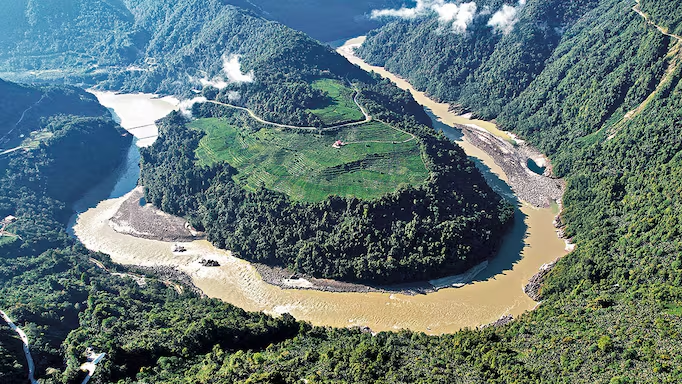
(Feature Image: Aerial view of the Yarlung Tsangpo’s Great Bend, Medog County)
Arunachal and other Himalayan states activists in a press conference in Delhi have rightly urged the Union Government to publicly demand from China all the features and dimensions of the Medog Dam on Yarlung Tsangpo river, their impact assessments and share the same promptly in public domain before even considering any project like the Siang Upper Multipurpose Project (SUMP). This is important since without knowing the features, dimensions, operating procedures and impact assessments, all the projections being made about the possible impacts of the projects are completely speculative and unfounded.
Demanding these is also within India’s right as per international norms and as per an order of the international Court that in fact, there should be joint impact assessments of any projects taken up by the upstream country on shared rivers. It is necessary to demand this publicly so that the world gets to know what is China’s response or non-response. We hope the Indian government will listen to this request from the citizens of Arunachal Pradesh and other Himalayan states.
Arunachal Pradesh Activists urge centre to find dimensions of China’s Motuo Dam before pushing SUMP The Arunachal activists urged the government to engage in dialogue with China to gain a clear understanding of the hydrology and dimensions of the Motuo dam publicly before pushing Siang Upper Multipurpose Project-SUMP. They accused the Centre of creating fear over China’s world’s largest dam on the Brahmaputra River to develop an 11,500 MW hydroelectric project in Arunachal Pradesh on the Siang River. During a press conference in Delhi, activists said that both the Union and state governments are suppressing public protests against the Pre-Feasibility Report (PFR) for the SUMP.
The project involves the construction of a dam that would be 300 meters high and would lead to the submergence of 27 villages, affecting around 150,000 members of the Adi tribe. “The Union and State governments are militarising the entire region to prevent people from organising protests,” said Bhanu Tarak, a lawyer and activist from Arunachal Pradesh. Another lawyer and protest leader, Ebo Mili, echoed these concerns. “The government is resorting to violent means to silence our protests,” he said, adding that state police have illegally detained him three times. Last December, 351 environmentalists, journalists, scientists, and civil society organisations sent a letter to the President of India, Droupadi Murmu, urging her to direct the government to withdraw security forces from the area. he proposed pre-feasibility report (PFR) surveys and pre-construction activities and other outreach activities are being conducted “by force” without the informed consent of the affected indigenous communities, members of the Siang Indigenous Farmer’s Forum alleged on Aug 03.
The villagers have also opposed the visit of local MLA and Rural Development Minister Ojing Tasing to the proposed survey site for the SUMP. The All Riew Students’ Union (ARSU) has rejected the signing of the MoU by Riew villagers for preparing the PFR for the proposed SUMP, saying the process lacked transparency. It claimed that many of the so-called signatories were not even legitimate heads of households and signed more than once for the same household or have done so without the knowledge or consent of the rest of the family.
Meanwhile, Tator Tapak, the gaon bura (GB) of Parong-II was placed under suspension with immediate effect for opposing the PFR study. Several GBs were served notices for their opposition to the project in December last year too. Many of the gaon buras and gaon buris have been leading the opposition to the project, as well as its pre-feasibility report assessment and proposed deployment of the Army to pave way for the study of the project.
China’s Medog Dam The project would involve drilling four to six 20-km tunnels and diversion of half of the river’s flow… The present strategy of quiet diplomacy with China is not working. Strangely, none of our readouts on recent high-level conversations with China have even mentioned the Medog project. Looking ahead, there must be strong signalling of our deep concerns about this project to China, both through diplomatic channels and in public comments. If the roles were reversed, there is absolutely no possibility of China being similarly circumspect.
The scope of the dialogue with China must be expanded beyond the issue of hydrographic data. As an affected party, we have every right to insist on full visibility on the technical specifications of the project, its environmental impact studies and how China proposes to tackle the seismic challenge. We must push for transparent and broader transboundary cooperation, similar to China’s engagements with Kazakhstan on rivers like the Ili and Irtysh, to protect our existing and proposed user rights and other interests as a co-riparian. Indeed, we should seek suspension of work on the project until the relevant issues have been addressed. There should be a clear message that China undertaking a massive project like this without taking on board our legitimate concerns will have consequences for bilateral relations.
India should reassess the quantum of water contributed by major tributaries and local hydrological systems using its remote sensing datasets, geospatial modelling tools and legacy hydrological data to reduce dependency on upstream data from China. We have the means and expertise to monitor the project and make the findings of those studies public. We must appreciate that India’s circumspection could be seen by China as a sign of weakness. This wouldn’t help in pursuing our larger agenda of rebuilding bilateral relations with our northern neighbour. (Ashok K Kantha, India’s former ambassador to China)
What kind of Project China is building at Medog? Officials from China’s Ministry of Water Resources have explicitly pointed out that the dam’s technical design adopts a run-of-river hydropower model, meaning it will not divert water from the Yarlung Zangbo’s natural course. This explanation is credible due to the geographical conditions in the lower Yarlung Zangbo region, which lack the natural topography necessary for building large-scale reservoirs. Consequently, the project utilizes a “bend-cutting and tunnel diversion” cascade development model, relying solely on water diversion and elevation drop to generate power. The volume of water stored within the tunnels is minimal, and the impact on downstream flow is negligible, fundamentally dispelling external concerns over “water storage and flood discharge.”
The project faces unprecedented challenges: the elevation exceeds 3,000 meters, with complex geological conditions, a fragile ecosystem, and an extreme climate.
Chinese response There is not much detailed Chinese response to the criticism it faces from Indian and international media to the Medog Project. One report in China Global South Project quotes former Global Times editor-in-chief Hu Xijin to reply to some of the criticism, but there are no additional details or information about the Chinese project. It possibly is translation of the Chinese report.
China shared info about Medog project with India? China’s foreign ministry statement on July 22 2025 included: “China has also conducted necessary communication with downstream countries regarding hydrological information, flood control, and disaster mitigation cooperation related to the Yarlung Zangbo project.” However, Indian government has not shared any of this information with the people of India, nor have they denied or challenged that China has not shared such information. Indian government should come out and share publicly all the information China has shared with it.
China not to withdraw any water from Yarlung Tsangpo? Reports from Dhaka said the Chinese envoy to Bangladesh Yao Wen has assured that its dam is solely for electricity generation and will not affect water flow to downstream countries. Mr. Yao conveyed the message during a meeting with Bangladesh Foreign Affairs Adviser Md Touhid Hossain during their meeting on July 21. “China will not withdraw or use any water from the project and the project will not affect downstream countries,” he was quoted as saying in a media report.
Alarmist projections without basis In this interview, Senior Supreme Court lawyer Mohan Katarki has suggesting that storage capacity of the proposed Medog dam is 120 BCM, possibly since storage capacity of Three Gorges Dam is a bit less than 40 BCM, so three times that would make it 120 BCM. But no basis for such alarmist proposition is provided and none is known. In fact if anything, the storage capacity of the proposed Medog dam is likely to be much smaller than that of Three Gorges Dam. Katarki is quoted saying that if 100 BCM is released by this dam, it would submerge Assam. All this is very alarmist indeed. Even if 1 BCM is released, it will submerge downstream, leave aside question of 100 BCM.
HYDRO POWER PROJECTS
Himachal Pradesh Aug 2025: Flashflood Damages Malana-I HEP in Again The latest disaster only proves that hydro project companies are paying no heed to safety restriction in construction activities during monsoon months and deliberately risking the lives of workers and projects. It is apparent that these companies are not willing to learn any lessons despite facing repeated destruction and disasters.
Uttarakhand Aug 2025: Rockslide at Vishnugad-Pipalkoti HEP For long, the locals have blamed the project developer for carrying out excessive blasting work resulting in weaking of the hills and cracks in homes in the area and disposing off construction muck and debris in the Alaknanda river. Only, in July 2024 a flash flood had damaged the project property and machineries apart from endangering the lives of several workers. The project is vulnerable to geological risks and has already suffered massive disaster and deaths in February 2021 Chamoli disaster.
Sikkim ‘No land, no home, no future’: Himalayan Lepchas on Teesta 3 “What was the hurry to give clearance for rebuilding even before the Central Water Commission and Central Electricity Authority cleared the design?” asks Himanshu Thakkar, coordinator of SANDRP. “The Environmental Impact Report (EIA) used was done before 2006, which didn’t consider the risk of a GLOF. It contributed to the disaster, and now the same flawed EIA is being used again. Even the dam safety report prepared after the collapse hasn’t been made public or considered for this decision.”
The night the flood hit, the dam’s power station was still operating. According to Thakkar, authorities had received alerts well in advance, but there were no standard operating procedures or emergency protocols in place about opening spillway gates during such situations. “And there has been no accountability since,” he added. Thakkar says he is deeply concerned that the dam is being rebuilt without taking into account the flood potential based on current rainfall patterns. “And what happens to the other downstream dams when this one releases excess water during the next flood?” he asked. “None of them are being redesigned to withstand that kind of excess flow.”
“People will have confidence only if decisions are based on proper impact assessments, considering all factors, and done in a transparent way,” Thakkar adds. “But that’s not happening now, which is why there’s scepticism about hydro projects among locals.” He says that Indigenous communities must be part of the decision-making process. “They’re the ones most at risk, and also the most knowledgeable.”
Subansiri Lower HEP The people of Gengi, Siberite, Tango, Ditten, Ossumpuri, and Durpai villages in Lower Siang district staged a dharna on July 28 in protest against the NHPC’s move to seek clearance from the National Dam Safety Authority to start the process of commissioning three units (250 mw each) of the Subansiri Lower Hydroelectric Project (SLHEP) in Gerakamukh. The villagers stated that until the issues concerning land acquisition and payment of fair and adequate compensation under the state’s Rehabilitation and Resettlement Policy, 2008 are resolved, the clearance should not be given to the NHPC. They also alleged that there has been a violation of the MoA signed between the Government of Arunachal and the NHPC.
Jammu and Kashmir The 1000 Mw Pakal Dul Hydroelectric Project in Kishtwar district is steadily moving toward completion and remains on schedule. Initiated in 2018, the project is being constructed on the Marusudar River, a tributary of the Chenab, and is slated for commissioning in 2026. As of May 2025, approximately 66 percent of the work has been completed. The Chenab Valley Power Projects Pvt. Ltd. (CVPPL) – a joint venture between NHPC Ltd. and the J&K State Power Development Corporation (JKSPDC) – announced a record 927 meters of tunnel boring, including tunnel lining, achieved in July 2025.
The Centre has also floated tenders for the construction of the long-pending 1856 MW Sawalkot Hydro Electric Project, nearly four decades after it was first conceived. The NHPC will oversee the project, with a sanctioned expenditure of Rs 209 crore, and a targeted completion timeline of 113 months. The Sawalkot project, a run-of-the-river hydroelectric plant on the Chenab River in the Ramban and Udhampur districts, was initially conceptualised in 1984 but had remained shelved for years due to objections raised by Pakistan under the IWT framework. The project is part of a broader plan by the government to construct seven key hydroelectric projects with a total installed capacity of 5,388 MW. These include 1000 MW Pakal Dul HEP, 624 MW Kiru HEP, 540 MW Kawar HEP, 1856 MW Sawalakote HEP, 390 MW Kirthai-I, 930 MW Kirthai-II and 48 MW small hydro initiatives.
Jharkhand Grim Story of Mandal / Kutku Dam in Palamu Story starts way back in 1971, but PM Modi laid foundation for a reduced height dam in 2019 from earlier proposed 367.28 m to now 341 m). The story includes the Aug 1997 episode when the Mandal dam (officially, North Koel Dam Project) gates “were closed” under a “conspiracy” to submerge protesting tribals of 32 villages.
The 1997 flood submerged approximately 32 villages within the Mandal dam’s reservoir area in Latehar and Garhwa districts of Jharkhand. About 21 lives were lost, and hundreds of cattle swept away or drowned. At the time of the floods, while major construction of the dam, in the gorge of the North Koel river, a tributary of the Son river, was done, it was not yet operational. The authorities blamed the floods on “debris jamming the dam gates,” causing an uncontrolled rise in the water level. But many villagers who witnessed the horror alleged that the gates were deliberately shut. “It wasn’t an accident,” states Mangru Singh of Saneya, one of the villages in the submergence area. “It was a conspiracy.” The dam is in the core area of the Palamu Tiger Reserve, also a PTR.
By 2015, the process for the Mandal dam construction was fast-tracked, and in 2018, new conditions were set along with a reduced dam height. The project received fresh clearance, and the dam’s height was lowered to 341 metres. In 2019, just before the Lok Sabha elections, Prime Minister Narendra Modi laid the foundation stone for the project. Thousands of villagers surrounded the Mandal dam site and raised slogans in protest. And the protest continues to date.
Saneya, one of the villages likely to submerge, is the birthplace of tribal heroes Nilamber and Pitamber, brothers from the Kharwar tribe. During the 1857 uprising against the British, they led local Adivasi groups in resisting unjust taxes and protecting their land. Even today, they are remembered in Jharkhand for their courage and fight for justice. “We hear the government say it has kept its promises,” says Mangaru Singh of Saneya village, pointing to Arun Singh, a direct descendant of Nilamber-Pitamber. “But even their family has not received a job.” The villagers refuse to relocate and are demanding fresh land documents, protection of the Nilamber-Pitamber land, and its development as a heritage village.
The original cost of the project was ₹300 million. So far, the government has spent ₹7.924 billion and estimates an additional ₹16.22 billion to complete it. As one travels across Palamu and Garhwa districts, wide but damaged canals lie scattered across the landscape. Many people purchased homes in the hope that they would no longer face water scarcity. However, water has yet to flow through these canals. Whether it will ever reach their villages remains uncertain — one can only wait and watch. “This is the first case where, except for the dam, everything else was constructed — canals, airport, colony, school, hospital, clubhouse, and more,” geologist DS Srivastava (who conducted dam impact assessment) concludes.
MoEF Decisions in minutes of EAC meeting held on July 11 2025: 1. Kadambari PSP closed-loop pumped storage project (1560 MW) in 286.1 ha at Village Kakdara & Kothar etc., Sub-dist –Bali & Pindwara Dist Pali & Sirohi, Rajasthan by Avaada Aqua Batteries Pvt Ltd – Terms of References: Approved (even after minutes noting water scarcity, excessive land requirements and asking the PP to optimise the same)
2. Khadkhai Medium Irrigation Project (Phase – II) on Khadkhai river with Culturable
Command Area of 5,394 ha and Submergence Area of 77.50 ha in Village Murgaghutu, Block Rairangpur, Dist Mayurbhanj, Odisha-Terms of References: Deferreed: EAC advised that the proponent and their consultant must ensure the presence of technically qualified and well-informed representatives.
3. Koyna-Nivakane (Closed loop) Pumped Storage Project (2450 MW) in 312.84 ha at Village Marathwadi, Tehsil Patan, District Satara, Mah by Adani Green Energy Ltd – Amendment in Terms of Reference: Approved
4. Renukaji Dam Project (40 MW) in 1988.27 ha at Village Dadahu, Dist Nahan, Himachal Pradesh by HP Power Corp Ltd – Validity Extension of Environmental Clearance: Approved till Oct 22 2027. Original Clearance dated Oct 23 2009.
Agenda of EAC meeting held on July 30. 2025 1. Khadakwasala Fursungi Tunnel Project substitute to New Mutha Right Bank Canal KM 1 to Km 34 in 23.8364 Ha at Village Akole, Rui etc, Subdist Indapur, Haveli, Pune City, etc. Dist Pune, Mah – Environmental Clearance
2. Etalin H.E. Project (3097 MW) in 1175.03Ha at Village Adapowa, Aguli, Emuli etc., Sub-dist Etalin & Anini, Dist Upper Dibang Valley, Arunachal Pradesh by SJVN Ltd– Env Clearance
3. Damanganga-Vaitarna-Godavari Intrastate Link Project in 1203.38Ha at Village Poshera, Kurnoli, Met Humbhachi etc., Sub-dist Mokhada, Igatpuri & Trimbakeshwar etc., Dist Palghar & Nashik by Godavari Marathwada Irrigation Development Corp-Terms of Reference
4. Kandhaura Pumped Storage Project (1680 MW) in 569.707 Ha at Village Sashnai Sub- dist Robertsganj, Dist Sonbhadra, Uttar Pradesh by JSW Energy PSP Six Ltd–Env Clearance
5. Sirkari-Bhyol Rupsiabagar Hydro Electric Project of 120 MW in 30 ha by UJVN LTD in Tehsil Munsiyari, Pithoragarh Dist (Uttarakhand) – Environmental Clearance
6. Extension, Renovation & Modernization (ERM) of Kamla Irrigation Project (CCA: 23,419.08 ha + 4,965.05 ha) in 26.7 Ha (additional) at Sub Dist Jainagar, Basopatti, Khajauli etc, Dist Madhubani, Bihar by Water Resources Dept, Govt. of Bihar– Terms of Reference
Relevant Agenda: FAC meeting on July 30 2025: 1. NON-FORESTRY USE OF 193.01 HA OF FOREST LAND FOR PUMPED STORAGE PROJECT (9X150MW) AT UPPER SILERU VILLAGE IN BETWEEN EXISTING GUNTAWADA RESERVOIR (UPPER RESERVOIR) AND EXISTING DONKARAYI RESERVOIR (LOWER RESERVOIR) IN FAVOUR OF ANDHRA PRADESH POWER GENERATION CORP LTD IN CHINTAPALLI DIVISION OF ALLURI SITHARAMA RAJU (ASR) DISTRICT
2. FOR DIVERSION OF 54.155 HA OF FOREST LAND IN VARIOUS VILLAGES OF SAGAR, SHIVAMOGGA WILDLIFE AND HONNAVARA DIVISIONS FOR SHARAVATHY PUMPED STORAGE-2000 MW IN FAVOUR OF THE CHIEF ENGINEER, KARNATAKA POWER Corp Ltd.
3. NON-FORESTRY USE OF 136.724 HA FOREST LAND CHHINDWARA IRRIGATION COMPLEX PROJECT BALANCING RESERVOIR (PANDHURNA DAM) UNDER PANDHURNA DISTRICT (FORMALLY IN CHHINDWARA DISTRICT) OF MADHYA PRADESH
4. NON-FORESTRY USE OF 43.149 for GANGA BAWARI TANK PROJECT UNDER NEEMUCH DISTRICT OF MADHYA PRADESH
5. 2250.05 HA (INSTEAD OF 2272.05 HA) FOREST LAND FOR MORAND – GANJAL IRRIGATION PROJECT IN HOSHANGABAD, BETUL, HARDA AND KHANDWA DISTRICTS OF MADHYA PRADESH IN FAVOUR OF NARMADA VALLEY DEVELOPMENT AUTHORITY
6. NON-FORESTRY USE OF 740.1592 HA RESERVE FOREST LAND for MUNJARI MAJOR IRRIGATION PROJECT UNDER SHEOPUR DISTRICT OF MADHYA PRADESH
DAMS
Kaleshwaram Project Ghose Panel Submits report The Justice PC Ghose one-man commission submitted its report to Telangana govt on July 31. Justice (Retd) Ghose handed over the nearly 650-page report, which runs into three volumes, to principal secretary, irrigation, Rahul Bojja at the secretariat. After a gazette notification on March 14, 2024, Justice (Retd) Ghose began his probe in May, 2024. Chief Minister A Revanth Reddy constituted a 3-member Official Committee to vet the report of the Ghose Commission. The Committee, comprising state Irrigation Secretary Prashant Patil, Secretary to Law and GAD departments, will examine the report and submit its synopsis to the state Cabinet on Aug 4.
Ghose Panel holds former CM responsible The Ghose Panel reportedly found fault with former chief minister K Chandrasekhar Rao, holding him directly and vicariously accountable for irregularities in planning, execution, completion and operation and maintenance of the three Kaleshwaram project barrages. Justice Ghose is said to have recommended criminal action against some engineers who admitted to following instructions from their superiors, even in matters such as filling the barrages.
The commission reportedly found fault with former ENCs C Muralidhar, B Hari Ram, A Narender Reddy, T Srinivas and Omkar Singh, who were held liable for false deposition before the commission. The engineers were also at fault for approving the designs without model studies, permitting poor construction quality, failing to ensure third-party vetting, and carrying out ineffective operation and maintenance. It also said the completion certificates were given for the Medigadda barrages despite these issues. Officers in the quality control wing were held liable for overlooking defects and leakages at the time of giving completion certificates.
Alamatti Dam Height Dispute Karnataka Industries Minister M B Patil on Aug. 01 dismissed Maharashtra’s claim that raising the height of the Alamatti dam on the Krishna river would cause floods in Sangli and Kolhapur districts. Asserting that this argument has already been rejected by the Krishna Water Disputes Tribunal, the Supreme Court, and even in the Lok Sabha, he termed Maharashtra’s objection as “politically motivated”.
Maharashtra government has sought the Centre’s intervention to ask the neighbouring state not to allow the increase in the height of the dam. In a letter to the Union Minister of Jal Shakti, C R Paatil, CM Devendra Fadnavis made a formal request. Fadnavis said that increasing the Full Reservoir Level of the dam from 519.6 metres to 524.256 metres would have serious consequences for those living in the Krishna river basin.
Fadnavis pointed out that the backwaters of Almatti have already been affecting several villages in Maharashtra. “Silt accumulation in the river and barrages has reduced the water-carrying capacity of the Krishna and its tributaries, slowing down the recession of floodwaters,” he said. The letter comes ahead of the 4 August meeting of Centre and State officials, where state Water Resources (Godavari & Krishna Valley Development Corporation) Minister Radhakrishna Vikhe-Patil is expected to ag concerns.
The Maharashtra government had asked the National Institute of Hydrology, Roorkee, to conduct a detailed hydrodynamic and simulation study of the impact of the backwaters of Almatti, and the final report is awaited. “It would not be appropriate to decide on increasing the dam’s height before receiving the related report… until this scientific study is completed, any decision to raise the dam’s height would be premature and potentially disastrous,” the Maharashtra CMO said.
Andhra Pradesh The State government has sanctioned Rs 489.28 crore for the long-pending Muktyala Lift Irrigation Project, reviving hopes among farmers in Jaggayyapeta and Nandigama mandals of NTR district. The project is expected to irrigate around 39,000 acres and meet the drinking water needs of approximately 30 villages. Officials will construct the project on the left bank of the Krishna River, near Muktyala village, about 4 km downstream of the Pulichintala Project in Jaggayyapeta mandal. The scheme is designed to lift 2.7 TMC of water, with the discharge of 386.27 cusecs, operating 16 hours per day over 120 days.
DAM SAFETY National Dam Safety Committee reconstituted The Centre has announced the reconstitution of the National Committee on Dam Safety (NCDS), which will function for a three-year term starting from its notification date. This was disclosed in a Gazette notification, as the committee has been revamped under the Dam Safety Act, 2021. Headed by the chairman of the Central Water Commission, the committee includes senior representatives from government bodies such as the National Dam Safety Authority, Central Electricity Authority, Ministry of Environment, Geological Survey of India, India Meteorological Department, and the Indian Space Research Organisation. In addition, the committee will feature officials from seven states: Karnataka, Punjab, Assam, Mizoram, Odisha, Maharashtra, and Uttar Pradesh. The revamped body, which includes three industry experts, has the mandate to invite additional national and international specialists as needed.
Madhya Pradesh Kalora Dam weir damaged in Guna In Guna, 12.92 inches of rain in just 24 hours damaged the Kalora Dam’s west weir by 15 feet on July 29, posing a serious threat to nearby villages. Authorities have deployed NDRF and army personnel for assistance. The west weir breach of the Kalora Dam in Bamori area led water to overflow into surrounding villages including Singapore, Tumda, Kurka, Bandha, Umardha, Baniyani, Mamli, and Biloda near the Rajasthan border.
The breach in Kalora Dam has raised fears of a complete collapse, threatening nearby villages. An NDRF team from Gwalior and an Army unit from Babina have reached the site. Emergency resources including boats, medical kits, and food supplies have been arranged. Kalora pond, constructed in 1956, has a storage capacity of 4.74 million cubic meters (MCM). It serves as a crucial irrigation source for the Padon area. Given the critical condition, the administration has issued alerts for eight villages in Guna and three in Rajasthan, affecting a total of 3,550 villagers.
Punjab Pong Dam to open Spillways soon: Alert The water level of Pong dam on Beas River in Himachal Pradesh, managed by BBMB, has crossed 1361 feet on Aug 2, over 32 ft higher than the level on the same date last year. The level now is less than 29 ft lower than FRL of 1390 ft and there has been further heavy rains in Beas catchment.
INTERLINKING OF RIVERS
Ken-Betwa Link project (KBLP): Out of the budgetary provision of Rs. 4469.41 crore, the actual expenditure incurred for the KBLP over the last three financial years amounts to Rs. 3969.79 crore. No protest has been observed as reported by the concerned Project Authority, District Administration and Forest Department. As per records available at the time of issuance of Section-11 under the Right to Fair Compensation and Transparency in Land Acquisition, Rehabilitation and Resettlement Act, 2013 (RFCTLARR Act, 2013), the project involves 7,193 Project Affected Families (PAFs). This information was provided by THE MINISTER OF STATE FOR JAL SHAKTI SHRI RAJ BHUSHAN CHOUDHARY in a written reply to a question in Rajya Sabha July 28.
The Govt. of India has approved the implementation of KBLP in December, 2021 with an estimated cost of Rs. 44,605 crore (year 2020-21 price level) with central support of Rs. 39,317 crore through a Special Purpose Vehicle viz. Ken Betwa Link Project Authority (KBLPA). Work for the main component of the project i.e. Daudhan dam has been awarded. A Project Management Consultant has been hired for assisting KBLPA for implementation of project. This information was provided by THE MINISTER OF STATE FOR JAL SHAKTI SHRI RAJ BHUSHAN CHOUDHARY in a written reply to a question in Lok Sabha on July 24. More than 17,000 trees are set to be felled in Madhya Pradesh for the project, including over 12,000 trees from within the Panna Tiger Reserve, the Ministry of Jal Shakti said on Monday.
KOSI-MECHI RIVER LINK PROJECT The Cabinet Committee on Economic Affairs (CCEA) has approved inclusion of Kosi Mechi Intra-State Link Project of Bihar under Pradhan Mantri Krishi Sinchai Yojana – Accelerated Irrigation Benefits Program (PMKSY-AIBP) of Ministry of Jal Shakti, on 28th March, 2025. The timeline for completion of Kosi Mechi Intra-State Link Project is March, 2029. The total estimated cost of the project is ₹6,282.32 crore with Central Share of ₹3,652.56 crore. This information was provided by THE MINISTER OF STATE FOR JAL SHAKTI SHRI RAJ BHUSHAN CHOUDHARY in a written reply to a question in Lok Sabha on July 24.
INTERSTATE WATER DISPUTES
Mahanadi Water Dispute Odisha and Chhattisgarh have agreed for an amicable settlement, prompting the Mahanadi Water Disputes Tribunal to grant additional time for negotiations. Upon being informed by the two States that they would give a chance for amicable settlement, the Mahanadi Water Disputes Tribunal (MWDT) chaired by retired Supreme Court judge Justice Bela M. Trivedi on August 2, fixed the next date hearing on September 6. However, the BJD has questioned the sincerity of the triple-engine government to bring closure to the matter. Former, CM Naveen Patnaik had protested construction of several barrages on the upstream of Mahanadi river by Chhattisgarh. But then BJP government headed by Raman Singh did not pay any heed to it. Earlier the former CM had demanded an all-party meeting to discuss the issue.
Mahadayi Water Dispute BJP MP and ex Karnataka CM Jagadish Shettar has condemned the statement of Goa CM Dr Pramod Sawant in the Legislative Assembly that Union Water Resources Minister Bhupendra Yadav has assured him that Mahadayi Project to divert the waters of Kalasa-Banduri nallah’s into river Malaprabha will not be allowed to be implemented. He said that claims made by the Goa CM were wrong and they cannot be accepted. Centre has not taken any such stand. Before this, Karnataka Deputy CM D K Shivakumar on July 24 stated that Karnataka would start work on the Mahadayi project while reacting to Goa CM’s statement. “We will withdraw our application from the Supreme Court and start the work. I will see who stops it,” Shivakumar said.
BBMB Despite stiff opposition from Punjab, the BBMB has cleared path for deployment of CISF in Bhakra Dam. BBMB is learnt to have deposited Rs 8.5 crore with the Union Ministry for Home for deployment of Central Industrial Security Force (CISF) in BBMB. The issue of deployment of CISF in BBMB is likely to generate more political heat in the coming days with Punjab Government vehemently opposing it. Meanwhile, Punjab finance minister Harpal Singh Cheema on July 29 said the state govt had sought a pending payment of Rs 113.24 crore for operations and maintenance of the Bhakra canal from Haryana govt, as part of an effort to recover dues owed of BBMB partner states.
IRRIGATION
PMKSY Presently, 58 clusters comprising of 5,861 Surface Minor Irrigation (SMI) and Repair, Renovation, and Restoration (RRR) of Water Bodies schemes are included under the SMI/RRR component of the Pradhan Mantri Krishi Sinchayee Yojana – Har Khet Ko Pani (PMKSY-HKKP). The total estimated cost of these schemes is Rs. 9,965 crores. The central assistance liability for these schemes during the 15th Finance Commission period amounts to Rs. 5,449 crores. This information was provided by THE MINISTER OF STATE FOR JAL SHAKTI SHRI RAJ BHUSHAN CHOUDHARY in a written reply to a question in Lok Sabha on July 31.
URBAN RIVERS
River Cities Alliance National Mission for Clean Ganga (NMCG) has approved an action plan for River Cities Alliance (RCA) for the year 2025. The major thrust of the plan is to promote river considerations within city master plans by organizing River Sensitive Master Planning training programs across different States. This information was provided by THE MINISTER OF STATE FOR JAL SHAKTI SHRI RAJ BHUSHAN CHOUDHARY in a written reply to a question in Rajya Sabha on July 28.
Sabarmati Gujarat’s most polluted River In a written reply to a query raised by Member of Parliament from Surat, Mukesh Dalal, the Union Ministry of Jal Shakti has confirmed that the Sabarmati river has the most polluted stretch among all rivers in Gujarat. The Sabarmati River, between Raysan and Vautha, recorded the highest BOD level at 292 mg/litre, indicating severe pollution. Providing information on the measures to prevent pollution of rivers in Gujarat, the minister said in his reply that pollution abatement schemes for conservation of Sabarmati, Tapi and Mindhola rivers were sanctioned at a total cost of Rs 1,875.29 crore and sewage treatment capacity of 697 MLD was created.
Mula-Mutha; Pune Citizensoppose tree felling for RFD The civic body has given a deadline of July 30 to voice objections. However, resident activists and environmentalists are raising a lot of questions about this decision and are urging people to come forward and submit their objections.
Mithi; Mumbai City lets down river ecologically What lies at the core is Mumbai’s land-water relationship. The Mithi has been restricted by design. It must be recognised as a river with a thriving ecosystem and made ecologically sustainable. (Smruti Koppikar and Jashvitha Dhagey)
‘Give the river back its space’ São Paulo and Mumbai are similar in that the cities have seen massive urbanisation at the cost of rivers. The Tietê and Pinheiros rivers, in the Brazilian city, and the Mithi in Mumbai are choked by myopic policies and apathy. “We need to move beyond the utilitarian vision and ask ourselves, what is the role that rivers can play as active participants in the city…rivers can be choreographed and managed, but not controlled and dominated,” says Ecuadorian architect Felipe Correa, who visited and studied the Mithi, in this interview to Question of Cities.
Hooghly; Kolkata City not celebrating river The iconic river, immortalised in cinema, songs and art, hardly has a happy relationship with the city. Visible for barely 1.5 kms, its banks and the ghats have garbage, debris, faecal matter, crumbling structures of the British era, derelict factories. Only the working-class people commuting by ferries and street dwellers use the Hooghly; the rest of Kolkata merely passes by it. Plans to clean and develop its banks are many but the government’s piecemeal approach means the river’s disconnect with the city continues. It’s as if the Hooghly hides in shame.
Musi; Hyderabad In a review meeting on July 29, the CM directed officials to expedite the development works under the Musi Riverfront project, particularly the stretch from Himayat Sagar to Gandhi Sarovar. He asked officials to plan and construct bridge-cum-barrages on the river and secure all necessary permissions without delay. On the other hand, several encroachments starting from Chaderghat bridge up to the old Osmania General Hospital have been cleared up by HYDRAA on July 29. Majority of which were being used as parking for heavy vehicles including district buses. The river was being filled up and levelled before temporary sheds were constructed and leased out. The action was taken after a series of complaints. Locals expressed concerns over sheds being built on the riverbed, which were then rented out for parking buses and trucks, as well as for other commercial ventures, including nurseries.
RIVERS
Need to evaluate the impact of the 2018 Environmental Flow Notification: CR Patil Union Minister C.R. Patil highlighted the need to evaluate the impact of the 2018 Environmental Flow Notification. He stressed that a robust and holistic action plan must be developed to enhance water flow in rivers to preserve river ecosystems and ensure balanced use of water resources.
Shri C R Patil emphasised the need to assess whether the current e-flow framework needs improvement or augmentation to better safeguard the Yamuna River’s ecosystem. He called for concrete strategies and comprehensive plans to improve the water flow in Yamuna, especially in regions facing excessive water usage and pollution challenges.
Union Minister issued clear directions to expedite the assessment of all programs related to environmental flows. Timely evaluation of their effectiveness will help ensure that actions taken are aligned with the goal of preserving river ecosystems. He also called for strengthening decision-making processes to maintain ecological balance and improve water management systems.
The National Mission for Clean Ganga (NMCG) has approved several studies to assess environmental flows in the Ganga basin. These include assessments by NIH Roorkee for Chambal, Son, and Damodar. IIT Roorkee has been tasked with assessing e-flows in the Ghaghara and Gomti sub-basins.IIT Kanpur has been given responsibility for assessing E flow in Kosi, Ganda, and Mahananda. Shri Paatil emphasised the need for extensive discussions with all the stakeholders during these studies so as to have more balanced outcomes.
Loksabha River Pollution Control Progress Under Namami Gange Program, a total of 212 sewerage infrastructure projects involving laying of 5220 km of sewer network and sewage treatment capacity of 6540 MLD have been taken up. Out of that, 136 projects have been completed resulting creation/rehabilitation of sewage treatment capacity of 3781 MLD. Out of the total expenditure of around Rs. 20,000 crores under Namami Gange Program so far, during last 5 years around Rs.10,500 crore were spent towards implementation of various projects.
NRCP has so far covered 57 rivers in 17 States in the country at a cost of Rs.8970 crore, and total sewage treatment capacity of 2945 MLD has been created in identified towns. An amount of Rs.1677 crore was released during last 5 years under the scheme for implementation of projects.
As per the directions of National Green Tribunal in OA No.673/2018, States/UTs have prepared action plans including sewage management in identified cities/towns for restoration of polluted river stretches in their jurisdiction. Implementation of these action plans is reviewed at State level and also at the Central level from time to time. This information was provided by THE MINISTER OF STATE FOR JAL SHAKTI SHRI RAJ BHUSHAN CHOUDHARY in a written reply to a question in Lok Sabha July 31.
Study Monsoon Rainfall Declining in Meghna-Barak Basin? The climate crisis is reshaping the hydrology of the Barak-Meghna basin — an 82,000 sq km lifeline for over 50 million people in India and Bangladesh. Experts warn that monsoon rainfall is declining, while pre- and post-monsoon showers are increasing, triggering flash floods and threatening the communities like the indigenous Khasi, Garo and Jaintia who rely on the river’s ecosystem. These findings emerged from a three-day dialogue, “Building Community and Ecosystem Resilience to Climate Change,” hosted by the Meghna Knowledge Forum II from July 23-25 in Bangkok. The event was organised by the International Union for Conservation of Nature (IUCN) with South Asian University (New Delhi) and the Asian Institute of Technology (Bangkok).
Extreme river flood exposes latent erosion risk Our investigation highlights the challenges of re-engineering rivers in the face of climate change, increased flood risks, competition for river widening space, and calls for a better understanding of the subsurface.
Jammu & Kashmir Brari Nambal battles for survival Brari Nambal has immense ecological importance for Dal Lake as it regulates its hydrology. However, in absence of conservation measures, the water body has been marred by encroachments and pollution.
Himachal Pradesh No govt building within 150 m of rivers The CM has made an ad hoc statement that no government institution in Himachal Pradesh will be built within 150 m of the rivers. While at one level this sounds good, what is the meaning of such a statement until it gets written in policy and then in law? How do you define a river? Are all streams also considered rivers? From where you measure 150 m? From middle of river or from river bank, and what is definition of river bank? If one finds a govt structure violating this, what remedy one can seek? What about the non-govt buildings, that invariably comes with sanction of the govt? Many such ad hoc statements including from courts have come and gone in the past without implementation. So unless the statement gets systematic, policy and legal support, it is likely to remain meaningless.
Kerala Villagers unite for river’s revival People have once again begun ocking to the banks of the Kolarayar, as the river shows signs of life thanks to a community-led cleanup initiative. The collective effort to remove water hyacinths and weeds that had choked the river’s ow has been kick-started under the leadership of the Kolarayar Protection Council. The council, formed eight years ago with the motto ‘Let the Kolarayar ow,’ was established to revive the dying waterbody. Today, it is back in action, determined to restore the 11-kilometre-long river that originates at Arakkal Muyppu and ows through the Kadapra and Niranam panchayats before merging with the Areethodu stream. As part of the ongoing campaign, a 1.5-kilometre stretch between Poovanmeli and Ilanjikkal Bridge, where the river meets the Areethodu canal, has already been cleared of invasive vegetation. The committee has decided to continue the cleanup in the coming days.
Chhattisgarh Riverine agroforestry restores the Lilagar River With roots in tradition and eyes on the future, Chhattisgarh’s farmers are restoring rivers through agroforestry. Along the fragile banks of the Lilagar River in Chhattisgarh, a detailed study has shown that planting the right trees in the right places could be the key to restoring not just farmland but the rivers themselves.
The Lilagar River, a 135-kilometre-long tributary of the Sheonath River, flows through the Bilaspur and Janjgir-Champa districts of Chhattisgarh. It has long served as a lifeline for agriculture and human settlements in the region. But over the past few decades, increasing anthropogenic pressures, particularly sand mining and land-use change, have degraded its catchment and compromised its year-round flow. The researchers strongly recommend making agroforestry a central part of river and ecosystem conservation plans. This includes weaving it into existing efforts like the Namami Gange programme and catchment development schemes under the Jal Shakti Abhiyan. They also urge policymakers to recognise agroforestry in India’s climate goals, such as the Nationally Determined Contributions (NDCs) and state climate action plans.
Madhya Pradesh ‘Unmarried’ River A popular legend speaks of Narmada’s love for the handsome river Son. Just before their wedding, Narmada discovers Son’s affection for another river, Johila. Heartbroken, she changes her course, flowing westward—away from Son—and vows to remain unmarried. Interestingly, all three rivers—Narmada, Son, and Johila—originate from the same Maikal ranges in Madhya Pradesh. Geologists attribute this unusual flow to the presence of a rift valley — a geological formation where land between two faults sinks, creating a natural westward slope. This gradient causes the Narmada to flow from east to west, unlike most rivers in India.
GANGA NMCG fund allocation The budgetary allocation [Revised/Final Estimates (RE)] for the Namami Gange Program from financial year (FY) 2014-15 to FY 2024-25 was ₹ 23,424.86 crore. The Budget Estimates (BE) for FY 2025-26 are ₹ 3,400 crore. Thus, the total budgetary allocation for the Namami Gange Program since inception up to FY 2025-26 is ₹ 26,824.86 crore. A total of 502 projects have been sanctioned under the Namami Gange Program for the rejuvenation of the River Ganga and its tributaries. Out of these, 323 projects have been completed. This information was provided by THE MINISTER OF STATE FOR JAL SHAKTI SHRI RAJ BHUSHAN CHOUDHARY in a written reply to a question in Lok Sabha on July 31.
NMCG Achievements A total of 212 number of sewerage infrastructure projects costing ₹ 34,526 crores have been taken up for remediation of polluted river areas with treatment capacity of 6,540 MLD. 136 STP projects with a capacity of 3,780 MLD have been completed and made operational;
For industrial pollution abatement, 3 nos. of CETPs have been sanctioned, i.e., Jajmau CETP (20 MLD), Banther CETP (4.5 MLD), and Mathura CETP (6.25 MLD). Two projects, Mathura CETP (6.25 MLD) and Jajmau CETP (20 MLD), have been completed. As of 30th June 2025, a total of 167 STPs have been made operational, resulting in the creation of a total sewage treatment capacity of 3,781 MLD.
Under the Namami Gange Program, from Financial Year 2014–15 up to 30th June 2025, the NMCG has disbursed a total of ₹19,679.84 crore to various agencies for the implementation of approved projects and interventions. This information was provided by THE MINISTER OF STATE FOR JAL SHAKTI SHRI RAJ BHUSHAN CHOUDHARY in a written reply to a question in Lok Sabha July 31.
Water quality monitoring A total of 502 projects has been sanctioned under the Namami Gange Program for the rejuvenation of the River Ganga and its tributaries. Out of these, 323 projects have been completed, 150 are currently under implementation, and 29 are at the tendering stage. This information was provided by THE MINISTER OF STATE FOR JAL SHAKTI SHRI RAJ BHUSHAN CHOUDHARY in a written reply to a question in Lok Sabha on July 24.
Ganga sustained in summer by gw discharge A study carried out by IIT-Roorkee researchers has found that the Ganga is primarily sustained by groundwater discharge during the hot and dry summer months, not glacial melt as widely believed. The pioneering study published in the journal Hydrological Processes based on a full-scale isotopic analysis of the Ganga from its Himalayan origins to its deltaic end, including its major tributaries, offers a paradigm shift in understanding how the mighty river is sustained during the hot and dry summer months.
The study challenges long-held assumptions by establishing that up to Patna in Bihar, the Ganga is primarily sustained by groundwater discharge and not glacial melt. This natural underground contribution boosts the river’s volume by nearly 120 per cent along the middle stretch. Meanwhile, more than 58 per cent of the river’s water is lost to evaporation during summer—an alarming yet overlooked component of the river’s water budget.
Uttar Pradesh How Noon river was “revived” According to this report, 48.5 km long Noon River flowing near Kanpur has been revived through the efforts of 34 gram panchayats, officers, using drone mapping and removal of water hyacinth. The river originates from Rampur Naura village and meets Ganga near Bithoor. In UP all districts have been asked to revive one river and Kanpur has selected Noon River. Interestingly, the work for river revival started on Feb 22 and is already finished.
Bihar Largest river dependent population With over six million inland fishers, Bihar holds India’s largest river-dependent population.
YAMUNA Delhi Encroachment surges on floodplains The South Asia Network on Dams, Rivers and People (SANDRP) has written to Delhi CMer Rekha Gupta, LG Vinai Kumar Saxena, and other concerned officials, seeking immediate intervention to stop these activities, which it says pose a serious ecological threat. SANDRP stressed the importance of protecting the eastern floodplain, which is lower in elevation and gets submerged during every medium to high flood. Continued encroachment, it warned, is undermining the floodplain’s natural ability to buffer floods and recharge groundwater. With downstream infrastructure already limiting the Yamuna’s flood-carrying capacity, the group argues that protecting the remaining floodplain is essential for the city’s safety and resilience.
Eviction floodplain farmers: Crisis of Social Citizenship The eviction of urban farmers from the Yamuna floodplain in the name of restoration and rejuvenation raises a question about the right of the community and the state’s responsibility to protect their rights. Ecological conservation is essential, but such efforts expose deeper social and political issues of communities in terms of deepening their marginalization and unequal social citizenship. Social activist, Bhim Singh Rawat (SANDRP), argues that “DDA is altering the natural floodplain by restricting farming and developing biodiversity parks, permitting recreational activities in these ecologically sensitive areas. They argue that biodiversity parks are more of a revenue-generating projects that serve to the interests of the urban elite by providing green spaces, and a riverfront walk in the evening at the cost of the livelihoods and well-being of the urban poor.”
A comprehensive approach that addresses all facets of river management is essential to tackle the Yamuna issue. Experts advocate the need of a comprehensive water policy for Delhi to navigate these challenges. In 2017, the INTACH, prepared a water policy for DJB, which could serve as a starting point. Only through holistic, integrated efforts can the Yamuna truly flow. (Ritu Rao)
River city’s relations with river The Yamuna has little resonance for most Delhiites but, for the few who still interact with it, it offers a connection. A photo essay to capture the connect and the disconnect with the river. (Umer Ahmed). Meanwhile, the river is brimming after a rainy July, marking the 22nd rainiest July since 1901 in terms of rainy days.
Progress in cleaning river As per the information provided by the Delhi Jal Board (DJB), the estimated sewage generation in Delhi is 3,596 MLD. The total installed capacity of 37 operational STPs of DJB is 3,474 MLD. As of June 2025, the capacity utilization of these STPs was 2,955 MLD of which 2,014 MLD of treated sewage from 23 STPs complied with the discharge standards prescribed by the Delhi Pollution Control Committee (DPCC) and 14 STPs are non-compliant to DPCC norms. Further, about 641 MLD of sewage remains untreated and enters the river or drainage network, contributing to pollution in the Yamuna.
Under the Namami Gange Program (NGP) for the rejuvenation of River Yamuna, 9 projects have been sanctioned for the creation of a sewerage treatment capacity of 1,268 MLD at a cost of ₹ 1,951 crores. All of these projects have been completed. The total funds of ₹ 140 crores have been allocated by NMCG and the Govt of NCT of Delhi for Yamuna cleaning since January, 2025; Out of which ₹ 108.31 crores have been utilized. This information was provided by THE MINISTER OF STATE FOR JAL SHAKTI SHRI RAJ BHUSHAN CHOUDHARY in a written reply to a question in Lok Sabha on July 31.
‘Release only treated water into river’: HC The Delhi High Court has directed the DJB and Municipal Corporation of Delhi (MCD) to file a joint report highlighting the action plan to be undertaken by them to overcome the shortcomings highlighted by a special committee on the issue of discharge of water from all STPs into the Yamuna River. A division bench comprising Justice Prathiba M Singh and Justice Manmeet Pritam Singh Arora perused a report filed by the Special Committee and said that enormous amount of work needs to be undertaken by civic agencies in the national capital to ensure that only treated water is discharged in the river.
The Court thus directed the members of the Special Committee to hold a meeting with all the above agencies on August 07, which shall be attended by the relevant officials of DJB, MCD, DSIIDC as also the DPCC, as also any other authorities or agencies whose cooperation would be required. “After the said meeting, the officials may agree to hold further meetings in this regard, if necessary and finally, the DJB and MCD shall file their joint report and the action plan for addressing various shortcomings, deficiencies and improvements as pointed out by the Special Committee,” the Court said.
Govt plans to install boom barriers on Shahdara drain outfall The Irrigation and Flood Control department (I&FC) project is likely to cost ₹10 lakh, the tender said. Work is required to be completed within 75 days of awarding of the tender, it said. The boom barrier should have a tensile strength of 180–200kg and a minimum guarantee period of one year has been mandated for the material, the tender adds, stating work will be carried out under the supervision of the executive engineer of the I&FC’s civil division 3.
Haryana Cast-off capital Over the past two decades Panipat, a city in Haryana known in Indian history for three major battles, has emerged as one of Asia’s largest processors of textile waste. Ashok Kumar finds that the city has a large number of illegal bleaching and dyeing units, essential in the conversion of scrap cloth into low-quality thread. These units discharge contaminated water into drains that merge with the Yamuna river.
Uttar Pradesh Floodplains to be marked across 17 districts by March The irrigation department has informed the NGT that the project to physically mark the Yamuna floodplains with visible boundary indicators will begin in Oct, following the completion of the tendering process in Sept. In an affidavit submitted to the tribunal, the department said over 21,000 physical markers (‘muddis’) will be installed at 200-metre intervals along both banks of the river across a 1,056-km stretch spanning 17 districts from Gautam Buddh Nagar to Prayagraj. The project is expected to be completed by March next year. The development comes months after the NGT imposed a penalty of Rs 50,000 each on the ministry of jal shakti and the central water commission in July last year for failing to act on floodplain demarcation, following a letter petition by Agra-based environmentalist Sharad Gupta.
Noida NGT seeks fresh report on illegal buildings The NGT has expressed dissatisfaction with Noida Authority’s response regarding illegal residential and commercial constructions. The tribunal, chaired by Justice Prakash Srivastava on July 28, directed the Authority to submit a fresh affidavit within three weeks along with specific details about individuals, properties, projects, and their locations.
FISH, FISHERIES, FISHERFOLKS
West Bengal Kolkata chooses Myanmar & Gujarat fish In a notable shift in consumer preference, hilsa enthusiasts in Kolkata have begun embracing fish arriving from Myanmar’s Irrawaddy and Gujarat’s Narmada, previously deemed inferior to the varieties sourced from Bangladesh’s Padma or Rupnarayan in Kolaghat. Over the past five days, hilsa caught during migration from the Arabian Sea to the Narmada estuary in Gujarat have been arriving in Kolkata in truckloads. Approximately five trucks from Gujarat, carrying 60 tonnes of hilsa, have been reaching Bengal daily.
Traditionally, hilsa from Padma arrives in Kolkata ahead of Durga Puja. Although more expensive, priced at Rs 1,800-Rs 2,200 per kg, Bangladeshi hilsa is eagerly purchased by ilish-loving Bengali households. Hilsa from the Arabian Sea is believed to be less flavourful than those caught in the Bay of Bengal. However, with serious doubts over the arrival of Bangladeshi hilsa this year due to current political tensions between India and Bangladesh, Kolkatans who once avoided hilsa from other regions are now queuing for them.
SAND MINING
Goa Mandovi river mining EC challenged in NGT The Goa River Sand Protectors Network has challenged the environmental clearance (EC) granted for sand mining by the Goa State Environment Impact Assessment Authority in the NGT. The NGT has admitted the appeal. The matter will be heard next on Aug 13.
Maharashtra SOP for M-Sand Policy finalized The govt on July 29 finalised the Standard Operating Procedure (SOP) for implementing the Artificial Sand (M-Sand) Policy aimed at completely stopping sand mining from rivers in the state. As per the Government Resolution issued by the Revenue Department, information on suitable land for M-Sand units on public and private properties will be compiled and made available on the ‘Mahakhanij’ for auction. A registered undertaking will be required for setting up M-Sand units.
Karnataka Another panel formed to probe illegal mining The Cabinet on July 02 formed a sub-committee headed by Law and Parliamentary Affairs Minister H K Patil to look into the illegal mining issue. The Cabinet’s decision comes after Patil wrote a scathing 7-page letter to CM Siddaramaiah, in which he had accused the government of “apathy” on the issue and urged the CM to take measures.
Uttarakhand Committee formed to seal stone crushers The Haridwar district administration on July 31 constituted a multi-departmental committee to initiate sealing operations of stone crushing units along the Ganga riverbank, following high court directives. Starting Aug 1, the committee will begin sealing 48 stone crushers located between Raiwala and Bhogpur. The HC on July 30 ordered the closure of 48 stone crushers operating in Haridwar, directing authorities to snap their electricity and water connections immediately.
Bihar ₹131cr sand mining scam The Enforcement Directorate has written to the Bihar government flagging an alleged over Rs 131 crore worth sand mining scam in Banka district that has potential links to certain politicians and their associates.
WETLANDS, LAKES, WATER BODIES
Kerala HC orders formation of wetland body to save Ashtamudi Lake The Kerala High Court on July 29, 2025 has directed the State government and the State Wetlands Authority to constitute a dedicated Ashtamudi Wetland Management Unit and create a public feedback mechanism for reporting pollution, encroachments and ecological violations affecting the Ramsar-designated Ashtamudi lake.
-The Court observed that despite the ecological importance of Ashtamudi lake, the State had failed to establish a dedicated authority or implement a site-specific conservation plan. It noted that various government departments and local bodies were functioning in isolation, resulting in fragmented and ineffective conservation measures. Recognising this, the Court directed the State to formally constitute the Ashtamudi Wetland Management Unit within two months and convene its first meeting within two months of notification.
WATER OPTIONS
Desilting of Waterbodies The Govt of India has released Rs. 545.35 crore as central assistance to various States under the Repair, Renovation, and Restoration (RRR) of Water Bodies scheme, a component of the Pradhan Mantri Krishi Sinchayee Yojana – Har Khet Ko Pani (PMKSY-HKKP), from the financial year 2016–17 up to 31st March 2025. As a result, an irrigation potential of 1.20 lakh hectares has been restored, and 191 million cubic meters (MCM) of water storage capacity has been revived as of March 2025. State-wise details are provided in below. This information was provided by THE MINISTER OF STATE FOR JAL SHAKTI SHRI RAJ BHUSHAN CHOUDHARY in a written reply to a question in Lok Sabha on July 24.
Master Plan for Artificial GW Recharge– 2020 has been prepared by Central Ground Water Board (CGWB) in consultation with States/UTs which is a macro level plan indicating various GW recharge structures for the different terrain conditions of the country. The plan aims to construct approximately 1.42 crore such structures across India, potentially harnessing about 185 Billion Cubic Meters (BCM) of rainwater.
Moreover, under the umbrella campaign of Jal Shakti Abhiyan (JSA) being implemented by this Ministry, during the period 2021-2025 construction/renovation of 1.14 crore artificial recharge, rain water harvesting and other water conservation structures at an estimated cost of Rs. 1.18 lakh cr have been coordinated across the country in convergence with MGNREGS. This information was provided by THE MINISTER OF STATE FOR JAL SHAKTI SHRI RAJ BHUSHAN CHOUDHARY in a written reply to a question in Lok Sabha July 24.
GROUNDWATER
Review of GW action plan Ministry had drafted a Model ‘Groundwater (Regulation and Control of Development and Management) Bill’ providing a regulatory framework to curb indiscriminate extraction of ground water while also making provisions for rain water harvesting and artificial recharge. The Model Bill has been circulated to all States/UTs and so far 21 States/UTs have adopted it. Further, the Central Ground Water Authority(CGWA) has been established under the Ministry, which is regulating the extraction of ground water for industrial and other commercial purposes in 19 states and UTs, in accordance with the provisions of its Guidelines dated 24.09.2020, which have pan India applicability. The Guidelines have stringent measures to regulate unlawful extraction which include imposition of heavy Environmental Compensation (EC) charges, penalties and even sealing of bore wells in certain cases. This information was provided by THE MINISTER OF STATE FOR JAL SHAKTI SHRI RAJ BHUSHAN CHOUDHARY in a written reply to a question in Lok Sabha on July 31.
Punjab Not included in ABY The Union minister of jal shakti, CR Patil, on July 30 stated in Parliament that Punjab has not been included in providing funds under the Atal Bhujal Yojana for groundwater management. He was replying to a question by Rajya Sabha MP Vikramjit Singh Sahney. Sahney had demanded that on the pattern of states like Haryana, Uttar Pradesh, Madhya Pradesh, Maharashtra, Rajasthan and Gujarat, where a sum of ₹3,800 crore has been allocated, Punjab should also be included in the scheme, especially when it is among the most groundwater-stressed states in India.
URBAN LAKES, WETLANDS
Bengaluru Bill amends size of lakes’ buffer zones The State Cabinet’s approval of the Karnataka Tank Conservation and Development Authority’s (Amendment) Bill, 2025, has left ecologists, limnologists, and lake activists in a state of concern. The Bill has amended the size of buffer zones around lakes in the city. As per the amendment, the buffer zone will now be down to 3 metres from the boundary of a lake measuring up to one acre.
It will be 6 metres for lakes between one and 10 acres in size, 12 metres for lakes between 10 and 25 acres, 24 metres for lakes between 25 and 100 acres, and 30 metres for lakes above 100 acres in size.This implies the 30-metre uniform buffer zone rule around every lake will be replaced with the new rule, redefining the size of buffer zones based on size of the lakes. Experts say the Bill is unrealistic and is a classic example of an amendment made sitting in ivory towers.
The decision to reduce lake buffer zones and allow construction closer to waterbodies has alarmed lake protection volunteers. They fear the move could weaken environmental safeguards, legitimise past violations, and allow new encroachments.
Unwise to dilute lake protection law By proposing to amend the Karnataka Tank Conservation and Development Authority Act, the state has not only undermined Supreme Court and NGT orders but also given in to the very forces that have historically plundered the city’s water bodies.
Meanwhile, 472 acres of lake land encroachment have been identified by BBMP, and the civic body has so far managed to reclaim only 17.38 acres. As per sources, among the surveys done on 136 lakes, BBMP managed to remove encroachments on 29 water bodies. On 31 lakes, only government encroachments have been recorded. On the other hand, the BBMP is currently in the final stages of rejuvenation 7 lakes in the city. However, environmental activists and civic volunteers have raised concerns about possible oversights that could harm the ecological balance of these water bodies and undermine years of rejuvenation efforts. In addition to these seven lakes, BBMP is also rejuvenating over 20 more lakes with a budget of ₹50 crore. Another ₹65 crore, allocated under the National Disaster Mitigation Fund (NDMF), will be used to rejuvenate seven additional lakes: Hebbal, Nagawara, Sompura, Chikkabellandur, Arekere, Halsur, and Kalkere lakes.
Mysuru ₹40 cr facelift for 6 Lakes In a bid to combat rising pollution and transform these water bodies into public spaces, six major Lakes including Dalvoy Lake on Mysuru-Nanjangud Road, will soon undergo large-scale restoration. The total cost of the Lake rejuvenation project is estimated at Rs. 40 crore: Dalvoy Lake – Rs. 15 crore; Huyilalu, Hinkal, Devanur, Bugathagalli and Vajamangala Lakes – Rs. 5 crore each. In addition, several smaller Lakes near these water bodies will also be restored.
Delhi DDA plans to start Bhalswa lake conservation The Delhi Development Authority (DDA) is discussing a proposal to start conservation and rejuvenation work on Bhalswa Lake in north-west Delhi. DDA has floated a tender for a specialised project focused on soil investigation and structural designing of a reinforced cement concrete (RCC) wall along the lake to demarcate it from the landfill site. The estimated cost of the project for initial soil investigation is ₹2.54 lakh and the work is expected to be completed within two months, officials said.
Bhalswa Lake was formed from a meandering loop left behind by the Yamuna. The lake has now been encroached by landfill, settlements and the sprawling Bhalswa Dairy colony. Cut off from the Yamuna by an embankment built in 1964, Bhalswa Lake has since lost its primary natural water source.
Plan to revive Naini LakeAnnouncing the redevelopment plan on July 30, tourism minister Kapil Mishra said the revamp decision was taken in a planning meeting he held with officials from Delhi Tourism and the Delhi Tourism and Transport Development Corporation (DTTDC). Among the major upgrades planned are a state-of-the-art laser show on the lake’s central island, an upgraded musical dancing fountain, and the installation of two new LED fountains to enhance the visitor experience. The lake will also be opened to a range of water activities including shikara and gondola rides, racing boats, and water scooters.
URBAN WATER
Chennai Plan to increase Poondi’ capacity pending for 4 years The department had planned to increase the Full Reservoir Level (FRL) by two feet – from the present 35 feet to 37 feet. A senior WRD official said the DPR prepared last year estimated the project to cost Rs 552.60 crore. However, the report has still not been taken up with the state government since it is still under the consideration of the WRD. The official said that feasibility studies have already been done at a cost of Rs 48 lakh for the project.
Storage of Poondi reservoir last increased between 1990-96 under Krishna Water Supply Project from 2.750 tmcft to 3.231 tmcft by raising FRL from 33 to 35 feet. CMWSSB now requires 1,150 MLD to meet the city’s water demand. The govt has also planned the construction of a new reservoir near Thiruporur at an estimated cost of Rs 471 crore with a capacity of 1.6 tmc. Though the estimated cost is lesser than the cost estimated for increasing Poondi’s capacity, sources said the construction of a new reservoir, is going to take a longer time with escalation of budgeted cost.
Bengaluru 43K illegal sewage connections detected By matching consumer databases from Bescom and BWSSB, the water authority has identified nearly 43,000 illegal sewage connections in the past two months. Many violators are large apartment complexes, with penalties ranging from Rs 50 lakh to Rs 1 crore, a senior official said. The BWSSB is willing to regularise these connections if violators pay the ne and applicable connection charges.
Delhi DJB withdrew water bill rebate The Delhi Jal Board (DJB) has informed the NGT that it has withdrawn a 10% rebate granted in water bills from 119 societies in Dwarka, and issued disconnection notices after rainwater harvesting (RWH) systems there were either found missing or dysfunctional. The water agency has also written to the Delhi Pollution Control Committee (DPCC) to impose an environmental compensation (EC) on such societies for polluting the groundwater table. NGT has been hearing a plea since February 2023, after a Dwarka resident alleged that RWH pits in the sub-city were leading to groundwater contamination.
CPCB finds contamination in 6 Janakpuri homes The Central Pollution Control Board (CPCB), which collected samples of tap water from 12 houses in Janakpuri, has found the presence of total and fecal coliform bacteria in six houses and E. coli in two homes. The central agency has told NGT that the samples of the Delhi Jal Board supplied water were collected on July 20. The tribunal had earlier sought details from the pollution watchdog to assess the water quality after residents complained about the contaminated water.
Faridabad 7 liquor shops told to shut for illegal gw use The Haryana Water Resources Authority (HWRA) this month ordered the closure of 7 liquor shops in Faridabad for illegally extracting groundwater in the district that is already tagged as an ‘over-exploited’ zone. The action stems from a probe ordered by the NGT in Dec 2024 to investigate illegal groundwater extraction by 37 commercial units in the NCR district. The tribunal, which was hearing a petition filed by Narender Sirohi, had directed the district administration to carry out inspections.
JJM/ RURAL WATER SUPPLY
Challenges in JJM States have informed that lack of dependable drinking water sources in water-stressed, drought prone and desert areas, presence of geo-genic contaminants in ground water, uneven geographical terrain, scattered rural habitations, delay in release of the matching State share in some States, lack of technical capacity with implementing agencies, Gram Panchayats and local communities to plan, manage, operate & maintain the water supply schemes, rising price of raw materials, delay in obtaining statutory/ other clearances, etc. are few of problems being faced in the implementation of the Mission. This information was provided by THE MINISTER OF STATE FOR JAL SHAKTI SHRI V. SOMANNA in a written reply to a question in Lok Sabha on July 24.
Implementation of Har Ghar Jal Scheme At the start the Mission, only 3.23 Crore (16.7%) rural households were reported to have tap water connections. So far, as reported by States/ UTs as on 21.07.2025, under Jal Jeevan Mission (JJM) – Har Ghar Jal around 12.44 Crore additional rural households have been provided with tap water connections. Thus, as on 21.07.2025, out of 19.36 Crore rural households in the country, more than 15.67 Crore (80.94%) households are reported to have tap water supply in their homes. This information was provided by THE MINISTER OF STATE FOR JAL SHAKTI SHRI V. SOMANNA in a written reply to a question in Lok Sabha on July 24.
JJM Water Quality Monitoring Under the Jal Jeevan Mission (JJM), as reported by States/ UTs on Jal Jeevan Mission – Water Quality Management Information System (WQMIS), so far during 2025-26, as on date, 24.89 lakh samples from 3.92 lakh villages have been tested and reported in water quality testing laboratories and 21.92 lakh samples from 1.52 lakh villages have been tested and reported using Field Testing Kits in State’s/UTs respectively. The village-wise water quality test reports are made available in public domain through ‘Citizen Corner’ on JJM Dashboard and can be accessed at: https://ejalshakti.gov.in/jjmreport/JJMIndia.aspx The details of water quality test reported through WQMIS can be accessed at: https://ejalshakti.gov.in/WQMIS/Main/report This information was provided by THE MINISTER OF STATE FOR JAL SHAKTI SHRI V. SOMANNA in a written reply to a question in Lok Sabha July 31.
MONSOON 2025
June July 2025: District wise rainfall in India’s SW Monsoon This article provides, using IMD Maps, district wise rainfall for all states of India for June-July 2025, first two months of South West Monsoon 2025. It also shows how callous is IMD in providing or not providing river basin wise rainfall figures, the most crucial way to understand and manage rainfall. It also shows that while IMD characterises the rainfall as Normal on all India basis, the distribution, both temporally and spatially is highly skewed. The July 2025 is above normal as has been the case since 2022, but with each passing year, the surplus has actually gone down.
Bengaluru The city recorded its driest July in 6 years as rainfall levels plunged far below the seasonal average. As per the IMD, the city documented a total rainfall of just 87.5mm for the month, significantly lower than the July average of 116.4mm.
Mumbai The city has just wrapped up one of its driest July months in recent memory, with rainfall figures plunging well below the seasonal norm. According to the IMD, the Santacruz observatory recorded just 797.3mm of rainfall this month — a drop from the July average of 919.9mm, and the lowest for the month since 2016. In fact, only in the year 2015 did Mumbai see a drier July, when Santacruz logged a paltry 359.1mm of rain. The IMD’s Colaba observatory fared no better, registering just 381mm of rainfall, which is barely 50% of its monthly average of 768.5 mm.
FLOOD 2025
Why is CWC flood forecast often off the mark? Despite decades of experience, equipped with improved technology in monitoring and data analysis, CWC often performs miserably in forecasting floods. On 03.08.2025 it forecasted Ganga flood level at Allahabad to decline from 84.99 m to 84.8 meter at 08:00 hour on 04.08.2025 with steady trend. However, the flood level increased by 0.57 meter and reached 85.37 meter at the forecasted time and is still in rising trend.
When Yamuna was in severe floods for days at several station and even continuous rise is seen in Ganga river upstream Allahabad, it is strange that CWC prematurely forecasted decline in flood level at the site. This also suggests something seriously wrong with flood forecast model and method being used by the country’s premier flood forecast agency. This is just one latest example, if observed closely, there are many more such incidents as seen in previous years and also in case of July 2023 flood spell in Yamuna in Delhi.
Flood Management Program In order to strengthen structural flood management measures, the Union Government implemented the Flood Management Program (FMP) during the XI and XII Five Year Plans, offering central assistance to States for works related to flood control, anti-erosion, drainage improvement, and protection against sea erosion. This initiative was subsequently continued as a component of the Flood Management and Border Areas Program (FMBAP) during the period 2017–18 to 2020–21, and was further extended up to 2026 with a limited financial outlay.
Under the FMP component of FMBAP, a total of 48 flood management projects—estimated at ₹1866.50 crore—have been included for implementation, out of which central assistance amounting to ₹924.40 crore has been released to the Government of Bihar. Further, the Ministry of Jal Shakti has advised all the States to adopt and enforce flood plain zoning as a non-structural measure to mitigate damage caused by floods. This information was provided by THE MINISTER OF STATE FOR JAL SHAKTI SHRI RAJ BHUSHAN CHOUDHARY in a written reply to a question in Lok Sabha on July 24.
Flood Management Projects Total 522 flood management projects covering 25 States/UTs with an estimated cost of Rs. 13238.37 Crore were included during XI and XII plan and 7 new flood management projects of 6 states with an estimated cost of Rs. 2573.80 crore have been included under FMP component of FMBAP during 2021-26. Total central assistance amounting to Rs. 7260.50 crore and Rs 1477.15 crore has been released under FMP and River Management and Border Area (RMBA) component respectively to various states upto March 2025. Details of State wise fund released under FMBAP scheme during last three years is placed below. Total 431 projects under FMP component of FMBAP have been completed in various States which give protection to an area of around 5.13 Mha and protected a population of about 54.84 million. This information was provided by THE MINISTER OF STATE FOR JAL SHAKTI SHRI RAJ BHUSHAN CHOUDHARY in a written reply to a question in Lok Sabha on July 31.
Web based C-Flood platform Government has launched/inaugurated a web-based C-Flood platform. It has been designed to serve as a unified inundation information system integrating flood modelling outputs from national and regional agencies for all river basins as per their respective action plans. It covers inundation forecasts for the Godavari, Tapi and Mahanadi River Basins in initial phase. It indicates three categories of Flood Alerts based on the inundation depth: Yellow Alert indicates inundation below 0.5m, an Orange Alert corresponds to depths below 1.5m, and a Red Alert signifies inundation exceeding 1.5m. This information was provided by THE MINISTER OF STATE FOR JAL SHAKTI SHRI RAJ BHUSHAN CHOUDHARY in a written reply to a question in Rajya Sabha July 28.
AI for flood forecasting In order to provide more lead time to the local authorities to plan evacuation of people & take other remedial measures, CWC has developed basin wise flood forecasting model based on rainfall-runoff mathematical modelling for 7 days advance flood forecast advisory for all the forecasting stations. Its dissemination is through the dedicated website, namely, https://aff.india-water.gov.in. CWC flood forecasting services are also integrated with integrated alert dissemination platform Common Alert Protocol (CAP) issued to the State Disaster Management Authority (SDMA) of the respective States/ UTs. The flood information is also loaded in various social media platforms viz., Facebook, X, Flood Watch India Mobile App, etc. This information was provided by THE MINISTER OF STATE FOR JAL SHAKTI SHRI RAJ BHUSHAN CHOUDHARY in a written reply to a question in Lok Sabha on July 24.
Delhi Yamuna level at season’s highest The water level in the Yamuna rose to a season-high of 204.14 metres at the Old Railway Bridge on Aug 03 morning. Though the river’s swelling prompted concern, it remained below Delhi’s official “warning” level of 204.5 metres. Experts, however, noted the water appeared visibly cleaner, thanks to the increased flow. “The river is naturally cleaning itself. This seasonal surge flushes pollutants and improves water quality,” said Bhim Singh Rawat of SANDRP. “Such fluctuations will continue until September, and August is typically when peak flood levels are observed.”
HFL BREACH
Rivers Crossing the Highest Flood Levels in July 2025 In July 2025 during the South West Monsoon, we have found rivers crossing their respective Highest Flood Levels (HFL) at least at 12 flood monitoring sites of Central Water Commission (CWC). Of the 12 sites, 11 are in Ganga basin and 1 site is in Narmada basin. The 12 sites are spread over 5 states: Madhya Pradesh, Uttar Pradesh, Bihar, Uttarakhand and Jharkhand.
Uttar Pradesh River Paisuni a tributary of Yamuna in lower segment at Sardhua site in Chitrakoot district has crossed its HFL 91.42 meter dated 28.08.2022 at 20:00 hour on 01.08.2025 and is currently flowing at 92.2 meter at 08:00 hour on 02.08.2025 with rising trend.
Bihar Ganga river at Ahiro site in Banka district has crossed HFL 52.42 meter dated 14.08.2021 at 08:00 hour on 03.08.2025 and continues to flow in extreme flood situation. Present flood level is 52.74 meter at 14:00 hour on 03.08.2025 with rising trend.
CLOUD BURSTS
Arunachal Pradesh Cloudburst in Dirang On 27 June, a cloudburst hit Dirang town and its adjoining areas in West Kameng district. Even though no lives were lost, it damaged properties, both private and government-owned. In the Sapper area, houses belonging to local people were damaged. The 90 Road Construction Company (RCC) of the 42 Border Roads Task Force (BRTF), based in Dirang under Project Vartak was among the first to respond and come to the rescue of the locals.
DISASTERS
Himachal Pradesh Monsoon Disaster 2023-24 IMDHARA interrogates how infrastructural expansion, socio-ecological degradation, regulatory failure and technocratic ‘solutions’ have created compounded vulnerabilities and disaster risk in the state in recent years. It spotlights the Kullu Valley: home to the headwaters of the Beas River, and one of the most severely affected regions for three consecutive years.
25 Cloudbursts, 238 lives lost in Monsoon fury
ENVIRONMENT GOVERNANCE
No State showed net increase in forest cover between 2015 and 2019 A first comprehensive analysis of forest connectivity between 2015 and 2019 across Indian States has found that India has lost 18 sq. km of forest for every one sq. km gained during this time. While two States alone accounted for half of the gross forest loss of 1,033 sq. km, four States had half of the gross forest gain of about 56 sq. km. Even as some States lost forest cover, they also recorded some increase. However, across India, the net forest cover gained was less than the net forest cover lost such that not a single State reported a net increase in forest cover.
What is more concerning is that while the loss was in the forest core and bridge areas (corridors connecting different core areas), the increase in forest area was mostly restricted to islets — patches of forest containing no core and representing isolated habitats. Nearly half of newly added forests were islets while a negligible 6% increase in forest cover was in the core, according to a study by researchers from SASTRA University and IIT Bombay. The results were published in the journal Environmental Monitoring and Assessment.
SOUTH ASIA
Indus Treaty: The 2016 episode In this report, the author quotes Subhash Garg, the then India appointed Executive Director at the World Bank, from Garg’s new book, No, Minister: Navigating Power, Politics and Bureaucracy with a Steely Resolve. In the chapter titled ‘Bringing Indus Waters Arbitration Back From the Brink’, Garg says According to Mr. Garg, it was his own intervention, in a one-on-one meeting with the then World Bank President Mr. Kim, that eventually helped ensure a neutral expert, Ian Solomon, was appointed, after the World Bank accepted Pakistan’s demand for a court of arbitration at The Hague.
BHUTAN: 1125 MW Dorjilung HEP work started The roads and bridges related to the World Bank funded 1125 MW USD 1.7 B (Nu 150 B) Dorjilung HEP on Kurichu River in East Bhutan has started on July 28 2025.
Tata Power acquires 40% in Khorlochhu HEP Tata Power has announced the completion of the first tranche of its strategic investment in the INR 69 B, 600 MW Khorlochhu Hydro Power Ltd, acquiring a 40% equity stake in the Bhutan company. The transaction is valued at INR1.2bn ($14mn).
PAKISTAN: Neelum Jhelum Project to remain off line for two more years Pakistan’s 969-MW Neelum-Jhelum Hydropower Project in Muzaffarabad will remain offline for at least two more years due to a severe rock burst fault that happened last year, the National Electric Power Regulatory Authority was told on July 30, extending an outage that has already drained hundreds of millions from the national exchequer.
BANGLADESH: Rainwater fed ponds can revive Hilly Streams Natural streams in Bangladesh’s southeastern Chittagong Hill Tracts are drying up due to climate change and human activities. Rainwater harvesting in man-made ponds holds hopes for the revival of streams and could boost local biodiversity. The nature-based solution faces obstacles such as lack of resources and structural vulnerability. Experts suggest that co-management with the participation of local communities could bring good results to conserve such natural streams in the region.
WORLD
Unprecedented continental drying, shrinking freshwater availability, increasing land contributions to sea level rise Abstract: Changes in terrestrial water storage (TWS) are a critical indicator of freshwater availability. The paper uses NASA GRACE/GRACE-FO data to show that the continents have undergone unprecedented TWS loss since 2002. Areas experiencing drying increased by twice the size of California annually, creating “mega-drying” regions across the Northern Hemisphere. While most of the world’s dry/wet areas continue to get drier/wetter, dry areas are now drying faster than wet areas are wetting. Changes in TWS are driven by high-latitude water losses, intense Central American/ European droughts, and groundwater depletion, which accounts for 68% of TWS loss over non-glaciated continental regions. “Continental drying” is having profound global impacts. Since 2002, 75% of the population lives in 101 countries that have been losing freshwater water. Furthermore, the continents now contribute more freshwater to sea level rise than the ice sheets, and drying regions now contribute more than land glaciers and ice caps. Urgent action is required to prepare for the major impacts of results presented.
SANDRP

 SANDRP