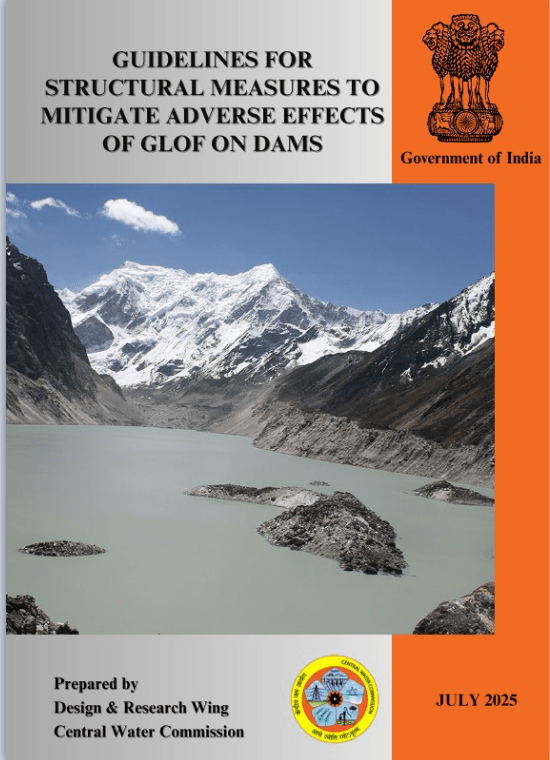
Guidelines for Structural Measures to Mitigate Adverse Effects of GLOF on Dams Central Water Commission (CWC) on July 23 has issued new guidelines to safeguard dam infrastructure from risks and threat of flash floods triggered by glacial lake outburst floods (GLOFs). The information about this 40 paged documents named Guidelines for Structural Measures to Mitigate Adverse Effects of GLOF on Dams July 2025 was shared by CWC director Shiv Kumar Sharma, in a LinkedIn post. The document is available in PPT format and a pdf link for the same is still not available.
In the LinkedIn post, the CWC director said that the guidelines followed consultations with stakeholders including National Hydroelectric Power Corporation, Tehri Hydro Development Corporation, Satluj Jal Vidyut Nigam Ltd, Northeastern Electric Power Corporation, and Jammu & Kashmir State Power Development Corporation. The advisory applies to dams across Arunachal Pradesh, Uttarakhand, Himachal Pradesh, Sikkim, and Jammu & Kashmir.
The directive came amid growing concerns about glacier melt and swelling glacial lakes due to climate change. It recommended a mix of structural and non-structural interventions. For new dams, the guidelines mandated spillways capable of handling peak flood loads and debris-heavy surges. These must include high-speed sluice and surface spillways with gates driven by variable-speed motors capable of opening at 1.5 to 2 metres per minute to avoid overtopping.
Existing dams were advised to undergo retrofitting of hoists, reinforcement of piers, and added protection for gates, trunnions, and power packs. High-performance concrete and downstream sediment traps were recommended to manage heavy debris flow. Additional protections for earthen dams included parapet walls and reinforced river channels.
At the source of GLOFs, the CWC advised structural interventions such as lake siphoning, artificial drainage channels, and debris-trapping weirs wherever possible. Chorabari glacier near Kedarnath, which retreated by 7 metres per year between 1976 and 2016, is one of several rapidly shrinking glaciers creating new lake hazards.
Non-structural measures included installation of early warning systems, SCADA-controlled gate operations, satellite-based communication, and preparation of emergency action plans. In cascaded hydropower setups, upstream reservoirs must maintain lower levels during monsoon to buffer possible surges, with cost-sharing between downstream operators.
The guidelines should have mandated all information about GLOFs to be put promptly in public domain. It should also have required independent assessment post every GLOF related disaster. The NDSA report about the Chungthang dam burst is still not in public domain. Without information in public domain, and such reviews, how are we going to learn any lessons, how are we going to hold those responsible as accountable? And what is the point in keeping any information about GLOF secret when the whole issue is related to public interest?
HYDRO POWER PROJECTS
Sikkim Aftermath of Sikkim GLOF of Oct 2023 This report provides detailed account of the situation of riverbank villages along the Teesta River from downstream of Chungthang dam (now stands destroyed by the GLOF in Oct 2023), right upto to W Bengal’s Teesta Low Dam III and IV.
PSUs Restructuring Central Govt has approved the restructuring of the boards of THDC India Limited (THDCIL) and North Eastern Electric Power Corporation Limited (NEEPCO), two wholly owned subsidiaries of state-run energy major NTPC Limited. The changes are part of a broader effort by the Ministry of Power (MoP) to streamline management across public sector enterprises and enhance alignment among NTPC and its subsidiaries.
The Department of Public Enterprises (DPE) has green-lit a proposal to restructure the boards of NTPC subsidiaries THDC India Ltd (THDCIL) and NEEPCO, making them “leaner” amid a push for hydropower projects along India’s eastern and north-western borders. In a communication dated 18 July to the union ministry of power DPE agreed with the ministry’s proposal for having a non-executive chairperson and re-designation of the post of managing director on the board of NEEPCO and THDCIL.
DAMS
Arunachal Villagers continue to protest against forcible survey for SUMP The People of Ugeng village of Siang district in Arunachal Pradesh protested the Panchayat Minister Ojing Tasing’s attempt to conduct meeting for survey of the Siang Upper Multipurpose Project (SUMP). Why the minister and power developer are keen when the entire village is protesting against SUMP, the villagers wondered.
“We have seen protesting women were hit from behind besides altercation by minister’s supporters and protestors,” said a villager, adding that Ugeng village saw almost similar incident involving minister’s personal security officers earlier. The villagers have been demanding that the project should be stopped as there are many serious questions and potential impacts on the environment. Then, why state Govt is adamant not to listen to grievances of villagers, the villagers questioned.
These statements in the Times of India report of July 28 2025 seem totally wrong: “As per internal documents related to India’s proposed Siang Upper Middle Stage Project (SUMP), 84% of the Brahmaputra’s water in Arunachal Pradesh between November and April originates in China… If China diverts or controls the flow upstream through its new mega dam project on the Yarlung Zangbo, the river’s volume downstream, especially in Upper Assam—could drop dramatically. In its early stretches, before tributaries join in, the Brahmaputra may shrink to a trickle, threatening the region’s ecological balance and biodiversity.” The report also says: “While a full assessment is still pending, initial estimates suggest that nearly 59 villages could be affected by the dam. Of these, at least 15 villages may require complete relocation.”
Polavaram: Quality concerns continue to haunt Despite repeated recommendations from a team of international experts, it appears no significant steps have been taken to implement quality control measures in the Polavaram project. The Union Ministry of Jal Shakti has been persistent in pushing for action, but progress on this front remains sluggish. Six months after the work began on the reconstruction of the diaphragm wall, only 30% of the structure has been completed, and critical quality control mechanisms are yet to be fully operationalised.
The manual & guidelines relating to quality control are yet to be published. A draft manual prepared by the Andhra Pradesh Engineering Research Institute is still awaiting approval from several Central & State-level agencies, including the Union Ministry of Jal Shakti, Central Water Commission, Polavaram Project Authority (PPA), and the A.P. Water Resources Dept. The delay in approval of the draft manual is due to objections raised by some agencies.
Consultations were initially held with institutions like IIT, Tirupati and the National Institute of Building Construction for third party quality assurance mechanism. However, the Union Ministry of Jal Shakti did not approve the proposed arrangements, prompting the govt to issue tenders. “Eventually, a Delhi-based firm with over 45 years of experience—ADCO—was selected. This firm will be entrusted with the responsibility of setting up a dedicated laboratory at the Polavaram project site to conduct material and construction quality tests,” sources say. At this juncture, the absence of a finalised manual that defines clear quality standards for various components of the project is a key bottleneck.
Haryana CEC opposes dams in Kalesar Wildlife Sanctuary Allowing construction of four dams inside Kalesar Wildlife Sanctuary in Yamunanagar is likely to cause “irreversible ecological damage, including the loss of critical habitat” for endangered species, the central empowered committee has recommended to the Supreme Court. CEC’s advice to the top court came on a plea filed by lawyer Gaurav Kumar Bansal, who last year challenged Haryana govt’s approval for the project despite earlier warnings by experts.
“Permission to build the four dams inside the sanctuary should be denied. The interim stay on construction, already in place, should continue. The wildlife clearance given by the National Board for Wildlife (NBWL) should be withdrawn because it was granted without considering these issues properly,” CEC said in its July 9 submission to the top court. Additionally, it said, Haryana’s forest department should prepare an alternative watershed management plan to conserve water and prevent flooding without harming the sanctuary.
The committee also raised legal concerns and said that Haryana govt’s proposal was not approved by the State Dam Safety Organisation (SDSO) or the National Dam Safety Authority (NDSA). This approval is mandatory under the Dam Safety Act, 2021. Most importantly, the committee said, the dams are not unavoidable and don’t have to be built inside the sanctuary. According to environmental laws, diversion of forest land in protected areas should be allowed only if there is no other option. The next date of hearing in the plea is yet to be listed.
INTERLINKING OF RIVERS
Ken Betwa Project: NCC’s negligence in demoliting Pukhraj River Bridge leads to deaths? According to Dainik Bhaskar report of July 26 2025, the demolition of Pukhraj River bridge by NCC contractor (the report mentions LCC company possibly by mistake) even before putting in place alternative arrangement and washing away of the temporary bridge has already led to at least three new born kids. Post factor, district admin has sent notice and Water Resources department has promised to find out! All those responsible must be prosecuted for this.
INTERSTATE WATER DISPUTES
Yamuna Water Sharing Disputes Rajasthan CM Bhajan Lal Sharma on July 19 approved the first installment of Rs 95 crore for the construction of dams under the Yamuna Basin Development Project, aimed at addressing water scarcity in the Shekhawati region. The funds will contribute to the state’s share in the construction of the Renukaji Dam in Himachal Pradesh and the Lakhwar Dam in Uttarakhand. The initiative is part of a larger Rs 11,320 crore inter-state project, with Rajasthan’s total contribution estimated at Rs 216 crore. The project aims to channel excess water from the Yamuna basin in Haryana (Is there any?) to the state’s drought-prone Shekhawati region.
URBAN RIVERS
Planned destruction of Gomti River The deception began with the creation of Gomti Nagar — a township built on the river’s own floodplain drained by two small rivers, the Kukrail and the Sahiri. Land that nature had given to the river to handle seasonal overflows, recharge groundwater and sustain the wetlands along the river was cut, levelled and sold for commercial and residential projects. From that moment on, the Gomti’s expanse, its breath, its survival, became subject to the innumerable demands of a growing city. The many small rivers that once fed the Gomti with fresh water, such as the Kukrail, Behta, Bakh, Nagwa and Sai, were one by one converted into open sewers. Gomti was thus fed by untreated sewage.
The recharge areas — wetlands, ponds and lakes — were filled with colonies, roads and offices, approved by the same officials whose job was to maintain balance through planned development in the city. The Lucknow Development Authority, instead of protecting the city’s water storage system, left no stone unturned in wiping it out. The riverfront development project, launched with much fanfare, struck another deadly blow. Vast stretches of the banks were allotted for commercial development. And now another deadly attack has come from a project, which was given the deceptive name of “Green Corridor”. In reality, this is not a green area, this project is a plan for a rapid multi-lane road designed along the Gomti in the middle of the last remaining floodplain of the river.
Mula-Mutha; Pune Environmentalists and residents objected to the PCMC’s proposal to cut down 1,009 trees between Wakad and Sangvi for the riverfront development Project. The PCMC stated in a notice in newspapers on July 24 that people could send their suggestions and objections to the proposal within seven days, after which a hearing would be organised on August 4. Explaining their objections, Prajakta Mahajan, a member of the Pune River Revival (PRR), a citizens’ movement focused on rejuvenating Pune’s rivers, said the affected area was rich in biodiversity and was like a natural sanctuary within the city.
Budha Dariya; Ludhiana Ahead of July 22 hearing at the NGT, the Union ministry of environment through affidavit submitted that the EC is mandatory for all CETPs in Ludhiana. Interestingly, during earlier hearings, CETP companies had taken a contradictory stand before the tribunal. Initially, they appealed for relief citing pending EC, but later during proceedings, they submitted documents claiming EC was not required for their projects.
The PAC, in its reply, clarified that since Ludhiana is already listed among the ‘Most critically polluted cities’ of the country, EC has always been mandatory for all dyeing industry treatment plants. The green ministry, in its latest affidavit made it clear that these plants not only misled the public but also misinformed central authorities to continue their operations illegally while continuing to pollute the Buddha Nullah.
RIVERS
Environment Protection Rules 2025 Notified The MoEF&CC on July 24 has notified Environment Protection (Management of Contaminated Sites) Rules, 2025 which aims to prevent exposure to hazardous and toxic substances in soil, sediment and water.
Arunachal Pradesh Demand for stronger river protection measures During the meeting with CM, the YMCR on July 21 has urged the government to draft an ‘Arunachal Pradesh River Protection Act’. The proposed legislation would address legal, administrative, and community responsibilities for river preservation, taking inspiration from similar frameworks in other Indian states. The YMCR representatives highlighted ongoing threats to the state’s rivers, including illegal extraction, changing flow patterns, and pollution.
The delegation also proposed the establishment of a dedicated department or cell under the state’s Environment or Water Resources Department. This entity would monitor river health, ensure law enforcement, coordinate restoration work, and undertake public education campaigns. The YMCR noted that such a department could build upon recent measures like the Arunachal Pradesh Flood Plain Zoning Act, 2025. The group further suggested instituting a statewide ‘Arunachal River Day’ and a dedicated conclave focused on environmental protection.
Nagaland A Consultative meeting on Barak River Basin management plan & collaboration between Indian -EU initiative and Brahmaputra board was held at CS conference hall Nagaland Civil Secretariat Kohima on 22nd July 2025.
Karnataka Hiranyakeshi river pollution case in NGT The NGT has threatened to increase the cost from Rs 25,000 to Rs 50,000, taking exception to the Belagavi district administration’s failure to submit a report on the alleged pollution of Maharashtra’s surface and ground waters by an industry in the district. The NGT’s southern zone bench was hearing a petition by Shahu Shivaji Mokahi, a resident of Nangnur in Maharashtra’s Kolhapur district, who had accused the Hiranyakeshi Sahakari Sakkare Karkhane situated in Sankeshwar of discharging its molasses into the waters of the Hiranyakeshi river, thereby polluting the surface and groundwater.
GANGA Haridwar flooded with waste after record Kanwar influx Haridwar Municipal Corporation estimate that the total waste generated during the fortnight-long mela could be between 30,000 and 35,000 metric tonnes. While cleaning operations are underway, authorities admit that it may take several days or even weeks to fully restore cleanliness across the city and pilgrimage routes. According to data from the Kanwar mela control room, more than 40 million Kanwariyas have visited Haridwar since July 11. Anup Nautiyal, a social activist in Dehradun said about 30,000 mt of waste was generated during the 2023 Kanwar Yatra. “We don’t have the data for 2024, but the number of Kanwariyas has gone up sharply this year. While religious tourism is vital for our state, it is equally important to ensure waste minimisation, collection and recycling.”
Uttar Pradesh 9 rivers revived in Rampur through govt, community efforts Rampur district saw a record nine small rivers come back to life under the river revival programme of the state govt. Govt and community efforts to revive Nahal, Hatiyari, Sajni, Neeli, Aril, Naiya, Revati, Baigul and Chaugaja rivers not only benefitted farmers across more than 100 gram panchayats but also transformed the rural landscape. A govt spokesperson said blocks like Bilaspur, Chamraua, Milak, Saidnagar, Shahabad and Swar became green and groundwater levels started rising again.
YAMUNA Delhi Floodplain Encroachment The South Asia Network on Dams, Rivers and People (SANDRP) has written a letter to top Delhi officials highlighting persistent abuse and encroachment of the Yamuna floodplain on the eastern bank downstream of the Wazirabad Barrage. The letter details extensive violations observed during a ground visit on July 15, 2025, and calls for immediate corrective action. The letter paints a grim picture of environmental degradation and disregard for regulations in a crucial ecological zone.
‘Save floodplains from govt-sponsored encroachment’ The Yamuna is being choked, artificial grass is being watered with ground water, ornamental plants and bamboo trees planted, the riverbank has red coarse sand, and of course, construction continues on the floodplains. “If you let a river flow, it will repair itself. The Yamuna cleans itself every monsoon but things go back to square one after these two months,” says well-regarded environmental activist Bhim Singh Rawat, SANDRP in this interview, calling for a consistent bottom-up approach and independent committees for the river’s restoration.
Steel fence to prevent encroachment The DDA will install a steel fence along an 11-kilometre stretch of the Yamuna floodplain from Wazirabad barrage to ITO barrage, in a bid to protect the ecologically sensitive area from encroachment, officials said on July 21. The project, estimated to cost Rs 18 crore, will be executed within four months by the selected contractor.
Panipat city has a large number of illegal bleaching and dyeing units, essential in the conversion of scrap cloth into low-quality thread. These units discharge contaminated water into drains that merge with the Yamuna river
RIVERS BIODIVERSITY
Jammu & Kashmir Returning of Otters: Long believed to have gone extinct, Eurasian otters seem to be showing signs of resurgence in Kashmir, with three individuals spotted by Indian wildlife officers in two places since 2023. The chance sightings have excited environmentalists and wildlife conservationists while raising hopes of a better future for the Himalayan region’s fragile freshwater ecosystems, which have been battered by climate change in recent years.
SAND MINING
Madhya Pradesh Cop dies by suicide alleging harassment by sand mafia A 51-year-old assistant sub-inspector of police, Pramod Pavan, allegedly died by suicide at his official quarters inside the Godan Police Station premises in Datia district early July 22 morning. But what has sent shockwaves across the state are a series of chilling videos he posted before he killed himself – videos in which he names serving police officers and local mafia members, accusing them of mental harassment, caste discrimination, and even death threats. Wearing his police uniform, ASI Pramod Pavan, in his recorded messages, alleges that he was mentally tortured by Godan Police Station in-charge Arvind Singh Bhadauria, constable-driver Roop Narayan Yadav, and Tharet police station in-charge Anfasul Hasan. The reason? He claims it began after he intercepted a tractor-trolley carrying illegally mined sand linked to local mafia member Babloo Yadav.
The incident once again puts the spotlight on rampant illegal sand mining in Gwalior-Chambal region, a deadly business that has already claimed the lives of: Deputy Forest Ranger Subedar Kushwah in 2018 (crushed to death by a mining vehicle), IPS officer Narendra Kumar in 2012 (killed by a sand-laden tractor-trolley).
Telangana High Court directed the police to follow govt orders before confiscating vehicles and machinery, if found involved in illegal extraction and transportation of sand. Justice E.V. Venugopal said that GO 15 issued by the industries and commerce (mines) department, dated 19.02.2015, imposes only a penalty for the first two offences for vehicles and machinery involved in illegal mining and transportation. Police have the authority to confiscate vehicles or machinery for a third offence.
Haryana Former Minister and senior Congress leader Karan Dalal in June 2025 wrote to the NGT, highlighting ongoing illegal and unrestrained sand mining operations along the banks of the Yamuna”, particularly in the districts of Palwal, Faridabad, Sonipat, and Yamuna Nagar. He urged the Tribunal to initiate “urgent, firm, and exemplary action against all individuals and entities involved”. The letter alleged that “a systematic and large-scale plunder of the Yamuna riverbed” was under way, allegedly “orchestrated by a powerful, well-organised and influential sand mining mafia operating with blatant impunity”.
WETLANDS, LAKES, WATER BODIES
Haryana Govt has revived 68,827 small wetlands in a year as part of the Amrit Sarovar Mission and Mission Sahbhagita, state govt officials announced at Ramsar COP15 being held at Victoria Falls in Zimbabwe. Officials said the state’s model to revive these small-scale wetlands, most of them less than 1-hectare area, drew international attention for the projects’ speed and replicability.
WATER OPTIONS
Karnataka Breathing Life into Lakes For thousands of farmers in the dozens of drought-prone villages in Gauribidanur taluk, Chikkaballapur district, local lakes are not relics of the past anymore. Over the past 5 years, de-weeding and desilting have infused life into 12 community water sources that had been reduced to beds of weeds. The community initiative to revive lakes firmed up in 2020, after the region experienced eight years of drought in one decade, starting from 2009. A group of like-minded people, who worked in different sectors, got together and decided to put their collective sense of purpose to use and make lakes functional again.
GROUNDWATER
CGWB Tamil Nadu is among the states worst affected by groundwater overexploitation, with 106 assessment units—33.87% of the total of 313—classified as over-exploited, according to a comprehensive report of the Central Ground Water Authority (CGWA) submitted before the principal bench of the NGT. The CGWA report, which was based on the data provided by every State last month in a specific format, says that, in Tamil Nadu, while No Objection Certificates (NOCs) for drawing groundwater in over-exploited and critical areas are restricted to domestic use, infrastructure development, and non-water-intensive industries, the enforcement of these norms has been inconsistent.
Across the country, the situation is grim. The CGWA has identified thousands of assessment units in various states that are either over-exploited, critical, or semi-critical. Punjab has the highest proportion, with 115 units classified as over-exploited. Rajasthan tops in absolute numbers with 214 such units (20.86% of total), followed by Haryana (88 units, 61.54%) and Uttar Pradesh (132 units). The CGWA has pulled up eight states and Union Territories—including Delhi, West Bengal, Telangana, Pondicherry, and Jammu & Kashmir—for failing to provide requested data despite multiple reminders and a clear directive under Section 5 of the Environment (Protection) Act, 1986. The CGWA has requested the NGT to issue directions to the defaulting states and stressed the need for urgent compliance.
Andhra Pradesh Irrigation accounts for 86% of total extraction A recent groundwater resource assessment has estimated Andhra Pradesh’s annual groundwater extraction in 2024 at 7.88 billion cubic metres. The study was a collaborative effort between AP ground water dept and central ground water board, functioning under the Union ministry of Jal Shakti. The assessment indicates that irrigation accounts for 86% of the total groundwater extraction, domestic use comprises 13%, and industrial use represents the remaining 1%.
URBAN LAKES, WETLANDS
Guwahati Deepor Beel NGT has directed the CPCB, SPCB, SWA and Kamrup (Metro) district commissioner to file affidavits within two weeks in response to the suo-motu petition regarding serious environmental damage caused to Deepor Beel, the only Ramsar site in the state, in Guwahati. The matter has been listed on Aug 25 for the next hearing. A hearing is ongoing in Gauhati high court over alleged illegal earth-filling activities on the land of Deepor Beel.
Silsako Beel Meanwhile, the Institute of Hotel Management was demolished on July 21 to free Silsako Beel in Guwahati city, officials said. The administration is eyeing to clear the natural waterbody from various structures, both private and government, to mitigate flood problems in the state capital, said Housing and Urban Affairs Minister Jayanta Malla Baruah.
Chennai Dredging may not solve charru mussel invasion in Ennore-Pulicat wetlands The unchecked spread of charru mussels (Mytella strigata) across the Ennore-Pulicat wetland system continues to raise concern, as government agencies remain without a clear or sustainable plan to contain the invasive species. Field surveys conducted by the National Centre for Sustainable Coastal Management (NCSCM) in May revealed that mussels had colonised multiple pockets along the 24-km stretch from Ennore Creek to Pulicat Lake.
In response to long-standing complaints from fishermen, dredging was initiated in some sections of the creek. A 1,700-metre stretch at Kattupalli and another 500 metres at Puzhuthivakkam were taken up by the Water Resources Department, at an estimated cost of ₹20.85 crore. However, the NCSCM, in its recent submission to the NGT, has warned that both manual and mechanical dredging pose serious ecological risks. These include habitat destruction, disruption of sediment layers, loss of native aquatic species, and long-term degradation of water quality.
With no clear removal method and the final NCSCM report still pending, the fishermen are a worried lot. While dredging, despite its potential environmental impact, is still seen as useful by Mr. Kumaresan, he acknowledges that it is not a permanent solution, as the mussels could return. However, the dredging is being carried out unevenly, making it difficult for fishermen to navigate their boats through the affected areas. A value-addition study is underway to explore possible commercial uses for the mussels, such as in animal feed or fertiliser. However, the study remains incomplete and cannot yet support a full-scale removal strategy.
Coimbatore Damage to wetland caused by dumping silt from Ooty lake Conservationists who visited the site said the entire wetland complex surrounding the lake is at risk of complete devastation. “It was only last year that the Salem division of Southern Railways destroyed another portion of a wetland surrounding the lake by constructing a parking facility. Now it seems to be the turn of the WRO,” said G. Janardhanan, president of the Ooty Public Awareness Association. He said that the government continued to have little regard for protecting wetlands, with major projects, including adventure park facilities already being constructed around the Ooty lake.
The WRO is currently conducting a clean-up and desilting of the Ooty Lake, with conservationists stating that the wing, operating under the PWD was causing irreversible damage to the wetland ecosystem, home to multiple species of birds and small mammals as well as unique wetland flora. Conservationists said that damage done to the wetland would take years to reverse. The WRO’s unscientific approach towards desilting the Ooty lake was destroying biodiversity both within the lake as well as wetlands around its perimeter.
Mumbai NGT has constituted a joint committee to investigate residents’ grievances with the Powai lake. The committee, comprising officers from the CPCB, SPCB, and the SWA, has been directed to submit the report to the Pune bench within a month.
Delhi As global delegates prepare for Ramsar COP15, Delhi’s Jharoda wetland urgently needs attention. Once a thriving aquatic habitat, it has been filled with waste over the past two years, leading to its decline. Despite Wetland Rules enacted in 2020, no wetlands in Delhi have been officially notified, highlighting a global issue of neglect and destruction.
URBAN WATER
Chennai According to a report from the CGWA, Chennai’s groundwater crisis remains acute, with over 80% of its assessed units falling into the ‘over-exploited’ category. Of the 16 groundwater assessment units in the city, 13 are classified as over-exploited, meaning that extraction far exceeds recharge. while only two are considered safe. Despite previous efforts to augment surface water sources, the city still relies heavily on groundwater, particularly in peripheral areas and commercial zones.
Ludhiana A serious public health concern has again surfaced in Omaxe society on Pakhowal Road as coliform contamination was found in water samples taken from the residential complex. According to the report, water registered a most probable number (MPN) of 43 for coliform bacteria — suggesting possible faecal contamination and exposure to harmful pathogens. Samples have been failing the test since 2018 and all reports are in possession with The Tribune. Health experts warn that such water poses significant risks, especially to children, senior citizens and people with weak immune systems.
Delhi Dredging Wazirabad Barrage The govt plans to double the water storage capacity of the Wazirabad barrage by dredging the Yamuna riverbed after the monsoon, government officials said on July 20. In April, the government had called tenders to dredge and desilt the riverbed between the Wazirabad barrage and Ram Ghat to remove silt, weeds and shoal material. A senior government official said bids for the project were submitted with a reserve price of ₹27 crore, but agencies will need three months to complete the exercise.
The Delhi Jal Board was planning removal of around 363,000 cubic metres of silt from the pondage area. “The pondage area has not been cleared for more than a decade and its capacity has almost halved. Currently, it is only able to hold 100 million gallons of water and once the project is complete, its capacity will be between 200-250 million gallons per day. We estimate that there is an average of 2.15 siltation in the river bed,” the official explained.
Hurdle in Munak Canal elevated corridor plan The govt may face a green hurdle in its bid to develop a 20-km elevated corridor along the Munak Canal from Bawana to Inderlok, as part of the canal revamp project. Officials of the PWD said that Haryana’s irrigation and flood control department, which oversees the entire length of the canal in Delhi and is also the landowning agency, has apprised that the land for the proposed corridor is a “protected forest” and necessitates additional clearances and approvals for infrastructure work.
According to a PWD report on the project dated July 10, there are more than 2,000 trees along the canal. “The Irrigation and Flood Control Department of Haryana has informed that the land under the proposals has been declared as a protected forest through a notification issue dated March 6, 1972. There are approximately 2000+ trees,” the report reads.
JJM/ RURAL WATER SUPPLY
Tamil Nadu JJM not properly planned to be a holistic project? According to Madurai Member of Parliament Su. Venkatesan, the scheme was not properly planned to be a holistic project to include all aspects of it. Raising the inefficiency in implementing the project, Mr. Venkatesan, during a recent District Development Coordination and Monitoring Committee (DISHA) meeting in Madurai, directed the officials to find out the gaps in implementation and rectify it. Despite the funds being allocated periodically and households being earmarked for the connections, many villages, despite having a tap connection, did not get water connections for more than three years.
Noting that they use the water only for washing and bathing, he stated that they were buying water from the private water suppliers who visit their street every morning. Though it costs them ₹30 per pot, they spend it for the well-being of their family and health, he said. Reflecting on the overall planning of the JJM, Mr. Venkatesan said that the execution part of the project was not planned as it was for distribution. “It is not a road project where the only aim is to provide a transport facility,” he added. Though it had worked well in a few places, it was a failure in a maximum number of areas. “The importance given to distribution was not given to deciding the water source and the quality of water,” he noted.
S. Saravanakumar, Senior Project Executive, DHAN foundation, said that the pipe installation works were mostly completed, but the project to match the water needs of public would take at least 10 years. “Though we worry about the poor quality of water, the concept of safe drinking water does not exist anymore,” he added. As both the Vaigai and Cauvery drinking water projects were not completed entirely, even most urban households depend on private water suppliers or purified water cans, he stated. “Most of the JJM connections entirely get their water supply from either nearby water resources or bore facilities in the locality. So, no one can ensure that they get water with a drinking standard,” Mr. Saravanakumar noted.
Jammu & Kashmir JJM has come under intense scrutiny in the Charar-i-Sharief constituency, where residents continue to grapple with an acute water crisis. Despite extensive pipe-laying works by the Jal Shakti Department in villages such as Zaloosa, Rozabal, Baldara, Nowgam, and Branpathri, not a single functional water storage tank has been constructed. Locals say the ambitious project has failed to deliver even the basic promise of access to clean drinking water.
Uttar Pradesh The reality of JJM has been exposed in Gudia village, Sewapuri block, Varanasi, where hundreds continue to face a severe drinking water crisis. Despite pipelines laid & a water tank installed under the scheme, homes have received no connections, the tank remains empty.
MONSOON 2025
IIT-M researchers develop AI powered system to forecast rains 90 min in advance A team from the Indian Institute of Technology (IIT) Mumbai has developed a machine learning-based nowcast forecasting system which will analyse weather radars to predict rainfall at least 90 mins ahead of rains. Set to be launched next week, the model has been installed at Mumbai’s Regional Meteorological Centre in Colaba. The model will issue nowcast warnings with updates every 8 mins, forecasting rain in Mumbai up to 90 minutes in advance. The data pertaining to the nowcast forecast warnings will be furnished on the website, Mumbaiflood.in. The system is based on a model developed by Akshay Sunil, a post doc student at IIT Bombay’s Centre for Climate Studies. The model will work by analysing the rainbands, cloud formation, wind speeds and weather systems over the past few hours to forecast the incoming rain patterns. This data will be procured from IMD radars. The system has already generated positive forecasts in its testing phase.
Cloud seeding using drones and AI to fill Ramgarh Dam in Jaipur’s Ramgarh Dam may soon witness artificial rain through cloud seeding in Aug by the Agriculture Dept partnering with an American company, provided the pending DGCA clearance comes. Senior scientists from the U.S. firm have arrived in Jaipur. This may be the first time in India that artificial rain will be created using drones and AI technology. Specially designed drones — ordered from Taiwan — will release sodium chloride into moisture-laden clouds, triggering rainfall. Previously, cloud seeding in India has been carried out using aircraft injecting silver iodide, sodium chloride, dry ice, & other particles. Artificial rain will be carried out for several days to ensure the Ramgarh Dam gets full.
Ramgarh Dam near Jaipur was built by Maharaja Sawai Madho Singh in 1903. Once the lifeline of Jaipur, the dam supplied drinking water to the city from 1931 to 1980s. With a total storage capacity of 75 million cubic meters, at its peak, it even hosted a boating competition during the 1982 Asian Games. Over the years, the dam’s catchment area and inflow channels choked due to illegal constructions & encroachments. Since 2005 the reservoir has remained completely dry.
FLOOD 2025
Delhi Next big flood is inevitable According to an analysis by the SANDRP, the MoJS committee’s findings gloss over crucial factors that contributed to the disaster and fail to provide a clear roadmap for preventing similar incidents in the future. Experts have warned that without urgent systemic interventions; Delhi may face yet another devastating urban flood. The floods highlighted the dangers of permanent encroachments on the Yamuna’s floodplains, a key factor in the man-made disaster. Yet, Delhi persists with its River Front Development (RFD) drive, prioritizing commercialization over ecological restoration. Himanshu Thakkar of SANDRP warns, “Replicating the Sabarmati model could lead to the complete destruction of Yamuna as a river,” emphasizing the risk of erasing the river’s seasonal rhythms and groundwater connections.
Yamuna level inches towards full capacity “This is the first time the peak discharge has crossed 50,000 cusecs and with more rain likely in the upper reaches of the Yamuna, an increase in water levels may occur in the next two to three days,” said Bhim Singh Rawat of SANDRP. Last year, the Yamuna in Delhi did not hit the warning mark, as the highest water level recorded was 204.38 metres on September 26, 2024. The peak discharge at Hathnikund last monsoon was 87,018 cusecs, data from the irrigation and flood control (I&FC) department showed.
Delhi considers a water level of 204.5m as the warning level, and 205.33m as the danger level. In the past 63 years, the I&FC department data shows the warning level has been breached in 53 of them, making it a common annual occurrence. The river has crossed the 205-metre mark in 43 years, the 206-metre mark in 14 years and the 207-metre mark in four years, including in 2023.
Water released from the barrage typically takes 48 to 50 hours to reach Delhi, with the Old Railway Bridge serving as the primary monitoring point. A water expert criticised the revision recommendation as shifting the goalpost. “These points relate to siltation and floodplain encroachment, raising the riverbed in Delhi. Instead of repeatedly increasing warning and danger levels, which were already revised in 2019, the government should first conduct a geomorphological study of the river’s upper segment,” said Bhim Singh Rawat of SANDRP.
Rawat told TOI, “After the July 2023 deluge, the river has not witnessed any flood spell in 2024 and so far in this monsoon season. This is quite natural and should not raise any flood alarm.” He added that the real concern should be regarding how the river level was reaching close to the warning level even with these low discharges. “This indicates a gradual increase in the riverbed level in Delhi due to siltation and floodplain encroachment. The govt should conduct a geomorphological and cross-sectional study of the entire river course in the upper segment,” said Rawat. He added that to see a cleaner Yamuna, it must be allowed maximum flows during the monsoon to facilitate the recharge of groundwater and the flushing of pollutants accumulating in the riverbed throughout the year.
“This is the annual flushing-out exercise, and the river’s water quality has improved automatically due to the increased flow,” said Bhim Singh Rawat, SANDRP. “It is likely to dip marginally again but will keep oscillating as more rain gets recorded in the higher reaches,” he added, pointing out that peak flood levels in the Yamuna are typically recorded in August or September.
Delhi to ask Haryana for control of ITO barrage The Delhi govt will formally request the Haryana govt to hand over control of the ITO barrage on the Yamuna River in an effort to strengthen flood management in the national capital, officials said on July 23. Irrigation and flood control minister Parvesh Verma confirmed the decision, citing last year’s flood crisis in which malfunctioning gates at the barrage contributed to the extent of flooding in central Delhi. “The ITO barrage is vital to Delhi’s flood control. In 2023, its malfunctioning gates worsened the crisis. While repairs have been made, Delhi needs full control to act swiftly in emergencies. We will formally request the Haryana government to hand it over. I’ll take up this matter personally to ensure Delhi’s safety is not compromised,” Verma added.
Delhi has previously written to Haryana urging a handover of the barrage’s key structure, but its control has so far remained with the neighbouring state. “While the gates at the barrage have been repaired to prevent any flood-like situation like in 2023, and we are monitoring it. We will also be requesting Haryana to hand it over,” a government official said.
Bihar The constant erosion of Ganga during monsoon has damaged about 100s of homes in Javainiya village of Bhojpur district. Govt had approved about 13 crore for flood protection measures but no structures were built.
Himachal Pradesh Chakki railway bridge crumbles The retaining wall of a railway bridge collapsed partly on July 21 when a passenger train was over the Chakki river at Dhangu in Kangra district. Fortunately for the passengers, the entire retaining wall did not collapse, or else there could have been a major tragedy. A railway official said the bridge was still open and repair was about to start. The colonial-era Chakki railway bridge had washed away partially during Aug 2022’s massive flood, and the railways had to then suspend all services on this line.
URBAN FLOODS
Mumbai Retaining walls have brought little respite from floods for residents along Mumbai’s rivers. Yet, for those still living here, rehabilitation chances are remote. Environmental activists like Stalin Dayanand, founder of nonprofit Vanashakti, co-petitioner in pleas seeking removal of retaining walls along rivers to rejuvenate them, says, “Retaining walls should not have been built in the first place as they disconnect rivers from the land along them. The retaining walls of the rivers have been built to demarcate land along rivers and to facilitate their development by both private and government agencies.”
Stalin points out that since the walls came up, many buildings have come up on river basins. Over 620 acres of prime property at BKC was reclaimed and generated thanks to the retaining wall that came up along Mithi river, he tells us. “In fact, the MMRCL’s own office has come up inside the flood plains of Mithi river, which is a direct violation of Coastal Regulation Zone rules,” says Stalin.
Bengaluru Flood alert system: Good for rescue, not prevention Bengaluru’s flooding story often circles around its age-old stormwater drainage system conflicting with rapid urbanisation. The Bruhat Bengaluru Mahanagara Palike has been actively utilising data from flood alert systems, but only for rescue & evacuation, and not for mapping flood patterns or preventing floods. Though the data is publicly accessible, little is being done to create public awareness.
SOUTH ASIA
China and India plans on Siang The lack of engagement with a detailed analysis of the gorge’s unique attributes is not unique to India. Both (China and India governments argue that their dams will make the region safer and extol their green benefits. Climate change threatens the entwined food and water security of the 114 million people living in the Brahmaputra basin in China, India, Bhutan, and further downstream in Bangladesh, but, arguably, so do the dams.
Experts and conservationists have repeatedly expressed deep concerns about dam building in this geologically unstable and biodiverse region. Projects built here are vulnerable to landslides and flash floods, like the one that destroyed the Chungtang Dam in Sikkim, India, in 2023, killing over 100 people. The rivers also flow along tectonic faults. The epicenter of the strongest terrestrial earthquake on record, the 8.7 magnitude Assam-Tibet earthquake (1950), sits between Pe, the SUMP site, and the Polo Dam.
The other major issue that is not regularly discussed in either Chinese or Indian media is that these dams are all being built on minority (or Indigenous) lands. They are dotted with sacred sites and have supported Tibetan, Monpa, and Adi people for millennia. Adi people have been protesting dams on their land for years. In an ideal world, both nations would co-develop a transboundary network of smaller, pumped-storage hydropower projects that would do less to disrupt these communities, be more sustainable, and be less likely to cause or fall victim to earthquakes.
The Shillong (Meghalaya)-based North East Dialogue Forum (NEDF) has urged China halt the plan to build Yarlung Tsangpo dam until and unless a proper assessment is conducted. The forum demanded conducting a thorough impact assessment, including upstream, downstream, environmental, economic, social, cultural, human rights and cumulative impacts before constructing both dams.
Further, the forum urged to the Special Rapporteur on Right of Indigenous People, Special Rapporteur on Right to food, Special Rapporteur on Freedom of speech, Special Rapporteur on Freedom of Association and assembly, EU South Asia Delegation in New Delhi and Beijing to communicate with China through their diplomatic channels to issue safeguard measures and guidelines under International Law while planning both the dams. It also urged the UN Human Rights Council to communicate with China to ratify the UN Water Course Convention of 17 August 1997.
Indian Express Editorial: lobbying for dam, ill informed The Indian Express Editorial on July 24 2025 on the China dam on Yarlung Tsangpo is an example of ill-informed media trying to push govt for the Indian dam in Siang River.
For example it says in the very beginning of the editorial: “Last week, the Chinese government started work on the construction of a massive hydropower project on the Yarlung Zangbo, just before the river bends and enters Arunachal Pradesh, where it is called the Siang. The river then flows into Assam, where it is called the Brahmaputra.” This is clearly wrong. It is not Siang that is called Brahmaputra in Assam. Siang is called Dihang in Assam. It is only after Saing’s confluence with two other big rivers, namely Dibang and Lohit that the river becomes Brahmaputra. A common mistake most media reports do, but we expect better from an editorial in a national daily like Indian Express.
At the end of the first para, the editorial says: “Hydrology experts fear that the Chinese project could disrupt water flow to the hydro projects proposed in the country’s Northeast — the region holds nearly half of India’s hydropower potential, over 80 per cent of which remains untapped.” The Chinese dam can only disrupt the water flow to the only one or two dams proposed on Siang, and not “nearly half of India’s hydropower potential”. Shocking blunders. One can say the same about the statement in next para: “The fears about inundation due to the river’s changing flows are, therefore, not unfounded.” This after referring to the fact that most of the water is contributed to Brahmaputra by rainfall in India! Similarly another statement is the same para is totally inaccurate and misleading: “Besides generating electricity, the project’s storage facility can cushion the Northeast from the risks of being flooded by water released from the Chinese dam.” There is a lot more that can be said about such inaccurate and misleading statements in the editorial.
And then it pushes for hastening a project whose even pre-feasibility report is not yet done, leave aside detailed appraisals or approvals: “The work on building storage facilities downstream of the Brahmaputra cannot be postponed.” One does not expect Indian Express editorial to do such lobbying.
The Indian Express opinion piece on July 24 2025 does the same mistake. The statement in this article, “The Yarlung Tsangpo contributes one-third of the flow to the Brahmaputra, which supports 130 million people in Assam and Arunachal Pradesh, for agriculture, fisheries and drinking water. Indian officials, including Arunachal Pradesh MP Tapir Gao, have described it as a potential “water bomb”, fearing that China could regulate flows to induce floods, as it did in the devastating 2000 Siang River disaster that washed away bridges, or to worsen droughts in dry seasons” has many fallacies. To describe the 2000 incident as an example of China regulating flows to induce floods is clearly wrong, that incident is well known to have happened due to breach of the landslide dam, the landslide dam is known to have happened due to seismic activity.
China Medog Project On the morning of July 19, inaugurating the first phase of the Yarlung Hydropower Project, Li Qiang, a member of the all-powerful Standing Committee of the Politburo of the Communist Party of China and Premier (Prime Minister) of the State Council (Cabinet), stated that it was to be “large in size, long in cycle, and far-reaching in impact.” He added it can be called the “project of a century”. After Li Qiang announced that the construction had officially started, the secretary-general of the State Council (China’s Cabinet), Wu Zhenglong, presided over the opening ceremony.
The opening ceremony of the project on the lower reaches of the Yarlung Tsangpo (YT) was held in Milin County of Nyingchi City in today’s Tibet Autonomous Region. The Xinhua release said: “At the dam site of the Milin Hydropower Station (probably near Pai Township), Li Qiang inspected the construction site and the equipment.” A few days earlier, a new industrial conglomerate, the China Yajiang Group, was created in Beijing for the purpose of building the five dams.
In December 2020, Beijing had announced that a survey would be conducted to select the route and the characteristics of the hydropower plants, with the diversion starting a few kilometres from Pai Township; it was then to consist of one tunnel (about 30 km long) and 9 HPPs. The project in this extremely geologically fragile area will now consist of a cascade of five run-of-the-river HPPs, with water being mostly diverted via tunnels; the design has therefore been simplified.
The main characteristic of the Pemakoe area, known as the Great Bend of the Yarlung Tsangpo, is the difference of altitude between the beginning of the Bend at Pai, located at 2,900 metres above sea level, and an altitude of 600 metres at the end, 60 km away as the crow flies, where the river enters India and becomes the Siang. According to previous plans, the project ends near Baibeng (also known as Drepung), a few kilometres north of the Indian border. It should be noted that the route of the diversion will run close to the Doshung-la tunnel and the new G219 (earlier known as Aksai Chin Road) which links Xinjiang to Mainland China along Tibet’s southern borders.
Disaster Prone and Disaster inducing Chinese officials said cracks appeared on five hydropower dams in Tibet after a magnitude 7.1 earthquake struck near the city of Shigatse this month, killing more than 120 people. Even if the Motuo dam is built well enough to withstand an earthquake, the landslides and mudflows resulting from quakes are difficult to contain and can kill people living nearby. Experts say the massive excavation involved in dam construction could make such disasters more likely.
If the dam trapped sediment, that would make the soil along the river downstream less fertile and erode riverbanks and coastlines in India, saidDr. Kalyan Rudra, a professor of river science and the chairman of the West Bengal Pollution Control Board, a government body. Some officials in India have proposed building a large dam in a tributary of the Brahmaputra to store water and counter any reduction in flow that the Tibet dam might cause. But Dr. Rudra of the West Bengal Pollution Control Board said such a dam could cause the same problems with soil fertility and erosion.
USA
Questions in USA about filling wetlands with treated effluents “There’s a huge dark side to this whole business of municipalities using effluent that’s carrying loads of Pfas and other toxic materials and calling it ‘wetland restoration’,” said James Aronson, a restoration ecologist and president of Ecological Health Network. “It’s truly the worst kind of lying to the public.” Pfas are a class of about 15,000 compounds that are dubbed “forever chemicals” because they do not naturally break down, and accumulate in the human body and environment. The chemicals are linked to a range of serious health problems such as cancer, liver disease, kidney issues, high cholesterol, birth defects and decreased immunity. It’s not just Pfas – microplastics, heavy metals and other toxins have been found at high levels in effluent. Few regulations around chemicals exist, and though the wastewater industry knows the scale of the problem. It’s a “don’t ask, don’t tell” issue, said Laura Orlando, a civil engineer with Just Zero.
There is some potential to use some types of wetlands to treat effluent that can then be released as truly clean water. “Constructed wetlands” are filled with effluent and the inflow and outflow of water is controlled. Those can be filled with plants that take up Pfas and other contaminants. The plants would have to be disposed of in hazardous waste facilities.
While there are some efforts to explore how this could work on a broad scale, the chemicals and toxins are a problem that few in the wastewater industry are thinking about, Orlando said.
Dam Overtopping Probabilities increasing in USA With concerns about aging dams and changes in hydrologic extremes (e.g., flooding), questions arise about whether existing dams may be at risk of failure and pose threats to society. This paper analyzed 33 dams across the United States to investigate temporal trends in dam overtopping probabilities of annual maximum dam water levels. These dams were selected because of the availability of public domain long-term time series of uncontrolled water levels (50 years or longer). It applied updated frequency analyses using generalized extreme value distributions on 30-year rolling periods from 1973 to 2022. The results revealed an overall increasing trend in the number of dams exhibiting critical overtopping probabilities (i.e., low, moderate and high) alongside a decline in the number of non-critical overtopping probabilities (i.e., very low) over time. It identified six dams having the greatest overtopping probability, with several being located near large population centers, posing potential risks to the downstream communities. All six dams are classified as large and high-hazard potential. This study provides insights into dam management and risk assessment, emphasizing the need for proactive measures to mitigate potential threats.
Among the most concerning are Whitney Dam in Texas, which sits roughly 50 kilometers from Waco and its 140,000 residents, and Canyon Dam, also in Texas, located just 30 kilometers from New Braunfels and nearly 100,000 people.
SANDRP

 SANDRP