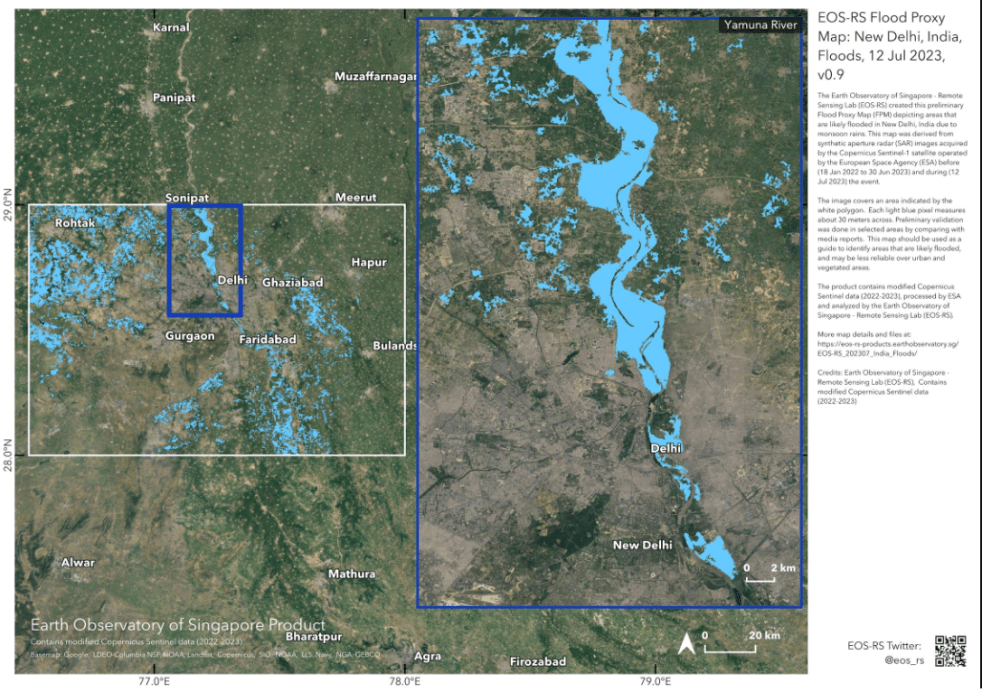
(Feature Image: EOS-RS Flood Proxy Map: New Delhi, Floods, 12 July 2023,v0.4)
July 13 will mark two years since the Yamuna river stretch in national capital witnessed unprecedented flood spell. The river not just submerged every part of existing available floodplain by several feet but also spilled over to reclaim its lost channels. The unusual flood also breached historic 1978 flood level at Delhi railway bridge by a huge margin, setting new benchmark.
Studying the reasons, the MoJS committee in its final report found heavy rainfalls in catchment, faulty operation of barrages and floodplain encroachments as main culprits. Since, the MoJS probe and even parliamentary committee report has addressed the reasons inadequately and offered no decisive actions, the freak episode still deserves an independent assessment suggesting corrective measures. Clearly, that is not likely to happen.
No doubt, the permanent encroachments on river floodplains are among most possible reasons behind the July 2023 man-made flood disaster in the city. And presently, in the name of beautification and RFD (River Front Development) drive, Delhi is further losing its precious natural resource to commercialization. Despite the fact that the floods significantly damaged these misadventures. Yet no lesson is learnt. Further the river course and floodplain in the capital area has already been totally channelized by huge numbers of existing cross-sectional and linear infrastructural projects. Still there are similar projects in execution and pipeline. Thirdly, the issue of sedimentation raising the riverbed level remains unaddressed.
Floods are essential part of the natural and hydrological functions of a river. Last year, the Yamuna remained unflooded which added into worsening pollution levels in the river in lean season. This year, heavy rainfalls in the catchment is likely to bring floods as the situation on ground remains a little more degraded than what led to July 2023 flood disaster.
RFD: Experts urge the city to prioritise ecological healing over concrete development to truly revive the Yamuna. They warn that blindly replicating the Sabarmati model could end up erasing the Yamuna’s natural identity, a free-flowing river with seasonal rhythms and complex groundwater connections. “Replicating the Sabarmati model could lead to the complete destruction of Yamuna as a river,” said Himanshu Thakkar, coordinator of the SANDRP. Critics argue the entire floodplain needs protection, not just mapped fragments, if Delhi is serious about restoring the Yamuna. Experts feel the government should first revive the river, take care of the floodplain, and then consider the beautification project in an informed way.
Meanwhile, Delhi Development Authority (DDA) is planning to develop 51km dedicated bicycle tracks on both banks (~21km along the western & ~30km along the eastern) of the Yamuna as part of riverfront redevelopment projects. Officials on June 26 said that the first phase of the project is expected to be completed by October 31, while the full plan—spanning over 25 ha—is likely to be completed by June 30, 2026. The DDA on July 5 has directed concerned agencies to remove all encroachments from the floodplains by Nov 2025.
Flood: The river is not being allowed sufficient flows from Hathni Kund barrage in Haryana even during monsoon season. Though the barrage recorded over 400 cumecs of inflows for twelve hours on July 9, only 9.97 cumces was released in the river which is merely 2.5% of available inflows. The remaining water is being discharged in canals. At 11:00 on July 11, the inflows at the barrage were 559.05 cumecs and the discharge in the river was 119.58 cumecs.
So far, this monsoon, the river has received highest discharge of about 1100 cumecs at 12 hours on July 3. The peak flows reached Delhi after 54 hours at 18:00 hour on July 5 causing river level rise to 203.31 m at Delhi Railway Bridge station. Before this, the river got a peak discharge of about 595 cumecs from the barrage at 16:00 hour on June 30. The flow has helped river flush out most of pollution from Delhi stretch.
In Paryagraj also, both rivers Ganga and Yamuna are seeing considerable rise in flood levels.
Dams in Yamuna Basin: The validity extension of environmental clearance proposal of Renuka dam project on Giri river in Himachal Pradesh is listed in the EAC panel meeting to be held on July 11. Before this the FAC panel on June 24 had considered the proposal submitted by UJVNL seeking diversion of 47.547 ha of revenue forest land for 72 Mw Tiuni Plasu hydro project in Uttarakashi district of Uttarakhand. In a related development on June 17, the EAC has approved the proposal of Cumulative Impact Assessment and Carrying Capacity Study of Yamuna River Basin in Uttarakhand.
PKC Link Project: The villagers fearing displacement from proposed Dungari dam under Parvati-Kalisindh-Chamabl (PKC) river linking project organized a Mahapanchayat at Dungri Badkuti, Rajasthan on July 6 and unanimously opposed the dam. They have submitted their demands to administration. As per villagers, the project proposal has been prepared without consulting local people. They have planned another bigger gathering in Sapotra on July 13.
About 76 villages of Karauli and Sawai Madhopur districts will be affected by the East Rajasthan Canal Project (ERCP). Earlier, villagers had sent a memorandum to the Prime Minister raising their concerns. The process of financial approval and non-objection of land acquisition for the construction of dam on the Banas river has been completed which as per villagers was done without seeking NoC and consent from affected villages. Villagers say that due to the acquisition of Dungri dam land, large number of villagers in both districts will become homeless. Hence, they have demanded to stop the process of dam construction with immediate effect in public interest.
Water Sharing Dispute: The Chief Ministers of Haryana and Punjab had the fourth round of talks with the Jal Shakti Minister CR Paatil on July 9 to resolve the long-standing Sutlej-Yamuna Link (SYL) Canal dispute. Before, this officials both states had convened a meeting at the Haryana Civil Secretariat to discuss ways to resolve the issue of water allocation between the two states from the Bhakra Main Line (BML).
The impasse surrounding the SYL canal, continued on July 9, as the meeting remained inconclusive. CM Mann said Punjab has no surplus water for any other state, even as he sought share in Indus waters and mooted the idea of Yamuna getting Indus Water.
Irrigation: After the Haryana CM Nayab Singh Saini expressed strong displeasure over project delays and questionable work order allotments, particularly for the diaphragm wall in the Yamuna, the irrigation department on June 16 identified 6 officials, including 2 chief engineers, for strict departmental action. The CM was also supposed to hold a review meeting regarding the progress of 5 mega projects, including a new parallel lined channel from Dadupur to Hamida head, the remodelling of the Western Yamuna Canal (WJC), augmentation canal remodelling, and the construction of a diaphragm wall downstream of Hathnikund barrage.
E-Flows: Officials from Central and Delhi in a high level meeting on May 22 have considered a plan proposing diversion of about 500 cusecs of Ganga water to cater to deficient flows in river in Delhi stretch during lean season months. The plan under consideration proposes the diversion of water from the Upper Ganga Canal in Roorkee to the Eastern Yamuna Canal via the Deoband feeder branch. From there, it will reach the Yamuna via three water courses namely Bhaniawala (~150 cusecs), Baraut ~250 cusecs), and Jawli (~100 cusecs) near Loni in western Uttar Pradesh.
The additional water will enter the Yamuna upstream of Wazirabad. The water will pass through Delhi and be recovered downstream via the Agra canal, with a critical condition: the DJB cannot extract the water for municipal use. Consent from Uttar Pradesh and the Upper Yamuna River Board is also required before implementation.
Experts, however, pointed out that diverting flows from a river to clean another river may be a short-cut measure that may not be a substitute for long-term sustained efforts, such as fixing drains or ensuring proper sewage treatment. Bhim Singh Rawat of SANDRP says, firstly, Ganga does not have any surplus water. Like Yamuna, the national river also struggles to maintain minimum flows during lean season. Transferring water from one depleted river to another is not restoration,” he said. Rawat also questioned the feasibility of using old drains that cut through pollution-prone and encroached agricultural zones in UP. “Ensuring the diverted water actually reaches the Yamuna will be an enormous logistical challenge. And even if it does, the volume will be too little to make a significant impact,” he said. He advocated for the revival of the Shivalik feeder streams and increasing water releases from Hathni Kund barrage, as well as using Western Yamuna Canal water through Drains No. 2 and 8 — all of which are better aligned with natural hydrology.
The Delhi Jal Board is also working on a plan to release about 1244 MLD treated water from the Coronation Pillar STP (453 MLD), Yamuna Vihar STP (227 MLD) and Okhla STP (563 MLD) into the Yamuna’s lean-season flow. Bhim Singh Rawat, of the SANDRP, said while some marginal dilution will take place, the flow seems insufficient. “Quality of treated water will have to be ensured. In long term, we need to focus on ensuring more fresh water in the river stream. Use highly treated water for secondary uses like washing and horticulture and equal amount of fresh water be allowed to flow in the river. At present, the Yamuna is acting as a large drain. The long-term solution remains ensuring our drains are no longer carrying sewage into the river directly,” said Rawat.
We must adopt a holistic and integrated approach, focusing on river diversity and complexity, connectivity, biodiversity, and ecosystem services for assessment and improvement of the health of the Yamuna River. It is equally important to focus on the restoration of the Yamuna River channel as well as its floodplain.
We need to develop a decision-support system that cannot remain human-centric but has to be ecosystem-based and integrative. Apart from an institutional framework, we also need the stakeholders and the society at large to be involved and informed in the decision-making process. Unfortunately, there is a general lack of awareness of such issues in India, both at the user/academic and policy maker’s level. We need to expose both these communities to secure the health of our rivers. (Rajiv Sinha)
Delhi’s Yamuna project is a particularly complex one and can therefore make a useful contribution. The Yamuna, like all other major Indian rivers, is an interstate river. Improving its ecological status depends on reliable interstate cooperation mechanisms for enduring outcomes — a challenge that Delhi will need to address. (Srinivas Chokkakula, Debarshee Dasgupta)
Pollution Experts warn against the prevailing perception that Yamuna remains clean upstream of the Wazirabad barrage and get polluted only afterward. Bhim Singh Rawat, of SANDRP, called this belief “illusionary.” “In reality, the government’s own water quality reports and incidents of Delhi’s water treatment plants getting disrupted due to increased pollution indicate that the river’s health has deteriorated even upstream of the barrage over recent years,” he said. “The continued degradation in the city is the end result of unchecked destructive activities upstream including dam construction, water diversion and discharge of untreated effluents,” Rawat said.
He stressed that all basin states are equally responsible for exploiting the Yamuna’s water, minerals, and ecological resources. “Rampant and unsustainable sand mining in Haryana and UP has disrupted the river’s essential lean season flow.” He stressed that Delhi alone cannot revive the Yamuna and called for the central govt to implement a holistic river revival plan.
More than 800 ‘illegal’ dyeing factories are operating across the NCR, discharging industrial effluents directly into stormwater drains that ultimately empty into the Yamuna and Hindon rivers. Environmental experts say urgent, meaningful intervention is needed. Bhim Singh Rawat, SANDRP, said that hundreds of grossly polluting industrial units have sprung up in neighbouring districts without the necessary permissions. Rawat called the situation a textbook case of “putting the cart before the horse,” resulting in routine violations of the Water Pollution Act. He warned that while rivers can handle some organic waste, chemical effluents destroy their self-cleansing ability.
While the govt talks about expanding treatment capacity and fixing drainage systems, the core problem—illegal dyeing units—remains largely ignored. These dyeing units are reportedly consuming nearly 100 million litres of water each day and dumping chemical-laden waste directly into the capital’s drainage system, which ultimately merges with the Yamuna River. Environmentalists & residents are calling for immediate and strict action. They want heavy fines, legal enforcement and factory shutdowns. Without this, experts warn, efforts to revive the Yamuna will fail. “No matter how much the DJB upgrades STPs, it won’t help if untreated chemical waste keeps entering the river. STPs are meant for household sewage, not industrial chemicals,” Gulati warned. In fact, polluted water entering STPs can damage them, reducing their efficiency. “If these factories aren’t shut, the Yamuna will never be clean,” Gulati added.
Indeed, untreated sewage, industrial waste & failed clean-up plans have turned it into a toxic waterway. Meanwhile, the deadline for river cleaning, for which ₹8,500 cr has already been allocated, has been pushed back from 2023 to 2025, and then to 2026. The DJB has received at least ₹1,200 cr as of 2023; however, most of the 37 STPs are outdated or underperforming. Though, Delhi’s latest Yamuna revival plan is ambitious, combining technology, funding, and public engagement. Yet, past failures remind us that plans alone don’t clean rivers—enforcement, political will, and sustained civic participation are key. If successful, the 2027 mission could set a national example. If not, the Yamuna may continue to foam with toxins, a stark symbol of urban neglect and environmental apathy in India’s capital.
Activists Varun Gulati and Pankaj Kumar are helping clean Yamuna by mapping pollution, monitoring drains, mobilising volunteers alongside official efforts. While Gulati relies on legal channels and surveillance, Pankaj Kumar focuses on public participation and on-the-ground action. Both Gulati and Kumar agree that claims like making the river “bathing clean” are unrealistic under current circumstances. Both activists emphasise a hard truth: the Yamuna cannot be cleaned by government machinery alone. “Officials act only when the courts force them,” says Gulati. “And even then, only if we follow up relentlessly.”
Pollution & Riverine People: Despite pollution, a peaceful boating culture thrives at Nigam Bodh Ghat, where tradition, livelihood and nature meet. Often overlooked in urban planning conversations, the Yamuna floodplains are not merely open spaces but thriving agricultural zones cultivated by local residents—many of whom have lived and farmed there for generations. For the descendants of floodplain farmers, diving is only livelihood of divers after farming was banned due to pollution. Most of these divers were raised on the Yamuna floodplain. Each retrieval is a story of risk. But for the divers, the mission remains the same: to bring someone’s son, daughter, parent or sibling back to the surface, for closure, for final rites, for peace. In Delhi, the capital of a modern republic but also the keeper of ancient faiths, thousands of devotees still descend upon Yamuna banks during festivals like Chhath Puja, risking health and life to touch what was once holy. For some, the Yamuna is not just a lifeline but its the last resort. More than 5,000 people live at Nigambodh Ghat. Their lives are tethered to a river no longer clean, no longer holy, yet, theirs. The Yamuna gives them sustenance, and a sense of continuity. It also takes their health, their dignity, and often, their futures.
Govt Actions: The DJB has formulated short-term, medium-term and long-term plans to resolve the issue of sewage inflow into the Barapullah drain according to a submission made to the NGT on July 4. The NGT is hearing several pleas filed by RWAs demanding remedial measures to treat Barapullah and its subsidiary drains, which pass through south Delhi. On May 21, NGT sought a response from DJB.
The CM on July 05 said the govt has restored the financial powers of DJB, which were taken away by the previous govt in 2021-22. The DJB previously faced multiple issues, including having to float low-cost tenders to escape financial bottlenecks that arise with expensive projects. In 2024, the Finance dept had also directed that all DJB projects must be geo-tagged before funds could be released – aimed at promoting transparency and real-time monitoring.
Chairing a meeting with DJB, the CM on June 20 directed that water and sewer lines must be laid in all unauthorised colonies by Dec 2027. The CM focused on 3 key areas: budgetary action plan, progress on Yamuna cleaning related projects, and ongoing water supply and sewerage initiatives. Currently, 303 drainage projects worth ₹8,000 crore are underway.
During the meeting the CM launched a 45-point action plan to rejuvenate the river. The plan covers drain treatment, treated water inflow into the river, solid and sewage waste management, septage and dairy waste disposal, riverfront development, stormwater planning, enforcement mechanisms, and public engagement. Work is also ongoing to upgrade 8 STPs, including those at Okhla, Keshopur, Yamuna Vihar, Nilothi, and Pappankalan. The govt plans to establish 40 new Decentralised STPs 13 of which are under the AMRUT 2.
After the meeting, the PWD and Water Minister Parvesh Sahib Singh also ordered a city-wide crackdown on the discharge of illegal sewage and industrial waste into the Yamuna, kickstarting an enforcement campaign to tackle water pollution in the capital. The drive will target all establishments legally mandated to install and operate STPs or Effluent Treatment Plants (ETPs). The minister said penalties would be enforced “with no exemptions or delays”. A real-time e-dashboard will be developed to track inspection status, record violations, and monitor corrective measures. Departments have been directed to submit bi-monthly compliance reports to the minister’s office to ensure regular monitoring and accountability.
To reduce groundwater extraction, the DJB is planning to bring in a policy of using treated water for construction works.
After inaugurating a Waste-to-Wealth Bio-CNG plant in Mathura, the CM directed officials to urgently identify suitable sites near Delhi’s dairy clusters to set up similar bio-CNG plants, calling it vital for tackling pollution and boosting the city’s green energy capacity.
Haryana: The Irrigation Dept plans to treat the pollution at 3 places -Kachroli, Kurar and Khojkipur- before it meets the river. About 335 ha metre water would be stored at three places, which would not only increase the ground water level, but also make micro-irrigation in 10,000 acres possible. The dept has constructed a storage reservoir-cum-match box treatment structure costing Rs 10 cr at drain no. 2 near Kurar village for this. The drain roughly carries about 80 cusec untreated effluents. The process to construct 2 more structures is underway.
The govt has also constituted a high-level committee to monitor the water quality of 11 major drains flowing into the river, status of new, upgraded and proposed STPs, progress of CETPs, completion of sewerage networks in towns under the Yamuna catchment and installation of treatment systems in villages along the river. The MoJS had flagged the issue in May. In response, the HSPCB prepared a detailed action plan, highlighting the deteriorating condition of several drains over the past three years (2022–2025) including the Ditch Drain, Panipat Drain, Sonepat’s Drain Number 6 and Budhiya Nala’s legs 1, 2 and 3.
As per HSPCB data, 12 drains meets Yamuna in Haryana. There are 90 STPs with a capacity of 1,518 MLD in the Yamuna catchment area, against the estimated generation of 1,239 MLD sewage. There are around 3,240 water polluting industries in the state, with these generating approximately 210 MLD industrial effluent. Out of these, 2,080 units have their own ETPs, while 1,180 are connected with CETPs. At present, 17 CETPs of 198 MLD capacity are operational in the state, while 7 CETPs of 126.5 MLD capacity have been proposed.
Agra The analysis based on World Resources Institute’s Aqueduct data (also a water risk atlas) said Taj Mahal faces water scarcity that is increasing pollution and depleting groundwater, both of which are damaging the mausoleum. A new study also finds that a 12km stretch of the Yamuna riverbed near the Taj Mahal has the highest concentration of highly toxic microplastics compared to the other three segments sampled.
Yamuna Rivers: Sahibi For centuries, a seasonal river emerged from the Aravalli hills and followed its course to meander into the waters of the Yamuna until human interventions created a conflict between it and urban planning. “Sahibi river is a case study on how a river goes extinct in a city,” says Dr Rajendra Ravi. “Our study of the Sahibi river in Delhi reveals a recurring pattern of urban river mismanagement across the country. Rivers, like the Sahibi in Delhi, or the Mula and the Mutha in Pune are dammed upstream to provide water to the ever-growing cities,” says Ranjit Gadgil, Parisar. The water that flows in the rivers after damming is mostly sewage and industrial effluent, affecting the downstream communities. Constricting the Sahibi contributes to the severe flooding in Gurugram every year. Creating riverfronts does not address the pollution in the rivers and, in fact, can worsen flooding. We can expect the same in Pune,” he adds.
The Delhi govt has informed NGT that it has submitted a fresh proposal to Delhi govt, requesting to revert to the Najafgarh Drain’s old name, Sahibi river, to raise awareness & remove the stigma associated with the word “nala”, which is often linked to dirty water. The govt said a similar renaming proposal was submitted last year, but was returned, asking the city to first obtain concurrence from the MHA, govt said in its NGT submission dated May 24.
Some officials pointed out that rejuvenation downstream of the Masani Barrage was difficult as land could not be acquired during attempts made earlier. “From Masani barrage, for about 11km, there is no flow of water. Because of that, the land of the Sahibi creek till the boundary of Gurgaon district, belongs to private landowners. There is no land particularly marked as the Sahibi river in revenue records,” disclosed a Haryana irrigation official. “Due to the disappearance of the Sahibi downstream of the Barrage, the landowners started cultivating the land.” Haryana irrigation officials said that they were working to reclaim the river downstream of the Masani barrage. Two major drains, the Aurangpur Link Drain and Outfall Drain No. 8, have already been notified as the Sahibi river.
The river carries around 31-35 cumecs sewage now. In 2022-23 budget previous govt announced a budget of Rs 705 crore to rejuvenate it. However, not much was done regarding the same by the then govt. A former govt official linked with the said project revealed, “The budget of Rs 705 Cr sanctioned was for many other purposes, including developing road infrastructure, over bridges, sports facilities, urban transit, urban forests, beautification, etc. It largely remains unused.”
Ujjain Historically, the Shipra River was perennial until the late 1970s. However, over time, it has transitioned into an intermittent flow regime, likely due to the combined effects of climate change and anthropogenic activities. (CP Rajendran)
Dehradun The boundary wall of Sheeshambada landfill site collapsed again during heavy rainfall on July 09. The wall had also crumbled down last year. The landfill is located along Asan river a tributary of Yamuna.
Yamuna Biodiversity: The Central message after 50 years of Gharial Conservation effort since 1975 is that Gharial’s fate remains precarious. It seems like a species living on borrowed time, forever on the verge of extinction. It is living thanks to a few scientists, forest officials and some riverside communities. And if we really want to save Gharials, we must save rivers, the habitat of Gharials, from sand mining, dams and pollution.
The once thriving ecosystem Okhla Bird Sanctuary in Delhi is in peril. The drop in bird populations at OBS has disrupted key ecological processes, threatening biodiversity. At the core of all troubles is the river Yamuna. Once a lifeline, the river has been reduced to what conservationists now call a “lifeless nallah”. Besides water pollution, human activity poses another threat to OBS.
A caracal of one of the country’s most elusive and threatened wild cats, has been captured on a camera trap inside the fenced Cheetah Closed Natural Area of Gandhi Sagar Wildlife Sanctuary in Mandsaur district, Madhya Pradesh. This is the first confirmed sighting of the species in the state in nearly 20 years.
Fish; Fisherfolks: The Union fisheries department on July 04 told the NGT that a combination of factors including pollution, dams, competition for water, and habitat loss is contributing to the decline of native fish species in the Yamuna, while exotic species are on the rise. The NGT had taken suo motu cognisance of the matter. “Dams fragment rivers and block migration routes, preventing fish from reaching spawning grounds, which can lead to local extinctions. Poor water quality from nutrient pollution and other contaminants poses a serious threat to aquatic life. Overexploitation, indiscriminate harvesting, and the use of illegal fishing gear also contribute to the depletion of native fish stocks. Additionally, encroachment of riverine land and climate change have worsened the situation,” it said. Exotic species, the report said, have likely entered the river either as aquaculture escapes or through pet releases. “These multiple pressures collectively contribute to the decline in native fish populations,” it noted.
Mining in Yamuna Rivers: Amid growing concerns over illegal sand mining in the Yamuna River areas near the Delhi-UP border, CM Rekha Gupta has written to UP CM Yogi Adityanath urging him to take immediate steps to curb the activity. She has highlighted that such illegal activities are weakening the river’s embankments, thereby increasing the risk of flooding. Calling it an inter-state issue, the CM underlined the need for a coordinated and joint enforcement mechanism between the two governments to address and control illegal sand mining. In an ongoing case, the NGT has been involved in addressing illegal sand mining activities along the Yamuna river in Ghaziabad. The NGT has taken action, including imposing environmental compensation and directing authorities to prevent further illegal mining.
In Karnal, Haryana 3 trucks and some machines were trapped in flood water after rise in river water level on July 1. Earlier, the mining mafia in Yamunanagar misbehaved with a team of Enforcement Bureau. They also snatched a tipper loaded with illegal mining mineral from the possession of the bureau team and drove away with the snatched vehicle. In Uttar Pradesh, Banda district MLA reprimanded Naraini SDM for taking on sand mafia. An FIR was lodged against four unidentified people for allegedly assaulting the SDM after he confronted them for mining sand illegally and seized two loaded trucks on June 22. The incident occurred near the Paigambarpur-Jarar turn under the Girwan police station area. The legislator has denied the allegation though he admitted he scolded the officer. Before this, illegal sand miners attacked SDM team in the Mau Ranipur area Jhansi and forcibly took back two sand-laden tractors that had been seized on June 18.
Yamuna Wetlands, Lakes, Waterbodies: A long-running tug of war between two govt agencies in Delhi over Tikri Khurd lake, which spans over 40 acres in Narela, is symptomatic of why wetlands and water bodies are depleting in the national capital. It’s been eight years since the Centre formulated wetland rules – which made it mandatory for all States, UTs to form SWAs (State Wetland Authorities) and identify and notify all wetlands – but not a single wetland has been notified in Delhi. Over six years have elapsed since the NGT directed authorities to conserve Tikri Khurd lake. No action has been taken, and the DDA, which owns the lake, continues to deny that it is a water body.
The Tikri dispute is part of a larger problem in Delhi’s wetland governance. One agency claims it is not a natural water body, citing sewer water accumulation, while another insists on its ecological value and recommends wetland notification. This institutional gridlock has left the lake neglected and vulnerable to encroachment.
The NGT on June 6 directed the Delhi Transport Corporation (DTC) to not carry out any fresh construction in southwest Delhi’s Najafgarh, where a bus terminal presently stands. The directions were issued during hearing of a plea that alleged that the structure has been built by DTC by encroaching upon land belonging to a village pond (johad). The plea was filed by local resident Kartar Singh, who has alleged that DTC had encroached upon 30 bigha and 5 biswa of land in the village, forming part of a water body in the village.
The National Highways Authority of India (NHAI) told NGT that it followed all rules while building Urban Extension Road (UER) over a village pond near southwest Delhi’s Goyal Khurd. NHAI stated that the land was acquired by DDA and handed over to it, after which all necessary environmental clearances were sought and received from the Union environment ministry. Thus, there was no bar on the construction of the bridge under the applicable laws, it submitted. In March, Delhi State Wetland Authority submitted a report to NGT, stating that a pond in southwest Delhi was proposed to be listed, but was destroyed due to the highway.
Positive Stories: Once a vital part of Delhi’s medieval water system, Satpula Lake had long been choked by urban sprawl and neglect. Roads and construction had severed its link to rain-fed sources like the Jahanpanah forest. Its waters dried up. Its legacy faded. But an initiative led by Rotary, in partnership with the DDA and INTACH, has brought the lake back to life. At the core of the restoration lies a nature-based wastewater treatment system called Aranyadwip, designed to sustainably reintroduce water into the lake. Using CAMUS-SBT technology, the 200 KLD system treats drain water through a multi-stage process involving filtration, bioremediation, constructed wetlands and natural aeration. Oxygen-rich water now fills the 5,000-8,000 sq m lakebed throughout the year.
At the Change Makers 2025 summer bootcamp, a student team of IIT, Delhi named “Aqua Nova” developed a two-stage bioremediation system to clean the Yamuna of the high levels of phosphate and nitrate pollution.
The Gautam Budh Nagar administration on June 20 approved the renovation of 10 ponds across various villages in the district to promote groundwater recharge. The initiative is being undertaken in accordance with directives issued under the 2022 NGT order. According to the list approved, the selected ponds are located in the villages of Satharpur, Harola (Wazidpur), Roza, Shahdara, Salarpur Khadar, Jhatta, Koudli Bangar (3 ponds), Badoli Bangar & Miyapur.
Groundwater: Taking serious note of water pollution caused by chromium, mercury, fluoride and iron in Kanpur Nagar, Kanpur Dehat and Fatehpur districts, Uttar Pradesh the NGT on July 1, recommended forming an expert team of doctors to provide treatment to affected persons. The case relates to an application filed before NGT, New Delhi in 2019. Thereafter, three more applications were filed in 2019, 2023 and 2024, highlighting the presence of heavy metals in water in the districts. Next hearing on Oct 7. The amicus curiae advocate’s findings revealed dangerous concentrations of chromium, mercury, fluoride, and iron in soil and groundwater samples. Govt health camps detected elevated chromium and mercury levels in numerous blood samples. Residents displayed various ailments, including respiratory conditions, skin disorders, neurological issues, and behavioural alterations.
Budhpur villagers in Baghpat have blamed groundwater contamination by a sugar mill resulting in death over 12 people in a month.
A govt report reveals that while groundwater extraction levels are semi-critical in the Bhopal division, they’ve reached the ‘critical’ and ‘over-exploited’ category in Indore and Ratlam districts in Madhya Pradesh, as western parts of the state hit alarming levels. Among the reasons for depletion in groundwater, the report says that urban areas can be concrete jungles and rainfall infiltration is not equal to that of rural areas unless and until special measures are taken in the construction of roads and pavements.
It is proposed to use 30% of the rainfall infiltration factor proposed for urban areas as an ad hoc arrangement till field studies in these areas are done and documented field studies are available. It was also highlighted that there should be a separate ground water assessment for urban areas with a population more than 10 lakhs. Experts point out that it is the time of the year that can be used for recharging ground water by letting rain water seep inside the ground instead of just seeing it flow away.
Urban Water: The Delhi High Court on July 04 pulled up the DJB for supplying contaminated water in colonies. The court was hearing a plea alleging residents of Yojana Vihar, Anand Vihar, Jagriti Enclave and other adjacent areas in east Delhi received “highly contaminated potable water” mixed with sewer/sewage in their household taps. The bench directed that the work related to replacing old and damaged water supply pipes in and around these houses should be completed in any case by August 2025 and any failure would be viewed seriously by the court. The matter will be heard on August 13.
The NGT on July 07 rapped the DJB and imposed a cost of ₹50,000 for repeatedly seeking adjournments in a case related to illegal groundwater extraction by hotels in the Capital. The tribunal was hearing an execution application filed to ensure compliance of a 2018 order, passed in a case filed by activist Shailesh Singh, alleging that several hotels, including a well-known five-star hotel in New Friends Colony, illegally draw groundwater. Finding merit in the applicant’s claim that the DJB was deliberately delaying proceedings, the bench observed that the board’s conduct was obstructing justice and directed the DJB to appear before it in person in the next hearing on August 12.
Meanwhile, the officials on June 19 said that DJB is planning to set up 9 new water treatment plants (WTPs) at Narela, Najafgarh and Chhattarpur, while simultaneously expediting ongoing work at new treatment plants at Chandrawal and Dwarka. A project involving 452 tubewells is expected to add 26 MGD by September. Another 50 MGD will come from the second phase of the Dwarka WTP, although its raw water source is yet to be finalised. DJB is targeting to complete the second 50 MGD plant unit by December.
Four realtors in the Gurugram were fined Rs 5 crore by Haryana Water Resources Authority (HWRA) for unauthorised groundwater extraction following an order by NGT. Borewells and sump wells at these project sites, which are located in sectors 102, 103 and 37D, were also sealed, stated an inquiry report filed by HWRA chairperson Keshni Anand Arora to NGT. The case stems from a plea initiated in NGT in 2023 over groundwater violations in the city. A joint committee of NGT submitted its report confirming the violations in Nov 2023. However, during a hearing in April this year, NGT criticised the delay in enforcement by state authorities. The case is next scheduled to be heard by NGT on July 7.
Showers aggravated the outflow of leachate from the Bandhwari landfill, causing toxic and viscous discharge to spill into the Aravalis and form puddles over a stretch of 1 km on June 8. Environmentalists told that leachate leakage into the Aravalis is a recurring problem after every rainfall, leading to groundwater pollution and posing significant health risks to both wildlife and people living in the vicinity. Despite repeated appeals to the authorities seeking intervention, no action was taken so far, they alleged.
Monsoon: Haryana recorded rainfall at 71.7mm this June, 30% higher than the average considered normal for this month. Data from the IMD shows a skewed pattern of district-wise rainfall over the month. Gurgaon logged rainfall at 48.6mm till June 30 afternoon, slightly higher than 47.1mm considered normal for June. In neighbouring districts, Nuh (97.8mm, +99%) and Rewari (94.9 mm, +89%) received abundant rain, but Faridabad (-43%), Kaithal (-42%) and Panipat (-38%) posted deficits. Yamunanagar topped the chart, with 299.8mm of rainfall, more than double the normal level for the month.
Urban Floods: The mismanagement of stormwater drains is compounded by unplanned construction covering up spaces that would absorb rainwater making Delhi prone to urban floods. Barapullah has a vast catchment area, it covers 91% of South Delhi and 95% of Central Delhi. Najafgarh drains out West Delhi, the Shahdara and Ghazipur drains carry out the same function. In all, 201 natural drains flow through Delhi.
A major impediment to tackling this problem is the fact that administrative authority over stormwater drains is currently spread out between ten institutions. Indeed, in the master plan, IIT-Delhi team after mapping existing lakes and ponds in the 3 major drainage basins – Najafgarh, Barapullah and Trans Yamuna – found that waterbodies “could store a considerable volume” of water. But the water bodies are increasingly encroached, filled up, including by Delhi Govt bodies. (Vaishnavi Rathore)
Meanwhile, in an official statement, the MCD said it has cleared 1,70,619.89 MT of silt from 800 drains, spanning 530.82 km across 12 zones between Jan 1 and June 30 2025. All the drains cleared were of a height or width of 4 feet and above. With this move, MCD said, it has achieved 134.9% of its first-phase target of clearing 1.2 lakh MT silt. It claimed that the volume of silt cleared this year was 2.18 times higher than the drains cleared in 2024 during the same period. Around 78,000 MT of silt was removed between January and June 2024, it said.
Gurugram It was chaos that is all too familiar for people living in the so-called Millennium City. On July 09 night, a two-hour downpour triggered a cascade of tragedies across Gurugram, leaving at least 8 people dead—electrocuted, drowned, swept into manholes or killed in road accidents. Once again, Gurugram found itself knee-deep in grief, sewage, and questions that have echoed through its flooded streets for years. What does it take for one of India’s wealthiest, fastest-growing cities to prepare for something as predictable as rain? Despite repeated warnings during the monsoon, the city’s drainage system failed to cope with the 133mm of rainfall, leading to widespread traffic congestion and flooding. Residents say rain has again exposed the utter failure of the efforts of MCG, which has spent a staggering Rs 503 crore on the city’s drainage infrastructure over the past nine years. In fact, Rs 256.21 crore — the highest expenditure — has been spent on sewer line upkeep and repairs from 2016-17 to June 2025.
Cloud Burst: Two workers died and at least seven others are missing after a landslide struck an under-construction hotel site in Uttarkashi’s Silai Bend area along the Yamunotri NH. The incident took place early on June 29 following continuous rainfall that began late June 28 night. Officials said 19 workers, all believed to be Nepali nationals, were staying in tents near the roadside when the landslide hit their campsite around 3am. CM said the landslide was caused by a cloudburst. The area remains vulnerable to landslides during the monsoon, especially along the hilly stretches of the Yamunotri route.
As per Syanachatti villagers a lake-like formation a few metres from their colony following cloudburst adding that its water level is constantly rising. “A huge boulder had fallen from the hill into the Yamuna during the cloudburst. It appears to have obstructed the river’s flow and created a lake beside it. The water may reach the Kinsala motor road bridge and eventually submerge our village,” Jaypal Singh, a resident, told reporters. Uttarkashi district magistrate Prashant Arya said: “We have asked the irrigation department to restore the flow of water in the river so that the lake-like structure can be filled to ensure the safety of the people.”
The cloudburst killed 3 labourers, 10 escaped unhurt, 6 are missing. Losing hope of tracing them alive, the state disaster response force stopped the search operation after 72 hours.
Landslide: In April 2025, the central govt approved Rs. 100 crore amount for the treatment of perennial landslide zone Ojari-Dabarkot along Yamuna in Uttarkashi. Following this, the NHAI started preparation of inviting tenders for the work.
Studies: Planning for longitudinal and lateral connectivity recovery This study demonstrates how to identify priority barriers for the recovery of free-flowing rivers, integrating multiple connectivity dimensions & prioritising barriers at the catchment scale in a systematic & transparent way, overcoming previous approaches for longitudinal connectivity alone.
Book Submerged Worlds and Other Amazing Stories of India’s Mighty Rivers by Vaishali Shroff brings together well-researched stories of the ecology, mythology, politics, history and culture of India’s rivers. A Murder Most Foul deals with the death of the Yamuna choked with ammonia, phosphates, toxic chemicals and untreated waste. Because of its historical status as a ‘holy river’, you still see parents dipping their new born children in the poisonous water. According to a report by the SANDRP, the Yamuna is free flowing only in the first 100 km of its 1,346 km journey. It is ecologically dead in Delhi. While a major portion of the book recounts the problems, the latter part presents the people who are coming up with solutions. Be it the famous activists of Narmada Bachao Andolan or the unsung crusaders in Meghalaya, a newspaper vendor cleaning the Yamuna or an activist shoring up data on sand mining, ‘Submerged Worlds’ brings in some hope.
CPCB is launching a new initiative – a Common Consent Portal, expected to go live by early 2026. Entrepreneurs will be able to apply for the NOC online, and CPCB will coordinate with the concerned state or UT’s pollution board to gather the required reports. Based on these, the NOC will be issued within a fixed timeline. This move is part of the govt’s broader Ease of Doing Business agenda. It is also expected to increase CPCB’s annual revenue, as the board will charge a 5 per cent service fee on the total application cost. The bulk of the NOC fees will still go directly to the respective state/ UT’s pollution control authority.
SANDRP

 SANDRP