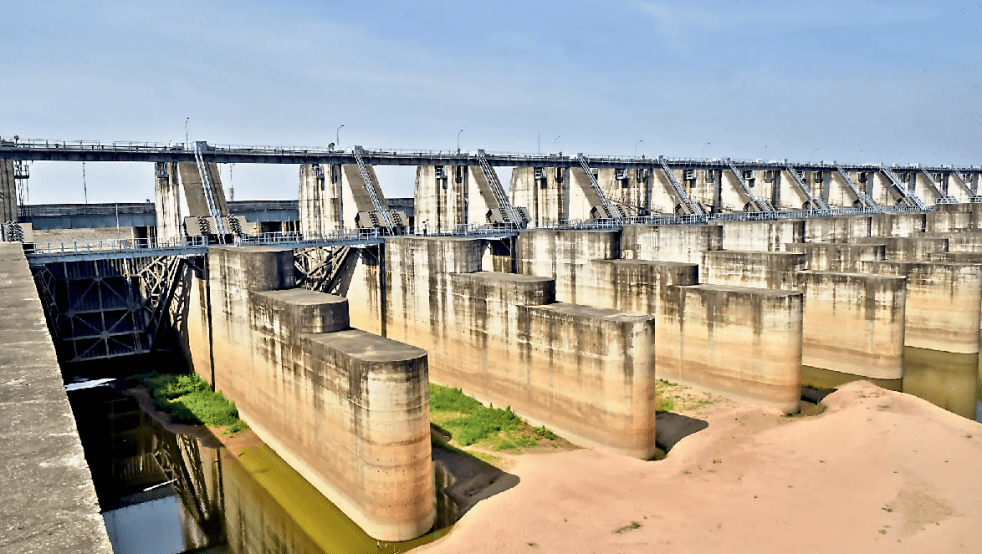
(Feature Image: Medigadda barrage, part of the Kaleshwaram project, facing structural challenges due to design flaws. DC: File Photo)
One of the alarming news this week is the recommendation of irrigation experts and others to the Telangana govt is to prioritise Tummidihatti project, rather than spending limited available resources on repair of Kaleshwaram barrages: Medigadda, Annaram and Sundilla, all part of the controversial and disaster hit Kaleshwaram Project. The reasoning behind the recommendation seems to be apparent difficulty to rehabilitation of the barrages with inherent unstable foundation on sand beds.
This apparent recommendation translates into abandonment of the Kaleshwaram project. This also gets strength from the huge delay by the NDSA to submit its report and then Ministry of Jal Shakti sitting on it for 4-5 months and no movement towards the repair of the barrages first damaged with a big bang on Oct 21 2023.
If this is indeed the case, this project and its fate will be recorded in the history as the evidence of complete failure of so many aspects of India’s dam projects, that too the costliest project, most corruption ridden project which was publicly praised by the engineers of the Central Water Commission.
Kaleshwaram Project Focus on Tummidihatti over Medigadda repairs Irrigation experts and intellectuals have urged the Telangana govt to prioritise the Tummidihatti project instead of spending vast sums on repairing the Medigadda barrage, where multiple piers in block 7 have sunk and others have developed cracks. Speaking at a round table discussion titled ‘NDSA Final Report–Future of Kaleshwaram Project,’ organised by the Telangana Jala Sadhana Samithi on May 15, participants described the Kaleshwaram project as one of the most corrupt in the country’s history.
Irrigation expert PG Sastry, presenting an analysis of the Kaleshwaram project and the NDSA report, highlighted that constructing barrages on sand beds poses significant engineering challenges compared to rocky terrain. He said that the Medigadda, Annaram, and Sundilla barrages were all built on sand beds — an inherently unstable foundation for large-scale water storage. “These barrages were designed to hold only 2.5 to 3 tmcft of water, but the previous govt stored far more—16 tmcft in Medigadda, 12 tmcft in Annaram, and 8 tmcft in Sundilla. When such large volumes are stored, the structure functions more like a dam than a barrage. This excessive storage caused serious damage to the spillways and foundation,” Sastry explained. https://timesofindia.indiatimes.com/city/hyderabad/experts-focus-on-tummidihatti-over-medigadda-repairs/articleshowprint/121194701.cms (15 May 2025)
Ignore advice of politicos on irrigation issues: CM A Revanth Reddy has advised irrigation engineers not to take instructions from political leaders, who have limited knowledge on irrigation issues, on how and where to build barrages, dams and reservoirs, otherwise they will have to face the music and go to jail, if something goes wrong like Kaleshwaram project.
Revanth said newly appointed engineers should visit projects such as Nagarjunasagar and Srisailam, which were built seven decades ago and Himayatsagar, and Osmansagar, which was built by the Nizam over 100 years ago, and compare with Kaleshwaram. “Kaleshwaram project is the only irrigation project in the world that collapsed within three years of construction and inauguration even after spending over 1 lakh crore.
We don’t find such project in the most backward country like Somalia to most developed country like the US. Even soil tests of the three barrages were not done properly. Other project Sitharama Sagar has also some structural issues.” https://timesofindia.indiatimes.com/city/hyderabad/ignore-advice-of-politicos-on-irrigation-issues-says-revanth/articleshow/121170413.cms (15 May 2025)
HYDRO POWER PROJECTS
SANDRP Blog Of Landslides, Spirits and Stories Absolutely fascinating story of what looked like a recent landslide at Darcha village to Parineeta Dandekar (& photographer Abhay Kanvinde) during her visit to Lahaul recently, turned out first to several hundreds of years old as per local people and then 8000 years old as per scientific investigation.

She narrates the amazing stories of how this landslide could have happened at the confluence of three rivers in Chenab basin in Himachal Pradesh. The women here have so far successfully fought against the proposed 300 MW Jispa hydropower project, but as the author touchingly ends the article: “However, one should remember that Darcha Maidan is a place where once an old and poor Lama unleashed his wrath towards the hubris and arrogance of the people in power. Some stories are truly allegorical.” Plz Read, Share. https://sandrp.in/2025/05/17/of-landslides-spirits-and-stories/ (17 May 2025)
Himachal Pradesh Uhl-III HEP starts production 22 years after the project work started, the 110 MW Rs 788 Cr Uhl III HEP in Joginder Nagar in Mandi district has started generating power. https://www.tribuneindia.com/news/himachal/functional-after-22-years-uhl-iii-power-project-starts-production/ (17 May 2025)
Govt to sell surplus power to other states Himachal will sell the electricity produced at various hydroelectric projects to various states while some will be given supply under the banking system. Under the banking system, Himachal provides power to states like Punjab during the summer when its own requirement declines and gets electricity back during the winter when the demand increases. https://www.tribuneindia.com/news/himachal/himachal-to-sell-surplus-power-to-other-states/ (13 May 2025)
DAMS
Srisailam Dam NDSA Slams AP Over Srisailam Dam Safety In a letter to the AP government, National Dam Safety Authority (NDSA) chairman Anil Jain, who led an inspection of the dam on April 29 and 30, pointed out the apparent lackadaisical approach to the dam’s safety and said: “Its regular monitoring was in the recommendations of all expert groups formed for the safety of Srisailam dam. However, the same has not been complied with and as on date no one is aware about the conditions of the measures taken earlier to protect the rock face against the scouring.”
-The level of concern over the damages to the dam structure, and temporary protection measures in the form of installed steel cylinders to stop further damage immediately after the spillway, the NDSA asked the AP government to “minimise” the operations of Gates 5 and 6 (in the middle of the dam which has 12 gates. Typically when dam gates are opened, this process starts from the middle and extends to the sides) “in view of the severe damaged condition of the cylinders and possible scour of the old cofferdam.” https://www.deccanchronicle.com/southern-states/telangana/ndsa-slams-ap-over-srisailam-dam-safety-1879318 (16 May 2025)
Safety study begins amid concerns over delay in repairs A safety study of the Srisailam project plunge pool, approved by the Central Water Commission’s (CWC) Dam Safety Review Panel, is set to begin soon. The exercise costing Rs 14.70 crore, would be supported with an immediate release of Rs 3 crore for its preliminary phase. This study will address 14 to 16 key safety concerns to ensure the dam’s stability. A Central Design Organization team, led by Chief Engineer Vijayabhaskar, conducted an inspection to assess the structural integrity of the dam and monitor progress on critical repair works on May 12. Key areas reviewed included eroded hilly zones, the approach road, gate operations, and water retention systems. Officials provided updates on ongoing and pending safety measures, as the National Dam Safety Authority has set a deadline of May 31, 2025, for plunge pool repairs before the monsoon season. The issue has remained unresolved for over a year, prompting the AP Chief Minister N Chandrababu Naidu also to call for immediate repair estimates and reports for cabinet approval.
– With concerns being voiced in both the Telugu States over delayed repairs and monsoon risks, all eyes are on the AP administration and its Irrigation Department that are tasked with the responsibility of expediting the rehabilitation process. https://telanganatoday.com/srisailam-dam-safety-study-begins-amid-concerns-over-delay-in-repairs (14 May 2025)
No timeline indicated so far for urgent repairs Telangana’s Engineer-in-Chief G Anil Kumar also wrote to the NDSA stressing that any catastrophic failure at Srisailam would have severe downstream consequences, impacting the Nagarjuna Sagar and Pulichintala dam, and even Vijayawada. The condition of the Srisailam dam has become a major source of worry for both the Telugu States.
-The NDSA has directed the Andhra Pradesh government to complete urgent repairs to the dam’s plunge pool area by May 31. The directive follows repeated warnings from different agencies that raised the alarm over a large void in the plunge pool that could compromise the dam’s stability.
-While several funding proposals have been made over the years, actual disbursement has been limited. Way back in 2022, works costing Rs 900 crore were proposed for dam development. They included Rs 780 crore for plunge pool restoration. In 2021, a requirement of Rs 1,000 crore was cited to take up repairs on the dam and its plunge pool.
-The World Bank approved Rs 103 crore in 2024 for dam repairs, including Rs 10 crore specifically for plunge pool restoration. Additionally, the Central Water and Power Research Station (CWPRS) was allocated Rs 14.70 crore for a comprehensive safety study, with Rs 3 crore released for preliminary assessments.
-An allocation of Rs 108 crore was indicated under the Dam Rehabilitation and Improvement Project (DRIP) this year. Despite these allocations, bureaucratic delays and insufficient annual maintenance budgets have hindered progress. Andhra Pradesh has been urged to use state resources for repairs due to delays in central funding. The response of AP is still awaited. https://telanganatoday.com/no-timeline-indicated-so-far-for-urgent-repairs-to-srisailam-project (11 May 2025)
Madhya Pradesh Basaniya dam sparks displacement fears in tribal villages of Mandla Villagers in Mandla and Dindori districts oppose the Basaniya Dam, fearing displacement and loss of livelihood. Despite laws requiring Gram Sabha consent, surveys began without approval. Protests halted survey teams; tribal rights remain ignored. https://groundreport.in/latest/basaniya-dam-sparks-displacement-fears-in-tribal-villages-of-mandla-9054656 (10 May 2025)
Maharashtra Rubber dam will hold back water on Gondia river -It is a new technology and would cost around Rs109 crore. Instead of building a concrete weir or a barrage, high-grade rubber walls filled with air will act as the barrier. Rubber makes the dam flexible; it will fall flat after the air is released when water has to be allowed to flow away, explained a VIDC engineer. The dam will have three spans held with piers, the source said.
-The need for a dam on the Bagh River arose due to the falling water level . Over the years, the level has depleted due to diversions for various uses like drinking water to even industries. Due to this, a lift irrigation scheme (LIS) remained unused. A river needs to have a certain minimum level of water for an LIS to operate. The Rajegaon Kati LIS nearby remained unused due to low water level of Bagh River.
-Even a concrete dam could have been built. However, the Bagh river has typically heavy silt deposits. Following successive monsoons, there is a likelihood of the conventional dam getting covered by the silt, leading to the need for frequent clearing operations. Silt can even flatten a conventional weir. https://timesofindia.indiatimes.com/city/nagpur/rubber-dam-will-hold-back-water-on-gondia-river/articleshowprint/121219911.cms (17 May 2025)
INTERSTATE WATER DISPUTES
BBMB BBMB in deep waters over inter-state dispute According to a former BBMB member (power) Ashok Thapar, “Discord between states is not a good sign. There were differences between states earlier also but they were resolved in the confines of the office, and never got escalated to this level that politicians would cry hoarse in public. The BBMB, once a symbol of national pride, is being used as a tool to up the political ante.”
-The BBMB is expected to tide over the confrontation between Punjab and Haryana by May 21 when the filling season at Bhakra and Pong dams begins. “The dams start filling water with the snow melt and later with the monsoon from July to September 21, the states will get water according to the demand raised,” a BBMB official said. From September 22 when the filling season ends, water will be rationed and allocations made in proportion to the available water and individual share of the states.
-A bigger challenge for the board, however, is silt accumulating in the reservoir of Bhakra dam. The dead storage level of the dam is 1,462 feet which, BBMB officials say, is set to increase due to the silt in the reservoir. “The total storage of Bhakra’s reservoir is 7.8 MAF of which 1.97 MAF is dead storage capacity. This is increasing because of the huge quantity of silt entering the reservoir due to urbanisation in the catchment area of the dam,” a retired BBMB engineer said. “Instead of political rhetoric, the partner states should focus on the dam’s safety and longevity,” he added.
The silt coming in the 168 sq km reservoir is much more than expected when the dam was commissioned in 1963. Due to the silt, the dam fills and empties at a faster pace. https://www.hindustantimes.com/cities/chandigarh-news/consensus-to-confrontation-bbmb-in-deep-waters-over-inter-state-dispute-101747338510118.html (16 May 2025)
BBMB meeting ends in deadlock According to an official, till May 30, Punjab has demanded 3000 cusecs per day. From June 1 onwards, when paddy transplantation starts, it will need 22,000 cusecs to supply the fields.
-“Later, as the paddy season peaks, Punjab will need about 40,000 cusecs daily. Last year, our peak season flow was 32,000 cusecs per day. We used only 90 per cent of our share in the current year cycle. From the next cycle onwards, we plan to utilise 100 per cent of our share. We are working on supplying maximum water through canals. Our drains are desilted. We have cleaned the water channels to the fields. The water is now reaching the tail end,” the official added.
-However, Haryana demanded that the AAP dispensation allow the release of water from the Bhakra Dam unconditionally. Both states had called an all-party meeting to back their stands over the water issue. https://indianexpress.com/article/cities/chandigarh/haryana-punjab-water-sharing-deadlock-bbmb-10009584/ (16 May 2025)
Punjab calls Haryana’s water demand ‘impossible’ During BBMB’s technical committee meeting on Thursday (May 15), Punjab WRD minister Barinder Kumar Goyal said Haryana demanded 10,300 cusecs of water to be delivered from May 21, despite their previous written correspondence requesting 9,525 cusecs, which is a “significant and unexplained” increase. He added the BBMB chairman acknowledged the “discrepancy” and assured to examine the matter.
-Emphasising the “physical impossibility” of meeting Haryana’s demands, Goyal said the Bhakra Main Line (BML) has a maximum capacity of 11,700 cusecs. Punjab requires a minimum of 3,000 cusecs for its own critical needs. Now, Haryana’s demand of 10,300 cusecs would effectively leave Punjab with almost no water and exceeds what the infrastructure can safely handle, especially while repairs of BML are ongoing, he said.
-The meeting, chaired by the BBMB chairman, was attended by officials of the member states of Punjab, Rajasthan, and Haryana to work out water allocation by the BBMB for the next accounting year beginning May 21. https://timesofindia.indiatimes.com/city/chandigarh/at-bhakra-board-meeting-punjab-calls-haryanas-water-demand-impossible/articleshowprint/121194540.cms (16 May 2025)
Demand to review 1981 agreement opposed The Sriganganagar chapter of the Samyukt Kisan Morcha (SKM) has opposed the Punjab Government’s demand to amend the BBMB agreement signed among partner states over river water sharing in 1981. https://www.tribuneindia.com/news/punjab/demand-to-review-1981-agreement-opposed/ (13 May 2025)
‘Moral victory for Punjab’: CM The Punjab and Haryana High Court on Wednesday (May 14) sought response from the Centre, Haryana and Bhakra Beas Management Board (BBMB) on Punjab’s plea for a review of its May 6 order on releasing 4,500 cusecs of extra water to Haryana. A division bench of Chief Justice Sheel Nagu and Justice Sumeet Goel fixed May 20 as the next date of hearing. https://www.deccanherald.com/india/punjab/moral-victory-for-punjab-cm-mann-after-hc-seeks-response-from-centre-haryana-over-water-row-3540902 (14 May 2025)
Punjab moves HC for review of Bhakra water-release order Punjab has filed a review petition seeking a recall or modification of Punjab and Haryana high court’s May 6 order directing it to release additional water from Bhakra Dam to Haryana in compliance with a decision taken at a meeting chaired by the Union home secretary. The plea accuses BBMB chairperson of misrepresenting facts in court and questions the Union home secretary’s administrative authority to take a decision on the water row. The review petition will be heard on Wednesday (May 14). https://timesofindia.indiatimes.com/city/chandigarh/punjab-moves-hc-for-review-of-bhakra-water-release-order/articleshowprint/121123178.cms (13 May 2025) According to the Union Government’s submission, on May 2, the Centre’s Home Secretary at New Delhi convened a meeting and decided to release of extra 4500 cusec of water to Haryana in 8 days to meet the emergent needs of Haryana. However, the Punjab Government objected to the same, stating in the application that the Union Home Secretary is not the competent authority and lacks jurisdiction to decide on allocation of water under BBMB Rules. https://www.livelaw.in/high-court/punjab-and-haryana-high-court/punjab-moves-high-court-to-recall-order-which-directed-it-to-abide-by-decision-of-union-meeting-to-give-extra-share-of-water-to-haryana-291952 (12 May 2025)
CM stops BBMB from releasing water to Haryana Punjab CM for the third time in a fortnight, reached the Nangal dam in Rupnagar district of Punjab after he came to know that BBMB officials reached the dam to release water to Haryana. Speaking at the dam, Mann further warned the BJP and BBMB to not try to disturb the law and order in the region by sending officials to the dam.
-Mann’s comments come days after the May 7 order of the Punjab and Haryana high court restraining the Punjab government and its functionaries, including police personnel, from interfering in the functioning of Nangal dam.
-“On the night of May 20, when the new cycle of water-sharing starts, Punjab will release water to Haryana. What is the hurry? Which crop do they have to sow? If they are adamant, so are we. We will continue to protect our water. If the BBMB wants to file any contempt notice, they should file against me, and not against the people protesting here at the Nangal dam,” Mann further said. https://www.hindustantimes.com/cities/chandigarh-news/punjab-mann-rushes-to-nangal-dam-stops-bbmb-from-releasing-water-to-haryana-101746984954277.html (12 May 2025)
Mann freezes Punjab’s share to BBMB, calls for funds audit Punjab CM Bhagwant Mann on May 11 announced that the state govt will conduct an audit of funds it contributes to the Bhakra Beas Management Board (BBMB) and will withhold further payments until the audit is completed.
-While Punjab covers 60% of the board’s operational expenses, the remaining 40% is shared among Haryana, Rajasthan, Himachal Pradesh and Chandigarh.
-Mann also stated that Punjab will not bear the legal expenses in the ongoing court case and hinted at possible legal action against BBMB officers and engineers if surplus water is released to Haryana in future without the state’s consent.
-The state had earlier refused to contribute ₹3 crore towards the ₹5 crore proposal by the BBMB to celebrate the 50th anniversary of Pong Dam, citing financial constraints. Due to the lack of Punjab’s contribution, the BBMB did not move forward with the proposal. https://www.hindustantimes.com/cities/chandigarh-news/watersharing-row-mann-freezes-punjab-s-share-to-bbmb-calls-for-funds-audit-101746984533703.html (11 May 2025)
Lessees of BBMB land face eviction Chairman of Guru Ravidas Ayurvedic University Sanjeev Gautam told The Tribune that many Bhakra Dam oustees and traders were settled in Nangal town by the BBMB in 1960s. They were given plots and shops on lease by the board. After around 60 years, a number of them are facing eviction cases filed by the board. The eviction cases have been filed against them over minor issues, including alterations in the buildings. The residents have urged the BBMB to settle their lease or transfer the land in their names after charging commercial rates from them. Sources said many plots and shops given by the BBMB had been sold by the original leaseholders to others. The people who have bought the properties were now facing eviction cases by the BBMB. https://www.tribuneindia.com/news/punjab/lessees-of-bbmb-land-face-eviction-seek-state-govt-help/ (16 May 2025)
Farmers gherao Chief Engineer’s office About 300 workers of the BKU (Rajewal), led by their president Balbir Singh Rajewal, staged a dharna outside the office of the Nangal Dam Chief Engineer on Monday (May 12). They raised slogans against the Centre and the BBMB for about an hour. Rajewal said their protest was against the BBMB over giving extra water to Haryana from the Punjab quota. The issue would be taken up at the next meeting of the Samyukt Kisan Morcha (SKM). He said the SKM would launch an agitation over the issue. https://www.tribuneindia.com/news/punjab/farmers-gherao-bbmb-chief-engineers-office/ (13 May 2025)
BBMB staff holds protest against Punjab Govt Employees of the BBMB held a protest here on Tuesday (May 13) against CM Bhagwant Mann’s demand to dissolve the board. They raised slogans against the state government. https://www.tribuneindia.com/news/punjab/bbmb-staff-hold-protest-against-punjab-govt/ (14 May 2025)
Mahadayi Water Disputes Protests over NIO report A protest has emerged in Goa following the publication of a scientific paper, “The water budget of the Mahadayi river and its implications for the inter-State dispute”, by scientists and researchers from the CSIR- National Institute of Oceanography (NIO), Goa and the Indian National Centre for Ocean Information Services, Ministry of Earth Sciences, Hyderabad.
The paper says Karnataka’s plans for diversion of the river as approved by the MWDT would not have much impact on Goa. The diversion from the Kalasa tributary could have “significant impact” but its impact is restricted to the northern part of the Mhadei Wildlife Sanctuary in Goa. Scientists recommend that by creating check dams and storage facilities inside the wildlife sanctuary, the ecological impact of the river diversion could be minimised.
Following this report, members of the Mhadei Movement, dressed in blue T-shirt, staged a protest outside the NIO complex near Goa’s Dona Paula, with placards displaying a red cross mark on the photographs of the scientists, shaming them, with words such as ‘BJP sold Mahadayi‘, ‘Mhadei deal by NIO’, ‘Anti-Goa NIO’… demanding an explanation from the hydrologists and the institutes for the reason behind publishing the report. https://www.thehindu.com/news/national/goa/protests-in-goa-over-nio-hydrologists-report-claiming-mahadayi-river-diversion-will-have-limited-impact-on-the-coastal-state/article69579981.ece (15 May 2025)
Krishna Water Disputes Telangana emphasizes need for water reallocation As part of the ongoing proceedings of the Krishna Water Dispute Tribunal-II, Telangana presented its case by emphasizing that with the development of the Capital Region Development Authority, certain areas under the Krishna Delta System, Nagarjuna Sagar Right Canal, and Left Canal now fall within CRDA. It would help in reducing their dependence on Krishna waters. The state contended that the saved water should be redirected to projects within the Krishna basin, particularly benefiting drought-prone areas inside Telangana.
Vaidyanathan stressed the importance of scientific methods for computing water requirements for agriculture and cited the Agriculture Affidavit submitted by Palanisami on behalf of Telangana, which aligns with previous estimates from the 1995 Krishna Delta System (KDS) modernization report submitted to the CWC. The hearing will continue on May 16 with further discussions expected on water allocations. https://telanganatoday.com/krishna-tribunal-hearingtelangana-emphasizes-need-for-water-reallocation (15 May 2025) Presenting Telangana’s argument before the Tribunal on Friday (May 16), senior counsel appearing for the State C.S. Vaidyanathan said given the rainfall variability and uncertainty, crop production is unviable and at least only irrigated-dry (ID) crop is needed to sustain the livelihood of farmers and farm workers in the backward areas of Telangana. https://www.thehindu.com/news/national/telangana/telangana-urges-kwdt-ii-to-rectify-anomaly-of-assured-irrigation-compared-to-ap-in-krishna-basin/article69584755.ece (16 May 2025) Telangana argued that rainfall variability and uncertainty has been making crop production unviable in the State and it needed at least one irrigation cycle for dry crops to sustain farmers and labourers in backward areas. The state highlighted disparities in water allocation, stating that only 15 per cent of Telangana’s cultivable land was receiving assured irrigation in the Krishna basin, compared to 95 per cent in Andhra Pradesh. The State has urged the tribunal to rectify this imbalance. It has scheduled further hearings on Telangana’s arguments for July 23 to July 25. https://telanganatoday.com/kwdt-ii-proceedings-only-15-of-telanganas-cultivable-land-receives-assured-irrigation-95-in-andhra-pradesh (17 May 2025)
Haryana-Rajasthan Yamuna water to reach Sikar, Churu, Jhunjhunu Sources said that the second joint meeting of the task force set up by the Rajasthan and Haryana governments to implement the Yamuna Water Agreement was held on April 25, following the first on April 7. A consultant will soon be appointed to prepare a DPR for the underground pipeline to carry Yamuna water to Rajasthan. https://timesofindia.indiatimes.com/city/delhi/yamuna-water-to-soon-reach-rajasthans-sikar-churu-and-vice-president-jagdeep-dhankhars-home-district-jhunjhunu/articleshowprint/121157630.cms (14 May 2025)
RIVERS AS NATIONAL WATERWAYS
Jammu & Kashmir IWAI opens office in Srinagar A govt spokesperson on May 13 said J&K govt and IWAI had signed an MoU in March this year in this regard, under which the authority would launch works, including setting up of floating jetties at 10 locations in J&K, development of navigational fairway by dredging wherever required, night navigational aids and regular hydrographic surveys for safe plying of vessels in these waterways.
-The river navigation infrastructure will be developed in three national waterways in the Union Territory — NW-26 (River Chenab); NW-49 (River Jhelum), and NW-84 (River Ravi). https://timesofindia.indiatimes.com/india/iwai-opens-office-in-srinagar-to-develop-inland-water-transport-on-jk-rivers/articleshowprint/121146818.cms (14 May 2025)
Mangaluru 19 stations planned for Water Metro on Phalguni-Netravati rivers The Water Metro project is set to be launched on the Phalguni and Netravati rivers—lifelines of Dakshina Kannada district. The state’s department of infrastructure development, ports, and inland water transport is gearing up to call tenders for the DPR. If all goes as planned, the Water Metro is expected to be operational within two years. Discussions are also being held on inviting private companies to operate the services once the tenders are finalized.
-It has been pointed out that unlike Kochi, where the Water Metro operates entirely through calm backwaters enabling scheduled and consistent speeds, the proposed route in Mangaluru passes close to the river mouth near Alive Bagilu, where tidal fluctuations are common. This could impact the expected speed and efficiency of the Water Metro service. Hence, many have stressed the need for a thorough feasibility study before the project is executed. https://daijiworld.com/index.php/news/newsDisplay (13 May 2025)
Kerala Kochi Metro’s ₹3,716 crore plan to revitalise canals The project includes deepening, widening and beautifying six major canals in Kochi-Perandoor, Chilavannur, Edappally, Thevara, Konthuruthy, and Market Canal. Each canal will be widened to at least 16.5 metres. Green spaces and attractive walkways will be developed on both sides, turning these areas into vibrant urban zones.
-The Kerala Water Authority is also setting up 4 STPs at Elamkulam, Vennala, Perandoor, and Muttar-at ₹1,325 crore. These works are being carried out in coordination with KMRL to ensure the project progresses smoothly, the release added. https://infra.economictimes.indiatimes.com/news/urban-transportation/kochi-metros-3716-crore-plan-to-revitalise-canals-for-enhanced-transport-and-tourism/121113725 (12 May 2025)
Kozhikode Canal City project to begin in 2026 CM Pinarayi Vijayan on Tuesday said that work on the Rs 1,118-crore Kozhikode Canal City project will begin in 2026 and be completed in three years. He was speaking at a meeting of special invitees organised as part of his second government’s fourth anniversary in Kozhikode, where he outlined the progress and plans of several key projects in the district, ranging from infrastructure and rehabilitation to healthcare, investment, and cultural development.
Three years ago, on February 17, 2022, his Cabinet approved the project to revive the Conolly Canal as a major waterway to boost tourism and improve goods transport. On the same day, PWD Minister P A Mohammed Riyas shared the news on his X handle, but was trolled for using a photo of Amsterdam with the words ‘Kozhikode Canal City’ superimposed on it. https://www.onmanorama.com/news/kerala/2025/05/13/work-on-kozhikode-canal-city-project-to-begin-next-year-completed-in-thre-years-pinarayi.html (13 May 2025)
Restoration Mullassery canal likely after monsoon The Irrigation department is likely to take up the restoration of the remaining 200-odd metres of the Mullassery canal under Operation Breakthrough only after the monsoon. Of the total 829-metre stretch of the canal, the Irrigation department claims to have completed the restoration of 625 metres. The stretch between Chittoor Road and M.G. Road remains to be restored. The department is also revising the estimates as several emergency works required at the site had to be carried out during the course of the project. https://www.thehindu.com/news/cities/Kochi/restoration-of-remaining-200-metres-of-mullassery-canal-likely-to-be-taken-up-after-monsoon/article69571065.ece (13 May 2025)
URBAN RIVERS
Mula-Mutha; Pune PCMC directs contractor to stop RFD work at Pimple Nilakh Following objections from irrigation department, citizens and green activists, the Pimpri Chinchwad Municipal Corporation (PCMC) on Wednesday (May 14) directed the contractor to stop the riverfront development (RFD) project work along a stretch of Mula River, said officials on Thursday (May 15).
PCMC on Wednesday (May 14) issued a letter to one of the contractors, directing them to stop work on a 400-metre stretch of the RFD project near the Mula-Ramnadi confluence in Pimple Nilkah near the crematorium. https://www.hindustantimes.com/cities/pune-news/pcmc-directs-contractor-to-stop-riverfront-development-work-at-pimple-nilakh-101747334918535.html (16 May 2025) Mula RFD Work Is a Document of Corruption, Says Waterman Rajendra Singh. https://www.youtube.com/watch?v=v8jj0oZjt1I (18 May 2025)
Indrayani; Pune 36 Riverside Bungalows demolished At River Residency in Chikhali, structures were built within the prohibited blue line zone of the Indrayani river floodplain. The NGT had ordered their eviction, and this decision was later upheld by the Supreme Court. As a result, the PCMC initiated demolition in accordance with the ruling.
Despite the known restrictions, a local political leader reportedly plotted and sold this land in 2017–18, with the support of senior political figures. Attracted by the natural beauty along the river, many citizens purchased small plots (1-2 gunthas), investing lakhs of rupees. They went on to build bungalows worth Rs 1–1.5 crore, complete with water, roads, and electricity. Residents allege that senior officers and PCMC Ward Office Staff deliberately turned a blind eye during the construction phase.
Furthermore, bungalow owners claim that a PCMC employee named Shirsath took bribes from them. They also allege that the same local leader who plotted the land has ties to a major political party and earned crores from land sales. This leader is reportedly eyeing the upcoming PCMC elections. Now, with the demolitions complete and the monsoon approaching, residents are left asking, “Where do we go?” They feel betrayed and cheated after investing their life savings. The biggest question they raise is: Why did the PCMC allow illegal construction to continue for years, only to suddenly take action now? https://www.punekarnews.in/pune-36-riverside-bungalows-in-pimpri-chinchwad-demolished-owners-furious-allege-fraud-and-claim-innocence/ (17 May 2025) On May 5, a bench comprising Justices Abhay Oka and Ujjal Bhuyan dismissed a civil appeal led against the NGT’s July 1, 2024 directive, which had not only ordered the removal of the unauthorised structures but also imposed an environmental damage compensation (EDC) of ₹5 crore to be recovered from the respective property owners. “We nd no grounds to entertain this appeal. It stands dismissed,” stated the apex court in its brief order, reafrming the NGT’s directions for environmental restoration and accountability. The bungalows in question were part of the “River Villa” project developed by VSquare. https://www.punekarnews.in/pune-29-bungalows-in-chikhli-face-demolition-as-sc-upholds-ngt-order-on-indrayani-river-encroachments/ (12 May 2025)
Mithi; Mumbai Desilting scam: Accused sponsored foreign trips for officials: SIT The Special Investigation Team (SIT) of the Mumbai Police’s Economic Offences Wing (EOW) on May 13 revealed that the accused in the Mithi River desilting scam arranged foreign trips for BMC officials and their families as kickbacks in exchange for favourable treatment in awarding desilting contracts, an official said. The accused were produced in court on May 13 & have been remanded to judicial custody.
-According to the EOW’s remand application, the arrested accused include Ketan Kadam, a middleman and director of Woder India LLP, and Jayesh Joshi of Virgo Specialities Pvt. Ltd., a firm that allegedly supplied equipment such as silt-pusher machines to various contractors involved in the desilting work.
EOW sources revealed that the investigation has found Kadam sponsored international travel — including flights and hotel stays — for BMC Assistant Engineer Prashant Ramgude. “It has come to light that trips to Singapore and Dubai were arranged by accused Kadam for the BMC engineer, who is now accused and wanted in connection with the Mithi River scam,” an EOW officer stated. https://www.mid-day.com/mumbai/mumbai-crime-news/article/mithi-river-desilting-scam-accused-sponsored-foreign-trips-for-bmc-officials-says-mumbai-polices-sit-23542063 (13 May 2025)
Adyar; Chennai 1,500cr plan runs into vote bank politics The past three states budgets, including the one presented by Palanivel Thiaga Rajan in 2023, have referred to the project, but not a brick has been moved on the ground. In the latest budget announcement in Feb, the present finance minister, Thangam Thennarasu, said a stretch of river from Thiru Vi Ka Bridge in Adyar to Saidapet Bridge would be restored in 15 months, while the entire river, till zero point near Guduvanchery Lake, would be restored in 30 months. Yet, nothing has changed on the ground.
-Tamil Nadu govt even created a company — Chennai Rivers Transformation Company Limited — last year with an IAS officer heading it to execute the project. This company hired a concessionaire, Khilari, to prepare a detailed project report and restore the river. Yet, they have not been able to prepare the detailed project report (DPR) because at least 2,300 encroaching houses on the river in prime stretches like Saidapet, Kotturpuram, and Jafferkhanpet are yet to be removed. Officials blame local politicians and say they are stalling the drive. https://timesofindia.indiatimes.com/city/chennai/1500cr-plan-to-restore-adyar-river-runs-into-vote-bank-politics-as-encroachments-remain/articleshowprint/121169810.cms (15 May 2025)
Musi; Hyderabad HYDRAA begins expert consultation To prevent future urban floods and tackle uncontrolled encroachments, the Hyderabad Urban Development and Regulatory Authority (HYDRAA) organised an expert consultation on May 16, to deliberate upon the demarcation of the limits of the Musi River and the concomitant nala (drain) network under the Outer Ring Road (ORR) boundaries. Although HYDRAA is not a direct participant in the Musi River beautification project, the meeting was called due to increasing complaints regarding encroachments on the Musi floodplains.
Urban planners held the opinion that city master development plans should consider canal and drain construction with equal gravity as other infrastructural work, and correct hydrological surveys should determine nala layouts. A detailed study of canal characteristics was advocated prior to the execution of new drainage or anti-flood schemes. HYDRAA said it would summarise the expert advice and draw up further discussions to develop an action plan that would help maintain the Musi catchment’s ecological balance while protecting the city from floods. https://www.siasat.com/hydraa-begins-expert-consultation-on-musi-river-limits-nala-network-3221580/ (16 May 2025)
Ghaggar, Panchkula Trash rack to be installed at river to curb waste flow A trash rack will be installed inside Ghaggar river near Majri Chowk bridge to intercept and contain solid waste flowing through the river. For this, the SPCB has released an environmental compensation fund of Rs 52.27 lakh to the state irrigation and water resources department. The department will now float a tender for this. If this project proves successful, similar trash racks will be set up at other vulnerable locations in the river. This initiative is part of a broader effort to clean local water bodies and improve waste management infrastructure. The project aims to tackle the persistent issue of waste flowing through the river. https://timesofindia.indiatimes.com/city/chandigarh/trash-rack-to-be-installed-at-ghaggar-river-to-curb-waste-flow/articleshow/121254251.cms (19 May 2025)
Report Living in most polluted city -Devesh Walia, Dean of School of Human and Environmental Sciences, North-Eastern Hill University (NEHU), told Mongabay India that industrial units in Byrnihat are the major contributors to pollution in the area. “This place became an industrial hub because of the connectivity advantage as well as the presence of the nearby Umtrew river. The topographical features, such as hills on both sides, blocked river channels and low-pressure zones which trap pollutants have all contributed to pollution here. Cement factories, coke factories, and distilleries are all located in a small area and along with environmental violations, pollution here is bound to rise.”
-Phrangsyngkh Syngkli, who holds the position of Lyngdoh Raid, a customary clan head or representativeof Nongkyllah clan in Byrnihat told Mongabay-India that the locals of Byrnihat are facing several health issues and he attributes them to the pollution. “Many people here have been suffering from respiratory ailments. Also, factories are dumping the industrial wastes in the Umtrew river in Byrnihat (known as Digaru in the Assam side) thus contaminating the water, which was a source of drinking water for the people here,” he said. https://india.mongabay.com/2025/05/living-in-the-most-polluted-city-in-the-world/ (13 May 2025)
RIVERS
Listening to the Living Rivers Melbourne Law School is on 11 June 2025 hosting an event that brings living rivers into conversation with each other and ourselves. Shrishtee Bajpai, a researcher, writer and activist, will open this event with insights from the living rivers and waterscapes of India, and what these transformative reforms mean for river protection and environmental justice. https://events.unimelb.edu.au/MCLE/event/46949-listening-to-the-living-rivers (May 2025)
Interview Nature’s right to exist, flourish and persist Prerna Singh Bindra and naturalist Robert Macfarlane discusses why rivers, and all of nature, should be granted rights, and how Chennai became central to his latest book, Is a River Alive? Macfarlane says: “Mountains and rivers live in an ancient dialectic; mountains lend their gravity to rivers, as it were, and rivers in return sharpen and cleave mountains. So, in a strange way, turning to rivers felt like a coming home! I have always and will always be drawn, as a writer, to the limitless terrain where nature meets culture; where the complex and eventually unmappable reciprocities of imagination and landscape shape one another, dynamically. Is A River Alive? asks its readers to imagine rivers as possessing lives, deaths and even rights, and to see what consequences flow from that, in terms of law, story, song and, of course, the aliveness of rivers themselves.” https://www.hindustantimes.com/books/natures-right-to-exist-flourish-and-persist-101747417927883.html (17 May 2025)
Odisha SPCB raises concern over Jeera pollution During the hearing of a case, the Bargarh Municipality has itself proposed the setting up of 5 STPs of 125 KLD at 5 different locations inside the municipality area. The said STPs were to be installed and made operational by December 31, 2023. The SPCB, during inspection conducted March 21, 2025, found that no such STPs of the said capacity have been installed by the Bargarh Municipality to date, and no document was available with the municipality regarding STP establishment. However, the Bargarh Municipality has installed and made operational one Septage Treatment Plant (SeTP) of 30 KLD capacity at Tentela and has obtained Consent to Operate (CTO) vide Letter No. 562 dt.04.03.2022 valid up to dt.31.03.2022.
The NGT further asked the Bargarh Municipality to ensure complete treatment of legacy waste through Biomining/Micro Composting Centres/Material Recovery Facilities by December 31, 2023. However, the SPCB affidavit exposed that the municipal authority has not completed the remediation of the legacy waste at the alleged dumpsite site near the town till the inspection by the SPCB team March 21. During the inspection, it was observed that approximately 20,000 MT (as enquired with the representative of the unit) only of legacy waste has been bio-mined out of approximately 51,476 MT from the dumping site. The NGT May 14 asked the Odisha SPCB to file an Action Taken Report (ATR) by May 20 regarding action taken against the Bargarh Municipality for failing to comply with the instruction of the apex green court. https://aroundodisha.com/2025/05/18/spcb-raises-serious-concern-over-pollution-in-jeera-river/ (18 May 2025)
YAMUNA Study Surface-GW interactions in upper Yamuna basin Abstract: The multivariate analyses confirm strong river water-groundwater interactions, particularly in the lower catchment. This study highlights catchment-specific RW-GW interactions and recharge sources in the water-scarce UYRB, providing critical insights for regional climate-resilient water resource management.

https://www.sciencedirect.com/science/article/abs/pii/S0013935125008382 (15 May 2025)
Uttar Pradesh Noon river runs again through parched Jalaun Farmers of Jalaun in UP’s parched Bundelkhand will not have to toil too much this season to get water for crops. They have almost revived an 81km-long local river that had dried up completely. Community members have restored the drainage basin over a 14km course of Noon river to create a funnel through which water has again entered it. The river had dried up to encroachments and poor rainfall. The revival commenced in 2021 and reached the final stage only recently, with voluntary labour contributions from thousands of local men and women. Officials said the water would start flowing through the entire course of the river in a fortnight. The river is expected to help more than 15,350 farmers.
– Noon meandered across 47 villages before merging with Yamuna on the other side of Jalaun. The river was earlier a key source of irrigation for agricultural fields spread over 2,780 hectares, as well as for animals looking for a waterbody in the dry region. But dwindling rainfall and sporadic construction activities changed the river’s contours, preventing water collected during the monsoon from funnelling down into the riverbed. https://timesofindia.indiatimes.com/india/a-river-again-runs-through-ups-parched-jalaun/articleshowprint/121196212.cms (16 May 2025)
Delhi Water quality 42 times worse Meanwhile, experts said the spike is likely due to a combination of low environmental flow in the river and no change in the existing sewage and effluent treatment plants in the city. “The river’s flow has been reducing since last monsoon as there has not been enough non-seasonal rainfall in Delhi or in the higher reaches. Normally, the rain dilutes the river and the pollution. At the same time, we have not seen any improvement in the quantum of sewage or effluents being released into the Yamuna. Our STPs (sewage treatment plants) & ETPs are at the same level as they were two years ago,” Bhim Singh Rawat of SANDRP said. https://www.hindustantimes.com/cities/delhi-news/yamunas-water-still-worsening-now-42-times-worse-than-permitted-limit-dpcc-101747161775895.html (14 May 2025)
Worst water quality in 2 years Experts attribute the worsening water quality to two key factors: a decline in the river’s environmental ow due to insufficient rainfall and stagnation in the capacity of sewage and effluent treatment plants. “There has been little rainfall in Delhi and the upper catchment areas since the last monsoon, which means less dilution of pollutants in the Yamuna. “Meanwhile, no major upgrades have been made to Delhi’s sewage infrastructure,” said Bhim Singh Rawat, a Yamuna activist and member of the SANDRP. https://www.deccanherald.com/india/delhi/yamunas-water-quality-hit-new-low-in-2-years-dpcc-report-3539066 (13 May 2025)
Most STPs fail to meet standards The Yamuna continues to remain heavily polluted, with some parameters showing a spike while others show improvements in the April assessment by Delhi Pollution Control Committee (DPCC). It was also found that 16 out of 37 STPs failed to meet standards in April. The report for Yamuna shows that the faecal level has risen in the river, reaching 1,500,000 units by the time the river exits the city, against a standard of 500 units. The DPCC report shows that despite claims of the river being cleaned, the level of effluents and Yamuna’s health markers remain way worse than what was expected as this year unfolded. https://timesofindia.indiatimes.com/city/delhi/yamuna-pollution-remains-high-as-most-stps-fail-to-meet-standards/articleshow/121194372.cms (16 May 2025)
Rs 6,857 cr spent but Yamuna still a ‘dead’ river According to CSE, the treated sewage must be recycled and reused. At present, between 10 per cent and 14 per cent of the treated wastewater is reused. Each STP needs a plan not only for treatment but also for discharging its treated wastewater. https://kashmirtimes.com/amp/story/opinion/comment-articles/rs-6857-crore-spent-to-clean-22-km-stretch-in-four-years-but-yamuna-still-a-dead-river (12 May 2025)
‘Hard to call it river’: CR Patil Union Jal Shakti Minister CR Patil announced on Friday (May 16) that the Yamuna river in Delhi is expected to be clean enough for bathing within the next one and a half years, with the water projected to become drinkable in another 1.5 years thereafter. “Yamuna ko abhi nadi kehna mushkil he hai. Delhi ke nadi ka jo part hai wo poora nallah bann gaya hai (It is difficult to call Yamuna a river. The part of the river in Delhi has become a complete drain),” he said. He added that a plan has been made with the involvement of the PMO, Jal Shakti Ministry, Home Minister Amit Shah since Delhi is a union territory and the Delhi chief minister Rekha Gupta. Patil said in 45 days the government will complete the task of assessment of the entire 48 kilometer stretch of the river in Delhi using artificial intelligence (AI). “In fact, AI will be used in all projects – right from planning to execution,” he stated.
The BJP government in Delhi plans to develop a Yamuna riverfront, on the lines of the Sabarmati riverfront, ensuring 24×7 commercial establishments, interactive shows, theatres and other entertainment facilities along the riverbank. It also wants to hold an annual festival once the riverfront is ready. But experts say the mission to clean the Yamuna will need more than just high-end machinery. https://www.moneycontrol.com/news/india/hard-to-call-it-river-cr-patil-slams-state-of-yamuna-in-delhi-sets-3-year-goal-for-drinkable-water-13028992.html (16 May 2025)
DPCC plans 32 OLMS to assess major drains The DPCC, which will oversee the process, will award a tender worth ₹22 crore for installing 18 stations in major drains, and the remaining at various points of the Yamuna. The project is likely to be completed towards the end of the year, environment minister Manjinder Singh Sirsa said. The minister said the stations will be made operational within three months of awarding the work contract. – Bhim Singh Rawat, a Yamuna activist, and member of the SANDRP said that the data should be made public once the project takes off. “The idea is good. A website or a section on DPCC website needs to be maintained where such data is updated on a real-time basis,” he said. https://www.hindustantimes.com/cities/delhi-news/like-air-delhi-govt-to-assess-water-quality-in-real-time-at-yamuna-major-drains-101747334608594.html (16 May 2025)
Govt invites CSR funds to support STP operatioin The Delhi Jal Board (DJB) has invited private companies to sponsor the modular STPs to be installed along the major open drains having an outfall into the river. According to the officials, instead of traditional STPs, which require large space and investment, modular and decentralised STPs will be installed on the drains, in which the companies can invest and get a chance at branding. https://www.ptinews.com/story/national/Delhi-govt-invites-private-sector-to-financially-support-Yamuna-cleaning-efforts/2561944 (16 May 2025)
12 more STPs to treat Najafgarh The DJB is working on developing 12 new STPs in the Capital with the aim to reduce untreated sewage being dumped from the Najafgarh drain into the Yamuna river, officials said. The DJB has started work on a 49.5 mld (million litres per day) capacity wastewater treatment plant in southwest Delhi’s Chhawla along with 11 units of smaller de-centralised STPs (DSTPs) and pumping stations. The agency will be expected to take 15 months for the development, another one month for commissioning and two months for carrying out trial runs of the DSTPs, officials said.
A DJB official said they are planning 40 DSTPs across Delhi, out of which 14 will be in the Najafgarh zone, and work on 11 has started. On April 16, the expenditure finance committee, headed by chief minister (CM) Rekha Gupta on Wednesday approved setting up of 27 DSTPs, treatment facilities and associated infrastructure at a cost of ₹3,140 crore. “A deadline of December 2026 has been kept for development of all 40 plants. They will add capacity of around 92mgd water in Delhi,” he added. https://www.hindustantimes.com/cities/delhi-news/12-more-stps-to-treat-sewage-discharged-from-najafgarh-in-delhi-101747074685558.html (13 May 2025)
11 floodplain beautification projects https://timesofindia.indiatimes.com/city/delhi/11-projects-to-revive-yamuna-floodplain/articleshow/121145343.cms (13 May 2025)
Noida NGT adjourns Hindon pollution hearing Under pressure to act on toxic pollution in the Hindon river and its tributaries, the UP govt has sought more time from the NGT to file a revised affidavit—despite being pulled up by the tribunal earlier this year for key gaps in its submissions. The tribunal has now adjourned the matter, originally sparked by a 2022 petition over untreated sewage and industrial waste contaminating the river system.
-In the previous hearing in February 2025, the NGT had directed the state’s chief secretary to file a fresh affidavit addressing lapses in the earlier submission. The affidavit had lacked crucial data on the functioning of STPs, C&D waste management, and enforcement of environmental penalties against non-compliant industries.
-Importantly, the government clarified that no previous adjournments had been sought and said the extension was aimed at ensuring the affidavit meets NGT’s requirements. The tribunal granted the adjournment on May 5, with the official order uploaded on May 10.
-According to earlier records, the Hindon basin houses 366 industries, of which 123 were reportedly found non-compliant with pollution norms. While closure orders were issued against some units, the previous affidavit failed to provide clarity on enforcement and the recovery of environmental compensation. The tribunal had also flagged that 52 of 55 drains still discharged untreated sewage into the river and that poor household connectivity to STPs was hampering their optimal use. https://www.hindustantimes.com/cities/noida-news/ngt-adjourns-hindon-river-pollution-hearing-as-up-seeks-more-time-for-revised-affidavit-101747081467247.html (13 May 2025)
Notices to 250 farmhouses on floodplains Noida Authority will issue fresh notices to nearly 250 farmhouse owners for permanent construction in the Yamuna floodplains, where only farming is allowed. Officials said while buying and selling land in this area is not illegal, using the land for anything other than agriculture — like building farmhouses or permanent constructions — is prohibited. The Authority has demolished around 200 such farmhouses since May 2022. However, many owners went to Allahabad high court and managed to get stay orders, which stalled the action temporarily. But now, the Authority is once again planning a large-scale campaign against illegal constructions in the floodplain.
While there’s currently no plan to demolish old illegal structures built near the Hindon floodplain, officials made it clear that no new construction will be allowed. If any such activity is found, strict action will be taken against the responsible officers. A separate team, led by the sub-divisional magistrate, has been formed to monitor and act in the Hindon region. Some of the existing farmhouses in Hindon may also face demolition in the next phase of the campaign. https://timesofindia.indiatimes.com/city/noida/only-farming-no-construction-noida-to-issue-notices-to-250-farmhouses-on-yamuna-floodplains/articleshow/121039095.cms (10 May 2025)
Rivers pollution causing water crisis Noida weather is increasingly influenced by the water crisis stemming from the pollution of the Yamuna and Hindon rivers. As the city continues to grow, it faces challenges in ensuring safe drinking water for its residents. The need for effective pollution control and sewage treatment is more critical than ever, as environmentalists advocate for a sustainable approach to restore these vital water sources. https://www.timesnownews.com/city/noida/noida-water-crisis-water-supply-disruption-likely-despite-sitting-between-2-big-rivers-heres-why-article-151664678 (18 May 2025)
RIVERS BIODIVERSITY
Karnataka India’s 7th marine sanctuary to come up in Honnavar A 6-kilometre stretch of coastal and estuarine area extending from Monkey (Aparakonda) to Mugali and Madiyavare in Honnavar is set to be declared the country’s seventh and Karnataka’s first marine sanctuary. The State Wildlife Board, under the leadership of forest minister Eshwar Khandre, has approved the proposal, and it is now set to receive cabinet approval. The proposed sanctuary spans a total of 5,960 hectares, including 835.02 hectares of marine area and 835 hectares of land. This region includes 5,400 hectares of mangrove forests, rich in biodiversity and home to several endangered and ecologically significant species.
-The proposal is currently before the cabinet for final approval. It was originally put forward during B S Yediyurappa’s tenure as chief minister, when Rs 1 crore was earmarked for the initiative in the state budget. However, the plan was delayed due to the Covid-19 pandemic. https://www.daijiworld.com/news/newsDisplay (16 May 2025)
FISH, FISHERIES, FISHERFOLKS
Delhi मर गई हज़ारों मछलियां! यमुना नदी में बुराड़ी के पास हजारों मछलियां मर गई हैं। इलाके में मछली पकड़ने वाले लोगों का कहना है कि हरियाणा के सोनीपत की तरफ से फैक्ट्री से निकलने वाला केमिकल युक्त पानी और घरों से निकलने वाला मल-मूत्र का पानी यमुना नदी में छोड़ा गया है जिसके चलते इतनी सारी मछलियां मर गई हैं। बीते साल भी कुछ इस तरह से ही समस्या हुई थी जब इसी जगह पर बड़े पैमाने पर यमुना में मरी हुई मछलियां साफ नजर आ रही थी। शरद शर्मा बीते साल भी यहां गए थे इस साल भी गए । https://www.youtube.com/watch?v=gDJT1EIfv38&t=229s (15 May 2025)
West Bengal Story of a char dweller Boalmari is a char or riverine island in the floodplains of the Teesta. The name suggests that once upon a time, fisherfolk here would routinely get rich hauls of boal, a kind of freshwater fish known for its delicate flavour. That was in the late 1940s.
In October 2023, Boalmari was lashed by a flash flood. It was caused by a lake burst upstream in Sikkim. The raging waters of the Teesta swept away homesteads, farmlands and livestock. Since the flash flood was induced by climate change, char dwellers couldn’t anticipate it. Neither could any weather forecasting system provide advance warning.
After the debacle, Alladi realised that life on the char would only get more fragile. After all, multiple dams and barrages had the Teesta twisting and turning in ways that were unpredictable. She rented a shop at faraway Helapakri Bazar. These days, she and her husband run the shop there & stay in a small house beside it; the flagship store is managed by her sons & daughters-in-law.
Gopa Samanta, who has done extensive research on Bengal’s char dwellers and written the book titled Dancing with River, tells The Telegraph, “I have seen people in chars who build an alternative base in nearby towns. They know the home on the char can be swept away any day. But they don’t forsake their home on the char altogether nor snap ties with char life.” https://www.telegraphindia.com/life/alladi-and-the-seer-how-a-char-woman-rose-above-the-teestas-wrath-and-erosion-prnt/cid/2100437 (18 May 2025)
SAND MINING
Haryana Embankment on Yamuna: SC asks CEC to examine issue The Supreme Court has directed the Central Empowered Committee to investigate claims of an embankment being constructed on the Yamuna River near Kalesar Wildlife Sanctuary in Haryana, allegedly to enable mining activities. The matter was heard by Justices B R Gavai and Augustine George Masih on April 29, following concerns that the river’s flow was being diverted from Haryana to Uttar Pradesh.
-Advocate Gaurav Kumar Bansal, representing the applicant, presented the case before the court, asserting that the embankment was built to facilitate rampant mining operations near the wildlife sanctuary. “We, therefore, find that it would be appropriate that the Central Empowered Committee (CEC) examines the issues and submit its report,” the bench stated in its order. The case has been scheduled for further hearing in the last week of May. https://timesofindia.indiatimes.com/city/delhi/embankment-on-river-yamuna-to-facilitate-mining-activity-sc-asks-cec-to-examine-issue/articleshowprint/121101957.cms (12 May 2025) The petitioner stressed that illegal mining activities abound in Kalesar Wildlife Sanctuary, which is located in the eastern part of Yamunanagar. https://www.newindianexpress.com/cities/delhi/2025/May/13/supreme-court-seeks-report-on-yamuna-embankment-for-mining-plea (13 May 2025) Acting on a petition filed by Bansal, the Supreme Court had, on April 24, 2024, stayed the construction of four proposed dams inside the sanctuary in Yamunanagar district. Bansal has challenged the construction of Chikan, Kansli, Khillanwala and Ambawali dams within the sanctuary on the ground that it will have a negative impact on the flora and the fauna in the area. https://www.tribuneindia.com/news/biodiversityconservation/mining-sc-asks-panel-to-examine-yamuna-embankment-claims-near-sanctuary (13 May 2025)
Assam Endangered river dolphins at risk as illegal sand mining ravages Kulsi River Local people in the area allege that mechanised mining in large parts of the riverine area for the past several years has led to drastic decline in the water level. This activity has caused destruction of the prime habitat of the fresh water river dolphins. Debojit Choudhury, a farmer and environmental activist of Kukurmara revealed, “Tourist flow to the Kukurmara area has almost come to a halt as the mammal is hardly seen now. In its heyday, sighting was a daily occurrence.’
-Mechanized mining is highly detrimental for the river as hours-long vibrations trigger erosion on either bank of the river. Worse still, sand mining through this suction machine not only extracts sand to the hilt from river bed, but also soil and water, stripping the bottom of the river. Attributing the halt of the river flow through the Kukurmara stretch of the river to mechanized mining along the Chhaygaon stretch of the river, the source said the water level has declined drastically along the branch. We are vehemently opposed to mechanized mining,” a local said and added mining must be manual for the restoration of the health of the river. https://assamtribune.com/assam/endangered-river-dolphins-at-risk-as-illegal-sand-mining-ravages-kulsi-river-1570672 (10 March 2025)
Banda किसान ऊषा निषाद को भेजा जेल Banda activist Usha Nishad arrested and jailed by police for protesting against illegal and unsustainable sand mining in Ken river. https://soochanasansar.in/banda-district-in-rural-tahseel-palani-police-station-which-was-sympathetic-to-the-mafia-involved-in-illegal-mining-in-sandi-moram-block-77-conspired-and-sent-woman-farmer-and-ground-social-activist/ (17 May 2025)
अवैध खनन के विरुद्ध महिला किसानों का केन नदी में जल सत्याग्रह बांदा जिले में पैलानी तहसील क्षेत्र के सांड़ी गांव के खंड संख्या-77 में अवैध खनन और किसानों व ग्राम सभा की भूमि से जबरन निकाली जा रही बालू पट्टाधारकों और उनके गुर्गों की दबंगई के विरोध में दर्जनों महिला-पुरुषों ने नदी की जलधारा में बैठकर जल सत्याग्रह शुरू किया। सत्याग्रह कर रहे किसानों ने बताया कि सांडी खंड 77 में न्यू यूरेका माइंस एंड मिनरल्स (छतरपुर) की कंपनी के संचालक व खदान के पट्टा धारक हिमांशू मीणा रात दिन अवैध खनन करा रहें है। पट्टाधारक और उसके गुर्गे दिन-रात किसानों व ग्राम सभा की भूमि से बालू का अवैध खनन कर रहे हैं।
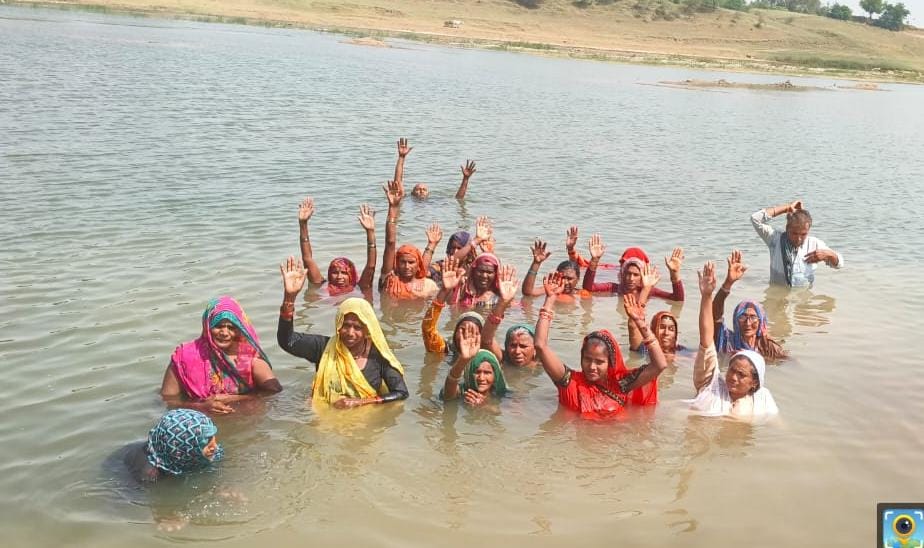
-आरोप लगाया कि पट्टाधारकों को खनिज अधिकारी का संरक्षण प्राप्त है। सांठगांठ के चलते ग्राम सभा व किसानों की निजी भूमि पर प्रतिबंधित पोकलैंड मशीनों से बालू का अवैध खनन धड़ल्ले से किया जा रहा है। किसानों ने केन नदी पर लगातार अवैध खनन होने से भूगर्भीय जल संकट गहराने की आशंका जताई है। सत्याग्रह करने वाले महिला व पुरुष किसानों ने जिलाधिकारी से की मौके पर आने की मांग करते हुए जांच कराकर पट्टाधारक को काली सूची में डालने की मांग की।https://bhaskardigital.com/banda-water-satyagraha-of-women-farmers/ (15 May 2025)
Chhattisgarh Constable crushed by tractor बलरामपुर-रामानुजगंज जिले के सनावल थाना अंतर्गत ग्राम लिबरा में कन्हर नदी से रविवार (May 11) की देर रात रेत का अवैध खनन कर रहे बिचौलियों को पकडऩे संयुक्त टीम पहुंची थी। यह देख खनन कर रहे लोग ट्रैक्टर लेकर भागने लगे। इसी दौरान उन्हें रोकने के दौरान रेत बिचौलिए द्वारा एक आरक्षक पर ट्रैक्टर चढ़ा दिया गया। इससे आरक्षक गंभीर रूप से घायल हो गया। टीम द्वारा अस्पताल ले जाने के दौरान रास्ते में उसने दम तोड़ दिया। इस मामले में आईजी ने सनावल थाना प्रभारी को निलंबित कर दिया है। https://www.patrika.com/balrampur-chattisgarh-news/constable-crushed-by-tractor-sand-middlemancrushed-constable-with-tractor-death-19592968 (12 May 2025) इस घटना ने कानून-व्यवस्था और अवैध खनन को लेकर सरकार की कार्यप्रणाली पर गंभीर सवाल खड़े कर दिए हैं. इस जघन्य घटना को बिलासपुर हाईकोर्ट ने गंभीरता से लिया है और स्वतः संज्ञान लेते हुए खनिज विभाग के सचिव और वन विभाग को नोटिस जारी कर जवाब तलब किया है.
चीफ जस्टिस की डिवीजन बैंच ने इस मामले को गंभीरता से लेते हुए आज हाई कोर्ट (High Court Bilaspur) की अवकाशकालीन पीठ में सुनवाई की. कोर्ट ने कहा अवैध खनन रोकने निर्देश के बाद यह हालत है. यह बहुत ही गंभीर बात है. स्टेट अफयर्स की ऐसी हालत है. वहीं ये भी कहा कि इस तरह की घटना का दोहराव नहीं होना चाहिए. हाई कोर्ट ने मामले में खनिज सचिव व वन विभाग को नोटिस जारी कर जवाब मांगा है. वहीं पुलिस महानिरीक्षक को इस मामले में गंभीरता से जांच के निर्देश दिए हैं. अगली सुनवाई 9 जून को होगी. https://mpcg.ndtv.in/chhattisgarh-news/sand-mafia-ran-over-constable-with-tractor-in-balrampur-bilaspur-high-court-considered-it-very-serious-8402967 (13 May 2025) बलरामपुर व सूरजपुर जिले की नदियों से हर दिन पोकलेन व जेसीबी लगाकर रेत का उत्खनन किया जा रहा है। बलरामपुर की कन्हर नदी, इरिया नदी व पांगन तथा सूरजपुर जिले के रेण नदी से रेत का उत्खनन किया जाता है। रेत की सप्लाई उत्तर प्रदेश व मध्यप्रदेश में की जाती है। जिस लिबरा गांव में कन्हर नदी के तट पर प्रधान आरक्षक को ट्रैक्टर से कुचला गया, वह झारखंड बॉर्डर से लगा हुआ है। यह घटनास्थल मंत्री रामविचार नेताम के गृहग्राम सनावल से करीब 15 किमी दूर है। झारखंड के संगठित तस्करों के एक गिरोह द्वारा छत्तीसगढ़ की सीमा में कन्हर नदी से रेत का अवैध उत्खनन किया जा रहा है। ये सभी गढ़वा क्षेत्र के धुरकी गांव के आसपास के हैं।
जिस गांव में आरक्षक पर रेत माफियाओं ने गाड़ी चढ़ाई वहां के ग्रामीणों ने इसकी शिकायत थाने में पहले भी की थी। जानकारी मिली है कि नदी से 10 किमी की दूरी पर अस्थायी डंपिंग यार्ड भी तस्करों ने बना रखा है। छत्तीसगढ़ में 800–1000 रुपए ट्रैक्टर बिकने वाली रेत झारखंड में 7 से 8 हजार रुपए ट्रैक्टर में बिकती है। https://www.patrika.com/ambikapur-news/sand-smugglers-from-jharkhand-has-murdered-a-constable-from-chhattisgarh-19595965 (14 May 2025) छत्तीसगढ़ में रेत माफिया ने वनकर्मियों को दौड़ाकर पीटा:डंडे से फोड़ा सिर-वर्दी फाड़ी, बोले-तुम्हे मार डालेंगे; अवैध उत्खनन की मिली थी शिकायत https://www.bhaskar.com/local/chhattisgarh/news/chhattisgarh-kawardha-sand-mafia-attacks-forest-officer-team-133700212.html (Nov. 2024)
Madhya Pradesh उत्खनन के लिए रोका पानी, फसल बर्बाद! रेत खनन के कारण पर्यावरण पर हो रहे असर की व्यापकता को देखते हुए इसे लघु नहीं, बल्कि प्रमुख खनिज में शामिल कर सख्त पर्यावरणीय अनुमति का प्रावधान किया जाना चाहिए। वर्तमान दौर में नदियां कम्पनियों, कॉर्पोरेट्स और सरकार के मुनाफा कमाने का साधन बन चुकी है। (Vijayshree Dubey) https://www.youtube.com/watch?v=M0eGRxNNv5k&feature=youtu.be (13 May 2025)
Jammu & Kashmir 16 trucks escape as cops fail to reach spot 16 trucks carrying illegal mining material worth lakhs of rupees managed to escape from the custody of officials of the Mining Department as the police failed to arrive at the scene to help the officials. This development has become the talk of the town with the police finding it hard to defend themselves. The trucks were operating without valid documents. They were trying to enter Punjab from J&K on Thursday (May 15) evening.
The state stands to lose revenue when undocumented trucks enter the state without paying the relevant fees. According to the norms, each truck illegally entering the state from outside states is fined Rs 2 lakh. Mining officials said they stopped the trucks at 7.30 pm and till 1.30 am, the police did not reach the scene.
A case has been registered at the Taragarh police station based on a complaint filed by XEN Samyal. XEN Sood said the hooligans manhandled his staff. “We seized the trucks at 7.30 pm and for the next few hours, we kept on contacting the police. What else advance information should we have given? In the meantime, the miscreants badly manhandled my staff,” said Sood. SSP Dhillon said the police had stumbled on some clues, adding that the trucks would be impounded soon and the culprits brought to book. https://www.tribuneindia.com/news/amritsar/16-trucks-carrying-mining-material-escape-as-cops-fail-to-reach-spot/ (17 May 2025)
Maharashtra Govt approves policy for artificial sand The Maharashtra government on May 13 cleared a policy to promote the use of artificial sand, also known as manufactured sand or m-sand, in the state as a sustainable alternative to river sand in construction work. The state also made the use of m-sand mandatory for construction work undertaken by government and semi-government agencies. To encourage its production, the state will lease land for artificial sand crushers.
– Artificial sand is produced by crushing hard rocks, often granite, into small, sand-sized particles. To begin with, the state government has decided to allow the installation of 50 crusher machines in each district and 1,500 in total. The government is also ready to allot its land for the projects on a first-come, first-served basis. “Even the existing crushers will have to shift to producing m-sand in the next three years, without which they will not get permission to continue their production,” said Bawankule.
– The state government has also decided to keep the royalty price of artificial sand much lower than that of natural sand. “It has been dropped to ₹200 per brass, compared with ₹600 per brass for natural sand,” Bawankule said. https://www.hindustantimes.com/cities/mumbai-news/maharashtra-approves-policy-for-promoting-artificial-sand-101747164656571.html (14 May 2025)
Tamil Nadu Consider plea to prevent illegal sand mining: HC Madras high court has directed the authorities to consider and pass orders on a plea seeking to prevent illegal mining of sand in Keeranur village in Madurai district. The court was hearing a public interest litigation filed by N Kesirajan, a farmer, and a resident of Keeranur village in Melur taluk. He stated that an individual was excavating odai sand from the village beyond the permissible limit and contrary to conditions imposed in the licence granted to him by the authority concerned. He added that no action was taken on his representation to the authorities. Hence, Kesirajan moved court. https://timesofindia.indiatimes.com/city/madurai/consider-plea-to-prevent-illegal-sand-mining-in-madurai-village-hc/articleshow/121216860.cms (16 May 2025)
WETLANDS, LAKES, WATER BODIES
Kerala Kuttanad Wetland Interpretation Centre proposed A report submitted by the Alappuzha district administration to the State government on the rejuvenation of the Vembanad Lake has proposed the establishment of a Kuttanad Wetland Interpretation Centre. Touted as a transformative initiative, the centre aims to redefine tourism in the ‘Rice Bowl of Kerala’. The primary goal of the centre, according to the report, is to create an experiential knowledge hub where visitors can “immerse themselves in the region’s cultural and environmental heritage” through interactive exhibits, live demonstrations, and digital documentation. https://www.thehindu.com/news/national/kerala/kuttanad-interpretation-centre-proposed-to-redefine-tourism-and-conservation/article69575351.ece (14 May 2025)
West Bengal Voices from Mangroves The fate of Sundarbans’ landscape has always been shaped by the outsiders’ perceptions of it. Locals like Chapal, who feel most at home in the landscape, have never had any say in determining its fate. With the right systems and policies in place, millions of people like Chapal who have an intimate knowledge of the hyper-localised ecosystems that they have lived in and have observed across generations can play a game-changing role in aligning the local economy with the mangrove ecology. This will also transform how w imagining disaster risk-reduction measures for the landscape. If we are able to put our acts together, then, maybe, the local economy, people’s lives and the mangrove ecosystem will all thrive in the Sundarbans of the future. (Pinaki Roy) https://www.telegraphindia.com/opinion/voices-from-the-forest-the-fate-of-sundarbans-landscape-has-always-been-shaped-by-the-outsiders-perceptions-of-it-prnt/cid/2100256 (17 May 2025)
Odisha Govt initiates demarcation of 13,000 wetlands Acting on the directions of the Supreme Court, the Forest department has taken up ground truthing of a total of 13,667 wetlands which are spread over 2.25 hectares or more area. The wetlands have been identified by the Space Application Centre, forest officials said. The apex court had in its order directed the state/Union Territory Wetland authorities to expeditiously complete the ground truthing and demarcation exercise of the boundaries of each of the wetlands identified by the Space Application Centre, Atlas (SAC, Atlas), 2021 and had set a three-month timeline for the same.
Following the Supreme Court judgement, the Orissa High Court also initiated a suo motu PIL in January to monitor the conservation of wetlands in the state. Accordingly, sources said, the state government engaged the Chilika Development Authority (CDA), responsible for the management and protection of Asia’s largest brackish water lagoon, as the nodal agency to implement the wetland conservation measures. https://www.newindianexpress.com/states/odisha/2025/Mar/30/odisha-initiates-demarcation-of-13000-wetlands-2 (30 March 2025)
GROUNDWATER
Study Deltaic freshwater scarcity driven by unsustainable gw-fed irrigation Abstract Southern Asia benefits from groundwater pumping for dry-season irrigation by increasing both crop productivity and monsoon aquifer recharge rates in the region. On the basis of a data-driven integrated modelling system, we provide numerical evidence that the impacts of unsustainable groundwater-fed irrigation on surface freshwater availability go beyond what was previously understood. Our results confirm findings from previous studies showing increased groundwater recharge rates during wet seasons over 2002–2021, but these rates are insufficient for aquifers to recover, gradually depleting groundwater across the Ganges–Brahmaputra–Meghna delta.
-The main findings are that this increased recharge causes a drop in surface runoff and baseflow generation during the monsoons, resulting in lower flood risk (a beneficial outcome), but also less surface freshwater available for farming, which may trigger additional groundwater demand. The drop in coastal flood risk induced by inland groundwater-fed irrigation exceeds the increase caused by sea level rise by about five- to tenfold. Reduced runoff may also increase seawater intrusion, driven by less freshwater to push ocean water away, further increasing freshwater scarcity. This is particularly concerning, since the region has been under rising sea levels and sinking lands. Our findings over this delta have global implications, as humans and climate are increasingly pressuring coastal and deltaic ecosystems worldwide. https://www.nature.com/articles/s41893-025-01566-0 (16 May 2025)
Karnataka Borewell drilling now requires mandatory clearance from state Groundwater Authority The Directorate of Groundwater and Karnataka Groundwater Authority (GDKGA) has reissued an advisory to all departments across the state—mandating prior permission for drilling borewells and using groundwater, especially for construction and commercial activities. Officials have stressed that any application for a No Objection Certificate (NOC) or Occupancy Certificate must now include clearance from the GDKGA. Despite this stipulation, many buildings and industries continue to bypass the rule, leading to overexploitation.
-According to GDKGA records, since its inception in 2019, only 205 NOCs have been granted in Bengaluru, covering a mix of industrial, residential, and commercial setups. However, more than 400 notices have been issued to violators who failed to seek the authority’s nod for groundwater usage. In the current financial year (2024-25), the department has approved 942 borewells. Ambika, Deputy Director of GDKGA, Bengaluru City, revealed that a large chunk of applicants remains unaware of the rules.
-Another senior official pointed out a major loophole. “Even 20% of the ongoing projects in Bengaluru have not sought our permission. BWSSB is granting online approvals independently without involving GDKGA,” the official stated, underlining the urgency of curbing indiscriminate drilling as water levels plummet. To address the issue, a sub-committee has been formed comprising representatives from BBMP, BWSSB, and GDKGA, which will scrutinize all large-scale construction proposals—excluding individual houses and domestic use. “However, a lack of awareness means that many stakeholders are unaware of our involvement,” the official added. https://daijiworld.com/news/newsDisplay (14 May 2025)
Punjab Farmers urged to adopt DSR technique Chief Agriculture Officer Baljinder Singh Bhullar highlighted that in 2024-25, around 17,000 acres in the district were cultivated using the DSR method. This year, the target has been set to expand the area to 30,000 acres. To achieve this, awareness campaigns are being organised at the village level, including farmer education camps, and the distribution of technical information via WhatsApp groups. https://www.tribuneindia.com/news/amritsar/to-conserve-groundwater-farmers-urged-to-adopt-dsr-technique/ (17 May 2025)
URBAN LAKES, WETLANDS
Delhi Clear water a far cry in lakes From grand announcements and crores in public funding to broken promises and green scum, the story of Delhi’s lakes is one of ambition undermined by indifference. If the city is to truly become a “City of Lakes,” officials, ecologists, and local communities must step up together—not just to build lakes, but to keep them alive.

-Water activist Diwan Singh believes lake rejuvenation must begin with natural sources such as rainwater or linking waterbodies with stormwater drains. Bhim Singh Rawat, a Yamuna activist, and member of the SANDRP, said that the “use of treated water for rejuvenation of lakes needs to be backed by rigorously monitored treatment process with open source data to check that the water is not going back to poor quality.” https://www.hindustantimes.com/cities/delhi-news/clear-water-a-fry-cry-in-lakes-of-delhi-101747248413805.html (15 May 2025)
Ajmer SC approves development of 2 new wetlands The Supreme Court has given its approval to the Rajasthan govt’s comprehensive proposal for developing two new wetlands, spanning a total area of 22 hectares, near Ajmer. The decision came on May 16 as part of the ongoing Ashok Malik case, which addresses environmental concerns surrounding the Ana Sagar Lake.
-The proposed wetlands will be developed at two locations: a 12-hectare site at Foy Sagar (Varun Sagar) Extension near Hathi-Khera and a 10-hectare site at Tabiji-1. Both locations will be situated outside the Ana Sagar Lake’s catchment boundary.
-The ruling follows a previous mandate from the NGT that ordered the removal of several structures, including a replica of the Seven Wonders, a food court and Gandhi Smriti Udhyan/Aazad Park, from the green zones surrounding the Ana Sagar Lake. https://timesofindia.indiatimes.com/city/jaipur/sc-approves-development-of-two-new-wetlands-near-ajmer/articleshowprint/121219639.cms (17 May 2025)
Hyderabad Restore forest or face jail: SC The Supreme Court gave the State of Telangana a choice between restoring the ruined acres of Kancha Gachibowli forest where trees were felled for an IT infrastructure project during an extended weekend or face the prospect of its Chief Secretary and “half a dozen officials” being sent to a “temporary prison” near the bulldozed green cover. “It is for the State to make a choice between restoring the forest or having the Chief Secretary and officials in prison,” Chief Justice of India B.R. Gavai stated firmly on Thursday (May 15, 2025). https://www.thehindu.com/news/national/kancha-gachibowli-tree-felling-restore-forest-or-face-jail-sc-warns-telangana/article69578849.ece (16 May 2025)
NCR Map area of Najafgarh lake on Haryana side: NGT The NGT has directed the National Wetland Authority to ascertain the exact area of Najafgarh lake on the Haryana side and submit its report by August last week. The directive came while the tribunal was hearing a petition seeking restoration of the lake that lies on the Delhi-Haryana border.
-During the May 1 hearing, the tribunal examined inconsistencies between the area that Haryana plans to mark as wetlands and information presented by INTACH, which seeks compliance with NGT’s Feb 2017 order to designate Najafgarh jheel as a wetland.
-The Haryana Wetland Authority reported that 75 acres along the Najafgarh drain could qualify as wetland, contingent upon future projects which would prevent the flow of dirty water and utilise treated water instead. INTACH contested this, presenting satellite imagery and flood data showing water coverage ranging from 200 to 5,300 acres recently, with an average of 3,800 acres submerged over 16 years. https://timesofindia.indiatimes.com/city/gurgaon/map-area-of-najafgarh-lake-on-haryana-side-submit-report-by-august-last-week-ngt-to-wetland-authority/articleshowprint/121140197.cms (13 May 2025)
Kolkata Mangroves to shield the city from storms Kolkata Municipal Corporation (KMC) has undertaken an ambitious initiative to plant mangrove trees and shrubs along the banks of the Hooghly River. While the move is being hailed as a step toward building climate resilience, experts say the success of such green buffers depends on careful ecological calibration — salinity levels, soil quality and tidal behaviour being among them. https://www.telegraphindia.com/my-kolkata/places/kolkata-municipal-corporation-plants-mangroves-along-hooghly-to-tackle-cyclones-and-soil-erosion/cid/2100021 (15 May 2025)
URBAN WATER
Chennai Krishna water yet to reach Krishna water released from Andhra Pradesh on May 5 is yet to reach Tamil Nadu border due to low flow velocity. According to the WRD, the discharge from Kandaleru reservoir had been stepped up after a meeting with Andhra Pradesh officials at Tirupati two days ago. Krishna water, a vital source to augment city’s drinking water resources, is expected to reach the zero point of 152-km-long Kandaleru-Poondi (KP) canal in Uthukottai, Tiruvallur district in two days. https://www.thehindu.com/news/cities/chennai/krishna-water-yet-to-reach-tn-border-increased-discharge-expected-to-speed-up-flow/article69579254.ece (16 May 2025)
Kurnool No water worries this summer Learning from last year’s challenges, officials took proactive action and filled the Sunkesula reservoir to 1.2 TMC feet well in advance this year. “With this storage, there will be no drinking water problem for the next 7–8 months. Managing even during the severe summer months will not be an issue,” said a senior official from the water works department of the civic body. https://www.deccanchronicle.com/southern-states/andhra-pradesh/kurnool-goes-without-drinking-water-worries-this-summer-1878733 (14 May 2025)
Hyderabad ORR dip into red zone for groundwater extraction “The change in water table is mostly due to anthropogenic (human activity) reasons. Encroachment of tanks, lakes and other water bodies and plotting are the major reasons. There used to be a big lake near Shivam near DD Colony. Now only houses can be seen there. Downstream of the lake used to be another small water body that too has disappeared. At the same time, we are seeing the rise of tall towers where water usage is above the 150 litre mark for urban users,” says K. Laxma, director of Telangana Ground Water Department.
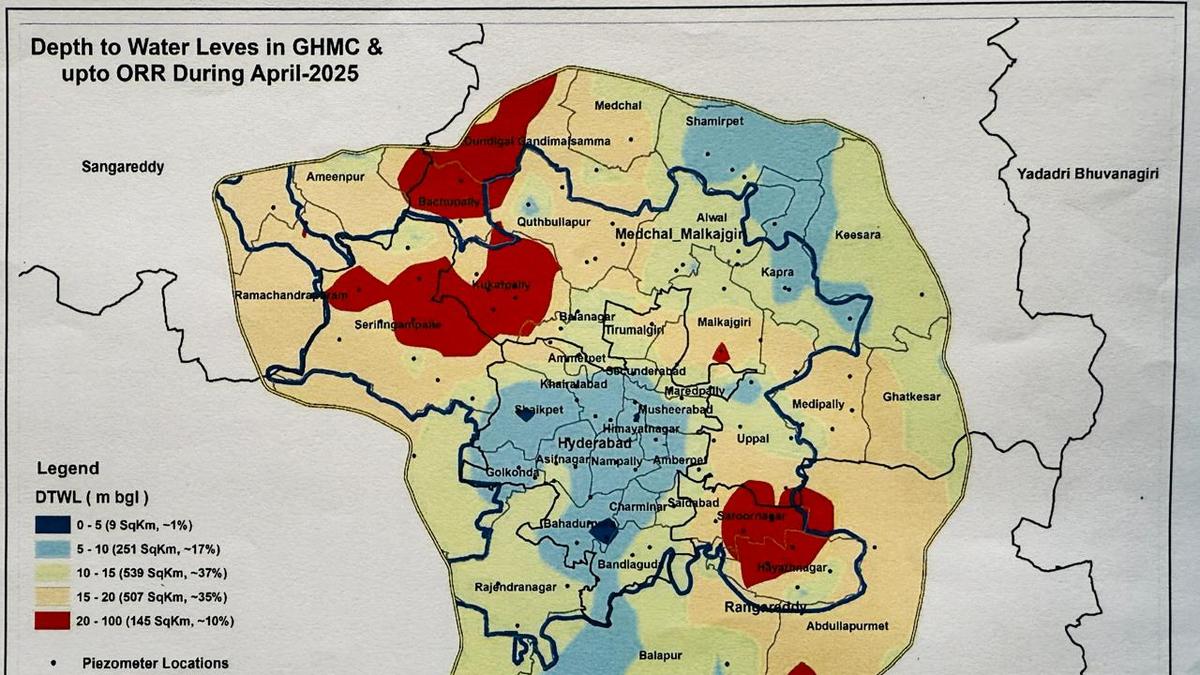
The remedial measures suggested by the Groundwater Dept officials include investing in rainwater harvesting structures. “It is not enough that the rainwater harvesting structures are built. They need to be cleaned and maintained as they frequently clog up or become filled up. If there is optimum harvesting of rainwater, the aquifers will get recharged and help the community in drier months. It will also reduce urban flooding,” informs Mr. Laxma. https://www.thehindu.com/news/national/telangana/serilingampally-malkajgiri-and-other-areas-within-telanganas-orr-dip-into-red-zone-for-groundwater-extraction/article69568252.ece (13 May 2025)
Erratic rains do little for GW Widespread concretisation that hindered rainwater infiltration, causing most of the runoff to drain into stormwater systems rather than replenishing underground aquifers. Officials confirmed that the rains had minimal impact on groundwater recharge, with most water flowing into drains instead of soaking into the soil. The groundwater in Hyderabad is classified as overexploited.
-Authorities have pointed to the lack of rainwater percolation due to urban development and inadequate implementation of Rain Water Harvesting Structures (RWHS). Though about 45–50% of houses and apartments have RWHS pits, many have become defunct due to poor maintenance. As borewells dry up during summer, the dependency on tankers continues. Officials said that any noteworthy recharge would require 10 to 15 consecutive days of rainfall. This means that occasional spells of rain are insufficient to restore groundwater levels.
-The state government has made it mandatory under Section 17(2) of the Water, Land & Trees Act, 2002, for all premises over 200 sq m to construct and maintain RWHS to aid groundwater recharge. Officials attributed the falling water table to human activity, including encroachment of buffer zones and constructions over tank beds and FTLs of water bodies. https://www.newindianexpress.com/states/telangana/2025/May/17/erratic-spells-of-rain-do-little-for-groundwater-levels-in-telangana (17 May 2025)
Pune CEC halts Balbharti-Paud Phata road project In a major relief for environmentalists in Pune who are fighting to protect Vetal Tekdi, one of the last remaining green spaces in the city, the Central Empowered Committee (CEC) on Friday directed that no construction activity be undertaken for the Balbharti-Paud Phata road project until the matter is considered by the Supreme Court. The directive follows a representation submitted in March 2024 by members of Vetal Tekdi Bachav Kruti Samiti (VTBKS), a citizens’ collective, seeking the CEC’s intervention to prevent irreversible ecological damage to the hill slope and forest ecosystem of Vetal Tekdi. https://www.freepressjournal.in/pune/relief-for-environmentalists-in-pune-as-cec-halts-balbharti-paud-phata-road-project (16 May 2025)
Mumbai Residents, activists, and lawyers are opposing BMC’s Deonar WTE project, citing environmental and health concerns. https://citizenmatters.in/city-buzz-five-things-you-must-know-about-the-deonar-wte-plant/ (17 May 2025)
Ludhiana 24×7 canal-based water supply project The first phase of the World Bank and Asian Infrastructure Investment Bank (AIIB) funded canal-based water supply project is being taken up at a cost of around Rs 1,300 crore (civil works). The works will be completed in two phases.
-Though it took seven years for the project to start, the canal-based water supply will reduce the burden on tube well and plug the depletion of groundwater. There are around 1,000 tube wells from which the MC was supplying almost 550 million litres daily (MLD) to over 20 lakh people living within the city limits. Of these, over 100 tube wells are now lying defunct. https://www.tribuneindia.com/news/ludhiana/works-under-24×7-canal-based-water-supply-project-going-on-in-full-swing/ (12 May 2025)
Delhi NGT seeks CS’s response on GW Five months after the NGT passed an order regarding the environmental damage caused by the illegal extraction of groundwater in Paharganj, the Delhi chief secretary’s response is yet to be submitted. The order called for identifying and holding accountable the officials responsible for the unregulated withdrawal of water under the guise of a non-existent voluntary disclosure scheme. https://timesofindia.indiatimes.com/city/delhi/national-green-tribunal-calls-illegal-groundwater-extraction-a-serious-matter-seeks-chief-secretarys-response/articleshowprint/121216645.cms (16 May 2025)
Gurugram Leachate dumped outside landfill site MCG additional commissioner Mahabir Prasad on Friday (May 16) ordered an inquiry into disposal of leachate, a black viscous liquid released from garbage, outside the Bandhwari landfill site by truckers. The order was issued after TOI on May 14 reported that dumper trucks were illegally discharging leachate outside the landfill site to keep a check on dust pollution from the vehicles moving to and from the landfill site.
Environmentalists pointed out that it wasn’t the first time that leachate was flowing into the Aravalis surrounding the landfill. The viscous liquid is toxic and seeps into the soil, contaminating groundwater. Bandhwari is a groundwater recharge zone for NCR cities as it lies at an elevation, and any groundwater contamination is likely to flow downhill towards Gurgaon, Delhi and Faridabad. https://timesofindia.indiatimes.com/city/gurgaon/leachate-dumped-outside-landfill-site-to-settle-dust-pollution-mcg-orders-inquiry/articleshow/121219633.cms (17 May 2025)
Wildlife dept asks for inspection Haryana’s wildlife department last week directed its officials to inspect the Bandhwari waste treatment plant and list out all environmental norms that were being violated at the site. It was the fifth notice to be sent in less than 12 months to its officials and MCG, which was granted a no-objection certificate (NOC) in 2019 to operate the plant that lies alongside protected Aravali forests.
Currently, most of the space at the site of the treatment plant is taken up by a mountain of garbage. Bandhwari is the only landfill where all municipal waste from Gurgaon and Faridabad is dumped every day even as treatment capacity has lagged. Environmentalists alleged on Sunday that these notices were “bureaucratic charade” that has permitted authorities to degrade the Aravalis with no punitive action. “This cycle of non-compliance has been going on for years,” said Vaishali Rana, an environmental activist. https://timesofindia.indiatimes.com/city/gurgaon/as-haryana-wildlife-department-asks-for-inspection-of-bandhwari-landfill-activists-say-just-a-charade/articleshow/121254681.cms (19 May 2025)
JJM/ RURAL WATER SUPPLY
Meghalaya GH group calls for action over ‘failed’ JJM project The state’s saga of failed Jal Jeevan Mission (JJM) projects continues, with the Achik Dedicated Integrity Leaders (ADIL) now demanding action against the company responsible for the project in Chandigre village under Demdema C&RD Block in West Garo Hills district. The JJM project in Chandigre falls under the Kaimbatapara Water Supply Scheme (WSS), which has a total project cost of over Rs 18.64 crore. According to information available on the official website, the village has 117 households, all of which are shown as connected through Functional Household Tap Connections (FHTCs).
Interestingly, while the Kaimbatapara Water Supply Scheme is still under way, almost the entire project amount of Rs 18.45 crore has reportedly already been paid to the contractor. According to ADIL, after receiving complaints from the villagers of Chandigre, their team had visited the site to assess the situation firsthand. As expected, ADIL found that not a single one of the 117 households was receiving any water. https://theshillongtimes.com/2025/05/18/gh-group-calls-for-action-over-failed-jjm-project/ (18 May 2025)
WATER
Opinion When water standards don’t hold water Despite its widespread use by municipal authorities across India, the per capita water supply standard lacks empirical grounding, objective rationale, and validity (Sachin Tiwale)
https://www.thehindu.com/opinion/op-ed/when-water-standards-dont-hold-water/article69567815.ece (13 May 2025)
Meghalaya A mountainous bastion faces an ecological threat The Shillong Plateau in Meghalaya, acts as a barrier to the humid air masses of the summer monsoon from the Bay of Bengal, and forces the wind to ascend on its southern windward side causing high rainfall. The plateau not only modulates monsoon precipitation but may also regulate the rate of tectonic convergence of the Indian and Asian plates along the eastern Himalayas. However, a serious water crisis is brewing on the plateau due to unscientific coal mining methods. (C.P. Rajendran) https://india.mongabay.com/2025/05/a-mountainous-bastion-faces-an-ecological-threat-commentary/ (19 May 2025)
Karnataka Minister talks of blacklisting L&T for delay in water project Minister for Rural Development and Panchayat Raj, IT-BT, and Kalaburagi district in-charge Priyank Kharge has directed the Kalaburagi City Corporation Commissioner Avinash Shinde to submit a detailed report on the inordinate delay in implementation of the 24×7 drinking water supply project in the city by L&T so that the construction company could be blacklisted for repeated failure to meet the project deadline.
The directive came during a review at the Deputy Commissioner’s office in Kalaburagi on May 13 with the Minister expressing strong dissatisfaction over the sluggish pace of the project. “If L&T is not doing enough to complete the project within the stipulated time, what exactly are you, the engineers from the municipal corporation and KUIDFC, doing? Sitting idle is not acceptable. While thousands of workers were required, L&T has deployed only between 170 and 300 labourers,” he said, questioning whether officials had ever visited the work sites or monitored if labour deployment matched the required numbers.
Kalaburagi Mayor Yallappa Naikodi attributed the delay to L&T’s sub-contracting practices and alleged that non-payment to sub-contractors was slowing down progress. He suggested that while the execution could remain with the company, management responsibility should be transferred to the Karnataka Urban Water Supply and Drainage Board (KUWSDB) for smoother operation. “At this rate, the project may not be completed even after another two years,” he warned. https://www.thehindu.com/news/national/karnataka/minister-talks-of-blacklisting-lt-for-delay-in-completion-of-24×7-drinking-water-project-in-kalaburagi/article69570681.ece (13 May 2025)
Last-mile water supply eludes N-K as authorities fail to walk extra mile The problem aggravated in the last one-and-half decade after Maharashtra stopped releasing water to Bhima river from Ujjani dam. The neighbouring state has not yet released water from Koyna dam despite pleas by Karnataka to ensure drinking water to parts of Belagavi and Bagalkot districts.
-Sewage water is entering rivers, lakes and dams. Water in the Bhima, Amarja, Kagina, and Mullamari rivers is not suitable for drinking, due to absence of water treatment plants. “The lone RO plant in our village cannot cater to the pure water requirement of the 2,400 people here. Due to this, many people are dependent on borewell water though it is not potable. Officials have not taken measures to instal another RO plant despite several appeals,” said R H Kalamangi of Kalmangi village in Sindhanur taluk of Raichur district. https://www.deccanherald.com/india/karnataka/last-mile-water-supply-eludes-n-k-as-authorities-fail-to-walk-extra-mile-3535746 (12 May 2025)
MONSOON 2025
SANDRP Blog CWC, IMD Need to Improve Extreme Weather Forecast Services The weather and flood monitoring and forecast services by the IMD and CWC are primarily active in the monsoon season. The IMD issues weather warnings for rainfall events throughout the year but its flash flood services are not available in pre-monsoon months. Moreover, the rainfall alerts by the local meteorological divisions are often late and of general category while there is need for more precise area specific rainfall alerts.
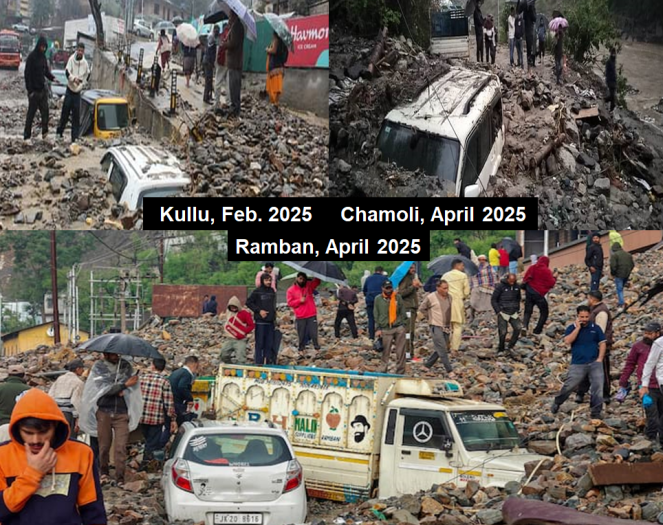
The sheer number of tourists getting trapped along severely damaged national highways and scores of vehicles getting damaged only suggests that the available weather alerts are still not reaching the targeted group of public timely and the local administrations are failing to follow the instructions. These gaps are bound to result in a major disaster in these states. https://sandrp.in/2025/05/17/cwc-imd-need-to-improve-extreme-weather-forecast-services/ (17 May 2025)
Study Atmospheric memory: How do monsoons ‘remember’ the past? How do monsoons really work? What makes them plentiful some years, but vanish completely in others, causing drought-like conditions? Climate scientists have been seeking answers to these questions for a long time. Now a research paper has come up with an intriguing explanatory concept: atmospheric memory. The study was conducted by two scientists — Anja Katzenberger & Anders Levermann — from the Potsdam Institute for Climate Impact Research (PIK). Titled ‘Monsoon Hysteresis reveals Atmospheric Memory’, it was published recently in the scientific journal PNAS.
– The study showed, for the first time, that the atmosphere can store moisture over extended periods, creating a physical memory effect. In other words, the atmosphere can ‘remember’ its previous state by storing physical information in the form of water vapour.” The paper also talks about how there is a tipping point in the system that determines monsoon rainfall. So, how does this discovery change our understanding of how monsoons work? What are its practical applications? What are the risks posed to this system by things like pollution and global warming?
– Guest: Anders Levermann, Professor of the Dynamics of the Climate System at the Institute for Physics and Astrophysics of the Potsdam University, Germany. https://www.podbean.com/media/share/dir-zumas-25758967 (16 May 2025)Anders Levermann speaks to us about his research paper that shows that the atmosphere can store moisture over extended periods, and how this discovery changes our understanding of the monsoons. https://www.thehindu.com/podcast/atmospheric-memory-how-do-monsoons-remember-the-past-in-focus-podcast/article69583181.ece (16 May 2025) The onset of monsoons in spring or ‘switching on’ and their retreat or ‘switching off’ in autumn appeared to depend not solely on incoming solar radiation, as previously believed, but also on the cumulative build-up of atmospheric moisture over time, the researchers found. “It allows monsoon systems to flip between two stable states. Disrupting this delicate balance would have severe consequences for billions of people, in India, Indonesia, Brazil and China,” stated a press release issued by PIK on May 7, 2025. https://www.downtoearth.org.in/climate-change/monsoons-remember-to-switch-on-and-off-disrupting-it-could-be-dangerous-finds-study (07 May 2025)
FLOOD 2025
Himachal DAM FLOODS सायरन बजाकर डैम से छोड़ दिया पानी बिलासपुर जिले के खंगर गांव में बुधवार (May 14) शाम को सतलुज नदी में अचानक आए उफान में दो बच्चे फंस गए. इन बच्चों को स्थानीय ग्रामीणों और एनटीपीसी की कोलडैम परियोजना के अधिकारियों ने जैसे तैसे कर सुरक्षित बाहर निकाल लिया. घटना के दौरान तीन बच्चे कृष, उसकी बहन मन्नत (10) और अनुज ठाकुर (12) नदी के किनारे खेल रहे थे.. कोलडैम परियोजना से बिजली उत्पादन के लिए सायरन बजाकर पानी छोड़ दिया, जिसके कारण सतलुज नदी का जलस्तर अचानक बढ़ गया. जलस्तर बढ़ते ही कृष और अनुज नदी में एक बड़े पत्थर पर बैठ गए, जबकि मन्नत पानी से बाहर निकलने में सफल रही. मन्नत ने शोर मचाया, जिससे बड़ी संख्या में लोग नदी के दोनों ओर जमा हो गए. लोअर भटेड़ पंचायत की वार्ड सदस्य अंजना कुमारी भी घटना की जानकारी मिलने पर तुरंत मौके पर पहुंचीं और बांध अधिकारियों से संपर्क किया. अधिकारियों ने तुरंत बांध के गेट बंद कर दिए, जिससे पानी का बहाव कम हो गया. पानी का स्तर कम होने पर निचली भटेड़ गांव निवासी राजेंद्र कुमार (55) रस्सियों की मदद से बच्चों के पास पहुंचे और उन्हें सुरक्षित बाहर निकाल लिया. https://hindi.news18.com/news/himachal-pradesh/bilaspur-hp-sutlej-river-ntpc-koldam-project-two-children-trapped-dam-officials-and-villagers-rescued-ws-dkl-9244205.html (16 May 2025)
Bihar फोटो निबंध: नीति निर्माण और स्थानीय संदर्भ–एक परस्पर संवाद की आवश्यकता कोसी नदी के क्षेत्र में बाढ़ एक पुरानी समस्या है और इसी वजह से इसे ‘बिहार का शोक’ नाम कहा जाता है। कोसी बाढ़ नियंत्रण नीति पर पीएचडी कर चुके डॉ. राहुल यादुका बताते हैं कि कोसी नदी पर कंक्रीट संरचना नहीं टिक सकती। यह नदी सबसे अधिक बार धारा बदलती है। चूंकि यह क्षेत्र इसके मध्य में आता है, इसलिए यहां बार-बार बाढ़ आती है, जिससे हजारों लोग प्रभावित होते हैं। लेकिन आश्चर्य की बात यह है कि सरकार फिर भी ऐसी परियोजनाओं पर करोड़ों रुपये खर्च करती है। यादुका बताते हैं कि सरकार को जलमार्गों को बढ़ावा देना चाहिए, क्योंकि ऐसी जगहों पर रहने वाले लोग इन पर अधिक निर्भर हैं।

सुपौल जिले का स्थानीय निवासी होने के नाते मेरा मानना है कि यहां के लोग हमेशा से बाढ़ की तमाम चुनौतियों के साथ गुजर-बसर करते रहे हैं। वर्तमान समय में विकास जरूरी है, लेकिन एक ही समाधान हर जगह के लिए लागू नहीं किया जा सकता। नीति निर्माण में स्थानीय संदर्भों और सामुदायिक भागीदारी को महत्व देना भी जरूरी है। इसलिए यहां नाव व्यवस्था, तैराकी प्रशिक्षण, जलवायु अनुकूल खेती जैसे विषयों पर ज्यादा ध्यान देने की जरूरत है। https://hindi.idronline.org/article/zamini-vastvikta-aur-niti-nirman-mein-antarbhed/ (15 May 2025)
URBAN FLOODS
Bengaluru Rain Havoc Bengaluru witnessed its heaviest downpour of the year late on May 18, with the deluge beginning post 1.30am and continuing into the early hours, triggering widespread chaos across the city. The rain, described as more typical of the monsoon months, brought with it traffic snarls, waterlogging, and damage. Kengeri recorded a staggering 123 mm of rainfall, while other areas like Jayanagar, BTM Layout, Yeshwanthpur also experienced intense showers.
The late-night thunderstorm left roads submerged and caused major disruptions to morning commute. The city’s central business district and parts of south and southwest Bengaluru bore the brunt of the rain fury, with several homes and low-lying areas inundated. The repeated pattern of late-night thunderstorms this May has surprised weather watchers and residents alike, as Bengaluru grapples with increasingly erratic pre-monsoon activity. https://www.timesnownews.com/bengaluru/bangalore-rain-news-heaviest-deluge-of-year-today-heavy-rain-waterlogging-imd-forecast-today-yellow-alert-article-151669875 (19 May 2025)
Varthur residents slam BBMP’s SWD project The major canal, which links Varthur Lake and Bellanduru Amanikere Lake and runs along survey numbers 61 & 59, has been cut to make a road to connect Varthur. “The officials have covered the major drain by placing concrete slabs.
-The drain, which is about 150 metres long near Vibgyor School, has been cut. It appears that builders, to facilitate better connectivity to their apartments, have got this violation executed through SWD Officials,” alleged Raveesh JK, an advocate and a resident of Varthur.
-Residents of Varthur have expressed concern that, despite being fully aware that the canal-side road at Balagere T Junction and Thubarahalli becomes impassable during heavy rains and floods, some developers are aggressively pushing for a Rs 480 crore flyover project. The proposed flyover spans 1.92 kilometres, extending from the Varthur Main Road sluice gate to Vinayaka Theatre. https://www.newindianexpress.com/cities/bengaluru/2025/May/12/varthur-residents-slam-bbmps-storm-water-drain-project (12 May 2025)
Itanagar Heavy rainfall disrupts life Itanagar was battered by heavy rainfall today on May 14, causing widespread disruptions across the region. The IMD had issued a warning for heavy to very heavy rainfall in isolated parts of Arunachal Pradesh, attributing the intense weather to a cyclonic circulation over the Northeast and moisture incursion from the Bay of Bengal. The downpour, which began in the early hours, led to severe waterlogging in low-lying areas, particularly in sectors like Ganga Market, Chandranagar, and near the NH-415 highway. Several roads became impassable, stranding commuters and disrupting public transport.
-The heavy rain also triggered minor landslides in hilly areas around Itanagar, blocking access roads to nearby villages like Chimpu and Gohpur. Landslide occurs near ongoing Artisan-cum-Exhibition centre building in WRD Colony Chimphu under Smart City Project. -A cloudburst in June 2024 caused significant flooding and damage in the city, raising concerns about urban drainage systems and infrastructure resilience. https://arunachal24.in/arunachal-heavy-rainfall-disrupts-life-in-itanagar/ (14 May 2025)
Guwahati Complete desiltation withing 3 days: Minister Housing and urban affairs minister Jayanta Mallabaruah on May 15 warned officials and contractors concerned of legal action under the Disaster Management Act if they fail to complete the remaining de-siltation work within next three days. The minister said the de-siltation work across the city was supposed to be completed by April 30. However, the minister added, work remained incomplete in a few areas. https://timesofindia.indiatimes.com/city/guwahati/complete-desiltation-withing-3-days-or-face-legal-action-minister-warns-officials-contractors/articleshowprint/121194075.cms (16 May 2025)
Delhi Drain clean-up leads to traffic chaos in NFC A massive traffic jam gripped parts of New Friends Colony and nearby areas on May 15 — chaos that is expected to spill over into Friday (May 16) morning — after mounds of silt from a major drain cleaning operation were dumped along a key stretch of CV Raman Marg, leaving only one lane open, traffic police officials said.
According to Traffic Police officers, Municipal Corporation of Delhi (MCD) began clearing silt from the Taimoor Nagar drain — which recently saw a high court-mandated largescale demolition drive—on Thursday morning. But instead of being swiftly removed, the debris was left piled on the road near the connecting bridge, leading to severe bottlenecks. A bulldozer parked alongside the debris further choked the stretch, turning a two-lane arterial road into a single-lane snarl. https://www.hindustantimes.com/cities/delhi-news/drain-clean-up-leads-to-traffic-chaos-in-nfc-in-south-delhi-101747333587944.html (16 May 2025)
Gurugram Gaps flagged in mock drill Weeks before the monsoon, gaps in flood preparedness have prompted authorities to issue urgent directives for corrective measures. Non-functional pumping machinery has been detected at major locations under NHAI along with a lack of basic infrastructure at stretches maintained by PWD. GMDA, which completed drills at 21 underpasses across the city on Wednesday (May 14), flagged these critical gaps. The drill that began on May 5 was carried out at different locations. Among the problem spots, the pumping machinery at underpasses near Medanta, Rajiv Chowk and Sector-84-36B was found to be non-functional. NHAI was asked to rectify these issues immediately to ensure smooth drainage during the rainy season. https://timesofindia.indiatimes.com/city/gurgaon/monsoon-a-month-away-pumps-still-defunct-at-flood-prone-underpasses-in-gurgaon/articleshow/121195673.cms (16 May 2025)
CLOUD BURSTS
Uttarakhand उड़खोला में फटा बादल; कई वाहन फंसे अल्मोड़ा जिले के चौखुटिया ब्लाक के दूरस्थ तड़ागताल क्षेत्र में शनिवार (May 10) करीब डेढ़ बजे के आसपास उड़खोला गांव के जंगल में बादल फटने से खदुगाड़ गधेरा उफान पर आ गया। जो तेज प्रवाह के साथ बड़े-बडे बोल्डर व मलबा बहा ले आया। इससे गांव की पेयजल योजना ध्वस्त होने से पेयजल आपूर्ति ठप हो गई है, वहीं गांव के पास मोटर मार्ग में बडे-बड़े बोल्डर व मलबा जमा होने से यातायात बाधित हो गया और सड़क के दोनों ओर वाहन फंस गए।
-26 जून 2013 में उड़खोला के ही तोक गांव खौला में बादल फटने से भारी तबाही हुई थी। बादल फटने से गांव के पास ही खौला गधेरा रोद्र रूप में आ गया तथा इसके तेज प्रवाह में एक व्यक्ति के बहने से मौत हो गई तथा कई मकान टूट गए एवं खेत खिलहान मलबा और पत्थरों से पट गए।https://www.jagran.com/uttarakhand/almora-uttarakhand-weather-update-cloud-burst-in-udhkhola-23935094.html (10 May 2025)
ENVIRONMENT GOVERNANCE
Supreme Court Don’t Grant Ex-Post Facto ECs In Future: SC The Supreme Court on Friday (May 16) restrained the Central Government from granting “ex-post facto” Environmental Clearances (EC) in future and set aside the previous Office Memoranda and notifications which allowed for the grant of ex-post facto Environmental Clearance for mining projects. This means that the projects which commenced without obtaining the mandatory prior Environmental Clearance cannot be later regularised by granting them EC in future. https://www.livelaw.in/top-stories/supreme-court-restrains-centre-from-allowing-ex-post-facto-environmental-clearances-strikes-down-previous-notifications-292386 (16 May 2025) The court also quashed the 2021 OM and all related circulars, declaring them unlawful. However, it clarified that ECs already granted under these provisions would remain unaffected. The case arose from petitions filed by the non-government organisation Vanashakti and others, challenging the legality of two government memorandums issued in July 2021 and January 2022.
Earlier, the Supreme Court had imposed an interim stay on the contested OMs in January 2024. The Union Ministry of Environment, Forest and Climate Change defended its position in a counter-affidavit, stating that the 2017 Notification had provided only a limited six-month window for violators to seek regularisation, which expired in September 2017. https://www.downtoearth.org.in/governance/axing-legal-loophole-supreme-court-prohibits-retrospective-environmental-clearances-scraps-government-notifications (16 May 2025) Don’t Grant Ex-Post Facto ECs In Future : Supreme Court To Centre; Quashes Previous Notifications https://www.livelaw.in/top-stories/supreme-court-restrains-centre-from-allowing-ex-post-facto-environmental-clearances-strikes-down-previous-notifications-292386 (16 May 2025) Before doors closed, 55 projects benefited from 2017-2021 environmental amnesty. https://indianexpress.com/article/explained/explained-law/before-doors-closed-55-projects-benefited-from-2017-2021-environmental-amnesty-10011525/ (17 May 2025)
Gaps remain: Experts Himanshu Thakkar, Coordinator of the SANDRP, said the decision is welcome but should have come earlier. He also raised concerns about enforcement. “This is welcome, but the directions could have come sooner. It shows that our system is very slow to react.” “Secondly, where is your credible monitoring system to ensure that this doesn’t happen? The third thing is there is a bypassing of the law happening. For example, land acquisition is allowed, even when environment clearance is not there. If you have already acquired land, you are creating impacts, displacing people, you are making the project fait accompli,” Thakkar said.
– “So, the Supreme Court also needs to put down more stipulations that you cannot acquire land without environmental clearance because once you acquire the land, then you get the right over the land and you can do what you want to do with it, which is again movement towards irreversibility. So, these kinds of loopholes are still there,” he said. https://www.newindianexpress.com/nation/2025/May/17/sc-order-on-retrospective-environmental-clearances-a-step-forward-but-gaps-remain-experts-2 (17 May 2025)
Maharashtra CJI flags politician-builder nexus in Pune land scam Newly sworn-in Chief Justice of India, BR Gavai, delivered his first verdict since taking over the reins, ruling that the forest land handed over by the Maharashtra government to private parties for non-forest activities back in 1998 was illegal. “This is a classic example of the nexus between politicians, bureaucrats and builders,” observed the court in the Pune land scam case, while ordering the transfer of the forest land to the forest department.
-“The alarming speed with which the government of Maharashtra changed land use between July to August 1998 shows the then-minister for revenue was involved,” the top court further observed. The top court also passed a directive to all states and union territories to probe if any forest land was allotted to any private parties for non-forest activities. The top court further directed that any reserved forest land given away for non-forest purposes be handed back to the forest department. https://www.indiatoday.in/india/law-news/story/in-his-first-verdict-chief-justice-of-india-br-gavai-flags-politician-builder-nexus-in-pune-land-scam-2725031-2025-05-15 (15 May 2025) The case revolves around the illegal allocation of 11.86 acres of forest land in Kondhwa Budruk, Pune, by the state revenue department to Richie Rich Colony, despite opposition from the forest department. The court declared the environmental clearance granted to the project as unlawful. https://www.business-standard.com/india-news/cji-gavai-first-verdict-sc-pune-land-transfer-illegal-alarming-125051501068_1.html (15 May 2025) The Supreme Court directed Chief Secretaries of all the States and the Administrators of all the Union Territories to constitute Special Investigation Teams for examining whether any of the reserved Forest Land in possession of the Revenue Department has been allotted to any private individuals/institutions. https://www.verdictum.in/court-updates/supreme-court/in-re-tn-godavarman-thirumalpad-v-union-of-india-2025-insc-701-forest-lands-possession-1577716 (16 May 2025)
What’s making Chandrapur simmer? Industrial development in the last two decades has focused on Chandrapur city, Tadadi, Ghughus and Ballarshah. The district already has 33 coal mines and five thermal power plants. It also has four cement plants and five sponge iron plants. There are also four major industrial estates, at Tadadi, Chandrapur, Ghughus and Ballapur, which house 100 major and 200 small industrial units.
-The SBWL has cleared the Asola Mendha irrigation project, which will divert 315 hectares of forest land in Brahmapuri, Middle Chanda and Chandrapur. A staggering 1.17 lakh trees will be cut. The district already hosts more than 30 coal mines; now there’s a concerted push to transform it into a major steel hub. Large infrastructure projects – roads, power and irrigation – are also underway. Between 2021 and 2024 alone, 25,063 trees were axed for infrastructure projects In 2024, the go-ahead was given for an irrigation project that will take down a staggering 1.17 lakh trees, while an iron and steel project will fell 18,024 trees in a Tadoba Andhari tiger corridor. https://www.hindustantimes.com/cities/mumbai-news/whats-making-chandrapur-simmer-101747244931617.html (15 May 2025)
Opinion Ecology is the world’s permanent economy In simple terms, this might be the clearest way to define sustainability — finding the right balance between protecting the environment and supporting economic development. Without this balance, neither the environment nor the economy can thrive in the long run. (P Ragavan) https://www.thehindu.com/opinion/op-ed/ecology-is-the-worlds-permanent-economy/article69572346.ece (14 May 2025)
West Bengal Govt introduces environmental science in schools The move, which targets senior secondary students, is designed to equip them with early exposure and foundational knowledge in the field. The introduction will be phased with the initial rollout covering schools in Kolkata, Howrah, Hooghly, and North and South 24 Parganas. The announcement, made in December 2024, has garnered considerable interest, with over 1,500 schools opting in ahead of the May 31 deadline. While Environmental Studies will continue to be available as an optional subject, Dr. Mallick underlined the enhanced relevance and future prospects of Environmental Science. The introduction of Environmental Science marks a decisive step by the West Bengal government towards aligning school education with global sustainability goals and academic relevance in a changing world. https://www.thehindu.com/education/west-bengal-introduces-environmental-science-in-schools/article69571383.ece (14 May 2025)
Report Cooling boom adds to environmental burden According to the India Meteorological Department, 2024 was the country’s hottest year since detailed records began in 1901, following a global trend of extreme heat fuelled by climate change. In May 2024, a heatwave in New Delhi sent temperatures soaring to 49.2 degrees Celsius — the same as the city’s record high in 2022. By 2050, air conditioning is expected to cause a quarter of India’s carbon emissions and nearly half of its peak electricity demand, according to the UN Environment Program’s Cool Coalition. https://www.business-standard.com/india-news/india-summers-air-conditioners-acs-coal-burning-electricity-global-warming-125051200534_1.html (12 May 2025)
CLIMATE CHANGE
Chandigarh Climate Change action plan gets nod The ministry of environment and climate change has given an in-principle nod to the Chandigarh State Action Plan for Climate Change 2.0 (SAPCC 2.0). SAPCC 2.0 outlines two major strategies — adaptation and mitigation. In 2019, the ministry of environment, forest, and climate change (MOEF&CC) provided a framework for revising the SAPCC 2.0 for a period covering 2020-2030 so that it aligns with the changing national and international action and policy landscape, such as India’s Nationally Determined Contribution (NDC) goals and Sustainable Development Goals (SDGs) for inclusive, sustainable, and climate-resilient low carbon development pathways. https://timesofindia.indiatimes.com/city/chandigarh/ut-climate-change-action-plan-gets-centres-nod/articleshow/121241583.cms (18 May 2025)
Report India witnessing severe climate impact on Himalayan: Bhupender Yadav “The science is clear. Himalayas are sounding alarm. As a consequence of global warming due to human activity, glaciers are retreating, threatening the future of water security for populations downstream,” said Yadav in his address at the Sagarmatha Sambaad, a multi-stakeholder meeting on mountains and climate change being hosted by Nepal while adding that the livelihoods of mountain communities are threatened despite contributing the least to the climate crisis. https://www.hindustantimes.com/india-news/india-witnessing-severe-climate-impacts-on-himalayan-region-bhupender-yadav-101747373565880.html (16 May 2025)
Glaciologists, locals mourn loss of Yala glacier Glaciologists and local communities mourned the loss of Nepal’s Yala glacier, believed to be the first Nepalese glacier to be declared “dead”. Yala is one of just seven glaciers in the entire 3,500km-long arc of the Hindu Kush Himalayas to have been monitored annually for a decade or more and it is one of 38 glaciers with in-situ measurements, providing crucial data on the speed and extent of losses.

Yala has shrunk by 66% and retreated 784m since it was first measured in the 1970s. Over 50 people, including Buddhist monks and members of local community, and glacier experts from Bhutan, China, India, and Nepal completed the arduous high-altitude trek to attend the “poignant” tribute on May 12, according to ICIMOD. Yala is one of just seven glaciers in the entire 3,500km-long arc of the Hindu Kush Himalayas to have been monitored annually for a decade or more and it is one of 38 glaciers with in-situ measurements, providing crucial data on the speed and extent of losses. https://www.hindustantimes.com/india-news/glaciologists-local-communities-mourn-loss-of-nepal-s-yala-glacier-101747072348171.html (13 May 2025)
Himalayas becoming harder to see But with rising temperatures and a lack of rain, and worsening air pollution, the spring months are now seeing thick haze with low visibility. Those conditions are beginning as early as December. This is compounded by soot from massive forest fires – which are increasing due to a longer dry season – and the burning of crop residues after the harvest by farmers in northern India, Pakistan and Nepal. https://www.bbc.com/news/articles/cvgdl092jj5o (13 May 2025)
SOUTH ASIA
IWT India not sharing hydrological info The importance of hydrological data for Pakistan can’t just be understated, not only during the upcoming monsoon season but also at times when there is a sudden deluge of water in the upper riparian state, the coordinator at the SANDRP, Himanshu Thakkar explained in a conversation with Sputnik India. Around 80% of Pakistan’s water comes from the Indus basin, making the rivers extremely critical for the nation’s water and food security, river expert noted.
– “Just last week, we saw reports about a sudden surge in the water levels of the Chenab River after India opened two gates of the Baglihar Dam following heavy rainfall on the Indian side. So, definitely, Pakistan could have avoided the situation had it had access to the river flow data. If the Indus Water Treaty had continued to remain in effect, the downstream country could have been alerted and taken necessary measures to minimize the implications,” he said. Further, Thakkar emphasised that the de-silting of the rivers was another major factor.
– “Whenever an upper riparian state [India] would undertake a silt flushing exercise, this would inadvertently lead to massive amounts of silt flowing downstream [Pakistan]. A downstream state would be better placed if it knows about this desilting exercise,” Thakkar said, adding that India has already initiated the silt-flushing exercise in the Baglihar and Salal dams on the Chenab River since the Pahalgam terrorist attack. The river expert said that the desilting exercise or the unpredictability in the river flow would have a direct impact on Pakistan’s ‘Kharif’ crops (rice, maize, pulses, mango, etc). In the Subcontinent, Kharif crops are usually sown around April-May and harvested at the onset of winter.
– “If the lower riparian state is using the river for lifting water for irrigation purposes, an excessive amount of silt would render that untenable. On the other hand, a very high flow could lead to erosion, which would also be detrimental to Pakistan’s interest,” Thakkar said. He also assessed that industries such as fisheries could be impacted in Pakistan, which also risks creating water shortages in the short run.
– Thakkar pointed out that Pakistan, at present, didn’t have the requisite river infrastructure to manage the consequences of India’s actions upstream. “While Pakistan does have major dams on the rivers Jhelum and Indus, it only has the Marala waterworks on the Chenab river, which is in essence a diversionary structure. It doesn’t have the capacity to store water,” he said. Lastly, the expert noted that since the Pahalgam terrorist attack, India has already fast-tracked the construction of four projects on the Chenab River- Ratle, Kiru, Kwar and Pakal Dul. https://sputniknews.in/20250514/india-not-sharing-any-hydrological-info-with-pakistan-9121456.html (14 May 2025)
Needs for cohesive strategy not coercion The pattern of interaction between the two countries on sharing the waters of the Indus Basin has been conflictual rather than cooperative. As the conflict escalates post Operation Sindoor, it is pertinent how India recalibrates the link between water and terrorism. Some claim India has weaponised the Indus Waters Treaty by putting it in ‘abeyance’, an action that can have regional ramifications.There are also claims that India will now expedite projects on both the western and eastern rivers of the Indus system and that putting the treaty in abeyance can be seen as a political signal rather than legally enforceable action. (By Medha Bisht) https://www.mainstreamweekly.net/article15783.html (17 May 2025)
How will treaty freeze affect South Asia? Some experts worry that the entire region’s water security could be in danger. Others point out that India has only put the treaty “in abeyance” — a legal gray zone which is reversible, and could be seen as a measured diplomatic tool. The experts DW spoke to agree on one thing — that India and Pakistan will have to go back to diplomatic channels to eventually reinstate the treaty.
Old or reworked, a functioning Indus Waters Treaty is critical — especially for India and Pakistan, both of which are bearing the brunt of climate change and mounting pressure on their freshwater resources. https://www.dw.com/en/how-will-the-indus-water-treaty-freeze-affect-south-asia/a-72566811 (16 May 2025)
Indus through the centuries Among Asia’s oldest rivers, the Indus is under growing pressure from political turmoil, climate change, population growth, and increasing water demand. https://indianexpress.com/article/research/terror-treaties-and-civilisations-indus-through-the-centuries-10009466/ (16 May 2025)
Authorities probe Centre-funded Bunker project The allegations of malpractices in another flagship programme of the Union government have surfaced at a time when at least 20 civilians were killed and dozens wounded as Pakistan resorted to arbitrary shelling of border areas. Pakistan appeared to have targeted areas in J&K where some of these underground bunkers were reportedly proposed to be built. https://thewire.in/government/jammu-kashmir-bunker-project-probe (18 May 2025)
Underground water table & bunkers The Indian Ministry of Home Affairs approved Rs 415 cr in 2018 for 14,000 bunkers along the international border in Kathua, Samba and Jammu and the Line of Control in Rajouri and Poonch districts. These included 1,431 community bunkers each of which was budgeted at 10.5 lakhs and 13,000 individual bunkers each of which cost 3.5 lakhs.
In wake of the Pahalgam attack and increasing fears of a military escalation many media reports have covered border residents cleaning their bunkers. However, nobody has ever reflected on the condition of the old bunkers and the livability of the new ones. More importantly we have persistently overlooked how groundwater & rainwater impact the bunkers.
-Tough situations obviously produce resilience–however it shouldn’t prevent us from identifying persisting problems and finding solutions. The Indus Water Treaty is an unscientific, redundant treaty and its lack of clarity on the groundwater resources is only contributing to conflict and crisis.
-This unscientific approach to the utilization of groundwater is amply visible since long–even before the Pulwama attack of 2019 and the recent Pahalgam attack brought it back into loud discussions. In 2015 in its report on “Global Groundwater Basins in Distress,” NASA identified the Indus River Basin aquifer as the second most stressed river basins of the world. https://sundayguardianlive.com/featured/underground-water-table-in-the-indus-river-basin-and-the-case-of-community-bunkers-on-the-border (11 May 2025)
IWT to remain paused “Now, as per the Cabinet Committee on Security decision of 23 Apr, India will keep the Treaty in abeyance until Pakistan credibly and irrevocably abjures its support for cross-border terrorism. Please also note that climate change, demographic shifts and technological changes have created new realities on the ground,” the MEA spokesperson added. https://www.indiatoday.in/india/story/indus-waters-treaty-suspended-pakistan-abjures-support-for-terrorism-india-2724203-2025-05-13 (13 May 2025)
Pakistan wants to restart talks Pakistan has said it is willing to restart talks with India regarding the IWT which India has kept in abeyance following the Pahalgam terror attacks, government sources, on condition of anonymity, confirmed on May 15. A letter from Pakistan’s Secretary, Ministry of Water Resources, Syed Ali Murtaza, received “a week ago,” – sources said, to India’s Water Secretary, Debashree Mukherkjee, on May 8 asked for India to nominate representatives who could engage in talks with Pakistan’s Indus Commissioner.
– “India’s position is that re-negotiation of the treaty could be done only government-government and not by Indus Commission representatives. Pakistan offered to meet at a neutral venue but we proposed that we meet in Islamabad. Following this there was a silence for 4-5 months and now they have sent us this letter,” a person, familiar with the contents of Mr. Murtaza’s latest letter, said. The letter, sources said, has Pakistan’s objecting to India’s action of keeping the IWT in abeyance and violative of the terms of the treaty. However it says Pakisan is willing to meet and would like to begin the process for arranging the necessary logistics. The letter makes no mention of India’s surprise-water releases from the Baglihar and Salal dams on the May 5. “It was polite letter,” the person added. https://www.thehindu.com/news/national/willing-to-restart-talks-on-indus-water-treaty-pakistan-wrote-to-india/article69578219.ece (16 May 2025)
Dams in Afghanistan India’s commitment to advance the Shahtoot Dam project on the Kabul River, has deepened Pakistan’s water security concerns. Afghanistan’s Taliban govt has announced plans for another major hydroelectric dam on the Kunar River. With no bilateral water-sharing agreement between Afghanistan and Pakistan, these dam projects threaten to escalate into a major source of conflict. Afghanistan and Pakistan share 9 river basins, all of which are vital to Pakistan’s water security. In addition to the Kabul, Kunar, and Indus rivers, these include the Gomal River, the Kurram River, the Pishin-Lora, Kandahar-Kand, Kadanai, Abdul Wahab stream, and Kaiser River, all shared basins in Balochistan. https://www.indiatoday.in/world/story/indias-dam-good-plan-glbg-2725877-2025-05-16 (16 May 2025)
Govt plans monthly flushing of Salal, Baglihar dams CWC has now recommended that such flushing (as was done recently for Salal and Baglihar HEPs) become a monthly routine. The flushing that began in early May removed just over 7.5 million cubic metres (MCM) of sediment from the 690 MW Salal and 900 MW Baglihar reservoirs. “The CWC has now recommended that forced flushing be carried out monthly for both projects, and an SOP (standard operating procedure) will be issued shortly,” a senior official said. https://indianexpress.com/article/india/indus-pact-on-hold-govt-plans-monthly-flushing-of-salal-and-baglihar-dams-10009254/ (16 May 2025) India now plans to flush out silt from all hydropower projects on western rivers once a month, says this report. https://www.livemint.com/news/india-pakistan-desilting-hydro-power-projects-rivers-indus-water-treaty-jammu-and-kashmir-11747303132461.html (16 May 2025)
HEP generation may increase by 30% this season “We are looking at increasing electricity generation from the operational hydropower plants in J&K by 20-50 percent. But, since hydro is also contingent to weather factors, we would state a conservative number of 30 percent,” said one senior government official requesting anonymity.
-“Until now, all hydropower plants on the Indus River system, including the eastern ones, were compelled to run much below capacity due to objections from Pakistan. This summer would be the first time when the government will attempt to run all of them in full capacity,” the official said.
-“It is not only about filling the reservoirs, Pakistan used the IWT even to restrict India on flushing exercises during the monsoon season, which is meant to clear sedimentation. It would not allow us to reduce the level of reservoirs below a particular level, which is different for every plant. But now, we are not bound by any such restrictions,” said a second senior official. https://www.moneycontrol.com/news/india/hydropower-generation-from-jammu-and-kashmir-may-increase-by-30-this-season-13021512.html (12 May 2025)
India to rebuild canals, dig new ones India is preparing to begin desilting work in the Ranbir, New Partap, Ranjan, Tawi Lift, Paragwal, Kathua Canal and Ravi canals, which will be done in phases by the Jammu and Kashmir government under technical guidance of the Centre, a second official said. Then, expansion of the Kathua, New Partap and Ranbir channels will take place after projects are sanctioned, HT has learnt but it is as yet unclear which one will be taken up first. The Ranbir canal can carry no more than 1000 cusecs for irrigation, 250 cusecs for hydropower besides some withdrawal allowance for silt extraction, to be carried out within a defined window. J&K CM Omar Abdullah has pushed for the completion of the Tulbul barrage on Wullar lake, with the IWT being suspended. https://www.hindustantimes.com/india-news/india-to-rebuild-canals-dig-new-ones-to-tap-into-indus-101747421164080.html (17 May 2025) Originally built in the 19th century and currently about 60 kms long, the plan is to extend the Ranbir canal to 120 kms. This expansion would increase India’s capacity to divert water from 40 cubic meters per second to 150 cubic meters per second. https://timesofindia.indiatimes.com/india/water-wars-how-india-is-planning-to-divert-water-from-indus-river-system-leave-pakistan-high-and-dry-waters-treaty/articleshowprint/121209850.cms (16 May 2025)One of the key plans under discussion involves doubling to 120km the length of the Ranbir canal on the Chenab. The canal was built in the 19th century. This would allow it to divert 150 cubic meters of water per second, up from about 40 cubic meters currently. https://www.reuters.com/world/asia-pacific/india-weighs-plan-slash-pakistan-water-supply-with-new-indus-river-project-2025-05-16/ (16 May 2025) Plans to divert more water in canals. https://economictimes.indiatimes.com/news/india/india-vs-pakistan-whats-really-changing-on-the-chenab-river-and-why-it-matters-now/articleshow/121229043.cms (17 May 2025) Experts align with Omar’s view, saying revival of Tulbul Navigation Project will yield socio-economic benefits for J&K https://timesofindia.indiatimes.com/india/experts-align-with-omars-view-saying-revival-of-tulbul-navigation-project-will-yield-socio-economic-benefits-for-jk/articleshow/121219418.cms (17 May 2025) The People’s Democratic Party (PDP) on Saturday (May 17) criticised Omar Abdullah for his recent comments about the Tulbul Navigation Project and the IWT. The party also said, “Introducing contentious issues like the Tulbul Project or the abrogation of the IWT in today’s volatile climate only pushes both countries closer to further confrontation. Those in J&K advocating such positions are undermining our region’s stability, jeopardizing the lives of our people living in the border states who suffer most when conflict escalates, and, most importantly, India’s interests.” https://timesofindia.indiatimes.com/india/undermining-our-regions-stability-pdp-slams-omar-abdullah-for-calling-to-scrap-indus-waters-treaty/articleshow/121244189.cms (18 May 2025)
GREAT BEND PROJECT Big Risks for Asia’s Grand Canyon Two proposed Chinese dams will barricade the Yarlung Tsangpo, as it is about to flow through the world’s longest and deepest river canyon — think the Grand Canyon on the Colorado River, only three times as deep, projected to cost $137 billion. Ruth Gamble, an environmental historian at La Trobe University, in Australia, says that, despite the project’s huge electricity-generating potential, the dams won’t hold back large volumes of water, so the potential to inflict harm downstream will be limited. The site’s unique geography will do the work, as the water rushes downward for thousands of feet through 12-mile-long tunnels to deliver unprecedented power to turbines at the bottom of the canyon, before discharging the flow back into the river close to the border with India. “Indian soldiers will overlook the project from their bunkers,” says Gamble.

– The project could also impact sediment flows in the river. Erosion in the canyon currently supplies 45 percent of the total volume of sediment that flows downstream on the Brahmaputra, says Robert Wasson, a geomorphologist at James Cook University, in Australia. Bypassing the canyon could reduce sediment supply to the lower reaches and damage the river’s vast delta, says Sahana. “Any disruption to the balance of sediment could accelerate coastal erosion and make the already low-lying [delta] area more vulnerable to sea-level rise.” But this outcome is far from clear, says Wasson, as too little is known about sediment movement on the river.
– The canyon is “one of China’s vital gene banks,” says Shuaifei Duan of the Chinese Academy of Sciences. It is a biodiversity hotspot created by the huge changes in elevation — some 20,000 feet from mountain top to canyon bottom — combined with wet monsoon air blowing into the canyon from the south. Within a few miles, it contains glaciated peaks, alpine meadows, pine forests, and tropical rainforests.
– Researchers have documented more than 4,500 species of plants, and “China’s largest and most intact primary forest” containing Asia’s tallest tree, a native cypress more than 330 feet tall and believed to be a thousand years old. The canyon’s profuse animal life also includes “the world’s richest assemblage of large carnivores,” says Ren, with lynx, Tibetan brown bears, Asian black bears, gray wolves, and Asiatic wild dogs.
-The canyon also has “more cat predators than anywhere else on the planet,” says Gamble — from snow leopards on the mountain to China’s only known Bengal tigers in the jungle below. On the slopes are Asian golden cats, jungle cats, marbled cats, ocelots, clouded leopards, and common leopards.
– Can this biological Shangri La survive an invasion of engineers and a giant construction project? Peking University geographer Guo Qinghua, Ren, and other colleagues have campaigned to turn the canyon into a national park. But Gamble says this is not enough on its own. It ignores the true custodians, the local Indigenous Adi and Monpa people, for whom the canyon and surrounding mountains and forests are sacred. “There seems to be minimal local engagement in conservation and no official recognition that the whole region is a sacred site,” she says.
– “Weaponizing water is a perilous strategy that may backfire,” says Mehebub Sahana, an environmental geographer at the University of Manchester. “The weakening of water diplomacy in South Asia is not just a regional threat; it endangers global climate security.”
In 2014, China completed its first hydroelectric dam on the river’s main stem, the 380-foot Zangmu Dam. https://e360.yale.edu/features/china-tibet-yarlung-tsangpo-dam-india-water (14 May 2025)
Pakistan NJHPC restoration to take 2 years: Minister Federal Minister for Water Resources Muhammad Moeen informed the National Assembly on Friday that the restoration of the Neelum-Jhelum Hydropower Project (NJHPC) is expected to be completed within two years, following a series of operational setbacks. Speaking during the question hour, the minister said a committee formed to investigate the recurring issues at the project site is nearing completion of its report. He noted that significant efforts have already been made to restore the plant’s operations, with approximately Rs 6.6 billion spent so far on repairing the Tail Race Tunnel (TRT). “After repairing the TRT, the project resumed full operations in March 2024, generating 969 megawatts of electricity,” he said. However, operations were halted again in May 2024 due to complications in the Head Race Tunnel (HRT), for which the main repair contract has yet to be awarded, in line with government directives. https://www.nation.com.pk/16-May-2025/njhpc-restoration-to-take-two-years-says-water-resources-minister (16 May 2025)
Bhutan Govt commissions Suchhu HEP The Nu 2.56 B, 18 MW. Suchhu HEP, fully designed, built and engineered by Bhutanese professionals, was commissioned on May 15 2025. It was inaugurated by PM in Sombaykha, Haa. It was built in 27 months. Two more small hydro projects -54MW Burgangchhu in Zhemgang and 32MW Yungichhu in Lhuntse – are expected to be commissioned in Sept. 2025. Phase II of the plan – which includes the 54MW Gamri, 90MW Jomori, 26MW Druk Bindu, and 25MW Begana projects, has already been initiated for larger projects. DGPC is also pursuing larger ventures like the 600MW Khorlochhu and the 1,125MW Dorjilung projects, in partnership with strategic international collaborators. https://kuenselonline.com/news/bhutan-commissions-first-fully-bhutanese-built-suchhu-hydropower-project (16 May 2025)
Afghanistan Kabul losing race against water shortages The water and energy ministry wants to divert water from the Panjshir River to Kabul, but needs $300 million to $400 million. A dam project near Kabul would ease pressures, but was delayed after the Taliban takeover. For now, Kabul’s primary drinking water source is groundwater, as much as 80 per cent of which is contaminated, according to a May report by Mercy Corps. It is tapped by more than 100,000 unregulated wells across the city that are regularly deepened or run dry, the NGO said. Groundwater can be recharged, but more is drawn each year than is replenished in Kabul, with an estimated annual 76-million-cubic-metre (20-billion-gallon) deficit, experts say. Water systems designed decades ago serve just 20pc of the city’s population, which has exploded to around six million over the past 20 years, said Zahidi. https://www.dawn.com/news/1911380 (16 May 2025)
EUROPE
Record number of river-blocking barriers removed Europe dismantled 542 river-blocking dams, weirs, culverts and sluices in 2024, a report has found, helping a record number of waterways resume their natural course. The number of removals grew 11% from the year before, according to an annual report from Dam Removal Europe. It found 23 countries had removed a river barrier last year, four of which – Bosnia and Herzegovina, Croatia, Czech Republic and Turkey – did so for the first time.
-Europe’s waterways are fragmented by 1.2m barriers, tens of thousands of which are thought to be old and obsolete. Ecologists suggest the damming of rivers is a significant driver of the 75% decline in the continent’s freshwater migratory fish population that has been observed since 1970. The report found Finland removed the most barriers-138, followed by France-128, Spain-96, Sweden-45 & UK-28. https://www.theguardian.com/environment/2025/may/15/record-number-river-blocking-dams-removed-europe (15 May 2025)
UK Exceptionally low river levels raise fears over water supplies Many of the UK’s rivers have hit exceptionally low levels and that could worsen in the next three months, according to the Centre for Ecology & Hydrology (CEH), raising questions over supplies to households, farmers and businesses. The warning comes after the driest spring in England since 1961, with northern regions experiencing the driest start to the year in nearly a century. Almost all of the UK is expected to have below normal or low river levels in May, apart from the south-west of England and southern Wales. The Environment Agency has said that the UK is at medium risk of drought and warned households of the risk of water restrictions.
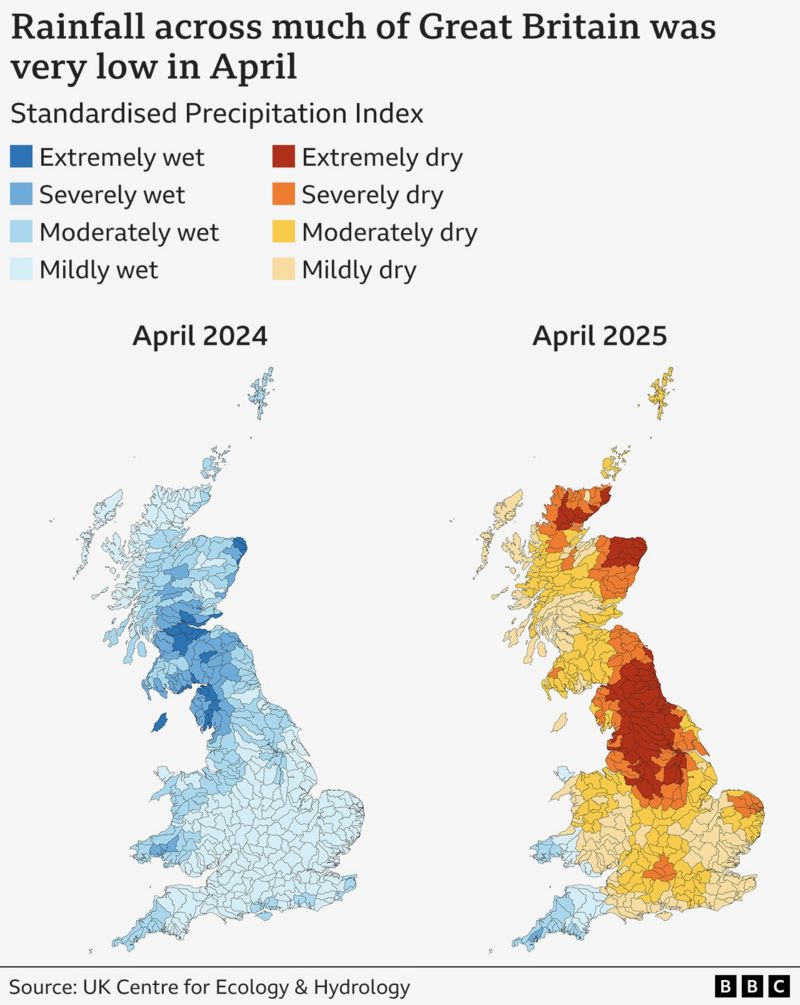
-The last drought was in June-August 2022, which was the joint hottest summer (with 2018) and fifth driest since the 1890s. Five companies introduced hosepipe bans, affecting 19 million people, and waterways had restricted navigation. That drought was preceded by six months of very dry weather. However, the wet summer in 2024 and moderately-wet winter means water supplies are in a better place now and water companies have larger reserves to rely on. But dry weather earlier in the year has risks. It does “potentially pose a greater risk to water resources later on in the year, particularly if the dry weather continues,” says Stephen Turner, hydrologist at the UK Centre for Ecology and Hydrology. https://www.bbc.com/news/articles/crmkn7rjv7zo (14 May 2025)
Scotland Driest period in 60 years All of Scotland is now experiencing water scarcity, with some areas approaching significant levels, environment agency Sepa has warned. The River Dee and the Firth of Forth are among areas which are experiencing moderate scarcity expected to be upgraded to significant as the dry weather continues. Scottish Water has warned customers to use supplies sparingly after the driest start to the year since 1964. https://www.bbc.com/news/articles/c0r1nk8g8l8o (16 May 2025)
SANDRP
Also see: DRP 12 May 2025 & DRP 05 May 2025
Follow us on: www.facebook.com/sandrp.in; https://twitter.com/Indian_Rivers

 SANDRP