
This week’s DRP News Bulletin brings two encouraging reports about revival of Kham River in Sambhajinagar district in Maharashtra. The Bulletin also brings report of Gujarat Human Rights Commission sending notice to the state and city government to uphold the environment rights of citizens in Vadodara. There is also here the news of signing of MOU for beginning of 4 km water taxi along Yamuna in Delhi upstream of Wazirabad barrage, of course without any environment or social impact assessment, any environmental clearance, any public consultation process, with blind faith in Sabarmati River Front Development model.
There is a lot one can learn from Kham River Revival as a model if we want to. The key is to first understand the problem, create a plan to address various components of the issue, going systematically to implement the plan and involvement of the local people, including school children, youth, senior citizens and others and finally consistent sincere effort on ground by the officials. All of these elements are missing in Yamuna, Vishvamitri (Vadodara) and Sabarmati.
The Kham River revival shows that it is possible to reverse the destruction of urban river like Kham, and it also provides roadmap to go about achieving that objective. Only if the authorities elsewhere were open minded enough and open to this reality and learn from that. For now, Yamuna or Delhi or Delhiites do not seem to have that good fortune, it seems.
Kham River Revival; Chhatrapati Sambhajinagar Historically, the Kham River was an essential water source for local communities, a place where people gathered, farmers irrigated their lands, and children played along its banks. However, over the years, unchecked urbanization has taken a toll. The river became clogged with industrial and domestic waste, its banks encroached upon, and its flow reduced to a sluggish trickle.
One major breakthrough came when a group of young volunteers took it upon themselves to monitor pollution levels and report violations. The administration ensured that their complaints were addressed swiftly, sending a strong message that negligence would not be tolerated. Within months, the results became visible. The river, once blackened by sludge, began to show signs of revival. Water started flowing again, albeit slowly. Birds and small aquatic species returned. After decades, people could walk along the riverbanks without being overwhelmed by foul odors.
The restoration project was divided into multiple phases, each targeting a critical issue plaguing the river including: Cleaning River bed, stopping the flow of sewage and industrial pollutants into the river, Reviving the ecosystem. “Every Saturday I used to go to the bank of the river for a cleaning drive by myself with citizens. 7 am to 10 am. After that, I used to sit with my core team, including all stakeholders on the bank of the river, & take a review of work done last week & solve their problems on the spot. Then, discuss, plan, & give targets to the core team for the next week. The same thing was repeated every Saturday for 4 years,” shared District Magistrate Mr. Astik Pandey.
The most remarkable aspect of the project was the overwhelming response from the people. Schools, colleges, and community groups began participating in cleanup drives. Environmentalists came forward with sustainable solutions. Even corporate entities extended support through CSR initiatives. https://indianmasterminds.com/features/the-bureaucrat-who-brought-a-river-back-to-life-astik-pandeys-fight-for-kham-107024/ (15 Feb 2025)
By restoring river, city revives cultural legacy By 2020, the Kham reached a breaking point. So, a coalition of community and Chhatrapati Sambhajinagar (formerly known as Aurangabad) city-led groups launched a multi-pronged restoration initiative to revive the Kham’s function as a river and ultimately lead a cultural revival as a key component of the city. Previously polluted sites have since turned into ecological parks (known as EcoParks) which now serve as community spaces and natural habitats.
The Kham is also now the first seasonal river in India to have an Urban River Management Plan through the River Cities Alliance, an initiative focused on the sustainable management of urban rivers. Since 2020, 54 acres of riparian zone have been restored, 25,000 households have begun benefiting from new waste collection and more than a million people have participated in waterfront educational and community events. The river has been flood-free for the past 2 years.
-The restoration initiative has intentionally sought to revive cultural connections to the Kham River, too. A local band’s “Kham Song” became an anthem for the river cleanup initiative, and residents affectionately refer to the river as Aapli Kham, or Our Kham. Schoolchildren regularly go on birdwatching tours and biodiversity walks, and women’s groups have organized workshops and community activities.
-The Kham River, historically revered as a sacred lifeline from its 400-year-old Neher aqueduct system, is now at the center of rising ambition for local river restoration projects and is inspiring citizens to recognize the river as a living entity, intertwined with the community’s cultural fabric. https://www.wri.org/insights/kham-river-restoration (31 July 2024) The journey of Kham River Restoration Mission in Aurangabad may provide the path to placemaking in a complex situation. https://questionofcities.org/apli-kham-ecological-river-restoration-as-placemaking/ (30 Dec. 2022) The revival of the Kham river is a fine example of how wastewater treatment technologies can be used to save the country’s waterbodies. https://www.downtoearth.org.in/water/cse-alumnus-impact-how-a-green-entrepreneur-helped-restore-kham-river-81760 (02 March 2022)Kham river cleaning campaign. https://www.lokmat.com/chhatrapati-sambhajinagar/our-river-kham-river-cleaning-campaign-sewage-discharged-249-places-kham-river-a320/ (07 April 2021) Citizens join Kham river restoration drive. https://timesofindia.indiatimes.com/city/aurangabad/citizens-join-kham-river-restoration-drive/articleshow/80727223.cms (07 Feb. 2021) Presentation on Restoration of Kham River in Aurangabad. https://www.researchgate.net/publication/363800004_Restoration_of_Kham_River_in_Aurangabad_Maharashtra_2016_MIT_Aurangabad (March 20217)
Vishwamitri; Vadodara State Human Rights Commission directs authorities to uphold environmental rights in Vadodara’s Vishwamitri River Project. https://www.counterview.in/2025/03/state-human-rights-commission-directs.html (16 Mar. 2025)
Delhi Water taxis soon on 4km stretch of river The Inland Waterways Authority of India (IWAI) will sign a memorandum of understanding (MoU) with the Delhi government & other agencies (DJB, DTC, DDA, Irrigation & Flood Control) on March 11 to develop a 4km stretch of river Yamuna for running water taxis. These solar powered hybrid boats — designed to carry 20 to 30 passengers at a time — are planned to be run between Sonia Vihar and Jagatpur, upstream of Wazirabad. The boats will be equipped with bio-toilets, public announcement systems, and life jackets for passengers.
– The Centre in 2018 had announced a water taxi project on the Delhi stretch of the Yamuna. Initially, the project was proposed over a 16km stretch of the river, from Wazirabad to Fatehpur Jat. A year earlier, the NGT was approached for environmental clearance, but the green court referred the matter to a principal committee, and the panel in May 2017 said the project proponent needed to review the proposal, taking into account the environmental impact of the proposed activities in the drinking water reservoir.
– The IWAI in September had floated a notice seeking an expression of interest (EOI) for the operation of a ferry service in an 8km loop between Sonia Vihar and Wazirabad barrage. The EOI had stated that initially two electric or solar hybrid boats would be procured – each with a seating capacity of 20-30 passengers. “The speed should be around 5 to 7 knots, with a maximum draft of 1.2 metres,” the EOI had said. https://www.hindustantimes.com/cities/delhi-news/water-taxis-soon-on-4km-stretch-of-yamuna-in-delhi-101741629854119.html (11 Mar. 2025)

-SANDRP (साउथ एशिया नेटवर्क ऑन डैम्स, रिवर्स एंड पीपल) के भीम सिंह रावत ने बताया कि पिछले एक दशक में कई बार यमुना में कमर्शियल वाटर टांसपोर्ट के प्रयास हुए हैं। शहरी क्षेत्र में नदी में गाद तथा अत्यधिक प्रदूषण के साथ वज़ीराबाद के ऊपरी क्षेत्र में जल के बहाव की कमी एवं कम गहराई की वजह से यह योजनाएं पूर्व में सफल नहीं हो सकी है। अब बिना उपरोक्त कारकों के समाधान के एक बार फिर योजना शुरू करने की कोशिश हो रही है। यह तार्किक नहीं है और सरकारी धन का दुरुपयोग है। उन्होंने बताया कि यमुना नौकायन के लिए जिस हिस्से का चयन किया गया है, वहां प्रवाह और गहराई की कमी है। दिल्ली में यमुना किनारे अब यही क्षेत्र बचा है जहां मानवीय गतिविधियां और नदी प्रदूषण अपेक्षाकृत कम है। ऐसे में यहां अनेक प्रकार के स्थानीय एवं माइग्रेटरी बर्ड्स भोजन एवं आश्रय के लिए आते हैं। ऐसे मं फेयरी सर्विस के इन पक्षियों पर काफी असर पड़ेगा। (अतः योजना शुरू करने से पहले एक वैज्ञानिक पर्यावरण प्रभाव मूल्यांकन किया जाना बहुत आवश्यक है जिसमें इस योजना की उपयोगिता और व्यावहारिकता के पहलुओं का भी निष्पक्ष अध्ययन होना चाहिए।)
HYDRO POWER PROJECTS
Sikkim Teesta dam disinvestment challenged in court A writ petition on Feb. 24 by BJP’s state Chief Advisor, Tseten Tashi Bhutia contests the government’s decision to disinvest its stake in the public sector company that was operating the Teesta III dam. The petition raises allegations of wrongful financial gain by the sitting government. The project should not be at the cost of the people residing along the shores of mighty Teesta. We worship the river,” Bhutia, who is also convenor of the Sikkim Bhutia Lepcha Apex Committee, said. “Those affected by the GLOF were never included in the decision to disinvest from the project.”
– The writ petition will be heard alongside an older one filed by former Sikkim Democratic Front leader M.K. Subba, who also challenged the disinvestment last year. The next hearing for both petitions is scheduled for March 18. There is a “likelihood of corruption of public money,” the petition alleges, and the decision to divest was “taken in a haste and…without complying with due procedures.” https://india.mongabay.com/2025/03/disinvestment-from-dam-challenged-in-court-in-fragile-himalayan-state/ (11 Mar. 2025)
Lepcha community’s bid to protect rivers The Dzongu region lies on the outskirts of the Kanchenjunga National Park, in the North district of Sikkim. The region is home to the Lepcha tribal community. The river Teesta and many of its tributaries run through upper and lower Dzongu. However, climate change, combined with the construction of hydropower plants in the last two decades, has disturbed the delicate ecology of the region.
Landslides and flash floods have increased considerably. In 2016, a major landslide disrupted the lives of the Lepcha people, 16 villages in the upper Dzongu region were completely cut off from the rest of Sikkim. Nine years later, these villages are connected to the rest of the region only through a temporary bridge that floods during monsoon. Built by the locals, this bridge is frequently used by the Indian army; despite this, the government has not found a permanent solution for it. In 2024, a cloudburst in the area led to massive floods and many villages were submerged, leading to loss of property and livestock. (Mayalmit Lepcha) https://idronline.org/ground-up-stories/the-lepcha-communitys-bid-to-protect-sikkims-rivers/ (14 Mar 2025)
Arunachal Pradesh Human & ecological cost of mega dams We are the people living in one of the most vulnerable regions of our country. Our land is rich in natural resources, including minerals and vast forests. Additionally, we are blessed with abundant water resources. However, this abundance often turns into a curse, as flooding and erosion pose serious threats to our communities. While we have developed adaptive capacities to cope with natural flooding, the increasing frequency of unnatural floods and severe erosion—primarily driven by aggressive developmental projects—has left us struggling to adapt. This situation is exacerbated by the lack of awareness and understanding among local leaders regarding the consequences of such developments. Many infrastructural projects are being undertaken with insufficient or half-baked feasibility studies. One major example is the 2000 MW under construction, controversial Lower Subansiri Hydropower Project. https://www.assamtimes.org/node/23359 (14 Mar. 2025)
Himachal Pradesh Bidding annulled for Shongtong Karcham HEP evacuation scheme RECPDCL has scrapped the bidding process for the ISTS-TBCB scheme termed as “Transmission system for evacuation of power from Shongtong Karcham HEP (450 MW) and Tidong HEP (150 MW” that was housed under project SPV “Shongtong Power Transmission Ltd.” Interestingly, the scrapping of the bidding process has come at a time when three bidders – Power Grid Corporation of India Ltd (PGCIL), Sterlite Power (now Resonia) and Adani Energy Solutions Ltd (AESL) – were shortlisted in September 2024 for opening of initial price bids.
-It is even learnt that PGCIL was named L1 bidder but the formal issuance of the letter of intent was pending. The bidding process for Shongtong Power Transmission Ltd was initiated in June 2023, and by original timelines, the initial price bids were scheduled to open on July 24, 2023. However, the last date of submission of bids was extended on at least 23 occasions, prolonging the bidding process by well over a year. The reasons for scrapping the bidding process were not immediately available. https://www.tndindia.com/bidding-annulled-for-hydropower-evacuation-scheme-in-himachal-pradesh/ (10 Mar. 2025)
Report Hydropower financing landscape Over time, sentiments towards the hydro sector have evolved, but the concerns raised by lenders remain largely unchanged. Given India’s conventional lending landscape and regulatory framework, we cannot assume that these challenges will be adequately addressed. Issues such as long gestation periods and complex construction risks continue to deter private investment. As a result, financing in the conventional hydro sector remains largely confined to the public sector domain. (Kumar Bibhu – State Bank of India)
– We (the World Bank) have some concerns about the economics (of. Pump Storage Projects) when the capex exceeds $600-$800 per kW… For conventional hydro projects in India, we are not doing anything particular right now, but we are involved in the broader South Asian region with Indian entities in Bhutan and Nepal. (Dzenan Malovic)
– For any PSP, if we calculate tariffs on a commercial basis, it may go up to Rs 8-9 per unit for it to be profitable. The capital cost for PSPs is Rs 50 million-Rs 60 million per MW. (Bijendra Singh-Power Finance Corp) https://renewablewatch.in/2025/03/13/investment-outlook-insights-into-the-hydropower-financing-landscape/ (13 Mar. 2025)
West Bengal DVC’s ₹1,500 cr push to modernise power supply Damodar Valley Corporation (DVC) unveiled a Rs 1,500 crore project to modernise power supply within its command area, primarily serving industries in West Bengal and Jharkhand. The initiative aims to establish a robust distribution network, incorporating advanced technologies like unmanned substations and automated systems, ensuring continuous quality power and reducing losses, with completion targeted within 18 months. https://economictimes.indiatimes.com/industry/energy/power/dvcs-rs-1500-crore-push-to-modernise-power-supply/articleshow/119071465.cms (16 March 2025)
MoEF Decisions in EAC meeting held on Feb. 27, 2025: 1. Expansion of Tembhu Lift Irrigation Project in 2284.601 ha at Village Tembhu, Ranad, Govare and etc, Sub District Khatav, Atpadi, Karad and etc, Dist Satara, Sangli and Solapur, Mah by Minor Irrigation Division, Sangli Water Resources Department, Mah Krishna Valley Development Corp– For Env Clearance:
The EAC noted that Certified Compliance Report of earlier EC conditions has been submitted by RO, MoEF&CC vide F. No. EC-2556/RON/2024-NGP/3436 dated 12th Aug, 2024. The RO, MoEF&CC raised serious concerns over compensatory afforestation, Multidisciplinary Committee, non- submission of half yearly compliance report etc. Taking cognizance of these issues, the EAC requested the PP to submit a closure report from the RO, MoEF&CC, addressing the observations/ suggestions provided by the RO, MoEF&CC. MORE INFO SOUGHT.
2. OA No. 71/2020 (SZ) in the matter of Gavinolla Srinivas Vs. UOI and Ors. Hon’ble NGT, Southern Bench, Chennai regarding Rayalasema Lift Scheme of State of Andhra Pradesh. – Compliance of Hon’ble NGT Order: Approved change in additional TORs.
3. Harmonization and Optimization of Environmental Clearance Conditions for River valley and Hydro-electric sector: The Member Secretary of the EAC informed the committee that the Ministry is in the process of harmonizing and optimizing Environmental Clearance conditions for River Valley and HydroElectric Projects in consultation with the sectoral EAC. It was further stated that the EAC had previously discussed a similar process during its meeting on 13.08.2024, The Expert Appraisal Committee (EAC) recommended for having a consultation with stakeholder such as MoJS, MoP, EIA consultants, Project Proponents and other subject area experts for addressing the recent environmental/social challenges in developing the River Valley and HEPs.
4. Site Visit Report of Sub-Committee of the EAC (River Valley & Hydro-electric) from 24.01.2025 to 26.01.2025 for Proposed Sharavathy Pumped Storage Project of 2000 MW at village Begodi, Tehsil Honavar, District Uttara Kannada, Karnataka. https://parivesh.nic.in/utildoc/122198866_1741693119156.pdf
DAMS
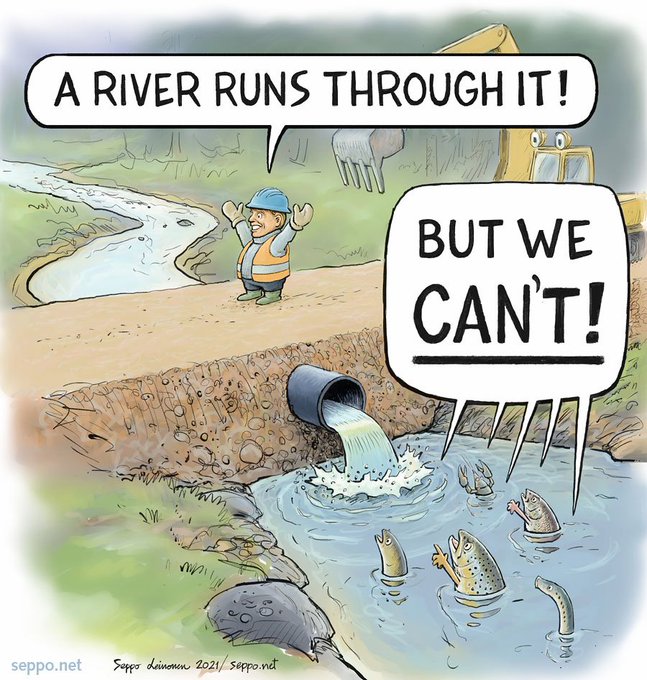
International Day of Action for Rivers Rivers sustain us—let’s support them. They’re vital to our well-being, but Dams are altering their course & harming biodiversity. On International Day of Action for Rivers, let’s stand up for healthy, free-flowing rivers. Save Rivers & Stop Dams (The Mediterranean Wetlands Initiative) https://x.com/MedWetOrg/status/1900487074320368112 (14 Mar 2025)
Polavaram Project Work in progress: Minister Andhra Water Resources Minister said, currently, two cutters are being used to rebuild the diaphragm wall, with 136 metres completed and 6,700 square metres of de-wall work finished. A third cutter is expected to arrive by early April. He noted that the upper cofferdam is being strengthened with a buttress dam, progressing rapidly, while vibro-compaction for the clay to reach the diaphragm wall has also begun. The diaphragm wall is set for completion by December 2025, while the ECRF dam and remaining works are targeted for completion by December 2027, he confirmed. https://www.newindianexpress.com/states/andhra-pradesh/2025/Mar/13/min-ramanaidu-highlights-rapid-progress-of-polavaram-project-under-ndas-double-engine-government (13 Mar 2025)
Karnataka Dams losing copious water to rising evaporation Underscoring the detrimental impact of climate change on the availability of water in North Karnataka, hydrogeologist Devaraj Reddy N J said, “Each square metre of the soil could extract up to 12 litres of water from a single night’s fog until 10 years ago. But this has come down by at least 50% now, pushing mercury levels higher, and resulting in loss of water to evaporation in water bodies.
-Rise in loss of water through evaporation by 5% is abnormal.” Farmers storing up to one crore litres are likely to lose 20% of it to evaporation despite laying HDPE liner sheets, he added. “Owing to rise in temperatures in the past fortnight, farmers have removed plastic oating shade balls to check loss of water through evaporation,” Reddy added. Lack of humidity and dry weather conditions in North and South Interior Karnataka are among the reasons why more water is lost through evaporation in these regions, said head of India.
-Pointing out that this gure was only going to rise in April and May, Arali added, “Around one tmcft of water is likely to be lost due to evaporation by the start of the monsoon, according to our estimations. We are supplying water to meet both drinking water and irrigation requirements. We will not have to grapple with water scarcity as long as we supply water for irrigation only till March 23, in accordance with the directions of the Krishna Bhagya Jal Nigam Limited, but problems may arise if we continue to supply water for irrigation thereafter.”
-Tungabhadra Dam engineer Raghavendra said that water level at the reservoir was receding by 5 mm to 6 mm daily owing to evaporation. “This will only increase over the next three months. Engineers at Narayanpur Dam informed us that, on average, 145 cusecs were lost to evaporation in February this year, as opposed to only 120 cusecs in the corresponding month in 2024,” said Raghavendra. https://www.deccanherald.com/india/karnataka/ponds-dams-losing-copious-water-to-rising-evaporation-3439967 (10 Mar. 2025)
Maharashtra Official halts quarrying operations in Tillari dam region Sindhudurg’s District Collector Anil Patil has issued a directive to temporarily halt operations of stone quarries and crushing units as well as transportation near the Tillari dam. Approximately seven such units were operational in the ecologically sensitive area. The order issued by the collector states that the decision was taken following a discussion with officials who pointed out that the mining activities can have detrimental impact on the Tillari dam as well as water in the village.
– Stating that the stone quarrying and blasting activities in the Tillari dam region near Shirnge-Khanyale, Maharashtra are “illegal”, environmental activists have said that a Supreme Court order prohibits mining activities in water bodies. “The illegal excavation and blasting operations, which encroach upon the dam water, amount to contempt of court,” said activist Ramesh Gauns, stating that he would formally report the issue to the chief engineer of Maharashtra’s Water Resources Department. https://www.navhindtimes.in/2025/03/14/goanews/maha-official-halts-quarrying-operations-in-tillari-dam-region/ (14 Mar. 2025)
Goa We watching situation: Minister For over a week now, locals and environmentalists have been protesting at Tillari against alleged illegal stone quarrying being carried out near the Tillari reservoir that supplies water to both Goa and Maharashtra. On Wednesday, Goa’s minister for water resources, Subhash Shirodkar, said quarrying is on at some distance from the dam and that there is no impact to the reservoir. However, Shirodkar said the chief engineer of Goa’s water resources department (WRD), Pramod Badami, has already written to the Maharashtra govt and is awaiting a response. The minister said WRD officials from Goa are monitoring the situation.
– However, the environmentalists who accompanied the WRD officials to Tillari on Wednesday alleged that they saw the quarrying taking place in complete violation of all norms.“The manner in which these quarries are running violates all norms. It is not possible for them to receive permission for operations from any authority in Maharashtra. Despite the blatant violations, they have been allowed to continue operations,” said environmental activist from Goa, Ramesh Gauns. https://timesofindia.indiatimes.com/city/goa/quarrying-on-at-distance-from-tillari-dam-but-goa-watching-situation-minister/articleshowprint/118941746.cms (12 Mar. 2025)
Gujarat Gates of Kadana Dam replaced after five decades The irrigation department has started the process of changing the gates of Kadana Dam, Gujarat’s third largest dam and expects to change two of the 27 gates by 2025 monsoon. Work on the dam was completed in 1978. The dam has 21 gates on the main spillway and six on the additional spillway. Nine gates are to be replaced at a cost of Rs 18.24 Cr in first phase. Each gate weighs 120 T. Replacement of all 27 gates may take five years.
– A committee appointed under the Dam Rehabilitation and Improvement Programme suggested that the gates should be changed. Examination of the gates revealed wear and tear as well as some rusting. https://timesofindia.indiatimes.com/city/vadodara/gates-of-kadana-dam-replaced-after-five-decades/articleshowprint/118947354.cms (13 Mar. 2025)
INTERLINKING OF RIVERS
Wainganga-Nalganga Link Rs 1,232cr allocated for project: Minister The Proposed Rs 87343 Cr Wainganga-Nalganga river linking project will undergo thorough “survey & investigation” till 2027, followed by another eight years of construction, according to information provided by the state govt to the legislative council earlier this week. Rs 1232 Cr has been allocated for Survey and Investigation. It is proposed to irrigate 3.17 Lakh ha in Nagpur, Wardha, Amravati, Yavatmal, Akola, and Buldhana districts in Vidarbha. The project will lift water from Wainganga river in Bhandara district and channel it through a 426.52-km network of canals and pipelines to the Nalganga river in Buldhana district. https://timesofindia.indiatimes.com/city/nagpur/rs-1232cr-allocated-for-wainganga-nalganga-project-min/articleshow/119086055.cms (17 March 2025)
Mahi-Luni Link Feasibility study under progress: Minister The long-stalled project of supplying water to Jalore and Barmer from the Mahi Basin seems to be gaining momentum. Farmers in these districts have been striving to get water since 2005, but their efforts have repeatedly been thwarted by non-cooperation from the Gujarat govt and lack of will of leaders from Rajasthan. In reply of the water resource minister Suresh Singh Rawat in the assembly on March 7 said that a feasibility study as per 2023-24 Budget to provide surplus water of Mahi basin to Jalore – Barmer from Kadana Dam through Sujlam Suflam canal is under process.
– The project is an outcome of an MoU between Rajasthan and Gujarat in 1966, under which two dams; Mahi-Bajaj Sagar Dam in Banswara (Raj) and Kadana Dam in Kheda (Gujarat) were constructed to provide Mahi water to Kheda district, until it starts receiving Narmada water. The MoU stipulated that after Narmada water reaching Kheda district, two-thirds water of Kadana Dam will be routed to Jalore-Barmer districts through a 320 km long canal from the dam. Interestingly, despite the Narmada water reaching Kheda in 2005, Gujarat govt built a 337 km long Sujlam Suflam Canal to reach this water to northern districts instead of providing this water to Rajasthan.
– When the samiti moved high court in 2022, the state govt formed a committee in January 2023 to examine the feasibility of the project, while admitting that these two districts are miserably water deficient. The then Gehlot govt allocated Rs. 27 lakh to WAPCOS for a feasibility study, but it remained unexecuted. Convener of the samiti, Vikram Singh Punasa said that the water scarcity in Jalore intensified after Jawai Dam’s construction interrupted the natural flow of the Jawai river to the district. https://timesofindia.indiatimes.com/city/jaipur/jalore-barmers-two-decade-wait-for-mahi-water-sees-hope/articleshow/118824325.cms (10 March 2025)
नदी जोड़ने के लिए व्यावहार्यता रिपोर्ट बनाई जा रही है: मंत्री – जल संसाधन मंत्री ने कहा कि राष्ट्रीय जल विकास प्राधिकरण द्वारा राजस्थान में संशोधित पार्वती कालीसिंध चम्बल लिंक, शारदा-यमुना लिंक, यमुना-राजस्थान लिंक और राजस्थान साबरमती लिंक के लिए तीन अलग-अलग व्यवहार्यता रिपोर्ट तैयार की गयी है। केंद्र सरकार द्वारा उत्तर प्रदेश, उत्तराखंड, हरियाणा, गुजरात और नेपाल के साथ सहमति के विशेष प्रयास किये जा रहे हैं। साथ ही इस सम्बन्ध में कार्यबल का भी गठन किया गया है। https://hindi.theprint.in/india/feasibility-report-is-being-prepared-to-connect-mahi-river-with-luni-minister/794084/ (07 Mar. 2025)
RIVERS AS NATIONAL WATERWAYS
Jammu & Kashmir ₹100cr to boost inland connectivity An MoU was signed between the IWAI and the Government of Jammu and Kashmir to boost river cruise tourism. The proposed Rs 100 crore investment will be used to develop infrastructure for smooth transportation on the Rivers Chenab (NW-26), Jhelum (NW-49), and Ravi (NW-84). https://www.greaterkashmir.com/latest-news/in-j-k-rs-100-crore-to-be-spent-to-boost-inland-connectivity-over-rivers-chenab-jhelum-ravi/ (09 Mar. 2025)
IRRIGATION
Telangana Water levels in irrigation projects deplete A severe water crisis is staring at Telangana. The dwindling water levels in major irrigation projects such as the Sripada Yellampalli, Sriram Sagar and Nagarjuna Sagar are not just affecting crops, but could also lead to drinking water shortages by May. Farmers in Hanamkonda and Jangaon districts are struggling to save their crops due to the lack of a proper water supply plan for the Rabi season. The government’s failure to pay the bills for the pipeline maintenance has led to a halt in water pumping. The damage suffered by crops is extensive. Nearly 60 per cent of the crops in Devaruppula mandal are drying up. The lack of water in various reservoirs and failure to release water from the Devadula project have left farmers in a desperate situation. https://telanganatoday.com/severe-water-crisis-stares-at-telangana-as-water-levels-in-irrigation-projects-deplete (14 March 2025)
URBAN RIVERS
Sabarmati; Ahmedabad S Korean firm to make, operate first rubber barrage YOOIL Envirotech Private Limited, a South Korean company, will manufacture, operate and maintain an air-filled rubber barrage, which will be part of a six-lane barrage-cum-bridge connecting Sadar market on the East to Acher on the west banks in Ahmedabad under the Sabarmati Riverfront Phase 2 project. The contract for the construction of the bridge has been awarded to Rajkamal Builders Infrastructure Pvt Ltd at a tender price of Rs 239.9 crore.
The Sabarmati Riverfront Development Corporation Limited (SRFDCL), which is carrying out the work, on March 13 stated that the barrage-cum-bridge will be completed by April 2027. The 3.5-metre-high air-filled rubber barrage will be the first of its kind in Gujarat. The installation work for the rubber membrane of the barrage will start after the completion of the barrage’s civil work, after the monsoon season in 2026, the SRFDCL added. The stored water can meet demand of water for 10-15 days, needed for purification at Kotarpur water works. When the barrage opens, the flow of water will be towards Subhash bridge. Also, with the riverfront being extended to Gandhinagar, the barrage will help maintain the water levels. https://indianexpress.com/article/cities/ahmedabad/s-korean-firm-to-make-operate-first-rubber-barrage-on-sabarmati-9885796/ (14 Mar. 2025)
12 new barrages on Sabarmati The Gujarat govt will construct 12 new barrages along the Sabarmati River, to be completed in 3 years. The Rs 2,566-crore project aims to rejuvenate the river while ensuring year-round water availability for irrigation, drinking, and groundwater recharge. The barrages will be built along the 148-km stretch from Dharoi Dam in Mehsana district to Vasna Barrage in Ahmedabad city. Several cities including Satlasana, Idar, Vijapur, Mansa, Prantij, Gandhinagar, and Ahmedabad, along with numerous villages, will benefit.
– Construction has already begun on four sites, while detailed surveying and administrative work continues for the remaining eight structures. Six of the proposed barrages, estimated to cost Rs 1,500 crore, will be constructed in Mehsana district at Chhelpura, Techava, Fudeda, Falu, and Ged, while one will be built in Gandhinagar district at Rajpur. Additionally, a rubber barrage is planned at Acher in Ahmedabad. https://timesofindia.indiatimes.com/city/ahmedabad/12-new-barrages-to-rejuvenate-sabarmati/articleshowprint/118857266.cms (11 Mar. 2025)
Mula-Mutha; Pune PMC told to look into objections to RFD work The Defence Estates Office (DEO) in Pune has asked the Pune Municipal Corporation (PMC) to look into the grievance of activist Prajakta Mahajan, who has objected to the River Front Development (RFD) works on 17 acres of defence land allocated to PMC in Yerawada. Mahajan recently wrote to the defence ministry highlighting issues such as destroying the natural buffer, natural ecosystem, riparian zone, ecological balance, reduced groundwater recharge, increased urban heat, loss of biodiversity and heightened flood risks due to RFD works. She urged the ministry to reconsider the decision to allocate defence land for the project. https://timesofindia.indiatimes.com/city/pune/pune-civic-body-told-to-look-into-objections-to-riverfront-devpt-works-on-defence-land/articleshowprint/118809732.cms (11 Mar. 2025)
Residents demand stop RFD In the wake of ongoing RFD projects in Pune, several NGOs, environmentalists and citizen groups gathered at Chaphekar Chowk in Pimpri-Chinchwad under Pune district on Sunday (March 09) to oppose tree felling and loss of natural vegetation across the river banks while demanding cleanliness drives for Mula, Pavna, Indrayani and other rivers.
-In response to the citizen’s demands at the protest site, Amit Gorkhe, a Member of the Legislative Council, said that he will arrange a meeting with Pankaja Munde, Minister of Environment and Climate Change, in the coming week to present the demands and would urge the chief minister to look into the matter. https://indianexpress.com/article/cities/pune/stop-river-front-development-pune-residents-demand-river-cleanups-9878786/ (10 Mar. 2025)
Thousands of Punekars protest against the Rs 4750 Crore Mula-Mutha riverfront development project. https://www.youtube.com/watch?v=nMzLTQGDVFk (09 March 2025)
Phalguni; Mangaluru Action sought against river encroachment Residents alleged that an attempt was being made to encroach the Phalguni River in Boloor in the city. Former corporator Jagadish Shetty Boloor has appealed to the district administration to protect the river. A significant portion of the river at Parapu near Boloor has already been filled with debris, raising concerns of flooding during the rainy season, threatening several houses in the nearby areas, Shetty noted. https://timesofindia.indiatimes.com/city/mangaluru/action-sought-against-river-encroachment-in-mluru/articleshowprint/119018492.cms (14 Mar. 2025)
Pohra; Nagpur How utreated domestic, industrial effluents have severely polluted Pohra and Pili rivers which are tributary of Naag river in Nagpur city. Nagpur: -How utreated domestic, industrial effluents have severely polluted Pohra and Pili rivers which are tributary of Naag river in Nagpur city. https://www.ehitavada.com/article.php?mid=NCpage_2025-03-12_a3fdd0d09c06e7eca70a7531fd4a360167d0f2d785066&JSON ; https://www.ehitavada.com/article.php?mid=NCpage_2025-03-12_753fda889c217dc162e61140ea69738367d0f47e9c33f&JSON (12 Mar. 2025)
NMC’s ₹810 cr plan to clean Pohra The Nagpur Municipal Corporation (NMC) has initiated the process for Pollution Abatement of Pohra River, a tributary of the famed Nag Nadi, as part of its commitment to revive the water bodies in Nagpur. The project has been divided into five packages and the total outlay earmarked is Rs 810.28 crore.
As per the outline of the tenders, Package-I pertains to construction of 45 TMC sewage treatment plant, within which a pumping station, a wet well, and pumping main has been planned. The cost for this is pegged at Rs109.29 crore. Similarly, under Package-II for Sewerage Sub-zone-1, Rs 175.40 crore have been earmarked. For Package III that would cover Sewerage Sub-zone-2 and 3, the budget is of Rs 254.63 crore. In Package-IV for sewerage Sub-Zone 4, a sum of Rs 115.50 crore is allocated and for Package- 5, it would cover Hudkeshwar and Narsala areas Rs 155.46 crore would be spent.
NMC is going to contribute 50 percent of project cost through internal resources. The DPR of this project had pegged the total cost at Rs 957.01 crore (including GST) as per the technical approval given by the Chief Engineer, Maharashtra Jeevan Pradhikaran (MJP), Regional Division, Nagpur, and same was approved by the State Level Technical Committee at its recently held meeting. https://www.nagpurtoday.in/nmc-unveils-ambitious-rs-810-crore-plan-to-cleanse-pohra-river-in-2-years/01121820 (12 Jan. 2025)
Encroachments stall Rs900cr pollution abatement project The ambitious Rs900 crore Pohra River Pollution Abatement Project of Nagpur Municipal Corporation’s (NMC) is encountering severe roadblocks, with 50% of the work stalled due to encroachments, unauthorised constructions, and utilities obstructing progress.
The project is divided into five packages, including 2 STPs at Jaitala (10 MLD) and Chikhli (35 MLD). These STPs will treat 45 million litre of wastewater daily, reducing pollution in the Pohra river and enhancing public health. The remaining packages focus on expanding the sewer network across south-west Nagpur, with 253km of pipelines planned in Laxmi Nagar and Hanuman Nagar, and 164km in Hudkeshwar and Narsala. The project, funded under the AMRUT 2.0 initiative, is co-financed by the central and state govts (25% each), while NMC bears 50% of the cost. It is expected to benefit over 8.5 lakh residents, improving sanitation and sewage disposal. https://timesofindia.indiatimes.com/city/nagpur/encroachments-stall-rs900cr-pohra-river-abatement-project/articleshow/116640412.cms (25 Dec. 2024)
Garbage piles turn Pohra into haven for mosquitoes Pohra River— once a pristine water system originating from Sonegaon lake — is now proving a health hazard for residents of Karve Nagar, Kannamwar Nagar, Manisha Nagar and Beltarodi areas of the city with carelessly strewn garbage choking the water body. Pohra was once a part of the scenic Bhor Sanctuary. Unfortunately, it has now transformed into a cesspool due to rampant garbage dumping. https://timesofindia.indiatimes.com/city/nagpur/garbage-piles-turn-pohra-into-haven-for-mosquitoes/articleshowprint/109514544.cms (23 April 2024)
RIVERS
-भारत के पर्यावरण इतिहास पर शोध करने वाले और पुस्तक लिखने वाले प्रोफेसर क्रिस्टोफर वी हिल नहीं रहे। चार मार्च को 71 साल की उम्र में कार्डियक अरेस्ट से उनका निधन हो गया। उन्होंने अमेरिका के यूटा प्रांत की सॉल्ट लेक सिटी में आखिरी सांस ली। भारत के पर्यावरण इतिहास पर उनकी पुस्तक “रिवर ऑफ सारोः एनवायरमेंट एंड सोशल कंट्रोल इन रिपेरियन नॉर्थ इंडिया” River of Sorrow: Environment and Social Control in Riparian North India, 1770-1994 को मिशिगन विश्वविद्यालय से प्रकाशित किया गया था।.

https://climateeast.in/christopher-v-hill-who-wrote-indias-environmental-history-no-more/ (14 Mar. 2025)
The Role of sediments in river hydrology Rivers are dynamic ecosystems channelling energy and carrying life, nutrients, rocks – elements that shape not just the river but also the land, lives, and cultures that surround it. Imagine this: the Ganga emerging from the Himalayas, carving its way through the mountains before it begins a slow, laborious meandering through the plains. What shapes these rivers, allowing them to nourish civilisations, and sustain life? Sediment. Sediments play a crucial role in the river’s health and ecosystem. Sediment dynamics influence the river’s pace, as well as the shape and course it takes. The process of sediment formation, transport, deposition, & natural erosion not only affects the river’s flow but also moulds islands & sandbanks – with this constant interplay of deposition & erosion shaping the riverine system itself.
HEAD WATERS: At a river’s origin—often in steep, mountainous regions—water rushes downhill with tremendous energy and a swift pace. As it makes its way along the rocky substrate at immense speeds, the river’s energy erodes rock into small stones and finer sediments. These sediments are then transported downstream, carried by the flowing river.
PLAINS: As the river enters the plains, it slows down and moves with less energy. Here, in flatter terrain, the river relieves its load by depositing sediments in floodplains, riverbanks, and islands. Its energy goes to carrying and depositing sediment and to eroding at its banks – resulting in the iconic meandering pattern of rivers like the Ganga, Yamuna, Ghaghra, and others.
DELTAS: As the river travels its course and eventually meets the sea or ocean, its speed reduces further, energy dissipates, and a lot of sediment deposition takes place at the mouth of the river, often forming a delta or estuary. Sediments are very important for a delta, as they help in the growth of mangroves, mitigate the impact of cyclones, and can reduce saline intrusion.
Human activities on rivers such as the construction of dams and barrages, sand mining, hampers the flow of sediments, which affects the rivers’ energy and flow, and consequently its floodplain. https://www.indiawaterportal.org/environment/ecology/muddy-waters-the-role-of-sediments-in-river-hydrology (11 Mar. 2025)
Pollution endangers India’s water lifelines Due to weak enforcement mechanisms and the lack of coordination among various agencies, legal interventions often fail to effectively control river pollution. It underscores the need for comprehensive and well-coordinated initiatives to address the issue. Despite decades of legal efforts and policy interventions, river pollution in India continues to be a pervasive problem.
-Rivers are self-cleansing entities to a certain extent. To ensure their natural flow, it is essential to curb issues such as extensive river sand mining and encroachments. Also, there is a need to strengthen the coordination among pollution control authorities along with the collaboration between government, industries, and local population. India’s rivers need to be restored to their natural glory, which is possible only through urgent and coordinated actions by all the stakeholders. https://indianexpress.com/article/upsc-current-affairs/upsc-essentials/rivers-in-peril-how-pollution-endangers-indias-water-lifelines-9883074/ (13 Mar. 2025)
Arunachal Pradesh 12 tonnes of waste removed from Yagamso river More than 180 students actively participated in cleaning the Yagamso River here on Friday (March 14), successfully removing a staggering 12 tonnes of waste from a 1-kilometre stretch near the RWD colony. The initiative, organized by the Youth Mission for Clean River (YMCR) in collaboration with the Political Science Department of Dera Natung Govt College (DNGC), Garden Dew School, Itanagar, and the Abralow Memorial Multipurpose Society, marked the observance of International Day of Action for Rivers under the theme ‘Our Rivers, Our Future.’ https://arunachal24.in/arunachal-students-remove-12-tonnes-of-waste-from-yagamso-river-on-international-action-day/ (15 Mar. 2025)
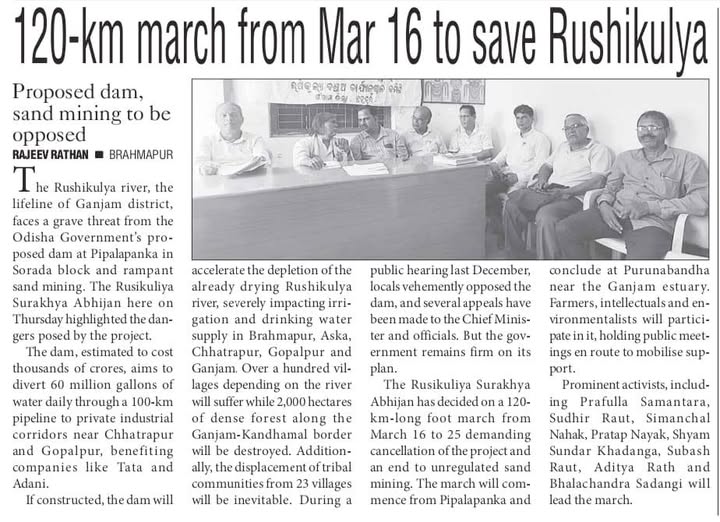
Odisha 120 km long march from March 16, to save Rushikulya
Make Daya river pollution-free: Activists River protection activists on Thursday (Feb. 06) announced to start an indefinite satyagraha in front of the residence of CM Mohan Charan Majhi if the government did not take steps to control pollution of the Daya River. The decision was taken during a meeting of Mahanadi Bachao Andolan, Daya Surakhya Abhijan, Gangua Bachao Andolan and Chilika Bachao Abhijan in view of the death of six persons in the Kanas area of Puri district due to suspected diarrhoea after consumption of contaminated water from Daya river. The activists demanded that the government initiate steps to decontaminate the river as it is a source of drinking water for people residing in its nearby areas.
They also demanded that the Gangua nullah be given the status of a river as it was earlier known as the Gandhabati River. The organisations urged the government to involve river experts, environmentalists and local committees in the revival of the Gangua nullah instead of implementing such a project only through the Water Resources Department. This apart, the resolution demanded that the state government order an inquiry to find out why STPs planned for the Gangua nullah were not completed, and sought strong action against industries, apartments and other agencies responsible for polluting the water of Daya and Gangua rivers. https://www.newindianexpress.com/cities/bhubaneswar/2025/Feb/07/make-daya-river-pollution-free-demand-activists (07 Feb. 2025)
CAUVERY Tamil Nadu Paddy Paradox: Delta turns on the taps even as wells run dry Tamil Nadu’s Cauvery delta has grown rice for millennia but environmental alarm bells warn that the days might be numbered for large-scale rice cultivation. Within a few decades, intensive farming practices have changed almost everything about the region, with potentially irreversible consequences. It has ramped up water use even as the Cauvery river dispute choked off water supplies. The delta is almost sucked dry now and its soil is stripped of nutrients. Nutritious native varieties that kept the soil and the people farming it healthy have all but disappeared.
– Cauvery delta, South India’s largest delta, is crucial for Tamil Nadu’s food security. For farmers here, growing paddy is as much about a sense of duty and pride as survival. But the fight over water access has pushed farmers to extremes. The delta is fed by the Cauvery river that originates from the neighbouring Karnataka state. Soon after the Green Revolution introduced high-yielding, water-thirsty paddy varieties here in the 60s, Tamil Nadu’s Cauvery water-sharing dispute with Karnataka escalated. As the dispute peaked in the 90s and 2000s and river water supply shrank, farmers increasingly switched to borewells, using up more water, instead of less. https://www.thenewsminute.com/tamil-nadu/tamil-nadus-paddy-paradox-cauvery-delta-turns-on-the-taps-even-as-wells-run-dry (04 Mar. 2025)
GODAVARI Telangana Farmers celebrate as water reaches fields Farmers in Siddipet constituency welcomed Godavari water that was flowing down over check dams, built across the Siddipet Vagu, after irrigation officials released the water into canals following the request of former minister T Harish Rao. The water was seen flowing over a check dam at Ghanpur in Nanganur mandal where the farmers welcomed the sight holding banners of former CM K Chandrashekhar Rao and Harish Rao. They hailed the two leaders for getting Godavari water to their agriculture fields. https://telanganatoday.com/farmers-celebrate-as-godavari-water-reaches-agriculture-fields-in-siddipet (11 Mar. 2025)
Aarati performed at Kaleshwaram Following the instructions of the endowment department, the temple officials will be conducting the Godavari River aarati during the full moon day (Pournami) of every month. https://www.deccanchronicle.com/southern-states/telangana/godavari-aarati-performed-at-kaleshwaram-1866773 (14 March 2025)
Jammu & Kashmir EPG raises concern over Srinagar-Pahalgam road project A statement by the Environmental Policy Group said the project, which as per the government involves cutting down of 845 trees and acquisition of 108 kanals of forest land that come in its alignment, is “bound to adversely affect the otherwise fragile environment of the region and ecology of the area through which it passes.” With two existing roads already connecting Srinagar and Pahalgam, the necessity of this new route is not at all justified, it said.
According to the group, excavating tunnels through mountains are “bound to weaken their rock structure and disrupt vital water sources besides having adverse effects on the ecology of the region, comprising natural landscapes that serve as for communities and wildlife equally.” It said the proposed road is reported to pass through the Notified Wildlife Sanctuary at Tral and will be detrimental to the wildlife in the sanctuary. The proposed route endangers essential habitats and affects the natural water cycle, which could result in detrimental impacts on both flora and fauna. The Environmental Policy Group calls for “putting a stop to the planning and development related to the Srinagar-Pahalgam road project until a comprehensive environmental impact assessment is conducted.” https://www.tribuneindia.com/news/j-k/environment-group-raises-concern-over-srinagar-pahalgam-road-project/ (17 March 2025)
Himachal Pradesh Baijnath Municipal Corporation continues to dump garbage into Binwa river, a tributary of Beas river and also a source of drinking water for 50 downstream villages. This is in spite of strict warning and fine from NGT and contrary regulations. https://www.tribuneindia.com/news/himachal/mc-defies-ngt-order-continues-dumping-in-binwa-river/ (17 March 2025)
Punjab Govt admits polluted river drains links to cancer cases The Indian Council for Medical Research has informed the government about a 2024 study (https://www.ias.ac.in/article/fulltext/sadh/049/0242) that found people living near river drains in Punjab were highly prone to cancer. In a written reply to a question on cancer cases, Union Minister of State for Health and Family Welfare Prataprao Jadhav informed the Rajya Sabha of the study by researchers from Punjabi University and Thapar University in Patiala had found that the levels of heavy metals like lead, iron and aluminium exceeded the permissible limit of the Central Pollution Control Board.
-The researchers analysed wastewater drains of the Ghaggar river in Punjab, highlighting enormous amounts of heavy metal contamination in the study area. The researchers flagged limited data availability on heavy metal distribution in wastewater drains in Punjab. They also noted that there was no report on water quality indices and human health risk assessments. https://www.downtoearth.org.in/water/government-highlights-2024-study-linking-polluted-river-drains-to-cancer-cases-in-punjab (12 Mar. 2025)
GANGA Uttar Pradesh Drowning in sins Between May and June last year, a 1.5-km stretch of the Ganga, from Shastri Bridge to the Sangam, was dredged to reclaim riverbed land for the gathering. As a result, the river’s course was shifted 200 metres away, and its naturally braided channels — previously split into three streams — were merged into a single flow. To ensure adequate water depth for the ritual baths, an additional discharge of 230 cubic metres per second (cumecs) has been released from the Tehri Dam reservoir since December 15 for the Prayagraj Mahakumbh. Further, since December 24, 5,000 cusecs of water have been released from the Narora Barrage, with the Kanpur Barrage also contributing significantly to the Ganga’s flow. Given the river’s travel time, water released from Narora Barrage takes approximately 10 days to reach the Triveni Sangam in Prayagraj, while water from Tehri Dam takes around 22 days.
– In an affidavit submitted to the NGT in December 2024, the Uttar Pradesh government reported that out of the 471.92 MLD of total sewage, 293 MLD is discharged into 81 drains flowing into the Ganga and Yamuna, and 178.31 MLD enters the sewage network, which is linked to 10 sewage treatment plants (STPs) with a total capacity of 390 MLD. Of the 81 drains carrying sewage into the Ganga, 37 have been connected to STPs, treating approximately 216 MLD of wastewater. However, the remaining 44 drains, which carry 77.42 MLD of sewage, remain untapped and untreated. Authorities claimed that on-site treatment — including screening, ponding, and biological and chemical processing — was implemented. However, the effectiveness of these measures remains uncertain, as the water quality of the treated effluent flowing into the river was not adequately tested. The river stretch between Bullua Ghat and Rasoolabad Ghat continues to receive multiple sewage streams carrying untreated waste, undermining river health. (Venkatesh Dutta) https://www.civilsocietyonline.com/column/living-rivers/drowning-in-sin/ (March 2025)
Uttarakhand Himalaya Kumauni Song This song is the voice of the Himalayas, echoing in the hearts of the people of Uttarakhand, urging them to protect themselves. It calls for freedom from the destructive practices of sand and gravel mining, and the auctioning off of their heritage and land. In honor of Gaura Devi and Girda, it implores them to safeguard their pure water, fresh air, and lush greenery from the exploitation of these. https://www.youtube.com/watch (12 Mar. 2025)
YAMUNA Delhi Many pieces to river puzzle What the Yamuna in Delhi desperately needs, according to Himanshu Thakkar of SANDRP, is more water flowing into it. “For most of the year, the river during its Delhi stint just does not get enough water. The government has to ensure that enough freshwater flows into the Yamuna downstream from the Wazirabad barrage, where the river enters Delhi.” Thakkar said the government would also have to ensure that all treated wastewater is reused and not pumped back into the river. He also called for rainwater harvesting and rejuvenation of local water bodies. These efforts, he said, would reduce the demand for fresh water from the Yamuna, leaving more water in it.
– “There are many pieces to the Yamuna puzzle. A basic requirement to having a holistic approach to cleaning the river is a Delhi water policy. It will take a comprehensive look at the situation and provide a road map to clean the river,” Thakkar said. https://frontline.thehindu.com/politics/yamuna-river-delhi-pollution-cleanup-efforts-history-politics-rekha-gupta-assembly-election/article69293696.ece (08 Mar. 2025)
Can river be revived in 3 years Himanshu Thakkar, coordinator of SANDRP, said, “This is because no one ever addressed the governance problem. They kept spending on new infrastructure, committees, technology, etc, but refused to address the main issue. You need governance to ensure funds and efforts are directed at the right solution.” https://timesofindia.indiatimes.com/city/delhi/in-icu-since-1993-yamuna-still-died-in-delhi-can-it-be-revived-in-3-years/articleshow/118813181.cms (09 March 2025)
Faecal level 50 lakh, norm is 500 A recent analysis based on samples collected in February has revealed a decline in the Yamuna’s water quality, with the river recording a significant rise in faecal coliform. The faecal coliform (FC) concentration was 160 lakh/100 ml at Asgarpur, where Yamuna exits the city, compared to 79 lakh in Jan. This is the highest FC measurement at Asgarpur since Dec 2020, when it was 120 crore/100 ml, suggesting substantial sewage discharge into the river. FC should not exceed 2,500 units, with an ideal limit of 500 units for the river to remain healthy.
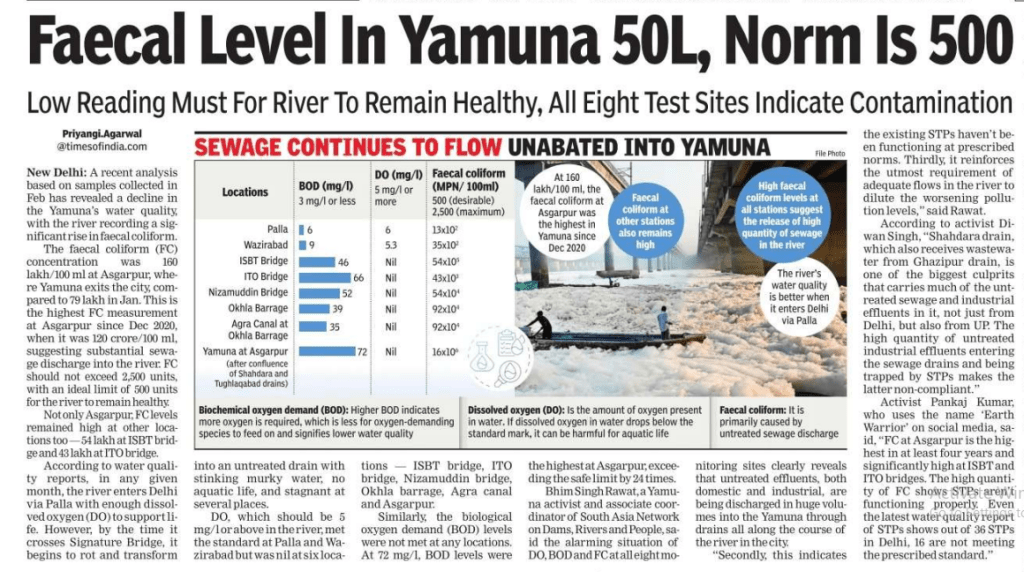
Bhim Singh Rawat, a Yamuna activist and associate coordinator of SANDRP, said the alarming situation of DO, BOD and FC at all eight monitoring sites clearly reveals that untreated effluents, both domestic and industrial, are being discharged in huge volumes into the Yamuna through drains all along the course of the river in the city. “Secondly, this indicates the existing STPs haven’t been functioning at prescribed norms. Thirdly, it reinforces the utmost requirement of adequate flows in the river to dilute the worsening pollution levels,” said Rawat.
According to activist Diwan Singh, “Shahdara drain, which also receives wastewater from Ghazipur drain, is one of the biggest culprits that carries much of the untreated sewage and industrial effluents in it, not just from Delhi, but also from UP. The high quantity of untreated industrial effluents entering the sewage drains and being trapped by STPs makes the latter non-compliant.” Activist Pankaj Kumar, who uses the name ‘Earth Warrior’ on social media, said, “FC at Asgarpur is the highest in at least four years and significantly high at ISBT and ITO bridges. The high quantity of FC shows STPs aren’t functioning properly. Even the latest water quality report of STPs shows out of 36 STPs in Delhi, 16 are not meeting the prescribed standard.” https://timesofindia.indiatimes.com/city/delhi/faecal-level-in-yamuna-50l-norm-is-500/articleshow/118989346.cms (14 Mar. 2025)
Experts say the latest data highlights that contamination from untreated sewage is still entering the river in large volumes. “It shows that both our STPs are not functioning adequately and we also have a gap between the sewage generated and the sewage being treated. Until we tackle that, such a situation cannot be rectified,” said Bhim Singh Rawat, a Yamuna activist, and member of the SANDRP. Pankaj Kumar, another Yamuna activist who goes by the name ‘Earth Warrior’ on X, said data shows that authorities must trap and treat wastewater before it reaches the river. https://www.hindustantimes.com/cities/delhi-news/delhi-yamuna-water-worsens-faecal-coliform-6-400-times-safe-level-101741889009657.html (14 March 2025)
Floodplain in Palla Palla serves not only as the gateway for the river into the Capital, but also a key section from which Delhi extracts most of its drinking water. Experts say that tackling the discharge of effluents from Trunk Drain No. 8 will help in ensuring that this stretch remains clean. “This way, Palla can be made even better. Since there are no major drains in Delhi between Palla and Wazirabad, this drain in Haryana is the only contaminant source,” said Yamuna activist Bhim Singh Rawat, who is a member of SANDRP.
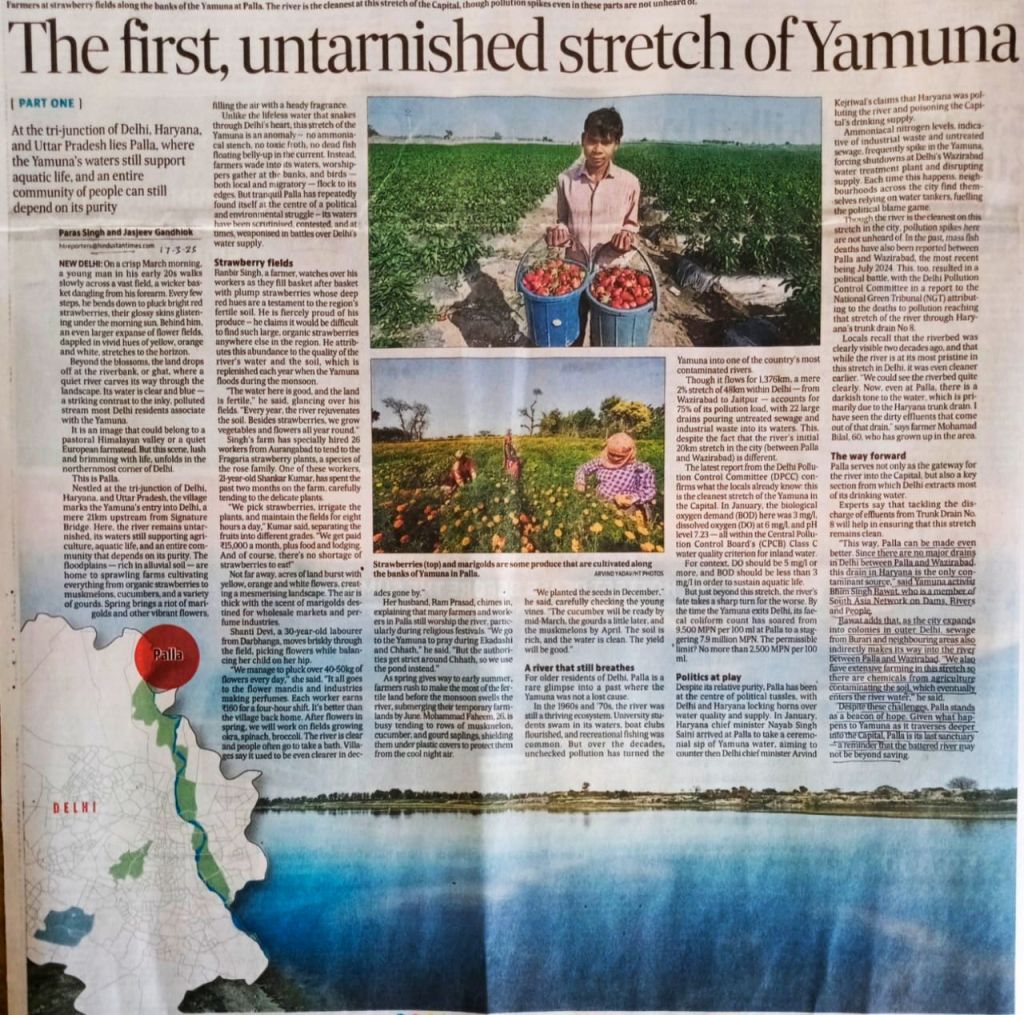
Rawat adds that, as the city expands into colonies in outer Delhi, sewage from Burari and neighbouring areas also indirectly makes its way into the river between Palla and Wazirabad. “We also have extensive farming in this stretch so there are chemicals from agriculture contaminating the soil, which eventually enters the river water,” he said. Despite these challenges, Palla stands as a beacon of hope. Given what happens to Yamuna as it traverses deeper into the Capital, Palla is its last sanctuary — a reminder that the battered river may not be beyond saving. https://www.hindustantimes.com/cities/delhi-news/delhi-the-first-untarnished-stretch-of-yamuna-101742149157255.html (17 March 2025)
River can barely sustain life: Report A parliamentary panel on water resources, in its report tabled in Parliament on Tuesday (March 11), stated that the Yamuna river’s ability to sustain life has been found to be nearly nonexistent in the Delhi stretch. The report highlighted that 23 out of the 33 monitored sites, including six in the national capital, failed to meet basic water quality standards. The Yamuna flows through a 40 km stretch in Delhi, entering from Palla in Haryana and exiting at Asgarpur into Uttar Pradesh. The DO levels, which indicate the river’s ability to sustain life, were found to be nearly nonexistent in the Delhi stretch.
– The Committee highlighted that the DDA retrieved approximately 477.79 hectares from encroachments along the floodplains. However, some parts of the floodplains remain occupied due to ongoing litigation. The panel urged the Department of Water Resources, River Development, and Ganga Rejuvenation to work with the DDA and the state governments to expedite the removal of encroachments and ensure the restoration of the floodplain ecosystem. https://www.newindianexpress.com/nation/2025/Mar/13/23-yamuna-sites-fail-quality-test-river-can-barely-sustain-life-in-delhi-parliamentary-panel-report (13 Mar. 2025) The Yamuna River would stay polluted even if the Delhi Jal Board treated all its sewage up to required standards, a report by the parliamentary standing committee on water resources has found.
For years, the focus of various stakeholders, including the DPCC and the Irrigation and Flood Control Department, has been to augment the capacity of STPs and CETPs. The Centre too, under the Yamuna Action Plan since 1993, has spent Rs 1,514.70 crore to build STPs in Haryana, Uttar Pradesh and Delhi. While such steps are being taken, the key concern of maintaining an adequate environmental flow remains unaddressed, the committee’s findings revealed. The panel observed that “there is almost nil environmental flow available at downstream of Wazirabad Barrage during 9 out of 12 months in a year…”.
The National Institute of Hydrology (NIH) had recommended increasing the e-flow to 23 cumecs in the lean season, but the Haryana government had refused citing the 1994 inter-state water-sharing agreement which is to be reviewed after 2025. There was also no response by the Haryana Irrigation Department over the committee’s previous recommendation. As per the 1994 agreement, maintenance of e-flow of up to 10 cumecs was agreed upon. Therefore, the Upper Yamuna River Board (UYRB) informed the committee that the issue could be considered for review post-2025. https://indianexpress.com/article/cities/delhi/yamuna-river-virtually-non-existent-parliamentary-panel-report-9886151/ (14 March 2025) The panel raised particular concerns over encroachment along the Yamuna floodplains. While Delhi and Haryana provided information on encroachments, Uttar Pradesh and Uttarakhand are yet to furnish complete details. The floodplain zone of the Yamuna in Uttar Pradesh remains undemarcated, despite its ecological importance in flood management.
The panel recommended controlled dredging to remove this toxic sludge, warning that it poses a serious health hazard and contributes to the river’s deteriorating quality. However, the NMCG raised concerns that large-scale dredging could destabilise the riverbed and cause further environmental degradation.
The report also criticised the lack of data on unauthorised industries operating in Delhi. It recommended that the Delhi government conduct a comprehensive study to identify such units and strengthen pollution control measures.
The panel highlighted the impact of pollution on the Yamuna’s ecosystem, noting that the absence of dissolved oxygen has severely affected aquatic life.Incidents of dead fish being washed ashore have been reported in Agra and Mathura. The Committee recommended that the MoEF conduct a study to assess the ecological damage. https://www.thehindu.com/news/cities/Delhi/pollution-parliamentary-panel-says-23-yamuna-sites-fail-water-quality-test/article69325080.ece (13 March 2025) Parliamentary committees have powers to recommend measures to be taken by various ministries, call for so-called action-taken reports and summon officials to depose before it. The panel for water resources is chaired by BJP lawmaker Rajiv Pratap Rudy.
The panel received responses from the irrigation department and the NMCG but got no response from the Delhi Jal Board within the stipulated time. It found that measures taken were grossly inadequate. https://www.hindustantimes.com/india-news/yamuna-virtually-dead-in-city-says-parliamentary-panel-report-101741800675365.html (13 March 2025) The committee also said that measures should be taken to discourage cremations on the banks of the river, and also states should be pushed to install electric or CNG facilities. It noted that there was no data on the extent of pollution in the river due to cremations carried out on its banks. https://theprint.in/india/governance/study-ecological-damage-to-yamuna-identify-polluter-industries-parliamentary-panel-tells-centre/2543618/ ; https://www.tribuneindia.com/news/delhi/yamunas-alarming-reality-its-capacity-to-sustain-life-almost-non-existent-in-delhi-says-parliamentary-panel/ (13 March. 2025)
EDIT Rejuvenating the Yamuna A collaborative effort involving Delhi, Haryana and UP becomes central to any Yamuna revival plan. Two of the major tributaries that join the Yamuna in Delhi, the Hindon on the eastern bank and the Sahibi (often referred to as the Najafgarh drain) on the west, originate in Haryana and UP respectively. These rivers are hugely polluted at their point of merger with the Yamuna. “Double-engine governments” in all three states and the Centre must work together to rejuvenate the Yamuna basin and ensure at least minimum e-flow in the river. Together with other conservation efforts, the Yamuna can surely be restored to the state of a living river. https://www.hindustantimes.com/editorials/rejuvenating-the-yamuna-101741877544040.html (13 Mar. 2025)
Haryana CM directs DCs to prevent pollution Chairing the 56th meeting of the Haryana State Drought Relief and Flood Control Board, the CM reiterated the state’s commitment to permanently clean the Yamuna. He instructed the DCs of Panipat, Sonepat, Palwal, and Yamunanagar to establish STPs to stop the discharge of untreated sewage into the river. Additionally, he called for a review of the functioning of the six STPs at Masani Barrage in Rewari and ensured their proper maintenance. https://www.tribuneindia.com/news/haryana/cm-directs-dcs-to-prevent-yamuna-pollution-boost-flood-control-steps (16 March 2025) An official spokesperson said during the meeting Haryana State Drought Relief and Flood Control Board considered and approved 352 schemes amounting to ₹658 crore for flood control in the state. The chief minister directed to immediately take up the short-term schemes as well as procurement of pumps and ensure their timely completion before June 30. https://www.hindustantimes.com/cities/chandigarh-news/no-sewage-water-to-be-discharged-in-yamuna-haryana-cm-101742063792130.html (16 Mar 2025)
RIVERS BIODIVERSITY
Arunachal Pradesh Biodiversity action plan launched The “Arunachal Pradesh State Biodiversity Strategy and Action Plan: People’s Plan” was launched by the CM Pema Khandu in Itanagar at Golden Jubilee Banquet Hall, Niti Vihar on March 13. The Action Plan has been developed by the Arunachal Pradesh Biodiversity Board and WWF-India to guide the state to sustainably utilise its rich biodiversity while ensuring a harmonious balance between development and nature conservation.
– Arunachal Pradesh is a custodian of India’s mega biodiversity and is recognised as one of the 200 globally important ecoregions and 36 biodiversity hotspots. It is also the only state which has three goat antelopes, namely, goral, serow and takin; all four large cats, namely tiger, common leopard, snow leopard and clouded leopard, as well as five species of hornbills besides 727 bird species, 111 reptiles and 272 species of fishes. The state is ethnically and linguistically diverse and home to 26 major tribes and 110 sub-tribes and minor tribes. https://www.wwfindia.org/ (13 Mar. 2025)The CM Khandu informed that a cell will be established in the chief minister’s Office to monitor implementation of schemes and projects announced in the state Budget 2025-26, which would also monitor implementation of the state biodiversity plan. He said also that the plan would be implemented across the state at all levels, including at the gram panchayat level, by engaging communities at the grassroots. https://arunachaltimes.in/index.php/2025/03/14/cm-releases-state-biodiversity-plan/ (14 Mar. 2025)
Report ‘Frogs carry the weight of environment’ Filmmaker, photographer and naturalist Suhas Premkumar’s film Little Planet: A Tale of Frogs explores the fascinating life of frogs in India. https://www.thehindu.com/news/cities/bangalore/frogs-carry-the-weight-of-our-environment-on-their-tiny-shoulders/article69316120.ece (13 Mar. 2025)
Study Microplastics messing with photosynthesis in plants As scientists develop a better idea of where microplastics are accumulating in the environment, they’re just beginning to understand how these pollutants affect one of the most essential and widespread kingdoms of life on Earth: plants. A new study, published on Monday (March 10) in the Proceedings of the National Academy of Sciences USA, reveals how microplastics hinder photosynthesis across a wide range of plant species—including crucial food crops. “It’s really scary,” says Marcus Eriksen, a marine scientist at the 5 Gyres Institute, a nonprofit plastic pollution research organization, who was not involved in the study. https://www.scientificamerican.com/article/microplastic-pollution-is-messing-with-photosynthesis-in-plants/ (10 Mar. 2025)
FISH, FISHERIES, FISHERFOLKS
Delhi Disappearing fishermen Through the 80s and 90s and also the early 2000s, hundreds of fishermen migrated to Delhi, mainly from the east – West Bengal, Bihar and parts of Uttar Pradesh – to seek a livelihood from the Yamuna. They were drawn by the success of those who came before them and assured that the capital’s appetite for fresh fish would only grow as it expanded.
-Upstream is where they made their home, in huts along the banks of Wazirabad, Jagatpur, Sonia Vihar and Burari. The initial years were promising, and this part of the river was anyway in better health than the one downstream, flowing past ITO and Okhla. In the last 15 years, things went downhill with pollutants, mainly coliform, choking the river.
-Every year, Delhi govt renews fishing licences in March. “I pay Rs 350 annually for the licence, but even that feels like a lot,” said Baidyanath. As of Dec 2024, there were 3,346 registered fishermen in Delhi. But the actual number casting nets is much lower. https://timesofindia.indiatimes.com/city/noida/how-yamuna-is-turning-fishermen-into-daily-wagers-car-washers-dog-walkers/articleshowprint/119055012.cms (16 Mar. 2025)
Himachal Pradesh PWD rejects trout farmer’s Rs 47L claim The PWD has refused the demand for compensation made by a trout fish farm owner, who blamed the PWD for causing a loss of around Rs 47 lakh to him. Kushal Gupta, a resident of Haripur village near Manali in Kullu district of Himachal Pradesh, approached the NGT in 2024, claiming compensation after his farm suffered losses due to the construction of a new bridge over the Haripur nullah by the PWD in 2018.
– In his letter petition, Gupta stated that his trout farm was located around 50 meters downstream of the Haripur nullah, and all the muck and debris from the bridge construction work were dumped in the nullah, reaching his farm and killing trout fish due to water quality degradation and damage to the physical habitat. Gupta demanded compensation of Rs 47 lakh, an amount he claimed he lost due to the death of fish in his farm.
– He also served a legal notice to the Kullu deputy commissioner in 2018, expressing apprehension that the construction of the bridge could cause him losses and filed a police complaint against the contractor. Acting on the petition, the Tribunal last year in August ordered the PWD, Kullu DC, and the Forest Department to file their replies. The PWD, in its recent reply to the Tribunal, stated that the period of limitation in the present case expired. “The bridge construction work started in December 2018 and was completed in March 2019. In the present case, the period of limitation expired on May 10, 2023, and the application for compensation was filed 11 months later in April 2024” the PWD said. https://timesofindia.indiatimes.com/city/chandigarh/himachal-govt-rejects-trout-farm-owners-rs-47l-compensation-claim-over-bridge-construction-impact/articleshowprint/118945469.cms (12 Mar. 2025)
SAND MINING
SANDRP Blog Indian People’s Fight Against Destructive Riverbed Mining Observing International Day of Action for Rivers, SANDRP through this account highlights the exemplary work being done by activists and organizations in protecting the rivers from destructive riverbed mining practices in India.
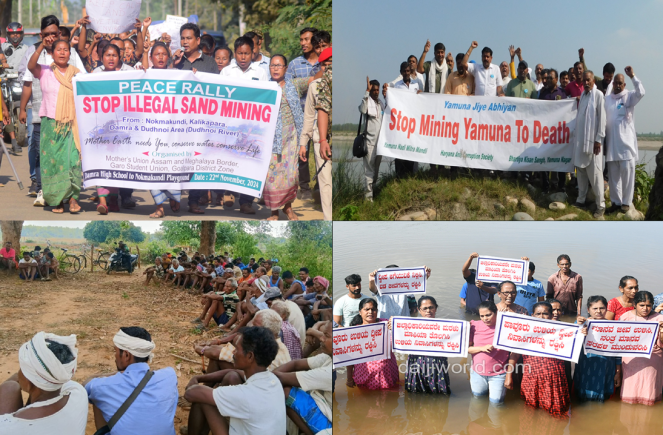
While the people’s resistance is important, the two common elements in all the incidents, include brazen violations of norms and collusion of local govt officials. This suggests that the custodians of the public resource have themselves become a reason damaging illegal mining in India. https://sandrp.in/2025/03/14/indian-peoples-fight-against-destructive-riverbed-mining/ (14 Mar. 2025)
Jammu & Kashmir Disaster under the garb of development? The Deputy CM, Mr. Surinder Chowdhary, stated that an Rs 80 lakh penalty had been imposed on NKC. However, considering the massive environmental and financial damage caused by this company over the past four years, this penalty is negligible. The actual loss to the state exchequer is estimated at Rs 3,000 crores or more, and only a fraction of that amount has been recovered. The government must take strict action against this company, blacklist it in J&K, and order an independent investigation—either by the CBI or a commission of two retired High Court judges—to be completed within six months. (Dr Raja Muzaffar Bhat) https://kashmirobserver.net/2025/03/10/disaster-under-the-garb-of-development/ (10 Mar. 2025)
Meghalaya Minor minerals concession amendment to help small operators The government constituted a committee under the chairmanship of Deputy CM Prestone Tynsong on September 16, 2024. The committee, composed of MLAs, officials from the Mining, Forest and Law Departments, as well as stakeholders like miners’ representatives, has conducted two meetings so far. Based on the discussions, the committee has recommended a simplified procedure for granting traditional quarry permits. According to Sangma, the proposed process would require only a forest permit and a no-objection certificate (NOC) from the local headman certifying undisputed ownership of the land.
-The government is now seeking concurrence from the MoEFCC to waive the requirement for environmental clearance for traditional and small quarry operations. The CM stated that under the Environment Protection Act 1986 and the Environmental Impact Assessment (EIA) rules of 2006, amended in 2016, the state government can declare certain activities as non-mining with the approval of MoEFCC. The government is actively pursuing this exemption, as many village-level miners struggle with the bureaucratic hurdles of the current regulations. https://highlandpost.com/minor-minerals-concession-amendment-to-help-small-operators/ (11 Mar 2025)
Maharashtra Sand mafia’s illegal bridge chokes Kanhan river Sand mafia in Nagpur district, notorious for clandestine mining at riverbanks and attacking revenue officials, have now escalated their activity by constructing an unauthorized, wobbly bridge over Kanhan River to sustain their lucrative multi-crore racket. This steel abutment bridge has raised significant concerns on safety and environmental damage to the river and is even affecting water supply to Nagpur.
-Constructed without govt approval, the bridge is reportedly intended to facilitate transport of sand-laden trucks and tippers, each weighing over 50 tonnes. Spanning approximately 400m in length and 10 feet in width, the bridge was completed in 15 days during the election period. Tehsildar Ganesh Jagdale confirmed a complaint was received regarding the illegal construction of the bridge, whose landing abutments on both sides are obstructing natural flow of the river. The construction has blocked over 75% of the river’s width, disrupting its natural course and violating environmental regulations, as well as Supreme Court guidelines on protecting water bodies. https://timesofindia.indiatimes.com/city/nagpur/illegal-sand-mafia-constructs-dangerous-wobbly-bridge-over-kanhan-river/articleshowprint/115910257.cms (03 Dec. 2024)
Illegal bridge eing dismantled Acting on ToI’s expose of an unauthorized steel and abutment bridge built across Kanhan river, a team from Kamptee Tehsil office began dismantling the 400meter-long and 10foot-wide bridge. Constructed without govt approval, it obstructs 75% of Kanhan river’s width and was primarily used to facilitate sand transportation by the mafia.
-Residents and environmentalists had been demanding immediate removal of the bridge, warning of irreversible harm to the river’s ecosystem. Preliminary findings indicated that over 100 tonnes of murram and boulders were dumped into the riverbed at Mouza Bina, Kamptee (khasra No. 94) to create the makeshift platform. The bridge’s construction reportedly occurred during election period, exploiting the distraction caused by the model code of conduct.
-While the collector’s orders signal a crackdown on illegal sand mining, questions remain about how such large-scale unauthorized construction went unnoticed by local authorities, including the Kamptee tehsil office. Environmental activists are calling for stricter measures to prevent the sand mafia from exploiting natural resources. https://timesofindia.indiatimes.com/city/nagpur/urgent-action-illegal-sand-mafia-bridge-on-kanhan-river-demolished-after-toi-report/articleshowprint/115983648.cms (05 Dec. 2024)
Tamil Nadu Consider plea to prevent illegal sand mining: HC Madras high court has directed the Dindigul district administration to consider and pass orders on a plea seeking a directive to prevent illegal sand mining in a pond in Thethupatti village in the district. The court was hearing a public interest litigation filed by Pandi Yogeswaran. The petitioner also sought action against those involved in illegal sand mining in the pond. https://timesofindia.indiatimes.com/city/madurai/consider-plea-to-prevent-illegal-sand-mining-hc/articleshow/119021667.cms (15 March 2025)
Karnataka Govt invites bids for 12 sand mining blocks in Haveri The mines department initiated auctions for 12 sand mining lease blocks in Haveri district. The online bidding started from Feb 28. The leases are for five-year terms. Ten blocks are located in the Tungabhadra River area in Ranebennur taluk, and two are in Haveri taluk. Following the KMDC Act amendment of 2024, the department initiated the bidding process. Although 55 blocks were initially identified (49 in Ranebennur taluk, 3 each in Haveri and Rattihalli), only 12 are currently viable for sand extraction due to water coverage. Officials indicate plans to auction additional blocks during summer, when river water recedes. https://timesofindia.indiatimes.com/city/hubballi/govt-invites-bids-for-12-sand-mining-blocks-in-haveri/articleshow/118855495.cms (10 March 2025) Over 270 cases have been registered and fines of almost Rs 1 crore have been collected, along with seized vehicles and equipment in Coastal Karnataka districts over illegal sand mining from April 2024 till Jan. https://www.deccanherald.com/india/karnataka/crackdown-on-illegal-sand-mining-in-coastal-karnataka-over-270-cases-booked-fines-reach-almost-1-crore-3447185 (14 Mar 2025)
WETLANDS, LAKES, WATER BODIES
Manipur Loktak project UC Even though Rs 59.05 crore was released for implementation of “Loktak Lake, Experience in Loktak” project, the State Government has not yet submitted any utilisation certificate. This was stated by Union Minister of Tourism Gajendra Singh Shekhawat in response to a query raised by Dr Angomcha Bimol Akoijam in the Lok Sabha today. https://e-pao.net/GP.asp (11 Mar. 2025)
Report Worm poaching threatens India’s wetlands India’s bristle worms are often overlooked. But they are crucial to the health of the country’s wetlands – which is why local women are working to catch the poachers decimating their population. https://www.bbc.com/future/article/20250311-the-women-fighting-indias-worm-poachers (12 Mar 2025)
WATER OPTIONS
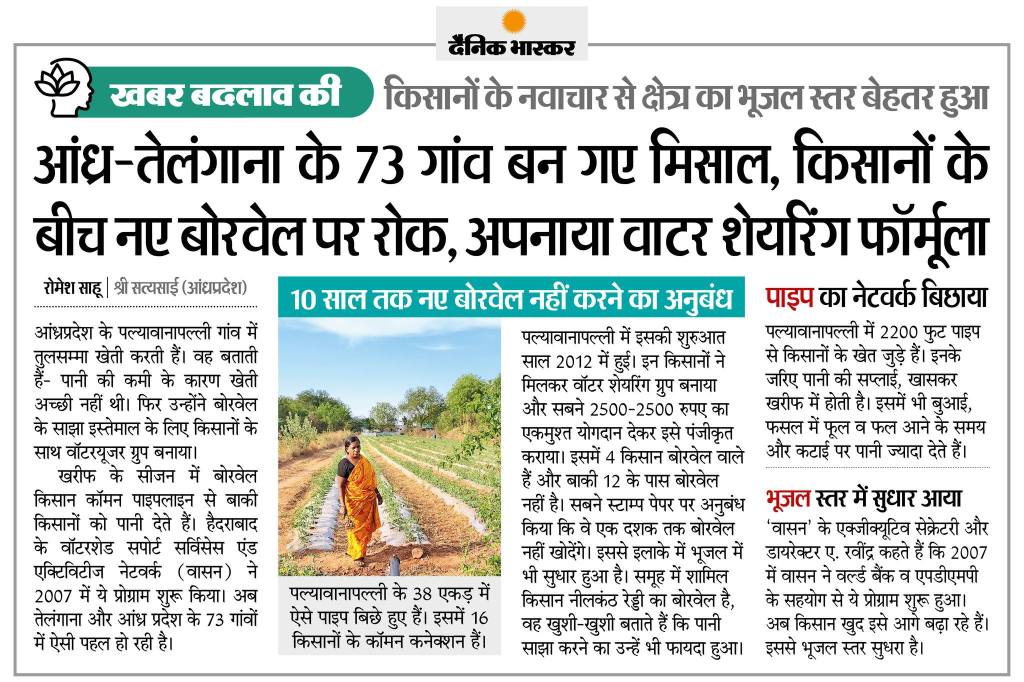
A unique movement in 73 villages in AP-Telangana border where farmers with borewell share them with those who do not have and collectively regulate use of borewell. No new borewells agreement has been signed for ten years. https://www.facebook.com/share/p/1FYsnpm9gp/ (17 March 2025)
Jharkhand Women of Jharia’s coalfields revived dugwell Neeche Mohalla’s dugwell now has water all through the year and has never gone dry since the women took charge of it in 2017 and desilted it with fawda [spade/shovel] and hathoda [hammer]. Neeche Mohalla’s dugwell is now an example of successful shallow aquifer management, commonly known as SAM, under AMRUT 2.0 that targets to have access to clean water for all urban citizens, increase coverage of sewerage and septage. Simply put, a shallow aquifer is the first layer of groundwater which is tapped upon digging the ground. Dugwells tap this layer of water and have been a source of water for centuries. (Nidhi Jamwal) https://www.downtoearth.org.in/governance/jharkhand-once-reviled-and-ignored-these-women-of-jharias-coalfields-revived-dugwell-to-ensure-year-round-water-supply (12 Mar. 2025)
Haryana State claims 85% water conservation goals Haryana claims to have achieved 85% of its target by saving 5.8 billion cubic meters (BCM) of water from March 2023 till Feb 2025, according to an estimate by the Haryana Water Resources Authority (HWRA). Officials said this was done by reusing treated wastewater, promoting efficient cultivation methods, encouraging crop diversification, adopting micro-irrigation techniques and enhancing groundwater recharge. The state aims to save 6.9 BCM by the end of March 2025.
Haryana recorded an 11% increase in groundwater recharge from 2023 to 2024, as reported by the Central Ground Water Board (CGWB). For 2025-26, the state has planned to dig up 244 water bodies over 1,185 acres, with storage capacity of 12,000 million litres of water. Haryana aims to reuse 50% of treated wastewater by March 2025 and take this up to 100% by Dec 2028. https://timesofindia.indiatimes.com/city/gurgaon/crop-diversification-to-reuse-haryana-meets-85-water-conservation-goals/articleshowprint/118846299.cms (10 Mar. 2025)
Centre Sustainable & safe use of treated mine water Coal India Limited (CIL), NLC India Limited (NLCIL), and Singareni Collieries Company Limited (SCCL), has been promoting the utilization of treated mine water for drinking, irrigation, and industrial purposes in alignment with relevant environmental and water conservation guidelines. The quality of treated mine water for gainful utilization is guided by the provisions of the Environmental Protection Act, 1986, the Water (Prevention and Control of Pollution) Act, 1974, and directives issued by the Central Pollution Control Board (CPCB) and respective State Pollution Control Boards (SPCBs). Additionally, Coal/Lignite PSUs have formulated their own standard operating procedures to ensure the safe and effective utilization of treated mine water for various purposes.
Efforts are being made to expand mine water management initiatives across all coal and lignite mining states, including Jharkhand. Coal/Lignite PSUs have undertaken projects for gainful utilization of mine water for community use, irrigation, and industrial purposes. In Jharkhand, MoU has been signed between the Government of Jharkhand and Coal India Limited (CIL) to facilitate the utilization of mine water for the benefit of villages located within the command areas of Central Coalfields Limited (CCL), Bharat Coking Coal Limited (BCCL), and Eastern Coalfields Limited (ECL). This information was given by Union Minister of Coal and Mines Shri G. Kishan Reddy in Rajya Sabha on Mar 10. https://pib.gov.in/PressReleasePage.aspx (10 Mar 2025)
Study Nature-based solution can purify wastewater, generate clean energy A comprehensive investigation, published in the Journal of Environmental Management discussed constructed wetland as an engineered ecosystem designed to replicate natural wetlands, utilising aquatic plants and microorganisms to filter contaminants from wastewater. By incorporating a microbial fuel cell into this system, the technology enhanced wastewater treatment while simultaneously generating clean energy.
The procedure is described as wastewater flowing into the wetland, where plants and microorganisms collaborate to decompose organic contaminants. Below the surface, special bacteria in the microbial fuel cells consume the organic matter, initiating a biochemical reaction that produces electrons. These electrons are captured and transferred through an electrode system, generating a small but usable amount of electricity. This innovative approach ensures dual benefits — efficient water purification and renewable energy production, making constructed wetland coupled with microbial fuel cells a sustainable, cost-effective solution for wastewater treatment in urban, rural, and industrial applications. https://www.downtoearth.org.in/water/how-this-nature-based-solution-can-generate-clean-energy-while-purifying-wastewater (12 Mar 2025)
Research Scientists convert sewage sludge into green hydrogen & nutritious protein Scientists at Nanyang Technological University, Singapore (NTU Singapore), have developed a groundbreaking solar-powered process to convert sewage sludge—a by-product of wastewater treatment—into green hydrogen for clean energy and single-cell protein for animal feed. Published in Nature Water, this innovative sludge-to-food-and-fuel method addresses two critical global challenges: waste management and sustainable resource generation. It also aligns with NTU’s commitment to tackling major issues like climate change and environmental sustainability.
Lab tests showed the new method recovers 91.4 percent of the organic carbon in sewage sludge and converts 63 percent of the organic carbon into single-cell protein without producing harmful by-products. In comparison, traditional anaerobic digestion typically recovers and converts around 50 percent of organic materials in sewage sludge. The solar-powered process achieves an energy efficiency of 10 percent, generating up to 13 liters of hydrogen per hour using sunlight, which is around 10 percent more energy efficient than the conventional hydrogen generation methods. https://scitechdaily.com/scientists-convert-sewage-sludge-into-green-hydrogen-and-nutritious-protein/ (15 March 2025)
Report Creating urban biodiversity parks from degraded lands Delhi hosts seven biodiversity parks, which were restored from degraded lands to serve as urban forests, providing ecological benefits. Initiatives such as converting mining pits into orchid and butterfly conservatories showcase successful habitat restoration, supporting native flora and fauna, including endangered species. Experts advocate treating biodiversity parks as essential green infrastructure in city planning, aligning with global and national environmental commitments. (Nidhi Jamwal) https://india.mongabay.com/2025/03/new-delhi-invests-in-natural-capital-through-biodiversity-parks/ (06 March 2025)
UNEP Six women helping communities adapt to climate change In Gambia, climate change is causing more severe flooding. Fishers in the countryside sometimes lose their lives because they lack reliable forecasts and receive no alerts of when to avoid open water. Anti Rohey Ceesay, a forestry expert from the Central River Region, decided to take matters into her own hands a few years ago. After nine weather stations were built in her district with funding from the Global Environment Facility (GEF), Ceesay was able to gather weather alerts and travel via motorbike from village to village sharing vital warnings. In Ceesay’s culture, knowledge is often passed on through song and dance, so she organized ‘climate theatre’ performances in villages to educate her community about climate change and how to adapt. Since Ceesay began providing advanced warnings, the number of deaths from climate impacts has fallen in her community, Ceesay said.
-With precipitation patterns changing in Xalapa, Mexico, local homemaker Michelle Delgado once believed restoring forests was “for men.” But through a project funded by the GEF and implemented by UNEP, workshops were organized to teach women how to plant and nurture tree species. Alongside other participating women, Delgado reforested the riparian forest of the Arroyo Papas stream, helping protect communities from landslides and floods while building a more sustainable future. Women collect native seeds, germinate them, and distribute trees to households—“one tree for every home”. Now called “guardians of the forest” by their communities, these women’s efforts are dismantling gender stereotypes and empowering them to shape decisions that build resilience & curb climate impacts. https://www.unep.org/news-and-stories/story/how-six-women-are-helping-their-communities-adapt-climate-change (6 Mar 2025)
GROUNDWATER
Haryana Groundwater crisis worsened by subsidised tubewell irrigation Failure of government policies meant to aid farmers seems to be making the situation worse. Subsidised electricity, poor distribution of canal water, and lack of funding for micro-irrigation means groundwater levels continue to drop as farmers drench fields in groundwater that is running out fast. Districts where subsidised electricity used for agriculture is the highest are among the most water-stressed, and also among the top 10 districts growing paddy and wheat, our analysis shows. If water use is not regulated, the state could soon run out of groundwater to meet the basic needs of the farmers. https://www.indiaspend.com/earthcheckindia/haryanas-groundwater-crisis-worsened-by-subsidised-tubewell-irrigation-945451 (15 Mar. 2025)
Report 96 districts hit by water contamination A parliamentary panel has raised concerns over water contamination issue in the country, highlighting that 11,348 habitations in 96 districts across seven states have not been provided with short-term measures for pollutants such as iron, nitrate, and heavy metals.
The report further revealed that uranium contamination remains a pressing issue in Punjab, where 32 habitations across nine districts are affected. Despite interim measures in 22 of these areas, 10 habitations still await any mitigation efforts, it said. The committee has called for urgent and long-term interventions to safeguard public health. https://www.hindustantimes.com/india-news/over-11-300-habitations-in-96-districts-hit-by-water-contamination-parliamentary-panel-101741867701204.html (13 Mar. 2025)
Bihar Severe contamination in over 30,000 rural wards: Report 30,207 rural wards exposed to “unsafe” drinking water that poses serious health risks, according to a new report. The report, which was recently tabled in the assembly as part of the Bihar Economic Survey (2024-25), highlighted the presence of arsenic in groundwater in 4,709 such wards, fluoride in 3,789 wards and iron in 21,709 wards. “Around 26 per cent of the rural wards in 31 districts, out of a total of 38, have groundwater sources affected by arsenic, fluoride and iron contamination beyond permissible limits,” the state’s Public Health Engineering Department (PHED) said in the study.
“We are aware of the fact. Sensing the gravity of the situation, the state government has decided to make rural Bihar ‘hand pump-free’ and provide safe drinking water to people in the rural areas under the ‘Har Ghar Nal ka Jal’ scheme,” PHED Minister Niraj Kumar Singh told PTI. The government is also implementing multi-village schemes (MVS) to improve water quality in the state, he said. Under the ‘Har Ghar Nal ka Jal’ scheme, PHED is providing safe drinking water to 83.76 lakh families in rural areas, he said, adding, potable water is also being made available to families in the 30,207 rural wards where the contamination is high.
“The state government is already working on a plan to use river water for drinking purposes. In September 2024, CM Nitish Kumar laid the foundation stone of a Rs 1,347-crore project for the supply of water from Sone river for drinking purposes in Aurangabad, Dehri and Sasaram cities after necessary treatment,” the minister said. The scheme will use the water of Son river, ending the dependence of these cities on groundwater, he said. The project is likely to be completed in two years. In 2023, the CM dedicated the ambitious Ganga Water Supply Scheme (GWSS) or the ‘Ganga Jal Apoorti Yojana’ to the people of Gaya, Rajgir and Nawada. Under the scheme, people in these districts are provided an uninterrupted supply of clean and safe drinking water, Singh said. https://www.newindianexpress.com/nation/2025/Mar/15/severe-groundwater-contamination-detected-in-over-30000-rural-wards-in-bihar-report (15 March 2025)
Gujarat 88.11% of wells show rise in groundwater levels: Centre The water level data collected by CGWB during November 2024 has been compared with the decadal mean water levels of November (2014-2023) for the state of Gujarat including the District of Banaskantha as detailed in Annexure. Perusal of such long term data on fluctuation of ground water levels in respect of Gujarat indicates that 88.11% of wells have registered rise in ground water levels in the state of Gujarat and in Banaskantha, 93.3% wells have registered rise. A total of 3,078 nos. Digital Water Level Recorders have been installed in Gujarat under various central schemes like Atal Bhujal Yojana and National Hydrology Project (NHP) to monitor the ground water level fluctuation on real time basis. https://deshgujarat.com/2025/03/11/88-11-of-wells-in-gujarat-show-rise-in-groundwater-levels-centre-in-lok-sabha/ (11 Mar. 2025)
URBAN LAKES, WETLANDS
SANDRP Overview 2024: Approach to Restore Bengaluru Lakes Despite NGT orders and huge amount spent by the govt, the restoration works of Bellandur, Varthur, Yele Mallappa Shetty, Madiwala and Hosakerehalli lakes have not been completed. On the other hand, the city is losing more lakes to increasing encroachments and pollution primarily due to real estate lobby, multiplicity of governing bodies and inefficiency of sewage treatment plants. Involving corporate sector for the management of lakes have not achieved the desired objectives.
Though, the concerned citizens and residents have kept raising voices on causes behind continual degeneration of various lakes, their grievances have largely remained unaddressed, though the voices here are louder and heard more clearly than elsewhere. https://sandrp.in/2025/03/11/2024-approach-to-restore-bengaluru-lakes/ (11 Mar. 2025)
Chennai First wetland sponge park comes up in Porur CM M.K. Stalin has inaugurated Chennai’s first wetland sponge park in an OSR land off Mount Poonamallee High Road, Porur. Officials said the wetland sponge park is the first of its kind in the city as visitors will be permitted inside a wetland, unlike Pallikaranai, and learn about the ecosystem and the species. “The land was previously used as a parking lot. We have converted only the OSR land into a wetland sponge park. After work started in the 16.63 acres OSR land of Sri Ramachandra University in 2023, the biodiversity has improved during the eco-restoration and the number of species of birds has already increased in the wetland. The original area of the wetland was vast in areas such as Porur,” said Niveda Ramesh, design consultant, Sponge Collaborative.
Meanwhile, CMDA has started a GIS survey of such marshy areas to implement similar eco restoration projects across all the zones of Chennai Corporation and local bodies in the suburban areas of the metropolitan area. The wetland parks to be developed across the city are expected to improve the groundwater recharge, improve water storage and facilitate flood mitigation.. https://www.thehindu.com/news/cities/chennai/chennai-first-wetland-sponge-park-comes-up-in-porur/article69316417.ece (11 March 2025) “We identified that the site is a remnant of a wetland. The park incorporates a blue-green infrastructure that collects runoff through swales and undergoes a natural filtration process. The deepened waterbody improves its holding capacity and boosts groundwater recharge,” said Niveda Ramesh, associate urban designer, Sponge Collaborative. Designed as a community space for wellness and nature-based recreation, the park also serves as an urban resilience model. “It demonstrates nature-based solutions for improving water quality, managing runoff, and creating habitats for diverse species. It will also help raise awareness about wetland ecosystems,” she added. https://timesofindia.indiatimes.com/city/chennai/stalin-inaugurates-citys-first-wetland-park/articleshow/118858239.cms (11 March 2025)
Mumbai Green groups appeal PM to save wetlands With new research findings from New Zealand sounding alarm bells that the rising sea levels could simultaneously drive groundwater levels to rise, green groups have asked the disaster management authorities to brace themselves for floods from beneath the inlands. Quoting a new paper focused on the coastal city of Dunedin, New Zealand, NatConnect Foundation has appealed to Prime Minister Narendra Modi to take note of the research that sea level rise might change groundwater levels and thereby increase inland flooding hazards.
– “These findings only reinforce our longstanding demand to conserve our wetlands which act as urban sponges and save the river flood plains,” NatConnect Foundation director B N Kumar called for maintaining spaces for waters to expand instead of burying the water bodies under the pretext of infrastructure development. https://www.deccanherald.com/environment/rising-sea-levels-may-push-groundwater-floods-study-finds-green-groups-appeal-pm-to-save-wetlands-3448331 (16 March 2025)
Illegal tree cutting in Seawoods buffer zone Forest Officer VG Bairagi from the Mangrove Cell confirmed that parts of the land fall within a protected mangrove buffer zone, where no activity is allowed without Bombay High Court approval. He further reported trees being illegally uprooted, violated the Bombay High Court’s order in PIL 87/06/2006, which safeguards mangrove areas. https://www.freepressjournal.in/mumbai/navi-mumbai-news-joint-inspection-confirms-large-scale-illegal-tree-cutting-in-seawoods-buffer-zone-activists-demand-cidco-plot-withdrawal (14 Mar 2025)
URBAN WATER
Report Challenges to treated water reuse India’s institutional framework for wastewater reuse is fragmented, with responsibilities divided across multiple national, state and local agencies. This leads to weak coordination, poor enforcement and limited financial incentives.
-One of the critical gaps in wastewater reuse is the absence of clear, sector-specific standards for wastewater quality. For example, there are no unified benchmarks for treated water use in agriculture, industry, or urban landscaping, leaving industries and urban local bodies (ULB) without clear guidelines on how to safely and effectively repurpose treated water.
-A state-level analysis of policies reveals that only 11 out of 28 states have established wastewater reuse policies. While a few states have developed robust frameworks, the majority lack well-defined action plans, funding strategies and monitoring mechanisms to effectively implement wastewater reuse initiatives. https://www.downtoearth.org.in/water/policy-and-governance-roadblocks-are-the-biggest-challenges-to-treated-water-reuse (11 Mar. 2025)
Chennai City to get sixth reservoir with 1.6 tmcft capacity A new reservoir will be built in the Kovalam sub-basin near Chennai covering 4,375 acres at an estimated cost of Rs 350 crore to augment the drinking water supply for the city, Finance Minister Thangam Thennarasu said during budget presentation on Friday (March 14). This will be the sixth reservoir of Chennai. The proposed reservoir will have a storage capacity of 1.6 tmcft. The project is expected to provide a long-term drinking water supply to Chennai, ensuring 170 MLD of water every year.
A senior official said, “As of now, five reservoirs — Cholavaram, Chembarambakkam, Poondi, Red Hills, and Kannankottai-Thervaikandigai — with a combined capacity of 11.757 tmcft cater to the drinking water needs of Chennai city’s residents. However, this storage capacity is far below the city’s annual drinking and industrial water demand of 24 tmcft, which is expected to rise to 34 tmcft by 2035. So, we planned to increase water storage capacity in and around the city and the state government is gradually planning to add 21 tmcft of storage. https://www.newindianexpress.com/states/tamil-nadu/2025/Mar/15/tn-budget-2025-chennai-to-get-sixth-reservoir-with-16-tmcft-capacity (15 Mar. 2025)
Bengaluru BWSSB Chairman interview The cabinet has approved Rs 1,000 crore for building nine sewage treatment plants (STPs) with a total capacity of 148 MLD and 400 km of sewer line. Wherever there is a gap in the 110 villages, we are planning to build the new STPs. The budget has allocated Rs 1,000 crore, but this will be in the form of a guarantee for the World Bank loan.
We have built a capacity to supply 2,275 MLD of water. Earlier it was 1,540 MLD. We have a sufcient quantity of water and built-incapacity now. The only problem is distribution. For this, people must come forward and take piped water connections. But some areas rely on groundwater, which can pose health risks due to the presence of heavy metals. We recommend switching to Cauvery water connections, which offer better quality water. Furthermore, there is a proposal underway to make Cauvery connections mandatory for apartments.
Water tariffs have not been hiked since 2014, and it is now important for the long-term sustenance of BWSSB. We are currently incurring a revenue loss of Rs 41 crore per month. By operating the full capacity of Cauvery stage 5, our losses may go up to Rs 81 crore per month. This will gradually lead us to a Rs 1,000-crore revenue deficit annually. The rise in the capital expenditure can be maintained only with a tariff hike.
We filled about 23 lakes with treated water and propose to fill 40 more lakes in the eastern and northern parts of the city this year. We have commissioned a research organisation to study the implications of sewage entering water. Lakes are being filled with treated water to prevent overexploitation of groundwater and help recharge it. https://www.deccanherald.com/india/karnataka/bengaluru/we-have-achieved-our-vision-of-making-bengaluru-water-surplus-says-bwssb-chairman-3440825 (11 Mar. 2025)
RWH: Govt to ban cementing of setback areas With the city and its adjoining areas reeling under acute water shortage every summer, the state govt has decided to enforce a complete ban on cementing of surface areas, especially the setback areas at individual households, to trap rain water and facilitate sufficient recharge of groundwater through topsoil.
In town-planning parlance, a ‘setback area’ refers to the minimum distance that a building or structure must be built from a property line, street, or a designated area, ensuring sufficient open space. Commenting on the latest govt initiative, deputy chief minister DK Shivakumar said: “We are hardly recharging the water table because the surface area is completely concrete and there is no space for rainwater to seep in. Hence, we will soon come up with rules to ban concreting of surface areas, particularly the setback areas around houses.”
He added: “People normally put concrete sludge all along the 6-7 feet of setback area, completely covering it with cement, but that cannot be done henceforth in houses that are under construction.” The deputy CM explained that setback areas will have to be retained with soil surface and plant saplings to facilitate percolation of rainwater.
Sources in the town planning wing of Bruhat Bengaluru Mahanagara Palike (BBMP) revealed to STOI that the govt’s move is based on recommendations by experts from the Indian Institute of Science (IISc), who recently studied the groundwater scenario, and reports by the Karnataka Ground Water Authority (KGWA). https://timesofindia.indiatimes.com/city/bengaluru/rainwater-must-seep-in-govt-to-ban-cementing-of-setback-areas-in-bengaluru/articleshow/119063776.cms (16 March 2025)
BWSSB to supply treated water to Chinnaswamy Stadium The stadium requires about 75,000 litres of water daily during the tournament. In response to a request from the Karnataka State Cricket Association, the BWSSB has been supplying treated water from the Cubbon Park Wastewater Treatment Plant since last year, and this arrangement will continue for the current IPL season as well. https://www.deccanherald.com/india/karnataka/bengaluru/bwssb-to-supply-treated-water-to-chinnaswamy-stadium-for-ipl-matches-3440674 (10 Mar. 2025)
Water tariff to go up by 1 paisa per litre Ending months of speculation, deputy chief minister DK Shivakumar on Friday said the govt will increase water tariff in Bengaluru by one paisa per litre. The hike, being effected after 11 years, is expected to be formalised after a meeting with Bengaluru MLAs ahead of the BBMP budget. The proposed hike will be significantly lower than the 7 to 8 paise per litre hike initially sought by Bangalore Water Supply and Sewerage Board (BWSSB), the agency entrusted with the task of supplying water. “Despite the surging costs, we have not revised the water tariff since 2014,” he said. Shivakumar pointed out that water to Bengaluru was being sourced from a place 100km away. https://timesofindia.indiatimes.com/city/bengaluru/11-years-on-water-tariff-to-go-up-by-1-paisa-per-litre-in-bengaluru/articleshow/119031755.cms (15 March 2025)
Hyderabad HMWSSB to tighten grip on wastage of supply, increase fine This initiative comes as Hyderabad faces increasing pressure on its water resources due to rising demand and depleting groundwater levels. As part of this effort, the board plans to amend the 35-year-old Water Board Act to significantly increase fines for violations, with penalties expected to rise by five to ten times. Currently, fines range from Rs 20 to Rs 1,000, with an additional daily penalty of Rs 100 for non-compliance. The revised fines aim to address issues such as illegal water connections, misuse of treated water, damage to pipelines, and unauthorized activities like using motors to extract water or tampering with sewer lines.
The board spends Rs 48 per kiloliter to purify and supply water sourced from distant rivers like Krishna, Godavari, Manjeera, and Singur. However, inspections have revealed that treated water is being wasted on non-essential activities such as washing vehicles, watering lawns, filling swimming pools, and cleaning streets. Alongside imposing fines on violators, they will educate residents on the importance of conserving water. Measures such as restricting supply and depriving tanker services in areas where wastage persists will also be implemented to ensure responsible usage during the summer months. https://www.siasat.com/hyderabad-water-board-to-tighten-grip-on-wastage-of-supply-increase-fine-3194830/ (15 March 2025)
Noida Too costly, can’t use treated water: NTPC to NGT The National Thermal Power Corporation (NTPC) in Dadri has informed the NGT that using treated water from Noida Authority’s STP is not feasible, citing financial, technical, and operational challenges. A private agency conducted a feasibility study on behalf of NTPC on March 11, which revealed that the project required a capital investment of Rs 1,398 crore and an annual operational expenditure of Rs 129 crore. NTPC said these costs rendered the project economically unviable.
It cited the need to lay pipelines through densely populated urban zones, increased energy consumption for pumping, and strict environmental regulations. NTPC further noted that even with tertiary treatment, the quality of the treated water might not meet operational requirements of the power plant, potentially affecting maintenance and daily operations. Consequently, NTPC said, the project’s cost and technical complexities outweighed the anticipated benefits, making large-scale adoption of STP water at Dadri unviable in its present form.
The case dates back to 2018, when environmental activist Abhisht Kusum Gupta petitioned the NGT, alleging that the Authority discharged treated sewage water into the Kondli drain instead of utilising it. During a hearing on Aug 3, 2022, the tribunal observed that the Authority and NTPC signed an MoU on June 14, 2018, for the supply of 80 MLD of secondary treated sewage water for non-potable use. The tribunal, however, found no evidence that the water was actually supplied by the Authority. It then asked NTPC to undertake a feasibility study to assess the viability of using treated water at Dadri.
According to a central govt policy of March 4, 2020, thermal plants situated within a 50km radius of an STP must use treated sewage water. Earlier, the NGT asked the Authority to ensure 100% utilisation of treated water from its six STPs. Noida produces 260 MLD of treated water, but only 68 MLD is used, while 192 MLD is released into drains that ultimately flow into the Yamuna or Hindon. The tribunal asked the Authority to focus on raising the utilisation rate from 26% to full capacity. https://timesofindia.indiatimes.com/city/noida/too-costly-cant-use-noidas-treated-water-ntpc-to-ngt/articleshow/119055083.cms (16 March 2025)
WATER POLLUTION
Study Increasing chance of catching a virus from sewage What remains unclear is how weather conditions affect a virus’s ability to infect people – and whether climate change could make these risks worse. Understanding this is crucial to tackling the growing health challenges posed by extreme weather and sewage contamination. https://theconversation.com/how-climate-change-could-be-increasing-your-chance-of-catching-a-virus-from-sewage-new-study-243220 (11 Mar. 2025)
URBAN FLOODS
Mohali Admin to soon start desilting of dams, rivulets The Mohali administration is set to desilt dams, canals, and strengthen banks before the monsoon. Work is planned for dams on the Ghaggar, Siswan, Jayanti, Mirzapur, and rivulets like Patiali Ki Rao, Jayanti Ki Rao, and Sukhna Choe. The strengthening of banks is also included. Work on Banur Wein has already started, from which the govt will earn revenue at the rate of Rs 5.5 per cubic foot of sand excavated.
The work on desilting Baur Weir is expected to generate govt revenue of Rs 2.5 crore. Additionally, 12 boulder stone check dams constructed under MGNREGA in the previous year, and this year work on 12 RCC Check Dams has been initiated in Siswan, Budhki, and Jayanti Devi Ki Rao River. https://timesofindia.indiatimes.com/city/chandigarh/mohali-admn-to-soon-start-desilting-of-dams-rivulets/articleshow/118126117.cms (11 Feb. 2025)
DISASTERS
The flawed Disaster Management Amendment Bill, 2024 was passed in Lok Sabha in December 2024. It is due to be introduced in the Rajya Sabha and with the ongoing budget session. – The Bill can be accessed at this link – https://prsindia.org/files/bills_acts/bills_parliament/2024/Disaster_Management_(Amendment)_Bill_2024.pdf
KEY ISSUES: ▪ Centralizes control over funds, reduces state’s autonomy in disaster management in spite of it being the first responder.
▪Removes critical provisions on loan relief, compensation etc to those affected that were availed after recent Wayanad landslide.
▪ Neglects the pivotal role communities play in disaster management.
▪Misses an opportunity to recognise grave disasters impacting citizens like heatwaves and slow onset events, amongst other flaws.
180 members of environmental and human rights groups and concerned citizens have sent detailed objections to the Bill: https://foeindia.net/wp-content/uploads/2025/01/Joint-statement-on-Disaster-Managment-Amendment-Bill.pdf
Himachal Pradesh Recent rainfall exposes infra in Dharamsala to landslides Recent rain has exposed public and private infrastructure to landslides in Dharamsala city. There was a massive landslide in the Kotwali market area after rain in Dharamsala that threatened the under-construction parking lot near the local bus stand under the Smart City project. The landslide also exposed the community hall of the Dharamsala Municipal Corporation and many private shops to danger. The parking facility near the Dharamsala bus stand involved an investment of about Rs 80 crore. An earlier landslide in the area had damaged the approach road to the Dharamsala ropeway project. People residing in the area have been demanding measures to check landslides triggered by the cutting of hills for construction, they alleged. https://www.tribuneindia.com/news/himachal/recent-rainfall-exposes-infra-in-dharamsala-to-landslides/ (10 Mar. 2025)
SOUTH ASIA
Report Balancing regional cooperation & strategic interests How does India’s water diplomacy balance regional cooperation with its national & strategic interests, especially in comparison to China? What are some key treaties that demonstrate India’s commitment to planned water-sharing mechanisms? https://indianexpress.com/article/upsc-current-affairs/upsc-essentials/indias-water-diplomacy-regional-cooperation-and-strategic-interests-9885159/ (14 Mar 2025)
India-Bhutan New power agreements The four power purchase and sale agreements were signed between PTC India and Druk Green Power Corp in Thimpu on March 10. First agreement is for extending power purchase from 336 MW Chukha HEP for two more years ending on Dec 31 2026. Second agreement is for facilitating export of power from India to Bhutan during winter months. Third agreement extends the power sale limit from the 118 MW Nikachu HEP from 50 to 60 MW. The Fourth agreement is for export of summer surplus power from the 64 MW Basochhu HEP. https://kuenselonline.com/news/bhutan-and-india-deepen-energy-ties-with-new-power-agreements (12 Mar. 2025)
Pakistan Fisherwomen rise against river project Hundreds of women from different parts of the city gathered in Ibrahim Hyderi, demanding that the government immediately cancel the six-canal project on the Indus River. They stressed that this was not just about cultivating agricultural land but a matter of life and death. On the occasion of International Women’s Day, the Pakistan Fisherfolk Forum (PFF) organised a cycling rally near the sea to raise awareness about women’s empowerment. Dozens of young girls participated, carrying placards and banners. The women chanted slogans against the ongoing water shortage in the coastal belt of Sindh, stating that they were the most affected by the crisis. They warned that the situation would become even more dire if the govt didn’t withdraw its decision to construct new canals on the Indus River. https://www.msn.com/en-ae/news/other/fisherwomen-rise-against-river-project/ar-AA1Ay9x2 (9 Mar 2025)
EUROPE
Ukraine Destruction of dam caused ‘toxic timebomb’ of heavy metals The destruction of a large Ukrainian dam in 2023 triggered a “toxic timebomb” of environmental harm, a study has found. Lakebed sediments holding 83,000 tonnes of heavy metals were exposed when the Kakhovka dam was blown up one year into Russia’s invasion, researchers found. Less than 1% of these “highly toxic” heavy metals – which include lead, cadmium and nickel – are likely to have been released when the reservoir drained, the scientists found. They said the remaining pollutants would leach into rivers as rains wore down the sediment, threatening human health in a region where river water is widely used to make up for shortages in municipal water supplies. The lead author, Oleksandra Shumilova, said the scale of the environmental impacts was comparable to the Chornobyl nuclear disaster.
The Kakhovka dam, which was built in the 1950s on the Dnipro River, was destroyed on 6 June 2023 while under Russian occupation. Its reservoir supplied water to cool the Zaporizhzhia nuclear power plant and irrigate southern Ukraine. https://www.theguardian.com/world/2025/mar/13/destruction-of-ukraine-kakhovka-dam-caused-toxic-timebomb-in-rivers-study-finds (13 Mar. 2025)
THE REST OF THE WORLD
USA Implementation of forecast-informed reservoir operations can increase resilience to floods A new report released on March 13 shows that changes to reservoir operations at Lake Oroville and New Bullards Bar Reservoir in California can further reduce flood risk for communities along the Yuba and Feather rivers during extreme atmospheric river storm events and potentially benefit water supply during drier periods. The approach, known as Forecast-Informed Reservoir Operations, or FIRO, uses improved monitoring, weather, and runoff projections to build more flexibility and efficiency into reservoir operations. Using historical forecasts, reservoir storage and river flow data, scientists found that FIRO, combined with a planned second spillway at New Bullards Bar, could provide additional flood storage capacity in the Yuba-Feather system and reduce downstream peak flows during prolonged storms like the 1986 and 1997 floods that devastated Yuba County.
Since advanced weather forecasting tools give dam operators more notice of incoming storms, water releases to reduce flood risk may begin earlier using FIRO, providing additional storage capacity to capture increased runoff into reservoirs. As storm systems pass and dry conditions return, releases from reservoirs can be reduced, potentially benefitting water supply. The updates will ensure both reservoirs continue to comply with federal flood control guidelines while potentially adding flexibility to make operational decisions based on improved forecasting. Public meetings for the water control manual updates are on track to begin this year. These requirements are outlined in each reservoir’s water control manual, which USACE (United States Army Corps of Engineers) oversees. https://water.ca.gov/News/News-Releases/2025/Mar-25/Report-Shows-Forecast-Informed-Reservoir-Operations-Can-Increase-Region-Resilience (13 Mar. 2025)
SANDRP
Also see: DRP 10 March 2025 & DRP 03 March 2025
Follow us on: www.facebook.com/sandrp.in; https://twitter.com/Indian_Rivers

 SANDRP