
(Feature Image: An aerial view of the flooded collectorate ghat at the bank of Ganga river in Patna. PTI Photo/Source: The Asian Age)
This remarkable report this week, quoting the work of Gilbert F White, also considered “father of floodplain management” provide a number of lessons in flood management. These include: – “Floods are ‘acts of God’, flood losses are largely acts of man” (By ‘acts of God,’ he meant that floods are perfectly natural events);
– “Yes, floods will happen. Whether or not those floods are good floods or bad floods, whether or not they cause damage is largely up to us”;
– “Even more alarming, deltas around the world are sinking and shrinking because their rivers’ sediment supply has declined (through sand mining or trapped behind reservoirs) or they’ve lost their “good floods” to spread sediment around – or both”;
– “Floods are perfectly natural events that are essential for functioning, diverse and productive ecosystems”… these natural, productive floods can be viewed as “good floods… those good-flood-supported ecosystems produce food that feeds hundreds of millions of people…”
– “Good floods can help prevent bad floods… While bad floods are destructive, good floods are quite literally constructive: they build new land through the addition of sediment… floods build and maintain deltas through the addition of sediment”.
– “Another way that good floods can reduce the risk of bad floods is quite simple: intentional flooding in one place (floodplains, wetlands) subtracts from the volume of floodwaters that can threaten other places.”
These lessons, in the context of increasing impacts of climate change, are even more relevant today. In the highly flood prone area like India and even South Asia, the relevance of this wisdom becomes even more pointedly useful. As the report notes, flood losses are largest among all types of disasters and they are likely to rise dramatically in years to come.
Good floods reduce the risk of bad floods Floods are ‘acts of God,’ but flood losses are largely acts of man. – Gilbert F. White, the “father of floodplain management.” That aphorism, which has been quoted by floodplain managers for nearly a century, comes from White’s 1942 doctoral thesis, making this perhaps one of most enduring phrases to ever emerge from a dissertation (a literary form not typically known for literary flair). The quotation persists among floodplain managers because it so succinctly captures the conundrum at the heart of their profession: Yes, floods will happen. Whether or not those floods cause damage is largely up to us.
Unfortunately for floodplain managers, who generally have a deep appreciation for White’s wisdom, the “us” that makes decisions about how we occupy floodplains is often dominated by those outside their profession. So, primarily due to past decisions about development on floodplains, flood losses are the largest among all types of disasters globally, causing more than 150 billion dollars of annual damage in recent years. Those losses are poised to rise dramatically due to climate-driven intensification of floods.
Even more alarming, deltas around the world are sinking and shrinking because their rivers’ sediment supply has declined (through sand mining or trapped behind reservoirs) or they’ve lost their “good floods” to spread sediment around – or both. The degradation of the Mississippi River delta has considerably raised the flood risk for New Orleans, and, with current trends, the Mekong Delta is projected to disappear beneath the sea by the end of the century, jeopardizing the home of 20 million people and ¼ of Vietnam’s GDP. What the people of New Orleans and the Mekong Delta need is the restoration of good floods that can spread sediment around to rebuild their deltas. (By Jeff Opperman) https://www.forbes.com/sites/jeffopperman/2025/03/04/good-floods-reduce-the-risk-of-bad-floods/ (04 March 2025)
HYDRO POWER PROJECTS
Sikkim Ex-SDF spokesperson files PIL against govt over Teesta disinvestment Former Sikkim Democratic Front (SDF) spokesperson MK Subba has filed a Public Interest Litigation (PIL) in Sikkim High Court challenging the Sikkim government’s decision to disinvest from the Teesta III hydropower project. The PIL questions the state’s move to sell 60.2% of Sikkim Urja Ltd’s stake in the project to Greenko Energies. PIL has raised concerns over why a profitable state-owned asset was handed over to a private company without exploring alternative financial solutions. In the Sikkim Legislative Assembly last month, Chief Minister Prem Singh Golay defended the disinvestment, arguing that it was necessary to reduce the state’s debt burden. However, Subba countered that Sikkim Urja Ltd had recorded a profit of ₹1,270 crore in 2022-23 and that outstanding dues from power distribution companies could have helped stabilize finances without selling the stake.
– The PIL also criticizes the absence of an open bidding process, suggesting that a competitive auction could have secured a better deal for the state. The decision has sparked political controversy, with the Bharatiya Janata Party (BJP) urging Prime Minister Narendra Modi to review the sale, while opposition parties, including the SDF and Congress, have strongly opposed it. https://www.eastmojo.com/news/2025/03/04/ex-sdf-spokesperson-files-pil-against-sikkim-govt-over-teesta-disinvestment/ (04 Mar. 2025)
Arunachal Pradesh Bhanu Tatak: No more dams Bhanu Tatak, an Adi woman from Siang district tells FE, “My advocacy currently focuses on the impact of building dams in the Lower Dibang Valley. We are looking into the 2,880-MW Dibang Multipurpose Project and working on the downstream impact it will have in the Dibang Valley because there has been no cumulative impact assessment done so far on the effects of building a series of dams on a single river.”
Over the years, her work has shown promise on the ground too. A legal advisor for her hometown’s Siang Indigenous Farmers’ Forum, Tatak is among the third generation of people who have been protesting against dams in the region for the past 50 years. At the moment, she’s also leading a campaign against the 12,500-MW hydropower Siang Upper Multipurpose Project. “We are currently fighting four cases. The Gauhati High Court had said in one of our cases that the security and consent of the people is important before building a dam; and then it cancelled 44 proposed dams on the Siang river,” she says.
Tatak was also one of the people who led the campaign against the 3,097-MW hydropower project proposed on the Dibang river basin—the Etalin Project. Post their protests, the Union ministry of environment and forests cancelled the project for non-compliance with forest clearance regulations. Their fight still continues as another project has been proposed on the same river. https://www.financialexpress.com/life/lifestyle/bhanu-tatak-no-more-dams/3771656/ (9 Mar 2025)
Assam Army hosts seminar on Arunachal hydel projects Interesting: Indian Army holding a seminar in Dibrugarh, Assam on hydropower projects in Arunachal Pradesh! Leading scholar on transboundary rivers, Uttam Kumar Sinha rightly said, “We have to build our capabilities and capacities in a sustainable and people-friendly manner. We should not be reactive to what the Chinese are doing because the dams are being built on their side. We need to build infrastructure, which is resilient and sustainable and fosters collaboration between the state and its people.” https://www.indiatodayne.in/assam/story/army-hosts-seminar-on-arunachal-hydel-projects-in-assams-dibrugarh-1180033-2025-03-06 (06 Mar. 2025)
Kopili fault zone highly active The 300-km-long Kopili Fault zone in Northeast India has been identified as highly active, raising concerns about the possibility of a major earthquake exceeding magnitude 7 in the near future. Researchers studying the region have linked the recent magnitude 5.0 earthquake on February 27 to the fault, noting its proximity to the epicenter of the 6.4 magnitude Sonitpur earthquake that struck on April 28, 2021. With the potential for a devastating seismic event looming, experts are urging authorities to prioritize earthquake preparedness, reinforce infrastructure, and increase public awareness to mitigate the impact of future disasters. https://dy365.in/assam/kopili-fault-zone-highly-active-experts-warn-of-potential-major-earthquake-15639 (05 Mar. 2025)
Himachal Pradesh In 22 years, govts diverted 10,926 ha forest land Rastogi, through the affidavit in the NGT, informed that from 2001 to 2023, a total of 10,926.42 ha forest land was diverted for 2,067 projects including hydel power projects, road construction, and projects pertaining to irrigation and public health department (I&PH). The land has been diverted under the provisions of the Forest (Conservation) Act, 1980.
-The proposed projects include 24 MW Jai Banni Mata Hydro Electric Power Project (Hydel/Irrigation category) at Bharmaur Forest Division in Chamba district for which 17.2 ha of forest land needs to be diverted. Another 1.3 ha forest land needs to be diverted for setting 3.5 MW Chachiot Small Hydro Electric Project (SHEP) under Nachan Forest Division, as per the affidavit.
-The NGT, taking suo motu notice of media media reports in April 13, 2024 pertaining to India losing 2.33 million ha of tree cover since 2000′ had issued notices to all the states and Union Territories seeking their replies. https://indianexpress.com/article/cities/chandigarh/22-years-successive-himachal-govts-diverted-10926-hectares-forest-land-9869621/ (05 Mar. 2025)
Jammu & Kashmir NHPC no less than East India Company: Karra Congress president Tariq Hamid Karra on Saturday (March 08) said that National Hydroelectric Power Corporation (NHPC) is no less than East India Company and is draining the resources of the J&K, besides taking undue consultancy charges from the regional entities. Karra, while speaking on the budget presented by the Omar Abdullah led government in J&K Assembly, also accused the NHPC of inappropriately taking Rs 300 crore as consultancy charges over the last ten years from the regional entity.
“Post the commissioning of 900 MW Baglihar power project in 2008 which was independently executed and commissioned by state arm JK Power Development Corporation, NHPC came back as Chenab Valley Power Projects (CVPP) – a joint venture between JKSPDC (49% stake), NHPC (49% stake) & PTC (2% stake),” said Karra in the assembly. The Congress leader said that following the abrogation of special status of J&K in 2019, the NHPC bought the 2 percent stake of PTC in 2021 and subsequently made CVPP its subsidiary. “Why even after this joint venture was created, CVPP still pays consultancy charges to NHPC worth Rs 30 crore every year,” Karra asked. The Congress leader said that calculating it over a period of ten years it appears that NHPC has ‘siphoned at least Rs 300 crore’ from J&K via CVPP.
“Why are the posts of JMD & Chairman in CVPP lying vacant while they had to be filled by J&K cadre officers. Why none of these projects is being headed by a State Government Engineer. Why is the cadre employee of CVPP being discriminated in promotion and other matters by NHPC. These issues warrant serious questioning,” said Karra. https://economictimes.indiatimes.com/news/politics-and-nation/nhpc-no-less-than-east-india-company-drain-of-wealth-happening-from-jk-congress-tariq-hameed-karra/articleshow/118814750.cms (09 March 2025)
Karnataka Ecological damage, corruption allegations mar Sharavathi PSP Karnataka government’s ambitious Sharavathi pumped storage hydroelectric project (PSHP) has ignited fierce debate with environmentalists and locals warning of irreversible ecological damage to the fragile Western Ghats ecosystem. Despite mounting opposition, the state is pushing ahead with the Rs 8,000-crore project. It also aims to supply drinking water to Bengaluru. Five tunnels and eight pumping stations are critical parts of the plan.
– The proposed pumped storage power plant will consume about 25% more electricity in pumping water from the lower reservoir to the upper reservoir as compared to the electricity it can generate from the same volume of water, as per the pre-feasibility report. The Karnataka high court has intervened in a contentious bidding process for the Sharavathi pumped storage power project, issuing a stay order on March 11, 2024, following allegations of procedural irregularities and corruption. A division bench paused all proceedings related to the short-term tender after Larsen & Toubro (L&T) appealed a March 6 ruling by a single-judge bench that dismissed its petition challenging the tender’s legitimacy. https://thewire.in/environment/karnataka-ecological-damage-corruption-allegations-mar-sharavathi-hydroelectric-project/ (07 Mar. 2025) Karnataka has started land acquisitions for the controversial 2000 MW Sharavathi pump storage project in Karnataka even as the project does not have the wildlife or the forest clearances. https://www.deccanherald.com/india/karnataka/land-acquisition-begins-for-sharavathi-pumped-storage-project-3439270 (10 March 2025)
Report EDF India releases white paper on PSP investment framework EDF India has launched a new white paper titled “Strengthening India’s Pumped Storage Plants Framework: EDF’s Recommendations for Attracting International Investment” (https://www.linkedin.com/posts/edf-india_whitepaper-on-strengthening-indias-psp-framework-activity-7302552224109314048-nYEZ). The report outlines policy recommendations to enhance pumped storage plant (PSP) development and attract global investors.

India’s power capacity reached 46 GW as of January 31, 2025, with solar and wind contributing 32% of the total. By 2032, these renewable sources are expected to expand to 487 GW, forming 54% of a projected 900 GW power system. To maintain grid stability and effectively use renewable energy, India requires 27 GW/175 GWh of PSP capacity by 2031–32. https://www.waterpowermagazine.com/news/edf-india-releases-white-paper-on-pumped-storage-investment-framework/ (04 March 2025)
MoEF Agenda of EAC meeting to be held on March 12, 2025: 1. Kamod Close Loop Pumped Storage Hydro Electric Project (2000 MW) in 395.23 Ha at Village Chaupale, Kamod, Lavhartodi, Kotkhamb and Nagziri, Sub Dist Sakri and Nawapur, District Dhule and Nandurbar, Mah by Megha Engineering & infrastructures Ltd – Terms of References
2. Chakung Chu Hydroelectric Project (82.5 MW) in 42.24 Ha at Village Meyong, Naga-Namgor, Sentam and Singchit, Sub Dist Mangan Dist North District, Sikkim by Kundan Hydro (Gangtok) Pvt Ltd – Terms of References
3. Kopra Medium Irrigation Project (CCA: 9990 Ha ) in 1044.52 Ha at village Bamarakunj, Berkheri Kalan, Devpura, Kanmar, etc, Sub Dist Rehli, Garhakota, Dist Sagar, Madhya Pradesh by Water Resources Division, Sagar –Terms of References https://parivesh.nic.in/utildoc/121496112_1741004236435.pdf
Relevant agenda of FAC meeting held on March 5 2025: 1. Proposal from GREENKO MP01 IREP PRIVATE LIMITED FOR 17.5272 HA ADDITIONAL LAND FOR ESTABLISHMENT OF MP30 GANDHI SAGAR OFF-STREAM PSP FALLING UNDER RAMPURA PATHAR R.F, NEEMUCH FOREST DIVISION IN KHEMLA BLOCK(V), RAMPURA (T) IN NEEMUCH DIST, MADHYA PRADESH
2. DIVERSION OF 20.15 HA FOREST LAND FOR THE DEVELOPMENT OF BHIVPURI OFF-STREAM OPEN LOOP PUMPED STORAGE PROJECT (1000 MW) IN FAVOUR OF M/S TATA POWER COMPANY LIMITED IN PUNE AND RAIGAD DISTRICT OF MAHARASHTRA https://forestsclearance.nic.in/AgendaDetail.aspx
DAMS
Study Age, climate & economic disparities drive the current state of global dam safety Abstract: -Dams are essential for flood protection, water resources management, energy generation and storage and food production. However, the consequences of their failure can be catastrophic, as demonstrated by recent examples. Here this study revisits dam failures worldwide since 1900, analysing key factors driving the failure risk, profiling current dam safety and providing an outlook to the near future. Similar to previous analyses (1970s to 2010s), we observe a strong infant mortality, which remains especially important for the development of new embankment dams, while recent concrete dams have become more resilient.
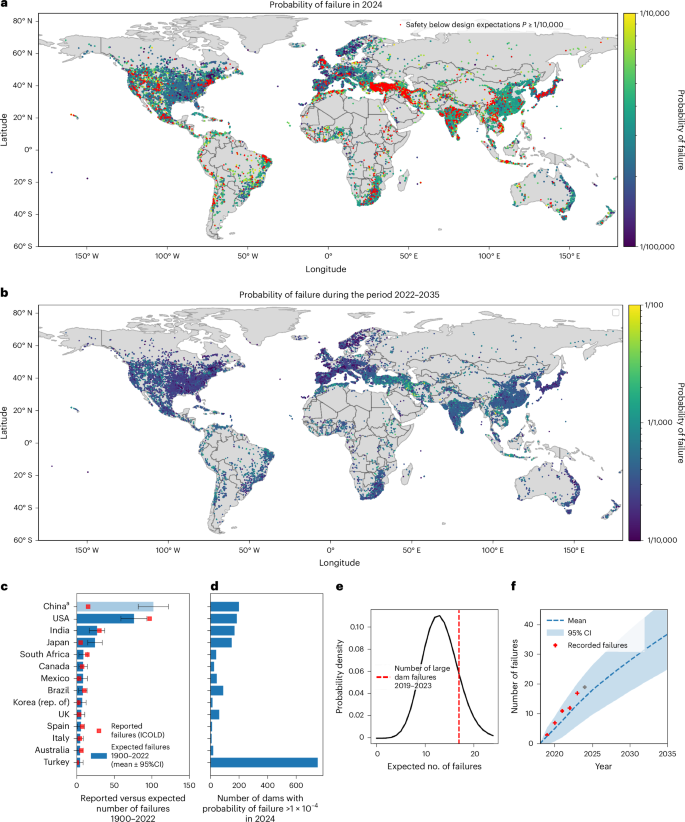
In contrast, hazard signals related to ageing remain yet less apparent, contrary to common belief. Nevertheless, given their abundance, we expect decades-old dams to be prevalent in future failure statistics—especially for embankment dams of height between 15 and 70 m built in the second half of the last century. This highlights the relevance of investments in monitoring, maintenance and uprating, which, if ignored, could become a substantial liability and a major vulnerability, especially in the context of increased flooding frequency.
We uncover a trend of increased failure rates of newly constructed dams in low-income regions, which coincides with areas where a substantial hydropower potential remains untapped. This is especially intensified in monsoon-dominated climates, whereas the pattern of construction and failures is more homogeneous across other major climatic regions. Our statistical analysis suggests that 23 (95% confidence interval 14–33) large dam failures are to be expected worldwide in the near future (2023–2035), with currently ~4.4% of large dams having a probability of failure larger than 1/10,000. Contrarily, 85% of large dams are at least twice as safe as this threshold, commonly embraced in policy. These findings can support the targeted allocation of limited resources for the future-proofing of infrastructure, thereby contributing to water, food and energy security. https://www.nature.com/articles/s44221-025-00402-1 (07 March 2025)
Polavaram Project Demand for immediate halt on work till submergence issues are sorted out A joint action committee comprising representatives from proposed submerged areas of Odsiha, Chhattisgarh, Andhra Pradesh, and Telangana has demanded immediate halt to Polavaram Polavaram Project till all submergence issues are settled. Delegates from the submerged areas of Motu Tahsil and Malkangiri district in Odisha, along with representatives from Chhattisgarh, Andhra Pradesh, and Telangana, met under a joint action committee (JAC) at Motu to discuss the implications of the ongoing Polavaram interstate water project. “Independent backwater studies should be conducted, with representation from all affected states, to evaluate the potential impacts more accurately. Moreover, a mandatory public hearing must be held in Malkangiri, Odisha, before granting any further environmental clearances or approvals for the project,” representatives demanded. Expressing concern over granting of environmental and forest clearances without conducting a mandatory public hearing in the proposed submerged region in Odisha, the JAC said that these clearances, based on inaccurate assumptions about submergence, were detrimental to the environment and the indigenous tribal communities who will be severely affected. https://www.thehindu.com/news/national/odisha/demand-for-immediate-halt-to-polavaram-projects-till-submergence-issues-are-sorted-out/article69275270.ece (01 March 2025)
Kaleshwaram Project Medigadda barrage block beyond repair finds NDSA report It is learnt to have concluded that the partial collapse of the Medigadda barrage of the Kaleshwaram lift irrigation scheme, as well as problems at its sister barrages at Annaram and Sundilla, resulted from poor planning, faulty design, and the abuse of the structures for storing water despite the fact that they were not to be used as dams to store water.
– Sources said that the NDSA also noted that repairs to the three barrages – in the form of grouting the voids that were formed due to the stored water forcing its way from under their foundations – were taken up without its approval.
-The report is expected to be sent by the NDSA to the state government in the next few days. The government has been waiting for it before taking any action on the way forward with the barrages and their repairs. https://www.deccanchronicle.com/news/ndsa-report-medigadda-barrage-block-beyond-repair-1864897 (04 Mar. 2025)
NDSA found defects In Medigadda construction The NDSA, which had already recommended that the seventh block of the Medigadda Barrage be demolished, has suggested that it be rebuilt. However, it seems that it has been suggested that the responsibility of preparing the design required for the reconstruction of this block be entrusted to the CWC. The expert committee formed under the leadership of former CWC Chandrashekhar Iyer submitted its report two weeks ago, and it is reported that the Union Ministry of Jal Shakti discussed it three days ago. It is reported that Chandrashekhar Iyer explained the important aspects of it to the Jal Shakti officials through a presentation. The report revealed that there were flaws in the design, construction, and maintenance and that the seventh block of Medigadda would have to be removed and rebuilt. In addition, the committee found flaws in the columns of the Medigadda Barrage. The quality of the secant piles at the top of the barrage was also not good. The full details are likely to come to light only after the final report is received by the state government. https://indtoday.com/ndsa-found-defects-in-medigadda-construction-block-needs-to-be-rebuilt-report/ (02 March 2025)
Srisailam Dam NDSA orders immediate repairs -NDSA chairman Atul Jain convened a video conference on Thursday (March 06) with officials from Telangana, Andhra Pradesh and the Krishna River Management Board (KRMB), following a letter from Telangana engineer-in-chief G Anil Kumar raising concerns over the dam’s structural integrity. The NDSA directed AP to take up repair and fixed timelines for the same. It also pulled up AP officials for not implementing the recommendations of the NDSA for one year.
-The NDSA agreed to Telangana’s suggestion and declared that those who were currently operating the project should be treated as the owner. Accordingly, Telangana will be the owner of NSP while AP will be the owner of Srisailam. The NDSA conducted a study in February 2024 on the safety of Srisailam dam. https://www.newindianexpress.com/states/andhra-pradesh/2025/Mar/07/ndsa-directs-ap-to-complete-srisailam-dam-repairs-by-may-31 (07 March 2025) -The repairs include plunge pool areas and other works. The NDSA authorities said if the plunge pool is not repaired now, it may pose a danger in future, especially in the monsoon season. Chief engineers of the dams are responsible for any repairs and they will be held responsible for any lapse, the NDSA warned.
-The SDSA has recently suggested a flood flow analysis be done by involving all neighbouring states on Krishna river as the Srisailam dam received heavy floods in 2009 and inundated some villages. https://timesofindia.indiatimes.com/city/hyderabad/ndsa-directs-ap-to-repair-srisailam-before-monsoon/articleshow/118768263.cms (07 March 2025) -Anil Kumar said ever since the 2009 heavy floods in Krishna when the river received 24 lakh cusecs of water, the Srisailam dam’s pressure releasing cells have stopped working, and that the drainage channels in the dam’s gallery have been blocked. He informed the NDSA that the equipment to monitor seismicity at the dam, and any tremors has not been functioning and that AP appeared to be not bothered about these aspects. https://www.deccanchronicle.com/southern-states/telangana/ndsa-slams-ap-for-putting-srisailam-dam-at-risk-orders-immediate-repairs-1865324 (06 March 2025)
SLBC Tunnel Collapse Failure to locate weak spot: Ex-GSI official A retired scientist from the Geological Survey of India (GSI) said that procedural challenges, coupled with the failure to locate the shear zones (weak spots), which are the fault-lines in the terrain where the tunnel was being built has caused the incident. The scientist also pointed out that that until ten years ago, the GSI used to give technical appraisal for all such projects, which was then discontinued, as almost all the contracting firms were now having their own geological wings comprising experts.
-The scientist points out that in similar projects initiated by the Centre, such technical appraisals and reports from GSI and other agencies are taken from time-to-time before and during the progress of the construction. “If the SLBC tunnel project that was initiated more than 20 years ago had continued without any halt during the BRS government, such structural issue may not have happened. Whether it was a human error, negligence, or a procedural issue, unless one looks at the detailed project report of the project, it will be difficult to understand accurately what caused the water to enter the tunnel in such massive quantities,” he added.
-Meanwhile, reports have been speculating about heavy flow in Mallela Teertham and Thirumalapur Vagu (local stream) causing the springing up of water in such unexpected quantities inside the tunnel. https://www.siasat.com/failure-to-locate-weak-spot-may-have-caused-slbc-tunnel-collapse-ex-gsi-official-3188626/ (03 March 2025)
Soft rock problems force rethink The SLBC tunnel is being dug simultaneously from two sides – Tunnel-I, which is the inlet near the Srisailam reservoir, were the collapse occurred, and Tunnel-II, which is the outlet end in Nalgonda district. The plan that is being talked about is stopping digging the tunnel along the current alignment as there are serious and legitimate fears that the machines and the workers could encounter more fault, or shear, zones that may result in further collapses.
-Of the 44-km-long tunnel, stated to be the world’s largest when completed, just around 10 km remains to be dug. Following the collapse at the Tunnel-I side, sources said there was concern over the presence of rocks along the route. Instead, the digging of two bypass tunnels, each five metres wide, is being considered. These tunnels will be dug in the hard rock portion under the Nallamala hills where the SLBC tunnel is being built. “This proposal will have to be fully studied. Geological studies will be required to be done by the likes of NGRI and GSI. This will take some time but it is an option that is being looked at so that the project can be completed safely,” a government official said. https://www.deccanchronicle.com/southern-states/telangana/soft-rock-problems-force-rethink-on-slbc-tunnel-1864582 (03 Mar. 2025)
Telangana High Court on Monday (March 3, 2025) disposed of the PIL petition seeking a direction to State govt to expedite efforts to extricate the eight workers trapped inside the SLBC tunnel, after taking into consideration the explanation by Advocate General A. Sudershan Reddy over the steps taken by government in the matter. https://www.thehindu.com/news/national/telangana/telangana-slbc-tunnel-collapse-rescue-day-11-live-march-4-2025/article69288311.ece (04 March 2025)The Telangana government is exploring the option of deploying robots in the rescue operation to prevent any threat to the rescue personnel, officials said on Monday (March 03). https://www.tribuneindia.com/news/india/robots-might-be-deployed-in-tgana-tunnel-rescue-ops/ (04 March 2025)
Sardar Sarovar Project 5900 km long Narmada canals yet to be built: CM Canals with a cumulative length of more than 5,900 km are yet to be constructed as part of the Sardar Sarovar Narmada project, Gujarat Chief Minister Bhupendra Patel told the state assembly on March 7. Patel, who holds the Narmada portfolio, was replying to Congress MLA. He further stated that 46.13 km of branch canals, 159.70 km of distributaries, 1,052.26 km of minor canals and 4,663.14 km of sub-minor canals are yet to be constructed as of January 2025. https://www.deccanherald.com/india/gujarat/narmada-canals-with-cumulative-length-of-more-than-5900-km-yet-to-be-built-gujarat-cm-3436673 (07 Mar. 2025)
Hirakud Dam Work for additional spillway to start soon A nine-member team comprising experts from the World Bank and Central Water Commission (CWC) visited the proposed site for construction at the left dyke of the Hirakud Dam, and the rehabilitation colony on Saturday (March 08). The team also inspected the right dyke of the dam, power channel, its gates, and reviewed documents regarding additional spillway projects, they said. Chief Engineer of Upper Mahanadi Basin, Sushil Kumar Behera, said tender for the additional spillway work will be floated soon after getting the administrative approval from the government. “We have already submitted the documents to the government and are waiting for the nod,” he said. “If needed, the expert team will again visit the site for any further investigation,” Behera said. The project will entail a cost of around Rs 884 crore.
The length of the proposed additional spillway dam will be 91 metres with five sluice gates. The new spillway channel will originate from near the Gandhi Minar on the left dyke of the reservoir and meet river Mahanadi near the Jawahar Udyan, sources said. At present, the dam has 98 gates, including 64 sluice gates and 34 crest gates, to release flood water. After the construction of the additional spillway, the dam will be able to handle up to 25 lakh cusecs of water from 15 lakh cusecs in case of incessant rain and flash floods, the sources said. Earlier in 2019, two private companies had been entrusted to carry out the construction work of the additional spillway. However, in February 2020, the firms backed out of the project, citing delay by the government in handing over the site for the construction work. https://www.theweek.in/wire-updates/national/2025/03/09/ces2-od-dam.html (09 March 2025) A nine-member joint inspection team from the CWC and the World Bank visited Hirakud Dam on March 8 to assess plans for constructing an additional spillway under phase three of the DRIP. The Rs 884-crore project, approved by the state cabinet, aims to bolster the dam’s flood-handling capacity in response to changing weather patterns. Currently, the dam can discharge up to 15 lakh cusecs of floodwater, but CWC estimates suggest future inflows could reach 25 lakh cusecs. The construction is expected to begin in Apr. CWC chief engineer Rakesh Kashyap said, “We are exploring various options for additional water discharge. While the tendering process is our immediate focus, the entire construction is expected to takearound three years.” https://timesofindia.indiatimes.com/city/bhubaneswar/world-bank-cwc-team-inspects-hirakud-dam-for-addl-spillway/articleshow/118808841.cms (08 March 2025)
Karnataka Govt seeks Centre’s funds for 6 new irrigation projects The submissions sought funding for six fresh proposals, estimated to cost Rs 11,123 crore, under the PM Irrigation Scheme, it said. The six new proposals are: flood management and border area programme at Bennehalla; creation of fresh irrigation potential of 16,000 hectares under Sonthi lift irrigation project across Bhima river; Extension, Renovation and Modernisation (ERM) works at Malaprabha canal systems, Indi branch canal under Upper Krishna project, Ghataprabha right bank canal, Chikkodi branch canal and Tungabhadra left bank canal. These proposed projects will benefit Vijayapura, Dharwad, Belagavi, Bagalkot, Gadag, Koppal and Raichur districts.
-Shivakumar also raised issues about other existing irrigation projects in Karnataka – approvals for Mekedatu project, central assistance for the Upper Bhadra project, Gazette notification for Krishna Water Distribution Tribunal-II award, clearance for Kalasa-Bhanduri canal projects, diversion of surplus water from Mahanadi-Godavari basin to Krishna-Cauvery and Pennar-Palar basin. He informed the Union minister that he would shortly submit a proposal for the automation of dams and canal systems to enhance efficient irrigation management. https://theprint.in/india/karnataka-dy-cm-seeks-centres-approvals-and-funds-for-six-new-irrigation-projects/2511491/ (25 Feb. 2025)
Shahpur Kandi Dam J&K govt seeks time-frame for release of water The J&K Govt has written a letter to the Govt of Punjab seeking time-frame for release of water from Shahpur Kandi dam project on River Ravi as reportedly pondage of the reservoir has not reached the maximum level so far. Meanwhile, the Irrigation and Flood Control Department of the Union Territory is required to strengthen and upgrade the existing gravity canal system for efficient water distribution and maximizing irrigation potential in Kathua and Samba districts. As per the agreement, J&K will get due share of 1150 cusec of water from River Ravi and the same will provide irrigation facility to 32173 hectares of land in Kathua and Samba districts. https://www.dailyexcelsior.com/jk-writes-to-punjab-seeks-time-frame-for-release-of-water-from-shahpur-kandi-dam/ (03 March 2025)
25,000 trees axed in dam area The Shahpur Kandi dam authorities have axed nearly 25,000 trees in its reservoir, a development which officials maintain will not affect ecological balance in the area. The Forest Departments of both the states floated tenders for cutting trees. In all, 6,544 trees were chopped by J&K while 18,920 trees were axed by the Forest Department in Punjab. The trees were cut over a four-month period, commencing from June till September last year.
Interestingly, as reports emanated about the axing, officials were quick to plant nearly 64,000 saplings in the premises of both the Ranjit Sagar Dam and the Shahpur Kandi Dam. “It was imperative to cut the trees, otherwise the wood would have got trapped in the hydraulic gates and head regulators, which could have posed a serious problem. There are 22 such hydraulic gates and nine head regulators. Moreover, had we not axed the trees, they would have kept floating dangerously in the reservoir.” said Sher Singh, Chief Engineer (Canals). https://www.tribuneindia.com/news/amritsar/25000-trees-axed-in-shahpur-kandi-dam-area/ (09 March 2025)
Dam ready, capacity testing underway According to this report, the Shahpurkandi dam on Ravi river, an interstate project between Punjab and J&K is nearing completion, though 206 MW hydro power house is still under construction. The dam filling started in Nov 2024 and currently being checked from dam safety perspective. https://www.tribuneindia.com/news/punjab/shahpurkandi-dam-ready-capacity-testing-underway/ (07 Mar. 2025)
Rajasthan Illegal excavation of sand continues at Bisalpur Dam Despite the apex court’s order on Feb 25, which did not extend the stay on NGT order that barred sand excavation from the dam, the state govt has seemingly turned a blind eye to the ongoing illegal operations. The Supreme Court, on May 24 last year, initially granted a stay on the NGT order that stopped sand excavation at the dam without obtaining prior environmental clearance. However, in subsequent hearings on July 16 and Nov 5, the apex court did not extend the stay on NGT order.
Despite this, the private firm has continued its operations, extracting sand in clear violation of the apex court and NGT directives. A senior official source revealed that the Department of Mines and Geology, also issued an e-rawanna (a mining permit) on March 6, 2024, in contempt of the Supreme Court order. According to the source, “The firm has illegally excavated a staggering 20,04,261 tonnes of sand, transported in 17,844 trucks. This illegal activity has resulted in an estimated environmental compensation and NGT charge and penalty of Rs 1,100 crore, along with compensation of Rs 1,200 crore for violations under the common cause.”
Director of mines, Deepak Tanwar said, “This does not come under mining jurisdiction as the contract was given by the Eastern Rajasthan Canal Project Corporation Limited (ERCPCL).” A senior ERCPCL official said, “We have sought legal advice on the issue and will act accordingly. However, the Supreme Court has also specifically not vacated the stay.” https://timesofindia.indiatimes.com/city/jaipur/illegal-excavation-of-sand-continues-at-bisalpur-dam-despite-sc-ngt-orders/articleshow/118811515.cms (09 March 2025)
Decreasing levels in Himachal dams affects irrigation supply Due to falling water levels in the dams in Himachal Pradesh, downstream Rajasthan is not receiving adequate water for irrigation. Since February 1, water in the canals of the Indira Gandhi Canal Project has been supplied exclusively for drinking purposes. This has severely impacted farmers in Hanumangarh, Sri Ganganagar and Bikaner districts, where standing crops are at the risk of drying up.
-During a meeting of the Bhakra Beas Management Board (BBMB) in Chandigarh on January 29, it was decided that the irrigation water supply in the Indira Gandhi Canal shall be suspended from February 1 and will provide only 3,000 cusecs of water exclusively for drinking purposes. Additionally, it was decided to release 850 cusecs of water from the Bhakra Project. Farmers, however, argue that 1,200 cusecs of water from Bhakra and 5,000 to 6,000 cusecs from the Indira Gandhi Canal are needed to ensure adequate water supply in state canals. https://www.downtoearth.org.in/agriculture/water-crisis-decreasing-water-levels-in-himachal-dams-affects-irrigation-supply-to-rajasthan (06 Mar. 2025)
Haryana हिमाचल प्रदेश के साथ आदिब्रदी बांध के निर्माण के लिए समझौता किया गया है। बजट सत्र के दौरान राज्यपाल ने अपने अभिभाषण में इसका जिक्र किया। पूर्व की मनोहर सरकार के प्रयासों से यह योजना सिरे चढ़ी और बांध पर निर्माण शुरू हुआ। आदिबद्री बांध के जून-2027 तक पूरा होने की उम्मीद है। इससे मिलने वाला पानी प्रदेश के किसानों के सिंचाई में इस्तेमाल किया जा सकेगा। साथ ही, पेयजल आपूर्ति में भी इजाफा संभव हो पाएगा। https://ragazone.com/agreement-reached-between-himachal-and-haryana-regarding-the-construction-of-adi-badri-dam-after-the-syl-dispute-the-government-started-efforts-to-arrange-for-water/ (08 March 2025)
INTERLINKING OF RIVERS
Wainganga-Nalganga Linking Govt to build 31 dams, 426km canal Govt will construct 31 new dams and a 426 km canal as part of Wainganga-Nalganga river-linking project, a major initiative aimed at eradicating drought in Vidarbha and resolving regional water disputes, CM Devendra Fadnavis announced during the state legislature session in Mumbai on Friday (March 07). “The govt is committed to providing irrigation facilities to farmers through this crucial project. The tender process will commence soon to expedite implementation,” Fadnavis said. The CM called the initiative a landmark step toward efficient water resource management, which will bring irrigation to water-scarce areas and permanently address drought conditions. https://timesofindia.indiatimes.com/city/nagpur/wainganga-nalganga-project-maha-to-build-31-dams-426km-canal-says-cm/articleshow/118809168.cms (08 March 2025)
URBAN RIVERS
Vishwamitri; Vadodara ‘Serious deviation from NGT’s mandate’: Citizens In a letter to the mayor, the municipal commissioner, and other officials from Vadodara and Gujarat, the group wrote that the integrity of the riverine ecosystem should not be compromised in any way while carrying out these activities. https://www.downtoearth.org.in/water/serious-deviation-from-ngts-mandate-citizens-pan-measures-to-desilt-resection-vishwamitri-river-in-vadodara (05 Mar. 2025)
₹40cr proposal to reroute canal stirs controversy The Standing Committee also approved four other proposals of the Vishwamitri Project Department for the clearing, resectioning, desilting and dredging of a 25-km urban stretch of Vishwamitri river at a total cost of around Rs 60 crore — handed out to four different contractors. The work on the dredging of the Vishwamitri will commence next week, with the civic body setting a 100-day deadline to complete the work and mitigate flood risk for Vadodara city during the upcoming monsoon. https://indianexpress.com/article/cities/ahmedabad/vadodara-vishwamitri-project-controversy-proposal-rerouted-9875211/ (08 Mar. 2025)
Mithi; Mumbai Janak Daftari returns to the Mithi, one last time On Sunday (March 9) evening, Janak Daftari returned to his beloved Mithi, as family and close friends gathered to immerse his ashes in a rivulet of Powai Lake, which flows into the Mithi River. Daftari, who died on February 27 at 74, had spent the last decades of his life striving to revive the river – making this final tribute a fitting one for a man so deeply connected to its waters. https://www.hindustantimes.com/cities/mumbai-news/janak-daftari-returns-to-the-mithi-one-last-time-101741029185787.html (04 Mar. 2025)
RIVERS
Arunachal Pradesh Miss AAPSU contestants clear 1,700 kgs of waste Contestants of the Miss AAPSU-2025 pageant cleaned up a stretch of the Yagamso river inside IG Park here on Monday (March 03), clearing approximately 1,700 kilograms of waste. The event, held to commemorate the World Wildlife Day, was organised by the Youth Mission for Clean River (YMCR) and the Miss AAPSU organising team, with support from the Itanagar Smart City. https://arunachaltimes.in/index.php/2025/03/04/miss-aapsu-contestants-clear-1700-kgs-of-waste/ (04 Mar. 2025)
Meghalaya Close to 800 water sources critical, some beyond rejuvenation: CM Conrad K Sangma on Monday (March 03) raised concerns over the state’s escalating water crisis, stating that a recent study identified 792 critical water sources, some beyond rejuvenation, despite projects worth Rs 8,000 crore being implemented in the state. The CM said the state government has set up a climate council, with him at the helm, alongside other water-related departments, to hold dialogues and address the crisis.
“Over 70,000 springsheds have been identified, of which more than 55,000 have been mapped across Meghalaya. Steps are being taken on a war footing to rejuvenate the 792 critical water bodies,” Sangma informed the Assembly during the question hour. “After conducting a study, we found that 792 out of the 55,000 mapped springsheds, which serve as water sources for the Jal Jeevan Mission, are in a critical condition, with many completely dried up,” he added.
He said the soil and water conservation department has come up with a Rs 32-crore project and 67 springsheds will be rejuvenated to bring back life to these water sources. According to the CM, 1,601 springsheds have been constructed in the last five years at a cost of Rs 46.62 crore under the MGNREGS. “Each of the 1,601 springsheds are success stories in itself,” Sangma said while informing that the village employment councils (VECs), people and the community are monitoring and looking after these assets that have been created. Sangma informed that with the availability of gadgets, we are able to monitor the level of water in the springs and almost 13,000 volunteers (VCFs) have been trained for the purpose.
He also informed that a 62 million USD project funded by the Asian Development Bank (ADB) is underway to rejuvenate springsheds, which includes the construction of 532 structures such as check dams. Sangma added that Meghalaya is one of the few states to have a water policy in place, with over Rs 4,000 crore worth of projects. https://theshillongtimes.com/2025/03/04/close-to-800-water-sources-critical-some-beyond-rejuvenation-cm/ (04 March 2025)
CM Conrad K Sangma informed the Assembly that 1,601 Springshed Development Programs under climate change adaptation have been constructed in the last five years across the state. “A total amount of Rs 46.62 crore has been sanctioned for the above programme,” Sangma stated in response to a question from MLA Heavingstone Kharpran during the March 3 budget session. https://www.indiatodayne.in/meghalaya/story/meghalaya-constructs-1601-springshed-projects-in-5-years-to-tackle-water-scarcity-cm-sangma-1178382-2025-03-03 (3 Mar 2025)
36 polluting units told to pay Rs 26 lakh as compensation An environmental compensation of Rs 26,85,000 were imposed against the thirty-six violators and polluting units in the state during the financial year 2021-2022. The NGT order stated, ‘The CPCB may take penal action for failure, if any, against those accountable for setting up and maintaining STPs, CETPs and ETPs. CPCB may also assess and recover compensation for damage to the environment and said fund may be kept in a separate account and utilized in terms of an action plan for protection of the environment.”
In pursuance to the Resolution of Agenda No. 6 of the 82nd meeting of the Meghalaya State Pollution Control Board held on March 19, 2022, the board recommended that the ‘Report of the CPCB In-house Committee on Methodology for Assessing Environmental Compensation and Action Plan to Utilize the Fund’ be adopted for assessment, imposing, collection. Meanwhile, the MSPCB has entrusted Knowledge Lens Pvt. Ltd. with the job of connecting all the industries in Meghalaya State to SPCB and CPCB. Keeping up with the current government norms and applying the latest technologies all the industry’s data about Emission Monitoring and Air Quality Monitoring using various instruments available in the market is being captured and transmitted to the Pollution Control Boards. https://theshillongtimes.com/2025/03/09/36-polluting-units-told-to-pay-rs-26-lakh-as-compensation/ (09 March 2025)
Jammu & Kashmir Doodhganga from milky to cesspool -The river’s destruction started when its original course was changed for feeding a small hydropower project. Besides wanton felling of trees in catchment areas of Doodh Ganga resulted in heavy influx of silt into the river. Known for its pure waters, the river has turned into a cesspool due to unabated flow of sewage and dumping of solid waste. As per official figures, 2.23 MLD of sewage is generated within Budgam district and there is not a single STP. Ironically the entire untreated sewage flows into water bodies including Doodh Ganga.
-Besides pollution, illegal mining is devastating the hydrology of the river. The extraction of riverbed material by heavy machines from Doodh Ganga is spelling doom on its fragile eco-system. In March last year, the NGT imposed an interim penalty of over Rs 15.79 lakh on two contractors for using heavy machinery to undertake riverbed mining in Doodh Ganga near Chadoora town. It is not only the case of Doodh Ganga but other water bodies in J&K too. https://www.greaterkashmir.com/opinion/doodh-ganga-from-milky-waters-to-cesspool/ (2 Mar 2025)
Karnataka Suo motu case over Nandini River pollution Justice Veerappa was speaking during his visit to Mukka and Khandige, on Saturday (March 08), following complaints from villagers regarding pollution in the Nandini River, which also disrupted the traditional temple fishing festival of Sri Kshetra Khandige Dharmarasu Sri Ullaya Daivasthana. The Upa Lokayukta took officials from Mangaluru City Corporation (MCC) SPCB to task for failing to protect the waterbody. “The waterbody is encroached upon, and a building is under construction. When asked about encroachment, the officials failed to provide a proper reply,” he said. “Officials are not discharging institutional responsibility and constitutional obligations, and they are unfit to continue in the post they are in. If the officials concerned do not act, I will initiate action against them by registering a suo motu case. I will summon all of them. Officials who fail to fulfil their responsibilities should go home,” the Upa Lokayukta warned.
When SPCB officials informed about serving notices regarding wastewater discharge into the river, Justice Veerappa said that issuing notices alone was inadequate. He stressed the importance of follow ups to achieve a logical end. The Upa Lokayukta further said that simply delivering notices would not resolve the issue. He firmly declared that the practice of soil dumping to encroach upon waterbodies was unacceptable.
It may be recalled that Moodbidri MLA Umanath Kotian raised the issue of pollution of the Nandini River during the Disha meeting chaired by Dakshina Kannada MP Capt Brijesh Chowta at the zilla panchayat on March 1. Later, hundreds of villagers led by the Nandini Nadi Samrakshana Samiti staged a protest at Khandige against the pollution of the river on March 4. The protesters alleged that untreated wastewater from an educational institution, an MCC-run STP and other places contaminated the river. https://timesofindia.indiatimes.com/city/mangaluru/upa-lokayukta-to-initiate-suo-motu-case-over-nandini-river-pollution/articleshow/118808620.cms (8 Mar 2025)
‘Take steps to check pollution of water bodies at pilgrimage centres’ In the light of water bodies near pilgrimage centres getting polluted, Forest Minister Eshwar B. Khandre has directed officials to act against the use of soap and shampoo and stop pilgrims from discarding used clothes near them after bathing. The Minister has asked the officials to take steps to ban the sale of soaps and shampoos within 500 m from the water bodies such as rivers, streams, ponds, and temple kalyanis. The shampoo sachets and soaps are currently easily available near such water bodies, he said and asked Forest Department officials to coordinate with officials of other departments to ensure action. He also said that people, out of superstitious beliefs, discard used clothes and piles of such clothes can be seen at several pilgrimage centres. https://www.thehindu.com/news/national/karnataka/take-steps-to-check-pollution-of-water-bodies-at-pilgrimage-centres/article69309838.ece (09 March 2025)
Cauvery levels witness a sharp decline in Dubare As the water level of River Cauvery has declined to a significant extent at Dubare in Kushalnagar taluk, activities of boat riding and rafting have been stopped. The tourists have been crossing the river from one bank to the other by walking. https://www.deccanherald.com/india/karnataka/river-cauvery-levels-witness-a-sharp-decline-in-dubare-3431452 (04 Mar. 2025)
CAUVERY Tamil Nadu Delta turns on taps even as wells run dry A four-month investigation by Navya PK shows that farmers here are staring at a future of low yields, or even one without farming. Part 1 investigates how much water farmers are drawing, and how this will affect the delta’s residents and the consumers of the rice grown here. It is not just groundwater depletion and climate change that are pushing farmers to the brink of collapse. https://www.thenewsminute.com/tamil-nadu/tamil-nadus-paddy-paradox-cauvery-delta-turns-on-the-taps-even-as-wells-run-dry (04 Mar. 2025) In Part 2 of this series on the delta’s looming water crisis, we investigate the consequences of the shift to high-yield paddy: these varieties need large amounts of chemical fertilisers and pesticides whose repeated use has depleted the delta’s soil, which, in turn, means that the rice grown here lacks certain nutrients essential for our health and growth. While farmers are attempting to compensate for the soil damage by using even more fertilisers, this only worsens the problem. The only beneficiaries of the intensive chemical farming system seems to be big fertiliser and pesticide companies who dominate the market, and not the farmers themselves. https://www.thenewsminute.com/tamil-nadu/tamil-nadus-paddy-paradox-cauvery-deltas-intensive-farming-drains-nutrients (05 March 2025)
Rajasthan Video report on Jojari pollution With unchecked discharge of industrial effluent having turned having turned Jojari River into a toxic drain, it is in the news, but the authorities in Jodhpur have grappled with the crisis for over two decades while villagers relying on the river have been reporting heightened health risks and harms to wildlife and local livelihoods. Watch the video to know more about it. https://www.youtube.com/watch?v=GgE8wPJtQk4 (06 Mar. 2025)
Chhattisgarh सूखी इंद्रावती नदी: जलप्रताप के लिए ज्यादा पानी छोड़ने का आरोप बस्तर जिले के किसान सोमवार 10 मार्च से आंदोलन कर सकते हैं, क्योंकि उनके खेतों में खड़ी फसल के सूखने का डर है। किसानों का आरोप है कि इंद्रावती नदी का पानी उनके खेतों की सिंचाई के लिए देने की बजाय चित्रकोट जल प्रताप के लिए छोड़ दिया गया। चित्रकोट जलप्रपात (वाटरफाल) इंद्रावती नदी पर स्थित एक सुंदर जलप्रपात है, जिसकी ऊंचाई 90 फीट है। इस जलप्रपात की विशेषता यह है कि वर्षा के दिनों में यह रक्त लालिमा लिए हुए होता है, तो गर्मियों की चांदनी रात में यह बिल्कुल सफेद दिखाई देता है। यह एक प्रमुख पर्यटन स्थल है।
बस्तर जिले के बस्तर, टोकपाल और लोहांडीगुड़ा के विकासखंड के किसानों का कहना है कि इंद्रावती नदी के एनीकट (बांध) से पानी उनके खेतों के लिए दिया जाता है, लेकिन प्रशासन ने एनीकट से पानी चित्रकोट जलप्रताप के लिए छोड़ दिया, जबकि इंद्रावती नदी का जल स्तर का काफी कम था। अब पानी न होने की वजह से 22 पंचायतों के करीब दो हजार एकड़ में खड़ी फसल सूख रही है। https://hindi.downtoearth.org.in/agriculture/dry-indravati-river-waterfall-or-farmers-whom-is-the-administration-choosing (10 March 2025)
GANGA Study Deciphering CO2 fluxes & interactions in Ganga Basin Abstract The present insights are instrumental in comprehending the potential of CO2 emissions in the Ganga River and facilitating riverine restoration and management. Our findings underscore the significance of incorporating South Asian rivers in the evaluation of the global carbon budget. https://www.sciencedirect.com/science/article/abs/pii/S0013935124008065 (11 July 2025)
Mahakumbh 2025 CPCB new report says water fit for bathing The Central Pollution Control Board in its new report has said that water quality in the recently concluded Maha Kumbh was “fit for bathing”. This comes after the board had termed water in Prayagraj at several locations during Kumbh unfit for bathing due to high faecal bacteria levels. In the new report dated February 28, the pollution control board said that a statistical analysis was required due to inconsistencies in the data, as water samples taken from the same locations on different dates—and from different spots on the same day—varied significantly. As a result, the findings did not accurately represent the overall water quality across the entire river stretch. “There is a significant variability in the values on various parameters, viz pH, dissolved oxygen (DO), biochemical oxygen demand (BOD) and fecal coliform count (FC) for the samples taken from the same location on different dates. The values of the afore-mentioned parameters also vary at different locations for the samples collected on the same day,” the report said.
– The report clarified that an expert committee analyzed the issue of data variability and concluded that the findings represent only a snapshot of water quality at a specific location and time. It highlighted that water quality can fluctuate significantly due to various factors, including human activities upstream, flow rate, sampling depth, time of collection, river currents, mixing of currents, and the exact sampling location, among other influences. “As a result, these values reflect water quality parameters at the exact time and place from where these water samples were collected, and may not fully represent the overall characteristics of the river, therefore, not necessarily reflecting the overall river water quality throughout the river stretch,” it said. https://timesofindia.indiatimes.com/india/maha-kumbh-water-fit-for-bathing-says-new-cpcb-report-cites-variability-in-data/articleshow/118817467.cms (10 March 2025) The latest CPCB report, dated February 28 and uploaded on the tribunal’s website on March 7, noted that a statistical approach was necessary due to “variability of data” in water samples collected from the same locations on different dates and from different locations on the same day. This “variability of data” in water samples collected from the same locations on different dates and from different locations on the same day. The NGT has scheduled the next hearing for April 7. https://english.mathrubhumi.com/news/india/what-did-the-new-pollution-control-board-say-about-human-faecal-river-water-at-maha-kumbh-1.10408684 (09 March 2025)
Dismantling Mela city over 4,000 ha According to various authorities and agencies involved in the uninstallation and cleanup, while the deadline to bring the entire area back to how it was is March 20, the processes — a third-party verification, dismantling and inventorying — means the deadline could be pushed. https://indianexpress.com/article/cities/lucknow/maha-kumbh-is-over-now-for-the-hard-part-dismantling-mela-city-over-4000-hectares-9876308/ (09 March 2025)
Uttar Pradesh Take action against ‘illegal’ felling of trees: NGT The NGT has directed the Uttar Pradesh government to take appropriate action against people responsible if trees were illegally axed for a 111-km Kanwar Yatra route, as stated in a report by the Forest Survey of India (FSI), and also submit a report to the court. A total of 17,607 trees have been cut in Ghaziabad, Meerut, and Muzaffarnagar districts to make way for the new route, as per data provided by the Public Works Department of the State government.
As per the report dated February 20 submitted by the FSI, trees were axed for the route “not as per rules” and without “final approval”. Also, the opinion of the FSI was not included in a ‘final report’ of a joint-committee, as per the report submitted by FSI Joint Director Meera Iyer.
In an order dated February 28, the NGT noted that the ASG, appearing for the U.P. government, told the court that the report submitted by Ms. Iyer was of “no consequence” as there was no order permitting the FSI Director to appoint Ms. Iyer as his representative. “… we are of the opinion that in certain stretches felling of trees beyond 20 metres has been done and satellite images have been enclosed, then, the competent authority must verify it, ascertain its correctness and … then take appropriate action against those who are responsible for the same,” the order read. https://www.thehindu.com/news/national/uttar-pradesh/take-action-against-illegal-felling-of-trees-for-kanwar-yatra-route-ngt-to-up/article69290569.ece (05 March 205)
YAMUNA Delhi Will new govt succeed where others failed? What the Yamuna in Delhi desperately needs, according to Himanshu Thakkar of South Asia Network on Dams, Rivers and People (SANDRP), is more water flowing into it. “For most of the year, the river during its Delhi stint just does not get enough water. The government has to ensure that enough freshwater flows into the Yamuna downstream from the Wazirabad barrage, where the river enters Delhi.”
Thakkar said the government would also have to ensure that all treated wastewater is reused and not pumped back into the river. He also called for rainwater harvesting and rejuvenation of local water bodies. These efforts, he said, would reduce the demand for fresh water from the Yamuna, leaving more water in it. “There are many pieces to the Yamuna puzzle. A basic requirement to having a holistic approach to cleaning the river is a Delhi water policy. It will take a comprehensive look at the situation and provide a road map to clean the river,” Thakkar said. https://frontline.thehindu.com/politics/yamuna-river-delhi-pollution-cleanup-efforts-history-politics-rekha-gupta-assembly-election/article69293696.ece (08 March 2025)
Can river be revived in 3 years? The answers aren’t that difficult – increase the river’s flow, stop sewage from entering the river, revive floodplains and wetlands, clean up Najafgarh drain on a war footing, and coordinate with Haryana and UP to plug sewage and effluents. But for three decades, this has proved to be an impossible job. Himanshu Thakkar, coordinator of SANDRP, said, “This is because no one ever addressed the governance problem. They kept spending on new infrastructure, committees, technology, etc, but refused to address the main issue. You need governance to ensure funds and efforts are directed at the right solution.”
Opacity around STPs is a problem. Among other things, it recommended a relook at the 1994 water-sharing treaty to improve Yamuna’s flow from Hathni Kund, better monitoring of the river and adopting a jal shakti ministry-like model that brings all agencies linked to Yamuna under a central regulator. But ultimately, it will have to bargain for a larger share of water from the Upper Yamuna Water Board, which will be a hard task because the Yamuna canals are water lifelines for Haryana. https://timesofindia.indiatimes.com/city/delhi/in-icu-since-1993-yamuna-still-died-in-delhi-can-it-be-revived-in-3-years/articleshow/118813181.cms (09 March 2025)
Dysfunctional STPs pose clean-up hurdle Bhim Singh Rawat, a Yamuna activist and member of the SANDRP, said that the agencies are focusing on symptoms by clearing floating waste while neglecting the root cause. “For years, we have been hearing about STPs not meeting norms but no accountability is fixed. There is no monitoring mechanism which involves people and civil society and violations continue month after month without any repercussion,” he said. Rawat said the DJB estimates sewage generation without taking into account extracted groundwater. “The real quantum of sewage is much more; STPs are inadequate and underperforming and even the water that gets treated does not meet norms,” Rawat said, calling on the new government to focus on improving STP management. “Commercial use and ornamental plants which change the natural character of the river floodplain should be avoided,” he said. https://www.hindustantimes.com/cities/delhi-news/dysfunctional-delhi-stps-pose-yamuna-clean-up-hurdle-101741283470559.html (07 Mar. 2025)
500 ‘illegal’ dyeing units drain groundwater, pollute Yamuna An estimated 500 or more ‘illegal’ dyeing units are operating across the national capital, consuming around 100 million litres per day (MLD) of water and discharging untreated wastewater directly into Delhi’s drains, Patriot has learnt. Environmentalists claim these illegal operations are a major factor in the alarming depletion of the city’s groundwater. This massive water wastage occurs in a city where, every summer, residents queue for hours in the sweltering heat, waiting for water tankers to meet their basic needs. The yarn and textile processing industry—including bleaching, dyeing, printing, and colouring—is classified as a red-category industry, indicating the highest level of pollution. https://thepatriot.in/environment/500-illegal-dyeing-units-in-delhi-drain-groundwater-pollute-yamuna-66991 (10 March 2025)
What Delhi must do to rescue the river With indiscriminate urbanisation, industries, unsewered colonies, fly ash and garbage dumping, the river has become a corridor of filth, garbage, squatting and insanitation. Restoring its health will need correcting planning and execution flaws and pushing forward with circulatory water management.
The river is intimately connected with the Capital’s water supply, sanitation, flooding, drainage, and transport networks. As such, several agencies dealing with the environmental management and pollution control, land, water, flood control and drainage. power, irrigation, transport, and sewerage need to work together. To that end, the Unified Centre for Rejuvenation of River Yamuna (UCRRY) was notified in July 2015, under the chairmanship of the LG. AK Jain is former commissioner (planning), DDA. https://www.hindustantimes.com/opinion/what-delhi-must-do-to-rescue-the-yamuna-101741532499022.html (09 March 2025)
Sabarmati RFD like makeover for Yamuna But downstream, the Sabarmati waters continue to be highly polluted (near Vasna) because of its unique problem. Sabarmati is a seasonal river, coming alive only during the monsoon. However, in something of a marvel, water from the Narmada River was released into the Sabarmati River through the Sardar Sarovar dam in 2002. The Gujarat government constructed check-dams to maintain water levels in the riverfront by using the Narmada Canal.
The fact is Yamuna waters are over-utilised by Uttar Pradesh, Haryana and Delhi – for drinking, irrigation and industrial purposes. This leaves the river with little freshwater in its Delhi stretch. Add to that the weight of untreated industrial effluent and sewage from all of Delhi. Inevitably, no flora or fauna can survive in this muck of a river. (Bharti Misra Nath) https://www.ndtv.com/opinion/a-sabarmati-riverfront-like-makeover-for-yamuna-7580044 (28 Jan 2025)
सफाई रूपरेखा के साथ जिम्मेदारी भी तय हो -यह अच्छा तो है कि केंद्रीय जलशक्ति मंत्रालय यमुना को स्वच्छ करने के लिए एक नई योजना की रूपरेखा बना रहा है, लेकिन क्या ऐसी योजना तैयार करने के लिए दिल्ली में सत्ता परिवर्तन की प्रतीक्षा की जा रही थी। ऐसी कोई योजना तो पहले भी बनाई जा सकती थी। प्रश्न यह है कि ऐसा क्यों नहीं किया गया। क्या यमुना को स्वच्छ करना केंद्र सरकार की भी जिम्मेदारी नहीं थी। केंद्रीय जलशक्ति मंत्रालय की पहल पर भले ही यह कहा जा रहा हो कि यमुना की सफाई के काम को एक अभियान का रूप दिया जाएगा और उसे एक निश्चित समयसीमा में स्वच्छ किया जाएगा, लेकिन इस पर भरोसा करना इसलिए कठिन है, क्योंकि यमुना केवल दिल्ली में ही प्रदूषित नहीं है। https://www.jagran.com/editorial/nazariya-yamuna-river-cleaning-responsibility-and-framework-decided-by-government-23893612.html (02 Mar. 2025)
HC rejects plea against uprooting of nurseries The Delhi High Court has observed that the Yamuna river in the national capital has surpassed the threshold and any interference in its restorative and rejuvenation is not justified. The Court was dealing with a plea moved by a nurseries welfare association working in the area of Yamuna Khadar falling in Zone ‘O’ of the Master Plan for Delhi-2021 i.e., the Yamuna Floodplains. The association was aggrieved by DDA action of uprooting their nurseries and destroying all the plantation with bulldozers.
It was claimed that the said demolition drive was conducted by DDA without giving an opportunity to be heard to the association members and without conducting a physical demarcation of the subject land as per the directions of the NGT in 2019. Justice Sharma observed that the petitioners woefully failed to demonstrate any reasonable and justifiable grounds to be afforded protection from dispossession over the subject land.
It added that the NGT has reiterated in various orders that the floodplains of Yamuna should not be permitted for construction, occupation or habitation and it is the duty of the DDA to maintain the natural features and ecology of the Yamuna floodplain. The Court said that the land in question fell under the Zonal Development Plan for Zone- ‘O’ and is required to be rid of encroachments, in the larger public interest, in terms of directions passed by the Supreme Court and the NGT. https://www.livelaw.in/high-court/delhi-high-court/delhi-high-court-yamuna-river-restoration-285434 (03 March 2025)
Jhuggi union moves HC to halt further demolition at Dhobi Ghat A slum dwellers’ representative body approached the division bench of the Delhi high court against a single-judge order refusing to halt further demolition of a slum cluster at Dhobi Ghat, Jamia Nagar, by the DDA. Senior advocate mentioned the plea on Wednesday (March 05) by senior advocate Arundhati Katju before a bench of chief justice DK Upadhyay and justice Tushar Rao Gedela. Katju urged the court to immediately list the matter, filed by Dhobi Ghat Jhuggi Adhikar Manch in response to the March 3 order of the single judge, asserting that residents were apprehensive of further demolition, following a visit by DDA officials. The court said that it would list the matter for Mar 6.
In its 35-page order, a bench of justice Dharmesh Sharma had dismissed the petition filed by the Manch in 2021 seeking directions to the DDA to halt the demolition (if any) and maintain the status quo, with a cost of ₹10,000 taking note of the fact that the site formed a part of ecologically sensitive Yamuna floodplains in Delhi and was a significant source of pollution to the river. In Sep 2020, the DDA demolished temporary structures. https://www.hindustantimes.com/cities/delhi-news/jhuggi-union-moves-delhi-hc-to-halt-further-demolition-at-dhobi-ghat-101741196827213.html (06 March 2025)
Justice Dharmesh Sharma, while dealing with the petition by “Dhobi Ghat Jhuggi Adhikar Manch”, said the “so-called members” of the petitioner were not entitled to any compensation or rehabilitation as they were “rank tress-passers” who repeatedly returned to the site, which was acquired by DDA for developing a biodiversity park. “Since the subject site was acquired by the DDA for the channelisation and protection of the River Yamuna, the removal of the petitioner union from the subject site serves the greater public interest,” the court said in its verdict on March 3. https://www.hindustantimes.com/india-news/delhi-hc-junks-plea-against-slum-demolition-in-yamuna-floodplain-imposes-costs-101741175998828.html (05 March 2025) ‘They’ve taken away our means to live’: Residents of Yamuna bank after bulldozer razes homes. https://indianexpress.com/article/cities/delhi/theyve-taken-away-our-means-to-live-residents-of-yamuna-bank-after-bulldozer-razes-homes-9871039/ (06 March 2025)
High ammonia again, may hit water supply The elevated ammonia levels, stemming from industrial operations upstream in Haryana, may disrupt the water distribution in the city. However, the supply wasn’t affected on Wednesday (March 05), officials said.
-“The level of ammonia had shot up for some time, but it is now largely on declining trends. There was no issue in terms of water production as we get additional water from Munak Canal to dilute it at Wazirabad,” said an official on the condition of anonymity.
-Since last year, DJB has expressed concerns about Haryana releasing water containing excessive ammonia into the Yamuna. The planned ammonia treatment facility at Wazirabad, due for completion by 2023, still remains unbuilt. https://timesofindia.indiatimes.com/city/delhi/ammonia-up-in-river-again-water-supply-not-hit-as-yet/articleshowprint/118741874.cms (06 Mar. 2025)
‘In 2023, Delhi faced flood as floodgates were closed’: Verma “In 2023, Delhi faced a flood. Previously, all the floodgates were closed, but now they have been repaired and raised to prevent future flooding,” Verma said. “Our biggest commitment is to completely clean and restore the Yamuna. As of now, 1,300 metric tonnes of garbage have been removed in the last 10 days. The Delhi Development Authority will restore the riverbed and encroachments are being removed,” the minister said. https://timesofindia.indiatimes.com/city/delhi/in-2023-delhi-faced-flood-as-floodgates-were-closed-1300-tonnes-of-garbage-removed-from-yamuna-in-past-10-days-says-minister-parvesh-verma/articleshowprint/118728086.cms (05 Mar. 2025)
All drains in city to be connected to STPs All drains in the city will be connected to STPS with enhanced capacities to prevent untreated wastewater from flowing into the river. Minister Parvesh Verma said that common effluent treatment plants would also be constructed in industrial areas to deal with chemical waste. https://timesofindia.indiatimes.com/city/delhi/mission-yamuna-cleanup-all-drains-in-city-to-be-connected-to-sewage-treatment-plants/articleshow/118741253.cms (06 March 2025)
Prayagraj Riverfront, bird sanctuaries to boost tourism The tourism department has proposed an 8-km-long riverfront on the banks of Yamuna in Prayagraj as well as two new bird sanctuaries in Naini to give a boost to tourism prospects of the city that had generated a huge interest among visitors during the recently concluded Maha Kumbh. The department is busy preparing a DPR for the riverfront project. The plan includes connecting various locations like Boat Club, Mankameshwar ghat, Saraswati Park and Juna Akhara along Yamuna Bank Road while developing tourist amenities. The project will incorporate modifications as per NGT guidelines and requirements.
Officials said a bird sanctuary will be developed on six acres in Naini using Japan’s Miyawaki technique. The proposal has been finalised, and plantation work is scheduled to commence in the upcoming season. The Prayagraj Municipal Corporation has earmarked the former Baswar Plant waste dumping for the forest. Apart from this, another bird sanctuary will be constructed on nine hectares in Arail, Naini. This will have facilities like walking paths, sitting areas and a cafeteria. https://timesofindia.indiatimes.com/city/allahabad/yamuna-riverfront-bird-sanctuaries-to-boost-prayagraj-tourism/articleshow/118793481.cms (08 March 2025)

Haryana Masani dam on Sahibi river is releasing polluted water and affecting downstream villagers in Rewari. https://www.facebook.com/share/p/15ADNHYZLd/ (Dainik Bhaskar, 09 March 2025)
Ujjain स्थायी कुंभ नगरी के लिए जमीन नहीं देना चाहते किसान -उज्जैन में सिंहस्थ कुंभ की 2378 हेक्टेयर जमीन पर स्थायी कुंभ नगरी बसाने को लेकर प्रशासन और सैकड़ों किसान आमने-सामने हो गए। मंगलवार (March 04) को किसानों ने इसके विरोध में रैली निकालकर प्रदर्शन करना चाहा। लेकिन पुलिस ने किसानों को रैली शुरू करने की इजाजत नहीं दी। इसके बाद किसानों और पुलिस में झड़प भी हो गई। किसानों ने लैंड पुलिंग (जमीन अधिग्रहण) स्कीम सहित कई मुद्दों को लेकर आपत्ति जताई है।
-सीएम मोहन यादव ने सिंहस्थ 2028 को देखते हुए सिंहस्थ मेला क्षेत्र को विकसित करने का प्लान तैयार किया है। मध्यप्रदेश में इस तरह की यह पहली योजना है, जिस पर करीब 2000 करोड़ रुपए का खर्च आने का अनुमान है। https://www.bhaskar.com/local/mp/ujjain/news/clash-between-farmers-angry-with-permanent-kumbh-city-and-police-video-134592584.html (06 Mar. 2025)
Madhya Pradesh बेतवा बचाने की हमारी मुहिम का असर! एनवायरमेंट स्टोरी की खबर ने सरकार को कार्रवाई के लिए मजबूर कर दिया! सीएम की नजर अब इस गंभीर मुद्दे पर है, और 8 मार्च 2025 को उच्च स्तरीय बैठक में बेतवा बचाने पर ठोस चर्चा हुई। बैठक में प्रमुख सचिव की अध्यक्षता में आला अधिकारियों ने भाग लिया, और एनवायरमेंट स्टोरी की रिपोर्टिंग इस पूरी चर्चा के केंद्र में रही। https://www.youtube.com/watch?v=oSpZLXkhgu0 (08 March 2025)
RIVERS BIODIVERSITY
Yamuna Manthan Dolphin Survey Rings Alarm for Pachnad Dam Project Since Nov 2024, the MoEF’s Expert Appraisal Committee (EAC) on River Valley Projects has been considering the proposal for ToR. In its recent meeting held on Feb. 14, 2025, the EAC found that the project would submerge about 9118 ha of land including 1900 ha of National Chambal Gharial Wildlife Sanctuary. Seeking more information, the EAC has deferred the proposal. The project will also require permission from the National Board of Wild Life.

If it goes ahead, the project will certainly fragment the Yamuna river segment and will be detrimental for the survival of wildlife in Yamuna rivers around Pachnada. In light of the findings of dolphin survey report and given the ecological significance of Pachnada area, the EAC and the NBWL must reject the proposal, and the Centre and state government must explore better, cost-effective alternatives to meet the irrigational water needs. https://sandrp.in/2025/03/06/yamuna-manthan-060325-dolphin-survey-rings-alarm-for-pachnad-dam-project/ (06 Mar. 2025)
Survey Gangetic dolphins need deep water; minimal disturbance Under Project Dolphin, India completed a survey of river dolphins across eight states covering the entire range of the Ganges River dolphin in the Ganga and Brahmaputra, as well as the Indus River dolphin in the Beas River systems. The population estimate reveals 6,324 Ganges River dolphins and only 3 Indus River dolphins, the report released by PM Modi on Monday (March 03) said. In the mainstem of Ganga, the population is estimated to be around 3,275 with an encounter rate of 1.3/km between Bijnor barrage and Ganga Sagar in West Bengal.
“The results suggest that dolphins thrive in areas with sufficient water depth and minimal anthropogenic disturbances,” the report stated. Another significant finding of the survey is that they prefer tributaries, confluences, meanders, and mid-channel Islands. For instance, in Uttar Pradesh, a total of 3,453km was surveyed covering mainstream Ganga and its tributaries (Chambal, Yamuna, Rapti, Sharda, Geruwa-Kauriala, Ghaghara and part of Gandak River).
The highest encounter of dolphins in this stretch was found in the 47km stretch of Bhind-Pachhnada (2.68/km) in the Chambal River followed by Kanpur-Vindhyanchal (1.89/km). National Chambal Sanctuary, Hastinapur Wildlife Sanctuary and Katerniaghat Wildlife Sanctuary are important conservation sites. While dolphin population between Bijnor to Narora Barrage is small, the population between Narora to Kanpur (366 km) is almost non-existent, with an encounter rate of 0.1/km, the report states speculating that this may be due low depth of water there.
The stretches of river where the distribution of dolphins is very sparse or even absent are termed as ‘Coldspots’. In the Ganga River, such an area was present in the Farukkhabad-Kannauj which lies between the Narora Barrage and Kanpur Barrage. Similar ‘coldspots’ were found in the Yamuna River, from Kaushambi-Chitrakoot, in the Sharda River, in Pilibhit, and in Rapti River, from Balrampur-Siddharth Nagar.
A total of 536km of Yamuna was also covered by the survey in Uttar Pradesh, starting from Yamuna Setu at Etawah and ending at the Sangam Ghat at Prayagraj. The Ganges River Dolphin were largely observed around Chambal and Yamuna Confluence with a total of 104 (96-112) individuals with an encounter rate of 0.2/Km. The survey underlined that there are several coldspots in Yamuna and only population may be in the Chambal stretch.
According to a separate note by WII on its website, Gangetic dolphins are threatened by unintentional killing through entanglement in fishing gear; habitat destruction due to development projects (for instance, water extraction and the construction of barrages, high dams and embankments), pollution (industrial waste and pesticides, municipal sewage discharge and noise from vessel traffic). Fragmented populations created by dams and barrages have degraded downstream habitat and created impoundments with high sedimentation and altered assemblages of fish and invertebrate species. (Jayashree Nandi) https://www.hindustantimes.com/india-news/gangetic-dolphins-need-deep-water-minimal-disturbance-project-dolphin-report-101741148568315.html (05 March 2025) The report revealed that the Ganga mainstream holds 3,275 dolphins, while its tributaries hold another 2,414 dolphins. Brahmaputra river system is estimated to have 635 and the Beas three dolphins. A total of 3,453 km was surveyed in Uttar Pradesh covering mainstream Ganga and its tributaries for river dolphins. The highest encounter of dolphins was found in the 47 km stretch between Bhind and Pachhnada in Chambal river followed by the Kanpur-Vindhyachal stretch. The population between Kanpur and Narora is almost non-existent, the report said. https://www.hindustantimes.com/india-news/pm-announces-expansion-of-wildlife-conservation-efforts-101741027629652.html (04 March 2025) Conducted between 2021 and 2023, the survey covered 8,406 km long stretches of Ganga and Brahmaputra river basins, inclusive of its tributaries, and a 101 km long stretch of the Beas river. In UP, the highest encounter or concentration of dolphins was found in the 47-km stretch of Bhind-Pachnada in Chambal River. The Kanpur-Vindhyachal stretch of 380 km had an encounter rate of 1.89 dolphins/km. The dolphin population in 366-km long Narora to Kanpur stretch was almost non-existent, the report said. https://indianexpress.com/article/india/india-has-6327-river-dolphins-finds-first-population-survey-9866912/ (04 March 2025)
6,300 river dolphins in country; highest in UP As per ‘Population Status of River Dolphin in India’, survey report, Uttar Pradesh has the highest number of dolphins at 2,397, followed by Bihar 2,220, West Bengal 815, Assam 635, Jharkhand 162, Rajasthan and Madhya Pradesh 95, and Punjab 3. The survey covering over 8,000 km was conducted from 2021 to 2023. It included eight states — along the Ganga and Brahmaputra rivers and their tributaries, as well as the Beas river.
-During the survey, 58 rivers were assessed. Of these, 28 rivers were actively surveyed by boat, while 30 were studied through road surveys, focusing on locations where the Ganges river dolphin had been historically reported. The findings suggest that dolphins thrive in areas with adequate water depth and minimal human disturbances, it said. https://www.business-standard.com/india-news/first-ever-survey-finds-over-6-300-river-dolphins-in-country-highest-in-up-125030301283_1.html (03 Mar. 2025)
Assam Ganges dolphin resurfaces in Charikadia river after 25 years The recent sighting of the endangered Ganges dolphin (Platanista gangetica) in Charikadia River at Dhakuakhana, Lakhimpur district, has sparked immense interest. Locally known as Sihu, this marks the first recorded presence of the species in the river since 1998, ending a 25-year absence. The prolonged disappearance of the Ganges dolphin from this waterway had fueled concerns over its dwindling numbers and possible extinction. The disappearance of the species from the Charikadia River has been attributed to several factors, including hunting, habitat destruction, and depletion of food sources. https://www.dailypioneer.com/2025/columnists/ganges-dolphin-resurfaces-in-charikadia-river-after-25-years.html (07 March 2025)
Meghalaya A prehistoric whale fossil stolen from a cave Parts of a fossilised jaw of a prehistoric whale have been reportedly stolen from the site in Meghalaya, where the fossil was first found in 2024. The fossil is assumed to be of the now extinct Rodhocetus or Ambulocetus genera, ancestors of modern whales which once roamed the land before evolving into marine mammals. The theft is being considered a substantial scientific loss because the specimen was stolen before thorough study and analysis. https://india.mongabay.com/2025/03/theft-of-prehistoric-whale-fossil-from-a-cave-turns-attention-to-fossil-trade/ (05 Mar. 2025)
Tamil Nadu Focus on lesser-known species In light of World Wildlife Day 2025, observed annually on March 3, here are some of these less ‘famous’ wildlife that conservationists and researchers in Tamil Nadu are working tirelessly to protect. https://www.thehindu.com/news/national/tamil-nadu/on-world-wildlife-day-focus-on-tamil-nadus-lesser-known-species/article69286712.ece (06 March 2025)
FISH, FISHERIES, FISHERFOLKS
Study Gobioid fishes of Ashtamudi Ramsar Lake Abstract An integrative taxonomic study on the gobioid fishes of Ashtamudi Lake (a Ramsar Site), Kerala, India revealed the occurrence of 12 species representing 10 genera, including three species of the genus Oxyurichthys.
The Arrowfin goby, Oxyurichthys tentacularis, considered as the mainstay of gobioid fisheries in the Lake for over 40 years, represents a clear case of misidentification of O. ophthalmonema. Combined morpho-molecular analysis confirmed, for the first time, the occurrence of Oxyurichthys omanensis in the Indian subcontinent, and from anywhere outside its type locality in the Gulf of Oman. Three additional new records are presented: Exyrias puntang from mainland India, Paratrypauchen microcephalus from the West coast of India, and Istigobius diadema from the southwest coast of India. Intensive region-wise studies, particularly along the western coast of India, are required to better understand the diversity and distribution of estuarine and freshwater gobies. https://www.mapress.com/zt/article/view/zootaxa.5601.2.8 (07 Mar. 2025)
For the past 40 years, the Arrowfin Goby was identified as the main species of Ashtamudi Lake. It was first mentioned in the literature on fishes of Ashtamudi in the early 1980s. Due to the significant commercial interest in the Arrowfin Goby, several studies were conducted to determine its key life history and biological characteristics but not much was done to confirm its identity. Arrowfin Goby is a marine fish found in Indo-West Pacific waters and does not survive in freshwaters. What was thought to be the Arrowfin Goby is actually the Eyebrow Goby. As the identification and naming were incorrect, the fishery management was also not conducive to the fishery.
The findings come at a crucial time as Ashtamudi Lake faces increasing ecological stress and anthropogenic pressures. The research team emphasises the importance of a comprehensive management strategy tailored to the multispecies Oxyurichthys fishery, which sustains traditional fishers and meets a growing culinary demand. “Incorporating genetic tools in fishery assessments will be essential for identifying overexploited stocks and implementing conservation-oriented, species-specific management policies,” said Prof A Biju Kumar, Kerala University. https://timesofindia.indiatimes.com/city/kochi/a-case-of-mistaken-identity-its-not-arrowfin-goby-but-eyebrow-goby/articleshow/118824343.cms (10 March 2025) This discovery uses both traditional and molecular techniques; has significant implications for conservation and sustainable management of this exploited fishery. https://www.thehindu.com/news/national/kerala/study-reveals-misidentification-of-koozhavali-in-ashtamudi-lake/article69306455.ece (08 March 2025)
SAND MINING
Rajasthan Can’t probe sand mining due to resource constraints: CBI Expressing concern over the Central Investigation Bureau’s inability to probe the cases of illegal sand and gravel mining citing resource constraints, the Rajasthan high court has asked CBI director Praveen Sood to appear before it.

-The high court noted on March 4 that “such limitations were unexpected from India’s premier investigating agency,” and directed Sood to appear either in person or through video conferencing when the case comes up for hearing on March 17.
-In April 2024, the high court had directed the CBI to investigate illegal sand mining on the state’s Chambal and Banas riverbeds. The directive came in the case of one Shahrukh, who is accused of transporting 40 metric tonnes of sand in a dumper without a valid permit. The court asked the agency to investigate other sand mafias of the state too. Following that order, a case was registered by the central agency. https://thewire.in/law/unexpected-rajasthan-hc-cbi-director-praveen-sood-illegal-mining/ (05 Mar. 2025)
Illegal excavation of sand continues at Bisalpur Dam Despite the apex court’s order on Feb 25, which did not extend the stay on NGT order that barred sand excavation from the dam, the state govt has seemingly turned a blind eye to the ongoing illegal operations. The Supreme Court, on May 24 last year, initially granted a stay on the NGT order that stopped sand excavation at the dam without obtaining prior environmental clearance. However, in subsequent hearings on July 16 and Nov 5, the apex court did not extend the stay on NGT order. https://timesofindia.indiatimes.com/city/jaipur/illegal-excavation-of-sand-continues-at-bisalpur-dam-despite-sc-ngt-orders/articleshow/118811515.cms (09 March 2025)
Jammu & Kashmir DMO Budgam issues notice to NKC Projects The District Mineral Officer (DMO) of Budgam has issued a notice to M/S NKC Projects Pvt. Ltd. for allegedly engaging in “unauthorised extraction” of minor minerals from Shali Ganga Nallah at Lanilab Basant Wooder in Khansahib Tehsil. According to the notice issued, field staff from the Department of Geology & Mining reported that the company had “unauthorisedly engaged men and machinery” at the site and extracted minor minerals in contravention of the MM(D&R) Act, 1957 and The Jammu And Kashmir Minor Mineral Concession, Storage, Transportation of Minerals and Prevention of Illegal Mining Rules 2016.
The official communication states that approximately 300 metric tons of “Nallah Mukh” (riverbed material) has been illegally lifted from the site. The DMO noted that video evidence of the illegal mining activity was circulated on social media on March 2, 2025, drawing public attention to the violation. “The unauthorised extraction has caused damage to the environment and loss to the public exchequer,” the notice states. The District Mineral Officer has directed NKC Projects to immediately halt all mining activities at the location. The company has been given three days to produce any relevant documentation regarding their mining operations at the site. “Failing which it shall be presumed that you have nothing to say/produce in your defense and action as warranted under rules shall be initiated,” the notice warns. https://www.greaterkashmir.com/business/dmo-budgam-issues-notice-to-nkc-projects-for-illegal-mining-in-shali-ganga-nallah/ (03 March 2025)
NHPC no less than East India Company: Karra Congress president Tariq Hamid Karra on Saturday (March 08) also informed that as per the J&K Mining Department, 70 percent of mining blocks auctioned post-2019 went to non-local rms. “It is being said that the postings at Chenab region are regarded as Dubai postings due to the illegal exploitation of its resources,” said Karra adding, “There are complaints made in the name of even Nirav Modi and Mehul Choksi who have managed to rob our State of its precious mineral wealth sapphire and this exploitation is still continuing unabated.” The Congress leader also said that if the white paper on the ‘fiduciary policies’ of the last seven years, when the J&K was without any elected government, is prepared it wouldn’t be any short of getting called “Drains of Wealth from J&K.” Karra took the reference from Dadabhai Naroji’s ‘Drain of Wealth’ theory in context of British rule in India. https://economictimes.indiatimes.com/news/politics-and-nation/nhpc-no-less-than-east-india-company-drain-of-wealth-happening-from-jk-congress-tariq-hameed-karra/articleshow/118814750.cms (09 March 2025)
Himachal Pradesh Govt told to recover Rs1.08cr penalty from violators The NGT has ordered the state govt to recover an environmental penalty of Rs 1.08 cr from the violators within 60 days or make the payment itself. Justice Arun Kumar Tyagi ordered that the state govt and the SPCB must take appropriate steps to recover the environmental penalty imposed by the pollution control body and the police against 41 violators for carrying out illegal mining.
-The order came with regard to an ongoing case of illegal soil mining in the Baddi area and its sale to the Railways. The order stated that if the Himachal govt failed to recover the penalty within 60 days, then “it is appropriate that the state deposits Rs 1.08 crore with the HPSPCB from the district mineral fund to be utilised for environmental restoration”. The NGT also directed the state industries director, Solan deputy commissioner, and district mining and forest officers to appear before the tribunal either physically or through a virtual conference on the next date of hearing. https://timesofindia.indiatimes.com/city/chandigarh/illegal-mining-hp-told-to-recover-rs1-08cr-penalty-from-violators/articleshowprint/118667850.cms (03 Mar. 2025)
Tamil Nadu Activist assaulted for action against illegal sand mining A 49-year-old social activist was brutally assaulted by a gang at Kadaladi village near Kalasapakkam town in Tiruvannamalai on Saturday (March 08) for stopping removal of silt from an irrigation tank in the area. Police said the victim T. Jaganathan, a milk vendor, was involved in social and environmental activities in the village for many years. He also actively engaged himself against illegal sand mining in Thenpennai and Cheyyar rivers in the area. Around 8 a.m on Saturday (March 08), a group of people led by S. Pachiappan (40), assaulted Jaganathan when the social activist halted an attempt to illegally mine silt from an irrigation tank in the village. Meanwhile, residents have pasted posters in the village, demanding arrest of those responsible for the assault. A probe is underway. https://www.thehindu.com/news/national/tamil-nadu/activist-assaulted-for-action-against-illegal-sand-mining/article69306610.ece (08 March 2025)
Karnataka Protest held against illegal mining Residents of Kottaru Kudru and Gatti Kudru islands, located within the Harekal and Amblamogaru villages of Ullal taluk, are living in fear due to rampant illegal sand mining. The situation has become so dire that there is now a looming threat of the islands being eroded away, expressed Oswald Furtado, president of the ‘Save the Islands Committee’. Addressing a protest organized by the committee in front of the mines and geology department office at Mallikatte on Tuesday (March 04), Furtado highlighted that nearly 40% of the families residing on these islands for generations are now at risk as half of the land has already vanished due to illegal sand mining. He urged authorities to halt the unauthorized activities and restore safety and peace to the local residents. https://www.daijiworld.com/news/newsDisplay?newsID=1274276 (04 March 2025)
Telangana CCTV to curb illegal mining near bridges: Minister In a move to prevent illegal sand mining that weakens bridges, District In-charge Minister Dinesh Gundu Rao has directed authorities to install CCTV cameras on both sides of bridges constructed over rivers along highways and main roads in Dakshina Kannada district. During his inspection of the strengthening work on the Polali-Addoor state highway bridge on Wednesday (Feb. 05), the minister instructed officials to take necessary measures. “Complaints have been received regarding sand extraction near river bridges, weakening their structures. As per regulations, sand extraction within a 500-meter radius of a bridge is prohibited. However, recent incidents indicate that illegal sand mining is causing structural damage to bridges,” he said. https://www.deccanchronicle.com/southern-states/karnataka/cctv-cameras-to-curb-illegal-sand-mining-near-bridges-minister-dinesh-gundu-rao-1859254 (05 Feb. 2025)
WETLANDS, LAKES, WATER BODIES
Jammu & Kashmir Govt to complete wetland mapping by March-end Minister Rana explained that district wetland management units have been formed with the Deputy Commissioner concerned heading each unit following a government order issued last year. He further stated that the department has initiated the mapping of wetlands using remote sensing data, which is being followed by ground-truthing and the demarcation process. This work is being carried out in collaboration with various stakeholder departments in compliance with the Supreme Court’s directions. Rana confirmed that this mapping and demarcation exercise is currently underway and is scheduled for completion by March. https://www.tribuneindia.com/news/j-k/jk-to-complete-wetland-mapping-by-march-end/ (05 Mar. 2025)
Bihar Delay in clearing restoration plan for Kanwar Lake Though water is on the verge of drying in Bihar’s Kanwar Lake, locally known as ‘Kabartal’, in early March itself — not a healthy sign for a large wetland — the state government has not sanctioned the ecological restoration plan for the lake-cum-bird sanctuary. This indicates the government’s apathy towards saving the dying lake.
-The government has long neglected the land disputes surrounding the lake, exacerbating social tensions as fisherfolk claim fishing rights while farmers assert land ownership for agriculture. https://www.downtoearth.org.in/environment/bihars-delay-in-clearing-restoration-plan-for-kanwar-lake-bad-news-for-bird-population-say-experts (07 Mar. 2025)
Telangana Govt to seek Ramsar listing for major wetlands Forests and environment Minister Konda Surekha on Saturday (Feb. 01) announced that the state has decided to offer more protection to some of its major wetlands by submitting proposals to the Centre for inclusion in the list of Ramsar Convention-identified sites. In a statement on the eve of the International Wetlands Day on February 2, Surekha said the government had identified the Manjira and Kinnerasani reservoirs, Pakhal and Ramappa lakes, as well as Ameenpur lake in the city for inclusion in the list. https://www.deccanchronicle.com/southern-states/telangana/govt-to-seek-ramsar-listing-for-major-telangana-wetlands-1858317 (02 Feb. 2025)
WATER OPTIONS
Madhya Pradesh ‘Jal Sahelis’ show the way On February 2, 2025, the Jal Sahelis (Women friends of water) of Bundelkhand embarked on what was perhaps a ‘never done before’ walk for water: The Jal Saheliyon ki Jal Yatra or the ‘Water walk of Women friends of Water,’ an over 300 kilo metre-long march for water conservation.
This incredible journey of 19 days was undertaken from start to finish by a whopping 368 Jal Sahelis who walked continuously for 19 days. Some 1,000 Jal Sahelis participated in the yatra and on the last day, the yatra was concluded in the presence of 2,500 plus persons and Former MP Chief Minister and current Union Agriculture and Rural Development Minister, Shivraj Chauhan. During this yatra the Jal Sahelis walked through five districts of Niwari, Jhansi, Lalitpur, Tikamgarh and Chhatarpur, carrying earthen pots filled with water from seven rivers of Bundelkhand. https://globalbihari.com/accelerated-action-jal-sahelis-show-the-way-before-international-womens-day/ (08 March. 2025)
Telangana Water crisis forces farmers to turn to open wells Faced with the unreliability of surface water irrigation and the soaring costs associated with deep borewell drilling, farmers across several districts are increasingly turning to the age-old practice of digging open irrigation wells. This shift is driven by the need for a more dependable and sustainable water source to support their agricultural activities.
In districts such as Nalgonda, Karimnagar, Adilabad, Warangal and Khammam, open wells have become the preferred choice for many farmers. These wells tap into shallow aquifers replenished by surface water, proving to be a more sustainable option over time. Unlike borewells, open wells do not rely heavily on consistent power supply. Farmers can use diesel-powered pump sets to draw water, ensuring critical wetting during crucial crop stages. Open wells can be dug using a JCB in just 15 to 20 hours, costing between Rs 20,000 and Rs 25,000.
The government’s Mission Kakatiya, aimed at reviving over 46,000 minor irrigation tanks, had contributed to the replenishment of groundwater levels during the BRS regime. However, the upkeep of these minor irrigation sources needs to be a continuous process to ensure their effectiveness. The same has not been happening of late, leading to the current situation. https://telanganatoday.com/telanganas-water-crisis-forces-farmers-to-turn-to-open-wells (08 March 2025)
GROUNDWATER
Rajasthan Barmer’s groundwater falling despite ₹1,500cr pumped in 3 years Rajasthan’s drought-prone Barmer district has the highest number of groundwater recharge structures built under the Jal Shakti Abhiyan scheme of the Union Ministry of Jal Shakti (water resources). The 47,000 structures consisting of rooftop rainwater harvesting, trenches, ponds, tanks and check dams from 2021-2024 were constucted at a cost of Rs 1,300 crore, according to the official dashboard for the scheme. This figure stands in stark contrast with the reality:
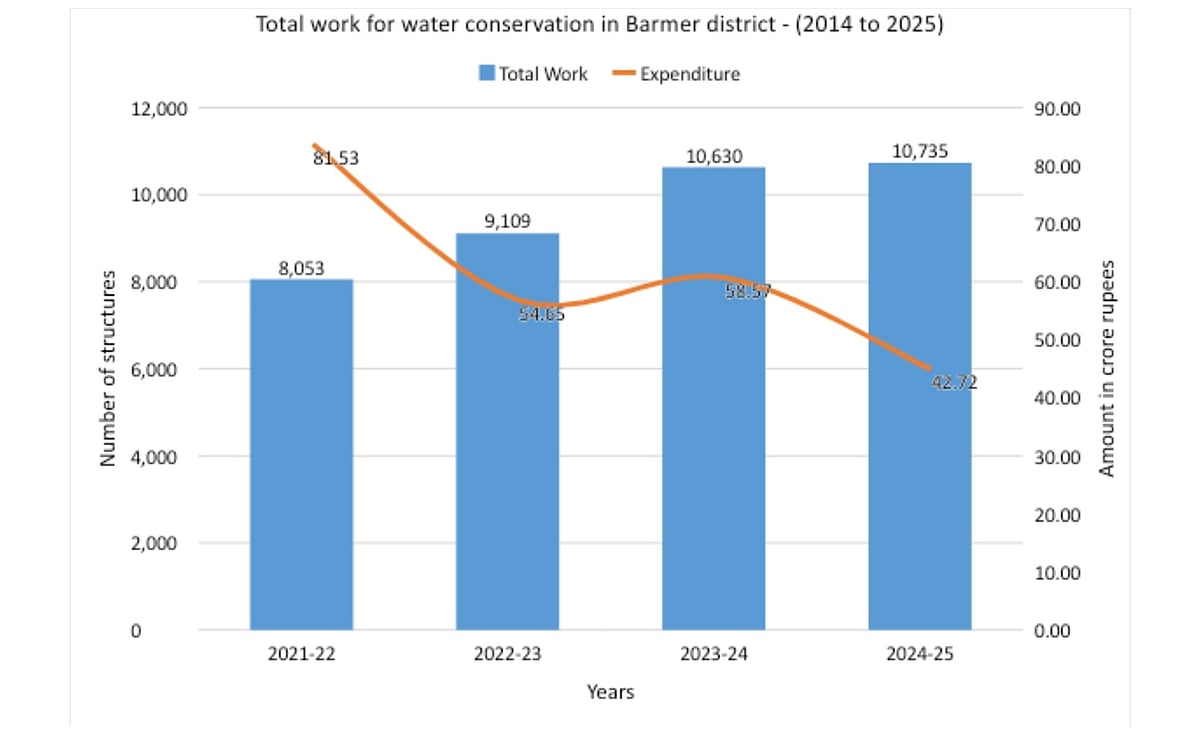
There has been no increase in the groundwater levels in Barmer district, according to the reports of the Central Groundwater Board (CGWB). In fact, most of the monitoring stations in the district reported a decline in groundwater levels in the last decade from 2014 to 2024. https://www.downtoearth.org.in/water/why-barmers-groundwater-records-do-not-show-a-rise-despite-rs-1500-crore-pumped-in-3-years (05 Mar. 2025)
Telangana Groundwater levels deplete rapidly The once-thriving Godavari basin, which saw a considerable rise in groundwater levels due to consistent water lifting operations, is now facing a severe groundwater crisis. The Kaleshwaram barrages — Medigadda, Annaram and Sundilla — had maintained maximum water levels, forming a 120-km freshwater lake in Godavari that enriched the groundwater table. Water used to seep into the ground, even at depths of five to 10 feet in some riverbank pockets. However, this scenario has drastically changed, leaving the region dry and farmers desperate. The drying up of the vast stretch in the Godavari basin, once perpetually under a sheet of water due to regular pumping operations under the Kaleshwaram Lift Irrigation Project (KLIP), has led to an alarming decline in groundwater levels.
-In the Krishna basin, the storage levels in major areas are fast dipping. The anticipated water release through canals has not materialised. Water levels in Srisailam and Nagarjuna Sagar projects are falling rapidly, despite surplus inflows received this year. They are likely to touch dead storage levels again as the prospects for the Rabi season look bleak.
-Due to the lack of water storage in lakes, canals, projects and check dams, groundwater extraction through borewells has intensified. This rapid extraction has further depleted groundwater levels, as confirmed by water experts. Borewells that were full until recently are now failing. Farmers are drilling new bore wells, reaching greater depths, with little success. https://telanganatoday.com/parts-of-telangana-stare-at-drought-this-summer-as-groundwater-levels-deplete-rapidly (06 Mar. 2025)
Tamil Nadu The potential toxic fallout of herbicide use in solar parks Many solar parks in Tamil Nadu are relying on glyphosate-based herbicides for vegetation control, raising concerns about long-term health effects, groundwater contamination, and air pollution. Clearing the vegetation entirely contributes to the heat island effect, while sustainable practices such as solar grazing, weed-cutting machines, and agrivoltaics offer viable alternatives. Experts stress the need for stricter regulations to address the environmental and health risks of unregulated herbicide use in solar parks. https://india.mongabay.com/2025/03/communities-fear-toxic-fallout-from-herbicide-use-in-tamil-nadus-solar-parks/ (06 Mar. 2025)
EDIT Step up action Many schemes such as the Atal Bhujal Yojana were launched to ensure sustainable use of water for drinking, irrigation and other purposes but the problem has only worsened. Rainwater harvesting plans and projects for recycling water haven’t made much progress. There is colossal wastage of water at domestic and other levels. The way forward is in ensuring greater awareness about the value of water, of economy in its use, and more effective action at individual, family, community and government levels to conserve water. https://www.deccanherald.com/opinion/editorial/groundwater-crisis-step-up-action-3431847 (5 Mar 2025)
URBAN LAKES, WETLANDS
SANDRP Overview Mumbai Civil Society Efforts to Protect Mangroves, Wetlands Like previous years, several civil society groups in Mumbai have continued their remarkable efforts dedicated towards protection and conservation of the mangroves and wetlands throughout 2024.
While their untiring efforts have met with some successes, given the hostile agencies and increasing developmental pressures the threats to mangroves and wetlands continue to increase. Despite growing challenges, their undying spirit offers inspiration to other civil society groups in the country. https://sandrp.in/2025/03/07/mumbai-civil-society-efforts-to-protect-mangroves-wetlands/ (07 Mar. 2025)
Mumbai Restore 4 Bhiwandi wetlands turned into dumps: NGT The NGT has ordered the Thane collectorate to clean up four wetlands in Anjur Dive village in Bhiwandi, which were turned into a dumping ground over the last one year. The order dated December 18, which was passed in response to a petition filed by environmental NGO Vanashakti, was uploaded on Tuesday (07 Jan.). The NGT order states that the owners of the concerned land should be held accountable for the removal of the debris and restoration of the wetlands. NGT has ordered the exercise to be completed within three months of the date of uploading the order. “A compliance report in that regard should be submitted to this Tribunal,” the order reads.
-“The city has about 800 hectares of wetlands, which are diminishing with time, as people want to turn them into commercial places, failing to understand their ecological importance,” said Stalin. Stalin added that there were more cases across the city where wetlands were turned into dumping yards to build illegal warehouses. “Their verdicts are expected this month,” he said. https://www.hindustantimes.com/cities/mumbai-news/restore-4-bhiwandi-wetlands-turned-into-dumps-green-tribunal-to-thane-collector-101736277207138.html (08 Jan. 2025)
Chennai First Indian to win Ramsar award Jayshree Vencatesan, co-founder of Chennai-based Care Earth Trust, has become the first Indian to be honored with the Ramsar award for ‘Wetland Wise Use’, a globally recognised accolade celebrating contributions to the sustainable management of wetlands. Jayashree is known for her decades-long dedication to preserving India’s wetlands, particularly the Pallikaranai Marsh in Chennai. Her journey in conservation began with a modest $350 and a resolve to protect India’s marshlands, often dismissed as “wastelands”. Her work documenting the biodiversity and ecological significance of Pallikaranai Marsh brought wide attention to its role in flood mitigation and as a haven for over 337 species of flora and fauna. Leading an all-women research team, she has not only safeguarded wetlands but also mentored a new generation of female conservationists. https://www.newindianexpress.com/cities/chennai/2025/Mar/08/jayshree-vencatesan-becomes-first-indian-to-win-ramsar-award-for-wetland-wise-use (08 March 2025)
Raipur NRANVP’s projects near Jhanjh wetland faced objections The Naya Raipur Atal Nagar Vikas Pradhikaran (NRANVP) has proposed two development projects in Sector 24 near Jhanjh Wetland (Audhumi) in Naya Raipur. The tendering process is currently underway for these projects, which include a plotted development and floating recreation facility on 2.66 acres (NIT No. 10361) and a branded residential area on 18.64 acres (NIT No. 10360).
-However, objections have been raised regarding these tenders. Dr. Rakesh Gupta from Raipur has formally written to the Chief Secretary-cum-Vice Chairman of the Chhattisgarh State Wetland Authority, the Chairman and CEO of NRANVP, the Member Secretary of the Chhattisgarh State Wetland Authority, and the Chief Engineer, expressing concerns over the legality of these projects. https://www.freepressjournal.in/india/raipur-objections-raised-against-nranvps-development-projects-near-jhanjh-wetland (19 Feb. 2025)
Bengaluru Treated water from apartments to fill 30 lakes Buoyed by the success of filling up 14 parched lakes with tertiary treated water from its STPs to tide over the summer water crisis of 2024, BWSSB says it will now fill up over 30 lakes across the city by drawing treated water from nearby apartment complexes. The water authority’s plans come even as apartment complexes have been complaining that the ambitious plan announced last year to facilitate diversion of treated water to industries hasn’t made any headway.
-The utility, however, said it would lay dedicated pipelines from these apartments to nearby lakes. According to Prasath Manohar, BWSSB chairman, most apartments are reusing up to 50% of their treated water for non-potable purposes while releasing the rest into stormwater drains as they have no storage space. Manohar also said BWSSB engineers would keep tabs on the quality of treated water on a daily basis. https://timesofindia.indiatimes.com/city/bengaluru/treated-water-from-apartments-to-fill-30-lakes-in-bengaluru/articleshowprint/118717279.cms (05 Mar. 2025)
URBAN WATER
SANDRP Overview Bengaluru GW: Problems, Causes & Solutions This annual overview complies the top ten reports regarding the continual depletion in groundwater levels in Bengaluru, the factors responsible for it and its impact on the citizens. It also highlights relevant steps taken by government agencies and some cost-effective sustainable alternatives suggested by experts and civil society groups. https://sandrp.in/2025/03/05/2024-bengaluru-groundwater-top-ten-reports-problems-causes-solutions/ (05 Mar. 2025)
Bengaluru Enforcement on treated water use lags The Karnataka State Pollution Control Board (KSPCB) and Bangalore Water Supply and Sewerage Board (BWSSB) have been unable to take tough decisions in enforcing the use of treated water in existing apartment complexes and commercial complexes. This inaction has led to a rise in water demand, continued contamination of water bodies and groundwater pollution. KSPCB officials admitted that while efforts are underway, progress is far slower than needed.
-Following the budget announcement, KSPCB introduced a single-window system to clear proposals and simplify the procedure to obtain clearance under the Ease of Doing Business initiative. However, officials admit that full implementation will take some more time as synchronising all government agencies under one platform for projects takes time.
KSPCB is moving slow in addressing the water quality of water bodies in the state. While real-time water quality measurement stations and environmental laboratories are being set up, experts and citizens point out that it is too late. They also stated that little is being done to clean Vrishabhavathi Valley, which contains most of Bengaluru’s sewage. A KSPCB report on pollution levels in the state water bodies shows the quality of water as poor and unfit for consumption or irrigation. https://www.newindianexpress.com/states/karnataka/2025/Mar/06/bengalurus-water-crisis-worsens-as-enforcement-on-treated-water-use-lags (06 Mar. 2025)
RWH: ₹2.7cr penalty collected in Jan 2025 According to the latest data from BWSSB, of the 11.1 lakh water connections in Bengaluru, about 2.5 lakh are required to have RWH but only 2.1 lakh have complied, leaving approximately 42,000 properties liable to be penalised. In Jan alone, the authorities collected Rs 2.7 crore in fines from such properties. The report also highlights that while 267 govt buildings are yet to comply with the RWH mandate, a majority of the defaulters are private properties. BWSSB officials told TOI inspections will be intensified in the coming months to push for greater adoption of RWH systems. https://timesofindia.indiatimes.com/city/bengaluru/rainwater-harvesting-rs-2-7-crore-penalty-collected-in-january-2025-in-bengaluru/articleshowprint/118717272.cms (05 Mar. 2025)
Hyderabad Residents take to streets over drinking water crisis Stating that they have been facing drinking water issues regularly for the last 10 years, residents of Padmashri Hills Colony, Bandlaguda, staged a protest on Saturday (March 08). They organised a rally in Padmashri Hills, highlighting their grievances and demanding immediate action.
The demonstrators said that despite submitting multiple representations to the government and authorities concerned, the issue was unresolved, forcing them to take to the streets. They said they would continue their demonstrations until the authorities addressed their concerns and resolve the water crisis. https://www.newindianexpress.com/cities/hyderabad/2025/Mar/09/residents-take-to-streets-over-drinking-water-crisis-in-hyderabad (09 March 2025)
Pune PMC to start monthly recovery of water bills from 2026 Rajendra Bhosale, Municipal Commissioner, said the PMC had undertaken equitable distribution of water across the city at a cost of Rs 2,048 crore. “We have completed 75 per cent of the project, worth Rs 1,471 crore, and will finish it by December,” he said. A total of 3.15 lakh water meters will be installed under the project along with laying pipelines of 1,800 km and 82 overhead water tanks, Bhosale said, adding that it aims to check water loss due to leakages and theft.
The PMC has also submitted proposals for constructing new water treatment plants and distribution systems in the newly merged areas in its limits. Through water meters, the PMC has been recovering charges of Rs 125 crore on average over the last few years. It collected Rs 130.98 crore in 2023-24 and Rs 102.45 crore till January end for 2024-25. A total of 47,070 water meters have been installed so far and dues of up to Rs 727.96 crore have been calculated due to various technical errors in the system.
From the current financial year, the charges will be telescopic, meaning those who consume less will be charged at a lesser rate and likewise for higher consumption, in a bid to reduce wastage of water. Failure to pay monthly bills will also lead to penalty of 1 per cent per month. The civic body has been hiking water charges by 5 per cent every year as per a precondition for implementation of the project.
Civic activist Vivek Velankar said the PMC had started the project work in 2018 and was to complete it in 2022 but seven years later, the project work is still going on. “The scope of the project was reduced by 25 per cent, still the PMC had to seek extension to complete it. Now, the deadline is 2026,” he said. https://indianexpress.com/article/cities/pune/pmc-recovery-water-bills-2026-equitable-water-supply-project-complete-9870506/ (05 March 2025)
Burnt cable at dam causes water crisis Residents of east Pune which receives water supply from the Bhama Askhed dam faced a severe shortage on Wednesday (March 05) and Thursday (March 06), with the civic body services being completely cut off because of electrical cable repairs. Pune Municipal Corporation (PMC) issued a notice that supply was expected to resume completely after 12pm on Friday. “Work is underway to repair the electrical cable at the dam water supply facility in Bhama Askhed. Tanks in the areas will fill first and supply will be restored to the entire area gradually,” the official communication said. The power cable at Bhama Askhed reportedly got burnt on Wednesday at 1.30pm. PMC tanks in Vimannagar were completely empty by Thursday noon, causing significant inconvenience, said residents. https://timesofindia.indiatimes.com/city/pune/burnt-cable-at-dam-leaves-east-pune-in-water-crisis/articleshow/118768920.cms (07 March 2025)
Mumbai Minister halts killing of 1200 trees for STP Days after mid-day highlighted the concerns of Mira Road residents about the proposed expansion of a STP, which would necessitate the removal of 1208 trees from a garden on Kanakia Road, local MLA and Maharashtra Transport Minister Pratap Sarnaik stepped in, asking Mira Bhayandar Municipal Corporation (MBMC) officials to seek out a new location for the STP, away from the residential area. All barricades set up at the open space have also been removed. https://www.mid-day.com/mumbai/mumbai-news/article/mumbai-minister-halts-killing-of-1200-trees-for-sewage-plant-23495194 (06 Mar. 2025)
AGRICULTURE
Report How climate change affects wheat production High temperatures cause early flowering and faster ripening, affecting the quality and quantity of wheat crop yield. https://www.thehindu.com/sci-tech/agriculture/climate-change-impact-on-wheat-production-in-india/article69306516.ece (10 March 2025)
MONSOON 2025
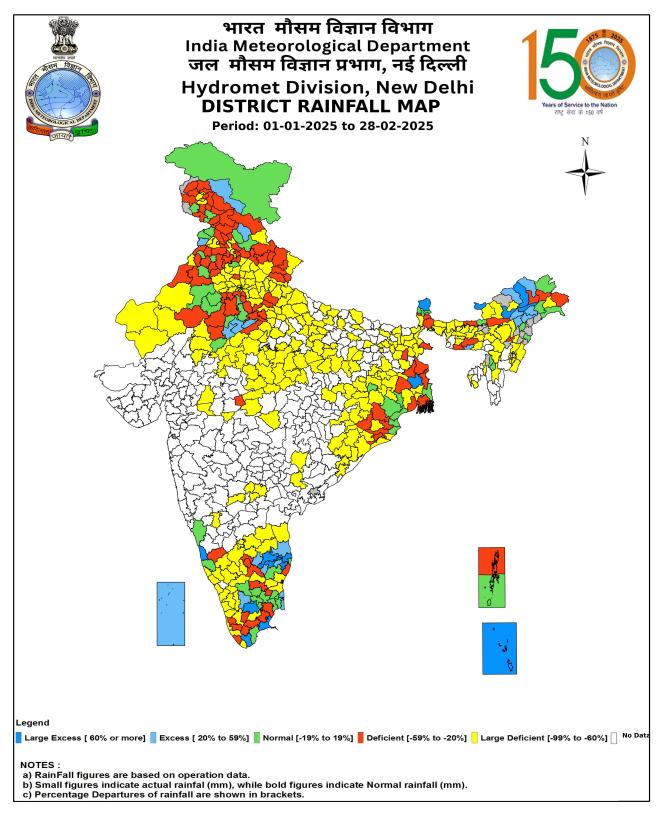
SANDRP Blog District wise Rainfall in India In the just concluded 2025 Winter Season (January 1 2025 to February 28 2025), as per India Meteorological Department (IMD), India received 47% below Normal Rainfall (it was 33% below normal in winter 2024, it was 45% below normal in winter 2023, 44% above normal rainfall in winter 2022 and 32% below normal rainfall in winter 2021). This is coming on top of 8% above normal in SW Monsoon 2024 and 3% below normal rainfall in Post Monsoon season 2024. The Normal rainfall in this two-month Winter season is supposed to be quite low at 39.8 mm, but the actual rainfall was 20.9 mm in winter 2025. https://sandrp.in/2025/03/08/winter-2025-district-wise-rainfall-in-india/ (08 Mar. 2025)
Report How Trump could hurt India’s ability to forecast the monsoon The move to downsize a US meteorological body could hurt its data collection around the world. India depends on this data for monsoon and cyclone forecasting. (Vaishnavi Rathore) https://scroll.in/article/1079921/how-trump-could-hurt-indias-ability-to-forecast-the-monsoon (6 Mar 2025)
URBAN FLOODS
Report Solving India’s urban flooding crisis is not just a pipe dream A critical component to stop the flooding of roads, and preventing them from turning into rivers, and allowing for daily life to continue unhindered, is to completely overhaul the design of storm water drains. The current design of concrete ‘box drains’ is a failure on multiple counts and simply not fit for purpose. What we need instead is a ‘pipe and chamber’ system which can overcome all the shortcomings of the widely prevalent yet antiquated box drain. The pipe and chamber system is a modern global standard that is overdue for adoption by India’s cities, in policy and practice. (Srikanth Viswanathan and Nithya Ramesh) https://india.mongabay.com/2025/03/solving-indias-urban-flooding-crisis-is-not-just-a-pipe-dream-commentary/ (07 Mar. 2025)
Indian cities need a plan Transforming our cities will require an overhaul of planning, strengthened governance, and sustainable financing. With action on these fronts, India can develop liveable, resilient, and economically vibrant cities. The first step must be to notify these census towns as urban areas in their own right. States must take the lead. (Amitabh Kant; Ranveer Nagaich) https://indianexpress.com/article/opinion/columns/indian-cities-need-a-plan-9864968/ (03 Mar. 2025)
DISASTERS
Study All hazards are multihazards, few of them are natural Abstract In today’s world, many hazards reflect complex interactions between one or more natural processes and human activities, calling the relevance of the term “natural hazards” into question.
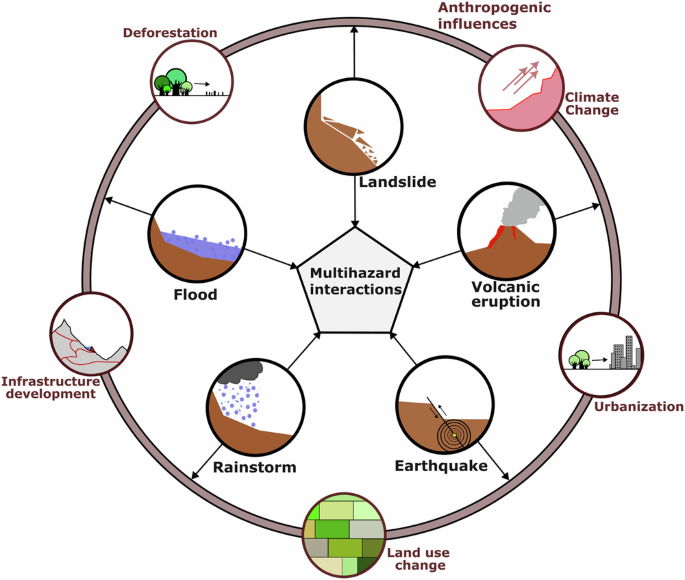
Here, I propose a redefinition to remove the divide between natural and human processes and emphasise the importance of a multihazard perspective for effective disaster risk management. https://www.nature.com/articles/s44304-025-00071-w (21 Feb. 2025)
Uttarakhand Activists blame ‘administrative negligence’ for deaths in avalanche Social activists have blamed the death of eight workers in an avalanche that hit a BRO camp at Mana in Chamoli district last week on “administrative negligence” and said the lives could have been saved had the authorities paid heed to a snowslide warning. They also blame “reckless construction” works in avalanche-prone areas for the rise in snowslide incidents. https://theprint.in/india/activists-blame-administrative-negligence-for-deaths-in-uttarakhnad-avalanche/2531980/ (04 Mar. 2025)
ENVIRONMENT GOVERNANCE
Supreme Court SC warns States/UTs which haven’t formed expert committees to identify forest areas The Supreme Court on Tuesday (March 4) came down heavily on States/Union Territories for not complying with its earlier directions to constitute expert committees for the identification of forest areas. If the non-compliant States fail to constitute the Expert Committees within one month and carry out the exercise in terms of Rule 16(1) of Van (Sanrakshan Evam Samvardhan) Rules, 2023 within six months, the Chief Secretaries and Administrators of the States/UTs shall be held personally accountable, the Court said. https://www.livelaw.in/top-stories/supreme-court-rebukes-statesuts-which-havent-formed-expert-committees-to-identify-forest-areas-285649 (04 Mar. 2025)
Uttarakhand Booming Tourism, Dying Ecosystems Glaciers are melting, rivers are drying, landslides are increasing, and climate disasters are intensifying. Bulldozing mountains, cutting down trees will not make Uttarakhand thrive—it will make it unlivable. Joshimath was a warning. The Kedarnath floods were a tragedy. If Uttarakhand continues to prioritize large-scale tourism and urbanization over ecological balance, there will be nothing left to preserve. The choice is simple: sustainable development that protects the Himalayas, or reckless expansion that leaves behind an environmental catastrophe. The future of Devbhoomi depends on it. (Noman Siddiqui) https://countercurrents.org/2025/03/booming-tourism-dying-ecosystems-uttarakhands-fragile-future/ (07 Mar. 2025)
Opinion Rethinking wildlife conservation Habitat destruction and poaching remain the twin evils plaguing India’s wildlife. India ranks second only to Brazil in forest loss. If we fail to address this existential crisis, all other conservation efforts will amount to little more than spectatorship in the face of destruction. (Sanjay Gubbi) https://www.deccanherald.com/opinion/rethinking-wildlife-conservation-in-india-3428603
CLIMATE CHANGE
Report A path to climate resilience through city-level research & planning Indian cities are expanding rapidly while facing increasing climate hazards. Rising temperatures, unpredictable weather, sea level rise, floods, and droughts pose growing threats to urban populations. However, the impact of these hazards varies widely due to socioeconomic inequalities and political and cultural factors. Given these dynamic challenges, experts emphasise the need for local planning and the role of organisations like Centre for Heritage, Environment and Development (C-HED) which a think tank of Kochi Municipal Corporation and has its team of environmental engineers, researchers and ecologists, has been driving sustainable urban resilience initiatives. https://india.mongabay.com/2025/03/a-path-to-climate-resilience-through-city-level-research-and-planning/ (04 Mar. 2025)
SOUTH ASIA
India-Nepal IREDA shares in focus after this development from the RBI Shares of state-run Indian Renewable Energy Development Agency (IREDA) Ltd. will be in focus on Monday, March 10, after the company informed the exchanges about a letter received from the Reserve Bank of India (RBI). IREDA, in its exchange filing, stated that the RBI has not acceded to the company’s request of making an equity investment to develop and implement a 900 MW Upper Karnali Hydro Electric Power Project in Nepal.
– The Upper Karnali Hydro Electric Power Project is a joint venture between IREDA, GMR Energy, GMR Power & Urban Infra, GMR Lion Energy, NEPAL Electricity Authority, and another state-run company SJVN Ltd. The JV agreement was signed earlier this year. IREDA’s equity investment in the venture was supposed to be around ₹174.22 crore for a 5% stake and it was supposed to be entitled to nominate one director on the board of the JV company. The company had already received approval from the Department of Investment and Public Asset Management (DIPAM) for the said investment in January this year. IREDA’s board had accorded in-principal approval for this investment in July last year. The company said that it will again make its case for the investment before the central bank. https://www.cnbctv18.com/market/ireda-share-price-rbi-nepal-investment-update-jv-fno-stock-returns-19570981.htm (10 March 2025)
Nepal Rahughat HEP dam at risk of landslides, Study underway for prevention Nepal Electricity Authority’s subsidiary, Raghu Ganga Hydropower, is constructing the 40 MW Rahughat Hydropower Project, whose dam faces the risk of landslides. The nearly completed dam, designed to divert water from the Rahughat River into a tunnel, faces a landslide threat. The river flows from the foothills of the Dhaulagiri Himal through the base of Dagnam in Raghu Ganga Rural Municipality-4 and Jhi in Ward-5. A newly formed landslide above Dagnam village now looms directly over the Rahughat Hydropower Project’s dam. Last monsoon, debris from the same landslide piled up on the under-construction dam, causing damage. The landslide has heightened risks for both Dagnam village and the dam below. Project Chief Raj Bahadur Bista said the team has started studying ways to control the landslide. A landslide has formed about 300 meters directly above the 17 m high dam, desander, and inlet (tunnel entry point). https://myrepublica.nagariknetwork.com/news/rahughat-hydropower-dam-at-risk-of-landslides-study-underway-for-prevention-73-61.html (08 March 2025)
India-Bangladesh Officials, experts to sit over Ganges water talks After an intensive on-the-spot survey for two days of the current status of the flow in the Ganges river at Farakka in West Bengal, technical experts and senior officials of Bangladesh and India will sit across the negotiating table in Kolkata on March 6. A visiting team from Bangladesh and officials of India visited the Farakka Barrage, exchanging data on the water flow of the Ganges at joint inspection sites. The water-sharing treaty’s 30-year term ends next year. Among the sites visited by the Bangladesh delegation until yesterday afternoon were the water levels of the Ganges downstream and the feeder canal.
– Under the existing Ganges water-sharing agreement signed on December 12, 1996, Bangladesh and India will get 35,000 cusecs to 40,000 cusecs respectively every ten days during the dry season depending on the water level. At the Kolkata meeting of the 86th meeting of India-Bangladesh joint committee under the banner of Joint River Commission (JRC), both sides will try to reconcile their respective data collected from Farakka. After the meeting, the two sides will submit their reports to their respective ministries of Water Resources (Bangladesh) and Jal Shakti (India), which will form the basis of the possible dates for the JRC meeting which are yet to be confirmed. The Bangladeshi delegation returns to Dhaka on March 8. https://www.thedailystar.net/news/bangladesh/news/officials-experts-bangladesh-india-sit-tomorrow-over-ganges-water-talks-3840286 (05 Mar. 2025)
‘Meeting not for any conclusion’: Joint River Commissions A senior official and member of the Joint River Commission said, “This meeting is not for any conclusion. So, don’t expect any concluding remarks or decision from this meeting. This meeting only discusses the possibility and the subjects that can be raised during the final treaty meeting.” Following the secretarial-level meeting between the two countries, a six-member technical committee comprising representatives from both nations will be formed, which will determine the future of the agreement in the next three months. The formation of this committee is expected to be discussed at the Joint River Commission meeting. https://indianexpress.com/article/cities/kolkata/indo-bangla-meet-on-ganga-water-treaty-begins-in-kolkata-ahead-of-renewal-talks-9873038/ (07 Mar. 2025)
Pakistan Wheat crops at risk as dams approaching dead levels The Indus River System Authority (Irsa) has issued a warning to the Punjab and Sindh provinces of Pakistan about a potential 30-35 per cent water shortage, as the Tarbela and Mangla dams are rapidly approaching their dead levels, affecting the wheat crops, the Dawn reported.
In a letter to irrigation secretaries, Irsa’s Director of Regulation, Khalid Idrees Rana, informed the provinces that both reservoirs were nearing depletion. He stated that operating the reservoirs at or around dead levels could lead to significant water shortages. https://www.tribuneindia.com/news/world/pakistan-wheat-crops-at-risk-as-dams-approaching-dead-levels/ (08 March 2025)
SANDRP
Also see: DRP 03 March 2025 & DRP 24 Feb. 2025
Follow us on: www.facebook.com/sandrp.in; https://twitter.com/Indian_Rivers

 SANDRP