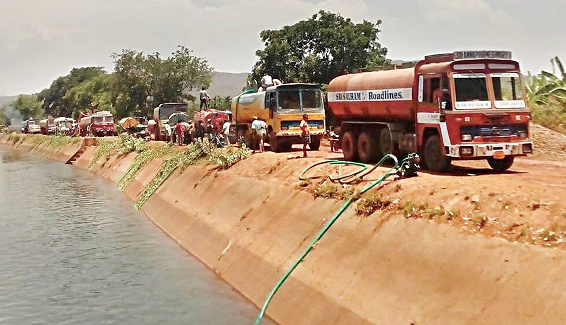
(Section 144 imposed near Bhadra Canals to stop illegal water lifting amid supply crisis. Representational image. TNIE)
As the two reports from media today shows, Karnataka is facing drought in 223 of 236 talukas, water scarcity and even farmer distress and suicides. The state government is aware of the situation and taking necessary measures. The situation could be similar in a number of states including Maharashtra, Telangana, Andhra Pradesh and even some of the eastern and northern states. The North Himalayan states have experienced hugely below normal snowfall in the ongoing winter. The Winter Rainfall at all India level for the period Jan 1 2024 to Feb 25 2024 is already 31% below normal.
There is role of global warming and El Nino in this and these factors are going to persist at least till the end of Indian Summer. So the governments both at centre and in states needs to be ready for the crisis.
The current Karnataka govt is awake to reality and seems to be taking the appropriate steps. Karnataka had deficit rainfall in SW Monsoon 2023.
One hope for Karnataka is that in March-April parts of state including Bangalore could receive some rains that may help reduce the water scarcity to some extent in such areas. Forecasts also suggest that El Nino may significantly give way to La Nina by July-Aug 2024, if not earlier. But till then, India needs to be ready to face the heat.
Karnataka 692 suicides in 10 months 692 farmers killed themselves between April 2023 and Jan 2024, Revenue department data shows, highlighting rural distress in the face of “Persistent Drought Conditions”. Haveri (84), Belagavi (75) and Chikkamagaluru (60) had the highest suicide rates. The report mentions farm loan distress and drought.
Karnataka has already declared 223 of 236 taluks as drought hit. 196 taluks are categorized as severe drought hit and 27 as drought hit. Several lakh farmers depend on private money lenders, where the distress is higher and lends to suicides. https://www.deccanherald.com/india/karnataka/692-suicides-in-10-months-as-drought-crisis-persists-2909768 (Feb 26 2024)
Drinking water shortage With the summer expected to be more severe this year, some 7,082 villages across Karnataka and 1,193 wards, including in Bengaluru Urban district, are vulnerable to drinking water crisis in the coming months as per an assessment made by the govt as of Feb 10. A report by the revenue department has identified the greatest number of villages in Tumakuru district (746) and the greatest number of wards in Uttara Kannada. In Bengaluru Urban district, 174 villages and 120 wards are shown as vulnerable. All 31 districts have villages likely to be affected but there are nine districts – Tumakuru, Chitradurga, Davanagere, Mysuru, Mandya, Raichur, Bidar, Chikkamagaluru and Kodagu – where zero wards are shown as being vulnerable. https://timesofindia.indiatimes.com/city/bengaluru/7k-villages-1k-wards-in-karnatakas-stare-at-drinking-water-crisis-latest-news/articleshow/107994126.cms (Feb 26 2024)
Karnataka Section 144 imposed near Bhadra Canals In his order, Shivamogga Deputy Commissioner (DC) Gurudatta Hegde stated that one thousand million cubic feet (tmc ft) of water was released from the reservoir starting from the night of February 5, to supply drinking water to the urban areas of Haveri and Gadag districts. However, the deputy commissioners of Gadag and Haveri informed the Shivamogga deputy commissioner that the water had not reached the intended location where the jack well was situated.
-The deputy commissioners further informed the DC that there are over 20,000 pump sets installed along the canals, which are being used to lift water illegally. Additionally, some villagers have constructed illegal check dams using sandbags, further obstructing the supply of water to the Haveri and Gadag districts. https://www.newindianexpress.com/states/karnataka/2024/Feb/20/karnataka-section-144-imposed-near-bhadra-canals-to-stop-illegal-water-lifting-amid-supply-crisis (20 Feb. 2024)
Bengaluru grapples with water scarcity due to Kaveri river overexploitation and unbalanced growth. Civil Engineer Raj Bhagat highlights the geographical factors and calls for conservation efforts and diversified growth to tackle the crisis collectively. https://www.timesnownews.com/bengaluru/bengaluru-water-crisis-due-to-overexploitation-of-kaveri-river-engineer-explains-on-x-article-107983876 (25 Feb. 2024)
HYDRO POWER PROJECTS
Himachal Pradesh Climate change, illegal construction loss increasing disaster The state experienced 5,748 landslides, 45 cloudbursts (rainfall above 100 mm in an hour), and 83 flash flood-like situations. The disaster directly affected 22,879 households and claimed around 500 lives, with losses and damages amounting to Rs 8,665 crore, the NDMA said.
In its post-disaster need assessment (PDNA) report, prepared at the request of the Himachal Pradesh government, the NDMA highlighted that unregulated development has added to the vulnerability of the Himalayan region. “This has created environmental and infrastructural challenges, amplifying the disaster risks in the region,” it said.
“Vulnerabilities that arose due to unplanned and non-scientific developments in the fragile Himalayan ecosystem were exacerbated by floods resulting from the convergence of monsoon winds and western disturbances in July-August 2023, leading to significant devastation. It is acknowledged that the frequency of such extreme events may increase due to climate change,” the report read.
Citing reports by the Intergovernmental Panel on Climate Change, the NDMA said that two key regions in the Indian subcontinent are particularly vulnerable to climate-induced disasters: the Indian Himalayas and coastal India. “The disaster in Himachal Pradesh serves as an indicator of such events, which are expected to rise in the near future,” it said.
Considering the unique terrain in the region, the NDMA emphasized the need for construction practices to undergo rigorous evaluation. Road construction and design should be reconfigured to reduce ecological impact.
The environmental effects of various hydro projects, whether large, medium, small, or run-of-the-river, need to be assessed cumulatively. Construction methodologies for major projects should be contextualised to the Himalayan ecosystem, and building regulations require updating and reinforcement to ensure that the ecology of the Himalayan region is not affected, it said.
The agency said it is important that dams in the state function on prediction-based modelling and account for three to five days of weather data from the catchments for flood warning. It also emphasised the need to demarcate river floodplains, and have appropriate policy instruments and mechanisms in place to restrict any construction in such areas.
The NDMA said the Himachal Pradesh State Disaster Management Authority (HPSDMA) should proactively anticipate and factor in climate-related risks when planning and implementing recovery initiatives. It also noted that Himachal Pradesh’s weather prediction and early warning capabilities are “limited”, with only 31 weather stations currently operational in the state. The agency recommended installing automatic weather stations in each gram panchayat and strengthening early warning systems in the state.
The NDMA also suggested establishing local hill area development authorities, saying that the absence of adequate planning in hilly areas exacerbates existing vulnerabilities. “It is crucial to establish a techno-legal framework to monitor and regulate development in these mountainous regions.” https://www.tribuneindia.com/news/himachal/himachal-pradesh-floods-climate-change-illegal-construction-greenery-loss-increasing-disaster-risk-in-himalayas-says-ndma-report-586698 (02 Feb. 2024)
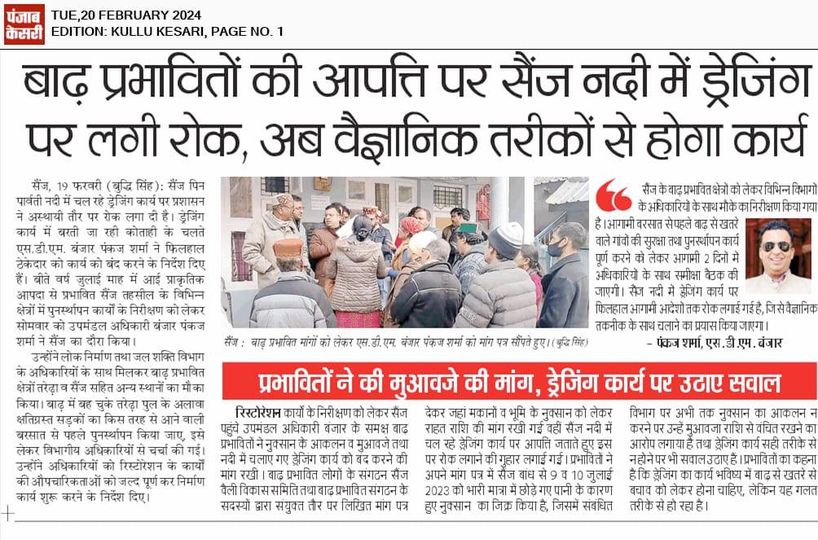
SDM of Sainj Tehsil has stopped sand mining in Sainj river, on appeal by flood affected people and have said it will be done only in scientific way.
Sikkim CAP demands white paper on Teesta Urja Hydro project share sale The Citizen Action Party demands a white paper on the recent sale of shares in the Teesta Urja hydro project, before the assembly election. Greenko company has decided to buy a 40% stake in Teesta Urja Ltd (TUL) for $200-250 million (Rs 1,400-1,750 crore) from Singapore-based Asian Genco Pte Ltd, a company majority owned by PE investors such as General Atlantic, Goldman Sachs, Morgan Stanley, Norwest Partners & Everstone Capital. The Govt of Sikkim owns the remaining 60% of TUL.https://www.indiatodayne.in/sikkim/story/sikkim-citizen-action-party-demands-white-paper-on-teesta-urja-hydro-project-share-sale-896806-2024-02-22 (22 Feb 2024)
Teesta GLOF the untold story On 17 Feb 2024 we were fortunate to meet Mr Dathup Lachenpa a person in the tourism business in Lachen; he had walked across to Chungthang from Lachen because there is still no motorable road. He was in Kalimpong for brief while and we caught up with him to check how the GLOF impacted town of Lachen. Our interview with Mr Lachenpa: https://savethehills.blogspot.com/2024/02/savethehills-sth-and-junkeri-studio-js.html (21 Feb 2024)
Arunachal Pradesh Pare HEP affected deserve better treatment The Pare Project Land Affected Welfare Committee (PPLAWC) has alleged that the NEEPCO conducted the recruitment of junior engineers by overlooking the local candidates. Two junior engineers selected for the Pare Hydroelectric Project are reportedly non-Arunachalis, which has angered the PPLAWC. This is a very serious allegation and needs to be looked into. The land-affected people should always be given preference when conducting such recruitment drives. The project-affected people have to make immense sacrifices. It is not only NEEPCO, most of the hydropower developers operating in the state have utter disregard for the local indigenous communities. They only love the resources available in the state but have no affinity for the people. The representation of Arunachalis is much less in the NEEPCO, the NHPC, etc. This is one of the main reasons why locals often oppose hydropower projects. https://arunachaltimes.in/index.php/2024/02/20/hep-affected-locals-deserve-better-treatment/ (20 Feb. 2024)
Jammu & Kashmir CBI searches over ‘corruption’ in Kiru HEP CBI on Feb. 22 claimed to have found evidence of huge cash stash, fixed deposits and investments in properties in various cities during searches it carried out at over 35 locations, including premises linked to J&K ex-governor Satya Pal Malik, in connection with its probe into alleged corruption in awarding civil work contract for the Rs 2,200 crore Kiru Hydro Electric Power Project in the UT being executed by Chenab Valley Power Projects Pvt Ltd.
The places searched included Malik’s ancestral house in western UP’s Baghpat. Evidence gathered was both digital and documentary, CBI sources said. The case arose out of Malik’s disclosure of having been offered a Rs 200-crore bribe for clearing two files related to the project. https://timesofindia.indiatimes.com/india/cbi-searches-jk-ex-governor-premises-over-corruption-in-hydel-project/articleshow/107923952.cms (23 Feb.2024)
Kiru HEP work on The project is being built on Chenab river near the villages of Patharnakki and Kiru, around 42km from Kishtwar. “The CBI probe into charges of corruption is a different issue altogether and has not impacted the project. It is moving as per timeline and its deadline is 2025-end,” the official added. JKSPDC managing director Pankaj Magotra said that the revised cost of the project was over ₹5,300 crores. The project will include a 135 m high concrete gravity dam near Kiru. Thepowerhouse will be on the left bank of the river. https://www.hindustantimes.com/cities/chandigarh-news/despite-corruption-allegations-kiru-hydropower-project-work-on-course-101708631440881.html (23 Feb.2024)
Uttarakhand TBM on Vishnugad-Pipalkoti HEP Terratec’s Hard Rock Double Shield Tunnel Boring Machine (TBM) is tunneling for the 444 MW Vishnugad-Pipalkoti Hydropower Project. The 9.86m TBM has excavated 431m in January 2024. This TBM, the largest of its kind in the Indian Himalayan Region, is tailored with custom features to complete the 13km tunnel. The machine is presently working for Hindustan Construction Co. Ltd. of India, the primary contractor for this project. The alignment for the project primarily traverses Dolomitic Limestone (33%) and Slates (64%), with the remaining 3% passing through critical geological sections. These sections include Thrust Zones, Shear Zones, and Fault Zones, which pose significant challenges necessitating the TBM’s specialized engineering.https://www.waterpowermagazine.com/news/newstbm-making-significant-progress-on-vishnugad-pipalkoti-hydropower-project-india-11540956 (22 Feb.2024)
Meghalaya Victims of Umiam dam electrocution The incident took place around 5:30 am on January 28 when the 25-year-old guard went to collect firewood near a transformer owned by ITD Cementation India Limited, the company responsible for the bridge’s renovation. VPP MLA from Mawlai, Brightstarwell Marbaniang, while raising the lack of safety measures and fencing around the transformer, also mentioned a similar case which took place on February 14, wherein an elderly woman lost her life due to electrocution from an exposed electric wire in Umran village, Ri-Bhoi. https://theshillongtimes.com/2024/02/23/umiam-dam-electrocution-victim-not-meecl-staff/ (23 Feb.2024)
Report तीन राज्यों सिक्किम, अरुणाचल और उत्तराखंड में उच्च हिमालयी झीलों की पारिस्थितिकी पर शोध देश के पांच संस्थानों के विशेषज्ञ करेंगे. इस शोध में जलवायु परिवर्तन के साथ ही मौसम के बदलावों पर अध्ययन होगा. तीन सालों के अध्ययन में 9 करोड़ रुपये खर्च होगें. जानें इस पर एक रिपोर्ट… https://hindi.news18.com/news/uttarakhand/almora-research-on-sikkim-tsomgo-chho-arunachal-tso-moriri-uttarakhand-bhenkam-lake-climate-change-gb-pant-himalayan-environment-institute-ssj-university-iit-kharagpur-sikkim-university-gis-arunachal-8079837.html (19 Feb. 2024)
MoEF Decisions in Minutes of EAC meeting of River Valley Projects held on Feb 9 2024:
1. Upper Sileru Open Loop Pumped Storage Project of 1350 MW at Village Valasagedda, Busikonda, Sub District Gudem Kotha Veedhi, Dist Alluri Sitharama Raju, Andhra Pradesh by AP Power Generation Corp Ltd – Environmental Clearance: The EAC desired that PP must come prepared for presentation by themselves and ensure proper internet facility and the connectivity in case of online appraisal of projects. The NABET accredited consultant (M/s WAPCOS) was also alerted to not repeat such situations in future. The proposal is therefore deferred to the next meeting on the above lines.
2. Rouni Open Loop Pumped Storage Project of 2100 MW at Village Bhadikona, Chhichhli and Rajpuri R F, Sub-dist Bagicha, Dist Jashpur, Chhattisgarh by Chhattisgarh State Power Generation Company Ltd – Terms of References: EAC desired that PP shall submit the further details on below mentioned observation:
i. The project proponent shall explore any alternate source of water nearer to the site as Dorki Nallah is not a perineal river or alternative site specifically for lower reservoir. Also submit the seasonal hydrograph of Dorki Nallah to assess the make-up water during lean season.
ii. PP shall resubmit the proposal with revised layout after minimizing the forest land for the proposed project
iii. Finalize the site of Muck disposal outside the forest area and explore the possibility for management of muck in any closed nearby coal mine (if any).
iv. PP shall submit MoU signed with State department for setting up the proposed project and availability of water for the project.
v. Secondary data of presence/occurrence of wildlife in the in consultation in forest department and local people shall be provided.
The proposal was therefore deferred on the above lines.
3. Dangari Open Loop Pumped Storage Project of 1400 MW at Village Dangari, Madia and Rajpuri R F, Sub-dist Bagicha, Dist Jashpur, Chhattisgarh by Chhattisgarh State Power Generation Company Limited– Terms of References: EAC was not satisfied with the project authorities and raised serious concerns about their complete dependability on consultant (WAPCOS) for all the crucial information. It was advised that the project proponent and consultants must discuss together on the details of project as it seems that many of the proponents feel the consultants are only responsible for EC related process. EAC desired that project proponents shall come prepared with all facts and technical details of the project and presents its case instead of totally dependent on EIA consultants. The consultant was also unable to present the proposal before the EAC due to lack of sufficient knowledge of important details since no site visit is being done before presentation of ToR, which could eventually jeopardise the project’s feasibility and sustainability. The proposal is therefore returned in present form.
4. Attunli Hydroelectric Project of 680 MW on Tangon river as a run-of-the-river at Village Athunli, Edilin and Gunil, Sub- District Etalin, District Upper Dibang Valley, Arunachal Pradesh by SJVN Ltd – Terms of References: Approved
5. Cumulative Impact Assessment and Carrying Capacity Study (CIA & CCS) of Tirap Basin. Inclusion of Chinglum Hydroelectric Project in Subansiri Basin – Recommendation of the Study: Approach MoEF. https://parivesh.nic.in/utildoc/48184428_1708350530465.pdf
Relevant Agenda of the FAC meeting to be held on Feb 28 2024:
1. diversion of 598.2427 ha. forest land for Methala Bandhara Irrigation Project near village Methala in Talaja Taluka in Bhavnagar District of Gujarat: The satellite imagery dated 26.09.2018 shows that out of total 598.2427 ha forest area sought for diversion, approx. 417 ha forest area is already submerged under water. The state govt. to submit justification as why the impounding has taken place without prior approval of the Central Government. State Govt. shall submit the details of the officers who has permitted the violation of the Forest (Conservation) Act, 1980 and what action has been taken against them.
2. DIVERSION OF 7.3722 HA OF FOREST LAND AS ADDITIONAL FOREST LAND REQUIREMENT IN ALREADY APPROVED DIVERSION IN FAVOUR OF SHONGTONG KARCHHAM HYDRO ELECTRIC PROJECT, HPPCL UNDER THE JURISDICTION OF KINNAUR FOREST DIVISION, DISTT. KINNAUR, HIMACHAL PRADESH
3. 263.5406 HA. FOREST LAND FOR CONSTRUCTION OF SAMBARKUND IRRIGATION PROJECT AT VILLAGE MAHAN, TALUKA ALIBAG, DISTRICT RAIGAD IN THE STATE OF MAHARASHTRA
4. DIVERSION OF 2250.05 HA (INSTEAD OF 2272.05 HA) FOREST LAND FOR CONSTRUCTION OF MORAND- GANJAL IRRIGATION PROJECT LOCATED IN HOSHANGABAD, BETUL, HARDA AND KHANDWA DISTRICTS OF MADHYA PRADESH STATE IN FAVOUR OF M/S NARMADA VALLEY DEVELOPMENT AUTHORITY
5. DIVERSION OF 407.8227 HA FOR CONSTRUCTION OF SHAHPUR (1800 MW) PUMPED STORAGE PROJECT BY M/S GREENKO ENERGIES PRIVATE LIMITED, HYDERABAD IN HANUMANTH KHERA, MUNGAWALI VILLAGES, G.P.-MUNDIYAR, TEHSIL-SHAHBAD, BARAN DISTRICT, RAJASTHAN https://forestsclearance.nic.in/AgendaDetail.aspx?id=298!dis1
DAMS
Kaleshwaram Project Restoration unlikely in near future A team of officials from Vigilance and Enforcement department which conducted inspections at the barrage found that the cracks in Medigadda barrage were detected in 2020 itself and the cement concrete blocks in the wiring coat were found to be washed away. Similar incidents were reported in 2021, 2022 & 2023. “The irrigation dept authorities informed the higher-ups about seepage of water from vents 17, 18, 19 & 20 in the 7th block,” the report said. https://www.hindustantimes.com/india-news/restoration-of-kaleshwaram-project-unlikely-in-near-future-101708456909459.html (21 Feb 2024)
NDSA awaits preliminary report, to make spot visit The National Dam Safety Authority (NDSA) is awaiting a report from the technical team of the Telangana Dam Safety Authority before making spot visits to the Medigadda and Annaram barrages of the Kaleshwaram Lift Irrigation Scheme (KLIS) to decide on the future course of action. After studying the preliminary report and making visits, in the next three to four days, the NDSA will decide next course of action. https://www.deccanchronicle.com/nation/politics/klis-ndsa-awaits-preliminary-report-to-make-spot-visit-this-week-882925 (22 Feb. 2024)
NDSA & CSRS teams to inspect Medigadda, Annaram barrages Members of the NDSA visited Annaram and inspected the Saraswathi barrage constructed under the KLIS project in Mahadevpur mandal of Jayashankar Bhupalpally district on Feb 20 2024. They were accompanied by an expert team and officials of the central soil and research station (CSRS). The state government had written a letter to NDSA asking it to submit a comprehensive report about the reasons of the damage that occurred in the Kaleshwaram project. https://www.deccanchronicle.com/nation/current-affairs/ndsa-csrs-teams-inspect-medigadda-and-annaram-barrages-882845 (21 Feb. 2024)
Dam safety panel inspects Annaram barrage The State Dam Safety Review Panel (DSRP) and technical experts of the State Dam Safety Organisation on Tuesday visited the Annaram barrage of the KLIS and inspected the structure. The team undertook the inspection at the behest of the State government following seepage related issues reported at the barrage recently. The team conducted a thorough inspection of pier no 39 and its peripheries suspected to be the source of the seepage.
Water from Annaram barrage was completely drained to facilitate an end-to-end inspection of the project. The Annaram barrage work was executed by Afcons Infrastructure Limited. As a minor leakage was spotted in the barrage, the implementing agency had undertaken grouting works for arresting the seepage a few months ago. The barrage was restored to the normal functioning status under the supervision of the Operations and Maintenance wing of the Irrigation Department.
The NDSA team is expected to visit Annaram barrage by the weekend for a thorough investigation and recommend a way forward. The DSRP which had inspected the barrage would submit its preliminary report to the government in a day and two. The same report would be shared with the National Dam Safety Authority team on its visit to the project. The DSRP team also visited the Medigadda barrage and took stock of the structural issues in Block 7 of the barrage. https://telanganatoday.com/telangana-dam-safety-panel-inspects-annaram-barrage (20 Feb 2024)
Medigadda Barrage works Not Before Me say Govt & L&T Not before me. This is what the L&T and the state government are now saying on the issue of taking up repair and restoration works of Medigadda Barage. L&T was not ready to take up repair works saying that the project has already been inaugurated with pomp in the presence of several VIPs, their liability was over and it was for the government to take up the works.
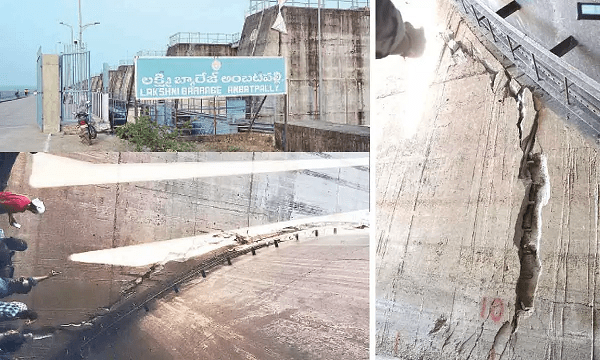
The state govt claims that though the previous government had inaugurated the project, it was not complete and the no release and discharge certificates have been issued. Even the Measurement Book (MB) was not released and hence it was the responsibility of L&T to bear the cost of the repairs of sunken piers of the barrage. https://www.thehansindia.com/news/cities/hyderabad/medigadda-barrage-works-not-before-me-say-govt-and-lt-860231#google_vignette (22 Feb.2024)
Damaged portions of Medigadda barrage may have to be rebuilt It is very likely that up to six piers of Medigadda barrage, the gates between them, and the rest of the barrage structure in the worst-hit Block 7 may have to be taken down and rebuilt. Two crucial tests —electro resistivity tomography (ERT) and ground-penetrating radar (GPR) — have been completed on Block 7. A part of this block sank into the sandy floor of the Godavari river in Oct 2023. With worries that the adjacent Blocks 6 and 8 may also have developed cracks, the ERT and GPR tests will be conducted on these two blocks but this work on Block 6 may take some time.
On Block 7, the testing began at the worst hit piers 19, 20, and 21 and progressed sideways on both sides to determine how many of the piers in the block suffered cracks and damages. While four piers have clear damages and cracks, it may be possible to restore two more. Until the final report from the testing data is received, nothing can be said with certainty. https://www.deccanchronicle.com/nation/in-other-news/damaged-portions-of-block-7-may-have-to-be-rebuilt-883017 (22 Feb.2024)
Leaking Annaram barrage emptied A technical team of SDSA has suggested grouting to plug leakages at Annaram barrage, while a team from the NDSA will visit Annaram and Medigadda barrages in next couple of days following a request from the state govt to hammer out solutions. Following leakages in Annaram barrage a few days ago, SDSA member Vijay Desai and others visited both the barrages on Feb 20 2024. Irrigation department central design officials accompanied the SDSA team, which enquired about the designs and drawings of the barrages. https://timesofindia.indiatimes.com/city/hyderabad/leaking-annaram-barrage-emptied-hyderabad-sdsa-suggests-grouting-to-plug-leakages/articleshow/107867046.cms (21 Feb 2024)
Polavaram Project Plagued by technical issues, funds crunch, politics About half a dozen sophisticated vibro-compact machines are humming along the stretch of the Godavari River where the Polavaram dam will eventually come up, to strengthen the riverbed’s foundation, on a hot February afternoon. Close to 150 workers are moving around doing “ground improvement work” or basic foundational work. The Rs 47725 Cr (2017-18 price level, but Centre has capped it at Rs 29027 Cr at 2013-14 PL) project has missed multiple deadlines (new deadline: March 2026) since work first began in 2004-05. Twenty years on and approximately Rs 21,000 crore later, the project is far from complete.
– A senior engineer from the water resources department, who is working on the project, said that during the 2019 floods, half of the diaphragm wall — the core of the main dam built to restrict seepage from upstream to downstream — was washed away. It was built at a cost of Rs 442 crore. Erecting a parallel diaphragm wall will cost approximately Rs 990 crore, a senior water resource department official said. “A decision on whether to construct a parallel diaphragm wall or carry out repair of the existing structure is yet to be taken by the Central Water Commission. We have proposed erecting a parallel diaphragm wall as repairing the existing one could result in safety issues. We hope a decision is taken soon,” K. Narasimha Murthy, superintending engineer, Polavaram project said. It’s only after the diaphragm wall has been constructed that work on the main dam can start. “It’s very critically poised in terms of execution. The earlier mis-planning has delayed the project’s completion. Earlier, the project components were executed without any relevance to the SoPs of the major dams,” Narayana Reddy C., engineer-in-chief of Andhra Pradesh’s water resources department said. “Because of heavy flooding during 2019 and 2020, water gushed from the unfinished portions of the cofferdam and scoured the river bed to a depth of almost 36 meters, damaging the diaphragm wall also,” he said.
– In the first phase, the Centre will reimburse the cost required to complete the dam with the storage level of the reservoir up to a height of 41.15 metres as against the full reservoir level of 45.72 metres. “At 41.15 metres, we can impound 120 TMC of water, which can be immediately used for irrigation and drinking and other purposes. The idea is to get the project operational to an extent that some revenue can be generated by reaping early intermediate benefits. Meanwhile, the work can go on in the second phase, where the reservoir level will be completed up to 45.72 metres,” Reddy said. A storage level of 41.15 metres will require rehabilitation of 29,946 project displaced families (PDF) as against 93,000 PDFs if the storage level is 45.72 metres. https://theprint.in/india/governance/unfinished-after-20-yrs-andhras-polavaram-dam-plagued-by-technical-issues-funds-crunch-politics/1971332/ (20 Feb. 2024)
Uttarakhand Jamrani dam blocking tiger corridor but cleared Despite rejection by the National Tiger Conservation Authority, the multi-crore Jamrani multipurpose project in the hill state gets wildlife clearance. “The project should not have been cleared because it affects a protected area and does not have clearance from the National Tiger Conservation Authority (NTCA). It will have major implications in terms of climate change affected monsoon rainfall and flood issues. But these have not even been studied,” Himanshu Thakkar, coordinator of South Asia Network on Dams, Rivers and People (SANDRP), an informal network of organisations and individuals working on issues related with the water sector and large dams, told this writer. “The Gola River, across which the dam will be constructed, runs through an area that is seismologically active. River water seeps into fault lines and fractures in the land. This aspect was not adequately considered while clearing the proposal. Further, the project was cleared based on old hydrology data. The hydrology of the river has significantly changed over the years ever since data was last collected,” added Thakkar. https://www.newsclick.in/uttarakhand-project-blocking-tiger-corridor-cleared-after-modi-cabinet-backs-it (24 Feb.2024)
On Feb 21, Pushkar Singh Dhami cabinet gave its nod to two Dam projects. The multipurpose Jamrani project envisages a dam near Jamrani village across river Gola, a tributary of river Ram Ganga, in the Nainital district. While under Song drinking water project, a 130 m high dam will be built on Song river nine kms upstream from Maldevta with the water reservoir 4 km in diameter. It is meant to provide water supply to Dehradun. https://www.news9live.com/india/jamrani-and-song-uttarakhands-two-dam-projects-soon-to-come-into-shape-for-irrigation-and-drinking-water-2446331 (22 Feb. 2024) Chief Secretary Radha Raturi has expressed her anguish over the delay in the procedural clearances of the Song drinking water project which has faced huge cost overruns. More than a decade ago, the cost of the Song project was estimated to be Rs 500-600 crore, which has now reached to Rs 2000-2100 crore mainly due to delays. https://garhwalpost.in/cs-miffed-at-procedural-delay-in-song-project/ (22 Feb. 2024)
Karnataka Govt speeds up efforts for supplementary project across TB The govt has put itself on the fast track for completing the formalities of a supplementary project across the Tungabhadra River, near Navali in Raichur district, in the upstream areas. The new project would adversely impact the sources of AP and TS. For, the TB dam, an inter-state project, is a major source to meet the drinking and irrigation needs of Rayalaseema region and also parts of TS.
The Karnataka govt had reportedly planned another barrage along the Raichur borders and allotted Rs 158 crore in the recent Budget to prepare a detailed project report (DPR). Recently, deputy CM D.K. Shivakumar announced that the govt prepared the DPR to take up a balancing reservoir across the TB river near Navali and is planning to discuss it with AP and TS. However, the Karnataka govt needs to get consent from AP, TS and also a member of CWC at a TB board meeting. The project will not have clearance if a majority of the members oppose it.
The Karnataka govt was reportedly stressing that heavy siltation in the existing reservoir has reduced the water storage capacity in the dam and that it was unable to get more water during the rainy season. Irrigation experts from Karnataka proposed to build a new reservoir for water storage & utilise an additional 35tmc-ft. https://www.deccanchronicle.com/nation/current-affairs/karnataka-speeds-up-efforts-for-supplementary-project-across-tb-882837 (21 Feb. 2024)
Himachal Pradesh Pong dam affected facing displacement again About 1,500 households set to be affected by the impending land acquisition, spanning across 14 villages, for the proposed expansion of Kangra airport by the government. Among these households are many that were previously displaced in the early 1970s due to the construction of the Pong Dam.
-These families, having already experienced the toll of displacement, find themselves confronted with the prospect of relocation once again due to the proposed airport expansion. Their sense of disturbance and apprehension about the future, especially concerning the well-being of their children, is palpable.The uncertainty surrounding the government’s plans for resettlement and rehabilitation only adds to their anxieties. The construction of Pong Dam which started in 1961 displacing 20,722 families and 1.5 lakh population.
-Locals across the 14 affected villages have vehemently opposed the government’s plans for airport expansion, resorting to multiple protests. The Gaggal Airport Expansion Affected Society Welfare Committee had voiced concerns regarding the suitability of the land slated for acquisition for the airport expansion and the process followed for the social impact assessment (SIA) survey that was carried out in February last year. They had also raised objections against the techno-economic feasibility of the proposed airport expansion.
-Last month, the Supreme Court put in abeyance a Himachal high court order (HC) that stayed the Gaggal airport expansion project in Kangra district. The HC had on January 9 stayed the project following a civil writ petition by members of the welfare committee. However, residents recently filed a reply to the special leave petitions filed by the state government in SC. https://www.hindustantimes.com/cities/chandigarh-news/displaced-to-make-room-for-pong-dam-families-in-kangra-dread-another-search-for-new-home-101708409600705.html (20 Feb. 2024)
Farming to be allowed in Pong Dam area soon: CM Sukhvinder Singh Sukhu on Feb 23 2024 assured that the issue of declaration of the Pong Dam as an eco-sensitive zone will be finalised only after seeking the opinion of all MLAs whose constituencies fall under this zone. “First the process of pre-determination of the wildlife sanctuaries will be done and then the notification for declaring it as an eco-sensitive zone will be issued. The guidelines of the Centre are very strict and we are ascertaining the decline in various bird species and then we will take a call on it,” said Sukhu while replying to a query by Dehra MLA Hoshiyar Singh. He said from this year, agriculture would be allowed in the area falling under Pong Dam.
– Agriculture Minister Chander Kumar pointed out that the notification of the eco-sensitive zone was issued without public consultation and inviting objections. “It has become mandatory to obtain permission for construction of houses and the rules for the Wetland Ramsar area are being enforced,” the minister said. He said the notification must be withdrawn. Fatehpur MLA Bhawani Pathania said allowing agriculture in the area will help attract more migratory birds. https://www.tribuneindia.com/news/himachal/farming-to-be-allowed-in-pong-dam-area-soon-cm-593956 (24 Feb. 2024)
Jammu & Kashmir Shahpurkandi dam complete after 3 decades The 55.5 m high Shahpurkandi dam is close to completion, but the full benefits of the project will be realised only when the two power houses with total capacity of 206 MW will be completed by end of 2025. The project has gone through humongous delays. The then Prime Minister P.V. Narasimha Rao had laid its foundation in 1995. But over the years, paucity of funds and dispute between Punjab and Jammu and Kashmir ensured that work continued at a snail’s pace. In 2014, work was stopped again following a dispute between Punjab and J&K. https://theprint.in/india/governance/shahpurkandi-dam-complete-after-3-decades-will-help-check-unutilised-ravi-water-flowing-to-pakistan/1978380/ (25 Feb. 2024)
In 2008, Shahpur Kandi project was declared national project but construction work started in 2013. Ironically, the project was again stalled due to disputes between Punjab and J&K in 2014. Finally in 2018, the Centre mediated and brokered an agreement between the two states. The work, which started soon after, is finally over. https://www.ndtv.com/india-news/india-stops-ravi-water-flow-to-pakistan-with-a-dam-in-punjab-explained-5126724 (26 Feb. 2024) Shahpur Kandi dam could be nearing completion on Ravi River, providing water to J&K and Punjab. https://timesofindia.indiatimes.com/india/flow-of-ravi-water-to-pakistan-fully-stopped-report/articleshow/107970921.cms (24 Feb. 2024)
INTERLINKING OF RIVERS
Parbati-Kalisindh-Chambal Linking The detailed project report (DPR) for Eastern Rajasthan Canal Project (ERCP) under the Modified PKC (Parbati-Kalisindh-Chambal)-ERCP Link Project is likely to be prepared in a fortnight. https://timesofindia.indiatimes.com/city/jaipur/dpr-of-pkc-ercp-link-project-likely-within-next-15-days-eastern-rajasthan-canal-project/articleshow/107837399.cms (20 Feb. 2024)
INTERSTATE WATER DISPUTES
Cauvery Water Disputes This article, as the title says, provides some interesting details of how the 1924 agreement between the then Mysore and Madras happened. https://www.thehindu.com/opinion/op-ed/cauvery-pact-a-controversial-journey/article67863342.ece (20 Feb. 2024)
IRRIGATION
Maharashtra Koyna’s sluice gate lifted to discharge 1,000 cusecs The water discharge from the Koyna dam has been increased to 3,100 cusecs amid increased water demand for irrigation. Of the 3,100 cusecs ultimately being released into the Krishna river, about 1,000 cusecs is being released from the sluice gates of the dam, which is rare since the gates are opened only when the dam is full to capacity. At present, the dam has a live storage of 62 TMC against a total capacity of 105 TMC. The dam authorities have stopped the water supply for power generation in Pophali. The discharge of 2,100 cusecs is going on from the powerhouse spillway. A senior official said, “The water demand was placed by the Sangli irrigation circle office. The water will be lifted from the Takari and Tembhu lift irrigation projects.”https://timesofindia.indiatimes.com/city/kolhapur/koyna-dam-sluice-gate-opened-to-discharge-1000-cusecs/articleshow/107929836.cms (23 Feb.2024)
URBAN RIVERS
Mula; Pune River bank lost over 200 plant species in last 66 years In a survey of the plant diversity along the 22 kilometre stretch of Mutha river bank between Khadakwasla and Bund Garden, environment researchers found 243 plant species. However, in a similar survey that was carried out in the year 1958, at least 400 plant species were recorded on the 12 km river stretch between Vitthalwadi to Yerawada. The survey study highlighted that in the last 66 years, the Mutha river bank has lost over 200 plant species, and most of them were indigenous plants.
-Uma Kalamkar, a member of Maharashtra Vruksha Samvardhini said, “The ever-increasing urbanisation has been identified as a major driver affecting biodiversity. Urbanisation not only alters the city’s landscape and waterscape but also is responsible for environmental degradation.” https://www.hindustantimes.com/cities/pune-news/mutha-river-bank-lost-over-200-plant-species-in-last-66-years-study-101708628799636.html (23 Feb.2024)
No permission for chemicals in cleaning water bodies: MPCB Officials from the Maharashtra Pollution Control Board (MPCB) have clarified that no permission has been provided for using any chemicals to clean water bodies as they may have a harmful impact on the ecology of rivers and lakes. The clarification comes on the back of concerns raised by individuals involved in river conservation over the Pune Municipal Corporation’s (PMC’s) decision to spray bio-enzymes or natural chemicals on rivers and lakes across the city to resolve the twin problems of water pollution and water hyacinth.
The PMC came up with the idea of spraying bio-enzymes or natural chemicals on rivers and lakes after the ‘mosquito tornado’ video went viral on social media followed by a barrage of criticism for neglecting these issues plaguing most of the water bodies in Pune city. Recently in a pilot study, the PMC sprayed a bio-enzyme on the Ramnadi river at Bavdhan. The preliminary results revealed that the water hyacinth in the river dried out within four days. Subsequently, the civic body started using drones to spray insecticide on the Mula-Mutha river stretch along Keshav Nagar, Kharadi & Mundhwa. https://www.hindustantimes.com/cities/pune-news/no-permission-provided-for-use-of-chemicals-in-cleaning-water-bodies-mpcb-101708628981005.html (23 Feb 2024)
MPCB issues closure notice to pharmaceutical unit The officials reported that the unit failed to achieve zero liquid discharge as per consent conditions. It also did not provide the details of the types of products manufactured at plot no. A-70, MIDC Kurkumbh. Based on this, the board issued closer notice for the unit under the provisions of the Water (Prevention & Control of Pollution) Act, 1974, and the Air (Prevention & Control of Pollution) Act, 1981 for non-compliance with norms and causing water and air pollution in the environment. https://www.hindustantimes.com/cities/pune-news/mpcb-issues-closure-notice-to-pharmaceutical-unit-involved-in-drugs-case-101708540881625.html (22 Feb.2024)
Indrayani Survey to identify pollution sources For a long time, the river has become a point of concern as the toxic foam appears in the river time and again indicating the higher pollution in the water body. Manchak Jandhav, sub-regional officer, MPCB, said, “The joint inspection will be conducted of Indrayani River although the date is yet to be finalised, we are working on the agenda and it is likely to be conducted in the first week of March.” https://www.hindustantimes.com/cities/pune-news/survey-to-identify-pollution-sources-at-indrayani-river-101708786969197.html (24 Feb. 2024)
Krishna; Sangli NGT fines Sangli civic body Rs 90 cr NGT has imposed a penalty of Rs 90 crore on Sangli Miraj Kupwad Municipal Corporation over toxic discharge from distilleries into Krishna river in Aug 2022, leading to deaths of a large shoal of fish. A lawyer described this as the “highest” such fine on any civic body. NGT had formed a panel to carry out an investigation and it concluded that the civic body was responsible for the pollution. NGT has directed MPCB to ensure the penalty is paid. J S Salunkhe, regional officer MPCB (Kolhapur), wrote to civic chief Sunil Pawar on Feb 17 to deposit the money in 15 days, failing to which recovery action will be initiated. A civic official described the fine as unrealistic and illogical. “We will make an appeal before the Western Zone bench of the NGT at the earliest,” the official said. https://timesofindia.indiatimes.com/city/kolhapur/ngt-fines-sangli-civic-body-rs-90-crore/articleshow/107862710.cms (21 Feb. 2024)Sangli Municipal Corporation and some factories in Mah fined Rs 90 crore by Pollution Control Board for Krishna river pollution. But will there by any impact on the guilty officials? This is following NGT appointed committee’s report regarding a petition following mass fish death in July-Aug 2023. https://www.loksatta.com/maharashtra/municipal-corporation-fined-rs-90-crore-for-krishna-river-pollution-mrj-95-4217815/ (19 Feb. 2024)
Musi; Hyderabad Not even a drop of untreated sewage should enter Musi river CM A Revanth Reddy on Monday (Feb. 19) asked Hyderabad Metropolitan Development Authority (HMDA) to first focus on cleaning up Musi before taking up the govt’s ambitious riverfront development project. After a review meet with HMDA officials on Musi riverfront plan, the CM told them to ensure that not a single drop of sewage flowed into the river without being treated. He said that infrastructure for keeping the river clean should take in consideration the sewage generation in the next 3 decades. https://timesofindia.indiatimes.com/city/hyderabad/hyderabad-cm-revanth-reddy-emphasizes-on-preventing-untreated-sewage-from-entering-musi-river/articleshow/107836527.cms (20 Feb 2024)
Two hydraulic excavators are proposed to be hired for a year to clear the debris and ensure free flow of water. The other major works that will be taken up include a drone survey of the 57.5 km stretch of the river to identify encroachments and prepare the aggregate master plan for its revival. The corporation will also study possible hydrological issues. A study of the hydrological pattern of the Musi from Osmansagar in the west to Gowrelly in the east will be taken up. https://www.deccanchronicle.com/nation/hyderabads-ambitious-plan-for-musi-riverfront-development-883375 (26 Feb. 2024)
Bengaluru Arkavathi hits pollution rock-bottom There in no improvement in the water quality of Arkavathi River in recent years. The river stretch at TG Halli Reservoir has now recorded an all-time high value of BOD, indicating highly polluted water. The recent water quality report of the river by SPCB shows that the BOD value has gone up to 21, the highest recorded since the Centre’s National Water Monitoring Program (NWMP) started in 2018. The BOD value in December 2018 was recorded to be 4.
Experts blame the high level of pollution on poor regulatory mechanisms in place. They allege the state pollution control board has not been able to bring down pollution levels as it has not taken action against the culprits. “KSPCB has become a monitoring agency, instead of a pollution control body. The idea behind NWMP and other such programs is not just to monitor the pollution level but to also mitigate it. The board must take action under Polluters Pay Principle and should also come up with location-specific recommendations to improve water quality. Contamination of rivers is not just from untreated sewage but also from industries and agricultural runoff,” said V Ram Prasad, founder, Friends of Lakes. https://bangaloremirror.indiatimes.com/bangalore/others/arkavathi-stretch-at-tg-halli-reservoir-hits-pollution-rock-bottom/articleshow/107861499.cms (21 Feb. 2024)
Tapi; Suart RFD work to start by diverting storm water project Surat Municipal Corp (SMC) will start the Tapi Riverfront Development (TRD) project by undertaking the interception and diversion of storm water drainage pipeline and natural storm water outlets at a cost of around Rs 1,000 crore. The interception and diversion will happen between Nanpura and Bhatha Pal barrage. Of the Rs 1,000 crore estimated cost for the interception and diversion work, SMC is planning to start work worth Rs 300 crore. https://timesofindia.indiatimes.com/city/surat/surat-municipal-corporation-to-start-tapi-riverfront-development-project/articleshow/107738611.cms (16 Feb. 2024)
Gomti; Lucknow Kukrail rejuvenation project to be launched In a significant development aimed at restoring the ecological health of the Kukrail River, the government has launched a rejuvenation project. Spearheaded by divisional commissioner Roshan Jacob, who also chairs the Lucknow Development Authority (LDA), this initiative is ambitious in scope. It encompasses not only the revival of the Kukrail River but also concerted efforts to breathe new life into the surrounding water sources. It is worth noting that HT highlighted the plight of the Kukrail River in a special series in Dec 2023.
Officials have been instructed to devise solutions for treating an estimated 40 MLD of water emanating from 26 drains. Divisional commissioner directed for conducting a thorough topographical and hydrological survey along the entire course of the Kukrail River. The immediate task at hand involves the meticulous preparation of DPR, a comprehensive undertaking expected to be completed within the next two months. https://www.hindustantimes.com/cities/lucknow-news/rejuvenation-project-to-be-launched-to-revitalise-kukrail-river-101708107615849.html (17 Feb. 2024)
RIVERS
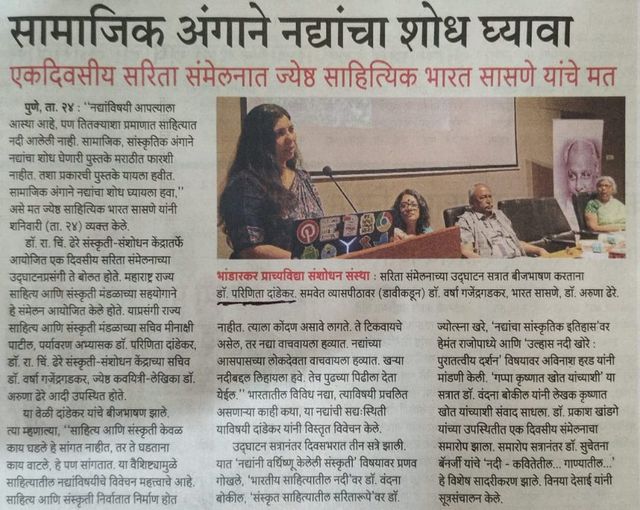
News report about Parineeta Dandekar speaking at River Conference in Pune on Feb 25 2024.
Study LULC change impact on hydro-meteorological shifts in Vedavathi basin The influence of the changing land use land cover (LULC) pattern on the vegetation, water, and temperature parameters is ascertained in the study of the Vedavathi River basin. For the years 2005, 2010, 2015, and 2022 Landsat and MODIS satellite products (MOD11C3, MOD13Q1) along with the ground-based rainfall from IMD measurement were used to implement the methods of indices such as normalized difference vegetation index (NDVI), normalized difference water index (NDWI) along with the land surface temperature (LST), and standardized precipitation index (SPI) and analyze the situation in the basin. The study aims to provide an understanding between all these factors and what is the intensity of influence on each other.
Veda and Avathi are the two tributaries of the Vedavathi River rising from the Bababudangiri Mountains in the Western Ghats and flowing through the states of Karnataka and Andhra Pradesh. This seasonal river fed by the southwest monsoon stays dry for the better part of the year stretching for a distance of 391 km from its origin to its confluence. The extent of the river basin lies between 13°5′55.83″N to 15°44’26.58″N Latitude and 75°42’59.66″E to 77°24’11.74″E Longitudes covering an area of 23,434 Km2. The river joins the Tungabhadra River at Siruguppa Taluk of Bellary Dist. https://www.sciencedirect.com/science/article/pii/S2211714824000013 (Feb.2024)
DTE Sewage will be biggest polluter of rivers This study predicts that sewage will become the dominant source of nitrogen pollution in rivers due to urbanisation and insufficient wastewater treatment technologies and infrastructure in worse case scenario projections in countries such as India. A recent study titled ‘A triple increase in global river basins with water scarcity due to future pollution’ published in Nature Communications aimed at assessing future global clean-water scarcity in 2050 under climate change scenarios and socio-economic changes.
– The recent scare in Pune city, Maharashtra where mosquito swarms resembling tornadoes were cited over Mula Mutha river in Khadki area is evidence enough. While these turned out to be red bloodworms, relatively harmless relatives of mosquitoes, their presence indicated the very high levels of pollution of the river due to high levels of nutrients such as phosphates, nitrates in the waters due to release of untreated sewage. https://www.indiawaterportal.org/articles/sewage-will-overtake-agriculture-biggest-polluter-river-sub-basins-india (21 Feb. 2024)
Chhattisgarh Adivasis challenging paradigms of ‘Vikas’ “It is not about trees being cut in one particular village or about opposing one project. Emphasis is on the forest as a whole, whereby felling of trees or the dying river reflects destruction of a rich ecosystem and crucial wider environmental impact. Climate change and the survival of the planet – these are issues the whole world is talking about,” said Alok Shukla, one of the founding members of the struggle and convenor of the Chhattisgarh Bachao Andolan, an umbrella body for movements across Chhattisgarh.
Stretching across 170,000 hectares, the Hasdeo-Arand is one of India’s most pristine and contiguous tracts of forest. It houses Gond Adivasis and is home to several plant and animal species, many of which are endangered. It is the catchment area for the perennial Hasdeo river that flows into the Mahanadi and provides water to the Surguja district.
Another notable feature of the Hasdeo movement is the way it has adopted a dual strategy. Beside civil disobedience through protests, rallies, padayatras, and dharnas it has sought to challenge the state and the Adani Group through the assertion of rights and guarantees for Adivasis under the constitution. It is also a struggle where women have been very forceful and displayed their capabilities.
Exemplifying this holistic view of the forest, Sunita Porte, a fiery young woman from Fatehpur village, spoke to me of how the rivulet that flows across their region feeds the Hasdeo river. “There is water all year round. Our opposition to mining protects this river that provides water for the farmers. Korba, with its numerous power plants, is dependent on that plentiful water. What will happen if the river dries up with tree felling and mining?” https://thewire.in/rights/the-hasdeo-bachao-movement-adivasis-vikas (19 Feb. 2024)
KRISHNA Telangana Rare temples, inscriptions discovered along river Rare Badami Chalukya temples and a 1200-year-old label inscription were discovered in Mudimanikyam village, located in Nalgonda district on the banks of the river Krishna. These findings, including two temples dating back at least 1300 years to the Badami Chalukyan period and an inscription from the late Badami Chalukya era, were unearthed by the team of Dr M A Srinivasan & S Ashok Kumar from the Public Research Institute of History, Archaeology, and Heritage. https://timesofindia.indiatimes.com/city/hyderabad/archaeological-marvels-badami-chalukya-temples-and-inscriptions-discovered-along-river-krishna/articleshow/107919789.cms (22 Feb 2024)
CAUVERY Karnataka Kodagu residents demand action as river degrades to ‘C’ grade “The water has been graded at ‘C’ in River Cauvery at Kushalnagar. This proves that waste water is flowing into the river from commercial buildings and other set ups. Unscientific growth of tourism has also resulted in increased waste and garbage being flown into River Cauvery. If the river is not protected, we will have to face dire situations in the near future,” shared Chandramohan, the convener of Cauvery Swachata Andolana. The incomplete UGD work is adding to the pollution as sullage water is released to the river directly across Kushalnagar region.
In the memorandum, the organization demanded the administration to submit a proposal to the state for special funds to establish plans to improve the conditions of the river banks and stream banks across the district, a survey be ordered to mark the territory of River Cauvery and stringent laws be passed to keep the river clean and hygienic. They also demanded plans to be released to preserve other water bodies in the district including the Lakshmana Theertha River. “The authorities must release plans to preserve Cauvery and prevent pollution of the river across the 22 Grama Panchayats and one Municipality of Kushalnagar, Virajpet and Madikeri taluks,” explained Chandramohan. https://www.newindianexpress.com/states/karnataka/2024/Feb/19/karnataka-kodagu-residents-demand-action-as-river-cauverys-purity-degrades-to-c-grade (19 Feb. 2024)
GANGA Uttarakhand 36 villages suffer water scarcity due to Rishikesh Karanprayag railway project. https://himbumail.com/home/latest/rishikesh-karanprayag-railway-project-dry-up (24 Feb. 2024)
YAMUNA SANDRP Blog Delhi July 2023 Floods: Parliamentary Committee Report Raises More Questions The Parliamentary Committee report has raised more questions than revealing the causes responsible behind unusual flood spell in Delhi in July 2023. Without providing convincing reasons, the Haryana government and CWC have ruled out role of ITO barrage closed gates in Delhi’s flood situation. Both have made confusing and contradictory statements which has also escaped the scrutiny of Parliamentary Committee. The issue requires urgent credible scientific assessment including of Wazirabad and Okhla barrages.
The dispute between Haryana and Delhi governments regarding ownership and operations of ITO barrage seems reaching no conclusion. The CWC, UYRB have also appeared non-serious on the issue. Yamuna is already starved of flows during lean season and plan of utilization of ITO barrage to divert available water in future is unviable and unjustified.
In larger context of revival of river Yamuna and flood management all concerned stakeholders must initiate plan to decommission the barrage which is standing on the river without any purpose for the past 9 years in unmaintained condition, creating a lot of safety issues, among others. https://sandrp.in/2024/02/20/delhi-july-2023-floods-parliamentary-committee-report-raises-more-questions/ (20 Feb. 2024)
Quotes from SANDRP Blog An analysis of this report by SANDRP an organization dedicated to rivers and dams, has raised more questions than it has answered regarding the causes behind the unusual flood spell in Delhi in July 2023. SANDRP has suggested that a thorough assessment of the July 2023 flood event in Delhi is necessary to understand and address the exact reasons, including discrepancies in water discharge figures, encroachment of floodplains, and siltation of the riverbed.
According to SANDRP, the current release of 10 cumecs of water is inadequate, as most of it evaporates or percolates soon after being released. A SANDRP member stated, “The committee has asked the Union Jal Shakti Minister to take urgent steps in this direction. In fact, the committee should have provided a time limit for this.”
“A careful reading of the chapter has only compounded the flood mystery and raised questions about the operation and management of the Wazirabad and ITO barrages. The report has also revealed some contradictory and confusing statements by the Central Water Commission (CWC), Upper Yamuna River Board (UYRB), and the Haryana Govt,” added one of the members. https://www.newindianexpress.com/cities/delhi/2024/Feb/21/23-floods-parliamentary-report-raises-more-queries (21 Feb. 2024)
No end to ITO barrage dispute between Haryana & Delhi Bhim Singh Rawat of SANDRP quoted based on SANDRP blog: The dispute between the Haryana and Delhi governments regarding the ownership and operations of the ITO barrage seems to be reaching no conclusion. The CWC and UYRB have also appeared non-serious on the issue. The Yamuna is already starved of flows during the lean season, and the plan for the utilization of the ITO barrage to divert available water in the future is unviable and unjustified. https://www.newindianexpress.com/cities/delhi/2024/Feb/21/no-end-to-drainage-dispute-between-haryana-and-delhi (21 Feb. 2024)
HLC to define floodplain by April 18 The high-level committee for Yamuna’s rejuvenation has set a target of April 18 for the floodplain’s demarcation. The ground verification by revenue teams led by DDA and MCD is likely to be completed by March 18. NGT had constituted a committee headed by the Delhi chief secretary to identify, demarcate and notify the Yamuna floodplain as per the River Ganga (Rejuvenation, Protection and Management) Authorities Order, 2016. https://timesofindia.indiatimes.com/city/delhi/committee-plans-to-define-river-floodplain-by-april-18/articleshow/107956713.cms (24 April 2024)
RIVERS BIODIVERSITY
Assam Gharial spotted in Kaziranga A survey of 160 km long stretch from Majuli to Koliabhomora bridge, Tezpur of Brahmaputra river was conducted from 16-25 January 2024 by Biswanath Wildlife Division (under Kaziranga Tiger Reserve) and TSA Foundation India. The survey has recorded over 900 freshwater turtles, representing 5 species and one female Gharial. Opportunistic sightings of other aquatic wildlife like Gangetic River Dolphins and otters were also recorded to compare notes with the recent dedicated surveys on the same.
Historical records of Gharials from sixteen rivers in NE India in the 1950s reported only secondary habitat information and it was thought to be locally extinct. “The recurrent sighting of gharials (especially female) in the last three years in the Bishwanath stretch of the Brahmaputra brings in cheer as it confirms the premise on restoring back species with due protection” Kaziranga National Park field director Sonali Ghosh says. https://www.eastmojo.com/news/2024/02/23/a-one-in-a-lifetime-moment-gharial-spotted-in-kaziranga/ (23 Feb.2024)
The presence of Indian Gharial (Gavialis gangeticus) in Greater Kaziranga has been confirmed by the forest department after a gap of 75 years, officials said, sharing the outcome of a latest survey conducted in January. Kaziranga has a recorded abundance of over 42 species of freshwater fishes and thus, officials said, it is one of the best habitats for gharials in the long run.https://timesofindia.indiatimes.com/city/guwahati/indian-gharial-spotted-in-greater-kaziranga-after-75-years/amp_articleshow/107929826.cms (23 Feb.2024)
Madhya Pradesh PM says drones have been used to monitor ghariyals in Ken Ghariyal Sanctuary along Ken River. https://timesofindia.indiatimes.com/india/pm-modi-cites-crocodiles-in-ken-river-to-hail-tech-use-in-saving-wildlife/articleshow/107991163.cms (26 Feb. 2024)
Report Gharial conservation should extend to unprotected rivers A recent study conducted by Panda and his team to understand the population status and distribution of gharials (Gavialis gangeticus) in the Gandak river, reveals that the species avoid human presence and prefer to occupy undisturbed riverine habitats with deeper pools. The study documents that the presence of human settlements near the riverbank poses a threat to the gharials as they reduce their basking time, potentially affecting their physiology. Other threats in the form of fishing, fishing nets in the river, the presence of feral dogs and cattle in the human-dominated landscape across the length of the river, river braiding and changes in river flow due to damming are reasons severely threatening the small but robust population of gharials in the Gandak river, a transboundary tributary of the Ganga that flows through the Indian states of Bihar and Uttar Pradesh.
-Other than the gharials in Gandak river, most of the population is distributed in the Ganga and its tributaries, notably Chambal, Girwa and Son. What makes the Gandak river and its gharials special is its unprotected status, unlike the Chambal river which is a notified sanctuary, says Panda, which makes survival more challenging for the animal. Researchers also believe that the river is home to the second-largest population of gharials in India and the only breeding population in a non-protected area.
-Also known as the fish‐eating crocodile, gharial gets its name from the Hindi word ghara or pot, alluding to a distinct morphological character — the bulbous knob, a cartilaginous mass — at the tip of a breeding male’s snout. The snout and rows of uniform sharp teeth, supported by a strong muscular neck, make the gharial an excellent fish catcher. The adult gharials eat only fish, making extensive fishing in their habitats a cause for concern as it could impact food availability. Fishing nets across the rivers endanger the animal as they get entangled in them and incidents of drowning have been reported. The study notes that gharials have been seen avoiding fishing boats, perhaps as an adaptive mechanism.
-Sand and boulder mining, especially in the southern tributaries of the Ganga, have been found to be disturbing the nesting patterns and sites of the species. There is also the threat of feral dogs preying on gharials’ eggs. They are not natural predators and are an outcome of human presence, says Panda. Nair says such predators are not controlled by ecological factors and hence pose a larger threat. https://india.mongabay.com/2024/02/gharial-conservation-should-extend-to-unprotected-rivers/ (21 Feb. 2024)
Western Ghats A special fund to save Purple Frog, a ‘living fossil’ The Purple Frog, two species of which are found in unique habitats in Tamil Nadu, are among the many lesser known and endangered species to be covered under the fund. Believed to have co-existed with dinosaurs, the Purple Frog is often dubbed as a ‘living fossil’, as it has similarities to the Sooglossidae family of frogs in Seychelles, supporting the Gondwana landmass hypothesis.Belonging to the Nasikabatrachidae family, the soil-dwelling frog is endemic to select habitats in the Western Ghats in Kerala and Tamil Nadu. For years, the amphibian has been drawing the attention of researchers, who are striving to solve the mysteries of its unique year-long subterranean life. https://www.thehindu.com/sci-tech/energy-and-environment/a-special-fund-to-save-purple-frog-a-living-fossil-in-the-western-ghats/article67876204.ece (23 Feb. 2024)
FISH, FISHERIES, FISHERFOLKS
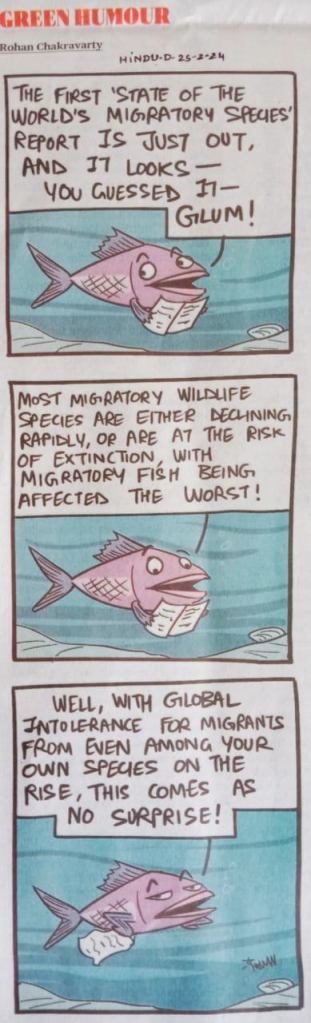
Report India’s small and marginal fishers have demanded complete exemption from any WTO commitment for reducing subsidies on essentials such as fuel, nets, fishing boats and other fishing gear, for fishing up to 200 nautical miles (nm), as they say that it could drive them into further poverty. https://www.thehindubusinessline.com/economy/agri-business/indias-small-fishers-want-complete-exemption-form-wto-curbs-on-subsidies/article67867844.ece (20 Feb. 2024) The WTO’s 13th Ministerial Conference will seek to build consensus on the potential regulation of fisheries subsidies contributing to excessive fishing effort and capacity. India is advocating for the principles of common but differentiated responsibilities (CBDR) and respective capabilities, proposing a 25-year transition period for developing countries and addressing livelihood and food security concerns for fishermen. https://india.mongabay.com/2024/02/indias-stance-at-wto-balances-fisheries-subsidies-for-artisanal-fishers-and-sectoral-growth/ (09 Feb. 2024)
SAND MINING
Madhya Pradesh Son Ghadiyal Sanctuary is facing the threat of donotification from Sand mafia and also due to the absence of any male ghadiyal here, there is no increase in population.
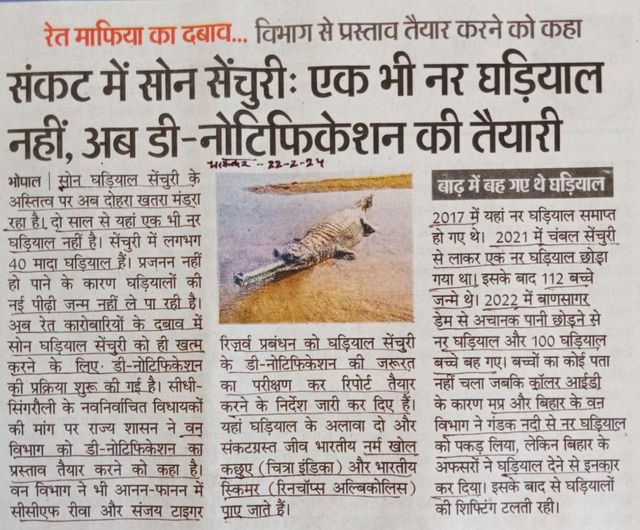
In 2017 all the male Ghadiayal had washed away possibly when water was suddenly released from Bansagar dam. Similarly in 2022 too. https://www.bhaskar.com/local/mp/bhopal/news/son-sanctuary-in-crisis-not-a-single-male-crocodile-now-preparations-for-de-notification-132615705.html (23 Feb. 2024)
Tamil Nadu SC questions govt’s intervention against ED’s sand mining case The Supreme Court questioned the Tamil Nadu government’s successful intervention in the Madras High Court to get a stay of summons issued by the Directorate of Enforcement (ED) to five District Collectors in connection with a money laundering case linked to “illegal” sand mining. “How can the State file a writ petition against the Enforcement Directorate? How is the State aggrieved? How is the State interested? Let the Collectors respond to the summons… Are they not supposed to cooperate with the investigative agency?” Justice Bela M. Trivedi quizzed the Tamil Nadu government, represented by senior advocate Mukul Rohatgi. At one point, Justice Trivedi remarked she would stay the High Court order, but Mr. Rohatgi convinced the Bench to list the case again on February 26.
In its appeal against the November 2023 stay order, the ED said efforts were underway to “unearth the nexus between the illegal miners, officials and local mafia in the State”. It said searches were conducted in 34 places across Tamil Nadu in September last year, leading to seizure of currency, incriminating documents and digital devices. The appeal said an expert study revealed that the value of excess sand mining in Tamil Nadu came to ₹4,730 crore against the recorded revenue of ₹36.45 crore earned by the State government. https://www.thehindu.com/news/national/sc-questions-governments-intervention-in-madras-hc-against-ed-summons-to-district-collectors/article67878813.ece (23 Feb. 2024)
Report sought from DCs on illegal mining U Chinnamari, an agriculturist from Thiruppuvanam taluk in Sivaganga, stated in her PIL petition that as per Section 19 of the Tamil Nadu Minor Mineral Concession Rules, 1959, whenever quarrying permits are issued to extract sand from cultivable lands, quarrying should be done only for an optimum depth to be specified by the district collector so that the land could be restored to a state fit for cultivation. However, in the guise of agricultural reclamation, many people excavate sand indiscriminately beyond the permitted limit and make agricultural lands uncultivable, she alleged. https://www.newindianexpress.com/amp/story/states/tamil-nadu/2024/Feb/24/report-sought-from-collectors-on-illegal-mining-in-sivagangai-kanniyakumari (24 Feb.2024)
Illegal quarrying causes Rs 700 cr loss toe exchequer: NGO – Arappor Iyakkam, an anti-corruption organisation, has alleged that illegal quarrying in Tirunelveli district and the failure to impose penalty on erring quarries have resulted in loss of over Rs 700 crore to the state exchequer. The organisation has also filed a complaint with the Directorate of Vigilance and Anti-Corruption. Addressing a press conference here on Thursday (Feb. 22), convenor Jayaram Venkatesan said in Tirunelveli district alone more than 50 stone quarries are operational. A tragic incident unfolded on May 14, 2022, during late hours at a stone quarry in Tharuvai village, in which four people lost their lives. https://www.newindianexpress.com/states/tamil-nadu/2024/Feb/23/illegal-quarrying-in-tns-tirunelveli-causes-rs-700-crore-loss-to-state-exchequer-alleges-ngo-files-complaint-with-dvac (23 Feb.2024)
Haryana Govt to restore mining affected Aravalis The state govt has initiated a “ground-truthing” exercise to map the extent of damage caused by mining in the Aravalis and revive the affected areas. This is the first such step in the process of restoring the protected forest land. The survey will be carried out in every district that has a portion of the Aravalis – Gurgaon, Nuh, Faridabad, Rewari, Mahendragarh, Charkhi Dadri and Bhiwani.
Govt teams will use drones to map areas hit by mining and those that are vulnerable to it, and prepare reports on land ownership, the extent of flora and fauna, solid waste dumping and anything that threatens the eco-sensitive forests. The govt plans to utilise funds collected from environment compensation for the survey, which follows an NGT directive to restore Aravali areas hit by mining and prevent further violations in the future. The survey will also involve mapping of private areas. The restoration plan, however, is a long one, spanning two decades. “The plan will be carried out over the next 20 yrs. But it will succeed only if executed properly and monitored as well,” said Sumit Dookia, an assistant professor in Indraprastha University & an expert member.
In November last year, a committee set up by NGT had listed 38 illegal mining sites in the Aravalis of Gurgaon and Nuh, citing FIRs filed over the years. Some of these, it had said, had fresh signs of stone quarrying. Haryana govt, in its submission to the green tribunal on July 17 last year, said it had formed the Aravalli Rejuvenation Board to deal with complaints of illegal mining. The govt also said steps were being taken to deploy drones and install CCTV cameras for better surveillance. So far, most of these measures are still on paper. Besides, an Aravali task force – announced by the govt years ago – is yet to be formed. https://timesofindia.indiatimes.com/city/gurgaon/how-much-of-aravalis-is-hit-by-mining-govt-starts-ground-truthing-for-revival/articleshow/107806092.cms (19 Feb. 2024)
Rajasthan 3 Labourers Killed After 100-Tonne Rock Falls -Three workers died, two others suffered minor injuries and one was hospitalised after a 100-tonne rock fell on them inside a granite mine named Mishri Mines located near the Sakdara (Chanod) Village near the Gudi Endla Police Station of Pali district around 10.30 am on Wesnesday (Feb. 21). As per police sources, they were buried under heavy blocks for one and a half hours. By the time they were rescued, their bodies were totally deflated. After being wrapped in clothes, they were rushed to the hospital.
-A labourer Suresh, who witnessed the accident, said that six people were working in the mine when the huge block of stone broke from above and fell on them killing three on the spot and critically injuring one. Police officials said that the bodies of the three deceased were taken out of the mine after much effort. https://www.etvbharat.com/en/!state/rajasthan-three-labourers-killed-one-in-critical-condition-after-100-tn-rock-falls-on-them-enn24022105570 (21 Feb. 2024)
पाली की ग्रेनाइट खदान में 6 मजदूरों पर 100 टन की चट्टान गिर गई। इसमें 3 मजदूरों की मौत हो गई। उनके शव चट्टान के नीचे दबने से पूरी तरह पिचक गए थे। इन्हें कपड़े में भरकर अस्पताल ले जाया गया। वहीं, 3 लोग घायल हो गए। हादसा पाली जिले के गुड़ा एदंला थाना क्षेत्र के साकदड़ा गांव (चाणोद) के पास बुधवार सुबह हुआ। https://www.bhaskar.com/local/rajasthan/pali/news/accident-in-mines-in-pali-4-5-people-buried-132616809.html (21 Feb. 2024)
GROUNDWATER
Contamination not being effectively addressed by CGWA: NGT The NGT on February 6, 2024, said the reply filed by the CGWA on the matter was a “very generic response”. “From the report, it appears that no concrete steps have been taken by the CGWA to address the problem,” the tribunal said. The bench said the report of the CGWA should clearly state the places where concrete steps have been taken to address arsenic and fluoride in groundwater or whether alternative drinking water is being provided to the people there. The NGT observed that despite these elements having a very bad effect on the human body, the CGWA has not installed arsenic and fluoride removal plants in these areas. The NGT has postponed the next hearing of the case for April 26, 2024. https://www.downtoearth.org.in/news/water/groundwater-contamination-due-to-arsenic-fluoride-not-being-effectively-addressed-ngt-94628 (23 Feb. 2024) The NGT, through an order on Feb 15 has given CGWA and states six weeks to file reports about status and solutions of Fluoride, Arsenic and other metallic pollution in groundwater in six weeks. https://timesofindia.indiatimes.com/city/delhi/groundwater-toxins-ngt-sets-six-week-deadline-for-cgwa-and-states/amp_articleshow/107897404.cms (22 Feb. 2024)
URBAN LAKES, WETLANDS
Chennai Residents don’t want an eco-park in Perungudi dump yard Over the years, the marsh has been concretised to give way for MRTS stations and railway lines, middle and high-income real estate projects, IT parks, and more. Given rivers and lakes from four districts: Chengalpattu, Kanchipuram, Chennai and Vellore drain their water into the marsh, the concretised areas get heavily flooded during rains — putting residents and workers in the area at grave risk.
Many of the residential areas, government institutions and the IT park have even been identified as encroachments by the NGT, which had ordered the GCC to remove the buildings which did not have proper land titles and relocate them with adequate compensation. The marsh has also been fragmented by radial roads that connect outlying neighbourhoods. While it might not be possible to remove all of these, many of the roads that cut through the marsh could be replaced.

At the hearing, the opinion of those attending appeared unanimous on the matter of avoiding the eco-park altogether — a hopeful moment of solidarity among the public. The consensus at the hearing highlights how the public is growing more aware of how the history of Chennai’s development has had an adverse effect on natural ecosystems. However, given that the GCC has gone through with the plans for the park despite the NGT’s ruling, only time will tell if the state body will listen to the public’s opinion on this matter. https://citizenmatters.in/eco-park-perungudi-dump-yard-chennai-residents-pallikaranai-marshland-conservation-45978 (20 Feb. 2024)
Hyderabad It’s govt duty to save Durgam Cheruvu: HC Protection of iconic Durgam Cheruvu was the responsibility of the state and it must take all steps to restore it to its pristine glory, the Telangana high court made it clear on Feb 21 2024. The HC gave the state one week to explain the steps it intended to take to preserve the water body. “Restoration of this lake is a must. Non-negotiable. It is not an option any more,” said a bench of Chief Justice Alok Aradhe and Justice J Anil Kumar which had converted into a PIL a Dec 12 TOI report on the current plight of the water body, known as the ‘secret lake’, situated between Jubilee Hills and Madhapur. The bench had appointed a committee headed by Dr Atul Narayan Vaidya, a water expert currently heading the Nagpur-based NEERI.
The committee visited the lake, its vicinity, studied the issue and furnished its report in a sealed cover to the court and the bench glanced at it on Feb 21 2024. The bench said that the report highlighted the huge quantum of sewage being released into Durgam Cheruvu as well as another water body downstream, Malkam Cheruvu. Added to this were encroachment of the lake area and construction of huge structures, the bench said citing excerpts from experts’ report. “We will deal with the encroachments soon,” the bench observed. According to the report, there are 78 buildings in FTL area of lake and 146 structures in the buffer zone area. https://timesofindia.indiatimes.com/city/hyderabad/high-court-directs-telangana-government-to-save-durgam-cheruvu/articleshow/107896997.cms (22 Feb.2024)
Bengaluru Summer an opportunity to regenerate lakes Increasing the depth of lake beds uniformly with only capacity upgrade as objective is not the way to go, notes Raghavendra B. Pachhapur, Senior Project Lead with ActionAid Association, a non-government institution. Lake rejuvenation is not only about removal of residual silt but also about building a habitat around the water bodies for birds and wildlife to thrive, he explains.https://www.thehindu.com/news/cities/bangalore/seasonal-lakes-do-dry-in-summer-but-it-is-time-to-de-silt-to-raise-storage-capacity/article67856591.ece (19 Feb. 2024)
Residents of Halanayakanahalli and volunteers cleared around 100 bags of garbage around Halanayakanahalli Lake on Sunday. The lake, often in the headlines for the wrong reasons, is vulnerable to encroachment and has become a dumping ground for waste. Over 25 people participated in a debris clean-up drive that began at 8 am and concluded at 10 am. The participants, including children and volunteers, collected 100 bags of garbage around the lake. https://bangaloremirror.indiatimes.com/bangalore/civic/100-bags-of-waste-collected-from-just-one-lake-in-city/articleshow/107990553.cms (26 Feb. 2024)
Madiwala lake in crisis “The lake was handed over to us in the middle of a financial year. By then we were done with fund allocations. Thus, there is no money left to maintain Madiwala Lake. However, KFD collected Rs 2.5 cr from boat riding & other activities. We have written to them to hand over this fund so the lake can be maintained,” said a BBMP official from the lake dept.
The BBMP had announced in January that the waterbody will be developed and a sum of Rs 15 crore has been allotted for the purpose under the 15th finance commission grant. After receiving the fund, the civic agency had started preparing a DPR to carry out the development work, which would include removing silt from the lake, improving the main bund and creating a ring bund. “The DPR is ready and has been sent to the Karnataka Tank aConservation and Development Authority (KTDA) for approval. Once we get the approval, the tender process for lake development will begin,” added the official. https://bangaloremirror.indiatimes.com/bangalore/civic/madiwala-lake-in-crisis/amp_articleshow/107973580.cms (25 Feb.2024)
URBAN WATER
Gurugram 7 of 13 water samples near landfill site fail Seven out of 13 water samples collected from the vicinity of the Bandhwari garbage landfill have been found unfit for consumption. The Gurugram health authorities, following directives from the NGT, collected these samples earlier this month. They have now sent a letter to the Municipal Corporation of Gurugram (MCG), requesting a chemical examination of these samples to identify the exact nature of pollutants. An advisory has also been issued to residents nearby, urging them to refrain from using groundwater, especially for drinking purposes. https://www.tribuneindia.com/news/haryana/seven-of-13-water-samples-near-landfill-site-unfit-for-consumption-592883 (21 Feb.2024)
Ahead of an NGT hearing on Thursday (Feb. 22), MCG has in an affidavit claimed that all parameters of groundwater samples tested from five villages around the Bandhwari landfill are within the permissible limits and there is no damage to groundwater due to leachate. The civic body has attributed these claims to an HSPCB report published last month. Interestingly, a report on the same issue submitted by the health department stated that samples taken from these villages were ‘unfit’ for drinking. https://timesofindia.indiatimes.com/city/gurgaon/same-water-two-reports-one-says-unfit-for-drinking-another-all-good/articleshow/107897466.cms (23 Feb 2024)
WATER
Report HP, Rajasthan & UTs first to decriminalise small offences The Water (Prevention and Control of Pollution) Amendment Act, 2024, recently revised, is set to be enforced initially in Himachal Pradesh, Rajasthan, and Union Territories. This is according to a Ministry of Law and Justice notification published on Friday (FEB 16). Other states have the option to adopt it through resolutions. https://www.business-standard.com/india-news/water-act-2024-hp-rajasthan-and-uts-first-to-decriminalise-small-offences-124021901131_1.html (19 Feb. 2024)
Opinion Water act amendments ignore climate crisis The amendments to the Water Act are not only counterintuitive but will also prove detrimental to the future of the very economy that the govt is trying to boost. Ironically, the great water act of 2024 does not take any lesson from the failure of the Gujarat model in protecting its river and, worse, it completely ignores the fact that the climate crisis is inherently a water crisis, of excesses and scarcity, of floods and droughts, and of inequity. (Shailendra Yashwant) https://www.freepressjournal.in/analysis/analysis-the-great-indian-water-act-of-2024 (21 Feb.2024)
Telangana Water crisis looms large The govt is yet to unveil a contingency plan to tide over the potential crisis. With just 11 TMC remaining in the Sripada Yellampalli project coupled with release of water from the Annaram and Sundilla barrages of KLIS due to alleged leakages, the situation is only getting worse. With the water level of the Yellampally project dwindling, officials proposed that the State government consider releasing water from the Kadem project to the Sripada Yellampally project up to the crest level, emphasising the pressing need for immediate action to avert an unprecedented water scarcity in the State capital and other areas. https://telanganatoday.com/unprecedented-water-crisis-looms-large-over-hyderabad-other-districts-in-telangana (20 Feb. 2024)
Report Explore the Water Cycle with Wally and Deanna Fascinating: Wally and Deanna’s water cycle adventure online! Follow Wally the Worm and Deanna Waterdroplet as they travel to the saturated zone and further. This is also available in Hindi/ Urdu https://uwaterloo.ca/earth-sciences-museum/news/explore-water-cycle-wally-and-deanna (10 Dec. 2020)
AGRICULTURE
Report हरित क्रांति का वो पहलू, जो हरा-भरा नहीं था जर्नल ऑफ एथनिक फूड्स और साइंस डायरेक्ट नाम की विज्ञान उन्मुख ऑनलाइन पत्रिकाओं के अनुसार, ये बात सही है कि नए हाइब्रिड बीज ज्यादा पैदावार दे रहे थे. मगर इसकी एक बड़ी कीमत भी चुकानी पड़ी. पहले से अधिक सिंचाई की जरूरत पड़ी और फर्टिलाइजर का भयंकर इस्तेमाल होने लगा. इससे मिट्टी में घुलने वाले रसायनों की मात्रा बढ़ी और आज हरियाणा जैसी उपजाऊ जमीन वाली जगहों में भी मिट्टी की उर्वरता कम होती दिख रही है.
कृषि विशेषज्ञ देवेंद्र शर्मा बताते हैं, “हम हरित क्रांति तो ले आए, मगर अब हम उसके ‘सेकंड जनरेशन एनवॉयरमेंट इम्पैक्ट’ को भुगत रहे हैं.” इसका मतलब है, खेती के तरीकों में पहले किए गए बदलावों के कुछ साल बाद के नतीजे. देवेंद्र रेखांकित करते हैं, “यह सही है कि भारत को ज्यादा अनाज की जरूरत थी. बड़ी मात्रा में फर्टिलाइजर भी आयात किया गया. लेकिन खेती के तरीकों को ज्यादा बेहतर बनाने और कम फर्टिलाइजर उपयोग करने की जगह हम हर साल और भी ज्यादा उर्वरक का आयात करने लगे. हमें इस आदत को खत्म करना चाहिए था.”
देवेंद्र शर्मा कहते हैं, “खेती के गलत तौर-तरीके दुनिया में एक तिहाई ग्रीनहाउस गैसों के जिम्मेदार हैं.” क्या हरित क्रांति के कारण भारत में रासायनिक खादों का इस्तेमाल बढ़ा है, इसके जवाब में पूर्व कृषि सचिव हुसैन ने बताया, “भारत में यूरिया पर अत्यधिक सब्सिडी दी जाती रही और कुछ राज्यों में यूरिया का बहुत अधिक उपयोग हुआ है.” https://www.dw.com/hi/farming-in-india-from-green-revolution-to-agro-ecosystem/a-68295734 (19 Feb. 2024)
भारत में मिट्टी को नहीं सहेजा तो यह लाखों लोगों के विनाश का कारण बन जाएगी भारत ने बड़े पैमाने पर हरित क्रांति का जश्न मनाया। इसकी वजह से चावल और गेहूं के उत्पादन में बेतहाशा बढ़ोतरी हुई, साथ ही दालें और सब्जियों की पैदावर भी काफी बढ़ गई। लेकिन हमने इस बात को नजरअंदाज कर दिया कि ये हमारी जमीन को कितना नुकसान पहुंच रहा है। रासायनिक कीटनाशकों और उर्वरकों के जरूरत से ज्यादा इस्तेमाल ने हमारे खेतों और फसलों को जहरीला बना दिया। मिट्टी ने अपने प्राकृतिक पोषक तत्व खो दिए और वह जहरीली और दूषित हो गई। अतिरिक्त उर्वरकों से मिट्टी में नाइट्रेट बढ़ गया। अत्यधिक खेती के कारण जल स्तर गिर गया। बोरवेल हर साल गहरे, और गहरे होते चले गए। राजनीतिक फायदे के लिए ज्यादातर राज्यों ने किसानों को मुफ्त पानी उपलब्ध कराया। इसकी वजह से अंधाधुंध तरीके से सिंचाई हुई और बहुमूल्य जल संसाधनों की कमी होती चली गई।
-ख़राब होती मिट्टी की जटिल समस्या का कोई आसान समाधान नहीं है। लेकिन ऐसे कई तरीके हैं जो खेती की जमीन को फिर से सेहतमंद बनाने में मदद कर सकते हैं। उदाहरण के लिए, लघु डैम की मदद से एकीकृत वाटरशेड प्रबंधन, सीढ़ीदार खेत और समोच्च खेती करना। इसके अलावा उन फसलों में कटौती करना जिन्हें बहुत अधिक पानी की जरूरत होती है, मानसून के दौरान मिट्टी के बहाव को रोकने के लिए बांध बनाना और कीटनाशकों और रासायनिक उर्वरकों का कम से कम इस्तेमाल करना जैसे उपाय शामिल हैं। https://hindi.mongabay.com/2024/02/22/commentary-soil-degradation-in-india-spells-doom-for-millions/ (22 Feb. 2024)
Based on rice and wheat, the Green Revolution was launched on account of the perceived threat of famine. India’s vast traditional arena of ecofriendly cereals like millet and maize was ignored writes Anupam Paul. https://www.telegraphindia.com/opinion/the-other-extinction-mainstream-agricultural-policy-has-not-done-enough-to-propagate-eco-friendly-crop-varieties/cid/2002562 (24 Feb. 2024)
MONSOON 2024
Study Cloud clustering patterns reveal increasing severity of extreme rainfall in tropics Focussing on the area of the tropics around the equator, the scientists from the Institute of Science and Technology Austria (ISTA) and the Max-Planck-Institute for Meteorology (MPI-M) in Germany used a climate model to study how cloud and storm clustering impacted extreme rainfall events. They found that with warming climate, extreme rainfall events in the tropics increase in severity more than what was expected from the theory.
“We can see that when clouds are more clustered, it rains for a longer time, so the total amount of rainfall increases,” said Jiawei Bao from ISTA, and the lead author of the study published in the journal ‘Science Advances’. “We also found that more extreme rain over high-precipitation areas happens at the cost of expansion of dry areas – a further shift to extreme weather patterns. This is due to how clouds and storms cluster together, which we could now simulate with this new climate model,” said Bao.
Their model captures the complex dynamics of air movement and hence, simulates the climate with a much higher resolution than the previous ones that do not factor clouds and storms in as much detail, the researchers said. These complex dynamics at play are involved in creating clouds and helping them congregate to form more intense storms, they explained. https://www.thehindu.com/sci-tech/energy-and-environment/cloud-clustering-patterns-reveal-increasing-severity-of-extreme-rainfall-in-tropics-in-new-study/article67881837.ece/amp/ (24 Feb 2024)
Climate change impacting extreme weather events These events include heat waves, droughts, floods, hurricanes, and wildfires. Studies can show whether the warming climate made an event more severe or more likely to happen. In India, the duration of heat waves has increased by about 2.5 days between 1961 and 2021 due to global warming, according to a 2023 report by the India Meteorological Department.

Similarly, rising temperatures have worsened droughts. A 2023 report by World Weather Attribution (WWA) showed that climate change made a drought of such intensity (like that in 2020-2022) at least 100 times more likely in East Africa. https://indianexpress.com/article/explained/explained-climate/climate-change-impact-extreme-weather-events-9169603/ (20 Feb. 2024)
LANDSLIDES
Himachal Pradesh पहाड़ी दरकने से मशीन व ऑपरेटर मलबे में दबे मंगलवार (Feb 20 2024) दोपहर 1.30 के लगभग मंडी-मनाली फोरलेन पर पंडोह के पास छः मील में पहाड़ी दरकने से भारी मात्रा में पत्थर और मलबा गिरने से यहां काम कर रही मशीन व ऑपरेटर भी मलबे में दब गए। https://surbhinews.com/61241/ (20 Feb 2024)
ENERGY OPTIONS
Tamil Nadu More govt buildings to generate solar power this year More govt buildings including collectorates, commercial tax offices and court complexes will generate green energy this year as the Tamil Nadu Energy Development Agency (TEDA) has floated a tender to install grid-connected solar photovoltaic (PV) systems. TEDA aims to install systems of 20MW at a cost of 120 crore in 2024. Those who get the tender will install and maintain rooftop solar PV systems for the next five years. TEDA said that it had been approached to install rooftop PV systems on nearly 100 govt buildings. “The number will go up as the tender is finalised,” said an official.
Tangedco itself has rooftop systems on its buildings in Chennai and other districts and on EVK Sampath Maligai on College Road, TEDA’s office. The govt has installed 973 grid-connected solar power systems on educational institutions, hostels, and hospitals. Besides, it has set up 74 solar PV systems for public lighting and 78 worship places have rooftop solar panels installed. Universities and govt schools in various parts of the state have also got rooftop solar PV systems installed under the capex model with a combined capacity of 1,916 KW. The solar power generated from these systems gets injected into to the grid, which reduces the power bill of the buildings apart from increasing the green energy quotient in the overall energy mix. https://timesofindia.indiatimes.com/city/chennai/government-buildings-in-state-to-generate-solar-power/articleshow/107806237.cms (19 Feb. 2024)
Report Can we build solar power without harming nature? The boom in solar, set to be the fastest-growing energy source in the United States, is predicted to fence off millions of acres across the nation, blanketing them in rows of glassy squares. The good news for wildlife is that there are ways for solar developers to make installations less harmful and even beneficial for many species, like fences that let some animals pass, wildlife corridors, native plants that nurture pollinators, and more. But at this pivotal moment, as solar farms sprout across the country, those measures often go unused. Among the reasons: a patchwork of local and state regulations governing large-scale solar, not enough research on how animals interact with it, and an absence of federal guidelines on siting or design.
“We’re faced with two truths: We have a climate change crisis, but we also have a biodiversity crisis,” said Meaghan Gade, a program manager at the Association of Fish & Wildlife Agencies. “We have to be mindful that there’s wildlife that are dependent on these habitats, and we have to be smart and thoughtful about how we’re doing this deployment so that we can hold both of those crises at the same time.” https://www.nytimes.com/interactive/2024/02/11/climate/climate-change-wildlife-solar.html (11 Feb 2024)
ENVIRONMENT GOVERNANCE
Supreme Court States must follow definition of ‘forest’ given by Godavarman Judgment Taking note of concerns, the bench comprising CJI, Justices JB Pardiwala and Manoj Misra, passed the following order: “Pending the completion of exercise by the administration of the State Governments and Union Territories, under Rule 16, the principles which are elucidated in the judgment of this court in TN Godavarman must be continued to be observed. As a matter of fact, it is evident that Rule 16 includes within its ambit forest-like areas to be identified by the expert committee, unclassed forest lands and community forest lands. In the interregnum therefore, while being guided by the provisions of the statute and those contained in Rule 16, the State Governments and UT administrations shall peremptorily ensure compliance with the ambit of expression “forest” as explained in the decision in TN Godarman.”
-The Court directed the Union of India, through the MoEF, to issue a circular to all States/UTs in terms of the above order. The Court further directed the Union of India shall, within a period of 2 weeks from the date of this order, require all States/UTs to provide to it a comprehensive record of land which has been identified as forests by the expert committees constituted by the States/UTs as per the TN Godavarman judgment. All states and UTs must comply with the directions by forwarding the reports of the expert committees by March 31, 2024. These records shall be maintained by the MoEFF and shall be duly digitised and made available on the official website by April 15, 2024. https://www.livelaw.in/top-stories/statesuts-must-follow-definition-of-forest-given-by-godavarman-judgment-till-forests-are-identified-as-per-2023-rules-supreme-court-249897 (19 Feb. 2024)
Go back to dictionary meaning of ‘forest’ The Bench noted that the “all-encompassing” dictionary meaning upheld by the Supreme Court in the Godavarman Thirumulpad case over 25 years ago would continue to hold field till the States and union territories prepare a “consolidated record” of all the lands recorded as ‘forest’ in government records, including forest-like areas, unclassed and community forest lands. The court said the exercise to prepare such a consolidated record was part of Rule 16 of a notification issued by the Environment Ministry on November 29, 2023, and would take a year. “We clarify that pending the completion of this exercise by the States and union territories under Rule 16, the principles in T.N. Godavarman Thirumulpad must continue to be observed,” the court ordered.
-The Bench ordered the Environment Ministry to issue a circular in this regard to the States and union territories. The court directed the Union government to require States and union territories, within two weeks, to forward the “comprehensive records” of forest lands their respective expert committees had identified in pursuance of the apex court’s orders in the Godavarman Thirumulpad case. The States and union territories have to forward the records by March 31, 2024. The Environment Ministry has to publish these records on its website by April 15, 2024. https://www.thehindu.com/news/national/go-back-to-dictionary-meaning-of-forest-supreme-court/article67864608.ece (19 Feb. 2024)
No permission for zoo, safari in forests without nod The Supreme Court examining the validity of amendments to the Forest (Conservation) Act on Monday (Feb. 19) held that its prior permission will be necessary for setting up any zoo or safari in a forest, and directed all states and union territories to submit information about the total forest land, as determined under a 1996 top court decision to the Centre, latest by March 31 this year. The Forest Act amendments received Presidential assent on August 4 last year. https://www.hindustantimes.com/india-news/no-permission-for-zoo-safari-in-forests-without-court-nod-supreme-court-101708349994662.html (19 Feb. 2024) The Supreme Court said that while the expert committees set up under the 2023 Rules should take into account the progress made by the previous expert panels, they are free to expand the protection umbrella to any forest land that is worth protecting. The matter will be heard for final disposal in July. https://indianexpress.com/article/explained/supreme-court-forests-definition-conservation-9171444/ (20 Feb. 2024)
Centre has no details of panel report on deemed forests: RTI -The Union environment ministry does not have details of the state expert committee reports which identified so-called deemed forests in every state following Supreme Court’s 1996 order in TN Godavarman Vs Union of India matter, according to information received under a right to information or RTI application. https://www.hindustantimes.com/india-news/centre-has-no-details-of-panel-report-on-deemed-forests-rti-101708456003179.html (21 Feb. 2024)
EDIT Greening growth This EDIT in Indian Express, following a front page story by Jay Mazumdar, rightly questions the MoEF’s wide hole in regulation by regularising violations and allowing projects without Environment Clearance. “Unfortunately, as a report in this newspaper has shown, the balance between environment and industry seems to be tilting far too much towards the latter.”
“In 2017, the government brought in a loophole to the EIA and gave a six-month moratorium to all the companies that had not complied with the requirements to receive an EC. This one-time window was made indefinite under the revised Standard Operating Procedures in 2021. The notification was challenged before the Madras High Court, which granted a stay order. The Centre, however, interpreted the order as applying only to Tamil Nadu. Then, in January 2024, the Supreme Court stayed the notification, and the Court’s final decision is pending. In essence, between 2017 and 2024, over 100 projects — they include coal, iron and bauxite mines, steel and iron factories, cement plants and limestone quarries — have been granted ex post facto environmental clearance under the diluted EIA, their original lack of EC notwithstanding.”
“However, by any standard, the weakening of the EIA, and the National Green Tribunal, is a matter of deep concern that needs to be addressed urgently — in 2020, an Environmental Performance Index of Yale University ranked India 168 amongst 220 countries. Perhaps the only sustainable way to do this is to not see “environment” and “development” locked in an inevitably zero-sum game.”
“It’s time to move to environmentalism as development and development as environmentalism… This will, however, require a robust policy and regulatory framework, which while facilitating business, allows for a careful assessment of the adverse impacts of projects, and does not constantly search for and seize the loopholes.” https://indianexpress.com/article/opinion/editorials/express-view-on-the-balance-between-environment-and-industry-greening-growth-9171992/ (21 Feb. 2024)
Report SOP on non-compliance: In most cases, violations were recorded only to be condoned Between March 2017 and January 2024, till the July 2021 notification was stayed by the Supreme Court in January this year, the Union Environment Ministry had cleared over 100 projects.
Some of the approved violation cases include a greenfield airport being developed by the Karnataka government at Vijayapura, the Lower Orr hydel project of the National Water Development Agency near Shivpuri in Madhya Pradesh, enhancing production at a pesticide factory in Maharashtra’s Ratnagiri run by Godrej Agrovet Limited, expansion of Leela hotel in Delhi’s Chanakyapuri, and the residential-cum-training complex for Special Protection Group in Delhi’s Dwarka. The next hearing of the challenge to the post-facto clearance regime before the SC is due in the first week of March. https://indianexpress.com/article/india/environment-ministry-sop-eac-remediation-plan-eac-violation-cases-9170171/ (20 Feb. 2024)
Amnesty stretched, 100 projects with ‘violations’ cleared By turning a six-month window for clearing projects which violated clearance conditions into a routine process, the Environment Ministry allowed for at least 100 projects to sail through. Besides clearing over 100 projects, the ministry also issued terms of reference (ToR) for impact assessment to at least another 150 under the violation category.
-Conceived as a one-time opportunity, it became a routine process when the Union Environment Ministry notified a “Standard Operating Procedure (SOP) for identification and handling of violation cases” in July 2021. PV Jayakrishnan, former Environment secretary and former Chairman of the Supreme Court’s Central Empowered Committee (CEC) until it was reconstituted last year, said such policies did not help the regulatory process. “In principle, ex-post facto clearance should be avoided as it only complicates matters,” he told The Indian Express.
-Since July 2021 when “handling of violation cases” became a routine procedure, the ministry’s ten EACs – industry 1-3, infrastructure 1-2, thermal, hydro, coal mining, non-coal mining and CRZ — that deal with projects in different sectors have met over 400 times and recommended at least 144 projects under “violation category”. Of this, at least 46 have been issued final environmental clearances. The maximum number of violation cases was cleared by the EAC dealing with projects in the chemical industries sector, followed by those handling the mining (coal and non-coal) sectors and the mineral-based industries. https://indianexpress.com/article/india/amnesty-stretched-100-projects-with-violations-cleared-9170084/lite/ (20 Feb. 2024)
CAG flags MoEFCC projects costing Rs 4.47 cr for procedural lapses The ministry spent Rs 1.04 crore on technical research for the development of polyols from plant-based non-edible oils in collaboration with Indian Institute of Chemical Technology (IICT), Hyderabad and an industrial partner, the report found. MoEFCC approved the two-year project in 2013 under the “Development and promotion of clean technology and waste minimisation strategies” scheme. At a total cost of Rs 2.58 crore, IICT was designated to develop the technology. The industrial partners were expected to design and install the pilot plant on its premises and upgrade the technology.
In February 2014, the MoEFCC released Rs 31 lakh to IICT and another Rs 64 lakh to the industrial partner to begin the work. However, the audit found that no memorandum of understanding was signed defining the responsibilities as agreed mutually between the industrial partner, the ministry and the institute. Furthermore, the bipartite agreement between the IICT and the firm was delayed and signed in November 2017. The CAG also found that no intermediate milestones and deliverables were laid, which was an issue raised in the first meeting in 2014 and on later occasions as well. The project monitoring committee (PMC) had also highlighted the need for financial safeguards. https://www.downtoearth.org.in/news/governance/cag-flags-moefcc-projects-costing-rs-4-47-crore-for-procedural-lapses-94593 (21 Feb. 2024)
Hindi cinema embraces environmental narratives Over the past decade or so, many Hindi films have been released in which serious efforts have been made to portray the impact of the changing environment, on screen. These include Kadvi Hawa (2017) that discusses drought, Kaun Kitne Paani Mein (2015) that depicts the water shortage problem, Iraada (2017) that touches upon the issue of underground water getting contaminated because of factories, Jal (2013) which highlights the water crisis in Kachchh, and Sherni (2021) that spotlights the human-wildlife conflict. The film Joram that was released in December 2023 highlighted the very contemporary ‘nature versus development’ issue.
– An Indian climate fiction thriller series, The Jengaburu Curse, which was released on an OTT platform last year and shows the impact of mining on humans and nature, Nila Madhab Panda is the director of this series.
– A recent study by researchers at FLAME University, Pune, analysed how nature, environment and climate featured in Indian films since the 1940s. It notes that there are hundreds of Indian films that feature nature, wildlife or the environment, including popular films such as Mother India, Pather Panchali and the one of the biggest commercial hits of 1971, Haathi Mere Saathi. At that time these films were viewed solely from a social perspective. https://india.mongabay.com/2024/02/hindi-cinema-embraces-environmental-narratives/ (20 Feb 2024)
Film Songs of resistance Aarey Here is the latest Vikalp Sangam film by Srishti Films and Kalpavriksh, on the struggle by Warli Adivasis against a metro related project threatening to destroy their forests and homes, in Mumbai.
Don’t miss the inauguration by a leopard … and Swadeshi band’s rap music! https://vikalpsangam.org/article/songs-of-resistance-aarey/ (17 Feb. 2024)
Karnataka Centre rejects State’s names for SEIAA & SEAC chairman, members posts For nearly three months, the appointment of chairman/members of the State Environmental Impact Assessment Authority (SEIAA) and State Expert Appraisal Committee (SEAC) has been hanging in the balance as reconstitution of the panels has not been completed. The Centre has so far refused to accept certain names recommended by the State government on many grounds, including that they do not meet eligibility criteria. https://www.thehindu.com/news/national/karnataka/appointments-to-environment-body-hangs-in-the-balance-as-centre-rejects-names-sent-by-state/article67872254.ece (22 Feb. 2024)
SOUTH ASIA
Pancheshwar Project Nepal proposes Team of Experts’ term extension to finalise DPR Nepal has proposed a two-month tenure extension for the Team of Experts under the Governing Body of Pancheshwar Development Authority. The secretary-level Team of Experts (ToE) was authorised to finalise the Detailed Project Report (DPR) of the multipurpose project. The last meeting of the ToE held in October last year failed to finalise the DPR and its latest deadline extension ended on January 6 without finalising the report. India has not yet proposed extension of tenure to the ToE. Once both sides are ready, the body governing the Pancheshwar Development Authority could decide on whether to extend the panel’s term, the official said.
– In early July 2023, a meeting of the Pancheshwar board of directors extended the tenure of the expert team by six months till January 6 to enable the body to conclude the DPR. Previously, its term had expired in March 2023.
– Nepal does not recognise the use of water by India via Lower Sharda Barrage as a component of the Mahakali Treaty. That is why Nepal argues that it should not be considered an existing consumptive use. But, India wants it to be included as an existing consumptive use because the neighbour is using the water of Mahakali, which is called Sharda in India. India draws 7 of the 12 bcm (billion cubic metres) from the upper Sharda barrage built on the India-Nepal border for irrigation purposes in Uttar Pradesh. The remaining 5bcm comes from the lower Sharda barrage, which is 150km downstream on the Indian side. https://kathmandupost.com/national/2024/02/25/nepal-proposes-team-of-experts-term-extension-to-finalise-pancheshwar-dpr (25 Feb. 2024)
Afghanistan It is understood that the Taliban government has made repeated requests to Indian authorities for the dispatch of a technical team to address longstanding issues at Salma Dam. However, responding to these appeals has been delayed amid diplomatic complexities. This is likely the first visit by any Indian official delegation to Afghanistan related to infrastructure projects since 2021. The Wire has learned that a four-member team from the Indian public sector company Wapcos is currently visiting Salma Dam, their hydroelectric project built on the Harirud River in a remote part of north-western Afghanistan. https://thewire.in/diplomacy/for-first-time-in-taliban-era-indian-technicians-return-to-inspect-265-million-dam-in-afghanistan (25 Feb. 2024)
Myanmar A Journey along Salween river border -We, two geographers, took the photographs presented here in March 2022 during a research trip to and along the Salween River-border.
We share them to illustrate that the border, particularly when the border is a river, is not fixed, rather it is lived and experienced, and shaped through nature, infrastructure, and everyday life. The first author (Zali) has been conducting research in northern Thailand since 2015 and in the Salween basin since 2021. The second author (Vanessa) has been visiting the Thai-Myanmar borderlands and the basin since 2006. Both authors are committed to conducting collaborative research with Salween residents and civil society actors, and plan to continue working in the region. (Zali Fung and Vanessa Lamb) https://openrivers.lib.umn.edu/article/when-the-border-is-a-river/ (Feb. 2024)
CHINA
More than 100 Tibetans arrested over dam protest Chinese officials arrested more than 100 Tibetan monks and other ethnic Tibetans in China’s southwestern Sichuan province on Thursday (Feb. 22) to quell protests against a massive dam project that would destroy six Buddhist monasteries and force the relocation of two villages, three sources told Radio Free Asia. The detentions reportedly occurred in the Kardze Tibetan Autonomous Prefecture in Sichuan, an area with a large population of ethnic Tibetans. Some of the arrested protesters required hospitalization due to rough treatment, sources said.
In a rare act of defiance, residents have taken to the streets of Wangbuding township in Dege County in Kardze Tibetan Autonomous Prefecture since Feb. 14 to oppose the plan to build the 2,240-megawatt Gangtuo hydropower station on the Drichu River (Jinsha in Chinese), which is located on the upper reaches of the Yangtze, one of China’s most important waterways. The protests started on Feb. 14, when at least 300 Tibetans gathered outside the Dege County Townhall to protest the dam. Such protests are rare in China, particularly among Tibetans, due to strict controls on public gatherings and extensive surveillance by authorities.
The Gangtuo dam is part of a plan that China’s National Development and Reform Commission announced in 2012 to build a massive 13-tier hydropower complex on the Drichu. It would be located at Wontok (or Gangtuo in Chinese), Dege county, northwest of the Kardze Tibetan Autonomous Prefecture, Sichuan province. The planned capacity of the 13 hydropower stations is 13,920 megawatts. The construction of the Gangtuo hydropower dam will force the resettlement of the Upper Wonto and Shipa villages and the Yena, Wonto and Khardho monasteries in Dege county, and the Rabten, Gonsar and Tashi monasteries in Chamdo township, sources told RFA. https://www.rfa.org/english/news/tibet/arrests-02222024144627.html (2 Feb.2024)
NGOs express concern over Chinese dam Various NGOs held a protest in McLeodganj on Thursday (Feb. 22) to show solidarity with the Tibetans who are protesting forced resettlement due to the project. In a statement, the organisations stated that it was important to highlight that the displacement of Tibetan communities is not a new phenomenon. “The forced resettlement of Tibetans due to large-scale development projects, such as the dam on the Drichu river, is one of many examples. The continued disregard for the rights and welfare of Tibetans in the face of such development projects is unacceptable,” they said. https://www.hindustantimes.com/cities/chandigarh-news/tibetan-ngos-in-dharamshala-express-concern-over-chinese-dam-project-on-drichu-river-101708718421009.html (24 Feb.2024)
THE REST OF THE WORLD
USA Elected officials submit letter opposing York Energy Storage project Pump Storage Project opposed: U.S. Rep. Lloyd Smucker has penned a letter with local elected county and state elected officials opposing the preliminary permit application submitted to the Federal Energy Regulatory Commission for construction of a hydroelectric pumped storage facility at Cuffs Run, proposed by York Energy Storage, LLC.
– The letter said, in part: “The landscape of the lower Susquehanna River gorge has been recognized by both the Commonwealth of Pennsylvania and the federal government as a landscape worthy of protection and investment. This project, if allowed to proceed, would destroy preserved farms, a regional scenic trail, the viewshed of a popular multimodal rail trail, and forested lands needed to help protect the ecological health of this landscape and an already impaired waterway… We stand united in opposition to this project and York Energy Storage LLC’s application.”
– Smucker said the project “would uproot families, impact preserved farms, and irreparably damage the natural beauty that so many have worked so hard to preserve along the Susquehanna River.”
– The site for the project is near Chanceford Township in York County, Pa. York Energy Storage LLC said the project will be comprised of an existing lower reservoir, Lake Clarke owned by Brookfield Renewable Energy Group, with the construction of a new upper reservoir. Lake Clarke, formed by Safe Harbor Dam, has a storage capacity of 26,000 acre-feet, and the new upper reservoir would have the same storage capacity. A 44-foot-diameter shaft and tunnel trifurcating into three 20-foot-diameter steel-lined tunnels would lead to an underground powerhouse containing three 286 MW reversible pump-turbine units. https://www.hydroreview.com/world-regions/north-america/elected-officials-submit-letter-opposing-york-energy-storage-project-in-pennsylvania/ (15 Feb. 2024)
UK Incidents of dam failure/ dam safety issues in Wales A new spillway was built at Llyn Llywelyn, near Beddgelert in Snowdonia; two dams have been taken down near Cilcain, Flintshire; and a seven-metre slate-cladded dam above Corris Uchag, Gwynedd, was taken apart. At Llyn Anafon, a small old reservoir on the Carneddau mountains, water levels are being lowered very slowly after engineers found a small crack in the dam in 2008.
– To fight the risk of overtopping, a second spillway is now being built at Llyn Celyn, Wales’ biggest and most talked-about reservoir. In 2019, safety engineers put the reservoir at Frongoch, near Bala in Gwynedd, in category A risk, showing a possible risk to life in nearby communities. Engineers warned a breach here “could result in catastrophic damage and potential significant loss of life “. https://www.walesonline.co.uk/news/wales-news/maps-show-catastrophic-consequences-reservoir-28696850 (24 Feb. 2024)
Africa GERD might make climate crisis worse The dispute over Ethiopia’s enormous dam should be a warning of what the future holds on a hotter, drier planet, where the rivers that feed dams like GERD are drying up while the superpowers continue to jockey for position, hoping to control what remains of the world’s resources.
Hydropower won’t help solve the climate crisis, but new dam projects may lead to war over one thing key to our survival—access to fresh, clean water. https://www.thenation.com/article/environment/ethiopia-dam-hydropower-climate/ (21 Feb. 2024)
SANDRP
Also see: DRP 19 Feb. 2024 & DRP 12 Feb. 2024
Follow us on: www.facebook.com/sandrp.in; https://twitter.com/Indian_Rivers

 SANDRP
One thought on “DRP 260224: Karnataka faces Drought, Farmer Distress, water scarcity”