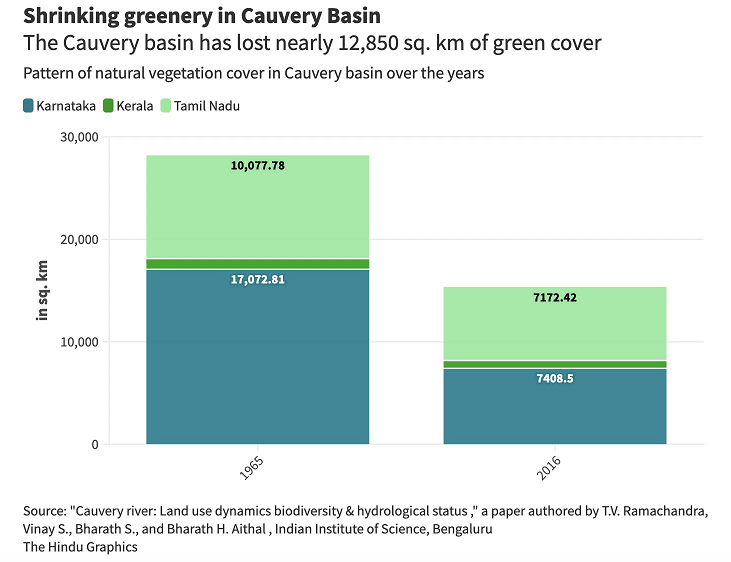
The study by Indian Institute of Science (IISc), Bangalore has brought to light one of the key reasons for the water problems of Cauvery basin: 12850 Sq km of Cauvery basin has lost natural vegetation over the fifty years between 1965 and 2016. The trend is likely to have continued, possibly at an accelerated pace in the eight years since 2016. It may be useful to assess the hydrological implications of this massive destruction of the Cauvery basin.
SANDRP has been highlighting that the reason for the more frequent floods and followed by water scarcity and drought, in spite of somewhat increased rainfall under changing climate is exactly this, the degradation of the Cauvery catchment, including destruction of local water bodies, groundwater recharging mechanisms and natural vegetation.
This lost natural vegetation area is over 15% of the total catchment area of Cauvery basin. This should give us an idea about how huge this loss has been. And we may as well remember that the situation in most river basins in India is likely to be the same. This also shows how totally wrong and suicidal is the advocacy for building more dams in the basin like the Mekedatu dam that Karnataka is pushing at a huge loss of forests and natural vegetation, ostensibly in the name of more water for Bangalore! How suicidal that proposal sounds, if only we could understand the reality of Cauvery basin situation.
Study Natural vegetation on ~12,850 sqkm in Cauvery basin lost Natural vegetation on nearly 12,850 sq. km of land in the Cauvery basin was lost in the 50 years between 1965 to 2016, according to a recent paper published by scientists and researchers at the Indian Institute of Science (IISc), Bengaluru. Karnataka has lost much more than any other State in the basin. It accounts for three-fourths of the lost cover, while Tamil Nadu’s share is around one-fifth, the study added. Pointing out that natural vegetation cover went down by around 46% all these years, the paper, authored by T.V. Ramachandra, Vinay S., Bharath S., and Bharath H. Aithal, stated that the quantum of reduction of dense vegetation was 35% (6,123 sq. km) and that of degraded vegetation, 63% (6,727 sq. km). https://www.thehindu.com/sci-tech/energy-and-environment/natural-vegetation-on-nearly-12850-sq-km-in-the-cauvery-basin-has-been-lost-says-a-research-paper/article67624533.ece (10 Dec. 2023)
Green cover loss in Cauvery basin: NGT issues notice to southern states The NGT has served notices to Karnataka, Tamil Nadu and Kerala govts, based on a IISc study. The notices, directed to the MoEF, the director general of forest survey of India and other authorities concerned, was taken up suo motu by Justice Prakash Srivastava. Considering the gravity of the environmental impact, the NGT categorised the issue as a matter of environmental law. The SC has affirmed that voluntary cases can be filed in such instances. The states concerned were urged to respond promptly to the NGT and the case will be heard at the Chennai bench of the Tribunal, given its jurisdiction over the matter.
‘Rally for Cauvery’ by the organisation claims to have raised funds for planting over 46 million trees in the Cauvery basin and efforts by the foundation’s leader Sadhguru have garnered celebrity and political support. However, environmental experts and scientists have raised red flags, casting doubt on the project’s efficacy and long-term impact. Ecologist Shishir Rao criticised the foundation’s focus on tree planting, arguing that it ignored the root causes of the Cauvery’s woes, large dams disrupting water flow and sediment transport.
Afforestation is not the magic bullet for boosting rainfall, according to experts like those at the ATREE. They pointed to urbanisation, groundwater depletion and existing / planned dams as the true culprits. ATREE proposed a more holistic approach, emphasising urban pollution control, proper waste management and restoring riparian and floodplain ecosystems. Additionally, adopting sustainable agricultural practices like water-efficient crop selection and drip irrigation is crucial. Relying solely on captivating solutions without addressing the multifaceted challenges faced by India’s rivers might be akin to chasing a green mirage. https://www.downtoearth.org.in/news/forests/concerns-raised-over-decimation-of-green-cover-in-cauvery-basin-ngt-issues-notice-to-southern-states-93875 (14 Jan. 2024)
HYDRO POWER PROJECTS
Himachal Pradesh MoEF gives nod for 191 Mw Hydro project on Beas The MoEF has given forest clearance for the construction of the 191 (MW) Thana Plaun hydel power project on the Beas in Mandi district. Now, 406.79 hectare forestland will be diverted in the name of Himachal Pradesh Power Corporation Limited by the Forest Department for the power project. This project has been contemplated as a storage-cum-run-of-the river scheme envisaging a Roller Compacted Concrete (RCC) gravity dam of 85 m height above the riverbed level. The dam site is proposed to be located 40 km downstream of the Pandoh Dam and the powerhouse will be located downstream of the dam. https://www.tribuneindia.com/news/himachal/forest-ministry-gives-nod-for-191-mw-power-project-on-beas-580703 (13 Jan. 2024)
Govt forms committee to collect royalty from HEPs Aiming to revive the empty coffers of Himachal Pradesh, the government has formed a committee to collect royalty from different hydropower projects in the state. The committee will be headed by director energy Harikesh Meena has been assigned the responsibility of convincing the power projects to pay royalties. The committee constituted under the chairmanship of the energy director has included officials from the state electricity board and power corporation as members. This committee will soon prepare a report on the entire matter and raise the matter in the interests of the state before the Central Electricity Authority. The government has already issued a notice to Satluj Jal Vidyut Nigam Limited to give more electricity free in royalty. Efforts have now begun to resolve the matter through the mediation of the central authority to get the state’s fair share.
CM Sukhwinder Singh Sukhu has recently met Union new and renewable energy minister RK Singh in New Delhi regarding this matter. The CM had discussed with RK Singh about protecting the interests of the state in the face of revenue loss due to delayed royalty in the power projects of SJVN and NHPC in the state. The chief minister had requested to provide free electricity under the state’s electricity policy and raised the issue of getting these projects back to the state after 40 years. https://www.hindustantimes.com/cities/chandigarh-news/himachal-forms-committee-to-collect-royalty-from-hydropower-projects-101705000375588.html (12 Jan. 2024)
CM: Himachal suffered huge losses due to HEPs allotted to SJVNL The CM on Jan. 11 said that the terms for awarding Luhri, Sunni and Dhaula-Siddh hydropower projects to the SJVNL by previous govt were against the interests of the state and its people. The CM said that the Bhakra Beas Management Board (BBMB) owed over Rs 4,300 crore to the state government but was not paying the amount despite repeated requests. He added that Central Government undertakings were opposing the water cess levied by the state government on their hydroelectric projects despite making huge profits from these.
Meanwhile, Sukhu laid the foundation stones of a new drinking water facility for Nadaun town to be constructed at a cost of Rs 44.66 crore, HPTDC hotel with an outlay of Rs 43.06 crore, a rest house of the Jal Shakti Department at Gagaal at be built at a cost of Rs 6.54 crore and a Rs 14.02-crore Model Career and Skill Centre at Jalari. https://www.tribuneindia.com/news/himachal/cm-state-suffered-huge-losses-due-to-hydropower-projects-allotted-to-sjvnl-580228 (11 Jan. 2024)
HC restrains govt from taking coercive action against SJVNL A High Court Bench headed by the Chief Justice has stayed the order of the Directorate of Energy of the state govt dated Dec 20 2023, threatening to take over the three projects (Luhri-I, Sunni and Dhaulasindh) allotted to SJVN if SJVN does not sign an agreement with the state govt as per HP Energy Policy. Both sides have suggested they will meet soon and decide. https://www.tribuneindia.com/news/himachal/himachal-high-court-restrains-government-from-taking-coercive-action-against-sjvnl-578897 (07 Jan. 2024)
5-member team to plead case with CEA Himachal’s case will be argued before the CEA on Jan 20 2024 regarding the three SJVN hydro projects that HP wants to take back from SJVN for lack of implementation agreement. https://www.tribuneindia.com/news/himachal/five-member-team-to-plead-case-with-cea-579480 (09 Jan. 2024)
Meghalaya Umiam stage I dam bridge under repair The site visit by Power Minister AT Mondal on Thursday (Jan. 11), which focused on the Umiam Stage-I Dam, specifically the spillway bridge, was aimed at assessing the progress of critical DRIP works, such as drilling and grouting. One of the key outcomes of the visit was the decision to replace the existing damaged Roller Rocker Bearings, a long-overdue measure critical for the structural integrity of the spillway bridge. https://theshillongtimes.com/2024/01/12/umiam-bridge-repair-mondal-for-manpower-along-road-flanks/ (12 Jan. 2024) https://theshillongtimes.com/2024/01/11/meghalaya-govt-takes-steps-to-ensure-safety-efficiency-at-umiam-stage-i-dam/ (12 Jan. 2024)
It is learnt that two tender were called by the MeECL for the repair work; one for grouting works (a specialised process that involves injecting a fluid-like material into gaps, voids, or spaces within structures to improve structural integrity, and one for bearing works (a machine element that constrains relative motion to only the desired motion and reduces friction between moving parts).
While the public have themselves put pressure on Government at the urgency of repairing the only connecting link between Shillong and Guwahati, perhaps an alternative route could have been found before repairing a bridge with a daily toll of thousands of vehicles. This of course reflects on the lack of attention and responsibility by previous governments which allowed overloaded-coal trucks to pass through this critical bridge which should have been used only for light motor vehicles, despite the completion of the Shillong by-pass. And even after the bridge was considered to be in a critical condition heavily loaded trucks with essentials and LPG cylinders etc., bound for Shillong were allowed to cross the bridge because the carriers find the Shillong bypass too long and narrow from Diengpasoh onwards. https://theshillongtimes.com/2024/01/11/umiam-bridge-repair-woes/ (11 Jan. 2023)
Uttarakhand Study needed to pin NTPC tunnel role in Joshimath sinking Residents and officials alike continue to believe that NTPC’s construction has created a heavy load on land in Joshimath. “To a certain degree, tunnelling by NTPC is also a contributing factor of land sinking here,” the official said. “But studies have to be completed to say it assertively.” https://scroll.in/article/1061812/why-joshimath-residents-have-moved-back-to-unsafe-houses (10 Jan. 2023)
Video report on hydropower in the Himalayas and disaster risks. https://india.mongabay.com/2024/01/video-hydropower-in-the-himalayas-and-disaster-risks/ (12 Jan. 2024)
Arunachal Pradesh Region highly prone to seismic trigger: NGRI study Abhey Ram Bansal, one of the authors of the study, titled ‘Tiny stresses are capable of triggering earthquakes and tremors in Arunachal Himalaya’ published in Scientific Reports journal, said, “The region is highly vulnerable to seismic activities due to its location at the collision zone of Indian and Eurasian tectonic plates. The area is prone to earthquakes because of the complex structure of faults and fractures. The region is also well known for the complexity of its geological characteristics.”
Even tiny stresses can cause seismic triggering in the Arunachal Pradesh region, says a study by Hyderabad-based National Geophysical Research Institute (NGRI). NGRI scientists, who investigated dynamic triggering in Arunachal using data of 34 significant remote and distant earthquakes, have identified triggered seismicity in the form of microearthquakes and non-volcanic tremors during six remote mainshocks. Arunachal Pradesh, located in north-east India, falls in a seismically active zone. Researchers said the study has the potential to identify vulnerability in north-east India and help understand the seismic hazard in the area. https://timesofindia.indiatimes.com/city/itanagar/arunachal-pradesh-highly-prone-to-seismic-trigger-study/articleshow/106559941.cms (05 Jan. 2024)
Jammu & Kashmir Over 100 active permafrost structures in Jhelum basin: Study More than 100 of these had ridges and bulges on their body, which indicates that the permafrost in them has started moving or melting, said the report’s lead author, Remya, S N Assistant Professor from the Amrita School for Sustainable Futures, Amrita Vishwa Vidyapeetham, Kerala. These are called ‘active glacial rocks’ and may contribute to natural disasters as the region warms. Research on permafrost, which are thick ground layers frozen for at least two years, is at an advanced stage in places like Greenland, Alaska and Siberia. But little is known about the rock glaciers of the Himalayas.
But there is a silver lining: These permafrost structures hold large volumes of water and at a time when water sources are fast-disappearing, these can be valuable reserves. “Across the Jhelum basin, active rock glaciers store a trillion litres of frozen water, according to the 2022 report.
The authors called for more research to understand the distribution of permafrost across the mountainous regions of India, specifically the western Himalayas where the glacial retreat is fast and significant, to assess risks associated with them. “The region’s complex topography and limited accessibility make field investigations challenging, highlighting the importance of remote sensing and modelling techniques in studying these frozen landforms,” they added. https://www.downtoearth.org.in/news/climate-change/over-100-active-permafrost-structures-identified-in-jhelum-basin-can-cause-landslides-glofs-in-future-study-93796 (09 Jan. 2024)
Report Transboundary hazard & downstream impact of GLOFs Among the 230 transboundary glacial lakes in the Hindu Kush Karakoram Himalaya, 55 lakes can potentially impact other glacial lakes along their flow path, creating a cascade of events. Five transboundary lakes could potentially impact over 1000 buildings, and 16 lakes could impact over 500 buildings. A total of 35 lakes can impact at least one hydropower station along their flow path, and 4 lakes can impact two hydropower stations. This research emphasizes the critical importance of conducting comprehensive risk analyses of GLOFs in transboundary regions to inform policy-makers. It calls for investing in broad-scale assessments and data-driven decision-making for mitigating and adapting to GLOF risks effectively. Finally, by raising awareness among policy-makers, the study aims to drive actions that safeguard communities and infrastructure vulnerable to GLOF. https://www.sciencedirect.com/science/article/abs/pii/S0048969723083882
Maharashtra CBI books 3 retired SJVN officials The accused allegedly did not ensure the proper installation of equipment and material at SJVNL’s power plant in Maharashtra’s Ahmednagar district, resulting in its under-performance. The Central Bureau of Investigation (CBI) has registered a case against three former officials of the Satluj Jal Vidyut Nigam Limited (SJVNL), a public sector undertaking, and others, for allegedly causing a loss of ₹191 crore to the exchequer.
– Among those named in the First Information Report (FIR) are R.K. Agarwal, retired Executive Director; Sanjay Uppal, retired Chief General Manager; and A.K. Jindal, retired Deputy General Manager of SJVNL; Vineet Sharma and C.M. Jain, representatives of Power Energy Consultants; and Gamesa Wind Turbines Private Limited (Chennai), now known as Seimens Gamesa Renewable Power Private Limited, the agency said. It has been alleged that the private company had provided a faulty feasibility report for the installation of the wind power plant. The accused, in a conspiracy with others, allegedly did not ensure the proper supply and installation of equipment and material as per the tender specifications for the installation of SJVNL’s power plant at Khirvire/Kombhalane in Ahmednagar district of Maharashtra, resulting in under-performance of the plant.
– “Searches were conducted at seven places in Delhi, Ghaziabad, Gururgram, Punjab’s Samana in Patiala district, and Chennai,” an official said. https://www.thehindu.com/news/national/cbi-books-three-retired-officials-of-satluj-jal-vidyut-nigam-others-for-allegedly-causing-a-loss-of-191-crore-to-the-exchequer/article67727859.ece (11 Jan. 2024)
MoEF Decisions of EAC meeting held on Dec 19-20 2023 as per minutes now available:
1. CHH-09 Pumped Storage Project (1200 MW) by STERLITE GRID 36 Ltd at SURGUJA, CHHATTISGARH for TOR: APPROVED
2. Gandhwani Pumped Storage Project (1200 MW) by Gandhwani ENERGY Pvt Ltd at SURAJPUR, CHHATTISGARH: For TOR: Approved
3. Greenko UP01 Off-Stream Closed Loop Pumped Storage Project by GREENKO ENERGIES Pvt Ltd at SONBHADRA, UTTAR PRADESH for EC: Approved
4. Kandhaura Pumped Storage Project (1680 MW) at Village: Sashnai, Taluka: Obra and Villages: Markuri & Cherue Taluka: Robertsganj, District: Sonbhadra, Uttar Pradesh by JSW Energy PSP Six Ltd by JSW ENERGY PSP SIX Ltd at SONBHADRA, UTTAR PRADESH FOR TOR: The EAC unanimously decided to seek comments of Central Electricity Authority (CEA) about observed overlapping of project components of Kandhaura Closed Loop Pumped Storage Project (1680 MW) and Sonbhadra Pumped Storage Project. it was also recommended to seek details about necessary consent/ MoU signed by the project developers for both projects, so that the EAC can take appropriate decision on the present proposal.
5. 1500 MW Pane Pumped Storage Project at Villages: Pane and Vagheri, Taluka: Mahad, District: Raigad, and Village: Khanu, Taluka: Velhe, District: Pune, Maharashtra by JSW Energy PSP Seven Ltd. by JSW ENERGY PSP SEVEN Ltd at RAIGAD, MAH: Approved
6. Oju HEP by OJU SUBANSIRI HYDRO POWER CORP PVT LTD at UPPER SUBANSIRI, ARUNACHAL PRADESH for amendment in TOR: Approved.
7. Gandikota Pumped Storage Project (1000 MW) by NEW & RENEWABLE ENERGY DEVELOPMENT CORP OF ANDHRA PRADESH LTD at Y.S.R., ANDHRA PRADESH: For EC: Approved
8. Lower Orr by National Water Development Agency located at SHIVPURI, MADHYA PRADESH for TOR: Approved
9. Gadikota Pumped Storage Project (1200 MW) by NEW AND RENEWABLE ENERGY DEVELOPMENT CORP OF ANDHRA PRADESH LTD at ANNAMAYYA, ANDHRA PRADESH for TOR: Approved https://parivesh.nic.in/utildoc/37328773_1704718073375.pdf
MoEF Agenda EAC meeting on River Valley Projects, to be held on January 23 2024:
1. Tiruvannamalai Close Loop Pumped Storage Project (2000 MW) in 295 ha at Village Gengavaram, Sub-Dist Kalasapakkam, Dist Tiruvannamalai, Tamil Nadu by Eco Leap Technologies India Pvt Ltd – Terms of References
2. Kalamb Thakurwadi Close Loop Pumped Storage Project (1000 MW) in 157 ha at Village Ambavane, Sub-Dist Mulshi, Dist Pune, Mah by Renew Solar Power Pvt Ltd – Terms of References
3. Saruali Close Loop Pumped Storage Project (840 MW) in 276 ha at Village Saruali, Tehsil Rengali, Dist Deogarh, Odisha by Jindal Renewable Power Pvt Ltd – Terms of References
4. 1500 MW Dharampur Close Loop Pumped Storage Project in 278.7 ha at Village Bhanval, Sub-Dist Dharampur, Dist Valsad, Gujarat by Adani Green Energy Ltd – Terms of References
5. Bilaspur Open Loop Pumped Storage Project (1000 MW) in 301.5Ha in Village Manjurpah & Karichhaper, Dist Bilaspur, Chhattisgarh by Jindal Renewable Power Pvt Ltd – Terms of References https://parivesh.nic.in/utildoc/37607261_1704807820385.pdf
Relevant agenda of the FAC meeting to be held on Jan 17, 2024: – DIVERSION OF 315.74 HA FOREST LAND FOR RENOVATION OF ASOLAMENDHA IRRIGATION PROJECT IN SAOLI, MUL AND POMBHURNA TALUKAS OF CHANDRAPUR DIST IN MAH https://forestsclearance.nic.in/AgendaDetail.aspx?id=297!dis1&fbclid
DAMS
Kaleshwaram Project Govt asks HC to assign judge for probe The state govt on Tuesday (Jan 9) asked Telangana High Court Chief Justice Alok Aradhe to allocate a judge to probe the engineering lapses in the construction of the Kaleshwaram Lift Irrigation Scheme (KLIS) and subsequent sinking of Medigadda Barrage piers. On the day, the vigilance and enforcement departments searched multiple locations in connection with the alleged irregularities in the KLIS construction.
– Disclosing the government’s decision on the judicial probe, irrigation minister N. Uttam Kumar Reddy said that the state government also ordered a vigilance inquiry into the KLIS. The moves come after Chief Minister A. Revanth Reddy had announced, in the recent Assembly session, that the state government would order a judicial inquiry into KLIS, ascertain the party responsible for finalising its design, how the contract was finalised and awarded, alongside other factors that caused the issue at Medigadda Barrage. According to officials associated with the searches, an inquiry has been taken up on the allegations of sub-standard work in KLIS and also several other irregularities related to the planning, design, execution, payment and other aspects. https://www.deccanchronicle.com/nation/current-affairs/090124/cong-asks-hc-to-assign-judge-for-klis-probe-raids-held-at-multiple-g.html (09 Jan. 2024)
Annaram Barrage seepage repair work begins Afcons Infrastructure Limited, that constructed the Annaram Barrage, has started the seepage repair work using Polyurathene as grouting material in the Barrage on Saturday (Jan. 13). In Annaram Barrage, which is a part of Kaleshwaram Lift Irrigation Scheme, small seepages occurred at gate number 38 and 28 due to heavy rains in October. The officials who were alerted made a temporary treatment with stone, metal and sand and controlled the leakage and prevented sand from seepage. After Grouting, another agency will check the status of leakage. https://telanganatoday.com/annaram-barrage-seepage-repair-work-begins (13 Jan. 2024)
Vigilance raids to uncover irregularities in KLIS The officials seized key documents, records, files and hard discs pertaining to the Medigadda and Annaram barrage and of Kannepalli Laxmi Pump house. It is learnt that the vigilance officials admonished the irrigation officials for not producing key files and documents of the barrages constructed under the Kaleshwaram project. There are allegations against the irrigation officials of the Kaleshwaram project that they had lifted all the important documents as soon as the government changed in Telangana after the recent assembly polls. All the important files, documents and records were kept at the irrigation offices in Bhupalpally district. https://www.deccanchronicle.com/nation/current-affairs/120124/vigilance-raids-uncover-irregularities-in-kaleshwaram-project-document.html (12 Jan. 2024)
Redesigning raised costs by 400%: CAG report The CAG also observed that the BRS government went ahead with re-engineering without exploring alternative ways to make the best use of the old B.R. Ambedkar Pranahita-Chevella Sujala Sravanti (PCSS) launched by erstwhile Andhra Pradesh CM Dr Y S Rajashekar Reddy-led government in the undivided state.
Aimed at increasing the area under irrigation by 50 percent, the cost of the project also skyrocketed from Rs 38,000 crore to Rs 1.5 lakh crore, so far as. However, several pending works are yet to be completed.
A CAG report published two years ago clearly stated that the re-engineered Kaleshwaram project was “economically unviable and ab-initio.” The CAG report revealed that substantial amounts of the increased project cost were pocketed by the contractors, more particularly Megha Engineering and Infrastructure Limited. In terms of contract management of the Kaleshwaram project, the CAG in its report held that the BRS government gave the contractors an undue benefit of Rs 25,188.43 crore.
The report also alleged that, in the case of the now-sinking Medigadda Barrage, consultants were only given a span of four months by the Telangana government to come up with detailed estimates of the project, while soil testing itself would only take up to a year. https://www.siasat.com/redesigning-of-kaleshwaram-increased-costs-by-400-cag-report-2954163/ (11 Jan. 2024)
CAG finds excess payments of Rs. 7500 cr According to the draft performance audit report on KLIS by the CAG, the company was paid an excess of Rs.5,188.43 crore in just four packages, involving the supply and commissioning of pumps, motors and auxiliary equipment.
-The amount is likely to be much more as there were 17 more such packages. While works in four of 17 packages were still under progress at the time of the audit in 2022, the BRS government did not provide invoices for 13 packages to the auditing agency, without which it could not arrive at the excess payments made to the contractors. https://www.deccanchronicle.com/nation/crime/080124/klis-a-cesspool-of-corruption-cag-finds-excess-payments-of-rs7500-c.html (08 Jan. 2024)
KLIS absence looms large over Yasangi season Much of the Krishna basin ayacut was in the grips of acute scarcity conditions and a crop holiday was already declared in part of the ayacut, especially in 6.3 lakh acres under the Nagarjuna Sagar Project left canal in the absence of adequate inflows into the Krishna basin projects. Now, ringing more alarm bells, uncertainty looms large over irrigation support to a major extent in the Godavari basin as well.
A major reason for the shortage of water was the three key barrages of the KLISs, a project repeatedly derided by the Congress, being drained for rehabilitation works with the Medigadda pillars sinking. However, even when all the projects integrated with the multi stage project holding just six tmc less water compared to last year, the government appears to be throwing up its hands citing severe shortage of water. https://telanganatoday.com/kaleshwarams-absence-looms-large-over-yasangi-season-in-telangana (14 Jan. 2024)
Edit It is time for facts about the Kaleshwaram Lift Irrigation Project to come out. https://www.thehindu.com/opinion/op-ed/telanganas-kaleshwaram-lift-irrigation-project-a-project-in-troubled-waters/article67740766.ece (15 Jan. 2024)
Polavaram Project PPA to take up D wall study The Polavaram Project Authority (PPA) would call for tenders shortly to decide on an international agency for a study on the partially damaged diaphragm wall of the irrigation project. After study, the agency would recommend whether to go for construction of a new wall or do only repair works to the existing one.
– Ever since, the water resources authorities noticed damage to some portions in the D-wall, the AP government and the central agencies like the PPA, the Central Water Commission and other agencies are on the lookout to address the issue. The AP government proposed construction of a new D-wall for the full length of nearly 1,400 metres parallel to the damaged D-wall. The government felt this would ensure safety of the whole Polavaram project including the upcoming earth-cum-rockfill-dam.
– According to an estimate, it costs nearly Rs 800 crore to construct a new D-wall while it would require Rs 408 crore to repair the damaged one. The proposal for carrying out repair works to the damaged D-wall is found to be highly unviable from the safety point of view. Any damage to the repaired D-wall in the form of leakage of water, in future, may result in a major disaster, it was averred. Now, the international agency may also be asked to take up a study on ground improvement where the D-wall is located, the stability of underground earth, the seepage of water from upper coffer dam and the stability of earth where the ECRF dam will be constructed.
– Meanwhile, the water resources authorities are taking up vibro compaction works to solidify the soil in the D-wall area. https://www.deccanchronicle.com/nation/current-affairs/110124/project-authority-to-take-up-study-on-polavaram-d-wall.html (11 Jan. 2024)
Karnataka HC bans quarrying in 20km radius around KRS The High Court of Karnataka bench headed by Chief Justice in a suo motu action on Monday (Jan. 08) imposed a ban on mining and blasting activities within a 20-km radius of the Krishna Raja Sagara (KRS) dam in Srirangapatna. The ban issued on Jan 8 2024 will be in force till the Central Institute of Mining and Fuel Research, Dhanbad, conducts a dam safety survey. A division bench comprising Chief Justice Prasanna B Varale and Justice Krishna S Dixit passed the order, pointing to the safety of the century-old dam and the requirement of the same under the provisions of Dam Safety Act of 2021. The mining department has been told to pass necessary orders in this regard. The court is hearing a petition filed by CG Kumar, who had challenged the May 15, 2023, communication issued by the Mandya deputy commissioner with respect to 120 acres of land in Pandavapura taluk where he was keen on quarrying after getting the land converted for nonagricultural purposes. https://timesofindia.indiatimes.com/city/bengaluru/hc-bans-quarrying-and-mining-in-20km-radius-around-krs/articleshow/106650100.cms (09 Jan. 2024) High Court Directs Scientific Study To Be Conducted For Determining Feasibility https://www.livelaw.in/high-court/karnataka-high-court/karnataka-high-court-gr-medical-college-mangalore-inspection-national-medical-council-article-226-constitution-246558 (09 Jan. 2024)
Madhya Pradesh विशेषज्ञ समिति द्वारा बसनिया का टी. ओ. आर मंजूर; प्रभावितों ने कहा परियोजना आदिवासी हित में नहीं: –पर्यावरण, वन एवं जलवायु परिवर्तन मंत्रालय द्वारा गठित विशेषज्ञ मुल्यांकन समिति की 49 वीं बैठक दिनांक 24 जुलाई 2023 को प्रस्तावित बसनिया बहुउद्देशीय परियोजना के लिए पर्यावरणीय प्रभाव आकलन रिपोर्ट तैयार करने हेतु संदर्भ बिन्दु (टी.ओ.आर) देने का निर्णय लिया है। पर्यावरण, वन एवं जलवायु परिवर्तन मंत्रालय दिल्ली द्वारा नर्मदा घाटी विकास प्राधिकरण को लिखे गए पत्र दिनांक 21 नवम्बर 2023 में उल्लेख किया है कि पर्यावरणीय प्रभाव आकलन 2006 के प्रावधान और संशोधन के साथ निम्न अतिरिक्त एवं विशिष्ट संदर्भ बिन्दु भी शामिल है।जिसमें परियोजना निर्माण के कारण नर्मदा नदी, नाला के जलग्रहण क्षेत्र में उसके वहन क्षमता और निरंतरता का संचयी प्रभाव(कम्यूलेटिव ईम्पेकट) का अध्ययन।वन भूमि को कम करना जिससे पर्यावरणीय निरंतरता सुनिश्चित हो।नर्मदा कंट्रोल ऑथोरिटी को परियोजना प्रस्ताव के साथ पर्यावरणीय प्रभाव निर्धारण व पर्यावरणीय प्रबंधन नियोजन रिपोर्ट भेजकर उनसे टिप्पणी लेना।वन भूमि का परिवर्तन, जैव विविधता हानि के कारण जंगल के पारिस्थितिकी तंत्र पर पङने वाले असर का पर्यावरणीय दृष्टि से लाभ हानि का विश्लेषण करना। पर्यावरण प्रभाव निर्धारण रिपोर्ट में मिट्टी की विशेषताओं का अध्ययन कम से कम 10 अलग- अलग स्थानों का करना, जो जलाशय और जंगल के आसपास वाले गांव हैं।तीनों ऋतु में परियोजना क्षेत्र के 10 जगहों का भूजल स्तर का नाप करना। परियोजना के कारण जलीय और स्थलीय पारिस्थितिकी तंत्र पर पङने वाला असर का अध्ययन।वन्य जीव संरक्षण का विस्तृत रिपोर्ट तैयार कर मुख्य वन्य प्राणी वार्डेन को जमा करना।डूब में आने वाले वनस्पति एवं जीवजंतु और पेङो की संख्या,घनत्व एवं उसका नामावली के साथ विस्तृत रिपोर्ट तैयार करना।नर्मदा घाटी विकास प्राधिकरण ने पर्यावरण प्रभाव आकलन रिपोर्ट तैयार करने के लिए कंसल्टेंन्ट आर एस इंवाईरोलिंक टेक्नोलॉजी प्राइवेट लिमिटेड दिल्ली को जिम्मेदारी दिया है।
नदी घाटी विशेषज्ञ मुल्यांकन समिति ने 25 जनवरी 2023 की आयोजित बैठक में परियोजनाकर्ता के प्रस्ताव पर टिप्पणी किया था कि परियोजना में 2107 हेक्टेयर वन भूमि क्षेत्र शामिल है।कम से कम जंगल शामिल हो इसका कोई अभ्यास नहीं किया गया है और ना ही इस परियोजना का वैकल्पिक स्थल विश्लेषण इस आवेदन के साथ प्रस्तुत किया गया है।समिति ने यह भी कहा था कि इस विकास परियोजना में जंगल का बङे क्षेत्र की आवश्यकता होगी और साथ ही परियोजना क्षेत्र में आदिवासी जनसंख्या निवास करता है। बसनिया (ओढारी) बांध विरोधी संघर्ष समिति ने सवाल उठाया है कि इस बांध में 6343 हेक्टेयर क्षेत्र डूबा कर मात्र 8780 हेक्टेयर मात्र की सिंचाई होगी।यह भी सर्वविदित है कि सिंचाई का जितना लक्ष्य रखा जाता है, उसमें मात्र औसत 60-65 प्रतिशत ही सिंचाई लक्ष्य पूरा होता है।दूसरी ओर 40 प्रतिशत प्लांट लोड फैक्टर के कारण 100 मेगावाट से मात्र 350 मिलयन यूनिट वार्षिक विधुत उत्पादन किया जा सकेगा।इतने कम सिंचाई और विधुत उत्पादन के लिए प्राकृतिक संपदा का विनाश करना आदिवासी समुदाय के हित में नहीं है।संगठन ने निर्णय लिया है कि सभी प्रभावित गांव और समाजिक संस्था की ओर से परियोजना के विरोध में पर्यावरण मंत्रालय को पत्र भेजा जाएगा।
बजारी लाल सर्वटे(9300509691) ;अध्यक्ष, बसनिया (ओढारी) बांध विरोधी संघर्ष समिति, मंडला; तितरामरावी( 9111411084) उपाध्यक्ष, बसनिया (ओढारी) बांध विरोधी संघर्ष समिति
Sardar Sarovar Project Narmada oustees want demands met About seven years after a massive protest, the state government on November 18 last year announced the integration of 80 settlements affected by the Sardar Sarovar Dam Project with village panchayats as a step forward in the rehabilitation process.
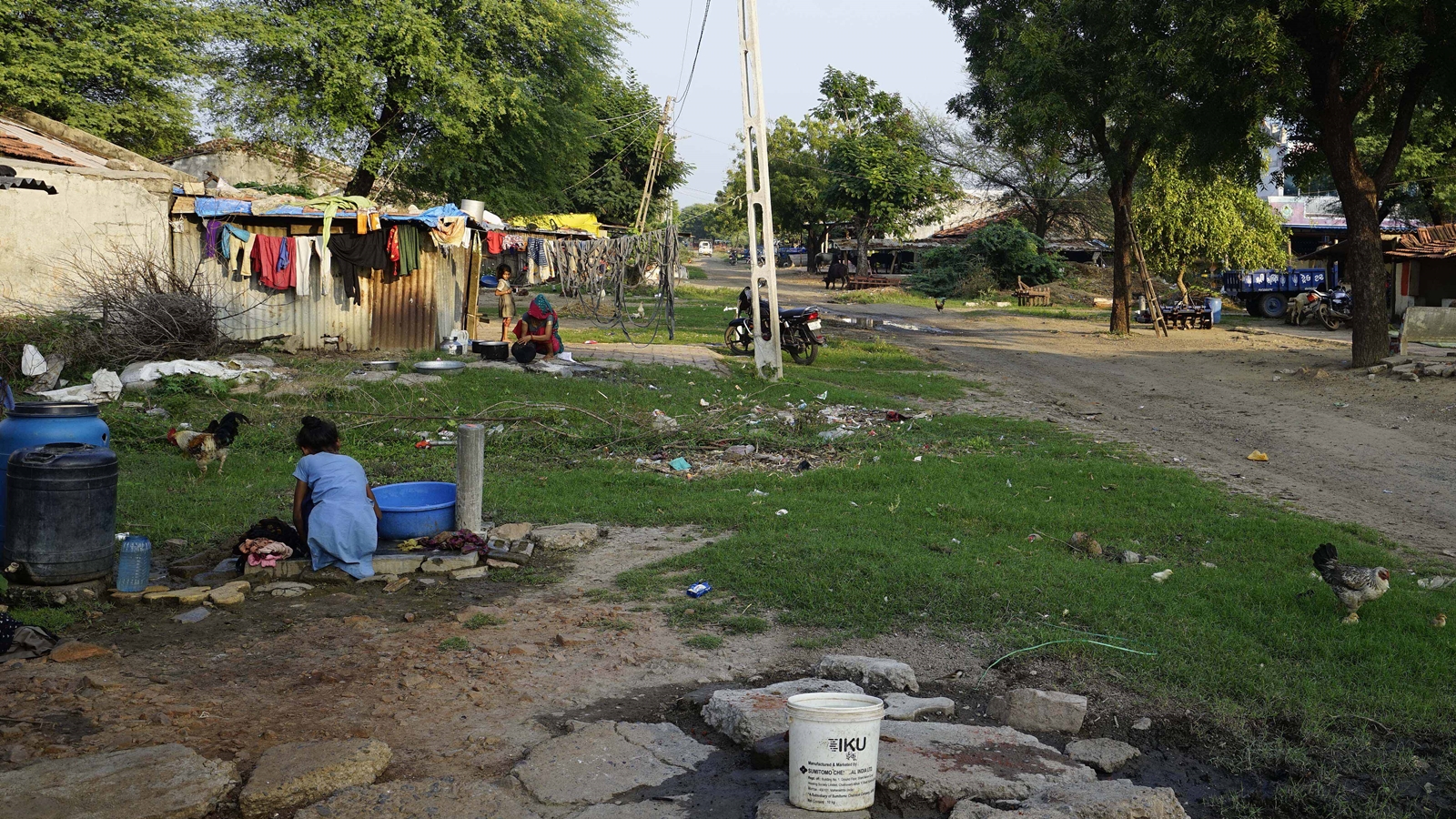
However, as the government says most grievances in this regard have been resolved, settlers in two of the six affected districts say their long-pending demands remain unmet. In 2016, Shira vasahat — a settlement affected by the Sardar Sarovar Dam Project — had become the centre of a huge protest that lasted seven months. Jiku Tadvi, 60, a Narmada Bachao Andolan activist, led the hunger strike. https://indianexpress.com/article/cities/ahmedabad/sardar-sarovar-dam-project-rehabilitation-before-village-mergers-narmada-oustees-want-demands-met-9099291/ (08 Jan. 2024)
Himachal Pradesh Pong dam displaced oppose ESZ plan Over 25,000 people displaced by the Pong dam on the Beas river have been waiting to be relocated for over five decades. Many of them were surviving by farming around the dam region. But a draft policy to declare Pong Dam eco-sensitive zone (ESZ) is likely to impact these oustees again, who are planning to protest against the MoEFCC’s decision. https://www.downtoearth.org.in/news/governance/pong-dam-eco-sensitive-zone-awaiting-rehabilitation-for-over-50-years-not-consulted-for-policy-decision-say-locals-93814 (10 Jan. 2024)
Punjab No outflow from Ranjit Sagar Dam till Feb 14 The state Water Resources Department has decided to close the water outflow from Ranjit Sagar Dam for 31 days to carry out urgent work. The official spokesperson said water outflow from the dam will remain closed for 31 days (January 15 -February 14) to complete urgent work, including the plugging of under sluices and the impounding of Shahpurkandi Dam. https://www.tribuneindia.com/news/punjab/no-outflow-from-ranjit-sagar-dam-till-february-14-580980 (14 Jan. 2024)
Study River damming impacts fish habitat, associated conservation measures Abstract: Dams have extensively altered global river dynamics, including riverine connectivity, hydrological, thermal, sediment and solute regimes, and the channel morphology. These alterations have detrimental effects on the quality and quantity of fish habitat and associated impacts on aquatic life. Indeed, dams have been implicated in the decline of numerous fishes, emphasizing the need for effective conservation measures.

This paper (River damming impacts on fish habitat and associated conservation measures. Reviews of Geophysics, 61, e2023RG000819) presents a global synthesis of critical issues concerning the impacts of river damming on physical fish habitats, with a particular focus on key fish species across continents. We also consider current fish conservation measures and their applicability in different contexts. Finally, we identify future research needs. The information presented herein will help support sustainable dam operation under the constraints of future climate change and human needs. https://agupubs.onlinelibrary.wiley.com/doi/pdfdirect/10.1029/2023RG000819
INTERLINKING OF RIVERS
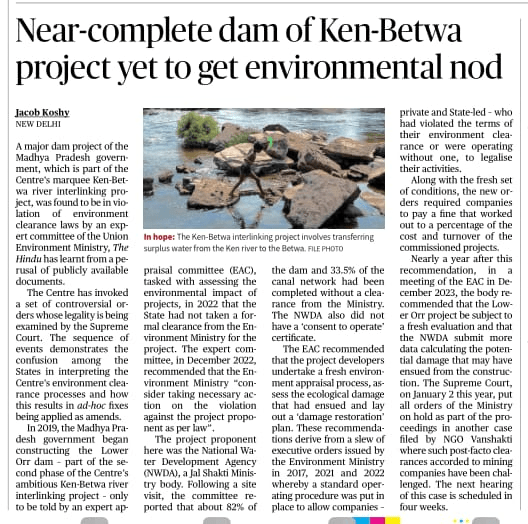
Ken-Betwa Linking Dam near complete without EC This is the pathetic track record of ILR and NWDA. 82% of the Lower Orr Dam, part of Ken Betwa Project Phase 2, has been constructed even without environmental clearance.
INTERSTATE WATER DISPUTES
Krishna Water Dispute Telangana to approach Maharashtra seeking water from Koyna dam The Telangana government is planning to approach the Government of Maharashtra requesting for release of 8 TMC water immediately from the Koyna dam to meet its drinking water needs in the Krishna basin. Koyna dam, with a gross storage capacity of 105 TMC utilises its inflows mainly for hydro-electric power generation. The Maharashtra government was generating power using Koyna river water and releasing the same into the Arabian Sea. Officials said the project had scope to spare up to 30 TMC of water as per the Krishna Water Disputes Tribunal Award. The Nagarjunsagar project is left with only 20 TMC of water above the minimum draw down level. In Srisailam it is 17 TMC. Upper Krishna project in Karnataka also does not have any water to spare. https://telanganatoday.com/telangana-to-approach-maharashtra-seeking-water-from-koyna-dam (11 Jan. 2024)
Telangana Seeks 10 TMC Ft Water from Karnataka The state government will soon seek 10 tmc ft of water from Karnataka to augment storage in Telangana reservoirs to meet drinking water needs in the summer, irrigation minister N. Uttam Kumar Reddy said on Saturday (Jan. 13). He said a delegation led by CM A. Revanth Reddy would visit Karnataka to discuss the issue. Uttam Kumar Reddy also said that the Congress government was committed to providing irrigation to 4.5 lakh to 5 lakh additional acres by the end of this year. https://www.deccanchronicle.com/nation/in-other-news/140124/telangana-seeks-10-tmc-ft-water-from-karnataka.html (14 Jan. 2024)
URBAN RIVERS
Sabarmati; Ahmedabad Drone survey shows 20 polluting outfalls In February 2023, the Sabarmati was rated as the second-most polluted river in the country, the first being the Cooum in Tamil Nadu, in a CPCB report tabled by the Union ministry of jal shakti. The Gujarat Pollution Control Board (GPCB) conducted a comprehensive drone survey spanning Rayasan in Gandhinagar and Vautha in the Gulf of Khambat on the river stretch and found 123 sewage outfalls that were live and dry. Of these, 73 were found to be actively releasing domestic sewage.
– The drone survey was conducted mid-2023, a year after the high court’s reprimand in May 2022. Back in November 2022, the CPCB had found that the stretch of the river between Raysan and Vautha in Dholka had a biological oxygen demand (BOD) of 292 mg/l instead of 9 to 10mg/l as directed by the NGT. Within Ahmedabad city, the GPCB drone survey found 43 outfalls.
– The Ahmedabad Municipal Corporation (AMC) collaborated with IITRAM Maninagar and measured high pollution levels from 20 outfalls. The locations of three of 16 outfalls within the municipal corporation limits could not be accessed while 13 outfalls had undetectable flow. “The 13 outfalls which have been located are dry now but were not sealed, which has made us suspicious that these are probably being utilized by certain agencies. This will be investigated soon,” said a senior AMC official. Meanwhile, recognizing the urgency of the situation, the AMC’s standing committee on Thursday (Jan. 11) approved the measurement of pollution levels of the remaining seven sewage outfalls that were within city limits.
– “The committee has allocated a budget of Rs 1.05 lakh per outfall for IITRAM’s expertise,” added the AMC official. “The GPCB had reminded AMC at least six times till September 2022 after which the AMC roped in IITRAM to measure the outfalls,” added a senior AMC official. https://timesofindia.indiatimes.com/city/ahmedabad/drone-survey-of-sabarmati-shows-20-polluting-outfalls-in-ahmedabad/articleshow/106794460.cms (13 Jan. 2024)
Indrayani; Pune PMRDA waiting approval for river improvement project Pune Metropolitan Region Development Authority (PMRDA) CEO Rahul Mahiwal said on Sunday (Jan. 14) they have prepared a comprehensive 100-page report which details what exactly will be done to abate the river pollution. “We have prepared a Rs 545 crore first phase plan for abatement of Indrayani river pollution. The state government has approved the proposal. Now, it is pending with the central government”.
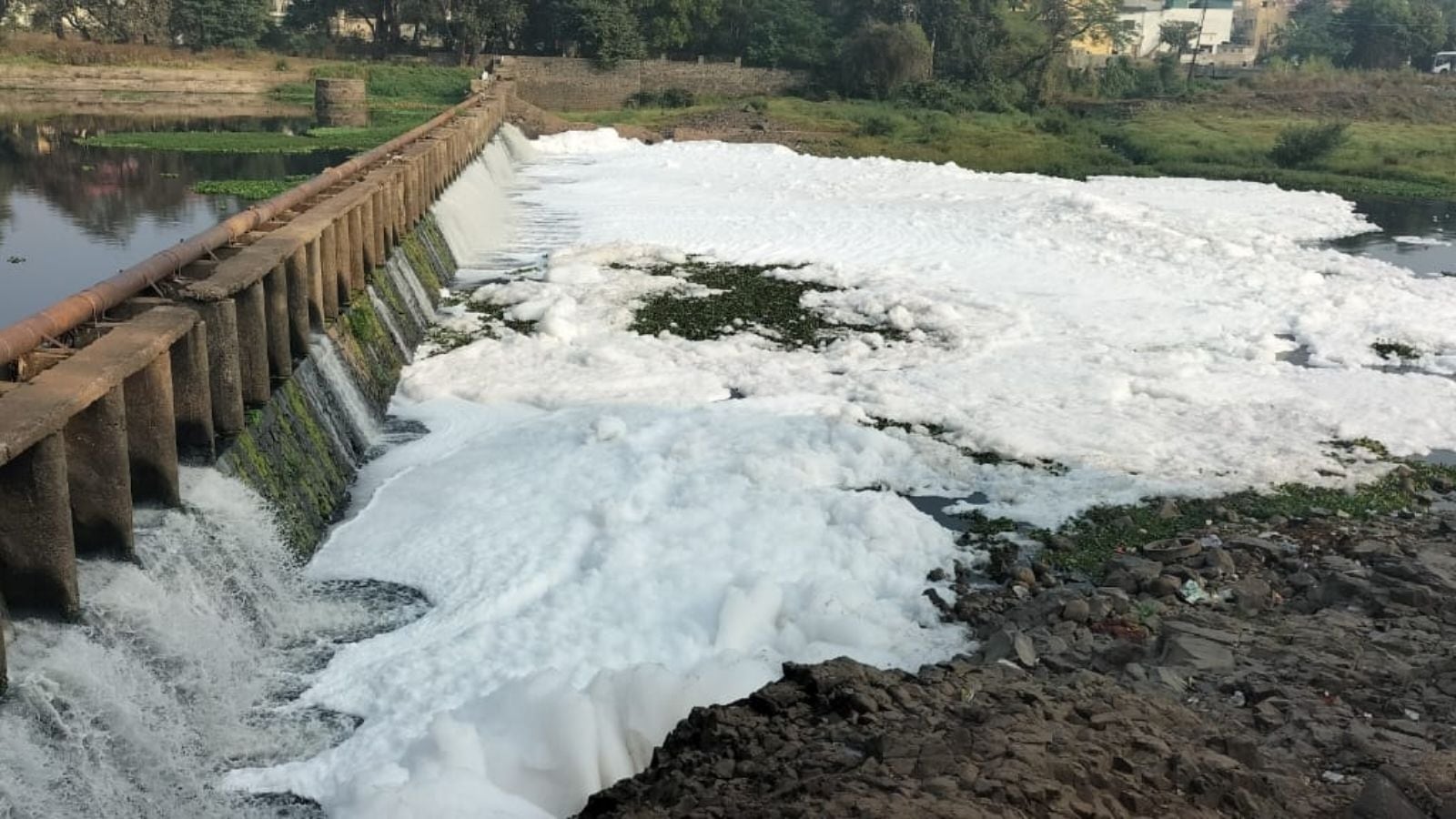
The PMRDA chief said they plan to set up at least 16 STPs across the length of the river from Lonavala to Alandi. “The river improvement work involves putting in place an effective sewerage system and development of riverfront,” he said. The total cost of the Indrayani River Improvement Project is 1,534 crore. “The first phase cost involves around Rs 545 crore, the second phase cost is estimated at Rs 589 crore, and the third phase involves Rs 410 crore,” the PMRDA CEO said. https://indianexpress.com/article/cities/pune/indrayani-river-pollution-pune-centre-approval-river-improvement-project-9108895/ (15 Jan. 2024)
Residents and environmentalists from Pimpri-Chinchwad are raising their voice against pollution of the river with many blaming industrial waste as the main cause. As per the MPCB officials, domestic waste is the primary cause of water pollution along the Indrayani stretches, and pollutants, including detergent and phosphate, are identified, which indicate a higher amount of sewage water in the river. https://www.hindustantimes.com/cities/pune-news/mpcb-official-undertakes-indrayani-pollution-review-101705172779823.html (14 Jan. 2024)
On the fifth consecutive day, the white toxic foam was palpably visible in the river at several places. The river flows for 18 km in Pimpri-Chinchwad – from Dehu Road to Charholi. Last year, too, toxic foam emerging in the river had drawn flak from citizens and activists who held the state government and the PCMC responsible for its plight. On the fifth consecutive day, the white toxic foam was palpably visible in the river at several places. The river flows for 18 km in Pimpri-Chinchwad – from Dehu Road to Charholi. Last year, too, toxic foam emerging in the river had drawn flak from citizens and activists who held the state government and the PCMC responsible for its plight. https://indianexpress.com/article/cities/pune/indrayani-river-white-toxic-foam-mahrahstra-cm-shinde-9098930/ (08 Jan. 2024)
Mithi; Mumbai ~700 illegal structures to be demolished Around 700 structures on a 900-meter stretch between Kalina Bridge to CST Bridge have been a hurdle in the Mithi river widening and deepening project for nearly a decade. The BMC has now conducted a survey to identify the structures eligible for compensation. Accordingly, the illegal structures are planned to be demolished by the first week of February. However, it will be a challenging task to vacate the stay of some of the structures, fears civic officials. https://www.freepressjournal.in/mumbai/mumbai-news-around-700-illegal-structures-to-be-demolished-for-mithi-river-widening-project (09 Jan. 2024)
RIVERS
The river speaks Shrishtee Bajpai: This short story was inspired by a walk organised alongside the Indus river in order to raise awareness and help the youth of Ladakh reconnect with the river and her ecosystem. The Snow Leopard Conservancy India Trust, along with Kalpavriksh, Pune, helped facilitate the walk, which began in Upshi and ended in Phey Village in July 2023. Over the course of six days, 30 Ladakhi students and other river enthusiasts covered around 90 kms together.

I participated in the walk and felt called to imagine what the Indus might be thinking, feeling, and wanting to articulate about the humans who inhabited her banks. I would also like to take the opportunity to thank Ashish Kothari for seeding the idea for this piece. This story is intended to encourage all of us to transcend our anthropocentrism and find more points of connection with the more-than-human. https://darknlight.com/projects/short-story/the-river-speaks/
Chenab symbolizes pain of partition & consumerism Surjit Patar prominent Punjabi poet about the Chenab: -The river still has importance in Punjabi poetry and consciousness. But today, besides reminding us about the classic romances, it also reminds about sadness and the deep pain of separation. I wrote once: Kahe Satluj Da Paani, Aakhe Beas Di Rawani, Saadda Jhelum Chenab Nu Salaam Aakhna (The Satluj and Beas send their Salaams to the Jhelum and Chenab).
The rivers of Punjab, or for that matter, all rivers in India or even abroad, today remind us of the rapacious greed and selfishness of Man. Indeed, the new literature emerging in Punjab does make mention of all this: Our consumerist lifestyles, the short-sightedness of those who lead us. The rivers that once reminded us of love, today remind us of the worst in ourselves. I once wrote on this issue:
Maatam, Hinsa, Khauff, Bebasi Te Anyaa; Aey Ney Ajj Kal Mere Panjaan Daryawaan De Naa; Jo Hunde San Jhelum, Satluj, Ravi, Beas Te Chana (Lament, Violence, Terror, Helplessness and Injustice; These are the names of my five rivers today; Which were Jhelum, Satluj, Ravi, Beas and Chenab.) But I also expressed a note of hope in the last line: Par Jede Ik Din Howange Raag, Shayari, Husan, Mohabbat Ate Nya (But which will one day be Music, Poetry, Beauty, Love and Justice) https://www.downtoearth.org.in/news/water/moon-river-the-chenab-a-symbol-of-lovers-today-symbolises-pain-of-partition-consumerism-says-surjit-patar-93869 (13 Jan. 2024)
Manipur Rivulet on fire after leaking furnace oil from power plant A rivulet in the Imphal West district was on fire on Wednesday (Jan. 10) night after leaking black furnace oil from the Leimakhong Heavy Fuel Power Plant. The Tumu Lairembi rivulet, a tributary of the Nambul River passing through the heart of Imphal city, erupted in flames at Kanto Sabal village, under the Sekmai police station in Imphal West district for about 3 hours.
The fire was extinguished at around 10 pm on Wednesday (Jan. 10) by a team of experts. The leaked oil has also been diverted using an excavator to another drain. It is not yet clear how the fire started, but villagers allege that it may have been lit by miscreants after the crude oil leaked into the rivulet. The Tumu Lairembi rivulet runs beside the Heavy Fuel Power Plant at Leimakhong and passes through many villages before winding its course to the Luwangli River. The Luwangli is also a tributary of the Nambul River which merges with Loktak Lake. https://nenow.in/north-east-news/manipur/manipur-imphal-rivulet-on-fire-after-leaking-furnace-oil-from-power-plant.html (11 Jan. 2024)
Accident or Sabotage? Some unanswered questions -A three-member committee to look into the incident has been formed; they will give a report to the Governor in 15 says, the state Home Department said in an order on behalf of the Governor. While the police will run their own investigation separate from the committee formed by the Governor, publicly available information throws up several questions as to the location of the heavy-fuel power plant and its distance to the river.
-The nearest point from the power station to the river is 450 metres, while the farthest point is 2.5 km within Leimakhong. There are buildings, school, church, market and other structures between the river and the power plant. A surface oil leak would have contaminated the areas between the river and the power plant.
-An electrical engineer who has been to this power plant while it was operational said the facility is a self-contained unit, with no fuel connection outside except the electricity outlet. He ruled out underground seepage from the storage unit as the residual heavy oil from the defunct power station was not enough in volume to push through the soil till the river. The tank would also act as a shield against the soil. https://www.ndtv.com/india-news/leimakhong-manipur-heavy-oil-leak-accident-or-sabotage-some-unanswered-questions-4844970 (12 Jan. 2024)
Odisha SPCB finds untreated sewage discharges in 2 rivers As per reports, officials of OSPCB’s regional office in Rourkela conducted surprise inspections during which they found that untreated sewage and sullage waste water from NIT-R’s academic, administrative, and residential buildings, including hostels, were directly released to a low-lying area near Bartoli behind the campus. It was found that this untreated waste water then flowed into the Koel river through a natural drain near Jhirpani bridge. This apart, untreated waste water was found directly entering the Brahmani river near Panposh from various pockets within the Rourkela Municipal Corporation (RMC) limits.
Notably, multiple discharge points are situated near drinking water intake wells of the Water Corporation of Odisha (WATCO) and Rourkela Steel Plant (RSP) of SAIL on both rivers. Meanwhile, it was reportedly found that a STP for 11 NIT-R hostels constructed a decade ago is defunct. A new STP of 1.5 MLD is under construction. However, it is expected to take at least 30 months to become operational. https://odishabytes.com/opscb-finds-discharge-of-untreated-sewage-into-2-rivers-in-rourkela-sends-notices-to-nit-r-others/ (11 Jan. 2024)
Karnataka Once upon a river As per SPCB’s Nov. 2023 Water quality analysis of 12 rivers in the state, 9 were found to have stretches with poor water quality (class D). The 12 rivers monitored under the central government’s National Water Monitoring Programme (NWMP) include Arkavathi, Lakshmantirtha, Tungabhadra, Bhadra, Cauvery, Kabini, Kagina, Krishna, Shimsha, Bhima, Netravati and Tunga. Under the program, the water quality of these rivers is monitored at 38 locations. Out of these, 19 locations recorded water quality under class D – suitable for only propagation of wildlife and fisheries. https://bangaloremirror.indiatimes.com/bangalore/cover-story/once-upon-a-river-/articleshowprint/106676226.cms (10 Jan. 2024)
GANGA NMCG Power to allow treated sewage into water bodies Shocking NMCG order allowing “treated” urban and industrial effluents to flow into Ganga and on top of it claiming it will mean more water in the river! The NMCG, which comes under the Ministry of Jal Shakti, issued a notification Wednesday (Jan. 10) to amend the River Ganga (Rejuvenation, Protection and Management) Authorities Order, 2016. Through this notification, the NMCG has added a new proviso in the sub-paragraph (1) of paragraph 6 of the 2016 order, giving it powers to allow discharge of treated sewage, which conforms to the norms prescribed under the Environment (Protection) Act, 1986, into river or any other water bodies.

The new provision is contrary to the existing provisions of paragraph 6 of the 2016 order that deals with prevention, control and abatement of environmental pollution in Ganga and its tributaries. “No person shall discharge, directly or indirectly, any untreated or treated sewage or sewage sludge into the River Ganga or its tributaries or its banks,” stated the order. https://indianexpress.com/article/india/ganga-mission-gets-power-to-allow-treated-sewage-into-water-bodies-9105963/ (13 Jan. 2024)
Uttarakhand NHIDCL hasn’t filed FIR against contractor: RTI response On December 31, in an RTI reply, NHDCL, under the Union Ministry of Road Transport and Highways (MRTH), categorically stated that no FIR had been lodged against the contractor, Navayuga Engineering Company Limited, so far on the matter. Colonel Pradip Patil, general manager, NHDCL (Barkot), told Amravati-based RTI applicant Ajay Bose that the body is awaiting the outcome of an investigation being carried out by a committee formed by MRFTH. “The committee had visited the site between 13.12.2023 to (and) 15.12.2023 and final outcome of the investigation is yet to be published.”
The Silkyara tunnel crisis came barely three months after 20 workers and engineers lost their lives on the Nagpur-Mumbai Samruddhi Expressway in Maharashtra’s Thane district. Navayuga was its primary contractor. In that case, an FIR was registered only against the sub-contractor “hired to construct Package 16 of Samruddhi Expressway,” the Indian Express had reported. https://thewire.in/government/nhidcl-hasnt-filed-fir-against-contractor-responsible-for-collapsed-silkyara-tunnel-rti-response (07 Jan. 2024)
Fix accountability for Silkyara disaster, directs cabinet secretary Fix accountability and take action against those responsible for lapses resulting in the Silkyara tunnel collapse in Uttarkashi, cabinet secretary Rajiv Gauba has instructed the NHIDCL and road transport ministry. Gauba on Saturday chaired a review meeting on the findings of the probe into the tunnel collapse and steps being taken to salvage the project.
– Referring to the probe on tunnel collapse, the presentation by the Highways ministry at the meeting mentioned that the DPR was based on limited geological and geotechnical investigations, negligence on the part of contractor, authority engineer and the NHIDCL officials. Sources said the report has pointed to how each of the 21 collapses before the recent one should have resulted in a review of the construction methodology, design presumptions and quality assurance. It has also found that re-profiling work was attempted in a distressed zone without ensuring safety and safe passage for workers.
– The NHIDCL informed that it is identifying its personnel and officials responsible for the lapses or negligence to initiate penal action. It has also started proceedings against the DPR Consultant for blacklisting and debarment. The agency has sought explanations of the authority engineer and its personnel engaged for the poor supervision resulting in collapses. It will also fix accountability of the contractor, Navayuga Engineering, after investigation.
– the presentation before the cabinet secretary mentioned that the shear zone resulted in collapse during reprofiling as it was done without adopting the approved methodology. The expert team had found that the fineness of the debris after collapse suggested that reprofiling of support was being carried out in the shear zone, which was not taken seriously and resulted in the collapse. Shear zone refers to deformed, weak and thinned rocks due to high level of regional stress and such zones require special attention, greater monitoring of ground behaviour and more support to avoid any mishap. https://timesofindia.indiatimes.com/india/fix-accountability-for-silkyara-disaster-directs-cabinet-secretary/articleshow/106844056.cms (15 Jan. 2024)
YAMUNA NGT seeks fresh reports from UP, Haryana, Delhi noting ‘deficiencies’ The green tribunal, which was hearing a plea regarding the rejuvenation of the river, had sought several details from the three state governments last October. In the order passed on Tuesday (Jan. 09), a bench of NGT Chairperson Justice Prakash Shrivastava said the authorities concerned had filed reports but “the requisite information which is necessary for ascertaining the correct factual situation has not been disclosed”.
“The reports must disclose each drain which is discharging the treated or untreated effluent in river Yamuna in the state or NCT concerned, the total quantity of treated or untreated discharge by that drain in the river,” the bench also comprising judicial member Justice Sudhir Agarwal and expert member A Senthil Vel said. To ensure that the drains did not discharge untreated sewage into the river, the bench also sought information regarding the STPs and the local bodies having jurisdictions over the endpoint areas of the drains.
“Out of 22 drains meeting river Yamuna (in Delhi), only 9 have been tapped and 13 untapped drains are still discharging huge quantity of sewage (2976.4 MLD,” the bench said noting the report. “There is a gap of 222 MGD in sewage treatment thus untreated sewage is being discharged into Yamuna. For assessing the factual status, sewage being discharged through drains and sewage diverted to STPs are to be accounted for,” it added. The tribunal further noted the absence of data regarding faecal coliform (coliform bacteria) in the reports.
It said the deficiencies in Haryana’s reports included that the state was yet to provide connectivity of 3,78,866 households to the sewer lines and treated and untreated sewage mixed at many places. “Location of STPs with respect to each town and in context of each drain joining river Yamuna is not provided,” the tribunal said. It noted that the report submitted by Uttar Pradesh was also deficient in the aspects of not tapping 13 drains in Ghaziabad and one drain in Noida.
“90 MLD of treated sewage, instead of being utilised, is simply discharged into Ghazipur drain which is meeting Yamuna. Two drains namely, Indirapuri and Banthala are discharging 52 MLD untreated sewage to Shahdara drain meeting Yamuna and untreated sewage of 150 MLD is reaching Yamuna via river Hindon,” the tribunal said.
It added, “We direct the state of Haryana, NCT Delhi and UP to furnish the requisite information and file a fresh report within four weeks.” The matter has been listed on February 13 for further proceedings. https://theprint.in/india/yamuna-pollution-ngt-seeks-fresh-reports-from-up-haryana-and-delhi-noting-deficiencies/1921632/ (12 Jan. 2024)
Delhi Rising riverbed could make floods a whole lot worse: ex-IIT professor One of the main reasons behind the record floods in the national capital in July last year was a 7.5-foot rise in the riverbed of the Yamuna between Wazirabad and Okhla, according to former IIT Delhi professor A.K. Gosain. Mr. Gosain, who has been part of multiple committees appointed by the National Green Tribunal on the Yamuna and is the founder/director of I.N.R.M. Consultants, said his firm had developed a “hydraulic modelling software”, which had suggested the rise in the riverbed. The former IIT professor said that if the Delhi government does not act in time, future floods in Delhi may turn out to be more disastrous, and inundate more areas.
– “We created the model into which we fed the quantity of water released from Hathnikund. It correctly predicted the level of water in the Yamuna at Palla and Wazirabad, which are upstream of the Old Railway Bridge [ORB],” Mr. Gosain said. “Since the model predicted the levels at Palla and Wazirabad accurately, we knew the model was right. So, we considered that between Wazirabad and the Okhla, there is a constant deposit of silt which has raised the riverbed level by 7.5 feet,” he added. Mr. Gosain presented the findings at a stakeholders’ workshop on December 12, at the National Institute of Disaster Management. https://www.thehindu.com/news/cities/Delhi/rising-yamuna-riverbed-could-make-floods-a-whole-lot-worse-ex-iit-professor/article67716490.ece (08 Jan. 2024)
Kushak drain to be sewage free by June 2025: DJB The process will involve trapping and connecting the sewage entering the drain at 11 points with STPs nearby. DJB, in a submission to the National Green Tribunal (NGT) said that six such points have already been connected to STPs, with five others to be connected by mid-June next year, as the drain is meant only to carry stormwater.
In its latest submission, dated January 6, DJB said the remaining entry points will be trapped after the completion of new STPs, which includes the new Okhla STP. The Mehrauli STP has been functioning beyond its operational capacity and needs to be augmented further. Meanwhile, sewage was still entering the drain from five other points which included Jagdamba camp in Sheikh Sarai, Krishi Vihar in Chirag Dilli, Press Enclave road, Tigri, Sangam Vihar and sewage from Mehrauli. It eventually meets the Barapullah drain and this sewage flows into the Yamuna.
NGT, in May, formed a joint committee to look into grievances raised by residents living in different parts of south Delhi along the drain, including GK1, asking the committee to ensure no toxic gases were getting trapped inside it, as 85% of the drain was covered. The move came after residents alleged that a foul smell emerged from the drain. In another submission, made by the MCD, dated January 5, apprising the NGT on the progress made in the same case, the corporation said it was continuously desilting the stormwater drain. However, the problem of foul smell would only be solved once sewage stopped flowing through the drain. https://www.hindustantimes.com/cities/delhi-news/kushak-drain-to-be-sewage-free-by-june-2025-says-delhi-jal-board-101704823947212.html (10 Jan. 2024)
Industrial waste: DJB’s takeover of plants to help boost river clean up “Delhi Jal Board shall take possession and control of the 11 CETPs along with rising mains, from the president/general secretary of the respective CETP societies on “as is where is” basis with effect from the date of publication of this notification” read a gazette notification issued on January 1 by the office of the commissioner of industries. The direction for this order was from LG VK Saxena. These plants have become an impediment in the way of cleaning the Yamuna. Till now, these were managed by private societies made of resident welfare associations in industrial areas, who have voiced their reluctance on DJB’s takeover of the management. There are 13 CETPs, but the plants of Narela and Bawana are managed by DSIIDC, a government body, hence those were not included in the notification.
– The private societies managing the CETPs are against CETP management going to the DJB. “We oppose the latest notification of the government,” Jitendra Minhas, general secretary of Mayapuri CETP society, said. He said a meeting of the federation of all CETP societies was held after the notification was issued and they have decided that legal steps would be taken. https://timesofindia.indiatimes.com/city/delhi/industrial-waste-djbs-takeover-of-plants-to-help-boost-river-cleanup-/articleshow/106621551.cms (08 Jan. 2024)
Old news report on Chambal tributaries facing pollution, encroachment, mining, flows threats. The situation has only degraded further. https://www.bhaskar.com/news/latest-sheour-news-050503-1880432.html (05 June 2018)
RIVERS BIODIVERSITY
Western Ghats New butterfly species in Coorg spotted; first one in the in 4 decades The butterflies were first seen in the Iruppu Falls area of the Brahmagiri Wildlife Sanctuary way back in 2008 but was studied extensively when a large number of them were spotted in the Honey Valley two years ago. Both of the locations are in Kodagu districts. “The stunning part of the discovery was that this species was never seen. It was neither in the museums nor in the literature. Our naturalist friends found them in a coffee plantation. This is the first new butterfly species reported from the Western Ghats in the last four decades,” Krushnamegh Kunte, associate professor at the NCBS and corresponding author of the study, told DH.
Despite barely having the size of a one-rupee coin, the species is extremely valuable to conservationists as it is endemic to mid-elevation evergreen forests of the Western Ghats mountains. The two sites where they have been located are at an elevation of 900 meters (Iruppu Falls) and 1,300 meters (Honey Valley).India houses more than 1,400 species of butterflies, but very few new ones have been discovered in the last few decades. https://www.deccanherald.com/science/bengaluru-biologists-spot-new-butterfly-species-in-coorg-first-one-in-the-western-ghats-in-four-decades-2843704 (11 Jan. 2024)
Tamil Nadu Govt mulls 4 new Biodiversity Heritage Sites this year The Board is also pursuing about 25 BHS proposals from various districts, and is making an effort to get the necessary details to complete the proposals for submission to the government for its approval and subsequent notification. A network of Biodiversity Heritage Sites in the State could potentially become an important tool to conserve biodiversity that has a unique character, and could pave the way for local communities to participate in the process of conservation. It could also create opportunities for the sustainable use of such regions, with fair and equitable sharing. In the long run, this initiative could be an important precursor to the sustainable development of various local regions. https://www.thehindu.com/news/national/tamil-nadu/tamil-nadu-may-get-four-new-biodiversity-heritage-sites-this-year/article67726070.ece (10 Jan. 2024)
FISH, FISHERIES, FISHERFOLKS
Gujarat Industrial pollution in Dahej destroyed fisheries Dahej is one of several villages in the area where local lives have changed for the worse due to industrial expansion. Many villages in Bharuch district, including Dahej, Suwa, Lakhigam, Kavi, Sarod, Hansot, and Kantiazar, have traditionally depended on fish farming for livelihood. The traditional means of livelihood of the community living in Asia’s number one industrial region are shrinking and new industrial units are emerging rapidly. Local people are struggling for livelihood and the graph of profits of industrial units is constantly on the upward trend.

Dahej is important environmentally as the freshwater of the Narmada enters the saline waters of the Gulf of Khambhat. Many types of fish and sea life including shrimp, bumla, salmon, boi, makul are found here. At the same time, the area is also the breeding ground of the Hilsa (known as ‘palwa’ in Gujarat) fish. The economy of many villages depends on it. Rivers and seas have become easy means of disposal of industrial waste.
The value of the country’s chemical industry is projected to grow from $220 billion in 2022 to $300 billion by 2025. The GPCB gave environmental clearance based on the study from December 2021 to February 2022 to develop industrial parks and multi-product SEZs in a 715-hectare area spread over Pakhajan, Ambhel and Limdi villages of Vagra taluka. https://www.downtoearth.org.in/news/environment/just-transition-in-petrochemicals-dahej-near-bharuch-is-asia-s-richest-industrial-zone-but-what-of-its-local-fisherfolk-93783 (08 Jan. 2024)
Tamil Nadu Notify Ennore backwaters as special wetland: Panel A report released by the expert committee constituted by the ‘Ennore Makkal Paathukappu Kuzhu’ has recommended the state government to notify the Ennore backwaters as a special wetland to prevent further calamities in north Chennai. The expert committee led by retired Justice K Kannan prepared the report comprising seven recommendations to the government after convening a public hearing on Monday (Jan. 01) to discuss the recent oil spill and gas leak in Ennore.
The other recommendations include strict enforcement of environmental laws, permanent closure of Coromandel International Limited (CIL), publishing the government’s inspection report on the recent gas leak in Ennore, criminal action against the CPCL and CIL for violations, immediate medical assistance for victims, a regional health survey and monetary compensation for the affected persons. The committee also urged the government to withdraw the criminal cases filed against 18 residents in the area.
The report stressed the significance of NGT July 2022 order to take up restoration measures for the Ennore backwaters. The judgment had directed the state government to notify the full extent of Ennore backwaters as a special wetland and take measures to rehabilitate and rejuvenate it holistically. “Take urgent and credible action as per the NGT’s order,” the expert committee report urged the government. https://www.newindianexpress.com/cities/chennai/2024/jan/04/notify-ennore-backwaters-as-special-wetland-panel-2647677.html (04 Jan. 2024)
Delay in filing Ennore gas leak report irks NGT The NGT has expressed its displeasure over the delay in filing reports over the recent ammonia gas leak incident in Ennore. The tribunal posed a slew of questions to the Coromandel International Limited (CIL), Tamil Nadu Pollution Control Board (TNPCB) and the Tamil Nadu Maritime Board regarding the case. The NGT had earlier registered a Suo Motu case regarding the ammonia gas leak based on a TNIE report. The tribunal then sought detailed reports from the TNPCB, TNMB and the CIL about the incident.
When the matter came up for hearing on Monday (Jan. 08), the tribunal raised questions as to whether the gas leak took place in the pipeline or from the storage chamber. “The leak reportedly took place during the pre-cooling process before unloading. But it is still not clear from where did the leaked ammonia come from,” Justice Pushpa Sathyanarayana questioned the counsels for the CIL and TNPCB. The bench has impleaded the Chief Inspector of Dock Safety in the case. Even as the bench suggested active monitoring of preventive measures, it also questioned whether the lapse was on the part of the company or the monitoring authorities. The bench subsequently granted time to the respondents to file a detailed report and posted the matter for further hearing on February 6. https://www.newindianexpress.com/cities/chennai/2024/jan/09/delay-in-filing-ennore-gas-leak-report-irks-ngtin-chennai-2649292.html (09 Jan. 2024)
TNPCB evades responsibility The TNPCB evaded responsibility and blamed the dock safety officers – appointed under the Dock Workers (Safety, Health and Welfare) Act, 1986 – as responsible for the ammonia gas leak in Ennore. The said officer has also been named as an additional respondent in the case. During the hearing, the NGT concluded that the TNPCB and the Directorate of Industrial Safety and Health (DISH) had submitted unsatisfactory reports and asked for them to submit fresh reports before the next hearing scheduled for February 6. https://www.thenewsminute.com/tamil-nadu/ennore-gas-leak-tn-pollution-control-board-evades-responsibility (13 Jan. 2024)
SAND MINING
Odisha Impact of mining on major river catchments- Mining projects being routinely cleared at the cost of river inflows by E A S Sarma. https://countercurrents.org/2024/01/impact-of-mining-on-major-river-catchments-in-odisha-mining-projects-being-routinely-cleared-at-the-cost-of-river-inflows/ (12 Jan. 2024)
Madhya Pradesh Now for sand mining, 207 ha of Chambal Sanctuary in Murena is being de-notified. Illegal sand mining is going on. As per this report the state government after permission from NBWL in January 2023 had de-notified 207 hectare of Chambal sanctuary land for allowing sand mining activities. 90% of the de-notified area is in Morena district. Some months back DFO Morena Sandeep Dixit had objected to the proposal stating that 1 km area outside the sanctuary is Eco Sensitive Zone and prohibited for mining. After which the Central govt had asked the state govt to demarcate the area of ESZ. Following which DFO Morena had sent a proposal to forest department about three months back. The matter is pending with the forest department since then. (Dainik Bhaskar 09 Jan. 2023)

चंबल अभयारण्य के डिनोटिफाई क्षेत्र को लेकर स्थिति अब तक साफ नहीं हुई है। मामला केंद्र सरकार में विचाराधीन है। राष्ट्रीय चंबल अभयारण्य में स्थानीय निवासियों की आवश्यकताओं के लिए 31 जनवरी, 2023 को डिनोटिफाई किए गए 207.049 हेक्टेयर क्षेत्र के मामले में केंद्र सरकार ने सवाल उठाया है कि डिनोटिफाई क्षेत्र के बदले समतुल्य भूमि क्यों नहीं उपलब्ध कराई गई। https://www.naidunia.com/madhya-pradesh/bhopal-matter-of-denotified-area-of-chambal-sanctuary-stuck-in-central-government-now-equivalent-land-will-have-to-be-given-in-return-8220428 (05 Sept. 2023)
Questions on Illegal Sand Mining ‘Nexus’ The murder of Prasanna Singh, a 40-year-old former Army man-turned-revenue officer (patwari), in Shahdol on the night of November 27 when he was trying to stop illegal transportation of sand, is raising questions on policing and governance. The teenaged daughter of the patwari has questioned the intention of sending his father to intercept illegal sand miners at night without police force, alleging that the police were working hand-in-glove with the sand mafia. On the other hand, the kin of main accused, Shubham Vishkarma, 25, arrested for the murder, have claimed that he is innocent.
Alleging that the police was hand-in-glove with the sand mafia, she said, “My father often used to say that they catch trucks smuggling sand in the night risking their life, but in the morning, police releases them after taking bribes. He was killed because he was an honest man, who fulfilled his duties irrespective of the consequences.” “He would have been alive, if he was corrupt,” Diya said, demanding justice and support for the family as Singh was the lone breadwinner. https://www.newsclick.in/mp-police-action-patwaris-killing-raises-questions-illegal-sand-mining-nexus (29 Nov. 2023)
रेत से भरे ट्रैक्टर ट्राली जब्त करने पर राष्ट्रीय चंबल अभ्यारण विभाग के एसडीओ योगेंद्र पारदे की उन्हीं के विभाग के वनपाल और वन कर्मियों ने मारपीट की। घटना की शिकायत कोतवाली पुलिस थाने में आवेदन देकर की गई। पुलिस ने आरोपी बनकर्मियों के खिलाफ तत्काल एफआईआर दर्ज करने की बजाय एसडीओ की एमएलसी करवाकर आवेदन लेकर मामले को ठंडे बस्ते में डाल दिया है। https://www.bhaskar.com/local/mp/sheopur/news/case-of-national-chambal-sanctuary-department-office-131793784.html (05 Sept. 2023)
श्योपुर में रेत माफियाओं ने राष्ट्रीय चंबल अभयारण्य की टीम पर लाठी-डंडे और पत्थरों से बुधवार सुबह हमला कर दिया। बदमाश टीम से अवैध रेत से भरा ट्रैक्टर-ट्राली को छीनकर ले गए। टीम ने रेत से भरा ट्राली काे ट्रैक्टर सहित जब्त किया था। आरोपी हमलावरों ने वन विभाग टीम को लाठी-डंडों से जमकर पीटा। उसके बाद धमकी देते हुए ट्रैक्टर ट्रॉली को लेकर फरार हो गए। गनीमत यही रही कि इस हमले में कोई भी वनकर्मी गंभीर रूप से घायल नहीं हुआ है। टीम ने बदमाशों को रोकने के लिए काफी दूर तक उनका पीछा किया। इसका वीडियो भी सामने आया है। शिकायत मिलने के बाद विजयपुर पुलिस ने हर बार की तरह मामले की जांच शुरू कर दी है। https://www.bhaskar.com/local/mp/sheopur/news/national-chambal-sanctuary-team-attacked-131692588.html (15 Aug. 2023)
Punjab Illegal land usurpation & mining by Beas dera: HC notice to govt The Punjab and Haryana high court has issued notice to Punjab government, seeking its reply by February 15, on a plea alleging illegal usurpation of land and the extraction of sand/earth by the Dera Radha Soami Satsang, Beas, in Amritsar district. The petitioner had in May 2023 sought directions for an inquiry by a retired high court judge and setting up of a high-powered committee to look at saving the integrity, topography, possession, and nature of lands in Warraich village. The dera through its secretary as well too has been asked to file its response.
Division bench comprising Acting Chief Justice Ritu Bahri and Justice Nidhi Gupta of the HC has passed these orders while taking cognizance of a petition filed by Lok Bhalai Insaf Welfare Society through its president Baldev Singh Sirsa of Amritsar. The petitioner body has alleged that the dera has tried to increase its area by using various unscrupulous means. “The Beas has unnaturally changed its course by 2 km after Dhusi Bandh because of which around 2500 acres of cultivable lands have been lost,” the petition has alleged. https://timesofindia.indiatimes.com/city/chandigarh/illegal-land-usurpation-mining-by-beas-dera-hc-notice-to-punjab-government/articleshow/106714072.cms (11 Jan. 2024)
Illegal mining rampant in Mohali Despite 27 FIRs registered against illegal mining in 2023, vehicles impounded and fines imposed, the activity continues unabated in Derabassi and Majri blocks of the Mohali district. Residents of the area claimed that sand, gravel and mud mining go unchecked in these areas.
The whistle blowers have reportedly stepped back, alleging that they do not get required support from the administration and the police to highlight illegal mining in their areas. Many villagers having fields along the Ghaggar river alleged that they had been witnessing illegal miners getting super active, especially during the nights. While a group of village panchayat members have lodged a complaint with the DC regarding rampant illegal mining in their area, the Mohali administration claims that illegal mining is not being carried out in the district as per the reports submitted by the mining officers.
Groups of villagers from Majri, Mubarikpur, Mullanpur, Kharar and Derabassi alleged that there were a total of 42 illegal mining sites and crushers all together in their respective areas. The villagers said there were around 14 such sites in Majri block, 11 in Mubarikpur, eight in Mullanpur, nine in Derabassi and Kharar. They said despite reporting illegal mining activities in their areas, very less has been done to curb the menace. https://timesofindia.indiatimes.com/city/chandigarh/illegal-mining-rampant-in-derabassi-a-growing-concern-in-mohali-district/articleshow/106797769.cms (13 Jan. 2024)
Former Punjab Congress president Navjot Singh Sidhu on Friday moved the NGT to seek quick action against illegal sand mining in Ropar and the erring officials after investigation. The case is listed for January 15. https://timesofindia.indiatimes.com/city/chandigarh/former-punjab-congress-president-navjot-singh-sidhu-moves-ngt-against-illegal-sand-mining-in-ropar/articleshow/106798164.cms (13 Jan. 2024)
Haryana Govt ties up with HARSAC to monitor illegal mining To check illegal mining, the Department of Mines and Geology has joined hands with the Haryana Space Application Centre (HARSAC) to establish a dedicated control and command centre, said Chief Secretary Sanjeev Kaushal after presiding over a meeting of the State Level Task Force Committee on Mines & Geology here today. The centre would employ cutting-edge satellite remote sensing technology to offer real-time insights into illegal mining, drawing inspiration from the successful application used for monitoring stubble burning in fields.
He stressed on the importance of deploying a static and mobile police force in district offices and mining sites to conduct raids on suspected locations. Emphasising the need for meticulous geo-referencing at various sites, he highlighted the significance of addressing both legal and illegal mining activities. Applauding the department’s technological advancements, he highlighted the successful launch of the HMGIS portal across the state, replacing the older e-Rawaana system.
Mandip Singh Brar, Director-General, Mines and Geology, informed the meeting about the department’s efforts in collaboration with HARSAC to devise a mechanism for monitoring GPS-equipped vehicles. He said the Transport Department was formulating a scheme mandating GPS installations in all commercial vehicles, enhancing overall tracking capabilities. https://www.tribuneindia.com/news/haryana/haryana-govt-ties-up-with-harsac-to-monitor-illegal-mining-580127 (12 Jan. 2023)
ED continues raids in Yamunanagar, Panchkula The first set of raids were conducted last week at the residences of Congress’ Sonipat MLA Surender Panwar and INLD’s former MLA Dilbagh Singh and their close aides in Sonipat and Yamunanagar, respectively. The ED had recovered Rs 5 crore cash from Dilbagh Singh’s residence, apart from four foreign-made weapons, nearly 4 kg gold, over a 100 liquor bottles and several incriminating documents indicating his assets in various foreign countries.
The money laundering case is a follow-up of several cases that were registered by the Haryana Police to probe the illegal mining of boulders, gravel and sand in Yamunanagar, Sonipat and nearby districts. The primary charge against the accused was that they continued illegal mining even after the expiry of the licenses issued to them and despite a ban imposed by the NGT. https://indianexpress.com/article/cities/chandigarh/lllegal-mining-case-ed-raids-businessmen-houses-offices-yamunanagar-panchkula-9101853/ (09 Jan. 2024) भीम सिंह रावत के मुताबिक, जब तक माइनिंग में बड़े ठेकेदार रहेंगे, तब तक हालात ऐसे ही रहेंगे। राज्य सरकार को छोटे स्तर पर ग्रामीणों से माइनिंग करानी चाहिए। इससे अवैध और अवैज्ञानिक माइनिंग पर अपने आप रोक लग जाएगी। https://www.bhaskar.com/local/haryana/gurugram/news/haryana-illegal-mining-haryana-space-applications-center-harsac-ed-raid-on-mining-132430949.html (12 Jan. 2023)
हरियाणा राज्य प्रवर्तन ब्यूरो (HSEB) और खनन विभाग की संयुक्त टीम ने पानीपत जिले के गांव बाल जाटान में अवैध खनन के खिलाफ कार्रवाई की। टीम ने गुरुवार को यहां एक जजपा नेता की पोकलेन मशीन पकड़ने के बाद उस पर 9 लाख रुपए का जुर्माना ठोका है। टीम ने पोकलेन मशीन को खनन विभाग को सौंप दिया है। खनन विभाग ने जजपा नेता पर जुर्माना किया। https://www.bhaskar.com/local/haryana/panipat/news/jjp-leader-illegal-mining-caught-in-panipat-village-bal-jatan-haryana-rajya-pariwartan-bureau-mining-department-132394418.html (05 Jan. 2023)
Aravalis Staring At Likelihood Of Mining? A large tract of Aravalis in Faridabad is staring at the likelihood of resumption of mining in the near future as Haryana government is pursuing its case in the Supreme Court from 2021. However, what has come in its way is the discoveries in the hills of Mangar and Sohna, where petroglyphs dating back to the paleolithic era were accidentally found by environmentalists and reported in the media.
The SC in its last hearing had directed Haryana government to file a response and ensure that if the report is correct, no damage is caused in the areas of the findings. It listed the matter for hearing on Tuesday. Sources said the archaeology department has sought more time for detailed surveys by experts to authenticate the findings and delineate areas that need to be preserved before any mining is allowed. https://timesofindia.indiatimes.com/city/delhi/aravalis-staring-at-likelihood-of-mining-haryana-governments-case-in-supreme-court/articleshow/106651005.cms (09 Jan. 2024)
Uttar Pradesh पिलर ढहने से मौरंग लदा डंपर अटका -Slab and pillars of an old PWD bridge on Gaha river on Jafarpur road in Bilgram area of Hardoi district collapsed on Jan. 05 when a heavy truck overloaded with sand was crossing it. The bridge is stated to be about 40 years old and was already in dilapidated condition. Local people had repeatedly asked administration to get repaired but no action was taken.
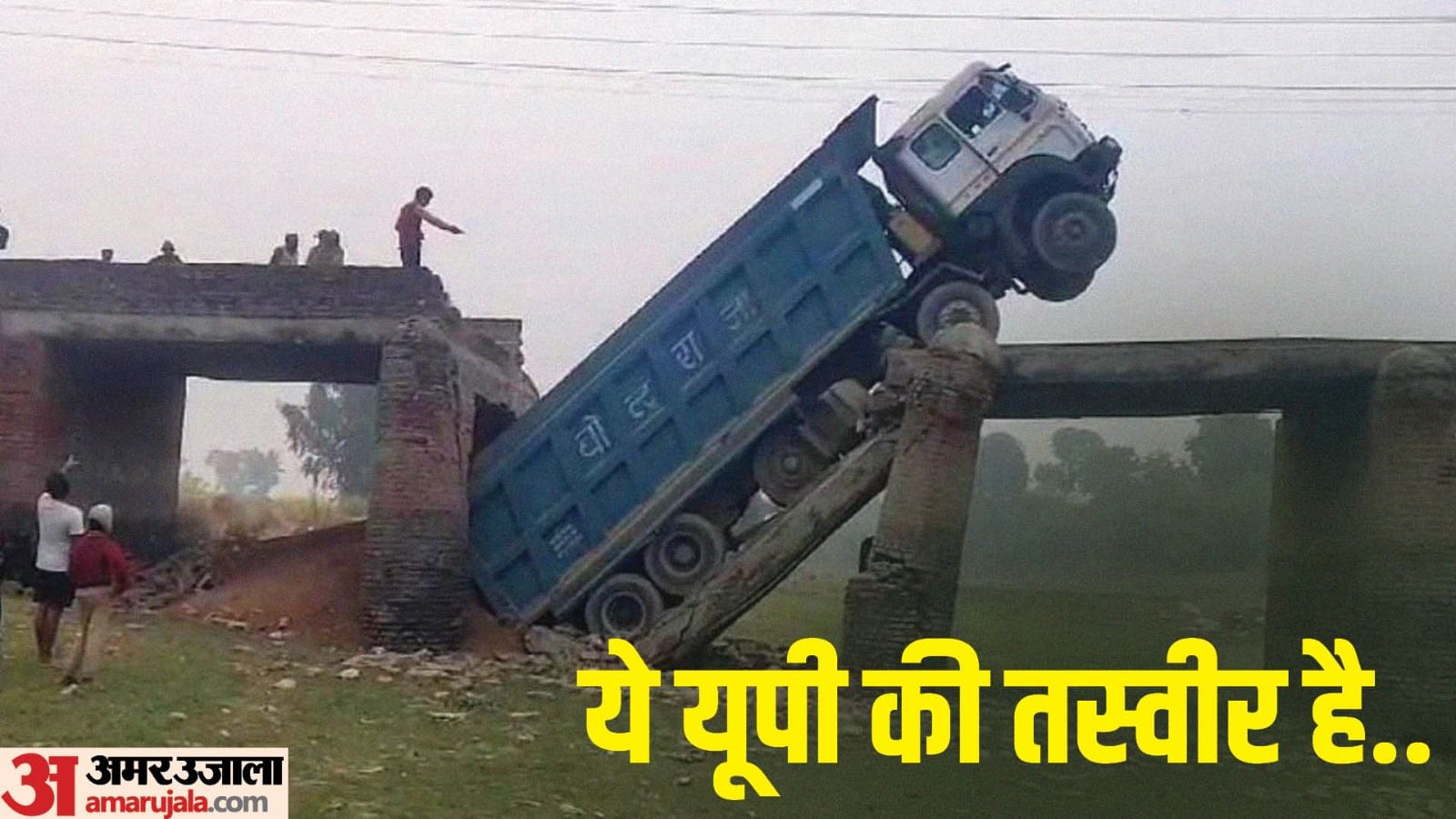
The incident has disconnected several villages from tehsil office. Though the bridge seems old and in dilapidated condition but the collapse clearly has been due to plying of heavy sand truck. However, there is no information whether the sand was sourced illegally and where it was being delivered. https://www.amarujala.com/uttar-pradesh/hardoi/pwd-dilapidated-bridge-collapsed-a-few-hours-before-the-minister-jitin-prasad-arrival-in-hardoi-2024-01-06 (06 Jan. 2024) हरदोई जिले में देर रात (Nov. 07, 2023) अंधेरे में बड़ा सड़क हादसा हो गया। कोथावां स्थित नहर पर निर्माणाधीन पुल के गहरे गड्ढे में गिट्टी लदा ट्रक गिर गई। हादसे में कई लोगों के घायल होने की संभावना है। सूचना पर पहुंची पुलिस बचाव कार्य में जुटी है। जेसीबी मशीन के सहारे ग्लेंडर मशीन से ट्रक के केबिन को काटकर घायलों को बाहर निकाला जा रहा है। बताया जा रहा है कि तेज रफ्तार ट्रक संडीला की ओर से आ रहा था और अनियंत्रित होकर गिर गया। https://www.amarujala.com/uttar-pradesh/kanpur/hardoi-road-accident-ballast-laden-truck-fell-into-deep-pit-of-under-construction-bridge-many-likely-to-be-i-2023-11-08 (08 Nov. 2023)
Karnataka HC bans quarrying and mining in 20km radius around KRS The court is hearing a petition filed by CG Kumar, who had challenged the May 15, 2023, communication issued by the Mandya deputy commissioner with respect to 120 acres of land in Pandavapura taluk where he was keen on quarrying after getting the land converted for nonagricultural purposes. https://timesofindia.indiatimes.com/city/bengaluru/hc-bans-quarrying-and-mining-in-20km-radius-around-krs/articleshow/106650100.cms (09 Jan. 2024) HC directs scientific study to be conducted for determining feasibility. https://www.livelaw.in/high-court/karnataka-high-court/karnataka-high-court-gr-medical-college-mangalore-inspection-national-medical-council-article-226-constitution-246558 (09 Jan. 2024)
Tamil Nadu Madurai villagers save their hills, pools from granite quarries Everything went well until Collector MS Sangeetha issued a notification on October 3, 2023, inviting tender applications for extracting multi-coloured granites from four locations in Sekkipatti, Ayyapatti and Thiruchunai revenue villages in Melur taluk for a 20-year lease. The notification sent shock waves across these villages as they already have examples of devastation caused by illegal mining in the taluk before them. Protests were launched by people in not only the affected villages, but also from about 10 surrounding villages, including Kambur and Ottakovilpatti.
Arittapatti Biodiversity Heritage Site is spread across Arittapatti in Melur taluk and Meenakshipuram in Madurai East taluk. Arittapatti could not have attained its special status if a similar protest did not take place in 2011, which forced the state government to go back on its order allowing a granite quarry in the same hillets that the government is keen on protecting now. The site has about 100 mountain pools, and shelters about 170 species of birds, and animals such as endangered slender loris. https://www.thenewsminute.com/madurai/madurai-villagers-save-their-hills-pools-livelihood-from-granite-quarries (08 Jan. 2024) After Arittapatti in Madurai district, four more places may be declared Biodiversity Heritage Sites this year. https://www.thehindu.com/news/national/tamil-nadu/tamil-nadu-may-get-four-new-biodiversity-heritage-sites-this-year/article67726070.ece (10 Jan. 2024)
WETLANDS, LAKES, WATER BODIES
Supreme Court NGT not supposed to apply strict rigors of CPC The Supreme Court (on January 04) expressed dissatisfaction with the NGT’s approach while dismissing an application. The application alleged that a waterbody/pond was being filled up. However, the NGT summarily dismissed the same without holding any inquiry. The Tribunal’s findings were based only on certain photographs. Discontent with the same, the Apex Court observed that when a citizen approaches the NGT with a grievance that a water body is being filled in, a different approach by the NGT is contemplated. It is not supposed to strictly apply the rigors of the Code of Civil Procedure, 1908.
It may be noted that the appellant had filed certain photographs along with his application. The NGT, in its impugned order, stated that these photographs do not show that it is a waterbody since no water is visible in the photographs. However, the Top Court asserted in this context, “If a water body is already filled in, obviously from the photographs, water cannot be seen.” Given these facts and circumstances, the Court opined that the Green Tribunal had not done its duty and, thus, remitted the matter to it. While doing so, the Court also asked the tribunal to conduct a fresh inquiry into the aforestated application. Before parting, the Top Court clarified that these observations are only limited to the order of remand. Thus, the same shall not be understood as the Court’s findings. https://www.livelaw.in/supreme-court/ngt-not-supposed-to-apply-strict-rigours-of-cpc-when-citizen-approaches-with-grievance-supreme-court-246475 (11 Jan. 2024)
Uttar Pradesh Factory waste is painting Surajpur wetland black Untreated effluents from industrial units flowing into the Surajpur have killed over a dozen trees at the wetland, considered the ‘green lungs’ of Greater Noida and a haven for more than 180 species of birds from Asia and Europe during the migratory season. Birders and environmentalists claimed several trees on the eastern arm of the wetland near Kasba village have died due to the discharge of effluents allegedly from Yamaha’s motorcycle manufacturing unit. Another stormwater drain that originates in Hapur and passes through several industrial areas also empties into the wetland.
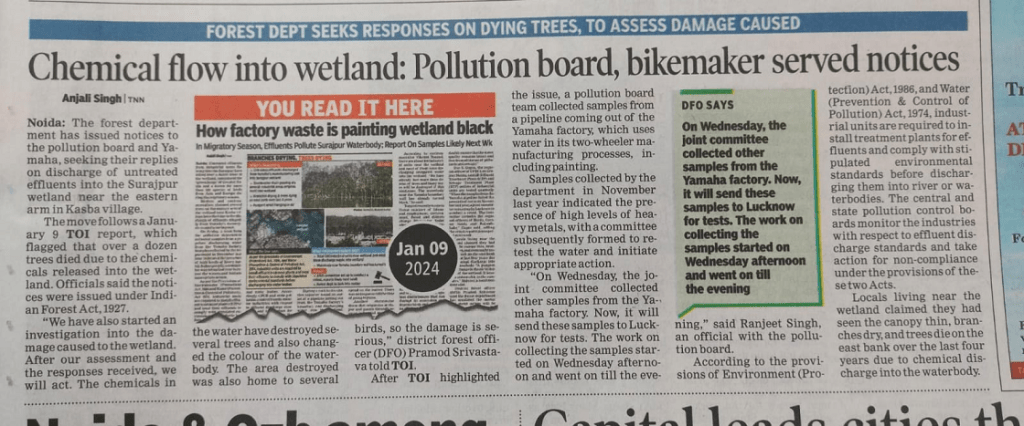
According to environmentalist Vikrant Tongad, there are about 100 industrial units near the wetland and most of them were discharging untreated water into the wetland. Spread over 308 hectares, of which 60 hectares is a lake, the wetland is city’s largest reserve forest and one of three major birding spots after Okhla Bird Sanctuary and Dhanauri wetland. Locals living near the wetland claimed they had seen the canopy thin, branches dry, and eventually trees dieback on the east bank over the last four years due to chemical discharge into the waterbody. “A pungent smell hangs in the air in this part of the wetland. It becomes unbearable in the summers,” Rajveer, a local resident said. https://timesofindia.indiatimes.com/city/noida/factory-waste-pollution-in-surajpur-wetland-noida/articleshow/106651081.cms (09 Jan. 2024)
Assam Baghjan: NGT asks Tinsukia DC, Oil India to clarify delay in compensation The NGT has asked the DC of Tinsukia and Oil India Limited (OIL) to clarify issues related to the interim compensation of Baghjan blowout victims on Wednesday (Jan. 10). OIL was held responsible for the blowout incident in its oil well in Baghjan in May 2020, which impacted over 9,000 families in the region. OIL represented by advocate Sridhar Potaraju stated that the compensation amount was deposited to the office of Tinsukia Deputy Commissioner. However, Assam’s state counsel, Malabika Roy Dey appearing before the tribunal said she has received no instruction from the state government regarding the disbursal of the compensation to the affected people of Baghjan. https://www.eastmojo.com/assam/2024/01/12/baghjan-ngt-asks-tinsukia-dc-oil-india-to-clarify-delay-in-compensation/ (12 Jan. 2024)
WATER OPTIONS
Lecture Bhil Adivasi Ecosystem Restoration The Bhil Adivasis have traditionally been past masters at ecosystem restoration. Mainly because of their customs of communitarian cooperation. Moreover, they lived frugally in harmony with nature. Both these characteristics are extremely important in the present context of the serious crises of water scarcity and climate change which can be tackled only by transitioning from fossil fuels and doing ecosystem restoration.
Here is the link to an online lecture Rahul Bannerjee gave recently for the Bahai Chair for Studies in Development of the Devi Ahilya University, Indore. The lecture itself is of 30 minutes but it is followed by a very good question and answer session of 45 minutes that further elucidates the points made in it. https://www.youtube.com/watch?v=U9ysDwWo54g (05 Jan. 2024)
Andhra Pradesh Guntur ryot’s natural farming techniques win global acclaim – After her husband fell sick, K Meerabi was forced to take up farming as she had become the sole breadwinner of the family. On realising that exposure to chemicals while farming resulted in her husband falling sick and taking to bed, she started considering alternative methods to cultivate crops. She learnt about non-pesticide management in 2009 and began working as a chief resource person for promoting natural farming. By implementing pre-monsoon dry sowing (PMDS) and dribbling methods, she was able to cultivate 30 crops per year, which raked in high profits.
-Sharing her experience, Meerabi said, “Natural farming has changed my life. I switched to chemical-free farming in one acre land in 2012. Besides reducing investment cost to Rs 19,000 per year, it helped me earn Rs 1.5 lakh. Continuous implementation of PMDS and growing multiple crops resulted in improvement of soil health. Last year, I didn’t even use any inoculants like Ghana and Drava Jeevamruthas. Nevertheless, the yield was of good quality,” she said. https://www.newindianexpress.com/states/andhra-pradesh/2024/jan/08/guntur-ryots-natural-farming-techniques-win-global-acclaim-2648953.amp (08 Jan. 2024)
IWP Managing water resources & generating livelihood opportunities in rural India This shares some articles and inspiring stories on how managing rural water resources can go hand in hand with skilling people and generating livelihood opportunities to make the effort sustainable in the long run. https://www.indiawaterportal.org/articles/managing-water-resources-and-generating-livelihood-opportunities-rural-india (10 Jan. 2024)
GROUNDWATER
Rajasthan Insights from ABY This report by Council on Energy, Environment and Water in collaboration with the Ministry of Jal Shakti of the government of India (GoI), ‘India’s Participatory Groundwater Management Program: Learnings from the Atal Bhujal Yojana Implementation in Rajasthan’ (https://www.ceew.in/sites/default/files/atal-bhujal-yojana-sustainable-participatory-groundwater-resources-management-india.pdf) provides an assessment of the scheme, combining desk review and field visits. It explores the implementation status, identifies key drivers of success (strengths), outlines implementation challenges (weaknesses), highlights opportunities for improvement, and assesses external threats impacting the scheme’s sustainability. https://www.indiawaterportal.org/articles/insights-atal-bhujal-yojana-rajasthan (12 Dec. 2023)
Maharashtra Post-2023 monsoon, GW crisis deepens; situation acute in 16 districts Latest Groundwater Survey and Development Agency (GSDA) data revealed that 2 blocks Shirur in Pune and Khandala in Satara were showing severe depletion in October 2023 in comparison to the last 10 years’ average, while moderate depletion is seen in 7 blocks. Pune district has maximum blocks (9) showing depletion as per GSDA data, followed by Jalna (7), Solapur (6) and Sangli (5). Officials said the sub-par monsoon conditions in 2023 and intensified groundwater extraction for various purposes were a few factors leading to the depletion. 54 talukas were showing groundwater depletion in October 2023 in comparison to the last 10 years’ average October level. As a result, the talukas were declared drought-affected under GSDA’s Groundwater Drought Index.
In October 2022, the number of such blocks in Maharashtra was just 4. A GSDA official said barring the 54 blocks, all others are in the normal Groundwater Drought Index category in the state. “Altogether 3,688 observation wells across Maharashtra were studied in October 2023. The number of wells studied in the 54 affected talukas was 676. The data depicts the average water level in all the observation wells studied per block,” the official said. “The affected areas may also have had specific cropping pattern requiring more water. For example, parts of Baramati and Solapur received less rainfall in monsoon 2023, while the Ujjani dam levels were also not up to the mark. Water supply from the dam was restricted in case of farm use, which led farmers to extract more groundwater, especially for sugar cane farms and other water intensive crops,” Upendra Dhonde, a senior groundwater scientist from the Central Groundwater Board (CGWB), said. https://timesofindia.indiatimes.com/city/pune/post-2023-monsoon-groundwater-crisis-deepens-in-maharashtra-situation-acute-in-16-districts/articleshow/106605338.cms (07 Jan. 2024)
Govt allots ₹10cr for 12 concrete dams with gates in Yeola taluka Twelve gated concrete dams will be constructed across several water bodies in Yeola taluka to facilitate the storage of water and groundwater recharge, officials said on Friday (Jan. 12). These dams will ensure drinking water supply for local villagers as well as for agriculture programmes. The state government has allocated Rs10.3 crore for the project through the Maharashtra Water Conservation Corporation.
The works will ensure the percolation of water on the ground in these villages during the monsoon period. This will also contribute to the recharging of groundwater to some levels, thus reducing the dependency on tanker-supplied water for some time, a senior officer from the department said.. It must be noted that in November 2023, the state had declared Yeola as a drought-affected taluka. It received less-than-normal rainfall which affected crop production. https://timesofindia.indiatimes.com/city/nashik/government-allocates-10-crore-for-construction-of-12-gated-concrete-dams-in-yeola-taluka-nashik/articleshow/106797724.cms (13 Jan. 2024)
URBAN WATER
Interview “Caste shapes access to water in so many ways” The authors Harini Nagendra, Seema Mundoli – of Shades of Blue talk about climate change, its impact on the most disadvantaged sections of society, and the ongoing water crisis across Indian cities. https://www.hindustantimes.com/books/harini-nagendra-seema-mundoli-caste-shapes-access-to-water-in-so-many-ways-101705108266006.html (13 Jan. 2024)
Bengaluru Don’t use treated KC Valley water for irrigation: Minister Minor Irrigation Minister N S Boseraju has warned farmers not to use the treated sewage from KC Valley project directly for irrigation. The water should be used to fill up the lakes and recharged groundwater can be used for irrigation. https://www.deccanherald.com/india/karnataka/don-t-use-treated-kc-valley-water-for-irrigation-minister-2845489 (12 Jan. 2024)
Groundwater conundrum Activists argue that Bengaluru had exploited groundwater to the highest level, and since it was now a red zone, no new permissions should be provided. “The Central Groundwater Authority has declared Bengaluru in the red zone. Ideally, we should not allow any new borewell,” Anirudhan argues.
– Key message from the article: There is complete confusion about groundwater regulation even in a relatively regulatable Urban city. KGWA says they have given the authority to BWSSB, BWSSB says it is not in their power. The Drilling companies are least bothered. The Police do not seem to do much even after complaints. https://www.deccanherald.com/india/karnataka/bengaluru/bengaluru-s-groundwater-conundrum-2847211 (13 Jan. 2024)
Encroachment of Yale Mallappa Shetty Lake Bund of Yale Mallappa Shetty Lake has become dumping site for construction and demolition waste; activists highlight encroachment of over 21 acres of lake land. https://bangaloremirror.indiatimes.com/bangalore/civic/preserve-this-lake-before-it-disappears/amp_articleshow/106646582.cms (09 Jan. 2024) The Hindu Logo
Coimbatore NGT to take suo motu action against Corporation The NGT will soon take suo motu action against the Coimbatore Corporation in the case of a non-functional waste processing unit situated in Ukkadam, sources said. The unit, being handled by a Coimbatore-based solid waste management company, which also operates four other micro composting centres (MCCs) in the city, has faced opposition from the public living close-by stating it has been acting as a dump yard where ‘waste is also being burnt at time.’
This is despite the Corporation’s 2022 order to the company, instructing it to “ensure segregation and recycling on all working days and provide account details of the collected dry waste sent for recycling”. However, neither of these functions have been carried out since the centre was shut down citing machinery issues. Additionally, the Corporation, in the same order, mentioned that the contract was given to the company based on its “work for many years in areas like Tiruchengode, Bhavani, Namakkal, Edappadi and Attur”. But there is no account for these operations having existing. https://www.thehindu.com/news/cities/Coimbatore/ngt-to-take-suo-moto-action-against-coimbatore-corporation/article67723382.ece (09 Jan. 2024)
Hyderabad ACB court convicts GM of water board The judge of Anti-Corruption Bureau (ACB) court on Friday (Jan. 12) convicted a general manager of Hyderabad Metropolitan Water Supply and Sewerage Board (O&M division), Rathlavath Lokilal and directed him to undergo three years of imprisonment. The convict in the year 2010 demanded and accepted ₹50,000 from a contractor Bontha Maisaiah for clearing the bills for the works he had executed. https://timesofindia.indiatimes.com/city/hyderabad/acb-court-convicts-gm-of-water-board-hyderabad/articleshow/106797090.cms (13 Jan. 2024)
Mumbai PM inaugurates Surya Dam The Surya Regional Bulk Drinking Water Supply Scheme aims to deliver treated bulk water to VVMC, MBMC, and 44 villages in the Palghar district. The first phase of the project will make 185 MLD of water available to the residents of Vasai and Virar. The second phase of the project will extend the water supply to the MBMC area, and the overall completion of the scheme is expected to address the water needs of a significant population in the region. Authorities have already initiated the supply of 85 MLD of water since November last year to the 14 lakh people under the jurisdiction of Vasai Virar Municipal Corporation.
“With an overall physical progress of about 88%, the scheme can be commissioned by the designated corporations in 2024,” said officials from MMRDA overseeing the project. On the other hand, a VVMC official said that the water supply will be irregular till it becomes stable. They are testing the supply and gradually the supply will increase. Nallasopara MLA Kshitij Thakur said, “Due to the project, 403 MLD of water will be supplied to Vasai-Virar towns and nearby villages and Mira-Bhayander Municipal Corporation through MMRDA in the long run. Currently, VVMC needs 372 MLD water out of which 230 MLD water is currently available to the Municipal Corporation.”
The project, developed at a total expenditure exceeding ₹1975 crore, commenced in 2017. The Surya Regional Water Supply Scheme will deliver 403 MLD of water daily, featuring two pumping stations at Kawadas and Surya Nagar. Under the scheme, raw water will be lifted from the Kawdas pick-up located downstream of Surya dam and will be purified in the water treatment plant. Following purification, the treated water will be transported through a gravity-fed underground pipeline spanning 80.71 kilometer. The water will be directed to the master balancing reservoir located at Kashid Kopar Hill for the VVMC and to the master balancing reservoir situated on the hill of Chene village along Ghodbunder road for MBMC. https://www.hindustantimes.com/cities/mumbai-news/prime-minister-inaugurates-surya-dam-bringing-relief-to-vasai-virar-and-mira-bhayandar-residents-101705086773183.html (13 Jan. 2024)
Pune Kharadi society residents in a fix over sewage in drinking water Residents of Kharadi’s Gulmohar Paradise Homes society are at their wits’ end as even after five days the problem of sewage mixing with drinking water has not been solved by the Pune Municipal Corporation. The PMC officials say they have not been able to find out the source of sewage percolating into the supplied water.
The society, situated at Thite Nagar, Kharadi, accommodates around 400 residents in 156 flats and they are all facing health issues as water mixed with sewage has been coming out of the water taps. Although the aggrieved residents have urged the PMC to get this issue resolved as soon as possible, it appears the civic body has not been able to locate the source from where sewage is mixing with drinking water. The water department officials say that their team is working diligently, but has not been successful so far. https://punemirror.com/pune/civic/kharadi-society-residents-in-a-fix-over-sewage-in-drinking-water/cid1705227448.htm (14 Jan. 2024)
Shimla SC sets aside NGT order on SDP Another problematic order of the Supreme Court, setting aside an NGT orders staying the disastrous Shimla Development Plan. Allowing the state govt’s appeals, the Bench – which also included Justice Aravind Kumar—quashed the NGT’s orders dated November 16, 2017; July 16, 2018; May 12, 2022; and October 14, 2022, saying it “transgressed its limitations and attempted to encroach upon the field reserved for the delegatee to enact a piece of delegated legislation.”
The top court said, “We are of the view that the continuation of the proceedings by the NGT during the pendency of the writ petitions before the High Court was not in conformity with the principles of judicial propriety. Needless to state that the High Court of Himachal Pradesh, insofar as its territorial jurisdiction is concerned, has supervisory jurisdiction over the NGT.”
Noting that it has not considered the development plan in minute details, the Bench clarified that “We may, however, not be construed as giving our imprimatur to the said development plan.” “If any of the citizens has any grievance that any provision is detrimental to the environment or ecology, it is always open to raise a challenge to such an independent provision before the appropriate forum. Such a challenge can be considered in accordance with law,” the Bench said. https://www.tribuneindia.com/news/himachal/supreme-court-upholds-shimla-development-plan-%E2%80%94-vision-2041-sets-aside-national-green-tribunal-order-580368 (12 Jan. 2024)
The Court found that the NGT had transgressed its limitations and tried to encroach upon the field of the executive. “When the TCP Act empowers the State Government and the Director to exercise the powers to enact a piece of delegated legislation, the NGT could not have imposed fetters on such powers and directed it to exercise its powers in a particular manner.” https://www.barandbench.com/news/supreme-court-slams-ngt-for-stalling-shimla-development-plan-2041 (11 Jan. 2024)
Reading out the operative part of the judgment, justice Gavai said the new development plan seems to have considered the concerns raised by the NGT earlier. It clarified that though the court is of prime facie view that the 2041 development plan is sustainable, it will still be open for the parties to challenge the finer points of the plan on their merits.
A total of 22,450 hectares were taken into account for revision and formulation of the development plan, which included the Municipal Corporation of Shimla, special area development authorities of Kufri, Shoghi and Ghanahatti and additional Shimla planning area besides villages. After hearing the arguments over the feasibility of the new plan, the court had on December 12 reserved its judgment in the case. https://hindustantimes.com/india-news/sc-approves-shimla-development-plan-2041-aimed-at-regulating-construction-activities-101704953404472.html (11 Jan. 2024)
Edit: The lifting of the blanket ban on construction in 17 green belts from December 2000 and in the core area since the 2017 order of the NGT could open floodgates for unregulated building activity unless and until the government puts in place a strict monitoring mechanism. The Town and Country Planning (TCP) Department and the Shimla Municipal Corporation (SMC) face a tough challenge of checking haphazard construction, especially in the core area of the city. Also, devastation caused by the monsoon last year necessitated ensuring structural stability of buildings, which were on gentle gradient slopes and not in sinking or sliding zones.
The SC in its order clearly spelt out that while ensuring developmental activities so as to meet the demands of a growing population, it was necessary that ecological and environmental protection issues were also addressed. The court maintained that though the SDP was prepared after an exhaustive process in consultation with experts, if any citizen had a grievance that any provision was detrimental to the environment or the ecology, it was always open to raising a challenge to such an independent provision before an appropriate forum. https://www.tribuneindia.com/news/himachal/now-onus-of-ensuring-regulated-construction-in-shimla-on-govt-580520 (12 Jan. 2023)
Panchkula Plans for solid waste plant in making: MC in NGT The Panchkula municipal corporation (MC) is planning to set up a solid waste processing plant in Panchkula for which it has identified several pockets falling in villages located between Panchkula to Barwala and Raipurani. This information has been provided by MC commissioner Sachin Gupta in an action taken report (ATR) submitted to the NGT in compliance with the orders of NGT dated October 19, 2023. The tribunal had asked the MC Panchkula to submit an ATR with regard to the solid waste analysis and figures related to generation, collection and processing of waste in Panchkula.
The tribunal has been informed that various pockets in the villages Jalaouli, Khatouli, Boonga, Tibbi, Sablpur, Khet Parali, Ganeshpur, Tilokpur, Bhud, Rattewali, Kanauli, Shamtoo, Amrala, Manak Tabra, Batwal and Haripur were identified for the establishment of solid waste processing plant in the district. However, only first two pockets including Jalouli and Khatoui are within the limits of MC Panchkula, but these village lands are classified as choe land (’Gair Mumkin Nadi’ land). https://timesofindia.indiatimes.com/city/chandigarh/panchkula-municipal-corporation-plans-to-establish-solid-waste-processing-plant/articleshow/106682417.cms (10 Jan. 2024) Despite efforts to segregate and process legacy waste at the two dumping sites, the corporation is yet to ensure complete segregation of waste at source. https://www.tribuneindia.com/news/chandigarh/swachh-survekshan-at-139-panchkula-plunges-53-spots-580452 (12 Jan. 2023)
Noida 9.9m max drop in Noida & 2.8m in Gr Noida in 6 yrs The city’s groundwater level dropped by 9.9m in the post-monsoon months and 8.5m in the pre-monsoon months between 2017 and 2023 due to limited rainfall and recharge. In the pre-monsoon months, the groundwater level plummeted to 22.5m in 2023 from 14m in 2017. In the post-monsoon months, the groundwater level dropped from 13.1m in 2017 to 23m in 2023. “In Noida, we set up 11 groundwater monitoring stations with piezometers (digital water level recorders). In 2017, at four stations, the groundwater level data was inconclusive on account of a fault in the piezometer, but even then, the rate of depletion from 2017 to 2023 was recorded at 9.9m in the post-monsoon months, which is alarming,” said Ankita Ray, a hydrologist in the groundwater department.
Noida’s Aghapur in Sector 41 was the worst affected, with an average depletion rate of 17m, followed by Garhi Chaukhandi (11.5m) and Phase 3. In Greater Noida, the groundwater level in the pre-monsoon months fell by only 2.8m in the corresponding period. “There is an urgent need to recharge the groundwater table, especially in the city. Steps must be taken to ensure that illegal groundwater extraction is checked,” added Ray. City-based environmentalist Vikrant Tongad blamed the rapid pace of urbanisation and concretisation. “Clearly, there is a big gap in the rate of extraction of groundwater and its recharge, and authorities need to heed the warning before the water table runs dry,” he said.
“Not long ago, there were a number of water bodies, but they have disappeared due to rapid urbanisation. From industries to commercial establishments to residential areas, all are extracting groundwater with scant regard to rules. Apathy on the part of authorities is only adding to the problem,” he said. Rainwater harvesting and de-concretisation of roads and parks should be taken up with urgency. “The drains have been concretised, which does not allow water to sieve into the ground. Rainwater harvesting rules have been included in building bylaws but are not followed. In many societies, the system installed for rainwater harvesting hardly works, while the system is not installed in others,” he added. https://timesofindia.indiatimes.com/city/noida/alarming-depletion-rate-of-groundwater-in-noida-and-greater-noida/articleshow/106621579.cms (08 Jan. 2024)
Delhi Ammonia rise hits water supply The city this week witnessed its first ammonia spike episode in Yamuna in the new year leading to disruption in operations in two of its nine water treatment plants. https://www.hindustantimes.com/cities/delhi-news/explainer-ammonia-spike-episodes-in-delhi-101705063119420.html (12 Jan. 2024)
For the last 10 days, there has been a high ratio of ammoniacal nitrogen. Usually, to treat 3-4 parts per million of ammonia in river water, DJB takes water from three other plants connected to CLC, but mainly the Haiderpur WTP, and dilutes the ammonia ratio down to 1 ppm at the Wazirabad plant. It further treats this water through chlorination and then supplies the water to the reservoirs.
With water supply reducing drastically on January 8 and 9, the WTPs had to run continually even at 50% capacity. On January 10, the ammonia at Wazirabad measured on average 2.3ppm, and around 1.5ppm on January 9. However, according to the officials the WTEs can only treat raw water with around 1ppm of ammonia. The Wazirabad plant also doesn’t have a specific ammonia treatment infrastructure, which despite being announced by Delhi government, hasn’t yet been installed, causing worry about the quality of drinking water being supplied. https://timesofindia.indiatimes.com/city/delhi/water-quality-under-lens-at-wazirabad-plant/articleshow/106744674.cms (12 Jan. 2024)
DJB supplies more than 990 MGD of water to Delhi out of which over 230 MGD is supplied by Chandrawal and Wazirabad plants — both of which draw water from the Wazirabad pond fed by raw water coming from the river. The water utility can treat up to 0.9ppm of ammonia in raw water but beyond such high levels, neutralisation of ammonia with chlorine gas regularly leads to the formation of toxic chloramine compounds
DJB officials have previously alleged that the source of the pollutants such as dyes, chlorides, and ammonia-based chemicals comes from the Panipat industrial dye drain and that untreated water from industries in Haryana predominantly causes high levels of ammonia in the river water, a charge repeatedly denied by the Haryana government. https://www.hindustantimes.com/cities/delhi-news/ammonia-levels-spike-in-yamuna-water-supply-hit-in-delhi-101704907726038.html (10 Jan. 2024)
-दिल्ली जल बोर्ड ने सोमवार (Jan. 8) को बताया कि वजीराबाद में यमुना नदी में प्रदूषक तत्वों के उच्च स्तर के कारण वजीराबाद और चंद्रावल के वाटर ट्रीटमेंट प्लांट की क्षमता 30-50 प्रतिशत कम हो गई है। बताया गया कि जब तक यमुना नदी में प्रदूषण का स्तर कम नहीं होता, तब तक स्थिति ऐसी बनी रहेगी। https://www.jagran.com/lite/delhi/new-delhi-city-ncr-delhi-water-supply-affected-in-30-area-including-ndmc-due-to-pollution-in-yamuna-23624366.html (08 Jan. 2024)
WATER POLLUTION
Report Vibrant Gujarat document about reality of water, air and solid waste pollution in Gujarat. https://www.counterview.net/2024/01/vibrant-gujarat-failure-to-tackle.html (08 Jan. 2024)
JJM/ RURAL WATER SUPPLY
Report Evolution of state’s role in rural drinking water governance in India A recent paper ‘Changing Role of the State in Rural Drinking Water Governance in India’ by NC Narayanan et al (https://www.cps.iitb.ac.in/wps-2023-001) examines the major interventions in post-independent India’s rural drinking water sector—in the context of the ongoing Jal Jeevan Mission—to assess the progress made in the provision of the service as well as discern the challenges that continue to persist. The push to universalize service provision by 2024 marks the return to the earlier supply-driven approach led by the state and by the emphasis on community participation it appears to be a prolongation of the dominant blueprint of the past three decades of experience. The failure to clearly define the role of the state is contributing to absence of focus on state capacity at different levels to ensure sustainable service provision. This is partially a consequence of the superficial consolidation of elements from former models of service provision in Jal Jeevan Mission.
– The Jal Jeevan Mission institutional framework would be more unambiguous if it explicitly acknowledges local governments’ responsibility as service providers. It is also pertinent to highlight that the panchayat raj institutions do not have the required autonomy and institutional capacity to effectively manage service provision on the ground. Capacitating panchayat raj institutions and creating an effective governance ecosystem at the state level is critical to achieving improved outcomes in the sector. https://www.indiawaterportal.org/articles/evolution-states-role-rural-drinking-water-governance-india (07 Jan. 2024)
Madhya Pradesh Survey for Rs. 782 cr Chambal water supply completed After field survey, the HFCL a Gurugram based company has reportedly finalized Rameshwar ghat along Chambal river for construction of a 90.51 million litre capacity intake well and Hirapur site about 15 km away from intake well for building water treatment plant in Bhind. The same company will construct these structures apart from laying of 2000 km long pipeline network under Rs. 782 crore project proposing potable water supply to 392 villages in the district. (Dainik Bhaskar 07 Jan. 2024)

आदिवासी विकासखंड कराहल के ग्राम झरेर में 71.44 एमएलडी क्षमता का जल शोधन संयंत्र बनेगा। जिसमें चंबल नदी का पानी लाकर उसे शुद्ध किया जाएगा। इसके बाद शु़द्ध किए पानी की सप्लाई जिले के 392 गांवो में पाइप लाइन के जरिए की जाएगी। इस योजना के तहत झरेर में जल शोधन संयंत्र और मानपुर क्षेत्र में फतेहपुर के पास इंटेकवेल बनाया जाएगा। इसके जरिए चंबल नदी के पानी को शुद्ध करके चयनित गांवाें में पहुंचाया जाएगा। बताया गया कि यह पूरी योजना लगभग 883.64 करोड रुपये की है, जिसकी डीपीआर बनकर शासन से मंजूरी मिल गई है और टेंडर भी लग गए है। बताया गया है कि 392 गांवो में पानी के संकट के स्थाई समाधान के लिए बनी इस योजना के अंतर्गत मानपुर क्षेत्र में फतेहपुर के पास 90.51 मिलीयन लीटर क्षमता का इंटेकवेल बनाया जाएगा। https://www.naidunia.com/madhya-pradesh/sheopur-sheopur-news-water-purification-plant-will-be-built-in-jharer-8210182 (12 Aug. 2023)
Rajasthan Work on Rs. 974 cr Chambal water project to Bundi चंबल पेयजल परियोजना (भीलवाड़ा फैज प्रथम) में 70 टंकियों में से सबसे बड़ी और ऊंची 2 टंकियां नैनवां में ही बनेंगी। 973.74 करोड़ की लागत की चंबल पेयजल परियोजना का 30 प्रतिशत से अधिक कार्य पूरा हो गया है। वर्ष 2024 में योजना का कार्य पूरा होने का लक्ष्य रखा गया है। इनमें से टोडापोल में 10 लाख लीटर क्षमता की टंकी का निर्माण शुरू हो गया है। 8 लाख लीटर क्षमता की टंकी का निर्माण नगर रोड पर तीन दिन बाद शुरू होगा। दोनों टंकियों की ऊंचाई 25 मीटर रहेगी।
चंबल पेयजल परियोजना में नैनवां और हिंडौली उपखंड के 286 गांवों और 287 मजरों में पेयजल आपूर्ति आसानी से हो सकेगी। गांवों में पेयजल सप्लाई के लिए 2200 किमी लंबी पाइप लाइन बिछाई जा रही है। साथ ही नैनवां के बांसी रोड पर 1200 केएल पंप हाउस का भी निर्माण होगा। अभी स्टोर रूम और क्वार्टर का कार्य चल रहा है। जल्दी ही पंप हाउस का भी कार्य शुरू करवाया जाएगा। पंप हाउस से नैनवां में बन रही दोनों टंकियों को पानी से भरा जाएगा। https://www.bhaskar.com/local/rajasthan/bundi/news/chambal-project-will-quench-the-thirst-of-286-villages-and-287-villages-will-get-relief-from-water-crisis-131031532.html (April 2023)
MONSOON 2024
Interview IMD enters its 150th year on Jan 15 Edited excerpts from the interview with DG Mrutyunjay Mohapatra as IMD enters its 150th year: -With a very humble beginning in 1875, IMD has undergone several phases of evolution. It so happened that on October 5, 1864, a massive cyclone came and devastated Calcutta wherein 80,000 people died. In the same year, 40,000 people died in Andhra Pradesh when a cyclone hit Machilipatnam. This event was followed by the 1866 famine because of monsoon failure followed by another famine in 1871. All this led the then government to form a meteorological committee. Henry Francis Blanford was appointed as the Imperial Meteorological Reporter. He joined on January 15, 1875 in Mumbai, and that’s why we celebrate the day as the formation day of the IMD. https://www.indiaspend.com/indiaspend-interviews/we-should-mainstream-weather-forecasting-for-everyday-life-imd-chief-says-889813 (15 Jan. 2024)
WINTER 2024
Report Snowless, dry winter worries over ripple effect The picture is no different in Kashmir, Himachal Pradesh and Uttarakhand. The unusually long dry spell has meant that places that would ideally have a minimum of four-to-six feet thick snow by now hardly have any snow. After the initial winter precipitation in November, and at some places in the first few days of December, there has been no precipitation at all.
Drawing a connect between WDs and El Nino, climate scientist Raghu Murtugudde from the Indian Institute of Technology-Bombay said, “WDs have had a trend for a while, so the low precipitation is consistent with that (trend). During an El Nino, the cold winds come from the northwest and the cold temperature remains over northern and north-central India. This means, dry cold winds and thus less precipitation.” Elaborating on the “trend”, he said, “The WDs have been decreasing and bringing less precipitation for a couple of decades. That means, there will be more years with below-normal precipitation than years with above-normal precipitation. El Nino exacerbated this.”
Glaciologist Dimri also spoke about a distinct pattern shift in WDs over the last few years. “One, there has been a decrease in WDs, then, there has been decreased precipitation, and third, most importantly, precipitation has changed from solid to liquid, which means, there is rain in winters instead of snowfall.” The replenishment of water sources for the southern Himalayan region will bear the brunt. “The water system will collapse. We are drifting towards living in a dryer system,” he warned. On average, India receives four to six intense WDs each month between December and March. Except for a one-off event, December had no WD and there is no sign of it till mid-January.
“The unknown thing is that the El Nino pattern is different this year because of a strong superimposition of El Nino and global warming. This happened back in 2009, which too was a dry year,” Murtugudde said. Murtugudde was a co-author in a January 2012 study, “Is a global warming signature emerging in the tropical Pacific?” published in the journal Geophysical Research Letters. It demonstrated that the unprecedented basin-wide warming in the Tropical Pacific (TP) during the year 2009 was associated with increasing global warming trend in the TP SSTs. https://www.theweek.in/wire-updates/national/2024/01/08/lst2-snowless-himalayas-el-nino.html (08 Jan. 2024)
Kashmir’s snowless winter rings alarm bells as temperatures rise With Kashmir yet to receive major snowfall amid the 40-day harshest winter period, Chillai Kalan, environmentalists warn that a prolonged dry spell will be disastrous for glaciers and water bodies – triggering acute water shortage in the summer this year. Environmentalists say that the dry spell in the peak winter period is an indicator of climate change coupled with El Nino–Southern Oscillation (ENSO) and North Atlantic Oscillation (NAO) over Kashmir.
Snow precipitation presently comprises 52 percent of the total annual precipitation and contributes 55 percent to the annual streamflow with the peak observed in May. However, projections to the end of the 21st century under various RCPs indicate that there shall be a considerable decrease in both the snow precipitation and snowmelt contribution to the streamflow. As a result of the predicted change in the form of precipitation under climate change in the basin, a significant increase in the streamflow is predicted during the February–May period when the crop water requirement in the basin is very negligible.
“The depleting stream flow predicted in the Upper Indus Basin ending in the twenty-first century will have noteworthy impacts on various sectors of the economy, particularly agriculture and dependent livelihoods in the lower Indus Basin which is already facing severe water scarcity. Further depletion of the streamflow will further jeopardise the food, energy and water security in the entire Indus Basin,” Romshoo said.
Previous dry spells in winter during December and January were witnessed in 1887, 1992, 1993, 1998, 2015 and 2018. Weatherman said there is no forecast of any snowfall until January 17. There is zero precipitation in the first 10 days of January as compared to average 21.2 mm during this period, which is 100 percent. The water level at Sangam gauge station is minus 0.65 feet which is one of the lowest levels in Jhelum during this season. https://www.greaterkashmir.com/front-page-2/kashmirs-snowless-winter-rings-alarm-bells-as-temperatures-rise/ (11 Jan. 2024)
“If the present dry spell continues till the end of Chillai Kalan then we are headed for a miserable summer water situation. “Snowfall after the Chillai Kalan hardly replenishes the perennial water reservoirs in the mountains”, said a senior engineer of the Jal Shakti department. https://www.greaterkashmir.com/gk-top-news/unprecedented-dry-spell-shrinks-water-bodies-in-kashmir/ (11 Jan. 2024)
Erratic weather patterns this winter will spell doom on eco-fragile glaciers in Jammu and Kashmir and severely affect ecological balance besides food, energy, and water security in the eco-fragile region, environmentalists warn. https://www.greaterkashmir.com/gk-top-news/jks-eco-fragile-glaciers-face-doom-as-erratic-weather-wreaks-havoc/ (12 Jan. 2024)
Dry weather on in Punjab, Haryana, Himachal, water levels in dams fall below normal The current storage at Thein Dam that lies on the Ravi in Punjab is 0.58 billion cubic metres (BCM) against its full reservoir level of 2.34 (BCM). This is 38 per cent below normal for this time of the year, according to data released by the CWC on January 11. At Bhakra Nangal Dam the current storage is 3.27 BCM against the full reservoir level of 6.23 BCM. This is below normal by 7 per cent. On the other hand, the water storage at Pong Dam on the Beas in Himachal Pradesh is above normal by 21 per cent for this time of the year. The water availability is 3.62 BCM against the upper limit of 6.16 BCM. All three dams have a combined irrigation potential of 1,024 thousand hectares and an installed hydel power generation capacity of 2,375 MW.
Rain is major source of water for Thein and Pong dams. North Indian states of Himachal Pradesh, Punjab and Haryana have remained dry since January 1. Even in Dec. 2023, rain was deficient by 85 per cent in Himachal and 70 per cent in Punjab, according to the IMD. A Western Disturbance lies in middle tropospheric westerlies that could bring light rainfall or snowfall at isolated places over J&K , Ladakh and HP on January 12 and 13. A fresh Western Disturbance is likely to affect the western Himalayan region from January 16. https://www.tribuneindia.com/news/punjab/dry-weather-on-water-levels-in-dams-fall-below-normal-580768 (13 Jan. 2024)
The catchment areas of Sutlej area spread over 56,000 sqkms in the upper reaches of Himachal and some parts in Uttarakhand and the area normally starts seeing snowfall from mid-December to February. “This time, snowfall has been negligible even during the peak winter months. There is prediction of snow in the upper reaches in January-end but it is to be seen how much snow it gets,” said India Meteorological Centre’s Himachal head Surendra Paul.
“The Sutlej is fed by melting glaciers. Less snow means less water for the dam,” said Sunil Singla, secretary of Bhakra Beas Management Board which manages the dam. In August last year, Bhakra Dam’s reservoir, Gobind Sagar Lake, had been filled up to the brim at 1,680 feet due to heavy rain in the catchment areas. However, within four months, 57-ft water, which comes to almost half of the water-holding capacity of the reservoir, was consumed. According to Singla, the dam still has a large quantity of water but keeping in view the need and dependence on the dam, it should have adequate arrangement for filling the reservoir. https://www.hindustantimes.com/cities/chandigarh-news/as-snow-evades-catchment-areas-bhakra-dam-authorities-worried-101705260102082.html (15 Jan. 2024)
Except for the monsoon months between July and September, the reservoir is mostly fed by snowmelt. “River Sutlej is fed by melting of glaciers and in case of less snowfall it would impact filling of the dam,” said Sunil Singla, secretary of BBMB. Surendra Paul said that snowfall predictions for the near future are of no snowfall in the catchment of river Sutlej. https://www.hindustantimes.com/india-news/dip-in-bhakra-dam-water-level-raises-concerns-101705255965345.html (15 Jan. 2024)
Several rivers of Kangra in HP, originating from the Dhauladhar range are dry already and there is no snow on the hill slopes, leading to fear of water crisis if the dry spell continues. https://www.tribuneindia.com/news/himachal/dry-spell-may-lead-to-drinking-water-crisis-579291 (08 Jan. 2024)
FLOOD 2023
Bihar 30 जनवरी को शुरू होगा कोशी सत्याग्रह पदयात्रा कोशी तटबंध के भीतर बसे करीब साढ़े तीन सौ गांवों के लोगों की जन समस्याओं को लेकर आगामी 30 जनवरी को सत्याग्रह पदयात्रा निकला जाएगा। कोशी नव निर्माण मच के संयोजक महेंद्र यादव ने कहा कि कोशी नदी पर तटबंध बनाकर, तटबंध के बीच फंसे लाखों लोगों का समुचित पुनर्वास आज तक नहीं किया गया है। हर साल ये लोग बाढ़, कटाव की भीषण तबाही झेलने को विवश होते हैं। बाढ़ और कटाव से उनकी खेती और घर दोनों प्रभावित होते हैं। जिससे इलाके से पलायन लगातार बढ़ रहा है। कोशी के किसान धीरे धीरे असंगठित मजदूर बनते जा रहे हैं।
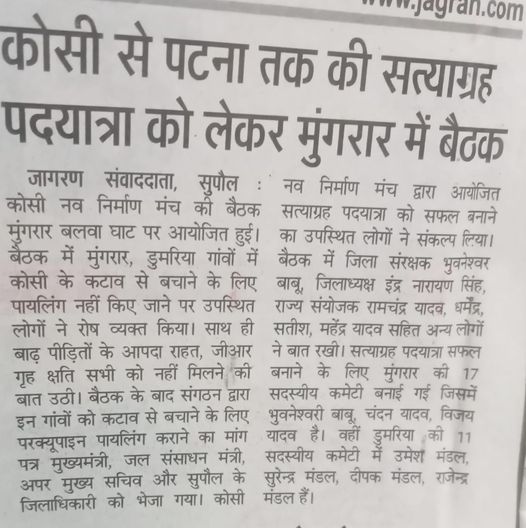
हर साल बाढ़ के पानी के साथ आने वाले सिल्ट और गाद से नदी के तटबंध के भीतर का तल ऊंचा हो रहा है जो तटबंध पर दबाव बना रहा है। वहीं सुरक्षित माने जाने वाले बाहर के क्षेत्र के लिए आने वाले समय में कभी भी तबाही का कारण बन सकता है। उस पर विचार करने के बजाय सरकार पश्चिम से तटबंधों के बीच की चौड़ाई घटाकर सुरक्षा बांध और स्पर विदेशी कर्ज लेकर निर्मित कर रही है। इससे बाढ़ और तबाही तटबंध के भीतर के लोगों के लिए हर साल बढ़ रही है। साथ ही बाहर के लोगों के लिए खतरा भी बढ़ रहा है| शिक्षा की बदहाल स्थिति है। https://www.bhaskar.com/local/bihar/supaul/news/satyagraha-march-will-start-on-january-30-132367637.html (31 Dec. 2023)
URBAN FLOODS
Bengaluru BBMP plans new roads in buffer zones of storm water drains Court order prohibits building activities within 50 mts from the centre of the primary drain, called the buffer zone. The protected space is 25 m for secondary drains and 15 m for tertiary drains. Now Bangalore wants to violate that and build roads in that space, citing rather strange reasons, saying it will protect the drains from dumping! https://www.deccanherald.com/india/karnataka/bengaluru/now-bbmp-plans-new-roads-in-buffer-zones-of-storm-water-drains-2848834 (15 Jan. 2024)
DROUGHT
Maharashtra Summers Grow Ever Harsher How do you compare the gathering outcomes of this year’s drought with those you experienced in recent drought years, I asked Ravindra Kisan Bawaskar of Fardapur village in central Maharashtra’s Chhatrapati Sambhaji Nagar district. “You big city folk see it as drought years and non-drought years,” the 52-year-old farmer said after a long pause. “For us there are drought years and aftermath years.”
In the accounts of villagers in several regions of Marathwada, the problem is no longer that 148 villages and 40 hamlets in Marathwada are already receiving water supply through tankers—the corresponding number for the previous year was zero—but that the hardscrabble months will be borne by women who have already neglected their health and nutrition during previous years of drought-related financial distress; by young girls who have lost a year or two of schooling earlier when they migrated along with their parents to work in the cane fields; by families that have faced the ignominy of taking up menial work or jobs beyond the social mores and traditional diktats of their caste and stature; by people riven by years of cyclical drought and the ensuing socio-economic distress.
Those influencing policy often come with a prepared checklist of questions, the drought-weary farmers found, and these may not be ideally suited to understanding the cumulative impact of years of cyclical drought. https://article-14.stck.me/post/165475/Field-Notes-In-A-Land-Of-Drought-Resigned-Farmers-As-Summers-Grow-Ever-Harsher (11 Jan. 2024)
Karnataka Depleting reservoir water levels raise alarm on summer crisis This alarming situation is attributed to one of the most severe droughts the state has experienced -in over 125 years-last year. Data provided by the Karnataka State Natural Disaster Management Centre (KSNDC) indicates that a majority of the 11 major reservoirs in the Cauvery and Krishna basins are currently holding less than 40% of their storage capacities. Similarly, 7 reservoirs in the Krishna basin are facing a shortfall, with only 173 tmcft of water against their gross capacity of 422 tmcft. Last year, the reservoirs in the Cauvery and Krishna basins had storage levels of 81 tmcft and 331 tmcft, respectively.
Officials from KSNDMC anticipate a further dip in water levels as the summer season approaches, exacerbated by evaporation. They highlight that, on average, one tmcft of water evaporates from both basins during summer. Of particular concern is KRS reservoir in Mandya, a crucial water source for Bengaluru, currently holding 19.5 tmcft of water. While this raises worries about an impending drinking water crisis, authorities claim that the existing storage is sufficient to meet the city’s needs. Acknowledging the gravity of the situation, the state government has instructed the dam authorities not to release water for irrigation. Additionally, a call for judicious use of available water has been emphasised. https://timesofindia.indiatimes.com/city/bengaluru/depleting-reservoir-water-levels-raise-alarm-on-summer-crisis/articleshow/106828070.cms (14 Jan. 2024)
ENVIRONMENT GOVERNANCE
Report Controversial forest Act opens door to unfettered deforestation The contentious Forest Conservation (Amendment) Act, 2023 (FCAA), became operational on December 1, 2023, amidst widespread criticism from citizens, scientists, non-profits and even legislators. Undeterred by the protests, the MoEFCC has started implementing the act now, allowing State governments to clear forest diversions that were deemed illegal under the original legislation, the Forest Conservation Act, 1980 (FCA). The FCAA was passed by Parliament on July 26, 2023, and received Presidential assent on August 4, 2023. In November 2023, the MoEFCC published the Van (Sanrakshan Evam Samvardhan) Rules, 2023, further solidifying the act and giving a free hand to States to regularise encroachments and decide on diversions of forestlands.
The FCAA dramatically alters forest governance in India. It undermines seminal judgments of the Supreme Court; lifts protections from natural forestlands that were secured under the parent legislation (FCA), thus facilitating their commercial exploitation; and exempts a host of infrastructural projects in forest areas from environmental scrutiny. The preservation of the environment must be at the forefront of national policies, and it is hoped that the Supreme Court’s decision reflects this at the next hearing of the PIL on January 12. https://frontline.thehindu.com/environment/the-forest-conservation-amendment-act-2023-dramatically-alters-forest-governance-in-india/article67726166.ece (10 Jan. 2023)
The SC on Nov. 30, 2023 had refrained from staying the amendments to the Forest Conservation Act that take effect from December 1 after the Union government assured that no “precipitative action” will be taken until guidelines are framed for an exemption from the definition of the forest under the new law. The court was hearing a public interest litigation (PIL) of 13 retired public servants challenging the constitutional validity of the amendments claiming they will be a “death knell” for India’s forests. The petitioners moved a stay application claiming that the law restricts the expansive scope of forests the Supreme Court laid down in the ruling in the TN Godavarman case in December 1996. https://www.hindustantimes.com/india-news/screfrains-from-staying-amendments-to-forest-conservation-act-101701337562226.html (30 Nov. 2023)
Reserve forest: MoEF allows delay in notification of compensatory land The MoEF has, through a notification issued on January 2, given project proponents its permission to delay the official classification of ‘reserve forest’ or ‘protected forest’. The proponents can now notify the land before a final (Stage-II) approval of their project. The move is aimed at aiding projects’ progress while also addressing developers’ concern that declaring compensatory afforestation land earlier might lead to disputes with landowners in instances where projects face rejection or encounter legal obstacles.
Environmentalists, however, argue that the move could vitiate the intent of Forest (Conservation) Rules, which require state governments to certify that compensatory afforestation land is available. “Instead of fixing the flaws in how the identification of this land is being done, the problem has simply been postponed until after Stage-II, when the forest clearance becomes a fait accompli, and the pressure to somehow facilitate the land ‘grab’ increases, even on the state government,” says Sharachchandra Lele, distinguished fellow, Ashoka Trust for Research in Ecology and the Environment. https://www.business-standard.com/industry/news/environment-ministry-allows-delay-in-notification-of-compensatory-land-124010901017_1.html (09 Jan. 2024)
Delhi NGT notice to MoD, DDA & forest dept over tree felling Taking cognisance of a TOI report, NGT has issued a notice to secretary, ministry of defence; principal chief conservator of forests and vice-chairman, Delhi Development Authority, in a matter related to tree cutting while clearing 8.7 hectares on the Central Ridge.TOI carried a report on December 18, 2023, that the forest department claimed that trees were cut in violation of Delhi Preservation of Tree Act 1994, Forest Conservation Act 1980 and Indian Forest Act 1927 and it had issued a notice to Quarter Master General, Army Headquarter.
“The news item discloses a substantial issue relating to compliance of the environmental norms,” said the bench headed by Justice Prakash Shrivastava. The matter was heard on January 8, but the order’s copy was shared on Wednesday (Jan. 10). TOI had earlier reported that the forest department in its notice said, “A report has been received regarding clearing of trees at Central Ridge, whereas it has been observed with periodical analysis of Google Earth images that an area of approximately 8.7 Ha has been cleared, the same is a violation of Forest Conservation Act 1980”. https://timesofindia.indiatimes.com/city/delhi/ngt-notice-to-mod-tree-felling-violation/articleshow/106712841.cms (11 Jan. 2024)
Opinion A manifesto for justice that has sprung from crises The ‘People’s Manifesto for a Just, Equitable and Sustainable India’ attempts to resist the forces of destruction and give life to human needs and aspirations (Ashish Kothari) https://www.thehindu.com/opinion/lead/a-manifesto-for-justice-that-has-sprung-from-crises/article67727814.ece (11 Jan. 2024)
‘Green roads’ are key for sustainability in Himalayas Implementation of green road guidelines may be expensive upfront, but they will prove to be cheaper in the long-run due to reduction in maintenance costs — contributing to a resilient and environmentally-conscious road infrastructure (Sandeep Tambe and Vinod B Mathur) https://indianexpress.com/article/opinion/columns/green-roads-are-key-for-sustainability-in-the-himalayas-9104868/ (11 Jan. 2024)
CLIMATE CHANGE
Uttarakhand Climate crisis ravages nomadic herders, govt looks away With extreme weather hurting their precious cattle and seasonal migration, the long-neglected pastoral tribe of Van Gujjars is fighting a dire—and lonely—battle for survival. https://www.themorningcontext.com/chaos/climate-crisis-ravages-uttarakhands-nomadic-herders-as-government-looks-away (10 Jan. 2024)
SOUTH ASIA
India-Nepal Nepal’s hydroelectricity is vital for India’s energy mix Nepal and India inked various deals last week including a long-term power trade agreement under which India agreed to buy 10,000MW in 10 years. Dinesh Ghimire, who retired a month ago from the post of energy secretary, is among those closely involved in negotiations with India in this connection. He says: “The Indian side was not ready to buy electricity generated by the 456MW Upper Tamakoshi citing the involvement of a Chinese contractor. We have clarified to the Indian side that it is a fully Nepal-funded project with both Indian and Chinese contractors involved in the construction. Lately, they have been positive about buying its power too. When India for the first time opened its door for Nepal’s power exports in November 2021, it permitted only 39MW initially. Two years down the line, the quantum has climbed over 600MW. It is the result of negotiations.”
– On Nepal’s benefits from India developed hydro projects: “The first benefit is the energy royalty that Nepal gets. For example, in the case of Arun-3, the developer pays two percent of what it gets from the energy sold in the Indian market in the first 15 years. In the next 15 to 30 years, it pays 10 percent energy royalty. Two, it pays capacity royalty at the rate of Rs 100 per kW for the first 15 years and Rs 1,000 per kW after 15 years. Third, it pays income tax. Fourth, we get 21.9 percent of the total energy produced by Arun 3 for free. Fifth, the entire project is handed over to the government after 30 years.” https://kathmandupost.com/interviews/2024/01/08/nepal-s-hydroelectricity-is-vital-for-india-s-energy-mix (08 Jan. 2024)
Nepal Trends in landslides occurrence from 2011 to 2020 A new paper has been published (https://link.springer.com/article/10.1007/s12665-023-11347-7) in the journal Environmental Earth Sciences (KC et al. 2023) that provides a detailed analysis of landslides that have occurred in Nepal between 2011 and 2020. Paper concludes: “Nepal is experiencing an increase in landslide disasters. Landslide density was 0.85 events/1000 km2 in 2011 and reached 3.34 events/1000 km2 in 2020, with an average increasing rate of 0.25 events/1000 km2/year… After 2015, there is a dramatic increase in landslide disasters, attributed to the Mw 7.8 Gorkha earthquake in Nepal. Landslide disaster rates remain elevated in several provinces several years after the earthquake. The earthquake mainly triggered landslides in the central east areas. Landslide disasters in the 14 worst-affected districts remains significantly higher than on the day of the earthquake in 2015.”

– However, as the summer month data shows, in the first three monsoons after the earthquake (2015, 2016 and 2017) the change in landslide rate was quite modest. The big change comes in 2018, and the summer month occurrence has increased subsequently. Why is that so? https://eos.org/thelandslideblog/nepal-landslide-trends (11 Jan. 2024)
Pakistan Illegal gold mining threatens Indus River water and biodiversity Environmental experts have highlighted the immediate and long-term consequences of these activities. The use of heavy machinery not only disturbs the riverbed but also releases harmful pollutants into the water which affects the quality of food for the fish, threatening the delicate balance of the aquatic ecosystem, particularly affecting the life cycle of turtles.
The consequences of the illegal mining extend beyond environmental damage. The Indus River serves as a crucial water source for agriculture and other domestic purposes, making its protection vital for the well-being of local communities. The continued failure to address this issue could result in threatening the livelihoods of those dependent on the river. Furthermore, there is the looming possibility of diverting the course of the Indus River in Nowshera, an area already susceptible to flooding.
The environmentalists and local residents are demanding a thorough investigation into the alleged collusion between the mafia and local authorities, emphasizing the need for accountability to prevent further degradation of the region’s natural resources. As the situation intensifies, concerned citizens hope that the government will take swift action to put an end to the illegal placer gold mining and protect the Indus River from further harm. The fate of the region’s biodiversity and the well-being of its residents hang in the balance, emphasizing the urgency of addressing this critical issue. https://news.mongabay.com/2024/01/illegal-gold-mining-threatens-indus-river-water-and-biodiversity-commentary/ (09 Jan. 2024)
EUROPE
Report Why European countries have been flooded -While rain this time of year in these regions isn’t unusual, it’s the intensity of the downpour that has set off alarm bells among experts. They suggest a combination of factors, including global warming, rising sea levels, and ageing flood defence systems have led to the deluge in the countries.
-The Euro News report noted that the outdated water management systems of France failed to tackle the large volumes of water that had entered the affected regions. Authorities had to get water pumps from the Netherlands to combat flooding.
-Moreover, people, both in France and England, have built infrastructure like roads and buildings on floodplains, restricting the natural routes the water would have taken to get drained into the floodplain soils. As a result, the water ends up flooding certain areas.
-The situation is bound to get worse. Studies have shown that as the planet gets warmer, storms would get more intense, causing heavier rainfall. The frequency of extreme weather events like floods is also expected to go up.
-Therefore, there is an urgent need to improve flood defences, early warning systems and resilience measures to tackle the fallout of heavy rain. https://indianexpress.com/article/explained/explained-climate/why-european-countries-have-been-flooded-9100544/lite/ (09 Jan. 2024)
THE REST OF THE WORLD
USA Leaky dam with troubled past tests CT’s dam safety system The thunderous roar of the swollen Yantic River cascading over the 95-foot-wide spillway of the Fitchville Pond Dam (200 Ft wide and 27 ft high, constructed in 1871), a 19th-century artifact of a tiny village’s past as a thriving textile manufacturer, was dramatic, if relatively unconcerning. It was the quiet, steady flow from an abutment at the edge of the stone and concrete dam that drew the attention of a firefighter who shot a video on a smart phone in the pre-dawn darkness. One of Connecticut’s aging and privately owned “high-hazard” dams was leaking.
– The incident draws attention to Connecticut’s decade-old, public-private system of inspecting the 3,300 dams that fall under its regulatory authority: A nine-person dam safety unit enforces a requirement that owners of dams submit safety assessments conducted by licensed professional engineers.
– At least once every decade in the 1960s, ’70s and ’80s, the state ordered repairs or other work on the dam, according to an inspection report provided Wednesday night by DEEP. The state deemed the dam unsafe in 1963 and ordered repairs that were completed in 1964. A decade later, the state found leakage and again ordered repairs. Unspecified “remedial work” was ordered in 1987.
– Connecticut passed a law in 2014 that transferred responsibility for inspecting privately owned dams to their owners and another in 2016 requiring that owners of dams classified as Class C (high hazard) and Class B (significant hazard) prepare an emergency action plan and update it every two years. The first inspection was due in 2015, the emergency action plan in 2017. According to a summary of violation notices released Wednesday night, the company never submitted either one. (An inspection report did note, however, a 30-year-old emergency plan was on file.)
– DEEP commissioned its own emergency inspection of the dam in September 2021 and then a full inspection by Fuss & O’Neill in July 2022. The engineering firm concluded that the dam should remain listed as a Class C high hazard dam. “Failure of the dam is likely to cause major damage to the downstream state roadway bridge (Route 608, Fitchville Road) and utility crossings (30 inch water supply pipe for the City of Norwich), potential damage to habitable structures in the flood inundation area, major economic damage, and potential loss of life,” the firm warned. “An up-to-date dam breach analysis would help clarify potential damage to habitable structures.” https://www.ctpublic.org/news/2024-01-11/leaky-dam-with-troubled-past-tests-cts-dam-safety-system (11 Jan,. 2024)
Evacuation order lifted along Yantic River in Norwich A partial dam break along the Yantic River after heavy wind-swept rain caused the river to overflow and led to evacuations in Bozrah and of homes and businesses along the Yantic River in Norwich Wednesday (Jan 10 2024). A leak was discovered in the Fitchville Pond Dam in Bozrah Wednesday morning. Officials said they learned at 5:30 a.m. that the left abutment was leaking. A contractor was brought in and temporary engineering measures were taken before more rain moves in.
– Norwich’s city manager determined that the Yantic River Flood Zone needed be evacuated to “protect the life and safety of residents” in the area along the Yantic River from the Bozrah line to the Uncas Falls in Downtown Norwich. Kelly Middle School was made available as an Emergency Shelter for people for most of the day. By Wednesday evening, the evacuation order was lifted after the state determined the dam was not in imminent danger of failing. People were allowed to return to their homes Wednesday evening. https://www.nbcnewyork.com/news/national-international/partial-dam-break-on-yantic-river-norwich-public-utilities/5025601/ (11 Jan. 2024)
SANDRP
Also see: DRP 08 Jan. 2024 & DRP 01 Jan. 2024
Follow us on: www.facebook.com/sandrp.in; https://twitter.com/Indian_Rivers

 SANDRP