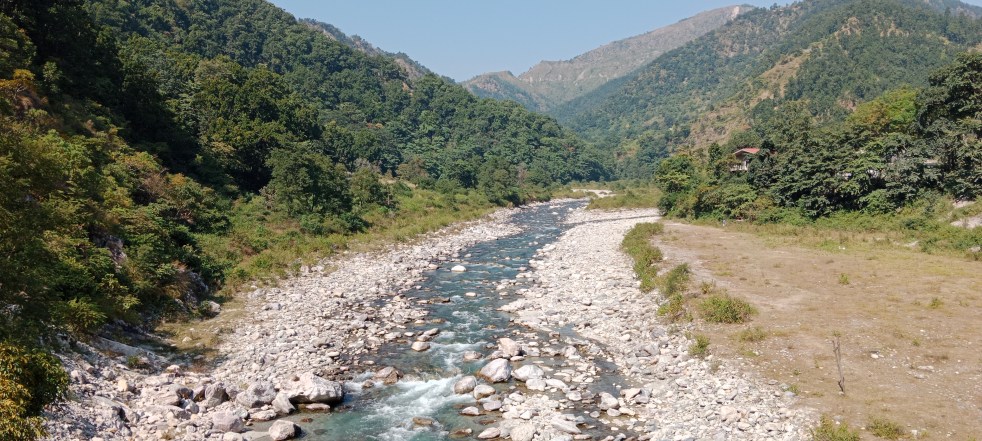
(Feature Image: A Ramganga tributary before joining the river at Marchula, Ramnagar in Nov. 2022. Bhim Singh Rawat/SANDRP)
Post facto environment clearances are indeed a sham as the Hindustan Times Edit has said. It is welcome that the Supreme Court of India has stayed, on Jan 2, 2024, the MoEF memorandums allowing such post facto environmental clearances. Following a petition filed by the Mumbai based environmental group Vanashakti, the sham practice that has been going on since March 2017. Such clearances are clearly contradictory, in letter and spirit to the prior environment clearances as required under the EIA notification of 2006.
The Sham practice should have been stayed much earlier, for example when the Madras High Court gave an interim stay on the MoEF notification of 2017. But unfortunately, the Supreme Court then interpreted that the Madras High Court order will only be limited to Tamil Nadu. Or it may have been stayed earlier by NGT.
It is certainly a slap for the Union Environment Ministry and one only hopes that it learns right lessons and does not start to undo what the Supreme Court has done. This is a major blot on the environmental credentials of the MoEF. One wishes the Supreme Court would also order that the projects that benefited from the impugned order should stop work and go back to get the environment clearance.
Supreme Court MoEF’s 2 memorandums allowing post facto EC, stayed by SC A bench of Justices B R Gavai and Sandeep Mehta stayed the July 7, 2021 and January 28, 2022 Memorandums of MoEF. The Vanashakti plea said that even though the July 2021 SOP only clarified on the March 2017 notification — which had a limited application window of six months that expired on April 13, 2018 — without extending its application, authorities were still treating it “as substantive procedure to process fresh applications for grant of ex post facto environmental clearance”.
– The plea said the SC had, in the 2017 case of Common Cause v. UOI, and 2020 case of Alembic Pharmaceuticals v. Rohit Prajapati, “consistently held that the concept of ex post facto EC is in derogation of the fundamental principle of environmental jurisprudence and is alien to environment jurisprudence”. https://indianexpress.com/article/india/sc-stays-two-ministry-memorandums-allowing-post-facto-green-clearance-9094234/ (04 Jan. 2024)
Prior & post facto green nods can’t co-exist, SC told Prior and post facto environment clearance for projects cannot co-exist as they are “mutually destructive and an oxymoron”, petitioners told the SC on Jan 2 2024, challenging the validity of an office memorandum of the ministry of environment, forest and climate change allowing post facto clearances. Environment impact assessement for a project “can only take place before commencement of activity and not after, and that the EC is an approval which is taken prior to commencement of activity and emanates from precautionary principle which is one of the cornerstones of environmental jurisprudence”, senior advocate Gopal Shankaranarayanan told the bench. In 2017, the government provided a six-month window for alleged violators to apply for post facto clearances.
– This was stayed by the Madras HC. On July 7, 2021, the ministry issued standard operating procedures for processing EIA applications allowing ex post facto environment clearance through the back door, leading to the HC staying its operation. “When an independent question of one Bokaro project came up in the SC in December 2021, the SC said although the Madras HC stay was not challenged, it anyway applied only to Tamil Nadu,” Shankaranarayanan said.
– “Using this observation, the ministry issued an OM on January 28, 2022, saying SC had restricted the HC’s interim order only to Tamil Nadu and started clearing a whole bunch of mining projects with ex-post facto clearance,” he claimed. The NGO, while challenging the validity of the office memorandum, had sought a direction to the ministry and state environment impact assessment authorities “not to process and entertain any application for grant of ex post facto environment clearance on applications filed after April 13, 2018 (the window permitted under the March 14, 2017 notification as extended by the Madras HC). https://timesofindia.indiatimes.com/india/prior-post-facto-green-nods-cant-co-exist-supreme-court-told/articleshow/106498038.cms (03 Jan. 2023)
SC stays OM allowing post facto green nod for projects The Supreme Court on Jan 2 2024 stayed the operation of a January 2022 office memorandum of the MoEF allowing ex post facto environment clearance to projects. These were availed of mainly by mining lease holders. Appearing for NGO ‘Vanashakti’, senior advocate Gopal Shankaranarayanan told a bench of Justices B R Gavai and Sandeep Mehta that the very concept of ex post facto clearance — i.e. clearance after the projects had begun — was an anathema to the Environment Protection Act, which mandated environment clearance prior to starting work on a project.
– The counsel said the EIA notification of 2006 insists on prior environment clearance for all projects and told the court the problem started with an office memorandum of 2017 which provided a six-month window for alleged violators to apply for post facto clearance. The SC entertained the petition, issued notice to the ministry, and stayed the 2022 OM till further orders. https://timesofindia.indiatimes.com/city/delhi/sc-stays-memo-allowing-post-facto-green-nod-for-projects/articleshow/106498621.cms (03 Jan. 2024)
Ex-post facto mining clearance without prior EC stayed The Union government issued an office memorandum in January 2022 to make the stay applicable to Tamil Nadu. The EIA authorities accordingly began processing applications for ex-post facto clearance for the rest of the country. The memorandum was based on the Supreme Court order in a matter related to the Bokaro steel project. The Supreme Court in December 2021 held the high court’s interim stay would not apply beyond its territorial jurisdiction. It was to examine the office memorandum and SOP in light of its previous judgment. https://www.hindustantimes.com/india-news/sc-stays-ex-post-facto-mining-clearance-without-prior-environmental-clearance-101704252518222.html (03 Jan. 2024)
Edit in HT: Ex post facto environmental clearance is a sham. The Supreme Court is right to stay it. https://hindustantimes.com/editorials/how-green-was-my-valley-101704290434512.html (03 Jan. 2024)
HYDRO POWER PROJECTS
SANDRP Blog 2023: Safety & Sustainability Concerns on Dams & Hydro Projects in India In this fourth part of annual overview, SANDRP compiles the issues affecting the safety and sustainability of dams and hydro power projects in India during 2023. The report starts with governance and management issues of dams and hydro power projects as highlighted in our weekly DRP NB and blogs all through the year amid rising concerns and disasters on these structures across the country. It then covers some relevant judicial interventions and governments decisions on the issue. https://sandrp.in/2024/01/03/2023-safety-sustainability-concerns-on-dams-hydro-power-projects-in-india/ (03 Jan. 2024)
Arunachal Pradesh Reliance Power to sell Kalai II HEP Another Hydro Proposal sees exit of private company: Reliance Power has inked an agreement to sell its 1,200 MW Kalai II hydroelectric project in Arunachal Pradesh for Rs 128.39 crore to THDC India. The purpose of entering into the agreement was to monetise the hydroelectric power project, Reliance Power said in a regulatory filing on Dec 31 2023.
– According to the filing, the Governor of Arunachal Pradesh, Kalai Power Private Ltd (a subsidiary of the company), and THDC India Ltd (THDC) have inked an agreement in this regard on December 30, 2023. Under the pact, there will transfer of the development rights and associated physical assets, studies, clearances, designs and intellectual properties of the proposed 1,200 MW Kalai-II hydroelectric project located at the Lohit river basin of Arunachal Pradesh to THDC for an aggregate consideration of Rs 128.39 crore, subject to certain indemnities, representations and covenants, it stated. https://www.business-standard.com/companies/news/reliance-power-to-sell-1-200-mw-kalai-ii-hydropower-project-to-thdc-india-124010100410_1.html (01 Jan. 2024)
Himachal Pradesh Govt plans to take over key HEPs from SJVN In a significant development, the state govt is gearing up to take control of three crucial power projects from Satluj Jal Vidyut Nigam (SJVN), a GoI undertaking. The projects in question—Sunni, Luhri, and Dhaulasidh—have become the center of a growing conflict between the state government and SJVN. The CM, Sukhwinder Singh Sukhu, is scheduled to meet with Union Energy Minister RK Singh on Thursday (Jan. 04) in New Delhi. The conflict arises from the projects allocated to SJVN during the tenure of the former Jairam government.
– The state government is dissatisfied with the progress of the hydropower sector and has sought to reevaluate the terms of the projects. In contrast to the previous government, which made several concessions, the present administration has increased the royalty in power projects significantly. The royalty rates have been elevated from 12, 18, and 30 per cent to 20, 30, and 40 per cent, respectively. Notably, the projects granted to SJVN were reportedly not yielding more than five per cent in royalty.
– The projects in question have symbolic importance, as their foundation stones were laid by PM Narendra Modi. This complicates the matter for the Union Energy Ministry, adding an additional layer of complexity to the ongoing dispute. As tensions escalate, the probability of the state govt taking over these key hydro projects from SJVN remains high, contingent on the company’s willingness to accept the new conditions laid out by the state government. https://thenewshimachal.com/2024/01/himachal-pradesh-government-eyes-takeover-of-key-hydro-projects-from-sjvn-amidst-royalty-dispute/ (03 Jan. 2024)
NGT impleads state officials, seeks accountability In its eight-page order, the NGT expressed dissatisfaction with the steps taken by the government to prevent illegal deforestation and mining, as reported in the media. The matter was posted until February 29, 2024, with a directive for state officials to submit their replies within two months. Notably, despite damages to Union government projects like hydropower, dams, and National Highway, the center, NHAI, and power companies have not been impleaded parties in the matter as of now.
The NGT highlighted that it initiated suo moto cognizance based on a media report published on November 25, 2023, nearly two months after the rain fury. The media report attributed the devastation in Himachal Pradesh to factors such as deforestation, ill-planned construction, and illegal mining along riverbeds. https://himachalscape.com/himachal-monsoon-fury-ngt-impleads-state-officials-seeks-accountability/ (02 Jan. 2024)
Vulnerability to Glacial Lake Outburst Floods Researchers from the Divecha Centre for Climate Change at the Indian Institute of Science in Bengaluru have sounded the alarm, proposing a potential solution – a reduction in the lake’s water level by 10 to 30 meters. Yet, the vulnerability of Himachal Pradesh to bureaucratic inertia and indecision leaves these recommendations dangling perilously, as the region stands at the brink of potential catastrophe.
The vulnerability of Himachal Pradesh has finally caught the attention of NDMA. In a survey conducted in early September, two lakes were identified as being at imminent risk, their areas expanded up to 2.5 times in the past three decades due to rapid glacier melt. Despite efforts in 2016 to draw down some of the lake’s water to prevent overflow, the vulnerability of Himachal Pradesh is underscored by the absence of an early warning system, raising troubling questions about systemic delays. https://thenewshimachal.com/2024/01/silent-threats-roaring-waters-unmasking-himachal-pradeshs-vulnerability-to-glacial-lake-outburst-floods/ (01 Jan. 2024)
Deforestation, ill-planned constructions, unscientific mining behind catastrophe Vikas Vasudeva A preliminary report of a multi-expert committee that was set up to assess the cause and impact of the damage that occurred in and around Shimla, revealed that deposition of thick debris on fragile slopes and construction on these debris cover, unplanned drainage system, decreasing binding force of trees amid relentless rain were among major reasons for the damage. The report pointed out that the Himalayas’ hill slopes are fragile by virtue of their origin, and over a period of time, these slopes are characterised by thick debris cover in the form of overburden overlying the metasediments at varying depths by virtue of erosion, deforestation, and other ill-planned construction activities, and the changing land use patterns have resulted in the slopes being highly fragile.
According to another multi-expert committee report regarding the natural disaster, apart from the effects of climate change, the unscientific and illegal mining along the riverbeds was responsible for the recent natural calamity in the State. The report said that out of 131 stone crushers set up in the Beas river basin, 68 did not have the necessary permission, and only 50 operators were found to have valid permits. Due to excessive muck dumping in the Beas river and on its banks, the flash floods caused enormous damage to life and both public and private property, said the report, adding that the environmental balance of the river basin is under great pressure, which needs to be studied scientifically. https://www.thehindu.com/news/national/other-states/deforestation-ill-planned-constructions-and-unscientific-illegal-mining-behind-himachal-pradeshs-monsoon-catastrophe/article67569624.ece (25 Nov. 2023)
Opinion String of disasters should prompt urgent reconsideration of big infrastructure projects Despite repeated warning from geologists and environmentalists about the fragile status of the Himalayas and the need for utmost caution while constructing dams, roads, power plants or tunnels, haphazard construction for energy, increased revenue from tourism and pilgrimages continues unabated. (Usha Rai) https://scroll.in/article/1061207/string-of-disasters-in-himalayas-should-prompt-urgent-reconsideration-of-big-infrastructure-projects (02 Jan. 2024)
Hattis in Sirmaur get SC status The govt has granted the Scheduled Tribe (ST) status to the Hatti community in Sirmaur district. The government on Monday issued a notification granting the Scheduled Tribe status to all Hattis living in the four assembly segments of Sirmaur district. According to the notification, the Scheduled Caste community has been excluded from the ST status, as per their demand. https://www.tribuneindia.com/news/himachal/hattis-given-scheduled-tribe-status-in-himachal-pradeshs-sirmaur-577297 (01 Jan. 2024)
Sikkim Kundan Green Energy to set up 18 Mw HEPs To develop 12 MW Upper Myong Chu and 6 MW Lower Myong Chu. Investment of Rs 120 Cr and 80 Cr respectively. It will take Kundan Eneregy’s hydro capacity in Sikkim to 50 MW. It has 35 MW of operating projects in Sikkim at Lower Lagyap, Meyong Chu, Kalex Khola and Rabum Chu. https://energy.economictimes.indiatimes.com/news/renewable/kundan-green-energy-to-set-up-18-mw-hydro-projects-in-sikkim-commits-rs-200-crore/106510267 (03 Jan. 2024)
Tiger spotted at 3,966 metres Camera traps placed by the Sikkim forest department in collaboration with the WII have got a picture of a tiger at 3966 metres which is now the highest altitude where a tiger has been sighted. This is the second-highest record globally after Bhutan. Earlier in 2019, Tiger was recorded from North Sikkim (3602 m) and in 2023 from Pangolakha Wildlife Sanctuary at (3640 m). “Gaur (also known as Indian bison) was (also) observed at an elevation of 3568 m from Pangolakha Wildlife Sanctuary which is a world record,” a Sikkim forest department statement said.

Referring to the historical and the recent camera trap records, Wildlife scientist Atharva Singh it is inevitable that the big cat is found above 4000 meters in Sikkim. “Though there are assumptions of the tiger moving towards the higher altitude due to changing climate, more long-term studies would be required to understand the changing climatic trends with respect to the tiger movement in the region. Interestingly there have been accounts of tigers at 4,000 meters in 1924 by Frederick Bailey, a British intelligence officer near Nathula. Considering the growing developmental infrastructures across the borders of Sikkim, the factors causing the range shift of the tiger (if at all it is occurring) could possibly be purely due to rising anthropogenic pressure,” Singh said. https://www.eastmojo.com/sikkim/2024/01/03/roar-from-the-skies-now-tiger-spotted-at-3966-metres-in-sikkim/ (03 Jan. 2024)
Jammu & Kashmir Ratle HEP to provide power to Rajasthan Ratle Hydro Electric Power Corporation Limited (RHPCL), a joint venture company of NHPC Limited and J&K State Power Development Corporation (JKSPDC), has entered into a Power Purchase Agreement (PPA) with Rajasthan Urja Vikas and IT Services Limited, for offtake of power generated from 850 MW Ratle Hydroelectric Project, Kishtwar in the union territory of Jammu & Kashmir. The agreement has been signed for offtake of power for a period of 40 years from the Commercial Operation Date (COD) of the project and as per power allocation to be notified by Ministry of Power. The PPA was signed in Jaipur on 3rd January, 2024 in the presence of senior officers of RHPCL & Rajasthan Urja Vikas and IT Services Limited. https://pib.gov.in/PressReleaseIframePage.aspx?PRID=1993039 (04 Jan. 2024)
Political parties raise questions over Ratle HEP PPA National Conference (NC) spokesperson Imran Nabi Dar sought clarification about the agreement. He said the agreement has stirred a hornet’s nest because the terms and conditions seemingly are to the disadvantage of the Union Territory. “The government should have prioritised providing electricity to the domestic consumers, given the looming energy crisis. For electricity-starved people of J&K, is this agreement a solution?” he asked.
Former CM Mehbooba Mufti, president of Peoples Democratic Party (PDP), said the move to supply electricity to Rajasthan from the Ratle Power Project would “rob” the people of J&K “at a time when J&K is facing a severe power crisis”. J&K Apni Party president Altaf Bukhari termed the government’s move as “puzzling”. “The J&K administration has off and on came on record claiming that it has been buying the power supply from other states to meet the demands in the Union Territory, while at the same time leasing out its own supply to another state is beyond comprehension. I urge the J&K administration to come clear on the facts,” Mr. Bukhari said. https://www.thehindu.com/news/national/other-states/jk-parties-up-in-arms-over-ratle-power-corporation-signing-deal-with-rajasthan-for-40-years/article67713192.ece (06 Jan. 2023)
Ministry of Power Year End Review (up to November 2023) – AT&C losses in power sector down to 15.41% (provisional) in FY 22-23.
– During 2023-24, 7,569 MW (total capacity added 9942 MW) of Renewable Capacity (Incl. Large Hydro) consisting of 5,531 MW of Solar, 1,931 MW of Wind, 34 MW of Biomass, 42 MW of Small Hydro and 30 MW of Large Hydro Generation Capacity has been added.
– During the current year 2023-24, peak demand has increased by 12.7% to 2,43,271 MW during the current year 2023-24 from 2,15,888 MW during same period previous year and all India peak Shortage has reduced to 1.4% (3,340 MW) with respect to 4.0% (8,657 MW) during the same period previous year.
– Energy requirement has increased by 8.6% to 11,02,887 MU during the current year 2023-24 from 10,15,908 MU during same period previous year. Energy availability has also increased by 8.9% to 10,99,907 MU during the year from 10,10,203 MU during same period previous year. Total Electricity generation including from Renewable Sources during 2023-24 is about 1176.130 BU as against 1092.520 BU during the same period last year showing a growth of 7.7%. During the current year 2023-24, energy shortage at all India level has reduced to 0.3% (2,980 MU) with respect to 0.6% (5,705 MU) during the same period previous year. https://pib.gov.in/PressReleasePage.aspx?PRID=1992405 (02 Jan. 2024)
Steps taken to increase production of renewable energy and for setting up Pumped Storage Projects https://pib.gov.in/PressReleaseIframePage.aspx?PRID=1989807 (20 Dec. 2023)
SJVN 4 JV companies in India, Nepal formed SJVN will form a JV with Maharashtra State Power Generation Company Ltd. to develop renewable energy projects of 5,000 MW. The second JV will be between SJVN, the government of Arunachal Pradesh and Navyuga Engineering Co. Ltd. to execute the development of 1,878 MW Oju Hydro Electric Project in Arunachal Pradesh.
SJVN will collaborate with the Nepal Electricity Authority and GMR Energy Ltd. in the third JV to implement a 900 MW Upper Karnali Hydro Electric project in Nepal. SJVN and GMR will have equal equity partnership in this JV. Lastly, SJVN Green Energy Ltd. will form a JV with Assam Power Development Co. Ltd. to develop 1,000 MW Renewable Energy projects in Assam. https://www.cnbctv18.com/market/sjvn-share-price-dipam-fin-min-approval-four-jv-india-nepal-renewable-energy-arunachal-assam-18693651.htm (02 Jan. 2024)
Gujarat NHPC signs pact for 750-MW PSP NHPC Ltd (BOM:533098) announced on Jan 3 2024 that it entered into a memorandum of understanding (MoU) with Gujarat Power Corporation Limited (GPCL) for a 750-MW pumped storage project. The MoU envisages a total investment of INR 40 billion in the Kuppa Pumped Storage Project, which will be developed at a site in Chhota Udaipur, Gujarat. https://renewablesnow.com/news/indias-nhpc-signs-pact-for-750-mw-pumped-storage-project-844782/ (03 Jan. 2024)
DAMS
SANDRP Blog 2023: Incidents of Dam Induced Floods in India In this third annual overview on dams and hydro power projects, we have compiled the reports on flood disasters caused by unscientific or improper operation of dams, hydro and barrage projects in India in 2023. The report highlights criminal negligence by SSNNL and BBMP resulting in massive flood destruction in parts of Himachal Pradesh, Punjab, Gujarat and Madhya Pradesh.

Similarly, the sudden discharges from hydropower dams in Assam, Himachal and Uttarakhand have caused flash flood deluge damaging human properties along the respective rivers. The report also covers some incidents of barrage induced flood events along Ganga in Uttar Pradesh and along Yamuna in Delhi. https://sandrp.in/2024/01/02/2023-incidents-of-dam-induced-floods-in-india/ (2 Jan 2024)
2023: Fly Ash Bund Breach Incidents in India The mismanagement of fly ash has not been just causing the fly ash ponds breach incidents but also contaminating the air and water sources and adversely affecting the health, livelihoods of local people in areas around the thermal power plants. Some relevant reports compiled below reveal that the several of these plants have openly been violating environmental norms across the country and the law enforcers as well judiciary have not been able to address the issue in efficient manner. https://sandrp.in/2024/01/04/2023-fly-ash-bund-breach-incidents-in-india/ (04 Jan. 2023)
Kaleshwaram Project Medigadda barrage undergoes electrical resistivity test for structural integrity As part of the end- to- end investigation of the Medigadda barrage structures that got underway, the project authorities have opted for electrical resistivity test for the entire length of the barrage. It is intended to assess the durability of the concrete structures. The testing process which commenced on Jan 3 2024 would be completed within a week. Basing on the findings, the final investigation report would be prepared by Jan 15 for submission to the government which had already ordered a judicial probe into the sagging of the barrage piers. The L&T company, which constructed the Medigadda barrage has taken up the electrical resistivity test. Top officials of the Irrigation Department made it clear that the investigation as well as the rehabilitation would solely be the responsibility of the implementation agency.
– The electrical resistivity test was conducted first on Sundilla barrage. Pressured grouting was taken up after identifying certain issues. The work has been completed and the barrage was made leakage free. The rehabilitation works on the barrage were done by the implementation agency as part of the contractual obligation. Tests of the electrical resistivity method would be conducted in Annaram barrage also very soon. The grouting works on the barrage were in progress. The seepage issues identified at places were being addressed. https://telanganatoday.com/medigadda-barrage-undergoes-electrical-resistivity-test-for-structural-integrity (05 Jan. 2024)
Kaleshwaram project likely to be defunct for at least 7 months The Kaleshwaram lift irrigation project (KLIP) built on Godavari River in Telangana will be defunct for at least for six to seven months, as it is a gigantic task to restore Medigadda barrage, which suffered major damages in October. That means, “the other two barrages upstream – Annaram and Sundilla will not be functional, as water cannot be lifted and pumped into these barrages. So, the entire project is in a limbo,” a senior engineer associated with the project said.
– On October 28, chairman of dam safety review panel and former Central Water Commission chairman Ashwin B Pandya, along with his team of engineers visited the site and gave the inspection report. “The panel observed that piers had sunk due to a combination of issues involving planning design, quality control and operation and maintenance,” the engineer-in-chief said. https://www.hindustantimes.com/india-news/telanganas-kaleshwaram-project-likely-to-be-defunct-for-at-least-seven-months-101704135865481.html (02 Jan. 2024)
CAG reveals damage to KLIS in 2019 Itself Three barrages — Medigadda, Annaram and Sundilla — under the Kaleshwaram lift irrigaiton scheme (KLIS) were damaged even during the 2019 floods and the previous BRS government clandestinely adjusted the Rs 500 crore estimated value of repairs into the revised project cost as the contractors refused to bear the expenditure.
In November 2019, after the floods, it was found that the RCC wearing coat, CC curtain walls, CC blocks and apron in the downstream of the barrages were washed away. The government had then spent Rs 180 crore to fix the damage Rs 83 crore at Medigadda, Rs 65 crore at Annaram and Rs 32 crore at Sundilla — and estimated that repairs would cost Rs 500 crore.
According to the draft performance report of the Comptroller and Auditor-General (CAG) on KLIS, which the BRS government kept under wraps, studies by the irrigation department had revealed that inadequate provision of energy dissipation works to match the high discharge velocity of water had led to certain structures being washed away.
“When the department approached the contracting agencies for attending to the damages, the agencies rejected the request citing that the work was executed strictly as per the designs and drawings approved by the department,” the CAG said in its report. The contracting agencies claimed that the quality certification had been issued, the CAG said and added “due to defective designing of launching apron and cement concrete blocks, these works could not withstand the discharge velocities and were washed away.”
Ironically, in October last and afterwards, then ministers K.T. Rama Rao and T. Harish Rao had dismissed the sinking of piers at the Medigadda barrage as a routine development and had assured that the state government would not to spend a rupee on repairs. They openly announced several times that the contracting agencies would bear the cost to fix the damage sustained in October, while concealing the flood damage to the three barrages in 2019.
The CAG also pointed to the grave mistake of constructing the Mallannasagar, the largest reservoir under KLIS with a storage capacity of 50 tmc ft, without conducting detailed seismic studies. The drawings were approved and reservoir was constructed in undue haste without conducting the necessary investigations and studies, it said. It was found that irrigation department wrote to the National Geophysical Research Institute (NGRI) to conduct seismic analysis in 2016 and again in 2017. Without waiting for the report, the government awarded the contract in December 2017 with a completion timeline of 2020.
The NGRI, in its report submitted in March 2018, clearly stated that “There is a deep-seated vertical fault with significant strike slip motion in the proposed location of the reservoir and that the rocks in the fault zone were highly sheared and fractured.” Expressing serious concern over the lapse, the CAG said with a project being built without conducting seismic studies and in the absence of any emergency action plan the government left the reservoir as well as lives of people nearby at increased risk.
The Congress govt has not yet revealed the estimated cost of studies to find the reason for sinking of the Medigadda barrage and who – the govt or L&T – would bear the cost of the repairs. https://www.deccanchronicle.com/nation/in-other-news/070124/cag-reveals-damage-to-klis-in-2019-itself.html (07 Jan. 2024)
Andhra Pradesh CWC may take up silt formation study in Srisailam Central Water Commission (CWC) is likely to take up another round of study on formation of silt in Srisailam reservoir following the request from AP government. The state government recently conducted hydro-metric survey and found loss of storage capacity to the tune of 50 tmc due to the additional silt formation. Taking the issue with a serious note as the latest finding will pose more troubles in sharing water with Telangana, AP government requested CWC to take up a scientific study and finalise the actual storage capacity of Srisailam project.
– The project designed with 315tmc ft capacity is now capable of storing just around 185-190tmc ft. First scientific study carried out in 2001-02 found loss of about 44 tmc ft of storage. Then, the state government declared that Srisailam could store just around 264 tmc ft. Subsequently, another round of study was conducted in 2009-10 which found loss of another 50 tmc due to the heavy formation of silt due to the massive floods of 2009. After losing nearly 94 tmc ft in a decade, Srisailam reservoir was left with around 215 tmc capacity. https://timesofindia.indiatimes.com/city/vijayawada/study-on-silt-formation-in-srisailam-reservoir-cwc/articleshow/106499586.cms (03 Jan. 2024)
Maharashtra Temghar stock at 23%; govt yet to allot funds for repairs The live water stock in the Temghar dam has been brought down to 23% of its total capacity for pending repairs of its walls. The work will, however, start only after state government allots the required funds, irrigation department officials said on Jan 5 2024. The department had tabled a proposal seeking Rs 140 crore for the repairs and strengthening of the dam’s structures last year. But, state government has yet to give its final approval. An irrigation department official said, “About 95% works are over. There is a need to give a treatment to the wall from the inner bottom portion. For this, water levels need to be maintained at the lowest level.” https://timesofindia.indiatimes.com/city/pune/temghar-stock-at-23-govt-yet-to-allot-funds-for-repairs/articleshow/106588251.cms (06 Jan. 2024)
Ujani dam pollution scary for health: Minister State health minister Tanaji Sawant on Friday (Jan.05), citing an environment department report, claimed that over 90% people of future generations from several districts of Maharashtra and Karnataka “might be vulnerable to cancer due to the polluted water of Ujani dam”. “Water polluted by industrial effluents from Pune and nearby areas flows into Ujani dam through different rivers. The dam supplies water to several districts of western Maharashtra and Marathwada. The same water reaches many districts of Karnataka. https://timesofindia.indiatimes.com/city/pune/ujani-pollution-scary-for-health-maharashtra-minister-tanaji-sawant/articleshow/106586445.cms (06 Jan. 2024)
INTERLINKING OF RIVERS
Ken Betwa Linking Strong case for shifting resources from mega to small water conservation projects Bharat Dogra argues: While there is widespread agreement on according very high priority to resolving the water problems here by finding sustainable solutions, there is a lot of difference of opinion regarding how to go forward in this. Already in recent decades several large and medium dam projects have been constructed here and a district like Lalitpur is known as the district perhaps most known for such projects. Despite this people have continued to experience water scarcity quite frequently. While people just now are happy regarding the jal jeevan mission being busy with providing water connections in all village homes, serious concerns regarding the depletion of water sources still persist.
– The biggest and most highly publicized water project being implemented here, which involves dam as well as canal construction and which has been called the first river-link project under the wider national river-links mega-project is the Ken-Betwa River-Link Project. https://countercurrents.org/2023/12/a-strong-case-for-shifting-resources-from-mega-water-projects-to-small-water-conservation-projects-in-bundelkhand/ (31 Dec. 2023)
Maharashtra Govt relaxes water norms for Wainganga-Nalganga linking project To clear the irrigation backlog in Vidarbha, the cabinet on Thursday (Jan. 04) decided to relax the water availability condition for the Wainganga-Nalganga river linking project. Under the project, the excess water collected during the monsoon in Gosikhurd dam in Bhandara would be diverted from the Wainganga sub-basin to the Nalganga project in Buldhana district through a tunnel.
– The project is planned to take Gosikhurd waters to drought prone western region of Vidarbha. Over 3.71 lakh hectares land across six districts of the region would be irrigated, as per the statement issued by the government. The ₹82,000 crore project would benefit districts like Wardha, Amravati, Yavatmal, Akola and Buldhana, besides Nagpur. For the project, about 62.57 TMC water is required, and the Godavari Water Disputes Arbitration has allowed Maharashtra to use it fully from the Gosikhurd project. Therefore, 29.23 TMC water is available for this project with 75% reliability and 62.57 TMC with 63% reliability. https://timesofindia.indiatimes.com/city/nagpur/govt-relaxes-water-norms-for-wainganga-nalganga-project/articleshow/106561209.cms (05 Jan. 2024)
INTERSTATE WATER DISPUTES
Krishna Water Disputes Telangana CM plans to meet Karnataka CM Telangana CM Revanth Reddy said that he is planning to meet Karnataka CM Siddaramaiah to seek for water for the state from the Krishna River. Speaking in an interview with a local channel, Revanth Reddy said, “…Uttam Kumar Reddy (irrigation minister) and I are planning to meet the Karnataka CM to ask for water from Almatti dam. We can release our share to Karnataka when our dams get water in future.” However, Telangana CM has yet to announce any tentative date of the meeting, and this will be his first official meeting with Karnataka CM after getting into power. https://www.hindustantimes.com/cities/bengaluru-news/telangana-cm-revanth-reddy-plans-to-meet-karnataka-cm-for-krishna-river-water-101704611774722.html (07 Jan. 2024)
IRRIGATION
Study Impact of RE on groundwater irrigation & agriculture India has made impressive progress in rural electrification (RE) since the government of India shifted its policy focus towards universal household electrification since early 2000s. However, evidence suggests limited impacts on household incomes and expenditures since agriculture still drives the economy and electricity is primarily used for generating income through pumping groundwater for irrigation – one of the important factors affecting prosperity among small holder farmers informs this paper titled ‘The changing impact of rural electrification on Indian agriculture’ published in Nature Communications. https://www.indiawaterportal.org/articles/how-has-changing-rural-electrification-impacted-agricultural-expansion-india (03 Jan. 2024)
Karnataka Farmers protest demanding water for chilli crop The farmers protest outside the administrative office of Krishna Bhagya Jala Nigama Limited (KBJNL) in Bheemarayanagudi in Shahapur taluk demanding to release water from Basavasagar reservoir to Narayanapur Left Branch Canal to save standing crops, mainly chilli in the command area, has continued even after 20 consecutive days. Deputy Commissioner B. Susheela and other higher officers at the dist headquarters had come to the spot on Friday to convince the farmers to end the protest since the water level in the reservoir is not favorable for water to crops. The farmers explained the situation and said that they would face loss if water was not released and declared that they would continue the protest. https://www.thehindu.com/news/national/karnataka/farmers-protest-demanding-water-for-chilli-crop-continues-in-bheemarayanagudi/article67710026.ece (5 Jan 2024)
Water Released Karnataka govt late Jan 6 night decided to release 2.75tmcft of water from Almatti and Narayanpur reservoirs to save chilli crops in four North Karnataka districts of Bagalkot, Kalaburagi, Yadgir, Raichur. The watere will reach the tail end destinations in four days. https://timesofindia.indiatimes.com/city/bengaluru/2-75tmcft-water-released-to-save-chilli-crop-in-n-karnataka/articleshow/106620632.cms (8 Jan 2024)
URBAN RIVERS
Ghaggar; Panchkula Fencing of bridge on to check waste dumping Following the NGT orders, the Haryana Shehri Vikas Pradhikaran (HSVP) has begun the installation of fences on the Ghaggar bridge adjacent to Sectors 23 and 3 to prevent people from dumping garbage in the river or immersing religious idols in it. HSVP XEN NK Payal said that, following the NGT’s orders, fences are being installed on the sides of the bridge. “We had floated a tender for the installation of a fence worth Rs 80 lakh. The work has been started, and it is expected to be complete by the end of February,” Payal added.
It may be recalled that a husband-wife duo, Sukhwinder and Meenu, had filed a complaint with the NGT in August 2022, seeking a ban on the immersion of idols in water bodies that are not eco-friendly. They had noted that the immersion of such idols was polluting the river. Sukhwinder, a resident of Sector 23 in Panchkula, said they had earlier approached the Panchkula Municipal Corporation and the HSVP in that regard, but to no avail. His wife, Meenu, said people dump garbage and other items in the river despite the fact that the Central Pollution Control Board had previously suggested barricading spaces for idol immersion in a river stretch and suggested a separate disposal of waste. https://www.tribuneindia.com/news/chandigarh/fencing-of-bridge-on-to-check-dumping-of-waste-in-ghaggar-577999 (04 Jan. 2024)
Devika; Udhampur Minister inspects Devika rejuvenation project Devika river is considered the sister of the sacred river Ganga, and it has a great religious significance. Therefore, the Liquid Waste Management (LWM) project has been undertaken separately to protect the sanctity of the holy river in Udhampur.
On the lines of ‘Namami Ganga’, Devika rejuvenation project is being built at a cost of over Rs 190 crore. The sharing of fund allocation is in the ratio of 90:10 by the centre and UT respectively. It was launched by the PM in Feb. 2019. The project includes the construction of 3 STPs of 8 MLD, 4 MLD, and 1.6 MLD capacity, a sewerage network of 129.27 km, development of two cremation ghats, protection fencing and landscaping, small hydropower plants and three solar power plants. Besides a Liquid Waste Management Project, a Solid Waste Management (SWM) project will also be constructed under the project. https://www.financialexpress.com/business/infrastructure-pm-modi-set-to-unveilnbspnorth-indias-first-river-rejuvenation-project-devika-check-key-features-here-3352377/ (01 Jan. 2024) Union Minister Jitendra Singh on Sunday (Dec. 31, 2023) carried out an on-site review of the Devika rejuvenation project in Udhampur. https://www.tribuneindia.com/news/j-k/minister-inspects-river-project-577202 (01 Jan. 2024)
Adyar; Chennai Work to desilt river to be completed by Feb. The Adyar river had carried a flow of a minimum of 30,000 cubic feet of water per second during heavy rain in December last year. However, instead of building a training wall for sustainable opening of river mouth like in other estuaries, the WRD has planned to dredge the river mouth every year.
The Department had earlier obtained the MoEF&CC’s coastal regulation zone clearance for the project to dredge the river mouth. Officials said the ₹11-crore work would be carried out during May without disturbing the turtle nesting season. The estuary would be dredged for a length of 400 metres and a width of 400 metres, covering both the river and sea sides. About 2 lakh cubic metre of sand estimated to be removed would be used to enhance beach nourishment on the northern side, in places like Srinivasapuram.
In its study, the National Institute of Ocean Technology had recommended dredging the Adyar river mouth every year as an alternative to a training wall, which may lead to sand erosion in other stretches. The upstream portions of the river, including those near Kotturpuram, have gained more silt after the recent heavy discharge into the river. However, sources said the stretch would need a desilting exercise after 5 years as silt was removed recently. Dismantling the old bridge near Thiru.vi.ka. bridge also needs to be considered as it often obstructs the river flow. https://www.thehindu.com/news/cities/chennai/work-to-desilt-a-portion-of-adyar-river-close-to-estuary-to-be-completed-by-february/article67710285.ece (06 Jan. 2024)
Musi; Hyderabad New bridge to end waterlogging woe The Greater Hyderabad Municipal Corporation (GHMC) officials said the foundations for the project, costing Rs 52 crore, would be laid by March and the project completed in one year. The bridge starts from Ali Cafe in Amberpet and ends at Pista House, opposite the Musarambagh RTO. Currently, the demolition of the existing bridge at Moosarambagh over Musi is underway, which will be replaced by the new structure.
Officials said that the new bridge will be 400 metres long, including approaches, and 29.5 metres wide, with six lanes and 3.5-metre footpaths on either side. “The height of the new bridge is 10 metres, unlike the earlier one, which was of a low height. The new structure will have a better aesthetic appeal too,” a GHMC official said. The bridge is being replaced as motorists had to suffer during rain, as the water overflow and waterlogging would make the bridge unusable, posing enormous risks to those who use it. https://www.deccanchronicle.com/nation/current-affairs/040124/hyderabad-new-bridge-over-musi-to-end-waterlogging-woe.html (04 Jan. 2024)
Pune Campaign to save dying water bodies launched Following the authorities’ apparent failure to address the critical issue of reviving dying rivers, the Pune River Revival is starting the Rights of Rivers – My Responsibility Campaign for the water bodies in the Bhima basin, including Mula, Mutha, Ramnadi, Pawana, Indrayani, Bhama, and Bhima. The three-day campaign will kick off on Republic Day. The crusade aims to have clean and natural rivers that are free of sewage and pollutants.The activities planned during the campaign include celebrating the completion of 700 days of relay fasting by citizens, river cleaning, selfies, vlogs, street play, and other types of art displays. The participants can win exciting prizes by participating in selfies with the river contest. Those who get 300 likes on social media for their selfies stand a chance to win prizes. https://punemirror.com/pune/others/pune-based-group-launches-campaign-to-save-dying-water-bodies/cid1704684105.htm (08 Jan. 2024)
RIVERS
Report Looking back at top moments for the environment in 2023 Nations band together to protect freshwater sources UNEP and several partners launched the Freshwater Challenge, which aims to safeguard and revive 300,000km of rivers and 350 million hectares of wetlands around the world by 2030. That would make it the largest wetland and river restoration effort in history. Some 43 nations joined the push in 2023, including many at the United Nations Climate Change Conference (COP28), whose presidency cited the Freshwater Challenge as a key outcome of the summit. Sources of freshwater are under increasing pressure from climate change, pollution and other stressors. One-third of the world’s wetlands have been lost over the past 50 years, while rivers and lakes are the most degraded ecosystems in the world. https://www.unep.org/news-and-stories/story/looking-back-top-moments-environment-2023 (28 Dec 2023)
MoJS 2023 report of Jal Shakti Ministry In 2023, National Mission For Clean Ganga Completes 38 Projects And Sanctions 45 New Projects Amounting To ₹ 5,473 Crore
– India Led Global River Cities Alliance Launched at COP28 in Dubai in December, 2023
– National Water Mission’s Jal Shakti Abhiyan: Catch the Rain 2023 Campaign Reaps Big Results, creates 10,59,816 Water Conservation & Rain Water Harvesting Structures, 5,88,816 reuse and recharge structures & 12,41,245 watershed development structures; Renovates 2,53,951 traditional water bodies and Establishes 661 Jal Shakti Kendras
– Task Force Under Bureau of Water Use Efficiency submits report on 14.08.2023; Draft Action Plan next 2 years prepared based on the Task Force report
– 8th India Water Week 2024 to be held from 17th to 21st September, 2024, at Pragati Maidan, New Delhi themed “Partnerships & Cooperation for Inclusive Water Development & Management”
– 29,777 Wells Constructed, 87,243 Ha Command Area Created And 67,902 Small & Marginal Farmers Benefitted Under Pradhan Mantri Krishi Sinchayi Yojana – Har Khet Ko Pani
– As Per Assessment Of Dynamic Ground Water Resources Of India 2023 Report, Total Annual Groundwater Recharge In The Country Assessed As 449.08 Bcm; Annual Extractable Ground Water Resources Assessed As 407.21 Bcm; Annual Groundwater Extraction Is 241.34 Bcm. https://pib.gov.in/PressReleseDetailm.aspx?PRID=1993077 (04 Jan. 2024)
GANGA Uttar Pradesh The state of Ganga being exposed by this video, close to Prayagraj where lakhs are to come for Holy Bath. Exposing the reality of work of NMCG, Namami Gange and that of River Ganga. https://fb.watch/poGnmTXGdn/?mibextid=Nif5oz (05 Jan. 2023)
YAMUNA SANDRP Blog SC & NGT Reject Delhi Police’s Plea for Construction on Yamuna Floodplain Upholding the NGT order, the Supreme Court has rightly rejected the Delhi Police petition. The case should act as an eye-opener for all the developmental agencies in national capital still eyeing on floodplain land for unjustified projects which can further jeopardize the carrying capacity and ecological functions of Yamuna River and its floodplain. At the same time, the case also offers a learning lesson for the Principal Committee which should have ideally rejected the proposal.

Hope the Principal Committee would function accordingly the spirit of “Maili Se Nirmal Yamuna” case which is among most remarkable NGT judgements for River Yamuna till date. And though the man behind the judgement Manoj Misra of Yamuna Jiye Abhiyan is no more but the outcomes of his determined efforts are still proving instrumental in safeguarding the interests of Yamuna River and its floodplain in Delhi. https://sandrp.in/2024/01/07/sc-ngt-reject-delhi-polices-plea-for-construction-on-yamuna-floodplain/ (07 Jan. 2024)
The SC on Jan 2, 2024 dismissed a plea by the Delhi Police seeking seeking permission to construct barracks for accommodation of its trainees in the floodplains of Yamuna river. A bench of Justices Abhay S Oka and Ujjal Bhuyan wondered how could permission be given for allowing construction on the floodplains.
– The NGT in its 2015 order prohibited any construction activity in the demarcated flood plain and directed the Principal Committee to identify all existing structures as of today which fall on the demarcated floodplain. “Upon identification, the Principal Committee shall make its recommendations as to which of the structures ought or ought not to be demolished, in the interest of environment and ecology, particularly, if such structures have been raised in an unauthorised and illegal manner,” the NGT had said. https://theprint.in/india/delhi-police-plea-for-construction-on-yamuna-floodplains-junked/1907862/ (02 Jan. 2024)
YAMUNA Delhi Govt blames Haryana for rising ammonia in river A senior official of Water Ministry said that industrial effluents from Haryana’s Sonepat, Panipat and Rohtak districts and UP’s Ghaziabad and Noida districts continue to pollute the Yamuna. Delhi alleges that drains number 2 and 6 from Haryana carry toxic industrial pollutants that fall into the Yamuna. Due to frequent discharge of industrial waste, the level of ammonia in raw water rises, forcing the DJB to shut down water treatment plants till pollutants are washed away from the Wazirabad pond. https://www.tribuneindia.com/news/haryana/delhi-again-blames-haryana-for-rising-ammonia-in-yamuna-river-577168 (01 Jan. 2024)
NGT forms panel over encroachment on floodplains The NGT has formed a panel to suggest measures to remove encroachments from the Yamuna floodplains, taking cognizance of a news report that flooding in the city is caused by unauthorized construction there. The committee will be headed by the Delhi Chief Secretary and it has been directed to submit its report by January 30 next year. “We are also of the view that the floodplains of the Yamuna are required to be identified, demarcated and notified in the light of the River Ganga (Rejuvenation, Protection and Management) Authorities Order, 2016,” read an order of the principal bench of the NGT dated October 17. The committee has been directed to visit the floodplains and ensure their demarcation. It has been asked to suggest measures to prevent and remove the encroachments and unauthorized constructions, as per the order. https://www.thehindu.com/news/cities/Delhi/ngt-forms-panel-over-encroachment-on-yamuna-floodplains/article67435497.ece (19 Oct. 2023)
Haryana NGT forms panel to check violation of green laws NGT has started a probe into illegal industrial units in Haryana districts bordering Delhi, releasing untreated effluents directly flowing into Yamuna. The NGT directed the joint committee comprising of a representative of MS, CPCB, MS, SPCB and District Magistrates of Sonepat, Faridabad, Gurugram and Jhajjar, to ascertain the ground report in all these districts.
A Delhi-based environmentalist, Varun Gulati, had filed a complaint with the NGT in December last year in which he alleged that over 500 dyeing units were operating in the residential and non-confirming areas — Dheeraj Nagar and Surya Vihar in Faridabad; Friends Colony, Pyau Maniyari, Ferozpur Bangar in Sonepat; Bajghera, Dhankot, Dhanwapur and Sector 37 in Gurugram and Badsa village in Jhajjar district and Nizampur in Bahadurgarh.
There is no CETP in the areas concerned due to which the untreated effluent from the units in Faridabad is going directly into Badshahpur drain, the effluent from the units in Gurugram directly goes into Sahibi river, the effluent of units in Badsa village and Nizampur flows directly into Mungeshpur drain in Delhi and the untreated effluent from the units in Sonepat district flows directly into drain number 6 and all these drains leads to Yamuna river. The untreated effluent is a big reason behind the pollution of Yamuna, the complainant said. https://www.tribuneindia.com/news/haryana/ngt-forms-panel-to-probe-violation-of-green-laws-578633 (06 Jan. 2024)
Agra Activists demand urgent measures to save dying river At a people’s conference held at the Etmauddaula View Point, the activists expressed concern and disgust at the continued neglect of the Yamuna river in Agra, the city of the Taj Mahal and other glorious Mughal monuments that attracted millions of tourists round the year.
“More than three decades after the SC intervention in the MC Mehta case, to control environmental pollution in the eco-sensitive Taj Trapezium Zone, conditions in respect of air and water pollution remain almost the same, though over a thousand crores of rupees have been spent on nonspecific schemes,” environmentalist Devashish Bhattacharya said.
The members of the River Connect Campaign demanded a White Paper detailing all the money, and grants, sanctioned under various projects for river cleanup, the various Action Plans, the actual work done, and the results thereof. “For want of accountability and lack of transparency no one knows what work has been done and what milestones had been covered,” the activists said.
Neither the drains and open nalas have been tapped or diverted, nor has the continuous discharge of industrial effluents stopped in the industrial clusters of Haryana and Delhi, said Deepak Rajput. For many years, the NGT has been persuading the district authorities in Mathura, Vrindavan, and Agra to demarcate the flood plains, and all encroachments but there has been no action. Political will is lacking and the corrupt bureaucracy scuttles all initiatives in this direction, said Pandit Jugal Kishor.
Two decades ago, the Agra police had formed river police squads, but now there is no trace of this body set up to control pollution in the river, Jugal Kishor added. The district authorities in Agra have shown no interest in shifting the transport companies from the Yamuna Kinara road, shifting cattle sheds from the congested city areas, shifting dhobi ghats, and cremation grounds, and clearing the encroachments along the river banks, pointed out Raj Kumar Maheshwari.
Activist Nidhi Pathak said despite repeated demands over the years, the government bodies had not initiated any plan for regular dredging of scum and desilting of the river bed to increase the holding capacity during the monsoon months. In a resolution, the conference members said air pollution in Agra and the drying up of the river Yamuna were critical issues that called for drastic action by the state government. The Yamuna barrage project hangs fire with no hope of an early start of work on this crucial project that could save the Taj Mahal and other monuments from air pollution. https://www.daijiworld.com/news/newsDisplay?newsID=1147938 (10 Dec. 2023)
14 MLD STP worth Rs. 77.36 Cr in Baghpat inaugurated The Union Minister for Jal Shakti, Shri Gajendra Singh Shekhawat on Jan. 04 inaugurated 14 MLD STP and 2.4 km long Interception & Diversion (I&D) Network in Baghpat. It is built under DBOT mode with 100% central funding under the Namami Gange Program. The estimated cost of the project is Rs. 77.36 crores.
The Baghpat STP project encompasses the interception of 4 major Nalas in the region. An Intercepting Sewer Line, spanning 2.345 kilometers, is installed to ensure efficient sewage interception. Additionally, the installation of one Master Pumping Station (MPS) regulates the efficient flow of sewage within the system. The initiative includes a robust Operation & Maintenance plan for the next 15 years.
The MoJS has recently approved 34 projects, allocating Rs. 5834.71 crore to create 2110.25 MLD STP capacity. These projects are strategically distributed across Himachal Pradesh (01), Haryana (02), Delhi (11), and Uttar Pradesh (20), under the Namami Gange program, aiming to mitigate pollution in the Yamuna and Hindon Rivers. Notably, 15 out of these 34 projects have already been completed, including 1 in Paonta Sahib, Himachal, 2 in Sonipat & Panipat, Haryana, 6 in Vrindavan, Etawah, Firozabad, Baghpat & Mathura (involving both STP & CETP) in Uttar Pradesh, and 6 in Delhi.
Discussing the ongoing challenges regarding the pollution of the Yamuna, he noted that Asia’s largest STP has been successfully established in Okhla, boasting an impressive capacity of 564 MLD. Shri Shekhawat concluded by underscoring the commitment to combat Yamuna’s pollution with a firm pledge to ensure 100 percent cleanliness in the Yamuna water of Delhi by the year’s end. https://pib.gov.in/PressReleaseIframePage.aspx?PRID=1993103 (04 Jan. 2024)
Madhya Pradesh नदी जिसने लोगों को बनाया रंक से राजा पन्ना जिले में बाघिन नदी में कंकर और पत्थरों के बीच वेशकीमती हीरे मिलते हैं। नदी के आसपास आज भी बड़ी संख्या में लोग हीरों की तलाश करते हैं। बाघिन की उत्पत्ति सुतीक्ष्ण मुनि की तपोभूमि सारंगधर मंदिर के निकट हुई है। यहां से यह नदी इटवां, सिरस्वाहा, बृजपुर, रमखिरिया, गहरा, गजना धर्मपुर होते हुए बृहस्पति कुंड में गिरती है। नदी जिले में जहां-जहां से होकर प्रवाहित होती है, उस पूरे इलाके में हीरा मिलता है। बाघिन नदी के कछार में चलने वाली पतालिया, जमुनिहाई, चांदा डबरी, सिरसा द्वारा की खदानें प्रसिद्ध रही हैं। यहां की उथली हीरा खदानों से हर साल करोड़ों रुपए कीमत के हीरे निकलते हैं।
बाघिन नदी के किनारे रमखिरिया गांव के पास विगत चार दशक पूर्व तक एनएमडीसी द्वारा भी हीरों का उत्खनन कराया जाता रहा है। 90 के दशक में एनएमडीसी का रमखिरिया प्लांट बंद कर दिया गया और मझगवां में नया संयंत्र स्थापित किया जाकर वहां हीरों का उत्पादन बड़े पैमाने पर किया जाने लगा। मौजूदा समय मझगवां स्थित एनएमडीसी प्लांट भी बंद है। जानकारों का कहना है कि रमखिरिया हीरा खदान में एनएमडीसी द्वारा बाघिन नदी के पानी का उपयोग किया जाता रहा है। फलस्वरुप एनएमडीसी के हीरे इस नदी में बह जाया करते थे। नदी में बहे यही हीरे लोगों को मिलते रहे हैं। https://pannastories.blogspot.com/2024/01/blog-post_4.html (04 Jan. 2024)
FISH, FISHERIES, FISHERFOLKS
Tamil Nadu Public hearing panel recommends urgent govt action At a recent public hearing organised on January 1 at the Ennore Vyabarigal Sangam Thirumana Mandapam by the Ennore Makkal Paathukaappu Kuzhu (Ennore People’s Protection Committee) — a campaign front bringing together representatives of all 32 villages/localities in the Ennore/Ernavur region — people living in these villages recounted how the extreme climate and hazardous environment have affected their families for decades, and the recent events have only added to their fear and trauma.

The public hearing panel headed by Justice (Retd) K. Kannan, Punjab & Haryana High Court has recommended that the government should notify Ennore backwaters as a special wetland, as directed by the National Green Tribunal’s July 2023 order. The panel, in its report released to the media, also recommended that criminal cases be filed against Chennai Petroleum Corporation Limited (CPCL) and Coromandel International Limited (CIL) for “reckless negligence leading to harm to human health and the environment.”
The panel report observes that the residents lament the lack of government action and the adverse reaction to the peaceful protests by villagers to draw attention to their suffering, wherein 18 residents were booked under various criminal charges for highlighting their problems during protests. https://citizenmatters.in/public-hearing-panel-recommendations-ennore-industrial-disasters-oil-spill-gas-leak-40491 (05 Jan. 2024)
सार्वजनिक क्षेत्र की रिफाइनिंग कंपनी से कथित तौर पर कच्चा तेल चेन्नई के उत्तर में कोसस्थलैयार नदी, जैव विविधता वाले एन्नोर क्रीक और बंगाल की खाड़ी में रिस गया। इससे प्रदूषण फैलने के साथ-साथ मछली पकड़ने का काम रुक गया। इस घटना से कम से कम 2,301 मछुआरा परिवार प्रभावित हुए हैं और 787 नावें खराब हो गई हैं। मछली पकड़ने का काम बंद होने से इस समुदाय को बुनियादी सुविधाओं के लिए संघर्ष करना पड़ रहा है। मछुआरा समुदाय का कहना है कि उन्हें दिया गया मुआवजा पर्याप्त नहीं है। पारिस्थितिकी विज्ञानियों ने तेल रिसने से इलाके में मैंग्रोव पर असर पड़ने को लेकर चिंता जताई है। मैंग्रोव, मछलियों के प्रजनन के लिए जरूरी जगह होने के साथ-साथ समुद्री पारिस्थितिकी तंत्र का एक अहम हिस्सा है। https://hindi.mongabay.com/2024/01/08/oil-spill-in-ennore-brings-fishing-to-a-standstill/ (08 Jan. 2023)
Maharashtra Fresh protest against solar plant at Jayakwadi dam Fishermen and other allied communities from different villages in Chhatrapati Sambhajinagar and Ahmednagar districts located on the banks of the Jayakwadi dam marched to the district collectorate on Jan 2 2024 to register their protest against the floating solar power plant at the dam. Accusing the authorities of not keeping their promise and continuously pushing for the project, the fishermen said they would fight tooth and nail to ensure the solar power plant does not see light of the day.
– “After talks with the local authorities, we had given them a month to scrap the project. Despite giving an assurance to look into our demand, different authorities are pushing for the project. The solar power plant is going to snatch the livelihoods of 2 lakh people,” Sachin Pandav, one of the leaders of the fishermen community, said. According to local fishermen, the central authorities have asked for installing a pulling station as part of the floating solar power plant at Mauje Katpur in Paithan taluka of Chhatrapati Sambhajinagar district. They also claimed that tenders have been floated for appointing a firm to prepare a feasibility report as a precursor for the solar project.
“We are also waging a legal battle against the project. If the government does not mend its ways, we will intensify our protest,” Somnath Limbore, another leader, said.
– The floating solar power plant at the Jayakwadi dam allegedly falls in the core area of the bird sanctuary. Conservationists and nature-lovers have also been vehemently opposing the project maintaining that it would badly affect the resident as well as the migratory birds. Considered as home for 234 species of resident and migratory birds among other creatures, Jayakwadi bird sanctuary is spread over 341.05 sqkm in Chhatrapati Sambhajinagar and Ahmednagar districts. https://timesofindia.indiatimes.com/city/aurangabad/fresh-protest-by-fishermen-against-solar-power-project-at-jayakwadi-chhatrapati-sambhajinagar/articleshow/106500453.cms (03 Jan. 2023)
Himachal Pradesh Fish production declines in Govind Sager There is decline in fish production in Gobind Sagar Lake of Bhakhra Dam from 328.26 tons in 2018-19 to 182.84 Tons in 2022-23, majorly due to upstream dams like Kol Dam, Karcham Wangtoo, Nathpa Jhakri, Rampur HEPs as per a CIFRI study. https://www.tribuneindia.com/news/himachal/fish-production-declines-in-gobind-sagar-578727 (04 Jan. 2024)
Uttar Pradesh Mass fish death in Behta river A mass fish death incident has occurred in Behtra river near Rusena Majre Jhobaria village under Rahimabad police station of Malihabad tehsil area following release of untreated effluents in late night hours of Jan. 05. Behta is part of Gomti river basin. According to the report the chemically laced water has been released from factories under Sandila police station of Hardoi district. As per the villagers there have been similar incidents in past killing fish, birds and animals dependent on the river. https://nishpakshpratidin.com/intoxicating-water-came-into-the-stream-of-water-for-fish/ (6 Jan 2024)
SAND MINING
Bihar 2023: Cops, mining officials bore the brunt of mafia attacks The attacks on the government officials were reported almost every day from different parts of the state in 2023. The officials faced most attacks by illegal sand miners.
-On Nov 14 police sub-inspector Prabhat Ranjan (28) was run over by a tractor allegedly carrying illegally mined sand, while he was trying to stop the vehicle in Vaishali district. The 2018-batch officer was posted at Garhi police station in the district.
– On Nov. 1, home guard constable Rajaram Mahto being run over by a vehicle allegedly belonging to sand mafia on Madhe road under Barem police outpost in Aurangabad district.
-On Oct 11, SI Paras Sah and BSAP jawan Suresh Kumar were severely injured in a stone pelting by the alleged sand mafia during a raid in Main police station area of Gaya district.
-On Sept 13, mining inspectors Anu Kumar and Apurva Singh, along with SAF jawan Parmanand Singh, were injured in another stone and brick pelting at Bairmi village under Kadirganj police station in Nawada district.
-On Aug 20, SHO Dharmendra Kumar and constables Niranjan Prasad, Nazimuddin Khan and Rajiv Dubey were injured, while their police jeep was damaged in an attack by alleged sand mafia on the outskirts of Gaya town on August 20.
-On June 8, mining inspectors Apurva Singh and Rukaiya Khatun, along with five police constables, were injured in a stone and brick pelting and attacks by sticks and rods by alleged sand mafia in Nardiganj police station area of Nawada district.
-On April 17, district mining officer Kumar Gaurav and two mining inspectors Syed Farheen and Amya Kumari were injured in a stone pelting by alleged sand mafia while conducting raids at Bihta in Patna district.
-On February 22, illegal miners allegedly tried to set mining inspector Anil Kumar and his team on fire by pouring petrol on them at Shiv Bachan Singh Chowk in Saran district. A SAP jawan, Bindeshwari Mandal, was injured in the clash while the miners allegedly decamped with a seized vehicle, even as the mining officials managed to escape from the spot.
-January saw two attacks of mining officials. On January 30, alleged illegal sand miners attack a mining department team, which was kept hostage for an hour at Sangam ghat of Gandak river in Muzaffarpur district. Later the district police released the team. https://timesofindia.indiatimes.com/city/patna/rising-attacks-on-cops-and-mining-officials-by-mafia-groups-in-bihar/articleshow/106393183.cms (30 Dec. 2023)
Tamil Nadu HC stays ED summonses to three private contractors The Madras high court on Friday stayed the operation of summonses issued by the Enforcement Directorate (ED) to three private contractors in connection with an illegal sand mining case. A division bench of Justice S S Sundar and Justice Sunder Mohan granted the relief on pleas moved by contractors A Rajkumar, Shanmugam Ramachandran and K Rethinam challenging the summonses issued under the Prevention of Money Laundering Act (PMLA). https://timesofindia.indiatimes.com/city/chennai/illegal-sand-mining-in-tamil-nadu-madras-high-court-stays-ed-summonses-issued-to-three-private-contractors/articleshow/106572753.cms (05 Jan. 2024) https://www.livelaw.in/high-court/madras-high-court/madras-high-court-stays-ed-summons-to-contractors-in-sand-mining-money-laundering-case-245932 (05 Jan. 2024)
Sand-laden truck crushes 4 people to death Sources said that the driver of a sand-laden tipper lorry lost control of the vehicle, jumped over the centre median and crashed into motorists waiting near the railway gate. https://www.newindianexpress.com/cities/chennai/2023/aug/11/sand-laden-truck-runs-berserk-in-chengalpattu-crushes-four-people-to-death-2604290.html (11 Aug. 2023)
Jharkhand ED issues summons to CM’s media advisor and two others The ED on Saturday (Jan. 06) issued summons to CM Hemant Soren’s Press Advisor Abhishek Prasad to appear before it on January 16 in connection with an illegal mining case. Two others have also been summoned — Vinod Singh, a close associate of Mr. Soren, on January 15; and Sahibganj Deputy Commissioner Ramniwas Yadav, on January 11.
The central probe agency initiated the investigation on the basis of a FIR registered in Sahibganj, under various Sections of the Indian Penal Code, the Arms Act, and the Jharkhand Prevention of Illegal Mining, Transportation and Storage Rules, 2017. The investigation revealed that “rampant” illegal mining activities, estimated at a market value of ₹1,250 crore, were evident in the area. To ascertain the extent of the operation, 20 joint inspections were carried out by ED officials, along with administrative, forest, mining, and pollution control officers of the State government. During its raids, the agency found evidence of investments and suspicious financial transactions via shell companies. Further action is being taken on the basis of the seizures, sources said. https://www.thehindu.com/news/national/other-states/ed-issues-summons-to-hemant-sorens-media-advisor-and-two-others-in-illegal-mining-case/article67713166.ece (06 Jan. 2024)
Telangana CSIR-NGRI, GSI ink ₹99 cr pact for mineral exploration The Geological Survey of India (GSI) on Monday (Jan. 01) gave the green light to a groundbreaking project in geological research and mineral exploration. A collaboration with CSIR-National Geophysical Research Institute (NGRI), the ₹99.73-crore project focusses on a comprehensive ‘Deep Seismic Reflection Survey (DSRS) and Magnetotelluric (MT) Survey’, spanning 700 kms across Rajasthan and Madhya Pradesh, to study the intricate crustal architecture and unlock the region’s latent mineral potential.
The initiative is being spearheaded by CSIR-NGRI Director Prakash Kumar and GSI Director-General Janardan Prasad, according to an official release. The execution of the project has been entrusted to chief scientist and head of the MT division Prasanta K. Patro, senior principal scientist Biswajit Mandal and their team. Mr. Prasad stressed the project’s importance to understand the region’s geological makeup. Dr. Kumar expressed optimism about its far-reaching implications on mineral resource mapping and potential extraction avenues. https://www.thehindu.com/news/national/telangana/csir-ngri-gsi-ink-99-crore-pact-for-mineral-exploration/article67695384.ece (01 Jan. 2024)
Report Impacts for half of the world’s mining areas are undocumented Because no mine is immune from risk or controversy, independent research is essential to decipher the extent of its risks and impacts and to build trust with the public. However, enormous data gaps prevent this. There’s no comprehensive inventory of the world’s hundreds of thousands of mine sites and exploration zones. Publicly available data on mine production, waste, pollution and consumption of water and energy are widely lacking. A large share of global mineral production might be illegal — for example, more than 80% of gold mined in Colombia and Venezuela comes from illegal operations, according to the UNEP. These gaps leave researchers with a fragmented view of the industry and hamper their ability to track decarbonization strategies and inform policies and decision-making. https://www.nature.com/articles/d41586-023-04090-3 (03 Jan. 2024)
WETLANDS, LAKES, WATER BODIES
MoEF Indore, Bhopal, Udaipur nominated for WCA scheme India has nominated Indore, Bhopal and Udaipur for the Wetland City Accreditation (WCA) scheme under the Ramsar Convention, which helps cities gain international recognition for their efforts to protect their natural or human-made wetlands. These are the first three Indian cities nominated for WCA based on the proposals received from state wetlands authorities in collaboration with municipal corporations.
Sirpur Lake has been recognised as an important site for water bird congregation and is being developed as a bird sanctuary. A strong network of more than 200 wetland mitras is engaged in bird conservation and sensitising the local community to protect sarus crane. Bhoj Wetland is Bhopal’s lifeline, equipped with the world-class wetlands interpretation centre, Jal Tarang. The Bhopal Municipal Corporation also has a dedicated Lake Conservation Cell. It is supported by a network of more than 300 wetland mitras engaged in wetland management and the conservation of sarus crane.
Udaipur in Rajasthan is surrounded by five major wetlands — Pichola, Fateh Sagar, Rang Sagar, Swaroop Sagar, and Doodh Talai. These wetlands are an integral part of the city’s culture and identity, helping maintain the city’s microclimate and providing a buffer from extreme events. https://theprint.in/india/indore-bhopal-udaipur-nominated-for-wetland-city-accreditation-scheme-under-ramsar-convention/1911235/ (04 Jan. 2024)
Maharashtra Protest against CIDCO’s neglect of Chanakya lake Environmentalists from Navi Mumbai are up in arms against the alleged inaction on part of the City and Industrial Development Corporation (CIDCO) in transferring the Chanakya Lake, situated behind TS Chanakya off the arterial Palm Beach Road. The lake is a protected area as per the order of the Bombay High Court. Tidal-affected, Chanakya Lake covering an area of 14.74 Ha and the surrounding mangroves come under the jurisdiction of CIDCO. Despite the Bombay High Court directing CIDCO to transfer all the mangroves in its possession to the Mangroves cell of the Forest Department, CIDCO has so far refused to do so and is now flouting the High Court’s order by expressing its desire to allot it to private builders and developers, environmentalists say.
Regrettably, despite being a protected area, CIDCO has deliberately neglected the maintenance and safety of Chanakya Lake. As a local planning authority, the maintenance system has not been handed over to the Navi Mumbai Municipal Corporation, they say and added that security personnel of a renowned developer have now started patrolling the area, informing locals and fishermen that Chanakya Lake has been sold for the construction of hotels and residential towers. Despite filing complaints with the Mangroves Cell and the Mangroves Protection and Conservation Committee, the authorities are busy passing the matter from one organization to another. This led to the first protest by the activists under the banner of Save Navi Mumbai Environment and Environment Life Foundation on December 24, 2023. https://www.freepressjournal.in/mumbai/navi-mumbai-environmentalists-rally-against-cidcos-neglect-of-protected-chanakya-lake (01 Jan. 2024)
Bihar Pond ‘stolen’: No action; encroachments rampant More than four days ago, a shocking story was reported widely — an entire pond was stolen in Darbhanga town. The brazen act has had no conclusion yet, as no action has been taken so far to date, angering local residents. Local administrative authorities are playing the old game of issuing directives to subordinates to enquire into the case and take action.
-Since the last decade, no one has been held accountable in Darbhanga for the encroachment of a number of ponds, Narayan Choudhary, convenor of Talaab Bachao Abhiyan (Save Lakes Campaign) in Darbhanga district claimed. “There is no official record of a land mafia being punished for encroaching on a pond here. The land mafia have no reason to fear laws or people like us who are fighting to save ponds,” he said.
Around 200 out of a total 350 ponds in Darbhanga have been filled up in the last 30 years according to Choudhary. “Authorities have made no serious effort to save or protect ponds. According to local official records, only 100 to 125 ponds, both small and large, remain in Darbhanga town,” said Choudhary. Darbhanga had 350 ponds in 1960, according to the dist gazetteer. The number dipped to 250 in the 1990s, with fewer than 100 ponds now, as per dist municipality. https://www.downtoearth.org.in/news/governance/pond-stolen-in-bihar-s-darbhanga-no-action-so-far-locals-allege-such-encroachments-rampant-93693 (3 Jan 2024)
West Bengal NGT taks congnizance of onversion of pukur land The NGT took up the matter of the conversion of pukur (waterbody) to non-pukur land without initiating the proceedings under the provisions of Section 4C(5) of the West Bengal Land Reforms Act, 1955. The area is located in Canning-I, South 24 Parganas district. The court, on January 5, 2024, directed the district magistrate, South 24 Parganas, to examine each of the replies submitted by the land holders to whom the show cause notices were issued and take appropriate action as per law and file an affidavit of compliance within four weeks. https://www.downtoearth.org.in/news/governance/daily-court-digest-major-environment-orders-january-5-2024–93763 (08 Jan. 2024)
Himachal Pradesh Residents protest move to notify Pong wetland ESZ With the Union Ministry of Environment and Forest issuing a draft notification declaring 1 km area from the boundaries of the Pong Dam Wildlife Sanctuary in Kangra district as an eco-sensitive zone, hundreds of affected residents of 52 gram panchayats of different Assembly constituencies of Kangra district organised a protest rally at Nagrota Surian today (Dec. 26).
The residents living within the one-km radius of the wetland and Pong Dam oustees raised their voice against the draft notification and appealed to the state government to raise their concern before the Union Government with a demand to de-notify the draconian notification with immediate effect. Addressing the gathering, MLA Hoshiar Singh said the Union Ministry of Environment and Forest had sought objections from residents of 52 affected villages on April 28, 2022, for creating eco-sensitive zone, but no gram panchayat had been informed on the issue. He said the proposed zone would be a major roadblock in the development of the area.
The Dehra legislator also announced to visit affected villages and collect objection letters from its residents and submit the same to the state and central governments demanding immediate withdrawal of draft notification. He said if this zone was not de-notified, the affected people would be forced to come on the streets against it. https://www.tribuneindia.com/news/himachal/residents-protest-move-to-notify-pong-wetland-eco-sensitive-zone-575712 (27 Dec. 2023)
Punjab Gurdaspur’s wetlands need urgent help The Keshopur-Miani Community Reserve in Gurdaspur, is only habitat for sarus and common cranes in Punjab, it regularly supports more than 20,000 water birds. The Keshopur-Miani wetlands encompass marshlands, including aquaculture ponds and wetlands, in the former flood plains of the Ravi and Beas rivers. These are nourished by the annual monsoon. Ramsar acknowledges that Keshopur-Miani “is heavily human-influenced, and includes a series of managed fishponds and cultivated crops such as lotus and chestnut”, and that “the site is an example of wise use of a community-managed wetland, which provides food for people and supports local biodiversity”. The uniqueness, vibrancy and beauty of these wetlands, nestled among fields, roads and human construction, are being confronted with increasing pressures from spiralling population and the complex realities of expanding human habitats. https://www.tribuneindia.com/news/features/gurdaspurs-wetlands-a-haven-for-migratory-birds-need-urgent-help-572699 (18 Dec. 2023)
Coimbatore ‘Revive waterbodies and leave them alone’ A long-time resident on why water conservation should also consider the local ecosystem Sai Vivek: -In 2014, a small group of us started a bird count in Perur Lake. That’s when I really started understanding the importance of these water bodies — how they support a huge ecosystem, and sustain not only endemic birds but also migratory ones. Over the last decade, we have found a lot of changes in the waterbodies, mostly through human intervention. Due to this, the ecosystems are failing. Yes, there’s water in the lakes. But does that mean the lakes are doing well? They are not. The ecosystems are disappearing. Not only migratory birds, but common birds too are unable to survive in these water bodies. People should revive the waterbodies and then leave them alone. https://www.thehindu.com/sci-tech/energy-and-environment/coimbatore-water-conservation-waterbodies-waterbirds-destruction-sai-vivek/article67708652.ece (05 Jan. 2024)
WATER OPTIONS
Odisha Ganjam farmers bring turnaround in paddy farming with SRI method The Ganjam district project management unit under the Berhampur Forest department is laying stress on the SRI method of cultivation and drawing the farmers towards it. This has come as a relief for the distressed farmers fed up with crop loss and reduced output in the traditional method of cultivation. SRI method of cultivation is being implemented in the district with the support of the state government, the Green Climate Fund, and the United Nations Development Programme (UNDP). This has helped many farmers in becoming self-reliant and financially independent. Farmers think that this new method is helping them raise their crops without hassle. However, there is significant difference between the SRI and traditional methods of paddy cultivation. In this method, eight to 10-day-old paddy saplings are transplanted within a distance of 25 cm on wet farmlands. Maintaining proper distance during transplantation helps in the growth of the root.
– As a result, paddy saplings get more air, sunlight, and nutrients. Jute and long beans are sown along with paddy as green manure. The de-weeding machine is used every tenth day to clear weeds and unwanted shrubs on the farmlands. This helps in aeration of the soil and the weeds also act as organic manure for the crops. The cultivation is resilient to standing water and dampness on the farmland. The output is more where there is proper movement of air. When contacted, Ranjan Kumar Bhoi, the district coordination officer of the Agriculture department said this year over 900 farmers in Chikiti, Rangeilunda, Khallikote and Ganjam blocks have taken up SRI method of cultivation which initially started with only 30 farmers on 10-acre land in 202-23 FY. Assisted by two voluntary outfits Lipika and Pallishree and supervised by 30 experts, an additional 870 farmers have taken up the cultivation this kharif season on 200 acre of farmland. The cultivation was initially started by training the farmers in 39 villages. An increase in cultivation in the coming days can help check climate change and benefit the farmers, Bhoi added. https://www.orissapost.com/ganjam-farmers-bring-turnaround-in-paddy-farming-with-sri-method/ (31 Dec. 2023)
Telangana A template to restore historic step wells A social enterprise led by a designer-turned-environmentalist in Hyderabad is charting a new course in restoring the most neglected historic masterpieces — step wells.

The Rainwater Project founded by Kalpana Ramesh with the help of the Telangana government and a few corporates had taken the same template of rejuvenated 17th century Bansilalpet step well after 3 yr long effort to other places in Telangana. Until now, The Rainwater Project has restored at least 20 step wells across Telangana. 30 more are undergoing restoration. The water level in aquifers around the rejuvenated Bansilalpet step well has come up, its quality has improved, it has helped moderate flood and has provided a natural place for the people
– These step wells that are hundreds of years old, and in some cases probably even thousands, had served humankind with drinking water and irrigation needs by harvesting the rainwater and also recharging the local aquifer. https://www.deccanherald.com/india/telangana/a-telangana-template-to-restore-historic-step-wells-2707922 (08 Jan. 2024)
GROUNDWATER
Haryana Groundwater in 18 districts contaminated After the Central Ground Water Board (CGWB) informed the NGT that groundwater in 18 districts of Haryana is contaminated with arsenic; and with fluoride in 21 districts, the tribunal has issued notice to the state through the Chief Secretary. The NGT is hearing a case related to arsenic and fluoride contamination of groundwater in several states. After Uttar Pradesh (45), Bihar (27) and Assam (21), it is Haryana where maximum districts (18) are affected by arsenic contamination — Ambala, Bhiwani, Faridabad, Fatehabad, Hisar, Jhajjar, Jind, Karnal, Panipat, Rohtak, Sirsa, Sonepat, Yamunanagar, Mahendergarh, Palwal, Panchkula, Rewari and Kaithal. Punjab has 17 districts where groundwater is contaminated while Kangra in Himachal Pradesh is affected. https://www.tribuneindia.com/news/haryana/groundwater-in-18-districts-contaminated-with-arsenic-fluoride-found-in-21-districts-576914 (31 Dec. 2023)
URBAN WATER
Chennai TC needs ₹2k cr to revive its lakes and lay pipelines Tambaram Corporation has set an ambitious goal for 2024, focusing on the restoration of water bodies and completion of underground pipes for water supply. Despite having detailed project reports ready, the civic body is not able to complete crucial sewage infrastructure and lake restoration activities without government funding and resources. There are around 20 water bodies in the civic body’s jurisdiction. However, unregulated real estate growth and lack of an underground sewage system have left most of the water bodies stinking with sewage. Tambaram Corporation commissioner R Alagumeena said the civic body would need at least ₹2,000 crore to execute these projects. https://timesofindia.indiatimes.com/city/chennai/tambaram-corporation-requires-2k-cr-for-lake-revival-and-pipeline-lay-chennai-news/articleshow/106463508.cms (02 Jan. 2024)
Reservoirs brimming with water but Ambattur residents get little of it The city’s two primary drinking water reservoirs — Chembarambakkam and Poondi — are almost full, but households in Ambattur, which is located close to these waterbodies, get very little water, that too only on alternate days.When TOI reached out to Ambattur area engineer of Metrowater, M Sridevi, she said daily water supply to ward 81 areas resulted in cut in quantity of water supplied to wards 83, 84 and 85 in Ambattur. The other wards would get water for five days a week. “Hence, this alternate day arrangement of one hour supply. We are yet to construct a 2MLD underground tank to ensure daily water supply in those areas. The old oxidation ponds in Ambattur municipality have been converted into parks by Greater Chennai Corporation, while they should have been handed over to Metrowater for water supply purposes. We want the land of one such park for building the tank,” she said, adding that talks with GCC are going on. https://timesofindia.indiatimes.com/city/chennai/reservoirs-brimming-with-water-but-ambattur-residents-get-little-of-it/articleshow/106606026.cms (07 Jan. 2024)
Rourkela Poor sewage treatment leaves city in mess Even as the unprecedented diarrhoea outbreak in Rourkela city has raised fresh concerns about the safety and quality of piped water sourced from Brahmani and its tributary Koel, efforts to contain river water pollution seem to have not yielded the desired results.
The much-hyped underground integrated sewerage system (ISS) seemingly has made little difference with the proposed STP-1 at Koelnagar and STP-2 at Bondamunda yet to take off. The STP-3 at Balughat has been completed but could only be connected to a mere 13 per cent of households. Reliable sources said the STP-2 for Bondamunda having a capacity of nine MLDs was originally included in the detailed project report (DPR). But it was dropped from the ISS before tender due to land issue. https://www.newindianexpress.com/states/odisha/2024/jan/04/poor-sewage-treatment-leaves-rourkela-city-in-mess-2647768.html (04 Jan. 2024)
Pune Horse excreta contaminating drinking water source Venna Lake is a major source of drinking water for Mahabaleshwar and Panchgani. The drinking water at Venna Lake is exposed to heavy contamination from leisure activities offered to tourists – boating and horse riding, especially the horse excreta that runs down from the plateau above the lake where the horses are parked, from where the horses are taken around for tourists. The study was by Priti Mastakar, Kakali Mukhopadhyay, Rajas Parchure and others at the Centre for Sustainable Development at Gokhale Institute of Politics and Economics. https://indianexpress.com/article/cities/pune/horse-excreta-contaminating-drinking-water-source-study-9097275/ (06 Jan. 2024)
Chandigarh Residents allege water pollution by dyeing unit in Mangat village Residents of Mangat village have raised serious concerns about water pollution allegedly caused by a dyeing unit operating in the area. Members of the Public Action Committee visited the village and emphasized that the contamination from the dyeing factory has not spared even the drinking water in the vicinity. Gurpreet Singh Mangat, a resident of Mangat village, voiced his concerns, saying, “The dyeing unit, established approximately a decade ago, has led to increasing water contamination, reaching a point where even our drinking water is compromised. Despite multiple complaints to the authorities, no action has been taken. Numerous residents are now facing health problems, including cancer, due to the chemical and coloured water waste seeping into the groundwater, contaminating the entire supply.” https://www.hindustantimes.com/cities/chandigarh-news/residents-allege-water-pollution-by-dyeing-unit-in-mangat-village-101701453737742.html (02 Dec. 2023)
Gurugram Govt spends Rs 126 cr to tackle waste mountain On the radar of NGT as well as Central pollution Control Board (CPCB) the Haryana government on Tuesday claimed to have awarded contracts valued at approximately Rs. 126 crore for processing an additional 15 lakh metric tonnes of legacy waste at Bandhwari. An action plan has been prepared to achieve this target by June 2024. It was apprised in the meeting that Gurugram and Faridabad generate about 1200 TPD and 1000 TPD of fresh waste, respectively. https://timesofindia.indiatimes.com/city/chandigarh/haryana-spends-rs-126-crore-to-tackle-waste-mountain-in-gurugram-faridabad/articleshow/106490966.cms (02 Jan. 2024)
Delhi DPCC proposes panel to enforce RWH norms The Delhi Pollution Control Committee (DPCC) in a report submitted to the NGT has proposed the formation of a joint committee, comprising officials of the MCD, DDA and DJB, to monitor and enforce compliance of rainwater harvesting (RWH) norms in Delhi, officials aware of the matter said on Friday (Jan. 05).
DPCC said MCD will identify all buildings in Delhi with an area over 100 sqm, where the installation of RWH pits is mandatory, as per the building bylaws and added that the government will be imposing an environmental compensation ranging from ₹50,000 to ₹5 lakh on defaulters, based on the area of the building inspected, they added. The report said the compensation will be ₹50,000 for buildings with an area of 100-500 sqm, ₹1 lakh for 501-2,000 sqm; ₹2 lakh for 2,001–5,000 sqm and ₹5 lakh for over 5,000 sqm.
“The proposed joint committee (MCD, DDA, DJB) shall co-ordinate and ensure implementation of various orders of NGT and the Central Groundwater Authority. The committee shall operate under the chairmanship of the divisional commissioner of DJB as member convener….it shall present an action taken report to the chief secretary on the first month of every quarter,” said the report, submitted to NGT, dated January 4. https://www.hindustantimes.com/cities/delhi-news/dpcc-proposes-panel-to-enforce-rainwater-harvesting-norms-in-delhi-101704644332422.html (07 Jan. 2024)
JJM/ RURAL WATER SUPPLY
Haryana Govt waives off water charges of Rs 372.13 crore The Cabinet, led by CM Manohar Lal Khattar, on Wednesday (Jan. 03) approved the waiver of outstanding water charges, including surcharge and interest, amounting to Rs 372.13 crore. This decision will extend relief to a substantial 28.87 lakh water connection holders in rural areas. However, it does not extend to institutional, commercial, or industrial consumers falling under the PHED. The Cabinet has approved the waiver of water charges accumulated from April 1, 2015, to December 31, 2022, for all types of consumers in villages and rural areas. In addition, the Cabinet has accorded approval for the waiver of surcharge and interest totaling Rs 37.93 crore on water charges accumulated from April 1, 2015, to December 31, 2023, in villages and rural areas. https://www.daijiworld.com/news/newsDisplay?newsID=1155086 (03 Jan. 2024)
Jammu & Kashmir 9 Baramulla villages continue to reel under water scarcity Persistent water scarcity has affected around nine villages across Baramulla district for decades, leaving residents to rely on water tankers or polluted streams for their daily needs. The affected villages have faced hardships due to the unavailability of tap water. Residents, desperate for a solution, are now placing their hopes on the Jal Jeevan Mission. Acknowledging the issue, an official from the Jal Shakti department in Baramulla said that relief is on the way for these villages through various water supply schemes under the Jal Jeevan Mission programme. https://www.greaterkashmir.com/gk-top-news/9-villages-in-baramulla-continue-to-reel-under-water-scarcity-for-several-years/ (06 Jan. 2024)
MONSOON
SANDRP Blog Post Monsoon 2023: District wise Rainfall in India According to IMD, during the just concluded Post Monsoon Rainfall for 2023, that included rainfall during the three Oct-Dec 2023 months, India received 110.7 mm rainfall, 9% below normal (144.1 mm, 19% above normal in Post Monsoon 2022 and 177.7 mm rainfall, 43.54% above normal in Post Monsoon 2021 rainfall of 121 mm.

In the same period in 2020, India received 124.6 mm rainfall, 0.64% above the normal rainfall. As per IMD definition, the rainfall in Post Monsoon 2023 was in Normal Rainfall category. https://sandrp.in/2024/01/01/post-monsoon-2023-district-wise-rainfall-in-india/ (01 Jan. 2024)
URBAN FLOODS
Chennai Residents to launch comprehensive audit for flood mitigation strategies To gain more insight into flood mitigation measures – a citizen forum Citizen Platform’, an initiative from 2016- has been revived to address the effects of Cyclone Michaung. The forum has resolved to conduct fieldwork to prepare an audit on the effects the incessant rain and inundation have on the city and its surrounding areas at a meeting here on Saturday (30 Dec. 2023). https://www.thehindu.com/news/cities/chennai/chennai-residents-take-initiative-launch-comprehensive-audit-to-uncover-causes-effects-and-flood-mitigation-strategies/article67690503.ece (30 Dec. 2023)
Creation of small reservoirs vital for flood mitigation: WRD The WRD is planning to create tiny reservoirs across several places in the city and its outskirts to divert and conserve floodwater since constructing new channels to tackle floods in these areas does not seem feasible. To create new channels between Thiruneermalai and Padalam along the Adyar, approximately 900 hectares of land is required. However, these areas are densely populated with residences, industries, and commercial establishments, making land acquisition practically impossible.
Another official said, “Currently, 6 reservoirs – Cholavaram, Chembarambakkam, Poondi, Red Hills, Kannankottai-Thervoykandigai, and Veeranam – with a combined capacity of 13 tmcft address Chennai’s drinking water needs against an annual demand of 22 tmcft. This is projected to rise to 32 tmcft by 2035 due to population growth. Building new reservoirs will help to meet future needs while also curtailing the impact of floods.” To meet escalating water demands, the government plans to inaugurate a new reservoir at Orathur near Padappai on the city’s outskirts. The upgrade of Orathur and Arambakkam tanks will also contribute to the creation of this waterbody at Orathur capable of storing 500 million cubic feet. https://www.newindianexpress.com/cities/chennai/2024/jan/02/creation-of-small-reservoirs-across-chennai-vital-for-flood-mitigation-wrd-2647006.html (02 Jan. 2024)
738cr SWD for flood-hit suburbs The Greater Chennai Corporation has embarked on a 738-crore storm water drain project for flood-hit OMR, ECR, Perungudi and Pallikaranai. This is the third phase of the German KfW Bank-funded Kovalam Basin project and is in addition to the 600-crore SWD work already on along OMR and ECR in two phases. Once the three phases are over, the ECR-OMR and Radial Road stretch till Madipakkam and surrounding areas will have a 283.18-km-long drain network linked to Kovalam. https://timesofindia.indiatimes.com/city/chennai/738cr-swd-for-flood-hit-suburbs/articleshow/106391872.cms (30 Dec. 2023)
LANDSLIDES
IIT Delhi team makes first hi-res landslide risk map for India -This map, called the ‘Indian Landslide Susceptibility Map’, is the first of its kind by virtue of being on a national scale, leaving out no locations in the country. The map and the researchers’ study will be published in the journal Catena in its February 2024 issue. The authors will include G.V. Ramana, also of the civil engineering department in IIT Delhi.
-The map acknowledged some well-known regions of high landslide susceptibility, like parts of the foothills of the Himalaya, the Assam-Meghalaya region, and the Western Ghats. It also revealed some previously unknown places with high risk, such as some areas of the Eastern Ghats, just north of Andhra Pradesh and Odisha. News reports have described landslides in this area in the past, but the GSI hasn’t had data from there. https://www.thehindu.com/sci-tech/science/iit-delhi-team-first-hi-res-landslide-risk-map-india/article67701918.ece (4 Jan 2024)
EVIRONMENT GOVERNANCE
Chhattisgarh Activists condemn tree-felling in Hasdeo after “fake gram sabha” In context with the large scale tree-cutting in Hasdeo Aranya forests for coal mining amid heavy police protection in Chhattisgarh leading to repression of tribal activists and communities in the region, Chhattisgarh Bachao Andolan highlighted the multi-dimensional destruction of environment, tribal culture and the eco-system as a whole. The CBA convener Alok Shukla held a press conference in Newly Delhi claiming that fake gram sabhas were being organized in state for seven coal blocks allocated to corporate houses, “Hasdeo forests are being cut for corporate profit and not to meet demand for coal.”
Others from Hasdeo Aranya Bachao Sangharsh Samiti, Sudiep Shrivastava, advocate, Chhattisgarh High Court, highlighted how irrespective of the party in power, adivasi community has always suffered at the hands of corporates. Tribal people across the country, from Rajasthan, Gujarat to Chhattisgarh and Odisha, have been excluded from all benefits of progress while have paid the greatest cost for the development schemes, they said. The organization members said that in pursuit of a “development” agenda, the adivasi community is being displaced and their protests criminalized. Activists and tribals have been protesting against massive tree felling in Hasdeo forest which is home to many tribal communities, wild animals and birds and are now facing a direct impact on their lives due to the deforestation and mining activities. https://timesofindia.indiatimes.com/india/tribal-rights-activists-condemn-large-scale-tree-felling-in-hasdeo-after-fake-gram-sabha/articleshow/106523825.cms (03 Jan. 2024)
The proposed Gare Pelma II coal mine will impact the lives, spirituality and livelihoods of the inhabitants of 14 villages. If the mine proceeds, over 2500 ha of fertile farmland and forest will be obliterated, as well as hundreds of dwellings and several places of worship. Over 2200 families will be displaced. An Adani company is the appointed operator and developer of the proposed mine and is wasting no time in obtaining the necessary approvals from a compliant central government. Several people who oppose takeover of their lands and who are battling to conserve their spiritual traditions claim that false affidavits were submitted as part of acquiring the approvals. https://www.adaniwatch.org/14_indian_villages_in_firing_line_of_adani_s_gare_pelma_ii_coal_mine (07 Jan. 2024)
Opinion India Needs to Foster R&I in Environmental Science India’s Research & Innovation (R&I) investment as a percentage of GDP has steadily declined from 0.84% in 2008 to 0.64% in 2020. This compares dismally with countries such as Israel (5.3%), the US (3.4%), China (2.4%), and the global average of 2.5%. R&I Research & Innovation (R&I) expenditure related to the environment are even worse. As reported by the Department of Science and Technology, the MoEF accounted for a measly 0.8% of the major R&I expenditure of the Union Government. The Ministry of New and Renewable Energy, a crucial actor to achieve the net-zero target by 2070, spent 0.1%. While environmentally related R&I expenditure tends to be low across nations (ranging from 0.58% to 3.69% of total government R&I spending in G7 countries), this is widely recognised as inadequate. (Gautam Aredath and Abi T. Vanak, ATREE) https://science.thewire.in/environment/india-needs-to-foster-research-and-innovation-in-environmental-science/ (02 Jan. 2024)
Civil society under siege, in India The last bastion for India’s democracy is being targeted, with the anti-communal and progressive civic space under the most serious attack by the state Rahul Mukherji, Aditya Shrivastava https://www.thehindu.com/opinion/lead/civil-society-under-siege-in-india/article67706998.ece (05 Jan. 2024)
CLIMATE CHANGE
Opinion After COP28: Implications for India’s cities & vulnerable communities Future climate policies should transcend silos and foster collaboration among key national actors like urban development, climate change, labour, disaster management authorities, home affairs and so on. Adopting a convergence model and establishing climate cells at various administrative levels ensure integrated and effective climate governance, with a specific focus on communities as drivers of change. This approach is vital for effective climate governance.
India, thus, stands at a pivotal moment to adopt a proactive role in climate leadership on cities beyond COP28. Rather than passively waiting for future COPs, India can advocate the acknowledgement of urban vulnerable local communities in the international climate initiatives and steer the narrative for climate action in cities of the Global South. The work, though, begins at home. (Aravind Unni, an urban practitioner and policy expert) https://questionofcities.org/after-cop28-the-implications-for-indias-cities-and-vulnerable-communities/ (30 Dec. 2023)
SOUTH ASIA
India-Nepal Pancheshwar Project awaits political decision Nepal wants India to bear the cost of water it does not use. The neighbour has rejected the proposal, officials say. Issues of sharing water, quantifying benefits to each side and cost-sharing for project development appear to be the major bones of contention. There has been an understanding to scale down the project’s size from 6,480 MW to below 5,000 MW, officials said.
– “But Nepal cannot utilise all the water in the foreseeable future,” the official said. “On the other hand, Nepal also cannot ask India to bear more cost for the southern neighbour’s use of unutilised water, over which Nepal has the right because of clause 3 (B) of the Letter of Exchange.” Even though India, which has more land to be irrigated with water from the Mahakali, can use part of the water that falls under Nepal’s rights, the southern neighbour has been unwilling to bear the cost of using such water citing clause 3 (B) of the letter of exchange. “There is an option that Nepal cedes rights to India to use more of the water that falls under Nepal’s right, and the southern neighbour bears more of the cost of developing the project,” said the energy ministry official. “Will Nepal be ready to cede its rights to water and India to bear more cost for the water which it can freely get?”
– As per a Nepali calculation, Nepal’s benefit should not be more than five percent from irrigation and flood control while the southern neighbour proposed to keep Nepal’s benefit in the range of around 18 percent in the last meeting of the team of experts, officials at the energy ministry told the Post earlier. https://kathmandupost.com/national/2024/01/04/pancheshwar-project-awaits-political-decision (04 Jan. 2024)
Nepali officials say they plan to discuss ways to finalise the detailed project report of the Pancheshwar Multipurpose Project during Indian Foreign Minister S Jaishankar’s Nepal visit. Jaishankar is arriving in Kathmandu on Thursday to take part in the meeting of the Nepal-India Joint Commission being held on Thursday and Friday (Jan. 4 & 5). The term of the team of experts tasked with finalising the DPR expires on Saturday (Jan. 06). https://kathmandupost.com/national/2024/01/04/pancheshwar-project-awaits-political-decision (04 Jan. 2024)
Nepal Govt opens protected areas to hydro projects The government has approved a controversial proposal allowing the construction of large-scale hydropower plants inside the country’s protected areas, in a move conservationists have slammed as a “huge setback.” The policy on “Construction of Physical Infrastructure Inside Protected Areas” was published in the national gazette on Jan. 4. It allows hydropower developers to build projects entirely inside protected areas, release only a fraction of the water in the river during the peak dry season compared with previous requirements, and acquire land for developing power projects inside protected areas more easily.
More than two dozen conservationists have reportedly submitted feedback to the MoEF to not go ahead with the proposal, which was made available for public discussion in September last year. However, officials didn’t make any significant changes to the document to reflect the comments, a comparison of the initial and final drafts shows. According to the new policy, hydropower projects with installed capacity of 100 MW or more that lie entirely within a conservation area will be allowed to release as little as 10% of water in the river during the peak dry season. This may not be adequate for aquatic species downstream, experts say. https://news.mongabay.com/2024/01/conservation-setback-looms-as-nepal-opens-protected-areas-to-hydropower-projects/ (05 Jan. 2024)
Pakistan Neelam-Jhelum HEP to shut for a month The 969 MW Neelum-Jhelum Hydropower project will be shut down for inspection of its 3.5-km Tail Race Tunnel (TRT) from January 10, 2023 for one month. https://www.thenews.com.pk/print/1144601-power-crisis-looms-as-969mw-nj-project-to-shut-for-a-month (04 Jan. 2024)
Bangladesh 2 months ban on crab fishing A two-month ban has been imposed on crab fishing in the Sundarbans from January 1 to Feb 28 2024, as the breeding season has started said Conservator of Forest Mihir Kumar Doe. He said January and February comprise the breeding season for crabs. During this time, the mother crabs lay their eggs. Then the crab larva comes out from the eggs. “While crabs are normally in rivers or canals, they move towards the warmer water of the sea during breeding season. Besides, salinity of sea water is higher, which is suitable for breeding, he added. When female crabs lay eggs, it is easier to catch them. The ban thereby ensures a boost in crab production.
– Crab catchers and traders, however, expressed concerns over the ban, saying it causes seasonal unemployment for many people. Alamgir Hossain, General Secretary of Koyra Upazila Crab Traders Association, claimed Tk 10 lakh worth of crabs are sent to Dhaka from Koyra each month and that 99 percent of exported crabs are caught in the Sundarbans. According to Forest Department, 2,900 boats are permitted to enter the Sundarbans. Most are crab fishermen. https://www.thedailystar.net/news/bangladesh/news/two-month-ban-crab-netting-3509401 (3 Jan 2024)
Afghanistan More hydro, dam projects planned The Taliban government in Afghanistan, which remains internationally unrecognized, is going ahead with plans to build dams on major rivers as a source of hydel power, to provide irrigation facilities so that farmers in several drought-prone areas might revert to farming and not the least, to secure the country’s freshwater supply.
Construction of a hydroelectric dam on the Kunar River is the latest ambitious infrastructure project undertaken by the Taliban-led government in Kabul. A major tributary of the Kabul River, the 480-kilometer-long Kunar River originates in the Hindu Kush mountains in northeastern Afghanistan and merges with the Kabul River before flowing downstream into Pakistan.
The earlier government in Kabul was planning to build about twelve dams on the Kabul River with the assistance of India, and New Delhi had also indicated readiness for progress on these projects in Afghanistan. India and Afghanistan signed an MOU in February 2021 for the construction of the 92 meter high Shahtoot dam at the Maidan River, a tributary of the Kabul River in Kabul province, to provide irrigation facilities and drinking water.
Other dam projects like the Machalgho dam on the Jelga River in southeastern Paktia province, which was being built with Russia’s assistance, are likely to be resumed. In the previous years since the launch of the project in 2007, with over 1.1 billion afghanis spent, only a fraction of construction had been undertaken on the Machalgho Dam.
There is no existing concrete mechanism of cooperation between Kabul and Islamabad on river water sharing. According to political analyst Sayed Massud, “Kunar’s dam, the same as the Qosh Tepa canal, is an economic-political dam that, in addition to strengthening us economically and again leading us to the self-sufficiency of our other four provinces, is a very good pressure tool in political negotiations for Afghanistan, that can show the power of Afghanistan to the region.” https://www.eurasiantimes.com/afghanistan-unleashes-hydro-power-on-pakistan-dam/ (27 Dec 2023)
EUROPE
Ukraine Scientists are tallying the grave environmental consequences of the Kakhovka Dam disaster in June 2023. https://www.science.org/content/article/ukrainian-scientists-tally-grave-environmental-consequences-kakhovka-dam-disaster (04 Jan. 2024)
THE REST OF THE WORLD
Australia Parts of Brisbane and Queensland facing severe floods. https://www.abc.net.au/news/2024-01-02/storms-wet-weather-heavy-rainfall-south-east-queensland/103277556 (02 Jan. 2024)
4K Rivers An ongoing series of vibrant river and delta images from North America and other parts of the world. The images are constructed using high-resolution elevation data.

To learn more about the rivers and to download the 4K-resolution versions, use the links at the bottom of the page. https://dancoecarto.com/4k-rivers
SANDRP
Also see: DRP 01 Jan. 2024 & DRP 25 Dec. 2023
Follow us on: www.facebook.com/sandrp.in; https://twitter.com/Indian_Rivers

 SANDRP