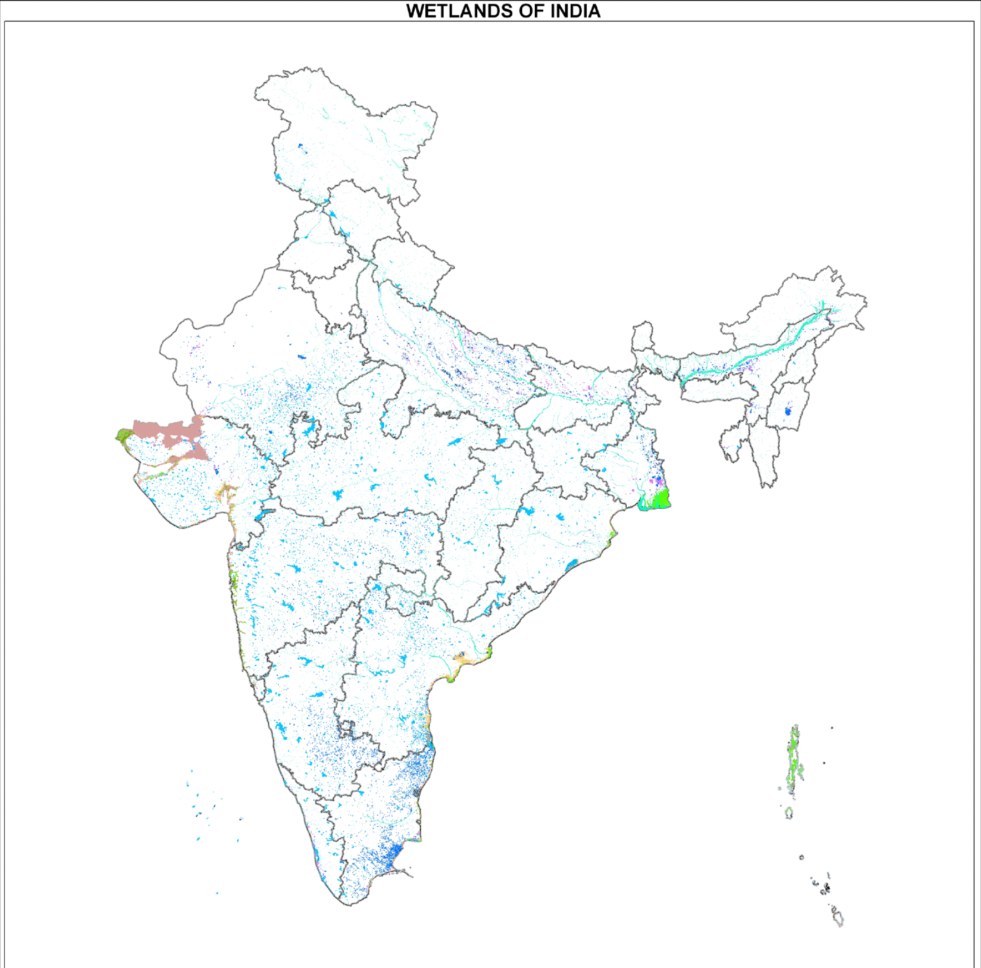
As somewhat belated summer in North India reaches its peak, with ongoing heat wave in Delhi and surrounding areas, there is increasing fear of water scarcity. The media generally uses one figure to highlight this situation, namely Live Storage in some 150 reservoirs in Central Water Commission (CWC)’s Weekly Reservoir Bulletin (WRB) that is published every Thursday afternoon (why cannot this be given on daily basis is a mystery).
Continue reading “Becoming water smart holds the key to our water secure future”Tag: wetlands

DRP 270524: Illegal Sand Mining Menace: Can Judiciary act effectively?
(Mechanized mining in Yamuna river in Vikas Nagar. Image credit: Nishant Panwar, 12 May 2024)
The river sand mining stories this week makes fascinating reading. We have stories from Andhra Pradesh, Telangana, Uttar Pradesh, Goa, Rajasthan, Madhya Pradesh and Punjab. The stories from first five states are related to judiciary. One story from Punjab is about collapse of a bridge due to illegal mining and another about how illegal sand mining is part of electoral narrative. The story from Madhya Pradesh is possibly most interesting and most indicative of the direction in which we need to go. In MP at a public hearing for sand mining project, the women of the villages, including sarpanch, have decided to save the river rather than allow unsustainable mining.
The stories from five states about judicial actions includes the one from Andhra Pradesh where the Supreme Court of India has warned the govt about contempt action. The apex court has set up committees of govt officials in Krishna and Guntur districts to stop illegal mechanized sand mining. The story from Rajasthan is about Supreme Court stopping sand mining in 1 km radius around Sariska Tiger Reserve. The stories from next two states is about the NGT action. Lastly, the story from Goa is about High Court action.
Continue reading “DRP 270524: Illegal Sand Mining Menace: Can Judiciary act effectively?”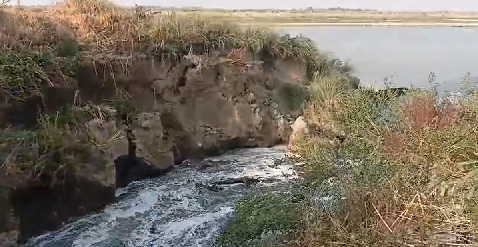
DRP 200524: After Ten years of Namami Gange and Rs 40 000 Cr expenditure Ganga remains dirty
(Feature Image: Untreated effluents being discharged in Gang river through ‘Chor’ nullah in Kanpur on May 19, 2024. Image Source: Sceenshot of ABC News Media report)
The reports this week from Ganga basin rivers clearly show that after ten years of Namami Gange and NMCG (National Mission for Clean Ganga) efforts and expenditure of over Rs 40 000 Cr, there is no improvement in even river pollution, leave aside the state of river flows or state of the rivers in the Ganga basin.
In fact, there is nothing to show that even the new STPs are making any difference to the river even with respect to the limited objective of sewage treatment. As highlighted in the report below, until and unless the governance of STPs become more transparent, accountable and participatory, there is no hope for change, no matter how much money is spent, how much new STP capacity is added or what technology is used. Only a responsive, confidence inspiring governance can make a difference. But there is no interest in working in that direction from the government.
Continue reading “DRP 200524: After Ten years of Namami Gange and Rs 40 000 Cr expenditure Ganga remains dirty”
DRP 130524: Unreliable Hydropower poses new challenges for India
(Feature Image: NHPC’s under construction 2000 Mw Subansiri Lower Hydro Power Project. Source: PIB, June 2023)
As per this Reuters report based on official information and statements, in June 2024 India will face the biggest peak hour power shortfall in 14 years, mainly due to the slump in hydropower generation. This is the result of not only pushing hydropower projects over the decades, but also not taking any steps to optimize peaking power generation from existing hydro or doing anything worthwhile to manage peak load. India’s hydropower generation had steepest fall in four decades in the year ending on March 31 2024, which was another reason not on rely on unreliable hydropower projects. The regular and frequent disasters that we see connected with hydropower projects in almost every month and more frequently in monsoons should be another reason in this regard.
Continue reading “DRP 130524: Unreliable Hydropower poses new challenges for India” DRP 220424: International Energy Agency accepts high-cost high risk hydro is no longer High Priority
DRP 220424: International Energy Agency accepts high-cost high risk hydro is no longer High Priority
The International Energy Agency (IEA) has accepted in its latest World Energy Investment Special Report titled “Reducing the Cost of Capital: Strategies to unlock clean energy investment in emerging and developing economies” has candidly accepted that hydropower (excluding pump storage) is no longer the high-priority sector.
Among the challenges hydropower faces, according to IEA, include long permitting time necessary considering the high and complex impacts of hydropower projects amd delays during construction. IEA figures show that the capacity of Chinese developed hydropower projects that had high proportion of installed hydropower capacity globally in any year for decades, was the lowest in 2023 since 2014. The report accepts that high cost of capital with high interest rates can have a major impact on Cost of electricity, affecting competitiveness of the hydropower projects.
Continue reading “DRP 220424: International Energy Agency accepts high-cost high risk hydro is no longer High Priority”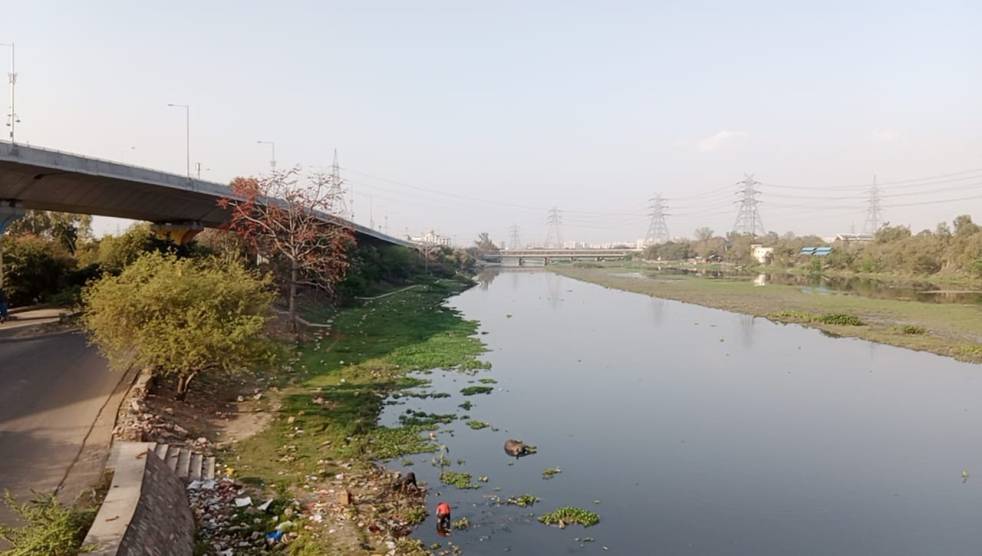
DRP 150424: Supreme Court’s order on right to be free from climate change impact is welcome, BUT…
(Feature Image: Polluted Hindon river flowing through Ghaziabad in March 2024. Bhim Singh Rawat/SANDRP)
On March 21, 2024, a case related to the Grean Indian Bustard, a critically endangered bird – numbering less than 150 individuals – has led the Supreme Court of India to expand citizens’ constitutional right to life and equality to include the right to be free from the adverse impact of climate change. The PIL filed by M.K. Ranjitsinh asked to protect the GIB from extinction. In 2021, in this PIL, the Supreme Court had passed directions restricting and regulating power lines and renewable energy projects in an area of 99,000 sq km in Rajasthan and Gujarat.
The Supreme Court’s latest order modified directions passed in the earlier judgment. Chief Justice D.Y. Chandrachud – writing for the 3-judge bench including Justices J.B. Pardiwala and Manoj Mishra – has expanded the contours of environmental jurisprudence: from the oft-repeated polluter pay principle–precautionary principle–public trust doctrine to the larger arena of climate justice, environmental inequity and gender justice. However, in the process, the protection the SC gave through earlier order has been withdrawn.
Continue reading “DRP 150424: Supreme Court’s order on right to be free from climate change impact is welcome, BUT…”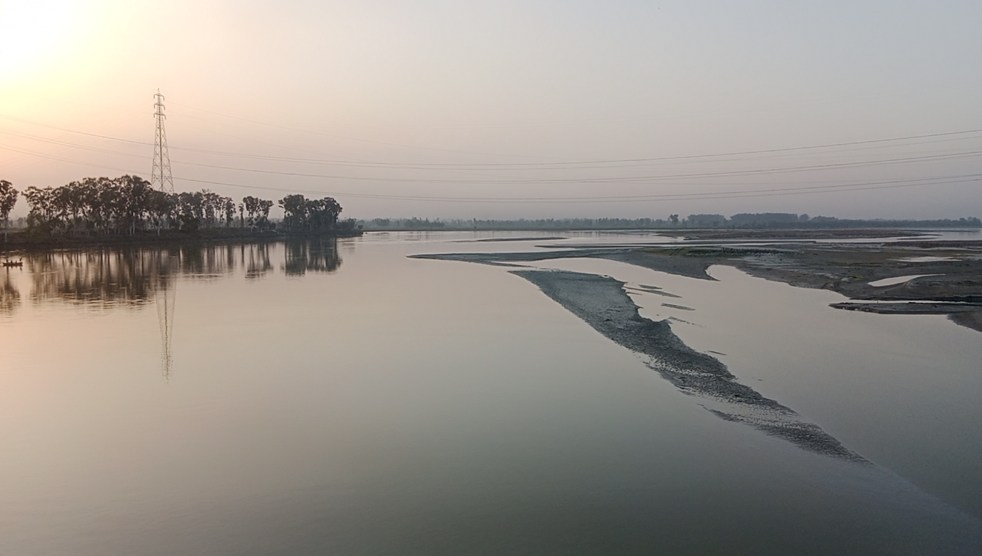
DRP 080424: Demand to include River protection measures in election manifestoes
(Feature Image: Ganga river at Garhmukteshwar in March 2024. Bhim Singh Rawat/SANDRP)
The demand of NAPM to political parties going to the National elections in next couple of months to include protection of rivers and communities dependent on rivers in their manifestoes is most appropriate and urgently required.
Some key components of the demand include strengthening of decentralized river governance, role in decision making related to rivers for the fisherfolks, boats people and other river dependent communities. A draft of the People’s River Protection Bill has also been sent to the political parties. The NAPM also opposed indiscriminate construction of dams, hydro projects, embankments, barrages, river front developments, illegal sand mining, dumping of solid and liquid waste in the rivers and also interlinking of projects, all being done in the name of development, with least concern for the rivers. The draft bill also demands removal of unjust encroachments into riverbeds and floodplains. NAPM also demands continued flow in the perennial rivers by way of adequate environment flows throughout the length of the rivers from origin to its confluence with other rivers or sea.
Continue reading “DRP 080424: Demand to include River protection measures in election manifestoes”
Yamuna Manthan 030424: DDA Continues to Destroy River Floodplains
(Feature Image: Huge part of Yamuna floodplain raised by massive soil dumping near Bela Estate just upstream Shashtri Park Metro Depot in North East Delhi. Photo Credit: Vivek Nigam, Photo Journalist Amar Ujala, Source: Principal Correspondent in Amar Ujala, Delhi)
In latest example proving Delhi Development Authority’s (DDA) utter failure in protecting Yamuna River floodplains from abuse and encroachment, a large part of floodplain land has been levelled by soil dumping thus raising it by several meters at Bela Estate farm near Shashtri Park Metro Depot. As per the reports, the DDA has allotted about 19.5 ha of floodplain to forest dept for compensatory plantation. The plantation work at the site like at most of the sites on Yamuna floodplain in Delhi has suffered damages during July 2023 floods. And the levelling at the Bela Estate site is being done in the name of protecting the compensatory plantation.
The site is among few remaining floodplain patches available for spread of flood waters. The floodplain area on western bank at the location is less and already developed. Due to natural gradient, the part of floodplain on eastern side undergoes periodic floods. The patch was under several feet floodwater in July 2023. The floodplain immediately downstream the site has already been encroached by the bridge road, metro depot and buildings. Hence, raising of floodplain here would not only reduce spread of flood waters but also hamper the groundwater recharge.
Continue reading “Yamuna Manthan 030424: DDA Continues to Destroy River Floodplains”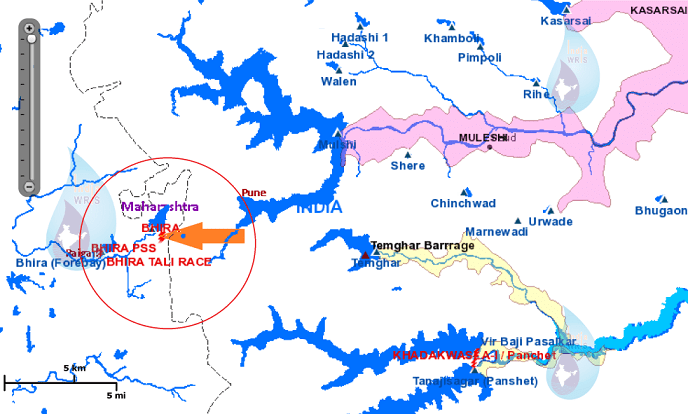
DRP 010424: As Krishna basin faces drought and scarcity, water diverted from the basin to Konkan
(Feature image: Map of Bhivpuri Hydropower Project, one of the Tata Dams)
Large parts of South India, including Maharashtra are facing depleted reservoir levels with the beginning of summer and water scarcity. However, the Krishna Bheema basin, the second largest basin of peninsular India, is diverting water to outside the basin to Konkan. The Krishna Bheema basin has the largest live storages of Maharashtra in Koyna dam (1347.5 MCM) and Tata dams (617.67 MCM), but the water in those storages won’t be available to the drought hit residents of Krishna basin in water scarce Maharashtra, Karnataka, Telangana and Andhra Pradesh.
This is because Koyna and Tata dams divert the water from Krishna Bheema basins to Konkan for power generation. Even in March, according to Maharashtra Load Dispatch Centre, Koyna had generated 128.87 Million Units (MU) of power and Tata Dams had generated 130.47 MU, both by March 30. This implies diversion of millions of Cubic meters of water from Koyna and Tata Dams during March 2024, which mostly gone down from Konkan to Arabian sea.
Continue reading “DRP 010424: As Krishna basin faces drought and scarcity, water diverted from the basin to Konkan”
DRP 250324: Celebrating 50 years of Chipko Movement and Message
(Feature Image: A photo taken in March 1974 of people in Raini village, Uttarakhand, a few days after they protested against the felling of trees in order to make tennis racquets. Source: Varsha Singh/Third Pole report dated 30 Nov. 2022. The original photograph was taken on 30 March, 1974 by Chandi Prasad Bhatt and has been reproduced in The Third Pole with permission)
As we celebrate the golden jubilee of Chipko Movement, one of the most iconic and memorable environmental movements of India, we need to remember the key messages of the movement. It may seem gloomy situation at the place where the movement originated in Raini village in Chamoli district of Uttarakhand. In fact, as we travel from Raini to Chamoli to Uttarakhand and beyond, as far as environmental situation is concerned, there is not too much around us to celebrate about.
Continue reading “DRP 250324: Celebrating 50 years of Chipko Movement and Message”
