
At the tenth India Rivers Week function that was inaugurated at BAIF, Pune on Nov 25, 2023, the annual Bhagirath Prayas Samman (BPS) award for exemplary unsung work for river conservation was announced and the award went (jointly) to Bhanu Tatak and Dibang Resistance, both of Dibang River Basin in Arunachal Pradesh, North East India. The Anupam Mishra Medal (AMM) for exemplary media work for the cause of rivers was awarded to Swapan Kumar Bhowmick of Nadia, West Bengal, for this work that started way back in 1977. Both the awards were given away by well-known ecologist, Prof Madhav Gadgil. The BPS award was accompanied by a citation, a shawl and cash component of Rs 60 000. The AMM award was accompanied by a citation, a shawl and a medal.[i]
Continue reading “India Rivers Week 2023: Bhagirath Prayas Samman to Dibang resistance; Anupam Mishra Medal to Swapan Kumar Bhowmick”Tag: W Bengal
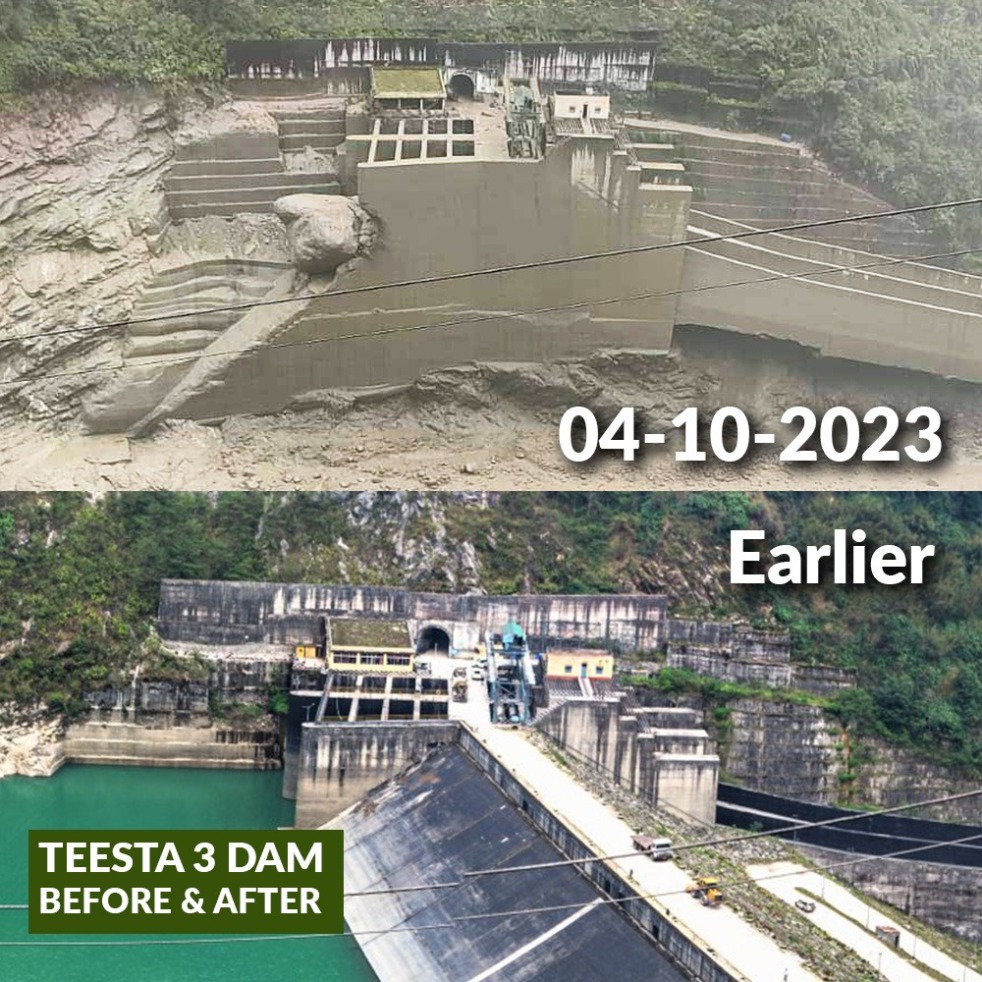
Glacial Lake FLood destroys Teesta-3 Dam in Sikkim, brings wide-spread destruction
A Glacial Lake Outburst Flood (GLOF) that originated at South Lhonak Glacial Lake at around 00.40 hours on Oct 4, 2023, washed away the 60 m high dam of Sikkim’s biggest hydropower project, the 1200 MW Teesta 3 HEP. The flood has brought unprecedented disaster all along the river in Sikkim and further downstream in W Bengal and then Bangladesh. Central Water Commission (CWC) reported early in the morning of Oct 4 that there was cloud burst at the site of the lake burst, the cloud burst could have played the role in triggering the lake burst. (Feature image above: A combination of before after photos of Teesta 3 dam put together by Siddharth Agarwal.)
Continue reading “Glacial Lake FLood destroys Teesta-3 Dam in Sikkim, brings wide-spread destruction”
June July 2022: District wise rainfall in India’s SW Monsoon
In the just concluded month of July 2022, the second month of India’s South West 2022 monsoon, India received 327.7 mm rainfall, 16.8% above the normal July rainfall of 280.5 mm as per India Meteorological department. In July 2021, the rainfall was 266.1 mm[i], about 6.7% below normal and in July 2020, the rainfall was 257.1 mm[ii], or about 9.9% below normal.
Continue reading “June July 2022: District wise rainfall in India’s SW Monsoon”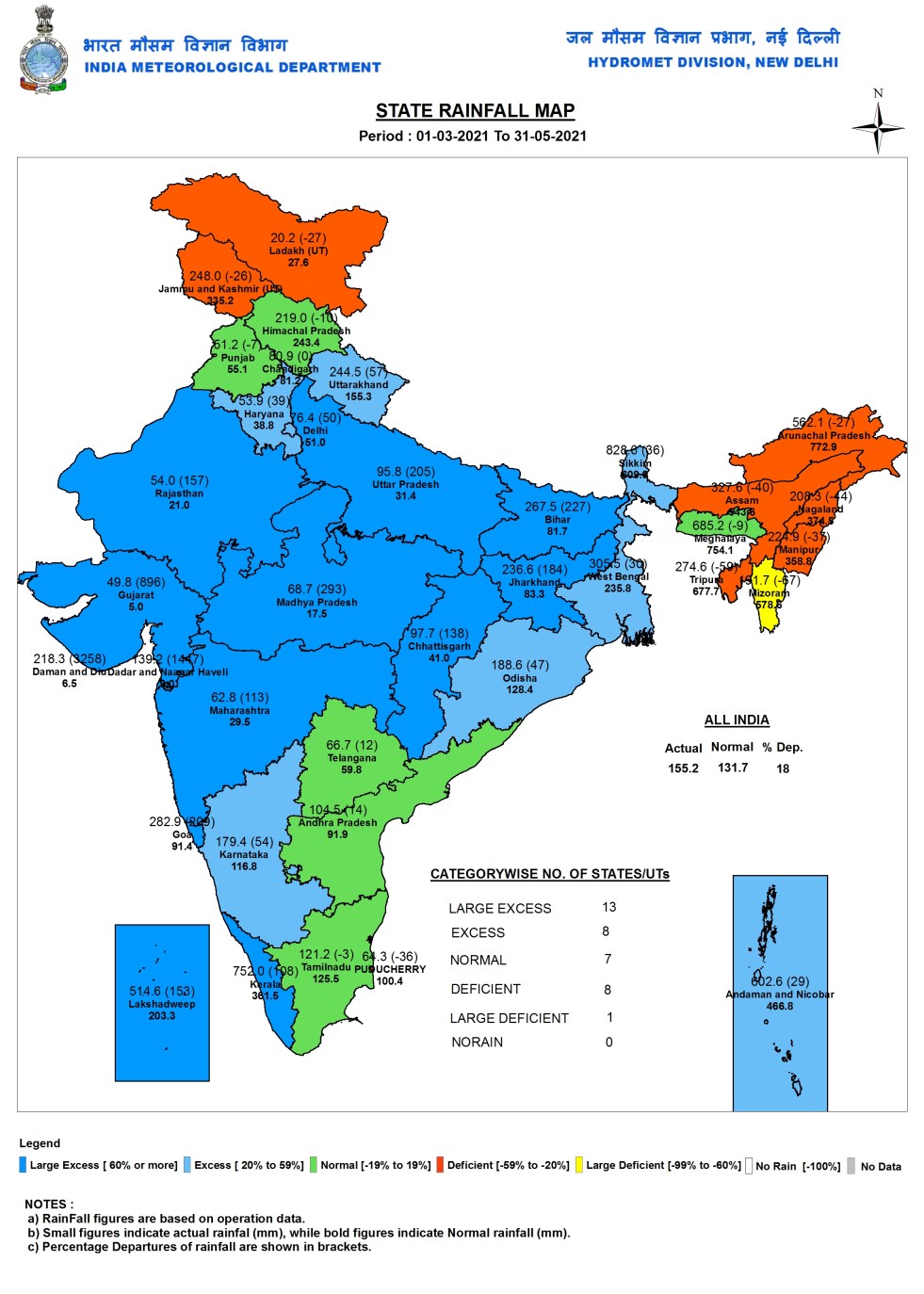
Pre Monsoon 2021 season – State Wise, District Wise Rainfall
In the just concluded pre monsoon season (March 1 to May 31, 2021) India received 155.2 mm rainfall, 18% above the normal rainfall of 131.7 mm as per the India Meteorological Department (IMD). This is similar to the case in 2020[i] when India received 158.5 mm or 20% above normal rainfall.
Continue reading “Pre Monsoon 2021 season – State Wise, District Wise Rainfall”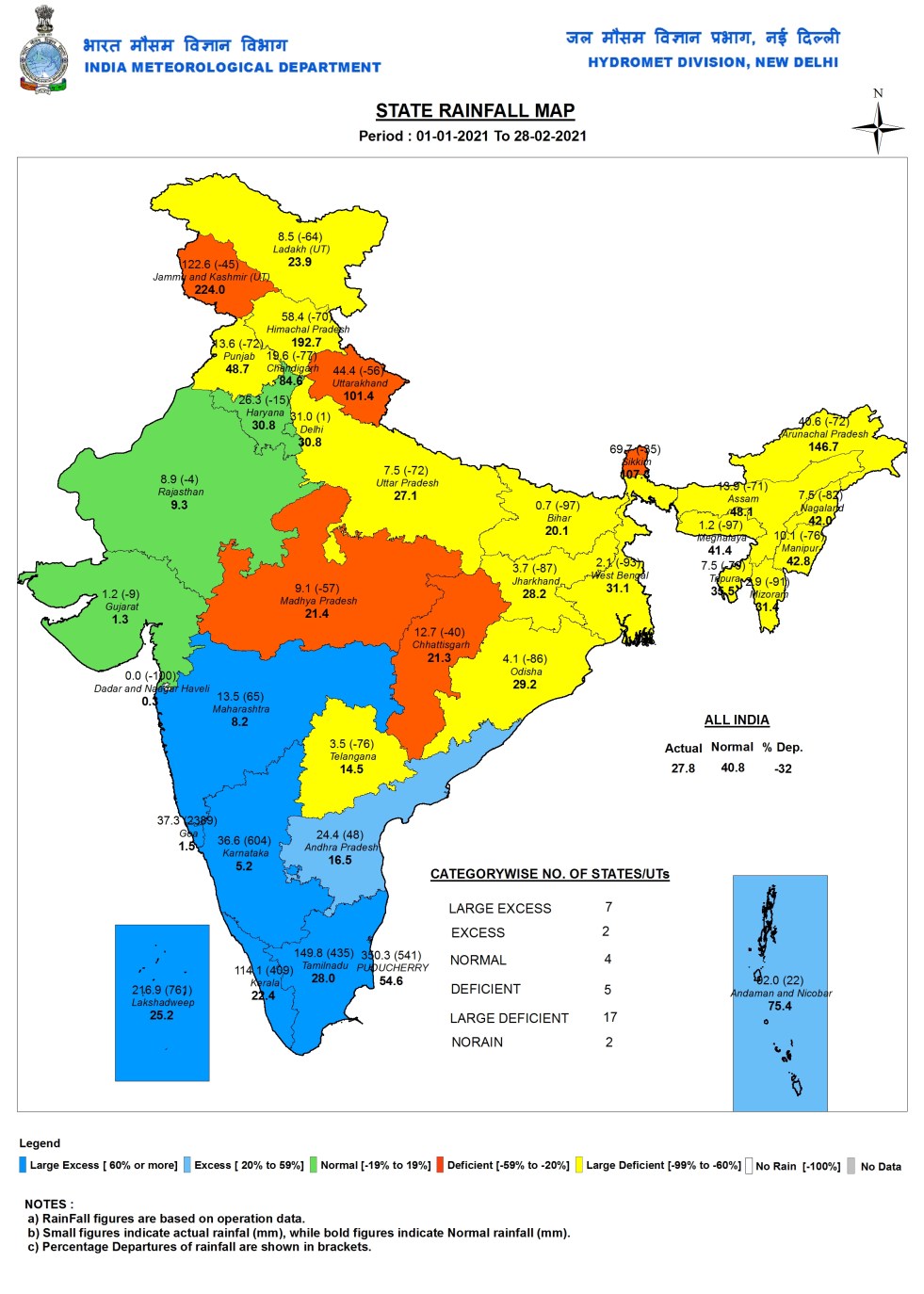
District wise Winter 2021 Rainfall in India
In the just concluded Winter Season (Jan 1 2021 to Feb 28 2021), as per India Meteorological Department (IMD), India received 32% below Normal Rainfall. The Normal rainfall in this two-month season is supposed to be quite low at 40.8 mm, but the actual rainfall was just 27.8 mm, which means rainfall was less than 0.5 mm per day in the season. Out of this the Rainfall in January 2021 was 20.2 mm, 17% above the normal rainfall of 17.3 mm. So in February 2021, the rainfall was 7.6 mm, against the normal rainfall of 23.5 mm, so the February rainfall was 68% below normal!
Continue reading “District wise Winter 2021 Rainfall in India”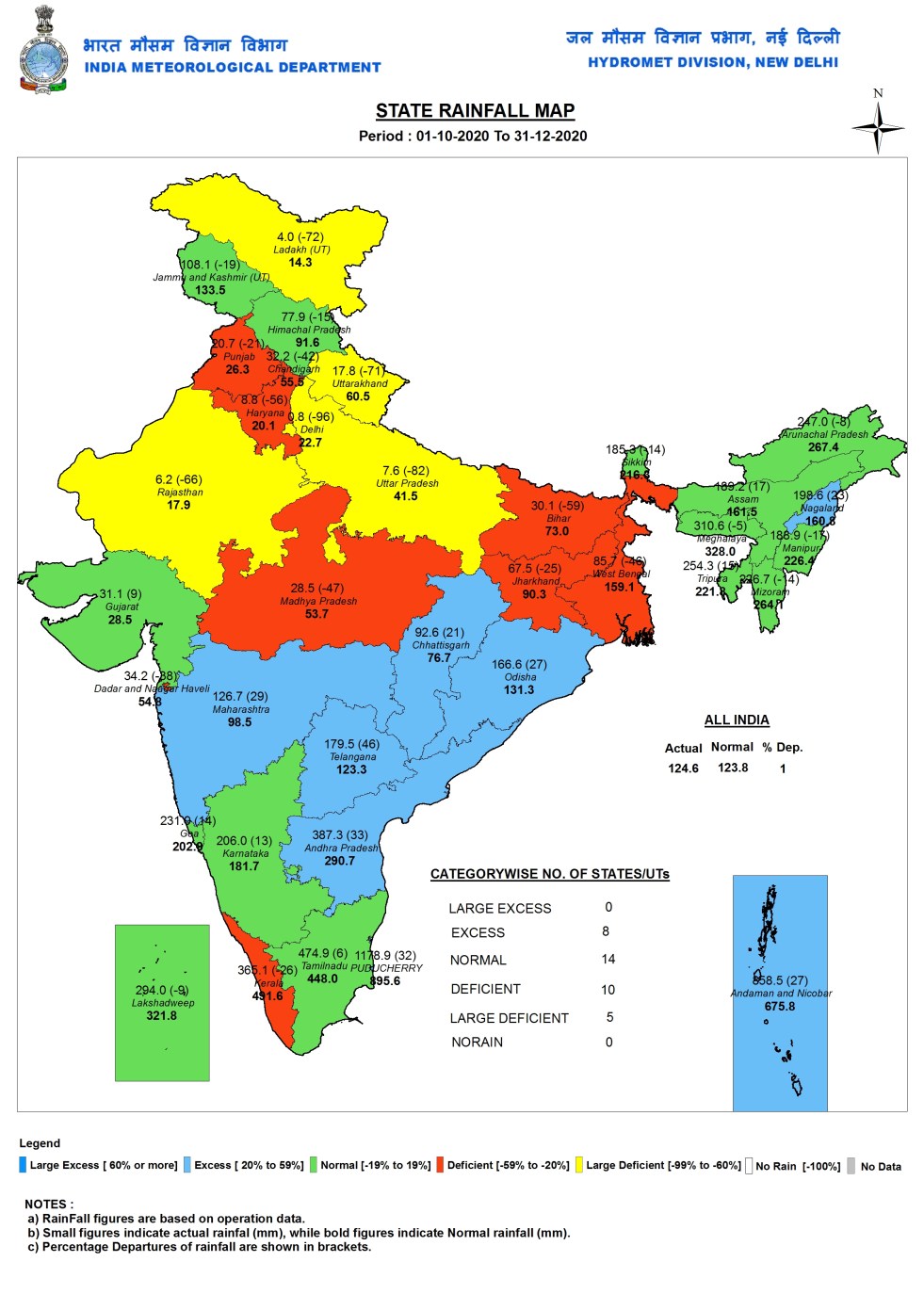
Post Monsoon 2020: State wise Rainfall
According to India Meteorological Department (IMD), during the just concluded Post Monsoon Rainfall for 2020, that included rainfall during Oct-Dec months, India received 124.6 mm rainfall, 0.64% above the normal rainfall of 123.8 mm during the period. As per IMD[i] definition, the rainfall was thus normal.
This three-month period from Oct 1, to Dec 31 includes the North East Monsoon that mainly affects parts of South India including Tamil Nadu, Puducherry, Rayalseema, parts of Karnataka and Kerala. IMD declared on Jan 1, 2021 that the of NE Monsoon ended on Dec 31, 2020 with normal overall rainfall: TN had 6% above normal, Karnatak 13% above normal, Puducherry 32% above normal, Andhra Pradesh 33% above normal. However, Lakshadweep had 9% below normal and Kerala 26% below normal. This monsoon provides 48% of the annual rainfall of TN so it is most imp for that state.
The rainfall revived only towards the end of November, mainly due to two consecutive cyclones — Nivar and Burevi — both of which developed in the Bay of Bengal. While Cyclone Nivar crossed the coast close to Karaikal near Puducherry and brought heavy showers for the east and coastal districts of Tamil Nadu, Cyclone Burevi weakened before it reached land.
Continue reading “Post Monsoon 2020: State wise Rainfall”
East Zone River Sand Mining Dialogue: How can we ensure implementation of court orders?
Higher Courts and NGT has been giving numerous orders and judgments, but the state is happily getting away with non implementation in most cases. How can we ensure that court orders get implemented? Why is the judiciary not concerned about non implementation of its orders? This was one of the central message of the East Zone River Sand Mining Dialogue on Nov 21, 2020 (4-6.30 pm) as part of the India Rivers Week 2020[i] theme “Is Sand Mining Killing our Rivers?” Additional Director R B Lal from Union Ministry of Environment and Forests in his presentation agreed that the sustainable sand mining guidelines have not been implemented. One would have liked to hear how we can achieve their implementation and that MoEF also values participation of people at the grass roots in sand mining governance. He did not mention the local people even once, while praising MoEF’s emphasis on technology in the sand mining guidelines.
The Dialogue was very ably moderated by Dr Malavika Chauhan of Tata Trusts and Dr Debashish Sen of People’s Science Institute (Dehra Dun). This was Fourth in a series of Zonal River Sand Mining dialogues being held after North Zone[ii], South Zone[iii] and West Zone[iv] Dialogues held earlier.
Continue reading “East Zone River Sand Mining Dialogue: How can we ensure implementation of court orders?”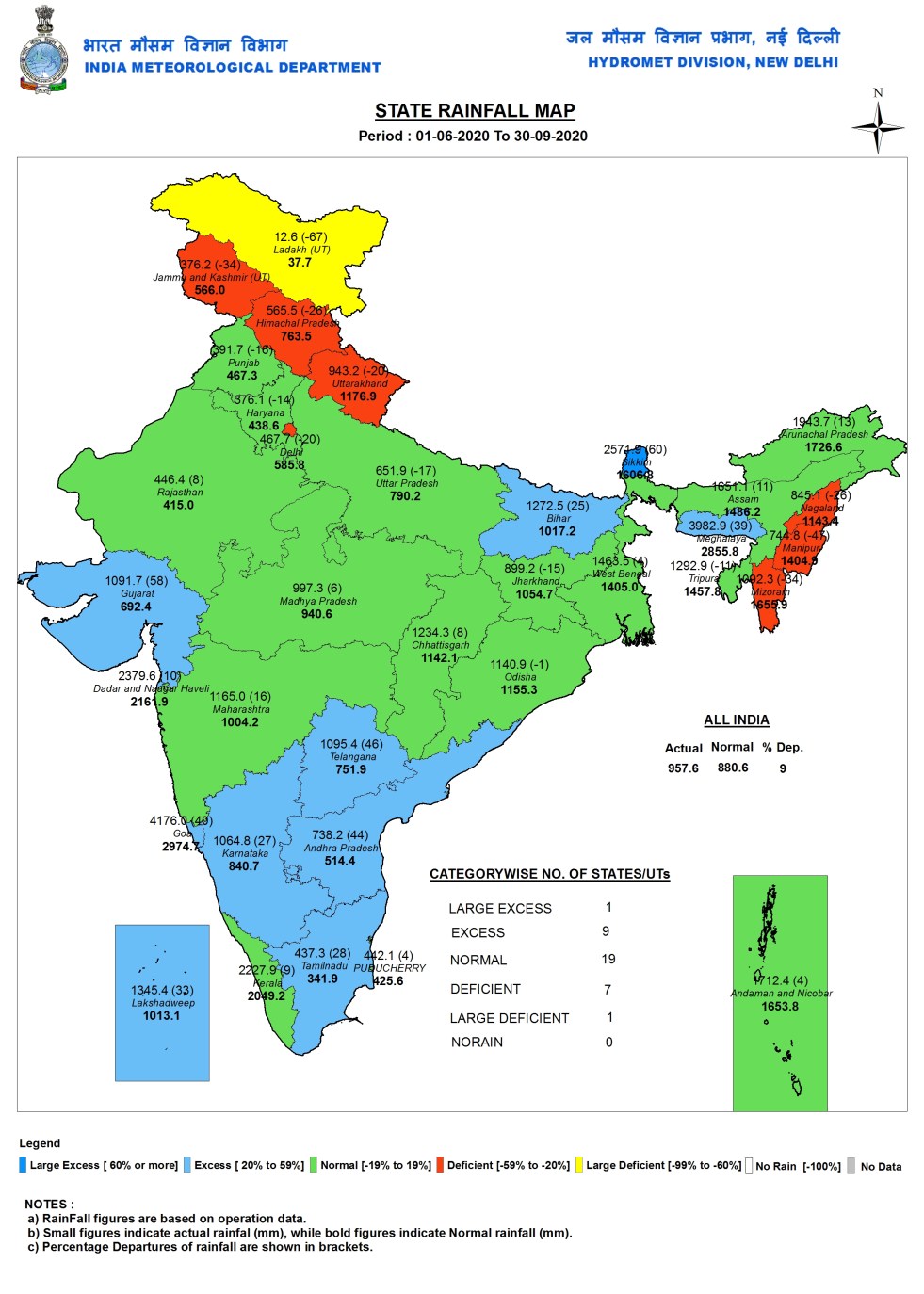
SW Monsoon 2020: District Wise Rainfall
India received 957.6 mm rainfall in Just concluded South West Monsoon 2020, during the scheduled 4 month monsoon from June 1 to Sept 30, 2020. This is 8.74% above normal monsoon rainfall of 880.6 as per India Meteorological Department (IMD). This is considered ABOVE NORMAL rainfall, since rainfall is in the range 4-10% above Normal rainfall. This sounds good at national level, but the situation on ground could be very different, if we see the rainfall across the country.
It is noteworthy as per even IMD, monsoon has not yet withdrawn from most parts of the country. But IMD closes its monsoon rainfall account at 0830 hours on Sept 30, so all rainfall after that hour has to be counted in “Post Monsoon” rainfall book, even though the rainfall is very much part of monsoon as per IMD.
Continue reading “SW Monsoon 2020: District Wise Rainfall”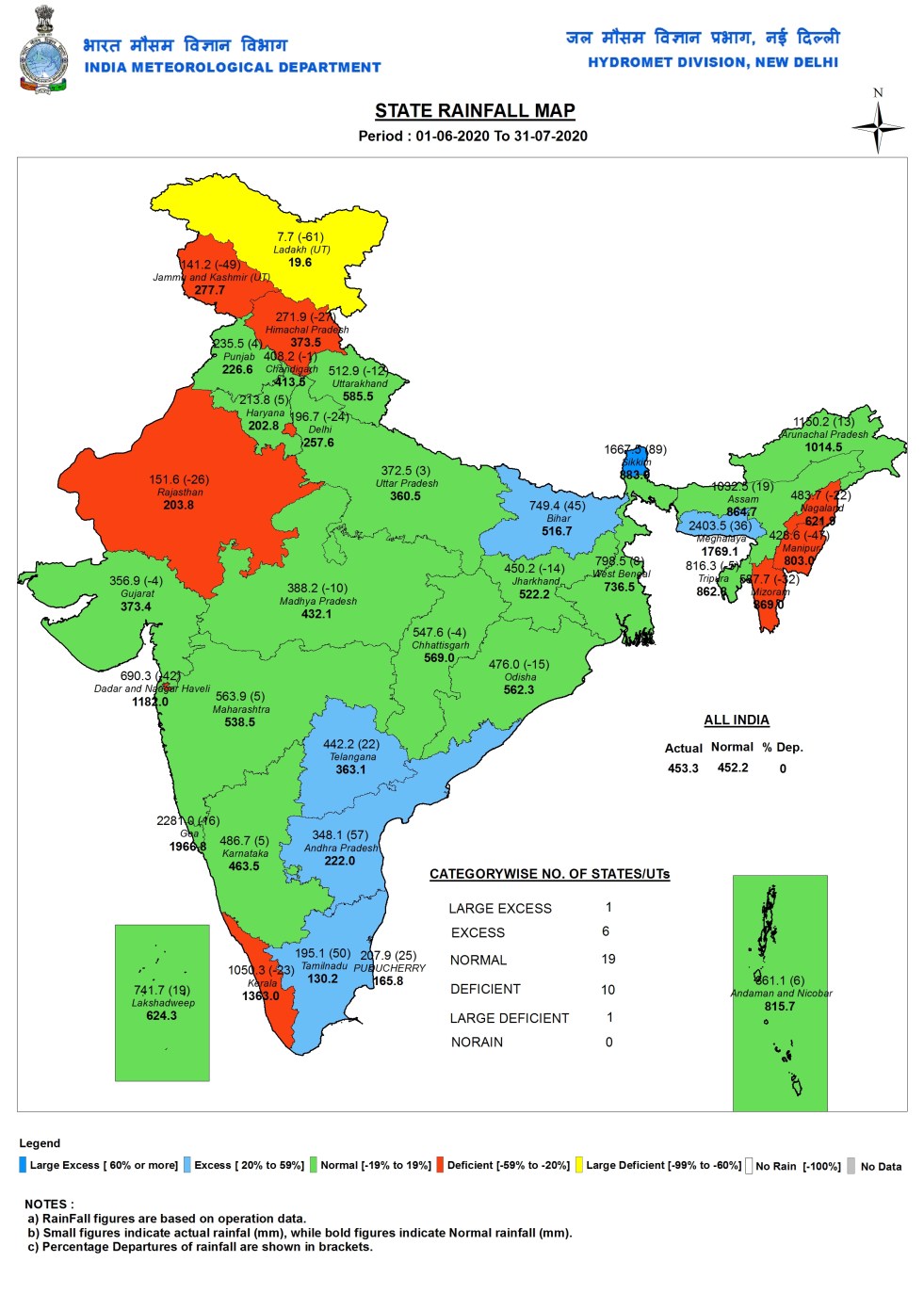
District wise Rainfall in India in June July 2020
During the just concluded first half of the South West Monsoon 2020, India received 453.3 mm rainfall, just 1.1 mm above the normal rainfall of 452.2 mm during the period. The Surplus of 18% rainfall that India received in June 2020 has thus been wiped out by the 9.9% deficit in July rainfall. Normal rainfall in July 2020 is 285.3 mm, while actual rainfall was 257.1 mm. IMD does not provide monthly figures of rainfall for different states, sub divisions and river basins, which it should along with comparison with respect to normal rainfall and rainfall last year.
To get July 2020 rainfall, we will need to use the figures given in this article along with the figures of June 2020 rainfall (see: https://sandrp.in/2020/06/30/district-wise-rainfall-in-india-in-june-2020/). The district wise figures of June-July 2020 rainfall can be seen in this PDF file from IMD: IMD DISTRICT WISE RAINFALL FROM JUNE 1 TO JULY 31 2020.
Continue reading “District wise Rainfall in India in June July 2020”

District Wise rainfall in India in June 2020
Here we present the rainfall figures from India Meteorological Department in the just concluded month of June 2020, the first month of SW Monsoon 2020. The overall rainfall at all India level in June 2020 was 196.2 mm, 18% above normal rainfall in the month at 166.9 mm. It was 33% deficit last year.
This is India’s wettest June 12 years, The Times of India reported on July 1, 2020. Agriculture Ministry Data shows that sowing is 68% higher at 31.56 m ha. The June rainfall was 202 mm in 2008, the rainfall this year is the highest since then. All four IMD regions (Northwest, Central, South, East & NE) have recorded surplus rainfall, the surplus is the highest in Central (30.5% surplus) and E-NE (15.7%) regions. North West India had the lowest surplus at 3.5%. IMD Head Mrutyunjay Mohapatra said that whole of India was covered by monsoon on June 26, 12 days ahead of the normal date of July 8.
State wise rainfall Three states had large excess rainfall (above 60% surplus rainfall), namely Bihar, Madhya Pradesh and Sikkim. Eight states/UTs (Union Territories) had excess rainfall (20-59% surplus): Assam, Meghalaya, UP, Chhattisgarh, Maharashtra, Telangana, Andhra Pradesh & Andaman and Nicobar. Nine had deficient rainfall (20-59% deficit): Lakshadweep, Mizoram, Manipur, J&K, Ladakh, Himachal Pradesh, Delhi, Dadar & Nagar Haveli. Rest of India had Normal Rainfall. Continue reading “District Wise rainfall in India in June 2020”
 SANDRP