Sand Mining

Rajasthan: SC Banned Riverbed Mining through 2018: Centre & State Show No Concern

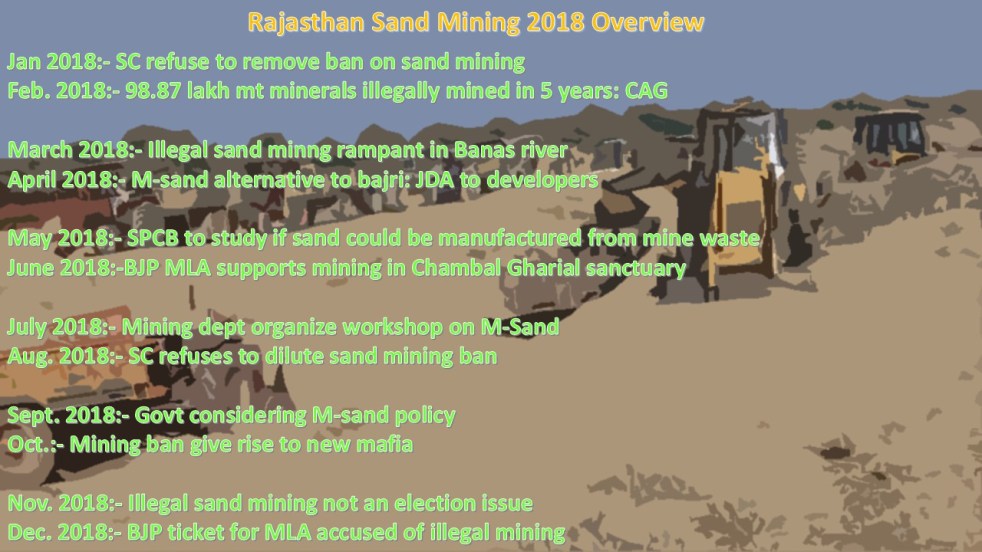
On November 16, 2017, the Supreme Court (SC) of India, prohibited 82 large lease holders from mining sand and stone activities in absence of scientific replenishment study. The ban continued all through the year of 2018 and so were the incidents of illegal sand mining and violent attacks on police officials.

The ban has reportedly hampered some development projects. The prices of sand has increased. Meanwhile the mining department is seen making efforts in exploring Manufactured Sand (M-Sand) as an alternative though it seems there is not much success as yet.

Continue reading “Rajasthan: SC Banned Riverbed Mining through 2018: Centre & State Show No Concern”

DRP News Bulletin

DRP News Bulletin 7 January 2019: NGT REJECTS FLAWED GROUNDWATER NOTIFICATION

Good to see NGT rejecting the flawed Groundwater notification dated Dec 12, 2018 from CGWA that was also critiqued by SANDRP: https://sandrp.in/2018/12/31/groundwater-governance-why-dec-12-2018-cgwa-notification-would-be-disastrous/. However, NGT should have asked an independent panel to formulate the policy for sustainable groundwater use, rather than a committee of the same government persons. Besides, there is also need for restructuring of currently totally ineffective CGWA and make it COMPLETELY INDEPENDENT of government.

Continue reading “DRP News Bulletin 7 January 2019: NGT REJECTS FLAWED GROUNDWATER NOTIFICATION”

Char Dham Highway · Dams

Char Dham Road Project Kills 8 Labours: Will State & Central Govts Wake Up Now?

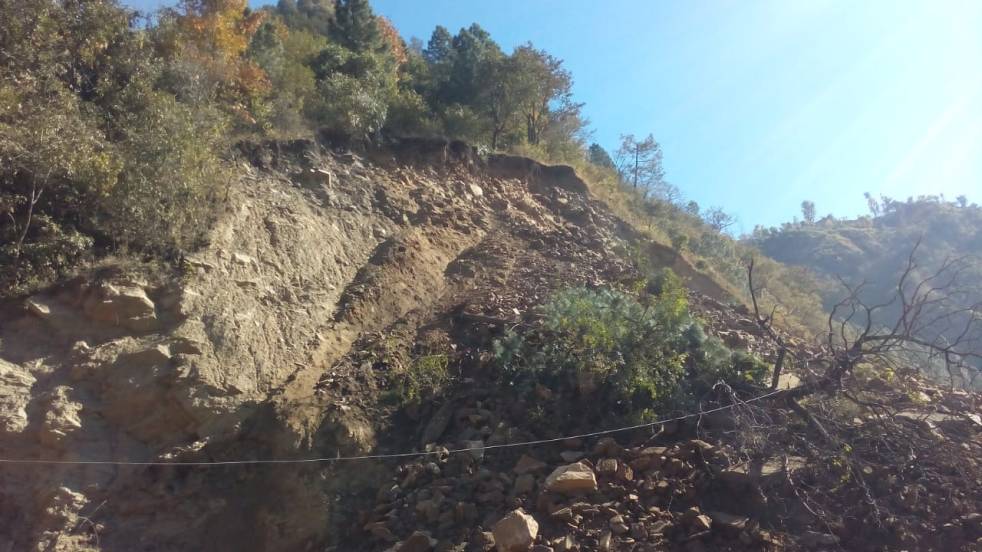
The landslide incident[i] on under construction Char Dham All Weather Road Project in Rudraprayag district of Uttrakhand has killed 8 labours on 21 December 2018 around 12.30 pm near Banswada in Ukhimath Bhiri area on the Rudraprayag-Gaurikund national highway (NH 107).

Continue reading “Char Dham Road Project Kills 8 Labours: Will State & Central Govts Wake Up Now?”

DRP News Bulletin

DRP News Bulletin 24 Dec. 2018: MoEF and WII’s Compromises Cater to Hydro Vested Interests

In a shocking revelation, Jay Mazoomaar in this Indian Express report exposes how Wildlife Institute of India not only accepted consultancies from hydropower companies, but also diluted the mandate for the studies for given by statutory bodies like NGT, NBWL and FAC, but also provided compromised reports catering to the interests of the hydropower developers, thus trying to clear the way for the two controversial mega hydropower projects, one each in Dibang and Lohit river basins in Arunachal Pradesh. https://indianexpress.com/article/north-east-india/arunachal-pradesh/wildlife-institute-all-for-hydel-projects-in-arunachal-pradeshs-tiger-zone-5499656/

In case of the 3097 MW Etalin project being developed by Jindal and Arunachal Pradesh govt, the IE report says: “the WII was asked by the Ministry (MoEF) to assess the feasibility of the plan that requires 1,166 hectares of forestland in the valley. The Ministry’s move followed a recommendation from its Forest Advisory Committee (FAC) to conduct an environment impact assessment study. Instead, the WII initiated a study to find how the project’s impact on wildlife can be minimised”. Thus instead of doing the mandated scientific impact assessment, the WII initiated a study to minimise the project’s impact.

Continue reading “DRP News Bulletin 24 Dec. 2018: MoEF and WII’s Compromises Cater to Hydro Vested Interests”

DRP News Bulletin

DRP News Bulletin 3 Dec. 2018: Ken Betwa Link; Push to Dilute Forest Clearance Conditions

Ken Betwa river interlinking project is back to drawing board with Union water resources ministry approaching the ministry of environment and forest to relax conditions imposed as part of forest clearance accorded in May 2017 for diversion of forest in the Panna Tiger reserve (PTR).

Forest Advisory Committee (FAC) while according Stage-I clearance to the project had recommended that the project proponent and state govt should consider equivalent non-forest area (6,017 ha) adjoining to PTR from the revenue and private land and add to the PTR as a part of core/corridor (for tiger movement) with other areas or satellite core area. According to water resources ministry, they are unable to find land adjoining to PTR.

Will the forest department buckle under pressure to dilute the forest clearance conditions?  http://www.newindianexpress.com/thesundaystandard/2018/nov/25/first-river-linking-project-coming-undone-1902890.html  (25 Nov. 2018)

Continue reading “DRP News Bulletin 3 Dec. 2018: Ken Betwa Link; Push to Dilute Forest Clearance Conditions”

Dams · DRP News Bulletin

DRP News Bulletin 05 November 2018: More Reports on Spectacular Failure of Namami Gange Program 

(Feature image showing preparation of Kumbh 2019 at Prayagraj by Siddharth Agarwal of Veditum)

EDIT article in SCIENCE magazine by TUSHAR SHAH and others on Ganga: “The quickest, cheapest, and most effective way for Mr. Modi to show a less polluted Ganga by 2019 would be operating dams and barrages in the Ganga basin with the sole objective of augmenting river flows. This would be a start to controlling discharge of untreated sewage and industrial waste, which will take a long time.” http://science.sciencemag.org/content/362/6414/503  (2 Nov. 2018)

DOWN TO EARTH says about Ganga: “the river will continue to run as – and even more – polluted as ever… Till August 31, 2018, only a little more than a quarter of the total number of projects sanctioned under it (Namami Gange) had been completed… according to CPCB’s Water Quality Map, only five out of the 70-odd monitoring stations on the river had water that was fit for drinking; only seven had water that was fit for bathing…”

-“Down To Earth quotes a study report and CPCB data to say that the actual measured discharge of wastewater into the Ganga is 123 per cent higher than what has been estimated…”

-“Numerous hydroelectric projects on the Bhagirathi and Alaknanda have turned the upper stretches of the Ganga into ecological deserts, says the Down To Earth assessment. The baseflow amount of the river has decreased by a huge 56 per cent in 2016, as compared to the 1970s.”

– “about 180 MLD of sludge will be generated in the five Ganga Basin states (Uttarakhand, Uttar Pradesh, Bihar, Jharkhand, West Bengal) when they become ODF. If proper sludge management is not done, this would invariably pollute the Ganga. What should cause further concern is that faecal sludge is a bigger pollutant than sewage – while BOD of sewage is 150-300 mg/litre, that of faecal sludge would be 15,000-30,000 mg/litre.” https://www.cseindia.org/ganga-may-not-flow-clean-in-the-near-future-says-new-analysis-9085  (30 Oct. 2018)

Meanwhile, a new CAG report reveals that almost 26 million litres of untreated sewage still flows into the Ganga every day in Uttarakhand. https://www.downtoearth.org.in/news/water/uttarakhand-has-failed-to-rejuvenate-the-ganga-through-namami-gange-62027  (2 Nov. 2018)

Continue reading “DRP News Bulletin 05 November 2018: More Reports on Spectacular Failure of Namami Gange Program “

Dams · DRP News Bulletin

DRP News Bulletin 29 October 2018: Better Paddy Options Exist For Punjab

A try-out of the technique to grow paddy without puddling at village Chehlan of Ludhiana has resulted in higher yield in comparison to puddled fields, while saving water in the process. The crop was ready for harvest days before expected time, saving irrigation water otherwise to be used for another fourteen days. This trial was funded and supervised by ATMA, a central govt.  scheme under the Union Ministry of Agriculture.

Puddling is a traditional method of flooding paddy fields with running water, whereas in non-puddling technique, ‘ridges and furrows’ are formed in soil to let water store in spaces and let it stay, thus reducing irrigation frequency.

“Not paddy but puddling is the enemy of waters of Punjab. It is wastage of water to puddle fields as most of it just evaporates. We have saved 45-50 per cent of water in non-puddled fields. Our yield has been almost 30 per cent more from fields where crop was not puddled. Also, non-puddled crop matured very early, saving at least ten days of irrigation water,” says Rupinder Singh Chahal (43) who along with his brothers Jasvir Singh (48) and Kulwinder Singh (52) experimented with ‘non-puddling’ technique on four acres this year.

Continue reading “DRP News Bulletin 29 October 2018: Better Paddy Options Exist For Punjab”

Dams · DRP News Bulletin

DRP News Bulletin 15 October 2018: Reuters Corroborates that Dams Played Major Role in Kerala Floods

International news agency, after independent research, have corroborated what SANDRP has been saying: Mismanagement of dams played big role in worsening Kerala floods.

-“The release could have started earlier so that by Aug. 9 there would have been left-over capacities in the reservoirs to store the water,” said Biswajit Mukhopadhyay, director of water resources at U.S-based engineering firm IEA, who analysed some of the publicly available data at the request of Reuters.

– Still, dozens of flood victims interviewed by Reuters, who live in villages dotting the banks of Kerala’s biggest river, the ‎244 km Periyar, say they faced no floods despite torrential rain in late July and early August. All of them said waters only rose overnight on Aug. 15. That was when more intense rainfall forced KSEB to rapidly ramp-up releases of water from Idukki and Idamalayar reservoirs, which feed into the Periyar.

– Kerala’s revenue secretary and head of disaster management, P.H. Kurien, told Reuters he has twice written to KSEB requesting EAPs and has yet to receive them. KSEB’s Pillai said EAPs and dam operation manuals were still being prepared. CWC said it was working with Kerala’s government to speed this up. The Kerala Chief Minister’s office did not respond to requests for comment. https://widerimage.reuters.com/story/did-dams-make-indias-once-in-century-floods-worse  (11 Oct. 2018)

And this fantastic infographic: https://fingfx.thomsonreuters.com/gfx/rngs/INDIA-FLOOD/010080MF18N/index.html  (11 Oct. 2018)

Continue reading “DRP News Bulletin 15 October 2018: Reuters Corroborates that Dams Played Major Role in Kerala Floods”

Dams · DRP News Bulletin

DRP News Bulletin 1 October 2018: Hungry Water Effect due to Dams & Unsustainable Sand Mining Worsened Kerala Floods

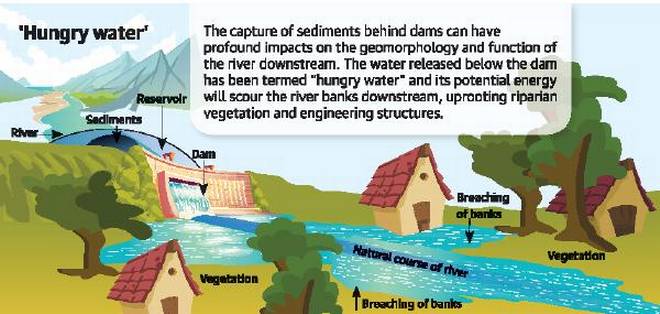
Dams and reservoirs make rivers sediment-starved and menacing manifold downstream. While heavy rainfall is also a key factor behind the floods, hungry water had a more pronounced effect, says D. Padmalal, Scientist and Head, Hydrological process group, National Centre for Earth Science Studies.

– “When the sediment transport is interrupted, the potential energy of the hungry water released from dams will scour the river banks downstream, uprooting trees or riparian vegetation and damaging bridges and other engineering structures,” explains Dr. Padmalal. Overloaded with silt and clay from the eroding river banks, the highly turbid and viscous water clogs drainage channels. Subsequent discharge of water from the dam will lead to inundation and waterlogging of large areas.

– Hungry water can also develop in high gradient river channels devoid of adequate quantity of sand and gravel, especially during periods of high rainfall. “Years of uncontrolled sand mining have left most of the rivers in Kerala depleted or exhausted of sand and gravel. This creates a situation similar to the release of hungry water from dams,” notes Dr. Padmalal. When the river channel has adequate supply of sand and gravel, the potential energy of the water is used to transport the mixture. The water does not scour the banks or turn muddy.

Continue reading “DRP News Bulletin 1 October 2018: Hungry Water Effect due to Dams & Unsustainable Sand Mining Worsened Kerala Floods”

Dams · DRP News Bulletin

DRP News Bulletin 17 September 2018: How Much of This Drought Is Man Made?

  1. Gujarat suffering due to political use of water for elections in 2017.
  2. Rajasthan given more water for elections there in 2018. Will Punjab, Haryana suffer now?
  3. Kerala drought: how much could have been reduced if dams were operated more prudently?
  4. North Interior Karnataka is suffering, but Krishna basin dams are almost full? Issue of unsustainable cropping patterns, groundwater overuse, and neglect of recharge & regulation?

Gujarat Water scarcity looms large with state receiving only 74% rainfall so far

  • Kutch and North Gujarat are likely to face severe water scarcity this year, officials said. The Kutch region has received a mere 26.51 percent of average rainfall so far, while North Gujarat has received 42.93 percent, central Gujarat 66.83 percent, Saurashtra 72.20 percent and South Gujarat the highest 94.79 percent.
  • However, the Sardar Sarovar Dam is filled up to 125.82 meters, and it can provide drinking water for the entire state till the next summer, the govt said. As per Govt. storage in Sardar Sarovar Dam on the Narmada, which will be enough to meet the state’s need for drinking water through the next summer.
  • The Narmada water will also be used to fill up empty dams in Saurashtra including Aji 1, Macchu 2, Vadod and Ankadia through the Sauni scheme, officials said.
  • “The state govt will provide 20,000 cusecs water for the next 20 days to save the crops in water-starved areas,” Deputy CM Nitin Patel told reporters in Gandhinagar said.
  • “We plan to fill up 400 big and small ponds in North Gujarat by Narmada water through canals and pipeline network of the Sujlam Suflam scheme,” he said.
  • “We also plan to fill the dams in Saurashtra region and provide water for irrigation from Narmada Dam under the SAUNI scheme,” he said. https://www.firstpost.com/india/water-scarcity-looms-large-in-gujarat-with-state-receiving-only-74-rainfall-so-far-this-monsoon-says-government-5188271.html (15 Sept. 2018)

Himachal Pradesh Rajasthan quietly given extra water by BBMB to improve BJPs Poll prospects A detailed story about how BBMB, controlled by Central Power Ministry, released excess water to BJP ruled Rajasthan this poll year, which has deepened the water availability at BBMB dams this year. This is not that the first time that the water releases have happened to achieve poll objectives. https://www.huffingtonpost.in/2018/09/16/rajasthan-quietly-given-extra-water-by-bhakra-dam-board-to-improve-bjps-poll-prospects_a_23528788/  (14 Sept. 2018)

Rajasthan Rainfall deficit in many districts As per IMD, Badmer district of Rajasthan has received rainfall 48 percent below normal till Sept. 16. Similarly rainfall deficit in Hanumangarh 58 percent so far. Jallor district is facing maximum rainfall deficit of 60 per cent less than normal. Likewise the rainfall in Pali district is 35 per cent below the normal and in Jaislmer is facing a rainfall deficit of 38 per cent. In Western Rajasthan it rained only 193 mm during entire monsoon season causing a  deficit of 24 per cent below the normal.

Continue reading “DRP News Bulletin 17 September 2018: How Much of This Drought Is Man Made?”