Dams · DRP News Bulletin

DRP: 6 Nov 2017 (NGT Asks For Fresh Appraisal Of Lower Subansiri Hydro Project)

In a remarkable development, the National Green Tribunal (NGT) on October 24 has suspended the clearances given to the 1750-megawatt (MW) Demwe Lower Hydroelectric Project  (HEP) planned on the Lohit river in Arunachal Pradesh.

In its detailed order, released on October 27, the NGT ruled that the Environment Minister as Chairperson of the National Board for Wildlife (NWBL), a statutory body constituted under the Wildlife Protection Act, 1972, could not “just brush aside” the views of the majority of NBWL standing committee members.

Suspending the clearances given by the Centre and the state govt, the NGT order added that “the decision taken by the Standing Committee is not in accordance with established principles of law and hence the Standing Committee shall reconsider the issue and pass appropriate orders within a period of six months from the date of the judgment”.

Environmental clearance for the project was given by the Union environment ministry’s Expert Appraisal Committee (EAC) for river valley and hydroelectric projects back in 2009. An in-principle forest clearance for the Lower project was given in February 2012 and agreed upon in 2013.

However, the in-principle clearance of the project was opposed by a majority of the Standing Committee of the NBWL but subsequently cleared by the then-environment minister of state (independent charge), Jayanthi Natarajan, who was also the chairperson of the Standing Committee.

Natarajan is currently under the CBI’s scanner for alleged anomalies in clearance given for diversion of land in Saranda forest in Singhbhum district, Jharkhand to mining company Electrosteel during the previous UPA regime.

The NGT said that it is “of the view that either the Chairperson (Natarajan) should have given a proper reason for rejecting the objection of the majority of the non-official members or the decision ought to have been arrived at based on the opinion of the majority of the members. Even though the Standing Committee is a recommendatory body, the same being a statutory committee, is bound by the laudable principles of justice and fair play”.

Continue reading “DRP: 6 Nov 2017 (NGT Asks For Fresh Appraisal Of Lower Subansiri Hydro Project)”
Dams · DRP News Bulletin

DRP: 2 October 2017 (New Rules Disastrous For India’s Wetlands)

The wetlands are the hotspots of biodiversity, act as carbon sinks, act as buffers against floods and are essential for groundwater recharge. With groundwater reservoirs in the country heavily exploited, this last function has assumed greater importance. http://www.hindustantimes.com/environment/centre-notifies-wetland-rules-environmentalists-unhappy/story-3MoGp9D8eSzHI90zfOXWSO.html

Wetlands can be defined as lands transitional between terrestrial and aquatic eco-systems where the water table is usually at or near the surface or the land is covered by shallow water.

But they are threatened by reclamation and degradation due to activities like drainage and landfill, pollution, hydrological alteration (water withdrawal and changes in inflow and outflow), over-exploitation resulting in loss of biodiversity and disruption in ecosystem services provided by them.

DRP 12

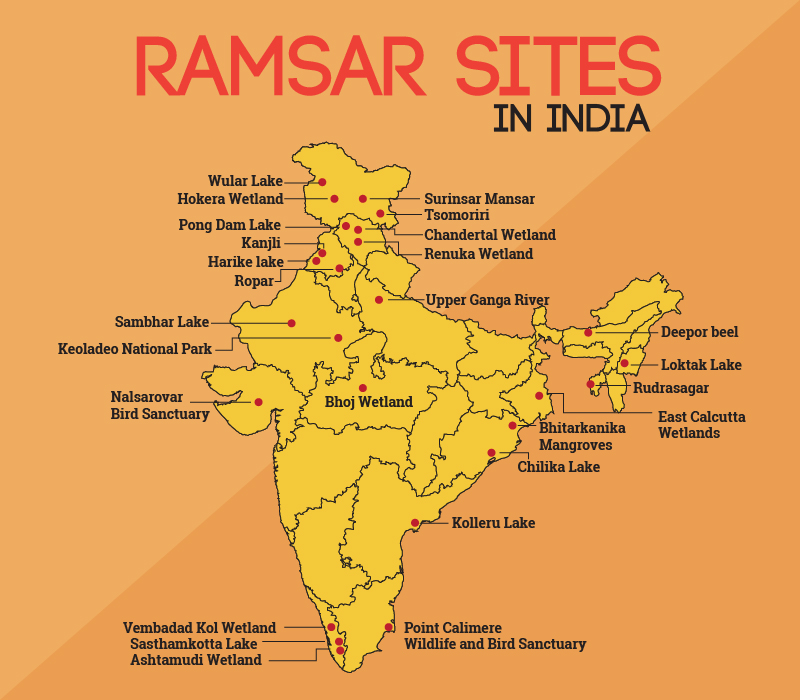
There are at least 115 wetlands that are officially identified by the central government and of those 26 are identified as wetlands of international importance under Ramsar Convention which is an international intergovernmental treaty for conservation of wetlands. India is a party to the treaty. http://www.livemint.com/Politics/y6Tr3tkrr3q28AmGKaBFII/Environment-ministry-notifies-new-wetland-rules.html

The Centre on September 26 notified a new set of rules under the head Wetlands (Conservation and Management) Rules, 2017 replacing the Wetlands (Conservation and Management) Rules, 2010. http://www.thehindu.com/news/national/kerala/new-wetland-conservation-rules-notified/article19779100.ece

It is worth to mention that under the 2010 rules, not a single water body was notified as a wetland over and above the ones already recognised as such by the Centre and the Ramsar Convention, defeating its purpose in a way. http://www.zeebiz.com/agencies/centre-notifies-new-rules-for-preservation-of-wetlands-26312

Similarly, despite country’s space agency ISRO had in 2011 mapped over two lakhs of wetlands across the country, the centre has, so far, notified only 115 wetlands and 63 lakes in 24 states and 2 UTs for conservation and management.

Continue reading “DRP: 2 October 2017 (New Rules Disastrous For India’s Wetlands)”
Dams

How much longer will Goa remain Otter Worthy?

Above: A fisherman on his traditional mango-wood canoe in Goa. (Photo: Atul Borker)

Guest Blog by Atul Borker, with Salil Chaturvedi

My deep engagement with Goan rivers began almost half a decade ago, when I started researching otters in the state. In this short span of time, an otter’s life has seen its ups and downs, and I don’t mean the daily rise and fall of tides that are critical to wildlife adapted to the mangroves!

Though Goa is the smallest state of India, it is blessed with as many as nine rivers. A unique aspect of Goan rivers is that they are tidal as well as rain-fed. During the monsoon months (June-September), water is drained out of the watershed through the rivers and into the sea. At the same time, the rivers experience a daily tidal influx upto 40 kilometers inland. The salinity of the rivers varies sharply between the monsoon and non-monsoon seasons, and so does the physico-chemical quality of the water. Needless to say, the people and the wildlife along the banks are highly attuned to these seasonal (and diurnal) changes, and the shy and elusive otter is one such animal. Continue reading “How much longer will Goa remain Otter Worthy?”

Rivers

Will this ‘Rally’ help the rivers?

PRESS RELEASE From India Rivers Week Organising Committee on Sept 13, 2017

We are concerned about the increasing superficial optics around saving rivers, with little or no effort to address fundamental issues which are causing their demise.

The high profile rally initiative to save India’s rivers taken up by well respected religious guru Sadguru and his followers is noteworthy, and the most recent case in point. It is striking that so many film stars, politicians, governments, and public personalities, are joining the call. Lakhs of children are expected to join in the program. While we welcome such an outpouring of good intentions and good will as a demonstration of the positive energy all around, unfortunately, we have seen no evidence either from the rally organisers, on their website[i] or their messaging, that they understand or plan to address the real threats faced by our rivers and their sorry state. Continue reading “Will this ‘Rally’ help the rivers?”

Dams · DRP News Bulletin

DRP: 11 September 2017 (Why This Rally Won’t Help The Rivers?)

The news media is filled with this new kid on the block, trying to wake the nation about the need to save our rivers… amazing to see so many film stars, politicians, governments, and public personalities, many of them rather innocently joining the band wagon… some friends were pleading that see, he is able to take the message of rivers to so many people, including lakhs of children… let us try and see if there is something positive here… may be, may be this is just the entry point, but the guy and his team have bigger vision? May be we need to give him longer rope, be more charitable and not jump to negativity?

We have kept all this in mind while writing this.

We see nothing from the people who are leading the rally, or their websites or messages that they understand the real threats faced by and reasons for the state of our rivers, are ready to even list such causes or protest any further move to destroy our rivers. The website claims it is “a nationwide awareness campaign to revive our rivers”. Can missed call save our rivers?

Continue reading “DRP: 11 September 2017 (Why This Rally Won’t Help The Rivers?)”
Dams · DRP News Bulletin

DRP: 28 August 2017 (Need for Policy on Equitable Sharing of River Flow)

Krishna River Water Sharing Dispute  The Andhra Pradesh government is contemplating a legal battle against the Maharashtra and Karnataka governments for denying the “rightful share” of Krishna river water to the state. 

As per DU Rao, Water Resources Minister, Andhra Pradesh, State Government is consulting legal experts to file either a special leave petition or public interest litigation in the Supreme Court against Maharashtra and Karnataka for withholding water in river Krishna and depriving the lower riparian state of its rightful share. The minister also said that upper riparian states are not releasing water even as a humanitarian gesture to meet drinking water needs.

The minister further stated that due to abundant rains, reservoirs on river Krishna in Maharashtra and Karnataka were filled to the brim. Both these states have a total of 275 tmc ft of water stored in their reservoirs, but they are not letting out even one tmc ft to lower riparian states like Telangana and Andhra and instead taking cover under tribunals, those states are fully utilising the water.

It will really be a good case if they draft it well. The Maharashtra and Karnataka parts of Krishna basin have stored 275 TMC of water and Maharashtra is also diverting water from Krishna basin to high rainfall Konkan area this monsoon, but not releasing any water to downstream Telangana and Andhra Pradesh. http://www.deccanchronicle.com/nation/current-affairs/220817/ap-mulls-moving-sc-against-maharashtra-karnataka-over-krishna-water.html

Continue reading “DRP: 28 August 2017 (Need for Policy on Equitable Sharing of River Flow)”
Dams · DRP News Bulletin

DRP: 7 Aug 2017 (Manipur govt demands decommissioning of Loktak Dam)

In an interesting development, Biren Singh the Chief Minister of Manipur on August 01, 2017, has urged Prime Minister Narendra Modi to have a review of the Loktak Dam (Ithai barrage) and Hydropower Project, leading to decommissioning to the dam.  https://thenortheasttoday.com/manipur-cm-biren-singh-apprises-pm-modi-of-worst-man-made-ecological-disasters-faced-by-state/  

Mentioning that Ithai barrage has become the main cause of frequent flood in the State, the CM has also demanded Prime Minister to figure out a permanent solution to the frequent floods in the state. Stating that Manipur is facing one of the worst man made ecological disasters and the floods have severely affected the socio-economic life of the people, the CM asserted that the Ithai barrage should be removed so that natural course of water could be maintained. . He mentioned that at present, the state is having sufficient power resources from other sources.  http://www.easternmirrornagaland.com/modi-urged-to-review-manipurs-loktak-project-ithai-barrage/

Before this, on July 27, in a very significant statement, M. Asnikumar, the vice chairman of Manipur Infrastructure Development Agency (MIDA) and also the state vice president of BJP Manipur has said that the Loktak Hydro Electric Project and Ithai dam have been disastrous projects and they must be decommissioned. The people of Manipur can live better without the Loktak Project. But we cannot develop without the Loktak. The statement Ithai dam has been the main reason for flash flood in an around the Loktak lake.  http://www.ifp.co.in/item/2247-time-to-decommission-loktak-hydro-electric-project

Since the commissioning of Ithai Barrage in 1983, there have been disastrous flash floods in and around the lake. These floods have severely affected the socio-economic life of the people of Manipur. Since the construction and commissioning of this dam, there have been drastic overnight changes in the hydrological path of Loktak that have in turn adversely affected the environment and socio-economic condition of the people of Manipur, Loktak dwellers being the most affected.

Continue reading “DRP: 7 Aug 2017 (Manipur govt demands decommissioning of Loktak Dam)”
Dams · DRP News Bulletin

DRP: 31 July 2017 (Dams Turn Floods into Disasters, Yet We Continue to Push Big Dams)  

All through the month, several states in the country have been battling severe flood situation. The Northeastern (Arunachal Pradesh, Assam), Western (Rajasthan Gujurat), Central (Madhya Pradesh, Uttar Pradesh) and Eastern (Bihar, Odisha, West Bengal) regions have been particularly affected by floods following incessant rain.

Till July 28, 2017, 293 people have succumbed to flood related accidents. As per govt sources, the economic cost of flood damages has reached 53894.634 lakh.  http://www.ndmindia.nic.in/flood-2017/floodsJuly-2017.htm

Superficially water deluge seems a natural disaster occurring on annual basis. But a closer observation of flood monitoring mechanisms and scores of media reports reveal that most of the flood crisis is man-made and dams have been playing a bigger role in creating a disaster out of a natural phenomenon.

So far there have been more than a dozen reported incidents across country where breaching of aged or unmaintained dams have led to inundation of human habitation. On July 06, 2017 breaching of Shiv Sagar dam was such an incident causing severe floods in several villages in Mirzapur district, Uttar Pradesh. http://amritprabhat.com/mirzapur-mirzapur-floods-with-heavy-rain-dozens-of-houses-and-five-people-of-the-same-family-found-dead-body-of-two-shivsagar-dam-broke/

Similarly, there is information from reliable sources proving that the wrong operation of dams end up creating flood situation in downstream areas which were already facing heavy rains. The devastating floods in Lakhimpur Assam around July 09, 2017, were a result of release of huge amount of water from Ranganadi dam in Arunachal Pradesh. https://scroll.in/article/844509/severity-of-assam-floods-heightens-old-fears-about-dams-in-the-brahmaputra-basin

In one more similar and latest incident, untimely release of water by Damodar Valley Corporation (DVC), Jharkhand resulted in flood disaster in Birbhum, Purulia, West Medinipur and Hoogly districts. As per West Bengal Govt the DVC officials discharged the around 2 lakhs cusec of water on 25 July 2017, from many dams built on Damodar river without intimating it.  https://scroll.in/latest/845268/mamata-banerjee-blames-west-bengal-floods-on-centre-run-damodar-valley-corporation  

The third dimension in the flood tragedy is the fact that responsible authorities like Central Water Commission (CWC), concerned state department have failed to issue timely warning in so many incidences which could have otherwise been avoided or mitigated. There are also reports suggesting that there was no prior forecast and warning for ongoing floods in Gujarat and Rajasthan.

Similarly there have been dozens of incidents in different parts where flood situation has been either caused or aggravated by faulty dam operation, breach in dams and lack of timely warning by responsible authorities.

The breach in Jaitpura dam and over spilling of Jawai dam in Jalor Rajasthan has inundated several villages. http://indiatoday.intoday.in/story/jawai-dam-pali-disrict-floods-rajasthan-heavy-rains-rescue-operations-ndrf-food-material/1/1012924.html The breach in Narmada canal has led to floods in Badmer districts. http://timesofindia.indiatimes.com/city/jaipur/narmada-canal-damaged/articleshow/59762317.cms

The sudden discharge from Seepu dam on West Banas River, Dharoi dam on Sabarmati river has created severe flooding in downstream districts killing many villagers. http://indianexpress.com/article/india/aerial-survey-of-banas-river-to-be-undertaken-as-death-toll-in-gujarat-floods-touch-111-4768335/ , http://timesofindia.indiatimes.com/city/vadodara/gujarat-sabarmati-waters-flood-anand-villages/articleshow/59786379.cms  

Further, the latest Comptroller and Auditor General (CAG) latest report only goes on reinforcing all these issues. The shocking report tells us that out of 4,862 large dams, emergency action plans or disaster management plans of only 349 (seven per cent) large dams had been prepared till March 2016. http://www.newindianexpress.com/nation/2017/jul/22/huge-delay-in-completion-of-flood-control-projects-in-country-cag-1632017.html

In a similar development another CAG report has put onus on Hirakud dam officials for 2011 floods. http://www.newindianexpress.com/states/odisha/2017/jul/23/cag-puts-onus-on-hirakud-officials-for-2011-flood-1632412.html 

The CAG has also presented scathing indictment of India’s CWC’s shoddy flood forecasting system. https://www.dailypioneer.com/todays-newspaper/indias-flood-forecast-capability-a-washout-cag.html

The efficiency of flood monitoring can be judged from the fact that Irrigation Department Uttar Pradesh still relies on blade runners to convey flood information in the digital era. http://timesofindia.indiatimes.com/city/varanasi/in-e-age-runners-alert-officials-about-flash-floods/articleshow/59676066.cms

The DAM FLOOD sanction of this update is full of such reports proving that dams have turning the floods into disasters.

Continue reading “DRP: 31 July 2017 (Dams Turn Floods into Disasters, Yet We Continue to Push Big Dams)  “
Dams · DRP News Bulletin

DRP: 17 July 2017 (Northeast Continues To Experience Floods As Disaster Majorly due to Man-made Reasons) 

Since May 2017, several flood related incidents have taken place in the North East showing how our shortsightedness in understanding the rivers, how our thoughtless construction along the rivers in the name of flood control and how our careless operation of dams have converted floods into a disaster.

At the same time, there have been incidents raising suspicion over quality of construction of built and ongoing dams. Then the news of NHPC being accused of forging Gram Panchayats signs to build 520 MW Teesta IV dam is shocking revelation in itself. Contribution of such factors in worsening the floods is always underplayed. 

The countless landslides and Cyclone Mora (http://www.hindustantimes.com/india-news/cyclone-mora-reaches-northeast-many-houses-damaged-in-mizoram/story-UzcDuPOge0drAklftXW38L.html) have already left the region crippling, despite this there is no regular monitoring of flood situation and no timely warning being issued by States or Central Agencies about the rainfall and floods. All this is enough to prove that the ongoing flood devastation in North East has very much to do with the way we are destroying rivers with hydro projects, dams and embankments and disturbing the fragile environment of North East. These incidents also put question mark before govt agencies which are first pushing the destruction in the sensitive region and then lagging way behind in monitoring and issuing timely precautionary warnings.  

Continue reading “DRP: 17 July 2017 (Northeast Continues To Experience Floods As Disaster Majorly due to Man-made Reasons) “
Dams

Jammu and Kashmir Rivers Profile (Jhelum and Chenab Basins)

This report discusses a few of the significant issues in the Jhelum and Chenab basin two of the main tributaries of the Indus and provides the readers a snapshot of the issues confronting the water resources development in the basins. On the basis of these factors, the health and status of the Jhelum and Chenab basins is determined using an assessment matrix providing qualitative weights to each of the indicators and influencing factors to arrive at the overall score of the river categorizing a riverscape as healthy, sick and dying.

Continue reading “Jammu and Kashmir Rivers Profile (Jhelum and Chenab Basins)”