
The controversial 2000 MW Lower Subansiri Hydropower Project of NHPC has suffered yet another landslide disaster in which one worker has died. The project has suffered damages, but the project authorities have not informed the people the reasons for this landslides, nor extent of damage and implications for project future. Project is already much delayed and after massive landslide in April and Oct 2023, its commissioning has been majorly rescheduled from earlier projected 2023-24 to now 2025-26 or subsequent date. The implications of these on the project cost and cost of electricity from the project are not known, not made public by NHPC.
Continue reading “May 2024: Another landslide at NHPC’s Lower Subansiri HEP leads to death, destruction”Tag: Landslide
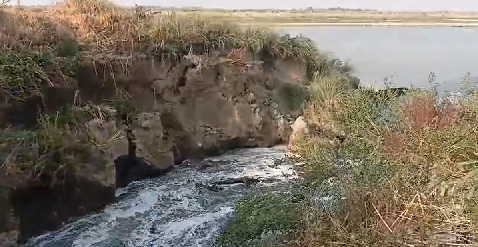
DRP 200524: After Ten years of Namami Gange and Rs 40 000 Cr expenditure Ganga remains dirty
(Feature Image: Untreated effluents being discharged in Gang river through ‘Chor’ nullah in Kanpur on May 19, 2024. Image Source: Sceenshot of ABC News Media report)
The reports this week from Ganga basin rivers clearly show that after ten years of Namami Gange and NMCG (National Mission for Clean Ganga) efforts and expenditure of over Rs 40 000 Cr, there is no improvement in even river pollution, leave aside the state of river flows or state of the rivers in the Ganga basin.
In fact, there is nothing to show that even the new STPs are making any difference to the river even with respect to the limited objective of sewage treatment. As highlighted in the report below, until and unless the governance of STPs become more transparent, accountable and participatory, there is no hope for change, no matter how much money is spent, how much new STP capacity is added or what technology is used. Only a responsive, confidence inspiring governance can make a difference. But there is no interest in working in that direction from the government.
Continue reading “DRP 200524: After Ten years of Namami Gange and Rs 40 000 Cr expenditure Ganga remains dirty”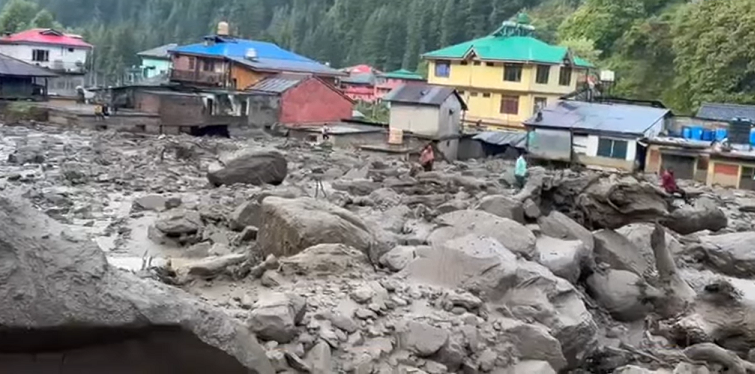
May 2024: Lambadug HEP Leak Disaster in Kangra-Himachal
(Feature Image: Flashflood ravaged Multhan market area after leakages in 25 Mw Lambadug HEP tunnel on May 10, 2024. Image Source: Screen shot of Amar Ujala video report)
The massive leakages in penstock of Lambadug Hydro Electric Project (HEP) on May 10 2024 morning have caused extensive damages in Multhan market area of Kangra district in Himachal Pradesh. The sudden leakages turning into a flash flood spell occurred around 08:00 am on May 10, 2024. As per reports the deluge containing mud and debris spread over 400 meter of market and invaded about 50 homes, 80 shops apart from damaging cash crops over 6 acres farming land.
The incident created panic situation for 150 families living in the area. Several residents had to run to save their lives. The project and administration officials remained unavailable to control the situation for hours. With no help in site, the local people had to divert the gushing currents towards Lambadug river to prevent further damages to their homes and properties.
Continue reading “May 2024: Lambadug HEP Leak Disaster in Kangra-Himachal”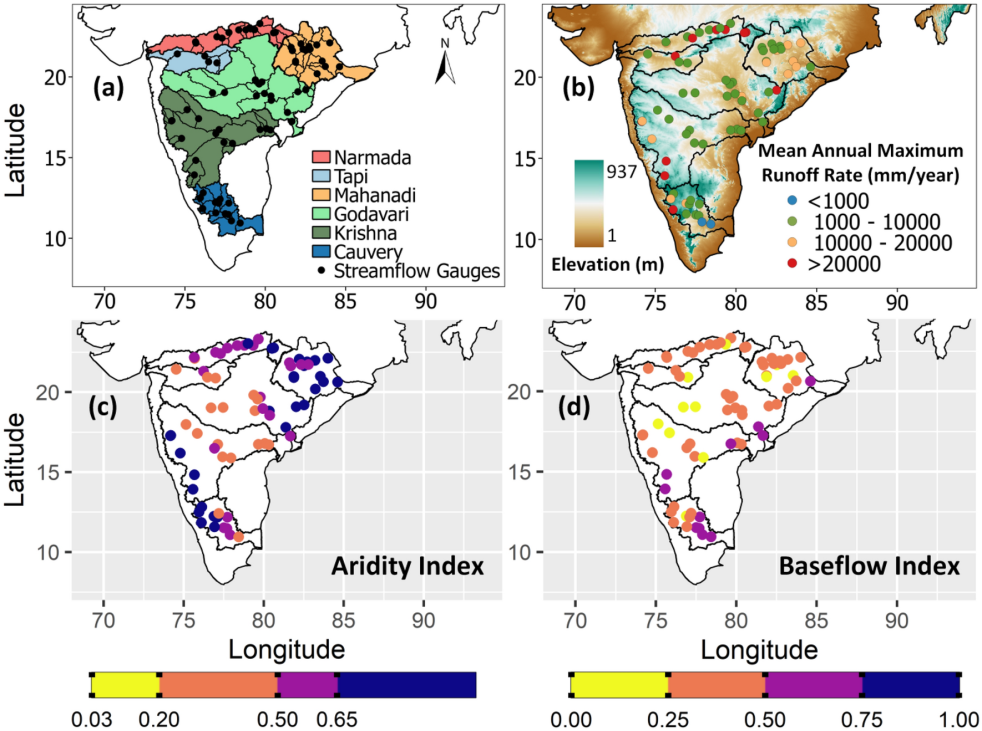
DRP 060524: Study on dam induced river flooding in Peninsular India
(Feature Image: (a) Locations of streamflow gauges with catchment boundaries in six major river basins of Peninsular India, (b) elevation map and mean annual maximum runoff rate (streamflow per unit catchment area), (c) Aridity Index (AI) and (d) Baseflow Index (BFI). The maps in first row are prepared in QGIS (Version 2.14.0 ‘Essen’ (2016), URL: http://qgis.org) and the maps in second row are generated using R (Version 4.2.2 (2022), URL: https://www.R-project.org/). Source: Baseflow significantly contributes to river floods in Peninsular India )
A recently published study, see details given below throws light on the role of groundwater contribution to baseflow in rivers and their flooding in Peninsular India’s river like Narmada, Tapi, Mahanadi, Godavari, Krishna and Cauvery. The found that while baseflow contributes more to river flows, its share in the flood event flow magnitude decreases as surface runoff accounts for a larger proportion of flood discharge on the day of the flood.
Most significant are the findings related to dam induced flood that SANDRP has been writing for long and the finding corroborate exactly what SANDRP has been saying: Sudden releases of water from a dam can raise river levels during extreme rainfall events, especially when the dam is nearly full. The impact of sudden floods is more destructive because people living in nearby areas are often unprepared. Without a dam, floodwaters rise slowly over time, allowing people to take preventive measures. However, sudden floods caused by dam releases offer little or no time to prepare, increasing the risks associated with dam-induced flood hazards. Furthermore, the construction of dams alters the natural regime of rivers, leading to changes in sediment transport and erosion patterns. These changes can heighten the risk of flooding downstream from a dam.
Continue reading “DRP 060524: Study on dam induced river flooding in Peninsular India”
May 2024: Chanju III HEP in Chamba-HP: Rockfall Incident Kills 1; Injures 2
(Feature Image: Screenshot of First Verdict video report on rockfall incident at Chanju III HEP in Chamba)
A rockfall incident at weir site of Chanju III Hydro Electric Project (HEP) site in Chamba district of Himachal Pradesh has left one worker dead and two injured[i]. The incident occurred in afternoon on May 3, 2024 when several workers were working on the weir site of the project.
Suddenly rock pieces started falling on them from uphill portion creating panic among the workers. They had to run for the shelter to save their lives. However, one worker was severely hit by the stones and two others got injured while looking for safety cover.
Continue reading “May 2024: Chanju III HEP in Chamba-HP: Rockfall Incident Kills 1; Injures 2”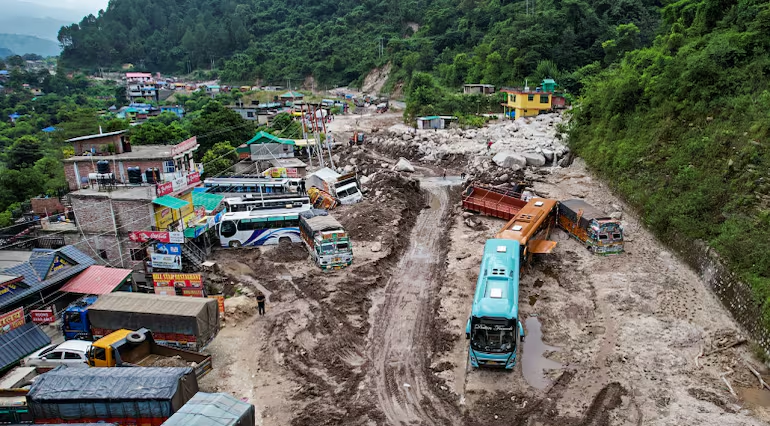
DRP 290424: Why is Climate Change not major election issue?
(Feature Image: Vehicles stuck in debris following a recent cloudburst at Saat Meel in Mandi, on August 20, 2023. (PTI Photo/Money Control)
World’s largest democratic exercise is now ongoing in India to elect the members of India’s Lok Sabha. Over 97 crores are eligible to vote in these elections. One of the biggest factors that is adversely affecting people across India currently is Climate Change. It is affecting almost every aspect of life and the adverse impacts are only increasing with every passing year. This is man-made disaster basically happening due to anthropogenic reasons, affecting air, water, climate, food, health, livelihoods, disasters and so on, affecting everyone. Currently, India is also a major contributor to the climate change causing green-house gas emissions, even though historically, the developed countries have contributed much more.
More importantly, the development options that the elected government choose will decide how the people will be impacted by climate change. The government has large number of options for pathways to development. Considering all this, one expected that climate change responses will be a major issue in these elections. But that is clearly not the case. BJP and Congress, two of the biggest parties fighting the elections, have mentioned climate change in their manifestos, but neither has dealt with this important issue with the detail and seriousness required. Nor are any of them making climate change a major election issue. One expects the ruling party to at least respond in greater detail and seriousness to this issue, but that is not the case.
Continue reading “DRP 290424: Why is Climate Change not major election issue?”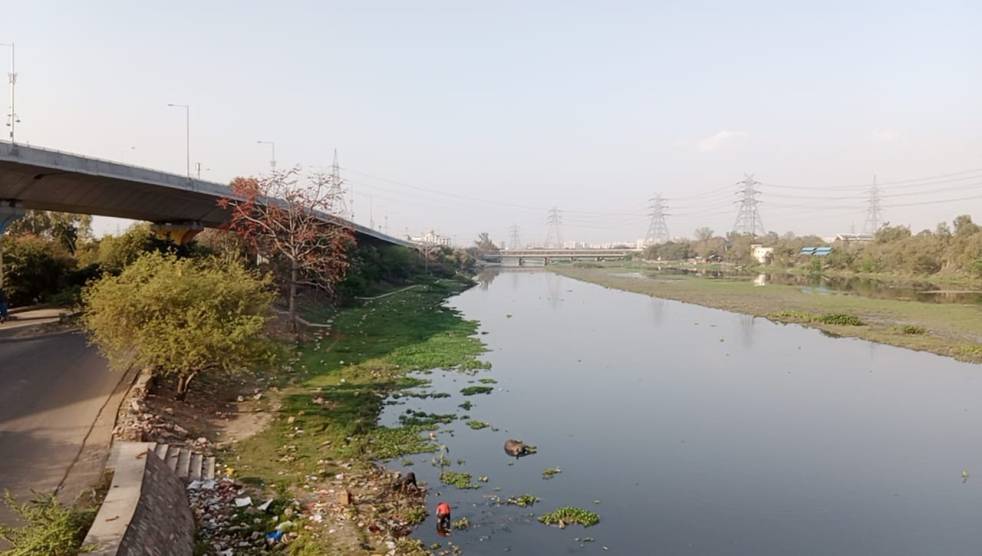
DRP 150424: Supreme Court’s order on right to be free from climate change impact is welcome, BUT…
(Feature Image: Polluted Hindon river flowing through Ghaziabad in March 2024. Bhim Singh Rawat/SANDRP)
On March 21, 2024, a case related to the Grean Indian Bustard, a critically endangered bird – numbering less than 150 individuals – has led the Supreme Court of India to expand citizens’ constitutional right to life and equality to include the right to be free from the adverse impact of climate change. The PIL filed by M.K. Ranjitsinh asked to protect the GIB from extinction. In 2021, in this PIL, the Supreme Court had passed directions restricting and regulating power lines and renewable energy projects in an area of 99,000 sq km in Rajasthan and Gujarat.
The Supreme Court’s latest order modified directions passed in the earlier judgment. Chief Justice D.Y. Chandrachud – writing for the 3-judge bench including Justices J.B. Pardiwala and Manoj Mishra – has expanded the contours of environmental jurisprudence: from the oft-repeated polluter pay principle–precautionary principle–public trust doctrine to the larger arena of climate justice, environmental inequity and gender justice. However, in the process, the protection the SC gave through earlier order has been withdrawn.
Continue reading “DRP 150424: Supreme Court’s order on right to be free from climate change impact is welcome, BUT…”
DRP 250324: Celebrating 50 years of Chipko Movement and Message
(Feature Image: A photo taken in March 1974 of people in Raini village, Uttarakhand, a few days after they protested against the felling of trees in order to make tennis racquets. Source: Varsha Singh/Third Pole report dated 30 Nov. 2022. The original photograph was taken on 30 March, 1974 by Chandi Prasad Bhatt and has been reproduced in The Third Pole with permission)
As we celebrate the golden jubilee of Chipko Movement, one of the most iconic and memorable environmental movements of India, we need to remember the key messages of the movement. It may seem gloomy situation at the place where the movement originated in Raini village in Chamoli district of Uttarakhand. In fact, as we travel from Raini to Chamoli to Uttarakhand and beyond, as far as environmental situation is concerned, there is not too much around us to celebrate about.
Continue reading “DRP 250324: Celebrating 50 years of Chipko Movement and Message”
March 2024: 3 Hydropower Workers Killed in Avalanche in Kinnaur-Himachal Pradesh
(Feature image: Rescue work being done at Selti-Masrang HEP site in Kafnu, Kinnaur on March 11, 2024. Image Source: News 18 Hindi)
A snow avalanche has killed three workers of under construction Selti-Masrang hydroelectric power (HEP) project in Kinnaur district of Himachal Pradesh. The incident occurred in after noon hours reportedly around 01:00 pm on March 11, 2024.
The 24 Mw project is being built by Hyderabad based Ramesh Hydro Power Private Limited on Wangar khad, a tributary of Sutlej River near Kafnu village panchayat in Bhaba valley of the district. The basic information about the project can be seen here. A forest land of 4.75 ha was diverted for the project wide permission given in May 2013. In 2016, 0.64 ha more forest land was applied for. The project cost then in 2016 was Rs 154. 27 cr.
Continue reading “March 2024: 3 Hydropower Workers Killed in Avalanche in Kinnaur-Himachal Pradesh”
DRP 110324: Bangalore reminds us: Ignore groundwater at your own peril
(Feature Image: People stand in a queue with water cans to get drinking water at Jnana Jyothi Nagar, in Bengaluru. Image Source: PTI/Live Mint, 10 March 2024)
One central lesson of the ongoing Bangalore water crisis is essentially that ignore groundwater sustainability at your own peril. The surface water availability in Bangalore has not decreased, it is the groundwater depletion that is leading to crisis. There is of course the expansion of the city both horizontally and vertically that is increasing demands, but simple arithmetic tells us that if groundwater levels are sustained, it can take care of these increased demands.
The Groundwater sustainability includes sustaining the groundwater recharge and ensuring that extraction does not go past the recharge. Sustaining the groundwater recharge means first understanding the groundwater recharge mechanisms, zones and protecting them. BDA has been sitting for four years on desilting of two lakes: Bellandur and Varthur, which has caused huge impact on groundwater depletion. It also means increasing the groundwater recharge through rainwater harvesting (Bangalore’s failure here is apparent from the fact that government is collecting crores of rupees as fines from those not following the mandatory rainwater harvesting requirements), groundwater recharge wells and diverting tertiary treated sewage, available in Bangalore of upto 300 Million Liters per Day, to lakes and other such recharge zones.
Continue reading “DRP 110324: Bangalore reminds us: Ignore groundwater at your own peril”
