Dams · Floods

Overview of CWC Flood Forecasting Sites 2018: WEST INDIA

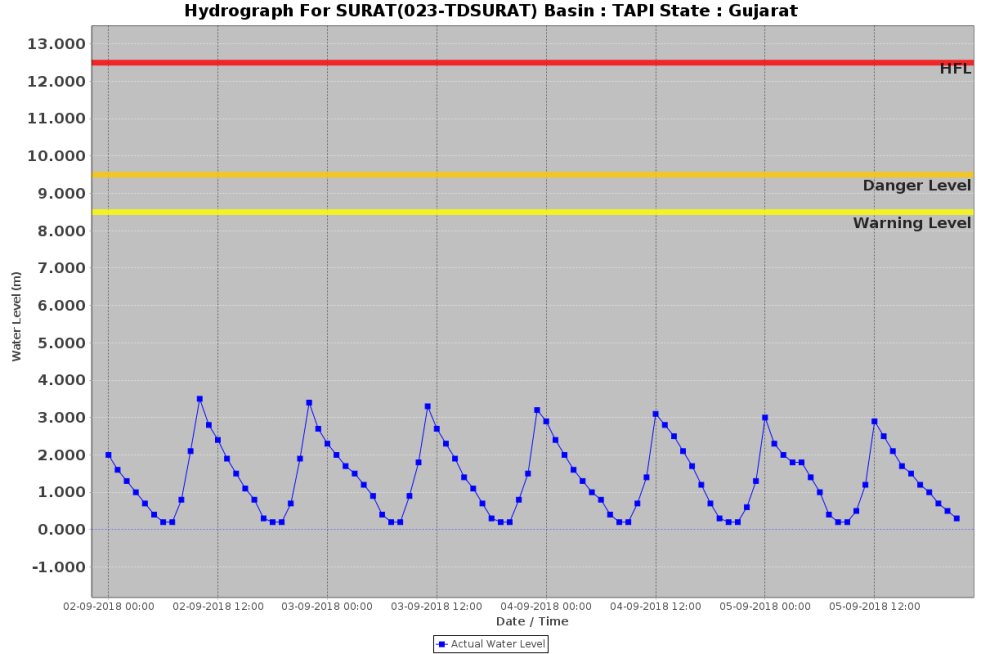
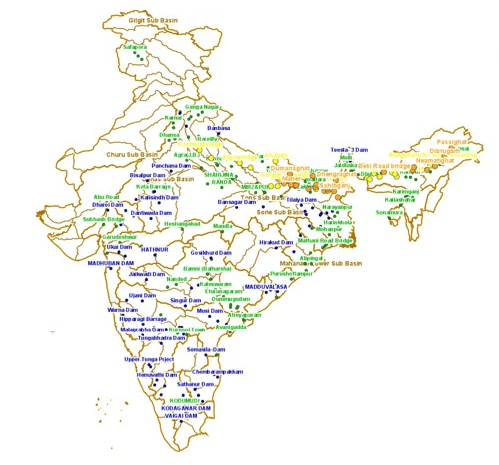
Central Water Commission is the only agency doing flood forecasting in India. As per CWC’s Flood Forecasting website[i] the Data Flow Map has information about 226 Flood Forecast Sites in the country comprising of 166 Level Forecast Sites and 60 Inflow Forecast Sites. It also monitors 700 other sites, information is made available through List Based Exploration and Hydrograph View, but no flood forecasting is done for these sites.

In order to better understand the CWC’s flood monitoring and forecasting work, in this article, we have given an overview of CWC’s flood forecasting and monitoring sites in West India. It includes state wise list of CWC’s Level Forecasting, Inflow Forecasting and level monitoring sites in 5 States in West India. Similar report has been published for North India[ii] and North East India[iii] and East India[iv] and South India[v]. This is the last part in the series.  Continue reading “Overview of CWC Flood Forecasting Sites 2018: WEST INDIA”

Dams · DRP News Bulletin

DRP News Bulletin 13 August 2018: Existing Sediment Management Draft Policy Promoting Navigation & Not Rivers’ Health

Traditionally, our river management strategies are mainly focused on the water flows, including flood management, and these have resulted in various interventions such as dams, barrages, canals and embankments. Most of these interventions have had very little consideration for sediment transfer and even if they did, they were generally defunct within a few years of their operations either due to improper design or inadequate maintenance.

A long-term sediment management strategy has never been a part of any protocol of river management, not just in India, but in several other parts of the world. It is amply clear that sediment management must form an important component of management strategies for the Himalayan rivers. The Union Water Ministry has recently circulated a draft policy on sediment management.

Continue reading “DRP News Bulletin 13 August 2018: Existing Sediment Management Draft Policy Promoting Navigation & Not Rivers’ Health”

Dams, Rivers & People

DRP News Bulletin 30 July 2018: Laos Dam DISASTER: Yet Another Wake Up Call?

The various aspects of tragic Dam Disaster in Mekong Basin in Laos are still unfolding. But it is clear from many accounts that it was an avoidable, man-made disaster due to neglect of contractors, decision makers, consultants and supervising agencies. There is a lot we can learn from this if we want to avoid such disasters in India. We still do not have credible Dam Safety Law or institution, CWC is clearly not the right agency considering the conflict of interest with the various other roles of CWC. But for now let us look at the reports of Laos Dam Disaster.

Reminding the world of one of the worst dam disasters, the under construction dam Xepian Xe Nam Noy Hydro power project breached releasing 5 billion cubic metres of water in Southern Laos on July 23.

The gushing water current swept the surrounding leading to death of about 26 people and displacing about 6600 residents. As per report hundreds of people are still missing from neighbouring villages of Yai Thae, Hinlad, Mai, Thasengchan, Tha Hin, and Samong, which bore the brunt of flooding. The deluge has reportedly destroyed thousands of homes.

Continue reading “DRP News Bulletin 30 July 2018: Laos Dam DISASTER: Yet Another Wake Up Call?”

Dams · DRP News Bulletin

DRP News Bulletin 2 July 2018: Punjab Cabinet Meets To Discuss Water crisis, IS IT SERIOUS?

In a rare event, Punjab Cabinet met to discuss water crisis on June 26, 2018. The reports before the meeting seemed to give hope that may be Punjab will look at the water crisis in a fundamental, holistic way. https://indianexpress.com/article/cities/chandigarh/punjab-government-to-firm-up-water-conservation-plan-5233826/ (June 26, 2018)

But the cabinet ended up setting up a committee to assess the ground water situation in the state and submit a detailed proposal for water conservation.

– Punjab has the highest rate of groundwater exploitation and had on average withdrawn 28.2 million acre feet (MAF) water yearly during 2008-2013. However, the yearly average replenishment of water was only 18.9 MAF.

– 73% of Punjab’s irrigated area uses groundwater for irrigation, while only 27% uses surface water. The number of tubewells had gone up exponentially from 2 lakh in 1971 to 12.50 lakh in 2015-16, with 41% of these have water availability beyond the depth of 60 metres. https://timesofindia.indiatimes.com/city/chandigarh/5-member-committee-to-assess-punjab-ground-water/articleshow/64770186.cms  (28 June 2018)

Continue reading “DRP News Bulletin 2 July 2018: Punjab Cabinet Meets To Discuss Water crisis, IS IT SERIOUS?”

Dams · DRP News Bulletin

DRP News Bulletin 11 June 2018 (Groundwater Pollution: The Hidden Killer Menace Lurking All Over)

Aquifers in 16 States in the country are contaminated by uranium, whose presence in drinking water has been linked to chronic kidney disease by several studies, a recent study has shown. More importantly, uranium doesn’t figure on the list of contaminants monitored under the Bureau of Indian Standards’ drinking water specifications. The main source of this contamination is natural, but groundwater depletion by extensive withdrawal of water for irrigation and nitrite pollution due to the excessive use of nitrogenous fertilisers may be exacerbating the problem, said the study.

– The study was carried out by a team of researchers led by Avner Vengosh, professor of geochemistry and water quality at the Nicholas School of the Environment at Duke University in the US. The team, which also included experts from the Central Ground Water Board, the Rajasthan government’s Ground Water Department and Gujarat Water Resources Development Corporation, analysed groundwater samples from 226 locations in Rajasthan and 98 in Gujarat.

Continue reading “DRP News Bulletin 11 June 2018 (Groundwater Pollution: The Hidden Killer Menace Lurking All Over)”

DRP News Bulletin

DRP News Bulletin May 7, 2018: WESTERN GHATS FORESTS ARE VITAL FOR SOUTH WEST MONSOON RAINS IN TAMIL NADU

W Ghats Forests vital for Tamil Nadu SW Monsoon Rains Researchers have found that the dense vegetation in the Western Ghats determines the amount of rainfall that Tamil Nadu gets during the summer monsoon. A team led by Prof. Subimal Ghosh from the Department of Civil Engineering at the Indian Institute of Technology (IIT) Bombay has found that dense forests of the Western Ghats contribute as much as 40% of moisture to the southwest monsoon rainfall over Tamil Nadu during normal monsoon years. The average contribution is 25-30%. But during monsoon deficit years, the contribution increases to as high as 50%. Continue reading “DRP News Bulletin May 7, 2018: WESTERN GHATS FORESTS ARE VITAL FOR SOUTH WEST MONSOON RAINS IN TAMIL NADU”

DRP News Bulletin

DRP News Bulletin 16 April 2018: HOW Citizens can use mobile app to monitor Rivers

MOBILE APP FOR RIVER MONITORING: HUGE POTENTIAL FOR CITIZENS IN INDIA? If you added up the length of all the streams around the world, the total would be at least 89 million kilometers [Downing et al., 2012]. More than half of the global stream channel network is likely intermittent (i.e., the streams do not have flow year-round [Datry et al., 2014]), yet most streamflow monitoring stations are located on perennial streams. Continue reading “DRP News Bulletin 16 April 2018: HOW Citizens can use mobile app to monitor Rivers”

Dams · DRP News Bulletin

DRP News Bulletin 18 September 2017 (Why Madhaya Pradesh Depleted Its Meagre Water Storage To Fill up SSP Dam For Sept 17?)

As per the Daily Status Reports of Narmada Control Authority[iv], inflow into SSP Dam suddenly jumped from 495 cumecs (Cubic Meters per second) on Sept 12, to 2518 cumecs on Sept 13, 2383 cumecs on Sept 14 and 2210 cumecs on Sept 15, 2384 cumecs on Sept 16, in anticipation of the birthday, so that when Narendrabhai visits the dam site to formally declare the project complete, the reservoir is seen to have substantial water. Expectedly, SSP water level rose from 126.19 m to 128.5 m by 8 am on Sept 15. How was this made possible?

Madhya Pradesh depletes its water storage so that SSP looks full on Sept 17? The increased inflow into SSP was made possible only by increased outflow from upstream Madhya Pradesh dams like Indira Sagar Project (ISP) on Narmada. ISP, incidentally is India’s largest reservoir in terms of storage capacity.

So the ISP storage level which was already very low (about 33%) on Sept 11 with monsoon almost coming to close, was depleted by further 450 MCM (Million Cubic Meters) from Sept 11 to Sept 16 (date for which latest information is available), while SSP water level rose by 750 MCM during the same period. All this, so that water level at SSP could look more respectable on Sept 17. Its not known why Madhya Pradesh is ready to lose water from its low storage levels (in fact, the water level at Omkareshwar Project on Narmada is below Minimum Draw Down level throughout this period).

Will Madhya Pradesh Chief Minister and MP Govt be held accountable for this by the media, judiciary and the people?

Continue reading “DRP News Bulletin 18 September 2017 (Why Madhaya Pradesh Depleted Its Meagre Water Storage To Fill up SSP Dam For Sept 17?)”

Dams · DRP News Bulletin

DRP News Bulletin 11 September 2017 (Why This Rally Won’t Help The Rivers?)

The news media is filled with this new kid on the block, trying to wake the nation about the need to save our rivers… amazing to see so many film stars, politicians, governments, and public personalities, many of them rather innocently joining the band wagon… some friends were pleading that see, he is able to take the message of rivers to so many people, including lakhs of children… let us try and see if there is something positive here… may be, may be this is just the entry point, but the guy and his team have bigger vision? May be we need to give him longer rope, be more charitable and not jump to negativity?

We have kept all this in mind while writing this.

We see nothing from the people who are leading the rally, or their websites or messages that they understand the real threats faced by and reasons for the state of our rivers, are ready to even list such causes or protest any further move to destroy our rivers. The website claims it is “a nationwide awareness campaign to revive our rivers”. Can missed call save our rivers?

Continue reading “DRP News Bulletin 11 September 2017 (Why This Rally Won’t Help The Rivers?)”

Inter State Water Disputes

Inter state River Water Disputes in India: History and status

Water sharing disputes across the country (and even beyond) are only going to escalate with increasing demands, and also with increasing pollution & losses reducing the available water. Climate change is likely to worsen the situation as monsoon patterns change, water demands going up with increasing temperatures, glaciers melt and sea levels rise. The government’s agenda of interlinking of rivers would further complicate the matters.

The ongoing Cauvery Water Dispute [iv] has once again brought the focus on interstate river water sharing disputes in India and what has been our experience so far. There is no solution of Cauvery water dispute in sight and the engineer-dominated Cauvery Management Board that the Cauvery Water Dispute Tribunal Award has recommended is unlikely to help matters. Continue reading “Inter state River Water Disputes in India: History and status”