Dam floods · Dams

Dam Floods 2018: Assam, Himachal; Making Dam Operators Accountable

ASSAM: NEEPCO a repeat offender? On July 27, 2018 sudden release of water from NEEPCO’s Doyang Hydropower Electric Project (HEP), located in Wokha district, Nagaland led to flood disaster[1], submerging[2] about 36 villages in Golaghat a district in Upper Assam. According to Rony Rajkumar, project officer of the Golaghat district disaster management authority, around 5,575 people were affected by the deluge which damaged 887.9 ha of crop.

Earlier, on July 11, 2018, reviewing the severe flood situation Lakhimpur Assam, the Chief Minister (CM) Sarbananda Sonowal strongly warned[3] the state-owned power utility NEEPCO not to release water from its Ranganadi dam without warning like previous years.

Continue reading “Dam Floods 2018: Assam, Himachal; Making Dam Operators Accountable”

Dams · Monsoon

Monsoon 2018 Overview: Serious Anomalies Hidden by Macro Figures

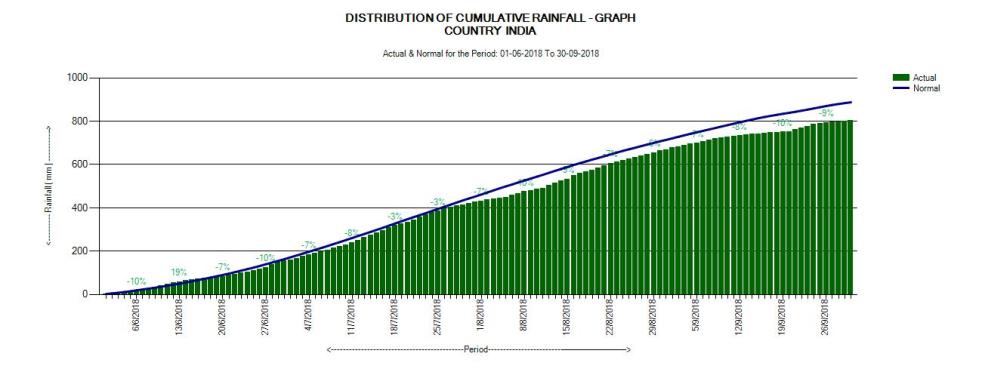
2018 becomes fifth year in a row when India’s south west monsoon has been below normal.  In the beginning of monsoon season, Indian Meteorological Department (IMD) has forecasted rains to be normal with rainfall equal to 97 percent of the long term average. However at the end of the season the overall rainfall turned out to be 91 percent, with deficit of 9 percent at national level. However, as we see in this overview, the situation as move from national to local figures, is much different, mostly much worse.

According to IMD’s State Rainfall Map (cumulative) dated 30 Sept. 2018, the country received 804.0 mm rains against 887.5 mm of normal average. Thus the south west monsoon 2018 had 9.4 percent below normal rainfall.

Continue reading “Monsoon 2018 Overview: Serious Anomalies Hidden by Macro Figures”

Dams · DRP News Bulletin

DRP News Bulletin 29 October 2018: Better Paddy Options Exist For Punjab

A try-out of the technique to grow paddy without puddling at village Chehlan of Ludhiana has resulted in higher yield in comparison to puddled fields, while saving water in the process. The crop was ready for harvest days before expected time, saving irrigation water otherwise to be used for another fourteen days. This trial was funded and supervised by ATMA, a central govt.  scheme under the Union Ministry of Agriculture.

Puddling is a traditional method of flooding paddy fields with running water, whereas in non-puddling technique, ‘ridges and furrows’ are formed in soil to let water store in spaces and let it stay, thus reducing irrigation frequency.

“Not paddy but puddling is the enemy of waters of Punjab. It is wastage of water to puddle fields as most of it just evaporates. We have saved 45-50 per cent of water in non-puddled fields. Our yield has been almost 30 per cent more from fields where crop was not puddled. Also, non-puddled crop matured very early, saving at least ten days of irrigation water,” says Rupinder Singh Chahal (43) who along with his brothers Jasvir Singh (48) and Kulwinder Singh (52) experimented with ‘non-puddling’ technique on four acres this year.

Continue reading “DRP News Bulletin 29 October 2018: Better Paddy Options Exist For Punjab”

Dams · Monsoon

Himachal Pradesh Monsoon 2018 Overview

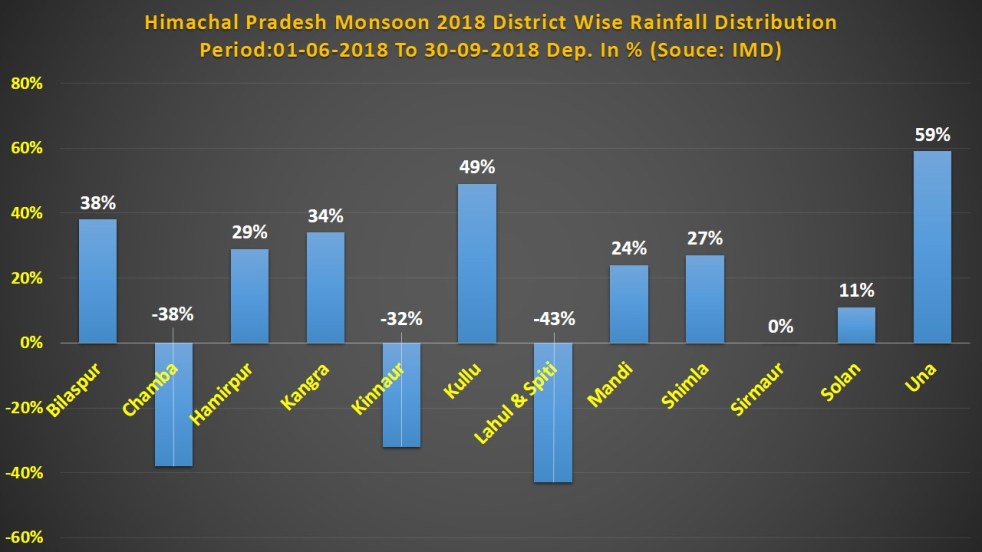
Himachal Pradesh has received 917.3 mm rainfall during South West Monsoon 2018. The amount is 11 percent higher than normal rainfall category of 825.3 mm. However at district level there is considerable variation in the distribution of rainfall. Out of 12 districts in the state, rainfall departure has been in deficit in three districts namely Chamba, Kinnaur and Lahul & Spiti by 38 percent, 32 percent and 43 per cent respectively. All these three districts are in upper part of Himalaya, the origin of many rivers & where mountains are mostly snow covered.

Continue reading “Himachal Pradesh Monsoon 2018 Overview”

Dams · Floods

Overview of CWC Flood Monitoring Sites 2018: INDIA

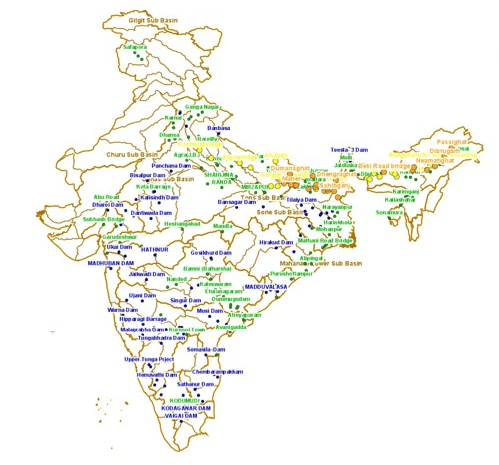
Central Water Commission is the only agency doing flood forecasting in India. As per CWC’s Flood Forecasting website[i] the Data Flow Map has information about 226 Flood Forecast Sites in the country comprising of 166 Level Forecast Sites and 60 Inflow Forecast Sites. It also monitors 700 Flood sites, information made available through List Based Exploration and Hydrograph View, but no flood forecasting is done for these sites.

In order to better understand the CWC’s flood monitoring and forecasting work, SANDRP has published report of CWC’s Level Forecast, Inflow Forecast and level monitoring sites in 5 zones of North India[ii], North East India[iii], East India[iv], South India[v] and West India[vi].  Through this report, we have presented all the data at one place with links to separate zone wise reports with detailed description.

Continue reading “Overview of CWC Flood Monitoring Sites 2018: INDIA”

Beas · Fish · Fish Sanctuaries

Beas Dolphins: A Flash Of Fin, A Glimmer Of Hope

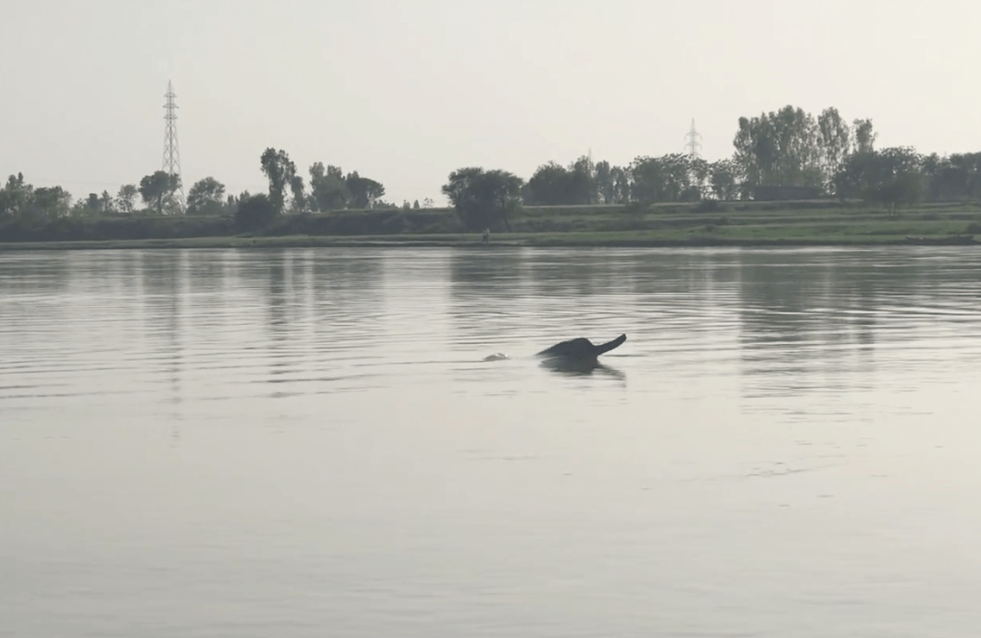
Above: A female Platanista gangetica minor breaks the surface of the Beas (Photo by Arati Kumar Rao)

India’s few remaining Indus river dolphins are confined to one short, beautiful stretch of the Beas. They have a fighting chance at survival only if we ensure a healthy river

Guest Blog by Arati Kumar Rao

A dark shape cleaves the Beas river, leaving a long wake in its trail. From the way it moves, it is neither a human, nor fish, nor even a river dolphin. The shape swims strongly, shrugging off the strong current. It holds its line and makes straight for a sandbar, hauling itself up on a buff-coloured spit.

A black dog, probably feral. It shakes itself free of water and, running across the sand, begins tugging at the beached carcass of a cow. Another bigger dog appears out of nowhere, and the two begin to snarl and gorge, yanking and tearing flesh off the arcing ribs.

River sandbars contain multitudes. I was upstream of Harike, the largest wetland in north India. The critically endangered gharial (Gavialis gangeticus), the fish-eating, long-snouted crocodilian, of which no more than a few hundred survive in the world, bask and nest on these sandbars. Freshwater turtles like the red-crowned roofed turtle (Batagur kachuga) and the Indian narrow-headed soft-shell turtle (Chitra indica), among the most endangered of freshwater species, use sand islands extensively to breed and to bask. Hundreds of thousands of birds — some transient visitors from China and Siberia and Central Asia wintering here, some resident — forage, nest, breed, raise chicks. Many of these creatures have this in common – they are all threatened, to greater or lesser degree.

The sight of predatory, feral dogs in this delicate ecosystem comes with chilling implications. Continue reading “Beas Dolphins: A Flash Of Fin, A Glimmer Of Hope”

Water

A tale of two National Water reports: NITI and USGS

Within a span of a week, two interesting reports on National Water situation were made public. Indians have heard of NITI Ayog’s first ever report on Composite Water Management Index, trying to put together state of water management in India. Not many here would have heard of the United States Geological Survey (USGS)’s once in five year report on water consumption for various activities and states in USA[i]. The US report was published on June 19, 2018, five days after NITI Ayog report was launched on June 14 by Union Water Resources Minister Nitin Gadkari.[ii] Continue reading “A tale of two National Water reports: NITI and USGS”

Rivers

RIVERS AS COMMONS: REALITY OR MYTH?

Guest Blog by Dr. Ruchi Shree (Delhi University)

The fact that most of the civilizations of the world flourished on the river banks is more or less uncontested. The examples of early river valley civilizations range from Indus civilization near Indus River to Mesopotamia along the Tigris and Euphrates Rivers, Egypt on the bank of Nile, and Chinese civilization near Yellow River to name some of them. Even today most of the major cities of the world are situated on the banks of rivers viz. London near Thames, Paris near Seine, New York next to Hudson and the list is endless. Coming to the cities in India also, Delhi is on the bank of Yamuna, Kolkata is near Hooghly river, Allahabad at the confluence (popularly known as Sangam) of Ganga, Yamuna and mythical Saraswati, Ahmedabad near Sabarmati and many more. Continue reading “RIVERS AS COMMONS: REALITY OR MYTH?”

Dams · DRP News Bulletin

DRP News Bulletin 12 February 2018 (With Innovative Ideas Hyderabad, Chennai & Delhi Are Reviving Its Wetlands)

This week there are exemplary and encouraging wetlands revival stories from three metro cities of Chennai, Hyderabad and Delhi.  In the first example from Hyderabad, meticulously chosen plant species such as tulsi, aswagandha, citronella and hibiscus have been used to create an artificial island to clean Neknampur Lake. The treatment islands are composed of four layers of which the bamboo base keeps the entire structure afloat. Based on soil-less hydroponics, these floating treatment wetlands absorb excess nitrates, thereby reducing the chemical content of the lake water. Microorganisms present in the wetland break down organic matter while the root systems filter out pollutants and sediments. https://www.thenewsminute.com/article/3500-saplings-floating-islands-help-rejuvenate-hyd-neknampur-lake-75819 (The News Minute, 3 Feb. 2018)

Image by: Madhulika Choudhary

Similarly, Chennai-based Care Earth Trust along with the public works department (PWD) and the civic body has managed to restore three urban lakes. While many of the smaller wetlands have vanished over time, many mid-sized wetlands seem to have shrunk by almost 65 percent. Thanks to their joint effort, invasive hyacinth was removed from the Narayanapuram Lake in Pallikaranai, while sewer lines, which emptied into the Perungalathur Lake, have now been plugged. A detailed restoration proposal has been forwarded to the PWD regarding the Korattur-Madhavaram-Ambattur lakes. https://timesofindia.indiatimes.com/city/chennai/hyacinth-out-sewer-line-plugged-three-water-bodies-restored/articleshow/62748110.cms (The Times of India, 2 Feb. 2018)

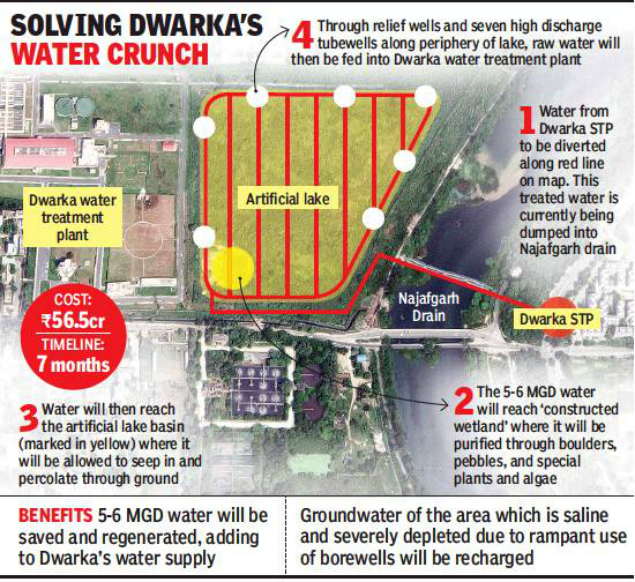
Meanwhile, Delhi Jal Board (DJB) has taken up interesting new project of creating an artificial lake in Dwarka. The project will supply water in sub-city and improve ground water level too. DJB has approved Rs. 56 crore for the project which will be completed in next seven months.  This would the first model project wherein a lake will be used to augment water supply. The special lake is being created next to the Dwarka water treatment plant (WTP) will have a sand bed to allow maximum percolation of water into the ground. It will have a capacity of 10 million gallons (MGD). The project is expected to add supply of 5-6 million gallons water to Dwarka every day.

Continue reading “DRP News Bulletin 12 February 2018 (With Innovative Ideas Hyderabad, Chennai & Delhi Are Reviving Its Wetlands)”