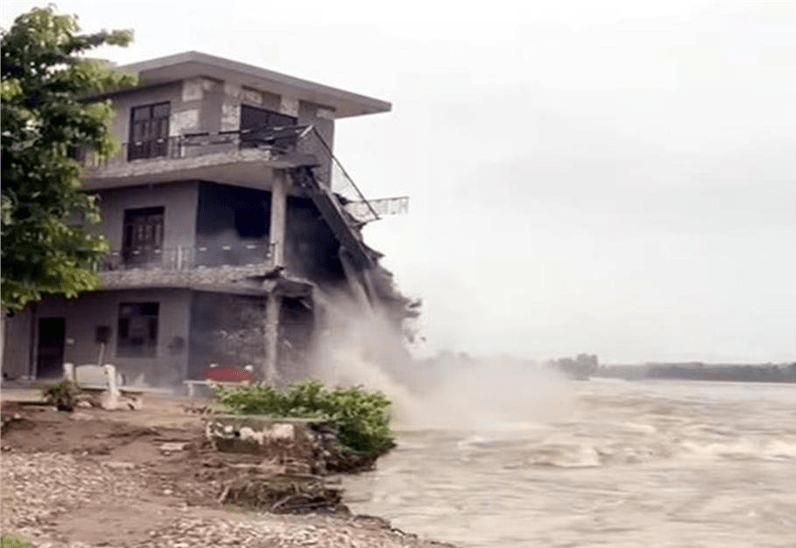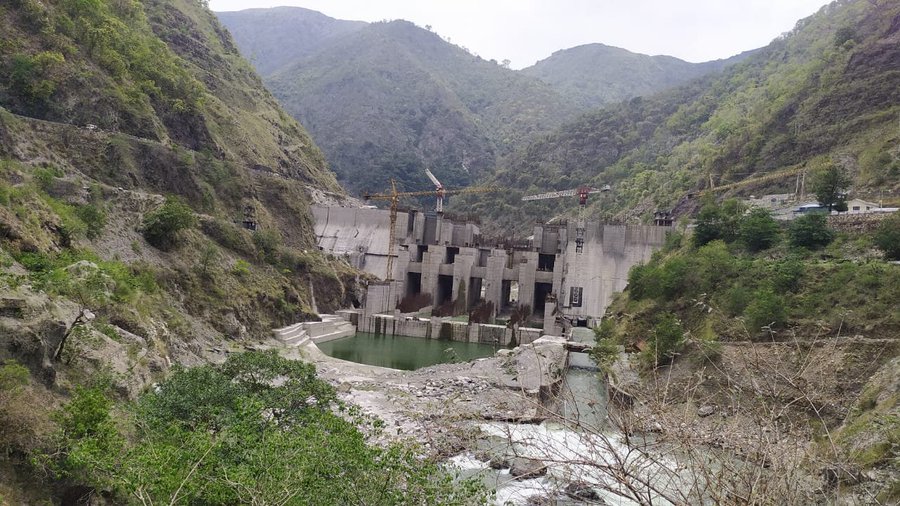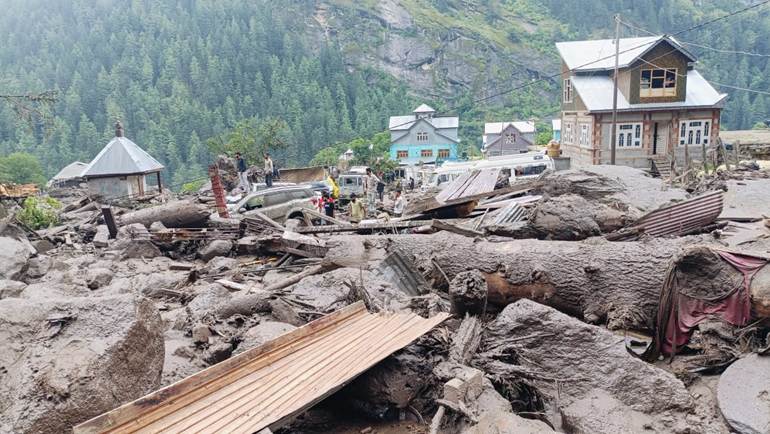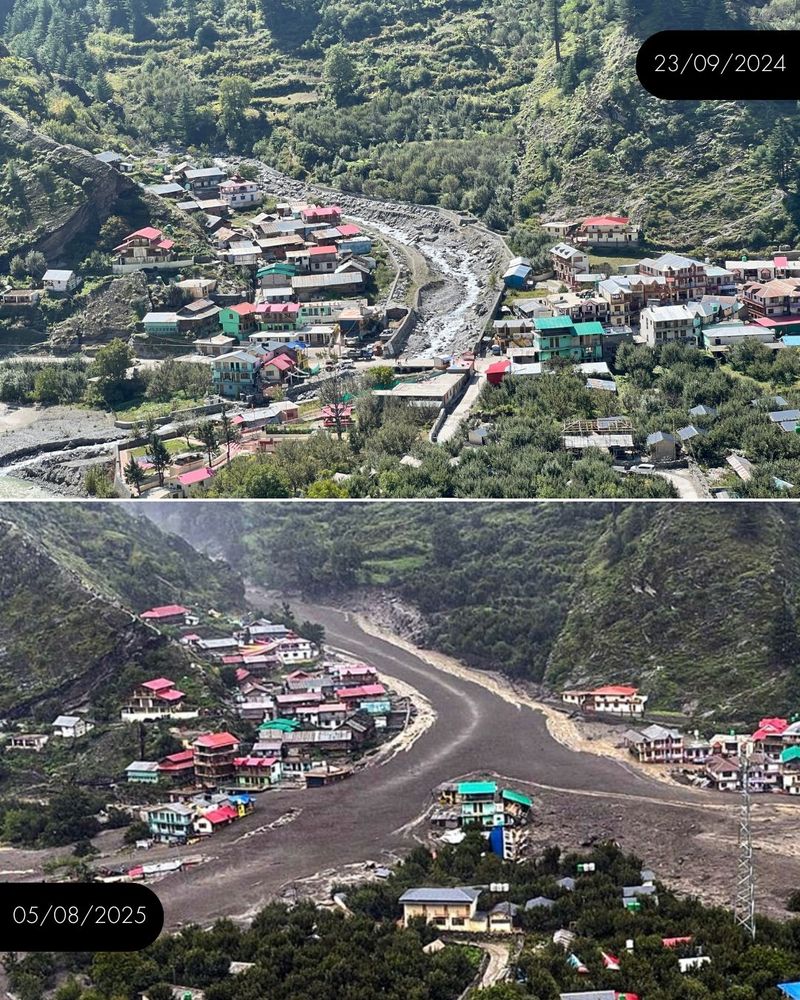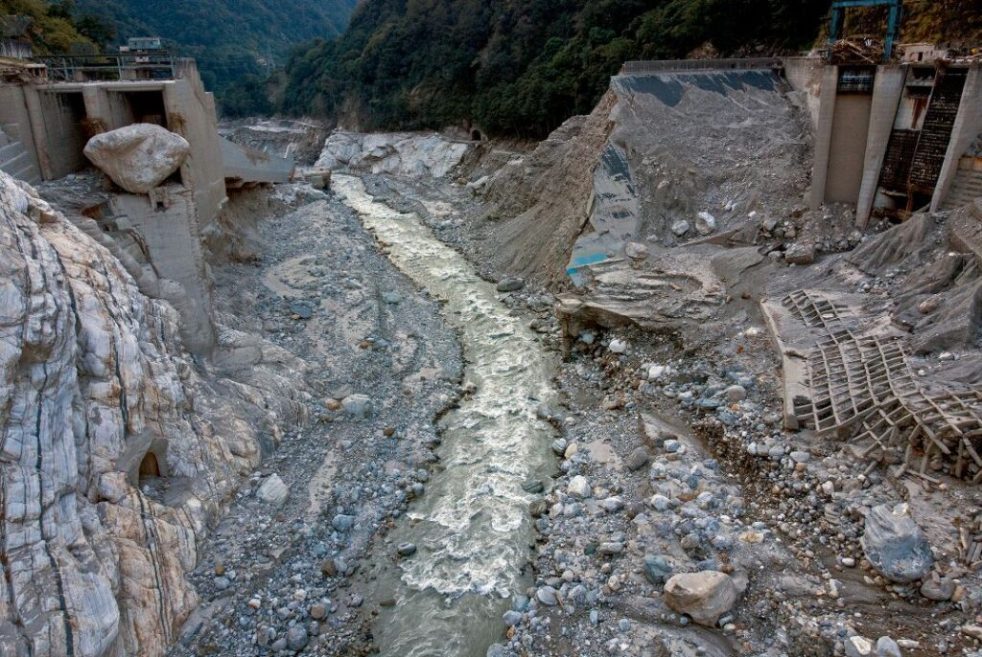
Guidelines for Structural Measures to Mitigate Adverse Effects of GLOF on Dams Central Water Commission (CWC) on July 23 has issued new guidelines to safeguard dam infrastructure from risks and threat of flash floods triggered by glacial lake outburst floods (GLOFs). The information about this 40 paged documents named Guidelines for Structural Measures to Mitigate Adverse Effects of GLOF on Dams July 2025 was shared by CWC director Shiv Kumar Sharma, in a LinkedIn post. The document is available in PPT format and a pdf link for the same is still not available.
Continue reading “DRP 280725: CWC Guidelines on GLOF should have mandated all information in public domain, independent assessment after every GLOF”Tag: GLOF
July 2025: GLOF Disaster Impact Ten HEPs in Nepal
(Pre and post flood images of Tibet’s Pyurepu Glacier region. Source)
A Glacial Lake Outburst Flood (GLOF) disaster in Lehende Khola river impacted several hydro-electric power (HEP) projects in Nepal on July 8, 2025. The deadly flood occurred around 3 am in Rasuwa and Nuwakot districts of Nepal bordering Tibet region under China control. As a result, the water level in Lehende river rose by 3.5 meters in Timure, Rasuwa. The merging of Kerung and Lehende rivers in Tibet forms the Bhotekoshi river in Nepal and it is part of Trishuli sub-basin under Narayani river system.
Continue reading “July 2025: GLOF Disaster Impact Ten HEPs in Nepal”DRP 260525: Opposition to large hydro as strategic projects
(Feature Image: Lahaul Spiti Ekta manch holds a protest rally against hydel projects at Udaipur in Lahaul Spiti on Friday May 23. Source: The Tribune)
Some of the most prominent reports this week are related to wide spread opposition to large hydro projects in Arunachal Pradesh, Himachal Pradesh, Kerala, among other states. Indeed, there is little sense in building large hydro projects as strategic assets as seems to be the case in Himachal Pradesh and J&K (Chenab basin) and Arunachal Pradesh (Siang basin, among others). Use of security forces to complete pre-feasibility survey when local communities are strongly against the project, as is being done in case of Siang Upper Multipurpose Project is clearly counter-productive in so many ways. In Kerala people have again gathered to oppose the destructive Athirapally Hydro projects that they have been successfully opposing since late 1990s.
Continue reading “DRP 260525: Opposition to large hydro as strategic projects”The Moon River: People’s Story of Chenab
Chenab, which translates as the Moon River is the largest of the five tributaries of River Indus. It flows for about 974 kilometers from the High Himalayas of Lahaul to the forests of Jammu and Kashmir and onto the plains of Pakistan. Its main tributaries in India include Miyar, Marusudhar and Tawi. In the vast plains of Punjab in Pakistan, it is met by Jhelum, Ravi and Sutlej to form the mighty Panjnad before it meets the Indus. Its catchment, spread across 67,430 km2, is shared between the two countries.

Chenab is Chandrabhaga (Crescent Moon) in its headwaters. It was the River Asikni in Rigveda, and the Acesines for the ancient Greek. From sparse mountain settlements of Lahaul to the bustling urban centers of Sialkot, more than 10 million people live and prosper along the Chenab. Hydropower projects operational and under constructions on the river have an installed capacity of more than 5000 MW (Central Electricity Authority 2024), and its canals irrigate hundreds of thousands of acres in Pakistan and India (Shakir et al).
Continue reading “The Moon River: People’s Story of Chenab”Hydropower-GLOF Nexus in Chenab Headwaters: Absence of credible studies and accountable governance
Increasing incidences of Glacial Lake Outburst Floods (GLOFs) are being experienced in the Indian Himalayas. One of the most notable examples of GLOF was the Chorabari Lake GLOF that occurred on 16th June 2013 in Kedarnath, Uttarakhand[1] which was triggered by heavy rainfall induced mass movements into the lake. The GLOF devastated villages of Kedarnath, Rambara, and Gaurikund. Around 6,000 people were officially killed, and a significant number of the deaths were linked to the GLOF. Countless bridges and roads were washed away, and about thirty hydropower plants were affected or completely devastated. Several Hydropower projects resulted in exponential losses to life and livelihoods. Whole of Uttarakhand was affected in the disaster, and a significant proportion of it was related with GLOF.
Continue reading “Hydropower-GLOF Nexus in Chenab Headwaters: Absence of credible studies and accountable governance”DRP 100225: EAC & MoEF’s shocking decision to clear Teesta 3 Dam raises a stir
(Feature Image: Teesta III HEP dam was washed away on the intervening night of Oct. 3-4, 2023 on account of a GLOF. The flood in the downstream was magnified by the dam disaster. Photo: Mayalmit Lepcha/Source: Sanctuary Nature Foundation)
The decision of Union Ministry of Environment and Forests (MoEF)’s Expert Appraisal Committee (EAC) on River Valley Projects on Jan 10 2025 has understandably raised a stir and earlier the EAC and MoEF reviews and reverses this decision, better it will be. The decision is shocking on a number of counts. The EAC itself had raised a number of issues related to the project in its earlier meeting, but decided to clear the project without getting satisfactory resolution of the issues.
Continue reading “DRP 100225: EAC & MoEF’s shocking decision to clear Teesta 3 Dam raises a stir”2024: Climate Change, GLOF impact on Safety of Hydro, Dams in India
(Powerhouse of a hydro project ravaged by cloudburst induced flashflood in Sutlej basin Shimla, Himachal Pradesh in Aug 2024. Image Source: Social Media)
This 2024 annual overview focusses on important reports highlighting the safety and sustainability issues of the hydro and dam projects in India in 2024 in the context of Climate Change, including Glacier melt and GLOFs. The compilation shows that the climate change driven extreme weather events have become significant threat for the structural safety of these projects.
This is even more relevant in inherently vulnerable areas like the Himalayas and Western Ghats from the point of view of seismic activity, young erosion prone mountain, flash floods, avalanches and landslides. Here the impact of climate change effects like more intensified hydrological cycles, cloud bursts, reduction in snow fall, glacier melts and GLOF (Glacier Lake Outburst Flood) increase the vulnerability including landslide dams and avalanche dams.
Continue reading “2024: Climate Change, GLOF impact on Safety of Hydro, Dams in India”2024: People’s Resistance against Dam, Hydro Projects in Himalayan States
(Feature Image: Tribals in Siang river belt in Arunachal Pradesh demonstrating against a proposed mega hydropower dam. Photo Credit: Special Arrangement/The Hindu)
All through 2024, the vulnerable communities across Himalayan states have continued their resistance and struggles against proposed, under construction & damaged hydro and dam projects as can be seen in this yearend roundup.
The tribals in Siang valley have been urging Central and State govts to stop pushing the giant SUMP. In Teesta valley the GLOF, flood and landslide though have served as wake-up call, the planners seem to ignore the warnings. Facing adverse impacts, the native people in Manipur have resolved to stop further extension to Loktak lake HEP. In Nagaland, fearing damages, the villagers have made the future of Dikhu HEP uncertain.
Continue reading “2024: People’s Resistance against Dam, Hydro Projects in Himalayan States”DRP 091224: “Kale Pani Da Morcha”: A Landmark people’s movement
(Feature Image: Women activists who were standing and displaying placards were detained by the Ludhiana police during the protest. Photo: By special arrangement/The Wire)
‘Kale Pani da Morcha”, the people’s movement against Pollution of Buddha Nallah, a tributary of Sutlej River in Ludhiana (Punjab) is a landmark movement in more than one sense. Firstly, while severe pollution of rivers is the usual story from across the country, a courageous people’s movement to address is the issue is such a rare event.
The fact that the industries association actually threatened this movement with a counter from the industries and their workers is shocking and shows the impunity of these industries. While the state government has to take quick action to address the issue, there is also a huge role for the central government, which has abjectly failed to perform its basic duty of providing credible governance of rivers, including their pollution in India. They including CPCB and MoEF know since decades that CETPs are completely failed model, and no worthwhile action has been taken to address the failure, including by the World Bank which has funded many of them. The filthy rivers all over India are violating the fundamental rights of millions of people, without any credible action even by the judiciary.
Continue reading “DRP 091224: “Kale Pani Da Morcha”: A Landmark people’s movement”DRP 190824: Goa River group win important battle against illegal sand mining
(Feature Image: Sand extraction in Mandovi river near Candola bridge. Image Credit: GRSPN)
This is indeed a rare and important victory by Goa River Sand Protectors’ Network (GRSPN) in their long fight against illegal river sand mining in Goa. Following a petition in the National Green Tribunal the state government has agreed to recall all the environment clearances granted by the State Environment Impact Assessment Authority.
Goa government has agreed since these clearances were given without a District Survey Report (DSR) as required under the sustainable sand mining guidelines of MoEF. While this may sound like a temporary respite based on some technical violation, the fact is most sand mining clearances across India are given without a credible DSR, but it has not been possible to stop such violations elsewhere.
Continue reading “DRP 190824: Goa River group win important battle against illegal sand mining”