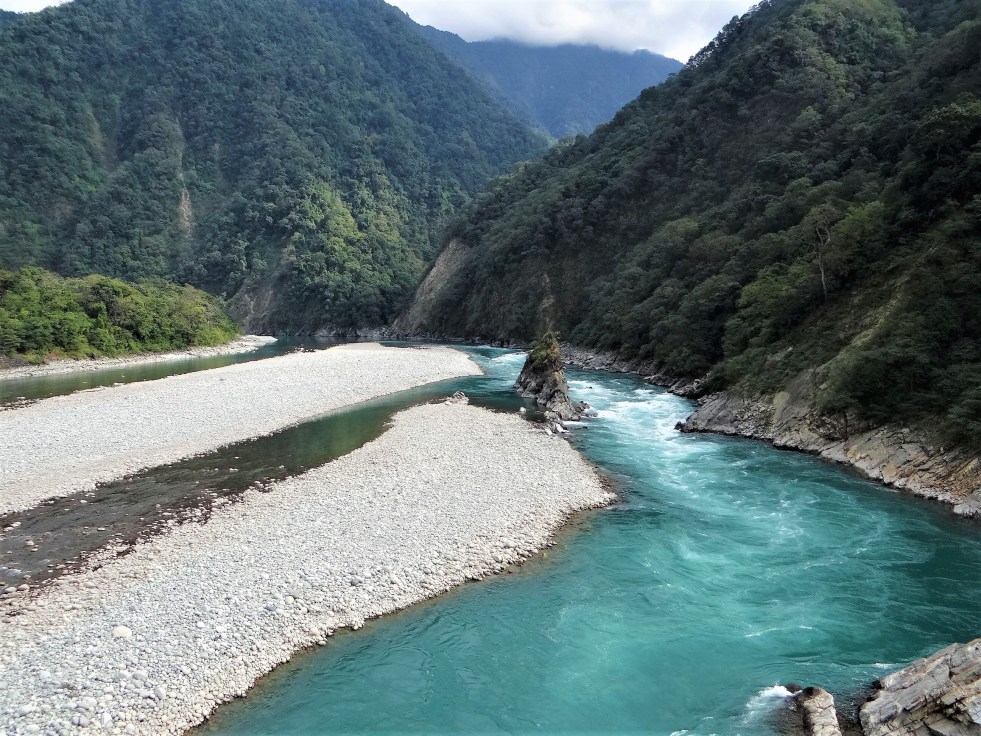
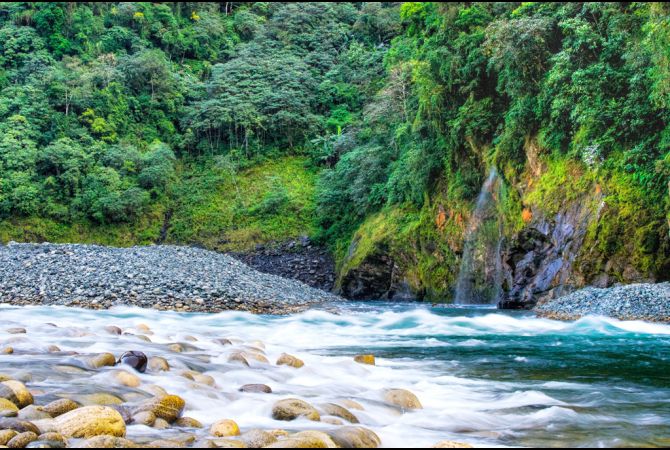
Above: Lohit River, Parshuram Kund on the right. Photo: Parineeta Dandekar
Assam, Arunachal and the North East India, West Bengal and Bangladesh are riverine entities in many ways. Ancient rivers flowing through this landscape have moulded not only the mountains and the silt-heavy banks, but cultural identity of the region itself. Rivers permeate through the literature, folklore, songs, poems, cuisine, even dressing… Bhupen Hazarika, the Bard of the Brahmaputra, likened the red ripples of the Assamese Gamcha (red and white stole) to the braided filigree of the Red River. When Guwahati University opened on the banks of Luit, Hazarika sang “Jilikabo Luiter Paar”..Banks of the Luit will Shine. Rivers stood for revolution as they stood for Love.. Jyoti Prasad Agarwal wrote“Luitar Parore Ami Deka Lora.. Moribole Bhoi Nai.” (“We are the youth from the banks of the Luit/ We are not afraid of death”). Older poets like Parvato Prasad Baruah wrote entire books full of poems of Luit and today modern poets in Assam like Jeeban Narah link their creative processes inextricably to rivers. Continue reading “‘Banks of the Lohit will shine’: Glimpses of a free-flowing river”→
North Bengal Flood situation “Cooch Behar, North Dinajpur, Alipurduar, Jalpaiguri and Darjeeling are the five districts which have been affected by the flood. Earlier in the day, Irrigation Minister Rajib Banerjee said that the state government is tackling the flood in north Bengal on war footing.” 58,000 people had been affected in Alipurduar, Jalpaiguri and Cooch Behar districts.
In the morning of Aug 11, 2017, while checking my daily morning routine sites, I saw the sudden appearance of purple patch (signifying rainfall in access of 175 mm rainfall in previous 24 hours) on NASA daily rainfall accumulation map for Indian subcontinent.[i] The purpose patch covered parts of the West Bengal, North East Indian and Bangladesh. I was taken aback, but it was not very unusual to see in the peak of monsoon. So as we usually do, I took a screenshot and put up on SANDRP FB page with a warning that this could lead to floods. I did not realize that this was the beginning of an unprecedented wave of floods for these regions that may extend to Ganga basin as I write this. Such purple patches generally disappear in 24 hours, since the rains do not last to long. However, in the case of current phase, not only the purple patch has last now for 42 hours, it has extended to the west, all along India Nepal region along the southern boundary of Nepal. Continue reading “Brahmaputra basin faces unprecedented flood wave in Aug 2017”→
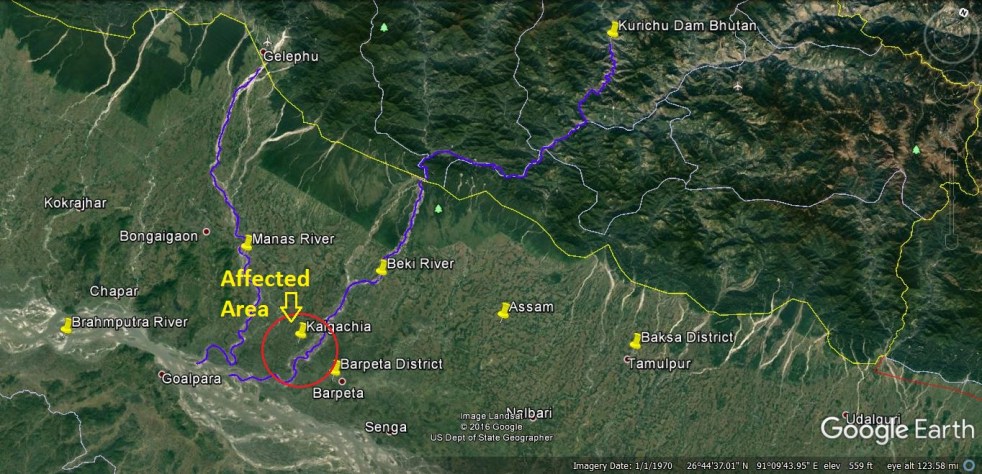
Above: Google Map showing relevant locations (Map by Bhim Singh Rawat of SANDRP)
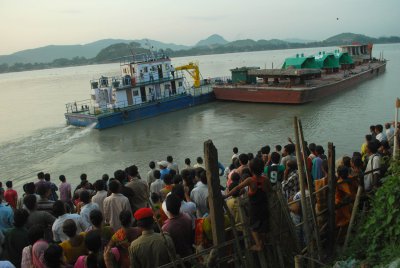
Several media reports have alleged that sudden water releases from Kurichu Dam in Bhutan has led to floods in Beki and Manas rivers in Assam on Oct 13, 2016 (Thursday), affecting thousands of people in Barpeta district & also reportedly Baksa district. This is not the first time that Kurichu water releases have led to this kind of situation, it has happened in the past including in 2004, 2007, 2008, 2009 (150 villages affected[i]), among other instances. The Indo Bhutan joint mechanism, established in 2004-05, following the July 2004 floods, has clearly failed to effectively address this issue. Continue reading “Bhutan’s Kurichu Dam releases floods Assam, again in 2016”→
Arunachal Tawang residents protest against unfulfilled promisesHundreds of residents on July 22 marched through the streets of Tawang, the home district of newly elected CM Pema Khandu, in protest against non-fulfillment of their demand for jobs to kith and kins of two anti-dam activists killedin police firing on May 2. During the protest march they also led a signature campaign against large dams planned in Tawang, where the predominantly Buddhist Monpa tribe feared that many of the proposed hydro-power projects would damage sacred Buddhist sites in the district. At least 13 large hydro-power projects have been planned in the district, which shares border with China’s Tibet region. On June 21 the Lamas-led Save Mon Region Federation had issued six-point charter of demand to the state government for fulfillment in 30 days. Arunachal comprises a fragile, rich parcel of wildlife and ecosystem, among the richest ecosystems in India. But planning & building of hydro projects has been and will cause irreversible environmental damage. Perhaps it’s time for an aggressive freeze on all the un-built projects and an evaluation of other models of energy. Mr Prema Khandu must consider why Arunachal should become India’s mitochondria-the country’s energy provider, while losing its own enormous wealth. But contrary to this new while addressing a press conference, the new CM, on July 18 said that the govt would find ways to tap the petroleum resources & harness the hydropower potential which could be a money spinner for the state. On the 2000Mw Lower Subanisiri HEP at Gerukamukh, Mr Khandu has emphatically said he would discuss the issue with the Assam govt as well as the Centre for a solution. He said that in all the hydropower projects the affected people should be taken into confidence by both the executing agencies as well as the state govt.The new CM elected from Tawang, seeing the hydropower projects as money spinner does not sound very encouraging. Let us see how far he actually goes to take people into confidence as promised by him.
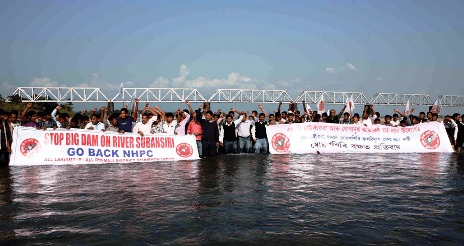
Above: Protest against Lower Subansiri Project in Assam. Basin Study of Lower Subansiri is also a part of intense debate in Assam. Now these studies are under wraps by the MoEF and CC
Non-transparent Environment Governance does not help anyone, neither is it legal. In the upcoming Expert Meeting of the MoEF and CC on River Valley Projects (read dams), documents pertaining to 6 of the 8 projects being considered are not available!
Expert Appraisal Committee on River Valley Projects,
Ministry of Environment and Forests,
New Delhi
Respected Chairman and Members,
We have just seen the minutes of the 86th meeting (uploaded on Sept 14, 2015, but clearance letters in some cases have already been issued even before the EAC minutes are made public or the minutes are finalised at the next EAC meeting) of the Expert Appraisal Committee on River Valley Committee, held on Aug 24-25, 2015.
The minutes make a disturbing reading. The EAC seems to be bending every ecological norm, facts and even legal stipulations to push ahead with every project that the government wants them to clear. There seems to be no application of mind from the EAC on the proposals. The minutes are not even internally consistent. It is putting forward facts in misleading fashion to give a wrong picture. Continue reading “Why the Decisions and minutes of the 86th meeting of EAC on River Valley Projects need to be reviewed”→
Reaching exasperating lows of environment decision making, the Forest Advisory Committee (FAC is a statutory body of the Ministry of Environment Forests and Climate Change (MoEFCC) formed under the Forest Conservation Act of 1980. FAC appraises Forest diversion proposals) has recommended Forest Clearance to the 3000 MW Dibang Project on Dibang river in Arunachal Pradesh.
While we had already written against this recommendation, what is nearly unbelievable is that this recommendation has come at just 10 meters height reduction of the dam from the proposed 288 meters.
This was the very same NHPC proposal which was rejected twice by the FAC in the past,[1] despite this token 10 meter height reduction. In fact in April 2014, the FAC said that 10 mt reduction does not take care of any pertinent impacts for which the proposal was rejected in the first place in July 2013! A 10 m reduction would still mean destruction of 3.24 lakh trees and submergence of 4577.84 hectares, nearly 12000 acres, of rich bio-diverse forest.
Dibang River. Photo with thanks from Global Post, Scot Ligare
The usually reticent MoEFCC (Ministry of Environment, Forests and Climate Change, MoEF earlier) too had issued a strong-worded rejection to this scheme in August 2014, stating that 10 meters reduction is nothing in the face of what is being lost. The rejection letter stated: “Such a marginal reduction in requirement of the forest land (445 hectares reduction, reducing forest requirement from 5056 hectares to 4577 hectares) for the project may not be able to reduce the adverse impact of project on such a biodiversity-rich mature forest ecosystem to the extent which could make the project environmentally as well as socio-economically viable in forest dependent tribal society of Arunachal Pradesh”.
This letter from the same ministry certified that the 10 m reduction proposal still leaves the project environmentally, socio-economically unviable. So an environmentally and socio-economically unviable project has been recommended clearance by the statutory FAC (and also the separate recommendation a week earlier by the same MEFCC’s Expert Appraisal Committee on River Valley Projects)!
This shows that the decision of FAC is devoid of merits, will invite huge opposition from Arunachal Pradesh, Downstream Assam, North East India, and even beyond and will not pass legal scrutiny. The decision seems to have been taken under pressure from the political masters. Union Power Minister Piyush Goyal has been dreaming of clearance to this project, as is clear from his road map published on completion of 100 days of office for the new NDA government[2]. He has also been pressurizing the MoEFCC to clear the project by hook or by crook. The FAC was reconstituted and the reconstituted FAC has obliged the minister in its very first meeting. In the process, the entire FAC has violated its mandate and should be held accountable for this.
Regrettably, MoEFCC seems to have become the willing punching bag of not only above-mentioned ministries, but even unrelated ministries like Ministry of Mines and Minerals, Ministry of Steel ,etc., whose ministers and Secretaries were present for the meeting: “to Expedite Clearances”. (Incidentally, when was the last time we heard MEFCC resisting such arm-twisting, or forthrightly suggesting any pro-environment measures to other ministries?)
Before the minutes of the September FAC meeting were out on Oct 22, 2014 (there was an inordinate delay this time, raising suspicion of negotiated minutes and again breaking all norms of conduct), there was discussion in media that Dibang was cleared, but even the hard-core skeptics believed that this recommendation must have come after a 20 meter or 40 meter height reduction, for obvious reasons.
But the FAC seems to have outdone itself. As stated above, the recommendation has come at 10 mts height decrease, for which the FAC had rejected the project and MoEF had issued a rejection letter in the past.
As we discussed in detail in our last blog on Dibang project, the twice-rejected project was up for discussions again in Sept 2014 only after considerable arm-twisting of the MEFCC by the Cabinet Committee of Investment, Ministry of Power, Project Developer NHPC and Arunachal State Government. This time it was for a supposed sensitivity analysis (done by the developer!)for studying the feasibility of reducing the height of the project upto 40 meters from its original height of 288 meters.
This sensitivity analysis was not shared with anyone, not even the FAC members till the day of the FAC meeting, breaking all codes of conduct of transparency, participation and informed decision making in governance. SANDRP wrote about this to the Minister and Secretary of MoEFCC as well as the Member of the FAC, but received no response.
Looking at the minutes, it is clear that the FAC members have lapped up the logic presented by the developer and the Ministry of Power which in a nutshell says that “10 meters reduction is sufficient as the ratio of forest land required per MW is lowest at 10 meters reduction.” This twisted logic reduces all decision making related to forests, even biodiversity-rich forests supporting endemic, unstudied species, local protests, downstream impacts etc., to mere number crunching of forest per MW. This criteria alone cannot be the basis for decision for forest appraisal committee.
Dibang Valley Forests Photo: The Telegraph
As per the sensitivity analysis by NHPC, the ratio forest land required per MW for 40 meters reduction is 1.67 MW/ hectare, which is same as no height reduction and 1.78 MW/ hectare in case of 20 meter reduction. In terms of tariff, for 40 meters reduction, the power tariff will be 6.24 Rs./unit while it is 5.66 Rs/unit 10 meters reduction, 5.94 Rs./unit 20 meters reduction and 5.64 Rs. at zero reduction. The installed capacity will reduce by 120 MW (4%) MW for 10 meters reduction, 600 MW (20%) for 20 mt reduction and 780 MW (26%) for a 40 meter reduction.
Height Reduction
Forest land required
MW capacity per ha Forest lost
First Year Tariff: Rs per unit
Reduction in installed capacity
Nil (288 m)
5056 Ha
1.67
5.64
None
10 m
4578 Ha
1.59
5.66
120 (2880 MW)
20 m
4284 Ha
1.78
5.94
600 (2400 MW)
40 m
3703 Ha
1.67
6.24
780 (2200 MW)
The proponent said: “Decrease in dam height and consequent sacrifice of power generation beyond 10 mt is not commensurate with saving forest land.”
How did NHPC reach this conclusion? What is the value of the mature, old growth forest land considered by NHPC? Without knowing this, how can this conclusion be acceptable to the FAC? It has to be remembered that Dibang is not an exclusive hydropower project, but a multipurpose project with a flood moderation component and costs have to be borne for this.
While the proponent and Ministry of Power did their best for pushing the project, the FAC did not do its duty of stating that the sensitivity analysis put forth by NHPC is a sham as it does not consider the worth of the forest being lost.
In this sabji-mandi haggling, when FAC had all the watertight justifications for rejecting the project, it did not bat for even a 40 meter reduction, which could have saved nearly 1355 hectares of forests and would have had a marginal impact on other factors. Its unclear why this happened.
Only one of the FAC members tried to battle the case saying that 10-40 meter reduction still does not address the upstream and downstream impacts, especially considering the biodiversity rich area. The minutes do not disclose the name of this member, but it seems the brute majority (majority of FAC members are govt officials) took the official line, alleging “subjectivity” and said that “To reduce subjectivity, it is important to analyse the issue objectively on objective parameters”. Forgetting that this is Forest Appraisal committee, not Power Developer Committee.
This is ironical. It was indeed the duty of the FAC to appraise the project “objectively” based on issues like destruction of 3.24 lakh trees, invaluable forests, unstudied biodiversity, rich wildlife and several Schedule I species, community dependence, traditional rights, downstream impacts, climate change impacts, options assessment, etc. But it did nothing of that and has in fact recommended the project “subjectively”, bowing to pressures outside their ambit.
Clearly, per MW forest land required and per Unit Tariff from a project are anything but objective criteria for FAC. FAC is supposed to apply its mind to a number of issues like the ones above. If FAC was not supposed to apply its mind to these aspects and its judgment, there was no need for an FAC, Power ministry and developer could have taken the decision independently.
The FAC decision does not address any pertinent issues raised by the same FAC while rejecting the project, it also does not address downstream impacts on Assam or assume any value for a rich forest. There is no discussion why 20 meters or 40 meters reduction is not seriously considered by FAC. Decision-making based on such biased, proponent-driven criteria is bound to be open to legal challenge and public protests.
Sham consideration of Downstream Impacts About Impact of the project on Dibru-Saikhowa National Park, the User Agency said that the issue was considered by EAC in its meeting on the 16th September (Please note this is just 6 days and 5 working days back from FAC meeting. There is no chance of minutes being firmed up by then. They were not in open domain in any case) and the EAC has recommended clearance based on the fact that there is less than 1 meter level fluctuation at DSNP.
This claim in any case is patently incorrect, again a case of project-friendly, anti-environment decision-making. The level fluctuation at DSNP can go way higher than a meter, anywhere from 7-8 feet every day in lean season, according to the studies considered by the EAC of the MEFCC itself. This has been pointed out by SANDRP to the EAC as well. There has been no study of the impacts of this project on downstream Arunachal Pradesh or Assam. The developer seems to assume that Dibru-Saikhowa is the only part of Assam worth considering.
Dibang Valley tribes Photo from go ibibo/dibangvalley
There is no compliance under Forest Rights Act (2006) for such a massive project and despite this, FAC under some supposedly progressive members working on tribal issues, does not bat an eyelid before recommending clearance!
To conclude, pricing mature, biodiversity-rich forests in terms of per MW terms is an insult of those forests, the communities that depend on them and to the mandate of FAC. Downstream impacts of Dibang project are not studied, the impacts on Dibru-Saikhowa are based on compromised studies.
There is no merit in this decision from the newly appointed FAC which includes members also from reputed environment protection organizations in North East and from Tribal Welfare groups like Friends of Baripada. It is also sad to see that there is no dissenting note from a single member. The unnamed member who expressed dissent in the meeting has not written anything about this in public domain.
Decisions like Dibang lay further foundations for poor, pro-developer, anti-people, anti-environment decisions taken due to pressure from proponent and other ministries. Such decisions will not be legally tenable, nor acceptable to affected communities, nor good for sustainability and equity. In fact, by such reversals, FAC decisions are losing their sanctity. FAC has done this in the past too in case of Kalu Dam in Western Ghats which would submerge 18 villages and 1000 hectares forest.
Isn’t it ironical that the new government changed the name of the MoEF to MoEFCC but is sanctioning massive projects like Dibang which will have far reaching impacts on Climate Change as well as adaption and mitigation abilities of the affected communities? Without even considering these aspects or even mentioning them?
National Democratic Alliance (NDA) led by BJP’s Mr. Narendra Modi has been given a mandate to govern India for the next five years. Without going into the political and social facets related to this issue, there are a number of justifiable concerns about this government’s stand on critical issues of water and environment.
While the importance of water and environment sectors for the people, their livelihoods, society and economy is acknowledged, how crucial these sectors are for them is not easily appreciated. For example, environment is important not only for tigers and trees, but also for livelihoods of hundreds of millions of Indians who depend on natural resources. More than 60-65% Indians continue to depend on agriculture and every farm can benefit from better water resource management.
Some of the major challenges plaguing the water and environment sectors in India include: urgent need for an inclusive, democratic and accountable governance, holistic assessment of impacts the very many interventions in the Himalayas (lessons from Uttarakhand flood disaster of June 2013[1]), ecological restoration of Ganga and other rivers, dealing with climate change in a way that protects lives and livelihoods of the vulnerable sections, etc., to name a few.
The leaders of the party forming the new government have already declared their agenda in terms of completion of Sardar Sarovar Project (SSP) on Narmada, pushing interlinking of rivers (ILR), pushing for more dams in the name of irrigation, pushing big hydropower projects in North East India (Mr Modi had said in his campaign that NE is heaven for hydropower projects) and mega industrial initiatives like the Delhi Mumbai Investment Corridor.
This agenda indicates that the importance of water and environment to the vast millions is not understood. Nor is the significance of the challenges to this sector appreciated. Pushing the above agenda is not only fraught with serious risks in terms of social, environmental, economic and interstate issues, but these projects are not likely to deliver the promise of this party at the elections: Better life, more jobs, more development, fulfillment of basic needs of the people who do not have access to these at the moment. Pushing this agenda is not likely to deliver stated promises, however blind push for more and bigger projects will compound strife and conflicts.
Let us look at the issues related to the NDA Agenda. These are not incidental issues, but issues inherent to the nature of these centralized, mega projects themselves.
Does ILR have scientific basis? The basic premise of ILR is that certain basins are water surplus and others are water deficit. It is assumed that occurrence of floods in a basin means there is surplus water in the basin and occurrence of drought or water scarcity in other basin means it is water deficit. This premise itself is not scientifically, ecologically and socially robust.
While this is said, there is no attempt at assessing and exhausting the available water options in any basin in India. Twithout this exercise, there can be no scientific basis for declaring a basin surplus or deficit. The ILR advocates seem to ignore the reality that India’s water lifeline is groundwater and the best way to sustain groundwater is through local water systems and recharge. They also seem to ignore the massive social, environmental impacts and constitutional issues. ILR is basically a collection of large number of major irrigation projects (over 84), but proponents of ILR do not seem to realize that in last two decades, there has been no addition to net irrigated area by these projects, in spite of addition of thousands of new projects.[2]
“Sabarmati Model” holds no water for Ganga or other rivers During the elections in Varanasi constituency that elected Mr Modi, the issue of cleaning of Ganga remained prominent. BJP claimed that they will clean up Ganga at Varanasi the way they cleaned up Sabarmati River that flows through Ahmedabad in Gujarat. The trouble with this claim is that Sabarmati has not been cleaned up at all. The water flowing through Sabarmati as it flows through the city of Ahmedabad is actually the water of Narmada River, diverted into Sabarmati. Ahmedabad has no right over this water which was supposed to be meant for Kutch, Saurashtra and North Gujarat. If you go upstream along Sabarmati River from the point where Narmada Main Canal releases water in Sabarmati, you will see the reality of dry Sabarmati River. And if you go down to the Vasna barrage, downstream of Ahmedabad along the Sabarmati, you will see the state of polluted Sabarmati River. This model clearly holds no water either for Ganga or any other river.
River Ministry? There is speculation in media[3] that the new NDA government is going to create a new River Ministry at the centre. The same media report also stated that this ministry will push Inter Linking of Rivers (ILR)! This seems like a proposal for Ministry of River Destruction, since ILR is a recipe for destruction of rivers. If at all the new government is interested in an act of goodwill towards rivers, it needs to start with understanding what is a river and what are its various functions along the various stretches during various periods, including the social, ecological, economic, hydrological, geo morphological, biodiversity related, groundwater related and most importantly, livelihoods related functions. This exercise will mean understanding the roles of various arms of the government which affect the river. Some key ministries which affect river profoundly include: Ministry of Water Resources, Ministry of Environment and Forests, Ministry of Power, Ministry of Urban Affairs, Ministry of Rural Development, Ministry of Home Affairs (Disaster Management), Ministry of Agriculture, Department of North East Region, Ministry of Non Conventional Sources of Energy, to name only a few. How is this new proposed Ministry of River Going to coordinate with these ministries? Moreover, according to India’s constitution, Rivers are essentially state subjects and no state is likely to welcome such infringement of centre into what the states see as their domain of responsibility.
Ganga a National Project? There are statements from Mr Amit Shah[4], that the new government will give National status to the Ganga Project. It is not clear what is meant by this. Ganga is already under the Prime-Minister headed National Ganga River Basin Authority, but the Authority, five years after its constitution, has failed to change a single attribute affecting the Ganga. Similarly, Ganga River Basin Management Plan that IIT consortium is working on is already known to be pathetic in its understanding of the river, while pushing for privatization. We do not need another project in the name of Ganga, national or local. If the aim of declaring Ganga as a National Project is to wrest its control from the state, as the media suggests, then it is going to raise a lot of hackles.
What we need is a new approach to river governance, which is based on ecological, and not engineering principles, which is participatory, and not exclusive and which is democratic and not autocratic.
Himalayas & Hydro-onslaught Irrefutable evidence shows that building large number of major hydropower projects in Himalayas is having unprecedented impacts, some are known, many are unknown. The flawed environmental governance around these projects is well known in terms of dishonest EIAs, flawed and compromised appraisals, ineffective (these are consultations just in the namesake, in reality there is no basis for informed participation) public hearing and non-existent compliance, both at project and cumulative level. One implication of this was felt in terms of the role of such projects in the Uttarakhand flood disaster of June 2013, after which, no political leader from any party spoke about this. It was left to the Supreme Court to order and enquiry into this. The report of this investigation clearly indicates the role of hydropower projects in increasing the proportions of the disaster, and more work on this issue remains to be done. In North East itself, India’s biggest mass based public agitation against dams & hydropower projects has been going on. The anger of people has led to stoppage of the work on 2000 MW Lower Subansiri Hydropower project (largest capacity hydropower project under implementation in India) for 30 months now, after over Rs 5000 crores were irresponsibly spent by NHPC without completing even basic studies. Mindless pushing of more such projects in the region is clearly not a prudent move.
Source: MATU Jansangathan
BJP manifesto’s promise of expeditious and single window environment clearances is clearly dangerous in this context. What India needs is stronger and not weaker environmental governance. The advocacy[5] to “reduce time and transaction costs for the industry” under the circumstances seems inappropriate particularly from an organisation which was possibly the only environmental organisation represented on the completely flawed EIA registration process at Quality Council of India. The QCI process failed to achieve any improvement in the quality of EIA in almost 4 years of its existence
Sardar Sarovar Dam The new government wants to take the SSP Dam from its current height of 121.92 m to its final design height of 138.68 m. Firstly, there are serious doubts if this height increase is required since it can be shown that Gujarat and Rajasthan can get their share of water from Narmada without this increase in height. Secondly, Gujarat is not even in a position to use more than 20% of the water it already gets from the river at current height of the dam for the purposes for which the project was designed: providing water for the drought affected regions in Kutch, Saurashtra & North Gujarat. On the other hand, urban centres, industrials areas, SEZs, cosmetic river beautification schemes have appropriated a large chunk of SSP waters without legal, democratic sanction or justification. Gujarat really does not have a case for increasing the height of SSP Dam.
Moreover, this will also entail such massive additional submergence, displacement and disruption of lives of tribals and farmers that it is sure to create huge opposition. The just rehabilitation of already affected people is far from complete, in fact, most of the affected population has not been given minimum 2 ha of land required under the Narmada Tribunal award and subsequent accepted policies.
Mr Modi during his tenure of 13 years as Chief Minister of Gujarat failed to complete the canal network of SSP in the drought prone areas in whose name the project has always been justified. It needs to be noted that the agitation against SSP did not stop Gujarat government from going ahead with construction of canal network. It was not for lack of finances that SSP could not complete the canal network. SSP has been getting largest quantum of money from the Government of India’s Accelerated Irrigation Benefits Programme ever since the AIBP scheme started in 1996. This support to SSP from AIBP was clearly wrong since SSP was never the last mile project for which AIBP was meant, but the big dam lobby in Union Water Resources ministry and Gujarat government were hand in glove in this misallocation of AIBP money for SSP. In fact, Mr Modi arm-twisted the Planning Commission in 2011-12 to sanction the escalated costs for SSP even when the issues raised by Planning Commission officers remained unanswered.
Unused Narmada Canal waters flow into Salt pans, not only at a huge cost, but also affecting livelihoods of salt pan workers and the ecology Photo: Counterview
It is the ineptitude of Gujarat Government under Mr Modi that is on show in why it could not complete the canal network on drought prone areas in Gujarat. Mr Modi would do well to remember the reasons for that failure before he considers the mega projects agenda as Prime Minister.
Moreover, on SSP, the issues of completing repairs of the damages the Sardar Sarovar dam structure suffered four years ago & related issue of safety of the dam are yet to be resolved[6] and Gujarat has embarked on building another Garudeshwar Dam in immediate downstream without any impact assessments, participatory democratic process or required sanctions[7]. The legality of the Garudeshwar Dam work stands challenged in the National Green Tribunal by the affected tribals.
MAJOR RISKS FOR NEW GOVERNMENT Some major risks for the new government include: the track record of Gujarat government that Mr Modi headed for the last 13 years; no checks from coalition of parties; poor image, strength, morale and track record of Congress as the chief opposition party; large sections of almost completely subservient media[8] and BJP’s problematic manifesto[9].
Why UPA faced people’s anger The new government also needs to remember why the outgoing ruling coalition of UPA (United Progressive Alliance) lost so badly in spite of some unprecedentedly remarkable, and pro people steps taken by it. Absence of accountable and participatory governance (which also manifested in terms numerous scams) was one of the major reasons as to why there was huge anger in people’s mind about the UPA regime. Another aspect of corruption and high-handedness was apparent in the scandalous way UPA dealt with governance of environmental issues: blatantly changing its environment ministers from bad to worse.
Even if we leave aside the Rajas and Balus of UPA I, the UPA II began on a positive note with appointment of Mr Jairam Ramesh as environment minister. While we had our share of criticism of functioning of Mr Ramesh as environment minister[10], he was possibly the best environment minister India have had.
But under pressure from misguided and misinformed corporate vested interests, Mr Ramesh was removed (kicked upstairs) and Mrs Jayanthi Natarajan was brought in. She did not really help the cause of environment as is apparent, for example, from her answers to the two debates on Ganga river in Parliament (these debates were unprecedented in their own right) as also sanctioning projects rejected by statutory bodies like Forest Advisory Committee.
Strangely, she too was removed to bring in disastrously, Mr Veerappa Moily[11], who also held the Oil and Petroleum ministry. Mr Moily then went about the designated task of green lighting everything, not bothering about governance issues, people’s concerns or environmental consequences. This led to massive anger anger against Moily as well as UPA.[12]
Such arrogant handling of governance of environmental issues that affect the lives and livelihoods of millions of most vulnerable sections of people was bound to be punished[13]. This is clearly another reason behind the anger of people that UPA government faced in the elections.
Playing favorites UPA is also guilty of playing favorites when it came to appointing non governmental persons in environmental decision making. In almost every committee on environmental decision making, including Prime Ministers’ Council on Climate Change, National Tiger Task Force, Coastal Zone Management Committee, National Ganga Authority, Inter Ministerial Group on Ganga, Western Ghats Task Force, QCI process on registration of EIA consultants, 12th Plan working Groups to name only a few, everywhere one could find representatives of only particular organisation. Leaving aside the issue of effectiveness of the role played by representatives from this organisation, such tendencies of playing favorites is bound to raise serious questions. While many people at grassroots may not be aware of this inappropriate action by UPA government, the resultant outcomes of these committee invited various reactions ranging from disbelief, anger and even an uproar, as it happened in case of Kasturirangan Committee on Western Ghats.
While the result of anger of the voters could be seen in decimation of the UPA in the elections, the new NDA government will also do well to remember that even the Vajpayee government was voted out in 2004 for similar reasons. The mindless pursuit of agenda of inter linking of rivers and 50000 MW Hydropower initiatives, disregarding all the concerns and protests of the people across the country, along with the rejection of India Shining campaign were some of the causes for the voting out of the previous NDA regime in 2004.
SOME SPECIFIC TASKS In what follows we have given several examples of specific tasks before the new government. This is not an exhaustive, but only an indicative list.
Ganga Action Plan, Rivers Action Plans, NGBRA, CPCB, SPCBs Mr Modi has said that he would like to give priority to cleaning of Ganga River. Any such effort has any chance of success only if there is an attempt at understanding why our efforts at river pollution for the last 40 years have shown no impact:
Þ Water Pollution Control Act, 1974 The Water Pollution Control Act led to setting up a huge and powerful bureaucracy including Central and state pollution control boards. 40 years after setting up of this whole institutional and legal infrastructure, we do not have a single that this establishment can claim to have cleaned up.
Þ Ganga Action Plan, 1986 This plan was launched with much fanfare by the then Prime Minister Rajiv Gandhi, but without trying to understand why the water pollution bureaucracy failed.
Þ National River Conservation Authority 1994 This authority, the only institution in the name or river conservation in India, had Prime Minister of India, no less, its chairman. In ten years of UPA, the Prime Minister of India did not get time for a single meeting of this authority.
Þ GAP II 2000 The second phase of GAP was launched, again without making any honest attempt at understanding the failure of GAP I.
Þ NGBRA 2009 In Feb 2009, just before the last parliamentary elections, National Ganga River Basin Authority, again under Prime Minister. As noted earlier, this too has failed to make any impact on the state of Ganga.
What all this shows is that we have tried many things, including legal, institutional, financial, and authoritative, with Prime Minister at the helm, but have achieved no success. This is also true of the previous NDA regime during 1998-2006. If we do not make an honest attempt at understanding the reasons for these failures, there is little hope for success in future. The efforts at river cleaning has not suffered due to lack of money (over Rs 20 000 crores have been spent on Ganga alone, as per one estimate), for lack of institutions, for lack of political attention, for lack of media attention, for lack of judicial attention, for lack of infrastructure [where infrastructure exists (e.g. Delhi with the highest Sewage Treatment Capacity], there too there is no change in state of river), or technology. One major reason for the failure was the complete disconnect between the people whose lives depend on the river and those who took the decisions or managed the system. In other words, unless you make the river governance more democratic, there is no hope for Ganga or other rivers.
Some basic steps to make governance of rivers democratic could include: Setting up of management committee (with 50% independent members from outside the government) for management of each Sewage Treatment Plant, each freshwater treatment plant, each tributary, each 10 km stretch of river, each water utility, each city (& sub city level where cities have population above 1 lakh). These committees should be legally empowered and the officials should be made responsible to these committees.
Jayanthi Tax In this regard, it would be useful to remember that during the election campaign, Mr Modi had accused Mrs Jayanthi Natarajan for collecting Jayanthi Tax as environment Minister, allegedly for collecting bribes for environment clearances. This was a very serious charge Mr Modi had leveled. Now that he heads the new government at centre, he must institute a credible enquiry into this charge to prove that he was not making just frivolous statements.
Maharashtra Irrigation Scam One state that has given NDA the highest number of seats after Uttar Pradesh is Maharashtra, the NDA coalition got 42 of 48 seats in this state. One of the major reasons for this debacle of UPA was that the UPA here got a very corrupt image, in spite of its Chief Minister having a relatively clean image. This was largely due to the massive Rs 70 000 crores irrigation scam in that state. The NDA partners in Maharashtra also played a role in exposing this corruption, although the top brass of NDA was also allegedly involved in the scandal. To this corrupt image was added the arrogance shown, for example, by deputy Chief Minister (who resigned on charges of corruption, but came back even without any investigation into the charges) when he first asked how are people expecting him to give water from dams – by urinating in the dams? During elections he actually threatened a village that water will be cut off if they do not vote for his party! This combination of corruption and arrogance was sufficient to enrage the voters.
Here again one expects the NDA government at centre to take decisive credible action in exposing the guilty in Maharashtra irrigation scam and brining to book those who are responsible both among the politicians and bureaucrats-engineers. Here, as BJP spokespersons in Maharashtra have been saying, the Madhav Chitale committee has basically done white washing role[14] and hence we need an independent investigation. We hope NDA government at centre will take this up urgently.
Andhra Pradesh Irrigation Scam Similar action is also required in Andhra Pradesh Irrigation scam exposed by the CAG report[15].
AIBP As noted above, the Accelerated Irrigation Benefits Program has majorly failed in achieving any additional net irrigation area by major projects at national level. The CAG has noted in more than one report the failure of AIBP and so has the Planning Commission. The new NDA government could start with instituting a credible independent enquiry into the reasons for failure of this scheme.
Uttarakhand Disaster and role of hydropower projects[16] Following the worst ever disaster faced by the state of Uttarakhand in June 2013, the role played by indiscriminate construction of hydropower projects and other infrastructure needed to be investigated since prime facie they had played significant role in increasing the proportions of disaster. The UPA government did nothing, and it was left to the Supreme Court to ask MoEF to set up an Expert Body for this. In the meantime, SC ordered stay on any more projects. The MoEF along with Central Water Commission and Central Electricity Authority and the Congress’s Uttarakhand state government, have been trying to push more projects in stead of honoring the Apex Court orders. In April 2014, the report of Expert Body lead by Dr Ravi Chopra has been submitted. The new Union government, it is hoped, will take credible steps to implement the recommendations of the Expert Body at the earliest date.
Independent National Environment Monitor It is well known that MoEF as an independent environmental regulator is seriously compromised with shoddy EIAs, flawed appraisal and non existent compliance. This situation has remained unchanged for the last decade and more. The Supreme Court of India, seeing this, had in 2011 ordered that an Independent Environment Regulator needs to be set up at National and state level. The outgoing central government had shown reluctance to do anything in this regard, in spite of repeated Supreme Court orders. The new government has a historical opportunity to indeed set up a truly independent & accountable environment regulator, at the same time increasing the transparency and participation of people in the environmental governance through fresh round of democratic reforms.
Cabinet Committee on Investment One of the flawed legacy of the previous UPA government is the Cabinet Committee on Investment, which has been created to bypass the statutory work of the MoEF. The new Union government would do well to disband this extra legal committee.
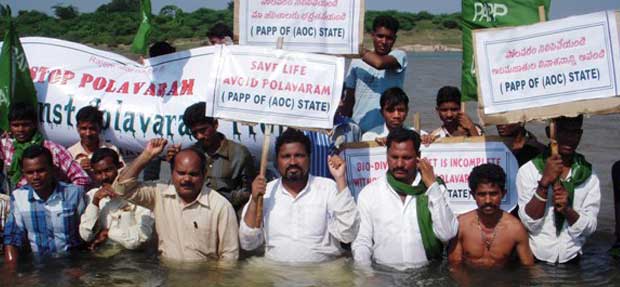
Polavaram Project Authority Even as elections were underway, in a most inappropriate decision, the outgoing government set up a Polvaram Project Authority, without even consulting affected states of Orissa and Chhattisgarh. In both these states there is either BJP government or BJP led government. There are also cases going on against this project, including civil suits filed by the governments of Chhattisgarh and Orissa. In the interest of these states and affected tribals, the new Union Government should scrap the Polavaram Project Authority.
Mullaperiyar The 119 year old Mullaperiyar dam has already suffered damages in the past and there is no doubt that it has limited life. To overcome the inflexible attitude of Tamil Nadu and respecting the constitutional duty of Kerala government to protect the life and property of people of Kerala, it become the duty of the Union government to initiate process for new a arrangement (e.g. lower the intake level to 50 ft from current 106 ft, as seen promising both by the Empowered Body and Supreme Court in May 2014) and decommissioning of the dam in a time bound manner. The previous Union government completely failed in this and the new government has an opportunity to correct this.
Central Water Commission Central Water Commission is India’s premier technical body on water resources. Water resources development and management has always remained crucial to any country’s water, food, livelihood and environment security. However, for this we need a really independent and credible technical body at the top, on the lines of United States Geological Survey (USGS). USGS, is known to be source of very reliable water resources data world over. However, USGS’s main task is to gather data and put it in public domain. Use of that data for development tasks and such other functions are not the mandate of USGS, there are other bodies for that. Unfortunately in India, CWC tasked with data gathering, sanctioning projects, monitoring and so many other contradictory functions. Moreover, CWC is working more like a big dam lobby, and even the assessment of hydrological data, flood forecasting functioning, water use data and projections, climate change implications, dam safety issues, etc are all getting colored by the lobbying tendency of those who head CWC. This is having a very deleterious effect on the water resources development and management in India.
It is high time that there are reforms in CWC to separate its various contradictory functions and make its functioning transparent, accountable and participatory. The new Union government has a chance to initiate such reforms in CWC and Ministry of Water Resources.
Technical Advisory Committee of CWC The TAC of CWC is a very little known, but powerful body. It sanctions projects worth thousands of crores every year, but its functioning is completely non transparent, unaccountable and it has no independent members. Since the new government has been raising the issue of corruption by UPA during the election campaign, it is hoped that the new government will work to fight corruption and one of the key steps it can do is to make the functioning of TAC transparent, accountable and ensure that at least 50% members of the TAC are non governmental, independent people with track record of having shown independent mind.
Urban Water Sector The social, environmental, economic and carbon footprint of this sector increasing at huge pace, without any success story in sight. The big cities are find it easy to promote construction of big dams rather than go for rain water harvesting, sewage water treatment & recycle, demand side measurement, groundwater recharge, reduction in losses and such other measures. SANDRP report on unjustified dams being pushed in Mumbai highlights this issue. The 12th Plan Working Group report on Urban water issues have several useful recommendations that has remained unimplemented. These need to be urgently implemented.
Climate Change Climate change in the biggest threat that vulnerable sections of Indian people face, as do the vulnerable sections of the rest of the world. This is not only relevant for water and environment sectors that we are discussing here, but for all sectors. As Environmental Groups in Gujarat have noted[17], people of Gujarat do not have good experience of the Modi regime in the state. The record of the 10 year long UPA government is very poor on this issue. We hope the new Union government will do better and begin with identification of the sections of the people who are vulnerable and start working on action plan to address the concerns of such sections, while also reducing the carbon footprint of India through reduction in consumption patterns of richer sections.
Suggestions for positive actions As analysed by Dr. Ashok Gulati (former chairman of Commission for Agricultural Costs and Prices) and Dr. Tushar Shah (International Water Management Institute) separately, the relatively high agricultural growth in Gujarat in first decade of current millennium was largely due to local water harvesting work that happened in Gujarat through check dams, groundwater recharge etc, largely in non governmental sector. The new government at centre can bring about changes in policies and programs to learn lessons from such success stories to achieve such results all over India.
Similarly on the issue or river rejuvenation, management and conservation front as also environmental management front, a decentralized bottom up community driven approach can be taken up.
It can encourage people led, scientific and ecological river restoration work.
Promote System of Rice Intensification in a major way, it can not only reduce water use, fertiliser use, use of other chemicals, reduce seed requirement, increase farmers’ income, reduce agriculture sector’s carbon footprint and thus help mitigate and also adaptation to changing climate. This is possible in other crops too, as has been demonstrated at farmer level.
Encourage measures that can help increase carbon content of the soil, this will also have multiple benefits to farmers, economy and environment.
It can strengthen implementation of Forest Rights Act which UPA, despite introducing it, failed to do.
It can protect free flowing rivers for their social, ecological, cultural values.
It can also engage more effectively with civil society and community groups in a credible manner.
A recent SANDRP study “Shrinking and Sinking Deltas: Role of Large Dams” has shown that large dams are playing big role in sinking of deltas in India. This is not even properly studied. The new government can initiate a scientific study in this regard and ensure that before taking up any new project, this aspect is studied.
Conclusion I started writing this brief note following questions from several media friends, but it has become much longer! So let us come to the conclusion. I am not even sure if the new government is in any mood to listen to such unsolicited suggestions, but let us put it out and hope for the best! I decided to put this out, even as Mr Modi prepares to take office on May 26.
This article tries to show the risks, challenges and some immediate tasks of the new government at the centre. In sum, the new NDA government would do well not to forget the reasons for rejection of NDA in 2004 and UPA now in 2014. Both were guilty of bull dozing ahead with their agendas without listening to the people. Avoiding that may be the biggest challenge this government faces, besides the specific ones mentioned above.
[13] For example, Dakshin Kannada and Mangalore saw a huge socio-political movement against Moily and Congress due to his politically motivated support to Yettinahole Diversion Project.
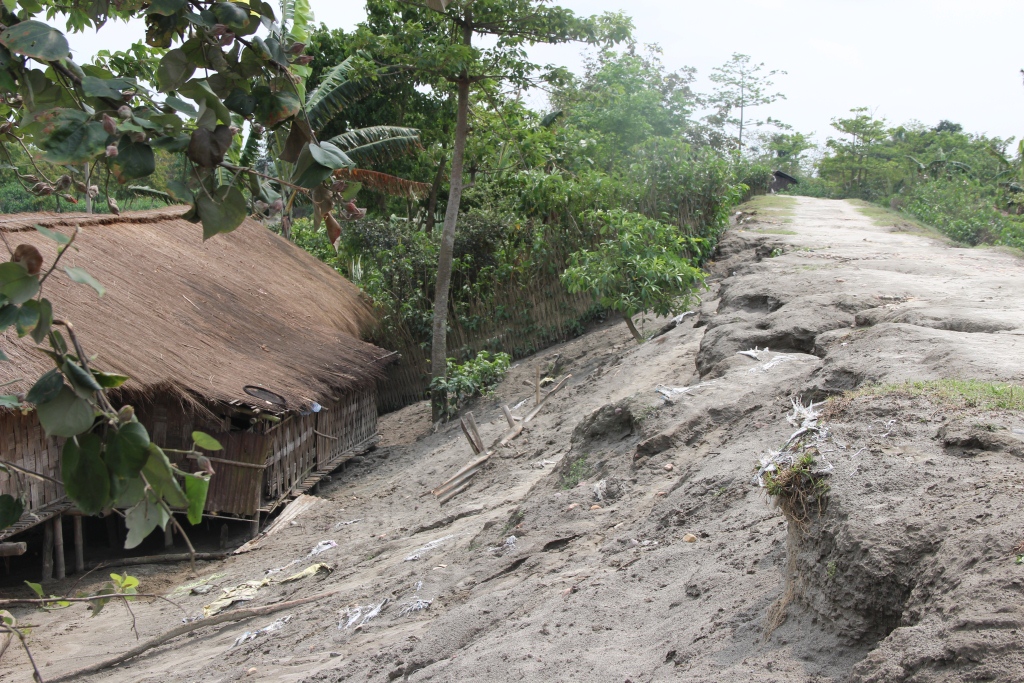
The state of Assam in the northeastern India annually bears the brunt of floods and where embankment construction and repairing seems like permanent affair. Displacement of people living on the banks of rivers due to river bank erosion is another major issue here. The braiding and meandering river Brahmaputra and its tributaries continue to erode the banks rapidly. The Brahmaputra is well known for the rate in which it erodes. Among the places in the path of the river where the brunt of erosion has been felt severely include the following:
– Rohmoria and Dibrugarh town in Dibrugarh district,
– Matmora in Dhakukhana subdivsion of Lakhimpur district,
– Majuli and Nimati Ghat in Jorhat district,
– Lahorighat in Morigaon district and
– Palashbari and Gumi in Kamrup district.
Map of areas taken up for erosion protection in Assam. Source– Assam 2011, A Development Perspective, published by Planning and Development Dept., Govt. of Assam
SANDRP recently traveled to Matmora and Nimati ghat, two of these areas.
Bearing the Brunt of Erosion Silently Once a large village now only the name Matmora remains. Locals show us towards the middle of the river, to indicate where the village used to be. The rate of erosion is such that the Brahmaputra dyke from Sissikalghar to Tekeliphuta (popularly known as Sissi-Tekeliphuta dyke/embankment) takes the shape of a bow for nearly five kilometers at this place. From 2010, Matmora became very significant in the embankment history of India since country’s first embankment using geo-textile technology was constructed here. This was constructed at the bow shaped eroded line using geotextiles tubes. These tubes were filled up using water and sand from the banks of the river. This five kilometer embankment became a part of the Brahmaputra dyke from Sissikalghar to Tekeliphuta which is 13.9 km long. For the state government and Water Resources Department (WRD) of Assam, Matmora geotube embankment is a story of success of preventing floods and erosion. But what we saw in Matmora presents a different picture.
At Nimati Ghat, the river Brahmaputra is eroding its banks ferociously and people are intimidated by the river. A local person whose village used to be nearly two kilometers from the present bank line, told me, “Nothing can stop Baba Brahmaputra from claiming what he wants”. At Nimati Ghat, the Water Resources Department (WRD) is doing anti erosion work using geo-bags.
Funding for Embankments in Assam The total length of embankments in Assam is 4448 km as stated in a debate in the Legislative Assembly of Assam in 1998. Even though the present length of embankments is not known, it is very clear that the state of Assam continues to construct of newer embankments. In a recent analysis by SANDRP, it was found that the funds continue to increase for construction of embankments in the state. In five years from January 2009 to December 2013, the Advisory Committee in the Union Ministry of Water Resources for consideration of techno-economic viability of Irrigation, Flood Control and Multi-Purpose Project Proposals (TAC in short) had given clearance to projects worth Rs 1762.72 crores. A detailed list of these sanctioned projects can be found in Annexure 1 below.
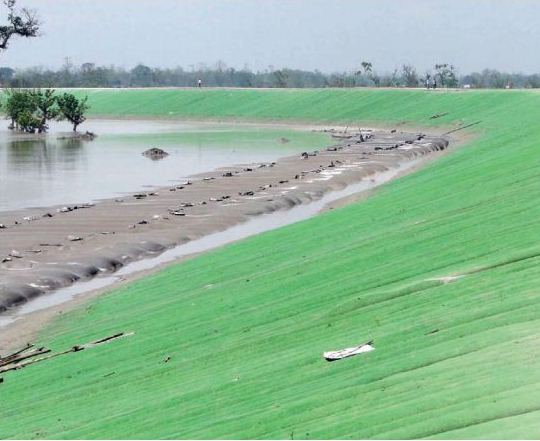
Matmora Geo-tube embankment after its construction in 2010. Source– Assam 2011, A Development Perspective, published by Planning and Development Dept., Govt. of Assam.
Has Geo-tube been helpful for the people Between January 2009 to December 2013, the Brahmaputra dyke from Sissikalghar to Tekeliphuta, was considered twice by the TAC. The committee in its 95th meeting on 20th January 2009 accepted the project titled “Raising and Strengthening to Brahmaputra dyke from Sissikalghar to Tekeliphuta including closing of breach by retirement and anti-erosion measures (to protect Majuli and Dhakukhana areas against flood devastation by the Brahmaputra, Lakhimpur district, Assam). The estimated cost of this project was Rs 142.42 crore and its project proposal envisaged – (i) Raising and strengthening of embankment for a length of 13.9 km, (ii) Construction of retirement bund with geo-textile tubes of length 5000 m. (iii) Construction of 2700 m long pilot channel.
Geo-tube embankment in Matmora, three years after construction. Photo: SANDRP.
Protection work of the same dyke was considered in the 117th meeting held on 21st March 2013 under the proposal for “Protection of Brahmaputra dyke from Sissikalghar to Tekeliphuta at different reaches from Lotasur to Tekeliphuta from the erosion of river Brahmaputra Assam.” The estimated cost of this project was Rs 155.87 crore. According to the minutes of 117th TAC meeting, the scheme envisaged “restoration of existing embankment in a length of 15300m at upstream and downstream of existing geo-tube dyke, Sand filled mattress in a length of 15604 m at river side slope, geo-tube apron length of 7204 m and Reinforced concrete porcupines as pro-siltation device at different reaches to prevent floods and erosion in Dhakukhana Civil sub-division of Lakhimpur district and Majuli sub-division of Jorhat district.” In the same minutes,while referring to the previous project proposal of 95th meeting the minutes stated that, it “was taken up primarily for closure of breach in the existing embankment including raising of embankment around the breach area only. The proposed works in the present scheme were in the same river reach and these would be required to protect the bank from further erosion and provide flood protection.”
This clearly shows that the geo-tube embankment in Matmora cannot be called a success. Government documents which showed that major part of the Brahmaputra dyke from Sissikalghar to Tekeliphuta remained vulnerable even after the construction of the geo-tube embankment. In fact submitting a proposal for the whole Sissi-Tekeliphuta embankment at first and later saying that the money was spent in constructing a smaller part of the embankment also raise questions. The time gap between the two proposals also raises questions. If the whole money from first proposal was to be spent in constructing only a part of the embankment, why was it not stated clearly in the first proposal? In fact, this was not stated in the first proposal and second proposal reflects that the first project failed to achieve the objectives. If the first proposal was indeed only for part of the embankment, why the proposal to strengthen the larger part of the embankment took 5 years to appear before the committee? The latter proposal also did not mention about the breach which swept away a large part of the Sissi-Tekeliphuta embankment from Jonmichuk to Amgiri Tapit under Sissikalghar and Jorkata village panchayat. According to the local people this breach occurred in the morning hours of 25th June 2012. The photo below shows the breach happened at the Jonmichuk end.
The breached area of 2012. This photo is taken from the new embankment and the lake formed at this spot can also be seen. Photo – SANDRP
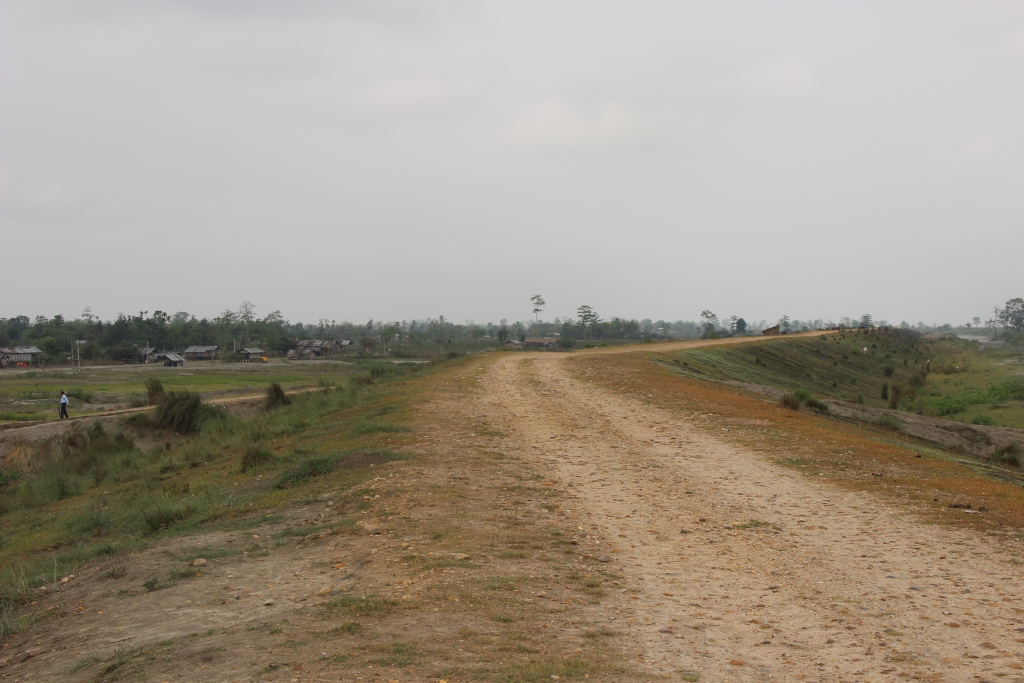
Jonminchuk area is nearly 15 km upstream of the geotube embankment in Matmora and part of the Sissi-Tekeliphuta embankment. A new embankment of nearly four kilometer long is being constructed at this place but the remnants of the old embankment still exist. The embankment was breached for nearly 3 kms and the water which entered the fields during that time could no longer go out and a large lake has been formed at this place, see the photo. It was surprising to see people living in the patches of the old embankment.
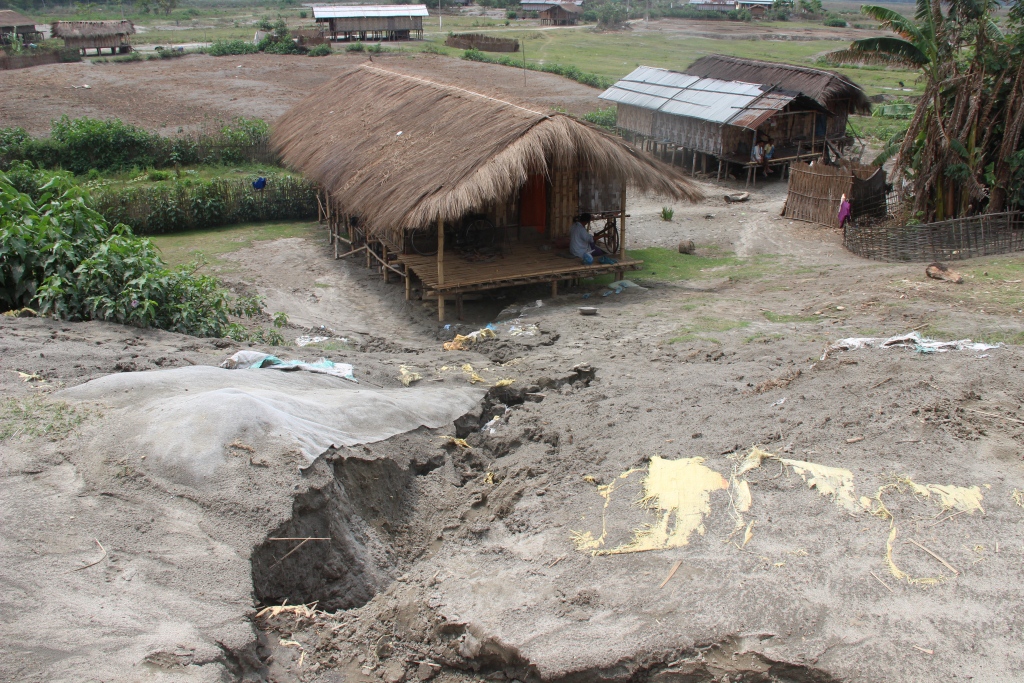
In the downstream, right from the point where the geo-tube embankment ends, the condition of the Sissi-Tekeliphuta embankment is pathetic. There were cracks in the embankment and water seepage has almost shattered the embankment. The embankment was in need of urgent repairs.
Condition of the Sissi-Tekelphuta embankment at the end point of the geo-tube embankment towards the village side. Photo – SANDRP
Sissi-Tekelphuta embankment at the same spot mentioned above towards the river side. Photo – SANDRP
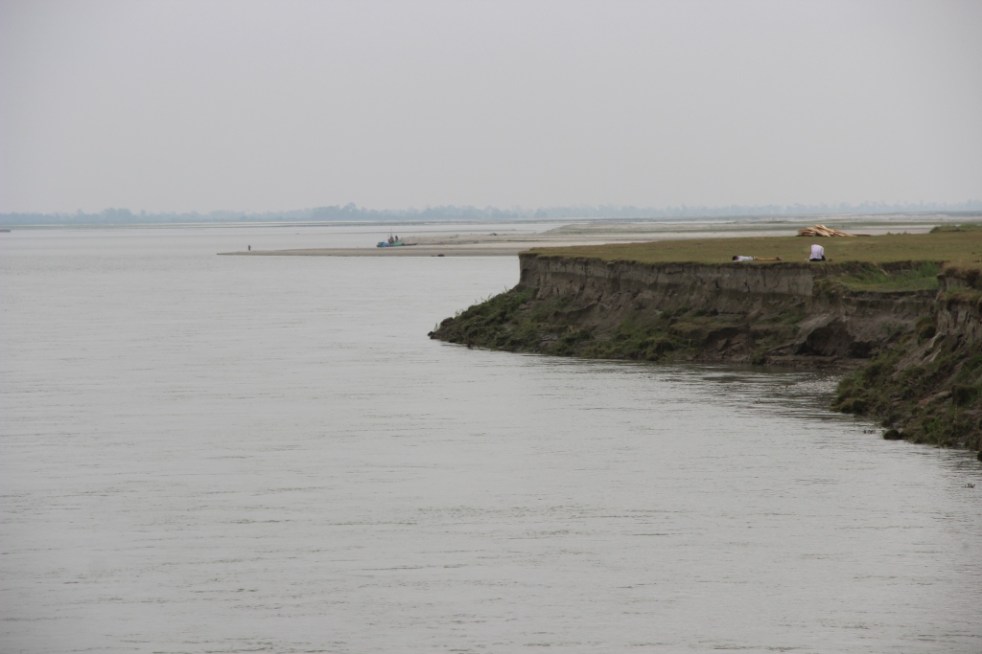
Besides, one does not have to travel far to find erosion in the downstream of the geo-tube embankment. After travelling, less than three kilometers from the end point of the geo-tube embankment, rapid erosion was observed at the place where the Matmora and Tekeliphuta ghats join, due to low water level. This joint ghat is more than a kilometer from the toe line of Sissi-Tekeliphuta embankment but seeing the rapidity of the erosion the locals opine that the river would reach the toe of the embankment within this monsoon. It was difficult to believe that the river can erode so fast, until a young man pointed towards a black line in the middle of the river and said that that area which now seemed to be char/sand bar used to be his village three years back. He with his family now live beside the embankment. In this ghat we also witnessed that spurs constructed from the embankment inside the river, mainly to divert the flow of water, have been eroded as well.
The Spur has also been eroded. Photo – SANDRP
Erosion at Matmora-Tekeliphuta Ghat. Photo – SANDRP
It is also important to note that protection of Majuli from floods was one of the main aims of the geo-tube embankment project, but there were reports of devastating floods affecting Majuli in 2012 & 2013.
After geo-tube comes geo bags With the construction of geo-tube embankments being hailed as a success by the state government, construction of embankments using geo-bags followed. Geo-bags are smaller than geo-tubes and come at a cheaper cost. Embankments on many rivers were constructed using geo-bags which were also used for erosion protection. But effectiveness of the geo-bags as protective measure to flood and erosion, still remains disputed. A news report titled “ADB, river engineers differ on geo-bags” published in Assam Tribune on 9th September 2010 reported about the difference of opinion among the water resource engineers of Assam and powerful lobby of the Asian Development Bank (ADB) for the use of geo-bags to resist Brahmaputra erosion in Palasbari-Gumi and Dibrugarh. Referring to the engineers the news report stated “They have alleged that the ADB provided 23,000 geo-bags for an experiment. They were dumped in the month of September 2009 at a 150-metre-long selected erosion-prone reach at Gumi for testing their efficacy. But, a diving observation made in the month of December 2009, suggested that the bags were not launched uniformly in a single layer as it was claimed. They were found lying in a haphazard manner in staggered heaps with gaps in between and the total distance they covered was only about 8 metres, against the claimed and required 35 metres…..The ADB then carried out another diving observation at Gumi in May last (2010) and found no bag at the site. The State WRD did not get any feedback from the ADB on this issue.”
Work of piling up the geo-bags is going on in Nimati Ghat. Photo – SANDRP
Status of the geo-bags put last year. Photo – SANDRP
The spot where not a single Geo-bag was seen. Photo – SANDRP
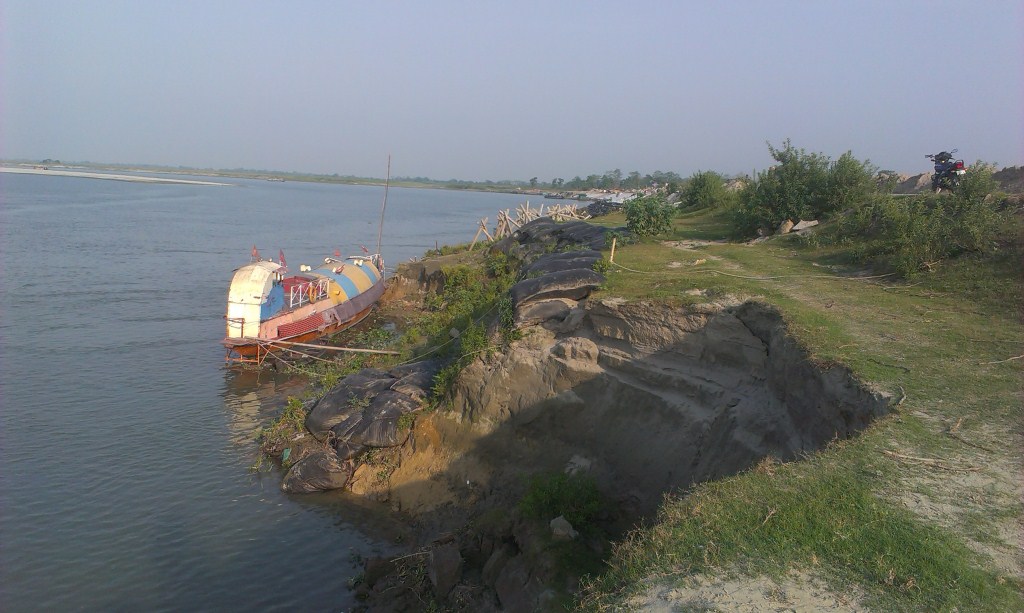
Nimati Ghat was the other place which SANDRP visited to find out the effectiveness of geo-bags. The work of piling up the geo-bags for erosion protection was going on when SANDRP visited the area in the second week of April 2014. The bags which were used previously for the same purpose were seen to be mostly lying in water in shattered condition. Locals told us that majority of the bags are now under water. In the eroded bank line, these geo-bags were lying without any order and in a way suggesting how the river has dealt or to say played with these jumbo bags. In this bank line, there was a stretch of nearly five meters where the river has eroded more than the other parts. At this stretch none of the geo-bags were to be seen.
There were also contradictions regarding when the present erosion protection work at Nimati ghat had started. Some of the shopkeepers of the ghat said that the work of putting up geo-bags started in February 2014. But according to the contractor in charge of the work, the work started in November 2013. Construction or repairing of embankment just few months before the advent of monsoons is one of the constant criticisms, leveled against the Water Resources department of the state and in Nimati too we heard the same complaint.
Is Geo-tube really a ‘permanent solution’ to floods? In the present discourse of floods in Assam this has become a very significant question. The local people have been fed with various information about geo-tube and most of which are wrong. The life of embankment constructed using geo-tube is of 100 years, we were told by the locals when we travelled to the upstream areas of Matmora geo-tube. This is absolutely not true. In fact, for Prof Chandan Mahanta of IIT Guwahati the scouring[1] done by the river Brahmaputra will be the major cause of concern for geo-tube embankments in the long run.
The geo-tube embankment has already faced threat of scouring right after its construction in the monsoons of 2011. It was on the morning of 14th July, 2011 when two of the apron tubes at the tail of the embankment, were launched due to increase force of water. The apron tubes were laid at the toe of the geo-tube embankment and with the increased force of water scoured at the bottom by the embankment toe line. WRD engineers flung into action and immediate repairing work was taken up at the site. According to WRD engineers this had happened because the trees which were left outside the embankment had obstructed and increased the force of water and they were immediately cut down. Concrete porcupines were also thrown into the water. Asomiya Pratidin, a regional newspaper reported this on that day but thereafter no report on this could be found. The incident was almost forgotten. When we visited the geo-tube embankment, it was observed that along the toe-line of the embankment a scour line runs for substantial length of the embankment. This clearly shows that scouring by the river has increased in this area. The news report published in Assam Tribune [2]also points out a significant problem associated with geo-bags – “The lobby is mounting pressure for use of geo-bags in the form of bank revetment. Bank revetment is generally not adopted in Brahmaputra because of many reasons. Most important of them is – it produces a permanent deep channel along the existing riverbank.”
On the issue of lobbying behind geo-tube, an interesting perspective was provided by activist-researcher Keshoba Krishna Chatradhara who coordinates ‘Peoples’ Movement for Subansiri and Brahmaputra Valley (PMSBV)’. He opines that the construction of geo-tube embankment in Matmora was an experiment, done to see whether such embankments can withstand the flood and erosion of Brahmaputra. The reason for choosing Matmora first and not other severe erosion affected places like Dibrugarh or Rohmoria, was because even if the embankment fails it won’t be as significant loss for the state compared to those places. Dibrugarh is one of the most important towns of upper Assam with a glorious history whereas Rohmoria became important for the state when Oil India Limited found oil deposits in Khagorijan[3]. Infact several local people and activists also opined that the Sissi-Tekeliphuta embankment which is on the north bank of the river was cut several times, to save the areas in the upstream south bank, mainly the Dibrugarh town. They said that in the past, before the geo-tube embankment came, whenever there was any news of water rising in Dibrugarh, there would soon be a breach in Sissi-tekeliphuta embankment. In fact considering these breaches in the larger Sissi-tekeliphuta embankment, Mr. Chatradhara opined that even if the geo-tube embankment survives the flood, erosion and breaches in future, it might become a small island in midst of a submerged land as there will surely be breaches in the rest of the Sissi-Tekeliphuta embankment.
ADB loan for Geo-textile Embankments in Assam After the construction of the geo-tube embankment at Matmora, the state government is leaving no stone unturned to make it sound like a glorious success. But it is surprising to know that, even before the Matmora embankment was commissioned in December 2010, the state government have filed proposal for two more embankment project where geo-textile would be used for construction and got it cleared. The two subprojects of Assam Integrated Flood River Bank Erosion Risk Management Project (AIFRERM) in Dibrugarh and Palashbari were cleared in the 106th meeting of TAC held on 16th September 2010. It is important to note that for the total AIFRERM project ADB is giving a loan of $56.9 million. The cost of Dibrugarh and Palashbari subprojects are Rs 61.33 crore and Rs 129.49 crore respectively. But these investments have been cleared without even doing a post-construction impact assessment of Matmora geo-textile embankment. The Palashbari subproject also included erosion protection for Gumi area through the use of geo-bags but the Assam Tribune report quoted above already mentioned about how geo-bags scheme has failed in that area.
It is important to note here that, the first geo-tube embankment has been constructed only three years back and it would be premature to give any verdict of success, on the contrary there are many signs of failure. But the state government of Assam and the Assam Water Resources department are claiming it as success without really any credible basis and than have used that self certification to go on building more embankments using geo-textile and in several occasions these plans have failed. They first should have done a detailed impact assessment of the embankment at Matmora before going on building more embankments of the same nature.
It seems the Assam government, ADB and CWC are pushing these projects to deflect attention from the failure of embankments in flood management. Such attempts won’t succeed, but it is possibly a ploy to prolong the use of embankments as a flood management technique.
Parag Jyoti Saikia (meandering1800@gmail.com)
Annexure 1
Flood and Erosion Projects approved for Assam – 2009 to 2013
TAC meeting no & date
Project
Appr. year
River/ Basin
L of Emba. (m)
Original (revised) Cost-CrRs
Benefitting area (Ha)
Decision
95th -20.01.2009
Protection of Sialmari Area from the erosion of Brahmputra
2002
Brahmaputra
NA
14.29 (25.73)
NA
Accepted
Protection of Bhojaikhati, Doligaon and Ulubari area from the erosion
2002
Brahmaputra
NA
14.52 (27.92)
NA
Accepted
Raising & strengthening Brahmputra Dyke from from Sissikalghar to Tekeliphuta including closing of breach by retirement and anti erosion measures
New
Brahmaputra
NA
142.42
NA
Accepted
96th -16.02.2009
Flood protection of Majuli Island from Flood and Erosion Ph-II & III
New
Brahmaputra
NA
115.03
NA
Accepted
Restoration of Dibang & Lohit rivers to their original courses at Dholla Hattiguli
New
Brahmaputra
NA
23.32 (53.11)
NA
Accepted partly & suggested that proposal of coffer dam, pilot channel, etc. to be put up for expert opinion
101st -30.11.2009
Raising and strengthening to Puthimari embankment
New
Brahmaputra
NA
30.23
15000
Accepted
Anti Erosion measures to protect Brahmputra Dyke on left bank
New
Brahmaputra
NA
27.97
5000
Accepted
Protection of Gakhirkhitee & adjoining areas from erosion
New
Brahmaputra
NA
19.06
20,000
Accepted
102 -28.1.’10
Emergent measures for protection of Rohmoria in Dibrugarh District
New
Brahmaputra
NA
59.91
18,000
Accepted
106th -16.09.2010
Raising and strengthening of tributary dyke along both banks of Kopili River
New
Kopilli/ Brahmputra
NA
110.72
NA
Accepted
Assam Integrated Flood River Bank Erosion Risk Management Project
New
Brahmaputra
NA
61.33
NA
Accepted
Assam Integrated Flood River Bank Erosion Risk Management Project
New
Brahmaputra
NA
129.49
NA
Accepted
110th – 20.07.2011
Protection of Majuli from Flood and Erosion Ph II & III
2011
Brahmaputra
115.03
Accepted
Restoration fo rivers Dibang & Lohit to their original courses at Dholla Hatighuli
2011
Brahmaputra
54.43
Accepted
111th – 17.08.2011
Protection of Biswanath Panpur including areas of upstream Silamari and Far downstream Bhumuraguri to Borgaon against erosion
New
Brahmaputra
167.09
Accepted
117 – 21.3.’13
Protecion of Sissi-Tekeliphuta dyke from erosion – Lotasur to Tekeliphuta
New
Brahmaputra
153000 m
155.87
153000 m
Accepted
118th – 30.07.2013
Flood management of Dikrong along with river training works on both banks embankment
New
Dikrong/Brahmaputra
105.96
Accepted
Flood management of Ranganadi along with river training works on both bank embankments
New
Ranganadi/Brahmaputra
361.42
Accepted
[1] Scour can be termed as a specific form of the more general term erosion. In case of geo-tube embankments Scour is the removal of sediment from the bottom of the geo-tubes. Scour, caused by swiftly moving water, can scoop out scour holes, compromising the integrity of a structure.
[3] See ‘Rohmoria’s Challenge: Natural Disasters, Popular Protests and State Apathy’ published in Economic and Political Weekly, Vol XLVI NO 2, Janurary 8, 2011.









 SANDRP