In an unprecedented development[i], the Himachal Pradesh Chief Minister Sukhvinder Singh Sukhu has sent a Rs 658-crore damage report to the Union Road Transport and Highways Minister Nitin Gadkari seeking from National Highways Authority of India (NHAI) compensation for the devastation caused at the 126-MW Larji hydel project allegedly due to the construction of a double-decker four-lane road.
Continue reading “Himachal demands Rs 658 Cr from NHAI for damage to Larji Hydro Project”
Co-sculptors of the Central Highlands: River Sindh and its People
GUEST ARTICLE BY POORVA GOEL
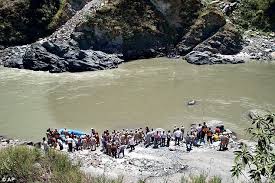
At Pachnada (see the photo above, the river in Uttar Pradesh, photo by Poorva Goel), the Sindh River meets four other rivers- Yamuna, Chambal, Kunwari and Pahuj, in a rare spectacle. Over time, the gentle currents of these rivers have meandered and unloaded their sediment on the floodplains. The floodplains are lush with mustard and wheat fields, and the scrub slopes are dotted with grazing cattle.
Continue reading “Co-sculptors of the Central Highlands: River Sindh and its People”
The 2023 Yamuna floods of Delhi only a trailer of bigger floods to come in future?
(Feature Image:- Boats tied to Yamuna river bank at Wazirabad Barrage in June 2023. SANDRP)
In this detailed interview by Questions of Cities; Bhim Singh Rawat, associate coordinator, SANDRP talks on multiple issues affecting the Yamuna and offers some corrective measures to improve the overall condition of the river. The interview has already been published by Question of Cities and can be seen here. The interview also covers possible reasons behind unusual floods in Yamuna in Delhi in July 2023 and the detailed SANDRP blog on the issue can be seen here.
Continue reading “The 2023 Yamuna floods of Delhi only a trailer of bigger floods to come in future?”
Himachalis blame NHPC dams for flood disaster in Sainj Valley in July 2023
(Feature Image:- Deluge in Pin Parbati river engufling riverbank habitations in Sainj market on July 09, 2023. Source: Anil Khatri Vlogs)
The official report of what has transpired in Sainj Valley under Banjar subdivision of Kullu district during July 8-10, 2023 is still not in public domain, however the multiple media reports suggest it to be one of the worst flood disasters for the valley and have once again raised serious questions on the role the hydroelectric power (HEP) projects. Local people have specifically underlined the gross negligence by National Hydro Power Corporation (NHPC) company for turning floods into a disaster. Moreover, old media reports from the area have also highlighted that it was a disaster in the making for which the state government machinery as well hydro projects and NHPC have contributed hugely.
Continue reading “Himachalis blame NHPC dams for flood disaster in Sainj Valley in July 2023”
High Rainfall days in India’s districts in July 2023
For July 2023, an analysis in this article of the daily district wise rainfall data from India Meteorological Department (IMD) shows that there were 855 (809 in July 2022 and 717 in July 2021) instances when district rainfall of a day was above 50 mm. Such high rainfall instances included 660 (663 in July 2022) instances when rainfall was 50-100 mm, 149 (107 in July 2022) instances when it was 100-150 mm, 34 (28 in July 2022) times it was 150-200 mm and 12 (13 in July 2022) times above 200 mm. As noted in detailed article[i], the July 2023 rainfall all over India was 13.5% above normal.
Continue reading “High Rainfall days in India’s districts in July 2023”
DRP 070823: Forests & Biodiversity amendments: Gap between intent & application
(Feature Image: Dense Dudhatoli forest range near Peethsain in Thalisain block of Pauri Garhwal. Feb. 2023/ SANDRP)
As editorial comments in two different national newspapers given below shows, the biodiversity and forest conservation amendment bills passed by the Parliament last week weaken the cause of biodiversity and forest conservation, when it is most pressingly required to strengthen them.
Both amendments pave the way for ease of doing business and reducing role of local communities, both in terms of legal norms and practical implications.
The need for conservation of these resources was never more urgent than now considering the impacts of climate change on them and their importance for not only livelihood security of vast millions, but also for hydrological implications, food security, protection against increasing frequency and intensity of disasters, but also for adaptation in the context of changing climate. We hope against hope that better sense will prevail sooner rather than later to ensure the amendments do not lead to destruction of forest and biodiversity resources.
Continue reading “DRP 070823: Forests & Biodiversity amendments: Gap between intent & application”
June July 2023: District wise rainfall in in India’s SW Monsoon
In the month of July 2023, the second month of India’s South West 2022 monsoon, India received 318.4 mm (327.7 mm in July 2022[i]) rainfall, 13.5 % above (16.8% above normal in July 2022) the normal July rainfall of 280.5 mm as per India Meteorological department. In July 2021, the rainfall was 266.1 mm[ii], about 6.7% below normal and in July 2020, the rainfall was 257.1 mm[iii], or about 9.9% below normal.
Continue reading “June July 2023: District wise rainfall in in India’s SW Monsoon”
Rivers Breaching Highest Flood Levels in July 2023
( Feature Image: CWC’s water level gauge set up along Yamuna river at Old Railway Bridge, Delhi. 28 June 2023/ SANDRP)
The analysis of hydrographs being published on Center Water Commission’s (CWC) Flood Forecasting website shows that the previous Highest Flood Levels (HFL) have been breached at least at 34 flood monitoring sites across the country in July 2023. The river basin wise details of all these sites are given in tables below.
Continue reading “Rivers Breaching Highest Flood Levels in July 2023”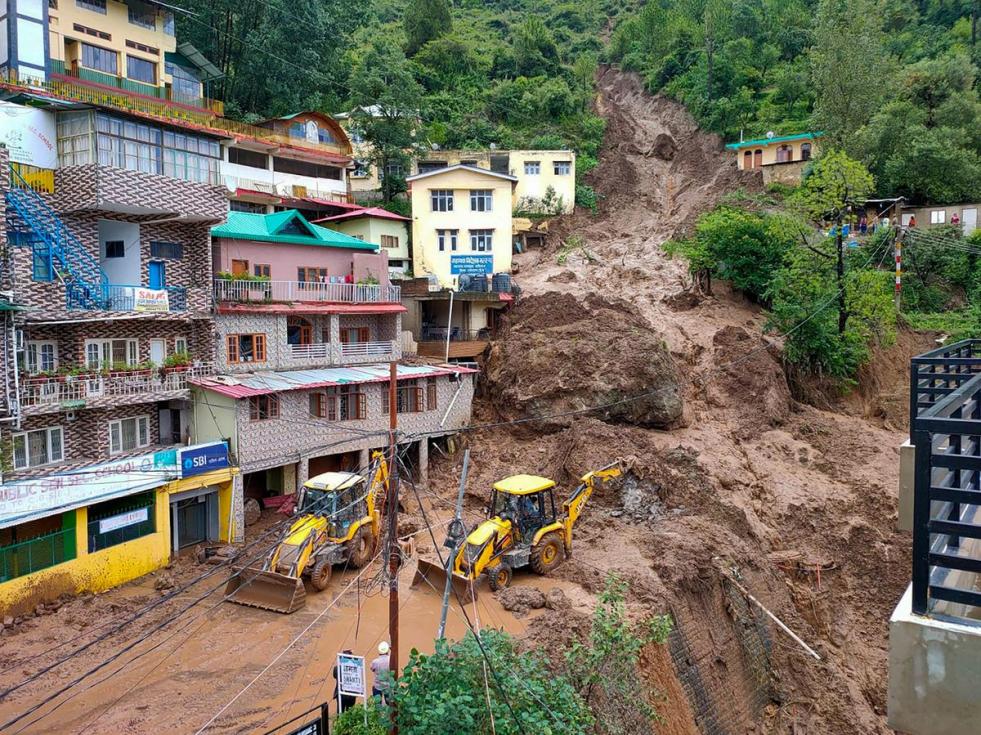
DRP 310723: Disastrous SHORT TERMISM in Urban India
(Feature Image: Earthmovers on restoration work as massive landslide damaged buildings at Shamti after heavy monsoon rainfall, in Solan district, on July 11, 2023 | Photo Credit: PTI/The Hindu)
The Supreme Court’s notice on Shimla development plan that lacks balance between development and environment is welcome and one hopes the apex court takes the issue to its logical conclusion. The consequences of unplanned and ill planned urban developments are a clear invitation to major disasters, including floods, landslides, traffic congestions, air and water pollution, health hazards and also water shortages. The Shimla Master plan also violates the NGT directions with complete impunity.
This is exactly what the EDIT in the Times of India on Mussoorie misery, dangerous short termism that pervades across sectors in Urban India with no policy to guide Urban Water sector or for that matter any other sector.
Continue reading “DRP 310723: Disastrous SHORT TERMISM in Urban India”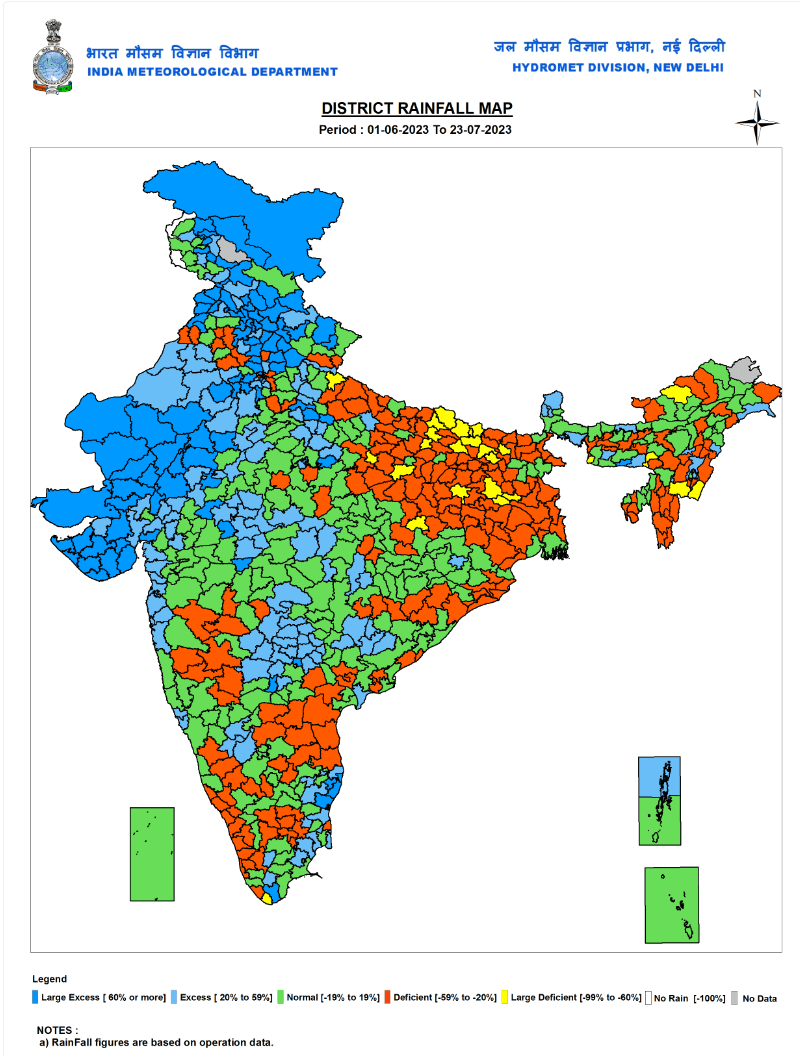
DRP 240723: Urgently need parameters that will truly reflect rainfall pattern
(Feature Image: – IMD’s District Wise Cumulative Rainfall Map for 01 June to 23 July 2023)
India received 389.2 mm rainfall till 0830 hrs on July 23, 2023 in SW monsoon. This being 5% above the normal rainfall till this date of 370.9 mm, India Meteorological Department and with it, the whole nation calls it Normal Monsoon. But anyone who is familiar with the rainfall pattern across India will not call it Normal.
We must urgently develop new parameters for describing the monsoon that also take into account spatial (across states, districts, Tehsils, blocks) and temporal variability. These parameters should take into account the departure from normal for each unit of space for each day and combine such departures to arrive at a figure that will better describe the monsoon for each unit of space. It can also take into consideration the high intensity rainfall events as also the longer dryer patches. This will help us understand not only the nature of monsoon rainfall, but also alert the farmers and everyone else but also help us understand how this pattern is changing over the years. This should not be so difficult for IMD to initiate and accomplish quickly. When aggregated at river basin level, this will also help us understand the actual rainfall pattern in each river basin but also how it is changing. Is this too much to ask?
Continue reading “DRP 240723: Urgently need parameters that will truly reflect rainfall pattern” SANDRP