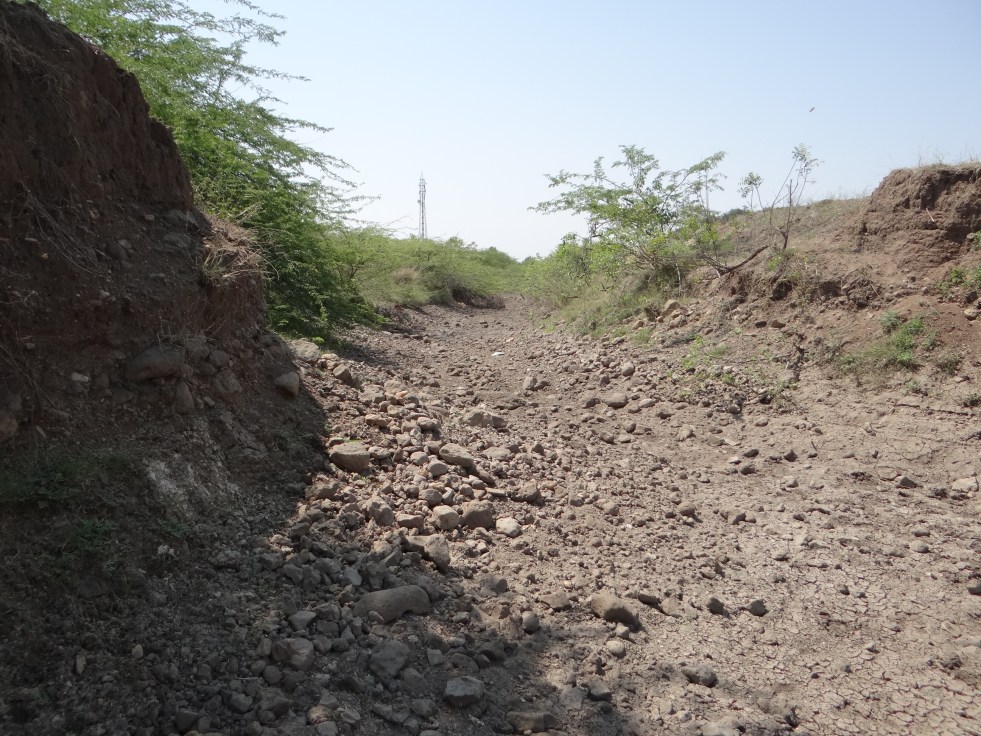
Marathwada, a region known more for its routine and severe droughts in the recent years, now showing the highest rainfall deficit in the country at 48%[1].
Marathwada (which coincides with Aurangabad Division of Maharashtra) consists of 8 districts in the heart of Maharashtra: Aurangabad, Beed, Latur, Osmanabad, Parbhani, Jalna, Nanded and Hingoli.

The region has a population of about 1.87 Crores and a geographical area of 64.5 Thousand sq. kms. Nearly the entire region, barring parts of Beed, Latur and Osmanabad, falls in Godavari basin. This has historically been a rain shadow region with average rainfall of about 700 mm, but in districts like Beed, it dips down to 600 mm. Apart from Godavari, no major rivers originate or flow through Marathwada except rivers like Purna, Shivna, Dudhna, Velganga, Sindhphana, Bindusara, etc. These are modest rivers, which carry little water as the harsh summer approaches. This is unlike Vidarbha (to the east of Marathwada) which has mighty rivers like Penganga, Wainganga, Wardha etc., or Khandesh and Western Maharashtra to its north and west, which have bigger rivers, denser watersheds and more rainfall.
Since the past 4 years, Marathwada has been facing exceptionally cruel weather. June-September Monsoon, which is the lifeline of most of this rainfed region, has been playing truant. Last year, the region experienced highest rainfall deficit in the past 10 years at -42%. In two districts it was much more than 40%, leading to a severe water crisis.[2] To give you an example, the JJAS (June, July, August, and September) rainfall in Parbhani in 2014 was just 346 mm, barely 4 mm more than rainfall during the horrifying 1971 drought! These two are the lowest rainfall figures for Parbhani since 1902, for more than 113 years! Continue reading “Drought and Marathwada: An Oft repeated Tragedy”