Mithi · Mumbai

Anthems alone don’t save rivers: Treat sewage & create room for the rivers

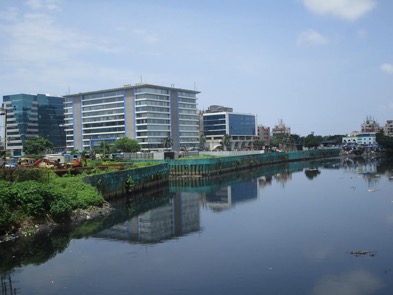
Above: Mithi River at Bandra-Kurla Complex; Photo by Nidhi Jamwal

Guest blog by Nidhi Jamwal

The four rivers of Mumbai —- Mithi, Oshiwara, Dahisar and Poisar —- now have an anthem of their own. Released recently by T-Series and Leelaa, the music video, “Mumbai River Anthem”, has already created uproar in the state Assembly, as it features the state chief minister (CM), Devendra Fadnavis; the state finance minister, Sudhir Mungantiwar; Mumbai civic commissioner, Ajoy Mehta; and the city police commissioner, Datta Padsalgikar lip-syncing and striking poses to urge Mumbaikars to come together to save the rivers. The anthem also features Amruta Fadnavis, wife of the chief minster, who, along with Sonu Nigam, a playback singer, has sung the song. While celebration of rivers is welcome, when not accompanied by necessary actions to improve the pathetic state of Mumbai’s rivers, it sounds like hypocrisy. Continue reading “Anthems alone don’t save rivers: Treat sewage & create room for the rivers”

Dams · Indus

Rivers are Us

Above: Sindhu by Anoop Patnaik, Outlook Traveller

“To choose safe waters

is the route of imposters:

Those who love

take on the mighty river.” (Seeking the Beloved, translations of Shah Abdul Latif Bhitai’s Poems)

Sohni
Sohni in modern art by Aparna Caur

In the inky, starless night, beautiful Sohni plunged into the flooded River Chenab to meet her beloved Mehwal, knowing well that she will never make it to the other side. Sohni is one of the seven heroines brought to life by Shah Abdul Latif Bhitai, a remarkable 18th Century Sufi poet, mystic and reformist living on the banks of Indus. Sohni was the wife of a potter, in love with Mahiwal, a cattle herder from the banks of the Chenab. Like all poignant love stories, Sohni-Mahiwal’s tale was short-lived, but 300 years later, the legend of Sohni flows through the Chenab and lives on in the songs of peasants. In Punjab, the land of five rivers, they sing of Sohni, of the roaring, helpless river and of mad, wilful love. The narrative is so unwrinkled and dewy that till this day, silent figures sweep the modest tombs of Sohni and Mahiwal, hoping that their love will meet a better fate. Like Sur Sohni (Sohni’s poem) from Shah jo Risalo (Poetry of the Shah) prophecised:

“Hundreds were by the river drowned,

But the river was drowned by this maiden.” Continue reading “Rivers are Us”

Cauvery · Inter State Water Disputes · Karnataka · Tamil Nadu

Supreme Court Judgment on Cauvery Dispute: Does it change anything?

Supreme Court of India passed the much awaited 465-page Judgment on Cauvery Water Dispute on Feb 16, 2018[i]. After the Cauvery Water Disputes Tribunal declared its award on Feb 5, 2007, a number of Appeals were filed in the SC, challenging the Tribunal Award, including those by Karnataka and Tamil Nadu. By this Judgment, the SC has partially allowed the Karnataka Appeal (Civil Appeal 2453 of 2007) and disposed off all the appeals. The Award was published in gazette only in 2013, following an earlier SC order. The SC Judgment provides additional 14.75 TMC (Thousand Million Cubic Feet) of water to Karnataka and thus reduces Tamil Nadu’s share to that extent.

Continue reading “Supreme Court Judgment on Cauvery Dispute: Does it change anything?”

Dams · Environment Impact Assessment · Expert Appraisal Committee · Himalayas · Irrigation · Landslide · Ministry of Environment and Forests · Nepal · Public Hearing

Who exactly needs the Pancheshwar Dam?

Bolo Jai Jai Baba Bhole”, the Prime Minister Narendrabhai Modi, while speaking at Kedarnath in Uttarakhand in Oct 2017[i], asked the people in audience to chant with him. Indian deity Mahadev, the presiding deity at Kedarnath on the banks of Mandakini river is possibly the closest to rivers and nature among all the deities, as is also clear from his attire. Baba Bhole is one of the many names of this deity. Incidentally, the massive, controversial Pancheshwar Dam a pet project of Mr Modi will also submerge the Pancheshwar Mahadev Temple, where too, the presiding deity is same Bhole Baba. But we will come back to Bhole Baba. Continue reading “Who exactly needs the Pancheshwar Dam?”

Bhagirath Prayas Samman · Dams · Kerala · Western Ghats

Remembering Latha

It took some time to write. Latha chechi and me talked just 4 days before she passed away on Nov 16, 2017. As usual, it was about when we will meet next and go to Athirappilly Falls and travel to the river together. Her voice was light, it had a surreal gentleness. We agreed on everything, which was rare. After just a few minutes, Unni gently took the phone from her and told me she needed to sleep. It just didn’t feel right.

We first met virtually about 10 years back, discussing rivers and forests and then, through her initiative, came together to organize the first civil society workshop on Environmental Flows in January 2009 with SANDRP.  Since then, Latha Chechi has been a bubbling, enthusiastic and wise constant. We worked on several submissions together, discussed strategies and ideas, eating each other’s heads about what worked and what can work and always, I was always taken aback by her unmatched way of linking issues.

She told me, “You need one particular river. Work on all the rivers of world, but have that one river to go back to.” Continue reading “Remembering Latha”

Dams · Environmental Flow · Fish Sanctuaries · Free flowing rivers · Ganga · Inland Waterways · Interlinking of RIvers · Karnataka · Kerala

Riverine Fisherfolk as Mascots of flowing rivers and how 4 projects treat them today

When I was documenting a tiny, free-flowing river in Maharashtra Western Ghats named Shastri, the common thread from headwaters to estuary was Fishing! It was everywhere, in all forms, including dozens of fish species and fishing practices, including everyone: men, women, children, otters, crocs, storks. Across the country, buzzing, diversified fisheries with old, complex narratives indicate a rich river. And the palette just gets more vivid, nuanced and colorful with the size of the river.

More than 10 million Indians from some of the most vulnerable groups depend on rivers for their livelihood and nutritional needs. This staggering number can be an underestimate as several riverine fisherfolk do not bring their produce to the market and our livelihood census hardly captures the intricacies of riverine fisheries sector. Despite the huge dependence and critical importance of riverine fisheries, the sector continues being ignored and abused. The reasons behind the exploitation are at the heart of a deeper, more troubling discourse: ownership and appropriation of the river as a natural resource. Continue reading “Riverine Fisherfolk as Mascots of flowing rivers and how 4 projects treat them today”

Interlinking of RIvers · Madhya Pradesh · Ministry of Environment and Forests · Ministry of Water Resources

NGT Admits Appeal Challenging Environment Clearance to Ken Betwa Project

Press Release                                                                                                                  Oct 30, 2017

National Green Tribunal Admits Appeal Challenging

Environment Clearance to Ken Betwa Project:

No claim of equity for work done during pendency of application

The Principle Bench of National Green Tribunal on Oct 27, 2017 admitted a comprehensive Appeal (No 33 of 2017) challenging the Environment Clearance to Phase I of Ken Betwa River Linking Project. The order of the Bench comprising of Hon’ble Justice Swatanter Kumar (Chairperson of NGT), Hon’ble Justice Jawad Rahim (Judicial Member) and Hon’ble Bikram Singh Sajwan (Expert Member) on Oct 27, 2017 (available on Oct 28, 2017) noted: “Learned Counsel for the respective respondents accepts notice and prays for time to file reply. Copy of the application be furnished during the course of the date. Let the reply to be filed within two weeks from today and rejoinder within two weeks thereafter. List the mater on 27th November, 2017.” Ritwick Dutta, Rahul Choudhary and Meera Gopal are the lawyers representing the petition.  Continue reading “NGT Admits Appeal Challenging Environment Clearance to Ken Betwa Project”

Gujarat · Narmada

India’s Dam Mania gives acche din for Dam lobby and Gando Vikas

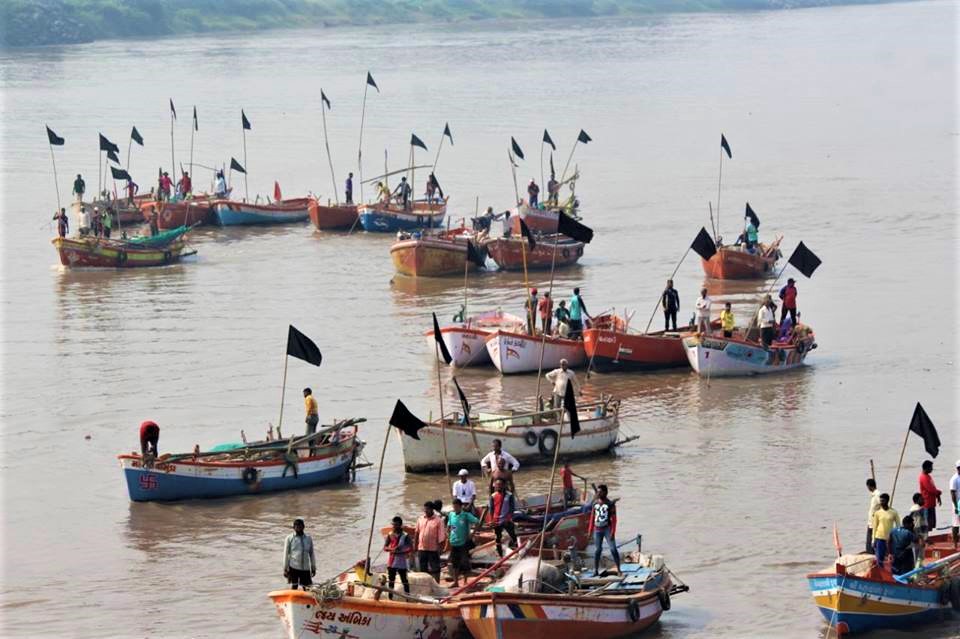
(Above: Protest in Bharuch on Oct 8, 2017 when Prime Minister laid foundation stone for Bhadbhut Dam on Narmada)

“Vikas Gando Thayo Chhe” is these days a super hit song in Gujarati, which literally means “Development has gone mad”. In the just concluded Garba (form of traditional social dance in Gujarat) festival, this was hugely popular this year through out Gujarat. The song became popular, even before Prime Minister of India celebrated his birthday on Sept 7 by declaring completion of an incomplete Sardar Sarovar Project, heaping totally unnecessary, unjustified and unjust displacement on 40 000 families of Narmada Valley and killing the largest west flowing river of India. So much for the river rejuvenation claims his government has been making since May 2014. As if to complete the process, they have started another dam on Narmada, few kilometers downstream of Sardar Sarovar Dam, at Garudeshwar, even without any environmental impact assessment. Continue reading “India’s Dam Mania gives acche din for Dam lobby and Gando Vikas”

Arunachal Pradesh · Assam · brahmaputra · Dams · Lohit River

‘Banks of the Lohit will shine’: Glimpses of a free-flowing river

Above: Lohit River, Parshuram Kund on the right. Photo: Parineeta Dandekar

Assam, Arunachal and the North East India, West Bengal and Bangladesh are riverine entities in many ways. Ancient rivers flowing through this landscape have moulded not only the mountains and the silt-heavy banks, but cultural identity of the region itself.  Rivers permeate through the literature, folklore, songs, poems, cuisine, even dressing… Bhupen Hazarika, the Bard of the Brahmaputra, likened the red ripples of the Assamese Gamcha (red and white stole)  to the braided filigree of the Red River. When Guwahati University opened on the banks of Luit, Hazarika sang “Jilikabo Luiter Paar”..Banks of the Luit will Shine. Rivers stood for revolution as they stood for Love.. Jyoti Prasad Agarwal wrote “Luitar Parore Ami Deka Lora.. Moribole Bhoi Nai.” (“We are the youth from the banks of the Luit/ We are not afraid of death”). Older poets like Parvato Prasad Baruah wrote entire books full of poems of Luit and today modern poets in Assam like Jeeban Narah  link their creative processes inextricably to rivers. Continue reading “‘Banks of the Lohit will shine’: Glimpses of a free-flowing river”

Environment Impact Assessment · Ganga · Nepal · Public Hearing · Uttarakhand

Letter to MoEF’s Expert Committee: Why Pancheshwar Project should not be considered for Environment Clearance

(Above: Protest outside MoEF on Oct 24, 2017 when EAC met to consider EC for Pancheshwar Project)

Oct 23, 2017

To

Chairman and Members, Expert Appraisal Committee (River Valley Projects), Union Ministry of Environment and Forests, Jor Bagh, New Delhi

Respected Chairman and Members,

The agenda of the EAC (for RVP) to be held on Oct 24, 2017, put up on the EC website only on Oct 18, 2017, just six days before the EAC meeting includes the 5040 MW Pancheshwar Multipurpose project (PMP), India’s largest proposed hydropower projects. The agenda should be available at least ten days before the meeting, and this should also be a reason for not considering the Pancheshwar project by EAC for its meeting on Oct 24. Moreover agenda mentions 5600 MW Pancheshwar project, where as the capacity as per EIA is 5040 MW. Is MoEF just callous in mentioning wrong installed capacity or has the capacity gone up? In either case, the 5040 MW Pancheshwar project should not be on EAC agenda. Continue reading “Letter to MoEF’s Expert Committee: Why Pancheshwar Project should not be considered for Environment Clearance”