
Within a span of a week, two interesting reports on National Water situation were made public. Indians have heard of NITI Ayog’s first ever report on Composite Water Management Index, trying to put together state of water management in India. Not many here would have heard of the United States Geological Survey (USGS)’s once in five year report on water consumption for various activities and states in USA[i]. The US report was published on June 19, 2018, five days after NITI Ayog report was launched on June 14 by Union Water Resources Minister Nitin Gadkari.[ii] Continue reading “A tale of two National Water reports: NITI and USGS”
Author: SANDRP

DRP: 9 Jul 2018: National Meeting on Inland Fishworkers in Delhi
The NATIONAL PLATFORM FOR SMALL SCALE FISH WORKERS (INLAND) is convening a Consultative Meeting on Livelihood Issues of Inland Small Scale Fish Workers 10thJuly 2018, Gandhi Peace Foundation, New Delhi.
The Invitation letter says: “India is gifted with vast and varied inland water bodies bearing rich fish resources.Rivers and canals, reservoirs, ponds and tanks, oxbow lakes, wetlands, backwaters and estuaries yield 7.21 million tonnes of fish which is more than 66% of total fish production of the country. The sector sustains about 4 million fish workers and a total population of around 2 crores.Fish provides good quality animal protein rich in minerals and vitamins. About 800 million Indians eat fish. After milk, fish is the largest source of our animal protein.These huge resources are under severe stress. Rivers are poisoned with heavy pollution. Diversion of water from rivers is harming their ecological flow.
Continue reading “DRP: 9 Jul 2018: National Meeting on Inland Fishworkers in Delhi”
DRP: 2 July 2018: Punjab Cabinet Meets To Discuss Water crisis
In a rare event, Punjab Cabinet met to discuss water crisis on June 26, 2018. The reports before the meeting seemed to give hope that may be Punjab will look at the water crisis in a fundamental, holistic way. https://indianexpress.com/article/cities/chandigarh/punjab-government-to-firm-up-water-conservation-plan-5233826/ (June 26, 2018)
But the cabinet ended up setting up a committee to assess the ground water situation in the state and submit a detailed proposal for water conservation.
– Punjab has the highest rate of groundwater exploitation and had on average withdrawn 28.2 million acre feet (MAF) water yearly during 2008-2013. However, the yearly average replenishment of water was only 18.9 MAF.
– 73% of Punjab’s irrigated area uses groundwater for irrigation, while only 27% uses surface water. The number of tubewells had gone up exponentially from 2 lakh in 1971 to 12.50 lakh in 2015-16, with 41% of these have water availability beyond the depth of 60 metres. https://timesofindia.indiatimes.com/city/chandigarh/5-member-committee-to-assess-punjab-ground-water/articleshow/64770186.cms (28 June 2018)
Continue reading “DRP: 2 July 2018: Punjab Cabinet Meets To Discuss Water crisis”
Mississippi and the Singing River
Mississippi is a phenomenon. A large body of water flowing down a slope towards the sea is perceived as so many disparate things by different people at different times and places.
Some say that if you want to understand the continent, you have to understand this river. Some say this is no river, it is an Ocean. Some say its a Strong Brown God. Continue reading “Mississippi and the Singing River”
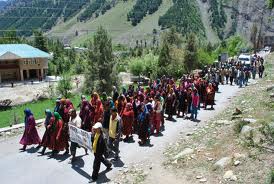
DRP: 25 June 2018: Himachal HEPs remain stalled: Big Hydro no longer viable
Private Hydro remain in stalled Himachal The State Govt has sought the revised completion schedules of 21 stalled hydropower projects (above 5 MW capacity) having a capacity of 684 MW. Additional Chief Secretary (Power) Tarun Kapoor on June 19, 2018 held a meeting with independent power producers to take feedback from them on the hurdles being faced in completion of the 10 stalled projects on which work has not begun. In the remaining 11 projects also, the progress is extremely slow. “We have asked the power producers to expedite work on these 21 projects and also cancelled the Joiner-II (8 MW) in Kinnaur,” revealed Kapoor.
Continue reading “DRP: 25 June 2018: Himachal HEPs remain stalled: Big Hydro no longer viable”
Ferocity of Glacial Lake Outburst in Bhaga Valley in Himachal
Have you seen how FEROCIOUS glacial lake outburst flood can be? I too have not, but watch this[i].
Frightening, is it not?
Continue reading “Ferocity of Glacial Lake Outburst in Bhaga Valley in Himachal”

USA manages to reduce 2015 water use to below 1970 level
Water use across US has been decreasing since 2005, has now reached pre 1970 levels, says the U.S. Geological Survey (USGS) study[i] published on June 19, 2018. According to a new USGS report[ii], 445 BCM (Billion Cubic Meters, all BCM figures are annual figures) of water were withdrawn for use in the United States during 2015. This represents a 9 percent reduction of water use from 2010 when about 489 BCM were withdrawn and the lowest level since before 1970 (511 BCM). Continue reading “USA manages to reduce 2015 water use to below 1970 level”

DRP: 18 June 2018 (Why this Onslaught of Big Dam Advocacy by CWC Ideologues?)
In a recent article Ashwin B Pandya, Former, Chairman Central Water Commission (CWC) refuses to acknowledge either the adverse impacts of dams or the better option of using groundwater aquifer for storing water. And thus making unscientific arguments against dam decommissioning and for dams. No one is talking of removal ALL dams as the author seems to postulate and then dismiss it as impossible and irresponsible.
Continue reading “DRP: 18 June 2018 (Why this Onslaught of Big Dam Advocacy by CWC Ideologues?)”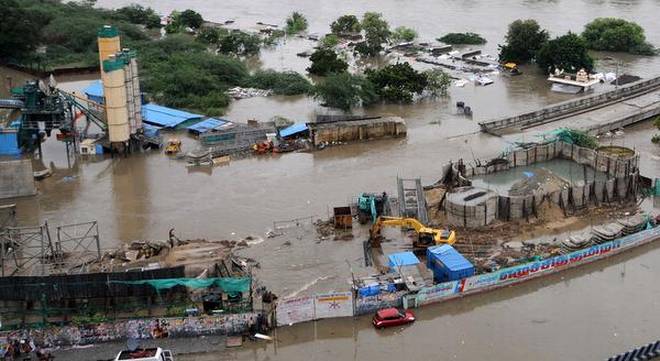
India’s water unsmart cities operate in policy vacuum
The Urban Water footprint in India is increasing in multiple ways. Rapid Urbanisation predicted by experts is just unfolding. Per Capita Demands are going up.
The City water managers are looking at big storages for dependable source of water, such big storages are necessarily far off from the cities. Cities are also generating sewage equal to 80% of the water they consume. Such storages created behind Big Dams have huge social, environmental impacts, besides massive economic costs and increased disaster risks. There is competition for water allocation from such sources, either existing, under construction or to be constructed. Such allocations for long distance cities thus creates conflicts, and potential disruption for cities, like the ones Delhi frequently faces, including in Summer of 2018. Continue reading “India’s water unsmart cities operate in policy vacuum”

Floods in Tripura, Mizoram, Barak Valley in June 2018
The second wave of floods (first wave came in around May 20-24) this year inA North East India is affecting Tripura, Mizoram and mainly Barak Valley in Assam. Worryingly, while CWC flood forecast site shows water level reaching unprecedented levels in Manu river at Kailashahar in North Tripura District, CWC seems to have NO flood forecasting site in Mizoram. At Matizuri site in Hailakandi district in Barak Valley in Assam, the Katakhal river also approaching its highest ever flood level. In Bangladesh too sites like Amalshid have crossed the HFL. Continue reading “Floods in Tripura, Mizoram, Barak Valley in June 2018”

