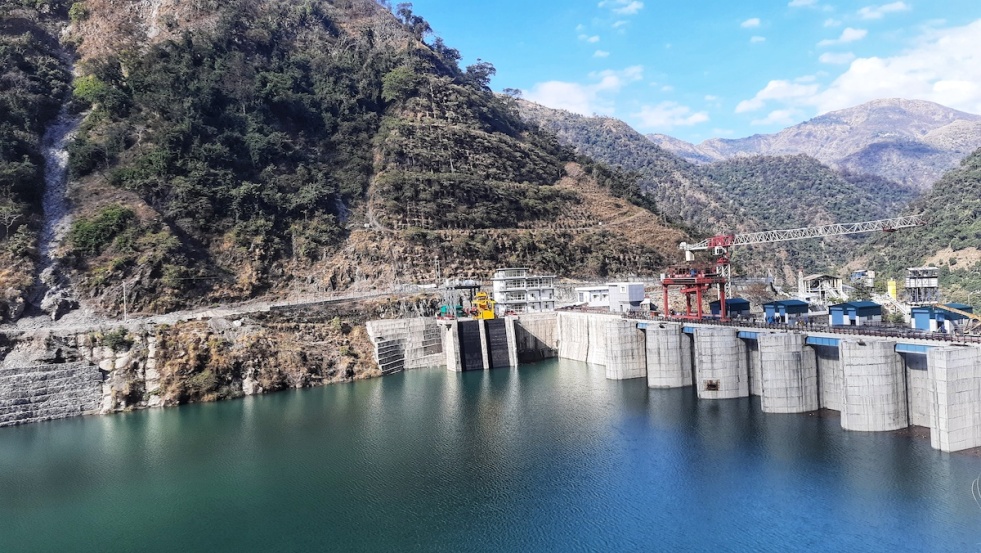
(Feature Image: Vyasi dam on Yamuna river in Uttarakhand. Bhim Singh Rawat/SANDRP)
A detailed report this week in an international Water Power Magazine underlines the urgent need for India, as rest of the world to adopt adaptive reservoir management. This has become urgent as under changing climate, the Probable Maximum Precipitation figures are changing fast. In India, it has already increased by 35% in 84% of mainland. This makes the current reservoir operation models including rule curves and spillway capacities outdated. Human activities in the catchment and aging infrastructure are making the situation worse.
The report highlights, a number of countries including USA, Japan, Australia and Italy have already taken a number of measures in this direction. The authors of the report have warned that there is wide spread failure to achieve this among water and environment policies and institutions.
The National Dam Safety Authority would be expected to work on this, but we see nothing in public domain to suggest that NDSA is taking any credible action. The Central Water Commission, that dominates the persons in and functioning of NDSA, has very poor track record. Its flood forecasting does not even monitor, advise or ensure compliance of reservoir management to existing rule curve or adaptive operation. Earlier we wake up, better it will be.
Adaptive Reservoir Management The World Bank has recently been looking at enhancing the safety and resilience of dams in the context of climate change and extreme hydrological events, providing detailed methodologies of climate change impact assessment, along with case studies on adaptative reservoir operations from different regions. New research warns that lakes and reservoirs are under significant stress due to human activities, global warming, and ageing infrastructure. According to Rafik F. Hirji, a retired World Bank Group and Former Water-Environment Thematic Lead and Team Leader; and Alfred Duda, a retired Bank Group and Former Senior Advisor and Team Leader for the Global Environment Facility, there is ‘widespread failures across international water and environmental policies and institutions’ in this regard.
India need to implement adaptive system In India, research shows a clear increasing trend in PMP across the country. Specifically, 84% of the Indian mainland exhibits an increasing trend in PMP, about a 35% increase from 1971–2010 compared with the 1901–70 period. This indicates the significant impact of climate change, demonstrating that it must be factored into the revised planning and design of water resources and hydropower engineering projects.
PMP 13-33% up in Australia After assessing the impact of climate change on PMP estimates, Australian researchers have identified the assumption of a stationary climate as a key shortcoming of traditional estimates. Indeed, based on an optimistic climate scenario, PMP estimates across Australia are predicted to increase by an average of 13% by 2100, compared with 33% for the pessimistic scenario. PMP methods, the team says, will require regular updating to account for likely progressive increases in PMP and ensuing flood estimates. Such PMP projections indicate serious implications for the hydrological safety of dams under climate change impacts in Australia, while the same range of impacts can be expected for many other regions of the world.
The World bank report says this case (of role of Wivenhoe Dam on Brisbane river in Queensland in Australia in 2011 floods) highlights the importance of establishing a proper decision support system and operation manual for multipurpose dam operations, which inherently include conflicting demands for water supply and flood control. The introduction of advanced rainfall and inflow forecasting systems is equally important for supporting the decision support systems for reservoir operation.
Italy: Lake Como The decision support system demonstrated significant operational improvements, such as: Reducing the frequency of flooding in the city of Lake Como by more than 30%, Reducing water deficit by 110 million m³/year – on average by 12%, and Increasing hydropower generation by an average 3%. It also illustrates the importance of collaboration among reservoir managers, scientists, and other stakeholders for developing an advanced rainfall and flood forecasting system integrated with a system for optimising reservoir operation.
USA: Policy Shift in 2017 In a significant policy shift in 2017, the US Army Corps of Engineers co-developed the Forecast Informed Reservoir Operations (FIRO) programme. Its aim is to better inform decision making on retaining or releasing water, by integrating additional flexibility in operation policies and rules based on enhanced monitoring and improved weather and flow forecasts, in order to maximise various development objectives, such as water supply, hydropower generation, and flood attenuation.
The FIRO system uses Ensemble Forecast Operations (EFO) – a risk-based approach of reservoir flood control operations that incorporates ensemble streamflow predictions made by the California-Nevada River Forecast Centre. One of FIRO’s first applications was for the Coyote Valley Dam on Lake Mendocino in California in Water Years 2019 and 2020. FIRO enabled a 19% (more than 13.6 million m3) increase in water storage by the end of March which allowed the service provider to maintain water supplies throughout the subsequent very dry period in the region.
Japan In Japan, many metropolitan areas have been developed in highly flood-prone areas at the downstream ends of river basins. Therefore, the country has established a river basin–based comprehensive and integrated flood management system, upon which river basin administrators provide guidance regarding dam operations to dam owners and operators during floods. Non-government owners of dams that do not have flood control functions are also requested to contribute to flood management at the basin scale, with the aid of an advanced rainfall and flood forecasting system. The adaptive system demonstrated in case of Kusaki Dam in Oct 2019 Typhoon time that due to advanced action, the water releases from the dam could be reduced to 600 cumecs compared to possible 1700 cumecs without the advance action.
HYDRO POWER PROJECTS
CEA Chair releases IIT Roorkee Report on Pump Storage Projects Chairperson, Central Electricity Authority (CEA) Shri Ghanshyam Prasad on March 13 2026 released a report titled “Pumped Storage Hydropower in India: Drive, Initiatives, Market Growth and Challenges” prepared by IIT Roorkee. He claimed that India has planned to add 100GW of PSP in next 10 years & will accordingly be No. 2 in development of Hydro Pumped Storage Projects in the world. The report reviews the state of PSP development in Indian and globally, including technology, policies and regulations, and business models of PSPs and provides recommendations for hastening PSP development in the country.
Sikkim: Payout to Greenko-linked firm without CM’s nod draws scrutiny A hefty payment of about ₹1,300 crore made by the Haryana Power Utilities to Sikkim Urja Limited (erstwhile Teesta Urja Ltd) – a power generation company in which Greenko Energies Pvt Ltd holds a majority stake – without the approval of the CM and energy minister, as required under government procedure, has put the spotlight on the decision-making process that facilitated the high-value payment.
The payment was made in October 2025 to Sikkim Urja on the basis of 2022 orders of Central Electricity Regulatory Commission (CERC) and 2024 orders of Appellate Tribunal for Electricity (APTEL) on an interlocutory application filed by the Haryana Power Purchase Centre (HPPC). The Haryana Power Utilities had terminated the power sale agreement in March 2018 citing time overrun and cost overrun in the commissioning of the 1,200-MW Teesta-III hydroelectric project in Sikkim. The power utilities said the escalation in the project’s capital cost from ₹5,700 crore to ₹13,965 crore was expected to push the tariff and burden the consumer.
Himachal Pradesh: 15 HEPs Cancelled; Pandoh allotted to BBMB The State Cabinet has decided to cancel 15 hydroelectric projects that failed to be commissioned despite being given relief under the state government’s one-time amnesty scheme aimed at reviving long-pending projects. The decision was taken in a Cabinet meeting chaired by CM Sukhvinder Singh Sukhu.
In another decision related to the hydropower sector, the Cabinet approved the allotment of the 10 MW Small Hydro Electric Project at Pandoh to the Bhakra Beas Management Board. The allotment will be subject to the return of unused land by the board to the state government. Under the arrangement, the state government will receive 13 percent free power along with an additional 5 percent power as its share from the project once it becomes operational.
SUMP: 56 more villagers support PFR? Fifty-six more residents of Komkar village in Upper Siang district submitted their consent to carrying out activities to prepare the pre-feasibility report (PFR) for the Siang Upper Multipurpose Project (SUMP) to Deputy Commissioner Talo Jerang here on March 12. On behalf of the 56 residents of Komkar village, Obi Taram and Aton Minno submitted the consent letter to the DC. Earlier, a memorandum of understanding had been signed by 245 residents of Komkar village on 30 December, 2025 in Itanagar in support of the PFR survey. With the latest development, the total number of consenting households has now reached 297 out of 302 households in Komkar village.
20 more families of Simong village? in Upper Siang district have extended their consent to carrying out activities to prepare the PFR for the SUMP. On behalf of the villagers, Genom Tekseng submitted the consent letters to Deputy Commissioner Talo Jerang at the DC’s bungalow here on March 14. With this latest development, a total of 194 out of 240 families of Simong village have given their consent to the MoU for PFR activities. Earlier, 128 families had submitted their consent on 26 February, followed by 46 families on 6 March, expressing their support and commitment towards the PFR survey.
A significant number of families from Pugging, Ramsing and Janbo villages gathered at the DC bungalow here in Upper Siang district on March 15 and extended their consent for the PFR activities by signing MoUs with the Government of Arunachal Pradesh. From Pugging village, 57 out of 70 families signed the MoU. Residents from both Ramsing and Janbo villages also stepped forward to officially join the initiative, formally signing the MoU, demonstrating their commitment to the project at the PFR stage.
Budget focuses on infra, HEP generation Deputy CM Chowna Mein on March 10 presented the state budget for 2026–27. Emphasising Arunachal Pradesh’s vast hydropower potential of around 58,000 MW, Mein said the state aims to commission 19 GW of hydropower capacity between 2025 and 2035, with investments estimated at around ₹1.9 lakh crore.
Major projects such as the Subansiri Lower Hydroelectric Project, where two 250-MW units have already been commissioned, are progressing, with full commissioning expected by December 2026. The Dibang Multipurpose Project is expected to be completed by 2032. The state is projected to receive monetised free power worth ₹4,520 crore between 2025 and 2035, and about ₹4,100 crore annually thereafter, along with local area development funds and dividends from hydropower projects.
33 HEPs underway with 19,165 Mw capacity A total of 33 hydropower projects are currently being developed in Arunachal Pradesh, with their combined generation capacity estimated at 19,165 megawatts. Information shared by the state’s hydropower department during the recently concluded budget session of the Arunachal Pradesh Assembly revealed that only five hydropower projects have been completed so far. The details were provided in response to a query raised by MLA Wanglin Lowangdong.
CM Distributes Rs 33.4 Cr Fund for Pare HEP-Affected Families CM Pema Khandu handed over Local Area Development Fund (LADF) cheques for the Pare Hydroelectric Project and Panyor Lower Hydroelectric Project to their respective district administrations on March 13. The DC of Papum Pare District received an amount of Rs 23.15 cr for the Pare HEP, which is being developed by NEEPCO Ltd. The 110 MW project is situated on the Dikrong River, which is a tributary of the Brahmaputra River.
For the Panyor Lower Hydroelectric Project, a total of Rs 10.25 crore was released, of which Rs 5.43 crore was allocated to the Keyi Panyor district and Rs 4.82 crore to the Papum Pare district. The 405 MW project, called as the Ranganadi Dam, was commissioned in 2002. It is a concretegravity diversion dam built on the Panyor River.
DAMS
Polavaram: CAG finds violations, financial mismatches, lapses, delays A performance audit by the Comptroller and Auditor General (CAG) for the period 2017-18 to 2022-23 identified multiple discrepancies across financial, procedural and implementation aspects in the Polavaram irrigation project. The report flagged poor budget utilisation, environmental violations, and delays in land acquisition and rehabilitation. Overall project spending was over-reported by ₹1,492 crore by the Chief Engineer between 2017 and 2023. Even after 17 years, the hydropower component registered 12% physical progress. Just 11% of the 1.06 lakh project-displaced families were resettled.
CAG flagged that deviations from the construction schedule as per the DPR led to the collapse of the diaphragm wall. The wall, built at a cost of ₹399.77 crore, was damaged due to the non-existence of a contract agency to mitigate flood situations. The audit highlighted environmental non-compliance, including failure to construct protective embankments in Odisha and Chhattisgarh (they were to be completed by 2014-15), inadequate plantation, and execution of 2 lift irrigation schemes without statutory approvals, leading to National Green Tribunal penalties.
It recommended that the state government expedite the socio-economic survey and obtain approval for the Detailed Project Report from the Central Water Commission for the distributary network, to facilitate the approval of the revised cost estimate by the central government.
EAS Sarma calls for investigation into Polavaram dam irregularities A dam meant to irrigate fields and supply drinking water has instead become a symbol of displacement, irregularities and political–contractor nexus. In a strongly worded letter to the Cabinet Secretary, former Union Secretary E.A.S. Sarma cites the CAG’s 2025 report on the Polavaram project, highlighting massive procedural violations, irregular contract awards and serious failures in rehabilitation. Over one lakh tribal families remain inadequately compensated and largely unrehabilitated even after two decades, while project costs have soared beyond Rs 62,000 crore. Sarma calls for a forensic audit and a comprehensive investigation by central agencies to fix accountability and expose what he describes as a potential scam.
Allegations of corruption in MP irrigation projects including Ken Betwa Project According to this Dainik Bhaskar report of March 11 2026, Congress persons have made serious allegations about corruption in awarding contracts for irrigation and other projects in Madhya Pradesh, including Ken Betwa Project.
Gargai Dam Project under review due to costs and environmental impacts Mumbai’s Gargai Dam project, aimed at adding 440 MLD to the city’s water supply, is under review due to rising costs and environmental concerns & rehabilitation of affected villages. The standing committee has referred the proposal back for further review.
About 650 hectares are needed for compensatory afforestation. The BMC has acquired 570 hectares so far, while 80 hectares are yet to be secured. Forest clearance will be sought once the entire land parcel is acquired. However, finding the remaining 80 hectares of suitable land for afforestation has been challenging. The parcels identified so far are in Chandrapur, Hingoli and Washim districts, nearly 800 km from the proposed dam site. 34% of the 4000 MLD water currently supplied to Mumbai is lost in leakages or theft.
Clash over Gargai Dam project The BMC’s standing committee witnessed its first clash between two factions on March 11 over a water supply project. While discussing the Gargai dam proposal, Shiv Sena (UBT) demanded that the project be scrapped and that the focus shift to the desalination project, while Deputy CM Eknath Shinde-led Shiv Sena advocated the Gargai dam project over desalination.
The BMC administration tabled a proposal for the construction of the Gargai dam in Palghar district worth Rs 4,679.47 crore, which includes construction of a water tunnel. While discussing the proposal, UBT senior member Shailesh Phanse opposed it and demanded that the project be scrapped. “For this project, we are losing forest and six villages will be affected. This project will be completed in six years and the city needs more water now,” Phanse said. “On the other hand, the desalination project will be completed in two years. It will not affect the forest and there is no issue of rehabilitation. Dam water supply is completely dependent on the monsoon. The BMC should cancel the Gargai project and focus on the desalination project,” he added.
Meanwhile, chairman Prabhakar Shinde decided to refer the proposal back to the administration, as members raised questions over the higher cost compared to the estimated cost of the project. The estimated cost was Rs 3,006.75 crore, while the administration received a bid of Rs 3,334.48 crore. Including all taxes, the cost reached Rs 4,679.42 crore.
Medigadda: tests stalled due to technical problems The exercise to determine the nature and the condition of the river bed under the Medigadda barrage continues to pose challenges to the irrigation department, which has said that it was unable to drill boreholes on the barrage’s causeway and spillway sections due to ‘certain technical problems’. The department has sent an SOS to the Central Power and Water Research Station (CPWRS), Pune, asking for urgent help. The chief engineer of Ramagundam circle of the irrigation department said in a letter on March 12 2026 to CWPRS, and urged the organisation to “arrange a drilling expert to visit the site to advise on the issue as per the site condition at the earliest.”
Drilling of boreholes is part of the required investigations suggested by the National Dam Safety Authority (NDSA). The irrigation department gave the contract for conducting the studies to CWPRS. Unless all the studies are completed and the data analysed, no design can be prepared for taking up repairs at the barrage which suffered significant damage with one of its blocks cracking and sinking into the riverbed in October 2023. “The riverbed is sandy and core samples drawn from the drilling collapse. If the core sample cannot maintain its column structure then nothing can be learnt from a pile of sand,” a source familiar with these problems encountered at the site when boreholes were sought to be drilled last year, said.
Decisions of MoEF’s Expert Appraisal Committee meeting on River Valley Projects held on Feb 26 2026
1. Cherue Close loop Pumped Storage Project (1200 MW) in 569 Ha at Village Dighia, Bahera, Dharan and etc., Sub Dist Robertsganj, Dist Sonbhadra, Uttar Pradesh by Adani Hydro Energy Six Limited – Terms of Reference: APPROVED
2. Kurha Vadhoda Islampur Lift Irrigation Scheme of Culturable Command Area of 32372 Ha at Village Rigaon, Tehsil Muktainagar Dist Jalgaon (Maharashtra) by Tapi Irrigation Development Corp, Jalgaon, Mah – Environmental Clearance: APPROVED
Relevant decision of MoEF’s Forest Advisory Committee meeting held on Feb 27 2016 – Diversion of 243.74 ha (Shahapur Division 181.45 ha and West Nasik Division 62.29 ha) of forest land (reserved forest, protected forest and private forest) for Bhavali Pumped Storage Project (1500 MW) in Thane & Nasik District in Maharashtra: Govt to re-examine use of 40.91 ha forest land to be used for muck dumping and 39.932 ha forest land for approach roads and optimise the same.
The forest department has forwarded the file, along with its report, to the Central Government for approval. This project entails the felling of 119,000 trees. Environmentalists have been opposing this initiative for the past year and a half; however, disregarding public opposition, the Forest Department approved the land diversion file within a mere 22 days. In connection with this matter, on February 18, 2026, the company deposited ₹73.32 crore, in accordance with the stipulated demand. On March 10, the Forest Department referred the land diversion proposal to the Union Ministry of Environment, Forest and Climate Change for approval. The High Court had previously taken cognizance of this issue. Following a hearing, the Court issued directives instructing the department to complete its procedural formalities, but mandated that permission for the felling of trees must be obtained specifically from the High Court.
DAM SAFETY
A seismic decision: Earthquake zoning framework The Centre’s rollback of the revision to India’s earthquake zoning by the Bureau of Indian Standards (BIS) is reportedly driven largely by the massive cost and execution implications, as the decision impacts urban planning, disaster preparedness and climate resilience. But this reversal neglects the safety of people and environment for vast number of people and seems based on lop sided consideration of GDP growth. Globally, most advanced economies and seismically active regions now use Probabilistic Seismic Hazard Assessment (PSHA), a dynamic framework that models earthquake risk through probability-based simulations of ground motion. No convincing reason is put forward for the reversal. The revisions were notified in November 2025 and withdrawn on March 3, reported only direction of cabinet secretariate. Indeed, only a scientific, holistic, honest, transparent and accountable framework can strengthen disaster resilience and address climate mitigation, affordability and execution challenges. This is particularly true of major structures like dams, roads, bridges, railway lines, power stations and cities in vulnerable zones.
Withdrawal Of India’s 2025 Seismic Code India must now continue building to 2016 standards, in a world where the scientific understanding of seismic risk has advanced considerably. The bold policy was withdrawn. The science remains. And we still don’t know why this reversal was executed without discussions with the scientists who know the risk best. In a country where 75% of the population lives in earthquake-prone zones, whose voice should carry greater weight—the builder counting costs, or the scientist counting lives? (C P Rajendran)
Himachal shifted to top seismic danger category In a significant seismic alert, the Bureau of Indian Standards (BIS) has placed the entire state of Himachal Pradesh in seismic Zone V, the highest earthquake risk category in the country. Earlier, the state was divided between Zones IV and V, but the latest revision now categorises the whole region under the most hazardous zone.
According to the National Disaster Management Authority (NDMA), the move reflects growing scientific understanding of the region’s seismic vulnerability. Experts say the new classification means the state could potentially experience earthquakes of up to magnitude 8.0, which could cause large-scale destruction if preparedness measures are not strengthened.
The state will also observe April 4 as Disaster Awareness Day to mark the 121st anniversary of the devastating Kangra earthquake of 1905, which claimed nearly 20,000 lives.
Heavy water pressure damages crest gate of India’s first private barrage A crest gate of Shramabindu Sagar—India’s first private barrage built across the Krishna River in the Bagalkot district—was severely damaged due to heavy water pressure in the river on Jan. 06, 2026. The incident, which reportedly occurred around noon, affected gate No. 22 of the barrage at Hipparagi village in Jamakhandi taluk, resulting in a significant loss of water from the reservoir. The barrage is popularly referred to as Hipparagi barrage.
According to officials from the Bagalkot district administration, the barrage, constructed by local farmers led by former Union minister late Siddu Nyamagouda in 1989 by pooling around Rs 1 crore, had nearly 6 TMC of water stored to irrigate about 75,000 acres of agricultural land in the surrounding areas. “Fortunately, there was no crop damage due to the sudden influx of water into the downstream areas,” a senior revenue official clarified. Officials also stated that an Andhra Pradesh–based firm has been entrusted with the responsibility of servicing and managing the barrage’s crest gates.
URBAN RIVERS
International Day of Actions for Rivers 2026: Citizens Actions to Protect Urban Rivers in India On the occasion of the 29th International Day of Action for Rivers, celebrated annually on March 14 since 1997, the SANDRP highlights ten inspiring examples of citizen-led initiatives in last one year across India aimed at protecting urban rivers. The overview showcases how citizen groups and individuals are taking action to address river pollution, oppose ecologically harmful development projects and promote restoration and conservation of urban river ecosystems. These efforts demonstrate the crucial role of public participation in safeguarding rivers and ensuring that river management prioritizes ecological health, transparency and the rights of affected communities.
These examples show that the failure of government authorities to stop the dumping of untreated industrial effluents, domestic sewage, and solid waste has severely damaged the health of urban rivers across the country. Ironically, instead of addressing these urgent problems, many urban authorities continue to promote large riverfront development projects that harm river ecosystems, overlook the rights of local communities, and increase the risks of water scarcity and urban flooding.
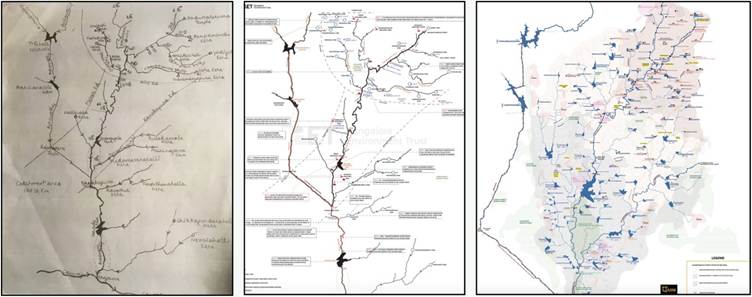
From a hand-drawn map carried to government meetings to a comprehensive GIS-based reference — the evolution of our spatial understanding of the Vrishabhavathi basin.
State of the Vrishabhavathi River (2016–2025), Bengaluru. Part 1: River Condition, Public Health, and the ₹391-Crore Reboot Nirmala Gowda of Mapping Malnad has published this report on March 14 2026. It offers critical evidence on how pollution fundamentally undermines the proposed Mekedatu project—a dam that would impound toxic flows rather than store clean water.
According to the report, the Karnataka government’s proposal of a ₹391 crore plan to revive the long-contaminated Byramangala reservoir reveals a fundamental disconnect from pollution reality, and fails to address the source of the pollution that has turned Vrishabhavati river into a toxic stream. The report throws light on the river’s worsening condition, and how the river’s pollutants also make their way into vegetables, feed, and even animal and human bodies, turning it into a public health crisis.
The approximately 69 km-long river collects nearly 500 MLD of toxic wastewater along with massive quantities of solid waste from urban, industrial, and rural settlements before being impounded behind the Byramangala dam near Bidadi. The river thus has become an urban channel carrying waste and wastewater.
Study flags pollution, health risks in Vrishabhavathi The report — State of Vrishabhavathi (2016–2025): River Condition, Public Health, and the Rs 391-crore Reboot — released by the research platform Mapping Malnad, examines the river’s condition over nearly a decade and evaluates government efforts aimed at restoring the heavily polluted waterway. According to the study, untreated sewage and industrial effluents continue to dominate the river’s flow. It identifies industrial clusters such as Kumbalgodu, Byramangala and Bidadi as significant contributors of toxic discharge. One of the key observations highlighted in the study relates to trade effluent sampled from a tanker that was physically intercepted while dumping waste directly into river.
Hyderabad: Scientific planning is must for Musi rejuvenation Musi Jan Andolan (MJA), a civilian body fighting against the Musi Riverfront Development project, called for a scientific approach to Musi rejuvenation. Responding to the PowerPoint presentation of the Musi River Development Corporation Limited (MRDCL) in the presence of the Chief Minister A Revanth Reddy on Friday, the MJA said the Musi rejuvenation should be carried out through ecologically sound river basin planning that does not require mass displacement.
In a statement, the MJA said the MRDCL displayed grand visuals of London, Paris, Singapore and Korea, and pointed out that these cities spent decades cleaning their rivers before adding public amenities. Without this, the Musi will remain polluted no matter what is built on the banks.
MJA tells Dy CM to ensure zero displacement A 12-member delegation of the Musi Jan Andolan (MJA) met Bhatti Vikramarka Mallu at Praja Bhavan on March 12, 2026 and raised concerns over the proposed Musi Riverfront Development Project, particularly the hurried unveiling of Phase-1 plans. The meeting, which lasted over two and a half hours, was attended by ministers D Sridhar Babu, V Srihari, and A Laxman Kumar. The meeting happened following a March 10, 2026 letter by prominent activist Medha Patkar urging CM A Revanth Reddy to halt the March 13, 2026 event at Taj Krishna and initiate democratic dialogue.
The delegation urged the government to suspend the unveiling event at Taj Krishna and release the complete Detailed Project Report (DPR) for the entire project in English, Telugu and Urdu, along with river boundary and buffer zone maps. They demanded at least sixty days for stakeholders to submit suggestions and objections and called for public hearings with affected communities.
Patkar asks CM to ensure public consultation before starting work Medha Patkar of the National Alliance of People’s Movements has written to CM Revanth Reddy urging an immediate halt to the March 13 unveiling of the Musi River Rejuvenation Project’s detailed plans. The letter warns that the massive riverfront project could displace thousands of households and proceed without mandatory social and environmental scrutiny. Patkar criticizes the exemption granted from Social Impact Assessment under amended land acquisition provisions and calls for democratic consultation with affected communities, environmental experts, and civil society groups. She demands public release of the project’s full plan, independent review, withdrawal of land acquisition notices, and restoration of the safeguards of the 2013 land acquisition law.
MJA activist under house arrest A vocal activist from the Musi Jan Andolan (MJA) has been detained inside his home at Chaderghat on March 13, 2026, hours ahead of the CM’s scheduled unveiling of proposed plans for the Musi Riverfront Development project. The activist, Syed Bilal, from the slum Shankarnagar on the Musi river bank, was part of the 12 member delegation from the MJA which met the Deputy CM Mallu Bhatti Vikramarka and his cabinet colleagues at his residence on March 12, 2026.
Musi PPP The govt’s presentation on the Musi rejuvenation project on March 13 showcased how riverfront projects had transformed into thriving economic and tourism hubs in global cities, setting the vision for the Musi riverfront development in Hyderabad. The presentation highlighted Seoul, London, Tokyo, Singapore and Paris along with the Sabarmati riverfront project in Gujarat, demonstrating how revitalised waterways have generated employment, tourism and economic activity. According to the presentation, the Musi riverfront project will be developed in phases, with Phase-I covering a 21-km stretch and the full vision extending up to 55 km along the river.
Blueprint for first phase As per the presentation made at a program titled ‘Musi invites’ in the presence of Telangana Chief Minister Revanth Reddy, the first phase will cover 21 km with tentative development cost of Rs 6500 to Rs 7000 crore.The project will have blue master plan, green master plan, land use master plan, marquee projects, infrastructure master plan and financial master projects.
Out of 20 TMC of water to be brought to Hyderabad through Godavari River linkage project, 2.5 TMC will be allocated for Musi River rejuvenation and remaining 17.5 TMC for drinking water supply for Hyderabad.
The first phase covers two river stretches (Esa and Musa) converging at Gandhi Sarovar or Bapu Ghat, where Mahatma Gandhi’s ashes were immersed in 1948. The Gandhi Sarovar project will comprise a statue of peace, a handloom training centre, education and knowledge hub, public recreation spaces, meditation along with a wellness village and national museum.
Can scrap it if needed: CM A Revanth Reddy threw down an unusual gauntlet on Friday evening, March 13, saying that if political parties opposed to the Musi Riverfront Development Project pass a resolution against it in the upcoming Assembly Budget Session, he is willing to scrap it entirely. He said the government was open to a conversation, but wanted it conducted through proper democratic channels rather than outside of them.
EV Narasimha Reddy, towards the end of his presentation on the first phase of the project, urged the people to give their suggestions on the project on https://musi.telangana.gov.in. He also said that the DPR will be uploaded on that website in a week, for suggestions and final consultations with regard to the project.
Residents oppose felling of 689 trees for RFD Residents and environmental activists have raised objections to the proposed felling of 689 trees for a stretch of the Pune Municipal Corporation’s (PMC) Riverfront Development (RFD) project between Wakad Bypass and Sangvi Bridge. The civic body issued a public notice regarding the proposed tree cutting on March 2, inviting objections from citizens. The objection period ended on March 13. The trees fall under RFD stretches 1, 2 and 3 within the PMC jurisdiction. While the civic body has maintained that the proposal is part of the infrastructure required for the riverfront development project, several residents have argued that the scale of tree felling could harm the river’s ecosystem and biodiversity.
NGT pane on Pavana pollution Untreated sewage and sullage (grey water) from at least 20 villages under the Pune Zilla Parishad and PMRDA have emerged as major contributors to pollution in the Pavana river, stated a joint committee report submitted to the NGT last week. NGT ordered the formation of the joint committee last Aug after the river slipped into the CPCB ‘Priority I’ category due to rising pollution levels. The three-member committee reviewed the situation and found extensive discharge of untreated household waste from villages along the river. “Around 57% of households lack septic tank connections, leading to direct discharge of sewage into open drains flowing into the river. Similarly, nearly 92% of households have no kitchen garden-based grey-water treatment systems, resulting in sullage entering natural drains without treatment,” the report stated.
The committee identified 15 natural drains channelling sewage and sullage into the Pavana river and recommended time-bound action by ZP and Pune Metropolitan Region Development Authority (PMRDA) to prevent further deterioration of water quality. The PMRDA has begun work on 14 decentralised STPs with a combined capacity of 5.84 MLD, using Solid Immobilised Bio-Filter (SIBF) technology. “The tendering process has begun and on-ground work will start soon,” a senior PMRDA official said. The Pavana river is the primary drinking water source for Pimpri Chinchwad, which draws over 70% (520 MLD) of its supply from the Pavana dam.
RIVERS
International Day of Action for Rivers 2026: Efforts to Protect and Revive India’s Rivers Marking the International Day of Action for Rivers 2026, this overview brings together several encouraging examples of people’s efforts to protect, revive and defend their rivers across India. At a time when rivers are increasingly threatened by pollution, indiscriminate sand mining, encroachments, dams and half-baked developmental projects, these stories remind us that citizens, communities and grassroots organizations remain the strongest defenders of the rivers.
Interview: ‘Rivers need to run free’ -From Tibet to West Bengal, the Brahmaputra is the pulse of communities and ecosystems along its course. But what are the risks the river faces through human interventions, particularly dams, discusses journalist, author and filmmaker Sanjoy Hazarika in his new book, River Traveller.
Filling Streamflow Data Gaps in Indian Catchments Here, we develop a robust framework that integrates geomorphological, meteorological, and hydrological parameters with the Quantile Regression Forests to fill the gaps in daily streamflow observations at 343 stations across Peninsular India from 1961 to 2021. To reconstruct the streamflow at ungauged locations, we employed transfer learning through k‐means clustering to group hydromorphologically similar catchments. Our data gap‐fill method performs well with Nash‐Sutcliffe Efficiency (NSE) of more than 0.8 at 72% and 90% of stations for water level and streamflow, respectively. We found that 50 and 100‐year return period events are highly sensitive to data gaps, often leading to significant under‐ or overestimation by more than 40%. Overall, the gap‐filled streamflow and water‐level data sets for the1961–2021 period provide a robust foundation for hydrological modeling, climate change impact assessments, and water resource planning across Peninsular India.
Drinking water resources suitability assessment in Brahmani river This research identifies key research gaps and proposes future directions for developing transparent, adaptive, and accurate models. The findings can also guide researchers and policymakers towards the development of smart water quality management systems that enhance decision-making and ecological sustainability.
Jojari pollution: SC reviews interim report The Supreme Court on March 10 took note of an interim report submitted by a court-appointed committee in the suo motu case concerning contamination of Rajasthan’s Jojari River and expressed concern over the damage caused to public infrastructure due to stagnant polluted water. During the hearing, the Court referred to the interim report submitted by the committee that had been constituted pursuant to the Court’s order dated November 21, 2025 to examine issues relating to the contamination of the river and the steps required for its restoration.
According to the Court, the committee has submitted an extensive interim report running into nearly 202 pages. The report, the Court noted, has been structured in multiple sections detailing the actions taken so far, the recommendations made by the committee, and the logistical challenges encountered during the course of its work. Taking note of the voluminous nature of the report, the Court requested the Chairperson of the committee to provide a digital copy so that it could be circulated among all counsel appearing in the case.
The bench also took note of certain logistical constraints flagged by the committee, including issues related to the availability of human resources required for completing the assigned work. During the proceedings, the Additional Advocate General (AAG) appearing for the State of Rajasthan assured the Court that the issue regarding the non-availability of human resources would be addressed by the State government before the next date of hearing. The Court also expressed concern over the impact of stagnant polluted water in the affected areas and deprecated the State over the extent of damage caused to public infrastructure.
Jhelum below zero-gauge mark after warm spell According to Flood Control Department data, the Jhelum was flowing at minus 0.86 feet at Sangam in south Kashmir at 9 am all through the week, indicating discharge below the zero-gauge level-a rare occurrence for this time of year. Water levels have also declined in several major tributaries of the Jhelum across south and north Kashmir, including the Vishaw, Lidder, Brengi, Sandran, Veth Vethastu, Romshi Nallah, Tongri Nallah, Aaripal Nallah, Rambiara and Ferozepora Nallah.
Kashmir witnessed its seventh consecutive rainfall-deficient winter, with precipitation about 65 percent below normal. Between December and February, the region received 100.6 millimetres of rain and snow, compared with the normal 284.9 millimetres. Hydrologist Riyaz Ahmad Mir of the National Institute of Hydrology said the weak river flow is due to the lack of snow accumulation in the mountains that feed the Valley’s rivers.
Jammu and Kashmir has now witnessed its seventh consecutive rainfall-deficient winter, Arif stated. Between December and February, the region received 100.6 millimetres of precipitation against a normal of 284.9 millimetres, a deficit of nearly 65 per cent. February alone saw rainfall records tumble across the Union Territory. In Srinagar, meteorological records show the city received only 5.3 millimetres of rainfall, placing the month among the driest Februaries in more than a century. The impact of the deficit is now becoming visible in the Valley’s rivers.
CAG flags Namami Gange implementation in Uttarakhand The CAG report, presented during the ongoing state’s budget session, notes several irregularities found in this project, including defective designs of STPs, poor maintenance of infrastructure, failure to tap drains discharging into the Ganga, and the dumping of waste near rivers and smaller streams.
The CAG observed that the detailed project report (DPR) for Forestry Interventions for the Ganga (FIG) included a budgetary provision of Rs 885.91 crore and a plantation target of 54,855.43 hectares. However, contrary to this, only Rs 144.27 crore-amounting to just 16 per cent of the allocated funds – was actually utilised. Consequently, physical progress remained sluggish, and the scheme failed to achieve the specific objectives related to the rejuvenation of the Ganga.
Of the 44 STPs inspected by the CAG in 2023, only three to five were found to be compliant with the norms set by the NGT, while merely six to twelve were found to be in compliance with the standards of the MoEF and other relevant criteria. The report states that this reveals widespread non-compliance and a substandard level of sewage treatment.
The report also notes that in Chamoli, Rudraprayag, Tehri, and Uttarkashi districts, cremation ghats were constructed at 11 locations without assessing local needs or cultural practices; consequently, these facilities are neither being utilised nor maintained, while funeral pyres continue to be lit along the riverbanks.
According to the report, in 2011, the then State River Conservation Authority set a target to prevent untreated urban wastewater and industrial effluents from entering the Ganga by 2020; yet, state government officials have failed to formulate a plan even 13 years later.
The report further states that District Ganga Plans were not formulated in any of the districts within the Ganga basin, resulting in the poor management of sewage-related issues and a failure to achieve the 2020 target.
SC seeks status report on Ganga bank encroachments The Supreme Court has directed the Centre and the National Mission for Ganga Authority to file a report detailing the status of encroachments on the banks of the River Ganga across all the States through which it flows or passes. A Bench headed by Justice J.B. Pardiwala ordered the Union government and the Authority to provide details of the measures taken to meaningfully implement an October 7, 2016 notification issued by the Ministry of Water Resources, River Development and Ganga Rejuvenation on the rejuvenation, protection, management and ecological flow of the river and its tributaries, which are choked by plastic waste and riddled with illegal structures on the banks.
The Supreme Court recently refused to entertain a plea seeking directions to curb the sewage waste disposal into the Ganga River and around Manikarnika Ghat. The court has allowed the petitioner to approach the authorities or the High Court. The bench of CJI Surya Kant and Justices Joymalya Bagchi and Vipul Pancholi was hearing the writ petition filed by a monk named ‘Baba Khatarnak’…
Centre plans design changes in Char Dham road stretch The ministry of road transport and highways (MoRTH) is considering design changes to the Char Dham road stretch in the Bhagirathi Eco-Sensitive Zone after several environmental activists and veteran politicians Murli Manohar Joshi (of the BJP) and Karan Singh (of the Congress) raised an alarm about its ecological impact.
Senior officials from MoRTH said on condition of anonymity that they are considering certain design changes to accommodate the concerns of environmentalists in Uttarakhand but emphasized that the widening is critical because of the strategic nature of the stretch, which connects to the India-China border, which means the road needs to be wide enough to move defence equipment. Environmental activists have said a disaster prone road may be unsafe even from the perspective of the movement of troops and equipment.
Delineation of River Tamsa’s floodplain zone The Irrigation and Water Resources Department of Uttar Pradesh has already initiated necessary steps for delineating River Tamsa’s floodplain zone and the process is presently underway. The department’s report filed March 10, 2026 was in compliance with the NGT order of September 22, 2025.
The matter related to extensive encroachment, unauthorised construction and continuous discharge of untreated sewage and industrial effluents into Tamsa in Ambedkar Nagar district, which is a tributary of Ganga. The applicant said that the absence of proper floodplain demarcation, coupled with inadequate enforcement of the Solid Waste Management Rules, 2016, has resulted in significant ecological degradation and deterioration of the river ecosystem.
The executive engineer of the Flood Works Division in Ayodhya, through letter dated December 9, 2025, requested NIH for the determination of the floodplain zone of Tamsa in accordance with the Ganga Rejuvenation Order, 2016 according to high-resolution digital elevation model (DEM) data and 1 metre contour data. The National Institute of Hydrology (NIH), Roorkee provided the draft proposal for floodplain zone delineation of the Tamsa / Marha / Tons river. In the proposal, NIH stated that the study will be completed in 12 months.
Yamuna covered in pink froth The Kalindi Kunj to Okhla barrage section of the Yamuna in southeast Delhi is covered with iceberg-like pink coloured floating froth, which, experts say, indicates the fusion of untreated dyes and waste from neighbouring illegal industries. Yamuna activist Pankaj Kumar from the NGO Earthwarrior said that pink froth blanketing the Yamuna downstream of Okhla barrage is a glaring sign of untreated industrial waste and toxic effluents being dumped into it.
Activists and experts have urged the government to probe the presence of pink froth and sources of dyes. Bhim Singh Rawat, member of SANDRP said that though there is no conclusive study for the situation so far, untreated effluents from dye, textile or colouring industrial units could be a reason behind pink tints. “In Yamuna, it is probably due to untreated effluents from dyeing or colouring industrial units operating illegally. In the Delhi stretch of Yamuna, similar froth incidents were reported in March 2023 and 2016 downstream of Wazirabad barrage,” he said.
14 of 37 STPs in Delhi not operational, or substandard According to the latest report of the Delhi Pollution Control Committee (DPCC) announced on March 6, the STPs which failed to meet the criterion include Delhi Gate phase 1 and 2; Sen Nursing Home Phase 1 and 2; Okhla (old); Okhla (new) Yamuna Vihar-3; Yamuna Vihar Phase-1; Vasant Kunj1 and 2, Ghitorni; Mehrauli; Rithala Phase-2 and Keshopur-1. The number of STPs failing to meet the parameters has increased, with nine such plants flagged by the DPCC in its September and October reports, 12 in December and 14 in February.
The government stated that of the 37 STPs found substandard, 28 have been upgraded and work continues on the remaining nine. “Tenders have been completed for 35 decentralised STPs costing ₹2,400 crore, and plans for 12 additional STPs worth ₹7,200 crore are underway. Treatment capacity has been increased from 700 MGD to 814 MGD,” the government said.
Riverfront among new LG’s big tasks The riverfront project is also part of the DDA’s plans to redevelop the 22-km stretch of the Yamuna between Wazirabad barrage and Okhla barrage. Eleven floodplain projects are to be developed on the floodplains on 1,500 hectares, out of which five are ready. Work is still on for the Kalindi Biodiversity Park adjacent to the DND Flyway; the Mayur Nature Park near Nizamuddin Bridge; a new Eco-tourism area near Rajghat; Yamuna Vansathali; and Hindon Sarovar.
Gayatri Ganga pollution Drains leading to River Gayatri Ganga in Hamirpur district of Uttar Pradesh were untapped and no temporary phytoremediation / bioremediation measures were in place, stated the affidavit filed by Uttar Pradesh Pollution Control Board (UPPCB). The UPPCB report of February 27, 2026 was in compliance to the NGT order December 12, 2025. The district magistrate of Hamirpur constituted a committee to inspect the relevant sites as per the NGT’s order. The joint committee inspected the sites from February 3-5, 2026 and the National Mission for Clean Ganga prepared an inspection report. The inspection found all drains untapped, and no temporary phytoremediation/bioremediation measures were in place.
FISH, FISHERIES, FISHERFOLKS
Rs 100 cr Aqua park to be established at Anantnag: Ranjan Union Minister for Fisheries, Animal Husbandry and Dairying and Panchayati Raj Rajiv Ranjan Singh today announced the sanction of a Rs 100-crore Integrated Aqua Park to be established in Anantnag district, aimed at strengthening aquaculture infrastructure, boosting fish production and creating employment opportunities. The announcement was made while addressing the National Conference on Cold Water Fisheries at the Sher-e-Kashmir International Conference Centre (SKICC) here. The Union Minister said that the project would promote cold-water fisheries development and strengthen the fisheries value chain in J&K.
Fish found dead A lake near Hasrat Siddique Shah Bahe Dargah in Pune Camp, located close to the BJ Medical College grounds on Wellesley Road, is almost dry, resulting in the death of many fish and worrying local residents. People noted that the lake, which usually has enough water and attracts birds, lost most of its water in just a few days, raising concerns among nearby residents. Local residents think that water from the lake might have been redirected to a nearby construction site, which could explain the rapid decrease in water levels.
SAND MINING
SC takes suo motu cognisance of illegal sand mining in Chambal sanctuary The Supreme Court on March 13 took suo motu cognisance of illegal sand mining in the national Chambal sanctuary. A Bench comprising of Justice Vikram Nath and Justice Sandeep Mehta noted the serious threat posed to endangered aquatic wildlife, including the critically endangered Gharial.
“We have taken note of some recent newspaper reports and the report submitted by CSR which required that the entire protected areas where ghadiyal preservation program is going on, they are being rampantly mined, the ghadiyals are having to relocate because of this mining,” observed the Court during today’s hearing. The Court said the matter would now be placed before the Chief Justice of India (CJI) Surya Kant’s Bench for further directions.
Uttarakhand HC orders transfer of police staff over mining mafia FIR Uttarakhand high court (HC) on March 14 came down heavily on state govt and police for registering an FIR against a forest department official based on a complaint filed by an alleged mining mafia member. The court ordered the suspension of the officer who registered the FIR and directed the transfer of the entire staff of Vikas Nagar police station. A single bench of Justice Rakesh Thaplilyal was hearing a petition filed by Rajeev Nayan Nautiyal, sub-divisional forest officer of Kalsi, and noted that an FIR was lodged against him at 12.15am on 26 Feb at Vikas Nagar police station following a complaint by Manish Chauhan, alleged to be linked with illegal mining operations.
Calling the circumstances “very strange”, the bench questioned the state’s handling of the case and remarked, “What exactly is going on here? You are unable to even protect your own official.” The HC directed the DGP and SSP to ensure the transfer of the entire police station staff and ordered a probe into possible collusion with the mining mafia. “Who is colluding with the mining mafia?” the bench asked, while emphasising that mining activities in the region must cease completely and directed the state counsel to obtain necessary instructions from the govt in this regard.
Notably, in Dec the HC had stayed Nautiyal’s transfer, ruling that it violated provisions of the Uttarakhand Annual Transfer for Public Servants Act, 2017. The court observed that the officer had not completed his minimum tenure and that the transfer order lacked legal backing. Nautiyal had challenged the Dec 11, 2025, transfer order issued by the principal secretary of forest.
Tamil Nadu: Quarries using water channel as road to transport minerals Madurai RDO Karunakaran, is planning to hold an inquiry with the owners of quarries operating in Katchaikatti village in Vadipatti taluk soon following complaints that they have been using the Vaguthamalai Odai as a pathway to transport minerals. Speaking to TNIE, Karunakaran said that based on a letter from an Assistant Engineer of the Periyar Vaigai Basin, Andipatti, he is planning to conduct a meeting with quarry owners.
The Assistant Engineer, in his earlier letter, said, “The access channel carrying water from Vaguthamalai to the government-owned Karuppumaniyakaran tank has been encroached upon by unauthorized occupants. Under the Tamil Nadu Protection of Tanks Act 2007, heavy vehicles are not permitted in tank supply channels. Therefore, they were instructed to create an alternative route that avoids the water pathway and transport minerals in compliance with mining regulations.”
Kerala Korapuzha dredging to remain suspended after high-level meeting A high-level meeting chaired by Forest Minister and Elathur MLA A.K. Saseendran has decided not to restart dredging works in the Korapuzha river. Following mass protests last month, the authorities temporarily halted the work and appointed an expert committee led by Assistant Collector S. Mohanapriya to examine complaints regarding the project. The committee has submitted its report to District Collector Snehil Kumar Singh.
Anger grows over ‘illegal’ sand mining in Korapuzha Resentment is growing over “illegal” sand mining being carried out under the guise of dredging to remove accumulated silt and other sediments in the Korapuzha river in Kozhikode. Last week, protesters blocked a contracting firm from transporting sand from Mattuvayal. Fishers and local residents also demolished a temporary bridge constructed over the Azheekkal canal, which was allegedly being used to transport sand.
In Bihar, companies surrendering sand mining lease will not be allowed to participate in fresh tender Bihar’s Deputy CM Vijay Kumar Sinha on March 12 unequivocally asserted that the companies, which have surrendered sand mining leases, will not be allowed to participate in the fresh tender for allotment of sand mining lease in the State. The companies have surrendered their sand mining leases for 78 sand ghats to the department citing massive losses in the financial year 2025-2026, said Mr. Sinha who also holds mines and geology department in the State. 78 companies surrendered sand mining leases citing massive losses. The Bihar minister said the move has caused a revenue loss to the tune of around ₹700 crore to the department.
Illegal mining disrupting flow of Ghaggar: Green activist Illegal mining being carried out along the banks of the Ghaggar near Sector 28 here late Nov. 10, 2025 has once again raised concerns about its impact on the environment. A written complaint in this regard was submitted to the deputy commissioner, highlighting large-scale extraction of sand and gravel from the river bed. It was filed by Tapsaya Sharma, co-founder of the Save Ghaggar Campaign, who wrote that unauthorised mining has caused severe soil erosion, weakening of riverbanks, and disruption of the river’s natural flow. The complainant warned that such unchecked activities could encourage others to dump construction and demolition waste in the same area, further degrading the environment.
बांदा। देहात कोतवाली क्षेत्र के अंतर्गत ग्राम पंचायत महोखर में शनिवार को एक भीषण सड़क हादसा सामने आया है। अंध विद्यालय के पास गिट्टी से भरे एक तेज रफ्तार ट्रक ने स्कूल से साइकिल पर घर लौट रहे दो छात्रों को जोरदार टक्कर मार दी। इस हृदय विदारक दुर्घटना में एक छात्र की मौके पर ही दर्दनाक मौत हो गई, जबकि दूसरा छात्र मामूली रूप से घायल हुआ है।
MoEF backs 10-member expert panel to define Aravalli hills In an affidavit filed before the top court, the Ministry has endorsed the names suggested for the high-powered expert committee comprising in-service and retired bureaucrats associated with the Forest Survey of India (FSI), Geological Survey of India (GSI) and Survey of India, along with academicians.
The committee is proposed to be headed by Kanchan Devi, the current director general of the Indian Council of Forestry Research & Education. The CEC in its report to the apex court said Devi, a 1991 Indian Forest Service officer from the Madhya Pradesh cadre, has over three decades of experience in forestry education and research, wildlife and forest policy, and institutional leadership.
The other members include Subhash Ashutosh, former director general of FSI, former GSI director Rajendra Kumar Sharma, climate and energy policy expert Tejal Kanitkar, senior academician and life sciences researcher Jaya Parkash Yadav, senior geographer and scholar Tejbir Singh Rana, former additional surveyor general of India SV Singh, former Gujarat principal chief conservator of forests CN Pandey, and former Nagaland PCCF Dharmendra Prakash. The CEC also recommended names of RN Mishra, a noted author and Vijay Dhasmana, an ecological restoration practitioner and conservationist.
WETLANDS, LAKES, WATER BODIES
Meghalaya hands over 66 acres near Umiam Lake for 5-star resort The Meghalaya govt has handed over 66 acres of land near Umiam Lake in Ri-Bhoi District to Indian Hotels Company Limited — the Tata Group’s hospitality arm — for the development of a five-star Taj Resort and Spa, CM Conrad K. Sangma told the state assembly on Feb. 23. The disclosure came in response to a starred question by MLA Adelbert Nongrum, who sought details of the land transaction and the financial terms involved.
Tourism Minister Timothy D. Shira, responding on the government’s behalf, said the annual revenue share and lease rent from the project is expected to begin at Rs 4.47 crore in its first year of operation, rising to Rs 7.42 crore by the fifth year and Rs 9.46 crore by the tenth year. Over a 60-year period, the cumulative revenue is estimated at Rs 1,981.65 crore. In addition, Taj Hotels will pay a one-time upfront premium of ₹8 crore to the state government upon implementation of the project. The government confirmed that 266.28 acres of land near the lake remains with the state after the handover.
WATER OPTIONS
Bharat Dogra: How narrow, false ‘solutions’ are actually worsening the water scarcity for most people in Gopalpura village In Gopalpura village of Madhya Pradesh, water scarcity is not just about drought—it is also about misguided solutions. With only one hand pump serving 55 households, women wake at 2–3 a.m. to fetch water. Pipelines have been laid, but no water flows through them. Meanwhile, private bore wells that benefit a few often drain nearby traditional wells, worsening scarcity for many. Bharat Dogra shows how individualised, technocratic fixes ignore community realities and deepen inequality. The article argues for collective, sustainable solutions—water conservation, shared infrastructure, and community planning—before climate stress turns scarcity into a full-blown survival crisis.
The 5% model in Korea Dist of CG The Ministry of Jal Shakti has introduced a 5% water model into the Indian context. This places community participation at its core. It has been introduced in the Korea district of Chhattisgarh, transforming its vulnerable landscape into a model of resilience. The model is simple yet effective: allocate five per cent of village land to water conservation structures, ensuring that rainwater is captured, stored, and allowed to recharge the ground rather than being lost as runoff. (No details of what is actually done on ground and its impacts are available in this piece.)
GROUNDWATER
The farmers preparing for the day Punjab runs out of water Some cultivators are experimenting with methods that use less groundwater. But scaling up is a challenge.
Groundwater table available within a few feet in many parts of Chennai: Survey Though summer is here, the groundwater table remains within a few feet of the surface in many parts of Chennai, according to a survey by Rain Centre. The survey was conducted as part of a project along with various Rotary Clubs to sink recharge wells in government schools across Chennai. Rain Centre, which is the nodal agency for Shallow Aquifer Management (SAM 2.0) under AMRUT 2.0, noted that residents should tap the shallow aquifer through open wells as an alternative to deep borewells.
Rs 32,000 cr allocated under VB-GRAMG in 2025-26 for revival of dark zones: C R Patil The Centre has allocated Rs 32,000 crore under VB-GRAMG in 2025-26 for water conservation and revival of dark zones across the country, Union Jal Shakti Minister C R Patil told the Rajya Sabha on March 09. He said it is compulsory to allocate a minimum share of project costs in each category, under VB-GRAMG, to water conservation, water harvesting, and other water related works, with at least 65% funds allocated to dark zones and critical rural blocks, 40% in semi-critical blocks, and 30% remaining blocks.
He was replying to Punjab MP Satnam Singh Sandhu’s question on Punjab’s groundwater depletion and contamination. Sandhu said the state is facing a water emergency as 19 districts fall under the dark zone for groundwater and over 62 % of groundwater samples in Punjab exceed the safe limit for uranium which is the highest contamination intensity recorded across the country.
Union minister Patil said though Atal Bhujal Yojana has been discontinued now, funds are being provided to all the states for revival of dark zones under the Viksit Bharat-Guarantee for Rozgar and Ajeevika Mission (Gramin) (VB—G RAM G). “After discontinuation of the Atal Bhujal Yoajana, water conservation is being done on a large scale because this scheme had a budgetary provision of Rs 6,000 crore but now Rs 32,000 Crore has been allocated in the current financial year for the water conservation under the(VB-GRAMG), previously known as MGNREGA,” he said, adding that under water-stressed regions are now designated as priority areas, enabling enhanced allocations.
57 per cent wells in Punjab show rise in groundwater levels over 10 years: CGWB data The Central Ground Water Board (CGWB) data has revealed that approximately 57 per cent of the wells monitored in Punjab have registered a rise in groundwater levels while 43 per cent wells have shown decline over the past decade. The rise is mostly in the range of 0-2 metres, according to information shared by the Ministry of Jal Shakti with the Parliament on March 09. The data was collected by CGWB to assess the long-term fluctuation in groundwater level.
19 districts in dark zone for groundwater: MP Sandhu Raising the issue during the Question Hour in the Rajya Sabha, Rajya Sabha MP Satnam Singh Sandhu on March 09 said 19 out of the 23 districts in Punjab were classified as dark zones, meaning groundwater resources in these areas are severely over-exploited. He also highlighted the alarming presence of uranium in the state’s groundwater, stating that more than 62% of groundwater samples in Punjab contain uranium levels above the safe limit, the highest contamination intensity recorded in the country.
The MP said Punjab’s groundwater extraction rate reached 156.36%, which is the highest in the country compared to the national average of around 60%. He cited findings of the NGT’s monitoring committee, which warned that if the current trend continues, the groundwater table in Punjab could drop below 300 metres by the year 2039, potentially leading to severe water scarcity in the state. Sandhu also referred to a report by the Central Ground Water Board which indicated that around 62.5% of groundwater samples in Punjab contain uranium levels above the permissible limit, raising serious public health concerns.
URBAN LAKES, WETLANDS
Death of a Delhi wetland This is a wetland in a Karawal Nagar, East Delhi. Once a place where there was water and wildlife thrived, plastic now dominates. The wetland now lies buried under layers of garbage as people dump waste along its edge. Scientists warn that the loss and degradation of wetlands in Delhi is weakening natural flood control, biodiversity habitats and groundwater recharge systems.
URBAN WATER
IISc study has shown no negative impact of treated water supplied to Chickballapur and Kolar: Govt. Seeking to allay fears about the quality of treated water being supplied to Kolar and Chickballapur districts for filling up tanks, the government on March 10 noted that the IISc, which is monitoring water quality, had found no presence of any harmful elements in the water so far. The government announced that it would organise a meeting of legislators from these districts with experts from the IISc.
The issue was raised in the Assembly during the question hour by JD (S) member Samruddhi V. Manjunath, who displayed two bottles of water and alleged that contaminated water being supplied to them was harmful to humans, animals, and plants as it was being subjected to only secondary waste treatment.
The K C Valley project’s approach to sewage water treatment has sparked controversy in Karnataka. JD(S) MLA Samruddhi Manjunath criticized the government for supplying impure water to Kolar and Chikkaballapura. While officials claim secondary treatment aids groundwater recovery, suggestions for further improvements have been made amid political tensions.
Hyderabad faces potential groundwater crisis According to groundwater monitoring data collected through aquifer piezometers, several areas recorded a significant drop in groundwater levels between January and February this year. A senior official from the Groundwater Department said more than 80 percent of commercial establishments in the city depend on groundwater through borewells, while the remaining rely on tanker supply from the Hyderabad Metropolitan Water Supply and Sewerage Board (HMWSSB).
Even as groundwater levels continue to fall, tanker demand has begun increasing across Hyderabad earlier than usual. According to data from the Hyderabad Metropolitan Water Supply and Sewerage Board, consumers started booking water tankers in February itself, nearly a month ahead of the typical summer demand cycle that usually begins in late March.
In February alone, the Water Board’s Metro Customer Care (MCC) received around 96,000 requests for tanker bookings. To meet this demand, the HMWSSB delivered approximately 1.42 lakh tanker trips to consumers across the city. Each tanker typically carries between 5,000 and 10,000 litres of water depending on vehicle capacity.
Restore recharge pits in time to conserve water: HMWSSB MD Emphasising the urgent need to protect the city’s water resources, Hyderabad Metropolitan Water Supply and Sewerage Board (HMWSSB) Managing Director Ashok Reddy urged citizens to restore and maintain rainwater recharge pits to help improve the declining groundwater levels in Hyderabad.
Hyderabad: Illegal bottled water unit busted, Rs 55,800 stock seized The Flying Squad team of the Commissioner of Food Safety, Telangana, conducted a surprise inspection at a packaged drinking water manufacturing unit in Medchal Malkajgiri district on March 14, and uncovered multiple serious violations of food safety regulations. According to officials, the Food Business Operator (FBO) was running the unit using an expired license and was not displaying the mandatory FSSAI license details at the premises. Authorities also found that the unit was illegally processing and supplying bottled drinking water to restaurants using expired or invalid license numbers, raising concerns about consumer safety.
New barrage on Tapi to ensure 50-year water supply for Surat The barrage will have a capacity of 18.73 million cubic metres, creating a 10km long freshwater reservoir, which will help meet the city’s drinking water demand until 2050. Once operational, the project will also prevent saltwater ingress into Surat and the surrounding coastal villages, a long-standing threat to groundwater sources.
Officials said the project’s design is being upgraded from an earthen dam to a coffer dam, though the final design is yet to be approved. Surat currently gets water from intake wells upstream on the Tapi at the weir-cum-causeway connecting Rander and Singanpor. Water treatment plants are at the city’s eastern end and supplying water to western areas requires a large pipeline network. The new water body is expected to make supply to these areas easier.
Ghaziabad mandates rooftop solar and rainwater harvesting in residential building plans Officials said the step follows a similar initiative previously implemented in Auraiya and is being considered as a model that could potentially be adopted in other parts of Uttar Pradesh. Under the new arrangement, solar rooftop systems and rainwater harvesting structures will need to be included in residential construction projects once building plans receive official approval. The initiative has been introduced through an order issued by the district administration. Municipal institutions, including municipal corporations, municipal councils and nagar panchayats, may also adopt the requirement by passing resolutions in their respective board meetings. Once adopted, developers and homeowners would be required to install rooftop solar panels and rainwater harvesting facilities during construction phase.
URBAN SEWAGE MANAGEMENT
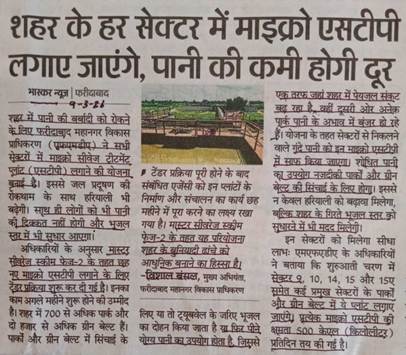
Faridabad Micro STP plan Faridabad Metro Development Authority has planned to set up a micro STP in each of the six city sectors where the currently untreated sewage will be treated to recycle for irrigating the over 700 local parks and over 2000 green belts. These parks and green belts currently use either drinking water or groundwater. Such water use will be curtailed if the micro STP plan succeeds.
Gurugram to get Rs 166-cr STP at Dhanwapur Gurugram Metropolitan Development Authority (GMDA) has initiated plans to set up a 100 MLD STP along with a main pumping station and a Bio-Compressed Biogas (Bio-CBG) facility at Dhanwapur. The project, estimated to cost Rs 166.96 crore, will be placed before the High-Powered Works Purchase Committee for approval. Officials said once the project is awarded, it is expected to be completed within 24 months. The contract will also include operation and maintenance of the facility for 10 years.
At present, the existing STP at Dhanwapur has a capacity of 218 MLD, which will increase to 318 MLD once the new plant becomes operational. The upcoming plant will use Sequencing Batch Reactor technology, considered an advanced wastewater treatment system capable of meeting the standards prescribed by the NGT. The treated water will be suitable for reuse in horticulture and other non-potable applications, helping reduce dependence on fresh water resources.
India’s ₹561 billion drainage push The 16th Finance Commission grant concentrates resources in few cities, enabling higher per-city investment in drainage and wastewater infrastructure. The special infrastructure component grant is one of the most targeted urban water investments in recent years. It allocates ₹561 billion for drainage and wastewater upgrades across 22 cities with populations of one to four million.
The grant focuses on both wastewater and stormwater. This is an opportunity for cities to focus more on stormwater since wastewater was also covered under many previous schemes. Flooding, despite its growing frequency, has rarely received structured attention. Drainage funding has therefore tended to be reactive — desilting after heavy rains, rebuilding collapsed stretches, or constructing isolated ward-level drains.
A 2019 estimate by the Ministry of Housing and Urban Affairs states that only 20% of the country’s urban road network is covered by stormwater drains. In Hyderabad, approximately 1,300 km of stormwater drains serve a road network exceeding 9,000 km. In smaller cities, coverage is often lower. Flooding, therefore, is not just about extreme rainfall, but about incomplete networks.
Few cities have comprehensive maps showing how rainwater, sewage, and natural channels connect across the entire city. Even large metros struggle: the Comptroller and Auditor General (CAG) found that Bengaluru lacks a single reliable, citywide inventory/as-built record of its stormwater drains (with sewage routinely mixing in), while Chennai has mapped only ~15% of its stormwater network, leaving connectivity and capacity unclear. These gaps are more prevalent in mid-sized cities. CAG’s audit across Odisha’s municipal corporations noted the absence of stormwater drainage master plans and major sewerage gaps feeding flooding and untreated discharge. As a result, projects are typically taken up one neighbourhood at a time, without fully understanding downstream effects. So, widening or rebuilding a drain in one area often pushes water to another. The problem shifts; it does not disappear.
An example of alternative: Consider Portland, United States, where SW 12th Avenue Green Street transformed an ordinary asphalt road into a living stormwater system. Kerbside vegetated planters now capture, clean, and slow runoff, managing about 180,000 gallons of stormwater runoff annually and reducing peak flow by over 70%. Research from São Carlos in Brazil, whose tropical climate and prolonged monsoon season mirror conditions in many Indian cities, offers similar lessons. Bioretention basins installed along asphalt roads, composed of layered soil and gravel topped with light planting, have been shown to capture on average 65% of annual runoff.
Cities need to move away from fragmented, project-based interventions and adopt an integrated street–nallah–wetland approach, ensuring clear separation of stormwater, sewage, and drinking water systems to reduce flooding and contamination risks.
The intensity of funding per city and per capita is therefore far higher than under earlier missions. If distributed evenly across the population, cities such as Pune, Jaipur, and Lucknow could receive upwards of ₹40 billion, while Madurai, Raipur, and Jodhpur could receive around ₹15 billion.
WATER POLLUTION
Water pollution in Rajasthan canals comes from Punjab, minister tells Lok Sabha The matter pertaining to the source of pollution in water bodies in two districts of Rajasthan, raised in the Lok Sabha, ended up in finding fault with industrial and municipal waste being dumped from Punjab.
“To prevent illegal discharge of contaminated water by industrial units and municipal bodies of Punjab into the Satluj and Buddha Nala, which is ultimately supplied to Sriganganagar and Hanumangarh districts in Rajasthan through canals, Rajasthan State Pollution Control Board (RSPCB) took up the matter with Central Pollution Control Board (CPCB) and Punjab Pollution Control Board (PPCB) for taking strict action against defaulting industrial units upstream,” read the reply tabled by Union minister for environment, forest and climate change (MOEFCC) Bhupender Yadav in Lok Sabha in response to a question on March 09.
Climate change-driven contaminants in water Climate change creates multiple pathways of water contamination. Here we call for defining climate change-driven contaminants as a distinct class and explore their implications.
JJM/ RURAL WATER SUPPLY
MoJS launches Sujal Gaon ID The Union Minister of Jal Shakti, Shri C. R. Paatil on March 13 released the Sujal Gaon ID, a scheme‑based unique digital identifier that enables complete digital mapping of rural piped water supply assets. For the first time in the country, every rural drinking water scheme is being assigned a digital identity, bringing the rural water supply system onto a unified national platform. So far, 1.64 lakh Sujal Gaon IDs across 31 States/ UTs have been created, linked to 67,000 Sujalam Bharat IDs. Each Sujalam Bharat ID integrates the scheme’s infrastructure ID and service area ID, creating a comprehensive digital footprint of rural water service delivery.
Shri Kamal Kishore Soan, AS&MD, NJJM presented on reforms in JJM 2.0 and modalities for fund release. The Mission’s total financial outlay has been increased from ₹3.60 lakh crore to ₹8.69 lakh crore, reaffirming the Government’s commitment to strengthening rural drinking water services across the country. The focus of the next phase will be on the quality of infrastructure and the effective operation and maintenance of rural piped water supply schemes. Emphasizing “Jan Bhagidari”, the Mission will strengthen community participation and local ownership to ensure long‑term functionality.
Centre sets conditions for states to receive JJM funds Days after the Union Cabinet approved extending the Jal Jeevan Mission (JJM) until 2028, the Centre has set four conditions that must be fulfilled by the states to receive funds, putting safeguards amid concerns over irregularities in the implementation of the rural tap water scheme. These include: signing the Memorandum of Understanding (MoU); creation of Sujal Gaon IDs to ensure complete digital mapping of all rural water supply schemes; timely financial reconciliation, and notification of State operation & maintenance (O&M) policies,” said an official.
The official said that the Centre has shared a copy of the MoU with all the states and UTs and they have been asked to sign the same as soon as possible so that funds can be released on time. Some of the states including Madhya Pradesh, Rajasthan and Uttar Pradesh expressed their willingness to sign the MoUs soon, said the official.
The official said that states have been told clearly that the Centre will release funds upfront only in case of single village schemes (SVS) under the JJM. In case of multi village schemes (MVS) the Central funds will be released only after reviewing the Detailed Project Reports, the official said. However, in case of those MVS which are in quality affected or water scarcity areas, a relaxation will be made, the official added.
On March 10, the Union Cabinet approved an additional allocation of Rs 1.51 lakh crore for the JJM till 2028. The scheme will now have an overall outlay of Rs 8.70 lakh crore till 2028. Of this amount, the Centre’s outlay will now be Rs 3.59 lakh crore, including Rs 2.08 lakh crore allocated in 2019.
JJM to undergo upgrade The Cabinet will shortly take up restructuring the Jal Jeevan Mission under JJM 2.0, aiming to correct these distortions while building a locally accountable governance structure for the scheme that has already made big headway.
The revamp will shift responsibility for single-village schemes to Gram Panchayats, link funds to actual water delivery and route operations and maintenance (O&M) money directly to villages. State governments will handle large regional projects.
Fund flows to states under the existing mechanism have slowed sharply, with only Rs 31 crore released until February 12, 2026. JJM 2.0 is expected to drive spending under the Rs 67,670 crore allocation proposed for FY27.
WATER
Why climate change will empty your tap before it floods your street Research from the Council on Energy, Environment and Water documented rainfall shifts across 55 per cent of India’s tehsils between 2013 and 2022. Dry states such as Rajasthan, Gujarat and central Maharashtra received 10 to 30 per cent more southwest-monsoon rain than in the three preceding decades. But around 11 per cent of tehsils, concentrated in the agriculturally critical Indo-Gangetic plains, saw rainfall fall by more than 10 per cent.
More rain somewhere and less elsewhere sounds like balance. It is not. Extreme rainfall events above 150 mm per day increased by 75 per cent in central India between 1950 and 2015. Dry spells within the monsoon, those stretches of days or weeks mid-season when the rain simply stops despite it being peak monsoon, grew by 27 per cent between 1981 and 2011.
Nearly half of the season’s total rainfall now lands within 20 to 30 hours. Rain that arrives that fast does not recharge aquifers. Groundwater recharge is a slow process. Water needs time to seep through layers of soil and rock before it reaches the water table below. When rain hammers down in a single violent burst, the ground simply cannot absorb it quickly enough. It runs off, floods roads, sweeps away topsoil and rushes into drains. The aquifer beneath gets almost nothing. So a farmer in Maharashtra can watch his fields flood in July and still find his borewell dry by March. The annual rainfall total looks fine on paper. The ground tells a different story.
AGRICULTURE
After Punjab floods, emergence of unfamiliar weeds worry PAU scientists Expressing concern over the long-term impact of floods on soil health, the Punjab Agricultural University (PAU) has deputed teams of scientists to survey areas in Gurdaspur and Amritsar districts following reports of unfamiliar weeds sprouting in wheat fields. According to PAU, several farmers have reported the appearance of weeds grown along with the wheat crop that were never witnessed in the region earlier. Scientists have been asked to conduct field surveys, collect samples and document the type of weeds.
A study conducted by PAU’s Department of Soil Science in flood-affected villages across Amritsar, Gurdaspur, Ferozepur, Kapurthala and Patiala districts last year found that the deluge had altered farmland conditions in multiple ways. The study also revealed large variations in sediment depth, texture and composition across fields. In some areas, sand and silt deposits exceeded one metre in depth, while others had thinner layers.
MONSOON 2026
El Nino likely to affect monsoon, summer WMO Global Producing Centre last week’s forecasts indicate the chance of an El Nino increases steadily to around 40% during May-July period. “El Nino is expected to develop by the second half of the season. As the current predictions suggest it could be a moderate El Nino. However predictions at this time have large uncertainties. Better idea about El Nino will be known by June,” Madhavan Rajeevan, former secretary, ministry of earth sciences, said. El Nino refers to the periodic large-scale warming of the ocean surface temperatures in the central and eastern equatorial Pacific Ocean, coupled with changes in the tropical atmospheric circulation, including changes in winds, pressure and rainfall patterns. El Nino year usually negatively impacts rains during the monsoon and makes the summer warmer.
US National Weather Agency: El Nino to set in by June The latest update from the US national weather agency says El Nino, the weather condition linked to deficient monsoon rains in India may set in as early as the June-Aug trimester, with a one-in-three chance that it would go on to develop into a strong event. The update released on Thursday by Climate Prediction Center under the US National Oceanic and Atmospheric Administration predicted a 62% chance of an El Nino emerging by June-Aug – corresponding with the Indian summer monsoon – rising to over 80% in subsequent months. This is a significantly higher probability than the agency’s previous update on Feb 12, which had given a 52% chance of an El Nino setting in by July-Sept, rising to around 60% in later months.
Since 1980, there have been 14 El Nino years, of which nine have corresponded with deficient monsoons in India with rainfall at least 10% below long period average. In another year, 2018, the monsoon was close to deficient at -9.4%. “The connection between El Nino and poor monsoons in India is strong, although there have been exceptions. The most notable example is 1997, when the monsoon was normal despite a super strong El Nino,” M Rajeevan, former Secretary, Ministry of Earth Sciences said. In 1997, a strong positive phase of what’s known as the Indian Ocean Dipole (IOD) is known to have counteracted El Nino. IOD is a measure of the temperature difference between surface waters in the ocean’s east and west regions. Forecasts suggest IOD is likely to be positive this monsoon.
European Centre for Medium-Range Weather Forecasts predicted a more rapid warming of the Pacific with a possibility of a very strong or ‘super’ El Nino later this year, potentially setting the stage for unprecedented heat waves.
El Niño Coming This Summer: NOAA Update Believe it or not, we have generally been in a La Niña or neutral phase of the El Niño Southern Oscillation Index (ENSO) for most of the last 10 years. Since 2017, there was an El Niño during the winter of 2018 before switching to a neutral phase until the spring of 2020, when we returned to a La Niña phase.
After this, we actually stayed in a La Niña all the way to the winter of 2023 before returning to a neutral phase. El Niño again began to occur in the summer of 2023, lasting through to the late winter of 2024. That event led to much above average temperatures across the Midwest and wetter than average conditions in the Plains. We then largely returned to a La Niña ever since. Models are all but confirming that El Niño is coming, but the severity and longevity are still being locked down.
Expert flags El Nino risks for 2026 Climate scientist Dr M N Rajeevan has warned of a possible strong El Nino event in 2026 that could affect India’s monsoon. However, a positive Indian Ocean Dipole may partly offset its impact and help maintain near-normal rainfall. India’s Monsoon Mission Climate Forecast System has projected the transition to ENSO-neutral conditions to take place during Feb-April.
What is Super El Niño? A super El Niño is an extremely strong El Niño event, where sea surface temperatures in the central-eastern equatorial Pacific (Niño 3.4 region) rise at least 2.0°C above the long-term average for three consecutive months. It causes global weather disruptions like heavy rains, droughts, floods, and heatwaves, far beyond a regular El Niño. Some famous examples include 1982-83, 1997-98, and 2015-16, which increased hurricanes & crop failures worldwide.
FLOOD
Household-level flood loss assessment 2024 This assessment covered 2,290 households across 134 wards in 21 panchayats spanning seven severely affected districts – Pashchim Champaran, Sitamarhi, Darbhanga, Madhubani, Saharsa, Supaul, and Kishanganj. These sites were purposively selected to represent diverse flood conditions and spatial contexts.
ENVIRONMENT GOVERNANCE
Centre notifies to set up new body to fast track ECs The Union government has decided to set up a standing body on environment impact assessment which will appraise projects when state level impact assessment authorities are non-functional — a move aimed at fast-tracking environmental clearances for projects. The body will also discharge other tasks as may be entrusted to it by the Centre from time to time, the union environment ministry said in a draft notification issued on March 5. The standing body will have a similar structure like SEIAA/SEAC and will be called Standing Authority on Environment Impact Assessment (SAEIA) or Standing Committee on Environment Impact Appraisal (SCEIA). The draft states that the authority “may also be authorised to consider the projects that are delayed at the SEIAA/SEAC level”.
Legal experts have raised concerns and called for more oversight. “The expert appraisal committees – both at the Central and State level – perform an extremely crucial role in the environmental clearance process. This is the only stage in the process where independent experts properly scrutinize the project proposal and related documents, undertake site visits, and ask for additional information where necessary,” said Shibani Ghosh, Advocate-on-Record, Supreme Court of India.
Institutional delays or bypass environmental scrutiny? Although framed as a procedural reform aimed at administrative continuity and addressing delays in appraisal when SEIAA and SEAC bodies lapse, the amendment reflects a deeper institutional shift. When placed alongside the original design of the EIA framework and the evolution of environmental jurisprudence in India, the proposal suggests a gradual transformation in the way environmental decision-making is being structured.
The 2026 amendment introduces a markedly different institutional logic. Instead of focusing on strengthening the constitution and functioning of expert committees, the amendment establishes standing authorities whose principal function is to ensure that environmental clearance decisions continue even when those expert bodies lapse.
The draft states that these new bodies may consist of “ex-officio members as deemed appropriate by the Central Government,” a formulation that contrasts sharply with the detailed qualification and expertise requirements prescribed for expert appraisal committees under Appendix VI. Where the earlier framework prioritised the integrity, disciplinary diversity and continuity of expert institutions, the amendment places greater emphasis on maintaining the uninterrupted movement of project approvals by sidelining the central role of expert appraisal bodies in environmental decision-making.
A day after notifying the draft, the ministry on Mar 6 issued a separate office memorandum (OM) on guidelines to be followed by states while sending proposals for re-constitution of state-level environment impact assessment authorities and expert appraisal committees. It directed the states that the process for finalising proposals for re-constitution of state-level panels may be initiated “well in advance” so that the proposals, complete in all respects, may reach the ministry at least six months prior to expiry of the terms of state bodies.
Environmentalists move SC to cancel EC for Kozhikode–Wayanad twin tunnel The Wayanad Prakrithi Samrakshana Samithi (WPSS) on March 10 moved the Supreme Court seeking to revoke the environmental clearance granted for the proposed twin tunnel connecting Anakkampoyil in Kozhikode with the Kalladi region near Meppadi in Wayanad. The petition comes days after Chief Minister Pinarayi Vijayan inaugurated the rock excavation phase of the project on March 06.
SC closes MC Mehta’s PIL on Delhi pollution after 40 yrs The court noted that the proceedings had involved continuous mandamus for nearly 40 years, resulting in numerous directions on environmental issues.
CLIMATE CRISIS
ISRO study: Dharali disaster due to Glacier Collapse, not cloud burst In a recent study, scientists from the Indian Space Research Organisation (ISRO) have pinpointed that the Aug 2025 devastating flash flood in Dharali in Uttarkashi that led to significant damage and loss of life, was triggered by the sudden collapse of an exposed ice patch within the nivation (erosion of the ground beneath and at the sides of a snow bank due to alternate freezing and melting) zone of the Srikanta Glacier.
Researchers Giribabu Dandabathula, Omkar Shashikant Ghatage, Subham Roy, Apurba Kumar Bera, and Sushil Kumar Srivastav from ISRO used satellite images, 3D terrain maps, and flood footage to trace the disaster from Srikanta Glacier’s slopes to the village 9.2 km away over a 2,500-meter drop. In the high “nivation zone” – bowl-like spots above 5,200 meters where snow sticks on north-northeast slopes of 25-35 degrees – warming stripped away protective snow by June-July 2025, exposing a 0.25 square km ice patch unseen in 15 prior summers. This non-flowing mass of snow, firn (granular snow), and ice (at least 0.3 meters thick, millions of kg) collapsed suddenly around August 5, with 80% clouds hiding full views. The break sent ice, water, and debris racing down steeper 35+ degree slopes, scarring fresh paths and grabbing old rock piles near the base. Channel widened downstream, banks eroded, and floods spilled into Dharali.
Seven months after the massive devastation, ISRO’s detailed satellite imagery analysis revealed sudden collapse of a massive, unstable ice patch as the trigger for the tragedy. It ruled out the possibility that the catastrophe was a conventional meteorological event. The ISRO report describes how around 6900 Tons of ice cascaded down the slopes. As this large mass of frozen material moved, friction transformed it into a high-speed mixture of ice and meltwater.
Satellite images from July 2025, before the incident, showed an exposed ice patch at an elevation of 5,220 metres, a feature not seen in 15 years of recorded data. Images taken after the event on August 12 confirmed that this patch had disappeared, leaving behind deep, fresh erosion scars on the slope. The report clarifies that the disaster was not a typical Glacial Lake Outburst Flood (GLOF), as no such lake existed in the upper catchment basin. Furthermore, rainfall data between August 3 and 5 recorded only light to moderate precipitation, ruling out cloudbursts. “The pattern of the flood, a sudden, high intensity surge followed by a prolonged, low intensity flow, is a hallmark of a mass release event,” the report reads.
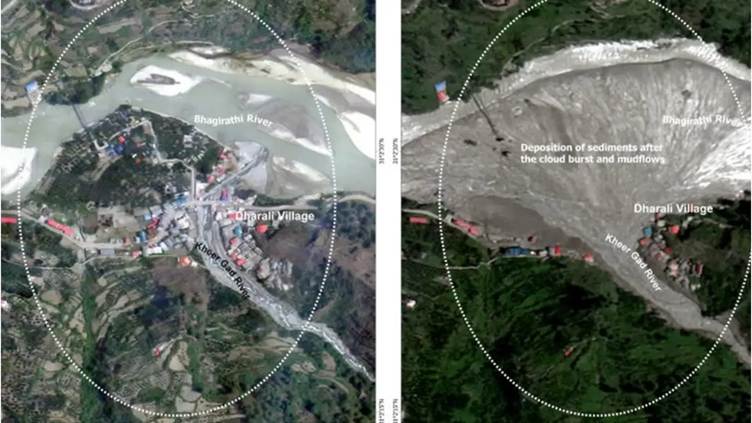
ISRO Scientists Uncover True Cause of Dharali Flash Flood: Ice Patch Collapse, Not Cloudburst | Image: ISRO
“This event represents an emerging class of cryo-hydrological hazards,” the scientists cautioned. The report also notes the limitations of optical satellites during the monsoon season, when cloud cover often hinders surveillance.
Research: Why Chamoli disaster killed 200, similar Switzerland disaster killed just one? An international team of scientists compared the two disasters and concluded that the contrasting outcomes were “not a matter of luck but the result of monitoring, early warnings, timely evacuation and coordinated risk management”. Their findings are in a paper: ‘Ice-rock avalanches in a warming Himalaya indicate pathways toward effective preparedness’, published in the journal Communications Earth & Environment. The study was conducted by Rayees Ahmed of the Indian Institute of Science, Bengaluru, Anshuman Bhardwaj and Lydia Sam of the University of Aberdeen in the UK and Lander Van Tricht of the Laboratory of Hydraulics, Hydrology and Glaciology (VAW) in Switzerland.
According to the research, the avalanche above Blatten (Switzerland) in 2025 was preceded by clear warning signs of slope instability. Swiss scientists monitored the mountain using instruments that track glacier movement, rock fractures, temperature changes and ground deformation. When these indicators showed increasing instability, authorities assessed the risk and ordered the evacuation of the village, which had about 300 residents at the time. When the slope eventually collapsed, most people had already moved to safety. “This coordinated approach, combining scientific monitoring, rapid communication and community response, prevented a large natural event from becoming a major human tragedy,” the authors said.
In contrast, the disaster in Chamoli unfolded without warning for communities downstream. At the time, there was little real-time monitoring of unstable slopes in the region and no effective early-warning system to alert people in the valley, the study noted. The research suggested that elements of the Swiss model could be adapted for the Himalaya. Satellite-based monitoring, combined with strategically placed ground sensors in high-risk valleys, could help identify unstable slopes, while stronger communication systems would ensure that warnings reach communities quickly. “The rising frequency and complexity of cryospheric hazards in the Himalaya highlight the need to shift from reactive disaster response to proactive risk management and anticipatory governance, similar to the integrated risk management model used in Switzerland,” the authors concluded.
They added that many glacier-fed valleys in the Himalayan region still rely on outdated hazard zonation maps, while environmental impact assessments for infrastructure projects often fail to adequately consider cryospheric slope failures, including permafrost thaw and cascading hazards. The Sikkim disaster in Oct 2023 and Dharali disaster in Aug 2025 showed that there is little change on ground in India.
THE REST OF THE WORLD
What happens when mining dams burst? While tailings dams are theoretically built to last for ever, more extreme weather driven by the climate crisis has changed the risk profile of many structures. Flooding, intense rainfall and other weather extremes mean that many of them are more unstable, according to experts, increasing the risk of future disasters. They do not just go away. They have to be maintained in perpetuity … we’re leaving our descendants huge piles of waste
Analysis produced for the Guardian by researchers Tim Werner and Victor Wegner Maus, who have played a leading role in establishing the true scale of the mining industry around the world, found that at least 108 tailings dams are situated in key biodiversity areas around the world, although this is probably a significant underestimate due to data limitations. This is about 5% of known tailing facilities on the Global Tailings Portal database.
In 2019, 272 people died near Brumadinho, Brazil, when a tailings dam burst, releasing a torrent of mud on to a mineworkers’ canteen and communities below. Four years earlier, another burst dam in Mariana, Brazil, killed 19 people, spreading pollution along more than 400 miles of river and watercourses. The breach brought widespread ecological devastation, increasing the extinction risk of 13 aquatic species and negatively impacting 346, according to later studies.
The impact of tailings dams on the environment can last for decades, often with disastrous consequences for nature. Heavy metals do not degrade over time and can evolve into many poisonous forms, accumulating up food chains, inhibiting plant growth and altering populations of soil microbes.
Ten longest rivers in the World Even today, the longest rivers in the world are the major ecological and economic routes on the planet. From the Amazonian rainforests to the African plains, from the Siberian snows to the Middle Eastern deserts, the longest rivers are the major routes that cover hundreds of kilometers and several nations.
SANDRP
Also see: DRP 09 March 2026 & DRP 02 March 2026
Follow us on: www.facebook.com/sandrp.in; https://twitter.com/Indian_Rivers

 SANDRP