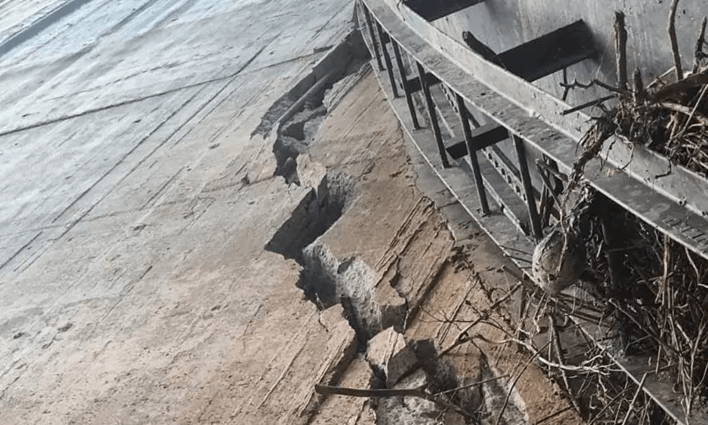
(Feature Image: Cracks in Medigadda barrage structure. Source: DC, Jan. 2024)
The recommendation of Nation-wide audit of Dam Safety in India in the editorial in Deccan Herald, following International Conference on Dam Safety in Bangalore on Feb 12-13 is very important and timely, the only added proviso required is that the audit must be independent. Dam Safety is essential for public safety and how can this objective be achieved if everything related to dam safety is shrouded in secrecy, with entry to all work and meetings restricted to what the government describes as experts, mostly govt officials, current and retired.
The aging dam infrastructure and the fact that 85% of India’s about 6600 specified dams are earthen dams adds urgency to this task. The rapidly increasing impacts of changing rainfall pattern on the probable maximum precipitation and probable maximum inflows have made the spillway capacities of existing dams out dated, but this aspect needs urgent re-assessment for each dam. This along with the reduced storage capacity of the dams due to siltation means that the rule curve also needs urgent reassessment for each dam. But under India’s pathetic dam regulation under the Central Water Commission, Rule curves are state secrets! No dam or dam operator has ever been held accountable for violation of rule curve that leads to avoidable floods. This happens every year for numerous dams.
But our governments or governance systems seems totally disinterested in any of these. One hopes changes come before we face major disasters, not after it.
Dam safety: Time for a nationwide audit India has over 6,600 specified dams, the world’s third-largest dam-owning nation. Of these, about 1,100 are already over 50 years old, and more than 220 have crossed the 100-year mark. By 2050, nearly 80% of India’s large dams will be past their intended design life. Karnataka has 231 specified dams. Nearly 70% of them are over 25 years old, while over 40 major structures are already past the 50- year threshold. Icons such as Vani Vilasa Sagar (119 years), Krishna Raja Sagar (95 years), and Tungabhadra (73 years) underline both the state’s engineering legacy and its present vulnerability.
The dams face four interlinked dangers. First, structural fatigue and ageing of mechanical systems such as gates & hoists, many were designed for a 50-year life. This risk was starkly illustrated in 2024 at the Tungabhadra Dam, where a crest gate was washed away after a chain link snapped.
Second, reservoir sedimentation has robbed dams of significant storage capacity, reducing their ability to manage floods or droughts. Third, climate variability, where extreme rainfall routinely exceeds the assumptions under which these dams were originally designed. Fourth, contemporary risk of cybersecurity, whereas dams adopt digital controls and automated gates, they become potential targets for technological sabotage.
The Karnataka CM’s emphasis on cooperative federalism was equally pointed – he called for shared safety standards across river basins. This was coupled with a push to replace episodic, manual inspections with continuous digital monitoring, including real-time dashboards, remote sensing, and structural health systems.
Systematic monitoring, scheduled modernisation, climate-resilient redesign, and credible emergency action plans for downstream communities should be non-negotiable. This must begin with a nationwide audit of all specified dams without waiting for a catastrophe. This necessitates that the Centre and states act as partners, moving beyond jurisdiction-based friction to embrace a model of cooperative federalism where safety standards are unified across river basins.
Dams were once called the temples of modern India. As they age, maintaining them safely is no longer just about irrigation or power, but also about safeguarding lives and livelihoods.
International Conference on Dam Safety 2026 The two-day International Conference on Dam Safety (ICDS) 2026, which commenced on 13th February 2026 with a high-level inaugural and plenary program, followed by technical and industrial sessions that set the strategic context for the conference deliberations, concluded successfully after extensive discussions and knowledge exchange. Experts from government agencies, international organisations, academia, and industry shared evidence-based approaches and field-tested solutions aimed at strengthening the safety and sustainability of ageing water infrastructure.
Delivering the welcome address, Shri Sri Kulkarni noted that dam safety has moved beyond routine inspections to become a multidimensional challenge encompassing climate resilience, emerging technologies, regulatory frameworks, data-driven decision-making, emergency preparedness, and institutional strengthening. He highlighted that these critical themes were effectively addressed through the conference’s technical sessions, case studies, and policy deliberations.
Presenting the conference recommendations, Shri Subodh Yadav emphasised that with over 85 per cent of India’s dams being earthen, there is an urgent need for innovative and cost-effective armouring solutions to prevent catastrophic failures due to overtopping. He highlighted the importance of simplified dam break analysis and hazard assessment tools to support rapid, first-level planning across India’s large dam portfolio.
HYDRO POWER PROJECTS
Demwe Lower HEP given 11-year EC extension Sixteen years after granting environmental clearance (EC) to the 1,750 MW Demwe Lower Project on the Lohit River in Arunachal Pradesh, the EAC has now held that the EC will be valid for another 11 years, till 2037, on the grounds that the project was stuck in litigation for over 10 years. The EAC made this decision in its January 9 meeting, relying on a combination of notifications giving relaxations to hydel projects and a key October 2025 office memorandum (OM), which treats time lost to litigation in the National Company Law Tribunal (NCLT) or courts as ‘zero period’.
The panel, however, appears to have overlooked a key detail. The NGT matter—an appeal against the project’s forest clearance—did not merely stall the project, but culminated in the Tribunal setting aside the project’s wildlife clearance. It was this nod that formed the basis for the forest clearance. It directed the National Board of Wildlife to reconsider the issue, while suspending the forest clearance in the interim. The project was appraised and given wildlife clearance again in 2018.
The ministry’s 2025 OM, while rationalising time lost to litigation as ‘zero period’, is silent on whether this process should apply when judicial orders have struck down related project clearances. The EAC also suggested no fresh baseline environmental or biodiversity studies for the project, which is planned in the Lohit riverine ecosystem and upstream of the significant Hindu pilgrimage site Parshuram Kund.
Dibang HEP: Breakthrough in Diversion Tunnel 3 According to a statement issued in Itanagar on Feb. 18, the breakthrough of Diversion Tunnel-3 marks a significant step forward in the execution of the 2,880 MW Dibang Hydroelectric Project being developed by NHPC Limited. The final blast for the tunnel breakthrough was initiated by NHPC Director (Projects) Sanjay Kumar Singh on Feb. 17.
How local people are affected by Hydro push in J&K “While these projects are called ‘run of the river,’ supposedly with small storage, they entail large dams and tunnels, and some, like Baglihar and the proposed Sawalkot project, do have storage that can affect downstream flows,” said Parineeta Dandekar, a river researcher and associate coordinator at SANDRP. “None of the projects cleared so far violate the Indus Waters Treaty, but their environmental impacts in Jammu and Kashmir have been profound, on protected areas, forests, groundwater springs, river ecology, and downstream stability, particularly in a climate-stressed and politically sensitive basin like the Chenab.”
For families displaced by hydropower expansion, the consequences of climate stress and political conflict are already being lived, crack by crack, illness by illness, in homes that were never meant to replace the land they lost. As climate change accelerates and political trust erodes, the costs of treating rivers as strategic assets rather than shared lifelines are increasingly borne by those with the least power to shape decisions made upstream.
NHPC clears ₹5,700 cr investment for 2 HEPs in J&K In a regulatory filing, NHPC’s board on Feb. 20 said its board had approved the implementation of the 240 MW Uri-I Stage-II Hydro Electric project at an estimated completion cost of ₹2,708.95 crore. The cost includes ₹264.31 crore towards interest during construction (IDC) and a grant of ₹26.20 crore for enabling infrastructure, considering a start date of March 1, 2026.
Salal dam desilting process A tender has also been floated to disilt and reopen six under-sluice gates that were permanently plugged under the treaty’s provisions. Speaking to ANI, Anish Gauraha, Executive Director of the Salal Power Station, said, “after the suspension of the Indus Water Treaty we are working on an effective sediment management plan to improve the operational efficiency of the power station.”
He added, “It is difficult to say how much this will increase power generation, but it will certainly reduce wear and tear. Dredging is one of the key activities under the silt management plan. Through this, we aim to remove as much silt as possible to minimise damage. Plans are also being developed to reduce sediment through flushing.” Gauraha confirmed, “We have floated a tender to make the under-sluice gates operational, and work on that is underway.”
Officials said, “NOC has been issued for de-siltation of the Salal dam reservoir, and work already commenced. Till now, 1.7 lakh MT of sediments have been dredged out and 68490 MT disposed off.” Authorities are now working to further enhance reservoir capacity and strengthen sediment management to improve the plant’s long-term operational efficiency.
The reservoir’s original storage capacity of 284 million cubic meters (MCM) had drastically reduced to just 9.91 MCM, according to a May 2025 bathymetric survey. Following the suspension of the treaty and the start of desilting work, capacity has been restored to 14 MCM as of January 2026.
Officials said that a three-pronged plan is being undertaken for the first time after the suspension of the treaty last year. “We are working under an effective silt management plan to ensure the operational effectiveness of the power station. One of the activities under this is dredging, through which we are trying to remove silt from the dam,” Salal Power Station Executive Director Anish Gouraha said.
He said that the plan focuses on three key measures – dredging, flushing and under-sluicing to reduce sedimentation in the dam and improve power generation efficiency. To address the crisis, a no-objection certificate (NOC) was issued to Reach Dredging Limited, Kolkata, for the desilting of the Salal dam reservoir. “The work commenced on November 25, 2025,” the official said.
The firm has obtained permission from the J&K Department of Geology and mining for the disposal of one lakh metric tonnes (MT) of silt. “Of this, 1,77,802 MT has been dredged so far, while 68,490 MT has already been disposed of, “officials added.
In a parallel move, another NOC was issued on February 17 to Dharti Dredging and Infrastructure Limited, Mumbai. “Statutory clearances are under process, after which the work will commence,” the official said. Separately, a tender has been floated on February 9 to make functional the permanently plugged under-sluices. “The last date for bid submission is March 23,” the official added.
For the third component, under-sluicing, Gouraha said bids have been floated, and responses are being evaluated. “A final decision is yet to be taken, but this is also an integral part of our sedimentation management strategy,” he said.
The 22-kilometre-long reservoir created by the Salal dam on the Chenab River has faced high sediment inflows due to fragile geological formations, steep and unstable slopes, intense monsoon rains and frequent seismic activity in the region, the reports said. Taking this into consideration, Union Minister of Power and Housing and Urban Affairs Manohar Lal Khattar on January 4 directed sediment removal at the Salal project to ensure maximum utilisation of water resources, in the wake of the treaty being kept in abeyance between India and Pakistan.
Dredging is one way to take out the slurry from the dam and the company is already doing some work in Salal. For dredging, the issue is finding a market for the removed silt, another person said. As for under sluice installation, a structure designed to remove accumulated sediment, the company is in the tendering process though it has not decided any timeline for the work. “The status of the silt is not known as to whether it has become compact or is it loose. The core drilling to study the silt has begun,” the second person said. The dam and the power plants were built in phases in 1987 and 1994.
Assam CM sets 10-day deadline for 150 Mw Kopili HEP launch Addressing the House during the final Budget Session ahead of the Assembly elections, CM Himanta Biswa Sarma on Feb. 19 said the long-pending 150 Mw Kopili Hydro Electric Project would be completed within the next 10 days. Repair and restoration work to revive an additional 25 MW capacity at the Kopili plant is also underway. Sarma added that the government has taken up new solar initiatives and has also started a 25 MW hydropower project in Karbi Langpi.
Odisha: 4 PSPs worth Rs 29,949 cr approved Among the cleared proposals, Adani Hydro Energy Twelve Limited will invest Rs 9,731.47 crore to set up a project in Nayagarh district. Sangamam CD Hydro Consortium has secured approval for a Rs 9,000 crore pumped-storage project in Koraput. Similarly, Greenko OR01 IREP Private Limited will establish a project in Kalahandi with an investment of Rs 7,506.94 crore. In Deogarh district, Jindal Green PSP Two Pvt Ltd will develop a pumped-storage facility involving an outlay of Rs 3,711.56 crore.
DAMS
Mamallan Dam will damage backwater ecosystems A group of scientists, ecologists and conservation experts has urged Tamil Nadu CM MK Stalin to withdraw the proposed Mamallan reservoir project, warning it could cause irreversible damage to the Kovalam-Nemmeli backwater ecosystem. In a letter, the signatories, including contributors to national and global climate assessments, said scientific evidence shows the project would harm one of Tamil Nadu’s important coastal wetlands.
The experts stressed the Kovalam-Nemmeli backwaters function as a tidal marsh ecotone hydrologically connected to the Bay of Bengal through the Kovalam and Kokilamedu inlets, and are not an inland freshwater depression. Restricting tidal flow, they warned, would alter salinity, temperature and circulation patterns, ultimately limiting marine biodiversity. They noted the southern stretch near Mamallapuram remains ecologically healthy due to continued tidal inflow, while parts of the Nemmeli stretch already show early signs of degradation because of partial blockage by roads and bunds.
The group also flagged hydrological risks, stating that the project’s Environmental Impact Assessment attributes flooding in western villages to drainage bottlenecks along the Old Mahabalipuram Road and the Kelambakkam-Kovalam Link Road. The proposed reservoir does not address these choke points, they said, and constructing 4.5-metre bunds within a tidal floodplain could remove natural flood buffers and increase cyclone-related risks.
BBMB to initiate Bhakra Dam desilting The Bhakra Beas Management Board have invited expression of interest for removing silt from the Bhakra dam from two locations of the reservoir in Himachal Pradesh: Seer Khand in Una and Lunu in Bilaspur. It is estimated that about 150 MCM silt is removable from these locations. There is window of about five months when the silt can be removed as rest of the time the site will be under water. An agency working full time can extract maximum of 4-5 MCM silt.
A lot of the silt that have landed up in Bhakra dam is due to deforestation and blasting in the name of development and also dumping of muck into the river by the development projects including hydro projects and Highways. But there seems no attempt to identify these reasons, nor to fix accountability.
Shahpur Kandi dam nears finish J&K minister Javed Ahmed Rana on Feb. 16 said that the dam is expected to be completed by March 31 and is a priority for drought-prone Kathua and Samba districts. Officials said the project will irrigate about 5,000 hectares in Punjab and more than 32,173 hectares across Kathua and Samba in J&K. Central assistance of Rs 485.38 crore was approved for the irrigation component.
Mah issues work orders for two dams in MMR The Mah government has issued work orders for two dams in Karjat with a total storage capacity of 18.954 thousand million cubic feet (TMC). The Poshir dam, with a storage capacity of 12.344 TMC, will be constructed on the Poshir River in Karjat at an estimated cost of ₹6,394.13 crore. The 6.61 TMC Shilar dam will be constructed on the Shilar River in Karjat. “Concerned bidders will be responsible for acquiring forest land and requiring approval for it, and they will have to acquire private land through negotiations with locals.” said an official from the Water Resources Department.
The Poshir dam project will be handled by M/s Prasad HES Bekem, while M/s Mahalaxmi SEL will construct the Shilar dam. The estimated tender cost for the Poshir project is ₹ 2,135.97 crore and ₹1,667.65 crore for Shilar. Of the 12.344 TMC capacity at Poshir, 9.721 TMC will be live storage, including 7.933 TMC earmarked for drinking water and 1.859 TMC for industrial use. Water from the project will be supplied to Navi Mumbai, Ulhasnagar, Ambernath and Badlapur. The Shilar dam will provide drinking water to Panvel and Navi Mumbai municipal corporations.
Agenda of EAC be held on Feb 26 2026 – Cherue Close loop Pumped Storage Project (1200 MW) in 569 Ha at Village Dighia, Bahera, Dharan and etc., Sub Dist Robertsganj, Dist Sonbhadra, Uttar Pradesh by Adani Hydro Energy Six Ltd – Terms of Reference
URBAN RIVERS
Musi River-Hyderabad: “Rivers are not supposed to die because of our mistakes” The Musi could have been the defining characteristic of Hyderabad, as it was in history when it filled over 3,000 lakes, had 22 flood diversion channels, 14 public parks, and places of learning and social life along its course. But all this was lost when the authorities isolated water management from urban planning. “This is the fundamental flaw. Cities and rivers are co-existing systems…but we treat rivers as inert material,” says Dr BV Subba Rao, veteran geo-hydrologist, in this interview, while decrying contemporary riverfront development.
Musi Fact-Sheet The Musi, a tributary of Krishna River, bisects Hyderabad into old city in the south and new in the North. Of its 250 km long course, 55 km flows through Hyderabad. Area of Hyderabad has grown in less than a century from 55 sq km to 625 sq km, under Greater Hyderabad Municipal Corporation. It originates from Anantgiri hills, Vikarabad, Telangana. Entire course of the river is in Telangana, it merges with Krishna in Wazirabad, Nalgonda district.
‘We want the Musi cleaned but without displacing the people’ Once a lifeline of the city of Hyderabad, the Musi was home to thousands of people – mostly economically backward — living along its banks. The increasing pollution threatened their well-being; the demolitions, their very existence. While the unauthorised constructions must be done away with, there are critical questions of proper procedure and rehabilitation before the demolitions. As the ambitious Rs 1.5 lakh crore Musi Riverfront Development project takes shape around them, people wonder why they do not count. Shobha Surin.
The Musi was, and is, Hyderabad’s heritage and culture The story of the Musi is woven with that of the city. It, historically, had a riverfront with grand palaces, shamshaan ghats, Sati mounds, dhobi ghats, slums, and held immense cultural and historical significance. Bathukamma, the flower festival, was celebrated along its banks and Muharram processions culminated in the river. The industrialisation and urbanisation of Hyderabad has taken its toll. Despite its pollution, the Musi is remembered as the river that made the city possible. Its restoration is, therefore, not only an environmental project but a heritage endeavour.
What if the Musi River could lead the development of Hyderabad? The Musi, the pride of the city during the Nizam era, is a channel of filth, its banks encroached upon, its waters carrying untreated waste and industrial effluents, and its edges subjected to construction in the name of riverfront development. It’s the same old story but the Musi can be re-envisioned. If the river was placed at the centre of planning and development, determining how the city is built or rebuilt, it would be a different Musi. River-led city-making is the call Hyderabad must consider. (Smruti Koppikar and Shobha Surin)
Hyderabad: Locals oppose land surrender for Musi project The Musi Jan Andolan (MJA) has opposed what it termed the unilateral approach of the Telangana government in implementing the Musi Riverfront Development Project (MRDP). At a meeting on Feb. 16, residents from nearly 10 housing colonies along the Musi unanimously rejected a government notification initiating land surrender in exchange for Transferable Development Rights (TDRs). They declared they would not part with “even one inch” of land.
MJA said no authenticated river boundary maps or buffer zone demarcations have been made public. They demanded free and informed consultations, noting that many families are still paying housing EMIs and would face hardship if displaced. They further alleged that exemptions granted under Chapters II and III of the RFCTLARR Act, 2013, bypass mandatory Social Impact Assessment and public consultation. The group also opposed G.O. Ms. 921 and sought its withdrawal, insisting that the Detailed Project Report and official maps be placed in the public domain before any land acquisition proceeds.
The activists alleged that the government has maintained secrecy around maps relating to the Musi river boundary and buffer zones. They also objected to the Government Order issued on Dec. 16, 2025, which exempted the Musi and related projects from the application of Chapters II and III of the RFCTLARR Act, 2013. According to them, this exemption removes the requirements of social impact assessment, public consultation and expert appraisal. MJA contended that the project is neither a public purpose initiative nor aimed at ecological well-being of the river basin, but instead a mega real estate venture serving the profit interests of the State and private parties.
Residents oppose Gandhi Sarovar Project Land acquisition for the project has triggered a dispute with residents urging authorities to stop what they described as a forcible land acquisition drive. Some of the residents whose properties are affected by the land acquisition for the project told ‘Telangana Today’ that their concerns extend beyond the impact on their properties. They raised concerns about disappearance of green lung space, absence of a Social Impact Assessment (SIA) and an Environmental Impact Assessment (EIA), which they said are mandatory, and a lack of transparency and public opinion in the project’s implementation.
Revenue authorities issued a notification for land acquisition of MPR’s A and B blocks, as well as land of a dargah on the banks of River Musi. They gave notices to the MPR committee to hand over the 6.5 acres and accept Transferable Development Rights (TDRs). Residents also raise concerns about Defence land’s greenery, describing it as a carbon filter that purifies vehicular emissions and pollutants and provides oxygen to urban dwellers. They said it threatened ecological balance by depriving fauna of habitat and flora of land.
Farmers and flat owners raised objections over the proposed takeover of their properties. Notifications were issued this month to acquire areas of Kismatpur village of Gandipet mandal and Durgam Khalikhan village. Officials conducted a gram sabha and asked residents to submit objections in writing. “All objections will be forwarded to the government as per law,” an official said, adding that compensation would be provided in accordance with the Land Acquisition Act.
Residents arrived with placards, questioning the inclusion of their lands. They argued that the Musi river lies 500 metres away from some properties, while others are nearly 2 km distant. “There must be a limit to how much land is required. Our land is 2 km away. This feels like a land grab,” one resident said. Several expressed dissatisfaction over compensation. Another resident said the notification sought voluntary surrender even though the plots were legal and outside the FTL. “If it is for Musi development, do it within the buffer zone. This is only a beautification project. There is no need to take private lands,” he said. Officials confirmed that residents have sought higher compensation and assured that their concerns will be placed before the government.
Hyderabad hospitals poisoning water bodies? An ongoing scientific investigation has raised fresh concerns over the spread of antibiotic-resistant bacteria in Hyderabad’s drainage network, particularly in areas surrounding major hospitals. Researchers from the Centre for Cellular and Molecular Biology and the Tata Institute for Genetics and Society have found that sewage flowing from hospital zones into municipal drains and eventually into the Musi River carries a significantly higher diversity of drug-resistant organisms.
The study found that chemical cleaners and antibiotic traces are altering the natural microbial balance of water bodies, reducing oxygen levels and weakening the self-purifying capacity of rivers and streams. “These compounds accumulate in sediments and seep into groundwater, gradually affecting aquatic ecosystems,” said environmental microbiologist J Keshvani.
Environmental Concerns Shadow Pune RFD Project Residents and activists highlighted that the completed work on the stretch has destroyed riparian forests and riverine habitats. They allege that old native trees, natural undergrowth, bird habitats, and both aquatic and terrestrial ecosystems have been adversely affected. They have also pointed out the loss of natural floodplains that play a critical role in flood control, biodiversity conservation, groundwater recharge, and overall river health. They urged the Pune Municipal Corporation (PMC) to ensure that the remaining stretches of the RFD are executed in a more eco-sensitive and site-specific manner instead of adopting a uniform design along the entire river course.
Pune River Revival group has proposed key pointers for environmentally responsible riverfront development. These include the protection of existing riparian vegetation, limiting hard concrete surfaces, and prioritising soft, permeable, and nature-based solutions. They have recommended low-impact public access measures such as elevated boardwalks, viewing decks, birdwatching platforms, and designated “finger access” points instead of continuous embankment construction.
Beautification of Pune riverbanks In the name of riverside beautification, in the first phase of Pune, solid construction was done along the riverbank, removing the vegetation and destroying the habitats of birds, insects and animals. While opposing such further phases, conscious citizens of Pune have also suggested alternatives to this beautification.
RIVERS
Indus Valley Civilisation could be over 8,000 years old The Indus Valley or Harappan Civilisation of the Indian subcontinent could be over 8,000 years old, something which would make it more ancient than peers like Mesopotamia (modern-day Iraq), Egypt or China, a new paper has claimed. The authors of the paper reached the conclusion after performing radiocarbon dating at Bhirrana in Haryana. Bhirrana was part of a high concentration of settlements along the dried-up bed of the river known as ‘Saraswati’ in the Vedas. It is identified with the Ghaggar-Hakra river system today.
“Isotope and archaeological data suggest that the pre-Harappans started inhabiting this area along the mighty Ghaggar-Hakra rivers fed by intensified monsoon from 9 to 7 ka BP. The monsoon monotonically declined after 7 ka yet the settlements continued to survive from early to mature Harappan time. Our study suggests that other cause like change in subsistence strategy by shifting crop patterns rather than climate change was responsible for Harappan collapse,” the authors note.
Meghalaya: NGT forms panel to probe damage to Myntdu river The NGT has constituted a high-level Joint Committee to investigate allegations of ecological damage caused to the Myntdu river in West Jaintia Hills district due to indiscriminate dumping of construction debris during road works undertaken by the Public Works Department (PWD). The NGT constituted the panel after hearing the Original Application (OA) No. 1271/2024, registered based on a June 25, 2024 letter petition submitted by Khroo Lamsalanki Pariat and several others.
The petition raised concerns over large-scale dumping of muck generated during road construction in the hillocks, adjacent to Myntdu, allegedly causing serious damage to river hydrology, aquatic life, flora and fauna. The matter was taken up under Sections 14 and 15 of the NGT Act, 2010 through the tribunal’s suo motu jurisdiction, in view of the law laid down by the Supreme Court in the Municipal Corporation of Greater Mumbai Vs Ankita Sinha case.
In its latest order issued on February 4, the tribunal directed the constitution of a Joint Committee. The matter has been listed for further proceedings on March 11, 2026, when arguments on pending applications will also be heard. The Chief Engineer has been exempted from personal appearance on future dates unless directed otherwise.
NGT questions move to treat Assi river as drain The NGT has raised serious concerns about the Centre and Uttar Pradesh government’s approach to cleaning the Ganga, citing the continued discharge of untreated sewage and industrial waste into the Ganga and its tributaries in Varanasi. During a hearing on February 5, 2026, the tribunal said that permanently tapping stormwater drains to divert sewage was neither legally permissible nor environmentally sound.
According to the state plan submitted by the Uttar Pradesh government, a total of 76 drains in Varanasi and Chandauli flow into the Ganga and Varuna rivers. Of these, 33 drains flow into the Ganga — 26 fully tapped and seven partially or untapped. A further 43 drains flow into the Varuna, with 19 tapped and 24 either partially tapped or untapped. The tribunal noted that 31 partially or untapped drains continue to discharge untreated domestic sewage, describing this as a serious concern. The tribunal stressed that making stormwater drains a long-term solution would violate environmental principles.
A key issue in the hearing was the classification of the Assi (Nagwa) river. The state plan described the Assi as a “drain” and proposed tapping it. The NGT clarified that the Assi is a tributary of the Ganga and that the River Ganga (Rejuvenation, Protection and Management) Authorities Order, 2016 prohibits the tapping of tributaries.
Although the state government said it had received permission from the NMCG, the tribunal has now asked the agency to explain how such approval was granted in light of the 2016 order. The Uttar Pradesh government and the NMCG have been directed to submit a detailed progress report within six weeks. The next hearing is scheduled for April 21, 2026.
NGT orders Suav to be restored as a river in official records The NGT has directed the Uttar Pradesh government to correct official records and restore the Suav’s status from a “drain” to a “river” in the revenue records and gazetteer, warning that failure to comply could attract punishment under the law. The order follows a petition challenging the classification of the Suav — a major tributary of the Rapti river in Balrampur district — as a nullah (drain). Environmentalists argued that treating rivers as drains in official documents risks erasing their ecological and historical identity for future generations.
The bench, led by NGT Chairman Justice Prakash Srivastava, passed the order after considering a letter petition dated April 20, 2022 by Pateshwari Prasad Singh, chairman of the environment, forest and wildlife conservation committee of Balrampur district. The petition was treated under the tribunal’s suo motu jurisdiction, citing the Supreme Court judgment in Municipal Corporation of Greater Mumbai vs Ankita Sinha and others.
Petitioners referred to a 1906 publication Gonda: A Gazetteer, which described the Suav (then referred to as Suwawan) as a significant tributary of the Rapti River. The Suav River plays a vital role in controlling and mitigating floods generated by the Rapti River during the monsoon. It fills dozens of wetlands, lakes and ponds along its roughly 120 kilometre course before joining the Rapti, itself a tributary of the Ganges. Petitioners argued that its conservation and restoration are crucial for regional environmental stability.
The plea described how Balrampur, formerly part of Gonda district, once had four rivers — the Rapti, Suav, Kuana and Besuhi. The petitioner has further alleged that the government is now reinforcing this transformation by constructing the STP and a community hall on the riverbed, and by filling adjoining drains.
The plea stated that such construction must be halted as it poses serious environmental risks and threatens the lives and safety of residents of Balrampur and Bhagwatiganj. It also cites judicial precedents — including the case relating to dumping waste into the Nala Rani River in Rajasthan – where courts have intervened to stop environmentally harmful construction activities.
The bench warned that non-compliance with its order would constitute an offence under Section 26 of the National Green Tribunal Act, 2010. The NGT also directed the NMCG to review proposals related to STPs and Suav river rejuvenation submitted by the Uttar Pradesh government. Nodal officers from the state’s Urban Development Department and the District Ganga Committees are to coordinate with the NMCG on these proposals.
Microplastics in Yamuna river & floodplain There is “widespread contamination” linked to microplastics in Yamuna, open drains, floodplain soil and even groundwater before monsoon rains hit, a first-of-its-kind scientific investigation has revealed. The ‘Study on Microplastics in River Yamuna and Groundwater in Delhi (2024–25)’, led by Dr. Nupur Bahadur, was commissioned by Delhi govt and conducted by The Energy and Resources Institute (TERI) across 49 locations.
The findings show that while the monsoon brought respite to the river’s flowing waters, it may be shifting the pollution burden onto land. Microplastic concentrations in the Yamuna averaged 6,375 particles per cubic metre in the pre-monsoon period (May–June 2024), but fell to 3,080 particles per cubic metre after the rains (Dec 2024–Jan 2025), a nearly 50% drop. Open drains such as Najafgarh and Shahdara recorded an even steeper 60% reduction — from about 7,500 particles per cubic metre to 3,000 particles per cubic metre. Researchers said the decline is because of rainfall-driven dilution and flushing.
The study also identified 10 major vulnerability zones across the city, including Najafgarh, Tilak Nagar, Saket–Vasant Kunj, Kalkaji, Karol Bagh, Naraina, ITO Barrage, Okhla, Ghazipur and Bhalswa—areas characterised by dense residential clusters, industrial activity, landfill sites and medical facilities.
While there are no specific guidelines or global standards, experts said the volumes found were high and hazardous. “There are standards for total dissolved solids, but there is no specific standard for microplastics in water or soil. What goes into the human body can go through water, food and airas well. It causes a tremendous amount of harm,” said Satish Sinha, from Toxic Links.
Yamuna cruise: Lxury ride or ‘dystopia tour’? Delhi is launching a Rs 20-crore Yamuna cruise project, offering recreational rides to boost tourism and green mobility. While authorities promote it as a luxury experience and part of river rejuvenation, critics and environmentalists argue it’s a “dystopia tour” that will merely showcase a polluted river and mislead the public about its worsening condition.
Inspection of 60 Sonepat units At a meeting of the River Rejuvenation Committee (RRC), the Haryana Chief Secretary directed officials to reduce the pollution load in the Yamuna. A special committee was formed to monitor 11 drains across the state that flow into the river. A study found that industrial units were a major contributor to pollution, discharging untreated effluent into drains. Untreated sewage was also reaching the Yamuna. To address the issue, members of the Special Environment Surveillance Task Force (SESTF) recently carried out a surprise inspection of 60 industrial units in Sonepat district in a single day.
11 drains in Haryana flow into the Yamuna. These include the Dhanaura drain in Yamunanagar; Drain 2 in Panipat; Drain 6 and Mungeshpur drain in Sonepat; KCB drain; Drain 8 in Bahadurgarh in Jhajjar district; Leg-1, Leg-2 and Leg-3 drains in Gurugram; Budhiya Nala in Faridabad; and Gaunchi drain in Ballabgarh/Palwal. In Sonepat, the Mungeshpur drain and Drain 6 merge into the Yamuna through the Najafgarh drain. According to the Haryana State Pollution Control Board (HSPCB), the Biological Oxygen Demand (BOD) levels in almost all these drains exceeded permissible limits, indicating the discharge of untreated sewage and industrial effluent.
Human health implications of metal pollution in Betwa-Yamuna river system This study demonstrates that the Betwa–Yamuna confluence is affected by significant water quality degradation, with As persistently exceeding WHO drinking-water guidelines and driving both non-carcinogenic and carcinogenic health risks. Seasonal controls exerted a strong influence on contaminant behaviour, with the highest metal concentrations occurring during pre-monsoon and winter low-flow periods, when dilution capacity is reduced. These results collectively show that untreated river water at this confluence presents a persistent and seasonally amplified public-health concern. This study therefore provides a critical health-risk baseline for northern Indian river confluences and offers a scientifically rigorous platform for evidence-driven water safety policy and long-term mitigation planning.
RIVERS BIODIVERSITY
Give otters their riverbanks with sand and grass Field studies show that otters value things we often disregard. Firstly, otters need clean water. When we look at water, we think of a resource, to be piped and poured. But water is a habitat too; and clean water, unpoured with effluent and chemicals, is a better habitat. Secondly, otters require food that we too covet—fresh fish. Conflict is rampant and needs handling and quick compensation. Thirdly, otters are impacted by human industry—much of it unseen by the final consumer. Dams on water, and legal and illegal sand mining serve some in various ways, but deprive the mammals of their very right to exist.
As we build along and over rivers and pour chemicals into them, it is also worth remembering that both water and the banks belong not just to us, but to animals that are already besieged by other threats. But we are the ones with the agency to change this state of affairs. And we can and should conserve more wildlife and otter stretches on rivers and wetlands. (Neha Sinha)
SAND MINING
Karnataka HC seeks govt reply in 4 weeks The High Court on Feb. 20 granted four weeks’ time to the state government to file its response to a suo motu PIL initiated regarding alleged illegal sand mining being carried out in rivers across the state. A Division Bench of Chief Justice Vibhu Bakhru and Justice C M Poonacha posted the matter for further hearing on April 7.
On January 31, a division bench of the high court directed registration of the suo motu PIL over the alleged illegal sand mining after taking cognisance of media reports published on January 28. The bench said in its order that it was a “serious issue”, and requires court-monitored investigation by a central agency, a specially constituted investigating agency or a Special Investigation Team.
On January 27, Karnataka Home Minister Dr G Parameshwara made a statement in the Assembly, saying many influential people from across political parties are involved in illegal sand mining. “If the home minister of the state feels helpless in taking action to curb the illegal sand mining by mafias, there cannot be any hope that the said illegal activity of sand mining in the state can be curbed by the state machinery,” the division bench said on January 31.
Rivers, farms, future under strain from mining The unchecked, illegal trade in the critical resource that powers the construction industry has ravaged rivers, devastated villages, and drained the public exchequer.
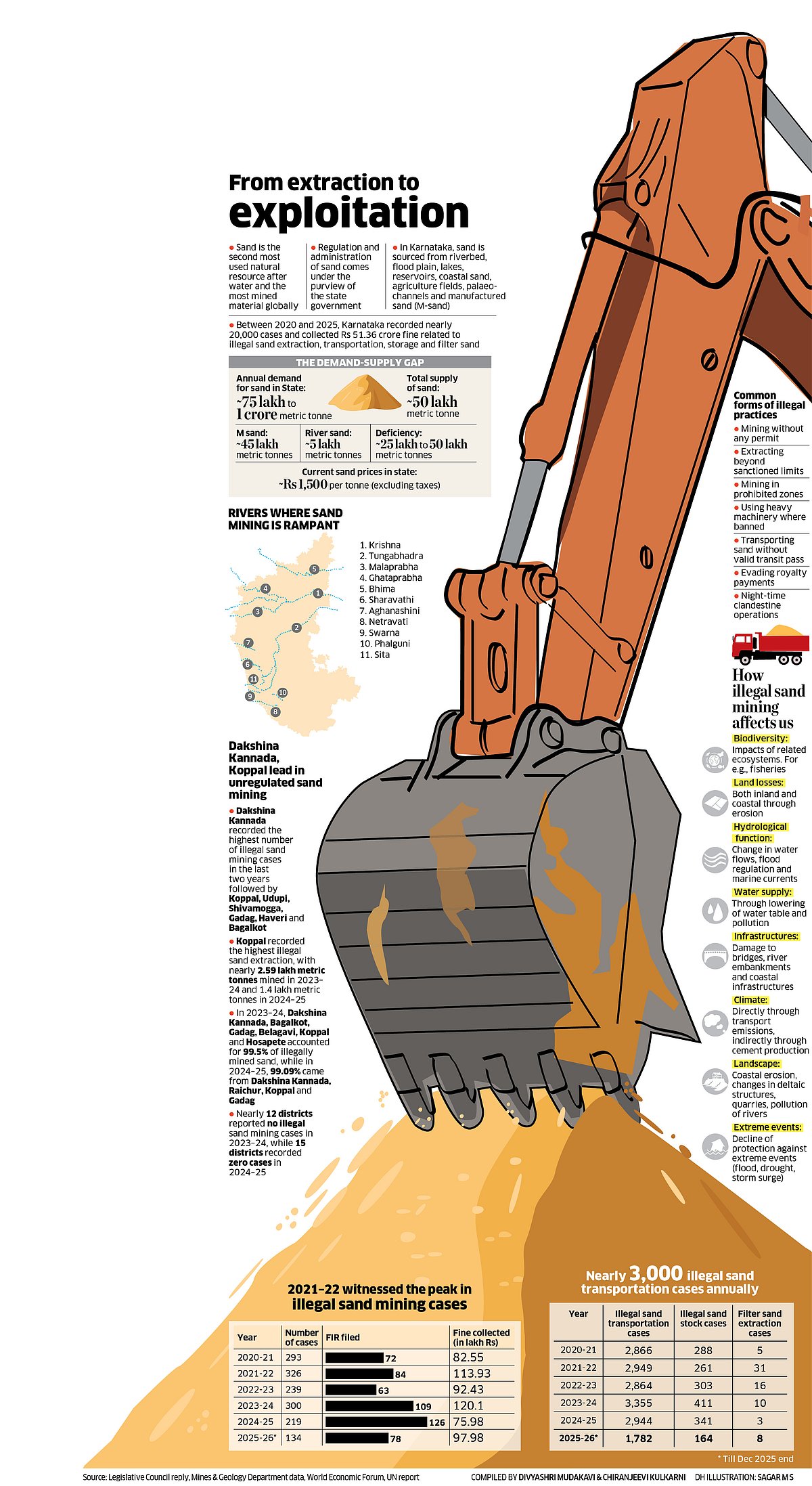
Illegal sand mining is common along the basins of the Krishna, Tungabhadra, Ghataprabha, Malaprabha, Bhima, Vedavati, Netravati, Panchagangavali, Sita, Hemavati and Kaveri rivers. It also occurs on numerous streams across 18 districts. It has a cascading impact on revenue, livelihoods and the environment in these regions.
Experts warn that over-exploitation of sand could lead to severe social and economic consequences, such as altering the natural flow of rivers, increasing the risk of flooding during the monsoons and reduced groundwater recharge in surrounding areas, impacting water availability for drinking and agriculture. A study by the University of Agricultural Sciences, Bengaluru found that excessive sand mining had caused a 64% depletion of groundwater in Kolar.
The sand mafia poses a serious threat to local activists as well. Sand extraction is also threatening public infrastructure, including roads and bridges. Activists in Harihara warned that excessive sand mining in the Tungabhadra river is putting the bridge across the river at risk.
Odisha HC: Tehsildar lacks jurisdiction in auctions post-2022 amendment A division bench of Chief Justice Harish Tandon and Justice M S Raman on Feb 18 expressed concern while quashing an order of the tehsildar of Badasahi in Mayurbhanj district cancelling a sand auction process, holding that the officer had no jurisdiction after the amendment.
The court noted that the amendment to the Odisha Minor Mineral Concession Rules, 2016, came into effect on Dec 28, 2022, the date of its publication in the official gazette, transferring powers relating to sand sairat sources and quarry leases to the mining department.
While disposing of the petition, the court directed the Badasahi tehsildar to transfer all records to the mining department within two weeks. The mining officer has been asked to take a fresh decision according to law within four weeks.
IAI system to tackle illegal sand mining in Telangana When the Telangana IT Department approached IIIT Hyderabad looking for a way to curb illegal sand mining, the challenge was not just regulatory — it was technical. India’s trucks, unlike their counterparts in more standardized markets, often carry hand-painted registration plates: idiosyncratic in font, spacing, and style, and largely invisible to commercial automatic number plate recognition (ANPR) systems built for uniform plates.
The result of that collaboration is Vahan Eye, a field-deployed ANPR solution developed by iHub-Data, the technology translation hub at IIIT Hyderabad. The system has been running continuously since September at Chityal on the Vijayawada–Hyderabad highway, cross-checking trucks entering Telangana against a whitelist of nearly 40,000 vehicles approved by the Telangana Mineral Development Corporation (TGMDC).
Illegal mining ruining livelihoods in Kashmir Unchecked riverbed mining and illegal extraction of soil have been going on unabated across Kashmir, threatening the livelihoods of people.
Banda: Mining damaging Ken river The controversy over the direction and condition of the Ken River in the Marauli area of the district is deepening. Villagers and farmers have leveled serious allegations of illegal mining and arbitrary extortion against sand contractors. Farmers say that excessive mining in the river is causing the water level to drop, directly affecting their agriculture and livelihoods.
Village head representative Manoj Yadav, describing the situation in the village, claimed that the Ken River is being harmed with the connivance of some influential individuals. He alleged that Sanjeev Gupta and others are disrupting the river’s natural flow through mining operations, endangering surrounding agricultural land. Villagers allege that extortion is being demanded at varying rates in the name of extortion—somewhere as low as 400 rupees and somewhere as high as 500 rupees. Anger is growing among farmers over this alleged extortion.
A Test of Environmental Justice in Pachama Dadar The auction process for the Pachama Dadar bauxite block in Balaghat district, Madhya Pradesh, was initiated in 2023. The EIA report submitted for the proposed bauxite mining project only collects primary baseline data for the period from December 2024 to February 2025, which is inconsistent with established standards and guidelines for environmental assessment.
The report does not provide details of the project’s water requirements and groundwater exploitation. Groundwater levels in the proposed mining area and surrounding villages are already low. Without accurate daily and annual water use and groundwater exploitation, it is impossible to estimate the project’s impact on local water resources. Dense forests cover 24,416.5 hectares within a 10-kilometer radius of the proposed mining area, which also contains wildlife and medicinal plants. This area is home to tigers, leopards, bears, chital, and sambar, and is a corridor for the Kanha-Pench Tiger Reserve. (Raj Kumar Sinha)
ADP raises alarm over illegal mining The Arunachal Democratic Party (ADP) has raised alarm over alleged illegal mining activities in the Siji area of Lower Siang district, questioning the district administration’s silence and inaction in the matter. Addressing a press conference at the Arunachal Press Club here on Feb. 16, ADP spokesperson Johny Yangfo alleged that unauthorised mining operations are being carried out in violation of environmental and mining regulations. He claimed that, despite repeated appeals, the departments concerned have failed to furnish details regarding the activities, casting serious doubts on their legality.
WATER OPTIONS
Marathwada villagers came together to end water crisis At its core, Bansawargaon’s transformation is a story of human spirit — of villagers who refused to accept despair, leaders who looked beyond politics, and a community that dug deep, literally and figuratively, to reclaim its future. Standing by a canal that now glistens with water, farmer Prabhakar Swami reflects, “We once thought our village was cursed. Today, we know it was only thirst — and we learned how to quench that thirst together.” From scarcity to sustainability, Bansawargaon’s journey stands as a testament to what collective resolve can achieve when a community decides that water — and its future — belongs to everyone.
Project Jaladhara Lifts Annamayya district to 2nd in AP Groundwater Ranking Annamayya district has climbed from the 25th to second place in state groundwater status within a year. This happened after the launch of Project Jaladhara in the district, under which thousands of tanks and feeder channels have been revived and linked. As a result, groundwater levels have risen by 8.7 metres. The locally designed initiative has turned the drought-prone region into one of the fastest-improving water-secure zones in Andhra Pradesh, that too without creation of any new irrigation project.
Official data show that while the average groundwater rise across Rayalaseema between May and December 2025 had been 3.6 metres, Annamayya recorded an 8.7-metre increase. Groundwater that lay at a depth of 12.97 metres in November 2024 and 14.45 metres in August 2025 is now available at about 3–8 metres in nearly 90 per cent areas of the district, reviving more than 20,000 defunct borewells and reducing dependence on deep pumping.
District collector Nishant Kumar explained that the project applied river-linking logic at a micro level by connecting surplus and deficit water zones within the district. “When governments plan to interlink rivers from surplus to deficit regions, we applied the same concept locally by linking smaller streams and unused tanks, thereby restoring existing water bodies,” he said. Sub-basin mapping in Cheyyeru and Pennar systems guided the interconnection of major tanks, enabling diversion of 3.9 TMC of surplus water to deficit mandals, including Rayachoty, Madanapalle, Lakkireddipalle, Thambalapalle, Rajampet and Nandalur. Tanks, such as Pullampet and Konamma Cheruvu, received water after four to five decades. Officials estimate that about 90 per cent of the district has benefited, barring a few rain-shadow pockets.
District Collector Nishant Kumar said the initiative did not involve the construction of new irrigation projects but relied on reviving defunct infrastructure and linking surplus and deficit sub-basins. Nearly 90% of the district has benefited, with several tanks receiving water after a gap of more than four decades.
The improvement in water availability has led to a reduction in borewell usage and cutting agricultural power consumption by 30–40%. This has resulted in estimated savings of about ₹96 crore to the State exchequer over four months. Expansion of horticulture by about 20,000 hectares has contributed an additional ₹1,634 crore, while dairy and allied activities have further supported rural livelihoods. Officials said the project has demonstrated the potential of sustainable and low-cost water management practices in drought-prone regions.
GROUNDWATER
Farmers urge desilting of Chithirai Chavadi check dam Farmers have urged authorities to immediately desilt the Chithirai Chavadi check dam across the Noyyal river near Coimbatore. They stated that the 800-year-old check dam has not been dredged for more than 30 years despite repeated allocations for river restoration. The Chola-era check dam measures 282.11 feet in length and 350 feet in width, with a 72-metre-long head sluice on the left side. It provides water for irrigation in 3,791 hectares. N Viswanathan, a farmer from Thennamanallur village though crores of rupees were allocated for the Noyyal restoration, the check dam remained untouched.
Policy correction needed in Haryana Policy responses so far have focused disproportionately on supply-side solutions — recharge structures, ponds and check dams — without addressing demand. Crop diversification away from paddy, rational pricing of electricity, micro-irrigation incentives and enforceable groundwater regulation must move to core policy. Equally important is decentralized governance. Groundwater is a local resource and its management requires community participation, transparent data and district-level accountability. Without empowering panchayats and users to monitor and regulate extraction, state-level targets will remain cosmetic. Unless water is treated as a finite ecological asset, today’s overexploitation will translate into tomorrow’s water drought. The window for corrective action is narrowing.
URBAN LAKES, WETLANDS
Karnataka notifies Act to shrink lake buffer zones based on area The govt on Feb. 18 notified the controversial ‘The Karnataka Tank Conservation And Development Authority (Amendment) Act, 2025’ which sets the buffer zone of water bodies based on their size. Though the amendment was passed by the legislature in August, 2025, the Governor had sent back the Bill seeking clarity on its ‘adverse effect’. Following this, Minor Irrigation Minister N S Boseraju had said the Bill would not harm any lakes and a revised version would be submitted. He had argued that the standard 30 metres buffer zone for all lakes had left large areas around smaller lakes useless.
It is learnt that the Governor gave consent to the Bill on Feb. 16. Earlier, all the lakes in the city had a standard buffer zone of 30 metres. Now, with the act notified, the buffer zone of only lakes bigger than 100 acres will remain 30 metres. While the lakes up to 0.05 acres will have no buffer zone, those between 0.05 to 0.1 acres will have a buffer zone of one metre. Lakes measuring between 0.1-1 acre will have only three metres of buffer zone. The buffer zone will be six metres for lakes sized 1-10 acres, 12 metres for lakes sized 10-25 acres, and 24 metres for lakes sized 25-100 acres.
The amendment is expected to help the govt construct roads, bridges, water supply lines, sewage treatment plants and other infrastructure. The amendment was opposed by citizen groups, environmentalists and experts citing that reduction of buffer zones will harm the lakes and create ecological imbalance.
Ulsoor Lake desilting taken up after 20 years The historic Ulsoor lake, measuring 108 acres, is almost dry as the lake engineers attached to Bengaluru Central City Corporation (BCCC) have begun development of the main water body as well as the sedimentation tank and Kalyani. As per officials, the lake desilting is being taken up under a Rs 4 crore National Disaster Mitigation Fund (NDMF) grant, and the work of desilting is being done after nearly two decades. The work began by diverting the water through the outlet.
The lake is still receiving 1.5 MLD of treated water from Bangalore Water Supply and Sewerage Board (BWSSB), and officials concerned have been asked to study the situation and explore the option to divert the treated water into the major drain until the desilting is completed. Last time complete desilting was done in 2001-2002, and since then, no complete desilting has been done,” said Subbaiah, Secretary of the Sangha. He added that after partial cleaning in 2020, the contract was also renewed. The association paid Rs 50,000 for the lease period and released fishlings worth lakhs, but within a few days, the fishlings and small fish died.
2 Tambaram Corporation lakes bear brunt of pollution Residents and environmental activists said that Veeraraghavan Eri in Chromepet and Nemilichery lake near Hasthinapuram, under Tambaram Corporation limits, continued to suffer from neglect despite years of volunteering and fund-raising. Once reliable sources of groundwater recharge, both the lakes present a grim picture of sewage inflow, plastic waste and unchecked encroachments, with residents alleging that sustained efforts have failed to elicit a meaningful response from the civic body.
Tambaram Corporation Commissioner S. Balachandran said a CSR proposal worth ₹8 crore had been placed for constructing the STPs, while ₹14.30 crore had been proposed for developing facilities around Veeraraghavan Eri. On Nemilichery lake, the Commissioner said ₹962 crore had been sanctioned for the Underground Sewerage Scheme and that a Government Order was expected shortly. Activists said top priority should be preventing sewage from entering the lake and hoped the proposals moved beyond paperwork and translate into concrete action on the ground after years of sustained effort to revive the two lakes.
Tambaram allocates 6 cr to restore Idumbankulam lake Also known as Old Perungalathur lake, it once sprawled over 70acres and was a major water source in Perungalathur. Now spanning 55acres, it lies neglected—more than 600 encroachments, including residential buildings and commercial establishments, block natural inflow channels and contribute to its shrinking. The waterbody is now covered with a thick growth of water hyacinth, fed by untreated sewage entering the lake. Residents complain of a heavy stench that shows the failure of earlier restoration attempts.
Coastal Road Project 2nd Phase: Forest Dept starts survey In a bid to pave the way for the second phase of the Mumbai Coastal Road Project, the state forest department has initiated works to survey, cut and transport mangrove trees sprawled over a marshy, saline land parcel of 103.65 hectares. On Feb. 20, the Mangrove (North Konkan) Division floated a tender for ‘survey, demarcation and execution of Mangrove Tree felling and transportation works’ for diversion of the forest land for the proposed Versova to Bhayandar DP road.
A total of 45,675 mangrove trees are poised to face the axe for the upcoming coastal road project which will link Versova to Bhayandar. Of these, 9,000 mangrove trees will be permanently cut while 36,675 trees will be restored after construction through transplantation. The impacted mangroves have been identified across a total area of 103.65 hectares. Earlier in an order dated December 12, 2025, the Bombay High Court granted permissions to the Brihanmumbai Municipal Corporation (BMC) to construct the high-speed corridor, as it cleared the felling of mangrove trees over the 103.65 hectares of mangrove forest area.
Construction debris from 2,000 redvpt projects ‘go missing’ Tonnes of construction debris from nearly 2,000 redevelopment projects that were supposed to make it to designated disposal sites never reached there, a civic investigation has found, officials have told Mumbai Mirror. Environmentalists said they suspect that the waste has been allegedly sold to land mafia for encroaching on Mumbai’s mangrove and wetland belt.
The lid was blown off this large-scale environmental lapse when a Brihanmumbai Municipal Corporation (BMC) scrutiny of documents found that city builders had listed the same seven sites as designated disposal spots for over 2,000 redevelopment projects. “There was no way so much debris would fit in those seven spaces,” an official in the know told Mirror. “We then started a probe in December and found that the debris was not going to the designated spot.”
Gurgaon to trace demolition waste From April 1, anyone undertaking construction, renovation or demolition on plots of 200 sq metres or more in Gurgaon will be required to show exactly where their waste went, according to the new directions issued by Commission for Air Quality Management (CAQM). Demolition waste will have to be accounted for twice, once before construction begins and once again before a building is allowed to be occupied. The long-running practice of off-loading debris onto roadsides, vacant plots or forest edges will no longer slip through the cracks.
Builders and homeowners will have to declare, at the plan-approval stage, how much debris they expect to generate. A Haryana State Pollution Control Board (HSPCB) official said, “If demolition is part of their project, they will be required to take the waste to an authorised C&D collection or processing facility and produce a formal receipt. This receipt will become a core document not only for starting construction but also for obtaining completion and occupation certificates. A structure may be finished, but unless this paperwork is in order, it cannot legally be occupied.”
Encroachment of a waterbody in Delhi The Municipal Corporation of Delhi (MCD) and the Delhi Pollution Control Committee (DPCC) was directed by the NGT, February 17, 2026 to file reports on steps taken to remove encroachments on a johar (pond) situated in Savitri Nagar village, Delhi. The reply has to be filed within six weeks. The applicant had filed an execution application seeking compliance of the NGT order, July 11, 2025.
The tribunal had taken note of the fact that the applicant had already made a complaint to DPCC which was forwarded to the District Magistrate, South and Commissioner, MCD and had disposed of the application by directing the authorities to expeditiously ascertain the status of the pond in question by carrying out spot inspection and if any encroachment is found on the land of the pond, take appropriate remedial and punitive action. The court also directed that the order should be carried out within a period of three months.
URBAN WATER
Water woes haunt Bengaluru even before summer sets in Summer is yet to begin, but Bengaluru’s water woes have already begun plaguing a few localities, forcing residents to depend on expensive water tankers. VV Puram in Basavanagudi, Nanjappa layout in Shantinagar, Frazer town, Kalkere in Ramamurthy Nagar are some of the areas facing water shortage. Residents have complained about water shortage and fear that it is going to get worse for them as harsh summer sets in.
Bengaluru firms win Rs 50 lakhs each for sewage water projects Two Bengaluru-based companies — EcoSTP Technologies Pvt Ltd and Transwater Systems Pvt Ltd — won a purse of Rs 50 lakh each from Tata Group’s Titan for their work in agriculture and urban water management. They, along with four other companies, were awarded at the second edition of the Design Impact Awards, whose focus this year lay on addressing water crises and management across India.
300 at New Town complex down with diarrhoea More than 300 residents of Shukhobrishti housing complex’s E Block in New Town have reportedly been down with acute diarrhoea the past three weeks, leading to hospitalisation of some, with families blaming the facility management for poor upkeep of overhead tanks that reportedly contaminated the water. Residents claimed nearly every household in E Block had at least one member suffering from stomach-related ailments.
Residents suspect that contamination of the drinking water supply was the reason with some pointing at the proximity of the Kestopur canal, alleging that canal water might be flowing into underground pipelines of the complex. Doctors treating patients reportedly did not rule out waterborne infection. A number of residents of the 522-tower complex complained of abdominal pain, vomiting and high fever. The matter came to a pass on Feb. 16 morning, when agitated residents surrounded the facility manager, demanding an answer. But an NKDA official claimed water sample test reports till last week suggested no contamination but they would inspect again.
Sewage in drinking water PMC Admits The Pune Municipal Corporation (PMC) has admitted that sewage contamination has been detected in drinking water supply at around 60 to 70 locations across the city, following sharp criticism from corporators during a general body meeting.
Elected representatives alleged that residents in several areas are receiving foul-smelling, discoloured water and falling ill after consuming it, despite repeated complaints to civic authorities. The issue was raised in the house by corporators including Gafur Pathan, Vaishali Bankar, Prashant Jagtap and Ashwini Landge, who accused officials of neglecting the matter.
Responding to the concerns, Water Supply Department head Nandkishor Jagtap acknowledged that leakages in pipelines have allowed sewage to mix with drinking water at multiple points. He informed the house that repair work will be undertaken and that the sewerage department has allocated ₹20 crore for pipeline rectification and shifting. A tender has already been issued for the project, he said.
With 3 new cases, hepatitis tally now 32 in Palwal village Three fresh hepatitis infections — the first instances of Hepatitis B cases recorded in Chhainsa village of Palwal in recent weeks — have pushed the total number of confirmed cases to 32. While the deaths have heightened anxiety in the village, officials said investigations were still underway to establish whether the fatalities were directly caused by hepatitis. In the wake of infections, many villagers have complained about fever, vomiting, body pain and cough.
The investigation has also turned the spotlight on possible water contamination. During inspections, the public health department found 25 illegal connections to drinking water pipelines, which led to leakages and raised fears of contamination. Officials said the connections have now been removed, and engineers are checking supply lines for further breaches. Water samples collected from six households have also tested positive for E coli, indicating faecal contamination, while earlier tests showed inadequate chlorination in stored water.
Mohammad Arif, who has been tracking the number of cases in his neighbourhood, points towards a canal cutting across the landscape. According to him, waste from factories, hospitals and nearby cities flows through it before villagers use the water for irrigation. “There is a black layer on the farm fields,” he says. Another resident, who, along with his wife, has tested positive for Hepatitis C, says helplessly, “We are drinking hard water. There is no other option.”
Some blame the piped supply itself. “The water that is being supplied to the village is what is making everyone ill. Mosquitoes are breeding in the canal,” a villager says. When told that injection drug use is one of the suspected causes, a few men respond bluntly: “What drug use? Some people do use drugs, but it’s mostly ganja.”
Jalandhar waste mountain Despite spending nearly Rs 300 crore over a decade, Jalandhar processes only 15 per cent of its waste. As the city awaits the April bio-mining deadline, residents of Wariana and Jamsher continue to contend with toxic leachate, frequent landfill fires, and a systemic failure in waste segregation.
Drinking water from polluted Dal? The J&K Pollution Control Committee-JKPCC has been silent on this issue and have not even imposed Environmental Compensation on J&K Lakes Conservation Management Authority-LCMA for allowing open drains to enter Dal Lake at multiple locations. Right from Rainawari, Hazratbal to Isher-Nishat and Brein including Dalgate to Nehru Park? Pesticides used in orchards and vegetable farms around and inside Dal lake also enter this water? How can we call Srinagar a smart city when we don’t have a smart water supply system in place? More than half a million population is supplied with unhygienic drinking water from Dal Lake alone & law enforcing agencies like JKPCC are not acting at all? (Dr Raja Muzaffar Bhat)
JJM/ RURAL WATER SUPPLY
ACB nabs 9 after raids across Rajasthan, Delhi in JJM scam probe A Special Investigation Team of the Anti-Corruption Bureau (ACB) on Feb. 17 arrested nine persons – six serving senior Public Health Engineering Department (PHED) officials and three of its retired engineers – after conducting coordinated raids across Rajasthan and in New Delhi in connection with the Jal Jeevan Mission (JJM) scam. Sources in the bureau said teams also attempted to locate a recently-retired senior IAS officer during the operation, but could not trace him. Tuesday’s arrests followed simultaneous searches in Jaipur, Barmer, Udaipur, Karauli, New Delhi and other locations in connection with an FIR registered by the ACB in 2024.
According to the ACB, the case pertains to large-scale irregularities in awarding tenders under the Centre’s Jal Jeevan Mission to provide rural tap water connections. Officials said the investigation revealed that two companies – Ganpati Tubewell Company owned by one Mahesh Mittal and Shyam Tubewell Company owned by one Padamchand Jain – submitted forged work completion certificates purportedly issued by the Central govt-owned company IRCON International Ltd to secure contracts worth around Rs 960 crore.
Earlier in the probe, the former PHED minister in the previous Ashok Gehlot government, Mahesh Joshi, and several engineers were arrested in connection with the case. Tuesday’s coordinated action suggests that the investigation has widened in scope, with enforcement agencies now focusing on senior officials and key beneficiaries allegedly linked to irregularities in Jal Jeevan Mission tenders. According to the ACB, the investigation revealed that two firms allegedly secured tenders worth approximately ₹960 crore by submitting forged completion certificates in the name of a third company. The probe further revealed that senior PHED officials allegedly incorporated mandatory site-visit certification clauses in major projects above ₹50 crore, contrary to norms, thereby disclosing bidder identities and facilitating alleged tender pooling, the bureau said.
WATER
Water Bankruptcy: The Formal Definition This paper proposes Water Bankruptcy as a more meaningful and useful term for this condition and provides the first formal, scientific definition of this concept grounded in hydrology, ecology, and socio-economics. Water bankruptcy is presented not only as a metaphor to communicate the severity of the problem and the urgency of a transformative fresh start, but also as a diagnostic label for human–water systems whose water use persistently exceeds hydrological carrying capacity (insolvency), eroding the water and natural capital to the extent that some damages are irreparable (irreversibility).
Drawing on a bank-account analogy that likens surface water to a checking account and groundwater to a savings account, the paper explains why language matters for policy outreach and public discourse and discusses why bankruptcy framing calls for not only protecting water but also the natural capital and hydrological cycle that produce it. It also outlines the misleading policy implications of terms such as stress, crisis, or emergency in reference to the state of systems that can no longer restore their baseline conditions. While the focus of the paper is on water, the underlying discussions and framing are applicable to other natural systems facing insolvency and irreversibility under human pressure, including the climate system.
Freshwater crisis due to mismanagement Weak water governance also complicates the problem. Lack of coordination among water management institutions, a lack of reliable data, and short-term policies hinder long-term solutions. In many countries, water-related authority and responsibilities are fragmented among multiple ministries and agencies, preventing the development of an integrated and holistic approach.
Ultimately, the freshwater crisis is one of the greatest shared challenges facing humanity. It is clear that this problem is not solely a result of natural limitations, but also of man-made policy and management failures. If sustainable water management, rainwater harvesting, wetland conservation, inclusive water governance, and international cooperation are prioritized in time, this crisis can be transformed into an opportunity. Ensuring water security is not just a question of environmental protection, but an essential obligation linked to social justice, economic development, and the protection of the rights of future generations. (Dr. Priyanka Saurabh)
SUMMER 2026
Storage in all Indian regions drops below 75% of capacity Storage in India’s 166 major reservoirs dropped this week to 61.65 per cent of the capacity, with the level dropping below 75 per cent in all five regions this week. Data from the Central Water Commission (CWC) showed that the storage in key reservoirs was 113.160 billion cubic metres (BCM) against the 183.565 BCM capacity. It was 11.5 percentage points higher than last year and 25 percentage points more than normal (the last 10 years)
According to India Meteorological Department (IMD), the country received 56 per cent deficient rain from the beginning of the year to February 18, with central India receiving 85 per cent deficient precipitation. Data received from 727 districts showed that 80 per cent of the country received deficient or no rainfall so far this year.
Dams losing water fast, Karnataka may face crisis Karnataka received good rainfall last year raising hopes of trouble-free months ahead, but the reality is different: Ten of the state’s 13 major dams now have lower storage than the previous year. That is because of evaporation of water from dams because of rising temperatures, while severe overexploitation has affected groundwater quality. Experts warn that drinking water could be a concern in some parts of the state this summer. As per data from the Karnataka State Natural Disaster Monitoring Centre (KSNDMC), water storage at all 13 dams was 535 thousand million cubic Feet (tmcft) in 2025, but now, it is 493 tmcft, a difference of 42 tmcft.
FLOOD MANAGEMENT
Kerala declares tide flooding a State-specific disaster For the first time in the country, tide flooding along the coastline has been declared a State-specific disaster by a State government. Kerala took the lead to notify tide flooding as a State-specific disaster, considering the gravity of the phenomenon along the coastline of the State, which has a coastline of around 590 km, and nine of its 14 districts are located on the coast of the Arabian Sea.
Kerala has been bearing the brunt of the coastal flooding round the year, with tidal waves advancing to the shoreline beyond the High Tide Line (HTL) which is the legally defined coastal line determined using precise scientific methods as per the Coastal Regulation Zone (CRZ) notification. The issue becomes serious when thecoastal flooding coincides with spring tides, exacerbating the depth and extent of the flooding. According to a senior government officer, the risk is particularly severe in low-lying regions in Alappuzha and Ernakulam.
ENVIRONMENT GOVERNANCE
NGT Dismisses Challenges to Great Nicobar Infrastructure Project The NGT Kolkata has disposed of Original Application Nos. 93/2024/EZ and 95/2024/EZ along with M.A. No. 23/2024/EZ concerning the proposed International Container Transshipment Terminal (ICTT), township development, and 450 MVA Gas and Solar-based Power Plant at Great Nicobar Island. The applications were filed challenging environmental and CRZ clearances granted for the integrated development project in Great Nicobar Island. This was the second round of litigation concerning the project. In April 2023, the Tribunal had largely upheld the Environmental Clearance (EC) while constituting a High-Powered Committee (HPC) to examine specific concerns.
The Tribunal declined to interfere with the Environmental Clearance and disposed of the applications. However, it directed the authorities and regulatory agencies to ensure full and strict compliance with all Environmental Clearance conditions.
Tribunal determined that the issues raised in the second round of litigation had already been resolved through established safeguards and assessment by a High-Powered Committee (HPC), allowing the project to move forward provided all EC conditions are strictly followed.
NGT’s Nicobar judgement asked everything about procedure, and nothing about the point The NGT’s judgment raises important questions about environmental adjudication in India. Environmental law principles such as the precautionary principle, reversal of burden of proof, species best interest standard, public trust doctrine, inter-generational equity, and eco-centric approach have been the basis for environmental decisions across courts in India and have been followed the world over but one does not find reference to any of these principles in the latest judgment of the NGT. Deforestation of this scale is bound to have implications as far as climate change is concerned. However, the mention of “climate change” in the judgment is with reference to the Ministry of Environment, Forest and Climate Change.
Only time will tell how well this judgment stands against further legal scrutiny. Till then, it remains a deeply concerning development for India’s environmental jurisprudence. (Ritwick Dutta)
NGT continues its streak of failed merit review The NGT has the power to review the clearances, assess the environmental impacts of projects and even cancel projects. But the current decision is one in a long line of many in recent years where the NGT has remained a silent spectator.
In the present case, the NGT constituted an ad hoc bench to hear the Great Nicobar case comprising members from Benches like the Principal Bench and the Western Bench and not the Eastern Bench which the order was posted. The NGT also has vacancies at present and some members are continuing beyond their retirement term.
Edit: In Nicobar to Aravalis narrow approach is a serious problem NGT upheld that no coral reefs were found at the precise project footprint and that nearby reefs would be “relocated” for protection. Of the 20,668 coral colonies identified, 16,150 are to be translocated, while the “threat” to the remaining 4,518 will be studied. The relocation plan, first documented in 2019, is projected to take 30 years, with the initial decade alone costing ₹55cr.
This technocratic framing echoes the incremental weakening of safeguards seen in the Aravalis over decades. Institutions tasked with environmental protection often reduce complex ecological realities to narrow definitional thresholds – hills above 100m in Aravalis, “no coral reef, no nesting” in Galathea Bay. Both claims on Galathea Bay are contested. But even if accepted, corals enjoy the same legal protection as tigers and elephants. That protection must mean preservation in situ, not displacement.
Marine ecosystem is already under stress from climate change – warming waters, bleaching events and mangrove loss. Dredging Galathea Bay, with inevitable silt displacement, and felling rainforest will only intensify these pressures. Afforestation cannot replicate the intricate web of a mature ecosystem. Nicobar’s strategic imperatives are real but they cannot justify a narrow reading of environmental risks that can irreversibly damage biodiversity and ecological balance.
The NGT’s clearance has drawn sharp criticism from environmental researchers, lawyers, and tribal welfare advocates, who say the order bypasses legal safeguards and puts an irreplaceable ecosystem—and its indigenous people—at risk.
The decision has drawn flak from several quarters. Scientists who have worked on the island on various aspects including its wildlife and tribal communities said that while the NGT’s response does not come as a surprise given its previous stands, the order was not justified.
In 2023, the Tribunal had put together a high-powered committee (HPC) to look into these and other issues. But the composition of the committee shows a blatant conflict of interest, a researcher who has worked on the island for several years told The Wire.
The NGT has not made this HPC report public. It did not even share this report with Kothari, who is the petitioner in these cases. And yet, the NGT has used the findings of the HPC report to conclude in its February 16 order that the Union environment ministry has all “safeguards” – or mitigation measures – in place to ensure minimal damage to people or biodiversity through the projects.
Senior environmental activist Ashish Kothari alleged that the NGT’s 2023 order to revisit the project’s EC was not complied with, as the HPC tasked with that work examined only limited aspects of the project’s environmental impacts, not the entire clearance process.
Notably, one of the contentions by the petitioners was that the government had made a mistake in limiting the HPC’s terms of reference to just three issues: even these three issues, they alleged, had not been scrutinised adequately.
The NGT order essentially rubber-stamps the government’s appraisal process without independently examining the concerns raised. It only imposes faith that the government will be a conscientious executor of the project. Whether the Great Nicobar Project is a ‘net good’ can only be judged by future generations, but the lack of a process that offers a fair appraisal of independent concerns bodes ill for the present.
India among 4 nations driving most global pesticide toxicity: study India is among just four countries that contribute almost 70% to the world’s total applied toxicity (TAT) in the form of pesticide, which is directed at agricultural pests, but in affect unleashes huge collateral damage among “non-target” species (that is, species that pesticides claimed as collateral). Experts are concerned that India’s new Pesticides Management Bill 2025, expected to be passed in March this year, could be worse than the Insecticides Act 1968.
Manipur’s Vanishing Forests Using satellite imagery and right-to-information records, our investigation contradicts ruling party claims that poppy cultivation drove deforestation and Manipur’s ethnic conflict, resulting in 300 deaths. Overlaying poppy maps with historical forest data shows cultivation spreading into already degraded land, not virgin forests. State records and evidence of politically connected timber networks suggest tribal farmers were scapegoated to hide regulatory complicity and justify deforestation amid the violence.
87 % claims rejected in J&K under Forest Rights Act The J&K govt on Feb. 13 revealed that it has rejected 87 percent of claims under the Forest Rights Act, 2006. In response to a cut motion moved by Peoples Conference president Sajad Gani Lone,as per news agency—Kashmir News Observer (KNO), Minister in-charge of Forests, Environment and Climate Change, Javed Ahmad Rana stated that 6097 claims (13.26%) have been accepted, while 39898 claims (86.7%) have been rejected.
According to the details, Jammu recorded 44 claims accepted with none rejected. Kathua saw 42 accepted but a staggering 1518 rejected, while Doda reported 51 accepted against 1744 rejected. Ramban and Reasi also showed high rejection numbers, with 1276 and 576 respectively, compared to just 10 and 2 accepted. Kishtwar fared better, with 273 accepted and 582 rejected. Rajouri and Poonch emerged as the districts with the highest number of accepted claims -2852 and 2,054 respectively- though both also recorded thousands of rejections (13590 in Rajouri and 2,956 in Poonch).
SOUTH ASIA
Bhutan: Hydropower overview of 2025 At Punatsangchu I, geological uncertainties, particularly the right side slide continued to be a major concern. There are uncertainties about project’s completion date and costs, raising questions about long term financial and technical sustainability. The overtopping of the 1020 MW Tala HEP and attendant costs and losses adds another major issue related to hydro projects not faced earlier. These are likely to increasing due to changing climate. Commissioning of Punatsangchhu II and 18 MW Suchhu HEP in Haa were the bright spots.
The initiation of PPP projects with Tata Power with work beginning at 600 MW Khorlochhu HEP in Trashiyangtse in eastern Bhutan and agreement for 1125 MW Dorjilung HEP as also the signing of shareholders agreement with Adani for the 570 MW Wangchhu HEP was an attempt to reduce public debt for Hydro projects.
Lake Unloading Drives Fault Slip and Rift Asymmetry in Southern Tibet Summary: -On the Tibetan Plateau, the drying of giant lakes is causing the Earth’s crust to slowly rise—a process known as rebound—as the weight of water is removed. This uplift, in turn, pushes on nearby faults, making them more likely to slip. In this study, we show that the dramatic drop in lake levels since the last interglacial (about 116,000 years ago) has not only reshaped the landscape but also helped to activate dormant faults. For example, at Nam Co Lake, crustal rebound due to water loss accounts for nearly one-fifth of the total fault movement observed nearby. Similarly, at Yamzho Yumco and Puma Yumco Lakes, rebound has driven ∼70 m of vertical fault displacement. Our work demonstrates that climate-driven lake drying not only reshapes the landscape but can also “awaken” dormant faults and influence the shape of massive rifts. This reveals a surprising link: changes in surface water can ultimately drive tectonic activity deep within the Earth.
The finding adds to evidence of an unexpectedly strong link between our planet’s climate and the geological activity deep beneath our feet. About 115,000 years ago, southern Tibet was home to enormous lakes, some more than 125 miles (200 kilometers) long. Today, those lakes are much smaller. They include Nam Co Lake (also called Namtso Lake or Lake Nam), which is just 45 miles (75 km) long.
SANDRP

 SANDRP