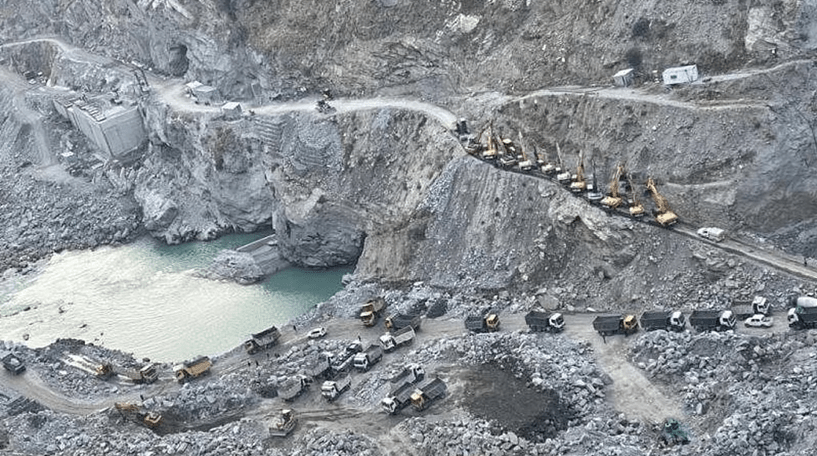
(Feature Image: Ongoing work at Ratle HEP in June 2025. Source)
There are troubling news reports about a number of hydropower projects, even as the hydro industry tries its best to present a positive picture. NHPC tries to say that one of its 250 MW units at the Subansiri Lower HEP is good news. However, the fact that WII’s several years old recommendation that project should not be used for peaking power generation till studies about its impact on elephant corridor are complete. But the WII recommendation presented at the National Wildlife Board over 22 months ago is yet to be implemented. The serious financial trouble that the project is in, is also apparent from its desperate attempt to use the forest land as collateral, rejected by MoEF. The closing down of the NHPC office for the Subansisi Upper HEP in Upper Subansiri district came following agitation by the students Union and others there opposing the project.
In Kashmir, the contractor has threatened to withdraw from the ongoing construction work for the 850 MW Ratle HEP following alleged interference from the BJP MLA. However, there can be no objection to the the demand of the MLA that independent inquiry is necessary about the environmental compliance of the project. An MP has also said in Parliament that agreements with the affected people and their rights are being violated in all for under construction HEPS in J&K. In Meghalaya, NEEPCO’s 800 MW Wah Umiam III project remains stalled due to land acquisition issues.
These are all serious developments and possibility do not provide full comprehensive picture of troubles with the ill-conceived push for large hydro projects. It would be interesting to see how the government deals with these issues.
HYDRO POWER PROJECTS
Subansiri Lower HEP puts Elephants at risk The 2,000 MW Subansiri Lower Hydroelectric Project of NHPC, has said that first unit will be commissioned soon. Its location is fraught with ecological sensitivities; the dam sits amid a biodiversity hotspot and immediately upstream of forests and riverine tracts that form a critical elephant corridor.
It’s also been 22 months since the Wildlife Institute of India (WII), India’s apex wildlife institute, warned in a report that unless urgent action is taken the project’s powerful surges of water, known as hydropeaking, could “wash away” elephants, particularly calves attempting to cross the river. Recurrent incidents “could trigger behavioral avoidance of the vulnerable stretches resulting in functional loss of the corridor”. The WII states that this is “an extremely crucial link” in maintaining elephant habitats along the Himalayan foothills in India’s northeast. At its worst, the fallout could be catastrophic.
The WII recommended that the NHPC should restrain from hydro-peaking until a multi-seasonal hydrological modelling study in relation to impacts on elephants and their habitat is carried out. Although the recommendation was made to the standing committee of the National Board for Wildlife (SC-NBWL) in January 2024, the study has not been commissioned as yet. The NHPC officials met the member secretary of the committee a day before the body met officially on 30 January 2024 for its 77th meeting and objected to the WII recommendation.
“The habitat of the elephant along the eastern Himalayan foothills, from Nepal eastward through Bengal, Assam and Arunachal Pradesh is extremely tenuous at several places, including the downstream area of the Lower Subansiri hydel project,” Raman Sukumar, ecologist and one of the foremost experts on Asian elephants, said. The non-commissioning of the study for almost two years shows that the NHPC seems to have had its way until now.
“There are several hydropower projects which do not carry out hydro-peaking for various reasons,” Neeraj Vagholikar, who has closely tracked environmental governance issues with respect to large hydropower in the eastern Himalayas, said. “It is not a sacrosanct holy cow which has to be implemented even if elephants and other wildlife are at risk of being washed away.”
“Hydro-peaking must be stopped as it will impact both downstream communities and major wildlife populations. This is a request to safeguard wildlife; the elephant issue is not just about a corridor, but about ecological balance. Blocking the corridor will cause irreparable environmental damage,” KK Chatradhara, resident of Subansiri Valley said.
In this project the only measure undertaken to mitigate this peaking are several “caution notice boards” that have been put up in the downstream of the 2000 MW Subansiri Lower project by the NHPC in anticipation of commissioning. As indicated in the notice board the usual flow fluctuations due to releases will be from October to April (that is due to peaking). There is no peaking done in monsoons as water level is maintained at minimum draw down level, but releases would be based on upstream rain.
People whose lives are intertwined with the river will be given a 15-minute notice, courtesy a hooter, to evacuate the river. “On hearing the siren/hooter, the public is requested to immediately move away from the river and come to a safe place on the river bank,” says the notice.
After it’s commissioned hydro-peaking is likely to cause daily flow fluctuations between 240 cubic metres per second (cumecs) and 2579 cumecs in non-monsoon months, resulting in water level fluctuations of 1.5-2 metres (5-6 feet) in the first 40 km downstream according to the official Subansiri basin cumulative impact assessment and carrying capacity study.
That is a huge difference. Parag Jyoti Saikia points out that not just elephants but other life forms will be affected as well because of the “wild swings in water flow” every day. The Subansiri river, also called the Awanori or “mother river” by the Mising indigenous community, is a life support that sustains livelihoods along the river. “Fishing, agriculture, livestock grazing, recovering driftwood, boats to transport people are all sustained by this river,” Saikia said.
Tongam Rina, journalist from Arunachal Pradesh who has closely tracked and written about hydropower and dams in her state for over two decades, says that poor environmental impact assessment has been a known aspect of hydropower development in Arunachal Pradesh, including downstream impacts in Assam. “This case has gone a step further and become a new low,” Rina said.
“An impact assessment study as recommended by the WII has not been commissioned for almost two years due to opposition by the power company! The NBWL standing committee members will have blood on their hands if washing away of elephants is considered an acceptable trade-off to generate power from the project,” she added.
MoEF declined NHPC’s proposal on funding Subansiri Lower HEP The Environment Ministry has turned down a NHPC proposal to use assets located on forest land as collateral to raise funds for the Subansiri Lower hydel project which is facing an over 300% cost escalation. The Environment Ministry, according to a letter, examined NHPC’s “proposal to mortgage assets on diverted forest land” and ruled that it is “not tenable” under the provisions of the Forest Conservation Act now known as the Van (Sanrakshan Evam Samvardhan) Adhiniyam, 1980.
This March, the NHPC board cleared a borrowing plan for raising of debt up to Rs 6,300 crore during FY 2025-26 through secured, redeemable, taxable, non-cumulative, non-convertible corporate bonds, term loans or external commercial borrowings, in suitable tranches and on private placement basis. On August 29, a revised borrowing plan to raise up to Rs 10,000 crore was approved.
In a press statement last week, NHPC said that the final four units are scheduled for sequential connection during 2026–27, noting that the “project cost increased from Rs 6,285 crores at the 2002 price level to approximately Rs 26,000 crores at the current price level, primarily due to the extended construction period, escalation charges, and interest during construction (IDC)”.
NHPC office in SU HEP closed until further notice In the order, it cited multiple reasons for temporarily closing the office and suspending all operations in the district. The NHPC has been awarded the 1,605 mw Subansiri Upper Hydroelectric Project (SUHEP) in Upper Subansiri dist. The NHPC informed that the decision has been taken in view of the cancellation of the public hearing for the SUHEP. The public hearing, scheduled for Sept 12, was cancelled after the All Tagin Students’ Union (ATSU) called a bandh opposing it. However, the bandh was withdrawn after the district administration agreed to postpone the hearing to a later date.
The first hearing had also been cancelled on 28 Oct following a similar bandh called by the ATSU. The NHPC stated in the order that the current situation has created an atmosphere not conducive to the implementation of its project in the district. Considering the gravity of the protests, the safety of employees, and the overall administrative difficulties, the NHPC said that it has decided to close down its office until further notice. All field activities, project-related movements, and official engagements related to the SUHEP have also been suspended until further orders.
The NHPC further stated that it will reconsider its position regarding the future course of action for the implementation of the project, keeping in view the prevailing situation. The ATSU, along with several other groups, has opposed the SUHP, as it will displace a significant number of villages and trigger demographic changes in tribal and indigenous areas. They have demanded immediate cancellation of the proposed SUHEP.
Land hurdles stall NEEPCO’s 800 Mw Wah Umiam HEP push NEEPCO Executive Director Jayanta Sharma said the corp aggressively pursued Wah Umiam Stage-III and even got the Detailed Project Report approved. “However, we could not acquire land. In Meghalaya, the govt does not own land; only 5-6% of the land is under the Forest Dept, and local communities are unwilling to part with their land,” he said. The project has also failed to secure forest clearance.
On Meghalaya’s plans for pumped storage projects (PSP), Sharma said NEEPCO is ready not just to assist but to develop such projects. “However, land remains the biggest challenge,” he stressed. No major hydropower project has been taken up in Meghalaya in recent years. The last big projects were the Myntdu-Leshka (126 Mw) and New Umtru (40 Mw), commissioned 10–12 years ago. The 22.5 MW Ganol project in Garo Hills became operational only recently.
Coal mining ban boon for 275 Mw Kopili HEP The ban on illegal coal mining in Meghalaya in 2014 has helped improve the acidic level in the reservoir of the Kopili power plant, designed in 1955, less than two decades before the state was carved out of Assam. Assam and Meghalaya get 6% of free power from the project. The first power house of the project was commissioned in 1984. The project was running fine until 2006, when the water in its reservoir started to turn acidic.
“It damaged our turbine and other underwater parts. We started taking precautions and used stainless steel for the parts, as it has resistance to acidic water,” Sharma said. He stated that the acidic level earlier was 3 to 3.5 (on the pH scale), which is now diluted to 5-5.5 due to the closure of illegal coal mines in Meghalaya and the measures undertaken by NEEPCO. NEEPCO is now also focusing on developing more projects through pumped storage hydro.
Jammu BJP leaders’ interference stalls 850 MW Ratle HEP in Kishtwar, J&K Harpal Singh, Chief Operating Office of Megha Engg & Infrastructure Ltd has alleged interference by a local BJP MLA, warning that continued disruptions could force the company to pull out of the 850-megawatt Ratle Hydroelectric Project in Jammu and Kashmir’s Kishtwar district, the project has been going on since 2008. He said the under construction of the project — slated for completion by September 2026 at a cost of Rs 3,700 crore — is now delayed by two years, attributing this chiefly to the continued disruptions allegedly caused by BJP MLA Shagun Parihar. The new deadline that MEIL has conveyed to NHPC is Nov 2028 for the project also involving construction of the 133-metre-high dam at Drabshalla.
Parihar dismissed the allegations. The MLA recommended an independent survey of the project to see whether it was being constructed in consonance with the environmental impact assessments.
GVK awarded the contract to L&T in 2008, which worked at the site till 2014, when a mob of locals forced the company’s engineers out and locked the camp. Engineers left the site the same night, after which the J&K government decided to turn the project into a joint venture with the Government of India. NHPC formed the Ratle Hydroelectric Power Corp Ltd, a joint venture company, with Jammu and Kashmir State Power Development Corp Ltd (JKSPDC) in 2021 to implement the plant on the Chenab river. NHPC holds 51 % equity and JKSPDC 49 %. Tenders were floated in 2020, and MEIL, as the lowest bidder, won the contract.
“Four hydro Projects: Pakaldul, Rattle, Koru and Kawar are running behind schedule in the Kishtwar district because of BJP-sponsored unions who are creating trouble. It’s impacted crucial national projects on the Chenab river,” Singh said.
MP alleges in Parliament violation of agreements and rights of people in Jammu & Kashmir Hydropower Projects “Major hydropower projects in J&K continue, but agreements with locals are being violated. Those who surrendered land are suffering.” JKNC MP @KichlooSajjad demands that a special committee be sent to the region to see the real situation of the people.
4 Major HEP Under Construction in J&K The Ministry of Power Dec. 11 informed the House that the Ratle (850 MW), Pakal Dul (1,000 MW), Kiru (624 MW) and Kwar (540 MW) projects in J and K are under execution through joint venture company Chenab Valley Power Projects Limited (CVPPL) and Ratle Hydro Power Corporation Limited (RHPCL). Their estimated commissioning timelines range from December 2026 to March 2028. The Ratle project is expected to be commissioned in November 2028, while Pakal Dul and Kiru are scheduled for completion in December 2026. The Kwar project is targeted for March 2028.
The combined anticipated cost of these four large projects in the Union territory stands at Rs 27,945 crore, with a projected design energy output of 10,614 million units annually. Together, these projects will add 3,014 MW of new capacity once completed.
NHPC invests ₹98,107cr to build 8,814 Mw HEP capacity by 2032 “There are eight hydropower projects that are currently under construction by NHPC Ltd and its joint venture or subsidiary companies with a total generation capacity of 8,514 MW,” power minister Manohar Lal said in a written reply in Parliament on Dec. 11. The eight projects being set up by NHPC alone include the 2,000 MW Subansiri Lower plant to be commissioned in December 2026, the 2,800 MW Dibang Multipurpose project to be commissioned in 2032 and the 500 MW Teesta-VI project to start operation in 2029.
The three projects entail investment of Rs 68,273 crore by NHPC. The remaining Rs 29,834 crore investment will be made by the company along with its arms in six projects being set up in Sikkim and Jammu & Kashmir. The NHPC Group currently operates 23 hydropower projects with a combined capacity of 7,771 MW. These projects generated around 25,194 MU in 2024-25.
CLIMATE CRISIS
Impact of Himalayan snow droughts on downstream areas In the Hindu Kush Himalayas, snow is vital for rivers, ecosystems, and the water security. A recent study published by in the journal Scientific Reports, finds snow droughts are on the rise in the Hindu Kush Himalayas. A snow drought is defined as a significant lack of snowpack (standing snow over the ground) for a given time of the year which distinguishes it from other types of hydrological and meteorological droughts.
Manzoor Ahmad Shah, a professor of Ecology at University of Kashmir says that there is credible scientific evidence for climate change-driven rapid melting of Himalayan glaciers and its implications for biodiversity and ecosystem functioning are yet to be fully understood. “We need a pan-Himalayan coordinated distributed experimental approach, setting up long-term ecological observatories and serious policy level interventions to check this trend,” Shah notes.
DAM SAFETY
2025: Dam Safety Issues in India This annual overview presents top ten reports highlighting the dam safety issues in India. Worryingly, the central govt in Oct. 2025 itself has revealed that safety audit of about 5000 large dams is pending. Before this, the NHRC in Feb. 2025 sought a report on safety of the dams across the country. The plea rightly demanded a transparent, accountable and participatory dam safety mechanism to prevent disasters. Indeed, the aging infrastructure, inadequate maintenance, slow progress of rehabilitation and fast changing climate are among the key issues putting our dams under threats.
2025: Govts, Judiciary Actions on Dam Safety in India At national level, the NDSA has carried safety audit of 1853 large dams out of 6545 as of Nov. 25, 2025. In July 2025, the Central govt announced to reconstitute NCDS for a period of three years. Before this the NDSA in April 2025 organized a symposium on Dam Safety Act 2021. It has also released the updated version of National Register on Specified Dams 2025. At state level, the Tamil Nadu govt in July 2025 has planned to set up separate dam safety wing. The Punjab govt in May 2025 moved resolution in state assembly to annul Dam Safety Act and planned to enact its own dam safety bill.
Feb. 2025: Srisailam Dam Left Bank Tunnel Collapse Disaster The SLCB tunnel collapse in Feb, 2025 is among worst dam-tunnel disaster this year in India. The incident occurred just four days after resuming tunneling work after a long halt killing at least 8 workers. Despite, two-month long multi agency search operation only 2 bodies were retrieved while mortals of 6still remain buried inside the tunnel. The TBM involved in tunnelling has also been damaged. Given risky situation the rescue work was stopped in April end and there is no update on the same so far. Nearly 10 months after the disaster, there is no official report probing the reasons and addressing the concerns over inadequate geological, geotechnical inspections.
DAMS
Polavaram completion by July 2027 A senior water official said, “Given the rate of progress of works at the Polavaram project, we would complete all major works by July, 2027. Some 80 per cent of the head work has been completed so far.” As per the latest schedule, Diaphragm Wall works have been completed to an extent of 50,858 sq-m against a total quantity of 65,352 sq-m, showing completion of 78 per cent works. The target is to complete the works by Feb, 2026. Similarly, the ECRF Dam Gap-1 works, covering the embankment from +25m to +38.32m, are to be completed by March, 2026. The ECRF Dam Gap-II embankment works would be completed by July, 2027, though their completion is targeted for December 2027.
As for land acquisition, out of the 1,00,099 acres targeted, acquisition of 91,127 acres is completed and the remaining land would be acquired by March, 2026. On resettlement and rehabilitation, 38,060 Project Displaced Families have been included; and, of these, 14,385 families have been shifted while 23,675 PDFs are to be shifted by March, 2027. Housing is provided to 15,439 PDFs and 18,921 PDFs would get this by March 2027.
Scientists inspect material for building ECRF dam A team of scientists from the Central Soil and Materials Research Station (CSMRS) on Dec. 12 inspected sites from where soil, rock, gravel and other components will be excavated for construction of the earth-cum-rock-fill (ECRF) dam. Detailed quality assurance studies are to be carried out on these materials to determine their suitability for building the ECRF dam.
Tungabhadra Dam: Portion of 18th Crest Gate Removed The portion of the crest gate that was sliced and removed on Dec. 7 was 10 feet above the surface of the water. The authorities have commenced work at the centre of the reservoir, with work expected to be undertaken along the right and left flanks of the Tungabhadra Dam in phases. Sources in estimate that portions of crest gates around the centre of the reservoir may be removed by the third week of December. Incidentally, it was the first time that a crane trundled into the Tungabhadra Dam.
Mekedatu dam: Panel formed Following the recent Supreme Court order, the Siddaramaiah govt issued an order on Dec. 12 to form a specialized team under the Director of the Karnataka Engineering Research Station (KERS) on the controversial Mekedatu Project.
Earlier, on Nov 18, in a meeting chaired by Deputy CM D.K. Shivakumar, who is also Water Resources Minister, it was decided to establish a Chief Engineer’s office and a Superintendent Engineer’s office at the Mekedatu project. However, the creation of these new offices and posts requires approval from the Finance Dept, a process expected to take time. In view of this delay, the govt has assigned the responsibility for executing the project to the Director of KERS.
TN asks SC to reconsider Nov 13 direction Govt said it had filed the review petition on Dec 11, urging the SC to reconsider its Nov 13 directive dismissing TN’s plea against the Mekedatu project as ‘premature’. “TN govt will never permit Karnataka govt’s attempt,” it said. Referring to its plea on Nov 12, govt said it challenged Karnataka’s move to construct a dam on the Cauvery at Mekedatu. It recalled the SC’s verdict from Feb 2018, which held that any attempt to build the dam would further deepen the inter-state water dispute between the two states.
Gargai dam gets greenlight The BMC has finally floated a ₹3,000-crore tender to build the 69-metre Gargai dam in Palghar district, along with a 1.6km tunnel connecting it to Modak Sagar. The tunnel will cut through the hill separating the reservoirs, marking a major step toward expanding Mumbai’s long-stretched water infrastructure.
Around three lakh trees need to be transplanted across neighbouring villages, including two directly impacted by the reservoir footprint. To compensate for loss of forest cover, afforestation across 658 hectares in Washim, Chandrapur and Hingoli has been proposed as part of the plan.
The first year after awarding the contract is earmarked for securing permissions and preparing infrastructure for relocating villages. Core dam construction is set for the second year, followed by installation of electrical and mechanical systems, including a hydropower unit, in the third.
Telangana HC fines state govt Rs 5,000 for delay in filing counter The high court on Dec. 11 imposed a cost of ₹5,000 on the state govt for failing to file a counter affidavit in a PIL concerning alleged illegal convention centres operating in the prohibited bio-conservation zone around Osmansagar and Himayatsagar lakes. “Two weeks’ more time is allowed to file the counter affidavit, subject to payment of costs of ₹5,000 to the Telangana state legal services authority within one week,” a division bench of Chief Justice Aparesh Kumar Singh and Justice GM Mohiuddin said, posting the matter to Dec 30.
The petitioner, Mandadi Madhava Reddy, a farmer from Moinabad, alleged that the govt failed to act against illegal constructions within the prohibited 10 km radius of the two lakes. During the previous hearing in Nov, the high court expressed serious concern over the state’s inaction and warned it might stall all activities in the restricted zone if delays continued. Although the govt had been directed to file its counter in April, it sought additional time.
INTERLINKING OF RIVERS
Implications of ongoing tectonic activities in Ken Basin on Ken Betwa Project In this Guest Post, Dr Kundan Parmar & Dr Satheesh Chothodi (both at Doctor Harisingh Central University at Sagar-MP), highlight some of their recent findings of ongoing tectonic activity in Upper Ken basin in Madhya Pradesh. They underline the implication for these findings for the major intervention projects in the basin including the controversial Ken Betwa Link Project. Needless to add, the Ken Betwa Project has NOT taken these aspects in its appraisal.
‘No river linking project involving AP has reached implementation stage’ The Centre mentioned that Polavaram, which is also a river-linking project, is being implemented by the state with central assistance. Union Jal Shakti minister CR Patil informed the Parliament that AP’s pre-feasibility report on Polavaram-Banakacherla has been routed to KRMB, GRMB, PPA, and neighbouring states, including Telangana, Odisha, Chhattisgarh & Maharashtra, for their views.
₹15,146 crore was reimbursed to the state govt between 2014 and 2024, he stated, adding that the Centre has approved the revised cost estimate of ₹30,436 crore with an additional central assistance of ₹12,157 crore. The cumulative central assistance to Andhra Pradesh for Polavaram stands at ₹20,658 crore to date.
Punjab alleges ‘systemic mismanagement’ in Beas-Satluj link project The Punjab govt has raised concerns over what it describes as “systemic mismanagement” of the Beas–Satluj Link (BSL) Project and the 990 Mw capacity Dehar Power House by the Bhakra Beas Management Board (BBMB). The govt has alleged that huge financial losses worth Rs 227 crore have been caused to partner states due to reduced power generation and a potential threat to water security for partner states because of operational failures and inadequate maintenance of the BSL project.
In a letter addressed to the Chairman, BBMB, and the Union Ministry of Power, the Principal Secretary, Water Resources, Punjab, has demanded an independent, time-bound audit of the BSL Project and Dehar Power House operations beginning from the 2023 filling season. The letter alleges a pattern of technical failures, silt accumulation, equipment non-availability, and questionable administrative decisions that have cumulatively caused hundreds of crores in losses.
The Chairman of BBMB, Manoj Tripathi termed the generational losses as notional. He said that the Dehar power project was closed from November 18 to December 3 after a decision was taken in the technical committee of the board, in which the Chief Engineer-level officer of Punjab also participated. According to official correspondence, the Balancing Reservoir at Sundernagar, critical for regulating flows and supporting generation at Dehar Power House, has suffered from excessive silt deposition owing to inadequate dredging over the last two years.
This has severely impaired the reservoir’s storage capacity and disrupted optimal water diversion into the Sutlej. This mismanagement forced the BSL system to operate below capacity during crucial months, causing ripple effects across multiple hydropower assets, Punjab has alleged.
URBAN RIVERS
Pune RFD: Ecologists warn of damage to floodplains, biodiversity Pune’s Riverfront Development Project along the Mula-Mutha, is progressing, with 80% work completed on the priority stretch. However, as construction continues, environmentalists raise concerns about risk of floods, loss of riparian ecosystems and gaps in environmental clearances. The debate around Pune’s riverfront reflects larger questions that many growing Indian cities face about how to plan development, while protecting natural systems that prevent floods and droughts.
Study highlights ecological value of Mula-Mutha The fragile yet vital ecosystem of Pune’s Mula-Mutha river basin came under scientific and ethical scrutiny on Dec 11 as Dr T V Ramachandra, a leading ecologist from the Indian Institute of Science, presented the findings of his team’s study, ‘Ecosystem Valuation of the Mula-Mutha Catchment’. The study quantifies how wetlands, springs, and riparian biodiversity contribute measurable ecological and financial value to the city, urging authorities to integrate ecological data into urban planning frameworks.
The study estimated that the Mula–Mutha river catchment generates ecosystem services worth Rs 5,000 crore annually. The study was conducted in June and calculated the net present value (NPV) of the catchment’s ecological assets at Rs1.3 lakh crore. Shailaja Deshpande of Jeevitnadi Living River Foundation, which commissioned the survey, stressed its importance.
RIVERS
BOOK REVIEW: Brahmaputra will retaliate: Sanjoy Hazarika “River Traveller: Journeys on the Tsangpo-Brahmaputra from Tibet to the Bay of Bengal” 2025; Speaking Tigers, Rs 899.

This review of the book on Brahmaputra authored by Sanjoy Hazarika narrates the numerous travels of the author along the River Brahmaputra from Tibet to Arunachal Pradesh to Assam and Bangladesh is not only a good narration of the travels, but also a warning that the river will retaliate to the various dams being built and planned on it by China and India.
Book Review: The plot twists about a river’s politics The book, The River Mhadei: The Science and Politics of Diversion, published by Goa 1556, is a compilation of research essays on the river which traverses through three states — Karnataka, Goa, and Maharashtra. Written by experts — scientists, ecologists, legal scholars, historians, planners, journalists, activists, and community practitioners — explore the environmental dispute over the damming and diversion of Mhadei’s waters.

Concerns over govt pushes to divert 2 rivers in Karnataka Conservationists from Western Ghats will protest against the latest attempt by the Centre and state to divert two west-flowing rivers – Bedti and Aghanashini – in Uttara Kannada district. Bedti, Aghanashini Valley Conservation Committee has brought together religious institutions to scientists, legal experts, retired forest officers and activists to protest against the two diversion projects.
The Aghanashini-Vedavathi Project, estimated to cost over Rs 23,000 crore, seeks to bring water from the river basin to Chitradurga’s Vani Vilas Sagar dam. A pre-feasibility report for the project was drafted in October. The NWDA was working with other agencies on the DPR.
Karnataka Biodiversity Board Anant Hegde Ashisar said both the projects would become destructive white elephants similar to Yettinahole project. “They will cause lasting damage by disturbing the water security of 1 lakh farmers in the Ghats who are dependent on the river, damaging the fishery by diverting the ecological flow and fuelling wildlife conflict by disturbing pristine areas, he said.
The committee referred to the reports prepared by the Indian Institute of Science that the carrying capacity of the Ghats in Karnataka has been exhausted by successive govts. It also expressed concerns over the rising number of landslides directly attributed to linear projects and other works.
DDA to float tenders for houseboat convention centre at Baansera The tenders for the House Boat Convention Centre, planned by the DDA at Baansera, will soon be floated, Raj Niwas officials said on Dec. 11. At about nine metres in height, the boat will have multiple levels with ground, lower, middle and upper decks, officials said. This large boat, “to be made by master craftsmen”, will be placed near the eating house at Baansera and will use different varieties of wood, including deodar at the base and a cedar superstructure with walnut wood carvings, they said. Ceilings and interior wall panels will use chinar wood.
Najafgarh drain to be 57-km highway Chaired by Irrigation and Flood Control Minister Parvesh Sahib Singh, the 39th Board meeting, held after nearly 10 years, cleared high-value works along the Najafgarh Drain and Shahdara Link Drain, including construction of two-lane service roads between Jhatikra and Basaidarapur and a technology-driven desilting programme to remove nearly 91 lakh cubic metres of legacy silt.
A key approval was the Rs 453.95 cr project to develop rigid-pavement service roads on both banks of the Najafgarh Drain. The 57-km stretch, which runs parallel to major corridors such as UER-II, Outer Ring Road & Inner Ring Road, has remained underutilised for years. Once widened and formalised into a continuous service road network, it is expected to serve as an alternative high-speed mobility corridor for commuters from Najafgarh, Matiala, Uttam Nagar, Vikaspuri and adjoining areas, easing pressure on arterial roads & improving industrial connectivity.
Pahuj pollution: NGT seeks report 6 weeks Taking serious note of pollution in the Pahuj river in Jhansi due to sewage waste flowing directly from four untapped drains, the NGT has directed the Uttar Pradesh chief secretary to file an action taken report within six weeks. NGT chairperson Justice Prakash Shrivastava and A Senthil, an expert member of the tribunal, passed the order on November 28 on an application filed by Bhanu Sahay highlighting rising pollution in Pahuj, a tributary of Sindh and Yamuna rivers. The applicant alleged that the river was being polluted by sewage discharge, solid waste dumping, muck deposits, and encroachment on the riverbed.
“The photographs submitted by the applicant on Nov 27, 2025, reveal large-scale garbage dumping, sewage discharge, and construction obstructing river flow,” observed the tribunal. Water hyacinth, solid waste disposal, and illegal construction continue to obstruct the river, the tribunal added. The tribunal noted that the Jhansi Municipal Corporation, irrigation department, Jhansi Development Authority, and other authorities were shifting responsibility onto each other. The development authority was not represented during the hearing of the case despite being served notice, the tribunal said.
Concerns over Yamuna pollution in Mathura-Vrindavan Two BJP members on Dec. 11 raised concerns in the Rajya Sabha regarding the pollution in the Yamuna River, which affects the Mathura-Vrindavan pilgrimage circuit. Speaking during Zero Hour, Tejveer Singh from Uttar Pradesh highlighted challenges, particularly Yamuna River pollution, faced by pilgrims and locals. He also called for enhancing STP capacity, strict monitoring of pollution sources, and enhanced safety measures along the riverbanks.
Mini tent city on Yamuna banks to offer 150 luxury cottages A mini tent city comprising 100-150 luxury cottages and two dormitories of 10 beds each is set to come up on the banks of Yamuna at Arail side for the devotees wishing to visit the annual religious and spiritual fair, Magh Mela, beginning Jan 3. Moreover, the mela administration has also moved to set up a tent city of 50 beds under the PPP model.
RIVERS BIODIVERSITY
Arriving black-necked cranes face challenging times From high-tension wires, which have proved fatal for these cranes, to feral dogs to mining, as of now there seems to be no respite for these cranes. The revered cranes may now have to look at the people and the govt to save their winter homes at Chug Valley, Sangti and Pangchen Valley. (Tongam Rina)
Predation of Endangered crowned river turtles by golden jackals in Keoladeo NP Abstract: -The predation of an endangered species by its natural predators can severely impact its survival, even in protected areas. We report on the predation of the Endangered crowned river turtle Hardella thurjii by golden jackals Canis aureus in Keoladeo National Park in India. There were 48 predation instances over five months, particularly of gravid females during the breeding season. The concentration of predated carcasses along turtle breeding trails raises concerns about demographic impacts. These findings underscore the need for targeted conservation measures, such as monitoring jackal movement, installing barricades in predation hotspots, and providing care for injured turtles to reduce losses of H. thurjii.
Physical barriers around nests and increased surveillance during the nesting season can enable turtles to move safely between nesting and feeding sites and reduce the chances of being preyed on, say experts.
SAND MINING
No sand mining activities in Adichanallur village: HC There shall never be sand mining activities anywhere near the Adichanallur historical site or within the Adichanallur village in Tuticorin district, Madras high court has ordered. The court was hearing a PIL filed in 2016 by T N Mahendra Kumar, seeking a direction to the authorities to forbear mining operations near the Adichanallur iron age urn burial site situated on the right bank of the Thamirabarani river in Adichanallur village.
Removing sandbars to protect river: Karnataka govt The state govt has clarified that it has initiated measures to remove sandbars in Sharavathi, Gangavali, Kali and Aghanashini rivers in Uttara Kannada district and the same will be taken up after clearance from the environment authorities. The Department of Mines and Geology was responding to a notice issued by the NGT’s Chennai Bench that sought an explanation over complaints of illegal sand mining in the rivers.
बनास नदी में अवैध खनन को लेकर ग्रामीणों में रोष जनपद के बनास नदी क्षेत्र में चल रहे अवैध बजरी खनन को लेकर ग्रामीणों में आक्रोश व्याप्त है। ग्रामीणों ने उच्च न्यायालय जयपुर की सिविल पिटीशन संख्या 4250/2012 में दिए गए आदेशों की खुलेआम अवहेलना को लेकर कड़ा विरोध जताया है।
WETLANDS, LAKES, WATER BODIES
Chhattisgarh gets its first Ramsar wetland site The Kopra Reservoir in Bilaspur district on Dec. 12, was officially declared the state’s first Ramsar Site. Officials said Kopra reservoir is a unique wetland system shaped by both natural and man-made features. Fed largely by rainwater and small seasonal streams, it serves as a lifeline for surrounding villages – supplying drinking water, sustaining irrigation and supporting agriculture across fertile tracts that depend heavily on the reservoir’s catchment. CM said that it’s part of the Anjor Vision 2047, which includes a major target: securing Ramsar status for 20 wetlands by 2030.
Siliserh Lake in Alwar is India’s 96th Ramsar site Siliserh Lake in Alwar district was declared a Ramsar site Dec. 12 by The Convention on Wetlands, making it India’s 96th such recognised wetland. Built in 1845 by Maharaja Vinay Singh to supply drinking water to Alwar city, Siliserh Lake remains an important historical and ecological landmark, with its old aqueducts still visible around the site.
Complete STP to curb lake pollution: NGT The NGT bench at Bhopal has disposed of an application related to inflow of untreated sewage into Gandhi Sagar Talab in Bhilwara, after directing authorities to ensure timely completion of an ongoing sewage diversion project to address this issue. The matter pertained to allegations that untreated domestic sewage was freely entering the historic lake. The tribunal had earlier sought a detailed response from the Bhilwara municipal corporation. In its submission, the civic body informed NGT that a comprehensive assessment of the sewage discharge system around Gandhi Sagar Talab had already been carried out. Based on this assessment, a wastewater nalla construction project was initiated to divert untreated sewage away from the lake. The project commenced on May 23, 2025, it said.
Bhiwadi pollution nightmare Bhiwadi, a rapidly expanding industrial hub in Rajasthan, faces severe air and water pollution, consistently matching Delhi’s high AQI. This crisis, impacting residents’ health and daily life, stems from unchecked industrial growth, inadequate infrastructure, and a severely understaffed, overwhelmed pollution control board. Enforcement failures and inter-agency blame perpetuate the environmental degradation.
WATER OPTIONS
Home delivery of locally-treated water can improve access to clean drinking water in Odisha: Study The research, carried out in partnership with Spring Health Water and covering nearly 60,000 households across 120 villages, showed that simple, localised water treatment combined with home delivery can dramatically expand access to clean drinking water in the state where contamination of groundwater, surface water and even piped supply is widespread.
GROUNDWATER
Groundwater crosses ‘over exploited’ mark Delhi has one of the lowest groundwater levels in the country, trailing Haryana, Punjab and Rajasthan, according to data released by the Reserve Bank of India (RBI) in the 10th edition of Handbook of Statistics on Indian States, 2024-25. The Capital has crossed the ‘over-exploited’ mark in 2024 and 2017, and was close to it in 2023 and 2020. The Central Ground Water Board (CGWB) categorises an area as ‘over-exploited’ when groundwater extraction exceeds 100 per cent, meaning annual consumption has surpassed recharge.
India’s groundwater is under stress A Rajya Sabha response by Minister of State for Jal Shakti Raj Bhushan Choudhary lists Punjab, Rajasthan, and Haryana as the states that extract more groundwater each year than what is available. Punjab withdraws about 56 per cent more groundwater than what is available each year, while Rajasthan uses 47 per cent more. For Haryana, it’s about 37 per cent more. Delhi draws close to its annual limit, and Puducherry uses over three-quarters of what it can safely extract. These numbers show how heavily these regions depend on groundwater for farming and daily use.
URBAN LAKES, WETLANDS
Delhi: Agencies continue blame game over vanished ‘wetland’ Five months since being pulled up by the NGT over the disappearance of a water body, the Jharoda pond, in Wazirabad, central and state agencies continued to play the blame game over dumping of inert material at the functional wetland, officials aware of the matter said. The next hearing in the case is scheduled for January 28, 2026.
Pallikaranai ground-truth exercise over: TN to HC The govt on Dec. 11 informed the Madras High Court that the ground truthing exercise on the Pallikaranai marshland has been completed and the report has been sent to the Chengalpattu collector for authentication. Advocate General PS Raman made the submission before the bench when a PIL filed by advocate J Breznev seeking to quash the planning permission issued by the Chennai Metropolitan Development Authority (CMDA) for constructing a residential complex allegedly on the marshland by Brigade Enterprises Limited came up for hearing. The AG also informed that once the authentication is done by the collector, the report will be submitted in the Supreme Court which is seized of the matters relating to Ramsar sites.
Senior counsel P Wilson, representing the TN Wetland Authority, told the court if the one km radius of zone of influence, as imagined by the petitioner, is accepted, then the entire stretch of OMR and Sholingunallur will go and there wouldn’t be any development in the city. The petitioner, AIADMK legal wing secretary of Chennai Suburban district, alleged that the Brigade Enterprises was given environmental clearance for constructing a high-rise residential building complex with four blocks in Perumbakkam village, on the marshland, on January 20 by the SEIAA. Within three days, the CMDA issued permission for the construction. The AG pointed out that the CMDA issued the approval only after the SEIAA, constituted by the union govt, granted the clearance.
URBAN WATER
Understanding Himalayan Water Insecurity The Himalayan region illustrates a paradox of abundance, where immense hydrological wealth coexists with intensifying water insecurity driven by climate change, urban pressures, and extractive development. (Soma Sarkar)
WATER POLLUTION
Packaged water sample declared unsafe The Food Safety Department J&K imposed an immediate ban on the sale, storage, and distribution of the packaged drinking water brand ‘Ajwa’ after laboratory tests confirmed the presence of dangerous bacteria, E. coli, and coliform in a sample lifted from Srinagar. The prohibition order DO/FSSA/Sgr/25/661-664 dated December 10 has been issued by the Designated Assistant Commissioner, Food Safety, Srinagar.
The order states that ‘Ajwa’ packaged drinking water manufactured by M/s Saaf Pani located in Khonmoh, Srinagar, has been declared “unsafe”, and unfit for consumption. The sample, which has been tested at the National Food Testing Laboratory, Ghaziabad, and the report, numbered J-612/25/727/25, dated November 25, 2025, showed the presence of E. coli and Coliform bacteria in it.
JJM/ RURAL WATER SUPPLY
MoJS launches Sujalam Bharat App In summary: Just as Aadhaar became the backbone of India’s identity system, Sujalam Bharat – Sujal Gaon ID will serve as the identity of rural water management, forming the very foundation of a transparent, accountable and citizen-centric service delivery framework. The Sujalam Bharat App will be available for download from the Google Play Store very soon.
States to get funds only after they add all schemes on Sujal Gaon ID module: Centre Amid concerns over irregularities in the implementation of the Jal Jeevan Mission, the Centre has informed states that funds during the mission’s extended period, up to 2028, will be released only after all rural piped water supply schemes are onboarded onto Sujal Gaon ID. Sujal Gaon ID is a digital module that records comprehensive details of all village water supply schemes, including geo-tagged pipelines, overhead tanks, and drinking water quality. Launched by Union Jal Shakti Minister C R Patil earlier this week, the Sujal Gaon ID and the Sujalam Bharat App will enable identification of which scheme is supplying water to which families.
This is one of the measures taken by the Centre to ensure transparency and accountability in the implementation of the Mission, which has been marred by irregularities and corruption complaints. As per the data reported by 32 states and Union Territories (UTs), 17,036 complaints have been received by them from different sources, such as media reports, suo-moto cognisance, references from public representatives, citizens, grievance portals, etc, regarding financial irregularities and poor quality of works under JJM, according to the Ministry of Jal Shakti..
JJM spending slows, and so does state-level coverage Central spending on the mission rose steadily for years, but the latest data shows a sharp reversal. Against a Budget estimate (BE) of Rs 70,163 crore in FY25, the Centre’s revised estimate (RE) was cut to about Rs 29,000 crore, meaning the Centre spent barely a third of what had originally been planned. Jal Jeevan Dashboard data up to December shows a meagre Rs 178 crore released by the Centre this year, while states continue to sit on large unspent balances.
The shift marks a stark contrast to the surge in spending that characterised the mission’s middle years. The Centre spent Rs 5,484 crore in FY19 on schemes under the JJM umbrella. That rose to roughly Rs 10,000–11,000 crore in FY20 and FY21. After the pandemic, spending surged: Rs 63,000 crore in FY22, Rs 54,700 crore in FY23, and Rs 69,992 crore in FY24, almost exactly matching the budgeted Rs 70,000 crore.
The spending slowdown comes even as several states remain far from the national average in providing Functional Household Tap Connections. Nine states continue to lag national rural coverage, which stands at 81.4 percent. Kerala had the lowest utilisation rate at 54.77 percent, followed closely by Jharkhand (55.1 percent), West Bengal (56.5 percent) and Rajasthan (57.6 percent). Madhya Pradesh (72.7 percent), Andhra Pradesh (74.5 percent) and Odisha (77.1 percent) perform better but remain below the national average.
Maharashtra says no funds from Centre since Oct 2024 According to Water Supply and Sanitation Department Minister Gulabrao Patil, a total of 51,560 schemes have been sanctioned under the program, and 25,429 of these are still underway. He informed the Lower House that the state has provided Rs 2,483.58 crore in 2024–25 and Rs 2,103.25 crore in the current fiscal year to keep these works moving.
The reply noted that delays were tied to multiple factors, lack of land, resistance from local residents, permissions required from various depts, and contractor-related issues. The govt said 67 contractors have been blacklisted and fined Rs 12.8 crore in schemes handled by different Zilla Parishads. Additionally, contracts of 188 contractors have been cancelled.
Show-cause notices have also been issued across the administrative chain: 76 project management consultants, 17 third-party inspection authorities, 70 junior engineers, 149 deputy engineers, and 12 executive engineers. Seven engineers have been suspended. In schemes undertaken through Maharashtra Jeevan Pradhikaran, 233 contractors have been fined Rs 55.84 crore, underscoring the scale of action the state has taken to address delays and lapses.
Non-submission of certificates delaying funds to Karnataka: C R Paatil “The state has admitted that discrepancies have occurred in the utilisation of funds in some projects. Until we receive the utilisation and verification certificates, the release of the next instalment of funds is not possible,” he said. The Minister assured that once the state submits the utilisation and field verification certificates, the entire balance amount would be released immediately.
Tukaram pointed out that the Ministry was yet to release Rs 13,000 crore to Karnataka under the scheme. Minister of State for Jal Shakti V Somanna recently stated that Karnataka was lagging in the implementation of the scheme primarily because the state had not released its matching share corresponding to the funds allocated by the Centre. From 2019–20 to 2024–25, the Jal Shakti Ministry had allocated Rs 28,623.89 crore to Karnataka under the scheme.
However, the state could draw only Rs11,760 crore and spent just Rs 11,097.92 crore within the mission period. Due to the delayed submission of requisite documents, the state government was unable to utilise the entire allocated amount, Somanna had said.
Rajasthan govt clears ACB probe against 6x officers in Rs 900-cr scam The govt has approved an Anti-Corruption Bureau (ACB) investigation against six officers, including former Additional Chief Secretary (ACS) of the Water Resources Dept, Subodh Agarwal, in connection with alleged fraud and irregularities in Jal Jeevan Mission tenders. The list also includes Gopal Singh, brother of BJP MLA Devi Singh Shekhawat. The sanction for investigation under Section 17-A of the Prevention of Corruption (Amendment) Act was granted at the Chief Minister’s level.
JM scam: ACB SIT to probe 18 top officers After CM Bhajan Lal Sharma Dec 8 gave approval for a detailed investigation against six senior officers, including the former additional chief secretary (ACS) of the public health engineering dept (PHED), over allegations of fraud, corruption, and collusion in tenders issued under the Jal Jeevan Mission, the Anti-Corruption Bureau (ACB) Dec. 10 constituted a special investigation team (SIT) to probe the matter. Investigation approval was earlier granted against 12 officers. With six more added, the probe now covers a total of 18 officers.
Halt in fund causing delay in payments: CM Conrad K Sangma on Dec. 09 said that the delay in clearing bills amounting to over Rs 700 crore for contractors working on JJM projects is due to the Centre halting the release of funds to all states. He clarified that JJM, originally designed as a mission-mode program ending in March 2024, was slated for closure by the Union Cabinet. However, the Cabinet later chose to extend the program until ongoing projects are completed, but only after auditing schemes carried out across the country.
Meghalaya govt receive Rs 51 Cr Minister incharge water resources Metbah Lyngdoh announced that the government has received Rs 51 crore from the Centre as part payment for ongoing water resource projects, describing it as a “token of Christmas celebration”. The minister directed the department to expedite spending and release the funds to contractors without delays. Lyngdoh expressed hope that the Centre will release more funds and assured that the government will utilize the received amount effectively.
FLOOD 2025
Why Madhopur barrage gates collapsed? The official said that under the NDSA Act, dam owners of structures like the Madhopur barrage are mandated to conduct regular maintenance according to dam safety guidelines and submit their report to the State Dam Safety Authority before every monsoon. “Please find out if it was done. If it was done, how did the barrage gates get stuck? Fifty percent of the barrage gates not opening in itself is an example of extremely poor upkeep,” the official said.
-A senior BBMB official, said that ideally the barrage gates should have been opened before monsoon for testing to see if they are functioning properly. The gates should be greased properly. “None of this seems to have happened. Lack of proper maintenance can result in the gates getting rusted and becoming structurally weak over a period of time,” the BBMB official added.
Minister blames private firm WRD minister Barinder Kumar Goyal said a company (Level9 Biz) was hired on March 13, 2024, for Rs 22.72 lakh to review the headworks’ floodgates. The report, submitted by the company on Dec 12, 2024, claimed that the headworks could handle a water flow of up to 6.25 lakh cusec. However, the minister noted, the gates collapsed under a flow of less than 2 lakh cusec. As a result, the govt has sent a notice to the company for submitting an incorrect report that led to human loss and damaged the dept’s reputation, he said on Aug 30.
Canal breach rewrote Madhopur’s map The topography near the Madhopur headworks, built by the British between 1872 and 1879 to divert Ravi’s waters into the Upper Bari Doab Canal (UBDC), changed overnight recently. The manicured embankments and green fields gave way to a raw, broken landscape: roads torn apart, trees uprooted like matchsticks, and gaping breaches carved by raging water.
Ravi washes away 30 km border fence The fury of the Ravi river has ripped through Punjab’s border belt, washing away nearly 30 km of iron fencing along the Indo-Pak frontier, breaching embankments and forcing the Border Security Force (BSF) to abandon dozens of checkposts. At least 50 breaches have been reported in bundhs across Gurdaspur, Amritsar & Pathankot.
ENVIRONMENT: JUDICIARY
After 30 yrs, SC says its time HCs look into state env issues Nearly three decades after assuming guardianship of the country’s environment and forests, Supreme Court on Dec 8 said the time has come to enable high courts to look after state-related issues pertaining to green cover, water bodies and environment. SC had began its journey as a protector of environment in a petition filed by retired forest officer T N Godavarman Thirumalpad in 1995 seeking protection of the Nilgiri forests from illegal felling of trees.
On Dec 8, in the case related to the protection of Sukhna Lake in Chandigarh, a bench of CJI Surya Kant and Justice Joymalya Bagchi castigated the Haryana & Punjab govts for being in collusion with real estate agents to allow rapid urbanisation around the water body to throttle its catchment area. However, it said Punjab and Haryana HC, which is just 500 mts from the lake, would be better placed to gauge the local situation & pass appropriate orders. It asked amicus curiae and senior advocate K Parameshwar, additional solicitor general Aishwarya Bhati, & representative of the Central Empowered Committee to identify localised issues raised in a large number of petitions pending before the green bench. The cases involving local issues should be dealt with by HCs concerned, the bench said.
SOUTH ASIA
Pakistan: Floods revive Indus Delta With heavy rainfall and floods in 2025 monsoon, the once-dying Indus Delta has sprung back to life, as floodwaters revived fisheries, nourished farmland and restored ecosystems that had been shrinking for decades. “After a decade, the Indus Delta has released so much water into the sea,” said Iqbal Hyder, a community leader and social worker in the coastal belt. “It has benefited both fishing and agrarian communities in a way we haven’t seen in years.” Fishermen, in particular, have been celebrating a season they had almost given up hoping for. “It’s the first time in 15 years I’ve seen fishermen smiling because of such massive catches of fish and prawn,” Hyder said. Thrill was especially high over the returning “palla,” (Hilsa) a prized species that swims upriver from the Arabian Sea to breed.
Over the years, the delta’s active area shrank from 13,900 square kilometers in 1833 to just 1,067 square kilometers today – a staggering 92% reduction. Seventeen active creeks have dwindled to only two. Memon warned that new upstream canals planned for corporate farming would further suffocate the delta. For a long-term solution, he said Pakistan must uphold the minimum water flow to the sea outlined in the 1991 Water Accord. “The Indus Delta’s restoration is a national obligation,” he said. “An embargo on new upstream diversions is desperately needed for this national asset to survive.”
ASIA
What fuelled the deadly storms that hit Southeast Asia The rapid study by World Weather Attribution focused on heavy rainfall from cyclones Senyar and Ditwah in Malaysia, Thailand, Indonesia and Sri Lanka starting late last month. The analysis found that warmer sea surface temperatures over the North Indian Ocean added energy to the cyclones.
-The deadly storms which struck Sri Lanka, Indonesia, Malaysia, and Thailand in late November were “supercharged” by elevated sea surface temperatures and worsened by rapid deforestation, according to a rapid analysis by World Weather Attribution published on Dec. 10, 2025.
-Across both countries, rapid urbanization, large concentrations of people and assets in low‑lying floodplains and deltas, and infrastructure built in or near frequently flooded corridors have elevated exposure to flood events.
-Cascading failures of transport, energy, communications, and basic services disproportionately affected low-income and marginalized groups, who are more likely to live in informal or substandard housing and to lack savings or insurance.
-While early warnings were issued in both Sri Lanka and Indonesia, failures in ICT infrastructure may have prevented them from reaching intended audiences, and even those who did receive warnings were often unable to anticipate the scale of the floods. Issues such as language barriers, timing of floods, and the remoteness of some communities presented further challenges.
SANDRP

 SANDRP