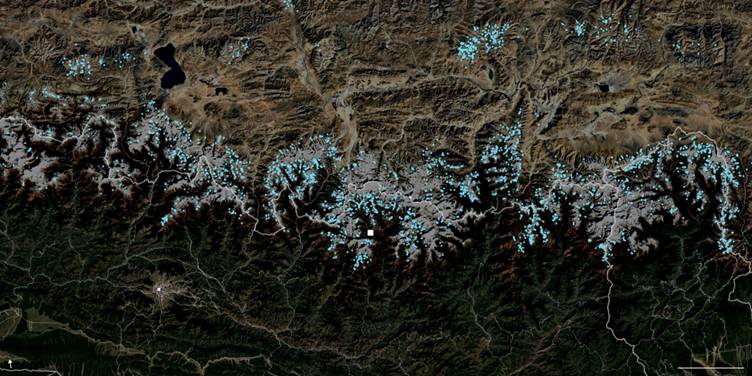
(Feature Image: Thousands of Glacial lakes dot the Himalayas. Source: NYT)
The following brilliant report on the threat of GLOFs (Glacial Lake Outburst Floods) is noteworthy from many perspectives. But possibly the most important one is to show the unknown but huge dimensions of the threat. Each of the thousands and thousands of glacial lakes in the Himalayas could pose such a threat. Alarmingly, no one can predict in most of these cases, when this threat will materialize, how big the floods it will bring and what will be the dimensions of the downstream impacts.
The report so lucidly explains how the Glaciers are not a threat, but becomes one when the ice starts melting. The threat materializes from the fragile walls of the lake formed and trigger comes from the melting ice or rain or avalanche or landslide from the surroundings. But the proportion of the downstream flood is majorly decided by the amounts of debris the flood will collect from the downstream.
For example, the Sikkim GLOF of Oct 2023 collected debris from the downstream, which was five times the volume of water that overflowed from the Glacial Lake in the first place. And the velocity of the flood would be decided by the elevation difference between the lake location and downstream community or infrastructure. This makes the quantum of downstream floods and its impacts so much more difficult to predict. The GLOF threat can remain hanging over the downstream areas for decades.
It once again underlines the urgent need to reduce the carbon footprint, and also do everything possible to reduce the threats from these melting glaciers. We can also take more prudent decisions about the location of communities and infrastructure in the path of the GLOF. We can also refrain from increasing the threat by avoiding activities that worsens the GLOF threat.
Why Dying glaciers are a threat across Himalayas As humans warm the planet, so much ice has been erased from around Mount Everest that the elevation at base camp in Nepal, which sits on a melting glacier, has dropped more than 220 feet since the 1980s. But this loss is not unfolding gradually. Often it begins slowly, imperceptibly — and then it happens all at once, with catastrophic consequences for the people below.
The death of a glacier is widely understood to be a tragedy, a loss reversible only on geological time scales, mourned like the death of a species. But before a glacier is gone — while it is still in the process of dying — it represents not just a loss, but a threat. The problem is the meltwater. As a glacier shrinks, it sheds water that gathers in the earthen bowl where the ice once sat, forming a lake. But the dirt and rock around this bowl are loose, crumbly. And so maybe one day there is a landslide. Maybe a chunk of the glacier’s remaining ice breaks off and plummets into the water.
Water plunges down the valley, picking up speed but also sand, silt, gravel and boulders. It becomes a slurry so thick that it knocks down buildings. And Dams. This is the way some of the largest floods in Earth’s history, ancient deluges that reshaped entire landscapes, took place. But it isn’t just their capacity for devastation that makes these floods so terrifying. It’s how hard it is to predict where, when and how they will happen.
As the glacier ice melts, more and more of the glacier’s surface is liquid: puddles that you could step across at first, then ponds, then lakes. Now, the lakes are joining up, transforming the landscape into a maze of ribbonlike waterways. There were 19,300 of these lakes across the Himalayas as of 2020, nearly 1,700 more than in 1990, by one recent estimate. Their total area grew 10 percent.
More recent floods have taken their own staggering toll: In Sikkim in Oct 2023, a chunk of partially frozen earth half a mile long collapsed into a lake, creating a 65-foot tsunami that barreled down the mountains, killing dozens of people and destroying the biggest hydropower dam of that state.
Kristen Cook, a geomorphologist at Université Grenoble Alpes in France, examines 3-D models of valleys before and after floods. The differences in topography indicate how much solid material — sand, gravel, boulders — the water picked up as it moved, adding to its deadly momentum.
When Dr. Cook first ran the numbers on the Oct 2023 flood in Sikkim, she thought her math was wrong. “I was like, This can’t be right,” she said. She and her colleagues’ calculations showed that the volume of sediment that the flood carried down the valley was five times the volume of lake water that originally overflowed. In other words, the roaring torrent had a consistency somewhere between murky water and wet concrete.
Dig Tsho is a giant lake that shed much of its water in a catastrophic flood in 1985. (The village hit hardest? Thame, where 12 people were killed in that flood.) But the lake has since refilled, its depth was 150 ft a decade ago and this year Dr. Watson measured its maximum depth as 240 feet.
That is what happened on a warm August Day in 2024 in Thame, a secluded village of 370 people, in a valley in the Everest region in Nepal. Glacial melt had been pooling rapidly in a high spot above the village for more than a decade. The resulting lake was so remote that nobody had given it a name. That day, rocks from the surrounding mountains fell hundreds of feet and landed in this lake, displacing an enormous amount of water. The water rushed half a mile down the valley and into another lake, heaving up more water. Soon, 100 million gallons were coursing downhill, toward the village. (The NYT report illustrates all this using satellite maps dramatically, effectively.) People in Thame heard a crescendoing roar.
By the time the water raged through, it was as if a swath of the village had never existed. The medical clinic, gone. The school, destroyed. Two dozen homes and trekking lodges, plus fields and fields of potatoes — wiped out. The lakes that flooded Thame were small, not on anybody’s list of the lakes most likely to cause a disaster. The village was wiped out, but fortunately nobody died as the disaster happened in broad day light.
All across the fast-warming Himalayas, melting glaciers are creating thousands of high-altitude lakes — and, in effect, thousands of new opportunities for avalanches and earthquakes to cause destruction. When falling rocks or snow land on a frozen glacier, nothing much happens. But as the ice melts and forms a lake, those same falling objects can set off a flood that menaces villages, tourist lodges, hydropower plants and anything else in its path.
Sitting on these lakes in their inflatable kayak, the scientists team lead by Dr Scott Watson of a glaciologist at the University of Leeds found them anything but placid. The ice cliffs were leaking noisy streams of fresh meltwater. Rocks and debris were tumbling in. Behind heavy clouds, unseen landslides rumbled all around, like rolling thunder.
CLIMATE CRISIS
First block level climate vulnerability assessment in Meghalaya shows 25 blocks in high or very high vulnerability categories According to a new study 25 out of 39 Community & Rural Development (C&RD) Blocks in Meghalaya fall under the high or very high climate vulnerability categories. The Meghalaya Climate Change Centre (MCCC) has conducted a comprehensive block-level climate vulnerability assessment covering the 39 Community & Rural Development (C&RD) Blocks of the State under NMSHE. The study adopts a common national framework to integrate biophysical and socio-economic indicators through a tiered, top-down approach.
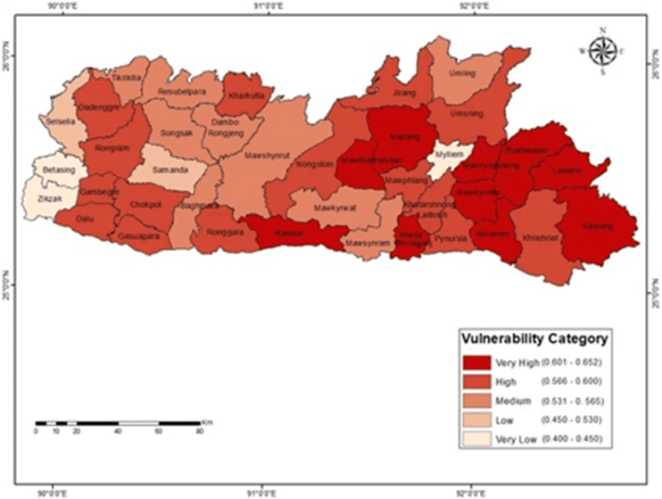
The Climate Change Programme under CEST Division of the Department of Science and Technology has established State Climate Change Cells (SCCCs) in 30 States/UTs of the country for better coherence on climate actions between Centre and States, and among States. The Meghalaya Climate Change Centre (MCCC), Government of Meghalaya is one of the important components under the National Mission for Sustaining the Himalayan Ecosystem (NMSHE) under the National Action Plan for Climate Change (NAPCC). The study titled “Integrated Climate Vulnerability Assessment of Meghalaya at Block Level” has been published in the renowned journal Discover Sustainability.
Assam completes 6 climate change related projects, 9 more underway Assam govt has completed six climate change related research projects, including a district-level vulnerability assessment for Assam and green budget tagging for various departmental schemes, projects, and policies. Additionally, nine projects are currently in progress, such as the state of environment report for Assam, Study for Developing Flood Management Plan: Prioritising Blue-Green Interventions and Building a Climate-Resilient Dibrugarh Town, and Decarbonisation Pathways for Assam.
HYDRO POWER PROJECTS
Report attempts to give positive spin to Hydro Sector A PTI story on Nov 28 2025 attempted to give unsubstantiated positive spin to hydro sector over the last decade, when in reality, the sector performance has been very poor. The commissioning (800 MW Parbati II) or wet spinning (two units of Lower Subansiri HEP) of some of the much delayed hydro projects is being used to give this spin. It talks about expansion of Teesta V, when what is being attempted, though without environmental clearance is expansion of the spillway capacity of the project, not the generating capacity of the project.
Pump Storage Hydro (PSH) Projects are being pushed, but these projects are net consumer of power and there is question mark over economic viability and necessity of the huge capacity being pushed. It notes: “As of May 2025, 125 PSH projects (Rs 151.7 GW) were in the environmental-clearance pipeline, though only Rs 13% had received Environmental Clearances (ECs) or begun construction”. There is certainly some push to more hydro in J&K and Arunachal Pradesh, without really much debate or public consultation process or credible environment, social and disaster impact assessments. As the report notes, with only a handful of capable contractors, two firms (L&T and Patel Engg) stand to benefit from the PSH push.
Phrases like “elevated safety and design standards” and “improving trust and governance in hydropower development” have no substantiation or reflection on ground. The ground situation in fact is only getting worse as far as disasters related to hydro projects are concerned.
NHPC to add spillway tunnel at Teesta V, needs fresh EC The NHPC’s Teesta V project, damaged in Oct 2023 GLOF, is under repair and is being reworked. According to a Patel Engineering company’s press release on July 18 2025, NHPC has given a Rs 240 Cr “works involving modification of diversion tunnel into tunnel spillway arrangement – Civil & Hydromechanical works”. This way, NHPC seems to be intending to add spillway capacity to the project. However, NHPC should have taken modification in Environment Clearance for the project to add this additional component, which it has apparently not taken seeing the minutes of the MoEF’s Expert Appraisal Committee meetings for River Valley Projects over the last two years since Oct 2023 disaster. Awarding the works for this without such modification in EC is clearly violation of the EIA notification.
Dima Hasao residents oppose 1200 MW HEP In a strong show of resistance, people from Moti Lampu, Moti Hojai, and Riam Bathari in Dima Hasao district opposed the 1200-MW hydroelectric power project, proposed jointly by Assam Power Generation Corporation Ltd (APGCL) and Adani Green Energy Ltd. In a detailed memorandum addressed to Dilip Saikia, president of the Assam BJP, village representatives Mohonlal Rajiyung (Gaonbura, Moti Lampu), Joytolal Khersa (Gaonbura, Moti Hojai), and Nailon Bathari of Riam Bathari expressed deep alarm over reports that the North Cachar Hills Autonomous Council (NCHAC) has issued a No Objection Certificate (NOC) for the project site.
The objection letter strongly underlines the severe ecological implications: it warns that this project could result in the permanent destruction of rich forest cover, rare wildlife habitat, streams, flora and fauna, and the delicate ecological balance of the region.
Sawalkote HEP facing delays The situation worsened after the NHPC cancelled the consultancy tender issued in July this year, just days after its announcement. Informed official sources have revealed that although preparatory work such as land acquisition, allocation of funds and inter-departmental clearances is being carried out in phases, progress on the ground remains extremely slow. NHPC officials have also reportedly expressed dissatisfaction over the lack of consistent support and coordination from the present JK UT government.
With an estimated cost of Rs 31,380 Cr, the Sawalkote project is designed to generate 1856 megawatts of electricity. The dam will be constructed on the Chenab river in Ramban district, the water diversion tunnel will be located in Reasi district, while the underground powerhouse will be built in Udhampur.
DAMS
Are dams in India Truly Safe? Are the dams in India truly safe? This is not just a technical query for engineers or bureaucrats – it is a humanitarian concern, a governance responsibility and, most importantly, a future-defining challenge. The fundamental issue lies at the intersection of aging infrastructure, inadequate maintenance, political inertia and growing climatic stress. Many dam manuals haven’t been updated for over 20 years.
The question is not whether a dam can withstand an extreme event. The question is how many simultaneous extreme events we are ready to handle. Who will risk releasing water early if downstream farmers protest? And who will risk delaying water release if urban areas flood? In India, risk balancing is more electoral than hydrological. If you speak to senior hydrologists privately, they admit that while India hasn’t had a major dam disaster in recent history, it is not because we are fully prepared. It is because of sheer luck and fragmented rainfall patterns. One synchronised failure of multiple dams in a river basin could trigger unprecedented devastation.
Reportedly, out of over 6,000 large dams in India, only around 500 have complied with the provisions of the National Dam Safety (NDS) Act. This means less than 10% of the country’s major dams are aligned with the mandated safety, inspection and emergency preparedness norms introduced under the Act. But when water is released from a dam or a structurally unstable dam shows early signs of stress, who informs the people living downstream? Why is the public not treated as a stakeholder in dam safety dialogues? Why should a nation that builds Mangalyaan not build world-class predictive dam safety networks?
BBMB proposes 1500 MW PSH near Bhakra Dam The Bhakra Beas Management Board (BBMB) has proposed a 1,500 MW pumped storage power project near the Bhakra Dam head in Himachal Pradesh’s Una district. BBMB has identified Dobar village in the Shivalik foothills for the project. Engineers have identified a narrow gorge in the area where a 20 million cubic metre (MCM) reservoir can be constructed. Water will be lifted from the existing Gobind Sagar Lake of Bhakra Dam to the new reservoir during off peak hours. During peak hours, the same water would be released back into the Gobind Sagar Lake, generating electricity.
The full board of BBMB had approved the concept in 2024. Since then, the organisation has already completed the tendering process for selecting consultants to prepare the Detailed Project Report (DPR). Once the DPR is finalised, the project will require mandatory environmental clearances from the Union Ministry of Environment and Forests. Until the power sharing details with Himachal Pradesh are final, project cannot go ahead. HP is likely to ask for 12% free share in power generated.
Jal Shakti Minister says building dams no longer viable Jal Shakti Minister CR Paatil on Nov. 28 said building new dams is no longer a viable and long-term water management solution due to high costs, land acquisition hurdles, and shrinking river flows. The minister urged states to align with the Centre’s push for conservation, and emphasised the need for collective action. “We need water every moment, but we have not been able to organise it properly,” he said.
Highlighting the difficulties in constructing new dams, he said, “We have more than 6,500 dams, but we still store only about 750 bcm of water. It takes 25 years and Rs 25,000 crore to build a dam. Do we have that much time? Do we have that much money?” Paatil further said that high cost, land acquisition hurdles, and shrinking river flows are key hurdles in pursuing a dam-based water storage strategy.
Minister says new dams no longer feasible Jal Shakti Minister C. R. Paatil on Nov. 28 added that high costs, acquisition delays and declining river flows were major obstacles. He said the government had shifted focus to water conservation, community participation and groundwater recharge through the ‘Jal Sanchay Jan Bhagidari’ (JSJB) initiative and the Jal Shakti Abhiyan. Paatil highlighted what he called a surge in JSJB structures. “In the first 10 months, against the target of 10 lakh structures, people built 27.5 lakh,” he said, adding that this year’s target was one crore. He also urged states to make full use of MGNREGA funds allocated for water conservation.
Citing examples from Gujarat and Rajasthan, he said community-led work was showing results. In Banaskantha, he said, the NGO Vantara and farmers built 30,000 recharge structures, helping revive drying wells. “Government alone cannot do this. Water is not just a state subject, but it is the responsibility of all of us,” he said. He urged officers to prioritise work over positions. “Put your talent to national service,” he said. “If you put your vision on the ground, you can do great work.”
2 day Summit on “Vision for Sujalam Bharat” 2025 As part of the inaugural session, the Union Minister of Jal Shakti released the Book on Jal Sanchay Jan Bhagidari 1.0, showcasing community-led groundwater recharge efforts and successful water conservation models from across the country.
A Report on the Assessment of the Ecological Status of the Barak River Basin for Conservation Planning was also launched, providing critical scientific insights to guide basin-wide restoration strategies. In addition, the Ganga Pulse Public Portal was unveiled, offering an integrated digital platform to enhance public access to real-time information and promote wider participation in river health monitoring.
He further informed that the Modernization of the Command Area Development and Water Management (SAMRIDHI-MCAD) is enhancing irrigation efficiency through pressurized and scientific irrigation systems. He also highlighted that Jal Shakti Abhiyan: Catch the Rain (JSA:CTR 2025) has led to the creation of 22.5 lakh water-conservation works and more than 42 lakh plantation activities.
MoJS held meeting to strengthen water governance The Ministry of Jal Shakti held a high-level brainstorming session on Nov 26, chaired by Minister C R Paatil. The meeting aimed to chart a roadmap for strengthening water governance, improving service delivery, and ensuring long-term water security across India. Discussions covered integrated water management, sanitation, river rejuvenation, climate preparedness, and community participation.
The ministry said structured interactions of this kind are crucial for aligning priorities, identifying bottlenecks and improving coordination among stakeholders. Key suggestions and outcomes from the session will now be compiled for follow-up action in consultation with relevant departments and state governments, it said.
Andhra invites fresh bids to divert Godavari waters Andhra Pradesh has unveiled a fresh plan to divert Godavari waters, this time through the Polavaram–Nallamala Sagar Link Project (PNLP), as was expected. The AP Irrigation department has issued an e-procurement notice inviting tenders to prepare the Detailed Project Report (DPR). The last date for submitting bids is December 11, and the bids will be opened on December 17. This move follows the government’s decision in early November to cancel tenders for the Polavaram–Banakacherla Link Project. The state is now preparing a new DPR for the PNLP in line with the CWC guidelines, 2017.
According to the document, the project aims to divert 200 tmcft of Godavari floodwater at 2 tmcft per day (23,000 cusecs) to drought-prone areas of the state. The work will proceed after securing approvals from Central agencies, including MoEF, MoTA and CWC. The latest tenders cover all required investigations and other works.
Polavaram stop work order: AP wants permanent stay The Andhra Pradesh govt has urged the Centre to grant a permanent stay on the “stop work” order issued in 2011 by the Union ministry of environment, forest and climate change (MoEFCC) for the Polavaram project. The current stay—allowing work to continue—remains valid until June 2026.
Key decisions of EAC meeting Nov 12 2025 1. Malshej Ghat Closed Loop Pumped Storage Project (1200 MW) in 310.61 Ha at Village Khubi and Thitabi Tarf Vaishakhare, Sub Dist Junnar and Murbad, Dist Pune and Thane, Mah by THDC India Ltd – Terms of Reference: APPROVED
2. Masinta Closed Loop Pumped Storage Project (1000 MW) in 403.9 Ha at Village Kadapada, Kantapali, Kulsra, etc, Sub Dist Barkot, Dist Deogarh, Odisha by NHPC Ltd – Terms of References: APPROVED
INTERLINKING OF RIVERS
Ken Betwa link alignment changed for the second time, project cost up The alignment of the Ken Betwa Link has been changed second time. To save the bunglows of collector, SP, and some 40 colonies, there is proposal for underground pipeline tunnel. The cost of the project has gone up by Rs 12000 Cr. Union Govt is going to consider the proposal.
Ken Mandakini Proposal MP’s third River Link Project is proposed, involving the linking of the Ken and Mandakini rivers. The Rs 4000 Cr project involves a 110-km (90 km open and rest closed) canal between Panna and Majhgaon in Satna district. The core goal of this new link is to divert 250 Million Cubic Meters water from the Ken River into the Mandakini River, which flows through the Chitrakoot district. It involves a dam on the Ken River at Patne Abir in the Panna district. The canal will terminate in the catchment area of the Dauri Sagar Dam, in Majhgaon Tehsil in Satna district. Water will then flow from the Dauri Sagar Dam into the Mandakini River. Additionally, under the existing Betwa Project, both MP and UP are slated to send 125 MCM of water to the Mandakini. The project is expected to irrigate 18000 ha in MP, 20 000 ha in UP and have a 25 MW hydro station. Work on the DPR is underway.
Sediment movement in Rivers From fertile floodplains to floating islands, the movement of sediment has shaped civilisations, ecosystems, and cultures. This report explores how people in India continue to live with and adapt to the ever-changing nature of sand and silt. Assam’s chars and Goa’s khazans show how people continue to adapt to these dynamic landscapes.
“Chars, as landscapes of flux, lie on the borderlines of land and water. They are a perfect example of an ecotonal space where the solid and the liquid existences of the land and water merge in myriad ways, resulting in the creation of unique lifestyles and livelihood choices, socio-economic identities and everyday narratives of survival”, says Debdatta Chowdhury.
On Goa’s coast, lies another example of human ingenuity in negotiating with sediment. In the coastal state of Goa, an estimated 3-4,000 years ago, early communities had begun reclaiming marshlands in the floodplains of the state’s tidal rivers through Khazans. This system controlled the influx of brackish, tidal water – enabling agriculture, creating opportunities for inland fisheries, and essentially making the land habitable. (Rhea Lopez, Aishani Goswami)
INTERSTATE WATER DISPUTES
9th meeting of UYRC The 9th meeting of Upper Yamuna Review Committee (UYRC) was held under the chairmanship of Shri C. R. Patil, Union Minister for Jal Shakti on 27.11.2025 at Yamuna Bhawan, Noida. Various aspects related to regulation and management of surface water like implementation of storage projects in Yamuna basin; Transfer of Rajasthan’s share of Yamuna water; Maintenance of e-Flow in river Yamuna; Inclusion of representative of NMCG as a member in UYRB; etc. were discussed during the meeting.
The Committee noted with satisfaction that the States of Haryana and Rajasthan are working together for implementation of the project for transfer of Rajasthan’s share of Yamuna river to water scarce region in Rajasthan at the earliest.
The matter related to ensuring requisite flow in river Yamuna for its rejuvenation was also discussed. Union Minister observed that all States will have to reduce their consumption by adopting water efficient practices and spare water to flow in river Yamuna. He called upon all concerned states to explore the possibility in positive manner and asked all partner States to work in the larger interest of the country for implementation of three storage projects in the Yamuna basin. These measures will help in improvement of water availability during lean season as well as in ensuring e-flow and reducing pollution.
Let water flow into Yamuna: Patil to riparian states Union Jal Shakti Minister CR Patil on Nov. 28 urged riparian states of Yamuna to reduce their consumption of water by adopting “efficient practices” and spare water to flow in the river.
Rajasthan taking steps to bring excess Yamuna waters The Rajasthan govt has started preparing a detailed project report (DPR) for construction of a transportation system to divert some of the waters flowing wastefully from the Yamuna river during the monsoon to the State. The DPR will be sent shortly to the Central Water Commission (CWC). Water Resources Minister Suresh Singh Rawat said at the ninth meeting of the Upper Yamuna Review Committee in NOIDA that the work orders for the DPR had been issued and it was being prepared in coordination with a joint task force comprising the members from Rajasthan and Haryana.
The decision to divert excess Yamuna waters to Rajasthan follows an agreement signed with the Haryana government in February 2024 for getting the State’s full share of 1.119 billion cusec metre water as per the 1994 Yamuna Water Agreement. The availability of water will resolve the issue of shortage of drinking and irrigation water in four districts of Shekhawati region. Mr. Rawat said the Shekhawati region, situated at the edge of Thar desert, had been facing water scarcity since long, and the joint task force was preparing an action plan to supply the Yamuna waters to the remote areas in Sikar, Churu, Jhunjhunu, and parts of Nagaur district.
The Minister urged the Centre to consider the Renukaji, Lakhwar and Kishau projects on Yamuna and its tributaries in Himachal Pradesh and Uttarakhand as integral parts of national projects for diverting the water from Hathini Kund Barrage to Rajasthan, and provide financial assistance. The State government has already approved its share of funds in the three projects for ensuring the completion of work on time.
RIVERS AS NATIONAL WATERWAYS
Turning the Ganga into ‘a powerful corridor for trade, mobility, tourism’ At India Maritime Week 2025, the Inland Waterways Authority of India (IWAI) signed MoUs worth over Rs 6,000 crore to expand and modernise National Waterway-1 (NW-1) on the river Ganga, the Union Ministry of Ports, Shipping and Waterways said. The investments span river cruise tourism, ship repair, cargo movement, clean-energy infrastructure and skill development, with a sharp focus on Varanasi.
IWAI has tied up with private operators Heritage River Journeys and Alaknanda Cruises to induct new cruise vessels and scale up premium river tourism and heritage circuits in and around Varanasi, with more than Rs 800 crore earmarked for these projects. A new ship repair facility in the city, at a planned investment of Rs 350 crore, and two river cruise terminals worth Rs 200 crore are expected to position Varanasi as a regional maritime services and cruise hub.
To support greener transport, a Rs 100 crore project will roll out electric vessel charging infrastructure on NW-1 under the National Green Shipping Mission.A Rs 1,000 crore MoU with Rhenus Logistics will bring modern tug-barges to the Ganga and Brahmaputra (NW-1 and NW-2), increasing freight capacity and improving multimodal logistics. Another Rs 200 crore has been allocated for a Regional Centre of Excellence in Varanasi to train manpower and drive research in vessel design, inland navigation and green technologies.
Additionally, MoUs worth Rs 1,500 crore each with NTCPWC of IIT Madras (for dredging supervision) and IPRCL (for rail connectivity to multimodal terminals at Varanasi, Sahibganj and Haldia) aim to integrate waterways with rail under PM Gati Shakti.
Tripura: IWAI advances waterway projects The IWAI has advanced two projects connecting Dumbur Lake in Dhalai district via waterways on the Gomati river and the launch of a cruise service. Tripura tourism minister Sushanta Chowdhury said on Nov. 23 during a high-level meeting with officials from the ministry and IWAI.
According to Chowdhury, Sonowal pointed out the advancements in Tripura, stating that IWAI is executing a Rs 24.53-crore project aimed at enhancing the Gomati river and establishing a navigation link with Bangladesh’s Meghna river system. He also said a feasibility study is currently taking place to launch a cruise service on Dumbur Lake, with the goal of increasing the area’s tourism prospects and fostering leisure-based water travel in the region.
URBAN RIVERS
Karnataka minister spells measure to curb Nandini river pollution District minister Dinesh Gundu Rao said that he has directed the MCC officials to prepare an estimate to upgrade the STP at Munchoor with the latest technology. He said the present STP at Munchoor is old, and uses outdated technology. The STP needs to be upgraded. “Once the estimate is prepared, I will speak to the minister for urban development for the release of funds for the same,” he said. He mentioned that it has been decided to procure a generator for the STP. A tender will be floated soon, and the generator will be available by Feb. Until then, the officials have been directed to hire a generator to ensure that the STP functions throughout the day, and the untreated water is not discharged into the river. He also noted that with the sludge accumulating in the river, officials have been directed to prepare an estimate to dredge the water body to clean it.
RIVERS
BIS’s updated earthquake design code places entire Himalayas in High Risk Zone VI India has unveiled a radically updated seismic zonation map as part of the revised Earthquake Design Code by the Bureau of Indian Standards (BIS), placing the entire Himalayan arc in a newly introduced highest-risk Zone VI for the first time. 61% of the country now falls under moderate to high hazard zones.
Previously fragmented across Zones IV and V despite uniform tectonic threats, the Himalayan belt now receives consistent classification. The older maps underestimated risks from long-unruptured fault segments, particularly in the central Himalayas, which haven’t seen a major surface-rupturing event in nearly two centuries. The update accounts for rupture propagation southward along the Himalayan Frontal Thrust, extending dangers to areas like Dehradun near Mohand.
Key changes include reclassifying the outer Himalaya, where faults could drive quakes intersecting populated foothills. Boundary towns between zones now default to the higher-risk category, prioritising geological realities which planners and administrators take into account while taking decisions about projects. It demands retrofitting of infrastructure and halting expansions on soft sediments or active faults.
India unveils new quake map Previously fragmented across Zones IV and V despite uniform tectonic threats, the Himalayan belt now receives consistent classification. The older maps underestimated risks from long-unruptured fault segments, particularly in the central Himalayas, which haven’t seen a major surface-rupturing event in nearly two centuries.
Is India becoming world’s chemical graveyard? By permitting the machinery that devastated Veneto to restart production in Maharashtra, India risks repeating one of Europe’s greatest environmental scandals – this time in a larger, more densely populated area.
This isn’t just about one plant or one industry. It’s about the future we are building. Coastal chemical hubs like Dahej, Paradeep, and Mangaluru are dangerously close to ecologically sensitive zones — estuaries, mangroves, and agricultural lands that sustain millions. If PFAS and other hazardous substances enter our rivers or aquifers, no clean-up technology in the world can reverse the damage. We risk contaminating the food chain, livestock, and groundwater — the invisible arteries of life itself.
Let’s not forget: India is already grappling with rising cancer clusters near industrial zones, poisoned rivers like the Periyar and Yamuna, and declining soil fertility. Adding Europe’s chemical rejects to this toxic mix is not development; it is self-destruction masquerading as progress. (Ameer Shahul)
Major droughts linked to Indus Valley Civilisation collapse The Successive major droughts, each lasting longer than 85 years, were likely a key factor in the eventual fall of the Indus Valley Civilization along India-Pak border, according to a paper published in Communications Earth & Environment. Indus Valley Civilisation, between 5000 to 3500 years old, was one of the oldest human civilisation. At its peak, between 4,500 and 3,900 years ago, its culture was characterized by advanced cities and sophisticated water management systems.
The authors identified a temperature increase over the period of approximately 0.5°C, and a decrease in average annual rainfall across the region of between 10% and 20%. They were also able to identify four long-term droughts between 4,450 and 3,400 years ago, each lasting more than 85 years and affecting between 65% and 91% of the IVC region. The final 113-year-long drought that they identify, between 3,531 and 3,418 years ago, coincides with archaeological evidence of major deurbanization in the IVC. The authors conclude that the IVC likely did not collapse suddenly as a result of any one climate event, but instead declined slowly, with the prolonged droughts a major contributory factor.
Iconic Umangot River of Meghalaya polluted by NH Project The Umngot, the famous crystal clear river of the State was destroyed by the Shillong Dawki Road of National Highways & Infrastructure Development Corp Ltd, funded by JICA. No EIA or EMP was prepared using the loophole that roads below 1000 m elevation with length lower than 100 km and width less than 60 m need not have environment clearance, though being located in one of the most fragile and sensitive hilly regions was not covered under these safeguards. This colossal environmental disaster, which has not only the shamed the state as a eco-tourist destination, but destroyed the livelihood of thousands of people who depended on the river’s unparalleled clearness which drew tourists from all over.
The Irulas mourn a fading river Chokkanalli village in the Sigur plateau (part of Nilgiri Biosphere Reserve) in Tamil Nadu has seen decades of ecological change that transformed the Sikkole river (also called the Chokkanalli river and also the Maheshwar river, a tributary of Moyar River which flows into Bhavani reservoir), a lifeline of the Irula community. Driven by deforestation, land-use change, hydropower dams, and erratic rainfall, the river now flows thin, altering wildlife movement, agriculture, and water security. These shifts have reshaped indigenous livelihoods, with the Irula community losing access to traditional farming, forest foods, fish, and clean water. B. Vijayarani, an Irula woman, offers a first-person account of these changes.
Muddy Umngot threatens livelihoods For years, local boatmen, guides, and homestay owners extended Meghalaya’s traditional six-month tourism season into nearly year-round income by promoting the Umngot’s clarity, but this progress is now at risk.
Emerald Dawki is now muddy In the last few weeks, videos showing its muddy and cloudy water have spread online, leaving travellers shocked and locals worried. The caption posted with the video explains that a major construction project is currently underway near the river, where a new bridge is being built. Due to this work, large amounts of mud and loose soil are flowing straight into the Umngot, turning the once crystal-clear river brown and murky. The caption also mentions that locals believe it could take up to 2 to 3 years for Dawki to get back its original emerald colour.
Muddy Umngot impacts tourism The sudden change in water quality has created an economic emergency for hundreds of families across Dawki, Shnongpdeng and Darrang who rely entirely on the river for their income, reported The Shillong Times. For years, these communities built their livelihoods around the Umngot’s signature transparency. This season, that fragile balance has collapsed. “Business is down almost 80 per cent,” said Alan West Kharkongor, president of the Meghalaya Rural Tourism Forum. “Bookings are being cancelled left and right. People come here for crystal clear water; when it is polluted, they simply don’t come.”
Umngot joins the endangered list of rivers! The detailed measures to be adopted during different stages of the project to mitigate negative impacts and enhance positive aspects are subject to strict monitoring. The responsibility for implementation and supervision of EMPs are vested with three agencies, namely, Contractors, PIU, and Supervision Consultants (SC). All prescriptions are on paper which requires implementation in letter and spirit on the ground. The question is whether such recommendations have been complied with under the scrutiny of monitoring agencies and if in the positive, to what extent?
Yamuna: Industrial discharge hampering cleaning: DPCC Of the 13 installed common effluent treatment plants (CETPs) meant to process wastewater from 28 approved industrial zones, six have failed to meet Environmental Protection Agency (EPA) standards for key pollution markers. Delhi, which has 28 planned industrial areas, currently has only 13 CETPs. The remaining industrial pockets channel untreated waste into stormwater drains that ultimately empty into the Yamuna, sharply amplifying the river’s toxic load. The 13 CETPs are currently operating at less than half of their cumulative installed capacity, the report has revealed.
The report also details enforcement action. “Environmental compensation of ₹19.10 crore has been imposed by DPCC on 11 CETP societies and two CETP operators at Narela and Bawana from time to time in the past for violations and for not meeting prescribed standards,” the report said. However, the fines have triggered multiple legal challenges. “CETP societies of Okhla, SMA, Mayapuri, Mangolpuri, GTK Road, Naraina, Jhilmil and Lawrence Road have approached the court against these penalties, and cases are currently at various stages,” the report added.
Rawat said: “Besides these approved and non-conforming clusters, a large number of industries are operating illegally from residential areas and agricultural land which are not even accounted for. We have also seen cases where effluents were being dumped in borewells contaminating ground water.”
DJB plans to use treated wastewater In an action plan submitted to the central government, the Delhi government stated that of the 701 MGD of available treated wastewater, only 125 MGD is currently being reused in the city. Under the 1994 Yamuna water-sharing agreement, 267 MGD of treated water must be mandatorily discharged back into the river to sustain its flow.
Bhim Singh Rawat, Yamuna activist and member of the SANDRP, said the first primary focus of the DJB should be to ensure that the STPs meet the standards and independent credible monitoring is carried out otherwise the plan risks contamination of water bodies and sub surface qualifiers. “Half of our STPs don’t meet CPCB parameters. We should first ensure treated water is of high quality. Secondly, the marshy area in Jahangirpuri and Coronation pillar has been significantly reduced due to filling. It was naturally undertaking groundwater recharge by rain run off from areas along the ridge. We have destroyed s natural wetland and now are looking for these artificial means. Thirdly, the plan to set up water bodies and then extract ground water for drinking purpose using tubewells needs very stringent regular monitoring of water quality otherwise the groundwater will be contaminated irreversibly.”
117 Sonipat units still polluting Yamuna Industrial discharge from nearly 117 polluting units in the Barhi industrial area continues to contaminate drain no. 6 of the Yamuna, which passes through Sonipat, according to a report submitted by an expert committee to the NGT last week. The inspection was carried out by experts from the CPCB, HSPCB, and the local administration to assess the functioning and effectiveness of the CETPs installed in the HSIIDC Industrial Complex. The report highlighted alarmingly high BOD levels at the CETP outlets. It also noted that HSIIDC lacks valid permissions to operate borewells for supplying groundwater to industries in the area.
CM reviews progress cycle track project CM Rekha Gupta on Nov. 26 held a high-level review meeting to assess the progress on the 53-km cycle track along the river, officials said. The track is proposed from the Wazirabad bridge to NH-24 and will further go up to the Kalindi Kunj biodiversity park.
The Delhi Development Authority (DDA), which is implementing the project, said that the cycle corridor will run along both the banks and cross the Yamuna at selected points to maintain route continuity. The western bank will have a track of 23kms while the eastern bank will have 30kms. “Most departments have issued no-objection certificates (NOCs) for the project. Approval from the railways are at an advanced stage. The CM directed the departments concerned to prioritise coordination efforts so that work can begin without delay,” said the official.
Yamunotsav to celebrate Yamuna: Minister Delhi’s Culture Minister Kapil Mishra on Oct. 31 said the upcoming Yamunotsav at Vasudev Ghat will be a “grand and divine” celebration, promoting public participation in preserving the purity and continuity of the Yamuna River. The two-day festival, scheduled for November 2 and 3, will bring together spiritual leaders, experts, and citizens to explore both the spiritual and scientific dimensions of the river, an official statement said.
SAND MINING
Check dam blasted, sand mafia blamed A new check dam on the Manair river, constructed at a cost of about Rs 23 crore, was reportedly destroyed using explosives between Gumpula of Odela mandal in Peddapalli district and Tanugula of Jammikunta mandal of Karimnagar district, officials said. The suspicion centres on the sand mafia operating in the area. The check dam, due for inauguration, suffered significant damage, with 90-metre-long cracks and breaches found in three places. Irrigation officials have filed a complaint with the Jammikunta Police stating that the attack was carried out using detonators or gelatin sticks, strongly suspecting it to be the work of the sand mafia whose illegal operations were halted by the dam’s presence.
The illegal sand trade, which previously operated extensively with 300 to 400 tractors and trucks illegally transporting sand to Hyderabad and other regions, was severely restricted by the dam’s water reserves. Authorities believed the culprits realized they could only resume their highly profitable, large-scale mining operations if the structure was eliminated.
Following the incident, irrigation officials, including EE K. Balaramaiah and DE Ravi filed a formal complaint, stating that unidentified individuals blasted the dam and specified that the damage has placed the cultivation of 100 acres in the immediate vicinity and estimated the financial loss to be around Rs 3 crore. EE Balaramaiah stated that the act appeared to be a deliberate blast, likely executed by the sand mafia and promised strict action against the perpetrators. The Jammikunta police have registered a case and CI S. Rama Krishna confirmed that an investigation into the destruction is underway.
Forensic experts inspect collapsed check dam A forensic team on Nov 24 inspected the site where a check dam across Manair river collapsed at Gumpula village in Peddapalli district on November 21, as part of the ongoing investigation to ascertain the exact cause. According to the police, the forensic personnel were accompanied by the members of the Clues Team of the State police. The incident sparked concerns among local farmers, who expressed doubts over the possible sabotage angle behind the check dam’s sudden collapse.
Experts probe Manair check dam damage The officials said they were examining the site to establish the cause of the incident. They said the collected samples would be analysed in the laboratory and that action would follow based on the findings. They added that legal proceedings would be initiated against anyone found responsible.
Officials inspect damaged Manair check dam Local farmers alleged that the sand mafia had blasted the check dam to clear the way for illegal transportation of sand. Responding to the allegation, the CP said it was not possible to conclude that the structure was blasted without proper evidence. He added that the exact reasons would be known after the forensic report and further action would be taken based on its findings.
BRS demands judicial enquiry into check dam blast incident. In this regard, BRS MLAs Gangula Kamalakar and P Koushik Reddy along with other party workers submitted a representation to the district Collector Pamela Satpathy in Karimnagar on Nov. 28.Based on a complaint lodged by irrigation Divisional Engineer (DE) and Executive Engineer (EE), police registered an FIR but no action has been taken so far. There was a possibility of sidetracking the issue. So, they gave representation to the Collector for judicial enquiry besides making public the forensic lab report.
Kerala HC directs CS to submit suggestions on expert panel The Kerala High Court has directed the Chief Secretary to submit recommendations on forming an expert committee to oversee the removal of sand from the Thottappally spillway mouth in Alappuzha district. The directive came while considering a petition filed by R. Arjunan, general convener of the Anti-Black Sand Mining Coordination Committee, and Saji Jayamohan, secretary of the Thottappally Green Roots. The Bench also observed that sand could be removed only in accordance with the guidelines issued by a multi-department expert panel. The matter has been posted for further hearing on December 3.
The petitioners argue that unchecked sand extraction under the pretext of disaster management cannot be permitted, especially in an ecologically fragile area where such activities could gravely affect the coastline and surrounding farmlands. They further highlight that the site is among the world’s rare nesting grounds of the Olive Ridley turtle, an endangered species protected under Schedule I of the Wildlife Protection Act, 1972, warning that any failure to safeguard this habitat could push the species close to extinction.
Odisha: 32 HYVA trucks with illegally-mined sand seized The Balasore administration seized 32 hyva trucks for transporting sand illegally from Subarnarekha riverbed and nearby areas in the intervening night of Nov. 26-27. The operation was carried out by a joint enforcement team led by district collector Suryawanshi Mayur Vikas along with SP Pratyush Diwakar, sub-collector Shiv Malviya, Jaleswar tehsildar Satyajit Mohanty and other officials. The team found multiple trucks engaged in illegal lifting of sand from Subarnarekha riverbed.
The officials also intercepted several vehicles on way to locations where large sand stockpiles had been created for illegal sale. Some trucks were reportedly headed outside the district to supply sand to buyers. Residents of Jaleswar and Chalanti claimed they had repeatedly opposed the unauthorised activities but were threatened by the sand mafia. Despite being aware of the situation, local officials ignored the illegal sand mining for months, they alleged.
12cr penalty imposed for illegal sand mining Drone-based volumetric survey conducted by the Cuttack administration has detected large-scale illegal sand extraction across 15 major quarries, with penalties to the tune of Rs 12 crore imposed on operators on Nov. 27. The survey found significant excess extraction at the sand sources in the Kathajodi river, the Kuakhai, Naraj, Badambadi, Sidua, Balada-Nailo Devi river sand, Kalikaprasad sand ghat, Baisdeswar sand source, Subarnapur sand source, Dhanipur Mahanadi and Brahmapura Mahanadi sand sources.
The joint exercise by the district administration and office of the deputy director of mines, Cuttack circle, aimed to scientifically measure sand extraction levels. High-resolution drone imagery coupled with DGPS (differential GPS) mapping helped officials detect excess sand lifting even beyond the leasehold boundaries. A professional technical agency was also engaged to carry out the drone-based survey to ensure accuracy and eliminate manual intervention. High-resolution drone images and DGPS mapping helped officials measure sand extraction both inside and outside leasehold areas. “Data, vetted by Odisha Space Application Centre (ORSAC), was verified with initial data stored with ORSAC. Finally the report has come and we have acted accordingly,” he added.
WETLANDS, LAKES, WATER BODIES
UP: Challenges in Wetland Conservation In the villages of Uttar Pradesh, a test case in environmental law is clashing with inheritance, displacement and politics on the ground.
Illegal farming menaces migratory birds’ haven in Himachal Notwithstanding a Supreme Court ban imposed in February 2000 on all non-forestry activities inside wildlife sanctuaries, illegal cultivation continues unabated on the Pong Wetland Wildlife Sanctuary land in the lower Kangra region. Even as thousands of exotic and domestic migratory birds arrive with the onset of winter, the state Forest Department’s repeated attempts to curb the violations have yielded little success. Issuing challans has failed to deter offenders, who continue to plough protected land with impunity.
WATER OPTIONS
When springs dry up, J&K pastoralists turn to RWH Water scarcity from declining snowfall and drying springs puts pastoralists in Jammu & Kashmir at risk of abandoning their traditional migration practices. Community-led efforts to harvest rainwater through small artificial ponds in high-altitude pastures is proving to be a potential solution to it. The Alpine Pond Project, that supports over 230 pastoral households, is emerging as a model for climate adaptation, combining both local knowledge and scientific insight.
Tank restoration revives life in Kolar village Yagavoddu tank, once the lifeline for the small village of Ammacheruvapalli under Mudimadugu gram panchayat in Srinivaspur taluk of Kolar (Karnataka), has dried up over the years. As silt accumulated and monsoon failures became more frequent, the tank’s storage capacity drastically diminished, along with the hopes of the many families who depended on it. However, the tank has been revitalised. Spanning 15 acres, the lake has been restored after years of neglect at a cost of around Rs 80 lakh.
The restoration process began with extensive desiltation, followed by the reinforcement of the bund. Inflow channels were cleared of silt and weeds to ensure smooth water flow into the tank. Additionally, saplings were planted along the perimeter to enhance the ecosystem and prevent soil erosion. After the restoration, the groundwater level in the surrounding area increased significantly. The rejuvenated tank now supports not only Ammacheruvapalli but also seven neighbouring villages.
Story 2: Hindignala’s century-old Kalyani restored The ancient temple well, Kalyani, at Hindiganala near Hoskote in Bengaluru Rural, lay abandoned for over a century — unsafe, silted, and forgotten. Today, it stands fully restored and reopened to the public, thanks to a remarkable rejuvenation effort. The temple well now holds 3.1 billion litres of water, significantly improving groundwater recharge and helping revive multiple borewells across neighbouring villages. The rejuvenated ecosystem supports climate-resilient agriculture, reduces reliance on deep borewells, strengthens rural livelihoods, and restores local biodiversity.
Coinciding with the auspicious Kartika month, over 5,000 people gathered at Kalyani for a traditional deepotsava and boat festival last week, reviving the cultural and spiritual traditions lost over generations.
Water conservation in an Assam Village Baltipur The people of Baltipar village in Assam’s Tamulpur district once lived with water scarcity. Agricultural productivity was low, livelihoods were insecure and 53% of households had migrated in search of work. But Baltipar changed this narrative after efforts since 2023 that included use of solar power and other elements to achieve water and livelihood security.
GROUNDWATER
Karnataka Groundwater Authority has just two geologists The Karnataka Groundwater Authority, against 440 sanctioned posts, currently has just 49 permanent staff and 30 outsourced workers across the state — meaning an 82% vacancy. Bengaluru residents frequently raise complaints about illegal borewell drilling and groundwater exploitation. Yet, officials say the watchdog is “functionally paralysed.” Shockingly, only two geologists serve the entire city, a number that the officials describe as “severely inadequate.” The agency currently responds only to public complaints rather than proactively monitor borewell activity; a practice that the officials admit is insufficient for a city with rapidly declining groundwater levels.
Groundwater Management must put farmers first As groundwater depletes, the region must protect farmers’ livelihoods while encouraging adoption of water-saving tech. Diesel pumps power the majority of tubewells in Nepal, Pakistan and Bangladesh (74-90%), while in India, electric pumps power around 76% of tubewells.
For sustainable groundwater management, policymakers are experimenting with alternative approaches. These include Direct Seeding of Rice and Alternate Wetting and Drying. DSR and AWD, for example, both increase weeds in fields, reducing net profits. Another approach, increasing in popularity, is powering the pumps with sunlight. Empirical assessments confirm that this increases the area under irrigation and production, the costless pumping will almost certainly encourage more pumping.
62.5% of Punjab Groundwater contaminated with Uranium A new national assessment reveals that 62.5% of groundwater samples in Punjab exceeded the safe limit (30 ppb) for uranium following the monsoon, 53.04% before the monsoon, the highest contamination intensity recorded across the country. Haryana also reported significant levels, with 15% of pre-monsoon and 23.75% of post-monsoon samples above the limit, followed by Delhi, Karnataka, and Uttar Pradesh. The Annual Ground Water Quality Report 2025 by the Central Ground Water Board (CGWB), places Punjab and Haryana among the states most critically affected by multiple pollutants, including heavy metals and widespread agricultural run-off.
Groundwater level declines in Chamarajanagar The groundwater table in Chamarajanagar district has fallen by 13.2 metres, raising concern among farmers and officials. The level, recorded at 11.2 metres two years ago, has continued to drop due to increased drilling of borewells for agriculture and commercial purpose, as well as changing rainfall patterns in the drylands. The groundwater level slumped 2 metres in the last two and a half years alone..
URBAN LAKES, WETLANDS
NGT allows time to MoEF to submit final report on Najafgarh Jheel The NGT on Nov. 26 noted a submission by the Union environment ministry (MoEFCC) that an interim report on Najafgarh Jheel has been prepared by the Wetlands International South Asia (WISA) and the World Wildlife Fund (WWF) India for the lake’s demarcation and its notification as a wetland. The report, MoEFCC stated, comes after a detailed field survey conducted in August, and needs to be revalidated by the National Centre for Sustainable Coastal Management (NCSCM). The final report will then be submitted only by February or March 2026.
URBAN WATER
BWSSB opens doors of its STPs to startups As the first project under this program, Boson Whitewater has been permitted to set up operations inside the Kadubeesanahalli wastewater treatment plant. The company will install its advanced purification systems at its own cost, while the BWSSB will facilitate access to raw wastewater and support the process of connecting the treated water to potential buyers. “This zero-investment model for the board ensures that research advances without financial burden on public infrastructure. Through Boson’s pilot, the city will immediately gain access to nearly 70,000 litres of high-quality treated water per day,” the BWSSB said.
Man fined Rs 10K for washing car with drinking water A man was fined Rs 10,000 for washing a car with drinking water supplied by the Water Board on Banjara Hills Road No. 12. This is far from an isolated incident, as another resident of Banjara Hills Road No. 12 was fined Rs 10,000 on September 4 after officials noticed him washing his vehicles with drinking water. Then, just a few days later, on September 18, another resident of the same locality was fined Rs 5,000 for allowing his overhead tank to overflow.
Pune: PMC to survey wells, borewells Considering the rising demand for water in the city due to rapid urbanisation, the Pune civic body has decided to survey all wells and borewells in its limits so as to be able to use the available groundwater to meet citizens’ needs in the event of a shortage. “Pune city has an area of 519 sq km, but the civic body does not have any accurate information about the number of wells and borewells in its area. Thus, the Science and Technology Park of India (STPI) has been roped in to survey all wells and borewells,” said Naval Kishore Ram, Municipal Commissioner.
The civic body estimates that there are 5,000 borewells in its jurisdiction, he said, adding that data on the groundwater table in the respective area needs to be gathered. “The survey of wells and borewells will be based on GIS (Geographic Information System) technology and will be superimposed on the city map for easy identification. The civic body would spend Rs 83.75 lakh for the purpose,” said Ram, adding that the survey would be completed in two years.
High uranium in Delhi groundwater The capital is now third in the country, after Punjab and Haryana, in percentage of samples breaching the permissible limit. According to the latest Annual Ground Water Quality Report 2025 submitted by Central Ground Water Board, 13-15% of the analysed samples in Delhi contain uranium levels above the acceptable threshold of 30 ppb (parts per billion), raising red flags for public health and drinking-water safety.
Sewage tankers found dumping waste in Aravallis The Municipal Corporation of Gurugram (MCG) has ordered a high-level inquiry after an environmentalist allegedly caught the civic body’s sewage tankers dumping untreated waste inside the Aravalli forests near Ghata and Bandhwari villages—an incident environmentalists call a serious violation on Nov. 24. The tankers, outsourced from the Delhi Jal Board (DJB) for routine sewage-lifting duties, were contracted to transport waste strictly to authorised STPs. However, the contractor allegedly diverted loads of waste into forest depressions, leaving behind foul smell, contaminated soil and fresh pockets of sludge scattered across the eco-sensitive zone, said officials.
JJM/ RURAL WATER SUPPLY
Centre imposes Rs 129 cr penalty/recovery PM Modi has directed officials of the Jal Shakti Ministry to take action against those who have committed irregularities in the Jal Jeevan Mission (JJM), and after the Centre’s nudge, at least seven states have imposed penalties on and recovered over Rs 129 crore from contractors of which Rs 12.95 crore have already been recovered, a top official said on Nov. 25. The highest amount of “penalty/recovery imposed” was reported at Rs 120.65 crore from Gujarat, followed by Rajasthan at Rs 5.34 crore.
Besides this, Uttar Pradesh has imposed “liquidated damages” ranging from 0.1 per cent to 10 per cent in 113 cases out of 119 cases against which action has been taken. In the remaining 6 cases, the scope of the contractors has been reduced for work ranging from 43 villages to 212 villages, the official said.
The official also informed that 23 states have notified their operations and maintenance policy so far. The remaining 11 states and UTs are Haryana, Jammu and Kashmir, Kerala, Ladakh, Lakshadweep, Maharashtra, Manipur, Punjab, Rajasthan, Telangana, and West Bengal. According to the official, the Centre has now decided to change the funding mechanism, and in the next phase of JJM, which is expected to be approved by the Union Cabinet soon, the Central Government will release funds scheme-wise. No lump sum money will be given to the states, the official said.
Penalties worth Rs 129 cr imposed The govt has recovered around Rs 13 crore in these states so far, with more than Rs 6.6 crore being recovered from Gujarat. The 6 other states from where penalty recovery has been made are Rajasthan (Rs 5.3 crore), Maharashtra (Rs 2 crore), Tripura (Rs 1.2 crore), Karnataka (Rs 1 crore), Assam (Rs 5 lakh) and Tamil Nadu (Rs 3 lakh).
According to the ministry, 20 states/UTs have reported cases of irregularities and taken action in 607 cases against 621 departmental officials, 969 contractors and 153 Third Party Inspection Agencies (TPIAs). 9 FIRs have been registered against 20 officials, 10 contractors, and 1 TPIA. One former Congress minister in Rajasthan (Mahesh Joshi), 10 officials and eight contractors have been arrested so far.
Fix complaints first, funds will follow: PM The direction came after extensive field inspections revealed gaps between reported tap connections and actual water delivery. While pipelines and overhead tanks have been built to extend potable water to 19.36 crore households, on-ground inspections between 2022 and 2024 found that 14–16% of areas with tap connections were not receiving regular water supply. Officials attribute recurring problems to weak operation and maintenance systems, especially in parts of north India where gram panchayats lack technical capacity. States such as Kerala, with stronger panchayat structures, have shown better outcomes.
Karnataka govt seeks Centre’s funds In a letter to Union Jal Shakti Minister C R Patil on Nov. 29, Priyank Kharge Karnataka Minister for Rural Development and Panchayati Raj, IT/BT, highlighted that the state has been proactively supporting the scheme through budgetary allocations and timely releases, including an allocation of Rs 11,050 crore in the current financial year. The financial progress since the inception of JJM stands at Rs 35,698.58 crore against an approved cost of Rs 69,487.60 crore.
“It is pertinent to note that out of the total expenditure of 35,698.58 crore, the state share is Rs 24,598.45 crore while the central share is only Rs 11,786.63 crore, which reflect the huge shortfall of the matching central government share. In this FY also, the state government has released 1,500 crore while central releases till now is nil,” Kharge stated. Currently, bills amounting to approximately Rs 1,700 crore are pending for payment and bills amounting to Rs. 2,600 crore are in the pipeline,” he stated.
Meghalaya: Clarity sought on ₹700-cr JJM ‘dues’ Referring to contractors’ complaints, State BJP general secretary Wankitbok Pohshna said the All Jaintia Contractors and Suppliers Association, along with contractors from across the Khasi-Jaintia Hills, had accused the state government of failing to clear bills amounting to about Rs 700 crore under JJM. He said the contractors had claimed these dues have been pending since 2019 despite project completion. Pohshna added that such prolonged delays would naturally affect the livelihoods of contractors and suppliers.
WATER SECTOR
NITI Ayog releases report on water budgeting in Aspirational Blocks to enhance local water security NITI Aayog on Nov 19 released a report on “Water Budgeting in Aspirational Blocks”, to take forward local water budgeting. It uses a web-based platform Varuni (a web based water budgeting platform) to enhance the block-level water security planning. It provides a structured approach for estimating water demand across key sectors: human, livestock, agriculture, and industry, while accounting for supplies from multiple sources such as runoff, surface water, groundwater, and water transfers. The report highlights the need for adopting customised strategies across 18 Aspirational Blocks with different endowments of water availability. These blocks, spread across 8 agro-climatic zones of the country in 11 States offered a window into the heterogeneity of water resources challenges. NITI Aayog collaborated with GIZ India to prepare the report.
WINTER RAINFALL 2025
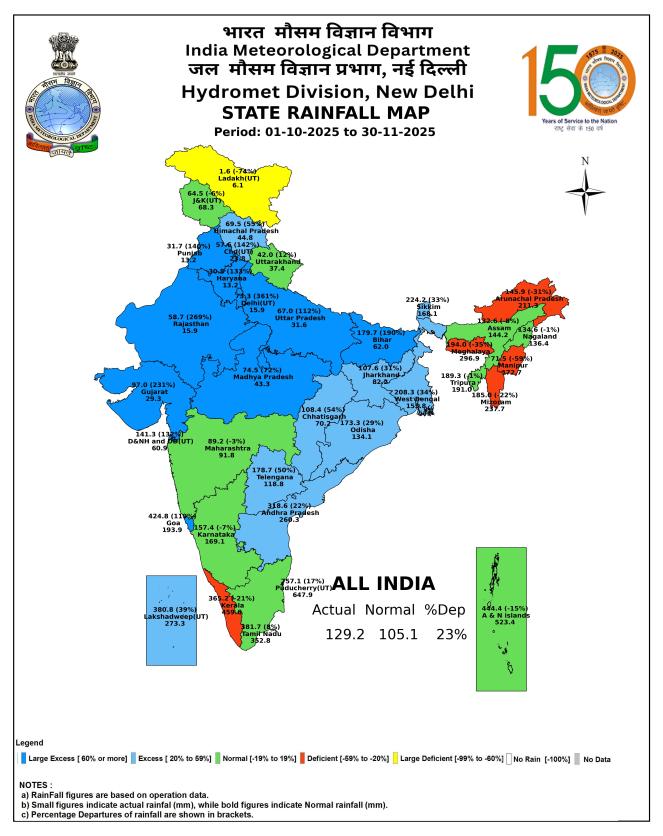
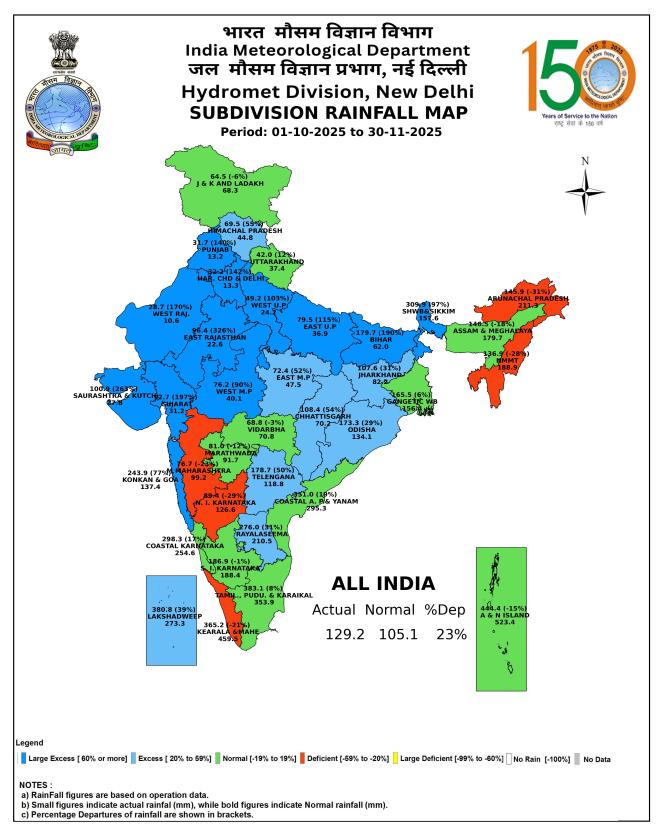
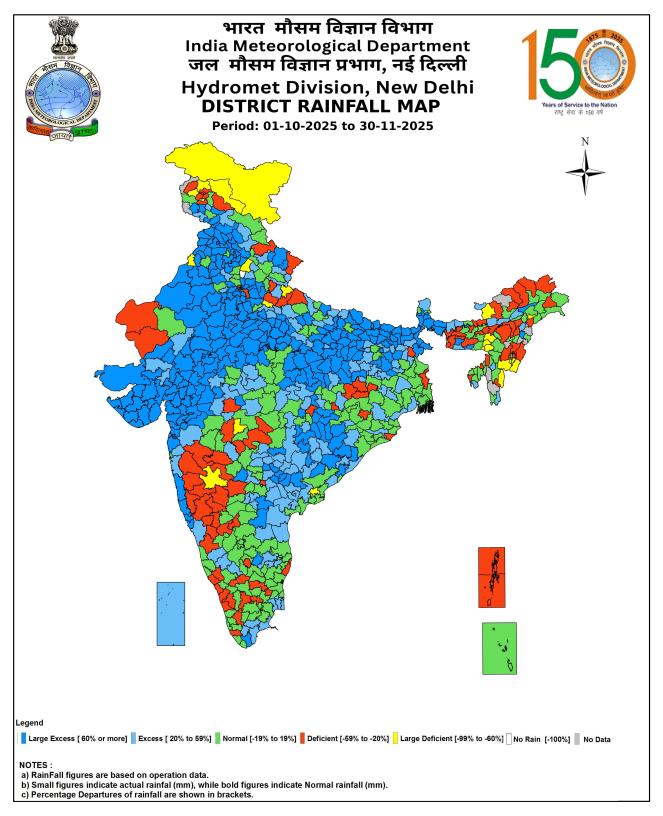
IMD’s cumulative state, sub-division and district wise rainfall maps for the period of Oct. 01 to Nov. 30, 2025.
HIMALAYAN DISASTERS
Shimla: Twin tube tunnel work stopped The Shimla district administration has directed the National Highways Authority of India (NHAI) to stop work on the twin tube tunnel following creation of a large depression on the Mehli-Dhali Road along with persistent leakage and structural cracks in several nearby residential homes. As a precautionary measure following the recent landslide at Bhattakufar, Mehli-Dhali Road, the district administration, Shimla, has stopped all excavation, blasting and related construction work on tunnel under National Highway-05 (Shimla Bypass Package-II).
According to the preliminary site inspection report submitted by the Geological Branch, a large depression has developed on the Mehli-Dhali Road, with cracks appearing in the rock mass. There are issues like persistent leakage, exposed utilities and structural cracks in several nearby residential homes. The report also mentions that the axis of the twin tube tunnel under construction by the NHAI lies beneath the affected area and the impact of excavation activities at this level cannot be ruled out.
Meghalaya: Rivers die, hills slide & cities choke In Meghalaya, landslides and fragile roads are emerging as an area of concern. Unscientific hill-cutting for road expansion has destabilized slopes. Experts warn that infrastructure projects that lack climate resilience, make disasters inevitable. Unscientific hill-cutting has destabilized fragile slopes. In April 2025, geologists sounded the alarm near Pynursla when NH-40 expansion began damaging hillsides. May–June 2025’s torrential rains triggered over 70 landslides, killing four people and severely damaging infrastructure along NH-6 and NH-206. Since October 2023, over a dozen fatalities have been reported from landslide-prone regions like West Jaintia and Garo Hills.
SOUTH ASIA
BHUTAN: Tata Power & DGPC sign Commercial Agreement for Dorjilung HEP Tata Power Company Limited has signed commercial agreement with Druk Green Power Corporation Limited (DGPC) for the 1125MW Dorjilung hydroelectric power project in Bhutan on Nov 21 2025. The project will be executed through a Special Purpose Vehicle, with DGPC holding 60% equity and Tata Power 40%. The project will be located on the Kurichhu River in Mongar, Bhutan, and will include six units of 187.5MW each. It is designed with six-hour pondage for peaking. Tata Power will invest approximately ₹1,572 crore in equity.
₹13,100 crore Dorjilung will be Bhutan’s second-largest hydropower project and the largest public–private partnership hydro project in the country. The project is scheduled for commissioning in September 2031. 80% of the power generated will be supplied to India. The Dorjilung HEP comes after Dagachhu HEP in which Tata Power has 26% stake and under construction Khorlochhu in which Tata has 40% share.
NEPAL facilitates HEPs by Indian Companies The decisions about extending the survey license date for the reservoir-based West Seti hydropower project being developed by NHPC and approval for the work for direct agreement with Arun-III hydropower project being developed by SJVN, and to facilitate Indian companies for hydropower projects were taken at the 67th meeting of the Nepal Investment Board (NIB) chaired by PM Sushila Karki in Kathmandu on Nov 19.
The meeting also authorised NIB CEO Sushil Gyevali to issue a license for the Lower Arun Hydropower Project (669 MW) after approving the draft of the power generation license. The meeting also approved investment for the Betan Karnali Hydropower Project, a 439 MW semi-reservoir-based project.
Investment modalities for Budhigandaki and Upper Arun HEPs finalised The investment modalities through domestic investments for the Rs 406 Billion 1,200 MW Budhigandaki reservoir-based and the Rs 214 Billion, 1,063 MW Upper Arun semi-reservoir-based hydropower projects have been prepared.
China’s Medog Dam Unlike the fierce public debate that once surrounded Three Gorges, the Medog mega-project has drawn almost no discussion inside China. Searches mostly return identical official write-ups and investor commentaries. Recently, the independent Chinese-language outlet Initium Media published a long feature based on interviews with Chinese ecologists and environmental groups. It details the project’s ecological risks, its downstream water-security implications, why its rollout has faced virtually no domestic resistance, how civil-society voices were drowned out by promises of economic returns, and how the project is being framed as critical “AI-era computing power storage.”
Researchers call this gorge a “treasury of biodiversity”: it contains an estimated 70% of China’s species, including tigers, leopards, clouded leopards, Himalayan black bears, musk deer, civets, and many endemic and isolated species shaped by the deep canyon’s geography. In 2021, as China hosted the COP15 biodiversity summit, ecologists such as Lü Zhi and Wang Fang warned in Nature that the project threatened the canyon’s fragile ecology and urged the creation of a national park to protect it.
The Medog project details are highly classified: the inundation area, resettlement plans, and environmental impact remain unknown. “It’s three times the size of Three Gorges, in a far more fragile and politically sensitive region, yet it proceeded without a National People’s Congress vote,” wrote Zhang Hong, an international studies professor.
Ecologist Wang Xing (pseudonym) said many researchers are worried but cautious because the project touches on China’s national strategy and territorial issues. He described the Chinese government’s approach as “thunderous”, moving ahead while bypassing normal procedures such as public environmental review. China’s Ministry of Ecology and Environment has denied access to the EIA, calling it classified. Lawyers who tried to obtain the report said they were met with unusually fast rejections and online harassment accusing them of “helping India.”
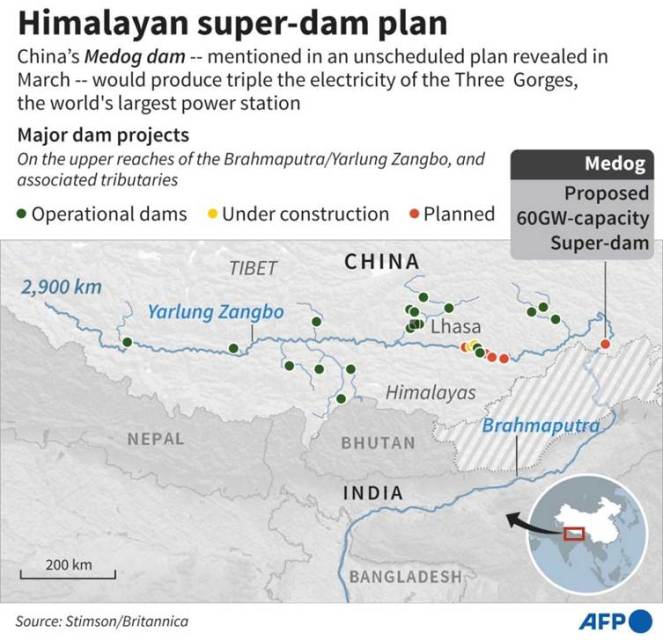
Technically, experts say the project’s ability to manipulate downstream flows is limited because it is a run-of-river dam, not a storage reservoir like Three Gorges. The Metog project shows how massive infrastructure can now bypass once-standard checks entirely, taking shape under strict information controls and minimal transparency.
Earth.com report Official plans describe a chain of five linked power stations along a canyon where the river falls about 6,600 feet in roughly 31 miles. One of the scientists watching the region most closely is Taigang Zhang, a researcher at the Institute of Tibetan Plateau Research in Beijing (ITPCAS).
THE REST OF THE WORLD
USA dams get D to D+ grade, need $1 Trillion to upgrade The 2025 Report Card (once in 4 years report) for America’s Infrastructure from the American Society of Civil Engineers, or ASCE, a trade group, gave dams, levees, stormwater, and wastewater infrastructure components D to D+ grades. That’s concerning given that climate change is increasingly stressing dams, levees, wastewater, and stormwater systems through heavier precipitation events. What’s more, the federal government has shown little interest in sustaining the funding needed to continue improving infrastructure.
A “D” grade, in ASCE’s words, means “the infrastructure is in fair to poor condition and mostly below standard, with many elements approaching the end of their service life. A large portion of the system exhibits significant deterioration. Condition and capacity are of serious concern with strong risk of failure.” Each of ASCE’s assessments since the first was issued in 1998 has given U.S. dams a “D” or “D+” grade. ASCE called for investments of over $165 billion for dams, more than $70 billion for levees, and by 2044, $690 billion for wastewater and stormwater systems. That adds up to about $1 trillion.
Increased precipitation in the U.S. in recent decades, partially the result of climate change, has caused an additional $2.5 billion a year in U.S. flood damages, according to a January 2021 study in the Proceedings of the National Academy of Sciences. Aging infrastructure and more frequent and intense rainstorms cause additional strain to the nation’s dams. Since 2018, heavy rains have resulted in approximately 30 dam failures or near failures just in the Midwest, according to ASCE.
Drawing upon the latest data from the Association of State Dam Safety Officials, ASCE estimated the cost of rehabilitating all non-federal U.S. dams (which comprise 96% of the country’s more than 92,000 dams) at $165 billion. Of that amount, $37 billion is needed to address high-hazard dams, defined as those whose failure would result in loss of life and significant property damage. Additional money, which was not quantified in the report, would be needed to upgrade federal dams. Over 2,500 dams are considered “high-hazard.” This class of dams has increased by 20% in number since 2012, driven mostly by increased development in downstream areas.
The U.S. Army Corps of Engineers says the dams it maintains are designed to serve for 50 years. Yet the average age of America’s dams is 64 years, and over 70% of U.S. dams are more than 50 years old. Old dams are a hazard: Approximately 75% of all U.S. dam failures occurred in dams over 50 years old.
Worse than most: Vermont’s dams In Vermont, the average age of the state’s dams is 89 years, and many were not built using modern codes and standards. In other words, they are not designed to withstand increasingly heavy and frequent rainstorms. Following historic flooding in July 2023, state dam inspectors found that 57 dams were overtopped by flooding, 50 dams sustained “notable damage,” and five dams failed.
SANDRP

 SANDRP