
(Feature image is from the New York Times)
The annual Conference of Parties (COP) on climate change begins its annual meeting in Brazil today. Consider the track record of the annual meetings so far, it is a valid question to ask, as the Question of Cities asks, Does the World still need this meeting with such a huge carbon footprint of its own? Is it a futile exercise now?
The question becomes even more relevant considering that leaders from some of the world’s biggest polluters, including US, China, Russia, Japan, Australia, Indonesia and Turkey are absent from the meeting, as the New York Times has said. Particularly, since the head of the USA, the world’s biggest historical per capita polluter has called climate change a hoax, and when the rest of the world has not risen up to question this stand of the USA?
The New York Times, however, is a bit positive, saying that following Paris accord, the trajectory of warming has curved downwards. Now the average world temperature is expected to rise by 2.5-2.9 degrees C by the end of the current century. How much of a solace it is for most of the world population when this is not only above the Paris accord target of 1.5 degrees C, but much higher than even the extended projection of rise of 2 Degrees C and when tip off point for most of the indicators are likely to be exceeded.
The biggest impacts of the climate crisis are going to be experienced through water sector as we in India are already experiencing in most aspects. The trouble is, there is a lot that we can do here to increase the adaptation capacity of the impacts, but we are actually moving towards destruction of adaptation resources. And we have no clue what is the road map to reverse this. Can we create a political will in this regard by having annual gatherings of people in each state and nationally?
CLIMATE CHANGE
The Appalling Futility of COP on Climate Change? As countries prepare to attend the annual Conference of Parties (COP) in Brazil’s Belem, Question of Cities asks: Does the world still need the annual jamboree given its awful record?

This is the 30th annual COP meeting to take stock of climate change and chart a course for the world. The first COP was in Berlin in March 1995, a year after the United Nations Framework Convention on Climate Change was set up and three years after the path-breaking Rio Summit. In three decades that the world’s most powerful people – heads of state, heads of governments, climate scientists, data analysts, academicians, and others – met every year, the world has come no closer to containing hazardous emissions, limiting fossil fuel use, addressing global warming and climate change impacts.
The COP framework gave the world the Kyoto Protocol in 1997, the Paris Agreement in 2015, the Loss and Damage Fund in 2022. These are important milestones but mean little to the millions around the world who struggle to cope with climate change impacts primarily because fossil fuel companies and the industrial complex based on them – including the massive energy-guzzler AI – still place profits over the planet. With the United States, among the highest energy consumers and emitters, pulling out of COP under President Donald Trump, the annual jamboree holds even less meaning.
Forests are hacked, including the Amazon where nearly 10 kilometres were slashed for a four-lane highway to host the COP30 – wetlands encroached upon, and sea-level rise threatens the very existence of small island nations. The climate impact has claimed millions of lives and damages run into billions of dollars. The last two editions even saw delegates from fossil fuel companies outnumber climate scientists and workers.
So what went wrong? To put it straight: The lack of political will, especially among the high polluting countries. If the COP30 has to be meaningful, it could start by taking steps to reverse its own futility over the years, become the voice of countries facing devastating impacts, and bring moral pressure on the countries that must urgently reduce their carbon emissions.
However, The New York Times is a bit more positive. It says: “The good-ish news: Slower emissions growth (over the last decade) means the arc of temperature increase has curved downward over the past 10 years. If countries stick to current policies, the global average temperature is projected to rise by 2.5 to 2.9 degrees Celsius by the end of the century — still bad, but a significant improvement from where we were 10 years ago. These charts show 10 big things that have happened on the climate front in the last decade.”
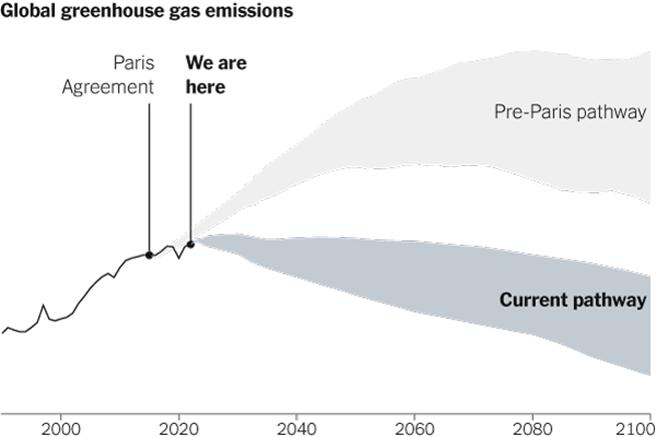
But it is equally negative about who all are attending Brazil COP: “The leaders of China, Russia and Japan won’t be there. Neither will the leaders of Australia, Indonesia or Turkey. But the most notable absence is that of the United States.”
HYDRO POWER PROJECTS
Beas turning angry now After weeks, the Beas River is finally back to its gurgling self after a violent carnage. But authorities and residents are yet to learn their lesson. Himanshu Thakkar, an expert on Indian rivers from the South Asia Network on Dams, Rivers and People (SANDRP), said that while most parts of north and northwest India recorded heavy, unprecedented rain this year, the floods were symptomatic of a larger problem.
“Rain doesn’t cause disasters. Ideally, a healthy river’s catchment should be able to hold, store and recharge it. But the catchment health of the Beas is poor. Its streams are destroyed, there is widespread erosion and muck is mindlessly dumped into it,” Thakkar said. Residents and environmental activists said that encroachment on the banks of the Beas is not only a local menace but also worsens the impacts of the seasonal floods.
Researchers have found that over the last two decades, the quantity of debris in the river has increased, and new sediments have also been discovered in the river water. This, scientists said, could be an impact of soil degradation and the loss of traditional vegetation around the river. In simpler terms, when certain native varieties of trees and foliage of an area are altered continuously, over an extended period, the profile of the soil and the ecosystems around it—rivers and climate—also start to change.
“A single reason cannot be pinpointed. There are a series of problems that have gone unaddressed for far too long,” Himanshu Thakkar said. He said that apart from developmental activities, the authorities have also failed to keep a check on muck dumping along the Beas.
“Flood doesn’t just bring water with it. When you encroach on the river and treat it as a dumping ground, when it floods, it will obviously hit you with all this debris,” he said. “And that’s what aggravates the impact of floods.” All these changes to the river system, experts say, have a larger impact—extreme weather and worsened disasters.
Chenab restless ticking time bomb “Chenab is the only Himalayan river that has the potential to be saved—humans have eaten up every other,” said Parineeta Dandekar, associate coordinator at SANDRP. “In parts of Himachal where the Beas and Ravi have been reduced to mere streams, we still see Chenab flow in all its glory.”
Chenab is now on its way to becoming the most-dammed river in the Indus Valley. Fed by glacier melt-off, Chenab’s Indian segment is as long as the entire length of the Beas. Its hydropower ‘potential’ of over 15,000 Mw is still untapped according to Indian government surveys. But after the Pahalgam terrorist attack and the suspension of the Indus Waters Treaty in April 2025, India went on a spree of clearing hydroelectric projects on the river.
However, these projects, along with increasing encroachments on tributaries like the Tawi, the eternal siltation problem, and newer threats of glacial lake outburst floods (GLOFs), spell disaster for the Chenab.
During this year’s monsoon, Dharali wasn’t the only Himalayan disaster. Flash floods in the Miyar nallah on 30 July, a Chenab tributary in Himachal, brought down so much silt and sediment that it devastated the entire valley. According to Dandekar, these occurrences are almost routine across the Chenab basin and highlight its fragility.
“Despite this, there are over 44 different dam projects that are currently planned or under construction in the Chenab in both Himachal and J&K,” said Dandekar. “This isn’t just environmentally unsafe; it is also a bad investment decision because of the fragility of the landscape.” “The glacial lakes in Chenab basin are basically ticking time bombs. Both Chandra and Bhaga rivers originate near glaciers, and the number of lakes have increased in size over time,” said Dandekar.
Dandekar’s organisation SANDRP, has collected information from scientists as well as field surveys through the Chenab basin to explain these challenges. Their conclusions are resolute: Large construction projects in areas that are ‘seismically active’, and see ‘routine, crippling climate disasters’ need extremelyattentive planning and detail, not to mention proper democratic process and approvals from local people.
Teesta now flows to kill Teesta’s love story is still narrated in Lepcha wedding songs, but the river is now also feared for its anger. What began with melting ice has been worsened by dams and encroachment.
Bi-Monthly Safety Inspection of Kalez HEP in Sikkim A bi-monthly inspection of 5 MW Kalez HEP of M/s Kundan Hydro Power Project Pvt. Ltd. in Dentam was carried out on Nov 6 by a district team led by Ganesh Kumar Rai, DPO (DDMA). The team, including officials from power, civil, forest, and fire departments, reviewed the Trench Weir, Desilting Tank, and Power House, with emphasis on disaster management readiness, safety infrastructure, and fire safety measures.
Officials directed the project management to complete essential repairs, including a footpath and fencing around the Desilting Tank, within a month. As per Fire and Emergency Services guidelines, two hydrants with a minimum storage capacity of 50,000 liters, sprinkler systems, and smoke and heat detection devices are to be installed outside the power house.
Six new butterfly species found in Siang Valley in Arunachal Pradesh Six butterfly species never before recorded in India have been discovered in Arunachal Pradesh’s Siang Valley. The study reveals ecological links between Tibet’s Yarlung Tsangpo and India’s Brahmaputra basin. The discovery emerged from a camera-trapping project in the Litin Community Conserved Area. Local villagers have protected their ancestral forests through community-led conservation. Researchers warn that hydropower projects and climate change threaten the region’s unique biodiversity.
Himachal CM orders HPPCL to fast-track power projects Chairing a review meeting in Shimla on Nov. 06, the CM specifically instructed officials to ensure the completion of the 450 Mw Shong Tong Karchham hydroelectric project by Dec 2026. Sukhu also reviewed progress on several key projects, including the 130 MW Kashang-II and III, 48 MW Chanju-III, 40 MW Renuka Dam, and 191 MW Thana Plaun projects, emphasising strict adherence to their timelines. He also directed the corporation to initiate work on the proposed 1630 MW Renukaji and 270 Mw Thana Plaun pump storage projects. Such projects, he said, are crucial for managing peak-hour electricity demand and stabilising the grid.
J&K’s 15 HEPs of 7,768 Mw at different stages of execution As per the official information, the Power Development Department’s records show that currently total generation capacity of 3,540.15 Mw of hydropower through projects operational in the UT sector, the central sector, and the private sector. The UT sector contributes 1,197.4 megawatts, the central sector—run primarily by NHPC- produces 2,250 Mw, while private developers add 92.75 megawatts to the grid.
6 major projects with a combined capacity of 3,063.5 Mw are presently under construction. These include the 1,000-Mw Pakal Dul project, 624 Mw Kiru, 540 Mw Kwar, 850-Mw Rattle, 37.5 Mw Parnai, and 12 Mw Karnah project. 2 more projects—the 93-Mw New Ganderbal and 48 Mw Lower Kalnai—are at the award stage and are scheduled to be completed within four years of final approvals. Another 7 projects aggregating 4,563.5 Mw are currently under preparation or awaiting statutory and environmental clearances.
PM unveils over ₹8,000cr projects The Prime Minister will also laid the foundation stone for 2 hydro-sector-related projects. The first is the Song Dam Drinking Water Project, which will supply 150 MLD of drinking water to Dehradun. The second is the Jamarani Dam Multipurpose Project in Nainital, designed to provide drinking water, support irrigation activities and generate electricity. Among the projects inaugurated by PM Modi were the Dehradun water supply coverage for 23 zones under the AMRUT scheme, an electrical substation in Pithoragarh district, solar power plants on government buildings.
FAC Sharavathy PSP review based on false data The FAC took into consideration ‘false and outdated data’ while deliberating on the project during its meeting on October 27, it is said. This is the second time the FAC has looked into the project, after discussing its salient features on July 30. Also, the committee has ignored the blatant errors made by KPCL and the corrections made after the errors were pointed out by the MoEF&CC.
The biggest of the errors pertains to the cost benefit ratio calculated by the Karnataka Power Corporation Limited (KPCL). Earlier this year, MoEF&CC had expressed surprise at the exorbitantly high cost benefit ratio of 1:2,643.25. The agency later reduced it to 1:75. The FAC continued its meeting based on the previous numbers.
Secondly, the committee accepted the claim that ‘there are no protected archeological monuments, heritage sites… or important historical landmarks within the project area”. The claim has been disputed by residents who have noted that four monuments listed by Archeological Survey of India were located in the vicinity of the project. It asked the state government to submit a copy of the report on the site visit as well as a report on the wildlife mitigation plan.
Earlier, Researchers and experts contested the claims of Karnataka Power Corporation Limited (KPCL) that the proposed Sharavathi pumped storage project won’t have negative ecological consequences.
Tata Power to invest Rs 11,000 cr in Pune PSP Tata Power Company Ltd (TPCL) will invest ₹11,000 cr in setting up a pumped hydro storage (PSP) project in Shirawta in Pune as per the CEO and MD, Praveer Sinha on Nov 4. Last year Tata Power Ltd. and the Govt of Mah signed a MoU to develop 2 large PSPs with a combined capacity of 2,800 Mw.
DAMS
Telangana warns L&T on Medigadda barrage: Repair or face black listing The Telangana govt has threatened to blacklist L&T, as well as take steps to have the company blacklisted in rest of India if it does not issue “a favorable response within one week,” to the demand that the company cooperate with the government in all steps needed for repairs and rehabilitation of the Medigadda barrage. The government has also made it clear that L&T PES-JV which built the barrage, that any repair and rehabilitation work must be taken up and completed at its own cost.
The unprecedented ultimatum to L&T was in a letter dated Nov 3 sent by the irrigation dept’s Ramagundam Circle’s superintending engineer. The 14-page letter also warned L&T PES-JV that if it fails to agree to the terms set by the irrigation department, then the company could also face “recovery of costs and damages under the Revenue Recovery Act, as per prevailing Government rules in vogue,” and risks the “forfeiture of all deposits and pending payments” due to it.
Telangana opposes Polavaram-Banakacherla link project The Telangana govt on Nov. 07 firmly opposed the proposed Polavaram-Banakacherla link project at the Polavaram Project Authority (PPA) meeting, warning that it could seriously harm the state’s water interests and lacked statutory clearances. The meeting, chaired by PPA member Atul Jain, was attended by senior irrigation officials from both Telangana and Andhra Pradesh.
Telangana officials also raised the long-pending issue of Polavaram backwaters, which they said pose a serious threat to villages and infrastructure in the state, including parts of Bhadrachalam town. “Two streams — Kinnerasani and Munneru — and eight drains of Bhadrachalam will be blocked, preventing flow into the Godavari. Backwater from the dam will inundate Telangana villages and Bhadrachalam town,” Bojja warned.
Banakacherla project not in our purview: PPA The Polavaram Project Authority (PPA) has made it crystal clear that the Polavaram-Banakacherla project does not fall under its purview, and the PPA is not the forum to discuss any issue related to it. The clarification came from top PPA officials during a meeting on Nov 7. According to sources, the issue was raised by Telangana’s Water Resources Dept officials towards the end of the meeting.
During the review, the PPA was informed that the first phase of the Polavaram project is expected to be completed by December 2027. Detailed updates were provided on key components such as the D-Wall, Gap-1 and Gap-2, with the PPA expressing satisfaction over the progress. Officials noted the PPA laid emphasis on land acquisition and rehabilitation and resettlement.
Regarding the cancellation of tenders for the DPR of the Polavaram-Banakacherla project – originally notified on October 6 – officials clarified that the decision was made prior to the PPA meeting. “The AP government is considering a revision in the project’s scope, and a fresh notification will be issued soon,” they added.
Andhra cancels tender process for Polavaram-Banakacherla project DPR Amid fierce backlash from Telangana, Andhra Pradesh has abruptly cancelled the tender process for the DPR of the contentious Polavaram-Banakacherla link project (PBLP), which was aimed at diverting Godavari waters to Krishna basin and beyond.
Irrigation officials confirmed that AP had withdrawn the tender notice issued on October 11 after reviewing technical and financial parameters. Sources indicated that the decision to cancel stemmed from the need to re-evaluate the project scope as its integration with the main Polavaram dam system was strongly opposed by Telangana. The govt of AP reportedly intends to adopt a more comprehensive approach to address the issues raised by other riparian States and to optimise interlinkages between the Banakacharla existing canal networks, officials claimed.
Andhra govt says no objection to joint survey The Andhra Pradesh government has no objection if a fresh joint survey is held on six streams joining the Godavari river in Telangana, to ascertain the impact of backwaters of Polavaram project. The joint survey is proposed to be done by the Polavaram Project Authority under the supervision of the Central Water Commission.
As for a joint survey on the backwaters of Polavaram project, both AP and Telangana held it on Kinnerasani and Murredu steams at the direction of PPA and under the supervision of CWC following a direction from the NGT. There are six more streams in Telangana for a joint survey if PPA intends to do so.
Odisha villagers oppose irrigation project Residents of Chakadar panchayat staged a protest on Nov. 03 against a proposed irrigation project on the Samakoi River in Telkoi block of Keonjhar district. Locals fear that the project, if implemented, could submerge several villages in the block, threatening homes, farmlands, and livelihoods. To express their opposition, the villagers organised a rally and submitted a memorandum to CM Mohan Charan Majhi through the local tehsildar, demanding that the project be halted immediately.
The agitation gained momentum as community members continued to hold demonstrations and press authorities for action. Meanwhile, the protest has also received support from Naba Nirman Krushak Sangathan, a local farmers’ organisation, amplifying the call for cancellation of the project. Despite repeated appeals and rallies, the district administration has not yet responded to the demands of the residents.
Agenda of EAC meeting to be held on Nov 12, 2025: – Malshej Ghat Closed Loop Pumped Storage Project in 310.61 Ha at Village Khubi and Thitabi Tarf Vaishakhare, Sub Dist Junnar and Murbad, Dist Pune and Thane, Mah by THDC India Ltd – Terms of References
Relevant decisions of FAC meeting held on Oct 27 2025 – Diversion of 811.29 Ha of forest land for Ganjal Dam out of 2250.05 ha (instead of 2272.05 ha) forest land earlier proposed Morand – Ganjal Irrigation Project in Hoshangabad, Betul, Harda and Khandwa Districts of Madhya Pradesh in favour of NVDA: Approval for diversion of 811.29 ha for Ganjal Dam. (Approval of Morand Dam to be considered subsequently.
File 2 of the minutes of FAC on Oct 27 2025:– Yettinahole Integrated Drinking Water Project: diversion of 111.0277 ha (originally proposed area is 173.3105 Ha) of forest land from CH 000+00 to 261.690 Km in Hassan and Tumkur District for Gravity Canal under Yettinahole Project from Visvesvaraya Jala Nigam Limited: Deferred, more info sought.
– Diversion of 54.155 ha of forest land in various villages of Sagar, Shivamogga Wildlife and Honnavara Divisions for Sharavathy Pumped Storage Project-2000 MW: Deferred, more info sought.
URBAN RIVERS
Waste collection vehicle ends up in Thrissur river A newly launched electric vehicle of the Haritha Karma Sena’s Navakanthi project fell into the Wadakanchery river soon after being flagged off at a municipal event. The vehicle, meant to work as the mobile unit of Navakanthi, was driven by a Haritha Karma Sena member. Just after the municipal chairman flagged it off, the vehicle moved forward and slipped into the nearby river. Municipal Health Standing Committee Chairman P. R. Aravindakshan was also inside the vehicle.
RIVERS
Socioeconomic impacts & migration dynamics of riverbank erosion Abstract: -Riverbank erosion is a major natural calamity causing destruction to lives, settlements, and the environment. This study analyzes the socioeconomic impacts and migration patterns of communities affected by erosion. It identifies literature and policy gaps, proposing future research directions. After reviewing 62 papers from 2000–2024, the study highlights the neglected vulnerability of erosional migrants, who face significant economic and social challenges. It emphasizes the need for a better understanding of psychological, ecological, and demographic factors.
Meghalaya river turns murky All fingers in the state are pointing towards the construction work being carried out by the National Highways and Infrastructure Development Corporation Limited (NHIDCL) for the upgrade of Shillong-Dawki corridor. Shillong MP from the opposition Voice of the People Party (VPP), Ricky Syngkon, has written to Union Transport Minister Nitin Gadkari and Environment Minister Bhupender Yadav, seeking their intervention. “The Umngot river, a symbol of Meghalaya’s pristine natural heritage and a major tourism asset, has tragically turned muddy and lifeless this October, a period when its waters should be crystal clear,” he wrote, stating that it has been caused by the ongoing construction activities.
“This development has alarmed local communities, tourism operators and environmental organisations, who report massive dumping of soil and construction debris into river systems, especially near Umtyngar and Dawki, during hill-cutting operations along the project alignment,” he wrote.
बिहार के चुनावी संकल्प पत्रों में नदियों और बाढ़ पर राजनैतिक दिशाहीनता बिहार में चुनाव प्रचार जोरों पर है। दोनों मुख्य गठबंधनों ने अपने-अपने घोषणा पत्र जारी कर दिए हैं। बिहार देश का ऐसा राज्य है जिसके 38 जिलों में से 28 जिले बाढ़ से प्रभावित रहते हैं, जिनमें से 15 जिले अतिप्रभावित हैं। वहीं कुछ जिले सुखाड़ से परेशान हैं। उत्तर बिहार के 94,163 वर्ग किलोमीटर क्षेत्रफल में 68,800 वर्ग किलोमीटर अर्थात 73 प्रतिशत भू-भाग और उत्तर बिहार की आबादी का लगभग 76 प्रतिशत हिस्सा बाढ़ प्रभावित रहता है।
दोनों गठबंधनों के घोषणा पत्रों में हर साल बाढ़ की पीड़ा झेलने वाले, और कोशी तटबंध के भीतर रहने वाले लाखों लोगों के लिए एक शब्द भी नहीं है। ये लोग नीतिगत अन्याय के शिकार हैं। इन्हें “विकास का काला पानी” भुगतना पड़ रहा है — यह कहना अतिशयोक्ति नहीं होगी। कोशी समस्या के समाधान के लिए कोई ठोस योजना, कार्यक्रम या रोडमैप नहीं दिया गया है। यही स्थिति अन्य नदियों और तटबंधों के पीड़ित लोगों की भी है।
NGT directs CPCB to ensure installation of OCEMS The NGT has directed the CPCB and SPCBs of Uttar Pradesh, Haryana, Bihar, and Delhi to ensure that all Grossly Polluting Industries (GPIs) dumping their waste in the Ganga and Yamuna rivers and other water bodies immediately install Online Continuous Effluent Monitoring Systems (OCEMS). The bench said that pollution control boards, both at the central and state levels, are required to take prompt action to ensure that GPS do not default and install OCEMS without delay.
The order came in response to an application filed by Md Imran Ahmad, who alleged that over 1,700 industries across Uttar Pradesh, Haryana, Bihar and Delhi have failed to comply with CPCB’s directions and were continuing to discharge untreated effluents into major water bodies, including the Ganga and Yamuna rivers, causing severe environmental damage. After hearing the matter, the Tribunal ordered the MSs of the state SPCBs and the DPCC to submit compliance reports to the CPCB within two months, while the CPCB must take remedial and punitive action against defaulting industries within one month thereafter.
Haryana scales back flows after Chhath Puja As the four-day Chhath Puja concluded on Oct. 28 , the Haryana govt sharply reduced the volume of water released from the Hathnikund Barrage into the Yamuna, cutting the flow by nearly 96%, according to data from the CWC.
DJB invites bids for 13 decentralised STPs The long-pending DSTP project has been delayed primarily due to land availability issues. Officials said the DJB has now secured land for 30 of the 34 proposed sites, while the Delhi Development Authority (DDA is expected to allot the remaining plots soon. “The DJB is also in the process of floating tenders for 15 more DSTPs and estimates for the remaining 6 are under way. Once completed, most areas currently discharging untreated sewage into the Yamuna will have local treatment systems,” the official said.
Kaziranga: Survey finds 77 fish, 108 reptile & amphibian species Kaziranga National Park and Tiger Reserve (KNPTR) Director Sonali Ghosh on Nov. 06 said that a rapid survey conducted by the Kaziranga Park authority has revealed a rich assemblage of 77 species of freshwater fish, forming a major share of Assam’s 216 indigenous fishes and contributing to the Northeast’s remarkable diversity of 422 native fish species. The park also supports 108 species of amphibians and reptiles, far exceeding the 70-plus herpetofauna recorded from other parts of the state and adding to the 274-plus herpetofaunal species known from the northeast. The survey was conducted between July and September this year in collaboration with scientists and researchers from the Wildlife Institute of India (WII), Ghosh said.
FISH, FISHERIES, FISHERFOLKS
First International Fisherwomen’s Day: Fisherwomen demand equal rights “Fisherwomen have always held the coastline together. They wake up before dawn to carry fish to market, manage homes through storms and loss, and are the first to rebuild after every cyclone. Yet, their names do not appear in government records. They are still called ‘helpers’ or ‘dependents’, while laws, schemes, and cooperatives continue to be written in the masculine lens.
This erasure, the women declared in Kerala last year (in the first India Fisherwomen Assembly), must end. They demanded recognition not as “wives of fishers,” but as fishers themselves — rightful claimants of the seas, keepers of knowledge, and protectors of coasts. Writes Jesu Rethinam and Vijayan MJ in this article on 5th November, the first International Fisherwomen’s Day locating the fisher women s struggle in a feminist politcal economy and justice frame.
Illegal fishing team evicted from Kumaradhara river in Uppinangady Authorities in Uppinangady have taken firm action against illegal fishing activities along the Kumaradhara river. On November 6, village panchayat development officer Wilfred Lawrence Rodrigues led an operation to evict a group of fishermen from another district who had set up a temporary camp near the Kumaradhara bridge to catch fish.
Electric shocks killing Fish, destroying ecology in Wular Lake Peoples Democratic Party Constituency Incharge for Bandipora, Naeem Akhter, on Nov. 09 expressed deep concern over reports of fish deaths in Wular Lake, alleging that some miscreants are using electric gadgets to kill fish in large numbers, calling it a “disaster for both people and ecology.”
SAND MINING
SC quashes Odisha govt’s award of mining lease The Supreme Court set aside the Odisha High Court’s order that had upheld the State Govt’s decision to award a five-year sand extraction lease for the Mahanadi Sand Quarry to a lower bidder. The Court held that the exclusion of the highest bidder was based on a misinterpretation of the tender conditions and resulted in an unfair decision that caused substantial loss to the state exchequer. The legal dispute centered on a 2022 auction for a five-year sand quarry lease in Cuttack. M/S Shanti Construction Pvt. Ltd. emerged as the highest bidder, quoting ₹2,127.27 per cubic meter. However, its bid was rejected by the Tender Committee for submitting its Income Tax Return (ITR) for the Financial Year (FY) 2020-21 instead of FY 2021-22, as required under the tender rules.
Nagaland Panels formed to regulate riverbed mining in Chümou Chümoukedima district administration has constituted district level monitoring committee (DLMC) and sub-division level enforcement committees for the Chathe River and its tributaries. Under the new directives, a complete ban has been imposed on the use of heavy machinery for extraction of riverbed materials within the jurisdiction of Chümoukedima district, unless proper licenses and permissions were obtained as per the Nagaland Ownership and Transfer of Land and its Resources Act, 1990 and the Nagaland Minor Mineral Concession Rules, 2004.
The committee would also oversee and periodically review compliance with the regulatory order and ensure effective coordination between agencies. To strengthen enforcement at the grassroots level, sub-division level enforcement committees (SDLC) have also been formed for Medziphema and Seithekema. SDLCs, headed by respective administrative officers, would include representatives from the police, forests, geology & mining, local councils, and Chakhrüma Public Organization. Their responsibilities include regular inspections, prevention of illegal extractions, awareness creation, and reporting compliance to the DLMC.
WETLANDS, LAKES, WATER BODIES
Cleanup begins in Kunhimangalam wetlands Acting on a directive from the Kerala High Court, efforts have begun to clear large quantities of construction debris and plastic waste illegally dumped in the Poruni fields and Kaippad wetlands under the Kunhimangalam panchayat. The illegal dumping had severely damaged the mangrove forests in these ecologically fragile areas.
The court issued the order while hearing a petition filed by environmentalist P P Rajan, represented by advocate Mahesh V Ramakrishnan. In its directive, the court ordered that all soil and construction waste deposited at the site be removed within three months from October 13. It also instructed that at least three mangrove saplings be planted for every mangrove tree destroyed during the dumping. The court also called for the establishment of a permanent monitoring mechanism to prevent any future destruction of this sensitive ecosystem.
VACB uncovers nexus facilitating illegal conversion of wetlands The Vigilance and Anti-Corruption Bureau (VACB) have uncovered a well-entrenched racket involving real estate developers, agents, and revenue officials who illegally convert paddy and wetland areas for construction, including suburban villas and gated communities, which are in high demand in Kerala’s booming housing market. On Nov 7, the VACB conducted surprise inspections at 27 Revenue Divisional Offices (RDOs) and also at the offices of 32 Deputy Collectors tasked with enforcing the Kerala Conservation of Paddy Land and Wetland Act, 2008.
Director, VACB, Manoj Abraham, authorised the operation code-named Haritha Kavacham after the anti-corruption agency’s intelligence wing flagged the existence of a mafia, including criminal gangs that own dumper truck fleets and use illegally mined earth to convert paddy fields into dry land for pricey construction. Investigators said the “agent-builder-realtor-official” nexus provided cover for the widespread environmental crime by legitimising the illegal conversion. They said RDOs were the racket’s hubs. The offices maintain the wetland paddy land data bank, an essential digital record that identifies and categorises the nature of the land within their respective jurisdictions.
GROUNDWATER
Impact assessment of Groundwater Collectivisation program in Andhra-Telangana This blog presents key insights and findings from the recently released study on above subject. To provide economic support to rainfed farmers and reduce competitive borewell drilling, the Watershed Support Services and Activities Network (WASSAN) launched the Groundwater Collectivisation Programme in Andhra Pradesh and Telangana. The initiative helps groups of farmers form ‘water collectives’ to share groundwater through formal agreements. Within these collectives, borewell-owning farmers agree to share water with their rainfed neighbours under defined conditions. In return, WASSAN helps finance a piped network to carry groundwater across multiple plots.
The key findings are: Improved access to irrigation, reduced cultivation of water intensive crops, improved incomes, productivity. The WASSAN model of rewarding cooperation offers a practical way to reduce competition over groundwater and improve livelihoods. The study recommends working at aquifer level.
URBAN LAKES, PONDS, WETLANDS
Listed as wetland, this pond is now a public health hazard The pond, located in Budhela village in west Delhi’s Vikaspuri, is among the 1,040 waterbodies listed by Wetland Authority of Delhi for notification and protection. Over the years, it was gradually neglected and encroached upon. Although recorded in govt documents as gram johar (village pond) and measuring around 0.6 hectares, the land was allotted in 2002 to Sahitya Kala Parishad, a Delhi govt body for arts and culture. The parishad later asked Delhi Tourism and Transportation Development Corporation (DTTDC) to construct a cultural complex on the site. Construction began in early 2024, triggering protests from residents and local activists who pointed out that the plot was a listed wetland.
URBAN WATER
Delhi sinking fastest among Indian megacities The study has linked land subsidence with groundwater depletion, monsoon variability, and climate change. “In Delhi, the primary driver of land subsidence is the compaction of alluvial deposits caused by extensive groundwater withdrawals,” it reads.
WATER POLLUTION
Samba paddy on 500 acres damaged Samba paddy cultivated in around 500 acres in several villages in Thiruverumbur block, especially Vengur and Pazhanganankudi villages, have withered, leaving farmers worried. Experts from agriculture department suspect polluted water may have caused this and are set to recommend probe by Tamil Nadu Pollution Control Board (TNPCB).
JJM/ RURAL WATER SUPPLY
Action against officials in 15 states & UTs Uttar Pradesh topped the list in complaints received with 14,264 – over 85 per cent of the total so far – while Assam came a distant second with 1,236 followed by Tripura (376). Action has been taken against at least 596 officials, 822 contractors and 152 Third Party Inspection Agencies (TPIAs) across 15 states and Union Territories following complaints received about financial irregularities and poor quality of work under the Centre’s Jal Jeevan Mission for supplying drinking water through individual tap connections to rural households, The Indian Express has learnt.
Jodhpur ACB begins probe into JJM tender irregularities The Jodhpur branch of the Anti Corruption Bureau (ACB) Nov. 07 initiated preliminary investigations into alleged irregularities in the Jal Jeevan Mission (JJM) tendering process and sought reports from the Public Health Engineering Department (PHED) on several engineers believed to be involved in the matter. According to the complaint, a term introduced in tenders for 20 special projects under JMM, worth a combined Rs 20,000 crore, required participating firms to obtain a certificate from the engineer in charge of each proposed project after a site inspection. These 20 tenders were floated in 2022 under the previous Congress govt.
Centre seeks report on alleged corruption in JJM projects in Senapati The directive, issued on October 10, 2025 follows a complaint filed by RTI activist R.K. Paul Chawang who on 15th September 2025 wrote to the Union Minister of Jal Shakti alleging large-scale misappropriation and irregular project execution in the district. Citing the gravity of the allegations, the Ministry has asked the state government to “examine the matter and send a detailed report including action taken” on or before October 15, 2025. The development comes after increased scrutiny over the way water supply projects are managed in Manipur and across the Northeast.
MONSOON 2025
Monsoon shifts lead to Ecological droughts: Study A team of researchers from the Indian Institute of Technology, Kharagpur has warned that India’s forests and farmlands are facing a surge in what they call “ecological droughts”, long-term moisture stress that damages entire ecosystems. Their paper looks at how ecological droughts are increasing in India with the changing summer monsoon and human interventions. Published in Communications Earth & Environment, the paper is authored by Rahul Kashyap, Jayanarayanan Kuttippurath, and Vikas Kumar Patel from IIT Kharagpur’s CORAL laboratory.
“Our analysis identifies meteorological aridity and ocean warming as the main drivers of ecological droughts, with ocean warming indirectly influencing droughts through changes in moisture and thermal conditions,” corresponding author Kuttippurath said. “The westward shift of the monsoon system has intensified droughts in east and south India, in addition to anthropogenic pressures.”
Rainfall’s origin reveals a hidden driver behind drought risks for farmers A new University of California San Diego study uncovers a hidden driver of global crop vulnerability: the origin of rainfall itself. The paper, “Crop water origins and hydroclimate vulnerability of global croplands,” was published in Nature Sustainability.
The research traces atmospheric moisture back to its source—whether it evaporated from the ocean or from land surfaces such as soil, lakes and forests. When the sun heats these surfaces, water turns into vapor, rises into the atmosphere, and later falls again as rain. Ocean-sourced moisture travels long distances on global winds, often through large-scale weather systems such as atmospheric rivers, monsoons, and tropical storms.
In contrast, land-sourced moisture—often called recycled rainfall—comes from water that evaporates from nearby soils and vegetation, feeding local storms. The study finds that this balance between oceanic and terrestrial (land) sources strongly influences a region’s drought risk and crop productivity.
FLOOD 2025
Rayalacheruvu Breach Floods Villages Several colonies were inundated after the KVB Puram Rayalacheruvu breached in Satyavedu. Villagers said the breach occurred late on Nov. 05 night due to continuous rainfall during the cyclone Montha. The Pathapalem and Arundati Colony in Kaletthuru were among the worst affected, with floodwaters entering homes and fields. Locals expressed fear as farmlands and standing crops in nearby villages were completely submerged. Authorities are monitoring the situation, and relief measures are expected to be initiated to assist affected residents.
URBAN FLOODS
Jammu floods were man made: Evidence from space On 25th and 28th August 2025, Jammu city experienced catastrophic floods of Tawi River. When Tawi enters Jammu City, its gradient is relatively flat. Due to the steep catchment on the upstream, the surface runoffs are fast and voluminous resulting in quick and steep rise in water levels. The velocity of the river reduces considerably when Tawi enters Jammu city due to relatively flat gradient. This situation makes the city far more vulnerable to floods in comparison to other cities.
Slower the velocity, river needs more space or width to carry its flow and this fundamental principle is completely disregarded while planning the Tawi River Front Development (RFD) at Jammu. Along 2.5 km of Tawi riverbanks, River Front Development project is almost complete. The project involves construction of massive embankments right on the riverbed to reclaim the flood plains by filling debris along both the banks. This has resulted in 35-40% reduction in the width/cross-section/flow area of the river. This has led to proportionate rise in flood levels which subsequently caused huge inundation in Jammu City.
The Google Satellite images show that the embankments constructed for the RFD project have reduced width of Tawi from 450 Meters to 285 Meters in Jammu city. If these embankments were not constructed, the maximum flood level of 34 feet on 26th August 2025 would have remained much low causing far lesser inundation and damages. Given the changing rain pattern and frequent events of intense precipitation due to climate change, to save Jammu City from such floods in future, there is no option but to give the river its original space by removing all encroachments including Tawi RFD which is the largest encroachment and needs to be removed on the highest priority.
While leaving Jammu City, Tawi splits into two flows — Badi Tawi and Nikki Tawi — forming a riverine island of around 19-20 km in length. Immediately after this bifurcation, two huge barrages are built to store the river water. These barrages also have played a crucial role is aggravating the Jammu floods. The sill levels of the barrages are about 12 to 15 feet above the original riverbed level. Most of the silt gets deposited before the barrages up to the sill level raising the original level of the river bottom by 12 to 15 feet on the upstream of the barrages i.e. within the city. The flood levels went up by 12 to 15 feet making the floods far worse and disastrous. In absence of these barrages, the flood level would have remained much low in Jammu and the inundation as well as the destruction would have been far less.
It is high time we redraw our development policies to minimise floods, its severity and impacts. It is unambiguously visible that one of the major causes responsible for the destruction caused by these floods is thoughtless anthropogenic interferences in the nature under the pretext of “infrastructure” or “development”.
Chennai’s new answer to flooding Gate The Flood is both designing and manufacturing the product in Chennai, allowing room for customising the product according to individual houses’ needs. “We have a team of women who are manufacturing and assembling the products in Mambakkam. Currently, there are no other local manufacturers. This is a blue ocean,” he says.
Before the product was launched this year, Handery found through a market survey that awareness about flood gates in Chennai was very low – with barely 10% of the population even aware that such a solution exists. But since the beginning of October, he admits to receiving 400-500 calls, inquiring about the product. “Every week, we are doing 100-150 site visits and per day my team is installing 2-3 gates, all with a small team of 24 people,” he says.
HIMALAYAN ECO-SYSTEM
Ex-civil servants write to 16th Finance Commission: Himalayan states ‘going to pieces’ As part of the Constitutional Conduct Group, 103 former bureaucrats urged the Finance Commission to recommend compensating the Himalayan states as their natural resources were essential for India’s economy. “The states themselves have destroyed their ecology through these development projects like highways and dams, and even central agencies are complicit in this. If the states get more financial assistance from the Centre, it shouldn’t go towards more development projects,” said Himanshu Thakkar, coordinator of SANDRP.
The CCG acknowledged this concern in the letter and proposed that green bonus should not be a “free pass” but should come with conditions focused on improving forest cover, promoting sustainability in construction and tourism, and curbing illegal mining. Thakkar reinforced this view, advocating for a change in terminology. “The money should be called financial incentive, and not compensation. Don’t compensate them for their natural resources, but rather provide them incentive to protect their resources,” he said.
What are we doing to mountains -In this episode, Arati and Prem speak with environmental researcher Manshi Asher of Himdhara Collective about disaster justice, flawed development models, and the fight for fair futures in the mountains.
ENVIRONMENT GOVERNANCE
Judges being targeted for passing strong orders on environment: Abhay Oka Justice Oka was speaking on the topic concerning clean air and sustainability at an event organised by the Supreme Court Bar Association (SCBA). “Unfortunately, these activists who do this pro bono work. They take so much effort. They take so much risk by taking the environmental issues to the court. They’re ridiculed by the political class. They’re targeted by religious groups. This is the most unfortunate situation,” Justice Oka said in his speech.
He lamented that only a few citizens showed “enthusiasm and courage” to take up environmental issues before the court due to lack of support from the society and those who took up such issues to the court were labelled “anti-development”. “There are very few citizens who show enthusiasm and more importantly, muster courage to take up environmental issues by approaching the court. Unfortunately, the reason is that they don’t receive active support of the society at large. In fact, our experience has been that those who take up environmental issues to the court are branded as anti development and somebody who wants to obstruct their developmental activities,” he said.
Cloud seeding gives politicians mileage but is scientifically dubious At the end of October, researchers from IIT Kanpur made three attempts to use “cloud seeding” to produce artificial rain over New Delhi in an effort to wash down the city’s dangerously high rates of airborne pollution. The expensive initiative – for which the Delhi government had allocated Rs 3.21 crore – failed to produce any rain. That isn’t surprising. Cloud seeding experiments around the world have barely produced any rain-on-demand. But it gives politicians get mileage.
SOUTH ASIA
Bangladesh became the 1st South Asian country to join UN Convention in June 2025 Bangladesh became on 20 June 2025 the first South Asian country, and 56th overall, to accede to the UN Water Convention. Bangladesh’s accession follows a National Workshop on the UN Water Convention on the 24 March held in Dhaka, the capital. The national workshop was one in a series of events and meetings attended by the Convention Secretariat in South Asia to showcase the Convention during March 2025. Bangladesh has been participating in Convention activities since 2012 and participated in the 10th Meeting of the Parties to the Convention in Slovenia in October 2024.
Effects of Bangladesh accession to UN Water Convention The Bangladesh joining could actually heighten tensions in South Asia, especially with India. With India and China, Bangladesh shares one of the world’s most complicated transboundary water systems: the Ganges-Brahmaputra-Meghna Basin.
India’s concerns The concern in New Delhi is that Bangladesh may ask for more water than originally specified and that being part of the U.N. Water Convention gives the Bangladesh government a more powerful negotiation platform. As such, Bangladesh’s proposition in September 2025 to create a new institutional framework to manage water-sharing agreements with India for 14 transboundary rivers was viewed with suspicion in India. Renewing the Ganges River Treaty with a framework that gives Bangladesh more water may put more stress on eastern India.
PM Bhutan visit: Energy, connectivity on table The visit will coincide with the 70th birthday celebrations of former King Jigme Singye Wangchuck, the father of the current monarch, and feature the inauguration of the 1,020-Mw Punatsangchhu-II Hydropower Project, which has been financed through a mix of Indian grants and loans.
The Kabul River question As Afghanistan announced its dam construction plans on the Kunar and Kabul rivers, concerns in Pakistan are resurfacing over the absence of a formal water-sharing framework between the two neighbours.
SANDRP

 SANDRP