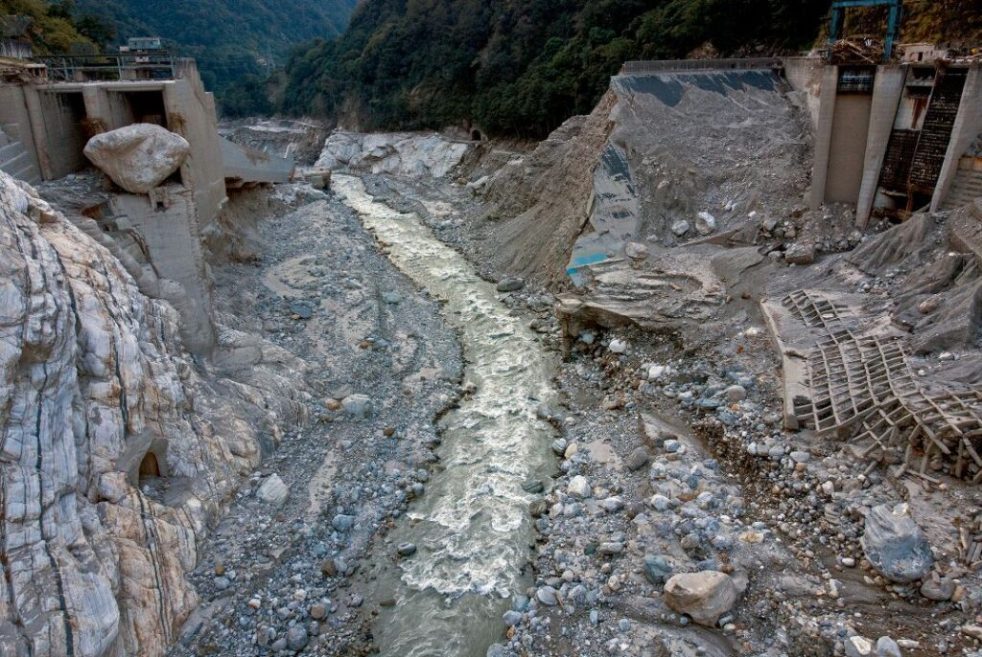
(Feature Image: Drone image of the Teesta III dam in Sikkim, taken from Chungthang town looking downstream. Image by Praful Rao of Save the Hills.)
According to a report in the National Daily, the Centre has decided to hire outside experts on fixed contracts to evaluate designs of planned hydropower projects, a move aimed at speeding up construction of several dams in the pipeline, an official said on Oct 1. The Union Govt plans to expedite construction of a slew of hydroelectric projects, especially in Jammu & Kashmir and the northeastern state of Arunachal Pradesh.
This seems like looking for short cuts for major interventions in high-risk, fragile, disaster-prone Himalayan region where such regions have already proved to be major force multipliers. The climate change is making the Himalayas even more prone to high-risks and disasters for multiple reasons, often compounded by multiple factors.
The report quotes coordinator of SANDRP saying that the government should “not look for any short cuts” in expediting any high-risk projects like big hydropower dams in the Himalayas. “Our experience shows over the years that these projects act like force multipliers during disasters, the frequency, intensity and spread of the disasters is increasing rapidly in the Himalayas. We need honest environment and social impact assessment, we need to take the local community into confidence through credible public consultations,” he said. “We particularly need independent appraisal, including geological aspects, we also need disaster impact assessment, since these projects are coming up in the vulnerable areas and are likely to increase the disaster potential of the area. We also need confidence inspiring carrying capacity and cumulative impact assessments and also credible monitoring and compliance.” One hopes better counsel shall prevail.
HYDRO POWER PROJECTS
FIR lodged over EIA for hydro project A citizen of Anjaw district, Roshman Tawsik, lodged an FIR at the police station here on Oct. 02 against Shilpa Shinde, chairperson of WAPCOS Ltd, a scientist from the EIA Survey Committee of WAPCOS Ltd, Anjaw Deputy Commissioner Millo Kojin, and Land Management Secretary Audesh Kumar Singh.
In his FIR, Tawsik, who is also the chairman of the Nukung Welfare Society, alleged that despite sending a legal notice to WAPCOS and writing letters to the DC and the land management secretary, raising concerns over the manner in which the environmental impact assessment (EIA) was conducted for the proposed Kalai-II hydropower project, no one has responded to his concerns.
PM reviews Dibang Project PM Narendra Modi has reviewed the progress of this project last week through video-conferencing. With a 91-month deadline as per the tender, Dibang dam is expected to come up by 2032 and is crucial to India’s strategic security. PM Modi had last year laid the foundation stone of the 2880-MW Dibang Multipurpose Project. The PM reviewed seven other mega projects alongside the Dibang project.
NHPC holds discussion with ABK & SIFF on SUMP The National Hydroelectric Power Corporation (NHPC) Ltd held a consultative discussion on the proposed Siang Upper Multipurpose Project (SUMP) with delegations of the Adi Bane Kebang (ABK) and the Siang Indigenous Farmers’ Forum (SIFF) at the NHPC office complex here in East Siang district on Oct. 04.
ABK president Tatak and other members raised several questions to clarify their doubts over the project, to which the NHPC GM responded with detailed explanations. Tatak proposed holding a consultative meeting with the project-affected families, followed by another meeting with the state government and the NHPC.
The NHPC GM urged the ABK to support the preparation of the pre-feasibility report and to help raise awareness at the grassroots level about the importance and necessity of the SUMP. It was also emphasised that the preparation of the detailed project report and related studies, such as the environmental impact assessment, environmental management plan, social impact assessment, land acquisition, and resettlement & rehabilitation plan, would involve consultations with stakeholders at every stage.
ALSU urges govt to halt SUMP-related activities The Arunachal Law Students’ Union (ALSU) urged CM Pema Khandu and his deputy Chowna Mein to halt all activities relating to the SUMP, including survey for preparing the pre-feasibility report (PFR), until consent of the affected villages is formally obtained through a transparent, participatory, and documented process. The ALSU said development must not come at the cost of human dignity, peace and constitutional rights.
SC advocate stopped at Ruksin check gate Designated senior Supreme Court advocate Colin Gonsalves was stopped at the Ruksin gate in East Siang district last Oct. 04 on grounds of ‘suspicion’ in connection with the proposed SUMP in the Siang valley. He was stranded for four hours at the Ruksin gate, the entry point to Pasighat in East Siang district.
It is to be noted that travel restrictions have been imposed on people opposing the SUMP. Earlier, SIFF legal adviser Bhanu Tatak, who is also a law student, had received an invitation to a three-month academic program at the Dublin City University, but she had been stopped at the Delhi airport as a look out circular (LOC) had been issued against her.
On Sept. 28 evening, human rights activist, advocate Ebo Mili was summoned by a SIT in Chimpu in connection with a case registered at the Boleng police station in May this year. The interrogation lasted at least three hours. Mili has been summoned again on 2 October for the final examination.
Ebo Milli offloaded at Kolkata airport Arunachal Pradesh’s young human rights activist, Ebo Milli, was stopped from travelling abroad and offloaded at Kolkata airport on Sept. 28 while he was about to board his flight to Dhaka, Bangladesh. Officials at the Kolkata immigration reportedly intervened and prevented him from leaving the country. So far, no official explanation has been given for this action.
Collector calls meeting with Anti HEP committee in Andhra Pradesh Alluri Seetharama Raju District Collector A.S. Dinesh Kumar will convene a meeting with representatives of the anti-hydropower project protest committee at the Collectorate in Paderu on Sept 29, the leader of the protest committee and Anantagiri ZPTC member D. Gangaraju said. He said that the Collector had invited them for a meeting with him. He said that the government had proposed to set up hydropower projects at five places — Anantagiri mandal’s Pedakota, Chittammavalasa and Gujjeli and Yerravaram (Koyyuru mandal) and Majjivalasa in Hukumpeta mandal — of the district, against the interests of the locals and tribals. He said the protests by locals against the hydropower projects in the district have received tremendous response. He said the committee would work in every possible way to protect the rights of the people of the district and the environment.
Tamil Nadu: PSP could harm the Nilgiri Tahr habitat Despite the State Forest Department taking efforts in recent years to protect and conserve the Nilgiri Tahr, the State animal, a proposed hydroelectric project could cut through the heart of the Tahr’s domain in the upper Nilgiris. The ₹5,000 crore project, to be undertaken by will add 1,000 MW to the State’s electricity grid. In the pipeline for over a decade, the project envisages the pumping of water between the two existing reservoirs in Upper Bhavani and Avalanche through underground tunnels to generate electricity to help supply the State’s energy grid during peak demand hours, officials from TNPDCL said.
DAMS
Maharashtra govt set to lease out land near reservoirs After several meetings with the CM, WRD Radhakrishna Vikhe Patil now appears ready to implement a govt resolution that opens up waterfront land near 20 dams across the state. Once released, the standard bid document will bring into force a public-private partnership model. Under it, any private player can get land on a lease signed for 49 years, explained the sources in the department. The plan to use the dams’ waterfront land is likely to generate approximately Rs 500 crore per year in revenue.
RIVERS AS NATIONAL WATERWAYS
Bihar’s ₹ 908 Cr Patna Water Metro begins trial run.
Muthalapozhi: Dredging to be completed in 2 months To ensure a long-term solution to the recurring problems at the port, including extending the southern breakwater, the project has been included under the Pradhan Mantri Matsya Sampada Yojana (PMMSY) with an administrative sanction of ₹177 crore. The Collector said that tenders have been finalised and work contracts awarded. Once completed, these efforts are expected to provide a permanent remedy to the hazards at Muthalapozhi.
URBAN RIVERS
Mula-Mutha RFD: Key land acquisitions cleared A total of 22.26 hectares belonging to the Women and Child Welfare Department in Mundhwa, the Defence Ministry in Sangamwadi and the Forest Department in Koregaon Park will now be handed over for the project. Crucially, the Defence Ministry has also granted clearance, paving the way for faster execution.
Although the District Collector’s office had initially demanded Rs 116 crore for the land transfer, Deputy CM Ajit Pawar has directed that the land be made available at a nominal rate. The directive came during a review meeting held on Sept. 29, where Pawar emphasised that the riverfront project is a priority initiative under CM Devendra Fadnavis’s war room. PMC is expected to benefit significantly from the cost waiver.
Govt expedites Musi RFD plan With the Asian Development Bank (ADB) expressing its consent to grant a loan, the state government is fast-tracking the Musi Riverfront Development Project. Of the total 55 km stretch targeted for development, the government plans to initially develop a 20.5 km segment. Work has been intensified under Phase 1A and Phase 1B of the project, which carries a combined estimated cost of `5,641 crore. Specifically, Phase 1A is estimated to cost `2,500 crore and Phase 1B `3,141 crore.
DPR work by Jan. 2026 The consortium involving three companies are already conducting different surveys to prepare the DPR. After the consortium prepares the DPR for a portion of the river flow, the Musi Riverfront Development Corporation Limited (MRDCL) would submit it to the government. Accordingly, steps would be taken to raise nearly Rs.4,100 crore as a loan from ADB for executing the works.
Dying Doodh Ganga! Despite directions of NGT, authorities in Kashmir have blatantly failed to launch conservation measures to restore Doodh Ganga. Meanwhile the JKPCC has informed the NGT that action for imposing Environmental Compensation on Srinagar Municipal Corporation (SMC), Municipal Council Chadoora, and Municipal Council Budgam will be taken within six weeks. Notably, NHRC had selected ‘Doodh Ganga- Valley’s Dying Lifeline’ the winners of its tenth prestigious annual competition for short films on human rights in 2024.
RIVERS
Rivers are Alive Engaging session organized on the World Rivers Day (28th Sep) dwelt on reflective river-hood conversations on living rivers, rights of rives & earthy governance between Shrishtee Bajpai, Parineeta Dandekar (SANDRP) and Alyen Foning, followed by active interventions by many participants.
Free Flowing Rivers Online session on 25th Aug where concerned citizens shared perspectives from ground and riverine experiences and asserted that rivers have life & dignity too & must flow freely; free from destructive large dams, sand mining, riverfronts, pollution, river linking and destructive development’.
Aghanashini diversion a disaster in making Even after 11 years of the implementation of Yettinahole Integrated Project at a cost of Rs 23,251 crore, it is providing water to only two out of the seven parched districts despite spending Rs 16,076 crore. Since its inauguration, a miniscule 2 tmcft of water has been supplied out of the promised 24 tmcft.
There are bad ideas, and then there are ideas so catastrophic that they deserve their own Hazardous Sign. Diverting the Aghanashini, a free-flowing west-bound river of the Western Ghats, across ridges and forests to feed the River Vedavathi in drought-hit Chitradurga, falls squarely in that category. The sales pitch rests on one myth: water reaching the sea is “wasted.” Hydrologists have debunked this theory for years. (R S Tejus)
Vijayapura in Karnataka plants 1.5 cr trees The story of the transformation of the land once known as Bijapur begins in 2016 when Koti Vruksha Abhiyan (KVA) was launched. Over 1.5 crore trees and 17,000 acres later — that’s more than 4,500 saplings daily — it’s still going strong. Karnataka minister M B Patil remembers the shock he’d felt all those years back when he learnt how little green cover was available in this dictrict of 2.5 million hectares.
The success of the opening charge — which covered community forests, village plantations and private farm forests — has whetted the ambition of Vijayapura’s green warriors, who now want to plant 5 crore saplings. Prof Murugesh Pattanashetti, coordinator of KVA Pratisthana, said that it will have long-term impacts for biodiversity, soil and moisture conservation, and groundwater levels.
The undivided Bijapur district in north Karnataka’s semi-arid zone, was once known as the land of five rivers, or ‘Pancha Nadigala Naadu’. Some also referred to it as the ‘Punjab of Karnataka’ with the Krishna, Bhima, Malaprabha, Ghataprabha, and Doni flowing through it. But, after Bagalkot district was carved out of it in 1997, the renamed Vijayapura district was left with just three rivers, the Krishna, Bhima, and Doni.
India’s Deadliest River Jojari In the deserts of Rajasthan, every drop of water is a blessing. But what happens when that blessing becomes a curse?
Story of Kosi River Ground report on the reality of Koshi Floods, people affected by the floods, their lost lives, scarcity of food, blown-away land, and houses.
Brahmaputra under water road tunnel may get Cabinet nod soon The DPR for Assam’s first underwater tunnel, slated for construction between Numaligarh and Gohpur with a budget of ₹6,000 crore, has been completed.
After conducting a feasibility assessment and finalising the alignment, NHIDCL has determined the project’s provisional length at 33.7 km, including both the tunnel and the roadway connecting Gohpur to Numaligarh.
The tunnel’s considerable depth is evident as its crown is designed to be situated approximately 32 m beneath the Brahmaputra river’s lowest bed level, which maintains significant depth in this section.
The NHIDCL is handling the execution of this project. The construction is expected to span five years following its allocation. The NBWL Standing Committee has endorsed the proposed tunnel but requested a scientific assessment regarding its potential effects on soil stability, groundwater movement, sediment patterns, and seismic susceptibility.
CPCB: Polluted River Stretches (Sept. 2025) Upon reviewing water quality data of 2116 locations monitored during the year 2022 and 2023, it is observed that 807 river locations were exceeding the Primary Water Quality Criteria for Outdoor Bathing for the parameter BOD i.e. more than 3 mg/L. Based on the assessment, 296 polluted river stretches/locations have been identified on 271 rivers in 32 States and Union Territories.
4.5 CONCLUDING REMARKS AND RECOMMENDATIONS: – Over the years, monitoring network on rivers under NWMP has been enhanced from 1533 river monitoring locations in year 2017 to 2155 river monitoring locations in year 2023.
– Decline in number of polluted river stretches are observed mainly due to collective actions taken by various stakeholders for rejuvenation of the polluted river stretches identified during the year 2018.
– Number of polluted river stretches are reduced from 45 to 37 in Priority I, from 72 to 45 in Priority IV and 175 to 148 in Priority V category.
– An increasing trend is observed in number of identified PRS under Priority II (16 to 21) and Priority III (43 to 45), which is attributed to shifting of few Priority I stretches to lower Priority Class, which is indicative of efforts initiated by State Govt. Agencies for rejuvenation of the PRS.
Maharashtra has most polluted rivers With as many as 54 polluted river stretches, Maharashtra has emerged as the state with the highest number of such stretches according to the CPCB’s latest technical report published on September 23 and uploaded online on September 27. Six out of the 54 polluted river stretches located in the Pune, Solapur and Mumbai districts fall under the most critical category.
Arkavathi most polluted river in Karnataka Arkavathi river stretch from Hesaraghatta reservoir to Kanakapura town has been classified as a highly polluted (under priority I) stretch by the CPCB in its recent report. The report reveals that Karnataka now has 14 polluted river stretches, including Arkavathi, Tungabhadra, Bhima, Cauvery, Krishna, Shimsha, Tunga, Lakshmantirtha, Bhadra, Ghataprabha, Kabini, Kagina, Malprabha, and Dakshinpinakini.
NMCG: 16th Meeting of Empowered Task Force Special focus was laid on the status of wetlands in Uttar Pradesh and Bihar, where 282 and 387 wetlands were assessed respectively, with 40 in Uttar Pradesh and 19 in Bihar identified as high priority. The Minister urged both states to expedite notifications and provide legal protection to these 59 wetlands, emphasizing that wetlands are the backbone of flood control, groundwater recharge, and biodiversity conservation, and their protection is vital for ecological balance and local livelihoods.
Reviewing the status of pollution abatement in Uttar Pradesh, it was informed that while larger cities have developed a sewage treatment capacity of 4,651 MLD with an additional 1,708 MLD under construction, the focus should be increased on smaller urban bodies. The Minister directed the state government to prioritize City Sanitation Action Plans under Swachh Bharat Mission 2.0 and prepare DPRs at the earliest for project approvals.
The Hon’ble Minister also reviewed and released the project report on “Geomorphic and Ecological Impacts of Sand Mining in Large Rivers” prepared by IIT Kanpur under the guidance of Prof. Rajiv Sinha. The report provides an in-depth assessment, analysis, and mitigation strategies regarding sand mining using high-resolution remote sensing data and drone surveys. It marks an important step towards understanding and addressing the ecological challenges posed by sand mining in India’s rivers and would help in bringing out a policy framework on regulating sand mining.
Dams strangle Ganga There are 784 dams across the basin, with the highest number being in Madhya Pradesh (364), followed by Rajasthan (145) and Uttar Pradesh (98). The Tehri dam is the highest at 260.5 meters, and the Nanak Sagar Dam is the longest at 19.2 km. According to the India-WRIS report, the Ganga basin has 478 major and medium irrigation projects and 39 hydro-electric projects. In addition, the basin’s easily accessible groundwater resources account for nearly 50 per cent of India’s total groundwater-irrigated area.
Yamuna: ‘Flushing’ impact: Sept floods cleanse river Between August 31 and September 4 this year, Hathnikund barrage discharged more than 100,000 cusecs per hour for five consecutive days. The flow then tapered but left the river temporarily cleansed. Experts, however, caution the improvement is short-lived. “Samples were taken when a huge flood volume had just reached Delhi, flushing out pollutants. But once the flow reduces, effluents will again dominate,” said Bhim Singh Rawat of the South Asia Network on Dams, Rivers and People (SANDRP). He stressed that while higher e-flows — at least 23 cusecs as recommended — are crucial, Delhi must also tackle untreated sewage flowing into drains.
According to the experts, the DPCC report for Sept is on expected lines. “The Yamuna shows significant improvement in the key parameters primarily due to the flood spell in the river. The samples were taken on the day when a huge volume of floodwater from the Hathnikund barrage had already reached and was passing through the Delhi segment, flushing out the legacy pollutants. This is also a time when the major city drains are kept closed to avoid back flooding, thus greatly reducing the entry of large volumes of effluents in the river system,” noted Bhim Singh Rawat of SANDRP. Rawat, however, pointed out some problems with the analyses, including not figuring out permissible limits for three parameters – COD and the presence of phosphates and ammoniacal nitrogen.
As water from its catchment areas upstream reaches Delhi, life returns to the river. Nearly 100 fishermen from Bihar and West Bengal camp along the Yamuna near the Okhla Barrage for these 2-3 months each year. The rains, clean water and steady flow bring with it, a good catch.
HM to launch Yamuna projects worth 4,000cr CM Rekha Gupta on Sept. 24 announced that Union home minister Amit Shah would inaugurate 46 projects aimed at the revival of the Yamuna on Sept 30. The projects will cost over Rs 4,000 crore. Delhi Jal Board is gearing up for the grand inauguration of its biggest 124 million gallons per day wastewater treatment plant in Okhla, said an official. According to officials, the Okhla STP is the largest facility of its kind in Asia, with a treatment capacity of 124 MGD. Built at a cost of Rs 1,161 crore, the plant spans 40 acres and replaces four outdated sewage treatment units previously located at the same site.
Mathura: Flooding prompts relook at Heritage City-cum-riverfront plan UP govt’s Heritage City project in Raya, near Mathura-Vrindavan, has encountered setbacks after heavy rainfall led to flooding in parts of the proposed site. Yamuna Expressway Authority has tasked the project consultant to undertake a detailed risk assessment to assess the impact of the flooding and determine if parts of the proposed project require to be relocated. Following the recent flooding, concerns have arisen that the proposed township could face similar risks each monsoon. The open-air cultural parks, artisan villages and planned riverfront are seen as particularly vulnerable. Officials have warned that tourism infrastructure of this scale cannot be sustained on flood-prone land without robust safeguards.
RIVERS BIODIVERSITY
Deaths, Threats, Conservation Efforts related to Gangetic Dolphins This year, we could find details related to the death of at least 5 Gangetic dolphins during past one year including 3 from Uttar Pradesh and 1 each from Jharkhand and West Bengal. The report indicates gradual increase in incidents of dolphins being stranded in canal particularly in Sharda river canals in Uttar Pradesh due to problematic operation of barrages. It is also observed that there is increase in awareness among local communities and successful rescue efforts by the forest departments. The report also covers status of govt conservation programs and findings of important studies, survey conducted recently.
Gangetic Dolphin: Study maps mortality hotspots Using MaxEnt modeling and GIS-based weighted overlay analysis mortality hotspots for the Gangetic dolphin were identified. Accidental causes emerged as the primary contributor to Gangetic dolphin mortality in the Ganga River Basin. Approximately 770 km of the river stretches were identified as mortality hotspots, requiring urgent conservation attention.We propose establishing rescue facilities, capacity building, and mobilizing Ganga Praharis for dolphin conservation.
FISH, FISHERIES, FISHERFOLKS
Impact of Farakka barrage on Hilsa The Farakka Barrage, commissioned in 1971, poses a major barrier to Hilsa migration. By altering flow regimes and salinity, it has had complex, far-reaching effects on Hilsa production by disrupting migratory pathways, as per a CIFRI study.
SAND MINING
Notify PESA rules: HC to Jharkhand govt In a setback to the Jharkhand government, the high court in Ranchi Sept. 24 refused to modify its 9 September order banning the allocation of sand ghats and minor mineral mines in the state. A bench comprising Chief Justice Tarlok Singh Chauhan and Justice Rajesh Shankar rejected the state government’s plea to lift the stay on the allocation process, saying it had yet to comply with the court’s direction to frame and notify rules under the Panchayats (Extension to the Scheduled Areas) Act, 1996 (PESA), which grants control over resources in scheduled tribal areas to gram sabhas. The court said that for allocation to proceed, the state must first frame the PESA rules.
Fight to save Sukhnag river The Sukhnag had been plundered of its minerals in the last decade; now, with the NGT’s intervention, it can get a chance at life again. (Raja Muzaffar Bhat)
Punjab govt to pay Rs 7,200 per acre for removing silt: CM Extending assistance to those hit by floods, Punjab chief minister Bhagwant Singh Mann on Sept. 29 announced that farmers will be given Rs 7,200 per acre to remove sand and silt from their fields under the ‘Jisda Khet, Ohdi Ret’ scheme, along with a sharp increase in crop loss and housing compensation. He said the state govt will begin disbursing compensation from Oct 15, ahead of Diwali.
Joint Yamuna task force on cards Inter-state coordination to safeguard Yamuna’s banks will finally take shape after UP and Delhi agreed before NGT to set up respective task forces. The Ghaziabad administration has formed UP’s task force to tackle illegal mining along the riverine border, which will work in coordination with Delhi’s task force as well as those of other Yamuna districts like Noida and Baghpat.
12 feared drowned in Agra during idol immersion What began as a celebration turned into a day of mourning in Agra on Oct. 02, after 13 people, many of them teenagers, were swept into a deep pit in the Utangan river while immersing an idol of Goddess Durga. By evening, only one man was rescued alive, five bodies were retrieved and the frantic search operations for the remaining people still continued.
The tragedy unfolded around 1 pm, when a group of village residents entered the river for the immersion of the goddess’s idol. They formed a human chain, holding hands as they stepped into what seemed to be waist-deep water. Within minutes, they slipped into a pit that officials said was at least 20-25 feet deep, and could have possibly been carved out due to illegal sand mining.
Authorities said the elevated water level, combined with the sudden drop in depth caused by mining pits, made the spot particularly hazardous. Agra Police Commissioner Deepak Kumar, who inspected the site along with DM Bhanu Chandra Goswami, said: “The river looked shallow, but there are dangerously deep pits in some stretches. Our rescue teams believe the bodies are stuck there. We are using every possible resource to recover them.”
4 killed after dumper hits 5 in Meghalaya Four teenage girls died while a minor sustained severe injuries after a sand-laden mini dumper hit them at Thadrang village in Ri-Bhoi district on Oct. 3 evening. The vehicle, which was coming from the side of Jowai and was going towards Bhoirymbong, ran over the five at around 6 pm, Ri Bhoi SSP Vivekanand Singh Rathore said on Oct. 04.
WETLANDS, LAKES, WATER BODIES
Proposed industrial park endangers Dorabeel wetland As per the government’s plans, an industrial park is set to come up on the wetland – a disturbing move that has triggered a mass protest by the local populace. Located near Bijoynagar area, Dorabeel is much more than a wetland. Aside from supporting wide-ranging plants, mammals (including the endangered Gangetic river dolphin), birds (four endangered species of vultures), fish, reptiles and birds, its ecosystem overlaps with grassland (which sustains a village grazing ground) and fertile farmland. This makes the entire area of around 1,800 bighas (excluding agri land) a haven for diverse species as well as a constant livelihood provider for the local populace who are into tilling and fishery. No less significant is the cultural worth of the wetland, which is rooted in local lore and has been at the centre of traditional cultural and religious practices for generations.
Officials face contempt notice over water pollution The Gujarat high court has issued contempt of court notices to four IAS officers and Dholka town’s chief officer for their prolonged failure to comply with court orders regarding pollution in waterbodies of nearby villages. The bench of Justice A S Supehia and Justice L S Pirzada issued notices on Sep 25 for contempt proceedings against Gujarat Pollution Control Board (GPCB) chairman R B Barad, Ahmedabad district collector Sujeet Kumar, commissioner of municipalities and managing director of Gujarat Urban Development Co Ltd (GUDCL) Remya Mohan and its chairman M Thennarasan, and Dholka’s chief officer Prarthana Jadeja. As the lawyers representing these officers sought time to take instructions from the officers, the HC posted further hearing on Oct 3.
WATER OPTIONS
MGNREGA: More expenditure on projects to conserve water The central government amended the Mahatma Gandhi National Rural Employment Guarantee Act (MGNREGA) on September 23, 2025. 65 per cent of MGNREGA funds will now be spent on water conservation projects in areas with “extreme water stress”. This amount will be 40 per cent in areas with less water stress. Finally, in areas without water stress, at least 30 per cent of funds will be spent on water conservation projects.
GROUNDWATER
Groundwater in the Indo-Gangetic Basin In this episode, Alan and Veena dive deep into the Indo-Gangetic Basin, exploring how its young sediments and complex geology shape groundwater availability, why salinity and depletion can exist side by side, and how historical canal records still influence water levels today. Alan explains how tracer studies and isotope hydrology reveal the origins of groundwater, and how modern tools like satellites are transforming our understanding of recharge, depletion, and salinity.
Quality controlled, reliable groundwater level data Abstract: Groundwater is a vital resource for domestic, agricultural, and industrial use, with its demand growing due to population growth and climate change. Several studies have identified groundwater depleting in India at unsustainable rate over North-west part, but a contrasting trend is observed in the southern India. To better study groundwater dynamics quality-controlled and reliable well data is essential, which is missing. Here we process seasonal groundwater levels from 32,299 wells across India to obtain reliable well data and provide respective specific yields.
URBAN LAKES, WETLANDS
Environmentalists urge PM Modi to conserve wetlands Ahead of World Migratory Bird Day (WMBD) on October 11, environmentalists have appealed to PM Narendra Modi to conserve India’s wetlands. NatConnect has called for the expedited notification and protection of over two lakh wetlands above 2.25 hectares that have already been mapped by ISRO’s National Wetland Inventory Assessment. While the Ministry of Environment has published the national wetland atlas, actual protection remains stalled due to delays in “ground-truthing” by state governments. “Without official notification, wetlands are treated as developable land parcels a dangerous trend,” Kumar cautioned.
URBAN WATER
GW in Bengaluru still ‘critical’ Groundwater levels have improved by 0.5 to 1.2 metres across Bengaluru Urban in the past year and this is driven majorly by rain, recharge structures, irrigation expansion, and wastewater reuse, according to data monitored jointly by BWSSB and the minor irrigation and groundwater development department. However, the city is still in the ‘over-exploited’ or ‘critical’ category because of its heavy reliance on borewells.
WATER POLLUTION
Kerala’s brain-eating amoeba outbreak raises alarm over protesters’ safety Rights groups warn use of untreated water in police cannons could spread lethal pathogen linked to 21 deaths
JJM/ RURAL WATER SUPPLY
Kishtwar village grapples with acute water shortage In the far-flung sub-division of Marwah in Kishtwar district, residents of Hanzal village are grappling with an acute shortage of drinking water despite the much-hyped Jal Jeevan Mission scheme. According to locals of Hanzal village in Marwah sub division, women are compelled to fetch drinking water from nearby streams and rivers as taps in the village run dry. The residents allege that employees of the Public Health Engineering (PHE) sub-division Dachhan have been neglecting their duties, resulting in wastage of water through leaking pipelines.
WATER
Storage tops 90% of capacity in 50% reservoirs Over 50 per cent of India’s major reservoirs are nearly brimming, with the storage crossing 90 per cent of the capacity this week, data from the Central Water Commission (CWC) showed. The storage, which is 3.5 percentage points higher than last year and 15 percentage points more than normal (the last 10 years’ level), has improved this year with the South-West Monsoon showering 8 per cent excess rainfall.
35 reservoirs were full, while the level in 48 was above 90 per cent. Of the 35, 13 dams are in Maharashtra. Of the rest, four reservoirs are in Rajasthan, three reservoirs each in Madhya Pradesh, Jharkhand, Gujarat and Karnataka, two in Uttar Pradesh and one each in Chhattisgarh
The western region continued to have the highest storage in its 50 reservoirs at 97.31 per cent of the 37.357 BCM capacity at 36.351 BCM. Apart from Goa, the storage in Gujarat was 96.79 per cent and in Maharashtra, it was 97.76 per cent. In the northern region, the 11 reservoirs were filled to 17.889 BCM or 90 per cent of the 19.836 BCM capacity. The level in Rajasthan was 97 per cent, while in Himachal, it was 89 per cent and in Punjab, 83.58%. The eastern region continued to have the lowest level, though it increased marginally this week.
MONSOON 2025
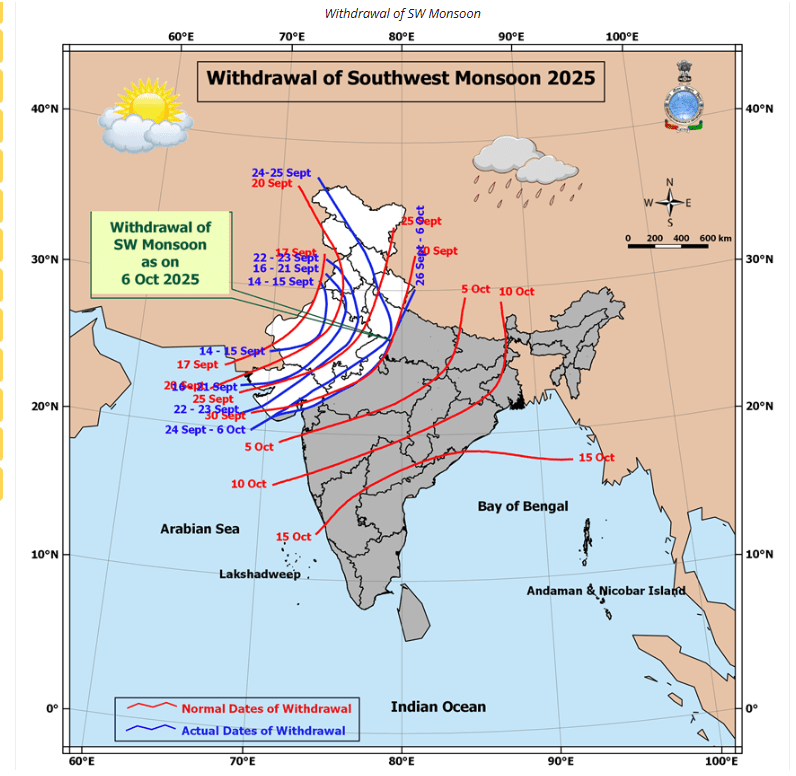
SW Monsoon 2025: District wise rainfall in India In the just concluded South West Monsoon 2025, India received 937.2 mm (934.8 mm in SW Monsoon 2024, 820 mm in SW Monsoon 2023, 925 mm in SW Monsoon 2022) rainfall, about 107.9% (107.6% in 2024, 94.45 % in 2023, 106.5% in 2022) of the Normal SW Monsoon rainfall of 868.6 mm as per India Meteorological Department (IMD). This rainfall is categorised as normal rainfall. The rainfall in SW monsoon 2025 is 5th highest since 2001 and 38th highest since 1901.
India gets 8% more than normal rainfall – 5th highest since 2001 The four-month summer (southwest) monsoon season ended on Sept. 30 with India reporting 8% more than normal rainfall. East & northeast India, however, reported a huge deficit of more than 20% and witnessed the second lowest rainfall year in the rainy season since 1901. The country as a whole, on the other hand, saw fifth highest rainfall this year since 2001 and 38th highest since 1901. “Bihar, Arunachal Pradesh, Assam and Meghalaya saw deficient rainfall in three of the four monsoon months. The lowest rainfall in the monsoon season in the region was recorded in 2013,” IMD chief Mrutyunjay Mohapatra said.
Monsoon 2025 has the double distinction of being above normal for the season and for the individual month, as well. Since 1950, the monsoon rainfall was above average in all four months in 1956, 1961, 1975, and 2007. Notwithstanding that the current season will figure amongst the rare category, but not without concerns for some pockets.
However, the rain distribution was skewed and uneven at the district level. While many urban cities like Delhi, Kolkata, Mumbai, Dehradun, among several other regions received ‘excess rainfall’ between 20 and 40 per cent, there were at least 146 districts in the country with ‘deficient’ or ‘large deficient’ rainfall. Of the total 727 districts, for which data was available with the IMD, 135 districts were in the ‘deficient’ category and 11 were in the ‘large deficient’ category, till September 30.
Delhi: Earliest exit in 23 years The southwest monsoon withdrew from Delhi on Sept. 24, marking its earliest departure from the capital in over two decades. This year’s exit was the earliest since 2002, according to an analysis by HT. Last year, the monsoon withdrew significantly later, on October 2. Despite the premature exit, the season delivered a surplus of rainfall. Delhi’s base weather station in Safdarjung recorded 902.6mm of rain, which is approximately 41% above the normal level of 640.4mm.
Haryana logs wettest September in 3 years Haryana has closed this monsoon season with its highest rainfall in three years. It has recorded a 70% surplus over the long-term average, according to IMD data. At 129.2 mm against a normal of 77.2 mm, 2025 stands out not just for the statewide numbers but also for the intensity of Sept showers that tipped the balance. In 2023, rainfall stood at 43mm (-44%) while in 2024, it was 105.7mm (37%).
South Mumbai logs its third highest Sept rain since 2006 South Mumbai received over 200mm of rainfall over this past weekend, pushing its Sept total to 586.2mm. IMD’s historical data for Colaba shows this is the third-highest rainfall for the month since 2006. The two years that recorded higher rainfall for Sept were 2019 with 855.8mm and 2016 733.4mm.
Sept rain 60% above normal The Colaba observatory—which registers an average of 355.6mm of rain in the month—recorded 601mm (69% excess) as on Sept 30 morning. The Santacruz observatory —considered the benchmark for the city—logged 612mm (59.8% excess) against an average of 383mm. The month’s average was surpassed on Sept 20 itself. Aug (1,191mm), too, exceeded its average of 560.8mm.
Kolkata: ‘Warming oceans make rainfall intense’ The severity of the rainfall in Kolkata on Sept 23 was not just a quirk of the monsoon — it was supercharged by warming oceans, say scientists. A report compiled by Climate Trends linked the severity with the rapidity of climate change. The heaviest burst came in the early hours of Sept 23, when 98 mm fell in just an hour — just shy of the 100 mm threshold that meteorologists classify as a cloudburst. The IMD said the downpour was triggered by a low-pressure system that developed over Odisha and the northwest Bay of Bengal, sustaining a conveyor belt of moisture into Kolkata.
FLOOD 2025
DAM FLOOD Floods in Manipur worsened On the afternoon of September 14, four gates of the Mapithel dam in Manipur were suddenly opened, leading to flooding in the downstream villages across the Thoubal river basin. The sudden release of water inundated paddy fields, fish farms, and households, sweeping away two elderly persons who later died.
The president of the Manipur Congress and an elected representative of the Manipur Legislative Assembly, Keisham Meghachandra, accused the WRD for creating a “man-made disaster” and noted that there was no proper communication between the government institutes and the people residing downstream. But the clarification issued by the WRD signals that the discharge was mandatory in light of the “extraordinary natural inflow” rather than dam operation and that adequate “mobile communication” was completed by field staff to communities downstream.
Krishna Godavari Rivers in spate Prakasam Barrage on Krishna River is currently handling 6.57 lakh cusecs, with levels expected to rise due to heavy rains in Telangana and flood releases from Srisailam. Dowleswaram Barrage on Godavari recorded 10.12 lakh cusecs, which may increase to 11.50 lakh cusecs. Groundwater levels are on an average of 8.43 metres—1.25 metres higher than last year, with Rayalaseema seeing the sharpest rise of 2.07 metres.
AP CM N. Chandrababu Naidu has termed the situation critical and called for aggressive, dynamic flood management to protect lives and optimise water use. Officials warn that inflows could exceed seven lakh cusecs at Prakasam Barrage on Monday, while Godavari inflows are also rising rapidly. The CM demanded real-time monitoring of flood inflows and integrated analysis with rainfall data to coordinate reservoir and tank filling across the state. He directed that every possible water body be filled.
HFL BREACH
Rivers in Extreme Floods During SW Monsoon 2025 This is the summary report of Highest Flood Levels (HFL) breach incidents which we could document from CWC’s flood monitoring sites during South West Monsoon Season 2025.
Rivers Flowing in Extreme Floods in September 2025 We have been able to observe river attaining new HFL at least at 18 flood monitoring sites of the Central Water Commission (CWC) in the last month of South West Monsoon 2025. These 18 sites are spread over 7 States & UT, including Jammu & Kashmir (6 sites), Maharashtra (4 sites), Uttar Pradesh (3 sites), Haryana (2 sites), Madhya Pradesh, Telangana and Karnataka (1 each site) comprising 5 river basins including Indus (6), Ganga (6), Krishna (3), Tapi (2) and Godavari (1).
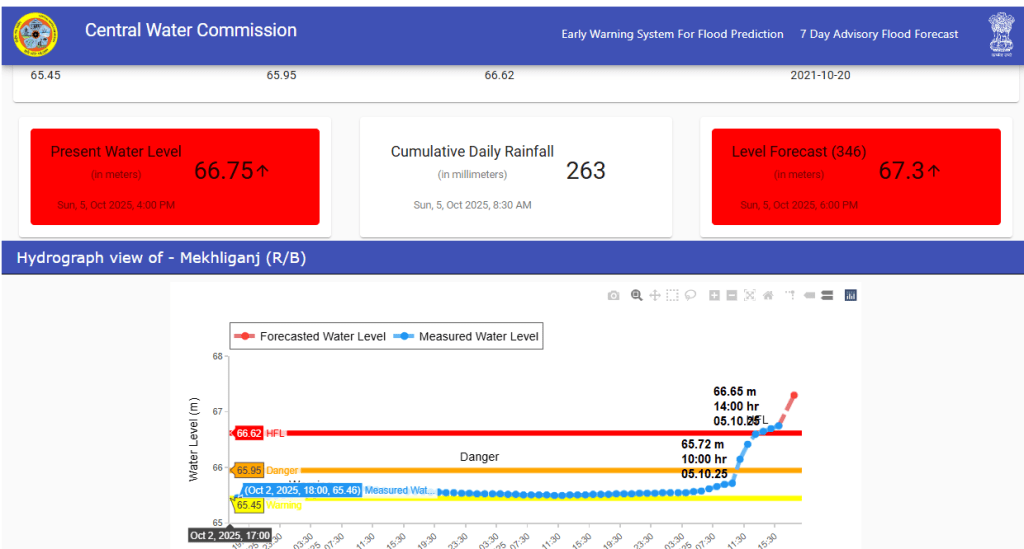
West Bengal River Teesta at Mekhliganj site in Cooch Behar district has crossed its HFL 66.62 meter dated 20.10.2021 at 14:00 hour on 05.10.2025. The flood level is forecasted to reach increase to 67.3 meter at 18:00 hour on 05.10.2025.
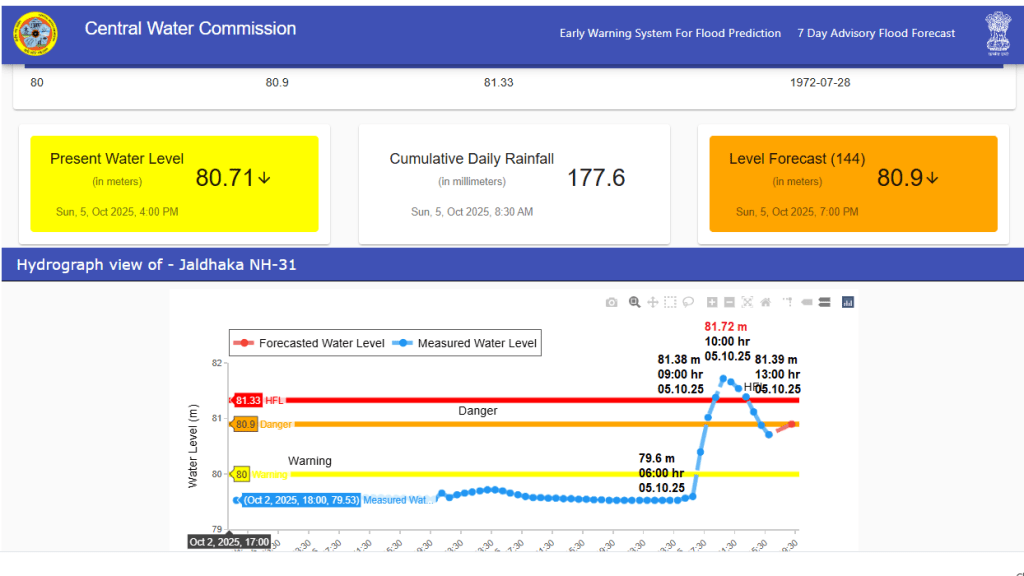
After 53 years, River Jaldhaka at Jaldhaka NH 31 site in Jalpaiguri district has crossed its HFL 81.33 meter dated 28.7.1972 at 09:00 hour on 05.10.2025. The flood level in the river increased by 2.12 meter in 4 hours attaining new HFL 81.72 meter at 10:00 hour on 05.10.2025. The river stayed in extreme flood situation for 04 hours.
River Jaldhaka at Diana site in Jalpaiguri district missed breaching HFL 196.55 meter dated 19.07.1980 by 0.11 meter at the peak flood level in the river increased to 196.44 meter at 07:00 hour on 05.10.2025. The flood level in the river increased by 2.28 meter in just 3 hours from 194.16 meter at 04:00 hour to 196.44 meter at 07:00 hour on 05.10.2025.
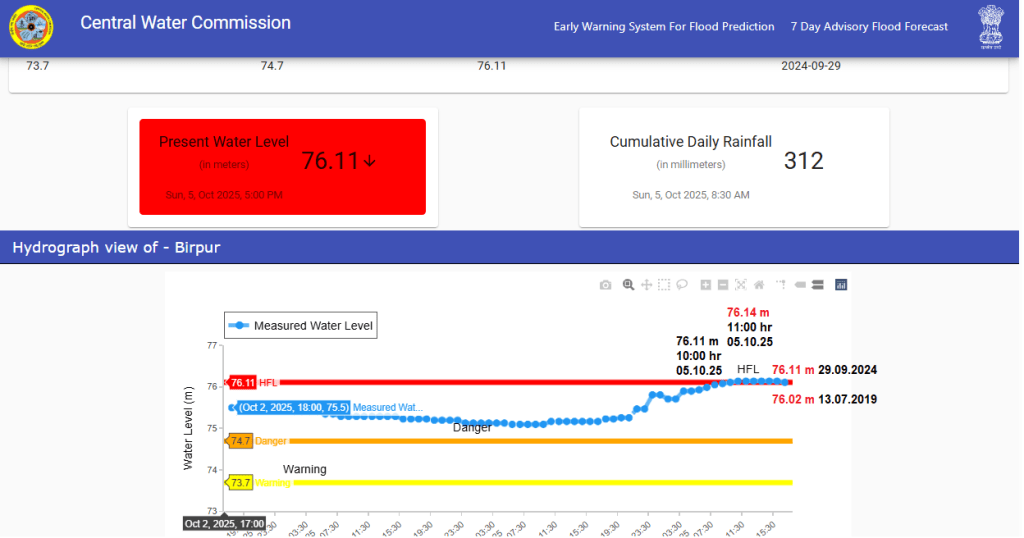
Bihar River Kosi at Birpur site in Supal district has crossed HFL 76.11 meter dated 29.09.2024 at 10:00 hour on 05.10.2025. The HFL is breached with a narrow margin of 0.03 meter at the peak flood level at the site reached to 76.14 meter at 11:00 hour and declined to 76.11 meter at 17:00 hour on 05.10.2025.
URBAN FLOODS
Activists oppose plan to shrink Bengaluru’s vital drain buffers In an open letter to the Urban Development Department, a concerned citizen says drain buffer cuts defy court orders and climate plans, risking floods.
HIMALAYAN DISASTERS
Lest we forget 2023 Teesta Disaster It is critically important to take this forward as a sustainable mountain development issue that questions how infrastructure is built in the mountains, especially large dams and roads. National policies, practices and resource allocation to the Himalaya have to be sensitive and appropriate to the importance and fragility of our landscapes. Engagement at a transboundary landscape level that goes beyond administrative, political and bureaucratic boundaries for collaborative visioning and planning is much needed. Ensuring loss and damage is minimal in the future and most importantly our interventions in the Sikkim and Darjeeling Himalaya must be such that they do not invite disasters. We might forget the Teesta Disaster 2023 but Teesta never forgets and the choice and responsibility is ours. (Roshan Rai)
Darjeeling landslides kill 23; villages cut off At least 23 people, including children, have lost their lives in one of the worst landslides to hit Darjeeling in a decade.
– Darjeeling, Mirik worst hit: According to the National Disaster Response Force (NDRF) and local district administrations, 18 deaths were reported from Darjeeling district alone, with 11 in Mirik, the worst-affected region, and seven more in subdivisions such as Jorebunglow, Sukia Pokhri, and Sadar Police Station areas. A separate operation in Nagrakata (Jalpaiguri district) led to the recovery of five bodies from debris.
– Worst landslide disaster since 2015: Officials say this may be the worst landslide disaster since 2015, when nearly 40 people were killed in the region. The current wave of destruction has seen entire slopes give way, key roads like the Mirik-Sukhiapokhri route blocked, and highways buried in thick layers of mud.
CM Mamata Banerjee said, “Due to incessant rain in Bhutan, water has overflowed into North Bengal. This disaster is unfortunate — natural calamities are beyond our control. I have been monitoring the situation since 6 am and held virtual meetings with officials of five affected districts along with the chief secretary.” She said more than 300 mm of rain in 12 hours had caused severe flooding and landslides at seven locations, comparing the situation to the intense flooding Kolkata saw last month.
ENVIRONMENT GOVERNANCE
NCRB 2023 report volume II details Environment Related Offences (State/UT-wise & Crime Head-wise) – 2023 in Chapter 11 from page number 917 onwards.
Total number of cases reported are 68, 994 of which maximum 59,279 are under The Cigarette and Other Tobacco Products Act, 2003 followed by 6,640 under Noise Pollution Acts (State/ Central), 2,076 under The Forest Act & The Forest Conservation Act, 526 under The Wildlife Protection Act, (1972), 389 under The Environmental (Protecti on) Act, (1986), only 68 under The Air (1981) & The Water Prevention & Control of Pollution Act, (1974) and only 16 under NGT Act 2010.
States & UTs wise: Total number of cases reported under Forest Act & Forest Conservation Act from 28 States and 8 UTs is 2076 mixumum 1282 from Uttar Pradesh, followed by 232 Rajasthan, 141 Himachal Pradesh, 139 Jharkhand, 98 Karnataka, 40 Uttarakhand.
Total number of cases reported under Wildlife Protection Act 1972 is 526 maximum 181 from Rajasthan, 116 Uttar Pradesh, 41 West Bengal.
Total number of cases reported under Environment Protection Act is 389 of which maximum 257 Maharashtra followed by 85 Uttar Pradesh and 12 each from Telangana and West Bengal.
Total number of cases report under Air (1981) and Water Prevention and Control of Pollution Act 1974 is 68 of which maximum 46 are from Tamil Nadu, followed by 14 from Maharashtra and 3 each from Haryana and Uttar Pradesh.
Environment-related offences increased by 30% India reported 68,994 environment-related crimes in 2023 which is over 30% higher than the total number of such crimes (52,920) reported in 2022, shows the latest Crime in India report released by the home ministry’s National Crime Records Bureau (NCRB) this week.
Nearly 86% (59,279) of environment-related crimes, however, pertain to only one offence — the Cigarette and Other Tobacco Products Act, 2003 that prohibits advertisement and regulates trade, commerce, production, supply and distribution of such products.
The report shows that the highest number of overall environment-related crime was reported in Tamil Nadu (41,304) followed by Kerala (8,786), Rajasthan (7,794), Maharashtra (4,854) and Uttar Pradesh (1,804).
Offence-wise data shows that Uttar Pradesh reported the highest number (1,282) of cases under forest-related crimes followed by Rajasthan (232), Himachal Pradesh (141), Jharkhand (139) and Karnataka (98) in 2023. Under the Wildlife Protection Act, Rajasthan reported the highest number of cases (181) followed by Uttar Pradesh (116), West Bengal (41), Maharashtra (27) & Bihar (25).
MP lost 408 sq km forest in 5 years Madhya Pradesh is the only state in central India showing a decline in forest cover. Across the country, five states reported a decline, with the four others located in the north-east. Between 2019 and 2023, MP lost 408.56 square kilometres of forest, according to the union govt’s reply in the Rajya Sabha on July 24. Among states, only Arunachal Pradesh recorded a higher loss, at 806.43 square kilometres. MP’s forest land also suffers the highest level of encroachment. Despite the loss, Madhya Pradesh still has the largest forest cover in India, with a total of 77,073.44 sqkm.
CLIMATE CHANGE
Riverine Heat Waves New research from shows that riverine heat waves – periods of abnormally high water temperatures in rivers – are becoming more common, more intense and longer-lasting than they were 40 years ago. Their frequency, intensity and duration are also increasing at rates more than twice as fast as heat waves in the atmosphere. The increased heat puts more stress on aquatic ecosystems, water quality, energy production and agriculture, and it can threaten species that rely on cool streams. Riverine heat waves are disruptive in ways that can cascade through aquatic ecosystems.
Cold-water fish such as trout and salmon are especially vulnerable: Extended periods of abnormally high water temperatures can impair reproduction, slow growth and trigger mass die-offs. Warmer water also holds less oxygen, potentially suffocating aquatic life. In addition, hot water increases the likelihood of algae blooms and elevates the cost of treating water to make it safe for drinking. Warmer water can also create problems for energy production. Many thermoelectric fossil fuel plants and nuclear plants depend on river water for cooling, and warmer water reduces energy production efficiency, which could mean higher power costs.
Despite these serious risks, riverine heat waves have gone quietly unnoticed. That’s due, in part, to the narrow width of rivers and streams. Measuring the temperatures in narrow, winding streams requires high resolution that many satellite sensors lack. Until recently, scientists lacked the tools to stitch these fragments into a coherent picture.
On average, we found that riverine heat waves occur about half as often as air heat waves, and their temperature increases are a third as intense, but they last nearly twice as long.
More strikingly, their frequency is increasing faster than air heat wave events are. Compared to 1980, an average U.S. river experienced nearly two additional heat wave events in 2022. In 2022, those river heat waves lasted more than three extra days on average than in 1980 and were nearly 1 degree Fahrenheit (almost half a degree Celsius) hotter than in 1980.
SOUTH ASIA
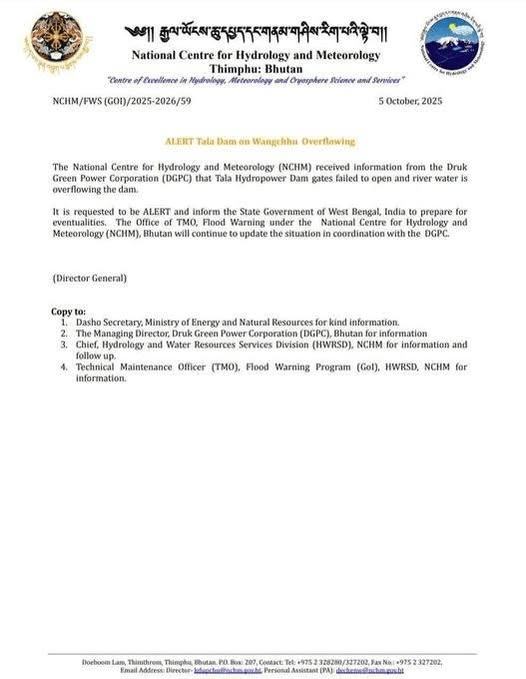
Bhutan Issues Flood Warning to West Bengal as Tala Dam Overflows Bhutan’s National Centre for Hydrology and Meteorology (NCHM) has issued an urgent flood alert for northern W Bengal after the Tala Hydropower Dam on the Wangchu River overflowed due to malfunctioning gates. Operated by Druk Green Power Corporation (DGPC), the dam’s failure to open gates amid heavy rainfall has raised downstream flooding risks in districts like Jalpaiguri and Cooch Behar.
The alert, issued on Oct 5, urges W Bengal’s state govt to prepare for potential inundation, with NCHM’s Flood Warning Program coordinating with DGPC for updates.
Severe rains have already triggered landslides in Darjeeling, worsening the situation. Social media footage shows the Wangchu River surging over the dam, a critical 1,020 MW facility exporting power to India. No casualties are reported yet, but disaster teams in West Bengal are on high alert, advising residents in low-lying areas to stay vigilant.
52 killed in Nepal landslides Besides human casualties, Nepal has also suffered infrastructure damage due to landslides and floods across the country. According to the Independent Power Producers’ Association, Nepal (IPPAN), a representative body of private-sector power developers, flooding and landslides affected 18 hydropower projects — 13 operating and five under-construction projects affecting power generation.
Power generation by 13 projects with a total capacity of 105.4 MW has remained halted due to damage to various infrastructure linked to these projects, the IPPAN said.
The country, which is rich in hydropower potential, is also facing risks to this vital infrastructure due to climate change-related disasters in recent years.
According to the Ministry of Energy, Water Resources and Irrigation, riverbank erosion, flooding, and inundation occurred in various areas due to the recent incessant rainfall, resulting in the erosion of nearly 1,500 metres of embankments along riverbanks and causing an estimated preliminary loss of around Rs 100 million. Some irrigation projects were also inundated due to flooding, according to the Ministry.
4 Waves of floods in Teesta basin in Bangladesh The International Farakka Committee in a statement on Sept 29 have said that the farmers in the Teesta basin areas in Bangladesh suffered damage in three waves of flood in August when their transplanted Aman seedlings were submerged and damaged. The mid-September floods damaged transplanted aman seedlings again. Erosion of crop lands and homesteads with dwelling houses is colossal, it is alleged. People from Lalmonirhat, Rangpur, Kurigram, Nilphamari and Gaibandha districts have been affected, it is stated.
China dam on Yarlung Tsangpo China says, the “hype surrounding the Yaxia Hydropower Project as a ‘water bomb’ is groundless and malicious”. Chinese media reports suggest the project may be more complex than a single giant dam, and could involve diverting water through tunnels. It could produce three times more electricity than its vast Three Gorges dam — the world’s largest power station —though other details remain scant.
India’s approach counter-productive India’s “dam-for-dam” approach may be counterproductive, said Anamika Barua, a transborder water governance expert at the Indian Institute of Technology Guwahati. “Diplomatic engagement, transparent water-sharing agreements, and investment in cooperative river basin management would yield more durable and equitable outcomes than reactive infrastructure building,” she said. Building mega-dams in earthquake-prone Arunachal Pradesh is also risky, said Barua.
THE REST OF THE WORLD
Importance of Flying Rivers Connecting the Amazon In this report, MAAP aims to both summarize the current state of knowledge on the movement of atmospheric moisture across the Amazon and develop novel analyses based on this information. Overall, MAAP aims to show the critical connections between the eastern and western Amazon, and how these connections change during the major seasons (wet, dry, and transition) of the year.
Ethiopia warns of hydropower’s drought risk Barely one month after launching Africa’s biggest dam, the Ethiopian government’s new climate plan outlines an ambition to reduce its heavy reliance on rainfall-reliant hydropower by getting more electricity from solar, wind and biogas.
The 7th International Symposium on River Science will be held from 6-9 October 2025, hosted by the Center for Watershed Sciences, at the University of California, Davis.
This is the first opportunity for the global International Society for River Science (ISRS) community to meet since 2019, and for river scientists and practitioners to reconnect and share ideas and experiences. The symposium provides a unique platform for bringing together researchers and practitioners from across the world, and to foster collaboration, sharing ideas, and experiences that can advance the field of river science and management. The Symposium will focus on themes that incorporate research from across ecology, geomorphology, hydrology, biogeochemistry, social sciences, first nations science, environmental engineering, river management and policy.
SANDRP

 SANDRP