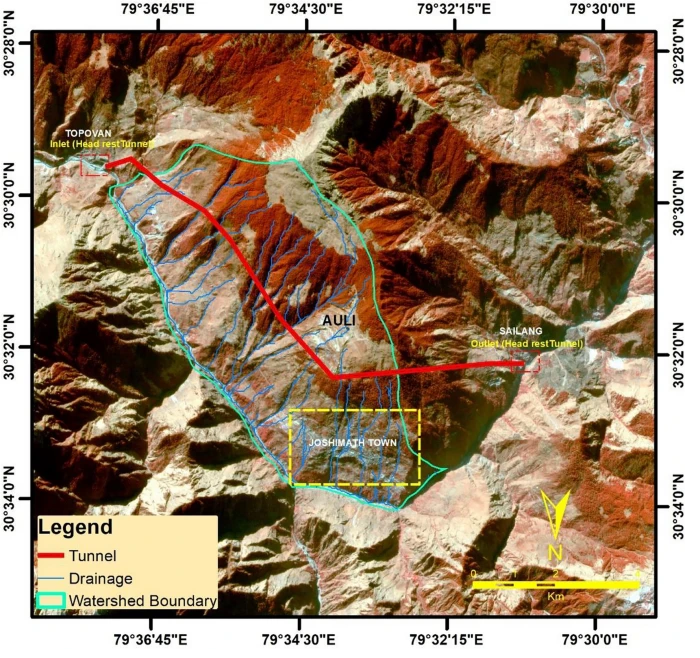
(Feature Image: Hydropower Tunnel project shown in the Joshimath area along with the Watershed Boundary. This figure is generated using ArcGIS software-version 10.3.1 and CorelDraw Graphics Suite 2019 https://www.coreldraw.com/. Source: Analyzing Joshimath’s sinking: causes, consequences, and future prospects with remote sensing techniques. May 2024)
A paper in scientific journal co-authored by Internationally renowned landslide expert Dave Petley (published on June 16 2025 at: https://doi.org/10.1016/j.enggeo.2025.108201) warns that the Joshimath landslide is moving and can threaten the under construction Tapovan Vishnugad hydropower project in Chamoli district in Uttarkhand. The paper says: “The 2023 rapid deformation at Joshimath was preceded by slow movement years ahead. Deforestation in the Joshimath region might have intensified the slope instability. Additional landslide zones were detected in Hailang, Kalpeshwar with similar pattern. Slow-moving landslides have high potential to cause often underestimated damages.”
This raises many questions, not only about the justification of moving ahead with the project, but also about the project appraisal, including the geological appraisal by the Geological Society of India. More worryingly, there is no confidence inspiring process in place to understand this reality and take necessary steps.
Uttarakhand Movement of the Joshimath landslide in India by Dave Petley A new paper (Dalal et al. 2025) in the journal Engineering Geology shows that the slope reactivated in 2018, probably as a result of the loss of vegetation and poor management of water. Finally, and most worryingly, Dalal et al. (2025) indicate that the slope could be undergoing progressive failure towards a catastrophic collapse. They have modelled runout scenarios for the slope, which indicate that such an event would threaten the Tapovan Vishnugad hydropower project downstream. All of this indicates that action is needed at Joshimath.
If a large-scale mitigation project is not possible (and I recognize that this would be extremely expensive and very challenging), efforts should be made to manage water (and drainage) across the whole area, and the slope should be monitored in real time.
To evaluate future risks of the Joshimath landslide complex, hypothetical runout simulations suggest that it could cause severe damage to the Tapovan Vishnugad Hydropower Project (TVHP) located ∼6 km downstream, if the slope fails catastrophically and evolve into a mobile debris flow.
HYDRO POWER PROJECTS: NBA Press Release: July 16, 2025: NBA Proven true: Order for liquidation of Maheshwar Project Assets by NCLT
In a significant order, the National Company Law Tribunal (NCLT) has directed the liquidation of the Shree Maheshwar Hydel Power Corporation Limited, promoter company of Maheshwar Project. This means the Maheshwar project’s assets will be auctioned and the proceeds will be distributed among the lending institutions. The Indore bench of NCLT stated in its order that, as no resolution has been reached for the Maheshwar Project, the liquidation of its assets should commence under Section 31 of the Insolvency and Bankruptcy Code, 2016.
What is the Issue? Senior activist of Narmada Bachao Andolan, Chittaroopa Palit, said that the Maheshwar Project was the country’s first privatized hydroelectric project, awarded to the private company S. Kumars. It affects approximately 10,000 families across 61 villages. Through a prolonged struggle under the aegis of the Narmada Bachao Andolan, the affected communities proved that since the project would produce extremely expensive and insufficient power, and had been sold to private developer Shree Maheshwar Hydel Power Corporation Limited through anti-people agreements, it would devastate the state’s economy. The people’s movement also demonstrated through the struggle and the figures provided by the government itself, that the rehabilitation of the 10,000 affected families as per the approved R&R Plan is well nigh impossible. Also, the project was plagued by continuous financial irregularities, and as many as five CAG reports had been issued against the project developer.
In 2020, the Madhya Pradesh government cancelled all agreements with the project developer, stating that the electricity produced would be very costly and the project’s Power Purchase and other connected agreements were not in the state’s interest. These were the same issues raised by the Narmada Bachao Andolan struggle since 1997, which the government acknowledged after 23 years and a huge expenditure of ₹5,000 crore on the project.
Proceedings Before NCLT: Senior activist Alok Agarwal stated that financial institutions such as Power Finance Corporation, REC, IFCI, and State Bank of India had provided loans for the project. After an investment of approximately ₹5,000 crores by these public financial entities, when the project developer, Shree Maheshwar Hydel Power Corporation Limited, refused to repay the loans or invest its own funds in the project, the Power Finance Corporation approached the NCLT under the Insolvency and Bankruptcy Code, 2016, to resolve the issue. On September 27, 2022, NCLT appointed a Resolution Professional and granted 180 days to find a resolution. However, the lending institutions repeatedly sought extensions, resulting in a total of 840 days, which exceeded the legal limit of 330 days by 510 days. The current order was issued in response to another request for a 180-day extension.
What is NCLT’s Order? The NCLT bench stated in its order that, despite granting excessive time, no resolution was achieved, proving that a resolution is not possible, and the process remains where it began. The order also noted that information regarding the rehabilitation of affected communities and land acquisition was not provided to the lenders by the SMHPCL. Consequently, NCLT dismissed the application and ordered the liquidation of the project’s assets under Section 31 of the Insolvency and Bankruptcy Code, 2016. This means the project’s assets will be auctioned and the proceeds will be distributed among the lending institutions in proportion to their invested capital.
Logical Conclusion of an Anti-People Project: Affected People’s Acquired Land Cannot Be Auctioned
Narmada Bachao Andolan welcomes this order and believes this is the logical outcome of a project that was destructive, costly and anti-people from the very start. Despite facing severe repression, all issues raised by the movement over 28 years of struggle have proved true. The Narmada Bachao Andolan and the people of the Narmada valley demand that given the project’s harmful nature, an investigation should be conducted into the decisions that led to the loss of ₹5,000 crores of public money, and that those responsible should be held accountable and face punitive measures. The movement also clarifies that, as the affected communities have not been rehabilitated, their acquired lands cannot be auctioned or sold to other parties
The Maheshwar dam on the Narmada River will likely be abandoned due to financial and management failures. With decades of resistance from the Narmada Bachao Andolan, the project faced insurmountable challenges, including incomplete rehabilitation efforts and financial insolvency, leading to its liquidation by the National Company Law Tribunal.
The Indore Special Bench of the National Company Law Tribunal (NCLT) has, in its order of July 11, 2025, directed that the Shree Maheshwar Hydel Power Corp (SMHPCL), which had been given the contract to build and operate the Mandleshwar dam, be liquidated. The main creditor among the many financial institutions that had given loans, Power Finance Corp, had applied to the NCLT for a Corporate Insolvency Resolution Process (CIRP) against SMHPC as it had defaulted on its loans and had also abandoned work on the project.
Not only has the Govt of Madhya Pradesh said that it will not take over the project, but it had also earlier abrogated in April 2020 the Power Purchase Agreement (PPA) that SMHPCL had with it. Therefore, there will be no buyers for the bare dam structure, without a PPA in place. Thus, the structure will stand as a mute testimony of India’s disastrous dam centric water and river management.
Uttarakhand Movement of the Joshimath landslide in India by Dave Petley A new paper (Dalal et al. 2025) in the journal Engineering Geology shows that the slope reactivated in 2018, probably as a result of the loss of vegetation and poor management of water. Finally, and most worryingly, Dalal et al. (2025) indicate that the slope could be undergoing progressive failure towards a catastrophic collapse. They have modelled runout scenarios for the slope, which indicate that such an event would threaten the Tapovan Vishnugad hydropower project downstream. All of this indicates that action is needed at Joshimath.
If a large-scale mitigation project is not possible (and I recognize that this would be extremely expensive and very challenging), efforts should be made to manage water (and drainage) across the whole area, and the slope should be monitored in real time.
To evaluate future risks of the Joshimath landslide complex, hypothetical runout simulations suggest that it could cause severe damage to the Tapovan Vishnugad Hydropower Project (TVHP) located ∼6 km downstream, if the slope fails catastrophically and evolve into a mobile debris flow.
Arunachal Pradesh AJYCP sounds alarm over Dibang HEP The 3000 MW Dibang hydropower project being constructed in Arunachal Pradesh — touted as the tallest dam in India and one of the highest in the world — has sparked serious concerns in Upper Assam, with the influential Asom Jatiyatabadi Yuba Chatra Parishad (AJYCP) warning of catastrophic consequences for downstream districts. The project, located at Achu Pani in Arunachal’s Lower Dibang Valley district, involves the construction of a dam towering approximately 945 feet (288 metres) above ground.
AJYCP has launched a scathing critique of the project, alleging that it is being executed without any public hearing or consent from people living in the downstream floodplains of Assam — particularly in Dhemaji, Lakhimpur, Tinsukia, Dibrugarh, Jorhat, and Majuli districts. They have warned that if the dam collapses or is mismanaged, the resulting deluge could wipe out entire towns and villages within minutes, putting millions of lives at risk.
“Unlike the Subansiri River, the Dibang river’s banks are even more susceptible to landslides and erosion. A disaster here would be swift and irreversible,” AJYCP leaders said in a press statement.
Subansiri Lower HEP A high-level delegation led by Pankaj Agarwal, Secretary (Power), visited the NHPC’s 2000 Mw Subansiri Lower Hydroelectric Project at Dollungmukh on July 20 to assess final preparations as India’s largest hydroelectric project nears commissioning.
The Papum Pare District Disaster Management Authority (DDMA), in collaboration with the National Disaster Management Authority (NDMA), conducted a first-of-its-kind multi-hazard mock exercise at the Pare hydropower station, NEEPCO, on 16 July. The exercise is designed to assess preparedness and enhance coordination among key stakeholders during multi-hazard disaster scenarios, particularly focusing on hydropower installations and surrounding settlements.
Himachal Pradesh Karcham Wangtoo & Baspa HEP: SC overturns HC order, backs HP govt’s demand for more free power In what comes as a setback for JSW Neo Energy (which in turn in subsidiary of JSW Energy) subsidiary JSW Hydro Energy, the Supreme Court (SC) has ruled against the company in a tussle with Himachal Pradesh government over the supply of 18% free power from the Karcham Wangtoo & Baspa HEP, with combined capacity of 1391 MW. JSW Hydro Energy had claimed that, as per CERC Tariff Regulations, it was required to supply no more than 13% free power. Himachal Pradesh had issued a notice to JSW Hydro asking it to begin supply of 18% of the power generated to the state free of cost from September 2023. JSW Hydro had challenged the Himachal Pradesh government’s notice before the Himachal Pradesh High Court. The SC ruled that the CERC regulations do not prohibit Himachal Pradesh from seeking free power higher than 13% and does not over-ride the Power Supply Agreement. Following the order, JSW Energy shares were trading down.
Jammu & Kashmir Dr. Raja Muzaffar Bhat highlights how a pristine meadow has been overshadowed by the construction of the Brenwar Hydropower Project, leading to the diversion of the Doodhganga stream and the absence of essential side fencing walls, putting the region at serious environmental risk.
Sikkim Patel Engineering Limited (PEL) on July 18 said it has secured a contract worth ₹239.98 crore, inclusive of taxes, from NHPC Ltd for civil and hydro mechanical works at the Teesta-V power station. The scope of work involves modifying the diversion tunnel into a tunnel spillway arrangement under Package 6 of the project. The project is expected to be completed within 18 months.
Maharashtra Jayakwadi HEP shuts since Dec 2023 The 12 MW Hydropower on Jayakwadi dam in Maharashtra has remained shut for maintenance since Dec 2023 when it was found to be excessively vibrating.
DAMS: Kaleshwaram Project Ex Telangana Chief Engr arrested As part of the ongoing crackdown on corruption within the state’s irrigation department, the Telangana Anti-Corruption Bureau (ACB) has arrested former Engineer-in-Chief of the Irrigation Department, Muralidhar Rao, in connection with a disproportionate assets case. This arrest follows closely on the heels of another high-profile case involving Nune Sridhar, an Executive Engineer with the Irrigation Department who was involved in the Kaleshwaram Lift Irrigation Project (KLIP). He is currently in judicial remand. The ACB’s intensified efforts are part of a broader initiative to tackle corruption within the irrigation department, particularly scrutinising officials linked to the Kaleshwaram Lift Irrigation Project.
Sardar Sarovar Project E-flows case in SC The matter was listed on July 17 and the Narmada Control Authority has filed on July 16 additional reply stating that E-flow study which has been given to CIFRE -Koltata which would be completed by December, 2025, so the matter has been kept on 15.10.2025 for submission of preliminary report after six months of initiation of the study and further directions.
Tamil Nadu The Water Resources Department (WRD) will establish a separate wing, State Dam Safety Organisation (SDSO), with a dedicated chief engineer for effective management of dam safety and implementation of various initiatives, including dam rehabilitation and improvement projects in Tamil Nadu. The SDSO will be the 15th wing of the WRD, bifurcated from the Operation and Maintenance Wing, and would adhere to the Dam Safety Act, 2021. The State government recently issued an order, notifying the constitution of the SDSO headed by a chief engineer to adhere to the requirements of the Act and perform the functions specified by it.
Jharkhand North Koel Reservoir Project is now being accelerated for quick completion after the Prime Minister’s review. Out of the cost of balance works of Rs 2,430.76 crore, the central government would provide Rs 1,836.41 crore.
Kerala The state govt has given administrative sanction for the preparation of Detailed Project Reports (DPR) for the Kadamanthodu and Thondar dam projects for the effective utilisation of 21 TMC (Thousand Million Cubic Feet) of water in the Kabani sub-basin in Wayanad as per the verdict of the Cauvery Water Dispute Tribunal (CWDT). An official of the Kabani Sub Basin said that eld surveys for the two projects are almost over. “We will be inviting the EoI soon. The time for preparation of DPR is less than 8 months,” he said.
INTERLINKING OF RIVERS: More displacement for Ken Betwa Project The land of at least 32 villages in three districts of Damoh, Panna and Chhattarpur would be needed to accommodate the wildlife of Panna Tiger Reserve which would get affected due to submergence of 6017 hectares under Ken-Betwa river link project. The endeavours are being made to relocate the identified 32 villages so that their land could be handed over to Panna Tiger Reserve.
PPA to consider PBLP only after completion of Polavaram Polavaram Project Authority (PPA) has said that it will review the proposed Polavaram-Banakacherla project only after the completion of second phase of Polavaram project. PPA, in a communication to Central Water Commission (CWC), said its main focus now is on the completion of the two phases of Polavaram, of which the Centre has granted financial clearances to complete the first phase up to 41.15 meters, 2nd phase will take dam height to 45.72 m. This is because considering PBLP at this stage will require change in design of the already sanctioned Polavaram project, PPA said.
The rehabilitation and resettlement of over 1.2 lakh project oustees have been a major concern for both the Centre as well as the state govt as it requires the acquisition of over 1 lakh acres of land and payment of cash compensation to the project affected people.
The CWC raised fundamental questions on water availability assumptions in the pre-feasibility report, requiring that the dependability of the proposed diversion be computed only after accounting for all existing, ongoing, and planned utilisations and allocations as per GWDT for all co-basin states.
GRMB: PBLP will need approval for revised Polavaram DPR The Godavari River Management Board (GRMB) has observed that the diversion of an additional 200 tmc ft water from Polavaram Project planned by Andhra Pradesh through the proposed Polavaram-Banakacherla Link Project (PBLP) will change the scope of the Polavaram project and it requires the revision of the detailed project report of the Polavaram dam.
In its observations on the pre-feasibility report (PFR) of PBLP sent to the CWC, GRMB noted that the DPR of Polavaram project was approved by the Advisory Committee of the Department of Water Resources on January 20, 2009 and the changes planned now needs to be placed before the same for approval again.
“The diversion of 2 tmc ft water per day from Polavaram dam may lead to modification of the operation schedule of Polavaram project as per the agreement of April 2, 1980 between the erstwhile States of Madhya Pradesh, Orissa and Andhra Pradesh. Any change in the operational schedule shall be made only after consultation with the three erstwhile States”, the GRMB said in its communication sent to the CWC.
PBLP violates law, flood waters alien concept: Vedire Former Advisor to Union Jal Shakti Ministry and former chairperson of the Task Force on Interlinking of Rivers SriramVedire has said that there is no concept of flood waters in India and hence there is no basis for the Polavaram Banakacharla Link Project, it is contrary to law. He said if all upstream states start using their flood waters, what will happen. He said the projects have to be designed on 75% dependability and flood waters clearly do not have that dependability.
He explained that the Godavari Water Disputes Tribunal had categorised the water in the basin as ‘all waters, remaining waters and specific numbers (waters)‘ – all translated as assured water by the Central Water Commission and the agency (CWC) had assessed the availability of 3,396.9 tmc ft water at 75% dependability, average flows at 4,535.1 tmc ft and the average water above 75% dependability at 1,138.2 tmc ft.
“The reality is that the Central Water Commission (CWC) has calculated that the ‘average flows’ that end up in the sea are about 1,138 tmc ft a year,” Vedire said. “When the CWC said the annual run off into the sea was around 3,100 tmc ft, this figure includes water allocated to Maharashtra, Telangana, AP, Chhattisgarh and Odisha, but not yet put to use by these states.” Addressing a press conference where he made a detailed presentation on Godvari river issues, Vedire said neither Telangana nor AP had rights to use the 1,138 tmc ft of water going into the sea as the ‘terminal states’ for the river.
Telangana declines any talk on PBLP with AP before statutory clearances on Tuesday, a day ahead of the meeting with AP and Jal Shakti Ministry, the Telangana govt sent a letter to the ministry, urging it to revise the meeting agenda. The letter requested that any discussion on the Godavari-Banakacherla link project be deferred until all statutory requirements, inter-state consultations, and clearances are fully complied with and all objections are resolved. The Telangana govt said discussion on the Banakacherla now is premature and undermines the credibility of national water regulatory institutions.
Telangana irrigation minister N Uttam Kumar said the need is to prioritise long-pending projects such as the Palamuru-Rangareddy and Dindi schemes. Telangana submitted its own agenda for the July 16 talks, which includes the allocation of 80 TMC for the Pranahita project at Tummadihatti, approval for a floodwater utilisation plan at Inchampalli (200 TMC), and recognition of key lift irrigation schemes as national projects.
Andhra Pradesh Govt is focusing on getting Godavari River water data for nearly 50 years to buttress its case for getting the Polavaram-Banakacherla project okayed by the Central Water Commission (CWC). Water Resources department superintending engineer for Polavaram-Banakacherla project B. Rambabu said, “We will present this data within a month, underlining that we have a right to use the surplus flood water for the Polavaram-Banakacherla project.” Moreover, as both AP and TG have agreed to form a committee of experts, which will also comprise senior officials of CWC, this committee will also look into the data of AP’s claims of surplus flood water going waste into the sea.
The Telangana govt opposed the inclusion of the Godavari-Banakacharla project in the agenda for July 16 Apex Council meeting in Delhi, to be chaired by jal shakti minister C.R. Patil. The other two members of the Apex Council are the Telangana and Andhra Pradesh CMs, and the project was sought to be included in the agenda by Andhra Pradesh.
INTERSTATE WATER DISPUTES: Centre to from panel to resolve AP-Telangana water issues The Centre on July 16 decided to constitute a high-level technical committee within a week to examine concerns around the PBLP and other pending inter-state water issues between Telangana and Andhra Pradesh. The move follows a meeting chaired by Union Jal Shakti Minister C R Patil with both Chief Ministers — N Chandrababu Naidu of Andhra Pradesh and A Revanth Reddy of Telangana — in attendance on July 16. The Telangana chief minister said the Centre had formally ratified a previous agreement to locate the Godavari River Management Board (GRMB) in Hyderabad and the Krishna River Management Board (KRMB) in Amravati.
Telangana raised concerns over the condition of the Srisailam dam on the Krishna river operated jointly by both states. Reddy said the Centre had directed Andhra Pradesh to immediately undertake urgent repair and maintenance work at the dam. Telangana Irrigation Minister N Uttam Kumar Reddy said repairs in vulnerable areas such as the plunge pool would be prioritised.
IRRIGATION: Tamil Nadu Farmers from the Srivaikuntam north main canal area have strongly opposed the concrete flooring of the canal, stating that it would affect groundwater recharge. As the canal was badly damaged during the December 2023 flood, disfiguring major parts of it, like collapsing of the bridge, breached bunds, and destroyed side walls, the WRD has been repairing the canal including reconstruction of bridges, bund strengthening with block lining, and retaining walls at necessary places under the funds supplied by world bank.
The abrupt halt of the Rs 335-crore project for redevelopment of the old Kattalai High-Level Canal, which the WRD commenced in 2020, due to fund crunch has prolonged farmers’ years-long struggle to irrigate about 10,000 acres of farmlands in Tiruchy and Karur districts. Mentioning inability to even take up sowing works due to the blockages in the irrigation canal’s course, farmers, particularly in the tail-end region, urge the authorities concerned to resume the redevelopment project at the earliest by allocating the required funds.
URBAN RIVERS: Need to connect people and Rivers The editorial in Question of Cities: Rivers are slowly being erased from people’s lives and imagination in cities. Seen as water sources, as dumping yards for waste, and their floodplains as developable land, they remain disconnected from the rhythms of urban life. Rivers are, can be, a lot more to cities they flow through if only governments and people ‘see’ them and interact with what they offer, respect them and forego the template of ‘urban river management’ and concretisation.
The rich riverine ecology and the complex biodiversity that a river supports, its point of origin and its dispersal or merger with the sea, its confluences, and the impact of human activity are rarely discussed. The cultural aspect is another. The flows and currents of rivers have been the fount of poetry, literature, mythologies and more; art has drawn inspiration from them. The people-river connection has to be rebuilt so that rivers find a place in the popular imagination, a kinship develops, which nudges people to feel a sense of ‘ownership’ and participate in the maintenance of rivers.
The floodplains is not ‘land’ for us, it belongs to the rivers. It must not be used to house massive infrastructure projects like Delhi’s Commonwealth Games Village, Akshardham Temple, Yamuna Bank Metro Depot, Shastri Park Metro Depot or entire precincts like the Bandra Kurla Complex. Cleaning the rivers without adding tons of concrete and allowing the rivers their space – their land – to swell when necessary would help restore rivers, which in turn, can contain flooding in cities.
Mumbai’s Mithi has retaining walls as a flood control measure and to prevent encroachment but their efficacy has been questioned. Some residents say the walls helped prevent flooding but the Supreme Court-appointed experts’ committee averred that the walls were “not as per riverine methodology,” had reduced the width of the river, their impervious nature prevented water from seeping into the ground, and they had been built on both sides even in verdant areas like Aarey “thus preventing the interaction of river with the forest itself”. The committee noted that the walls, upto three metres high, gave no scope for water to flow to and fro the river during heavy rainfall which meant flooding in nearby areas.
In Nagpur, people’s angst is that the promised retaining walls along the Nag, Pili and Pora rivers, costing nearly Rs 205 crore, have not yet been constructed.
In the urban imagination, rivers have to be ‘managed’ and constructed upon to fulfil human needs, also the ambitions of a certain class. This ‘river management’ perspective is evident even in the National Institute of Urban Affairs, the central government’s go-to for policies on urban issues, through its Rivers Cities Alliance which now covers about 145 cities.
Riverfront development, as part of ‘river management’ is a scam that has little to do with cleaning or rejuvenation of the river but more to do with construction contracts, say academics and activists tracking this. From the Sabarmati project, the template repeated across India, there are an estimated hundred riverfront development projects around the country. Even the Smart Cities Mission had 61 such projects. An assessment by the Delhi-based School of Planning and Architecture, in 2024, showed that the highest number of them were a “boost to local identity and economy” and suggested that stricter environmental guidelines and monitoring mechanisms be established.
The new holistic imagination of rivers in cities must necessarily focus on reconnecting the river with its ecosystem, including floodplains and wetlands.
Buddha Dariya; Ludhiana Buddha Nullah still gasping CM Bhagwant Mann’s promise, made at the 25th anniversary of the Kali Bein project on July 16, to step up efforts to clean Ludhiana’s Buddha Nullah is welcome. But promises need to be followed by firm action, with citizens as partners, not mere spectators. The transformation of the 165-km-long Kali Bein from a polluted drain into a rejuvenated lifeline offers a template for cleaning the Buddha Nullah. The Buddha, once a clean stream, is today one of Punjab’s stubborn environmental challenges: a toxic channel choked by industrial effluents and untreated sewage from Ludhiana and surrounding areas.
Toxic industrial effluents are once again flowing unchecked into the Buddha Dariya after a key motor at a pumping station failed, disrupting treatment operations and allowing untreated water from the Jamalpur drain to enter the river directly. The incident has sparked serious environmental concerns, with local dyeing and industrial units suspected of contributing to the contamination. Rajya Sabha MP Balbir Singh Seechewal accused both the PPCB and Ludhiana municipal corporation of neglecting basic maintenance and monitoring duties.
Kale Pani Da Morcha activists have slammed the state govt for alleged apathy and inaction on the issue of Buddha Dariya pollution. Morcha’s Kapil Arora and Kuldeep Singh Khaira said a lot of action is expected in the coming days due to upcoming contempt petitions and hearings of Buddha Dariya cases on July 22. Meanwhile, the MoEFCC has issued show-cause notices to three CETPs operating in Ludhiana without any valid consent from the PPCB. The notices were served after detailed inspections revealed multiple serious violations of environmental norms and non-compliance with environmental clearance (EC) conditions.
Initiated on December 2, 2020, the Buddha Dariya Rejuvenation project was originally scheduled for completion by December 1, 2022, but delays pushed the deadline to August 31. The total estimated cost was Rs 650 crore, with the tender awarded at Rs 519 crore and an additional Rs 22 crore as a provisional sum. The operation and maintenance costs were pegged at Rs 321 crore. As of now, the project is 99% physically complete, with only the final pumping station at Gaughat pending full commissioning. However, several critical issues remain unresolved.
Panchkula Full 100 per cent marks in the ‘cleanliness of water bodies’ category came as a big surprise in the recent Swachh Survekshan, as none of the parameters match the scoring, raising questions on the marking process of the nationwide survey conducted here.
Pune In the absence of a transparent and updated tree census, citizen-led geotagging initiatives are helping track species health, survival rates, and urban biodiversity across key hills, riverbanks, and forest patches in the city.
In a heinous attack in broad daylight, journalist Sneha Barve was beaten with a wooden rod till she became unconscious while she was reporting on illegal construction activity in a riverbed in a town near Pune on July 4, 2025.
Vishwamitri; Vadodara In the last three weeks, as many as nine crocodiles have been rescued from various parts of the city and handed over to the forest department. Officials said Vadodara Municipal Corporation’s (VMC) extensive project of cleaning culverts and canals linked to the Vishwamitri as part of the flood-mitigation plan has resulted in some baby and sub-adult crocodiles emerging in city areas close to the river and its network of canals in search of new territories.
Dr Pratyush Patankar, curator of the VMC-run Sayajibaug zoo, who was on the panel of the Vishwamitri project to supervise the shifting of crocodiles if needed, told that the cleaning of the culverts has meant that the agencies have “realised for the first time” that the crocodiles also reside and mark territories in the canals. Since March last year, VMC and the state irrigation department have been carrying out desilting and dredging of Vishwamitri river along its approximately 50-km course.
Vrishabhavathi; Bengaluru How city transformed a river into a toxic drain Located in the western region of Bengaluru, this is the story of the Vrishabhavathi River, a key tributary of the Arkavathi. The Vrishabhavathi hasn’t always looked like this. What we see today is a narrow, blackened canal boxed in by concrete. This began to change in the 1970s with the establishment of the Peenya Industrial Area. As factories multiplied rapidly, with Peenya becoming one of Asia’s largest industrial hubs, so did the volume of untreated industrial waste entering the river. By the 1990s, visible changes had set in. The water turned dark, occasionally foamed, and had a pungent odour. The river, once essential, became something to avoid. A drain. A health concern. By 2024, the river is fully capped and concealed, overlaid with a playground. In the process, the river has disappeared from view, its flow buried and its waters fully contaminated.
Arkavati The govt has announced its ambitious plan to bring the Arkavati back to life, but people living close to the river have little hope, while experts point out to many challenges.
RIVERS: Meghalaya The Assembly Committee on Environment has raised concerns over the deteriorating condition of water bodies in Meghalaya, pointing to rampant deforestation and unchecked industrial discharge as key contributors to the crisis.
Karnataka In the Uttara Kannada district, the Aghanashini and Sharavathi rivers present a contrasting story. While both flow through the Western Ghats, their stories of conservation and exploitation are vastly different. While the Aghanashini river has remained relatively undisturbed and was recently declared a Ramsar site, the Sharavati continues to face relentless developmental pressures. (Prashanth R, Amalendu Jyotishi)
Tamil Nadu The southern bench of the NGT on July 15 directed the Karnataka govt to submit an action plan within a month to control the discharge of untreated sewage and industrial effluents into the Thenpennai river. This is pending the completion of new STPs scheduled for the end of December 2025. The bench has scheduled the next hearing for August 21, 2025.
A central negotiation committee has conducted nine meetings and site visits, observing black, foamy, odorous water in tanks and river stretches across both states. Despite repeated requests, Karnataka is yet to act on recommendations. D Shanmuganathan, standing counsel for Tamil Nadu government, said chief secretary had written to Karnataka counterpart way back in April 2023, but no action had been taken. In 2019, Karnataka said it was building STPs with a cumulative capacity of 630 MLD.
Rajasthan Following continuous rainfall, Luni river has started flowing again, sparking joy and celebration across the desert region. On July 17 morning, as the river reached the Balotra area after passing through Ajmer and Jodhpur, residents gathered along its banks to celebrate the rare sight. Women and men danced in jubilation, some playing traditional drums and cymbals, others chanting and offering prayers to the river that brings life to their parched lands. This marks the third consecutive year the river has received a fresh inflow of water. In Surana village, people welcomed the flowing river—fondly called Maruganga—with traditional rituals.
GANGA Uttar Pradesh Govt decided to ban construction activity within the 200 metres radius of the river. The proposed draft of the building byelaws, likely to be notified soon, however, allow repair, renovation and conservation work at the existing buildings near the Ganga river. The new guidelines would allow construction of ashrams, monasteries, and temples in major pilgrimage sites with riders. Moreover, property owners would have to give an undertaking that construction activity would not pollute the Ganga river and disposal of the building material and wastewater discharge from the property would be done in accordance with the norms. Similarly, restrictions would be imposed in case the NGT or a court has regulated construction activity in other rivers.
YAMUNA Delhi Letter: Encroachment of Yamuna floodplain near Wazirabad Barrage One must remember that the Eastern part of the floodplain is lower than Western one and is submerged during every medium and high scale flood event. The continual abuse and encroachments of this part is destroying both the flood cushion and groundwater recharge potential it offers to the city.
SANDRP has sought intervention from lieutenant governor, chief minister and other senior officials to remove the dumped waste and permanent constructions to restore the floodplain. It has also written to NMCG in this regard. The group’s report mentioned a total of 12 issues, including the presence of a Delhi Metro casting yard facility that occupies 13 acres of the floodplain land. It also stated that a road was laid down in the sensitive area. “A new five-kilometre long and six-metre wide road dissecting the floodplain from the Wazirabad crematorium to the eastern embankment near Usmanpur village has been created. It passes through the metro bridge, Signature Bridge, and the metro casting yard facility,” stated the advocacy group.
According to Delhi water minister Parvesh Verma, fresh findings indicate that the Najafgarh drain alone now carries around 800 MGD of sewage into the river—up from previous estimates of 450 MGD. Bhim Singh Rawat, of the SANDRP said focus should be on mapping, flow and correct baseline estimates. “Delhi’s overall sewage generation estimates are also faulty as we do not factor in the ground water being used by people in the sewage output which could be a massive chunk,” he added He added that there is a significant contribution of sewage from Gurugram to Delhi via Badshahpur as well as a drain number 8 coming from Haryana.
The irrigation and flood control (I&FC) department has cleared two of the three water bays -arched openings -of the Barapullah drain that runs under the nearly 400-year-old Barapullah bridge, restoring water flow and marking the first major clean-up effort on the structure in decades. The third bay remains clogged, officials said, due to an electricity tower located at its mouth. Once a key stormwater conduit for the city, the drain had been choked by years of unregulated dumping and encroachment, reducing its capacity to just 10%, officials said. As part of a wider desilting drive that began in August 2023, over 1.4 million metric tonnes of silt have now been excavated from the Barapullah stretch, they added. The clean-up followed a Delhi high court order on May 9 this year, directing action against encroachments along the Barapullah drain.
Union home ministry has launched a multi-pronged strategy spanning Delhi, Haryana, and UP in its comprehensive action plan for the Yamuna. Haryana is mandated to stop untreated discharge from grossly polluting industries by March 2026 through either in-house effluent treatment plants or common effluent treatment plants. Simultaneously, 17 unauthorised STPs will be upgraded by Dec 2026. The underperforming STPs must cross at least 60% treatment efficiency by April 2026. Haryana also plans to build new STPs in Gurgaon and Faridabad and construct seven new CETPs with a combined capacity of 125 MLD by March 2028. As of now, Haryana’s STP compliance has improved to 72%, according to Central Pollution Control Board reports.
Meanwhile, UP will work on urban sewage and drain tapping in the Yamuna basin cities, among them Agra, Mathura, Vrindavan, Kosi and Chhata. UP’s plan involves treating of sewage through STPs to ensure an environmental flow of 6.2 cusecs in the Yamuna. Massive tapping operations are underway and 43 untapped drains in Agra alone are being addressed. Full tapping is expected to finish by June 2027. The NMCG cleared this plan in Sept 2024. Officials said that a significant part of the strategy involved improving the river flow. The Ganga and Yamuna water to be routed through two canal networks —the Upper Ganga Canal and the Eastern Yamuna Canal, with up to 2,400 cusecs of Ganga water diverted to the Yamuna via escape structures at Jani (1,800 cusecs) and Khatauli (600 cusecs).
The NMCG has approved proposals for conserving and sustainably managing floodplain wetlands of the Yamuna river in Delhi, and preparing the Urban River Management Plan (URMP) for the national capital. A note on the decisions of the NMCG’s executive committee, sent to different central ministries and state govts on July 16, shows that the project on wetlands will focus on all wetlands within a 10 km buffer of the Yamuna by conducting a comprehensive inventory and assessment of its floodplain. The project will be completed by Dec next year.
Meanwhile, a large, functional wetland in the Jharoda area near Wazirabad—home to a diverse range of aquatic flora and fauna—is now lost. Over the past two years, the pond has been filled with municipal soil waste, transforming the flattened wetland into a large plot of land. Local residents said the pond, which had existed for decades, was being filled over the last two years.
A new status report from the Delhi Pollution Control Committee (DPCC) shows river’s quality has deteriorated compared to June, with several indicators far exceeding permissible limits. A comparison of the report dated July 17 and sampled on July 1 with the previous month’s report reveals that the pollution levels in the river have worsened. “This clearly shows sewage is entering the river and alongside it, possibly effluents from industries running in the vicinity. With no major drain in this segment, such a deterioration should not happen,” said Bhim Singh Rawat, of the SANDRP. Rawat said that while local sources may cause a spike in pollution, trunk drain number 8 is playing a key role in the river’s deterioration. Every year during the rainy season Yamuna used to look somewhat clean but this year the river is in bad condition even in the monsoon season.
Ten industrial units found violating environmental norms in the residential areas in East Delhi have been penalised for causing pollution, the DPCC has told the NGT. The DPCC said that enforcement action in such residential non-conforming areas falls under the jurisdiction of the Zonal Deputy Commissioners of the Municipal Corporation of Delhi (MCD), in line with a 2019 Supreme Court order.
RIVERS BIODIVERSITY: Study A decline in riverine birds signals deeper problems in the Himalayan rivers A recent study reports a decline in the populations of five riverine bird species by 5-10%, with the trends of three species matching the national bird population trends. Specialist riverine birds can be key indicators of river habitat quality in montane headwaters, thus contributing to the conservation of riverine biodiversity in the Indian Himalayas. The Himalayan rivers are increasingly threatened by habitat destruction, hydropower projects, pollution and climate change, which significantly impact the riverine birds.
Sikkim Riverine Fisheries impacts of Oct 2023 GLOF Besides destroying a hydropower project, damaging many others and killing 55 people, the October 2023 glacial lake outburst flood in Sikkim also left significant changes in water depth, quality, and floodplain structure, finds a new study. The study by researchers from the Indian Council of Agricultural Research (ICAR)-National Bureau of Fish Genetic Resources (NBFGR) published in the journal Ecohydrology in May compared the health of the river pre- and post-flood, and noted that the disaster resulted in the “simplification” of the Teesta river’s complex ecology. The changes in the river flow regime could harm keystone species like the snow trout via destruction of spawning grounds, reduced species abundance, and challenges for species migration.
The gush of water and debris from the GLOF caused the floodplain area to expand by 138% and the width to increase from 88 metres to 147 metres in Tanak, the highest elevation point in the study. These impacts taper further downstream. The study found that water depth decreased significantly across all study sites. Deep pool habitats, which are “unique microhabitats that support rich fish diversity owing to their favourable functional properties,” had disappeared in multiple places. Higher turbidity after the flood in places like Joyee Bridge (West Bengal) and Rangpo (Sikkim) lowers transparency and affects the “overall net primary productivity of the system,” the study says.
SAND MINING: Odisha The NGT has formed a fact-finding committee on July 18 to investigate the allegations of illegal sand mining at Gunadei Brahmani river sand quarry in Dhenkanal. The order came in response to a petition alleging large-scale violations of the Sustainable Sand Mining Management Guidelines, 2016, at the quarry, which spans 11.80 acre in Gunadei village under Odapada tehsil. The plea claimed that the project was continuing operations illegally, without the necessary Environmental Clearance (EC) transfer and in violation of conditions attached to the original EC granted in favour of the tehsildar on March 30, 2021. The committee has been directed to conduct a site inspection and file a report on affidavit within three weeks. The matter has been listed for next hearing on Aug 19.
Haryana Struggling to contain illegal mining emanating from Rajasthan, Haryana has proposed that the mining activities be banned within 5 km of the neighbouring state along its border. Haryana has requested that the Survey of India be directed to mark this buffer zone of 5 km. The proposal was made by Chief Secretary Anurag Rastogi in an affidavit filed in the Supreme Court over illegal roads made in the Aravalis to facilitate illegal mining.
WETLANDS, LAKES, WATER BODIES: Centre to frame guidelines for projects around wetlands The Union Minister for Env and Forests have said that Central Govt will form guidelines for sanctioning infrastructure projects near wetlands to curb encroachments and reduce flooding in Urban areas. Wetlands constitute 4.7 percent of India’s land area, and more than two-thirds of these are outside forest areas. The encroachment upon wetlands will disturb the ecosystem in various parts of the country, such as Chennai, Guwahati, Udaipur (behind Fateh Sagar Lake), and Ajmer (around Ana Sagar Lake).
In a recent meeting of standing committee on wildlife, it was highlighted that unregulated construction and encroachment on these ecologically sensitive areas had already caused serious problems like urban flooding, and severely impacted the local ecosystems. This was self-confession of the MoEF that it has clearly failed to curb such illegal encroachments in the past.
WATER OPTIONS: Hyderabad The Hyderabad Metropolitan Water Supply & Sewerage Board (HMWS&SB) has decided to take up a 90-day special action drive to construct 16,000 recharge pits to augment groundwater storage in the city and up to ORR limits. The campaign ‘Intiko Inkudu Guntha’ is a planned approach to augment groundwater resources and gradually reduce residents’ dependence on water tankers for daily needs, particularly in the summer season, officials said. The pits will be photographed, geo-tagged, uploaded in a special mobile application and can be monitored on a dashboard to check progress and maintenance from time to time.
GROUNDWATER: Karnataka The state govt has decided to impose charges ranging from Re 1 to Rs 35 per cubic metre on individuals, housing societies, commercial establishments, industries, and mining operators drawing groundwater across the state. The charges will apply to all types of apartment complexes, group housing societies, and even govt agencies supplying water in urban areas. Commercial and mining users will also fall under the ambit of the new regulations. In addition, the govt has made it mandatory for all residential and commercial property owners to obtain a no-objection certificate (NOC) before digging borewells or extracting groundwater. While the 2011 and 2012 Karnataka Groundwater Regulations allowed NOCs water extraction, they did not include charges or cover tanker suppliers.
URBAN LAKES, WETLANDS: Bengaluru The draft BBMP Community Involvement for Lake Conservation (CILC) Policy, 2024, prohibits any citizen group or private body from accepting CSR funds to rejuvenate lakes and routes all money through the BBMP. Now, with the BBMP transitioning to GBA and the possibility of multiple corporations, the policy will need to change accordingly, leading to further delays. Meanwhile, citizen groups want to be active participants in maintaining lakes. Volunteers say they will approach the subject legally, through groups like the Federation of Bengaluru Lakes and individual lake groups.
Under its Brand Bengaluru initiative, the BBMP has developed a 10-acre ‘constructed wetland’ (waste stabilisation pond) near the Jakkur lake in Byatrayanpura to treat waste water before it enters the main water body. As per officials, the site will treat about 7 MLD of waste water.
URBAN WATER: How to Make Cities Water Self-Sufficient: Vishwanath Srikantaiah Water conservation expert and urban planner Vishwanath Srikantaiah discusses the many initiatives that have been implemented to improve water security in Bangalore. Interestingly, many of these initiatives can be mapped – intentionally or not – to circular economy principles. the city receives the equivalent of 3,000 million liters per day in terms of rainfall. The city strives to engage every house as part of the solution through rainwater harvesting. At the next level, the city is looking at reviving lakes. The rainwater that runs off from roads, parks, and open spaces is directed towards the city’s lakes, allowing water levels to increase, thereby recharging underground aquifers. It is also planned for parks and open spaces to have their own rainwater harvesting systems through swales and recharge wells.
We must understand the storage capacity of the underground aquifers to hold water. We have found that in many places in Bengaluru, the storage capacity is 20 times the surface water storage. So if you top up the aquifer during the rainy season, you can draw on it like a bank during dry spells. There is enough and more capacity in the aquifer to hold water. How do we top it up? There are two ways to do it. One is through rainwater harvesting and recharging. The other is to use treated water to recharge the aquifers. We need to be smart about understanding aquifers and making sure that it becomes part of your solution.
Hyderabad Water tanker bookings have increased by 36 percent since last year due to delayed monsoons for three consecutive years, a data report was released by the HMWSSB on July 15. The data also reveals that 22,000 households booked 90 percent of the water tankers which amounts to 2.84 lakh tankers across the city. The report revealed that this high demand is because many households lack rainwater harvesting pits. HMWSSB has begun issuing notices to these households as part of a 90-day awareness program promoting the construction of rainwater harvesting pits. So far, 16,000 households have been served the notices.
HMWSSB plans to modernise water distribution in the city with the application of smart valves and meters technology. In this regard, a review meeting was held with the IT and revenue officials on July 19. Officials informed that out of the 15,000 small and large valves in the board’s drinking water distribution system, only 35 percent are frequently operated. To this, the managing director Ashok Reddy proposed automating 1000 valves experimentally and asked them to study the plan’s feasibility. He also recommended installing smart meters at reservoir outlets and areas with bulk connections to account for every drop supplied.
Delhi The govt has started work on a new water management project aimed at upgrading the city’s ageing infrastructure, increasing water production, and ensuring equitable distribution across the city, Water Minister Parvesh Verma said on 14 July 2025. The Delhi Jal Board (DJB) has been instructed to review studies conducted over the past 10 to 15 years on water supply, transportation, and management.
The DJB is also working on a policy to deploy private operators to manage water and sewage services by carving the Capital into eight zones—on the lines of reforms by power distribution companies—with a sharp focus on curbing 50-52% water supply loss, senior govt functionaries said. Each operator will oversee DJB infrastructure in their zone, and the functioning of the concessionaires will be overseen by the DJB, they said. Bhim Singh Rawat, SANDRP said that the DJB has largely focused on managing the water supply to the city and its failure in managing the wastewater could not be disputed. “DJB has always behaved as if additional responsibility of managing sewage has been put on it without resources. DJB should get a separate mandate or body to treat and process wastewater in the city,” he said.
Meanwhile, the Central Pollution Control Board (CPCB) has once again found faecal coliform and E. coli in water samples collected from five houses in Janakpuri’s A Block. After this, the NGT pulled up Delhi Jal Board for not taking remedial measures. The tribunal is hearing a plea based on the grievance of the residents welfare association in A1 Block, Janakpuri, who claimed that they are not receiving fresh drinking water that meets the requisite norms.
MONSOON 2025: Bundelkhand sees rain deluge, kharif crops ruined Deluge during July 11-14. Tikamgarh and Niwari in MP recorded 212% and 315% more rainfall respectively. All 14 dams in Lalitpur are full to capacity, water being released. Kharif crops like peanut, sesame, green gram (moong) and black gram (urad) crops destroyed. Continuous rains have triggered flooding, collapsed homes and inaccessible roads. Experts link the unseasonal rain pattern to climate change.
FLOOD 2025: NH66 in Kerala: Built Against Water logic, Designed to Collapse? The collapse of the NH66 highway in Kerala is not yet another accident. It is the result of designing roads without listening to water, terrain, or people. Built in defiance of Kerala’s monsoon logic, paddy-wetland systems, and ecological memory, the highway blocks natural drainage, floods homes, and divides society. From ignored protests to forgotten flood lessons, its collapse is a story of what happens when asphalt arrogance meets a land shaped by rain. Read, Share Guest Article by Environmental and Social Justice Activist Sridhar Radhakrishnan.
Delhi remains vulnerable to floods like the one in 2023 According to an analysis by SANDRP, floodplain encroachment, silt and dam gate operations pose flooding threats. The analysis also questioned the Union jal shakti ministry report as well as the parliamentary committee report on the floods presented last year, stating that they did not address the problem adequately.
“Since the ministry probe and even the parliamentary committee report addressed the reasons inadequately and offered no decisive actions, the freak episode deserves an independent assessment to find corrective measures,” said SANDRP.
Calling it a “man-made disaster”, the SANDRP report said the permanent encroachments on the floodplain were the most likely reasons for the floods. It also referred to TOI reports on Yamuna’s beautification and riverfront development, stating that by doing so, “Delhi is further losing its precious natural resource to commercialisation”. It said that the river course and floodplain had been already channelised by a huge number of existing cross-sectional and linear infrastructure projects, but similar projects were still being executed or in the pipeline. “The issue of sedimentation raising the riverbed level remains unaddressed,” the analysis added.
SANDRP said the 2023 floods remained a puzzle and required an independent scientific investigation and corrective measures to avoid similar adverse events in the future. “At the institutional level, the questions of CWC failure, lack of coordination in the operation of barrages and absence of hydrological data of three barrages in Delhi remain unaddressed. Credible answers and course correction are needed,” said Bhim Singh Rawat, associate coordinator, SANDRP.
Dam Floods Sudden water release from Kota Barrage Drowns 6 According to Hindi newspaper Dainik Bhaskar report of July 15 2025, when 12 gates of the Kota Barrage on Chambal river were opened, seven people in the downstream got stuck in the middle of the river, six of them washed away and one was saved by SDRF.
Dam floods set to rise with changing climate Abstract: Observations show that dams both mitigated and triggered floods across Indian river basins. However, their effectiveness in mitigating floods under current and future climates remains unknown. Using in-situ and satellite observations and model simulations for 178 major dams, we show that flood mitigation depends more on antecedent reservoir storage than upstream rainfall. Downstream floods are more likely when reservoirs exceed 90% of their full capacity. The duration with reservoir storage exceeding 90% is projected to increase threefold at 3 °C warming compared to 1 °C. A substantial rise in compound events of high inflow and high antecedent reservoir storage is also projected from 0.55 ± 0.22 events/year at 1 °C warming to 1.1 ± 0.4 events/year at 3 °C warming. Our findings highlight the need for advanced approaches for dam operations (maintaining buffer storage) integrated with early warnings of extreme inflow in India.
Drivers of flash floods in the Indian sub-continental river basins Our findings emphasize the need to implement climate resilient flash flood mitigation frameworks. With rising temperatures and shifting precipitation patterns, we anticipate more erratic precipitation extremes, and changes in wet spells, which can exacerbate flash flood risk in the Indian sub-continent. Thus, implementing climate resilient infrastructure, reassessing flood policies, and increasing preparedness in vulnerable and emerging hotspots are critical. Improving early warning systems, enhancing land-use planning, and targeted community awareness are also essential.
Around the World, Flash Flood Disasters Are the ‘Hardest Kind to Prevent’ Global experts in early warning systems said that there are few examples of places around the world that have mastered the choreography of forecasting and communication needed to prevent loss of life in extreme rain events. And in many cases, like in Texas this month, accurate forecasting alone is not enough to prevent calamity.
in Valencia, Spain, a lack of sufficient warnings contributed to a catastrophe where more than 200 people died in flash floods in 2024. An alert system was in place, but was not activated until it was already too late. “There’s a major ‘cry wolf’ issue because flash floods are so hard to predict,” Dr. Coughlan de Perez said.
One country that experts agree has done a better job than others is Japan. The nation’s steep mountain ridges, fast-flowing streams and heavy rains make flash flooding a particular threat. Yet heavy investment in storm infrastructure and advanced early warning systems have helped Japan significantly curb deaths from natural disasters.
In Bangladesh, a low-lying country that sees some of the highest rainfall in the world, officials have been trying to improve their flash flood early warning systems for a quarter of a century, said Shampa, a hydrologist at the country’s Institute of Water and Flood Management, who goes by one name. “We are able to tell people about three to five days ahead but so far still more than half of our warnings end up being false alarms,” she said. “But relying on text messages is hard because heavy rain often causes power cuts and people’s phone are not charged,” Shampa said. “And if they get the message, do they understand what a certain level or velocity of river means? Or what it means for their land in particular?”
Liz Stephens, a professor in the meteorology department at the University of Reading in England, said that researchers were working in Uganda, Nepal and elsewhere to use satellite monitoring to predict flash floods. It was necessary in Uganda because some flash floods were so strong that rivers carried boulders along with them, crushing river gauges that had been installed. And in Nepal, where some flash floods are caused by the collapse of lakes held back by glaciers, work is underway to understand better how those collapses are triggered.
Most early warning systems are put into place only after disasters strike, Dr. Coughlan de Perez said. And responses often assume that the next disaster will look like the last, but with climate change intensifying, that is a shaky assumption.
HFL BREACH: Uttar Pradesh The Baghain river at Badausa site in Banda district has crossed old HFL 116.24 meter dated 02.08.2021 and has set new HFL 116.58 meter at 05:00 hour on 13.07.2025.
River Tons at Chakghat site in Prayagraj district has crossed old HFL 94.7 meter dated 02.08.2021 and has set new HFL 96 meter at 11:00 hour on 18.07.2025. The new HFL is 1.3 meter higher than the old HFL and the river stayed in extreme flood for about 25 hours.
River Urmil at Kaimaha site in Mahoba district has crossed the old HFL 215.2 meter dated 19.18.2016 and has set new HFL 218.7 meter at 13:00 hour on 18.07.2025. The new HFL is 3.5 meter higher than the old HFL and the river was in extreme floods for about 08 hours.
River Sone at Nigai site in Sonbhadra district has crossed old HFL 162.17 meter dated 17.09.2024 and has set new HFL 162.84 meter at 24:00 hour on 17.07.2025. The new HFL is 0.67 meter higher than the old HFL. The river remained in extreme flood for about 23 hours. Before this, the river had witnessed HFL of 161.33 meter on 29.09.2019.
Bihar River Sone at Yadunathpur site in Rohtas district has crossed old HFL 148.14 meter dated 15.08.2019 and has set new HFL 149.35 meter at 10:00 hour on 18.07.2025. The new HFL is 1.21 meter higher than the old HFL. The river stayed in extreme flood condition for about 45 hours.
River Dhardha at Kolhachak stie in Patna district has crossed old HFL 55.99 meter dated 30.09.2019 and has set new HFL 56.13 meter at 04:00 hour on 18.07.2025. The new HFL is 0.14 meter higher than the old HFL. The river was in extreme flood situation for about 16 hours.
River Dhardhaa at Masaurhi site in Patna district has crossed old HFL 57.79 meter dated 26.08.2024 and has set new HFL 59.54 meter at 02:00 hour on 18.07.2025. The new HFL is 1.75 meter higher than the old HFL. The river remained in extreme flood four about 48 hours. The river had attained 56.75 meter HFL at the site on 30.09.2019.
River Belan at Lalganj site in Mirzapur district has crossed old HFL 137 meter dated 01.08.2021 and has set new HFL 137.55 meter at 21:00 hour on 17.07. 2025. The new HFL is 0.55 meter higher than the old HFL. The river stayed in extreme flood situation for about 18 hours.
Jharkhand River Gumani at Berhait site in Sahebganj district has crossed old HFL 48.8 meter dated 25.09.2006 and has set new HFL 49.55 meter at 12:00 hour on 16.07.2025. The new HFL is 0.75 meter higher than the old HFL. The river stayed in extreme flood condition for about 16 hours.
URBAN FLOODS: Gurugram The Municipal Corporation of Gurugram (MCG) has taken serious note of deliberate dumping of solid waste and debris into the city’s sewer and drainage lines – an act it has now declared a punishable offence under municipal regulations. MCG commissioner Pradeep Dahiya said that during the cleaning drive, civic teams found that the underground sewer networks were clogged not due to systemic failure, but because of indiscriminate dumping of large, non-biodegradable objects.
Gurugram’s problem is not primarily physical infrastructure. It is one of the mental attitudes through which our cities are built and occupied. Physical infrastructure is not so difficult to build and operate. How we choose to live in urban environments has always been a more complex task. (Sanjay Srivastava)
Hyderabad A torrential downpour on July 18 evening left Hyderabad and Secunderabad struggling under severe waterlogging, paralysed traffic, and widespread disruption across several parts of the city. The rains, which began in the late afternoon and intensified into the night, inundated roads and colonies, submerged low-lying neighbourhoods, and brought evening commutes to a standstill.
Kolkata improved drainage an example for other cities? According to this report in the Times of India of July 15 2025, Kolkata’s improvement of its drainage capacity since 2009 has meant less floods in North Kolkata and parts of South Kolkata. This drainage improvement has been achieved through multiple ways including installation of pumps and desilting and dredging of drains and canals.
DISASTERS: Sikkim South Lhonak Lake again in highest Risk category The South Lhonak lake has again refilled to its level before the Oct 2023 GLOF. The lake has been placed in the highest risk category along with 15 other lakes in Sikkim, 3 of them in South Dist and 13 in North Dist. The Sikkim Govt has constituted a 13 member High Level Committee to monitor glacial hazards.
NGT seeks action from CWC and NIH on Himalayan Glaciers The NGT has taken serious cognizance of the growing threat posed by expanding Himalayan glacial lakes. Acting on media reports highlighting a 10.81 per cent increase in glacial lakes over the last 13 years, the Tribunal has directed the National Institute of Hydrology (NIH) to file a detailed reply with remedial measures within four weeks. In four page order passed by the Principal Bench, headed by Chairperson Justice Prakash Shrivastava on July 14, heard two original applications based on reports published two English dailies regarding the alarming surge of glacial lakes in Himachal Pradesh, Tibet, and other Himalayan states. The NIH has been asked to submit a detailed affidavit suggesting preventive and mitigation strategies, including early warning systems, structural safeguards, and mapping of vulnerable zones. Next hearing on Oct 16, 2025.
Himachal Pradesh Union home minister Amit Shah has directed the formation of a multi-sectoral central team comprising experts from National Disaster Management Authority (NDMA), Central Building Research Institute (CBRI) Roorkee, Indian Institute of Tropical Meteorology (IITM) Pune, Geologist, and Indian Institute of Technology (IIT) Indore, to study and address increasing frequency and intensity of natural disasters in Himachal Pradesh, the ministry of home affairs (MHA) said in a statement. Further, in the wake of floods, flash floods and landslides during monsoon in different parts of Himachal Pradesh, the Union government has already deputed an inter-ministerial central team (IMCT) for on-the-spot first-hand assessment of damages. The IMCT is visiting the affected areas of the hill state from July 18 to 21.
CLIMATE CHANGE: India’s climate action needs a local thrust India’s National Action Plan on Climate Change is mitigation-heavy. Subsequently, down-the-line state and city climate action plans continue to be mitigation-focused. The need for local adaptation is being serviced largely by non-state actors. These efforts transcend existing political frameworks and are founded in traditional or hyperlocal knowledge and experiences. Integrating cognisance and comprehension of these into the NAP can ensure equitable climate action that addresses climate vulnerability on a fundamental level. (Anjali Karol Mohan Vanessa Quadros)
SOUTH ASIA: IWT India has completed flushing sediments out of three other dams in Kashmir for the first time since they began operation decades ago and opened bids for wide-ranging upkeep activities in others, including desilting and repair, to boost power output.
Weaponizing the Indus Waters Treaty will undermine the efforts to help South Asia overcome its flawed & troubled colonial resource and river control legacies. Recovering the idea of the ecological river & developing the notion of flows as natural endowments is crucial for a climate impacted region. (Rohan D’Souza)
Pakistan Judicial Probe set up into Neelum Jhelum HEP tunnel collapse Prime Minister Shehbaz Sharif has constituted an inquiry commission to take legal action against those responsible for the collapse of the tunnel at the Rs500 billion Neelum-Jhelum Hydropower Project (NJHP). The commission, headed by a retired judge, was formed on the basis of findings from two separate committees.
The restoration of the 969 megawatts project that is closed since May 2024, was still not in sight as the Water and Power Development Authority (Wapda) had not yet submitted the PC-I for the revival. In May 2025, Water Resources Minister Muhammad Moeen had informed the National Assembly that the restoration process of the NJHRP was expected to take an additional two years to complete.
Justice (retd) Tariq Abbasi is the chairman of the inquiry commission, which has time till August 20 to finalise its report, according to the notification. Other members include Shahid Khan and the secretaries of Establishment Division, Water Resources Division and the Engineer-in-Chief of Pak Army. The ToRs of the commission entail a sequential analysis of all key decisions in planning, design, execution, and monitoring; establishing clear accountability for omissions, delays, and misjudgements that led to the tunnel collapse.
The commission has been tasked to verify compliance with engineering standards, project management protocols, and directives from Executive Committee of the National Economic Council (ECNEC) and the Central Development Working Party (CDWP) and other regulatory bodies.
Bhutan Fifth Unit of Punatasangchhu HEP Synchronised The fifth of the six 120 MW units of the 1020 MW Punatasangchhu HEP was synchronised with the grid on July 17 2025, 14 years after the construction of the project started.
CHINA: Work on Great Bend Hydro started? According to this AFP report quoting Chinese state media, the work has started with Premier Li Qiang attending the commencement/ ground breaking ceremony in south-eastern Tibet’s Nyingchi at Mainling hydropower station. The project will entail constructing five hydropower stations, with the total investment estimated to be around 1.2 trillion yuan ($167.1 billion), Xinhua said.
THE WORLD: UK How removing old New England dams is opening rivers to new wildlife.
SANDRP

 SANDRP
One thought on “DRP 210725: Moving Joshimath Landslide a threat to Tapovan Vishnugad HEP in UKD?”