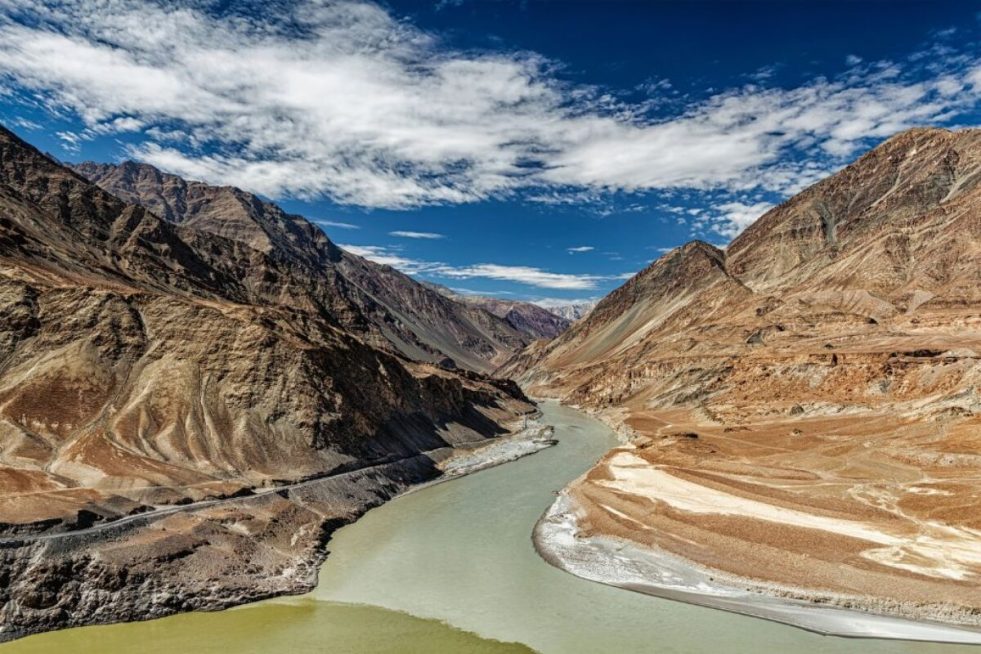
INDUS RIVER: Stephen Alter, in his article “With the River by My Side” says about Indus River that some rivers are older than the landscape through which they pass: “Nowhere is this clash between hydrological and geological history more apparent than along the Indus, as it passed through Ladakh. This seemingly eternal river has followed its winding course since long before the Himalaya were formed, tossing and tumbling over. Boulders, stones and pebbles that the water polishes and grinds into sand. Eroded flanks of the mountains on either side of the river are scarred and twisted by tectonic forces that lifted giant slabs of rock more than eight kilometres into the clouds but failed to block the persistent flow of the Indus. Driving along the highway that runs parallel to the river, from Leh to Kargil, it feels as if the landscape is a timeless epic that the waters of the Indus have etched in stone.”
“Further downstream lies the confluence of the Indus and Gilgit rivers, where three mountain ranges converge. Early geographers called this “The Fulcrum of Asia.” To the. North stand the Karakoram, to the east are the Himalaya and on the west the Hindu Kush, all of which bow down in front of the Indus as it bends southward and sets its course for the Arabian Sea. Travelling in the company of this venerable stream, one cannot help but feel that its flowing waters will outlast human history and wash away any memory of our tenuous journeys.”
Impact of Climate Change on Indus River Basin Currently, rivers in the Upper Indus Basin see maximum flows between June and August, just when farmers need water for irrigation. But the precipitation and temperature changes could shift this peak to earlier in the year, glaciologist Shakil Romshoo’s (Islamic University of Science and Technology) research has found. Sometime around the middle of the century, overall water flows in the Indus Basin are forecast to reach a modern-era peak as glacier melt accelerates. “But after that, the water availability will start to diminish” because of a lack of snow and ice, Arun Shrestha of ICIMOD says.
Those forecasts, however, remain uncertain because of sparse data. For example, researchers currently monitor just 16 of the roughly 33,000 glaciers in the Indian Himalayas, Romshoo says. And because the monitoring stations tend to be at lower altitudes, they provide limited insight into how weather phenomena, such as storms known as the western disturbances, might dump snow at high altitudes and help compensate for the loss of ice. There’s also been little study of how other factors, such as the debris and black carbon particles that settle on glaciers and snow, might influence melting. And simply collecting more data won’t be enough: India and Pakistan would also need to share them.
HYDRO POWER PROJECTS
Etalin HEP FAC goes against its earlier decisions to approve Etalin Hydropower project The Forest Advisory Committee of MoEF has in its meeting on May 26 2025 given in principle approval without addressing the issues raised in FAC’s earlier meetings on the 3097 MW Etalin Hydropower project in Arunachal Pradesh. The FAC had rejected the project in Dibang basin in December 2022 primarily on two grounds. One, the project was originally submitted in 2014 and FAC said it was imperative to review the facts and figures presented, especially regarding tree felling. Secondly, owing to the biodiversity and wildlife protection concerns raised, a sub-committee of the FAC had recommended further assessments and safeguards.
This included a multi-seasonal replicate biodiversity study, as was already directed by FAC in 2017, and a cumulative impact assessment, since multiple hydroelectric projects are planned in Dibang valley. A wildlife conservation plan, instead of a multi-season biodiversity study, was carried out by the Wildlife Institute of India and submitted in 2019. However, since it was carried out over just four months, the FAC sub-committee had insisted on the multiple-season study again in December 2022.
The minutes of the 2022 meeting said that “After going through the facts of the proposal and submissions made by the Nodal Officer, and in view of the various issues viz. wildlife, observations made in the reports of the SubCommittee, concerns raised by the locals, the committee opined that the instant proposal cannot be considered in the present form and the revised proposal may be submitted for further consideration by the state government.”
The WII study was also heavily panned by 29 independent Indian conservationists in a peer-reviewed paper for inaccurate wildlife documentation, scientific deficiencies among other things. Specifically, the WII study had reported a species of African bat and long-tailed house bat, not found in India. Minutes of the FAC’s May 26 meeting as well as documents submitted to the Centre show that the FAC relied on the existing WII study, as well as the existing cumulative impact assessment.
SUMP The members of the Siang Indigenous Farmers’ Forum (SIFF) has submitted a representation to Deputy CM and Hydropower Minister Chowna Mein on June 15, reiterating its grievances vis-à-vis the proposed Siang Upper Multipurpose Project (SUMP). The SIFF sought immediate withdrawal of all FIRs registered against the people protesting against the SUMP, and cancellation of the proposed SUMP. The forum maintained that any further talks between the SIFF and the state government would only be possible after the fulfilment of these demands.
Meanwhile, a collective of 114 scientists, researchers and practitioners have called for suspending all construction, surveys and pre-clearance activities related to the proposed SUMP citing its ecological, cultural, and socio-political risks. The collective noted that the site of the SUMP fell in Seismic Zone V, which the highest risk category for earthquakes as per the Bureau of Indian Standards. The statement underscores that the proposed dam is situated in one of the most biologically and culturally rich regions of the Eastern Himalayas and calls for a serious re-evaluation of how such infrastructure projects are planned and executed in sensitive areas.
On the other hand, union minister Kiren Rijiju has defended the project, calling it a “strategic necessity” for India’s national security and a transformative opportunity for the state’s development. He urged people who have been protesting the project in the state bordering China to have an open mind about it, asserting that their culture, land and livelihoods will be protected.
Arunachal Pradesh The state Cabinet has declared 2025-35 as the ‘Decade of Hydropower’. The government aims to undertake strategic policy and governance measures to harness the hydropower potential through a judicious mix of mega, large and small hydroelectric projects.
Sawalkote HEP in J&K The Rs 22700 Cr 1856 MW Sawalkote project, among four proposed hydroelectric projects in Jammu and Kashmir, has been granted the status of a nationally important project, officials said. It will come up in the Ramban, Batote, Mahore and Udhampur forest divisions abutting the Raman, Reasi and Udhampur districts.
Himachal Pradesh The FAC on Jun 4 has granted st II forest clearance to the Renuka dam for the diversion of 909 ha forest land. The initial phase involves three 1.5-km diversion tunnels to temporarily redirect the Giri river. This is critical to laying the foundation for the 148-m-high rock-fill dam, which is expected to be operational by 2030. A 24-km main tunnel would be constructed.
PM Modi had laid the foundation stone of the project in Dec 2021. 41 villages and 7,000 people will be affected and 346 families will be homeless for the dam. 1,508 ha of land, including 1,231 ha of agricultural land spread across 32 villages, 909 hectares of reserved forestland and 49 hectares of the Renuka wildlife sanctuary, would be submerged for the Rs 6,947-crore project.
Power Ministry has granted a 100% interstate transmission system (ISTS) waiver for pumped storage projects (PSPs) for which construction works were awarded on or before June 30, 2028. The ministry had extended the waiver multiple times since 2016. The last waiver extension was issued in 2022 for projects to be commissioned by June 30, 2025. After this deadline, 25% of the applicable ISTS charges will be levied on renewable energy projects, including solar, wind, pumped hydro storage, and projects with BESS commissioned during Jul 1, 2025 to Jun 30, 2026.
Decisions of EAC meeting on River Valley Projects held on May 29, 2025: 1. Bhavali Pumped Storage Project (1500 MW) in 278.92 Ha in Village Kalbhonde, Kothale and Jamunde, Sub Dist Shahapur and Igatpuri, District Thane and Nashik, Maharashtra by M/s JSW Energy PSP Two Ltd – Environmental Clearance: Approved
2. Thana Plaun HEP (191 MW) in 432.79 Ha in Guini Village, Mandi Dist, Himachal Pradesh by HPPCL-Environmental Clearance: Approved
3. Tato-II 700 MW Hydroelectric Project in 278.92 Ha in village Tato Village, Lower Heyo, Tagur, Quing and Tadogita, Sub Dist Tato, Dist Shi Yomi, Arunachal Pradesh by NEEPCO – Extension of validity of Environmental Clearance: EC Valid till 26.06.2027.
4. Saundatti HEP (1260 MW) (Integrated Renewable Energy with Pumped Storage Project) in 213.70 Ha in Village Badli, Mallor And Yekkundi, Sub Dist Savadatti, Dist Belagavi by Greenko KA01 IREP Pvt Ltd – Amendment in Env Clearance: Approved
5. Ambegaon Open-loop Pumped Storage Project in 69.41 Ha in village Kanase, Mahalunge Tarf Ghoda and Phulvade, Sub – Dist Ambegaon, Dist Pune, Mah by Renew Hydro Power Pvt Ltd – Terms of Reference: Approved
6. Consideration of EAC Sub-Committee Site Visit Report of Upper Bhavani Open loop Pumped Storage Project (1000 MW) in 167.85 Ha located at Village Mulligur, Sub Dist Kundah, Dist The Nilgiris, Tamil Nadu by NTPC TN Energy Company Ltd: Approved
7. Consideration of EAC Sub-Committee Site Visit Report of 1500 MW Malshej Ghat Bhorande Pumped Storage Project at Adoshi village, Junnar Taluka, Pune Dist and Bhorande village, Murbad Taluka, Thane Dist, (Mah). Approved
Agenda of EAC-RVP meeting to be held on June 17, 2025: 1. Polavaram Banakacherla Link Project (PBLP) with 300000 Ha CCA and 400 MW in 24064 Ha in Sub dist Rajupalem, Pedavegi, Amaravathi,etc., Dist East Godavari, West Godavari, Eluru, Krishna, NTR, Palnadu, Prakasam, Nandyala-AP-Terms of Reference
2. Kandhaura Pumped Storage Project (1680 MW) in 584.57Ha in village Sasnai, Markuri & Cherue, Sub Dist Robertsganj, Dist Sonbhadra, Uttar Pradesh by JSW Energy PSP Six Ltd–Amendment in Terms of Reference
3. Cumulative Impact Assessment and Carrying Capacity Study (CIA & CCS) of Yamuna River Basin in Uttarakhand by Indian Council of Forestry Research & Education (ICFRE), Dehradun
DAMS
Polavaram Project A Central team visited the Polavaram project in Eluru district in AP on June 14 and inspected the progress of the project. The team comprised Central Water Commission member Yogesh Paithankar, chief engineer H.S. Sentra, and Polavaram Project Authority chief engineer M. Ramesh Kumar. They inspected the works related to the diaphragm wall, buttress dam, Gap-1, upper and coffer dams, and spillway.
Kaleshwaram Project The ACB has arrested Irrigation Executive Engineer (EE) Nune Sridhar in connection with disproportionate assets (DA) case and is probing whether he amassed huge properties only after started associating with KLIS project. The ACB raided Sridhar’s house and 13 other places belonging to him and his relatives.
Terming the project useless, the Kothagudem MLA & CPI State secretary Kunamneni Sambasiva Rao said that the ₹1-lakh-crore project had not delivered “a single additional drop” of irrigation water and farmers were instead receiving supplies diverted from the Yellampalli reservoir.
Nagarjuna Sagar Dam Major tasks including the overhauling and sealing of all 26 crest gates of the project have been completed. Proposals related to spillway maintenance have been submitted, to completed by the end of July.
Almatti Dam Farmers’ organizations have decided to launch a massive stir on June 30, in support of their demands pertaining to increase the height of Almatti dam from 519.6 m to 524.25 m. They have urged the Centre to declare the Upper Krishna project as a national project. They have also criticized the opposition by Maharashtra to increase the dam height.
Chhattisgarh CM Vishnu Deo Sai held a detailed meeting with Prime Minister regarding the Rs 29000 Cr multipurpose Bodhghat Dam Project and the Rs 20 000 Cr Indravati-Mahanadi Interlinking Project, both declared as national projects and both in Bastar region. The Bodhghat dam site is about 8 km from Barsur village in Geedam block of Dantewada district and around 100 km from Jagdalpur city. The 10440 ha area reservoir could have gross capacity of 2.727 BCM and net capacity of 2.009 BCM. However, if providing irrigation in Bastar region is the objective, the de-centralised water harvesting and small-scale projects would be much better, cheaper, faster, sustainable and appropriate options.
Kerala WRD Minister Roshy Augustine said that removing sediment and silt from dams to increase storage capacity can help address both flooding and water scarcity. Desilting work is being carried out at the Aruvikkara dam by KIIDC, which saw a reduction of up to 50% in its water storage capacity for the first time in 90 years. Idukki Malankara dam had to be opened this monsoon due to reduced storage capacity.
INTERLINKING OF RIVERS
Ken Betwa Link Experts concerned about impact on PTR, Wildlife In March 2025, work began with the construction of a road to the dam site at Daudhan village, in PTR’s core Chandra Nagar range, for which trees in 15 hectares of forest land were felled. As a result, animals have started migrating to other areas of the reserve, officials said. “The signs of disturbance are clear. Herbivores, once abundant in the Chandra Nagar range, are leaving and moving northward. This will further increase the risk of territorial conflict,” a deputy forest range officer said.
On May 28, a tiger, identified as T-2, was killed in such territorial fight, the officer said. “These incidents may seem isolated, but they reflect a broader disruption. Even birds and monkeys are fleeing due to the presence of humans and machinery,” they added. The experts also flagged a decline in prey base as a concern as reports emerged about the presence of a female tiger with two cubs, and a male tiger frequenting the Bhusaur and Gangau area, 5km from the project site.
Earlier on April 19, a Wildlife Institute of India (WII) report raised similar concerns about the prey density in the reserve being six animals per sq km — far below the ideal range of 30-60 per sq km prescribed by the wildlife board. The report, released during a meeting of the National Tiger Conservation Authority (NTCA), also pointed out that the reserve has the lowest prey base among all wildlife habitats in Madhya Pradesh. “The NTCA raised a red flag at the meeting as herbivores were already in less numbers and further cutting of forest will aggravate the situation,” said a senior forest official.
Wildlife experts, however, are concerned that the project will have longstanding impact on the reserve’s wildlife and ecology. “The gains made from the revival of PTR over the past 15 years may be lost,” said Arun Singh, a Panna-based wildlife expert, adding that the project will change the economy of the Bundelkhand region over the next two decades. Ajay Dubey, a wildlife activist, also alleged a lack of transparency from forest department on the impact the dam construction. “The work was started in March, and till now, no bulletin or any information has been shared on any public platform,” he said.
PKC Linking Govt’s ‘Vande Ganga Water Conservation Public Campaign’ began at the historic Ramgarh Dam in Jaipur. A crucial aspect of this initiative is the plan to link the Eastern Rajasthan Canal Project (ERCP) with the Ramgarh Dam. In 1981, Ramgarh Dam hosted the Asian Rowing Championships, putting it on the tourism map. But due to encroachments and neglect over the years, the dam has been reduced to a mere name in govt records. Around 14 feet of silt has accumulated in the dam bed, destroying its original structure.
IRRIGATION
Haryana The state govt has initiated action against 80 officials of the Irrigation & Water Resources Department (I&WRD) for alleged corruption and negligence pertaining to quality of hardened concrete used in various projects under the department. CM Nayab Singh Saini has approved disciplinary action against these officials. Certain chief engineer rank officials will also get a displeasure note from the govt. Officials said that samples of ongoing civil works and installation of high-density polyethylene pipe were collected for quality check by the office of superintending engineer, vigilance of the irrigation department in November-December 2024.
URBAN RIVERS
Itanagar Youth Mission for Clean River (YMCR) began cleanup drive in Itanagar’s Green Belt in 2016 and it has today evolved into a grassroots movement that’s not only removing garbage from riverbanks but also attempting to reshape public attitude towards sustainability and ecological responsibility. So far, YMCR claims to have cleared over 1.1 million kilograms of waste from riverbanks and drainage systems across Itanagar, Naharlagun, Doimukh, and several other towns including Seppa, Palin, and Pasighat.
RIVERS
From Texas to Maharashtra: Can River Basin Organizations Actually Work? The Mula-Mutha, Pawana, Indrayani and Bhima Basin seem to be at the cusp of such a process if only the energy of communities, experts and other stakeholders finds a respectful place in basin planning. https://sandrp.in/2025/06/15/from-texas-to-maharashtra-can-river-basin-organizations-actually-work/ (15 June 2025)
Rivers Releasing long term carbon Study has found that over half of the carbon gases released by rivers come from long-term, old carbon sources like deep soils and weathered rocks, not just recent organic matter. This surprising discovery suggests Earth’s vegetation is playing an even bigger role in absorbing excess carbon to keep the climate in check. In another study the researchers present an evaluation of nitrogen fixation for inland and coastal waters. It demonstrates that water column and sediment nitrogen fixation is ubiquitous across these diverse aquatic habitats, with rates ranging six orders of magnitude.
CAUVERY Aarti The preliminary work for Cauvery Aarti project at the KRS Dam has been suspended following opposition from local farmers. Farmer organisations have criticised the govt for allocating Rs 100 crore to the project, claiming it could be completed for just Rs 20 crore.
GANGA: Waste incinerator at Gangotri NP Residents of Uttarkashi district have written to the Union government expressing concern over a new waste incinerator in the Gangotri National Park and within the Bhagirathi Eco-Sensitive Zone. The incinerator, installed a few months ago by the district administration, is burning mixed solid waste disposed in the hills, causing emissions in the region.
Delhi Plans to divert Ganga water to Yamuna, faces criticism The. Govt of India now plans to divert 300 Million Gallons per Day (MGD) of Ganga Water to Yamuna river via Eastern Yamuna Canal in UP. While Uttar Pradesh is yet to agree to this proposal, a number of experts including Pankaj Kumar, Varun Gulati and Bhim Singh Rawat (SANDRP) have questioned the proposal as non-solution for Yamuna and additional burden on dying Ganga River. NMCG is now preparing a proposal for this. This seems to be advance self-confession by the Delhi and Central Govt that all their efforts and plans to clean up Yamuna are doomed to fail in achieving the objective.
Similarly, the Delhi govt is also planning to utilise the treated wastewater from the 574 MLD Okhla STP to boost the e-flow by 5.69 cumecs. The project had been delayed for months due to pending permissions from the UP Irrigation Dept, which controls the Yamuna downstream. The clearance was finally granted on March 1 2025, and the remaining work is expected to be completed by the end of 2025. Officials expect to begin releasing the additional e-flow by February 2026.
The Delhi Jal Board (DJB) has also chalked out a ₹10,087 crore project to clean Yamuna and revamp the water infrastructure. This includes Rs 1,400 crore for drain management, Rs 120 crore for solid waste management, Rs 600 crore for septage and dairy waste management, Rs 3,515 crore for sewerage management, Rs 2,000 crore for additional sewage treatment capacity of 500 MLD, Rs 1,000 crore for strengthening e-flow and drinking water supply, Rs 1,100 crore for floodplain conservation and riverfront development, Rs 225 crore for public outreach and Rs 127 crore for miscellaneous expenses.
DJB documents show that Delhi’s major STPs including the Coronation Pillar, Yamuna Vihar and Okhla will play a key role in restoring the river’s environmental flow. As per the officials, by Sept 2026, treated sewage from these plants will be released downstream of the Wazirabad barrage. At Coronation Pillar alone, 454 mld of treated water is expected to be diverted into the river. The CPCB will inspect current STPs and outfalls by July to identify operational deficiencies.
Meanwhile, DDA’s ropeway is likely to start from the Kalindi Aviral project along the floodplains. The point of origin to destination, number of intermediate stations, and location of towers has yet to be decided. The Kalindi Aviral project is currently being developed along the western bank of Yamuna over a total area of 163 ha. It covers the stretch from NH24 to Barapullah drain and Baansera park near Sarai Kale Khan that has already been inaugurated is a part of this project.
FISH, FISHERIES, FISHERFOLKS
Arunachal Pradesh The elusive fish species swamp eel (Ophichthys hodgarti) and the velvet worm (Typhloperipatus williamsoni) have been rediscovered after over 100 years. Further, researchers have discovered several species of freshwater crabs, damselfly, fish, frogs, insects, mammals, plants and birds which are new to science.
Kerala The rare subterranean fish Pangio bhujia, locally referred to as ‘paathaala poontharakan’, has been sighted for the first time since it was designated as the ‘official fish’ of Kozhikode district. A total of 11 species of underground fish have been identified in Kerala so far, and detailed studies are underway on them. The main hurdle faced by scientists in learning more about the subterranean species is the lack of adequate number of specimens to conduct studies.
SAND MINING
The NGT has ordered a nationwide study for the govt to come up with standard guidelines on construction of temporary bridges across rivers for sand mining. NGT gave the order on May 30 while hearing a petition by Sonipat resident Vikas Kumar, who has alleged that a firm was illegally mining sand from Yamuna’s riverbed in the district and had unlawfully diverted the river’s natural course by constructing a makeshift bridge there. NGT will take up the case next on Aug 4.
Haryana Temporary bridges have been built on the Yamuna around Palwal so that sand miners can get even closer to the riverbed, leaving residents irate and environmentalists fuming. The “illegal” bridges, which have reportedly come up without official approval or environment clearance, are being used by illegal miners to carry equipment deep into the river to excavate sand and transport it. Contracts for sand mining have been awarded in Palwal, but local sarpanches and environmentalists say none of the contractors has allegedly obtained environmental clearance.
BJP’s Yamuna pledge drowned in sand “The contradiction is stark: The BJP government that claims to champion green causes with projects like the “Green Wall of Aravallis” simultaneously presides of ecological ruin. The ruin of a river amounts to the destruction of entire village ecosystems. The party’s political rhetoric on saving the Yamuna rings hollow against this backdrop of environmental pillage. The situation demands swift and transparent action: immediate dismantling of illegal infrastructure, a judicial probe into the issuance of mining contracts and holding accountable those in the administration who turned a blind eye.” (Edit)
Panipat Three children have died in Yamuna at Sanauli ghat on June 11 after drowning in deep pits formed by sand mining.
Banda A 12 year old child died drowning in deep sand mine pit formed in Yamuna river in Charka village under Marka police station on June 09.
Rajasthan Deaths by drowning due to indiscriminate sand mining Eight young people were submerged in Banas river near old bridge in Tonk in Rajasthan on June 10. Reports suggest that this is due to the deep pits created by indiscriminate sand mining. Despite this, the mining activities have not stopped.
Madhya Pradesh Supreme Court has granted interim protection from arrest to two journalists who allege they were assaulted by Bhind police officials over their reporting on illegal sand mining in the Chambal region. The court clarified that the journalists shall not be arrested until the High Court considers the matter. The petition was led by Shashikant Jatav and Amarkant Singh Chouhan, who claimed they were physically assaulted by state police personnel in connection with their coverage of illegal sand mining activities in Bhind district.
Tamil Nadu The Madurai Bench of the Madras High Court directed the authorities concerned to seal off illegal sand mining sites in Vedasandur in Dindigul district, citing no action taken by respective officials even after a committee -constituted by the collector – had identified such sites operating in the area. “Mines and minerals are the nation’s wealth, and the officials are duty-bound to protect the same. Any collusion or corrupt activities relating to illegal mining are to be viewed seriously,” the bench stated. The hearing in the case has been adjourned to June 24.
A group of environmental activists has urged the state govt to arrest all those arrested recently for illegal sand mining from the Cauvery be detained under the Goondas Act.
Goa In the sand mining contempt petition in the high court of Bombay at Goa, former North Goa collector Sneha Gitte said that the circle inspector – whose role is to assist the mamlatdar of Bicholim – was responsible for not promptly taking action on a report of illegal sand mining, and not the mamlatdar of Bicholim. The HC is hearing a second contempt petition by the Goa River Sand Protectors Network against illegal sand mining.
Odisha The sand mafia reportedly attacked two junior mining officers in presence of cops at Chalantai near Subarnarekha river bed in Jaleswar here on June 12 night. This is the latest in a series of brazen attacks on officials trying to curb illegal sand mining in the region. A junior mining officer was allegedly assaulted by miscreants while inspecting a sand mining site in Balasore district on June 10. On June 2, a revenue department officer was allegedly assaulted by unknown miscreants in Mayurbhanj district when he was on way to conduct a raid against illegal transportation of minerals. The police arrested 8 people for their alleged involvement in attacking a revenue department officer in Mayurbhanj district on June 2 while he was on duty.
Chhattisgarh As per the police, members of a sand mafia allegedly assaulted 3 villagers after they opposed illegal sand mining in Rajnandgaon district. The accused also allegedly opened fire in the air before escaping from the spot in two cars. A local corporator, and the driver of an earth mover machine engaged in illegal mining were arrested. The incident took place on June 11 night in Mohad village under Basantpur police station limits when some smugglers were allegedly retrieving sand from the Shivnath river using an earth mover.
Jharkhand Sand mining from riverbeds stopped on June 10 in accordance with the NGT order that prohibits sand mining during monsoon to protect aquatic life in the rivers.
WETLANDS, LAKES, WATER BODIES
Andhra Pradesh Protect Kolleru Wetland Former Secretary to Govt of India, Shri EAS Sarma has in a letter to secretary and DGF of Union Ministry of Environment, Forests and Climate Change (MoEFCC) said the ministry should proactively intervene to protect Ramsar-notified Kolleru wetland system from encroachments, especially chemicals-based aquaculture and ill-advised upstream projects. The letter undelined: “At present, there is no mechanism in place to monitor the vital parameters of water quality of Kolleru on scientific lines, necessary to understand the changes that the wetland system is undergoing both on account of anthropogenic interventions and other factors such as the changes in the Kolleru water level vis-a-vis the downstream sea water level. Such monitoring needs to be introduced by your Ministry in the case of all wetland systems.”
Bihar The Department of Environment, Forest and Climate Change (DEFCC) on June 2 received administrative approval and expenditure sanction for “conserving and sustainably managing Nathmalpur Bhagad (wetland)” under the Namami Gange Mission (NGM)-II. As per the official statement technical support may be sought from an expert organisation or agency. The project, approved at an estimated cost of Rs 3.51 crore will span four years from 2025–26 to 2028–29 across two phases: Phase I (2025–26) and Phase II (2026–29) an official statement said.
GROUNDWATER
Tamil Nadu A total of 13 districts have recorded a fall in their groundwater level in May 2025 compared to May 2024, according data frp, the Water Resources Department (WRD) for 37 districts barring Chennai. A senior official from WRD said that despite availability of river-based irrigation systems in the delta and western regions, many of the farmers still use borewells due to easy availability, leading to faster depletion of groundwater levels. V Ravichandran, a farmer from Tiruvarur, said that changing weather patterns and erratic rainfall have worsened the situation and have made farmers rely on groundwater, which is also depleting fast.
Haryana The state has witnessed an average decline of 5.41 m in its ground water table in 10 years from 2014 to 2024, the most in Ambala, the state govt informed the Assembly on March 19.
URBAN LAKES, WETLANDS
Mumbai Residents and activists from multiple sectors in Seawoods and Nerul came together on June 08 at sector 27, Lotus Lake in a strong show of solidarity, pledging continued legal and civic action to protect the ecologically sensitive wetland from further destruction. At the event, participants resolved to take a series of legal and administrative steps to ensure lasting protection of the wetland. After repeated attempts to reclaim the Lotus Lake were thwarted by environmental activists, the last of the earthmover and other paraphernalia used for the illegal activity has left the wetland. The environmental activists, however, remained skeptical and suspect the illegal reclamation of land may resume soon. Accusing CIDCO of repeatedly trying to harm environment, former MLA Sandeep Naik has demanded an inquiry against officials who allowed debris dumping in the Lotus Lake situated in Nerul.
On the other hand the Maharashtra Pollution Control Board (MPCB) has confirmed that several Ready Mix Concrete (RMC) plants in Vasai were running illegally on land marked as wetlands. This confirmation follows FIRs filed by revenue officials against 28 RMC units for not submitting valid approval documents.
Noida An affidavit by the DM to the NGT recently showed of the 1,018 waterbodies in the district, nearly 10% are encroached. Some of them are by govt agencies for the construction of roads and banquet halls. The affidavit, submitted on March 17, showed most of the waterbodies have been encroached for the construction of houses or extending agricultural activities. A handful of building plans encroaching on ponds have been sanctioned by govt authorities. Next hearing on Jul 17.
URBAN WATER
Bengaluru BWSSB starts upgrading 20 STPs, six years after NGT’s guidelines The upgradation is being undertaken at an estimated cost of Rs 991.6 crore. The 20 STPs that will be upgraded have a cumulative capacity to process 763 MLD of sewage. The upgrade is expected to be completed by December 2025. The upgrade is being undertaken following a report from researchers at the IISc, who, in 2020, inspected the quality of output at each of the 36 STPs operated by BWSSB.
MONSOON 2025
IMD According to the latest data from the IMD, rainfall between June 1 and June 15 was recorded at 42.9 mm, while the normal level for this period is 62.1 mm. The monsoon has stalled over parts of Maharashtra and N Bengal since around May 29. But the IMD has said the monsoon is likely to enter an active phase over South Peninsular India, with heavy to very heavy rainfall and isolated extremely heavy rains.
FLOOD 2025
Haryana Assembly Speaker Harvinder Kalyan said the flood prevention work is underway at 6 locations identified last year in Karnal dist to safeguard against the flood of the Yamuna, and all works are expected to be completed by June 30 at a cost of Rs 17–18.
Jammu & Kashmir The CBI has registered a case against officials in multi-crore 2014 flood relief scam. The case follows discreet verification by the CBI, which found credible evidence of fraudulent practices and fake documentation used in securing government relief funds intended for flood-affected shopkeepers in Srinagar.
URBAN FLOODS
HM calls for timely action on Urban Floods The Union home minister Amit Shah on June 10 reviewed the preparedness of various agencies engaged in flood management and stressed the dissemination of early warning alerts to the grassroots level, as well as timely action for flood control in urban areas. HM asked NDMA to ensure coordination with SDMAs and DDMAs for timely dissemination of early warnings. He also suggested the maximum use of space technology by the central agencies for timely flood control and management. The HM, while appreciating CWC and IMD’s move to raise the time limit for issuance of flood forecast/advisory to 7 days from 3 days, emphasised improving the accuracy of forecasts. He advised jal shakti ministry, NDMA and National Remote Sensing Centre (NRSC) to closely monitor glacial lakes and take timely steps in the event of an outburst.
Pune Water-logging, flooded streets, and zero accountability—this familiar nightmare has returned with full force, and this time, it has exposed just how little has been done despite endless warnings and desperate cries from the public. Pune Municipal Commissioner and former District Collector Naval Kishor Ram admitted the grim truth after inspecting the city firsthand during June 13 rainfall. “Only 16% of Pune is covered by a stormwater drainage system,” he said. The remaining 84% of the city is exposed, unprepared, & punished by the rains year after year.
Guwahati is a city with immense potential, but these same features make it vulnerable when abused. Turning it into a disaster zone every monsoon is not destiny—it is a consequence of choices made by both its rulers and its residents. So, who is responsible for Guwahati’s recurring destruction—the government or the public? The honest answer is: both.
DISASTERS
Arunachal Pradesh Is state prepared for a major disaster? Unfortunately, the SDRF is struggling, and questions are being raised over the disaster preparedness of the state govt. The lack of a permanent headquarters and basic infrastructure for the SDRF reflects the sordid picture and apathetic gesture of the govt and the dept towards disaster management. The lack of training is becoming a big hurdle for the SDRF. Many a time, SDRF personnel are also engaged in law and order and election duties, apart from disaster duties.
Opinion Natural hazards are inevitable, but disasters are preventable with better planning writes. Saurabh Kelkar a Climate Researcher at the WOTR, Pune.
LANDSLIDES
Uttarakhand Nearly two years after land subsidence devastated Joshimath, forcing hundreds of families to flee their homes in panic, a tragic pattern has emerged—most of them have now returned to the same unstable, cracked, and sagging houses they once ran from.
ENVIORNMENT GOVERNANCE
CPCB has spent just 0.2 per cent (Rs 9 lakh) of the Rs. 45.40 crore environmental compensation it collected from 2018 to 2024 on protecting the environment, according to official data accessed RTI. There is no record of EC spending in most years. The only exception is 2024-25, when ₹9 lakh was finally utilised. The data also shows that the CPCB spent only ₹130.9 crore, about 30 per cent of the ₹427.37 crore collected under the Environment Protection Charge (EPC) during the same period. These funds are meant to tackle air pollution in Delhi-NCR.Earlier in March, a parliamentary panel flagged that only ₹7.22 crore (less than one per cent) of the ₹858 crore allocated to the Environment Ministry for its ‘Control of Pollution’ scheme in 2024-25 had been spent by January 21.
CLIMATE CHANGE
Ladakh Drang Drung Glacier has been losing ice or receding at an average rate of 1m per year between 2021 and 2023, according to scientists who carried out the first detailed glaciological study of the glacier. Spanning around 70 sq km, Drang Drung is the largest glacier in the Zanskar range. Despite its relatively clean surface, the glacier is steadily retreating, leading to the formation of a growing proglacial lake at its terminus.
Uttarakhand Development and disasters Villages like Pangu, Aala and Hookra now have roads — but little else. These newly cut mountain roads are frequently blocked by landslides and weakened by unregulated slope-cutting. Schools remain underfunded, healthcare is nonexistent, and jobs are largely seasonal. The road came — but development did not follow. In the fragile Neeti Valley, along the India-China border, the risks are even more acute. Despite its strategic significance, the same reckless construction persists: muck is dumped into rivers, steep slopes are cut without engineering oversight, and road widening continues unchecked. These practices endanger both locals and Indian armed forces operating in this sensitive frontier.
The same pattern plays out in Joshimath, a critical pilgrimage and military town now sinking under its own weight. Cracks have split homes, temples, and shops. In the cantonment, workers filled fresh fissures with concrete — a desperate gesture to hold back what nature can no longer contain. For many, relocation is economically and emotionally impossible. They live trapped within the very development model that caused the crisis.
Across the Himalayas, the same story repeats: connectivity without resilience, construction without safety, growth without stability. Here, disasters don’t just arrive suddenly — they unfold daily, as chronic ecological and human degradation engineered from afar. The Himalayan crisis is no longer driven by poor development choices alone — climate change is now its most dangerous accelerant, silently amplifying every existing risk. The Hindu Kush Himalaya Assessment reports a 28 per cent loss in glacier ice between 1987 and 2015. This rapid melting destabilises slopes, swells glacial lakes, and magnifies both droughts and floods. Here geology is destiny, but policy pretends otherwise. Without a radical shift in the Himalayan development paradigm — one grounded in climate science, ecological knowledge, and genuine local participation — disasters like Kedarnath, Chamoli and Joshimath will not remain anomalies. They will become the norm. (By Ankita Ojha)
Rainwater most underused climate solution (By K S Mehta)
SOUTH ASIA
SW Monsoon forecast by ICIMOD The ICIMOD has issued the forecast on June 11, 2025 predicting above-average rainfall across India, Nepal, Pakistan and China’s Tibetan Autonomous Region alongside dangerous temperature spike.
Bhutan CWC Technical Review of Punatasangchhu HEP submitted On June 2, Central Water Commission submitted the comprehensive technical Dam Safety review of stability of Right Bank of the controversial 1200 MW Punatsangchhu HEP to Bhutan Govt. Bhutan experts are now examining the report that contains standard and supplemental stabilisation measures proposed earlier. The dam site had suffered landslides in 2013, 2016 and 2019. Bhutan had explored the option of building a barrage 2.6 km upstream in place of the unstable dam.
SANDRP

 SANDRP