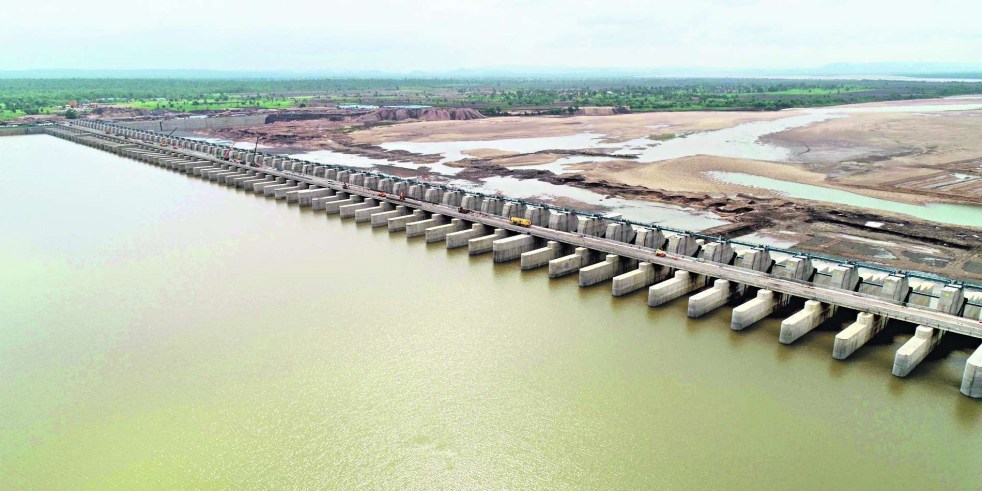
(Feature Image: Medigadda barrage of KLIS. Source: South First)
The National Dam Safety Authority (NDSA) expert committee report under chairman Shri J Chandrashekhar Iyer on the controversial Kaleshwaram project has at long last been submitted this last week to the Telangana govt vide DO letter dated April 24, 2025, from Shri Anil Jain, NDSA chairman. One of the intriguing aspects of this episode is that the NDSA expert committee submitted the report to the Ministry of Jal Shakti in December 2024 and it has taken almost four months for the report to be submitted to the executing authority, the Telangana Govt. Why should it take any time at all for the NDSA expert committee report to reach the state government, leave aside the 4 months it has taken.
This becomes even more intriguing considering that monsoon is now less than two months away, and no work is possible related to repairing the damaged three barrages of (Medigadda, Annaram and Sundilla) during the monsoon and the time now left before monsoon is possibly totally inadequate to complete, for example the removal of the damaged block 7 of Medigadda barrage as recommended by NDSA expert committee. Considering these factors, it becomes even more intriguing as to why the NDSA expert committee report was not directly submitted to Telangana govt. The unrepaired barrages facing the Godavari floods in the 2025 monsoon possibly risk further damages to the barrages.
It reminds one of the Supreme Court remarks when the apex court said that the dam safety authorities at the Centre seemed to be in slumber, though it was in context of another project. The NDSA expert committee report is also not available in public domain, which must be as all issues related to dam safety are public interest issues.
Kaleshwaram Project Irreversible damage to Kaleshwaram barrages: NDSA report Stating that the damage to the raft and piers of block 7 of the Medigadda barrage of the Kaleshwaram Lift Irrigation Scheme (KLIS) are irreversible, National Dam Safety Authority (NDSA) has recommended that the Telangana govt should not use the (block 7) structures for the operation of gates again. They may be safely disposed of or stabilised, in situ, based on the experience of the executing agency. NSDA also said while carrying out the works, the adjacent blocks should not be damaged in any manner.
– On Annaram and Sundilla, which have also developed structural issues, the NDSA said the two barrages have also experienced distress conditions and damages “rendering them unserviceable” and were also vulnerable. “All three barrages need to be thoroughly and entirely investigated from all angles,” NDSA added.
– The NDSA committee, led by J Chandrashekhar Iyer and member secretary Amitabh Meena, along with other members, investigated sinking of some piers of block 7 of the Medigadda barrage and problems in the Annaram and Sundilla barrages. They submitted a 365-page report to the Union ministry of jal shakti in Dec last, which has been sent to the Telangana govt for further action. Three piers were completely damaged, while some others were partially affected in block 7 of Medigadda in Oct 2023.
– Regarding the reasons for the sinking of piers in Medigadda and other barrages, NDSA, in its report, stated that the sand piping phenomenon, cavity formation underneath the raft, construction defects, design deficiencies, structural distress, and other downstream damages experienced by block 7 rendered it unserviceable. These issues could manifest in other blocks of the Medigadda barrage as well. The committee noted that the geophysical investigation report reveals that cavities underneath the raft had formed not only in block 7 but also in other blocks.
– “The damages to block 7 have resulted in the barrage becoming non-functional for diverting water. Even the bridge that spanned over it has become non-functional. Since this block is not the first or last block of the barrage, the movement of the gantry crane over the whole barrage width has also been stopped. Due to such sinking, not only has block 7 suffered irreversible damages, but its safe removal would also pose challenges as it may cause damage to adjacent blocks,” the report stated. The committee mentioned that the flexible protection works of the barrage, such as CC blocks and the launching apron in the downstream, have either settled, been damaged, dislodged, or washed far away at many locations along the length of the barrage. https://timesofindia.indiatimes.com/city/hyderabad/irreversible-damage-to-kaleshwaram-barrages-ndsa-report/articleshowprint/120595258.cms (25 April 2025)
KLIS Barrages Need Extensive Repair: NDSA “Extensive debilitating damages.” With these three words in its 378-page report on the state of Medigadda, Annaram, and Sundilla barrages of the Kaleshwaram Lift Irrigation Scheme, the National Dam Safety Authority issued a damning indictment of planning, executing, constructing, and maintaining the three barrages, the lifeline of the Kaleshwaram project.
– It further made it clear that the condition of the barrages was such that they require “immediate stabilization measures” adding that they are experiencing “ongoing distress.” In short, the NDSA made it clear that irrigation department engineers will have to go back to their drawing boards if these barrages were ever again to be put to use. And that they do not have much time to lose. The NDSA said all three barrages, Medigadda, Annaram and Sundilla, had construction defects, design deficiencies, structural distress resulting in the phenomenon of sand piping, cavity formation underneath the raft, and other downstream damages rendering them “unserviceable.”
– It further warned that the damages seen in Block 7 of Medigadda, which cracked and sank, could manifest in other blocks of the barrage as well. “The two upstream barrages at Annaram and Sundilla, which have similar deficiencies in design and construction, have also experienced distress conditions and damages rendering them unserviceable.” The NDSA said all the three barrages were vulnerable, can experience catastrophic failure, and hence, they need to be thoroughly and entirely investigated in right earnest.
– The NDSA raised the question of ethics that were probably given a go by saying “in the larger interest, it is important that engineering ethics take lead, and no bias creeps into the investigations and studies.” https://www.deccanchronicle.com/southern-states/telangana/klis-barrages-need-extensive-repair-ndsa-1875014 (25 April 2025)
NDSA suggests safe removal of 7th block of Medigadda barrage The NDSA has stated in its final report on the Kaleshwaram Lift Irrigation Scheme (KLIS) that there were flaws at all levels, from design to construction, quality and maintenance of the Medigadda, Annaram and Sundilla dams. The expert committee has recommended the safe removal, or stabilization of the seventh block of the Medigadda dam. It also stated that diverting water from Annaram and Sundilla dams was not safe, as the barrages have been damaged.
-It stated that the design, hydraulic models, gate operations were not proper, and that there were design flaws in energy dissipation, and gate seat positioning. It stated that the model studies were not done properly, and the hydraulic-structural design was not adequate. It stated that the construction of the barrages started while the DPR was still under the scrutiny of the CWC, and that the construction areas and designs of the Annaram and Sundilla dams were changed without prior geotechnical studies. https://www.siasat.com/ndsa-report-suggests-safe-removal-of-seventh-block-of-medigadda-barrage-3212535/ (25 April 2025)
Ex-ENC arrested for disproportionate assets ACB officials on Apr 26 conducted simultaneous searches at premises linked to the project’s former engineer-in-chief, B Hariram and his relatives. The searches unearthed disproportionate assets worth crores of rupees. Hariram was arrested late in the night. The raids follow a case registered under the Prevention of Corruption Act, based on intelligence gathered from multiple sources, officials said. https://timesofindia.indiatimes.com/city/hyderabad/kaleshwaram-ex-enc-arrested-for-disproportionate-assets/articleshow/120652706.cms (27 April 2025)
HYDRO POWER PROJECTS
SANDRP Blog Infra Projects in Chenab Basin & Climate Change: Need to Exercise Caution Parineeta Dandekar of SANDRP (with photos from Abhay Kanvinde) explains, based on their field visit, how climate change is playing out in Chenab basin in Indian states of Himachal Pradesh and Jammu & Kashmir and why there is need for extreme caution in taking up any large infrastructure project in the basin.

https://sandrp.in/2025/04/27/infrastructure-projects-in-chenab-basin-and-climate-change-need-to-exercise-caution/ (27 April 2025)
Lower Subansiri HEP Downstream impact worries The NHPC’s plan to start generating electricity from the 2000 megawatt Lower Subansiri Hydroelectric Project (LSHP) has triggered downstream impact worries in Assam, specifically because an independent reservoir management authority recommended by an Environment Ministry-constituted panel has not been set up. The target fore May-end has stirred organisations such as the All Assam Students’ Union (AASU) into action. In a memorandum to Chief Minister Himanta Biswa Sarma a few days ago, the union criticised the Centre for failing to honour its previous commitments and demanded a scientific and permanent resolution of the downstream impact of mega dams such as the LSHP. The concerns relate to the recommendations of a three-member expert committee on reservoir management in 2019 and a report submitted by the Wildlife Institute of India (WII) to the National Board for Wild Life (NBWL) on the possibility of elephants getting washed away during “panic release” of water from the LSHP reservoir.
– The committee said the Centre should constitute a Subansiri Independent Integrated Reservoir Management Authority (SIIRMA) or Subansiri River Basin Authority to regularly monitor the reservoir level and minimise downstream “danger” during panic water releases, especially during floods. Other recommendations included running at least one unit continuously to ensure a minimum release of 240 cumec water downstream and ensuring that peaking discharge release does not aggravate the erosion of Majuli Island in the Brahmaputra river downstream.
– “The NHPC, the Centre, and the Assam and Arunachal Pradesh governments accepted the expert panel’s 2019 recommendation, which requires setting up the SIIRMA before filling up the reservoir and commissioning the LSHP,” an ecologist said. “The SIIRMA cannot be postponed to 2026 when all eight units of the mega project are scheduled to be commissioned, as the reservoir needs to be managed by the independent authority irrespective of how much power is generated,” he said. The expert committee was set up by the Environment Ministry following a 2017 order by the National Green Tribunal. https://www.thehindu.com/news/national/assam/target-of-may-end-for-nhpcs-subansiri-dam-triggers-downstream-impact-worries-in-assam/article69468512.ece (20 April 2025)
Uttarakhand THDC synchronises 1st unit of Tehri PSP THDC India is constructing a 1,000-MW (250 MW X 4 units) PSP project at Tehri. “CMD R K Vishnoi has announced achievement towards successful commissioning of India’s first variable speed 1,000 MW PSP at Tehri with the successful synchronisation of its first unit (of 250 MW) to the Indian grid in pump condenser mode,” THDC India said in a statement. With the completion of this pumped storage project, the tehri hydro power complex will have a total installed capacity of 2,400 MW. https://www.business-standard.com/india-news/thdc-synchronises-first-unit-of-1-000-mw-tehri-pumped-storage-project-125042401262_1.html (24 April 2025)
Tamil Nadu NDC seeks Unesco intervention in PSP The Nilgiris Documentation Centre (NDC) has sought the intervention of the regional head of Unesco, New Delhi, and the director and member secretary of Indian National Man and Biosphere Committee, New Delhi, to investigate the proposed Sillahalla Pumped Storage Hydroelectric Project in the Nilgiris on a priority basis and take up violations of the biosphere norms and conditions, if any, with the officials or institutions concerned. According to the NDC, the proposed sites fall in the core zone of the Nilgiris Biosphere Reserve, where activities such as hydroelectric projects are prohibited.
– Created in 1986, the Nilgiris Biosphere Reserve is located at the critical junction covering three south Indian states in the western ghats, a Unesco world heritage site. The NDC pointed out that the Nilgiris district, being the topmost tourist destination in the country, was the most advanced area of the biosphere. “This tiny district contributes around 850MW of hydroelectricity to the state through 14 dams, which are mostly located within the biosphere reserve. It has long been agreed that the Nilgiris has saturated its hydro power capacity.”
– “Now, suddenly, there is a rush to proceed with a 1000MW Sillahalla Pumped Storage Hydroelectric Project in two stages in the Kundah ranges on the south-western part of the Nilgiris. More projects are proposed in the western parts, mostly in protected areas, amidst huge public protests,” the NDC said and urged the authorities to investigate the matter. https://timesofindia.indiatimes.com/city/coimbatore/ndc-seeks-unesco-intervention-in-pumped-hydro-storage-project/articleshow/120495901.cms (22 April 2025)
Concerns over Sillahalla PSP The proposed Sillahalla Pumped Storage Hydroelectric Project has run into rough weather as local residents have come out to protest, fearing the impact of such a large-scale project on their lives and livelihood. https://www.thehindu.com/news/national/tamil-nadu/saving-sillahalla-the-proposed-hydroelectric-project-site-in-the-nilgiris/article69494044.ece (27 April 2025)
MoEF Relevant decisions taken in EAC meeting held on April 15, 2025: 1. Khadakwasala Fursungi Tunnel Project substitute to New Mutha Right Bank Canal KM 1 to Km 34 in 23.8364 Ha at Village Akole, Rui etc, Sub-dist Indapur, Haveli, Pune City, etc. Dist Pune, Mah – Env Clearance: More Info Sought
2. Sukhnai Close Loop Pumped Storage Project (1000 MW) in 284 Ha at Village Mahuwat, Devhat, Durjanipur, etc Sub-dist Lalganj, District Mirzapur, Uttar Pradesh by Hinduja Renewables Energy Pvt Ltd – Terms of Reference: Returned on PP request
3. Parsapani Open Loop Pumped Storage Project (1000 MW) in 231 Ha at Village Chhatauna, Parsa Pani, Sorha Khurd etc, Sub Dist Kota, Dist Bilaspur, Chhattisgarh by Hinduja Renewables Energy Pvt Ltd – Terms of Reference: APPROVED
4. Upper Kolab Open Loop Pumped Storage Project (4×150 MW) 600 MW in 162 Ha at Village Karnga, Daurapadar, Padmapur, etc, Sub Dist Koraput and Jeypore, Dist Koraput, Odisha by Odisha Hydro Power Corp Ltd – Terms of Reference: APPROVED
5. Upper Bhavani Open loop Pumped Storage Project (1000 MW) in 167.85 Ha at Village Mulligur, Sub Dist Kundah, Dist The Nilgiris, Tamil Nadu by NTPC TN Energy Company Ltd– Terms of Reference: APPROVED https://parivesh.nic.in/utildoc/125310104_1745311169219.pdf (April 2025)
DAMS
SANDRP Blog Maharashtra Irrigation Act 1976 exists for 49 years without Rules! Guest Article by: Pradeep Purandare: A PIL (152 / 2014) has been filed by this author before the Aurangabad bench of Mumbai High Court way back in 2014. Maharashtra Irrigation Act, 1976 (MIA 1976) is not being implemented in letter & spirit, thanks to the absence of Rules of MIA 1976. It is needless to add that Act/Law states the general principles and Rules give the necessary details required for the actual implementation of the Act. For example, Act only says that Water Use Rights may be given to all farmers in the command area as prescribed. Rules of the Act, however, give the details to answer the usual questions like How? How much? When? Where? To whom? Application / Agreement required? Applicable terms & conditions? etc. Rules reduce the scope for discretion and chances to interpret the Act in different manner by different individuals at different times & places. Rules facilitate smooth & uniform implementation of the Act. https://sandrp.in/2025/04/23/maharashtra-irrigation-act-1976-exists-for-49-years-without-rules/ (23 April 2025)
Polavaram Project CWC unhappy over delayed backwater study The Central Water Commission (CWC) is quite unhappy with the delay in conduct of the impact studies on Polavaram backwaters. The backwaters impact is seen as a big threat looming large over Telangana. Though it is an issue to be addressed with a sense of urgency, the seriousness is missing in the approach of the Polavaram Project Authority (PPA). It has been accused of adopting dilatory tactics, raising concerns about the safety of vital installations like the Manuguru Heavy Water Plant, the pilgrim town of Bhadrachalam and tribal settlements along the river course in Telangana and parts of Andhra Pradesh. CWC sources have clarified that the primary responsibility for conducting backwater impact studies lies with the PPA, although it has pledged to provide necessary support. Despite this, the PPA has repeatedly attempted to shift the responsibility to the CWC.
– When contacted on the issue, CWC sources responded with frustration, emphasising that this issue could not be postponed any longer. The matter has lingered despite Supreme Court directions issued on September 6, 2022, which led to multiple technical meetings chaired by the CWC. https://telanganatoday.com/central-water-commission-unhappy-over-delayed-polavaram-project-backwater-study (23 April 2025)
Govt to outsource quality testing of construction to pvt agency After months of delay, the Andhra Pradesh govt has finally decided to entrust quality standards testing at the Polavaram project to a private expert agency. The agency will establish an international-standard laboratory on-site to assess construction quality, following strong recommendations from the Panel of Experts (PoE), which includes dam safety specialists.
– The PoE submitted its report to the govt and the Centre six months ago, urging immediate action. After a series of discussions, the Union Jal Shakti Ministry directed the state to make a final decision. The dam safety experts raised concerns about how such a massive project commenced without an integrated quality standards unit. They emphasised the importance of an on-site laboratory to ensure no compromises during construction. The urgency of this decision heightened after damage was discovered in the diaphragm wall of the Polavaram project.
– In Jan 2025, contractors resumed construction after receiving clearance from the Centre in Dec 2024. However, laboratory operations remain pending as tender finalization continues. https://timesofindia.indiatimes.com/city/vijayawada/polavaram-govt-to-outsource-quality-testing-of-construction-to-pvt-agency/articleshowprint/120594344.cms (24 April 2025)
Telangana Srisailam Dam’s tale at Berlinale and MOMA The last of the massive modernisation projects of the Nehruvian era, Srisailam dam was sanctioned in 1960 and it took two decades for the construction to be completed. The state’s promise of development and progress demanded the sacrifice of the villagers’ lands and livelihoods, even as resources were dedicated to salvaging old temples — considered of prime importance to narratives of nationalist history. Eventually, more than 100 villages were submerged and 1,50,000 people displaced. But this tragic story has not made a mark in the nation’s cultural memory. In this context, Badhwar and Rao’s project is a welcome intervention that initiates a new conversation and provokes us to re-evaluate the existing discourses of state-led development.
The collaboration that ensued between Badhwar and Rao from 2021 has resulted in an artistic project that was first featured at the Chicago Architecture Biennale in 2023 as Monumental Returns, and recently as Beneath the Placid Lake in the prestigious Forum Expanded section of the 75th Berlinale. Now, the duo has been invited to present at the World Around Summit at The Museum of Modern Art (MOMA) in New York City on April 27. The summit will be livestreamed on YouTube. Registration is via the MOMA website. The Bengaluru-based writer, filmmaker and educator teaches at Srishti Manipal Institute of Art, Design and Technology. https://www.thehindu.com/entertainment/art/beneath-the-placid-lake-berlinale-moma-kush-badhwar-displacement-vyjayanthi-rao/article69482548.ece (24 April 2025)
Maharashtra ‘Conduct survey to remove silt from Panshet, Varasgaon dams’ State water resources minister Radhakrishna Vikhe Patil told irrigation officials on Saturday (April 26) to conduct a sediment survey to assess the amount of silt in Panshet and Varasgaon dams. He stated that removing silt from the dams would help increase the storage capacity. He also instructed the officials to prepare a plan to address leakages from Varasgaon. Panshet and Varasgaon, along with Khadakwasla and Temghar, are the city’s primary water sources.
The water resources minister also directed the officials to check if the existing capacity of hydro-power generation units located at both Varasgaon and Panshet dams could be increased. He also requested a review of the status of acquired land for the Panshet and Varasgaon projects and a report on the utilisation of additional land acquired for these projects. https://timesofindia.indiatimes.com/city/pune/conduct-sediment-survey-to-remove-silt-from-panshet-varasgaon-dams-to-increase-capacity-vikhe-patil/articleshow/120650723.cms (27 Apr 2025)
Ambazari dam escape gate project hits delays Civic chief Abhijeet Chaudhari admitted before the Nagpur bench of Bombay high court on Thursday (April 24) that a delay in administrative approval for redesigned escape gates at Ambazari Dam was caused by procedural hold-ups linked to the municipal budget software system’s annual upgrade.
In an affidavit filed in response to a PIL filed by Ramgopal Bachuka and others regarding safety and flood management concerns at the dam, Chaudhari explained that the irrigation department initially sought administrative clearance for Rs11 crore in August 2024, which NMC granted the following month. However, the department later requested revised approval for Rs6.6 crore in February 2025 after redesigning the gates as radial structures. This second request was only cleared on April 23.
In a detailed affidavit submitted before the Nagpur bench of Bombay high court, the irrigation department has informed that the tender process for installing escape gates at Ambazari Dam is underway, with the financial bid set to be opened soon. The tender, once awarded, will take nine months for completion. https://timesofindia.indiatimes.com/city/nagpur/ambazari-dam-escape-gate-project-hits-delays-moves-forward-after-redesign/articleshow/120628669.cms (26 Apr 2025)
Dams run dry Of the 32 dams monitored in the state, 20 have less than 50 per cent water stock, and several of them are alarmingly close to drying up, holding less than 10 per cent of their capacity. However, 10 dams are in relatively better condition, with over 50 per cent water storage.
Among the most critical is the Ujani Dam in Solapur dist, which currently has just 1.97 per cent of its total storage. On the other hand, Pune district’s Manikdoh Dam is at full capacity with 100 per cent water storage. Similarly, the Ghod Dam is in good condition, holding 60.92 per cent water.
Experts are urging the state government and the water resources department to take immediate measures to manage the available water efficiently. Strategic planning for equitable distribution, prioritisation of drinking water needs, and conservation efforts are the need of the hour to tackle the looming crisis. https://www.news18.com/india/maharashtra-stares-at-crisis-as-dams-run-dry-with-18-per-cent-drop-in-water-storage-in-a-month-ws-kl-9307258.html (21 April 2025)
Sardar Sarovar Project Resettlement site Vadchil / Shobhanagar, Maharashtra This clip is listing of the indigenous trees in the forests in the Narmada valley before these were drowned out by the Sardar Sarovar Dam. Thirteen thousand hectares of forest has drowned in this single dam alone.
This listing is narrated by Girdhar Guruji, a founding member of Narmada Jeevanshalas/ schools and an adivasi leader of the NBA. With his immense knowledge and skills, at one point, Girdhar Guruji became one of the driving forces in overseeing the working of all Jeevanshalas. So respected is he as a teacher that now, people far and near know him as Girdhar Guruji (teacher). https://oralhistorynarmada.in/girdhar-guruji-pawara-about-trees/
IRRIGATION
Tamil Nadu Farmers want construction of check dams across Chittrar A couple of check dams must be constructed at appropriate spots across Chittrar river to store water for irrigation and drinking purpose since thousands of cusecs of surplus water is going waste every year, said farmers at the grievance redress meeting at the Tirunelveli Collectorate on Friday (April 25). Agriculturist Abraham of Kanarpatti near Maanur said the Chittrar river received water during southwest and northeast monsoons and fed irrigation tanks and agricultural fields in Tenkasi and Tirunelveli districts. Whenever the river swelled with good rainfall, the surplus water from the river, which merges with Tamirabharani river beyond Gangaikondan, went waste after getting drained into the sea. https://www.thehindu.com/news/cities/Madurai/farmers-want-construction-of-check-dams-across-chittrar-to-store-water-going-waste-into-sea/article69490943.ece (25 April 2025)
New check dam on Palar inaugurated According to the WRD officials, the entire channel has been desilted to a distance of 12.7 km and a depth of four metres, and widened up to three metres; the check dam has been built at ₹9.7 crore. https://www.thehindu.com/news/national/tamil-nadu/new-check-dam-restored-water-channel-across-palar-near-katpadi-inaugurated/article69471239.ece (20 April 2025)
URBAN RIVERS
NMCG 2025 action plan to keep rivers healthy in cities Formulated under the River Cities Alliance (RCA) which was launched in 2021 aimed at rejuvenating urban rivers across India, the plan covers Agra, Ayodhya, Kanpur, Lucknow, Prayagraj, Varanasi, Jhansi, Dehradun, Haridwar, Patna, Ranchi, Howrah, Pune, Nashik, Chennai, Hyderabad, Udaipur, Bhubaneshwar, Surat, Thiruvunanthapuram and Visakhapatnam among others.
The national capital Delhi will be covered under the Urban River Management Plan (URMP) which is one of the key components of the RCA to guide sustainable, integrated, and actionable river rejuvenation efforts.
“The URMP in Delhi will serve as a model for other metropolitan cities, anchoring the vision of resilient and river-sensitive urban development,” said an official note on the action plan. It said the initiative seeks to redefine Delhi’s river (Yamuna) as vital ecosystems and not just water channels, paving the way for sustainable and inclusive urban river management in alignment with national environmental priorities.
The list of 145 cities includes 14 from Uttarakhand, 25 from Uttar Pradesh, 20 from Bihar, 14 from Jharkhand, 32 from West Bengal and remaining 40 from the rest of India. Jointly spearheaded by the ministry of Jal Shakti and the ministry of housing and urban affairs, the action plan aims to integrate river-centric planning into the urban development agenda across India.
-The 2025 plan focuses on enhancing institutional capacities, fostering inter-city collaboration, and embedding river-sensitive thinking into city master plans. Preparation of River-Sensitive Master Planning (RSMP) is another component of the action plan. According to NMCG, five cities – Kanpur, Ayodhya, Chhatrapati Sambhaji Nagar, Moradabad, and Bareilly – have already developed their URMPs, setting the benchmark for other urban centres. Twenty-five more URMPs will be prepared this year. It will be part of creating 60 such plans across India over the next two to three years in the first phase. https://timesofindia.indiatimes.com/india/nmcg-clears-2025-action-plan-to-keep-river-stretches-along-145-cities-healthy/articleshowprint/120635785.cms (26 April 2025)
Chithrapuzha; Kochi Brahmapuram bio-mining pollutes river The audit report has cited that although there was high presence of heavy metals in the inert materials as per the lab reports, it was used for land-lling which was done in violation of the agreement. The waste management site lies close to the Chithrapuzha river which is used for many purposes by the neighbouring residents. Inert materials with a high presence of lead were used for land-lling close to this water body. ” Depositing inert materials with dangerous levels of lead which pose threat to the public health without the consent of Kochi corporation is really serious. It is a violation of the agreement and the provisions of the The Water (Prevention And Control Of Pollution) Act 1974,” the audit report noted. Exposure to lead can affect multiple body systems and is particularly harmful to young children and women of child-bearing age, according to the World Health Organization. https://www.onmanorama.com/news/kerala/2025/04/25/brahmapuram-bio-mining-audit-report-inert-materials.html (25 April 2025)
RIVERS
SANDRP Book Review Submerged Worlds & Amazing Stories of India’s Mighty Rivers

The book revisits the struggles of the dammed rivers and drowned communities, highlighting the injustices they have endured for decades. It prompts us to question why we continue to overlook more viable alternatives, especially when most dams have entirely failed to achieve their intended goals. https://sandrp.in/2025/04/28/book-review-submerged-worlds-amazing-stories-of-indias-mighty-rivers/ (28 April 2025)
India River Basins Maps https://data.opencity.in/dataset/india-river-basins-maps (April 2025)
Study 80% length of rivers posing risks from antibiotic pollution Along with India, Nigeria, Ethiopia, Vietnam, and Pakistan are among the countries facing similar risks due to pollution from antibiotics, the research, published in the Proceedings of the National Academy of Sciences (PNAS) Nexus, said.
-Potentially 315 million people in India could be exposed to environmental risks arising from rivers contaminated with antibiotics, according to the study, which measured amounts of 21 antibiotics at 877 locations globally.
-Findings highlight the need for appropriate wastewater management plans and improving current practices, the team said. Regulations and guidelines on use of antibiotics also need to be updated, with a particular focus on high-risk substances and locations that pose the greatest risk, they said.
-The team estimated that in a year, people consume around 29,200 tonnes of the 40 most used antibiotics — about a third of the amount enters the world’s rivers and 11 per cent enters oceans and lakes, after metabolism and wastewater treatment.
-Further, 6 million kilometres of rivers around the world could be exposed to antibiotic levels exceeding thresholds that protect ecosystems, with major contributions from amoxicillin, ceftriaxone, and cefixime, the authors said.
Cefixime, which helps treat bronchitis among others, was found to be the substance contributing the most to river pollution in India. https://www.business-standard.com/health/study-estimates-80-length-of-rivers-posing-risks-from-antibiotic-pollution-125042301096_1.html (23 Apr 2025)
Interception effect by submerged dam on microplastics Abstract: Submerged dam can alter microplastic (MP) transport, and act as a sink for MPs. This paper investigated the interception rates of Polyvinyl chloride (PVC) and Polystyrene (PS) by an artificial submerged dam in a flow flume at first and found that most of the un-intercepted PVC and PS particles by the dam accumulated behind it under the subcritical (Fr < 1) and turbulent (Re > 500) flows. PVC particles behind the dam mainly concentrated within two dam widths, and the concentration of PS particles decreased with the distance behind the dam. https://www.sciencedirect.com/science/article/abs/pii/S0304389424025032 (05 Dec. 2024)
Microplastics: What’s trapping the emerging threat in our streams? The study explains that microplastics in streams are concerning because they can be ingested by aquatic organisms, posing threats to their digestion and fertility—all while easily spreading given their small size and exposing wildlife and humans alike to the toxins they can carry. The team found that streams with higher levels of algae, larger stream substrates and higher levels of stream discharge all saw increased levels of microplastic retention during the study’s three-day experimental period.
Findings revealed that in instances of rapid increase in discharge, such as a storm, microplastics can become resuspended, meaning they are lifted from the bottom of the stream where they have settled. These events increase the potential for these particles to be transported downstream. https://phys.org/news/2025-04-microplastics-emerging-threat-streams.html (21 Apr 2025)
ICIMOD Ganga, Brahmaputra basins hit 23-year low in snow persistence The Ganga and Brahmaputra basins are witnessing a record low in snow persistence in the past 23 years including in last three consecutive years and. 4 out of last six years, raising concerns about an impending water crisis that could affect the over- 650-million people dependent on the snow-fed river systems. Snowmelt contributes to around 23% of the annual flow, especially in early summer. In 2020 and 2022, the Ganga basin witnessed a snow surplus, 27% and 26.4% above normal respectively.
Snow persistence – the duration that snow remains on the ground – in Hindu Kush Himalayas in the Ganga basin this year has been 24.1% below normal, the lowest in past 23 years. https://www.newindianexpress.com/nation/2025/Apr/21/ganga-brahmaputra-basins-hit-23-year-low-in-snow-persistence-data (21 April 2025)
Himalayan region spirals into 3rd year of shrinking snowfall The report stressed that the countries must also prioritise the integration of snow anomaly data into national water management policies, particularly in sectors such as hydropower, agriculture, and allied industries. Furthermore, ICIMOD emphasised the necessity of establishing a comprehensive, standardised snow anomaly data collection framework, to aid national policy formulation and enhance inter-sectoral coordination. https://theprint.in/environment/ganga-basin-hits-23-year-low-as-himalayan-region-spirals-into-3rd-year-of-shrinking-snowfall/2597690/ (21 April 2025)
Opinion Disappearing rivulets of India The rivulets and streams across the country, from the Himalayan ranges to southern India, have been reduced to drains or sewers due to rapid encroachment, urbanisation, extension of the built environment and pollution. And, many times, the governments that should be the saviours end up as destroyers. A few examples of rivulets/streams near Dehradun, a city located in the Doon Valley, a wide, long valley within the Siwalik Hills and the Lesser Himalayas, in the state of Uttarakhand, provide us with a broad picture of the ‘rivulet crisis’ of India. (C P Rajendran) https://www.etvbharat.com/en/!opinion/disappearing-rivulets-of-india-the-need-for-action-enn25042102158 (22 April 2025)
CAUVERY Karnataka Aarati at KRS Dam: Govt allocates ₹92 cr Govt has approved Rs. 92 crore for organising Cauvery Aarati at Krishna Raja Sagar (KRS) Dam in Mandya district, on the lines of Ganga Aarati performed at Varanasi in Uttar Pradesh. The decision was taken during the Cabinet meeting held yesterday at M.M. Hills in Chamarajanagar. The funds will be utilised to offer prayers to Mother Cauvery and to develop the necessary infrastructure for hosting the grand ritual regularly. https://starofmysore.com/cauvery-aarati-at-krs-dam-state-allocates-rs-92-crore/amp/ (25 April 2025)
Odisha NGT forms panel to probe river pollution by fish unit The alleged illegal operation of a 15,800 metric tonne per annum capacity fish meal and scrap fish processing unit at Tundura under Remuna block in Balasore district has come under the NGT scanner. The tribunal constituted a high-level fact-finding committee on April 17 and asked it to submit report within four weeks. The district magistrate of Balasore has been made the nodal officer for all logistic purposes and for filing the report on affidavit. The next hearing is scheduled to May 22.
In a petition, Bipin Bihari Das, resident of the nearby locality, had alleged that the unit has been operating since 2023 with an annual processing capacity of 5,000 metric tonne fish meal and 10,800 metric tonne surimi (fish paste). The petitioner alleged the factory operates on the banks of a natural creek locally known as Kantachira river which connects the green fields with the Orissa coast canal and Bay of Bengal and releases untreated water into the sea through the river after washing huge quantity of rotten scrap fish.
The petitioner claimed that due to huge extraction of ground water by the fish processing unit, hundreds of small and medium bore wells which supply drinking water to around 2 lakh people residing in the gram panchayats, deep bore wells of the government used for agriculture and private small shallow tube wells have started drying up creating a water scarcity. The Kantachira river is the only way to drain rainwater of around 20 to 25 gram panchayats into the sea as there is no river or large creek from Soro to Remuna at a stretch of around 30 km. https://www.newindianexpress.com/states/odisha/2025/Apr/24/ngt-forms-panel-to-probe-river-pollution-by-fish-unit (24 April 2025)
Madhya Pradesh 32 बड़ी नदियों में से 27 की ‘गंगोत्री‘ खत्म मध्य प्रदेश में छोटी-बड़ी मिलाकर करीब 207 नदियां बहती हैं. इसमें से 175 नदियां सिर्फ बरसाती हैं. बड़ी नदियों में नर्मदा,शिप्रा, गोदावरी,माही, चंबल और ताप्ती शामिल हैं. चिंता इस बात की है कि राज्य की 32 बड़ी नदियों में से 27 के उद्गम स्थल सूख चुके हैं. ये खुलासा खुद राज्य में मंत्री प्रह्लाद पटेल ने की है.
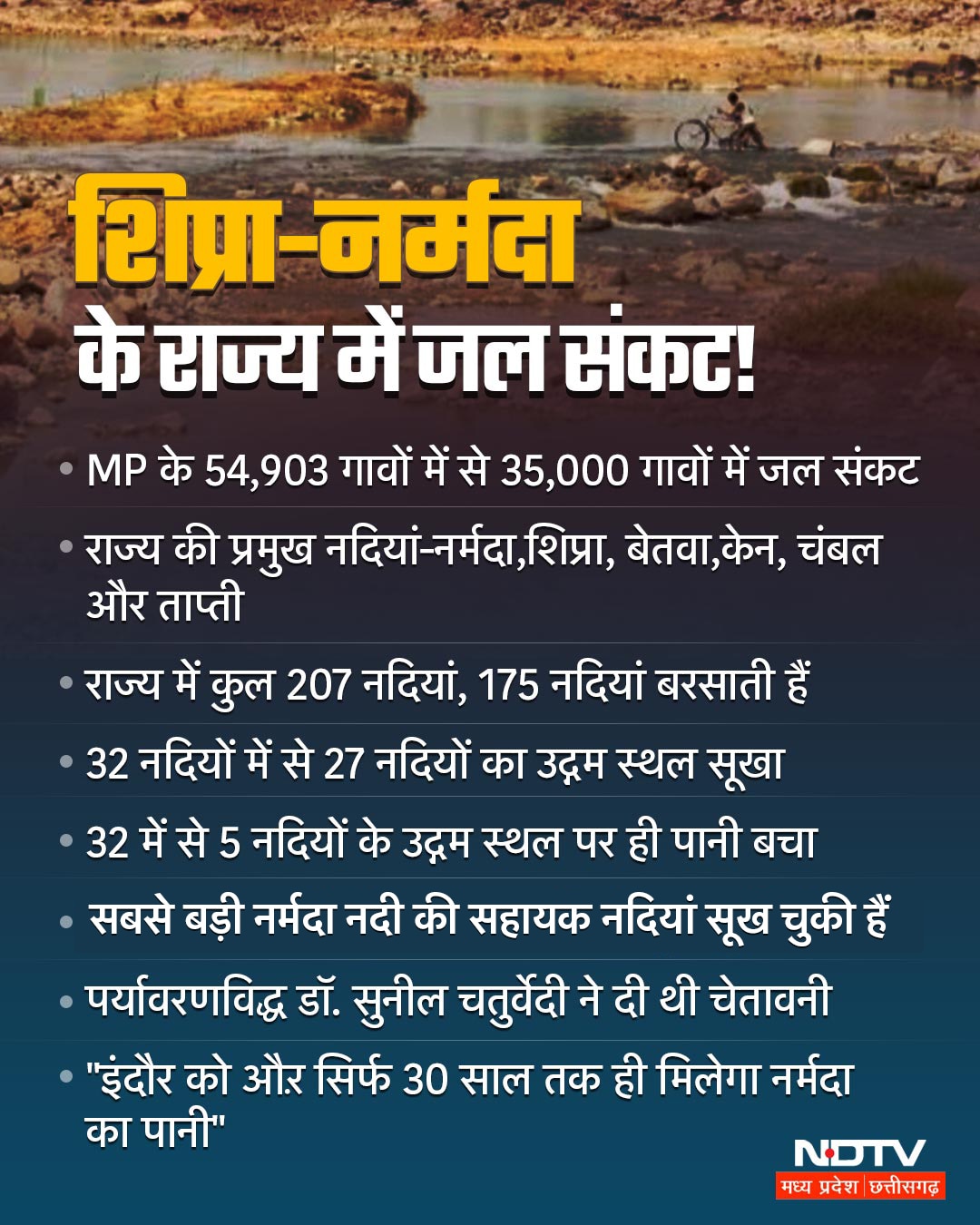
-इस संकट से निपटने के लिए केंद्र सरकार के साथ-साथ मध्यप्रदेश सरकार ने जल गंगा संवर्धन कार्यक्रम शुरू किया है. जिसका उद्देश्य नदियों, तालाबों और अन्य जलस्रोतों के संरक्षण और पुनर्जीवन की दिशा में ठोस कदम उठाना है. गंजबासौदा में आयोजित एक ऐसे ही कार्यक्रम में प्रदेश के ग्रामीण विकास एवं श्रम मंत्री प्रहलाद पटेल ने कहा- प्रदेश की अधिकांश नदियाँ अब सूखने की कगार पर हैं। उन्होंने पारासरी नदी का उदाहरण देते हुए बताया कि यह नदी अब पूरी तरह से समाप्त हो चुकी है, और इसके पीछे इंसानी लालच, अतिक्रमण और अवैध उत्खनन प्रमुख कारण हैं. https://mpcg.ndtv.in/madhya-pradesh-news/out-of-32-major-rivers-of-madhya-pradesh-the-origin-of-27-rivers-is-dry-the-risk-of-water-crisis-increased-8196375 (18 April 2025)
Haryana Plans to channel Sutlej River water into Saraswati In a recent virtual meeting, HSHDB vice-chairman Dhuman Singh Kirmach discussed the project with Sultan Singh, director of Haryana Space Applications Centre (HSAC), and P Dorje Gyamba, deputy director of the Central Water Commission. Providing details of the meeting, Dhuman Singh said that both officials have extensive experience working with river systems in HP. As per the plan, water from the Sutlej could be channelled through Solan or Bilaspur (both of HP) i.e. via Matr Ki Khol (a tributary to Somb River) from Solan to Nahan or via the Tons River after Shimla to feed the Saraswati River.
Dhuman Singh also mentioned that the waters of the Indus, Jhelum, Chenab, Ravi, Beas and Sutlej rivers could potentially be distributed into rivers in Haryana, Punjab, and Rajasthan. In Haryana, the Tons River near Nahan, in the Shivalik hills, could also be utilized for this project. HSHDB is developing a comprehensive plan around Adi Badri (Yamunanagar district), the origin point of the Saraswati River and will soon present the project proposal to CM Nayab Singh Saini.
Notably, at this moment, construction of a dam and a barrage at Adi Badri is progressing rapidly, aimed at ensuring a year-round flow of water in the Saraswati River. HSHDB is also preparing to harness catchment waters from the Shivalik range in HP, especially rivers coming from Bilaspur (HP). Under its persistent efforts, over the past three years, the HSHDB has succeeded in enabling water flow along nearly 400 km of the Saraswati riverbed during the monsoon season, completing the first phase of river rejuvenation. Additionally, a major lake project is already underway across 350 acres near Chhalor village in Bilaspur (Haryana).” To further the project, Dhuman Singh will participate in a key meeting on April 28 at the Birla Remote Sensing Technology Centre in Jaipur with ISRO and remote sensing officials. https://timesofindia.indiatimes.com/india/saraswati-board-plans-to-channel-sutlej-river-water-into-saraswati-collaboration-with-haryana-space-center-and-central-water-commission-underway/articleshow/120672824.cms (27 April 2025)
GANGA NGT Notice to Uttarakhand, Jharkhand over untreated sewage polluting Ganga This is particularly important because the Jal Shakti ministry had informed Lok Sabha in March that faecal coliform levels met the bathing quality criteria in the entire stretch of Ganga in Uttarakhand and Jharkhand and certain stretches of UP, Bihar and West Bengal. Further, the ministry had informed that as per CPCB report on the Polluted River Stretches (PRS) on river Ganga, Uttarakhand and Jharkhand do not fall under polluted stretches.
-“On the perusal of the status report filed by the DM, Ramgarh, we find that in Nagar Parishad Ramgarh, the sewage generation is 17880 KLD, but no STP exists and status of sewage-line has also not been disclosed. Meaning thereby the entire untreated sewage directly or indirectly is flowing to the River Ganga. Almost same is the status in respect of districts Bokaro, Sahebgunj and Dhanbad,” the NGT order dated April 16 said. https://www.hindustantimes.com/india-news/ngt-notice-to-uttarakhand-jharkhand-over-untreated-sewage-polluting-ganga-101745420475729.html (23 April 2025)
YAMUNA Delhi Plan to tap Ganga water to clean Yamuna The proposal was discussed last week during a high-level meeting involving Delhi Chief Secretary Dharmendra, Union Home Minister Amit Shah, and PM Narendra Modi. A combined meeting chaired by Mr. Modi and attended by Mr. Shah, Delhi CM Rekha Gupta, and top officials further advanced the discussions. “After the PM’s meeting, the plan is now at an advanced stage. Finer details are being worked out, and Uttar Pradesh is also part of the discussions,” said a senior government official.
-The current proposal involves diverting about 380 MGD of additional water from the UGC, the largest Ganga canal, flowing through western Uttar Pradesh, into the Yamuna. “U.P. won’t lose out, as most of this extra water will flow back into the State through the Yamuna, which lies downstream of Delhi,” the official added. The Centre is also considering giving U.P. additional funds for its irrigation as compensation for any potential impact. “The exact details, such as the volume of water and diversion points, will be finalised in the agreement with U.P. It will take more time, but it is looking positive,” said another source.
-Since the UGC does not cross Delhi or directly connect to the Yamuna, the plan involves channelling water from the UGC into the Eastern Yamuna Canal (EYC), which also flows through U.P. From there, it would be diverted into the Yamuna via existing infrastructure. “There are existing channels that can carry the water to the Yamuna. Only minor works may be needed, and those won’t take long,” the official said.
-Though other water sources were initially considered, the UGC emerged as the most feasible option due to its higher water availability. According to the sources, the government aims to rely solely on existing infrastructure to avoid delays associated with new construction, such as seeking approvals, issuing tenders, and building, which could take two to three years. Ganga water diversion is seen as an interim measure. The long-term solution lies in constructing three dams in the upper reaches of the Yamuna. “Once these dams are completed, excess water during monsoon can be stored and released during lean season to maintain the required river flow,” the official said. https://www.thehindu.com/news/cities/Delhi/plan-in-motion-to-tap-ganga-water-to-clean-yamuna-in-delhi/article69492288.ece (26 April 2025)
River dredging to be undertaken after over a decade The project, which is expected to cost ₹25.79 crore and take around two months, will involve selecting an agency to remove accumulated silt, weeds and shoal. A senior DJB official said the exercise will entail removing around 363,000 cubic metres of silt.
-“The pondage area has not been cleared for more than a decade and its capacity has almost halved. Currently, it is only able to hold around 100 million gallons of water per day and once the project is complete, its capacity will be between 200-250 million gallons a day (mgd). We estimate that there is an average of 2.15 metres of siltation in the riverbed,” the official said.
-According to a DJB report, the work of desilting the Yamuna at Wazirabad was last undertaken in 2013, and that was done on a smaller scale. It was, however, stopped by the NGT over sand mining concerns. In 2015, the tribunal permitted the work, noting that “dredging needs to be carried out in public interest and to maintain the flow of the river”. NGT also directed the contractor concerned to pay ₹500 per cubic metre of sand, and said the same will be used for environmental restoration. https://www.hindustantimes.com/cities/delhi-news/dredging-of-yamuna-in-delhi-to-be-undertaken-after-over-a-decade-101745346387424.html (23 April 2025)
Govt’s 3-Point River Rescue Strategy CM Rekha Gupta recently presented an elaborate plan on rejuvenating the Yamuna and creating a riverfront to PM Modi. The report laid out a three-fold strategy focused on the river’s revival, removal of encroachments along the floodplain and beautification of the riverfront, sources in Delhi govt said.
Among the interventions proposed are 100% sewage treatment, tapping of all 22 drains falling into the Yamuna and laying a sewerage network in the city’s 1,799 unauthorised colonies and 639 JJ clusters. Sewer lines have been laid in 1,224 colonies, work is in progress in 159, leaving 287 colonies where sewer pipes have to be laid and treatment plants erected. In another 129 colonies, a no-objection certificate is awaited for such work or the colony falls in the eco-sensitive O zone. Officials disclosed that the deadline for all this work is Dec 2026. CETPs will manage industrial effluents, an official said. Gupta presented the report at a meeting chaired by Modi on April 17.
Delhi govt plans to construct a new STP at Delhi Gate and 40 new decentralised STPs besides upgrading the existing plants. DDA is also tasked with removing construction waste and debris from the floodplain. “In case of non-compliance by agencies such as DMRC, PWD, NCRTC and MCD which dump the waste, DDA will clean up the area at the cost of the defaulters,” said the official. https://timesofindia.indiatimes.com/city/delhi/delhis-3-point-river-rescue-strategy/articleshow/120593393.cms (24 April 2025) The Delhi govt has decided to launch the “Maa Yamuna Swachhta Abhiyan” across schools in the national capital with CM Rekha Gupta saying it was aimed at increasing sensitivity towards the need to revive the holy river. https://indianexpress.com/article/education/yamuna-cleanliness-awareness-campaign-to-be-launched-in-delhi-schools-9968089/ (27 April 2025)
यमुना नागरिक परिषद (सिटीज़न कौंसिल फॉर यमुना) यमुना की सफाई व आसपास के क्षेत्र का सौंदर्यीकरण कर पाने में विफल रहने पर सम्बंधित विभागों के अधिकारियों को शीघ्र ही कारण बताओ नोटिस (शो कॉज नोटिस) भेजेगी। साथ ही इस कार्य में देरी और लापरवाही करने के लिए संबंधित विभागों के अधिकारियों के ख़िलाफ़ कड़ी कार्रवाई करने की माँग करेगी। यह फैसला शनिवार (April 26) को यमुना नागरिक परिषद की बैठक में लिया गया। बैठक में यमुना स्वच्छ कार्य योजना के क्रियान्वयन और एनजीटी द्वारा निर्देशित विभिन्न गतिविधियों की समय-सीमा की उपलब्धियों की समीक्षा की गई। https://www.mcdlivenews.com/2025/04/blog-post_27.html (27 April 2025)
Noida NGT directs authorities not to allow illegal construction The tribunal was hearing a matter over the alleged “major changes” in violation of the environmental norms by Jaypee Infratech Ltd in Jaypee Wishtown, a township in Noida. The plea alleged illegal construction was being carried out in the green area of the township. In an order dated April 21, a bench of NGT Chairperson Justice Prakash Shrivastava noted constructions could not be allowed as the area of the township was located in the Yamuna river bed and was a green area as part of the Okhla Bird Sanctuary.
“In spite of the repeated opportunity, neither response has been filed by respondent 2 (NOIDA) nor by the respondent 3 or project proponent (Jaypee Infratech Ltd). Construction on the flood plain of the river Yamuna or in violation of any environmental norms cannot be allowed to continue,” said the bench. The authorities concerned were then directed to ensure no illegal construction was carried out by the realtor on the flood plain zone of Yamuna in violation of the River Ganga (Rejuvenation, Protection and Management) Authorities Order, 2016. The bench also barred construction by Jaypee in violation of the environmental norms till the next hearing on August 21. https://theprint.in/india/ngt-directs-authorities-not-to-allow-illegal-construction-in-noida/2602549/ (24 April 2025) https://hindi.downtoearth.org.in/river/construction-should-not-be-done-in-yamuna-flood-area-ignoring-environmental-rules-ngt (25 April 2025)
Authority’s 2nd expressway along Yamuna to be 6-lane elevated road The second expressway between Noida and Greater Noida is to be a six-lane elevated road between Okhla barrage near Kalindi Kunj and Yamuna Expressway via the Hindon-Yamuna doab. UP govt has now directed Uttar Pradesh Expressways Industrial Development Authority (UPEIDA) to execute the riverside bypass.
Noida Authority was earlier considering 2 proposed alignments—an 8-lane ground-level road or a six-lane elevated corridor—for the road that will offer direct connectivity to commuters travelling from Delhi and Faridabad to the Noida International Airport, which will start operation this year.
-Officials said extensive illegal constructions and farmhouses on the Yamuna floodplains made an elevated road more feasible. A ground-level road, they claimed, would not only face regulatory hurdles but also encourage further encroachments in a flood-prone area. The revised alignment now proposes to connect Sector 168 and a 75-metre-wide road between Sectors 149A and 150. Officials said some design tweaks are expected in the final draft plan.
Noida Authority is also planning a cloverleaf interchange near the Mahamaya Flyover to connect the under-construction Chilla Elevated Road with the new expressway. The design, similar to the one near AIIMS in Delhi, will ensure smooth traffic transitions between the 2 corridors.
-The 5.9-km-long Chilla Elevated Road is also a six-lane road aimed at easing congestion at Noida’s entry point. Once operational, it will provide direct access to the Noida Expressway for vehicles from Mayur Vihar and East Delhi. When connected with the new elevated corridor, the combined network will enable uninterrupted travel between Delhi, Haryana, and cities like Agra and Lucknow via the Yamuna and Lucknow expressways. https://timesofindia.indiatimes.com/city/noida/noidas-second-expressway-along-yamuna-to-be-six-lane-elevated-road/articleshowprint/120562107.cms (24 April 2025)
Prayagraj Initial survey begins for six-lane bridge over Yamuna The bridge is proposed to connect Madouka in Naini to Karelabagh (near the Kareli area of the city) and promises to ease traffic congestion and boost regional development. The proposal for the bridge was passed during a cabinet meeting chaired by Uttar Pradesh chief minister Yogi Adityanath on January 22. The meeting approved the construction of two new bridges—one, a six-lane bridge across the Yamuna from Madouka to Karelabagh, and the other, a four-lane bridge over the Ganga from Salori to Hetapatti. Authorities have started the initial survey work for both the proposed projects. Last month, the initial survey was done for the bridge over the Ganga, and now preparations for the Yamuna bridge have already taken a concrete shape. https://timesofindia.indiatimes.com/city/allahabad/initial-survey-begins-for-six-lane-bridge-over-yamuna-river-in-prayagraj-/articleshow/120154511.cms (10 April 2025)
FISH, FISHERIES, FISHERFOLKS
Study India’s fishery sector loses $2.2 bn annually due to water pollution India’s fishery sector loses over $2 billion due to untreated wastewater contaminating waterways, according to a study published on Wednesday (April 23). Launched at the World Ocean Summit in Japan by ocean health initiative Back to Blue and the Ocean Sewage Alliance, the study highlights the high cost of inaction in wastewater management in Brazil, India, Kenya, the Philippines and the United Kingdom. Since India is a major seafood supplier, this threatens both domestic food security and export markets. Also, among the countries studied, India incurs the highest healthcare costs from diarrhoea linked to contaminated drinking water. With a wastewater treatment rate of just 21 per cent, nearly three times as many people are affected, resulting in annual costs of $246 million.
India experiences lower proportional losses due to lower soil salinity but still suffers the highest absolute revenue loss ($1.2 billion), the study says. Around 10 per cent of agricultural land in developing countries is irrigated with raw or partially treated wastewater, which often contains toxic heavy metals like zinc, chromium, manganese and iron. While wastewater nutrients such as nitrogen and phosphorus can initially boost crop yields, long-term use leads to soil salinisation and reduced yields.
Policymakers who look beyond infrastructure investment and focus on circularity can ensure wastewater is repurposed as organic fertiliser, biogas or even a source of renewable energy, Wenger added. Like much of the developing world, India views wastewater pollution partly through the lens of water scarcity. Asserting that expanding treatment capacity is key, Nitin Bassi, senior programme lead for sustainable water at the CEEW said, “We need to improve both water quality and the usable quantity of water. If more wastewater can be captured, treated, and reused, it will reduce the pressure on our freshwater resources. https://www.business-standard.com/industry/news/india-s-fishery-sector-loses-2-2-bn-annually-due-to-water-pollution-study-125031200159_1.html (12 March 2025)
Report Centre engages fishermen to combat pollution In a bid to combat escalating plastic pollution in the Ganga, a government-funded study has proposed a “cash-for-nets” scheme aimed at incentivising fishers to return worn-out or abandoned fishing nets. These abandoned, lost or discarded synthetic nets — referred to as “ghost gear” — pose a severe, long-term threat to aquatic ecosystems. https://www.dailypioneer.com/2025/india/centre-engages-fishermen-to-combat-pollution-in-ganga.html (20 April 2025)
Harnessing reservoir fisheries India is the second-largest fish-producing country in the world. It is, in addition, now also the second-largest nation globally in aquaculture production. The country has witnessed a 92 per cent increase in the national fish production since 2013-14, which stands at a record 184 lakh tons in 2023-24. Interestingly, 75 per cent of our fish production comes from inland fisheries that include freshwater, brackish and saline resources. Reservoirs, spread over an area of more than 31.50 lakh hectares, are a major source of freshwater fisheries and aquaculture. The fish production from these water bodies is approximately 18 lakh tons. While Madhya Pradesh has the maximum area under reservoirs (approximately 6 lakh hectares), Tamil Nadu has the highest number, with over 8,000 reservoirs. For purposes of fisheries management, reservoirs are categorised as small (less than 1000 hectares), medium (up to 5,000 hectares) and large (more than 5,000 hectares).
– A key factor in the rise of the country’s fish production is the increase in fish productivity in reservoirs to 100 kg per hectare compared to 50 kg per hectare in 2006. This has been made possible by the application of cage culture technology with sufficient stocking of quality seed backed by requisite budgetary support under flagship programmes such as Blue Revolution (BR) and the Pradhan Mantri Matsya Sampada Yojana (PMMSY). While the Indian Major Carps (Catla, Rohu, Mrigal) form the core species for stocking, need-based stocking of additional species (Tilapia, Pangasius, etc) in consultation with beneficiaries is provided in the above programmes. These reservoir cages, floating or stationary, are typically made of synthetic netting or mesh with a frame or structure for support. The mesh allows for natural water flow, ensuring oxygen and nutrient exchange with the surrounding environment. Additionally, these cages are anchored to the bottom or suspended from buoys to maintain their position and depth. https://www.millenniumpost.in/opinion/harnessing-reservoir-fisheries-606967 (17 April 2025)
Meghalaya EKH bans chemical fishing in Rynsha, Lawmei rivers The District Magistrate of East Khasi Hills, Meghalaya, has issued a prohibition order against illegal fishing practices that threaten local river ecosystems. The order, enacted on April 24 under Section 163 BNSS, specifically targets the use of poisonous chemicals and explosive substances in the Rynsha and Lawmei rivers near Lawmei village.
Officials took action following reports of widespread fish kills caused by hazardous fishing methods. According to the order, “miscreants are rampantly killing fishes along Wah Rynsha, Lawmei River, Lawmei village and the adjoining areas through haphazard use of chemicals and explosive substances.”
Prohibited materials include bleaching powder, ammonium-sulphate, pesticides, and dynamite. The use of certain fishing nets has also been banned. Authorities noted these methods “can cause irreversible damage to the river and endanger the aquatic lives therein unless prevented.” https://www.indiatodayne.in/meghalaya/story/meghalayas-east-khasi-hills-bans-chemical-fishing-in-rynsha-lawmei-rivers-1204208-2025-04-25 (25 April 2025)
Jammu & Kashmir Native fish disappear with changing climate One main anthropogenic factor affecting Nallah-e-Mawer is illegal sand mining from the river for two decades, which continues even now with hand tools. This activity disrupts the natural migratory path of fish that move from lower to the upper stretches of the stream. “Fish rely on biological and chemical habitats for survival, and their migration is possible only when there is an adequate water supply,” said Aatif Qayoom, a prominent environmental journalist in Kupwara.
But it’s climate change that has so far had the most insidious effect on the native fish population. “Reduced glacier influx, rising temperatures, erratic precipitation, and altered hydrological cycles have affected Schizothoracinae fish species in Nallah-e-Mawer. While kashir gaad and other native fish varieties have shown a decline in numbers over the last decades due to the change in water levels, water quality and food availability, exotic varieties like carps (major carps catla, rohu and mrigal, and minor carps grass carp, silver carp and common carp) have outnumbered the indigenous ones as the changing environment favours them, Bhat added. https://101reporters.com/article/environment/In_a_corner_of_Kupwara_native_fish_disappear_with_the_changing_climate (22 April 2025)
Western Ghats 2 new fish species discovered Researchers at the Centre for Peninsular Aquatic Genetic Resources, Kochi, of the National Bureau of Fish Genetic Resources claimed to have discovered two new species of freshwater fish from the Western Ghats — Labeo uru and Labeo chekida, resolving the taxonomic identity of Labeo nigrescens, a species first described in 1870 but shrouded in confusion for over a century.
-The team led by V.S. Basheer used morphological analysis with historical specimens and fresh samples from Kerala and Karnataka rivers to clarify identities. Labeo uru, named after the traditional wooden dhow for its sail-like elongated fins, was found in the Chandragiri river, said a press release on Wednesday (April 23). The team had researchers R.G. Kumar and R. Charan as its members. https://www.thehindu.com/news/cities/Kochi/two-new-fish-species-discovered-in-western-ghats-resolving-155-year-old-taxonomic-puzzle/article69482931.ece (23 April 2025)
Uttarakhand 2 new catfish species discovered in Ganges River The two new species were uncovered while examining specimens after a routine biodiversity survey conducted by researchers, V. Balaji and Gaurav Shinde. One species has been named Glyptothorax bhurainu, from the Garhwali word bhurainu, in reference to the brown live colouration of this species, and the other has been named Glyptothorax himalaicus, in reference to the mighty Himalayan mountains.
A third species, Glyptothorax dakpathari, originally described from the Dakpathar Barrage near Dehradun in 1976, has also been redescribed in this study after being found to be a valid species. The researchers speculate that these species may have remained undetected for so long due to their cryptic colouration and elusive habitat preferences, dwelling primarily under rocks and pebbles in swiftly flowing hill streams.
The two researchers already have a series of additional research papers on the way to further illuminate the biodiversity of the Ganges river and Uttarakhand state in particular. What makes this discovery even more remarkable is the timing, as it has been almost fifty years since a new species of Glyptothorax was discovered in this iconic river. Both researchers were emphatic about the critical role of the local community in protecting native fish species, particularly since their lives have been intertwined with the mighty Ganges for centuries. https://www.mid-day.com/news/india-news/article/two-new-catfish-species-discovered-in-ganges-river-23510125 (21 March 2025)
Maharashtra 12 lakh fishermen likely to get ‘farmer’ status The Maharashtra government is working on a policy to grant “farmer” status to 12 lakh fishermen across the state. According to sources within the fisheries department, the draft policy is in the final phase of administrative approval. Once it receives the green signal from the finance department and the chief minister’s office (CMO), it will be tabled before the state cabinet for final approval, likely within the coming week. If approved, Mah will be the fist state to implement this measure. https://www.cnbctv18.com/india/maharashtra-to-cast-welfare-net-wider-as-12-lakh-fishermen-likely-to-get-farmer-status-19590157.htm (17 April 2025)
SAND MINING
Tamil Nadu Failed by the judiciary The killing of Jagabar Ali in January this year by members of Tamil Nadu’s mining mafia may have added another dark chapter to the ongoing battle against illegal mining in the State, but activists are equally worried over the fact that neither the government nor the judiciary has been able to stem the rot. The judiciary, for its part, has largely confined itself to issuing directions without ensuring their implementation. No suo motu PIL petitions have been initiated by the High Court Legal Services Authority, nor have any Special Benches been constituted to address the issue.
In Ali’s case, the High Court’s ineffectiveness was evident: the quarries remained open despite the court’s order dated September 5, 2023, directing the Collector to inspect and close the unlicensed ones. And Ali was killed despite his petitions to the police seeking protection. The High Court too failed to order police protection despite his representations since June 2024. In a similar case, R. Jeganathan from Karur, who persistently fought for the closure of illegal quarries, was run over by a lorry in September 2022. In this case too, the High Court was reluctant to provide protection to the witnesses and transfer the trial to another district, even after the activist’s death.
For many environmental activists battling a corrupt administrative machinery, the court remains a lone ray of hope. But the judiciary’s tentative interventions so far have only emboldened the mafias. It must act strongly before we lose many more Alis. (Henri Tiphagne and Edgar Kaiser are lawyers at People’s Watch, Madurai, assisting activists legally at the Madurai Bench of Madras High Court.) https://frontline.thehindu.com/environment/tamil-nadu-mining-mafia-activist-murders-judicial-inaction/article69460140.ece (23 April 2025)
Jharkhand Illegal sand mining exposes bridge foundations The Khunti administration on Wednesday seized illegal sand measuring 2.5 lakh cubic feet, valued at approximately Rs 18 lakh, from the banks of Koel river under Rania police station limits, officials said on Thursday. During the inspection, officials also discovered that a bridge over the Chhata river in Torpa police station area had its foundation exposed due to illegal sand mining activities.
Sub-divisional officer (SDO) Deepesh Kumari, who led the district administration team, discovered the illegal sand dump during a routine checking drive. “Legal action will be taken against all involved parties,” said Kumari. She further said that the bridge over Chhata river in Torpa area faces potential collapse due to unauthorized sand mining near its support structures. The administration’s crackdown on illegal sand mining continues as part of its efforts to prevent environmental damage and protect public infrastructure from mining-related hazards. Notably, opposition parties raised the issue of illegal sand mining in the recent budget session and demanded state govt action. https://timesofindia.indiatimes.com/city/ranchi/in-khunti-illegal-sand-mining-exposes-bridge-foundations/articleshow/120593962.cms (24 April 2025)
West Bengal Sand walls in Subarnarekha river for illegal mining The issue pertains to allegations that leaseholders from West Bengal have erected 15 sand walls in the Subarnarekha river, altering the course of the water and directing it towards habitations in Gopalpur, Rajanagar and other adjoining villages under Jaleswar tehsil in Odisha’s Balasore district. https://www.downtoearth.org.in/environment/daily-court-digest-major-environment-orders-april-22-2025 (23 April 2025)
Jammu & Kashmir Final Days of Lithium Village 2025 In this documentary by Rohit Upadhyay, the Salal-Haimana villagers in Reasi district voice concerns over possible displacement for Lithium mining project in addition to environmental threats. The villagers have already faced displacement for Salal dam project on Chenab river during 1980s. https://www.youtube.com/watch (12 April 2025)
Uttar Pradesh उत्तर प्रदेश के कैराना में एक दर्दनाक घटना सामने आई है। नगलाराई गांव के पांच भाई-बहन यमुना नदी पार करते समय डूब गए। ग्रामीणों ने चार को बचा लिया, लेकिन 14 वर्षीय सादमा अभी भी लापता है। घटना रविवार (April 20) शाम 4 से 5 बजे के बीच की है। हाशिम के पांचों बच्चे – जावेद (20), फारूक (25), परवीन (16), माईला (17) और सादमा (14) यमुना पार अपनी खरबूजे और तरबूज की प्लेज की देखभाल के लिए जा रहे थे। नदी में पानी सिर्फ 3 फीट था, लेकिन अवैध रेत खनन के कारण बने गहरे गड्ढों में वे फंस गए। https://www.bhaskar.com/local/uttar-pradesh/shamli/news/5-siblings-drowned-in-yamuna-in-shamli-134878686.html (21 April 2025) ग्रामीणाें ने बताया कि 10 महीने पहले पानीपत निवासी तीन दोस्तों प्रिंस, विकास और शिवा की भी यमुना में डूबने से मौत हुई गई थी। इसके बाद भी कोई कार्रवाई नहीं हुई। https://www.amarujala.com/uttar-pradesh/shamli/five-siblings-drowned-in-yamuna-four-were-rescued-shamli-news-c-26-1-sal1002-140593-2025-04-21 (21 April 2025)
“बुंदेलखंड के पहाड़ों पर खनन कारोबार की विनाशलीला ढाई दशक पुरानी कारगुजारियों का फलसफा है। विंध्याचल पट्टी क्षेत्र वीर महोबा के लगभग 300 पहाड़ों को खनन माफिया खत्म कर चुके है। यहां का कारोबार मध्यप्रदेश के छतरपुर क्षेत्र मे सिमट गया है। लेकिन चित्रकूट मंडल के बाँदा का गिरवां क्षेत्र भी पहाड़ों की वीरानी का गवाह बनता जा रहा है। वहीं चित्रकूट मे भरतकूप का गोंडा तो अक्सर ही अवैध खनन की विभीषिका झेलता है।” (आशीष सागर दीक्षित, बाँदा) https://soochanasansar.in/illegal-mining-spread-from-the-black-stone-grenait-of-district-banda-rural-village-jarar-in-girwan-and-bharatkup-chitrakoot-village-gonda-stone-mininig-of-bundelakhnd-region/ (28 April 2025)
WETLANDS, LAKES, WATER BODIES
Maharashtra Wetlands to be declared as eco-tourism destinations soon The govt has begun the process to declare at least one wetland in each district along the Konkan coastline as eco-tourism destinations. Konkan commissioner Jagdish Patil directed collectors from Mumbai Suburban Palghar, Thane and Raigad to survey and select one wetland site each earlier this month. The collectors need to submit the location during the next meeting of the wetland grievance redressal committee (constituted by the Bombay high court (HC) in August 2016) later this month. After preliminary discussions, proposals for each location will be submitted and identified as eco-tourism zones. https://www.hindustantimes.com/mumbai-news/wetlands-along-maharashtra-s-konkan-coast-to-be-declared-as-eco-tourism-destinations-soon/story-HreRH82LSAo2Ebq5p80KxK.html (09 June 2025)
Jammu & Kashmir Converting weeds into organic fertilizer Maninder Singh is the founder of Clean ‘Effen’ Tech (CET), a local-government partner company that harvests thousands of tons of those lake weeds every year, dries and enriches them, then grinds them into fertilizer to sell to local farmers. Maninder was first inspired to find a solution for clearing the Dal lake weed when visiting Kashmir for his first wedding anniversary. Having already launched an IT startup in his native Uttar Pradesh, Singh would eventually change his focus to creating a social enterprise to tackle the challenges of our age.
-“Our project is designed to process up to 70,000 [metric] tonnes of lake weed each year, which yields between 20,000 to 22,000 tonnes of organic manure. This large-scale effort is expected to lead to an annual reduction of around 50,000 tonnes of CO2 emissions,” Singh tells The Better India. “We have made an impact by enriching over 4,400 acres of land, improving soil health, and supporting sustainable agriculture practices.”
-The lake weed is dried, shredded, enriched, and pulverized before being sold for 25% less than chemical fertilizers imported from other states like UP and Haryana, saving more emissions from transportation. Local farmers have benefited from the cost savings and from the lack of soil amending. Harvests are up, as are soil nutrient concentrations. Also in an economic sense, the local tourism industry will no doubt benefit from the 14,800 metric tons of lake weed pulled in by Singh’s partners last year, not least because during the hotter summer months the mounds of weeds decay and putrefy the air.
-Looking to the future, Singh aims to replicate this success in other Indian lakes—starting in the states of Odisha and Rajasthan. Anywhere there’s a beautiful freshwater body overrun with aquatic plants, Singh hopes to see some Clean ‘Effen’ Tech brought in to clean it the eff up. https://www.goodnewsnetwork.org/man-revives-iconic-indian-lake-by-converting-lake-weed-infestation-into-organic-fertilizer-business/ (23 April 2025)
Study Wetland bacteria could make more methane in warming world Warming temperatures may cause methane emissions from wetlands to rise — by helping methane-producing bacteria thrive. Higher temperatures favor the activity of wetland soil microbes that produce the potent greenhouse gas, at the expense of other microbes that can consume it, researchers report April 23 in Science Advances. https://www.sciencenews.org/article/wetlands-bacteria-make-more-methane (23 April 2025)
WATER OPTIONS
Goa ASI Goa to restore Aguada fort’s underground water tank “Aguada fort is famous for underground water storage where several thousands of gallons of water were stored. The ASI will take up the work to restore the tank,” superintending archaeologist holding additional charge of ASI Goa circle Abhijit Ambekar told TOI. nce restored, the tank is expected to offer insights into the lesser-known utilitarian aspects of Goa’s heritage architecture to tourists and scholars, showcasing how water management was integrated into military fortification 400 years ago.
Perched strategically on the edge of the Mandovi where it meets the Arabian Sea, the 17th-century fort is believed to have been constructed in 1612 CE. The fort derives its name from the Portuguese word ‘agua’, meaning water. Maritime Heritage of India, penned by the Indian Navy, mentions that “the fort was named Aguada because of the abundant springs around it”. These natural springs were therefore central to the fort’s location, for the underground chambers were engineered to store thousands of gallons of freshwater for Portuguese ships navigating the high seas. Vessels, often on long voyages across the Indian Ocean, would anchor at Aguada to replenish their dwindling water supplies, making the fort a vital watering station for maritime trade and military operations. https://timesofindia.indiatimes.com/city/goa/asi-goa-to-restore-aguada-forts-underground-water-tank/articleshow/120461856.cms (21 April 2025)
Haryana Build check dams in hilly forest areas: CM The CM Nayab Singh Saini on Saturday (April 26) directed forest department officials to build as many check dams as possible in the hilly forest areas so that water can be conserved during monsoon and the groundwater level can be maintained. He also told officials not to compromise with quality at any cost during the construction of check dams and directed them to assess the current condition of all the old check dams and repair them, according to an official statement.
While reviewing the projects of various departments, including the Home, Revenue, Environment, Forest and Wildlife and Transport, related to ‘CM Announcements’, he instructed officials to complete them within the stipulated period. He also said that if there is a delay in completing the work due to any valid reason, then the officer must write the “reason for delay” on the file. https://theprint.in/india/haryana-cm-asks-officials-to-build-check-dams-in-hilly-forest-areas-to-conserve-water-in-monsoon/2605362/ (26 April 2025)
Report Advances in tin water pollution treatment Researchers in India have designed an iron doped tin (IV) oxide photocatalyst supported on chitosan to remove pollution in water systems. Chitosan, which can be derived from crab shells is a sustainable catalyst for wastewater treatment. The catalyst is able to remove 99.8% of rose bengal dye from water even at a low dosage.
Additionally, researchers have also trialed using tin-doped copper ferrite (Sn-CuFe2O4) nanoparticles successfully for the same purpose. Commercially, Californian-based water treatment company AMS are using tin oxide generated on site electrolytically to reduce 99% of bacteria in wastewater even at a low dosage. These innovations highlight the growing potential of tin in wastewater treatment, providing efficient, sustainable solutions for pollution control. https://www.internationaltin.org/researchers-make-significant-advances-in-tin-water-pollution-treatment/ (03 April 2025)
GROUNDWATER
Punjab Plea challenges early paddy transplantation dates Social and rights activist Hari Chand Arora has filed a petition with the NGT seeking directions against the Punjab govt’s decision to advance the paddy transplantation date from June 15 to June 1. Arora argued that this change would have detrimental effects, particularly in over-exploited, semi-critical, and critical blocks, as it would impede the state’s efforts to conserve sub-soil water. https://timesofindia.indiatimes.com/city/chandigarh/petition-in-ngt-challenges-early-paddy-transplantation-dates-in-punjab/articleshowprint/120529479.cms (23 April 2025)
Farm unions too oppose early paddy sowing It’s not just agriculture experts, environment crusaders or agro-economists in Punjab who are opposing the Punjab Govt move to advance the date of paddy transplantation. Many farmer unions, too, have often opposed this, raising concerns about the fast-depleting groundwater in the state. https://www.tribuneindia.com/news/punjab/farm-unions-too-oppose-early-paddy-sowing/ (23 April 2025)
Govt issues notification for early paddy transplantation Despite opposition from agricultural scientists and petition filed in the NGT, the govt has issued a notification advancing the paddy transplantation schedule. The transplantation will now begin in a staggered manner from June 1, while direct seeding of rice (DSR) is permitted across the state from May 15 to May 31. Former agriculture secretary Kahan Singh Pannu stated that despite the scientific advice, the govt’s insistence on early transplantation is a “painful” step that could hasten Punjab’s march toward desertification. https://timesofindia.indiatimes.com/city/chandigarh/punjab-issues-notification-for-early-paddy-transplantation/articleshowprint/120561837.cms (24 April 2025)
Opinion Groundwater crisis needs more than just wells While government schemes like the Jal Jeevan Mission (JJM) and Atal Bhujal Yojana (ABY) attempt to address the issue, funding constraints and implementation delays continue to undermine progress. Only 57% of allocated funds under ABY have been released, and just 48% have been utilised as of early 2025. While technical targets such as equipment installation have exceeded expectations, only 21% progress has been made on actually reducing the rate of groundwater decline—the scheme’s core objective. The finance exists, but not the fluidity needed for results.
The financial bottlenecks are systemic. Centrally sponsored schemes like JJM and ABY follow a cofunding model, requiring states to match funds. Yet, as of February 2025, only 31% of the central share for JJM was released, primarily because states could not mobilise their share or demonstrate fund utilisation. This rigid model penalises less wealthy states and reinforces regional disparities. Moreover, implementation suffers from terrain challenges, cost overruns, and delays in statutory clearances, pushing deadlines further into the future.
A fresh financial approach is required—one that matches the complexity and urgency of India’s groundwater crisis. First, the government must expand interest-free loans to states for capital expenditure, a policy already in place but underutilised for water conservation. Second, we must explore innovative financial instruments. Third, a pricing rethink is long overdue. Free electricity for agriculture has incentivised water-intensive crops like paddy and sugarcane, worsening groundwater depletion. Finally, groundwater governance must shift from siloed programs to an integrated institutional framework.
The 2016 Mihir Shah Committee recommended merging the Central Water Commission and the Central Ground Water Board into a single National Water Commission with multidisciplinary expertise. Nearly a decade later, this remains unfulfilled. Fragmented data collection, overlapping mandates, and lack of accountability continue to plague outcomes.
Investing in groundwater today is not a luxury—it is economic common sense. Moreover, decentralised groundwater recharge projects create rural employment and reduce climate vulnerability, offering a high return on public investment. India’s groundwater story does not have to be a tragedy. With smart financing, decentralised planning, and political will, the country can reverse the decline and secure its water future. Just as India led the world in scaling up solar power through bold financial models, it can now become a leader in sustainable water governance. Groundwater may be invisible, but the urgency to act cannot remain hidden. (Souryabrata Mohapatra & Amit Mitra) https://sundayguardianlive.com/business/groundwater-crisis-needs-more-than-just-wells# (27 April 2025)
Study India’s GW extraction shifting Earth’s axis: Scientists Excessive groundwater extraction in India, over 25% of the world’s total, has thrown the planet off balance, literally shifting it from its axis, says a new study. Scientists have highlighted that excessive groundwater extraction is altering the Earth’s axis, as revealed in numerous scientific studies. When water is extracted from the ground, it disturbs the land’s mass balance. The Earth attempts to redistribute this mass to maintain balance, causing shifts.
– Research by NASA and other institutions indicates that between 1993 and 2010, the extraction of groundwater changed the Earth’s North Pole direction. Approximately 54 trillion litres of water were extracted from groundwater in India, Pakistan, Bangladesh, and China, shifting the Earth’s axis by about 78 cm towards the east. https://www.news18.com/india/indias-groundwater-extraction-is-shifting-the-earths-axis-warn-scientists-ws-dekl-9308224.html (23 April 2025)
URBAN LAKES, WETLANDS
Bengaluru City of lakes battles a deepening water crisis 85% of the 183 remaining lakes are severely polluted today, with rejuvenation efforts not yielding consistent results. Citizen-led efforts have gained traction, but scientific planning, stakeholder collaboration, and stronger governance are essential. Efforts need to consider the lakes’ function, usage, maintenance, and socio-economic relevance for the communities. https://india.mongabay.com/2025/04/the-city-of-lakes-battles-a-deepening-water-crisis/ (25 April 2025)
De-weeding operation at Madiwala Lake throws up refrigerator A Jaldost team, operating under the banner of National Aerospace Laboratories (NAL), stumbled upon the unexpected ‘catch’ while clearing overgrown water weeds. Among the other items retrieved were heaps of plastic bags, milk packets, mugs, books, pens, and even steel vessels, turning the lake into what locals call a ‘miniature junkyard’. While the Jaldost — the de-weeding machine — is adept at removing weeds and debris from water, NAL officials and residents pointed out that the responsibility of waste disposal lies with Bruhat Bengaluru Mahanagara Palike (BBMP). https://timesofindia.indiatimes.com/city/bengaluru/de-weeding-operation-at-bengalurus-madiwala-lake-throws-up-refrigerator/articleshowprint/120652381.cms (27 April 2025)
Hyderabad Dying lakes turn cooler spots into heat islands It’s set to be a particularly sweltering summer for residents of Jubilee Hills, Kapra, and the Hayathnagar–Saroornagar belt with the three emerging as the hottest pockets of Hyderabad. And while the temperatures reflect a broader climate crisis, experts attribute the heat pattern in these neighbourhoods to their “unique geography, urban planning flaws, and ecological neglect”.
-In the case of Kapra, located in the city’s north-east, it’s the disappearing water bodies. Home to one of the highest concentrations of lakes in the region— including the Kapra Lake, Banda Cheruvu, RK Puram Lake, Safilguda Lake, and several smaller tanks — it’s now all dry land. “These lakes were natural heat moderators,” said Manognya Reddy, from the Kapra Revival group that has worked extensively on preserving the water body in the Kapra region. “They absorbed heat, maintained humidity, and cooled down the surrounding air. But most of them are now either polluted, encroached, or have disappeared entirely.” She added that Kapra Lake currently holds only 20% of its earlier water capacity.

-The Hayathnagar–Saroornagar belt, located along the downstream stretch of the Musi River, though geographically vulnerable to heat spikes, has been hit further by depleting groundwater levels. These areas sit on lower-lying land, where hot air, humidity, and pollution tend to settle. “This belt is like a basin—it collects heat and holds it in. Combine that with the fact that Saroornagar has one of the worst groundwater levels. Groundwater helps to maintain the groundwater surface temperature,” said G Sailu, urban biodiversity researcher with the ministry of environment and forest. Until the end of last month, the area had water levels as low as 15 metres. https://timesofindia.indiatimes.com/city/hyderabad/hyderabads-concrete-jungle-dying-lakes-turn-cooler-spots-into-heat-islands/articleshowprint/120594208.cms (24 April 2025)
Banjara Lake neglect fuels mosquito menace, odour Banjara Lake in Hyderabad’s Banjara Hills has fallen into neglect following the closure of the Taj Banjara Hotel. The hotel was shut down earlier this year, on February 21, due to unpaid property taxes. Since then, no agency has taken over the upkeep of the lake.
-Banjara Lake was part of a Rs 4.3 crore conservation project under the National Lake Conservation Plan between 2002 and 2009. An 800-mm RCC ring drain was constructed to divert sewage from entering the lake. During the time of united Andhra Pradesh, the ministry of environment and forests noted that the Andhra Pradesh Tourism Development Corporation (APTDC), in collaboration with Taj GVK, had prepared a conservation and management plan for the Banjara lake in Hyderabad.
-For the past several years, the GHMC has been regularly maintaining the lake, ensuring that it does not become a breeding ground for mosquitoes. However, of late, GHMC apathy has caused trouble to residents of nearby areas. https://www.siasat.com/banjara-lake-neglect-fuels-mosquito-menace-odour-in-hyderabad-3211421/ (23 April 2025)
Mumbai HC questions BMC nod for construction on Goregaon wetland The Bombay high court (HC) on Apr 24 issued notices to the Brihanmumbai Municipal Corporation (BMC), the Mah Coastal Zone Management Authority (MCZMA), and the Konkan Wetland Committee over alleged illegal permission for development on a recognised wetland in Goregaon West. A division bench comprising chief justice Alok Aradhe and justice Makarand Karnik was hearing a PIL filed by environmental activist Zoru Bhathena. The PIL challenges the BMC’s 2023 approval granted to private developers for landfilling and construction on a 191.39-hectare plot in the Pahadi area, which, according to the petitioner, has been identified as a wetland since 1991 by the MCZMA.
Bhathena said the site falls under CRZ-1 (Coastal Regulation Zone), as per the Wetland Atlas prepared by the MCZMA. He alleged that developers—Beeline Impex Pvt. Ltd and Pearl CosChem Pvt. Ltd—applied in 2022 to build a compound wall and carry out landfilling work. This request was approved by the BMC the following year. The petition further claims that 39,601 square metres of landfilling was already carried out around the edge of the plot, which borders mangroves. Satellite imagery used to demarcate the high tide line confirms the area is low-lying and influenced by tidal water, Bhathena said.
The PIL states that in May 2023, the BMC altered the development plan for the same plot while allocating it for Maharashtra National Law University. The land’s designation was changed to “residential use” without altering its CRZ-1 classification. Calling the BMC’s actions illegal, Bhathena has urged the court to order restoration of the wetland and to issue a permanent stay on any further development. The court has now asked the BMC, MCZMA, and the Konkan Wetland Committee to file their responses. https://www.hindustantimes.com/cities/mumbai-news/hc-questions-bmc-nod-for-construction-on-goregaon-wetland-101745523238720.html (25 April 2025)
Conservation tag is likely for 2nd wetland The WII has proposed including the NRI wetland, alongside DPS Flamingo Lake, as a conservation reserve for aquatic birds, reports B B Nayak. Greens have expressed pleasure, noting that it is a significant development in their fight to save Navi Mumbai wetlands as part of the Thane Creek Flamingo Sanctuary management plan.
-The state forest department invited the WII to evaluate the DPS Flamingo Lake area for potential conservation reserve status for the flamingo habitat. In its assessment report on DPS Lake’s significance for flamingos in Navi Mumbai, the Institute indicated that specific water bodies in the Arabian Sea inlet outside TCFS require management for aquatic birds, particularly emphasising DPS Lake and NRI Lake for flamingos. https://timesofindia.indiatimes.com/city/mumbai/conservation-tag-likely-for-2nd-wetland-in-navi-mumbai/articleshowprint/120462668.cms (21 April 2025)
URBAN WATER
Report Top national rankings for sewage treatment in metros In March this year, the Bengaluru city was awarded ₹103 crore under the Jal Hi Amrit initiative for its effective sewage treatment. Of the 30 STPs evaluated in Bengaluru, 23 received a 5-star rating, six a 4-star rating, and one a 3-star rating. Surat, Gujarat’s Diamond City, topped the national rankings and was awarded ₹104.75 crore, with 19 out of 20 STPs rated 5 stars and one with 4 stars.
-S. Vishwanath, a Bengaluru-based water expert who advises several government and non-profit bodies, credited a 2015 NGT order for improving wastewater treatment in the city. He said around 15 MLD of treated water is also being used for power generation in Jakkur, and some of it is sent to parched districts such as Kolar and Chikkaballapur. However, Vishwanath noted that while treatment has improved, sewage collection and consistent monitoring of water quality remain areas of concern. “Once a system of treated water is in place, it can be utilised for agricultural, ecological, and industrial purposes as required,” he said.
-While MoHUA did not disclose a complete ranking of states or cities, the agency confirmed that 250+ field assessors evaluated the STPs, and ₹400 crore was disbursed as incentives in the last fiscal. The ministry also highlighted the training of over 3,400 officials and 30 capacity-building sessions. A Water Resource Recovery Cell (WRRC) has been set up at the state level for ongoing monitoring and enhancing reuse and biosolids management.
-At the state level, Gujarat emerged as the top performer with ₹164 crore, followed by Maharashtra and Karnataka. Among Gujarat’s top cities, Ahmedabad received ₹48 crore for its 16 STPs (two 5-star, nine 4-star, and five 3-star), while Jamnagar was awarded ₹11 crore.
-Mayank Mithaiwala, a Surat-based STP expert, said the current industrial reuse of treated sewage in the state is based on the 2018 state government policy aimed towards conserving fresh water resources. At present, only 1100 MLD of treated sewage out of the total 3860 MLD is currently being reused, he said, adding that the reuse holds huge potential to save fresh water equivalent to serving more than two crore people.
-Despite these successes, MoHUA has not shared a city- or state-wise ranking list, nor released other macro-level insights. On March 27, the government told the Lok Sabha that just 3,531.52 MLD—or 28%—of the 12,599.28 MLD of sewage treated under the Atal Mission for Rejuvenation and Urban Transformation (AMRUT) mission 1 and 2 was fit for reuse across India’s cities. https://www.hindustantimes.com/cities/delhi-news/froth-to-fame-bengaluru-surat-top-national-rankings-for-sewage-treatment-in-metros-101745173405362.html (21 April 2025)
Panchkula Residents dispute MC claims to NGT on Jhuriwala waste management In its report to the NGT, the corporation attached photographs taken on April 17, of Jhuriwala site, along with the present location, to claim that the site is ‘totally’ cleared and no legacy waste remains. They also said no natural flow of water has been obstructed by the corporation. Waterlogging at this point was due to the blockage of drains under the national highway, which was opened by the civic body after much effort. While opening the drains, only mud was found rather than any waste material. https://timesofindia.indiatimes.com/city/chandigarh/residents-dispute-mc-claims-to-ngt-on-jhuriwala-waste-management/articleshowprint/120561586.cms (24 April 2025)
Gurugram Residents complain about untreated sewage Deputy Commissioneron Thursday (April 24) ordered an inspection after residents of Astaire Garden in Gurugram Sector 70A complained to him that their neighbouring housing societies are continuously discharging untreated sewage water into an open vacant plot next to their society. According to administrative guidelines, the sewage is supposed to be discharged into the designated Berhampur STP.
-Residents also questioned the administrative oversight that allows builders to secure occupancy certificates (OC) despite their projects lacking proper sewage treatment infrastructure. “How are builders getting OC without a functional STP? This is a systemic failure driven by collusion between builders and officials,” Singh added. The association also expressed frustration that repeated warnings have fallen on deaf ears, and sought accountability from both authorities and developers. https://www.hindustantimes.com/cities/gurugram-news/gurugram-dc-orders-probe-after-residents-complain-about-untreated-sewage-101745520600495.html (25 April 2025)
Delhi DJB water supply hit, South Delhi residents say disruption since 2 weeks. https://indianexpress.com/article/cities/delhi/djb-water-supply-hit-south-delhi-residents-say-disruption-since-2-weeks-9967728/ (27 April 2025)
WATER POLLUTION
Punjab Black water flows from taps in Muktsar Amid rising concerns over brackish and discolored water flowing in the Sirhind Feeder canal for the past couple of days, the authorities have finally halted its use for public water supply in Malout town. The Water Supply and Sewerage Board has switched to underground water, resulting in a curtailed supply schedule for residents. Officials have now decided to supply water on alternate days. An engineer from the Board admitted that while the canal water was being treated, the foul smell and murky appearance remained a concern.
-Meanwhile, officials from the Water Supply and Sanitation Department in Muktsar town said they had already avoided storing the canal’s brackish water in local reservoirs. “Instead, we are drawing underground water from tubewells to meet daily demand,” said Shaminder Singh, Executive Engineer, Water Supply and Sanitation Department, Muktsar. However, some local residents complained about receiving severely contaminated water. Notably, the farmers have recently lodged some protests over the deteriorating quality of canal water. https://www.tribuneindia.com/news/bathinda/black-water-flows-from-taps-in-muktsars-malout-town/ (23 April 2025)
Tamil Nadu 3 dead after drinking sewage-contaminated water In a tragic incident in Tiruchirappalli district, over 30 residents have been hospitalized, and three fatalities have been reported due to drinking water contaminated with sewage. The victims include a four-year-old girl. The alarming situation has sparked public outrage, with local residents blaming municipal negligence for the disaster and demanding immediate medical assistance and accountability from officials. Preliminary investigations indicate the water contamination could have been due to sewage mixing with the drinking water supply. Residents had raised the issue repeatedly, but it was allegedly ignored by the municipal corporation. https://www.newsbytesapp.com/news/india/tn-3-dead-over-30-hospitalized-after-drinking-sewage-contaminated-water/story (20 April 2025)
JJM/ RURAL WATER SUPPLY
MoJS Govt slashes JJM budget by 46% Jal Shakti Ministry is facing a possible 46% cut in the Centre’s funding assistance against its demand for Rs 2.79 asked by the Jal Shakti Ministry for the extended phase of Jal Jeevan Mission for four years ending in December 2028. This move comes amid concerns that some states may have approved inflated work contracts for providing tap water connections to rural households under the Jal Jeevan Mission, reported The Indian Express. https://www.outlookbusiness.com/planet/industry/jal-jeevan-mission-budget-shortfall (21 April 2025)
Uttar Pradesh Water tank bursts during trial A newly constructed water tank collapsed during testing in Lakhimpur Kheri. Unable to withstand the pressure of water, the tank burst and collapsed like a house of cards. The tank was built at a cost of Rs 3.5 crores under the Jal Jeevan Mission. It burst during the trial on Apr 26. The solar panel installed in the premises also collapsed due to the debris of the tank.
DM Durga Shakti Nagpal described this incident, which indicates a clear case of corruption, as serious and assured immediate action by getting it investigated by the district-level officials. Water supply was to be provided to five nearby villages from the tank. The implementing agency Building Technical Leadership (BTL) had built a water tank in Sheikhpur village.
The construction of the 250 kilo liters tank with 14 m height started in Oct 2022. Executive Engineer of Jal Nigam YK Neeraj said that the overhead tank is made of zinc alum (an alloy of zinc and aluminium). The structure is not damaged. The liner of the outer part of the tank is torn. The water tank was not handed over, so the organisation will have to get the work done again. The tank burst will be investigated within six months, he added. https://english.jagran.com/uttar-pradesh/water-tank-built-at-rs-35-cr-under-jal-jeevan-mission-bursts-like-balloon-during-trial-in-ups-lakhimpur-sp-mp-flags-corruption-video-10233189 (26 Apr 2025)
Maharashtra Water crisis-hit Yavatmal In Yavatmal district, the situation is particularly dire for the residents of Phanse Pardhi settlements—especially women—who are risking their lives daily just to fetch water.
Despite government schemes like ‘Har Ghar Nal’, which promise tap water to every household, the reality in these settlements tells a starkly different story. Yavatmal is home to nearly 60 to 62 Pardhi settlements. While a few NGOs have attempted to alleviate the crisis by installing borewells, most have run dry, exacerbating the community’s plight.
-Women are forced to walk two to three kilometers daily under the scorching sun to fetch water. Many are compelled to descend into deep, uncovered wells, facing the constant risk of snake and scorpion bites. Yet, they have no alternative. Contaminated water remains another serious concern, leading to frequent illnesses among children and adults. Their struggle for clean, accessible water has persisted for years with minimal government intervention. https://timesofindia.indiatimes.com/city/nagpur/water-crisis-haunts-pardhi-community-in-yavatmal-women-forced-to-walk-miles-for-water/articleshowprint/120463843.cms (21 Apr 2025)
Water crisis hits Nashik village Borichi Bari in Peth taluka of the Nasik district is grappling with a severe water shortage, as three wells in the village are drying up, and only one is showing any trace of water. Villagers are forced to climb down wells using ropes, a dangerous feat that puts their lives at risk.
-“We have three wells, but they depend entirely on rainwater. The supply lasts until January or February,” said Somnath Nikule, deputy sarpanch of the village. He said locals have to walk 2 to 3 km to fetch water, and people who are unable to make the trip shell out Rs 60 for a 200-litre barrel. Nikule said work under the Jal Jeevan Mission had started but was halted midway.
-The water crisis in the village has also affected the personal lives of villagers. Nikule said, “No one wants to get their daughters married to men from the village. Many men, even in their thirties, remain unmarried because of the water shortage.” Echoing the distress, Chandrabai Bhoir (61) said, “The well water is dirty, and children fall sick after consuming it. Villagers who own livestock have to buy water to keep their animals alive. https://www.deccanherald.com/india/maharashtra/women-climb-down-dried-up-well-walk-miles-as-water-crisis-hits-nashik-village-3503314 (21 April 2025)
WATER
Odisha Summer water woes in KBK region The dynamics of water scarcity and the reasons for its worsening over time in the undivided Kalahandi, Bolangir, and Koraput region are examined. As summer progresses, water becomes scarce, making water sources one of the most contested spaces in villages. The urgency to meet water needs sharpens caste and community lines as each group strives to meet its water needs. The article analyses the conditions of the waterbodies as well as the reasons for their degeneration. It highlights the differential impacts of water scarcity. https://www.epw.in/journal/2025/16/insight/summer-water-woes-kbk-region-odisha.html (19 Apr 2025)
MONSOON 2025
EDIT Rain forecast brings hope amid uncertainty Temporal and spatial distribution of the rainfall carries more signicance than the average or total rainfall – the rains should be available to the farmers when they need them. Early monsoon months are critical to the sowing of crops such as paddy, coarse cereals, pulses, and soybean. The IMD has to develop the expertise to make localised predictions for the districts.
While the overall rainfall was true to the IMD’s predictions last year, over half of the country received either excessive or deficient rainfall because of climate change or other factors. Such a situation could result in droughts, floods, landslides, or other extreme events. The authorities must have in place a comprehensive contingency plan. Govts should be ready to face adverse, unforeseen conditions. https://www.deccanherald.com/opinion/editorial/rain-forecast-brings-hope-amid-uncertainty-3502024 (21 April 2025)
Monsoon anticipation This year, except for the El Niño, none of the ‘oceanic parameters’ indicates either way — how the monsoon will pan out. This is not unusual but means that factors closer to the sub-continent – cyclonic activity in the Bay of Bengal and Arabian Sea for instance — will have greater importance to the monsoon. Past years with above normal rainfall have brought flooding and landslides, accentuated by the challenges of global warming. Therefore, positive news on the monsoon front should not distract the focus of the Centre and States from putting in place adequate infrastructure to minimise damage and the loss of lives. https://www.thehindu.com/opinion/editorial/monsoon-anticipation-on-the-monsoon-in-2025/article69456918.ece (17 April 2025)
Report Pitfalls of IMD’s seasonal monsoon forecasts IMD’s monsoon forecasts, HT reported on April 16, have less accuracy than predicting a coin toss. A more careful reading of the forecasts shows that this is only a part of the problem with IMD’s forecasting. Forecasting errors are bigger in El Niño years than La Niña or neutral conditions in the Pacific Ocean. Also, IMD’s second forecast, which is made one and a half month after the first one, is as likely to be wrong as the first one. Here is a detailed explanation. https://www.hindustantimes.com/editors-pick/pitfalls-of-imds-seasonal-monsoon-forecasts-number-theory-101745205161248.html (17 April 2025)
Dibrugarh Highest-ever rainfall in 24 hours in April In an unprecedented weather event, Dibrugarh recorded its highest-ever 24-hour rainfall for the month of April, with 187.7 mm of rain lashing the city since yesterday. The figure shattered the previous April record of 124.6 mm set back in 1973, making it only the third instance when the city has seen over 100 mm of rain in April. The current rainfall also ranks as the fourth highest 24-hour total across all months for Dibrugarh, with the all-time record standing at 231.5 mm in 1996.
-Other areas were similarly impacted, Tinsukia recorded 160 mm of rain, while Naharkatiya received 140 mm. Dhemaji and Majuli both reported 70 mm of rainfall. Moderate showers were reported across most parts of Assam in the last 24 hours.
-Despite the recent deluge, Assam continues to face a rainfall deficit this season. Since March 1, the state has recorded 35 percent less rainfall than average, making these recent showers both a relief and a challenge for residents and authorities dealing with water management and flood concerns. https://assamtribune.com/assam/dibrugarh-registers-highest-ever-rainfall-in-24-hours-in-april-1575264 (25 April 2025)
Karnataka Concerns rise over NH 169 road stability ahead of monsoon With the monsoon fast approaching, concerns have been raised about the durability of the newly constructed NH 169 road from Gurpur to Savanur Karkala. While the stretch near Gurpur bridge to Nooyi currently appears to be in good condition, doubts persist about how well it will withstand heavy rainfall. A major concern is the absence of retaining walls on either side of the road. The entire structure rests solely on a mud foundation, which has already begun to erode due to pre-monsoon showers. If timely preventive measures are not taken, this erosion could lead to the road collapsing. https://www.daijiworld.com/news/newsDisplay (23 April 2025)
FLOOD
Arunachal Pradesh Kameng River swells, admin sounds alarm The East Kameng district administration has issued a high alert as the Kameng River is reportedly flowing with high turbulence in its upper stream near Pakke Camp, approximately 40 kilometers from Seppa town. A team led by district disaster management officer (DDMO) Kaley Sono has alerted residents of various colonies in Seppa township especially, those living near the Kameng riverbank, through public announcements.
-They have been cautioned not to venture into the river, as its turbulent flow may soon reach or exceed the danger level. “It is not yet officially at danger level; however, we have issued the alert as a precautionary measure,” said DDMO Kaley Sono.
Meanwhile, it has been reported that the Para River – one of the tributaries of the Kameng – is flowing above the danger level near Rebe village under the Chayang Tajo administrative circle. A viral video showing the Para River’s floodwaters flowing over the bailey bridge abutment sparked immediate concern, prompting warnings to downstream residents, including those in Seppa. https://arunachaltimes.in/index.php/2025/04/24/kameng-river-swells-admin-sounds-alarm/ (24 Apr 2025)
URBAN FLOODS
Pune Confusion over flood prevention work To avoid flooding during the upcoming monsoon, the Pune Municipal Corporation (PMC) has asked the Pune Metropolitan Region Development Authority (PMRDA) to remove 189 encroachments on nullahs and address 125 flooding spots in the 23 newly merged villages. However, PMRDA has clarified that these villages now fall under PMC’s jurisdiction, so the responsibility lies with the civic body. This has created confusion over who will do the work and help citizens during the monsoon. https://www.hindustantimes.com/cities/pune-news/confusion-over-flood-prevention-work-in-pune-s-newly-merged-villages-101745779234060.html (28 April 2025)
Dibrugarh Waterlogging: An unending saga A heavy spell of rain started from Wednesday (April 23) night and on Thursday (April 24) morning, the roads of Dibrugarh were waterlogged. The busy Mancotta road was also badly affected by the flash flood at several stretches. The 300-metre stretch of road, near the newly constructed flyover, from the Chowkidinghee side, resembled a rivulet with the water level reaching up to the knee-height. “The drainage system of Dibrugarh is worst because of garbage dumping and could not flush the excess water from the city. Most of the drains are not clear as they are dumped with garbage and plastic bottles, which stopped the flow of water,” alleged a resident of Dibrugarh. https://www.sentinelassam.com/north-east-india-news/assam-news/waterlogging-in-dibrugarh-an-unending-saga (25 April 2025)
CLOUD BURSTS
Jammu & Kashmir Highway to Havoc: What broke NH-44? Despite ambitious plans and significant financial investments to transform it into an all-weather, four-lane expressway, the Jammu Srinagar NH 44 highway today stands as a symbol of engineering failures, environmental neglect, and policy oversight. The Ramban–Banihal stretch became the most problematic and dangerous portion of the highway. The initial DPR proposed expanding the highway by cutting vertical slopes along the existing route—an approach shockingly undertaken without comprehensive geotechnical investigations. The result was devastating.
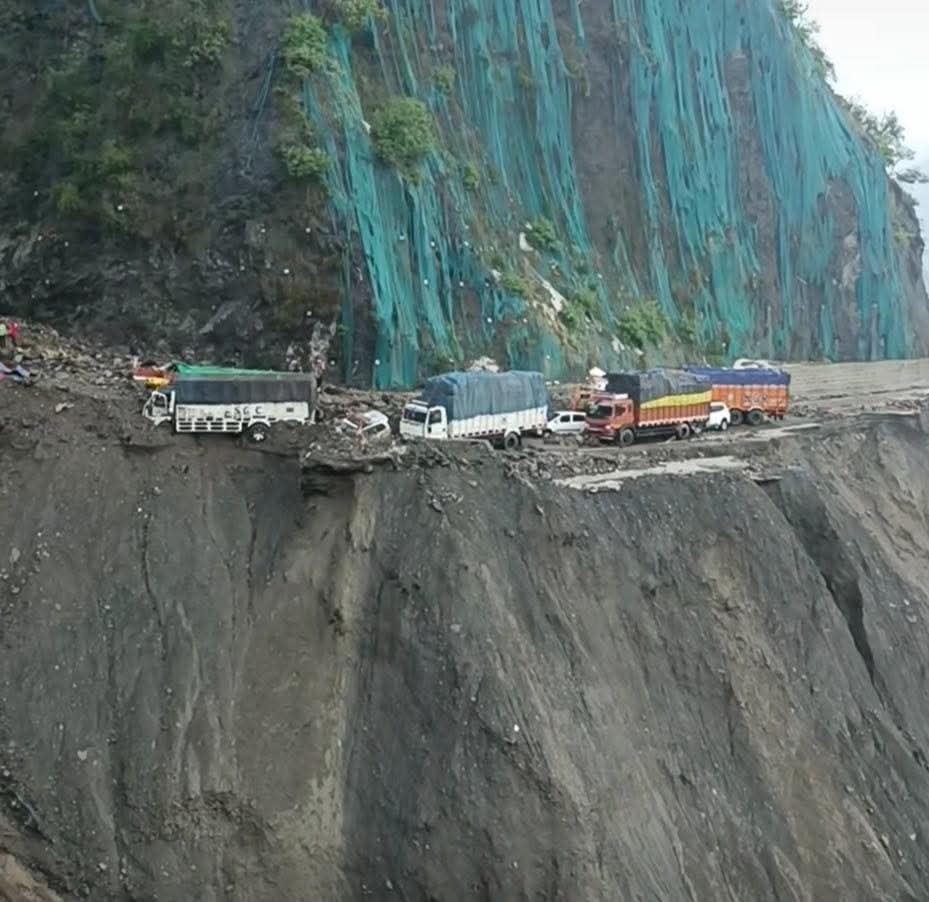
-Large-scale hill cutting began, weakening the region’s fragile slopes and triggering a chain of landslides. Years into the work, with little progress and increasing instability, it became evident that the plan was fundamentally flawed. The consultant responsible was blacklisted and fined, but the environmental damage was irreversible. The terrain, once stable, was left vulnerable to frequent slips and collapses.
-In 2023, the Cafeteria Morh tunnel project, aimed at bypassing a well-known slide zone, collapsed due to weak geological conditions. Cracks formed within the tunnel structure, halting work. A canopy structure was proposed as an alternative, but this too faced complications.
-In March 2025, persistent rainfall caused the road in the area to sink, reducing movement to a single lane and exposing the inadequacies of both the original and revised designs. Experts argue that a better solution would have been to extend the Ramban viaduct instead of disturbing the already unstable area.
-Now recently, a similar story unfolded in the Seri region of Ramban, where slope protection measures such as rock bolting, geomats, and mesh netting were installed. Yet, during the recent rainfall, a massive landslide wiped out the work of the past three years. The failure raises alarming questions about whether the work was carried out as per design specifications or if the latest DPR had again underestimated the geological complexity.
The Kela Morh and Panthal areas, already notorious for frequent landslides, have seen multiple collapses despite the installation of tunnels and canopy structures. During the latest rainfall, even these protections failed, resulting in the destruction of infrastructure and, tragically, loss of life.
-In some places, such as Battery Chashma, the road has been completely washed away, and vehicles have plunged into deep gorges. Thousands of vehicles remain stranded during such incidents, and the safety of travelers is repeatedly compromised.
-These recurring failures have sparked outrage and concern among locals and commuters alike. The broader question looms large: after spending thousands of crores on NH-44’s upgradation, why does the infrastructure fail within months or a year of completion?
-The causes could range from flawed engineering to poor project reports, or a lack of monitoring and accountability. While punitive actions such as blacklisting consultants may help enforce standards, they do not compensate for the lives lost or the daily hardships faced by people using this critical route. https://kashmirobserver.net/2025/04/21/highway-to-havoc-who-or-what-broke-nh-44/ (21 April 2025)
Are we ignoring nature’s warnings? Ramban district has experienced a significant increase in landslides and shooting stone incidents in recent years, according to local reports and observations, highlighting the region’s growing vulnerability to such natural hazards. Areas like Digdol, Panthiyal, and Mehar — sites of aggressive tunnel drilling and road expansion — have become hotspots of repeated collapses.
-Landslides here are no longer merely a result of rain or earthquakes. They are a consequence of constant slope destabilization due to road construction, tunnel blasting, and deforestation,” says an environmental expert from Jammu who wished to remain anonymous.
-But it’s not just the hills that are falling — the ground is giving way too. Land subsidence has become a parallel hazard in the region. In January 2024, more than 45 families were evacuated from Pernote village after deep cracks appeared in their homes and fields due to sudden land sinking. Similar incidents have been reported in Sangaldan, Gool, and parts of Batote.
-The National Institute of Disaster Management (NIDM) has emphasized that unplanned development across Kashmir can have serious consequences. The Comptroller and Auditor General (CAG) Report (2021) audit report on the Prime Minister’s Development Package for Jammu Kashmir highlighted issues related to unplanned execution of infrastructure projects.
-The report pointed out that several projects were undertaken without “proper planning and adherence” to environmental guidelines, leading to delays and cost overruns. “Such unplanned development activities can exacerbate the region’s vulnerability to natural disasters like landslides and floods,” the report pointed out.
-“These are young mountains, still forming and adjusting,” says Dr G.M Bhat, a renowned geologist. “We cannot treat them like the Deccan plateau. The Himalayas remember every cut, every crack, and one day, they push back.” https://thekashmiriyat.co.uk/the-rebellion-of-the-mountains-are-we-ignoring-natures-warnings/ (21 April 2025)
क्या हाईवे की वजह से रामबन में तबाही रामबन में 19 अप्रैल को भारी बारिश के बाद तीन जगह लैंडस्लाइड हुई। इसका मलबा 10 किमी एरिया में फैला है। सबसे ज्यादा नुकसान करोल में हुआ है। यहां दुकानों में मलबा भर गया। लोग बताते हैं कि रामबन में पहले भी तेज बारिश होती रही है, लेकिन ऐसा हादसा पहली बार हुआ है। अभी मलबे के नीचे कितनी गाड़ियां फंसी हैं, कितने इंसान फंसे हैं, कुछ नहीं पता।
-लोगों के मुताबिक, लैंडस्लाइड वाली जगह पर पहले पानी और मलबा निकलने के लिए बड़ा नाला था। यहां हाईवे का काम शुरू हुआ तो उसे ब्लॉक कर दिया गया। पहाड़ी की तरफ से मलबा आने के लिए 25 से 30 फीट चौड़ी जगह थी। हाईवे पर पुलिया बनाकर उसे सिर्फ 2 से 4 फीट का कर दिया गया। इससे पानी के साथ आया मलबा मेन रोड के पास आकर रुक गया। आगे रास्ता न होने से घरों और दुकानों में घुस गया।
-जम्मू-कश्मीर के सभी 20 जिलों में रामबन लैंडस्लाइड के लिहाज से सबसे ज्यादा खतरे वाली कैटेगरी में है। जियोलॉजिकल सर्वे ऑफ इंडिया ने 2020 में इसी एरिया में सर्वे किया था। स्टडी में पता चला कि मारुब से लेकर रामबन का एरिया सबसे ज्यादा सेंसिटिव है। अब 5 साल बाद इसी जगह लैंडस्लाइड हुई है, जिसमें तीन लोग मारे गए। करीब 250 घर टूट गए।
-कार्तिकेय की रामबन के मेन हाईवे पर हार्डवेयर की दुकान है। दुकान में पहाड़ों से आया मलबा भरा है। कार्तिकेय बताते हैं कि फिर से दुकान शुरू करने में 2 से 3 महीने लग सकते हैं। कार्तिकेय कहते हैं, ‘ये पूरी गलती नेशनल हाईवे अथॉरिटी के अधिकारियों की है। अगर वे पानी निकलने के लिए रास्ता छोड़ देते तो ये समस्या नहीं होती।’ https://www.bhaskar.com/db-original/news/ramban-landslide-tragedy-jammu-srinagar-highway-situation-omar-abdullah-nitin-gadkari-134895074.html (24 April 2025)
LANDSLIDES
Sikkim 1,000 tourists stuck after landslides According to an official communication received on Thursday (April 24) night, significant landslides have occurred at Munshithang on the Lachen–Chungthang road and at Lema/Bob on the Lachung–Chungthang stretch. Lachen was among the places in Sikkim that were worst hit due to the October 2023 Glacial Lake Outburst Flood. It was disconnected for almost one and half years. It opened up to tourists this year from March. https://www.hindustantimes.com/india-news/1000-tourists-stuck-in-sikkim-s-lachen-lachung-after-landslides-1-500-rescued-101745575521138.html (25 April 2025)
DISASTERS
Study Hidden rift in Indian Plate may trigger future Himalayan quakes A rare geological process is tearing the Indian Plate apart deep beneath the surface, scientists have discovered. In a study published by the American Geophysical Union, researchers revealed the plate is delaminating—its dense lower layer peeling off and sinking into the Earth’s mantle. This shift could reshape earthquake patterns across the Himalayas and beyond, challenging long-held views of how continents behave. The implications are vast, from seismic risk to tectonic theory, and may herald a new era in earth sciences. The process—called delamination—was detected beneath the Tibetan Plateau using seismic waves and helium gas analysis from natural springs.
– Simon Klemperer, a geophysicist at Stanford University, warned that this process could produce new zones of seismic instability: “The tearing and sinking of the plate could create new stress points in the Earth’s crust, triggering more frequent and potentially more powerful quakes.” Particular attention is being paid to the Cona-Sangri Rift, a deep fracture in the Tibetan Plateau. Scientists believe it may be directly connected to this hidden tear. If confirmed, regions around this rift could face heightened earthquake threats in the coming decades. https://economictimes.indiatimes.com/news/new-updates/indias-outer-surface-is-cracking-scientists-reveals-how-the-indian-subcontinent-may-split-into-two-parts/articleshow/120546939.cms (23 April 2025)
ENVIRONMENT GOVERNANCE
Kerala Kasturirangan’s legacy continues to shape environmental conservation debate The death of K. Kasturirangan, former chairman of the High-Level Working Group (HLWG) on the Western Ghats, has rekindled memories of the panel’s report that shaped conservation policy in the region. Released in 2013, the Kasturirangan report remains one of the most contested documents in Kerala’s environmental history, continuing to stir discussions about balancing ecological protection with the rights of local communities. https://www.thehindu.com/news/national/kerala/kasturirangans-legacy-endures-through-contentious-report-that-continues-to-shape-environmental-conservation-debate/article69491149.ece (26 April 2025)
CLIMATE CHANGE
India to submit climate adaptation framework to UNFCCC by September Termed the National Adaptation Plan (NAP), which will be submitted to the United Nations Framework Convention on Climate Change (UNFCCC) by September, this marks the country’s first such framework in line with its global commitments. Though India has its National Action Plan on Climate Change (NAPCC), the country for the first time is drafting it in compliance with the Paris Agreement. https://www.business-standard.com/india-news/india-to-submit-climate-adaptation-framework-to-unfccc-by-september-125042301126_1.html (23 April 2025)
SOUTH ASIA
IWT Why Pakistan is Scared? ECO N ENERGY TALK: Hridayesh Joshi interviews SANDRP Coordinator on Indus Treaty.
https://www.youtube.com/watch?v=02KM1FDaWb8 (26 April 2025)
Can Indus spark WWIII? “As far as India is concerned, since it is an upstream country, the importance of the treaty is not so great. These agreements are generally more important for downstream countries, like Pakistan. And for Pakistan, it’s a life and death issue,” says Himanshu Thakkar of the Delhi-based SANDRP. “For Pakistan it is existential. It is Pakistan’s lifeline actually, its agricultural and food lifeline. That’s why it is very touchy, and that’s why the provisions in the treaty are very stringent. There should be no uncertainty, no loss of predictability. I mean, it is existential dependence. That’s why they have called it an act of war,” he adds.
– But there are other ruses. Ignoring the treaty’s rules about “silt flushing” – the practice of clearing out existing Indian dams by opening the sluices – could be used to wreak havoc downstream in the short term, says Thakkar. “I hope India doesn’t intend to really interfere in a big way with the flow of water going into Pakistan,” he says. “But we don’t know. There has been a build up to this from 2016, which has led to this situation.” https://www.telegraph.co.uk/news/2025/04/25/most-dangerous-river-world-why-indus-spark-ww2/ (25 April 2025)
Centre plans study to look into max use of Pak’s share of water According to an official, the ministry has been asked to conduct a study to look at ways to utilise the water from the three western rivers. Experts have spoken about the lack of infrastructure that may limit India’s capability of completely utilising the water it gets from the decision to suspend the treaty. “The real issue is with the western rivers where infrastructure limitations prevent us from immediately stopping water flows,” Himanshu Thakkar of the South Asia Network on Dams, Rivers and People (SANDRP) said. “We have several projects underway in the Chenab basin that will take five to seven years to complete. Until then, water will continue to flow to Pakistan by gravity. Once these are operational, India will have control mechanisms that currently do not exist,” Thakkar had told PTI. https://www.deccanherald.com/india/jammu-and-kashmir/centre-plans-study-to-look-into-max-use-of-paks-share-of-water-under-now-suspended-indus-treaty-3512196 (26 April 2025)
How suspending IWT will affect Pakistan For Pakistan (a downstream country) “it is the most important treaty, a matter of life and death,” says Himanshu Thakkar of the SANDRP. Thakkar says the “strategic and symbolic” decision to suspend the IWT will give more options on how to use the waters of the Indus river system in future. For starters, India can immediately stop sharing water flow/flood data with Pakistan. “India can create storage on the Western rivers and also revive the Tulbul project, it can stop sharing data on project and documents, do silt flushing anytime instead of designated months,” explains Thakkar. However, if an upstream country does not treat a downstream country well, it should remember that it too may be downstream for another country as in the Brahmaputra basin. But given the situation, the issue (IWT) is only expected to escalate, says Thakkar. https://www.tribuneindia.com/news/india/what-next-after-the-indus-waters-treaty-suspension/ (25 April 2025)
Why is IWT so critical for India and Pakistan? “There is no provision for suspension in the treaty, so we are entering into a grey area,” Himanshu Thakkar, coordinator of the SANDRP, told The Independent. “If India stops participating in the mechanisms such as data-sharing and project reviews, it could still have implications for how downstream flows are managed.” https://www.the-independent.com/asia/south-asia/indus-water-treaty-india-pakistan-kashmir-attack-b2738729.html (24 April 2025)
Threats of a water war “In the short term, there may not be any direct practical implication”, said Himanshu Thakkar, coordinator of the India-based SANDRP. “Any safe infrastructure to divert water, beyond what is happening now, takes years, mostly more than a decade”. India’s existing dams do not have the capacity to block or divert water. https://www.macaubusiness.com/india-pakistan-and-threats-of-a-water-war-what-we-know/ (26 April 2025)
Can India really stop river water from flowing into Pakistan? “The infrastructure India has are mostly run-of-the-river hydropower plants that do notneed massive storage,” said Himanshu Thakkar, a regional water resources expert with the SANDRP. Such hydropower plants use the force of running water to spin turbines and generate electricity, without holding back large volumes of water. Experts say India can now modify existing infrastructure or build new ones to hold back or divert more water without informing Pakistan. “Unlike in the past, India will now not be required to share its project documents with Pakistan,” said Mr Thakkar. https://www.bbc.com/news/articles/cd7vjyezypqo (26 April 2025)
सिन्धु जल समझौता स्थगित होने के क्या हैं मायने? नदी और जल विशेषज्ञ और SANDRP कॉर्डिनेटर हिमांशु ठक्कर कहते हैं, “जब देश आजाद हुआ और बंटवारा हुआ तो उस वक्त स्थिति यह थी कि अधिक सिंचित इलाका तो पाकिस्तान में चला गया था, लेकिन जहां से सिंचाई के लिए पानी भेजा जाता था और उसके कंट्रोलिंग हेडवर्क भारत के पास थे। भारत ने 1947-48 के युद्ध के बाद पानी के रोक दिया था और पाकिस्तान की हालत बहुत दयनीय हो गई थी। उनके पास कोई चारा नहीं था इसलिए उन्होंने अमेरिका और वर्ल्ड बैंक की मध्यस्थता से यह समझौता किया गया और इसमें करीब 12 साल लगे।”
-ठक्कर बताते हैं, “ यह समझौता काफी बारीकी से बनाया गया। इसीलिये शायद यह इतने साल से टिका है। इसमें विवाद के निपटारे के लिए भी व्यापक प्रावधान है जो तीन स्तर का है। इसके साथ ही डेटा को साझा करने और दोनों देशों के बीच वार्षिक मीटिंग का प्रावधान है।”
-ठक्कर कहते हैं, “यह अल्पकालिक और त्वरित कदम हैं लेकिन अगर भारत दीर्घकालिक रणनीति बना रहा है तो वह पाकिस्तान को हिस्से वाली पश्चिमी नदियों के पानी पर अपने अधिकार से अधिक संग्रह कर सकता है। इसके लिए उसे बड़ी स्टोरेज बनानी होगी और वह पानी को डायवर्ट कर दूसरे हिस्सों में भी भेज सकता है।” https://hindi.downtoearth.org.in/river/pahalgam-attack-what-does-the-suspension-of-indus-water-treaty-mean (26 April 2025)
Just 6% water of ‘eastern’ rivers flows into Pakistan Just about 6 per cent of the total volume of water of the three ‘eastern’ rivers and their tributaries flowing through Punjab and Himachal Pradesh, which come under the purview of the Indus Waters Treaty (IWT), flows into Pakistan, mostly during monsoon, released through Ferozepur barrage. https://www.tribuneindia.com/news/india/just-6-water-of-eastern-rivers-flows-into-pakistan/ (25 April 2025)
भारत को कुल पानी का 20 प्रतिशत नहीं बल्कि इससे बहुत अधिक मिलना चाहिए। लेकिन इसके लिए भारत को अंतरराष्ट्रीय बिरादरी को अपने साथ लेना होगा। उसे पहले विश्व बैंक, संयुक्त राष्ट्र, अमरीका, रूस और चीन के साथ राजनीतिक वार्ता शुरू करनी होगी और अपने पक्ष में माहौल बनाना होगा और यह आंकड़े और बातें उन्हें समझानी होंगी। तभी भारत कानूनी रूप से पानी के कहीं बड़े हिस्से का हकदार होगा जो पाकिस्तान की बड़ी हार होगी। (हृदयेश जोशी वरिष्ठ पत्रकार) https://www.patrika.com/opinion/india-can-play-a-new-strategic-move-in-the-indus-water-treaty-19560456 (28 April 2025)
Demands for return of river waters to Punjab Terming the Indus Water Treaty as a ‘historic blunder’, Jago Punjab President and former vice-chancellor of Punjabi University Swarn Singh Boparai on Saturday (April 26) demanded that the waters of the Jhelum, Chenab and Indus be allocated to Punjab. Boparai, who had earlier served as principal secretary of the irrigation department of Punjab, said 80 per cent of the waters of these rivers were wrongfully given to the neighbouring country under the Indus Water Treaty. The suspension of the Indus Water Treaty has revived Punjab’s hopes of regaining its rightful share of the river waters, he said. https://www.newindianexpress.com/nation/2025/Apr/26/ex-bureaucrat-says-indus-water-treaty-a-historic-blunder-demands-return-of-river-waters-to-punjab (26 April 2025)
Govt considering moving forward with several HEPs initiatives the 800 MW Bursar plant, 260 MW Dulhasti II, 1856 MW Swalkote HEP, 240 MW Uri Stage II, and 930 MW Kirthai II, total capacity coming to about 4086 MW. Apart from Uri-II, which recently received Indus Waters Treaty approval, the other projects await clearance under the Indus Waters Treaty framework. Uri-II experienced delays since 2010 due to Pakistan’s design-related objections.
– The largest among these initiatives is Swalkote, situated in Ramban district, featuring a 192.5-metre dam, whilst Dulhasti Stage-II will be established in Kishtwar district with an underground powerhouse (2×130 MW).
The Bursar hydroelectric project, planned in Kishtwar district, serves as a storage facility that will regulate water flow, benefiting all downstream projects during periods of reduced flow.
– These are in addition to projects already under construction: Pakal Dul, Kwar, Kiru and Ratle. https://timesofindia.indiatimes.com/business/infrastructure/with-indus-waters-treaty-suspended-modi-government-looks-to-expedite-five-major-jk-hydroelectric-power-projects/articleshow/120687824.cms (28 April 2025)
What are India’s options on IWT The Indus originates in Tibet and enters Ladakh at Demchok and exits near the hamlet of Biamah. Within Ladakh, there are enough gorges to build dams to generate power. However, diverting waters of the Indus southwards to Punjab and Himachal would be near impossible due to geological challenges.
– Jhelum offers lesser scope for large dams.
– In J&K, from Kathua to Akhnoor – a distance of some 115 km – the area is sub-mountainous. Several small rivers flow westwards towards Pakistan. Some join the Tawi river and others the Ravi. India could easily build dams across these rivers to hold back some water.
– Ujh project: Will create storage of water on the Ujh, a tributary of the Ravi, for irrigation as well as power generation.
– 2nd Ravi Beas link below Ujh: This has been declared a national project. It involves constructing a barrage across the Ravi for diverting water through a tunnel link to the Beas basin. This is planned to prevent excess water flowing into Pakistan. https://www.tribuneindia.com/news/india/explainer-what-are-indias-options-on-indus-waters-treaty (26 April 2025)
Indus Waters Ex-Commissioner on India’s options India on Wednesday (April 23) announced that the Indus Waters Treaty of 1960 with Pakistan will be held in abeyance with immediate effect, until Islamabad credibly and irrevocably abjures its support for cross-border terrorism. The move comes after the killing of 26 people including tourists in Pahalgam in Jammu and Kashmir on Tuesday (April 22).
-Pradeep Kumar Saxena, who served as India’s Indus Waters Commissioner for over six years and has been associated with work related to the IWT, said India, as an upper riparian country, has multiple options. “This could be the first step towards the abrogation of the Treaty, if the Government so decides,” Mr Saxena told Press Trust of India.
-“Although there is no explicit provision in the Treaty for its abrogation, Article 62 of the Vienna Convention on Law of the Treaties provides sufficient room under which the treaty can be repudiated in view of the fundamental change of circumstances which has occurred with regard to those existing at the time of conclusion of the Treaty,” he said.
-Listing out the steps India could take, Mr Saxena said in the absence of the treaty, India is under no obligation to follow the restrictions on the “reservoir flushing” of the Kishanganga reservoir and other projects on Western rivers in Jammu and Kashmir. The Indus Waters Treaty currently prohibits it.
-Mr Saxena said India can stop sharing flood data on the rivers. This could also prove detrimental to Pakistan, especially during the monsoon when rivers swell. India will now have no restriction on storage on Western rivers, particularly the Jhelum, and India can take a number of flood control measures to mitigate floods in the Valley, Mr Saxena said. https://www.ndtv.com/world-news/indus-water-treaty-suspended-after-jammu-and-kashmir-pahalgam-terror-attack-india-has-many-options-8239780 (24 April 2025)
What India’s IWT suspension means for Pakistan This most recent announcement that India would “suspend” its obligations under the treaty marks the culmination of a long, escalating trajectory. For the first time since 1960, one country has effectively stepped outside the treaty’s procedural and cooperative framework. Whether this is a negotiating tactic or a permanent break remains to be seen. What comes next will test not just bilateral diplomacy, but the resilience of Pakistan’s water system in a world where guarantees no longer hold.
The Indus Waters Treaty is not perfect. But it does something few agreements between adversaries manage to do. It keeps the rivers flowing and gives both countries a reason to keep talking, even when everything else has broken down. That framework is now under strain. Whether the treaty is reinstated in full, renegotiated, or left to fade in practice, what follows will be harder.
– Without clear rules, even small projects can provoke mistrust. Every monsoon, every reservoir, every dry spell becomes a potential source of tension. At a time when climate change is already intensifying droughts and floods, and when both countries face rising domestic water stress, the last thing the region needs is another layer of uncertainty. Yet that is where we now find ourselves.
– The western rivers are not just shared rivers. They are Pakistan’s primary source of water. In the long run, there may be reforms or alternatives. But in the here and now, there is no substitute. These rivers sustain lives, livelihoods, and landscapes across the country. Pakistan can simply not afford to let it become collateral in a political fight. Thus, the flows must continue. Not out of goodwill, but because the consequences of stopping them are too great for either country to bear.
– The Indus and its tributaries that have sustained civilisations for thousands of years, now test the capacity of two modern nuclear-armed nations to cooperate. The coming months and years will reveal whether wiser heads prevail, or if the subcontinent will enter a new, uncertain era of unilateralism on its most precious resource: water. https://www.dawn.com/news/1906274/what-indias-indus-waters-treaty-suspension-means-for-pakistan (24 April 2025)
What India’s suspension of IWT means for Pakistan and for itself “The Indus Waters Treaty of 1960 will be held in abeyance with immediate effect, until Pakistan credibly and irrevocably abjures its support for cross-border terrorism,” Foreign Secretary Vikram Misri said on Apr 23 evening. “For instance, India can immediately stop sharing water flow data with Pakistan. There will be no design or operational restrictions on India for the use of the water of the Indus and its tributaries. Also, India can now create storage on the Western Rivers, Indus, Jhelum and Chenab,” P K Saxena, former Indian Commissioner for Indus Waters said. India can also stop visits by Pakistani officials to the two hydroelectric projects currently under construction in Jammu & Kashmir — the Kishenganga HEP on Kishenganga, a tributary of the Jhelum, and the Ratle HEP on the Chenab — Saxena said.
– “India can undertake reservoir flushing (a technique used to remove accumulated sediment from reservoirs by releasing water through low-level outlets to scour out the sediment and transport it downstream) on the Kishenganga project, which will increase the life of the dam,” he said. However, the suspension will not have an immediate impact on the flow of water to Pakistan for a few years at least. India does not currently have the infrastructure to either stop the flow of water into Pakistan, or to divert it for its own use.
– However, in a 2016 interview with Dawn newspaper, a former Pakistani federal law minister, Ahmer Bilal Soofi, had said that arbitration may not offer much recourse if India chooses not to follow the Treaty. “In case India ‘revokes’ the treaty, it literally means it has shunned it. The dispute resolution mechanism under Article IX and Annexes F and G of the IWT will be of no use and assistance to Pakistan. It is limited to a dispute under the treaty and not meant to provide for specific performance of the treaty itself,” Soofi had told Dawn. “Since there is no provision in the IWT about its duration or suspension, there is no avenue that Pakistan can approach for ‘revival’ of the treaty. Nor can Pakistan approach the International Court of Justice seeking specific performance to implement the Treaty because of the Indian reservation given under the ICJ statute that bars the filing of a case by Pakistan against India. In other words, Pakistan will not be left with any peaceful mechanism for seeking performance of the treaty by India,” Soofi said.
– In January 2025, the Neutral Expert appointed by the World Bank in 2022 under the terms of the IWT, decided that he was “competent” to adjudicate on the differences between India and Pakistan regarding the design of two hydroelectric projects. The Expert, Michel Lino, decided after holding three meetings with the parties concerned. During the meetings, Pakistan submitted that the “Points of Difference” raised by India did not fall within “Part I of Annexure F” of the Treaty, effectively taking the issue outside the remit of the Neutral Expert. India, on the other hand, had argued that these fell “squarely and entirely” within the aforementioned part of the Treaty, making the Neutral Expert “duty-bound” to render a decision on their merits. https://indianexpress.com/article/explained/what-indias-suspension-of-the-indus-waters-treaty-means-for-pakistan-and-for-itself-9962032/lite/ (24 April 2025)
India’s IWT decision casts shadow on renewal of GWT: Bangladesh water expert India’s decision to hold the Indus Waters Treaty with Pakistan ‘in abeyance’ has proved that India will not hesitate to use water as a “weapon” in case political relations with common riparian neighbours nosedive, a leading water expert of Bangladesh has remarked. Prof. Aninun Nishat, a leading water resource and climate change specialist in Dhaka said the decision to freeze the Indus Waters Treaty has “cast a shadow” on the prospects of renewal of the 1996 Ganga Waters Agreement. “Renewal of the Ganga treaty will come up next year but if India continues to hold the Indus Waters Treaty in abeyance then it will create doubts about India’s willingness on sharing of river waters with Bangladesh,” said Prof. Nishat.
Prof Nishat said treaties are legal documents and it is generally understood that such documents would remain unaffected by political sentiments. “But in the case of Indus, it appears that the political sentiment can affect the legal document,” said Prof. Nishat hinting that India is not averse to using water as a “weapon” if political differences increase. https://www.thehindu.com/news/national/indias-decision-on-indus-casts-shadow-on-renewal-of-indo-bangladesh-ganga-water-treaty-top-bangladesh-water-expert/article69491920.ece (26 April 2025)
Does India’s IWT freeze threaten Pakistan? “In principle, a unilateral suspension of a bilateral treaty can be challenged as a breach of international law,” Khan, the Tufts University assistant professor, told Al Jazeera. However, the enforcement of this is complicated, Hassaan Khan added. “The Indus Waters Treaty is a bilateral agreement without a designated enforcement body. While the World Bank has a role in appointing neutral experts and arbitrators, it is not an enforcement authority.” Khan explained that if Pakistan wanted to pursue legal recourse, it would likely be through international forums such as the International Court of Justice (ICJ). “In practice, the main costs for India would be reputational and strategic: undermining its image as a rules-based actor, especially given its own status as a downstream riparian on other transboundary rivers.” https://www.aljazeera.com/news/2025/4/24/kashmir-attack-does-indias-indus-waters-treaty-freeze-threaten-pakistan (24 April 2025)
Opinion A treaty in troubled waters The water will continue to flow into Pakistan by nature’s force of gravity, with or without a treaty. The hard reality is that India has no capacity dam or reservoir to act as a tap to cut off the flow on the western rivers of the Indus and its tributaries, Jhelum and Chenab. Of course, temporary freedom extracted from the shackles of the treaty may facilitate India to execute the Ratle hydropower project, apart from proposing a diversion of 5 to 10 MAF water from the western rivers to the eastern rivers to augment the deficit flows. (Mohan V Katarki, Senior Advocate Supreme Court & expert in transboundary water disputes) https://www.deccanherald.com/opinion/a-treaty-in-troubled-waters-3511552 (26 April 2025)
Indus versus them Suspension of the water treaty can upend Pak’s agri economy & water security if India can build water storage infra on Chenab & greenlight stalled projects like Tulbul. These’ll take time. The immediate impact is to open up New Delhi’s options & increase uncertainty for Islamabad. (Uttam Sinha) https://timesofindia.indiatimes.com/blogs/toi-edit-page/indus-versus-them/ (25 April 2025)
EDIT Storm beneath the waters -The 1960 agreement, which India has put in ‘abeyance’ after the Pahalgam terror attack, had started showing signs of decay in recent years with New Delhi demanding a bilateral modification of the treaty. https://www.thehindu.com/news/national/the-hindu-profiles-indus-waters-treaty-april-27-2025/article69495432.ece (27 April 2025)
The myth, hype and truth of Indus Waters Treaty There are downsides to this decision (suspend Indus Treaty) too. India, being a downstream country on rivers like the Brahmaputra that originate in China, has long upheld the principle of respecting downstream rights. By suspending the treaty and acting unilaterally, it risks setting a precedent that could be used against it. https://www.indiatoday.in/india/story/indus-waters-treaty-suspended-india-pakistan-diplomatic-offensive-pahalgam-attack-2714660-2025-04-24 (24 April 2025)
Not a drop of water will go to Pakistan: MoJS Union home minister Amit Shah on Friday (April 25)held a meeting on how swiftly the decision could be implemented and finalised a detailed roadmap, including quick desilting of rivers and dams as an immediate step to prevent the flow of river waters to the neighbouring country. The meeting, attended by Jal Shakti minister C R Paatil and senior officials, is learnt to have discussed implementation modalities in view of creating additional water storage infrastructure and speeding up work on hydro-power projects as medium- and long-term measures so that waters of the western rivers – Indus, Jhelum and Chenab – can be adequately used by India. http://timesofindia.indiatimes.com/india/not-a-drop-of-water-will-go-to-pakistan-jal-shakti-minister/articleshowprint/120630311.cms (26 April 2025)
Panic in PoK after India releases Jhelum water An unexpected spike in the Jhelum river’s water level has thrown Pakistan-occupied Kashmir (PoK) into pandemonium, after India, according to local officials, released water from the Uri Dam without notice on Apr 26. The unexpected release sparked a water emergency in PoK’s Hattian Bala area, causing inhabitants along the riverbanks to leave for safety. Pakistani officials criticised it as a breach of international standards and the Indus Waters Treaty.
– A district administration official in Muzaffarabad released a brief statement recommending that locals to avoid sites near the Jhelum River. “Due to India releasing more water than usual into the Jhelum river, there is moderate flooding,” according to a spokeswoman. Moderate flooding has been recorded in the low-lying areas of Kohala and Dhalkot, with unverified claims of animal loss and agricultural damage. https://www.firstpost.com/world/pahalgam-panic-in-pok-after-india-releases-jhelum-water-13883377.html (27 April 2025)
Concern in AJK as flows surge in Jhelum A daily water situation report issued by the Water and Power Development Authority (Wapda) also confirmed an increase in water flow levels in River Jhelum. However, an officer from the Met Department’s Flood Forecasting Division (FFD) dismissed the concerns, stating the rise was part of usual seasonal flows. “Typically, these days we see up to 50,000 cusecs in River Jhelum. As of now (April 26), we have 47,000 cusecs, which doesn’t even qualify as a low flood in the river,” Akhtar Mahmood, the FFD deputy director, explained to Dawn on Saturday. “A low flood in River Jhelum ranges between 75,000 and 110,000 cusecs,” he added. He further clarified that water levels in all rivers typically rise during this period due to snowmelt and rainfall in the catchment areas. “The water level in River Jhelum at Manga always rises this time of year (until June 15) due to snowmelt, followed by monsoon rains. Similarly, water rising in the Indus at Tarbela is 80 per cent due to snowmelt,” he said.
The Muzaffarabad division commissioner said on Saturday that an unusual surge in the flow of River Jhelum was recorded after India released water into the river. Speaking to Dawn, Chaudhry Guftar Hussain said that while the normal flow of the river in Muzaffarabad remained around 18 cumecs (cubic metres per second), it swelled to 26.4 cumecs at around 12:15pm. However, the flow reduced to 22 cumecs within an hour, he added. Despite the sudden increase, the flood wave passed through the territorial limits of Muzaffarabad without causing any loss or damage, he said. https://www.dawn.com/news/1906856/concern-in-ajk-as-flows-surge-in-river-jhelum (27 Apr 2025)
Why Pakistan has put ‘act of war’ tag on India’s move “While the physical and political limits on disruptions by India are real, the erosion of treaty protections still matters. This is not because water will stop tomorrow, but because the system it supports was never built for uncertainty. The flows of the Indus, Jhelum, and Chenab are the backbone of our agriculture, our cities, our energy system. At this moment, we simply do not have a substitute for these waters,” wrote Hassaan F. Khan, assistant professor of Urban & Environmental Policy (UEP) and Environmental Studies (ENVS) at Tufts University, in the Pakistan newspaper Dawn.
-In March, the Telegraph Online had reported that Pakistan was bracing for an unprecedented water crisis as the Kharif season (April to June) approached, compounding fears for the country’s agriculture and food security. With a looming 55 per cent water shortage and no reserves in major dams, irrigation planners are facing an uphill battle. “A more pressing concern is what happens in the dry season when the flows across the basin are lower, storage matters more, and timing becomes more critical,” wrote Khan.
-“No Indian action will create a downstream humanitarian disruption or water crisis in the near term,” strategic affairs expert Brahma Chellaney wrote on X. “Pakistan will still receive the lion’s share of the Indus waters, but a withdrawal will free New Delhi from its legal obligations under a treaty that hangs like the proverbial albatross from India’s neck.” https://www.telegraphindia.com/world/why-pakistan-has-put-act-of-war-tag-on-indias-indus-water-treaty-move/cid/2095832 (24 April 2025)
THE REST OF THE WORLD
River defender wins Goldman Environmental Prize Peruvian Indigenous advocate receives the prestigious climate justice award for her groundbreaking campaign to secure legal rights for the Marañón River.
Raised on the banks of the Marañón basin in Peru’s Loreto region, Mariluz grew up appreciating the river as sacred and life-giving. But over the years, she witnessed it choked by oil spills, polluted by illegal mining, and threatened by the Hidrovia Amazonica (Amazon Waterway) and 22 planned hydroelectric dams. More than 60 spills from the North Peruvian pipeline contaminated the water her people rely on for drinking, bathing, and fishing. Entire communities experienced a rise in unexplained illnesses: fevers, headaches, diarrhea, skin rashes, and miscarriages. Yet, little was done.
-Refusing to stay silent, following a 2010 oil spill, Mariluz helped organize local women into the Huaynakana Kamatahuara Kana (“Hard-Working Women”). Represented by women from 29 Indigenous communities in the district of Parinari along the Marañón River, the Huaynakana Kamatahuara Kana is a movement to defend their rights, their territory, and their river. In 2021, supported by the Instituto de Defensa Legal (IDL), International Rivers, and the Earth Law Center, they filed a landmark lawsuit demanding legal personhood for the Marañón.
-In March of 2024, the court in Nauta ruled in their favor. It declared the Marañón River as the subject of rights—the right to flow freely, to be free from pollution, and to be restored. Crucially, the ruling recognizes Indigenous communities as the guardians of the river. It was the first such ruling in Peru, placing the Marañón alongside other globally recognized rivers like the Whanganui River in New Zealand and the Atrato River in Colombia. https://www.internationalrivers.org/news/river-defender-mariluz-canaquiri-murayari-wins-goldman-environmental-prize/ (21 April 2025)
A River’s Voice, A Woman’s Courage The Marañón case recognized that the river has the right to exist, to flow, to regenerate—and to be represented by those who know it best. It was an unprecedented legal and spiritual achievement, rooted in tradition and sharpened by years of organizing and resilience.
-Mariluz Canaquiri Murayari, Kukama leader and river defender speaks not only for the Marañón, but for rivers across the world facing the same threats. Her victory is a reminder that hope flows from the most rooted places—communities where women are rising, organizing, and restoring life. https://www.internationalrivers.org/news/a-rivers-voice-a-womans-courage-honoring-mariluz-and-the-maranon/ (21 April 2025)
11 more women revolutionizing River Protection worldwide. But Mariluz is not alone. Around the world, other women are leading movements, shaping narratives, and making change happen across communities and continents. Here are 11 more women you should be following: https://www.internationalrivers.org/news/inspired-by-mariluz-canaquiri-2025-goldman-winner-here-are-11-more-women-revolutionizing-river-protection-worldwide/ (22 April 2025)
Robert Macfarlane on lives, deaths & rights of our rivers -As pollution levels hit record highs and fresh water becomes ‘the new oil’, is it time to radically reimagine our relationship to the natural world? https://www.theguardian.com/books/2025/apr/26/is-this-river-alive-robert-macfarlane-on-the-lives-deaths-and-rights-of-our-rivers (26 April 2025)
Study Mediterranean megaflood carved out hills in Sicily The event that refilled the Mediterranean basin 5m years ago is thought to have been the largest flood in Earth’s history, with water surging through the present-day strait of Gibraltar 1,000 times faster than the Amazon River, filling the basin in just a couple of years. Now jumbled rock deposits on the top of hills in south-east Sicily provide the first land-based evidence for this flood.
-The megaflood theory emerged in 2009, when scientists discovered a massive eroded channel at the bottom of the strait of Gibraltar. Subsequent research has revealed scours on the sea floor, showing how the water forced its way through the shallow gap between Sicily and mainland Africa, to fill the eastern Mediterranean Sea. https://www.theguardian.com/science/2025/apr/23/mediterranean-megaflood-carved-out-hills-sicily-study (23 April 2025)
SANDRP
Also see: DRP 21 April 2025 & DRP 14 April 2025
Follow us on: www.facebook.com/sandrp.in; https://twitter.com/Indian_Rivers

 SANDRP