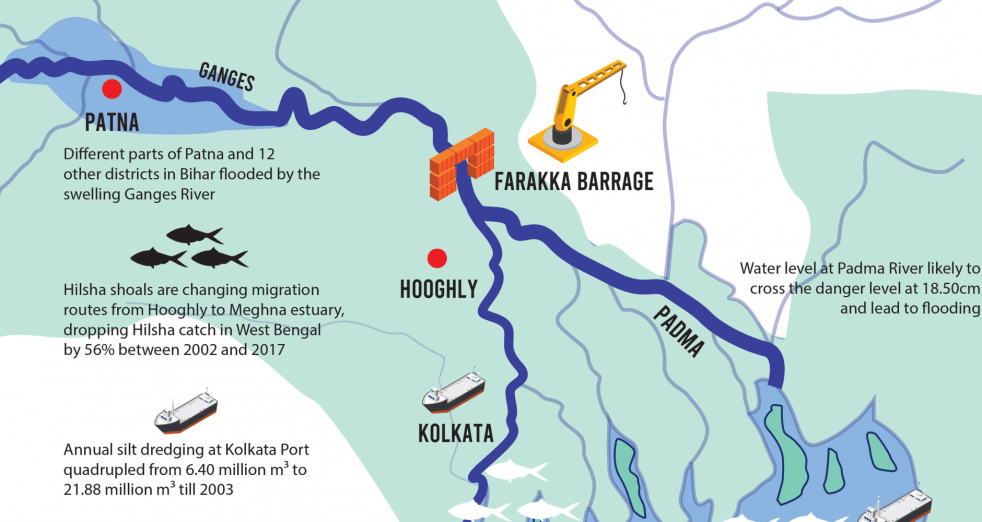
(Feature Image: Infographic taken from Farakka now boomerangs on India: Source: TBS News, Oct. 2019)
The 2304 m long Farakka dam on Ganga in Murshidabad district in W Bengal was commissioned on Apr 21 1975 and completes 50 years today. The dam needs an independent review to assess the costs, benefits and impacts of the dam, both projected and actual and to decide about the need and form of its continued existence.
When a proposed dam is assessed, typically the cost benefit ratio is calculated for 50 years. That useful life, if it is accurate to use that term for this dam, is over. Many individual groups, experts and even the Bihar Chief Minister Nitish Kumar has rightly demanded to make such an assessment to decide about the decommissioning of the dam. This is because there is a huge question if the dam has been able to delivered the main benefit for which the dam was proposed: to make the Kolkata port navigable. It has been established that the quantum of dredging to keep the Kolkata port navigable has actually increased since the dam was commissioned.
There is also no doubt that the dam has destroyed the livelihood of thousands of fisherfolks in the upstream as Hilsa, the key lucrative fish species is no longer able to migrate upstream from the dam. The spread, intensity and frequency of floods in the upstream has also significantly increased post Farakka, a key reason for Nitish Kumar’s advocacy for decommissioning of the dam. The erosion along the banks of Ganga in Malda and Murshidabad areas post Farakka has also increased, besides the complaints from Bangladesh. The review can look at the all the projected and incidental benefits the dam may be providing.
So while singing Happy Birthday to Farakka, it is certainly an opportune time today to initiate a comprehensive, credible independent review of the Farakka Dam Project. Hope we can gather enough courage to take this up.
HYDRO POWER PROJECTS
SANDRP Blog The Moon River: People’s Story of Chenab Writing about the Chenab River in this fascinating article (with 20 photos by Abhay Kanvinde) based on field visit to Himachal Pradesh and J&K, Parineeta Dandekar quotes Late Punjabi Poet Mohan Singh: “Ganga makes Gods, Yamuna makes goddesses, But it takes the waters of Chenab to make a Lover.” Plz Read and Share: https://sandrp.in/2025/04/15/the-moon-river-peoples-story-of-chenab/ (15 April 2025)
A Sinking Village & a Stream that Floods in the Sun In this fascinating but frightening blog Parineeta Dandekar (with photos by Abhay Kanvinde) describes the unique experience of seeing and hearing a live landslide in Lindur village in Lahaul District in Himachal Pradesh, where the Jahlma Nallah, a glacier fed steep tributary of Chenab River actually brought so much debris in monsoon months (but when there was no rainfall) in each of last four years that it temporarily blocked the flow of Chenab for several hours.
How people are left to live in such villages is frightening to even imagine. And the govt wants to build massive hydropower projects in this terrain! https://sandrp.in/2025/04/17/a-sinking-village-a-stream-that-floods-in-the-sun-climate-change-jahlma-nallah-and-lindur-in-chenab-basin/ (17 April 2025)
Arunachal Pradesh Opposition to SUMP Residents affected by the SUMP (Siang Upper Multipurpose Project) are resolute in their opposition. Without clear information about the Chinese dam, speculation about its impacts downstream is rife. Experts warn that mitigation strategies should be driven by transparency and data-sharing, not rhetoric.
– On a cold February morning, the residents of Parong village in Arunachal Pradesh climbed up a hillslope and gathered in the village’s large community hall. An air of caution filled the room – the Additional District Commissioner from the nearby Pangin village would be holding a meeting on an issue considered to be of national importance, with the potential to sink their homes: building an 11,200-megawatt hydropower project. When ADC Gamtum Padu finally arrived, he had an unexpected message. “I want to tell all of you, on behalf of the administration, that we’re sorry,” he said. After months of antagonising the residents for opposing the dam, the administration now came with folded hands. “We want to listen to you,” he said. It was the first time the government initiated a formal dialogue with families affected by the Siang Upper Multipurpose Project (SUMP), a hydroelectric and storage dam to be built on the Siang river – the part of the Brahmaputra river that passes through Arunachal Pradesh.
– In December 2022, the NHPC, the public sector company constructing the dam, prepared a draft Pre-Feasibility Report (PFR) based on three prospective sites for the megadam – one in Dita Dime, another in Ugeng, and a third in Parong.
– India’s Ministry of External Affairs shared its apprehensions with the Chinese government on December 30, 2024. (https://www.mea.gov.in/rajya-sabha.htm?dtl/39270/QUESTION+NO3106+CHINAS+HYDROPOWER+PROJECT+ON+YARLUNG+TSANGPO+AND+ITS+IMPACT+ON+INDIA)
– Homes along a slope in Parong village, one of the 27 villages that are likely to be submerged by the Siang Upper Multipurpose Project (SUMP), an 11,200-megawatt hydroelectric and storage dam to be built on the Siang river. Total 43 villages will be affected.
– “Parong is the most preferable because it would lead to the least submergence area-wise compared to the other two locations, and it’s technically suitable because only one powerhouse will have to be built, saving costs,” said an official with the NHPC, on the condition of anonymity. “Building it in Parong would also save the Advanced Landing Ground built in Tuting, which serves as defence infrastructure for the government.” If built in Parong, the dam would have a storage capacity of 9.2 billion cubic meters – reportedly almost double the capacity of the Medog dam – with a wall that’s 250 meters high.
– Later, in December 2024, Siang’s District Collector, P.N. Thungon, sent a letter to Parong’s residents threatening to deploy central armed forces in order to complete the PFR exercise. When protests continued, with residents marching to the district headquarter, the district administration suspended the protesting gao buros of seven affected villages. Other measures, such as ordering the return of arms used for hunting – a ritual that holds much significance for the Adi community – also angered residents, who viewed such orders as an overreach. “The order to return hunting arms was given only to the protesting villages. We are treated as criminals, and the government’s response to our peaceful protests is one of mistrust,” said Elung Tapak, a resident and orange farmer.
– More unusually, the government is also routing certain developmental activities through the NHPC. This includes setting up roads and upgrading hospitals and schools in the district. “We got a mandate from the Prime Minister’s Office to do public outreach and welfare work, and we were given Rs. 300 crores from the Ministry of Jal Shakti to carry it out. It is not Corporate Social Responsibility,” the NHPC official said. “If people see development here, we hope they will accept the dam.”
– Speculation that the Chinese will weaponise water is rife. “They will use their dam as a water bomb against us,” P.N. Thungon, Siang’s District Collector, told Mongabay India, adding, “The Chinese dam will divert 70% of the Brahmaputra’s water away. The Siang Multipurpose Project will protect the people by collecting the remaining 30% of water and supplying it downstream. The Siang dam is being proposed for the safety and security of the people.”
– Similarly, the paper (https://www.tandfonline.com/doi/abs/10.1080/07900627.2024.2449227) observes that the total annual outflow of the Yarlung river from China is about 31 billion cubic metres, whereas the annual flow of the Brahmaputra at Bahadurabad (a gauging station much further downstream in Bangladesh) is approximately 606 BCM. The paper argues that India’s own disaster mitigation efforts should be driven by data, and not rhetoric. “India’s concern should be to track hydro-meteorological events in the 320 km stretch between Nuxia, the final hydrological station from where India receives flood-period data, and Tuting, the first hydrological station within Indian territory. Unfortunately, there is no available data for this rain-rich segment of the river journey,” the paper says.
– An existing Memorandum of Understanding mandates data sharing from three hydrological stations in China with India, capturing rainfall and water discharge. But this agreement doesn’t cover the crucial stretch of the river that passes through the Great Bend, before it enters India, and where the climate is most volatile. Sharing hydrological data gains even more significance in light of how disaster prone this region is, Nithiyanandam said. “Over the last decade, the Yarlung Tsangpo has seen some 600 flash floods and over 100 earthquakes. The river is fed by glacier melt and rainfall, both of which are seeing changing patterns due to climate change and could worsen impacts downstream,” he said, adding, “What we are witnessing here is a dam which can hold any impact, triggered naturally or artificially, from a higher slope. If the Medog dam comes up, India’s preparations should be geared towards reducing the quantum and velocity of water as it flows downstream.”
– According to Modak and Ghosh, the more imminent threat is not of China “turning off the tap” to the Brahmaputra, but that of dam failure. The recent memory of a flash flood in Sikkim, which destroyed its biggest dam, is still fresh in the Siang valley. The question of who benefits from building large dams in the Himalayas looms over both projects. https://india.mongabay.com/2025/04/caught-between-a-dam-and-a-hard-place/ (18 April 2025)
Lower Subansiri HEP Downstream impact triggers worries in Assam The AASU was not specific, but hydrologists and environmentalists in Assam and beyond said the concerns relate to the recommendations of a three-member expert committee on reservoir management in 2019 and a report submitted by the WII to the NBWL on the possibility of elephants getting washed away during “panic release” of water from the LSHP reservoir.
The committee said the Centre should constitute a Subansiri Independent Integrated Reservoir Management Authority (SIIRMA) or Subansiri River Basin Authority to regularly monitor the reservoir level and minimise downstream “danger” during panic water releases, especially during floods. Other recommendations included running at least one unit continuously to ensure a minimum release of 240 cumec water downstream and ensuring that peaking discharge release does not aggravate the erosion of Majuli Island in the Brahmaputra river downstream.
“The NHPC, the Centre, and the Assam and Arunachal Pradesh governments accepted the expert panel’s 2019 recommendation, which requires setting up the SIIRMA before filling up the reservoir and commissioning the LSHP,” an ecologist, declining to be named, said. “The SIIRMA cannot be postponed to 2026 when all eight units of the mega project are scheduled to be commissioned, as the reservoir needs to be managed by the independent authority irrespective of how much power is generated,” he said. The expert committee was set up by the MoEF following a 2017 order by the NGT, which cleared the LSHP in 2019. This fast-tracked work on the project started in 2005 but was suspended from 2011 to 2019 due to local protests. https://www.thehindu.com/news/national/assam/target-of-may-end-for-nhpcs-subansiri-dam-triggers-downstream-impact-worries-in-assam/article69468512.ece (20 April 2025)
NHPC chairperson and managing director RK Chaudhary on Apr 12 inaugurated LSHEP’s control room. Additionally, NHPC announced the completion of the civil works for the water conductor system, spanning 12.5km. This system includes eight head race tunnels (7,102 metres), surge tunnels (3,545 metres), and vertical and horizontal shafts — all integral to powering the eight 250-MW units. https://timesofindia.indiatimes.com/city/guwahati/state-of-the-art-control-room-inaugurated-for-subansiri-project/articleshow/120261949.cms (14 April 2025)
Himachal Pradesh All units of Parbati II HEP commissioned -Originally inaugurated by then PM Shri Atal Bihari Vajpayee on December 12, 1999, the project faced multiple challenges, including extreme geological conditions, flash floods, and cloudbursts. It now stands completed at an estimated cost of Rs 13,045 crore, against an initial sanctioned cost of Rs 3,919.59 crore.
-With the commissioning of Parbati-II, NHPC’s total installed capacity now stands at 8,140.04 MW, which includes 1,681.7 MW through joint ventures. Of this, 7,771.20 MW is from 23 hydropower stations, while 368.84 MW comes from six solar and one wind power project. https://psuwatch.com/newsupdates/nhpc-commences-power-generation-from-all-4-units-of-800-mw-parbati-ii-hydroelectric-project (17 April 2025)
MoEF Decisions of EAC meeting held on March 27 2025: 1. Kotpali Close loop Pumped Storage Hydro-electric Project (1800 MW) in 357 Ha located at Village Joka, Pendirdih and Samri Protected Forest, Sub Dist Shankargarh, Dist Balrampur, Chhattisgarh by Chhattisgarh State Power Generation Company Limited – Terms of Reference: APPROVED
2. Pinnapuram Integrated RESP-Storage project (1200 MW) in Sub District Gadivemula, Orvakal, Panyam, District Nandyal and Kurnool, Andhra Pradesh by Greenko AP01 IREP Private Ltd – Amendment in Environmental Clearance: APPROVED https://parivesh.nic.in/utildoc/124785663_1744531423897.pdf
Agenda for EAC meeting to be held on Apr 21 2025: 1. Extension, Renovation & Modernization of Western Kosi Canal (CCA: 2,15,672 Ha) in 2326.54 Ha at sub district Benipatti, Madhwapur, Alinagar etc, District Madhubani, Darbhanga, Sitamarhi, Saharsa, Supaul and Samastipur, Bihar FOR ToR. https://parivesh.nic.in/utildoc/125095024_1744964550660.pdf
DAMS
Polavaram Project Experts collect samples of rocks and soil A team from the Central Soil and Materials Research Station visited the Polavaram site and collected samples of soil and rock for testing, prior to their use for the Polavaram project in Eluru district on Apr 16. Water resources authorities say the construction of the Diaphragm Wall, were being taken up. The preparatory works for construction of the Earth-Cum-Rock-Fill Dam of the project were also on. The project requires nearly 50 lakh cubic meters of rock and 30 lakh cubic meters of soil. Accordingly, the team members are looking for rock and soil available at the project site to examine their suitability for use in the ECRF dam’s construction. https://www.deccanchronicle.com/southern-states/andhra-pradesh/ecrf-dam-experts-collect-samples-of-rock-soil-at-polavaram-for-testing-and-use-1873328 (17 April 2025)
Kaleshwaram Project Barrage turned into revenue source through sand auction Three key barrages of the Kaleshwaram Lift Irrigation Project—Medigadda, Annaram, and Sundilla—, have become a significant revenue source for the Telangana govt. Vast sand reserves along the Godavari river, especially near these barrages, are helping the cash-strapped state generate substantial income. The Telangana State Mineral Development Corporation (TSMDC) recently auctioned 6.97 million tonnes (MT) of sand near the Annaram barrage in Jayashankar Bhupalpally district. Officials are also in the process of identifying additional sand reaches between the Annaram and Sundilla barrages. Last year, the govt auctioned around 90 lakh MT of sand in the Medigadda barrage area, earning crores in revenue. In 2023–24, sand auctions generated ₹673 crore, which increased to ₹748 crore in 2024–25. Target is Rs 1000 Cr this year. https://timesofindia.indiatimes.com/city/hyderabad/kaleshwaram-barrages-turn-into-major-revenue-source-through-sand-auctions/articleshow/120440038.cms (20 April 2025)
Mumbai SBWL clears Gargai dam Even as the State Wildlife Board’s approval on Apr 17 marks a major milestone for the BMC’s long-pending Rs 3,105 crore Gargai dam project, which is aimed at augmenting Mumbai’s water supply, three more major clearances are needed before the civic body can begin floating tenders for it. The three clearances required are: the National Wildlife Board, the state forest department, and the Centre’s forest advisory committee (FAC). https://timesofindia.indiatimes.com/city/mumbai/gargai-dam-2-5k-villagers-to-be-shifted-2l-trees-to-be-affected/articleshow/120413057.cms (18 April 2025) The project will require more than 3,00,000 trees to be axed. It will also swallow a whopping 845 hectares of forest land – 652.21 hectares in the Tansa wildlife sanctuary alone, and 167.63 hectares of surrounding land, in Thane and Palghar districts. According to information placed before the SBWL at Thursday’s (April 17) meeting, an additional 5.7 hectares of land in the Jawahar forest division, and 19.29 hectares from surrounding areas will also be allocated for the project. Six villages will have to be rehabilitated. The CM had given a provisional nod to the project on March 26. https://www.hindustantimes.com/cities/mumbai-news/state-wildlife-board-clears-4-mega-projects-on-1-800-hectares-of-forest-land-over-400k-trees-to-be-axed-101744917539346.html (18 April 2025)
Telangana Govt’s desiltation plan sight ₹10K cr revenue potential Huge revenue is said to be the main attraction behind the State’s proposed desiltation programme, which is otherwise facing challenges including a looming monsoon, tight timelines and complex environmental requirements. The State government has already finalized agencies for taking up the exercise on a pilot basis in the Lower Manair, Mid Manair and Kaddam projects. The overall plan aims to dredge approximately 1,696.78 lakh tonnes of silt across all three reservoirs over the 20-year period, with more than Rs.10,000 crore expected to be raked in.
– From the Kaddam project, approximately 2.8 million cubic metres of material will be removed. Some 2.2 million cubic metres of silt is to be lifted from the Lower Manair project. Mid Manair, where the storage capacity is to be reclaimed by some seven TMCs, may yield about 41.85 million cubic meters. The overall cost involved would be Rs.1440 crore, with the revenue generated, according to officials, to be much higher.
-The implementation agencies are yet ready to take up the work immediately. They are still in the process of making their arrangements. The work may take off in time only with regard to Lower Manair dam. The government is ready with 50 acres to be handed over to the agency for silt dumping. In the other two projects, the process is still on for acquiring land which is not available.
-However, only 20 percent to 30 percent of the total yield could be coarse enough for use as sand, while the rest will be fine silt or clay, not usable directly for construction. Field experiences from reservoirs like Nagarjuna Sagar and Tungabhadra suggest that about 25 percent of total desilted material could be construction-grade sand. It is estimated that some 1.2 to 1.3 million cubic metres of sand could be potentially recovered from the Kaddam and Lower Manair projects.
Given the complexities and challenges involved in sediment management in respect of the major irrigation projects involved, the proposed desiltation program would be an arduous task with no immediate benefits, felt irrigation experts. Results are expected to take time, as desilting involves careful planning, resource allocation, and precise execution to prevent infrastructure damage. The prohibitive costs and intricate procedural requirements have rendered large-scale desilting efforts a persistent topic of discussion rather than implementation.
While surveys of sedimentation levels have been completed for selective projects, comprehensive studies remain pending across the State’s 159 projects with a gross storage capacity of 929 TMC. In contrast, the success of Mission Kakatiya demonstrates the immense potential of desilting minor irrigation tanks. Over 27,713 tanks were restored, enhancing groundwater recharge and stabilizing irrigation for 20 lakh acres of agricultural land. The initiative improved crop yields, with cotton, maize, and paddy showing significant increases, while also boosting fishermen’s income by 30-35 percent. https://telanganatoday.com/huge-money-behind-telangana-govts-desiltation-programme-push-rs-10000-cr-revenue-in-sight (18 April 2025)
Tapi Recharge Project Tribals and farmers of Maharashtra and Madhya Padesh Tapi basin took out a protest demonstration in Dharani in Melghat, Mah against the proposed Tapi Recharge project on Apr 18 2025. https://www.youtube.com/watch?v=ThavjFcsW-o (16 April 2025)
Kerala Govt withdraws controversial buffer zone order around dams The WRD Minister Roshy Augustine announced the withdrawal of the order in the Assembly on Tuesday (March 25), responding to an adjournment motion notice brought by the Opposition United Democratic Front (UDF). The Minister cited public concerns as the reason for the decision and assured that a revised regulation would be introduced after wider consultations.
The order, issued by the WRD on December 26, 2024, mandated a 20-metre buffer zone and a further 100-metre construction restriction near reservoirs. The directive had introduced new guidelines for issuing NoCs for construction in dam catchment areas. Under the regulations, a 20-metre buffer zone was categorised as Category I, prohibiting new construction. Beyond this, a Category II zone extended another 100 metres, where construction would have been allowed only with an NoC. The government claimed the order was issued in compliance with Kerala High Court instructions to ensure dam safety. https://english.mathrubhumi.com/news/kerala/buffer-zone-mandate-near-kerala-dams-to-be-revoked-1.10456817 (26 March 2025)
Karnataka Protest against move to draw Hidkal dam water Members of various organisations, including Kannada and farmer bodies, MES and Srirama Sene, under the banner of Namma Neeru Namma Hakku, on Monday (Feb. 03) staged a protest here, opposing the KIADB’s project to supply water from Hidkal dam in the district to the industrial areas in Hubballi-Dharwad. The agitators took out a protest march from Rani Chennamma Circle to regional commissioner and deputy commissioner’s office and submitted a memorandum demanding that the works on the project be stopped immediately.
The district minister is feigning ignorance of the works undertaken to supply Hidkal dam water to the industrial areas in Hubballi-Dharwad. How can the officials take up work without bringing it to the notice of the minister? The minister and the officials should clarify what they demanded. There is not enough water in the dams to meet the drinking water needs of the biggest district in the state. Even Hidkal village gets drinking water supply once a week. In such a situation, how can they (KIADB officials) divert Hidal dam water for the industrial use of another district, the protesters charged. They warned of an intensified protest if they do not shelve the ‘unauthorised’ project. https://www.deccanherald.com/india/karnataka/protest-against-move-to-draw-hidkal-dam-water-for-industries-in-hubballi-dharwad-3387613 (04 Feb. 2025)
Massanjore Dam Displaced waiting for relief for 70 years People displaced by the Massanjore dam on Mayurakshi River in Jharkhand seventy years ago are still waiting for rehabilitation or even compensation promised to them in 1955. The dam built with Canadian aid benefits parts of Jharkhand and Birbhum, Murshidabad and East Burdwan in W Bengal. There is ongoing dispute as to who will control the dam, Jharkhand or W Bengal, but over 1.5 lakh affected, including tribals keep waiting for compensation. https://www.facebook.com/share/p/16NrtYb8t7/ (14 April 2025)
Madhya Pradesh Action on encroachments in Kerwa dam catchment area Taking note of the encroachments on the catchment of Kerwa Dam, the district administration on Friday launched a drive to clear illegal constructions at the site. The action comes after Free Press published a report on April 16, highlighting encroachments in the catchment beyond the Full Tank Level (FTL) of the dam. A green activist had raised the issue of illegal constructions in the catchment and had submitted complaints to the collector, WRD, and the MPPCB, seeking immediate action against the encroachers.
Green activist Rashid Noor Khan stated, “The district administration has taken action on my complaint. Land sharks had started filling and leveling the catchment areas with the intent to sell plots for farmhouse development. The construction would have impacted the water-holding capacity of Kerwa Dam, which supplies water to several colonies in Kolar and Bairagarh—satellite townships. It was also a blatant violation of Bhoj Wetland rules meant for ecological conservation. The encroachers even tried to convert parts of the catchment into paddy fields during summer.” https://www.freepressjournal.in/bhopal/bhopal-admin-cracks-down-on-encroachments-in-kerwa-dam-catchment-area (18 April 2025)
BBMB Low reservoir levels this year -According to the CWC, Himachal received 97 mm of rainfall from March 1 to April 17, registering a shortfall of 36 per cent from normal. Punjab received 11 mm of cumulative rainfall during the same period, seeing a shortfall of 67 per cent. The meteorological subdivision of Haryana, Chandigarh and Delhi received 15 mm of rainfall, witnessing a shortfall of 32 per cent. Jammu and Kashmir, however, received 114 mm of rainfall, but it is below normal by 47 per cent. West Rajasthan received a mere 4 mm of rainfall, registering a shortfall of 54 per cent. There could be a shortage of water in the region in the coming days if the rain situation does not improve. https://www.tribuneindia.com/news/himachal/scant-rain-hp-punjab-reservoirs-low-this-year/ (19 April 2025)
Uttar Pradesh Arid Bundelkhand to be hub of water sports “Water sports will be promoted at seven dams and reservoirs,” read a press statement issued on Saturday (April 19) by the state government. Of the seven places identified for water sports, five are in the Bundelkhand region. “The dams and reservoirs selected for eco-tourism development include Gunta Dam in Chitrakoot, Arjun Dam in Mahoba, Dhandraul Dam in Sonbhadra, Maudha Dam in Hamirpur, Garhmau Lake in Jhansi, Majhouli Sagar in Siddharthnagar, and Nawab Tank in Banda,” read the statement. The department of irrigation and water resources will provide technical support and necessary approvals. It will also ensure that the safety and structural integrity of the dams are not compromised and that environmental and safety standards for water-based activities are strictly followed. https://www.hindustantimes.com/cities/lucknow-news/arid-bundelkhand-to-be-up-s-hub-of-water-sports-101745081632958.html (19 April 2025)
INTERLINKING OF RIVERS
Ken-Betwa Link Farmers Resent Against Project Resentment is brewing among the farmers of Chhatarpur district against the Ken-Betwa Link Project. The farmers have already sent memorandums and staged sit-ins against the project. But their efforts fell through. Their anger turned into a major protest on Apr 15. They took out a march under the banner of the Jai Kisan, a farmers’ organisation. The government also violated the environmental rules, the farmers alleged. Amit Bhatnagar, an office-bearer of the Jai Kisan, led the march which reached the collectorate at noon. In the absence of the collector, sub-divisional magistrate Akhil Rathore received the memorandum. Hundreds of farmers from Surai, Kharyani, Dhodhan and other villages joined the march. They alleged that the government had not surveyed the villages before launching the project. https://www.freepressjournal.in/bhopal/madhya-pradesh-farmers-resent-against-ken-betwa-link-project-marches-under-the-banner-of-the-jai-kisan (16 April 2025)
INTERSTATE WATER DISPUTES
Krishna Water Disputes KRMB files affidavit in SC against Telangana’s petition The Krishna River Management Board (KRMB) urged Supreme Court to direct Andhra Pradesh and Telangana govts to handover 15 projects under Krishna basin for better water management in both the Telugu states. It said that the Centre constituted the board as per the AP Reorganisation Act and it has authority to manage all the projects. While AP expressed willingness to handover the projects, Telangana refused to budge and approached the apex court. KRMB submitted an affidavit in the Supreme Court seeking quashing of the petition filed by Telangana. https://timesofindia.indiatimes.com/city/vijayawada/krishna-river-management-board-files-affidavit-in-supreme-court-against-telanganas-petition/articleshow/120261276.cms (13 Apr 2025)
Haryana-Rajasthan Progress review of Yamuna water at Pilani on Apr 21 CM Bhajanlal Sharma will review the progress of Yamuna water at Pilani in Jhunjhunu district on April 21 ahead of the second joint meeting of Haryana and Rajasthan Task Force. The second joint meeting of the task force is proposed to be held at Hisar in Haryana on April 25. Senior officials of the Haryana government will also participate in this meeting, an official statement said on Apr 19.
According to the statement, under the Yamuna Water Agreement between Rajasthan, Uttar Pradesh, Haryana, Himachal Pradesh and New Delhi in the year 1994, 1,917 cusecs water was allotted to Rajasthan during the monsoon period at Tajewala Head. But there was a deadlock for 30 years in bringing the allotted water to Rajasthan. This deadlock was removed and an agreement was reached on February 17, 2024, in the presence of the CMs of Rajasthan and Haryana and the MoJS a statement said.
Under the agreement, in the first phase, it was agreed to jointly prepare a DPR of the flow system to bring water for drinking purposes from Tajewala Head to Rajasthan. A task force was formed by the governments of Rajasthan and Haryana to prepare the DPR for the implementation of this agreement. A meeting was held in Chandigarh on March 26, between the Additional Chief Secretary, Water Resources Department, Rajasthan and Haryana regarding the preparation of the joint DPR. After this, the first joint meeting of the task force of Haryana and Rajasthan was held in Yamunanagar on April 7, in which preliminary discussions were held on conducting actual ground tests in order to make the alignment.
Under this scheme, it is proposed to bring water from Hathinikund Barrage to Hansiyawas reservoir in Churu district through three underground pipelines. An MoU has been signed for Renukaji and Lakhwar storage projects in the Upper Yamuna Basin, according to which Rajasthan has paid its share amount of ₹77.90 crore to Himachal Pradesh and Uttarakhand. An MoU for Kishau is yet to be signed. After the completion of these projects, 201 MCM water of Rajasthan’s share at Hathinikund Barrage will be available to Rajasthan through these pipelines throughout the year after the monsoon. https://www.hindustantimes.com/india-news/rajasthan-cm-to-review-progress-of-yamuna-water-at-pilani-on-apr-21-101745070875804.html (19 Apr 2025)
RIVERS AS NATIONAL WATERWAYS
Goa I’m minister but was kept out of loop for Centre’s Malim jetty plan: Khaunte -Tourism minister and Porvorim MLA Rohan Khaunte on Friday (April 11) said he was in the dark about the Centre’s plans to permit a Rs 8 crore private marina at Malim on the Mandovi. A visibly upset Khaunte questioned how permissions were given for the jetty without the local panchayat being consulted. Penha de Franca sarpanch Swapnil Chodankar has strongly opposed the private jetty project proposed at Malim. Panchayat members and local residents have also opposed the jetty.
Khaunte expressed his displeasure by pointing out that despite being a key member of the state cabinet, he found out about the jetty in his constituency through the newspapers. “I checked with the panchayat, and the panchayat has not given any permission,” Khaunte said. “I am the local MLA, and I have to find out from the papers. Someone is playing behind the curtains.”
With the Mandovi being declared a national waterway (NW-68), the Centre has decided to support the creation of infrastructure along the river. The NOC was handed over by Union minister of ports, shipping and waterways Sarbananda Sonowal. “If someone has brought permissions from the Centre, the first question is who has given permissions without studying?” Khaunte said. “The local sentiments, traditional fisherfolk, and their activities have to be understood first, and the local MLA needs to be kept informed. The people are to be taken into confidence, and then you decide.” https://timesofindia.indiatimes.com/city/goa/im-minister-but-was-kept-out-of-loop-for-centres-malim-jetty-plan-khaunte/articleshow/120262351.cms (16 April 2025)
URBAN RIVERS
Report रिवर फ्रंट: नदी, नियोजन और पर्यावरणीय सरोकार SANDRP को-ओर्डिनेटर हिमांशु ठक्कर ने कहा, “पुणे एक बाढ़ संवेदनशील क्षेत्र है। इसलिए वहां ऐसी परियोजनाएं लागू नहीं करनी चाहिए। जब नदी के फ्लड प्लेन का कंक्रीटीकरण कर दिया जाएगा, तो वह नदी न होकर एक चैनल बन जाएगी। इससे नदी की बाढ़ को वहन करने की क्षमता कम होगी और खतरे बढ़ जाएंगे”। https://hindi.idronline.org/article/river-front-se-paryavaran-par-badhta-dushprabhav/ (17 Apr 2025)
Mula-Mutha; Pune PMC to revise part of RFD project The PMC will revise its riverfront development (RFD) project plans affecting the Ramnadi-Mula devrai (sacred grove), after facing stark opposition from residents and activists. Civic officials on Apr 17 confirmed that no trees will be felled at the 8 ha site, which lines over 800 metres of riverbanks. Further, no concreting activities will be conducted at the location.
-Meanwhile, citizens have also raised strong objections to the laying of a 4km drainage pipeline through the devrai under the JICA project, urging authorities to reroute it outside the sensitive forest area. They have called for relocating a proposed STP to an alternative site that wouldn’t render it useless during monsoons. “This is an ecologically sensitive zone, as declared by a 2022 NGT order. Any activity here violates that mandate and harms wildlife,” said resident Pushkar Kulkarni, who attended Thursday’s (April 17) site visit.
Despite the latest development, citizens remain sceptical of the overall ongoing project on Pimpri Chinchwad Municipal Corporation’s (PCMC) end. They pointed to this area’s flood-prone nature and rich biodiversity, which includes Schedule-1 species like yellow-crowned woodpeckers and Indian flapshell turtles. Residents flagged myriad unaddressed issues, including the impact of RFD work and sand mining on the PCMC’s side, alleging that several roosting and nesting sites of birds have already been destroyed here. They demanded that JICA project sewage pipelines be shifted away from known nesting areas along the river, and highlighted that the embankments on both sides of the river are going to ruin the forest, which the wildlife depends on. https://timesofindia.indiatimes.com/city/pune/public-protests-bear-fruit-pmc-to-revise-riverfront-development-project-plans-affecting-ramnadi-mula-devrai/articleshow/120388830.cms (18 Apr 2025)
Mosquito tornado reported in Keshavnagar, Kharadi Following the rise in mosquito menace complaints and a bizarre sighting of a mosquito “tornado” in Kharadi, the Pune Municipal Corporation (PMC) launched a week-long vector control and containment campaign in the Kharadi, Keshav Nagar, Wagholi and Mundhwa areas on Wednesday, said the officials. As per the PMC officials, the sudden spike in mosquitoes in these areas is due to the unchecked large growth of water hyacinth in the Mula-Mutha river. Two small mosquito tornadoes were sighted during the containment activities in these areas, said the officials. https://www.hindustantimes.com/cities/pune-news/mosquito-tornado-reported-in-keshavnagar-kharadi-101745087217049.html (20 April 2025)
Dehradun River encroachments to be removed by June 30: Govt Encroachments around the Bindal River in Dehradun’s Doon Valley will be removed by June 30, the Uttarakhand government has said in an affidavit in the high court in response to a plea that pointed to dying rivers due to encroachments on the feeder drains and streams. The affidavit said encroachments on 29.5257 hectares out of 35.7135 hectares of land within the Dehradun municipal limits have been removed. “Further, 6.1878 hectares of land is still in possession of illegal encroachers,” said the affidavit filed on Tuesday (April 15) as a bench of Chief Justice G Narender and Justice Alok Mahra heard Dehradun-resident Urmila Thapa’s public interest litigation over tree felling and encroachments around storm water drains that flow into Rispana and Bindal rivers.
The plea said encroachments on the feeder drains and streams were killing the rivers. It added that tree felling has led to a decline in green cover along the river catchment areas, affected their recharge capacity, and reduced water levels. Lawyer Abhijay Negi, who appeared for Thapa, said the high court had directed the authorities to remove encroachments in the catchment of Rispana and Bindal rivers. He added that the court on Tuesday stayed constructions near or on both these rivers, for which no sanction plan has been approved.
The state government told the court that a committee has been constituted to remove the encroachments from the Bindal River. “…[a] survey near Bindal River is ongoing…after the completion of [the] survey, all identified encroachments shall be removed by 30.06.2025 [June 30] as per law,” said the affidavit. “…encroachments for which litigations are pending…shall also be removed within one month after the decision of the Apar Tehsildar and the City Magistrate. …all measures are being taken…to remove the encroachments expeditiously.” On March 24, the high court noted that the petitioner pointed out that debris dumped in seasonal streams has resulted in landslides during the monsoons. It said the authorities have done little to alleviate the hardships of Doon Valley residents. https://www.hindustantimes.com/india-news/doon-valley-river-encroachments-to-be-removed-by-june-30-uttarakhand-govt-101744784486565.html (16 April 2025)
It was alleged in the PILs that the constant dumping of debris in the rivers and streams has led to encroachment. It was also killing the local and seasonal streams that contribute to the Rispana river, the PILs said. The court had passed a similar order earlier too saying that the debris should be removed as it is a question of the survival of future generations. The same bench of the high court had said, “If we continue with this, the future generations will curse us”. The Chief Justice also said these streams help in preventing landslides. If the debris keeps piling up, the streams will go haywire, causing floods, land erosion and landslides.
The court said the main issues of the PIL were related to the removal of debris from seasonal streams as well as rivers and identifying the structures that were constructed on water bodies. The High Court asked the officials to conduct a survey to identify such structures built on water bodies and remove them. The court also suggested the use of GPS to identify such structures. While the Advocate General claimed that a similar matter has also been addressed by the NGT, the chief standing counsel pointed out that Namami Gange Project protects water bodies. The High Court said that any construction without the sanctioned plan should be stopped. https://theprint.in/india/high-court-orders-removal-of-debris-from-water-bodies-in-dehradun-district/2591197/ (15 April 2025) The court has sought documentation regarding map authorisations granted to two influential individuals in the Vikasnagar area, following adverse remarks reported by the sub-divisional magistrate against them. The bench also heard other PILs highlighting environmental concerns across the state. One petition claimed that large-scale construction on submerged land in Sahastradhara was threatening the water resource and the local environment. Another pointed to encroachment and unauthorised construction on rivers and slopes in Rishikesh. The petition cited encroachment of about 100 acres in Dehradun, 140 acres in Vikasnagar, 15 acres in Rishikesh, and 15 acres on river land in Doiwala. https://timesofindia.indiatimes.com/city/dehradun/hc-halts-construction-without-map-around-rispana-and-bindal-rivers/articleshow/120320159.cms (15 April 2025)
RIVERS
ICIMOD Record low snow persistence poses water shortage risk The Hindu Kush Himalaya (HKH) region experienced its third consecutive below-normal snow year in 2025, with snow persistence — the fraction of time snow is on the ground after snowfall–hitting a vicennial record low of – 23.6 per cent, according to the latest Snow Update Report.
-The report reveals the most alarming declines in snow persistence in the Mekong (-51.9%) and Salween (-48.3%) basins, followed by the Tibetan Plateau (-29.1%), the Brahmaputra (-27.9%), Yangtze (-26.3%), and the Ganges (-24.1%) basins. This is worrying news for the water security of nearly two billion people across 12 major river basins that originate high in the HKH, the report said. https://risingnepaldaily.com/news/60543 (19 April 2025)

The report used a 23-year time series (from 2003 to 2025) of basin-scale snow persistence during the snow season between November and March. In light of these findings, the report urges swift action: improved water management, stronger drought preparedness, better early warning systems, and greater regional cooperation. It emphasises that long-term resilience will depend on adopting science-led, forward-looking policies, and investing in seasonal water storage, efficient use of meltwater, and integrated water management strategies. https://www.downtoearth.org.in/climate-change/snow-persistence-in-brahmaputra-and-ganga-basins-showing-alarming-decline-at-vicennial-lowest-in-indus-basin-icimod-report (21 April 2025) The snow persistence in the Ganga basin this year has been 24.1% below normal — the lowest in the past 23 years, vis-à-vis 30.2% above normal (the highest) in 2015 — which could lead to reduced flows in early summer, the ICIMOD has said. https://www.hindustantimes.com/environment/ganga-basin-records-lowest-snow-persistence-in-23-years-report-101745208344638.html (21 April 2025)
Yettinahole Project Govt revises forest diversion proposal -Notably, the Detailed Project Report (DPR) of the Yettinahole project estimated the total land required for the project to be over 2,965 acres, of which 50 per cent was located in forest. However, the state government has been requesting forest lands in bits and pieces, in violation of the guidelines that stipulate avoiding multiple piecemeal diversions for a single project. Such tactics could also mislead the stakeholders on the total environmental and ecological damage caused by the projects.
-The project cost, originally estimated at Rs 8323.50 crore, has been revised time and again with the last year’s estimate of Rs 23,251.66 crore likely to be revised upwards in the coming months. The VJNL had cited the pending diversion of 508 acres of forest as one of the several reasons for the delay. The agency has been applying for forest diversions in bits and pieces.
-An activist noted that the piecemeal clearance has led to lack of any assessment on the damage caused to the environment. “The damage is not just to the forest but to the ecology, environment of a critically sensitive area of the Western Ghats. Till date, no assessment has been made to understand the loss, which is crucial for any restoration work,” he noted. https://www.deccanherald.com/india/karnataka/after-centres-rap-state-revises-forest-diversion-proposal-for-yettinahole-project-3492408 (14 April 2025)
Tamil Nadu Madras HC bans use of 28 plastic items in Western Ghats -The directions were passed by the Court while dealing with a plea filed by one G Subramania Koushik. It noted that even though orders banning plastic bottles and other polluting material have been passed since 2019, it has had little to no impact. Therefore, it passed detailed directions to ban plastics and ordered the Tamil Nadu government and other authorities to file a status report by June 6.
-“In addition to PET bottles, polythene bags, plastic/thermocol plates, plastic-coated paper plates, paper cups, plastic tumblers, spoons, knives, and similar items littered throughout the hills, posing a grave threat to the environment and local flora and fauna. It goes without saying that managing this solid waste becomes a Herculean task. After unknowingly consuming these plastics, animals die. The forests are facing extinction. The pristine eco system is encountering a major challenge,” the Court observed. https://www.barandbench.com/news/madras-high-court-bans-plastic-western-ghats (17 April 2025)
Jammu & Kashmir Jhelum Is Dying. Why’s Nobody Accountable? Unchecked sewage from Kashmir towns is polluting the lifeline of the Valley. The Pollution Control Committee must act before courts force its hand—again. There are solutions. First, third-party audits of all existing STPs must be conducted immediately to assess their functionality. Second, the Pollution Control Committee should launch suo motu actions against municipalities and departments violating the Water Act. Third, untreated sewage must be diverted from all water bodies until proper treatment infrastructure is built.
Environmental degradation is not a future threat, it is happening now. Every day of delay means more toxins in our rivers and more risk to public health. Jhelum is more than a river. It is the memory and future of Kashmir. If we don’t act now, we may soon cross the point of no return. (Dr Raja Muzaffar Bhat) https://kashmirobserver.net/2025/04/19/jhelum-is-dying-whys-nobody-accountable/ (19 April 2025)
₹1.62 cr fine for dumping solid, biomedical waste near river The UT administration has pulled up the Poonch Municipal Council over its legacy waste and has asked it deposit Rs 1.62 cr as “environmental compensation” for unscientific dumping of solid & bio-medical waste near a local river. This has been the first time in Jammu province that the administration has initiated the process to recover environmental compensation from an urban local body as land arrears. This at a time when NGT is hearing a petition on the 11 T of legacy waste dumped in Srinagar’s Achen landfill site.
The new order comes on the back of a September 2024 NGT order, which, following a petition by environmentalist Raja Muzaffar Bhat, pulled up the district administration for failing to recover environmental compensation imposed by the J&K Pollution Control Board in 2022. https://indianexpress.com/article/india/poonch-civic-body-told-to-pay-rs-1-62-crore-for-dumping-solid-biomedical-waste-near-local-river-9948470/ (17 April 2025)
Is Polluted Water in Rivers Causing Liver Disease in Kashmir? https://www.youtube.com/watch?v=j__ZX34s4sw (19 April 2025)
GANGA Uttar Pradesh Concerns over Adani Power Plant’s manipulated Public Hearing On April 11, 2025, a public hearing was held to discuss the establishment of a 1600-MW coal-based ultra-super critical thermal power plant in the forested area of Dadri Khurd village in Mirzapur district. However, local residents have protested, deeming the gathering illegal. They claim that the affected communities were not invited to the hastily organised public hearing, which was allegedly attended by a ‘hired crowd’. Moreover, no relevant information regarding this event has been made available on the UPPCB website. The local community is calling for the immediate cancellation of the public hearing and demands that all related documents, including the EIA report, be promptly made available to the public. They also request an independent and impartial high-level investigation into the matter to prevent such irregularities in the future.
Local residents are worried that the destruction of the Madihan forests will not only endanger wildlife and the environment but will also exacerbate the water crisis in surrounding regions, directly affecting agriculture and the daily lives of nearby inhabitants. Such circumstances could lead to issues like migration and food scarcity. Villagers assert that a case regarding illegal construction by Adani’s company is still under consideration by the NGT, with the next hearing scheduled for May 23. Given this context, they are puzzled by the necessity of a public hearing prior to the tribunal’s decision. The villagers express their concerns that the NGT report has not yet been released, raising questions about the urgency of the public hearing. https://thewire.in/environment/mirzapur-residents-raise-concerns-over-adani-power-plant-allege-manipulated-public-hearing (20 April 2025)
Villagers build its own bridge on river Magai In Kyampur Chhavni village in Ghazipur district locals have crowdfunded and begun building a bridge on a tiny river that has long stood between them and the rest of the world. While the district administration says the villagers were impatient and should have instead waited for some more time, the locals maintain that they waited for at least 58 years. The Magai, a small river in eastern Uttar Pradesh, originates in Azamgarh’s Dubawan village, flows through Mau and Ghazipur districts for over 200 km, before eventually joining the Tamsa river, which then merges into the Ganga near Ballia.
“Since 1967, villagers had started demanding public representatives to ensure construction of a bridge on the Magai river. Before every parliamentary or assembly polls, they used to send junior engineers or other officials with measurement machines to befool us. After being voted to power, the promises of building the bridge were conveniently forgotten,” said Captain (retired) Ravindra Yadav, a civil engineer with 55 Engineer Regiment of India Army’s Corps of Engineers, came to live in his ancestral house in Kyampur after his retirement in June 2024.
District magistrate Aryka Akhauri said, “The experts from PWD and UP Bridge Corporation have been assigned the task to check the structures built by villagers to see quality standards as well as load capacity that it will be able to bear.” As neither any technical committee and experts are involved nor any prior permission was sought for it, people involved in constructing the bridge have been asked to halt the work till the structures are examined, she said, mentioning how checking its strength is a must for public safety. But the villagers aren’t up for waiting any more. https://timesofindia.indiatimes.com/city/lucknow/the-bridge-on-the-river-magai/articleshow/120447160.cms (20 April 2025)
YAMUNA Delhi PM Modi chairs high-level meeting PM Modi chaired a high-level meeting on Apr 16 to review issues related to the cleaning of the Yamuna River and Delhi’s drinking water supply, it is learnt. During the meeting a presentation on the cleaning and rejuvenation of the Yamuna River and Delhi’s drinking water issues was made. The meeting was attended by Union Home Minister Amit Shah, Union Jal Shakti Minister C R Patil, Delhi CM Rekha Gupta, Principal Secretary to the PM P K Mishra, Principal Secretary-2 to PM Shaktikanta Das, and Additional Secretary to PM Atish Chandra.
“We will collaborate with the central government to develop Yamuna River front, on the lines of the Sabarmati Riverfront, ensuring 24×7 commercial establishments, interactive shows, theatres and other entertainment facilities along the riverbanks,” the BJP said in its statement. “We will set up a Yamuna Kosh to revitalise the Yamuna river, which has been neglected by AAP-DA for the past 10 years. Under this, we will: Undertake full treatment of wastewater from drains like Barapullah, Shahdara and Ghazipur before it flows into the Yamuna,” it said. https://indianexpress.com/article/india/pm-modi-high-level-meeting-yamuna-delhi-drinking-water-supply-9949954/ (17 April 2025)
Agency-wise action plan to clean the river was reviewed in the meeting to assess the current status of the Yamuna river and discuss ongoing and plans for its cleaning and rejuvenation, the Delhi government statement said. The meeting discussed short-term activities (of three months), medium-term activities (three months to one-and-a-half years) and long-term activities (one-and-a-half years to three years) related to the cleaning of the Yamuna along with management of drains, sewage, industrial waste and identification of gaps in wastewater treatment. Monitoring measures, improving the flow in the river Yamuna, floodplain protection, green riverfront development and public outreach were all discussed with specific timelines, it said.
The urgent need to rehabilitate Delhi’s drinking water system to reduce leakages and non-revenue water was emphasised. It was also decided that Delhi would prepare an Urban River Management Plan for holistic water management and integrate it with the master plan of the city. The current status of the wastewater treatment infrastructure and the governance issues that impact the quality of the river Yamuna were presented to the PM, the statement said.
A ‘Jan Bhagidari Movement’ enlisting volunteers for Yamuna rejuvenation and holding public events around the river were also emphasised. In addition to the Delhi stretch, special attention may also be paid to the culturally rich area around Braj, making the ‘Braj Yatra’ a part of the river-people movement, the statement said. Actions to be taken to rejuvenate the river stretches in Haryana, Delhi as well as the stretch downstream up to Sangam at Prayagraj were deliberated in the meeting. https://www.ndtv.com/india-news/space-tech-public-participation-pm-modi-reviews-yamuna-rejuvenation-plan-8189831 (17 April 2025) PM advised that the best available technology should be harnessed to gather micro-level real-time data to measure the flows in the drains and monitor the functioning of STPs. Further planning and implementation of pollution abatement infrastructure should be based on this data. He also suggested the use of space technology to gather data for better governance of the existing infrastructure. https://timesofindia.indiatimes.com/city/delhi/use-space-technology-real-time-data-to-rejuvenate-yamuna-pm/articleshow/120388719.cms (17 April 2025) The high-level meeting came a day after the Delhi government’s expenditure and finance committee, headed by chief minister Rekha Gupta, approved the setting up of 27 decentralised sewage treatment plants (D-STPs), related facilities, and infrastructure at a cost of ₹3,140 crore for cleaning the Yamuna.
The Jal Shakti ministry has proposed that interventions such as sewage treatment, dredging, improving dissolved oxygen levels, and restoring “jal pravah” (natural water flow) to support the river’s self-cleaning capacity should be undertaken in a “mission mode,” the official said. “There may be an overarching Yamuna Mission on the pattern of the NMCG,” the official added. The Jal Shakti ministry has been asked to set up “institutional mechanisms” to enable coordination between the Haryana and Delhi govts — crucial, officials said, as several key actions must be implemented upstream of Delhi. https://www.hindustantimes.com/cities/delhi-news/pm-modi-backs-role-of-public-space-tech-in-yamuna-revival-101744914538337.html (17 April 2025)
Froth re-surfaces in river A layer of froth was seen covering the Yamuna River surface near Kalindi Kunj on Friday (April 18), bringing back the focus on heavy pollution in the river. Experts said that the froth on the river surface was a recurring issue due to the toxic chemicals present in the sewage and industrial wastewater flowing unchecked into it. “The frothing problem in the Yamuna appears to have become a perennial issue, largely due to the deficit monsoon in the river’s upper basin last year and the lack of rainfall during the winter and pre-monsoon seasons this year,” said an environmental activist Bhim Singh Rawat (of SANDRP.) “Untreated effluents continue to enter the Yamuna, not just from drains in Delhi but also from major discharge points in Haryana like the Dhanaura escape in Karnal, Drain No. 2 in Panipat, and the Najafgarh drain,” he said. https://indianexpress.com/article/delhi/yamuna-river-froth-kalindi-kunj-9951573/ (18 April 2025) https://www.dailypioneer.com/2025/state-editions/toxic-foam-engulfs-yamuna-river–again.html (19 April 2025) https://www.theweek.in/wire-updates/national/2025/04/18/des57-dl-yamuna-froth.html (18 April 2025)
Is it even possible to clean Yamuna? This video investigates why the Yamuna is still so dirty, despite over ₹7,000 crore spent on cleaning it. State govts have launched cleanup missions, but the river remains dangerously toxic.
We travel along the Yamuna in Delhi, speak with experts trying to restore the river, and go behind the scenes inside a STP to understand where the system is failing. Our aim through this video is to answer this basic question: Is it even possible to clean the Yamuna river? https://www.youtube.com/watch?v=YrES113wBnw (19 Apr 2025)
Noida Hindon river in Gaziabad is always covered with a thick sheet of water hyacinth due to impoundment of highly polluted waters by the barrage there. https://www.facebook.com/share/p/16WXSWzryk/ 16 April 2025
Uttar Pradesh ‘मिढ़ासन नदी का भ्रष्टाचार ‘मिढ़ासन नदीको पुनर्जीवित करने के नाम पर वर्षों पूर्व तक़रीबन 20 करोड़ रुपये खर्च किये जा चुके है। फिर भी इस नदी की हालत सुधरने के बजाय और बिगड़ गई है। पहले तो इस नदी में गर्मी के समय कहीं-कहीं गड्ढों में पानी दिख भी जाता था, लेकिन अब तो यह पूरी तरह सूखे मैदान में तब्दील हो जाती है। पन्ना के वरिष्ठ बुजुर्ग पत्रकार श्री अरुण सिंह कहते है ‘मिढ़ासन नदी’ को जीवित करना असल मे केन के जींवन प्रवाह और उसकी जैवविविधता को भी संरक्षण करना होगा। किंतु जब सरकारें केन-बेतवा लिंक जैसी वाहियात परियोजना से पन्ना का विशाल जंगल बर्बाद करने पर आमादा हो। वहीं दो नदियों के भौगोलिक तासीर को समझें बगैर यह नहर सिंचाई परियोजना सर्वोच्च न्यायालय के दिशानिर्देश को ताक पर रखकर पूरी करने की ज़िद हो तब ‘मिढ़ासन नदी’ के 20 करोड़ रुपया क्या मायने रखते है ? लिंक प्रोजेक्ट पर तो 40 हजार करोड़ दांव मे लगे है। केन नदी के प्रवाह / कैचमेंट क्षेत्रफल मे यूपी-एमपी तक चलती पोकलेन और लिफ्टर तो सरकार का आभूषण बन चुकी है।
मालूम रहे कि मिढ़ासन नदी को सदानीरा बनाने का संकल्प तत्कालीन मुख्यमंत्री व मौजूदा केंद्र सरकार के कृषि मंत्री शिवराज सिंह चौहान ने लिया था। साथ ही 15 वर्ष पूर्व बड़े ही धूमधाम के साथ इस अभिनव योजना का शुभारंभ किया गया था। किंतु नदियों को उत्खनन और जलराशियों को संरक्षण मे सरकारी ड्रामा बनाने की विशेषज्ञ ब्यूरोक्रेसी व भ्रष्ट तंत्र ने योजना की हवा निकाल दी है। वहीं पुनर्जीवन के नाम पर खर्च की गई राशि कहां और कैसे खर्च हुई, इस बात का आज तक खुलासा नहीं हो सका है। मिढ़ासन नदी जस की तस रूखी-सूखी पड़ी है और सिर्फ बारिश होने पर ही यह नदी बहती नजर आती है। इस लिहाज से सदानीरा बनने के बजाय यह नदी बरसाती बनकर रह गई है। यह कुछ वैसे ही है जैसे उत्तरप्रदेश के भूभाग पर बहने वाली महोबा क्षेत्र की उर्मिल,धसान, चंद्रावल नदियां जिन्हें लाख जतन व भारी बजट के बावजूद उत्खनन की मार और सरकारी अदूरदर्शिता के चलते धरातल पर पुनर्जीवित नही किया जा सका। (अरुण सिंह पन्ना / आशीष सागर दीक्षित,बाँदा) https://soochanasansar.in/corruption-of-madhya-pradeshs-midhasan-river-a-tributary-of-ken-river-bundelakhnd-regional/ (20 Apr 2025)
FISH, FISHERIES, FISHERFOLKS
CFA Port Development or Mass Destruction of Fisherfolk Livelihoods? At a Press Conference held in Delhi, organised by Delhi Solidarity Group, fisherfolk from Uttara Kannada district of Karnataka shared how they the massive port construction spree under the Sagarmala push threatens their fishing grounds, and may prove ‘genocidal’ for their livelihoods and way of life. https://www.youtube.com/watch?v=_LDu7S8IXwc (21 April 2025)
Tamil Nadu Amid fishing ban fishermen demand more compensation The annual 61-day fishing ban along Tamil Nadu’s coastline commenced in the early hours of Tuesday and will remain in effect until 14 June. The ban, enforced under the Tamil Nadu Marine Fishing Regulation Act, 1983, is intended to safeguard marine biodiversity during the peak breeding season. During this period, mechanised boats and trawlers are barred from operating in the sea, giving marine life a crucial window to regenerate. https://english.mathrubhumi.com/news/india/tamil-nadu-fishing-ban-1.10510756 (15 April 2025)
Jammu & Kashmir Fish production at all time high – The rise in production has been particularly notable in trout farming, with output increasing from 598 metric tonnes in 2019 to 1,990 metric tonnes during the financial year 2022-23. Overall, trout production has increased by more than 300 percent in the last four years, rising from 650 metric tonnes in 2019 to 2,100 metric tonnes in 2023.c
– The introduction of Recirculating Aquaculture System (RAS) and Biofloc technologies in 2020-21 has been instrumental in enhancing fish production efficiency. These technologies optimize water and land usage, making fish farming more sustainable and environmentally friendly.
– Rainbow trout, which was introduced to Kashmir over 100 years ago, is now produced on a large scale in the region, with seeds being supplied to other areas as well, further cementing Kashmir’s reputation as an important center for fish production in India. https://m.greaterkashmir.com/article/fish-production-in-jk-reaches-all-time-high-of-28000-mts/388086/amp (14 April 2025)
SAND MINING
SANDRP Interview Advocate Waryam Singh: मशीनी खनन से हो रही यमुना बर्बादमशीनी रेत खनन हर लिहाज से नदी, पर्यावरण और ग्रामीणों के लिए बहुत नुकसानदायक है। आज रेत खनन कार्यों से नदी और लोगों को हो रहे अधिकाशं दुष्प्रभावों की जड़ में मशीनी खनन है। इसलिए आज मशीनी रेत खनन पर तुरंत प्रभाव से पाबंदी लगाना बहुत आवश्यक है। https://tinyurl.com/3uuadbtr (20 April 2025)
Ghaziabad Sand mining rampant off Yamuna, but on Delhi’s side: DM District magistrate Deepak Meena on April 16 has submitted a report at the NGT, listing measures the administration has taken to tackle sand mining along the Yamuna. The report — filed in response to the NGT’s suo-motu action on a TOI article — agreed that there were violations, but more on the Delhi side of the river. In response, the NGT on Thursday (April 17) asked the North Delhi district magistrate to submit a detailed reply by April 21. The case, initially heard by two separate NGT benches, has now been consolidated. The tribunal’s coram, led by chairperson Prakash Shrivastava, will hear the matter on April 22. https://timesofindia.indiatimes.com/city/noida/sand-mining-rampant-off-yamuna-but-on-delhis-side-ghaziabad-dm/articleshow/120390826.cms (18 April 2025)
Banda थाना मटौंध क्षेत्र के ग्राम मरौली खंड 5 मे बीते रविवार (April 20) को चट-चटगन निवासी रमैया किसान की 7 वर्षीय बेटी मौरम खदान के गड्ढे मे डूब गई है। जानकारी मुताबिक बेटी खेलते वक्त उक्त पानी भरे बड़े गड्ढे मे गिरी जिससे उसकी मौत हो गई। आनन फानन मे परिजनों ने जिला अस्पताल दिखाया लेकिन तब तक डाक्टर ने मृत घोषित कर दिया। https://soochanasansar.in/innocent-girl-khushboo-drowned-to-death-in-a-pit-of-a-gravel-sand-mining-gram-marauli/ (21 April 2025)
खनिज अधिकारी राज रंजन ने 29 मार्च की जांच पर लीपापोती कर दी है। उधर 9 अप्रैल को खदान पहुंचे थे एसडीएम पैलानी और सदर सीओ जिन्होंने मौके पर अवैध खनन देखा लेकिन पोकलैंड छोड़ दी। वहीं खनिज अधिकारी बाँदा के लिए मानों यह अवैध खनन का महाकुंभ 2025 है, तो सब केन की लाल मौरम-बालू जिसे लाल सोना भी कहते है मे आकंठ डुबकी लगा रहें है। https://soochanasansar.in/bandas-reality-of-illegal-mining-mining-of-cane-from-village-sandi-to-sadikamdanpur-charka-to-marka-maroli-to-girwan-bloody-battle/ (17 April 2025) सोशल मीडिया मे एक वीडियो वायरल है। यह सूचना संसार के व्हाट्सएप ग्रुप और अन्यत्र जेडीयू नेत्री शालनी सिंह पटेल ने डाला है। उधर अमर उजाला ने भी आज ‘एसडीएम ने पकड़े लोडर अभद्रता कर छुड़ा ले गए’ शीर्षक से खबर लिखी है। जिसमें नरैनी विधायक श्रीमती ओममणि वर्मा के सम्मानित पतिदेव जी पर ओवरलोड लोडर छुड़ाने का जिक्र है। https://soochanasansar.in/maharaj-ji-mla-patidev-has-started-getting-the-overloaded-loaders-released-contractors-have-started-singing-auspicious-songs-in-the-mines-of-banda/ (19 April 2025)
Punjab Sand mining & politics -In the latest episode of Decode Punjab, The Tribune Special Correspondent Ruchika M Khanna speaks to environment crusaders Col Jasjit Singh Gill and Tikka Yashvir Chand about the newly amended mining policy and policy of advancing paddy transplantation, and its impact on Punjab’s ecology. https://www.youtube.com/watch?v=iGvF7l3SqPI (18 April 2025)
Advocate complains of attack by sand mafia Advocate Simranjeet Kaur Gill, who was allegedly attacked by the sand mafia in Sahnewal under Ludhiana district on Apr 17, met Governor Gulab Chand Kataria in Chandigarh on Apr 18. Gill was accompanied by state BJP Mahila Morcha president Jai Inder Kaur, party spokesperson Pritpal Singh Baliawal, and representatives of nearly 10 villages, among others. The BJP leaders submitted a memorandum on illegal sand mining on behalf of Gill and other villagers to the Governor. https://indianexpress.com/article/cities/chandigarh/illegal-sand-mining-punjab-raj-bhavan-9952180/ (18 April 2025)
Goa Govt seeks CRZ relaxation for sand mining amid ongoing ban With legal sand mining at a standstill due to the lack of Coastal Regulation Zone (CRZ) clearance, the Goa government is preparing to make a fresh push for a policy change. Chief Minister Pramod Sawant is set to approach the MoEF&CC, requesting amendments to the CRZ notifications of 2011 and 2019 to allow regulated sand extraction in the State.
This marks Goa’s second appeal to the Centre after an earlier request in April 2023 failed to secure approval. The government hopes to gain a special exemption, similar to that granted to the Andaman and Nicobar Islands, where sand mining is permitted on a case-by-case basis for construction purposes. The existing CRZ rules strictly prohibit sand mining in coastal areas, with sustainable mining guidelines only addressing dry riverbed extraction in inland regions. Goa now plans to argue that its unique coastal geography and dependence on sand for construction make it eligible for a tailored policy approach.
Officials claim that allowing controlled sand mining — restricted to manual extraction methods — would help revive traditional livelihoods and address the acute shortage of construction material without compromising environmental safeguards. Earlier this year, the SEIAA granted one-year ECs for sand mining, contingent on CRZ approval. Meanwhile, the DMG has received nearly 185 applications for mining across 12 zones along the Mandovi and Zuari rivers, mapped through an environmental impact study by the National Institute of Oceanography (NIO). Legal sand extraction has remained suspended in Goa since 2018 following strict directives from the High Court & NGT. https://www.daijiworld.com/news/newsDisplay?newsID=1278159 (19 Apr 2025)
Maharashtra 2 officials suspended In a significant move, Maharashtra’s Revenue Minister Chandrashekhar Bawankule has suspended two revenue officers from the Tumsar subdivision of Bhandara district for their failure to stop illegal sand mining and for their involvement in hoarding. The suspended officers have been identified as Tumsar Sub-Divisional Officer Darshan Nikam and Tehsildar Mohan Tikle. The issue of illegal sand mining and the action against the accused were also discussed in the Legislative Assembly, where concerns were raised over the government’s delayed response and compensation for victims of accidents involving trucks carrying illegally mined sand.
Several revenue officers and collectorate officials have even been attacked by these mafias. The government machinery had been inadequate in curbing these illegal activities until now. However, the state revenue department recently introduced a new sand policy, which was approved by the state cabinet on Tuesday (April 08). As part of a broader crackdown on illegal mining, the state government has begun taking strict action—starting with the suspension of the two revenue officers. https://www.freepressjournal.in/mumbai/maharashtra-revenue-minister-suspends-two-bhandara-officials-for-failing-to-curb-illegal-sand-mining (09 April 2025)
Sand Mafia in Ratnagiri: https://www.jagran.com/maharashtra/mumbai-maharashtra-sand-mafia-ratnagiri-attacks-female-journalist-23919482.html (16 April 2025)
Karnataka Tensions flared in Chittapur taluk of Kalaburagi district on Apr 18 when Congress workers blocked BJP State President B.Y. Vijayendra & other senior party leaders during their visit to the villages Bagodi & Belagumpi in Chittapur to inspect sites of alleged illegal sand mining. https://www.thehindu.com/news/national/karnataka/kalaburagi-vijayendra-bjp-leaders-stopped-by-congress-workers-during-visit-to-sand-mining-site/article69464779.ece (19 April 2025)
Telangana -State’s tallest Vardhaman Mahavir Jain Tirthankar sculpture is facing an imminent threat from quarrying activity at Nangunuru village and mandal in Siddipet district. The 9 ft high and 3.5 ft wide granite idol, representing Mahavira in a Kayotsarga (meditative standing) posture and sunken up to the knees in the ground, is located on a low hillock on the southern side of the village. Quarrying work is ongoing around the site, raising concerns over the preservation of the centuries-old relic. https://timesofindia.indiatimes.com/city/hyderabad/telanganas-tallest-ancient-jain-idol-faces-threat-from-quarrying/articleshow/120415032.cms (19 April 2025)
Rajasthan A marble mirage of snow and ice -Laxmi Kant Sharma, head of the Department of Environmental Science at the Central University of Rajasthan, who headed the study, says the toxic contamination of water sources in the vicinity is reflected in total dissolved solid escalating 10 times above safe limits in a six-km radius of the dumping site. This has had a severe impact on crop yield. Besides, 25% of the surveyed population of 100 have lung-related ailments, and a significant number of marble industry workers have reported throat problems.
-Research scholar Basant Bijarniya says since the waste particles are smaller than 75 micro-metres, they could spread far and wide, making the soil infertile. “The environmental impact will be felt in the long-term. Several people may be suffering from silicosis, which is not confirmed yet. The government needs to take immediate action to prevent the situation from getting out of hand,” he says. https://www.thehindu.com/news/national/a-marble-mirage-of-snow-and-ice-in-rajasthan/article69428253.ece (12 April 2025)
WETLANDS, LAKES, WATER BODIES
Himachal Pradesh Dal lake remains dry -Revered for its religious significance and famed as a tranquil retreat, the historic Dal Lake in Naddi, Dharamsala has been without water ever since ill-conceived renovation efforts disrupted its delicate natural balance a few years ago. The lake—long considered a cultural and spiritual symbol for the region—was altered in the name of “development”, but the fragile ecosystem couldn’t withstand the interference. Since then, multiple government departments have tried and failed to revive it.
-In a last-ditch effort, the administration turned to “Lake Man”, an expert known for reviving dying water bodies. Following his advice, the district administration has begun efforts to plug the leakage. Dharamsala BDO Abhineet Katyayan told The Tribune that Rs 15 lakh was utilised for desilting the lake, and now an additional Rs 10 lakh is being spent on constructing a retaining wall to contain the water.
-Locals trace the lake’s degradation to an excavation carried out a few years ago, which disrupted the green grass floor known locally as “Dhruv.” Many residents lament the current state of the lake, calling it a blow to their cultural identity. “Our childhood memories, rituals and festivals are deeply linked to this lake,” said one local elder. “It’s heartbreaking to see it dry. If we don’t act now, other natural treasures will meet the same fate.” https://www.tribuneindia.com/news/himachal/dal-lake-dries-up-dampens-tourist-spirit/ (18 Apr 2025)
WATER OPTIONS
Punjab Govt to revive 15k ponds in rural areas The govt on Friday (April 18) launched an initiative to clean nearly 15,000 village ponds, a task long neglected for the past two to three decades. As part of the campaign, 1,062 ponds have already been dewatered and nearly 400 have been desilted. Ponds are being either desilted or resilted based on individual conditions to restore their natural water-holding capacity. “This initiative is part of a broader rural development plan backed by a ₹4,573 crore package, which also includes sports grounds, sewage management systems and regular infrastructure maintenance. Water samples from the ponds are being tested for agricultural reuse, with treatment plans to follow if necessary. The project aims to recharge groundwater levels before the monsoon season,” Tarunpreet Singh Sond, minister for rural development and panchayats said. https://www.hindustantimes.com/cities/chandigarh-news/punjab-govt-to-revive-15k-ponds-in-rural-areas-101744999885578.html (19 April 2025)
GROUNDWATER
Rajasthan Farners pushed into debt, distress and migration This story was based on a decadal analysis of groundwater use from 2013 to 2023 using data from the Central Ground Water Board’s (CGWB) Ground Water Resource Assessment. The CGWB has since released its 2024 report. Overexploitation of groundwater over decades has pushed the levels to an irreversible state, forcing many farmers to leave agriculture as wells run dry. Initiatives like micro-irrigation and farm ponds have proven too little, too late. Rajasthan, India’s largest state by area, is racing toward a groundwater crisis. While other states have slowed water extraction, as of 2023, Rajasthan was pumping 16.74 billion cubic metres annually, of which 80% was used for irrigation. Farmers face failing crops, dried-up wells, and rising debts.
– “None of these solutions — millets, farm ponds, sprinkler — will make a real difference. Let me be honest,” says the scientist from the CGWB. “The water that took thousands of years to accumulate has been drained in just 10-20 years.” Emphasising that irrigation is the main culprit, he explains, “While we regulate groundwater for housing and industry, irrigation gets a free pass. Politicians don’t want to upset farmers — even though irrigation wastes the most water and hits farmers the hardest.” He warns, “Until the water is completely gone, farmers won’t stop.” https://india.mongabay.com/2025/04/farming-families-in-indias-largest-state-are-being-pushed-into-debt-distress-and-migration/ (17 April 2025)
Monsoon & GW pumping turning Thar green -IIT Gandhinagar-led research suggests climate change, increased monsoon rainfall and expanded groundwater pumping have driven substantial vegetation growth in the Thar Desert over the past two decades.
-Rainfall and groundwater extraction together have enabled rapid agricultural and urban expansion in the Thar Desert over recent decades. Continued greening appears possible, as climate models project a 20% to 50% increase in mean annual precipitation through the end of the century under both low and high-emission scenarios.
-Groundwater overuse is a critical concern as satellite and in situ observations show long-term depletion, suggesting current rates of extraction may not be sustainable. https://phys.org/news/2025-04-monsoons-groundwater-climate-human-interventions.html (15 Apr 2025)
Punjab Experts alarmed at early paddy sowing -As the Government goes ahead with its plan to advance paddy sowing by 20 days, raising the hackles of agriculture scientists, the latest report on groundwater situation in the state has revealed a decline in level in all districts of Punjab. The water level decline of 0-2m has been observed in 59.17 per cent of the area, a decline of 2-4m has been observed in 0.08 per cent of the area and over 4m decline has been observed in less than 1 per cent of the area.
-These are the findings of the latest Ground Water Level Bulletin prepared by the CGWB in January. This report is prepared four times a year, after the groundwater is continuously monitored at 521 locations of the state. The decadal mean fluctuations show that water level has declined in 81.05 per cent area of Punjab, between 2015-2024. While a majority of the area (43.60 per cent) has witnessed a decline of 0-2 m, a decline of 4m has been observed in 20.14 per cent area in the past decade. https://www.tribuneindia.com/news/punjab/agri-experts-alarmed-at-early-paddy-sowing/ (17 April 2025)
URBAN LAKES, WETLANDS
Chennai Perungudi dumpyard makes residents miserable The dump yard, which has been in use for over 35 years, continues to affect daily life in the neighbourhood such as Thoraipakkam and Pallikaranai. A sample of Mr. Francis’ borewell water was submitted to the Chennai Metropolitan Water Supply and Sewerage Board for testing and results showed, among many parameters, ammoniacal nitrogen levels at 5.5 mg/L — 11 times the permissible limit (0.5 mg/L).
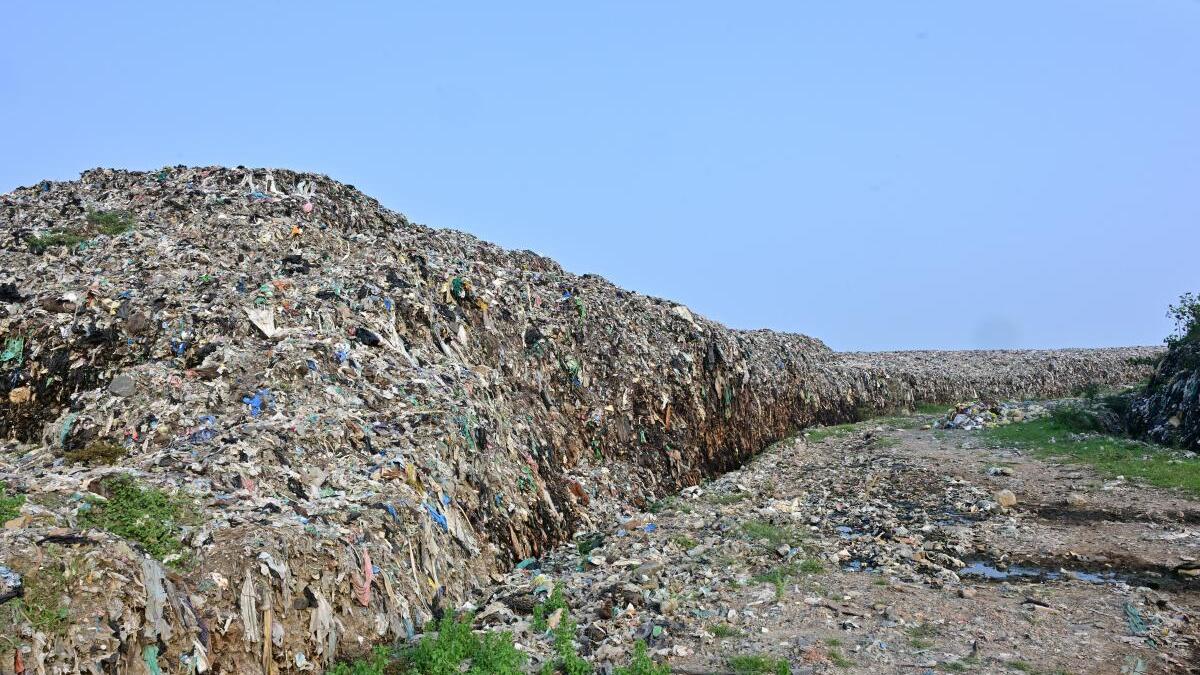
“The Pallikaranai Marshland, a Ramsar site, lies close by, and has also been affected by subsurface contamination. Unless all the dumped waste, is cleared and rainwater allowed to percolate through the reclaimed soil, the wetland cannot recover. We cannot have a Waste-to-Energy plant, like the one installed at the Kodungaiyur dumpyard,” he said.
The untreated waste over the years may have impacted the colour and odour of groundwater, said an expert from Anna University, which is the Project Management Consultant for the GCC on the Perungudi dumpyard. There are also issues due to leachate — toxic liquid discharge — mainly due to wet waste. There is no leachate management unit and dedicated STP at the dumpyard, he said. “Monitoring of pollution resumed in February after a year’s gap. A plan to separate soil from harmful substances was proposed, but experts from Anna University and IIT-M raised concerns that biomining may intensify leachate issues. https://www.thehindu.com/news/cities/chennai/chennai-corporation-waste-issues-perungudi-dumpyard-where-pollution-piles-up-for-residents/article69457676.ece (17 April 2025)
Mysuru New plan to save Kukkarahalli Lake The SPCB will assess pollution levels at Kukkarahalli Lake to help the Mysuru City Corporation (MCC), University of Mysore, District Administration and Mysore Grahakara Parishat (MGP) formulate a comprehensive action plan to halt the daily inflow of untreated sewage into the Lake. The KSPCB has proposed diverting sewage to the Underground Drainage (UGD) network and enforcing strict measures to prevent future contamination.
Located in the heart of Mysuru, Kukkarahalli Lake is reeling under the continuous discharge of sewage — a toxic mix of faecal matter and detergent-laden runoff — from areas like Jayalakshmipuram, Paduvarahalli (Vinayakanagar), Valmiki Road and their surroundings. The unchecked inflow has led to fish deaths, choking vegetation and food scarcity for migratory birds, drastically reducing the Lake’s avian population over the years. Despite repeated assurances from Mayors, Commissioners and release of funds, the MCC has failed to stop the sewage inflow. MGP members noted that Kukkarahalli Lake, with its rich biodiversity and heritage significance, is dying a slow death.
Activists expressed concern over the ineffectiveness of existing infrastructure. A bridge constructed by MCC at the Valmiki Road-Hunsur Road junction to block sewage entry has failed to prevent contaminated water from flowing into the Lake via a ‘magic box’ drainage inlet from the Paduvarahalli side. Two additional streams — one from the Hunsur Road side drain and another from behind Maharani’s College on Valmiki Road — are also contributing to the pollution. The continued influx of untreated waste water is fuelling algae growth, degrading water quality, threatening aquatic life and increasing mosquito populations. https://starofmysore.com/new-plan-to-save-kukkarahalli-lake/amp/ (16 April 2025)
Hyderabad KFG has all characteristics of a forest: CEC The Central Empowered Committee (CEC) set up by the Supreme Court in the ongoing Kancha Gachibowli row at the University of Hyderabad (UoH) has come to the conclusion that the entire 2374 acres which the Telangana government wanted to take over for industrialisation prima facie “appears to have all characteristics of a forest.” The CEC argued that the action taken by the state government raises concerns over the ongoing disputes over the ownership and ecological value of the land at Kancha Gachibowli. The Director General of FSI has indicated that the final report will require approximately two more weeks to be presented and a team of the FSI is presently in Hyderabad working on the survey. https://www.thenewsminute.com/telangana/kancha-gachibowli-has-all-characteristics-of-a-forest-says-scs-cec (17 April 2025) In its 60-page-long interim report, submitted in response to a suo motu case taken up by the Supreme Court, the CEC stated that the clearing of the forest was done in “unexplained haste” and caused “irreversible damage” to a landscape rich in flora, fauna, and unique rock formations. Rich biodiversity “The actions of TGIIC demonstrate utter disregard for the ecological value of the area and the rich biodiversity it supports,” the report stated. It stated that despite the area’s environmental sensitivity, no environmental clearance was obtained. https://timesofindia.indiatimes.com/city/hyderabad/unplanned-careless-sc-panel-raps-telangana-govt/articleshow/120377704.cms (17 April 2025) While posting the matter for the next hearing on May 15, the bench orally said, “In the meantime, not a single tree will be felled there.” It asked the Telangana government to explain the “compelling urgency” for clearing the large tree cover and stayed any future activity till further orders. https://www.siasat.com/sc-voices-concern-over-tree-felling-near-university-of-hyderabad-3207980/ (16 April 2025) When it comes to how we manage urban land and design our cities, no such compensation exists. Sustainability is our collective blind spot — always present, rarely acknowledged, and patched over with short-term fixes. (Navya Jannu) https://www.thehindu.com/opinion/op-ed/what-kancha-gachibowli-makes-visible/article69449367.ece (15 April 2025)
Mumbai DPS Flamingo Lake declared a conservation reserve The State Wildlife Board has officially approved the declaration of DPS Flamingo Lake as a conservation reserve, making it the first wetland connected to the Thane Creek Flamingo Sanctuary (TCFS) to receive such protection. The move, endorsed during a board meeting chaired by CM Devendra Fadnavis on Thursday, is expected to preserve Navi Mumbai’s delicate wetland ecosystem.
The 30-acre lake serves as a critical resting and feeding ground for flamingos that migrate from TCFS during high tide. State Forest Minister Ganesh Naik, who pushed strongly for the lake’s conservation, said, “This lake is an important stopover for flamingos and needs to be preserved as a sensitive biodiversity zone.” Naik, who also serves as vice-chairman of the State Wildlife Board, explained to members that protecting this habitat was not just about conservation, but also public interest and environmental responsibility. https://indianexpress.com/article/cities/mumbai/navi-mumbai-dps-flamingo-lake-conservation-reserve-9951316/ (18 April 2025)
Residents to hold walk for wetlands & trees While welcoming the govt’s recent move to declare DPS Lake as a Conservation Reserve, residents are now demanding that NRI Wetland and T.S. Chanakya Lake also receives the same protected status. According to the organizers, both ecosystems are equally vital and must be safeguarded from further degradation. https://www.freepressjournal.in/mumbai/navi-mumbai-news-palm-beach-residents-to-hold-walk-for-wetlands-trees-on-april-20-demand-conservation-status-and-action-against-tree-damage (19 April 2025)
Water flow partially restored to DPS lake after 3 yrs Flamingos have begun returning to the 30-acre DPS lake in Nerul, Navi Mumbai, after three years following partial restoration of intertidal water flow to the wetland. Range forest officer Sudhir Manjare said the water flow has cleared 60-70% of accumulated algae. The lake’s tidal water inlets had earlier been blocked. This led to an overgrowth of algae, which forced the migratory birds to skip the site. A govt-appointed panel and the state mangrove cell then asked Cidco to clear the blockage. The lake, part of the Ramsar site Thane creek flamingo sanctuary’s satellite wetland system, used to serve as a resting and feeding ground for flamingos during high tide. The state forest department recently initiated the process of granting conservation reserve status to it. https://timesofindia.indiatimes.com/city/mumbai/water-flow-partially-restored-flamingos-return-to-dps-lake-after-3-yrs/articleshow/120354792.cms (16 April 2025)
Bhopal Fish found dead in Lower lake Fish were found dead in Khatlapura Ghat (Lower Lake), Shahpura Lake, Munshi Hussain Khan Talab etc. Dead fish were also spotted in Lower Lake, one of two lakes in Bhoj wetland a Ramsar site. MPPCB prima facie attributes it to increasing temperature which reduces dissolved oxygen which is one of the major causes of death of fish in water bodies. However, MPPCB assures for testing water sample to know other factors of deaths like pollution or chemicals. https://www.freepressjournal.in/bhopal/fish-found-dead-in-lower-lake-a-designated-wetland-of-international-repute (19 April 2025)
Gurugram Illegal structures constructed close to Ramsar Site Sultanpur National Park is facing a threat from illegal construction within its eco-sensitive zone, with the wildlife department having identified 11 violations this month and 14 violations in March. Despite its 5km no-construction buffer intended to protect its ecological sanctity, numerous farmhouses, banquet halls and other buildings have emerged within just a km of the national park — a renowned birdwatching destination and Ramsar site since 2021.
The violations follow a troubling pattern, with 32 incidents having been reported in Dec last year and 78 earlier by a committee formed by National Board for Wildlife (NBWL). So, the overall violations stand at 135. Despite these findings, department of town and country planning (DTCP) has yet to take action against the violators. Wildlife officials warn these illegal constructions not only contribute to pollution but also heighten the risk of human-animal conflict. https://timesofindia.indiatimes.com/city/gurgaon/buildings-encroach-bird-haven-green-buffer-shrinks-in-gurgaon-farmhouses-banquet-halls-among-illegal-structures-constructed-close-to-ramsar-site/articleshow/120463121.cms (21 April 2025)
Delhi Govt starts Naini lake revamp -The project was announced in June 2022 as a part of the Amrit Sarovar Mission of the Union government, under which 21 waterbodies in the city were to be rejuvenated. The mission was scheduled to be completed by March 31, 2023, but work on Naini lake never started. A total of ₹10 crore was allocated for revamp of Naini lake.
-An MCD official said they will look into the delay but a large number of projects have been delayed over the last two years due to non formation of standing committee, which is a key panel whose permission is required for projects above the financial implication of ₹5 crore.
The consultancy will be responsible for developing the infrastructure to carry treated waste water from Coronation Pillar Sewage Treatment Plant near Mukundpur metro depot to Model Town. Besides, the firm will also design a mechanism to provide water for irrigating parks in the region using the lake water, thereby reducing the groundwater consumption. Currently, the waterbody is fed by the ground water using borewells. https://www.hindustantimes.com/cities/delhi-news/2-years-after-approval-mcd-invites-bids-for-naini-lake-s-revamp-101744569325182.html (14 Apr 2025)
URBAN WATER
Hyderabad HMWSSB not to penalise homes without RWH The Hyderabad Metropolitan Water Supply & Sewerage Board (HMWS&SB) for this season will not double the charges on water tankers for homeowners that do not have a rainwater harvesting pit, Board Managing Director K. Ashok Reddy said. The decision was taken in view of the prevailing high demand for water tankers in the season combined with the drying up of groundwater resource at several places in the city. http://thehindu.com/news/national/telangana/hmwssb-not-to-penalise-homes-without-rwh-with-double-tanker-charges-for-this-season/article69446431.ece (13 Apr 2025)
6 motors seized on day 3 of illegal water tapping drive On the third day of its ‘Motor Free Tap’ drive, the Hyderabad Metropolitan Water Supply and Sewerage Board (HMWSSB) on Thursday, April 17, seized six illegal water motors from an apartment in the Pardagate, Narayanguda, for attaching motors to water pipelines and disrupting supply.
On April 16, HMWSSB identified 134 illegal motors and fined 38 consumers across Hyderabad for attaching motors to water pipelines, disrupting the supply. Earlier, the Hyderabad water board seized 64 electric motors and fined 84 consumers across the city for illegally attaching motors to water pipelines, disrupting the supply.
Officials stated that using electric motors to draw off excess water disrupts the supply and causes low pressure for other consumers. They warned that any repeat offence will attract a fine of Rs 5,000 along with legal action. The Water Board has strongly urged residents not to attach motors to their pipelines. https://www.siasat.com/six-motors-seized-on-day-3-of-illegal-water-tapping-drive-3208775/ (17 April 2025) In phase 1, the linemen will inspect the supply lines connection by connection as soon as the water valves are opened. They will assess water pressure levels and check for the presence of motors. On the following day, the section managers in phase 2 will re-inspect the same water supply lines in Hyderabad. If a motor is found connected to a drain, a Rs 5,000 fine will be imposed, the motor will be seized immediately, and the consumer’s CAN number will be blacklisted. The Hyderabad water board MD warned officials that if found submitting false or incomplete reports will be subject to performance reviews and disciplinary actions, including the issuance of a MOMO (Memo of Misconduct). https://www.siasat.com/84-hyderabad-residents-fined-for-illegal-water-tapping-3207741/ (16 April 2025)
Mumbai Why city faces water crisis When untreated water by tankers is a reality in Mumbai, an aspirant city wanting to be a global city, imagine how it would be elsewhere. Rapid urbanisation without adequate water sources is one cause, unplanned development, poor planning, or poor finances, one or all together, are the reasons for the proliferation of dry taps at homes. This makes for urban governance across towns and cities. We are keeping the issues of rural India aside for once. It could be graver there. But historically, cities are said to be getting the best attention. (Mahesh Vijapurkar) https://www.siasat.com/water-water-everywhere-but-not-enough-to-drink-that-is-world-class-mumbai-for-you-3208309/ (16 April 2025)
Kharghar residents say near drought situation -As many as 125 societies in Kharghar are currently experiencing water cuts of 30-50 per cent. Residents have been forced to depend on tanker services to meet their basic needs. The Kharghar federation warned that allowing new projects without securing additional water sources would exacerbate the already dire situation.
-Next door, Taloja residents are also facing a harrowing time because of the water crisis. Representatives from 250 housing societies from Taloja phase1 and 2, have threatened to launch an agitation if no solution was found to solve their water problem.
-The area is already home to approximately 200 new high-rise buildings under construction, and residents fear that the water supply will be further depleted once these projects are completed. The issue is compounded by a reported shortfall of 18 million litres per day in the water supply to Kharghar and the nearby Taloja region. The demand for water in the area is 100 MLD, but the current supply hovers at 82 MLD.
-There is also growing concern about the additional water demand expected with the upcoming operations at the Navi Mumbai airport and the 25,000 homes being developed under CIDCO’s affordable housing scheme. https://www.newsband.in/article_detail/kharghar-water-crisis-near-drought-situation-say-residents (14 April 2025)
MWTA calls off strike -The MWTA took the decision a day after the BMC invoked the Disaster Management Act (2005), under which the civic body would take control of all the wells and tankers to continue the water supply in the city. “The BMC has agreed to suspend all the notices, take back the penalties imposed on us, and has told us that the state government will convey our demand to the union ministry to amend the 2020 guidelines of the CGWA,” said Ankur Sharma, spokesperson of MWTA.
-A statement from the BMC read, “The notices of suspension to well owners are withdrawn; however well owners who do not have adequate approvals from the corporation will have to obtain these. Further, any technical matters are the domain of the state government, and the civic body cannot interfere.”
-Activist Sureshkumar Dhoka said, “The wells in the city have been overexploited, which could lead to the ingress of saline water—which, in turn, will have an adverse environmental impact. Hence, it is important to regulate the wells and the water tanker business in the city.” https://www.hindustantimes.com/cities/mumbai-news/water-tanker-association-calls-off-indefinite-strike-on-day-5-101744657770776.html (15 April 2025)
Nagpur Revived canal ensures drinking water supply for 200 families A project to save the Sawangi canal in Nagpur has improved fertility of around 400 hectares of land and benefited 200 families by providing them with drinking water and an uninterrupted supply of the critical resource for irrigation and livestock. The project which began in February 2024, has now been completed with the widening and deepening of 4.11-km canal stretch spanning from ridge to valley, improving groundwater levels and the standard of living for farmers, livestock and wildlife in the area. https://www.newindianexpress.com/nation/2025/Apr/16/csr-project-to-revive-nagpur-canal-ensures-drinking-water-supply-for-200-families (16 April 2025)
Dehradun Drinking water crisis worsens -As temperatures continue to rise, several parts of Dehradun are grappling with a drinking water crisis, forcing residents to rely heavily on private water tankers. Localities such as Doon Vihar, Shipra Vihar, and elevated regions along Kaulagarh Road and Mothrowala have been severely affected.
– The city’s demand remains around 200 million litres per day, but during summer months, the supply drops to around 170 million litres per day, said officials. The district administration has also directed authorities to address supply-related concerns on priority as the crisis deepens. https://timesofindia.indiatimes.com/city/dehradun/drinking-water-crisis-worsens-in-dehradun-amid-rise-in-temperature/articleshow/120260650.cms (15 April 2025)
Chandigarh Apply for tertiary water in 15 days or face fine On Apr 15, the Chandigarh MC set a 15-day deadline for non-compliant residential and institutional properties to apply for the connections or face a penalty. “Residents are requested to apply for the connections in the next 15 days on the ‘I’m Chandigarh’ app, failing which, a penalty will be imposed,” said MC officials.
In December 2024, the MC House had passed a resolution to impose a penalty equivalent to 7.5% of the total water bill on properties not taking tertiary treated (TT) water connection despite repeated notices. As per the Chandigarh Water Supply Bylaws, 2015, the use of TT water is compulsory in all houses/institutions sized one kanal and above. The bylaws made TT water connections compulsory within three months from the date of notification, but the civic body has found that out of 7,385 eligible houses, only 3,334 have opted for the connection so far.
The civic body has identified 4,051 non-compliant properties and already issued notices to 2,358. Following the notices, 900 property owners have applied for the connection, while the rest have been given a final 15-day deadline. The situation is similar among institutions. Out of 414 establishments required to switch to TT water, only 154 have complied. Notices have been issued to the 154 violators.
Through tertiary treatment, sewage water is made suitable for irrigation through chemical treatment and sedimentation process. It is the final stage of the wastewater cleaning process to make it suitable for irrigation and related activities. The treated water’s BOD should be less than 10 mg. At present, for the residential sector, MC charges a flat rate of ₹50 per kanal area per month for TT water supply. For commercial use, the charge is ₹7 per kilolitre.
The TT water is supplied from MC’s 6 STPs — 3BRD, Dhanas, Raipur Khurd, Raipur Kalan, Maloya and Diggian, upgraded at a cost of ₹650 crore in 2023 under the Smart City Mission. Chandigarh generates 220 MLD of wastewater/sewage, which is treated at these state-of-the-art STPs to bring the BOD level under 10 mg per litre. Use of TT water for irrigation is one of the main objectives of the City Water Action Plan (CWAP) to conserve ground and potable water. https://www.hindustantimes.com/cities/chandigarh-news/chandigarhapply-for-tertiary-water-in-15-days-or-face-fine-101744748298080.html (16 April 2025)
MC crackdown on misuse of water In a bid to prevent the misuse of potable water, the Chandigarh Municipal Corporation (MC) launched its annual water conservation drive on Monday (April 14) morning, issuing 180 notices and eight challans to violators for wasting drinking water. According to officials, the campaign is part of an intensified effort to promote judicious water usage, particularly during the summer months. https://indianexpress.com/article/cities/chandigarh/mc-crackdown-misuse-water-challans-issued-first-day-9946766/ (16 April 2025)
Gurugram MCG ‘lied’ about drain for leachate control at Bandhwari: Plea in NGT MCG’s submission to the NGT that it has built a drain around the Bandhwari landfill site to stop the flow of leachate into the surrounding Aravalis was disputed by environmentalists, who said they will file a perjury application against the corporation. The objection was made after MCG on Tuesday (April 15) submitted a report to the tribunal, which has been hearing a long-drawn case on clearing the landfill site in Bandhwari. In the report, signed by MCG additional commissioner Mahabir Parsad, the corporation said it had constructed a garland drain around the landfill to contain any leachate spill-off.
According to the report, approximately 200 KLD of leachate is produced at the Bandhwari site in a day, and volume goes up during the rainy season. This leachate is transported to a STP in Behrampur, Gurgaon, it noted. Asked about the petitioner’s allegation, an MCG official said: “There is no leachate generation at this time. We are taking every step to ensure that leachate doesn’t spill.” The tribunal will take up the case next on Aug 14.
On legacy waste, MCG said it has been converted into bio-soil, refuse-derived fuel (RDF) and inert waste. As of March 31, 2025, 34 lakh metric tonnes (MT) of fresh and legacy waste have been processed since Jan 2023. The remaining 11.3 lakh MT of waste is expected to be processed by July 3 this year, the report said. https://timesofindia.indiatimes.com/city/gurgaon/mcg-lied-about-drain-for-leachate-control-at-bandhwari-plea-in-ngt/articleshow/120320816.cms (16 April 2025)
Delhi Illegal borewell boom running on empty Early this month, the High Court came down heavily on local authorities over the illegal extraction of groundwater in the national capital, calling it “nothing less than a sin”. The court’s sharp rebuke came while hearing a PIL that highlighted the unchecked use of borewells at an under-construction property on Roshanara Road. According to an affidavit submitted by the DJB to the NGT last month, 22,010 illegal borewells have been identified across the city. Of these, 13,693 have been sealed. The NGT, too, is hearing multiple petitions concerning illegal borewell operations in the capital. According to experts, this incident is only a surface-level indicator — the actual scale of the problem runs far deeper and threatens Delhi’s groundwater sustainability.
Environmentalist Bhavreen Khandari told The Hindu that the “recurring emergence of illegal borewells in Delhi is a symptom of our deepening water crisis and poor environmental governance”. Environmental activist Varun Gulati told The Hindu that the actual number of unauthorised borewells is likely far higher than official figures indicate. Citing his investigation in 2021, Mr. Gulati said he had submitted a list of 556 suspected addresses in the overexploited Paharganj area, where 442 were later confirmed to be operating illegal borewells. Beyond residential use, Delhi houses thousands of water-intensive factories, many of which tap into groundwater through unauthorised borewells to meet industrial needs, he noted.
Proceedings before the NGT have revealed enforcement gaps. The DPCC has imposed environmental damage compensation (EDC) of ₹70.93 crore on violators. However, only ₹79.70 lakh has been recovered so far. Advocate Sunil Kumar Sharma, whose PIL prompted the Delhi High Court’s intervention, emphasised the urgent need to tackle illegal borewells that can cause a decline in the water table. Mr. Sharma said extraction of large amounts of groundwater can result in the sinking of the land surface, causing structural damage to buildings, roads, and other infrastructure. https://www.thehindu.com/news/cities/Delhi/delhis-illegal-borewell-boom-running-on-empty/article69469292.ece (20 April 2025)
Delhi CM Rekha Gupta on Sunday (April 20) flagged off 1,111 tankers fitted with a location tracking system to boost water supply in the city during the summer. The system will enable the tankers’ location to be tracked on an IT dashboard from the Delhi Jal Board headquarters. https://www.moneycontrol.com/city/delhi-cm-flags-off-1-100-tankers-fitted-with-location-tracking-system-to-boost-summer-water-supply-article-12998781.html (20 April 2025)
Report As taps and borewell dry up, it’s the return of water tanker raj Emboldened suppliers not only extract groundwater illegally and charge a bomb, but also blackmail housing societies if asked to comply with rules. Richer societies end up paying lakhs per month for water while poorer residents fight it out for a few buckets due to the shortage of civic supply. The same story is playing out in metros across the country. https://timesofindia.indiatimes.com/toi-plus/environment/as-taps-and-borewell-dry-up-its-the-return-of-water-tanker-raj/articleshow/120433810.cms (19 April 2025)
WATER POLLUTION
Tamil Nadu Mercury levels 62 times higher in water near Neyveli mines -The SPCB has submitted an analysis of water and soil samples taken near Neyveli Lignite Corporation (NLC) India Limited before the southern bench of NGT, which revealed alarming concentrations of mercury in groundwater and surface water. The groundwater, a primary drinking source for residents, is heavily contaminated. Surface waterbodies, used for irrigation and domestic purposes, fared no better. The samples were collected on December 17, 2024.
These water sources, 2.35-8.45km downstream of NLC’s mines, are critical for household use, possibly exposing residents to mercury’s neurotoxic effects, which include neurological disorders, kidney damage, and developmental issues in children. The contamination likely stems from fly ash from NLC’s thermal plants and mine water discharges. The NGT bench has posted the matter to June 12. https://www.newindianexpress.com/states/tamil-nadu/2025/Apr/18/mercury-62-times-higher-in-water-near-neyveli-mines-reveal-reports (18 Apr 2025)
Maharashtra After hair, Shegaon villagers losing nails -With the cause still unknown, perplexed citizens have raised some questions and have demanded answers — what is this mystery illness…is it an infection…could it be linked to contaminated water or food source? https://timesofindia.indiatimes.com/city/nagpur/those-who-suffered-hair-lossnow-losing-nails-in-shegaon/articleshow/120391036.cms (18 April 2025)
Punjab PPCB inspects Ludhiana industrial units and sewer lines The Punjab Pollution Control Board (PPCB) has ramped up its crackdown on illegal effluent discharge, inspecting multiple industrial units and sewer lines across Ludhiana as part of its ongoing campaign to tackle water pollution. PPCB officials reported multiple infractions: absence of Joint Inspection and Reporting (JIR) records, operation without mandatory consent from the pollution board, non-maintenance of water usage logs, and visible acid spills inside premises. In one instance, wastewater samples from a unit registered a pH as low as 2 — a dangerously acidic level posing both environmental and occupational hazards. https://timesofindia.indiatimes.com/city/ludhiana/punjab-pollution-control-board-inspects-ludhiana-industrial-units-and-sewer-lines-in-campaign-against-water-pollution-/articleshow/120440549.cms (20 April 2025)
JJM/ RURAL WATER SUPPLY
Report Justify increase in cost of tap to Rs 1,37,500 from Rs 30,000, says Finance No sooner did the Jal Shakti Ministry propose a revised outlay of Rs 9.10 lakh crore for the Jal Jeevan Mission (JJM) and sought more funds in February this year than the Finance Ministry raised many red flags, asking it to first justify the sharp increase in the cost of installing a tap connection to Rs 1,37,500 now from Rs 30,000 during 2019-24.
“It is not clear why the cost of providing tap water to the remaining rural households of about 4 crore number of units, has gone up manifold… may provide necessary justification for the time and cost overruns incurred with respect to the original Cabinet approval of Rs 3.6 lakh crore which was planned to achieve 100 per cent coverage till 2024,” said the Department of Economic Affairs, responding to the concept note.
The Jal Shakti Ministry denied there were any time and cost overruns in its response to the justifications sought by the Finance Ministry. “Various states and implementing agencies informed that unprecedented increase was observed in prices of various input materials (costing around 60% of total cost of project), the price volatility, non-participation in tender, non-completion of works as per timelines, especially due to Covid situation and Ukraine war, which affected the implementation adversely,” it said.. https://indianexpress.com/article/india/jal-jeevan-mission-justify-increase-in-cost-of-tap-to-rs-137500-from-rs-30000-says-finance-9955582/ (21 Apr 2025)
MoJS wants Rs 2.79 lakh crore more Sharply higher costs amid concerns that some states may have approved inflated work contracts to provide tap water connections to rural households under the Jal Jeevan Mission have led an Expenditure Secretary-led panel to propose a 46 per cent cut in the Centre’s funding assistance to the Jal Shakti Ministry’s demand for four years ending December 2028. The onus to bridge this liability — estimated to be over Rs 1.25 lakh crore over the four years — may fall on states, which may then approach the Union government, said officials closely involved in the discussions. “As many as16 states are ruled by BJP and its allies and this may force the Centre’s hand,” said an official, who did not wish to be named. https://indianexpress.com/article/india/jal-shakti-wants-rs-2-79-lakh-crore-more-for-flagship-water-scheme-panel-clears-half-9955602/ (21 April 2025)
Madhya Pradesh -उमरिया जिले के पाली ब्लाक अंतर्गत ग्राम पंचायत मलियागुड़ा के ग्रामीण भीषण गर्मी मेें पानी के लिए संघर्ष कर रहे हैं। इसका कारण नल जल योजना का कार्य अधूरा होना है। कुछ दिन पूर्व तक ठेकेदार ने जितने स्थानों में कनेक्शन किया है वहां भी कुछ दिन पानी चला लेकिन लगभग पंद्रह दिनों से पानी आना बंद हो गया है। बताया जा रहा है कि ठेकेदार ने जल्दी जल्दी पानी की टंकी निर्माण करवाते हुए आसपास के क्षेत्र में कनेक्शन देकर इतिश्री कर ली, जबकि कई बस्तियों में अभी तक या तो काम अधूरा पड़ा है या कनेक्शन ही नहीं दिए गए हैंं। https://www.patrika.com/umaria-news/tap-water-scheme-contractor-left-the-work-midway-villagers-are-troubled-by-water-crisis-19526144 (12 April 2025)
WATER
Jammu & Kashmir Low snowfall to cause water crisis -The low snowfall in Kashmir’s higher reaches this winter has sparked concerns among experts over a possible water crisis in the upcoming summer, especially for irrigation and potable water needs. https://www.greaterkashmir.com/latest-news/low-snowfall-this-winter-may-trigger-water-crisis-in-kashmir-experts/ (17 April 2025)
Himachal Pradesh Tullu pump misuse creates water crisis in Kangra The Jal Shakti Department is grappling with a growing challenge of artificial water scarcity in rural Kangra, triggered by residents illegally using tullu pumps to extract drinking water. Despite a clear ban on connecting tullu pumps directly to piped water supply lines, some consumers continue to flout the rules, resulting in disrupted water distribution across several villages. https://www.tribuneindia.com/news/himachal/tullu-pump-misuse-creates-water-crisis-in-kangra-dist/ (19 April 2025)
AGRICULTURE
Maharashtra Deadly toll of sugar on soil A six-month investigation by “The Wire” explored the wide-ranging consequences of defying nature to grow water-intensive sugarcane in the region and why expansion continues. Part one examines the ecological impact of sustaining the sugar boom in a dry region. Data shows that sugarcane occupies less than a tenth of the state’s agricultural land but sucks up four times more water than wheat. Two out of ten irrigated hectares grow sugarcane in the state. Experts say it leaves the soil dead in its wake. The crop’s insatiable thirst is supplemented with pesticides, fertilisers and water that is running out. Yet, farmers are at its mercy. Its production has nearly doubled since 2012 in drought-prone Marathwada’s districts such as Beed, Jalna, Chhatrapati Sambhaji Nagar, and Parbhani when compared to the state average. Excessive sugarcane farming in Marathwada is depleting carbon from the soil, which plants need to stay healthy. Soil in most districts in Marathwada are also deficient in iron. https://thewire.in/environment/the-deadly-toll-of-sugar-on-marathwadas-soil (16 April 2025)
Interview Pest and disease attacks on crops rising due to climate change: Scientist Agriculture is one of the sectors most vulnerable to the effects of climate change on weather patterns across different parts of the world. In an interview with Business Standard, B M Prasanna, distinguished scientist and regional director for Asia at the International Maize and Wheat Improvement Center (CIMMYT), talks about some of the challenges that climate change poses to agriculture and ways to handle them. https://www.business-standard.com/economy/interviews/pest-and-disease-attacks-on-crops-rising-due-to-climate-change-scientist-125041800802_1.html (18 April 2025)
MONSOON
Report Move to downsize NOAA will impact India’s long term forecasting -IMD concerns intensified with the American Meteorological Society (AMS) releasing a formal statement late Thursday (April 17), highlighting the Trump administration’s plan to eliminate the National Oceanic and Atmospheric Administration (NOAA) research through fund cuts that will result in the closure of all its weather, climate, and ocean laboratories, as well as cooperative institutes.
-The NOAA presently shares data with several countries, including India, which helps improve weather forecast accuracy. Although the US govt’s proposed move may not immediately impact India, it will affect the IMD’s forecasting skill in the long run. NOAA significantly contributes to the observing system in oceans, including the Indian and Pacific Oceans, which helps IMD in weather forecasting, disaster preparedness and climatic research.
-Both NOAA and India’s ministry of earth sciences (MoES) have a joint oceanographic data portal, launched in 2021. The collaboration under partnership agreement between the two agencies also helps in studying the Indian Ocean’s role in monsoon and improving monsoon forecasts.
-Noting that the clue for monsoon forecasts comes from the ocean, M Ravichandran, secretary, MoES said, “If we do not have proper ocean observations, we will definitely not be able to have better predictability”. The AMS statement came in partnership with the National Weather Association of the US that connects approximately 1,300 members from the fields of meteorology, hydrology, emergency management and academia. https://timesofindia.indiatimes.com/india/indias-weather-forecasting-to-face-long-term-impact-of-us-move-to-downsize-noaa/articleshow/120422657.cms (19 April 2025)
Kerala New DWRs to amplify weather monitoring power The IMD is set to install an X-band Doppler weather radar (DWR) at the campus of Pazhassiraja College in Pulpally. The IMD is planning to commission the radar ahead of the south west monsoon season. Interestingly, the construction of a C-Band DWR is progressing at Mangaluru, which is expected to cover northern districts such as Kasargod and Kannur, apart from southern Karnataka districts. With the commissioning of these two new radars, Kerala is expected to get a state-wide Doppler coverage. It already has an S Band radar at Kochi and C-Band radar at Thiruvananthapuram.
The DWRs are categories based on the wavelength of the microwave radiation. While C-Band radars function at about 5 cm wavelength, X-Band radars function at 3 cm. S-band radar uses wavelengths between 8 and 15 cm. The C-Band radar provides radial coverage of 250 km from its centre, whereas X Band radar covers a radius of 100 km. The S-Band radar operational in Kochi is used for Cyclone detection along with weather forecasting.
So far, the S Band radar located at Kochi has been the one trusted by the weathermen for forecasts of northern districts for a long time. However, there were many challenges such as poor visibility of low lying clouds due to the effect of earth’s curvature. Though a Doppler radar has been approved for the northern districts, the installation got delayed due to lack of a proper location. https://www.thenewsminute.com/amp/story/kerala/new-doppler-radars-at-wayanad-mangaluru-to-amplify-weather-monitoring-power (12 April 2025)
FLOOD
Dam Floods Karnataka Experts call for better dam storage to avoid floods Several areas in north Karnataka falling in the Krishna river basin – which also covers Tungabhadra basin – were affected by floods in 2019, 2021, and 2024. The Cauvery basin experienced a flood situation in 2018 when farmlands in Kodagu and adjoining areas were submerged. In all these instanced, wrong management of dams contributed to floods. Significantly, many of these flood events occurred in July and Aug, even when rainfall was close to LPA. Experts say the deluge was triggered by the sudden release of water from brimming reservoirs that had been filled quickly.
– “This is the reason why we are advising cautious approach. Water should be released as and when there is inflow and the storage should never be allowed to go beyond 70% of the capacity of dams,” said Dr G S Srinivas Reddy, former director of Karnataka State Natural Disaster Monitoring Centre. Experts warn the pattern of holding water until reservoirs are nearly full, only to release it en masse, must change.
– The state’s water resources department said it is committed to strictly adhering to the rule curve and improving coordination with neighbouring states. Officials said mismanagement of upstream releases, such as from the Koyna dam in Maharashtra, contributed to floods in the Krishna basin in 2019. “Lessons have been learnt from the experience of 2019 and onwards. A coordination committee comprising the additional chief secretaries of Karnataka and Maharashtra has been set up. And there is a WhatsApp group of officials from all riparian states of the both Krishna basin and there will be a timely alert before release of water” said Krishnamurthy B Kulkarni, secretary, water resources department.
– The govt has also commissioned a survey to remove encroachments along riverbanks, which are seen as another major factor behind flash floods. https://timesofindia.indiatimes.com/city/bengaluru/experts-call-for-better-dam-storage-to-avert-floods/articleshow/120397169.cms (18 April 2025)
India-Bangladesh Tripura govt team inspects embankment repair work A high-level team of the Tripura Government on Apr 20 visited Belonia town and adjoining villages near the India-Bangladesh border in South Tripura district to inspect repair works of embankments, among others, damaged in the floods last year. The team also held discussions with the district magistrate, local public representatives, and officials concerned during the visit. The floods last year cost 38 lives, affected over 17 lakh people, and resulted in damages worth Rs 15,000 crore. Kiran Dinkarrao Gitte, Secretary, Public Works Department (PWD), who led the visiting team, said, “The highest recorded rainfall (in the state) occurred in South Tripura. Our (repair) work is continuing here. Some work is already underway on the left and right banks of the River Muhuri… All such repair and reconstruction work will end in two months.”
– The official, though, did not comment on the issue of Bangladesh constructing an embankment close to the border near Belonia. Nikhil Chandra Gope, Chairperson, Belonia Municipal Council, said they had intimated officials right at the beginning when Bangladesh started constructing the embankment. “Our demand is to protect Belonia town by raising the embankment on our side by at least 1 or 2 metre.” The issue of the construction of embankment by Bangladesh was raised by local CPI(M) MLA Dipankar Sen on Saturday (April 19). Flagging the issue, he requested the South Tripura district magistrate and senior BSF officials to take up the matter with the Centre, so that a dialogue could be initiated with the Bangladesh authorities.
– In January, the state government had expressed concern over the reported construction of an embankment on the River Manu by the Bangladesh Government close to the international border near Devipur under Tripura’s Unakoti district. A team led by Dilip Kumar Chakma, District Magistrate, Unakoti, had then inspected the site from the zero point and warned that the Kailasahar township could face devastating floods owing to the embankment right across the border. The district magistrate had also submitted a note to the state government on his findings. As per the 1971 Indira-Mujib pact, any permanent construction within 150 yards on both sides of the zero line is not allowed. https://indianexpress.com/article/india/tripura-government-team-belonia-embankment-repair-work-9955463/ (21 April 2025)
URBAN FLOODS
Kochi Panampilly Nagar struggles with tidal flooding Panampilly Nagar, known for its upscale residential area and charming commercial centres, is grappling with a growing threat—tidal flooding. Frequent sea surges now cause regular waterlogging, disrupting daily life and hindering local businesses. For residents, the rising water is more than just an inconvenience; it poses serious health risks. Contaminated floodwater often mixes with drinking water stored in ground-level tanks, forcing families to rely on costly tanker-supplied water. Locals say authorities have done little to mitigate the issue. Earlier projects aimed at solving the issue remain unimplemented. As Kochi continues to expand along its coast, the recurring waterlogging in Panampilly Nagar highlights the need for sustainable infrastructure solutions that can keep pace with the city’s evolving landscape. https://timesofindia.indiatimes.com/city/kochi/panampilly-nagar-struggles-with-tidal-flooding/articleshow/120461066.cms (20 April 2025)
CLOUD BURSTS
Jammu & Kashmir 3 killed, hundreds relocated after cloudburst wreaks havoc Three people were killed and several residential and commercial structures collapsed after a cloudburst led to torrential rain, wind and hail across Ramban tehsil on Sunday (April 20) morning. The weather has also resulted in the relocation of hundreds of residents and caused disruptions in transportation. Nearly 500 people were moved to safer locations during the night-long operations.
However, three people were buried under the rubble of their house, which collapsed at Seri Champa village on the outskirts of Ramban town. Several residential and commercial buildings were extensively damaged and scores of vehicles submerged in the muck caused by the cloudburst. As it was still raining heavily, officials said that an assessment of the loss of property will be made after the weather improves. The weather has also led to the Jammu and Srinagar NH being closed for vehicular traffic following blockades caused by landslides at various places in Ramban district. Disruptions in air travel to Srinagar have also been reported. https://indianexpress.com/article/india/jammu-kashmir-cloudburst-deaths-evacuated-9954625/ (20 April 2025) Around 40 residential houses sustained damage in the flash floods that struck the village. Several vehicles were also swept away by the overflowing stream. Multiple landslides, mudslides and shooting stones between Nashri and Banihal sections forced authorities to suspend traffic movement on the strategic highway from both directions. Nearly a dozen locations along the Nashri-Banihal stretch were affected by the landslides and mudslides, severely impacting the movement on this crucial route connecting Jammu and Srinagar. https://timesofindia.indiatimes.com/city/jammu/over-100-rescued-as-heavy-rain-triggers-flash-flood-in-jks-ramban-traffic-disrupted/articleshow/120450063.cms (20 April 2025)
Spell of cloud-burst inducing flash floods in certain areas; heavy rains, hail storm triggering slides in other stretches began at around 2 am and lasted till 7 am or so, leaving behind a trail of destruction all across the affected areas, including Ramban town, Seri and other areas along the NH. Crops and orchards also suffered extensive damage in the district.
As far as the NH was concerned, the stretch near Panthial was badly damaged. As per eye-witnesses’ accounts, three vehicles rolled down after a portion of the road caved in while around one dozen load carriers were stuck in land and mudslides near Maroog, one of the worst affected areas. They claimed that a few trucks, carrying livestock, were buried under debris near Maroog. SDRF and NDRF were engaged in relief and rescue operations yet the inclement weather condition was hampering their efforts.
Three major slides struck within the 100-meter radius affecting Seri; Kela Morh; Mehar Cafeteria, Maroog stretches and Shan Palace in Ramban town as big boulders and muck slides hit the structures. Bowli Bazar in Ramban town too was badly affected by flash floods in the adjoining nullah, which damaged around a dozen structures, including shops. Several vehicles also got buried under the muck debris.
“In Ramsoo of Banihal sub-division, there was no loss of life. However, horticulturists have suffered widespread damage to their crops. NH-44 witnessed multiple landslides,” SDRF officials said. “Seri, Cafeteria Morh, and Kela Morh were the worst affected stretches along the NH. At Panthial, we have been stationed since morning, closely monitoring the situation,” they added.
Power supply across the district was also badly affected and a major portion of the district was reeling under darkness till late evening. Mobile connectivity was another casualty as only a few networks were functioning and that too in certain areas.Following heavy rainfall and landslides that led to road blockages, hundreds of commuters, including women, children and the elderly, were left stranded without food, shelter or medical aid. https://www.greaterkashmir.com/front-page-2/2-minor-siblings-among-3-die-in-ramban-flash-floods/ (21 April 2025)
Over 3000 vehicles have been stranded at various places, along Jammu-Srinagar National Highway as the heavy rain has triggered landslides and mudslides at more than dozen places between Nashri and Banihal along the strategic NH. Due to at least 3-4 cloudbursts between 1 am and 3 am last night adjoining Ramban town and Seri Bagna area, scores of houses, shops and other establishments have been damaged while at least 200 vehicles were trapped and gone missing under debris.
Three parked vehicles rolled down into the gorge as road caved in in Maroog area during the day today. The vehicle operators however, escaped to the safer place. Near Hotel Usman at Ramban town at least 10-12 cars have been buried under the debris scattered all over the area after massive cloudburst. Scores of houses, shops and hotels etc have been damaged in the town. Many houses and shops besides Govt offices suffered damage in Maitra area of Ramban town. The cars, bikes and many other vehicles were washed away in the flood caused by cloudbursts.
The officials said about scores of residential houses were damaged after a flash flood hit Dharam Kund village. About a dozen houses were fully damaged while the rest suffered partial damage. From this village about 100 people were rescued. More than 350 trapped people were rescued by police, SDRF and local volunteers from the affected spots despite the continuous downpour and cloudbursts, they said, and added several light vehicles were swept away in the flood caused by overflowing streams.
A senior police official said that there had been massive damage in the entire district due to heavy rain, cloudbursts, high-velocity winds, landslides and hailstorms. https://www.dailyexcelsior.com/3-killed-over-350-rescued-as-heavy-rain-cloudbursts-wreak-havoc-in-ramban/v (21 April 2025)
Another cloudburst took place at Dharamkund village which is located around 20 kilometres (km) from Ramban town. Around 35 residential houses were destroyed, of which 10 have been washed away. Some locals said unplanned construction work in the town and blockage of some traditional storm water drains led to this massive damage.
“Ramban’s population has grown and the town is subsequently expanding. In the last 10 years, there has been large-scale construction work taking place in the town and the adjoining highway as well, with less checks and balances. Urban planning is completely missing. There are no experts posted in Ramban Municipality to guide the local body about sustainable architecture meant for hilly areas. In addition, constant work on NH-44 between Ramsoo to Ramban and Banihal has weakened the mountains which are not made of heavy rocky material. The constant drilling for making tunnels and heavy machinery cutting the mountain edges to create a 4-lane highway has further enfeebled these fragile geological formations and they have now become more prone to landslides and flash floods. This needs to be investigated,” said Badrul Duja, a Srinagar-based environmental lawyer while talking to Down To Earth. https://www.downtoearth.org.in/natural-disasters/massive-flash-floods-in-jammu-and-kashmirs-ramban-wash-away-nh-44-at-5-locations-three-people-killed (20 April 2025) रामबन में बादल फटने से एक होटल को भारी नुकसान हुआ. इसकी दो मंजिलें मलबे में दब गईं. होटल के कर्मचारियों ने पहले मेहमानों को निकाला और फिर अपनी जान बचने के लिए भागे https://www.abplive.com/states/jammu-and-kashmir/ramban-cloud-burst-usman-owais-hotel-affected-badly-destruction-horror-story-ann-2929017 (21 April 2025)
शनिवार शाम 19 अप्रैल को जम्मू एयरपोर्ट पर अफरा-तफरी मच गई, जब श्रीनगर में खराब मौसम के कारण कई उड़ानें रद्द कर दी गईं। रिपोर्ट्स के मुताबिक, किश्तवाड़ के नागेशरी वन क्षेत्र में बादल फटने की घटना के बाद मौसम खराब हो गया। इस बीच, खराब मौसम के कारण श्रीनगर से अन्य स्थानों के लिए कनेक्टिंग उड़ानें भी विलंबित या रद्द कर दी गईं। https://news24online.com/india/jammu-kashmir-cloudburst-in-nagesheri-forest-area-of-kishtwar-sparks-chaos-multiple-flights-cancelled-watch/536805/ (19 April 2025)
ENVIRONMENT GOVERNANCE
Himachal Pradesh Rights groups alarmed over forest official’s letter on FRA Several tribal and forest rights organisations have written to the Ministry of Tribal Affairs, objecting to a letter issued by the state’s Principal Chief Conservator of Forests which, they claim, misinterprets the Forest Rights Act (FRA) and could harm the recognition of rightful forest dwellers. The groups, which include Himdhara Collective, Himalaya Niti Abhiyan, Van Adhikar Manch and others, said the forest department’s letter, dated April 11 and addressed to all deputy commissioners and forest officers in the state, goes beyond its authority.
They demanded immediate withdrawal of the forest department’s letter and called for a trust-building process. Calling the letter “an unnecessary and unwarranted intervention”, the organisations wrote to ministry on April 14, saying, “As per the Act, only the Ministry of Tribal Affairs (MoTA) is authorised to issue clarifications or guidelines regarding its implementation. The letter issued by the Forest Department has bypassed the designated nodal agencies and their established clarifications.” https://www.business-standard.com/india-news/rights-groups-alarmed-over-himachal-forest-official-s-letter-on-fra-125041700117_1.html (17 April 2025) “The forest department is present during the verification of claims at every step as per the Act. In spite of all these safeguards and checks and balances, the principal chief conservator of forests issuing such a letter to the DLCs, even when they are not the statutory body in the state to issue clarifications and guidelines, is highly improper and unwarranted,” stated the organisations. https://timesofindia.indiatimes.com/city/chandigarh/in-himachal-pradesh-activists-challenge-forest-departments-stance-on-implementation-of-forest-rights-act/articleshow/120289340.cms (15 April 2025)
Forest conservation cannot wait The forests in India are vital to its ecological balance, climate resilience and socio-economic sustenance of millions of people. It is significant to improve the quality and quantity of green cover in India. Hence, it is essential to provide a clear and inclusive definition of forest. At the same time, efforts towards enhancing community participation and promoting native species of plants for afforestation purposes might be helpful. https://indianexpress.com/article/upsc-current-affairs/upsc-essentials/rapid-development-shrinking-green-cover-why-forest-conservation-cannot-wait-9949980/ (17 April 2025)
Maharashtra SBWL clears 4 mega-projects on 1,800 ha of forest land All four mega-projects were given the green signal by the State Board of Wildlife (SBWL) on Thursday (April 17) at a meeting chaired by CM Devendra Fadnavis. The proposals will be forwarded to the NBWL for its consideration. In addition to Gargai dam, the three other projects with potentially damaging environmental consequences were also cleared at the meeting.
Among them was the Gadchiroli hematite and quartzite mining project that will cut through the Tadoba Indravati tiger corridor. It will cover 997 hectares of forest land in Gadchiroli district, and require an estimated 123,000 trees to be axed. Significantly, Principal Chief Conservator of Forests, Shomita Biswas, had recommended this proposal.
Another project cleared also in the Tadoba Indravati tiger corridor, is a road to be built for the maintenance of power transmission lines in Gadchiroli. The project, whose estimated cost is ₹106 crore, has been allotted 20.57 hectares of forest land in the tiger corridor. It will involve the felling of 5,178 trees. A mining project in Marki Mangli in Yavatmal district also received the go-ahead, and has been allotted 146 hectares of forest land in the Tadoba Andhari, Painganga Sanctuary, Tipeshwar sanctuary and Kawal wildlife reserve. The number of trees that will be axed is not known. https://www.hindustantimes.com/cities/mumbai-news/state-wildlife-board-clears-4-mega-projects-on-1-800-hectares-of-forest-land-over-400k-trees-to-be-axed-101744917539346.html (18 April 2025)
Protest against civic body’s ‘nod for unchecked deforestation’ Hundreds of activists and common citizens gathered in Thane city on Saturday (April 12) to protest felling of trees, and accused the local civic body of allowing “unchecked deforestation”. The protest held at the Manpada Junction in the city was organised by several environmental groups, including Muse Foundation, Fridays for Future, and Friends of Nature, the protest aligned with the Global Climate Strike, a release said. Protesters accused the civic body of permitting unchecked deforestation in the name of development and ignoring the environmental consequences of such actions.
They demanded that the Tree Authority Committee of the Thane Municipal Corporation (TMC) publicly disclose data regarding its members, experts and ward-wise officers. They urged publication of all permissions granted for tree trimming, cutting and transplantation, including that on timelines, budgets and compensatory planting plans. Accusing the corporation of acting more as a sanctioning authority for tree cutting than a guardian of urban greenery, the protesters called for steps such as de-concretisation of tree basins, cataloguing and protection of heritage trees. “This is not just about trees, it’s about the soul of our city. We will not stop until the TMC upholds its duty to protect our environment,” a protester said. https://www.theweek.in/wire-updates/national/2025/04/12/wrg6-mh-environment-protest.html (12 April 2025) The protesters submitted a four-point list of demands: Public access to detailed data on tree-cutting permissions. Geotagged records of existing and transplanted trees. Regular updates on compensatory plantations. A dedicated public grievance redressal helpline. https://www.hindustantimes.com/cities/mumbai-news/twin-protests-in-thane-over-tree-cutting-and-lack-of-transparency-in-urban-projects-101744484937019.html (13 April 2025)
Report India’s forests are disappearing, but not on paper The country’s biodiversity-rich forests are failing to appear in official records due to non-classification and legal loopholes, leading to fears over their protection. https://dialogue.earth/en/forests/indias-forests-are-disappearing-but-not-on-paper/ (17 April 2025)
Ex-judge raises alarm on RTI Act phase-out Addressing a gathering on the RTI Act, Justice Madan B. Lokur said the amendments were undermining transparency and weakening the public’s ability to hold the authorities accountable. https://www.telegraphindia.com/india/may-be-abolished-within-five-six-years-ex-judge-raises-alarm-on-rti-act-phase-out-prnt/cid/2094787 (19 April 2025) Data Protection Act’s Death Blow to the RTI Act. https://www.youtube.com/watch?v=ocsrqkkBIwA (20 April 2025)
Obituary नंदा माई के बिल एटकिन, जिन्होंने हिमालय में पाया भारतीय दर्शन हिमालय के अद्भुत गाथाकार बिल एटकिन का इस सप्ताह नब्बे की उम्र में निधन हो गया. वह पच्चीस की उम्र में स्कॉटलैंड से भारत आए थे, और फिर यहीं बस गए. उन्हें बड़े प्रेम से याद कर रहे हैं पत्रकार-लेखक हृदयेश जोशी, जिन्होंने एटकिन की एक प्रसिद्ध किताब का हिंदी अनुवाद भी किया है. वैसे तो एटकिन ने भारत की नदियों से लेकर रेलवे तंत्र और धर्म, साहित्य और इतिहास सभी पर लिखा है लेकिन हिमालय को लेकर उनकी दृष्टि यशप्राप्ति की दौड़ में शामिल पर्वतारोही जैसी नहीं है. https://thewirehindi.com/299981/remembering-bill-aitken/ (19 April 2025)
CLIMATE CHANGE
Kerala Policy draft addresses climate risks & urbanisation Kerala-based environmentalist R Sridhar says the track record of successive state governments doesn’t give much hope for how the report will translate into practice. “An example is the Post Disaster Needs Assessment report that Kerala prepared with the support of the U.N. after the 2018 floods. It was a landmark report, but the Rebuild Kerala initiative that came out of it included projects like Silver Line that had nothing to do with the report.” Similarly, he believes that terms such as green fees, resilient infrastructure, and eco-industrial parks in the KUPC report can easily translate into nothing other than massive constructions.
“A report like this will work only if there is a high level of commitment and ecological literacy among leaders. Successive governments have only diluted laws on wetland conservation, biodiversity, etc. We don’t even have a proper land use policy or zoning concept as of now,” he says. However, Kumar believes that the democratisation of data and the evidence-based approach recommended in the report would help convince citizens and governments. Eventually, “marking eco-sensitive zones is a political decision,” he says.
With the Cabinet expected to complete its deliberations on the report by the end of May, the following months may show how the report translates into action. https://india.mongabay.com/2025/04/kerala-drafts-its-first-urban-policy-to-tackle-climate-risks-and-urbanisation/ (16 April 2025)
Maharashtra Mahadev Koli tribe can help fight climate change: Study The Mahadev Koli tribe, an indigenous forest-dwelling community from Maharashtra’s North Western Ghats, remains largely absent from mainstream environmental discussions. However, a new study highlights the tribe’s rich reservoir of medicinal and ecological knowledge, expertise that could be vital in strengthening global climate resilience.
Conducted by the Watershed Organisation Trust – Centre for Resilience Studies in Pune, the study emphasises that the Mahadev Kolis inhabit one of the world’s top eight biodiversity hotspots, yet their local ecological knowledge (LEK), particularly regarding medicinal trees, remains largely undocumented in scientific literature. https://indianexpress.com/article/cities/pune/mahadev-koli-tribe-maharashtra-forest-knowledge-climate-change-9947470/ (16 April 2025)
SOUTH ASIA
INDO BANGLADESH GANGA TREATY: Dhaka says that the terms favour India and do not address shared concerns such as flooding in both countries and the threat to the Sunderbans. Preliminary negotiations are already being made to re-negotiate the treaty as it expires on Dec 2 2026 on completion of 30 years. Both nations will need to negotiate a more thorough and climate-resilient deal. Water allocation is determined using historical flow data from 1949 to 1988 during a 10-day period at Farakka Barrage in India. The average flow at the barrage during the dry season (January 1 to May 31), when water availability is critical, is the basis for the water-sharing formula of the treaty.
– The treaty enjoins Bangladesh and India to split the water supply 50:50 if the flow is 70,000 cusecs or less. However, Bangladesh’s share is 35,000 cusecs if the flow is between 70,000 and 75,000 cusecs, while India receives the remaining flow. If the flow is 75,000 cusecs or more, India receives 40,000 cusecs, with the excess flow going to Bangladesh. The Ganga Water Treaty, however, does not provide a minimum “guarantee clause”. It instead offers diplomatic negotiations.
– Article II of the treaty mentions that “in the event flow at Farakka falls below 50,000 cusecs in any 10-day period, the two Governments will enter into immediate consultations to make adjustments on an emergency basis, in accordance with the principles of equity, fair play and no harm to either party”. There is a condition that “India and Bangladesh each shall receive guaranteed 35,000 cusecs of water in alternate three 10-day periods during the period March 11 to May 10”.
– The Joint Committee, established to supervise the execution of the Ganga Water Treaty between India and Bangladesh, met for the 86th time in Kolkata on March 6, 2025. This regular technical meeting, which is supposed to occur thrice a year, is part of an institutional procedure for the treaty’s implementation. The technical matters concerning the Ganga Water Treaty, such as water flow measurement and other topics of shared interest, were covered during the discussion.
– In August 2023, the West Bengal government nominated its representative to the internal committee set by the Central government in India to consult the stakeholders in the Ganga Water Treaty. West Bengal raised its concerns and participated in three of its four meetings. Additionally, on April 5, 2024, West Bengal wrote a letter to the committee outlining its industrial and drinking water needs under the Ganga Water Treaty after 2026.
– According to some experts, in 94 of 300 cases between 1997 and 2016, Bangladesh got less water at the Hardinge Bridge than India’s Farakka barrage. They claim that during the same period Bangladesh did not receive its stipulated supply 39 times out of 60, assuming the necessary dry spells are taken into consideration. Between 2008 and 2011, these failures were frequent during the dry seasons. Additionally, by releasing more water than is required during its remaining water-sharing seasons, India can declare itself in compliance with the agreement virtually any year.
– The secretary-general of Riverine People, a civil society organisation based in Dhaka, Sheikh Rokon, claims that the treaty’s focus on the water supply at the Farakka Barrage, a single location, is one of its flaws. Instead, the flows of the Ganga from its source to mouth need to be considered. He also fears that the ecologically sensitive Sundarbans delta may dry up if the Ganga water flow upstream is curtailed. https://scroll.in/article/1081231/ (16 April 2025)
Pakistan PAC miffed over hydel project mismanagement The Public Accounts Committee (PAC) on Apr 15 highlighted the glaring inefficiencies and massive financial mismanagement in key national hydropower projects. A meeting of the PAC, chaired by MNA Junaid Akbar Khan, reviewed audit objections related to the Ministry of Water Resources. Audit officials raised concern over the Dassu Hydropower Project (cost has gone up from Rs 4 B to Rs 36 B), where changes in the scope of work had led to significant increases in the contract cost. Despite years of planning, land acquisition and resettlement remain incomplete, drawing sharp criticism from committee members. “HaIf the issues weren’t resolved, why was the project initiated?” questioned chairman PAC, Mr Akbar. The committee handed over the matter to the National Accountability Bureau (NAB) for investigation. “We cannot allow such waste of the nation’s money to go unchecked”, said PAC chairman Akbar. https://www.dawn.com/news/1904488 (16 April 2025)
Bangladesh 58 day fishing ban begins A 58-day ban on fishing in the Bay of Bengal will come into effect from midnight today and continue until June 11, aiming to ensure the sustainable breeding and conservation of marine fish stocks, particularly hilsa, officials said. The revised ban, confirmed by the divisional fisheries office, replaces the previously enforced 65-day restriction that had been in place annually from May 20 to July 23 since 2015. The change came in response to longstanding demands from fishing communities, who called for synchronisation with India’s fishing restrictions to prevent cross-border fishing during Bangladesh’s ban period. https://www.thedailystar.net/news/bangladesh/news/58-day-ban-fishing-the-bay-begins-today-3871306 (15 April 2025)
EUROPE
Report Most widespread floods for more than a decade in 2024: Scientists Europe faced its most widespread flooding last year since 2013, with 30% of the continent’s river network hit by significant floods, scientists said on Tuesday (April 15), as fossil fuel-driven climate change continued to prompt torrential rain and other extreme weather. Flooding killed at least 335 people in Europe in 2024 and affected more than 410,000, the European Union’s Copernicus Climate Change Service and the World Meteorological Organization said in a joint report on Europe’s climate.
Western Europe was hit hardest, with 2024 ranking among the region’s ten wettest years in records going back to 1950. Storms and flooding are Europe’s costliest weather extremes, last year causing damage exceeding 18 billion euros. Much of Eastern Europe was hit by lack of rain and drought, while floods ravaged western Europe. Nearly a third of Europe’s overall river network exceeded a “high” flood threshold, while 12% breached “severe” flood levels in 2024. Other factors that influence flooding include river management and urban planning that determines whether homes and infrastructure are built in flood prone areas. https://www.thehindu.com/sci-tech/energy-and-environment/europe-had-most-widespread-floods-for-more-than-a-decade-in-2024-scientists-say/article69459304.ece (17 April 2025)
THE REST OF THE WORLD
USA How Klamath dam came down -The removal of the four dams on the Klamath, which were owned by the power utility PacifiCorp, represents the first real attempt at the kind of river restoration that Indigenous nations and environmentalists have long demanded.
It is the result of an improbable campaign that spanned close to half a century, roped in thousands of people, and came within an inch of collapse several times. Interviews with dozens of people on all sides of the dam removal fight, some of whom have never spoken publicly about their roles, reveal a collaborative achievement with few clear parallels in contemporary activism. https://grist.org/project/indigenous/klamath-river-dam-removal-tribe-pacificorp-salmon/ (19 March 2025)
Scientists map fastest pathways for replenishing Central Valley GW In a paper (https://doi.org/10.1029/2024EA003958) published April 17 in Earth and Space Science, the researchers used electromagnetic geophysical data to identify areas across the Central Valley where water released on the surface could rapidly flow into aquifers to “recharge” groundwater. “We were hoping to see a relatively big portion of agricultural land that’s suitable for recharge, and that’s what we’re seeing,” said lead study author Seogi Kang.
– To survey the Central Valley’s recharge potential, the team analyzed a trove of electromagnetic data collected by a helicopter-hoisted sensor that crisscrossed the region with a total of 20,000 kilometers of flight paths. The dangling sensor creates a magnetic field that extends below the ground, which allows it to detect subtle differences in how easily electrical current flows through materials up to 300 meters below the surface. By comparing this data to logs from drilled wells, the team determined a relationship between the ease of electrical current flow and sediment type. Electrical current moves readily across clay layers and is blocked in areas dominated by sand and gravel. https://sustainability.stanford.edu/news/scientists-map-fastest-pathways-replenishing-central-valley-groundwater (17 April 2025)
SANDRP
Also see: DRP 14 April 2025 & DRP 07 April 2025
Follow us on: www.facebook.com/sandrp.in; https://twitter.com/Indian_Rivers

 SANDRP
Rihand dam completed 63 years please focus
LikeLike