
(Feature Image: Skymet predicts normal monsoon with 103% rainfall of the long-period average. Source: Business Today)
The private forecasting agency Skymet has forecast Normal SW Monsoon rainfall across India on Apr 8, 2025, a week before IMD comes out with its forecast. This advance forecast by private agency, compared to IMD raises question as to how come the private agency with much more limited resources is able to achieve this.
In any case, the forecast of about 3% above normal rainfall in June Sept 2025 is welcome. The rainfall distribution forecast, both across the four months and across the four regions is also good if it comes true.
On a related subject the publication of research about greening of Thar in recent decades partly due to increased rainfall and partly due to increased groundwater use also raises question as to why is IMD not able to bring out such research, when IMD has all the information about the rainfall patterns and how they are changing.
MONSOON FORECAST Skymet, a private company, expects the upcoming monsoon to be ‘normal’ to the tune of 103% (with an error margin of 5%) of the long period average rainfall of 868.6mm in the 4 month period from June 1 to Sept 30. La Nina this season was weak and brief. The signs of La Nina have started fading now. The occurrence of El Nino is ruled out. ENSO-neutral is likely to be the most dominant category during the Indian Summer Monsoon. Preliminary Forecast of positive Indian Ocean Dipole (IOD) will work in tandem with ENSO for better Monsoon prospects. Historically, ENSO-neutral coupled with positive IOD tended to produce a worthy Monsoon. The second half of the season is expected to be better than the first half. It expects 30% chance of above normal, 40% chance of normal, 15% chance of below normal and 5% chance of drought.
Skymet expects good rains over Western and South India. Maharashtra and Madhya Pradesh will receive adequate rainfall. Excess rainfall is likely along the Western Ghats, more so, over Kerala, Coastal Karnataka and Goa. Northeast region and hilly states of North India are likely to observe less than normal rainfall.
June is likely to have 96%, July 102%, Aug 108% and Sept 104% of LPA. (https://www.skymetweather.com/content/weather-news-and-analysis/skymet-weather-forecasts-normal-monsoon-for-india-in-2025) Apr 8 2025
Monsoon rains to be normal in 2025 The agency’s experts pointed to a favourable convergence of global climate indicators that typically influence India’s monsoon patterns: The absence of El Niño—often associated with deficient rainfall—combined with neutral conditions in the Pacific Ocean and a potentially positive phase in what is known as the Indian Ocean dipole create optimal conditions for normal to above-normal precipitation.
Regionally, Skymet expects good rainfall over Western and South India, with adequate precipitation in the core monsoon rainfed zones of Maharashtra and Madhya Pradesh. Excess rainfall is predicted along the Western Ghats, particularly in Kerala, Coastal Karnataka, and Goa. However, the Northeast region and hilly states of North India are expected to receive below normal rainfall. IMD officials plan to release their initial monsoon forecast by mid-April. They have also indicated that ENSO-neutral conditions are likely to persist during the monsoon season. https://www.hindustantimes.com/india-news/normal-monsoon-likely-says-skymet-in-relief-for-cultivators-101744138374582.html (09 April 2025)
La Nina conditions in the Pacific Ocean that generally favour good monsoon rains in India have ended, the US govt agencies declared late Thursday (April 10), with the world’s largest ocean likely to stay in ‘neutral’ phase till winter. This could be good news for India’s monsoon, as it reduces the probability of drought or excess rainfall in the season, but it’s also likely to make monsoon forecasts trickier, experts said. Adding to the difficulty of forecasters, conditions in the Indian Ocean too are likely to be ‘neutral’ till at least Aug, as per the latest Australian weather bureau update. https://timesofindia.indiatimes.com/india/la-nina-over-india-unlikely-to-see-drought-or-extreme-rain/articleshow/120221899.cms (12 April 2025) According to the April update issued by the US weather monitor, the neutral phase of ENSO will emerge and continue during the entire summer season over the northern hemisphere. “There is over 50 per cent chance of ENSO neutral conditions to prevail during August-October 2025,” the NOAA. https://indianexpress.com/article/india/normal-monsoon-likely-this-year-as-us-weather-monitor-and-imd-rule-out-el-nino-9939624/ (13 April 2025)
Rajasthan 38% rise in vegetation, 64% gain in rainfall in Thar The study by Mishra and his colleagues has found that the Thar region experienced a 64 per cent increase in rainfall between 2000 and 2023. In parallel, cropland area in the region increased by 74 per cent and irrigated area by 24 per cent between 1980 and 2015.
The Indira Gandhi Canal that brings water from the Beas and Sutlej — Himalayan rivers — into Rajasthan, access to groundwater, and inexpensive land have likely boosted farming opportunities, vegetation and population growth in the region, the scientists have said. Several parts of the Thar have witnessed a 50 to 800 per cent rise in urban areas between 1985 and 2020, according to the study published in the journal Cell Reports Sustainability.
The scientists found that groundwater provides 55 per cent of the water sustaining plant growth in the region, with rainfall contributing to the other 45 per cent — underlining the crucial role of groundwater in this desert’s transformation. But they have also cautioned that current groundwater extraction rates are leading to rapid groundwater depletion, water being pulled out faster than it is naturally replenished, creating a growing imbalance. https://www.telegraphindia.com/india/38-rise-in-vegetation-64-gain-in-rainfall-seen-in-thar-as-a-result-of-global-warming-prnt/cid/2092781 (07 April 2025) The new study, published April 3 in the journal Cell Reports Sustainability, analyzed satellite data from 2001 to 2023. Mishra and his team found that the desert became, on average, 38% greener during this time, with more vegetation visible in satellite images. https://www.livescience.com/planet-earth/climate-change/why-is-this-giant-desert-turning-green-scientists-may-finally-know-the-answer (10 April 2025)
Western Ghats Climate change to intensify water cycle: Study Rising temperatures can trigger up to a 20% increase in annual rainfall and a 16% rise in extreme precipitation events for every 1◦C of warming, according to study, particularly during SW Monsoon. The findings of the study, by a group of researchers led by Jobin Thomas, a postdoctoral research associate at Department of Geology and Geological Engineering at University of Mississippi, the U.S., have been published in the peer-reviewed Journal of Environmental Management.
– In the paper titled ‘Climate warming modifies hydrological responses in the southern Western Ghats and the western coastal plains (India): Insights from CMIP6-VIC simulations,’ the researchers stress the urgent need for region-specific adaptation strategies, including improved short-term water storage systems and integrated water management plans, to safeguard agriculture, hydropower generation and livelihoods in the region. https://www.thehindu.com/news/national/kerala/climate-change-to-intensify-water-cycle-in-southern-western-ghats-study-warns/article69445974.ece (13 April 2025)
Study Air pollution turning India’s rainfall more acidic in several cities A comprehensive 34-year study tracking rainwater chemistry across India has found that Visakhapatnam (Andhra Pradesh), Prayagraj (Uttar Pradesh) and Mohanbari (Assam) are increasingly experiencing acidic rainfall. Though true “acid rain” is not yet a major threat, scientists associated with the study – conducted by IMD and IITM – have detected a concerning downward trend in pH levels across most monitored locations. The lower the pH, the higher the acidity of rain.
The research, conducted at 10 Global Atmosphere Watch (GAW) stations from 1987 to 2021, found a “general decrease in pH over time” at most locations, with significant reductions observed at multiple stations. This trend indicates rainwater is becoming more acidic in many parts of the country, particularly in the industrial and urban areas with high air pollution. Cities such as Visakhapatnam, Mohanbari and Prayagraj showed more acidic rainwater, while places like Pune showed concerning trends that researchers warned could worsen with continued urbanisation.
The study concluded that city growth and industrial development significantly affect rainwater composition across India. Changes in fuel burning and farming methods influence rain chemistry more than geographic location. Despite these findings, acid rain is not currently considered an urgent threat to the region. Experts, however, said if the trend continued, it could pose a risk in future. https://timesofindia.indiatimes.com/city/pune/air-pollution-turning-indias-rainfall-more-acidic-in-several-cities-shows-34-year-study-by-imd-iitm/articleshow/120214878.cms (12 April 2025)
Report Unseen sacrifice of Agromet workers When the government ordered the closure of 199 District Agrometeorological Units (DAMUs) in January 2024, around 130 employees chose to stay — unpaid but unwavering — because farmers still relied on them. They went to court, secured a stay and kept working, helping farmers navigate worsening weather and rising climate risks. On March 31 this year, their salaries were finally released following court intervention — a long-awaited relief after a year marked by sacrifice, resilience and quiet hope. http://theprint.in/india/duty-amid-despair-unseen-sacrifice-of-indias-agromet-workers-fighting-climate-chaos/2588281/ (13 April 2025)
HYDRO POWER PROJECTS
SANDRP Blog Hydropower-GLOF Nexus: Absence of credible studies & accountable governance Increasing incidences of Glacial Lake Outburst Floods (GLOFs) are being experienced in the Indian Himalayas. One of the most notable examples of GLOF was the Chorabari Lake GLOF that occurred on 16th June 2013 in Kedarnath, Uttarakhand which was triggered by heavy rainfall induced mass movements into the lake. The GLOF devastated villages of Kedarnath, Rambara, and Gaurikund. Around 6,000 people were officially killed, and a significant number of the deaths were linked to the GLOF. Countless bridges and roads were washed away, and about thirty hydropower plants were affected or completely devastated. Several Hydropower projects resulted in exponential losses to life and livelihoods. Whole of Uttarakhand was affected in the disaster, and a significant proportion of it was related with GLOF. https://sandrp.in/2025/04/10/hydropower-glof-nexus-in-chenab-headwaters-absence-of-credible-studies-and-accountable-governance/ (10 April 2025)
Sikkim Pubilshed online in an international photojournalism website. The Teesta Valley GLOF disaster – the unheard voices. https://www.socialdocumentary.net/exhibit/Praful_Rao/7063
LSHEP AASU flags safety concerns A team from the NCDS, which oversees dam safety and project readiness, recently assessed the site of 2000 MW under construction controversial Lower Subansiri HEP (LSHEP) and is expected to submit a report to the Centre outlining the viability of starting power production. As the region awaits the commissioning of the project, locals have already performed religious rituals seeking the smooth and safe operation of the dam. Meanwhile, the All-Assam Students’ Union (AASU) has reiterated its longstanding concerns over the safety and environmental impact of mega dams in the region. In a memorandum to CM Himanta Biswa Sarma, the student body demanded a scientific and permanent resolution to the risks posed by large hydroelectric projects, especially the LSHEP.
AASU president Utpal Sarma and general secretary Samiran Phukan criticised the Central government for failing to honour its previous commitments, and urged for smaller, safer HEPs. ASSU leaders also highlighted the failure of tripartite meetings and expert panels in reaching a conclusive, unified resolution. The AASU has now demanded a cumulative downstream impact assessment for all proposed dams in Arunachal Pradesh and has called for an immediate suspension of ongoing construction until comprehensive scientific studies are completed. The students’ body further sought clarity on Assam’s jurisdiction over shared river systems and demanded that Assam receive 50% of the power generated by any dam involving both states. https://assamtribune.com/assam/power-generation-at-subansiri-dam-likely-by-may-aasu-flags-safety-concerns-1574092 (13 April 2025)
Arunachal Pradesh Reassess Etalin HEP: NEHR The Northeast Human Rights (NEHR) said that the project was put on hold in early 2023 due to discrepancies found in the original EIA. The NEHR stated that the MoEFCC has deemed the existing EIA flawed and outdated, leading to the rejection of the proposal in its current form. While rejecting the proposal, the ministry called on the state government to submit a revised version that aligns with the latest guidelines and regulations, as several amendments and changes have been introduced under the Van (Sanrakshan evam Samvardhan) Adhiniyam, 1980 over the past decade.
The organisation urged that not only should a new EIA and SIA be conducted to reflect current environmental and social conditions, but that these studies should also be made public. Although final clearances are still pending, the project is planned to include two dams – one on the Dri River and another on the Talo (Tangon) River – with an underground powerhouse complex located near Etalin village. According to government documents, the project is slated for completion in December 2033. https://arunachaltimes.in/index.php/2025/04/14/etalin-assessments/ (14 April 2025)
SJVN releases ₹269.97 cr land compensation for Etalin HEP SJVN Ltd on Apr 10 said it has released land compensation of Rs 269.97 crore for 3,097 MW Etalin Hydro Power Project in Dibang Valley. The project aims to construct two dams – on Dri River and on Talo (Tangon) River – along with an underground powerhouse complex, the power producer and is scheduled for commissioning in Dec 2033. The MoA was signed between SJVN and Arunachal govt in Aug 2023 for this project along with 4 other hydro projects in the state, with a total capacity of 5,097 MW. These projects are located in Dibang Valley district with a combined investment of Rs 60,000 crore. https://economictimes.indiatimes.com/industry/energy/power/sjvn-releases-rs-269-97-cr-land-compensation-for-3097-mw-etalin-hydro-project-in-arunachal/articleshow/120162654.cms (10 April 2025)
CM urges developers to tap SHP CM Pema Khandu on Apr 10 urged power developers to explore smaller hydropower projects in their respective river basins, which could contribute to boosting the state’s overall energy capacity. Chairing the eighth meeting of the steering committee of the hydropower development department in Tawang, Khandu said Central Public Sector Undertakings currently engaged in large-scale projects could simultaneously working on smaller, feasible projects. “As you already have men and machines deployed at the sites, it should not be a difficult task,” the CM said. He urged CPSUs to adhere to project timelines, “Delay in execution costs us Rs 9 crore per day in lost revenue and local area development funds,” Khandu said. https://timesofindia.indiatimes.com/city/guwahati/arunachal-cm-urges-power-developers-to-tap-smaller-hydropower-projects-to-boost-energy-capacity/articleshow/120173663.cms (10 Apr 2025)
ATREE researchers rediscover long-lost species after 111 years A team of researchers at the ATREE had reported rediscovering a long-lost species of the velvet worms (phylum Onychophora), one of the oldest living fossils in the world, after 111 years. Named Typhloperipatus williamsoni, the ancient species — estimated to be around 220 million years old — was spotted by the team in the Siang Valley in Arunachal Pradesh and the rediscovery was published in the Journal of Natural History. The study provides the first molecular data for the species. https://www.thehindu.com/sci-tech/science/atree-researchers-rediscover-long-lost-species-after-111-years/article69442309.ece (12 April 2025)
Uttarakhand Blasting at Lakhwar Dam Shaking Hills, Damaging River The incident once again shows the scale of violations of norms that unusually take place in Dam construction projects in absence of adequate monitoring by the CWC and MoEF. It must be mentioned that the dam project scrapped in 1980s is being pushed on the basis of outdated environmental and social impacts assessment.

https://sandrp.in/2025/04/10/yamuna-manthan-100425-blasting-at-lakhwar-dam-shaking-hills-damaging-river/ (10 April 2025)
Himachal Pradesh Uhl III HEP to be inaugurated soon: CM The 100 MW Uhl III HEP on which work started in 2003 and which suffered penstock burst damage in May 2000, will soon be commissioned. https://www.tribuneindia.com/news/himachal/uhl-iii-power-project-to-be-inaugurated-soon-to-provide-rs-200-crore-revenue-sukhu/ (08 April 2025)
Karnataka Don’t compromise Western Ghats for energy The KPCL has already identified at least 11 pumped storage projects inside WLS in the Kali, Cauvery, and Varahi river basins, beyond those in the approval pipeline. Once the wall of wildlife governance is breached, as it has been with Sharavathi, every project starts to seem possible.
The WLS, most of which are in the Western Ghats, don’t just protect wildlife; they protect forests that regulate rainfall and store water. Bengaluru’s economy runs on the rainfall and from the mountains, feeding the Cauvery, Yettinahole, and even the distant future source, Linganamakki. These forests are the city’s most vital water infrastructure.
If pumped storage projects are to be part of India’s energy future, they cannot come from WG which sustains Bengaluru’s water infrastructure and supports the state’s irrigated agriculture. I take refuge in the fact that the WLPA is unambiguous: development or energy needs cannot override the protection of endangered species and critical habitats. This is especially important when state governments are pushing back even the already diluted legal protections for the WG put forth by the MOEFCC. Protecting wildlife also protects our water – and shields us from landslides.
If the current pace of infrastructure projects continues in the Western Ghats – breaching environmental laws – the extinction of the LTM is inevitable. And this won’t just be the loss of a species; it will signify a dangerous collision between energy ambitions, water security, and biodiversity survival. It is amply clear: we can’t solve the energy crisis by triggering a water crisis – or a biodiversity collapse. (Nirmala Gowda, Mapping Maland) https://www.deccanherald.com/opinion/dont-compromise-western-ghats-for-energy-3484749 (09 April 2025)
Andhra Pradesh Balancing energy ambitions and tribal rights: Closer look at PSPs From 2022 to 2025, the state has sanctioned PSPs with a combined capacity of 8,700 megawatts. These approvals have come under two successive governments. The YSR Congress government gave the green light to six major projects: Kurukutti-1,200 MW; Kurukutti2-600 MW; Karrivalasa-1,000 MW in Parvathipuram Manyam Dist, Raiwada-1,000 MW in Vizianagaram District; Pedakota-1,500 MW; & Yerravaram-1,200 MW. Later the current NDA-led administration cleared two more — Gujjili-1,400 MW & Chittimvalasa-800 MW in Alluri Sitarama Raju (ASR)District. These projects are situated in the tribal-dominated Agency areas of Andhra Pradesh — regions protected under the Fifth Schedule of the Constitution. Here, the transfer of land to non-tribals is explicitly restricted under the Andhra Pradesh Scheduled Area Land Transfer Regulation of 1970. The Supreme Court’s landmark ruling in the Samata case further upheld that government land in Scheduled Areas cannot be leased or transferred to private entities comprising non-tribals.
– Despite this, the state government has decided to hand over vast stretches of land to private developers – a total of 3,387 acres in both the Scheduled Areas and tribal-dominated Sub-Plan areas, including individual and forest lands — triggering widespread opposition from tribal organizations and legal experts. Water use, another critical aspect, has also raised alarms. Local tribal communities and downstream farming populations rely heavily on existing water bodies.
– A petition has been filed before the National Human Rights Commission (Case No. 1386/1/29/2022) by human rights advocate Amal Kanti Chakma against the Yerravaram project, which is projected to displace 32 tribal villages. These include 27 villages in Chintapalli Mandal and five in Koyyuru Mandal, affecting nearly 1,500 families. The complaint underscores concerns over potential violations of the Forest Rights Act 2006, the Land Acquisition, Rehabilitation and Resettlement Act (LARR) 2013, and the Panchayats (Extension to Scheduled Areas) Act (PESA) 1996. It also warns of irreversible damage to local biodiversity and forest ecosystems. Official state records reveal that the government has gone ahead with formal approvals despite these apprehensions. Government Order (GO) Ms No. 2, dated January 19, 2023, authorized the development of two pumped storage projects by M/s Shirdi Sai Electricals Ltd., including a 900 megawatt facility at Somasila in YSR District and a 1,200 Mw facility at Yerravaram in Alluri Seetharama Raju(ASR) District. For the Yerravaram project, the state allocated 0.553 TMC (thousand million cubic feet) of water for initial filling and 0.046 TMC annually for operational losses. https://www.counterview.in/2025/04/balancing-energy-ambitions-and-tribal.html (14 April 2025)
CEA Record number of PSPs DPRs concurred in 2024-25 The Central Electricity Authority (CEA) has concurred Detailed Project Reports (DPRs) of 6 Hydro Pumped Storage Projects (PSPs) of about 7.5 GW in record time during 2024-25 including Upper Indravati (600 MW) in Odisha; Sharavathy (2,000 MW) in Karnataka; Bhivpuri (1,000 MW) & Bhavali (1,500 MW) in Maharashtra; MP-30 (1,920 MW) in Madhya Pradesh & Chitravathi (500 MW) in Andhra Pradesh. https://www.pib.gov.in/PressReleasePage.aspx?PRID=2121181 (12 Sept. 2025) https://energy.economictimes.indiatimes.com/news/power/centre-approves-record-6-hydro-pumped-storage-projects-worth-7-5-gw-in-fy25/120251133 (13 April 2025)
MoEF Relevant agenda of FAC meeting to be held on Apr 16 2025: – HPPCL proposal FOR NON-FORESTRY USE OF 909 HA. (ORIGINAL PROPOSED 901.00 HA.) OF FOREST LAND FOR CONSTRUCTION OF RENUKAJI DAM PROJECT IN SIRMOUR DISTRICT IN OF HIMACHAL PRADESH (CHANGE IN CA LAND AND MODIFICATION OF STAGE- I CONDITION)
– FOR NON-FORESTRY USE OF 313.88 HA. OF FOREST LAND FOR NEEPCO’s TATO-II HEP (700 MW) ON SIYOM RIVER IN DAPORIJO FOREST DIVISION, DISTRICT- SHI YOMI, ARUNACHAL PRADESH
– DIVERSION OF 20.15 HA FOREST LAND FOR BHIVPURI OFF-STREAM OPEN LOOP PUMPED STORAGE PROJECT (1000 MW) IN FAVOUR OF TATA POWER COMPANY LIMITED IN PUNE AND RAIGAD DISTRICT OF MAHARASHTRA
– RE-DIVERSION OF 0.4542 HA FOREST LAND DUE TO TECHNICAL REALIGNMENT OF UNDERGROUND STEEL LINED PRESSURE SHAFT OF RONGNICHU HYDRO ELECTRIC PROJECT BY SURRENDERING 1.5158 HA OF ALREADY DIVERTED FOREST LAND BY MADHYA BHARAT POWER CO. LTD IN SIKKIM https://forestsclearance.nic.in/AgendaDetail.aspx?id=312%21dis1
DAMS
NDSA Union Minister inaugurated Symposium on “Dam Safety Act, 2021: Towards Integrated Dam Safety Management”, organised by National Dam Safety Authority (NDSA), DoWR, RD & GR, Govt. of India in the presence of Minister of State for Jal Shakti Dr. Raj Bhushan Choudhary in New Delhi on Apr 7, 2025. The minister highlighted that dams are getting old and more efforts are needed to take preventive measures for Dam Safety.
– He encouraged stakeholders to view dam safety not merely as compliance, but as a commitment to human safety, ecosystem preservation, and national resilience. HMoJS emphasized that every specified dam owner must earmark sufficient funds as mandated; and uphold the best global practices and advanced technology for a secure water future. He emphasised on the importance of Dam Health and Rehabilitation Monitoring Application, i.e. DHARMA Portal as a repository of data of all th.e specified dams of the country.
– Key releases during the Symposium: The National Register of Specified Dams-2025 was released, providing a comprehensive database of all the 6628 Specified dams in the country; Guidelines for Preparing Operation & Maintenance Manual for Ungated Dams was released, aimed at improving safety protocols of dams; A Compendium on regulations published under the Dam Safety Act, 2021.
– Secretary of the ministry pointed out that dam safety is becoming increasingly difficult with climate change. NHPC CMD claimed that NHPC is maintaining their Dam Safety Dam Management data through their In-house portal of NHPC, which is called “SAHAJ SEWA”. https://pib.gov.in/PressReleasePage.aspx?PRID=2119911 (07 April 2025)
Polavaram Project Andhra govt agrees to joint survey of backwater areas The Andhra Pradesh govt has reportedly agreed to a joint survey on the Polavaram backwaters issue. This comes after the Telangana govt raised concerns over the issue with the central water commission (CWC). The Polavaram Project Authority (PPA), led by its chairman Atul Jain and irrigation officials of both Telangana and Andhra Pradesh, held a meeting in Hyderabad on Apr 7. In the meeting, it was decided to request the CWC to conduct the survey. The state govt said the central water commission, PPA, and Andhra govt agreed to a joint survey at the full reservoir level. Data revealed that an extent of 954 acres faced submergence threat in Telangana, which was shared with the PPA and AP govt. However, there was no response from the neighbouring state. https://timesofindia.indiatimes.com/city/hyderabad/telangana-ap-agree-to-joint-survey-of-polavaram-backwater-areas/articleshow/120104552.cms (09 April 2025)
Kerala Proposal to raise storage level of Peppara dam still in limbo The Kerala Water Authority (KWA) had submitted its proposal to increase the water level from the present 107.5 metres to 110.5 metres in 2019, but it has not seen any progress. Increasing the permitted storage level to 110.5 metres is necessary for the State capital to enjoy the full benefit of the dam’s storage capability and to meet the ever-increasing urban water requirement, say KWA officials. “Increasing the storage capacity of Peppara is not permitted by the Environment and Forest departments, due to environmental impact/deforestation,” the KWA had observed in a January 2022 detailed engineering project on a 120 mld project based on the Neyyar reservoir, an alternative supply source for the capital city which is yet to materialise.
A senior KWA official said that the proposal for Peppara is still very much live, and should be taken up as a top priority, given the increasing water demand of the capital city region. The storage level of the dam, which is situated in a wildlife sanctuary, was raised from 104.5 metres to 107.5 metres in 2018, taking the submergence to 533 hectares. The proposal for raising the water level further is yet to win support from the Forest department, sources said. KWA maintains that adequate reserve storage for the dry/drought months can be guaranteed only if the storage at Peppara is increased. The water demand of the capital city region has now increased to approximately 400 mld. Ten years ago, it was approximately 270 mld.
The Peppara dam was constructed for meeting the growing water requirements of the capital city and nearby panchayats. The first phase was completed in the 1980s. Although the Phase-II development of the dam took the full reservoir level to 110.5 metres, actual storage was subsequently enhanced only to 107.5 metres. https://www.thehindu.com/news/national/kerala/proposal-to-raise-storage-level-of-peppara-dam-still-in-limbo/article69443163.ece (13 April 2025)
BBMP Seeking accountability and charging BBMB of wasteful expenditure and excess water distribution to Haryana and Rajasthan, Punjab govt has withheld the 4th quarter contribution to BBMB. https://www.tribuneindia.com/news/punjab/punjab-govt-refuses-to-give-more-funds-to-bbmb-seeks-accountability/ (09 April 2025)
INTERSTATE WATER DISPUTES
Mahadayi Water Disputes Concerns against irrigation project A coalition of farmers, environmentalists, religious leaders and advocates organised a protest meeting in Khanapur on Apr 9 against the State govt’s proposed land acquisition for the Banduri Nala Irrigation Scheme in an ecologically-sensitive Mahadayi basin. The protesters, holding banners that read Our Mahadayi, Our Water, Our Bhimgad, accused the State govt of reviving a shelved plan under the guise of the Kalasa-Banduri Nala schemes. They submitted a memorandum to the Tahsildar.
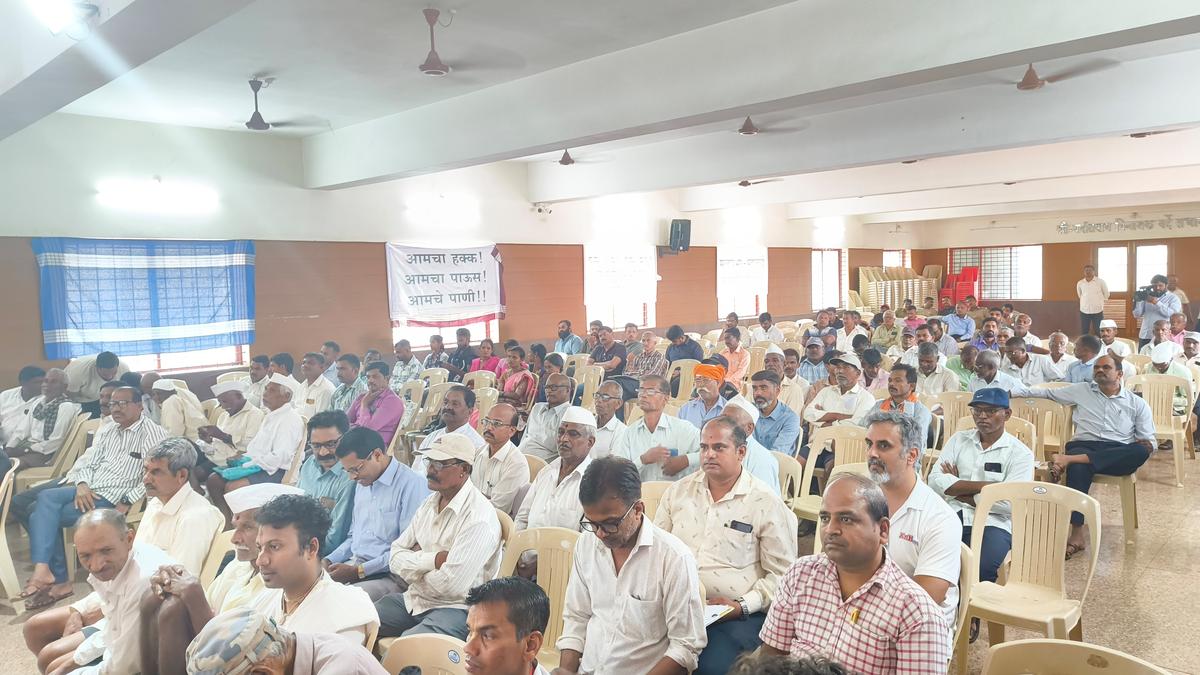
Social activist Dilip Kamat warned that diverting the Mahadayi waters to the Malaprabha will lead to desertification in North Karnataka while submerging forests and villages in the Western Ghats.
Kallappa Ghadi, a farmer from Karambol village who has received a land acquisition notice, said that several gram panchayats, including Karambol, have decided to pass a resolution against the land acquisition. Advocate Sonappa Nandrankar highlighted procedural violations in the land acquisition process, pointing out that the officials have issued notice dated Feb 25, in the first week of April.
Environment conservationist Captain Nitin Dhond criticized the planned diversion of water from east to west as unscientific. Using data from these studies, he said that the Mahadayi basin project envisages construction of three dams on the various streams emptying into the Mahadayi. “Such dams on the Mahadayi will reverse its flow, devastating Bhimgad and Mhadei wildlife sanctuaries in Karnataka and Goa and the Western Ghats evergreen forests,” he said.
The Mahadayi basin in Khanapur is classified as the most sensitive ecological zone in the Madhav Gadgil and Kasturirangan reports. “This project is for industries and sugar factories, not for thirsty households. The govt is taking water from the rural poor to supply to the urban rich,” said senior advocate Arun Sirdesai.
An advocate of sustainable farming Sharada Gopal questioned the State’s promotion of water-intensive crops. “We are defying nature while ignoring rainwater harvesting and traditional wisdom,” she said. She also asked the State govt and other agencies why they are not promoting rainwater harvesting and other sustainable practices and local solutions for water scarcity in North Karnataka, rather than pitching for big ticket projects. https://www.thehindu.com/news/national/karnataka/farmers-environmentalists-and-others-unite-against-irrigation-project-in-mahadayi-basin/article69431192.ece (09 April 2025)
Godavari Water Disputes TS accuses GRMB for withholding project info The Telangana govt has alleged that important project details, such as the Godavari-Bankacherla link being undertaken by Andhra Pradesh, which poses a serious threat to Telangana, are not being shared by the Godavari River Management Board (GRMB). GRMB was aware of the Board secretariat. The govt said the ministry of jal shakti had referred to the project as a VIP reference to the Board in Nov 2024, and the details were not shared with Telangana, which was a serious lapse on the part of the Board and not acceptable to it.
– The Telangana irrigation officials said the Godavari-Bankacherla link project was a massive project being undertaken by the Andhra Pradesh govt with an estimated cost of 80,000 crore. Through this scheme, the govt is planning to divert 200 tmc ft of water from the Godavari at Polavaram to Rayalaseema through the Bollapalli reservoir and Bankacherla head regulator. The officials said it was against the Godavari water tribunal award and impacted riparian rights, especially without informing the expansion plans to co-riparian states. The Andhra Pradesh govt was taking up the project without obtaining any approvals from the GRMB and the Central Water Commission, without informing Telangana. https://timesofindia.indiatimes.com/city/hyderabad/telangana-accuses-grmb-of-withholding-project-details/articleshow/120073759.cms (08 April 2025)
URBAN RIVERS
Mula-Mutha; Pune Forest dept to recommend halt on RFD Pune: The forest department will recommend an immediate halt on all riverfront development (RFD) activities impacting the Ramnadi-Mula devrai, following a site inspection led by range forest officer Manoj Barbole. Acting on a directive from the MoEFCC, Barbole’s report highlights the ecological sensitivity of the eight-hectare site and urges it to be declared a community reserve post-survey and demarcation. The ministry’s intervention came after city resident Vandana Chaudhary raised concerns in Feb this year over tree felling and damage to riverbanks for the project. https://timesofindia.indiatimes.com/city/pune/forest-dept-to-recommend-halt-on-riverfront-development-threatening-ramnadi-mula-devrai/articleshow/120104775.cms (09 April 2025)
Pollution control project in limbo as govt delays funds The final phase of the Mula-Mutha River Pollution Abatement Project is under threat due to a delay in the release of funds by the state government. While the central government has sanctioned Rs. 171 crore on March 27, the state authorities have yet to issue the required clearance for it, disrupting the Pune Municipal Corporation’s (PMC) execution of the scheme. This delay will subsequently affect the Riverfront Development (RDF) project as it will lose its purpose if untreated water is released into the river.
The Pollution Abatement Project is being implemented under the NRCP in collaboration with the JICA at the cost of Rs. 990 crore. As of now, 85 percent of the work has been completed, and the installation of critical machinery is underway. However, PMC officials are finding it difficult to proceed due to the financial bottleneck. Despite the recent extension granted by JICA until September 2026, PMC is aiming to complete the work by March 2026, an ambitious deadline that hinges heavily on timely fund disbursal.
The funding model for the project involves 85 percent central funding (Rs. 841.72 crore) and 15 percent municipal contribution (Rs. 148.54 crore). The PMC has already spent approximately Rs. 610 crore. For the financial year 2024–25, the Centre allocated Rs. 371 crore, of which Rs. 200 crore was disbursed earlier. The remaining Rs. 171 crore, although approved at the end of March, remains inaccessible to PMC until the state issues a formal usage order. https://punemirror.com/pune/cover-story/pune-mula-mutha-project-in-limbo-as-state-delays-funds/cid1744252608.htm/ (10 April 2025)
Gomti; Lucknow Earthen Dam obstructing the flow Earthen Dam obstructing the flow of Gomti River in Lucknow at Kudia Ghat made in 2015 by the Irrigation dept during the Gomti River Front development project.
Sadly, this earthen dam has not been removed even after the riverfront project was over in 2016. This is causing severe water pollution and stagnation at Kudia Ghat in Lucknow. (Venkatesh Dutta) https://www.youtube.com/watch?v=VVeAjFDAr8s (10 April 2025)
Dehradun HC stays slum demolition The high court on App 12 provisionally stayed the demolition of slum dwellers’ homes in Dehradun’s Vikas Nagar area and questioned the state govt for “not giving them a chance to be heard, while influential encroachers remained untouched”. Despite it being a holiday, a special hearing was held by the bench of Chief Justice G Narendar and Justice Ashish Naithani to hear petitions filed by affected residents. The court asked the govt to explain the situation by April 15.
Separately, residents Ajay Narayan Sharma, Reenu Paul, and Urmila Thapar filed PILs over widespread construction on submerged land in Sahastradhara, threatening local water sources. Another petition raised concerns over illegal construction on streams, canals, and hills in Rishikesh. According to the plea, encroachments span about 100 acres in Dehradun, 140 acres in Vikas Nagar, 15 acres in Rishikesh, and another 15 acres in Doiwala, all on river land. https://timesofindia.indiatimes.com/city/dehradun/why-no-representation-for-slum-dwellers-no-action-against-influential/articleshow/120238578.cms (12 April 2025)
Itanagar नदियों पर एनजीटी ने सरकार से मांगा जवाब एनजीटी ने सरकार और ईटानगर नगर निगम से पूछा है कि सेनकी, पचिन और दिकरोंग नदियों में बढ़ते सीवेज प्रदूषण को रोकने के लिए अब तक क्या कदम उठाए गए हैं और वे कदम कितने कारगर रहे हैं। 8 अप्रैल, 2025 को दिए अपने इस आदेश में अदालत ने फीकल स्लज ट्रीटमेंट प्लांट (एफएसटीपी) की स्थापना के बारे में जवाबी हलफनामे भी दाखिल करने का निर्देश दिया है। गौरतलब है कि एनजीटी के समक्ष एक आवेदन दायर किया गया था जिसके मुताबिक अदालत द्वारा पांच जनवरी, 2023 और 25 अगस्त, 2022 को दिए आदेशों का आज तक पालन नहीं किया गया है। गौरतलब है कि एनजीटी ने पांच जनवरी 2023 को यह सुनिश्चित करने का निर्देश दिया था कि किसी भी तरह का दूषित सीवेज सेनकी, पचिन और दिकरोंग में प्रवेश नहीं करना चाहिए। https://hindi.downtoearth.org.in/pollution/rivers-turning-into-dirty-drains-ngt-seeks-response-from-the-government-on-senki-pachin-and-dikrong-rivers (11 April 2025)
RIVERS
Video Climate change: Water paradigm This explains very well how we are through climate change and otherwise disrupting hydrological cycle and what can be done to stop, reverse it. https://www.youtube.com/watch?v=Q8B4tST8ti8 (08 Sept. 2020)
4th RWC: Transboundary Cooperation The 4th Roorkee Water Conclave (RWC 2026) will be held from February 23-25, 2026, at the prestigious Indian Institute of Technology (IIT) Roorkee, Jointly with the National Institute of Hydrology (NIH), Roorkee. This biennial event serves as a premier platform for policymakers, researchers, industry leaders, and water professionals to engage in meaningful discussions, exchange knowledge, and propose innovative solutions to address global water challenges. https://iitr.ac.in/rwc/
CPCB dilutes industry categoristaion criteria once again! https://cpcb.nic.in/openpdffile.php?id=TGF0ZXN0RmlsZS9fMTczNzYxMzk2OV9tZWRpYXBob3RvMTEzODMucGRm More industries placed in non- & less polluting categories and a new category created- Blue. Blue industries get extension on their pollution consent because they provide ‘essential environment services’. (Meenakshi Kapoor) https://x.com/meenaxshikapoor/status/1911384669154668879
Jharkhand First bridge since independence to be built on Sutamtandi River In a significant milestone in the history of Gwalkata Panchayat in the remote interiors of Potka block, a bridge is set to be constructed on the Sutamtandi river ghat in Shaharjuri village — the first such development since independence. The bridge, to be built under the Chief Minister Gram Setu Yojana at an estimated cost of ₹2.06 crore, comes as a result of the efforts and recommendation of Potka MLA Sanjib Sardar. https://avenuemail.in/first-bridge-since-independence-to-be-built-on-sutamtandi-river/ (06 April 2025)
GODAVARI; Study River severely polluted with effluents, sewage ‘Dakshin Ganga’ — as Godavari is often referred to — encompassing 10% of India’s geographical area, is polluted by industrial effluents in Maharashtra and untreated sewage in Telangana, shows the study jointly by the IIT-Hyderabad & NEERI-Nagpur. It adds that open defecation along its basin in Andhra Pradesh has further deteriorated its water quality, even as its “essence” is lost due to industries, along the river, discharging untreated effluents containing heavy metals and chemicals.
If that’s not all, the river’s natural course spanning 1,460 km — from Nashik in Maharashtra to West Godavari in AP — has been heavily impacted by uncontrolled urbanisation, “resulting in unauthorised construction, deforestation, and encroachments”, the study reveals. Some of these places include: Nashik, Nanded, and Rajahmundry, among others. These activities, the study highlights, have disrupted the river’s flow patterns and heightened flooding risks. The lower Godavari region, for instance, has been experiencing severe floods almost every alternate year, with major floods occurring once in 10 to 15 years. “During the 2006 floods in Andhra Pradesh, about 460 villages were affected, with nearly two lakh people evacuated and significant damage to crops and infrastructure,” the study reveals.
The study pointed out that areas around major dams and reservoirs like the Sriram Sagar Dam, Polavaram Project, and Nagarjuna Sagar Dam have seen large-scale water diversion and infrastructure development, altering natural habitats and river flow. Regions with extensive mining activities, such as parts of Maharashtra and Chhattisgarh, experience land degradation, deforestation, and water pollution due to mining operations. At Bhadrachalam temple, the water appears black in colour, with a pungent smell in surrounding areas. Here, sand mining was found to be prominently carried out using heavy hydraulic vehicles. https://timesofindia.indiatimes.com/city/hyderabad/godavari-severely-polluted-with-effluents-sewage-iit-neeri-study/articleshow/120215688.cms (12 April 2025)
Telangana Declining river level ahead of Pushkaralu cause of concern The state govt’s decision to sideline the Kaleshwaram project is likely to trigger a water crisis during the upcoming Saraswati Pushkaralu at Kaleshwaram, as water levels in the Godavari River have already declined and are expected to fall further by mid-May. Endowments Department officials are concerned that the shortage of water in the Godavari may worsen during the 12-day Pushkaralu, scheduled to be held from May 15 to 26. Officials said there are currently no alternative arrangements to meet the water requirements for bathing and other rituals. Expecting a large influx of pilgrims, the government has allocated ₹25 crore for the festival to ensure comprehensive arrangements. This includes the development of infrastructure such as ghats, roads, drainage systems, and other essential facilities. A team led by Secretary Shailaja Ramaiyyar recently visited Prayagraj to study the arrangements made during the Maha Kumbh Mela for reference. https://www.thehansindia.com/news/cities/hyderabad/declining-water-level-in-godavari-river-ahead-of-pushkaralu-cause-of-concern-961751 (11 April 2025)
Jammu & Kashmr LD hospital dumping untreated wastewater in Jhelum.
https://www.youtube.com/watch?v=c0J6MTU0Gs0 (13 April 2025)
GANGA MoJS Delay in river clean up In an affidavit submitted to the NGT, the Jal Shakti Ministry said that work related to the prevention of pollution in the Ganga was slow in Phase I due to poor quality of DPR, and acquisition of land to set up STP. Phase II of the Namami Gange Project will be operational till 2026. “As on February 2025, 494 projects (including one for sewage infrastructure) have been sanctioned at an estimated cost of Rs 40,478 crore. Of this, 308 projects have been completed and made operational,” the affidavit said. 208 projects have been taken up with a cost of 33,360 crore for creation and rehabilitation of 6,420 MLD of STP capacity. https://www.tribuneindia.com/news/india/poor-project-reports-delaying-ganga-clean-up-says-ministry-2/ (10 April 2025)
Bihar SC raps govt over illegal encroachments According to a report by the news agency PTI, a bench of Justices J B Pardiwala and K V Vishwanathan said, “We would like to know what steps have been taken by the authorities to remove all such encroachments over the banks of river Ganga.” The court also asked for the total number of illegal structures currently present and how and when the authorities plan to remove them. In its order dated April 2, the bench said, “We direct both the state of Bihar and the Union of India to file an appropriate report so that we can proceed further in the matter.”
The court was hearing a petition by Patna resident Ashok Kumar Sinha. He had challenged a June 30, 2020, decision by the NGT that dismissed his complaint against illegal buildings and permanent encroachments on the floodplains of the Ganga. His lawyer, Akash Vashishtha, told the court that illegal housing settlements, brick kilns, and religious structures were being built on the eco-sensitive floodplains. He said, “There are large scale encroachments all over the banks which require immediate attention,” and added that some parts of the riverbanks are home to freshwater dolphins. The petition also claimed that the NGT passed its order without properly checking the details of the people violating the rules. The Supreme Court will hear the matter again after four weeks. https://www.business-standard.com/india-news/sc-raps-centre-bihar-over-illegal-ganga-encroachments-demands-report-125041100922_1.html (11 April 2025)
YAMUNA SANDRP Blog July 2023 Flood: CWC report fails to explain unprecedented levels Although, almost 2 years have passed, the July 2023 flood mystery still requires an honest independent scientific investigation to decode the puzzle and recommend corrective measures.

Under the current river and floodplain affairs and forecast services a similar or bigger flood disaster is round the corner for Delhi. https://sandrp.in/2025/04/10/cwc-report-on-july-2023-delhi-floods-fails-to-explain-unprecedented-flood-levels/ (10 April 2025)
Delhi Weakened flow is killing river The single-minded focus on pollution of the river has resulted in a tunnel vision, where the critical issue of adequate flow in the river doesn’t attract similar fervor of action. The Upper Yamuna Water Sharing Agreement will lapse this year. The riparian states will press for raising their share, but the MoJS must speak up for the voiceless river. The Upper Yamuna River Board can’t be a passive onlooker, monitoring allocation to the states but ignoring the needs of the river itself. While the present allocation of 10 cumecs to flow downstream of Hathni Kund, settled in 1994, is grossly inadequate, the NIH’s recommendation of 23 cumecs, if implemented, can improve the flow in the river. However, this may not amount to environmental flow (e-flow) levels.
The Yamuna River Basin water budget must take into account irrigation demand, domestic and industrial requirements plus the scientifically determined minimum flow required to be left in the river, particularly from October to June. If values are estimated for the utilisation by various sectors, it will be apparent that demand management needs the maximum focus. Clearly, irrigation efficiency should be taken up on war footing. The NCT of Delhi, too, can do its bit by implementing its water policy — dormant since 2015 — whose key recommendations are demand management and recycling.
Apart from flow issues, it may be pointed out that the river needs desilting. Much saprophobic, sludgy matter has also settled on the riverbed, destroying bed habitats. All such matters must be removed from the channel. It is also recommended that the banks should have a wide belt of riparian grasses to stabilise the banks and provide habitats to various fauna. A holistic approach that restores the river as an ecosystem, by focusing on water quality, adequate flow, bank and channel management, is the need of the hour. (Manu Bhatnagar) https://www.hindustantimes.com/india-news/weakened-flow-is-killing-the-yamuna-101744451328639.html (12 April 2025)
Citizens Dialogue for river rejuvenation Yamuna Maintaining minimum river flow is critical as the river’s reduced flow during the dry season spirals the concentration of pollutants. The idea of riverfront development which concretizes the floodplains and permits construction at the edge of the main channel has to be avoided at all costs. Maintaining a high level of ecological integrity of the river ecosystem must be a critical part of the rejuvenation strategy. A concerted action needs to be taken at the national level to save river Yamuna. https://www.youtube.com/live/HIBTPT2n6wI (09 April 2025)

Former NGT chairperson Justice Swatanter Kumar along with other experts emphasised the need to tackle pollution, rather than resort to solutions like concretisation or running motorboats. They stressed that the problem lies in insufficient commitment to cleaning the river, despite the availability of resources. Justice Kumar said that while the necessary funding exists, Delhi government’s lack of dedication has allowed River Yamuna to remain polluted. https://timesofindia.indiatimes.com/city/delhi/instead-of-concretising-yamuna-or-running-motorboats-focus-on-tackling-pollution-experts/articleshow/120172763.cms (11 April 2025) Calling the Yamuna an “open sewer,” justice Kumar said the river’s current condition stemmed from a lack of political will and enforcement. “It stinks. Calling it a drain is a better expression than calling it a river. But it can still be fixed,” he said, citing his 2015 NGT judgment Maili se Nirmal Yamuna. “Funds have never been a problem. Over ₹2,000 crore was allocated by the Centre to the Delhi government, but it was never utilised.” Pental said the city’s lifeline is dying a slow death, despite the availability of known solutions. CR Babu, head of Delhi University’s Centre for Environmental Management of Degraded Ecosystems (CEMDE), proposed natural alternatives such as constructed wetlands.. https://www.pressreader.com/india/hindustan-times-haryana-9wef/20250410/281689735642373 (10 April 2025)
Earth Warriors is a group of volunteers led by Pankaj Kumar, dedicated to restoring the beauty and health of the Yamuna River since 2019. https://www.youtube.com/watch?v=8DdMEt0Jx78 (13 April 2025) दिल्ली के ऑक्सीजन मैन पंकज कुमार अर्थ वॉरियर ने यमुना सफाई के लिए पूरा अभियान चला रखा है। https://www.youtube.com/watch?v=hnsKUz30tgk (11 April 2025)
नदी है नहीं और बनाएंगे रिवरफ्रंट दिल्ली में यमुना लगभग अस्तित्वविहीन है, लेकिन बीजेपी की रेखा गुप्ता सरकार करोड़ों खर्च करने की योजनाओं का ऐलान कर रिवरफ्रंट तक बनाने के दावे-वादे कर रही है। (पंकज चतुर्वेदी)
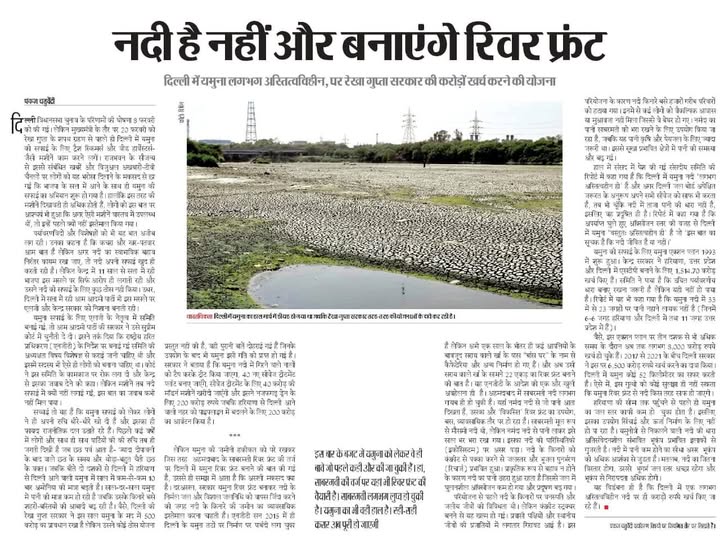
https://www.navjivanindia.com/opinion/bjp-plans-a-riverfront-on-the-non-existent-yamuna-in-delhi (12 April 2025)
-नजफगढ़ नाले से ही यमुना 60 फीसदी प्रदूषित होती है. इस नाले में गिरने वाले सीवेज की सफाई के लिए 16 STP यानि सीवेज ट्रीटमेंट प्लांट लगे हैं, लेकिन NDTV की टीम ने 8 STP का जायजा लिया उसमें से महज एक STP ही जमीन पर बढ़िया काम करती मिली. https://ndtv.in/india/ndtv-exclusive-investigation-on-cleaning-the-yamuna-know-whether-stp-is-doing-its-job-well-8118963 (08 April 2025)
Govt plans RFD along Najafgarh drain During visit to Najafgarh drain, the CM along accompanied by the LG and Water Minister Parvesh Verma inspected 50 acres of land belonging to the irrigation and flood control department and announced that the government has now decided to transform this land into a beautiful and grand public park. “This land holds immense potential for the community and has long been left in a deplorable condition. We are now committed to converting it into a lush, accessible green space,” she said. The plan also includes a proposed riverfront development along the Sahibi river, which passes through the area. https://www.hindustantimes.com/cities/delhi-news/delhi-cm-gupta-announces-riverfront-at-najafgarh-drain-inspects-ongoing-desilting-efforts-101744289969524.html (10 April 2025)
LG orders suspension of DDA staff over floodplain re-encroachment Taking stringent steps to control encroachment of DDA land on the Yamuna floodplain, lieutenant governor VK Saxena on Tuesday ordered the immediate suspension of field staff for the alarming re-encroachment of land near Pusta Road in Mayur Vihar Phase-I to NH-24. The suspended staff include the assistant and junior engineers responsible for the Mayur Nature Park project site, said officials.
LG has directed the vice-chairman of DDA to submit a detailed report on the inquiry and actions taken in response to these directives within seven days for review,” said an official. LG has directed DDA that similar stringent actions will be taken in case of any fresh encroachment or re-encroachment on its land, the statement added. The stretch from Mayur Vihar Phase-I to NH-24 is crucial for the restoration and rejuvenation of the Yamuna floodplain, where DDA is currently implementing the Mayur Nature Park project. https://timesofindia.indiatimes.com/city/delhi/lieutenant-governor-orders-suspension-of-delhi-development-authority-staff-over-re-encroachment-of-yamuna-floodplain/articleshow/120104557.cms (09 April 2025)
564 MLD wastewater plant in Okhla ready The Okhla STP project, a joint venture between the NMCG and the DJB began in 2017. Since June 2024, around 40 MLD of treated water from this facility is being used across various parts of Delhi for horticulture. The govt, in a statement, said: “The plant generates 4.8 megawatts of green energy from sludge biogas, which fulfills around 50 per cent of its total energy requirements.” The govt said the plant will also be helpful in cleaning the Yamuna as the treated water from the plant will be discharged back into the river. Around 132 MLD of sewage waste from the Barapullah and Maharani Bagh drains will also be treated in this plant before being released into the Yamuna, significantly reducing the flow of untreated sewage, it added. “Currently, the treated water is being discharged into the Old Agra Canal. Soon, it will be diverted into the Yamuna downstream of the Okhla Barrage via the Abul Fazal drain. Construction work is on for this,” it said. https://timesofindia.indiatimes.com/city/delhi/okhlas-wastewater-treatment-plant-is-ready-for-use/articleshow/120135896.cms (10 April 2025)
Effluents in drains failing standards: DPCC An analysis by Delhi Pollution Control Committee (DPCC) shows that in March all 19 major drains in the city that discharge into the Yamuna have failed to meet the required standards of water cleanliness and health. The condition of the drains has worsened since the last assessment in Jan. Officials pointed out that the drains were not supposed to carry effluents or treated water as these are stormwater drains. https://timesofindia.indiatimes.com/city/delhi/drains-carrying-effluents-into-yamuna-failing-standards-dpcc/articleshow/120259645.cms (13 April 2025)
Industrial effluents rise in March The Yamuna’s pollution indicators for March reveal an increase in industrial effluents, with COD, BOD and phosphate concentrations off the charts though dilution reduced faecal content since Feb. The DPCC assessment showed that the water quality readings were much higher than in March last year. A Delhi govt official claimed that water was released from the Wazirabad barrage around 20 times in Feb and March, explaining the reduction in faecal coliform count. “Whenever the holding capacity of the Wazirabad pond is exceeded, the excess is released into the river,” said an official. The DPCC drew samples from the Yamuna on March 5. https://timesofindia.indiatimes.com/city/delhi/industrial-effluents-rise-in-yamuna-in-march-this-year/articleshow/120137044.cms (10 April 2025)
7 men clean Barapullah Drain with their bare hands Minutes before Delhi Chief Minister Rekha Gupta, Lieutenant Governor Vinai Kumar Saxena and Irrigation and Flood Control Minister Parvesh Sahib Singh inspected the Barapullah Drain near Soochna Bhawan, Lodhi Road, on Thursday (April 10), at least seven men were cleaning the drain manually, without any protective gear. Carrying steel buckets and pans in their hands, the men waded into ankle-deep black muck to clean the drain, which falls under the Irrigation and Flood Control Department. https://indianexpress.com/article/cities/delhi/7-men-clean-barapullah-drain-with-their-bare-hands-before-delhi-cm-l-g-inspection-9937562/ (11 April 2025)
Mathura Grand RFD planned UP govt’s new master plan for Mathura aims to give the city a makeover by 2031, with a 30km Yamuna riverfront as its centrepiece. The riverfront will be located within the proposed Raya Urban Centre, which is an 11,653-hectare area – half the size of Noida – earmarked in the master plan for development as a tourist destination. Raya’s other highlight is a Heritage City, to be built as a museum to Mathura’s heritage.
The master plan marks 33% of Raya Urban Centre for tourism, riverfront development, and recreational green spaces – 505 hectares (4%) for the riverfront, 1,520 hectares (13%) for a tourism zone, and 1,920 hectares (16%) for recreational green spaces. Heritage City, which is a part of this, will showcase Mathura’s association with Lord Krishna, with a Rs 7,000-crore development plan that makes the city a fourth node in the state’s spiritual tourism circuit after Varanasi, Ayodhya and Prayagraj.
Components of the riverfront development include building parks and walkways and spots for recreation. Singh said no construction will be carried out or permitted along the riverfront and the development’s focus would be on creating green areas. “We will work on other aspects such as reducing pollution and restoring the natural flow of the river,” YEIDA CEO Arun Vir Singh added. A consultant has been engaged to prepare a DPR for the New Agra Urban Centre while plans are under way to hire a consultant for a proposed Hathras Urban Centre. The DPR for Raya is ready. “Along with industrial development, govt wants to promote tourism and culture along the entire 165km stretch of Yamuna expressway. This will also generate employment through tourism and bring more investment,” Singh said. https://timesofindia.indiatimes.com/city/noida/will-mathura-beat-delhi-to-a-yamuna-waterfront/articleshow/119555815.cms (27 March 2025)
Agra एक नदी की त्रासदी, एक वादे का विश्वासघात ! एक दशक से अधिक समय पहले, 2014 के चुनावी जोश में आगरा और मथुरा-वृंदावन की सभाओं में, प्रधानमंत्री नरेंद्र मोदी ने इसके खोए वैभव को लौटाने का वचन दिया था। मगर 2025 में, यह नदी टूटी आशाओं का दुखद स्मारक बनी हुई है। केंद्रीय मंत्री नितिन गडकरी ने कभी दिल्ली से आगरा तक स्टीमर सेवाओं की बात की थी, लेकिन यमुना की हकीकत ऐसी कल्पनाओं का मजाक उड़ाती है। प्रगति के सरकारी दावे—40 से ज्यादा नालों को बंद करना, 7 STP का संचालन—जांच के सामने ढह जाते हैं।
तीस साल से कार्यकर्ता ताज के नीचे एक बैराज या चेक डैम की मांग कर रहे हैं ताकि न्यूनतम जल स्तर बना रहे। मगर, सरकारों ने सिर्फ खोखले वादे दिए—कई बार बैराज की नींव रखी गई, और फिर परियोजना को भुला दिया गया। आजकल नगला पेमा में एक रबर डैम की चर्चा चल रही है, जिसकी आखिरी NOC एक साल से लटकी हुई है। आज, बीजेपी के क्षेत्र में दबदबे (10 विधायक, 2 सांसद) के बावजूद, नदी उनके “विकास” के एजेंडे से गायब है। यमुना का संकट अब संभावना का नहीं, इच्छाशक्ति का सवाल है। क्या सत्ता में बैठे लोगों को इसकी फिक्र भी है—या भारत की धरोहर को खोखले वादों की छाया में सड़ने के लिए छोड़ दिया जाएगा? (Brij Khandelwal) https://www.thenewsagency.in/uttar-pradesh/as-leaders-and-officials-turn-a-blind-eye-to-pollution-yamuna-cries-wails-in-agra (April 2025)
FISH, FISHERIES, FISHERFOLKS
Maharashtra Mystery of mass fish death -Thousands of dead fish were seen washed ashore at a lake in Kudan village, Palghar on (March 09) Sunday morning. The villagers were puzzled due to the sudden death of the entire lot of fish in the lake as there are no industrial units around negating the possibility of water contamination due to disposal of chemical waste.
-One of the senior officers at MPCB confirmed that there were no industrial units around and the fish could have died due to extreme heat or due to decrease in dissolved oxygen parameter in the water. In the past there have been instances of fish dying on a huge scale due to water contamination in and around Boisar – Tarapur and the authorities are confirming if the reasons are similar or something else. The fish which resurfaced on the lake shore is locally called as Khavlya. https://timesofindia.indiatimes.com/city/mumbai/mystery-surrounds-mass-fish-deaths-in-palghar-lake-probe-underway/articleshow/118823277.cms (10 March 2025)
SAND MINING
Himachal Pradesh Mining, garbage in Neugal leaves water polluted Large-scale illegal mining and dumping of muck and garbage in the Neugal river has led to water contamination of the water body and severe environmental degradation in the surrounding areas. The river, a vital drinking water source for lower Palampur, is now under threat. The Jal Shakti Department has been lifting water from this river for 60 schemes to supply water to 100 villages. Though the Jal Shakti Department is well versed with the situation, no steps have been initiated to check contamination of the river water.
Despite persistent opposition from local residents, the mining mafia continues to mine stones with heavy machinery like JCBs and poclain machines, creating trenches up to 3-4 metre deep in parts of the riverbed. Recently, CM had issued specific orders to DC and SP to stop illegal mining, but hardly any impact was witnessed in the field. Illegal mining has become highly lucrative business for the mafia in the lower areas of Palampur and Jaisinghpur. The local authorities, including the police and mining departments, appear to be ignoring these illegal activities.
Several stone crushers operating near rivulets and tributaries of the Beas in Kangra continue to pollute vital water sources despite the NGT 2021 guidelines. These directives prohibit setting up stone crushers within 100 metre area of water bodies under the EPA, 1986. However, many crushers in Jaisinghpur and Thural violate these norms, further degrading water quality. https://www.tribuneindia.com/news/himachal/dumping-of-garbage-in-neugal-river-leaves-water-polluted/ (11 April 2025)
Haryana NGT forms joint panel to probe illegal sand mining in Yamuna The NGT has formed a joint panel to investigate the ground reality following a complaint regarding the disruption of the flow of the Yamuna through illegal sand mining on the Haryana-Uttar Pradesh border in Karnal district. The panel has to submit its report within eight weeks.
Pradeep Dahiya, a resident of Sonepat, filed a complaint with the NGT in March, claiming that M/S Chaudhary Transport Company was indulging in illegal mining. He alleged that as per the terms, the company was provided only one entry and one exit for the mining project area, but it had made four entries and exit points. Dahiya further claimed that the river flow had been affected, and a criminal case had been registered against the company by Gangoh police of Saharanpur district, UP, on March 30. The FIR was registered against the company after an inspection was conducted by the Mining and Revenue Departments of UP on March 29.
The committee in its report said the company conducted illegal sand mining from a total area of 7,414 sq metres within the river’s course. The depth of the excavation was found to be about 2 metres, leading to the illegal extraction of 14,828 cubic metres of sand. The joint committee said the lease owners (mining company) and other people illegally extracted and transported sand, thereby earning profits and causing revenue loss to the UP Government. The NGT has fixed July 31 as the next date of hearing. https://www.tribuneindia.com/news/haryana/ngt-forms-joint-panel-to-probe-illegal-sand-mining-in-yamuna/ (13 April 2025) Asked about the case, an HSPCB official said that the state govt auctioned 8 mining blocks in Karnal, including the one in Chandraon, in 2023. “We carried out a public hearing also for environmental clearance from the State Environment Impact Assessment Authority (SEIAA) for the excavation of sand in the mining block. The project received clearances (in Jan 2024). We will follow the NGT order. We haven’t received it yet,” the official said. https://timesofindia.indiatimes.com/city/gurgaon/illegal-mining-choking-yamuna-probe-ordered/articleshow/120215694.cms (12 April 2025)
Drivers overturn trucks ‘in bid to kill accompanying cops’ Drivers of four trucks loaded with illegally mined sand from Gumthala village allegedly overturned their trucks in the fields in Kandrauli village of Yamunanagar district early morning on Apr 8. They did so in an attempt to kill the policemen who had caught the trucks and were sitting inside those vehicles to take those to the weighbridge, says the FIR in the case. But before the trucks overturned, all four drivers managed to jump outside. A Home Guards jawan, Ashok, got stuck in a truck and sustained injuries. All four trucks were allegedly transporting sand illegally without e-transit passes. https://www.tribuneindia.com/news/haryana/caught-with-illegal-sand-drivers-overturn-trucks-in-bid-to-kill-accompanying-cops/ (09 April 2025)
No mining in Aravallis till Aug 7, NGT tells govt The NGT has issued a show-cause notice to Haryana govt and the MoEF for allegedly allowing mining on ‘protected’ forest area in the Aravallis. The tribunal also directed the state govt to ensure no mining or stone crushing-related activity was carried out in the area till August 7. An NGT bench headed by chairperson Justice Prakash Shrivastava issued the notice on a plea filed by residents of Rajawas, a village located in the Aravallis in Mahendergarh district. The bench has asked the petitioners to explain within four weeks how 25 per cent of the protected forest land was auctioned to stone crushing units.
The petitioners had claimed that the Haryana Government had auctioned one-fourth of the 506.33 acres of the protected forestland for mining and stone crushing activities thereby endangering the fragile ecosystem of the area. The 506.33-acre patch of the land at Rajawas village was notified as a protected forest as a part of afforestation measures being undertaken in compensation for diversion of forestland for non-forest purposes in the Great Nicobar Island. https://www.tribuneindia.com/news/haryana/no-mining-in-aravallis-till-aug-7-ngt-tells-haryana/ (10 April 2025) Meanwhile, experts question how a public hearing for mining in the area was scheduled when Haryana has not applied for FCA. “Rajawas village comes under Section 4 of the Punjab Land Preservation Act (PLPA) 1900 and is now a protected forest. Any forest area cannot be converted for non-forest activities. The mining department has not applied for FCA and thus cannot carry out a public hearing in this matter. The said area was always Aravalis and thus, with or without protected forest status, FCA is required. That is not just village land, but it comes under PLPA as well,” former conservator of forest (south Haryana) RP Balwan said. https://timesofindia.indiatimes.com/city/gurgaon/ngt-curbs-must-to-prevent-illegal-mining-in-aravali-land-protected-under-nicobar-swap/articleshow/120137046.cms (10 April 2025) The auction is linked to the establishment of a large infrastructure project that is causing significant forest loss on Nicobar Island, with compensation planned by designating 24,535 hectares (Ha) of land as forest in Haryana’s Aravalli range. Additionally, a portion of the designated forest areas, specifically 204 hectares, has been officially recognised as ‘Protected Forest’ in Rajawas village. However, the ministry has auctioned off one-fourth of this designated forest area for mining and stone crushing. https://www.newindianexpress.com/nation/2025/Apr/10/how-forest-land-diverted-for-mining-in-aravallis-asks-ngt (10 April 2025)
नूंह जिले में एक बार फिर खनन माफियाओं का आतंक देखने को मिला. यहां खनन माफियाओं का पीछा कर रहे पुलिस कर्मचारियों के सामने चलते हुए डंपर के ड्राइवर ने बीच रोड पर ही पत्थरों को खाली कर पुलिस का रास्ता रोक दिया. इस घटनाक्रम का वीडियो अब सामने आया है. ये वीडियो फिरोजपुर झिरका के गांव घाटा बसई का है. वीडियो में साफ तौर पर देखा जा रहा है कि वहां एक नहीं बल्कि 6 डंपर खड़े थे. सभी पत्थरों से भरे हुए थे. हैरानी की बात यह है कि नूंह में इतनी बड़ी घटना हुई, जिसकी जानकारी पुलिस को नहीं है. हालांकि चार दिन पहले नूंह जिला उपायुक्त विश्राम कुमार मीणा ने खनन की शिकायत पर पहाड़ों का निरीक्षण किया था. इसके बाद ही यह घटना सामने आई है. https://www.etvbharat.com/hi/!state/terror-of-mining-mafia-in-nuh-policemen-attacked-with-stones-watch-video-haryana-news-hrs25032905285 (29 March 2025)
बागपत नैथला गांव के यमुना खादर में रविवार (April 13) रात को रेत खनन को लेकर बवाल हो गया। जहां खनन करके ट्रैक्टर-ट्राॅली में रेत लेकर जाते हुए सरूरपुर गांव के प्रमोद व नैथला के मजदूर राजेंद्र पर हमला कर दिया गया और उसके बाद प्रमोद को गोली मार दी गई। परिजनों ने दोनों को जिला अस्पताल में भर्ती कराया, जहां से प्रमोद को मेरठ के लिए रेफर कर दिया गया। हमलावर हरियाणा और नैथला गांव के बताए जा रहे हैं। पुलिस मामले में जांच में जुटी हुई हैं। https://www.amarujala.com/uttar-pradesh/baghpat/chaos-over-illegal-sand-mining-in-naithla-yamuna-khadar-one-shot-dead-baghpat-news-c-28-1-smrt1010-129745-2025-04-14 (14 April 2025)
बाँदा मे इस वक्त दो दर्जन मौरम खदानों पर सफेदपोश ठेकेदारों और नेताओं का पट्टा है। हर मौरम खदान पर पर्यावरण जल-वायु एनओसी समेत खनिज लीज शर्तों व यूपी खनिज एक्ट नियमों की खुलेआम अनदेखी है। मौरम पट्टेधारक ने अवैध खनन की खबरों को रोकने के लिए मीडिया को महीना फिक्स कर रखा है। वहीं खान अधिकारी से ब्यूरोक्रेसी तक सिस्टम सेट है। गाहेबगाहे अवैध खनन की खबरें अखबारों और सोशल मीडिया का हिस्सा बनी तो गले तक रुपया भर दिया जाता है। अथवा फौरी कार्यवाही पर जुर्माना होता है लेकिन मौरम माफिया पर एफआईआर और ब्लैकलिस्ट का एक्शन अपवाद की बात है। https://soochanasansar.in/two-dozen-gravel-mines-are-heavily-owned-by-contractors-journalists-and-the-dhritarashtra-government-then-who-will-take-action-in-banda-district-illegal-sand-mining-ken-river-bundelakhnd-rigion/ (24 March 2025) जांच कार्यवाही से बचने के लिए लाल बालू के लुटेरों ने वैध पट्टे की आड़ मे सरकार को राजस्व क्षति दी। वहीं किसानों की ज़मीन से मौरम निकासी की गई। 3 मीटर से ज्यादा गहराई का मानक ताक पर रखकर मनमानी से अवैध खनन किया गया है। साक्ष्य मिटाने को 10 पोकलैंड लगाकर आनन फानन मे तालाब जैसे बड़े गड्ढो को भरा गया। मौके पर शिकायत कर्ता ऊषा निषाद ने वीडियोग्राफी करके खुलासा कर दिया। यह सबकुछ सोशल मीडिया पर वायरल हुआ व सूचना संसार ने प्रसारित किया था। उधर ऊषा निषाद ने जानकारी के लिए आला अफसरों को व्हाट्सएप पर भेजा था। https://soochanasansar.in/banda-dm-j-reebha-took-action-on-moram-block-sandi-77-contractor-himanshu-meenas-disciple-azhar-is-tensed-dm-formed-investigation-team/ (29 March 2025) – बीते 29 मार्च को जिलाधिकारी के द्वारा इस खंड की जांच के बाद मिले निर्देश ताक पर है। वहीं सरकारी प्रेस विज्ञप्ति पर उक्त कृत्य के संबंध मे नोटिस प्रचलन की बात अभी तक धरातल पर मुकम्मल नही है। – खदान संचालक तमाम जांच और जुर्माना कार्यवाही को ठेंगा दिखाकर ग्राम सभा व किसानों की ज़मीन से खनन करता है। – एसडीएम पैलानी ने 9 अप्रैल को जांच की लेकिन मौके पर खनन करती मिली पोकलैंड सीज नही हुई। गहराई देखकर हतप्रभ हुए एसडीएम साहब !!! https://soochanasansar.in/on-wednesday-april-9-sdm-palani-and-co-sadar-inspected-the-spot-at-moram-block-sandi-77-in-the-evening-but-the-pokland-was-not-seized/#google_vignette (10 April 2025)
Madhya Pradesh Terror being spread by armed sand mafia in Morena.
Rajasthan जिस पर 7 मामले, 13 करोड़ की पैनल्टी उसे ही दे दीं अवैध खनन में जब्त मशीनें एक तरफ सरकार अवैध खनन के खिलाफ लगातार एक्शन ले रही है, हाईकोर्ट तो सीबीआई को सीआरपीएफ की मदद तक लेने को कह चुका है, वहीं दूसरी तरफ खनन विभाग कैसे काम कर रहा है, इसका उदाहरण डीग के नांगल जोन में दिखा। अवैध खनन में कार्रवाई करते हुए एक फोरमैन ने वहां जब्त की हुई महंगी मशीनें ऐसे व्यक्ति की सुपुर्दगी में दे दी, जिसके खिलाफ अवैध खनन की 7 एफआईआर दर्ज हो चुकी हैं और खनन विभाग ही 13 करोड़ रुपए से ज्यादा की पैनल्टी लगा चुका है।
विभाग के अधिकारियों ने भी केवल जिम्मेदार कर्मचारी को नोटिस देकर इतिश्री कर ली, कोई अनुशासनात्मक कार्रवाई नहीं की गई, जिसके बाद कर्मचारी ने मशीनें पुलिस को सुपुर्द करवा दीं। मामला पिछले साल अक्टूबर का है। माइनिंग इंजीनियर ने कर्मचारी रघुवीर सिंह को एक नोटशीट भेजी। इसमें कहा गया कि कैलाश जैन की शिकायत पर रघुवीर सिंह ने 17 अक्टूबर को जो जांच रिपोर्ट भेजी, उसमें कई कमियां पाई गईं। https://www.bhaskar.com/local/rajasthan/bharatpur/news/the-one-who-has-7-cases-against-him-and-a-penalty-of-rs-13-crore-was-given-the-machines-seized-in-illegal-mining-134736086.html (29 March 2025)
West Bengal सुवर्णरेखा नदी से अवैध बालू खनन, एनजीटी सख्त तीन अप्रैल 2025 को एनजीटी की पूर्वी बेंच ने पश्चिम बंगाल सरकार को नोटिस जारी करने का निर्देश दिया है। मामला सुवर्णरेखा नदी से अवैध तरीके से किए जा रहे खनन और रेत ब्लॉकों की नीलामी से जुड़ा है। अदालत ने इस मामले में एमओईएफ और सीसी के साथ-साथ कोलकाता के एकीकृत क्षेत्रीय कार्यालय को भी अपना जवाब दाखिल करने का निर्देश दिया है। दरअसल, पश्चिम बंगाल मिनरल डेवलपमेंट एंड ट्रेडिंग कॉरपोरेशन लिमिटेड ने 20 दिसंबर 2024 को निविदाएं जारी की थी। इनका मकसद था — सुवर्णरेखा नदी से रेत खनन के लिए कई रेत ब्लॉकों के लिए एक खान डेवलपर और ऑपरेटर का चुनाव करना। योजना थी कि पांच साल तक 13 जगहों से नदी की रेत निकाली जाएगी। इसकी ऑनलाइन नीलामी 24 जनवरी 2025 को होनी थी।
हालांकि याचिकाकर्ता अशोक खमरी का आरोप है कि ये 13 जगहें नदी के बीच बहते पानी में हैं, न कि नदी के किनारे या सूखी जमीन पर। ऐसे में इन ब्लॉकों के आवंटन और खनन से नदी की सेहत और आसपास के पर्यावरण के लिए खतरा पैदा हो सकता है। यह भी कहा गया कि सिजुआ मौजा, गोपीबल्लभपुर में रेत ब्लॉक (आईडी नंबर- MIN_JH_25) में से एक बांध के बिल्कुल करीब है। यह बांध बाढ़ और अन्य खतरों से आस-पास के गांवों की रक्षा करता है। ऐसे में अगर यहां से भारी मात्रा में रेत निकाली गई, तो इससे नदी की गहराई बिगड़ सकती है और बांध कमजोर पड़ सकता है। इसकी वजह से नदी के किनारों को भी नुकसान होगा। रेत से भरे ओवरलोड वाहनों के आवागमन से नदी को नुकसान पहुंचेगा। उनका यह भी कहना है कि इसकी वजह से आसपास के क्षेत्रों में जलस्तर घट सकता है। https://hindi.downtoearth.org.in/mining/loot-of-golden-sand-ngt-strict-on-illegal-sand-mining-from-subarnarekha-river (03 April 2025)
Tamil Nadu Man held for assaulting sub-inspector A 50-year-old man was arrested by Athamangalam police for assaulting a sub-inspector over illegal sand mining from dry portion of Miranda dam at Navapalayam village near Kalasapakkam town in Tiruvannamalai on Thursday (April 10). Police said the arrested person has been identified as S. Kumaran, a resident of Navapalayam village. The injured sub-inspector was P. Nagarajan, 44.
Initial inquiry revealed that based on tip-off, a five-member police team led by SI Nagarajan, Athamangalam police, was patrolling the dam area on complaints of illegal sand mining when the team found loads of sand mining in the dam area, using earthmover. Sand was being uploaded in three tractors. Immediately, the team seized the vehicles. As the seized vehicles were escorted by police, Kumaran intercepted the police team and demanded the release of seized vehicles. An argument ensued and Kumaran assaulted the sub-inspector.
A video of the incident went viral on social media platforms, leading to public outcry over the incident. Residents rescued the injured sub-inspector, who got admitted to Primary Health Centre (PHC) in Athamangalam village. A case has been registered against Kumaran, who has at least 13 cases on him at various police stations in the district. He was arrested and lodged at Central Prison in Vellore. A probe is underway. Police said more than 100 illegal brick kilns have been operating near the dam area. Sand is mined illegally from water bodies, govt land to operate these brick kilns. https://www.thehindu.com/news/national/tamil-nadu/man-held-for-assaulting-sub-inspector-over-illegal-sand-mining-in-tiruvannamalai/article69435173.ece (10 Apr 2025)
CBI books 21 people including govt officials Following the murder of mining activist Jagaber Ali in Pudukottai district, the court also ordered the district administrators to provide protection to whistleblowers who report illegal sand mining activities. https://www.thenewsminute.com/tamil-nadu/illegal-beach-sand-mining-in-tn-cbi-books-21-people-including-govt-officials (7 Apr 2025)
Jammu & Kashmir Final Days of Lithium Village (2025) On February 9, 2023, India discovered its first lithium reserves, 5.9 million tonnes, in the Salal-Haimana area of Reasi district. This discovery was hailed as a breakthrough for India’s green energy future. However, the road to lithium extraction has been anything but smooth. The Government of India announced two lithium mining tenders in November 2023 and March 2024, but both failed to attract sufficient bids. Meanwhile, the people of Salal-Haimana are facing uncertainty. Around 330 families fear displacement without proper resettlement or rehabilitation. They raise concerns about a lack of transparency, the absence of consent, and violations of the Land Acquisition, Rehabilitation, and Resettlement Act. What does this mean for the future of India’s lithium industry and the people of Salal-Haimana? Watch the documentary as we uncover the untold story of India’s lithium village. https://www.youtube.com/watch?v=4Gqr9hqMEuY (13 April 2025)
MoEF Earth extraction for linear projects to get green nod relief The notification, seen by HT, stated that linear projects will include “slurry pipelines, oil and gas transportation pipeline, highways or laying of railway lines, which require extraction or sourcing or borrowing of ordinary earth above the threshold of 20,000 cubic metre and does not require prior environment clearance under this notification”. All linear projects exempted from environmental clearance shall follow the standard operating procedure, it said. The EAC shall, while granting prior environment clearance for the projects requiring extraction of ordinary earth, include the environmental safeguards prescribed in the notification, it said. Further, a committee consisting of district officials, officer of the state pollution control board, forest department, geologist etc shall decide the quantum of ordinary earth that can be extracted for a particular project based on the different criteria, it said.
Earlier, a notification in March 2020 exempted linear projects from prior environmental clearance following representations for waiver of the clearance for borrowing of ordinary earth for roads; and manual extraction of lime shells (dead shell), shrines, etc in inter-tidal zones. The notification came under heavy criticism from environmentalists who said it could lead to indiscriminate extraction and a bonanza for various infrastructure projects. On March 23 last year, the Supreme Court struck down the 2020 notification, terming it “unguided and arbitrary”. In order to address issues raised by the Supreme Court, a draft notification amending the said notification was published on August 2, 2024, inviting objections and suggestions. https://www.hindustantimes.com/india-news/earth-extraction-for-linear-projects-to-get-green-nod-relief-101744571849288.html (14 April 2025)
Center Rules to manage & recycle C&D waste notified With India generating about 150-500 million tonne of construction & demolition waste every year which poses serious challenges including air and water pollution, the Centre has notified rules to manage and recycle it under an extended producer responsibility (EPR) framework that makes it mandatory for every producer to dispose and manage such waste in an environmentally sound manner with effect from April 1 2026. Absence of effective rules currently leads to unauthorised dumping due to lack of space for disposal, and improper mixing with biodegradable waste.
– Currently, the National Capital Region (NCR) alone generates 6,303 tonnes of C&D waste per day. Though almost 78% of the waste is processed per day in the region, other parts of the country don’t have records of processing that much waste. https://timesofindia.indiatimes.com/india/centre-notifies-rules-to-manage-recycle-construction-and-demolition-waste-under-producers-will-be-responsible-for-disposal-of-such-waste/articleshow/120136108.cms (10 April 2025)
Report Panel flags misuse of DMF funds across States According to the Standing Committee on Coal, Mines and Steel, the Ministry of Mines has reported numerous cases where DMF funds were redirected improperly. These misuses reportedly involved transferring money to state treasuries, consolidated funds, state-level schemes, the Chief Minister’s Relief Fund, or other unrelated programs—actions that violate both the intent and the legal framework under which the DMFs were established. https://www.businessworld.in/article/parliament-panel-flags-misuse-of-dmf-funds-across-states-552759 (06 April 2025)
A missed opportunity for social justice in mining regions A decade after its creation, the DMF remains a work in progress. The problem is not a lack of funds but a lack of vision and political will to ensure the DMF serves its intended purpose. For the DMF to truly fulfil its mandate, we need urgent, systemic changes that put communities at the centre of decision-making. Anything less would be a betrayal of the very people the DMF was meant to serve. (Chadra Bhushan) https://www.financialexpress.com/opinion/a-missed-opportunity-for-social-justice-in-mining-regions/3796855/ (03 April 2025)
WETLANDS, LAKES, WATER BODIES
Assam Protest as Centre sanctions ₹213cr for wetland rejuvenation Even as the Centre sanctioned Rs 213 crore for the rejuvenation and bioremediation of Silsako Beel under the PM Krishi Sinchayee Yojana, evicted residents from the area took to the streets on Monday (April 07), accusing the state government of reneging on its promise of rehabilitation and fair compensation. The fund approval, announced over the weekend by the MoJS, has sparked fresh outrage among displaced families, many of whom allege they have been left in limbo months after being forced from their homes. The protestors, who identify as indigenous residents, slammed the state for what they described as “inhuman eviction drives” that left hundreds homeless.
Anger has also grown over the compensation amounts offered. Residents claim they are insufficient to rebuild or purchase land in Guwahati. “The CM himself said one katha of land here costs Rs 7 crore. How will Rs 1 lakh, Rs 5 lakh, or even Rs 10 lakh help us reclaim our lives?” asked a resident. In their memorandum, the community had demanded Rs 5 lakh for thatched homes, Rs 15 lakh for Assam-type structures, Rs 25 lakh for RCC buildings, and one katha ten lechas of land per family. The GMDA, which oversaw the eviction, came under sharp criticism for its alleged mismanagement. Protestors claimed that many names were missing from the official records due to poor data collection. https://assamtribune.com/assam/silsako-evictees-protest-as-centre-sanctions-213-cr-for-wetland-rejuvenation-1573518 (07 April 2025)
Madhya Pradesh Jheel Mahotsav: Largest water carnival begins The Jheel Mahotsav, focused on MP’s cultural heritage, is taking place this year for the first time in the Jabalpur and Mandla districts. The 15-day Jheel Festival is taking place at the scenic Bargi Dam from April 5-20, promising a unique blend of water, land and aerial adventure activities set against the breathtaking backdrop of the Narmada River.
– First started in 2016, this year’s festival kicked off on April 5 with inaugural festivities led by Public Works Minister Rakesh Singh and Public Health Engineering Minister Sampatiya Uike. Several members of parliament and members of legislative assemblies, along with district collectors from Jabalpur and Mandla, were also in attendance. https://www.outlooktraveller.com/whats-new/jheel-mahotsav-2025-in-jabalpur-madhya-pradesh (08 April 2025)
WATER OPTIONS
Coimbatore NGO’s STP demo successful The decentralised STP was set up by Siruthuli a year ago on a parcel of private land at Singanallur along a stream connecting the Noyyal river. The plant uses Apta Xblu technology, developed by Apta Solvics. The STP comes with an inbuilt odour control technology, making it safe to install next to residential areas as well.
R S Krishnaswamy, convenor of water watch, Siruthuli, said, “This STP occupies very minimal space. This low space, low power and odour-free plant could be set up anywhere without any objection. This STP with a capacity to process 1 MLD requires hardly 200sqft space. Even if the capacity is increased to 2 MLD, the plant will occupy only 300sqft. Besides, the plant is so effective that in just six months the quality of water has improved with zero foul smell. Since it was a pilot project, all data has been officially recorded. We have dismantled the plant.”
The NGO is planning to replicate the model in various other locations to convert sewage water to potable standards. The demo plant was installed with the capacity to treat 5,000 litres/ hour, running for 20 hours per day. https://timesofindia.indiatimes.com/city/coimbatore/coimbatore-based-ngos-demo-sewage-treatment-plant-turns-successful-model-to-be-replicated/articleshow/120175009.cms (11 Apr 2025)
Karnataka Restored Janawada lake offers new lease of life to fishermen Rejuvenation of the 57-acre Janawada lake in Bidar district was taken up between November 2022 and April 2023 at a cost of ₹5 lakh , as part of the Mission Amrit Sarovar program under the MGNREGA. Janawada lake, which was drained a few years ago, was brought back to life during the last two monsoon seasons. At present, two societies comprising 65 members are engaged in fish farming, cultivating four primary species of fishes — goldfish, catla, mrigal and rohu. The harvested fish is sold in Bengaluru, Hyderabad and Pune.
Mr. Singh emphasised the need for monitoring of the premises to prevent littering, ensuring the sustainability of both fishing practices and the lake’s environment. The lake’s tranquil surroundings and picturesque environment are drawing local tourists and visitors from neighbouring villages. The lake has been leased out to Sagar society for fish farming. In the last two years, they have harvested around 10 quintals of fish, the officer added. https://www.thehindu.com/news/national/karnataka/janawada-lake-rejuvenation-offers-new-lease-of-life-to-bidar-fishermen-draws-tourists/article69431673.ece (10 April 2025)
Govt seeks statewide expansion of Atal Jal scheme The state govt has formally seeks expansion of Atal Bhujal Yojana to all districts, citing improved groundwater levels in 200+ gram panchayats amongst the current 1,199 participating panchayats across 14 districts. However, the Centre has said no decision has been taken yet on an expansion. The Rs 1,201 crore scheme in Karnataka has completed 1,707 conservation works, including boulder checks, check dams, and percolation tanks, with 771 projects still in progress until 2026. In Arkavathy River basin, a Rs 9.5 crore project at Doddatumakuru village near Doddaballapur aims to implement rainwater harvesting systems, though implementation faces delays despite approved project reports. https://timesofindia.indiatimes.com/city/bengaluru/after-groundwater-level-rises-in-200-panchayats-karnataka-seeks-statewide-expansion-of-atal-jal-scheme/articleshow/120101988.cms (11 April 2025)
Maharashtra Marathwada district declares competition to improve water levels How Dharashiv survives its water crisis could hold a lesson for the rest of India. In a first such initiative, the 734 villages in Dharashiv are being called upon to participate in a competition to showcase their water management skills and, potentially, create a knowledge base of best practices that can be adopted by other villages of the state and even the country.
The competition, in which the villages will be graded out of 100, is being conducted by the District Administration of Dharashiv, the Water Supply and Sanitation Department of the Maharashtra government and the Watershed Organisation Trust (WOTR), a Pune-based organisation that works in the sector of rural poverty and the ecosystems. The top three winning villages will get cash prizes of `5 lakh, `3 lakh and `1 lakh. Gram panchayat sarpanches and gram sevaks from more than 140 villages have already registered.
“After the exercise, if we come up with some good, innovative, indigenous solutions that can be developed to improve the underground water level, sanitation level and water supply quality, we will publicise it so that these can be implemented throughout the country,” says Mainak Ghosh, the CEO of the Dharashiv Zilla Parishad. The competition was announced on February 4, with April 15 being the last date for villages to self-nominate. https://indianexpress.com/article/cities/pune/in-a-first-water-scarce-marathwada-district-declares-competition-to-improve-water-levels-9928888/ (07 April 2025)
Chennai Playgrounds get a hidden RWH boost Beneath the fields where children play cricket and football, the city is building massive underground rainwater harvesting tanks using EcoBloc technology. Each tank can store up to five lakh litres of rainwater enough to support 45 mid-sized families. These tanks aim to reduce flooding during heavy rains and gradually recharge the groundwater. The initiative is part of a new project by Greater Chennai Corporation to conserve rainwater and improve city’s flood resilience, without disrupting how the playgrounds are used.
The project is currently underway in eight playgrounds across zones 8, 9, and 10. It is funded by the National Disaster Management Authority (NDMA) and aims to turn the city into a sponge that soaks up rainwater rather than letting it flow into drains and out to sea. However, not all experts are convinced. Some argue that such systems are best suited for highly urbanized areas, not where natural aquifers already exist.
“The sub-soil aquifer is nature’s most sustainable reservoir. Any soil, after a few feet, becomes permeable. Rainfall should be allowed to naturally percolate into the ground without interference. These man-made structures are best suited for places where natural percolation is not possible for example, in cities with little to no exposed soil. Japan has successfully created such systems in densely built urban areas. The corporation can consider similar interventions in fully concretized zones,” said Ram Shankar, founder of the Save Water and Recharge Aquifers Network (SWARAN). https://timesofindia.indiatimes.com/city/chennai/chennai-playgrounds-get-a-hidden-rainwater-harvesting-boost/articleshow/120043407.cms (06 April 2025)
GROUNDWATER
Punjab Maize: A double-edged sword for groundwater crisis The crop is sown in two contrasting seasons — the water-intensive spring/summer season (February to June) and the more water-conservative kharif season (June to October), running parallel to the paddy harvest — highlighting a growing dilemma as to how to balance the benefits of this crop with the critical need to conserve water resources.
A surge in spring maize cultivation is causing increasing concern among water experts. Depending on soil type and irrigation methods, spring maize requires 5 to 19 irrigations, a major burden on Punjab’s depleted groundwater table. The short-duration paddy varieties need around 20 to 21 irrigations, close to spring maize crops. In contrast, kharif maize, sown alongside paddy during monsoon and harvested in late October to November, is considered an excellent alternative to water-intensive paddy and the Punjab government promotes it extensively.
Kharif maize is less water-intensive due to the monsoon season and needs just three to four irrigations throughout the season, making it one of the best crops to reduce Punjab’s reliance on groundwater. Despite its potential, the area under kharif maize has declined in recent years — 1.05 lakh hectares to 1.30 lakh hectares for over a decade to just around 80,000 hectares in 2024 — far below than 5.5 lakh hectares under the maize cultivation suggested by experts, including PAU scientists, as part of the state’s crop diversification strategy.
Maize, particularly in the kharif season, yields significantly less than paddy — about 20 to 22 quintals (dry) per acre compared to 30 and above quintals per hectare of paddy. Additionally, maize does not enjoy the government procurement support as does paddy. Despite heavy irrigation requirements, spring maize is gaining ground among farmers due to higher yields. http://indianexpress.com/article/cities/chandigarh/maize-double-edged-sword-punjab-groundwater-crisis-9931507/ (08 April 2025)
Study calls for critical review Punjab grows rice on over 32 lakh hectares (64 per cent of the state’s total geographical area). However, a study by Punjab Agricultural University (PAU), Ludhiana, reveals a contrasting reality: no more than 30 per cent of the state’s geographical area (15.28 lakh hectares) is suitable for intensive crops like rice, suggesting the state needs to reduce rice cultivation by more than half. The overproduction of rice has not only strained water resources but has also contributed to long-term soil degradation, further compromising the state’s agricultural productivity. https://indianexpress.com/article/cities/chandigarh/punjab-land-rice-crop-study-critical-review-cultivation-9941349/ (13 April 2025)
Proposed changes to transplant dates raise alarm The water-saving in DSR owed as much to direct seeding as to the concomitant practices mentioned above. Advancing of the current DSR sowing date (1-15 June), as apprehended, would defeat the purpose of water-saving by creating a water burden greater than that of even transplanted rice.
The rice marketing and milling issues related to moisture content which came up during the last season and the perception of Punjab’s contribution to pollution in Delhi, seem to have prompted the proposal to advance the dates. This response, however, is based on unfounded perceptions and is a likely effort to appease the vocal sections.
Evidence based on decades of research and interaction with farmers on water-saving, yield gain and profitability benefits of transplanting post-June 10 and the use of short duration varieties should not be ignored. These water-saving technologies are fully compatible with meeting the grain moisture standards, though better awareness & monitoring would be required in any case.
Therefore, let us not deal a lethal blow to the foundational regulation on which the entire ecosystem of water-saving technologies in rice rests. Let us hope that better sense will prevail and the notification will align with the spirit of The Preservation of Subsoil Water Act and the sustainability of water resources for the sake of future generations. (Baldev S Dhillon and Navtej S Bains) https://www.tribuneindia.com/news/comment/proposed-changes-to-transplanting-dates-raise-alarm/ (09 April 2025)
Agri dept yet to issue notification on paddy sowing from June 1 The CM Bhagwant Mann had last week announced that paddy sowing in the state would be preponed from June 11 last year to June 1 this time, but the state agriculture department is yet to issue any notification in this regard. Agriculture department officials have already held meetings with experts from Punjab Agricultural University (PAU) to discuss the date for the start of paddy sowing and risks involved. Experts have already cautioned against any plans to sow paddy early, saying it will deepen the water crisis in the state and accelerate the depletion of groundwater. https://timesofindia.indiatimes.com/city/chandigarh/despite-cm-bhagwant-manns-announcement-punjab-agriculture-dept-yet-to-issue-notification-on-paddy-sowing-from-june-1/articleshow/120097832.cms (08 April 2025)
Zone-wise paddy cultivation from June 1: CM CM Bhagwant Singh Mann on Apr 12 announced beginning of zone-wise paddy cultivation from June 1. The govt has divided the state into three zones for sowing paddy on June 1, 5 and 9 and assured adequate supply of electricity as well as the canal water. https://www.hindustantimes.com/cities/chandigarh-news/zonewise-paddy-cultivation-from-june-1in-punjab-cm-mann-101744482897282.html (13 April 2025)
Govt bans water-guzzling Pusa-44 paddy variety The state Agriculture Dept has issued instructions to strictly implement the prohibition on the sale of Pusa-44, also known as Peele Pusa, a long-duration water-guzzler paddy variety, during the upcoming kharif season. This move comes amid speculation that advancing the date of paddy sowing to June 1 may encourage sowing of long-duration paddy varieties. http://tribuneindia.com/news/punjab/amid-groundwater-crisis-punjab-bans-water-guzzling-pusa-44-paddy-variety/ After the chief minister’s announcement to start paddy transplantation from June 1 this year, farmers are opting for long-duration PUSA-44 variety, raising the hackles of the experts who say that the efforts to improve paddy cropping patterns, made in the past few years, will go to waste. https://www.hindustantimes.com/cities/chandigarh-news/early-sowing-may-push-water-guzzling-pusa-44-s-acreage-warn-experts-101744055056350.html (8 Apr 2025) Some of the farmers & experts have opposed the ban. https://indianexpress.com/article/explained/punjab-bans-sale-of-hybrid-paddy-seeds-everything-you-need-to-know-9939131/ (11 April 2025)
Andhra Pradesh Water gains risk drying up under cash crop pressures Farmers in Andhra Pradesh shifted from monocropping to crop diversification, with micro-irrigation reducing water use. Despite this, cash crops dominate due to market pressures and flawed government incentives. Newer ways of regulating groundwater use, like water budgeting and borewell collectives, may hold the key to addressing the issue. https://india.mongabay.com/2025/04/an-arid-indian-states-water-gains-risk-drying-up-under-cash-crop-pressures/ (09 April 2025)
URBAN LAKES, WETLANDS
Ajmer SC to reviews admin’s proposal for new wetlands The Supreme Court has, in the case related to Anasagar wetland in Ajmer on which state govt had encroached, asked the Rajasthan govt to submit detailed plan about creating more wetlands in Ajmer. Next hearing on May 17. https://timesofindia.indiatimes.com/city/jaipur/sc-reviews-ajmer-admns-proposal-for-new-wetlands/articleshow/120024247.cms (06 April 2025)
Hyderabad Declaring KGF ‘deemed forest’ could be a game-changer As members of the Supreme Court-appointed Central Empowered Committee (CEC) prepare to visit Kancha Gachibowli on Apr 10, a critical question looms large. Is this 400-acre green patch a ‘forest’ in the eyes of the law? If yes, it could radically alter the legal and ecological landscape of Hyderabad’s current most hotly contested land. https://telanganatoday.com/declaring-hyderabads-kancha-gachibowli-deemed-forest-could-be-a-game-changer (09 April 2025) The CEC on Apr 10 began its inspection of 400-acre land at Kancha Gachibowli near Hyderabad Central University following allegations that the authorities resorted to tree cutting in violation of environmental norms. https://www.thenewsminute.com/telangana/tree-felling-row-sc-panel-begins-inspection-of-land-near-hyderabad-university (10 April 2025) The state govt on Apr 10 categorically told the CEC that the 400 acres of land adjacent to the University of Hyderabad at Kancha Gachibowli belonged to it and the development works were taken up recently as per existing laws. https://www.newindianexpress.com/states/telangana/2025/Apr/11/rules-followed-land-belongs-to-government-telangana-to-cec (11 April 2025) A delegation of the BRS on Apr 10 submitted a representation and explained the position on the ground to the CEC regarding the 400 acres of Kancha Gachabowli land, including ‘illegal deforestation and environmental violations and destruction’. Party leaders say 7 laws were violated in felling trees, killing wild animals; 11-page representation submitted with 200 pages of support/evidence documents. https://www.thehindu.com/news/national/telangana/brs-represents-violations-in-case-of-kancha-gachibowli-land-to-sc-appointed-cec/article69435963.ece (10 April 2025) The Congress government’s decision to mortgage 400 acres of prime Kancha Gachibowli land to raise a Rs 9,995 crore loan has sparked fresh concerns over the staggering financial burden it imposes on the public exchequer. A closer look at the borrowing terms reveals a long-term liability of Rs 15,776.93 crore to be repaid over the next 10 years, raising serious concerns over fiscal prudence. After payment of necessary taxes, charges and Rs 169 crore commission to Trust Investment Advisors Private Limited for mediation, around Rs 8,476 crore was deposited in the TGIIC account through the sale of bonds. Thus, the government would be effectively repaying nearly double the amount it borrowed within 10 years. https://telanganatoday.com/telangana-rs-15776-crore-repayment-raises-red-flags-in-kancha-gachibowli-land-deal (13 April 2025) Preserving this green space highlights the development vs environment debate and the legal fight to protect urban forests. https://www.financialexpress.com/india-news/explainer-why-hyderabad-is-trying-to-save-its-last-patch-of-green/3807811/ (13 April 2025)
Report Union govt ignoring similar projects While the deforestation of Kancha Gachibowli forest picked up headlines, here are some other major ‘developmental’ projects that are causing deforestation across the country, where even the BJP-led Union government has shown an “enmity” to trees – many of them are in states ruled by BJP governments and Union territories which are governed directly by the Union government. In many of these cases, the Supreme Court has not raised an “alarm” the way it did with Kancha Gachibowli. https://thewire.in/environment/amid-hyderabad-deforestation-row-union-govt-turning-blind-eye-to-7-similar-projects-in-bjp-ruled-states (07 April 2025)
Chennai Putting Parandur on the radar Despite its projected benefits, the Parandur airport project faces strong resistance on environmental and humanitarian grounds. Environmentalists argue that constructing the airport on a site comprising over 26% wetlands will exacerbate flooding risks in Chennai. G. Sundarrajan of Poovulagu Nanbargal, an environmental NGO, has been opposing the project right from the beginning. “Displacing thousands and destroying a fragile ecosystem is not the solution to Chennai’s infrastructure problems. There are alternatives. The OTA land, if acquired from the Defence Ministry, could resolve the existing constraints. A satellite terminal could enhance capacity without causing any environmental damage.” He also questions why the State continues to withhold a crucial hydrogeological report. “The long-term impact on the watershed area could be catastrophic. If this report is made public, it may halt the project.”
On the ground, discontent is palpable. Residents of 13 villages, including Ekanapuram, have been protesting against the land acquisition for over 950 days. Ilango, a resident of Ekanapuram, says, “We’ve been ignored for too long. This project will devastate our livelihood, displace entire communities, and destroy natural waterbodies. We are preparing to challenge this in court.” There is no doubt that whenever it is completed, the airport will be a landmark achievement in infrastructure upgrade in modern India, but activists caution that the concerns of stakeholders and environmental realities should be considered; otherwise, it will become a contentious chapter in the State’s history. https://www.thehindu.com/news/national/tamil-nadu/putting-parandur-on-the-radar/article69442734.ece (13 April 2025)
Mumbai 2 ha of forest land near Vihar lake has been cleared for construction of a 25-storeyed building with three basements. The city environmentalists learnt about this green cover destruction & are up in arms against Forest Conservator and BMC. https://www.freepressjournal.in/mumbai/mumbai-news-environmentalists-slam-bmc-forest-officials-after-2-hectares-cleared-near-vihar-lake-for-25-storey-tower-call-it-violation-of-forest-act-sc-orders (11 April 2025)
Shillong Govt allots ₹18 cr to spruce up Ward’s Lake The Lake will be re-transferred to the Tourism dept from the Forest and Environment department for the project. Tourism Minister Paul Lyngdoh on Thursday (April 10) said Rs 18 crore will be spent to develop facilities like a café and introduction of sound and light shows. “Once we are in formal possession of the Lake, we will first ensure the timings are change. The Lake will be kept open till 10 pm instead of 5 pm,” he added.
Divulging the details of the development project, he said, “A major attraction would be the sound and light show as this will attract visitors. We will have events and shows to upscale the entertainment value of the Lake.” When pointed out that the road leading to Ward’s Lake is narrow and clogged with traffic, he said, “We will expand the road as we expect the footfall to more than double. We will have to create facilities for movement of pedestrians and motorists. That is part of the sanctioned amount.” https://theshillongtimes.com/2025/04/11/govt-allots-rs-18-crore-to-spruce-up-wards-lake/ (11 April 2025)
Delhi Is unchecked urban expansion impacting our food security?
https://www.youtube.com/watch?v=MEqSocB3AIs (13 April 2025)
URBAN WATER
Bengaluru Now improve services That said, BWSSB must now match its consumers’ contribution with accountability and efficiency. Tariff rationalisation must be accompanied by tangible improvements in service quality. It must invest in reducing water losses through better leak detection, accurate metering, and modern infrastructure upgrades. Efforts to promote rainwater harvesting and public awareness on conservation are also crucial. Lower operational costs, building institutional capacity, and investing in solutions like recycled water for non-potable uses can ease future burdens. Finally, it is not just the government or BWSSB that bears the responsibility. Bengaluru’s water crisis cannot be solved by tariffs alone – it requires a collective commitment to valuing every drop. Citizens too must do their part – by conserving water, adopting rainwater harvesting, and reducing wastage. Sustainable water management is a shared responsibility, and Bengaluru’s water future depends on long-term commitment from all stakeholders. https://www.deccanherald.com/opinion/editorial/tariff-hike-necessary-nowimprove-services-3488736 (11 April 2025)
Water charges hiked after 11 years The revised tariff will reflect in bills issued from May onwards. Announcing that a government order in this regard will be released on Thursday (April 10), BWSSB Chairman Dr Ramprasat Manohar V said the board has tried its best to reduce the inconvenience to the public and kept the tariff hike minimal. Manohar opined that a tariff hike was unavoidable as the prices had not been revised in the last 11 years and this has affected the nances of BWSSB. “Every month, the operational costs go up to Rs 200 crore and we are able to collect a revenue of only Rs 120 crore. There is a deficit of Rs 80 crore,” he said. He added that increased revenue will also help improve the quality of service and infrastructure. http://deccanherald.com/india/karnataka/bengaluru/bengalureans-will-now-have-to-shell-more-for-water-bills-rates-revised-after-11-yrs-3486983 (10 April 2025)
Coimbatore Protest over drinking water of poor quality The residents of Bukka Veedhi in the 38th Ward staged a protest on Thursday (April 10), alleging contamination of the drinking water being supplied to the locality by the Greater Visakhapatnam Municipal Corporation (GVMC). The protestors said that the drinking water pipelines in the locality were criss-crossing with underground drainage pipelines, resulting in severe water contamination. https://www.thehindu.com/news/cities/Visakhapatnam/bukka-veedhi-residents-stage-protest-over-drinking-water-of-poor-quality/article69436332.ece (11 April 2025)
Hyderabad R₹5K fine on illegal motors impacting water supply To tackle the growing issues of water supply during the summer, the Hyderabad Metropolitan Water Supply and Sewerage Board (HMWSSB) is set to launch a dedicated mobile app and a citywide inspection drive. It aims at curbing illegal motor use and other violations; the initiative will help monitor water supply irregularities more effectively and penalize offenders in real time. The announcement followed a high-level review meeting chaired by Hyderabad water board managing director Ashok Reddy with the operation and maintenance circle managers and other senior officials at HMWSSB headquarters on Wednesday, April 9. https://www.siasat.com/rs-5000-fine-on-illegal-motors-impacting-water-supply-in-hyderabad-3205384/ (07 April 2025)
Water levels dip in Sagar & Srisailam reservoirs With water levels plummeting at an alarming rate in various projects, especially Nagarjunasagar and Srisailam in the Krishna basin and Sripada Yellampally in the Godavari basin, and Greater Hyderabad and surrounding areas likely to face water crisis next month, Hyderabad Metropolitan Water Supply and Sewerage Board (HMWS&SB) has asked the irrigation department to maintain required water levels in the three major reservoirs to ensure there will be no drinking water shortage to the city.
HMWS&SB has been supplying over 580 MGD of water to Greater Hyderabad, peripheral areas, several colonies up to the Outer Ring Road and also municipalities and gram panchayats under Mission Bhagiratha scheme. Of the 580 MGD, 270 MGD i.e., 1.38 thousand million cubic feet (tmcft) per month is being drawn from Nagarjunasagar. From Godavari, the board has been drawing 163 MGD i.e., 0.84 tmc ft every month. The water board has written to the irrigation department to maintain water level at 515 feet in Sagar with a storage of 131 tmc ft. https://timesofindia.indiatimes.com/city/hyderabad/water-levels-dip-in-sagar-srisailam-reservoirs-city-stares-at-crisis/articleshow/120074270.cms (13 April 2025)
Mumbai BMC invokes Disaster Management Act The Brihanmumbai Municipal Corporation (BMC) on Sunday (April 13) invoked the Disaster Management Act for requisitioning all water tankers, wells, and ponds in Mumbai. The decision was taken on the fourth day of the indefinite strike by the Mumbai Water Tanker Association (MWTA). Wells and ponds in Mumbai are privately owned, and private tanker owners extract water from them to cater to city residents.
Confirming the development, Bhushan Gagrani, Commissioner, BMC, said the order to requisition privately owned tankers and borewells will be implemented with the help of the Regional Transport Office (RTO) and the police department. “As long as the strike is on, we will take control of… the tankers under the Disaster Management Act, which empowers the commissioner to do requisition of any place or thing which is necessary for public convenience whenever there is a disaster situation,” said Gagrani.
According to officials, legal action will be taken against those private borewell and tanker owners who refuse to abide by the order and hand over control to the civic body. The move is likely to ease the man-made water crisis that has crippled the city. https://indianexpress.com/article/cities/mumbai/mumbai-water-tanker-strike-bmc-disaster-management-act-9942286/ (13 April 2025) This is the first time that BMC has invoked the Act-usually used in times of natural disasters-in such a situation. Police can take action against owners of wells, borewells and private tankers if they refuse to provide access. Ankur Sharma, Mumbai Water Tankers Association’s spokesperson, pointed out that if BMC takes over tankers and wells, then it, too, will have to seek an NOC from CGWA “whose conditions are not acceptable to us”, referring to the notices issued by BMC to owners of private wells directing them to obtain NOCs from CGWA, which had triggered the strike. The notices have been stayed till June 15.
The city’s dependence on private tankers has grown over the years, particularly in newly developed areas where BMC’s water supply is insufficient. These tankers also typically cater to star hotels, large housing societies, malls and food courts. With the strike disrupting even these supplemental supplies, concerns have been raised about the impact on daily water access in several parts of the city. https://timesofindia.indiatimes.com/city/mumbai/bmc-to-start-water-supply-by-tankers-from-tomorrow/articleshow/120270927.cms (14 April 2025) Amid the ongoing water crisis owing to the tanker strike in Mumbai, DCM Eknath Shinde, who also heads the urban development department which controls local bodies, directed BMC commissioner Bhushan Gagrani to halt the implementation of guidelines for water tankers till June 15 in order to ensure a smooth supply of water to citizens in summer. https://www.hindustantimes.com/cities/mumbai-news/shinde-directs-bmc-to-halt-water-tanker-rules-till-june-15-101744571125707.html (14 April 2025)
Day 3 of tanker strike: Out of patience, water On day three of the tanker operators’ indefinite agitation, residents in some parts of Mumbai stopped washing their clothes, saving whatever little water they have for more essential purposes. If the strike continues, they fear, they will altogether run out of drinking water as municipal supply is woefully inadequate in some housing societies, and corner stores are almost out of bottled water. https://www.hindustantimes.com/cities/mumbai-news/day-3-of-tanker-strike-out-of-patience-and-water-101744484336922.html (13 April 2025)
MWTA meets Union Minster While the association has not yet declared to call off the strike, a solution is being sought by the Union Minister, giving hope that the deadlock between MWTA and the Mumbai civic body might end. The association will be holding a general body meeting to take a decision on the issue.
Union Jal Shakti Minister CR Paatil on Apr 11 informed that the Ministry of Jal Shakti has now arranged for instant permissions (NOC) through an app — if an application is submitted for the required NOC, it will be approved promptly. “It has also been decided that work will not be halted even if an NOC hasn’t yet been issued — once the application is submitted and an undertaking is given, operations can continue. The tanker owners can obtain the actual NOC later when convenient. The matter was specifically related to housing societies in Mumbai — if a society wants to dig a borewell,” said Darekar.
He also mentioned that though there are no offices of Jal Shakti in Mumbai, NOC can still be obtained via the app. After meeting the Union Minister, the association will conduct a general body meeting and take a decision. “Right now, CGWA and BMC’s PCO department are sending constant notices stating that legal action will be taken against the water tanker providers if permissions are not taken from them to do the trade. Unless this stops, we will not call off the strike,” said Jasbir Singh, Vice-President, MWTA. https://www.mid-day.com/mumbai/mumbai-news/article/mumbai-water-tanker-association-members-meet-union-minister-no-decision-on-calling-off-strike-yet-23517644 (11 April 2025)
MWTA suspends services Guardian minister for Mumbai suburban district, Ashish Shelar, has written to CR Patil, minister of Jal Shakti, at the centre, claiming that local authorities are harassing Mumbai’s tanker operators. He has sought Patil’s intervention in the matter. “The BMC has asked tanker operators to obtain CGWA licences without prior consultation on the terms and conditions. The harassment from local authorities has led to undue disruption in the water supply,” read the letter. Defending the move to enforce the CGWA guidelines, an official from the BMC’s health department said, “In many cases, the tanker water is used for potable purposes, which impacts health. That is why a licence has been mandated by the central government authorities.” http://hindustantimes.com/cities/mumbai-news/tankers-suspend-water-supply-on-bmc-notice-to-well-owners-101744311295513.html (11 April 2025) The BMC on Friday (April 11) suspended for two months its notice issued to ring-well and borewell owners in the city, asking them to implement the 2020 guidelines of the CGWA.As a result, for the second consecutive day, lakhs of Mumbaiites have struggled to meet their need for water. https://www.hindustantimes.com/cities/mumbai-news/bmc-suspends-notice-to-well-owners-but-tanker-strike-still-on-101744398745917.html (12 April 2025) A day after the MWTA launched an indefinite strike, the BMC on Friday (April 11) deferred the terms of its notification to the owners of borewells and ring well operators until June 15. The decision to stay its notice until the next two months came along the heels of CM Devendra Fadnavis’ decision earlier in the day to find a resolution for the concerns flagged by the water tanker drivers across Mumbai amid burgeoning water crisis across the city. However, the MWTA maintained that their strike is here to stay and will not be revoked, leaving the city mired with its ongoing water crisis. https://indianexpress.com/article/cities/mumbai/mumbai-water-crisis-tankers-continue-strike-bmc-stay-9940677/ (12 April 2025)
Water crisis looms in city as tankers set to suspend services The move came after the BMC issued various notices over the last few weeks to ring well and borewell owners, stating that the wells were a breeding ground for mosquitoes or that they did not have authorisation to use them for commercial purposes. The well owners will be required to obtain a No Objection Certificate (NOC) and a license from the Central Ground Water Authority (CGWA) in seven days or shut the wells. The notices were sent to implement CGWA’s 2020 guidelines, which require borewell and ring well owners to have an area of 200 sq m or more around them, set up digital water flow meters, and submit groundwater reports to the CGWA. Furthermore, the tankers can be filled only within the premises.
The MWTA has stated that the guidelines are not feasible for them. “There is not enough space in the city to have an area of 200 sq m around the wells. We are ready to apply for an NOC and the license but the guidelines cannot be adhered to,” said MWTA spokesperson Ankur Sharma. “They were not created taking into account the urban landscape. They can only be implemented in rural areas.” The tanker and borewell owners also face a communication gap as the CGWA has offices only in Nagpur and Pune. “We are not able to communicate our problems to them; there is no official contact person,” said Sharma.
The city has a water requirement of 4,200 MLD of potable water, of which the BMC supplies 3,850 MLD, while the rest is supplied by tankers from the 385 borewells and ring wells in the city. Tanker water is also the only usable water for infrastructure projects like road concretisation, metro projects, cleaning of train coaches, and maintenance of public spaces like lawns and gardens. “The CGWA guidelines are only applicable for potable water, and we supply non-potable water,” concluded Sharma. “Why then do we need a license or NOC?” https://www.hindustantimes.com/cities/mumbai-news/water-crisis-looms-in-city-as-tankers-set-to-suspend-services-101744054456631.html (08 April 2025)
Noida Ajnara Homes fined ₹25 lakh penalty for ‘negligence’ Following reports of over 500 residents of Ajnara Homes in Greater Noida West Sector 16B falling sick over the past three to four days, allegedly after consuming contaminated drinking water supplied to flats, the Greater Noida authority on Wednesday (April 09) imposed a penalty of ₹25 lakh on the builder for its alleged negligence in maintaining the water tanks and other related utilities, officials said. According to a notice issued by the authority’s water department, the inspection carried out on April 7 revealed ”poor maintenance” of the underground and overhead water tanks at the society. http://hindustantimes.com/cities/noida-news/contaminated-water-ajnara-homes-fined-25-lakh-penalty-for-negligence-101744225685310.html (10 April 2025)
Cleaning of water tanks begins at society where 200 residents fell ill The health department set up a camp at Ajnara Homes, where 200 residents complained of stomach-ache and vomiting and showed other symptoms of diarrhoea, possibly from water contamination. At least 100 people, including eight children, were treated at the camp on Wednesday (April 09). Meanwhile, the society’s maintenance team began cleaning of the tanks. “There are 6 underground tanks that will be cleaned first, followed by the overhead tanks on each towe,” said Indu Chaudhary, head of the maintenance team. According to officials, the tanks were last cleaned in Sept 2024. https://timesofindia.indiatimes.com/city/noida/cleaning-of-water-tanks-begins-at-noida-society-where-200-residents-fell-ill/articleshow/120138096.cms (10 April 2025)
Gurugram Water shortage hits 500 families in Sushant Lok With soaring temperatures, tempers are rising as the 500 families living in Sushant Lok-1 have been left without adequate water supply for the past month. The colony, which was taken over by MCG in 2019, continues to suffer due to decades-old infrastructure which is now on the verge of collapse.
According to residents, boosting stations, underground and overhead tanks, tube wells, motors, and pipelines were laid over 25 years ago and are beyond repair. Frequent breakdowns have led to erratic water supply, they added. Residents also flagged misuse of potable water. Over 100 construction sites in the area are allegedly drawing potable water illegally, putting additional pressure on the already crumbling supply system, they complained. The RWA representatives on Friday met the MCG mayor Rajrani Malhotra and officials seeking immediate action on the matter. https://timesofindia.indiatimes.com/city/gurgaon/infrastructure-crumbles-water-shortage-hits-500-families-in-gurgaons-sushant-lok/articleshow/120215734.cms (12 April 2025)
Untreated waste dumped despite crores paid Experts estimate that the vendor allegedly saved at least ₹4–5 crore by avoiding scientific processing. Another neighbour said that it felt like the village was slowly dying. “The water started tasting strange, metallic, and we were afraid to drink it. Our fields, which used to give us life, wouldn’t yield anything. And people, especially the children, were constantly sick – fevers, rashes, breathing problems,” said Meena Devi, a 45-year-old farmer from Pali.
Residents in Gwal Pahari and Mangar villages, adjacent to the landfill site, report declining crop yields, contaminated groundwater, and increasing health problems. “We have started seeing skin allergies and stomach infections in children more frequently. The groundwater smells different now. This landfill is slowly destroying our lives,” said Kamla Devi, a resident of Mangar village. https://www.hindustantimes.com/india-news/untreated-waste-dumped-near-gurugram-despite-crores-paid-101744252276179.html (10 April 2025)
Opinion Toxic truth about bottled water Plastic bottles contribute significantly to environmental pollution through their production, transportation and disposal. The discarded bottles persist in the environment for decades, breaking down into microplastics (under 5 mm) and nanoplastics. As a result, plastic pollution has escalated into a global crisis, contaminating oceans, rivers and even the most remote ecosystems. Studies have detected microscopic plastics in marine life, soil and even human blood, raising concerns about their presence in the food chain and potential health impacts.
A 2018 study found that bottled water contained an average of 325 microplastic particles per litre, far exceeding the levels found in tap water. At that time, detection methods were limited to microplastics. To improve municipal water quality, governments must invest in modernising treatment plants, repairing pipelines and addressing contamination issues. Public awareness campaigns can rebuild trust in tap water and promote sustainable consumption habits. (SS Sekhon) https://www.tribuneindia.com/news/comment/plastic-in-every-sip-the-toxic-truth-about-bottled-water/ (08 April 2025)
JJM/ RURAL WATER SUPPLY
Kerala Ancient artefacts unearthed during JJM works Historical artefacts believed to date back to the megalithic period have been unearthed at Manimoola village in Bandadukka during excavation work carried out under the Jal Jeevan Mission scheme recently. The relics were discovered while digging trenches to lay drinking water pipelines to nearby homes. https://www.thehindu.com/news/national/kerala/ancient-megalithic-era-artefacts-unearthed-in-manimoola-during-jal-jeevan-mission-works/article69419310.ece (07 April 2025)
WATER
Karnataka Discussion on drinking water crisis in next week meeting The State Cabinet Sub-Committee has discussed multiple measures for addressing the drinking water problem in the district and officials of departments concerned have been directed to take initiatives to tackle the drinking water crisis during summer, Minister for Rural Development and Panchayat Raj Priyank Kharge has said. Addressing a press conference in Kalaburagi city on Monday, Mr. Kharge said that instructions have been given to authorities to take necessary steps, such as hiring private borewells, supplying water through tankers, and also drilling new borewells to ensure that there was no scarcity drinking water this summer. https://www.thehindu.com/news/national/karnataka/state-cabinet-sub-committee-to-discuss-drinking-water-crisis-in-next-week-meeting/article69423151.ece (07 April 2025)
AGRICULTURE
Study Erosivity density as an indicator of soil erosion risk The study highlights the necessity for region-specific soil conservation techniques to mitigate erosion risks, providing a foundation for effective soil conservation and land management strategies in South Asia. https://www.sciencedirect.com/science/article/abs/pii/S0341816225000682?via%3Dihub (April 2025)
Report How climate change will shape the way we celebrate harvest The transition from winter to spring and summer is time to express gratitude for the earth’s produce. But as seasons change out of schedule, will these traditions last? https://indianexpress.com/article/express-sunday-eye/agriculture-festivals-in-india-how-climate-change-will-shape-the-way-we-celebrate-harvest-9940300/ (13 April 2025)
SUMMER 2025
Gujarat State can witness one of the hottest years in 2025 Experts suggest that several factors contribute to this warming phenomenon. Rapid urbanisation and industrialisation have transformed cities like Ahmedabad and Surat into heat islands, where concrete structures and asphalt surfaces absorb and retain heat, elevating local temperatures. Additionally, deforestation for agricultural expansion and urban development has diminished the natural cooling effects of vegetation, further exacerbating the heat. Gujarat’s geographical features also play a role. Its extensive coastline along the Arabian Sea means that rising sea temperatures can influence local climate conditions. https://gulfnews.com/world/asia/india/gujarat-can-witness-one-of-the-hottest-years-in-2025-1.500089484 (10 April 2025)
MONSOON
Report Unseen sacrifice of Agromet workers When the government ordered the closure of 199 District Agrometeorological Units (DAMUs) in January 2024, around 130 employees chose to stay — unpaid but unwavering — because farmers still relied on them. They went to court, secured a stay and kept working, helping farmers navigate worsening weather and rising climate risks. On March 31 this year, their salaries were finally released following court intervention — a long-awaited relief after a year marked by sacrifice, resilience and quiet hope. http://theprint.in/india/duty-amid-despair-unseen-sacrifice-of-indias-agromet-workers-fighting-climate-chaos/2588281/ (13 April 2025)
Jammu & Kashmir First climate change station launched The newly inaugurated center is located at Mandlote village in Chenani tehsil at an altitude of 2,250 meters above sea level. The site was strategically chosen for its clean air and minimal pollution, providing a rare opportunity to study atmospheric processes in free tropospheric conditions, a key requirement for understanding cloud formation, weather patterns, and aerosol interactions, officials said. The center’s initial measurements will be conducted under ICE-CRUNCH, bringing together Indian and Swiss scientists to study ice-nucleating particles and cloud condensation nuclei. These studies are crucial for understanding the role of aerosols in cloud microphysics and their broader implications for climate systems and precipitation in the Himalayan region, experts said.
According to experts, the center will serve as a long-term research hub affiliated with the World Meteorological Organization’s (WMO) Global Atmospheric Watch (GAW) Programme. In partnership with the Indian Meteorological Department, the aim is to conduct continuous atmospheric monitoring and eventually integrate data into global climate models, they said. Beyond scientific research, the center is expected to contribute to capacity building, training young scientists, and developing climate modeling capabilities in India. It will also serve as a knowledge hub, offering training schools for students and professionals in atmospheric sciences, they added.
The Nathatop center is a product of multi-tier collaboration—between the Govt of India through the Ministry of Science & Technology, the Jammu & Kashmir govt, and the Central University of Jammu, besides the Swiss National Science Foundation, which provides international expertise. https://www.greaterkashmir.com/jammu/union-minister-jitendra-singh-launches-countrys-first-climate-change-station-in-udhampur/ (08 April 2025)
Opinion Climate panchayats & action Recognising this, the Govt of India has undertaken a series of initiatives aimed at strengthening grassroots participation in climate action. Despite these efforts, there is currently no structured ranking system to recognise villages that excel in adopting climate-resilient practices.
– Ministry of panchayati raj (MoPR), in collaboration with the IMD, has rolled out a panchayat-level weather forecasting service. Covering nearly 2.5 lakh gram panchayats, this initiative provides localised and timely weather forecasts, allowing farmers to make informed decisions on planting, irrigation, harvesting, and crop protection. The five-day forecasts cover essential parameters such as temperature, rainfall, humidity, wind speed, wind direction, and cloud cover. To maximise the effectiveness of these tools, training workshops are regularly conducted, ensuring that Panchayati Raj representatives and farmers are well-equipped to interpret and act on the provided data.
Parallel to these efforts, the Green Village initiative has been introduced to promote ecological, economic, and equitable development through community-driven efforts. Under this programme, village communities actively participate in tree plantation drives, organic farming, and the adoption of renewable energy sources, fostering a culture of sustainability at the grassroots level. The revamped Rashtriya Gram Swaraj Abhiyan (RGSA) has also been instrumental in building the capacity of elected representatives in Panchayati Raj Institutions (PRIs). In the financial year 2024-25 alone, approximately 73,136 elected representatives and Panchayat functionaries were trained under Theme 5 –Clean and Green, equipping them with the knowledge and skills necessary to drive local climate action.
To further mitigate the adverse effects of the climate crisis on agriculture, the Gramin Krishi Mausam Sewa (GKMS) scheme has been implemented. Under this initiative, medium-range weather forecasts for the next five days are generated at district and block levels by IMD. Based on these forecasts, 130 Agromet Field Units prepare advisories in English and regional languages, disseminating them through multiple channels to ensure widespread accessibility. Farmers also have access to critical weather information through mobile applications like Meghdoot and Mausam, launched by the ministry of earth sciences. Available in English and 13 regional languages, these applications provide real-time weather alerts and region-specific agromet advisories, helping farmers optimise their agricultural activities in response to changing climatic conditions.
The panchayat-level weather forecast information is made available through various digital platforms, including eGramSwaraj, the Gram Manchitra application of MoPR, the Meri Panchayat mobile app, and the Mausamgram web portal of IMD. These platforms ensure that even in remote areas, farmers and panchayat leaders have seamless access to crucial meteorological data, enabling them to proactively respond to climate variability. (Heera Lal, IAS, CEO, State Level Nodal Agency, WDC – PMKSY – 2.0, UP & senior advisor – Model Gaon). https://www.hindustantimes.com/ht-insight/climate-change/climate-panchayats-and-climate-action-101744030299512.html (07 April 2025)
FLOOD
Arunachal Pradesh Borguli farmers build boulder bunds to battle Siang erosion Amidst growing threats from recurrent monsoon floods and soil erosion caused by the Siang River (a major tributary of the Brahmaputra), farmers of Kongkin Rikyu Wetland Rice Cultivation (WRC) fields in Borguli village, under Mebo Sub-Division of East Siang district, have initiated a voluntary flood control initiative. The initiative, now in its third consecutive day, aims to mitigate soil erosion that endangers the livelihood and agricultural fields of nearly 60 families in the region.
Led by the Kongkin Rikyu WRC Field Farmers’ Group, local residents have begun constructing boulder bunds at two vulnerable river-striking points near the confluence of the Tatsing and Siang rivers, south of New Borguli. With no government support yet in sight, the villagers are financing the initiative through collective contributions from affected families and community well-wishers.
The area has been grappling with severe flood-induced erosion since the year 2000, when a devastating flash flood — widely referred to as the “Chinese Flood” — drastically altered the river’s course from the right bank to the left, leading to annual destruction of agricultural land in the Monggu Banggo area under the 39th Assembly Constituency.
Over the last two and a half decades, the continuous erosion has destroyed critical infrastructure including the Mebo-Dhola Road, electrical connections, school buildings, and healthcare centers. Much of this devastation has occurred in the past 8–10 years. Local residents now call upon the state government to construct permanent flood control infrastructure, such as a road-cum-flood protection bund, stretching from Sigar to Mer villages — a 20-30 km vulnerable stretch — to ensure the long-term safety of their land and livelihood. https://www.indiatodayne.in/arunachal-pradesh/story/arunachal-borguli-farmers-build-boulder-bunds-to-battle-siang-erosion-urge-government-intervention-1196742-2025-04-09 (09 April 2025) It may be recalled that recurring floods triggered by the mighty Siang and its tributaries wash away vast areas of wet cultivation (sali paddy) in lower Mebo area every year. Recurring flood and soil erosion posed by the rivers have already gripped several hundred hectares of fertile land in the area in the last decade. https://arunachaltimes.in/index.php/2025/04/14/farmers-take-up-flood-protection-work/ (14 April 2025)
URBAN FLOODS
Bengaluru Short rain spell floods city The April 3 rainfall Bengaluru saw was enough to expose the lack of preparedness of civic agencies. As per the Karnataka State Natural Disaster Management Centre (KSNDMC), Bengaluru Urban received just 7.2mm of rain, yet most areas saw waterlogging, trees and electric poles falling and water gushing into people’s homes. While residents termed it the new normal for Bengaluru, experts said this reflects misplaced priorities of the government.
– “Trees and branches are falling because of poor maintenance. The BBMP was supposed to complete the tree survey and prune branches, but it has not been done. Tree fall happens when footpaths and roads are concretised leaving no space for aeration of roots. Many action plan reports have been prepared by IISc, EMPRI and BPAC on flood mitigation and the government has to just implement it. Disaster management rests only on paper. Even small quantities of rain expose ad hoc planning by administrators,” said Prof TV Ramachandra, Centre for Excellence, IISc. https://www.newindianexpress.com/cities/bengaluru/2025/Apr/07/short-spells-of-rain-flood-bengaluru-as-shoulder-drains-stay-clogged (07 April 2025)
Panchkula Gumthala battles nature & neglect No connecting road, damaged embankment, and now a broken bridge – life has been harsh on the residents of Gumthala, a quaint village in Kalka with a history spanning over 70 years. This is the third time the culvert was rebuilt, but it has been damaged again. The villagers now fear the upcoming monsoon season, which will make it difficult for them to cross the rivulet due to the flowing water. At present, the rivulet is dry, so they walk across it to reach their village. It is the only way to access the village. Having faced multiple problems, some residents, like Mandeep Kumar, have left the village and moved to Pinjore. “We shifted to Pinjore following the floods last year. Due to flooding, our walls and debris fell on our terrace. Earlier, there used to be an embankment in the forest area, which got broken, and Ghaggar water started entering our village,” lamented Mandeep.
Last week, villagers submitted a memorandum of demands to the chief minister’s office, requesting the construction of a bridge and a dam. “Our village is located adjacent to the hills. Whenever it rains, a seasonal stream (nullaha) flows near our village, causing damage to several houses. Due to heavy rains, some houses even collapse into the stream. If a protective embankment (danga) is constructed along the stream, erosion can be prevented. The water from the forest rushes down with great force during the rainy season. We have made several similar requests to the administration in the past. This protective work should be completed before the monsoon arrives,” requested villagers Gurnam, Maan, Shamsher, and Raghuvir. https://timesofindia.indiatimes.com/city/chandigarh/a-village-forgotten-gumthala-battles-nature-neglect/articleshow/120240760.cms (13 April 2025)
CLOUD BURSTS
Uttarakhand -चमोली में बादल फटने के कारण आसपास के प्रभावित इलाकों में कई गृहस्थियां बर्बाद हो गई हैं। बादल फटने वाले क्षेत्र में घरों में पानी भर गया है। इससे लोगों का काफी नुकसान हुआ है। कुछ घर बुरी तरह से क्षतिग्रस्त हो गए हैं। लोगों के वाहन भी बह गए हैं। ऐसे में प्रशासन की ओर से मदद मुहैया कराई जा रही है। इसके अलावा चमोली जिले के थराली में भी भारी बारिश से नुकसान की खबर मिली थी। बताया जा रहा है कि थराली के रामलीला मैदान के पास गदेरे में तूफान आ जाने से भारी मात्रा में मलबा आ गया था, जिसकी चपेट में दो गाड़ियां दब गईं थी। हालांकि गनीमत ये है कि अभी तक जानमाल के नुकसान की कोई जानकारी नहीं मिली है। इसके अलावा नेशनल हाईवे भी बंद हो गया था, लेकिन बाद में बीआरओ ने मेहनत करके उसे खोल दिया। https://navbharatlive.com/uttarakhand/heavy-destruction-due-to-cloudburst-in-chamoli-uttarakhand-1183288.html (11 April 2025)
DROUGHT
Book Review मजदूरों की मंडी कालाहांडी “मजदूरों की मंडी कालाहांडी” किताब के लेखक अमरेंद्र किशोर इस इलाके को विरोधाभास की धरती मानते हैं। जैसे- अच्छी बारिश होने के बावजूद फरवरी जाते ही यहां पानी की किल्लत होने लगती है। राज्य में धान की जबरदस्त पैदावार के बावजूद यहां की भूख लोगों को पलायन के लिए मजबूर करती है। वाटरशेड की दर्जनों परियोजनाओं में सैकड़ों करोड़ खर्च करने के बावजूद यहां अब तक सूखे से निपटने के उपाय नहीं हो पाए हैं। तमाम सुधार कार्यक्रमों के बावजूद समाज में साहूकार और गौंतिया (बड़े जमींदार) अभी भी अपना प्रभुत्व बनाए हुए हैं।
वह आंकड़ों का हवाला देते हुए बताते हैं कि जिले की 15 लाख में से दो से तीन लाख लोग ही पहाड़ पर रहते हैं, शेष मैदानी इलाकों में रहते हैं। लगभग 43 फीसदी आबादी किसान हैं और 41 फीसदी भूमिहीन खेतिहर मजदूर। हाल के दशकों में एक हेक्टेयर से कम भूमि के मालिकों यानी सीमांत किसानों की संख्या तेजी से बढ़ी है। लेकिन ज्यादातर उपजाऊ व निचली भूमि (जहां बारिश का पानी अधिक इकट्ठा होता है) और सिंचाई की बेहतर पहुंच वाले इलाकों में अमूमन बड़े किसानों का स्वामित्व है, जबकि ऊंचे व बंजर इलाकों में छोटे किसानों के खेत हैं। https://hindi.downtoearth.org.in/governance/book-review-mazdooron-ki-mandi-kalahandi (12 April 2025)
ENVIRONMENT GOVERNANCE
Assam NGT seeks MoEF report While the NGT’s principal bench is hearing the violations pertaining to the Hailakandi forest, the Tribunal’s eastern bench in Kolkata is hearing a plea on the diversion of the Geleky forest in the Sivasagar district. Site inspections conducted by the environment ministry’s Shillong office found contravention of the Van Adhiniyam in both instances. As per the Shillong office site inspection report for Hailakandi, permanent structures were constructed on 11.5 hectares of land, including residential buildings, a mess, a small hospital, a school, and a community centre. However, the Union environment ministry regularised both police camps in February this year. The ministry’s forest advisory committee granted ex-post facto clearances to the camps while imposing penalties. https://indianexpress.com/article/india/assam-police-camps-on-forest-land-ngt-questions-centre-on-action-taken-on-violations-seeks-response-on-applicability-of-environmental-clearance-9936167/ (10 April 2025)
EDIT Green murder Encroachments on forest land not only disrupt an already fragile ecological balance but also threaten marginalised, forest-dependent communities whose identification and rights are recognised and protected by the Forest Rights Act, 2006. The executive must rectify this predation on precious forested land. But such interventions are contingent upon sustained public pressure, which remains as fractured as India’s forests. https://www.telegraphindia.com/opinion/green-murder-editorial-on-indias-dwindling-forests-prnt/cid/2092809 (07 April 2025)
Report Ecological disruptions are risk to national security National security depends on the ability of a nation to maintain productive ecosystems, resilient biological communities, and sustainable access to natural resources. When the natural environment is stretched beyond its ability to meet basic human needs for food, clean air, drinkable water and shelter, it is not just a humanitarian concern for the world community. Research shows that these crises are a matter of national security for the US & other countries. https://www.thehindu.com/sci-tech/energy-and-environment/ecological-disruptions-are-a-risk-to-national-security/article69425645.ece (12 Apr 2025)
Guha on 3 waves of environmentalism Guha argues that the Industrial Revolution led to the devastation of landscapes and forests, the tainting of air and water on an unprecedented scale. “It is this colossal destruction that modern industrial technologies enabled for the first time, which gave birth to modern environmentalism…human beings could be architects of their own destruction unless they came up with alternate ways of organising politics, economics, society, technology and lifestyles to achieve some kind of equilibrium with their ecological surroundings,” says Guha, suggesting that the English Romantic poet, William Wordsworth, was possibly the first modern environmentalist. “You can see it in his writings.” https://www.thehindu.com/books/books-authors/ramachandra-guha-on-the-three-waves-of-indian-environmentalism/article69421911.ece (08 April 2025)
CLIMATE CHANGE
Report Why India is warming slower? As Indians gird themselves for what could be a third summer in a row of extreme heat, they might be surprised to hear their country is warming more slowly than many others. Last year, India saw its highest recorded temperature and its longest spell of heat waves. But annual mean temperatures have risen by less than 0.7°C since 1901—about half the global average.
– Scientists don’t fully understand why. That much was evident at the conference, which was organized by the Indian environment ministry and Harvard University. Although the tropics in general are warming slower than the poles, scientists at the meeting highlighted other “cooling” factors that might be at play in India, from air pollution to irrigation. “I don’t think this is yet sufficiently settled,” Harvard climate scientist Peter Huybers told “Science”.
– But some scientists are cautious about the pollution hypothesis. Aerosol pollution in India includes a lot of soot particles, which absorb rather than scatter solar radiation and thus actually warm the air. It’s not yet clear whether the net impact of aerosols is cooling or warming, said Raghu Murtugudde, a professor emeritus at the University of Maryland who is now based in Mumbai, India.
– Murtugudde thinks another explanation might lie in changing winds. In a 2023 paper, he and his colleagues found that faster than average warming over the arid Middle East has pulled monsoon winds over the Arabian Sea northward; that shift, they said, accounts for an increase in extreme rains and floods in historically dry Pakistan and northwestern India. Murtugudde is now investigating whether wind shifts in other seasons could be playing a role in the slower than average warming of India.
– In a 2016 study, Huybers and other researchers found that increased evapotranspiration in the U.S. Midwest, from both irrigation and intensified farming, has cooled the hottest summer days there. A 2020 study concluded that expanded irrigation in the 20th century has dampened warming worldwide—and especially over South Asia. But the irrigation hypothesis has its critics, too. Some Indian researchers argue that studies using satellite measurements and global data sets have overestimated how much water is pumped in northern India, especially in summer, when irrigation is at its lowest, according to ground-based data, but the warming deficit has been pronounced.
– None of the explanations for the deficit convince Govindasamy Bala, a professor at the Indian Institute of Science’s Centre for Atmospheric and Oceanic Sciences. He thinks there is no mystery. India’s slower warming, he said, mainly reflects the country’s location in the humid tropics and variability in the climate system. https://www.science.org/content/article/india-global-warming-hole-scientists-arent-sure (08 April 2025)
Jammu & Kashmir Experts pitch for action to protect glaciers A one-day seminar focusing on glacier preservation was held in Srinagar on Saturday to mark World Water Day. Hosted by the Institution of Engineers (India), J&K State Centre in collaboration with the Environmental Policy Group, the event brought together leading scientists, academicians, engineers, policymakers, and environmentalists who voiced serious concerns about climate change’s impact on Jammu & Kashmir’s glaciers.
In his keynote address, Prof. Dr Shakil A. Romshoo, Vice-Chancellor of Islamic University of Science and Technology, highlighted that mean temperature increases in J&K have significantly exceeded global averages. “The pace at which our glaciers are receding, especially in high-altitude belts like Pir Panjal and Zanskar, should be an eye-opener,” said Romshoo, who is renowned for his Himalayan climate research. He emphasised the need to translate scientific findings into concrete policies and invest in climate resilience measures. https://www.greaterkashmir.com/business/scientists-policy-experts-pitch-for-action-to-protect-jk-glaciers/ (06 April 2025)
SOUTH ASIA
Medog Dam Researching rivers: In our recent study, colleagues and I analysed 4,713 case studies across 286 transboundary river basins. We wanted to assess how much academic research there was on each, what themes it focused on, and how that varied depending on the type of river. We found that, while large rivers in the global north receive considerable academic attention, many equally important rivers in the global south remain overlooked.
– What research there is in the global south is predominantly led by institutions from the global north. This dynamic influences research themes and locations, often sidelining the most pressing local issues. We found that research in the global north tends to focus on technical aspects of river management and governance, whereas studies in the global south primarily examine conflicts and resource competition.
– In Asia, research is concentrated on large, geopolitically significant basins like the Mekong and Indus. Smaller rivers where water crises are most acute are often neglected. Something similar is happening in Africa, where studies focus on climate change and water-sharing disputes, yet a lack of infrastructure limits broader research efforts.
– Small and medium-sized river basins, critical to millions of people in the global south, are among the most neglected in research. This oversight has serious real-world consequences. We still don’t know enough about water scarcity, pollution, and climate change impacts in these regions, which makes it harder to develop effective governance and threatens the livelihoods of everyone who depends on these rivers. https://theconversation.com/china-plans-to-build-the-worlds-largest-dam-but-what-does-this-mean-for-india-and-bangladesh-downstream-250109 (08 April 2025)
STRANGE and WRONG perspectives about Brhamaputra dam in Tibet: Neeraj Singh Manhas, Advisor at Parley Policy Initiative, said China had been planning mega project for some time on Yarlung Tsangpo river. Yarlung Tsangpo is called Brahmaputra when it enters Assam. He said while China may justify the hydroelectric project in terms of its push towards renewable sources of energy, the project has ramifications for India–especially in the Northeast. “In case of India – Arunachal and Assam; what they have faced – in 2000, we have seen a huge dam that leaked in the Tibetan region, and led to great devastation in the North East at that point in time,” he said.
– A similar episode occurred in 2017 when “the freshwater river, which comes from the upper riparian – it suddenly became black in colour.” Researchers attributed this to unregulated mining activity on the Tibetan plateau, elevated at 4,000-5,000 metres. “It has a huge amount of natural resources which still need to be explored, and China is still continuously doing that without taking care of the needs of the Tibetan people,” he said. https://www.tribuneindia.com/news/world/experts-from-india-bhutan-warn-of-risks-from-chinas-proposed-dam-on-brahmaputra/amp/ (08 April 2025)
The transboundary Brahmaputra river basin is an important Himalayan river system, with China, India, Bhutan and Bangladesh as co-riparians. China is planning a series of serious surgeries on the head of the Brahmaputra river system in Tibet, upstream of the Siang, where it is known as the Yarlung Tsangpo. The most debilitating of those surgeries is at the Great Bend, a region revered by local communities as the abode of the goddess Pemako, with the Medog hyper-dam of 60 GW, which will heavily disfigure the face of the transboundary Himalayan river system. While China is cutting up the head of the Brahmaputra in Tibet through its hydropower projects upstream, India is planning to cut up the rest of the body of the Brahmaputra with its own series of mega dams downstream. The race to cut up the body of the Brahmaputra by China and India puts the entire sensitive and ecologically fragile Himalayan bioregion/ecoregion in serious jeopardy. The several hydropower dams being built by Bhutan, adds to this story of Himalayan jeopardy. (By Mirza Zulfiqur Rahman) https://snu.edu.in/centres/centre-of-excellence-for-himalayan-studies/research/from-hyper-dams-to-deep-dredging-geopolitics-in-the-brahmaputra-river-basin/ (09 April 2025)
THE REST OF THE WORLD
USA How to set up groundwater agencies for recharge success The 2014 Sustainable Groundwater Management Act (SGMA) is driving major changes for California’s vibrant agricultural industry. The state’s growers will need to pump less groundwater to comply with the law, which seeks to limit groundwater use in the face of depleted aquifers. One tool that can help lessen the economic pain and boost groundwater sustainability is groundwater recharge—putting water into underground aquifers. Groundwater recharge is key to implementing SGMA, because it can reduce the need to curtail groundwater pumping. Local agencies are working to scale up recharge by incentivizing it on private land. Research has found that recharge on private land is growing fast, but it still accounts for less than 10% of total recharge volumes in the valley.
– What are landowners’ concerns about participating in recharge? In many cases, they worry they won’t be compensated for costly recharge efforts. In this two-part series, authors examine the policies of seven leading agencies working to ensure landowners benefit from recharge. In this post, authors detail how several agencies have set up the conditions needed for recharge incentives. https://www.ppic.org/blog/how-to-set-up-groundwater-agencies-for-recharge-success/ (07 April 2025)
Over 64% of all bottled water is just tap water: Research Research shows that a large portion of bottled water comes from municipal water supplies—the same tap water available at home. While some companies do filter the water before bottling it, others make no significant modifications, selling it at inflated prices. Ironically, U.S. public water systems are typically subject to stricter safety regulations than bottled water, further questioning the industry’s claims of superior quality. Transparency is another major concern. Many bottled water companies do not disclose critical information about their water sources, treatment processes, or potential contaminants. As a result, consumers are left to trust marketing campaigns rather than verified facts. However, a closer examination reveals that tap water in the U.S. often excels over bottled water in terms of safety, regulation, and transparency.
Public tap water systems are regulated by the Environmental Protection Agency (EPA), which enforces strict safety standards and requires regular testing. These systems must disclose information about contaminants and treatment processes, allowing consumers to access verifiable data. In contrast, bottled water is regulated by the Food and Drug Administration (FDA), which has less stringent regulations. Bottled water companies are not required to test their water as frequently as municipal systems, nor are they obligated to share information bout their water sources or quality. This regulatory gap raises serious concerns. Studies have shown that some bottled water brands contain harmful contaminants, including arsenic, microplastics, and chemical byproducts. Meanwhile, many public water systems meet or exceed safety standards, providing a cleaner and significantly cheaper option. https://timesofindia.indiatimes.com/life-style/health-fitness/health-news/over-64-of-all-bottled-water-in-the-us-is-just-tap-water-research/articleshow/120150063.cms (10 April 2025)
Peru Ancient irrigation systems succeeded because of the culture Most of the modern canal network originally dates to pre-Hispanic times, more than 1400 years ago. However, evidence suggests that while the canal systems of the past may have looked similar to those of the present, they functioned in more efficient, flexible ways. The key to adapting to our present and future climate may lie in comprehending the knowledge systems of the past – not just the equipment, technology or infrastructure, but how people used it. https://theconversation.com/perus-ancient-irrigation-systems-succeeded-in-turning-deserts-into-farms-because-of-the-culture-without-it-the-systems-failed-251199 (08 April 2025)
Congo 33 killed in floods At least 33 people have been killed after days of torrential rains flooded Kinshasa, the capital of the Democratic Republic of Congo. The river running through the megacity of 17 million people — one of the largest in Africa — burst its banks and submerged major roads. Hundreds of homes have been destroyed, and thousands of people have been displaced. The death toll was likely to rise, officials said. The country was already reeling from a rebel offensive in the east. https://www.nytimes.com/2025/04/08/world/africa/congo-kinshasa-floods.html (09 April 2025)
SANDRP
Also see: DRP 07 April 2025 & DRP 31 March 2025
Follow us on: www.facebook.com/sandrp.in; https://twitter.com/Indian_Rivers

 SANDRP