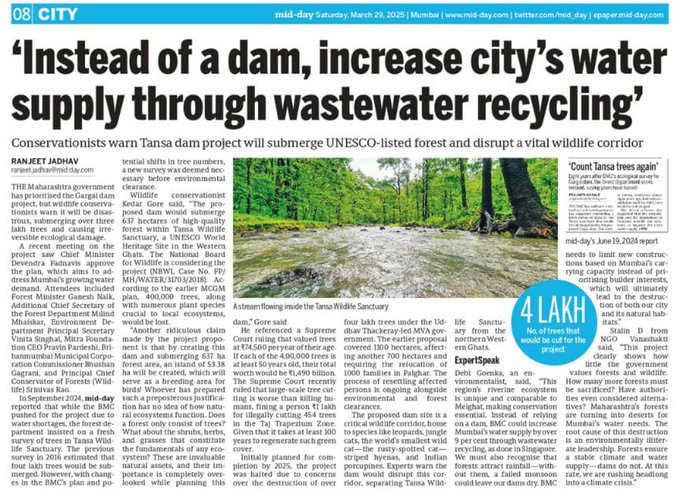
Maharashtra Chief Minister Devendra Fadnavis, brushing aside the concerns of forest officials, opposition, environment and available options this week has asked the officials to fast track the Forest and other clearances for the controversial Gargai dam for additional supply of water to Mumbai. This is shocking on several counts.
Our study earlier showed that Mumbai does not need any additional dam including Gargai if it utilizes available local resources including rainfall, reuse of treated sewage, desalinization, demand side management, groundwater recharge, among other cost effective and less destructive options. The Chief Minister of his government has not bothered to respond to these concerns or options. In fact, when our study was published, even government officials in Mumbai had supported our conclusions.
The fact that Gargai dam will involve destruction of lakhs of trees, rich biodiversity, natural habitat, carbon sink and hydrological assets, displacement of thousands of tribals does not even seem to be the concern of the current Maharashtra government. One only hopes better sense will prevail and the project will not get clearances or the judiciary will step in to stop such destructive dam projects. People of Mumbai also need to stand up to oppose the project.
CM directs officials to fast-track FC to Gargai dam In a meeting held at Mantralaya on Wednesday (March 26), the CM Devendra Fadnavis instructed civic officials to expedite the process of obtaining environmental clearances from the central govt for the Gargai Dam project. The project is expected to increase Mumbai’s water supply by 440 MLD. The Gargai dam in Palghar district, 110 km away from Mumbai, is awaiting environmental approvals.
“The CM has instructed the BMC and the Forest Department to coordinate and submit an immediate proposal for the rehabilitation of villages affected by the dam project,” said a civic official. According to the sources, the preliminary engineering works for the Gargai dam project are nearly completed, with most requisite technical clearances obtained. Permissions from the forest department and wildlife board are awaited. https://www.freepressjournal.in/mumbai/gargai-dam-project-cm-devendra-fadnavis-directs-officials-to-fast-track-forest-clearances-for-440ml-water-boost (27 March 2025)
Objections rejected The forest dept representatives present at the meeting at Vidhan Bhavan objected to the project, but their protests were shot down. The step will involve environmental consequences: apart from the chopping of hundreds of thousands of trees, nearly 658 ha of forest land in the sanctuary as well as 186 hectares of private land will be submerged.
Mumbai gets over 4,000 MLD from the seven lakes of Tulsi, Vihar, Tansa, Modak Sagar, Bhatsa, Middle Vaitarna and Upper Vaitarna. Nearly 30% of this is wasted on account of thefts and leakages. Most water supply projects were completed by the British, and the last one, the Middle Vaitarna project, was completed in 2014 by the BMC by cutting over 700,000 trees.
Shiv Sena UBT MLA Aaditya Thackeray said, “In the initial years, we were keen on the Gargai and Pinjal water supply projects. But we realised in 2016-2018 that 350,000 trees would have to be cut for the dam—actually 600,000 if the water body creation and pipes were taken into account. The cost of the dam will be ₹15,000 crore to ₹20,000 crore. As against this, the desalination project would have cost ₹1,500 crore for 450 MLD of water.” https://www.hindustantimes.com/cities/mumbai-news/cm-clears-gargai-water-project-for-mumbai-amid-forest-dept-opposition-101743015712094.html (27 March 2025)
Treated sewage can meet drinking water needs The govt has prioritised the Gargai dam project, but wildlife conservationists warn it will be disastrous, submerging over three lakh trees and causing irreversible ecological damage. Wildlife conservationist Kedar Gore said, “The proposed dam would submerge 637 hectares of high-quality forest within Tansa Wildlife Sanctuary, a UNESCO World Heritage Site in the Western Ghats. The National Board for Wildlife is considering the project (NBWL Case No. FP/MH/WATER/31703/2018).”
Debi Goenka, an environmentalist, said, “This region’s riverine ecosystem is unique and comparable to Melghat, making conservation essential. Instead of relying on a dam, BMC could increase Mumbai’s water supply by over 9 per cent through wastewater recycling, as done in Singapore. We must also recognise that forests attract rainfall – without them, a failed monsoon could leave our dams dry. BMC needs to limit new constructions based on Mumbai’s carrying capacity instead of prioritising builder interests, which will ultimately lead to the destruction of both our city and its natural habitats.”
Stalin D from NGO Vanashakti said, “This project clearly shows how little the government values forests and wildlife. How many more forests must be sacrificed? Have authorities even considered alternatives? Maharashtra’s forests are turning into deserts for Mumbai’s water needs. The root cause of this destruction is an environmentally illiterate leadership. Forests ensure a stable climate and water supply – dams do not. At this rate, we are rushing headlong into a climate crisis.” https://www.mid-day.com/amp/mumbai/mumbai-news/article/mumbai-instead-of-a-dam-increase-citys-water-supply-through-wastewater-recycling-23508949 (29 March 2025)
HYDRO POWER PROJECTS
Himachal Pradesh Tribals open front against Seli & Miyar HEPs Lahaul-Spiti Tribals Open Front against Seli and Miyar Power Projects in the Fragile Valley. Seli located. on Chenab River, Miyar is located on Miyar tributary of Chenab river in Udaipur sub division. Save Lahaul Spiti Society has condemned the agreement between HP and Telangana on these two projects. Both projects have been facing resistance for many years. https://himbumail.com/business/hydro-power/lahaul-spiti-tribals-open-front-against (30 March 2025) State govt has signed MoU with Telangana govt to build two major hydroelectric projects: 400 MW Seli and 120 MW Miyad HEPs on BOT basis in Lahul Spiti area. https://www.aninews.in/news/national/general-news/himachal-pradesh-and-telangana-governments-sign-mou-to-build-two-major-hydroelectric-projects20250329132447/ (29 March 2025)
Govt to take over 2 HEPs in Chamba -The state govt will take over the Baira Siul power project of National Hydroelectric Power Corporation (NHPC) in Chamba. This was stated by CM Sukhvinder Singh Sukhu in Assembly the ongoing budget session while replying to a question on the raised by Congress MLA from Chamba, Neeraj Nayar, on the NHPC project. Nayar also pointed out that Baira Siul and Chamera-I hydroelectric plant in Chamba has 350 bigha surplus land of which should be identified and taken back by the government. https://www.hindustantimes.com/cities/chandigarh-news/hp-government-to-take-over-two-chamba-hydel-projects-cm-sukhu-101742924199325.html (26 March 2025)
Video This video dives into the troubling reality surrounding the Himachal Pradesh Power Corp Ltd (HPPCL), a government-owned company that seems to operate with little to no accountability. Local communities are bearing the brunt of rampant blasting activities linked to HPPCL projects, causing cracks in nearby houses and disrupting lives. The fallout doesn’t stop there—sand and debris from these operations are damaging apple plants and local shops, threatening the livelihoods of residents.
On top of that, HPPCL has been plagued by numerous corruption charges against its senior officers, raising serious questions about its management and oversight. Join us as we explore the impact on locals and the ongoing controversies surrounding this state-run entity. https://www.youtube.com/watch?v=4iF2F0KbCGM (27 March 2025)
Jammu & Kashmir Govt consulting IIT-R, NHPC on revival of HEPs As per the official document available, 13 hydroelectric projects in Jammu and Kashmir have total capacity of 1197.4 MW and as per the design energy they can generate 5318.11 million units (MU). However, during 2023-24 these projects generated 4913.28 MU. The projects like Upper Sindh Hydropower Project (USHP-I) and USHP-II, Ganderbal, Chenani-I, Chenani-II and Chenani-III, Bhaderwah and Sewa-III generated power far less than their design energy during the year 2023-24.
“Losses due to decrease in generation have occurred as a result of decrease in hydrology due to climate change over period of time apart from the fact that many of the projects like 23.3 Mega Watt Chenani-I, 105 Mega Watt LJHEP, 22.6 Mega Watt USHP-1 etc have already outlived their design life of 35 years resulting in frequent forced shut downs and progressively increasing operation and maintenance Costs”, the Document said.
Moreover, Sewa-III is under complete shutdown since 20.08.2013 due to closure/damage of water conductor due to torrential rains, renderimg it totally defunct. IIT-Roorkee engaged by JKPDC for the preparation of Detailed Project Report for the revival of Sewa-III furnished a comprehensive DPR in March 2022 for an amount of Rs 76.68 crore which includes repair/renovation of various civil components along replacement of major electro-mechanical equipment.
“The J&K Power Development Corp is preparing a technical & financially viable proposal for the revival of Sewa HEP for placing before the Board of Directors”, the document said.
Pointing out that power generation in some of the J&K’s operational plans especially the very old ones does not always reach full capacity, the document said, “this can be attributed to frequent wear and tear due to aging machinery. Additionally issues such as low hydrology and trash accumulation, which are common in hydro plants, also lead to reduced generation”. https://www.dailyexcelsior.com/govt-consulting-iit-roorkee-nhpc-on-revival-of-power-projects-with-very-low-generation/ (24 March 2025)
Sikkim More than a year after the GLOF wiped out Teesta III hydro project, the government wants to rebuild the dam.
Mayalmit Lepcha an activist, president of the Sikkim Lepcha Indigenous Tribal Association, and general secretary of the Affected Citizens of Teesta asks the tough questions: Why are we rebuilding the dam in the face of escalating climate risks such as expanding glacial lakes? Why are financial institutions funding another risky venture? Will local communities see any real benefits? https://www.youtube.com/watch?v=2XA6S1AVJ60 (24 March 2025)
Meghalaya Umiam dam safety: Govt looks for long-term solution “We always call it the Umiam Bridge, but the Power Department’s concern is more about the health of the dam. After the renovation work, seepage has been minimised. We have restricted the passage of heavy vehicles solely for the dam’s safety,” Power Minister AT Mondol said. The minister acknowledged the pressing challenge of determining the long-term fate of the bridge once its extended lifespan expires. He highlighted the critical role of the Umiam Reservoir in supporting power generation.
Umiam Dam supplements water for the 216 MW capacity of the four units of Umiam and also the new Umtru power project near Byrnihat. He stated that there is continuous monitoring to ensure the dam’s safety. https://theshillongtimes.com/2025/03/28/umiam-dam-dilemma-govt-looks-for-long-term-solution/ (28 March 2025)
Hydro potential needs to be tapped: Minister State Power Minister AT Mondal stated, “We are upgrading this project from 3 Mw to 6 Mw. We sent the DPR to Rourkela, and they vetted it and said it can be done.” Mondol, however, said that while the MePGCL takes loans from different agencies to construct the power stations, it could explore sources of funding with zero interest. He said a central finance assistance scheme offering up to Rs 20 crore at Rs 7 crore per megawatt has been stopped, but all the power ministers of the Northeastern states have flagged the issue with the Union Power Ministry. “It is being looked into. If it comes, it will be helpful for us for generations,” he said. Mondal also said MePGCL has prepared 12 DPRs for small hydropower projects. “By this year, we will clear all the windows as far as the 201 MW Leshka Phase 2 is concerned. The only thing is from where the funds will come,” he added. https://theshillongtimes.com/2025/03/30/states-hydropower-potential-needs-tapping-soon-mondal/ (30 March 2025)
L Subansiri HEP NHPC has completed the erection of 767 ferrules for all eight lanes of pressure shaft liners at the 2000MW Subansiri Lower HEP. Earlier, installation of all nine Spillway Radial Gates was on Jan 29, 2025. https://www.waterpowermagazine.com/news/nhpc-completes-key-construction-milestones-at-subansiri-lower-project/?cf-view (24 March 2025)
Arunachal Pradesh Governer KT Parnaik sought German collaboration to accelerate hydropower development when German ambassador to India and Bhutan Dr Philipp Ackermann on March 27 called on Arunachal governor at the Raj Bhavan. https://timesofindia.indiatimes.com/city/guwahati/arunachal-seeks-german-collab-in-hydropower-devpt/articleshow/119609826.cms (27 March 2025)
Report SC remark on cutting trees wake-up call for govt Environmentalists welcomed the apex court’s strong stand on forest and tree protection but questioned if governments would take it seriously. “This is a wake-up call for the central government, which has constantly been diluting forest protection laws,” said Bhim Singh Rawat from SANDRP. He said the situation was particularly alarming in the geologically fragile and climatically sensitive Himalayan states. “The continuous push for large-scale infrastructure projects such as hydropower, dams, roads, tunnels and railways has led to the loss of thousands of hectares of pristine forests. This has increased disaster risks, vulnerability and fatalities in the region,” he said. https://www.livemint.com/news/india/sc-remark-on-cutting-trees-wake-up-call-for-govt-say-environmentalists-11743000700268.html (26 March 2025)
Power Ministry Fluctuation in hydro power generation In energy storage systems, 13,050 MW/78,300 MWh Pumped Storage Projects are under construction/concurred and 14,970 MW/54,803 MWh Battery Energy Storage System are currently under various stages of construction/bidding. Out of this, 6,853 MW/ 36,592 MWh of energy storage system (3,180 MW/19,080 MWh Pumped Storage Projects and 3,673 MW/ 17,512 MWh of Battery Energy Storage System) is likely to be added by 2025-26. https://pib.gov.in/PressReleasePage.aspx?PRID=2115792 (27 March 2025)
Trans Rivers Hydropower-a Harmful Outsider This week the International Renewable Energy Agency (IRENA) released a new Report Renewable Capacity Statistics 2025: It reports growth in renewable capacity installation in 2024. The 585 GW addition of RE in 2024 holds a 92.5% share of the total global electricity capacity expansion and presents a record rate of annual growth (15.1%). It is dominated by solar power with 452 GW added last year. China alone added 278 GW to the total expansion, followed by India (24.5 GW). Wind energy additions amounted to 113 GW (+11.1%).
The graph shows that in last 10 years hydropower lagged far behind the solar and wind development and this gap has been widening. Conventional hydropower capacity addition has slightly gone up from 11 GW in 2023 to 15 GW in 2024. What is interesting, the report also shows a decrease amounting to 6 GW of hydropower capacity in EU, Argentina, Russia and Ukraine.
In terms of capacity addition, China is at top (6850 MW), India at no 20 (72 MW) and Pakistan, Nepal and Bhutan are all ahead of India.
PAKISTAN: Inauguration of the Chinese-built Suki-Kinari HPP was accompanied by a mass protest of people who never received just compensation for the drowning of their lands and ruining cemeteries of their ancestors. https://www.transrivers.org/2025/4045/ (28 March 2025)
Odisha Portable system developed to draw power from Subarnarekha Researchers at IIT Kharagpur have developed a way to generate hydroelectric power using the natural flow of the Subarnarekha River. It costs Rs 1.5 lakh per kilowatt. Unlike traditional hydropower systems that require large turbines and deep water, this method can generate power even at 6-10 feet of water depths and with currents as low as 1.8-2 km per hour. It works on vortex-induced vibration technology, making it ideal for small rivers and streams where traditional turbines will be impractical. The machine is portable.
Over the past six months, the research team, led by Onkar Venkatyalla and Saikat Nandi, used this technology to operate LED bulbs at Keshiary block, Paschim Medinipur. Encouraged by this success, they plan to use the same technology to power speedboats and illuminate the ‘Jungalkanya Setu’. https://timesofindia.indiatimes.com/city/kolkata/iit-researchers-develop-portable-system-to-draw-power-from-subarnarekha/articleshow/119556529.cms (27 Mar 2025)
MoEF Decisions of EAC meeting held on March 12, 2025: 1. Kamod Close Loop Pumped Storage Hydro Electric Project (2000 MW) in 395.23 Ha at Village Chaupale, Kamod, Lavhartodi, Kotkhamb and Nagziri, Sub Dist Sakri & Nawapur, Dist Dhule and Nandurbar, Mah by M/s Megha Engineering & infrastructures Ltd -For Terms of References: APPROVED
2. Chakung Chu Hydroelectric Project (82.5 MW) in 42.24 Ha at Village Meyong, Naga-Namgor, Sentam and Singchit, Sub Dist Mangan Dist North District, Sikkim by Kundan Hydro (Gangtok) Pvt Ltd – Terms of References: APPROVED
3. Kopra Medium Irrigation Project (CCA: 9990 Ha ) in 1044.52 Ha at village Bamarakunj, Berkheri Kalan, Devpura, Kanmar, etc, Sub Dist Rehli, Garhakota, Dist Sagar, Madhya Pradesh –Terms of References: APPROVED
4. Proposed Pachnad Major Irrigation Scheme (CCA : 24,328 Ha) in 24328 Ha located at village Sadhrapur, Sub-Dist and Dist Auraiya, Uttar Pradesh – Terms of References: APPROVED https://parivesh.nic.in/utildoc/123163650_1742806696587.pdf
DAMS
Study Newly built dams in low-income countries failing increasingly A study published in Nature Water (https://www.nature.com/articles/s44221-025-00402-1) estimated that 23 large ‘dam failures’ could occur worldwide by 2035. With 4.4 per cent of large dams facing a failure probability above 1/10,000, prioritising investment in dam safety was never more important, the research highlighted. The researchers observed a strong infant mortality (higher probability of failure during the first years of operation), which remains especially important for the development of new embankment dams, while recent concrete dams have become more resilient. In contrast, hazard signals related to ageing remain less apparent.
Decades-old dams would be prevalent in future failure statistics—especially embankment dams of height between 15 and 70 m built in the second half of the last century, the study found. The study uncovered a trend of increased failure rates of newly constructed dams in low-income regions, which coincides with areas where substantial hydropower potential remains untapped. “This is especially intensified in monsoon-dominated climates, whereas the pattern of construction and failures is more homogeneous across other major climatic regions,” it noted. https://www.downtoearth.org.in/amp/story/water/newly-built-dams-in-low-income-countries-failing-increasingly-study (25 March 2025)
Polavaram Project Plan to release water from coffer dam by July 2026: CM N. Chandrababu Naidu has said the government is contemplating releasing water through gravity from the upper cofferdam of the Polavaram irrigation project by July 2026. “The idea will work out, provided the right and left connectivities are completed,” Mr. Naidu told the media. “I remember saying that water can be provided through gravity from the upper cofferdam. We are working on it,” he said. If technical issues do not crop up, the Phase-1 works should be completed by July 2027. Else, they should be completed by December 2027,” the Chief Minister said. https://www.thehindu.com/news/national/andhra-pradesh/govt-contemplating-releasing-water-from-polavaram-upper-cofferdam-by-july-2026-says-andhra-pradesh-chief-minister-chandrababu-naidu/article69381720.ece (27 March 2025)
1st phase to be complete by June 2027: CM N Chandrababu Naidu announced that the govt would strive to complete phase 1 of Polavaram project by June 2027, before the commencement of the Godavari Pushkarams, provided the technical committee identifies no lapses in the construction. He said construction of the diaphragm wall, costing Rs 990 crore, will be completed by Dec (2025), while ECRF Gap 1 and Gap 2 would be filled by Feb 2026 and Dec 2027, respectively. Subsequently, works of right and left connectivity structures would be completed by June 2026, he added. “Phase 1 of the project, which includes raising the height to 41.14 metres, completing the left and right main canals, and executing the relief and rehabilitation (R&R) packages, will be completed by June 2026,” he said. “We are also constructing a buttress dam at a cost of Rs 82 crore to arrest seepage in the cofferdam,” he added. https://timesofindia.indiatimes.com/city/vijayawada/andhra-pradesh-chief-minister-chandrababu-naidu-says-polavaram-phase-1-will-be-completed-by-june-2027/articleshow/119610021.cms (27 July 2025)
Telangana opposes Andhra’s ‘illegal’ Polavaram expansion Telangana irrigation officials have urged the Polavaram Project Authority (PPA) to discuss the proposed expansion of the Polavaram project by the Andhra Pradesh government to facilitate the Godavari-Banakacherla project. The PPA has convened a meeting on March 27 with Andhra Pradesh and Telangana officials to discuss interstate issues related to the project. However, Telangana has requested the PPA to include two additional points in the meeting agenda. In a letter to the PPA chief executive officer, Telangana irrigation engineer-in-chief (ENC) G Anil Kumar has stated that in response to the meeting notice regarding the discussion of interstate issues related to the Polavaram project, two more points should be added to the agenda. He noted that the AP government has proposed an expansion of the Polavaram project to draw about 40,000 cusecs of water from the head sluice of the Right Main Canal (RMC).
“Andhra Pradesh cannot undertake such components or expansions to facilitate the Godavari-Banakacherla Link Project without notifying the co-riparian states. These changes necessitate modifications to the gate operation schedule, deviating from the defined schedule under GWDTA, and are likely to cause adverse backwater submergence effects in upstream territories,” he said. Telangana, in its previous correspondence, has strongly opposed any such expansions of the Polavaram project, stating that they violate Telangana’s riparian rights, Anil recalled. https://www.newindianexpress.com/states/telangana/2025/Mar/24/telangana-opposes-andhra-pradeshs-illegal-polavaram-expansion (24 March 2025)
Andhra CM for operational model for Polavaram-Banacacherla link -In a review meeting with irrigation dept officials, the CM mentioned that the electricity required to transfer Godavari waters from Polavaram through lifts can be produced by setting up pumped storage and solar power plants in the project area. The CM instructed the officials to complete the DPR by June 20 this year, and to ensure the project receives CWC approval by Oct 20. He also emphasised obtaining environmental clearances and starting the work promptly.
The total cost for the Polavaram-Banacacherla linkage is estimated at 81,900 crore. The project will discharge 2 TMCs per day, and the water will be transported through a 368.60 km open canal. The main tunnel will be 20.50 km long, with Siddhapuram twin tunnels extending 6.60 km and pipelines up to 17 km. A total of nine lifts will be used, which require 3,377 MW of electricity. About 54,000 acres of land, including 15,300 acres of forest land, need to be acquired for the project. Additionally, 18 residential areas in five villages need resettlement for the Bollapalli reservoir. https://timesofindia.indiatimes.com/city/vijayawada/cm-for-operational-model-for-polavaram-banacacherla-link/articleshow/119492505.cms (25 March 2025)
Kaleshwaram Project ‘NDSA final report in 7-10 days’ Irrigation minister N Uttam Kumar Reddy on March 26 informed the state assembly that major lapses in the design and construction of the Kaleshwaram Lift Irrigation Project were officially confirmed in the vigilance and National Dam Safety Authority (NDSA) preliminary reports. The judicial inquiry into the matter is underway, and its report, along with the final NDSA assessment, is expected to be submitted within a week to 10 days, he said.
Citing the findings, the minister said the foundation technology used for the three barrages was flawed, with a clear mismatch between the detailed project report (DPR) and actual implementation. “The DPR mentioned sheet pile technology, but a secant pile was used. NDSA experts have expressed fear that the barrages may collapse and even submerge the nearby villages and towns like Bhadrachalam,” he warned. https://timesofindia.indiatimes.com/city/hyderabad/ndsa-final-report-on-kaleshwaram-in-7-10-days-says-uttam/articleshow/119552381.cms (26 March 2025)
Karnataka Technical issue at KRS dam causes uncontrolled release More than 1,000 cusecs of Cauvery water wastefully flowed into the river for more than a day after a sluice gate suddenly opened at the Krishnaraja Sagar Reservoir on Monday (March 24) night. Farmers alleged that officials failed to attend to the crisis immediately and did not close the gate to save precious water. Many wanted to know whether the fifth crest gate opened on its own due to a technical fault or because of the callousness of employees assigned to monitor the gauge and operations of sluice gates. They asked as to why the officials did not act in time to control the damage.
A few officers suspect that the gate might have opened because of the motor switch reversing or the irrigation department staff pressing the gate switch. Sources said officials struggled for hours to close the crest gate on Monday night as the reservoir level is around 106 ft as against the maximum of 124.8 ft. Superintendent Engineer Raghuram said the gate opened because of a technical snag, and a report has been sought to know how and who opened the gate. He said that around 750-1,000 cusecs of water flowed into the river. https://www.newindianexpress.com/states/karnataka/2025/Mar/26/technical-issue-at-krs-dam-causes-uncontrolled-release-of-cauvery-water-farmers-upset-over-delayed-response (26 March 2025)
Gujarat Bhadbhut project to complete in June 2027: CM Bhupendra Patel inspected the under construction Bhadbhut dam project on the Narmada river in Bharuch dist to review the progress. 53% of the construction work has been completed and 99% of phase I work is claimed to have been completed. Phase I work is expected to be completed in July 2026 and phase II work including embankments by June 2027. Fresh water storage is expected to begin in July 2027, after which Rs 900 Cr is expected to be generated from domestic and industrial water supply.
In the remaining work, in the first phase, the construction of cofferdam, girder casting, cement concrete block casting and hydro-mechanical work i.e. gate and gate lifting mechanism etc. are in progress. The work of fish pass and fisherman navigation channel has been largely completed and the work of approach road will be completed in May-2025 and the work of flood protection embankment in the available land, which is under progress, will be completed in December-2025. https://deshgujarat.com/2025/03/29/bhadbhut-barrage-project-to-complete-in-june-2027-gujarat-cm-briefed-during-review-visit/ (29 March 2025)
100-Mw floating solar plant planned at Middle Vaitarna Dam Mumbai will have a 100 Mw floating solar photovoltaic (FSPV) plant at Middle Vaitarna Dam as part of efforts to expand renewable energy options. The project, being undertaken by ABIL & Mahalakshmi Group, was announced at a recent seminar held by the company in Mumbai on Saturday (March 22). https://indianexpress.com/article/cities/mumbai/100-mw-floating-solar-plant-to-come-up-at-middle-vaitarna-dam-9902026/ (23 March 2025)
Bihar बागमती नदी पर बराज बनाने का किसानों का विरोध (कुमार कृष्णन) https://www.spsmedia.in/dam-and-displacement/farmers-protest-against-construction-of-barrage-on-bagmati-river/ (Mar 2025)
INTERLINKING OF RIVERS
Ken-Betwa Link Assessment of impacts The discussion for the third episode of The Green Mandate – Season 3 on ‘Assessing the River Interlinking Project’ focused on India’s Interlinking of Rivers Project (ILRP), on 20th February 2025 at India International Centre, New Delhi. The panel included Mr. Shashi Shekhar (ex-IAS and former Secretary at the Ministry of Water Resources), Mr. Jasbir Singh Chauhan (ex-IFS and former Principal Chief Conservator of Forests), and Mr. Himanshu Thakkar. The discussion was moderated by Mr. Debadityo Sinha (Senior Resident Fellow and Lead, Climate & Ecosystems at Vidhi Centre for Legal Policy). https://youtu.be/PfJFGzAPHcc AND https://vidhilegalpolicy.in/videos/the-green-mandate-s3e3/ (25 March 2025)
-The project is based on the premise that Ken, the smaller of the two rivers, has surplus water that can be transferred to the bigger Betwa river. But the hydrological data that is claimed to support that premise is not in the public domain and has never been put to scrutiny by any independent, credible agency. Ground realities and available facts show that the hydrological basis of the project is a secret exercise in manipulation. (Himanshu Thakkar, SANDRP) https://www.tribuneindia.com/news/comment/ken-betwa-project-can-ravage-bundelkhand-353116/ (16 Jan. 2025)
Kosi-Mechi Link Cabinet approves intra-state river linking The Cabinet Committee on Economic Affairs (CCEA) chaired by the PM has on March 28 approved inclusion of Kosi Mechi Intra-State Link Project of Bihar under Pradhan Mantri Krishi Sinchai Yojana0Accelerated Irrigation Benefits Programme (PMKSY-AIBP) of Ministry of Jal Shakti. The CCEA has also approved central support of Rs.3,652.56 crore to Bihar for completion of the project by March, 2029 with an estimated cost of Rs.6,282.32 crore.
Kosi Mechi Intra-State Link Project envisages diversion of part of surplus water of Kosi river for extending irrigation to Mahananda basin lying in Bihar by way of remodelling of existing Eastern Kosi Main Canal (EKMC) and extending the EKMC beyond its tail end at RD 41.30 km up to river Mechi at RD 117.50 km so that rivers Kosi and Mechi which flow through Bihar could be linked together within Bihar. The Link Project is to provide 2,10,516 ha additional annual irrigation in Kharif season in Araria, Purnea, Kishanganj and Katihar districts of Bihar. The project has potential to divert/utilize about 2,050 million cubic meter of surplus water of Kosi through the proposed link canal. Further, after remodelling of existing EKMC, shortfall supply to 1.57 lakh ha existing command of existing Eastern Kosi Main Canal shall be restored. https://pib.gov.in/PressReleasePage.aspx?PRID=2116180 (28 March 2025)
URBAN RIVERS
Mula-Mutha; Pune MoEF seeks report on threat to Devrai forest City resident Vandana Chaudhary reached out to MoEFCC on Feb 5 regarding the hacking of over 1,000 heritage trees and destruction of riverbanks at the grove for the project. She had submitted that no ecological survey was conducted as mandated under the Biodiversity Heritage Act, 2002, and the Wildlife Protection Act, 1972, before mapping this as a site for riverfront development project construction.
Following this, the MoEF on Mar 7 wrote to the state forest dept, directing it: “I am directed to request you to get the matter examined and take action as per the provisions of the rules. The action-taken report may please be communicated to the applicant and ministry at the earliest,” said an official from the MoEF. https://timesofindia.indiatimes.com/city/pune/submit-action-report-on-concerns-of-ramnadi-mula-devrai-destruction-for-rfd-project-in-pune-union-environment-ministry-tells-maha-forest-dept/articleshow/119552914.cms (28 March 2025)
MLC joins call to halt RFD -Amid rising opposition over the upcoming RFD projects in Pune, MLC Amit Gorkhe joined the opposition by holding a placard as he entered Vidhan Bhavan on Wednesday (March 26), highlighting the call for an end to the concretisation and beautification of riverfronts and advocated for the purification of the Pavana, Mula, and Indrayani rivers in Pimpri Chinchwad area. “The demand is to keep the rivers intact in their natural form. Conserving the Pavana, Mula and Indrayani rivers is essential as they cater to more than 30 lakh citizens in PCMC. Cutting down trees, destroying the habitat of animals and birds and creating a threat to the environment in the name of constructions and artificial beautification is unacceptable and must be stopped,” said Gorkhe. https://indianexpress.com/article/cities/pune/amit-gorkhe-joins-halt-riverfront-development-projects-pune-9907874/ (26 March 2025)
RFD: 1st phase at 85%, 2nd reaches 32% As per the Pune Municipal Corporation (PMC) the first phase of the project, which spans from Sangamwadi to Bund Garden Bridge, has achieved 85% completion. Officials have set a target to complete most of the work by June 2025. Concurrently, the second phase, extending from Bund Garden Bridge to Mundhwa, is progressing at 32% completion, with increased efforts to accelerate the pace. https://www.thebridgechronicle.com/news/mula-mutha-riverfront-development-first-phase-at-85-second-phase-reaches-32 (23 March 2025)
Buddha Dariya; Ludhiana Seechewal’s claim ‘PR stunt’: Activists Green activists have accused Rajya Sabha member Balbir Singh Seechewal of fabricating claims about cleaning the Buddha Nullah near Bhukhari village. They say that he is misleading the public by showcasing selectively clean stretches while ignoring the drain’s grim reality within city limits & downstream areas.
Seechewal and his team shared photos and videos on Mar 27, claiming that dirty water has been prevented from entering the drain at multiple points up to Gurdwara Gaughat. He said the implementation of the Seechewal Model in five villages over the past two and a half months, where 72 dairy farms had previously discharged waste into the drain. According to him, the flow of fresh water into Buddha Nullah has increased and is expected to reach 200 cusecs soon. https://www.hindustantimes.com/cities/chandigarh-news/ludhianaseechewals-claim-of-clean-buddha-nullah-pr-stunt-says-local-activists-101743271511415.html (30 March 2025)
RIVERS
Study Benefits of more room for rivers Abstract: Floodplain river ecosystems have been extensively artificially constrained globally. As climate change heightens flood risks, the command-and-control approach to river flood management is beginning to make way for a paradigm shift towards ‘living with water’. The ecological co-benefits of this shift, where rivers are given the space they need to migrate on the landscape, have so far been undervalued. Here we synthesize the ecological benefits of allowing rivers more room to move. We emphasize how the physical and ecological processes of unconfined river channels interact to provide the foundations for ecosystem resilience through spatiotemporal variability in multiple dimensions, including hydrologic and meta-ecosystem connectivity. More informed and sustainable decision-making that involves trade-offs between river ecology and engineering will be aided by elucidating these connections. Giving rivers more room to move can represent a mutually beneficial solution for both the freshwater biodiversity crisis and flood hazard management as climate-driven extremes escalate. https://www.nature.com/articles/s44221-025-00403-0 (21 March 2025)
A quarter of freshwater species risk extinction A study has found that around 24% of more than 23,000 freshwater animal species are threatened with extinction, because of pollution, dams, agriculture and the invasion of other species. The findings could help plan conservation efforts to reduce freshwater biodiversity loss, says an international team of ecologists.
Dams and water extraction endanger 46% fish, by blocking their migration routes and degrading habitat. Invasive species and disease threaten 33% fish and overfishing endangers 27%. These threats, along with overharvesting, drive extinctions and increase the number of threatened species in various parts of the world, including the Western Ghats in India and Sri Lanka’s Wet Zone, the researchers say. https://www.nature.com/articles/d44151-025-00033-1 (28 Feb. 2025)
Earth’s storage of water in soil, lakes and rivers is dwindling Their paper, published on Mar 27, 2025, in the journal “Science” (https://www.science.org/doi/10.1126/science.adq6529), finds that global warming has notably reduced the amount of water that’s being stored around the world in soil, lakes, rivers, snow and other places, with potentially irreversible impacts on agriculture and sea level rise. The researchers say the significant shift of water from land to the ocean is particularly worrisome for farming & hope their work will lead to reducing in water overuse.
Earth’s soil moisture dropped by over 2,000 gigatons in roughly the last 20 years, the study says. The study also confirms an explanation for a slight wobble in the rotation of the Earth—it’s being driven by the changing moisture levels of the planet. https://phys.org/news/2025-03-earth-storage-soil-lakes-rivers.html (27 March 2025)
Global human impact on biodiversity Abstract: We show that human pressures distinctly shift community composition and decrease local diversity across terrestrial, freshwater and marine ecosystems. Yet, contrary to long-standing expectations, there is no clear general homogenization of communities. Critically, the direction and magnitude of biodiversity changes vary across pressures, organisms and scales at which they are studied. This exhaustive global analysis reveals the general impact and key mediating factors of human pressures on biodiversity & can benchmark conservation strategies. https://www.nature.com/articles/s41586-025-08752-2 (26 Mar 2025)
Jammu & Kashmir Black carbon enhancing glacial meltdown Because of continuous carbon emissions & release of black carbon in the atmosphere the glaciers across Jammu & Kashmir and Ladakh are melting at a fast pace. The black carbon is also polluting our rivers and streams at its source now & it further gets contaminated when these rivers and streams enter the villages and towns? We go to Pahalgam but can’t drink water from Lidder there? Do we ever think about it? Buying packed water is now a routine thing for us and this change happened in last 10 -12 years only. (Water scarcity & uncontrolled urbanisation will turn Srinagar into a slum in coming years? (Dr Raja Muzaffar Bhat) https://www.greaterkashmir.com/opinion/black-carbon-is-enhancing-glacial-meltdown-in-kashmir/ (21 March 2025)
Rs 12 cr Env Compensation on SMC The Commissioner SMC has already informed the NGT that Leachate Treatment Plant (LTP) will be made operational. This plant is defunct for many years and has impacted the water-table around Achan Saidapora which is further impacting Anchar and Dal lakes. This was taken very seriously by NGT Judges during hearing. The Commissioner SMC also assured that anti odour chemicals would be sprayed to control bad smell in the area plus he has assured that by March 2027 the entire landfill site would be cleared through a process called Biomining. SMC has already been heavily penalized by NGT for pumping liquid waste in Doodh Ganga. A penalty of Rs 41.47 Crore was imposed on them last year by NGT for setting up 13 illegal pump stations between Chanapora to Tengpora. Let us wait and watch how things unfold? First litmus test for SMC will be in the coming summer when the Achan landfill site will start emitting a pungent smell. https://www.greaterkashmir.com/opinion/rs-12-cr-environmental-compensation-on-smc/ (Dr Raja Muzaffar Bhat)
Govt’s apathy towards streams These community-led initiatives have not only improved the environment but also fostered a sense of community and ownership of natural resources among locals. However, it has also exposed the government’s apathy towards cleaning up water bodies.
Schemes like Swachh Bharat Mission, Amrit Sarovar and MGNREGA implemented by the Rural Development Department provide no such provision for cleanliness of the water bodies. Under the Amrit Sarovar Mission launched in April 2022 by PM Modi to rejuvenate traditional springs and ponds, J&K government claims, on the Mission Amrit Sarovar portal of the Government of India, to have rejuvenated 237 springs under this mission through MGNREGA.
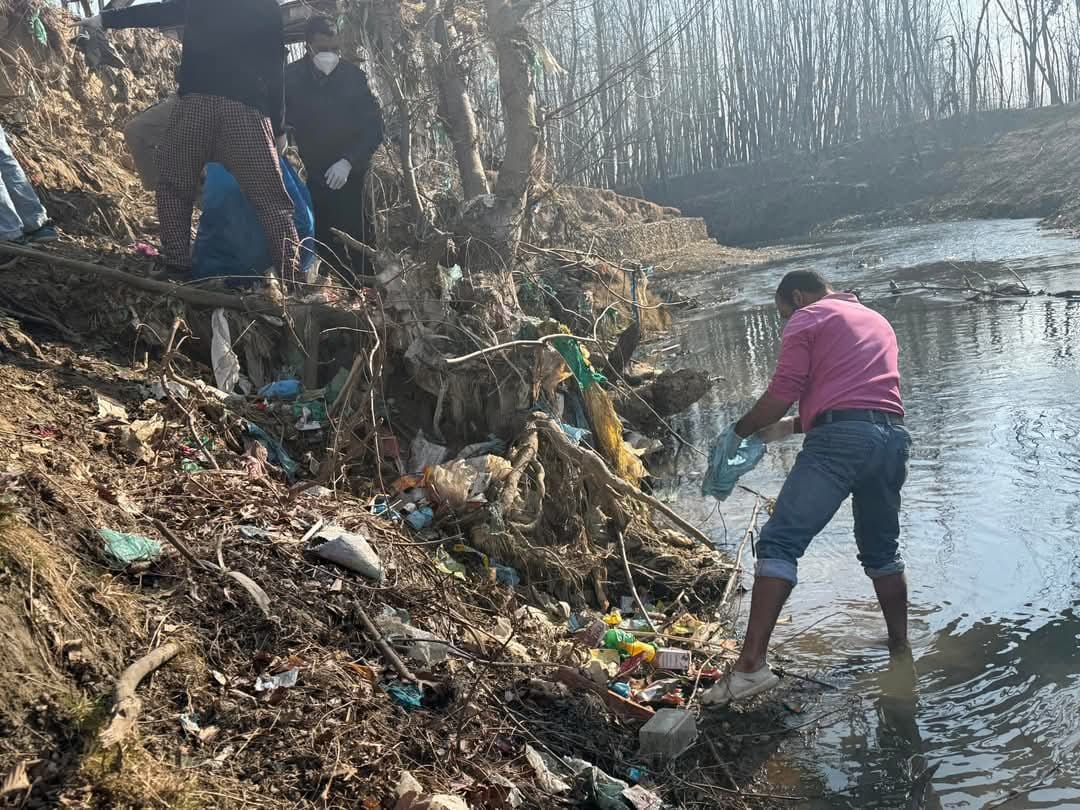
Regional Director of the Jammu and Kashmir Pollution Control Committee (PCC) Abhjeet Joshi admitted that the PCC’s role was limited to passing directions to concerned depts about pollution violations. According to Director Rural Development, Kashmir, Shabir Hussain Bhat, there is no provision under any scheme to clean water bodies. Deputy Director Rural Sanitation, Kashmir, Mantasha Bint Rashid too said that there was no scheme as such for cleaning of water bodies.
“Rural sanitation and rural development departments have sufficient funds for sanitation. The government should keep funds for cleanliness of water bodies as their maintenance is as necessary as water is for life,” claimed Ali Muhammad Jan, a popular sanitation worker in Pulwama, who launched a drive to clean river Jhelum banks in his Kakpora village. https://www.etvbharat.com/en/!state/kashmir-villages-launch-campaign-to-restore-water-bodies-expose-govt-apathy-enn25031804966 (25 March 2025)
Govt admits drains discharge wastewater into streams The govt has acknowledged in the Legislative Assembly (on March 11) that untreated wastewater from drains in south Kashmir’s Anantnag, Bijbehara and Mattan towns is being discharged into nearby streams. While the government did not directly confirm that this waste flows into the Jhelum, local nallahs (rivulets or streams) are all tributaries of the river — Kashmir’s primary drinking water source — raising concerns about contamination. https://www.downtoearth.org.in/water/jk-government-admits-drains-discharge-untreated-wastewater-into-local-streams-flowing-into-jhelum (28 March 2025)
Rajasthan Waling along Luni This article is written by Avisha Jain, based on her experiences from walking along River Luni as part of our Moving Upstream: Luni Fellowship programme. She undertook this journey with co-fellow Suraj Singh. https://veditum.org/2025/03/23/pipes-and-pomegranates/ (23 March 2025)
Chhattisgarh इंद्रावती नदी सूखने से फसलें बर्बाद, किसान परेशान -पहली बार इंद्रावती नदी इतनी बुरी तरह सूखी है कि नदी मैदान में तब्दील हो गई है. आज हजारों किसान प्रभावित हो रहे है. गर्मी के आने से पहले ही इंद्रावती नदी का पानी सूख गया है. नदी कई जगहों पर लोगों के टहलने, गप्पे मारने और क्रिकेट खेलने का अड्डा बन गई है.

-चकवा गांव के पूरन सिंह इंद्रावती बचाओ आंदोलन के नेता हैं. उनका मानना है कि नदी और डैम में जो पानी था उसे प्रशासन ने बस्तर की एक बैठक में आए मंत्री को दिखाने के लिए छोड़ दिया. वहीं, हाल में हुए चित्रकोट महोत्सव के लिए भी पानी को छोड़ दिया गया. लेकिन सरकार आम किसानों की जरूरतों को अनदेखा करती है. उनके लिए पानी डैम से नहीं छोड़ा जाता.
-उन्होंने मांग की कि जोरा नाला (एनीकेट) को खोल दिया जाए, ओडिशा के खातीगुड़ा बांध, तेलांगिरी परियोजना और भस्केल बैराज से इंद्रावती नदी में पानी छोड़ा जाए. इसके अलावा सूखी फसलों के लिए किसानों को मुआवजा दिया जाए. उन्होंने यह भी मांग की कि केंद्रीय और राज्य सरकार के मंत्री तथा अधिकारी जब चित्रकोट जलप्रपात आएं, तो उनके टूरिज्म के लिए एनीकेट से पानी नहीं छोड़ा जाए. https://thewirehindi.com/297322/chhattisgarh-bastar-water-crisis-indravati-river-drying/ (24 March 2025)
GANGA Uttarakhand HC pulls up govt over encroachment on water bodies Coming down heavily on the state government for not complying with its orders, the U High Court on Monday (March 17) issued guidelines for action against encroachments on water bodies in Dehradun. The court was hearing three PILs that flagged encroachments on water bodies and drains in Rajpur, Doon Valley. One petitioner sought that the state declares the catchment areas of drains of Rispana and Bindal rivers as ‘no construction zones’. Another petition flagged private encroachments on a rivulet and prayed that encroachment on the seasonal streams in Sahastradhara should be stopped.
Addressing the Municipal Commissioner, the CJ said, “Are you to be reminded that you need to be complying with the orders of the court? Do you realise the consequences?” The CJ said that elections cannot be an excuse and asked the Principal Secretary to inform the court in 3 weeks on how much time they required to clear these encroachments through an affidavit from secretaries of Irrigation, Urban Development, Forest & Revenue and the Municipal Commissioner.
The CJ said, “From 21 (2021), what have you been doing? We want a commitment from you and it cannot be open-ended like this with the officers forgetting and ignoring the court orders,” he said. Further, the CJ said, “There is a deliberate attempt by vested interests with an object of grabbing the land who dump debris on waterbodies and this is resulting in floods…” The court asked the authorities to install CCTV cameras and the DGP to inform the SHOs in the area to take action against those dumping debris in water bodies. “The SHOs and Urban Development Secretary should make public announcements regarding the dumping of debris in water bodies being a punishable offence,” the court observed. https://indianexpress.com/article/india/question-of-survival-uttarakhand-high-court-pulls-up-state-over-encroachment-on-water-bodies-9904146/ (25 March 2025)
Bihar SC stays NGT order imposing ₹50,000 cost The Supreme Court has stayed the NGT order that imposed a cost of ₹50,000 on the Bihar government for non-compliance of its directives and not properly assisting it in a matter relating to the prevention and control of pollution of river Ganga. In its order passed on October 15 last year, the tribunal had also directed Bihar’s Chief Secretary to remain present before it virtually to apprise it about the progress made for the prevention and control of pollution in river Ganga. “Until further orders, there shall be stay of the impugned order,” the Bench said in its order passed on Friday (March 28, 2025).
The Tribunal had noted in its order that it had earlier considered the issue of water quality of river Ganga and its tributaries in Bihar. It had directed the State authorities to submit water sample analysis report by taking samples at the point where the tributary merges with river Ganga and also at the point of entry and exit of the river in Bihar. “The above directions have not been complied with, and no report by the state of Bihar or all the districts of the state of Bihar from which river Ganga and its tributaries are flowing has been filed till now,” the tribunal had said in its October last year order.
It had directed the State’s Chief Secretary to remain virtually present on the next date to apprise the tribunal about the progress made for prevention and control of pollution of river Ganga and compliance of the directions contained in the River Ganga Authorities Order 2016. https://www.thehindu.com/news/national/river-ganga-pollution-supreme-court-stays-ngt-order-imposing-50000-cost-on-bihar/article69389421.ece (29 March 2025)
Uttar Pradesh Ordinary boatmen went without work while a mafia dominated the Sangam During the Kumbh, numerous reports emerged indicating that boatmen were charging exorbitant fares, sometimes reaching thousands of rupees per passenger. This situation arose because only a limited number of boats, belonging to select operators, were permitted to navigate, leading to an artificial increase in demand. The restricted supply of boats resulted in inflated prices, causing frustration among boatmen & khevadars, as they felt deprived of their traditional rights to operate boats. https://thewire.in/rights/kumbh-prayagraj-boatmen-without-work-mafia (19 March 2025)
YAMUNA Delhi River cleanup plan lack vision According to Bhim Singh Rawat, Associate Coordinator of the SANDRP, the budget repeats previous measures to clean the Yamuna but fails to introduce new approaches. Rawat pointed out that while the budget allocates increasing funds for STPs, drain diversion, and sewer line expansion; these measures have not improved the river’s pollution levels. “Despite repeated failures, no accountability has been fixed, and river governance remains ignored,” he said.
He emphasised that river cleaning requires coordinated efforts across multiple areas, including sewage and industrial waste management, stormwater and sewage separation, wetland protection, groundwater conservation, and better use of treated sewage. However, the budget does not propose an urban water policy to streamline these efforts.
Rawat also criticised the lack of clear deadlines for achieving Yamuna-cleaning targets. He suggested prioritizing the reuse of treated sewage instead of discharging it into the river. Additionally, the budget overlooks citizen participation by ignoring proposals for District Yamuna committees, a clean Yamuna fund, and a monitoring portal for encroachments and waste dumping. He urged the government to treat the Yamuna as a living ecosystem and address pollution sources upstream of the Wazirabad barrage, which threaten water quality and river health. https://www.newindianexpress.com/cities/delhi/2025/Mar/27/yamuna-cleanup-plan-lacks-vision-experts (27 March 2025)
Yamuna activist Bhim Singh Rawat, from the SANDRP, cautioned that the success of the budget’s ambitious plans hinges on effective implementation. “The budget missed a key aspect – on how this treated wastewater will be used. Also, while a lot of funds are being allocated for STPs and drains, these are promises even previous governments have made. Funds have never been an issue, but rather implementation on the ground,” Rawat said. https://www.hindustantimes.com/cities/delhi-news/budget-unveils-major-plans-to-infuse-life-into-the-yamuna-101742926540545.html (26 Sept. 2025) “Funds need to be set aside to improve the parameters of our existing STPs to the standards prescribed by the CPCB, while increasing their capacity too. Presently, a number of STPs are not meeting those standards, thus still polluting the river. This has been a longstanding demand of the Yamuna Action Plan,” said Yamuna activist Bhim Singh Rawat, who is also a member of the SANDRP. Rawat said if funds are set aside for riverfront development, it should be ensured the floodplain is not altered further, adding that connecting the major drains to STPs is another key agenda. “This includes connecting unauthorised colonies, a number of which are still reliant on septic tanks.” https://www.hindustantimes.com/latest-news/what-delhi-needs-from-its-budget-today-101742864613431.html (25 March 2025) During last year’s budget, the water sector was allocated ₹7,195 crore — ₹853 crore higher than the ₹6,342 crore allocated in 2023-24. https://www.hindustantimes.com/latest-news/what-delhi-needs-from-its-budget-today-101742864613431.html (25 March 2025)
Delhi to soon get its RFD near Sarai Kale Khan The project, part of Delhi Development Authority’s (DDA) plans to redevelop the 22-km river stretch, will come up on a 200-metre wide stretch. Unlike the Sabarmati waterfront in Ahmedabad, it will not see any concrete or permanent construction. “Any concrete that exists at the site or remnants of the bus depot are being cleared. Only ecologically suitable materials will be used. We have seen success with these materials in the other sections of the floodplain,” said a senior government official.
-While the plan to build a riverfront at the Millennium Park Bus Depot has been under consideration for many years, sources said a detailed blueprint was shared with the Centre recently and work will begin soon. “The project will not use any glass either. The idea is to make it as eco-friendly as possible,” said an official.
-A former DDA official, who worked closely on the redevelopment projects in other sections of the floodplain, said the key is to remember that the Yamuna will flood every few years and to plan the projects accordingly. “Each section that has been redeveloped has been a learning experience. Soon after the Asita East Park was opened to the public, we saw significant flooding in 2023. The area was under two metres of water. But we were very happy. This is why the floodplain exists and this is why no permanent structure should be built on it. After the water receded, most of the plants and grasses survived. We also learnt that the ones that did not survive were not suitable for the area,” the official said.
Talking about the difference in riverfront projects in other parts of the country and in Delhi, the official said, “We have to remember that Yamuna is an alluvial river, which deposits a lot of silt and floods on a regular basis. These characteristics have to be kept in mind while planning any activity on its banks.” https://indianexpress.com/article/cities/delhi/piazza-and-park-to-shopping-centre-delhi-to-soon-get-its-riverfront-near-sarai-kale-khan-9915273/ (31 March 2025)
The River & the City The concluding part of this series looks at how, for Delhi, the Yamuna has always been more than just a river. It is the city’s lifeblood, woven into its history, geography, culture, and even language. It has witnessed empires rise and fall, nurtured civilizations, and inspired poets and artists for centuries. Such is the relationship of the river with the city that even when it has disappeared, turned filthy black, become a victim of political slugfest and unfulfilled electoral promises, it remains an integral part of the city, its people and its lexicon.
In Percival Spear’s 1943 book Delhi: Its Monuments and History, which has been updated and annotated by historian Narayani Gupta and author Laura Sykes, the latter mentions an old Hindi proverb that sums up the city’s relationship with the river and its rulers – the three things necessary to build a city are daria, badal, badshah (river, rainclouds, and ruler). And once upon a time, there was no river more suitable than the beloved Yamuna to build a city next to. (Somya Lakhani) https://www.hindustantimes.com/india-news/delhi-the-river-and-the-city-101742754159307.html (24 March 2025)
What residents feel about river For farmers, boatmen and several others who live along the Yamuna, the river, despite being highly polluted, remains their lifeline. With the river being front and centre in the recent Delhi polls, and promises being made to clean it up, The Indian Express speaks to the inhabitants of the riverbanks on what it means to them. https://indianexpress.com/article/cities/delhi/we-eat-earn-and-live-because-of-the-river-from-palla-to-okhla-what-delhis-residents-feel-about-the-yamuna-9915264/ (31 March 2025)
Photo blog: A frothing river “The water stinks, but what option do we have?” “Everyone here is present out of compulsion. We see the foam too but the ponds [set up by the Delhi administration] are very far away. How do we get there in time for sunrise with all the offerings?” she asks.
“Kahan hai wo pond? Humko to nahi dikhta, pond dhoondhe ya kaam pe jaye [Where are those ponds the government talks about? We don’t see any ponds. Should we go and find the pond or go to work?],” Bachha Devi asks about the 1,000 artificial ponds said to have been created by the Delhi govt. https://ruralindiaonline.org/article/the-foaming-yamuna-perilous-piety (23 March 2025)
Haryana 105 illegal effluent discharge points identified in Panipat The state govt on March 27 said that 105 discharge points of untreated effluent flowing into drain number two in Panipat district have been identified. The govt said that 48 discharge points out of total 105 have been tapped by Panipat municipal corp, and that action against defaulters of remaining 57 discharge points is in process with SPCB for imposing environmental compensation.
The govt informed the assembly that Panipat district has a total 444 water polluting industrial units and that all of them have their own ETPs and that two CETPs are also operational in the district for the treatment of industrial effluent. The govt stated that for the domestic effluent, 10 STPs are operational in the district. https://www.hindustantimes.com/cities/chandigarh-news/haryana-105-illegal-effluent-discharge-points-identified-in-panipat-101743104290194.html (28 March 2025)
Panipat’s untreated sewage crisis A survey conducted by the HSPCB has identified 47 locations where untreated sewage is being directly discharged into Drain-1, leading to pollution in the Yamuna. “During inspections, six tankers were caught dumping untreated industrial effluent into the drains and have been impounded,” said Bhupender Singh Chahal, Regional Officer (RO) of HSPCB. Additionally, 13 industrial units in Israna, Balana and Kurar were found operating without obtaining the necessary CTE and CTO from the pollution board. Notices have been issued to these units under the Water Act, Chahal said.
The MC has so far managed to tap only five out of the 47 discharge points. The Yamuna enters Panipat from Rana Majra village and flows through 33 km of the district before entering Sonepat. The city’s STPs have a total capacity of 168.8 MLD, while the total sewage discharge is just over 100 MLD — well within the STP capacity. However, a report by the HSPCB reveals that only 70.5 MLD of sewage is reaching the STPs, while the remaining 31% is being directly discharged into Drain-1. This includes 11.5 MLD from urban areas and 20.11 MLD from rural areas, making it a major source of pollution in the Yamuna.
Meanwhile, Dahiya confirmed that the SDM Samalkha is identifying land for three pond systems, which will clean nearly 50% of the sewage before it reaches the Yamuna at Khojkipur. The government has also announced plans to construct a CETP in Panipat, aiming to improve wastewater management and reduce pollution in the Yamuna. https://www.tribuneindia.com/news/haryana/panipats-untreated-sewage-crisis-47-discharge-points-identified-13-industrial-units-served-notices/ (29 March 2025)
Polluted water flows into river from UP, Delhi & HR: Minister Haryana Environment Minister Rao Narbir Singh said polluted water flows into the Yamuna from Uttar Pradesh, Delhi, and Haryana, which runs into the Gurgaon canal downstream of the Okhla barrage in the Capital. Citing the specific efforts made in Haryana so far, the minister stated, “1239 MLD sewage is generated in 34 towns having outfall in river Yamuna. 89 STPs of 1526 MLD capacity have been set up. Out of 89 STPs, 65 STPs of 987 MLD have been constructed during the last 10 years. 3 New STPs of 29 MLD capacity are being installed, and 13 old STPs of 150.6 MLD are being upgraded to meet stringent standards fixed by the SPCB. The three Pond Systems have been set up with 84 MLD capacity in 211 villages and work of 6 MLD in 13 villages is under progress”.
“17 CETP of 184.5 MLD capacity have been installed to treat the industrial effluent for industries situated in Industrial Areas. Out of 17 CETPs, 10 CETPs of 98.5 MLD have been constructed during the last 10 years. The industrial effluent from standalone industries is being treated by the industries themselves through their ETPs. 8 CETPs of capacity 146 MLD have been proposed”. “HSPCB has levied Environment Compensation of approximately Rs. 295 cr. on 974 industries/units during the years 2022 to 2025. HSPCB is conducting water sampling of the Gurugram Canal on a regular basis. The results of the analysis for the year 2023-24 show that the BOD in Gurugram Canal water has been in the range of 20 to 27 mg/l”. https://indianexpress.com/article/cities/chandigarh/polluted-water-river-yamuna-up-delhi-haryana-environment-minister-9911214/ (28 March 2025)
As per the written statement of the govt, 1,239 MLD sewage is generated in 34 towns having outfall in river Yamuna and that 89 STPs of 1,526 MLD capacity have been setup. Out of 89 STPs, 65 STPs of 987 MLD were constructed in last 10 years. Three new STPs of 29 MLD capacity are being installed and 13 old STPs of 150 MLD are being upgraded to meet stringent standards fixed by HSPCB. 17 CETP of 184 MLD capacity have been installed to treat the industrial effluent. Out of 17 CETPs, 10 CETPs of 98 MLD capacity have been constructed during last 10 years. https://www.hindustantimes.com/cities/chandigarh-news/toxic-effluent-from-yamuna-polluting-gurugram-canal-affecting-flora-and-fauna-says-haryana-govt-101743193723855.html (29 Mar 2025)
RIVERS BIODIVERSITY
Vadodara Turtle, lapwing eggs found during Vishwamitri dredging Since the river resectioning work gained momentum after Holi, volunteers spotted turtle eggs on Mar 23 and lapwing eggs on Mar 28. These have now been kept for artificial incubation at the Sayajibaug Zoo hospital. https://timesofindia.indiatimes.com/city/vadodara/turtle-lapwing-eggs-found-during-vishwamitri-dredging/articleshow/119668572.cms (28 March 2025)
Karnataka Rare damselfly species found Naturalists Tejas Mehanday and Ajith Padiyar spotted five of these damselflies in a forested area near the Netravati river close to Madhugundi village in Mudigere taluk. They captured their photographs and studied their behaviour. Their research has been published in the quarterly journal Entomon.

“Also known as Indosticta decanensis, these damselflies are characterised by their bright orange bodies, which is why they are called Saffron reedtail. They are typically found in forest streams surrounded by dense vegetation,” explains Ajith Padiyar, a naturalist working at the River Mist Resort in Madhugundi. https://www.deccanherald.com/india/karnataka/rare-species-of-damselfly-spotted-in-chikkamagalurus-madhugundi-3459205 (23 March 2025)
FISH, FISHERIES, FISHERFOLKS
W Bengal सुंदरबन में जल परिवहन व पर्यटन से चिंतित छोटे मछुआरे केंद्र सरकार जैव विविधता एवं जलवायु परिवर्तन के दृष्टिकोण से बेहद संवेदनशील सुंदरबन में जल परिवहन व क्रूज टूरिज्म को बढ़ावा देने की योजनाओं पर काम कर रही है। इन दोनों कवायद को लेकर स्थानीय मछुआरे चिंतित हैं और उन्हें लगता है कि इससे उनकी आजीविका को नुकसान होगा। विशेषज्ञों का कहना कि भारी जलयान के चलने से सुंदरबन के द्वीपों के तट के अंदर कटाव होता है और ऊपरी सतह सामान्य दिखती है। पश्चिम बंगाल सरकार ने भी भारी जलयान से कटाव होने की बात कही थी, जिसे अंतरदेशीय जलमार्ग विकास प्राधिकरण खारिज करता है।
-मछुआरा संगठनों का कहना है कि भारी जलयान नेविगेशन रूट फॉलो नहीं करते हैं और छोटी नाव के जाल को काट देते हैं, जिससे छोटे मछुआरों को आर्थिक नुकसान होता है। सुंदरबन जलमार्ग से होकर फ्लाई ऐश का परिवहन सबसे अधिक मात्रा में होता है। पूर्व में फ्लाई ऐश लदे जलयान दुर्घटनाग्रस्त हुए हैं। मछुआरे फ्लाई ऐश परिवहन, नदी की गहराई कम होने, प्लास्टिक कचरे में वृद्धि, क्रूज पर्यटन के विस्तार को लेकर भी चिंता जताते हैं। https://hindi.mongabay.com/2025/03/27/small-scale-fishers-in-the-sundarbans-worry-about-water-transport-and-tourism-amid-climate-change/ (27 March 2025)
Report Who is Jhulelal Jhulelal is often depicted sitting on a palanquin on a fish (palla fish), symbolising his connection to water and the river god Varuna. He represents protection, justice, and faith. His blessings are invoked by Sindhis worldwide, especially during Cheti Chand, his birthday and the Sindhi New Year. https://onevorld.org/2025/03/30/who-is-jhulelal/ (30 March 2025)
SAND MINING
Delhi Illegal sand mining continues unchecked, damage Yamuna Bhim Singh Rawat (SANDRP) described riverbed mining as one of the least understood factors behind the degradation of India’s river ecosystems. He explained that riverbed minerals, including sand, sediments, pebbles, gravels, and boulders, are integral to a river’s ecosystem.
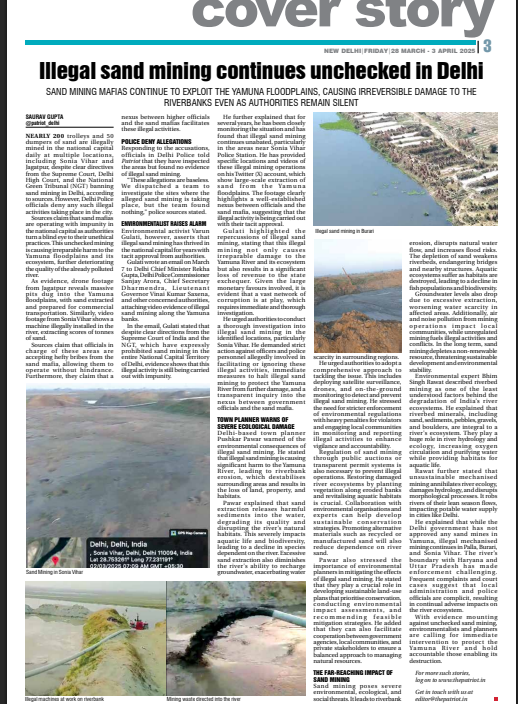
They play a huge role in river hydrology and ecology, increasing oxygen circulation and purifying water while providing habitats for aquatic life. Rawat further stated that unsustainable mechanised mining annihilates river ecology, damages hydrology, and disrupts morphological processes. It robs rivers of their lean season flows, impacting potable water supply in cities like Delhi. https://thepatriot.in/reports/delhi-illegal-sand-mining-continues-unchecked-damage-yamuna-67904 (28 March 2025)
Uttarakhand Ex-CM raises illegal riverbed mining issue in Lok Sabha A two-minute speech by BJP MP Trivendra Singh Rawat in the Lok Sabha on Thursday (March 27) sent the state government into a tizzy after he said that illegal mining was rampant at night in Uttarakhand. Speaking in the House, Rawat, the MP from Haridwar, said he wanted to flag a “concerning issue” from his home state. “In Uttarakhand’s Dehradun, Haridwar, Udham Singh Nagar, and Nainital, illegal mining is getting rampant at night. This is not only a threat to law and order and ecology but also the safety of common people. Despite orders from the state and central governments, we are witnessing a mining mafia transporting materials in trucks at night. This is affecting the roads, bridges, and other facilities,” he said.
What followed was a frenzied reaction, with the government releasing the data on legal mining in the state, claiming that it has increased over the years. On Thursday, caught off guard, the government also released a video of the mining secretary, Brijesh Sant, denying the “allegations”. “The statement that illegal mining is increasing in the state is baseless and false,” he said. Congress state president Karan Mahara said it was not just revenue that mattered. “Who will be held responsible for the destruction of our rivers? The CM should be strict about this”. https://indianexpress.com/article/india/uttarakhand-lok-sabha-speech-bjp-bjp-mp-trivendra-singh-rawat-9911233/ (28 March 2025) इससे पहले भी (Dec. 2024) उन्होंने सदन के अंदर खनन से संबंधित मुद्दा उठाया था, सचिव खनन बृजेश संत ने स्पष्टीकरण दिया उन्होंने कहा कि प्रदेश में अवैध खनन गतिविधियां बिल्कुल भी संचालित नहीं है। राज्य में अवैध खनन पर पूरी तरह से रोक लगा दी है। उन्होंने कहा कि राज्य गठन से लेकर अब तक खनन से राज्य को सबसे ज्यादा आई हुई है। यह सब अवैध खनन पर रोक लगाने के कारण ही हुआ है। https://www.bhaskar.com/local/uttarakhand/dehradun/news/trivendra-rawat-raised-the-issue-of-illegal-mining-in-parliament-134724802.html (28 March 2025)
NGT orders SPCB to assess environmental compensation for illegal mining The NGT has directed the SPCB to calculate environmental compensation to be paid by a private firm for illegally mining minerals from a restricted area near the Sharda river in Champawat district. The tribunal recommended levying compensation at 10% of the mineral’s sale price to support environmental restoration and promote sustainable development.
The NGT, while disposing of a petition concerning unauthorised mining in the river on Friday, stated: “It is not in dispute that M/s Siv Shakti Traders conducted mining activities and extracted 60,000 cubic meters of minerals for commercial gains. Therefore, in our assessment, environmental compensation should be levied at a rate of 10% of the sale price of the mineral to ensure environmental remediation and uphold sustainable development principles.”
A report submitted by the Champawat DM in Aug 2024 following NGT directives stated that between June 8 and June 17, 2021, a total of 912.8 tonnes of riverbed material (RBM) had been transported using two-wheelers, three-wheelers, and e-rickshaws. It said that a penalty of Rs 3.2 lakh had been imposed on Tarun Pant of the firm in question for illegal mining and transportation. The penalty for these illegally transported minerals had been collected and deposited in the relevant departmental account.
The NGT also criticised the DM for failing to consider that the area permitted for mining fell within the sanctuary’s ESZ. It noted that a letter issued on March 25, 2022, had authorised the collection of RBM from upstream of the Nandhaur River for six months, disregarding ecological concerns. The NGT further stated that the UKPCB’s role in the matter was “neither fair nor impartial”. https://timesofindia.indiatimes.com/city/dehradun/ngt-orders-pollution-body-to-assess-environmental-compensation-for-illegal-mining-in-sharda/articleshow/119767678.cms (30 Mar 2025)
खनन सामग्री से भरा डंपर बना काल देहरादून के लच्छीवाला टोल प्लाजा पर सोमवार (March 24) सुबह 7.35 के आसपास हुए भीषण हादसे में दो लोगों के शव को क्षतिग्रस्त कार से बाहर निकालने में पुलिस, फायर और एसडीआरएफ की टीमों को दो घंटे से अधिक का वक्त लग गया। डंपर की तेज टक्कर ने कार को बुरी तरह से क्षतिग्रस्त कर दिया था। कार में आगे बैठे दोनों लोगों के शव क्षत विक्षत हो गए थे। मौके पर पहुंची टीम ने दो हाइड्रा मशीन और जेसीबी मशीन के अलावा चार कटर और छेनी-हथौड़े से कटाई करने वाले विशेषज्ञों को भी लगाया। बावजूद इसके शव को बाहर निकलने में दो घंटे से अधिक का वक्त लग गया।
टक्कर इतनी तेज थी कि एक कार ट्रक और टोल प्लाजा के पोल के बीच में पिचक गई। प्रत्यक्षदर्शियों के अनुसार खनन सामग्री से भरा डंपर देहरादून की ओर से बेहद गति में टोल प्लाजा की ओर आया। इससे पहले किसी को कुछ समझ में आता डंपर ने आगे चल रही कारों को टक्कर मारते हुए एक कार को चपेट में ले लिया। प्रथम दृष्टया टोल प्लाजा पर हादसे का कारण डंपर के ब्रेक फेल होना जा रहा है। आरोपी चालक से पूछताछ की जा रही है। http://amarujala.com/photo-gallery/dehradun/dehradun-lachhiwala-toll-plaza-accident-mining-dumper-crushed-car-dead-bodies-recovered-by-cutter-photos-2025-03-24; https://www.aajtak.in/india/uttarakhand/story/dehradun-horrific-road-accident-in-doiwal-high-speed-dumper-rammed-three-vehicles-2-died-lcly-strc-2198141-2025-03-24 The accident occurred as a speeding dumper loaded with mining material collided with three cars on the Dehradun-Haridwar highway early morning. The horrific incident highlights the growing concerns over road safety in Uttarakhand. Authorities claim to be continuing their investigation and efforts to remove the remaining vehicle from beneath the dumper. The Police have also claimed to be tracking down the absconding driver as part of their ongoing probe. https://garhwalpost.in/two-dead-as-dumper-hits-3-cars-at-lacchiwala-toll-plaza/ “We have taken the dumper driver into custody. The ARTO, Rishikesh has examined all the documents related to the dumper truck and found them to be in order. The papers related to the mining material being transported in the truck are also under review,” he said. https://www.hindustantimes.com/cities/dehradun-news/truck-crashes-into-car-at-toll-plaza-after-brake-failure-kills-2-men-police-101742807574131.html The police officials said that the dumper was coming from Dehradun towards Doiwala when the driver lost control of the vehicle. The driver fled the spot soon after the accident. Investigation into the incident is underway. https://www.etvbharat.com/en/!state/speedy-truck-crashes-three-vehicles-at-uttarakhand-dehradun-many-killed-enn25032401344 A devastating accident at Lacchiwala Toll Plaza on the Dehradun-Haridwar highway this morning claimed the lives of two after a dumper collided with three cars. https://www.youtube.com/watch?v=cv0uXbyuxys (24 Mar 2025)
खनन माफियाओं का कर्मचारियों को कुचलने का प्रयास मामला हरिद्वार जिले के बीएचईएल क्षेत्र का है, जहां खनन माफिया ने सुरक्षा गार्डों को ट्रैक्टर ट्रॉली से रौंदने का प्रयास किया. भेल के संपदा अधिकारी संजय पवार ने इस मामले में पुलिस को शिकायत भी की है. संपदा अधिकारी ने बताया कि कुछ लोग उनकी जमीन से मिट्टी आदि खोदकर ले जा रहे थे, जिन्हें उनके सिक्योरिटी गार्ड ने रोकने का प्रयास. आरोप है कि इस दौरान ट्रैक्टर चालक ने सिक्योरिटी गार्ड को कुचलने का प्रयास किया, जिससे उनके कर्मचारी भी चोटिल हुए है. बता दें कि ये मामला तीन दिन पुराना है.
बीएचईएल के संपदा अधिकारी की तरफ इस मामले में पहले ही कार्रवाई की जा चुका थी. हालांकि उनकी तरफ से आज एक शिकायत पुलिस को मिली है. पुलिस शिकायत के आधार पर पूरे मामले की जांच कर रही है. हरिद्वार एसएसपी प्रमेंद्र सिंह डोबाल ने कहा कि घटना के तीन दिन बाद भी संबंधित विभाग के अधिकारियों ने पुलिस से शिकायत क्यों नहीं की? इसकी भी जांच की जा रही है. पुलिस इस मामले में सख्त से सख्त कार्रवाई करेंगी. https://www.etvbharat.com/hi/!state/mining-mafia-tried-to-crush-estate-department-employees-with-tractor-in-haridwar-uttarakhand-news-uts25032004905 (20 March 2025)
माफिया ने सिपाही के ऊपर चढ़ाया ट्रैक्टर देहरादून में बेखौफ खनन माफिया ने एक सिपाही पर ट्रैक्टर चढ़ाकर मारने का प्रयास किया। सिपाही ने अवैध खनन की शिकायत पर ट्रैक्टर चालक को रोक उसे थाने चलने के लिए कहा था। घायल सिपाही कैंट थाना एसएचओ का ड्राइवर है। उसके सिर और पैर में गंभीर चोट आई है। सिपाही का सिनर्जी अस्पताल के आईसीयू में इलाज चल रहा है। पुलिस ने आरोपी चालक के खिलाफ मुकदमा दर्ज कर लिया है।
देहरादून जनपद में खनन माफिया पहले भी इस तरह का दुस्साहस कर चुके हैं। इससे पहले वर्ष 2017 में विकासनगर के बाजार चौकी क्षेत्र में सिपाहियों ने खनन से लदे तीन ट्रैक्टरों को रोका था। दुस्साहसी खनन माफिया इनमें से दो ट्रैक्टरों को जबरन छुड़ा कर ले गए थे। इसके बाद एक ट्रैक्टर को सिपाही पर चढ़ाने का प्रयास किया। इसके बाद वर्ष 2019 में कालसी थाना क्षेत्र की एक नदी से निकलने वाले ट्रैक्टर चालक ने भी सामने खड़े सिपाही पर ट्रैक्टर चढ़ाने का प्रयास किया था।
स्थानीय निवासियों का कहना है कि वे लगातार पुलिस से अवैध खनन की शिकायत करते रहते हैं। यह सिलसिला 2018 से जारी है। बीडीसी मेंबर संदीप कुमार, वार्ड मेंबर रमा राणा, सयान सिंह राणा, परमवीर सिंह, अभय सिंह, आदि ने बताया कि पुलिस यदा कदा ही कार्रवाई करती है। लेकिन, इसके बाद फिर से खनन माफिया के हौसले बुलंद हो जाते हैं। https://www.amarujala.com/dehradun/dehradun-news-fearless-mining-mafia-ran-a-tractor-over-a-police-personnel-2023-02-26 (26 Feb. 2023)
Uttarakhand, Uttar Pradesh Govt submit affidavits on sand mafia attack on IAS officer Authorities in Uttarakhand and UP have submitted affidavits to the NGT outlining measures taken to tackle illegal sand mining and proposing new surveillance initiatives. The submissions were made in connection with a case where a sand mafia allegedly tried to mow down an IAS officer during an anti-encroachment operation on Sept 22 near the Uttarakhand-UP border. The district magistrates of Udham Singh Nagar and Moradabad also submitted affidavits outlining the steps taken to address the issue and prevent the recurrence of such incidents.
The attack occurred while IAS officer Ram Mohan Meena (30), a 2022-batch joint magistrate in Moradabad, was overseeing an anti-encroachment operation targeting illegal sand mining. During the inspection, a group of miners allegedly drove their vehicle towards him, posing a severe threat to his safety. The police team accompanying him seized two tractor-trolleys and heavy earthmovers from the site. The NGT had earlier issued notices to the MoEFCC, the district magistrates of Udham Singh Nagar and Moradabad, and the PCBs of both states and the Centre, seeking updates on measures taken in the matter. https://timesofindia.indiatimes.com/city/dehradun/ukhand-up-submit-affidavits-on-sand-mafia-attack-on-ias-officer/articleshow/117460935.cms (22 Jan. 2025)
Sand mafia tried to run over IAS officer: NGT issues notices The NGT issued notices to MoEFCC, DMs of Udham Singh Nagar in Uttarakhand and Moradabad in UP along with the secretaries of SPCBs of both states and the Centre after an attempt was made to mow down joint magistrate in Moradabad district, Ram Mohan Meena (30), an IAS officer of the 2022 batch, by the sand mining mafia on Sept 22.
That night, upon receiving a tip-off about sand mafia being active near the Dhela river, Meena had gone to the spot with his team and tried to stop them. However, the perpetrators tried to allegedly crush the administrative officer with two tractors before managing to flee after the vehicles got stuck in the mud in the sugarcane field. NGT noted that illegal sand mining has been a persistent problem in the region for years, often leading to clashes between local authorities and the culprits. The green tribunal issued the notices on Sept 27. Listed for Jan 22, 2025. https://timesofindia.indiatimes.com/city/dehradun/ias-officer-targeted-by-sand-mafia-ngt-acts-against-illegal-mining-in-up-and-uttarakhand/articleshow/113968684.cms (5 Oct 2024)
Illegal mining in border areas a persistent issue “On October 13, 2022, a major controversy erupted when an alleged mining mafia, Zafar Ali, reportedly escaped into Uttarakhand territory from Moradabad while being chased by police during illegal sand mining in the Thakurdwara region. Ali’s escape into Uttarakhand triggered a significant controversy, with Uttarakhand police accusing their UP counterparts of illegally entering the hill state. The situation escalated into a controversial encounter in a Uttarakhand village, during which cross-firing between UP police and the mining mafia resulted in the death of Gurpreet Kaur, the wife of Block Pramukh and local BJP leader Gurtaj Singh Bhullar, while five police personnel were injured,” the official recounted.
He further said that several UP police officers were taken hostage by villagers in Bharatpur near Jaspur town, located in the Uddham Singh Nagar district of Uttarakhand, and were only freed after the intervention of senior police officials. Since then, Uttar Pradesh and Uttarakhand have traded accusations, leading to even filing of cross-FIRs. https://www.hindustantimes.com/cities/lucknow-news/illegal-miners-attempt-to-run-over-trainee-ias-officer-at-u-p-uttarakhand-border-101727287881110.html (26 Sept. 2024)
Haryana Police failed to arrest attacker Panchkula Police, which otherwise pats its back for apprehending accused individuals in ‘record time’, has failed to arrest the illegal miners who allegedly assaulted and chased Amravati police chowki in-charge.
Sub-inspector Rajbir Singh was allegedly assaulted, threatened and his passage was blocked at different points in his own jurisdiction on March 23 by several miscreants. “The accused seem to be in collusion with the system. Also, the police need to enhance their mechanisms not only to arrest them but also to prevent illegal mining and attacks on their own personnel. When those in uniform are not safe, how can the public feel secure?” said Vijay Bansal, state president of Pinjore-based Shivalik Vikas Manch. ACP (headquarters) Vikram confirmed to The Times of India that no arrests have been made in the case so far. However, he said that police teams are conducting raids at multiple locations and are optimistic about making progress in the case soon.
The incident occurred when SI Rajbir Singh was informed about illegal mining activities in Burj Kotia riverbed and was on his way to investigate. As Singh approached the area, he encountered a suspicious situation. Someone nearby blew a whistle, signalling the illegal miners. Suspicious that the person might be part of the alert system for the illegal operation, Singh confronted him. The situation escalated when the person, later identified as Poli, along with his associates, Shera, Gajni, and others, blocked Singh’s vehicle. The group, armed with sticks, allegedly began threatening Singh, accusing him of interfering with their mining operations.
In response to the escalating threat, Singh reversed his vehicle and attempted to flee the scene, but the group pursued him, continuing to issue threats. Singh managed to contact Amravati police post and informed higher authorities while heading towards Chandimandir Light Point area. There, the group once again blocked his vehicle but fled when officers from Pinjore police station arrived. Singh’s statement in the FIR identifies several individuals involved, including Poli, his son, Gajni, Shera, Hanif, and Shakeel. The police registered a case under sections 351(3), 126(2), 121(1), and 132 of the BNS at Pinjore police station. https://timesofindia.indiatimes.com/city/chandigarh/two-days-on-panchkula-police-fail-to-arrest-suspects-in-amravati-police-post-in-charge-attack/articleshow/119496990.cms (26 March 2025)
Illegal mining continues unchecked in Panchkula -Despite the recent arrests of police and officials of other departments for their alleged connivance in an illegal mining case in Panchkula, large-scale illegal mining is still rampant in the district. Pinjore-Nalagarh Road, Mallah Road, Raipur Rani, Morni, Barwala, Chandimandir and other places near rivers are the hotbeds of illegal mining. Villagers complain that countless trees have been felled, many tube wells damaged to pave the way for such activities. As a result, these villages are witnessing soil erosion and deforestation. https://timesofindia.indiatimes.com/city/chandigarh/illegal-mining-continues-unchecked-in-pkl/articleshow/119440203.cms (25 March 2025)
Himachal Pradesh The CM said that the govt was ready to make amendments to the policy & raise the income from mining from current Rs 400 cr to Rs 1,000 cr. https://www.tribuneindia.com/news/himachal/will-amend-mining-policy-to-plug-loopholes-check-revenue-loss-cm/ (28 March 2025)
Jammu & Kashmir Illegal Stone Crushers in Doda Kishtwar have destroyed Chenab River. The Dist Admin is sleeping. CM Omar Abdullah must act. https://www.facebook.com/share/p/16FPYfbEpb/ (29 March 2025)
Madhya Pradesh Minister’s son accused of links to illegal sand mining The forest department in Morena has seized a truck carrying illegally mined sand from the Chambal river late on Thursday (March 27) night. During questioning, the driver alleged that the vehicle was bound for the Mungawali plant of Banku Kansana, son of MP agriculture minister Aidal Singh Kansana. The driver, identified as Deewan, claimed he had been transporting sand to the minister’s son’s plant for more than eight days, earning Rs 1,000 per day. The dumper, with “A Kansana” painted on its body, allegedly belongs to the minister’s son. He further alleged that multiple trucks and dumpers were engaged in similar illegal mining activities, with the sand being used for road construction. https://timesofindia.indiatimes.com/city/bhopal/ministers-son-accused-of-links-to-illegal-sand-mining/articleshow/119671267.cms (29 March 2025)
Odisha Balangir MLA Kalikesh demands probe into sand mining nexus Alleging collusion between mining officials and leaseholders leading to an artificial scarcity of sand, Balangir MLA Kalikesh Narayan Singh Deo has demanded a thorough investigation into the crisis. In a letter to the minister for Steel and Mines, he has raised serious concerns about the worsening situation on availability and distribution of construction sand in Balangir town and selective penalisation of small tractor owners while larger operators remain unchecked. “This has led to artificial scarcity and rampant blackmarketing of sand, severely affecting common citizens and small contractors,” he said. https://www.newindianexpress.com/states/odisha/2025/Mar/28/balangir-mla-kalikesh-demands-probe-into-sand-mining-nexus (28 March 2025)
Report Environment most dangerous beat Since 2014, according to data from Reporters Without Borders, at least 28 journalists have been murdered in India, and nearly half of them were reporting on environmental stories. These journalists were not covering wars or riots. They were reporting on sand. On soil. On trees. And they were killed for it. https://frontline.thehindu.com/newsletter/the-frontline-weekly/environmental-journalism-danger-reporters-killed-threats-press-freedom-crimes/article69377259.ece (26 Feb. 2025)
DMFs should be redesigned District Mineral Foundation (DMFs), India’s only benefit sharing mechanism which recognises the rights of mining-affected communities to benefit from mineral resources, marks a 10-year milestone on March 27, 2025. DMFs have collected ₹1,03,242 crore in the last ten years. iFOREST projections show that the collections could be as high as ₹3,00,000 crore between 2025 – 2035. Our assessment is a pan-India review of DMFs across 645 districts spanning 23 states to assess their performance and recommend reforms for improved future implementation.

Weak institutional structure, poor planning and implementation and lack of community participation is leading to misplaced investments. iFOREST recommends that DMFs should be redesigned as an independent public welfare fund, with increased representation of mining-affected communities to make the institution effective in reducing poverty and developing India’s mining regions. https://iforest.global/research/ (March 2025)
DMF funds remain unspent For their decadal assessment, iForest conducted a pan-India review of all 23 States where DMFs have been set up. The biggest challenge, however, is in the design of the DMFs themselves. DMFs are practically an extension of the District Collectorate. Their GCs and MCs are dominated by officials and elected representatives. There is minimal representation of the mining-affected communities, such as from the Gram Sabhas of the mining-affected villages, the report underlined. As per the report despite collecting about ₹1-lakh crore in the past decade, more than half the funds is unspent. Moreover, the funds are often diverted to activities that are not directly linked to the welfare of mining districts — a contravention of the Centre’s guidelines.
“With a total fund accrual of over ₹1 lakh crore, DMFs have a pivotal role in addressing developmental challenges in India’s mining districts, which are some of the most underdeveloped regions of the country. However, sub-optimal institutional design, inefficient fund utilisation, lack of systematic and long-term planning, and lack of people’s engagement in identifying and designing intervention measures are hindering their full potential. DMFs need to be redesigned as an independent public welfare fund to fulfill its mandate,” Chandra Bhushan, CEO, iFOREST, said in a statement. https://www.thehindu.com/sci-tech/energy-and-environment/over-half-of-1-lakh-crore-collected-for-the-welfare-of-mining-districts-not-spent-report/article69378081.ece (26 Mar 2025)
Study Earth has far less fresh water available for lithium mining than estimated There is a new wake-up call for critical mineral mining in the world, especially lithium mining. A study, conducted by scientists at the University of Massachusetts Amherst (UMass) to gauge how much freshwater is available on the Earth for lithium mining, has found that it is far lesser than what was initially imagined. The study was published Wednesday (March 26) in the journal Communications Earth and Environment.
The UMass hydrologists analysed the amount of freshwater that was entering the lithium lagoons in 28 basins in this Lithium Triangle, and found it to be shockingly lower than what was initially estimated. Mainstream estimates say it is between 90 and 230 millimetres per year, but the researchers found it to be close to two to 30 millimetres per year. As part of the research, they studied the topography of water basins in the Lithium Triangle, and also estimated the water being used by local communities in the region. The only way to ensure a sustainable division of the resources would be for communities, scientists and the lithium mining industry to work together, the study said. https://theprint.in/scientifix/earth-has-far-less-fresh-water-available-for-lithium-mining-than-estimated-us-researchers-find/2570504/ (30 March 2025)
WETLANDS, LAKES, WATER BODIES
Assam Concerns raised over OIL projects in ESZ Environmental activists in Assam have submitted a letter to the MoEF&CC requesting the immediate revocation of the permission granted to Oil India Limited (OIL) to establish a research and development center in the Dibru-Saikhowa Eco-sensitive Zone (DSESZ), which is recognized as a global biodiversity hotspot. The letter, addressed to the secretary demands a transparent and independent environmental impact assessment that includes input from local stakeholders before any future proposals are considered.
The Dibru-Saikhowa National Park, covering 340 sq km, is classified as a biosphere reserve and is home to several endangered species, including the white-winged wood duck, the Gangetic dolphin, and the Bengal florican. The FAC which operates under MoEF&CC, recommended the project on 27 Jan, 2025. https://www.newindianexpress.com/nation/2025/Mar/29/environmental-activists-raise-concern-over-oil-projects-in-ecosensitive-zone-in-assam (29 March 2025)
Odisha Govt initiates demarcation of 13,000 wetlands The state govt has initiated process for demarcation of over 13,000 wetlands in the state for their effective conservation. Acting on the directions of the Supreme Court, the Forest department has taken up ground truthing of a total of 13,667 wetlands which are spread over 2.25 hectares or more area. The wetlands have been identified by the Space Application Centre, forest officials said.
The apex court had in its order directed the state/Union Territory Wetland authorities to expeditiously complete the ground truthing and demarcation exercise of the boundaries of each of the wetlands identified by the Space Application Centre, Atlas (SAC, Atlas), 2021 and had set a three-month timeline for the same. Following the Supreme Court judgement, the Orissa High Court also initiated a suo motu PIL in January to monitor the conservation of wetlands in the state. Accordingly, sources said, the state government engaged the Chilika Development Authority (CDA), responsible for the management and protection of Asia’s largest brackish water lagoon, as the nodal agency to implement the wetland conservation measures. https://www.newindianexpress.com/states/odisha/2025/Mar/30/odisha-initiates-demarcation-of-13000-wetlands-2 (30 March 2025)
West Bengal Tram journey to highlight climate crisis impact on Sunderbans’ mangroves A tram decorated with images and models of Sunderbans’ flora and fauna will travel between Shyambazar and Ballygunge from March 28 to 30 to highlight how climate change can equally impact the mangrove haven and Calcutta. The focus will also be on the need for more low-carbon transport options like trams at a time when the state government has decided to discontinue them in all but one small stretch of the city. Besides the tram journey from north to south Calcutta and back, there will be a citizens’ assembly to discuss the “climate crisis” in the city and the Sunderbans. https://www.telegraphindia.com/west-bengal/kolkata/tram-journey-in-kolkata-to-highlight-climate-crisis-impact-on-sunderbans-mangroves-prnt/cid/2089752 (20 March 2025)
Punjab Bajwa objects to govt using ‘failed’ Seechewal model for cleaning ponds The name of Balbir Singh Seechewal, a Rajya Sabha MP of AAP from Punjab known for cleaning the holy Kali Bein rivulet in Sultanpur Lodhi, was brought up in the House when Rural Development and Panchayats Minister Tarunpreet Singh Sond was responding to a question by AAP MLA Amit Rattan Kotfatta. The MLA had raised concerns over the non-cleaning of village ponds in Bathinda, where stagnant water continued to cause diseases.
-In his reply, the minister stated that Bathinda Rural district had 173 ponds spread across 65 gram panchayats. He said five ponds in the constituency had been developed using the Seechewal-Thapar model. “Work is underway to develop 16 more ponds using the Seechewal-Thapar technique. It is proposed to clean and renovate the remaining village ponds in a phased manner over the next three years,” he said.
-Speaking to media persons outside the House, Bajwa said the Seechewal model had failed and that experts from Thapar Institute, Patiala, and Punjab Engineering College (PEC), Chandigarh, should be consulted instead. https://indianexpress.com/article/cities/chandigarh/bajwa-objects-to-govt-using-failed-seechewal-model-for-cleaning-ponds-9907604/ (26 March 2025) After visiting Seechewal village and seeing its wastewater management system, named Seechewal model, deputy speaker Jai Krishan Singh Rouri announced on Sunday (March 30) that the panchayats of 178 villages in Garhshankar would be brought to Seechewal and Sultanpur Lodhi to study the model. https://timesofindia.indiatimes.com/city/chandigarh/deputy-speaker-announces-implementation-of-seechewal-model-in-villages-of-his-constituency/articleshow/119767190.cms (30 March 2025) Balbir Singh Seechewal on Friday (March 28) said that He added that the ‘Seechewal model’ of cleaning ponds has been running smoothly at his native village since 1999. He added that whenever a problem arises in a village, the locals, and not engineers, are the first to find solutions. Seechewal said the model is running in nearly 250 villages across Punjab. “To reduce pollution in the Ganga, the Union government has adopted my model in 1,657 villages,” he added. https://www.hindustantimes.com/cities/chandigarh-news/my-model-didn-t-fail-seechewal-hits-back-at-bajwa-101743192043276.html (29 March 2025) He also said that his model of conserving water was a success while alternate plans adopted by others couldn’t achieve desired results. https://www.tribuneindia.com/news/punjab/my-water-conservation-model-a-success-others-failed-seechewal/ (29 March 2025)
EDIT Rapid degradation of wetlands The public will to protect wetlands, complemented by strict implementation of regulations, can perhaps turn the tide in favour of what remains of wetlands across India. https://www.telegraphindia.com/opinion/vulnerable-editorial-on-the-rapid-degradation-of-indias-wetlands/cid/2091620 (31 March 2025)
WATER OPTIONS
Leh Ursi a model for water conservation Ursi, a village located 130 km off Leh, has been developing an artificial glacier for the past seven years to address its water crisis. It is among many villages in the region that struggle with water scarcity and are solely dependent on spring water. With just 18 households, the village has set an inspiring example of how youth initiatives and community involvement can effectively address water shortages. https://www.etvbharat.com/en/!bharat/community-effort-turns-ursi-village-in-leh-into-a-model-for-water-conservation-enn25032506329 (25 March 2025)
Bengaluru Rain recharges lakes This was found by SayTrees which has installed solar-powered radar-based sensors in Handenahalli and Sollepura lakes to measure changes in water levels. According to a post on X by the founder Kapil Sharma, two lakes collected about two million litres of water in a single day of rain on Saturday (March 22). “Waiting for monsoon as the NGO is getting 10 lakes in Bengaluru, two in Hyderabad and 15 in Maharashtra ready to receive rainwater,” he wrote. https://www.deccanherald.com/india/karnataka/bengaluru/one-rain-two-lakes-21-million-litres-new-tech-reveals-citys-filling-waterbodies-3460916 (25 March 2025)
Andhra Pradesh Millet man asked farmers to stop fertilizers ‘Millet Man of India’ Khadar Vali on Sunday (March 23) called on farmers, policymakers, and agriculture scientists to abandon fertilisers and change agricultural practices to promote crops that are healthy and fit for human consumption. Addressing a large gathering of farmers from Anantapur on the second day of the three-day Millets Mela—2025 held here, he took a dig at the policy of giving subsidies for fertilisers, and the distribution of rice through the public distribution system (PDS). https://www.thehindu.com/news/national/andhra-pradesh/millet-man-of-india-asks-farmers-to-avoid-usage-of-fertilisers/article69365188.ece (23 March 2025)
Uttarakhand Training in nature based solutions The training explored key policy frameworks and sustainable land management practices, demonstrating how NbS can be integrated into land-use planning, water conservation, and agriculture to enhance environmental and socio-economic resilience. A special emphasis was placed on community-based approaches, ensuring that local knowledge plays a central role in NbS initiatives.
A major highlight was the field visit to the ICAR-Indian Institute of Soil and Water Conservation Research Farm in Selaqui, where participants learned practical water management techniques and discussed topics like governance, wetlands, and climate-resilient agriculture. https://timesofindia.indiatimes.com/india/global-experts-conclude-training-on-nature-based-solutions-for-resilient-ecosystems/articleshow/119342475.cms (22 March 2025)
Report Benefits of EOSs Earth observation satellites (EOSs) are spacecraft equipped with sensors to monitor Earth’s atmosphere and surface, providing data on weather, land-use patterns, vegetation, and water bodies. EOS data have revolutionised our understanding of global warming, climate change, environmental degradation and contributed to key findings about the rise in global temperatures, shrinking polar ice caps, and the impact of deforestation and urbanisation on ecosystems. EOSs can also track air pollution and water quality, and help monitor oil spills and extreme weather events. https://india.mongabay.com/2025/03/what-are-earth-observation-satellites-how-do-they-support-environmental-research-explainer/ (24 March 2025)
Opinion The role of communities in conserving water A common theme across these suggestions is that local and indigenous communities and their practices can support effective water management. Therefore, rural water policies should facilitate active engagement with communities. This means moving beyond the existing rhetoric of engagement, and centering communities’ voices in the decision-making process. While doing so, we must be mindful that communities’ practices may come with their own limitations which should be addressed through sensitisation and capacity building where required. (Kanika Jamwal) https://www.thehindu.com/opinion/op-ed/the-role-of-communities-in-conserving-water/article69377974.ece (27 March 2025)
GROUNDWATER
West Bengal GW declining fast in Sundarbans The Sundarbans, on the southern fringe of West Bengal, may soon struggle to provide quality drinking water to its human and non-human residents. This is because its ground water level has been plummeting steadily in recent years due to unbridled, and largely illegal, extraction of groundwater, according to a new study. The decade-long study was carried out by local non-profit Joygopalpur Gram Vikash Kendra with UBU-Danish Association for Sustainable Development and Danish Technical University in several parts of the vast delta. Researchers found that there has been a sharp decline in the water level of the Basanti block — in the range of 1 to 2 metres per year on average — over the last decade.
Shallow or submersible pumps — numbering hundreds in some Gram Panchayat areas — are drawing ground water regularly, most of which gets sold at a high price. According to a primary study carried out by Joygopalpur, Basanti block itself has 783 shallow wells. Most of the water in them is sold for irrigation and some for drinking. “As per our 2024 assessment, 783 shallow pumps draw 28 million litres of ground water daily for about three months in summer mainly for boro paddy crop irrigation. Most of these pumps irrigate around 30 bighas of agricultural land, including at least 20 bighas for which water is sold,” said a researcher from the nonprofit. A rough estimate shows that the illegal business covers nearly Rs 3 to 4 crore every year, a part of which is believed to go to a section of local political and administrative networks, alleged activists. https://www.downtoearth.org.in/water/dte-exclusive-ground-water-depleting-sharply-in-parts-of-sundarbans-may-lead-to-acute-shortage-soon-finds-international-study (22 March 2025)
Prayagraj City exploits GW -According to the report by the Ground Water Department, of the total 23 development blocks in Prayagraj, two are categorized as ‘critical,’ while eight fall under the ‘semi-critical’ category due to excessive exploitation of underground water. The city itself has been marked as ‘over-exploited.’
In Prayagraj, groundwater exploitation in urban areas has surpassed 100%, placing the city in the ‘over-exploited’ category. In Chaka and Sahaso development blocks, groundwater usage is assessed between 90% and 100% of the recharge, marking them as ‘critical.’ The remaining eight blocks, where 70% to 90% of recharged water is consumed annually, are classified as ‘semi-critical.’
At present, only 285 residents and commercial building owners, including businessmen and industrialists, have installed rainwater harvesting systems in the district. https://www.hindustantimes.com/cities/others/prayagraj-faces-groundwater-crisis-city-over-exploited-two-blocks-critical-101742756500743.html (24 March 2025)
URBAN LAKES, WETLANDS
Hyderabad HYDRAA commissioner A.V. Ranganath ordered Vamsiram Developers to remove the soil and silt dumped into Kothakunta at Khajaguda within the four days. He said that strict action would be taken if the developers failed to comply. He was inspecting the site after receiving complaints of unauthorised constructions within the full tank level of Kothakunta. https://www.deccanchronicle.com/southern-states/telangana/remove-silt-in-4-days-hydraa-to-vamsiram-1869050 (26 March 2025)
Bengaluru Disappearing lakes -According to Dr. Ramachandra, Bengaluru had 1,452 water bodies and 80 per cent green cover in the 1800s, which helped maintain its cool climate. However, rapid urbanization and encroachment have drastically reduced these numbers. By the 1970s, the city had around 760 lakes, and today, only 216 remain. In the episode he talks about how his research team has studied 193 of these lakes, leading to the development of the Bangalore Lake Information System, which maps the city’s diminishing water bodies. https://www.hindustantimes.com/cities/bengaluru-news/bengalurus-peak-summer-was-just-14-16-c-in-the-1800s-thanks-to-its-now-vanished-lakes-101742811980703.html (24 March 2025)
Mumbai Over 300 trees illegally cut in ESZ -The location, Sector 52A, is adjacent to crucial habitats like mangroves and DPS Lake, vital for flamingos and migratory birds, protected under the CRZ. Recently, the IDCO sold this land to Today Royal Developers for approximately ₹200 crore, leading to public discontent. In response, Maharashtra Forest Minister Ganesh Naik is advocating for the transfer of the land to the forest department to avert further ecological harm. Reports suggest that over 300 trees were removed using JCB machines by a contractor.
Residents alerted the Navi Mumbai Municipal Corp (NMMC) and the forest dept, prompting the machinery’s confiscation. The village revenue officer, Nilesh Kamble, conducted a joint inspection and confirmed widespread illegal deforestation, revealing that at least 100 trees were cut without the required approvals. https://www.freepressjournal.in/mumbai/navi-mumbai-news-over-300-trees-illegally-chopped-off-in-eco-sensitive-zone-of-palm-beach-road (17 Mar 2025)
Bhopal

Gurugram Decline in birds in Basai wetlands Birders on Sunday (March 23) organised a walk at Basai wetland to launch a movement urging Haryana govt to conserve the marshy forest that has dried out over the years and run over by rampant construction. Basai, recognised as a birding spot by Birdlife International, was once home to indigenous and migratory birds of 295 species. Now, birders say, species’ populations have fallen drastically.
Experts said the lack of any legal protection for Basai, including a ‘wetland’ status, made it easy to bulldoze it. In 2017, the Delhi Bird Foundation approached the NGT against the construction of the STP and with the demand to declare the area a wetland, but MCG, in its response, said that Basai was just a “piece of barren land where a few birds occasionally roost…” The case concluded with NGT asking the petitioners to approach Haryana govt with the demand.
“Basai couldn’t be saved till now because it is not a recognised wetland. I see firsthand how the absence of legal safeguards leaves our natural habitats vulnerable. Without legal protection, we risk losing not only the diverse species that call these places home but also the delicate balance that sustains our planet,” said Vaishali Rana, an environmentalist. https://timesofindia.indiatimes.com/city/gurgaon/flamingos-to-highrises-greens-flag-dwindling-bird-count-at-basai-wetland-call-for-quick-action/articleshow/119440667.cms (25 March 2025)
City loses 5 waterbodies to encroachments Five ponds, which were supposed to be restored under an initiative by MCG and GMDA, have been overrun by a former councillor’s office, construction waste, housing plots and temples – highlighting a pattern of disregard for environmental laws despite rules that prohibit such activities. According to MCG’s response to a RTI query filed by activist Vaishali Rana last year, ponds in Sector 50 township Nirvana Country, Badshapur, Kadarpur and Gwalpahari have been encroached on.
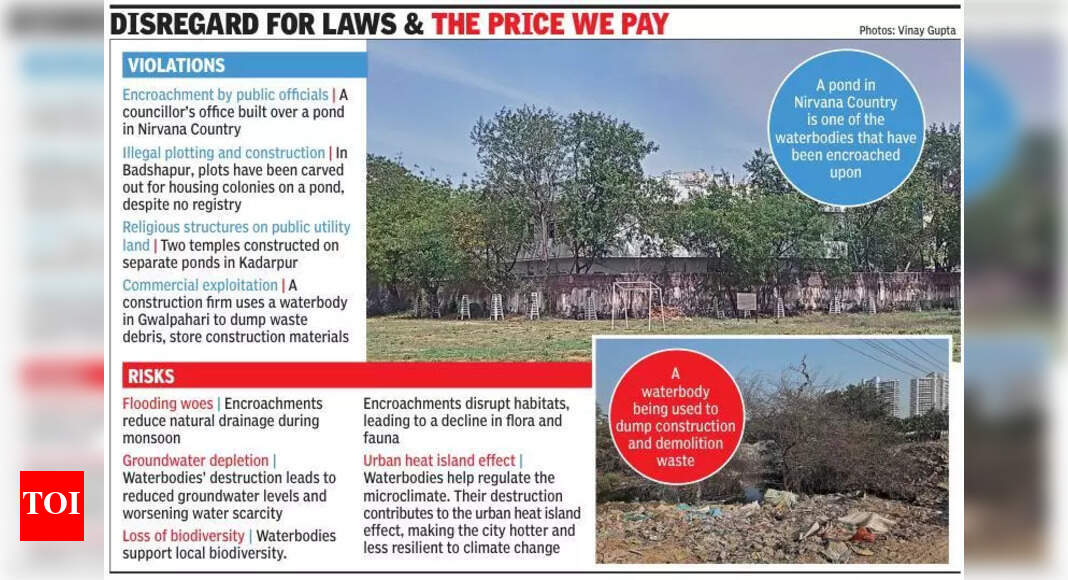
At Nirvana Country, the RTI response said, a former MCG councillor built an office directly over the pond. Google satellite imagery from this month shows a building at a spot where a natural water catchment used to be, Rana said on Friday (March 28). The RTI response said that another pond in Badshapur, an area prone to waterlogging and flooding during monsoon every year, was divided into plots for housing colonies, according to revenue records. In Kadarpur, two temples were built over two separate ponds, Rana said. The most blatant violation appears to have been in Gwalpahari, where a firm is allegedly dumping construction debris and materials into a pond. https://timesofindia.indiatimes.com/city/gurgaon/office-to-hsg-plots-flood-prone-city-loses-5-waterbodies-to-encroachments/articleshow/119769383.cms (31 March 2025)
Nainital NGT orders probe into Naini lake water pollution The NGT has taken cognisance of pollution in Nainital lake and ordered the formation of a joint committee comprising officials from SPCB, CPCB, and the Kumaon commissioner — who is the nodal authority — to investigate the issue that has the entire district, with one of India’s most popular hill stations, worried.
The green court’s action follows a petition filed on Oct 14, 2024, by activist Hemant Singh Goniya which said “untreated sewage and garbage that drains into the lake have been polluting the sole water source for the tourist town”. Over 40 British-era drains discharge into the lake, causing nearby residents to suffer from illnesses like diarrhea and jaundice during monsoons. The lake also has a fragile ecosystem and is home to numerous animal species. In its Jan 7 order, NGT acknowledged that “the petition raised significant environmental concerns”, including violations of the Water (Prevention and Control of Pollution) Act, 1974, and Environment (Protection) Act, 1986. https://timesofindia.indiatimes.com/city/dehradun/ngt-orders-probe-into-naini-lake-water-pollution/articleshow/117339816.cms (17 Jan. 2025)
URBAN WATER
Bengaluru Citizens struggling to follow BWSSB orders While the rationale behind such an order is easy to grasp, it is important to address the confusion many citizens have, and identify sufficient alternative sources to meet non-potable water needs. Sanath Kumar, chief engineer at BWSSB, says that the restrictions are only for drinking water from Cauvery connections. Thus groundwater could be an alternative source. But, a recent study by BWSSB and IISc found that groundwater too is being rapidly depleted and recommended reducing groundwater extraction.
A reliable and feasible alternative source is important to ensure seamless supply for the non-potable uses. While treated water from STP can be a real game changer, this is not a feasible solution for apartments without STPs or for individual houses that do not have STPs. Only one in five homes have rainwater harvesting (RWH).
Sanath Kumar suggests buying treated water from BWSSB. As per details provided by BWSSB, in the month of February this year, it sold a total of 163.28 million litres of treated water and collected Rs. 59,28,839 as charges for this. He also recommends that individual houses and small apartments should install dual pipings to facilitate the use of STP water.
But as per the options on the site, one needs to buy a minimum of 6000 litres of treated water from BWSSB. If a household does not have such storage capacities, the excess water poses another challenge. “We need more active uptake of treated water in the city, and we have to come up with strategies for wastewater reuse in the city for non potable purposes, especially right now,” says Shashank. But clearly for that to happen, the required infrastructure also needs to be in place. https://citizenmatters.in/bengalurus-looming-water-crisis-why-citizens-are-struggling-to-follow-the-bwssb-order/ (25 March 2025)
Pune Notice to DIAT over water pollution in Khadakwasla dam The MPCB on Mar 28 issued a notice to the Defence Institute of Advanced Technology (DIAT) over water pollution in the Khadakwasla dam. The board received a complaint from the irrigation dept in Jan about the untreated sewage being discharged by DIAT into the nallah in a nearby area which is then mixed with water in Khadakwasla dam. The notice also mentioned that the total water requirement of the institute is about 947 m3/day (757 m3/day) for domestic purposes, the generation of effluent of 606 m3/day, however, for treatment of the same the institute has not provided STP plant. https://www.hindustantimes.com/cities/pune-news/notice-to-diat-pune-over-water-pollution-in-khadakwasla-dam-101743271574756.html (30 March 2025)
Dhanbad Will the Well Breathe Again? Eklavya Prasad Throughout September and October, the water table stayed consistently shallow at 1.41 feet bgl in September and 2.66 feet bgl in October. The retreat had begun, but at a far slower pace. By November, instead of the drastic drops of previous years, the water level was still at 3 feet bgl. December and January saw a continued decline, yet the well held on, 3.66 feet bgl in December and 8.66 feet bgl in January.
But it was in February and March that the true impact of the intervention became evident. March had always marked the well’s lowest point, a dry, lifeless cavity, but this time, water is still visible in the dugwell. For the first time, the well had not run dry by March. With few more months until the next monsoon, the people of Bera Colony watch the changing seasons with anticipation. Will the well endure through the scorching summer? Can it continue to provide water where it once failed? And so, as April approaches, they wait, not with the familiar fear of an empty well, but with quiet hope. Hope that the coming rains will not only replenish but build upon this newfound resilience. Has the well truly learned to breathe again? https://www.linkedin.com/pulse/well-breathe-again-eklavya-prasad-wipzc/ (31 March 2025)
मसूरी यमुना पंपिंग योजना की मुख्य पाइल लाइन फटी पहाड़ों की रानी मसूरी में मंगलवार 25 मार्च को हजारों लीटर पानी बर्बाद हो गया. मसूरी यमुना पंपिंग योजना की मुख्य पाइल लाइन फटने से पूरा इलाका जलमग्न हो गया. जानकारी के मुताबिक कैंपटी रोड पर होटल वाइल्ड फ्लावर के समीप सड़क के नीचे जा रही पेयजल लाइन का ज्वाइंट खुल गया, जिससे सड़क का एक भाग क्षतिग्रस्त हो गया और पानी का तेज प्रेशर से क्षेत्र जलमग्न हो गया. इसके अलावा पानी के तेज बहाव से पहाड़ी से मलबा मुख्य सड़क पर आकर एकत्रित हो गया, जिससे मुख्य सड़क दोनों ओर से बाधित हो गई थी. इस कारण सड़क के दोनों ओर वाहनों का लंबा जाम लग गया था.
पाइप लाइन फटने की सूचना पर जल निगम के अधिकारी मौके पर पहुंचे और पेयजल की पंपिंग को बंद कराया गया. जल निगम के अधिशासी अभियंता संजीव वर्मा ने कहा कि मसूरी यमुना पंपिग योजना के तहत मसूरी तक करीब 17 किलोमीटर में पानी की लाइन डाली गई है, जिसमें कई जगहों पर पेयजल लाइन के ज्वाइंट पर अत्यधिक पानी का प्रेशर आने से खुल जा रहे है, जिस कारण दिक्कत आ जाती है. https://www.etvbharat.com/hi/!state/main-pipeline-of-mussoorie-yamuna-pumping-scheme-burst-uttarakhand-news-uts25032507407 (25 March 2025) मसूरी में 144 करोड़ रुपए की मसूरी यमुना पेयजल पंपिंग योजना के तहत किए गए कार्यों की पोल खुलती हुए नजर आ रही है. मसूरी के गांधी चौक पर जल निगम की तरफ से 6 इंच की लाइन का वाल फट गया, जिससे क्षेत्र में पानी पानी हो गया. स्थानीय लोगों ने कहा कि जहां मसूरी में कई क्षेत्र पानी को तरस रहे हैं वहीं जल निगम की तरफ से पेयजल योजना के तहत किये गए कार्य की खराब गुणवत्ता के कारण लोग पानी के लिये तरस रहे हैं. हाल में ही डाली गई पाइपलाइन लीक होने लगी है, जिससे कई एमएलडी पानी बर्बाद हो गया है. https://www.abplive.com/states/up-uk/mussoorie-drinking-water-pipeline-valve-burst-thousands-of-liters-of-water-was-wasted-ann-2720954 (22 June 2024) लोगों ने मांग की है कि मसूरी यमुना पेयजल पंपिंग योजना के तहत किए गए कार्यों की उच्च स्तरीय जांच की जाए और मसूरी के सभी क्षेत्रों में पेयजल की सप्लाई को सुनिश्चित किया जाए. https://www.etvbharat.com/hi/!state/thousands-of-liters-of-water-wasted-due-to-bursting-of-pipeline-valve-at-gandhi-chowk-in-mussoorie-uts24062203859 (22 June 2024) In Mussoorie, pipelines were damaged due to landslides at Jincy village and as a result water supply has been affected. One of the largest water sources of Mussoorie being threatened due to the construction of a new road on the Thatyur-Kempty route, the administration has decided to temporarily halt the project and work out a way to change the alignment of the road without damaging the springs. https://timesofindia.indiatimes.com/videos/toi-original/mussoorie-pipelines-damaged-due-to-landslides-at-jincy-village-water-supply-affected/videoshow/84951699.cms (01 Aug. 2021)
JJM/ RURAL WATER SUPPLY
Centre Over 12.3 cr rural homes given tap connection in last 6 years: Minister More than 12.3 crore additional rural households have been provided with tap water connections as of March 17 this year under the JJM – Har Ghar Jal scheme which was launched in August 2019, the Parliament was informed on Monday (March 24). The number of rural households in the country with tap water connections has gone up from 3.23 crore (16.7 per cent) in August 2019 to 15.53 crore as of March 17, 2025, which constitutes 80.2 per cent of India’s total rural households, Minister of State for Jal Shakti V. Somanna told the Lok Sabha in a written reply. “Work for the remaining 3.83 crore households are at various stages of completion as per the saturation plan of the respective state or UT,” the minister said. The initial estimated outlay of the Mission was Rs. 3.60 lakh crore, out of which Central share was Rs. 2.08 lakh crore. https://www.sarkaritel.com/over-12-3-crore-rural-homes-given-tap-water-connection-in-last-6-years-minister/ (24 March 2025)
Gujarat Govt achieves 100% tap water coverage in SC-dominated rural areas A 6,000-km-long pipeline now delivers clean water to over 68,000 SC households across the state. The ambitious project is backed by a Rs 412 crore investment from the state government. A game-changer in Gujarat’s success was the state’s decision to waive the 10% community cost contribution, fully absorbing the project cost to remove financial barriers for economically weaker SC families. By eliminating affordability concerns, the government ensured clean water access for all. https://www.newindianexpress.com/nation/2025/Mar/29/gujarat-achieves-100-tap-water-coverage-in-sc-dominated-rural-areas (29 March 2025)
Chhattisgarh 100% Gram Panchayat Coverage Under JJM The JJM has achieved full coverage in several gram panchayats across Chhattisgarh, with 64 in Kanker, 87 in Balod, 30 in Kondagaon, and 329 in Dhamtari districts now classified as Har Ghar Jal. As per data reported by states and union territories on the Integrated Gram Panchayat JJM Har Ghar Jal, Management Information System (IMIS), a total of 1,20,097 gram panchayats nationwide, including 2,001 in Chhattisgarh, have achieved this status. Additionally, 1,14,366 water supply schemes, including 4,515 in Chhattisgarh, have been transferred to community management.
Despite this progress, 1,40,580 gram panchayats across India, including 9,645 in Chhattisgarh, still lack complete tap water supply. States have cited several challenges in implementation, including water scarcity in drought-prone and desert regions, groundwater contamination, difficult terrain, scattered rural populations, delays in the release of state funds, technical limitations among local authorities, rising raw material costs, and bureaucratic clearances. https://www.constructionworld.in/urban-infrastructure/wastewater-and-sewage-treatment/100-gram-panchayat-coverage-under-jjm-in-chhattisgarh/70897 (29 March 2025)
WATER
Kerala 12% wards suffer from acute water stress during summer: Study As per the study, 2,567 (12 per cent) of the 21,908 total wards in the state are experiencing acute water stress. There has been a marked increase in the daily water consumption in comparison to previous years. The number of reliable water sources remains scanty, the study noted. This first ever ward-wise water-stress study is an initiative by the Kerala State Council for Science, Technology and Environment and was jointly conducted by the Institute for Climate Change Studies, Kerala Forest Research Institute and the Centre for Water Resources Development and Management. The water consumption patterns, climate trends, community-level use and feedback were factored-in during the field study.
The joint study has recommended that if there are planned interventions at these identified water-stress hotspots, it is possible to manage water better in future. Some of the possible causes for the water stress, the researchers said, were erratic rainfall and longer dry spells, early summer onset, rising salinity levels, drying up of water sources — all of which were posing challenges even in meeting the basic water needs, particularly in urban and hill areas, the researchers said. The findings of the study will be sent to the state government for implementing mitigation measures. https://indianexpress.com/article/india/kerala-water-stress-summers-acute-crisis-study-9912885/ (29 March 2025)
Maharashtra Panchayat imposes fine on filling 3rd water pot -In Parsul village (Khed tehsil) located 71 kms from Pune, anyone collecting more than two pots of water from the local well has to cough up a fine of ₹100. Reason being the village is reportedly facing a severe water crisis and for the past two months, villagers have been struggling to fetch water from a deep well – one of only two wells in the village, with water from one being used for domestic purposes and water from the other for drinking purposes.
– The villagers keep watch on the drinking water well from 7 am to 10 pm to ensure that no one violates the restrictions. What’s more, villagers are forced to travel long distances in search of water as Parsul has not received proper water supply despite the government’s ‘Jal Jeevan Mission’. The Gram Panchayat has started working on measures to avoid a drought-like situation in the village. https://www.hindustantimes.com/cities/pune-news/fetching-third-pot-of-water-be-prepared-to-pay-100-fine-101743102849693.html (28 March 2025)
AGRICULTURE
The hidden side of millet farming Author Unakar frequently interacts with millet farmers for her research and as the coordinator for the Pune-based Great State Aleworks’ Millet Beer Project. In addition to changing rainfall patterns, she has witnessed how farmers also struggle with labour issues and a lack of dedicated markets for their crops. She adds that these concerns are often not a part of the larger narratives that focus on these grains. “A lot of what we hear is that millets are great for nutrition, great for the land, for the soil and require very little water. But I am not sure if the average consumer understands the complexities behind the scenes,” she says. https://india.mongabay.com/2025/03/the-hidden-side-of-millet-farming/ (25 March 2025)
Bihar Govt bets big on millets The govt has stepped up its efforts to promote millet cultivation. As part of its fourth agriculture road map, the state has launched the Bihar State Millet Mission to boost the production of these nutrient-rich grains. Agriculture secretary Sanjay Kumar Agarwal said the govt would encourage the cultivation of jowar, bajra, ragi, kauni, cheena, sanwa and kodo, all of which are packed with vitamins and minerals. The state govt has earmarked approximately 1.40 lakh hectares of land for millet farming. “Of this, 17,500 acres each have been set aside for jowar and bajra, 66,000 acres for ragi, and 39,000 acres for sanwa, kodo, and cheena,” Agarwal said. https://timesofindia.indiatimes.com/city/patna/bihar-bets-big-on-millets/articleshow/119375974.cms (23 March 2025)
MONSOON
Study Ocean sediments from BoB reveal insights into Monsoon patterns, climate change A recent study by the Central University of Kerala has provided insights into the historical behaviour of the Indian Summer Monsoon over the past 15,000 years. By analysing ocean sediments from the Bay of Bengal and the Andaman Sea, researchers have shed light on how changes in monsoon activity have influenced water conditions in these regions, affecting salinity and marine productivity. The study is to be published in the Apr 25 issue of journal Quaternary International. (https://www.sciencedirect.com/science/article/abs/pii/S1040618225000837)
The study, which involved the examination of fossil shells of planktonic forminifera, tiny marine organisms, demonstrates that monsoon patterns have fluctuated significantly over millennia. These variations have had a profound impact on both oceanic and terrestrial ecosystems. The study’s lead researcher, prof. A.V. Sijinkumar of the Department of Geology, explained that while previous research primarily focused on Andaman Sea sediments, the inclusion of data from the Bay of Bengal has provided a more comprehensive understanding of monsoon dynamics.
According to the findings, monsoon intensity peaked during the early Holocene epoch, between 11,000 and 7,000 years ago. In this period, heavy rainfall led to a significant influx of freshwater into the Bay of Bengal, drastically lowering its salinity. The phenomenon occurred due to higher river discharge from major water systems such as the Ganga and the Brahmaputra. The resulting lack of vertical mixing of waters restricted the upwelling of nutrient-rich waters, diminishing primary productivity. In colder climatic phases when monsoon activity weakened, on the other hand, river discharge declined, leading to better vertical mixing. This process facilitated nutrient upwelling, promoting higher marine productivity and more robust marine ecosystems. https://www.thehindu.com/sci-tech/energy-and-environment/ocean-sediments-from-bay-of-bengal-reveal-insights-into-indian-monsoon-patterns-climate-change/article69365623.ece (24 Mar 2025)
FLOOD
Bihar Glaring issues in Kosi flood management The study, conducted by Kosi Nav Nirman Manch, covered 1,081 families across 38 villages in Supaul, Saharsa, Madhubani and Darbhanga districts, found that not only did the early warning system fail, but the majority of flood-affected families were left without government assistance. Shockingly, 62.1 per cent of households received no rescue or relief support, while rehabilitation efforts were equally inadequate, leaving most victims without proper resettlement or compensation. The survey highlighted a critical breakdown in disaster communication, with only 26.2 per cent of families receiving flood alerts through official channels. https://www.downtoearth.org.in/natural-disasters/kosi-floodplains-survey-reveals-glaring-issues-in-bihars-flood-management-62-respondents-neglected-by-relief-measures?232533?5325235 (27 March 2025)
W Bengal Govt flags off no cost dredging model to minimise flood risk -“Though we do not know how the weather will behave in this era of climate change but I expect such widespread dredging catered by the model , will reduce the risk of flood in the next monsoon,” said Bhuniya to the Telegraph online. In the last 15 years, about 226 km of drainage canals and rivers were excavated with an estimated cost of 500 crores, which is expected to be reduced if the introduced model works on ground.
The dept claimed that they have not received any funds from the union government for dredging since 2016. The minister claimed that the on ground implementation of Ghatal master plan has started, but admitted that problems remain with the availability of land linked to the project.
The state has often claimed that the Damodar Valley Corporation releasing huge quantities of water without prior appropriate intimation adds to the flood risk. Secretary Jain said that the repair to Durgapur barrage would also start soon. “As per instruction of the honourable chief minister , we have decided to implement the work soon before the onset of full monsoon” stated Jain adding that the appropriate traffic diversion model has also been finalised as 26,000 vehicles cross the barrage every day. https://www.telegraphindia.com/west-bengal/irrigation-department-flags-off-no-cost-dredging-model-to-minimise-flood-risk-prior-to-monsoon/cid/2090955 (26 March 2025)
Irrigation Minister Manas Bhuniya on Mar 26 said that the model, developed by W Bengal Mineral Development and Trading Corp Ltd, is being implemented with no cost volume sharing model at 5 river stretches from 2022-23 on a pilot basis. The pilot project has generated a revenue of Rs 112 crore totalling an area of 180 km of waterbodies including 28 canals and rivulets, he said.
“Previously, the government would spend Rs 500 crore annually to excavate or dredge 226 km of channels or rivers on an average. If the new model is okayed and implemented, the engaged contractor will pay royalty on dredged material and also pay premium at a contract rate for per cubic metre to the government,” the minister said. Irrigation and Waterways department Principal Secretary Manish Jain told PTI that it is the first such model in the country, and the department has already issued NOC to various the district magistrates to carry out dredging.
Bhuniya said, “If approved, the model will be implemented either through district administration or by the irrigation and waterways department. In both cases, there would not be any expenditure from the state while revenue can be generated.” Districts such as Purba Medinipur, Birbhum and North 24 Parganas have already initiated plans to go this way, he said. The minister said there are 8,670 canals or rivulets in West Bengal and most of them are faced with siltation threats.
“With the Centre not releasing funds for dredging and excavation of rivers and canals in W Bengal for the past few years, we cannot sit idle. As the state has to incur heavy expenses to the tune of Rs 500 crore every year to control flood, our department in collaboration with West Bengal Mineral Development and Trading Corporation Ltd is hopeful that this model will solve the problem to some extent,” Bhuniya said. There is little chance of getting any help from the Centre which has allocated only Rs 412 crore for 28 states, he claimed. https://www.theweek.in/wire-updates/national/2025/03/26/cal24-wb-irrigation-model.html (26 March 2025)
URBAN FLOODS
Vadodara Work on 6-phase flood-control project begins: Minister Work has started for the six-phase flood control project to address Vadodara’s flood issues due to Vishwamitri river, said Minister Kunvarji Bavaliya while presenting the demands of the State Water Resources and Water Supply Department in the state Assembly on March 24 2025. “Recently, due to heavy rains in Vadodara city and its surrounding areas, Vadodara city had to face flood situation. Looking at this, works worth an estimated Rs 2,750 crore have been started in six phases to carry out phased work of flood control implementation for Vishwamitri river flooding,” the Minister said.
Almost 239 mm rain in 24 hrs on Aug 26-27 2024 caused the 134-year-old Ajwa and the 94-year-old Pratappura reservoirs to overflow and flood the Vishwamitri river. Vadodara went underwater for nearly 72 hours. https://indianexpress.com/article/india/work-on-6-phase-flood-control-project-to-address-vadodara-issues-begins-minister-9904261/ (25 March 2025)
LANDSLIDES
Himachal Pradesh 6 killed, 5 injured in Kullu landslide Six people were killed and five injured in a landslide accompanied by a tree falling near Gurdwara Manikaran Sahib in Kullu on Mar 30. Earlier in the month a massive landslide triggered by incessant rains and cloudbursts at Rokaru in the Kangra district damaged several vehicles and endangered 12 houses, PTI reported. One person was reported missing near the Shiva Hydropower project in Palampur, and a search operation has been launched to trace him. https://www.hindustantimes.com/india-news/himachal-pradesh-6-killed-5-injured-in-landslide-in-kullu-101743340217208.html (30 March 2025)
ENVIRONMENT GOVERNANCE
Maharashtra Delayed formation of legislative committees raises concerns -The Comptroller and Auditor General (CAG), in its special audit report on the BMC in 2023, flayed the civic body for awarding contracts worth crores without tenders or agreements, in violation of vigilance and procurement norms during the Covid-19 pandemic. However, as there was no PAC, no departmental action could be taken. As per legislative procedure, the CAG’s report was to be sent to the PAC, which can recommend further action. However, the state didn’t have a PAC in place. The PAC is headed by a leader from the opposition parties. This is a major setback for transparency and a check on corruption, said the opposition. Assembly Speaker Rahul Narwekar said PAC was not formed due to the defection of MLAs from treasury to opposition benches in the last 2.5 years and delay from the opposition in giving names for PAC. https://timesofindia.indiatimes.com/city/mumbai/delayed-formation-of-legislative-committees-in-maharashtra-raises-concerns-over-accountability-and-transparency/articleshow/118486564.cms (23 March 2025)
Odisha Protest against bauxite mining intensifies -Thousands of tribal village residents from six Gram Panchayats in Nandapur block, Koraput district, marched to the Tahasildar’s office in Nandapur on March 18, 2025 in a mass protest against the allotment of the Balada bauxite mining project to the Adani Group. The protesters submitted a memorandum of demands addressed to the President of India, the Governor and the CM for Odisha through the Tahasildar.
-The village residents demanded the cancellation of the mining lease for Balada Nageswari Hill, arguing that it was auctioned without the consent of the Gram Sabhas. They also called for a fresh public hearing conducted in a democratic manner, rejecting the one held on March 6, 2025.
-SPCB conducted a public hearing on environmental clearance on March 6, 2025, stating that the proceedings followed the MoEF&CC guidelines. However, village residents from Balada, Bheja, Kulwbir, Atanda and Badel panchayats strongly opposed the hearing, citing concerns over the severe impact of mining operations on their livelihoods and the environment. https://www.downtoearth.org.in/mining/tribal-protest-against-balada-bauxite-mining-intensifies-in-odisha (24 March 2025)
CLIMATE CHANGE
UN Glaciers lost 9 trillion tonnes of ice since 1975 Glaciers around the globe are disappearing faster than ever, with the last three-year period seeing the largest glacial mass loss on record, according to a UNESCO report released on March 21. The 9,000 gigatonnes of ice lost from glaciers since 1975 are roughly equivalent to “an ice block the size of Germany with the thickness of 25 metres,” Michael Zemp, director of the Switzerland-based World Glacier Monitoring Service, said during a press conference announcing the report at the UN headquarters in Geneva. https://www.thehindu.com/sci-tech/energy-and-environment/worlds-glaciers-losing-record-ice-as-temperatures-climb-un/article69361519.ece (25 March 2025)
SOUTH ASIA
China-India-Bangladesh Adverse impacts of Medog dam Video report of Down to Earth on the proposed Great Bend Hydro project of China on Yarlung Tsangpo, a tributary of Brahmaputra. Quotes HT of SANDRP. https://www.youtube.com/watch?v=HrgocpcBT9Q (29 Mah 2025)
Threats from Medog dam As debate rages over the potential impact of the Medog Dam on India and Bangladesh, one fact is undisputed: its construction poses irreversible ecological risks to the fragile Himalayan region. Beyond seismic threats, the dam’s sheer scale demands mass deforestation, stripping the region of its green cover and natural stabilisers. Without tree roots anchoring the soil, heavy monsoon rains could trigger deadly mudslides, raising the risk of dam failure. The region’s volatile geo-morphology also makes dam stability a growing concern. Earthquakes, heavy siltation and landslides will shorten the dams’ lifespan.
Rather than pursuing a spree of dam construction, experts urge India to strengthen its northeastern water management systems. This includes enhancing independent river flow monitoring from China using advanced satellite technology, refining flood risk assessments and upgrading telemetry stations. Gamble points out that India lags behind China in studying Himalayan ecology and river systems.
“India has yet to thoroughly analyse the flow data China has provided on the Yarlung Tsangpo. Instead of issuing threats over dam construction, India must invest in a deeper understanding of the region’s hydrology and risks. Armed with this knowledge, it can engage China in informed negotiations, presenting concrete evidence on the downstream impacts,” she asserts.
In the Brahmaputra’s turbulent waters, survival will depend not on the might of dams but on the foresight of nations. https://www.indiatoday.in/magazine/the-big-story/story/20250407-chinas-brahmaputra-dam-a-himalayan-river-threat-2700454-2025-03-28 (28 March 2025)
Carefully monitoring: Centre The central government is “carefully” monitoring developments related to the Brahmaputra river, including China’s plans to construct a hydropower project, and is taking necessary “preventive and corrective” measures to safeguard India’s interests, Parliament was informed on March 27 2025 by Union Minister of State for External Affairs.
He added that “preventive and corrective measures” are being implemented to protect the life and livelihood of Indian citizens living downstream of the Brahmaputra. “As a lower riparian state with considerable established user rights to the waters of the trans-border rivers, the government has consistently conveyed its views and concerns to the Chinese authorities and has urged them to ensure that the interests of downstream states are not harmed by any activities in upstream areas,” he added. Following China’s announcement of the dam project, India “registered its concerns” with China on December 30, 2024, specifying the need for transparency and consultation with downstream countries. The matter was also raised during the foreign secretary’s visit to Beijing for a meeting of the foreign secretary-vice foreign minister mechanism on Jan 26-27, 2025. https://timesofindia.indiatimes.com/india/india-carefully-monitoring-all-developments-centre-on-chinas-brahmaputra-dam-project/articleshow/119594521.cms (27 March 2025)
Bangladesh seeks report on Medog dam Bangladesh has requested detailed technical information from China regarding the impact of the Medog hydropower dam that is being planned by the country on the Brahmaputra River in Tibet. Officials from Dhaka’s Ministry of Water Resources confirmed that a letter was sent last month seeking four key documents: an environmental impact assessment, feasibility study, climate impact assessment, and disaster impact assessment.
India’s external affairs ministry has already conveyed its concerns to Beijing, urging China to ensure that the interests of downstream nations are not harmed. On Jan 4, India’s external affairs Ministry spokesperson Randhir Jaiswal iterated, “As a lower riparian state with established user rights, we have consistently conveyed our concerns to China regarding mega projects on rivers in their territory. We will continue to monitor and take necessary measures to protect our interests.” https://www.telegraphindia.com/world/after-india-bangladesh-seeks-answers-from-china-on-medog-dam-in-brahmaputra/cid/2091085 (27 March 2025)
China-Bangladesh Yunus seeks Chinese master plan for river management Bangladesh’s interim govt chief Muhammad Yunus on Friday (March 28) sought a 50-year master plan from Beijing for its river water management, including that of the Teesta river, co-shared by the Indian upstream region, calling China the “master of water management”. Yunus is on a four-day visit to China and met Chinese President Xi Jinping earlier on March 28. Yunus earlier held a meeting with President Xi while the two sides later issued a joint statement saying they agreed to strengthen cooperation in areas such as hydrological forecasting, flood prevention and disaster reduction, river dredging, integrated water resources development and management and sharing of related technologies.
“The Bangladeshi side welcomed Chinese companies to participate in the Teesta River Comprehensive Management and Restoration Project,” the joint statement said. https://theprint.in/world/yunus-seeks-chinese-master-plan-for-bangladeshs-river-management/2570002/ (28 March 2025)
Bangladesh welcomes China to participate in Teesta Project Bangladesh on Friday (March 28, 2025) welcomed Chinese participation in the Teesta River Comprehensive Management and Restoration Project. Bangladesh’s assurance was communicated during the ongoing visit of Chief Advisor Prof Mohammed Yunus to China. The two sides also signed an agreement on exchange of hydrological information of the Yarlung Zangbo-Jamuna (Brahmaputra). https://www.thehindu.com/news/national/bangladesh-welcomes-china-to-participate-in-teesta-project-taiwan-inalienable-part-of-china-yunus-gives-firm-commitment/article69385201.ece (28 March 2025)
Pakistan Authorities restrict water only for drinking In an emergency meeting Mar 26, the Indus River System Authority (IRSA)’s advisory committee allocated water only for drinking in April, marking a rare shift to monthly water discharge reviews. This decision comes as river flows have dropped drastically, and the Pakistan Meteorological Department (PMD) has warned of below-normal rainfall and rising temperatures in the coming months. https://www.telegraphindia.com/world/pakistan-runs-dry-authorities-restrict-water-only-for-drinking-amid-severe-shortage/cid/2091120 (27 March 2025)
Report Tibetan glaciers shrunk by 26% over 60 years A UNESCO report published this month has said glacier areas in the People’s Republic of China (PRC), mostly in Tibetan territories, had shrunk by 26% since 1960, with 7,000 small glaciers having disappeared completely over the past 60 years and glacial retreat intensifying in recent years.
The reports said that the data published on the website of the Northwest Institute of Eco-Environment and Resources of the Chinese Academy of Sciences show that the total glacier area in the PRC was around 46,000 square kilometres, with around 69,000 glaciers in 2020. This compared to around 59,000 square kilometres and around 46,000 glaciers in the PRC between 1960 and 1980, the study was stated to show.
Besides, between the second inventory completed in 2008 and the third, the glacier area has declined by about 6% — equivalent to 5.2% per decade — indicating a rapid acceleration in glacier retreat in recent years, said the chinadaily.com.cn report. The report said global glacier inventory efforts, including by China, began in 1978, focusing on the distribution and volume of mountain glaciers. China’s first and second glacier inventories were published in 2002 and 2014, respectively. https://www.tibetanreview.net/tibetan-plateaus-glacier-area-have-shrunk-by-26-over-six-decades-accelerating/ (26 March 2025)
Glaciers feeding Indus, Ganga shrinking A recently released fact sheet, titled ‘Stop the Melt’ and published by Hong Kong-based think tank China Water Risk (CWR), warns that glaciers feeding the Ganga, Indus, Brahmaputra and Mekong are shrinking at an alarming rate. By 2050, these rivers could surpass their peak water levels—the highest point their surface reaches before declining as sources dry up.
This spells trouble for the 10 Hindu Kush Himalayas (HKH) river basins that sustain half of Asia’s population. The Indus and Tarim, which rely heavily on glacial melt, will be hit hardest, exacerbating water shortage in Pakistan, India and China. https://timesofindia.indiatimes.com/city/dehradun/glaciers-feeding-ganga-indus-shrinking-at-alarming-rate-report/articleshow/119668592.cms (28 March 2025)
Myanmar Quake damaged infrastructure -“Public infrastructure has been damaged, including roads, bridges and public buildings,” Marie Manrique, Program Coordinator for the International Federation of the Red Cross said to reporters in Geneva, via video link from Yangon. “We currently have concerns for large-scale dams that people are watching to see the conditions of them,” she said. “The bridge that connects Mandalay to Sagaing has collapsed – this will cause logistical issues. Sagaing has the largest number of internally displaced people in the country,” Manrique added. https://www.reuters.com/world/asia-pacific/myanmar-quake-damaged-buildings-infrastructure-causes-concern-over-dams-red-2025-03-28/ (28 March 2025)
Concerns over dam safety Myanmar’s govt said blood was in high demand in the hardest-hit areas. Images of buckled and cracked roads in Mandalay and damaged highways as well as the collapse of a bridge and dam raised further concerns about how rescuers would even reach some areas in a country already enduring a widespread humanitarian crisis. https://time.com/7272441/earthquake-thailand-myanmar-bangkok-building-collapse-death-toll/ (28 March 2025)
Soil liquefaction caused severe damage: NCS Soil liquefaction was also a major cause of the damage, said O P Mishra, head of the National Centre for Seismology (NCS). Soil liquefaction happens during a strong earthquake, when the ground starts acting like a liquid instead of solid land.This usually occurs in places with loose, wet soil like sandy areas near rivers or the coast. When the earthquake shakes the ground, the water between the soil particles pushes them apart, making the soil lose its strength. As a result, buildings, roads and other structures may sink, tilt or collapse, Mishra explained. https://www.moneycontrol.com/news/india/myanmar-quake-soil-liquefaction-caused-severe-damage-says-indian-agency-ncs-12979228.html (28 Mar 2025)
THE REST OF THE WORLD
USA NASA uses advanced radar to track GW in California Where California’s towering Sierra Nevada surrender to the sprawling San Joaquin Valley, a high-stakes detective story is unfolding. The culprit isn’t a person but a process: the mysterious journey of snowmelt as it travels underground to replenish depleted groundwater reserves. The investigator is a NASA jet equipped with radar technology so sensitive it can detect ground movements thinner than a nickel. The work could unlock solutions to one of the American West’s most pressing water challenges — preventing groundwater supplies from running dry.
“NASA’s technology has the potential to give us unprecedented precision in measuring where snowmelt is recharging groundwater,” said Erin Urquhart, program manager for NASA’s Earth Action Water Resources program at NASA Headquarters in Washington. “This information is vital for farmers, water managers, and policymakers trying to make the best possible decisions to protect water supplies for agriculture and communities. https://science.nasa.gov/earth/nasa-uses-advanced-radar-to-track-groundwater-in-california/ (20 March 2025)
UK England sewage spills hit record 3.6m hrs last year The data released by Environment Agency on Mar 27 showed that although the number of spills was down each spill lasted longer on average – resulting in a higher total number of hours. Some spilling can be legal, but concern has been mounting amongst scientists about the harm that regular sewage spilling is causing the country’s aquatic life. https://www.bbc.com/news/articles/c201rz925nyo (27 Mar 2025)
The Riverfly Partnership supports projects that are designed to assess the health of the UK’s rivers. Volunteers are trained to become citizen scientists and join a team to monitor their local river. They detect and report serious pollution incidents and create long-term data sets. https://www.riverflies.org/about
SANDRP
Also see: DRP 24 March 2025 & DRP 17 March 2025
Follow us on: www.facebook.com/sandrp.in; https://twitter.com/Indian_Rivers

 SANDRP