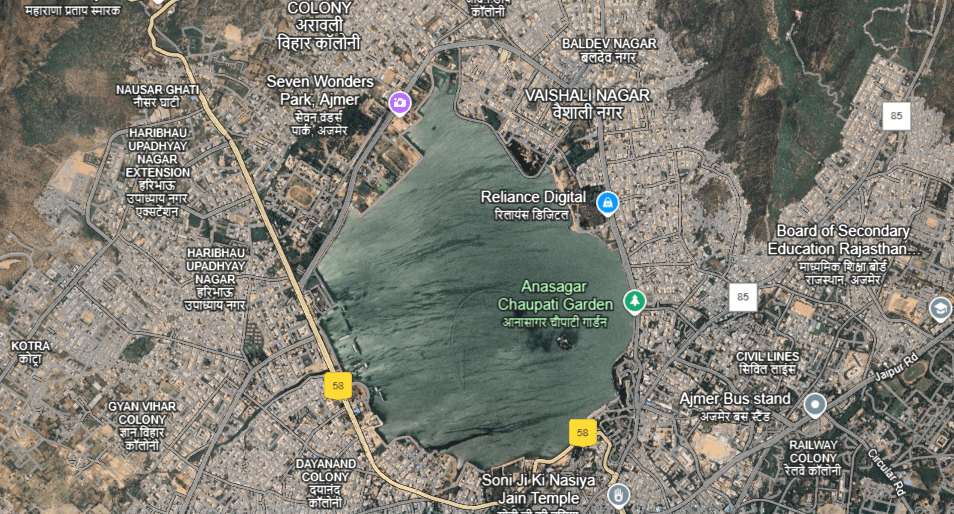
Over the last about 4 years, very interesting events are playing out in India’s judiciary regarding the encroachments in Anasagar lake in Ajmer, Rajasthan.
The first order from the National Green Tribunal came to remove the encroachments from Anasagar lake in Dec 2021, reiterated in Aug 2023 as the encroachments were in violation of the environmental regulations and Wetland Rules of 2017. Apparently, the state government with investment of Rs 12 Cr was the biggest encroacher and the investment in the encroached land continued even while NGT order was awaiting implementation.
The state government appealed against the NGT order in the Supreme Court and Supreme Court refused to stay the NGT order in Dec 2023 and subsequently, latest on March 17 2025, stood by the NGT order and asked Rajasthan to remove the encroachments. Last month, expressing displeasure over non implementation of NGT order by the state, the apex court bench summoned the state Chief Secretary to the hearing.
As far as wetlands protection in India is concerned, the events here have a mix of tragedy, comedy, tragicomedy, among other genres. It will be interesting to see where this sequence of events ends. The apex court has now asked the state to submit detailed plan in the next hearing on April 7. One hopes the state submits a sincere plan to remove the encroachments from Anasagar lake at the earliest, in addition to other compensatory plans. According to one report, the state government has started removal of encroachments since March 10 2025. This is welcome development.
Ajmer SC directs govt to demolish wetland encroachments The Supreme Court on Mar 17 directed the Rajasthan government to demolish encroachments on a wetland forming part of a park near Anasagar lake in Ajmer within six months and observed that destruction of wetlands is invitation to disaster. The bench directed the state to remove the structures insides the park and clear the food court within the stipulated period of six months.
-A bench headed by justice Abhay S Oka held that any encroachment on a wetland must go and shot down the argument by Rajasthan to save the illegal construction as demolishing it would result in a great loss to the public exchequer. The top court said, “If states are allowed to destroy wetlands, we are inviting disaster. The intention of the government should be to restore wherever there is a wetland. Under any cost, wetlands have to be protected.”
The court was hearing an appeal filed by Rajasthan government that was asked to restore the Anasagar Lake in Ajmer as a wetland by the NGT in December 2021 with a further direction in August 2023 to demolish any encroachment or construction in the ‘buffer area’ of the lake.
The state had objected to the NGT order by claiming that the site in question is not a declared wetland. Close to the lake, the state had planned recreational facilities including a “Seven Wonders Park” having replicas of the seven monuments from around the globe, a food court, pathways & markets. https://www.hindustantimes.com/india-news/sc-directs-rajasthan-govt-to-demolish-wetland-encroachments-in-ajmer-101742262621891.html (18 Mar 2025)
Govt’s plea to remodel 7 Wonders Park near Ajmer lake rejected A bench led by Justice Abhay S. Oka dismissed the government’s concerns that it had already invested Rs 12 crore in developing the park, which attracts approximately 2,500 visitors daily. The court ruled that the area surrounding the lake must be cleared, necessitating either the relocation or demolition of the seven replicas. The state had contended that the structures and pathways of the Seven Wonders Park serve as a public utility.
According to the NGT, the construction was in violation of environmental regulations and the 2017 Wetland Rules. It had issued an immediate demolition order for the Seven Wonders Park, Patel Stadium, Gandhi Smriti Udyan, and the food court built around the lake.
Although the state challenged the NGT’s decision before the Supreme Court, the latter, in Dec 2023, refused to stay the ruling. Subsequently, as the top court proceeded with the case, it reaffirmed its stance against suspending the NGT order & sought assurance from the state to comply with it.
However, last month, the bench expressed displeasure upon learning that the state had failed to implement the NGT’s directive, despite the Supreme Court’s refusal to stay it. Consequently, the court ordered the personal appearance of the state’s chief secretary. https://theprint.in/judiciary/rajasthan-govts-plea-to-remodel-seven-wonders-park-near-ajmer-lake-rejected-what-sc-said/2552316/ (18 Mar. 2025)
7 Wonders Park to be demolished in 6 months In April 2023, Ashok Malik (Jat), a former councillor of the Ajmer Municipal Corporation had filed a petition with the NGT, citing violations of wetland regulations and the city’s master plan. In Dec 2023, the NGT ordered the removal of unauthorized constructions, but despite this directive, the administration continued developing the park. Babulal Sahu, the national president of the Bharatiya Public Labour Party and an advocate in this case, stated that the next step is to hold officials accountable for illegally allocating wetland land for the Seven Wonders Park. He plans to file for financial recovery from those responsible for the misuse of power.
In an affidavit submitted to the court, the state govt pledged to compensate for the damage caused to the wetland by creating an artificial wetland area twice the size of the affected land. The court then instructed the government to present a detailed action plan for the new wetland by April 7.
Ashok Malik, the petitioner in the case, emphasized the need for a concrete plan of action. “We challenged this construction as it directly violated environmental laws. The state government has committed to demolishing the Seven Wonders Park within six months and compensating for the lost wetland by providing double the affected area. This project, which cost approximately ₹58 crore of taxpayer money, is both illegal and unjust,” said Malik. https://indianexpress.com/article/india/seven-wonders-park-near-ajmer-lake-to-be-demolished-in-6-months-amid-environmental-concerns-9891556/ (18 Mar. 2025) As per some reports, the govt has started demolition drive in the lake area. https://zeenews.india.com/hindi/india/rajasthan/ajmer/ajmer-news-big-action-supreme-court-wetland-area-shops-locks-put/2676302 (10 March 2025)
HYDRO POWER PROJECTS
Report Melting glaciers creating huge lakes Over 76% of Himalayan glacial lakes are end-moraine-dammed, a fragile structure prone to breaches. 70% of GLOF events in the region since 1833 have occurred in the past 50 years. Suhora Technologies, an Indian Earth observation firm, has analysed how the Himalayan glacial lakes are expanding at an alarming rate, heightening risks of devastating glacial lake outburst floods (GLOFs). It monitors 33000 lakes across Himalayas.

Glacial lakes in the Hindu Kush-Karakoram-Himalaya (HKH) region have grown by over 10% in area since 1990, with the Ganga basin witnessing a 22% surge in lake numbers. The UN World Day for Glaciers has been adopted to show what’s at stake: 1.9 billion people rely on Himalayan glaciers for water. https://www.indiatoday.in/science/story/melting-glaciers-are-creating-huge-lakes-in-himalayas-they-could-burst-anytime-2696840-2025-03-21 (21 Mar 2025)
Melting glaciers threaten biodiversity, lives & water resources -To mark Friday’s (March 21) first-ever World Day for Glaciers, the United Nations’ World Meteorological Organization (WMO) weather, climate and water agency, and its UNESCO culture agency, zoomed in on the impact shrinking glaciers can have on everyday lives. https://www.ndtv.com/world-news/how-melting-glaciers-threaten-biodiversity-lives-and-water-resources-7973576 (21 March 2025) -The declaration of the World Day for Glaciers, on May 21, is a global call to action — protecting glaciers is protecting the world’s future. https://www.thehindu.com/opinion/op-ed/not-frozen-relics-but-the-pulse-of-earths-water-system/article69354760.ece (21 March 2025)
Arunachal Pradesh Himalayan glaciers & HEPs The 1926 J&K deluge, the 1981 Kinnaur valley floods in Himachal Pradesh and the 2013 Chorabari Tal glacial lake above Kedarnath outburst in Uttarakhand, killing thousands of people, are examples of GLOF-related disasters. Among the Himalayan states in India, Sikkim has more than 300 glacial lakes, according to the Sikkim State Disaster Management Authority. Out of these, 10 have been identified as vulnerable to outburst floods. These include the South Lhonak Lake and had been under observation by government agencies for years. However, disaster struck Sikkim on 4 October,2023 morning after the outburst of South Lhonak Lake, flooding the Teesta river that devastated downstream areas. The voluminous outflow destroyed the Chungthang dam of the Teesta 3 hydropower project and rendered several hydropower projects along the river dysfunctional.
Most of the glacial lakes present in Siang, Subansiri, Dibang & Lohit river catchments are present in the Chinese portion of these river catchments. https://arunachaltimes.in/index.php/2025/03/22/the-reciprocal-dynamics-himalayan-glaciers-and-hydropower-projects/ (22 March 2025)
‘Ghost villages’ in HEP-affected areas to claim compensation Apparently, the ghost of the infamous TAH land compensation scam has resurfaced in the vicinity of the Athunli 680 Mw Hydroelectricity Project (HEP) in Dibang Valley district, as hundreds of semi-concrete and concrete houses are being built every day, ahead of the land baseline and property survey for the Athunli HEP. The state government had signed a memorandum of agreement with the Sutlej Jal Vidyut Nigam (SJVN) – a Himachal Pradesh-based public sector undertaking – in August 2023 for the Athunli HEP. The project covers a total area of 247.34 hectares (24.73400 square metres), under which seven villages fall – Athunli, Malinye, Apanli, Sunli, Gunli, New Echanli, and Chiya. According to sources in the district administration, there are only 40 households with a population of 240 recorded in the seven villages that would be affected by the Athunli HEP. https://arunachaltimes.in/index.php/2025/03/21/ghost-villages-being-established-in-hydropower-project-affected-areas-to-claim-compensation/ (21 March 2025)
Himachal Pradesh Mysterious death of HPCCL chief engineer After the mysterious death of chief engineer-cum-general manager of Himachal Pradesh Power Corp Ltd (HPPCL) Vimal Negi, his family sat on protest with his body on Wednesday (March 19) at the BCS-New Shimla road, refusing to cremate him till the accused officials are suspended and demanding a CBI probe.
Body of Negi, who had been missing for last 10 days, was recovered from Bhakra Dam in Bilaspur district on March 18. “I will not move till the officers — managing director (MD) and director are suspended. It is due to their constant humiliation and torture that I lost my husband,” said the grieving wife of Negi while demanding a Central Bureau of Investigation (CBI) probe.
“It is not suicide but murder. He was being pressurised by seniors to do something wrong but he was unwilling to sign. He was made to run around carrying files like a peon. He was also denied holidays and harassed, even though he was unwell and his blood pressure was fluctuating,” she alleged. https://www.hindustantimes.com/cities/chandigarh-news/mysterious-death-of-hpccl-chief-engineer-kin-refuse-to-cremate-body-press-for-cbi-probe-101742414108430.html Leader of Opposition Jai Ram Thakur, however, noted that while Desh Raj, the Director (Electrical), had been suspended, no similar action had been taken against the Managing Director of HPPCL. He stated that numerous questions have been raised about the Shongtong Hydro Power and Pekhubela Power projects since the Congress government took office. https://www.tribuneindia.com/news/himachal/congress-bjp-spar-in-assembly-over-death-of-himachal-power-corporation-chief-engineer-negi/ Mar 20 को न्यू शिमला पुलिस की टीम मामले की जांच के लिए पावर कॉरपोरेशन के बीसीएस कार्यालय में पहुंची और करीब सात घंटे तक कर्मचारियों और अधिकारियों से सवाल किए। उनके बयान भी दर्ज किए गए हैं। https://www.amarujala.com/himachal-pradesh/chief-engineer-vimal-negi-death-case-employees-and-officers-questioned-for-seven-hours-cctv-footage-seized-2025-03-20 एचपीसीएल के प्रमुख अभियंता विमल नेगी की संदिग्ध हालात में मौत के मामले में परिजन लगातार सीबीआई जांच की मांग कर रहे हैं। विमल के बड़े भाई सुरेंद्र नेगी ने शुक्रवार (March 21) को कहा कि परिवार ने सरकार को आरोपी अधिकारियों के खिलाफ कड़ी कार्रवाई करने के लिए पंद्रह दिन का अल्टीमेटम दिया है। अगर इस दौरान पुलिस आरोपी अधिकारियों के खिलाफ कड़ी कार्रवाई नहीं करती है तो फिर हम अगला कदम उठाएंगे। https://www.amarujala.com/himachal-pradesh/vimal-negi-death-case-15-days-ultimatum-to-the-government-brother-surendra-2025-03-21 (20-21 March 2025)
Karnataka Greens to demonstrate against projects in Sharavathi Valley The environmentalists announced plans for a large-scale demonstration in Shivamogga on Mar 19 to oppose the projects. The Sharavathi Nadi Kanive Ulisi Horata Okkuta leader, Sagar-based activist Akhilesh Chipli said that the demonstration targets both the Sharavathi Integrated Hydropower Project & the proposal to divert the Sharavathi water to Bengaluru. “Project approval would displace numerous families. Similar to the Yettinahole project affecting the Netravathi River, this initiative lacks scientific basis & transparency. It threatens pristine forest areas & could contribute to climate change issues. The project appears to be an inappropriate use of public funds,” he said. https://timesofindia.indiatimes.com/city/mysuru/environmentalists-to-demonstrate-against-projects-in-sharavathi-valley/articleshowprint/119127078.cms (17 Mar 2025)
20 years, zero progress. Potent Biodiversity Act remains unutilised More than 20 years since the Biodiversity Act came into force, Karnataka is yet to make headway in utilising its provisions to protect its rich bio-resources, while the latest amendment to the Act threatens to dilute the regulatory regime that once enabled conservation. https://www.deccanherald.com/india/karnataka/20-years-zero-progress-karnataka-s-potent-biodiversity-act-remains-unutilised-3455886 (21 March 2025)
MoEF Agenda of EAC to be held on March 27 2025: 1. Kotpali Close loop Pumped Storage Hydro Project (1800 MW) in 357 Ha at Village Joka, Pendirdih and Samri Protected Forest, Sub-Dist Shankargarh, Dist Balrampur, Chhattisgarh by Chhattisgarh State Power Generation Company Ltd–Terms of Reference
2. Pinnapuram Integrated RESP-Storage project (1200 MW) in Sub Dist Gadivemula, Orvakal, Panyam, Dist Nandyal and Kurnool, Andhra Pradesh by Greenko AP01 IREP Pvt Ltd – Amendment in Env. Clearance. https://parivesh.nic.in/utildoc/122726317_1742369800138.pdf
DAMS
Sardar Sarovar Project Court seizes SSPA office chairs, television Office chairs, including that of the Chief Executive Officer (CEO) and Chairman of the Sardar Sarovar Punarvasahat Agency (SSPA), as well as computers and television sets were confiscated by the bailiff of Dabhoi civil court as per a court warrant to recover a compensation of Rs 30 crore due to nine villagers, who had parted with their lands for the Sardar Sarovar Narmada Nigam Limited (SSNNL) to rehabilitate the Narmada dam oustees. As the bailiffs and the petitioners — all senior citizens — seeking compensation arrived at the SSNNL office in Narmada Bhavan compound in Vadodara city to execute the court warrant, they were met with vacant offices.
– On March 20, the Dabhoi civil court bailiff, along with petitioners, arrived at the office of the SSNNL and SSPA at Narmada Bhavan in Vadodara. Bailiff Sanjay Solanki said that as per the court warrant, the process was to attach “whatever movable items are available in the office”. https://indianexpress.com/article/cities/ahmedabad/movable-ssnnl-assets-attached-for-non-payment-of-compensation-9897545/ (21 March 2025)
Mullaperiyar Dam New supervisory committee visits dam The new supervisory committee formed to ensure safety of the Mullaperiyar dam visited the dam site on Mar 22, following a directive of the Supreme Court. The team travelled from the Thekkady boat landing station to the Mullaperiyar dam through the Vallakkadavu route in the morning. The team inspected the main dam, baby dam, gallery, and the spillway shutters. After the visit, a meeting was held at Kumily. https://www.thehindu.com/news/national/kerala/new-supervisory-committee-visits-mullaperiyar-dam/article69361805.ece (22 March 2025)
TN farmers demand exclusion of Kerala officials in supervisory panel Members of the Periyar Vaigai Irrigation Farmers Association staged a protest at the lower camp demanding the National Dam Safety Authority to exclude Kerala officials in the Mullai Periyar Dam’s new supervisory committee on Mar 22. They demanded NDSA to fulfill their 14 charter points of demands, such as release of the resettlement agreement of 1979 and conduct fair enquiry on the lack of implementation of the Supreme Court’s 2006 and 2014 orders. https://www.newindianexpress.com/states/tamil-nadu/2025/Mar/22/farmers-demand-exclusion-of-kerala-officials-in-mullaiperiyar-supervisory-panel (22 March 2025)
Telangana Southern Telangana gets lion’s share for irrigation projects Deputy CM and state finance minister Bhatti Vikramarka announced Rs 23,373 crore for irrigation and command area development while presenting the budget for 2025-26 in the Legislative Assembly on Mar 19. The operational and administrative costs related to irrigation and command area development are Rs 11,544 cr, including the Rs 6,914.54 cr loan repayment under the Kaleshwaram Lift Irrigation Scheme. The remaining expenditure on irrigation projects is estimated at Rs 11,829 cr.
The state budget has allocated Rs 1,714 cr for the S Jaipal Reddy Palamuru Rangareddy Lift Irrigation Scheme. The Congress govt has approved the revitalisation of the Bunadigani Canal under the Musi Project, allocating Rs 266.65 cr. A total of Rs 699.35 cr has been proposed for the Sitarama Lift Irrigation Scheme, including Rs 56 cr for the Sitarama Multi-Purpose Project.
The irrigation projects in the Palamuru region consist of the Nettempadu Lift Irrigation Scheme where Rs 144 cr has been allocated, Rs 642.94 cr for the Rajiv Bheema Lift Irrigation Scheme, Rs 800 cr for the Kalwakurthy Lift Irrigation Scheme and Rs 270 cr for the Dindi Lift Irrigation Scheme. The state govt has also proposed Rs 100 cr for a protection wall to prevent Mancherial town from flooding due to Kaleshwaram backwaters and Rs 5 cr for restoration of Ramappa Lake. https://www.siasat.com/budget-2025-26-southern-telangana-gets-lions-share-for-irrigation-projects-3196757/ (19 March 2025)
Kerala Over 110 megaliths discovered at Malampuzha dam The ASI has stumbled upon a cluster of over 100 megaliths near Malampuzha dam in Palakkad, largest water reservoir in Kerala during a recent exploration expedition. “Recent explorations near the Malampuzha dam in Palakkad has led to a fascinating discovery of megalithic structures spread across island-like mounds. The team of ASI surveyed the area and came across more than 110 megaliths spreading across 45 hectares of land,” said ASI officials. Megalithic are structures, which are built for burials using large, often rough stones, without mortar or cement. Such chambers were common during Neolithic and Bronze Ages. “The finding of such a large number of megalithic burials in clusters is expected to add further insights about early Iron Age society and belief system in Kerala,” added ASI officials. https://www.newindianexpress.com/states/kerala/2025/Mar/22/over-110-megaliths-discovered-at-malampuzha-dam-in-kerala (23 March 2025)
INTERLINKING OF RIVERS
Centre Trying to build consensus among states: C R Patil -Speaking during a debate on the demands for grants of the Jal Shakti ministry, Patil said that 30 rivers have been identified for inter-linking and detailed project reports (DPRs) have been prepared for 11. Citing a lack of consensus among river basin states on the subject, the Minister said the Centre is working to bring them on the same page. https://www.deccanherald.com/india/river-linking-projects-centre-trying-to-build-consensus-among-states-says-c-r-patil-3456942 (21 March 2025)
Mahanadi-Indravati Link नदी जोड़ो परियोजना बस्तर एवं छत्तीसगढ़ की जीवनदायिनी इंद्रावती नदी को महानदी से जोड़ने की इंद्रावती-महानदी नदी जोड़ो बहुउद्देशीय परियोजना प्रस्तावित है। इस परियोजना का उद्देश्य सिंचाई, पेयजल, औद्योगिक विकास, जल विद्युत उत्पादन और बाढ़ नियंत्रण को सुनिश्चित करना है। नदी जोड़ने के मामले में यह प्रदेश की पहली परियोजना है। इसलिए राज्य सरकार इसकी प्रस्तुतीकरण केंद्रीय स्तर के अधिकारियों के सामने कर सकती है। देश में छह नदी जोड़ो प्रोजेक्ट प्रगतिरत हैं। राज्य सरकार को उम्मीद है कि अगर ये प्रोजेक्ट केंद्र सरकार हाथों-हाथ लेती है, तो इस प्रोजेक्ट की रफ्तार बढ़ जाएगी। इस परियोजना की लागत लगभग Rs 25000 करोड़ है। https://www.naidunia.com/chhattisgarh/raipur-indravati-mahanadi-river-linking-project-may-gain-momentum-with-pm-narendra-modi-arrival-in-chhattisgarh-8383320 (17 Mar 2025)
RIVERS AS NATIONAL WATERWAYS
Delhi Questions over Yamuna ferry project This is not the first time the Yamuna River has been explored for commercial use of navigation and tourism. In 2015, the IWAI proposed a water taxi service from Sonia Vihar to Tronica City, covering 16 km. However, the plan largely remained on paper due to feasibility concerns. In 2021, the Delhi government rejected the proposal citing severe pollution and inadequate water levels.
Legal proceedings in November 2024 in the NGT have revealed the existence of an Environmental and Social Impact Assessment (ESIA) report for the earlier water taxi project, prepared by Ultra Tech Limited in 2018 which covers this stretch of the river too. However, this report has never been made public. Similarly, IWAI’s cost-benefit analysis remains undisclosed.
While IWAI has claimed to have obtained clearance from the DPCC, no official documents are accessible in the public domain so far. Transparency regarding such assessments is crucial for public scrutiny and establishing accountability. According to the same proceeding in the NGT, the Yamuna falls under the jurisdiction of the NMCG under the River Ganga Authorities Order, 2016. Any development on the river requires NMCG approval, yet there is no clarity on whether such a clearance has been sought.
Despite official claims of sustainability and media disclosures, the project appears to lack a participatory framework that includes those most affected—riverine communities, fisherfolk, floodplain farmers, and divers who have an intimate understanding of the river’s dynamics. While the initiative aims to benefit locals through a community jetty framework, a truly sustainable river cruise model would require integrating their knowledge and addressing their concerns. (Avli Verma, Manthan) https://www.hawapani.org/blogpost/yamuna_river_cruise (22 March 2025)
IRRIGATION
Jammu & Kashmir ‘₹37 cr DPR to enhance carrying capacity of canals’ Minister for Jal Shakti, Javed Ahmad Rana, today informed the House that a comprehensive DPR for Rs 37 cr has been prepared to enhance carrying capacity of different canals of Bijbehara- Srigufwara constituency, which shall be part of project shelf of NABARD 2025-26. The Minister said that regular drives are being conducted to restrict the encroachments on irrigation canals. Around 658 encroachments have been removed in the year 2024-25 in which 300.02 kanal of government land was retrieved, he added. Regarding de-silting of the canals, the Minister informed that under M&R grants, 17 km (in canals of Bijbehara/Srigufwara constituency) has been desilted during 2024-25 at an expenditure of Rs. 5.82 lakh. He added that the Rural Development Department undertook desilting in 8 km with a cost of Rs. 3.17 lakh. https://www.thekashmirmonitor.net/rs-37-00-cr-dpr-prepared-to-enhance-carrying-capacity-of-canals/ (19 March 2025)
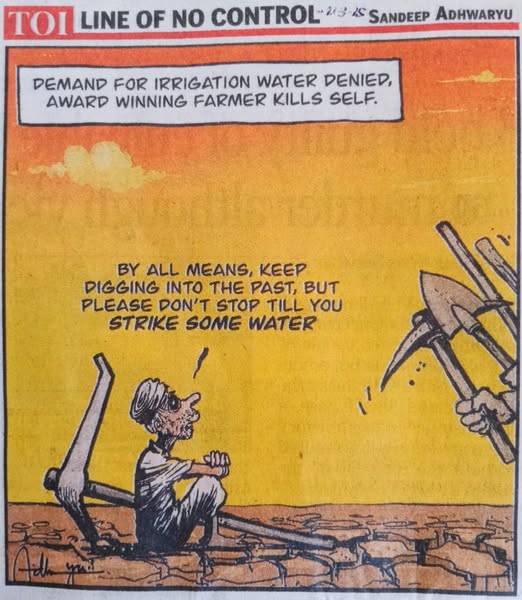
The Times of India, March 21, 2025.
URBAN RIVERS
Mula-Mutha; Pune Citizens protest RFD project A human chain was formed by over 150 people from a consortium of 60 organisations part of river revival groups in Pune and Pimpri Chinchwad at Kokane Chowk in Pimple Saudagar at 8am on Sunday to protest against the Mula-Mutha riverfront development (RFD) project and related works across the Pune metropolitan region and Pune and Pimpri Chinchwad municipal areas. Protesters declared their solidarity with the Pavana, Mula and Indrayani rivers — lifeline to over 30 lakh residents — and said these must be restored to their natural state. They emphasised theirs was a battle to protect nature.
The demonstration is part of a broader campaign for pollution-free rivers and sustainable river management. Citizens said large-scale projects like RFD could accelerate environmental degradation, threaten biodiversity and pose long-term public health risks. Many questioned the need for such development, urging authorities to prioritise waste management and pollution control. People warned protests, including direct action at govt offices, would escalate if their demands were ignored. https://timesofindia.indiatimes.com/city/pune/citizens-form-human-chain-to-protest-riverfront-devpt-project-in-pune-pimpri-chinchwad/articleshow/119388620.cms (24 March 2025)
Push to save Devrai grows -In an effort to map the biodiversity in and around the Mula river, a team of volunteers with at least two experts have been visiting the riverbank every Saturday since Dec 2024. The goal is to record the number of trees present and get an understanding of biodiversity in and around the rivers, while also creating a database. We must know what we are protecting. The activity is also a great way to learn more about the space and introduce it to more people — Amitraj | Volunteer, Pune River Revival. https://timesofindia.indiatimes.com/city/pune/green-haven-under-threat-push-to-save-devrai-grows/articleshow/119270791.cms (21 May 2025)
PMC to test water quality at 25 locations As part of the Mula-Mutha Rejuvenation Project, 5 STPs are currently being built in the city. To assess river water quality, the Pune Municipal Corporation (PMC) will conduct tests at 25 locations to help evaluate the effectiveness of the water treated once the new STPs become operational. However, officials are yet to finalise these locations. This initiative, supported by JICA, aims to treat the city’s sewage before releasing it into the river. Pune currently consumes around 1,750 MLD of water, generating nearly 1,400 MLD of sewage. However, the city’s existing STPs can only process about 350 MLD daily, leaving a large volume of untreated sewage flowing directly into the Mula and Mutha rivers. https://www.hindustantimes.com/cities/pune-news/pmc-to-test-water-quality-at-25-locations-under-river-rejuvenation-project-101742668444484.html (23 March 2025)
Gomti; Lucknow River gasping for life The Gomti is gasping for life as its oxygen level has dipped to alarming level. According to the latest water quality report of the river near Kudiya ghat, the Dissolved Oxygen (DO) level in the Gomti has dropped to a critically low 1.5 mg/litre while the Biochemical Oxygen Demand (BOD) has surged to 18 mg/litre. Worse, the river is also covered under a thick green layer of water hyacinth near the Kudiya ghat, adding to its distress. https://timesofindia.indiatimes.com/city/lucknow/gomti-gasping-for-life-as-its-oxygen-dips-to-critical-level/articleshowprint/119176671.cms (19 Mar. 2025)
Itanagar YMCR leads river clean-up in Itanagar The Youth Mission for Clean River (YMCR), with Abralow Memorial Multipurpose Society and supported by Itanagar Smart City Development Corp Ltd, organised a river cleaning drive and a placard-making competition on World Water Day.
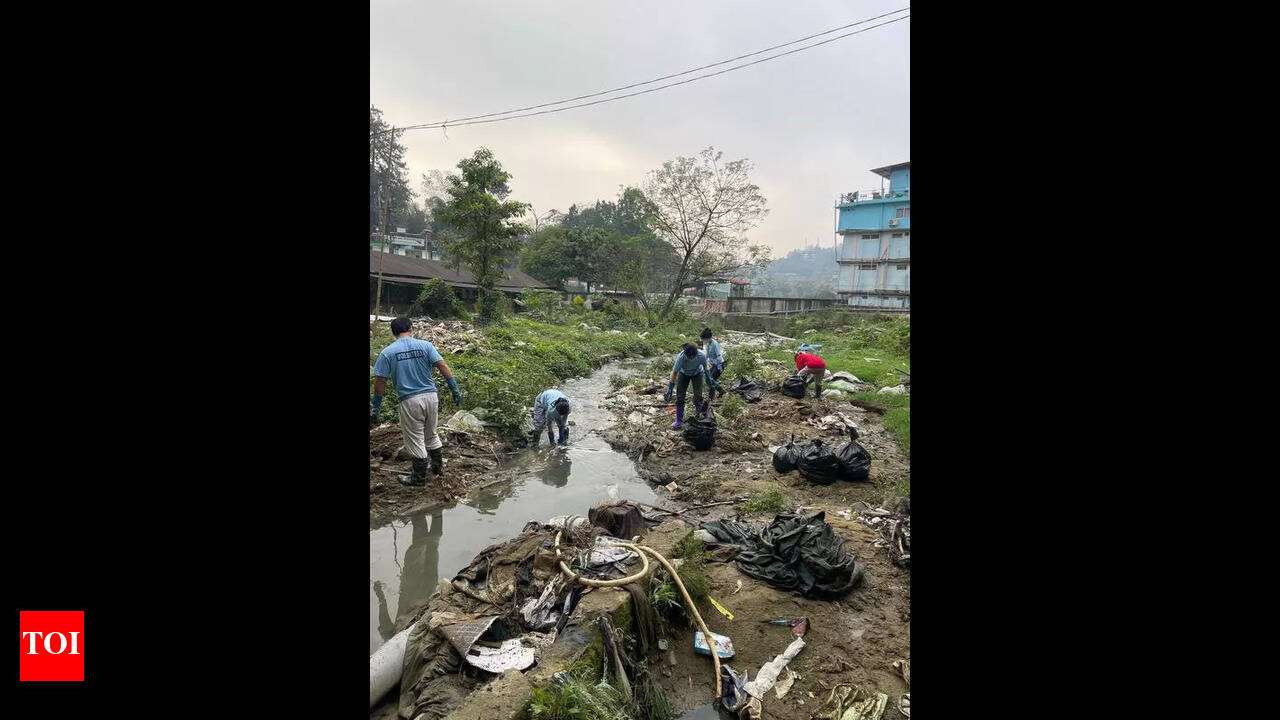
The initiative aimed to raise awareness about river conservation and environmental responsibility. Volunteers gathered along the Energy Park stretch of the Yagamso River, working tirelessly to clear plastic waste and debris obstructing the river’s flow. Simultaneously, students and youth participated in a placard-making competition under the theme ‘Save River, Save Life’, using art and slogans to express their commitment to protecting waterways. The event combined action with awareness, inspiring youth and the community to take an active role in safeguarding the region’s rivers and natural heritage. https://timesofindia.indiatimes.com/city/guwahati/ymcr-leads-river-clean-up-initiative-in-itanagar/articleshow/119351797.cms (22 March 2025)
RIVERS
Study Freshwater faces a warmer and saltier future from headwaters to coasts ABSTRACT: Alongside global climate change, many freshwater ecosystems are experiencing substantial shifts in the concentrations and compositions of salt ions coming from both land and sea. We synthesize a risk framework for anticipating how climate change and increasing salt pollution coming from both land and saltwater intrusion will trigger chain reactions extending from headwaters to tidal waters. Salt ions trigger ‘chain reactions,’ where chemical products from one biogeochemical reaction influence subsequent reactions and ecosystem responses. Different chain reactions impact drinking water quality, ecosystems, infrastructure, and energy and food production.
– Risk factors for chain reactions include shifts in salinity sources due to global climate change and amplification of salinity pulses due to the interaction of precipitation variability and human activities. Depending on climate and other factors, salt retention can range from 2 to 90% across watersheds globally. Salt retained in ecosystems interacts with many global biogeochemical cycles along flowpaths and contributes to ‘fast’ and ‘slow’ chain reactions associated with temporary acidification and long-term alkalinization of freshwaters, impacts on nutrient cycling, CO2, CH4, N2O, and greenhouse gases, corrosion, fouling, and scaling of infrastructure, deoxygenation, and contaminant mobilization along the freshwater-marine continuum. Salt also impacts the carbon cycle and the quantity and quality of organic matter transported from headwaters to coasts.
– We identify the double impact of salt pollution from land and saltwater intrusion on a wide range of ecosystem services. Our salinization risk framework is based on analyses of: (1) increasing temporal trends in salinization of tributaries and tidal freshwaters of the Chesapeake Bay and freshening of the Chesapeake Bay mainstem over 40 years due to changes in streamflow, sea level rise, and watershed salt pollution; (2) increasing long-term trends in concentrations and loads of major ions in rivers along the Eastern U.S. and increased riverine exports of major ions to coastal waters sometimes over 100-fold greater than forest reference conditions; (3) varying salt ion concentration-discharge relationships at U.S. Geological Survey (USGS) sites across the U.S.; (4) empirical relationships between specific conductance and Na+, Cl−, SO42−, Ca2+, Mg2+, K+, and N at USGS sites across the U.S.; (5) changes in relationships between concentrations of dissolved organic carbon (DOC) and different salt ions at USGS sites across the U.S.; and (6) original salinization experiments demonstrating changes in organic matter composition, mobilization of nutrients and metals, acidification and alkalinization, changes in oxidation–reduction potentials, and deoxygenation in non-tidal and tidal waters.
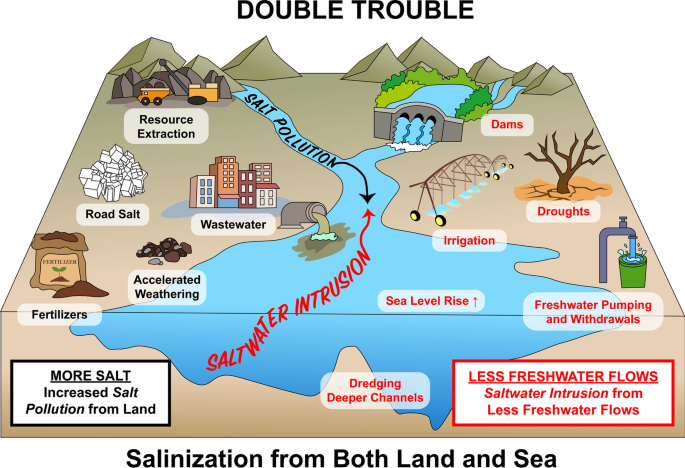
– The interaction of human activities and climate change is altering sources, transport, storage, and reactivity of salt ions and chain reactions along the entire freshwater-marine continuum. Our salinization risk framework helps anticipate, prevent, and manage the growing double impact of salt ions from both land and sea on drinking water, human health, ecosystems, aquatic life, infrastructure, agriculture, and energy production. https://link.springer.com/article/10.1007/s10533-025-01219-6 (10 March 2025)
CAUVERY Bengaluru HC clears way for Aarti The decks have been cleared for the Cauvery aarti programme, to be organised by BWSSB at Sankey Tank on March 21. The high court on March 20 disposed of an interlocutory application (IA) filed by city advocate Geetha Misra in her pending PIL regarding the city’s lakes. A division bench comprising Chief Justice NV Anjaria and Justice KV Aravind also recorded the assurance given by advocate general Shashikiran Shetty and senior advocate Uday Holla, appearing for BWSSB, that the event would be held in accordance with the law.
– “The authorities shall, while conducting the event, ensure that public movement and public order are managed to maintain law and order, and further that the provisions regarding the prohibitory acts in the tank as provided under section 12 of the Karnataka Tank Conservation and Development Authority Act shall be observed,” the bench said. https://timesofindia.indiatimes.com/city/bengaluru/karnataka-high-court-clears-way-for-cauvery-aarti-at-sankey-tank/articleshow/119269032.cms (20 March 2025) Temporary seating arrangements that were set up for the public to witness the Cauvery Aarti were also dismantled by early morning so as to not impede the morning walkers’ routine. Solid waste such as paper or plastic waste were collected in large dust bins placed at nodal points throughout the premises. https://www.deccanherald.com/india/karnataka/bengaluru/effective-garbage-control-keeps-sankey-tank-clean-post-aarti-3458600 (23 March 2025)
Petition filed in HC to stop Aarti The Interlocutory Application (IA), filed as part of a pending PIL petition, also sought a ban on related construction activities within the lake or its buffer zone. The IA was moved by Geetha Misra, one of the petitioners in a batch of PILs concerning lake encroachments in Bengaluru. https://www.deccanherald.com/india/karnataka/bengaluru/petition-filed-in-hc-to-stop-cauvery-aarti-on-friday-3452295 (19 March 2025)
Rajasthan काला पानी: जोजरी -राजस्थान की गर्म रेत के बीच एक नदी… एक जीवनरेखा… जोजरी! यह नदी सदियों से रेगिस्तान में पनपी कई सभ्यताओं की साक्षी रही होगी। सभ्यताओं के बनने, मिटने, मरने और फिर पनपने के इस दौर में जोजरी का पानी न जाने कितनों की प्यास बुझाता रहा होगा, कितने ही खेतों को लहलहाता रहा होगा; इसका किनारा न जाने कितने बेजुबानों का सहारा बना होगा।
मगर सभ्यताओं की साक्षी जोजरी आज अपने अस्तित्व की लड़ाई लड़ रही है और इसके किनारे बसी ग्रामीण सभ्यता अपने मरने का इंतजार कर रही है. https://www.youtube.com/watch?v=uzAQGIopr2I&t=164s(18 Mar. 2025)
Chhattisgarh इंद्रावती नदी बचाओ संघर्ष समिति करेगी जल संसाधन विभाग का घेराव इंद्रावती नदी बचाओ संघर्ष समिति के बैनर तले बस्तर के किसान Mar 19 को बोधघाट स्थित जल संसाधन विभाग कार्यालय का पानी की मांग को लेकर घेराव करेंगे। एक महीने से चले आ रही इंद्रावती नदी में पानी समस्या से किसानों की फसल सूख रही है। https://www.patrika.com/jagdalpur-news/cg-news-save-indravati-river-struggle-committee-will-gherao-the-water-resources-department-tomorrow-19467315 (18 Mar 2025) प्राणदायिनी इंद्रावती नदी सूखने और अल्टीमेटम के बाद भी प्रशासन की अनदेखी से नाराज किसानों Mar 11 को जोरानाला पहुंचें। यहां किसानों ने मिलकर जोरानाला में रेत-पत्थर के ढेर को हटाया। ताकि इंद्रावती नदी में पानी का प्रवाहित हो सके। यहां पर किसानों ने एक स्वर में कहा कि यदि जल्द से जल्द प्रशासन ने जोरानाला में सफाई नहीं करवाता है, तो 22 पंचायतों के हजारों किसान इंद्रावती नदी में ही धरना देंगे। http://patrika.com/jagdalpur-news/cg-news-farmers-of-22-panchayats-will-sit-on-dharna-in-indravati-river-19456037 (12 Mar 2025) अब इंद्रावती सूखने की सबसे मुख्य समस्या जोरानाला पर बने रेत के टीलों को खुद श्रम दान कर किसान हटाने का काम कर रहे हैं. प्रभावित किसानों में बताया कि कई बार ज्ञापन सौंपकर इंद्रावती नदी में बने स्टाप डेम का पानी छोड़ने और जोरानाला से रेत हटाने की मांग की गई. मांग पूरी करने के लिए सप्ताह भर का अल्टीमेटम जिला प्रशासन को दिया गया. जिला प्रशासन ने होली के बाद सफाई करने की बात कही है, लेकिन किसानों की फसल सूख रही है, इसलिए सैकड़ों किसान मिलकर दो दिनों से लगातार सफाई कर रहे हैं. https://www.etvbharat.com/hi/!state/bastar-farmers-cleaning-indravati-river-for-farming-chhattisgarh-news-cts25031205765 (12 March 2025) अगर पानी नहीं दिया गया तो राष्ट्रीय राजमार्ग में चक्काजाम करने की भी चेतावनी ग्रामीणों ने दे दी है. किसानों का कहना है कि रेत माफियाओं और सरकार की अनदेखी के चलते हो इस समस्या पर कोई ठोस पहल नहीं की जा रही है. ग्रामीणों का कहना है कि छतीसगढ़ -ओडिशा के बीच हुए जल बंटवारे पर प्रशासन गंभीर नहीं है. किसान प्रशासन इन्द्रावती नदी का 10 प्रतिशत पानी देने की मांग पर अड़े हुए. उनका कहना है कि अगर प्रशासन उनकी मांगों पर गंभीर नहीं होता तो बस्तर के किसान आंदोलन में उतर जाएंगे. https://hindi.news18.com/news/lifestyle/health-amazing-health-benefits-of-star-anise-know-more-benefits-of-including-it-in-your-diet-local18-9111651.html (12 Mar 2025) This Hindi report mentions impact of riverbed mining on Indravati river. https://cgkhabar.com/news/illegal-sand-mining-in-indravati-river-is-in-full-swing-20250311 (11 Mar 2025)
The NGT took cognizance of a letter petition alleging the discharge of untreated sewage from Champa town, District Janjgir-Champa into the Hasdeo River, affecting water quality and public health. The application contended that despite the construction of a sewerage pipeline with public funds to divert wastewater to a treatment facility, lack of maintenance had resulted in the direct discharge of sewage into the river. https://www.barandbench.com/columns/environmental-law-tracker-february-2025 (19 March 2025)
Maharashtra 50% sewage still flowing into waterbodies Maharashtra: “Out of 9,190 MLD sewage generated by the Mah’s civic bodies, 4,846 MLD is treated at 155 domestic sewage treatment plants, but the remaining, 4,344 MLD of untreated sewage, is flown into the rivers,” environment minister Pankaja Munde said while replying to a calling attention motion raised by legislators. She said the NGT had asked the state to impose a fine of Rs 5 lakh per nullah that pollutes a river, besides asking for a massive fund allocation to achieve 100% treatment of sewage. She announced a task force to tackle pollution in rivers. https://timesofindia.indiatimes.com/city/mumbai/50-of-sewage-still-flows-into-states-water-bodies-untreated/articleshow/119128584.cms (28 March 2025)
Task force to tackle pollution in rivers Minister Pankaja Munde on Mar 17 announced in the state legislative council that a task force will be set up to tackle pollution in rivers. The state environment and climate change minister said the task force will involve collaboration between the environment, the urban development and rural development departments to ensure better implementation of pollution control measures. She said Maharashtra currently has 155 operational STPs, with 16 new plants recently added, while 20 plants are under construction, and more than 30 are in the planning stage. https://www.theweek.in/wire-updates/national/2025/03/17/bes11-mh-council-river-pollution.html (17 March 2025)
Mah govt adopts Water Pollution Amendment Act 2024
Himachal Pradesh Centre allocates Rs 15 crore for state’s longest bridge on Beas The 800-metre-long bridge, to be built at a cost of Rs 104 crore under the Setu Bharatam Scheme, will be funded through the Central Roads and Infrastructure Fund (CRIF). Following the budget allocation, the PWD has floated tenders for the construction of this much-awaited bridge, which will provide uninterrupted interstate connectivity between Himachal Pradesh and Punjab. Currently, residents of Fatehpur, Jawali, Indora, and Jaswan Pragpur constituencies face travel difficulties due to security restrictions around the Pong Dam. The new bridge will significantly ease their movement. https://www.tribuneindia.com/news/himachal/centre-allocates-15-crore-for-states-longest-bridge-on-beas/ (24 March 2025)
GANGA Report Govt hides pollution data Despite the gravity of the issue, the response from the Minister of State for Jal Shakti, Shri Raj Bhushan Choudhary, was equally disappointing and lacked substance. Rather than providing specific figures or reports, he merely stated that the water quality at monitored locations remained “within permissible limits for bathing.” This lack of transparency raises serious questions about the credibility of pollution assessments, especially when independent studies and environmental watchdogs have consistently reported alarming contamination levels in the Ganga. The absence of hard data suggests that pollution levels may be understated, despite the government’s substantial expenditure on river cleaning efforts. At the core of the issue lies not just ineffective execution but also broader concerns of mismanagement and corruption. https://www.deshabhimani.com/deshabhimani-english-/environment-79695/government-hides-gangas-pollution-data-50957 (18 March 2025)
Bihar Ganga water has not conformed to FC levels at 34 sites: SPCB In Bihar, the water from the Ganga has not conformed to faecal coliform levels across 34 sampling sites since 2020-21, the SPCB has submitted to the NGT’s principal bench in an ongoing matter on the river’s water quality in the state. The SPCB’s affidavit was filed on the directions of the principal bench of NGT headed by chairperson Justice Prakash Shrivastava, which is hearing a suo moto matter based on news reports that the Ganga’s water is unfit for bathing in Bihar. Though the matter came up for hearing on Monday (March 17), no directions were passed. Regarding the inadequate number of STPs, the SPCB submitted to NGT that it was constructing 4 STPs in Patna, and one each in Barh, Munger, Sonpur, Sultanpur, Maner, Naugachhia, Chapra, Danapur and Phulwari Sharif.
Previously, the NGT had noted in its orders on the matter that few STPs were constructed and operational in the state and the river quality was meeting bathing criteria only in some respects. It had also pulled up the NMCG for not taking strict action regarding the state of water quality and reminded it of the powers it had. The NMCG had earlier submitted that estimated sewage generation in the state was 1,100 MLD and STPs constructed could only meet the requirement of 343 MLD. The NGT bench had noted that there was a gap of more than 750 MLD and that this volume of sewage was flowing into the river untreated. https://indianexpress.com/article/india/bihar-ganga-water-faecal-coliform-pollution-9892944/ (18 March 2025)
राज्य में मौजूद आठ सीवेज ट्रीटमेंट प्लांट्स में से छह मानकों पर काम नहीं कर रहे हैं। https://hindi.downtoearth.org.in/river/household-sewage-in-some-urban-areas-being-discharged-into-river-ganga-without-any-prior-treatment-bspcb (18 March 2025)
वाराणसी में गंगा नदी की स्वच्छता पर हजारों करोड़ रुपये सरकार की तरफ से भेजे जा चुके हैं. लेकिन अभी भी ग्राउंड की स्थिति हैरान करने वाली है. दरअसल सोशल मीडिया पर एक वायरल वीडियो में गंदा पानी (नाले का) सीधे गंगा नदी में गिरता हुआ देखा जा रहा हैं. यह वायरल वीडियो वाराणसी के दशास्वामेध घाट का बताया जा रहा है. गंगा की स्वच्छता और वायरल वीडियो को लेकर नियमित घाट पर साफ सफाई करने वाली नमामि गंगे की टीम से जब एबीपी न्यूज़ ने बातचीत की तो वायरल वीडियो के बारे में उन्होंने कहा की कुछ ही दिन पहले का यह वीडियो बताया जा रहा है. इसके बारे में पास के ही पंपिंग स्टेशन के कर्मचारियों ने कहा कि कुछ समय के लिए इस गंदे पानी को छोड़ा गया था. https://www.abplive.com/states/up-uk/varanasi-dirty-drain-water-is-being-released-on-the-banks-of-river-ganga-video-goes-viral-ann-2907359 (19 March 2025)
Uttar Pradesh Upper Ganga Canal Expressway project resumed The eight-lane expressway plan was originally launched back in 2013, and remains paused for almost 11 years. According to the reports, the government now has set the deadline to complete the project by November 2025. Reports suggested that a budget of Rs 8,700 crore has been decided for the 147.8 km-long expressway. https://www.news18.com/auto/upper-ganga-canal-expressway-project-resumed-set-to-connect-noida-greater-noida-and-dehradun-9266297.html (18 Mar. 2025)
Kolkata 2 hours of clean-up net 162 kg waste from Ganga On the occasion of World Water Day, the Sea Explorers’ Institute (SEI), in collaboration with (WWF and the National Cadet Corps (NCC), conducted a pilot river clean-up at Sundari Ghat. Using a 100-square-foot fishing net, the initiative retrieved 162 kilograms of waste from the Hooghly within two hours. The clean-up initiative involved boatmen, fishermen, vendors, and cleaners whose livelihoods depend on the river. The waste collected consisted of plastic bottles, torn plastic sheets, polystyrene, rubber slippers, disposable containers, and even illicit party drugs. Disturbingly, dead fish and prawns — believed to have perished due to chemical residues in the water — were also recovered. https://timesofindia.indiatimes.com/city/kolkata/2-hours-of-clean-up-net-162-kg-waste-from-ganga/articleshow/119352948.cms (23 March 2025)
YAMUNA Delhi When flow becomes froth HT series on Yamuna issues (Part 5) Froth formation is a symptom that indicates the river in this stretch is effectively “dead”, say experts. Bhim Singh Rawat, an activist with the South Asia Network on Dams, Rivers, and People (SANDRP) said froth forms only when the river has a toxic mix of detergents, sewage and effluents. “By this point, we have had dyes, detergents, toxic industrial waste and Delhi’s sewage entering the river in large quantities. The froth is a clear indication of a dead river.”
Rawat criticised the government’s sluggish response to contamination evidence. “In 2021, the DPCC prohibited detergents and soaps that failed to meet BIS standards to curb froth formation in the Yamuna. However, the ban remains largely unenforced. The surfactants from these detergents are a major contributor to froth buildup, depleting any remaining oxygen in the river,” Rawat said.
Experts have long called for a holistic approach to be followed when it comes to fixing the river. The first step is ensuring no sewage or effluents reach the Yamuna. Second, the drains carrying industrial waste and sewage into the river in the 22km urban section of Delhi need to be tapped and the untreated effluents need to be carried to the STPs and CETPs. Third, the river needs to flow with an assured minimum e-flow and its floodplains be protected to make it alive again.
Rawat said while increasing the environmental flow of the river is a start, at least two decades have passed with inaction from authorities on sewage and effluents. “All sorts of pollutants continue to enter the river each day and this is not just within Delhi, but from neighbouring Haryana and Uttar Pradesh too. The quantum of sewage actually reaching the Yamuna is still unknown, as it is based on the drinking water figures for Delhi. However, it does not account for the illegal water supply in the Capital.”
Pankaj Kumar, another Yamuna activist, said several governments have come and gone, but promises remain on paper. “We have STPs, but they are not functioning as per the standards required and even the treated water being released from there is not clean. In addition to the water, sludge is being released into the river, which is a sign that these STPs are not functioning properly,” said Kumar. https://www.hindustantimes.com/india-news/last-straw-when-flow-becomes-froth-in-the-yamuna-in-delhi-101742577937726.html (21 March 2025)
A barrage of compromises fails the Yamuna (Part 4)The 1994 UYRB water-sharing pact faces renegotiation this year – making it a pivotal moment for the Yamuna in Delhi. Experts argue that the minimum of 10 cumecs currently allocated to Delhi is grossly insufficient, leaving the river dry and unable to flush out pollutants. “The same party governing five Yamuna basin states and the Centre is a golden opportunity for the BJP to keep Yamuna revival objectives at the forefront and initiate joint actions for reversing the degradation river has been undergoing for past many years,” said Yamuna activist Bhim Singh Rawat. Rawat, a member of the SANDRP, said the 1994 deal was particularly detrimental to Delhi.

Official estimates indicate that for most of the year, the Yamuna’s flow downstream of Wazirabad Barrage is close to zero. Experts said that any increase in share for Delhi is likely to impact the share of Haryana and other upper-Yamuna states. Rawat, however, stressed that if all states work together, the impact can be minimal on others. “While it will marginally reduce the water these upper states get, if they all contribute a small share, it will ensure the Delhi’s section is much cleaner,” he said.
Haryana government officials say that they cannot comment on Delhi’s proposal till it is discussed with the state government. Delhi officials argue that UYRB has failed to mediate disputes effectively, often leaving states to settle conflicts in court. HT earlier reported that board has met fewer than twice a year over the last three decades, and its chief ministers’ committee — meant to be a high-level decision-making body — has convened only seven times.
UYRB’s problems extend to manpower also. Of the 58 permanent posts originally sanctioned for the board, only 22 remain. Of those, 17 have been “deemed abolished,” leaving it severely understaffed. Experts say that unless the board is empowered and actively enforces allocations, any renegotiation of the agreement will be meaningless. “Despite multiple committees recommending an increased e-flow, this was never implemented,” says Bhim Singh Rawat, a member of the SANDRP. “Now, the onus is once again on the UYRB to acknowledge the fallacy in the 1994 agreement and generate consensus among basin states to allow the river the share of water that was long overdue.” https://www.hindustantimes.com/cities/delhi-news/a-barrage-of-compromises-fail-the-yamuna-101742493659158.html (21 March 2025)
The Ghats: Sacred, yet struggling to survive (Part 3) Historically, socially and culturally, riverbanks have been the beating heart of cities built along rivers in the Indian subcontinent. There is a story and a purpose behind every ghat — they serve as the people’s connection to the river. From Nigambodh Ghat, where the dead find their final resting place, to Rajghat, where the nation’s tallest leaders are remembered; from Chhath Ghat, where Purvanchali families pray to the rising sun, to Yamuna Bazaar, where migratory birds find sanctuary and young couples pose for pre-wedding shoots; and finally, Vasudev Ghat, the city’s newest riverfront attraction built in the shadow of history.
Experts, meanwhile, stress that ghats remain the second-most prominent sources of pollutions for the Yamuna after drains. “Ideally, nothing, not even flowers, should be thrown into a river. Even though it decomposes, the process to decompose it increases the river’s biological oxygen demand. Efforts are needed at these ghats to create collection points where people can pray and throw these items there, instead of in the river. Once collected, these items can be reused or recycled, thus not hurting people’s sentiments either,” said Yamuna activist Pankaj Kumar, who goes by the moniker “Earth Warrior” on X.https://www.hindustantimes.com/india-news/the-ghats-of-delhi-sacred-yet-struggling-to-survive-101742320319954.html (19 March 2025)
Where the Yamuna still has signs of life (Part 2) In the Yamuna’s 52km journey through Delhi, Wazirabad marks one of its most pivotal junctures. Here, the river retains a semblance of life, still waging a losing battle against the toxic load of sewage and industrial waste that will soon turn it into a lifeless drain.
But this fragile balance is fleeting. Just a few hundred metres downstream, the river takes a catastrophic turn. The Najafgarh drain, merges with the Yamuna, unleashing an avalanche of sewage, industrial chemicals, and solid waste. Within minutes, the river’s blue morphs into a murky black, its oxygen levels plummeting to zero, rendering it incapable of supporting any form of life. https://www.hindustantimes.com/india-news/where-the-yamuna-still-has-signs-of-life-101742233361968.html (18 March 2025)
Palla: The first, untarnished stretch of Yamuna in Delhi. (Part 1) https://www.hindustantimes.com/cities/delhi-news/delhi-the-first-untarnished-stretch-of-yamuna-101742149157255.html (17 March 2025)
DDA to develop largest park in Mayur Vihar An official said work has commenced on the Rs 136.8 crore Mayur Nature Park with completion scheduled for Oct 2026. The project site will be intersected by the Barapullah Phase III flyover construction and Delhi Metro’s Pink Line. “The project proposals were presented to the screening committee and then to LG VK Saxena on March 17,” said an official. “DDA will need three months to issue the tender drawings. This will be followed by preparation of financial estimates and tendering. Work is to be completed by Oct next year. We are already carrying out horticulture work at the site.” https://timesofindia.indiatimes.com/city/delhi/what-yamunas-largest-park-may-look-like/articleshow/119314697.cms (22 March 2025) Entry zones planned to be located at the corner. Greenway zones with children’s play area, multipurpose spaces, restored depressions as well as depression basins/wetlands will line edges of the park. The greenway is planned as a strip along the roads and will be used for river-people connection. A floodplain forest with prominent tree plantations and nature trails, and a floodplain grassland with riverine grasses are planned. These projects are designed to ensure interaction between the river and people, ecosystem restoration and minimising the adverse impacts of anthropogenic activities, according to the official. Parking spaces are planned to be covered by solar panels, according to the official. A part of the park area is also denotified (owned by private parties) and is, thus, not being developed by the DDA. https://indianexpress.com/article/cities/delhi/yamuna-riverbanks-to-soon-get-ddas-largest-park-here-are-the-details-9893629/ (19 March 2025) New plans support the design of walking paths, cycling paths, both dry and wet yoga meditational zones for the active living of people in the community. https://www.indiatoday.in/information/story/delhis-yamuna-riverbanks-to-host-ddas-largest-park-all-you-need-to-know-2695704-2025-03-19 (19 March 2025)
Report A walk through the gates of Old Delhi Perhaps no other landmarks were as affected as the river gates of Shahjahanabad when the Yamuna changed its course. Delhi’s river gates facilitated commerce and activity around the Yamuna and led to the rise of markets near the bank, like Daryaganj.
-The name “Daryaganj” – literally, a market by the river – suggests that it was once a hub for trade that came to Delhi through the Yamuna, which flowed just below the city walls on the east.
-The former course of Yamuna can be easily traced, now forming a wide floodplain along Mahatma Gandhi Road. The other “ghat” gates – Nigambodh Gate, Raj Ghat Gate and Kela Ghat Gate – that doubled as security and sites of funeral rituals for Hindu residents, have blended in with the Inner Ring Road. https://scroll.in/article/1079945/in-photos-a-walk-through-the-gates-of-old-delhi (16 Mar. 2025)
Delhi Yamuna plans: Sirsa It is a four-pronged approach. First, we will stop untreated sewage coming from Delhi and Haryana into the Yamuna and ensure it is treated at STPs. Secondly, we are working on increasing the level of dissolved oxygen in the river. Thirdly, efforts are being made to stop external waste (industrial effluents) from entering the river. It comes from two sources – Delhi and a small amount from Haryana. The Haryana CM has ordered that this should not happen, and we are working on it in Delhi as well. Besides, we are starting work on developing the riverfront to make it a tourism hub. (Manjinder Singh Sirsa, Minister Environment, Industry, Food Supplies, Delhi Govt.) https://timesofindia.indiatimes.com/city/delhi/toi-exclusive-better-air-cleaner-yamuna-in-2-3-years-says-delhi-minister-manjinder-singh-sirsa/articleshow/119223649.cms (20 March 2025)
Govt may ban use of soaps, detergents in car washes “To enforce the ban, govt can seek the help of the municipal corporation,” Water Minister Pravesh Verma said. “We are very serious about cleaning the Yamuna and we need everyone’s support for this. For Yamuna Maiyaa, we will take every step, big or small. Banning car-wash products is one of the plans we want to implement in the city.” The minister said that before executing the ban, an awareness campaign would be launched to make people aware about the consequences of using car-wash products.
An alternative plan is also being contemplated. Space near sewage treatment plants may be allotted for opening car-wash centres, where treated wastewater can be used. Verma said, “At these centres, the city’s car owners can get their vehicles washed at nominal rates. The resulting wastewater can be processed easily at the nearby STPs.” https://timesofindia.indiatimes.com/city/delhi/cleaning-up-yamuna-act-delhi-may-ban-use-of-soaps-detergents-in-car-washes/articleshow/119363056.cms (23 March 2025)
यमुना में मिल रहा जहरीला पानी अवैध डाइंग यूनिट्स से निकलने वाला केमिकल युक्त पानी सीधे नालों के माध्यम से यमुना में मिल रहा है. इससे नदी का पानी जहरीला हो गया है और इकोसिस्टम को नुकसान पहुंच रहा है. सरकारी प्रयासों के बावजूद यमुना की सफाई में सफलता नहीं मिल पाई है. इस समस्या से निपटने के लिए सरकार और आम जनता को मिलकर प्रयास करने की आवश्यकता है. https://www.youtube.com/watch?v=4JQwzzjgtis (21 March 2025)
Haryana On March 22, Yamuna water flow dropped down to 1276 cusecs, out of 163 cusecs is going to Haryana, 751 cusecs to Delhi and 352 cusecs to downstream rivers, and none to UP. (24 March 2025)

Gurugram Unregulated jeans dyeing units threaten river’s health Between Haryana, Delhi and the Centre, all governed by BJP, it’s a triple-engine sarkar. Now, here’s something for all three to take note of, if BJP is serious about cleaning the Yamuna up in three years, as it promised in its Delhi election manifesto.
Despite NGT underscoring the pollution problem illegal dyeing units in Haryana are precipitating for the Yamuna, these units function in the open, without any effluent management system or fear of crackdown. https://timesofindia.indiatimes.com/articleshowprint/119130292.cms (18 Mar. 2025)
Noida Authority may take back 330 acres unused land from DND Noida Authority has decided to take back unused (Yamuna floodplain) land allotted to DND Flyway from Noida Toll Bridge Company Ltd (NTBCL), the concessionaire, after the Supreme Court in Dec last year ordered the road will remain toll-free. NTBCL has opposed the move, citing a 30-year contract signed in 1997. Noida had given 454 acres of land for DND, of which 330 acres lie unused. NTBCL built the 9.2km-long eight-lane flyway connecting Noida to Delhi’s Maharani Bagh, the now-defunct toll plaza and its office on 124 acres of the allotted land. Currently, large chunks of land are still vacant on both sides of the toll plaza, which the Authority plans to reclaim. Parks, cow shelters, green belts and a cricket ground have come up on this prime land along the Delhi-Noida connector. https://timesofindia.indiatimes.com/city/noida/330-acres-unused-noida-may-take-back-land-from-dnd-concessionaire/articleshowprint/119129940.cms (18 Mar. 2025)
Madhya Pradesh सिंध नदी सूखी एमपी की एक बड़ी नदी सूख गई है। 470 किमी लंबे इलाके में बहने वाली यह नदी कई जगहों पर सूखकर गड्ढों में तब्दील हो गई है वहीं कुछ जगहों पर नदी पोखरनुमा बन गई है जहां बहुत कम पानी बचा है। नदी की दुर्दशा से इसके किनारों की बसाहटों में हाहाकार सा मच गया है। एमपी के विदिशा जिले से निकलकर यूपी के जालौन में यमुना से मिलनेवाली सिंध नदी का यह बुरा हाल हुआ है। भीषण गर्मी के कारण मार्च में ही सिंध नदी के सूख जाने से कई गांवों में पीने के पानी का संकट गहरा गया है। यह नदी देश की सबसे साफ सुथरी नदियों में शामिल है, बहुतायत में अब भी लोग सिंध के पानी का उपयोग पीने के लिए करते हैं।
सिंध नदी के स्वच्छ होने की पुष्टि कई सरकारी मानकों से भी होती है। इस नदी के कम प्रदूषित होने की सबसे बड़ी वजह मानव और औद्योगिक गतिविधियों का कम होना है। सिंध के किनारे पर एक भी बड़ी आबादी वाला शहर नहीं है। ग्वालियर जिले का डबरा सबसे बड़ा शहर है जिसकी आबादी 2011 की जनगणना के अनुसार महज 2.37 लाख थी। https://www.patrika.com/bhopal-news/mp-sindh-river-drying-up-causing-havoc-in-470-km-long-area-19465407 (17 Mar. 2025)
Rajasthan -NGT to consider issue of crocodile deaths in Chandraloi River (a tributary of Chambal) due to river pollution. Earlier, the NGT had constituted a joint committee to investigate the matter. The report submitted on Feb 24 confirmed the deaths of at least 4 crocodiles & highlighted the presence of untreated sewage, industrial effluents and pesticide contamination in the river. https://www.barandbench.com/columns/environmental-law-tracker-february-2025 (19 Mar 2025)
Book Review How infertile lands in the Chambal basin helped biodiversity flourish An excerpt from ‘Submerged Worlds and Other Amazing Stories Of India’s Mighty Rivers’, by Vaishali Shroff. https://scroll.in/article/1079994/for-children-how-infertile-lands-in-the-chambal-basin-helped-biodiversity-flourish (14 Mar. 2025)
RIVERS BIODIVERSITY
Obituary An unparalleled conservationist Dr. Ajith Kumar, a pioneering primatologist, wildlife biologist, conservationist, educator, and mentor, passed away at the age of 72 on Mar 1, while leading a batch of students to the field in the Satpura Tiger Reserve, Pachmarhi. He did his Ph.D. at the University of Cambridge, focusing on the endangered lion-tailed macaque, which the Western Ghats forests in his native Kerala harbour. He was a faculty member at the WII-Dehradun and Salim Ali Centre for Ornithology and Natural History-Coimbatore before joining the Wildlife Conservation Society-India in 2003. A member of the IUCN Primate Specialist Group, he continued to be associated with the Master’s program & the Centre for Wildlife Studies-Bengaluru.
Despite all his travel, teaching, research, administration, mentoring, and a thousand little things that would fill up his day, he would always make time to talk. We have lost an incredible institution builder, primatologist and wildlife biologist par excellence, and an extraordinary human being way too early. In a field of inspiring conservationists having strong personalities, with tempers often running high, rife with splintered opinionated factions, Ajith sir was that rare hero who was universally loved. (Kadambari Devarajan) https://www.thehindu.com/opinion/open-page/an-unparalleled-conservationist/article69334133.ece (23 March 2025)
FISH, FISHERIES, FISHERFOLKS
Counter Currents Time to remember struggles of Ganga fisherfolks Recently several activists and supporters of the Ganga Mukti Andolan (Liberate the Ganga River Movement or GMA) got together first at Delhi and later at Bhagalpur (Bihar). This has been perhaps the leading movement of river fisher folk in India to protest against several exploitative practices. This was a peaceful struggle led by activists who were inspired by the ideals of Mahatma Gandhi and Jaya Prakash Narayan. Despite several difficulties this struggle succeeded in the fulfilment of several of its objectives with some important demands being accepted by the government. This brought considerable relief at that time to tens of thousands of fisher folk living by the banks of the Ganga in its reach in Bihar. Later this movement entered a new phase, which was aimed at helping boatmen. Of course several challenges still remain for these fisher folk and boatmen operating not just in the Ganga River but in numerous other rivers of this country as well.
– The river fisher folk are very widely scattered and despite their innumerable problems, it is very difficult to organise them, particularly so in a state like Bihar with its poorer communications facilities and a very wide, intricate network of rivers. The Ganga alone flows across a 500 km stretch in Bihar, receiving several tributaries from other parts of Bihar and also from Nepal. https://countercurrents.org/2025/03/a-time-to-remember-the-struggle-of-ganga-river-fisher-folk/ (20 March 2025)
Ruchi Sree takes stock of over 4 decades old Ganga Mukti Andolan in Bihar. https://sablog.in/ganga-mukti-andolan-contemporary-discourse/19927/ (16 March 2025)
SAND MINING
Rajasthan MLAs walk out of Assembly over illegal sand mining Congress MLAs walked out of the Assembly on Wednesday (March 18) after an uproar over their demand for a reply on the illegal mining of bajri – a type of mixed sand used in construction. Leader of Opposition Tika Ram Jully raised the issue through an adjournment motion during Zero Hour and targeted the state government. The Congress lawmakers demanded an answer from the state government and had a confrontation with the ruling paty’s MLAs, before they walked out.
“The way illegal mining of Bajri is happening in the state and the incidents that are happening every day … but the double-engine government is in a deep slumber,” he said. “The High Court had to comment that you people were not cooperating with the CBI… if you cannot handle the matter of illegal mining then deploy CRPF,” Jully added. He said that the BJP ministers were accusing their own government of stealing bajri every day and that more than 20 people from the ruling party had raised their voice inside the Assembly against the illegal mining. https://theprint.in/india/congress-mlas-walk-out-of-rajasthan-assembly-over-illegal-sand-mining/2554681/ (19 March 2025)
Sand mafia attack forest team A case of sand mafia’s audacity has surfaced from Ambah on Friday (March 21), where the miscreants attacked a forest department team and fled with a seized tractor. The incident took place when forest officials stopped a tractor-trolley filled with sand from the Chambal River near Bareh. The mafia members first threw a motorcycle in front of the tractor to stop it.

Then, they attacked the forest team and took back the seized vehicle. When the forest team took out their batons, one of the attackers warned, “If you hit us, we will shoot you.” After that, they forcefully took back the seized tractor and fled. SDO Bhura Gaikwad of the Forest Department confirmed that the team had captured photos and videos of the incident. A complaint has been filed at Ambah police station, and further investigation is underway. https://www.freepressjournal.in/bhopal/mp-shocker-sand-mafia-members-attack-forest-team-flees-with-seized-tractor-in-morena (21 March 2025) मुरैना में वनकर्मियों पर रेत माफिया का हमला:बाइक गिराकर ट्रैक्टर रुकवाया और छुड़ाकर ले गए; https://www.bhaskar.com/local/mp/morena/ambah/news/mafia-attack-during-forest-department-operation-134680694.html ; https://www.bhaskar.com/local/mp/morena/ambah/video/mafia-attack-during-forest-department-operation-134680694.html (21 March 2025) मुरैना में अपराधियों ने 24 घंटे के अंदर वन विभाग पर दो बार हमला करने की जानकारी सामने आई है। एक बार माफिया वन अमले से ट्रैक्टर छुड़ाकर ले गए वहीं दूसरे मामले में माफिया अवैध पत्थरों से भरी ट्रैक्टर-ट्रॉली को जबरन छुड़ा लिया। बताया जा रहा है कि, पुलिस को पहले से सूचना देने के बावजूद समय पर कोई कार्रवाई नहीं की गई। https://www.swadeshnews.in/state/madhya-pradesh/forest-department-attacked-twice-in-morena-within-24-hours-no-action-despite-informing-the-police-946311 (22 March 2025)
“No sand-mafia, only pet-mafia”: Minister Farmer Welfare & Agriculture Minister Edal Singh Kanshana on Mar 21 said that “the law will take its course” against those who attacked forest employees trying to stop illegal sand mining in Morena dist, where unidentified persons allegedly took away a seized tractor by force & threatened govt officials. Kanshana dismissed allegations of sand mafia, referring to them as “pet (stomach) mafia”-people working to feed themselves.
Reacting to ‘Pet (Stomach) Mafia’ remark, Deputy Leader of Opposition Hemant Katare said that the minister had incriminated his own government. “I support the minister’s statement because he has admitted that unemployment is at its peak in Madhya Pradesh, forcing people into crimes for survival. The government has failed to provide employment, which is why such incidents are happening. The minister has put his own government in the dock,” Katare said. https://www.aninews.in/news/national/politics/no-sand-mafia-only-peit-mafia-mp-minister-on-morena-sand-mining-incident20250321194931/ (21 Mar 2025)
Uttar Pradesh बाँदा मे इस वक्त दो दर्जन मौरम खदानों पर सफेदपोश ठेकेदारों और नेताओं का पट्टा है। हर मौरम खदान पर पर्यावरण जल-वायु एनओसी समेत खनिज लीज शर्तों व यूपी खनिज एक्ट नियमों की खुलेआम अनदेखी है। मौरम पट्टेधारक ने अवैध खनन की खबरों को रोकने के लिए मीडिया को महीना फिक्स कर रखा है।

वहीं खान अधिकारी से ब्यूरोक्रेसी तक सिस्टम सेट है। गाहेबगाहे अवैध खनन की खबरें अखबारों और सोशल मीडिया का हिस्सा बनी तो गले तक रुपया भर दिया जाता है। अथवा फौरी कार्यवाही पर जुर्माना होता है लेकिन मौरम माफिया पर एफआईआर और ब्लैकलिस्ट का एक्शन अपवाद की बात है। https://soochanasansar.in/two-dozen-gravel-mines-are-heavily-owned-by-contractors-journalists-and-the-dhritarashtra-government-then-who-will-take-action-in-banda-district-illegal-sand-mining-ken-river-bundelakhnd-rigion/ (24 March 2025)
Himachal Pradesh Pollution, mining & neglect threaten Yamuna’s survival Once a thriving water body, the Yamuna at Paonta Sahib’s Yamuna Ghat has now been reduced to a mere stream, alarming environmentalists, religious institutions and local communities. The primary reasons behind this crisis include the excessive diversion of Yamuna’s water for hydropower generation and irrigation, unchecked industrial and domestic pollution and large-scale illegal mining activities along the riverbed.
Illegal mining has emerged as one of the biggest threats to the Yamuna’s survival in the Paonta Sahib region. Sand and gravel extraction, often carried out without proper environmental regulations, has severely impacted the river’s ecosystem. Large-scale mechanised mining has altered the natural flow of the river, eroded its banks, and disrupted the aquatic habitat. The excessive removal of riverbed material reduces the water-holding capacity of the Yamuna, further exacerbating the already critical water scarcity. Additionally, deep mining pits create stagnant water pools, which lead to water contamination and pose serious risks to aquatic life. https://www.tribuneindia.com/news/himachal/pollution-mining-neglect-threaten-yamunas-survival/ (10 March 2025)
Jammu & Kashmir The NGT took suo motu cognizance of large-scale illegal sand mining in the Kathua and Samba districts of Jammu and the Ganderbal district of Kashmir, which is causing significant environmental degradation. The report submitted by J&KPCC revealed multiple violations, including excessive excavation beyond permissible limits, absence of demarcation and buffer zones and risks posed to riverbanks and bridges due to uncontrolled mining activities. https://www.barandbench.com/columns/environmental-law-tracker-february-2025 (19 Mar 2025)
WETLANDS, LAKES, WATER BODIES
Report Only 102 of over 200k wetlands notified in country Of the country’s estimated over 200,000 wetlands, only 102 have been notified and even these are concentrated in three states and one Union territory, data from the environment ministry has revealed. While Rajasthan has notified 75 wetlands & Goa 25, both Uttar Pradesh & Chandigarh have notified one each, the ministry’s data, shared in response to an RTI and available on ministry’s Wetlands of India Portal, showed.
Last year, the environment ministry filed an affidavit in the top court in the Anand Arya Vs Union of India, giving details of the notified wetlands. It said that only 92 of the 231,195 wetlands, an estimate of the ISRO in 2021, have legal protection. The remaining 10 were notified after November 2024. Further, in response to HT’s queries on why notified wetlands remained concentrated in three states and one UT, the ministry said that water and land are state subjects, and it is the discretion of the state governments to notify them.
Hence, Wetlands (Conservation and Management) Rules 2017 rules currently apply to only 102 wetlands and 89 Ramsar sites. Last year, about seven years after the rules were issued, the ministry released its “Wetland Wise Use” framework for implementation of the rules. Despite the centrality of the wise-use concept, the term remains vague, the document acknowledged. (Jayashree Nandi) https://www.hindustantimes.com/india-news/only-102-of-over-200k-wetlands-notified-in-country-shows-data-101742787471339.html (24 March 2025)
Tamil Nadu Govt yet to secure NPCA funds for Ramsar sites Tamil Nadu, which has the highest of 20 Ramsar sites in the country, has not availed of funds from the union government under the National Plan for Conservation of Aquatic Ecosystems (NPCA) for the protection of these sites in the last five years, according to official data presented in the Lok Sabha. This is primarily due to the state’s delay in preparing Integrated Management Plans (IMPs) for the sites, a prerequisite for the release of funds.
While the union government had allocated Rs 44.84 crore over five years for conservation and management of 27 Ramsar sites across different states, Tamil Nadu received its last funding in 2019-20, amounting to Rs 1.37 crore. In contrast, states like Odisha (Rs 5.37 cr in 2020-21), Mizoram (Rs 1.54 cr in 2021-22), and Jammu & Kashmir (Rs 9 cr in 2022-23) have benefited significantly from the NPCA fund. https://www.newindianexpress.com/states/tamil-nadu/2025/Mar/12/tn-yet-to-secure-npca-funds-for-ramsar-sites-due-to-delay-in-management-plans (12 March 2025)
Jammu & Kashmir Wular lake needs attention Wular holds key to Kashmir’s hydrology; its retention capacity has to be enhanced to save the Valley from frequent flood threats. Multiple studies during the past decade have shown that Wular Lake, formed by the meandering of the Jhelum, pushed back the flood waters in the river in September 2014 due to capacity shrinkage. The lake has shrunk during the last 100 years, with the storage capacity decreasing because of the siltation from the catchment. The open water surface has shrunk from 89.59 sq km in 1911 to 15.73 sq km in 2013. The depletion and degradation of Wular has adversely impacted the efficacy of the lake in retaining flood waters during peak discharge.
The flood of 2014 deposited huge quantities of silt from the entire Kashmir valley in Jhelum and Wular. Kashmir has since been perennially threatened by floods due to decreases in the retention capacity of these water bodies. The lake was declared a Ramsar Site way back in 1990, but the recognition and conservation that this entails never took off. Recently, the J&K government requested special funding of Rs 100 crore from the MoEF&CC for the conservation of key water bodies including Wular Lake. https://indianexpress.com/article/opinion/columns/indias-largest-freshwater-lake-wular-needs-attention-9890994/ (17 March 2025)
Toxic metals contaminating Dal Lake, researchers say The Dal Lake in Srinagar is accumulating toxic heavy metals at rates that can raise the concentration of arsenic 239-fold, lead 76-fold, and mercury 100-fold within 35 years, a study has suggested. The study by scientists at the University of Kashmir is among the first to forecast the future concentrations of these toxic metals in the freshwater lake, although multiple earlier studies had flagged pollution threats to the lake’s ecosystem.
-“Most previous studies involved one-time snapshots of pollution in the lake,” said Shahnawaz Hassan, a research scholar at the university’s environmental science department. “We’ve tried to understand how metal concentrations have changed over time and might increase in the future.”
-The researchers found the highest concentrations of heavy metals in the top layer, with the figures decreasing in the lower sections. The lowest concentration was in the bottom layer, dated to be 3,700 years old, a pattern consistent with more and more metals being deposited over the years. https://www.telegraphindia.com/india/poison-threat-in-paradise-toxic-metals-contaminating-dal-lake-in-kashmir-researchers-say-prnt/cid/2089358 (18 Mar. 2025)
WATER OPTIONS
SANDRP Overview WWD 2025: Positive Farmer Efforts in India Since agriculture sector is biggest user of surface as well as groundwater, SANDRP marks the day by presenting top ten reports which highlight the water efficient practices being adopted by farmers and some of these also being supported by the govts in India during 2024. https://sandrp.in/2025/03/20/world-water-day-2025-positive-farmer-efforts-in-india/ (20 Mar 2025)
WWD 2025: Top Ten Positive Initiatives from Rural India Marking World Water Day 2025, this compilation highlights top ten positive efforts made during last one year by village communities and women groups in India for restoration and protection of their water resources. The report also shares some important water conservation initiatives being taken by the various governments in India. https://sandrp.in/2025/03/21/world-water-day-2025-top-ten-positive-initiatives-from-rural-india/ (21 March 2025)
WWD 2025: Smart Cities, Rain & Sewage Rains and sewage are biggest resources available to Indian cities which can be harvesting and treated to meet the ever-increasing water needs. On the World Water Day 2025, we compile top ten media reports highlighting progress in utilizing these viable alternatives in urban India. The reports suggest that while some south Indian cities particularly Bengaluru and to some extent Chennai is taking some positive steps in this direction, there is very little action happening in the rest of cities. https://sandrp.in/2025/03/21/world-water-day-2025-smart-cities-rain-sewage/ (21 March 2025)
WWD: Top Ten Studies on Wastewater Treatment On the occasion of World Water Day 2025, SANDRP compiles ten studies and research papers revealing the various cost effective and efficient methods to treat sewage and recover nutrients from sewage sludge. https://sandrp.in/2025/03/22/world-water-day-2025-top-ten-studies-on-wastewater-treatment/ (22 March 2025)

Dainik Bhaskar March 22, 2025:
Ahmedabad Water usage cut by half when charged Imagine slashing your electricity bill and water usage by nearly half — simply by monitoring consumption. That’s exactly what residential societies in Ahmedabad have achieved by installing water meters. An apartment in the Satellite area has seen monthly water consumption drop by 50%, while its power bill has fallen from Rs 25,000 to Rs 12,000. A CEPT University study confirms similar results across Gujarat. The key takeaway? When households are charged for water, they start saving every drop. https://timesofindia.indiatimes.com/city/ahmedabad/amdavadis-cut-water-usage-by-half-when-charged-for-it-study/articleshow/119352855.cms (23 March 2025) The numbers highlight a powerful truth: monitoring consumption leads to behavioural change. On World Water Day observed on March 22, experts stress that responsible water use begins with understanding how much we actually consume. In Ahmedabad, several societies are proving that small adjustments can lead to significant conservation. https://timesofindia.indiatimes.com/city/ahmedabad/smart-meters-smarter-choices-how-societies-slashed-water-wastage/articleshow/119353227.cms (23 March 2025)
Maharashtra Ex-IRS’s water solution helped 204 drought affected villages In Maharashtra’s parched landscapes, former IRS officer Ujjwa Kumar Chavan initiated a transformative water conservation project. Inspired to combat drought, he constructed reservoirs and check dams, increasing water storage across 204 villages. His efforts boosted farmers’ incomes, rejuvenated rivers, and fostered community resilience, demonstrating the power of collective action. https://thebetterindia.com/414333/irs-officer-ujjwa-kumar-chavan-water-conservation-project-for-drought-prone-villages-maharashtra/amp/ (19 March 2025)
Report Wings of change Hargila, literally meaning ‘bone swallower’, is the local name for the endangered greater adjutant stork. Capping an unrelenting campaign since 2007, Barman today runs the India chapter of Women in Nature Network, besides being associated with the Rewilding Academy and Aaranyak as a biologist. These years of efforts recently catapulted her to Time’s Women of the Year 2025 list, the only Indian to have made the cut.
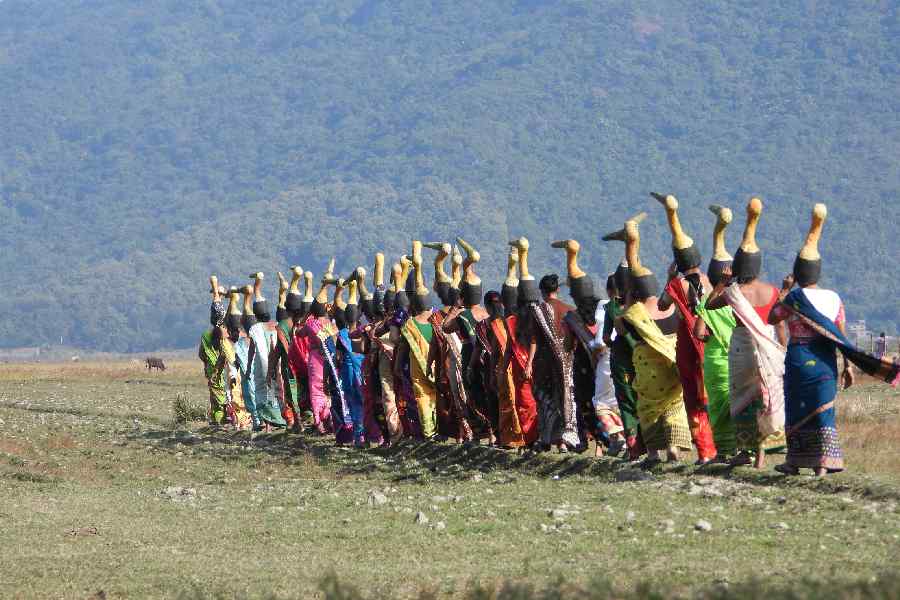
Initiating the campaign from the villages of Dadara, Pacharia and Singimari in Kamrup, Barman says that rehabilitating these birds “became my mission.” She shelved her doctoral thesis for a decade to focus on saving the storks and is happy that the Kulhati and the Morigaon wetlands now have a large nesting colony. By 2030, she envisions the population reaching 5,000 birds.
Interestingly, the first emblem of the Calcutta Municipal Corporation, a coat of arms created in 1896, sported two adjutant storks, each holding a serpent in its beak. It makes one wonder whether the peripheral East Kolkata Wetlands, a Ramsar site, has been able to contain the rapid decline in flora and fauna following unchecked urbanisation, encroachment and burgeoning real estate sector. https://www.telegraphindia.com/opinion/wings-of-change-conservationist-purnima-devi-barman-leads-hargila-army-to-save-endangered-storks-prnt/cid/2089937 (21 March 2025)
Can decentralized wastewater treatment plants solve water crisis A decentralised approach—where wastewater is treated at the source before being reused—offers a more scalable, cost-effective, and sustainable solution. This model eliminates the inefficiencies of centralised plants and ensures a consistent quality of treated water, which is critical for industrial reuse. Unlike conventional chemical or biological treatment systems, decentralised, electrically driven wastewater treatment systems can operate with minimal footprint and automation, reducing operational errors and improving reliability. More importantly, they offer industries a tangible economic benefit: reduced freshwater costs, lower discharge expenses, and compliance with increasingly stringent environmental norms. https://timesofindia.indiatimes.com/life-style/spotlight/can-decentralized-wastewater-treatment-save-indias-water-crisis/articleshow/119290671.cms (21 March 2025)
I&D wastewater management can conserve rivers & lakes? Interception and diversion (I&D) of drains offer a scalable solution to reduce river and lake pollution in India by preventing untreated wastewater discharge. This approach enhances water quality and supports sustainable water management. However, when drains carry industrial waste and contaminated runoff, treatment becomes complex, often leaving residues that limit safe reuse. Overloaded plants may struggle to remove all pollutants, compromising water quality. Effective I&D requires stricter pollution control and advanced treatment to ensure safe and sustainable water reuse. https://www.downtoearth.org.in/water/interception-and-diversion-based-wastewater-management-can-conserve-indian-rivers-and-lakes (17 Mar. 2025)
Increase in rainfall opportunity for better water management: Krishnan R Krishnan, Director of Indian Institute of Tropical Meteorology was speaking at the opening day of the Eighth International Workshop on Monsoons (IWM-8) at the institute. The four-day event is organised by IITM, Pune; ministry of earth sciences, World Weather Research Programme’s (WWRP) working group on tropical meteorology research and India Meteorological Department (IMD). The workshop will be focusing on “Advancing the understanding and prediction of monsoons and their impacts in a changing climate”.
“Since 2013, the country is experiencing an increased trend in rainfall. In the upcoming decade too, India is likely to experience the same phenomenon. This year also we are seeing the warming trend globally. And more evaporation could lead to more rainfall in the upcoming monsoon season,” Krishnan said. https://www.hindustantimes.com/cities/pune-news/increase-in-rainfall-due-to-global-warming-opportunity-for-better-water-management-krishnan-101742237165774.html (18 Mar. 2025)
Company creating a circular economy for wastewater Indra Water’s decentralised technology leverages ionic reactions to remove pollutants—including a wide range of unwanted substances, heavy metals, suspended solids, phosphorus, fats, oil, grease, pathogens and dissolved organics, among others—from wastewater. Its proprietary water treatment solution is a plug-and-play solution, which takes 90 percent less space compared to existing solutions and recovers up to 99 percent of the treated water.
The Mumbai-based company focuses on treating wastewater from industries like textiles, steel, and pharmaceuticals, as well as sewage from hotels and commercial buildings. Since the investment (Jan. 2024), Indra Water has scaled up its treatment capacity from 575,000 litres per day to 3.75 million litres per day, achieving a 7x to 8x growth in eight months. It plans to add another 30 million litres of water per day treatment systems over the next 12 months.
According to Indra Water, India treats water without considering its reuse. Water treatment and reuse should be driven by the end-use application rather than a one-size-fits-all approach. For example, a paper and pulp facility can reuse water with a certain level of pollutants, but a hotel requires much cleaner water.
To address this, Indra Water advocates for a graded system that takes into account the pollutant load and the end-use application. This would create a fairer system, where companies are charged based on the actual services provided, rather than just the volume of water treated.
“We are actively engaging with the government to establish new standards that are relevant to India’s current needs. Agencies like the Bureau of Indian Standards should play a more active role in standardising frameworks for water treatment and reuse,” adds Nayak. https://www.forbesindia.com/article/leadership/indra-water-creating-a-circular-economy-for-indias-wastewater/95556/1 (17 Mar. 2025)
Futuristic ideas like atmospheric water, rain energy Dr Visakh Vaikuntanathan, Assistant Professor, Department of Mechanical Engineering, Shiv Nadar University, Delhi–NCR, and his team have been working on a novel concept of harnessing rain energy by quantifying the amount of energy contained in rainfall of different intensities, light, medium, heavy, extremely heavy etc. “The energy ‘lost’ in the form of sound when rain impacts on surfaces is palpable,” says Vaikuntanathan and explained the challenges in the process of harvesting this energy, which differs with the type of rainfall.
His team says the ‘all-weather’ cells – which work as a ‘solar cell’ when the sun shines and as a ‘rain cell’ when it is rainy – can be integrated with rooftops, sidewalks, drainage systems etc. to extract energy from raindrops as well as water ow in existing rainwater harvesting systems. “Ongoing studies are focused on improving this framework for estimating the rain energy contained in different rainfall types, and creating a rain energy map based on the rainfall data,” Vaikuntanathan adds.
A paper in the journal Nature earlier in the month points out how a sorption-based atmosphere water harvesting (SAWH) irrigation system can “revolutionise agriculture, making it geographically and hydrologically independent”. However, not just for irrigation, atmospheric water generation can be an eco-friendly and reliable drinking water solution for industries, corporates, and communities using innovative technology, says Navkaran Singh Bagga, CEO and founder of Akvo Atmospheric Water Systems.
His company is into atmospheric water generation in 15 countries using sustainable water technology, in this case, tapping the atmospheric humidity. It recently announced the commercial launch of its Water-on-Want (WoW) initiative for corporates in Tamil Nadu, Karnataka, Maharashtra and Gujarat. Bagga says, “The minimum daily offtake is 500 litres per day (LPD) and it works on OPEX BOOT (Build Own Operate Transfer) model with no initial cash investment.” Technology is helping in other ways too and is especially useful in assessing and analysing the Himalayan glaciers situated in remote, high-altitude areas. https://www.deccanherald.com/science/researchers-look-into-futuristic-ideas-like-atmospheric-water-rain-energy-3458182 (22 March 2025)
‘पानी पंचायत का लोकार्पण विश्व जल दिवस World Water Day 22 मार्च के मौके पर दिल्ली में “पानी पंचायत पर्व” का भव्य आयोजन राष्ट्रकवि रामधारी सिंह दिनकर स्मृति न्यास के तत्वावधान में होने जा रहा है। इस महत्वपूर्ण आयोजन की अध्यक्षता भूतपूर्व मानव संसाधन विकास मंत्री डॉ. मुरली मनोहर जोशी करेंगे। कार्यक्रम का शुभारंभ दोपहर 2.30 बजे से होगा, जिसमें ‘पानी पंचायत’ पुस्तक का लोकार्पण किया जाएगा। यह पुस्तक तरुण भारत संघ Tarun Bharat Sangh’s (TBS) के 50 वर्षों के जल संरक्षण कार्यों की सत्यकथा को समेटे हुए है। इस अवसर पर पहले हिस्से में पानीदार समाज बनाने के लिए पानी पंचायत विषय पर राष्ट्रीय परिसंवाद होगा। दोपहर 3.30 से 5 बजे “हिमालय और दक्षिण-पूर्व एशिया में जल संकट” विषय पर चर्चा होगी। https://www.spsmedia.in/current-news/pani-panchayat-festival-organized-on-world-water-day-pani-panchayat-the-story-of-50-years-of-water-conservation-work-of-tarun-bharat-sangh-will-be-launched/ (17 Mar. 2025)
Haryana Catch the Rain-2025 launched The campaign was inaugurated by Union Jal Shakti minister CR Patil, and CM Nayab Singh Saini at Tau Devi Lal Stadium. As part of the campaign launch, several water conservation projects were inaugurated across Haryana. Additionally, the foundation stone for 400 artificial groundwater recharge structures was laid, aimed at restoring depleting groundwater levels. In Ferozepur Jhirka, ranneywell-based water supply projects were inaugurated in 52 villages and five dhanis. Similarly, in Pataudi assembly constituency, 24 villages and nine dhanis saw the launch of canal-based drinking water supply projects.
To enhance irrigation efficiency, Solar Power Integrated Micro Irrigation Projects were inaugurated in Devdhar and Begumpur villages of Yamunanagar, Julani Khera of Kaithal, Pahari of Bhiwani, Akoli and Mandlana of Mahendragarh. In a development aimed at resolving Haryana’s water concerns, Union minister of Jal Shakti, CR Patil, announced that a meeting with the CMs of the concerned states will soon be held to ensure that Haryana receives its rightful share of water. https://www.hindustantimes.com/cities/chandigarh-news/jal-shakti-abhiyan-catch-the-rain-2025-launched-from-haryana-on-world-water-day-101742671206971.html (23 March 2025)
GROUNDWATER
Report Can India’s MSP Strategy Avert a Groundwater Crisis -1? This is part one of a three-part series that investigates the dominance of wheat, its consequences and whether jowar (a millet) can become a more sustainable option. A six-month investigation by contributors to Newsclick shows how wheat, fuelled by decades of State-backed incentives, dominates farmlands across India, while millets like jowar remain sidelined despite their low water requirements and outsized nutritional benefits. Farmers continue to prefer water-intensive wheat cultivation, driven by entrenched market systems, better profitability and government support mechanisms heavily skewed in their favour. Many Indians once ate a millet-based diet. Over time, it faded from farms and plates. As water scarcity looms, one question persists: Can India turn back time and shift from water-intensive wheat back to millets like jowar to ensure future food security? https://www.newsclick.in/wheat-vs-jowar-can-indias-msp-strategy-avert-groundwater-crisis-1 (17 Mar. 2025)
Cost of wheat to Jowar shift 2 Wheat thrives on assured irrigation, but its water-intensive nature is pushing India’s groundwater reserves to the brink. As water scarcity deepens, the cost of favouring wheat over millets may soon become too high to sustain. In Part 2 looks at the environmental perils of wheat cultivation and how it might reverse the fortunes of wheat and millet, if water lasts long enough. Often, farmers grow wheat without fully accounting for the ecosystem’s limitations. When water resources fail to support wheat cultivation, they are forced to consider alternatives like jowar, even if they are reluctant to switch. As irrigation challenges worsen, farmers will inevitably need to rethink their crop choices. The pressing question remains: what will they grow when water is no longer sufficient for wheat? https://www.newsclick.in/water-security-cost-wheat-jowar-shift-2 (18 March 2025)
Weak policies failed millets, favored wheat 3 Millet takes longer to grow, has lower yields, and carries higher risks, making it an unappealing choice for farmers seeking economic stability. But it is a very appealing choice for agricultural policy experts trying to chart a course to a resilient agricultural policy for India. Yet, as water shortages worsen and climate pressures mount, policy failures are closing off one of the only viable paths for India to achieve a viable agricultural future.
– Part 3, examines why millets remain ‘ghaate ka sauda’ —a business of loss. Major failings of the government programme to increase millet adoption include weak procurement, inconsistent incentives, and, most importantly, a lack of real financial backing. https://www.newsclick.in/how-weak-policies-failed-millet-favoured-wheat-3 (19 March 2025)
Uttarakhand State ‘rice bowl’ hit as groundwater drops 70ft in past decade Udham Singh Nagar, the agricultural heartland, famed as the state’s “rice bowl,” is facing an escalating crisis. According to the CGWB, two areas in the district – Jaspur and Kashipur – have been classified as “critical,” with Rudrapur, the district headquarters, witnessing an alarming 4-m annual groundwater decline. Over the past decade, the water table has dropped by 70ft, as per estimates.
Spanning 3,055 sq km in the Terai region, the district produces over 4.4 lakh metric tonnes of rice annually across 1.5 lakh hectares (ha), alongside wheat and sugarcane. Yet, its 1.5 lakh farmers are battling adversities including a sharp groundwater decline, extreme weather conditions and delayed payments, which threaten their livelihoods.
To address the groundwater crisis, district magistrate Nitin Singh Bhadauria recently enforced a ban on summer paddy cultivation without prior permission as paddy cultivation depletes groundwater resources. Farmers are being encouraged to shift to maize or pulses, but the transition is proving difficult. “Maize fetched just Rs 600 per quintal last year—half the minimum support price (MSP). Who will buy it?,” Ramesh said. https://timesofindia.indiatimes.com/city/dehradun/farmers-in-ukhands-rice-bowl-hit-as-groundwater-drops-70ft-in-past-decade/articleshow/119351421.cms (23 March 2025)
Chhattisgarh Groundwater depletion issue raised in Assembly BJP senior MLA Dharamjeet Singh raised the issue of depletion of ground water level in rivers in the state through a call attention motion in the House on the 17th day of the budget session of legislative assembly, on Friday (March 21). The issue raised has been answered in the house by Deputy CM Arun Sao. The Minister said that under the catch the rain program of Jal Shakti Abhiyan, rainwater harvesting work is underway in the state. 68,685 works have been done under water conservation and rainwater harvesting programmes. 32,355 ponds have been renovated. 15,407 works have been completed for filling water. 38,149 works have been done under the watershed. 16,59,217 works have been completed for nursery and plantation, he added.
Assembly Speaker Dr Raman Singh, who was in the chair, directed CM Vishnu Deo Sai to hold a high-level meeting with the senior officers within a week to meet the challenges of water crisis in the summer. The Assembly Speaker asked the Chief Minister to direct the Collectors of the state to hold meetings with local representatives and chalk out a working plan for addressing the water crisis in the summer. https://www.freepressjournal.in/india/ground-water-depletion-issue-raised-in-chhattisgarh-assembly (21 March 2025)
Punjab Keep groundwater sustainability at the forefront: Expert Advocating economic stimulus and future security while combating insurmountable agrarian challenges, the two-day Kisan Mela kicked off at Punjab Agricultural University (PAU) on Friday amidst the active participation of scores of farmers from Punjab and adjoining states as well as a US delegation of professors and students. https://www.tribuneindia.com/news/ludhiana/keep-groundwater-sustainability-at-forefront-expert/ (22 March 2025)
Haryana We must address groundwater depletion As the state aspires to become a major industrial and economic hub, ensuring water security must be a priority (Rao Inderjit Singh https://indianexpress.com/article/opinion/columns/haryanas-groundwater-depletion-crises-9899930/ (23 March 2025)
Report Groundwater, the invisible gift Groundwater is a crucial but often overlooked resource that sustains India’s agriculture, industries, and drinking water supply. Stored in underground aquifers it serves as the lifeblood of the nation. The monsoon plays a key role in replenishing these aquifers, but the delicate balance between extraction and recharge is increasingly under threat. Managing this invisible yet vital resource is essential to ensuring long-term water security for future generations.
The National Groundwater Atlas provides a comprehensive assessment of groundwater availability across India, revealing stark regional disparities. While states like W Bengal & Bihar benefit from fertile alluvial aquifers and river-fed reserves, excessive withdrawal—especially in Punjab for water-intensive crops like rice—has led to significant depletion. https://www.thehindu.com/children/groundwater-the-invisible-gift/article69353106.ece (22 Mar 2025)
URBAN LAKES, WETLANDS
Hyderabad Lake revival may not help quench thirst Experts caution that lake rejuvenation alone may not be enough to replenish Hyderabad’s depleting water table. They stress the need for a multi-pronged approach, integrating urban planning strategies that enhance water absorption and conservation.
– Three decades ago, the combined percolation capacity of lakes and open porous land areas with soil that allows water to seep through easily was around 60%, while concretised spaces accounted for only 40%, shared TV Ramachandra, a researcher from the Indian Institute of Science, Bengaluru. “With urbanisation accelerating, the concretised area now exceeds 75%, leaving less than 25% of land available for percolation,” he said.
– According to National Remote Sensing Centre (NRSC) data, between 1979 and 2024, Hyderabad lost 61% of its lake area, with nearly 40 of its 185 notified lakes drying up completely. These include Ibrahim Cheruvu, RK Puram, and Gurram Cheruvu. Soakaways“Measures such as permeable pavements and soakaways pits filled with gravel or porous materials that allow rainwater to percolate into the ground — can significantly boost groundwater recharge,” said B Malav, an urban planner from Rajasthan. Many cities, he noted, are also exploring the ‘sponge city’ model, which focuses on absorbing, storing, and reusing rainwater. “This model includes rain gardens — vegetated depressions that collect rainwater from streets and rooftops, allowing it to seep into the ground rather than flowing into drains,” Malav said. Other featuresatures of sponge cities include bioswales and urban wetlands — landscaped drainage channels that filter stormwater.
Another key solution, experts say, lies in restoring the city’s historic water-holding structures, such as stepwells and Bowlis. “In ancient times, people relied on natural indicators to identify waterrich areas. They then dug stepwells and Bowlis,” said Kalpana Ramesh, a conservationist leading efforts to revive Hyderabad’s stepwells. Hyderabad is home to over 6,000 Bowlis and more than 100 stepwells. While nearly 20 have been successfully restored, many others are in various stages of revival. “Bansilal Stepwell, which was recently restored, can hold 22 lakh litres of water. A 900-year-old stepwell near Shamshabad remains fully functional, with a storage capacity of 30-35 lakh litres,” Kalpana said, adding, “Other revived stepwells include those in Kokapet (15 lakh litres), Kondapur (9 lakh litres), HPS, and ITC Kakatiya, both of which can store over 10 lakh litres each.” https://timesofindia.indiatimes.com/city/hyderabad/lake-revival-welcome-but-may-not-help-quench-hyderabads-thirst/articleshow/119335224.cms (22 Mar 2025)
Bengaluru Lake activists call out govt’s apathy towards conservation TOI interacted with lake enthusiasts and govt officials, who pointed out the biggest threats to be encroachments, pollution and apathy. Lake activists emphasised on increased public involvement and tighter environmental laws to protect these vital ecosystems. Joy VR, secretary and co-founder of Sarjapur Resident Welfare Association: “Despite us raising issues related to lakes (encroachments, sewage entering), authorities turn a blind eye, which is one of the biggest obstacles. Currently, no efficient agency protects waterbodies. From MLAs to panchayat members, their focus is on commercially beneficial projects, not conservation. Allowing lakes to die serves long-term vested interests, forging deals with land mafias and builders.”
Ram Prasad, founder of Friends of Lakes: The govt has to involve existing lake conservation groups in governance rather than selecting participants randomly. Lakes must not be treated in isolation — the Rs 3,000 crore allocated for nala rejuvenation should be linked to improving lake water quality, which is currently ignored while lakes are turned into concrete tanks. The Karnataka Tank Conservation and Development Authority (KTCDA) has legal power but lacks staffing and capacity. If empowered, it can restore lakes.”
Priyanka Jamwal, water quality scientist, ATREE: “Lake restoration initiatives are hindered by competing interests of multiple govt and non govt agencies. Unscientific alterations, like raising outlet levels for groundwater recharge, disrupt inflow and cause backflow issues. Poorly designed past interventions add to restoration challenges. We rely on impractical US and European water quality standards, lacking localised benchmarks. A coordinated approach is needed with clear, realistic targets as lakes sustain biodiversity, fisheries and groundwater recharge, crucial for Bengaluru city.” https://timesofindia.indiatimes.com/city/bengaluru/lake-activists-call-out-govts-apathy-towards-conservation/articleshow/119352706.cms (23 March 2025)
₹238cr NDMF grant: BBMP plans 47 flood-mitigation works The Bruhat Bengaluru Mahanagara Palike (BBMP) has proposed 47 projects, totaling Rs 247.25 crore, to provide structural solutions for flood-hit areas in the city. The project is largely funded by the National Disaster Mitigation Fund (Rs 238.72 crore) as part of the Urban Flood Risk Management Programme (UFRMP), which was recommended by the 15th Finance Commission. The project is expected to be completed within a year.
According to the action plan, most of the projects focus on stormwater drains, including the reconstruction of vents, redesigning retaining walls in flood-prone areas, creating percolation pits, and fencing drains to prevent the dumping of garbage. The civic body recently finalised the action plan after consulting with the revenue department, which is overseeing the project.
A total of Rs 75 crore has been earmarked for BBMP’s lake department. Funds have been allocated for the development of eight lakes: Chikkabegur (Rs 10 crore), Hebbal (Rs 20 crore), Nagawara (Rs 20 crore), Chikkabellandur (Rs 10 crore), Kalkere (Rs 2.5 crore), Arekere (Rs 2.5 crore), Ulsoor (Rs 4 crore), and Sompura (Rs 6 crore). Some of the works will include the construction of wetlands, sluice gates, and de-silting. This is the largest grant the lake department has received in a long time. https://www.deccanherald.com/india/karnataka/bengaluru/armed-with-rs-238-crore-ndmf-grant-bbmp-plans-47-flood-mitigation-works-3457632 (22 March 2025)
Chennai NGT stays SPCB’s order asking CPCL to pay Rs 73-crore for oil spill The amount Rs. 73.68 crore comes as a compensation for socio-economic and environmental damages caused by an oil spill in Ennore Creek in December 2023. The NGT directed CPCL to deposit Rs 19 crore—50% of the environmental damage cost of Rs. 38.24 crore—within four weeks as a bank guarantee. The NGT also issued a notice to the TNPCB and adjourned the matter to April 30 for further hearing. https://www.newindianexpress.com/states/tamil-nadu/2025/Mar/20/ngt-stays-tnpcbs-order-asking-cpcl-to-pay-rs-73-crore-for-oil-spill (19 March 2025)
Nanmangalam Lake faces an ecological emergency

Contaminated by sewage, garbage and illegal water extraction, Nanmangalam Lake has become a prime example of a mismanaged waterbody. https://citizenmatters.in/nanmangalam-lake-chennai-pollution-sewage-groundwater-extraction/ (24 March 2025)
GB Nagar Efforts on to reclaim all wetlands, Admin tells NGT During a previous hearing, the NGT had directed the administration to provide precise details on 1,018 wetlands, including their geo-coordinates, extent of encroachments, legal proceedings, and restoration efforts. Additionally, it ordered an assessment of other wetlands listed in the Wetland Atlas but not part of the 1,018 identified sites.
A survey in Sadar tehsil identified 245 ponds, of which 48 were found to be encroached upon by illegal road constructions, religious structures, private dwellings, and boundary walls.
Dadri tehsil reported a total of 480 ponds, of which 453 have already been restored. However, 27 ponds continue to suffer from unauthorised residential and commercial encroachments, some of which are over three decades old.
In Jewar, 293 ponds were found with 264 of them successfully restored. The remaining 29 ponds face substantial encroachments, including agricultural expansions and infrastructure development.
Similar reports have been sought from Noida, Greater Noida and Yamuna Expressway authorities. The matter will be next heard on July 17, 2025. https://www.hindustantimes.com/cities/noida-news/efforts-on-to-reclaim-all-wetlands-gb-nagar-admin-tells-ngt-101742406425080.html (20 March 2025)
URBAN WATER
Bengaluru Book GPS-tracked Cauvery water tankers via phone -In a bid to regulate the water tanker industry and provide relief to residents facing water scarcity, the Bangalore Water Supply and Sewerage Board (BWSSB) is set to launch a web-based mobile adaptive application that will allow citizens to book water tankers online at fixed rates. The BWSSB has hired 200 tankers for the initiative, with capacities of 6,000 and 12,000 litres. These tankers are expected to complete up to eight trips per day, operating on a “no profit, no loss” model.
-The cost of the water and delivery charges will be pre-determined by the software, preventing arbitrary pricing by private operators. The project will be introduced in stages, starting with 50 water connect points in the first phase, with more being added progressively. Unlike private tankers that often supply untreated borewell water, the BWSSB’s fleet will exclusively distribute Cauvery water sourced from 100 designated water connect points across the city. The water will meet BIS-certified standards, ensuring it is safe for consumption. https://www.hindustantimes.com/cities/bengaluru-news/bengaluru-residents-can-now-book-gps-tracked-cauvery-water-tankers-via-phone-report-101742266208122.html (18 March 2025)
Mangaluru MCC warns of heavy fines, jail for diverting rainwater into sewage The Mangaluru City Corp has issued a stern warning to residents, apartment owners, businesses, and industries against diverting rainwater into the underground drainage system. Violators will face legal action along with hefty fines, MCC commissioner Ravichandra Nayak stated in an official release. Instances of rainwater being discharged into the sewage network have been observed in some areas. This has resulted in excess water overloading the drainage system, causing sewage to overflow from manholes, creating inconvenience for the public, the commissioner said.
Connecting rainwater to the underground drainage system is strictly prohibited. Any unauthorized connection from buildings to the sewage system or manholes must be immediately removed. MCC officials will conduct site inspections to identify such violations, and strict legal action will be taken against those who fail to comply, he warned. If found guilty of diverting rainwater into the sewage system, property owners may face a fine of Rs 1 lac and up to six years in prison under the Pollution Control Act. Additionally, under the Environmental Protection Act, violators can be fined Rs 1 lac and face five years of imprisonment, Nayak cautioned.
First-time offenders will be fined Rs 5,000. If the unauthorized connection is not removed even after a notice, an additional fine of Rs 1,000 per day will be imposed. MCC may also disconnect the water supply of violators. The unauthorized connection will be removed by the corporation at the owner’s expense, with an additional penalty of Rs 25,000. https://www.daijiworld.com/news/newsDisplay (17 Mar. 2025)
Erode Residents allege industrial waste contamination in water sources Residents and farmers in Kolathupalayam and surrounding areas, on Friday (March 21), alleged that water sources in their locality, including farm wells and a channel, have been contaminated due to dumping of industrial waste at Attayampalayam in the Corporation’s Ward 5. On Thursday (March 20), residents noticed a change in the colour of water in farm wells and a channel in their area and alerted the Erode Corporation. They alleged that lorries carrying industrial waste, likely from a steel plant operating in SIPCOT, Perundurai, had dumped the waste into the channel, leading to contamination. Officials sought the intervention of the SPCB, which visited the area and collected water samples.
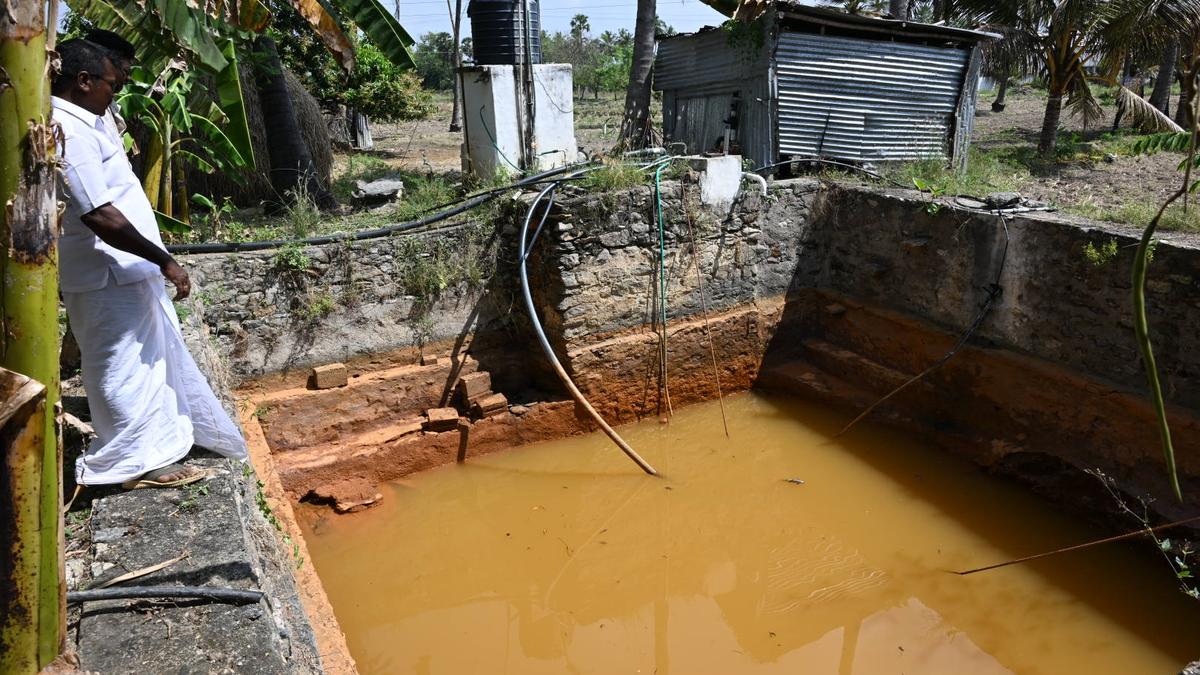
Meanwhile, two lorries that dumped the waste were seized by the Chithode police, and the drivers and cleaners are being questioned. Residents said the water in the channel passes through Kolathupalayam, reaches Kanirowther Lake, then flows into Pichaikaran Pallam Odai, and finally enters River Cauvery . They demanded the removal of toxic substance from the water, as the channel recharges farm wells, bore wells, and other water sources. https://www.thehindu.com/news/cities/Coimbatore/residents-of-kolathupalayam-in-erode-allege-industrial-waste-contamination-in-water-sources/article69357213.ece (21 March 2025)
Hyderabad ‘22,000 households book 2.84 lakh tankers’ Of the total 13 lakh Consumer Account Numbers (CANs) under Hyderabad Metropolitan Water Supply & Sewerage Board’s (HMWS&SB) service, only about 42,000 households or CANs rely on water tankers in the city. Further, of these consumers, 22,000 households are repeat consumers or those who book 90% or 2.84 lakh tankers of the total water tankers supplied, Board Managing Director Ashok Reddy said on Saturday (March 22). And in a 75-day period, 500 people booked 31,000 tankers.
“When these houses were surveyed, we found that they do not have a rainwater harvesting pit. This situation wouldn’t have arisen if they had a functioning pit in their premises,” he said. Mr. Reddy was speaking at Smt. Durgabai Deshmukh Government Women’s Technical Training Institute here observing United Nations World Water Day. “Excessive water consumption in Hyderabad drives the high demand. Because there isn’t sufficient groundwater in Hyderabad, we get water here from a distance of up to 150 km,” he said. Mr. Reddy, on the occasion, flagged off a campaign vehicle on water conservation. As part of the 10-day campaign, the board decided to conduct awareness programs and activities in all the divisions. https://www.thehindu.com/news/national/telangana/22000-households-book-284-lakh-tankers-in-hyderabad/article69361996.ece (22 March 2025)
Pune PMC to use robots to detect contamination, leaks These robots, equipped with cameras, could go below the ground up to a depth rating of 3 metres and cover a distance of 300 metres, officials said, adding the technology was recently experimented at Kasba Peth. Such a system is already used by the Sangli Miraj-Kupwad Corporation (SMKC).
According to activists, such system should be put to use for resolving the problem of illegal water connections in the city. “Action against such unauthorised connections are not taken because of local politicians and also some civic officials. The administration must act against them while detecting other issues of the water supply,” Vivek Velankar of Sajag Nagrik Manch, a citizens’ group, said. PMC data shows there are nearly 4.5 lakh illegal and 4 lakh legal water taps. PMC announced an amnesty scheme, appealing to those with illegal connections to pay a one-time penalty and get them regularised. However, only 500 of them came forward. https://timesofindia.indiatimes.com/city/pune/pmc-to-use-robots-to-identify-water-contamination-detect-leaks-in-pipelines/articleshow/119271033.cms (21 March 2025)
Gurugram Residents protest against sewage charges -According to residents, they have been charged for sewage services from the day their domestic water connections were activated, even though no sewage infrastructure has been developed in the area.
Due to the lack of a proper sewage disposal system, societies in these sectors are being forced to spend significant amounts on managing and discharging excess treated wastewater. Many residential communities are hiring private tankers to transport treated water, further increasing financial strain. https://www.hindustantimes.com/cities/others/residents-of-new-gurugram-protest-against-sewage-charges-seek-waiver-from-gmda-101742493603348.html (21 Mar 2025)
Delhi 22,000 illegal borewells identified: DJB tells NGT In a report dated March 19, DJB told the tribunal that illegal borewells were to be sealed by the district magistrates, and that it was pursuing the matter with the officials. Of the 22,010 illegal borewells, the highest number — 9,128 — was found in north-west Delhi, followed by south-west Delhi that had 6,926 illegal borewells. The lowest number was in New Delhi: 85.
The report said DJB had received 2,610 applications for NOCs for borewells. Of these, 1,119 applications were granted NOC, and 900 were rejected, while the remaining are being processed. The report said the highest number of borewells to get NOCs — 455 — were in south-west Delhi, followed by 384 in New Delhi. The DPCC has told NGT that it has transferred Rs 19.62 crore, including the environment compensation received for illegal borewells, to the divisional commissioner for revival of water bodies. https://timesofindia.indiatimes.com/city/delhi/22000-illegal-borewells-identified-more-than-13000-of-them-sealed-djb-tells-ngt/articleshow/119351950.cms (22 March 2025)
WATER POLLUTION
IWP Toxic blooms invade India’s waters When people at the beach in Puducherry noticed the sea turning red recently, it raised safety concerns and prompted official investigations. The reason was eventually determined to be a Harmful Algal Bloom (HAB), a phenomenon made worse by pollution, climate change, and unregulated wastewater flow, according to officials. An alarming increase in harmful algal blooms (HABs), which are toxic algal overgrowths that threaten ecosystems and public health, is occurring in India’s lakes, rivers, and coastal waterways in India. https://www.indiawaterportal.org/water-quality-and-pollution/pollution/toxic-blooms-invade-indias-waters (15 Mar. 2025)
JJM/ RURAL WATER SUPPLY
Report JJM Hits & misses -Official data show that functional household tap connections have continued to increase in recent times, but at a diminishing rate. https://www.thehindubusinessline.com/opinion/jal-jeevan-mission-hits-and-misses/article69354503.ece (20 March 2025)
Centre Action taken against officials in 12 states for irregularities: Minister Admitting that some of the complaints of “wrongdoing” in the Jal Jeevan Mission were genuine, Jal Shakti Minister C R Patil Friday informed Lok Sabha that action had been taken against the officials involved in 12 states. https://indianexpress.com/article/india/action-taken-against-officials-in-12-states-for-irregularities-in-jal-jeevan-minister-9899332/ (22 March 2025)
Jammu & Kashmir Speaker announces House panel to probe ‘bungling’ in JJM Following concern expressed by the members of National Conference, Congress and few members of the BJP, speaker of the J&K legislative assembly, Abdul Rahim Rather, on Saturday (March 22), announced to constitute a House panel to probe alleged bungling in Jal Jeevan Mission. He also referred to similar demand raised earlier during the ongoing session. The speaker, however, did not give broader contours of the house panel.
The alleged bungling came up during a discussion on grants held by PHE minister Javed Ahmed Rana. While Rana stated that projects implemented under Jal Jeevan Mission were all in public domain, BJP member Balwant Singh Mankotia, NC member Tanvir Sadiq, BJP member Sunil Bhardwaj and few Congress members claimed wrongdoings in the implementation of Jal Jeevan Mission project. Leader of opposition Sunil Sharma said that the house should first debate the issue before a panel was announced.
In August 2023, a senior Dalit IAS officer had flagged the scam before the then Union home secretary AK Bhalla. In his complaint Ashok Parmar had stated that he intimated LG Manoj Sinha and then J&K chief secretary AK Mehta about the dismal status of implementation of Jal Jeevan Mission vide his letter dated July 20, 2022. While Parmar claimed the scam was of ₹13,000 crore, additional chief secretary Shaleen Kabra had denied any scam or financial irregularity in implementation of Jal Jeevan Mission (JJM) in the union territory. https://www.hindustantimes.com/cities/chandigarh-news/jk-assembly-speaker-announces-house-panel-to-probe-bungling-in-jal-jeevan-mission-101742672828393.html (23 March 2025)
Madhya Pradesh According to this ground report by Bhaskar, in 13 districts of Bhopal, Gwalior, Bhind and Narmadapuram divisions in MP, it was claimed that Jal Jeevan mission has taken water to har ghar jal in 3794 villages, but in 1722 villages even infrastructure is not fully in place. (Dainik Bhaskar 22 March 2025)

AGRICULTURE
Uttar Pradesh A case successful pilot scale strawberry cultivation in Bahraich villages in UP. https://www.civilsocietyonline.com/livelihoods/bahraich-gets-a-big-strawberry-boost/ (13 Mar 2025)
SUMMER 2025
Maharashtra Reservoirs witness 7% decline in storage over 15 days According to the Central Water Commission, India’s 150 key reservoirs are regularly monitored to assess the water storage situation. Among them, Maharashtra’s 32 major reservoirs currently hold about 58 per cent of their total capacity, compared to 60% last year. Over the past fortnight, Maharashtra has experienced a 7 per cent decline in water storage. The Koyna dam has 69 per cent water storage, significantly higher than the 60 per cent recorded last year. https://www.news18.com/india/as-temperatures-rise-maharashtras-major-reservoirs-witness-7-pc-decline-in-water-storage-over-15-days-9263993.html (17 Mar. 2025)
MONSOON 2025
The APEC Climate Centre in South Korea, in its latest (March 17) outlook, has maintained normal to above-normal rainfall prospects for India during April-June and July-September (pre-monsoon and southwest monsoon). However, it also hinted at regional disparities on a month-to-month basis. https://www.thehindubusinessline.com/economy/agri-business/normal-monsoon-for-india-but-monthly-variations-likely-south-korean-agency/article69343356.ece (18 March 2025)
URBAN FLOODS
Study Biggest Indian cities became wetter in 4 decades According to a report from Water Aid last week, eleven Indian cities (Ahmedabad, Bangalore, Chennai, Delhi, Hyderabad, Kolkata, Kozhikode, Lucknow, Mumbai, Pune, Surat) have become wetter over the last four decades (1983-2022) and also more vulnerable to hazards. Ten of them figured in top 20 with increased wetness of the 112 cities studied worldwide.

Colombo was the top city and Surat third globally (top in India) for increasing wetness, Cairo top city in terms of drying trends. 58 of the studied cities showed wetting trend and 49 drying trend. https://www.pressreader.com/india/hindustan-times-st-noida/20250321/281977498409238 (21 March 2025)
Sayan Banerjee on FB post comment: -I have not read the report, but my experience as a thirty years of residence in Kolkata does not seem to be in line completely with the finding. Maybe the total rainfall remains similar, the distribution has gone totally haywire. During April-May, the number of Western disturbances have gone drastically low in numbers, with long spells hot and sunny days. For the monsoon period (mid june to mid Sept) which was evenly distributed with maximum rainfall during mid july-mid August is now completely changed. The distribution is completely uneven with shorter spells of heavy rainfalls and long spells of hot and sunny days. Quite good amount of rain happens in June with July and August becoming drier. Again we get to see more rain during October, often with multiple depressions over BoB. More depressions and cyclonic events are now visible. Not to mention more lightning. The flood season is also changed now. Not to mention the overall heat index (heat plus humidity) going worse.
Chennai Study calls for urgent reforms to mitigate floods and droughts A recent study by Arappor Iyakkam, an NGO, identified significant issues in Chennai’s water management system, especially the Kosasthalaiyar, Cooum, and Adyar, and implied that the city is vulnerable to floods as well as droughts. The report was submitted to government departments and the Chennai Corporation. According to a senior official of the Corporation, the measures will be reviewed and implemented wherever it is necessary.
The study says, “Chennai is significantly ill-prepared for the upcoming monsoon” and there is an urgent need for comprehensive water management reforms by the State government — such as large-scale desilting of lakes and ponds, improving rainwater harvesting infrastructure, restoring waterbodies, and ensuring sewage treatment before discharge into waterways. According to the study, Chennai’s hydrology is shaped by three major rivers — Kosasthalaiyar, Cooum, and Adyar — along with the Pallikaranai marsh, which collectively have 5,534 square kilometres in catchments. https://www.thehindu.com/news/cities/chennai/study-calls-for-urgent-reforms-to-mitigate-floods-and-droughts/article69336126.ece (17 March 2025)
ENVIRONMENT GOVERNANCE
Environmental Law Tracker: February 2025 A compilation of notable judgments/orders concerning environmental law passed during the month of February 2025. https://www.barandbench.com/columns/environmental-law-tracker-february-2025 (19 March 2025)
CLIMATE CHANGE
Report Low snowfall leading to national sports contests being cancelled Concerns about the impact of climate change on sports have also been raised internationally. On March 14, in an unprecedented move, more than 300 Olympic athletes, many of them alpine and freestyle skiers and snowboarders, wrote to the president of the International Olympic Committee, urging that the mitigation of climate change be prioritised since “rising temperatures and extreme weather are already disrupting competition schedules, putting iconic venues at risk and affecting the health of athletes and fans”.
-The athletes added, “Extreme heat is raising real concerns about whether Summer Games can be held safely in future years, and Winter Games are becoming harder to organise with reliable snow and ice conditions diminishing annually.” https://scroll.in/article/1080385/in-indias-skiing-hubs-low-snowfall-is-leading-to-national-sports-contests-being-cancelled (18 Mar. 2025)
SOUTH ASIA
Bhutan Huge cost of climate change Climate Change costs. GLOFs. Displacement of communities. Last year 72 families (500 people) from Thangza Toenchoe Chiwogs in Lunana were displaced to around 1.5 km away. They are still without basic infrastructure. In 2022 five deaths due to Jasabi floods in Lhuentse led to resettlement of entire village. https://kuenselonline.com/news/huge-cost-of-climate-change (19 March 2025)
PHPA commissions 3rd units The third 170 MW unit of Punatsangchhu HEP II was commissioned on March 19. First two units were commissioned in Dec 2024. Project launched in 2010. Estimated cost 94.5 Billion Nu. Nu 87 B have been spent so far. https://kuenselonline.com/news/phpa-ii-commissions-third-unit-adding-170-mw-to-national-grid (20 March 2025)
Japan offers 13.7 bl yen loans for HEPs Japan will provide up to about 13.7 billion yen ($90 million) in loans for three hydropower projects in Bhutan including one storage project. The construction of three stations, one in the district of Samdrup Jongkhar and two in Samtse, both bordering India, is set to start in May and is scheduled to be completed in 2029. https://english.kyodonews.net/news/2025/03/8a6be610f223-japan-offers-up-to-137-bil-yen-loans-for-bhutans-hydropower-plants.html (20 March 2025)
Nepal Upper Rawakhola HEP resume operation after compensation agreement The Upper Rawakhola Hydropower Project, which had been halted due to protests by locals demanding compensation, has resumed operations following an agreement. The project was reinstated after an all-party meeting led by Kepilasgadhi Rural Municipality Chairperson Samir Rai on March 18. The meeting concluded with an agreement to compensate landowners within 35 days. Previously, the Private and Public Property Conservation Struggle Committee had obstructed the project by diverting water from the dam back to the river, halting electricity production. https://english.onlinekhabar.com/hydropower-project-resumes-operations-after-compensation-agreement.html (19 March 2025)
Pakistan Indus delta now threatened by canals As part of a so-called Green Pakistan Initiative, the Pakistan government is seeking $6bn investment from Saudi Arabia, the United Arab Emirates, Qatar and Bahrain over the next three to five years for corporate farming, aiming to cultivate 600,000 ha of barren land, and mechanise the existing 20 million ha of agricultural land across the country. The project aims to irrigate a total of 4.8 million acres (1.9 million hectares) of barren land by constructing six canals – two each in Sindh, Balochistan, and Punjab provinces. Five of those canals will be on the Indus, while the sixth will be constructed along the Sutlej River to irrigate the Cholistan Desert in Pakistan’s most populous Punjab province.
– However, the Sutlej does bring water to Pakistan during the monsoons in India, with Cholistan historically reliant on rainfall for irrigation. “They will divert water from Indus to Sutlej through Chenab and then to Cholistan canal,” said Obhayo Khushuk, a former irrigation engineer. “You cannot build a new irrigation system depending on [monsoon] floodwater.” Corporate farming has already begun in Cholistan under the Green Pakistan Initiative, with the authorities approving 4,121 cusecs of water to irrigate 0.6 million acres (24,000 hectares) of land in the Cholistan Desert.
– Mohammad Ehsan Leghari, Sindh’s representative in the Indus River System Authority (IRSA), a regulatory body established in 1992 to oversee the allocation of water to Pakistan’s four provinces, strongly opposed the move. “From 1999 to 2024, not a single year has passed without water shortage in Pakistan, with Sindh and Balochistan provinces facing up to 50 percent water scarcity during the summer. In this situation, where will the water for the proposed canal system come from?” he asked. In a letter to the Council of Common Interest (CCI), a constitutional body authorised to resolve issues between the federal government and provinces, the Sindh government also criticised the project, saying that IRSA had no right to issue certificates of water availability. CCI is headed by the prime minister, with the chief ministers of the four provinces and three federal ministers as its members.
– According to a 2019 study by the US-Pakistan Center for Advanced Studies in Water, the Indus Delta was spread over 13,900 square kilometres (5,367sq miles) in 1833, but shrunk to just 1,067sq km (412sq miles) in 2018 – a 92 percent decline in its original area. “A delta is like an open hand and its creeks are its fingers that fall into the sea,” Sakani said. “The space between those fingers is home to millions of people, animals and other creatures, but it is rapidly shrinking.” https://www.aljazeera.com/news/2025/3/17/swallowed-by-the-sea-pakistans-indus-delta-now-threatened-by-canals (17 March 2025)
Bangladesh Sundarbans fishermen forced to pay robbers for fishing rights In the Sundarbans – home of the Bengal tiger and the world’s largest mangrove forest – fishermen are being forced to pay Tk20,000–Tk25,000 per boat each month to robber gangs in exchange for fishing rights and to avoid abduction and torture. To fish without harassment, they must purchase special tokens issued by these groups. The Daily Sun has obtained a token from the gang Sharif Bahini, which includes a contact number. Several calls to the number remained unreachable. Victimised fishermen and local government representatives report that robber activity has surged since the government changed on 5 August, taking advantage of a weakened law enforcement presence. As ransom payments and forced “fishing fees” continue to burden the already struggling fishermen, urgent government intervention is needed to restore security in the Sundarbans. https://www.daily-sun.com/printversion/details/796969 (20 March 2025)
EUROPE
Switzerland From sewage to swimming in ‘blue gold’ A key driver of that transformation was a tragedy in the mountain resort of Zermatt in 1963, when a typhoid outbreak killed three people and made 437 others ill. Soldiers were deployed and schools turned into emergency hospitals as panic spread. Pressure grew on the government to clean up the waterways, found to be the source of the outbreak. In 1971, the treatment of wastewater was written into Swiss law.
-Now Switzerland has some of the cleanest rivers in Europe. According to 2023 data from the European Environment Agency, just five of the country’s 196 bathing areas were rated as poor quality. Politicians across the spectrum agree on the need to prioritise clean water.
-And they pay for it: the government spent an average of £174 a person on wastewater treatment in 2022, compared with about £90 a person in England and Wales in the 2022-23 financial year, according to analysis by Ends Report.
-In 2016, Switzerland became the first country to enforce legislation to clean up drugs and chemicals that collect in waterways. This work is based on a precautionary principle – if something has unknown effects, err on the side of caution. “It’s just a matter of time before they cause problems,” says Mattle.
-Conventional sewage treatment works are designed to deal with organic waste but are less effective with chemicals, hence plants across Switzerland are getting an upgrade.
-Before 2016, a series of pilots found removing 80% of pollutants was the maximum amount achievable for a reasonable cost. Within the 20% of chemicals that are not removed are PFAs, known as forever chemicals. Mattle says: “The endgame is to get these substances prohibited. Very resistant pollutants should not be used anymore.” https://www.theguardian.com/environment/2025/mar/17/from-sewage-and-scum-to-swimming-in-blue-gold-how-switzerland-transformed-its-waterways-aoe (17 Mar. 2025)
SANDRP
Also see: DRP 17 March 2025 & DRP 10 March 2025
Follow us on: www.facebook.com/sandrp.in; https://twitter.com/Indian_Rivers

 SANDRP