A detailed review of functioning of Union Ministry of Environment and Forests’ (MoEF) Expert Appraisal Committee (EAC) on River Valley Projects (RVP) for 2024 by SANDRP shows that the committee or for that matter MoEF has almost non-existent rejection rate. Even when a project is not cleared, when it applies again, it gets clearance, whether the application if for stage I (Terms of Reference) or Stage II (Environment Clearance- EC) clearance. Even in some cases like Pump Storage Projects (PSP) in Western Ghats or the Hydropower projects in disaster prone Himalayas, including the disaster-stricken projects like the 1200 MW Teesta III projects in Sikkim, the scrutiny including field visits by the EAC Sub committees is minimal, not worthy calling even scrutiny.
Even in cases like the 1500 MW Warasgaon Warangi PSP in Western Ghats Maharashtra, when the project is asked to reapply due to massive increase in forest land and when details letters are sent to EAC and MoEF about the impact of the project on Community fish conservation areas, the EAC ignores its own concerns and no credible answers are available bout the concerns expressed in the letter. We are asked to be satisfied that EAC is satisfied with the secret replies of the project proponents!
Lack of transparency, independence, scrutiny, reasoned reports, lack of accountability and non-existent credible scrutiny or rejection rate has been the signature characteristics of the EAC and MoEF and 2024 is no different, even when faced by increasing, massive and intense disasters affecting projects, people and even rivers.
SANDRP Blog EAC & FAC Decisions on Dams, Hydro, Irrigation Projects in 2024 This annual overview tracks the minutes of meetings held by Expert Appraisal Committee (EAC) for River Valley and Hydropower Projects between 20 December 2023 and 31 December 2024 for consideration of Dams, Hydroelectric Power (HEP), Pumped Storage Hydro Projects (PSP) and Irrigation related proposals seeking Terms of Reference (TOR) and Environment Clearance (EC) approvals. The analysis also covers various water projects related proposals considered by the Forest Appraisal Committee (FAC) between 15 December 2023 and 26 December 2024 for Forest Clearances (FC). https://sandrp.in/2025/01/17/eac-fac-decisions-on-dams-hydro-irrigation-projects-in-2024/ (17 Jan. 2025)
HYDRO POWER PROJECTS
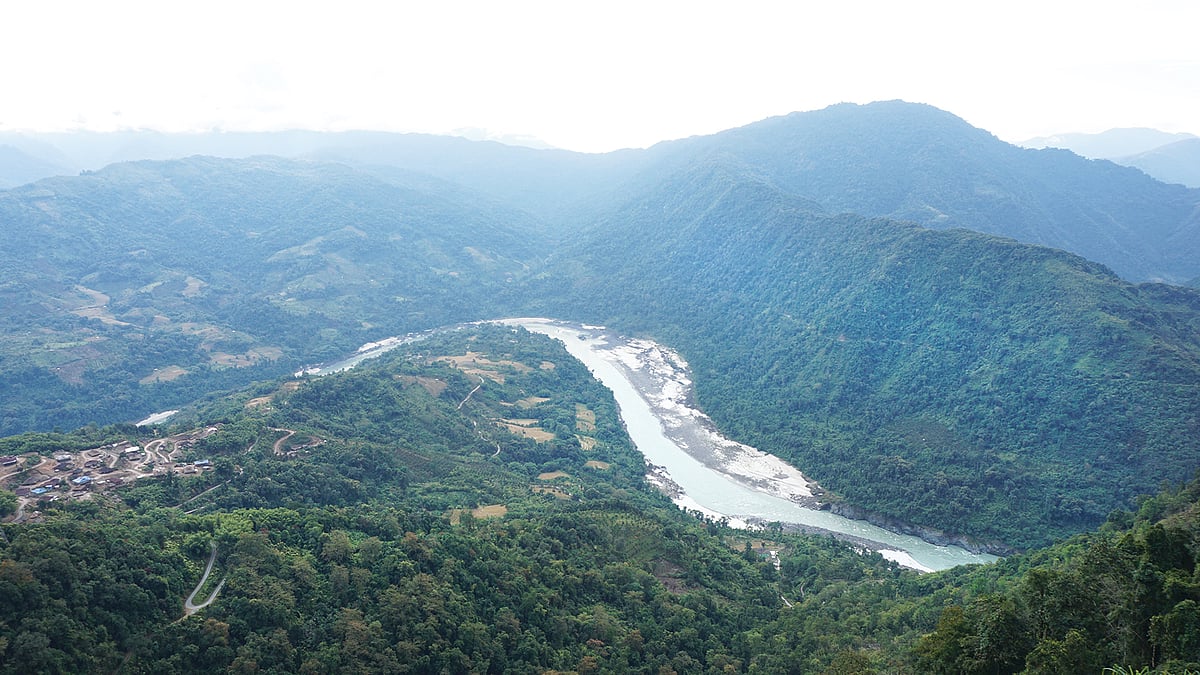
Arunachal Pradesh Capturing Siang “Our resistance began in the 1980s when the Brahmaputra Board first proposed a dam on the Siang,” says Oyar Gao, founder of Arunachal Pradesh-based non-profit Siang Peoples’ Forum. “Back then, dams were sold as a means to control floods downstream. Today, the narrative has shifted to concerns about China. But for us, it has always been about safeguarding our river and our land,” says Gao.
https://www.downtoearth.org.in/dams/capturing-siang (17 Jan. 2025)
Opinion Dam-building spree is a zero-sum game It’s time for a Himalayan Water Commission involving all countries in the region. When India expressed its reservations about the Chinese initiative to build the dam, it rightfully said the project will affect water availability in the lower riparian countries. The Chinese foreign ministry defended the plan, claiming it would not do so. The Chinese claim is false—but India’s justification for building a mega dam is also built on the wrong edifice. (C.P. Rajendran) https://www.newindianexpress.com/opinions/2025/Jan/14/dam-building-spree-is-a-zero-sum-game (14 Jan. 2025)
The implications of China’s mega-dam project Transboundary river systems are often likened by nation-states to ‘taps’, which they think can be closed or opened through hydraulic interventions such as dams within their respective nation-states. The Brahmaputra river system has been the site of planned and ongoing mega-dams projects by China, India and Bhutan, all contributing to an intense geopolitical power projection in the river basin.
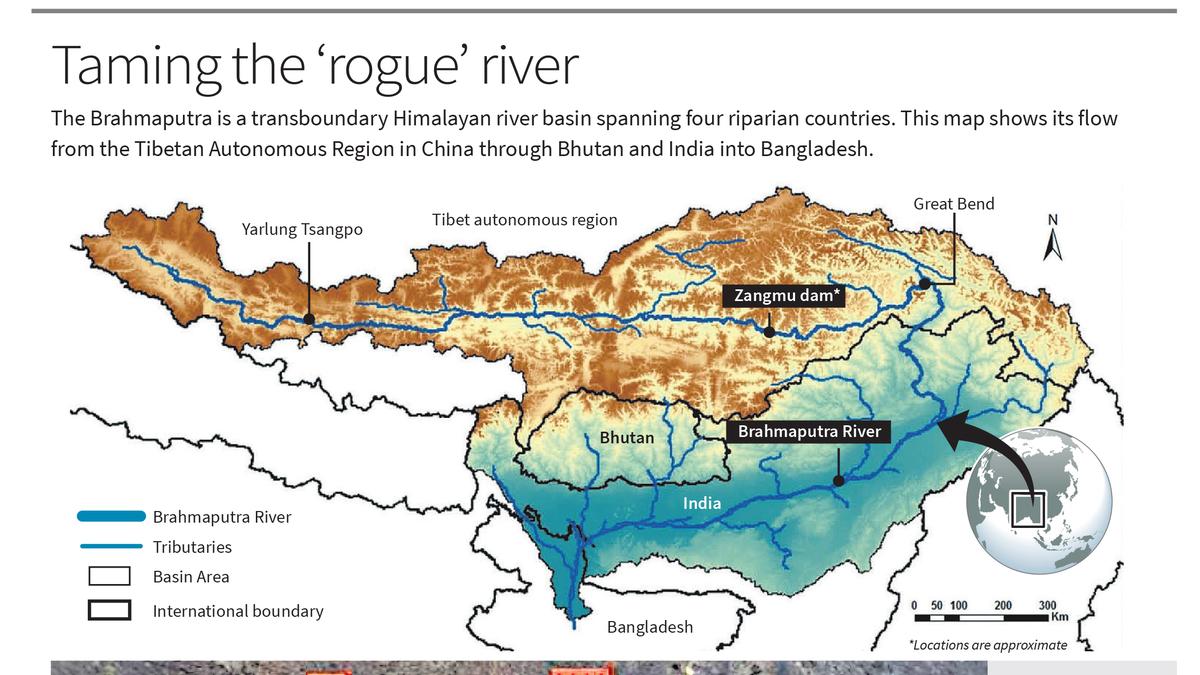
None of the riparian countries of the Brahmaputra river basin have signed the United Nations Convention on the Law of the Non-navigational Uses of International Watercourses of 2014, and hence first user-rights on river systems are non-enforceable. China and India have an Expert Level Mechanism (ELM) since 2006, to discuss outstanding issues and share hydrological data, but do not have a comprehensive bilateral treaty to govern shared transboundary rivers. (Mirza Zulfiqur Rahman) https://www.thehindu.com/news/international/the-implications-of-chinas-mega-dam-project-explained/article69064553.ece (06 Jan. 2025)
Jammu & Kashmir Delhi HC rejects JP Associates plea in Dulhasti HEP case JP Associates that took up the project from another contractor in 1997 was supposed to finish it in 33 months but took 120 months. JPA asked for compensation for this additional time, which was earlier rejected by court of arbitration. Earlier petition against the court of arbitration decision rejected by the HC. Now an application for fresh arbitration has also been rejected. https://www.barandbench.com/news/litigation/courts-ensure-no-one-made-face-same-litigation-twice-over-delhi-high-court (18 Jan. 2025)
Himachal Pradesh People threaten to launch mass agitation People are up in arms against the Himachal Pradesh government’s plan to commission mega hydroelectric projects in the Chenab basin located across Kullu, Chamba,Kinnaur, Lahaul-Spiti and Shimla districts. The projects ranging from 6.5 MW to 400 MW pose a significant threat to the delicate ecosystem of the region as it is home to fragile Himalayan glaciers and diverse biodiversity. The local residents, social activists and environmentalists have expressed serious concern over the projects. They have threatened to launch a mass agitation in Lahaul Spiti if the state government goes ahead with the plan. https://www.newindianexpress.com/nation/2025/Jan/13/himachal-pradesh-people-threaten-to-launch-mass-agitation-against-hydroelectric-projects (13 Jan. 2025)
Uttarakhand छोटे हाइड्रो पावर प्रोजेक्ट बढ़ाने पर फोकस सीएम धामी ने रविवार (Jan. 12) को देहरादून में आयोजित ‘अंतरराष्ट्रीय प्रवासी उत्तराखंडी सम्मेलन’ के दौरान मीडिया से बातचीत में यह बात कही। मुख्यमंत्री धामी ने कहा कि पहले चरण में 28 स्मॉल हाइड्रो पावर प्रोजेक्ट जल्द शुरू किए जा रहे हैं। इसके साथ ही राज्य में रन ऑफ द रिवर पर नए स्मॉल हाइड्रो पावर प्रोजेक्ट लगाए जाएंगे। https://www.livehindustan.com/uttarakhand/focus-on-increasing-small-hydro-power-projects-cm-dhami-told-what-preparationse-201736734557712.amp.html (13 Jan. 2024)
UN 2025 International Year of Glaciers’ preservation The United Nations will observe 2025 as the International Year of Glaciers’ Preservation, with March 21 marked annually as World Day for Glaciers from that year, experts from the World Meteorological Organisation (WMO) and Unesco said on Thursday (Jan. 16).
-The UN General Assembly adopted the resolution on glaciers in December 2022. The International Year and World Day aim to raise global awareness about glaciers’ critical role in climate systems and hydrological cycles, and the impacts of changes in Earth’s cryosphere. https://www.hindustantimes.com/world-news/un-declares-2025-international-year-of-glaciers-preservation-101737054242030.html (16 Jan. 2025)
DAMS
2024: Siltation, Safety & Sustainability of Hydro, Dams in India This annual overview focusses on how siltation, muck dumping related issues are affecting the safety and sustainability of Hydropower projects and dams in India. Some of the key dams facing crisis in this regard include Bhakra, Ratle, Gangasagar, Hathnur among others. Some of the states where this issue is acute include HP, J&K, Maharashtra, Telangana, Kerala, Karnataka & Punjab. https://sandrp.in/2025/01/15/2024-siltation-safety-sustainability-of-hydro-dams-in-india/ (15 Jan 2025)
Karnataka Plan to divert Hidkal dam water to Dharwad opposed Kannada organisations have strongly opposed the plans of the State government to divert water from the Hidkal dam to the industries of Dharwad district. The president of the Central Committee of Kannada Associations and member of the Karnataka Border Area Development Authority Ashok Chandaragi has written a letter to the government calling the plan an injustice to the dry villages of Belagavi. He said that this will affect water supply to Belagavi city and areas in Hukkeri taluk that depend on Hidkal dam for drinking water.
“We do not understand how the Ghataprabha waters can serve Dharwad that is 125 km from the dam, while Belagavi which is 50 km away, has some dry pockets. Belagavi district suffers from water scarcity during summer months. Even Belagavi city, that gets water once every week during summer. Drawing heavy amounts of water from Hidkal will reduce the average impounded quantum in Hidkal dam and making it an unreliable source of water for Belagavi. The State government should not take unilateral decisions like diverting water from one river water basin to another, between two districts. It should seek permission from the concerned Irrigation consultative committees and district administrations, that are custodians of the impounded water. We believe this has not been done. That is why we condemn this. If the State government goes ahead with the pipeline work, we will stage a protest,” Mr. Chandaragi said. https://www.thehindu.com/news/national/karnataka/govt-plan-to-divert-ghataprabha-water-from-hidkal-dam-to-dharwad-opposed/article69104852.ece (17 Jan. 2025)
Plan to divert KRS dam water to Bengaluru The government plans to lay an express pipeline from KRS dam to supply 7tmcft of water from Krishnaraja Sagar dam to localities falling in Greater Bengaluru area. The authorities have prepared the DPR which was sent to the Finance department for its concurrence to take up the project. If everything goes well, it is likely to be announced in the Budget. A senior bureaucrat, pleading anonymity, said they are using surplus water from KRS to meet drinking water needs, as Karnataka has been awarded 284.75 tmcft of water from the Cauvery river. Former Bengaluru Rural MP DK Suresh said the Mekedatu project will also contribute in a big way to meet the drinking water needs of Mysuru, Mandya, Chamarajanagar and Ramanagara districts. https://www.newindianexpress.com/cities/bengaluru/2025/Jan/16/express-line-from-krishnaraja-sagar-dam-will-supply-water-to-bengaluru-south-north (17 Jan. 2025)
Kerala Govt allocates Malampuzha dam water quota for liquor company The Kerala government has granted water access from the Malampuzha dam to Oasis Commercial Private Limited for a new liquor manufacturing plant in Palakkad, drawing mixed reactions. The company, which plans to produce Indian-made foreign liquor, brandy, and beer in phases, will source water through a new plant set up by the Water Authority at Kinfra Park, Palakkad. The government order species that groundwater will not be used, with rainwater harvesting also part of the company’s plans. Water for the plant, initially requiring at least one million liters per day, will come from the Malampuzha dam, which holds 226 million cubic meters of water. However, concerns arise as the dam primarily supports agricultural irrigation and drinking water for Palakkad city, which needs 400 million liters daily. The project, requiring a ₹600 crore investment, has been approved without a tender process. https://english.mathrubhumi.com/news/kerala/government-allocates-malampuzha-water-for-palakkad-liquor-company-project-1.10266874 (19 Jan. 2025)
Telangana Tenders floated for desilting of Kadam irrigation project The Irrigation department has floated tenders to remove silt from the Kadam irrigation project in Nirmal district. Officials plan to complete the tendering process by the end of this month, with the work set to begin in the summer season to ensure completion before the monsoon. The project’s full reservoir level (FRL) is 7.630 tmcft, but officials have identified that approximately 3 tmcft of this capacity is occupied by silt. Officials have been unable to accurately gauge the reservoir’s flood-handling capacity. In the past two years, water overflowed the dam during heavy rains.
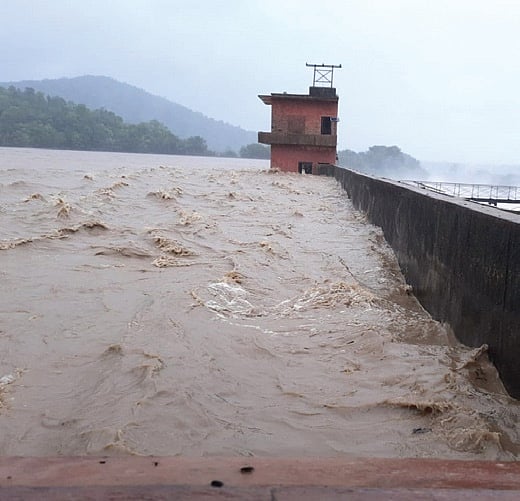
– The desiltation process will involve separating silt into sand and soil. The sand will be sold for commercial purposes while the soil will be distributed for agricultural use. The officials have identified 100 acres of land for this purpose, with 20 acres allocated for processing and the remaining 80 acres for silt storage. The government has also announced a fixed price for desiltation per tonne.
– Along with Kadam, two other projects in the state are being taken up as a pilot desilting initiative. Tenders have been invited from private companies, with the last date for submissions set as January 27. https://www.newindianexpress.com/states/telangana/2025/Jan/17/telangana-tenders-floated-for-desilting-of-kadam-irrigation-project (17 Jan. 2025)
BBMB ₹ 200-cr project to assess structural health, safety of Bhakra & Pong dams The Bhakra Beas Management Board (BBMB) is undertaking a Rs 200 cr project to assess the structural integrity and safety attributes of its two major dams — Bhakra and Pong — located in Himachal Pradesh, and implement corrective measures and technical upgradation where required. The exercise, spread over four years, is being undertaken by the Centre’s Dam Rehabilitation and Improvement Project (DRIP) that is granted loans by the World Bank. The World Bank project finances up to 70% of the outlay, while the remaining part is funded by the central and state agencies concerned. The project is expected to continue till 2029. “The first part of the project will be executed in 2025-2026 for which Rs 70 crore has been sanctioned,” a senior BBMB functionary said.
– The project involves evaluation of the physical state of the structures, measuring the dams’ deflection due to the constant water pressure against it, detecting and sealing seepage, undertaking seismic studies and treatment of the catchment area for slope stabilisation, erosion and silt flow. There is also some upgradation of instrumentation along with the automation of downstream headworks and barrage gate operations as well as real-time data access on various operational parameters. https://www.tribuneindia.com/news/punjab/rs-200-crore-project-to-assess-structural-health-safety-of-bhakra-pong-dams/ (14 Jan. 2025)
INTERLINKING OF RIVERS
PKC River Linking Rajasthan river-link could submerge 37 sqkm in TR Of the PKC-ERCP’s total submergence area of 408.86 sq km in Rajasthan, 227 sq km will go under the reservoir of a proposed 39-m-high and 1.6-km-long dam across Banas river, a tributary of Chambal, near village Doongri, about 30 km from Sawai Madhopur town.
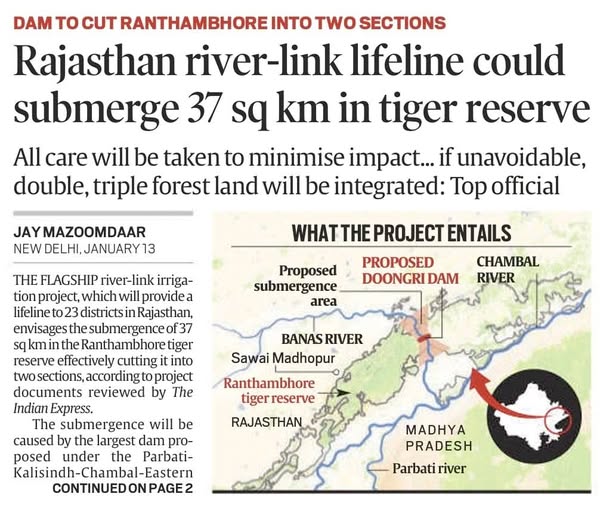
– The project envisages the submergence of 37 sq km in the Ranthambhore tiger reserve effectively cutting it into two sections, according to project documents reviewed by The Indian Express. The submergence will be caused by the largest dam proposed under the Parbati-Kalisindh-Chambal-Eastern Rajasthan Canal Project (PKC-ERCP), which is part of the ambitious Interlinking of Rivers (ILR) program. https://indianexpress.com/article/india/rajasthan-river-link-lifeline-could-submerge-37-sq-km-in-tiger-reserve-9777266/ (14 Jan. 2025)
Report River interlinkomg costly project These projects are excessively expensive and may even surpass their initial cost estimates. Their implementation will burden the country’s economy. Such large-scale projects often suffer from time and cost overruns, diminishing their economic viability. Apart from economic viability, such large projects also raise social & environmental concerns. https://indianexpress.com/article/upsc-current-affairs/upsc-essentials/river-interlinking-a-solution-to-water-scarcity-and-drive-development-9782430/ (18 Jan 2025)
INTERSTATE WATER DISPUTES
Krishna Water Disputes KWDT-II agrees to hear water allocation row In a significant victory for Telangana, the Krishna Water Disputes Tribunal (KWDT-II) on Thursday (Jan. 16) agreed to hear the arguments regarding water allocation between Telangana and Andhra Pradesh based on the new terms of reference (ToR) under Section 3 of the Interstate River Water Disputes (ISRWD) Act, 1956. https://timesofindia.indiatimes.com/city/hyderabad/krishna-tribunal-agrees-to-hear-water-allocation-row/articleshowprint/117310990.cms (17 Jan. 2025) -Telangana had requested that the Tribunal prioritise the Further ToR. However, Andhra Pradesh opposed this, seeking simultaneous hearings of both references and challenging the validity of the Further Reference by filing a writ petition in the Supreme Court. Following this decision, the Tribunal has scheduled the hearing of the Further ToR under Section 3 for February 19. https://www.newindianexpress.com/states/telangana/2025/Jan/17/in-big-victory-for-telangana-in-krishna-water-dispute-tribunal-with-andhra-pradesh (17 Jan. 2025)
Cauvery Water Disputes Kerala gets NBWL clearance for Silandhi check dam The NBWL considered an application for the use of 0.0442 ha of forest land from Anamudi Shola national park for the construction of a weir across the Silandhi river in Vattavada panchayat as part of Jal Jeevan mission (JJM) project. The Chief Wildlife Warden of Kerala, the State board for wildlife and the Kerala government have already approved the project. As per the minutes of the latest NBWL meeting, the Standing Committee decided to recommend the proposal subject to eight conditions. It has been directed that the work should be completed within one year from the date of sanction. Besides, an annual compliance certificate on the stipulated conditions shall be submitted by the user agency to the Chief Wildlife Warden and an annual compliance certificate shall be submitted by the State Chief Wildlife Warden to the Government.

Tamil Nadu has raised serious objections to the project. CM M K Stalin had sent a letter to Kerala CM Pinarayi Vijayan calling for measures to immediately halt the construction of the check dam across the Silandhi river. The farmers in Tirupur, Tamil Nadu have raised strong protests against the project. According to the farmers, the construction of a weir across the Silandhi river would affect water flow to Amaravathi dam which is the major source of irrigation for farmlands in Tirupur and Karur. https://www.onmanorama.com/news/kerala/2025/01/18/tamilnadu-silandhi-river-check-dam-idukki-wildlife-clearance-kerala.html (18 Jan. 2025)
IRRIGATION
Telangana Farmers demand restoration of water supply via SRSP canal Farmers from Lakshmapuram village in Nagaram mandal staged a protest on Saturday (Jan. 18), demanding restoration of water supply through the SRSP 70 DBM canal. The farmers expressed frustration over failure of the Irrigation Department to give water to the tail-end ayacut which adversely affected their agricultural operations. The farmers entered the SRSP 70 DBM canal, calling for immediate repairs to ensure water supply to the last reach of the command area. They emphasised their reliance on the SRSP Stage-II canal for irrigation and voiced concerns over the drying up of their fields due to inadequate water supply. https://telanganatoday.com/suryapet-farmers-demand-restoration-of-water-supply-via-srsp-canal (19 Jan. 2025)
Punjab March to protect historic Machhiwara trees Aiming to make the people of Punjab aware of the alleged destruction of biodiversity and remnants of the jungles of Machhiwara, which are linked to Guru Gobind Singh, various social organisations have decided to organise an awareness march on Sunday. The social organisations, ‘Public Action Committee Satluj, Mattewara, Budda Darya’ and ‘We Support Our Farmers’ claim that no care is being given to save biodiversity. They will take out an awareness march from Gurdwara Charan Kanwal Sahib, Machhiwara, to Katana Sahib via Chamkaur Sahib, with much of the route along the Sirhind Canal.
It has been stated that in the name of widening and strengthening the Sirhind Canal, biodiversity is being damaged by uprooting of trees beyond the earmarked area. Jaskirat Singh from Public Action Committee and Samita Kaur from We Support Our Farmers said, “We were told that the Sirhind Canal is being widened to increase its carrying capacity. Under this, trees are being felled even beyond the earmarked area, and many rare species are becoming endangered. The impact of the destruction is being felt even in the Machhiwara jungles, where Guru Gobind Singh Ji stayed, as heavy machinery is being used. We have sought various details from the authorities, but we are yet to receive all the details.” According to historical texts, Guru Gobind Singh and his soldiers stayed in the Machhiwara jungle around 1705. https://timesofindia.indiatimes.com/city/chandigarh/civilians-fight-for-jungles-where-guru-gobind-singh-stayed-in-1705-march-to-protect-historic-machhiwara-trees/articleshow/117361823.cms (19 Jan. 2025)
Farmers block key roads over Sirhind Canal project Accusing the government of reneging on its prior promise regarding non-concretisation of Sirhind Canal and the usage of the removed soil for strengthening embankments locally, farmers once again blocked key roads on Friday (Jan. 09). The roads connecting Ludhiana to Ropar and Khanna to Nawanshahr came to a standstill. The agitation was led by the Samyukt Kisan Morcha at the Garhi Bridge in Machhiwara. The road blockade caused severe inconvenience to commuters, forcing the police to arrange alternative routes.

Protesters made it clear that the agitation would not be called off until all their demands were met. Samrala SDM Rajneesh Arora tried to pacify the protesters, claiming that the SDO and JE responsible for removing soil from the canal had been suspended following allegations of malpractice. Additionally, a contractor will face a detailed investigation and potential legal action, farmers were told. The protesters alleged collusion between officials and the contractor. Despite the assurances, the farmers continued their protest. https://www.hindustantimes.com/cities/chandigarh-news/ludhiana-in-machhiwara-farmers-block-key-roads-over-sirhind-canal-project-101736535763043.html (11 Jan. 2025)
URBAN RIVERS
Pavana; Pune NGT stresses action to address river pollution The NGT western bench in Pune has taken significant steps to address the pollution in the Pavana River, directing a state-appointed rejuvenation committee to set a new timeline forimplementing the action plan. During a hearing held on January 7, the NGTemphasized the urgency of tackling pollution and outlined a structured approach to restore the river’s health. The case is listed forfurther hearing on March 2, 2024. https://pune.news/city/pcmc/ngt-stresses-urgent-action-to-address-pavana-river-pollution-290557/ (15 Jan. 2025)
RIVERS
Study Sedimentation shifted Rivers have never been as diverse as they are today, with human activities influencing their morphologies and contents. Catherine Russell discusses recent research that founds a crucial new sub-branch of sedimentology: plastic-sediment interactions. https://geoscientist.online/sections/features/sedimentation-shifted/ (01 Dec. 2023)
Discussion River Rights & responsibilities The Wednesdays for Water session on, ‘River Rights and Responsibilities’, focus is on the nuances of the legal, regulatory, social, political, cultural, and spiritual, framework of the rights and responsibilities of the society over Rivers in India.
In addition, the Right of the River for River only is looked into. The session speakers are Supreme Court Lawyer Avdhesh Pratap and Prof. Venkatesh Dutta and Namrata Kabra is the Discussant. https://www.youtube.com/watch?v=uMOcuNEBaZQ (09 Jan. 2025)
Puducherry Farmers flay scheme to bring water from villages to urban areas V Chandrasekhar, president of the Bangaaru Vaickal Neeraadhara Koottamaippu, (a Canal Water Resources Consortium) has urged the government for the cancellation of tender process to construct three borewells on the Sitheri Anaicut bund over the Then Pennaiyar river in Puducherry. The project, part of the “Augmentation of Water Supply Source for Urban Areas” scheme funded by Agence Française de Développement (AFD), is intended to provide urban drinking water. The Puducherry government floated the tender on January 13, with an estimated cost of Rs 49.38 lakh. The tender closes on January 21, with construction scheduled for completion within a month of the work order.
However, Chandrasekhar, in a memorandum to Lt Governor K Kailashnathan on Friday (Jan. 17), criticised the project for its potential environmental impact and alleged lack of stakeholder consultation. He highlighted repeated public protests by farmers since the scheme’s inception in 2016, which previously led to its suspension. Chandrasekhar expressed alarm that deep borewells were being commissioned to cater to urban water demands, arguing that such projects deplete the groundwater reserves which are already fragile.
Referring to statements made by CM N Rangasamy and PWD Minister K Lakshminarayanan in the Legislative Assembly, Chandrasekhar disputed assurances that the sinking of 40 borewells on river beds would not affect water tables. He explained that deep borewells tap into aquifers with limited recharge potential, rendering the proposal “unscientific” and unsustainable. Citing the Central Wetlands Rules, 2017, which prohibit permanent structures in waterbodies, he claimed the project violates environmental laws. Chandrasekhar also questioned the government’s response to a notice issued by the NGT in Jul 2023, warning that failure to address it could amount to contempt of court. https://www.newindianexpress.com/states/tamil-nadu/2025/Jan/18/pondy-farmers-flay-scheme-to-bring-water-from-villages-to-urban-areas (18 Jan. 2025)
Karnataka Around the Kabini river The Kabini river, a beautiful waterway winding through the Western Ghats, shares its name with an equally breathtaking forest in Karnataka. The Kabini Wildlife Sanctuary, also known as Nagarhole National Park, is part of the larger Nilgiri Biosphere. Kabini river, a natural boundary for the sanctuary, is a vital water source for the diverse wildlife inhabiting the area. Its presence ensures the sanctuary is a thriving ecosystem, supporting a wide range of flora and fauna. https://www.deccanherald.com/india/karnataka/around-the-kabini-river-3357020 (16 Jan. 2025)
NARMADA Madhya Pradesh Govt to start new plan Urban development and Housing Department Principal Secretary Sanjay Kumar Shukla told Free Press that a Cabinet committee has been constituted to conserve and rejuvenate Narmada. “We are working on a comprehensive plan to make the Narmada River pollution-free,” he said. https://www.freepressjournal.in/bhopal/madhya-pradesh-to-launch-clean-narmada-mission-aiming-for-pollution-free-drinkable-river-water (16 Jan. 2025)
Rajasthan HC initiates proceedings against encroachments over rivers, water bodies The High Court of Rajasthan initiated suo motu proceedings based on a news article published in ‘Rajasthan Patrika’. The article highlights that despite numerous directions issued by the courts and NGT, several rivers along with various other water bodies across the State are facing severe encroachment, jeopardising the well-being of all living organisms and environment. The High Court observed that such news indicated serious failure of the Central and state governments, particularly MoEFCC and Ministry of Jal Shakti, in protecting rivers from illegal encroachments. It also noted that the draft River Conservation Zone (Regulation of Harmful Activities) Rules, 2012 and the notifications regarding river conservation zone and river regulation zone in 2015 remain unimplemented till date. The High Court issued show cause notice on why the directions for constituting committees at state level, divisional level and district level should not be issued. It also proposed the demolition of illegal and unauthorised constructions and encroachments on the rivers, flood plains and catchment areas of all rivers, water bodies, water courses and water channels. https://www.barandbench.com/columns/important-environmental-law-orders-and-judgments-passed-in-2024 (24 Oct. 2024)
Punjab Governor seeks report from CM on Sutlej pollution Forwarding the demi-official letter received from his Rajasthan counterpart, Governor Gulab Chand Kataria has drawn CM’s attention towards the discharge of chemicals from industrial units in Ludhiana, Jalandhar, Phagwara and other cities into Buddha Nullah, which flows into the Sutlej. Not much impressed with the ongoing works, the Governor directed the heads of the in-line departments to launch a coordinated and sustained campaign to free Buddha Nullah and the Sutlej of the rampant pollution. Calling for both short and long-term plans of action to clean and preserve Buddha Nullah on permanent basis, the Governor asked for de-silting the Sutlej tributary on a massive scale. https://www.tribuneindia.com/news/punjab/governor-seeks-report-from-cm-mann-on-sutlej-pollution/ (16 Jan. 2025)
GANGA Study Assessment of recent erosion & accretion Abstract: –Unravelling erosion and accretion patterns of rivers with the application of remote sensing and GIS tools leads us to understand the river morphology and its behaviour. In the recent past, the catchment areas of river Ganga and its major tributary Alaknanda River affirmed some unprecedented anthropogenic interventions such as infrastructure boom, and deforestation as well as catastrophic climatic events. Considering these factors, the present study evaluates the erosion and accretion pattern of these river sections in the Garhwal Himalaya, India. The shape files of river sections of duration between 2017 to 2022 were extracted from high-resolution Sentinel-2, Land Use Land Cover (LULC) imageries. To understand their exactitude effect on river dynamics, these patterns are further correlated with recognised anthropogenic activities and natural events. https://www.geosocindia.org/index.php/jgsi/article/view/174060 (01 Jan. 2025)
Debris flow: A threat to emerging infra Abstract: –The present study aimed to understand the debris flow characteristics in view of frequent extreme rainfall events, expansion of road networks, tourist influx, and population pressure in the NW & Central Himalaya. Notably, majority of the human settlements, roads, bridges, buildings, and even protection measures in the NW & Central Himalaya do not take into consideration such debris flow impact scenario despite a history of debris flow disasters. The Voellmy-Salm rheology dependent dynamic runout simulation method was used to determine the debris flow pressure and velocity regime in 9 debris flow locations belonging to different litho-tectonic conditions. https://www.researchgate.net/publication/384610334_Debris_flow_in_indian_himalaya_A_threat_to_emerging_infrastructure (Jan. 2025)
Article Ganga asks to be left alone The Ganga and the Himalaya are sacred to millions of Indians, yet these iconic entities of veneration face unjust and unethical treatment. Victor Mallet’s book River of Life, River of Death asks a pertinent question: “How can the Ganges be worshipped as a life-giving force by so many Indians and simultaneously abused by the same people?”
– Let alone its status as a civilisational symbol and a sacred entity for millions, even as India’s national river, the Ganga, has not been accorded the dignity granted to other national emblems, such as the national flag. The lifeline of the nation is now on the brink of collapse because of flawed government policies. Preserving the Ganga is imperative for securing India’s future. Most importantly, one must remember that the name “Ganga” is derived from the root gam, meaning gach, that is, “to flow”. Thus, the uninterrupted full flow of the Ganga is non-negotiable, and without this, the rejuvenation of the Ganga is impossible. (Mallika Bhanot, C.P. Rajendran) https://frontline.thehindu.com/environment/ganga-basin-dams-hydro-electric-power-biodiversity-himalayas-joshimath-climate-change/article69067642.ece (13 Jan. 2025)
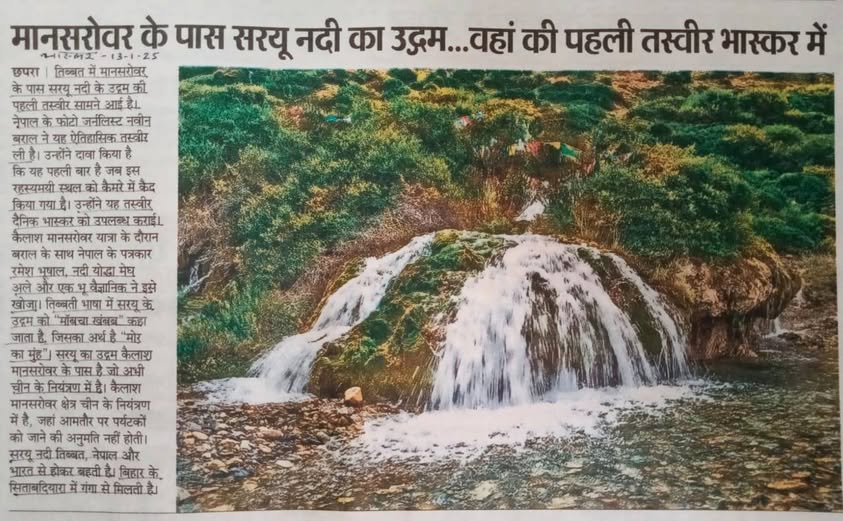
Report This report claims that this is first ever photo of origin of the Saryu River (a tributary of Ganga), near Kailash Mansarovar in Tibet. In Tibetan language this place’s name means mouth of Peacock. (Dainik Bhaskar 13 Jan. 2025)
Kumbh 2025 Plea in NGT seeking compliance to its order A plea has been filed in the NGT principal bench seeking directions to CPCB , UPPCB and other authorities to ensure the compliance of the guidelines issued by NGT pertaining to maintaining purity of the rivers during the ongoing Maha Kumbh Mela at Prayagraj.
-The plea, filed by ex-Indian Police Service officer and political activist Amitabh Thakur, highlights that NGT’s Dec. 28 directions include uploading various data, like the sample analysis report including performance of STPs and geo-tubes, analytical reports of periodic samples collected at the outlet of STPs and advanced oxidation. https://www.livelaw.in/environment/maha-kumbh-2025-plea-in-ngt-maintain-purity-of-river-water-pollution-281105 (16 Jan. 2025)
W Bengal Rising sea and erosion gobble up bathing ghats at ‘warm’ Gangasagar Mela Climate change has left a significant imprint on the 2025 edition of Gangasagar Mela in Bengal’s Sagar Island. Half of the six bathing ghats have succumbed to the rising sea, as only ghat numbers 1, 5 and 6 are being used this year by lakhs to take the sacred bath on the fringes of the original bathing facilities on offer. The IMD has supported the claim by residents of the area that the temperature in the morning hours, the auspicious time for bathing, has been warmer than usual. https://www.telegraphindia.com/my-kolkata/events/rising-sea-and-erosion-gobble-up-bathing-ghats-at-warm-gangasagar-mela/cid/2077699 (15 Jan. 2025)
YAMUNA Delhi Sahibi once a river now turned into drain Sahibi river emanated from the Sewar hills of Rajasthan’s Sikar district and flowed through the states of Rajasthan, Haryana and Delhi. Earlier existence of temples and mosques around the river shows the religious significance of the river. In the ancient Hindy texts of Rigveda and Manusmriti Sahibi river is named as the Drishadvati river.
-It was 300 km long when it used to flow with gushes of water, however, now it consumes the drainage water and its massive contamination. Due to this, Sahibi is no longer a river as the city’s contaminated water and waste from factories and industries gets collected here. https://www.dnaindia.com/india/report-once-delhi-s-main-water-source-this-river-has-now-turned-into-sahibi-river-najafgarh-nallah-3126610 (12 Jan. 2025)
Gurugram STPs set for revamp, to stop river pollution To enhance wastewater treatment and reduce pollution in the Najafgarh drain and Yamuna river, GMDA is set to upgrade two existing STPs to tertiary treatment plants in the city. The 100 MLD STP at Dhanwapur and 120 MLD STP at Behrampur will be upgraded into tertiary treatment plants to ensure compliance with wastewater discharge norms. The project will take at least two years to complete once the work starts. The govt approved the upgrade of these STPs in July 2023 and sanctioned Rs 75.5 crore for the Dhanwapur STP and Rs 50.6 crore for the Behrampur STP. The plan was approved in Dec 2020 but was shelved due to technical ambiguities in the tender process and limited demand in the Dhanwapur area. However, following the HSPCB’s revised norms issued in Sept 2023, the GMDA is now proceeding with the upgrade.
Presently, 5 STPs operate in Gurgaon with a combined capacity of 388 MLD — 218 MLD at Dhanwapur and 170 MLD at Behrampur. Both plants, constructed by HSVP in 2015, use advanced technologies for water treatment. According to GMDA, 218 MLD of sewage treated at Dhanwapur is discharged into irrigation channels maintained by the Irrigation Department, benefiting agricultural activities in 13 villages of Gurgaon and Jhajjar districts. From Behrampur, 160 MLD of treated sewage is partly utilised for horticulture, industrial purposes, and groundwater recharge, with the remaining discharged into the Badshahpur drain. https://timesofindia.indiatimes.com/city/gurgaon/stps-set-for-revamp-to-stop-waste-flowing-into-yamuna/articleshow/117362003.cms (19 Jan. 2025)
RIVERS BIODIVERSITY
Kolkata Gangetic dolphin dies after being trapped in fishing net A gangetic dolphin died after being trapped in a fishing net in the river Bhagirathi in East Burdwan’s Katwa. The incident occurred on Wednesday (Dec. 18, 2024). The carcass of the dolphin was recovered from the river and there were several injury marks in its body. In the last few years, many dolphins were killed after getting stuck in fishing nets or due to lack of food. https://www.millenniumpost.in/bengal/gangetic-dolphin-dies-after-being-trappedin-fishing-net-591379 (20 Dec. 2024)
FISH, FISHERIES, FISHERFOLKS
Madhya Pradesh Deline in Narmada fish The devastating impact the Sardar Sarovar dam has had on fresh water fish in the river Narmada and on the life of fishing community, explained in a 2 min. video with subtitles in English. The list of some of the fish variety impacted.

https://oralhistorynarmada.in/the-fish-variety-in-the-river-narmada/ (Jan. 2025) Small video clip on adverse impacts of Sardar Sarovar dam on Narmada fish species and fishing communities. https://www.youtube.com/watch?v=4t4QS5z-JVk&t=3s (16 Jan. 2025)
Assam Kaziranga eases fishing ban for 2 hrs In a temporary move to address local sentiments, the administration of Kaziranga relaxed its prohibition order against community fishing, allowing residents two hours for fishing on Monday (Jan. 13) morning. This decision was made ahead of the Bhogali Bihu festivities, with fishing permitted from 8 am to 10 am. Locals revealed that, despite no official order being issued, the relaxation of the ban was driven by the people’s demand and sentiment. https://assamtribune.com/assam/kaziranga-eases-fishing-ban-for-two-hours-to-honour-local-tradition-ahead-of-magh-bihu-1564708 (13 Jan. 2025)
Prohibitory order on community fishing in Kaziranga The Co-District Commissioner of Bokakhat, Shivani Jerngal, has issued a prohibitory order regarding community fishing activities within Kaziranga National Park and Tiger Reserve. The order comes in response to concerns raised by the Divisional Forest Officer, Eastern Assam Wildlife Division, following reports of large numbers of people from various districts intending to enter the park for fishing in beels, rivers, and wetlands between January 13 to 16. https://m.guwahatiplus.com/article/prohibitory-order-issued-on-community-fishing-in-assams-kaziranga-national-park-during-magh-bihu/36703/amp (12 Jan. 2025)
SAND MINING
Report NGT directs reappraisal of ECs granted by DEIAA for mining leases NGT has directed that the ECs granted at the district level by District Environment Impact Assessment Authorities (DEIAAs) should be reappraised by the SEIAA at the state level. The direction was passed in an application challenging the validity of OMs which extended the validity of the ECs granted by DEIAA. The applicant argued that these OMs contradicted the judgments of the Supreme Court and the NGT. NGT considered the legal development of the amendments to the Environment Impact Assessment Notification, 2006, in 2016 which allowed DEIAAs to grant ECs for mining projects with area less than 25 ha (twenty-five hectares) without public consultation. This was deemed inconsistent with the judgments of the Supreme Court, which mandated stricter environmental assessments for mining activities. NGT had previously directed that such procedures be aligned with the directions of the Supreme Court and all ECs. https://www.barandbench.com/columns/important-environmental-law-orders-and-judgments-passed-in-2024 (22 Oct. 2024)
Tamil Nadu Stop illegal sand mining in Kosasthalaiyar: HC The Madras High Court has directed the state government to initiate immediate action to prevent illegal sand mining from government and patta land on the Kosasthalaiyar river basin in Tiruvallur district. A division bench comprising Justices SM Subramaniam and V Lakshminarayanan issued the direction on Friday (Jan. 17) while disposing of a petition filed by the Kosasthalai Aaru Matrum Kanimavala Pathukappu Sangam.
“We direct the respondents to initiate immediate action to prevent illegal mining of sand, soil, and savudu from the government poramboke land in the Kosasthalai river basin, as well as the excavation of sand and savudu from the patta land in excess of permissible limits in Meyyur, Vembedu, Rajapalayam, Somadevanpattu, and Eraiyur villages of Uthukottai taluk and Thiruvallur taluk respectively,” the bench said in its order. The court asked the petitioner to file an appropriate petition, including contempt of court, to prevent illegal mining in the event of a violation of the terms and conditions of the licence or any illegal sand mining found or permitted by any government authority.
The petitioner alleged that large-scale illegal mining is being conducted on government land in the river basin, and mining is exceeding the permissible limits in these villages. The plea added that such illegal activity is being carried out with the active collusion of government officials, as no action has been taken to prevent illegal mining. However, Additional Advocate General M Suresh Kumar submitted that all the necessary actions had been initiated to prevent illegal mining and that only the permitted quantity was allowed to be removed as per the licence conditions. A special task force had been constituted at the district level to prevent illegal mining, he added. https://www.newindianexpress.com/states/tamil-nadu/2025/Jan/19/stop-illegal-sand-mining-in-kosasthalaiyar-orders-madras-hc (19 Jan. 2025)
Andhra Pradesh HC stays ₹1,334-cr penalty on JP over ‘illegal’ mining The High Court has stayed the imposition of penalties worth Rs 1,334 crore against Jaiprakash Power Ventures Ltd. by the Department of Mines and Geology for alleged illegal extraction, storing, transportation and selling of sand. The high court made decision on the grounds that the action of the DMG was beyond its jurisdiction and overreach of their authority. Jaiprakash Power had filed multiple writ petitions against the state, challenging these penalties, according to exchange filing on Friday (13 Dec. 2024). The DMG had issued several demand notices for alleged illegal sand mining and imposed penalties a long time after the expiry of lease period of the sand mines and handing over mining operations to other parties. The mining work was completed and handed over by the company in May 2023, according to Jaiprakash Power. https://www.ndtvprofit.com/law-and-policy/andhra-pradesh-high-court-stays-penalty-on-jaiprakash-power-ventures-over-illegal-sand-mining (13 Dec. 2024)
Kerala Greens oppose coastal sand mining plans The Green Kerala Movement has strongly condemned the Central government’s initiative to mine 745 million tonnes of sand from Kerala’s coast without conducting an environmental or social impact study. The group has demanded an immediate halt to the project, citing severe ecological and social repercussions. The Central government is advancing the project under the Offshore Minerals (Development and Control) Act, 2002, which was amended in 2023 to allow private sector participation in mining. The decision follows a Geological Survey of India (GSI) study that identified significant offshore sand deposits in five key areas: Ponnani, Chavakkad, Alappuzha, Kollam South, and Kollam North. Of these, the Kollam and Alappuzha regions have been earmarked for initial mining operations, with an estimated 300 million tonnes of sand deposits.
Despite the significant scale of the project, no ecological factors have been assessed. Critical studies, such as the impact on the coastal ecosystem, marine biodiversity, fish populations, and the livelihood of coastal residents, remain unaddressed. The Green Kerala Movement warned that sand mining poses a long-term threat to the fisheries sector and the already fragile river dynamics. Offshore sand, defined as deposits carried by rivers into the sea, is planned for removal of up to 12 nautical miles from the coast. Environmentalists argue that such large-scale extraction could destabilise the region’s natural coastal defences and significantly harm marine life.
In the past, offshore mining required joint inspections by the Geological Survey of India, the Indian Bureau of Mines, and the Atomic Minerals Directorate. However, the amended Act now permits private companies to enter the fray, raising concerns about unchecked exploitation. “Mining without a comprehensive impact study undermines the region’s ecological balance and jeopardises the livelihoods of thousands of fishermen,” said T.V. Rajan of the Green Kerala Movement. “This move is nothing short of a disaster waiting to happen, and we demand the Central government abandon this initiative immediately.” The Green Kerala Movement has urged stakeholders and the public to unite against the project, emphasising the critical need to prioritise environmental sustainability over short-term economic gains. https://www.thehindu.com/news/national/kerala/green-kerala-movement-opposes-central-governments-coastal-sand-mining-plans/article69107866.ece (17 Jan. 2025)
Telangana Sand mafia attacks revenue staff in Kothagudem On Sunday (17 Nov 2024) Burgampahad tahsildar, Mujahid informed that revenue inspector Muthaiah, deputy tahsildar Ramnaresh and staff on receiving information that sand was mined illegally in river Godavari under Sarapaka bridge, reached the spot on Saturday late night to stop it.
-Around 50 to 60 persons assaulted revenue inspector and deputy tahsildar and the attackers dispersed as the media persons reached the spot. When informed police they reached the spot but did not respond immediately. https://telanganatoday.com/sand-mafia-attacks-revenue-staff-in-kothagudem (17 Jan. 2025)
Assam Woman dies after being hit by dumper carrying illegally—mined Sand In a tragic incident, a woman who was out for a morning walk died after being hit by a sand-laden dumper in Mariani on Tuesday (09 April 2024) morning. According to sources, the accident took place in the Selenghat area, where the woman, identified as Mallika Gogoi Duarah, went out for a morning walk. While she was on the morning walk, a speedy dumper carrying illegal sand hit her, leading to her demise. Meanwhile, the locals alleged that illegal sand smuggling has been going on in the Selenghat-Tengabari area for a long time, adding that the police and the forest department did not take any action in this regard. https://assamtribune.com/assam/assam-woman-dies-after-being-hit-by-dumper-carrying-illegally-mined-sand-1529743 (09 April 2024)
Punjab Lokpal issues notice over failure to stop illegal mining The office of the Lokpal, reacting to a detailed complaint based on PPCB reports and NGT orders, asked the minister and the PPCB why an inquiry under the provisions of the Punjab Lokpal Act, 1996, should not be initiated against them for these allegations.
-The complaint further stated that the NGT, in its order dated December 10, 2020, identified a scam exceeding Rs 630 crore in the adjoining area of the Ropar district, while the scam in the Majri block in the Mohali district Mohali was estimated to surpass Rs 1,000 crore.
-The complaint alleged that the government granted permissions in violation of all notifications and allowed screening plants and crushers to operate illegally near villages, schools, and colleges. https://indianexpress.com/article/cities/chandigarh/barinder-kumar-goyal-punjab-lokpal-notice-ppcb-failure-stop-illegal-miningstop-illegal-mining-9781992/ (16. Jan. 2025)
Haryana Illegal mining returns to haunt Aravallis Residents of Pichopa Kalan village in Haryana’s Charkhi Dadri district were on Wednesday (Jan. 15) evening jolted by the sound of an explosion that reduced a significant portion of a hillock to rubble. The blast was allegedly orchestrated by a powerful mining cartel operating with tacit support from state authorities, marking yet another alarming instance of illegal mining in the region.
Activists and locals say this is only the latest episode in a troubling pattern stretching across Haryana, from Mewat (Nuh) to Bhiwani’s Dadam hills and the Haryana-Rajasthan border. They accuse authorities of turning a blind eye to blatant violations, emboldened by political patronage and official inaction. Despite a Supreme Court ban on mining in the ecologically critical Aravalli range, such activities persist unabated. https://www.hindustantimes.com/india-news/with-a-blast-fear-of-illegal-mining-returns-to-haunt-aravallis-in-gurugram-101737050431940.html (17 Jan 2025)
Mining rampant in Aravalis despite curbs Despite a blanket ban imposed by the Supreme Court in 2009 in three south Haryana districts (Gurgaon, Nuh and Faridabad), quarrying of stones and sand remains a means of sustenance for locals who supply to the construction industry. Officials said the rocky terrain makes it arduous for the authorities to crack down on the miners.
Multiple narrow roads cutting through forests lead to Rajasthan. Years of penalty and seizure of vehicles have failed to curtail stone quarrying and sand in the Aravalis. The business remains financially viable, given the surge in housing projects emerging in Gurgaon and nearby areas. These surveys by the forest department are being conducted to avoid Rava village incident when on Dec 19, hillock was blown into pieces.
A mining department team noted that an area of 200 metres in length, 10m in width and two metres in depth had been mined in Rava, amounting to 6,000 MT of stones. Last year, authorities found that 85.8 crore metric tonnes of stones had been mined from the Aravalis of Rava, Naharika and Chitoda in Firozpur Jhirkha, Nuh. The mining department quantified this loss to a monetary value of Rs 2,000 crore. https://timesofindia.indiatimes.com/city/gurgaon/mining-rampant-in-aravalis-despite-curbs-3-key-illegal-routes-blocked-after-checks/articleshow/117379249.cms (20 Jan. 2025)
Illegal mining starts eroding protective Aravalli barrier Illegal mining in the Aravalli range threatens biodiversity, groundwater, and local communities, leading to severe ecological and economic consequences. https://www.hindustantimes.com/cities/gurugram-news/illegal-mining-in-gurugram-starts-eroding-protective-aravalli-barrier-101737220465679.html (18 Jan. 2025)
Chhattisgarh Conflicts over natural resource extraction & development in Bastar The nature, process and impact of large-scale natural resource extraction in the Bastar region of Chhattisgarh are examined. Through an ethnographic inquiry, the neo-liberal political economy of natural resource extraction is analysed to investigate the implications of the ensuing resource conflicts and highlight the impact of the Maoist movement on the lives and livelihood security of the marginalised Adivasi communities in Bastar. The neo-liberal political economy of natural resource extraction undermines the long-standing relationships of local Adivasi communities with nature and makes them further marginalised. https://www.epw.in/journal/2025/3/special-articles/conflicts-over-natural-resource-extraction-and.html (18 Jan. 2025)
WATER OPTIONS
Study Isotopes reveal ancient marvel of water engineering Extreme monsoon variations — far more intense than today — profoundly impacted several other ancient communities and kingdoms in the Deccan across three millennia. In response, they pioneered advanced irrigation technologies and diverted river waters through canals for rainwater harvesting, ensuring water security and resilience, according to a team of scientists at the Indian Institute of Tropical Meteorology (IITM), Pune, and archaeologists at the Yogi Vemana University, Kadapa in Andhra Pradesh. https://www.nature.com/articles/d44151-025-00001-9 (30 Dec. 2024)
Research DTU scientists develop nanoparticles for water pollution treatment Scientists at Delhi Technological University (DTU) have made significant progress in creating nanoparticles from natural plant extracts with antibacterial properties. These particles show potential for various applications, particularly in treating water pollution caused by untreated sewage, dyeing industry effluents, and other contaminants. Dr Mohan Singh Mehata, associate professor in engineering physics at DTU, has led groundbreaking research in developing nanomaterials using eco-friendly sources, including tulsi, neem, and paddy straw. Laboratory assessments have demonstrated positive results, with the liquid nanomaterials showing effective purification capabilities. The scientific team suggests this innovation could help solve pollution issues in rivers, especially waterways like the Yamuna affected by industrial contamination. https://timesofindia.indiatimes.com/city/delhi/dtu-scientists-develop-eco-friendly-nanoparticles-for-water-pollution-treatment/articleshow/117361137.cms (18 Jan. 2025)
GROUNDWATER
Punjab Study groundwater for toxic elements: HC The directive came amid concerns over uranium contamination in Doaba and Majha areas, with the court on a previous date of hearing emphasising that the testing must adhere to updated WHO standards. The court also instructed the Centre to evaluate the reports and suggest solution to the “problem being faced by the citizens of Punjab as regards traces of uranium found in the groundwater in various districts of the state”. The court, on a previous date of hearing, had ordered comprehensive re-testing of water samples for uranium contamination in Punjab’s Doaba and Majha regions, following discrepancies in previous test standards. The court had made it clear that the water testing was required to be redone in accordance with the updated WHO standards.
Taking up the petition filed in 2010 against the Union of India and other respondents by Brijender Singh Loomba, the Bench had taken note of an affidavit filed on behalf of the Guru Hargobind Thermal Plant Chief Engineer stating that 11 samples, out of 4,406 tested, were found to be “infected” in districts such as Hoshiarpur, Jalandhar, Amritsar. The tests were based on the standards of “60 parts per billion (PPB)” recognised by the atomic energy regulatory body. A report by Punjab’s Department of Local Government said three samples were found to be “infected with traces of uranium” out of 269 tested in Doaba and Majha regions. The standard applied for testing was 30 µg/l. https://www.tribuneindia.com/news/punjab/study-groundwater-for-toxic-elements-hc-tells-state-govt/ (18 Jan. 2025)
Haryana Gurgaon extracted from aquifers double of what it recharged last year While the Gurugram city’s sustainable annual groundwater extraction limit is 20,333 million-hectare metres (ham), it ended up withdrawing 43,262 ham in 2024, data released by the National Compilation on Dynamic Groundwater Resources of India showed. This extraction rate was the third highest in Haryana, following Kurukshetra (228%) and Panipat (222%). Kaithal (190%) and Faridabad (180%) were close behind.
-Gurgaon currently receives 570 MLD of fresh water from rivers, falling short of its peak summer demand of 675 MLD. With a growing population and insufficient surface water supply, the city’s residents increasingly rely on groundwater to meet their daily needs, experts pointed out.
-Five districts – Gurgaon, Panipat, Kaithal, Karnal, and Kurukshetra – were found to have exhausted their groundwater resources for future use. And the entire state of Haryana now has only 1.1 lakh ham of groundwater available for the future, the report stated.
-The state’s overall groundwater extraction rate showed a slight increase from 135.7% to 136% over the past one year. Haryana’s total extractable groundwater was calculated at 9.3 lakh ham, yet actual extraction reached 12 lakh ham during this period. https://timesofindia.indiatimes.com/city/gurgaon/guzzling-groundwater-gurgaon-extracted-from-aquifers-double-of-what-it-recharged-last-year/articleshowprint/117341621.cms (18 Jan. 2025)
Set target to recharge groundwater in 500 villages: CM The CM said the work of recharging groundwater should be carried out in accordance with the vision of PM Modi and directed to build as many ponds as possible in the dark zone so that water can be stored during the rainy season. While chairing a review meeting of the Haryana Pond and waste water management authority, Saini also directed to explore the possibilities of using the Hansi-Butana link canal for water storage. The CM was informed that 19,716 sarovars have been built in the state under the pond authority, out of which 18,813 are in villages and the rest are in cities.
The CM said the Amrit Sarita Yojana was envisaged in the ‘sankalp patra’ and that under this assurance the embankments of all the canals and rivers of the state must be strengthened. He said this work can be done under the MGNREGA scheme. He also instructed officials to form a task force to stop theft of water from canals. Saini issued instructions to make arrangements for water drainage through solar pumps to fix the waterlogging in Charkhi Dadri, Jhajjar, Mahendragarh, Sonipat, Rohtak and some other areas. https://www.hindustantimes.com/cities/chandigarh-news/set-target-to-recharge-groundwater-in-500-villages-haryana-cm-101737136257493.html (18 Jan. 2025)
Assam Miners may have struck an groundwater source causing flooding The fate of the eight workers who are trapped inside the flooded coal mine in Dima Hasao district remains grim, according to officials. This comes as the body of one of the workers was recovered on Wednesday (Jan. 08) morning, two days after he got trapped inside the mine. Though a team of Navy, Army, NDRF and SDRF personnel, who are overseeing the rescue operations, reports emerge that three bodies were seen floating inside the well which is about 300 feet deep. There is water about 100 feet deep.
Meanwhile, officials suggest the accident may have occurred after the workers accidentally struck a water source while mining. This caused a sudden flood which trapped the miners inside the narrow “rat hole” mine shaft. Some of the workers, who managed to come out of the mine, informed the mine owner and the local police about the mishap. Eyewitness accounts and initial assessments too hint that the flooding was spontaneous and was caused due to the opening up of an underground water channel. https://www.theweek.in/news/india/2025/01/08/assam-coal-mine-workers-may-have-accidentally-struck-an-underground-water-source-causing-flooding.html (08 Jan. 2025)
Study 100,000-year journey of groundwater tracked A new study mapped continental groundwater flow, revealing that rain and snowmelt travel much farther and deeper underground than previously known. Over half of stream water comes from deep aquifers, highlighting crucial implications for pollution tracking and groundwater management.
Researchers from Princeton University and the University of Arizona have developed a groundbreaking simulation that maps underground water movement on a continental scale. Culminating three years of extensive study, this research traces the hidden journey of water—from raindrops or melted snow seeping into the ground to their eventual reappearance in freshwater streams. The simulation reveals that water can travel to great depths, resurface up to 100 miles from its entry point, and remain underground for periods ranging from 10 years to an astonishing 100,000 years.
Published on January 6 in the journal Nature Water, the study demonstrates that rainfall and snowmelt penetrate much farther into the Earth than previously thought. Additionally, it shows that more than half of the water flowing in rivers and streams originates from deep aquifers once considered isolated from surface water systems. These findings carry significant implications for managing groundwater resources, tracking pollution, and predicting how climate change might affect groundwater—an essential source of drinking water for half of the U.S. population.
This study’s new retrospective analyses and predictive simulations provide opportunities to track this vital resource and understand the far-reaching impacts of leakages from the likes of oil and gas well pads. “Interconnections between the watersheds isn’t just important for streamflow,” said Maxwell. “This also tells us how long contamination will persist in groundwater. Widespread pollutants like nitrate and PFAS can take these long journeys to the stream, making them harder to manage and even longer-lived.”
The second important new discovery is that groundwater from very deep aquifers contributes significantly to streamflow. Maxwell’s team found that deep groundwater from aquifers 10 to 100 meters below the surface contributed more than half of the baseflow in 56% of the subbasins. The greatest depths occurred in regions with the steepest topography gradients, such as the Rocky and Appalachian mountain ranges. https://scitechdaily.com/new-study-tracks-the-100000-year-journey-of-underground-water/ (11 Jan. 2025)
URBAN LAKES, WETLANDS
Karnataka Lake encroached upon By the end of June 2024, encroachment surveys had been completed for 28,713 out of 40,998 lakes. The surveys revealed that 10,988 lakes had been encroached upon. Of these, encroachments on 6,081 lakes have been cleared, while 4,907 lakes remain encroached. In Bengaluru, 8,599 of the 14,967 lakes were surveyed, revealing encroachments on 5,109 lakes. While encroachments on 3,042 lakes have been removed, 2,067 lakes still need to be cleared. In Mysuru, 4,436 lakes were found to have encroachments, with 2,199 cleared and 2,237 still requiring action. In Belagavi, 1,190 lakes were identified with encroachments, with 518 yet to be cleared. In Kalaburagi, 168 out of 253 lakes have been cleared,
According to the Minor Irrigation Department, the state is home to 40,998 lakes, managed by various departments, including Water Resources, Rural Development, and others. Additionally, district Deputy Commissioners and Zilla Panchayat (ZP) Chief Executive Officers (CEOs) are tasked with overseeing these lakes. Local communities are also involved through lake associations, and the government has established the Lake Conservation and Development Authority to further safeguard these vital resources. However, despite these efforts, over 25% of the state’s lakes are encroached upon, and more than 26% have not been surveyed for encroachments. https://bangaloremirror.indiatimes.com/bangalore/cover-story/young-foot-soldiers/articleshow/117340567.cms (19 Jan. 2025)
Bengaluru BBMP reports 235-acre lake encroachment The BBMP has identified 235 acres of encroached land across 183 active lakes in Bengaluru, with 120 lakes impacted by private properties and 131 by government projects. Despite legal actions and a ?52.55 crore allocation for lake conservation, only seven acres have been reclaimed. Encroachments include roads on 116 lakes and cemeteries on 15. The court has demanded detailed encroachment data, urging BBMP to expedite action. These lakes, vital for the city’s ecology and water supply, face severe threats amid rapid urbanization. Citizens are encouraged to support conservation efforts to protect Bengaluru’s diminishing natural resources. https://propnewstime.com/getdetailsStories/MTM5Mzg=/bengaluru-bbmp-reports-235-acre-lake-encroachment-vows-legal-action (13 Jan. 2025)
Mapping evictions of lake communities From more than 1,000 at a point of time, Bengaluru’s keres or lakes have come down to around 200. In place of Dharmambudhi Lake stands today the Majestic Bus Terminal. The Sampangi Lake gave way to Kanteerava stadium. HSR Layout, which is today the address of some of the biggest start-ups in the country, stands on top of what was once Parangipalya Lake.
When the city’s topography changed, what also parallelly emerged was a spate of ‘ecological evictions’, or in other words, the eviction of those who lived on Bengaluru’s keres, for real estate gains and to satisfy urban imaginations. And to legitimise these dispossessions, the state and judiciary have often resorted to environmental concerns, argues Achintya Anita Gurumurthy, a former research fellow at NCBS, who recently spoke at ‘Research Talks’ held by NCBS. https://www.thehindu.com/news/cities/bangalore/whose-city-whose-keres-mapping-the-state-backed-evictions-of-bengalurus-lake-communities/article69089806.ece (13 Jan. 2025)
Part I of a series on Bengaluru’s lake system and its role in urban sustainability looks at the primary and secondary functions of these lakes. https://citizenmatters.in/bengaluru-lakes-system-functions-sustainability/ (13 Jan. 2025)
Greater Noida Authority prepares DPR to protect Surajpur wetland The authority Jan. 17 said this wetland can be protected with the technical help from research institutes, NGOs, and environmental experts, who are willing to come forward to protect this wildlife habitat located right in the heart of industrial city of Greater Noida. “The authority has decided to set up a 45 MLD STP that can treat the wastewater,” said Ashutosh Dwivedi, additional chief executive officer, Greater Noida authority. In addition to these efforts, the authority plans to develop community-based programmes that educate local residents and farmers on sustainable water usage and wetland protection. This will include promoting water-efficient irrigation techniques and encouraging sustainable farming practices to reduce the impact of agricultural run-off on the wetland. Regular monitoring and evaluation systems will also be put in place to track water levels, quality, and biodiversity in the area, ensuring long-term conservation efforts.
The Surajpur wetland and sanctuary is spread 325 hectares, including 60 hectares of a natural lake located on Dadri-Surajpur-Chhalera (DSC) road in Greater Noida, 20km from Noida. On the other side of this sanctuary, reputed developers are coming up with residential and mixed-land use projects. Right in front of its gate, agricultural land is being sold for residential use without approvals from local authorities. Some farmers have sold their land to small developers, who are selling plots to others. “Apart from planning to clean wastewater and spreading awareness among the community, the authority must also prohibit illegal construction around the wetland because it poses a huge threat to the wetland, which is a crucial green lung for the city. This wetland plays a crucial role in recharging the groundwater table of this region,” said Harendra Bhati, founder member of citizens’ group called Active Citizen Team. https://www.hindustantimes.com/cities/noida-news/greater-noida-authority-prepares-detailed-project-report-to-protect-surajpur-wetland-101737139860129.html (18 Jan. 2025)
URBAN WATER
Study Urbanisation responsible for water-quality deterioration A new analysis of 625 studies from 63 countries shows that the global expansion of built-up areas has fundamentally degraded water quality across the globe and suggests increases in forest cover can help reduce water pollution risks. Overall, the study indicates that the impact of land-use change on water quality has been intensifying since the 1990s and that negative effects from contamination and pollution are driven by urbanisation and agricultural land changes. https://environment.ec.europa.eu/news/global-urbanisation-identified-landscape-change-most-responsible-water-quality-deterioration-over-2025-01-16_en (16 Jan. 2025)
Bengaluru Smart sensors keep track of city’s groundwater level In collaboration with the Indian Institute of Science (IISc), the Central Ground Water Authority (CGWA) and the Karnataka Ground Water Authority (KGWA), the BWSSB has allocated ₹22 lakh for this initiative. The system employs IoT (Internet of Things) and smart sensor technology to collect and analyse data on groundwater levels and fluctuations throughout the year. IISc will oversee the installation and data analysis, enabling real-time insights into groundwater conditions. Last summer, a pilot implementation of this system in Chinnappa Garden demonstrated its effectiveness. Encouraged by these results, BWSSB plans to expand the system across the city to provide a comprehensive picture of groundwater availability. https://bangaloremirror.indiatimes.com/bangalore/civic/smart-sensors-keep-track-of-citys-groundwater-levels/articleshow/117245654.cms (15 Jan. 2025)
BWSSB plans to build 17 STPs The BWSSB has announced plans to construct 17 new STPs with a total capacity of 583 MLD, aiming to enhance wastewater treatment and reuse across Bengaluru. This initiative is designed to address the city’s increasing wastewater burden and build a pipeline network to deliver treated water to industrial areas.
-The new STPs are expected to bridge the treatment gap, with the total wastewater generation in the city now exceeding 2,000 MLD. BWSSB’s existing 33 STPs treat about 1,200 MLD of wastewater, but another 800 MLD still requires treatment. To address this, BWSSB plans to invest ₹2,200-2,400 crore in the new plants, according to utility chairman Ram Prasath Manohar.
-Additionally, BWSSB is working on the Koramangala-Challaghatta Valley project, which aims to release treated wastewater into 145 lakes in surrounding districts. Currently, 265 MLD is being pumped, with the remaining 135 MLD expected to be supplied once the new STPs are constructed. https://www.constructionworld.in/urban-infrastructure/wastewater-and-sewage-treatment/bengaluru-water-authority-plans-to-build-17-new-sewage-treatment-plants/67148 (06 Jan. 2025)
BWSSB cuts service to 100 buildings, sewage floods roads The Bangalore Water Supply and Sewerage Board (BWSSB) has disconnected its services to around 100 illegal and unauthorised buildings in the Whitefield ward. This is in accordance with the Supreme Court direction against such buildings and Lokayukta notices to civic agencies like BWSSB and BESCOM to take necessary action against unauthorised structures. As a result, raw sewage from these buildings is now flooding BBMP’s side drains and main roads. BWSSB officials said that BBMP officials now have to take action and raze such illegal buildings or face criminal contempt charges. https://www.newindianexpress.com/states/karnataka/2025/Jan/16/bwssb-cuts-service-to-100-buildings-sewage-floods-roads (16 Jan. 2025)
Fix Cauvery water problems without delay Besides the eight villages still awaiting their connections, other areas supposedly included in the 110 villages have yet to see any sign of Cauvery water. Residents in some areas, including parts of Bellandur, experienced teething issues with muddy water after supply began, while other areas, such as Vibgyor High School Road, which had an older connection until this year, no longer receive Cauvery water. Sundaram R., a resident of the lane, explained that the water supply stopped on January 17 this year after the BWSSB claimed it would replace the old pipe with a new one under Cauvery Stage V. However, little progress has been made since. https://www.deccanherald.com/india/karnataka/bengaluru/fix-cauvery-water-problems-without-delay-urge-residents-3362272 (19 Jan. 2025)
Chennai Tambaram corpn faces scrutiny over persistent water pollution Two people died and several others were hospitalised following acute gastrointestinal disorder in Pallavaram in Dec 2024. Yet, several waterbodies in Tambaram corporation remain polluted with sewage discharge and garbage dumping. https://timesofindia.indiatimes.com/city/chennai/tambaram-corpn-faces-scrutiny-over-persistent-water-pollution/articleshowprint/117276541.cms (16 Jan. 2025)
Hyderabad Groundwater crisis fuels tanker demand The HMWS&SB has attributed the surge in water tanker bookings to the rapidly depleting groundwater level. Talking to Deccan Chronicle, K. Ashok Reddy, MD of HMWS&SB, said, “Bore wells in many areas have dried up nearly a month earlier than last year, leaving residents more reliant on water tankers. The situation has been worsened by the lack of rainfall in November and December 2024, which typically helps recharge groundwater levels.” The problem is compounded by the absence of rainwater harvesting structures in most households. Without proper systems to recharge groundwater, rainwater is simply flowing away.
Despite repeated efforts to create awareness about rainwater harvesting, many residents have been reluctant to implement these structures. The water board has even issued notices to encourage compliance. Also Read – Maoist leader with ₹50 lakh bounty killed in Bijapur encounter To address the issue, officials are planning to increase the tanker charges for households that do not have rainwater harvesting systems in place. Last December, the water board warned that it would collect double fees for water tankers booked by buildings that don’t have rainwater harvesting pits. It served notices to 17,000 buildings. https://www.deccanchronicle.com/southern-states/telangana/hyderabads-groundwater-crisis-fuels-tanker-demand-1855057 (18 Jan. 2025)
Mumbai Ghatkopar residents cry dirty water, BMC says fit to drink For nearly a week now, close to 2,000 residents of a few buildings in Kalpataru Aura in Ghatkopar have been battling a serious issue – contaminated water flowing through their taps. The supply of tainted water led to several residents falling ill, with some requiring hospitalisation. Schoolchildren were also affected, missing their ongoing exams due to illness in some cases. In response to complaints, BMC collected water samples from the connection feeding the building’s suction tank. According to results from the municipal laboratory, the water was deemed fit for consumption, ruling out contamination in the municipal water supply. However, the residents have said that if the contaminated water problem persists, the BMC should guide them rather than saying that the municipal supply is fit for consumption. https://timesofindia.indiatimes.com/city/mumbai/ghatkopar-residents-cry-dirty-water-bmc-says-fit-to-drink/articleshow/117347693.cms (18 Jan. 2025)
Gurugram NGT issues notice to SPCB over ₹1.5 cr fine on society for STP fault The NGT has issued notice to the SPCB in an appeal filed by the Freedom Park Society, Gurugram, challenging the penalty of ₹1.55 crore imposed as Environmental Compensation for fault in STP. The appeal contests the order dated November 26, 2024, through which HSPCB levied a penalty of ₹1,55,62,500 on the ground that when the sample was collected by Regional Officer, Gurugram (SPCB), in August 2022, the STP was damaged due to stormwater flooded in STP. It was argued by advocate Sumit Gehlot that over-flooding occurred in the whole Gurugram area in August 2022 and the problem arose in the STP due to the heavy rainfall and not because of any default on the part of his client. https://www.hindustantimes.com/cities/chandigarh-news/15cr-penalty-on-society-for-stp-fault-ngt-issues-notice-to-haryana-pollution-board-101737227907958.html (19 Jan. 2025)
JJM/ RURAL WATER SUPPLY
West Bengal Last on India’s JJM list A glance at the Jal Jeevan Mission dashboard shows that West Bengal is last, having covered only 54 per cent of the state so far. But a visit by The Indian Express to districts with the most coverage shows that taps are running dry even in households that have been given water connections. https://indianexpress.com/article/long-reads/west-bengal-jal-jeevan-mission-list-india-tap-no-water-9786431/ (19 Jan. 2025)
Focus on community-driven approach (Bishwadeep Ghose) Union Budget 2024-25 allocated Rs77,390.68 crore to the Department of Drinking Water and Sanitation (DDWS), highlighting the Central Government’s commitment to promoting water security and waste management and addressing India’s water-related challenges. By adopting a holistic, systems strengthening, community-driven and climate-focused approach, India can address its water challenges effectively. The Union Budget 2025 should be able to offer an opportunity to solidify these efforts through targeted financial support, fostering collaboration and emphasising sustainability. With concerted action, the vision of sustainable water management and equitable access can become a reality. https://www.firstpost.com/business/why-union-budget-2025-should-focus-on-community-driven-approach-to-solve-indias-water-problems-13853794.html (17 Jan. 2025)
WATER
EPW From Integration to Fragmentation This paper “From Integration to Fragmentation: False Pursuit of Technocratic and Quick Fix Solutions to Address Water Scarcity” published in EPW (Jan 11 2025) by Sachin Tiwale and Vinay Shankar is while focused on Maharashtra, the conclusions are applicable across India: “The evidence suggests that a technocratic and fragmented approach has repeatedly proven ineffective, reaffirming that the IWD approach remains the only viable solution to water scarcity.

However, we need to go beyond IWD and comprehend the interconnections and impacts of various water harvesting (like check dams) and use practices (such as water diversion and pumping). Understanding these hydrological relationships and their effects on water stocks and flows within the basin is crucial for sustainable water resource management. We need to prioritise demand-side measures and evolve appropriate institutional arrangements to regulate and manage water resources, facilitating equity and sustainability to ensure truly integrated water resources management from “below.” https://www.epw.in/journal/2025/2/review-environment-and-development/integration-fragmentation.html (11 Jan. 2025)
Study Counteracting GHG & aerosol influences intensify global water seasonality Abstract: -Variations in water availability seasonality significantly impact society and ecosystems. While many studies have focused on mean or extreme precipitation, the response of water availability seasonality, influencing yearly water distribution beyond individual extremes, to human-induced climate change remains underexplored. Here we examine global and regional water availability seasonality changes from 1915 to 2014, quantifying how anthropogenic greenhouse gases and aerosols have influenced these variations using reanalysis and simulations from Coupled Model Intercomparison Project Phase 6. Despite large spatiotemporal uncertainties due to regional variability and model assumptions, we find that greenhouse gases significantly amplify the seasonality, while aerosols reduce it. Given that the positive effects of greenhouse gases surpass the aerosols’ negative effects, the counterbalancing influences have led to an overall enhancement in seasonality of water availability over the past century. This trend is expected to continue in the future as greenhouse gases-induced warming continues to rise and aerosol levels decline. https://www.nature.com/articles/s43247-025-02025-6 (18 Jan. 2025)
NASA Human-caused shifts in global water cycle –In a recently published paper, NASA scientists use nearly 20 years of observations to show that the global water cycle is shifting in unprecedented ways. The majority of those shifts are driven by activities such as agriculture and could have impacts on ecosystems and water management, especially in certain regions.
-The shifts have implications for people all over the world. Water management practices, such as designing infrastructure for floods or developing drought indicators for early warning systems, are often based on assumptions that the water cycle fluctuates only within a certain range, said Wanshu Nie, a research scientist at NASA Goddard and lead author of the paper.
-Nie and her colleagues focused on three different kinds of shifts or changes in the cycle: first, a trend, such as a decrease in water in a groundwater reservoir; second, a shift in seasonality, like the typical growing season starting earlier in the year, or an earlier snowmelt; and third a change in extreme events, like “100-year floods” happening more frequently.
-The study results suggest that Earth system models used to simulate the future global water cycle should evolve to integrate the ongoing effects of human activities. With more data and improved models, producers and water resource managers could understand and effectively plan for what the “new normal” of their local water situation looks like, Nie said. https://www.nasa.gov/missions/gpm/nasa-scientists-find-new-human-caused-shifts-in-global-water-cycle/ (16 Jan. 2025)
MONSOON
IMD Extreme weather events caused 3,200+ deaths in 2024 -Extreme weather events caused over 3,200 deaths in the country in 2024 – the warmest year on record in India, with lightning and thunderstorms taking the highest number of lives (1,374) followed by floods and heavy rains (1,287) and heat wave (459), shows the India Meteorological Department’s (IMD) Annual Climate Summary – 2024, released on Wednesday (Jan. 15).
-In terms of rainfall, Porbandar (Gujarat) reported its new record of highest rains in a single day at 485.8 mm on July 19, followed by Puducherry at 483.7 mm on Dec 1 and Dwarka (Gujarat) at 418.6 mm on July 20. https://timesofindia.indiatimes.com/india/imd-extreme-weather-events-caused-3200-deaths-in-2024/articleshowprint/117278666.cms (16 Jan. 2025)
Opinion IMD 150: The changing skies of our weather office While significant progress has been made, there remain areas for improvement. The skill of deterministic forecasts for extremely heavy rainfall events is limited to 1-2 days. Accurately predicting such events with more lead time and associated flooding remains a considerable challenge.
-Local weather forecasts, particularly for major cities, require further refinement. Seasonal forecasts, though improved, still fall short of their potential predictability, necessitating better simulation of monsoon teleconnections and addressing systematic model errors. (Madhavan Nair Rajeevan) https://www.newindianexpress.com/opinions/2025/Jan/14/imd-150-the-changing-skies-of-our-weather-office (15 Jan. 2025)
FLOOD
Bihar Unexpected floods damage standing crops An unexpected flood, triggered by a rise in water levels in the Genhua River, has devastated hundreds of acres of standing Rabi crops, including wheat, maize, lentils, and vegetables, in the Kiratpur block of Bihar’s Darbhanga district. The floods, which struck on January 15, followed a significant rise in the water levels of the Genhua River on January 14.
-According to district officials who didn’t wish to be named, the river, which flows between the western embankment of the Kosi River and the eastern embankment of the Kamla River, was affected by an inadvertent mistake involving the opening of a small floodgate on National Highway 56 in the neighbouring Madhubani district. This led to a sudden surge in water levels, submerging low-lying agricultural land in dozens of villages in Kiratpur.
-This new flooding incident follows the significant damage caused by the September 2024 floods when the Kosi River breached its western embankment near Bhubhol village in Kartarpur block. That disaster, which occurred late on September 29, displaced hundreds of families, destroyed infrastructure, and ruined standing paddy crops. https://www.downtoearth.org.in/agriculture/amid-winter-chill-unexpected-floods-damage-standing-crops-in-bihar-heres-why (16 Jan. 2025)
Tripura Team visits border to see embankment construction work Following reports that Bangladesh has been constructing a massive embankment opposite to Kailashahar sub-division of Tripura’s Unakoti district, a high-level team led by District Magistrate (DM) D K Chakma on Friday (Jan. 17) visited the Indo-Bangla border. The visit came 48 hours after CM Manik Saha assured the state Assembly that he would take up the issue with the Centre after Congress MLA Birajit Sinha had drawn the attention of the CM on the matter.
-The DM told reporters that following reports that “Bangladesh has been constructing a massive embankment with some portions of it on the ‘zero line’, we have come here to see the ground reality.” “It appears construction of a massive embankment was underway by Bangladesh and they have already raised the height of the embankment substantially to control flood water. This will create problems in passing floodwater to downstream area (Bangladesh). Some portions of the structure has been constructed on the ‘zero line’ of the international border,” he said.
-He said that the matter will be taken up with the appropriate authorities. The DM said he will take up the matter of strengthening the existing embankment at Rangauti (Indian side) with the state government. https://www.deccanherald.com/india/high-level-team-visits-border-to-see-embankment-construction-work-by-bangladesh-3361049 (17 Jan. 2025)
-The ongoing construction of a new dam by Bangladesh on the Manu River near the Tripura border has sparked concerns among lawmakers in the state, prompting a united call for action from both the Opposition and treasury benches. “The dam in Bangladesh is being built on a much larger scale and capacity compared to the one on our side, which is not in optimal condition. If this continues, Kailashahar will face severe flooding during the monsoon,” Sinha warned, urging the state government to take immediate steps to address the issue. https://assamtribune.com/north-east/flood-concerns-spur-unity-among-tripura-lawmakers-over-bangladeshs-border-dam-1564873 (15 Jan. 2024)
DISASTERS
Study Geologists discover that India is splitting into two According to study author Simon Klemperer, a geophysicist at Stanford University, the idea of multiple tears has become very prevalent in recent years. Klemperer focused his attention on a region in northeastern India, near Bhutan, where the subduction zone curved, making it a prime candidate for plate tears. This region, as he described it, is where things get particularly turbulent.
His research journey spanned several years and involved the collection of isotope measurements of helium from Tibetan springs. These springs provided crucial clues, as helium-3, a light isotope found in Earth’s primordial composition, indicated the presence of mantle rocks. Conversely, a lack of helium-3 suggested the emergence of gases from buried crust. A striking pattern emerged as the team mapped the springs. South of a certain line, springs exhibited crustal signatures, while those to the north showcased mantle fingerprints. The researchers interpreted this line as the farthest point of the intact Indian Plate sliding under Tibet before descending into the mantle. However, a trio of springs south of this line, near Bhutan’s eastern border, also displayed mantle signatures. This hinted at the possibility that a section of the Indian Plate might be undergoing delamination, with hot mantle rock filling the gap. https://www.thebrighterside.news/global-good/geologists-discover-that-india-is-splitting-into-two/ (12 Jan. 2025)
LANDSLIDES
Karnataka The 16 July 2024 Shirur landslide in India On 16 July 2024, the Shirur landslide occurred in Uttara Kannada district, Karnataka. The failure left eight people dead or missing and disrupted a major road (National Highway 66). A useful new open access paper in the journal Natural Hazards Research (https://www.sciencedirect.com/science/article/pii/S2666592125000058) provides an initial analysis of this event.
The authors have concluded that this landslide was caused by poor engineering practice associated with the road. They state: “The event was triggered by two primary factors: anthropogenic activities and intense rainfall. The significant anthropogenic activity in the region was the expansion of the Highway. A vertical cut was made, thus removing the toe section of the slope without any retention system.” The authors have calculated that 198 mm rainfall fell in 4 days prior to the landslides, of which 77 mm occurred on the day of the failure. The Shirur landslide occurred at 8:15 am, meaning that the road was busy at the time of the failure. In addition, the site was used as a parking area by truck drivers. https://eos.org/thelandslideblog/shirur-landslide-1 (13 Jan. 2025)
DROUGHT
Study Extreme droughts will become more frequent & severe Researchers from the Swiss Federal Institute for Forest, Snow, and Landscape Research (WSL) and the Institute of Science and Technology Austria (ISTA) have analyzed global meteorological data and modeled droughts between 1980 and 2018. They demonstrated a worrying increase in multi-year droughts that became longer, more frequent, and more extreme, covering more land.
-The team aims to unveil the possible long-lasting effects of persistent droughts around the globe and help inform policy preparing for more frequent and severe future megadroughts.
-The persistently rising temperatures, extended droughts, and higher evapotranspiration ultimately lead to dryer and browner ecosystems, despite also causing heavier precipitation episodes. Thus, scientists can use satellite images to monitor the effect of drought by tracking changes in vegetation greenness over time.
-The results show that the trend of intensifying megadroughts is clear: The team generated the first global—and globally consistent—picture of megadroughts and their impact on vegetation at high resolution. However, the long-term effects on the planet and its ecosystems remain largely unknown. Meanwhile, the data already agrees with the observed widely greening pan-Arctic. https://phys.org/news/2025-01-year-extreme-droughts-frequent-severe.html (16 Jan. 2025)
ENVIRONMENT GOVERNANCE
Report Important environmental judgments passed in 2024 This piece is a comprehensive reckoner on the important judgments and orders in the field of environmental law passed by the Supreme Court, the High Courts and the National Green Tribunal (NGT) over the course of 2024. https://www.barandbench.com/columns/important-environmental-law-orders-and-judgments-passed-in-2024 (17 Jan. 2025)
Karnataka CPCB fails to recover ₹52 cr penalty from Adani thermal plant More than two years after the NGT in May 2022 directed the Adani-owned UPCL thermal power plant in Udupi to pay Rs 52 crore penalty for causing environmental damage and ordered the CPCB to recover the amount as per law, no action has been taken in this regard by the central agency, according to RTI information received by DH. While the CPCB cited the company’s appeal before the Supreme Court, the apex court has granted no stay in the matter. A cursory look at the Supreme Court database shows that the appeal had at least nine defects which were corrected on September 14, 2022, two weeks after the expiry of the NGT deadline. Moreover, the Janajagruti Samithi, whose case in the NGT led to the judgment, had led a caveat in the matter nearly a month before the Adani/UPCL appeal was led. https://www.deccanherald.com/india/karnataka/2-years-after-ngt-slaps-rs-52-cr-penalty-on-adani-thermal-plant-in-karnataka-officials-look-away-3363144 (20 Jan. 2025)
SOUTH ASIA
India-Nepal IREDA, SJVN, GMR & NEA join hands for 900 Mw Upper Karnali HEP Indian Renewable Energy Development Agency Limited (IREDA) has finalized a Joint Venture Agreement with SJVN Ltd., GMR Energy Ltd., and Nepal Electricity Authority (NEA) for the development of the 900 MW Upper Karnali Hydro-electric Project in Nepal. The joint venture agreement lays out a comprehensive framework for the project development, construction, operation, and maintenance under a Build-Own-Operate-Transfer (BOOT) model, with 25-years project term from the Commercial Operation Date (CoD). The agreement has been formalized on Thursday (Jan. 16) in New Delhi in the presence of senior officials from IREDA, SJVN, and GMR Energy Ltd. https://psuwatch.com/newsupdates/ireda-sjvn-gmr-and-nea-join-hands-for-900-mw-upper-karnali-hydropower-project-in-nepal (16 Jan. 2025)
CHINA
China reports problems at five reservoirs in Tibet after earthquake Chinese authorities in Tibet have detected problems, including cracks, at five out of 14 hydropower dams that they have inspected since a magnitude 6.8 earthquake rocked the southwest region last week, an emergency official said on Jan 16. Of the five affected dams, three have since been emptied, the Tibet emergency management official told a press conference. In the county of Tingri, the quake’s epicentre, the walls of one hydrodam have tilted, prompting the evacuation of about 1,500 people from six villages downstream to higher ground, he said. At another hydrodam, monitoring devices have been installed as it is being drained. The Jan. 7 quake in Tibet, the fifth-deadliest in China since the 2008 Sichuan temblor, destroyed more than 3,600 houses and damaged religious structures, killed at least 126 people and injured hundreds, with aftershocks of up to 5.0 in magnitude still shaking the area. https://www.reuters.com/world/china/china-reports-problems-five-reservoirs-tibet-after-earthquake-2025-01-16/ (16 Jan. 2025)
Study Interpretable flash flood susceptibility mapping in YTRB Abstract: –Flash flood susceptibility mapping is essential for identifying areas prone to flooding events and aiding decision-makers in formulating effective prevention measures. This study aims to evaluate the flash flood susceptibility in the Yarlung Tsangpo River Basin (YTRB) using multiple machine learning (ML) models facilitated by the H2O automated ML platform. The best-performing model was used to generate a flash flood susceptibility map, and its interpretability was analyzed using the Shapley Additive Explanations (SHAP) tree interpretation method. The results revealed that the top four models, including both single and ensemble models, demonstrated high accuracy in the tests.
The flash flood susceptibility map generated by the best-performing eXtreme Randomized Trees (XRT) model showed that 8.92%, 12.95%, 15.42%, 31.34%, and 31.37% of the study area exhibited very high, high, moderate, low, and very low flash flood susceptibility, respectively, with approximately 74.9% of the historical flash floods occurring in areas classified as moderate to very high susceptibility. The SHAP plot identified topographic factors as the primary drivers of flash floods, with the importance analysis ranking the most influential factors in such descending order as DEM, topographic wetness index, topographic position index, normalized difference vegetation index, and average multi-year precipitation. This study demonstrates the benefits of interpretable machine learning, which can provide guidance for flash flood mitigation. https://www.nature.com/articles/s41598-024-84655-y (11 Jan. 2025)
ASIA
Tajikistan WB reverses course to back mega dams In Dec 2024, the World Bank’s board of directors approved a scheme to make the bank the lead financier in a $6.3 billion project to finish construction of the Rogun Dam in Tajikistan. The frequently stalled project, launched in 1976, is now about 30 percent complete. If fully built, it would become both the world’s tallest dam, at 1,100 feet, and with its total price tag of $11 billion, one of the world’s most expensive.
– Simonov said engineering firms proposed alternate plans to build a dam that would be at least 115 feet lower and displace up to 30,000 fewer people. Officials rejected those plans, according to Simonov, because their primary interest was in the prestige they believed would come with building the world’s tallest dam.
– The World Bank and Democratic Republic of Congo officials also have been negotiating the terms of a deal that would include financing Inga 3, the third of eight proposed dams in a megaproject known as Grand Inga. Jaw-dropping in scale, Grand Inga is a $100-billion venture that would be the world’s largest dam scheme, nearly doubling the power output of China’s Three Gorges, currently the world’s largest hydroelectric dam.
– A study comparing greener energy alternatives to Inga 3, published in Environmental Research Letters in 2018, suggests that the dam is not financially prudent. It concludes that in most scenarios, “a mix of wind, solar photovoltaics, and some natural gas is more cost-effective than Inga 3.” Since the study appeared, the costs of solar and wind have only declined.
– From 2014 to 2024, the bank supported only one new major hydropower project, Nachtigal in Cameroon. Yet by mid-2025, the bank’s board of directors is likely to approve financing for five major dams, including Rogun and Inga 3.
– The World Bank’s support for big hydro has been intermittent since the late 1990s, when social and environmental controversies sparked by its dam-building efforts spurred it to convene an investigative body — called the World Commission on Dams — of 12 independent experts to make recommendations for proper planning, design, and construction procedures for big dams. But the bank found the Commission’s recommendations, issued in 2000, so restrictive that it dismissed them. Instead, it adopted a policy of “High Risk/High Reward” that wholeheartedly embraced big hydro. But the bank backed off when its dams once again triggered controversy. In 2013, the bank tried again to back big hydro, then backed off until 2018, when it softened its social and environmental standards for such projects. https://undark.org/2025/01/14/world-bank-mega-dams/ (14 Jan. 2025)
EUROPE
Spain After intense flooding, Barcelona is still battling drought Last autumn’s intense rainfall that caused flooding in Barcelona, as well as devastating damage and loss of life in Valencia, were not enough to alleviate this drought. Spain’s National Climate Change Adaptation Plan notes that while rainstorms are expected to increase in intensity and frequency, these will do little to recharge aquifers.
-Urban sprawl spreads hard surfaces such as concrete and asphalt, preventing water soaking into the ground. Storm drains, culverts and embankments constructed to remedy the local flood risk simply move the problem downstream – in greater intensity. Changes in agricultural land, too, can impact the soil’s ability to retain water.
-“Many flood defence works are not a solution, but factors that are going to be aggravating the damage by increasing the speed and height of floodwaters,” says Julia Martínez, executive director of the Foundation for a New Culture of Water, an independent research organisation based in Barcelona. What’s more, she says, by preventing small, more frequent floods, these defences encourage greater development within floodplains, magnifying the amount of damage that occurs when the defences are overcome.
-Infrastructure in flood zones is built according to “return periods” that describe the maximum flood expected every 10, 100 or 500 years. But Martínez says these design parameters have failed to keep pace with a warming climate. “What we have now is a new climate. There is no infrastructure that can provide any safety to future events whose magnitude we cannot know.” In addition, as flood defences are costly, they also tend to exacerbate existing inequalities. https://www.bbc.com/future/article/20250116-barcelonas-urgent-search-for-water-after-floods (17 Sept. 2025)
SANDRP
Also see: DRP 13 Jan. 2025 & DRP 06 Jan. 2025
Follow us on: www.facebook.com/sandrp.in; https://twitter.com/Indian_Rivers

 SANDRP