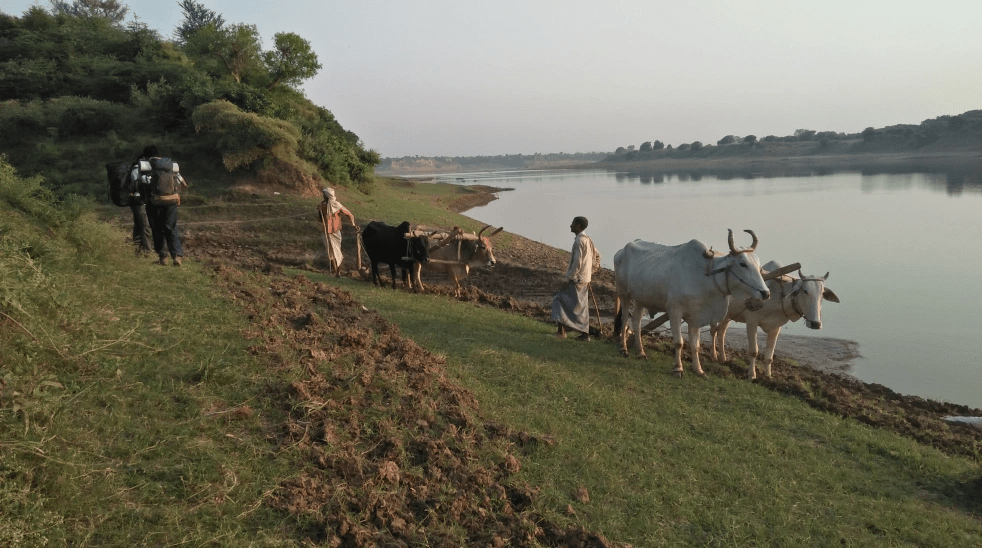
Rivers are the most important ecosystems (eco here includes ecology and economy) and yet possibly least studied entities. Some news below this week about some river studies brings the focus on need to take up many more river related studies.
Most important aspect of river related studies is the need for credible, independent studies, not influenced by the needs of the governments. Otherwise, the government is likely to not only influence the study, but also decide not to make it public as they did in case of the studies related to Joshimath town and role of Chamoli disaster.
In fact, we need to have a culture of achieving excellent research among our academic and scientific institutes to take up rivers related studies. There is no doubt that such culture does not exist today. When academic institutes compromise while conducting such studies, the studies and the institutes lose credibility as has unfortunately happened in case of Ganga River Basin Management Plans done by IIT consortium. Let us hope the studies mentioned below do not fall in the same category.
GANGA £1m project aims to forecast long-term effects of debris transported by natural disasters Centred on the headwaters of the Ganges River in the Himalayas, the SUPERSLUG initiative is named after the huge masses of debris created by such natural disasters, sometimes described as sediment slugs when they travel down rivers. The three-year project is being supported with a grant of almost £840,000 from the Natural Environment Research Council, part of UK Research and Innovation.
The project will focus on a 150 km stretch of the Ganges River impacted by the 2021 Chamoli disaster. Importantly, the project team will engage directly with communities and authorities in the Ganges region, to ensure their findings are accessible and useful to disaster management professionals, hydropower operators and the wider international academic community.
Professor Coulthard said, “Often it’s the rocks, house sized boulders and sheer volume of sediment moved rather than flood water that causes the most damage in these cascading multi-hazard events. The combination of remote sensing data with information gathered from sensors placed in the heart of the sediment slug will bring new understanding of how long the wave sticks around. This is fundamental for managing these events and predicting their impacts.” https://www.hull.ac.uk/work-with-us/more/media-centre/news/2024/1m-project-aims-to-forecast-long-term-effects-of-debris-transported-by-natural-disasters (26 Sept. 2024)
Safe operating space for major rivers in Ganges Delta An international study by Researchers at the University of Glasgow, Bangladesh University of Professionals, and Bangabandhu Sheikh Mujibur Rahman Agricultural University and Riverine People, is the first to define a safe operating space (SOS) for major rivers in the Ganges Delta, which will enhance resilience. The study found that four out of ten rivers in the Bangladesh Delta exceeded the SOS and that the majority of river flow has been significantly altered, with the remaining six rivers given cautious status.

The space just before the unsustainable state is defined as an SOS, within which humanity can safely thrive—anything beyond this is dangerous to humanity. Defining the SOS can provide an idea of the boundaries within which water management can operate safely to provide water security, and the sustainability of ecosystem services and development in Bangladesh. Study findings have been shared in a paper published (https://iopscience.iop.org/article/10.1088/1748-9326/ad796d) in the journal Env Research Letters. https://phys.org/news/2024-09-safe-space-major-rivers-ganges.html (25 Sep 2024)
Uttarakhand 289 sqkm of Doon valley in ‘high to very high hazard landslide zone’ A key study on the ‘landslide hazard zonation’ mapping of Dehradun shows that nearly 16.6% (approx 289.8 sq km) of the Doon valley (1741.6 sq km), including some popular tourist spots, falls under “high to very high hazard zone of landslides”. The peer-reviewed study by researchers from Amity University and Wildlife Institute of India (WII), published by Springer recently, says, “Increasing population and uncontrolled tourism in the valley is contributing to occurrence of landslides by placing additional pressure on vulnerable landscapes and altering natural terrain.”
It adds, “Landslides are more likely to occur near and above the ‘main boundary thrust’. The Doon valley rivers’ upper segments are more susceptible to landslides than their lower segments.” It is largely due to the area’s inherent geology and factors like slope, soil type, elevation etc, but external factors are also adding to the area’s susceptibility to landslides, the study points out. Places of tourist interest such as Maldevta, Bhatta Falls, Kimadi, Surkanda Devi temple, Digu waterfalls, George Everest Peak, Dhanaulti, Jharipani, Mussoorie and Bhadraj temple are under the 16.6% ambit, according to Ashish Mani, the lead author of the study, which is titled ‘Landslide hazard zonation (LHZ) mapping of Doon Valley using multi-criteria analysis method based on remote sensing and GIS techniques’. https://timesofindia.indiatimes.com/city/dehradun/289sqkm-of-doon-valley-in-high-to-very-high-hazard-landslide-zone-study/articleshow/113723652.cms (27 Sept. 2024)
SUTLEJ Heavy metals contaminating river, endangering ecosystem A study by Punjab-based environmental researchers has exposed alarming levels of pollution in the Satluj that pose a significant threat to water quality and aquatic life. The investigation revealed stark contrast between upstream and downstream sites, painting a worrying picture of the river’s health. While upstream areas remain relatively unpolluted, downstream sites are plagued by moderate to severe pollution. The most disturbing finding is the excessive presence of heavy metals at downstream sites, which surpass critical thresholds and endanger the river’s ecosystem, underscoring the urgent need for action to mitigate pollution and protect the Satluj’s water quality. https://timesofindia.indiatimes.com/home/environment/heavy-metals-contaminating-satluj-endangering-ecosystem-says-study/articleshow/113768501.cms (28 Sep 2024)
Understanding river flow dynamics Since 1953, an equation known as at-a-station hydraulic geometry (AHG) has been used to explain the relationship between river width, depth, velocity, and river discharge – the volume of water flowing through a river channel. AHG plays a key role in hydraulic engineering, flood prediction, and navigation. However, traditional methods for studying AHG through field research offer limited sample sizes and geographic scope, which do not fully capture the complexity of the factors affecting river discharge.
A new study, published in the ‘Journal of Remote Sensing’, explores the use of satellite data to enhance the understanding of AHG by incorporating remote sensing technology. The researchers aimed to overcome the limitations of field-based studies by using satellite imagery to track river changes globally.
“Understanding the response of width to changing discharge in different rivers is crucial for hydraulic modeling and river management. However, previous research is limited in spatiotemporal coverage by field measurements and only offers a fragmentary understanding in confined areas. This study introduces new data sources – multi-temporal river width data derived from Landsat and global discharge observations built upon years of progresses by the community – to provide a more comprehensive scope,” said Zimin Yuan, a researcher at the Institute of Remote Sensing and GIS at Peking University in Beijing.
The researchers identified 18 variables linked to AHG, which they grouped into six categories: hydrology, physiography, climate, land cover, geology, and human influences. They also considered how different river patterns – such as meandering, braided, or straight – affect AHG.
The study found that a 1% increase in river discharge typically leads to a 0.2% increase in river width, though this relationship is affected by factors such as soil composition, forest coverage, and human activities. For instance, rivers with cohesive soil and high forest cover showed less variation in width in response to discharge changes. https://www.spacedaily.com/reports/Using_Satellite_Data_to_Expand_Understanding_of_River_Flow_Dynamics_999.html (30 Sept. 2024)
UK Alarming drug pollution in rivers flowing inside national parks New research, published in August in the journal Environmental Toxicology and Chemistry, revealed that England’s most protected rivers – those that run through its national parks – were also heavily contaminated by pharmaceuticals. The findings demonstrated how drug pollution now flows into even the most apparently untouched waterways, with transformative, potentially dangerous results for ecosystems and people.
Antidepressants, antibiotics, diabetes treatments and anti-inflammatory drugs are among the chemicals flowing in the water – probably flushed down the toilet by someone in the nearby village of Tideswell. Brook Head Beck had 28 out of 54 pharmaceuticals that Boxall’s team tested for, but the greatest immediate risk to humans is posed by the concentration of antibiotics. https://www.theguardian.com/environment/2024/sep/27/amr-drug-resistance-england-national-parks-hidden-hazards-rivers-pollution-aoe (27 Sept. 2024)
HYDRO POWER PROJECTS
SANDRP Blog Adani PSP Dams: Defiling sacred pools & fish sanctuaries in Western Ghats Multiple dams, mushrooming resorts, creaking cities like Lonavala and townships like Lavasa have pushed Western Ghats Forests to a corner here.

And yet, the region is speckled with community conservation spaces like sacred groves, temple forests, sacred river origins and that spectacular gem of culture and conservation: community fish sanctuaries. https://sandrp.in/2024/09/25/adani-energy-dams-defiling-sacred-pools-and-fish-sanctuaries-in-western-ghats/ (25 Sept. 2024)
Study ‘Thick snow cover in central Himalayas down by over 30% in 3 decades’ Himalayan glaciers are rapidly diminishing, having “lost one-third of their ice in a mere three decades”, a recent research published in ‘Springer Nature Journal’ has revealed. Utilising reports gathered by US Geological Survey and using remotely-sensed data along with sophisticated landscape metrics, the report titled ‘Spatio-Temporal Assessment of Areal Fragmentation and Volume of Snow Cover in the Central Himalaya’ says that “between 1991 and 2021, areas covered by thick snow during peak periods plummeted from 10,768 km² to a mere 3,258.6 km², signifying a major reduction. In contrast, thin snow cover expanded from 3,798 km² to 6,863.56 km² by 2021, underscoring the region’s acute vulnerability to warming”.
– The research, which was conducted by professors Vishwambhar Prasad Sati and Surajit Banerjee from the department of geography and resource management at Mizoram University, further stated that “snow cover in the central Himalaya is not only thinning over time but also vanishing altogether. By 2021, thick snow cover had virtually disappeared in certain areas, particularly in lower-elevation regions such as Kedarnath”. Between 1991 and 2021, the snowline during maximum snow periods shifted upwards by approximately 700m, meaning that areas that once had permanent snow are now snow-free for most of the year. “Auli and its surrounding parts were known to have year-round snow cover, which is now missing. There has been a drastic reduction in snowfall frequency in lower elevations like Nainital, which now experiences snowfall once every two or three years compared to frequent snowfall during the 1990s,” Banerjee said. https://timesofindia.indiatimes.com/city/dehradun/central-himalayas-experience-over-30-decrease-in-thick-snow-cover-in-three-decades-reveals-springer-study/articleshow/113772338.cms (29 Sept. 2024)
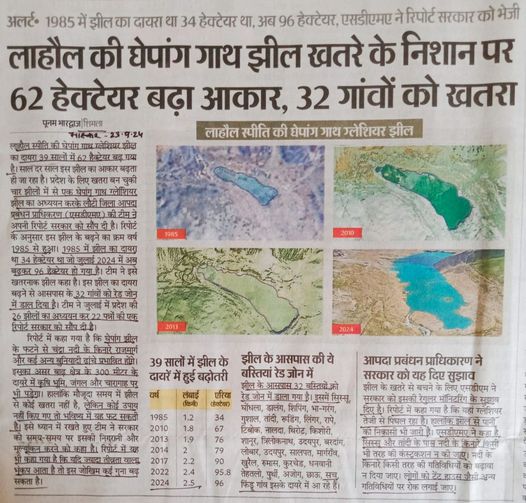
Himachal Pradesh According to this report Ghepang glacier lake area in Lahaul has increased from 34 Ha in 1985 to 96 Ha now. The district disaster management authority has called it dangerous and warned that 22 villages along the Chandra river could be at risk if the glacial lake bursts.
Arunachal Pradesh CM asked to review HEP policy In a letter to the CM, the group requested the state govt to promote community-based renewable energy alternatives and decentralised power grids, which will benefit not just the local communities but also the state. Expressing its opposition to rampant construction of dams in the state, the group said it’s not anti-development or anti-govt. Appealing to the state govt to review the 2008 policy, the group cited the dangers posed by Glacial Lake Outburst Floods (GLOF), as flagged by the National Disaster Management Authority. https://timesofindia.indiatimes.com/city/itanagar/review-hydropower-policy-grp-to-khandu/articleshow/113505061.cms (20 Sept. 2024)
NHPC Power Sec. demands completion date It is clear that completion dates of Parbati 2 and Subansiri Lower are still uncertain. https://www.newsip.in/nhpc-presents-dividend-check-to-union-minister/ (24 Sept. 2024)
Jammu & Kashmir NHPC to raise ₹2,300 cr to fund its expansion NHPC plans to raise the amount by securitising the return on equity of its Dulhasti Power Station in Jammu and Kashmir for eight years, said two people in the know of the development. The company will, however, retain ownership of the project.. For NHPC the monetisation is crucial to fund the expansion of its hydropower, pump storage, and solar power projects. The second person mentioned above said the initial plan was to implement the monetisation process in the third or fourth quarter of 2024-25 but had to be hastened because of a need for liquidity.
NHPC has implemented a similar securitisation earlier. In FY24, the NHPC raised ₹2,046.94 crore by monetising the return on equity of its Kishanganga Power Station for eight years, as per its annual report. NHPC aims to more than double its power generation capacity from 7,144 MW currently to 14,561.20 MW by 2026-27. Its net profit in the April-June quarter declined 5.66% from the same year-earlier period to ₹941.07 crore, while its revenue fell 2.29% to ₹2,694.20 crore.
India’s national monetisation pipeline includes power generation assets totaling 6 gigawatt (GW) of hydropower and renewable energy assets accounting for ₹39,832 crore, and power transmission assets accounting for as much as ₹45,200 crore. The Niti Aayog, which came up with the national monetisation pipeline, has listed potential core assets of Central government ministries and public sector enterprises for monetisation from 2021-22 to 2024-25. The plan includes assets with monetisation potential of ₹6 trillion during the period. In FY24, assets worth ₹14,690 crore were monetised under the power ministry. https://www.livemint.com/companies/nhpc-hydropower-securitisation-roe-dulhasti-power-station-rs-2-300-crore-national-monetization-pipeline-capex-expansion-11727177609302.html (24 Sept. 2024)
Report Power Ministry readies bidding norms for PSPs The Union Ministry of Power will soon come up with final tariff-based competitive bidding guidelines for producing electricity from pumped storage projects. Draft guidelines were issued two months ago and the deadline for comments and views from stakeholders ended in the first week of September 2024. India plans 74 GW of energy storage systems by 2031-32, including 27 GW from pumped storage plants and 47 GW from Battery Energy Storage Systems (BESS). https://www.fortuneindia.com/macro/india-readies-bidding-norms-for-pumped-storage-hydro-projects/118525 (24 Sept. 2024)
Maharashtra MEIL to set up two 4000 Mw PSPs at Rs 21,000 cr Megha Engineering & Infrastructures Limited (MEIL) will be investing Rs 21,000 crore in setting up two pumped storage hydro projects in Maharashtra with a total capacity of 4000MW. The two projects, MEIL’s first pumped storage hydro projects that it will set up under the build-operate-maintain (BOM) mode, include the Kamod pumped storage project in Nandurbar and Ghosla pumped storage project in Chhatrapati Sambhajinagar. While the Ghosla project is expected to be completed within three and a half years, the Kamod project is expected to be completed in five years, the Hyderabad-based company said on Thursday (Sept. 26). The two pumped storage projects will have newly constructed reservoirs – upper and lower reservoirs in a closed loop system that will generate power. The two project will be off-stream and will provide a minimum of six hours of energy storage on a daily basis. https://timesofindia.indiatimes.com/business/india-business/meil-to-set-up-two-4000mw-pumped-storage-hydro-projects-in-maharashtra-at-rs-21000-crore/articleshow/113706364.cms (26 Sept. 2024)
NTPC invites bids to prepare DPR for 800 Mw PSP NTPC has invited bids to prepare a detailed project report (DPR) for an 800 MW pumped hydro storage project, Amba PSP, in Maharashtra. The last date to submit the bids is November 16, 2024. Bids will be opened the same day. The scope of work covers preparing a bankable DPR of international standards for maximum annual power generation with a competitive tariff considering economical water usage and overall cost. For funding, NTPC may approach international funding agencies like the World Bank, JICA, ADB, and JBIC. The DPR should include all studies, analyses, and reports that such agencies usually require.
Last year, NTPC Green Energy, a subsidiary of NTPC, invited bids for developing pumped hydro energy storage projects of up to 2,000 MW capacity across India. The Central Electricity Authority recently approved two pumped hydro storage projects in Maharashtra with a total capacity of 2,500 MW. The two projects are the 1,500 MW Bhavali project to be developed by JSW Energy and the 1,000 MW Bhivpuri project by Tata Power. https://www.mercomindia.com/ntpc-invites-bids-to-prepare-dpr-for-800-mw-pumped-hydro-storage-project (26 Sept. 2024)
Andhra Pradesh AP-Genco and NHPC sign pact for development of RE projects The joint venture facilitates the implementation of solar energy and five Pumped Storage Hydropower Projects (PSHP) with an aggregate capacity of 5,070 Mw to meet the State’s growing energy demand. https://www.thehindu.com/news/national/andhra-pradesh/ap-genco-and-nphc-sign-pact-for-development-of-renewable-energy-projects/article68693421.ece (28 Sept. 2024)
MoEF Decisions of EAC meeting on River Valley Projects on Sept 13 2024: 1. 1500 MW Pawana Falyan Pump Storage Project by Avaada Hydropower BATTERY Pvt Ltd at in 204Ha in Village Kurvande and Falyan, Sub Dist Mawal and Sudhagad, Dist Pune & Raigad, Mah for TOR: Approved.
2. Rangit-II Hydro Electric Project (66 MW) in 33.294 ha in village Bangten, Barnyak, Barphok and Barthang etc. sub dist Gyalshing, Soreng and Ravong, West District, Sikkim by Sikkim Hydro Power Ventures Ltd for TOR: Approved
3. Tiruvannamalai Pump Storage Project (2000 MW) in 295ha in village Karnatiogarh Reserved Forest, Kidampalayam and Mel Cheppili etc., Sub District Jamunamarathoor and Kalasapakkam, District Tiruvannamalai, Tamil Nadu by Eco Leap Technologies India Pvt Ltd for TOR: Approved.
4. Greenko TN-11 OffStream Closed Loop Pumped Storage Project [1000 MW (6090 MWH)] in 274.94Ha in village Navappatti, Sub Dist Mettur, Dist Salem, Tamil Nadu by Greenko Energies Pvt Ltd: For TOR: Approved.
5. Thana Plaun HEP (191 MW) in 432.79 Ha in Guini Village, Mandi Dist, Himachal Pradesh by HP Power Corp Ltd. -for Environmental Clearance: https://parivesh.nic.in/utildoc/105841012_1727372935575.pdf
DAMS
Kaleshwaram Project Rush to fill gaps likely complicated repair plans Evidence is emerging that possible over-enthusiasm by officials in the irrigation department may have queered the pitch for the National Dam Safety Authority (NDSA) that is tasked with preparing a final report on the repairs needed at the Medigadda barrage. It is learnt that the NDSA has expressed unhappiness over how the gaps and voids under the foundations of Medigadda barrage, as well as those at Annaram and Sundilla, were grouted though the NDSA itself did not specify any such action in its interim report. https://www.deccanchronicle.com/southern-states/telangana/rush-to-fill-gaps-under-klis-barrages-likely-complicated-repair-plans-1825809 (25 Sept. 2024)
Govt tells L&T to repair Medigadda The Telangana govt has cancelled the completion certificate issued to L&T for constructing the Medigadda barrage as part of the Kaleshwaram lift irrigation project. The company will now have to shell out roughly Rs 600 crore to restore the damaged portions.Irrigation secretary Rahul Bojja confirmed on Sept 25 that the state govt wrote to L&T recently informing its management about cancelling the certificate issued by the irrigation engineers. The company must also complete other pending works like buildings and quarters near the barrage, earthwork as a 3D model, road approaches to the barrage, maintenance bay, overburden removal, and flood banks.
– The state govt is waiting for the comprehensive and final report from the National Dam Safety Authority (NDSA) to take up the restoration of the Medigadda barrage. The report is expected in about a month. NDSA may suggest ways to the irrigation department to restore damaged portions, including changing some designs. The vigilance and enforcement (V&E) department said the officials gave the certificate (in 2019 and 2021) without taking an undertaking from L&T that all tests had been done and it would take responsibility for restoring and repairing the barrage if problems cropped up. https://timesofindia.indiatimes.com/city/hyderabad/telangana-govt-tells-lt-to-repair-medigadda-cancels-cert/articleshow/113665317.cms (25 Sept. 2024)
July 2022 floods affected Medigadda: Experts Engineers and retired experts testified before the Judicial Commission headed by Justice PC Ghose on Tuesday (Sept. 24) that the July 2022 floods were beyond all expectations and likely a primary cause of the damage to the Medigadda barrage. The heavy floods affected even the cement concrete blocks of the structure. The agencies responsible for implementing the project were informed about the damage caused by the floods. This communication highlighted the need for immediate attention to the affected areas. The commission inquired about the entities responsible for the project’s design and construction. It was told that WAPCOS was entrusted with preparing the designs and drawings for the barrage.
Additionally, site studies were conducted by the National Institute of Technology (NIT) Warangal before the construction commenced, ensuring that the project was based on thorough research and analysis. Justice PC Ghose emphasised the importance of understanding the root cause. https://telanganatoday.com/july-2022-floods-affected-medigadda-experts (25 Sept. 2024)
Action against KLIS engineers could empty dept CM A Revanth Reddy created a flutter on Thursday (Sept. 26) by claiming that the entire irrigation department will be left with none if the state govt initiates action against the engineers for their alleged lapses in the construction of Kaleshwaram project. “Who should be blamed for the lapses in the Kaleshwaram project? The officials who executed the project or the political bosses of that time? This is an eye-opener on how the irrigation engineers should never compromise on the quality of the works,” he said. “Had the field engineers sent remarks on the quality of the Kaleshwaram project work, the current situation could have been easily avoided,” he stressed. https://timesofindia.indiatimes.com/city/hyderabad/revanth-warns-of-engineer-exodus-over-kaleshwaram-project-failures/articleshow/113714310.cms (27 Sept. 2024)
The CM added that till date Rs.1 lakh crore was spent on Kaleshwaram and another Rs.47,000 crore were needed. “But not even one lakh acres of ayacut has been created. Who should be held responsible,” he asked. Over the last decade, despite Rs.2 lakh crore being spent on irrigation many projects had remained incomplete. https://www.deccanchronicle.com/southern-states/telangana/revanth-slams-brs-for-wasting-rs-1-lakh-crore-on-klis-1826298 (27 Sept. 2024)
Telangana Focus on projects to be completed within 2 years first: CM At a review meeting held at Jala Soudha on Thursday (Sept. 26) night, the CM told the irrigation officials to prepare an action plan to speed up works on projects that could be completed in time up to two years. He also wanted them to focus on projects that were completed 75% or more, so that water could be given to the intended ayacut at least for the next Kharif season.
There would be no use in focusing on projects that could be completed in the next five-six years and asked the authorities to ensure that there was no problem of funds for projects to be completed on priority basis both in the Godavari and Krishna Basins. He told them to clear bills pertaining to projects that could be completed in a short period through green channel. https://www.thehindu.com/news/national/telangana/focus-on-projects-to-be-completed-within-2-years-first-cm-to-irrigation-officials/article68687769.ece (26 Sept. 2024)
The CM said that incomplete projects are the main reason for inter-state water disputes. “If the projects were completed on time these issues would be resolved as water allocation for all these projects has already been established,” he said. Assuring the newly-appointed AEEs that they could approach him with any problem the CM warned that if they came with recommendations for transfers and favourable postings, it would be discouraged. https://www.siasat.com/half-the-irrigation-dept-will-be-empty-if-kaleshwaram-engineers-face-action-telangana-cm-3103331/ (26 Sept. 2024)
Deputy CM Bhatti Vikramarka and an official government delegation which is touring the United States visited the hydroelectric power plant at the world-famous Hoover Dam and announced that the state government would emulate similar effective water management and security practices. https://www.deccanchronicle.com/southern-states/telangana/bhatti-vikramarka-visits-hoover-dam-plans-to-emulate-similar-effective-water-management-practices-1826351 (27 Sept. 2024)
Karnataka 3 steel majors to fix new crest gates for Tungabhadra dam Now, sources said the JSW steel plant, located in the undivided Ballari district, will play a major role in providing iron for the crest gate reinstallation project. Two other companies, Narayana and Hindusthan Engineering Works, are also ready to lend a helping hand. The Tungabhadra dam authority is waiting for the official announcement of installation of the new crest gates. https://www.newindianexpress.com/states/karnataka/2024/Sep/26/three-steel-majors-to-fix-new-crest-gates-for-tungabhadra-dam-in-karnataka (26 Sept. 2024)
Mullaperiyar Dam Petitioner moves SC, seeks to implead NDSA An application has been moved in the Supreme Court, seeking to make the National Dam Safety Authority (NDSA) a party in the ongoing Mullaperiyar Dam case. The application was moved by Dr. Joe Joseph, a resident of Kothamangalam, who had previously filed a petition concerning the safety of the Mullaperiyar Dam. The petitioner also requested that the NDSA conduct daily safety assessments of the dam.
Joseph alleged that the supervisory committee responsible for the Mullaperiyar Dam only visits the site once or twice a year for inspections. A sub-committee formed by the supervisory committee reportedly visits the dam only once every three months. According to Joseph, these irregular inspections are inadequate for ensuring the dam’s safety. He argues that there is no effective system in place to consistently monitor the dam’s condition. https://english.mathrubhumi.com/news/kerala/mullaperiyar-dam-case-ndsa-inclusion-1.9939719 (28 Sept. 2024)
Theni farmers seek protection for Mullaiperiyar dam Several farmers staged a protest near Pennycuick Memorial at Lower Camp in Theni district on Sunday (Sept. 22) against the Kerala government’s move to build a new dam countering the existing Mullaiperiyar dam, which serves as a lifeline for southern districts including Madurai, Theni, Dindigul, Sivaganga and Ramanathapuram. Balasingam, the coordinator of the Sangam, who led the protest, said if the Kerala government tries to demolish Mullaiperiyar dam, the farmers would turn into suicide squads. https://www.dtnext.in/news/tamilnadu/theni-farmers-seek-protection-for-mullaiperiyar-dam-804750 (22 Dec. 2024)
Madhya Pradesh नर्मदा बचाओ आंदोलन की नेता, मेधा पाटकर ने डिंडोरी और मंडला जिलों के कलेक्टरों को ईमेल के माध्यम से पत्र भेजा है। इस पत्र में उन्होंने राघवपुर और बसनिया बहुद्देशीय परियोजना के तहत प्रभावित कृषकों की भूमि अर्जन प्रक्रिया पर आपत्ति जताई है। पाटकर का कहना है कि प्रभावित क्षेत्रों की ग्राम सभाओं ने भूमि अधिग्रहण के लिए अपनी सहमति नहीं दी है। https://www.deshgaon.com/voices/medha-patkar-opposes-land-acquisition-in-narmada-valley-demands-constitutional-process/ (28 Sept. 2024)
INTERLINKING OF RIVERS
Himachal Pradesh Centre inducts CISF for security of Beas Satluj Link project The Union government has inducted the Central Industrial Security Force (CISF) for the security of the Beas Satluj Link (BSL) project in Mandi district of Himachal Pradesh, said officials familiar with the matter on Sunday (Sept. 29). The sensitive vital installation will be guarded round the clock by at least 235 personnel headed by a deputy commandant. The officer added that CISF will implement advanced surveillance and response measures to safeguard the infrastructure and personnel involved in the project. https://www.hindustantimes.com/india-news/centre-inducts-cisf-for-security-of-beas-satluj-link-project-101727636466814.html (30 Sept. 2024)
INTERSTATE WATER DISPUTES
Odisha-Andhra Pradesh According to sources, the Odisha government had spent lakhs of rupees in the construction of two check dams in a bid to help farmers of Kundum, Gaudakundum and other villages in the Odisha-Andhra border in Rayagada district in 2016-17. However, the purpose of the check dams remains unfulfilled as all the water is being diverted to Andhra. Odisha farmers are facing all sorts of problems due to lack of water for their crops. https://odishatv.in/news/odisha/odisha-farmers-left-high-and-dry-as-andhra-diverts-canal-water-from-rayagada-245323 (29 Sept. 2024)
URBAN RIVERS
Musi; Hyderabad Goons seize Musi riverbed, mint millions The Musi river bed in the central parts of Hyderabad has become a money-spinner for muscle-men and anti-social elements. Though the river bed was earlier used as grassland to raise fodder for animals, its central location and growing land prices in the last four decades have caught the attention of goons who have taken control over the large extent of land to either use the same or sub-lease it to others to carry out a number of nefarious ‘trading’ activities. Many have made crores in the last couple of decades as there is check by government agencies. https://www.deccanchronicle.com/news/goons-minting-millions-after-grabbing-musi-river-land-1826846 (29 Sept. 2024)
Survey of encroachments along river continues Officials of the Telangana Revenue department from the Hyderabad and Ranga Reddy districts on Thursday, September 26, are conducting a thorough survey to identify illegal structures. The survey, which began on Wednesday, September 25, involves 16 teams in Hyderabad district, 4 teams in Ranga Reddy district, and 5 teams in Medchal-Malkajgiri district. Revenue officials are collecting details of the structures built on the riverbed from the residents. They will also mark the constructions in the buffer zone of the Musi River.
The survey has already been conducted in areas like Chadarghat, Musarambagh, and Shankarnagar, which fall under the Musi catchment area. Himayatnagar Tahsildar Sandhya Rani is leading the survey efforts. Officials have also surveyed the Ibrahimbagh area under the Golconda division. The survey is expected to continue in the Langer Hauz Defense Colony in the coming days. The state government has already issued orders to allot around 15,000 double-bedroom housing units for the rehabilitation of the poor families to be displaced due to the Musi Riverfront Development project. https://www.siasat.com/hyderabad-survey-of-encroachments-along-musi-river-basin-continues-3102984/ (26 Sept. 2024)
After HYDRA, the govt is likely to face heat with its plan to develop Musi riverfront. As teams from the revenue department began conducting surveys and marking the structures that had come up in the river buffer zone, residents began raising hue and cry. These survey teams are facing stiff resistance from the public. While HYDRA demolitions were primarily targeted at the properties of the rich and wealthy, the government may have to clear many encroachments along the Musi River. The lower and middle classes made up the majority of those encroachments. https://www.deccanherald.com/india/telangana/congress-government-may-face-tough-time-realising-musi-riverfront-development-3208310 (26 Sept. 2024)
Along with shifting residents in the Musi buffer zone to alternative accommodation in 2BHK houses, the state government has prepared an action plan prioritising education of children and livelihood of the affected families. It has also been decided that families who are living in the buffer zone and having pattas will be rehabilitated and given compensation as per the Right to Fair Compensation and Transparency in Land Acquisition, Rehabilitation and Resettlement Act, 2013. https://www.deccanchronicle.com/southern-states/telangana/telangana-government-prepares-rehabilitation-plan-for-musi-buffer-zone-residents-1826484 (28 Sept. 2024)
Buddha Nullah; Ludhiana PPCB orders dyeing units to stop discharge The Punjab pollution control board (PPCB) in a written communication to dyeing associations’ office bearers at Tajpur road, Bahadurke road and Focal point have stated that they cannot discharge effluents from the common effluent treatment plants (CETPs) into Buddha Nallah or any other surface water body. Dyeing units are either supposed to reuse the treated water or can give that water for irrigation purposes. As dyeing units have no immediate arrangements for reuse, the fate of over 200 dyeing units hangs in air.

Earlier on May 3, 2013, the special purpose vehicle (SPV), formed to run the common effluent treatment plants of dyeing units at Tajpur road, Bahadurke road and Focal point, was granted environment clearance on the clause that they will not discharge treated water in Buddha Nallah or any other surface water body. However, they continued to do so over the years.
The order dated September 25 also mentions that the SPV formed to operate CETPs are supposed to meet the discharge standards and comply with disposal conditions mentioned in environment clearance granted by ministry of forest, environment and climate change on May 3, 2013. https://indianexpress.com/article/cities/chandigarh/ppcb-orders-dyeing-units-discharge-buddha-nallah-9590506/ (27 Sept. 2024) Despite the directive, pollution in the Sutlej tributary remains rampant, with effluents still being released into the waterway. The PPCB’s action comes ahead of the October 1 deadline set by the civil society group, Kale Pani Da Morcha, which has threatened to forcibly stop the effluent flow if action is not taken. https://www.tribuneindia.com/news/ludhiana/ludhiana-no-end-to-effluent-flow-into-buddha-nullah-despite-pollution-board-ban/ (28 Sept. 2024)
RIVERS
Report Nearly half of all posts in SPCBs vacant Nearly half the sanctioned posts in the State Pollution Control Boards (SPCBs) and Pollution Control Committees in Union Territories (PCCs) across the country are lying vacant.
While 11 states have over 60% vacancies, Sikkim tops the list with all posts yet to be filled. The Central Pollution Control Board (CPCB) submitted these details in an affidavit to the NGT on September 6. According to the affidavit, of the total 11,562 sanctioned posts in all SPCBs and PCCs, 5,671 (49.04%) posts have been left unfilled. While some of these posts have been vacant for a month or so, others have been vacant for decades — at least one post in the Punjab SPCB has been vacant for over 35 years (423 months). Only two states — Nagaland and Arunachal Pradesh — have no vacancies, with all 17 and 27 sanctioned posts respectively being filled.
The states with the most vacancies are Sikkim (100%), Jharkhand (73.06%), Andhra Pradesh (70.10%), Madhya Pradesh (63.76%) and Manipur (63.02%) (see chart). In an affidavit to the NGT, the Sikkim government said the recruitment process has been kept “on hold” as the state has been “unable” to allocate funds. Sikkim has the smallest SPCB with only 11 sanctioned posts, while the Madhya Pradesh SPCB has the largest sanctioned strength with 1,228 posts, of which 783 are vacant “due to court proceedings”.
Setting a deadline, the NGT, on September 11, directed all states and UTs to fill the vacancies by April 30 next year. This, however, does not include Punjab, Delhi and the states with areas in the NCR — Haryana, Uttar Pradesh and Rajasthan. Vacancies in SPCBs in these states and PCC in Delhi are already the subject of an ongoing case in the Supreme Court. According to the latest data, over half the sanctioned posts (53.68%) at the SPCBs and PCC in the NCR are lying vacant – 1,253 of the 2,334 sanctioned posts. In Rajasthan and Haryana, the vacancies go up to over 60%. The Supreme Court is set to hear the case again on September 27.
Over the past year, both the Supreme Court and the NGT have been monitoring states’ efforts to fill these vacancies. The NGT began monitoring SPCB vacancies in November last year, after taking suo motu cognizance of a media report. In a subsequent report submitted to the NGT on November 22 last year, the CPCB said over half of all sanctioned posts were vacant (50.8%). https://indianexpress.com/article/india/nearly-half-of-all-posts-in-pollution-boards-vacant-some-for-decades-9584609/ (24 Sept. 2024)
While a few states have said the recruitment for vacant posts could not be carried out as the service exams had not been held, others have also stated that elections had led to the postponement of exams. In other states, their respective governments are yet to approve the recruitments. https://www.tribuneindia.com/news/india/50-posts-in-state-pollution-boards-vacant-govts-blame-poll-code-insufficient-funds/ (25 Sept. 2024)
EDIT The problem does not stem from a lack of laws. Effective monitoring and implementation have been the Achilles heel in the battle against pollution. Environmental regulation has rarely kept pace with the demands of the post-liberalisation economy. The SPCBs haven’t just failed to fill up their sanctioned strength. They have also not done justice to their mandate by failing to rope in an adequate number of independent scientists in pollution control exercises. The autonomy of these agencies on technical issues is often compromised because civil servants and officials with a background in government, and not experts, hold most of the top posts. Moreover, the terms of the chairperson and member secretaries of these agencies vary from a year to three years — only in rare cases have these officials held a position for more than five years. Such short tenures are not ideal for developing long-term pollution abatement plans. https://indianexpress.com/article/opinion/editorials/vacancies-in-pollution-control-boards-a-deeper-malaise-9586372/ (25 Sept. 2024)
Meghalaya Opposition to public hearing on expansion of cement firm’s mining ops In a statement Elaka Narpuh Youth for Change (ENYC) noted that the public hearing will focus on the proposed mining project of Star Cement Meghalaya Limited (SCML), known as the ‘Brishyrnot Limestone Deposit – II,’ located at Brishyrnot in Elaka Narpuh, East Jaintia Hills. “We oppose the proposed limestone mining by the cement plant, which will expand over an area of 65 hectares at Brishyrnot, very close to Wah Lunar river. This proposed mining will have a significant impact on both Wah Lunar river and Wah Lukha river,” the organization stated. Furthermore, they expressed concerns that the mining area would also affect the Narpuh Wildlife Sanctuary and the Narpuh Reserved Forest. The ENYC announced that they would protest against the public hearing scheduled for October 8.
Earlier, the KSU had written to the MSPCB to oppose the expansion of Star Cement’s mining area and the establishment of a cement plant and captive power plant by Meghatop Cement Company Private Limited in the East Jaintia Hills district. KSU president of Narpuh Circle, KS Suchiang, warned that if the company is granted permission to expand its operations, there is a high risk of various types of pollution being discharged into the Lunar River and subsequently into the Lukha River. “The activities of the cement company have already caused both rivers to become highly acidic, rendering them unsuitable for drinking,” he added.
The SPCB is scheduled to hold a public hearing on October 18 regarding Meghatop Cement Private Limited’s proposal to construct a cement plant in the region. Meanwhile, the KSU has urged the MSPCB to withdraw the public hearing and prevent the expansion of projects that will exacerbate the ongoing environmental crisis. https://theshillongtimes.com/2024/09/29/opposition-to-public-hearing-on-expansion-of-cement-firms-mining-ops/ (29 Sept. 2024)
Uttarakhand A meeting between the Joshimath Bachao Sangharsh Samiti and the Additional Secretary of Disaster Management on Sep 25 had ended in stalemate, leaving residents of the subsidence-hit town in limbo. In the second round of discussions, it was decided that disaster management team will visit Joshimath in October. https://www.newindianexpress.com/nation/2024/Sep/27/after-talks-deadlock-team-to-visit-joshimath-in-oct (27 Sept. 2024)
Bihar Bridge over Kiul river in Lakhisarai tilts The portion of a bridge over the Kiul river in Lakhisarai district tilted on Monday (Sept. 23) in the second such incident in the state in the last 24 hours, officials said. The portion of an under-construction bridge, the Bakhtiyarpur-Tajpur Ganga Mahasetu, had collapsed in Patna district on Sunday (Sept. 22) night. The bridge, built by the Road Construction Department, was inaugurated in 2014, according to locals. opposition Tejashwi Yadav alleged, “The bridge was being built at a cost of Rs 1,603 crores. A week ago, another bridge constructed for crores of rupees over the Barnar river in Jamui also collapsed even though it was inspected by the CM a few days ago,” he added. https://www.deccanherald.com/india/bihar/bihar-bridge-over-kiul-river-in-lakhisarai-tilts-3203441 (24 Sept. 2024)
YAMUNA Delhi Govt to study impact of barriers, preventive steps for flood The scope of the study comprises nine points – three pertaining to embankments – and the rest on study of islands formed in river and corrective measures; assessment of location and extent for clearing the mud and sand mining in river bed between Wazirabad and Okhla to increase the river’s carrying capacity; corrective actions in solid approach roads of various bridges; review of danger and warning levels at Old Railway Bridge, and strengthening and raising of existing regulators and pumphouses.
The Delhi government will undertake a five-month study to analyse the impact of obstructions like bridges, embankments, weirs, and river islands on the flow of Yamuna, officials familiar with the matter said on Monday, adding that the report will also suggest measures to prevent flooding in the river that inundated the Capital in July last year. The Delhi government’s Irrigation and Flood Control Dept has joined hands with the Central Water and Power Research Station – an organisation under the Ministry of Jal Shakti – for the study, which will also assess the proposals by MLAs, MP and the I&FC department to create new embankments and retaining walls on the banks of the river. The study is estimated to cost ₹42.43 lakh. These include construction of another embankment (or bund) on the left bank of Yamuna from Wazirabad to Shastri Park parallel to the existing bund in continuity of left forward embankment up to the LM embankment near Shastri Nagar. https://www.hindustantimes.com/cities/delhi-news/delhi-govt-to-study-impact-of-barriers-preventive-steps-for-yamuna-flood-101727113675190.html (24 Sep 2024)
Delhi Using satellite imagery, INTACH has successfully traced the flow of the Sahibi river which is now classified as ephemeral. https://www.downtoearth.org.in/water/in-a-first-satellite-imagery-maps-long-lost-sahibi-river (26 Sept. 2024)
Haryana जीवनदायिनी यमुना की किसी को चिन्ता नहीं दर असल यमुना को प्रदूषण मुक्त किये जाने की दिशा में सीवेज ट्रीटमेंट की क्षमता में बढ़ोतरी किये जाने, नालों के पानी को सीधे नदी में गिरने से रोकने, शहरी और जे जे कलस्टर में सीवर नेटवर्क निर्माण, शोधित पानी के पुनर्उपयोग, यमुना कछार में चलने वाली और जिलों से गाद निकालने से जुड़ी परियोजनाओं में हीला-हवाली कहें या नाकामी पूरी तरह जिम्मेदार है। इसका खुलासा दिल्ली प्रदूषण नियंत्रण समिति की बीते माह जारी रिपोर्ट में हुआ है। इन हालात में यमुना का नाले के रूप में बहना उसकी नियति बन चुकी है। ऐसे में उसकी शुद्धि की आशा बेमानी है। हरिद्वार और वाराणसी की तर्ज पर यमुना घाटों का सौंदर्यीकरण कर पर्यटक स्थल बना और वहां आरती का कार्यक्रम आयोजित करने से यमुना की बदहाली छिप जायेगी, यह जनता को धोखे में रखने के सिवाय कुछ नहीं। इस सच्चाई को झुठलाया नहीं जा सकता। (ज्ञानेन्द्र रावत) https://globalbihari.com/yamun-ke-pradushan-ke-babat-haryana-chunaav-mein-kyon-chup-hain-rajnitik-dal/ (23 Sept. 2024)
RIVERS BIODIVERSITY
Report ‘Frogs are as important as tigers’ Frogs, which comprise the majority of amphibians, are culturally often associated with rain, says ecologist Gururaja K.V. going on to play a video of a frog wedding, a traditional ceremony performed in many parts of India to invoke rainfall. “There is a saying in the majority of cultures that if the frog croaks, there is going to be rain,” he says, throwing in a fascinating fact: 95% of the frogs that croak are male.
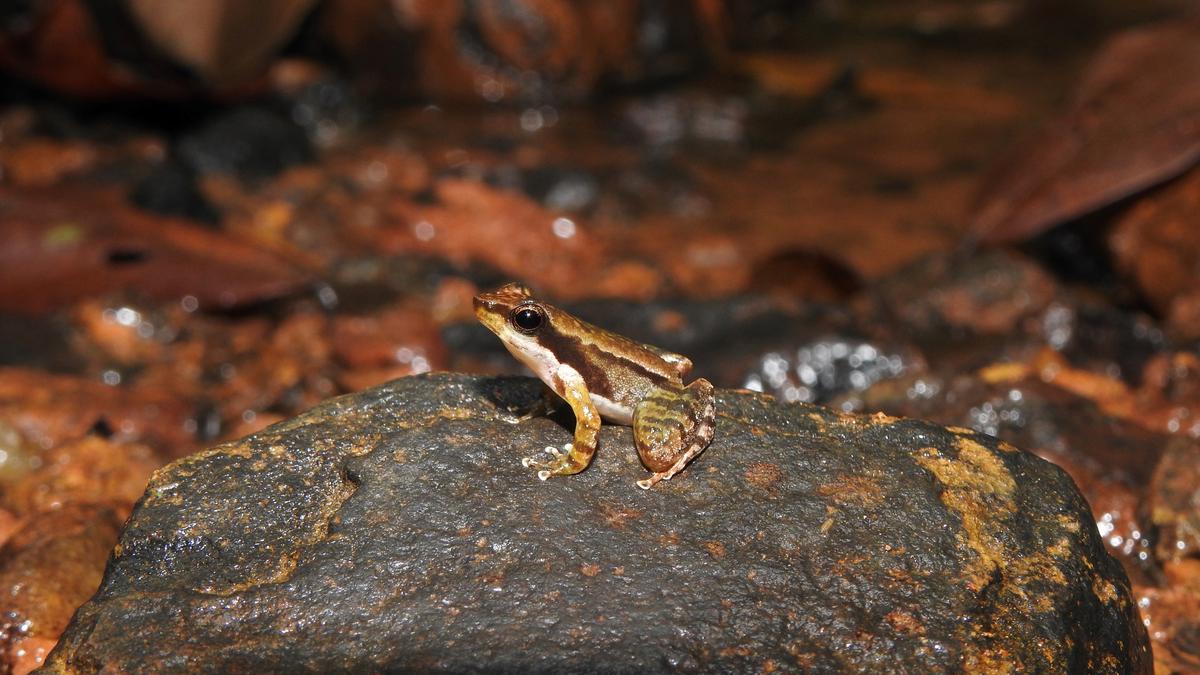
While frogs’ beautiful eyes and dazzling diversity are indeed enthralling, they are also a crucial part of various ecosystem functions like helping keep algal bloom and insects like mosquitoes in check and as prey for various predators. They’ve also played a critical role in medical research, whether in pregnancy testing, genetic experiments, or studying drug absorption and are of huge cultural significance, finding mention in mythology, religious texts, fairy tales, books and even cartoons.
Most importantly, they perform yet another important ecological role as indicator species: organisms that offer insights into ecosystem health. Since frogs are very sensitive to even the smallest changes, they reflect subtle shifts in a micro-habitat, says Gururaja. He firmly believes that a top-top conservation narrative focusing mainly on megafauna is problematic. “Frogs are as important as tigers,” he says, pointing out that preserving their micro-habitats is essential to overall ecosystem health. “At the end of the day, whatever we say about species, you cannot conserve based on a single species. You have to conserve the habitat.”
Citizen Science, he firmly believes, can play a major role in conservation, contributing to baseline data and information about amphibians. “Scientists cannot spend this amount of time on one species. But, if people can participate by observing and recording what is in their backyard, it is a great starting point,” he says. And it is not just about citizens simply being data gatherers; it is also about creating a more informed audience.” https://www.thehindu.com/news/cities/bangalore/frogs-are-as-important-as-tigers/article68672667.ece (24 Sep 2024)
SAND MINING
Odisha NGT bans sand mining in Subarnarekha river NGT’s east zone bench in Kolkata said no sand mining shall be carried out in Rayan Ramchandrapur sand source in Jaleswar tehsil in Balasore district in the absence of a district survey report (DSR) approved by State Environment Impact Assessment Authority (SEIAA). The tribunal imposed the restriction while disposing of a petition filed by Abani Kumar Sahu, a resident of Balasore, on Sept 20. Though the sand source has not been recommended in the DSR submitted by the sub-divisional committee, a private leaseholder continues to extract sand from the riverbed, the petition alleged. Advocates Sankar Prasad Pani and Ashutosh Padhy made submissions on the petitioner’s behalf. https://timesofindia.indiatimes.com/city/cuttack/ngt-bans-sand-mining-in-subarnarekha-river/articleshow/113646856.cms (25 Sept. 2024)
Andhra Pradesh Ex-mines director arrested by ACB Anti-Corruption Bureau (ACB) officials arrested VG Venkata Reddy, former director of mines and geology, for allegedly committing several irregularities causing financial loss of about 2,500 crore to the public exchequer. Venkata Reddy, who has been absconding for the past three months, was arrested from a resort in Telangana on Thursday (Sept. 27) night.
The NDA alliance govt had ordered an ACB probe into the “misdeeds” of Venkata Reddy during the previous YSRCP regime after placing him under suspension. The govt ordered the ACB to take action against him for various acts of “violation in tenders/agreements, APMMC Rules, operations of sand mining and violation of orders of NGT/ Supreme Court and causing huge loss to state exchequer and wrongful gains to private parties”.
The ACB alleged that Venkata Reddy entered into criminal conspiracy with JPVL, GCKC Projects and Works Pvt Ltd and Prathima Infrastructures Pvt Ltd and other accused, by abusing his official position and in anticipation of accepting undue advantage, dishonestly and fraudulently allowed JPVL and others to misappropriate govt funds. The wrongful loss caused to the govt that resulted in a breach of trust and misappropriation of property worth about 2,566 crore. https://timesofindia.indiatimes.com/city/vijayawada/former-mines-director-vg-venkata-reddy-arrested-for-corruption-in-telangana/articleshow/113748046.cms (27 Sept. 2024) APCC chief YS Sharmila has demanded an in-depth probe into the alleged sand mining scam involving former director of Mines and Geology VG Venkata Reddy. https://www.newindianexpress.com/states/andhra-pradesh/2024/Sep/29/apcc-chief-ys-sharmila-demands-probe-into-sand-mining-scam (29 Sept. 2024)
Karnataka Organisations take out protest march Members of Catholic Sabha, Mangaluru, and other pro-people organisations took out a march protesting unabated illegal extraction of sand from the Netravathi riverbed thereby threatening the existence of Pavoor-Uliya Kudru (river island) on Friday, September 27.Democratic Youth Federation of India leader Muneer Katipalla said illegal sand extraction from the riverbed was also threatening similar other areas, including Ranipura and Ullal Hoige in the Netravathi along with Pavoor-Uliya. He cautioned against holding indefinite dharna in front of police stations, including Konaje, Mangaluru Rural, and Ulla, that have jurisdiction over areas where the illegal sand extraction was taking place. Leaders of all political parties were involved in illegal sand extraction, he alleged.
The sabha organised the protest march to express solidarity with the residents of Pavoor Uliya in their fight against the illegal extraction of sand near the island. It alleged that the district administration was keeping silent over the illegal sand extraction despite repeated complaints. The existence of about 40 families on the Kudru was under threat following the unabated illegal sand extraction, it said. https://www.thehindu.com/news/cities/Mangalore/organisations-stage-a-protest-march-decrying-illegal-sand-extraction-around-pavoor-uliya-kudru/article68690953.ece (27 Sept. 2024)
Based on a report submitted by an inquiry committee headed by the assistant commissioner, deputy commissioner Mullai Muhilan MP has issued an order directing police and the mines and geology department to protect Pavoor-Uliya island by checking illegal sand extraction. Nearly 55 families on the island have been complaining about widespread and unlawful extraction of sand from the surrounding area. The DC has ordered the police and the mines and geology department to seize boats, machinery, and sand stocks in and around the island. Further, he has also directed the police to register cases against owners of the properties where sand stocks are found. https://timesofindia.indiatimes.com/city/mangaluru/urgent-action-against-illegal-sand-mining-near-pavoor-uliya-island/articleshow/113740171.cms (27 Sept. 2024)
Uttar Pradesh 2 students drown in pit created by illegal sand mining Two minors, identified as Durgesh and Manas, drowned in a water-filled pit created because of illegal sand mining in Sarojininagar. The boys were returning home after tuition when they decided to take a dip in the pond on Rahimabad Road on Sept. 27, said police. While one of their friends managed to escape, Durgesh and Manas drowned. Locals were furious and staged a protest complaining that SDRF arrived four hours after the incident was reported. They accused SDRF team of delaying search and rescue operation. https://timesofindia.indiatimes.com/city/lucknow/2-students-drown-in-pit-created-by-illegal-sand-mining/articleshow/113715498.cms (27 Sept. 2024)
Opinion गाद को बहने दो प्रत्येक नदी में तीन तरह के कण होते हैं: सैंड, सेडिमेंटेमेंटेशन और सिल्ट यानी रेत, गाद और तलछट। सबसे मोटा कण रेत, उससे बारीक गाद और उससे बारीक कण को तलछट कहते हैं। रेत का काम होता है नदी के पानी को सोख कर उसे सुरक्षित रखना। नदी से जितना रेत निकालते जाएंगे, नदी की जलसंग्रहण क्षमता उतनी कम होती जाएगी। जिस नदी में सीमा से अधिक रेत का खनन होगा, वह नदी अंतत: सूख जाएगी। (अरुण तिवारी) https://www.jansatta.com/politics/jansatta-article-about-ganga-river-2/335612/ (30 May 2017)
WATER OPTIONS
Opinion Reviving shallow aquifers: Part of the solution The Shallow Aquifer Management (SAM) project provides a blueprint for this approach, but its lessons must be scaled up and implemented nationwide. On these lines, AMRUT 2.0 intends to replicate this initiative in a much larger cohort of cities across India, not just involving pilot projects but larger city-wide actions. As India faces the dual challenges of urban growth and water scarcity, it is time to embrace the wisdom of our ancestors and integrate it with the science of hydrogeology. By restoring shallow aquifers and making them a part of an integrated urban water management ecosystem, cities can ensure that this invaluable resource remains a dependable source of water for generations to come. In the words of Kabir: The well is one, and the water is the same. Let us remember that the water we draw today must sustain us tomorrow. (S. Vishwanath, Ishleen Kaur) https://www.hindustantimes.com/analysis/reviving-shallow-aquifers-part-of-the-solution-to-indias-urban-water-crisis-101727190209145.html (16 Sept. 2024)
Hyderabad RWH pits made mandatory for all houses To recharge depleting groundwater table and prevent rainwater from going into storm water drains, Rain Water Harvesting Structures (RWHS) have been made mandatory for all houses in the city. From January 2025, houses that do not comply will be charged double for water tankers. The timeline fixed to implement these measures is from October to December, 2024, with a special drive by the Hyderabad Metropolitan Water Supply and Sewerage Board (HMWSSB) starting on October 2.
The Water Board will gather data on water tanker users from February to May, targeting those households to ensure RWHS construction. Eighteen NGOs will assist in surveying which homes have RWHS pits, focusing on residences of 300 sq yards and above, entering the data into a dedicated app. https://www.newindianexpress.com/states/telangana/2024/Sep/22/rain-water-harvesting-pits-made-mandatory-for-all-houses-in-hyderabad (22 Sept. 2024)
GROUNDWATER
Gujarat State extracts 52% of groundwater recharge: CGWB In the past 10 years, Gujarat has recorded 100% or more seasonal rainfall for eight seasons. With Narmada River waters reaching cities and several regions of North Gujarat, the availability of surface water has also improved. However, more than half of the groundwater recharge in Gujarat is extracted, indicated the Central Ground Water Board (CGWB) report for 2023. The extraction is lower than the national average of 59%.
– According to the CGWB report, the top three districts with the highest groundwater extraction include Banaskantha (115%), Mehsana (108%), and Patan (99%). Gandhinagar was close at 92%, with Ahmedabad at 87%. However, even among districts, there were variations in terms of water recharge and extraction — urban areas were extracting more water than annual recharge. https://timesofindia.indiatimes.com/city/ahmedabad/guj-extracts-52-of-groundwater-recharge-cgwb/articleshow/113792182.cms (29 Sept. 2024)
URBAN LAKES, WETLANDS
Hyderabad HC summons HYDRAA chief, tahsildar Hyderabad: Terming demolition of a house in Kistareddypet in Ameenpur mandal in Sangareddy district as violation of its order, the Telangana high court on Sep 27 directed HYDRAA commissioner AV Ranganath and Ameenpur mandal tahsildar to appear on Sept 30 either physically or virtually to explain their actions. Justice K Lakshman’s interim order came in a petition by Dr Mohammed Rafi and N Venkat Reddy of Ganesh Constructions challenging the demolition on Sept 22. The state has claimed the building was built on govt land. https://timesofindia.indiatimes.com/city/hyderabad/hc-summons-hydraa-chief-tahsildar-for-violating-its-order-demolishing-ameenpur-building/articleshow/113749714.cms (28 Sept. 2024)
HC halts HYDRA demolitions around Durgam Cheruvu lake The Telangana High Court on Sep 23, issued an interim order halting HYDRA demolitions around the Durgam Cheruvu lake. The petitions were filed by residents of Amar Society. This comes as HYDRA continues demolitions in Full Tank Levels and buffer zones of lakes and encroachments on government land across Hyderabad & other Telangana districts. https://www.siasat.com/telangana-hc-halts-hydra-demolitions-around-durgam-cheruvu-lake-3101402/ (23 Sept. 2024)
HYDRAA commissioner AV Ranganath has said the agency is not demolishing structures permitted by GHMC, HMDA or any civic body. He said they demolished structures which were unauthorised, permissions cancelled and unoccupied. He clarified that HYDRAA is not silent on rich and influential people, but doing some groundwork, which takes some time. https://timesofindia.indiatimes.com/city/hyderabad/not-demolishing-structures-permitted-by-civic-bodies-says-hydraa-chief/articleshow/113773289.cms (29 Sept. 2024)
Mumbai Watching over the water of our lakes and wetlands Thane and Navi Mumbai, old and new cities respectively which are often overshadowed by Mumbai, have seen their ecological abundance of rivers, creeks, wetlands, hills and forests threatened by ‘development’ plans and infrastructure projects.
Professionals, environmentalists, architects, traditional communities like the Agris and Kolis have worked individually and collectively as eco-warriors in their areas so that the ecology, especially the wetlands, do not disappear. While they may not be able to prevent projects like the Navi Mumbai International Airport, they seek to limit the ecological damage. https://questionofcities.org/watching-over-the-water-of-our-lakes-and-wetlands/ (20 Sept. 2024)
G Noida Why proposal to notify Dhanauri not sent to Centre: NGT The NGT principal bench on Sep 26 ordered the Uttar Pradesh govt to clear water hyacinth from the Dhanauri wetlands and sought to know why the state authorities have not yet sent a proposal to notify the wetland as a Ramsar site.
The bench headed by chairperson Justice Prakash Shrivastava asked the UP govt to be prepared by the next hearing (Jan. 07, 2025) with answers on why Dhanauri’s Ramsar site proposal is yet to be forwarded to the Ministry of Environment, Forest and Climate Change. The bench made the observations and passed directions while hearing an ongoing petition seeking notification of Dhanauri wetlands as a Ramsar site, by Greater Noida resident and bird-watcher Anand Arya. The petition had also pointed out that notification of the wetland as a Ramsar site was laid down as a condition in the environmental clearance granted to Jewar Airport site, which is located under 20 kms distance from the wetland. https://indianexpress.com/article/india/dhanauri-wetland-ramsar-site-ngt-up-govt-9587636/ (26 Sept. 2024)
Delhi NHAI has made highway at protected pond site: Activists A pond in a village in Delhi’s southwest district that is listed among natural wetlands to be recognised and protected has now been nearly consumed by a highway built by National Highway Authority of India (NHAI). NHAI built the Urban Extension Road-II over the pond in Goyla Khurd village, which was among the list of over 1,000 ponds to be protected. According to activists who brought the matter to light, it is a violation of orders of the Supreme Court and high court, as well as the wetland rules. A reply by NHAI in the matter, however, stated that they had all required permissions for the project.
According to CYCLE India, an NGO, the elevated road passing through the village also passes through a village pond that has shrunk in area since construction began. Paras Tyagi of the NGO said the construction of the road over the waterbody is itself illegal. Sharing details of the pond and construction, Tyagi pointed out that the satellite images show that the construction over pond land was done in 2022 after the land was acquired in 2009. https://timesofindia.indiatimes.com/city/delhi/activists-accuse-nhai-of-illegal-highway-construction-over-protected-pond-in-delhi/articleshow/113791994.cms (30 Sept. 2024)
URBAN WATER
Report Jal Satyagraha can address cities water crisis It’s time for Jal Satyagraha to take shape in cities too given the water crises, top-down water governance, increasing corporatisation, and non-transparent water governance. Water issues are not only between urban and rural India but equally between the rich and poor in both. (Mansee Bal Bhargava) https://questionofcities.org/jal-satyagraha-from-water-conversations-to-water-conservation-and-justice/ (20 Sept. 2024)
Bengaluru: For the past five years, residents of a section of HBR Layout have been living under the threat of a health emergency as sewage continues to seep into the Cauvery water pipeline, contaminating their water supply. Despite repeated complaints to the Bangalore Water Supply and Sewerage Board (BWSSB), the issue remains unresolved, leading to recurring health problems such as diarrhoea and chronic cough among residents of 6th Main, 9th Cross, 3rd Block. https://www.deccanherald.com/india/karnataka/bengaluru/contaminated-cauvery-water-sparks-health-crisis-in-bengalurus-hbr-layout-3205272 (25 Sept. 2024)
Hyderabad Metropolitan Water Supply and Sewerage Board (HMWSSB) on Saturday, September 28 announced the launch of a 90-day sewage cleaning drive from October 2. https://www.siasat.com/hyderabad-hmwssb-to-launch-90-day-sewerage-cleaning-drive-from-oct-2-3104134/ (28 Sept. 2024)
Giving details of the project, KTR said it was undertaken by the previous BRS government, involving 31 STPs with a combined capacity of 1,259.50 MLD, at an investment of Rs 3,866 crore. Once completed, these STPs will treat the sewage water of the entire Hyderabad city, KTR said. https://www.siasat.com/hyderabad-to-become-first-city-to-achieve-100-sewage-treatment-ktr-3102619/ (25 Sept. 2024)
Ghaziabad After nearly 20 residents of KW Srishti housing society fell sick after consuming contaminated water, the health department confirmed on Wednesday (Sept. 25), i.e., September 25, the presence of coliform bacteria in water samples, Times of India reported. https://www.dnaindia.com/delhi-ncr/report-ecoli-bacteria-presence-confirmed-in-water-samples-from-ghaziabad-society-after-20-fell-ill-delhi-ncr-3109528 (25 Sept. 2024)
Delhi Groundwater has very high salt content Delhi’s groundwater is high in salt content, according to a report by the Central Ground Water Authority. One out of four groundwater samples taken from the capital city had very high electric conductivity (EC), and more than 25% of water samples analysed in Delhi are saline. This is second only to Rajasthan, where 30% of the samples were found to be saline. The national electric conductivity average is 6%, representing conductivity higher than 3,000 micro siemens per centimetre. The permissible range of electric conductivity for groundwater is between 750 and 3,000 units at 25 degrees C. When the EC is more than 3,000 units, then it becomes unsuitable for drinking, causing several diseases, including kidney-related problems. https://www.indiatoday.in/health/story/delhi-groundwater-very-high-salt-content-saline-kidneys-problems-report-2601805-2024-09-18 (18 Sep 2024)
WATER POLLUTION
Maharashtra MPCB issues notice to MIDC The Maharashtra Pollution Control Board (MPCB), Pune, has issued a notice to the MIDC executive engineer directing an action plan to restrict seepage of sub-standard effluent in the Kurkumbh MIDC area within seven days. The move follows a series of pollution complaints received by the board from the area. The board, in its notice, has also directed MIDC officials to carry out a water audit jointly with the authorities responsible for operating the common effluent treatment plant (CETP) through renowned institutes like NEERI, IIT or ICT within three months.
The MPCB has issued a similar notice to the Kurkumbh Environment Protection Cooperative Society, which was formed to look after the operations of CETP in the area. The directives came after a series of meetings between MIDC and MPCB over the last few months. The MPCB has also directed the MIDC to replace the old fresh water carrying and effluent carrying pipelines before Dec 2024. https://timesofindia.indiatimes.com/city/pune/mpcb-takes-action-against-midc-over-water-pollution-complaints-in-kurkumbh/articleshow/113715797.cms (27 Sep 2024)
JJM/ RURAL WATER SUPPLY
Andhra Pradesh Minister inspects summer storage works in Madanapalle Minister of Water Resources Development Nimmala Rama Naidu reviewed the works and maps of the summer storage tank at Chippili on the outskirts of Madanapalle and instructed the officials to expedite the works and discussed water storage areas, land under the tank, among other issues.
Speaking to the media later, the Minister said that the CM is prioritising the Irrigation Department, adding that while the previous TDP government had completed 90% of the work, intending to supply 3,850 cusecs of water through the Handri Neeva Sujala Sravanthi (HNSS) project, the YSRCP government did not complete the remaining 10%, resulting in no water flow in the canals. He further highlighted the issue of sand exploitation at the summer storage tank, stating that it was being dug and looted at will, potentially leading to breaches and weakening of the bunds. He emphasised that by addressing these concerns, the summer storage tank works will be completed promptly, ensuring drinking water to the people of Madanapalle. https://www.thehindu.com/news/national/andhra-pradesh/water-resources-development-minister-inspects-summer-storage-works-in-madanapalle/article68674400.ece (23 Sept. 2024)
MONSOON 2024
Report Regional variation puts Rajasthan in spotlight The four-month monsoon season is most likely to end recording ‘above normal’ rainfall over the country as a whole on Sept 30. But, its spatial distribution this year presented a unique variation with Rajasthan, generally a rain-starved state, so far, receiving 56% more than its ‘normal’ rainfall while four northeastern states, Bihar, Punjab, Himachal Pradesh and J&K reporting a huge deficit. Interestingly, west Rajasthan, a large part of which is arid, has, so far, received 72% more than normal rainfall, whereas east Rajasthan got 46% above normal cumulative rainfall (June 1-Sept 25). Overall, the country received 5.4% more than normal rainfall till Wednesday (Sept. 25) with five more days to go for the culmination of the rainy season.
Though Rajasthan has consistently been showing an increasing trend in quantitative rainfall for the past few years, such a huge variation this year, where the state reported 672.1 mm of cumulative rainfall compared to its normal of 430.6 mm, is something that has caught meteorologists’ attention. Experts don’t rule out gradual change in the spatial distribution and quantitative variation in rainfall over the country as a whole due to climate change in the long run but good rain in Rajasthan this year is attributed to natural variability of the complex weather system. https://timesofindia.indiatimes.com/india/monsoon-2024-regional-variation-puts-rajasthan-in-the-spotlight-arid-west-gets-72-more-than-normal-rainfall/articleshow/113684734.cms (26 Sept. 2024)
Monsoon starts withdrawing from west Rajasthan Monsoon on Monday (Sept. 23) started withdrawing from some parts of West Rajasthan and Kutch, marking the beginning of its retreat from the country, against its normal date of withdrawal on Sept 17, the IMD said. “The line of withdrawal of southwest monsoon passes through Anupgarh, Bikaner, Jodhpur, Bhuj and Dwarka,” said the Met department, underlining that the conditions are favourable for its further withdrawal from some more parts of west Rajasthan and adjoining areas of Punjab, Haryana and Gujarat during the next 24 hours. The late withdrawal of the monsoon this year is the 14th consecutive delayed retreat of the seasonal rains. Last year, the withdrawal started on Sept 25. The monsoon season technically ends on Sept 30, but the withdrawal process continues till October 15. https://timesofindia.indiatimes.com/india/monsoon-starts-withdrawing-from-west-rajasthan-marking-its-retreat-from-the-country/articleshow/113605578.cms (23 Sept. 2024)
According to IMD forecasts, monsoon had withdrawn from parts of Rajasthan, Gujarat, some parts of Punjab and Haryana on Tuesday (Sept. 24) but now the withdrawal is expected to slow down. Since June 1, there is 5% excess rainfall with 4% excess over northwest India; 16% excess over central India; 16% excess over south peninsula; 17% deficiency over east and northeast India. https://www.hindustantimes.com/india-news/monsoon-withdrawal-delayed-due-to-cyclonic-circulation-over-west-central-india-101727345497280.html (26 Sept. 2024)
FLOOD 2024
DVC Dam Floods West Bengal CM Mamata Banerjee on Tuesday (Sept. 24) said that the Centre can shift the Damodar Valley Corporation (DVC) headquarters from Kolkata, asserting that she does not want an organisation, which releases water in the state leading to death of people, to stay here. Banerjee’s comment came when several districts of the state’s southern part were inundated following release of water from dams managed by the DVC which functions under the Centre’s Ministry of Power. https://www.telegraphindia.com/india/no-problem-if-damodar-valley-corporation-headquarters-is-shifted-from-bengal-mamata-banerjee/cid/2050286 (24 Sept. 2024)
There is no provision for the resignation of representatives of partner state governments from the DVC Board, a senior official said on Tuesday (Sept. 24).
The DVC (Amendment) Act 2011 has fixed the composition of the board to the chairman, a member (technical), a member (finance), one representative each from the state govts of Jharkhand and W Bengal, three independent experts, one each from the field of irrigation, water supply and generation or transmission or distribution of electricity and a member-secretary, they said. At present, the posts of the three independent experts remain vacant, DVC officials said.
DVC, which is currently undergoing a Rs 50,000 crore expansion to double its generation capacity, was also planning for reforms through corporatisation by unbundling into at least three entities for transmission, generation, and distribution, officials said. https://www.deccanherald.com/india/west-bengal/no-provision-for-resignation-of-representatives-of-partner-govts-from-dvc-board-official-3204115 (24 Sept. 2024)
CM Mamata Banerjee on Thursday (Sept. 26) again criticised the DVC for allegedly releasing more water without notifying her government. Banerjee expressed concern over the relentless rainfall in the state, coupled by DVC’s unchecked release of water. “Today it rained heavily, and yesterday the DVC released another 25,000 cusecs of water without informing us. They did not communicate through our sources. I am worried about what will happen if the rain does not stop in the next three days,” she added. She has repeatedly asserted that the floods are primarily man-made, caused by the unnecessary water discharge from DVC dams. https://www.deccanherald.com/india/west-bengal/worried-if-rain-doesnt-stop-mamata-slams-dvc-for-releasing-water-without-notifying-bengal-govt-3208792 (27 Sept. 2024)
DVC executive director (HR) had earlier appealed to employees to donate one day’s salary for the flood-hit. Responding to the offer, senior state minister Sobhandeb Chattopadhyay said: “The Bengal govt will not accept the donation of one day’s salary from DVC employees to the state’s flood relief fund. However, if any DVC employee wishes to donate personally to the flood victims, these will be accepted. The state will not accept any donation from DVC as an organisation.” https://timesofindia.indiatimes.com/city/kolkata/donation-offer-by-dvc-staff-stirs-row/articleshow/113717884.cms (27 Sept. 2024)
Bihar Highest discharge of water from barrages on Kosi, Gandak According to an official update by the WRD, a total of 557,000 cusecs of water was released from Birpur Barrage on the Kosi till 5 PM on September 28. All 56 sluice gates of the barrage were opened. By 10 pm at night, the discharge had increased to 601,600 cusecs. Similarly, a total of 480,000 cusecs of water was released from the Valmikinagar Barrage on the Gandak and all 36 sluice gates of barrage were opened on September 28. This later increased to 554,475 cusecs.
WRD officials admitted that they had not expected water levels to rise to astronomical levels that forced the release of water from barrages. “This is a dangerous situation,” a WRD official told this reporter. A quick glance at the official records of the WRD shows that the release of water from Birpur Barrage on September 28 is the highest after 1968 when 681,000 cusecs of water were released. Similarly, the release of water from the Valmikinagar Barrage on the Gandak river is the highest after 2003.
The Bihar Disaster Management Department (DMD) has sounded a flood alert in 13 districts, while the Water Resource Department (WRD) has cancelled leaves of all officials and deployed engineers to monitor the situation in districts along the Kosi, Gandak and other rivers. Floodwaters have already entered more than 200 villages in these affected districts, sources in DMD told this reporter. A DMD statement on the evening of September 28 said 141,000 people in these districts will be affected by the floods. https://www.downtoearth.org.in/natural-disasters/spectre-of-floods-over-bihar-after-highest-discharge-of-water-from-barrages-on-kosi-gandak-since-1968-2003-respectively (09 Sept. 2024)
6 barrages breached in 24 hours The breach of six barrages in 24 hours on Sunday (Sept. 29) aggravated the situation, leading to the overflow of major rivers like the Kosi, Gandak, and Bagmati, severely affecting districts near the Indo-Nepal border. The Bagmati River’s embankment breached in at least four places in Sitamarhi district on Sunday (Sept. 29) evening, impacting thousands living along its banks. In West Champaran and Sheohar districts, embankments were also breached, with the Gandak River breach in West Champaran sending large volumes of floodwater into the Valmiki Tiger Reserve.
In response, Nishikant Kumar, executive engineer of the Flood Control Division in Bagaha, was suspended for negligence and failure to coordinate effectively with local authorities.The Valmikinagar barrage on the Gandak River released 5.62 lakh cusecs of water–the highest since 2003–before reducing the discharge to 1.89 lakh cusecs today. The Birpur barrage on the Kosi River released 6.61 lakh cusecs, marking the highest release in 56 years, with the previous record being 7.88 lakh cusecs in 1968, officials reported.
In the Raisari area of Darbhanga, a government school was submerged after the Kamla Balan stream overflowed. Power supplies to thousands of homes have been cut off as infrastructure has been inundated. In Muzaffarpur, floodwaters entered the power grid control room, and officials warned that power could be shut down at any time, affecting around 42,000 to 43,000 consumers. The worst-hit areas include East Champaran, Gopalganj, Araria, Supaul, Katihar, Purnea, and several other districts. https://www.indiatoday.in/india/story/bihar-flood-rain-champaran-bagmati-gandak-imd-forecast-alert-kosi-muzaffarpur-gopalganj-2608467-2024-09-30 (30 Sept. 2024)
ये हाल तब है जब बिहार में सामान्य से 19% कम बारिश हुई है. हालांकि, कुछ दिनों से कई जिलों में भारी बारिश हो रही है. 29 सितंबर को ही बिहार में सामान्य से 205% ज्यादा बारिश हुई है.
बाढ़ को नियंत्रित करने के लिए मकसद से 1954 में बिहार में पहली बार तटबंध बनाया गया था. उस समय बिहार में 160 किलोमीटर इलाके में तटबंध बने थे. लेकिन आज 13 नदियों पर कुल 3,790 किलोमीटर इलाके पर तटबंध बने हैं. 2019 में आई जल संसाधन विभाग की रिपोर्ट बताती है कि 1987 से 2018 के बीच बिहार में तटबंध टूटने की 400 से ज्यादा घटनाएं सामने आई थीं. हर साल तटबंधों को बनाने और उनकी मरम्मत करने के लिए डेढ़ अरब रुपये से ज्यादा खर्च होते हैं. 2012 में आईआईटी कानपुर के दो प्रोफेसर राजीव सिन्हा और बीसी रॉय ने एक स्टडी की थी. इसमें उन्होंने बताया था कि तटबंधों के कारण नदियों के बहने का स्तर बुरी तरह प्रभावित हुआ है, जिस कारण बाढ़ का खतरा और बढ़ गया है. https://www.aajtak.in/explained/story/bihar-flood-hovac-why-bihar-flooded-every-year-embankments-breached-koshi-river-pryd-dskc-2057209-2024-09-30 (30 Sept. 2024)
रविवार (Sept. 29) की रात दरभंगा के किरतपुर के भूगोल गांव के पास कोसी की उपधारा ने पश्चिमी तटबंध को तोड़ दिया. इसके पहले 9 घंटे में सीतामढ़ी और शिवहर जिले में बागमती नदी पर पांच जगहों पर तटबंध टूटे. फिर बगहा में चंपारण तटबंध भी टूटा. इस हालात को देखते हुए पश्चिम चंपारण जिले में 8 प्रखंडों के 58 स्कूलों को 2 अक्टूबर तक बंद कर दिया गया है. बाढ़ का सबसे ज्यादा असर सुपौल और पश्चिमी चंपारण के इलाके में देखने को मिल रहा है. अररिया में भी बारिश और बाढ़ के कारण रेलवे ट्रैक के ऊपर से पानी बह रहा है. जिसकी वजह से कई ट्रेनें रद्द कर दी गई हैं. इससे एक दिन में ही 200 से अधिक गांव की करीब 3.5 लाख की आबादी बाढ़ से प्रभावित हुई हैं. अगले 24 घंटे में बाढ़ का दायरा बढ़ने की संभावना है जिससे नए इलाकों में भी पानी फैलेगा. https://www.prabhatkhabar.com/state/bihar/bihar-flood-7-embankments-broken-in-24-hours-in-bihar-more-than-50-roads-destroyed (30 Sept. 2024)
दरभंगा के किरतपुर प्रखंड में कोसी नदी का तटबंध टूटने से बाढ़ की तबाही मच गई है। इस घटना से किरतपुर और घनश्यामपुर प्रखंड के एक दर्जन से ज्यादा गांव प्रभावित हुए हैं। जिला प्रशासन की टीम ने बचाव के प्रयास किए, लेकिन पानी के दबाव के कारण तटबंध टूट गया। कई स्थानों पर नदियों के तटबंध टूट गए हैं। बाल्मीकि टाइगर रिजर्व में बाढ़ का पानी घुस गया है। जिसका असर भारत-नेपाल सीमा से सटे जिलों पर सबसे अधिक पड़ा है। सीतामढ़ी के मधकौल गांव में बागमती नदी के तटबंध में दरार आ गई। वहीं पश्चिम चंपारण में गंडक नदी के बाएं तटबंध में पानी के ज्यादा दबाव की वजह से नुकसान हुआ है। जिसके बाद बाढ़ का पानी वाल्मीकि टाइगर रिजर्व में घुस गया। https://hindi.moneycontrol.com/news/india/trends/bihar-flood-kosi-gandak-kamla-balan-rivers-spate-nepal-created-problems-lakhs-of-people-affected-1928146.html (30 Sept. 2024)
सीतामढ़ी: नेपाल के कुलेखानी जलाशय का फाटक खोल दिए जाने के बाद बागमती नदी अपने पूरे रौद्र रूप में आ गई है। यह नदी फिलहाल सीतामढ़ी जिले के तीन से चार प्रखंडों के तबाही मचा रही है। तबाही से जनता को बचाने के लिए बागमती के अभियंताओं की कथित कोशिश नाकाम रही है। बागमती तटबंध को सुरक्षित रखने में अभियंता नाकाम रहे हैं। बेलसंड प्रखंड में दो और रून्नीसैदपुर प्रखंड में एक स्थान पर बागमती नदी का तटबंध टूटने से तबाही मची हुई है। https://navbharattimes.indiatimes.com/state/bihar/sitamarhi/bihar-flood-news-today-bagmati-fierce-form-seen-in-sitamarhi-another-embankment-breached/articleshow/113808847.cms (30 Sept. 2024)
अररिया जिले में पिछले दो दिनों से बारिश थमने के बाद जिले के कुर्साकांटा, सिकटी, पलासी होकर बहने वाली नदियों के जलस्तर में भले ही कमी आई है लेकिन निचले इलाकों में अभी भी पानी फैला हुआ है। फसलें डूबी रहने से किसान हलकान हैं। वहीं जोकीहाट प्रखंड होकर बहने वाली बकरा व परमान के उफनाने से उफनाई पानी निचले इलाके में फैलने लगा है। इधर पलासी के ककोरवा के पास डेहटी बांध क्षतिग्रस्त होने से बकरा नदी का पानी निचले इलाके में प्रवेश किया है। https://www.livehindustan.com/bihar/due-to-flood-in-parman-and-bakra-rivers-road-connectivity-is-affected-and-farmers-are-worry-about-crops-201727673185309.html (30 Sept. 2024)
Flowing above the danger mark, a swollen river Ganga has swallowed up at least 10 houses in Mamalkha village. According to the Bihar District Management Department, approximately 12 districts along the Ganga are experiencing flood-like conditions, affecting over 13.5 lakh people in low-lying areas. As many as 376 village panchayats have been impacted, with many residents evacuated to camps, news agency PTI reported. The 12 affected districts are Patna, Bhagalpur, Buxar, Bhojpur, Saran, Vaishali, Samastipur, Begusarai, Lakhisarai, Katihar, Khagaria, and munger. https://www.ndtv.com/india-news/bihar-flood-bihar-houses-submerged-bihar-floods-video-swollen-ganga-swallows-up-houses-in-bihar-6638396 (24 Sept. 2024)
Odisha Vedanta Red Mud Pond Collapsed Tension in lanjigarh According to the local source, the red mud pond of Vedanta Company in Lanjigarh has been constructed in nearer Basantpada area. Due to lack of proper monitoring of its pond, it has collapsed due heavy rains. As a result, hectares of agricultural land in Bangguda, Turiguda, including Basantpada area have been flooded with red muddy water. Due to the waterlogging of the red soil, a flood-like situation has arisen. https://thesamikhsya.com/business/vedanta-red-mud-pond-collapsed-tension-in-lanjigarh-of-odisha (15 Sept. 2024)
Rajasthan The filling of Ajaan dam near Bharatpur for the first time after 28 years has made this village an island.
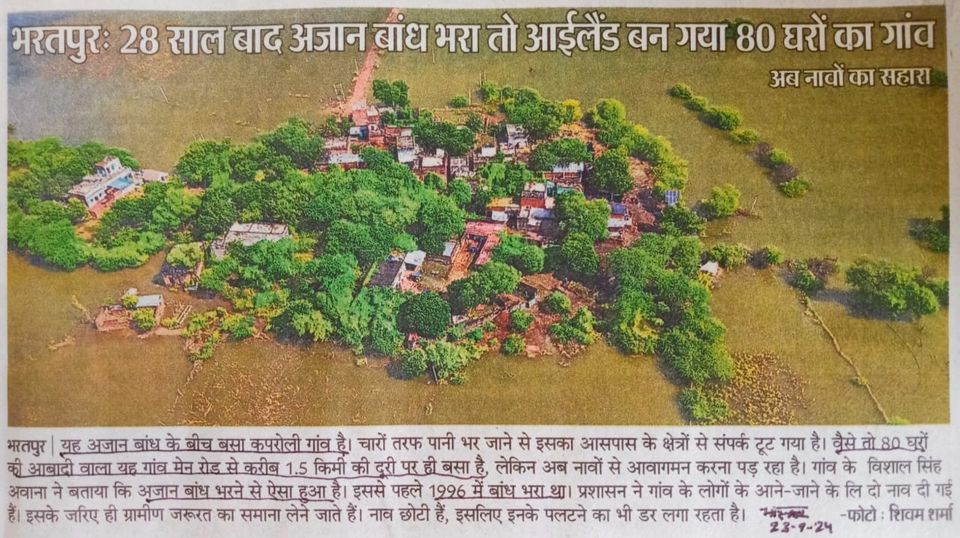
HFL BREACH
Himachal Pradesh River Bata in Yamuna basin at Ganguwala site in Sirmaur district has crossed HFL 373.52 meter dated 22.07.2023. Present flood level is 373.93 meter at 09:00 hour on 26.09.2024 with rising trend.
Bihar River Parman in Ganga basin at Bathnaha site in Araria district has crossed old HFL 63.61 meter dated 21.10.2021 and set 64.06 meter as new HFL at 06:00 hour on 28.09.2024. The river remained in extreme flood situation for about 13 hours.
River Gandak at Bagaha site in Paschim Champaran district has crossed the HFL 90.48 meter attained on 08.07.2024 at 20:00 hour on 28.09.2024 with rising trend.
River Gandak Gandak at Chhitaunighat site in Kushinagar district has crossed the HFL 93.2 meter attained on 07.07.2024 at 16:00 hour on 28.09.2024. Present flood level is 93.64 meter at 21:00 hour on 28.09.2024 with rising trend.
River Bagmati at Dheng Bridge site in Sitamarhi district has crossed old HFL 73 meter dated 13.08.2017 at 19:00 hour on 28.09.2024. Present flood level is 73.73 meter at 20:00 hour on 28.09.2024. CWC has forecasted flood level to decrease to 72.9 meter at 06:00 hour on 29.09.2024.
River Bagmati at Belsand site in Sitamarhi district has crossed old HFL 60.05 meter dated 28.08.2021 at 04:00 hour on 29.09.2024. Present flood level is 60.13 meter at 08:00 hour on 29.09.2024 with rising trend.
URBAN FLOODS
Mumbai On Sep 25, five hours of around 200 mm rainfall resulted in water logging in several areas of the city that disrupted traffic and railway services. https://www.hindustantimes.com/real-estate/mumbai-rains-rs-10-crore-apartments-in-the-financial-capital-become-river-facing-after-the-spell-of-heavy-rainfall-101727355827649.html (26 Sept. 2024)
CLOUD BURSTS
Himachal Pradesh पांवटा साहिब विकास खंड के पड़दूनी के वन क्षेत्र में बादल फटने से एक व्यक्ति की मौत हो गई है। घटना रात लगभग 3 बजे हुई है। बादल फटने से आए सैलाब ने यहां भारी तबाही मचाई है। मलबे से पांच दुकानें, दो छोटे पुल, एक शेड व दो घराट क्षतिग्रस्त हो गए हैं, जबकि एक कार भी क्षतिग्रस्त हुई है। खड्ड का पानी खेतों में घुस गया, जिसकी वजह से फासले नष्ट हो गई हैं, वहीं दूसरी तरफ बाता नदी उफान पर है। नदी के दोनों किनारो पर फसलों को भारी नुकसान हुआ है। बताया जा रहा है कि ग्रामीण क्षेत्रों में नदी के किनारे दर्जनों घर भी खतरे की जद में आ गए हैं। https://www.divyahimachal.com/2024/09/the-rain-standing-at-the-threshold-of-farewell-has-shown-its-fierce-form-while-leaving/ (26 Sept. 2024)
LANDSLIDES
Kerala Documenting the most disastrous Meppadi landslide Abstract: On the morning of July 30, 2024, a catastrophic landslide struck Wayanad, India, in the ecologically sensitive Western Ghats, claiming over 200 lives, with many still missing beneath the debris. Here, we present a comprehensive overview of the landslide event based on field, satellite images analysis, numerical modeling, geotechnical testing and aerial surveys to unravel the failure mechanism and its catastrophic impact downstream. We found that a preexisting crack developed in the source area in 2020, underlying complex geology, with sheared rocks and structural discontinuities contributes mainly to the failure causes, exacerbated by excessive rainfall. Water infiltration through cracks and joint sets in the gneissic complex led to severe weathering and erosion, with soil thickness exceeding 30 m, increased susceptibility to such an event.
Simulations show the debris flows initiated around 01:00 hrs and peaked at approximately 04:00 hrs on 30 July 2024, and reached a maximum velocity of 28 m/s. The volume of the eroded materials from the event was estimated as 5.17×10 6-5.72×10 6 m 3 , ranking it one of India’s largest debris flows. The debris flow runup height in the transitional (deposition dominant) zone (up to 32 m) was enhanced by multiple damming effects and entrainment, and topographic attributes such as cascades and river sinuosity, causing extensive infrastructure damage. Given the terrain’s known fragility and history of sequential events, this region requires special attention and real-time monitoring systems to mitigate future risks. https://www.authorea.com/users/581685/articles/1226483-documenting-the-most-disastrous-meppadi-landslide-of-30th-july-2024-wayanad-india (29 Sept. 2024)
ENVIRONMENT GOVERNANCE
Assam NGT stays construction of road inside WS The NGT has ordered a stay on construction of a road inside the Barak Bhuban Wildlife Sanctuary in Assam’s Cachar district. The order was issued last week by the Kolkata bench of NGT comprising judicial member B Amit Sthalekar and expert member Arun Kumar Verma in response to an application filed in August by Pradeep Singh Shekhawat, a resident of Jaipur in Rajasthan, alleging illegal construction of a road leading to Bhuban Hill inside the sanctuary. In its order the NGT bench issued notices to all respondents—Assam government, Assam Forest department, special chief secretary (forests) MK Yadava, Union ministry of environment, forest and climate change and deputy commissioner of Cachar, asking them to file counter-affidavits within four weeks. The next date of hearing is December 6.
Spread over an area of 320 sq km between the Barak and Sonai rivers, the Assam government had approved creation of the Barak Bhuban Wildlife Sancturary in July 2022. The sanctuary has eight recorded species of primates and is an important habitat for the king cobra snake. https://www.hindustantimes.com/cities/others/ngt-stays-construction-of-road-inside-assam-s-barak-bhuban-wildlife-sanctuary-101727080732336.html (23 Sept. 2024)
Western Ghats Greens write to MoEF to safeguard eco-sensitive areas –Environmental experts in Kolhapur, Sindhudurg, and Pune on September 19 sent an appeal to the MoEF&CC to set aside Maharashtra govt’s plea for excluding over 1,981sqkm of land from the draft notification of Western Ghats eco-sensitive areas (ESAs). Over 2,000 people from Sindhudurg and Kolhapur, including students, experts, NGOs and citizens, approached the ministry backing the demand proposed by renowned botanist Madhukar Bachulkar. “Our humble request is that the central govt should not accept Maharashtra state’s request and should not reduce the area of sensitive regions. Govt should accept ecologist Madhav Gadgil’s report. Only then will the entire Western Ghats remain intact and secure,” the letter said. https://timesofindia.indiatimes.com/city/pune/greens-write-to-forest-ministry-to-safeguard-w-ghats-eco-sensitive-areas/articleshow/113606957.cms (23 Sept. 2024)
SOUTH ASIA
IWT Neutral expert holds third meeting with Pakistan, India teams Michel Lino, a neutral expert appointed under the Indus Waters Treaty 1960, held a third meeting with the parties – Pakistan and India – in Vienna in proceedings commenced by India against Pakistan regarding India’s Ratle and Kishenganga hydroelectric plants, says a press release of Sept 27 2024. “The neutral expert will proceed accordingly to prepare his decision on competence under paragraph 7 of annexure F of Indus Waters Treaty.”
Following written submissions made by the parties on the subject earlier this year, the third meeting concerned the competence of the neutral expert under paragraph 7 of annexure F to the Treaty. Each party made opening and rebuttal submissions, completing the submissions on this issue. Pakistan’s submissions were made by its designated representative, Ahmad Irfan Aslam, and its counsel, Sir Daniel Bethlehem KC, Professor Philippa Webb and Dr Cameron Miles. India’s submissions were made by its designated representative and secretary, Ms Debashree Mukherjee, and its counsel, Harish Salve KC.
On Oct 13 2022 WB appointed neutral expert. On Feb 27-28 2023 NE held first meeting. The neutral expert’s terms of retainer were fixed on May 2, 2023. On June 1, 2023, the neutral expert issued supplemental rules of procedure, including a work programme, which was subsequently revised on Aug 21, Oct 11 and Nov 2, 2023, and most recently on May 29 and June 4, 2024. On June 5, 2023, the PCA was appointed as registry and secretariat by the neutral expert. On Aug 31, 2023, India submitted its memorial. A second meeting with the parties was held on Sept 20-21, 2023. Following the second meeting, Pakistan submitted its statement under paragraph 7 of annexure F to the Treaty on Feb 1, 2024 and India submitted its paragraph 7 statement and response to Pakistan’s paragraph 7 statement on June 14, 2024. From June 20 to 28, 2024, the neutral expert conducted a site visit of the KHEP and the RHEP, preceded by a 3-day preparatory visit by the technical assistant and a two-person engineering team from each party. https://www.thenews.com.pk/print/1234678-kishanganga-ratle-hydropower-projects-neutral-expert-holds-third-meeting-with-pakistan-india-teams (28 Sept. 2024)
India-Bangladesh Environmental balance of Sundarbans affected due to Farakka Barrage The ecosystem of the Sundarbans and Pasur rivers has been disrupted due to the Farakka dam. UNESCO has also identified the Farakka Barrage built by India on the upper reaches of the Ganges as the number one cause of damage to the Sundarbans. On the occasion of World Rivers Day, the speakers said this at a seminar on the rights of Bangladesh in the Sundarbans and Pashur river, cross-border rivers affected by Farakka at the Mongla Press Club auditorium on Sunday (September 22) morning. This seminar was organized by the upazila administration, Bangladesh Paribesh Andolon (Bapa), Save the Sundarbans Foundation and Service Bangladesh. https://barta24.com/details/national-en/246116/environmental-balance-of-sundarbans-affected-due-to-farakka-barrage (27 Sept. 2024)
Nepal Flood damages HEPs, transmission lines Incessant rainfall has caused damage to various hydropower projects and transmission lines. Nepal Electricity Authority (NEA) Spokesperson Chandan Kumar Ghosh said that the rainfall over the past two days across the country has damaged the headbox and powerhouse of the 456 MW Upper Tamakoshi Hydropower Project, the 22 MW Mandu Hydropower Project and the 22.1 MW Hewa Khola Hydropower Project. Similarly, the physical structures and equipment of the 216 MW Upper Trishuli 2 Hydropower Project, under construction in Rasuwa, have been damaged. According to Spokesperson Ghosh, five workers at the Upper Tamakoshi Hydropower Project are missing.
– Similarly, the Khimti-Lamosangu transmission line has also been damaged. The NEA reported that while around 3,000 MW of electricity was being produced in Nepal, the recent flooding and landslides over the past two days have reduced current production to only 1,300 MW. https://myrepublica.nagariknetwork.com/news/nepal-imports-300-mw-of-electricity-from-india-to-address-domestic-shortage-caused-by-hydropower-damage/ (29 Sept. 2024)
As many as 192 people have so far lost their lives and 30 others have gone missing in the floods, landslides and inundation caused by incessant rains. https://risingnepaldaily.com/news/49766 (30 Sept. 2024) Devastating floods and landslides have claimed at least 170 lives in Nepal following torrential rains on Saturday (Sept. 28). Nepal has already recorded above-average rainfall this season, with 1,586.3 millimetres of rain since June 10 – 7.2% above the average monsoon rainfall. The National Disaster Risk Reduction and Management Authority estimates that 1.8 million people could be affected by monsoon-related disasters this year. https://www.indiatodayne.in/international/story/nepal-flood-death-toll-reaches-170-as-rescue-efforts-continue-1099796-2024-09-29 (29 Sept. 2024) Torrential rainfall in Nepal has triggered rainfall and landslides in the country, causing 112 deaths and 64 people reported missing on Sept 29. Nepal has been dealing with heavy rainfall since Sept 27. The country’s weather bureau said that this was the highest recorded rainfall in the country’s capital since 1970. In the 24 hours, leading upto Saturday morning, Kathmandu had recorded 240 mm of rain. Some parts of the capital reported 322 mm of rain. https://www.hindustantimes.com/world-news/nepal-floods-112-dead-64-missing-as-intense-downpour-continues-101727582999006.html (29 Sept. 2024) In addition to the loss of life, the infrastructure damage is extensive. More than 322 houses have been destroyed, and 16 bridges have been damaged, cutting off critical transportation routes. In Dhadhing’s Jhyaple Khola area alone, 35 bodies were recovered after landslides buried four passenger buses. Rescue operations, including helicopter evacuations, are ongoing as authorities strive to locate the missing and provide aid to those affected by the disaster. However, major roadblocks and continued rainfall pose challenges for the teams on the ground. https://kathmandupost.com/weather/2024/09/29/rain-induced-havoc-leaves-148-dead-dozens-missing-across-nepal (29 Sept. 2024) Continuous heavy rainfall has triggered floods and landslides across Nepal, resulting in significant loss of life and property. Police further stated that 44 districts across the country have been affected by floods, landslides, inundation, and erosion. https://kathmandupost.com/national/2024/09/28/devastating-floods-and-landslides-claim-at-least-50-lives-across-country (28 Sept. 2024)
ASIA
Life Along the Mideast’s fabled Rivers A series of dams and years of conflict have transformed the Tigris and Euphrates rivers, which gave rise to some of the world’s earliest civilizations. Kurdish photographer Murat Yazar focused his lens on these rivers of his homeland and on the people who live alongside them: What hasn’t poured into the Tigris and Euphrates rivers? Raindrops. Blood. Snowmelt. Ashes. Hope. Pesticides. Ink. (When the Mongols plundered Baghdad in 1258 A.D., they tossed so many books from the city’s libraries into the Tigris that the currents ran black with ink.) Dreams. Stories. Time. The photographer Murat Yazar understands this. He knows that rivers are the biographers of landscape.

– Even now, however, not all is yet lost. Yazar’s images remind us, through their sensitive portraits of the gritty riverside communities still struggling to adapt, that time yet remains to save what remains of the region’s ecosystems and traditional lifeways. Yazar’s photographs are not mere lament. They are a call to action. (By Murat Yazar / Text by Paul Salopek) https://e360.yale.edu/features/tigris-euphrates-photo-essay (23 Sept. 2024)
THE REST OF THE WORLD
Ecuador Power service suspended as water level dips Ecuador’s government has announced the suspension of electricity service for nine hours on Sunday (Sept. 22) in 12 of the Andean nation’s 24 provinces and placed 19 areas on red alert due to a drought that has reduced the water levels of hydroelectric plants. Ecuador is gripped by the worst drought in the country in 61 years and an energy crisis made worse by what the government says is lack of maintenance of existing dams and contracts to ensure new energy generation.
After the government announced the planned power cuts on Tuesday, the military entered the Mazar hydroelectric plant, of about 170 Mw and considered key for its large storage capacity, to support its operation and protect it. https://www.indiatoday.in/environment/story/historic-drought-hits-ecuador-power-service-suspended-as-water-level-dips-2604887-2024-09-23 (23 Sept. 2024)
USA Hydropower Industry lost billlions to drought over 2 decades In a recently published study (https://iopscience.iop.org/article/10.1088/1748-9326/ad6200), the University of Alabama researchers at the Center for Complex Hydrosystems Research conducted a comprehensive analysis to determine the impact of drought on hydropower generation during the 18-year period and identify the relative vulnerability of each state to drought. They found a considerable decline in hydroelectric power between 2003 and 2020 at a cost of an estimated $28 billion to the sector nationwide. Hydropower facilities not only lost out on revenue, but the energy deficit then had to be purchased from other utilities. https://news.ua.edu/2024/09/hydropower-industry-lost-billions-in-drought/ (23 Sept. 2024)
NC officials detect damage to Lake Lure dam Emergency crews and residents scrambled Friday as Helene — the hurricane downgraded to a tropical storm — overwhelmed the Lake Lure dam (built in 1925-26) in western North Carolina, causing damage and erosion along its structural supports. A mandatory evacuation was ordered Friday morning after local officials notified the National Weather Service that a dam failure was imminent. By late Friday afternoon, water had crested the dam, but it was continuing to hold despite the structural damage, according to Josh Kastrinsky, a spokesman for the N.C. Department of Environmental Quality. Some erosion was also spotted on the left abutment, where water “is flowing uncontrolled,” Kastrinsky said. An engineer was expected to inspect the dam late Friday or Saturday and determine the scope of the damage and needed repairs, he said.
– The dam is a tourist and recreational destination for the rural county. It also harnesses the Broad River and two creeks to power a hydroelectric plant producing electricity for Duke Power Co. from two hydroelectric turbine generators. https://www.newsobserver.com/news/weather-news/article293139794.html (29 Sept. 2024)
TVA: Nolichucky Dam stable and secure A Flash Flood Warning has been issued for areas below the Nolichucky Dam as the Tennessee Valley Authority (TVA) and National Weather Service (NWS) Morristown report a failure at the dam is imminent. The TVA announced at 12:13 a.m. Saturday (Sept 28) that its River Forecast Center had activated a Condition Red Warning at the Nolichucky Dam in Greene County. The NWS reports the dam operators reported a failure at the dam at 11:35 p.m. on Friday. The NWS stated that if a total failure of the dam occurs, an initial flood wave will hit West Allens Bridge Road bridge in 20 minutes and the Highway 321 bridge in 30 minutes. https://www.wjhl.com/news/local/tva-nolichucky-dam-failure-is-imminent-could-cause-life-threatening-flooding/ (28 Sept. 2024)
CHILE Biobío River becomes first ecosystem to have a Declaration of Rights This historic declaration seeks to rekindle the bond between communities and their river while safeguarding the rights of Chile’s Biobío River against mounting environmental threats. Supported by the Somos Cuenca initiative, the Declaration of the Rights of the Biobío River is currently open for endorsements from both national and international organizations, as well as the general public. https://www.internationalrivers.org/news/press-release-breaking-news-the-biobio-river-becomes-the-first-ecosystem-in-chile-to-have-a-declaration-of-rights/ (25 Sept. 2024)
SANDRP
Also see: DRP 23 Sept 2024 & DRP 16 Sept. 2024
Follow us on: www.facebook.com/sandrp.in; https://twitter.com/Indian_Rivers

 SANDRP