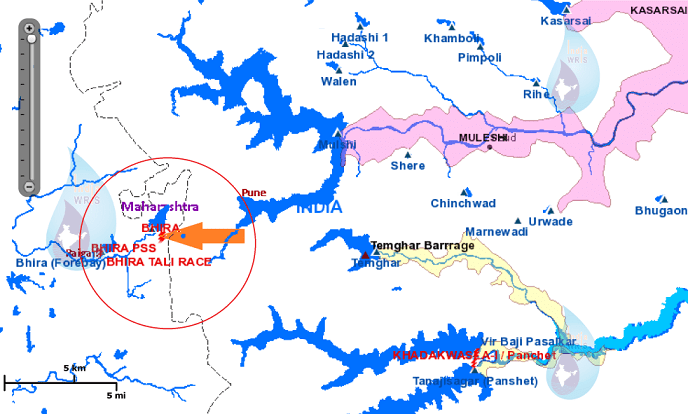
(Feature image: Map of Bhivpuri Hydropower Project, one of the Tata Dams)
Large parts of South India, including Maharashtra are facing depleted reservoir levels with the beginning of summer and water scarcity. However, the Krishna Bheema basin, the second largest basin of peninsular India, is diverting water to outside the basin to Konkan. The Krishna Bheema basin has the largest live storages of Maharashtra in Koyna dam (1347.5 MCM) and Tata dams (617.67 MCM), but the water in those storages won’t be available to the drought hit residents of Krishna basin in water scarce Maharashtra, Karnataka, Telangana and Andhra Pradesh.
This is because Koyna and Tata dams divert the water from Krishna Bheema basins to Konkan for power generation. Even in March, according to Maharashtra Load Dispatch Centre, Koyna had generated 128.87 Million Units (MU) of power and Tata Dams had generated 130.47 MU, both by March 30. This implies diversion of millions of Cubic meters of water from Koyna and Tata Dams during March 2024, which mostly gone down from Konkan to Arabian sea.
This means even as downstream Ujani dam in Maharashtra has no water in live storage, the water stored in Tata dams won’t be available for Ujani dam dependent people of Bhima basin in Maharashtra. There is need to stop this diversion of water from drought prone Krishna basin in drought years.
We have raised this issue multiple times in the past (e.g. see: https://sandrp.in/2015/08/07/as-krishna-bhima-basin-farmers-in-maharashtra-karnataka-ap-telangana-face-drought-crop-failure-water-scarcity-maharashtra-diverted-350-mcm-water-from-the-basin-literally-to-sea/). We hope the government will wake up to this cruel tragedy that the people of Krishna Bheema basin are facing severe water scarcity, but the water of their basin is being diverted to high rainfall region of Konkan, to basically flow down to Arabian Sea.
HYDRO POWER PROJECTS
What’s wrong with India’s hydropower push? Article by SANDRP coordinator about hydropower and pump storage projects in India. https://psuwatch.com/opinion/damn-it-whats-wrong-with-indias-hydropower-push (27 March 2024) -An opinion piece, ‘Dam(n) it, what’s wrong with India’s hydropower push?’, has raised a number of very serious concerns to our people from the large number of hydel power projects being planned and built in the country. Whereas, the issues have been raised many times in the recent past, civil society has not been able to persuade the concerned authorities, especially the Ministry of Power, Ministry of Environment, NITI Aayog, and PMO, to provide satisfactory clarification to any of these concerns (Shankar Sharma). https://www.counterview.net/2024/04/why-its-time-to-question-very-need-for.html (01 April 2024)
People for Himalaya Demand Charter Environmentalists Propose Alternative Development Model An alternate model of development that recognizes the knowledge and needs of local communities is among the many demands raised by the People for Himalaya Campaign in their charter aimed at party candidates ahead of the Lok Sabha elections. Based on this vision statement, the People for Himalaya Campaign have now released a ‘demand charter’ or maangpatr, said Manshi Asher, founder of Himdhara Collective who is also associated with the Campaign, at an online press conference.
The main intent of the demand charter is to move towards a Himalaya that is secure from disasters, and how we can achieve this, she added. “The entire Himalayan region is going through extreme distress right now,” she said. “These are manifesting in several forms, whether they are slow onset disasters such as the retreat of glaciers due to global warming…to immediate disasters that wreak a lot of havoc that we see on television, whether they are floods or landslides.” https://thewire.in/environment/people-for-himalaya-campaign-calls-for-alternative-devlopment-model-to-free-region-of-disasters (30 March 2024)

The demand for a complete halt on mega infrastructures like large dams, railway and four lane given the underground invasion and muck generation was also echoed by Guman Singh, from Himalaya Niti Abhiyan and Atul Sati of Joshimath Bachao Sangharsh Samiti. It was stated be it the Beas floods or the land subsidence in Joshimath, these are all not natural disasters but man-made, policy led disasters. The over-all demand for a people not profit centred economic and governance was reiterated. https://timesofindia.indiatimes.com/india/himalayan-solidarity-to-secure-future-of-mountains-not-profit-but-people-and-nature-centred-governance-is-way-forward/articleshow/108903282.cms (30 March 2024)
–Among its demands, the People for Himalaya coalition has sought democratic decision-making through referendums and public consultation on large infrastructure by strengthening the Environment Impact Assessment (EIA) Notification 1994, scrapping of the EIA 2020 Amendments & Forest Conservation Amendment Act 2023; free prior informed consent of gram sabhas to be mandatory for all developmental projects; and a just implementation of 2013 Right to Fair Compensation and Rehabilitation Act.

-Mayalmit Lepcha, from Affected Citizens of Teesta, and Mohan Saikia from the North East Dialogue forum expressed serious concerns about the ecological impacts of massive hydropower development proposed on the Brahmaputra and its river basins allegedly without the consent of local indigenous communities. “The far-reaching impacts of these infrastructures are manifested in the form of floods whose impacts go right up to the downstream,” Saikia said at the meeting. https://www.hindustantimes.com/india-news/activists-call-for-moratorium-on-mega-projects-in-high-himalayas-101711780307921.html (30 March 2024) लद्दाख के संघर्ष के साथ एकजुटता दर्शाते हुए पूरे हिमालय क्षेत्र के प्रतिनिधियों ने प्रेस को संबोधित करते हुए हिमालय से उठने वाली आवाजों को राष्ट्रीय स्तर पर हाशिये पर धकेले जाने को सामने रखा और कहा कि पर्वतों और उसमें रहने वाले समुदायों की भलाई के लिए निर्णयों में विकेंद्रीकरण और लोकतांत्रिक प्रक्रिया की मांग को लेकर हिमालयन एकजुटता की जरूरत है। https://www.downtoearth.org.in/hindistory/development/sustainable-development/people-for-himalayas-issued-five-point-demand-letter-for-political-parties-95293 (30 March 2024)
Blog Looming Quake: Tectonic strain reaching critical point By CP Rajendran & Kusala Rajendran -The Himalayas produced three great earthquakes in the last century alone—1905, 1934 and 1950, but none afterwards. With increasing clarity on the nature of temporal-spatial patterns of earthquakes, there is a consensus about the identifiable gaps along the Himalayas. One of the biggest threats in the north-east Himalayas would be landslip-impounded dams and consequent flooding of the downstream sides.
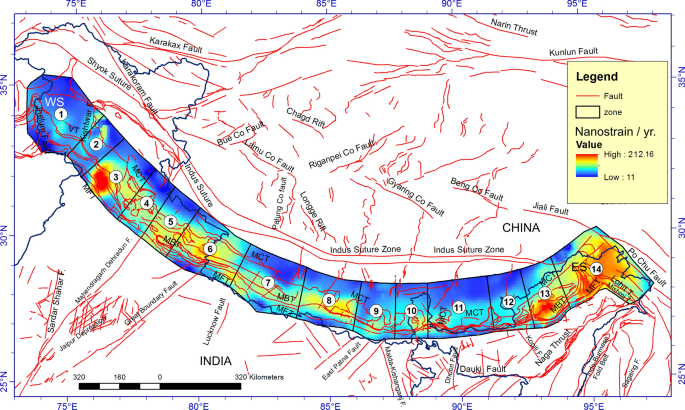
-The 1950 earthquake of magnitude 8.6 located just south of the McMahon line, the boundary between India and China, dammed the rivers. The dams were breached later, generating flash floods on the downstream sides, and seriously silting the river basins. If a similar event were to take place in the background of the fast-developing super hydro-projects, it would be an unimaginable replay of past destructions.
-Back in 1950, the vast flood plains of Brahmaputra accommodated the debris. Should it happen in the future, the heavy siltation and giant landslides will severely reduce the water-holding capacity and life expectancy of such dams. The tragedy that occurred on 22 March 1959, at Vajont Dam, 100 km north of Venice in Italy is an international example that reminds us of the potential threat of such massive, engineered structures in landslide-prone areas. https://kashmirpost.org/2024/03/looming-himalayan-quake-tectonic-strain-reaching-critical-point/ (25 March 2024)
Arunachal Pradesh Ready proposal to demarcate Dulung-Subansiri elephant corridor: MoEF The wildlife division of the Union Ministry of Environment, Forest and Climate Change (MoEFCC) recently directed the forest departments of Arunachal Pradesh and Assam to prepare a proposal to notify the Dulung-Subansiri elephant corridor – downstream of the 2000 MW Lower Subansiri hydroelectric project. The proposal to demarcate the corridor will be presented during the next meeting of the National Board for Wildlife (NBWL). Notification of the elephant corridor will involve physically marking the relevant areas used by elephants on the ground as well as potentially notifying parts of the corridor as either a wildlife sanctuary or a conservation reserve.
– An expert committee of the NBWL, which was inspecting the compliance of conditions imposed on the Arunachal Pradesh government, as part of the clearance of the hydroelectric project, had recommended the notification of the elephant corridor in May last year. The ministry’s directions to the state departments come in the backdrop of the NBWL’s meeting in January this year, which saw deliberations on ways to protect the critical elephant corridor. During the deliberations, members of the wildlife board concluded that this corridor is important, as it facilitates the east-west movement of elephants across the Subansiri River. The corridor, however, is fragile and requires urgent restoration efforts, they had noted. https://indianexpress.com/article/india/ready-proposal-demarcate-dulung-subansiri-elephant-corridor-union-environment-ministry-arunachal-assam-9238441/ (29 March 2024)
50 years of Chipko Movement Protest transformed environmentalism Ironically, Chipko, which had set these laws in motion, resulted in local communities losing access to the very forests that met their livelihood and subsistence needs. Little changed in terms of development or employment opportunities for the locals. With forest protection prioritized, even minor development projects, such as village roads or small irrigation channels, were denied permission. At the same time, large infrastructure projects promoted by the government, such as hydroelectric dams, got the go-ahead.
-A villager from Chamoli, Dhan Singh Rana, wrote a song describing the life and struggles of Gaura Devi, in which he says, “In this world of injustice, show us your miracle again.”3 As the world careens from one crisis to the next, it is more imperative than ever to rekindle the memory of Gaura Devi. It should inspire us to act to save the planet and contribute to sustainable change, putting aside any misgivings about our own limitations as individuals or communities. (Seema Mundoli) https://www.nature.com/articles/d41586-024-00895-y (26 March 2024)
The Chipko Andolan lost its ground at home, but its legacy lies in people’s ecological movements that emerged elsewhere in the country. Given the smartphone and social media penetration in the country today, a WhatsApp group of panchayats of Kerala serves to promote the preparation of people’s biodiversity registers as a device for local communities to decide on management options for their own local ecosystems. The spark that Chipko Andolan lit 50 years ago is thus promising to ignite fires far and wide. (Madhav Gadgil) https://www.hindustantimes.com/opinion/how-chipko-resonated-beyond-the-himalayas-101711462308230.html (26 March 2024) The Chipko movement is not a relic of the past; it is a source of inspiration for the challenges we face today. https://www.hindustantimes.com/opinion/takeaways-from-chipko-for-todays-eco-warriors-101711727856691.html (29 March 2024) The movement began in the 1970s in response to the increasing destruction of forests for commerce and industry. https://rightlivelihood.org/the-change-makers/find-a-laureate/the-chipko-movement/
Obituary Sreedhar Ramamurthi: A geologist who campaigned for Mother Earth Sreedhar Ramamurthi was a scientist as well as an activist who worked to ameliorate the condition of those impacted by reckless mining all over India. He worked with many others who shared his ideals about the need to conserve the planet with care. He became deeply interested in the environment of the Himalayas and studied the seismological impacts of hydro-electric projects in the mountainous terrain of India and Nepal. https://www.adaniwatch.org/sreedhar_ramamurthy_a_geologist_who_campaigned_for_mother_earth (28 March 2024)
Karnataka Govt says no to Goa power line through Western Ghats Govt has rejected neighbouring Goa’s proposal to draw a power transmission line through the Western Ghats forest by the Goa-Tamnar Transmission Project Limited (GTTPL), and directed the project executing agency to lay the line through non-forested areas instead. The state govt has also ordered serving of showcause notice to forest department officials who had earlier recommended the project, overlooking destruction of large tracts of forested areas in the Ghats. Planning to light up parts of South Goa by sourcing power from Tamnar in Chhattisgarh, GTTPL had sought permission from Karnataka to divert a whopping 174.6 hectares of forest land, including the Kali Tiger Reserve (KTR), to lay a 400 kV transmission line. https://timesofindia.indiatimes.com/city/bengaluru/karnataka-govt-says-no-to-goa-power-line-through-western-ghats-forest/articleshow/108742366.cms (24 March 2024) -After the state rejected the project, citing that the lines pass through a virgin forest area, the GoaTamnar Transmission Project Limited, the project implementing agency, had approached the Central Empowered Committee and the Supreme Court. Eventually, the agency agreed to realign the transmission line on the existing 220 KV KPTCL functional line from Ganeshgudi substation to Ponda substation. However, the state government rejected the second proposal as well, as nearly 25,000 trees might still be felled. https://www.deccanherald.com/india/karnataka/karnataka-rejects-goa-power-project-over-environmental-concerns-2952388 (26 March 2024)
NHPC Board approves raising Rs 6,100cr debt in 2024-25 -Further, the Board of Directors of NHPC in the meeting on March 27 has also given its in-principle approval for closure of Loktak Downstream Hydroelectric Corporation LTD (a Subsidiary Company of NHPC Limited and Joint Venture with Govt. of Manipur), subject to the approval of DIPAM, Ministry of Power and Govt. of Manipur, it stated. https://www.ndtvprofit.com/business/nhpc-board-approves-raising-rs-6100-crore-debt-in-2024-25 (27 March 2024)
DAMS
Sardar Sarovar Dam સરદાર સરોવર ડેમ પ્રોજેક્ટ બન્યા છતાં ગુજરાતમાં પાણીની સમસ્યા કેમ ઉકેલાઈ નથી? – વૉટર મૅનેજમૅન્ટ ઍક્સપર્ટ હિમાંશુ ઠક્કર બીબીસી ગુજરાતી સાથે વાતચીત કરતાં કહે છે, “નર્મદા ડૅમ નિરાકરણ નથી. લાંબા અંતરથી દૂર સુધી પાણી પહોંચાડવામાં ઘણી સમસ્યાઓ આવે છે. તેને માટે કેન્દ્રિયકૃત સત્તાઓની દયા પર નિર્ભર રહેવું પડે. તેની જગ્યાએ રેન હાર્વેસ્ટિંગ, ગ્રાઉન્ડ વૉટર રિચાર્જિંગ, કેચમેન્ટ પ્રોટેક્શન અને સ્થાનિક પાણીના સ્રોતોનો મહત્તમ ઉપયોગ કરવાથી વધુ ફાયદો થાય.” ગુજરાતમાં પાણીની સમસ્યા પર વાત કરતાં હિમાંશુ ઠક્કર કહે છે, “એક તરફ કચ્છમાં નર્મદા કૅનાલનું કામ બાકી છે અને બીજી તરફ સાબરમતી નદીમાં નર્મદાનું પાણી વહેવડાવી દેવામાં આવે છે. આ પાણી સાબરમતી નદીમાં વહેવડાવવું એ સરદાર સરોવર યોજનાની પ્રાથમિકતા નહોતી. આ સિવાય ઉદ્યોગોને પાણી પહોંચાડવામાં આવે છે તેને કારણે જરૂરિયાતમંદ સુધી પાણી નથી પહોંચતું.”
– હિમાંશુ ઠક્કર કહે છે કે ભારતની પાણીની લાઇફલાઇન ગ્રાઉન્ડ વૉટર છે. તેઓ કહે છે, “ભારતમાં 2/3 સિંચાઈ ગ્રાઉન્ડ વૉટરથી થાય છે. દુનિયાના સૌથી વધુ ગ્રાઉન્ડ વૉટરના ઉપયોગ કરતા દેશોમાં ભારતનો પ્રથમ નંબર આવે છે. ત્યાર બાદ યુએસ અને ચીન છે. પણ અમેરિકામાં ગ્રાઉન્ડ વૉટરના ઉપયોગ મામલે નિયંત્રણ છે જ્યારે ભારતમાં તેનું દોહન થઈ રહ્યું છે.” હિમાંશુ ઠક્કર આ ઉપરાંત વેસ્ટ વૉટરના ફરી ઉપયોગ કરવા પર પણ ભાર મૂકે છે. https://www.bbc.com/gujarati/articles/cd10zp5y545o (26 March 2024)
Gujarat snubs MP, offers Rs 2,000 cr Gujarat govt has offered Rs 2,000 crore to settle Madhya Pradesh govt’s compensation demand of Rs 7,600 crore for the submergence of forests and revenue land in Sardar Sarovar Dam project. In meetings between officials of both govts on March 21-22, the Gujarat team indicated this figure to their MP counterparts. MP govt had approached Gujarat three years ago to pay Rs 7,600 crore as compensation for the mines and revenue and forest land of Dhar, Khargone, Barwani and Alirajpur districts that got submerged in the Sardar Sarovar Dam. This compensation was calculated on the basis of collector’s guideline rates of property and land in 2019-20, officials said. The next meeting is in Bhopal on April 28-30. Officials said the objective is to reach a consensus and continuous dialogue will end the stalemate. https://timesofindia.indiatimes.com/india/dam-payout-gujarat-snubs-mp-offers-rs-2000-crore/articleshow/108860884.cms (29 March 2024)
Kaleshwaram Project Medigadda rehabilitation not before March 2025 If the complexities involved in the issue are to be taken into consideration, reconstruction of the damaged part of the Medigadda and other barrages is not going to happen before March 2025, a senior irrigation department official averred.
– In the present circumstances, there is no scope to give water to resume operations at Medigadda and Annaram before Khariff of 2025, stressed the irrigation experts. So far as the Medigadda rehabilitation works are concerned, its implementation would be at a cost of Rs 750 crore. Three of the piers found sinking have to be demolished and reconstructed. One or two piers in the vicinity of the impacted stretches may also need restoration as part of the permanent rehabilitation measures. The rehabilitation of Annaram and Sundilla, wherein seepage issues were spotted, would require Rs 250 crore each. Irrigation officials are not going to take any initiative at this stage, as the proceeding of the Judicial probe into Medigadda and other barrages is likely to take off very soon, they disclosed. https://telanganatoday.com/medigadda-rehabilitation-not-before-march-2025 (29 March 2024)
INTERSTATE WATER DISPUTES
Krishna Water Disputes KWDT gets extension till July 31, 2025 -Terms of reference of the 20-year-old Krishna Water Disputes Tribunal was amended last year to accommodate water-sharing concerns of the fourth state Telangana as well, factoring in issues under the Andhra Pradesh Reorganisation Act, 2014. As part of its latest extension, the central govt on March 21 notified that the Tribunal may now submit its report on addressing the water-sharing disputes among four states by July 31next year. Its term was earlier scheduled to end on March 31. https://timesofindia.indiatimes.com/india/krishna-water-disputes-tribunal-gets-extension-till-july-31-2025/articleshow/108759481.cms (25 March 2024)
AP to seek 15 tmc-ft of water from Nagarjunasagar dam The AP water resources department complains that though Telangana used excess water from the dam, the KRMB remained silent about it and is not asking the Telangana authorities to avoid excess pumping of water. A three-member committee comprising the engineers-in-chief of the two states and a KRMB member is holding a meeting next month. AP intend to raise the issue of allotting 15 tmc-ft of water for the state. https://www.deccanchronicle.com/nation/current-affairs/ap-to-seek-15-tmc-ft-of-krishna-water-from-nagarjunasagar-dam-887101 (26 March 2024)
RIVERS AS NATIONAL WATERWAYS
Manthan Report on Amba waterway (NW-10) -IWAI has anticipated a substantial increase in this traffic, rising from 28.54 MMT in 2022-23 to 116 MMT by 2052-53. From Rewas Port to Dharamtar Jetty, a 19.42 km operational stretch of the Amba River is a tidal estuary providing a rich breeding habitat for the diverse aquatic flora and fauna.
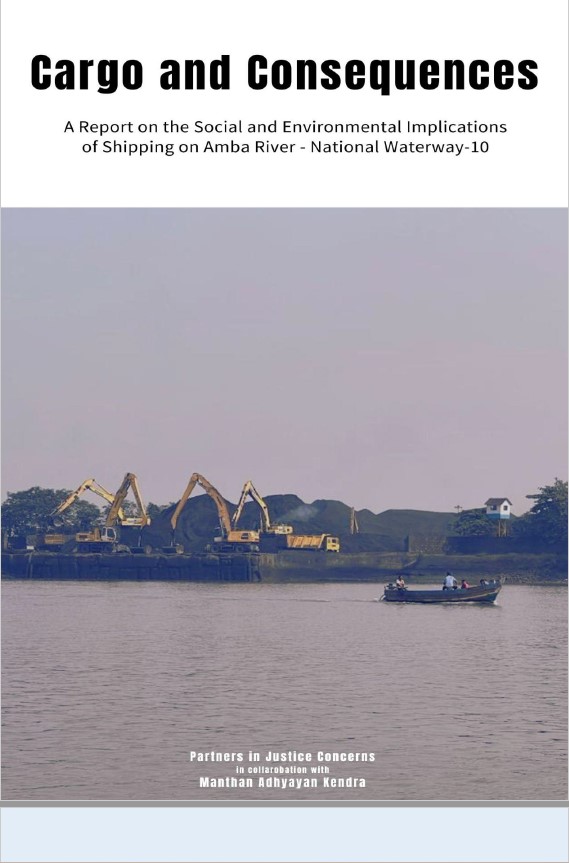
The riverine waters also provide a livelihood for thousands of fisherpeople residing along the banks of the Amba River. Against this backdrop, this report attempts to understand the challenges and socio-ecological impacts of cargo operations on NW-10. https://www.manthan-india.org/ambamarch24/ (March 2024)
URBAN RIVERS
Musi; Hyderabad Private partnership, land pooling integral to RFD As per an official estimate, the project is expected to cost over $7 billion or close to ₹60,000 crore. It has been proposed to finance the project through a variety of sources, including government resources, multilateral funding agencies, financial markets and private-sector funding. A significant portion of the project cost will be funded by the commercialisation of identified land parcels along the river, the project document said.
The land in the 130-180 sqkms area enclosed by a distance of up to 1.5 km on either side of the river between Narsingi to the west and Gowrelli to the east assumes enormous significance in this context, redesigning of which is expected to transform the core city’s landscape beyond recognition. The government is seriously considering land pooling as an option to make the property owners along the river stakeholders in the development, rather than go through the cumbersome process of land acquisition, which entails heavy financial burden.
However, unlike the model earlier, whereby the Hyderabad Metropolitan Development Authority (HMDA) would pool private land parcels, develop them as one layout and allot 60% of the developed land as the owners’ share, the land this time will be pooled and handed over to private developers. For this, the 50-acre minimum limit for the land pooling scheme will be done away with, and the option will be offered even for land parcels much smaller in extent. Officials on condition of anonymity said that the plan is to hand over even government land parcels to private developers, under public-private-partnership mode, for commercialisation and creation of supporting infrastructure. https://www.thehindu.com/news/national/telangana/private-partnership-land-pooling-integral-to-musi-riverfront-development-in-hyderabad/article68002300.ece (28 March 2024)
High-level bridges shelved to make way for RFD The bridges were planned by the previous government at 14 locations across the river, which included one bridge exclusively for hawkers displaced as part of the Charminar Pedestrianisation Project. Post the elections and the formation of the new government, CM A. Revanth Reddy announced bigger plans under the Musi River Front Development Corporation (MRDCL), envisaging a comprehensive rather than piecemeal approach for development of the river.
The 55 km stretch of the river connecting Narsingi in the west with Gourelli in the East with a km or more earmarked on either side of the river will be the canvas for the masterplan, totalling to around 130-180 sqkms of area. Key components of the project include river water management through improvement of sewer networks and better storm water management, development of trunk infrastructure, pedestrian zones, recreational/tourist areas, commercial centres, planning of mobility corridor and transit oriented development among others. The masterplan may get a shape before the Parliament elections, sources informed.
While hawkers’ bridges are mentioned in the EoI document as part of the masterplan, the one already approved has been shelved, as per information. Already, the Greater Hyderabad Municipal Corporation (GHMC) has been asked to put on hold any land conversions or infrastructural proposals within the defined stretch around the river, officials informed. Once the masterplan is finalised, land conversions will not be allowed anymore in order to maintain the integrity of the location. https://www.thehindu.com/news/cities/Hyderabad/high-level-bridges-on-musi-shelved-to-make-way-for-river-development-masterplan/article67998863.ece (27 March 2024)
39 STPs from AMRUT scheme to line river These will be in addition to the 31 STPs sanctioned by the previous government in the State and being established on the catchments of the Musi and the Hussainsagar lake. 4 of these STPs have already begun to function, and the remaining are in various stages of completion.

The Hyderabad Metropolitan Water Supply and Sewerage Board (HMWS&SB) will be the implementation authority for the STP component of the project, for which it needs to develop an interceptor network all along the river to divert the sewage into the STPs. An area of 50 metres on either side of the river will be declared as the utility zone to lay the pipeline network.
One more proposal to ensure fresh water flow in the river entails pumping water from the Godavari river into the Osman Sagar and Himayat Sagar reservoirs. Taking a leaf out of the previous regime’s book, the incumbent government is mulling release of small quantities of water from the heritage twin reservoirs into the Musi to maintain the flow of cleaner water. Doing so will also amount to linking of Krishna and Godavari rivers, the officials noted. https://www.thehindu.com/news/national/telangana/39-stps-from-amrut-scheme-to-line-musi-river-in-hyderabad/article68006473.ece (29 March 2024)
RIVERS
Odisha Pollution in Mahanadi River reaches alarming levels In February, the SPCB collected samples from four places of the river and after testing, categorised it under Class ‘C’. It means, the river’s water is not fit for consumption or any kind of use and it has jaundice bacteria. As per local people, sewage water is discharged to the river at places like Balibandham Binakhandi and Sadakghata. Similarly, factories are releasing their effluents to the Hirakud dam. In the peak of Summer, it is feared that the pollution level in the river would increase manifold.
Expressing concerns, a Sambalpur resident, Siba Prasad Meher said, “All the municipality drains are discharging the town’s sewage water into the river. Plants and factories are releasing their effluents. Here, the district administration should play an important role in saving the river.” The river’s condition in Boudh is no better either. Piles of garbage on its banks are testimony to its condition. “All are using the river as their dustbins. Starting from households to hospitals to factories, all are dumping their garbage into it. Because of this, the water of the river has become polluted,” said Debasish Purohit, a Boudh resident. No comments were received from the concerned district administrations. https://odishatv.in/news/odisha/pollution-in-mahanadi-river-reaches-alarming-levels–231429 (29 March 2024)
GODAVARI Andhra Pradesh Technical glitch detected on Gammon bridge A technical glitch has been detected on the fourth bridge, locally known as Gammon Bridge, between Rajamahendravaram city and Kovvuru town across Godavari river. Built by Gammon India Limited, the bridge was commissioned in 2015. A high-level team led by Principal Secretary (Transport, Roads and Buildings) P.S. Pradyumna on Monday (March 25) inspected the bridge and confirmed the technical glitch which was identified as ‘failure of a bearing’ between the 56 and 57 piers. In a review meeting with the officials concerned here, Mr. Pradyumna has said, “The equipment required for the repair is reportedly available in Kolkata. Steps will be taken on a war-footing to repair the bridge.” Ms. Madhavilatha has said that vehicular movements would be allowed on one-way to avoid pressure on the bridge. https://www.thehindu.com/news/national/andhra-pradesh/technical-glitch-detected-on-gammon-bridge-across-the-godavari-in-rajamahendravaram-of-andhra-pradesh/article67991428.ece (25 March 2024)
NARMADA Bhopal गैस त्रासदी: रासायनिक कचरे के मामले में एनजीटी ने अधिकारियों को लगाई फटकार एनजीटी ने यूनियन कार्बाइड परिसर से 337 मीट्रिक टन रासायनिक कचरे को हटाने के लिए कार्रवाई न करने पर अधिकारियों को फटकार लगाई है। साथ ही इस कचरे के निपटान के लिए तत्काल कार्रवाई करने का निर्देश दिया है। इस त्रासदी को करीब चार दशक होने वाले हैं। इसके बावजूद यूनियन कार्बाइड परिसर में जमा रासायनिक कचरा इस बात को दर्शाता है कि अधिकारी इसको लेकर कितना संजीदा हैं। ऐसे में न्यायमूर्ति शेओ कुमार सिंह की बेंच ने मामले को गंभीरता से न लेने के लिए अधिकारियों की आलोचना की है। अदालत का कहना है कि “गैस राहत और पुनर्वास के निदेशक फाइलों को लिए बैठे हैं। वो वहां रहने वाले लोगों और पर्यावरण को होने वाले नुकसान का आकलन नहीं कर रहे हैं।” उनके मुताबिक यह रसायन भूमिगत जल, नदियों और सतही जल के जरिए लोगों के स्वास्थ्य और पर्यावरण को प्रभावित कर रहा है। इस मामले में एनजीटी ने तीन सप्ताह के भीतर की गई कार्रवाई पर एक तथ्यात्मक रिपोर्ट प्रस्तुत करने के लिए कहा है। मामले की अगली सुनवाई नौ जुलाई 2024 को होगी। https://www.downtoearth.org.in/hindistory/sanitation/waste-management/bhopal-gas-tragedy-ngt-reprimands-officials-in-case-of-chemical-waste-orders-immediate-action-95282 (29 March 2024)
SATLUJ Punjab 4.5-lakh litres ‘lahan’ recovered in Jalandhar The Jalandhar rural police seized 4.5 lakh litres of ‘lahan’ (raw material used for making liquor) from Jalandhar’s Mehatpur area along Sutlej river bank on Sunday (March 24). Mehtapur SHO Gurshinder Kaur said that the smugglers had tied the polythene bags with ropes and dumped them in the Sutlej. “Smugglers used to extract illicit liquor by hiding lahan in the riverbed. We will continue our search operation in the villages situated near the Sutlej and stern action will be taken against the accused,” she added. The seizure has been made at a time when 20 people have died after consuming illicit liquor in Sangrur’s Sunam. https://www.hindustantimes.com/cities/chandigarh-news/45lakh-litres-lahan-recovered-in-jalandhar-101711307711061.html (25 March 2024)
GANGA Uttar Pradesh Part of under construction bridge collapse “Three beams built on Friday (March 29) evening have collapsed. We do perform quality checks from time to time, and this incident may have been caused due to bad weather. A probe committee under Bulandshahr chief development officer (CDO) will investigate this matter and appropriate action will be taken against those responsible,” DM Singh said on Saturday (March 30).
A senior district administrative officer, privy to developments, said the bridge construction work was being conducted by UP State Bridge Corporation Ltd. It had given the contract to a private construction firm based on the ‘engineering, procurement and construction’ (EPC) model, he added. Work on the 1km-long bridge started in 2021 at a cost of about Rs 83cr. Once complete, it will help connect Madaiya Mali village in Narsena area of Bulandshahr to Birampur village of Amroha. “At least 33 pillars were to be constructed and a broad road is to be laid after placing the beams on them,” the officer said. https://timesofindia.indiatimes.com/city/meerut/under-construction-rs-83cr-bridge-over-ganga-collapses-partially-in-up/articleshow/108911277.cms (31 March 2024) The DM CP Singh said the beams collapsed due to a storm and refuted allegations over the usage of low-quality construction materials for the bridge. https://www.indiatoday.in/india/story/under-construction-bridge-beams-up-collapse-ganga-river-no-casualties-officials-2521084-2024-03-30 (30 March 2024) 76 per cent work of the bridge had been completed. Some villagers had earlier accused the Setu Nigam employees of using substandard material. https://www.hindustantimes.com/cities/lucknow-news/portion-of-under-construction-bridge-over-ganga-collapses-in-u-p-s-bulandshahr-none-hurt-101711812818286.html (30 March 2024) As per this Jan. 2023 report a pillar of the bridge had developed cracked. Alleging use of inferior quality material, the local villagers had stopped the construction work at that time. https://newstrack.com/uttar-pradesh/bulandshahr-video-pillar-crack-in-bridge-being-built-on-river-ganga-356764 (20 Jan. 2023)
Part of bridge washed away The approach road of the bridge connecting Meerut’s Hastinapur and Bijnor was washed away in the river at 4 am on June 26, 2023 after it could not withstand the strong flow of the river. The bridge was shut the last year also due to repair work and the security installations are pending, Deepak Meena, DM of Meerut told news agency ANI. Some locals told news agency ANI that last year also, the connecting road was destroyed in the month of July and wasn’t repaired for six months. They also told that the work of the connecting road was finished just two days before the monsoon hit the area on Saturday June 24, 2023. https://www.ndtv.com/meerut-news/watch-part-of-bridge-linking-two-up-towns-swept-away-after-heavy-rain-4154235 (26 June 2023)
Uttarakhand Operator dies after shotcrete machine falls into ditch An operator of a shotcrete machine deployed at Silkyara tunnel, a part of which had collapsed trapping 41 workers for 17 days in November, was killed on Sunday (March 24) after the machine slipped and rolled into a ditch. The deceased has been identified as 24-year-old Govind Kumar, a resident of Didihat town in Pithoragarh. He had joined work two months ago. While locals said the machine fell into a ditch near the mouth of the tunnel, officials claimed that the accident took place 150 metres away. https://www.telegraphindia.com/india/another-tragedy-at-silkyara-tunnel-operator-dies-after-shotcrete-machine-falls-into-ditch/cid/2009339 (27 March 2024)
Report Disposal of offerings: NGT allows DPCC, UPPCB to file responses within 4 weeks -A Bench of NGT Chairperson Justice Prakash Shrivastava said that DPCCs counsel failed to point out the committee’s response on the issue. The Bench noted that the counsel’s submissions about submitting “a fresh proper response” covering the issue within four weeks. In an order passed on March 18, the Bench noted that there was a similar plea of filing its response within four weeks from the UPPCBs counsel. Allowing it, the Bench posted the matter on July 3 for further proceedings. https://www.thehindu.com/news/national/disposal-of-offerings-in-ganga-yamuna-ngt-allows-dpcc-uppcb-to-file-responses-within-4-weeks/article67990838.ece (25 March 2024)
YAMUNA Delhi NGT asks for redefinition of floodplains The NGT has asked the Delhi government to demarcate Yamuna floodplains keeping one-in-100-year risk probability in its calculations, a direction that can significantly expand the area that could be made out of bounds for settlements and construction work. Current efforts to demarcate Yamuna floodplains take into account a one-in-25-year flooding risk. The tribunal, also asked the government for details of a standard operating procedure (SOP) it was following for the demarcation of the floodplain land and gave it three weeks to submit a fresh report.
– NGT had in October, taken suo motu cognisance of a media report, when it formed a joint committee headed by the Delhi chief secretary to identify, demarcate and notify floodplains of the Yamuna as per the River Ganga (Rejuvenation, Protection and Management) Authorities Order, 2016. “The response which has been placed on record reflects that in terms of the above order the authorities intend to define the floodplain zone by taking 1:25 years as the criteria whereas the Rejuvenation Order, 2016 defines the floodplain as stated above. Therefore, with the river Yamuna being a tributary of Ganga, the flood plain corresponding to its greatest flow or with a flood frequency once in 100 years, is required to be demarcated,” said a bench headed by NGT chairperson justice Prakash Shrivastava in an order dated March 21.
– Bhim Singh Rawat, a Yamuna activist and member of the South Asia Network on Dams, Rivers and People (SANDRP), said the directions from NGT are welcomed and will allow more areas to be counted as floodplain zones. “The criteria for floodplains has become more stringent and this will allow more land along the river to be counted as a floodplain, as compared to earlier. This will also mean if demarcated properly, more encroachments are likely to be removed,” said Rawat, adding that despite multiple orders of NGT, there was no transparency on Yamuna’s floodplain area. “Boards have also been placed in some parts along the river, stating this was a floodplain area, but they are not maintained properly and are suffering from wear and tear. Until we carry out a proper demarcation, such boards have no meaning,” he added. https://www.hindustantimes.com/cities/delhi-news/green-tribunal-asks-for-redefinition-of-floodplains-101711304951019.html (25 March 2024)
Experts object to elevation work on floodplain Violating the NGT orders and floodplain related norms, Delhi Forest Dept is filling up thef floodplains in 19.5 ha in NE Delhi. Ecologists have objected to the elevation work being done on the Yamuna floodplain at Bela Farm Estate near Shastri Park in northeast Delhi. A TOI team that visited the locality found that the truckloads of debris and soil had already been dumped, which had elevated the area within a boundary marked as Bela Farm Estate that came under DDA. The move has filled the low-lying area by several metres, bringing it at the level of the main road.

A board of Delhi forest department’s south forest division marking the 2022-23 plantation drive over 19.5 hectares was found in the area while a deserted horse stable at the end of the floodplain had a signage reading Delhi Mounted Police. According to officials, DDA had given 19.5 hectares to forest department for compensatory afforestation.
Experts, however, pointed out that the work violated the 2015 NGT judgment in the case of Manoj Mishra versus Union of India, Delhi govt and others, which had set the guidelines to be followed to protect the Yamuna and its floodplain. “No filling of the floodplain/riverbeds be allowed in the name of development and renovation of ghats,” it had stated. NGT has now formed a high-level committee under the Delhi chief secretary to demarcate and conserve the Yamuna floodplain. Officials at forest department, however, claimed that the low-lying area was being elevated to save the future plantation from flood. According to the department, the plantation on 19 hectares of the floodplain was lost during the 2023 Yamuna flood. https://timesofindia.indiatimes.com/city/delhi/experts-object-to-elevation-work-on-yamuna-floodplain-in-ne-delhi/articleshow/108861730.cms (29 March 2024)
Study Abstract Landscape evolution of the NW Himalayan rivers… Here, we present the high-resolution chronostratigraphic records based on 47 optically stimulated luminescence (OSL) ages from 6 cores (∼50 m deep) retrieved across the palaeochannels of the Yamuna. We document multi-storied sand bodies deposited by a mobile channel belt in a large alluvial fan system characterized by four possible stages of drainage reorganization and landscape evolution during the late Quaternary. It has also been inferred that a major eastward shift of the palaeo-Yamuna River occurred at ∼18 ka, predating both the westward shift of the Sutlej at ∼8 ka and the decline of the Harappan Civilization at ∼3.9 ka BP. Our chronostratigraphic data helps to understand the drainage reorganization of the Himalayan river systems during the late Quaternary in the NW Himalayan foreland and reaffirms the non-contemporaneity of the Harappan Civilization with a large river system. https://www.sciencedirect.com/science/article/abs/pii/S0277379124001239 (March 2024)
RIVERS BIODIVERSITY
Nepal Release of gharials raises concerns Nepal recently released 25 critically endangered gharials into a tributary of the Mahakali River to reintroduce them to historical habitats, but concerns have arisen over transparency and timing of the process.Between 1981 and 2017, a total of 1,246 gharials were released into various river systems across Nepal. However, significant gharial populations are only found in Chitwan and the Babai River in Bardiya.
Bhatta noted that the majority of gharials released in Nepal ultimately migrate to India and struggle to return upstream due to the construction of barrages and dams in major rivers. “Recently, I spoke with fishermen downstream of the Gandak Barrage,” she said. “They mentioned spotting gharials swimming near the barrage.” The situation worsens during the monsoon, as flooded rivers sweep gharials downstream, and they are unable to swim back up due to the absence of fish ladders or other structures to aid their movement. Carrying out releases without addressing the issue doesn’t help meet the desired goal of creating viable populations in different areas, Bhatta told Mongabay. https://news.mongabay.com/2024/03/nepals-release-of-endangered-crocs-into-historical-habitat-raises-concerns/ (23 March 2024)
Report Free-flowing rivers will protect key migratory fish species -A report by the Convention on the Conservation of Migratory Species of Wild Animals makes for grim reading on migratory fishes (see go.nature.com/3v8pdv2). Among the 37 species with sufficient data, populations have declined by an average of 90% since 1970. Migratory fishes have key ecological roles, and their decline undermines Indigenous cultures, food security and biodiversity conservation. https://www.nature.com/articles/d41586-024-00825-y (19 March 2024)
FISH, FISHERIES, FISHERFOLKS
Jammu & Kashmir Fishing community’s struggle for survival The Dal Lake is home to thousands of indigenous people known as the Haenz in common parlance. The Haenz or the Hanjis have been living in and around the lake for thousands of years. These people regard the lake as their home and it holds sentimental value for them. As explained earlier, the Hanjis are not a monolithic group but a community of many subgroups. One of the subgroups is the Ga’ed Haenz or the fishing community. Also called the Maahigeer, they live around the Dal Lake. They can be seen selling the fish along the banks of the Dal. But today, amidst environmental degradation and rampant urbanisation to attract tourists, the Hanji people are confronted with significant obstacles that threaten their way of life. https://www.thequint.com/news/india/dal-lake-in-srinagar-a-fishing-communitys-struggle-for-survival#read-more (13 March 2024)
Tamil Nadu Invasive fish species found in Thamirabarani The Manimuthar Agathiyamalai People’s Natural Resources Conservation Centre has found 13 native fish species in the Thamirabarani River. It was found that there is also a dangerous tank cleaner fish in it, which is shocking.
-The fishermen said, “If they are trapped in the net, they bite and damage the net to escape. The inland fishermen catch 5 to 10 kg of farmed fish per day. Each fish weighs half to one and a half kilos. One of these fish may come from the dam. Or someone left them there.” The Tambaqui native to the Amazon is a fast-growing, all-eating and robust fish that tolerates poor water quality, especially low oxygen content. https://www.news18.com/india/in-tamil-nadu-fish-species-found-in-south-america-spotted-in-thamirabarani-river-8831092.html (28 March 2024)
SAND MINING
Assam Illegal sand excavation threatens River Bhogdoi The River Bhogdoi, which flows through Jorhat city, is dying a slow death due to illegal excavation of sand. The unchecked exploitation of sand resources has not only resulted in severe environmental degradation but has also altered the course of the river, exacerbating concerns among local residents.
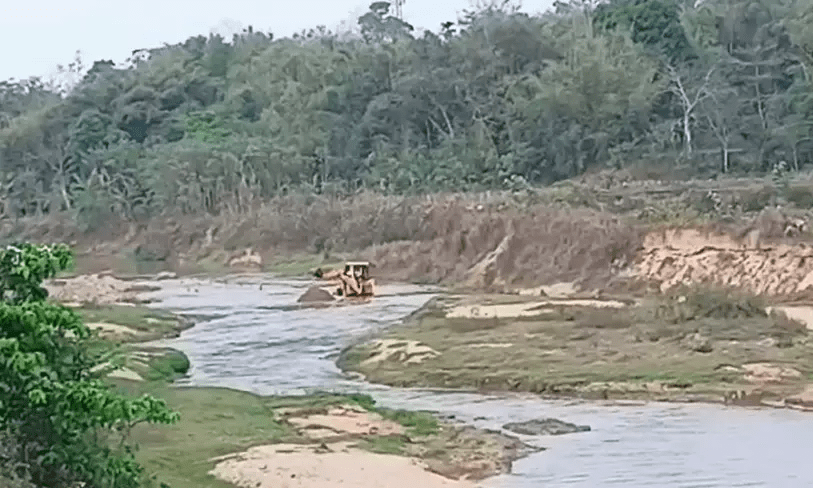
Allegations of complicity have been levelled against certain individuals and entities, accusing them of profiting from illicit sand mining activities while disregarding the detrimental impact on the environment. According to sources, there have been serious allegations that the Jorhat forest department has been cooperating in this work. https://assamtribune.com/assam/illegal-sand-excavation-threatens-river-bhogdoi-in-jorhat-1528058 (29 March 2024)
Punjab Everything about the rare metal found in Sutlej -The discovery of tantalum in the Sutlej River was unexpected. It was during a routine analysis that researchers from Indian Institute of Technology, Punjab stumbled upon this valuable find. The presence of tantalum in the river’s sands suggests that there may be untapped mineral wealth lying beneath the riverbed, waiting to be explored. This revelation has sparked interest in further geological surveys and research to determine the extent of the tantalum deposits. https://timesofindia.indiatimes.com/etimes/trending/everything-about-the-rare-metal-found-in-sutlej-river/articleshow/108827785.cms (28 March 2024)
Himachal Pradesh Hillocks levelled as illegal miners deploy heavy machines in Una Illegal mining with the help of JCB and Poclain machines continues to be rampant in parts of Una along the Punjab border, so much so that hillocks have been levelled at several points. A few environmentalists said it was shocking to notice the extent of illegal mining in Shivalik hills, the mined material being allegedly smuggled to the neighbouring state. The maximum damage, they alleged, was in Una and Haroli Assembly constituencies of Una district.
Talking to The Tribune, environmentalist Prabhat Bhatti said an entire hillock had been levelled in Bangarh while considerable damage could be noticed in Polian and Kudharbit. “Due to levelling of the hillocks, the ecology is under threat. Several animal species have been facing loss of habitat,” he said. Interestingly, the Himachal government’s mining policy doesn’t allow the use of JCB machines. On the compliant of residents, the NGT had ordered the Una administration to impose a fine of Rs 4 lakh on vehicles or machines found involved in illegal mining. However, no such penalty has been imposed so far. https://www.tribuneindia.com/news/himachal/hillocks-levelled-as-illegal-miners-deploy-heavy-machines-in-una-606034 (01 April 2024)
Report Scientists develop material to replace sand in construction -Researchers at IISc’s Centre for Sustainable Technologies (CST) are looking at ways to store carbon dioxide from industrial flue gas in excavated soil and construction waste. This can then be used to partially replace natural sand.
-Led by Souradeep Gupta, Assistant Professor at CST, the team has shown that replacing natural sand with carbon dioxide-treated construction waste in mortar and then curing it in a controlled, CO2-rich environment can speed up the development of the material’s engineering properties.
-The process is pegged to enhance the materials’ compressive strength by 20-22%. His lab has also tested the effect of injecting carbon dioxide gas into clayey soil – typically excavated from construction sites.
-Future research will assess the impact of industrial flue gas on these materials’ properties, with plans for industrial application and standards revision in cement-based construction materials. https://www.indiatoday.in/science/story/indian-scientists-develop-material-to-replace-sand-in-construction-2520340-2024-03-28 (28 March 2024)
On sustainable building materials The story so far: India is witnessing an unprecedented construction boom, with over 3,00,000 housing units erected annually. This growth brings economic opportunities and improved living standards but also poses significant environmental challenges. The building sector, a major energy consumer, accounts for over 33% of India’s electricity usage, contributing to environmental degradation and climate change. The India Cooling Action Plan forecasts an eight-fold increase in cooling demand between 2017 and 2037, emphasising the need for thermal comfort while reducing active cooling demand.
Sustainable construction requires innovation from building materials manufacturers to develop cost-effective, scalable, durable, fire-resistant solutions with superior thermal performance and climate resilience. In conclusion, the journey toward sustainable construction is challenging but essential for a greener future. By re-imagining construction design and practices, manufacturing innovative walling materials, and fostering a culture of sustainability, we can create resilient and energy-efficient structures that align with environmental goals and significantly improve the quality of life for the masses. https://www.thehindu.com/sci-tech/energy-and-environment/on-sustainable-building-materials-explained/article67999691.ece (27 March 2024)
Andhra Pradesh Minor mineral industries in crisis due to heavy tax burden, stringent license norms Mining activity has been badly affected, both in Vizianagaram and Srikakulam districts, apart from other parts of the State with the unprecedented tax burden, stringent norms for sanctioning of licenses, involvement of third parties in the collection of fees and others. This has led to slump in the minor mineral industries, including granite factories. Thousands of people lost their livelihood and many industries are unable to clear their bank loans due to the crisis in the industry. According to a study by the Federation of Minor Mineral Industry (FEMMI), total mining leases have come down from 5,935 to 3,373 in the last three years due to multiple challenges. https://www.thehindu.com/news/national/andhra-pradesh/minor-mineral-industries-facing-unprecedented-crisis-with-heavy-tax-burden-stringent-license-norms/article68009139.ece (30 March 2024)
WETLANDS, LAKES, WATER BODIES
Kerala Water woes in wetland As Kuttanad, known for idyllic backwaters, rivers, canals, and vast paddy fields, faces the dire consequences of changing weather patterns, for the people of the region who live across 62 grama panchayats in Alappuzha, Kottayam, and Pathanamthitta districts, fluctuating weather patterns, alternating between torrential downpours and drought, and intrusion of saline water from the sea are at the forefront. Adding to their woes is the worsening drinking water problem caused by water pollution, high salinity, and drought.
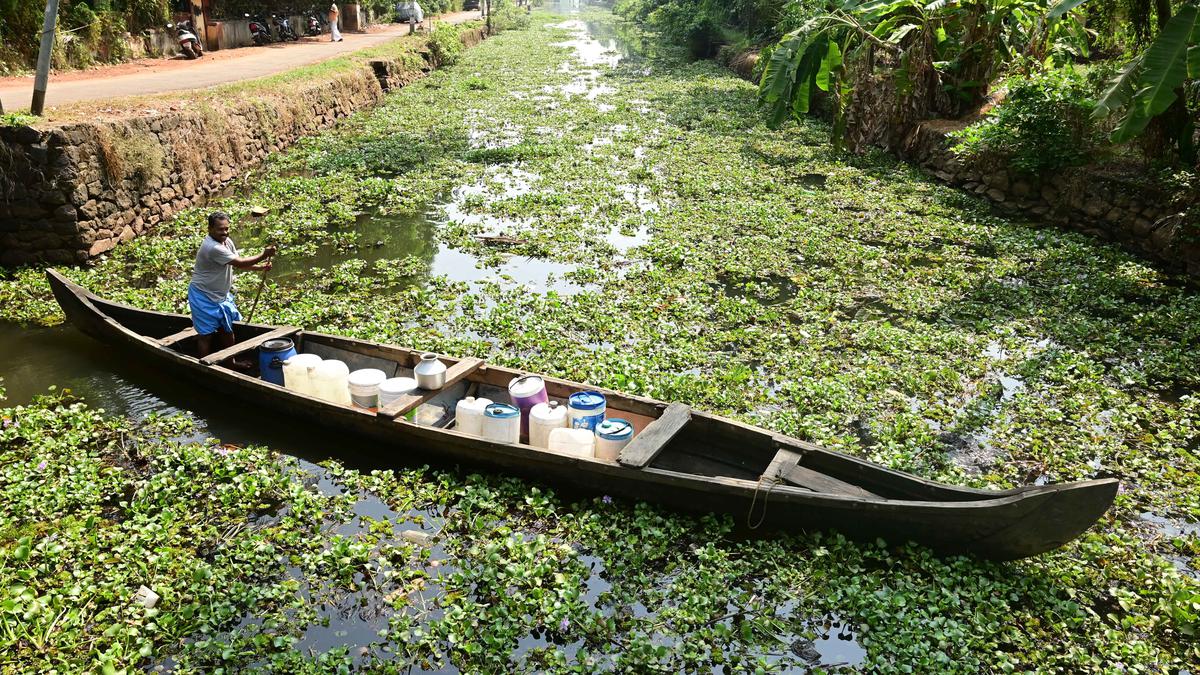
After the devastating 2018 floods, many water sources in Kuttanad taluk in Alappuzha district, such as ponds, wells, and rainwater harvesting pits, were destroyed or left unusable. Recurring floods exacerbate the situation. While residents blame the government for failing to ensure drinking water supply in the region, experts point out the lack of proper waste management in various sectors including water transport, houseboat tourism, and agriculture, which contribute to pollution in Kuttanad. Absence of efficient water management is also an issue.
As the drought intensifies over upper Kuttanad, the entire local economy has been affected. Fishing, agriculture, livestock, and even toddy tapping are all suffering in the region. “Even the coconut trees are running dry. The yield per tree has decreased to less than a litre per day against the average volume of 1.5 litres. The tappers are struggling to meet their daily quota of 5 litres,” says Saneesh Mohan, who runs a toddy shop near Paral, Changanassery. https://www.thehindu.com/news/national/kerala/water-woes-in-keralas-wetland/article67998225.ece (29 March 2024)
Jammu & Kashmir NGT notice to officials on wetlands’ condition The tribunal was hearing a matter in which it had taken suo motu cognisance of a news report highlighting the “worsening condition” of wetlands and waterbodies in the UT.
The report stated wetlands and waterbodies in the UT were declining due to both natural and man-made causes, such as rising temperatures, unchecked deposition of millions of tonnes of sediments annually, encroachment and waste discharge. It also claimed pollution in waterbodies, such as Dal, Wular, Anchar and Manasbal lakes and wetlands, including Haigam Rakh in the Jhelum Valley, Hokersar near Srinagar and Shalbug in the central district of Ganderbal. The next date of hearing is May 22. https://www.tribuneindia.com/news/j-k/ngt-notice-to-officials-on-wetlands-condition-602711 (20 March 2024)
Since 2021, the NGT has come down heavily on the govt for its recurring failures – from failing to stop illegal riverbed mining to dumping of solid municipal waste in water bodies. It has also fined construction companies and pinned responsibility on senior bureaucrats of the administration. https://scroll.in/article/1065866/why-kashmirs-activists-are-turning-to-the-national-green-tribunal-to-save-its-forests-and-wetlands (29 March 2024)
WATER OPTIONS
Bengaluru Newly rejuvenated open wells help meet water demand Amid the water crisis in Bengaluru, close to 500 families in Kanteerava Nagar near NandiniLayout have been able to get water for non-potable purposes from a newly rejuvenated open well in the area. Over the last year, the Bruhat Bengaluru Mahanagara Palike (BBMP), which is the nodal agency, in association with the Biome Environmental Trust, has rejuvenated five such open wells that had become defunct. Two wells near Avalahalli Lake, two wells close to Kothanur Lake and another in Kanteerava Nagar are among the wells that have been rejuvenated.
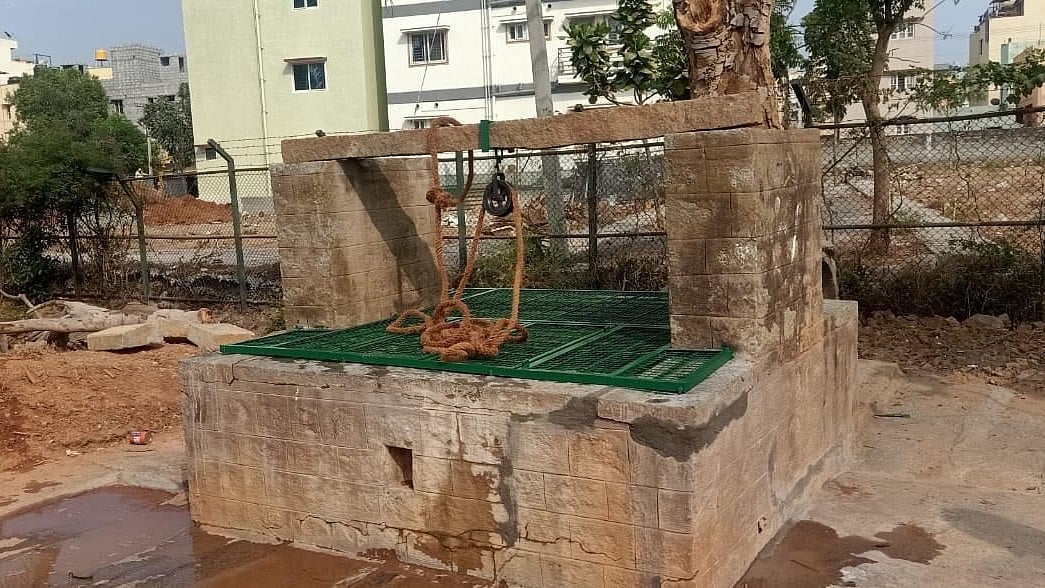
The wells were rejuvenated by desilting and cleaning since many of them had turned into garbage dump spots. The team also removed any vegetation and then installed grilles and pulleys to extract water. While the water from the well in Kanteerava Nagar is supplied to the families close by, water from other wells is also being used by the local communities. The traditional open wells tap into the shallow aquifers that do not run very deep like the borewells. https://www.deccanherald.com/india/karnataka/bengaluru/newly-rejuvenated-open-wells-help-meet-water-demand-during-crisis-2959667 (01 April 2024)
Odisha Greens working for water conservation felicitated Hosted by the Foundation for Ecological Security (FES), in collaboration with key partners, the event aligns with the International Day of Action for Rivers and World Water Day, emphasising the critical role of rivers and forests in sustainable living and climate resilience. The speakers included representatives from civil society organisations and academia, who drew attention to the current status of rivers in the state, as well as the initiatives being taken to revive and restore them. They also focused on interconnections among river health, forest health, rural and urban societies, and livelihood resilience. https://www.newindianexpress.com/states/odisha/2024/Mar/22/greens-working-for-water-conservation-felicitated-in-odisha (22 March 2024)
GROUNDWATER
Andhra Pradesh Drop in groundwater level Groundwater levels in the State have dropped by 2.27 metres below ground level (MBGL) this year compared to last year. Besides the deficit rainfall, experts have cited over exploitation of groundwater as the reason for the situation. As per statistics of the Andhra Pradesh Water Resources Information and Management System (APWRIMS), the State recorded 9.56 MBGL this February, compared to 7.28 MBGL last February. The depletion of groundwater level was more pronounced in both Rayalaseema and Coastal Andhra Pradesh districts this year. The groundwater table in coastal Andhra Pradesh was 8.92 MBGL last February, while it stood at 12.66 MBGL this February with a variation is 3.74 MBGL.
Terming the situation alarming, YV Malla Reddy, an expert in groundwater studies and working with the Rural Development Trust (RDT), said, “In my 50 years of career, I have not witnessed such a severe hydrological drought.” Stating that over exploitation of groundwater coupled with deficit rainfall has resulted in the crisis, he explained, “Take undivided Anantapur as an example. Before 2019, there were 2.72 lakh borewells, which is four times more than what the groundwater levels in the district can sustain. In three years from 2019, the number has crossed three lakh.” Further, he opined that avoiding water-intensive crops, wherever groundwater levels are low, and crop water budgeting by the farmers, backed by a suitable government policy might improve the situation. https://www.newindianexpress.com/states/andhra-pradesh/2024/Mar/25/andhra-pradesh-state-records-drop-in-groundwater-level (25 March 2024)
Report Needs to rethink many agri practices Groundwater is vital for farming in India. But overexploitation — years of it — has led to steadily drying aquifers. Major crops like sugarcane, rice, cotton, and wheat are becoming more and more difficult to cultivate, given their water-intensive nature. Yet, government policies by and large favour the growth of staple water-intensive cereal crops. The result: an impending water crisis. https://www.indiatoday.in/diu/story/depleting-groundwater-india-agriculture-farmers-water-intensive-crops-2506372-2024-02-23 (23 Feb. 2024)
URBAN LAKES, WETLANDS
GB Nagar MCC can’t halt steps to remedy ecological damage: NGT -Holding that ”measures required to be taken for remediation of environmental damage are not/cannot be barred by the model code of conduct”, imposed for the upcoming Lok Sabha elections, the NGT told the authorities that the amicus curiae appointed to look into the state of water bodies in Gautam Budh Nagar may visit the relevant sites, seek the information/document from the authorities concerned and verify the factual position regarding the remedial measures taken and suggest further remedial measures if any. The NGT further said on March 19 that the report of the amicus curiae will be submitted by him a week prior to the next date of hearing on July 23, 2024. https://www.hindustantimes.com/cities/noida-news/model-code-can-t-halt-steps-to-remedy-ecological-damage-ngt-tells-authorities-101711563334733.html (28 March 2024)
Kolkata 30-year journey of EKW– Degraded & diminished In sum, the east Kolkata wetlands provide the city a natural waste recovery system, enable significant economic activity that is fossil-free, reduce air pollution by capturing carbon and make the city more climate resilient. And yet, the wetlands have been allowed to shrink by almost 40%.
-The single, dominant reason for Kolkata losing large sections of its vital wetlands is government inaction. The state’s inaction can be attributed primarily to three reasons: absence of political commitment, low level of community engagement, and market forces.
-Poor funding starves the Management Authority of resources, including staff, which leads to unmonitored encroachment and continuing inaction. But resources aside, the fact that to date even the boundaries of the wetlands have yet to be fully demarcated is a sad testimony to the lack of political commitment on the part of the government. Without demarcation, it is open season for wetland hunters. The lack of political commitment is also reflected in the extremely low level of community engagement undertaken by the government. (Bonani Kakkar, Pradeep Kakkar PUBLIC) https://thewire.in/environment/a-30-year-journey-of-the-east-kolkata-wetlands-degraded-and-diminished (27 March 2024)
Bengaluru Water crisis rooted in the neglect of its lakes For years, lakes helped give the city steady water supply.
But lopsided growth pushed out traditional users and left lakes shrunken and polluted. https://scroll.in/article/1065813/how-bengalurus-water-crisis-is-rooted-in-the-neglect-of-its-lakes (27 March 2024)
URBAN WATER
Bengaluru Dry run There has been no groundwater cell in the Bengaluru Water Supply and Sewerage Board and it doesn’t have a single hydrogeologist, says S. Vishwanath, civil engineer and urban planner by profession and insightful water expert. He says in this interview: This is stunning considering that Bengaluru relies extensively on groundwater across the city. It is included in the municipal supply. Tankers commonly meet the needs of bulk users such as high-rise buildings and hotels. https://civilsocietyonline.com/cover-story/dry-run-in-bengaluru/ (30 March 2024)
Water math is badly failing as ‘zero water days’ loom large This year’s summer is a trailer for a bigger water crisis in a city which once boasted of great weather and good life. Now, authorities acknowledge they cannot bring more water to the city. Nearly half its population surviving without a reliable piped water system, chronic water shortages, lack of water sources in the city, and unplanned construction concretising water bodies show the severe drawbacks of Bengaluru’s urbanisation model. Trying to fix the water problem now is like catching a running train. Numbers indicate that, even with normal monsoons, the potable water supply may be negative in the future. Sustainable long-term measures call for building a new greenfield city. Anand Sankar https://questionofcities.org/bengalurus-water-math-is-badly-failing-as-zero-water-days-loom-large/ (23 March 2024)
Guidelines for sale of treated water out BWSSB has published the guidelines related to the spell of secondary treated water by apartment complexes. Apartment complexes are expected to reuse 50% of the treated water they generate and the remaining treated water can be sold. An MOU will be entered between buyer and seller and buyer is expected to ascertain the quality.
– The quality is supposed to adhere to the SPCB/ CPCB set parameters: Ph: 6.5-8.5; BOD less than 10 ppm, COD less than 50 ppm, TSS less. than 10 ppm; ammonical nitrogen less than 5 ppm; total nitrogen less than 10 ppm; faecal Coliform less than 100 MPN/ 100 ml.
– The tankers carrying treated water should declare the same in big letters on its body. This water is banned from used for drinking, food processing and manufacturing medicines. https://www.deccanherald.com/india/karnataka/bengaluru/guidelines-for-sale-of-treated-water-out-buyer-to-check-quality-2951975 (26 March 2024)
Treated water sells for just Rs 10 per 1,000 litres, a fraction of what potable water costs. Logistical challenges make it difficult for BWSSB to meet the demand. BWSSB’s 34 STPs in city have a capacity of nearly 1,350 MLD of treated water. Board gets orders for 70 treated water tankers of 6,000-12,000 litres a day. The orders are mostly to 133 major construction projects in the city. https://www.deccanherald.com/india/karnataka/bengaluru/bwssb-flooded-with-demand-for-treated-water-2958892 (31 March 2024)
Govt has for the first time allowed treated water from localised STPs inside apartment complexes and gated communities to be sold on commercial basis. https://www.thehindu.com/news/cities/bangalore/water-woes-apartments-in-bengaluru-can-now-sell-50-of-treated-water-from-in-situ-stps/article67990318.ece (25 March 2024)
The govt has provided relief to apartment communities in areas with underground drainage (UGD) lines, essentially the core city, by amending rules for in-situ STPs. Henceforth, only apartment complexes with over 120 units and producing over 80 KLD of sewage will have to install an in-situ STP. At present, an STP is mandatory for projects above 50 units. However, smaller STPs are capital-intensive and inefficient. The Bangalore Apartments Federation (BAF) lobbied hard for this amendment. However, in areas yet to be serviced by UGD lines, an in-situ STP is mandatory for all projects with over 20 units. https://www.thehindu.com/news/cities/bangalore/water-woes-karnataka-amends-law-makes-in-situ-stp-mandatory-for-residential-complex-in-bengaluru-with-over-120-apartments/article67997490.ece (27 March 2024)
Bengaluru East taluk seems to be the worst affected by the depleting groundwater levels in the city this summer, even as Bengaluru North taluk is the least affected, data from the Karnataka Groundwater Authority shows. The data of groundwater levels for last December and this January and February shows that Bengaluru East taluk, which houses one of the major IT corridors of the city, where the water crisis is most severe and groundwater exploitation unbridled, has seen the most dip in groundwater levels this summer. https://www.thehindu.com/news/cities/bangalore/bengaluru-east-taluk-worst-affected-in-depleting-groundwater-levels-this-summer/article68002688.ece (28 March 2024)
Hyderabad Water crisis grips Manikonda residents Residents of Manikonda are facing a severe water crisis, with skyrocketing prices for water tankers amid decreasing water resources. Despite the Hyderabad Metropolitan Water Supply and Sewerage Board (HMWSSB) offering the same quantity of water for a fraction of the cost, residents are forced to shell out exorbitant amounts for private tankers. Complaints have arisen regarding the delayed delivery of HMWSSB water tankers, with residents alleging that bookings often result in a wait of two to three days before water is supplied. This delay exacerbates the already dire situation, leaving residents grappling with water scarcity. https://www.siasat.com/hyderabad-water-crisis-grips-manikonda-residents-2999371/ (27 March 2024)
Mumbai Overestimating water demand to justify dams The water issues of Mumbai cannot be solved by developing more dams or a desalination plant. The city already has enough water. The real issues are the inequitable distribution of water across the city and the vast number of leakages. By minimising the leakages, the city can save a significant amount of water and, thereby, avoid the development of dams and their subsequent socio-economic and environmental consequences.
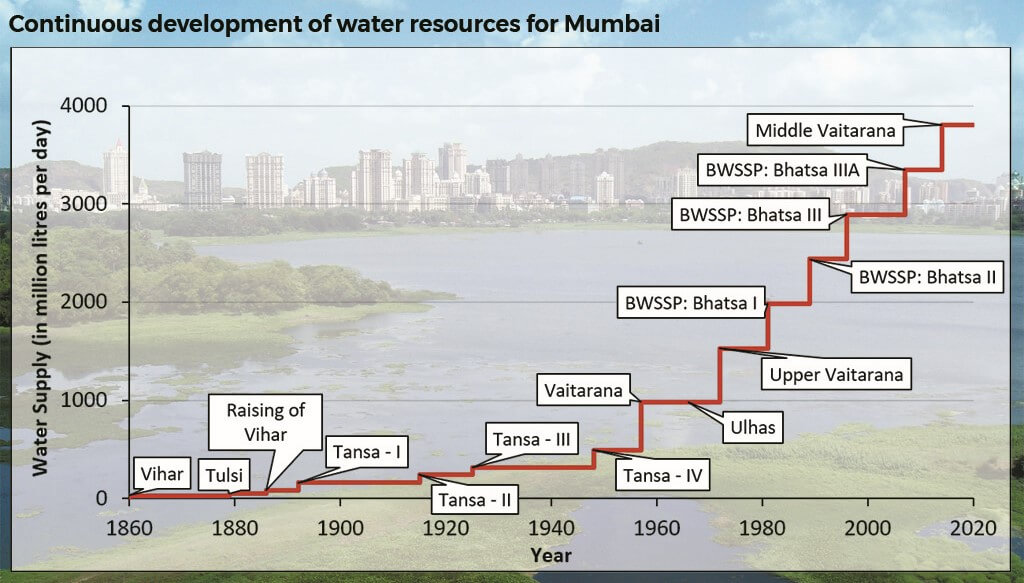
By developing dams and acquiring more water, the city is not only depriving tribal villages in the hinterlands but also other municipal corporations and councils of the metropolitan region. Thus, BMC needs to rethink its existing strategy of managing water resources for the city. (Sachin Tiwale, ATREE) https://questionofcities.org/mumbais-unquenchable-thirst-overestimating-water-demand-to-justify-dams/ (March 2024)
Pune Groundwater depletes in several areas Groundwater levels, in an alarming situation, have depleted to 400 feet and more in several pockets of the city, rendering existing borewells almost dry and making a deeper dig necessary for the new ones, borewell drilling firms and groundwater detectors told TOI on Saturday (March 30). “Barring the central Pune, that is the 5-10km area surrounding Shivajinagar, groundwater is on the verge of exhaustion,” said Ramesh Gaike, owner of a firm involved in rainwater harvesting and groundwater surveys.
The rapid depletion has led to a spike in demand for private water tankers, especially in newly developed suburbs surrounding central PMC areas. “Nobody is doing rainwater harvesting, that’s why the water table cannot be maintained. In Lohegaon, groundwater was found at 150 feet earlier, but it’s 250-300 feet in some locations now. Vimannagar, meanwhile, has hard rock and it is difficult to find groundwater in several areas here. In Wagholi too, one has to drill deeper than 200-300 feet as against 100-150 feet earlier (the last couple of years),” said Homesh Rawal, the owner of a borewell drilling firm. https://timesofindia.indiatimes.com/city/pune/pune-digs-deeper-as-groundwater-depletes-to-450ft-in-several-areas/articleshow/108909352.cms (31 March 2024) Pune is facing acute water crisis as borewells in the city have started to dry up along with groundwater levels. With just the arrival of the summer, residents are struggling to meet daily water demands despite efforts like rainwater harvesting and calls for water conservation. What is more adding to the crisis is water storage in Khadakwasla, Panshet, Temghar and Varasgaon — four major dams in Pune that provide drinking water to the city. The water level in these dams is 60.48 per cent at present. Moreover, the water storage in Ujjani dam, which supplies water to Solapur district, has alarmingly reached zero per cent. https://www.india.com/maharashtra/after-bengaluru-pune-faces-water-crisis-as-groundwater-level-declines-residents-express-concern-6813345/ (26 March 2024)
Opinion It is time to look for an alternative model of water supply to overcome the water quality issues. Decentralised treatment and non-pipe mode of service delivery are worth experimenting with by Sachin Tiwale. https://indianexpress.com/article/opinion/columns/how-to-fix-indias-urban-water-crisis-from-bengaluru-to-chennai-and-beyond-9236931/ (28 March 2024)
WATER POLLUTION
Report New law gets President’s approval The new law to prevent and contain water pollution has received approval from President Droupadi Murmu and will come into effect immediately in Himachal Pradesh, Rajasthan and the Union territories, and in any other state that adopts the Act, the environment ministry said on Saturday (Feb. 24). President ‘s assent came on February 15 according to the law ministry notification posted by environment ministry on its website. The Water (Prevention and Control of Pollution) Amendment Act, 2024, which decriminalises almost all penal provisions in the earlier 1974 law, was passed in Rajya Sabha on February 6.
The modified law relaxes several norms for industries and gives the Centre powers to exempt certain industries from statutory restrictions, such as taking consent from state pollution control boards, earlier mandatory. It also allows the central government to frame uniform guidelines for appointment of officials to state boards and prescribe service conditions of chairpersons of state pollution control boards. Section 25 applies to mandatory consent to establish and operate an industry to be taken from state pollution watchdogs and section 26 applies to discharge of sewage or trade effluents. https://www.hindustantimes.com/india-news/new-law-to-prevent-water-pollution-gets-president-s-approval-101708800955784.html (25 Feb. 2024)
JJM/ RURAL WATER SUPPLY
Ladakh A demand for autonomy -In Ladakh, customary norms regarding scarce resources like water have evolved over the centuries to suit the conditions of living in the cold desert. Each village has its own norms. Some villages rely on the Indus, some rely on springs and others rely on streams. Some villages share a single stream. In this case, the norms would have been developed after a long process of inter-village assertion, conflicts and consensus. Despite the differences in such norms across Ladakh, one thing is common: the norms are made locally. They are place-based norms made by people who use the resources.
-Another line that connects the different norms, especially in Buddhist villages, for using local resources like water is the sacredness of the water. Springs are considered the home of the spirits of the underworld, the Lu. The fish, insects and other more-than-humans are also seen as the embodiments of the Lu. We do not pollute our water, knowing that the Lu will get offended. The belief system also helped keep the water clean for our fellow villagers.
-Since August 2019, when Ladakh was carved out of Jammu and Kashmir and the status of both parts was downgraded to Union territories, policies for the region have been made in New Delhi or by bureaucrats appointed by the Centre. The statutory hill councils of Leh and Kargil now only have executive power. The councils lack legislative power, which means that the councils cannot make laws that recognise customary norms regarding resource use. https://scroll.in/article/1065783/ladakh-protest-a-tale-of-two-mountain-springs-and-what-it-says-about-the-demand-for-autonomy (26 March 2024)
Jharkhand Forest laws complicate access to safe drinking water for tribal groups For many tribal villages in and around Jharkhand’s Saranda forest, traditional chuas or shallow pits are the only source of drinking water. The water in these pits is deteriorating and polluted.

The absence of a ‘community patta’ under the Forest Rights Act (2006), has created a hurdle to access safe drinking water for some of these villages, as the forest department only approves development projects, including water supply projects, to villages that have a community patta. The department of drinking water and sanitation is taking steps to renovate the chuas and provide other alternatives for safe drinking water. https://india.mongabay.com/2024/03/forest-laws-complicate-access-to-safe-drinking-water-for-tribal-groups/ (26 March 2024)
Telangana Poor management of Mission Bhagiratha aggravates woes Management of the Mission Bhagiratha scheme has been left to the wind in several interior parts of the Adilabad district, pushing tribals dwelling in remote parts of the region into a drinking water crisis. The initiative is now not being managed properly in interior villages due to lack of supervision by officials and crunch of funds in maintenance of the scheme. Due to lack of supply of drinking water through the scheme to interior villages, the tribal population is forced to trek for long distances to fetch water. https://telanganatoday.com/poor-management-of-mission-bhagiratha-aggravates-woes-of-tribals-in-adilabad (31 March 2024)
WATER
Report Water levels dangerously low in major dams in South Most of the major reservoirs in the southern States of Karnataka, Tamil Nadu, Andhra Pradesh, and Telangana are filled to only 25% of their capacity or less. This is worrying as peak summer is round the corner. Some large dams such as the Tungabhadra in Karnataka and the Nagarjuna Sagar on the Andhra Pradesh-Telangana border are filled to 5% or less of their full capacity. Other large dams such as Mettur in Tamil Nadu and Srisailam on the Andhra Pradesh-Telangana border are also filled to less than 30% of their capacity. https://www.thehindu.com/data/water-levels-dangerously-low-in-major-dams-in-south-india-data/article67998189.ece (28 March 2024) The live storage position in Southern region reservoirs are 13 BMC which was 22.2 BMC last year. Similarly, in the Western region current live storage capacity is 17.8 BMC while it was 21.1 BMC last year. https://www.newindianexpress.com/nation/2024/Mar/26/water-crisis-looms-as-reservoir-levels-dip (27 March 2024) Kerala is the only exception among the southern States, with most of its major dams filled to at least 50% of their capacities, as shown in Chart 5. The Idukki reservoir is filled to 47%, the Idamalayar dam to 48%, and the Kallada and Kakki reservoirs to 50%. https://www.news18.com/india/bengaluru-water-crisis-south-india-summer-dipping-reservoir-stores-8831676.html (28 March 2024) Kerala is the only state maintaining slightly above normal reservoir levels at 1%. Rivers such as the Krishna and Cauvery exhibit deficient storage levels, reflecting the widespread shortage in various regions. North India (33%), West India (45%), and Central India (46%) also face storage levels much lower than the ten-year average. https://www.businessinsider.in/science/environment/article/dipping-reservoir-stores-in-south-india-raise-alarms-on-possible-water-shortages-ahead/articleshow/108763592.cms (25 March 2024)
AGRICULTURE
Report Nearly 56 million Indians joined back agriculture in 3 yrs According to the India Employment Report 2024, co-produced by the International Labour Organization (ILO) and the Institute for Human Development (IHD), the Delhi-based non-profit set up by the Indian Society of Labour Economics, During 2020-2022 (Covid period), the agriculture sector recorded an increase of workers by nearly 56 million. In 2020, the number of workers in agriculture and allied sectors increased by 30.8 million. Next year, the agri-sector workforce added 12.1 million and in 2022, another 12.9 million joined the agri-worker family. “Between 2000 and 2019, youths shifted out of agriculture much more than adults, but the COVID-19 pandemic reversed the long-term trend of youth employment expansion into non-farm sectors.” https://www.downtoearth.org.in/blog/agriculture/nearly-56-million-indians-joined-back-agriculture-in-3-yrs-is-it-a-good-sign-or-an-indicator-of-an-economic-distress–95274 (28 March 2024)
FLOOD 2024
Study Understanding flash flooding in Himalayan region Abstract The study focuses on the Himalayan region, emphasizing the pivotal role of geographical and atmospheric parameters in flash flood occurrences. Specifically, the investigation delves into the intricate interactions between atmospheric and surface parameters to elucidate their collective contribution to flash flooding within the Nainital region of Uttarakhand in the Himalayan terrain. Pre-flood parameters, including total aerosol optical depth, cloud cover thickness, and total precipitable water vapor, were systematically analyzed, revealing a noteworthy correlation with flash flooding event transpiring on October 17th, 18th, and 19th, 2021. Which resulted in a huge loss of life and property in the study area. Contrasting the October 2021 heavy rainfall with the time series data (2000–2021), the historical pattern indicates flash flooding predominantly during June to September.
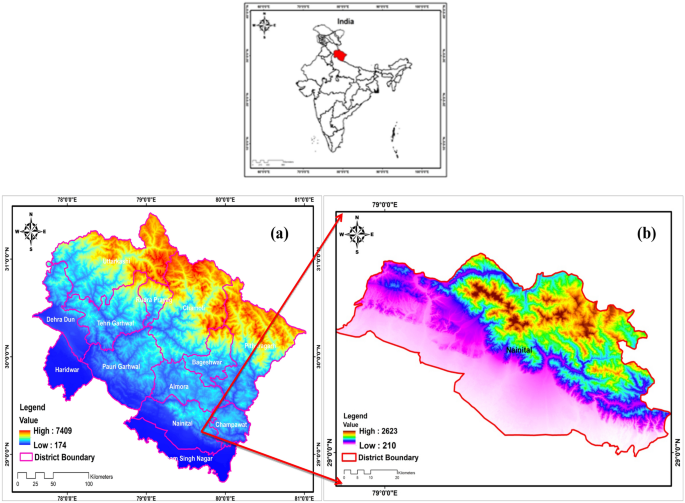
The rare occurrence of October flash flooding suggests a potential shift in the area’s precipitation pattern, possibly influenced by climate change. Robust statistical analyses, specifically employing non-parametric tests including the Autocorrelation function (ACF), Mann–Kendall (MK) test, Modified Mann–Kendall, and Sen’s slope (q) estimator, were applied to discern extreme precipitation characteristics from 2000 to 201. The findings revealed a general non-significant increasing trend, except for July, which exhibited a non-significant decreasing trend. Moreover, the results elucidate the application of Meteosat-8 data and remote sensing applications to analyze flash flood dynamics. Furthermore, the research extensively explores the substantial roles played by pre and post-atmospheric parameters with geographic parameters in heavy rainfall events that resulted flash flooding, presenting a comprehensive discussion. The findings describe the role of real time remote sensing and satellite and underscore the need for comprehensive approaches to tackle flash flooding, including mitigation. The study also highlights the significance of monitoring weather patterns and rainfall trends to improve disaster preparedness and minimize the impact of flash floods in the Himalayan region. https://www.nature.com/articles/s41598-024-53535-w (25 March 2024)
URBAN FLOODS
China Plan for cities that flood: Stop fighting the water Cities around the world face a daunting challenge in the era of climate change: Supercharged rainstorms are turning streets into rivers, flooding subway systems and inundating residential neighborhoods, often with deadly consequences. Kongjian Yu, a landscape architect and professor at Peking University, is developing what might seem like a counterintuitive response: Let the water in.
– “You cannot fight water,” he said. “You have to adapt to it.” Instead of putting in more drainage pipes, building flood walls and channeling rivers between concrete embankments, which is the usual approach to managing water, Mr. Yu wants to dissipate the destructive force of floodwaters by slowing them and giving them room to spread out. Mr. Yu calls the concept “sponge city”. Through his Beijing-based company, Turenscape, one of the world’s largest landscape architecture firms, Mr. Yu has overseen the development of hundreds of landscaped urban water parks in China where runoff from flash floods is diverted to soak into the ground or be absorbed into constructed wetlands. https://www.nytimes.com/2024/03/28/climate/sponge-cities-kongjian-yu.html (28 March 2024)
DROUGHT
Telangana Farmers ask govt to declare drought According to the farmer unions, the BRS government did not prepare an agriculture action plan for 2022 and 2023. “An action plan would have entailed farmers going for less water intensive crops in rabi which would have reduced the need for water and sinking of borewells to save drying crops.”
-The state has paddy sown over 50,69,326 acres, down from 56,44,850 acres last year. The normal area under the crop is 40,50,785 acres. The area under paddy, which requires large quantities of water, grew manifold as former chief minister K. Chandrashekar Rao made it a benchmark for the prosperity of farmers and attributed the increased acreage to the success of Kaleshwaram project. The higher area under paddy led to concerns of mono-cropping and consequent problems like groundwater depletion and soil degradation. https://www.deccanchronicle.com/nation/farmer-unions-ask-govt-to-declare-drought-in-state-887212 (27 March 2024)
Kerala Rain remains elusive, threat of drought looms Though there is sufficient storage in reservoirs, rivers and water bodies are drying up fast and water scarcity is forcing people to depend more on groundwater resources. According to Cusat Advanced Centre for Atmospheric Radar Research director S Abhilash, there is an increased possibility of water scarcity in central and north Kerala in April if summer rains fail to deliver. https://www.newindianexpress.com/states/kerala/2024/Mar/23/rain-remains-elusive-threat-of-drought-looms-in-kerala (23 March 2024) The ongoing drought situation in the cardamom-producing centres of Idukki poses a threat to cardamom farmers. Farmers say this is the first time in recent history that drought-like conditions have occurred in the cardamom sector in Idukki. https://www.thehindu.com/news/national/kerala/drought-situation-posing-threat-to-cardamom-sector/article68012976.ece (31 March 2024)
DISASTERS
Study Gujarat record 119% rise in soil erosion in 30 years: IIT-B -The study points to a critical issue of climate change and unsustainable land use, which are accelerating soil erosion. Urgent action is needed to minimize human impact and ramp up conservation efforts, the study states.
“These ranges play a vital role in moderating the tropical climate of the region by intercepting the southwest monsoon leading to an orographic rainfall region, thus providing for a non-equatorial tropical evergreen forest ecosystem,” states Chinnasamy. https://timesofindia.indiatimes.com/city/ahmedabad/western-ghats-in-gujarat-record-119-rise-in-soil-erosion-in-30-years-iit-b-study/articleshow/108757723.cms (25 March 2024)
Report Top NDMA official appointed as special representative for disaster risk reduction Kamal Kishore (55), in his current position at the National Disaster Management Authority (NDMA), holds the rank of secretary to the government of India. According to his profile on the NDMA website, Kishore has worked on disaster risk reduction and recovery issues for more than 22 years at the local, national, regional and global levels. https://indianexpress.com/article/world/top-ndma-official-kamal-kishore-disaster-risk-reduction-representative-united-nations-9237632/ (28 March 2024)
LANDSLIDES
Himachal Pradesh Unplanned excavation: HC tells NHAI to file fresh status report It was alleged in the PIL that from Parwanoo to Solan, there had been vertical cutting instead of slope or step cutting for widening of the road. It was further contended that due to lack of technology, the retaining walls were weak and feeble and there were no proper drainage channels for underground water. The width of the road was also not as per specifications.
-It was further contended that extensive deforestation without any planning and survey has led to soil erosion, which was constantly leading to landslides. Expanding the scope of the PIL, the court had directed the NHAI and the state government to file status reports on the safety of other highways of the state. The court has listed the matter again for March 27 now. https://www.tribuneindia.com/news/himachal/unplanned-excavation-of-slopes-high-court-tells-nhai-to-file-fresh-status-report-602487 (20 March 2024)
Fearing landslides, 12 families in Sainj village evacuate homes Danger is looming over Soti and Kartah villages and the villagers are making every possible effort to save their homes, but the continuous landslides have increased their concerns.

The villagers alleged that they had informed the administration several times about the condition of the villages, but even after eight months, the administration had not taken any concrete steps for the safety of the villages. Meanwhile, members of the Sainj Valley Vikas Samiti (SVVS) alleged that the flood-affected families had not been able to get any relief even after eight months of the disaster. https://www.tribuneindia.com/news/himachal/fearing-landslides-12-families-in-sainj-village-evacuate-homes-603514 (22 March 2024)
JCB operator killed in landslide A JCB operator has been buried under glacial debris in Kulu Nala near Manali, while working for what seems like a Hydropower project. https://timesofindia.indiatimes.com/city/shimla/jcb-operator-killed-in-landslide-near-pandoh-on-chandigarh-manali-highway/articleshow/107868257.cms (21 March 2024)
ENVIRONMENT GOVERNANCE
Report Why FCA Act may be deemed unconstitutional The Forest (Conservation) Amendment Act, 2023, proposing amendments to the Forest (Conservation) Act, 1980 (FCA) came into force on December 1, 2023. It introduced significant changes to the FCA, with the key focus being elucidation of its applicability to different types of land and exemptions thereof to specific land categories.
Further, the amendment established guidelines for compensatory tree plantation to offset tree felling arising from relaxations provided in the Act. It also broadens the ambit of forests / wildlife conservation activities by including initiatives such as establishment of zoos and safaris, eco-tourism facilities, etc.
– A Supreme Court bench led by Chief Justice Y Chandrachud, while hearing five petitions challenging the constitutional validity of the Amendment Act, issued an interim order on February 19, 2024. The petitions were filed by a group of retired civil servants, Satish Gokuldas Pendam and non-governmental organisations like Vanashakti, Goa Foundation and Conservation Action Trust. The SC interim order directed state governments and UT administrations to ensure compliance with the definition of ‘forest’ as outlined in the TN Godavarman case decision while preparing consolidated record of forest lands.
– On March 15, 2024, the SC issued notices to the Union ministry of tribal affairs, National Commission for Scheduled Tribes and Union ministry of environment, forest and climate change, based on another writ petition filed under Article 32 of the Constitution by the Aravalli Bachao Citizen Movement along with Rainbow Warriors of Goa, Lawyer Ebo Mili of Arunachal Pradesh and Santanu Das from West Bengal. Ritwick Dutta, a prominent environmental lawyer, drafted the petition on their behalf. A perusal of this petition revealed multiple grounds challenging the constitutional validity of the Amendment Act. The main contention of the petition is that the Act was founded on the mistaken legal premise that the FCA applied solely to ‘notified forests’ and not to any other forest category, including those listed in government records. Furthermore, the Amendment Act erroneously suggested the expansion of the FCA’s scope from ‘notified forest’ to ‘forest in government record’ was due to a SC order dated December 12, 1996, in the TN Godavarman case. Despite the above cited grounds, the future of forests in India hinges on the outcome of this petition and others during the final hearing scheduled for July. (Ritu Rao) https://www.downtoearth.org.in/blog/forests/why-forest-conservation-amendment-act-may-be-deemed-unconstitutional-95218 (26 March 2024)
Concerns over green credit use for compensatory afforestation -‘No amount of money can be a substitute for the land required for our forests, and for our biodiversity and wildlife to thrive. Yet the government is trying to make it easy for entrepreneurs and industrialists to acquire forest land by permitting them to offer, in exchange, money (in the form of green credits),’ the letter says. https://thewire.in/environment/former-civil-servants-voice-concerns-regarding-green-credit-use-for-compensatory-afforestation (19 March 2024)
Opinion Environmental federalism crucial for climate action There must be a greater involvement of states in crafting climate policies addressing the bottom-up nature of the crisis. They shoulder the responsibility of implementing most climate targets but are constrained by limited resources and a shrinking policy space. (Amar Patnaik) https://www.newindianexpress.com/opinions/2024/Mar/28/environmental-federalism-crucial-for-climate-action (28 March 2024)
Report Waste to energy plants in India are polluting, costly, and hazardous. So why are they still being built? https://idronline.org/article/climate-emergency/waste-to-energy-smokescreen-or-solution/ (27 March 2024)
CLIMATE CHANGE
Report Farmers from hill states feel impact of climate fluctuations While the apple growers of Himachal Pradesh are finding it tough to meet the ‘chilling hour’ requirement of the apple plant and the required temperatures during bloom, the impact of climate change in Kashmir is visible in the reduced production of saffron and paddy and the increasing cultivation of warm-area fruits like orange and kiwi. In Uttarakhand, the paddy-wheat cycle has taken a major hit due to erratic rainfall, especially over the last five-six years. The horticulturalists and agriculturalists from these regions highlighted these changes and their concerns at the recently held two-day Shimla Climate Meet. https://www.tribuneindia.com/news/himachal/farmers-from-hill-states-feel-impact-of-climate-fluctuations-604174 (25 March 2024)
Engage local communities to protect ecology: Experts Active engagement of local community in the efforts to protect environment emerged as one of the biggest takeaways from the Shimla Climate Meet that kicked off here today. On the inaugural day of the two-day meet, Romi Khosla, a reputed architect, dwelt at length on the impact of changing climate in the Northwestern Himalayan region. Listing melting glaciers, the potential change in cropping pattern as major impacts of climate change, Khosla suggested setting up of a Western Himalayan Survival Council to engage with the local communities, along with state and Central agencies, to mitigate the adverse impacts and look for solutions to the problems emanating from climate change and increasing infrastructure in the hills. https://www.tribuneindia.com/news/himachal/engage-local-communities-to-protect-ecology-experts-602498 (20 March 2024)
SOUTH ASIA
Report Future of 1 billion people in hinges on water pact Better collaboration is urgently needed to mitigate the impacts of climate change on three key river basins in South Asia—the Brahmaputra, Indus and Ganges—according to new analysis. In a series of reports, scientists call for joint action to tackle what they see as a lack of planning, research, cooperation and data sharing in these basins, highlighting growing pressures on water resources in the Hindu Kush Himalaya region from population growth and rising temperatures. The reports were released by the International Centre for Integrated Mountain Development and the Australian Water Partnership on March 20 in Kathmandu. Russell Rollason is the lead author of the Indus report.
Anamika Barua, professor of ecological economics at IIT Guwahati in India, said, “One common theme across [all these] basins is non-cooperation.” The studies recommend basin approach through IRBM, but the govts are likely to claim they are doing that, but neither the recommendation nor the govt emphasis bottom-up approach is fundamental to achieve any success in basin wise management. The reports talk about low storage capacity without comprehensive assessment of all local storage options.
Brahmaputra report: https://lib.icimod.org/record/36436
Indus Report: https://lib.icimod.org/record/36434
Ganga Report: https://lib.icimod.org/record/36435
https://phys.org/news/2024-03-future-billion-people-south-asia.html (27 March 2024)
Pakistan Chinese contractors have halted work on 2 dam projects Chinese contractors halted construction on two major dam projects in Pakistan as Chinese investigators arrived in the country to join a probe into the suicide bombing that killed five Chinese engineers and a Pakistani driver this week, an official said on March 29. A senior official from the Khyber Pakhtunkhwa interior department told AFP that since Wednesday, China Gezhouba Group Company has halted work on the Dasu dam in the province and Power China has stopped work on Diamer Bhasha dam, which straddles two provinces. The companies have demanded that Pakistan authorities come up with new security plans before reopening the sites where around 1,250 Chinese are working, it said. https://timesofindia.indiatimes.com/world/pakistan/pak-official-chinese-contractors-have-halted-work-on-2-projects-after-attack/articleshow/108888340.cms (30 March 2024) This decision came after a tragic incident this week, where a suicide bomber targeted a vehicle carrying Chinese engineers and a Pakistani driver, resulting in six fatalities. The halted projects spotlight the risks faced by approximately 1,250 Chinese nationals employed in these ventures. https://timesofindia.indiatimes.com/world/pakistan/security-crisis-in-pakistan-china-halts-work-on-2-dam-projects-after-deadly-attack-on-engineers/articleshow/108873241.cms (29 March 2024)
5 Chinese nationals among 6 killed in suicide bomb attack Five Chinese nationals and a Pakistani driver have been killed after a suicide attacker rammed his explosive-laden vehicle into their convoy near Besham city in northwest Pakistan’s Khyber Pakhtunkhwa province. The incident happened on Tuesday (March 26) when the convoy was on its way from Islamabad to Dasu, the site of a key hydroelectric dam being constructed by a Chinese company, about 270km (167 miles) from the capital.
-China is a close ally of Pakistan and has invested heavily in various projects in the South Asian country. But the safety of Chinese nationals working on those projects is often threatened by several armed groups in the region. In 2021, the bombing of a bus in Dasu killed 13 people, nine of them Chinese. Dasu is about 80km (49 miles) further northwest from Besham where Tuesday’s (March 26) suicide attack happened – the third such incident in a week. https://www.aljazeera.com/news/2024/3/26/five-chinese-nationals-killed-in-suicide-bomb-attack-in-pakistan-police (26 March 2024)
Myanmar Unyielding water, unyielding people On the International Day of Action for Rivers, a powerful wave of defiance flowed through the valleys and hills of Karen and Shan States in Myanmar. United in peaceful environmental and social movements, young people, villagers, and local groups sent a resounding call for environmental justice, urging the protection of their sacred rivers—which have served as the lifeblood of their communities for generations—and a halt to dam construction along the Salween and Namtu Rivers.
-On 14 March 2024, over a thousand local people demonstrated their steadfast rejection of the proposed Hatgyi Dam site, gathering on the banks of the Salween River and holding banners saying “No Dam” and “Let the River Flow Freely.” For the past 20 years, Karen Rivers Watch (KRW), which led the 14 March demonstration, has been at the forefront of anti-dam campaigns along the Salween River, particularly the Hatgyi Dam Project, which seriously threatens local peoples’ livelihoods and security, and was decided upon without their consent.
-Similarly, in Shan State, local villagers and youth from Hsipaw and Kyaukme, northern Shan State, and, Kunhing, southern Shan State, held blessing ceremonies along the Namma and Namtu Rivers on the International Day of Action for Rivers, waving the banners saying “May Shan State Rivers flow freely” and “May Shan State people be free.” Despite the people’s unequivocal rejection of dam projects, two large hydropower dam projects—the Upper Yeywa dam in Taung Che Village in Kyaukme Township, and the Namtu Dam in Tadae Village in Hsipaw Township—are continuing unabated for the Myanmar military’s benefit. https://progressivevoicemyanmar.org/2024/03/22/unyielding-water-unyielding-people/ (22 March 2024)
CHINA
China sends 1,500 tonnes of drinking water from Tibet to Maldives The decision to provide Maldives with drinking water was reached during the official visit of China’s Tibet Autonomous Region’s Chairman, Yan Jinhai to the Maldives, where he met President Dr Mohamed Muizzu last November, the Ministry of Foreign Affairs said.
-The Maldives has 26 atolls and its 1,192 islands are mostly composed of coral reefs and sandbars, a combination that makes groundwater and freshwater extremely scarce and the problems are exacerbated due to climate change.
-The country has tried between 2011 and 2015, a UN-funded ‘Increasing Climate Resilience through an Integrated Water Resources Management Programme’ but with limited success.
-In December 2014, India carried out ‘Operation Neer’ during one of its worst water crises following a massive fire in the Male Water and Sewerage Company complex on December 4, 2014.
-The Maldives Foreign Ministry has declared that the State has determined to distribute the water as aid to various islands in the event of drinking water shortage, the news portal said. https://indianexpress.com/article/world/china-tonnes-drinking-water-tibet-maldives-9236757/ (27 March 2024)
THE REST OF THE WORLD
USA Heat & drought are sucking hydropower dry -Hydropower in the Western US last year was the lowest it’s been in decades, and 2024 isn’t looking much better. https://www.theverge.com/2024/3/26/24112341/drought-heatwave-hydropower-western-us-low (26 March 2024)
Netherlands Try Ringing a Doorbell for Fish When friends visit Aliza Haskal’s apartment in Syracuse, N.Y., she offers them gripping entertainment: a live feed from a camera six feet below the surface of a cloudy river in the Netherlands.
As soon as a fish glides by, Ms. Haskal hurries to press the website’s sole button. It is a doorbell — specifically, a doorbell for fish. The button helps alert a worker in the Dutch city of Utrecht to crank open a dam, allowing the fish to wriggle toward shallower water where it can spawn. https://www.nytimes.com/2024/03/28/style/fish-doorbell-visdeurbel-netherlands.html (28 March 2024)
UK Raw sewage spills into rivers & seas doubles in 2023 The UK has combined sewage systems which mean rain and sewage share the same pipes, so if there is too much rain sewage treatment works can be overwhelmed. Sewage is spilled into waterways to prevent the system backing up. It works out that on average last year there were 1,271 spills a day across England, compared to 825 in 2022. https://www.bbc.com/news/science-environment-68665335 (28 March 2024)
SANDRP
Also see: DRP 25 March 2024 & DRP 18 March 2024
Follow us on: www.facebook.com/sandrp.in; https://twitter.com/Indian_Rivers

 SANDRP