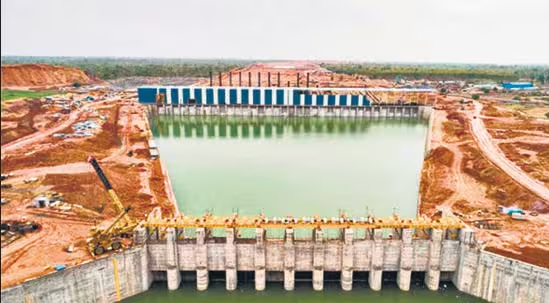
(Feature Image: A controversy over alleged engineering lapses in the ₹1 lakh cr Kaleshwaram project on Godavari triggered an electoral slugfest. HT, 03 Nov. 2023)
The Electoral bonds details now in public domain, thanks to the Supreme Court of India orders, has once again highlighted the political economy of large dams, hydropower projects and irrigation projects. It has once again confirmed what was publicly known that such large water projects involve kickbacks to political parties.
The details so far available involves companies like Megha Engineering, Rithwick Projects Pvt Ltd, Navayuga Engineering Company Ltd, among others. The projects so far that seems to be involved include Polavaram Dam, Kaleshwaram Lift Irrigation Project, Sunni Dam and Hydro projects, Kundah Pump Storage Hydropower project in Tamil Nadu and Silkyara Tunnel, almost all of them also involved in some kind of disaster or other.
These details (more likely to come to light in days to come) confirm the political economy of such large dams, irrigation projects, hydropower projects, among others. The Supreme Court had hinted at the quid pro quo that such donations can involve. We hope the judiciary will take note of the nexus and take steps to correct this.
GANGA Uttarakhand Silkyara tunnel company bought Rs. 55 cr bonds The Election Commission data show that Hyderabad-based Navayuga Engineering Company Limited, the contractor for the 4.5-km-long Silkyara Bend-Barkot tunnel in Uttarakhand that caved in last November, purchased electoral bonds worth Rs 55 crore between 2019 and 2022. The company bought the first two lots of Rs 30 crore and Rs 15 crore in April and October 2019, respectively, while the third lot of Rs 10 crore was picked up in October 2022. https://indianexpress.com/article/india/in-the-list-firm-in-uttarakhand-tunnel-collapse-others-with-a-dodgy-record-9217031/ (16 March 2024)
-In mid-2020, Navayuga was also granted the government’s ambitious Rishikesh-Karnaprayag rail link project. It is responsible for many large and prestigious projects, including bridges over the Ganga, the Quazigund to Banihal Highway project to ensure all-weather connectivity to north Kashmir through Pir Panjal Pass, as per its website. It has also built the Dhola-Sadia Bridge, over the Brahmaputra river, which PM Modi inaugurated in 2017. It was also among those responsible for work on the Nagpur-Mumbai Samruddhi Expressway, whose first phase of the expressway was inaugurated by Modi in December 2022. https://thewire.in/business/navayuga-engineering-responsible-for-building-the-collapsed-silkyara-tunnel-bought-rs-55-cr-of-bonds (15 March 2024)
Himachal Pradesh RPPL bought Rs. 45 cr bonds after bagging Sunni HEP contract Rithwik Projects Private Limited (RPPL) a company founded by BJP Rajya Sabha MP from Andhra Pradesh, C.M. Ramesh, purchased electoral bonds worth ₹5 crore weeks after it bagged the ₹1,098-crore Engineering, Procurement and Construction (EPC) contract for the Sunni hydroelectric project. This tranche was purchased just ahead of the Assembly elections in Tripura, Meghalaya, and Nagaland. Two months later, the company again purchased bonds worth ₹40 crore.
RPPL, a private, unlisted company incorporated in Hyderabad on March 31, 1999, was awarded the EPC contract on January 14, 2023, just days after another project that it was involved in – the Tapovan Vishnugad HEP in Chamoli, Uttarakhand — ran into controversy following the collapse of roads and homes at Joshimath, a town located close to the project site. Towns people and some experts blamed the underground tunnelling at an ecologically sensitive site for Joshimath’s gradual subsidence, aside from several other reasons.
Days after the news dominated national media, and less than two weeks after being awarded the Sunni Dam contract, RPPL purchased five bonds of ₹1 crore each on January 27, 2023. Rithwik Projects purchased another tranche of 40 bonds on April 11, 2023 worth ₹40 crore. This was just ahead of the Karnataka Assembly elections. The Cabinet Committee on Economic Affairs (CCEA) approved the ₹2,614 crore Sunni HEP on January 4, 2023, and Rithwik Projects was awarded the construction contract 10 days later.
The Sunni HEP a RoR project is being constructed on the Sutlej River in Shimla and Mandi districts. Locals from the affected villages have been protesting against shoddy land compensation values, the non-implementation of the Land Acquisition, Rehabilitation and Resettlement Act, 2013, debris from the project site falling much beyond the designated 900-metre radius for which crop loss compensation has been earmarked, and for not adequately providing jobs at the site for locals. Protests that began in December 2023 have intensified over the past months with more than 1,000 landowners who lost their lands partly or entirely deciding to join calls for nationwide farmers’ protests if their demands were not met.
Mr. Ramesh is a second-time BJP Rajya Sabha MP. He was associated with the TDP until 2019 and was the party’s Rajya Sabha MP from Telangana between 2014 and 2018. Mr. Ramesh was a close aide of Andhra’s former CM N. Chandrababu Naidu and his company has bagged several flagship irrigation and construction projects across the State. His son Rithwik Ramesh is “President Operations” at RPPL, among other family members, as part of the company’s board. https://www.thehindu.com/news/national/bjp-mp-cm-ramesh-45-crore-electoral-bonds-contract-sunni-dam/article67958367.ece (16 March 2024)
After Rs. 1098cr EPC contract for Sunni HEP, RPPL bought Rs. 5cr bonds -Last year, just two weeks before Rithwik Projects purchased electoral bonds to the tune of Rs 5 crore, the Hyderabad-headquartered company was awarded a letter of contract for a hydroelectric power project in Himachal Pradesh on January 14. On March 23, SVJN Limited, a state-run clean energy PSU, inked a contract agreement worth Rs 1,098 crore for the same project. And three weeks later, Rithwik Projects again donated money, this time with bonds to the tune of Rs 40 crore.
-Rithwik deals in areas ranging from mining and irrigation to highways and infrastructure. Ramesh claims to have no involvement in the affairs of Rithwik since 2012. However, his brother is still the executive director and his son Rithwik as the lead of operations. The income tax department had in 2018 accused Rithwik Projects of siphoning off Rs 74 crore through untraceable transactions and of dubious bills to the tune of Rs 25 crore.
-Months before Ramesh had joined the BJP in 2019, the party’s spokesperson GVL Narasimha Rao had written to the Rajya Sabha ethics committee to seek action against the MP over the income tax department’s allegations of fraudulent transactions. Ramesh is still a Rajya Sabha member with his tenure set to end next month. And the income tax case against him is pending. The BJP MP now wants to contest the Lok Sabha election from Visakhapatnam.
-Last year, a report by the Association of Democratic Reforms had mentioned his name among MPs with the highest declared wealth in Andhra Pradesh. Ramesh had declared assets to the tune of Rs 258 crore. In 2018, Rithwik Projects faced a fine of over Rs 2 crore for alleged illegal mining. A district vigilance officer had earlier told The New Indian Express the firm was lifting gravel and metal in the guise of using it for the Vamsadhara water project but were selling it to private parties instead. https://www.newslaundry.com/2024/03/16/bjp-mps-infra-firms-rs-45-cr-in-bonds-a-hydropower-project-and-curious-case-of-u-turns (16 March 2024)
Energy companies fueling purses of political parties Companies involved in the energy business in India donated over Rs 3,600 crores to political parties since the inception of the electoral bonds. Together, their share is nearly 30% of the total donations through electoral bonds. These companies are involved in projects across sectors, such as mining, coal, gas, thermal power, solar and wind power, hydropower, transmission lines, electric mobility, and smart meters. The list also includes Telangana-based industrial conglomerate, Megha Engineering and Infrastructures Limited (MEIL), which has emerged as the second-biggest donor of the political parties. The group is involved in projects related to irrigation, hydrocarbons, electric buses, communications, power (hydro, thermal, and renewable), etc. https://www.reporters-collective.in/trc/energy-companies-fueling-purses-of-political-parties (16 March 2024)
Megha Engineering, 2nd largest buyer of electoral bonds is in dams and irrigation projects Megha Engineering India Ltd (MEIL) MEIL bought a total of Rs 966 crore worth of bonds between 2019-20 and 2023-24. The unlisted private firm was founded in 1989 by industrialist Pamireddy Pitchi Reddy as Megha Engineering Enterprises, manufacturing pipes for municipalities. The company is contractor in some of the biggest dams and irrigation projects of India like the Polavaram dam in AP and Kaleshwaram LIS in Telangana, Kundah Pump Storage Project in TN, among others. According to a Crisil report, as of September 31, 2023, MEIL had an order book of Rs 1.87 lakh crore. https://www.businesstoday.in/latest/corporate/story/megha-engineering-started-business-with-just-rs-5-lakh-now-2nd-largest-buyer-of-electoral-bonds-421775-2024-03-17 (17 March 2024)
Firms awaiting green nod bought bonds worth Rs 825 cr Firms awaiting environment and forest clearances from the MoEF and also companies which have violated environmental norms have purchased electoral bonds worth Rs 825 crore, reveals data. Aditya Birla’s Essel Mining & Industries Limited (EMIL) has pending statutory clearances for Bunder Diamond Project in Chhindwara district of Madhya Pradesh. Due to proximity of the project in the buffer zone of Panna Tiger Reserve the environment ministry in 2020 asked EMIL to get forest and wildlife clearances. The forest clearance of the project is still pending. It purchased electoral bonds worth Rs 224.5 crore. The project also faced huge opposition from the local villagers.
The Vedanta Group, founded by industrialist Anil Agarwal purchased electoral bonds worth Rs 375 crore between 2019 and 2024. Of Rs 375 crore, Rs 98 crore was bought in January 2022, just before the elections in Uttar Pradesh, Uttarakhand, Punjab, Manipur and Goa. In May 2022, the NGT had imposed a fine of Rs 25 crore on Vedanta for violating environmental norms by expanding its alumina refinery in Odisha’s Kalahandi district. MSPL Ltd which deals in iron ore mining invested in bonds worth Rs 1 crore in April 2019 and Rs 3 crore in April 2023. In January 2022, the company sought modifications for its iron ore processing plant in Karnataka’s Bellary from the Ministry of Environment which included modifications to the project including doubling production capacity and usage of groundwater. The ministry amended the clearance conditions a month later. https://www.tribuneindia.com/news/india/firms-awaiting-green-nod-bought-electoral-bonds-worth-825-crore-601743 (18 March 2024)
HYDRO POWER PROJECTS
SANDRP Blog March 2024: 3 HEP workers killed in avalancheThis is probably first of its kind incident of avalanche striking a hydro power project site in the state. The incident has also damaged the project, however there is no official information on the extent of damages. The Google Earth map shows the Selti-Masrang project area in Kafno is located amid snow covered high mountains on either side and is quite prone to such incidents.
In recent past the incidents GLOFs, landslides, cloudbursts and flashfloods have increasingly damaged several hydro power projects in Himalayan states. This incident shows that the avalanches are also potential disaster threat for such projects and presents a wake up call for governments pushing hydro projects in glaciated and para glacier zone. https://sandrp.in/2024/03/12/march-2024-3-hydropower-workers-killed-in-avalanche-in-kinnaur-himachal-pradesh/ (12 March 2024)
Arunachal Pradesh AJP opposes Dibang Multipurpose HEPAssam’s regional political party, Assam Jatiya Parishad (AJP) has strongly opposed the Dibang Multipurpose Project for which the PM laid foundation stone on March 9 2024. AJP has raised concerns about the impact of the project on Shadia sub division of Assam, South of Dibrugarh and Tinsukhia districts of Assam. AJP highlighted the increased risk due to the project for the earthquake prone areas. AJP also said that in 2014, Mr. Modi had against big dams and advocated small hydro while speaking at Pasighat in Assam. AJP has demanded that the Union Govt should reconsider the Dibang project. https://www.syllad.com/ajp-opposes-dibang-multipurpose-hydropower-project-pm-lays-foundation-amidst-opposition/ (10 March 2024)
Sikkim HC accepts PIL against Teesta Urja Ltd share sell High Court has accepted a PIL against the contentious issue of the sale of shares of Teesta Urja Limited, now Sikkim Urja Limited. The PIL is labeling it as a blatant disregard for Sikkim’s Hydro Power policy and Memorandum of Understanding (MOU). https://www.indiatodayne.in/sikkim/story/sikkim-high-court-accepts-pil-against-teesta-urja-limited-share-sell-932461-2024-03-15 (15 March 2024)
Ladakh Mass agitation heats a cold desertLadakhOf particular concern is that effective local control over land use, though nominally still the Hill Council’s prerogative, has gone into the hands of the UT Administration (effectively in the hands of the central government). There are legitimate fears of land being grabbed by outsiders for tourism, industrial, mining, mega-energy, hydroelectricity, and other projects. Not that all such projects are unwelcome for a region that needs livelihood opportunities, but residents ask: how sustainable are these, who controls them, and for whose benefit?
-A proposed Ladakh Industrial Land Allotment Policy 2023, has raised hackles because all of the ‘single window clearance’ committees in it have only government officials and industry representatives – no Hill Council members, no civil society groups, no panchayat (village council) representatives. The document does not even lay out environmental or cultural criteria for considering an industrial project, nor any public consultation. However, it mentions ‘sustainable industrialization’ (without defining it) and prioritises local entrepreneurs. (Ashish Kothari) https://www.meer.com/en/79171-ladakhs-mass-agitation-heats-a-cold-desert (13 March 2024)
Karnataka Concerns over rushed tender process for Rs 8,005 cr Sharavathi PSPA pumped power storage facility along Sharavathi river in Karnataka finds itself embroiled in controversy following allegations that Karnataka Power Corporation Ltd (KPCL) rushed through the tender process of the ambitious Rs 8,005-crore project without obtaining approval from crucial environmental authorities. The tendering process for Sharavathi pumped storage, initiated on February 2, 2024, lasted only 21 days. The timeline provided for contractor inquiries and clarifications was notably brief, spanning just four days. Contractors, grappling with the complexity of the project and seeking vital clarifications, were left with minimal time to formulate their bids. Multinational conglomerate Larsen & Toubro (L&T) has now legally challenged the hasty tender process. L&T has now filed an application in the Karnataka High Court and an interim order now prohibits the opening of bid files until further directives are issued. https://www.downtoearth.org.in/news/environment/concerns-raised-over-rushed-tender-process-for-rs-8-005-crore-sharavathi-pumped-storage-project-in-karnataka-94891 (08 March 2024)
MoEF Agenda of EAC meeting to be held on March 20 2024: 1. Shahpur Pumped Storage Project (2520 MW) in 624.905 Ha at
Kaloni, Baint and Mungawali villages, Shahabad Tehsil, District Baran, (Rajasthan) by M/s Greenko Energies Pvt Ltd: For EC
2. Chichlik Pumped Storage Hydro Project (1560 MW) in 325.3 Ha at Village Argarh, Chichli, Khuraila and Pokharriya, Sub District Robertsganj, District Sonbhadra (Uttar Pradesh) by Avaada Waterbattery Pvt Ltd: For TOR
3. Bodwad Parisar Sinchan Yojana on river Tapi and Purna (CCA:53025 Ha) in 1729.64 Ha at Village Bodwad and Muktainagar, Sub Dist Muktainagar (Edlabad), Dist Jalgaon (Mah) by Tapi Irrigation Development Corp – Validity Extension of EC
4. Phata Byung Hydro Electric Project (76 MW) in 23.323 Ha, at
Village Barasu, Byung, Jamu, Gair etc., Sub Dist Okhimath, Dist
Rudraprayag (Uttarakhand) by Lanco Mandakini Hydro Energy Pvt Ltd – Terms of Reference https://parivesh.nic.in/utildoc/52473780_1710001674311.pdf (March 2024)
Relevant decisions of FAC meeting held on Feb 28 2024 1. Diversion of 598.2427 ha. forest land for Methala Bandhara Irrigation Project near village Methala in Talaja Taluka in Bhavnagar Dist of Gujarat: Approved
2. For Shongtong Karchham Hydro Electric Project, HPPCL in Kinnaur Forest Division, Distt. Kinnaur, Himachal Pradesh, for 7.3722 ha additional forest land requirement in already approved diversion: Approved.
3. Diversion of 263.5406 ha forest land for Sambarkund Irrigation Project at Village Mahan, Taluka Alibag, District Raigad in Maharashtra: More Info Sought
4. Diversion of 2250.05 ha (instead of 2272.05 ha) forest land for Morand – Ganjal Irrigation Project in Hoshangabad, Betul, Harda and Khandwa Districts of Madhya Pradesh for Narmada Valley Development Authority: More Info sought
5. Diversion of 407.8227 ha. of forest land in favour of Greenko Energies Pvt Ltd, in Hanumanthkhera, Mungawali villages, G.P.-Mundiyar, Tehsil-Shahbad, Baran District, Rajasthan for PSP on Kuno River: APPROVED https://forestsclearance.nic.in/writereaddata/FAC_Minutes/3117121912151ApprovedMoMdated28022024.pdf (28 Feb. 2024)
DAMS
Kaleshwaram Project Govt announces judicial probes into ‘irregularities’The Telangana Govt on March 12 said that former Supreme Court Judge, justice Pinaki Chandra Ghose will head the judicial inquiry into the irregularities of the Kaleshwarm Project. The duration of the inquiry will be 100 days. https://www.deccanherald.com/india/telangana/telangana-govt-announces-judicial-probes-into-irregularities-in-kaleshwaram-project-power-projects-2933566 (12 March 2024)
Gujarat Govt used 1489cr on Kalpasar project in 3 yearsThe govt during the recent t assembly session said that close to Rs 1,500 crore was spent in the past three years on the Bhadbhut. According to information provided by the govt in reply to a question by Congress MLA Tushar Chaudhary, the govt said Rs 419.44 crore was spent in 2020-21, Rs 408.76 crore in 2021-22 and Rs 661.63 crore in 2022-23. The Bhadbhut barrage at Bhadbhut village, aims to prevent the ingress of seawater and store fresh water flowing through downstream areas of the Narmada river. The govt approved a sum of Rs 5,322.19 crore and aims to complete it by Oct 2026. https://timesofindia.indiatimes.com/city/ahmedabad/rs-1489-crore-spent-on-bhadbhut-barrage-project-in-the-past-three-years-govt/articleshow/108476749.cms (14 March 2024)
INTERSTATE WATER DISPUTES
Krishna Water Disputes Telangana pins hope on Almatti dam for emergency releasesTelangana hopes to get 1-2 TMC water from Upper Krishna/ Narayanpur dams on Krishna river in Karnataka to reduce the water crisis in Telangana. They have earlier planned to request Mah to release Koyna water for Telangana, but they realised that due to the 700 km distance from Koyna to Telangana, it may not the most efficient option. https://telanganatoday.com/telangana-pins-hope-on-almatti-dam-for-emergency-releases (13 March 2024)
RIVERS AS NATIONAL WATERWAYS
Assam Centre approves Rs 645 cr for 10 waterways projects -The shipping ministry on Friday (March approved Rs 645 ) crore for 10 new waterways projects on the Brahmaputra river in Assam, according to an official statement. The statement said projects will be implemented under 100 per cent funding from the central government under the Sagarmala program of the Ministry of Ports, Shipping & Waterways. https://www.business-standard.com/pti-stories/national/centre-approves-rs-645-cr-for-10-waterways-projects-on-brahmaputra-in-assam-124031501112_1.html (15 March 2024)
IRRIGATION
Punjab Proposed Malwa canal project caught in land ownership tangle The state government’s move to construct Malwa canal along the Rajasthan Feeder Canal on unutilised land in Ferozepur, Faridkot and Muktsar district is facing a big challenge. When the Irrigation Department started the process to identify land for the 72-foot wide and 170-km long canal, it had found that the ownership of the land, acquired by the Rajasthan Government, was not changed in the revenue record. It still exists with the farmers who sold it to Rajasthan. https://www.tribuneindia.com/news/punjab/proposed-malwa-canal-project-caught-in-land-ownership-tangle-600205 (14 March 2024)
URBAN RIVERS
Rispana; Dehradun Rispana got reduced to a dirty drainReenu Paul, Dehradun-based environmentalist, said, “At its source in Mussoorie, the river is still perennial but the newly inaugurated Chamasari-Barlowganj road has damaged it severely. Hotels in Barlowganj regularly dump untreated sewage into the river where it starts getting polluted. Then at Shikhar falls, from where it enters the Doon valley, garbage dumping from localities situated on the river bank makes it worse. The damage that has been caused is severe but there are no serious efforts to save the river.”
-Meanwhile, sources at DMC said that Rispana clean-up has been underway for the past two years and a third party agency was paid up to Rs 80 lakh per month for the task last year. On March 10, the CM inaugurated the intersection and diversion (I&D) work for Rispana river and a sewage treatment plant with a capacity of 15 MLD at Sapera Basti worth Rs 78-99 crore. https://timesofindia.indiatimes.com/city/dehradun/how-doons-lifeline-rispana-river-turned-into-a-dirty-drain/articleshow/108377612.cms (11 March 2024)
Pune Residents concerned over frequent trash burning along riverbank Indiscriminate burning of garbage and debris dumped along the riverbank near the Dr Salim Ali Biodiversity Park has become a perennial problem for Kalyaninagar residents. On Monday morning, a fire broke out along the riverbank on South Avenue emanating huge toxic smoke. Team Swachh Kalyaninagar (TSKN) members, claimed fire incidents at this location are frequent and demanded a permanent solution to this perennial issue. “The smoke and fumes not only contribute to environmental degradation but also pose serious health risks to the community. Despite past incidents some people continue to dump waste, including plastics along the riverbank,” said the member. https://www.hindustantimes.com/cities/pune-news/kalyaninagar-residents-concerned-over-frequent-trash-burning-along-the-riverbank-101710179151279.html (12 March 2024)
RIVERS
CAUVERY Tamil Nadu River water inflow suddenly increased Water inflow suddenly increased in the Cauvery River in Dharmapuri district on Tuesday (March 12) night. Water Resources Department (WRD) said that the inflow was measured at 200 cusecs till Tuesday (March 12) evening, and it suddenly jumped up to 6,000 cusecs on the same night. WRD officials said that the sudden increase could have been due to recent rains in the catchment areas. https://timesofindia.indiatimes.com/city/chennai/cauvery-water-inflow-increases-suddenly/articleshow/108468797.cms (16 March 2024)
KRISHNA Telangana Vishnu idols found in river are at least 400 years old: Officials The discovery, made on February 5, in Raichur sparked immense curiosity among locals. Amidst debates over ownership, historical experts have revealed that these idols date back to the 11th century during the reign of the Kalyana Chalukyas. With over 163 battles fought in the vicinity of Raichur, the site of the idol discovery holds immense historical significance, raising expectations of uncovering more hidden truths. Subsequently, the Telangana Archaeological Department took custody of two of the idols found in the river. Preliminary research conducted by their team unveiled valuable insights, suggesting that these artifacts could be approximately 400-500 years old. The Raichur district administration, upon receiving this information, has initiated further investigations into the idols’ history. https://www.siasat.com/vishnu-idols-found-in-krishna-river-are-at-least-400-years-old-officials-2993969/ (17 March 2024)
GANGA Study Microplastics may pose a risk to the Indo-Gangetic plainPolymers in microplastics may pose a risk to the Indo-Gangetic plain, a study on rivers Ganga and Yamuna by the Goa-based CSIR-National Institute of Oceanography has concluded. The study titled ‘A comprehensive assessment of macro and microplastics from Rivers Ganga and Yamuna: Unveiling the seasonal, spatial and risk factors’, has been published in the ‘Journal of Hazardous Materials’.
As per the study microplastics were detected in Ganga from Haridwar to Patna, with the concentration of the pollutant being higher during the “wet (rainy) season than the dry season”. The researchers have found that in surface water, during the wet season, the highest abundance of microplastics was found in Haridwar and the lowest was observed in Patna. During the dry season, Agra had the highest affluence of microplastics, while Patna and Haridwar had the lowest concentration. During the study, the researchers also identified the plastic leakage vulnerable regions using GIS applications and field surveys. “Among all, Agra recorded the highest plastic leakage followed by Prayagraj, Patna, and Haridwar. In contrast, the microplastic concentration was highest during the wet season compared to the dry season for surface water, water column, and sediments,” it said.
The researchers have concluded that the microplastic abundance in surface water, water columns, and sediments along the Ganga and Yamuna rivers differed evidently during the wet and dry seasons. During the study, it was observed that significant waste was brought by the river from the upstream cities in the dry season and was deposited in the floodplain region. These wastes get washed off during the wet season. The study also confirms that the dispersion of microplastics is not limited to localized areas in the Ganga and Yamuna rivers. “However, it is challenging to distinguish the exact incorporation of microplastics between locally generated plastics and those carried from upstream sources since many rivers pass through the residential areas and due to the lack of awareness sometimes local deposition of plastics into the river is much higher,” the researchers have said. https://timesofindia.indiatimes.com/home/science/microplastics-may-pose-a-risk-to-the-indo-gangetic-plain-study/articleshow/108567315.cms (17 March 2024)
HC fines man claiming all lands between Ganga & Yamuna-“You say you own the entire area between Yamuna and Ganga. On what basis you’re coming? After 75 years you have woken up…The grievance arose in 1947. Isn’t it too late in the day to contest this? We are in 2024 now. Many years have gone by. Whether you’re the raja or not, we don’t know. You cannot complain today that you’ve been deprived in 1947,” the Bench remarked. https://www.barandbench.com/news/delhi-high-court-man-claiming-all-lands-between-ganga-and-yamuna (14 March 2024)
YAMUNA SANDRP Blog Parliamentary Committee Report Missing on River GovernanceThe Parliamentary Standing Committee on Water Resources has submitted its 27th report titled “Review of Upper Yamuna River Cleaning Projects upto Delhi and Riverbed Management in Delhi” to the Parliament on 6 Feb 2024. The 113 paged report has two parts first on Narration and second on Observation and 25 Recommendations. The first part of the report has XI chapters dealing with various issues of River Yamuna.
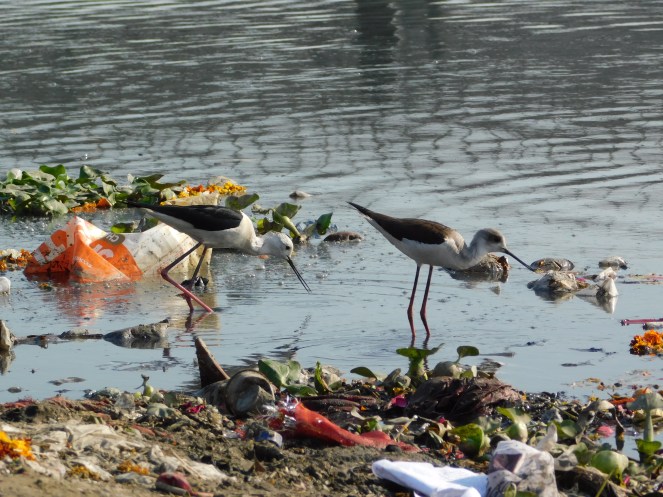
SANDRP here presents a detailed chapter wise overview of the key observations made by the Committee based on the replies mainly from Department of Water Resources, River Development & Ganga Rejuvenation (DoWR, RD & GR) along with the Committee’s recommendations and some comments by SANDRP. https://sandrp.in/2024/03/12/yamuna-parliamentary-committee-report-missing-on-river-governance/ (12 March 2024)
Haryana Take action on drain impacting Delhi’s water NGT had now directed Haryana to address the Drain six of Yamuna contaminating Delhi Water supply coming through drain 8 and file action taken report by Sept 2024. SANDRP has raised this issue multiple times in the past. https://www.hindustantimes.com/cities/delhi-news/take-action-on-drain-impacting-delhi-s-water-ngt-tells-hry-101710094863648.html (11 March 2024)
Delhi DPCC to find mess behind river pollution DPCC in its 72nd board meeting has said that a study will be conducted to determine the sources of pollution in Yamuna, apart from sewage. The board observed that despite STPs treating 70% of sewage, there hasn’t been considerable improvement in the water quality of Yamuna. The meeting was held on Feb 20, but its minutes were shared recently.
Currently, there is a gap of 222 MGD in sewage treatment. In its last board meeting held on Dec 14, 2023, it was decided that DPCC will install 10 online continuous monitoring stations (OLMS) in Yamuna to collect real-time data on water quality. Currently, water samples are collected manually and analysed only once in a month. DPCC also planned to procure a mobile laboratory van to monitor water samples at various locations. However, the OLMS will help in determining the quality of water at a given time. https://timesofindia.indiatimes.com/city/delhi/dpcc-study-on-yamuna-pollution-sources-delhi-pollution-control-committee/articleshow/108570285.cms (18 March 2024)
RIVERS BIODIVERSITY
Article Sanctuaries inside Indian rivers Venkatesh DuttaThere are several stretches of rivers that have been declared protected areas under the Wildlife Protection Act, 1972. These river stretches are special in many ways — they are known to protect and shelter many iconic species such as dolphins, gharials, otters and turtles.
– The National Chambal Sanctuary, also known as the National Chambal Gharial Wildlife Sanctuary, is a vast area that covers 5,400 sq. km. The river meanders through a labyrinth of ravines and hills within the sanctuary. It extends over three states, namely, Uttar Pradesh, Madhya Pradesh and Rajasthan. The sanctuary is known to provide a habitat for the distinct aquatic life that thrives in the Chambal river, particularly the critically endangered gharial.
– Two stretches of the Ganga have been declared as sanctuaries. The first is the 82-km stretch between Garhmukteshwar in Hapur and Narora in Bulandshahr district. It was declared a Ramsar site (wetland of international importance) in 2005. The second is the 60-km stretch of the Ganga extending from Sultanganj to Kahalgaon within Bhagalpur district of Bihar. This stretch was officially designated the Vikramshila Gangetic Dolphin Sanctuary (VGDS) in 1991. As a riverine habitat, the boundary and expanse of the sanctuary continually change due to flooding and the evolving geomorphology of the Ganga.
– There is also one case of a river sanctuary being denotified. Varanasi’s stretch of the Ganga, a seven-km stretch from Ramnagar Fort to the Malviya railroad bridge that was declared the only Turtle Wildlife Sanctuary in 1989 was denotified by the Uttar Pradesh government in preparation for a possible relocation to another stretch, the Allahabad-Mirzapur section of the Ganga. https://www.civilsocietyonline.com/column/living-rivers/bringing-back-wildlife/ (March 2024)
Book Why Chambal is cleanest river -Unlike the Yamuna and the Ganga, into which its waters flow, the Chambal is not considered a sacred river and there are no temples, pilgrimage sites, and bathing ghats on its banks. Few large towns are situated along the Chambal and as a result the river has been spared the worst forms of pollution like industrial effluents and urban sewage. Several dams have been built along the upper reaches of the river, which affect the flow and restrict the migration of fish and other aquafauna. Sand mining also threatens the habitat of rare species that breed on its shores. https://www.downtoearth.org.in/reviews/book-excerpt-an-ancient-legend-explains-why-the-chambal-is-india-s-cleanest-river-95054 (16 March 2024)
Tiger of the river-In this dream-like story, follow the wonderful adventures of Matisha as she migrates upstream to lay her precious eggs.

Illustrated beautifully by Maya Ramaswamy with vibrant colours, the invisible world that lives below the waters of the river and in the Western Ghats comes alive through the eyes of a fascinatingly beautiful, yet critically endangered species. https://www.amazon.in/Tiger-River-Adrian-Pinder/dp/9354471714/ref=sr_1_1 (20 May 2022)
Report The fish that skips & crawls on land Due to their sensitivity to environmental changes, mudskippers serve as indicator species, reflecting the health of intertidal habitats. Monitoring mudskipper populations, therefore, can provide insights into the impacts of climate change on a landscape and habitat degradation. Understanding the nuances of mudskipper biology not only contributes to scientific knowledge but also emphasises the importance of preserving intertidal habitats for the diversity of life they support. https://india.mongabay.com/2024/03/the-fish-that-skips-and-crawls-on-land/ (12 March 2024)
FISH, FISHERIES, FISHERFOLKS
Tamil Nadu Meenkaran YT channel giving freshwater fish a starring role-For 18 years, Beta Mahatvaraj has run the Facebook page and YouTube channel Meenkaran (Tamil for fisherman), where he documents some of the varied species of freshwater fish found in Tamil Nadu, Karnataka and Kerala. He now has 380 videos on his YouTube channel that feature more than 100 native species of fish, and he has accumulated 18,000 followers on Facebook. “When I started, there was no YouTube, and all the books that existed, especially on Indian fish, had artworks or descriptions in the text, but no colour photographs,” he says. “I want to now spread the knowledge I have gathered, because it is only if we know about something, that we will feel the need to conserve it. I believe that children should know as much about our endangered fish as they know about tigers and rhinoceroses.”
-It worries him, for instance, that the Eastern and the Western Ghats are home to scores of endemic and critically endangered species, and little attention is paid to the risks they face. It upsets him that so few people know, or care, about the mysteries and threats moving through our waters. Take the elusive Etroplus canarensis, he says. Found only in Karnataka, it was first documented in 1877, then lost to science and thought extinct. It was rediscovered in 1992. It is one of three cichlid species endemic to India.
-What his videos do not capture, he adds, is the absence of fish where once there were plenty. There was a shoal of Pethia nigripinnis — a small, lively, hardy and vibrantly coloured barb fish — that he would visit often, at a stream in Madikeri, Karnataka. “The stream used to be quite pristine. Then a bridge was built over it, and the last time I went to that area, three years ago, I couldn’t find the shoal in their hideout.” Similarly, the Travancoria elongata, a beautiful hillstream loach that he would spot in Kerala’s Chalakudy river, has gone largely missing since the floods of 2018. They had adapted to the fast-flowing waters, but local conservationists say they could not adapt to the silt deposited during the floods, Mahatvaraj says.
-He dreams of coming upon the Channa amphibeus, first documented in 1845 in the Chel river in present-day West Bengal, but not seen there for about 100 years. Meanwhile, he plans to put together a multimedia awareness and outreach programme aimed at children. “They have a deep interest in the core issues of conservation, and I think if they are guided the right way, they can be instrumental in conserving our freshwater fish in the future,” Mahatvaraj says. https://www.hindustantimes.com/lifestyle/art-culture/catch-of-the-day-meet-the-man-giving-freshwater-fish-a-starring-role-on-youtube-101709991455056.html (11 March 2024)
Environmental threats push Pulicat Lake to the brink As industrial pollution and climate change affect the delicate ecosystem of Pulicat Lake, villagers hold on to their dying livelihoods. https://citizenmatters.in/environmental-threats-pulicat-lake-fisherfolk-marine-ecosystem-industrial-pollution-climate-change/ (18 March 2024)
Manipur A new labeonine fishAbstract: -Garra hexagonarostris, a new member of the ‘proboscis species group’, is described from the Chakpi River of Chindwin basin in Manipur, India. The new species is distinguished by the following combination of characters: a prominent hexagon-shaped unilobed proboscis with five large-sized conical tubercles on anterior margin, and three or four medium-sized conical tubercles on anteroventral region; transverse lobe with 13−35 small- to medium-sized conical tubercles; lateral surface of snout swollen with 8−18 small- to medium-sized conical tubercles; 31−32 lateral-line scales including three pored scales on caudal fin; and a large arch-shaped black spot on each side of opercle, immediately anterior to upper angle of gill opening. The taxonomic status of several species of Garra from Arunachal Pradesh and Mizoram, is reviewed and accordingly Garra minimus is considered as a junior synonym of G. quadratirostris; G. nigricauda as a junior synonym of G. arunachalensis; G. alticaputus and G. kimini as junior synonyms of G. birostris; and G. tyao as a junior synonym of G. rakhinica. https://mapress.com/zt/article/view/zootaxa.5419.2.2 (06 March 2024)
Maharashtra Hundreds of fish found dead in Indrayani riverHundreds of fish were found dead in Indrayani river at Dehu on Wednesday (March 13). Activists claimed that such incidents were reported to the authorities earlier in the past, but no concrete action was taken by them. MPCB officials attributed the incident to the drop in the level of dissolved oxygen. The officials of Dehu Nagar Panchayat said that their STP at one of these nullahs had not been functioning for the last two weeks as the transformer to provide power supply to it was stolen. “Currently, we have one STP to treat 3 MLD of water in our jurisdiction and a proposal has been made to take it up to 12 MLD. We are taking steps to ensure that water released into the river is treated and a detailed project report has already been prepared for the same,” Nivedita Gharge, CEO, Dehu Nagar Panchayat, told TOI.
-Vishnu Shinde, president, Indrayani Seva Foundation, said “The officials have not even removed water hyacinth and now when they are removing it, thousands of dead fish are coming out. The administration is releasing sewage water directly into the river and they do not seem to be serious about the issue.” “Mahseer fish found here are considered sacred among the Warkari community. Fish with as much as 45 kg of weight and up to 4 feet of height have been found dead. The place hosts fish as big as 65 kg and all of them are under threat due to inaction by the administration,” Somnath Aaba Musudage, a member of Namami Indrayani Seva Abhiyan, said. He also said that the river is full of water hyacinth as the local administration has not cleared it for a long time despite local activists highlighting the issue on multiple occasions. https://timesofindia.indiatimes.com/city/pune/fish-deaths-in-indrayani-river-at-dehu-pune-causes-actions-latest-news/articleshow/108507276.cms (15 March 2024)
Rajasthan Lone Fisheries college in perilThe Fisheries College under Maharana Pratap University of Agriculture and Technology (MPUAT) in Udaipur is facing a critical shortage of faculty, putting its academic programs and the future prospects of students at risk. Being the only fisheries college in Rajasthan, the institution stands out and holds importance in the field of limnology and ichthyology.
-Across India, there are more than 30 fisheries colleges. Some states like Gujarat, Tamil Nadu, and Maharashtra have three fisheries colleges each, supported by their governments.”
– The current scenario is especially concerning given the ambitious “Pradhan Mantri Matsya Sampada Yojana” initiated by the Central Government, aimed at leveraging fisheries resources for economic growth. The success of such initiatives heavily relies on the availability of qualified professionals, making the resolution of the faculty shortage imperative. https://en.themooknayak.com/amp/story/education/the-lone-fisheries-college-in-rajasthan-in-peril-due-to-acute-faculty-shortage-ex-dean-urges-cm-for-immediate-intervention (13 March 2024)
Bengaluru Dead fish seen on dry lake bed as city faces drought In the midst of the water crisis, a poignant photograph has emerged from the Karnataka capital – it shows a dead fish on a dry lake bed. The picture was taken at Nallurahalli Lake in Bengaluru’s Whitefield area. This is the same lake that overflowed in 2022 and submerged more than 400 parked cars in nearby apartments, putting the spotlight on Bengaluru’s infrastructural problems. This time, the lake’s dry, arid bed indicates bigger ecological concerns. https://www.moneycontrol.com/news/trends/bengaluru-water-crisis-dead-fish-seen-on-dry-lake-bed-as-city-faces-drought-12448851.html/amp (13 March 2024)
SAND MINING
Jammu & Kashmir NGT fines 2 contractors for violating EC for mining The NGT has imposed an interim fine of nearly Rs 16 lakh on two contractors for violating the environmental clearance for mining of minor minerals from Doodhganga stream in Kashmir. A bench of the NGT on March 15 imposed the interim fine on contractors Danish Yousuf (Rs 7.46 lakh) and Rouf Ahmad (Rs 8.34 lakhs) for violating the terms and conditions of the environmental clearance for the mining lease in their favour. https://theprint.in/india/j-k-ngt-fines-two-contractors-for-violating-environmental-clearance-for-mining/2003420/ (16 March 2024)
Himachal Pradesh New mineral policy issued“The policy underscores our commitment to maximise revenue for the state while cracking down on illegal mining activities and safeguard the mineral wealth of the state and foster a conducive environment for extraction of mineral assets using scientific means,” said Sukhu. The government plans to recruit 80 mining guards in the Department of Industries for effective implementation of the policy, he added. The efforts of the state government to generate revenue from its existing resources were yielding positive results leading to generation of an additional Rs 2,200 crore, he said. https://theprint.in/india/hp-govt-issues-new-mineral-policy-to-curb-illegal-mining/1999338/ (13 March 2024)
Punjab MLA raises issue of illegal mining in Jalandhar villages Scores of farmers, who have their fields along the dug-up land in Jamsher, Diwali and Hardophrala villages of Jalandhar, are upset as contractors of a ring road project have excavated earth up to 56 feet from the allocated sites. Villagers have said those having their houses or fields adjoining the site had a risk to their lives. At Hardophrala village where digging is being done at a depth of 56 feet just along the Chitti Bein rivulet, smelly water has already started flowing into the dug up area, making the lives of people miserable. https://www.tribuneindia.com/news/punjab/pargat-raises-issue-of-illegal-mining-in-jalandhar-villages-599543 (11 March 2024)
Bihar ED conducts fresh searches in sand mining case -The money laundering case stems from a clutch of 20 FIRs registered by the Bihar Police against a company named Broadsons Commodities Pvt Ltd (BCPL) and its directors alleging they were engaged in illegal mining and sale of sand without using e-challans. The alleged sand trade is controlled by a syndicate that invested funds in the said company and the syndicate earns profit by selling illegal sand which is nothing but proceeds of crime, as per the ED. The ED has claimed that proceeds of crime to the tune of Rs 161 crore were generated in this case. https://www.business-standard.com/india-news/enforcement-directorate-conducts-fresh-searches-in-bihar-sand-mining-case-124031600164_1.html (16 March 2024)
Tamil Nadu HC directs CB-CID to proceed with probe Dismissing a review application preferred by the authorities against an earlier order that ordered CB-CID to probe illegal sand mining activities under the guise of renovation of Tirunelveli Junction bus stand, Madras high court has directed CB-CID to proceed with the investigation. A petition was filed in 2020 by S Sudalai Kannu seeking an investigation into the illegal sand mining activities and transportation of the same under the guise of renovation of the bus stand. In 2021, the court held that an offence had been committed with the connivance of some of the officials and ordered a CB-CID probe into the issue. The then officials of Tirunelveli corporation had filed the present application seeking review of the 2021 order. https://timesofindia.indiatimes.com/city/madurai/madras-high-court-orders-cb-cid-investigation-into-illegal-sand-mining-scandal-at-tirunelveli-junction-bus-stand/articleshow/108555325.cms (17 March 2024)
Jharkhand NGT issues notice to mining department, others The NGT has issued notice to the director of the Jharkhand government’s mines department and others over alleged illegal sand mining in Gomia block of Bokaro district. The NGT was hearing a matter where it had taken suo motu (on its own) cognisance of a media report about scores of trucks transporting illegally mined sand and the administration having “shut its eye” despite being aware of the unlawful activity. The bench, also comprising judicial member Justice Sudhir Agarwal and expert member A Senthil Vel, said in a recent order it was impleading the authorities concerned as respondents in the matter. These comprised the director of the state’s mining department, member secretary of the Jharkhand State Pollution Control Board and the district magistrate of Bokaro, it said. The green tribunal listed the matter for further proceedings on January 15. https://theprint.in/india/illegal-sand-mining-in-jharkhand-ngt-issues-notice-to-mining-department-others/1874636/ (06 Dec. 2023)
Uttar Pradesh खदान में मिनी ट्रक ने छात्र को रौंदा, मौत बांदा में बरियारी के कोलावल मौरंग खदान में गांव के रामशरण मजदूरी करते हैं। शनिवार (March 16) दोपहर 17 वर्षीय बेटा अंकित खाना देने आया था। वह खदान में बैक हो रहे मिनी ट्रक की चपेट में आ गया। यह देख वहां मौजूद लोगों ने शोर मचाया, लेकिन चालक पर कोई असर नहीं पड़ा। उसने बार-बार ट्रक को आगे-पीछे कर इस कदर अंकित को रौंदा कि वहीं उसकी मौत हो गई। हंगामा बढ़ता देखकर खदान संचालक व कर्मचारी सभी भाग निकले। इस दौरान परिजनों ने शव हटाने से इन्कार कर दिया। कहा कि मौके पर डीएम और खदान संचालक को बुलाया जाए। मजदूरों ने पुलिस को बताया कि जिस ट्रक से हादसा हुआ, उसमें नंबर प्लेट नहीं है। इसी तरह खदान में कई ट्रकों में नंबर प्लेट न होने के बाद भी उनसे मौरंग ढुलाई का काम किया जा रहा है। चार दिन पहले डीएम की ओर से खदान संचालक पर लाखों रुपये जुर्माना किया गया था। इतना ही नहीं कुछ दिन पूर्व तीन बच्चे भी बेतरतीब खोदाई से हुए गड्ढे के कारण नदी में डूबने से बचे थे। https://www.amarujala.com/uttar-pradesh/banda/mini-truck-crushes-student-in-mine-death-banda-news-c-212-1-bnd1003-108238-2024-03-16 (16 March 23024)
बांदा के तत्कालीन इंस्पेक्टर नेमध्य प्रदेश के मौरंग माफिया से मिलीभगत कर अवैध खनन और परिवहन कराया। ढाई साल तक चली जांच और इंस्पेक्टर के रिटायर होने के बाद एफआईआर दर्ज कराई गई है। मामलेमेंलखनऊ के दो लोकेटर भी नामजद हैं, जिनके मोबाइल सेडीलिंग की जाती थी। कानपुर देहात के पुखरायां स्थित सुभाषनगर निवासी बलजीत सिंह बांदा मेंशहर कोतवाली, पैलानी और गिरवां थाना इंचार्जरहे। गिरवां मेंउनका कार्यकाल वर्ष 2020 अगस्त सेदिसंबर तक रहा। इसके बाद फतेहपुर ट्रांसफर हो गया था। फतेहपुर मेंक्राइम ब्रांच मेंरहे, जहां सेअब रिटायर हो चुके हैं। गिरवां थाना इंचार्जरहनेके दौरान उन्होंनेएमपी के मौरंग माफिया सेसाठगांठ की और मौरंग का खनन-परिवहन कराया। इसमेंउनका साथ कमिश्नरेट लखनऊ के इंदिरानगर स्थित गुरुगु भारतीयपुरम निवासी सूर्यप्रकाश सिंह और इंदिरानगर के वसुंधरा कॉम्पलेक्स निवासी अंकित गुप्गुता नेदिया। https://www.livehindustan.com/uttar-pradesh/banda/story-fir-against-retired-inspector-in-mining-game-in-banda-9298011.html (08 Feb. 2024)
बदौसा थानाक्षेत्र स्थित बरकतपुर खदान मेंसोमवार (Nov. 06) सुबह जमकर बवाल हुआ। लाठी-डंडे और बंदूक की बटें चलीं। खदान कर्मचारी की तहरीर पर दो नामजद और 20 अज्ञात के खिलाफ एफआईआर दर्जहुई है। वहीं, दूसरेपक्ष ट्रक ड्राइवर और उसका पिता गंभीर रूप सेघायल हैं, जिन्हेंजिला अस्पताल मेंभर्ती कराया गया है। https://www.livehindustan.com/uttar-pradesh/banda/story-uproar-in-barkatpur-maurang-mine-in-banda-use-of-sticks-8954365.html (08 Nov. 2023)
Madhya Pradesh सिस्टम की छाती पर सवार खनन माफिया!-मध्यप्रदेश में खनन माफिया पर कार्रवाई करने गई टीम का पिट जाना कोई अनहोनी नहीं है. एमपी में खनन माफिया का सरकारी मुलाजिमों को दौड़ाना, पीटना और कई बार जान से मार देना इतनी आम बात हो गयी है कि इसको अब एक रूटीन प्रक्रिया कहा जाने लगा है. अभी पिछले साल नवंबर में ही खनन माफिया ने एक पटवारी की जान ही शहडोल में ले ली, जब उस पर कार्रवाई के दौरान उन्होंने गाड़ी चढ़ा दी और ट्रैक्टर से कुचल कर उस पटवारी की मौत हो गयी. पटवारी रात में अवैध खनन का निरीक्षण करने गए थे. https://www.abplive.com/blog/in-madhya-pradesh-there-is-no-law-for-mining-mafia-and-they-are-omnipresent-2640108 (16 March 2024)
अजयगढ़ बन चुका है अवैध रेत खनन का गढ़ अरुण सिंह केन नदी में स्वीकृत रेत खदानों के अलावा उन क्षेत्रों में भी व्यापक पैमाने पर अवैध उत्खनन चल रहा है जहां कोई खदान मंजूर नहीं है। विधान सभा चुनाव के समय से अजयगढ़ क्षेत्र में रेत का अवैध कारोबार कई गुना अधिक हो गया है। दिन ढलने के साथ ही दैत्याकार मशीनें रेत निकालने में जुट जाती हैं। केन नदी की रेत खदानों में पूरी रात ट्रकों व डम्फरों की लाइन लगने से यहां पूरी रात गहमा-गहमी मची रहती है।
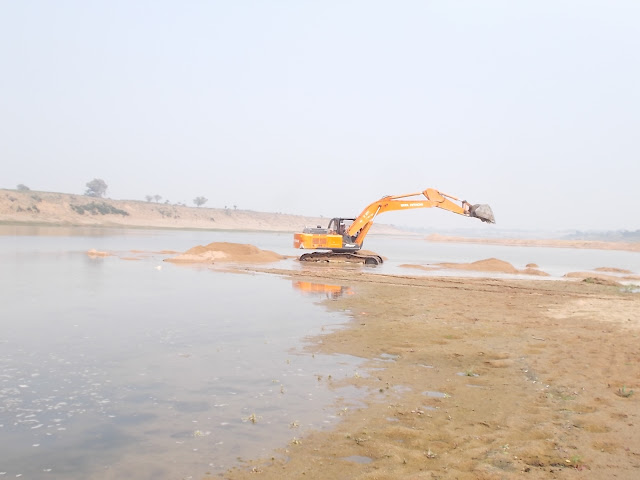
उल्लेखनीय है कि विलुप्त होने की कगार में पहुँच चुके विभिन्न प्रजाति के जलचरों को आश्रय प्रदान करने वाली जीवनदायिनी केन नदी का वजूद संकट में है। रेत के अवैध कारोबार में लिप्त लोगों द्वारा इस खूबसूरत नदी का सीना भारी भरकम दैत्याकार मशीनों से छलनी किया जा रहा है। नदी के प्रवाह क्षेत्र से मशीनों द्वारा बड़े पैमाने पर रेत निकाले जाने से मगर, घडिय़ाल व विभिन्न प्रजाति की मछलियों सहित अन्य जलचर और जलीय वनस्पतियां नष्ट हो रही हैं। अनियंत्रित उत्खनन से केन नदी का पूरा ईको सिस्टम तहस-नहस हो गया है, जिसके दुष्परिणाम केन किनारे बसे ग्रामों को भोगना पड़ रहा है। आलम यह है कि रेत के इस खेल में अधिक से अधिक कमाई करने की रेत माफियाओं में होड़ मची है, जिससे जीवनदायिनी केन नदी के चीथड़े उड़ रहे हैं। http://pannastories.blogspot.com/2024/03/blog-post_15.html (15 March 2024)
Rajasthan A raging sandstorm While mentioning of how miners with political patronage were benefitting hugely from illegal sand mining and how present govt is taking strict actions against illegal miners, this article by Rohit Parihar suggests that govt has plan to desilt dams as a solution to all sand mining problems in the state. It claims that dredging riverbed will improve dams’ capacity and revive rivers. Nilesh Gadhiya, a Gujarat origin entrepreneur has been entrusted with the project for three dams namely Bisalpur in Tonk, Som Kamla Amba in Dungarpur and Gudda in Bundi. The plan was envisaged by Shikhar Agrawal during previous govt regime. Shikhar Agrawal was then additional chief secretary (ACS), irrigation and is now the ACS to the CM and present CM has opted to back it. https://www.indiatoday.in/magazine/up-front/story/20240311-sand-mining-in-rajasthan-a-raging-sandstorm-2509266-2024-03-01 (11 March 2024)
Report ‘Grave danger to federal structure’: SC on denying states right to tax minerals-The top court is hearing a batch of more than 80 appeals dealing with the question whether royalty charged on mining is a tax and whether states have legislative competence to levy taxes on minerals and mineral-bearing lands in addition to the royalty imposed by the Centre. The matter was referred to a nine-judge bench in March 2011 following conflicting verdicts by the courts. In 1989, a seven-judge bench of the top court held that royalty was a tax but a five-judge bench in 2004 ruled that there was a typographical error in the 1989 verdict and that royalty was not a tax. https://www.hindustantimes.com/india-news/grave-danger-to-federal-structure-sc-on-denying-states-right-to-tax-minerals-101710346550355.html (13 March 2024)
WETLANDS, LAKES, WATER BODIES
Tamil Nadu Open website with details of waterbodies: HCWhile emphasizing the need to protect the fast-disappearing water bodies in the state of Tamil Nadu, the Madras High Court has directed the State government to open a dedicated website containing the details of all water bodies across the state,including their survey number, physical location, details of village, taluk, etc.
-The court added that the website was meant for viewing for all and shall be opened within 6 months. The exercise of collating the details will be undertaken from the village level onwards and certified at the Taluk level. If the details were found to be incorrect, appropriate action would be initiated against the persons responsible for furnishing the incorrect data. Thus, the officials were expected to conduct proper physical inspection and verify all the government records.
-The court further directed that all the encroachments in the water bodies shall be identified and removed after issuing notice to the encroachers and any construction made will be demolished. The court highlighted that no further encroachments shall be permitted or regularised.
-The court also said that any patta issued in respect of a water body after January 1 , 2000 shall be canceled and water bodies shall be restored to their original position. The court highlighted that any development project will have to be undertaken without affecting the integrity of the water bodies. https://www.livelaw.in/high-court/madras-high-court/madras-high-court-directs-state-open-website-details-of-all-water-bodies-in-tn-252009 (12 March 2024)
-The govt gave an undertaking that no other projects would be permitted in the said waterbodies in future, and also assured the court that the current project would not reduce, but increase the storage capacity of the tanks. Noting this, the judges allowed the project works to resume. However, they clarified that they are permitting the projects only because it was done in the public interest. “Water bodies cannot be obliterated under the guise of public interest,” the judges remarked.
-The judges also pointed out how the Krithumal River in the district has become a narrow drainage channel. Many court complexes are also located on former waterbodies, the judges stated. The Thoothukudi district court, which is situated near a waterbody, was severely affected during the recent torrential rains, requiring reconstruction of hundreds of case records. Any development projects or tenders floated by the government should keep this in consideration and ensure that the tank bunds, water quality and other factors are not affected, the judges added and disposed of the petitions. https://www.newindianexpress.com/states/tamil-nadu/2024/Mar/08/open-portal-to-track-waterbodies-madras-hc-tells-tn-govt (07 March 2024)
-The court passed the series of directions while disposing of two public interest litigations filed by an advocate R Manibharathi challenging the formation of roads on the bunds of Vandiyur and Thenkal tanks in Madurai district. Addressing the petitioner’s delayed legal action, the judges acknowledged the larger public interest behind the projects and lifted the restraining order, allowing the works to resume. However, they cautioned against sacrificing waterbodies in the name of public interest, noting that numerous waterbodies, including large ones in Madurai, have already vanished due to government department actions. “We note with pain that a number of court complexes are located in what were originally tanks,” the judges said. Expressing disappointment over people’s lack of civic consciousness, the judges noted the filing of petitions seeking encroachments on waterbodies, indiscriminate dumping of waste and sewage discharge. https://timesofindia.indiatimes.com/city/madurai/madras-hc-directs-state-government-to-create-dedicated-website-with-comprehensive-list-of-waterbodies/articleshow/108313426.cms (08 March 2024)
Ensure upkeep of waterbodies in Ramnad district: HC Madras high court has directed the authorities to ensure that the Vannan Oorani and Peravur Kanmai in Ramanathapuram district are maintained without any pollution. The court was hearing the petition filed by J M Hassanul Bazari seeking a direction to the authorities to prevent discharge of sewage in both the waterbodies. https://timesofindia.indiatimes.com/city/madurai/madras-hc-directs-authorities-to-ensure-upkeep-of-waterbodies-in-ramnad-district/articleshow/108359813.cms (10 March 2024)
Assam Govt plans to denotify Deepor Bee-Assam’s two wildlife sanctuaries, Deepor Beel and Pobitora, located near Guwahati, might lose their protected status. Sources say the Assam government decided to denotify the sanctuaries in a cabinet meeting on Sunday (March 10).
-The decision, however, has not been officially announced. This move by the government has been met with criticism from environmentalists and wildlife experts. “The proposal for denotification of any sanctuary or national park requires the recommendation of the National Board for Wildlife as per the Wild Life (Protection) Act, 1972, followed by approval from the Supreme Court,” explained a wildlife activist. Deepor Beel, a 900-hectare natural wetland and wildlife sanctuary, is situated near the Brahmaputra River. https://nenow.in/north-east-news/assam/assam-govt-plans-to-denotify-deepor-beel-pobitora-wildlife-sanctuaries-faces-flak.html (12 March 2024)
Karnataka Authority for streamlining development of Aghanashini needed Declaration of Aghanashini Estuary as Ramsar site is not enough, work now needs to be done to protect the site, ensure ecological and economical balance. For this to happen, there is a need to set up a Aghanashini Ramsar Wetland Conservation Authority, said Prof TV Ramachandra from Centre for Ecological Sciences, IISc.

Ramachandra, who is also Coordinator of Energy and Wetlands Research Group, said, formation of the authority is needed for management of estuary marine life, creating sustainable eco- tourism based on carrying capacity and having a proper waste management mechanism is needed. The Authority should include experts and locals. https://www.newindianexpress.com/states/karnataka/2024/Mar/14/authority-for-streamlining-development-of-aghanashini-needed (14 March 2024)
Maharashtra Environmentalists seek clarity on 7,137 missing sites In what could be called a classic case of contradiction, the govt, in an affidavit filed in 2022 in the Bombay High Court, identified 23,055 wetlands sites in the state spanning over 2.25 Ha of land in size. However, in the agreement entered with the National Centre for Sustainable Coastal Management (NCSCM) in July 2023 the number of wetlands has drastically reduced to 15,918 whereas, at the national level, the number of such wetlands has increased from 2.01 lakh to 2.31 lakh. This has prompted the environmentalists to know how the figure of 15,918 wetlands has arrived. They also seek to know what happened to missing 7,137 wetlands and why the authorities not making a list of wetlands available to the public?
Using data from the Space Application Centre (SAC) and the Indian Space Research Organisation (ISRO), officials identified 32,000 wetlands in Maharashtra, a decrease from the 44,714 estimated in the 2011 National Wetland Atlas. In 2018, the government initiated the first survey of wetlands in Maharashtra. The survey aimed to collect biodiversity data and support conservation efforts. This information is accessible through the ‘Wetlands of Maharashtra’ app.
“Why was the wetlands monitoring app suddenly withdrawn, wiping out district-wise data? Why spend Rs24 crore when students could have done it inexpensively? Is the government bowing to pressure from developers denying wetland existence, ignoring reputable organisations, and jeopardizing public safety for private gain?” asked Sunil Agrawal, Founder of Navi Mumbai Environment Protection Group. Stalin Dayanand from Vanashakti said, “This deliberate act favors specific interests, ignoring court mandates to protect all wetlands. It’s a waste of public funds for the benefit of a select few.” All efforts to get in touch with state environment department officials proved futile. https://www.freepressjournal.in/mumbai/navi-mumbai-falling-wetland-numbers-raise-concerns-environmentalists-seek-clarity-on-missing-7137-sites (12 March 2024)
West Bengal Exhibition on EKW flora and fauna Apart from treating city’s wastewater naturally and protecting the city from floods, the East Kolkata Wetlands are home to an overwhelming variety of plant and animal life and the exhibition titled “Symbiotic Cohabitation” at Goethe Institute celebrated this. It was created together by Disappearing Dialogues Collective, a city initiative, and the wetlands community. In the 12,500-hectare area, inhabited by 1,50,000 people, the bio-diversity is both aquatic and terrestrial, says Anushka Chakraborty, sustainability educator with Disappearing Dialogues. “The species of recorded plants alone number 381,” she says. https://www.telegraphindia.com/my-kolkata/news/exhibition-on-east-kolkata-wetlands-flora-and-fauna/cid/2001403 (19 Feb. 2024)
Report सूखे की राह पर पानी वाली धरती -भारत ने पेरिस जलवायु समझौते के आलोक में ऊर्जा और अर्थव्यवस्था संबंधी वायदे के अलावा 2030 तक भू-क्षरण तटस्थता का लक्ष्य रखा है जिसके मूल में भू-संपदा का संरक्षण और मिट्टी की उर्वरता में आ रही कमी को रोककर उसकी उत्पादकता सुनिश्चित करना है। हवा में, मिट्टी में या फिर जीव में नमी प्राण का प्रतीक है, अगर नमी न रहे तो हरा-भरा जंगल रेगिस्तान में बदल जाए। आज नम क्षेत्रों को बचाने की जरूरत है क्योंकि कचरों के अंबार से भरते तालाब और खत्म होती कृषि भूमि, भविष्य में पानी के लिए तड़पती आबादी ही छोड़ती नजर आ रही है।https://www.downtoearth.org.in/hindistory/water/water-conservation/watery-land-on-the-way-to-drought-94955 (12 March 2024)
WATER OPTIONS
Study Surat & Bengaluru lead in used water management -The CEEW report introduces the Municipal Used Water Management (MUWM) Index, assessing 503 ULBs in 10 states that have implemented treated used water reuse policies. While many ULBs assessed using the MUWM Index have shown progress in certain aspects of used water management, the mainstreaming of treated used water (TUW) reuse remains a critical aspect yet to be widely adopted in Indian cities. The report underscores a significant obstacle: 90% of ULBs lack targeted financial planning and investment in used water management. https://www.indiawaterportal.org/articles/surat-and-bengaluru-lead-used-water-management (12 March 2024)
White Paper Need for collective effort to improve DSR paddy cultivation-Despite being in vogue for several years, DSR has not picked up in major growing regions of India. Many farmers complain that the DSR crop yields are sometimes lower than the traditional process of transplanting in rice. They also say the DSR crop is more prone to pests and insects. The white paper released by the Federation of Seed Industries of India (FSII) and Sathguru Consultants urges public-funded institutions like the Indian Council of Agriculture Research (ICAR) to test and trial more popular varieties of paddy or hybrids for DSR cultivation in both public and private institutions rather than just the existing 2-3 varieties. It asks the government to formulate supportive policies and regulatory frameworks to address challenges related to land tenure, credit access, and market linkages for DSR farmers. It also advocated incentivising procurement of rice grown through the DSR method to ensure faster adaptation. https://www.business-standard.com/india-news/collective-effort-needed-to-improve-dsr-paddy-cultivation-white-paper-124031500932_1.html (16 March 2024)
Book Can Sunita & Rakesh do RWH to save their village-An excerpt from ‘Rain Harvesters’, by Sylvia Sikundar and Stephen Aitken.

https://scroll.in/article/1063999/for-children-can-sunita-and-rakesh-harvest-rainwater-successfully-to-save-their-village (12 March 2024)
MoJS Catch the rain 2024 campaign launchedThe Union Minister for Jal Shakti, Shri Gajendra Singh Shekhawat launched the fifth edition of “Jal Shakti Abhiyan: Catch the Rain” campaign on 9th March, 2024, at the NDMC Convention Centre in New Delhi. The campaign, themed “Nari Shakti se Jal Shakti,” emphasises the integral role of women in water conservation and management. The campaign comes under the National Water Mission, Department of Water Resources, River Development & Ganga Rejuvenation in collaboration with Department of Drinking Water & Sanitation. The Union Minister also virtually launched two books namely “Jal Shakti Abhiyan 2019 to 2023- The Journey for Sustainable Water Future” and “101 glimpse of Women Power: Through the prism of Jal Jeevan Mission”. https://pib.gov.in/PressReleaseIframePage.aspx?PRID=2013162 (10 March 2024)
GROUNDWATER
Kerala Fluoride contamination detected in three districts Fluoride contamination has been mostly detected beyond permissible limits in a total of nine areas in Palakkad, Malappuram and Alappuzha districts in Kerala, according to the State Environment department. The places include Muthalamada, Pallassena, Agali, Sholayur, Koppannu and Vattalakki (Palakkad); Komalapuram-1, Pazhaveedu (Alappuzha); and Manjeri (Malappuram). https://www.thehindu.com/news/national/kerala/high-levels-of-fluoride-contamination-detected-in-three-districts-of-kerala/article67954492.ece (15 March 2024)
URBAN LAKES, WETLANDS
Bengaluru A ‘thousand lakes’ once fed the city but now-parchedA British Captain once described Bengaluru as “The Land of a Thousand Lakes”. Centuries later, a retired bureaucrat, V Balasubramanian, in his 2013 paper titled, ‘Death of lakes and future of Bangalore’, concluded that Bengaluru’s tanks and lakes stored “sewage wastewater”. The majority of the ‘thousand lakes’ are nowhere to be seen in the urbanised Karnataka city of today. Of the ‘thousand lakes’,
-Bengaluru, as of now, has around 400 in its metropolitan region, according to a Deccan Herald report. However, Biome International’s 2016 study said the lakes numbered just 200. Moreover, Bengaluru has just 17 “good lakes”, says the Lakes Department website of the city’s civic body, Bruhat Bengaluru Mahanagara Palike (BBMP). It is quite ironic that the growth of the city killed the lakes because the city developed due to the water bodies.
-“Encroachment and pollution of water bodies, the felling of thousands of trees, conversion of open areas and parks into commercial, industrial, and residential settlements were also the by-products of Bengaluru’s economic growth, according to a 2013 journal by H S Sudhira and Harini Nagendra.
-As the rapid urbanisation and exponential population growth in Bengaluru is a reality, the vanishing of lakes is a reality too. So is the fact that the water situation in Bengaluru would have been better, had the city not neglected its ‘thousand lakes’. https://www.indiatoday.in/history-of-it/story/bengaluru-water-crisis-shortage-city-of-thousand-lakes-tanks-history-kempegowda-silicon-valley-karnataka-2514988-2024-03-15 (15 March 2024)
IISc launches portals to track land use, lake encroachmentResearchers from Indian Institute of Science, Bangalore have now developed portals for visualising data and track damage done to the lakes in the city. Their analysis showed that areas with vegetation has come down from 68.2% in 1973 to 2.9% in 2023. https://www.deccanherald.com/india/karnataka/bengaluru/iisc-launches-portals-to-track-land-use-lake-encroachment-2935735 (13 March 2024)
URBAN WATER
Edit Warning of looming water crisis -The problems of Karnataka’s capital should be a warning for most major cities in the country. Such warnings have also been served by studies. However, like Bengaluru, most Indian urban centres continue to neglect water management. The governance deficit at the municipal level in India means that solutions such as rainwater harvesting, reviving water bodies and cleaning and reusing wastewater remain on paper. The crisis in Karnataka’s capital should be a wake-up call. https://indianexpress.com/article/opinion/editorials/the-water-warning-9216862/ (16 March 2024)
Bengaluru Webinar: What data tells us about water crisis-This event will provide insights, based on data, into the water crisis in Bengaluru and what can be done to improve the situation. https://citizenmatters.in/webinar-bengaluru-water-crisis-open-city/ (11 March 2024)
Noted water conservation expert Vishwanath Srikantaiah said there is an immediate need for a wastewater policy and implementation of Jala Samvardana Yojana Sangha 2.0, besides the need for an integrated water management system. https://www.newindianexpress.com/states/karnataka/2024/Mar/17/integrated-water-mgmt-needed-to-avoid-crisis-in-bengaluru-vishwanath-srikantaiah (17 March 2024)
Schemes for rainwater harvesting, rejuvenation of lakes and recycling of water should get These are remembered only in times of crises. https://www.deccanherald.com/opinion/editorial/think-long-term-to-address-water-crisis-2940756 (18 March 2024)
Raj Palanichamy: -In the short term, the water table and lakes will fill up and the taps will flow again. But the city, situated on an elevation, needs effective urban planning. https://www.hindustantimes.com/analysis/bengalurus-water-crisis-the-geography-of-the-problem-101710676859926.html (12 March 2024)
WELL Labs has prepared a comprehensive view of Bengaluru’s water system, enabling better water security planning. https://welllabs.org/bengaluru-urban-water-balance-report-well-labs/ (11 Oct. 2023)
The crisis was a long time coming, said Shashank Palur, a Bengaluru-based hydrologist with the think tank Water, Environment, Land and Livelihood Labs. “Bengaluru is one of the fastest growing cities in the world and the infrastructure for fresh water supply is not able to keep up with a growing population,” he said. Another concern is that paved surfaces cover nearly 90% of the city, preventing rainwater from seeping down and being stored in the ground, said T.V. Ramachandra, research scientist at IISc. The city lost nearly 70% of its green cover in the last 50 years, he said. https://apnews.com/article/bengaluru-water-crisis-climate-change-india-17554235dba0741a266f2251b91aec8f (17 March 2024)
Drought calls for aggressive GW management Lack of effective groundwater management strategies such as active recharge methods and demand managementhas led to the current water crisis in Bengaluru, say city-based groundwater experts. They say groundwater management can avert similar water crises in the future and go a long way if supplemented with measures such as wastewater reuse, demand management, etc. “Groundwater mismanagement has a major role to play in the ongoing water crisis. While for this summer we might have to tide over by managing demand, in the longer run, knowing that the city is heavily dependent on this resource, we need to look at aggressive groundwater recharge methodologies and better monitoring of the city’s groundwater table,” said Shubha Ramachandran, water team lead at Biome Environmental Trust.
While multiple rules and laws govern this precious resource, experts say there is a lack of implementation and strict adherence. https://bangaloremirror.indiatimes.com/bangalore/civic/drought-calls-for-aggressive-groundwater-management/articleshow/108408318.cms (12 March 2024)
93% of city is concrete jungle: IISc study There has been a shartp 1055% rise in built up areas in Bengaluru over the last few decades. There has been 79% fall in the water spread area and 88% loss of vegetation in last 50 years, as documented by IISc.
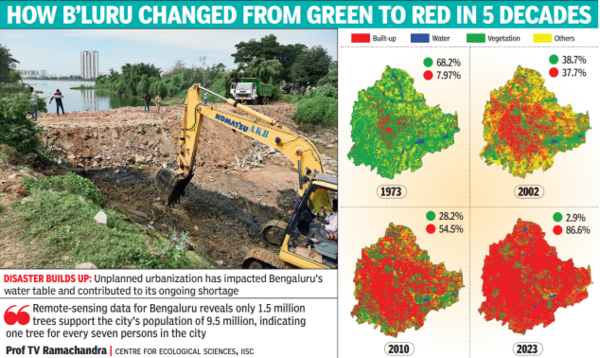
– According to Prof T V Ramchandra of IISc”s Centre for Ecological Sciences, the water spread area has decreased from 2324 ha in 1973 to 696 ha in 2023. Of the remaining water bodies 98% of lakes are encroached and 90% are fed with untreated sewage. The city’s built area in 1973 was 8%, going upto 93.3% in 2023. https://timesofindia.indiatimes.com/city/bengaluru/93-of-bengaluru-is-concrete-jungle-how-unplanned-urbanization-led-to-severe-water-crisis/articleshow/108478908.cms (14 March 2024)
Govt bans use of drinking water for swimming pools The Bangalore Water Supply and Sewerage Board (BWSSB) has issued an order prohibiting the use of drinking water in swimming pools. The order came on March 12 2024 banning the use of drinking water in the swimming pools. The board has said that violating this order will result in a penalty of Rs 5,000. https://timesofindia.indiatimes.com/city/bengaluru/bengaluru-water-crisis-govt-bans-use-of-drinking-water-for-swimming-pools/articleshow/108451897.cms (13 March 2024)
BWSSB to take over borewells at construction sitesBWSSB has banned use of drinking quality water at construction sites and have also decided to take over borewells at such sites for supply. BWSSP will soon launch a web portal to allow consumers to book treated water from BWSSB. https://www.moneycontrol.com/news/technology/bengaluru-water-board-to-take-over-borewells-at-construction-sites-says-will-instead-provide-treated-water-12448751.html (13 March 2024)
City apartments with less than 120 units need not have STPsThe Karnataka govt on March 12 2024 relaxed its 2015 and 2016 rules on mandatory installation of STPs. The state govt exempted apartments with below 120 units or those generating sewage of less than 80 KLD from mandatory STP installation. The apartment federation has been saying that STP for less than 120 units will be economically and ecologically unviable. https://timesofindia.indiatimes.com/city/bengaluru/city-apartments-with-less-than-120-units-need-not-have-stps/articleshow/108447926.cms (13 March 2024)
BWSSB announces 20% cut in water supply to bulk usersIn view of water crisis in Bangalore, BWSSB has announced 20% cut in water supply to some 38 bulk users, using over Rs 2 crore litres per day. Three hospitals will be exempted from the cut. The cut would be implemented in phased manner, starting from March 15 and fully effective by Apr 15. The bulk users collectively use about 59 MLD and BWSSP hopes to save about 10 MLD due to the cut. https://www.deccanherald.com/india/karnataka/bengaluru/bwssb-announces-20-cut-in-water-supply-to-bulk-users-2933901 (12 March 2024)
BBMP gives BWSSB Rs37.5 cr to drill new borewells The BWSSB has received Rs 37.5 crore from the civic body to dig more borewells and repair ones that are dysfunctional to take care of the water shortage in core areas where BWSSB supplies Cauvery water through pipeline. This is in addition Rs 32.6 Cr that BBMP plans to spend for the same purpose in the outskirts. This will have adverse impact on groundwater that is already at all time low. Instead, it may be good idea to dig open wells that can also act as recharge wells. https://www.deccanherald.com/india/karnataka/bengaluru/bbmp-gives-bwssb-rs-37-5-cr-to-drill-new-borewells-2933902 (12 March 2024)
Dead fish seen on dry lake bed as city faces drought In the midst of the water crisis, a poignant photograph has emerged from the Karnataka capital – it shows a dead fish on a dry lake bed. The picture was taken at Nallurahalli Lake in Bengaluru’s Whitefield area. This is the same lake that overflowed in 2022 and submerged more than 400 parked cars in nearby apartments, putting the spotlight on Bengaluru’s infrastructural problems. This time, the lake’s dry, arid bed indicates bigger ecological concerns. https://www.moneycontrol.com/news/trends/bengaluru-water-crisis-dead-fish-seen-on-dry-lake-bed-as-city-faces-drought-12448851.html/amp (13 March 2024)
‘6,900 of 13,900 city borewells are dry’ Deputy CM DK Shivakumar on March 11 said drying up of borewells has triggered the prevailing water crisis in the city and the government has taken steps to address the situation. He told the media that 6,900 of the 13,900 borewells in the city have dried up. He said there is no water shortage in areas served by Cauvery water. He said the state is witnessing its worst drought in 30 years. https://www.deccanherald.com/india/karnataka/bengaluru/6-900-of-13-900-city-borewells-are-dry-says-dks-2932192 (11 March 2024)
Treated water to be filled in drying lakes to replenish groundwater Civic authorities in Bengaluru have decided to fill the drying lakes with 1,300 mld of treated water to replenish groundwater sources in the city, where about 50 per cent of the borewells have dried up. https://www.newindianexpress.com/cities/bengaluru/2024/Mar/10/bengaluru-water-crisis-treated-water-to-be-filled-in-drying-lakes-to-replenish-groundwater-2 (11 March 2024)
Chennai Water shortage hits West Mambalam West Mambalam faces a water shortage, forcing residents to spend ₹10,000 a month on hiring water tankers. Many houses on Vivekanandapuram 1st Street, Balakrishna Mudali Street, Balakrishna Naicker Street, Srinivasa Pillai Street, Srinivasa Iyengar Street, Velu Street, and Ganapathy Street are experiencing inadequate water supply. With Veeranam lake being dry for a month now, neighboring areas rely on water tankers. “We supply around 17MLD to T Nagar and West Mambalam areas, drawing from the 150MLD Nemmeli desalination plant, Chembarambakkam reservoir, and borewells around Veeranam lake,” said a metrowater official. https://timesofindia.indiatimes.com/city/chennai/water-crisis-in-west-mambalam-residents-struggle-with-tanker-costs/articleshow/108554526.cms (17 March 2024)
Trichy Drought looms over city after 7 years Trichy city is staring at a drought-like situation after seven years due to a deficit northeast monsoon and poor water inflow into Cauvery and Kollidam rivers. With the city facing a shortfall of 10mld between drinking water demand and yield, insufficient groundwater levels are causing borewells to shut. Trichy corporation is drilling six new borewells to get over the shortfall but it anticipates a tough time until the water level in Mettur dam goes up. The city’s drinking water demand is estimated at 152-153 mld. Even though Trichy corporation has been operating other borewells over time to compensate for the fall in drinking water yield, the city is still short of 10 mld to meet the actual demand. Such a substantial fall in yield was previously encountered in the 2017 drought when both Cauvery and Kollidam were bone dry due to a failed monsoon. https://timesofindia.indiatimes.com/city/trichy/trichy-city-drought-crisis-water-shortage-after-7-years/articleshow/108536633.cms (16 March 2024)
Hyderabad Water tanker demand touches all-time high this summerWith groundwater levels depleting alarmingly across the Greater Hyderabad Municipal Corporation (GHMC) area, numerous power borewells have already dried up, leading to HMWSSB unable to supply sufficient water to the residents of Hyderabad. The demand for water tankers has increased in the past few weeks in the twin cities and is set to go up further in the next three months as temperatures are likely to shoot up to 43–450 Celsius.
-This February saw a huge demand for water tankers, touching an all-time high of 1.12 lakh in the city. The number would increase between March and May 2024 as summer peaks, necessitating the hiring of more tankers. Generally, the HMWSSB’s water tankers are in demand from the second or third week of March every year. However, this year the demand for tankers in the city started from the third week of February itself due to drying up of borewells. https://www.newindianexpress.com/states/telangana/2024/Mar/11/water-tanker-demand-touches-all-time-high-in-hyderabad-this-summer (10 March 2024)
Ghaziabad City declared ‘Red Zone’ as groundwater level declines In the wake of these developments, the district authorities have expressed concern and as per the survey of the District Geological Management Committee, which started in January, more than 30,000 small and big industrial units have been involved in exploiting the groundwater illegally for many years. After the report about the water crisis came to limelight, the Ghaziabad district administration started surveying the industrial units that are illegally exploiting groundwater day and night. Nearly 30,000 small and large units are there across more than one and a half dozen industrial areas in the district with only a few having groundwater connections. https://www.india.com/uttar-pradesh/after-bengaluru-water-crisis-hits-ghaziabad-city-declared-red-zone-as-groundwater-level-declines-6788758/ (15 March 2024)
Opinion Staring at zero water levels-The water crisis also threatens India’s purported US$5 trillion GDP dream. According to the World Resources Institute’s Aqueduct initiative, 31 per cent of global GDP—as much as US$70 trillion—will be at risk due to high water stress by 2050. Just four countries—India, Mexico, Egypt and Turkey—account for more than half of this.
-Nevertheless, much of the problem is self-inflicted. In a culture that deifies its rivers, more than half of these are highly polluted, and many others are contaminated at levels that are considered unsafe. Despite decades of ‘cleaning’ and tens of thousands of crores expended to this end, the most revered Ganga and Yamuna, among others, remain highly polluted, burdened each day with millions of gallons of human and industrial waste.
-The second major source, groundwater, is heavily over-exploited, far beyond the volumes of annual recharge. Significantly, India accounts for a quarter of global groundwater usage, an amount that exceeds the combined total usage of China and the US. In 2009, a NASA study warned that India’s groundwater levels were declining at a dangerous pace. Worse, available groundwater resources have been widely contaminated by toxic agricultural runoff and industrial waste.
– With an average of 100cm of rain per year across India, there is no reason why sufficient rainwater cannot be harvested during the monsoons. Technical solutions are available for both cleaning surface water and husbanding groundwater. Corruption and neglect have prevented these from being realised. It is human folly, greed and ineptitude that have brought us to the present pass. (Ajai Sahni) https://www.newindianexpress.com/magazine/voices/2024/Mar/09/thanks-to-human-folly-we-are-staring-at-zero-water-levels (09 March 2024)
JJM/ RURAL WATER SUPPLY
Report Big push for sanitation & drinking water does not go far enoughIn 2014, when it came to power, the Bharatiya Janata Party announced the launch of the Swachh Bharat Mission to construct toilets in each household. The party promised to increase the number of households with toilets from 39% in 2014 to 100% by 2019. In October 2019, India declared itself open-defecation free, which meant people were no longer relieving themselves in the open and had access to a household toilet. But numerous reports have pointed out that open defecation continues in India.
– In 2019, a second phase of Swachh Bharat Mission (rural) was launched for a period of five years to make arrangements for solid and liquid waste management in all the villages in the country by 2024. Government data shows 398 out of 746 districts in India have achieved that status. About 4.37 lakh villages have liquid waste management and 2.69 lakh have solid waste management.
– Ahead of the 2019 Lok Sabha elections, the BJP promised in its manifesto to provide piped water connection and safe drinking water to every household in rural India by 2024. This became the Jal Jeevan Mission. In 2019, at the time of the launch of the Jal Jeevan Mission, there were 3.23 crore rural tap water connections. In the last five years, the number of connections have risen to 14.07 crore, or 73% of the total 19.2 crore rural households in India. That figure, however, may be misleading because not every house with a tap water connection is supplied with safe drinking water. Experts have pointed out that the scheme relies on groundwater reserves to supply water to households, and does not rely on rainwater harvesting. In many places, groundwater depletion and depletion in levels of natural reservoirs is affecting water supply under this scheme. It follows what critics have called a “build-neglect-rebuild” feature of the mission – an excess focus on building infrastructure to the detriment of operations and maintenance. https://scroll.in/article/1063430/a-decade-under-modi-big-push-for-sanitation-and-drinking-water-does-not-go-far-enough (10 March 2024)
Rajasthan Digging a pit every 2 days At least a dozen villages in Sanchore’s Chitalwana tehsil are facing a severe drinking water shortage. The Narmada canal came to this region in 2008. It supplies drinking water to 500 villages in the area and to Jalore and Sanchore, but this tehsil comprising where most of the residents are wage-workers has been overlooked. Since the water table is saline, the only way to get drinkable water is to dig pits. After two days, the villagers will have to dig a fresh pit for drinking water. https://www.ndtv.com/india-news/digging-one-pit-every-2-days-how-people-in-parched-rajasthan-village-get-water-5245028 15 March 2024)
MONSOON 2024
MoES Testbed to track monsoon systems inaugurated India on March 12 2024 commissioned the atmospheric testbed facility near Bhopal. The testbed, works of which began in early 2018, is equipped with high-end instruments to record several vital parameters that will be fed into improving the weather models besides facilitating advanced studies on the Indian monsoons. Kiren Rijiju, Minister, Earth Sciences, on Tuesday (March 12) virtually inaugurated the first phase of the Atmospheric Research Testbed in Central India (ART-CI) in Sehore district, located about 50km northwest of Bhopal in Madhya Pradesh. He also inaugurated the Coastal Research Laboratory (CRL) established in Visakhapatnam’s Dolphin’s Nose area.
Pune-based Indian Institute of Tropical Meteorology (IITM) is spearheading the research activities at this first-of-its-kind testbed facility built at a cost of Rs 125 crore, whereas Chennai-based National Centre for Coastal Research (NCCR) will host and co-ordinate activities at CRL. ” The testbed in Bhopal is a unique observational facility and will help better understand the cloud systems, land-atmospheric systems and tracking of the low pressure systems and depressions. With climate change, rainfall associated with these systems during the monsoon season have been becoming erratic. Data obtained from the testbed facility will be assimilated and used to improve the forecasts,” said R Krishnan, director, IITM. https://indianexpress.com/article/india/govt-lab-to-monitor-sea-water-quality-and-testbed-to-track-monsoon-systems-inaugurated-9210907/ (13 March 2024)
Monsoon 2024 El Nino likely to end by May, monsoon may be sparedThe latest monthly outlook on the El Nino Southern Oscillation (ENSO) system by the Climate Prediction Centre of the National Oceanic and Atmospheric Administration (NOAA) of the United States says ENSO-neutral conditions are expected to prevail between April and June and a La Nina likely to emerge thereafter.
-Next month, the IMD will issue its first long-range forecast for this year’s monsoon season. Since 2015, rainfall during the monsoon season has been in the normal range every year except 2018.
-The ongoing spell of El Nino in 2023-24 was among the five strongest ever, according to the World Meteorological Organization (WMO). It had come on the back of one of the longest and strongest phases of La Nina that had extended for three years between 2020 and 2022. https://indianexpress.com/article/india/el-nino-likely-to-end-by-may-indian-monsoon-may-be-spared-9215736/ (15 March 2024)
Jammu & Kashmir Record 54% rainfall deficit this winter-This winter has brought forth a formidable challenge: a rainfall deficit of 54 per cent, surpassing even the deficits witnessed in the previous years. Between December and February, J&K received 129.7 mm of rainfall against an expected rainfall of 284.9 mm. January experienced the most severe shortfall, with a staggering deficit of 91 per cent, followed by December at 79 per cent and February at 17 per cent.
-The current 54 per cent deficit marks the highest shortfall in the past five winters, underscoring the growing vulnerability of the region to changing weather patterns. However, there may be some silver linings amidst the gloom. Unlike previous years where precipitation was concentrated in January or December, this winter saw substantial snowfall in February.
-The implications of this deficit are profound, impacting not only agriculture but also extending to crucial aspects such as ecological balance, water resource management, and the livelihoods of millions who depend on these resources. Glaciers, vital sources of freshwater, are dwindling at an alarming rate, exacerbating the challenges posed by climate change.
-Recognising the interdependence of agriculture, ecology, and society in addressing climate change must be a top priority for all stakeholders. Only through collaborative action can we mitigate the adverse effects of climate change and safeguard the future of our planet and its inhabitants. (Faizan Arif, an independent weather forecaster, also known by ‘Kashmir Weather’) https://www.outlookindia.com/national/climate-crisis-deepens-jammu-and-kashmir-faces-record-54-rainfall-deficit-this-winter (14 March 2024)
Telangana Farmers Worried Over 53% Rain Deficit in StateThe state receives around 14 per cent of its rainfall during this season. It has manifested in falling groundwater levels, empty tanks in the countryside and increased demand for water tankers in the cities and towns. As a result, the inflows into most reservoirs in the state like Jurala, Tungabhadra, Nagarjunasagar, Pulichintala, Singur and Nizamsagar have fallen to zero.
-The average normal rainfall of the Northeast monsoon from October to December is 113.20 mm, while the actual rainfall was 52.70 mm. It was 136 mm last year. Excess rainfall in the last few years had resulted in increased acreage of water guzzling crops like cotton and paddy. The culprit, experts say, is the lack of an action plan by the agriculture department on crop patterns leading to the increased acreage of water guzzling crops like cotton and paddy. The department had failed to even prepare the action plan for the past two years in the BRS regime. https://www.deccanchronicle.com/amp/telangana-farmers-worried-over-53-rain-deficit-in-state (11 March 2024)
DISASTERS
Report Western Himalayas more “risk prone” than the East-The Western Indian Himalayan Region is more prone to risks from climate change compared to the Eastern Himalayan ranges, a new climate risk index, designed by researchers from the Indian Institute of Technology, Madras (IIT-M), shows. The index is the first to use the latest framework from the Intergovernmental Panel on Climate Change (IPCC) to assess climate risk in the Himalayas, by combining both physical and socio-economic indicators, the researchers have said. https://india.mongabay.com/2024/03/western-himalayas-more-risk-prone-than-the-east-according-to-new-index/ (11 March 2024)
ENVIRONMENT GOVERNANCE
Report Indian environmentalist gets Planet Earth Awards-Indian environmentalist and former climate negotiator S. Faizi is one of the six recipients of the 2024 Planet Earth Awards, instituted by the Alliance of World Scientists, an international body of scientists based in the United States. Faizi, who hails from Kerala, has received the award for his contributions to forest conservation, biodiversity research and support of indigenous rights, among other things.

-As per S. Faizi the caste system has left us with a minority of affluence that surpasses the extreme form of western affluence and the massive majority living in poverty and destitution, with the poor outnumbering the poor in all African countries put together. This reign of inequality and injustice makes the pursuit of sustainable resource use and social equity a distant dream. Environment doesn’t matter at all to this social formation. And now we are witnessing how its political form can turn the country into anenvironmental nightmare, with the accompaniment of outlandish greenwashing. https://thewire.in/environment/indian-environmentalist-among-six-recipients-of-planet-earth-awards (15 March 2024)
Tamil Nadu Vedanta’s green violations: A wake-up call for industries The unit had been a polluter between 1997 and 2012 owing to non-compliance with environmental standards and operated without the consent of the SPCB for almost 16 years. Also, the unit did not have proper systems for hazardous waste disposal and had also dumped large amounts of copper slag, which not only lead to air and water pollution but caused floods in the region. The Madras HC came down heavily on TNPCB in its 2020 judgment and held that the regulator failed to exercise its powers in a timely and effective way.
The Supreme Court’s refusal to entertain a Special Leave Petition filed by Vedanta seeking to challenge an August 2020 Madras High Court judgment — which called for the closure of Vedanta’s copper smelting plant in Thoothukudi for repeated environmental violations — upholds the citizen’s right to clean environment. As environmental, social and governance (ESG) considerations gain prominence, companies must be vigilant about meeting the environmental standards. The verdict is a reminder for businesses to prioritise sustainable practices and ensure minimal environmental impact, reflecting a broader societal shift towards environmental consciousness and responsibility. https://www.thehindubusinessline.com/business-laws/vedantas-environmental-violations-a-wake-up-call-for-industries/article67938342.ece (11 March 2024)
Jammu & Kashmir Railway expansion gives sleepless nights to Shopian’s apple farmers Reshipora a small village comprising 300 households has been in deep distress since the Railway authorities started carrying out a survey in the village for laying a railway track. The proposed railroad cuts through the apple farms in the apple-rich village, raising fears among the residents of losing large swathes of land to the railway project.Over the last few weeks, the disconcerted farmers have made fervent appeals to the government to divert the proposed line from the village. The entire village relies on apple cultivation for its livelihood, with over 85 percent of the district’s population directly or indirectly reliant on the apple economy. Last week, the farmers hit the streets to protest against the acquisition of land by the railways after a knot of officials suddenly showed up in their apple farms to demarcate the land. https://www.greaterkashmir.com/gk-top-news/railway-expansion-gives-sleepless-nights-to-shopians-apple-farmers/ (18 March 2024)
SOUTH ASIA
Nepal-Bangladesh Agreement on buying hydro-powerBangladesh has agreed to buy hydro-power from Nepal at a rate of 6.5 cents for per unit; however, Nepal Electricity Authority (NEA) would not bear the cost of transmission and trade margin (service charge) for the supply of power to Bangladesh. Following several tariff negotiation meetings, both sides fixed the tariff, however, the issue would be sent before the cabinet committee on government purchase for final approval, Power Division sources said.
– Upon tariff agreement, Nepal, Bangladesh and India anticipate signing a tripartite deal, marking Nepals maiden power export to Bangladesh. According to the agreement, Bangladesh anticipates receiving a total of 40 MW of electricity from Nepal, comprising 24 MW from the Trishuli project and 16 MW from another power plant. The electricity will be transmitted to the national grid at Bheramara, Bangladesh, via the Baharampur transmission line in India.
– Earlier, a joint statement issued on February 22 said both parties intend to expedite a power sale agreement to facilitate Nepals electricity export during the forthcoming rainy season but now there is no room to get the electricity before October, official said. NEA proposes Bangladesh to export 40MW of power from June 15 to November 15, 2024 with the agreement slated for five-year duration. The transmission will occur via the Nepal-India Dhalkebar-Muzaffarpur Cross Border Transmission Line and the India-Bangladesh Baharampur-Bheramara Cross Border Transmission Line. https://www.observerbd.com/news.php?id=464021 (13 March 2024)
Pakistan Reviving Punjab’s dying rivers In essence, the historical path set during the colonial period, characterized by canal networks and land enclosures, has evolved into a modern-day agricultural landscape dominated by rice cultivation. Understanding this historical trajectory is crucial in devising sustainable solutions for the present and future, especially in the context of reviving Punjab’s dying rivers and promoting ecological balance.
-At the heart of the endeavor to revive Punjab’s dying rivers lies the pivotal role of a critical transnational peasant movement rooted in agroecology tradition. This movement serves as the linchpin, offering a transformative force capable of reshaping the agrarian landscape of Punjab. By uniting farmers across borders in a collective struggle, the movement seeks to challenge existing paradigms and advocate for sustainable agricultural practices. Embracing the principles of agroecology, these farmers envision a future where ecological balance and cultural values are reinstated. Through their collective efforts, the critical agroecology farmers’ movement strives not only to address historic injustices, but also to spearhead a new era of environmental consciousness, fostering the revival of Punjab’s deteriorating rivers. https://thefridaytimes.com/13-Mar-2024/reviving-punjab-s-dying-rivers (13 March 2024)
ASIA
MEKONG Emergency recovery plan for fishes & fisheriesDespite the fact that many other options are available, a new hydropower dam is under construction on the last major tributary of the Mekong that remains free-flowing, the Sekong, and construction is also underway on a dam on the mainstem Mekong, just upstream of the historic town—and World Heritage Site—of Luang Prabang.
-With these new dams, it’s clear the health of the Mekong is trending in the wrong direction. But even with these challenges, the fish and fisheries of the Mekong remain an incredibly important resource that can, and should, be sustained for the people of the region. The alarm bells are ringing and so countries must move urgently to implement the policies and management actions to deliver the Emergency Recovery Plan. (Jeff Opperman) https://www.forbes.com/sites/jeffopperman/2024/03/14/an-emergency-recovery-plan-for-mekong-fish-and-fisheries/?sh=3155e7375cb6 (14 March 2024)
THE REST OF THE WORLD
USA Bankruptcy denied for former Edenville Dam operatorA Nevada bankruptcy court has denied a filing from the the former operator of Boyce Hydro and the Edenville Dam. Lee Mueller owned the company and a federal judge ordered him to pay about $120 million last year for natural resource damages caused by the Edenville Dam disaster. Boyce Hydro used to own the Edenville, Sanford, Secord and Smallwood dams. The Edenville and Sanford dams failed in 2020, causing millions of dollars in damage to property in Gladwin, Midland and Saginaw counties. Mueller filed for Chapter 13 bankruptcy protection in September. But the bankruptcy court dismissed the bankruptcy petition, saying Mueller’s effort “smacked of bad faith.”
– “I am grateful that the courts have continued to see through Lee Mueller’s obvious attempts to manipulate these proceedings in order to protect himself at the expense of the thousands of Michigan residents whose lives he’s devastated,” said Michigan Attorney General Dana Nessel. https://www.abc12.com/news/dam-recovery/bankruptcy-denied-for-former-edenville-dam-operator/article_e8e2d1e6-e2cb-11ee-b190-c3587ada2efc.html (15 March 2024)
Corps begins spilling water at Columbia Basin dams, per litigation stayAfter an agreement to stay Columbia River Basin litigation for up to 10 years, federal water managers will begin spilling more water over basin dams this spring than in past years. “This is an important component of the agreement with Tribes, States, and other parties to implement a long-term, durable path forward,” said Tim Dykstra, USACE’s (US Army Corps of Engineers) Northwestern Division fish policy lead. “We’ve been using spill as an important tool for fish passage since the mid-1990s to improve migratory conditions for juvenile salmon and steelhead and we will evaluate the impacts of the increased spill to inform our decisions in the future.”
– This year, four projects on the lower Snake River and McNary Dam on the Columbia River will also begin spilling four hours each day through surface passage routes to primarily assist migrating adult steelhead starting March 1. Beginning March 21, those projects, plus John Day Dam on the Columbia River, will begin spilling through surface passage routes 24 hours each day until regular spring spill begins, with the goal of providing additional benefits for juvenile and adult salmon and steelhead.
– The litigation agreement specifies the following spill operations to benefit salmon and steelhead passage:
~ Bonneville, McNary, Ice Harbor, Lower Monumental and Lower Granite dams will spill up to the 125% TDG levels 24 hours per day.
~ The Dalles Dam will spill 40% of the river over the spillway.
~ John Day Dam will spill 40% of the river over the spillway during the day and up to the 125% TDG levels and at night.
~ Little Goose will spill 16 hours per day up to the 125% TDG levels and reduce spill for eight hours to performance standard spill levels, or 30% of the river. This is to benefit adult fish passage. https://www.hydroreview.com/world-regions/north-america/corps-begins-spilling-water-at-columbia-basin-dams-per-litigation-stay/ (04 March 2024)
Brazil Court suspends criminal lawsuits against former Vale CEO over dam collapseA Brazilian court on Wednesday (March 13) suspended multiple criminal lawsuits against Vale’s Chief Executive Fabio Schvartsman over the deadly 2019 collapse of a tailings dam at a mine owned by the company. A Minas Gerais state court said in a statement to press that public prosecutors had not presented enough evidence of criminal conduct by Schvartsman. The court said it had not discussed the former Vale CEO’s innocence or culpability. The court said new cases against Schvartsman over Brumadinho case can be filed by prosecutors. Criminal lawsuits against another fifteen people were not affected by Wednesday’s decision, it added, as it only encompass Schvartsman’s case. https://theprint.in/world/brazil-court-suspends-criminal-lawsuits-against-former-vale-ceo-over-dam-collapse/2000194/ (14 March 2024)
SANDRP
Also see: DRP 11 March 2024 & DRP 04 March 2024
Follow us on: www.facebook.com/sandrp.in; https://twitter.com/Indian_Rivers

 SANDRP