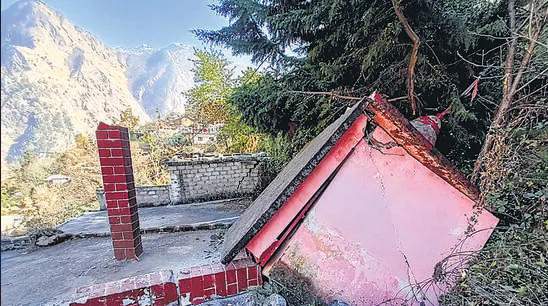
(Feature Image: A temple collapses after the gradual ‘sinking’ of Joshimath in Chamoli district, on Jan. 08, 2023. PTI/HT)
It is clear that the Union and the Uttarakhand government did not want the reports prepared by different national institutes related to Joshimath Sinking, to be made public and the state High Court had to order it to do so. The government’s view of the report is clear from that. It took the judiciary so many months to finally order the report to be made public. What is it that the government wanted to hide? Why? From whom? Why is there this culture of opaque governance even in disaster management related issues? Is it growth fundamentalism that is driving the government as the single most factor? Or is it the arrogance and adamant attitude of the governance, not wanting to consider any questions raised against their decisions? Why is there so little faith in the people, society and transparent, accountable governance? Why is the judiciary allowing such a culture to prevail generally?
These are some of the key questions that arise from this and other such episodes.
While Deccan Herald editorial below does mention the hydropower projects and such other large infrastructure projects, the Hindustan Times edit is silent on this. Also, some of the eight reports in question do not even go into the role of these projects. While others, some of whom like CWC, GSI suffer from conflict of interest (these agencies had a role to play in clearing the hydropower projects), gave a clean chit to these projects or remained silent on it.
While the NDMA report says Joshimath should be declared no new construction zone, we see no effort either by the Union or State govt to implement such recommendations.
Too late to save Joshimath? https://www.deccanherald.com/opinion/editorial/too-late-to-save-joshimath-2708655 (02 Oct. 2023)
One expected the editorial to also look at the factors that these reports have systematically refrained from talking about: the role of major infrastructure in the area including hydro projects, Highways and Railway lines. Unfortunately, the editorial does not. https://www.hindustantimes.com/editorials/all-that-is-wrong-about-joshimath-101695909490480.html (28 Sept. 2023)
The current reports have not given due weightage to the potential impact of these instances to cause drastic changes to the hydraulic properties and increased permeability – not only at the immediate location, but in neighbouring and even distant areas. The tunnelling was stalled also in February 2012, September 2012 and sometime in 2020 resulting in long intervals of intermittent suspension of the work. It is not known if these incidents are a repeat of the 2009 event. The puncturing of aquifers may have led to the gradual depletion of pore pressure within the sediment leading to aquifer compaction and settling of the ground. The role of pore pressure in determining slope stability needs to be studied further in this region to reach the bottom of the crisis in Joshimath. What triggered the accelerated subsidence in some parts of Joshimath? Whether it resulted from excess infiltration of surface water leading to internal erosion or it’s because of soil compaction due to groundwater depletion remains a live question. https://science.thewire.in/environment/the-unsettled-questions-on-the-joshimath-subsidence/ (01 Oct. 2023)
The Geological Survey of India (GSI) and the National Institute of Hydrology (NIH) in their report after a study at Joshimath has given a “clean chit” to NTPC’s 520 MW Vishnugad hydroelectric project on the Alaknanda River in Chamoli district. https://www.newindianexpress.com/nation/2023/sep/26/joshimath-collapse-expert-report-blames-construction-beyond-load-bearing-capacity-for-submergence-2618142.html (26 Sept. 2023)
अहम सवाल यह है कि सरकार इतने महीनों तक इन रिपोर्टों पर क्यों बैठी रही? राज्य के वरिष्ठ नौकरशाहों को जमीन धंसने की समस्या के बारे में लगभग दो साल से पता है। तब शहर का डीपीआर क्यों नहीं बनाया गया? इससे भी ज्यादा अहम बात यह है कि भूस्खलन ने जोशीमठ के आसपास के गांवों को भी प्रभावित किया है। क्या सरकार के पास इन असहाय ग्रामीणों के लिए कोई पुनर्वास योजना है या उन्हें किस्मत के भरोसे छोड़ दिया जाएगा?
लेकिन इस आकलन में कुछ भी नया नहीं है। पीपुल्स साइंस इंस्टीट्यूट के वैज्ञानिक डॉ. रवि चोपड़ा सवाल करते हैं, ‘उन्होंने (वैज्ञानिक संस्थानों ने) कौन सा नया शोध किया है? वे समस्या का कोई भी नया स्रोत स्थापित करने में विफल रहे हैं, सिवाय यह बताने के कि स्प्रिंग लाइन पर बने घरों में दरारें होने के कारण पानी रिस रहा है।’ भूविज्ञानी डॉ. एस.ए. सती ने कहा, ‘यह नई बोतल में पुरानी शराब है। उन्होंने ऐसा कुछ भी नहीं कहा है जो हम पिछले पांच साल से नहीं कह रहे हैं।’
नेशनल इंस्टीट्यूट ऑफ हाइड्रोलॉजी, रूड़की और जियोलॉजिकल सर्वे ऑफ इंडिया की रिपोर्टों के दो संकेतक बेहद अशुभ हैं क्योंकि ये दोनों नेशनल थर्मल पावर कॉर्पोरेशन को क्लीन चिट देते हैं जो विष्णुगढ़ तपोवन जलविद्युत परियोजना के हिस्से के रूप में एक भूमिगत सुरंग का निर्माण कर रहा है। वैज्ञानिकों और आम लोगों द्वारा इसे समस्या का मूल कारण माना जाता है। इस सुरंग का एक हिस्सा बहुराष्ट्रीय कंपनियों द्वारा खोदा जा रहा था जो खुदाई करने के लिए टनल बोरिंग मशीन (टीबीएम) का उपयोग कर रहे थे। अतीत में, दुर्भाग्य से, टीबीएम एक बार 9 दिसंबर, 2009 को अटक गई थी और फिर फरवरी और सितंबर, 2012 में और उसके बाद अगले सात सालों तक अटकी ही रही जिसके बाद बहुराष्ट्रीय कंपनियों ने इस परियोजना से अपने हाथ खींच लिए।
स्थानीय लोगों का कहना है कि जलस्रोत टूटने के बाद से ही धंसाव की समस्या शुरू हुई है। इन तीन दुर्घटनाओं का गहन विश्लेषण तीन अंतरराष्ट्रीय स्तर के वैज्ञानिकों- बर्नार्ड मिलर, जियोर्जियो हॉफर-ओलिंगर और जोहान ब्रांट द्वारा किया गया था। उन्होंने इंजीनियरिंग जियोलॉजी फॉर सोसाइटी एंड टेरिटरी में अपने नतीजे प्रकाशित किए जिसमें उन्होंने इस बात पर जोर दिया कि कैसे इस अवैज्ञानिक ड्रिलिंग ने चट्टानों में नई दरारें पैदा कीं जिससे सतह के नीचे का पानी तेज दबाव के साथ बाहर आ गया। ‘जोशीमठ बचाओ संघर्ष समिति’ का नेतृत्व कर रहे अतुल सती ने भी एनटीपीसी को क्लीन चिट दिए जाने पर चिंता जाहिर की। समस्या की जड़ एनटीपीसी की विष्णुगढ़ तपोवन जलविद्युत परियोजना का निर्माण है। जब इसे शुरू किया गया था, तो जीएसआई ने 2005 में ही इसकी प्रभावशीलता पर सवाल उठाया था। https://www.navjivanindia.com/opinion/two-third-of-houses-in-joshimath-are-not-fit-for-living-is-the-result-of-ignoring-the-technical-reports (02 Oct. 2023)
Eight institutes, in their report about Joshimath land sinking, give a range of reasons from construction loopholes, exceeding carrying capacity, construction over spring area, seismic activities, poor drainage, among others. https://www.pressreader.com/india/the-hindu-kochi-9WW8/20230926/281930252602884 (26 Sept. 2023)
CWC has attributed the cracks in Joshimath to constructions over springs. This could be a way to let the hydro projects and highways escape responsibility? The report needs independent scrutiny, but is not yet in public domain. https://www.hindustantimes.com/india-news/joshimath-cracks-likely-due-to-constructions-in-spring-zone-says-report-101695408118541.html (23 Sept. 2023)
Interesting that NDMA report says Joshimath should be declared as no new construction zone as it has exceeded its carrying capacity long back. But clearly neither state govt seems to be listening nor NDMA doing anything to make state govt listen. https://timesofindia.indiatimes.com/city/dehradun/declare-joshimath-a-no-new-construction-zone-central-institutes/articleshow/103914607.cms (25 Sept. 2023)
HYDRO POWER PROJECTS
Report Huge mountain erosion event witnessed from space Data delivered by Copernicus Sentinel satellites have enabled scientists to observe one of the most extreme incidences of mountain erosion ever documented. The analysis – published in The Cryosphere – describes how the disintegration of a glacier in Tibet caused more than 600 million cubic metres of rock and ice to cascade through the valley below, carving an enormous new canyon into the mountain side. In terms of the pace of the erosion and the amount of debris transported, this incident exceeded typical mountain erosion events by several orders of magnitude, according to the study’s lead author Andreas Kääb.
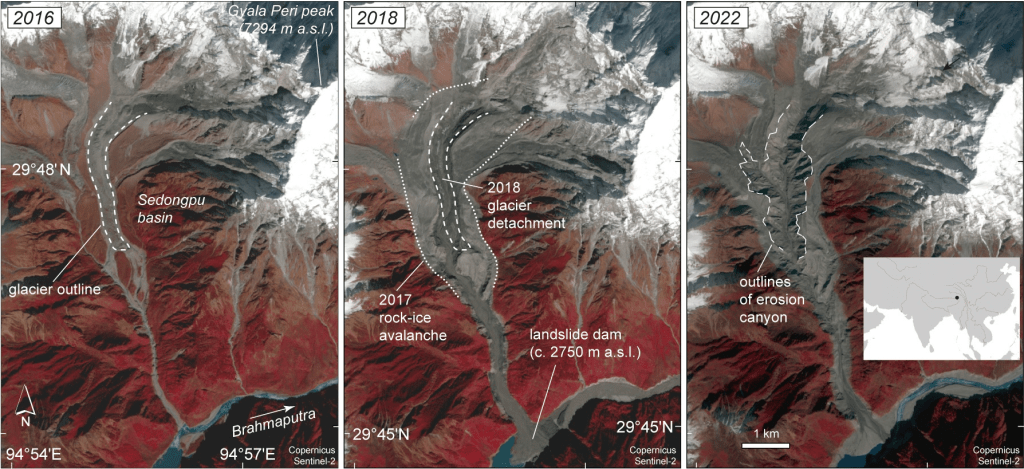
– Andreas Kääb, lead author of the study, concluded: “In our area of research, we see many large avalanches and debris flows in mountains, but the volumes eroded from the Sedongpu valley in just a few months and years really are breathtaking. I am not aware of another erosion event on Earth where 300 m thick sediments have been eroded within just three months. The total volume evacuated from the Sedongpu valley since 2017 amounts to an incredible 0.6 cubic-kilometres – this corresponds to a cube with an edge length of 850 m!” https://sentinels.copernicus.eu/fi/web/success-stories/-/huge-mountain-erosion-event-witnessed-from-space (28 Sept. 2023)
ABSTRACT: Following the 130 ± 5 × 10⁶ m3 detachment of the Sedongpu Glacier, south-eastern Tibet, in October 2018, the Sedongpu Valley, which drains into the Yarlung Tsangpo (Brahmaputra) River, underwent rapid large-volume landscape changes. Between December 2018 and 2022 and in particular during summer 2021, an enormous volume of in total ∼ 335 ± 5 × 10⁶ m3 was eroded from the former glacier bed, forming a new canyon of up to 300 m depth, 1 km width, and almost 4 km length. T
he 2021 erosion peak happened through massive but still gradual retrogressive erosion into the former glacier bed. Several rock–ice avalanches of in total ∼ 150 ± 5 × 10⁶ m3 added to the total rock, sediment, and ice volume of over 600 × 106 m3 (0.6 km3) that has been exported from the basin since around 2017. The recent erosion volumes at Sedongpu are by order of magnitude equivalent to the average annual denudation volume of the entire Brahmaputra basin upstream of the location where the river leaves the Himalayas. This high-magnitude low-frequency event illustrates the potential for rapid post-glacial landscape evolution and associated hazards that has rarely been observed and considered at such high intensity so far. https://tc.copernicus.org/articles/17/2533/2023/ (28 June 2023)
Intra-Seasonal Variability in Sediment Provenance and Transport Processes in the Brahmaputra Basin. https://agupubs.onlinelibrary.wiley.com/doi/full/10.1029/2023JF007105 (19 May 2023)
Himachal Pradesh CM seeks BBMB membership for state The BBMB has a Chairman and two Directors, one each from Punjab and Haryana, while Himachal Pradesh and Rajasthan have no representation. Himachal and Rajasthan have agreed to rotational permanent membership of the BBMB so that they could raise issues concerning their areas.
Sukhu said Himachal had sought Rs 4,000 crore as arrears in view of its 7.19 per cent share in the BBMB projects under the Punjab Reorganisation Act, 1966. The CM said, “I also raised the issue that Himachal should get 12 per cent royalty as free power in the Sunni, Luhri and Dhaula Sidh hydroelectric projects for which agreements were signed with the SJVN during the BJP regime.” https://www.tribuneindia.com/news/himachal/sukhu-seeks-bbmb-membership-for-state-548656 (29 Sept. 2023)
Centre Expert committee to look into time & cost overruns in hydro projects Ministry of Power has announced a standing technical body to look into the time and cost over runs of hydropower projects. It will mainly look into the issues related to geological surprises and submit bi annual reports. The committee headed by Member (Hydro) of CEA will include Chief Engr HPA and HPM, GSI, CWC and concerned state govt. Director (HPM) of CEA will be member secretary. https://energy.economictimes.indiatimes.com/news/power/govt-sets-up-expert-committee-to-look-into-time-and-cost-overruns-in-hydro-power-projects/103941009 (26 Sept. 2023)
DAMS
Report Libya dam collapse raises alarm for India’s 234 dams over 100 yrs old Experts warn those above 50 years old are at risk, call for govt to revisit Dam Safety Act. Himanshu Thakkar, coordinator of the South Asia Network on Dams, Rivers and People, observed that “dams above 50 years are of high risk”. “In the context of climate change, dam management needs to be fine-tuned. More intense rains are now occurring. This means that the spillway capacity for which the dams were originally designed is outdated. There should be an independent review to examine the safety aspects of all dams in India. The Central Water Commission is undertaking this task, but it has a poor track record,” Thakkar added.
Thakkar added that structural flaws were not the only issue with dams, as newly built structures too had cracked in the recent past in India. In August last year, the wall of an under-construction dam in Madhya Pradesh’s Dhar district collapsed, affecting 18 villages. Similarly, in July 2019, the Tiware dam in Ratnagiri district of Maharashtra gave way due to heavy rains, resulting in the loss of 19 lives. The dam was built only in 2000. https://www.business-standard.com/india-news/libya-dam-collapse-raises-alarm-bells-for-india-s-234-dams-over-100-yrs-old-123092601042_1.html (26 Sept. 2023)
The risk that dams pose to humans can be partially offset by more carefully monitoring weather forecasts, releasing water behind dams if necessary, and installing warning systems that alert imperiled people of the need to evacuate. But the best way to eliminate the danger is to remove dams entirely. This is especially true for older dams, whose reservoirs become filled with sediment that displaces water and reduces their effectiveness as electricity generators and water storers—and removal often costs less than repairs. Yet dam removal is still in its infancy. Out of the U.S.’s several million dams of all sizes, about 2,000 mostly small dams have been dismantled. Still, the movement is gaining momentum in the U.S. and Europe. https://time.com/6317451/dams-environmental-impact-libya-danger/ (26 Sept. 2023)
Polavaram Dam Telangana seeks join survey of back waters Taking strong objection to the Centre for not looking into the concerns raised by Telangana on Polavaram project backwaters, the state irrigation department has urged the Central Water Commission (CWC) to resolve the concerns of Telangana, especially joint survey of Polavaram backwaters.
The Telangana government has been raising the issues of submergence of areas due to Polavaram backwaters, drainage congestion, sediment and silt, flooding of Manuguru heavy water plant, necessity of public hearing and flood protection measures at various meetings for the past two years.
– “The Centre’s stand is totally contrary to the ground reality as none of the measures has been undertaken. It appears that assurances to the Supreme Court and in various meetings by the Centre were merely an eyewash,” Telangana engineer-in-chief C Muralidhar said in a letter to CWC on Sept 28 2023. https://timesofindia.indiatimes.com/city/hyderabad/tgana-seeks-joint-survey-of-polavaram-backwaters/articleshow/104003124.cms (28 Sept. 2023)
“The Centre filed compliance affidavit on September 1, 2023 inter alia stating that ‘the officials(s) of Government of Andhra Pradesh and Telangana gave their consent for joint survey for issues pertaining to Telangana based on survey results necessary measure is to be taken by PPA and government of Andhra Pradesh as may be required and thus matter was resolved for taking further actions’. However, this stand of the Centre is totally contrary to the ground reality as none of the activities have been undertaken. https://www.newindianexpress.com/states/telangana/2023/sep/28/polavaram-project-telanganaurges-central-water-body-to-resolve-its-concerns-2618900.html (28 Sept. 2023)
Telangana Water leaks from Kaddam project Water was leaking from the Kaddam Narayana Reddy project, one of the oldest irrigation projects of Telangana, due to the snapping of a rope carrying the counter weight of gate number 15, in Kaddampeddur mandal centre on Tuesday (Sep 26 2023). Water stored in the project leaked from the gate following the breakage of the rope. Officials of the irrigation department said steps were being taken to repair the rope and to prevent leakage of the water. https://telanganatoday.com/telangana-water-leaks-from-kaddam-project (26 Sept. 2023)
The State Dam Safety Authority has previously reviewed all of the project’s structural concerns. A group of engineers from the Dam Safety and Rehabilitation Project recently presented a report with significant suggestions. Its alternatives are being taken into account. According to engineer in Chief Nagendar Rao, the government would shortly make a final judgement about the report. https://www.indiaherald.com/Politics/Read/994632796/Telangana-Water-leaks-from-Kaddam-project (26 Sept. 2023)
Kaddam project spillway to be rehabilitated with Rs 500 cr The State govt has decided in favour of total rehabilitation of the spillway of the Kaddam project which has often been giving problems in operation and it is likely to cost over Rs 500 crore, according to Nagender Rao, Engineer-in-Chief (Operations and Maintenance), Irrigation. He said the counter weight of Gate No.15 that collapsed two days ago was replaced with a steel counter weight on a war footing and other operational issues were addressed with a sense of urgency, he added.
– The flood gates of the project were installed in 1956. Nine of the 18 gates were designed with Indian technology and remaining nine gates are of German technology. https://telanganatoday.com/kaddam-project-spillway-to-be-rehabilitated-with-rs-500-crore (27 Sept. 2023)
Kerala Innovative idea of river, dam water level management A Thrissur-based research student in disaster management has come up with an idea of l sensors to find out the volume and velocity of water flowing to dams and river during rain. It can accurately calculate the amount of water to be discharged from dams in case of an emergency. “Whenever the catchment areas of dams receive good rain, dams get filled and authorities are forced to open shutters. There is no accurate scientific system to estimate the time taken for the dam to fill and how much water should be released. As a result, precious water, which can be used for electricity production and irrigation/drinking water distribution is wasted. The situation is common across the country,” notes Shibu George, an employee at the District Emergency Operation Centre.
Similarly, sensors can be placed on the flowline of the river and at the point where the river joins the sea to calculate the water level in the river. “The data collected using RF/GSM modules can be sent to the control room at the district Collectorate. A software can compare the pre-estimated water flow ratio according to the geographical features of various segments of the waterbodies with the volume, velocity and rain data from the sensors. It can estimate the amount of water that will reach the dams/rivers. With the help of such data, it is possible to find out how long it will take for the dams to fill and the corresponding water level in the rivers.” It can calculate the volume of water that should be discharged from the dams. This will also help the authorities to make necessary precautionary measures, including evacuation in emergency situations, he says. https://www.thehindu.com/news/national/kerala/researcher-comes-up-with-innovative-idea-of-river-dam-water-level-management/article67357756.ece (28 Sept. 2023)
Karnataka Forest Minister Eshwar Khandre has urged Deputy CM D K Shivakumar to address the problems of farmers displaced by Karanja dam decades ago. The dam uses 23 TMC ft of Godavari water allocated to Bidar district. https://www.deccanherald.com/india/karnataka/address-problems-of-farmers-displaced-by-karanja-dam-karnataka-minister-eshwar-khandre-urges-dks-2707110 (30 Sept. 2023)
Madhya Pradesh Influentials eat into catchment of Kaliasot, Kerwa Dams Influential people allegedly encroached and raised illegal constructions in the catchment of Kerwa Dam and Kaliasot Dam in Bhopal. Besides the residential villas and farmhouses, many commercial activities like dairy business and restaurants are being operated in the prohibited areas. Cracking whip on the environmental norms breach in catchment area of Kaliasot and Kerwa dams, the NGT has given one month time to chief secretary instructing him to form committees at district and village levels to verify encroachments, illegal constructions and release of sewage in water bodies.
The petitioners Dr SC Pandey and Rashid Noor Khan, had approached the NGT bringing to notice the illegal and unauthorized constructions and commercial activities being carried out in and around Kerwa and Kaliyasot Reservoirs by the land owners/encroachers, who mostly are influential families of the city. There are not only illegal constructions but also illegal and prohibited activities are being carried in the area, the petitioners had maintained. https://www.freepressjournal.in/bhopal/bhopal-influentials-eat-into-catchment-of-kaliasot-kerwa-dam (19 Aug. 2023)
INTERLINKING OF RIVERS
Study Rivers interlinking may change rainfall patterns -The researchers analysed major river basins of the country namely Ganga, Godavari, Mahanadi, Krishna, Cauvery and Narmada-Tapi. They used multiple methods to show that these river basins are linked. As water evaporates from a basin or when it rains in a basin, land is linked to the atmosphere. Across basins, as the winds transport water, atmospheric links are formed.
-The researchers found that large-scale irrigation from river interlinking projects can change the spatial patterns of the Indian monsoon. They simulated the irrigation targets of the river interlinking projects, and simultaneously observed an up to 12% reduction in September rainfall in some arid regions of the country and a 10% increase in September rainfall in other regions. The researchers stressed that changes in the spatial patterns of the monsoon must be considered while planning for the proposed river interlinking projects. https://www.hindustantimes.com/cities/pune-news/river-interlinking-projects-may-change-monsoon-rainfall-pattern-study-101695753552881.html (27 Sept. 2023)
The study aimed to understand the complex relationships between different river basins by incorporating atmospheric variables, including the El Niño-Southern Oscillation (ENSO). The researchers discovered intricate causal pathways between the basins, driven by feedback loops between the land and the atmosphere. These feedback loops create connections between various land variables, such as soil moisture, and influence the moisture content of the air, temperature, and precipitation in different basins.
The study identified certain river basins as “donor basins” with more outgoing links, meaning they contribute moisture to other basins. On the other hand, some basins were labeled as “recipient basins” with a higher number of incoming links, indicating that they receive moisture from other basins.

The study found that there are both positive and negative interactions between river basins when it comes to the exchange of land and atmosphere. For example, the moisture levels in one basin could either decrease or increase the moisture levels in another basin, depending on the specific feedback mechanism involved.
According to the research, the implementation of river interlinking projects, which involve the transfer of water between different basins, could disrupt the interactions between land and atmosphere. This disruption could have an impact on the moisture content of the air and the patterns of wind. These changes, in turn, could result in alterations to the rainfall patterns observed throughout the country. https://www.theweek.in/news/sci-tech/2023/09/29/river-interlinking-projects-in-india-raise-concerns-about-water-.html (29 Sept. 2023)
INTERSTATE WATER DISPUTES
Cauvery Water Disputes Good to see editorial in TOI on this subject, but, this it totally unimaginative and not even trying to understand the ground realities. Just parroting that a permanent tribunal is required. Or that Tribunal has to be empowered to ensure implementation. How? https://timesofindia.indiatimes.com/blogs/toi-editorials/warring-over-water-river-fights-between-states-need-a-single-dispute-resolution-body-with-real-enforcement-powers/ (29 Sept. 2023)
Fix distress sharing norms The dispute has surfaced after a few years, once again highlighting the fact that the parties need a regular formula to share the shortfall and distress in years when the monsoon fails. It is only during deficit years that the States involved feel that the Court will pass favourable orders even if the CWMA does not. This kind of yearly adjudication and seasonal litigation should not become the norm.
The CWMA should utilise the opportunity to come up with a permanent formula on how to assess deficit in a given year. Even on the manner of assessment of deficit, the two States have divergent views. It is now up to the CWMA and the CWRC in gathering data on rainfall, inflows and storage, to evolve an acceptable formula to apportion the shortfall in an equitable way. It is inevitable that neither State will be satisfied with the quantum of release ordered by the CWMA, but it is at this point that politics should yield to domain expertise. https://www.thehindu.com/opinion/editorial/expertise-over-politics-on-the-cauvery-water-dispute/article67345267.ece (26 Sept. 2023)
Karnataka Cost of water disputes litigations In total, the State government has paid more than ₹122 crore in fees to the lawyers since 1990 for representing it before the Supreme Court and tribunals in disputes regarding the distribution of Cauvery, Krishna and Mahadayi river water. The information was revealed by the State’s Water Resources Department in response to the details sought by activist Bhimappa Gundappa Gadad under the RTI Act. The documents reveal that a total of ₹122,75,95,882 was paid as fees to 41 lawyers for arguments before the Supreme Court and tribunals.
The data reveals that from June 2, 1990 to July 10, 2017, an amount of ₹54.13 crore was paid as lawyers’ fees in the Cauvery matter before the tribunal. A total of 580 sittings have been held.
Similarly, the Krishna Water Disputes Tribunal (KWDT) was set up in 2004 to adjudicate disputes between Maharashtra, Karnataka and the erstwhile Andhra Pradesh. From then till November 29, 2013, 295 hearings were held and ₹43.24 crore was paid to lawyers, according to information revealed under the RTI Act.
The Mahadayi Water Disputes Tribunal was constituted in 2010 for resolution of disputes between Goa, Karnataka and Maharashtra. Till December 1, 2017, 97 hearings were held and ₹25.38 crore was paid to lawyers. https://www.barandbench.com/news/karnataka-govt-paid-122-crore-41-lawyers-river-water-disputes-other-states (28 Sept. 2023)
URBAN RIVERS
Pune Rise in river pollutants The various efforts by Pune and Pimpri-Chinchwad municipal corporations to prevent water pollution during the 10-day Ganesh festival have failed to provide the desired results, as per the data released by the SPCB. The water sample tests showed that both stretches of almost all rivers — Mula, Mutha, and Pavana – in both cities recorded an increase in COD and BOD during the festival.
While the recorded level is below the standard limit set by the CPCB, the data shows a constant rise of pollutants in rivers over the years. According to a MPCB official, as rivers in Pune do not have a strong flowing current, decomposition of immersed idols takes a long time due to stagnant waters and its harmful colour chemicals gets released in the waterbody. https://www.hindustantimes.com/cities/pune-news/efforts-to-prevent-water-pollution-during-ganesh-festival-in-pune-and-pimpri-chinchwad-fail-mpcb-data-101694104172578.html (07 Sept. 2023)
This study by freshwater biologists Avinash Vanjare, Yugandhar Shinde and Sameer Padhye finds that pollution and faulty restoration practices have spelled doom for smaller animals residing in the Mula Mutha river indicating serious threats to the river ecosystem in the long run. https://www.indiawaterportal.org/articles/water-fleas-see-red-river-mula-mutha-pune-chokes (29 Sept. 2023)
Godavari; Nasik ‘Fixing’ the River: Political Ecology of Changing Water Flows and Infrastructuring. (By Shilpa Dahake) https://www.epw.in/engage/article/%E2%80%98fixing%E2%80%99-river-political-ecology-changing-water (30 April 2022)
Opinion India need new thinking for urban river management Victor R. Shinde & Hitesh Vaidya Somehow, we have equated urban river management with pollution control over the years. It is as if the two were synonymous. Urban river management is much more than merely preventing sewage flow into rivers. It is all about maintaining the wholesomeness of rivers and creating an environment that enables the river to thrive and perform its natural functions, including providing vital ecosystem services.
This is the new thinking and evolution India needs for managing its urban rivers. The time has come to transition from a pure pollution control-driven approach to aspiring for holistic river management that addresses the triple bottom line of social, economic, and environmental considerations. https://sundayguardianlive.com/business/why-does-india-need-new-thinking-for-urban-river-management (01 Oct. 2023)
RIVERS
How about a research centre for existing rivers?
Webinar Video recording of Understanding Challenges and Solutions in River Rejuvenation – Session 1: Floods by Pune River Revival. https://www.youtube.com/watch?v=yzMaBj48t-k (25 Sept. 2023)
GANGA Report Has govt managed to clean river? Water expert Himanshu Thakkar, a coordinator for the SANDRP, says little has changed since previous projects to clean the Ganga in the 1980s, which also failed to meet their goals. “Tourism expansion, navigation, riverfront development, dam construction and highways [which the current government has pushed alongside its Namami Gange initiative] have worsened the state of the river,” he says. For now, the Indian government thinks more STPs are the solution. However, according to Thakkar, “putting up large, centralised STPs” is akin to “business as usual”. https://www.thethirdpole.net/en/pollution/has-the-indian-government-managed-to-clean-the-ganga-at-last/ (29 Sept. 2023)
While it is true that industrialisation is the primary cause of pollution, it is also true that religious and cultural ideals have not effectively promoted the concept and practice of revitalising the Ganga. https://thewire.in/environment/justice-for-ganga-requires-urgent-collective-action (24 Sept. 2023)
Bihar; Jharkhand NGT seeks report on river pollution The tribunal’s order dated August 28 had underlined that the issue relating to prevention and control of pollution in the River Ganga will be taken up for the entire stretch of the river, covering each state, city and district. The bench in an order passed on September 5, the tribunal had noted the details of the River Ganga (Rejuvenation, Protection and Management) Authorities Order, 2016, and specifically the role of the District Ganga Protection Committees.
In an order passed on Monday (Sept. 25), it noted the key issues regarding the river in the state of Bihar included groundwater contamination, sewage discharge, illegal sand and stone mining, floodplain encroachment, threat to aquatic species, change in the river’s original course and pollution by industries, municipal solid waste, biomedical waste and hazardous waste.
The bench also noted the issues pertaining to the river in Jharkhand, such as illegal mining, industrial pollution, sewage discharge, mine water discharge, disposal of fly ash, discharge of effluents from coal washeries and industrial plants, over-exploited groundwater and lack of sufficient numbers of ETP’s and STP’s.
“…We direct the district magistrate of all the 38 districts in the State of Bihar and 4 districts in the State of Jharkhand through which river Ganga and its tributaries are flowing to file a report (within 8 weeks) on the issues noted above and in respect of steps which have been taken by the District Ganga Protection Committee for prevention and control of pollution in river Ganga in their respective areas,” the tribunal said. The matter has been listed on December 5 for further proceedings. https://www.siasat.com/ngt-seeks-report-on-river-ganga-pollution-in-bihar-2701103/ (28 Sept. 2023)
Uttarakhand Govt mulls Rs 29K cr rail-road link for Char Dham The state govt has sent a proposal to the Centre for a single tunnel project to connect Dehradun to Yamunotri and Gangotri by rail and road. According to information received from departmental sources, after survey and technical investigation, the final DPR of about Rs 29,000 crore for the 121.76 km long railway has been sent to the Railway Board Delhi. Of this, 70 per cent of the track will be inside tunnels. Rail Vikas Nigam Limited (RVNL) has planned to connect Gangotri and Yamunotri Dham with a rail line.
In the coming days, the Railway Board and the Union Ministry of Road Transport and Highways can take a concrete decision in this regard. According to Public Works Department Secretary Dr Pandey, “This tunnel is proposed to start from Ranipokhari to Koti Colony (Tehri) near the lake, whose total length will be about 35 km. The NHAI has started an exercise to connect it with the railway project so that it does not have to construct a separate tunnel.” Work on the Rishikesh-Karnprayag rail project is already in full swing in the state. Apart from this, Rail Vikas Nigam Limited (RVNL) has planned to connect Gangotri and Yamunotri Dham with the rail line. https://www.newindianexpress.com/thesundaystandard/2023/oct/01/uttarakhand-mulls-rs-29k-cr-rail-road-link-for-char-dham-2619764.html (01 Oct. 2023)
Uttar Pradesh The 3D high-resolution aquifer mapping in the Ganga-Yamuna Doab region, conducted by the Council of Scientific Research and Industrial Development (CSIR) and the Central Ground Water Board, Lucknow, has unveiled a 200-kilometre-long ancient underground river that flows between the Ganga and Yamuna rivers. https://www.hindustantimes.com/cities/others/3d-mapping-aids-discovery-of-ancient-underground-river-in-ganga-yamuna-doab-region-in-up-101695659048840.html (25 Sept. 2023)
YAMUNA Delhi From growing bamboo plantations to desilting the Yamuna, Lieutenant Governor Vinai Kumar Saxena showcased several initiatives being undertaken in the capital at the recently-concluded meeting of the Northern Zonal Council (NZC). Held in Amritsar, Punjab, Saxena made a presentation on the good practices across various sectors at the 31st meeting of the NZC; these, L-G House officials said, ranged from steps taken to alleviate pollution in the Yamuna to interventions at dumping sites for Municipal Solid Waste among others. https://indianexpress.com/article/cities/delhi/bamboo-plantation-yamuna-desilting-at-meet-in-amritsar-l-g-highlights-initiatives-to-revive-delhi-ambience-8960952/ (29 Sept. 2023)
The state government’s decision to declare the region adjoining the Yamuna in the district as controlled area has left local residents worried. According to MC sources, the authorities concerned have been directed to take action against the illegal construction. https://www.tribuneindia.com/news/haryana/illegal-colonies-near-yamuna-in-faridabad-may-face-demolition-547754 (26 Sept. 2023)
RIVERS BIODIVERSITY
Nagaland New fish species found in Milak river A new fish species has been discovered from Milak river under Mokokchung district and has been named a ‘Badis limaakumi’, after the name of the principal investigator (PI), Limaakum, assistant professor& HOD, department of Zoology, Fazl Ali College. The team from Fazl Ali College which has been working for nearly a year, under the project titled “Integrated Taxonomic Studies on The Fishes Found in The Rivers of Nagaland”, sponsored by Higher Education department, came up with the second new discovery from Milak river. The team said that some more fishes believed to be new species to science have been identified and work was ongoing for its confirmation.
‘Badis limaakumi’ is locally known by many names like “Tepdang” or “Akngashi (Chungli)” or “Aokngatsü (Mongsen)” or “Sempi” etc. The fishes in its natural habitat are black in color but when they are moved to aquarium or some other environment, they change their color. This is the reason why the fishes of this species are sometimes referred to as the chameleon fish, the team said. One reason for the change in color is attributed to the amount of stress level the fish is under. Male Badis species are generally larger and more colorful than the females.
The team said that currently there were about 25 recognized badis species out of which 15 have been reported from India. Badis species are found in freshwater bodies like rivers, ponds and marshes in northern India, eastern Pakistan, Bangladesh, Bhutan and Nepal, including the Ganges, Brahmaputra, Mahanadi and Indus basins. They are predatory in nature feeding on tiny freshwater invertebrates. In Nagaland, it is not clear whether the Badis found in different water bodies in different areas are the same species or not, the team said, adding that more work needs to be done in this regard. https://nagalandpost.com/index.php/new-fish-species-found-in-milak-river/ (29 Sept. 2023)
The Chameleon Fish has a fairly widespread distribution throughout much of South Asia, where it is most commonly found in heavily vegetated ditches, ponds, slow-flowing streams, and swamps. Badis species are well-known in the aquarium trade and are regularly exported from India to other countries. There are 14 valid species of Badis from India, and this discovery adds one more species to the existing diversity, totaling 15. Badis limaakumi is also one of the largest Badis species, the other being Badis assamensis. The total number of fish species in Nagaland is now 200 after the discovery of this fish species. https://www.eastmojo.com/nagaland/2023/09/28/new-fish-species-discovered-in-nagaland-scientist-names-it-after-collaborator/ (28 Sept. 2023)
SAND MINING
Himachal Pradesh Beas changed course due to illegal mining, allege villagers We have demanded that the government should form a committee to ascertain the reasons behind flooding in Indora and Fatehpur areas. An FIR should be registered against whosoever is responsible for the present situation. The affected people of the Mand area said the stone crusher owners and the BBMB authorities should be held responsible for the losses caused to the residents of Indora and Fatehpur areas.
Ramesh Kumar, pradhan of Riyali village, said 70 per cent area of their panchayat had been submerged since water was released from the Pong Dam by the BBMB authorities on August 14. He alleged a stone crusher had been set up in the riverbed in their village. They had been protesting against the setting up of the stone crusher since long, but to no avail. The illegal mining and bundh created by the stone crusher owner changed the river course and it flooded fields and houses of people in the Riyali panchayat, he said.
Thakurdwara village pradhan Rana Pratap Singh also blamed the BBMB authorities for not maintaining sustained flow of water from the Pong Dam when heavy rain was lashing the upper regions of Himachal. Nikhil Kumar of the Mand area in Indora said people of the region were still coming to terms with the losses caused by floods. “Once we return to our houses, an agitation will be launched against illegal mining,” he said. https://www.tribuneindia.com/news/himachal/beas-changed-course-due-to-illegal-mining-allege-villagers-536121 (19 Aug. 2023)
Riverbed mining threatens bridge linking Palampur to 30 villages Large-scale mining in the Neugal river near Saurabh Van Vihar, around 1 km from Palampur, poses threat to the bridge linking Palampur with 30 villages of the Kandi area. The mining being undertaken in close proximity to the bridge has become a cause for concern. As per the policy of the state government, no mining can be carried out within 200-m distance from any bridge. Despite that, no steps have been initiated either to check the mining near the bridge or cancel the lease.
Villagers said the local panchayats had lodged protests against the illegal mining several times, but the Mining Department remained a mute spectator. The villagers also approached the SDM and the police in that regard, but to no avail.
District Mining Officer Rajiv Kalia said the government had granted a lease for the extraction of stone and sand from the Neugal near Saurabh Van Vihar. Therefore, the Mining Department was helpless in initiating any action in the case. He said he would inquire and request the revenue authorities for the demarcation of the area allotted for mining.
The villagers, however, alleged that the Mining Department and the police had not taken steps to check illegal mining despite repeated complaints. The situation has turned from bad to worse as a strategic bridge is now under threat. They have demanded that the Mining Department must demarcate leased out areas, so that illegal mining could be easily checked. https://www.tribuneindia.com/news/himachal/riverbed-mining-threatens-bridge-linking-palampur-to-30-villages-529957 (29 July 2023)
बाल्द नदी में अवैध खनन के खिलाफ ग्रामीणों ने खोला मोर्चा बीबीएन में अब लोग धड़ल्ले से चल रहे अवैध खनन के खिलाफ खुद आगे आकर मोर्चा खोलने लगे हैं। कोटियां में अवैध खनन का मुद्दा गूंजने के बाद आज बाल्द नदी में अवैध खनन करते दो दर्जन से अधिक ट्रैक्टरों को ग्रामीणों ने घेर लिया। सूचना के बावजूद पुलिस के मौके पर देरी से पहुंचने के चलते खनन सामग्री से लदे ट्रैक्टर खनन सामग्री को नदी में ही खाली करके मौके से भाग निकले। ग्रामीणों का कहना है कि खनन माफिया के चलते नदी किनारे उनकी जमीनें बाल्द की भेंट चढ़ रही है। अगर किसी के पास नदी की लीज भी है तो वह नदी में खनन करे लेकिन माफिया द्वारा को लोगों की जमीनों को खोदा जा रहा है। लोगों ने दो टूक कहा कि अब किसी भी कीमत पर अवैध खनन को बर्दाश्त नहीं किया जाएगा। https://www.dainiktribuneonline.com/news/himachal/villagers-open-front-against-illegal-mining-in-bald-river-surround-more-than-two-dozen-tractors/ (25 Sept. 2023)
Punjab Departmental probe ordered against suspended policemen Police have ordered a departmental probe against five cops who were suspended on Thursday (Sept. 28) for the alleged torture of Aam Aadmi Party’s Khadoor Sahib MLA Manjinder Singh Lalpura’s brother-in-law in an illegal sand mining case. Taking action in the case, the government had also transferred Tarn Taran senior superintendent of police (SSP) Gurmeet Singh Chauhan. The suspended cops include Goindwal Sahib SHO Sukhbir Singh, CIA in-charge sub-inspector (SI) Prabhjit Singh, SI Surjit Singh, and assistant sub-inspectors (ASIs) Paramdeep Singh and Hardeep Singh.
The MLA’s brother-in-law, Nishan Singh, was among 10 persons arrested for alleged illegal sand mining during a special raid by the CIA staff of the Tarn Taran police on Tuesday (Sept. 26) night. According to the police, 10 tipper trucks and an excavator were recovered from the spot and the mining operation was being operated by one Avtar Singh with the help of Nishan. According to the suspension order issued by the DIG, the five cops had tortured the MLA’s brother-in-law to make him confess that the mining operation was being carried out by the Lalpura. https://www.hindustantimes.com/cities/chandigarh-news/illegal-mining-row-punjab-departmental-probe-ordered-against-suspended-policemen-101696013625073.html (30 Sept. 2023)
Acting against the alleged sand mafia appears to have proven costly for two district police chiefs in the Bhagwant Mann-led AAP government even as the party had, before coming to power, promised to end illegal mining in Punjab.
In April last year, the AAP government had similarly posted out IPS officer Dhruman H Nimbale from Hoshiarpur within a week after he busted a gang of illegal sand miners and seized Rs 1.53 crore from them. Nimbale immediately opted for central deputation as he had been transferred 18 times in about eight years of service in Punjab. Two of his controversial transfers coincided with his action against illegal sand mining in Tarn Taran and Moga under the Capt Amarinder Singh regime. He had ordered more than 100 FIRs over illegal mining during his tenure as the SSP of Tarn Taran, Moga and Hoshiarpur. https://www.tribuneindia.com/news/punjab/gurmeet-chauhan-second-ssp-to-go-after-anti-mining-action-548913 (30 Sept. 2023)
Khadoor Sahib, AAP MLA Manjinder Singh Lalpura on Sept. 27 challenged SSP Gurmeet Singh Chauhan on FB after the police busted an illegal mining racket and arrested 10 persons, including brother-in-law of the MLA. The controversy erupted after the police claimed to have arrested Nishan Singh of Khawaspur, who is the brother-in-law of MLA Lalpura and who had been reportedly claiming himself to be the sarpanch of the village. Irked over this, Lalpura pasted a post on his FB page, allegedly calling the SSP a coward, which said that “instead of engaging with me directly, he is picking on my relatives”. He alleged that the police forced Nishan “to name him in the illegal mining practice”. https://www.tribuneindia.com/news/punjab/illegal-mining-khadoor-sahib-legislator-ticks-off-ssp-over-brother-in-laws-arrest-548329 (28 Sept. 2023)
Following specific inputs about an illegal mining operation in Bhail Dhaayewala village, the police carried out a raid and arrested 15 people, including one Nishan Singh, a relative of Khadoor Sahib MLA Manjinder Singh Lalpura. https://indianexpress.com/article/cities/chandigarh/aap-mla-lalpura-tarn-taran-ssp-corruption-security-cover-punjab-police-8958453/ (28 Sept. 2023)
Fazilka: Farmers protest illegal mining Farmers and CPI activists staged a protest outside the office of District Mining Officer in the District Court complex today against the alleged illegal mining being carried out in the district. Kul Hind Kisan Sabha leader Kuldeep Singh Bakhushah and CPI Block Samiti member Shubeg Singh alleged that illegal mining was being carried out in Salemshsha, Badha, Chandmari, Pakka Chisti, Alamshah, etc. They alleged that the sand was being excavated at the panchayat land. The said the matter had been brought to the notice of officers several times, but to no avail. District Mining Officer Alok Chaudhary said some cart owners were involved in illegal excavation in Salemshah and Badha. Some of them had also been booked. https://www.tribuneindia.com/news/punjab/farmers-protest-illegal-mining-541312 (05 Sept. 2023)
Tamil Nadu ED sleuths reach the doorstep of Kamalalayam staff Officers from Enforcement Directorate on Tuesday (Sept. 26), following the lead from last fortnight raids against sand mafia, landed at the doorstep of one Jothi Kumar, an office staff of state BJP headquarters – Kamalalayam. The ED officials had to do quick retreating when they came to know his job profile, sources said here. The ED sleuths were trailing cash payout details and reached the house located on Saravana street in T Nagar. Jothi Kumar is said to be a tenant of the house belonging to one Shanmugham, a realtor.
Sources said that a search was later carried out in the house of Shanmugham. Sources added that both were interrogated based on the evidence of large scale cash transfer to them from the sand mining barons, whose properties were searched two weeks ago. There is no official clarification from ED if they were tracking the transfer of cash to Jothi Kumar or Shanmugam, sources said that both were interrogated. However, the interrogation of Kamalalayam staff was over in less than 30 minutes. Sources said that Jothi Kumar has been working as an accountant at Kamalalayam for about 15 years. https://www.dtnext.in/news/tamilnadu/following-cash-trail-of-sand-barons-ed-sleuths-reach-the-doorstep-of-kamalalayam-staff-738506 (26 Sept. 2023)
North East Dimapur sand stockists and suppliers react to ASSTOAN Reacting to Assam Sand Supply and Truck Owners’ Association Nagaland (ASSTOAN) statement, the Sand Stockists and Suppliers’ Union Dimapur (SSSUD) asserted that it stood firm against any unilateral decision that could disrupt the sand trade and urged ASSTOAN to engage in open dialogue and collaboration with all stakeholders.
In a rejoinder, SSSUD president Viniho Shohe and general secretary Vikugha Chophy stressed that only through cooperation and a commitment to shared principles could build a sustainable and prosperous sand supply industry for the benefit of all. It said ASSTOAN’s decision to lift an alleged month-long ban on the transportation of sand from Manja, Assam, had raised questions that demanded unequivocal answers. https://nagalandpost.com/index.php/dimapur-sand-stockists-and-suppliers-react-to-asstoan/ (27 Sept. 2023)
WETLANDS, LAKES, WATER BODIES
Tamil Nadu Waterbody encroachers are traitors: Madras HC “They (encroachers) must not be provided with alternate accommodations at the cost of the exchequer, as it would amount to perpetrating an illegality by the government,” a division bench of Justice S Vaidyanathan and Justice K Rajasekar said on Tuesday (Sept. 26). “We make it very clear that if encroachments on waterbodies are not removed, this court will be constrained to pass appropriate orders to use military force to remove such encroachments,” the bench said.
The court made the observations on a contempt plea moved against the Tamil Nadu government for failing to implement a court order and remove encroachers from the Pallikaranai marshland. When the plea came up for hearing, the state filed a report dated September 12 prepared by the member-secretary of the Tamil Nadu State Wetland Authority.
Recording the submissions, the bench said: “It is really a sad state of affairs that in Tamil Nadu, instead of buying land, any person can encroach upon a land and the government is willing to give an alternative site.” “If this is going to be allowed, then the taxpayers’ money will be wasted. The government should not provide alternate accommodations to any encroacher, particularly to those who occupy waterbodies. It would amount to perpetrating illegality by the state,” the court added. https://timesofindia.indiatimes.com/city/chennai/waterbody-encroachers-are-traitors-madras-hc/articleshow/103973390.cms (27 Sept. 2023)
Between a dam and a wetland Kazhuveli lake, the second largest brackish water wetland in Tamil Nadu, is under threat. Apart from the mushrooming illegal shrimp farming industry around it, the bird sanctuary’s main threat comes from within as the plan is to convert it into a freshwater lake. While conservationists call it a disaster, water managers say it will be a blessing for the people
In 2021, the PWD built a check dam on the Kazhuveli wetland, located in Vanur and Marakkanam taluks of Villupuram district, hoping to convert it into a freshwater lake. While it sounds like a good plan, it could spell disaster for the bird sanctuary and its associated biodiversity. Very few people know about the PWD’s ₹161-crore project. Activists say much of the outside world has no clue about the work, as the check dam is located 10 km downstream.. https://www.thehindu.com/news/national/tamil-nadu/between-a-dam-and-a-wetland/article67367233.ece (01 Sept. 2023)
Maharashtra Amrit Sarovars must be notified as wetlands Green groups claim that the success of PM Modi’s Amrit Sarovars project, aimed at developing and rejuvenating 75 water bodies in each district of India, depends on the notification of these water bodies as wetlands for protection and conservation. They argue that wetlands are crucial for water conservation and provide various ecological services. So far, only a small fraction of the identified wetlands have been notified, leaving them vulnerable to development and degradation. The groups have called on the government to legally protect and conserve the Amrit Sarovars by designating them as wetlands. https://www.hindustantimes.com/cities/mumbai-news/amrit-sarovars-must-be-notified-as-wetlands-activists-demand-101695643982131.html (25 Sept. 2023)
Tirupati Balaji temple row: Mangrove Cell officer suspended In a new twist to the controversial Tirupati Balaji temple plot issue, the Navi Mumbai Mangrove Cell officer who confirmed the presence of the area being a wetland and the presence of wetland has now been placed under suspension.
Round officer Bapu Gadade of the Navi Mumbai Mangrove Cell has been placed under suspension as a “disciplinary action”. Gadade had visited the site along with NatConnect Foundation, the complainant, and other environmentalists and confirmed the presence of the mangroves and wetland there. He has reportedly been suspended for taking wrong measurements.
NatConnect described the suspension as unfortunate and requested the forest department to reinstate Bapu, who was merely confirming the concerns of the environmentalists and locals. https://www.hindustantimes.com/cities/mumbai-news/tirupati-balaji-temple-row-mangrove-cell-officer-suspended-101696085995147.html (30 Sept. 2023)
Kerala Kole wetlands face threats of alien plants Kole wetlands, an internationally important Ramsar site of high value biodiversity, has been facing the threat of alien invasive species. Cabomba furcuta, popularly called as Pink Bloom due its massive flowering, has been a new threat to the kole fields, in addition to water hyacinth and Salvinia molesta. Many parts of the water canals, crisscrossing the vast kole fields, have turned pink now. https://www.thehindu.com/news/national/kerala/kole-wetlands-face-threat-of-alien-plants/article67341793.ece (24 Sept. 2023)
Study Assessment of heavy metal contamination in sediments of wetlands Conclusions The present study covered eight different wetlands Chandaneswar, Chilika, Daringbadi, Koraput (natural wetlands) and Bhadrak, Hirakud, Talcher, and Titlagarh (constructed wetlands) in Odisha. The levels of metals like lead (Pb), chromium (Cr), and cadmium (Cu) found in the investigation region exceeded the toxicity reference value in sediments. The concentration of heavy metals above the threshold limit can be directly linked to the food chain through plant uptake.
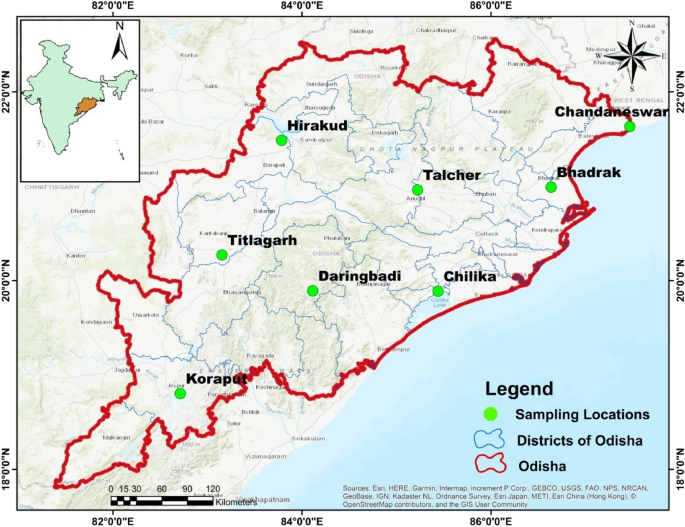
The natural wetlands had lower Cr, zinc (Zn), and Pb, while the constructed wetlands had higher Cr, followed by Pb and Zn. The high contamination of heavy metals poses an ecological risk to the wetlands, leading to human health risks in these regions. The hazard index higher than the threshold for adults and children is the health risk from polluted sediments. Pb and Cr contamination pose a carcinogenic effect on humans and can cause cancer in the study area. Heavy metal contamination in sediments in India’s wetlands can have significant environmental and health hazards. https://www.nature.com/articles/s41598-023-43349-7 (28 Sept. 2023)
WATER OPTIONS
Jammu & Kashmir Women fisher restoring Wular lake A group of fisherwomen is spearheading efforts to rejuvenate Wular Lake, once a lifeline for their communities in Bandipora district. Despite facing numerous challenges, the duo are committed to restore the lake to its former glory. Ashiyah Begum, a seasoned fisherwoman from Kulhama village, reminisces about the abundance of fish in Wular during her youth. While the catch has diminished in recent times, shr and her fellow fisherwomen are determined to reverse this trend.
– Kulhama, located along the lake’s shores, has eighty-three families that have traditionally relied on the lake’s resources for their livelihoods. Despite the challenges, these women are working tirelessly to revitalize the lake. Mugli Begum, a 75-year-old fisherwoman with decades of experience, remembers the golden days when they used to collect boatloads of chestnuts. While the harvest has dwindled over the years, Begum remains hopeful and is actively involved in conservation efforts. https://kashmirconvener.com/2023/09/27/a-noble-cause-fisherwomen-on-a-mission-to-restore-wular-lake/ (27 Sept. 2023)
Bengaluru How residents are working on citizen-driven projects to conserve biodiversity around lakes. https://india.mongabay.com/2023/09/when-citizens-take-ownership-of-urban-commons/ (27 Sept. 2023)
Sri Lanka Ancient ‘tank cascades’ tackling drought A 2,000-year-old Sri Lankan hydraulic system uses natural features to help harvest and store rainwater. In a rapidly warming world, it is providing a lifeline for rural communities. By releasing water into irrigation canals below, the tank supports the rice crop during the dry months before the rains arrive. For nearly two millennia, lake-like water bodies such as this have helped generations of farmers cultivate their fields. An old Sinhala phrase, “wewai dagabai gamai pansalai”, even reflects the technology’s centrality to village life; meaning “tank, pagoda, village and temple”.
– Constructed from the 4th Century BC up to the 1200s, these cascade systems have long helped Sri Lankan communities cope with prolonged periods of dry weather. “As most of the country is made up of crystalline hard rock with poor permeability, it induces runoff, ” says Christina Shanthi De Silva, senior professor in agricultural and plantation engineering at The Open University of Sri Lanka. “Our forefathers built tank cascades to capture this surface runoff,” she explains, preventing it from being washed away into rivers and, ultimately, the sea. Researchers suggest there were once 18,000-30,000 small tanks in Sri Lanka, with 90% organised into clusters or cascades. But today only 14,421 active tanks, and 1,661 cascades are estimated to remain. https://www.bbc.com/future/article/20230922-the-ancient-sri-lankan-tank-cascade-systems-tackling-drought (27 Sept. 2023)
GROUNDWATER
Telangana Groundwater rises by 4 metres The extractable groundwater available in Telangana at present is 739 tmcft. In other words, the water available in the State is around 2.5 times of State’s assured water of 299 tmcft in Krishna river and around 75 per cent of the assured waters of 967 tmcft in Godavari river.
The average groundwater level in the State has increased by more than four metres in the last nine years. The rise is observed in 83% of mandals, which is highest in the country. The groundwater extraction in the State has been reduced by 19%, this is, from 58% in 2013 to 39% this year. The extractable groundwater resources have been increased by 56% in 2023 (739 tmcft) as compared to 2013 (472 tmcft). This is an increase of 267 tmcft this year over the last year.
The State Level Committee (SLC) held a meeting here on Friday approved the ‘Dynamic Ground Water Resources of Telangana State for the year 2023’ by irrigation special chief secretary Rajat Kumar and others. The ground water resources are assessed jointly by Ground Water Department of the State and the Central Ground Water Board, Ministry of Jal Shakti. https://www.newindianexpress.com/states/telangana/2023/sep/30/groundwater-rises-by-four-metres-in-telangana-2619618.html (30 Sept. 2023)
URBAN WATER
Bengaluru Looming water crisis With water levels plunging in reservoirs, the threat of a water crisis looms over Bengaluru. Although senior BWSSB officials said it was too early to determine how badly the city would be hit by the shortage, well-placed sources warned Bengaluru would likely be impacted if the state does not receive sufficient rainfall in the next two months. With scanty rains depleting the groundwater and drying up borewells, the city’s dependence on the Krishnaraja Sagara, Harangi, Hemavathi or Kabini reservoirs would only be heavy. https://www.deccanherald.com/india/karnataka/bengaluru/depleting-reservoirs-drying-borewells-reveal-looming-water-crises-in-bengaluru-2-2700704 (26 Sept. 2023)
Bangalore is treating 1240 MLD wastewater at centralised STPs by BWSSP, and 615 MLD at decentralised STPs, leaving 145 MLD untreated. 13 MLD is used in Gardening, 125 MLS in toilet flushing, 1192 MLD in lakes and 530 MLD in agriculture and industries. Most of the decentralized STPs let out the treated wastewater into the lakes in absence of clear guidelines. https://www.deccanherald.com/india/karnataka/bengaluru/treating-wastewater-may-help-ensure-bengalurus-water-security-2708707 (02 Oct. 2023)
WATER POLLUTION
Haryana NGT orders notice to thermal power station on undisposed flyash The NGT on Friday directed SPCB to issue a notice to the Faridabad (Sept. 29) thermal power station for not disposing of fly ash lying in the Aravalis. Disposal of fly ash, which is formed after combustion of coal in thermal power plants, in forest areas is a violation of the Aravali Notification, 1992.
The directive came when the tribunal was hearing a petition by a Faridabad resident, Ajay Shrivastava, which stated that even after closure of the powerhouse in Bata Chowk in 1998, the fly ash it generated has not been removed from the area. On NGT’s directions, SPCB carried out an inspection on July 31, and the board said in its report that it found two ash dykes (retaining structures built to contain ash).
One of them, Old Ash Dyke, is spread across 103 acres. The other is spread across 152 acres, where lifting of ash is in progress now. The report disclosed that no lifting of fly ash took place between 2018 to 2022. Now, the work has been awarded to two agencies. HSPCB also informed NGT that the entire remaining fly ash at the second ash dyke will be lifted by June 21, 2026. https://timesofindia.indiatimes.com/city/gurgaon/fly-ash-in-aravalis-not-disposed-of-ngt-orders-notice-to-thermal-power-station/articleshow/104030511.cms (29 Sept. 2023)
MONSOON 2023
SANDRP Blog SW Monsoon 2023: District wise rainfall in India In the just concluded South West Monsoon 2023, India received 820 mm (925 mm in SW Monsoon 2022) rainfall, about 94.45 % (106.5% in 2022) of the Normal SW Monsoon rainfall of 868.6 mm or 5.55% (6.5% above normal in 2022) below normal SW Monsoon rainfall as per India Meteorological Department (IMD). This rainfall will now be categorised as below normal rainfall though the distribution has been unprecedented, both temporally and spatially.
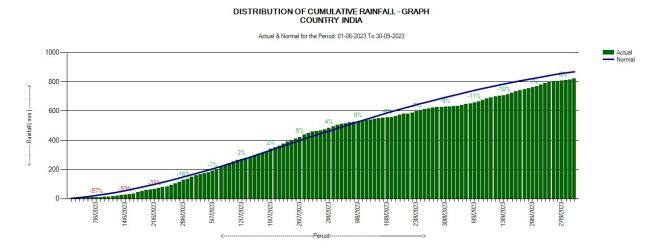
IMD had forecast Normal monsoon rainfall for SW Monsoon 2023 (rainfall between 96% and 104% of Long Period Average Rainfall), IMD has been proved wrong. IMD however, says that 73% of the area in the country received normal rainfall and 9% got above normal, only 18% got below normal rainfall. The monsoon withdrawal, is yet to happen from most of India, except a small part in North West India including parts of Rajasthan and Haryana. https://sandrp.in/2023/10/02/sw-monsoon-2023-district-wise-rainfall-in-india/ (02 Oct. 2023)
IMD High Rainfall districts for 24 hrs ending at 0830 hrs on
Oct 2, 2023: 50-100 mm: Bauda, Sambalpur, Subranpur (Odisha), Bokaro, Chatra, Giridih, Hazaribagh, Lohardaga, Ramgarh, Ranchi (Jharkhand), Nawada (Bihar), Ratnagiri (Mah), Balarampur (CG) [13]
100-150 mm: Garhwa (Jharkhand0 [1]
Oct 1, 2023: 50-100 mm: Aizwal (Mizoram), Kochbihar, Bankura, Howrah, Paschimi Medinipur (WB), Bokaro, Dhanbad (Jharkhand), N Goa (Goa), Dakshin Kannada, Kodagu (Karnataka), Ernakulam, Kannur, Kottayam, Pattanmittia (Kerala) [14]
100-150 mm: Puruliya (WB) [1]
Sep 30, 2023: 50-100 mm: Jamtara (Jharkhand), S Goa (Goa), Kasargod, Kozigod (Kerala) [4]
100-150 mm: N Goa (Goa) [1]
Sep 29, 2023: 50-100 mm: Nicobar, N & Middle Andaman (UT), N Goa, S Goa (Goa), Suburban Mumbai (Mah), Mahe (Puduchery), Alappuzha, Ernakulam, Kannur, Kottayam, Kozikod, Trishur (Kerala) [12]
100-150 mm: Zunhebeto (Nagaland) []
Sep 28, 2023: 50-100 mm: N & Middle Andaman, S Andaman (UT), Kanchipuram (TN) [3]
Sep 27, 2023: 50-100 mm: N Goa (Goa), Ranipet (TN) [2]
Sep 26, 2023: 50-100 mm: Dumka (Jharkhand) [1]
Source: IMD’s daily district wise rainfall page
Monsoon set to retreat The fact is Monoson 2023 has put a question mark on IMD’s prediction capabilities. Apart from lamenting “inadequate study of monsoon pattern”, experts also find fault in models IMD uses “which can predict light or moderate rain but only give an indication that heavy or very heavy rainfall will happen in certain areas.” https://www.tribuneindia.com/news/india/unusual-monsoon-all-set-to-retreat-in-two-days-rain-deficiency-stands-at-6-per-cent-548569 (28 Sept. 2023)
Monsoon left widespread destruction and uneasy questions This monsoon has seen an increase in the loss of human lives and the impact on infrastructure, compared to previous years. While extremely heavy rainfall is largely attributed for the situation this year in the western Himalayan state, unplanned infrastructure development and haphazard urbanisation, too, have a role, say experts. Experts and civic bodies seek better drainage systems and proper environment impact assessment, forest clearance and disaster risk assessment studies for all projects. https://india.mongabay.com/2023/09/monsoon-left-widespread-destruction-and-uneasy-questions-in-himachal/ (26 Sept. 2023)
FLOOD 2023
SSP Floods Who is responsible for back water floods in 193 villages It has been 10 days since the occurrence of the flood, yet NVDA has not disclosed any data regarding the extent of damage caused by this natural disaster. Ground Report attempted to obtain an official response regarding this matter, we reached out to the designated contact person, Chief Information Officer Neeraj, on the official authority phone number. However, unfortunately, Neeraj did not respond to our call. https://groundreport.in/193-villages-in-madhya-pradesh-flood-due-to-sardar-sarovars-backwater-who-is-responsible/ (30 Sept. 2023) https://groundreport.in/sardar-sarovar-backwater-floods-barwani-and-khargone/ (30 Sept. 2023)

स्थानीय लोग बताते हैं कि ओंकारेश्वर में ऐसी बाढ़ उन्होंने शायद पहले कभी नहीं देखी थी। लोग मानते हैं कि यह बाढ़ प्राकृतिक नहीं थी बल्कि इंसानी लापरवाही और महत्वकांक्षा के कारण बनाई गई थी। स्थानीय पत्रकार राजेंद्र पुरोहित बताते हैं कि पिछले दिनों ओंकार पर्वत पर शंकराचार्य की मूर्ति का अनावरण होना था। पहले इस मूर्ति का उद्घाटन पीएम नरेंद्र मोदी के द्वारा उनके जन्मदिन पर किया जाना था लेकिन उनका कार्यक्रम रद्द हो गया और बाद में सीएम शिवराज सिंह चौहान ने इसका अनावरण किया। इस दौरान कार्यक्रम स्थल पर बड़े भारी वाहनों को पहुंचने के लिए जो रास्ता है वह नदी की एक रपट से होकर जाता है और थोड़े से पानी में ही वह रपट डूब जाती है। ऐसे में आवाजाही बनाए रखने के लिए नदी में बांध से पानी नहीं छोड़ा गया और पुलिया नहीं डूबी तथा वाहन आते-जाते रहे। https://www.deshgaon.com/top-stories/the-gates-of-omkareshwar-dam-suddenly-opened-and-there-was-a-terrible-flood-in-the-narmada-river-peoples-stories1/ (29 Sept. 2023)
Former CM Digvijaya Singh, on Thursday (Sept. 28), demanded a thorough investigation into the delayed release of water from Omkareshwar Dam, causing huge floods and devastations recently. He said that the matter should be probed by a retired judge and strict action should be taken against the responsible and guilty officers in this regard. https://www.freepressjournal.in/indore/mp-digvijaya-demands-probe-into-delayed-release-of-water-from-dam-in-khargone (28 Sept. 2023)
BJP leaders admit party’s crucial vote banks are affected, and that “anger won’t subside soon”; leaders urge Bhupendra Patel to enhance relief package. Apart from 40 villages and two cities of Bharuch district, 31 villages of Vadodara district and 32 villages of Narmada district were affected.
– The BJP MLAs from Bharuch district who met the CM included Ramesh Mistry (Bharuch); Arunsinh Rana (Vagra); Ritesh Vasava (Jhagadia); Ishwarsinh Patel (Ankleshwar); D K Swami (Jambusar); Darshana Deshmukh (Nandod); and Kunvarji Halpati (Surat). Bharuch MP Mansukh Vasava was also present. Following the meeting, on Friday, Patel announced that small and medium shops with a monthly turnover of up to Rs 5 lakh will get Rs 85,000 one-time assistance, while those with bigger turnovers would get aid for interest on loans up to Rs 20 lakh, in addition to relief announced for macro, micro and small enterprises as well as Rs 5000 assistance for handcarts that suffered damage.
– MP Vasava says they urged the CM to compensate for household losses, and that those rendered rendered homeless be considered on priority as beneficiaries of the Pradhan Mantri Awas Yojana scheme. “These people will not benefit from the cash dole that the government announces as part of relief,” he says. https://indianexpress.com/article/political-pulse/oppn-claims-narmada-floods-man-made-public-anger-bjp-leaders-feel-heat-gujarat-8962942/ (01 Oct. 2023)
Study Kosi super flood could happen again -Based on these studies, the researchers have reported that climate-change-related and seismic events ravaging the planet today could create super-floods that could be catastrophic for people in the Gangetic plain, in a paper published in the journal Communications Earth and Environment on August 23. The findings signal that we need to urgently update India’s disaster management strategy to account for what Prof. Sinha calls “cascading hazards”: natural disasters that are triggered by other disasters.
-Prof. Sinha and his colleagues wrote in their paper that accounting for hyper-concentrated flows in “future disaster risk management strategies remain an important and major challenge”. This is because, he added, India’s disaster management strategy relies largely on a “compartmentalised” understanding of disasters, where how one disaster leads to the other is not taken into consideration. “If we keep looking at these hazards in an isolated and compartmentalised way, we will never be able to understand the entire cascading effect of a disaster,” he said. Instead, we need an “integrated disaster management approach” where the relationship between instances of earthquakes, landslides, and floods – along with the individual incidents themselves – is used to frame risk-mitigation plans. https://www.thehindu.com/sci-tech/science/clues-ancient-kosi-river-superflood-cascading-disaster/article67355949.ece (29 Sept. 2023)
URBAN FLOODS
Nagpur Wells contaminated, toilet lines still choked in aftermath of flood After the flash floods in the city following the September 23 downpour, residents of many localities are facing another crisis – contaminated well water. Parikshit, a resident of Deendayal Nagar, said he had submitted a written complaint to NMC related to contamination of his private well on Monday (September 25). The well had never been polluted before the September 23 deluge, he said. After the heavy downpour, overflowing dirty water breached the well wall, leading to its contamination, he said. Despite complaints, NMC has not responded yet, Parikshit said.
The same complaint was narrated by Corporation Colony resident Pravin Mishra (name changed). His private well too got contaminated due to the deluge. In the vicinity, private wells of many residents are affected due to the recent flood, he said. It also came to fore that sewerage network has been connected to the stormwater network at several places. This has added to the woes of the residents hit by the flood waters.
With drains overflowing for days, sources in NMC said there was too much pressure on the sewer lines, which led to well water getting polluted at several places across the city. Meanwhile, even after a week of deluge, NMC’s public health engineering department is still flooded with complaints of overflowing sewage in houses in the deluge-affected areas. This has forced the department to increase working hours of employees deputed for attending to choked drains, especially in Dharampeth and Laxmi Nagar zones. https://timesofindia.indiatimes.com/city/nagpur/wells-contaminated-toilet-lines-still-choked-in-aftermath-of-flood/articleshow/104071084.cms (30 Sept. 2023)
The Indian Express spoke to affected residents to gain insight into their experiences and the challenges they face in the wake of heavy rains and inundation. https://www.youtube.com/watch?v=adJy1o8Ta8k (25 Sept. 2023)
DISASTERS
Himachal Pradesh Central teams evaluate flood damage The central team’s primary objective is to compile a comprehensive damage report, which will be submitted to the central government. This report will serve as the basis for determining the relief amount that Himachal Pradesh will receive. In response to the crisis, the Himachal Assembly has passed a resolution declaring it a national disaster and has requested a special relief package of ₹12,000 crore. The central team’s visit and subsequent report are expected to play a crucial role in securing this much-needed assistance for the state. https://www.hindustantimes.com/cities/chandigarh-news/central-teams-evaluate-flood-damage-in-himachal-pradesh-101696013086359.html (30 Sept. 2023)
Just like in Uttarakhand, reckless tourism, hydel projects and extensive road widening are responsible for the devastation in Himachal. The construction blitz is unsustainable. (Priyadarshini Patel) https://timesofindia.indiatimes.com/blogs/voices/himalayas-are-on-shaky-ground-in-hill-states/ (30 Sept. 2023)
It is essential to understand that the Himalayan states are suffering from a ‘disease’ — the ‘disease’ to replicate the development model of the plains — big infrastructure projects, wider roads, high-rise buildings and mass tourism. It is this uncontrolled growth model that is seriously compromising their environmental security. (Chandra Bhushan) https://www.deccanherald.com/india/uncontrolled-tourism-growth-threaten-himalayas-2707905 (01 Oct. 2023)
Damages to property in Himachal Pradesh this year were more than the last five years combined. Other north and west Indian states also suffered heavy losses in terms of lives, property and farmland. https://www.newindianexpress.com/nation/2023/oct/01/indias-devastating-monsoon-season-is-sign-of-things-to-come-as-climate-and-poor-planning-combine-2619934.html (01 Oct. 2023)
LANDSLIDES
Himachal Pradesh Landslide risk high, yet govt awards tender to build flyover Even as eminent geologists have warned against building flyovers in the sensitive hills , a tender has been allocated to build the first flyover in Shimla at the Vidhan Sabha crossing. Sundernagar-based firm Messers AVS-Joint Venture has been awarded the Rs 26.75 crore contract.
The contract was awarded on August 23 by Himachal Pradesh Road and Infrastructure Development Corporation Limited, just days after a devastating landslide that wiped out a Shiv Temple in Summer Hill, Shimla, on August 14 and claimed 21 lives. The project involves construction of flyovers from Cart Road to Vidhan Sabha, and widening road with retaining wall at Victory Tunnel and protective works (breast walls, toe walls, gabion walls, retaining walls) and traffic safety (with metal beam crash barriers) and road appurtenance. It also includes widening of the existing road and construction of footpath and hand rails in Victory Tunnel. The project is scheduled to be completed in 24 months after allocation of tender. https://indianexpress.com/article/cities/chandigarh/landslide-risk-high-himachal-tender-flyover-shimla-8954567/ (25 Sept. 2023)
A landslide on the railway tracks near Jarati station, situated between Koraput and Jeypore stations, has brought rail services in southern Odisha to a grinding halt. Train services have been cancelled due to the natural disaster that occurred on Sunday (Sept. 24). The landslide is believed to have been triggered by continuous rainfall in Koraput and nearby Jeypore areas over the past few days, causing the hills on both sides of the railway tracks to soften. https://www.newindianexpress.com/states/odisha/2023/sep/25/landslide-hits-rail-services-in-odishas-koraput-2618039.html (25 Sept. 2023)
DROUGHT 2023
Karnataka All 31 districts receive poor rain As southwest monsoon ends, cumulative rainfall in the State from June 1 to September 30 is 642 mm against a normal of 852 mm; Malnad districts experience 39% rain deficiency, while a shortfall of 27% recorded in south interior regions. https://www.thehindu.com/news/national/karnataka/southwest-monsoon-officially-ends-leaves-karnataka-under-spell-of-drought/article67365655.ece (30 Sept. 2023)
Deputy CM DK Shivakumar, who is also handling the Water Resources portfolio, told reporters that a decision on cloud seeding will be taken in the next two or three days. “We will discuss the distress situation due to the shortage of rainfall in the Cauvery basin and the situation arising out of the need to release water to Tamil Nadu in the Cabinet meeting and also the option of cloud seeding,” he said. https://www.daijiworld.com/news/newsDisplay?newsID=1123937 (25 Sept. 2023)
KRS storage second lowest since 2011 The gross storage at the Krishnaraja Sagar (KRS) reservoir across the river Cauvery was 20.54 thousand million cubic ft (tmc ft) on September 27, 2023, against the gross capacity of 49.45 tmc ft. This is the second lowest level of gross storage in the dam since 2011. The previous lowest was in 2016, when the gross storage in the reservoir on the same day had dipped to 14.84 tmc ft owing to monsoon failure. https://www.thehindu.com/news/national/karnataka/gross-storage-at-krs-reservoir-second-lowest-since-2011/article67353021.ece (27 Sept. 2023)
Maharashtra Ujani dam water levels lowest since 2018 The Ujani dam has recorded 21.69% water storage till September 24, which is the second-lowest water storage since 2018 when the dam had recorded 59% water deficiency. A policy decision is expected after October 15. In 2015 as well, the Koyna Dam had experienced a rainfall deficit. https://www.hindustantimes.com/cities/pune-news/ujani-dam-water-level-second-lowest-since-2018-101695579363243.html (24 Sept. 2023)
Report Drought situation in 50% of India Of the total 718 districts in the country, close to 410 districts were facing drought-like conditions at the end of the southwest monsoon season. These 410 districts comprise more than 50 per cent of the country. This may severely impact India’s food stock which is under stress due to inclement weather last year.
Around 41 per cent (410) of the total 718 districts are under the ‘mild dry’ category, while 9 per cent of districts are ‘moderately dry’ category, followed by 8 per cent under the ‘severely dry’ category. Experts interpret the ‘mild dry’ condition as a drought-like condition that will reduce soil moisture drastically and further impact rabi crops. https://www.newindianexpress.com/nation/2023/sep/27/food-stock-a-concern-drought-like-situation-in-50-per-cent-of-india-say-experts-2618568.html (27 Sept. 2023)
ENVIRONMENT GOVERNANCE
MoEF Plan to conserve grasslands The standing committee of the national board for wildlife will take a call on how to conserve disappearing grasslands in the country. Not recorded or protected as forests, but supporting critical wildlife species, grasslands are on the brink, at least three standing committee members told the panel headed by Bhupender Yadav, union environment minister.
Members said while there is an administrative framework for the conservation of habitats of larger faunal species like tigers, elephants, wetlands, corals, mangroves etc. both in the Ministry and also in the States, there is none for grasslands. Member Secretary of NBWL, Bivash Pandav said that as per the Indian Grassland and Fodder Research Institute, Jhansi, a national institute under the control of Indian Council of Agricultural Research, over 100 million hectares of grasslands stand degraded.
“Many natural grasslands have either degraded or lost due to agricultural expansions, overgrazing, large areas being converted to plantations / protected areas/ Industrial establishment,” he said. The five ethnic grasslands which have existed in the country for centuries are Banni in Gujarat, Shola in the Western Ghats, the Thar desert in Rajasthan and Gujarat, the Terai, and Kangeyam in Tamil Nadu. https://www.hindustantimes.com/india-news/wildlife-board-s-key-panel-to-take-call-on-how-to-conserve-grasslands-101695926679455.html (29 Sept. 2023)
Tamil Nadu Govt reconstitutes State Biodiversity Board The govt recently reconstituted the State Biodiversity Board, and included three special invitees from the Industries Department, the Animal Husbandry, Dairying and Fisheries Department and the Tamil Nadu Pollution Control Board. The Minister for Forests will be the chairperson of the board. The Secretaries of the Environment, Climate Change and Forests; Rural Development and Panchayat Raj; and Agriculture and Farmers’ Welfare Departments, the Principal Chief Conservator of Forests and Chief Wildlife Warden are the ex-officio members of the panel. https://www.thehindu.com/news/national/tamil-nadu/tn-reconstitutes-state-biodiversity-board/article67353281.ece (27 Sept. 2023)
CLIMATE CHANGE
UNICEF Venture Fund’s First Cohort for Climate Action EQUINOCT has been selected for the UNICEF Venture Fund’s 1st cohort for climate action!! It will receive funding investment, and support to strengthen solutions with the community better. In line with its goal for community collaboration, it shares the journey with Renovus (Uruguay), MapAction (Mali), Map&Rank (Cameroon), Similie (Timor Leste), eSusFarm (Uganda), and INS (Albania). The diversity of the cohort represents female-founders, companies in fragile contexts, and teams comprised of young innovators under the age of 30. https://youtu.be/TqvYK3-8jyQ &: https://www.unicef.org/innovation/venturefund/climate-action-cohort (21 Sept. 2023)
Report Experts flag concerns over Sunderbans UN reports, shared during the meeting, showed that the Sunderbans both in India and Bangladesh is a global hotspot of climate change with fast-increasing, high-intensity cyclones, sea levels rising at over double the pace of the global average and huge erosion leading to forced migration of people. According to state government data, the cost of damage to the Sunderbans in the three recent cyclones, Bulbul, Amphan and Yaas, has been Rs 1.5 lakh crore.
Multiple reports predicted that the vulnerability of the Sunderbans in both India and Bangladesh would rapidly increase and low-lying regions in both countries could lose a significant percentage of their landmass by 2050. Some reports have indicated that the Indian side of the Sunderbans already has had a net loss of about 210sqkm landmass in the last 60 years owing to erosion. https://www.telegraphindia.com/west-bengal/environment-experts-from-bengal-and-bangladesh-flag-sunderbans-global-concern/cid/1968974 (26 Sept. 2023)
Swiss glaciers lost 10% of their volumes in past 2 years A Swiss Academy of Sciences panel is reporting a dramatic acceleration of glacier melt in the Alpine country, which has lost 10% of its ice volume in just two years after high summer heat and low snow volumes in winter. Switzerland – home to the most glaciers of any country in Europe – has seen 4% of its total glacier volume disappear in 2023, the second-biggest decline in a single year on top of a 6% drop in 2022, the biggest thaw since measurements began, the academy’s commission for cryosphere observation said. https://timesofindia.indiatimes.com/world/europe/swiss-glaciers-have-lost-10-of-their-volume-in-the-past-2-yrs-say-experts/articleshow/104029510.cms (29 Sept. 2023)
SOUTH ASIA
India-Bhutan While Bhutan’s power generation this year is lower by about 19% even after discounting the reduction due to planned maintenance of Tala HEP, its demand is growing. Bhutan expects to import about 1500 MU of power this month during five month period between Dec 23 and Apr 24, compared to 367 MU during four months last year. Normally Bhutan needs to import electricity during only three months, but that period is increasing Even after commissioning of 118 MW Nikachu (to provide 23 MW of firm power during winter) and Punatasangchu II (to provide 164 MW during winter) later this year, this trend will continue. Bhutan imports power from spot market of India Energy Exchange at rates generally much higher than its export rate of power. https://www.aninews.in/news/world/asia/bhutan-gearing-up-to-import-electricity-from-india-for-extended-period-report20230928170629/ (28 Sept. 2023)
Pakistan Diamer Bhasa dam a disaster in making Drawing on social and ecological repercussions from other dams of Pakistan, this commentary argues that constructing Diamer-Bhasa dam in an ecologically sensitive zone of GB is a disaster in the making that could have profound implication on its people, habitat and ecology. https://www.greaterkashmir.com/todays-paper/op-ed/diamer-bhasa-dam-and-the-ecological-disaster-in-the-making (22 Sept. 2023)
Nepal Floods beyond imagination hit Himalayan town High hill locations as well as the areas living there were currently in jeopardy as a result of the expanding danger of antarctic lake outburst floods (GLOFs) brought on by increasing temperature levels as well as their varied as well as fast effect on the area. Shrestha included: “In our observations, precipitation is becoming more frequent in high mountain regions, increasing the possibility of disasters other than GLOFs, too.” That’s why, after the Mustang flooding this year, there is an expanding need for specialized catastrophe threat decrease as well as monitoring strategies from city governments to specialists in the area.
In June 2021, one more hill area, Manang, seasoned abnormally extreme rains as well as devastating flooding. In the exact same year, the top location of Shindhupalchwok additionally experienced hefty rainfall-caused flood-related calamities. In current years, hill locations have actually seen modifications in rainfall patterns, with abnormally extreme climate occasions coming to be a lot more constant, as well as there is information to verify it. https://sanfrancisconewswire.com/why-floods-beyond-our-imagination-hit-nepalese-himalayan-town-global-issues/ (26 Sept. 2023)
A flood in the Kagbeni River on Sunday washed away 29 houses and displaced more than 150 people. The disaster occurred after the river, dammed upstream by a landslide, burst flooding the lower reaches. As per the preliminary disaster report of the District Disaster Management Committee, the floods swept away 29 houses, a motorable bridge along the Jomsom-Korala road section; a suspension bridge, 12 vehicles—including an excavator at the bridge construction site—and three temporary bridges. https://kathmandupost.com/gandaki-province/2023/08/14/flood-washes-away-10-houses-in-kagbeni (14 Aug. 2023)
This situation occurred when the Kaligandaki river was blocked due to a landslide, causing an initial halt in water flow followed by a subsequent increase. Although rainfall data from the nearest monitoring station, Jomsom, shows that rainfall is high, there is not enough information on the impact of the high-altitude rains. Climate experts argue that climate change and the rise in temperature could be the significant reasons behind such incidents. https://naturekhabar.com/en/archives/17695
THE REST OF THE WORLD
USA New York City declared a state of emergency as strong torrential rains triggered flash floods and crippled movement across the city. The National Weather Service reported more than 2 inches (5.08 cm) of rainfall in some areas by Friday morning, with an additional 2 inches expected in the hours ahead. https://www.ndtv.com/world-news/new-york-city-declares-state-of-emergency-over-flash-flooding-4436417 (30 Sept. 2023)
Report Expedition to explore Amazon river The title of “world’s longest river” is officially bestowed upon Africa’s Nile by authoritative sources like Encyclopedia Britannica and Guinness World Records. But an upcoming Amazon River expedition by a team of international explorers and researchers – traveling via rafts, horseback and solar-paneled boats – is readying to contest that designation.
The planned five-month-long expedition, due to set off in April 2024, aims to voyage the Amazon’s full length, using modern river-mapping satellite technology to scientifically prove once and for all that the Amazon is not just the world’s most voluminous river, but its longest. Notably, the Amazon is not one singular stretch of water, but rather part of a greater “river system” spanning much of northern South America. Not dissimilar to the branches of a tree, its network includes multiple sources and tributaries.
The length dispute largely stems from the issue of where the Amazon begins. While Britannica and others have traditionally measured the river as starting from the headwaters of the Apurimac River, in southern Peru, American neuroscientist-turned-river expeditionist James “Rocky” Contos, 51, claims to have discovered a more distant river source – the Mantaro River, in northern Peru – while researching whitewater rafting routes in the country.
The planned 7,000-kilometer (4,350-mile) spring expedition route will span the Amazon River’s course through Peru, Colombia and Brazil, starting at its newly purported source at the Mantaro, deep in the Peruvian Andes. After the expedition’s completion, a related full-length documentary as well as an IMAX film is expected to debut in 2026. The Nile, which flows across northeastern Africa before reaching the Mediterranean Sea via Egypt, also faces debate around its own source, with more than one African nation claiming to contain the river’s headwaters. https://edition.cnn.com/travel/worlds-longest-river-amazon-expedition/index.html (30 Sept. 2023)
Study Explosion in fish biodiversity due to genetic recycling Scientists show that the extraordinary diversity of cichlid fish in Africa’s Lake Victoria was made possible by “genetic recycling”—repeated cycles of new species appearing and rapidly adapting to different roles in the ecosystem. An evolutionary case study that has fascinated researchers for decades, the new study sheds light on how 500 species of fish were able to emerge and thrive in just 16,000 years.
The findings, published September 28 in Science, reveal the reasons behind cichlids’ unique ecological diversity. They also provide important insights into the genetic basis of adaptive evolution and diversification. https://phys.org/news/2023-09-explosion-fish-biodiversity-due-genetic.html (29 Sept. 2023)
Microplastics contaminating everything Millions of tons of microplastic that end up in the ocean are finding their way into the atmosphere with the ocean spray, revealed a new study, published in the journal Environmental Chemical Letters. Scientists, including those from Waseda University in Japan, assessed for the first time how these plastic bits affect cloud formation and their potential impact on the climate crisis and human health as “airborne particles”.
“To the best of our knowledge, this study is the first to detect airborne microplastics in cloud water in both the free troposphere and atmospheric boundary layer,” researchers wrote in the study. “If the issue of ‘plastic air pollution’ is not addressed proactively, climate change and ecological risks may become a reality, causing irreversible and serious environmental damage in the future,” co-author Hiroshi Okochi said.
Researchers also found an abundance of hydrophilic, or water loving polymers in the cloud water. The latest finding suggests these molecules were removed as “condensation nuclei”, suggesting these airborne plastic particles could play a “key role” in rapid cloud formation and potentially affect the overall climate. They warned that the accumulation of airborne microplastics (AMP) in the atmosphere – especially in the polar regions – can also significantly alter the ecological balance of the planet and lead to “severe loss of biodiversity”. https://www.independent.co.uk/climate-change/news/microplastic-clouds-rain-food-contamination-b2419998.html (28 Sept. 2023)
SANDRP
Also see: DRP 25 Sept. 2023 & DRP 18 Sept. 2023
Follow us on: www.facebook.com/sandrp.in; https://twitter.com/Indian_Rivers


It is indeed “the arrogance and adamant attitude of the governance, not wanting to consider any questions raised against their decisions”. Despite central agencies’ reports, scientific community still knows what’s behind such massive land submergence and yet state government of Uttarakhand announces further railway and road tunnels to connect Gangotri and Yamnotri! Have they lost their mind? Do they even know what kind of difficult and porous rocks are there that cannot even sustain one monsoon rain? Truth be told, the so called “double engine sarkars” have drastically reduced human values like that of boulders and pebbles, pushing them with bulldozers in action, every now and then, leading to people of these regions to embrace immense suffering.
LikeLike