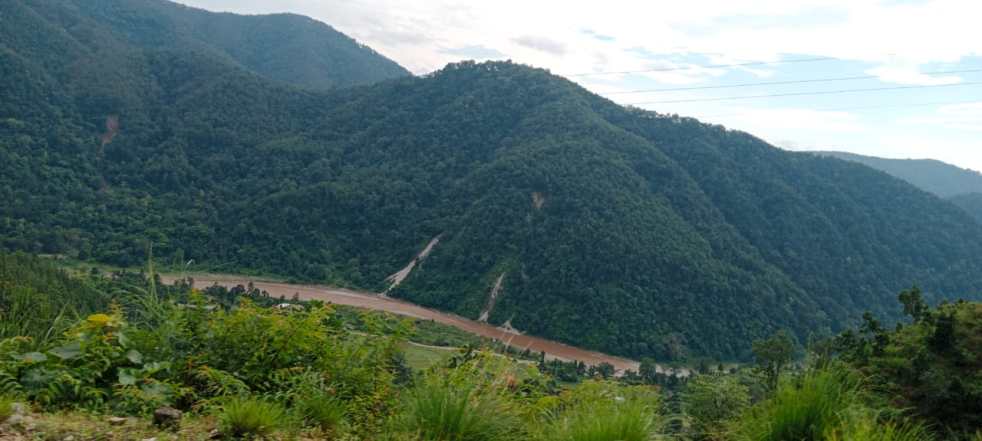
(Feature Image: Ramganga River near Marchula. SANDRP 08 Sept. 2023)
The Govt of India’s Sept 5 2023 notification reconstituting the Central Empowered Committee completely destroys the independent nature of this institution of accountability and course correction. This institution, set up by the Supreme Court in 2002 and reconstituted in 2008, worked as eyes and ears of the Supreme Court on environmental issues. The new committee has no independent members, it will be constituted by the MoEF, MoEF itself has such an abysmally poor track record.
The notification, reports said, diluted the CEC’s autonomy on four key counts: the committee will report to the ministry, instead of the SC; the ministry will pick all the members and the SC will have no role in the process; the ministry, and not the court, will fund the committee; the provision of having two NGOs in the committee has been done away with.
Even if the committee were to give an adverse report, very highly unlikely considering its constitution, even then, the government has to only give reasons why it does not agree with such recommendation: “In case any suggestion or recommendation of the Central Empowered Committee is not acceptable to the State or Central Government, the Government shall give reasons in writing for not accepting the same and such decision of the Central Government shall be final,” the notification reportedly says.
Unfortunately this whole reconstitution is happening under direct supervision and approval of the Supreme Court.
Centre’s notification constituting new CEC draws criticism The Union environment ministry on Tuesday (September 5) notified the constitution of a new central empowered committee (CEC) to replace an ad hoc body of the same name constituted by the Supreme Court in 2002.A two-judge bench of the top court had approved the Union government’s draft notification on August 18, the Hindustan Times reported.The Union government’s notification comes just a month after parliament passed the Forest Conservation (Amendment) Bill, 2023, which critics said diluted existing safeguards in Indian forest law and made it easier for the government to green-light construction projects in the fragile Himalayan region. https://thewire.in/government/environment-ministry-notifies-new-cec-non-governmental-actors-absent (07 Sept. 2023)
Set up in 2002, and reconstituted in 2008, the CEC has, in the words of the court, “rendered yeoman services to the cause of environment.” It has filed thousands of reports on issues referred to it by the apex court that have shaped the discourse around environment policy. These include compensatory afforestation, net present value of forests, Kudremukh mining, Aravali forests and Bellary mining. https://indianexpress.com/article/india/central-empowered-committee-sc-hands-over-its-green-watchdog-committee-to-environment-ministry-8929659/ (08 Sept. 2023)
-The government’s controversial revamp of the Central Empowered Committee raises questions about its autonomy. Since the MoEFCC itself is the root cause of almost all the problems that the CEC was originally set up to deal with, this has reduced the entire exercise into a farce. https://frontline.thehindu.com/environment/controversy-will-the-new-cec-be-able-to-protect-indias-forests-forest-conservation-act-amendments-supreme-court-moefcc/article67295803.ece (11 Sept. 2023)
HYDRO POWER PROJECTS
Arunachal Pradesh Centre to build barrage on Siang: CMPema Khandu on Wednesday (Aug. 06) informed the assembly that the Centre has proposed to construct a large barrage on Siang river in the state to keep it “alive” in view of the potential threats from a huge dam on YarlungTsangpo river (upstream of Siang) being built by China in neighbouring Tibet region. During a zero hour discussion initiated by Congress member LomboTayeng, Khandu said China decided to build the 60,000 MW dam on the river in the Tibet region in its 14th five-year plan. https://timesofindia.indiatimes.com/city/itanagar/centre-to-build-barrage-on-siang-to-ward-off-threat-from-chinese-dam/articleshow/103447793.cms (07 Sept. 2023)
Report Companies seek to build pump storage wroth Rs. 3 lakh croreSetting up so much PSP capacity that too at very high cost of Rs 7-8 Cr per MW clearly seems to suggest something not right. https://www.pressreader.com/india/hindustan-times-delhi/20230905/282187950595912 (05 Sept. 2023)
Himachal Pradesh Forest dept refuses clearance to 4 hydro projects The forest department has refused to give clearance to four hydro power projects till a cumulative impact assessment (CIA) study on the Ravi river basin is conducted to know their impact on ecology and wildlife of the region.The department has categorically told the directorate of energy (DoE), the nodal agency for hydro power in the state, that due to non-availability of a CIA study, a pre-condition imposed by the MoEF for clearance under the Forest Conservation Act (FCA), “it is not possible to process these cases.”The four projects, which have been allotted by the state government and proposed to come up on Ravi river in the tribal Bharmour region of Chamba district, are 4.98 MW Ghator Top, 24 MW Jai Bani Mata, 2.5 MW Jay Kartikay and 5MW Rudraveer projects.
In a letter to the DoE director in October last year, the department had requested to submit a copy of impact assessment study so that the four pending projects could be cleared and sent for approvals.Raising concern over the danger to environment caused by hydro projects, the letter also stated that “several instances of water leakage from project tunnels have been reported causing severe damage to forests and human habitations.”The letter stated massive landslides and water leakage has been reported from near the Holi-Bajoli hydro power project in Bharmour and which is threatening the ecosystem and may lead to ecological imbalance in the area. https://timesofindia.indiatimes.com/city/shimla/no-impact-study-himachal-pradesh-refuses-clearance-to-4-hydro-projects/articleshow/96955200.cms (13 Jan. 2023)
MoEFAgenda of EAC on River Valley Projects to be held on Sept 13, 2023:
1. Kadopada Pumped Storage Project (750 MW) in 325 ha at Village Guradikhol&Kadopada, District Deogarh, Odisha by Jindal Renewable Power Pvt Ltd – Terms of References
2. Tainsar Pumped Storage Project (675 MW) in 281 ha at Village Gailo& Kailash, Dist Deogarh, Odisha by Jindal Renewable Power Pvt Ltd – Terms of References
3. Expansion of Tembhu Lift Irrigation Project in 2284.601 ha at Village Tembhu, District Satara, Sangli and Solapur, by Dept of Irrigation, Mah – Terms of References
4. Emra-II Hydro Electric Project (315 MW) in an area of 236 ha at District Dibang Valley, Arunachal Pradesh by Athena Emra Power Pvt Ltd – Terms of References
5. Raiwada Close Loop Pumped Storage Project (850 MW) in 337.10 ha at Village Mariki&Sammeda, Tehsil Devarapalle&Vepada, DistAnakapalli& Vizianagaram, Andhra Pradesh by Adani Green Energy Ltd – Terms of References. https://parivesh.nic.in/utildoc/8911194_1693567116972.pdf
Relevant agenda of FAC meeting to be held on Sept 11 2023: – DIVERSION OF 160.4 HA. OF FOREST LAND IN KARLAKATTI, CHAKRAGERI AND KAGIHAL VILLAGE, SAVADATTI TALUK, BELAGAVI DISTRICT FOR STANDALONE PUMPED STORAGE COMPONENT OF SAUNDATTI INTEGRATED RENEWABLE ENERGY PROJECT OF GREENKO SOLAR ENERGY Pvt Ltd, KARNATAKA. https://forestsclearance.nic.in/AgendaDetail.aspx
DAMS
Madhya Pradesh A dam to block the tribal vote? The notification had just been issued by the Mandla collector on 31 August. In it, the executive engineer of Mandla district has been entrusted with the responsibility of acquiring the requisite parcels of land of 31 tribal villages for the Basania Dam. This dam is proposed to be built in village Audhari in tehsil Mohgaon of Mandla district—and will submerge 2,443 hectares of agricultural land held by 2,735 families. Curiously, all the villages that stand to be decimated by the Basania Dam project are notified areas under the Fifth Schedule of the Constitution.
– Earlier, according to Raj Kumar Sinha of the Association of Displaced Persons and Affected Persons of Bargi Dam, near Jabalpur, the Madhya Pradesh government had on 3 September 2015 issued guidelines for the implementation of the Right to Fair Compensation and Transparency in Land Acquisition, Rehabilitation and Resettlement Act, 2013. In this notification, it is clearly stated that the consent of the gram sabha, which consists of the entire voting population of a village, will have to be obtained before any land is acquired. But in the case of the Basania Dam project, so far no one has even talked to any tribal villager, let alone taking consent from any gram sabha.
– That is why the meeting held on Monday in Chakdehi village about the Basania Dam should sound an alarm bell for the BJP. Union minister Kulaste, ostensibly responsible for rural development, was specifically targeted in this meeting. Kulaste’s indifference, in particular, has been galling especially because he is elected to Lok Sabha from this Mandla district himself. He should know better, surely, the angry tribal communities hold. Given this state of things, if the BJP is expecting tribal votes out of Mandla at least, they may as well expect a rude awakening from that daydream too. https://www.nationalheraldindia.com/regional/madhya-pradesh-polls-a-dam-to-block-the-tribal-vote (06 Sept. 2023)
Karnataka Silt eats into storage capacity of KRS, Kabini, Harangi dams-KRS Dam, with a capacity of 49.45 tmcft (thousand million cubic feet) of water, has accumulated silt across an area of 131 square kilometres since its completion in 1932, without any silt removal efforts. Karnataka Engineering Research Station (KERS) conducted an Integrated Bathymetric Survey (IBS), survey revealed that approximately 2.34 tmcft of silt has accumulated in the Dam.Clearing the silt deposits at KRS, Kabini and Harangi Dams could increase storage capacity by up to 8 tmcft, benefiting both water storage and agriculture.
-Silt accumulation in the KRS Dam is relatively lower than in Dams like Tungabhadra and Almatti, attributed to the rocky terrain in the upstream region of the Cauvery river, which reduces silt transport.However, it’s worth noting that the silt in the KRS Dam also includes rocky debris left to act as wave-breakers for safety. In the case of Kabini Dam, located at Beechanahalli in H.D. Kote, silt accumulation is estimated at 1.35 tmcft, which is lower due to the forested and mountainous areas from which water flows.
-In the Harangi Dam in Kodagu, which is the primary Cauvery water supply reservoir to the KRS Dam, over 1 tmcft of silt has accumulated, with an increase after natural disasters in 2018.The KERS report stating this accumulation prompted the Cauvery Neeravari Nigam Limited (CNNL) to prepare a Detailed Project Report (DPR) worth Rs. 130 crore for silt removal, check Dam construction, retaining walls and other development work. However, the State Government has not taken any action thus far.
-Numerous studies have been conducted over the years to assess silt deposition in these Dams, but no practical solutions have been implemented on the ground. While Governments allocate substantial funds for various irrigation and water resource projects, they have yet to allocate even a fraction of that amount to de-silt these reservoirs. Siltation, and it significantly diminishes the benefits of these expensive Dams. Siltation can also lead to increased evaporation losses, backwater flooding and damage to power house turbines. https://starofmysore.com/silt-eats-into-storage-capacity-of-krs-kabini-harangi-dams/ (07 Sept. 2023)
Minor Irrigation Minister N.S. Boseraju said here on Saturday that of 15 vented dam projects which are under way in Dakshina Kannada under the Paschima Vahini scheme, 12 will be completed by this December-end.Of the remaining three projects, two will be over by March-end, 2024 and another will be completed by December-end, 2024. https://www.thehindu.com/news/cities/Mangalore/of-15-ongoing-vented-dam-projects-in-dk-under-paschima-vahini-12-will-be-over-by-year-end-says-minor-irrigation-minister/article67289602.ece (09 Sept. 2023)
INTERLINKING OF RIVERS
Ken-Betwa River Link Project Should be Reconsidered Due to Non-Viability and Disruptive Impacts on Bundelkhand Region by Bharat Dogra. https://countercurrents.org/2023/09/ken-betwa-river-link-project-should-be-reconsidered-due-to-non-viability-and-disruptive-impacts-on-bundelkhand-region/ (05 Sept. 2023)
INTERSTATE WATER DISPUTES
Cauvery Water Disputes Karnataka has informed the Supreme Court that it is facing a “severe drought situation” both in the Cauvery and Krishna basins and it may not be feasible to release any water from its reservoirs after September 12. https://www.thehindu.com/news/national/may-not-be-feasible-to-release-cauvery-water-after-september-12-karnataka-tells-supreme-court/article67277457.ece (06 Sept. 2023)
RIVERS AS NATIONAL WATERWAYS
Uttar Pradesh To expand inland water transport, govt to set up separate authority In a high-level meeting to discuss the formation of the authority, the CM on July 27 directed the officials to explore opportunities for passenger and cargo transportation in inland waterways, saying there is a need to make concrete efforts for promoting and developing waterways in the state.He also instructed them to study the functioning of the Inland Waterways Authority of India and similar state-level bodies and prepare a draft proposal in this regard. The proposed body will function as a nodal authority coordinating with the Indian Inland Waterways Authority and regulate all activities related to inland waterway transport and tourism in the state, an official spokesperson said while quoting the CM.
It will also ensure compliance with environmental and safety laws related to water transportation, besides conducting hydrographic surveys and inspections for the development and better utilisation of waterways, he added.It will also study and analyse the data related to inland waterway traffic and conduct scientific research on inland water transportation, tourism, shipping, and navigation activities, it is learnt.The CM added that illegal mining or any kind of settlement should be strictly prohibited in the catchment areas of rivers.“Vigilance is necessary in this regard. Channelisation and silt cleaning of rivers should be carried out in a timely manner,” he said. https://indianexpress.com/article/cities/lucknow/to-expand-inland-water-transport-govt-to-set-up-separate-authority-8864282/ (28 July 2023)
IRRIGATION
Study 3/4 of India’s irrigation sources run on electricity While more irrigation sources are dependent on electricity, the recharge ponds have reduced in last four years. Double cause of concern. https://www.thehindu.com/news/national/electricity-powers-three-fourth-of-farmers-irrigation-sources-census-report/article67263965.ece (02 Sept. 2023)

Odisha Farmers in distress as canal water fails to reach fields Despite having ample water in the canals, farmers not getting water to their paddy fields at the tail end has left them high and dry. They alleged that the situation arose due to the apathy of irrigation officials.In Balikuda, Naugaon, Biridi, Raghunathpur, Kujang, Erasama, and other blocks in the district, more than 85,000 hectares of land are dedicated to paddy cultivation. Farmers rely on both the Machgaon and Taladanda canals for irrigating their crops. However, encroachments and rampant weed and shrub growth in various sub-canals, has obstructed water flow till the tail end. Though the farmers have raised this with the Irrigation Department officials every season, no one has paid heed. https://www.newindianexpress.com/states/odisha/2023/sep/03/farmers-in-distress-as-canal-water-fails-to-reach-fields-2611282.html (03 Sept. 2023)
URBAN RIVERS
Sabarmati; Ahmadabad AMC disagrees with NGT panel recommendations As per the minutes of an August 23 meeting registered by the panel, the civic body’s disagreement with the two recommendations by the committee was reasoned on the ground that “AMC is responsible for providing services in residential areas and not for drainage of industrial area”. The civic body’s response is contrary to the stance it took before the Gujarat HC earlier. Following the court’s directions, it had agreed to sever illegal connections and monitor the pipelines with assistance from the GPCB and police.
An engineer with AMC said on Monday (Sept. 04), “The disconnection of illegal connections that is being undertaken by the AMC is as part of the directions issued in the Gujarat HC; but otherwise, the GPCB is the responsible authority for monitoring industries.” The NGT is due to take up the matter next on September 18. https://indianexpress.com/article/cities/ahmedabad/panel-formed-by-ngt-submits-report-amc-disagrees-with-recommendations-8924701/ (05 Sept. 2023)
Mula-Mutha; Pune MC instructs to speed up riverfront projectThe work of the first phase is 30 per cent complete and a model stretch of 300 metres is ready for demonstration. However, in the second phase, work completion is only 10 per cent, whereas, it should have been 30 per cent complete by this week.According to officials, the commissioner has asked the contractor to deploy additional manpower to speed up the work.The contractor claimed that in the second phase, there are hard stones which is making the work progress slow. https://www.hindustantimes.com/cities/pune-news/pune-municipal-commissioner-urges-speedy-progress-on-riverfront-project-faces-opposition-over-tree-cutting-101694021901101.html (06 Sept. 2023)
Musi; Hyderabad No takers for iconic pedestrian bridge Since March, the Qutub Shah Urban Development Authority (QQSUDA), a government body established for the development of Old City areas, has floated tenders on five occasions, the latest of which was recalled in the last week of August.A total of 15 bridges, including the iconic bridge, have been planned across the Musi River and its tributary Esa to ease traffic in the city. An amount of Rs 545 crore has been sanctioned for the construction of these bridges.
The expenditure for the construction of the 15 bridges will be equally divided between the Hyderabad Metropolitan Development Authority (HMDA) funds and the Greater Hyderabad Municipal Corporation (GHMC), which will borrow from the bank. The construction of the iconic bridge on the Musi River is proposed to be taken up at an estimated cost of Rs 40 crore and is likely to be completed in 18 months. Previously, the construction cost of the iconic pedestrian bridge was brought down from Rs 231.50 crore in 2019 to Rs 40 crore in 2023 by deciding to construct it as a simple bridge. https://www.newindianexpress.com/cities/hyderabad/2023/sep/05/no-takers-for-iconic-pedestrian-bridge-on-musi-2611740.html (05 Sept. 2023)
RIVERS BIODIVERSITY
IPBES Report 37,000 ‘alien species’ introduced by human activitiesThe report, which was released on Monday (Sept. 04), said that invasive alien species are one of the five major direct drivers of biodiversity loss globally, alongside land and sea use change, direct exploitation of organisms, climate change, and pollution.
The report has noted that the number of alien species (species introduced to new regions through human activities) has been rising continuously for centuries in all regions, but are now increasing at unprecedented rates, with increased human travel, trade and the expansion of the global economy.
The report further noted that many invasive alien species have been intentionally introduced for their perceived benefits, “without consideration or knowledge of their negative impacts’’ – in forestry, agriculture, horticulture, aquaculture, or as pets.
The water hyacinth is the world’s most widespread invasive alien species on land. Lantana, a flowering shrub, and the black rat are the second and third most widespread globally. The brown rat and the house mouse are also widespread invasive alien species.
The report said that the annual costs of invasive alien species have at least quadrupled every decade since 1970, as global trade and human travel increased. In 2019, the global economic cost of invasive alien species exceeded $423 billion annually.
Invasive alien species like Aedes albopictus and Aedes aegyptii spread diseases such as malaria, Zika and West Nile Fever, while others also have an impact on livelihood such as the water hyacinth in Lake Victoria in East Africa led to the depletion of tilapia, impacting local fisheries.The IPBES report has further warned that warming temperatures and climate change could favour the “expansion of invasive species’’.
The report found that 34% of the impacts of biological invasions were reported from the Americas, 31% from Europe and Central Asia, 25% from Asia and the Pacific and about 7% from Africa. Most negative impacts are reported on land (about 75%) – especially in forests, woodlands and cultivated areas – with considerably fewer reported in freshwater (14%) and marine (10%) habitats . Invasive alien species are most damaging on islands, with numbers of alien plants now exceeding the number of native plants on more than 25% of all islands. https://indianexpress.com/article/india/biodiversity-loss-37000-alien-species-introduced-by-human-activities-says-report-8924756/ (05 Sept. 2023)
Kerala Invasive species wipes out indigenous clams, oysters The Caribbean false mussel has wiped out almost all native clams and oysters of Kerala which are important for local fisheries, an intergovernmental panel report on biodiversity has said. The Caribbean false mussel (Mytilopsissallei) originally from the Atlantic and Pacific coast of South and Central America has spread widely in the state. Interestingly, it has also overwhelmed the American brackish water mussel, Mytellastrigata, another invasive species which once threatened to take over the state’s waterways.
Researchers say the Caribbean false mussel may have travelled to India via ships, later spreading to estuaries through smaller fishing vessels that travel frequently between coastal oceanic waters and the fishing harbours of Kerala, the report on invasive species has said. It has also said in its case study on India that it is possible that tropical CyloneOckhi, which struck the Kerala coast in 2017, may have triggered the spread of the “VarathanKakka” (alien mollusc in Malayalam) across the state by carrying it into new waters. https://www.hindustantimes.com/india-news/new-delhi-caribbean-false-mussel-wipes-out-native-clams-and-oysters-in-kerala-says-biodiversity-report-101693852477778.html (05 Sept. 2023)
Senior plant ecologist Ankila Hiremath, affiliated ATREE:- Currently, we invoke a number of existing legislations and policies to deal with invasive species, for example, the Environment Protection Act, the Livestock Importation Act, the Plant Quarantine Rules. But some of these existed before invasive species were ever recognised as an issue.
Also, responsibility is divided across many different government departments and agencies, for instance, the National Bureau of Plant Genetic Resources and Animal Genetic Resources that deal with quarantine issues are responsible for prevention of introductions. This creates challenges for a comprehensive approach to the prevention and management of invasive species. We need a single comprehensive legislation devised specifically to deal with invasive species. And there needs to be a single nodal agency responsible. https://www.downtoearth.org.in/interviews/wildlife-biodiversity/india-needs-a-single-comprehensive-policy-to-tackle-invasive-species-ankila-hiremath-91535 (04 Sept. 2023)
The coastal waters of the State are witnessing a massive spread of an invasive species, the Caribbean false mussel (Mytilopsissallei), which is wiping out the native clams and oysters that are crucial for the State’s fisheries, a report from the Intergovernmental Platform on Biodiversity and Ecosystem Services (IPBES) said.
The latest ‘Assessment report on invasive alien species and their control’ from IPBES said the Caribbean false mussels, originally from the Atlantic and Pacific coast of South and Central America, have spread widely through the coastal waters of Kerala. https://www.thehindu.com/news/national/kerala/invasive-mussel-species-from-central-and-south-america-wiping-out-native-variant-in-kerala/article67273654.ece (05 Sept. 2023)
India’s coastline, teeming with diverse marine life, faces an escalating threat from invasive species that have been steadily altering local ecosystems. https://www.hindustantimes.com/environment/invasive-species-are-threatening-indias-coastal-biodiversity-101694273919115.html (09 Sept. 2023)
As for India, the report had only one reference about the spread of Caribbean false mussels damaging locally important fishery resources in Kerala. The problem is much bigger and severe. In another recent study published in Biological Invasions, 330 species were declared invasive out of more than 2,000 alien species found in India and cost the country $127.3 billion to $182.6 billion from 1960-2020. The report analysed 112 countries. The top five nations incurring maximum economic loss due to the invasives were the US, Australia, Brazil, China and India.

Tanaya Nair, member of Biodiversity Collaborative Research Student, University of Oxford and Visiting Researcher, University of Witwatersrand, says, “Recent studies predict that nearly half of India’s total area is vulnerable to invasion by alien plant species, posing significant threats to agriculture and national security. Data from the field suggests that 76% of all Indian forests are already invaded by multiple invasive alien plant species.” She said the impact on the environment is felt through multiple interconnected pathways.
For example, the shola-grassland mosaics of the upper Nilgiris in Tamil Nadu serve as catchment areas for high-elevation streams that flow into the Bhavani river. Here, large tracts (~25%) of native grassland have already been lost to invasions by woody invasive plants like Wattle which exert a greater demand on the water table, and in turn, alter the water flow and flood regulation that many communities depend on.
The developed world tends to assess the effects of Invasive Alien Species using economic cost models. However, in the Indian context, where significant populations rely on natural resources, it might be more relevant to consider their impact in terms of the disproportionate effect on livelihoods. “Invasive species affect local communities by affecting their health, safety and cultural attachment to native landscapes.
Mahesh Sankaran, Professor, National Centre for Biological Sciences, said a request was made to the Centre to frame a policy on invasive species management, but that hasn’t happened yet. In India, when someone spots invasive alien species, nobody is able to identify it. “Our biosecurity measures are weak. For instance, the customs office at airports rarely checks if anyone is carrying plants that can carry the risk of invasive species.” https://www.newindianexpress.com/nation/2023/sep/09/over-120-billion-lost-in-60-years-the-corrosive-grip-of-invasives-on-indias-biodiversity-2613283.html (09 Sept. 2023)
Maharashtra Crocodiles yield to flower power: StudyFlowers of a specific kind enchant the mugger or Indian marsh crocodile, “underestimated” like all other reptiles because of the small size and simple structure of their brain, a new study has found. Observing the muggers (Crocodylus palustris) of Savitri River in Maharashtra from 2014 to May 2023, zoologists Utkarsh M. Chavan and Manoj R. Borkar found that the crocodiles were attracted to marigolds, often basking, floating, or lying in close contact with garlands discarded from offerings to corpses brought to the riverbank for cremation. https://www.thehindu.com/sci-tech/science/crocodiles-yield-to-flower-power-study-finds/article67263190.ece (04 Sept. 2023)
Ladakh Geologist finds marine fossils at icy heightsA geologist has found a collection of marine (sea) fossils at an altitude of 16,000 feet above sea level further in Ladakh, augmenting the idea that Himalayas were born as continental plates thrust out of Tethys Sea about 40 million years ago. Ritesh Arya, founder of the Tethys Fossil Museum, says that he made the discovery while conducting groundwater exploration in the rugged terrains of Burtse in eastern Ladakh.
Kashmir University department of earth sciences head Bikram Singh who has done research on earthquakes said, “The floor of Tethys thrust up, that is why we find ophiolites (oceanic crust) in Ladakh. Those rocks contain marine fossils. These fossils have been found earlier as well in Ladakh, like the palm leaves,”. “The discovery is not surprising. The marine animals of Tethys have been found at many places in Ladakh and Kashmir,” he added. https://www.hindustantimes.com/cities/chandigarh-news/geologist-discovers-marine-fossils-at-16-000-feet-in-ladakh-suggesting-himalayas-originated-from-tethys-sea-101693336377121.html (30 Aug. 2023)
FISH, FISHERIES, FISHERFOLKS
Gujarat Lives of Muslim Fishermen Since October 2022, the region’s coastal belt has experienced several targeted demolition drives. Today, thousands of Muslim fishermen are suffering the consequences, with communal tensions escalating around coastal Gujarat.
The Muslim fishermen allege that the authorities have colluded with the powerful Kharwa community (a Hindu-dominated caste of fishermen) to prevent them from docking their boats in Gosabara. While the authorities maintain that the fishermen have the right to dock their boats in the Porbandar port, the community has been demanding the right to park their boats in Gosabara or the nearby Navi Bandar port, owing to the logistical difficulties and distance from their village to Porbandar. https://thewire.in/rights/homes-demolished-the-right-to-fish-denied-the-lives-of-gujarats-muslim-fishermen (10 Sept. 2023)
SAND MINING
Punjab Cops ‘hand in glove’ with illegal miners: HC In a major embarrassment for the Punjab Police, the Punjab and Haryana High Court has asserted that police personnel apparently were hand in glove with persons carrying out illegal mining operations in the Ropar area after observing that only poor persons were being proceeded against.
The Bench also rapped the police for the “sorry state of affairs” after observing that they were trying their best to shield the real culprits, “at whose instance the illegal mining operations were being carried out”. The directions came on a petition filed by Aajamdeen against the state of Punjab for the grant of pre-arrest bail in an FIR registered on July 27 under provisions of the Mines and Minerals (Regulation of Development) Act, at the Nangal police station in Ropar district.
“It is a sorry state of affairs that the police are trying their best to shield the real culprits, at whose instance the illegal mining operations were being carried out. On advance notice, an ASI present in the court has informed that till date the police have not been able to ascertain as to at whose instance the illegal mining operations were being carried out,” the Bench observed, while fixing the matter for further hearing in September second week. https://www.tribuneindia.com/news/punjab/punjab-cops-hand-in-glove-with-illegal-miners-says-high-court-541986 (07 Sept. 2023)
Himachal Pradesh MLA apprised of losses due to illegal mining Roads and infrastructure of the Electricity and Jal Shakti Department have been badly damaged due to illegal mining at Handakundi village in Suner panchayat of the Doon Assembly segment.
The village located along the Sirsa river has become a hotbed of illegal mining where more damage has been caused due to illegal mining than the recent rain, rued villagers, who apprised Doon MLA Ramkumar Chawdhary about their losses during his visit to the village yesterday.The residents conveyed to the MLA how they were suffering owing to illegal mining. Water pipes as well as electricity poles have been damaged, besides link roads.
Chawdhary later held a meeting with the officials of various departments and directed them to install CCTV cameras on bridges in this industrial belt as unchecked illegal mining was damaging these structures. https://www.tribuneindia.com/news/himachal/mla-apprised-of-losses-due-to-illegal-mining-542255 (08 Sept. 2023)
Haryana 2 mining companies’ contract terminated The Director, Mining and Geology Department, has terminated the contract of two mining companies — Ultimate Group and M/s Anand Singh — involved in the extraction of sand from the Yamuna riverbed, for not depositing government dues, including royalty, reclamation and rehabilitation (R&R) funds and district mineral funds (DMF).
As per information, the department had allotted four sites at Jainpur, Tikola and Asadpur villages for mining to the private companies in 2015.A complaint was filed against M/s Anand Singh, which was carrying out mining at Tikola village, alleging that the company had to pay Rs 45 lakh per month as royalty to the government, but it had not. https://www.tribuneindia.com/news/haryana/2-mining-companies-contract-terminated-542577 (09 Sept. 2023)
Madhya Pradesh The illegally sand mined from Narmada river is transported by boat to Sehore for avoiding six police stations enroute along road.
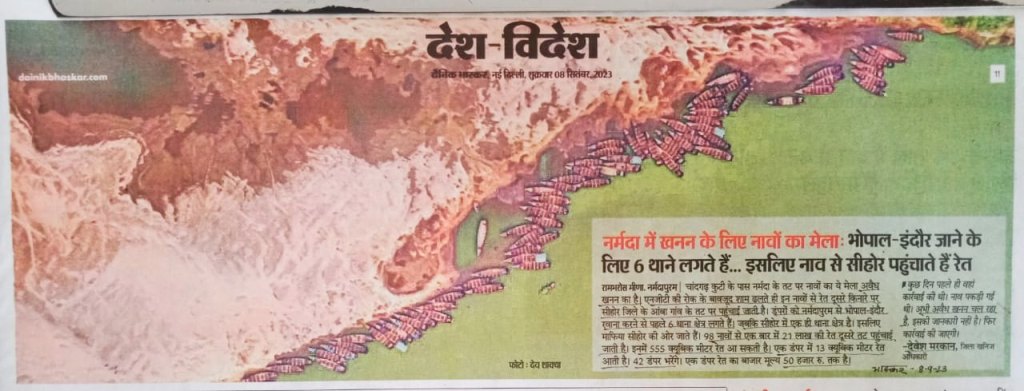
बारिश के बाद भी नर्मदा से रेत का उत्खनन और परिवहन जारी है। दिन के अलावा रात में भी गहरे पानी में मशीनों से उत्खनन किया जा रहा है। शुक्रवार-शनिवार की दरमियानी रात भी भैरूंदा के पास आंबा में मशीनों से रेत खनन किया जा रहा था तभी नर्मदा में अचानक जलस्तर बढ़ गया और अफरा-तफरी मच गई। इसी दौरान जैसे-तैसे मशीनें तो निकाल ली गई, लेकिन डंपर डूब गया। इसके ड्राइवर ने तैरकर अपनी जान बचाई। शनिवार शाम तक पानी से डंपर नहीं निकाला जा सका। वहीं इस मामले में जिला खनिज अधिकारी राजेंद्र परमार का कहना है कि जो वीडियो वायरल हो रहा है वह तीन-चार दिन पुराना है। डंपर खराब हो गया था जो तीन-चार दिन से वहीं खड़ा था। https://www.bhaskar.com/local/mp/sehore/news/sudden-rise-in-water-level-during-sand-mining-in-narmada-river-dumper-drowned-driver-saved-his-life-by-swimming-131471609.html
Andhra Pradesh A sand storm is brewing Some contours of the sand mining scam in AP, exposed through NGT Chennai Bench order recently.Political charges aside, the fact that the State Department of Mines and Geology, the State Environment Impact Assessment Authority, and the State Expert Appraisal Committee of successive governments have been pulled up by courts and the National Green Tribunal (NGT) for not ensuring due diligence in giving clearances shows that rules have been fragrantly violated.
It is imperative that the party in power and the government show zero tolerance for illegal sand mining, especially given the massive toll that it takes on the environment. Studies have noted that extracting sand at a greater rate than that at which it is naturally replenished has adverse consequences. If governments make unsubstantiated claims about the problem being solved, they will only be seen as protecting and promoting their own interests. https://www.thehindu.com/opinion/op-ed/a-sand-storm-is-brewing-in-andhra/article67270299.ece (05 Sept. 2023)
Kerala Greens upset as political parties take donations from mining firm The Income Tax expose of political parties in Kerala accepting donations from a controversial mining firm has upset the coastal communities of Kollam and Alappuzha districts of south Kerala who have been agitating over the last many years against the rampant mineral sand mining allegedly involving the same firm. Many politicians in the payee list of Cochin Minerals and Rutile Limited (CMRL), which was exposed by Income Tax department, had even taken part in the stirs against the sand mining.
The agitators are not much shocked over the fresh revelations as the cold response of the political parties towards the stir was sufficient reason to assume their nexus with the mining lobbies. They demand a judicial probe or a CBI probe into the political – mining lobby nexus.
While an indefinite stir against the mining at Thottappally region of Alappuzha district is going on for more than two years, an indefinite stir at Alappad region of neighbouring Kollam district ended after 14 months owing to the lack of response from the political leaderships. The sand mining activities were initiated at Thottappally by citing development of the spillway for flood management of nearby Kuttanad region. But loads of mineral-rich sand were allegedly being smuggled by the lobbies. https://www.deccanherald.com/india/kerala/anti-mining-agitators-of-kerala-upset-as-political-parties-take-donations-from-mining-firm-2645374 (12 Aug. 2023)
Quarry, crusher operators to go on indefinite strike from Sept 25 The Kerala Quarry and Crusher Coordination Committee has announced a state-wide indefinite strike demanding immediate revision of the new quarry policy and withdrawal of the latest order by the industries department. The strike, in which over 630 quarry and 1,200 crusher units will take part, will begin on September 25. The operators are up against the new policy that empowers mining and geology officials to levy penalties on illegal mining dating back to 1985. https://www.onmanorama.com/news/kerala/2023/09/06/quarry-crusher-operators-kerala-indefinite-strike.html (06 Sept. 2023)
WETLANDS, LAKES, WATER BODIES
Tamil Nadu Pallikarani wetland likely to lose Ramsar status The Pallikaranai marshland which has been recognised as a Ramsar site in 2022 is in the league of losing the status due to pollution in the marshland.The wetland is polluted with sewage discharge and dumping of garbage from the nearby Perungudi garbage dump yard. If the government and the concerned environment and forest department of Tamil Nadu does not act, the site may lead to Pallikaranai entering the International black list,Montreux Record.The Ramsar Convention can act on its own to blacklist Pallikaranai if the garbage dumping and sewage discharge cannot be controlled.
Notably, Pallikaranai marshland was spread across 5500 hectares in 1965 and is now at a meagre 500 hectares or rather the marshland has shrunk to his situation at present.The Perungudidumpyard has taken up a large area of the Pallikaranai marshland in addition to the encroachments by government bodies likeNational Institute of Ocean Technology and Centre for Wind Energy Technology.Several Private parks and residential complexes have also eaten up the area of the marshland.Leachate from Perungudidumpyard enters the marshland leading to its pollution.
It may be noted that IIT Madras had in 2021, set up a pilotsystem to treat the leachate before it enters the marshland however funding for the project was stopped by the government and hence the project isstalled now.Environmentalists and social activists have called for setting up STPs to treat the water that enters the marshlandfrom lakes.Meanwhile, sources in the Tamil Nadu State Wetland Authority (TNSWA) said that the department has conducted a study using drones to mark the inner land use of marshland but the study reports have not yet been made public. https://theshillongtimes.com/2023/09/09/sewage-discharge-garbage-dumping-pallikarani-wetland-likely-to-lose-ramsar-status/ (09 Sept. 2023)
Maharashtra Thane collector to decide Lotus Lake’s wetland status The conservation and preservation of the lotus lake spread over two hectares in Nerul, Navi Mumbai is now in the hands of Thane district Collector. The High Court (HC) on Wednesday (Sept. 06) directed the Thane collector to go through the revenue records to ascertain the nature of the land and its use before the area was handed over to City and Industrial Development Corporation (CIDCO). The Collector Ashok Shingare has been directed to file an affidavit within four weeks.The fresh HC directive comes in the wake of the doubts raised by the state Environment and Climate Change ministry about the authenticity of the lake getting notified by the wetlands uthority. The state department had raised it in an affidavit filed with the court in February 2023. https://www.hindustantimes.com/cities/mumbai-news/thane-collector-directed-by-high-court-to-determine-fate-of-lotus-lake-amidst-discrepancies-and-doubts-101694104760563.html (07 Sept. 2023)
Assam HC prescribes relief forDeeporBeel Hearing a petition by a trio of environment activists who are also farmers, the court prescribed 12 possible solutions to bailing DeeporBeel out of an ecological mess.One of the key suggestions by the court was the setting up of STPs at all the channels flowing from the city to the wetland to minimise the discharge of harmful chemicals or pollutants. No solid waste dumping should be allowed in and around the lake, the court said.
An organisation called the DeeporBeel Suraksha Mancha has been pushing the local authorities to shift Guwahati’s garbage dump at Boragaon on the edge of the wetland. A decision to shift the dumping site has not been implemented yet.The court observed that DeeporBeel has also been in focus because of the construction of a railway line along its northern boundary. The issue was taken up by the NGT and various directions passed are in the process of compliance, it said.
It recommended the construction of a promenade, cycling and walking tracks on the periphery of the lake for beautification, attracting sporting events, and checking the possibilities of encroachment. The court also said the State government should consider systematic and planned removal of water hyacinth from the lake for use in the handicraft industry. Among the court’s other suggestions was curtailing or regulating commercial fishing activities in the lake. https://www.thehindu.com/news/national/other-states/gauhati-high-court-prescribes-relief-for-oft-abused-assam-wetland/article67127107.ece (27 July 2023)
WATER OPTIONS
Report Man on mission to restore ponds Ramveer’s NGO Say Earth works towards pond restoration techniques and engages with local communities to raise awareness about the importance of these water bodies. On how they find these ponds, Tanwar explains, “We run social media campaigns where people share pictures of water bodies in their areas. Sometimes, district administrations of different states and Gram Pradhans of different villages contact us.” The NGO operates with funds donated by individuals and CSR funds released by different companies. The process differs for each pond, and the timelines hover around six months on average.
The first and foremost step in Ramveer’s approach is to engage the local community. He believes involving the people living around the ponds is crucial for long-term success. “This is why much of the pond rejuvenation is done by hiring a team from the same community, which not only gives them a source of income but encourages community participation,” he adds.Tanwar’s relentless dedication and innovative approach have resulted in the restoration of numerous ponds across India. https://indianexpress.com/article/et-al-express-insight/meet-indias-pond-man-who-is-restoring-water-bodies-for-a-sustainable-future-8927396/
Maharashtra Over 1,000 students to study water resources To prepare a water management plan for villages, ‘Jal ArakhadaNirman’ or the water draft creation initiative will be undertaken in the state. In this unique project, over 1,000 students will be participating in both online and offline modes to receive training. These students will later participate in a field project to assess the water resources in 160 villages across Maharashtra.
The project will be initiated by Dr DhananjayraoGadgil Centre for Sustainable Village Development, a centre of the Gokhale Institute of Politics and Economics in association with city-based NGO Sahaj Jalbodh Abhiyan. This project will be formally inaugurated on Saturday, September 9 at the new seminar hall in the GokhIe Institute. https://www.hindustantimes.com/cities/pune-news/over-1-000-students-to-study-water-resources-in-maharashtra-101694191058090.html (08 Sept. 2023)
GROUNDWATER
Study Groundwater depletion rates could triple in coming decades A new University of Michigan-led study finds that farmers in India have adapted to warming temperatures by intensifying the withdrawal of groundwater used for irrigation. If the trend continues, the rate of groundwater loss could triple by 2080, further threatening India’s food and water security. “We find that farmers are already increasing irrigation use in response to warming temperatures, an adaptation strategy that has not been accounted for in previous projections of groundwater depletion in India,” said study senior author Meha Jain, assistant professor at U-M’s School for Environment and Sustainability. “This is of concern, given that India is the world’s largest consumer of groundwater and is a critical resource for the regional and global food supply.” The lead author of the study, published in the journal “Science Advances”, is Nishan Bhattarai of the Department of Geography and Environmental Sustainability at the University of Oklahoma. https://phys.org/news/2023-09-groundwater-depletion-india-triple-decades.html (01 Sept. 2023)
Report Addressing Agri Water Crisis Already, about two thirds of Indian villages, have been adversely affected by the depletion in groundwater. the Poverty rate where the groundwater tables have fallen below 8% has risen by 9-10% directly putting pressure on small and marginal farmers. In this decade, we are failing to collectively identify the alarming depth of the issue of depletion of groundwater facing us… As the climate crisis disrupts rainfall patterns across the country, the significance of maintaining a healthy groundwater level in India becomes paramount. https://www.hindustantimes.com/ht-insight/climate-change/addressing-indias-agri-water-crisis-101693466824139.html (31 Aug. 2023)
URBAN WATER
Bengaluru 960 acres of lake encroachments yet to be cleared The Bengaluru district administration is yet to clear encroachments in 960.32 acres of lake land in Bengaluru Urban District. According to the Encroachment Removal Task Force at the Bengaluru deputy commissioner’s office, five taluks of the Bengaluru Urban district have 837 lakes, covering an area of 27,597.34 acres. Of that, 4,554.10 acres had been encroached for the last decade and the DC’s office managed to clear 3,593.17 acres. Violators, however, take advantage and approach courts to get a stay. That is the reason lake encroachments have still remained uncleared.” said a source from the DC’s office.
Former Lake Development Authority chairman Dr. UV Singh said that a designated officer looks into these aspects of lake encroachment under the Karnataka Tank Development Conservation Authority rules. There should also be an authorisation officer who checks the documents. He/she also has to hear from the aggrieved party (encroacher) before passing orders to get the encroachment cleared. However, the government has not appointed these officers and supporting staff. Encroachers take advantage of it and approach courts to drag the case, he added. “There is a constitution and relevant acts. If they are implemented, officers appointed and rules followed, the encroachers cannot go to court and drag the cases,” Dr Singh added. https://www.newindianexpress.com/cities/bengaluru/2023/sep/04/960-acres-of-lake-encroachments-yet-to-be-cleared-in-bengaluru-2611428.html (04 Sept. 2023)
The Bruhat Bangalore MahanagaraPalike (BBMP) on Monday (Sept. 04) submitted an action plan to the Karnataka High Court for the protection of lakes and stormwater drains (SWDs) from encroachment, fixing responsibility on the officers designated to protect the water bodies. The court accepted the action plan with some modifications.
The plan was placed before the division bench of Chief Justice Prasanna B Varale and Justice Krishna S Dixit, in compliance with the order passed by the court on August 1, 2023, to prepare an action plan in coordination with other stakeholders, under the aegis of Karnataka State Legal Services Authority. https://www.newindianexpress.com/states/karnataka/2023/sep/05/bbmp-submits-plan-to-karnataka-high-court-on-protecting-lakes-swds-2611693.html (05 Sept. 2023)
Chennai While the absence of piped water connections makes the OMR residents rely on private tankers, many residential areas in Chennai that have piped water connections have also had to use their services for various reasons. https://chennai.citizenmatters.in/private-water-tankers-chennai-ground-water-contamination-extraction-cmwssb-gcc-82056 (11 Sept. 2023)
Puducherry UT to get sewer cleaning machines The National SafaiKaramcharis Finance and Development Corporation (NSFKDC) has given “in-principle” approval to the Public Works Department (PWD) to extend loan for procuring mechanised sewer cleaning machines under the SwachhtaUdyami Yojana (SUY) scheme. About 46 MLD of sewage is generated in Puducherry. https://www.thehindu.com/news/cities/puducherry/puducherry-to-get-sewer-cleaning-machines/article67284172.ece (08 Sept. 2023)
Tiruchi Corporation has been selected by the Ministry of Housing and Urban Affairs (MoHUA) for a model project to detect and reduce loss in drinking water distribution using artificial intelligence (AI). Following an official communication from the MoHUA, a preliminary review meeting for the AI-based water loss detection technology project was conducted recently to assess the current drinking water supply conditions and objectives. https://www.thehindu.com/news/cities/Tiruchirapalli/ai-system-to-detect-and-reduce-drinking-water-leaks-in-tiruchi/article67288832.ece (10 Sept. 2023)
Coimbatore CC to conduct survey of underground sewage systems The Coimbatore Corporation will begin a survey of the underground sewage systems in the city — collection system and internal plumbing systems in roughly 21,000 houses linked to the sewage plants in Ukkadam, Nanjundapuram and Ondipudur — before revision of charges.
According to the Corporation, sewer and collection system works under the JNNURM are ongoing at the STPs in Ukkadam (70 MLD capacity), Ondipudur (40 MLD), and Nanjundapuram (60 MLD). Under the Smart City Mission, 16,874 connections, from manhole to compound wall, have been sanctioned and an estimate has been prepared for installing internal plumbing. https://www.thehindu.com/news/cities/Coimbatore/coimbatore-corporation-to-conduct-survey-of-underground-sewage-systems-linked-to-sewage-treatment-plants/article67288728.ece (09 Sept. 2023)
Hyderabad Lake view is no more a brownie point for people living in the 234 villa-type residences in Bowrampet as sewage mixed slush enters the area every time it rains, turning it into a horribly stinking cesspool. https://www.thehindu.com/news/cities/Hyderabad/official-action-sounds-death-knell-for-two-lakes-close-to-orr-in-mallampet/article67285559.ece (11 Sept. 2023)
Mumbai Water crisis deepens gender inequality Over half of Mumbai’s residents live in informal settlements, where access to hygienic water and improved sanitation is limited. The burden of collecting water primarily falls on women and girls. This leads to time poverty and thereby impacts educational and economic opportunities. Time spent on water and related duties restricts women from engaging in paid work, which can potentially contribute to the family’s economic status and well-being.
One of the primary reasons that urban settlements face inequitable water distribution is because they are not formally recognised. This results in informal water distribution that may increase the risk of water-borne diseases. Access to clean water heavily impacts maternal and child health as well. https://mumbai.citizenmatters.in/mumbai-water-crisis-women-sanitation-56018 (06 Sept. 2023)
Gurugram Even after the Municipal Corporation Gurugram (MCG) awarded tenders worth Rs 20 crore to private agencies to clean and repair sewers, complaints against open manholes and blocked sewers have been steadily rising. Earlier, 50 to 60 complaints used to be registered daily, but the number has now crossed 100.The situation is such that the officials of the MCG are not able to resolve even 50 per cent of the complaints. Due to the alleged negligence of the MCG officials, the city residents are facing many problems. Two-wheeler riders and auto drivers are particularly badly affected as they are always in the fear of accidents due to open manholes. https://www.tribuneindia.com/news/haryana/gurugram-residents-rue-open-manholes-sewage-overflow-542874 (10 Sept. 2023)
Delhi Govt may use cloud seeding to combat pollution CM Arvind Kejriwal on Monday (Sept. 04) said cloud seeding technology, being used in China and Dubai, could be put to use in Delhi during winter to arrest air pollution. Under this technology, artificial rain is generated by releasing certain chemicals in the atmosphere that react with the clouds. IIT Kanpur is working on cloud seeding technology “The cloud seeding technology is known to enable precipitation during low rainfall seasons and helps reduce pollution. It’s possible will now be explored in Delhi,” Kejriwal said. https://www.newindianexpress.com/cities/delhi/2023/sep/05/delhi-govt-may-use-cloud-seeding-to-precipitate-rain-to-combat-pollution-2611862.html (05 Sept. 2023)
JJM/ RURAL WATER SUPPLY
Uttar Pradesh DM who brought water shunted out Lahuria Dah, in eastern UP, is located on a hilltop in the semi-arid landscape of Mirzapur district. Residents say they have so far relied on tankers that provide 15-30 litres per person, a small “jharna” (reservoir) around 1 km away, and a well that was repaired when Mittal took the initiative after being posted in the district in September last year.On August 30, after piped water finally reached the village, Mittal (39) held a small “jalpujan”, where she opened a tap with running water for the first time. Days later, on September 1, the 2013-batch IAS officer was transferred to Basti district in eastern UP, before being put on a waitlist by the state government.
Following the “jalpujan”, local BJP leader Vipul Singh, the district’s vice-president of the party, had written a letter to CM Yogi Adityanath, complaining about Mittal. Speaking to The Indian Express, Singh said, “Lahuria village has had water issues for ages and tankers have to be deployed. It is under the ‘Har Ghar Jal Yojana’ that the PM and CM launched the scheme here and water reached the village. It is the DM’s responsibility to ensure that the scheme is implemented and water reaches villages. But the inauguration has to be done by someone from the government. This is the protocol, and culture too. The local MLA, MP, and others were not invited.Now, if such a thing is done, it is something to feel bad about.”
On Sept. 4, the pipe supplying water to the village was broken by “anti-social elements” and the supply stopped once again. Though the village head filed a police complaint, for now Lahuria Dah has no choice but to wait, once more, for water.With the pipeline now broken, the village is back to depending on tankers. A queue had formed on the highway before the tanker arrived at 12.50 pm on Thursday (Sept. 06). Mostly women and children lined up and took turns to fill buckets before making the uphill trek back to their village.Some others went to the “jharna” a kilometre away. The reservoir or pit is a natural one and rainwater is collected between rocks. The task is arduous, and some women and children go and bathe there so they don’t have to climb back up with buckets or pots of water. https://indianexpress.com/article/cities/lucknow/dm-who-brought-water-to-uttar-pradesh-village-shunted-out-put-on-waiting-list-8929657/ ; https://www.youtube.com/watch?v=KCROIMRlTbc (09 Sept. 2023)
Haryana Govt failed to provide adequate, quality water: CAG The CAG report said that assessment of quantity of water being supplied was one of the objectives of its performance audit. During audit, it was observed that elaborate data regarding operational hours of water motors, tubewells and machinery details – brake horse power, litre per minute etc. was not available in divisions. Hence, to determine actual quantity of water supplied, 58 locations were selected where the departments of public health, Haryana Shehri Vikas Pradhikaran(HSVP) and, urban local bodies agreed to install flow meters at water works. The report said that out of 12 locations of the public health department, water supply in respect of eight locations and out of 20 locations of HSVP, water supply in respect of 15 locations was below the prescribed norms. “Thus, the departments failed to provide water supply to the inhabitants according to the prescribed norms,” the CAG said.
In a beneficiary survey, the audit found that 95 of the 608 beneficiaries (16%) said that water supply was available after a gap of one or more than a day, whereas 125 of the 608 beneficiaries (21%) stated that there was shortage of water supply in summer. People met their needs through tankers either provided by the department or private, the report said. The CAG said the HSVP and urban local bodies department never conducted an audit to detect the estimated water losses by calculating water availability and further distribution to consumers. In the absence of a water audit, the estimation of water losses is not possible, which is a cause of concern, it said. https://www.hindustantimes.com/cities/chandigarh-news/haryana-government-fails-to-provide-adequate-and-quality-water-cag-report-reveals-alarming-findings-101693997283260.html (06 Sept. 2023)
Rajasthan Over ₹2Cr, 1 Kg gold seized in raids According to an official statement, the ED’s investigation was initiated based on an FIR registered by the Anti-Corruption Bureau (ACB) in Rajasthan. The case involved individuals Padamchand Jain (Proprietor: M/s. Shree ShyamTubewell Company), Mahesh Mittal (Proprietor M/s Shree Ganpati Tubewell Company), and others. They were suspected of offering bribes to public servants to gain illegal protection, secure tenders, obtain bill approvals, and cover up irregularities related to work executed in various tenders issued by the Public Health and Engineering Department (PHED). https://www.ndtv.com/india-news/jal-jeevan-mission-scam-over-rs-2-crore-1-kg-gold-seized-in-ed-raids-in-rajasthan-4360055 (05 Sept. 2023)
MONSOON 2023
IMD High Rainfall districts for 24 hrs ending at 0830 hrs on:
Sep 11, 2023: 50-100 mm: S Andaman (UT), Sibsagar (Assam), Wokha (Nagaland), Bahraich, Farrukhabad, Fatehpur, Hardoi, Kanpur, Lucknow, Sitapur (E UP), Badaun, Bijnor, Hathras, Shahjahanpur (W UP), Almora, Champawat, Nainital, Pithoragarh, Udham Singh Nagar (UKD), Guntur, Krishna, Palnadu (AP) [22]
100-150 mm: Barabanki, Kannauj (E UP), Kasganj, Rampur, Sambal (W UP) [5]
150-200 mm: N & Middle Andaman (UT), Moradabad (W UP) [2]
Sep 10, 2023:50-100 mm: Ri Bhoi (Meghalaya), Lawngtlai, Saiha (Mizoram), Bijnor, Firozabad, Hathras (W UP), Champawat, Nainital, Udham Singh Nagar (UKD), Faridabad (Haryana), E Delhi, S Delhi (Delhi), Banswara, Dholpur (E Raj), Morena, Ratlam (W MP) [16]
Sep 9, 2023:50-100 mm: Bokaro, Giridih (Jharkhand), Shahjahanpur (W UP), Burhanpur, Dewas, Indore, Khandwa, Khargone (W MP), Damgs. Valsad (Guj), Dadar & N H (UT), Daman (UT), Palghar, Raigarh, Suburban Mumbai, Thane, Nasik, Jalgaon (Mah) [18]
100-150 mm: Niwari (E MP), Ratnagiri (Mah) [2]
Sep 8, 2023:50-100 mm: Chirang, Goalpara (Assam), Giridih, Godda, Jamtara (Jharkhand), Khargone (W MP), Dangs (Guj), Palghar, Raigarh, Ratnagiri (Mah), Ernakulam, Kannur (Kerala) [12]
100-150 mm: Suburban Mumbai, Thane (Mah) [2]
Sep 7, 2023:50-100 mm: Koraput, Malkangiri (Odisha), Sahebganj (Jharkhand), Mirzapur (E UP), Anuppur, Katni (E MP), Valsad (Guj), Nandurbar (Mah), ParvathipuramManyam, Sri AluriSithramrajuDist (AP), Kozikod (Kerala) [10]
100-150 mm: D & NH (UT) [1]
150-200 mm: Mahe (Puduchery) [1]
Sep 6, 2023:50-100 mm: Mahabubabad (Tel) [1]
Sep 5, 2023:50-100 mm: N &Niddle Andaman (UT), E Medinipur (WB), Sukma (CG), Hyderabad, Kamareddy, M Malkajgiri, Medak, RajannaSircilla, Sangareddy, Siddipet, Vikarabad (Telg) [11]
Sep 4, 2023:50-100 mm: S Andaman (UT), E Medinipur, Howrah (WB), Raigarh (CG), J Bhupalpally, Jagtial, Kamareddy, Nirmal, Nizamabad, Pedapalle, RajannaSircilla (Tel), Alappuzha, Kollam (Kerala) [13]
100-150 mm: N & Middle Andaman (UT), Pattanmittia (Kerala) [2]
Source: IMD’s daily district wise rainfall page.
The seasonal rainfall deficit has widened to 11%.Of the total 36 sub-divisions, as many as 12 are currently rain-deficient. This includes large parts of the Indo-Gangetic plains from East Uttar Pradesh, Bihar, Jharkhand, West Bengal as well as West Madhya Pradesh, parts of Maharashtra and South Karnataka. The monsoon has remained largely unfavourable for the region since its onset in June. https://www.news18.com/india/after-driest-august-india-sees-subdued-monsoon-in-sept-so-far-as-rain-deficit-widens-to-11-8568945.html (08 Sept. 2023)
While we thought we got lucky in July, the El Niño was actually developing that month before it launched an attack on India in August. Strengthened, the system caused a 13-day-long monsoon break between August 6 and 17 — the longest the country has witnessed since 2009.The monsoon may have gained back some of its muscle in September, but experts fear that El Niño will invariably lead to a shortfall this month as well. https://weather.com/en-IN/india/news/news/2023-09-08-why-did-india-witness-its-hottest-and-driest-august-in-122-years (08 Sept. 2023)
In the first week of September, which marks the end of the rainy season in the region, Punjab received just 0.5 mm of rain, a significant shortfall compared to the normal 26.3 mm. Across all 23 districts, except Pathankot, where 18.2 mm of rain was recorded in the first week of September, there was almost a complete absence of rainfall.This resulted in an overall departure of 98 per cent from the normal rainfall for the first week of the month.During the initial three months of the monsoon periodPunjab recorded 352.5 mm of cumulative rain, falling short of the normal requirement of 388.4 mm by 9 per cent.
A similar situation has been observed in the neighbouring state of Haryana during the first week of September when it received only 0.8 mm rain, compared to the normal 28.5 mm – a departure of 97 per cent from the normal. Out of Haryana’s 22 districts, 18 recorded no rainfall, while four districts received minimal rain, including Mewat (12.6 mm), Yamuna Nagar (4.9 mm), Palwal (1.5 mm), and Kurukshetra (0.9 mm). https://indianexpress.com/article/cities/chandigarh/punjab-haryana-record-97-rainfall-deficit-sept-first-week-8931445/ (09 Sept. 2023)
FLOOD 2023
SANDRP Blog Aug 2023 Floods in Alaknanda-Ganga Rivers On August 14, 2023, there was flash flood in Alaknanda rivers in Uttarakhand causing sharp rise in water level at Center Water Commission (CWC) stations along AlaknandauptoDevprayag and then along Ganga in Rishikesh and Haridwar. The volume of water was so huge that it narrowly missed breaching the June 2013 peak flood level at Rishikesh and Haridwar site. This report tries to analyze hydrographs of 15 CWC flood monitoring sites on Alaknanda and Ganga rivers to assess the actual flood levels in these rivers during this flood spell in comparison with the previous peak flood levels attained on these sites. https://sandrp.in/2023/09/05/aug-2023-floods-in-alaknanda-ganga-rivers/ (05 Aug. 2023)
Jharkhand Chandil Dam radial gates opened, Displaced persons’ localities inundated The almost unabated rainfall over the past three days triggered the rise in Chandil dam’s water level leading to the opening of its 12 radial gates. Seven of the gates were lifted by one meter each while the remaining five by half meter each. It may be mentioned that the water level recorded at the Dam on Thursday (Sept. 07) night was 181.80 meters while on Friday (Sept. 08) morning the figure stood at 181.90 meters. The constant rise in water level prompted the opening of five radial gates simultaneously on Friday (Sept. 08) at 9 am.
The opening of the Chandil Dam radial gates resulted in water gushing into the settlements of displaced persons thereby compounding their woes. These displaced settlers are a worried lot, expecting flood-like situations especially with the rising water level. Their worries are not unfounded as they reside in flood-prone, low lying areas ever since their eviction from their land that had been taken over by the project.The water from the Chandil Dam has entered the villages on the dam’s banks, adversely affecting families residing in these places. The students, particularly those from Ichagarh, are facing difficulties in commuting to school. They are currently resorting to availing boat services to reach the outskirts and dry areas for reaching their institutions. Additionally, those who commute daily for work are also facing commuting hitches.
The displaced families residing in the low lying areas around the Dam’s embankments, while stating their multiple grievances, accused the authorities concerned that it was unlawful to displace them by claiming their land for the project without providing resettlement alternatives and full compensation. They urged the project administration to first compensate the affected families in full and ensure complete resettlement facilities for all before storing water in the dam. Every year, the villages in the low-lying areas were experiencing floods submerged area face flooding, exacerbating the difficulties faced by the displaced families.According to reports, due to the lack of complete compensation and resettlement facilities that were to have been provided by the project administration after displacement, many displaced families had been forced to continue residing in their old villages. https://avenuemail.in/chandil-dam-radial-gates-opened-displaced-persons-localities-inundated/ (08 Sept. 2023)
Jammu & Kashmir 2014 like flood threat persists The recent report of the National Institute of Disaster Management (NIDM) has called for taking more corrective measures to prevent 2014 flood-like disasters. The report has mentioned ‘haphazard developmental activities and infrastructure projects being implemented without sufficient consideration of environmental safety and sustainability.’ Then it has picked ‘mining operations on the flood plains of river Jhelum, construction of railway lines and poorly planned urbanization’ as threats to environmental safety and sustainability for the same reason.
The report has also pointed out that ‘the developmental activities are carried out with little regard for environmental, geological, geomorphological and ecological conditions of the region’ and that ‘the ongoing construction boom, fueled by indiscriminate mining of sand, gravel and boulders from riverbeds weakens the existing flood control infrastructure making the rivers more susceptible to flash floods.’ The report mentions that rapid urbanization in Kashmir, encroachment of water bodies and adjoining river banks and disappearance of wetlands have disrupted the natural drainage patterns. https://www.greaterkashmir.com/todays-paper/op-ed/2014-like-flood-threat-in-kashmir-persists-environmental-dangers-looming-large (06 Sept. 2023)
Uttarakhand Some images of August 2023 Alaknanda floods. https://www.outlookindia.com/national/in-pictures-situation-worsens-in-uttarakhand-as-heavy-rain-continues-to-batter-state-photos-310853?photo-1 ; https://www.deccanherald.com/india/uttarakhand/in-pics-incessant-rain-creates-flooding-in-uttarakhand-2646820 (15 Aug. 2023) Some images of June 2013 Kedarnath disaster. https://www.theatlantic.com/photo/2013/06/early-monsoon-rains-flood-northern-india/100537/ (19 June 2013)
Study People in countries with wide gaps between rich and poor are at higher risk of dying from floods than are those living in more economically equal nations, researchers have found. https://www.nature.com/articles/d41586-023-01280-x (20 April 2023)
HFL BREACH
SANDRP Blog Rivers Crossing HFLs in Aug 2023 Though, August 2023 has turned out to be hottest and driest month in a century; the first half the month has seen extreme flood events happening in North, North East and Central zones of the country causing breach in the highest flood level (HFL) at least at 17 flood monitoring sites being managed by Central Water Commission (CWC). These sites are in Ganga, Narmada and Brahmaputra basins. There are some sites where HFL has been breached in June and Jul 2023 also and peak flood level of these sites is given below the peak levels attained in Aug 2023. https://sandrp.in/2023/09/06/rivers-crossing-highest-flood-levels-in-india-in-august-2023/ (6 Sep 2023)
Uttar Pradesh River Khoh at Nagina level monitoring site in Bijnor district has once again crossed HFL 237.32 m dated 23.08.2023 and attained a new peak of 237.80 m at 06.00 hour on 11.09.2023.

URBAN FLOODS
Chennai Locals fume over shoddy stormwater drain works Residents of Chetpet, Perambur and suburbs like Red hills are complaining of shoddy stormwater drain works which may pose hazards for motorists and pedestrians. Chennai Corporation is currently constructing and desilting stormwater drains across the city. The works are expected to be completed by September 15 before the onset of the monsoon. However, locals allege that in some areas desilting has not been done properly and roads dug up have been left open. https://www.newindianexpress.com/cities/chennai/2023/sep/05/locals-fume-over-shoddy-stormwater-drain-works-2611812.html (05 Sept. 2023)
CLOUD BURSTS
Himachal Pradesh The surge in hydropower projects has also resulted in the increasing use of technology known as “run of the river” dams. This means that projects built on the rivers of Himachal have diverted the flow of water through tunnels burrowed into the mountains, and the debris disposed along the riverbeds. In the event of cloudbursts or heavy rains like this year, water carries this debris along with it resulting in disastrous consequences as is the case now. Besides, the methods used in certain constructions involve vertical cutting of mountains instead of terraced cutting resulting in adverse consequences to the environment during the rains. https://www.hindustantimes.com/opinion/the-urgent-need-for-sustainable-mountain-development-in-himachal-101693905459770.html (05 Sept. 2023)
DISASTERS
Report Ask 13 hill states to file plan on ‘carrying capacity’: Centre to SC The Centre on Monday (Sept. 04) urged the Supreme Court to direct all 13 Himalayan states/UTs to spell out steps taken and an action plan, in a time-bound manner, for initiating a plan regarding the carrying capacity assessment as per the guidelines prepared by GB Pant National Institute of Himalayan Environment.The institute has been involved in conducting similar “studies for Mussoorie, Manali and McLeodganj,” arising out of cases pending in the NGT, it pointed out.
The affidavit has been filed in response to an oral direction by a Bench led by CJI DY Chandrachud which had on August 21 asked the Centre to suggest a way forward for the top court to pass directions with regard to the carrying capacity of Himalayan states and towns.
The guidelines had been circulated to all 13 Himalayan states on January 30, 2020, and a reminder was also sent to them on May 19, 2023 “to request the states that if such study has not been undertaken then the states may kindly submit the action plan so that carrying capacity (assessment) can be carried out as early as possible,” the affidavit said. https://www.tribuneindia.com/news/india/ask-13-himalayan-states-to-file-plan-on-carrying-capacity-centre-urges-supreme-court-541313 (05 Sept. 2023)
While the Supreme Court is now asking for carrying capacity studies, such studies for several cities and towns of Himachal Pradesh were conducted in 2017-18 following NGT directions and all recommendations ignored. If SC ignores these, will its efforts have credibility? https://www.tribuneindia.com/news/himachal/hp-govt-ignored-red-flags-studies-on-carrying-capacity-just-gathered-dust-541626 (06 Sept. 2023)
More committees and reports will not change the reality that infrastructure development in the hills cannot be executed as in the plains. Either States must bear the higher cost that comes from building more sustainably and minimising the risk to denizens, or designate regions as no-go zones. The latter has for decades provided fertile ground for political opportunism. As unequivocal scientific evidence concludes, the option to kick the proverbial can down the road no longer exists. https://www.thehindu.com/opinion/editorial/time-to-decide-on-the-himalayan-region-its-carrying-capacity/article67273796.ece (06 Sept. 2023)
While the state government has estimated the losses caused to be over Rs 10,000 crore, the caved-in and damaged roads and bridges alone account for nearly one-third of the total figure. The number of roads swept away, leaving the affected areas cut off, is staggering. Sample this: The four-lane Chandigarh-Manali highway — the lifeline of Kullu, Manali and Lahaul&Spiti — is in a pathetic condition, reduced to a village link road at some places. Around 160 roads still remain closed across the state. It will be some time before the repair work is finished. Hopefully, the mistakes will not be repeated and care will be taken to build stable and ecologically sustainable structures. https://www.tribuneindia.com/news/editorials/uphill-road-to-recovery-541339 (05 Sept. 2023)
Uttarakhand ‘Policy of State Is To Commercialise Hills’: HC Observing that the policy of state in practice is only to “commercialise hills”, The High Court directed the state to formulate the Tourism Development Plan (TDP), and to seek approval of the MoEF within the next four weeks. The bench of Chief Justice Vipin Sanghi and Justice Rakesh Thapliyal said, “ Our experience has shown, and we are pained and dismayed to notice, that the policy of the State, in practice, appears to be only to commercialise the hills, and to generate more and more revenues, by permitting commercial activities. There is very little emphasis on actual preservation and protection of the environment.”
The State appears to be completely insensitized and blind to the enormous environmental degradation that the entire State – and not just the Doon Valley is suffering. No wonder, the State is urging the MoEFCC to repeal the Doon Valley Notification in toto, added the Court. These observations came in response to the PIL filed by Environment lawyer Akash Vashishtha through advocate Rakshit Joshi against State inaction for preparing the TDP and and Master Plan for the Doon Valley comprising Dehradun, Rishikesh, Mussoorie, Haridwar.
The petition seeks the issuance of directions to the respondents to take immediate steps for preparing a TDP, a Master Plan, and a Land Use Plan for the entire Doon Valley as mandated under the Doon Valley Notification, 1989. In the previous hearing, the Court had directed the State to file “a better affidavit” bringing on record, all the documents, and the policies claimed to have been formulated from time to time after the issuance of the 1989 Notification by the Ministry of Environment and Forest.
While listing the matter for October 10, the Court said, “We direct the Union of India to file an affidavit, specifically disclosing its position with regard to the implementation of the Doon Valley Notification, as amended on 06.01.2020, and the fate of the request made by the State Government for repeal of the Doon Valley Notification, as amended in 2020.” The bench also directed Centre to disclose the status with regard to consideration of the Integrated Master Plan submitted by the State in April. https://www.livelaw.in/high-court/uttarakhand-high-court/uttarakhand-high-court-directs-formulate-tourism-development-plan-uttrakhand-government-237382 (09 Sept. 2023)
LANDSLIDES
Himachal Pradesh NH closed as massive hill comes crashing down The strategic Chandigarh-Kinnaur National Highway-5 has been blocked due to a massive landslide near Nigulsari in Kinnaur district since early morning on Friday (Sept. 8).According to information, a massive hill has come crashing down onto the road, leaving no trail of the national highway. Due to this, the movement of vehicles from ReckongPeo to Rampur and Shimla and vice-versa has completely stopped and long queues of vehicles have formed on either side of the landslide point. https://thenewzradar.com/strategic-chandigarh-kinnaur-national-highway-closed-as-massive-hill-comes-crashing-down-at-nigulsari-in-himachal/ (08 Sept. 2023)
DROUGHT 2023
-Madhya Pradesh & Maharashtra have been the worst impacted with a rain deficit of 18% and 14% respectively, leading farmers across the two states to raze their crops. https://www.ndtv.com/video/news/news/drought-in-madhya-pradesh-maharashtra-farmers-destroy-own-crops-722185 (04 Sept. 2023)
Karnataka:- As 62 taluks were found to have met the criteria laid down by the Union government for declaring a region as drought-hit, the state government is embarking on a second ‘ground-truthing’ exercise for taluks where the situation has deteriorated since the first one (carried out in August), Revenue Minister Krishna Byre Gowda told the media on Monday, September 4. A ‘ground-truthing’ exercise is the process of gathering verifiable data. Karnataka has been witnessing a water crisis due to inadequate rainfall this year. From June 1 to September 4, Karnataka received 526 mm of rainfall compared to the normal 711 mm, resulting in a 26% rainfall deficit. https://www.thenewsminute.com/article/karnataka-62-taluks-qualify-be-declared-drought-hit-govt-orders-second-survey-181931 (05 Sept. 2023)
Twenty-two reservoirs in Karnataka have only 64.70 per cent of their total water storage capacity, with the “critical situation” prompting authorities to call for judicious use of water and not take up “water-guzzling crops” for cultivation. According to officials at these reservoirs, there is sufficient water to provide drinking water till the next monsoon and, in some areas, for a single crop in the kharif season. Several farmers in the Cauvery and Krishna basins informed DH that they have been asked not to plan for rabi cultivation.
Karnataka is divided into two major river basins: Krishna and Cauvery. Officials say they can manage the water situation (provide water for drinking and cultivation) in the Krishna basin for now. However, the situation is very grim in the Cauvery delta. The 16 reservoirs in the Krishna basin have nearly 293.86 tmcft of water against their total capacity of 379.51 tmcft, whereas the four major reservoirs in the Cauvery basin have only 50.4 tmcft of their total 73.76 tmcft capacity. https://www.deccanherald.com/india/karnataka/alarm-bells-ring-as-karnataka-reservoirs-brim-with-woes-2673429 (05 Sept. 2023)
River Cauvery which would otherwise overflow for a minimum of three times in the rainy season, has worn a dry look this year. Except for a single case of flooding in the month of July, the river has not been in spate so far. The water-level in the river has depleted significantly. The flow at Triveni Sangama in Bhagamandala, which is a confluence of Cauvery, Kannike and Sujyothi rivers too, has decreased. The Kshetra is facing an acute shortage of water during the rainy season for the first time. Water is prevented by placing an obstruction at Triveni Sangama, for the bathing of devotees. The sources of water which were rejuvenated during July, have also dried up. Cracks have formed on paddy fields, due to lack of water, thus resulting in stagnation of agricultural activities. https://www.deccanherald.com/india/karnataka/water-leveldepletesintriveni-sangamain-kodagu-2677453 (07 Sept. 2023)
Maharashtra Crops dying, dams drying Thirteen districts received less than 50 per cent rain compared to the normal average and 15 districts received less than 70 per cent rain.Farmers are facing a crisis as the lack of rainfall causes their crops to dry. Further, the dams in the state might not have enough water to last the year if the scanty rainfall continues.According to the agriculture department, the dams in Maharashtra only have 50 per cent water storage compared to last year’s amount. The amount is not enough and could have a negative impact on the Rabi and other cash crops. https://www.indiatoday.in/india/story/crops-dying-dams-drying-in-several-districts-of-maharashtra-due-to-scanty-rain-2432604-2023-09-07 (07 Sept. 2023)
The revival of monsoon after a month-long break in August has helped the Vidarbha, Konkan regions in Maharashtra as well as the state’s western and northern parts. However, the drought-prone Marathwada continues to reel under a prolonged dry spell which is evident from the low water storage in the 964 dams in this region. https://indianexpress.com/article/cities/mumbai/monsoon-revival-september-marathwada-dam-levels-low-8932002/ (09 Sept. 2023)
Mumbai is facing a severe water crisis as the region has experienced a 18.4% deficit of rain in the last three months, impacting water reserves. 1955 villages and hamlets are facing a shortage of drinking water, with the government deploying 406 tankers to supply potable water. The water storage in dams is also low, with only 64.75% of capacity compared to 84.84% last year. The rain deficit has also affected crops in one third of the state, leading to farmers losing a significant portion of their produce. https://www.hindustantimes.com/cities/others/mumbai-faces-severe-water-crisis-as-monsoon-rainfall-deficit-reaches-18-4-dam-levels-drop-to-20-101693942255567.html (06 Sept. 2023)
ENVIRONMENT GOVERNANCE
Opinion New amendment to Forest Act will open floodgates to ecological disaster Kodoth Prabhakaran Nair The current amendment completely overhauls the 1980 Act for the first time, not only by merely changing its name but also by opening up swathes of India’s forestland for very different, non-forest activities.
There are many concerns in the amended Act, but the most important is the amendment under the garb of clarifying what constitutes a forest, which limits the scope of the Act. This is being done in multiple ways. The current amendment will benefit the corporates more than the country. Forests are already being diverted by state governments for mining. This Act will make such actions legally valid. In addition to restricting the definition of a forest, the amendment also permits development of various activities in existing forests. For example, forest clearances are no more required for security-related infrastructure projects that lie within 100 kilometres of international borders. https://www.deccanherald.com/opinion/new-amendment-to-forest-act-will-open-floodgates-to-ecological-disaster-2680843 (11 Sept. 2023)
Karnataka SPCB puffs and pants with only 60% capacity The State Pollution Control Board (SPCB) is functioning with 60% vacancies, directly affecting the monitoring of compliance with the environmental laws. The multifold growth of industries and realty has added to the problems. Data accessed by DH shows that 431 (59.61%) of the total 723 sanctioned posts have been lying vacant even as the responsibilities have increased. Among the 142 scientific staff sanctioned, a whopping 104 (72%) are lying vacant. As a result, the board lacks in-house expertise on many issues affecting the public. The 49% vacancy in technical staff and 37% vacancy in non-technical ones has only added to the problem.
“Efforts have been made to bring outsourced employees to fill the gaps in the existing system. However, we can’t pin responsibility on temporary staff. A thorough performance review of the Board will show the pathetic state of affairs,” an official said. “In fact, the NGT has warned that it will impose a penalty for failing to comply with its orders. Along with recruitment, a thorough overhaul is required to set the board on the right path,” the official added. The Board has also found itself in a spot over allegations of corruption and persons appointed its chairman having conflict of interest. https://www.deccanherald.com/india/karnataka/green-board-puffs-and-pants-with-only-60-capacity-2671591 (04 Sept. 2023)
SOUTH ASIA
Pakistan Waters without borders The imminence of a flood caused alarm bells to ring in Pakistan. The administration, as well as the people, were alerted along the river course. The flood wreaked havoc in Kasur, Okara, Pakpattan, Lodhran, Bahawalnagar, Vehari and Bahawalpur. Sutlej enters Pakistan at the Kasur-Ganda Singh Border, and after re-entering India flows into Pakistan near Ferozpur’sHussainiwala border. The dried-up river now received a massive flow of 278,000 cusecs, the largest flood in 35 years. The spate of flood occurred after mid-August, displaced over 300,000 people from 548 villages, and submerged over 150,000 acres of cropland. It created a trail of destruction with its downstream movement in several districts of the Punjab.
– The Met Office has predicted another wet spell in the upper catchment of rivers in the first week of September. Contingent upon the amount of water to be discharged by India, it can bring another spate of flow in Sutlej. https://www.thenews.com.pk/tns/detail/1105837-waters-without-borders (03 Sept. 2023)
ASIA
MEKONGVietnam Disappearing delta -According to the Mekong River Commission, alluvium flowing down the Mekong declined from 160 million tons in 1992 to 47.4 million tons in 2020. It forecast the volume to drop to 4.5 million tons in 2040. The main reason is the construction of hydropower dams on the river, starting with the Manwan Dam China built in 1995.
-The Mekong River is set to have more than 400 hydropower dams, or one every 10 km, and it is predicted that they are going to hold back all the alluvium, sand and gravel, leaving the Vietnamese delta high and dry. The number of erosion spots in the delta has increased from less than 100 a decade ago to around 600 now. https://e.vnexpress.net/news/news/environment/vietnam-s-mekong-delta-world-s-youngest-river-basin-might-be-first-one-gone-4648237.html(04 Sept. 2023)
Article The essential role of river deltas for food production But today, deltas around the world are sinking and shrinking because we are tinkering with the key ingredients and processes that, when mixed together, form and maintain deltas. These ingredients include volumes of water and supplies of sediment; the processes include the connectivity between river, floodplain and delta that allow those ingredients to mix, interact, and drive the transformation of muddy water into solid land.

In a three-part series, I’ll examine deltas at the crossroads. In this first post, I’ll describe the processes that create deltas and the long relationship between deltas and food production, from Ancient Egypt to today. The second post will review current risks to deltas and why so many deltas around the world are disappearing. The third post will focus on the Mekong Delta, one of the best examples of the agricultural bounty described in the first post and also one of the most urgent examples of the threats described in the second. (Jeff Opperman) https://www.forbes.com/sites/jeffopperman/2023/09/05/muddy-waters-the-essential-role-of-river-deltas-for-food-production/ (05 Sept. 2023)
SANDRP
Also see: DRP 04 Sept. 2023 & DRP 28 Aug. 2023
Follow us on: www.facebook.com/sandrp.in; https://twitter.com/Indian_Rivers

 SANDRP