(GREEN SIGNALS: Ecology, Growth, and Democracy in India; Jairam Ramesh; Oxford University Press; 605 pages; Rs 850)
Jairam Ramesh (JR for short) is arguably, India’s best ever Environment Minister. His book Green Signals is essentially providing records and some explanations of his own actions during his 25 month tenure at Paryavaran Bhawan, the Ministry of Environment and Forests. JR in general laments the industry mindset on environment and says the NDA government’s attitude is dangerous. Grow now, pay later mindset won’t work in India. He says in India sustainability & ecological issues are not luxury but necessity & he tries to explain what they mean in the context of economic growth. Continue reading “Book Review: GREEN SIGNALS: In search of a Middle Ground”→
Expert Appraisal Committee on River Valley Projects,
Ministry of Environment and Forests,
New Delhi
Respected Chairman and Members,
We have just seen the minutes of the 86th meeting (uploaded on Sept 14, 2015, but clearance letters in some cases have already been issued even before the EAC minutes are made public or the minutes are finalised at the next EAC meeting) of the Expert Appraisal Committee on River Valley Committee, held on Aug 24-25, 2015.
The minutes make a disturbing reading. The EAC seems to be bending every ecological norm, facts and even legal stipulations to push ahead with every project that the government wants them to clear. There seems to be no application of mind from the EAC on the proposals. The minutes are not even internally consistent. It is putting forward facts in misleading fashion to give a wrong picture. Continue reading “Why the Decisions and minutes of the 86th meeting of EAC on River Valley Projects need to be reviewed”→
A three member committee set up by the Union Ministry of Water Resources, River Development and Ganga Rejuvenation (MoWR for short) has submitted a report in March 2015, which makes welcome recommendation on “Assessment of Environment Flows”. These recommendations on Environmental Flows (E-Flows) need to be implemented immediately for better health of our rivers. The committee members include Dr Vinod Tare of Indian Institute of Technology Consortium (IITC), senior officials of Union Ministry of Environment, Forests and Climate Change (MoEF for short, it was represented by Dr Shashi Shekhar, Special Secretary in MoEF) and MoWR (represented by Dr Amarjeet Singh, Additional Secretary, MoWR). Sushri Uma Bharti, Union Water Resources Minister[1] and even the recent meeting of National Ganga River Basin Authority (NGBRA) on March 26, 2015[2], headed by the Prime Minister referred to this committee. Continue reading “MoWR report on “Assessment of E-Flows” is welcome, needs urgent implementation”→
As Prime Minister Narendra Modi inaugurated the RE-Invest 2015, India’s first Renewable Energy Global Investors’ Meet and Expo in New Delhi on February 15, 2015, full-page advertisements in the National Capital declared the target of adding 5000 MW of small hydro capacity by 2022, in addition to other renewable energy targets. A part of this renewed focus on small hydro, a subset of India’s new push for Renewable Energy, involves a new Mission for Small Hydro Projects. Even as it has some welcome features, the new Mission will not help if the government continues to ignore significant social and environmental impacts of small hydro projects. Continue reading “Mission on Small Hydro Projects: Ignoring social and environmental impacts will not help”→
The National Green Tribunal (NGT) in a landmark judgment pronounced on 13 January 2015[1], has set an ambitious road map for a rejuvenated river Yamuna by 2017. Naming it as “Maily se Nirmal Yamuna rejuvenation project, 2017” the green court in the judgment spread over almost 100 pages has detailed steps necessary to achieve what all previous efforts have miserably failed. Continue reading “NGT Orders MAILY SE NIRMAL YAMUNA – WILL THIS LEAD TO A REJUVENATED YAMUNA?”→
Above: 440 MW Vishnuprayag HEP post 2013 disaster in Uttarakhand. The project, its operation and location added significantly to disaster in the downstream. Photo: Matu JanSangathan
Post by- Ritwick Dutta, Lawyers Initiative For Forest and Environment, Debi Goenka, Conservation Action Trust, Manoj Mishra, Yamuna Jiye Abhiyan & Himanshu Thakkar , South Asian Network for Dams, Rivers & People
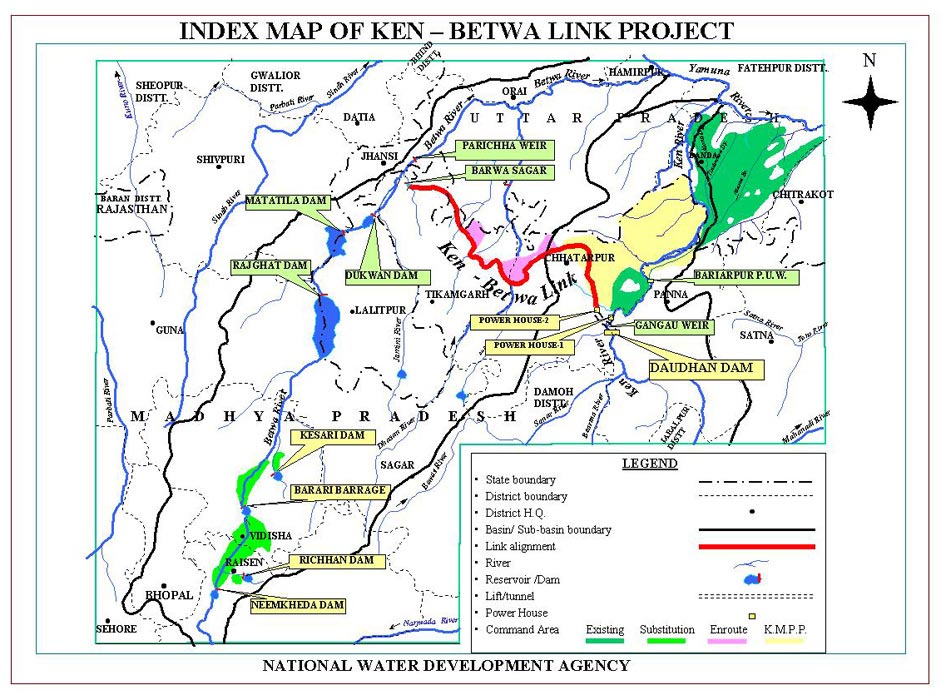
The public hearings required for the Ken Betwa River linking project (KBRLP) are to be held on Dec 23 and 27, 2014 at Silon in Chhattarpur and Hinouta in Panna districts of Madhya Pradesh. However, these public hearings violate fundamental legal norms in letter and spirit and should be cancelled and not held till these violations are rectified.
Firstly, the EIA (Environment Impact Assessment) notification of September 2006 clearly states that project EIA and EMP (Environment Management Plan) should be put up on the website of the Pollution Control Board a month before the actual public hearing. However, a perusal of the MPPCB website (http://www.mppcb.nic.in/) shows that the full EIA and EMP are still not uploaded on the website. When I talked with the concerned officers of the MPPCB, they confirmed that full EIA-EMP reports have NOT been uploaded on the MPPCB website.
Secondly, even the executive summary of EIA-EMP Report on the website is put up in such an obscure fashion that it is not possible for any common person to locate it. So I called up the phone number given on the MPPCB website: 0755-2464428. I was then told that I should call 0755 2466735 to talk to Mr Kuswaha about this. When I called Mr Kuswaha, he directed me to call Mr Manoj Kumar (09300770803). Mr. Manoj Kumar told me at 5.15 pm on Thursday, Dec 18 that he was already home and that I should call him at 12 noon next day. He however, confessed that even the executive summaries were not there about 15 days ago! When I called Mr Manoj Kumar next day and succeeded in connecting only after a few attempts, he told me that I need to first click on “Public Hearing” tab (Under EIA notification). On clicking this, one goes to a page with a table displaying various lists entitled List 1, List II, List III and List IV etc. Then one needs to click List IV. On clicking that one will see a list of projects from 469 to 601 and in that you go to project no 594 which is the Ken Betwa Project. There is no mention of the date of Public Hearing here.
I also called up Dr R K Jain (09425452150) at MPPCB regional office in Sagar, under whose jurisdiction Chhattarpur and Panna come to ask about the availability of the full EIA and EMP in soft copies. He said they are available at designated places, but about not being available on MPPCB website and available executive summaries not being properly displayed on MPPCB websites, he said that he is unable to do anything as that is happening from Bhopal.
When I told him that it is impossible for anyone visiting the MPPCB site to find this project and that the current public hearings need to be displayed more prominently, he hung up the phone, saying he has no time to answer such questions! In any case non-display of the public hearing date and executive summary in Hindi and English in easily searchable form is another violation of the EIA notification.
Thirdly, when we go through the Executive summaries in English and Hindi, we see that both are incomplete in many fundamental ways. The Hindi executive summary[1] has completely wrong translations. I could find nine gross translation errors in just first 16 paragraphs. The Hindi translation has not bothered to translation words like monsoon, MCM, PH, LBC, CCA, FRL, MWL, K-B, tunnel in first 16 paras, nor given their full forms. This makes the Hindi translation completely incomplete, wrong and unacceptable.
Fourthly, even the English (& Hindi) version of Executive summary on MPPCB website[2] is incomplete. It does not have a project layout map, sections like options assessment and downstream impacts.
Fifthly, the EIA claims in very second paragraph: “The scope of EIA studies inter-alia does not include water balance studies.” This is a wrong claim since water balance study of the Ken Betwa links establishes the hydrological viability of the project and by not going into the water balance study, the EIA has failed to establish hydrological viability of the project. SANDRP analysis in 2005[3] of the NWDA feasibility study of Ken Betwa Proposal[4] had established that the hydrological balance study in the Feasibility of the Ken Betwa Link Project is flawed and an exercise in manipulation to show that Ken has surplus water and Betwa is deficit. As the collector of Panna district noted in 2005 itself, if the 19633 sq km catchment of the Ken river upstream of the proposed Daudhan dam (comprising areas of eight districts: Panna, Chhatarpur, Sagar, Damoh, Satna, Narsinghpur, Katni, and Raisen) were to use the local water options optimally, then there will not be any surplus seen in Ken river at the Daudhan dam site and by going ahead with the Ken Betwa Link without exhausting the water use potential of Ken catchment, which is predominantly a tribal area, the government is planning to keep this area permanently backward. But the EIA of Ken Betwa link does not even go into this issue, making the whole exercise incomplete.
Sixthly, the Ken Betwa Link project is a joint project between Uttar Pradesh (UP) and Madhya Pradesh (MP), about half of the benefits and downstream impacts in Ken and Betwa basins are to be faced by Uttar Pradesh, but the public hearings are not being conducted in UP at all, the proposed public hearing is only in MP! Even within MP, the link canals will pass through and thus affect people in Tikamgarh district, but the public hearing is not being held in Tikamgarh district either.
Seventhly, the project had applied for the legally required Terms of Reference Clearance (TORC) and the same was discussed in the meeting of Expert Appraisal Committee (EAC) on River Valley Projects of Union Ministry of Environment, Forests & Climate Change (MoEF&CC) on Dec 20, 2010. However the public hearing is being held more than four years after EAC recommended the TORC and that is way beyond the normal term of two years for which TORC is valid and even for extended term of TORC of four years. The public hearing being conducted without valid TORC can clearly not be considered valid under EIA notification and hence there is no legal validity of this public hearing.
Eighthly, the EIA done by the Agriculture Finance Corporation of India was already completed when the project applied for TORC! I know this for a fact since copies of their (most shoddy) EIA were made available to the members of the Expert Committee on Inter Linking of Rivers set up by the Union Ministry of Water Resources in Nov 2009 itself. I having been a member of the committee had critiqued the shoddy EIA in April 2010 and this was also discussed in one of the meetings where the AFC EIA consultants were called and had no answer to the questions. The same base line data that is now more than five years old is being used in the EIA being used for this public hearing! This is again in complete violation of the EIA norms.
Ninthly, in a strange development, MoEF&CC issued TORC for the project on Sept 15, 2014, following a letter from National Water Development Agency dated 18.06.2014. This letter is clearly issued in violation of the EIA notification, since as per the EIA notification, the ministry could have either issued the TORC within 60 days of Dec 20, 2010 meeting of the EAC or the TORC would be deemed to have been given on 61st day or Feb 19, 2011. However, issuing the letter almost four years after the EAC meeting and that too without mentioning the deemed clearance is clearly in violation of the EIA notification.
The TORC letter on MoEF&CC website is also incomplete as it does not mention the Terms of Reference at all! They are supposedly in the Annexure 1 mentioned in the TORC, but the letter on MoEF&CC site does not include Annexure 1. When I asked Dr B B Barman, Director of MoEF&CC and who has signed the TORC letter, he said that the project has been given standard TORs for any River Valley Project. But Dr Barman forgot that the MoEF&CC was giving the TORC for the first ever interlinking of rivers project and the TOR for this unprecedented project CANNOT be same as any other River Valley Project. The TORC letter is invalid also from this aspect.
The MoEF&CC letter of Sept 15, 2014 is also without mandate for another reason. The letter says “Based on the recommendations of the EAC, the Ministry of Environment & Forests hereby accords clearance for pre-construction activities at the proposed site as per the provisions of the Environmental Impact Assessment Notification, 2006 and its subsequent amendment, 2009”. However, MoEF&CC seems to have forgotten here that the Daudhan dam site and most of the reservoir is inside the Panna Tiger reserve. Perusal of the 45th EAC meeting held on Dec 20-21, 2010 shows that EAC did not recommend preconstruction activity and the EIA division of the MoEF&CC that issued the Sept 15 2014 has no authority to allow pre construction activities inside the protected areas like Panna Tiger Reserve. Even the NBWL (National Board of Wild Life) Standing Committee meeting of Sept 14, 2006 allowed only survey and investigation and NOT preconstruction activity and in any case such activities inside protected areas cannot be allowed without Supreme Court clearance. It is thus clear that Sept 15, 2014 letter of MoEF&CC for Ken Betwa link is also without authority.
There is a third reason why the MoEF&CC letter of Sept 15, 2014 is legally invalid: the letter giving Terms of Reference clearance did not include the conditions EAC stipulated when it recommended the TORC in the EAC meeting of Dec 20, 2010. One of the conditions was that a downstream study will be done by Central Inland Fisheries Research Institute. This becomes particularly important since there is a Ken Ghariyal Sanctuary[5] which will be affected, as also the Raneh falls, both are also tourist attractions.
However, the EIA of the Ken Betwa links has no downstream impact assessment, no mention of Ken Ghariyal Sanctuary or Raneh falls. The EIA also does not contain the CIFRI study that EAC had asked for. This is yet another reason why this incomplete and inadequate EIA cannot be basis for the public hearing from Ken Betwa Project.
This article is not a critique of the EIA of the Ken Betwa Link, I hope to write a separate article for that. Here we only see how illegal is the Public hearing for Ken Betwa link to be held during Dec 23 and 27, 2014 in Chhatarput and Panna districts. The Ken Betwa link project itself is unviable and unjustified and should not be taken up at all. But that will need another article.
It seems the current Union Government under Mr Narendra Modi and Water Resources Ministry under Sushri Uma Bharti are trying to push ahead with their River Link agenda, putting aside even legal stipulations. They also do not seem to be bothered that the Ken Betwa link will only have adverse impact on Ganga and this will also affect the Ganga Rejuvenation that they say is their priority. The EIA does not say a word on this count.
NWDA Index Map of Ken Betwa link proposal
We hope the proposed public hearing will be cancelled. In any case, any clearance given to the project based on such a public hearing will remain open to challenge.
The 126 MW Larji Hydropower project near Aut on the mainstem of the Beas is run by the Himachal Pradesh State Electricity Board (HPSEB)[2]. The dam is constructed a little downstream of the confluence of the two main tributaries upstream, the Sainj and the Tirthan, at the narrowest part of a spectacular gorge, towering with limestone cliffs. The impounded waters of this dam have, since its construction in 2006, drowned the access road to the entire upper Kullu valley including Manali and the hundreds of villages upstream, including access to the entire Lahul valley and the region of Ladakh over the high passes from this end. The HPSEB then constructed a 3 km long tunnel to enable passage of traffic, and many people have warned of the hazardous nature of the tunnel. The 220 odd gods that descend from different valleys, on the backs of people to the lower Kullu valley every year in autumn however, refuse to use this tunnel. This is what compelled the HPSEB to build and maintain this tunnel, and during autumn to winter, to keep the water-storage in the dam low to enable the passage of gods, who have been traveling this route for over three and a half centuries. It is remark-worthy though, that this dam constructed as recently as 2006, seems to be heavily silted-up already and the dark shadows of sediment-shoals are visible just below the waters of the reservoir[3].
Being among the most recently completed, the Larji dam is the only dam on the Beas that has a fish-ladder, so it was of particular interest to us. Seeing no guard at the security booth, we walk in to the HPSEB dam operating office, and ask to speak to an officer about the fish ladder. To our complete surprise, we are spoken to and even taken on a tour of the ladder by a foreman who has worked on the dam for many years.
Having seen an elaborate fish ladder on the Kuri Chhu river in Bhutan of doubtful effectiveness[4], we could not help but look at this one with hope and excitement. Located at around 1,000 meters altitude, this dam was clearly in the way of a host of migratory species of fish. If this ladder design was effective, then surely the ‘barrier’ problem to seasonal migration for breeding and dispersal would have been addressed. Here though, is what we saw and heard.
For one, the flow through the fish-pass seems too small to create an ‘attraction flow’ for fish. But even more obviously, the downstream entrance of the fish ladder is a steep cascade over a couple of meters of broken masonry and rock, that would clearly be un-negotiable by any fish that does not jump that high[5].
Downstream entrance of Larji fish ladder: The 2 m high jump that fish require to enter the ladder can be seen here (all photos by the author)
2. The outlet from the dam reservoir into the fish ladder is blocked off by a metal grill-mesh that is narrow enough to trap flotsam like Bisleri water-bottles. The mesh seemed too fine to let Mahseer of breeding-age pass through, either upstream or downstream.
3. The fish ladder was in a serious state of disrepair. To our questions about whether the ladder worked or not, the foreman says honestly that it does not. We see the reasons for this when we walk down the ̴100 meter length of the fish-pass channel.
Fishladder can be seen in serious state of disrepair and blocked by broken concrete parts can be seen here
4. The Larji fish ladder seemed to be a hash of different designs of fish passes. There were four different design elements in this one fish-pass. It had a slotted-weir fishway design, a low gradient Denil fishway, a steep-pass Denil fishway and a plain concrete culvert on a grade design. Most of these slotted weirs were clogged with fallen rocks and debris from the slope above, and in places, the pools in them were over-flowing the weir in a vertical fall almost 2 meters high.
Steep-pass Denil fishway part of the fishladder can be seen here, water is flowing too rapidly here for any fish to be able to go upstream. The water picks up momentum down an extremely steep slope with the baffles at 45 degrees to the flow, not offset to slow the water, but concentrating the force of the water in mid-stream flow. The slope seemed to be at almost 40 degrees angle, and the water was turbulent in the extreme in this section. A workable Denilway slope, even for the strongest of swimmers among fish, is not designed to exceed a slope of 20% at most. This was close to a 100% slope
5. The oblique baffles on a Denil fishway are supposed to be placed in a manner that provides staggered partial-obstructions that slow the water down at variable velocities to make it passable for fish. However, here we saw that the water picks up momentum down an extremely steep slope with the baffles at 45 degrees to the flow, not offset to slow the water, but concentrating the force of the water in mid-stream flow. The slope seemed to be at almost 40 degrees angle, and the water was turbulent in the extreme in this section. A workable Denilway slope, even for the strongest of swimmers among fish, is not designed to exceed a slope of 20% at most. This was close to a 100% slope[6].
This part of fish ladder is less steep Denil
The last part of the fishway was a plain concrete culvert on a grade channel, essentially a sloping channel, where even the concrete sides of the channel had toppled over into the river-bed, and the final drop was over a two meter fall into the downstream flow. I asked the foreman whether he knew whether fish managed to make it over this extreme gauntlet. He said that they did not, but that he often saw fish gather and concentrate at the bottom of the dam under the sluice gates, and make futile leaps in an attempt to get over the dam. Clearly, the Larji dam fish ladder is just an unlovely trinket, a deceptive ornament.
Watch a 41 seconds video showing how fast the water is moving through the Larji Dam fishladder at: http://youtu.be/grVaxXPdeyY, Video is by the author.
It seemed to me that the dam builders and operators, the HPSEB in this case, both at the design and the executive levels, were not serious about constructing a fish-pass that would work, and neither were they serious about this at the operation and maintenance aspects. Whether they were serious at all even at the conceptual level, to put in place a mitigation measure that actually helped migratory fish bye-pass the barrier of the dam, or was this part of the design merely to obtain environmental clearance, can only be conjectured about. That hydropower projects can devise deceitful strategies for obtaining environmental clearance is one thing, but what does this tell us about the Union Ministry of Environment and Forests, the Expert Appraisal Committee on River Valley Projects appointed by MoEF, the regional office of the MoEF, the state Fisheries Department and also the state pollution Control Board, who are all variously part of the approval processes for hydropower projects, when they get their environmental clearances based on such ‘mitigation measures’?
Larji Dam – about 100 m long fishladder channel can be seen on the right side
[2] The 126 MW Larji project is also infamous for being the costliest hydro-power project per unit electricity generated so far in India. Finally built at a cost of R.s 10.27 billion, which was twice the estimated cost, the Vigilance department unearthed major financial misappropriation by HPSEB officials.
[5] Other than loaches, those tiny finger sized fish that can even climb (squiggle technique) up high waterfalls, provided there is something like a water-slide at the margins of the fall. They however, are not migratory fish.
[6] CIFRI recommends that the speed of flow of water in a fish-pass should not exceed 2 meters per second. Please see ‘Status of fish migration and fish passes with special reference to India’. MK Das and MA Hassan. CIFRI 2008.
SANDRP has just published a new report: “Headwater Extinctions- Hydropower projects in the Himalayan reaches of the Ganga and the Beas: A closer look at impacts on fish and river ecosystems”, authored by Emmanuel Theophilus. The report[i] was released at the India Rivers Week held during Nov 24-27, 2014.
Front Cover of the report HEADWATER EXTINCTIONS
Headwater Extinctions deals with impacts of hydropower projects in Beas basin in Himachal Pradesh and Alaknanda-Bhagirathi basins in Uttarakhand on river ecosystem and its components, mainly fish. While the harrowing impacts of hydropower projects on local livelihoods and social systems are being realized gradually, we are yet unclear about the extent of impacts of these so-called green projects have on fish and aquatic biodiversity.
Environmental Impact Assessments of large hydropower projects (> 25 MW as per EIA Notification 2006[2]) are supposed to assess ecological impacts of such projects, but we are yet to come across any comprehensive effort in this direction from EIA reports that we have assessed so far.
The Expert Appraisal Committee (EAC) of Union Ministry of Environment, Forests and Climate Change (MoEF & CC) which is entrusted with appraising these projects and their EIAs has paid very little attention to this issue. Since over a decade, the EAC has had expert members from Wildlife Institute of India (WII) and Central Inland Fisheries Research Institute (CIFRI). Both these institutes are supposed to have expertise on fish and aquatic biodiversity. But sadly, their presence has not helped fill the serious lacunae in appraisal and EIAs of the hydropower projects.
SANDRP had been trying to highlight the impact of hydropower on fish and the long standing problems in the so-called mitigation measures being recommended by the EAC. We thought that it may be useful to bring out a first-hand report bring out ground realities of what is happening to our rivers. Emmanuel Theophilus, based in the Dhauliganga Valley and who is an avid mountaineer, storyteller, ecologist and our ally was commissioned by SANDRP to study the impacts of hydropower on fish and ecosystems, review the EIAs as well as mitigation measures recommended by EAC as a part of Environment Management Plans of hydropower projects. We are very glad to publish the report as a first of the hopefully many steps to be taken to understand and address this important issue.
Headwater Extinctions has been written in an eminently readable style that Theo is known for, as could be seen from the earlier blogs[3] he wrote for us! The report has a section on ‘Travelogue’ which records Theo’s travels and thoughts as he visits Bhagirathi and Alaknanda sub basins in Uttarakhand and Beas basin in Himachal Pradesh. The report also brings illuminating photos from these trips. The fact that the travels happened within months of the Uttarakhand disaster of June 2013 could be seen in his photos and travel reports. It further substantives the role hydropower projects played in increasing the proportions of the disaster.
Travelogue is followed by discussions in two parts: Discussions on the impact of hydropower projects on fish and aquatic habitats along the two sub-basins and the role of EIAs, EMPs, Fisheries Plan and the government approval process. The findings of this report are valid for all Himalayan states & rivers.
Back Cover of the report HEADWATER EXTINCTIONS
Headwater Extinctions ends with some striking insights. Sample this: “We are in the midst of river extinctions in the Himalaya, but are surrounded by a tragic drama of double-speak and equivocation. And a horde of jostling brokers. Ranging from reputed universities, government departments, research institutions, everyday bureaucrats, and of course, politicians and contractors from within ‘the community’[4] along the developers and regulators. They not only write the script of this drama, they even play all the part”.
The inside covers of the report have detailed maps of the two basins with locations of hydropower projects, with annexures containing lists of hydropower projects in Upper Ganga and Beas basins and also list of fish found in Upper Ganga basin.
Theo has completed this report on a stringent timeline and budget, which meant that all the proposed and implemented fisheries management plans could not be assessed. We hope Headwater Extinctions provides sufficient material and compelling reasons to overhaul the way impacts of hydropower projects on fisheries and aquatic biodiversity are treated by EIAs, EMPs and government committees. We would also urge agencies like WII and CIFRI to do justice to their work inside EAC and beyond. That they are not doing that is apparent.
For EAC and MoEF&CC, we certainly would like them to ensure proper and full impact assessment of projects on aquatic biodiversity in the EIAs. The EAC also needs to stop approving completely ineffective fish hatcheries. They could initiate a credible independent study of the costs, benefits and performance of the fisheries development plans they have been approving in recent projects. It does not only smell fishy, but more like a scam! Here is a relevant quote from the report: “I can’t help see a few things here, as perhaps you do? Bluntly put, I see slush funds being dangled to a whole range of possible collaborators. The kindest term I can find for them is ‘brokers’.”
We look forward to your comments and suggestions on all aspects of Headwater Extinctions. If you would like a hard copy, please write to us.
[2] We have been saying this for long and this report helps substantiate our contention that the assumption that projects below 25 MW are benign and do not need EIA-EMP or environmental monitoring and public consultations is wrong.