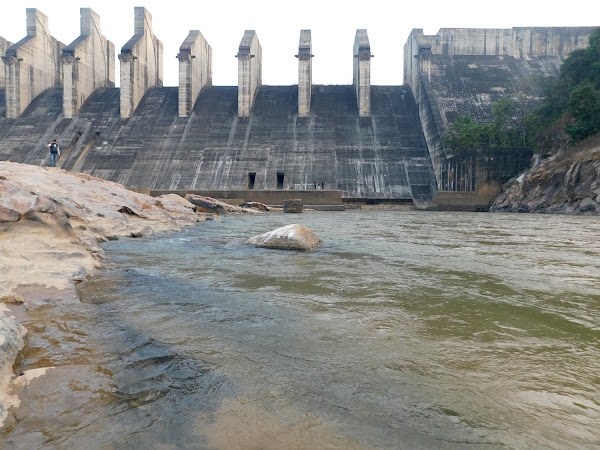
Dams · DRP News Bulletin

DRP NB 2 March 2020: Will Mumbai rise up against unwanted, destructive Gargai Dam?

Mumbai Metropolitan Region (MMR), with annual rainfall in access of 2000 mm, does not do much to harvest the rain. It does not protect its local water bodies. It does not recharge groundwater to the extent it can easily do. It does not reduce its transmission and distribution losses. It does not treat its sewage to recycle and thus reduce freshwater demand. It does no demand side management. And yet it keeps demanding more water, and for that building of more dams and thus pushing more destruction. Without any credible options assessment. It has no water policy or water vision for smart water management.

The proposed Gargain Dam that will lead to destruction of over four lakh trees in 720 ha forest mostly in Tansa Wildlife Sanctuary, is a good example of how Mumbai is fuelling such dam building and destruction. The Rs 3105 Cr project will have many other impacts, including displacement of tribals and destruction of livelihoods for thousands others. As SANDRP report showed six years ago, (https://sandrp.in/2013/12/20/dams-in-tribal-areas-of-western-ghats-for-water-supply-to-mumbai-why-are-they-unjustified/, https://sandrp.in/2013/12/18/multiple-dams-for-mumbai-region/) and as our letter to the then Maharashtra Chief Minister emphasised in 2015 (https://sandrp.in/2015/01/13/water-smart-mumbai-open-letter-to-cm-devendra-fadnavis/), MMR region does not need any of these dams.

It was good to see MID DAY news paper report and EDIT highlighting some of these issues. Will the people of Mumbai Rise up, to stop this destructive dam, being pushed in their names, the way they stood up to save the far fewer Aarey Milk Colony trees?

Continue reading “DRP NB 2 March 2020: Will Mumbai rise up against unwanted, destructive Gargai Dam?”

Dams · DRP News Bulletin

DRP NB 24 Feb 2020: Urban Rivers Need Urgent attention: Hiding won’t help

There are large number of stories this week from all over India highlighting the crisis that Urban Rivers in India face. Urban rivers, like the Urban Water sector, exist in complete policy vacuum. There is no policy to guide the Urban water governance. Cosmetic efforts being done when President Donald Trump of USA visits India on Feb 24-25, 2020 at Yamuna (in view of his visit to Agra) or Sabarmati (visit to Sabarmati Ashram in Ahmedabad) won’t really help. The crisis not only affects the rivers, but the health, livelihoods and lives of millions and millions of city dwellers too, in addition to the downstream river users. Our Water Resources establishment has no clue, as is evident from their calling the Dravyawati river channelization in Jaipur as an example of river rejuvenation and suggesting such rivers should be given to corporates to rejuvenate in similar ways! It’s doubtful if the new National Water Policy now being formulated will help, unless it dares to suggest radical changes.

Continue reading “DRP NB 24 Feb 2020: Urban Rivers Need Urgent attention: Hiding won’t help”

Dams · DRP News Bulletin

DRP NB 17 February 2020: Case of “disappearance” of 28849 wetlands in Maharashtra

The Maharashtra government submitted an affidavit in High Court that the state has 15865 wetlands, down from 44714 in 2010. How did 28849 wetlands disappear from the very definition of wetland? While all of these wetlands may not have disappeared from ground, their disappearance from govt papers as wetlands means that they are now open to all kinds of abuse and encroachments. It along with other wetlands related stories here shows how little the governments are concerned about the wetlands.

Continue reading “DRP NB 17 February 2020: Case of “disappearance” of 28849 wetlands in Maharashtra”

Dams · DRP News Bulletin

DRP NB 10 February 2020: Examples of Better Water Management Options

This week’s news bulletin has a number of examples of Better Water Management Options that India has, let us focus on the example from state. These examples come from Kerala (achieving a barren land free constituency & KERI study showing the need for desilting of Malampuzha reservoir), Tamil Nadu (lessons from implementation of System of Rice Intensification in large parts of cultivable land and also declaring the Cauvery Delta as protected agriculture zones that will help stop the problematic hydrocarbon exploration project as also, hopefully other destructive projects), Odisha (govt filing affidavit in the Supreme Court asking it to stop work on Polavaram Dam of Andhra Pradesh is hugely belated but right move), Telangana (rejecting the Godavari Cauvery River Linking proposal of NWDA for its shoddy water balance), Uttarakhand (Dehradun DM accepting in affidavit to High Court that 270 acres of river bed land is encroached in the district), Kashmir (drive to remove encroachments of Khushal Sar lake, even if selective, hopefully it will be a beginning), NGT (cancelling the township coming up in lake eco sensitive area in Bengaluru) among others. We have listed only the welcome initiatives from the govt. Even if these initiatives are taken to logical conclusion and also emulated by other states, it can go a long way in moving towards better water management.

Continue reading “DRP NB 10 February 2020: Examples of Better Water Management Options”

Agriculture · Climate Change · Economy · Water

Water-Environment Sectors disappointment in Budget 2020

The Water & Environment sector, including the Agriculture, Environment & Forests, Urban Development, Ganga and & Other Rivers, Water Resources Ministry, Rural Employment Program and Rural Drinking Water Mission, seems to have seen disappointment from the allocations in Union Budget 2020-21 presented by the Union Finance Minister Smt Nirmala Seetharaman to the Parliament on Feb 1, 2020, most independent observers have concluded. The Budget has proposed some welcome measures in solar power and rural infrastructure sector. But on the whole, considering the situation in Water Sector & Climate Change impacts already upon us, and considering the various statements from the government, these sectors have not received the priority they deserve. Continue reading “Water-Environment Sectors disappointment in Budget 2020”

DRP News Bulletin

DRP NB 03 Feb. 2020: Some welcome news on Pinjal and other dams

A number of welcome developments around dams appear in this week’s DRP News Bulletin from SANDRP. The prominent is the Brihanmumbai Municipal Corporation declaring that it may not need Pinjal Dam, which SANDRP had said in its report way back in 2012-13 and the then BMC commissioner had agreed to in an interview to NDTV. This should also lead to cancellation of the Damanganga Pinjal River Link proposal. The Maharashtra govt decision to review the need for Human dam is also welcome. The Kerala State Information Commissioner’s decision to direct that the Dam Break Analysis should be in public domain is also a useful precedent that all states and CWC need to follow immediately and also amend the proposed Dam Safety Act to include a provision that all Dam Safety related information, including meeting minutes, agenda, decisions, status reports etc will be in public domain.

Continue reading “DRP NB 03 Feb. 2020: Some welcome news on Pinjal and other dams”

Agriculture · Water

ECONOMIC SURVEY 2020: WHERE IS THE GROUND REALITY?

One of the key objective of the Economic Survey is to provide an accurate account of ground realities on various aspects affecting the Economy of the country and also what has the govt been doing to address the issues that such an account throws up. From a look at the key issues that SANDRP focuses on, it seems that the Economic Survey for 2019-20 that was released on January 31, 2020 does not even attempt to provide an account of the ground realities. Continue reading “ECONOMIC SURVEY 2020: WHERE IS THE GROUND REALITY?”

DRP News Bulletin

DRP NB 27 Jan. 2020: Beginning of Corporatisation of Rivers?

The statement of Shri U P Singh, secretary, Union Water Resources Ministry, that “industry (private or public sector) could adopt small rivers” seems to suggest that the government is moving towards handing over the rivers to Corporate bodies. The example Mr Singh gave of Drayavati River of Jaipur is even more disturbing since that river has been completely destroyed by the project implemented by the Tatas. It should not surprise though, considering that no less than the Prime Minister has been giving the example of canalisation of Sabarmati as an example of rejuvenation of the river. If this is what the government means by rejuvenation, that even Ganga and Yamuna are facing major risks of destruction. Its not less shocking that while Nitish Kumar, the Chief Minister of Bihar has questioned Modi government’s attempt to achieve Nirmal Ganga without attempting Aviral Ganga, his own government is basically following the same Sabarmati model on Ganga in Patna. If this is the example of “rejuvenation” of river according to the top most bureaucrat of of the government in charge of Water resources, nothing can save India’s rivers except a people’s movement against such moves wherever such destruction of rivers is attempted.

Continue reading “DRP NB 27 Jan. 2020: Beginning of Corporatisation of Rivers?”

Bangladesh · Rivers

Bangladesh DRP Overview 2019

HISTORIC COURT JUDGMENT: TREAT RIVES AS LIVING ENTITY

In a historic judgment, the High Court (HC) of Bangladesh has declared Rivers as living entities and the NRPC (National River Protection Commission) as the legal guardian of all rivers. The HC said that river encroachers cannot run in any elections or get bank loans. The HC delivered the judgment in response to a petition (WP No. 13989/2016) by Human Rights and Peace for Bangladesh. The writ petition was filed on Nov. 7, 2016. Continue reading “Bangladesh DRP Overview 2019”

DRP News Bulletin

DRP News Bulletin 20 Jan 2020: India urgently needs national urban water policy

A large number of stories this week remind us that India urgently needs national urban water policy.

The water footprint of urban areas is gradually on the rise. The cities have several problems with management including destruction of water sources, groundwater exploitation, poor performance in treating and recycling the polluted water, pollution and encroachment on water bodies etc. To fulfil their growing demands new dams, barrages and check dams are being planned, proposed and built on the rivers in faraway places, which is in turn displacing and depriving the local people of equitable water share.

Even before onset of summer, the Army in Sagar district have started patrolling Chitora dam to prevent water thefts (denying farmers to take dam water for irrigation).

Continue reading “DRP News Bulletin 20 Jan 2020: India urgently needs national urban water policy”