Kerala · Rivers

Ithikkara River in Kerala: Tampering with Nature – a recipe for negative NPV

Guest Blog by Jacob Chandy Varghese (jacob.c.varghese@gmail.com)

An Old Story: I read an account about Netherlands in the journal, Annals of Botany (2010)[i] . This story dates from the 11th century. Many centuries ago, the coastal plain of the Netherlands consisted of a dynamic landscape of meandering river channels, extensive floodplains and large complexes of fens and bogs. Sediment deposition and peat formation kept pace with the gradually rising sea level, so that the level of the land remained well above the water for most of the time. Since 11th century, inhabitants of the low-countries started to modify the hydrology of their surroundings to create protection from flooding for their dwellings and agricultural fields. They built dikes and started to manipulate the water level. Continue reading “Ithikkara River in Kerala: Tampering with Nature – a recipe for negative NPV”

DRP News Bulletin

DRP: 14 Jan 2019: Will the campaign of 17-yr old Alappad Girl Wake us up to the perils of unsustainable sand mining?

The coastline between Chavara and Alappad in Kollam district of Kerala, has a decades-long story of people’s battle for survival against mining companies. This stretch in Kerala is where the extensive mineral beach sand mining has been happening since the 1960s. The abandoned buildings are the remains of people’s failed agitations and indefinite strikes. One by one the villages in the area are vanishing from the map of Kerala.

Continue reading “DRP: 14 Jan 2019: Will the campaign of 17-yr old Alappad Girl Wake us up to the perils of unsustainable sand mining?”
DRP News Bulletin

DRP: 24 Dec 2018: MoEF & WII’s Compromises for Hydro Interests

In a shocking revelation, Jay Mazoomaar in this Indian Express report exposes how Wildlife Institute of India not only accepted consultancies from hydropower companies, but also diluted the mandate for the studies for given by statutory bodies like NGT, NBWL and FAC, but also provided compromised reports catering to the interests of the hydropower developers, thus trying to clear the way for the two controversial mega hydropower projects, one each in Dibang and Lohit river basins in Arunachal Pradesh. https://indianexpress.com/article/north-east-india/arunachal-pradesh/wildlife-institute-all-for-hydel-projects-in-arunachal-pradeshs-tiger-zone-5499656/

In case of the 3097 MW Etalin project being developed by Jindal and Arunachal Pradesh govt, the IE report says: “the WII was asked by the Ministry (MoEF) to assess the feasibility of the plan that requires 1,166 hectares of forestland in the valley. The Ministry’s move followed a recommendation from its Forest Advisory Committee (FAC) to conduct an environment impact assessment study. Instead, the WII initiated a study to find how the project’s impact on wildlife can be minimised”. Thus instead of doing the mandated scientific impact assessment, the WII initiated a study to minimise the project’s impact.

Continue reading “DRP: 24 Dec 2018: MoEF & WII’s Compromises for Hydro Interests”
DRP News Bulletin

DRP: 3 Dec. 2018: Ken Betwa Link-Push to Dilute Forest Clearance Conditions

Ken Betwa river interlinking project is back to drawing board with Union water resources ministry approaching the ministry of environment and forest to relax conditions imposed as part of forest clearance accorded in May 2017 for diversion of forest in the Panna Tiger reserve (PTR).

Forest Advisory Committee (FAC) while according Stage-I clearance to the project had recommended that the project proponent and state govt should consider equivalent non-forest area (6,017 ha) adjoining to PTR from the revenue and private land and add to the PTR as a part of core/corridor (for tiger movement) with other areas or satellite core area. According to water resources ministry, they are unable to find land adjoining to PTR.

Will the forest department buckle under pressure to dilute the forest clearance conditions?  http://www.newindianexpress.com/thesundaystandard/2018/nov/25/first-river-linking-project-coming-undone-1902890.html  (25 Nov. 2018)

Continue reading “DRP: 3 Dec. 2018: Ken Betwa Link-Push to Dilute Forest Clearance Conditions”
Dams · Fish, Fisheries, Fisherfolk

World Fisheries Day 2018: India’s Increasing Fish Kill Incidents

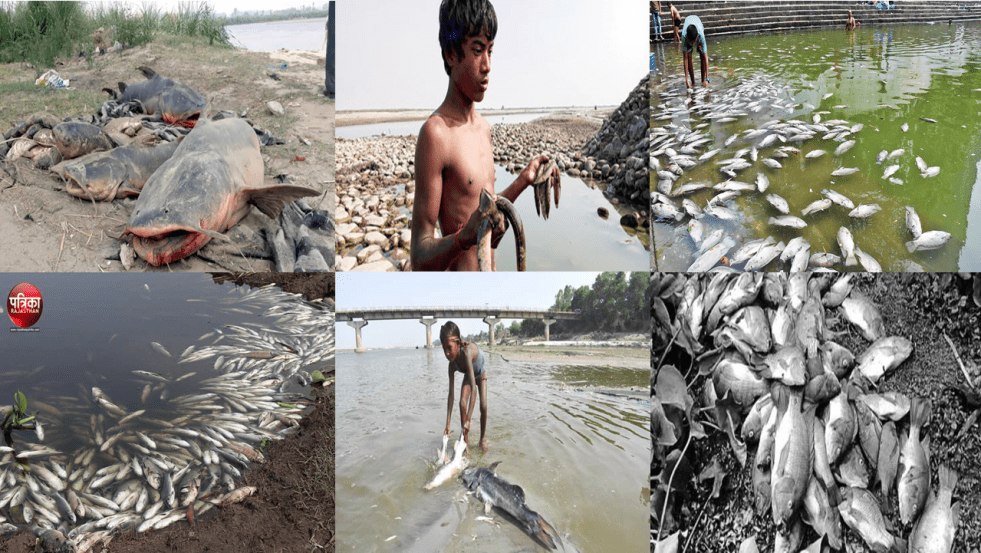
21 November is celebrated as world fisheries day across the world. Apart from crucial source of food and livelihood to lakhs of fisherfolks in India, fish diversity determines the health of the water body including lakes, ponds and rivers. However with growing threats and pollution mass fish mortality has been taking place in various rivers and lakes in the country every year. On World Fisheries Day 2018 SANDRP has put together known mass fish kill incidents that took place this past year to highlight the gravity of threat so that corrective measures can be taken by respective Governments and others concerned.

Continue reading “World Fisheries Day 2018: India’s Increasing Fish Kill Incidents”

Dams · DRP News Bulletin

DRP: 15 Oct 2018: Reuters Corroborates that Dams Played Major Role in Kerala Floods

International news agency, after independent research, have corroborated what SANDRP has been saying: Mismanagement of dams played big role in worsening Kerala floods.

-“The release could have started earlier so that by Aug. 9 there would have been left-over capacities in the reservoirs to store the water,” said Biswajit Mukhopadhyay, director of water resources at U.S-based engineering firm IEA, who analysed some of the publicly available data at the request of Reuters.

– Still, dozens of flood victims interviewed by Reuters, who live in villages dotting the banks of Kerala’s biggest river, the ‎244 km Periyar, say they faced no floods despite torrential rain in late July and early August. All of them said waters only rose overnight on Aug. 15. That was when more intense rainfall forced KSEB to rapidly ramp-up releases of water from Idukki and Idamalayar reservoirs, which feed into the Periyar.

– Kerala’s revenue secretary and head of disaster management, P.H. Kurien, told Reuters he has twice written to KSEB requesting EAPs and has yet to receive them. KSEB’s Pillai said EAPs and dam operation manuals were still being prepared. CWC said it was working with Kerala’s government to speed this up. The Kerala Chief Minister’s office did not respond to requests for comment. https://widerimage.reuters.com/story/did-dams-make-indias-once-in-century-floods-worse  (11 Oct. 2018)

And this fantastic infographic: https://fingfx.thomsonreuters.com/gfx/rngs/INDIA-FLOOD/010080MF18N/index.html  (11 Oct. 2018)

Continue reading “DRP: 15 Oct 2018: Reuters Corroborates that Dams Played Major Role in Kerala Floods”
Dams · DRP News Bulletin

DRP: 1 Oct 2018: Hungry Water Effect due to Dams & Unsustainable Sand Mining Worsened Kerala Floods

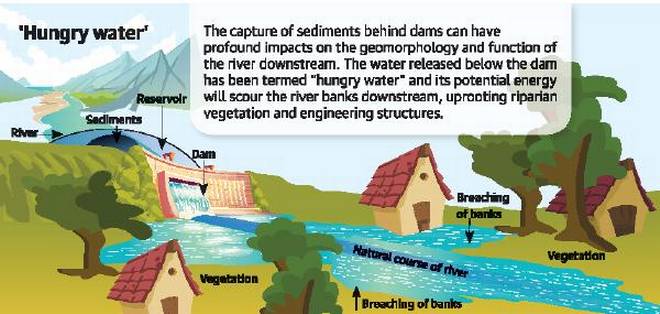
Dams and reservoirs make rivers sediment-starved and menacing manifold downstream. While heavy rainfall is also a key factor behind the floods, hungry water had a more pronounced effect, says D. Padmalal, Scientist and Head, Hydrological process group, National Centre for Earth Science Studies.

– “When the sediment transport is interrupted, the potential energy of the hungry water released from dams will scour the river banks downstream, uprooting trees or riparian vegetation and damaging bridges and other engineering structures,” explains Dr. Padmalal. Overloaded with silt and clay from the eroding river banks, the highly turbid and viscous water clogs drainage channels. Subsequent discharge of water from the dam will lead to inundation and waterlogging of large areas.

– Hungry water can also develop in high gradient river channels devoid of adequate quantity of sand and gravel, especially during periods of high rainfall. “Years of uncontrolled sand mining have left most of the rivers in Kerala depleted or exhausted of sand and gravel. This creates a situation similar to the release of hungry water from dams,” notes Dr. Padmalal. When the river channel has adequate supply of sand and gravel, the potential energy of the water is used to transport the mixture. The water does not scour the banks or turn muddy.

Continue reading “DRP: 1 Oct 2018: Hungry Water Effect due to Dams & Unsustainable Sand Mining Worsened Kerala Floods”
Dams · DRP News Bulletin

DRP: 6 August 2018 (2018 is Deficient Monsoon for Lakhs of Farmers)

(Feature Image: IMD Sub-Division wise Weekly Rainfall Map 26 July – 1 Aug. 2018)

Amid news of monsoon being normal, farmers in several parts in the country have started facing irrigation water problems affecting sowing of Kharif crops. Apart from, insufficient rainfall, mismanagement of water resources is turning the situation grim for them.  

As per reports, water levels in Bhakra and Pong dams in Himachal has plunged to lowest in decades. As a result dam authority has issued advisory to lakhs of farmers in Haryana, Punjab and Rajasthan to use water judiciously. Some official also said that the beneficiary states lacks efficient water management practices which is making the situation tough for them.

The Sri Ram Sagar Project in Telangana has no irrigation water. As per state water minister, a Rs. 1100 crore work was going on to renovate the dam. Meanwhile farmers of about 24 villages have started protest demanding irrigation water form SRSP for their standing crops. Given the tense situation, the State Govt has deployed heavy police forces to control farmers agitation.

At the same time, farmers in North Gujarat farmers have lost 40% of sown crops particularly in Ahmedabad, Morbi and Surendranagar. Non availability of Narmada waters have added to the problems. It is worth to mention that mismanagement of water during past four months in Narmada dam by the authority, has worsened the plight of farmers. Meanwhile, there are reports of furious Surendranagar farmers themselves opening the dam gates going against authority.

Similarly, lack of rainfall in Beed district which is part of Marathwada in Maharashtra has affected the rural population badly. In fact, the rainfall situation in a fourth of India, including Bihar and Uttar Pradesh, was in stark contrast to the rest of the country. Overall, the southwest monsoon in 2018 was only 2 % below normal by July, 27.

The southwest monsoon in Bihar was almost 40 % below normal till July 27 and the state was set to be formally declared ‘drought-hit’. It is worth to mention that the monsoon scenario seems less than reassuring, based on Skymet latest forecast and reading between the lines of IMD Aug. 3, press release.

Continue reading “DRP: 6 August 2018 (2018 is Deficient Monsoon for Lakhs of Farmers)”
Dams · DRP News Bulletin

DRP: 23 July 2018: Landmark CAG Reports on DAM FLOODS & Ineffective; Costly Mega Irrigation Projects

In its latest report, the Comptroller and Auditor General (CAG) has questioned implementation of sixteen National Irrigation Projects. Before this, the CAG has held mismanagement in dams’ operation responsible for Chennai floods in 2015. Both these reports are available on its website now.

The CAG report on National Irrigation Projects, tabled in Parliament on July 20, has revealed that sixteen major multi-purpose water projects, taken up on an expeditious basis about a decade ago, are nowhere near completion, with no work being undertaken in as many as 11 projects despite the incumbent govt’s much-wanted focus on improving irrigation facilities in the country.

The report also mentioned that out of the 16 projects, undertaken under the Accelerated Irrigation Benefits Programme (AIBP) in Feb 2008, only five projects with estimated irrigation potential of 25.10 lakh hectares were under implementation and even these projects suffer from 8 to 99 per cent shortfall in physical progress, the CAG said. The remaining 11 projects with estimated irrigation potential of 10.48 lakh hectares are yet to commence and are at different stages of approval.

Continue reading “DRP: 23 July 2018: Landmark CAG Reports on DAM FLOODS & Ineffective; Costly Mega Irrigation Projects”
Dams · DRP News Bulletin

DRP: 11 June 2018 (Groundwater Pollution: The Hidden Killer Menace Lurking All Over)

Aquifers in 16 States in the country are contaminated by uranium, whose presence in drinking water has been linked to chronic kidney disease by several studies, a recent study has shown. More importantly, uranium doesn’t figure on the list of contaminants monitored under the Bureau of Indian Standards’ drinking water specifications. The main source of this contamination is natural, but groundwater depletion by extensive withdrawal of water for irrigation and nitrite pollution due to the excessive use of nitrogenous fertilisers may be exacerbating the problem, said the study.

– The study was carried out by a team of researchers led by Avner Vengosh, professor of geochemistry and water quality at the Nicholas School of the Environment at Duke University in the US. The team, which also included experts from the Central Ground Water Board, the Rajasthan government’s Ground Water Department and Gujarat Water Resources Development Corporation, analysed groundwater samples from 226 locations in Rajasthan and 98 in Gujarat.

Continue reading “DRP: 11 June 2018 (Groundwater Pollution: The Hidden Killer Menace Lurking All Over)”