Dams

Landmark Supreme Court Order on Govt Failure in Tackling Drought

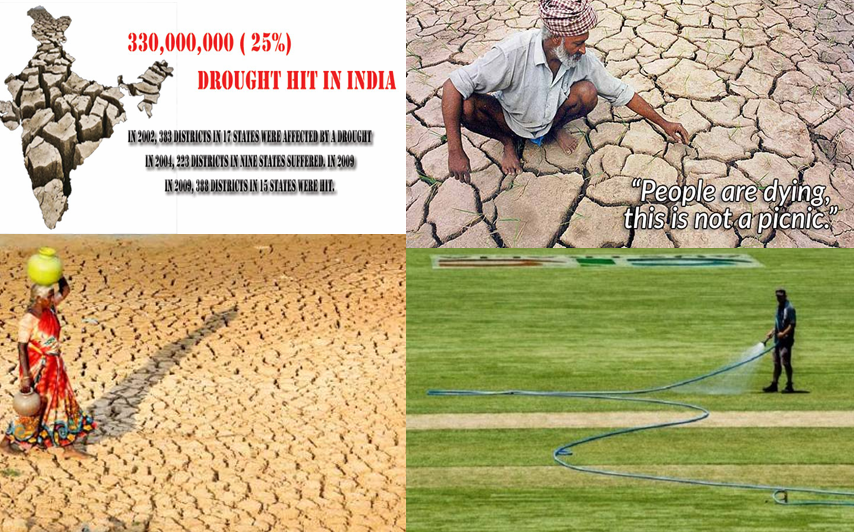
A PIL under Article 32 was filed by the NGO, Swaraj Abhiyan praying for directions for declaration of drought and relief in affected areas. The apex court came out with a 3 part judgment earlier this month – the first one dealt with the issue of drought and the latter judgments took up the poor implementation of the National Food Security Act, 200513 (NFSA) and the Mahatma Gandhi National Rural Employment Guarantee Act, 2005 (NREGA). These directions largely signify the failure of the governance in tackling drought and suggest actions to be taken hence, we need to be thankful to the petitioners and apex court for this. We also hope the apex court continues to monitor the implementation of the directions. 

Continue reading “Landmark Supreme Court Order on Govt Failure in Tackling Drought”

Dams · DRP News Bulletin

DRP: 23 May 2016 (WHY LARGE HYDRO IS NOT JUSTIFIED)

Chenab river runs its course amid spate of threats Chenab river’s money-spinner hydropower fate appears to run parallel to that of Sohni-Mahiwal – the legendary lovers who drowned into the river because their love was unacceptable. The govt as usual has shut its eyes to the needs of the river and its catchment area. There are multiple factors hidden below its surface. One is melting of glaciers sooner than anticipated. If glaciers lose their ice cover quicker, the Chenab would swell up abruptly before hitting a cruel, dried-up phase in as much deathly suddenness. There are several hydro projects coming up on the river which don’t have the approval of the Geological Survey of India. Once all the identified hydroelectric projects are installed, it will have a negative impact on the river. It may not get even a kilometre free space for running the course. At that point of time, it will not be a river, but a small stream. Meanwhile scientists have warned of large scale earthquake in J&KThe situation in Arunachal Pradesh is also grim. And yet the Parliamentary committee recommends further sops for Hydr. Misguided recommendations, to put is most charitably. There should be no question of subsidies to destructive Hydropower projects.  Continue reading “DRP: 23 May 2016 (WHY LARGE HYDRO IS NOT JUSTIFIED)”

Dams

Odisha Drought Profile-2016 

Odisha has many rivers, vast forest cover and it receives above average rainfall annually. But, greed for minerals beneath the land and destruction wreaked by industries hungry to exploit the resources of the state have slowly choked the natural environment of the state. Most farm holdings are small or marginal dependent on the rains for irrigation. The deficit rains in 2015-16 pushed the state over the edge. The state is facing extensive crop loss and severe water shortage. Even after exploiting its resources to the hilt, the people of the state have not been provided with piped water supply. In many ways, the drought in Odisha is man made.

Continue reading “Odisha Drought Profile-2016 “

Dams

Andhra Pradesh Drought 2016

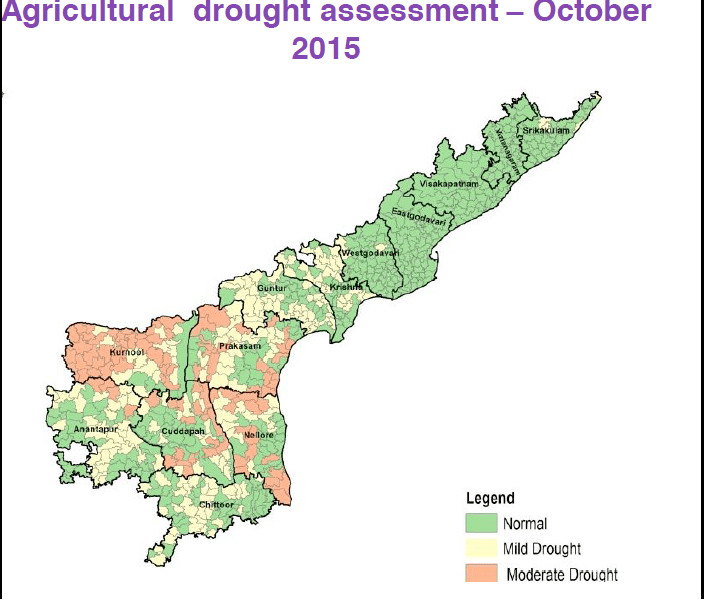
On Oct 28, 2015, the Andhra Pradesh government declared 196 mandals in seven districts, as drought-affected during the Kharif season 2015. The districts were Srikakulam (10 mandals), Prakasam (21), Nellore (14), Chittoor (39), Kadapa (33), Anantapur (39) and Kurnool (40). Consequent to the declaration of drought, the government directed the concerned district Collectors to notify the specific drought-hit areas in the District Gazette to enable farmers to avail credit facilities. On Nov 22, 2015, the Govt. added 163 mandals to the list of drought hit bringing the number up to 359 mandals. This included mandals in Guntur, Krishna, Vizianagaram. Drought was declared in 10 out of 13 districts. Crop loan and relief measures were to be taken up in these mandals as per guidelines. The state demanded central assistance of Rs 2,000 crore.

Continue reading “Andhra Pradesh Drought 2016”

Dams

Telangana Drought 2016

The severe drought in Telangana has caused acute shortage of drinking water and worsened the agriculture crisis in the state.

On Nov 24, 2015, the Telangana government declared drought in 7 out of 10 districts. It declared 231 out of 443 rural mandals (blocks) in the State as drought-affected and sought an immediate assistance of Rs. 1000 crore from the Centre. All the mandals in Mahabubnagar (64), Medak (46) and Nizamabad (36) districts were declared drought-hit.  Other mandals declared drought-hit included 33 out of 37 in Ranga Reddy, 19 of 57 in Karimnagar, 22 of 59 in Nalgonda, and 11 of 51 in Warangal. None of the mandals in Adilabad (52) and Khammam (41) districts were on the list.

Continue reading “Telangana Drought 2016”

Dams · DRP News Bulletin

DRP: 16 May 2016 (Water conservation: Lessons from ancient India)

Water conservation: Lessons from ancient India As drought-like conditions have gripped many parts of India this year, the pressure to drill borewells in search of increasingly scarce groundwater has escalated. Many regions are in the grip of a vicious cycle of drilling causing the water table to sink further. There is an urgent need to explore what benefits water conservation can bring, whether through modern or ancient water storage structures. This report explains, ecologically safe engineering marvels of water conservation have existed in India for nearly 1,500 years, including traditional systems of water harvesting, such as the bawari, jhalara, nadi, tanka, and khadin. Even today these systems remain viable and cost-effective alternatives to rejuvenate depleted groundwater aquifers, according to experts. With govt support, these structures could be upgraded and productively combined with modern rainwater-saving techniques such as anicuts, percolation tanks, injection wells and subsurface barriers. This may be a far more sustainable approach to alleviating the water scarcity crisis across India. Ultimately, water conservation has to be a key element of any strategy to bring an end to India’s perennial swings between drought and flood.

Continue reading “DRP: 16 May 2016 (Water conservation: Lessons from ancient India)”

Dams · DRP News Bulletin

DRP: 9 May 2016 (Welcome initiative by Lok Sabha Speaker on draught and ILR)

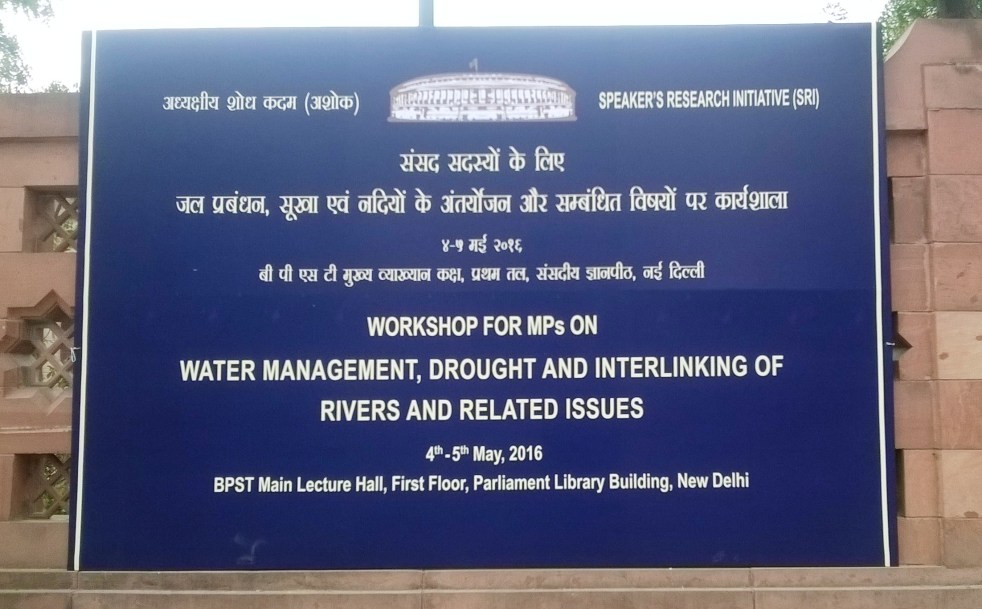
On May 4-5, 2016, Lok Sabha Speaker Smt Sumitra Mahajan took the lead in organising a workshop for Members of Parliament on Drought, Agrarian Crisis and ILR. As part of the newly constituted Speaker’s Research Initiative’s (SRI for short) work, Smt Mahajan inaugurated the workshop at 4 pm on May 4, 2016, where a panel of eight speakers were invited (4 on each day, SANDRP coordinator was one of the invited speakers on 1st day) to share their views, followed by questions from Members of Parliament. The idea was that on these important issues, Parliament Members are better equipped to raise the relevant issues when debating and raising questions in Parliament. It was heartening to see that at least 90 MPs (88 from Lok Sabha and 2 on Rajya Sabha) were present for 2.5 hours on first day, and they wanted to ask so many questions that there was not sufficient time to allow all of them to ask, nor sufficient time for speakers to make full presentations or answer all the questions. Similarly on second day too Speakers showed lot of interest on these issues. While inaugurating the workshop, Smt Mahajan mentioned how in Solapur, Maharashtra, because of the work of the collector and his team of officials, the impact of drought is lower than that in other districts. This was certainly heartening since it was SANDRP Associate Coordinator Parineeta Dandekar who first wrote on this issue, following her visit to Solapur and interview with the district collector. The workshop highlighted the need for many such workshops, possibly more focussed, but the impact of the workshop was already visible in the (as yet unfinished) debate under section 193 that started in Lok Sabha on May 5, 2016, hopefully to be continued in current week.

Continue reading “DRP: 9 May 2016 (Welcome initiative by Lok Sabha Speaker on draught and ILR)”

Dams · DRP News Bulletin

DRP: 2 May 2016 (Patoda: How a village in drought hit Maharashtra achieved water independence)

Patoda: How a village in drought hit State turned water self-reliant  At a time when almost every village in drought-hit Marathwada is facing acute water scarcity tiny Patoda, on the fringes of water-starved Aurangabad city, is offering valuable lesson in water management conservation and harvesting. Though it is surrounded by arid villages but Patoda’s residents regard water as more precious than money. They follow strict rules about usage and strictly carry the water audits. Water meters are installed in every households and entire village recycles each drop of waste water it generates. Today no rain water flows out of the village. Percolation has recharged the aquifers and the water table has risen. So effective is its water conservation model that Patoda has now become a model for the rest of Marathwada and has won 22 state & national awards. But it did not happened over nights. In fact it is a result of over 10 years joint efforts done by villagers.

Continue reading “DRP: 2 May 2016 (Patoda: How a village in drought hit Maharashtra achieved water independence)”

CGWB · Groundwater

Submission to Mihir Shah Committee For Restructuring of CWC & CGWB

It is proposed that the current CWC and CGWB should be reconstituted along following lines. Encouraged by communication from the committee and MoWR that the suggestions need not be limited by the TORs since TORs are also extendable, I have proposed a new institutional structure that is different than the current one. A brief outline of this was presented at the 6th meeting of Mihir Shah headed committee on Jan 11, 2016, it is elaborated here further. Continue reading “Submission to Mihir Shah Committee For Restructuring of CWC & CGWB”

Dams · DRP News Bulletin

DRP: 25 APRIL 2016 (One Year After Nepal Earthquake, Has the World Learnt Any Lesson?)

On this day in 2015, the massive Nepal earthquake of 7.9 intensity (Richter scale) shook the scenic Himalayan Nation. The earthquake left a major trail of destruction affecting over 20 districts and killing over 9 thousand people.  According to expert Dave Petley, Langtang rock and ice avalanche was the most dramatic and significant landslide, that killed the most individuals. The earthquake killed over 9000 people, with 255 still missing. The severity of the quake can be gauged from the fact that more than a third of the disaster related deaths in 2015 occurred in Nepal’s April 25 earthquake. The earthquake-induced flash floods, landslides and aftershocks also damaged up to 15 hydropower plants, which has not been still restored fully. Surprisingly despite the increasing number of disasters taking place across the globe, world only spends less than a fifth of the money on Disaster Risk Reduction Compared to Disaster management.  Nepal will still take years from recovering socio-economic losses caused by the quake. But it is pertinent that in the wake of the quake and other disasters, human civilisation must learn its lesson. It’s true that development and disaster cannot be stopped but we must make our developmental decisions more informed, rule based and democratic so that it helps us deal better with disasters by decreasing their  intensity and velocity and our short-sighted developmental choices do not get translated into a disaster itself. Continue reading “DRP: 25 APRIL 2016 (One Year After Nepal Earthquake, Has the World Learnt Any Lesson?)”