Arunachal Pradesh · Assam · brahmaputra · Embankments · Ministry of Water Resources · Sikkim

Lack of Transparency and Accountability Remains the Norm of Functioning for MoWR’s Advisory Committee

The Advisory Committee in the Union Ministry of Water Resources (MoWR) for consideration of techno-economic viability of Irrigation, Flood Control and Multi Purpose Project Proposals (TAC in short) is a very important committee. It accords the financial clearance for any irrigation, flood control and multipurpose project. TAC is supposed to discuss the techno-economic viability of projects as per the resolution published in the Union of India Gazette Notification No. 12/5/86-P-II dated Nov 27, 1987. This committee came into being replacing a similar committee that existed earlier in the planning commission. Even now, the guidelines for functioning of the committee are issued by the Planning Commission.

The Gazette notification cited above also said, “The committee may also invite representatives of any other Government organizations, scientific body of experts in the relevant fields to participate in its deliberations.” This seems like a window to appoint credible, independent, non-government persons in the committee, but this window does not seem to have been used. Among the functions of the committee listed in this notification include, “The functions of the Committee will be to examine projects proposed by State Governments, Central Government or other organizations and satisfy itself that the schemes have been prepared after adequate investigations” and “the need of environment conservation and proper rehabilitation of project-affected persons have been taken into account.” However, our perusal of the functioning of the TAC shows that TAC has failed to fulfill both these mandates.

As noted in the Guidelines for Submission, Appraisal and Clearance of Irrigation and Multipurpose Projects, 2010 available on the CWC website (see: http://www.cwc.nic.in/main/webpages/publications.html), “The project proposal, thereafter, is put up to the Advisory Committee for clearance, which is, by and large, like single window clearance.” The importance of such a single window clearance becomes all the more important. The guidelines further note, “On the basis of examination conducted by the Advisory Committee, decision on techno-economic viability of the projects is taken in the meeting of this Committee. The projects found acceptable by the Advisory Committee shall be recommended for investment clearance by the Planning Commission and inclusion in the Five Year Plan/Annual Plan.” This shows how important is the role of the TAC in judging techno-economic viability of projects and also from the point of view of prudent planning.

No Transparency, independent participation or accountability of TAC Considering the above, there is strong case for clearly defined norms for transparency, participation and accountability in (1) functioning of TAC; (2) The screening process of the projects at initial stages that also happen under these guidelines in the Central Water Commission, based on which approval for DPR preparation is given.

In view of the significance of TAC, this is SANDRP’s third analysis of the decisions taken in TAC meetings. The present analysis covers decisions taken for North East India from 110th to 122nd TAC meeting. In the two previous analysis done by SANDRP, TAC meeting decisions taken from 95th meeting to 109th meeting has been covered. Here it is important to note that lack of transparency has been observed right from the agenda and minutes of the TAC meetings. The agenda and minutes of the TAC meetings should be uploaded on CWC website but CWC website has minutes only till the 115th meeting held on 24th July 2012 and the website has been last updated on 31/08/2012.

In this analysis we have covered 13 TAC meetings held from July 2011 to December 2013. In these 13 meeting, 21 projects from 6 northeastern states have been considered. But out of the 13 meetings held, projects from northeast were considered only in 10 meetings. TAC has accepted the proposals for projects with a total cost of rupees 4075.46 crore. Majority of the projects were given clearance at the first time of consideration. Thus, on an average TAC  had cleared projects worth of 407.55 crores from the North East in each of these 10 meetings. Number of the projects considered by TAC in each meeting along with their total cost is given below. A state-wise and a project-wise list is also provided.

Total Cost of Projects Cleared by TAC July 2012 to December 2013

Sl No Meeting no Date of meeting No of projects considered from NE No projects approved No of projects deferred No of projects rejected Total cost of the accepted projects, Rs Crore
1 110th 20-07-11 5 4 1 0 211.56
2 111th 17-08-11 1 1 0 0 167.09
3 112th 14-09-11 1 1 0 0 48.55
4 115th 24-07-12 5 5 0 0 2208.81
5 117th 21-03-13 1 1 0 0 155.87
6 118th 30-07-13 2 2 0 0 467.38
7 119th 29-08-13 2 2 0 0 601.67
8 120th 13-09-13 1 1 0 0 42.96
9 121st 08-10-13 2 2 0 0 146.01
10 122nd 20-12-13 1 1 0 0 25.56
  Total     20     4075.46

State-wise list of projects cleared by TAC

Sl. No State No of projects approved Total cost of the approved projects, Rs Crore
1 Arunachal 1 36.47
2 Assam 7 1526.85
3 Manipur 7 2268.99
4 Meghalaya 1 5.63
5 Sikkim 1 48.55
6 Tripura 3 188.97

Note: No projects from Mizoram and Nagaland have come to TAC in this 30 month period.

Some observations regarding TAC meetings

1. Zero Rejections The TAC did not reject a single project. There was only one project which was deferred in the 110th meeting but it was approved in the next meeting. Rest of the new projects were were approved in the very first meeting of their consideration.

2. Lack of information The TAC minutes provide little information about projects. Specially in case of newer projects, detailed discussions should have happened. The minutes of TAC meetings do not give much of an idea about size, location, benefits of a particular project. In the project- wise list provided towards the end of this analysis, we have provided limited information available in the minutes. Some of the noteworthy missing information is listed below:

– In the 115th meeting, 5 projects from Manipur were considered. Out of these five projects, 2 were multipurpose projects and 3 were barrage projects. Surprisingly, there was no information about where these projects are located, on which river, what the size of these projects. None of the minutes mentioned about whom these projects will actually benefit. Only two projects mentioned about increase in annually irrigated land but no more detail was provided.

– In the 118th meeting, construction of embankments on both banks of river Ranganadi for flood management and river training was considered. But the cost of the project was on the higher side compared to the embankment construction work to be done on the river Dikrong, considered in the same meeting. This cost escalation may be due to the difference in the length of the projects. But this cannot be confirmed since minutes do not mention the length of the proposed embankments.

India's First Geo-tube embankment in Matmora in Dhakuakhana sub-division of Lakhimpur district in Assam.  Photo: Parag Jyoti Saikia
India’s First Geo-tube embankment in Matmora in Dhakuakhana sub-division of Lakhimpur district in Assam. Photo: Parag Jyoti Saikia

But the increased costs may also be due to the use of Geo bag technology for construction of Ranganadi embankments. Use of Geo-bag technology is a costly affair but nothing has been mentioned about the use of this technology in the minutes of 118th meeting. This is stated in the annexure (Annex VI as mentioned in the document) of the meeting. Interestingly this annexure too has been mentioned only as a corrigendum.

3. No Detailed Discussion on Projects Considered This was very evident in the two previous analysis done by SANDRP and situation remains the same this time as well. In case of all the projects, including the ones considered for the first time, there was no detailed information or any detailed discussion. There is no discussion on technical viability of the project. Reading through the minutes gives an impression that approval for any project considered by TAC is fait accompli. There is no discussion about whether the project is a desirable project, if there are other options available, if this is the best option and so on. Under the mandate given to it, TAC is supposed to discuss all these issues. TAC accepted projects proposals with huge cost and time overruns but little enquiry has been made why such escalation happened.

Dhansiri irrigation project This is a glaring example of cost escalation. The project was discussed in the 119th meeting on 29.08.2013 for consideration of cost of Rs 567.05 crores. But, it was surprising to find that original cost of the project in 1975 was Rs 15.83 crores as according to the information available in Assam State Irrigation Department website.[1] The same website states that project started in 1975 and supposed to be completed 35 years later in 2010. In the TAC meeting a new time schedule of March 2015 was stated. The cost of the project has increased by 35.82 times over a period of 40 years but the advisory committee accepts proposal without much scrutiny or enquiry. There was no detailed assessment of the reasons for time and cost over runs (there is no question of delay due to clearances or agitations here) or whether this project which will take 40 years just to complete will be viable or not. On the contrary, the planning commission representatives said, “the benefit cost ratio of the project was 1.2 and any further escalation in cost would result in the project becoming techno-economic unviable.”

The TAC should have done a detailed assessment why the project took so long time to complete. But it seemed to be contended with the rational that the project authorities provided which was that due land acquisition and law and order problem the project has not been completed. But in the meantime minutes of the meeting also showed that that major components of the project are in advanced stages of construction with 93% of barrage work, 99% of the canal works and about 83% of works in the distribution system were reported to have been completed. There has been no detailed assessment in to any of these aspects.

Imphal Barrage project In this project, the cost of the project mentioned in the minutes of the 115th meeting contradicted with the cost provided in the annexure. The cost of Extension, Renovation and Modernization (ERM) of the Imphal barrage project as mentioned in the minutes is Rs 16.80 crores. But a letter from the Under Secretary, Govt. of Manipur to the Chief Engineer of Irrigation and Flood Control Department, Manipur dated 21.07.2012 stated the cost of the project as 23.41 crores. This reflects the lack of serious discussion over projects in TAC. It is also surprising that TAC, being the committee which gives the techno economic clearance to projects, does not have clarity about even the cost of the project.

4. No Discussion over Social, Environmental and Other impacts of the Projects The projects cleared by TAC have serious social, environmental and other impacts but the committee never discussed these impacts. TAC does not at all take into account the impacts a project would have on the environment.

In the 118th meeting (30.07.2013), while considering the proposal for flood management of Dikrong along with river training works on both banks, the minutes stated “Effectiveness of existing embankments of river Dikrong has been deteriorating due to lack of repair, siltation of river bed and consequential change in river behaviour, change in flow pattern due to release of Ranga Nadi hydel project etc.” But this is one of the rare instances when TAC mentioned about the environmental impacts on embankments. But rather than asking for more details on these impacts or to see whether embankment would really be a viable option or not, the TAC accepted the proposal. On the other hand nowhere the committee discussed what impacts an embankment has on river bed, siltation or downstream stretches of a river.
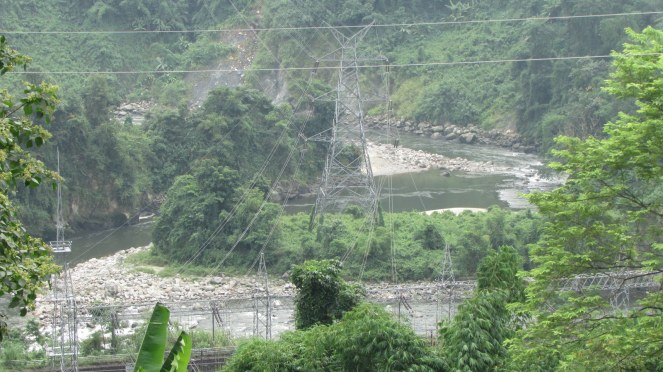
Dikrong Power Station at Hoz where water from Ranganadi HEP is released in Dikrong. Photo: Parag Jyoti Saikia
Dikrong Power Station at Hoz where water from Ranganadi HEP is released in Dikrong/Pare. Photo: Parag Jyoti Saikia
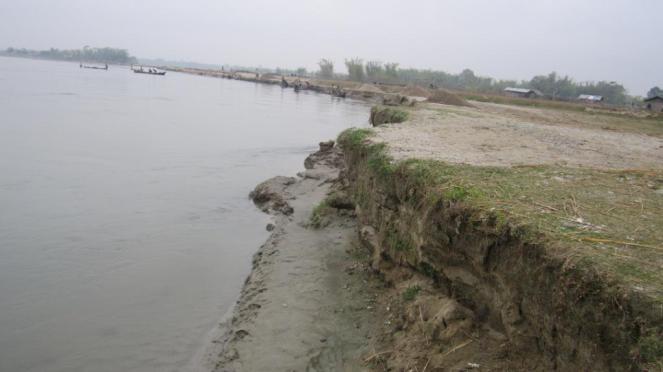
Dikrong at Dikronghat in Lakhimpur district of Assam where it erodes rapidly. The impacts of change is water flow is clearly visible. Due to release of water in upstream water at night covers the lower portion of the bank. This photo was taken around 8am in the morning when the water receded. The lower bank portion was wet in the morning. According to the local the water further recedes by the evening and again increases at night. Photo: Parag Jyoti Saikia
River Dikrong at Dikronghat in Lakhimpur district of Assam where it erodes rapidly. The impacts of change is water flow is clearly visible. Due to release of water in upstream water at night covers the lower portion of the bank. This photo was taken around 8am in the morning when the water receded. The lower bank portion was wet in the morning. According to the local the water further recedes by the evening and again increases at night. Photo: Parag Jyoti Saikia

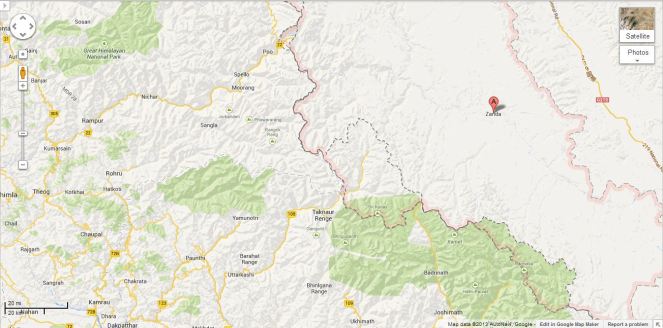
It is also important to note here TAC also does not take into consideration impacts of the hydropower projects on the embankments in the downstream of the river. In the above mentioned case, the increased costs of Dikrong embankment should have been charged on the Ranga Nadi HEP, but there is no discussion on this. The Pare hydropower project (110 MW) in Papumpare district of Arunachal Pradesh is currently under construction on Dikong / PareRiver. Moreover there are at least 10 hydropower projects at various stages in the combined Ranganadi-Dikrong basin in Arunachal Pradesh, including one operating, three TOR approvals given and five additional MoA signed (in addition to a proposed project). There is no provision to assess the impacts of these projects on the embankments downstream of DikrongRiver in Assam. In fact there is no provision for any impact assessment study for embankments even though studies show the disastrous impacts of embankments on environment, floods and on the lives of the people living close to the river.

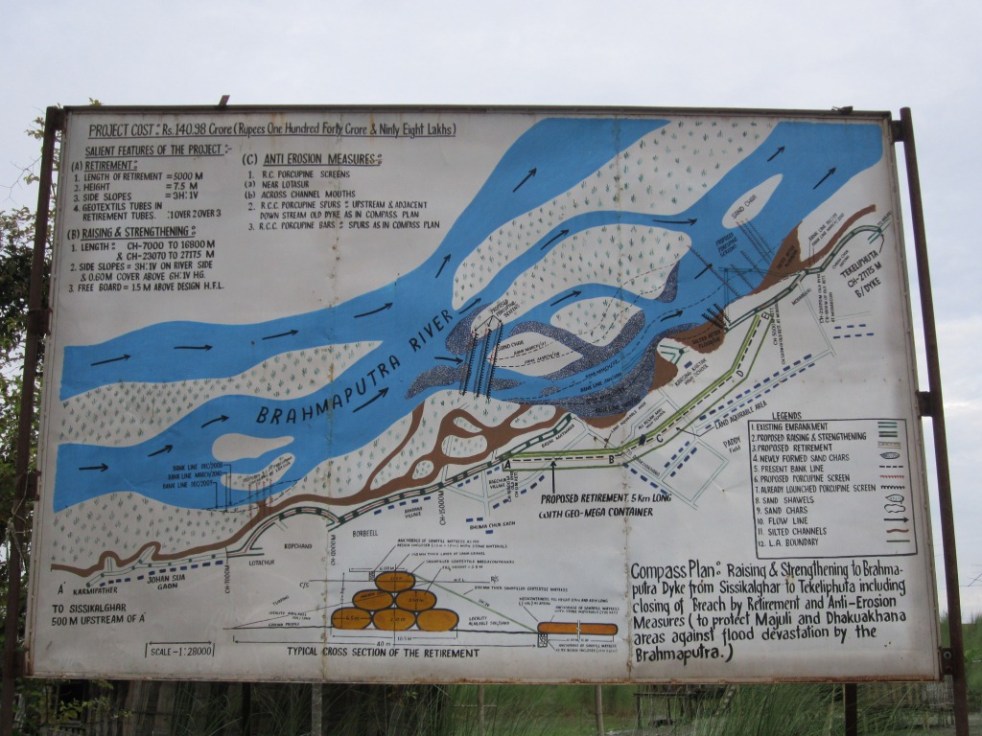
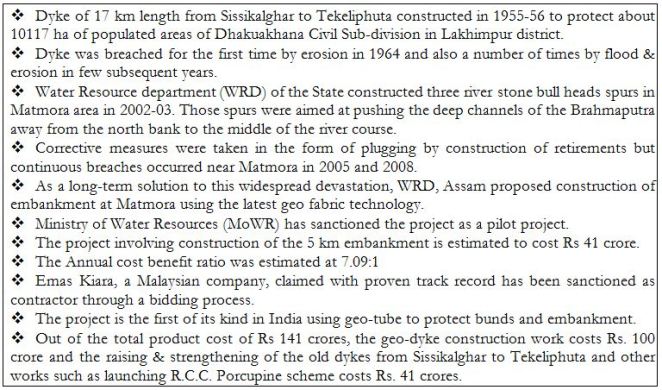
5. Clearing Same Embankment Projects over Years In terms of embankments, it is observed that the TAC had cleared same projects over the years. Not emphasizing on the environmental impacts of embankment projects is one of the major reasons for this. In the 117th TAC meeting held on 21.03.2013 the proposal for “Protection of Brahmaputra dyke from Sissikalghar to Tekeliphuta at different reaches from Lotasur to Tekeliphuta from the erosion of river Brahmaputra Assam” was considered. The estimated cost of the project was Rs 155.87 crore. But on the same embankment, a project titled “Raising and Strengthening to Brahmaputra dyke from Sissikalghar to Tekeliphuta including closing of breach by retirement and anti-erosion measures (to protect Majuli and Dhakukhana areas against flood devastation by the Brahmaputra, Lakhimpur district, Assam) was accepted in the 95th TAC meeting held on 20.01.2009. The estimated cost of the earlier project was 142.42 crore.

A Hoarding on the way to Geo-tube embankment in Matmora, describing the project.  Photo: Parag Jyoti Saikia
A Hoarding on the way to Geo-tube embankment in Matmora, describing the project.
Photo: Parag Jyoti Saikia

The minutes of the 117th meeting, about the previous scheme said that it “was taken up primarily for closure of breach in the then existing embankment including raising of embankment around the breach area only.” But the minutes of the 95th TAC meeting had said something totally different about the project. The minutes stated that project proposal envisaged – (i) Raising and strengthening of embankment for a length of 13.9 km, (ii) Construction of retirement bund with geo-textile tubes of length 5000 m. This shows how the discussion on the Brahmaputra dyke Sissikalghar to Tekeliphuta is 117th meeting is completely misleading. TAC does on even take into account its previous meeting discussions before clearing a project. This possibly gives a hint of a scam.

The Brahmaputra dyke from Sissikalghar to Tekeliphuta has a long history of facing severe erosions. The first geo-tube embankment was constructed on this dyke in Dec 2010. Crores have been spent for the protection of this embankment. But even after that the Dhakukhana sub-division always remained in the headlines during the flood season in Assam. There is need for area specific detailed study assessing the impact on and of the embankment, but little has been done in this regard. Besides, the Bogibeel Bridge, the fourth one on the BrahmaputraRiver, is coming up in the upstream of this embankment. Construction of this bridge would make this dyke even more prone to erosion since the length of this bridge will be 4.94 km, shrinking the wide river to great extent. In a personal visit to the area, one of the government officials informed that as a result of this “funneling action”, the force of water will increase and it will directly hit the embankment leading to more erosion. But TAC has never dealt with these issues in its meetings but cleared all the proposals that it considered.
Short History Brahmaputra Dyke from Sissikalghae to Tekeliphuta[2]
box text

6. There is no independent, critical voice in the meetings. The agenda, proceedings, or decisions of the meetings are not even in public domain.
7. There is no mechanism to hold the TAC accountable for any wrong decisions taken.
8. The TAC is clearly not fulfilling the mandate given to it in the guidelines for TAC meetings. The guidelines themselves need revision from several points.
9. There is no attempt to assess the justifiability of the kinds of projects that are being accepted and if they are indeed delivering the promised benefits.

Parag Jyoti Saikia (meandering1800@gmail.com)

Project-wise Detailed List of TAC decisions

110th meeting (20.07.2011): Accepted: TOTAL: Rs 211.56 crores

Sl No Project Dist/State Appr. year basin original cost (Rs. Cr) decision
1 Anti Erosion & Flood protection work Arunachal Pradesh New Tawangchu 36.47 Accepted
2 Protection of Majuli from Flood and Erosion Phase II & III Assam 2011 Brahmaputra 115.03 Accepted
3 Restoration fo rivers Dibang and Lohit to their original courses at Dholla Hatighuli Assam 2011 Brahmaputra 54.43 Accepted
4 Protection of Balat village from flood and erosion of river Umngi in West Khasi hill district West Khasi hill/Meghalaya  New Brahmaputra 5.63 Accepted

111th meeting (17.08.2011): Accepted: TOTAL: Rs 167.09 crores

Sl No Project Dist/State Appr. year basin original cost (Rs. Cr) decision
1 Protection of Biswanath Panpur including areas of upstream Silamari and Far downstream Bhumuraguri to Borgaon against erosion of the river Brahmaputra Sonitpur/Assam  New Brahmaputra 167.09 Accepted

112th meeting (14.09.2011): Accepted: TOTAL: Rs 48.55 crores

Sl No Project Dist/ State Appr. year original cost (Rs. Cr) decision
1 Improvement of Strom Water Drainage below GreenfieldAirport at Pakyong Sikkim  New 48.55 Accepted

115th meeting (24.07.2012): Accepted: TOTAL: Rs 2208.81 crores

Sl No Project Dist/State Appr. year basin original cost (Rs. Cr) decision
1 Thoubal Multipurpose project Manipur 1980 Brahmaputra 1387.85 Accepted
2 Khuga Multipurpose project Manipur 1980 Brahmaputra 433.91 Accepted
3 Dolathabi Barrage Project Manipur 1992 Brahmaputra 360.05 Accepted
4 ERM of Imphal Barrage Project Manipur New Brahmaputra 16.8 Accepted
5 ERM of Sekmai Barrage Project Manipur  New Brahmaputra 10.2 Accepted

117th meeting (21.03.2013): Accepted: TOTAL: Rs 623.25 crores

Sl No Project Dist/ State Appr. year basin Ht / L of Dam/Embnk. original cost (Rs. Cr) Benefit flood prot. (Ha) decision
1 Protecion of Sissi-Tekeliphuta dyke from erosion – Lotasur to Tekeliphuta Assam New Brahmaputra 153 km 155.87 10117 Accepted

1188h meeting (30.07.2013): Accepted: TOTAL: Rs 623.25 crores

Sl No Project Dist/ State Appr. year River/ basin original cost (Rs. Cr) Benefit flood prot. (Ha) decision
1 Flood management of Dikrong and river training works on both banks embankment Lakhimpur/ Assam New Dikrong/ Brahmaputra 105.96 9998 Accepted
2 Flood management of Ranganadi and river training works on both bank embankments Lakhimpur/ Assam  New Ranganadi/ Brahmaputra 361.42  21056 Accepted

119th meeting (29.08.2013): Accepted: TOTAL: Rs 601.67 crores

Sl No Project Dist/ State Appr. year River/ basin original cost (Rs. Cr) annual irrigation decision
1 Dhansiri Irrigation project Assam 1975 Dhansiri/ B’putra 567.05 Accepted
2 ERM of Singda multipurpose project Manipur  New Brahmaputra 34.62 3000 Accepted

120th meeting (29.08.2013): Accepted: TOTAL: Rs 42.96 crores

Sl No Project Dist/State River original cost (Rs. Cr) decision
1 Anti erosion work along river Haora from Champakpur to Baldakhal West Tripura Haora 42.96 Accepted

121st meeting (08.10.2013): Accepted: TOTAL: Rs 146.01 crores

Sl No Project Dist/ State River original cost (Rs. Cr) Benefit flood prot. (Ha) decision
1 Anti erosion work along river Gumti from Dlak Samatal Para to Durgapur under Amarpur, Udaipur & Sonamura subdivision S & West Tripura Gumti 54.99 2209 Accepted
2 Anti erosion work along river Khowaii from Netajinagar to Banglahour under Telimura subdivision and from south L. N. Pur to Paharmura bridge under Khowai subvision West Tripura Khowaii 91.02  4256 Accepted

122nd meeting (20.12.2013): Accepted: TOTAL: Rs 25.56 crores

Sl No Project Dist/State River original cost (Rs. Cr) decision
1 Loktak Lift Irrigation Project Manipur 25.56 Accepted

[2] From the brochure published by WRD, Assam at the time of commissioning the geo-tube embankment in Matmora

Arunachal Pradesh · brahmaputra · Cumulative Impact Assessment · Ministry of Environment and Forests · Siang

Cumulative Impact Assessment Study of Siang Basin in Arunachal Pradesh: Serious shortcomings; pro large hydro bias

Most of the major rivers in the North East India are largely free-flowing till date, which is a rarity in India and the world. Their basins are home to unbelievable ecological and cultural diversity. Main rivers in Arunachal Pradesh which form the mighty Brahmaputra are the Siang (the Yarlung Tsang Po), Dibang and Lohit, which meet at the trijunction to form Brahmaputra.

Massive hydropower projects are planned on these rivers in cascade. They will have irreversible destructive impacts on the society, forests, rivers, biodiversity, ecosystems, cultural identity and downstream Assam.

Hydropower Flood in Arunachal Pradesh Map: Neeraj Vagholikar, Sanctuary Asia
Hydropower Flood in Arunachal Pradesh
Map: Neeraj Vagholikar, Sanctuary Asia

Siang River alone has 44 dams planned along its entire length.

Yes, 44 dams. You have read it correctly. At least 44 dams in one sub basin of Brahmaputra River Basin. This is what was meant by MOU virus as Jairam Ramesh described it.

Siang River Basin The Siang river originates in the Chemayungdung mountain ranges which nearly sixty miles south-east of Mansarovar lake in the Mount Kailash range in Southern Tibet at an elevation of 5300 m. A spring called Tamchok Khambab spills from the glaciers which later gather breath and volume to become the Tsangpo, the highest river in world.  Tsangpo river flows 1625 km in Tibet parallel to the main range of Himalayas before entering India through Arunachal Pradesh.

Before entering India, the river passes Pi (Pe) in Tibet and suddenly turns to the north and northeast and cuts a course through a succession of great narrow gorges between the mountain Gyala Peri and Namjabarwa (Namcha Barwa) in a series of rapids and cascades. The river then turns south and southwest and flows through a deep gorge across the eastern extremity of the Himalayas with canyon walls that extends upward for 16,500 feet (5,000 meters) and more on each side.

The river enters Arunachal Pradesh near Gelling from where it is known as Siang. The total length of Siang River is 294 km till its point of confluence with Dibang and Lohit River. After entering India the river traverses approximately 197.0 km to join the Siyom river. From there the length of the river till Assam border is 86.3 km. Flowing further 10.6 km in Assam the river joins the confluence of Lohit and Dibang. From this point forward it flows as Brahmaputra river in Assam and traverses a distance of about 195 km up to the confluence of Subansiri river on its right bank. Further downstream it is joined by Kameng at Jamugurihat near Tezpur, after another 123 km.  From  here  it  travels  for  another  134  km  up  to Guwahati.

River Siang Photo from: Global Descents

The elevation of Siang river catchment area ranges from 90 m to around 5800 m. The total catchment area of Siang river from its origin to its confluence with Lohit and Dibang rivers is 251,521 sq km. Out of this 236555.7 sq km area lies in Tibet. The total catchment area of Siang river in India upto its confluence with Lohit and Dibang rivers is 14965.30 sq km.    

A question arises here, what will be the condition of the 294 km long Siang river if the proposed 44 dams are being built on the river. The Siang river basin study has the answer for this which is actually alarming “Only 85.5 km (29%) of free flowing water regime of Siang river will be left out of its total course in India i.e.  294 km of lotic ecosystem will be converted into 208.5 km of lentic ecosystem altering the entire Siang river aquatic system which will adversely impact the aquatic biodiversity and seriously affecting fish populations and their migration behaviour.”(page 11.23)

Three dams on the main Siang will convert the free flowing river into a three-stepped reservoir, without ANY flowing length of the river! These dams alone will affect more than 18,000 hectares of forests! If all the dams are built, water level fluctuations in the downstream D’Ering Sanctuary will be more than 23 feet every single day in the winter and other non monsoon seasons!

82.26% of the Siang basin is under forest cover (more than 15,000 sq kms), it is rich in orchids (more than 100 species!), holds 16 species of rhododendrons, 14 species of Bamboos and 14 species of canes and overall 27 RET species and 46 endemic plant species. 25 (18%) mammalian species found are Schedule I of WPA (Wildlife Protection Act), while 26 are under Schedule II! There are 447 species of birds, of which 31 are Schedule I species. The single basin consists of 5 Important Bird Areas !!(IBAs)

Formation of River Siyom, which will have multiple dams in a cascade Photo from: Team BHP

This information has been collated by the CIA (Cumulative Impact Assessment)/ CCS (Carrying Capacity Study) of the Siang Basin, which was an attempt to look at the scale and cumulative impacts of projects in Siang holistically.

Has the CIA commissioned by Central water Commission and done by RS Envirolink Technologies done an objective, scientific, independent assessment?

SANDRP sent comments about this 2-volume study  with over 1500 pages to the Expert Appraisal Committee, Ministry of Environment and Forests which will be considering this basin study in its upcoming meeting on Feb 20-21, 2014. Submission below highlights that the study has very serious short comings and bias. The recommendation of dropping 15 (mostly small ones, all below 90 MW installed capacity) HEPs and re-configuring some others is welcome, but far from sufficient. The study itself is disappointing:

Projects planned in the Siang Basin Phot from CIA/ CCS of Siang Basin


Time Line of Siang Basin Study

Feb 2010 Ministry of Water Resources constituted an Inter-Ministerial Group on the directions of Prime Minister’s Office with a view to evolve a suitable framework to guide and accelerate the development of hydropower in the North East and also to assess the impact of the massive hydropower development in Arunachal Pradesh on downstream areas in Assam
Nov 2010 EAC discussed TOR for the Siang Basin CIA
Dec 23, 2010 MoEF issues TORs for the Siang Basin CIA
April 2011 EAC discusses sampling locations for the CIA on request of CWC
Dec 2011 Work of CIA for Siang awarded to RSET Pvt Ltd
May 2012 RSET says draft interim report discussed by TAC, but there is no meeting of TAC in May 2012, minutes of March and July TAC meetings (the ones before and after May 2012) on CWC website also do not mention any such discussion.
Nov 2012 EAC discusses Draft Interim report
Aug 2013 Draft Final report submitted to CWC
Sept 2013 RSET says Draft final report discussed by TAC, but the minutes of the Sept 2013 meeting of the TAC obtained under RTI donot contain any reference to the Siang basin study
DEC 2013 Draft Final Report submitted to MoEF
Feb 17, 2014 Critique of the Draft Final report submitted by SANDRP to EAC
Feb 20, 2014 MoEF’s EAC to  discuss the Draft Final report

To,

Chairperson and Members,

Expert appraisal Committee

Ministry of Environment and Forests

Delhi

Subject: Serious inadequacies of Cumulative Impact Assessment (CIA) and Carrying Capacity Study (CCS) of Siang Sub-basin including Downstream Impacts

Respected Chairperson and Members,

We see from the agenda uploaded on the MoEF Website that Final Report of the Siang CIA/CCS Study commissioned by CWC and conducted by RS Envirolink Technologies Pvt Ltd will be discussed in the 72nd EAC Meeting to be held on 20-21 February 2014.

SANDRP has been analysing basin studies in the Western Himalayas and Brahmaputra Basin for some time now. Looking at the aggressive cascade hydropower development and its far reaching cumulative impacts, CIA/ CCS and Basin Studies should form the backbone of informed decision making by MoEF. Unfortunately, most studies being considered by the EAC are of a sub-standard quality and are shying away from addressing the cumulative impacts [1]. EAC itself is delinking appraisal of individual projects from basin studies, rendering the crucial process meaningless which is in violation of EIA notification of Sept 2006, wherein Form 1 Section 9 actually asks for cumulative impact assessment. Some of the recent orders of National Green Tribunal also make it CIA mandatory, thus making such delinking legally untenable.

Looking at the scale of ecological and social impacts of these projects and the significance of MoEF’s and EAC’s role, we urge the EAC to consider CIA/ CCS/ Basin Studies more seriously.

Main issues with Siang Basin Study include: (These are elaborated with reasons below)

1. No mention of social and cultural impacts!

2. Downstream impacts on Assam not studied in detail

3. Cumulative Disaster vulnerability, impact of projects on such vulnerabilities, Dam Safety Assessment, risk assessment not done

4. “Cumulative” Impacts not assessed on several aspects

5. Non-compliance with critical recommendations by the EAC:

a. Study is not compatible with similar studies done worldwide

b. No suggestions about ramping to reduce downstream impacts

c. No recommendation on free flowing length between two projects

d. No mention of cumulative impact on sediment regime

e. No mention of impact of road construction

f. BBM for eflows not used, despite agreeing to use it before EAC

g. Impact of Sand mining, boulder mining not conducted

h. Impact of specific projects not clearly studied

6. Eflows, one of the most significant issues, handled erroneously: NO ACTUAL ASSESSMENT OF E-FLOWS REQUIREMENTS AS REQUIRED BY TORs

7. No mention of Climate Change, reservoir emissions vis-à-vis cumulative impacts of such massive scale, how the projects would affect the adaptation capacity of the communities and region in the context of climate change

8. No stand taken on three mega projects on Siang Main Stem and other big hydro projects

9. No conclusion about how much length of the river is to be compromised

10. Number of sampling locations: TOR not followed

11. Source of information not given

12. Inconsistency, contradictions in listing of flora-fauna

13. Unsubstantiated advocacy: going beyond the TOR & mandate

14. Other inadequacies of CIA

15. Study should not be finalised without credible Public consultation across the basin.

Division of the Siang Basin into sub basins Phot from : CIA/ CCS Report of the Siang Basin

DETAILED CRITIQUE

1. No mention of social and cultural impacts! In the entire basin study, there is no mention of social and cultural impacts by these 44 projects which will together submerge more than 21,000 hectares of forests and affect the entire Siang Basin adversely. Needless to say, local communities depend heavily on the basin resources like fish, medicinal and food plants, timber varieties for their livelihoods. For example, more than 2000 hectares of multi-cropped, irrigated rice fields will be submerged by Lower Siang Project alone.

Adi Community that will be affected by the dams on Siang Photo with thanks from : Kaushik Shil

The CIA/CCS study needs to be re-conducted, in which social and cultural cumulative impacts are assessed with participation of local communities and downstream communities from Arunachal Pradesh and Assam. It may be remembered that Public Hearing of Lower Siang (in the latest instance, slated to be held on 31st January 2014) had to be cancelled due to a number of procedural issues, and also opposition from local residents [2]. It is incomprehensible how the CIA Study has no assessment of impacts on communities!

2. Downstream impacts on Assam not studied in detail The study assesses impacts specifically on Dibrugarh, Bokaghat (Kaziranga) and Guwahati. However, there are several villages, settlements, tea estates, agriculture, forests etc., on the Right Bank of Siang in Assam after Pasighat. This includes a major part of Dhemaji District of Assam. Impact on this region needs to be assessed. There has been opposition to Siang Dams from places like Jonai from Dhemaji, which have been ignored.[3] 

Meeting protesting against Public Hearing of 2700 MW Lower Siang HEP Photo: Echo of Arunachal

According to the model used, the chainage for assessing impacts at D’Ering Sanctuary is between 20-33 kms from Lower Siang Dam. The next chainage is at 102 kms at Dibrugarh. Impacts on the stretch between D’Ering and Dibrugarh, for nearly 70 kilometres are simply not assessed! What can be reason behind this?

Level fluctuations at D’Ering Sanctuary, with Lower Siang, Middle Siyom and Upper Siang Projects is to the tune of 7.2 meters (23.66 feet!!) in lean season. This highlights the need to study impacts on the intermediate zone in Assam between Dering Sanctuary and Dibrugarh. The Study should not be accepted without these assessments.

3. Cumulative Disaster vulnerability, impact of projects on such vulnerabilities, Dam Safety Assessment, risk assessment not done

Upper Siang Stage I, Stage II and Lower Siang are huge projects with direct impact on downstream state. Even as issues of dam safety and risk assessment have gained high significance in Assam as can be seen in Lower Subansiri protests, the basin study/CIA does not include a word on dam safety, cumulative risk assessment, risk of landslips and landslides, seismic zones of projects, past earthquakes in the region, possible mitigation measures, disaster management, etc. There is no assessment of baseline situation about disaster vulnerability of the region and how the projects will change that. By its nature, a CIA/CCS/ basin study is best placed to assess these impacts.

Lanslides are a common feature of this region. Pic shows Yinkiong in Siang II Sub basin where several projects are planned. Photo: Team BHP

These points have been raised by KMSS, Assam and others. The Uttarakhand disaster of June 2013 underlines this and even the Supreme Court of India has asked for an assessment of how hydropower projects contributed to disaster in Uttarakhand. Looking at Uttarakhand Disaster as well as protests from downstream Assam where dam safety is a major issue, dam safety needs to be addressed in the CIA/ CCS. In the absence of all this, projects will not be allowed by communities, as can be seen with Lower Subansiri and Lower Siang.

4. Cumulative impacts not assessed on several aspects The study has a sketchy section (Chapter 11) on Cumulative impact assessment.

The minutes of 62nd EAC meeting noted, “The main objective of the study is to bring out the impact of dams being planned on the main Siang River and its seven tributaries on terrestrial and aquatic ecology, plant and animal biodiversity, including wild life, hydrology of the basin, etc.” (Emphasis is as in original.) However, the study has not placed emphasis on assessing these impacts.

Yar Gyap Chu: a River and basin which holds high religious significance for the Buddhists Photo: Kaushik Shil

Moreover, the study does not attempt to assess cumulative impacts of all the projects due to:

  • Blasting and Tunnelling: This is not mentioned even once in the entire study! When the disastrous impacts of blasting, tunnelling and related activities are fresh in our minds w.r.t Uttrakhand and Himachal Disasters, it is incomprehensible to see that this section is not mentioned at all in the basin study!
  • Community resources: No mention on loss of agricultural lands, homesteads, displacement, loss of forest rights, etc.
  • Infrastructure development: No mention of the impact of workers colonies, buildings on the society, landscape and cultural aspects, etc.
  • Greenhouse gas Emissions: Considering submergence of more than 20,000 hectares of dense to very dense forests and building of a large number of reservoirs in tropical climate, cumulative impacts on green house gas emissions should have been assessed.
  • Biodiversity, RET Species, Deforestation: While the report deals with these issues very sketchily, there is no statement as to what will be the cumulative impact of 44 projects on the above issues.

5. Non-compliance with critical recommendations by the EAC Interim basin study was discussed in the 62nd EAC meeting in November 2012. The EAC had given some important recommendations at that stage to be included in the study. However, most of the recommendations have not been complied with, these include:

  • Study is not compatible with similar studies done worldwide: EAC had specifically recommended compatibility with global studies. However, Siang CIA is not compatible with any global Basin and Cumulative impact Assessment Study. A Cumulative Impact Assessment is a multi-stake – holder process that assesses the cumulative and indirect impacts as well as impact interactions of the proposed dam or set of dams, as well as existing and planned projects from other sectors, on ecosystems, communities, and identified Valuable Ecosystem Components (VECs) within a specific spatial and temporal boundary. [4]
  • No suggestions about ramping to reduce downstream impact: EAC had specifically asked for ramping study with reference to downstream impacts. However, ramping studies are not done at all, although downstream impacts of the projects in isolation as well as together are huge. 
  • No recommendation on free flowing length between two projects Although Upper Siang I, Upper Siang II and Lower Siang have no free flowing stretch between each other, the study refrains doing any assessments or from making any recommendations in this regard, contrary to EAC’s recommendation. 
  • No mention of cumulative impact on sediment regime 44 projects with several mega reservoirs will have a profound impact on the sediment regime of the rivers as well as downstream impacts thereof. EAC had specifically asked to include sediment balance and impact, which is not discussed in the report. 

The minutes of 62nd meeting of EAC says: “The Consultants were also asked to study and recommend on silt management considering “no dam” and “with dam” scenario as silt substantially impact the ecology and cause sedimentation particularly when its velocity is affected d/s due to construction of dam.” No such study has been conducted. In fact globally, sediment balance on cascade projects is a crucial element of study, which is completely left out in the present study. 

  • No mention of impact of road construction Roads and related activities like deforestation, slope destabilisation, blasting, mining, muck dumping, all the cumulative impacts of peaking operation (needs to be done comprehensively, including the limitations that such operation of upstream projects will impose on downstream projects), etc have a critical impact on fragile geology. Role of roads for hydel projects was significant in Uttarakhand Tragedy in June 2013. EAC had specifically asked for “Impacts due to construction of approach roads”. This point is not touched upon in the report. 
  • BBM for eflows not useddespite agreeing to use it in front of EAC Although the consultant agreed in the 62nd meeting that BBM will be used to assess eflows regime,[5] at the insistence of the EAC, in reality BBM has not been used in the study. The reasons given [6] that BBM is a “prescriptive approach”, “it takes too much time” and “only stakeholder in the basin is river and fish” is wrong, shocking and unacceptable.

The study forgets about the people, biodiversity and other stakeholders. Requirements of BBM were known at the time consultant agreed to use this methodology before the EAC. Is fluvial geomorphology, cultural practices, hydrological requirements and sediment balance not important blocks of BBM study? 

  • Impact of Sand mining, boulder mining not conducted EAC had specifically asked for this study. This is critical as mining of sand and boulders from river bed has severe impact on riverine ecology, bed stability, erosion, flow velocity, etc. However, the study has not even mentioned this issue. 
Yargyap Chu or teh Medicinal RIver Photo: Team BHP
Yargyap Chu or the Medicinal RIver Photo: Team BHP
  • Cumulative Impacts of projects on biodiversity in sub-basins not clearly studied While the study has done impressive job in inventorysing ecological attributes of 11 sub basins, it has fallen woefully short in clearly communicating the individual and cumulative impacts of projects on Valued Ecosystem Components (VECs). This reduces practical application of the report. EAC had brought this up during the 62nd meeting. 
  • Length of rivers to be assessed for downstream studies As per the minutes of the 43rd meeting of EAC held in Nov 2010 the report was to recommend: “What may be criteria for downstream impact study in terms of length of the river downstream to the tail water discharge point and what may be the parameters of such a study”.

The same EAC meeting recommended: “If the states do not change their policy of allotting elevation-wise river reaches for hydropower development, what criteria the EAC may adopt in restricting the river reach for hydropower development. Alternatively, what should be the clear river length of uninterrupted flow between the reservoir tip at FRL of a downstream project and the tail water discharge point of the immediate upstream project.”

“For peaking stations, what extent of diurnal flow variation may be considered safe for the aquatic life. There are examples where the release is drastically reduced during the long time for reservoir filling and huge discharge flows through the river during the few hours of peak power generation. This is detrimental to the aquatic environment of the downstream stretch of the river.”

“For muck disposal, what may be minimum distance that must be maintained between the outer boundary of the muck disposal sites and the river bank.”

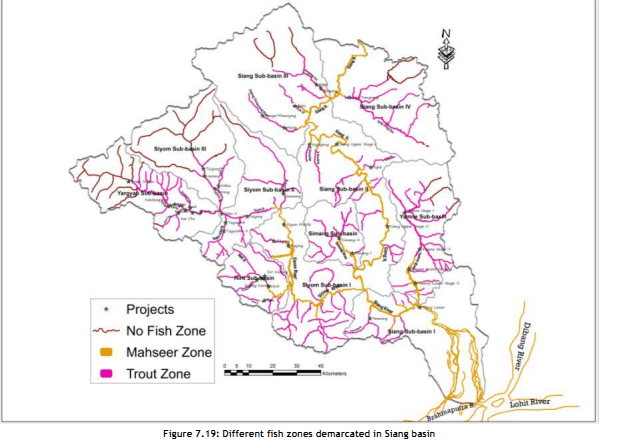
6. Eflows, one of the most significant issues handled erroneously: NO ASSESSMENT OF E-FLOWS REQUIREMENTS The CIA has not done assessment of e-flows requirements at various locations keeping in mind the upstream projects. The very crude assumption it has made is by dividing the entire basin in Mahseer and Trout Zone and assuming certain water depths for these fish in lean, monsoon and non-lean, non-monsoon months. Several fisheries scientists do not support this classification or accept these two species alone as representing the ecosystem. The study assumes 50 cms water depth for Mahseer and 40 cms depth for Trout in lean season.[7] Then flows for maintaining that particular depth are calculated and recommended. Added criteria is that depth should not be less that 50% pre-project river depth. 

Luxuriant Biodiversity of the Siang basin Photo: Team BHP

Here it is worth quoting the minutes of 62nd meeting of EAC:

“The EAC asked the Consultants to take comprehensive view of the environmental flow assessment and make final recommendations for each stretch. Committee asked to study international literature available on the subject and use the best suitable methodology for this exercise suiting to Indian conditions. The Consultants said that most appropriate method such as Building Block Methodology would be used by them. Detailed habitat simulation modelling for the entire year needs to be considered so that flow release requirement can be established not only for lean season but also for monsoon season and other months… The Consultants while submitted that public hearing as such is not a part of the study as per ToR, informed that BBM entails expert and stakeholder‟s consultations and would be followed.”

This has clearly not been done.

This approach is incorrect on various counts:

  • The habitat requirements of Mahseer and Snow Trout are higher than the assumed 0.5 m and 0.4 m. This has been confirmed by several fisheries scientists. The WII study on Upper Ganga Projects recommends a minimum of water depth of 1 meter for adult Mahseer (Tor species) (Table 7.6, Page 148) and at least more than 50 cms for Trouts (Schizothorax sps) (Table 7.8, Page 150). Incidentally these tables from WII Cumulative Impact Assessment have been used in the report without stating the source or credit. SANDRP has interacted with several fisheries experts who claim that 0.5 meters is a completely inadequate depth for adult Mahseer.
  • This faulty assumption has led to low eflows recommendations of 15% of average flows in non-lean non-monsoon months for Heo and Tato I Projects, this is lower even that EACs norms. This assessment and recommendations are clearly unacceptable.
  • The criteria of 50% water depth wrt pre-project depth is arbitrary and without any scientific justification. For Himalayan rivers with a stable hydrograph like Siang, 50% depth reduction is very high. As can be seen from Eflows chapter, after 50% depth reduction, most river stretches have less than 100 cms depth, which is just about the minimum depth required for an adult Mahseer or a spawning snow trout. However, Mahseer and trouts are abundant in these rivers. This just indicates the problems behind 50% water depth criteria. This should not be accepted.
  • The entire eflows discourse is not based on assessment of environment flows for various objectives and ignores most critical requirements.

    Division of the Basin into Trout and Mahseer Zones Photo: From CIA/ CCS Report of Siang Basin
    Division of the Basin into Trout and Mahseer Zones Photo: From CIA/ CCS Report of Siang Basin

7. No mention of Climate change In the entire study, there is no mention of climate change, how changing climate would affect the rivers and projects and how project construction would add to climate change impacts and how they will reduce the adaptation capacity of the people and environment to cope with the changing climate. Deforestation to the scale of 21000 hectares of thick forests and complete loss of a biodiversity rich free flowing river has strong impacts in the context of climate change and these need to be assessed.

8. No stand taken on three mega projects on Siang Main Stem and other big hydro projects Three mega projects on Siang Main stem, namely the 6000 MW Upper Siang I, 3750 MW Upper Siang Stage II and 2700 MW Lower Siang will have a huge destructive impact on the entire ecology and society of the region. These three projects together will submerge 18,100 hectares of dense forest area and will convert entire river length between these projects: 208.5 kilometers, into unbroken sequence of reservoir-dam-reservoir-dam-reservoir-dam, with no flowing river between two consecutive projects. The study has not even attempted assessment of length of flowing river required between the projects and eflows allocation for this stretch.

L Section of the Siang River with 3 mega projects which do not leave any flowing river between them. Photo from: CIA/ CCS Report of the Siang Basin


Oppsition to Public Hearing of 2700 MW Lower Siang Project Photo: Echo of Arunachal

These projects in a cascade, destroying a complete flowing river are against the principle of sustainable development and even EAC’s minimalist norm of 1 km of flowing river between projects. A CIA/ CCS study should have raised this issue strongly as these projects are undoing most of the other recommendations. However, the study refuses to take an independent stand against these projects and fails its mandate of being an independent study. 

Yamne Basin, claimed to host highest biodiversity in Siang is planned to have 4 projects back to back! Photo: Abor Country Travels

Similarly the study does not take stand on other big hydropower projects proposed in the basin. Most of the projects it has recommended to be dropped are relatively smaller projects, none are big ones. This shows bias of the consultants. The report is also not in consistent in its recommendations. 

Positive suggestions: The study recommends dropping 15 projects and keeping some tributaries free from any hydel development. It also calls for including small hydel projects under the ambit of EIA. These suggestions are important and should be accepted. EAC should immediately ask MoEF to recommend changes in the EIA notifications to include all hydro projects above 1 MW. 

The study has also asked for change in parameters of Tato II, Hirong, Naying and Siang Middle HEPs so that at least 1 km of river is left flowing between them. This is welcome and EAC should accordingly ask for changes in these projects. But the report has not done any study in this regard. 

9. No conclusion about how much length of the river is to be compromised One of the TORs of the study include, as per the minutes of the 43rd meeting of EAC held in Nov 2010: “Considering the total length of the main river in the basin and the HEPs already existing and planned for future development, how many more HEPs may be allowed to come up. In other words, how much of the total length of the river that may be tunneled inclusive of the tunnelling requirement of all the projects that have been planned for development so that the integrity of the river is not grossly undermined.” (Emphasis added.) The report does not do an assessment on this. The B K Chaturvedi committee had recommended that not more than 50% of the river can be compromised. However, this report was to study this aspect, but has neither studied this, nor done analysis or reached any conclusion. 

10. Number of sampling locations The minutes of 49th meeting of EAC held in April 2011 concluded that the number of sampling locations will be decided based on this criteria: 3 sites for project with over 1000 MW installed capacity, 2 sites for projects with 500-1000 MW installed capacity and one site for projects below 500 MW installed capacity. In addition 2-3 locations will be selected in the downstream areas. 

Menchuka_Team BHP

If we go by this criteria, and considering 44 planned projects listed in the CIA, there should have been 15 locations for 5 projects with capacity 1000 MW or above, 4 for two projects with 500-1000 MW capacity and 37 for projects below 500 MW capacity, in addition to the locations in downstream areas. The CIA has not followed these directions from EAC, else sampling locations would have been about 60 and not 49 as included in the report. 

11. Source of information not given Several annexures in Vol II (this too should have been put up on EAC website, but has not been, we got it from other sources), including Annex I says that it is prepared from “PREPARED FROM SECONDARY DATA & FIELD SURVEYS”, but which information has been obtained from field surveys and which information is obtained from which secondary source is not given. In absence of this it is difficult to verify the claims. 

12. Inconsistency, contradictions in listing of flora-fauna

– In volume II, Annex I titled “LIST OF PLANT SPECIES REPORTED FROM SIANG BASIN”, which is supposed to include data from secondary sources and field surveys lists 1249 angiosperms and 11 gymnosperms. However, the pteridophytes listed in Annex II titled “LIST OF PLANT SPECIES RECORDED FROM DIFFERENT SUB BASINS OF SIANG DURING FIELD SAMPLING” do not find mention in Annex I or Annex III a/b/c.

Out of 11 Gymnosperms listed in Annex I, only two figure in Annex II, rest do not get listed in any of the sub basins.

– The species Dicliptera bupleuroides and Phlogacanthus thyrsiflorus listed in Annex 1 Angiosperms do not get listed in any of the sub basins.

Section 4.1.4 says Paphiopedilum fairrieanum is an endangered and Cymbidium eburneum is an endemic and vulnerable orchid species in Siang basin, however, these species do not get listed in any sub-basins in Annexure II or in any season in Annexure III. Same is the case with endemic orchid species of Siang basin, namely Calanthe densifloraDendrobium cathcartiiD hookerianumGaleola falconeriLiparis plantaginea and Paphiopedilum fairrieanum.

– Similarly among the Rhododendron species, threatened species like Rhododendron boothii, threatened species like Rhododendron falconeri, newly discovered and critically endangered species like Rhododendron mechukae (even though it was found in Yargyap Chhu sub basin), Rare species like Rhododendron arizelumRhododendron dalhousieaevar. rhabdotum,Rhododendron kenderickii, and R edgeworthii are not found in Annex II or III.

Rhododendron Species of Siang Basin Photo: Abor Country Travels

Endemic cane species Calamus leptospadix also do not figure in Annex II or III.

– The CIA says, “The Siang basin as discussed above is also very rich in floristic resources and there are still number of areas in the basin which are either under-explored or yet to be explored”, however, a CIA is supposed to make recommendation how to ensure that such areas are explored before any more projects are taken up, but this report makes no recommendation in this regard.

– The CIA says that 17 Near Threatened (regional level) medicinal plants, 46 endemic species and additional 55 endemic species are reported in Siang basin, but CIA neither gives list of them, nor locations, how these will be affected by hydropower projects or recommendations to conserve them.

– The scope of study given in Annex 1, Vol. I says: “Preparation of comprehensive checklist of flora (Angiosperms, Gymnosperms, Lichens, Pteridophytes, Bryophytes, Fungi, Algae etc.) with Botanical and local name.” However, we do not find the local names listed.

The situation with respect to fauna species is no different, with similar inconsistencies, lack of specific sub-basin wise situations and recommendations to conserve them. This is true in case of mammals, birds, butterflies, amphibians, reptiles, inspects as also aquatic biodiversity. While the report makes some impressive general statements, but is found to be lacking in specifics mentioned above.

This sample list of inconsistencies and gaps shows that there are serious problems in these lists and the consultant should be asked to remove all these inadequacies. There is also need to get these lists peer reviewed by credible independent experts like those from WII.

13. Unsubstantiated advocacy: going beyond the TOR & mandate The CIA says in last para in section 12.3 titled “Downstream Impacts”, “Keeping the substantial storage requirement in Siang, storage projects in Siang needs to be re-configured, which may lead to merging of Siang Upper Stage I and II into single project to create storage.” There are several other such sentences in this section and elsewhere. This is uncritical acceptance of CWC assertions and is an advocacy for more storage projects in the name of flood moderation. This is clearly uncalled for in a CIA report and such uncritical acceptance of CWC assertions is also not what is expected from a CIA. In any case, this is also beyond the mandate of the CIA.

14. Other inadequacies of CIA

– The CIA does not contain the TOR, the scope of the study given Annex 1 of Vol I is not the TOR.

– 49th EAC meeting had asked for inclusion of Assam Experts in the study, but the study does not mention this.

– The 43rd EAC meeting held in Nov 2010 had asked for inclusion of assessment of the impacts of the projects on wetlands, floodplains, river morphology, sediment transport/ erosion/ deposits, impact on human activities and livelihoods and recommend necessary measures in these regard. The report mentions all these aspects, but fails to assess these impacts and make necessary recommendations.

– The Preface of the CIA claims that the TAC reviewed the draft interim report in May 2012 and draft final report in Sept 2013. We have checked the minutes of the TAC meetings and find that in May 2012 there was no TAC meeting. The 114th TAC meeting happened in March 2012 and 115th TAC meeting happened in July 2012, neither of the minutes include any mention of Siang basin study.

– The Sept 2013 meeting also did not include this report in its agenda. The report seems to be making false claims in this regard, they should be asked to provide minutes of the TAC meeting where this was discussed and what were the outcomes.

15. Study should not be finalised without credible Public consultation across the basin A comprehensive Siang Basin Study will give a cumulative picture of impacts on basin and on basin residents, including downstream population in Assam. The study is supposed to include important findings, which are separate from individual EIA reports. Even MoEF’s Strategic 12th Five Year Plan notes: 

Paddy feilds in Siang Basin. Agriculture finds no place in the CIA Photo: Kaushik Shil

“Of late, the limitations of project-level EIA are being realized internationally. Project EIAs react to development proposals rather than anticipate them, so they cannot steer development towards environmentally “robust” areas or away from environmentally sensitive sites. Project EIAs do not adequately consider the cumulative impacts caused by several projects or even by one project’s subcomponents or ancillary developments. The new trend is to address environmental issues earlier in planning and policy making processes. This could be done through cumulative impact assessment.” 

However, such a study cannot be complete without consultations held across the basin in a credible way with full information to the communities in the language and manner they can understand. The study should not be accepted without a credible process of Public hearing [8].

CONCLUSION We would like to urge the EAC NOT TO CONSIDER INDIVIDUAL PROJECTS UNLESS THE CIA/CCS Study is APPROVED through a participatory process. In Siang basin, the EAC has already granted EC to 2 projects, Scoping clearance to 16 projects (of which PH has been held for 8 projects) and nine projects will not need EC as they are below 25 MW. This renders the whole exercise of CIA/CCS meaningless!

We urge the EAC to consider all projects from Siang Basin only after CIA-CCS is finalised and keep the scoping and environmental clearances of projects in abeyance till then. 

Prayer Flags in Siang basin Photo: Team BHP

Looking forward to you point-wise response,

Yours Sincerely,

Parineeta Dandekar, Himanshu Thakkar SANDRP

(with inputs from Parag Jyoti Saikia)

END NOTES:
[1] SANDRPs assessment of Lohit Basin Study, Bichom Basin Study, Subansiri Basin Study and Upper Ganga Cumulative Impact Assessment.
[2] – This news was covered widely in the media – Arunachal Pradesh Groups Ask MoEF to Cancel Illegal Public Hearing of Lower Siang 2,700 mw Lower Siang Hydro Electric project runs into rough weather ,  GreenTalk: Activists to protest public hearing for dam on Arunachal’s Lower Siang river,  Protests against Siang dam,  Anti-dam stir hits Arunachal too, AASU,  TMPK oppose move on Lower Siang project,  Public hearing for Lower Siang project opposed,  Several organisations demand scrapping of Lower Siang project.
[3] Jonai meet opposes Arunachal dams
[4] Some such relevant benchmark norms include:
The World Commission on Dams Report, Nov 2000
International Rivers, Dam Standards: A Rights Based Approach, January 2014
The European Commission’s Guidelines for the Assessment of Indirect and Cumulative Impacts as well as Impact Interactions (1999)
The U.S. NEPA Analysis Guidance Manual (2007)
The Canadian Environmental Assessment Agency’s Cumulative Effects Assessment Practitioners Guide (1999)
– International Finance Corp’s (The World Bank Group) “Good Practice Note on Cumulative Impact Assessment and Management”, Jan 2013
– The World Bank’s “Sample Guidelines: Cumulative Environmental Impact Assessment for Hydropower Projects in Turkey”, Dec 2012
[5] “It was informed that BBM would be applied in addition to other applicable methodologies for working out EFR. The Consultants while submitted that public hearing as such is not a part of the study as per ToR, informed that BBM entails expert and stakeholder’s consultations and would be followed.” 62nd EAC Meeting, November 2012
[6] Section 9.9 of the CIA CCs Report
[7]“ To assess the minimum environment flow requirement in lean season a criteria has been defined that projects in the Mahseer zone needs to provide a minimum 0.5 m average depth in the initial reach studied, and for projects in the trout zone this depth is considered as 0.4m.” (Section 9.6.1 Environmental Flows Assessment in Lean Season)
[8] Himachal Pradesh Government had conducted such a Public Hearing on Satluj Basin Study recently
 

Post Script:

A good report on the Siang Basin CIA: Damn that river Author: Karthik Teegalapalli Posted on: 13 Oct, 2014: http://www.downtoearth.org.in/content/damn-river

Arunachal Pradesh · Assam · brahmaputra · Sikkim

Review of Water Sector in Northeast India in 2013: Increasing threats to Rivers, People and Environment

The year 2013 was an important for the water sector of northeastern states of India with several significant events. In this article I have tried to summarize some of the important events, issues and concerns of the water sector in northeast.  

Massive hydropower projects considered and cleared for northeast An analysis done by SANDRP for the year 2013 has showed that massive hydropower capacity in northeast India has been considered and cleared by Expert Appraisal Committee (EAC) on River valley and Hydroelectric projects. The total installed capacity of considered by EAC for the year 2013 is 29458 MW and out of which 21805 MW (over 74% of 29458 MW) projects are in the northeast India. On the other hand out of the total capacity considered for northeast, 20180 MW (over 92.5% of 21805 MW) projects are in Arunachal Pradesh. The total number of projects considered from northeast for 2013 was 37, all (including the Dibang multipurpose project, which is basically a hydro project) are hydropower projects. Out of these 37 projects, 10 projects of 4917 MW installed capacity has been given TOR (Terms of Reference) clearance or the Stage 1 clearance. 4 projects with 953 MW installed capacity has been given final environment clearances. 13 projects with 9078 MW capacity had been given extension of their TOR validity which implies that in next 2-3 years all these projects would also come up for final environmental clearance.

Pare hydro-power project on Pare/Dikrong river in Arunachal Pradesh is currently under -construction.  Photo – Parag Jyoti Saikia
Pare hydro-power project on Pare/Dikrong river in Arunachal Pradesh is currently under -construction.
Photo – Parag Jyoti Saikia

India-China Water Information Sharing MoU of October 2013 One of the most important developments of the year 2013 was the signing of this Memorandum of Understanding through which it was agreed that the current hydrological data (Water Level, Discharge and Rainfall) in respect of three stations, namely, Nugesha, Yangcun and Nuxia located on river Yaluzangbu/Brahmaputra from 1st June to 15th  October every year will now be extended to May 15th to Oct 15th with effect from 2014. Another important news through this agreement is that the Government of India recognizes the value of river since the agreement writes “rivers and related natural resources and the environment are assets of immense value to the socio-economic development.” But this agreement has been misread and misreported by a large section of the media. SANDRP wrote a detailed blog “Media Hype Vs Reality: India-China Water Information Sharing MoU of Oct 2013” which clears the fog around this agreement.   The blog also lists formation and decisions of the meetings of the Expert Level Mechanisms (ELM) on Trans-border rivers and MoUs on Hydrological Data Sharing on River Brahmaputra / Yaluzangbu and Satluj / Langquin Zangbu.   

Forest Clearance Rejected for Tipaimukh and Dibang Hydropower Projects In the year 2013 the rejection of forest clearance to 1500 MW Tipaimukh hydropower project and 3000 MW Dibang multipurpose project by the Forest Advisory Committee (FAC) of MoEF is noteworthy. Here it should be noted that the Prime Minister of India laid foundation stone for the Dibang Project in Jan 2008 when the project did not have any of the statutory clearances! However, NHPC has already started lobbying the Prime Minister headed Cabinet Committee on Investments to intervene for the forest clearance for Dibang Project and a note has already been moved for this. We hope these FAC decisions are not reversed as it happened in case of Kalu dam in Maharashtra, where the FAC decision was reversed following a letter from the Chief Minister. The stay over the construction work of Maphithel dam in Manipur by the National Green Tribunal could have been regarded as a positive sign but recent reports suggests that Union Ministry for Tribal Affairs (MOTA) had done a U-turn by going “back on its views to say that the Forest Rights Act should not apply to the acquisition of land from the Tanghkul and Kuki tribal people as a ‘rare and unique’ exception.”[1]

Two years of Anti-dam protests in Assam and Tripartite Talks The protest against large hydropower dams in Arunachal Pradesh had reached a new milestone as the stoppage of construction work of Lower Suabansiri hydropower project completed two year on 16th December 2013. This stoppage of the construction work of the Lower Subansiri project has brought the issue of downstream impacts of large dams to the forefront and also showed how a mass movement can question a top-down development project. These protests were led by Krishak Mukti Sangram Samiti (KMSS), All Assam Student Union (AASU), Asom Jatiyatabadi Yuba-Chatra Parishad(AJYCP) along with several other organizations.

KMSS president Akhil Gogoi with other members take out a procession in Guwahati on 16th December, 2013.  Picture by UB Photos
KMSS president Akhil Gogoi with other members take out a procession in Guwahati on 16th December, 2013. Picture by UB Photos

On Dec 6, 2013, a tripartite discussion was held involving the central government, Government of Assam and experts protesting organizations. Though this meeting failed to come to a common resolution, it led to the expert to expert meeting on the Lower Subansiri dam issues on 22nd December 2013.

These discussions not only help in building public opinion about the issue but also provide platform to discuss the larger issues related with 168 hydropower dam proposed for Arunachal Pradesh and its cumulative impacts in the larger Brahmaputra basin.

Foreign Funding of Hydropower projects in Northeast In the year 2013 Asian Development Bank has agreed to give loan of $ 200 million to construct the Lower Kopili Hydropower project in Karbi Anglong and Dima Hasao districts Assam. This project is being constructed by Assam Power Generation Corporation Limited (APGCL) and it is 8 km downstream of Kopili hydropower project, first dam on Kopili river. It is important to note that acidic contamination of water due to unabated mining in the upstream Meghalaya is a poses a major threat for the viability of the dam and this was disclosed in a study initiated by the project proponent. This project was given TOR clearance in the 69th meeting of EAC.

Proposed Site for Lower Kopili HEP in Assam Photo - Parag Jyoti Saikia
Proposed Site for Lower Kopili HEP in Assam.
Photo – Parag Jyoti Saikia

Foreign funding of hydropower project comes with the risk of huge cost overruns. This was evident in the case of Pare HEP on Pare/Dikrong river which NEEPCO constructing taking a loan of 80 million euros from KfW, a German Bank. Incidentally, this project was schedule to be completed in September 2013 but Central Electricity Authority status report on projects under execution now states the completion time as 2015. The cost of this project has already increased by 205% from its initial estimates. The loan amount along with the interest rest is also increasing year by year and NEEPCO’s 36th Annual Report of 2011-12 states that the loan taken from KfW is “repayable in 30 equal half yearly installments w.e.f. 30.12.2013.” This implies that even before the completion of the project the company has to start paying back the loan.

SANDRP had written a detail blog titled “Lower Kopili HEP: Oustanding issues that must be resolved before EAC can consider the project” which discussed the issues related with the proposed dam including the increase in intensity of floods in downstream Nagaon.  

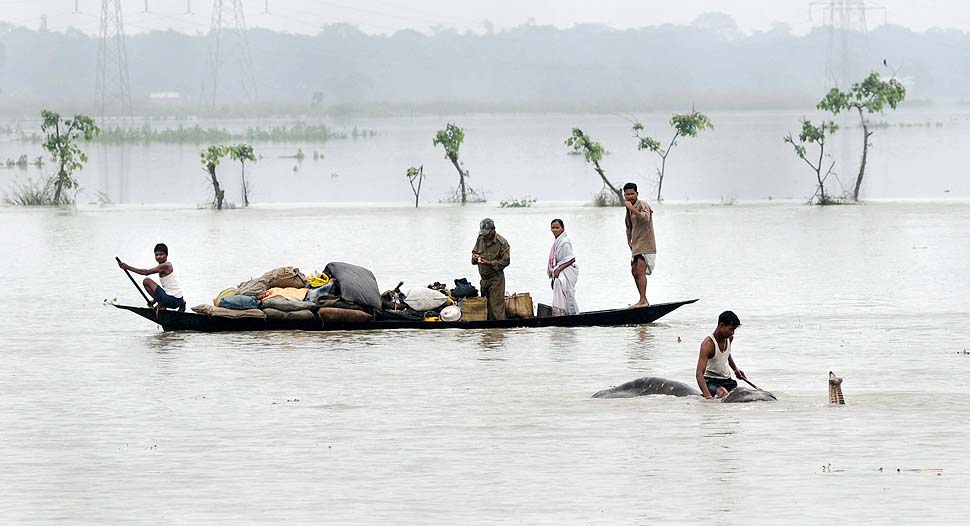
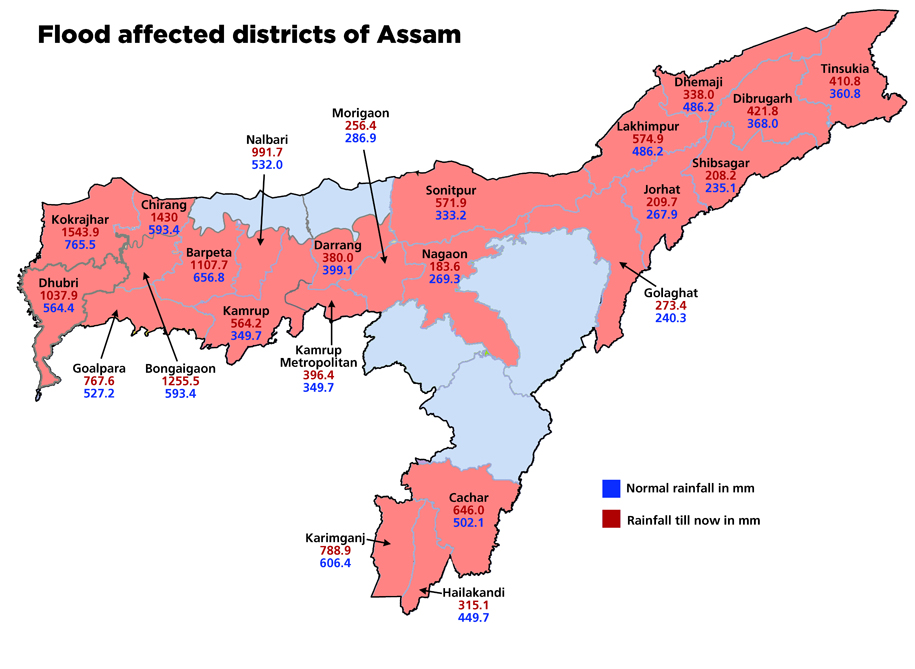
Assam’s Flood Devastation For Assam, the central state of northeast India, flood is an annual event. In the year 2013 Assam witnessed three waves of flood. The table below provides a glimpse of the extent of the flood disaster Assam faced in 2013. The data is sourced from National Disaster Management Institute under the Ministry of Home Affairs of Government of India. 

Data from NDMI, Government of India

Months No of affected People No. of affected districts No of affected Villages
30th June

14649

4

70

31st July

7971

4

55

31st Aug

6123

3

73

16th Sept

6123

3

73

But it was surprising to find that the numbers of affected people and villages provided by a central government organization is much less than the number provided by the disaster management department of the state government. The State Disaster Management Authority of Assam (SDMAA) provides much larger number of affected people. During the monsoon months of 2013, SDMAA published daily flood report on its website. After following the flood reports of four months, the following table with some key dates has been prepared to give an idea of the discrepancy between state government and central government data.

Data from SDMAA, Government of Assam

Months No of People affected No. of districts affected No of Villages affected
30th June

22,696

7

125

16th July

31,174

4

107

31st July

7716

4

45

10th August

53,714

4

164

15th August

33,563

5

102

24th August

6123

3

73

31st August

10,851

4

70

2nd September

2714

3

55

6th September

1,45,054

8

411

7th September

3,24,531

14

572

10th September

3,54,731

13

534

16th September

2510

2

16

This discrepancy points towards the lack of the coordination between the state and the central government departments which is clearly not good sign. Floods need serious attention and such misreporting can lead to confusions which will ultimately have bearing on the people of Assam. It is important to mention that many in Assam believe that the problem of flood in Assam has not been dealt adequately by the central government. The discrepancy detailed above reinforces that belief.

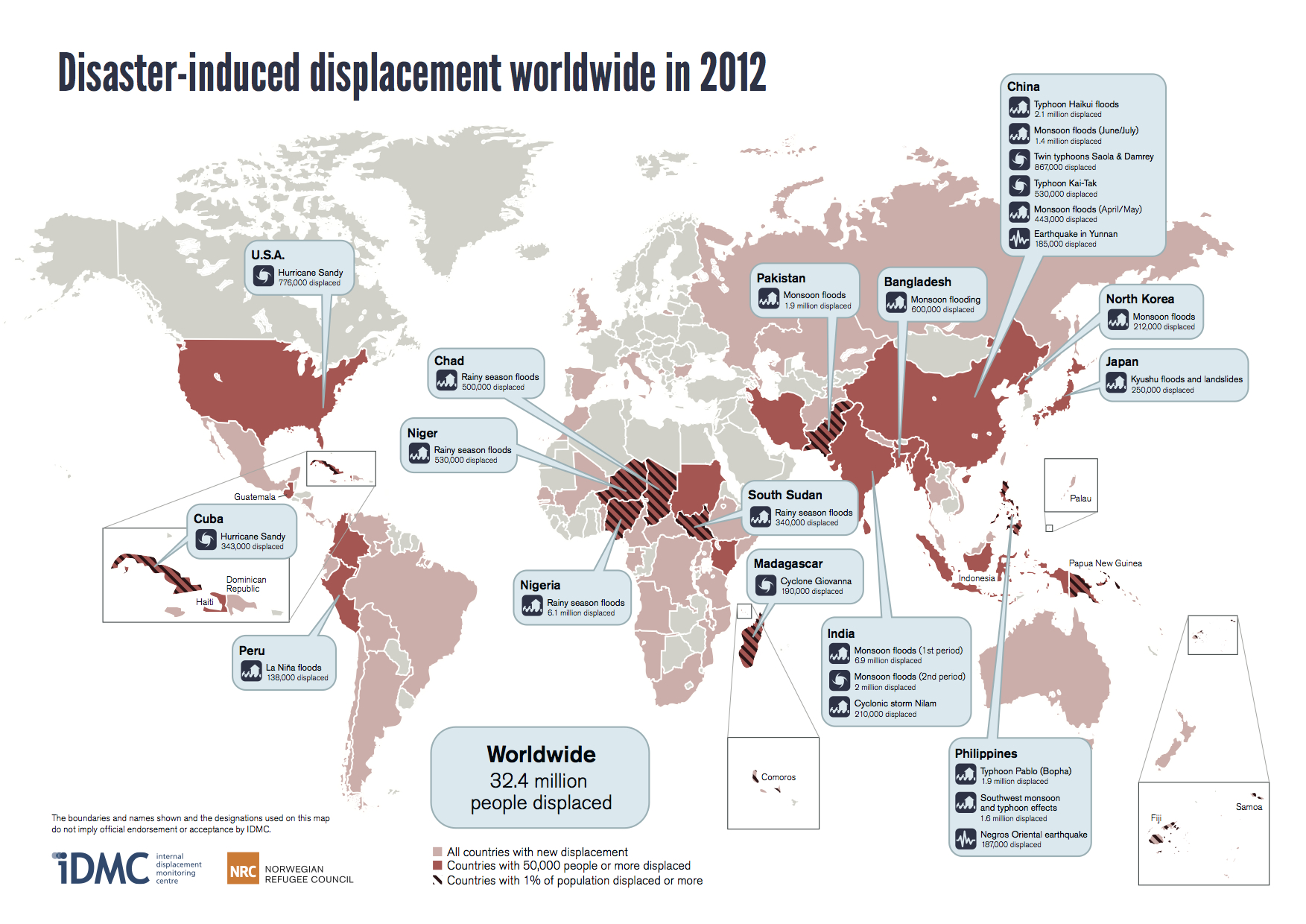
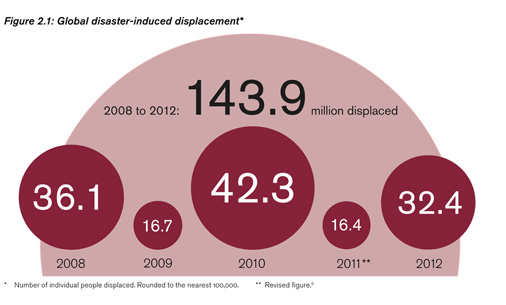
False claim about climate induced displacement in Northeast India by a global agency In connection with the flood issue, the year 2013 will also be marked by the publication of the report named “Global Estimates 2012 – People Displaced by Disasters” by Internal Displacement Monitoring Centre (IDMC) based in Geneva, Switzerland. This report had stated that the largest climate induced displacement in the world for the year 2012 happened in two states of Northeast India, Assam and Arunachal Pradesh in June 2012 due to the monsoon floods which displaced 6.9 million people, constituting about 21.2% of the population of the two states. But a detailed analysis of this report by SANDPR revealed that the though these figure are highly exaggerated. This analysis is available at “2012 Floods Displaced 6.9 Million in Northeast-IDMC: Staggering but Highly Exaggerated”.

Havoc of Erosion In Assam, along with annual floods, river bank erosion by Brahmaputra and its tributaries is a major cause of concern. The year 2013 is also no exception and severe erosion was reported in several parts of the state. A report Study of Brahmaputra River Erosion and Its Control done by IIT Roorkee, published in 2012 measured the loss of land due to erosion of Brahmaputra for nearly two decades in twelve reaches of the river. The total loss of land on both sides of the river Brahmaputra is mentioned below.

North Bank

South Bank

Total Erosion Length (km) 1990 to 2007 – 08 (in sq. km) 1997 to 2007-08 (in sq. km) Total Erosion Length (in km) 1990 to 2007 – 08 (in sq. km) 1997 to 2007-08 (in sq. km)
353.85 538.805 327.726 389.13 914.62 730.8

This report, sponsored by National Disaster Management Authority (NDMA), was a very descriptive report from the point of information and data about the river Brahmaputra and its tributaries. But an analysis of the report done by SANDRP, found that this report was biased towards structural interventions and hydropower projects and oversimplifies the problem of erosion by identifying ‘sediment overloading’ as the main reason for erosion. This analysis can be found at NDMA Commissioned IIT Roorkee Study on Brahmaputra River Erosion: A Biased and Structural Solution Oriented Report?”. 

protest against the state governments inactiveness to prevent erosion  Photo: Asomiya Pratidin
protest against the state governments inactiveness to prevent erosion
Photo: Asomiya Pratidin

The year 2013 also witnessed people in river-rine areas of Assam demanding relief from erosion. On May 21st 2013, the people of Bahgara Dhunaguri village panchayat in the Lakhimpur district of Assam floated the effigy of State Water Resources Minister Rajib Lochan Pegu in a traditional raft in the Subansiri River in Dhunaguri Baduli Para area. The TMPK units of Dikrong Awanori and East Dikrong joined in this protest. According to the beliefs of Mishing society when someone dies due to unnatural causes, his/her body is floated in a traditional raft in flowing river. People accused that Mr. Pegu had completely failed to perform his duty as a water resource minister and he had not been able to give any relief to the people by preventing flood and erosion. Failing to perform his duty has been regarded as the ‘unnatural death’ of the minister & that was why people floated the effigy of the minster.[2]

With respect to construction and repair of embankments, some serious issues were brought to light in the year 2013. In May 2013, All Assam Water Resources Contractors’ Association revealed that out of the total embankment length of 4473.82 km in Assam, the government had repaired only 1327 km embankment, leaving 3673 km long embankment completely vulnerable to floods.

Parag Jyoti Saikia (meandering1800@gmail.com)

with inputs from Himanshu Thakkar

——————

In the year 2013, SANDRP has written 13 blogs on issues related to North East India. A list of those blogs is given below. SANDRP has also made continuous submissions on dams and basin studies from Northeast to EAC and those submissions are available in our website https://sandrp.in/.

  1. NDMA Commissioned IIT Roorkee Study on Brahmaputra River Erosion: A Biased and Structural Solution Oriented Report?      
  2. 2012 Floods Displaced 6.9 Million in Northeast-IDMC: Staggering but Highly Exaggerated       
  3. Review of “Water Conflicts in Northeast India – A Compendium of Case Studies”: A Welcome Initiative
  4. CWC Flood Forecast for Assam: Issues Started Arriving before Floods   
  5. Brahmaputra – The Beautiful River or The Battleground?
  6. IWMI report on Glaciers and Snow cover in Himalayas in Changing Climate: Significant Impact on Seasonal flow of the Rivers in India   
  7. Lower Kopili HEP: Oustanding issues that must be resolved before EAC can consider the project 
  8. Subansiri Basin Study – Another Chapter of Environment Subversion in Northeast
  9. Climate Change, Migration and Conflicts in Assam-Bangladesh: Why we need better reports than this 
  10. Hydro Power Projects Violating SC order in the Greenest State of India 
  11. When EIAs Don’t Know River Lengths! Review of EIA/EMP of Simang I & II HEP on Simang River in Arunachal Pradesh        
  12. Media Hype Vs Reality: India-China Water Information Sharing MoU of Oct 2013
  13. Comments on Scoping Clearance Application of Panyor HEP on Ranganadi River in Arunachal Pradesh   


[2] Dainik Janambhumi, Guwahti, “Brahmaputra, Subanshirir Khohoniya Tras” 22nd May, 2013

brahmaputra · Dams · Sutlej

Media Hype Vs Reality: India-China Water Information Sharing MoU of Oct 2013

It was pretty surprising to see the front page headline in The Times of India on Oct 24, 2013[i], claiming that an India China “MoU on Dams Among Nine Deals Signed”. The Hindu headline[ii] (p 12) claimed, “China will be more transparent on trans-border river projects”. Indian Express story[iii] (on page 1-2) claimed, “The recognition of lower riparian rights is a unique gesture, because China has refused to put this down on paper with any other neighbouring country”. It should be added that the news stories on this subject in the Economic Times and the Hindustan Times took the MoU in more matter of fact way.

Proposed Chinese Dams on Yarlung Zangbo Source: SANDRP
Proposed Chinese Dams on Yarlung Zangbo
Source: SANDRP

Additional information for second half of May However, the actual language of the Memorandum of Understanding on “strengthening cooperation on trans-border rivers” available on website of Press Information Bureau[v] and Ministry of External affairs[vi] gives a very different picture. There is no mention of dams, river projects or lower riparian or rights there. One additional feature of the agreement is that the current hydrological data (Water Level, Discharge and Rainfall) in respect of three stations, namely, Nugesha, Yangcun and Nuxia located on river Yaluzangbu/Brahmaputra from 1st June to 15th October every year[vii] will now be extended to May 15th to Oct 15th with effect from 2014. While this is certainly a step forward since the monsoon in North East India sets in May and also in view of the accelerated melting of glaciers in changing climate, it should not lead to the kind of hype some of the newspapers created around the river information MoU. Moreover, it should be remembered that India pays for the information that it gets from China and what Indian government does with that information is not even known since it is not even available in public domain. How this information is thus used is a big state secret!

Three stations on Yarlung Zangbo - Nugesha, Yangcun and Nuxia (the green spots in the map represent these station)[iv]
Three stations on Yarlung Zangbo – Nugesha, Yangcun and Nuxia
(the green spots in the map represent these station)[iv]

Over-Optimistic reading of the MoU? The specific feature of the new MoU about which media seemed excited read as follows: “The two sides agreed to further strengthen cooperation on trans-border rivers, cooperate through the existing Expert Level Mechanism (for detailed chronology of ELM formation, meetings and earlier MoUs on Sutlej and Brahmaputra, see annexure below) on provision of flood-season hydrological data and emergency management, and exchange views on other issues of mutual interest.” The key words of this fifth the last clause of the MoU were seen as “exchange views on other issues of mutual interest”, providing India an opportunity to raise concerns about the Chinese hydropower projects and dams on shared rivers. However, the clause only talks about exchange of views and there is no compulsion for China to share its views, leave aside share information about the Chinese projects in advance or otherwise. On the face of it, the hype from this clause misplaced.

Tsada station on river Satluj (Shown as A in the Google Map)

This was read with first clause: “The two sides recognized that trans-border rivers and related natural resources and the environment are assets of immense value to the socio-economic development of all riparian countries.” Here “riparian countries” clearly includes lower riparian. But to suggest that this clause on its own or read with clause 5 mentioned above provides hope that China will include the concerns of the lower riparian in Chinese projects on shared rivers seems slightly stretched. The clause only recognises the asset value of rivers and related natural resources and environment for all basin countries and it is doubtful if it can be used to interpret that Chinese will or should take care of the concerns of lower riparian.

Thus the rather optimistic interpretation does not seem to emanate from the actual wording of the MoU, but the rather over optimistic interpretation by the Indian interlocutors, possibly including the Indian ambassador to China, who has been quoted on this aspect.

Real Achievement: GOI recognises value of Rivers! What is most interesting though is that Indian government has actually signed a Memorandum that recognises that “rivers and related natural resources and the environment are assets of immense value to the socio-economic development”. This is absolutely amazing and joyful development for rivers. Since there is nothing in the laws, policies, programs, projects and practices of Indian government that says that rivers are of any value. Now that Indian government has actually signed an MoU agreeing to such a value, there is sudden hope for rivers, it seems. Only lurking doubt, though is the word “trans-border” before rivers! We hope the Government of India applies this clause to all rivers, not just trans-border rivers, though we know from past that this hope is one a rather thin ice!!

SANDRP

Annexure:

1. Formation and Meetings of Expert Level Mechanism (ELM) on Trans-border Rivers

20-23 Nov, 2006 During the visit of the President of People’s Republic of China to India in November 20-23, 2006, it was agreed to set up an Expert-Level Mechanism to discuss interaction and cooperation on provision of flood season hydrological data, emergency management and other issues of trans-border rivers between the two countries. Accordingly, the two sides set up the Joint Expert Level Mechanism(ELM) on Trans-border Rivers. The Expert Group from Indian side is led by Joint Secretary level officers.  Seven meetings of ELM have been held so far.
19-21 Sept, 2007 In the 1st meeting of ELM the issues related to bilateral cooperation for exchange of hydrological information were discussed.
10-12 April, 2008 In the 2nd meeting of ELM work regulations of the ELM were agreed upon and signed. It was agreed that the ELM shall meet once every year, alternatively in India and China.
21–25 April, 2009 The 3rd meeting was focused on helping in understanding of each other’s position for smooth transmission of flood season hydrological data.
26-29 April, 2010 In the 4th meeting the implementation plan on provision of hydrological information on Yaluzangbu/Brahmaputra River in flood season was signed.
19-22 April, 2011 In the 5th meeting the Implementation Plan in respect to the MoU on Sutlej was signed.
17-20 July, 2012 The 6th meeting of ELM was held at New Delhi where both the countries reached at several important understandings and a significant one of those understandings is – “The two sides recognized that trans-border rivers and related natural resources and the environment are assets of immense value to the socio-economic development of all riparian countries.”
14-18 May, 2013 In the 7th meeting held at Beijing, China where in the draft MoU and Implementation Plan on Brahmaputra river was finalized.

 2. MoUs on Hydrological Data Sharing on River Brahmaputra / Yaluzangbu

2002 Government of India and China signed a MoU for provision of hydrological information on Yaluzangbu/Brahmaputra River in flood season by China to India. In accordance with the provisions contained in the MoU, the Chinese side provided hydrological information (Water Level, Discharge and Rainfall) in respect of three stations, namely, Nugesha, Yangcun and Nuxia located on river Yaluzangbu/Brahmaputra (see the map above) from 1st June to 15th October every year, which was utilized in the formulation of flood forecasts by the Central Water Commission. This MoU expired in 2007.
2008 On 5th June, India signed a new MoU with China on provision of hydrological information of the Brahmaputra /Yaluzangbu river in flood season by China to India with a validity of five years. This was done during the visit of the External Affairs Minister of India to Beijing from June 4-7. Under this China had provided the hydrological data of the three stations for the monsoon season from 2010 onward.
2013 During the visit of Chinese Premier Li Kegiang to India the MoU of 2008 has been extended till 5th June 2018.

 3. MoUs on Hydrological Data Sharing on River Satluj / Langquin Zangbu

2005 A MoU was signed during the visit of the Chinese Premier to India in April for supply of hydrological information in respect of River Satluj (Langquin Zangbu) in flood season. Chinese side provided hydrological information in respect of their Tsada station on river Satluj (Langquin Zangbu in Chinese, see the map above).
Aug 2010 In order to supply flood season hydrological information on River Sutlej a new MoU was agreed in August 2010
Dec 2010 On 16 Dec 2010, during the visit of Prime Minister of China to India a new MoU was signed to provide hydrological information of Sutlej/Langquin Zangbo River in flood season by China to India with a validity of five years.
April 2011 During the 5th  ELM meeting held in April, 2011 an MoU on Sutlej containing the Implementation Plan with technical details of provision of hydrological information, data transmission method and cost settlement etc. was signed in Beijing. The hydrological information during the flood season has been received in terms of the signed implementation plan.

Annexure compiled by Parag Jyoti Saikia

Post Script: Further reading: http://www.thethirdpole.net/2015/11/06/tibet-dams-hold-back-silt-not-water

END NOTES:

brahmaputra · Climate Change · Indus

IWMI report on Glaciers and Snow cover in Himalayas in Changing Climate: Significant Impact on Seasonal flow of the Rivers in India

International Water Management Institute (IWMI) has recently published a study named  Glacier Systems and Seasonal Snow Cover in Six Major Asian River Basins: Hydrological Role under Changing Climate, authored by Oxana S. Savoskul and Vladimir Smakhtin which claims that the hydrological role of the melt-water resources in six major rivers e.g. Indus, Ganges, Brahmaputra, Syr Darya, Amu Darya and Mekong of the Hindukush-Himalayan region (HKH) has been comprehensively assessed for the first time on a basin scale. Reviewing already published studies, this report draws some interesting conclusions regarding the role of glacier and snow meting for six river basins which includes three major rivers basins of India.

The map below shows area of the river basins included in this study. In this report, the term ‘melt-water resources’ has been used to cover glacier systems and seasonal snow cover. This report uses 1961-1990 status of melt-water resources as the baseline and compares with the 2001-2010 using the following characteristics: specific glacier runoff (average depth of annual discharge from glacier-covered area), basin total glacier runoff, shares of renewable and nonrenewable components in glacier runoff, total seasonal surface snowmelt from non-glaciated areas, portion of seasonal snowmelt lost for the recharge of groundwater aquifers, the contribution of glacier runoff and seasonal snowmelt to mean annual flow (MAF).

Map from the report showing the boundaries of the study basins (red line), state borders (light yellow line) and snow-covered high-altitude belts where glaciers are located (white spots
Map from the report showing the boundaries of the study basins (red line), state borders (light yellow line) and snow-covered high-altitude belts where glaciers are located (white spots)

The authors have used Glacier mass budget-based methods and hydrograph separation techniques which they stated as suitable for basin-scale assessments instead of the temperature-index methods. They say that application of these two methods in semi-distributed models can give the highest currently possible accuracy of +30%. The authors opine that many of the studies done previously had confused between the ‘snowmelt’ and ‘glacier-melt’ because these studies have not dealt with terminologies and methodologies in detail. The report states that there is a scarcity of glacier runoff estimates in peer-reviewed papers, “An analysis of publications on modeling runoff from large- and medium-scale glaciated catchments….. indicates that not many of these dealt with modeling glacier runoff per se. Even fewer report their evaluations of glacier runoff separately from snowmelt, if at all.”

For the three of the six river basins studies and which flow through India, i.e. Indus, Ganges and Brahmaputra the total annual glacier runoff for the period of 1961-1990 was 41 km3,16 km3 and 17 km3 respectively. But in the recent periods of 2001-2010, total glacier runoff was reduced to 36 km3, 15 km3 and 16 km3 respectively for the three basins, see Table 1 for details.

It is clear from the table that while Indus and Brahmaputra basins have similar percentage of  area under glaciers and snowmelt, the reduction in the glacier and snow cover area are more pronounced in Indus basin. Besides, in all the three basins the reduction in glacier area is more pronounced that the snow cover area. However, the contribution of glacier melt and also snow melt to run-off is much higher in Indus basin compared to Brahmaputra basin, showing the greater role of precipitation in Brahmaputra basin. Within the Indus basin even though seasonal snow covers 28% of the total area, much than the 2.6% occupied by glaciers during 1961-90, the contribution of two sources to Mean Annual Flow is almost same. But a question arises, has the contribution of glacier melt to the runoff increased in any of the basins in the recent decade? The answer is surprisingly, no.

Table 1: Recent changes in the glaciers and seasonal snow and their contributions to MAF

Basin Part of basin area(%) covered by Contribution to MAF (%)
Glaciers Seasonal Snow Glacier runoff Seasonal Snowmelt

1961-1990

INDUS

2.6

28 18

19

GANGES

1.2

6 4

2

BRAHMAPUTRA

2.7 27 2

2

2001 -2010

INDUS

1.8 25 15 16
GANGES

0.9

6 3

1

BRAHMAPUTRA

2.2 26 2

2

For the Ganges basin, the report says that heavy summer precipitation almost solely determines MAF volume for the basin. Maximum seasonal snow area in the Ganges basin makes just 6% of the entire basin area. Similar situation were reported for the Brahmaputra basin, where the lower parts of the basin i.e.  Southeastern Tibet and Eastern Himalayas where nearly 75% of the basin’s glaciers are located, witness heavy summer monsoon rains. Regarding Indus basin the report says, “Precipitation in the IndusBasin is more evenly distributed between the seasons, but is highly variable spatially – similar to Brahmaputra and Amu Darya, where annual precipitation in some catchments is tenfold (3,000 mm) of that in the other glacier-covered parts of the basin (300 mm).”

Reviewing already published documents the report states “it appears that the research in High Asia is concerned much more with CC impacts than with objects of the impact. Yet, understanding of the expected basin-scale changes in glacier runoff in response to climate change remains largely unclear.”

The report does an analysis of assessments done on impact of climate change on water availability in Himalayas and concludes that many assessments rely on poorly verified sources. The report refers to the statement made by Cruz et al. (2007) “The current trends of glacier-melts suggest that the Ganga, Indus, Brahmaputra and other rivers that criss-cross the northern Indian plain could likely become seasonal rivers in the near future as a consequence of climate change…,” This statement was admitted as a typing error after publication but even then this has been reiterated as an apocalyptic vision in NGO reports.

Using the Table 2 given below, the report states that glacier contribution is a minor item in the annual river water budgets in the Ganges and Brahmaputra basins. The report says “The impact of climate change was found to be more prominent on seasonal rather than annual water availability.” It is clear from the table that, in the recent decades non-renewable component in all three basins have gone up while renewable and total volume of water from glacier melt have come down. It is also noteworthy that, even though Brahmaputra basin has more area under glacier cover than the Ganges basin (see Table 1), the volume of water from non renewable glacier flow was more in both periods in the Ganges basin. Besides, the percentage of increase in nonrenewable glacier runoff components during 2001-10 is highest among all three basins, signifying that glaciers are melting fastest in Ganga basin.

Table 2: Contribution of renewable and non-renewable components to glacial runoff

Basin Glacier runoff components Total Glacier runoff (km3) Total Glacier runoff contribution to MAF (%)
Renewable (km3) Nonrenewable (km3)

1961-1990

INDUS

33.0

8.14 41.2

18

GANGES

11.0

4.74 15.7

4

BRAHMAPUTRA

12.7

4.29 17.0

2

2001 -2010

INDUS

24.5

11.62 36.1

15

GANGES

8.1

6.95 15.0

3

BRAHMAPUTRA

10.6

5.05 15.7

2

The reports also states, “Glaciers and seasonal snow in CC-impact assessments should be perceived as natural water reservoirs with gradually diminishing storage and flow regulation capacity, both on intra-annual and inter-annual scale. Potential changes of precipitation regime coupled with effects of temperature rise on evapo-transpiration will impact future hydrological regimes of the major rivers much more significantly, affecting both MAF and flow seasonality.”

The authors of this report clear some fog around climate change and Himalayan glacier system and snow-melt. One lacuna of the report is that even though the report discusses glacier run-off it makes no mentions of glacier lakes and glacier lakes induced floods. There are several incidents of glacier lake induced floods happening in the basins discussed. There is evidence to show that in the recent flood devastation in Uttarakhand in India glacial lakes played significant role.

Parag Jyoti Saikia

with inputs from Himanshu Thakkar

South Asia Network on Dams, Rivers and People (www.sandrp.in)

Arunachal Pradesh · Assam · brahmaputra

Brahmaputra – The Beautiful River or The Battleground?

Capture 3

The Brahmaputra River, geologically is the youngest among the major rivers in the world yet it is known as a moving ocean. The river Brahmaputra travels 2880 km from its origin in the young Himalayan range through the Tibet and India and finally merges with the sea in Bangladesh by opening its streams like the roots of a large Banyan tree. While traversing through India the river is astonishingly wide at some areas. In Upper Assam near Dibrugarh the river is 16 km wide where as in lower Assam at Pandu, near Guwahati the river is 1.2 km wide but in the immediate downstream it is nearly 18 km wide. Brahmaputra which is mainly a glacier fed river has also the distinction of being the river with highest sediment yield 852.4 t/km2/y in the world and second highest water yield at delta, next only to Amazon.[1]

Origin and Path

The BrahmaputraRiver originates in the Chemayungdung mountain ranges which nearly sixty miles south-east of Mansarovar lake in the MountKailash range in Southern Tibet at an elevation of 5300 m.A spring called Tamchok Khambab spills from the glaciers which later gather breath and volume to become the Tsangpo, the highest river in world.

A Buddhist shrine called a stupa overlooks the Brahmaputra River in southern Tibet. Source: http://kids.britannica.com/comptons/art-67000/A-Buddhist-shrine-called-a-stupa-overlooks-the-Brahmaputra-River
A Buddhist shrine called a stupa overlooks the Brahmaputra River in southern Tibet.
Source: http://kids.britannica.com/comptons/art-67000/A-Buddhist-shrine-called-a-stupa-overlooks-the-Brahmaputra-River

Out of its total length of 2,880 km the Brahmaputra covers a major part of its journey in Tibet as Tsangpo. Tsangpo or the BrahmaputraRiver flows 1625 km in Tibet parallel to the main range of Himalayas before entering India through Arunachal Pradesh.

Apart from the name Tsangpo, the Brahmaputra is also known by its Chinese name, Yarlung Zangbo in Tibet.  There are several tributaries of Tsangpo in Tibet. According to Encyclopedia Britannica,  Raka Zangbo (Raka Tsangpo), Lhasa (Kyi) and Nyang Qu (Gyamda) are prominent north bank tributaries where as Nyang Qu (Nyang Chu) is a tributary on the south bank. The Raka Zangbo (Raka Tsangpo) joins Tsangpo in the west of Xigazê (Shigatse) and Nyang Qu (Gyamda) River joins the river from the north at Zela (Tsela Dzong). The Lhasa (Kyi) river flows past the Tibetan capital of Lhasa and joins the Tsangpo at Qüxü.  The right bank tributary Nyang Qu (Nyang Chu) meets the Tsangpo at Xigazê.

Before entering India, the river passes Pi (Pe) in Tibet and suddenly turns to the north and northeast and cuts a course through a succession of great narrow gorges between the mountain Gyala Peri and Namjabarwa (Namcha Barwa) in a series of rapids and cascades.

The Great Bend of Tsangpo where China planning to build world’s biggest hydropower project Source: http://greenbuzzz.net/nature/the-biggest-canyons-in-the-world/
The Great Bend of Tsangpo where China planning to build world’s biggest hydropower project
Source: http://greenbuzzz.net/nature/the-biggest-canyons-in-the-world/

The river then turns south and southwest and flows through a deep gorge across the eastern extremity of the Himalayas with canyon walls that extends upward for 16,500 feet (5,000 meters) and more on each side. This is the celebrated great bend where China has plans to build the world’s biggest hydropower project of 40 000 MW capacity and also divert water from here to the North China, though China is currently denying any such plans.

Siang River Source: https://www.facebook.com/lovely.arunachal/media_set?set=a.117543018322855.21150.100002014725686&type=3
Siang River
Source: https://www.facebook.com/lovely.arunachal/media

The river enters Arunachal Pradesh near Gelling where it is known as the Siang or Dihang. The total length of Siang River is 294.5 km till its point  of confluence  with Dibang and Lohit River. The elevation of Siang river catchment area ranges from 90 m to around 5800 m. In India the total catchment of Siang river up to its confluence with Dibang is 14965.30 sq km.[2]

The SiangRiver meets two other major tributaries of Brahmaputra, Dibang and Lohit in the west of Sadiya, at a place named Kobo. From this confluence point, the river is known as the Brahmaputra till it enters Bangladesh. In India the journey of the river Brahmaputra is 918 km long.

A recent study has shown that Kobo used to be confluence point in 1915.  By 1975 the confluence shifted to a place called Laikaghat which is 16 km downstream of the earlier point of confluence. In 2005 through satellite images it was observed that the confluence point has shifted “19 km farther downstream”.[3]

The river crosses Assam below Dhubri and enters Bangladesh where the river is known as Jamuna and it flows for 337 km. Regarding Brahmaputra’s role in Bangladesh a study writes “The Jamuna is the local name given to the river for its entire length in Bangladesh to the Ganges junction.

Jamuna River in Bangladesh Source: http://www.trekearth.com/gallery/Asia/India/North/Uttar_Pradesh/Agra/photo322311.htm
Jamuna River in Bangladesh
Source: http://www.trekearth.com/gallery/Asia/India/North/Uttar_Pradesh/Agra/photo322311.htm

The Brahmaputra-Jamuna has one principal tributary input, the TeestaRiver in the north-west, and two major offtakes on the left bank that are the Old Brahmaputra and the Dhaleswari. The Brahmaputra/Jamuna River contributes ~51% of the water discharge and 38% of the sediment yield to the Padma (Schumm and Winkley, 1994), with the sediment yield being estimated at 590 MT/ yr and the sand fraction contributing 34% of this total (Sarker, 1996).”[4] The Jamuna joins the Ganges at Goalundo Ghat and from here the combined flows of these two mighty rivers are known as Padma which joins Meghna in the downstream. The united stream thereafter known as the Meghna and with this name the river Brahmaputra ends its journey, entering the Bay of Bengal.

Bhutan forms an integral part of the Brahmaputra river basin even though it does not come in the path of the river. In our subsequent blogs we will bring a detail account of Bhutan’s role in Brahmaputra river basin.

 The Brahmaputra River Basin

The Brahmaputra river is an international river and its river basin is spread over four countries Bhutan, Tibet , India and Bangladesh with a total basin area of 5,80,000 sq. km. Out of this total catchment area 50.5% lies in Tibet, 33.6% in India, 8.1% in Bangladesh and 7.8% in Bhutan. For geologist and environmentalist the Brahmaputra is a very unique river because “drains such diverse environments as the cold dry plateau of Tibet, the rain-drenched Himalayan slopes, the landlocked alluvial plains of Assam and the vast deltaic lowlands of Bangladesh.”[5]

Map of Brahmaputra Basin from its origin to its confluence Source: http://en.wikipedia.org/wiki/Brahmaputra_River

In India the total basin area of BrahmaputraRiver is 197 316 sq. km. which 5.9% of the total geographic area of the country. In India the river is spread over states of Arunachal Pradesh, Assam, West Bengal, Meghalaya, Nagaland and Sikkim.

In India state-wise the drainage area of the BrahmaputraRiver is as follows:

State

Drainage area (sq. km)

% of state area in Brahmaputra basin

Arunachal Pradesh 83 740 100%
Assam 71 216 90.79%
West Bengal 12 585 14.18%
Meghalaya 11 780 52.52%
Nagaland 10 895 65.71%
Sikkim 7 100 100%
Total 197 316

Source: ‘Intregrated Water Resource Development: A Plan for Action’, MoWR, Govt. of India, September, 1999

The Arunachal Pradesh and Nagaland portion of the Brahmaputra river basin is mainly covered by mountain ranges and narrow valleys. Meghalaya part of the basin is majorly covered by hills where as Assam and West Bengal are mostly plain areas.

Politically in India the basin is spread over 22 parliamentary constituencies (2009) comprising 12 in Assam, 4 in West Bengal, 2 in Arunachal Pradesh, 2 in Meghalaya, 1 in Sikkim and 1 in Nagaland.

Projected Water Use for Diverse Purposes in the Brahmaputra Basin

Catchment Area 197 316 km2
Population (1991 census) 29.1 million
Surface-Water Potential (Av Annual) 629 km3/year
Utilisable Surface Water 24 km3/year
Total Replenishable Ground Water (Av. Annual) 26.55 km3/year
Natural Groundwater Recharge from Rainfall 25.72 km3/year
Estimated Utilisable Flow excluding Ground Water 21 km3/year

Source: ‘Integrated Water Resource Development: A Plan for Action’, MoWR, Govt. of India, September, 1999

Tributaries of Brahmaputra

Sub-basin map of Siang River Source: Environment Assessment Report Siang Basin In Arunachal Pradesh, Interim Report June 2012
Sub-basin map of Siang River
Source: Environment Assessment Report Siang Basin In Arunachal Pradesh, Interim Report June 2012

Studies have stated that the Brahmaputra river in its entire course receive water from a large number of tributaries. A study called “Study of Brahmaputra River Erosion and Its Control” done by IIT Roorkee[6] stated “the Brahmaputra receives as many as 22 major tributaries in Tibet, 33 in India and three in Bangladesh.” However this study did not mention anything about the river in Arunachal. We have already mentioned about the few of the tributaries Tibet. In Arunachal the major tributaries of Siang River are Ringong Asi, Yang Sang Chhu, Sigong/ Sirapateng, Niyikgong, Angong, Simang, Yamne, Siyom, Yargyap, Hirit Korong.[7]

In the course of journey through Assam from east to west, some of the important tributaries of the BrahmaputraRiver which join the river on the north bank are Lohit, Dibang, Subansiri, Jiabharali, Barnadi, Puthimari, Pagladia, Beki, Manas, Ai, Gabhoru, Chompawati, Sankosh, Raidhak, Torsa, Teesta etc. Burhidihing, Desang, Dikhow, Jamji, Bhogdoi, Kakdonga, Dhansiri, Kopili, Kolong, Sonai, Digaru, Bharalu, Krishnai, Dudhnoi are the major tributaries on the left bank. The actual number of rivers and rivulets which joins the mighty river is much larger than this list. In subsequent blogs we will try to go into details of some of the tributaries of the river Brahmaputra.

Hydrology of Brahmaputra

For the river Brahmaputra the average annual flow (water discharge) throughout Assam vary from 8500 to 17000 cubic meters per second. At Pandu Ghat near SaraighatBridge the average annual floods recorded was 16,000 cubic meters per second. During floods water discharge reaches its peak and the yearly average peak flow recorded was approximately 51,000 cubic meters per second.[8] At its mouth in Bangladesh, the average annual discharge of the river is 19,830 cubic meters per second. This is the fourth highest average annual discharge in the world. For the river Brahmaputra the highest daily discharge was recorded in August 1962 at Pandu which was 72,726 cubic meters per second. The lowest daily discharge at the same place was 1757 cubic meters per second in February 1968.[9]

Satellite image of the river Brahmaputra (2008) just downstream of Guwahati city indicating intense braiding. width of the river at pandu is 1.2 km but donstream is about 18km. Source: ‘Riverbank erosion: a perspective” a presentation by Dr. Bipul Talukdar, Assam Engineering College
Satellite image of the river Brahmaputra (2008) just downstream of Guwahati city indicating intense braiding
Source: ‘Riverbank erosion: a perspective” presentation by Dr. Bipul Talukdar, Assam Engineering College

Though the Brahmaputra has been described as a braided river, recent studies have shown that the river does not fit into the conventional definition of braided river. A recent study states “In the study reach of the upper Assam area, the Brahmaputra appears to be a multichannel and multi-pattern river that has a tendency to very frequently generate ananabranching[10] (Latrubesse, 2008) pattern in decadal scale.” [11]

The Brahmaputra has been widening its (riverbed) size continuously from the last century. Reports from Water Resource Department showed that in Assam the river Brahmaputra was spread over for 4000 sq km in 1920 but in 2008 this has increased to 6000 sq km.[12]

The Brahmaputra along with several of its major tributaries like Subansiri, Jia Bharali, Manas had very high water yields[13]  which are higher than most of the major rivers in the world. The reason behind such high water yield for Dr. D.C. Goswami, one of the renowned environmental scientist from Assam is “High monsoon rainfall in the upper catchments and their steep gradients are considered to be the major factors responsible for the high rates of unit discharge which in turn help generate the high sediment yield from the basin and contribute significantly towards causing drainage congestion in the valley.”[14]

Seismicity and Brahmaputra Basin

The Brahmaputra river basin and its adjoining hill ranges are seismically very unstable because it is located in the Eurasian (Chinese) and Indian tectonic plates. The most severe earthquakes with Richter magnitude 8.7 was recorded twice in the valley, in 1897 and 1950. The latter one particularly had severe impacts on the river Brahmaputra. As a result of this earthquake river bed was raised at least by three meters at Dibrugarh which had increased the flood and erosion intensity of the river. In the opinion of geomorphologists “the region’s active seismicity has a significant impact on the hydro-geomorphic regime of the Brahmaputra system of rivers, causing landslides that result in the natural damming of rivers, flash floods due to the bursting of landslide-induced temporary dams, raising of riverbeds by siltation, fissuring and sand venting, elevation of existing river and lake bottoms and margins, creation of new water bodies and waterfalls due to faulting.”[15]

Climate Regime

The Brahmaputra in its path from snow covered mountains of Himalaya to the deltaic flood plains of Bangladesh covers different climatic regimes. The mean annual rainfall in the Brahmaputra basin excluding the Tibetan portion is 2300 mm.  The distribution of rainfall is different at different parts of the basin. In the southern slopes of Himalaya the rainfall is over 6000 mm but in parts of Nagaland this is 1200 mm. The monsoon rainfall (June to September) contribute 60-70% to the annual rainfall of the basin.[16]

In this basin, areas which are above or equal to the elevation of 1500 m experience snowfall. In the Indian part of Brahmaputra basin there are 610 glaciers which covers an area of 928.91 sq km and the volume of these glaciers are 49.57 cubic km. Out of these 449 glaciers are in Teesta basin and 161 glaciers are in Arunachal.[17]  In the Brahmaputra basin, Himalayan snow and glacial melt waters play a very significant role in water availability and climate change will have severe impacts on this. Climate change will also impact the rainfall and snowfall pattern in the Brahmaputra basin. This issue needs more serious attention and we will come up with more detailed blogs on this.

Bio-Diversity in the Brahmaputra Basin

The Lohit flooplains, immediately dowsntream of Lower Demwe HEP, constitute an Important Bird Area as per international criteria and is also a potential Ramsar site Photo: Neeraj Vagholikar
The Lohit flooplains, immediately dowsntream of Lower Demwe HEP, constitute an Important Bird Area as per international criteria and is also a potential Ramsar site
Photo: Neeraj Vagholikar

The Brahmaputra river basin hosts very rich and unique bio-diversity. The whole of northeastern region is a globally recognized bio-diversity hot spot.  In the Indian territory the total forest cover of the Brahmaputra basin is 1,14,894 sq. km. which is 54% of the total basin area. In the distribution of forest cover among 6 states in Brahmaputra basin, Arunachal Pradesh tops the list with 82.8% forest cover but it is sad that the highest number of hydro-electric dams are planned in this state inviting disastrous impacts for the biodiversity, forests, people and environment. The tally of rest of the five states is as follows – Nagaland (68.9%), Meghalaya (63.5%), Sikkim (38.1%), West Bengal (21.4 %) and Assam (20.6 %).

Besides, the aquatic bio-diversity of the Brahmaputra and its tributaries is also very rich. Here we should also take the case of ‘beel’ or wetlands in the Brahmaputra flood plains which according to experts work as ”ecotonal zones” and ”play an important role in the dynamics of the Brahmaputra ecosystem, as these are natural feeding and breeding grounds for a number of fish species and other aquatic fauna.”[18]

Flood and Erosion

Brahmaputra river basin is known to be very prone to flood and erosion and these two hazards have led to many problems in the basin. In India, out of the eight northeastern states, Assam faces the most severe brunt of flood and erosion. Both flood erosion has been severely affecting the economy as well political, social and cultural milieu of Assam.

Experts opine that natural as well anthropogenic factors lead to devastating floods in northeastern region. “The unique geo-environmental  setting of the region vis-à-vis the eastern Himalayas, the highly potent monsoon regime, weak geological formation, active seismicity, accelerated erosion, rapid channel  aggradations, massive deforestation, intense land use pressure and high population growth especially in the floodplain belt, and ad hoc type temporary flood control measures are some of the dominant factors that cause and/or intensify floods in the Brahmaputra and the Barak basins (Goswami, 1998).”[19] The Brahmaputra river basin is also prone to flash floods and some of the worst flash floods have occurred in the valley in the new millennium.

Along with floods, erosion is also threatening the lives of the people in the state of Assam as it leads to permanent loss of land.  Here we can take the case of the river island Majuli, which had been one of the worst sufferers of the erosion done by Brahmaputra. In 1853 the total area of Majuli was 1129 sq km but it has now reduced to 3.55 sq km.[20]

Ilish fishing, Dauladia, Bangladesh, 2001 Source: http://www.npr.org/blogs/pictureshow/2011/11/14/142219164/capturing-the-unseen-side-of-bangladesh
Ilish fishing, Dauladia, Bangladesh, 2001
Source: http://www.npr.org/blogs/pictureshow/2011/11/14/142219164/capturing-the-unseen-side-of-bangladesh

In Bangladesh the Brahmaputra river which known as Jamuna is also infamous for severe floods and erosion. The river carries huge water and sediment discharge in this deltaic region. Because of its geographical setting, Bangladesh is very much dependent on its river for fertile fields and diverse flora and aqua culture but rivers also brings several hazards in the form of floods and erosion. Bangladesh has witnessed severe annual floods but the floods in 1987, 1988, 1998 and 2004 were the most severe ones in recent decades. But studies have shown that, “The people of Bangladesh have adapted their lifestyle for centuries to live with river flooding – frequently moving their temporary bank-side homes, planting on newly emergent river bars, and sometimes raising their homesteads above water level in flood periods (Paul, 1997). However, a growing population, coupled with the expansion of infrastructure and economic development, has resulted in an increase in the intensity of flood damage (FPCO, 1995; Paul, 1997; CPD, 2004). The lives of many millions of Bangladeshi citizens is thus reliant on these rivers, with up to 600,000 people living on the riverine islands and bars alone (Sarker et al., 2003).”[21]

In order to protect people from the fury of floods and erosion the main measure taken in India as well in Bangladesh is the construction of embankments. In Assam the total length of embankment is 4,473.83 km constructed on a total of 130 small and big rivers. But recent reports say that out this, 3376 km embankments are in a vulnerable condition and need immediate strengthening and repair.[22] As a deltaic region Bangladesh too has put its thrust on increasing length of embankments. In 1989 Bangladesh launched an elaborate flood control programme through construction of embankments which was named as ‘Flood Action Plan’. But this plan was vehemently criticized both at national and international level.

Protest against big dams – KMSS (Krishak Mukti Sangram Samiti) members protesting in Pandu Ghat in Guwahati against the ship carrying the turbines for the Lower Subansiri project. Source: http://peakwater.org/wp-content/uploads/2011/07/Lower-Subansiri-turbines-protest.preview.jpg
Protest against big dams – KMSS (Krishak Mukti Sangram Samiti) members protesting in Pandu Ghat in Guwahati against the ship carrying the turbines for the Lower Subansiri project.
Source: http://peakwater.org/wp-content/uploads/2011/07/Lower-Subansiri-turbines-protest.preview.jpg

In order to control the floods in Brahmaputra valley one of the proposed solution is construction of multi-purpose dams. In fact flood control was one of the pretexts for hydro-development in the northeastern region. But the idea that multipurpose dams can lead to flood control along with hydro-power generation is actually contradictory and unviable as seen from experience of such projects. Studies done on some of the biggest multi-purpose river valley projects of independent India, e.g. ‘Unravelling Bhakra’ by Shripad Dharmadhikary, ‘Drown and Dammed’ done on Hirakud by Prof Rohan D’Souza, “One Valley and a Thousand: Dams, Nationalism, and Development, Studies in Social Ecology & Environmental History” on Damodar Valley dams by Daniel Klingensmith have shown how unviable this proposition is. A number of these dams have actually created avoidable flood disasters in the downstream areas due to wrong operation of the dams[23]. In case of the mightly Brahmaputra river, this is likely to prove even greater disastrous considering its characteristics described above.

Today Brahmaputra valley is witnessing severe opposition against hydro-power dams.  The struggle against the Lower Subansiri hydro-electric project can be regarded as milestone. In the Brahmaputra valley the hydropower projects have been opposed also because of the impacts which it will going to have in the downstream as well as on the biodiversity, seismicity, society and culture of one of the most ecological sensitive areas. .

Institutional Mechanism over Brahmaputra in India

The Brahmaputra Board is the foremost body on Brahmaputra established by Government of India under an Act of Parliament i.e. The Brahmaputra Board Act, 1980 (46 of 1980) under the Ministry of Irrigation which now renamed as Ministry of Water Resources. The main task entrusted on Brahmaputra Board is ‘planning and integrated implementation of measures for the control of floods and bank erosion in the BrahmaputraValley and for matters connected therewith.’ Both Brahmaputra and Barak valleys are under the jurisdiction of Brahmaputra Board. Even though this independent board was established to better manage the flood and erosion problem of the two river basins, but its activities have come under severe public criticism. Besides Brahmaputra Board, the State Water Resource Department and Central Water Commission also looks after water issues in the river basin. Recently international funding agency Asian Development Bank (ADB) has come to be associated with flood and erosion control in the Assam but from the experiences of Bangladesh, the advent such agencies must be dealt with precaution.

Brahmaputra Valley as the Point of Confluence for People and Cultures

The Brahmaputra is a dynamic river whose dynamism is not only limited to its physical characters or features of the river, but immersed in social, political, economic and cultural aspects. The Brahmaputra valley has been the space of assimilation for people from different races and the one can find large variety of languages and dialects being spoken in this valley. The northeastern region falls under the Brahmaputra and Barak River basin[24] which is home for more than 166 separate tribes, 160 scheduled tribes and over 400 other tribal and sub-tribal communities and groups, speaking a wide range of languages (Climate Change in India: A 4×4 Assessment, 2010). The northeastern region can also be considered as an ‘ethnological transition zone’ between India and the neighbouring countries of Bhutan, Tibet, Burma and Bangladesh. In this region one can find 220 languages belonging to three language families – Indo-Aryan, Sino-Tibetan and Austric.[25]

Relevance of Brahmaputra for Assam

For Assam, the state located at the center of the northeastern region, the river Brahmaputra paves its way through this state like the lifeline of the state. The river ‘Brahmaputra’ literally means ‘Son of Brahma’. It is also one of the few rivers in India which is regarded as a ‘male’ river. There are several myths and legends about the Brahmaputra’s origin and we will bring those together in our coming blogs.

Bogibeel, the fourth bridge on Brahmaputra is under construction between Dhemaji and Dibrugarh district. Photo – Parag Jyoti Saikia

In Assam Brahmaputra River is also known by several other names  i.e. ‘Luit’, ‘Siri Luit’, ‘Bor Luit’ ‘Bor Noi’. For the people of Assam, the Brahmaputra is a symbol of great pride due to its ‘moving ocean’ size but this also ignites fear when it rises to its strength during floods. People of Assam have faced difficult times when the river has come to its full strength. Famous singer Jayanta Hazarika wrote, when he formed ‘Xur bahini’ to gather relief for flood victims “Luitor Bolia baan, toloi koloi nu dhapoli meliso, hir hir sowode kal roop dhori loi kaak nu bare bare khediso (Oh the maddening floods of Luit, where are you heading this time. Whom are you chasing again with frightening sound of your waves)”.

But this river is also the source of strength for the people of Assam. Time and again, they have expressed their unity as ‘Luitporia’ or ‘people from the banks of Luit’. The famous cultural icon of Assam, Jyoti Prasad Agarwala wrote in 1942 during Indian Freedom movement “Luitor parore ami deka lora, moriboloi bhoi nai (we are the youth from the banks of Luit and we don’t have any fear of death)”.  For another legendary cultural icon, Dr. Bhupen Hazarika  who is known as the bard of Brahmaputra, the river’s power of destruction was the source which will awaken the people. In his famous song “Bistirno parore” he asked the river – “Sahasro barishar, unmadonar, avigyotare, pangu manobok sawal songrami aru agrogami kori nutula kiyo (with your maddening experience of thousand monsoons, why don’t you arouse the disabled human beings for struggle and progress)”.

This blog is a small step to document the various aspects of the river Brahmaputra. It is the need of the hour since a flood of dams are proposed to submerge the Brahmaputra valley. Chinese plans of dam construction is not very much in the public domain but the impacts of dam construction of in the upstream Tibet will have severe impacts on the Brahmaputra river. Besides, the bogey of Chinese threat to divert the waters of Siang is used by the Indian government to push for rapid dam construction sidelining all the social, environmental, safety, sustainability, climate change concerns and impacts on the river ecosystem. The government very shamelessly has also put aside all the democratic processes to push for rapid dam construction. Though there is no proposal for a dam on the Brahmaputra in Assam, there are proposals to dam its major upstream tributaries.  This upsurge of dams, if they do get constructed will have huge impacts on the Brahmaputra River which are yet not known due to lack of credible projects specific or cumulative impacts assessment studies. These studies should include issues like  the river ecosystem, river bio-diversity, forests and wildlife, climate change, floods and erosion and economic and socio-cultural impacts. However, we are hopeful that the ongoing struggles against such unjustifiable projects will succeed and all these projects won’t come up. Through a series of blogs we will also try to bring together all these different streams of concerns.

Himanshu Thakkar, Parag Jyoti Saikia

South Asia Network on Dams, Rivers & People (www.sandrp.in)
Email: ht.sandrp@gmail.com, meandering1800@gmail.com


[1] Lahiri, S.K., Sinha, R., Tectonic controls on the morphodynamics of the Brahmaputra River system in the upper As-sam valley, India, Geomorphology (2012)

[2]EnvironmentAssessmentReport  SiangBasin In Arunachal Pradesh, Interim Report June 2012, Prepared for Central Water Commission(CWC

[3] Lahiri, S.K., Sinha, R., Tectonic controls on the morphodynamics of the Brahmaputra River system in the upper As-sam valley, India, Geomorphology (2012)

[5]GoswamiD.C., “Managing the Wealth and Woes of the River Brahmaputra” available at http://www.indianfolklore.org/journals/index.php/Ish/article/view/449/514

[7]EnvironmentAssessmentReport  SiangBasin In Arunachal Pradesh, Interim Report June 2012, Prepared for Central Water Commission(CWC)

[9] Goswami D.C., “Managing the Wealth and Woes of the River Brahmaputra” available at  http://www.indianfolklore.org/journals/index.php/Ish/article/view/449/514

[10] An anabranch is a section of a river or stream that diverts from the main channel or stem of the watercourse and rejoins the main stem downstream.

[11] Lahiri, S.K., Sinha, R., Tectonic controls on the morphodynamics of the Brahmaputra River system in the upper As-sam valley, India, Geomorphology (2012)

[13] Water yield means volume of water drained by unit area of the basin.

[14] “The Brahmaputra River”, India  by D.C. Goswami and P. J. Das in The Ecologist Asia Vol. 11 No 1 January- March 2003

[15] ibid

[16] ibid

[17] “Water Sector Options for India in a Changing Climate” by Himanshu Thakkar, SANDRP, New Delhi, March 2012

[18] ‘Stemming the Flood, Killing Biodiversity’ by Dr. Sanchita Boruah and Dr. S.P. Biswas in The Ecologist Asia Vol. 11 No 1 January- March 2003

[19] Goswami D.C., “Managing the Wealth and Woes of the River Brahmaputra” available at  http://www.indianfolklore.org/journals/index.php/Ish/article/view/449/514

[24]Barak River is located in south Assam and also an international river but smaller than the Brahmaputra.

Arunachal Pradesh · Assam · brahmaputra · Floods

2012 Floods Displaced 6.9 Million in Northeast-IDMC: Staggering but Highly Exaggerated

According to a new report, the largest climate induced displacement in the world for the year 2012 happened

Cover of the IDMC Report on Disaster Induced Displacement

in two states of Northeast India, Assam and Arunachal Pradesh in June 2012 due to the monsoon floods which displaced 6.9 million people, constituting about 21.2% of the population of the two states[1]. This staggering fact was revealed in the report named “Global Estimates 2012 – People Displaced by Disasters” published by The Internal Displacement Monitoring Centre (IDMC) based in Geneva, Switzerland in May 2013. More people were displaced in India by natural disasters last year than in any other country, says the report. A closer scrutiny shows that the figure seems highly exaggerated, raising question mark over the accuracy of the work of IDMC and Norwegian Refugee Council (NRC), who jointly published the report.

IDMC is an international body monitoring internal displacement worldwide. This was established in 1998 by the NRC. IDMC defines displacement as a non volunteer nature of movement. People who are compelled to evacuate their homes in order to avoid the impacts or the threat of a disaster will come under this definition. But from this definition it is also clear that those people who are affected by any disaster but have not evacuated their place living will not be defined as displaced. IDMC states that majority of people who face displacement are internally displaced people (IDPs).[2]

Displacement by type of related hazard, 2012 and 2008-2012

Total displaced

Type of hazard

2012

2008-12

Flood

22,010,000

89,181,000

Storm/ Typhoon

9,603,100[3]

29,051,000

Earthquake(Seismic activity)

637,000

23,604,000

Extreme Cold

2,000

923,000

Landslide(wet)

47,000

577,000

Volcano

40,000

472,000

Wildfire

59,000

103,000

Landslide (dry)

200

3,200

Extreme Heat

1,700

1,700

TOTAL

32 400 000

143 900 000

This report states that in 2012, an estimated 32.4 million people in 82 countries were newly displaced by disasters associated with natural hazard events. Over five years from 2008 to 2012, around 144 million people were forced from their homes in 125 countries. The majority of this displacement (98% in 2012 and 83% over five years) occurred due to climate and weather related hazards which include floods, storm, etc.

Disaster-induced Displacement Worldwide in 2012  Source: http://idmcnrc.files.wordpress.com/2013/05/world-map-global-estimates-2012.jpg
Disaster-induced Displacement Worldwide in 2012
Source: http://idmcnrc.files.wordpress.com/2013/05/world-map-global-estimates-2012.jpg

In the year 2012, twenty disaster-induced displacement events were recorded, which were induced by flood and storm related disasters.  Out of these, fourteen happened in Asia which includes the mass displacement in India, China and Philippines. Large scale flood displacements also happened in African countries of Nigeria, Chad, Niger and South Sudan. In fact the Nigerian floods also displaced over six million people.  Hurricane Sandy brought the disaster for the west which rendered 775,000 people homeless in America and 343,000 people in Cuba.

Why Disaster Induced Displacements are Increasing The report says that related and interconnected global changes like population growth, rapid urbanisation and the exposure of vulnerable communities, homes and livelihoods to hazards will increase the risk of global disasters. Even though increasing use of life saving drugs have brought down mortality rate related with weather related hazards, number of disaster survivors getting displaced will not decrease.

Global Disaster-Induced Displacement  Source: http://www.nrc.no/?did=9675023
Global Disaster-Induced Displacement
Source: http://www.nrc.no/?did=9675023

The analysis done in the report shows that disaster induced displacement takes a toll on both high income and low income countries.  However, it is the middle and low income countries where majority of the people were displaced.  The report states that for the year 2012, 96.09% of disaster induced displacement happened in the middle and low income countries, whereas for the period of 2008-2012 it was 98.27%.  The report also identifies that the South Asia region had the highest disaster related displacement (36.4%) for the year 2012. From 2008 to 2012, the highest disaster induced displacements have happened in China (49,782,000) which is followed by India (23,775,000) and Pakistan (14,991,000).

Risk of the Unseen – Climate Change The impact of climate change on disaster induced displacement has been emphasized in the report. The report states that climate change is an important concern which will impact extreme weather events which could lead to more displacement. Intergovernmental Panel on Climate Change (IPCC) published a report in March 2012, Managing the Risks of Extreme Events and Disasters to Advance Climate Change Adaptation (SREX) in which relationship between extreme weather or climate events (“climate extremes”) and displacement has been acknowledged, “Although data on climate change-forced displacement is incomplete, it is clear that the many outcomes of climate change processes will be seen and felt as disasters by the affected populations. For people affected by disasters, subsequent displacement and resettlement often constitute a second disaster in their lives.”[4] Evidence suggests that climate extremes are becoming more and more unpredictable due to the impact of climate change which has changed the frequency and magnitude of these climate extremes. This could be very serious issue considering the impact climate extremes can have on displacement. The report however fails to point out that while high income countries have been responsible for the climate change to the greatest extent, the impacts of their emissions are being felt by the poorest people in the low income countries and middle income countries.

Displacement in Northeast The report says that that around 900,000 people were evacuated in Arunachal Pradesh in June-July 2012; two thirds of the state’s population. In Assam, the report says, quoting Central Water Commission that as many as six million, 20 per cent of the state’s population, were forced to flee by rising waters. It says, officials claimed the 2012 floods were the worst since 2004 when eight times more houses were recorded as damaged than in an average year.

Rainfall in June 2012 does not corroborate IDMC claims – Monsoon rain is the reason for the floods in June 2012. The table below presents the rainfall figures of Assam and Arunachal Pradesh during June 2012.

1-13 June 14-20 June 21-27 June 28 June – 4 July
Arunachal Pradesh 191.6 (+1%) 64.1 (-47.1%) 249 (+78%) 66.2 (-51%)
Assam & Meghalaya 189.4 (-3.5%) 123.7 (-9%) 251.8 (+105%) 65.2 (-51%)

Note: Rainfall in mm, figures in bracket indicate the % departure from Normal, all figures from weekly and seasonal rainfall maps of India Meteorological department.

It is clear from the above table that rainfall in June 2012 in Assam and Arunachal Pradesh was normal or below normal in all weeks except during June 21-27, 2012. Even the excess rain in this period is not too high to cause unprecedented flood displacement. This raises some doubt about the figures in the IDMC report.

Flood Effected Districts in Assam in 2012 Source: http://www.downtoearth.org.in/content/assam-arunachal-pradesh-face-worst-ever-floods-recorded-june
Flood Effected Districts in Assam in 2012
Source: http://www.downtoearth.org.in/content/assam-arunachal-pradesh-face-worst-ever-floods-recorded-june

Assam suffers annually from flood disasters. The havoc of floods paralyses the state for several months every year.  International recognition of this problem is very important for the state. However, that seems to be some significant exaggeration in the figure of displacement in NE India due to floods in June 2012.

The total population Arunachal Pradesh is 1,382,611 according to 2011 census[5] and displacement of 900,000 people would mean displacement of massive 65% population of the state. But we could not find any report or news confirming displacement of this huge extent. There was news about floods in several districts in Arunachal Pradesh in June and July 2012, but none corroborated the displacement figure of 900,000. In fact displacement of 65% population of Arunachal Pradesh due to floods have never been heard of for even the worst ever floods in the state.

For Assam, the flood in June 2012 was recorded as the worst floods in last ten years. The flood in June 2012 was termed as unprecedented by Dr. Partha Jyoti Das, a senior researcher working on flood and environment related issues in Assam. He said that the flood occurred quite earlier than the previous years, i.e. in the first few weeks of June.[6]  However we found it difficult to find any document corroborating the displacement figure of six million in Assam due to floods in June 2012.

On the National Disaster Management website of Government of India (http://ndmindia.nic.in/flood-2012/floods2012.htm) the highest number of people affected during the month of June and July was 1,992,727 (reported on 2nd July 2012). The highest number of people evacuated during this time was 383,421 (reported on 4th July 2012). The highest number of people found in the relief camps was 484,555 (reported on 15th July 2012). The Assam State Disaster Management Authority also corroborated this figure as the highest number of people reported in the relief camps during that period. Two tables providing extent of damage (cumulative figures) and rescue and relief (provisional) are given in Annexure1 and Annexure 2.

A mahout moves an elephant to higher ground as villagers paddle with their belongings through flood waters in the Pobitora Wildlife Sanctuary, some 55 km from Guwahati, the capital city of Assam, India on June 28, 2012. Source: http://photoblog.nbcnews.com/_news/2012/06/29/12478381-india-floods-displace-more-than-850000?lite
A mahout moves an elephant to higher ground as villagers paddle with their belongings through flood waters in the Pobitora Wildlife Sanctuary, some 55 km from Guwahati, the capital city of Assam, India on June 28, 2012.  Source: http://photoblog.nbcnews.com/_news/2012/06/29/12478381-india-floods-displace-more-than-850000?lite

Figures from Oxfam India, one of the leading organizations providing flood relief in the state also validated the fact that the flood in June 2012 was unprecedented early flood and worst in last ten years. They maintained that due to this flood nearly 2.4 million people have been affected and half a million people have been displaced.[7] The IDMC report also refers to the information gathered from Sphere India and Inter Agency Group (IAG). We found that in a Joint Assessment Report of IAG Assam on Assam Flood 2012 (published on 6th July, 2012) the number of affected people was stated as 2,391,369 in 4,540 villages. In the same report 383,421 inmates were reported to be staying in 650 relief camps in 15 districts of the state.

We had written to IDMC (at the email address idmc@nrc.ch as provided in the document for any further information and referred documents) on June 13, 2013, for copies of the documents referred in end note 11 and in table A2.1, and also request to “provide any other report that provides details and support for the figure of 6.9 million people displaced by flood disaster in North East India in June July 2012”. Our email remains unanswered as we write this.

Dr. Arupjyoti Saikia, an environment historian working on northeast after seeing the report said that “I have no accurate estimate of the people being displaced. But equally the estimate provided by the IDMC seems little awkward. The numbers of people affected in AP is surely less for very natural reasons. Often IDMC reports are criticized for their over-reaction. Official figures matter a lot as this numbers help in procuring relief from the GOI as well as other agencies. I presume GOA reports will come closer to the truth.” Dr. Dulal Chandra Goswami, another senior scholar from northeast, said that the displacement figures for northeast, quoted in the report appear to be highly exaggerated. Dr. Partha Jyoti Das also expressed similar opinions saying that the figures mentioned in the IDMC report for northeast are overestimated. Many reporters may accept the figures in such reports uncritically and report them, which lead to spreading of wrong information. This was evident from the reports published in Down to Earth[8] and Thomson Reuters Foundation[9].

Moreover, displacement in Assam is not only induced by floods but also by erosion. The report does mention “Shelter needs were a primary humanitarian concern as the authorities encouraged IDPs to leave relief camps and return to water-logged villages, destroyed houses and eroded land”.  But this is not completely correct as erosion leads to permanent displacement of people from their original land. Floods lead to inundation of a certain area for a period of time displacing people temporarily from their homes. But erosion displaces people permanently from their land. In displacements induced by floods the displaced people have the option of going back to their houses. Erosion leaves no option for that. People who get affected by erosion have to shift their homes before the actual erosion happens. In 2007 it was stated in the State Assembly that in 15 out of 23 districts in the state 40,414.98 bighas of land was lost due to erosion.  10,075 families have lost their houses due to erosion in that year. Many people who get displaced due to erosion opt to live on the side of the embankments in poor living conditions for years due to their inability to buy new land. They might not come to relief camp during floods which may result in their non-recognition in official displacement figures.

Such kind of reports also need to recognise clearly that among the disaster induced displacement, it is the poor people who are most at risk even in a fast growing country like India and climate change is making them even more vulnerable. Hence there is an urgent need to ensure that the climate action plans address the vulnerabilities of the poor. Unfortunately, Indian government’s National Action Plan on Climate Change (NAPCC) does not even recognise the vulnerable classes of people. In fact NAPCC increases the vulnerability of the poor, since it basically follows the business as usual development path.

This report by IDMC is an important initiative to document the plight of the people who face displacement due to the disasters. Recording and documentation of displacement is very important for policy formulation as well as for all related discussions and debates. The numbers presented are shocking but are clearly unsubstantiated and exaggerated. However exaggerated facts will also not lead to healthy policy formulation. Besides, factual inaccuracies may lead to questioning the credibility of such reports. We hope that IDMC will acknowledge these errors and bring more factual accuracy in their future reports. Such reports also need to highlight the issue of climate justice.

Parag Jyoti Saikia and Himanshu Thakkar
South Asia Network on Dams, Rivers & People (www.sandrp.in)

Email: ht.sandrp@gmail.com / meandering1800@gmail.com


Annexure 1: Extent of Damage (cumulative figures) (Provisional)

Name of States/

UTs

Date when updated

Population affected


No. of

human lives lost

No. of districts affected

No. of villages affected

No. of cattle/

Live- stock lost

Cropped area affected

(in ha)

No. of houses damaged

Fully Partially
15.06.12 13.06.2012 7 13 326
18.06.12 17.06.2012 66915 11 10 11783 07 02
28.06.12 27.06.2012 386762 14 19 23134.15 141 6592
02.07.12 01.07.2012 1992727 81 27 1564 657558.07
03.07.12 02.07.2012 1233970 95 27 1543 657558.07
04.07.12 03.07.2012 916801 104 27 1281 U/ Assesment
15.07.12 14.07.2012 2391369 125 30 4540 2.55
19.07.12 18.07.2012 2391369 126 30 4540 2.55 awaited awaited
24.07.12 23.07.2012 2391369 126 30 4540 2.55
31.07.12 23.07.2012 2391369 126 30 4540 0 2.55 0 0

Source: Flood Situation Report for June and July, 2012 available at http://ndmindia.nic.in/flood-2012/floods2012.htm


Annexure 2: Rescue and Relief (Provisional) 

Name of States/ UTs

Date when updated

No. of persons evacuated

No. of relief camps opened

No. of persons accommodated in the relief camps

15.06.2012

18.06.2012

17.06.2012

245

27

14100

28.06.2012

27.06.2012

24647

187

175750

02.07.2012

01.07.2012

370265

622

439548

03.07.2012

02.07.2012

370265

551

255677

04.07.2012

03.07.2012

383421

650

255677

15.07.2012

14.07.2012

383421

622

484555

24.07.2012

23.07.2012

383421

622

484555

31.07.2012

23.07.2012

383421

622

484555

Source: Flood Situation Report for June and July, 2012 available at http://ndmindia.nic.in/flood-2012/floods2012.htm


[2] As defined by the 1998  Guiding Principles on Internal Displacement, internally displaced people (IDPs) are individuals or groups of people “who have been forced or obliged to flee or to leave their homes or places of

habitual residence […] and who have not crossed an internationally recognised state border.”

[3] This figure is clearly gross error. The total Disaster induced displacement in 2012 by all types of hazards is 32.4 million, so storm related disaster cannot displace 95.7 million people. We have used a corrected figure in the table here, based on total displacement subtracted by displacement by other (than storm) factors.

[4] SREX, p.80. Citing Oliver-Smith, 2009

Assam · brahmaputra · Embankments · Floods

NDMA Commissioned IIT Roorkee Study on Brahmaputra River Erosion: A Biased and Structural Solution Oriented Report?


Image

Pic:  1  Erosion in Rohmoria in the Upstream of Dibrugarh. Source: The Assam Tribune

The National Disaster Management Authority (NDMA) has recently published a report named “Study of Brahmaputra River Erosion and Its Control”. NDMA had commissioned this study to the Department of Water Resources Development and Management of IIT Roorkee. NDMA is an apex body constituted under the Disaster Management Act, 2005 to prepare the country to face natural and human-made disasters. NDMA is headed by the Prime Minster of India. Under the natural disasters category it includes earthquake, flood, tsunami, land slide and avalanches while nuclear, chemical or biological disasters have been categorized as human-made disasters. This report provides a lot of information and data on the Brahmaputra and its tributaries. The information about erosion is also very much detailed and descriptive. The report can be found at http://ndma.gov.in/ndma/latestdisasterupdates/NDMA%20Final%20Report%20Brahmaputra%20River.pdf

Image

Pic:  2 Recent News Reports of Erosion in Subansiri River, One of the Largest Tributaries of Brahmaputra on the North Bank. Source: Dainik Janambhumi

ImagePic:  3 Houses on the side of the Old Embankment in Matmora. Source: Parag Jyoti Saikia

This reports deals with a very serious issue of erosion in the Brahmaputra river basin in Assam. Erosion should not be confused with floods even though both are annual phenomena in the Brahmaputra river basin. Erosion can be seen to have a more severe impact than floods because erosion leads to permanent loss of land and property. During floods land and houses are submerged for a period of time. But erosion displaces people from their land and property for good. Erosion inflicts severe damage to agriculture, economy and cultural relations of people. Erosion compels people to migrate to different places. Villages get eroded one after another and people living in those villages have to move to another location with their belongings. But this may not be possible and affordable for all those who lost their land in erosion. So for many of them, living on the side of embankments in very poor living conditions remains as the only option. Erosion also leads to migration of rural youths to urban areas in search of jobs. In the last few decades erosion has posed as a greater threat to the people of Assam than floods. The severity of erosion can be seen from the Table 7 of the report in which Satellite Based Estimation and Comparison of Area Eroded In Brahmaputra during the Period 1990 to 2007-08 and 1997 to 2007-08 have been presented.

Image

Map of the Study Area from the Report

The study divides the river length into twelve segments from Dhubri to Dibrugarh and that is why there are 12 reaches mentioned in the table.  It is clear from this table that the while the erosion prone length of the river is 10% higher along the South Bank of Brahmaputra compared to the same along North Bank. Areas facing erosion is 123% higher in South bank during the last decade (1998-2008) of the study period. The highest erosion area/per km of erosion prone bank is upstream of Dibrugarh, where the river enters the plains from the hills.

Areawise division into 12 reaches in the river

North Bank

South Bank

Total Erosion Length

(in km)

1990 to 2007 – 08 (in sq. km)

1997 to 2007-08 (in sq. km)

Total Erosion Length

(in km)

1990 to 2007 – 08 (in sq. km)

1997 to 2007-08 (in sq. km)

1. Dhubri

40.19

124.461

94.129

7.05

194.983

10.791

2. Goalpara

39.5

79.046

40.902

4.85

17.816

5.052

3. Palasbari

54.87

48.668

42.914

14.02

23.006

15.859

4. Guwahati

21.02

7.92

1.654

24.38

5.385

12.079

5. Morigaon – Mangaldai

6

35.606

2.138

47.91

96.979

103.7

6. Morigaon – Dihing

24.86

29.057

7.275

47.8

10.795

56.72

7. Tezpur

8.58

38.758

4.733

52.95

16.628

44.774

8. Tezpur-Gohpur

8.85

31.187

5.794

44.16

26.098

71.227

9. Majuli-Bessamora

24.69

25.562

12.327

47.17

32.788

28.998

10. Majuli Sibsagar

16.93

60.657

16.878

54.95

44.018

42.118

11. Dibrugarh

37.86

37.506

43.529

43.89

46.595

6.066

12. U/s Dibrugarh

70.5

20.376

55.454

57.54

399.529

333.416

Total

353.85

538.805

327.726

389.13

914.62

730.8


The Study Report:
There have been a lot of studies done on the river, to find a solution to the issue. But what comes as a surprise is the attempt to shy away with some of the crucial issues of the riverine eco-system in the northeast. But before going into crucial issues, a brief note about the report is provided.

The March 2012 study is divided into two phases. The first phase is named as ‘Sattelite Data Based Assessment of Stream Bank Erosion of Main Stem Brahmaputra and Its Major Tributaries’. In the second phase processing and analysis of the hydrological data of the Brahmaputra and its tributaries has been done.

In the first phase of the study information and data of 18 years (1990 to 2008) has been put together. The study pertains to a reach of 620 km on the main stem of Brahmaputra River, i.e., its entire course in Assam from upstream of Dibrugarh up to the town Dhubri near Bangladesh border.  23 major tributaries (13 northern and 10 southern) within India have also been considered. The data for this whole area was collected using an integrated mechanism of Remote Sensing and Geographical Information System.

In the second phase of the study a new method of analysis called Artificial Neural Networks (ANNs) has been used. The data processed through this analysis has been used for modeling the rainfall-runoff process and runoff-sediment process for the study area.

The report identifies inherent ‘sediment overloading’ of the river fluvial system as the main cause for river bank erosion vis-à-vis channel instability in Brahmaputra. The report recommends by proposing river training works for two pilot areas on Brahmaputra River. The first site is in Bhuragaon of Morigaon district and second one is near the Guwahati airport.

Critical issues:

The team of investigators for this study was led by Prof Nayan Sharma of the Department of Water Resources Development and Management at IIT Roorkee. This is a very descriptive report from the point of information and data about the river Brahmaputra and its tributaries. But even then there are several things that the report does not mention at all.

The report mentioned that inherent ‘sediment overloading’ as the prime cause for erosion in the river Brahmaputra. But another study named “River Bank Erosion and Restoration in the Brahmaputra River in India” has identified several other factors responsible for bank erosion.[1] That study states “The salient hydraulic and bank material factors responsible for bank erosion of the Brahmaputra system are i) rate of rise and fall of river water level, ii) number and position of major channel active during flood stage, iii) angle at which the thalweg approaches the bank line, iv) amount of scour and deposition that occurs during flood, v) variability of cohesive soil in bank material composition, vi) formation and movement of large bed forms, vii) intensity of bank slumping, and viii) progression of abandoned river courses to present-day channel.”

Identifying only ‘sediment overloading’ as the main reason for a dynamic river system like Brahmaputra seems an over simplification that overlooks the critical issues.

 Image

Pic:  4  A view of the Balijan Tea Estate Eroded by the Brahmaputra in Rohmoria in Dibrugarh district of Assam. Source: The Hindu

Even though the report identifies sediment overload as the prime cause of erosion, it has provided insufficient analysis as to why the sediment load is actually increasing in Brahmaputra. The report rightly states “Accelerated erosion has occurred in this region due to intensive deforestation, large – scale road construction, mining and cultivation on steep slopes.”

Pro Hydro Bias: Here the report completely ignores case of hydropower development in Arunachal Pradesh and its impact on Brahmaputra and its tributaries. The report nowhere mentions about the proposals for 168 hydroelectric dams in Arunachal Pradesh and its impact in the rivers in Assam. In the recent times, the state has witnessed mass protest against hydropower development in Arunachal Pradesh. In fact the report shows a pro-hydro bias when it laments that “less than 5% of the existing hydropower potential” have been put to use so far. At a time when people are demanding for cumulative impact assessment of dams on the rivers of Assam, reports like this attempt to create confusion among people. It is to be noted that when Assam was witnessing the mass protest against big dams, it was Dr. Nayan Sharma who appeared in the electronic media advocating for big dams.

Image

Pic:  5  Erosion protection work at Nimatighat on the Brahmaputra in Jorhat District on May 5th 2013.       Source: http://www.prokerala.com[2]  

Bias for Structural Intervention: This report advocates for structural intervention for flood protection and reiterates the need for more embankments. Lots of analysis has been done on the ill effects and poor performance of embankments. Embankments essentially transfer the problems to the downstream. There are ample examples of how structural interventions made for erosion protection have failed. We can take the example of Rohmoria, located in the upstream of Dibrugarh town in this regard. There were a series of structural interventions made to control erosion but it failed.[3]

The embankments proposed in this report for the two pilot-study areas are proposed to be constructed using geo synthetic bags. The geo-synthetic bags will be put inside polymer rope gabions[4] and installed in the critical toe of the bank line. The efficacy of controlling erosion through geo-tube embankments still not established, but even then geo-tubes have become the buzz-word for flood protection in Assam. The Asian Development Bank has offered a loan of $12 million for erosion protection through construction of geo-tube embankments. But Assam government engineers working on Brahmaputra and its tributaries are critical of ADB’s programme of erosion control through geo-tube. In a report published in regional news paper on March 2010, it was stated that revetments like geo-bags cannot be successful in Brahmaputra because it creates a permanent deep channel along the existing river bank.[5] The report also stated that geo-synthetic bags which were installed for bank protection in Palashbari-Gumi area were washed away by Brahmaputra. This area is in the downstream of Saraighat Bridge and close to Guwahati airport area where one of the pilot projects has been proposed.

Impact of Structural Interventions Ignored: The report provides structural solution for erosion control but ignores erosions which were a result of structural interventions in the river. Studies on Brahmaputra basin have shown that during and after the construction of bridges in the river Brahmputra erosion and floods have increased in the downstream areas.[6] In the case of Saraighat Bridge, unprecedented flood and erosion was witnessed in Palasbari and Gumi area. Morigaona and Nagaon districts suffered the same after the construction of Koliabhomora Bridge. Construction of Naranarayan Setu, led to flood and erosion in Dakshin Salmara, Pancharatna and Mancachar.

Similar fears have been expressed for the fourth bridge on Brahmaputra which is under construction between Bogibeel of Dibrugarh district and Kareng Chapori of Dhemaji district. The river is nearly 9 km wide at this point. But for the construction of this bridge, the river had been shrunk to almost 5 km through the boulder spurs. This is posing a great threat of flood and erosion for the downstream areas which include famous river island Majuli and Matmora, where India’s first geo-tube embankment was constructed. Engineers who are involved in the construction of the dykes of the fourth bridge had been reported saying that Matmora area would come under severe threat due to the increased river pressure in the area. The report completely ignores all these facts and shows ‘sediment overloading’ as the cause of erosion.

Besides, the study gives a feeling that erosion in the river Brahmaputra operates in ceteris paribus[7]. The report made no mention about climate change and how it is going to impact a river like Brahmaputra which is flowing right from the Himalayan mountain range. At a time when impacts of climate change are taken into account for every possible environment related matters, ignoring this is another major lacuna of this report.

These critical lacunas put a question mark over the usefulness of the otherwise informative study. Credibility of IIT Roorkee reports have been questioned in the past too.[8] NDMA may keep this in mind and focus on more basic issues. For starters as monsoon sets in and rounds of floods start along Brahmaputra, NDMA’s flood forecasting links have stopped functioning for five days as we publish this in the 1st week of June 2013.

 Parag Jyoti Saikia 

South Asia Network on Dams, Rivers & People (www.sandrp.in)

Email: meandering1800@gmail.com


[4] Gabions are sausages made of Polymer ropes that are appropriately woven by a special process to fabricate the Gabions in various sizes. Gabions are generally available in a prefabricated collapsible form. Images of polymer rope gabions can be found here – http://www.garwareropes.com/polymer_rope_pro_g.htm

[6] Mahanta, C; Mahanta, A., ‘Bridge over The Brahmaputra’ Economic and Political Weekly, pp 579-581, 2006

[7] Ceteris paribus is a Latin phrase which can be literally translated as “holding other things constant” and usually rendered in English as “all other things being equal”