Dams · Maharashtra

Multiple Dams for Mumbai Region have Severe Impacts and are Unjustifiable

Press Release                                                                                                                                                  18.12.13                           

Multiple Dams for Mumbai Region have severe impacts and are unjustifiable

More than 50 people including tribal groups, social activists, water experts, ecologists and wildlife experts, academics came together for a brainstorming workshop about Dams coming up for Mumbai Region. The meeting was organized by South Asia Network on Dams, Rivers and People, Shramik Mukti Sangathana, Jalbiradari and Keystone Foundation.

About 12 dams are planned or are under construction to satisfy the increasing thirst of the Mumbai Metropolitan Region (MMR). All of these dams fall in eco-sensitive region of the Western Ghats. They will together submerge more than 22,000 hectares of land, including nearly 7000 hectares of forests, lakhs of trees and more than 750 hectares of Tansa Sanctuary. They will affect a minimum of 100,000 tribals who depend on the forests and their ancestral lands for livelihoods. These dams include Kalu, Shai, Balganga, Susari, Khargihill, Bhugad, Pinjal, Gargai, Middle Vaitarna, Barvi and Poshir, among others. These are in addition to the dams already constructed for MMR water supply.

Tribals and other affected groups of Thane and Raigad region have been strongly opposing these projects. Most people in Mumbai seems unaware of their struggles or impacts of these projects.

Most of these dams are escaping the social and environmental impact assessments and management plans, environment clearance requirements, environmental monitoring or public consultations due  to blunders in environmental impact assessment notification of Sept 2006, which excludes domestic and industrial water supply projects from environmental clearance process.

MMR has not done any sort of options assessment before pushing these projects and cursory review show that many options exist. At the city or Region level, there is no shortfall in water supply currently and the existing problems are due to inequitable, non-transparent, non-participatory and wasteful water governance in MMR. Municipal corporations under the MMR which are pushing new dams do not treat even 15% of their sewage. Bhiwandi Nizampur & Vasai Virar Corp do not treat ANY of their sewage. The Mumbai Region has no estimate of its rainwater harvesting potential, and there is little effective action in this direction despite high rainfall. Water supply and distribution losses are over 30%. Local water sources like rivers, lakes and wells are being destroyed by pollution and encroachments. There is no interest in democratizing governance of MMR water sector.

We urge the MMR region to address these issues first, which would lead to sustainable water supply to the city and suburbs. Konkan Irrigation Department which is constructing most of these projects has violated several laws related to tribal and forest rights, environment, forests and resettlement and has been mostly favoring a single contractor, illegally.

We strongly urge the MMRDA, MCGM, Municipal Corporations of MMR, Maharashtra government, Union Ministry of environment and forests, Maharashtra Forest Department, National Board of Wildlife and all others concerned to ensure that following steps are taken up urgently and in a credible way:

  1. Undertake thorough options assessment for Mumbai’s (and also same for other cities of MMR) water needs which includes groundwater use, local water sources, rainwater harvesting, sewage treatment and reuse, water supply efficiency, etc.,
  2. Undertake Environmental and Social impact assessments for all the dams coming up for Mumbai Region
  3. Take immediate action against KIDC for violating multiple laws while bulldozing ahead with projects and MMRDA for funding projects in the absence of clearances
  4. Respect peoples protests and Gram Sabha resolutions against displacement, deforestation and their refusal to give permission for these projects
  5. Take strong penal action against the officers and the contractors who have displaced Adivasis illegally
  6. Not to resume any work or planning for any project before the above is done, stop work on projects in the meantime.
  7. Change the EIA notification to ensure that all large dams are included for environment clearance, public hearings and EIA requirements.
  8. Immediately institute a credible Cumulative Impact Assessment of the projects already constructed and advanced in implementation.
  9. Institutionalize decentralized, democratic governance of water sector in MMR from bottom to top.


Forests in the Western Ghats are Mumbai’s and MMR’s lungs. They are the watersheds of rivers and water sources like Tansa and Bhatsa and naturally purify Mumbai’s & MMR’s drinking water.

Rich tribal culture of Thane and Raigad is a shared heritage of Mumbai and we have no right to displace the tribals or destroy their livelihoods.

Stop this destruction in Mumbai’s backyard.

Indavi Tulpule (indavi62@gmail.com), Shramik Mukti Sangathana, Thane;

Surekha Dalvi, (surekhadalavi@yahoo.com) Shramik Kranti Sangathana: Raigad;

Brian Lobo, (brianlobo6@gmail.com) Shramik Kashtakari Sanagthana: Dahanu;

Prashant Sarkhot, (loksangramsamiti@gmail.com)Shai Dharan Viroddhi Samiti,

Sitaram Shelar (sitaram.shelar@yuvaindia.org) YUVA, Mumbai;

Janak Daftari (daffy@jalsangrah.org), Jal Biradari, Mumbai

Shripad Dharmadhikary (manthan.shripad@gmail.com), Manthan Adhyayan Kendra, Pune

Parineeta Dandekar (parineeta.dandekar@gmail.com, 09860030472), SANDRP, Pune


Bihar · Embankments

Flood activist Shashi Shekhar on indefinite fast in Sitamarhi (Bihar) Against Unwanted & unjustified embankment and for a River

Today (on Dec 17, 2013) is the 8th day of indefinite fast by flood activist Shashi Shekhar in Sitamarhi (Bihar) with a demand to stop work on the unwanted and unjustified embankment along the Jheem river (part of Adhwara group of rivers in North Bihar) and for bringing Lakhandehi river back to its path where it was flowing less than a decade back. Several others have joined the fast since it started on Dec 10, 2013.

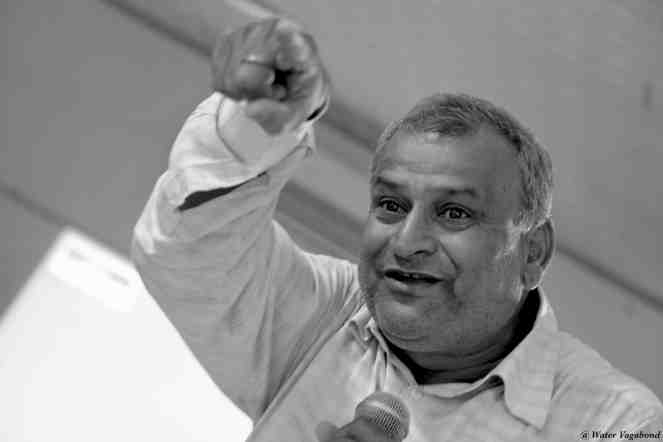
Activist Shashi Shekhar Speaking at a workshop in Patna

The demand is to prevent the shifting of river Lakshmana Ganga (Lakhandehi) toward east and to divert the river towards the west, so that the 147 km stretch of the original course resumes to get the river water, thereby helping hundreds and thousands of farmers, who are presently facing water scarcity. This can be done by desilting of the Lakhandehi river. The demand is also to stop work on the embankment along the Jheem River.

We are copying below the statement below compiled by Megh Pyne Abhiyaan, Bihar, from the statements and reports provided by Mr Shashi Shekhar. It explains the background of the situation.

Bihar government that has taken the decision of building the embankment without any consultation with the local people and even without any impact assessment and seems to be driven by contractor interests and have not yet bothered to respond. The state water resources ministry says that only the Chief Minister Nitish Kumar can take a decision on this and we see not effort from that quarter. With every passing day the health of Mr. Shekhar is deteriorating and the state government will be held responsible for any eventuality in this regard.

All this also highlights a serious anomaly in the Government of India’s EIA notification of Sept 2006 that excludes embankments and other such flood related structures from the need for environment clearances, environment impact assessments and also any public consultation process. This is clearly wrong since embankments have huge social and environmental impacts. This needs to urgently change, but the MoEF has not done that in spite of numerous letters to the ministry since 2006.

Local media is reporting on this on daily basis; the national media is yet to carry this except an isolated report or two[1]. We hope national media carries this important news.

SANDRP

PS: On Dec 19, 2013, Eklavya Prasad conveyed: Flood-activist Shashi Shekhar’s indefinite fast (against the construction of embankments along Adhwara Samuh and demanding de-silting of River Lakshmana Ganga (also known as Lakhandehi) was called off last evening. The negotiations between the district administration/state and Shashiji went off well and ALL his demands were have been accepted. According to Shashiji his indefinite fast has helped to take issues to a logical conclusion!

2. No action was taken following the assurances, so the fast was to resume in January 2014 as per this report: http://www.indiawaterportal.org/articles/indefinite-fast-continues.

3. Chicu from IWP wrote this piece in March 2014, which says the demand of bringing the Lakhandei river back to its course is not feasible and due to the priorities of the state government, the construction of embankments is likely to continue.

4. July 28, 2014: A petition by Shashi Shekhar against “the present project for raising the embankment along river Jhim and Jamura (Adhwara Group) from Sonbarsa Bazar to Sonbarsa Village” was rejected by Patna High Court, see full order: https://indiankanoon.org/doc/154770140/. It said in the end: “Counsel for the petitioners then submitted that in the name of the project the executants of the project are coming to the raiyati land in the adjoining area and are forcibly cutting the soil from the raiyati land. If that is so, the raiyat concerned, from whose land soil is forcibly taken out by the executants of the project, is at liberty to lodge First Information Report against such illegal soil cutting from the raiyati land.”

5. March 28, 2017: A petition by Brahmaputra Infrastructures, one of the contractor for the project, in Patna High Court. The order is available here: https://indiankanoon.org/doc/50437728/.

Statement


Sangharsh Yatra – A incessant protest for service, development and justice

Highlight On December 10, Shashi Shekhar, a well-known flood activist from Sitamarhi district of north Bihar started an indefinite fast on the banks of River Lakshmana Ganga (also known as Lakhandehi), as part of Sangharsh Yatra, protesting against the construction of embankments along Adhwara Samuh rivers.

Background River Lakshmana Ganga (Lakhandehi) previously flowed into India near pillar number 32 at Dularpur village in the Sonbarsa block of Sitamarhi district after crossing Simraha in Nepal. The distance between these two villages across the border is approximately 1.5 kilometers (km). However, presently the river has shifted almost 1-1.5 km east from its original location (i.e pillar number 32). The reason for this shift is being attributed to the siltation that has occurred, 8 km north of the Indo-Nepal border around Laxmipur village, which is located in Nepal. Because of this shift, the river on the Indian side has now started flowing near pillar number 35 at Choti-Bharsar village.

The shift in the river’s course towards east has resulted in its draining into river Jamuda, which is a part of the Adhwara-Samuh. Additional water of river Lakshmana Ganga (Lakhandehi) in river Jamuda has started causing floods thereby affecting Sitamarhi, Darbhanga, and a small part of Madhubani districts. People fear that the consistent shifting and flooding of Lakhandehi towards the east will lead to the flooding of the river Jheem, which is also a part of the Adhwara-samuh. They believe that flooding of Jheem will create havoc in the region as Sonbarsa block will get inundated. The shifting of the Lakshmana Ganga (Lakhandehi) from the west to east has dried up the original 147 km stretch of the river (in India), causing problems for the local farmers. Sustenance of productive agriculture along the old course of Lakshmana Ganga (Lakhandehi) is posing as a huge challenge.

The protest According to Shekhar, since 2002 he has been fighting against the mindless construction of embankments by writing letters to various government authorities and holding discussions with the concerned officials. However, there has been no positive response from the Bihar government, forcing him to take the extreme step of indefinite fast to protect the rivers from further destruction.

According to Shekhar this indefinite fast is to attract state government’s attention to prevent the shifting of river Lakshmana Ganga (Lakhandehi) toward east and to divert the river towards the west, so that the 147 km stretch of the original course resumes to get the river water, thereby helping hundreds and thousands of farmers, who are presently facing the wrath of river water scarcity. On the other hand, Shekhar is also trying to address the problems of farmers around and along the river Jamuda of excessive floods, being caused by the the draining of the river Lakshmana Ganga’s (Lakhandehi) water into river Jamuda. The other reason for Shekhar to resort to an indefinite fast is to highlight the skewed flood management strategy adopted by the state government. According to him, the shifting of Lakhandehi is causing excessive floods in Adhwara-Samuh. However, the state instead of constructing ‘thokars’ (boulder structures) to divert Lakhandehi from east to west, is investing in construction of embankments along the rivers of Adhwara Samuh.

The sheer diversion of the river Lakhandehi will substantially reduce the incidences of floods in Adhwara Samuh. This simple logic/solution is being ignored by the state government under the pretext of Lakhnadehi being a trans-boundary river, as if no structural intervention has ever taken place in any trans-boundary rivers in north Bihar.  According to him the state government is using the scenario to basically push for the mindless construction of embankments along the Adhwara Samuh rivers. The embankments that are being constructed are approximately 20-25 feet tall and the distance between two embankments is 80-500 feet. Shekhar is unable to fathom the technical reasons for the constructions of these embankments along the rivers that stay dry for almost four months a year and are only 20-40 feet wide.

Shekhar is raising strong objections to the manner in which embankments are being constructed and repaired on Adhwara Samuh rivers by contractors – M/S Brahamputra Construction and M/S Avantika Dhara Reddy and Brothers. With support of police officials and some bureaucrats, these contractors have forcibly taken lands from the farmers by threatening them to sign on false papers. Shekhar claims that no compensation has been given by the government for the land that is inside and outside (immediate vicinity) of the embankment. The land acquired for the construction of the embankment is what has been compensated, though farmers have been offered a pittance as compensation against their land.

According to Shekhar, all statutory compliances have been flouted. BIS states that excavation of earth should take place at the distance of 80 feet from the embankment. He mentions that the BIS also states that apart from leaving a distance of 80 feet the excavation should happen parallel to the embankment in small stretches of 20 feet length and 1-3 feet depth. The reason for the excavation to happen in small stretches is to prevent formation of drainage along the embankment. In reality, the excavation is taking place haphazardly. The contractors/petty contractors are extracting earth within 2-5 feet from both sides of the embankment; with an approximate depth of 10 feet and in the process the standing crops have been destroyed for which no compensation has been given to farmers. Shekhar states that the present practice is turning out to be a big scam which he calls as ‘Mitti Ghotatla’ – Soil/Clay scam. Felling of trees along Lakhandehi, Adhwara Samuh and Bhagmati rivers have been carried out for construction purposes. All this is having an adverse environmental/ecological impact on the rivers and human population. Shekhar is unable to fathom why the state government is not keen on diverting river Lakshmana Ganga’s (Lakhandehi) water which will cost far less than constructing embankment on Adhwara Samuh.

Through his indefinite fast, Shekhar is demanding rightful compensation for the affected farmers; a high level enquiry into the illegal manner in which embankments have been constructed along Adhwara Samuh rivers by deceiving local villagers; withdrawal of false police case against satyagrahis fighting to protect the river; an investigation of links between both the contractors — M/S Brahamputra Construction and M/S Avantika Dhara Reddy and Brothers — and Naxalite groups; and an enquiry into the soil/clay scam worth Rs 200 crore in Bagmati and Adhwara Samuh rivers.

Shashi Shekharji has been able to generate support from opposition leaders within the state, farmers and spiritual people from the region but is looking forward to additional support from all quarters to create pressure on the state government to explore alternatives….

(Compiled by – Nidhi Jamwal, Bhavya Durgesh Nandini and Eklavya Prasad)

Statement in Hindi

Statement in Hindi 

Sources

Þ     Personal communication Shashi Shekhar, Dec 2013;

Þ     Brief – Sangharsh Yatra, Dec 2013


Assam · Dam Induced Flood Disaster · Dams

Comments on Scoping Clearance Application of Panyor HEP on Ranganadi River in Arunachal Pradesh

The Arunachal Pradesh government has signed a MoU with Panyor Hydro Power Private Limited, a company based in Hyderabad to construct the Panyor hydro electric project. This will be the second hydroelectric project coming up on the Panyor River which is also known as Ranganadi in the downstream. This project with 80 (2x40MW) MW installed capacity is to be considered for ToR clearance in the 69th meeting of EAC to be held on 11-12 November, 2013.

Salient Features Panyor Hydropower project will be located a Lemma, a village five km upstream of the Yazali town in Lower Subansiri district. The proposed project is 12 km upstream of the Ranganadi dam Stage II with a surface power house on the left bank of the river and a 108 m high concrete gravity dam. This reservoir will cover 7.5 km of the river length. The catchment area of this dam is 1315.50 sq km. The tail race channel will be 300 m long. Total area required for the project is 390 ha. Out of this 42 ha is river area, 25 ha is reserve forest and 323 ha is private land. The total estimated cost of this project is Rs 820 crores which imply that per megawatt cost is Rs 10.25 crores.

First Wave of Flash Flood on June 14, 2008 near N Lakhimpur town, due to excess water released from Ranganadi HEP without prior warning

Critical Issues It was surprising to see that even though the project has been on EAC agenda for ToR clearance MoEF website does not have the complete documents for this project. The PFR document of the project was not opening up in the website. Going through the Form I of the project we found several issues which need to be highlighted.

Downstream impacts In regard of the project on the Panyor river it is very important to remember that the catastrophic downstream impacts of hydropower dams in Arunachal, which has been a subject of much debate in Assam, with specific issues raised against the existing 405 MW HEP on Ranganadi. The release of water from the Ranganadi dam on June 14, 2008 had led to flash floods in a vast area and catastrophic devastation in the downstream. The Ranganadi dam is having severe downstream impacts not only in the Ranganadi valley, but also in the Dikrong valley since water from this dam is released in Dikrong or Pare River through an 8.5 km long diversion tunnel. Now construction of another dam on the same river which needs serious analysis since the Form I (p 45) states “Downstream impact on water, land, human environment due to drying up of the river at least 10 km downstream of the dam.”

The drying of the river for at least 10 km downstream of the proposed dam also need to seriously examined keeping in mind the reservoir spread of the Ranganadi stage I project.

Not a single village affected and no rehabilitation? Form I (p 33) states that not a single village would be affected and no rehabilitation needs to be done, which seems doubtful. The document at the beginning states that the project is located near Lemma village. It also suggests for socio-economic impacts where it mentioned about project affected families. These are serious contradictory issues within the same report and the developer should be asked to resolve this.

Environment Flow contradictory The Form I provides contradictory information regarding environment flow. On the last page, the document states “A scientific study shall be done to assess the downstream requirement of water to decide minimum assured release of water (Environmental Flows) for maintaining the aquatic ecology and water quality of river.” But on page 33 in the section 2.7 the document states that environment flow will be 3 cumecs.

Important aspects left out from scoping of EIA study In the scoping for EIA/EMP study there are several important aspect which the Form I has made no mention at all. These include:

1. Impacts of excavation and mining

2. Impact of the project on landslide and other disaster potential of the area and region.

3. Disaster management plan considering the previous flash flood event in June 2008.

4. Impacts of climate change and impacts of the project on local climate

5. Options assessment including potential of micro hydro (below 1 MW capacity)  projects. The project will submerge a huge 312 ha of land. The PP (Project Proponent) should look into the options for run of river project rather than a dam with such huge submergence.

Wrong answers given in Form 1 In case of some of the information given in the Form 1, it seems wrong and the PP should be asked to correct it. For example (this is not exhaustive list):

1. In case of point 1.26 (p 11), in response to question “Long-term dismantling or decommissioning or restoration works?”, the Form says “No”. This is clearly wrong. After the useful life of the dam, it will need to be decommissioned and this has to be part of the EIA and TOR.

2. Similarly answer to question 1.27 (“Ongoing activity during decommissioning which could have an impact on the environment?”) is wrongly given as No.

3. In para 1.2 (p 6) there is no mention of land requirement for mining material for the project like sand, gravel, boulders, etc.

4. Para 2.2 (p 12) how much water will be used (KLD) or source is not given.

5. Para 2.3, in answer to minerals No is given, where as the project will require sand, clay, gravel, boulders, etc.

6. In response to Para 2.7, the impact of project on aquatic biodiversity, including fisheries should have been mentioned.

7. In response to Para 3.1 use of explosives is admitted. However, it should be told to PP to minimize the use of explosives considering the impact of them on increased landslides and other disasters.

8. In response to Para 3.3 the PP should have mentioned the impact of project on the people who also use the forests, rivers, get affected by other aspects including destruction of biodiversity including fisheries upstream and downstream.

9. In para 4.2 (p 16) and elsewhere, estimate of 1000 populations for “400 technical and labour staff” is clearly wrong. Also estimate of 200 labour vs 150 technical staff also do not seem correct.

10. Para 4.3 should also include the remains of explosives among hazardous waste.

11. Para 5.8 (p 19) answer (Q: Emissions from any other sources) No is clearly wrong, the reservoir covering 312 ha will certainly emit methane needs to be assessed.

12. In para 8.3 (p 22) and point 12 under environmental sensitivity (p 25-6) the vulnerability due to floods and landslides such others also need to be mentioned and response to them included.

13. The whole document keeps mentioning 25 ha forest land without inclusion of the community managed forest land in Arunachal Pradesh. This is clearly wrong information.

14. Under point 3 in on Environmental sensitivity (p 24) in response to “Areas used by protected, important or sensitive species of flora or fauna for breeding, nesting, foraging, resting, over wintering, migration”, it is not sufficient to investigate with forest dept, as the response says, since there are several aspects here (e.g. aquatic biodiversity) that are beyond the domain of forest department.

Cumulative Impact Assessment The information given in para 9.4 (p 24) is clearly wrong. There are at least eleven hydropower projects at various stages in the combined Ranganadi-Dikrong basin, including one operating, one under construction, three TOR approvals given and five additional MoA signed (in addition to the proposed project), see details below:

1. 405 MW Ranganadi HEP (Existing, transferring water from Ranganadi to Dikrong)

2. 110 MW Pare HEP (under construction)

3. 60 MW Par HEP on Dikrong (TOR approved by EAC on 8/9/2012)

4. 60 MW Dardu HEP on Dikrong (TOR approved by EAC on 8/9/2012)

5. 66 MW Turu HEP on Dikrong (TOR approved by EAC on 8/9/2012)

6. 25 MW Adum (Upper) Panyor HEP: Upfront premium and application fee of Rs 11.05 lakhs received by Arunachal Pradesh government from BSS Arunachal Energy Development Pvt. Ltd. (on 10/03/2010)[1]

7. 21 MW Panyor Lepa Middle HEP: Upfront premium nad processing fee of Rs 9.4 lakhs received by Arunachal Pradesh Government from JMD Power Solutions Pvt, New Delhi (on 27/08/2010)

8. 25 MW Papumpam HEP: allotted to: Meena Entrade and Engineering Pvt. Ltd. Naharlagun, AP. on 19/08/2008[2]

9.  15 MW Papum HEP: allotted to Patel Tours and Travels (Mumbai) on Dec 12, 2008

10. 12 MW Poma HEP: allotted to Patel Tours and Travels (Mumbai) on Dec 12, 2008

Hence a credible basin study is required BEFORE any more (including Panyor) projects are considered in Ranganadi-Dikrong basin.

Costly Project Per MW cost of this project will be Rs 10.25 crores according to current estimates. This will be costly affair considering that per MW cost of solar PV project would be lower than this.

Until the above issues are resolved, the project should not be considered for Scoping clearance.


Himanshu Thakkar (ht.sandrp@gmail.com) & Parag Jyoti Saikia (meandering1800@gmail.com)

——————————————————

Annexure: Panchayati Raj Institutions question the project

http://www.arunachaltimes.in/archives/ju09l%2012.html

July 12, 2009

PRIs question Govt on power project

ITANAGAR, July 11: Panchayat leaders of Pistana and Yachuli circles of Lower Subansiri district have voiced their protest against coming up of Panyor Hydro Electric Project, which they claimed was ‘kept secret’ from the public.

In a representation to the Chief Secretary yesterday, the PR leaders led by Zilla Parishad Chairperson Likha Tongum said that  Panyor Hydro Electric Project came to light when M/S Raajratna Energy Holdings Private Ltd of Shimla, started surveying and investigation works in the area. They urged the Chief Secretary to cancel the MoA signed with the private company immediately in the interest of local sentiments.

To the surprise of the people of the area, MoA to this regard was already signed between the govt and the company on February 25 last for implementation of the 80 MW project on BOOT basis for which an amount of Rs 80 lakhs (at Rs 1 lakh per MW) as processing fees was already paid in the name of the Secretary Power, Govt of AP. The grass-root leaders alleged that the whole process was carried out secretly and kept under wraps.

They leaders further came down heavily on the agency for “totally undermining the project affected panchayats”.  

If any agency wants to tap the natural resources available, they have to take the confidence of at least the local panchayat leaders, which is a normal procedure in a democratic setup, the leaders said.

“The local panchayats are the sole custodian and owner of natural resources in the region since time immemorial,” the leaders said and have decided to protest against the execution of the project.

Arunachal Pradesh · Dams · Environment Impact Assessment

When EIAs Don’t Know River Lengths! Review of EIA/EMP of Simang I & II HEP on Simang River in Arunachal Pradesh

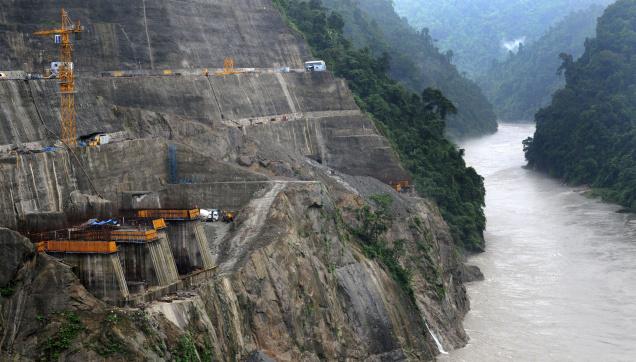
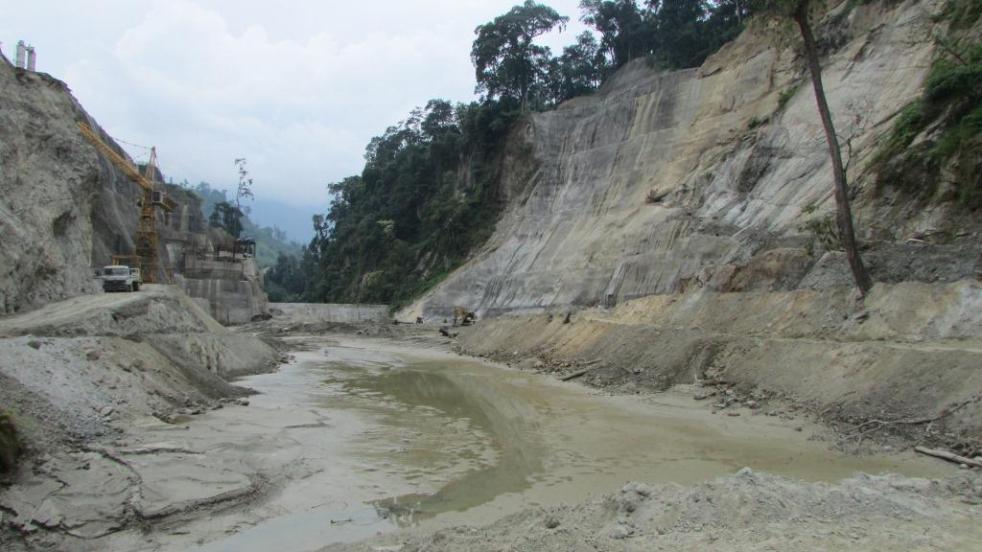
for the box 1The Simang River is a tributary of the Siang River which originates at an elevation of 2950 m. The river is 44 km long (as mentioned in the EIA/EMP reports done by consultant R S Environ Link). Total catchment area of Simang River is 554 sq km. There are two projects proposed on the Simang River.  The first one is Simang I with an installed capacity of 67 MW (3 x 22.33 MW) and catchment area of 494 sq km. The second one is the upstream project Simang II with an installed capacity of 66 MW (3 x 22 MW) and catchment area of 422 sq km. These two projects were jointly discussed in the 19th meeting of EAC in October 2008 for the first time. Then these projects were subsequently discussed in the 21st, 36th, 66th and 67th meeting of EAC. A diagram of the two projects on the Simang River is given below.
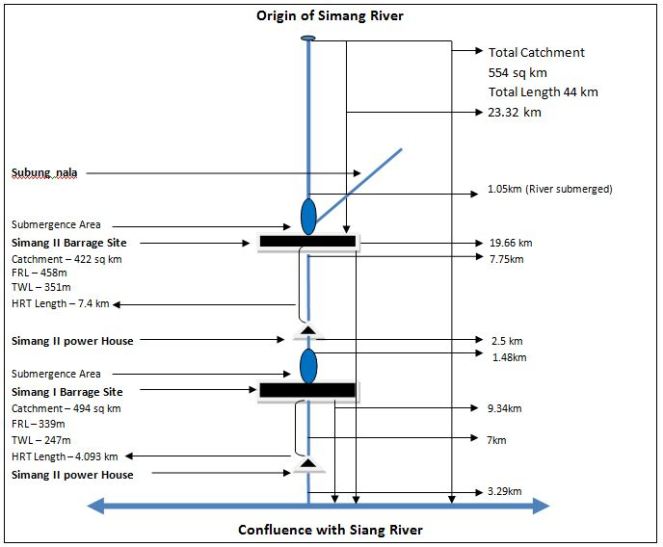
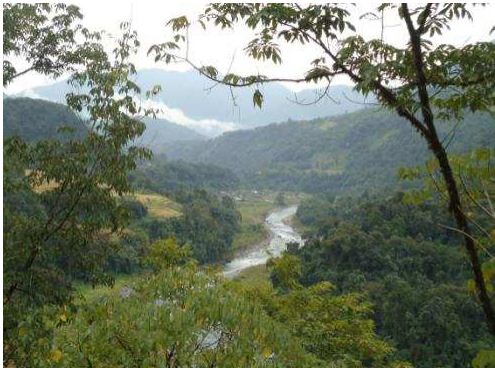
Diagram of Simang I & II projects on Simang River

Troubled Figures of EIA/EMP

In order to prepare the above diagram EIA/EMP reports of both Simang I and Simang II has been consulted. A detailed analysis of the numbers and figures mentioned in the EIA/EMPs for the river shows serious inadequacies in both the EIAs and raises questions on the authenticity of the EIA studies being done on the river.

1. EIA Wrong about Length of Simang River: It is surprising to find that the EIA studies for the two projects cannot give the correct the length of Simang River and contradicts each other (e.g. paragrapgh 4 page 1.14 of EIA of Simang I). Even though the total length of the river has been mentioned as 44 km in EIA studies of both the projects, lengths of the river over different parts do not add upto that.

The EIA report of Simang I in map of ‘Figure 1.3: Project in Simang Basin’ of page 1.16 shows that the distance between the origin of the river and reservoir of Simang II HEP is 22.27 km. The EIA report of Simang II states that the distance between barrage axis of Simang II and Simang-Siang confluence is 19.66 km (paragraph 1 page 5.2). The stretch of the Simang River used by Simang II barrage is 1.05km (from page 4.6 paragraph 1 & 2 of Simang II EIA report). If we take the total of these three parts of the Simang River, the total length of the river will be 42.98km and not 44 km.

On the other hand if we take some other figures given for different parts of the river, then we get another length for the Simang River. The Simang I EIA shows that the distance between the barrage axis of Simang II and TWL of Simang I is 15.75 km (Figure 1.3). The distance between the TWL of Simang I and it’s confluence with Siang river is given as 3.29 km. From this the total length of the river comes out as 41.31 km excluding the Simang II reservoir area. The stretch of the Simang River used by Simang II reservoir is 1.05 km. So including this total length of the Simang River is 42.36 km, not 44 km.

This is a serious inadequacy on the part of the EIA studies since the studies are not clear even about the river length across different parts of the projects. Either the EIA consultants do not know the rivers or they are fudging figures. In either case, these EIA reports should not be accepted.

2. Incorrect Assessment of River Use for the Projects The EIA reports of both Simang I and II projects gives incorrect figures for stretch of river used for the projects. The stretch of the Simang River submerged by Simang II barrage is 1.05 km (from page 4.6 paragraph 1 & 2 of Simang II EIA report), stretch of river bypassed between Simang II barrage and TWL is 7.75 km. The EIA report of Simang I states that the stretch of river submerged by Simang I barrage is 1.48 km and stretch of river bypassed between Simang I barrage and TWL is 7 km. This concludes that the total length of the river used by the two projects is 17.28 km and not 15.75 km as claimed in the EIA reports. Not giving the correct information about the stretch of the river used for projects is a major lacunae on the part of the EIAs and hence these EIA should be rejected.

3. Incorrect Assessment Distance between Simang-Siang Confluence and Power House of Simang I: It seems the EIA/EMP consultant has no knowledge of the area since the distance stated between the Simang-Siang confluence and Power House also seems to be incorrect. The Simang I EIA in states that distance between barrage axis of dam and Simang-Siang confluence is 9.34 km. It also stated that the distance between barrage axis and power house is 7 km. This leaves the distance between the Simang-Siang confluence and Simang I power house as 2.34 and not 3.29 as shown in Figure 1.3 in page 1.16 of the EIA. This again proves that the EIA report prepared by the consultant is inadequate and it should not be accepted.

4. Assessment of river length for diversion is doubtful The diverted river length for Simang II HEP given as 7.75 km in the EIA seems to be doubtful. But tunnel lengths mentioned in the same document for Simang II are as follows:

Tunnel

Length (km)

HRT

7.4

Surge Shaft

0.017

Pressure Shaft

0.225

Penstock

0.056

TRC

0.202

Total

7.9

In fact the bypassed length of the river is likely to be longer than this length of the various tunnel components since rivers do not flow in straight lines, unlike the tunnels.

Critical Issues Not Addressed by EIA/EMP The projects on the Simang River were first considered for TOR in 2008 in the 19th EAC meeting. The proposal that time was to construct three hydro electric projects (HEPs) on the river. In reply to this the EAC had asked, “Secretary  (Power)  and  Secretary  (Environment)  of  Government  of Arunachal Pradesh  should  attend  the  next meeting to clarify the reason for allotting a series of hydroelectric projects on a river which subsequently flows only through tunnels and damage the aquatic ecology.” The Power secretary and Environment secretary attended the 21st meeting of EAC. Going through the minutes of that meeting, it becomes very obvious that Arunachal with its aim to generate more revenue was ready to dam every river or stream in the state. This strengthens the impression that the Simang I or Simang II HEPs are not going to be much beneficial for the local people, environment or the state.

After going through the EIA/EMP of both the projects we have found that there are several critical issues with these studies. There are several issues which are common in both the studies and several others which are particular to each project. Reading these documents thoroughly gives a feeling that the documents don’t have much of a difference from each other and lot of ‘copy-pasting’ has been done. Some of them are also mere replications (e.g. section 4.2 page 4.7 of Simang I EIA and section 4.1.8 in page 4.6 Simang II EIA). There are also many instances where names and words have been confused, e.g. in page 1.15 of Simang II EIA, in the title of the Table 1.1 “Simang I” has been mentioned instead of “Simang II’. This kind of issues raises question on the validity and authenticity of the EIA/EMP studies done. Some of the critical issues are listed below as an example, this is not exhaustive list.

1. EAC Recommendations not Followed: The EIA/EMP studies of these projects have not followed several of the EAC recommendations. EAC in its meetings had recommended the project proponent to address several important concerns but those were no followed.

“To maintain the aquatic life, a study to be conducted by National Institute of Hydrology, Roorkee. Methodology followed for measurement of water flow to be given.” (19th EAC Meeting)  – There is no mention of any study done on environment flows. The EIA/EMP report of both the projects does not give any details of how the environment flow was measured except mentioning what will be the environmental flow.

Between dam and power house how many streams/ tributaries join and what is their contribution in turn of water in the lean season and monsoon? (19th EAC meeting) – The EIA/EMP of none of the two projects responded to this. There are no accurate details about number the flow contribution of different streams or river joining Simang.

Seismic Studies, Slope Stabilization measures, Reservoir Rim Treatment should be included in the EIA/EMP studies.  (36th EAC meeting) – The EIA/EMP studies of the two projects do not have any details of seismic studies done in the project area.

Disaster Management Plan should be included in the EIA/EMP studies. (36th EAC meeting) – This is very surprising because none of the two projects in Simang River has any disaster management plan in their respective EIA/EMP documents.

Pareng Village located in the upstream of Simang I barrage Siteand near the power house of power house site Simang II HEP. Source: EIA/EMP report of Simang I & II

2. Impact of Migration of Outside Workers on Local Communities not Assessed The EIA/EMP reports estimates that there will be migration of nearly 1000 persons for each project during the peak construction period to this very sparsely populated area. People who live in this area belong to several ethnic tribal groups with unique social, economic, political and cultural values. The EIA/EMP reports do not discuss what will be the impact of such migration on the social, political, economic and cultural lives of the people. Influx of such migration will also have impacts on their human rights as well on women. The EIA/EMPs make no mention of these impacts of migration and that is why the EIA/EMP report is incomplete. Besides, even though the projects had been considered together by EAC, no cumulative impact assessment of migration was done.

3. Shoddy Socio-economic Impact Study: The property surveys which the consultant claim to have done for both these projects are inadequate and shoddy socio-economic impact assessment studies. For Simang I a property survey of project affected families in 5 villages was done but it was found incomplete since it does not take into account two of the project affected villages. On page 6A-10 of the EIA report, these 5 villages are stated as Dosing, Lileng, Pareng, Rengo and Boleng.  But out of these villages, there are only three villages mentioned in the property survey – Pareng, Rengo and Boleng. The two villages Dosing and Lileng were not found in the list and instead there were two different villages mentioned in the list – Yingku and Sine.

But after reading through the EIA study of Simang II, it becomes clear that project consultant had done only one survey for both the projects. The two villages Yingku and Sine are also found in the property survey list for Simang II EIA with the same number of affected families (page 6A-16).

It is also surprising to see how the opinions can be exactly similar for both the projects when the affected families are different for each project (See page 16A-15 of Simang I HEP EIA and page 16A-17 of Simang II HEP EIA). Besides, in the list mentioned in page 6A-17 of Simang II EIA, village named Yingku is mentioned twice but there is no justification provided for that.

This brings to light how recklessly these EIAs had been prepared. In fact, the whole concept of property survey is questionable. It takes into account very limited concerns related with the projects ignoring many serious issues. One important aspect of what is the value of the river and other common property resources for the people of the area finds no mention in the property survey. Such property survey cannot be taken as a full proof socio-economic impact assessment and hence EIA/EMP is incomplete and cannot be accepted.

4. Options Assessment not Done The EIA/EMPs of the proposed projects have not done any options assessment study. For example, the option of sub megawatt micro hydro project for a sparsely populated and pristine area like this has not been assessed. For ethnic tribal communities with small population micro hydro project is a better option. The option of solar power generation has also not been assessed by the EIA/EMPs of the projects.  Options assessment is an important part of the EIA/EMP document and since this is not done the EIA/EMP reports are incomplete and cannot be accepted.

Intermediate zone near Sine Village between barrage and power house of Simang II  Source: EIA report Simang II
Intermediate zone near Sine Village between barrage and power house of Simang II
Source: EIA report Simang II

5. Environmental Flows Assessment not Done: The EIA/EMP reports of the two projects do not give any detail of how environment flow was calculated and how environment flow will be released. We have already mentioned that in the 19th EAC meeting, EAC had suggested that in order to  maintain  the  aquatic  life,  a  study  should be conducted  by  National  Institute  of Hydrology, Roorkee and the methodology followed for measurement of water flow should be made available in the EIA. But there is no mention about any such study in any of the documents.

EIA reports of both projects mentioned about the environment flow release exercise but that should have been done already and should have been a part of the EIA. Since the EIA reports do not mention about any study done on environment flow as asked by the EAC this EIAs cannot be taken as a complete impact assessment.

6. Socio-Economic Impacts of Reduced Flow Ignored:  None of EIA/EMP reports mention about the socio economic impacts of reduced flow in the intermediate stretch between the barrage axis and power house. Besides, in questionnaire of the primary survey/property survey which the EIA consultants claim to have done, there is no question on impacts of the reduce flow of water in the river. Besides, the EIA/EMP studies do not discuss the importance of the river for the local people. This proves that EIA report is inadequate and cannot be accepted.

Power house site of Simang II HEP  Source: EIA report of Simang II
Power house site of Simang II HEP
Source: EIA report of Simang II

7. Impacts of Non-monsoon Peaking Power Generation not Assessed:  EIA/EMP reports of the two projects do not assess how peaking power generation during non-monsoon period will impact the flow in the river downstream from power house. Peaking power generation will have significant impact in the downstream since there will be sudden flow of water in the river for a short period of the day and rest of times it will remain almost dry. This sudden release of water holds threat for the people living downstream as well as their livestock. There are many instances where large number of people and livestock dying due to sudden release of water from upstream dam. Most recently, on Oct 7, 2013, one person was washed away in Arunachal Pradesh due to sudden release of water from the Ranganadi HEP.[1] Besides, this fluctuation in river water on everyday basis will have severe impacts on aquatic bio diversity of the river and use of the river by the people. EIA study ignores all these issues and that is why this study cannot be accepted as a complete study.

8. Impact Assessment of changing sediment releases not Done The EIA/EMP reports do not talk about how sedimentation will impact the reservoir. The EIAs should have included detail analysis of two main impacts – 1.Impact of changing silt flows downstream from desilting chamber and 2. Impacts of silt flushing in monsoon season on the downstream areas. The EIA/EMP report should also do a cumulative study of reservoir sedimentation because the sediment released from the upstream reservoir will affect the reservoir downstream.

9. Socio-economic Impact Assessment of Quarrying not Done:  EIA/EMP of any of the two projects on Simang does not talk about the socio economic impact of quarrying on the local people and environment. EIA/EMP reports also have not assessed how the quarrying in a fragile hill range like Eastern Himalayas will increase the risk of landslide and disaster. Ignoring the disaster risk of quarrying in the hills can have disastrous impacts and the recent Uttarakhand disaster is a proof of that. Since EIA/EMP studies ignore all these issues, they cannot be accepted as complete and that is why EIA/EMPs of Simang I and II should be rejected.

10. False Claim about Height of the Dam: The claim made by the EIA/EMP of both the projects that 18 m high dam reservoir is “very low height” is misleading and false. In the 2nd paragraph of page 10.2, the EMP report of Simang I states “Because it is a run of the river hydro project with a small barrage with very low height (18 m), the inundation will be minimized during reservoir filling.” The same claim has been made in the same page of Simang II EMP. This claim is baseless because according to international standards any dam with a wall height of 15 m or above is a big dam.

11. Climate Change Assessment Not Done EIA/EMP studies of both the projects have not done any climate change impact assessment for the proposed projects. Today when climate change impact risks are increasing day by day, it is very essential for studies like these to do an assessment of possible climate change impacts on the project as well as impacts of the projects on local climate. In fact the word “climate change” is nowhere to be found in the EIA or EMP of the two projects. Without climate change risk assessment, an environment impact assessment cannot complete and that is why this report is unacceptable.

The EIA/EMP studies should also have done an assessment of methane release from the reservoir of the project. Since these important issues are not addressed by the impact assessment study, it cannot be accepted as a complete study.

12. False Claims about Flora and Fauna The EIA/EMP of the two projects makes a completely baseless claim that “There will be no negative impact on flora of region during the operation phase.” This cannot be accepted as truth since during the construction phase of Simang I and II, the forest area diverted will be 29.86 ha and 22.02 ha respectively. After such a diversion forest,   the impact on flora and fauna is inevitable because the area is covered by dense forest. The EIA report of Simang I states that forests constitute the predominant land use in the 10 km area which was studied for this project and 67.66% of this area is covered by dense forests. Besides, none of the two EIA studies provide any data on how many trees will be cut down for the project. These are serious lacunas on the part of EIA/EMP of these two projects and that is why this report cannot be accepted as a comprehensive study.

14. Barrage Location not Clearly Stated for Simang I The EIA report of Simang I is not clear about where the barrage of proposed Simang I HEP will be located. In page 1.5 the EIA report states “The reservoir created by the barrage located near Boleng town will operate between FRL 339 m and MDDL 334 m.” But the same report in page 5.2 says “The proposed Barrage axis is situated about 9.34 Km upstream of confluence of Simang river with Siang river. The river Simang joins the SiangRiver near Boleng township.” Besides, the maps show that Boleng area is located near the confluence of two rivers not near the barrage site. This is a significant error of the EIA study and hence this study is inadequate and cannot be accepted.

Barrage site Simang I HEP Source: EIA report of the Project
Barrage site Simang I HEP
Source: EIA report of the Project

15. Simang II does not assess the project impact on Protected Area EIA states that the distance between Mouling National Park and the reservoir tail at Subbung Nala and Simang River are 5.6 and 5.7 km respectively (page 1.2, paragraph 2). Being in so close proximity of a protected area there should have been impact assessment of the project on the protected area but the EIA/EMP does not mention any such assessment.

16. Threat to Nearly Threatened Mammals The Simang II HEP is a threat to some of the endangered mammal species listed in IUCN Red List. Common leopard (Panthera pardus) and Assamese macaque (Macaca assamensis) which falls in the “Near Threatened” and Gaur (Bos frontalis) falling in “Vulnerable” category of IUCN Red List are found in the project area of Simang II. There are 13 more species of mammals falling under the “Least concern” category of IUCN which are also found in the area. This has been stated in the EIA study of Simang II.

On the other hand, the EIA study of Simang I ignores some the species falling under IUCN Red List. Rhesus macaque, Indian Porcupine and Asiatic Brush Tailed Porcupine which are found in the area fall under the “Least concern” category of IUCN Red List but the EIA report completely ignores this.

The EIA/EMP reports of the two proposed HEP projects on Simang River have significant lacunas and those cannot be ignored. The EIA consultant also had not consulted the local people in preparing the EIA report. This is another significant lacuna on the part of the EIA because it is the local people who are more aware of the local environment and river as they have lived in that place for generations.  It is shameful that on the basis of such studies and reports, public hearing for the two HEPs was held without even announcing the Public hearing dates on the AP Pollution Control Board website. If these dams are constructed on the basis of such shoddy reports and flawed public hearings then it will invite an uncertain future for the people of the area and people have to live at the risk of disaster. The EAC should consider these issues seriously and must not accept these reports. The EAC should also consider recommending the black list of the consultants for the serious lacunae in the reports.

Parag Jyoti Saikia 

(with inputs from Himanshu Thakkar)

email: meandering1800@gmail.com


[1] Man drowns in Ranganadi, body recovered – http://www.arunachaltimes.in/oct13%2007.html

Dams · Hydropower · Ministry of Environment and Forests · Sikkim

Hydro Power Projects Violating SC order in the Greenest State of India

Gangtok, 9 October 2013: Deemed as the greenest state in India, the government of Sikkim has drawn flak of the national board of wildlife (NBWL) for blatant violation of the environmental norms and the standing order of the Supreme Court in implementation of several hydro power projects under different stages of construction.

The background: In its 28th meeting held on 20th March 2013, the proposal for 520 MW Teesta Stage-IV Hydroelectric Power Project, on River Teesta in North Sikkim to be developed by NHPC Ltd, was placed before the SC-NBWL (Standing Committee-National Board of Wild Life) for consideration. The Member Secretary had informed the SC-NBWL that the project location falls 4 km away from the Fambonglho Wildlife Sanctuary and was recommended by the State Board for Wildlife.

photo 1
Photo from SC-NBWL committee report has this caption: Construction of the Teesta III project at Chungthang on the edge of Khangchendzonga National Park proceeding without SC-NBWL clearances. Note the extensive forest cover and large landslides at the site

Following discussions, the SC-NBWL decided that a team comprising Dr M.K.Ranjitsinh, Kishor Rithe, Dr A.J.T Johnsingh and Dr M.D. Madhusudan would carry out site inspection and submit a report to the committee for its consideration. Following this decision, the above committee visited the project site and nearby areas from 15th to 21st May 2013. The committee met the representatives from the Sikkim Government’s Forest, Environment and Wildlife Management Department (FEWMD), the user agency, NHPC Ltd, and people from local citizens’ groups. The report of the committee dated Aug 2013 is now available online (http://envfor.nic.in/division/wl-orders).

The report raises serious concerns about a number of hydropower projects in Sikkim under construction without wildlife clearance in contravention to the Supreme Court order[1] (in the Goa foundation case).  The Chamling government in Sikkim has allowed blatant violation of the Supreme Court order, a situation compared by the report with what had happened in Goa with respect to mines which were operating without wildlife clearance in violation of SC orders (the subject of the Shah Commission report). The Union Ministry of Environment and Forests is equally responsible for allowing continuing construction of these projects without legally mandatory clearances. The decision based on this report in the NBWL Standing Committee is still pending.

map 1
Map with locations of projects and protected areas from the SC-NBWL committee report

Both before and during site inspection, multiple stakeholders brought to the notice of the NBWL team that there were other proposed and ongoing hydel projects in the Teesta Basin located within the eco-sensitive zone (as defined by the Supreme Court in the Goa Foundation case), of the Khangchendzonga NP and Fambonglho WLS, which had not obtained the Supreme Court mandated clearance from the Standing Committee of the National Board for Wildlife.

Besides this,  the team in their journeys saw  two projects under active construction—the Dik Chu[2] and the Teesta III[3]—that were clearly within the Supreme Court mandated eco-sensitive area. For Dik Chu HEP, the report says, “However, the accompanying FEWMD officials informed us that these mandatory wildlife clearances from the SC-NBWL had, apparently, not been obtained.” For Teesta III HEP, FEWMD officials were not aware of the SC-NBWL clearance, and the committee noted, we “must therefore conclude, on the basis of information available with us, that such a clearance was not obtained… we are deeply concerned about the advisability of this project.”

Deeply concerned about the likelihood of various hydel projects coming up in violation of the Supreme Court’s order in the Goa Foundation case, the team has  requested the MoEF to write to the government of Sikkim, seeking a comprehensive list of completed, ongoing and proposed hydroelectric projects within the Supreme Court mandated 10-kilometre zone of the Khangchendzonga National Park (KNP) and Fambonglho Wildlife Sanctuary (FWLS). For each project,  details sought included:  (a) location (latitude-longitude) and distance from KNP and FWLS; (b) current status of the project; and (c) if and when they had obtained the required Environment, Forest and Wildlife Clearances. Even after waiting for 10 weeks, the NBWL team did not receive either an acknowledgment, or a response from the Pawan Chamling government to their query.

The committee, left with no option was compelled to use publicly available information on Environmental Clearances (EC) (http://environmentclearance.nic.in), submissions and information provided by other stakeholders, and to examine minutes from the SC-NBWL’s meetings, to ascertain if there was merit to the allegations made about the violations of the Supreme Court’s order of 12/2006.

Key recommendations Based on examination of available information on legal compliances required for the projects in the Teesta basin, the committee concluded that, with the notable exception of the Teesta IV project (which has currently approached the SC-NBWL for clearance), none of the other projects appear to have sought/obtained this compulsory SC-NBWL clearance, as mandated by the Supreme Court. While the SC-NBWL is fully aware that there are many more proposed/ongoing hydroelectric projects situated within the Supreme Court mandated 10-km eco-sensitive zone of wildlife sanctuaries and national parks in Sikkim, it has not been able to ascertain whether Supreme Court stipulations in their regard are being followed, or being violated, and if latter be the case, the MoEF should take due cognizance of the same urgently.

“We are of the unanimous considered opinion that it is absolutely essential to assess the overall impact of these projects, both from the recent past and those in the pipeline, rather than deal with them in a piecemeal fashion. Hence, we urge the Standing Committee not to consider the Teesta IV project’s request for clearance separately, but treat it as part of a larger set of hydroelectric projects in the Teesta Basin, with vast ecological, social and legal portents”, the committee has recommended.

It further recommend that the Standing Committee direct the MoEF to write to the Government of Sikkim asking them to immediately investigate and submit a detailed report listing hydroelectric projects in Sikkim that are being constructed prima facie in violation of Supreme Court’s order. Based on the list provided by the government of Sikkim, if it is indeed ascertained that the projects are proceeding in violation of the said Supreme Court ruling, it further adds that the MoEF initiate action by asking the State Government to suspend ongoing work on those projects immediately and to direct user agencies to formally seek clearance for these projects from the SC-NBWL. It adds that the MoEF and the Government of Sikkim thoroughly investigate the circumstances under which the seemingly widespread bypassing of Supreme Court orders in the construction of dams within the 10-km ecosensitive zone of Sikkim has taken place, fix responsibility for the transgressions and violations, and punish the guilty.

About Teesta IV proposal from NHPC, for which the committee visited Sikkim, the report recommends, “Finally, in the light of the devastating June 2013 Uttarakhand floods, we are deeply concerned about the wisdom of such large-scale manipulations of mountain river systems that are being implemented, against all reasonable scientific advice (and thedisregard of the CISHME’s recommendation against the construction of Teesta III, is a case in point)… Hence, we urge the Standing Committee not to consider the Teesta IV project’s request for clearance separately, but treat it as part of a larger set of hydroelectric projects in the TeestaBasin, with vast ecological, social and legal portents.”

The report also recommends  that projects already in the pipeline and that may be proposed in future in Sikkim, be placed before the Standing Committee, “chaired by a very senior official of the MoEF, Besides senior officials of the MoEF and the Sikkim Government, this committee must include legal experts as well as experts in hydrology/ geology/ seismology/ social science/ botany/ riverine ecology/wildlife ecology, from reputed research institutions and some representatives of local communities” whenever they fall within the purview of the Supreme Court-mandated 10 km eco-sensitive area around PAs. The committee report adds that much of the summary and recommendations section of Justice Shah’s report (pp. 189-200) is extremely relevant to the case of the hydroelectric dams in Sikkim, and that any committee constituted to examine hydroelectric dams in the eco-sensitive areas of Sikkim, pay close attention to this report.

No ecological flows from NHPC’s Teesta V What the report says about this subject makes disturbing reading: ”On 16th May 2013, driving upstream of the Teesta V powerhouse, we noted extremely low flow in the river, which was particularly so in the stretch of the river directly downstream of the Teesta V dam (Figure 1), where the river was diverted through a tunnel. Such low flows, where River Teesta has been diverted through tunnels, are a cause for serious concern in the context of maintaining the ecological function of a river. We enquired from NHPC officials about how details of ecological flows were determined, and learnt that ecological flow was not a parameter that was optimised in the planning process. We were told that downstream flows were effectively a consequence of maximising hydropower potential of various river basins as determined jointly by the Central Electricity Authority and the Central Water Commission. These values, in turn, were used as the basis for soliciting proposals for hydroelectric power projects. In other words, we learnt to our great dismay that absolutely no ecological consideration whatsoever was used in the process of determining the hydropower potential of river basins.”

Violations galore, government unresponsive In a submission made by Tseten Lepcha in his capacity as the then Honorary Wildlife Warden of North Sikkim to Jayanthi Natarajan in 8th October 2011, Lepcha had contended that how the 1750 MW Demwe Lower by the Athena group is being considered by the SC-NBWL for wildlife clearance, when a project by the same promoters (1200 MW Teesta III) is under construction in violation of Supreme Court orders (without wildlife clearance). The current NBWL report confirms that the 1200 MW Teesta III is under construction illegally, violating SC orders. In an earlier submission he had made to the SC-NBWL on April 19, 2011 he mentioned violation of the WLPA (killing of a Serow – Schedule I species) in the 1200 MW Teesta III project being developed by the Athena group. The developer of the project, Teesta Urja Ltd (a special purpose vehicle of M/S Athena Pvt. Ltd.), through its sub-contractor, SEW Infrastructure Ltd, was involved in the death of a Serow (Capricornis sumanntraensis), a Schedule I animal, at the project site on June 4, 2008.

photo 2
Photo from SC-NBWL com report with this caption: The Teesta V dam showing the virtual absence of flow in the river downstream of the dam, which can have devastating consequences for river-dwelling and river-dependent species

Several attempts by this correspondent, to contact the PCCF –cum-Secretary of the FEWM department of Sikkim Mr. Arvind Kumar on his cell phone, and his official e-mail address to get the Sikkim government’s official version on the controversy, remained unanswered.

How IPPs are cheating by flouting norms Sikkim Bhutia Lepcha Apex Committee (SIBLAC) convenor Tseten Tashi Bhutia, while speaking to this correspondent expressed immense joy at the NBWL report. “We have been protesting cultural and religious genocide being committed by the Sikkim government in the name of developing hydro power, apart from severely degrading the environment, this is a moral boost. I hope GOI takes strong action”, he said. Bhutia added that there are violations of the Places of Worship (special provisions) Act 1991, extended to Sikkim, and the gazette notifications of the Chamling government, in allowing the Tashiding project on holy river Rathong Chu.

SIBLAC along with another apolitical group Save Sikkim on September 28th, 2013 filed FIRs against an IPP, Shiga Energy Pvt ltd, developer of the 97 MW Tashiding hydro power project for alleged cheating, distortion of facts and violation of environmental norms and the SC order. This is in addition to an ongoing PIL at the Sikkim High Court.

The facts revealed by Tseten Tashi Bhutia in his FIR are startling and shocking. As per the requirement of the Environment Ministry (MoEF, Government of India), the executing agency i.e. Shiga Energy Private Limited, is required to submit a Six-monthly compliance report[4] on the status of the 97 MW Tashiding HEP to the stipulated environmental conditions in a prescribed format .However, while going through the latest Six monthly report dated 22.11.2012[5] submitted by the executing agency to the concerned authority i.e. North Eastern Region Office, Ministry of Environment & Forest, Government of India , it is found that as against the IX necessary conditions required in the prescribed format, the executing agency have intentionally deleted Stipulation No. VIII, jumping to the next condition.

The Monitoring report of MEF regional office (signed by DR S C KATIYAR, SCIENTIST ‘D’) dated Oct 2012[6] says about Stipulation VIII: “the proposed site is about 5 Km away from the buffer zone of the Khangchendzonga Biosphere Reserve as per Supreme Court order clearance from NBWL may be obtained (if required).”  Status of Compliance: “Not complied with” and further writes; “the project also falls within 10 Kms from the Fambomgla Wildlife Sanctuary, as such; NBWL clearance needs to be obtained.”

Thus the agency has not complied to nor has obtained NBWL clearance yet as evident from the Monitoring Report on the Implementation Status of Conditions of Environmental Clearance dated Oct 4th, 2012. In other words, the executing agency has simply and swiftly been misleading and cheating the authorities till date by submitting wrong report to Ministry of Environment and Forest, Govt. of India. More surprising is to witness the lack of action by the MoEF on these manipulations and lack of action even after the Monitoring Report clearly reports non compliance.

Rathongchu is a sacred river according to the Denjong Neyig and Nesol texts having its source at various secret and sacred lakes at Khangchendzonga, Sikkim’s supreme guardian deity and runs independently till it meets River Rangit at the lower reaches; This sacred Rathongchu is the source to the annual Tashiding Bumchu ceremony which is held in the first lunar month, corresponding to the months of February and March. In fact, this Bumchu (Sacred Water) ceremony has been continuing for centuries and attracts thousands of devotees and pilgrimages from far across including Bhutan, Nepal, and entire Himalayas.

Ironically, a one-man Professor P S Ramakrishnan committee, of the JNU School of Environmental Sciences, submitted a report titled Ecology and Traditional Wisdom,  on October 9th 1995, to the government of Sikkim where he categorically stated, “on social, cultural, and religious considerations, apart from the rich bio-diversity and fragile ecology of the Yuksom valley region, I strongly recommend that no hydro power or other projects should be allowed on River Rathongchu, deemed extremely sacred by Buddhists”. Under the circumstances, how was the Tashiding HEP allotted to the Shiga Energy Ltd by the Sikkim Government and cleared by the MoEF is moot question.

Some of the other proposed projects that are mentioned in the SC-NBWL committee that are also coming up requiring the SC-NBWL clearance include the 300 MW Panan HEP, the Ting Ting HEP, besides the ones mentioned above, see the accompanying map from the SC-NBWL report. Other hydropower projects of Sikkim that are being considered by the MoEF for clearances and that are also close to the protected areas include: 63 MW Rolep HEP on Rangpo river in E Sikkim (5-6 km from Pangolakha and Kyongnosla WLS), 126 MW Ralong HEP (4.05 km from Kangchendzonga Biosphere Reserve and 1.8 km from Maenam Wildlife Sanctuary), 96 MW Chakung Chu HEP inn North Sikkim district (1.8 km from Kangchendzonga Biosphere Reserve). Other such possible projects include: 71 MW Sada Mangder, 60 MW Rangit III, among others.

Let us hope now following the SC-NBWL report, the MoEF will promptly order stoppage of illegally ongoing construction of the guilty HEPs, not waiting for the SC-NBWL committee to meet, since the new Standing Committee of the NBWL remains to be constituted after the term of the earlier committee ended. The evidence provided by the SC-NBWL committee is sufficient to take prompt action. The fact that the MoEF has not take action yet, weeks after submission of the SC-NBWL report speaks volumes about the possible collusion of the MoEF in this murky affair.

Soumik  Dutta (duttauni@gmail.com, with inputs from SANDRP)

END NOTES:


[1] WP 406/2004, Goa Foundation vs. Union of India, Order dated 04/12/2006: “The MoEF would also refer to the Standing Committee of the National Board for Wildlife, under Sections 5 (b) and 5 (c) (ii) of the Wild

Life (Protection) Act, the cases where environment clearance has already been granted where activities are within 10 km. zone

[2] Strangely, the Environment clearance letter for the project does not even mention the need for SC-NBWL clearance, see: http://environmentclearance.nic.in/Auth/openletter.aspx?EC=5766

[3] The Six monthly compliance report for Teesta III dated June 2013 also is quite on the issue of compliance with SC-NBWL clearance, see: http://environmentclearance.nic.in/writereaddata/Compliance/57_Teesta%20HEP-III%20_june2013.pdf, the condition for this was mentioned in the MoEF letter dated 30-04-2010 with additional condition: “Considering the proximity of Khangchendzonga National Park from the project site, clearance from the Standing Committee of theNational Board for Wildlife (NBWL) should be obtained”.

[4] For latest version of the compliance report, see: http://environmentclearance.nic.in/writereaddata/Compliance/34_Tashiding%20Six%20Monthly%20Compliance%20Report_May%202013.pdf. In this report, the column before the condition VIII says: NA (not available).

Dams · Kerala

Public Pressure Leads to Changes in Kerala Dam Operation

Kerala Govt Agrees to Change Operation of Chalakudy River Hydropower Project:

Public Pressure Leads to Changes in Dam Operation

The decision to increase off-peak generation at Poringalkuthu Left Bank Hydro Electric Project (PLB HEP) in Chalakudy River, taken at a meeting convened by the Hon Chief Minister of Kerala in the fourth week of April (PRD – Thrissur, 25-04-13) was a partial success to the sustained campaign for dams re-operation at Chalakudy river. The meeting was attended by the Ministers for water resource and power, River Basin MLAs and officials of state electricity board and irrigation department. The decision however falls short of the demand for reverting the operation of PLB HEP into base load.

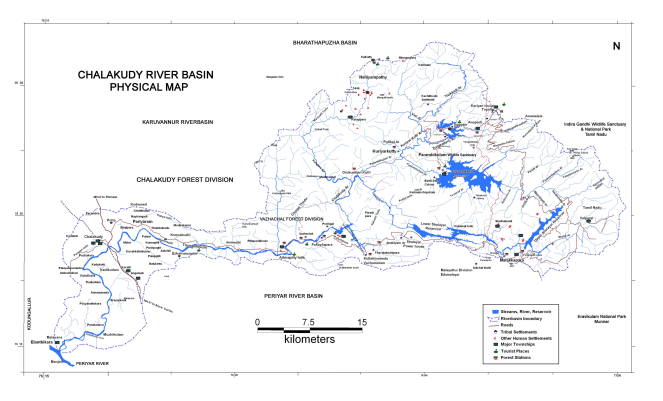
Chalakudy River Basin Physical Map

Normaly the summer water availability in the river below Poringalkuthu HEP should be between 1.3 – 1.5 MCM / day. The failure of both monsoons in 2012 and violation of Kerala-Tamil Nadu interstate Parambikulam – Aliyar agreement (1970) condition that the Kerala Sholayar reservoir shall be kept at full reservoir level by Tamil Nadu on the 1st of February every year (Sch. II.3 – PAP Capture 1Agreement), reduced the water availability in 2013 summer to less than 1 MCM per day resulting in severe water stress in the river basin. On top of the water shortage, intra-day as well as inter-day flow fluctuations in tail-race discharge from PLB HEP had worsened the situation. Anticipating water shortage the river basin MLAs as well as Local Self Government (LSG) heads had been demanding action from the State Government since December 2012.

Background: The river – dams and flow regime Chalakudypuzha (ChalakudyRiver), the fifth largest river in Kerala with a length of 144 kms and catchment area of 1704 Sq.kms is one of the heavily utilised rivers in the state. Major tributaries of this west flowing river originate from the Anamalai hills, Parambikulam Plateau and Nelliyampathy hills of Southern Western Ghats. The river/ its tributaries have been dammed at six places. The dams and diversions have completely altered the natural hydrological regime in the river. The river is the life line of about 30 Local Self Governments (LSGs) and about ten lakh people. Apart from the dams and diversion structures, numerous drinking water schemes and lift irrigation schemes are also dependent on the river. The table below provides details of existing major projects on the river.

Existing dams/ diversions in Chalakudypuzha

Sl. No. Project Commissioning Year Purpose Storage MCM Developer
1 Poringalkuthu LB HEP 1957 Hydro Power 32 Kerala SEB
2 Thunakadavu (PAP)* 1965 Diversion 15.77 Tamilnadu
3 Kerala Sholayar (PAP) 1966 Hydro Power 153.49 Kerala SEB
4 Parambikulam (PAP) 1967 Diversion 504.66 Tamilnadu
5 Peruarippallam (PAP) 1971 Diversion 17.56 Tamilnadu
6 TN Sholayar (PAP) 1971 Hydropower + diversion 152.7 Tamilnadu
7 ChalakudyRiver Diversion Scheme 1959 ** Irrigation 0,218 Kerala-Irri Dept
8 Idamalayar Augmentation Scheme 1990s Diversion NA Kerala SEB

*PAP- Parambikulam Aliyar Project    **Partially operational since 1952

Almost 75 percent of the catchments of the ChalakudyRiver were forested at the turn of 20th century. Hence the river had a fairly Capture 2healthy flow even during summer months. However, at present, the natural summer flow in the river has reduced drastically due to forest degradation and dams and diversions. Consequently, the present river flow in non-monsoon months is almost entirely dependent on the storage at Kerala Sholayar and Poringalkuthu reservoirs. The downstream major irrigation project, the Chalakudy River Diversion Scheme (CRDS) does not have storage of its own. It is completely dependent on the tailrace discharge from the PLB – HEP. Over the last two decades, the daily flow fluctuation due to the semi-peaking operation of the PLB-HEP is affecting the functioning of CRDS. Incidentally, the campaign against the proposed Athirappilly hydroelectric project (AHEP) had first brought this issue into focus. One of the major issues with regards to AHEP, a peaking power station, was the downstream impacts of drastic intra-day flow fluctuation (to the tune of 1:17).
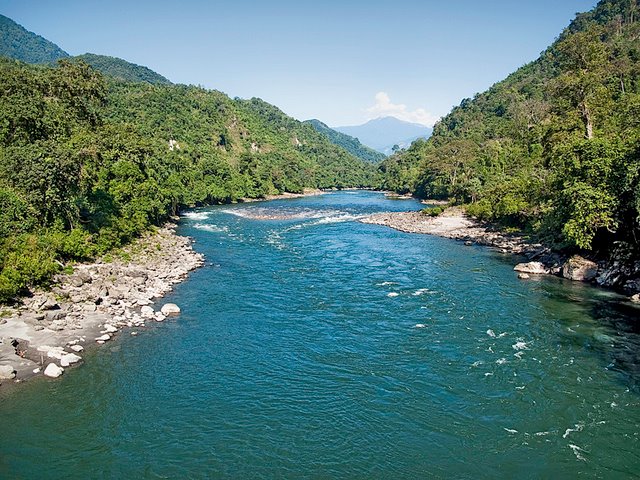
Incidentally, Western Ghats Ecology Expert Panel had recommended not to give clearance to the project after conducting field visits and detailed and transparent consultations. However, the High Level Working Group formed to look into the WGEEP report acted in a non-transparent manner. They conducted a field visit with the project proponent (The Kerala State Electricity Board – KSEB), without informing the public, press or the Grama Panchayath and not providing opportunity for the organisations opposing the project to present their case before the committee. The HLWG recommended that the project proponent can approach the Ministry of Environment and Forest (MoEF) for fresh clearance, if it so desired, after some studies despite identifying the project location as ecologically sensitive area.

Analysis of hydrological data for AHEP as well as debates on the issue revealed the existing flow fluctuations due to changed operation pattern of PLB HEP since early 1990s. As the capacity of the PLB HEP was enhanced from 32 MW (8 MW X 4) to 48 MW with the commissioning of a 16 MW generator in 1999, the peak generation and the resultant flow fluctuation increased. The field assessment in the CRDS command area had confirmed the impacts due to the flow fluctuations.

As part of an action research done by the Kerala State Centre of Forum for Policy Dialogue on Water Conflicts in India, an attempt was made to find possible solutions to the conflict of interest between power generation and downstream needs. The conflict between CRDS and other downstream uses due to total diversion of water at its head works at Thumboormuzhi was also taken up. An alternate reservoir operations management (ROM) strategy that aims at sustainable and equitable sharing of available water resources was prepared as part of the study. Capture 3

ROM strategy for Chalakudy River The ROM strategy tried to synchronise the operations of Kerala Sholayar and PLB HEPs with the downstream requirements. Secondary data regarding the river flow, rainfall etc. was collected from concerned agencies like KSEB, Water Resources Department etc. Issues with respect to the present flow regime were assessed through field surveys and stakeholder consultations.  After analysing the available data and assessing downstream irrigation needs through people’s perception and based on the suggestions/ comments by the experts, the draft reservoir operations strategy was prepared. ROM strategy is attempted for water available to the basin after diversions to Tamil Nadu and Idamalayar with focus for non-monsoon months.

In the proposed ROM strategy, the summer water availability for the downstream needs is suggested to be increased through modifications in the operation pattern of Kerala Sholayar and Poringalkuthu HEPs. At Kerala Sholayar, the total utilisable quantity of water is fixed as per the PAP agreement. The monsoon discharge is proposed to be reduced by about 15 % of the average flow (data period – 1979 to 2006) so that the non-monsoon water availability can be enhanced. At Poringalkuthu, the ROM strategy proposes that the water level in the reservoir shall be kept at close to the full reservoir level up to the end of January. The change in the operation of the two HEPs is expected to ensure water availability of not less than 1.5 MCM/ day for the downstream uses. The ROM strategy proposes to operate the Poringalkuthu HEP, the lower dam, that discharges water into the main river as a base load station (as it was operated before 1990s) in non-monsoon months. This can ensure a steady discharge of over 17 m3/sec.

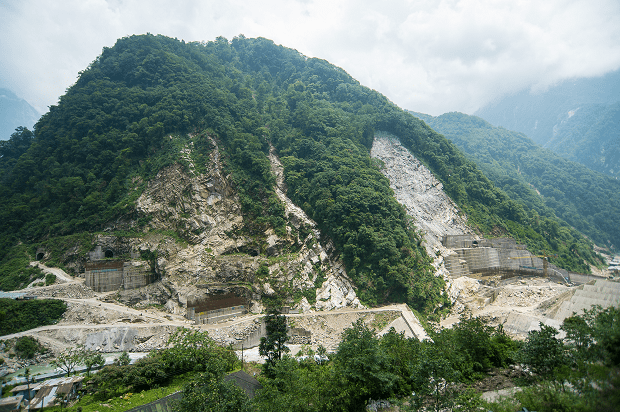
Peringal Dam Photo: CPSS
Peringal Dam
Photo: CPSS

At present the entire flow reaching Thumboormuzhi weir, the head works of CRDS is being diverted to the canals, except for some overflow during peak hours. This is affecting the downstream areas including the ecological functions of the river. The ROM strategy proposes a minimum flow of not less than 2 m3/sec to be released from Thumboormuzhi weir in to the river. This may be increased later after improvement in natural summer river flow through eco-regeneration of the upper catchments and by reducing the irrigation demand through adoption of ‘more crop per drop’ approach in the CRDS command.

The revised operation pattern is not expected to have significant impact on the power front. The non-monsoon power generation from the river basin is expected to slightly increase, whereas, the peak power generation will be reduced by 8 MW to 16 MW, which is about 0.25-0.5 % of the present summer peak demand of Kerala of about 3400 MW.

Building public awareness and public pressure The ROM strategy was widely discussed with the LSGs and other stakeholders. As the LSGs, farmers and Irrigation and Agriculture departments were active partners in the action research (2008 – 2012) they Capture 4readily accepted the proposed ROM strategy. Many LSGs demanded the state government to implement this, through resolutions. With the shortage in rainfall during 2012 monsoons, severe water stress was anticipated and a series of steps were taken to put pressure on the state government for dams re-operation so that the summer water shortage for downstream areas can be reduced.
  • A meeting of the LSG representatives organised by Chalakudy Puzha Samrakshana Samithi (CPSS) before the start of irrigation season discussed the anticipated scenario for the 2012-13 season and decided to step up campaign for changing the operation pattern at PLB HEP.
  • The project advisory committee meeting of CRDS, in December 2012 also took a similar decision.
  • In December 2012, five MLAs of the ChalakudyRiver basin, cutting across party lines, jointly demanded the Chief Minister to convene a meeting of the concerned ministers, MLAs, LSG heads and officials to discuss the issues with regards to the summer water availability in the river basin. This was the result of a series of interactions with these MLAs by the CPSS team.
  • In the second week of January 2013, 25 LSG heads gave a submission to the CM demanding action by the government to ensure water availability at Kerala Sholayar as per the PAP agreement and changing the Poringalkuthu HEP to base load station.
  • Even as no action was taken by the state government and the situation was becoming grim, the project advisory committee meeting of CRDS decided that a delegation must go to Thiruvananthapuram and meet the CM and other concerned ministers. A meeting of LSG heads organised jointly by CPSS and Chalakudy basin Block Panchayaths also decided to take necessary actions.
  • On March 19th 2013,   four MLAs and 10 LSG heads from ChalakudyRiver basin met the Chief Minister and Minister for Water Resources. Rajaneesh from CPSS was also part of the team. The people’s representatives wanted the Govt to take necessary steps to ensure better water availability for Chalakudy basin. The main points raised were regarding violation of Parambikulam – Aliyar Agreement condition and ensuring steady flow from Poringalkuthu HEP for the downstream needs. The CM agreed to convene a meeting of all concerned immediately. However, the meeting was delayed by more than one month and when the meeting finally took place, the LSG representatives were not invited for the same.
  • Meanwhile a detailed discussion was held with the KSEB Chairman in the first week of April 2013. The Chairman promised to look into the issue.
  • All along the campaign, the print as well as visual media reported these developments and published / telecast stories on the issue.

Partial re-operation The daily average generation at Poringalkuthu in January 2013 was 0.4481 MU (Million Units, as per Kerala State Load Despatch Centre website) and the corresponding discharge was about 1.2 MCM per day. Due to the non-compliance of PAP agreement condition, the combined storage at Kerala Sholayar and Poringalkuthu reservoirs on the 1st February was only around 115 MCM against an anticipated volume of 160 -170 MCM. Consequently, the generation was less in the following months. The average generation and discharge in February, March and April were 0.3457 MU / 0.93 MCM, 0.3237MU / 0.87 MCM and 0.3343 MU / 0.9 MCM respectively. The semi-peaking operation at PLB HEP continued resulting in intra-day fluctuations. The off-peak generation was mostly limited to 8 MW with a corresponding discharge of around 6.5 m3/sec, which is highly insufficient to meet the irrigation demand of the CRDS command. There were also instances of practically no generation during off-peak hours, especially during night times.

Upper Sholayar Dam Photo: CPSS
Upper Sholayar Dam
Photo: CPSS

Apart from the intra-day fluctuation the inter-day flow fluctuations was also a major cause of worry. The situation was particularly bad in the second half of March and first half of April. On 4 days between March 21st and April 10th, the generation was between 0.158 MU and 0.182 MU. The corresponding discharge was less than 0.5 MCM. On a few other days, the generation was between 0.2 -0.3 MU.

Since the decision of the meeting convened by the CM, the situation has slightly improved. The inter-day fluctuation was less since 25th of April with the discharge of 0.9 -1 MCM on most days. More importantly, the off-peak generation was at least 16 MW (except on a couple of days). The average discharge since the last week of April has also slightly increased in comparison to the previous months.

The change in operation pattern does not seem to have had any negative impact on power front. Initially the KSEB had increased off-peak generation without reducing peak generation. The generation figures as per the SLDC website shows the generation at PLB HEP on 25th, 26th and 27th April (after the decision at Ministry level meeting) as 0.425 MU, 0.402 MU and 0.412 MU respectively, corresponding to discharge of around 1.1 MCM. Later only one machine was available and the peak as well as total generation reduced.  The average generation during this period was around 0.35 MU corresponding to a discharge of about 0.95 MCM. The generation figure shows that the station was running continuously as a base load station (by default?) for two weeks. Even though the rate of discharge was less than the actual requirement, we have requested the irrigation officials to assess the effect of steady inflow at CRDS.

The decision for increasing off-peak generation is significant since it is acknowledgement by the government that the downstream requirement should be given priority over power generation. However, the long delay in taking such a decision even after the river basin MLAs and LSG heads unanimously demanded for the same cannot be justified. Also, the steps taken so far are not sufficient. The storage position as on 27-04-2013 at Kerala Sholayar and Poringalkuthu reservoirs (33.78 MCM and 9.23 MCM respectively) could have supported a daily discharge of upto 1.3 MCM till May 31st, especially since the catchments traditionally get good pre-monsoon rains and an inflow of 100 cusecs from Tamil Nadu Sholayar was anticipated, on the basis of inter-ministerial discussion on PAP agreement.

The campaign / advocacy for further changes in operation will have to be continued as the present decision is of a temporary nature. Until and unless the non-monsoon discharge from Poringalkuthu HEP is enhanced to around 17 m3/ sec, sufficient river discharge from CRDS head works is not likely to materialise. (The suggested discharge rate from Poringalkuthu HEP as per the ROM strategy, based on anticipated water availability, is 17.25 m3/ sec and the corresponding generation will be 24 MW.) The fact that the Chalakudy MLA protested against closing down all generators of old powerhouse together since May 7th shows that the people’s representatives are now more vigilant on the issue and this should help in stepping up the campaign. Moreover, a collective of Local Self Government heads is emerging for the cause of the river and this collective, if it becomes active, can really help take forward the efforts for the revival of ChalakudyRiver.

S P Ravi (cholayar@rediffmail.com)

Arunachal Pradesh · Environment Impact Assessment · Expert Appraisal Committee · Hydropower

Subansiri Basin Study – Another Chapter of Environment Subversion in Northeast

The Study The study has been done by IRG Systems South Asia Private Limited (http://www.irgssa.com/, a subsidiary of US based IRG Systems) and http://www.eqmsindia.com/[i]. It is supposed to be a Cumulative Impact Assessment of 19 HEPs planned in the basin, out of which PFRs of 7 are available, DPR of two, and one of which, the 2000 MW Subansiri Lower HEP is under construction.

Subversion of Environment Governance in the Subansiri basin While looking at this basin study, the subversion of environment governance in Subansiri basin this very millennia should be kept in mind. A glimpse of it is provided in Annexure 1. In fact, one of the key conditions of environmental clearance to the 2000 MW Lower Subansiri HEP was that no more projects will be taken up in the basin upstream of the Lower Subansiri HEP, which essentially would mean no more projects in the basin, since LSHEP is close to the confluence of the Subansiri River with Brahmaputra River. That condition was also part of the Supreme Court order in 2004. The need for a carrying capacity study was also stressed in the National Board of Wild Life discussions. We still do not have one. In a sense, the Subansiri basin is seeing the consequences of that subversion.

Map of Subansiri RIver Basin  Source: https://sandrp.in/basin_maps/Subansiri_River_Basin.pdf
Map of Subansiri RIver Basin
Source: https://sandrp.in/basin_maps/Subansiri_River_Basin.pdf

Information in public domain not known to consultants The report does not even state that Middle Subansiri dam have also been recommended TOR in 41st EAC meeting in Sept 2010. This project will require 3180 ha of land, including 1333 Ha forest land, and 2867 ha area under submergence. Even about Upper Subansiri, the consultants do not know the area of forest land required (2170 ha). So the consultants have not used even the information available in public domain in EAC meetings.

Study based on flawed and incomplete Lohit Basin Study The Study claims that it is based on Lohit Basin Study done by WAPCOS. Lohit Basin Study is an extremely flawed attempt and does not assess cumulative impacts of the cascade projects. Civil society has written about this to the EAC and the EAC itself has considered the study twice (53rd and 65th EAC Meetings), and has not accepted the study, but has raised several doubts. Any study based on a flawed model like Lohit Basin Study should not be acceptable.

A house in the upstream of Subansiri River  Source: http://cooperfreeman.blogspot.in/2012/12/the-wild-east-epic.html
A house in the upstream of Subansiri River
Source: http://cooperfreeman.blogspot.in/2012/12/the-wild-east-epic.html

No mention of Social impacts Major limitation of the study has been absolutely no discussion on the severe social impacts due to cumulative forest felling, flux of population, submergence, livelihoods like riparian farming and fishing, etc. Though this has been pointed out by the TAC in its meeting and field visit, the report does not reflect this.

Some key Impacts Some of the impacts highlighted by the study based on incomplete information about HEPs are:

Þ    The length of the river Subansiri is 375 km up to its outfall in the Brahamaputra River. Approximately 212.51 km total length of Subansiri will be affected due to only 8 of the proposed 19 HEPs in Subansiri River basin.

Þ    Total area brought under submergence for dam and other project requirements is approx. 10, 032 ha of eight proposed HEPs. The extent of loss of forest in rest of the 9 projects is not available.

Þ    62 species belonging to Mammals (out of 105 reported species), 50 Aves (out of 175 reported species) and 2 amphibians (out of 6 reported species) in Subansiri Basin are listed in Schedules of Wildlife Protection Act, 1972 (as amended till date).

Þ    99 species belonging to Mammals (out of 105 reported species), 57 species belonging to Aves (out of 175 reported species), 1 Reptilian (out of 19 reported species), 2 Amphibians (out of 6 reported species), 28 fishes (out of 32 reported species), 25 species belonging to Odonata of Insecta fauna group (out of 28 reported species) are reported to be assessed as per IUCN’s threatened categories.

Even this incomplete and partial list of impacts should give an idea of the massive impacts that are in store for the basin.

Cumulative impacts NOT ASSESSED Specifically, some of the cumulative impacts that the report has not assessed at all or not adequately include:

1. Cumulative impact of blasting of so many tunnels on various aspects as also blasting for other project components.

2. Cumulative impact of mining of various materials required for the projects (sand, boulders, coarse and fine granules, etc.)

3. Cumulative impact of muck dumping into rivers (the normal practice of project developers) and also of also muck dumping done properly, if at all.

Subansiri River in the Upper Reaches  Source: Lovely Arunachal
Subansiri River in the Upper Reaches
Source: Lovely Arunachal

4. Changes in sedimentation at various points within project, at various points within a day, season, year, over the years and cumulatively across the basin and impacts thereof.

5. Cumulative impact on aquatic and terrestrial flora and fauna across the basin due to all the proposed projects.

6. Cumulative impact of the projects on disaster potential in the river basin, due to construction and also operation at various stages, say on landslides, flash floods, etc.

7. Cumulative dam safety issue due to cascade of projects.

8. Cumulative change in flood characteristics of the river due to so many projects.

9. Cumulative impacts due to peaking power generation due to so many projects.

10. Cumulative sociological impact of so many projects on local communities and society.

11. Cumulative impact on hydrological flows, at various points within project, at various points within a day, season, year, over the years and cumulatively across the basin and impacts thereof. This will include impacts on various hydrological elements including springs, tributaries, groundwater aquifers, etc. This will include accessing documents to see what the situation BEFORE project and would be after. The report has failed to do ALL THIS.

12. Impact of silt laden water into the river channel downstream from the dam, and how this gets accumulated across the non-monsoon months and what happens to it. This again needs to be assessed singly and cumulatively for all projects.

13. Impact of release of silt free water into the river downstream from the power house and impact thereof on the geo morphology, erosion, stability of structures etc, singly and cumulatively.

14. Impact on Green House Gas emissions, project wise and cumulatively. No attempt is made for this.

15. Impact of differential water flow downstream from power house in non-monsoon months, with sudden release of heavy flows during peaking/ power generation hours and no releases during other times.

16. Cumulative impact of all the project components (dam, tunnels, blasting, power house, muck dumping, mining, road building, township building, deforestation, transmission lines, etc.,) for a project and then adding for various projects. Same should also be done for the periods during construction, operation and decommissioning phases of the projects.

17. Cumulative impact of deforestation due to various projects.

18. Cumulative impact of non compliance of the environment norms, laws, Environment clearance and forest clearance conditions and environment management plans. Such an assessment should also have analysed the quality of EIA report done for the Subansiri Lower hydropower project.

Wrong, misleading statements in Report There are a very large number of wrong and misleading statements in the report. Below we have given some, along with comment on each of them, this list is only for illustrative purposes.

Sr No

Statement in CIA

Comment

1 “During the monsoon period there will be significant discharge in Brahmaputra River. The peaking discharge of these hydroelectric projects which are quite less in comparison to Brahmaputra discharge will hardly have any impact on Brahmaputra.” This is a misleading statement. It also needs to be assessed what will be the impact on specific stretches of Subansiri river. Secondly, the projects are not likely to operate in peaking mode in monsoon.
2 “However, some impact in form of flow regulation can be expected during the non-monsoon peaking from these projects.” This is not correct statement as the impact of non-monsoon peaking is likely to be of many different kinds, besides “flow regulation” as the document describes.
3 “Further, during the non-monsoon period the peaking discharge release of the projects in upper reaches of Subansiri basin will be utilized by the project at lower reaches of the basin and net peaking discharge from the lower most project of the basin in general will be the governing one for any impact study.” This is again wrong. What about the impact of such peaking on rivers between the projects?
4 “The construction of the proposed cascade development of HEPs in Subansiri basin will reduce water flow, especially during dry months, in the intervening stretch between the Head Race Tunnel (HRT) site and the discharge point of Tail Race Tunnel (TRT).” This statement seems to indicate that the consultants have poor knowledge or understanding of the functioning of the hydropower projects. HRT is not one location, it is a length. So it does not make sense to say “between HRT and the discharge point of TRT”.
5 “For mature fish, upstream migration would not be feasible. This is going to be the major adverse impact of the project. Therefore, provision of fish ladder can be made in the proposed dams.” This is simplistic statement without considering the height of the various dams (124 m high Nalo HEP dam, 237 m high Upper Subansiri HEP dam, 222 m high Middle Subansiri HEP dam), feasibility of fish ladders what can be optimum design, for which fish species, etc.
6 “…water release in lean season for fishes may be kept between 10-15% for migration and sustaining ecological functions except Hiya and Nyepin HEP. Therefore, it is suggested that the minimum 20% water flow in lean season may be maintained at Hiya and Nyepin HEP for fish migration.” This conclusion seems unfounded, the water release suggested is even lower than the minimum norms that EAC of MoEF follows.

Viability not assessed The report concludes: “The next steps include overall assessment of the impacts on account of hydropower development in the basin, which will be described in draft final report.”

One of the key objective of the Cumulative Impact assessment is to assess how many of the planned projects are viable considering the impacts, hydrology, geology, forests, biodiversity, carrying capacity and society. The consultants have not even applied their mind to key objective in this study. They seem to assume that all the proposed projects can and should come up and are all viable. It seems the consultant has not understood the basic objectives of CIA. The least the consultant could have said is that further projects should not be taken up for consideration till all the information is available and full and proper Cumulative impact assessment is done.

The consultants have also not looked at the need for free flowing stretches of rivers between the projects.

Section on Environmental Flows (Chapter 4 and 9): The section on Environmental flows is one of the weakest and most problematic sections of the report, despite the fact that the Executive summary talks about it as being one of the most crucial aspects.

The study does not use any globally accepted methodology for calculating eflows, but uses HEC RAS model, without any justification. The study has not been able to do even a literature review of methodologies of eflows used in India and concludes that “No information/criteria are available for India regarding requirement of minimum flow from various angles such as ecology, environment, human needs such as washing and bathing, fisheries etc.”

This is unacceptable as EAC itself has been recommending Building Block Methodology for calculating eflows which has been used (very faultily, but nonetheless) by basin studies even like Lohit, on which this study is supposedly based. EAC has also been following certain norms about E flow stipulations. CWC itself has said that minimum 20% flow is required in all seasons in all rivers. BK Chaturvedi committee has recently stipulated 50% e-flows in lean season and 30% in monsoon on daily changing basis.

The assumption of the study in its chapter on Environmental Flows that ‘most critical reach is till the time first tributary meets the river” is completely wrong. The study should concentrate at releasing optimum eflows from the barrage, without considering tributary contribution as an excuse.

First step of any robust eflows exercise is to set objectives. But the study does not even refer to this and generates huge tables for water depths, flow velocity, etc., for releases ranging from 10% lean season flow to 100% lean season flow.

After this extensive analysis without any objective setting, the study, without any justification (the justification for snow trout used is extremely flawed. Trouts migrate twice in a year and when they migrate in post monsoon months, the depth and velocity needed is much higher than the recommended 10% lean season flow) recommends “In view of the above-said modeling results, water release in lean season for fishes maybe kept between 10-15% for migration and sustaining ecological functions except Hiya and Nyepin HEP. Therefore, it is suggested that the minimum 20-25% water flow in lean season may be maintained at all HEP for fish migration and ecological balance.”

The study does not recommend any monsoon flows. Neither does it study impact of hydro peaking on downstream ecosystems.

Shockingly, the study does not even stick with this 20-25% lean season flow recommendation (20-25% of what? Average lean season flow? Three consecutive leanest months? The study does not explain this). In fact in Chapter 9 on Environmental Flows, the final recommendation is: “Therefore, it is suggested that the minimum 20-25% water flow in lean season may be maintained at Hiya and Nyepin  HEP or all other locations for fish migration.” (emphasis added)

So it is unclear if the study recommends 20-25% lean season flows or 10-15% lean season flows. This is a very flawed approach to a critical topic like eflows.

The study keeps mentioning ‘minimum flows’ nomenclature, which shows the flawed understanding of the consultants about e-flows.

The entire eflows section has to be reworked, objectives have to be set, methodology like Building Block Methodology has to be used with wide participation, including from Assam. Such exercises have been performed in the past and members of the current EAC like Dr. K.D. Joshi from CIFRI have been a part of this. In this case, EAC cannot accept flawed eflows studies like this. (DR. K D. Joshi has been a part of a study done by WWF to arrive at eflows through BBM methodology for Ganga in Allahabad during Kumbh: Environmental Flows for Kumbh 2013 at Triveni Sangam, Allahabad and has been a co author of this report)

Chocolate Mahseer in Subansiri  Source: http://www.flickr.com/photos/8355947@N05/7501485268/
Chocolate Mahseer in Subansiri
Source: http://www.flickr.com/photos/8355947@N05/7501485268/

Mockery of rich Subansiri Fisheries Subansiri has some of the richest riverine fisheries in India. The river has over 171 fish species, including some species new to science, and forms an important component of livelihood and nutritional security in the downstream stretches in Assam.

But the study makes a mockery of this saying that the livelihoods dependence on fisheries is negligible. The entire Chapter on Fisheries needs to be reworked to include impacts on fisheries in the downstream upto Majuli Islands in Assam at least.

No mention of National Aquatic Animal! Subansiri is one of the only tributaries of Brahmaputra with a resident population of the endangered Gangetic Dolphin, which is also the National aquatic animal of India (Baruah et al, 2012, Grave Danger for the Ganges Dolphin (Platanista ganegtica) in the Subansiri River due to large Hydroelectric Projecthttp://link.springer.com/article/10.1007/s10669-011-9375-0#).

Shockingly, the Basin Study does not even mention Gangetic Dolphin once in the entire study, let alone making recommendations to protect this specie!

Gangetic Dolphin is important not only from the ecological perspective, but also socio cultural perspective. Many fisher folk in Assam co-fish with the Gangetic River Dolphin. These intricate socio ecological links do not find any mention in the Basin study, which is unacceptable.

Agitation Against Lower Subansiri Dam in Assam Source: SANDRP
Agitation Against Lower Subansiri Dam in Assam
Source: SANDRP

Lessons from Lower Subansiri Project not learnt A massive agitation is ongoing in Assam against the under construction 2000 MW Subansiri Lower HEP. The people had to resort to this agitation since the Lower Subansiri HEP was going ahead without studying or resolving basic downstream, flood and safety issues. The work on the project has been stopped since December 2011, for 22 months now. In the meantime several committee have been set up, several changes in the project has been accepted. However, looking at this shoddy CIA, it seems no lessons have been learnt from this ongoing episode. This study does not even acknowledge the reality of this agitation and the issues that the agitation has thrown up. There is no reflection of the issues here in this study that is agitating the people who are stood up against the Lower Subansiri HEP. The same people will also face adverse impacts of the large number of additional projects planned in the Subansiri basin. If the issues raised by these agitating people are not resolved in credible way, the events now unfolding in Assam will continue to plague the other planned projects too.

Conclusion From the above it is clear that this is far from satisfactory report. The report has not done proper cumulative assessment on most aspects. It has not even used information available in public domain on a number of projects. It does not seem to the aware of the history of the environmental mis-governance in the SubansiriBasin as narrated in brief in Annexure 1. For most projects basic information is lacking. Considering the track record of Central Water Commission functioning as lobby FOR big dams, such a study should have never been given to CWC. One of the reasons the study was assigned by the EAC to the Central Water Commission was that the CWC is supposed to have expertise in hydrological issues, and also can take care of the interstate issues. However, the study has NOT been done by CWC, but by consultants hired by CWC, so CWC seems to have no role in this except hiring consultant. So the basic purpose of giving the study to CWC by EAC has not been served. Secondly the choice of consultants done by the CWC seems to be improper. Hence we have a shoddy piece of work. This study cannot be useful as CIA and it may be better for EAC to ask MoEF for a more appropriate body to do such a study. In any case, the current study is not of acceptable quality.

South Asia Network on Dams, Rivers & People (https://sandrp.in/https://sandrp.wordpress.com/)

ANNEXURE 1

Set Conditions to be waived Later – The MoEF way of Environmental Governance

In 2002, the 2,000 MW Lower Subansiri hydroelectric project on the Assam-Arunachal Pradesh border came for approval to the Standing Committee of the Indian Board for Wildlife (now called the National Board for Wildlife) as a part of the Tale Valley Sanctuary in AP was getting submerged in the project. The total area to be impacted was 3,739.9 ha which also included notified reserved forests in Arunachal Pradesh and Assam.  The Standing Committee observed that important wildlife habitats and species well beyond the Tale Valley Sanctuary, both in the upstream and downstream areas, would be affected (e.g. a crucial elephant corridor, Gangetic river dolphins) and that the Environmental Impact Assessment studies were of a very poor quality. However, despite serious objections raised by non-official members including Bittu Sahgal, Editor, Sanctuary, Valmik Thapar, M.K. Ranjitsinh and the BNHS, the Ministry of Environment & Forests (MoEF) bulldozed the clearance through in a May 2003 meeting of the IBWL Standing Committee. Thus a project, which did not deserve to receive clearance, was pushed through with certain stringent conditions imposed (Neeraj Vagholikar, Sanctuary Asia, April 2009).

Lower Subansiri HEP Source: The Hindu
Lower Subansiri Dam
Source: The Hindu

The EC given to the project was challenged in Supreme Court (SC) by Dr L.M Nath, a former member of the Indian Board for Wildlife. Nath pleaded, these pristine rich and dense forests classified as tropical moist evergreen forest, are among the finest in the country. Further the surveys conducted by the Botanical Survey of India and the Zoological Survey of India were found to be extremely poor quality. The Application mentions that the Additional DG of Forests (Wildlife) was of the view that the survey reports of the BSI and ZSI reports were not acceptable to him because these organisations had merely spent five days in the field and produced a report of no significance.

The SC gave its final verdict on 19-4-2004, in which the Court upheld the EC given by MoEF to NHPC but with direction to fulfill some important conditions. Out these conditions there were two conditions which were very significant – “The Reserve Forest area that forms part of the catchment of the Lower Subansri including the reservoir should be declared as a National Park/ Sanctuary. NHPC will provide funds for the survey and demarcation of the same.”, and “There would be no construction of dam upstream of the Subansri River in future.” These conditions were also mentioned in the original EC given to the project in 2003.

In May 2005, two years after the EC was given the Arunachal Pradesh govt and NHPC approached the SC to waive or modify the above two conditions. The state government calimed that following these conditions would imply loss of opportunity to develop 16 mega dams in the upstream of Lower Subansiri (this including 1,600 MW Middle Subansiri and 2,000 MW Upper Subansiri to be developed by NHPC). The SC sent it back to National Board for Wildlife to review the conditions.

The petition was done strategically. “The strategy of the dam proponents is simple. They raised no objection to the terms until the construction of the Lower Subansiri project had proceeded beyond a point when it could have been cancelled. Armed with this fait accompli, they asked for a review of the clauses on the very basis on which the original clearance – laid down by members who were subsequently dropped from the wildlife board – was granted.”[ii]

Then nonofficial members of NBWL expressed their dissent to the proposal. In a May 2008 communication to the Chairman of the NBWL Standing Committee, member Dr. Bibhab Talukdar observed: “If the Standing Committee agrees to waive the conditions, we would be setting a dangerous precedent and sending a wrong signal regarding the credibility of decision-making by us. This would mean that projects impacting rich wildlife habitats can receive clearances based on stringent conditions, only to be up for review later. Such an approach is undesirable both from a perspective of good governance as well as the long-term interest of wildlife in the country.”

Dr. Asad Rahmani of the BNHS, who was part of a sub-committee of the NBWL Standing Committee conducting a site visit to the project area, stated in his report: “Under no circumstances should new projects be allowed in the Subansiri river basin until an advance cumulative assessment of proposed projects and a carrying capacity study of the Subansiri river basin are completed.”

In the December 12 2008 meeting of NBWL Standing Committee, even after these dissenting opinions from nonofficial members MoEF managed to do a dilution of the above two conditions. Assam that time was witnessing a major protest concerning the downstream impacts of Lower Subansiri HEP but it was not even consulted. Shockingly the “no dam upstream” condition was removed and it was decided that “any proposal in the upstream of the SubansiriRiver would be considered independently on its merit by the Standing Committee as and when submitted by the proponents”.

Now the Arunachal Pradesh government needs to declare a smaller area of 168 sq. km. as a sanctuary and “make serious efforts” to bring an additional 332 sq. km. reserved forest under the category of Conservation Reserve (CR) in consultation with the MoEF. The latter part of the condition (declaration of CR) is non-enforceable because of the choice of words. Even the demand to at least conduct an advanced cumulative impact assessment of proposed projects and a carrying capacity study of the Subansiri river basin has been ignored[iii].

As Bittu Sahgal, Editor, Sanctuary Asia says, “The Lower Subansiri is one such, where the PMO has placed a very dubious role in forcing clearances, agreeing to clearance conditions and then starting the project, only to loosen the environmental conditions. In this whole scam the Zoological Survey of India and the Botanical Survey of India have been co-conspirators that have suppressed the ecological value of the forests to facilitate the building of the dam, which will drown pristine elephant, tiger and clouded leopard forests and cause havoc downstream as well.”

The above sequence of events are very pertinent to remember as we see the Subansiri basin study.

END NOTES:


[i] Website says: “More than 200 successful environmental Impact Assessment Clearance from Ministry of Environment & Forests, Government of India for Industry, Infrastructure & Construction projects” Sounds strange from an EIA consultant.

[iii] For more details please see – “Forest Case Update”, Issue 1, June 2004 and “The Subansiri Subversion” by Neeraj Vagholikar published in Sanctuary Asia, April 2009 issue

Assam · Dam Induced Flood Disaster · Dams · Expert Appraisal Committee · Hydropower

Lower Kopili HEP: Oustanding issues that must be resolved before EAC can consider the project

The Lower Kopili Hydro Electric Project(HEP) will be considered for TOR clearance in the forthcoming Expert Appraisal Committee(EAC) meeting on September 23-24, 2013. This project was first discussed in the 63rd EAC meeting held on 12-13th October, 2012. It was again discussed in the 65th meeting of the EAC held on 26-27th December, 2012 for approval of Terms of Reference (TOR) for the Environmental Impact Assessment (EIA). EAC had sent back the project proposal seeking additional information/clarification on several issues. There were several critical issues which were not raised by the EAC. We have made a submission to EAC pointing out issues which need urgent attention.

Background of Hydroelectricity Generation on Kopili River

The Kopili River: Kopili is a south bank tributary of Brahmaputra which originates in the Borail range mountains in Meghalaya at an altitude of about 1600 m and has a total length of 290 km up to its confluence with Brahmaputra. Its basin is bound by the Jaintia Hills in the west and the South Cachar and Mikir Hills in the east. Kharkor, Myntriang, Dinar, Longsom, Amring, Umrong, Longku and Langkri are its major tributaries in its upper reaches.

After entering Assam the Kopili separates the Karbi Anglong district from the Dima Hasao North Cachar Hills district up to its confluence with Diyung River on its right at 135 km. After the confluence with Diyung, Kopili flows into the Nagaon district in a north-westerly direction. The Jamuna River with a catchment of 3960 km2 flows to the Kopili at Jamunamukh. The river then flows in western direction, and further downstream, the Umkhen-Borapani River which rises in the Shillong plateau and drains an area of 2038 km2 joins Kopili at a distance of 254 km from the left. The Killing River, known as Umiam in its upper reaches draining an area of about 1445 km2, flows into Kopili from the left at about 280 km. The Kopili River finally flows to Kalang, a spill channel of Brahmaputra, near Hatimukh after traversing a distance of 290 km2. The total catchment of Kopili River is about 16,421km2.

Kopili HEP: The Kopili Hydro Electric Project (HEP) has two dams, one on the Kopili River and one on its tributary Umrang stream. This project was developed by NEEPCO (Northeast Electric Power Corporation Ltd.). The first dam with 66 m height on the Kopli River is known as Khndong dam and the second one with 30 m height is known as Kopili dam located at Umranso.  Water from the Khandong reservoir is utilised in the Khandong power station through a 2852 m long tunnel to generate 50 MW (2 X 25 MW) of power. The tail water from this powerhouse is led to the Umrong reservoir. The water from Umrong reservoir is taken through a 5473 m long tunnel to the Kopili power station to generate 200 MW (4 X 50 MW) of power. An additional 25MW was added to the Khandong dam in the Stage two of the Kopili HEP, making the total power generation 275 MW. Both Khandong and Kopili dams are concrete gravity dams. The first unit of this Kopili HEP was commissioned in March 1984. Additional unit under stage two was commissioned in July, 2004.

Proposed Lower Kopili HEP: The proposed Lower Kopili HEP is coming up in Boro Longku village in Dima Hasao district. The project is developed by Assam Power Generation Corporation Limited (APGCL). The Lower Kopili dam will be a concrete gravity dam with 70.13 m high dam wall. This project will also have two power houses and the first power house, or the main power house will have an installed capacity of 110 MW (2X55MW). An auxiliary Power House with an installed capacity of 10 MW (2×2.5 MW+1×5 MW) has been planned  at  the  toe  of  the  dam  for  utilizing  the  mandatory  releases  for  ecological purposes, making the total installed capacity 120 MW. The Head Race Tunnel(HRT) of the project will be 7.25 m in diameter and 3.6 km long. The total land required for this project will be 1577 ha out of which according to the revised PFR and Form-I 552 ha will fall under submergence. But the old PFR and Form-I had mentioned the size of the submergence area as 620ha. The  free flowing river  stretch  between  Full Reservoir Level  (FRL) of  Lower  Kopili  HEP  and  Tail Water Level (TWL) of upstream  Kopili  HEP  is  about  6  km.

The water available at Lower Kopili dam site will consists of the following components:

1.   Tailrace releases from Kopili Power Station (4 x 50 MW)

2.   Inflow from intermediate catchment between Khandong and Longku Dam site

3.   Spill from Khandong and Umrong Reservoir.

Projects in Cascade on Kopili River

Some Key Issues Requiring Urgent Attention

After thoroughly going through Pre Feasibility Report (PFR) and Form-I of the proposed Lower Kopili HEP we have found that following issues have not been adequately dealt with by the project authorities. Infact some of them have not even been mentioned at all. EAC should not give TOR clearance to the project without satisfactory resolution of these issues.

Dam induced Flood: Experiences of the people living in downstream suggest that floods have become more recurrent after construction of the dam. The Kopili dam has changed the character of flood in the river downstream for the worse. Before the construction of Kopili dam, floods occurred mainly during monsoon season. Increase in water volume due to heavy rains used to be the reason for flood. These were normal floods which occurred not more than two or three times a year. But after the construction of the dam, number of artificial floods occurring in a year has gone upto 5- 6 times. These floods mainly occurred from the month of August to the first one or two weeks of November. Government of Assam never made an attempt to investigate the source of these floods (this information is from a field visit done to the area). 

In the catastrophic floods of 2004, out of 140 revenue villages of Kampur circle of Nagaon district 132 were affected by floods with area of 135.12 sq. miles. Due to these floods 1,92,000 people were temporarily displaced. These floods also took the lives of 4 people. Even government had confirmed that the main reason for the devastation in these Nagaon and Morigaon districts was the release of the water from the NEEPCO’s Kopili project. The team that was deputed by the government found that water level of the Khandong reservoir went up to 727.70 meters against the FRL of 719.30 meters on 18th July 2004, which rolled down and led to catastrophic disaster. Flood release from the dam happened without prior warning and affected the whole valley. Kampur is one of the towns located in the downstream of Kopili dam where people were give only 2 hours to evacuate the area and move to nearby relief camps.  July 18 is less than midway through the monsoon and questions arise why was the dam allowed to be filled up so soon which had led to such disaster. Had the dam operations were conducted properly the disaster could have possibly been avoided.

The issue of flash floods in Kopili River was raised in the Assam state assembly. On 8th November, 2010 former Chief Minister of Assam Mr. Prafulla Kumar Mahanta, an MLA from Nagaon district made a call attention motion in the Legislative assembly on the issue flash floods in Kopili. He stated the NEEPCO is responsible for the flash floods in the Kopili River.[1] Then Water Resource Minister Prithvi Majhi in his reply accepted this claim by saying that “the government would take up the matter of providing prior warning before release of excess water with the NEEPCO authorities.”  From the above experiences of flood in Kopili River, it is clear that after the construction of the Kopili HEP (Hydroelectric Project) flood ferocity had increased in the downstream. In such situation construction of another dam in the immediate downstream of previous dam can worsen the flood scenario.

Besides, The Kopili reservoir of the Khandong dam is located at 82.5 km downstream from the origin of Kopili River. A major tributary Myntang with 512 sq kmcatchment joins Kopili at 86 km from origin[2]. This is one of the tributaries in the upstream of proposed Longku dam site. In rainy season excess of rains in the catchment of these streams can also lead to spillovers in the proposed dam itself. The PFR does not look into the cumulative impact of the operation of the two dams on the downstream riverine area.

Spillway Capacity Inadequate at Lower Kopili HEP: As per the PFR, the design spillway capacity of the proposed Lower Kopili project with catchment of 2106 sq km is 16110 cumecs. Compare this with the spillway capacity of the upstream Khandong dam on the same Kopili river with catchment area of 1256 sq km being 15471.3 cumecs. It is clear that the design spillway capacity of the proposed Lower Kopili Project is inadequate.

Acid Contamination due to Opencast Mining threatens Viability of Lower Kopili: In the item 9.9 of the Form-I it has been mentioned that the acidic mine discharge in the upper reaches of the Kopili catchment is posing serious threats to the existing Kopili HEP. The PFR states “The identified acid mine discharge has been reported to cause constant erosion/ corrosion of critical hydropower equipments leading to frequent outages of the power plants under Kopili HEP.” The minutes of 9th TCC (Technical Coordination Committee) & 9th North East Region Power Committee Meetings held on 11-12th August, 2010, stated “The Kopili HE Plant has faced an extraordinary and unprecedented situation owing to acidic nature of the reservoir water. Prima facie, the acidification of the reservoir water is caused due to unscientific coal mining in the catchment area as revealed by study through GSI, NER, Shillong. The increased wear and tear on the underwater metal parts of the Plant due to corrosive action of the acidic water has led to the increase in the number of breakdowns.” The minutes also mentioned “It is pertinent to mention here that, although massive repairing work has been carried out by NEEPCO as temporary measures; an integrated, interdisciplinary approach for preventing / tackling acidification at source must be opted for survival of the Plant.” The acidic contamination due to open cast mining is such that no living organisms could be found in the downstream of Kopili river up to Kheroni.[3] The situation is quite alarming as the PH value of the water has come down from 5.5 to 3.2 due to acidic contamination which is unfit for human consumption. State Power Minster was very much aware of the situation and expressing concerns over this he had asked the center to take up this issue with Meghalaya.[4] The PFR should have given detailed account of implication of this on the proposed Lower Kopili HEP and further downstream, but has not done that.

PFR overlooks Kopili Fault Line: The PFR of the proposed Lower Kopili HEP does not mention about the Kopili fault line[5]. In recent studies done in the Kopili river basin it has been found that the Kopili fault extends  from  western  part  of  Manipur  up  to  the  tri-junction  of  Bhutan,  Arunachal Pradesh  and Assam, covers  a  distance  of about  400 km. During the last 140 years, the Kopili fault has experienced 2 earthquakes of magnitude greater than 7 in R.S., three of magnitude 6 to 7 in R.S. and several of magnitude 4.5 to 6 in R.S.[6]   The study concludes that the North East region, more specially the Kopili Fault area is a geologically unstable region, surrounded by faults and lineaments and seduction zones in the east.  But the PFR of Lower Kopili, overlooking this issue states that there are only two minor faults in this area and both of them are much beyond the project area. This clearly wrong and misleading on the part of Lower Kopili PFR.

Besides, some of the EAC statements are not complete and stand in contradiction to each other. The EAC said that as the site specific seismic study had been completed by IIT Roorkee and considered it appropriate for 120 MW project. But it also mentioned “The project specific geo-morphological and neo-tectonic mapping has not been done so far. As the project area falls under the active seismic zone where the Disang-Naga Thrust and Dhauki fault merge which triggers high seismic risk, the proponent is to monitor the MEQ studies by installing a 3-4 seismograph network for a period of one year.” When EAC is aware of these site specific details, allowing an additional big dam in the area will only to increase disaster potential in the area. EAC needs to keep this in mind while considering this new dam.

Issues Tribal Land Relations: In the item 2.1 of the Form 1 the project authorities have stated that the 620 ha that will be submerged due to this project consists of medium to high density vegetation, scrubs open and barren land etc. But Dima Hasao people have expressed their fears of not getting proper rehabilitation.[7] The project seems to ignore this fact in the form 1. There can another reason also for the stating the submerged land as government land because the land holdings may not same as the ‘patta’ lands.[8] Besides, the area which has been considered for the construction of the dam is inhabited by Dimasa people who mainly depended on the system of shifting cultivation.[9] It is to be noted that in shifting cultivation there a cultivator cannot exercise permanent ownership over the land.

Defining ‘Other Forests’: The project as stated in item 1.1 of form 1 will also submerge 65 ha cultivation land. In the same item it is mentioned that an area of 585 ha will be submerged and this area has been mentioned as ‘other forests’. But the Form 1 did not define what this ‘other forests’ are or what they consists.

Impact on the Local People: In a memorandum submitted jointly by the Karbi Students’ Association (KSA), Sominder Kabi Amei (SKA) and Karbi Nimso Chingthur Asong (KNCA), to the State Power Minster Mr. Praduyut Bordoloi, the association demanded first preference in terms of employment should be given to the locally affected people. But the track record of dam building companies is very poor in this regard. The local people did not get promised employment and other benefits the in the Kopili project which came up in 1970s, 1980s and 1990s. On 20th March 2012, the Dimasa Students’ Union, Dimasa Welfare Association, Karbi Students’ Association and Sengia Tularam Club called for a 48 hours Umrangso bandh seeking “60 per cent of technical and non-technical posts in the project should be reserved for the local tribal populace, 100 per cent reservation for local tribal youths for Grade III and Grade IV posts, free electricity for locals, free treatment facilities in NEEPCO-run hospitals and so on.”[10] This is very crucial issues but surprisingly it finds no place in the PFR document.

Why the size of forest area significantly reduced: In the revised Form I and PFR, submitted on 23 August 2013, Section 1.1 mentioned that out of 1577 ha which is the total land required for the project, 552 ha will fall under submergence and 340 ha forest land will  be submerged in the reservoir. But the previous Form I and PFR, submitted on 14th November 2012, stated in the same section that the land falling under submergence and land converted into reservoir area is same i.e. 620 ha. The revised document does not give any rationale for reducing size of submergence area and reservoir area. It is also surprising to note that in the revised document, under the section “Impacts due to damming of river” in page 55, the old figures of submergence has been reiterated – “The  damming  of  river  Kopili  due  to  the  proposed  hydroelectric  project  in  creation  of  620  ha  of submergence  area.” So the new documents submitted in Aug 2013 have serious contradictions.

Issues Need to be Included in EIA report

Since several critical issues were not included in the previously submitted document, we have listed out the following issue which should be included in the Environment Impact Assessment (EIA) study of the proposed Lower Kopili HEP. Without detail analysis of all these issues EIA cannot be considered as complete.

Downstream Impact Assessment:  Downstream impact assessment is a burning problem in Assam. The state has already witnessed huge protests against dams due to lack of proper downstream impact assessment. In case of proposed Lower Kopili HEP, the EIA document should do a proper downstream impact assessment. In order to do a thorough downstream impact assessment, the EIA will have to go beyond the 10 km radius and assess the full downstream area. In case of Lower Kopili, going beyond 10 km downstream becomes all the more significant because major part of the Kopili river basin is in the downstream of the dam. The downstream impact assessment should specifically focus on the impacts of the dam on fisheries and livelihood of the people who are dependent on fisheries, change in character of flood and impacts thereof, change in sedimentation and impacts thereof, change in geomorphological issues, change in groundwater recharge, among others. The EIA should find which section of people will be affected the most by the dam and how to compensate those people.

It has been reported that bank erosion by the Kopili River has increased after the construction of the Kopili dam. The EIA report of Lower Kopili HEP, should do an analysis to find what will be impacts of the new project on river bank erosion.

Impacts Peaking Power Operations: The EIA should do a detail assessment of impacts of peaking power operation during non-monsoon months. Due to peaking power generation in non-monsoon months the river stretch downstream from power house will have very little water for most hours of a day with sudden flows in the river only for a few hours. This flow fluctuation leads to many severe impacts including on aquatic bio-diversity, on safety, on river bed cultivation, on erosion, among others. This has severe socio economic impacts along with issues of safety of the people and their livestock in this stretch of the river. Therefore the EIA should do a detail assessment of impacts of peaking power generation.

Assessment of Optimum Reservoir Operation: The EIA should do an assessment to prepare an optimum reservoir operations plan for the project in order to minimize the downstream impacts if a disaster occurs. It is also highly recommended that the local people should be made a part of the reservoir operations process. Then only the dam authorities can be expected to be more responsible to in reservoir operations.

Impacts of Silt Management operations: The EIA should include detail analysis impact of changing silt flows downstream from desilting chamber, from silt flushing in monsoon, on the downstream areas. The EIA study should give detailed account of how the silt from the dam will be flushed out annually and what will be the impact of this in the downstream. The EIA should also include how the desilting chamber will be operated and what will be its impacts.

Detailed and Thorough Options Assessment: The EIA should do a thorough options assessment for the project. There can be several other cost effective options for power generation in that area and options assessment should look into al those.

Here we can take the case of solar power. A recent example of proposed 1000 MW solar power generation in Rajastan[11] has showed that for 1 MW installed capacity only 2 Ha of land is required and the cost per megawatt installed capacity will be 7.5 crores and electricity will be provided at Rs 6.5 per unit. Another proposed 25 MW solar power project in Assam[12] has similar figures.

At this rate, for a 120 MW (the target capacity of the proposed Lower Kopili HEP) solar power plant, the land required will be 240 ha. But for Lower Kopili HEP the land required is 1557 ha of land out of which nearly 900 ha will be used for the project even if we subtract 680 ha projected to be used for compensatory afforestation. This implies that for 1 MW installed capacity for the proposed dam the land requirement will be about 7.5 ha, about 3.75 times the land required for solar project of same capacity. Besides, the total cost for the Lower Kopili project is expected to be Rs. 1489.64 crores implying cost per MW installed capacity will be Rs. 12.41 crores, compared to Rs 7.5 cr for solar plant. Even if we were to put up 240 MW installed capacity of solar project, it would require 480 ha land, will not have impacts on the river, on people’s livelihoods, on forests, on climate change, and so on.

Increased Costs: It is important to note here that EAC in its 65th meeting in March 2013 discussing this projects had noted “In  comparison  to  other  HEPs  being  examined  recently,  the  cost  per  unit  of installed capacity of this project is almost double!” and this was said when the cost per megawatt installed capacity was Rs. 9.79 crores. Now in the revised document, the cost has gone up further to Rs 12.41 cr, the project proponent need to explain this further escalation from the earlier already high cost.

Groundwater Depletion in Downstream areas: People in the downstream of Kopili dam have reported that there has been depletion of groundwater in the downstream areas of Kopili dam. From a field visit done in the downstream areas of Kopili dam, it was reported that the ground water level at certain areas had reduced to 140 feet. River like Borapani, Kopili and Nisari dry up in the winters affecting the winter cultivations. Besides, wetlands which are known as Beel or Duba locally have disappeared. The reduction in groundwater can also be due to reduced groundwater recharge due to the dam. Impact of the dam on groundwater recharge should be a part of the EIA study.

Impacts of Tunneling and Blasting: The EIA should analyze the impacts of tunneling and blasting as these activities can increase in risk of landslide and disaster in a hilly area. Blasting in hilly area also will have impacts on water and people. These impacts should be thoroughly assessed by the EIA of the proposed project.

Impacts of Mining: The project will require large quantities of sand, coarse and fine granules and boulders. These are likely to be mined from the nearby areas. The EIA should include a study on the impacts of mining on the people as well on the local environment. Mining for the project will be done in the nearby areas and it will have severe impact on people as well as on the river, bio-diversity, hills, flora-fauna and aquatic bio-diversity etc. The study on the impacts of mining should include all these issues.

Impacts of Backwater Effects: The PFR of proposed Lower Kopili HEP states that Maximum Water Level (MWL) of the river is 229.60m where as the FRL of the reservoir is 226.0m. The MWL is thus 3.6m higher than FRL and this will have serious back water effects during the times of monsoon. The EIA must do an assessment of the submergence at MWL level and backwater effect measured at MWL and follow it up with an impacts analysis.

Detailed analysis about the existence of wetlands, watercourses and other water bodies: The revised PFR in page 17 under section ‘Environment Sensitivity’ states that there are no wetlands, watercourses and other waterbodies reported within the 15 km of the project. This statement seems incorrect. The EIA should do a detailed and thorough analysis regarding the existence wetlands, watercourses and other water bodies within 15 km of the project site.

 Impacts of Climate Change: The EIA of the proposed Lower Kopili dam should do a study of  possible impact of the climate change on the dam as well as on the Kopili river. Besides, it should also include the impacts of the dam on adaptation capacity of the local people.

Smaller Size Documents should be Uploaded for Public Dissemination: The EIA and other documents which would be uploaded on the internet should be about the size of 10 MB or less. The Revised Form I and PFR which uploaded on the MoEF website was 114 MB and it was difficult to download such a huge document even in a metropolis. These heavy documents will nearly be impossible to download from a small town or a village. The MoEF should insist from projects proponents that PP should be careful about this and should reduce the size (less than 10MB) documents for uploading from next time.


Parag Jyoti Saikia

with inputs from Himanshu Thakkar and Pooja Kotoky

Email – meandering1800@gmail.com

South Asia Network on Dams, Rivers & People (https://sandrp.in/https://sandrp.wordpress.com/)


[2] Patowary, A., “The Kopili Hydroelectric Project, Downstream People Rise in Struggle” published in “Water Conflicts in Northeast India – A Compendium of Case Studies” edited by Das, Partha J. et. all, 2013

[5] Mahanta,  K. and et all (2012): “Structural Formation & Seismicity of Kopili Fault Region in North-East India and Estimation of Its Crustal Velocity” International Journal of Modern Engineering Research,Vol.2, Issue.6, Nov-Dec. 2012 pp-4699-4702

[6] ibid

[8] It is to be noted that in many of the tribal areas of Assam and India’s north eastern states, the tribal law of land is community of ownership of land and there are no government ‘patta’ system.

Bihar · CAG Report · Floods

CAG Review of Flood Control measures in Bihar: When will Auditors learn about ecology?

CAG Review of Flood Control measures in Bihar:

When will the auditors learn about Ecology?

Image

Recently tabled CAG (Comptroller and Auditor General of India) audit report on Bihar contains a performance review of implementation of flood control measures[i] in this most flood prone state. Most of the rivers in North Bihar originate in the Himalayan range in Nepal and cause floods in downstream Bihar with recurrent frequency. 73 percent of geographical area in Bihar is said to be under the threat of flood every year and 16.5 percent of total flood affected areas of India is located in this state.

On reading this performance review, one gets an idea of how CAG audit teams’ knowledge base on flood issue in Bihar relied heavily on Ganga Flood Control Commission (set up by Government of India in April 1972) recommendations, Bihar Flood Management Rules of 2003, Guide on Flood Management Programmes issued by Govt of India etc. However, the performance audit fails to draw upon the numerous writings by Dinesh Mishra of Barh Mukti Abhiyan (Freedom from Floods campaigns) and others. The performance audit also fails to draw upon the recommendations in the civil society fact finding mission following the massive floods due to Kosi embankment breach at Kusaha in Nepal[ii], Kosi Deluge: the Worst is Still to Come.

So when a performance audit report fails to draw upon the writings from ecologists and environmental historians, what recommendation flows from it? The same that would have flowed from the various official Ganga Flood Control Commission (GFCC) reports: build high dams in Nepal to trap the silt, at Barah Kshetra and on the tributaries of the river Kosi, a reservoir with adequate flood cushion at Noonthore on the Bagmati river, three dams over the river Gandak and a multipurpose reservoir at Chisapani on the river Kamla Balan. It is out of this blind faith in looking at high dams as providing flood control and flood cushion solution that CAG audit raised an audit observation that Bihar had failed to prepare even the Detailed Project Report on these proposed dams. The reply that state flood control department filed in November 2012 stated that a Joint Project Office was established at Biratnagar (Nepal) to study the feasibility of proposal of dam on Bagmati, Kamla Balan and Kosi rivers and the DPR of dam at Barah Kshetra was expected to be prepared by February 2013. The audit could have raised the question about the appropriateness of spending money on such futile exercise.

Misplaced faith in structural solutions Dinesh Mishra responds to this fallacy of the auditors stating, “The CAG report repeats what is told to it by the Govt. of Bihar (GoB) as the long term plan that was proposed for the first time in 1937 and nearly eight decades later the proposal is still under ‘active’ consideration of the two governments. Neither the GoB nor the CAG brings out this fact that there is massive resistance to any dam building in Nepal and more so if it is done by India. That is the reason why it has taken 16 years to work on the DPR so far without getting the same ready for any negotiation.” Dinesh Mishra adds, “There is no talking about seismicity, downstream impacts of large dams and strategic defence of the dam itself. We are not sure whether these structures would ever be built, but it is a carrot dangled before the flood victims of the state as if once the dam is built, all the flood problems of the state will be solved” (emphasis added).

No review of reasons for the Kosi disaster of 2008 Also missing from performance review are references to reasons for massive floods in the year 2008 following the breach in Kosi embankment at Kusaha and the pending recommendations by the still ongoing enquiry committee of Kosi High Level Commission. The audit fails to go indepth into how improper maintanance of the embankment lead to this flood disaster, who were responsible for improper maintanance and what system is needed to ensure such blunders are not repeated in future. The audit could have also gone into the role played by GFCC, Kosi High Level Committee and others in the Aug 2008 Kosi flood disaster. The audit continues to display an understanding that looks at more and more embankments straight jacketing the river, or unproved technological remedies such as Intra Linking of Rivers as potential solutions. Hence it raises questions on the non-completion of DPRs on Intra-linking of rivers and on completion of only 61.47 kms embankment against the target of 1535 kms as envisaged in the 11th Five Year plan.

Need to audit CWC’s flood forecasting performance The audit report does however mention those long term non-structural measures, such as flood plains zoning bill and establishment of flood forecasting units at field levels in upstream Nepal that were also recommended in 2004 by GFCC. The audit scrutiny showed that the state water resource dept had failed to enact flood plain zoning bill as well as in establishing flood forecasting units at field levels in all 16 test checked divisions out of 60 flood control divisions. The Audit should have also looked at the quality and use of flood forecasting by the state government and central agency like the Central Water Commisssion. CWC’s flood forecasting and its role in other aspects of flood management in Bihar also need a performance appraisal urgently. The Role played by Farakka Dam in creating backwater effect in Bihar, thus prolonging the flood duration in Bihar and also increasing the height of floods is another aspect that needs scrutiny.

Non implementation of Flood Plain Zoning Bill The flood plain zoning bill would have provided framework for regulation of development activities with the help of flood management maps. In November 2012, replying to this audit observation, department sought to justify its inaction by arguing that flood plain zoning is “impracticable and hindrance in the pace of development of state”. In the wake up of recent disaster in Uttarakhand, Bihar as well as other states would do well to give up on this misconceived tactic of shooting down any advocacy for environmental regulations by terming it as arresting ‘the pace of development’.

Bihar evaluating detention basin DPRs? The audit also pointed out that the suggestion of creating detention basins, i.e. adapting natural depressions/ swamps and lakes for flood moderation was not implemented by the dept as they had neither identified any sites nor released any funds to any divisions to undertake this work during 2007 to 2012. When this was pointed out by CAG auditors, the dept replied in August 2012 claiming that the DPRs of detention basins was under evaluation and final plans would be prepared by December 2012. However, till February 2013, no further progress on this was communicated by dept.

The audit also observed very serious deficiencies in financial management by the department. During the five year period 2007 to 2012, the dept had failed to utilise 11 to 44 percent of the available funds mainly due to delayed/ non-sanctioning of the schemes, delay in land acquisition, opposition by local people and non-passing of bills by the treasuries. Worse still, audit scrutiny showed that the dept had made 30 allotments amounting to Rs 47.47 crore to divisions on the last day of financial year.

Audit scrutiny of flood protection scheme revealed that the contract management of the dept was deficient as was evident from the cases of non-publicity of tender, allotment of works to ineligible contractor, loss to government owing to undue favour extended to a particular contractor and loss of Rs 103 crore due to non-availing of the benefit of competitive bidding in execution of Bagmati extension scheme. Audit also noticed other deficiencies such as non adherence to flood calendar in 44 percent of test-checked works, infructuous expenditure worth Rs 68.50 crore in four test-checked divisions and excess payment of Rs 6.25 crore in two test-checked divisions. Audit also pointed out that dept had incurred an unfruitful expense of Rs 20.21 crore due to abandoning, closure/ postponement of zamindari bandh in two test-checked divisions.

The office of CAG of India has indulged in lot of talk around the idea of environmental auditing. An International Centre for Environment Audit and Sustainable Development was inaugurated at Jaipur in May 2013 and the office of the CAG of India has held a few consultations on environment auditing in recent past. However, performance reviews such as this one clearly points out the need for CAG auditors to equip themselves better in the realm of understanding the ecological aspects around flood, flood plains and flood management; rather than simply drawing up from the reports in official domain such as Ganga Flood Control Commission etc. Will the newly appointed head of India’s Supreme Audit Institution devote his labour to this urgent tak?

Himanshu Upadhyaya

(Author is a research scholar at Centre for Studies in Science Policies, JNU, New Delhi.)