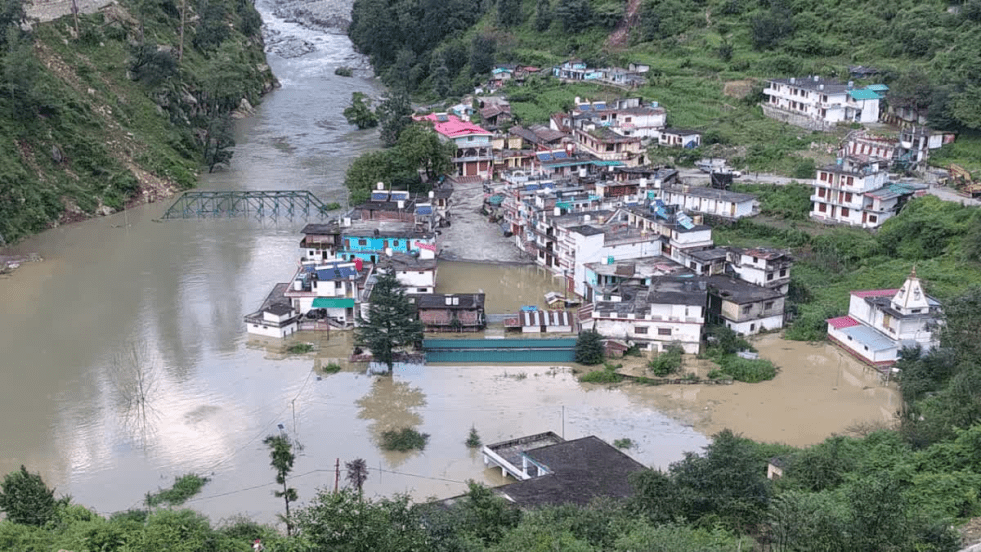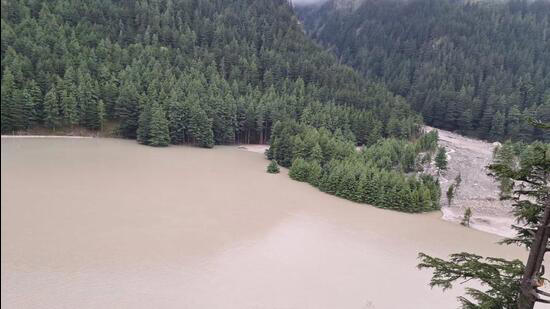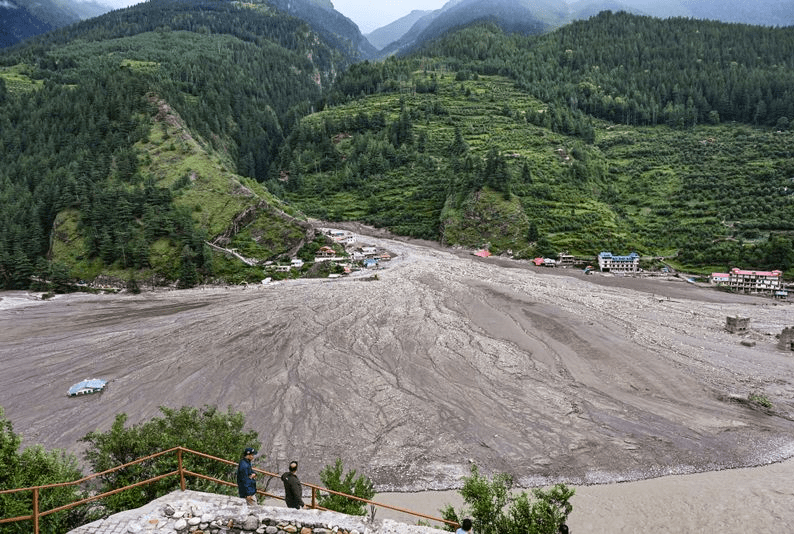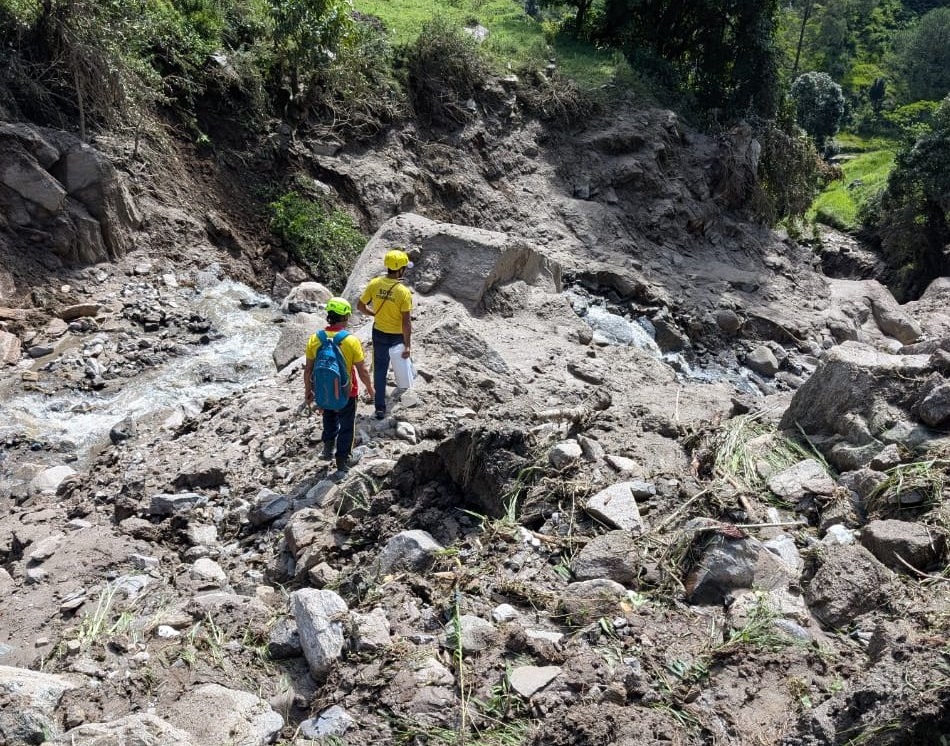
After 11 days since the Dharali disaster unfolded in Bhagirathi valley Uttarakhand on August 5, 2025, an artificial lake formed on Bhagirathi river has been removed to some extent by the joint team of concerned departments on Aug 16, 2025 noon. The lake was formed after the Tel gaad partially blocked the Bhagirathi river at Harshil about 2.5 km downstream of Dharali.
The following Indian Express report highlights some key aspects of the Oct 2020 guidelines from the National Disaster Management Authority related to disasters caused by Glacial Lake Outburst Floods (GLOF). Unfortunately, as is clear from the recent Dharali disaster most key aspects of the guidelines remain unimplemented almost five years after the Guidelines were published. Had they been implemented with any seriousness, the proportions of the Dharali disaster would have been significantly reduced.
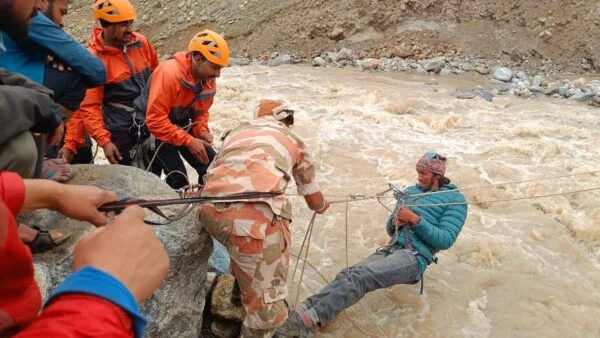
(Feature Image: Search Operation on Aug 07, 2025 in Katola gaad of Bankura village in Chauthan Patti, Thaisain, Pauri. Source: Uttarakhand Police)
The Chauthan Patti under Thailisain block of Pauri Garhwal district in Uttarakhand has again been battered by excessive rainfall events on August 06 2025. Villagers have reported of 3 incidents of ‘cloudburst’ induced flashflood causing severe damages in Bankura, Mansari and Sarson villages.
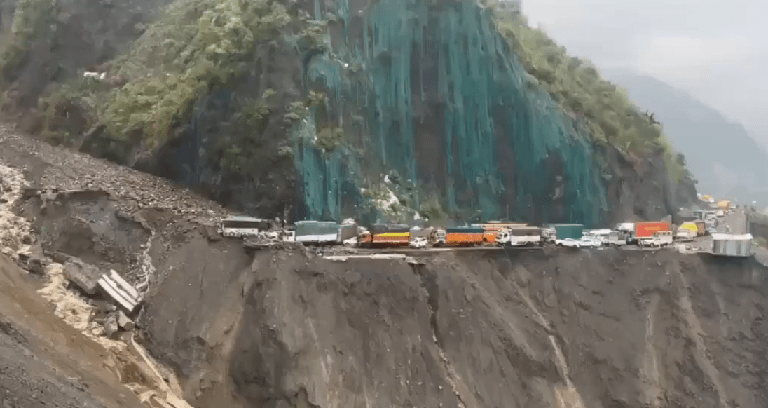
(Feature Image: Social media image showing scroes of vehicles precariously standing on severely damaaged NH 44 in Ramban on April 20, 2025)
After April 20, 2025 ‘cloudburst’ disaster in Ramban, the role of Jammu-Srinagar National Highway (NH) 44 has been under criticism for adding into the devastation trail. While a significant portion of the NH has been severely damaged in the aftermath, the residents have also blamed the NH work for compromising the drainage system and increasing destruction toll in the affected area.
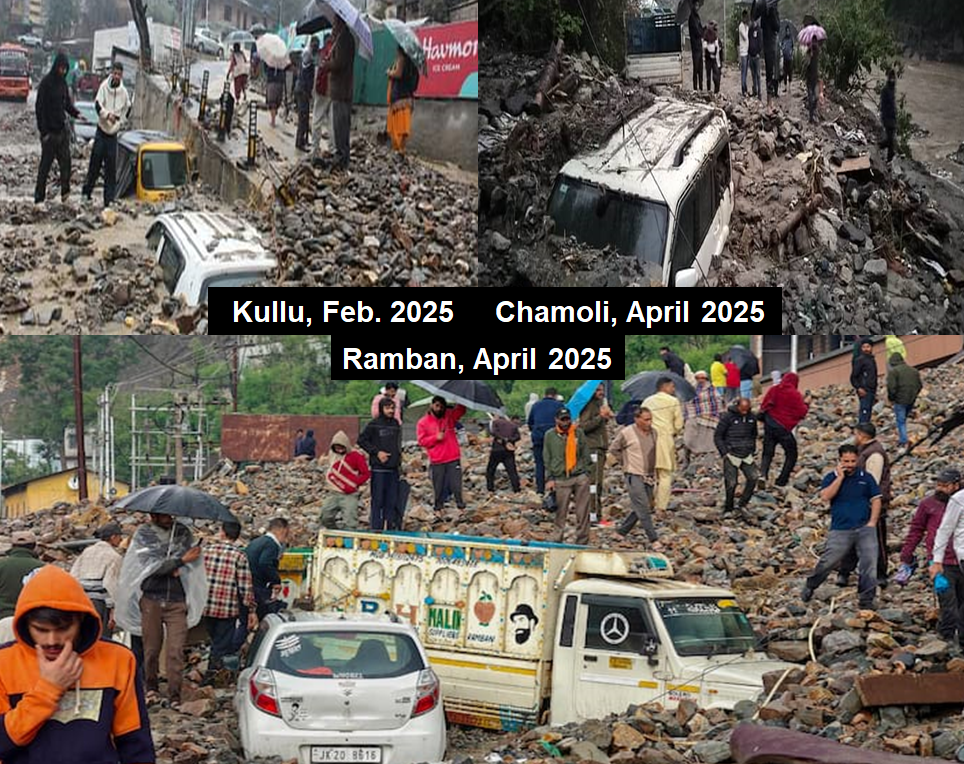
The rising numbers and intensity of western disturbances (WDs) in pre-monsoon months are causing excessive but short rainfall spells across the country particularly in the Himalayan states. These events are then resulting in sudden flash floods and taking a huge toll on human life and public infrastructure. However, the specific monitoring and warning services for such disasters by the Central Water Commission (CWC) & Indian Meteorological Department (IMD) are largely unavailable as these agencies are mainly forecasting floods during the monsoon.
On a crisp September morning, we clank across an iron suspension bridge on the River Chandra to enter the valley of Bhaga. We are tracing the origins of Bhaga and will be reaching Barlacha La pass at an altitude of 15,900 feet in a few hours. Madly fluttering prayer flags swaddling the bridge and the roaring river below make it seem as if, like the prayers, we are adrift on the wind too. Below, on the toasty river sands, a few men doze like monitor lizards.
“Bolo Jai Jai Baba Bhole”, the Prime Minister Narendrabhai Modi, while speaking at Kedarnath in Uttarakhand in Oct 2017[i], asked the people in audience to chant with him. Indian deity Mahadev, the presiding deity at Kedarnath on the banks of Mandakini river is possibly the closest to rivers and nature among all the deities, as is also clear from his attire. Baba Bhole is one of the many names of this deity. Incidentally, the massive, controversial Pancheshwar Dam a pet project of Mr Modi will also submerge the Pancheshwar Mahadev Temple, where too, the presiding deity is same Bhole Baba. But we will come back to Bhole Baba. Continue reading “Who exactly needs the Pancheshwar Dam?”→
Above: Entirely destabilised house next to 100 MW Sorang HEP transmission lines Photo: Sumit Mahar
Immediate Press Statementfrom Himdhara02/12/15
In the last two weeks a half a dozen lives have been lost in the Kinnaur region alone in three separate incidents that have one thing in common – accidents at hydropower project sites. The first event took place in Burang village on the 18th of November 2015 where a penstock pipe burst of the 100 MW Sorang Hydro-electric project led to the death of three people. On 29th November, two labourers died in blasting operations in the 450 MW Shongthong Karchham project, some others were seriously injured. And on the same day in the Bhabha Valley, a young teacher lost her life in a landslide that occurred in the area. Continue reading “Kinnaur in crisis; Sheer Negligence in hydro projects claiming lives. Who is accountable?”→
SANDRP has just published a new report: “Headwater Extinctions- Hydropower projects in the Himalayan reaches of the Ganga and the Beas: A closer look at impacts on fish and river ecosystems”, authored by Emmanuel Theophilus. The report[i] was released at the India Rivers Week held during Nov 24-27, 2014.
Front Cover of the report HEADWATER EXTINCTIONS
Headwater Extinctions deals with impacts of hydropower projects in Beas basin in Himachal Pradesh and Alaknanda-Bhagirathi basins in Uttarakhand on river ecosystem and its components, mainly fish. While the harrowing impacts of hydropower projects on local livelihoods and social systems are being realized gradually, we are yet unclear about the extent of impacts of these so-called green projects have on fish and aquatic biodiversity.
Environmental Impact Assessments of large hydropower projects (> 25 MW as per EIA Notification 2006[2]) are supposed to assess ecological impacts of such projects, but we are yet to come across any comprehensive effort in this direction from EIA reports that we have assessed so far.
The Expert Appraisal Committee (EAC) of Union Ministry of Environment, Forests and Climate Change (MoEF & CC) which is entrusted with appraising these projects and their EIAs has paid very little attention to this issue. Since over a decade, the EAC has had expert members from Wildlife Institute of India (WII) and Central Inland Fisheries Research Institute (CIFRI). Both these institutes are supposed to have expertise on fish and aquatic biodiversity. But sadly, their presence has not helped fill the serious lacunae in appraisal and EIAs of the hydropower projects.
SANDRP had been trying to highlight the impact of hydropower on fish and the long standing problems in the so-called mitigation measures being recommended by the EAC. We thought that it may be useful to bring out a first-hand report bring out ground realities of what is happening to our rivers. Emmanuel Theophilus, based in the Dhauliganga Valley and who is an avid mountaineer, storyteller, ecologist and our ally was commissioned by SANDRP to study the impacts of hydropower on fish and ecosystems, review the EIAs as well as mitigation measures recommended by EAC as a part of Environment Management Plans of hydropower projects. We are very glad to publish the report as a first of the hopefully many steps to be taken to understand and address this important issue.
Headwater Extinctions has been written in an eminently readable style that Theo is known for, as could be seen from the earlier blogs[3] he wrote for us! The report has a section on ‘Travelogue’ which records Theo’s travels and thoughts as he visits Bhagirathi and Alaknanda sub basins in Uttarakhand and Beas basin in Himachal Pradesh. The report also brings illuminating photos from these trips. The fact that the travels happened within months of the Uttarakhand disaster of June 2013 could be seen in his photos and travel reports. It further substantives the role hydropower projects played in increasing the proportions of the disaster.
Travelogue is followed by discussions in two parts: Discussions on the impact of hydropower projects on fish and aquatic habitats along the two sub-basins and the role of EIAs, EMPs, Fisheries Plan and the government approval process. The findings of this report are valid for all Himalayan states & rivers.
Back Cover of the report HEADWATER EXTINCTIONS
Headwater Extinctions ends with some striking insights. Sample this: “We are in the midst of river extinctions in the Himalaya, but are surrounded by a tragic drama of double-speak and equivocation. And a horde of jostling brokers. Ranging from reputed universities, government departments, research institutions, everyday bureaucrats, and of course, politicians and contractors from within ‘the community’[4] along the developers and regulators. They not only write the script of this drama, they even play all the part”.
The inside covers of the report have detailed maps of the two basins with locations of hydropower projects, with annexures containing lists of hydropower projects in Upper Ganga and Beas basins and also list of fish found in Upper Ganga basin.
Theo has completed this report on a stringent timeline and budget, which meant that all the proposed and implemented fisheries management plans could not be assessed. We hope Headwater Extinctions provides sufficient material and compelling reasons to overhaul the way impacts of hydropower projects on fisheries and aquatic biodiversity are treated by EIAs, EMPs and government committees. We would also urge agencies like WII and CIFRI to do justice to their work inside EAC and beyond. That they are not doing that is apparent.
For EAC and MoEF&CC, we certainly would like them to ensure proper and full impact assessment of projects on aquatic biodiversity in the EIAs. The EAC also needs to stop approving completely ineffective fish hatcheries. They could initiate a credible independent study of the costs, benefits and performance of the fisheries development plans they have been approving in recent projects. It does not only smell fishy, but more like a scam! Here is a relevant quote from the report: “I can’t help see a few things here, as perhaps you do? Bluntly put, I see slush funds being dangled to a whole range of possible collaborators. The kindest term I can find for them is ‘brokers’.”
We look forward to your comments and suggestions on all aspects of Headwater Extinctions. If you would like a hard copy, please write to us.
[2] We have been saying this for long and this report helps substantiate our contention that the assumption that projects below 25 MW are benign and do not need EIA-EMP or environmental monitoring and public consultations is wrong.
Reaching exasperating lows of environment decision making, the Forest Advisory Committee (FAC is a statutory body of the Ministry of Environment Forests and Climate Change (MoEFCC) formed under the Forest Conservation Act of 1980. FAC appraises Forest diversion proposals) has recommended Forest Clearance to the 3000 MW Dibang Project on Dibang river in Arunachal Pradesh.
While we had already written against this recommendation, what is nearly unbelievable is that this recommendation has come at just 10 meters height reduction of the dam from the proposed 288 meters.
This was the very same NHPC proposal which was rejected twice by the FAC in the past,[1] despite this token 10 meter height reduction. In fact in April 2014, the FAC said that 10 mt reduction does not take care of any pertinent impacts for which the proposal was rejected in the first place in July 2013! A 10 m reduction would still mean destruction of 3.24 lakh trees and submergence of 4577.84 hectares, nearly 12000 acres, of rich bio-diverse forest.
Dibang River. Photo with thanks from Global Post, Scot Ligare
The usually reticent MoEFCC (Ministry of Environment, Forests and Climate Change, MoEF earlier) too had issued a strong-worded rejection to this scheme in August 2014, stating that 10 meters reduction is nothing in the face of what is being lost. The rejection letter stated: “Such a marginal reduction in requirement of the forest land (445 hectares reduction, reducing forest requirement from 5056 hectares to 4577 hectares) for the project may not be able to reduce the adverse impact of project on such a biodiversity-rich mature forest ecosystem to the extent which could make the project environmentally as well as socio-economically viable in forest dependent tribal society of Arunachal Pradesh”.
This letter from the same ministry certified that the 10 m reduction proposal still leaves the project environmentally, socio-economically unviable. So an environmentally and socio-economically unviable project has been recommended clearance by the statutory FAC (and also the separate recommendation a week earlier by the same MEFCC’s Expert Appraisal Committee on River Valley Projects)!
This shows that the decision of FAC is devoid of merits, will invite huge opposition from Arunachal Pradesh, Downstream Assam, North East India, and even beyond and will not pass legal scrutiny. The decision seems to have been taken under pressure from the political masters. Union Power Minister Piyush Goyal has been dreaming of clearance to this project, as is clear from his road map published on completion of 100 days of office for the new NDA government[2]. He has also been pressurizing the MoEFCC to clear the project by hook or by crook. The FAC was reconstituted and the reconstituted FAC has obliged the minister in its very first meeting. In the process, the entire FAC has violated its mandate and should be held accountable for this.
Regrettably, MoEFCC seems to have become the willing punching bag of not only above-mentioned ministries, but even unrelated ministries like Ministry of Mines and Minerals, Ministry of Steel ,etc., whose ministers and Secretaries were present for the meeting: “to Expedite Clearances”. (Incidentally, when was the last time we heard MEFCC resisting such arm-twisting, or forthrightly suggesting any pro-environment measures to other ministries?)
Before the minutes of the September FAC meeting were out on Oct 22, 2014 (there was an inordinate delay this time, raising suspicion of negotiated minutes and again breaking all norms of conduct), there was discussion in media that Dibang was cleared, but even the hard-core skeptics believed that this recommendation must have come after a 20 meter or 40 meter height reduction, for obvious reasons.
But the FAC seems to have outdone itself. As stated above, the recommendation has come at 10 mts height decrease, for which the FAC had rejected the project and MoEF had issued a rejection letter in the past.
As we discussed in detail in our last blog on Dibang project, the twice-rejected project was up for discussions again in Sept 2014 only after considerable arm-twisting of the MEFCC by the Cabinet Committee of Investment, Ministry of Power, Project Developer NHPC and Arunachal State Government. This time it was for a supposed sensitivity analysis (done by the developer!)for studying the feasibility of reducing the height of the project upto 40 meters from its original height of 288 meters.
This sensitivity analysis was not shared with anyone, not even the FAC members till the day of the FAC meeting, breaking all codes of conduct of transparency, participation and informed decision making in governance. SANDRP wrote about this to the Minister and Secretary of MoEFCC as well as the Member of the FAC, but received no response.
Looking at the minutes, it is clear that the FAC members have lapped up the logic presented by the developer and the Ministry of Power which in a nutshell says that “10 meters reduction is sufficient as the ratio of forest land required per MW is lowest at 10 meters reduction.” This twisted logic reduces all decision making related to forests, even biodiversity-rich forests supporting endemic, unstudied species, local protests, downstream impacts etc., to mere number crunching of forest per MW. This criteria alone cannot be the basis for decision for forest appraisal committee.
Dibang Valley Forests Photo: The Telegraph
As per the sensitivity analysis by NHPC, the ratio forest land required per MW for 40 meters reduction is 1.67 MW/ hectare, which is same as no height reduction and 1.78 MW/ hectare in case of 20 meter reduction. In terms of tariff, for 40 meters reduction, the power tariff will be 6.24 Rs./unit while it is 5.66 Rs/unit 10 meters reduction, 5.94 Rs./unit 20 meters reduction and 5.64 Rs. at zero reduction. The installed capacity will reduce by 120 MW (4%) MW for 10 meters reduction, 600 MW (20%) for 20 mt reduction and 780 MW (26%) for a 40 meter reduction.
Height Reduction
Forest land required
MW capacity per ha Forest lost
First Year Tariff: Rs per unit
Reduction in installed capacity
Nil (288 m)
5056 Ha
1.67
5.64
None
10 m
4578 Ha
1.59
5.66
120 (2880 MW)
20 m
4284 Ha
1.78
5.94
600 (2400 MW)
40 m
3703 Ha
1.67
6.24
780 (2200 MW)
The proponent said: “Decrease in dam height and consequent sacrifice of power generation beyond 10 mt is not commensurate with saving forest land.”
How did NHPC reach this conclusion? What is the value of the mature, old growth forest land considered by NHPC? Without knowing this, how can this conclusion be acceptable to the FAC? It has to be remembered that Dibang is not an exclusive hydropower project, but a multipurpose project with a flood moderation component and costs have to be borne for this.
While the proponent and Ministry of Power did their best for pushing the project, the FAC did not do its duty of stating that the sensitivity analysis put forth by NHPC is a sham as it does not consider the worth of the forest being lost.
In this sabji-mandi haggling, when FAC had all the watertight justifications for rejecting the project, it did not bat for even a 40 meter reduction, which could have saved nearly 1355 hectares of forests and would have had a marginal impact on other factors. Its unclear why this happened.
Only one of the FAC members tried to battle the case saying that 10-40 meter reduction still does not address the upstream and downstream impacts, especially considering the biodiversity rich area. The minutes do not disclose the name of this member, but it seems the brute majority (majority of FAC members are govt officials) took the official line, alleging “subjectivity” and said that “To reduce subjectivity, it is important to analyse the issue objectively on objective parameters”. Forgetting that this is Forest Appraisal committee, not Power Developer Committee.
This is ironical. It was indeed the duty of the FAC to appraise the project “objectively” based on issues like destruction of 3.24 lakh trees, invaluable forests, unstudied biodiversity, rich wildlife and several Schedule I species, community dependence, traditional rights, downstream impacts, climate change impacts, options assessment, etc. But it did nothing of that and has in fact recommended the project “subjectively”, bowing to pressures outside their ambit.
Clearly, per MW forest land required and per Unit Tariff from a project are anything but objective criteria for FAC. FAC is supposed to apply its mind to a number of issues like the ones above. If FAC was not supposed to apply its mind to these aspects and its judgment, there was no need for an FAC, Power ministry and developer could have taken the decision independently.
The FAC decision does not address any pertinent issues raised by the same FAC while rejecting the project, it also does not address downstream impacts on Assam or assume any value for a rich forest. There is no discussion why 20 meters or 40 meters reduction is not seriously considered by FAC. Decision-making based on such biased, proponent-driven criteria is bound to be open to legal challenge and public protests.
Sham consideration of Downstream Impacts About Impact of the project on Dibru-Saikhowa National Park, the User Agency said that the issue was considered by EAC in its meeting on the 16th September (Please note this is just 6 days and 5 working days back from FAC meeting. There is no chance of minutes being firmed up by then. They were not in open domain in any case) and the EAC has recommended clearance based on the fact that there is less than 1 meter level fluctuation at DSNP.
This claim in any case is patently incorrect, again a case of project-friendly, anti-environment decision-making. The level fluctuation at DSNP can go way higher than a meter, anywhere from 7-8 feet every day in lean season, according to the studies considered by the EAC of the MEFCC itself. This has been pointed out by SANDRP to the EAC as well. There has been no study of the impacts of this project on downstream Arunachal Pradesh or Assam. The developer seems to assume that Dibru-Saikhowa is the only part of Assam worth considering.
Dibang Valley tribes Photo from go ibibo/dibangvalley
There is no compliance under Forest Rights Act (2006) for such a massive project and despite this, FAC under some supposedly progressive members working on tribal issues, does not bat an eyelid before recommending clearance!
To conclude, pricing mature, biodiversity-rich forests in terms of per MW terms is an insult of those forests, the communities that depend on them and to the mandate of FAC. Downstream impacts of Dibang project are not studied, the impacts on Dibru-Saikhowa are based on compromised studies.
There is no merit in this decision from the newly appointed FAC which includes members also from reputed environment protection organizations in North East and from Tribal Welfare groups like Friends of Baripada. It is also sad to see that there is no dissenting note from a single member. The unnamed member who expressed dissent in the meeting has not written anything about this in public domain.
Decisions like Dibang lay further foundations for poor, pro-developer, anti-people, anti-environment decisions taken due to pressure from proponent and other ministries. Such decisions will not be legally tenable, nor acceptable to affected communities, nor good for sustainability and equity. In fact, by such reversals, FAC decisions are losing their sanctity. FAC has done this in the past too in case of Kalu Dam in Western Ghats which would submerge 18 villages and 1000 hectares forest.
Isn’t it ironical that the new government changed the name of the MoEF to MoEFCC but is sanctioning massive projects like Dibang which will have far reaching impacts on Climate Change as well as adaption and mitigation abilities of the affected communities? Without even considering these aspects or even mentioning them?