Chenab · Cumulative Impact Assessment · Environment Impact Assessment · Expert Appraisal Committee · Himachal Pradesh · Hydropeaking · Hydropower · Ministry of Environment and Forests

Sach Khas Hydro project in Chenab Basin: Another example of WAPCOS’s shoddy EIA

Even after multiple appeals by various experts, organizations and local people, Expert Appraisal Committee (EAC) set up by Ministry of Environment & Forest (MoEF) has once again chosen to ignore alarms of changing climate such as disaster of Uttarakhand in 2013 and has continued to consider Hydro Power Projects on Chenab Basin for Environmental Clearance (EC) before the Cumulative Impact Assessment of Chenab Basin has been accepted by MoEF. While on one hand the State Government of Himachal Pradesh has promptly appointed a committee headed by Chief Secretary to supervise and monitor all the progress and to “sort out” problems of getting various clearances “without delay in single window system”[i], on the other hand overall transparency of the Environmental Clearance Process has been steadily decreasing.

Sach Khas HEP (260 + 7 MW) (located in Chamba District of Himachal Pradesh) was considered by EAC in its 76th meeting held on August 11, 2014. Even though the project was considered for EC, no documents were uploaded on the website. Website does not even list the project under “Awaiting EC” category. This is in clear violation with MoEF norms, basic norms of transparency and Central Information Commission (CIC) orders. There are no fixed guidelines for documents to the uploaded, the time by when they should be uploaded and rules that project cannot be considered if the documents are not uploaded.

SANDRP recently sent a detailed submission to EAC pointing out several irregularities of the project. The comments were based on reading of the Environmental Impact Assessment (EIA) report available on the HP Pollution Control Board Website (which cannot be substitute for putting up the documents on EAC website). Environmental Management Plan (EMP) of the project is not accessible at all! Non availability of EMP on the HP Pollution Control Board website too is a violation of EIA notification 2006.

The EIA report which is prepared by WAPCOS is another example of a poorly conducted EIA with generic impact prediction and no detailed assessment or quantification of the impacts. Moreover since EMP is not available in the public domain, there is no way to assess how effectively the impacts have been translated into mitigation measures. Violations of Terms of Reference (TOR) issued by EAC at the time of scoping clearance is a serious concern.

Project Profile

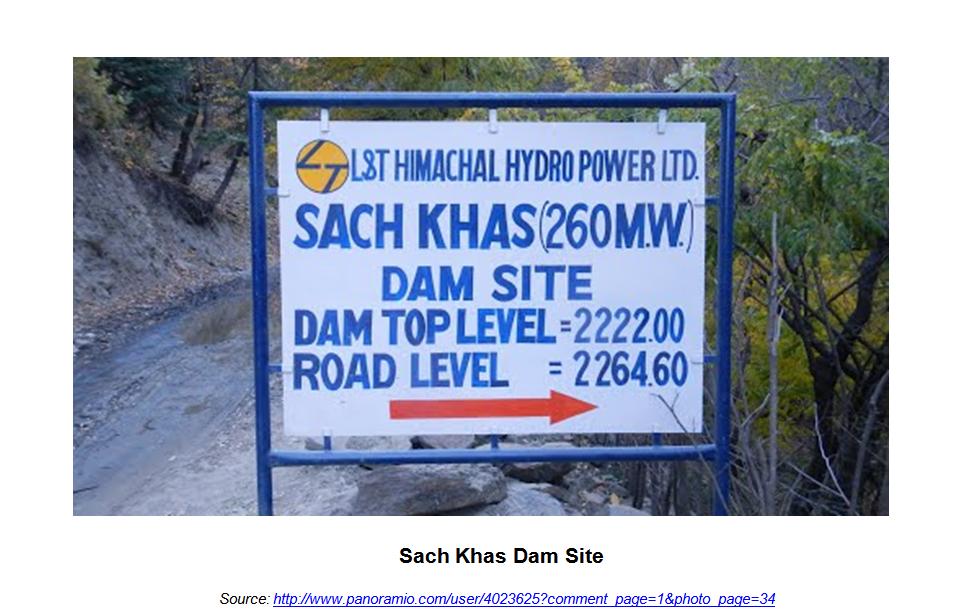
Sach Khas HEP is a Dam-toe powerhouse scheme. The project has a Concrete Dam & Spillway with Gross storage of 25.24 MCM, Live Storage of 8.69 MCM and Reservoir Stretch at FRL of 8.2 km (approx.) Three intakes each leading to 5.8m diameter penstocks are planned to be located on three of the right bank non-overflow blocks. Three penstocks offtaking from the intakes are proposed to direct the flows to an underground powerhouse on the right bank of the Chenab river housing 3 units of 86.67 MW turbines with a total installed capacity of 260 MW. The project also proposes to construct 2 units of 7 MW each to be installed to utilize the mandatory environmental releases. The EIA mentions (p 2.19) that the HP government has allocated 3.5 MW Hydropower project on Chhou Nala in the project area to the project authority, so this is integral part of the project.
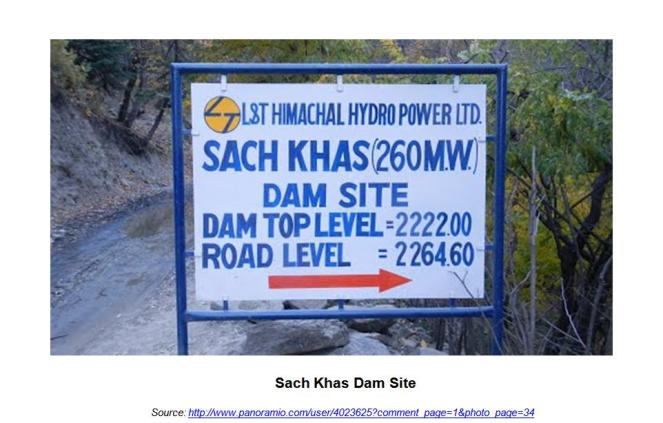
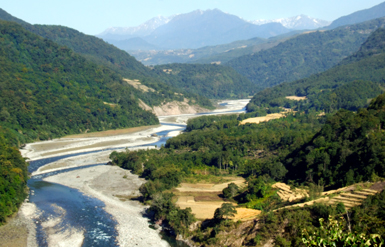
Sach Khas Dam Site

Sach Khas Hydro Electric Project was considered before completion of Cumulative Impact Assessment of Chenab Basin

Chenab basin may have one of the highest concentrations of hydropower projects among all basins in India[i]. The basin has over 60 HEPs under various stages of planning, construction and commissioning in states of Himachal Pradesh (HP) and Jammu and Kashmir (J&K). 49 of these projects are planned or under construction in Chenab in HP and of which 28 projects of combined generation capacity of 5,800 MW are at an advanced stage of obtaining (Environment Ministry) clearances[ii]. MoEF sanctioned TORs for Cumulative Impact Assessment (CIA) of the HEPs on Chenab in HP in February 2012 however the project specific ECs were delinked from the CIAs[iii].

MoEFs Office Memorandum dated May 28 2013 states, “While, first project in a basin could come up without insisting on cumulative impact study, for all subsequent hydro-power projects in the basin, it should be incumbent on the developer of second/ other project(s) to incorporate all possible and potential impacts of the other project (s) in the basin to get a cumulative impact assessment done.”

We had pointed out in our submission against Kiru & Kwar projects in Jammu & Kashmir that CIA of all the proposed, under construction and operational projects and carrying capacity assessment (CCA) of the Chenab River basin to see if it can support the massive number of HEPs in safe and sustainable way is one of the first steps before considering clearances to HEPs in this region. Looking at the fragility of the Himalayan ecosystem, considering any hydropower project in the basin without these studies will be an invitation to disaster[iv]. This fact has been repeatedly highlighted by multiple organizations and experts including SANDRP.

Sach Khas EIA Study: Gross violation of TOR

The EIA violates several stipulations of TOR issued on Feb 22, 2013, which also included the stipulations of EAC in Sept 2012 and Nov 2012 meetings where the project TOR was considered and also Annexure attached with the TOR. This has severely affected the overall quality of the EIA report.

About assessing the impacts of the project on wild life the TOR said: “Reaching conclusion about the absence of such (Rare, Endangered & Threatened) species in the study area, based on such (conventional sampling) methodology is misleading” as such “species are usually secretive in behavior”, “species specific methodologies should be adopted to ascertain their presence in the study area”, “If the need be, modern methods like camera trapping can be resorted to”. None of this is shown to be done in any credible way in EIA.

TOR also recommends intense study of available fish species in the river particularly during summer (lean) months with help of experimental fishing with the help of different types of cast and grill nets. There is no evidence in EIA of any such intensive efforts detailed here. In fact the field survey in summer moths was done in May June 2010, years before the EAC stipulation.

TOR (EAC minutes of Sept 2012) state “Chenab river in this stretch has good fish species diversity & their sustenance has to be studied by a reputed institute.” This is entirely missing. TOR (EAC minutes of Sept 2012) states “During the day, the adequacy of this discharge (12 cumecs) from aquatic biodiversity consideration needs to be substantiated”. This again is missing. TOR said 10 MW secondary station may be a more desirable option. This is not even assessed. TOR said Impacts of abrupt peaking need to be assessed. This is also not done. Site specific E-Flow studies and peaking studies stipulated by TOR are missing. TOR states that Public Hearing / consultations should be addressed & incorporated in the EIA-EMP. However there is no evidence of this in the report.

TOR also required following to be included in EIA, but many of them found to be missing: L section of ALL upstream, downstream projects; Project layout showing all components with A-3 scale of clarity and 1: 50000 scale; drainage pattern map of river upto project; critically degraded areas delineated; Demarcation of snowfed/ rainfed areas; different riverine habitats like rapids, pools, side pools, variations, etc;

Contradictions in basic project parameters

The EIA report provides contradictions in even in basic parameters of the project components: So section 2.1 on page 2.1 says, “The envisaged tail water level upstream of the Saichu Nala confluence is 2150 m.” This i s when the TWL is supposed to 2149 m as per diagram on next page from the EIA. Section 2.3 says: “River bed elevation at the proposed dam axis is 2145m.” At the same time, the tail water level is 2149 m. How can Tail water level of hydropower project be higher than the river bed level at the dam site? This means that the project is occupying the river elevation beyond what HPPCL has allocated to it. Page 23 of EIA says: “…the centerline of the machines in the powerhouse is proposed at 2138.00m…” So the Centre line o the power house is full 11 m BELOW the tail water level of 2149 m? How will the water from power house CLIMB 11 m to reach TWL level?

EIA report unacceptable on many fronts

Dam ht of 70 m was stated in TOR, however the report states it to be 74 from river bed. The submergence area, consequently has gone up from 70 ha at TOR stage to 82.16 ha, as mentioned in Table 2.2 of EIA. Total land requirement which was 102.48 ha as per TOR ha has now increased to 125.62 ha, with forest land requirement going up to 118.22 ha. This is a significant departure from TOR that should be requiring fresh scoping clearance. Part of the field study has been done for the project more than four years ago and rest too more than three years ago. There are not details as to exactly what was done in field study. EAC had noted in their meeting in Sept 2012, while considering fresh scoping clearance for the project, “EIA and EMP should be carried out afresh keeping in view the drastic changes in the features due to increase in installed capacity of the power house.” (Emphasis added.) The EIA report is thus unacceptable on multiple fronts.

No cognizance of Cumulative Impacts

CIA of the entire Chenab basin including HP and J&K is not being considered, which itself is violating MoEFs Office Memorandum dated May 28 2013. The OM states that all states were to initiate carrying capacity studies within three months from the date of the OM No. J-11013/I/2013-IA-I. Since this has not happened in case of Chanab basin in J&K, considering any more projects in the basin for Environmental clearance will be in violation of the MoEF OM.

On Cumulative Impact Assessment, the OM said, “While, first project in a basin could come up without insisting on cumulative impact study, for all subsequent hydro-power projects in the basin, it should be incumbent on the developer of second/ other project(s) to incorporate all possible and potential impacts of the other project (s) in the basin to get a cumulative impact assessment done.” The EIA of both the projects does not include the cumulative impacts.

The project is located between Purthi HEP upstream and Duggar HEP downstream. Elevation difference between TWL of Purthi (2220m) and FRL of Sach Khas (2219m) is barely 1 m. The horizontal distance between them is as less as 117m. This is clearly unacceptable and in violation of the minimalist EAC-MoEF norms.

Elevation difference between TWL of Sach Khas (2149m) and the FRL of Duggar (2105 m) is 44 m and the horizontal distance is 6 km. This is thus a cascade of three among many other projects in the basin.

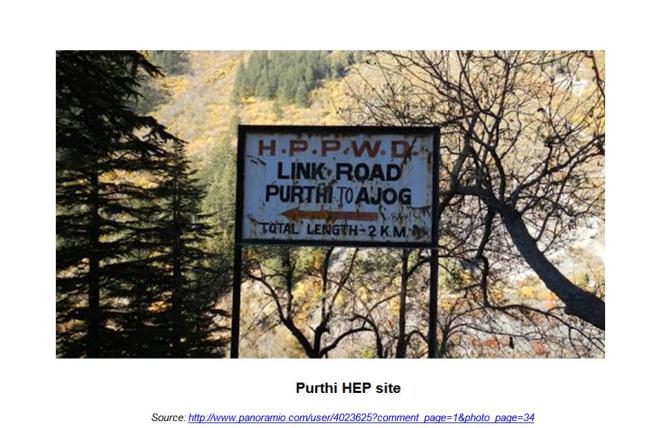
Cascade of three projects

Purthi HEP Site

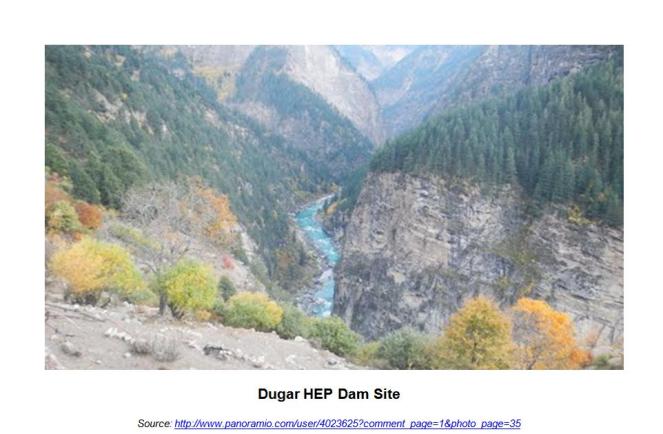
Dugar HEP Site

Even so the report does not even mention the other two projects. EIA study is project specific and no cumulative impacts are assessed along with the other two projects. The EIA does not provide a list of all the HEP projects taken up in the Chenab basin in HP state[i]. The MoEF sanctioned TORs for conducting Cumulative Impact Assessment (CIA) of Chenab In February 2012. EAC considering any further project in Chenab basin before completion of the CIA study of the basin by a credible agency (not WAPCOS) and finalised in a participatory way will be in violation of the MoEF order of May 2013.

EIA report completely misses out on the detailed analysis of cumulative impacts in terms of disaster potential of the area and how the project will increase that; impacts on flora, fauna, carrying capacity, livelihoods; cumulative downstream impact, cumulative impact of hydro peaking. impacts on springs and drainage pattern; impacts of forest diversion on environment, hydrology and society and implementation of the Forest Rights Act; changing silt flow pattern in different phases, impacts of mining, tunneling, blasting etc. Impact of reduction in adaptive capacity of the people and area to disasters in normal circumstance AND with climate change has not been assessed. Project makes no assessment of impact of climate change on the project even when over 60% of the catchment area of the project is snow-fed and glacier fed. Options assessment in terms of non dam options as required under EIA manual and National Water Policy are missing.

Generic impact prediction

Impact prediction is too generic with no detailed assessment, which is what EIA is supposed to do. Impacts have not been quantified at all. The EIA report merely states the likely impacts in 2 or 3 sentences. Several important impacts have gone missing. None of the serious impacts have been quantified. For an informed decision making and effective mitigation and EMP quantification of impacts is essentially a pre requisite. Following are some such incidences:

Impacts of blasting & tunneling: TOR for the impacts on “Socio-economic aspects” says, “Impacts of Blasting activity during project construction which generally destabilize the land mass and leads to landslides, damage to properties and drying up of natural springs and cause noise pollution will be studied.”(p.196 of EIA Report). The total area required for Underground Works is 2.44 Ha. The project proposes underground power house with an installed capacity of (260+7). There are three TRTs proposed of length 99.75m, 113.13m, and 132.35m. Even so the impacts of blasting for such huge construction are simply disregarded in the EIA report by stating that “The overall impact due to blasting operations will be restricted well below the surface and no major impacts are envisaged at the ground level.” (p.165). While assessing the impacts of blasting on wild life the report states that direct sighting of the animals has not been found in the study area and the possible reason could be habitation of few villages. No attempt has been made to assess impacts of blasting like damage to properties, drying up of springs etc. This is a clear violation of TOR.

Impacts of Peaking & diurnal flow fluctuation: In the lean season during peaking power generation the reservoir will be filled up to FRL. As stated in report, this will result in drying of river stretch downstream of dam site of Sach Khas hydroelectric project for a stretch of 6.0 km, i.e. upto tail end of reservoir of Dugar hydroelectric project. The drying of river stretch to fill the reservoir upto FRL for peaking power will last even upto 23.5 hours, after which there will continuous flow equivalent to rated discharge of 428.1 cumec for 0.5 to 2 hours. Such significant diurnal fluctuation with no free flowing river stretch will have serious impacts on river eco system. There is no assessment of these impacts. Instead the report projects this as a positive impact stating “In such a scenario, significant re-aeration from natural atmosphere takes place, which maintains Dissolved Oxygen in the water body.” This is absurd, not substantiated and unscientific.

International experts have clearly concluded that: “If it is peaking it is not ROR”[ii]. In this case the EIA says the project will be peaking and yet ROR project, which is clear contradiction in terms.

Impacts on wild life: EIA report lists 18 faunal species found in the study area. Out of them 8 species are Schedule I species and 8 Schedule II species. Even so while assessing the impacts of increased accessibility, Chapter 9.6.2 b(I) of the report mentions “Since significant wildlife population is not found in the region, adverse impacts of such interferences are likely to be marginal.” If the project has so many schedule I and II species, the impact of the project on them must be assessed in the EIA. Moreover, massive construction activities, the impacts of long reservoir with fluctuating levels on daily basis, high diurnal fluctuation and dry river stretch of 6km on wild life could be serious. But the report fails to attempt any assessment of the same.

Impacts on geophysical environment are missing: The project involves Underground Works of 2.44 Ha. This involves construction of underground powerhouse, three headrace tunnels and several other structures. This will have serious impacts on the geophysical environment of the region and may activate old and new landslides in the vicinity of the project. The report makes no detailed assessment of this. Generic comments like “Removal of trees on slopes and re-working of the slopes in the immediate vicinity of roads can encourage landslides, erosion gullies, etc.” (p.176) have been made throughout the report. Such generic statements can be found in every WAPCOS report. Such statements render the whole EIA exercise as a farce. Project specific, site specific impact assessment has to be done by the EIA. Considering that the project is situated between Purthi HEP upstream and Duggar HEP downstream, a detailed assessment of the geophysical environment and impact of all the project activities is necessary. Further since the EMP is not at all available in public domain, it is difficult to assess what measures are suggested and how effective measures to arrest possible landslides have been suggested.
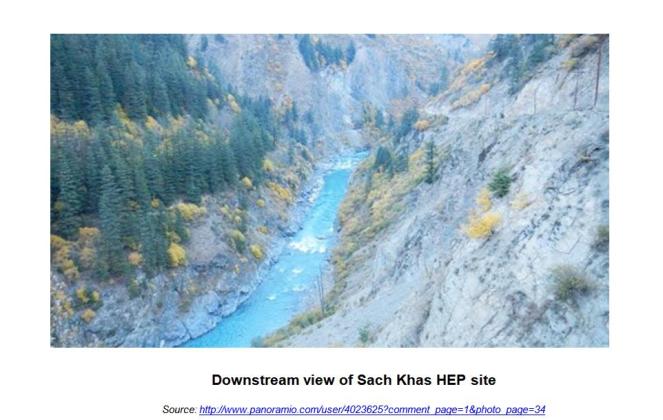
Downstream view of Sach Khas

Right Bank Drift at Sach Khas

No assessment for Environmental Flow Releases

TOR states that the minimum environmental flow shall be 20% of the flow of four consecutive lean months of 90% dependable year, 30% of the average monsoon flow. The flow for remaining months shall be in between 20-30%, depending on the site specific requirements (p.192). Further the TOR specifically states that a site specific study shall be carried out by an expert organization (p.193).

The TOR also mandated, “A site specific study shall be carried out by an expert organisation.” However completely violating the TOR, the EIA report makes no attempt for the site specific study to establish environmental flows. Instead it proposes to construct 2 units of 7 MW each to be installed to utilize the mandatory environmental releases. This completely defeats the basic purpose of the environmental flow releases. Such flows will help neither the riverine biodiversity, nor fish migration nor provide upstream downstream connectivity.

Socio-economic profile of the study area and Rehabilitation & Resettlement Plan are missing

TOR specifies a detailed assessment of socio-economic profile within 10 km of the study area including demographic profile, economic structure, developmental profile, agricultural practices, ethnographic structure etc. It also specifies documentation sensitive habitats (in terms of historical, cultural, religious and economic importance) of dependence of the local people on minor forest produce and their cattle grazing rights in the forest land. As per the TOR the EIA report is required to list details of all the project affected families.

Report however excludes assessment of socio economic impact of the study area. The total land required for the project is 125.62 ha, of which about 118.22 ha is forest land and the balance land 7.4 ha is private land. There are cursory mentions of habitations in the study area. Chapter 8.7 ‘Economically Important plant species’ states that in study area the local people are dependent on the forest produce such as fruits, timber, fuel wood, dyes and fodder for their livelihood. However the EIA report does not even estimate the population displaced due to land acquisition and impact of the various components of the project on livelihood of the people. Further detailed study is then out of question. This is again gross violation of TOR.

Indus Water Treaty

Chenab basin is international basin as per the Indus Water Treaty. A recent order of the international court has debarred India from operating any projects below MDDL and has disallowed provision for facility to achieve drawdown below MDDL in any future project[i] (for details, see: https://sandrp.wordpress.com/2013/12/23/international-court-asks-india-to-release-more-water-and-rejects-plea-to-re-interpret-february-verdict-on-kishanganga/). The EIA described gate opening in this project for silt removal, which stands debarred by international court. The EIA thus is in violation of the verdict of international Court.

The EIA says (p. 21 bottom), “Five low level sluices with crest at 2167m of size 7.5m width and 12.3m height are proposed for flood passage. Drawdown flushing of the reservoir shall be carried out through these sluices for flushing out of the sediment entrapped in the reservoir. Detailed studies on sedimentation and reservoir flushing can be taken up at detailed planning stage.” The MDDL of the project is 2209.3 m as mentioned in the same para. This means the project envisages sediment flushing by drawdown to 2167 m (sluice crest level, the sluice bottom level wll be 12.3 m below that), about 42.3 m below the MDDL. This is clearly not allowed under PCA order cited above on Indus Treaty.

Impact of 3.5 MW Chhou Nala HEP to be constructed for the project not assessed

The EIA mentions (p 2.19) that the HP government has allocated 3.5 MW Hydropower project on Chhou Nala in the project area to the project authority, so this is integral part of the project. But the EIA does not contain any impacts of the SHP. The stream on which this is planned is extremely important for the people as drinking water schemes, irrigation Kuhls and gharats of Rai, Chhou and Thandal villages are located on this stream in the proposed project area. Thus the project will have huge impacts, but there is no assessment of these impacts. This is another glaring omission of EIA. It was shocking to read that the resident commissioner said at the public hearing that this question is not part of Environmental Public hearing, when it is very much part of it.

Public hearing report

At several places either no information is given or misleading information has been presented. For example the project representatives mis-informed the people at PH that 15-20% water will be released, when minimum water they need to release is above 20%. DFO said that soil will be spread over the muck disposal site for tree planting over it, but there is no provision of this in EIA-EMP. Many questions were provided with vague answers or no answers at all. No clear answer was given when asked if the muck dumping sites have been decided in consultation with the local people, implied answer is clearly that local people have NOT be consulted. When asked about agreements to ensure that the company implements EMP and Social Management Plan as required, there was no promise that such an agreement will be signed with the village gram sabhas. The affected people raised the issue of erosion impact of diversion tunnel, but no specific response was provided in response to this issue. When a resident of Chhou village raised the issue of vulnerability of the village to the landslides, no clear answer was given by the project developer. When the same person asked that our cremation ground is going under submergence, what is the company planning about it, the project developer replied that IF the cremation ground goes under submergence, we will think about this. This only shows that the project developer and EIA consultant have not even done an assessment of such basic aspects. The PH report accepts that close to 100 workers are already working without even basic sanitation facilities, this is clear violation of EIA notification further the EIA Agency fails to mention this.

EIA is full of cut and paste, generic statements, no actual assessments

Out of nine chapters of EIA, only the last chapter is about impacts assessments! So out of 170 pages of nine chapters, only 31 pages of chapter 9 is supposedly about impact assessment and there too mostly there is no real impact assessment, mostly only generic statements that can be included in any EIA. There are several unnecessary sections in the EIA like chapter 3 on “Construction Methodology” which is unnecessary in EIA. In most other sections too, the information is just cut and paste from DPR. By way of impact prediction, the EIA report is only listing them doing absolutely NO ASSESSMENT and no quantification of impacts is attempted. Further since the EMP is not available in the public domain, it is impossible to assess if the measures provided in the EMP are effective. Such EIA is definitely not acceptable.

No proper referencing The EIA does not provide references to the specific information, without this it is difficult to cross check which information is from which secondary sources and how credible it is and which information is from primary survey.

Conclusion

This is another most shoddy piece of EIA by WAPCOS.

Moreover, as we can see the EIA has not done several impact assessments, has violated large no of TORs on several counts, the EIA-EMP are not available on EAC website, the project parameters have undergone changes necessitating fresh scoping clearance as mentioned in TOR but that has not happened, baseline study is 3-4 years old, EAC stipulation of fresh EIA-EMP has been violated, Project is using larger riverine stretch than given by HP govt, there is no proper referencing, hydrology is weak, EMP is not available on HPPCB website in violation of EIA notification, among several other issues listed above. Every conceivable serious problem can be found in this EIA of WAPCOS.

It is full of generic statements that can be pasted in any EIA without any attempt at project specific impact assessment. SANDRP has been pointing to EAC and MoEF about such unacceptable EIA by WAPCOS for several years, but neither EAC, nor MoEF has taken any action in this regard. SANDRP has once again urged to EAC and MoEF to reject this EIA and recommend blacklisting of WAPCOS and to issue fresh scoping clearance for the project as mentioned in the TOR since the project parameters (dam height, submergence area, land requirement, etc) have gone through significant changes.

We sincerely hope the EAC will not only take serious cognition of these and not recommend clearance to the project, but also direct the project proponent and EIA consultant to implement other recommendations made above.

 Amruta Pradhan (amrutapradhan@gmail.com), Himanshu Thakkar (ht.sandrp@gmail.com)

[i] https://sandrp.wordpress.com/2013/12/23/international-court-asks-india-to-release-more-water-and-rejects-plea-to-re-interpret-february-verdict-on-kishanganga/

[ii] See for example https://sandrp.in/basin_maps/Hydro_%20Electric_Projects_in_Chenab_River_Basin.pdf

[iii] https://sandrp.wordpress.com/2014/07/01/if-its-peaking-its-not-an-ror-interview-with-dr-thomas-hardy-iahr-and-texas-state-university/

[iv] https://sandrp.wordpress.com/2013/07/01/pm-kick-starts-850-mw-ratle-project-in-jk-without-full-impact-assessment-invitation-to-another-disaster-in-chenab-basin/

[v] https://sandrp.in/hydropower/Dams_on_Chenab_How_many_are_too_many_Dec2012.pdf

[vii] https://sandrp.wordpress.com/2013/07/01/pm-kick-starts-850-mw-ratle-project-in-jk-without-full-impact-assessment-invitation-to-another-disaster-in-chenab-basin/

[viii] Refer to SANDRP studies on Chenab

– https://sandrp.wordpress.com/2013/07/01/pm-kick-starts-850-mw-ratle-project-in-jk-without-full-impact-assessment-invitation-to-another-disaster-in-chenab-basin/

– https://sandrp.in/hydropower/Dams_on_Chenab_How_many_are_too_many_Dec2012.pdf

– https://sandrp.wordpress.com/2014/05/06/massive-hydropower-capacity-being-developed-by-india-himalayas-cannot-take-this-onslought/

[ix] http://northgazette.com/news/2013/04/25/special-committee-to-monitor-hydro-projects-in-hp-cm/

Ministry of Environment and Forests · NBWL

“We want a robust National Board for Wildlife”: Submission from several organisations and individuals

4 August 2014

 To,

  • Shri. Narendra Modi,

Prime Minister of India and Chairperson, National Board for Wildlife

  • Shri. Prakash Javadekar,

Minister of State of Environment, Forests and Climate Change (IC) and

Chairperson, Standing Committee, National Board for Wildlife

  • Shri. V. Rajagopalan,

Secretary, Ministry of Environment, Forests and Climate Change

  • Shri. S. S. Garbyal,

Director General of Forests and Special Secretary,

Ministry of Environment, Forests and Climate Change

Subject: Request to urgently amend the flawed constitution of the National Board for Wildlife (NBWL) as indicated in Notification issued by MoEF dated 22 July 2014 & not hold any meetings based on this flawed notification.

Respected Prime Minister, Hon. Minister and Sirs,

It is with great concern that we write to you about the constitution of the new NBWL as indicated in the Government Notification dated 22ndJuly 2014.

The term of the previous NBWL and its standing committee ended in Sept 2013, as was noted by the then chairperson of the standing committee and recorded in the minutes of the latest (Sept 2013) meeting of the standing committee (see: http://www.moef.nic.in/sites/default/files/MOM-30-NBWL-04.09.2013.pdf): “At the outset, Hon’ble Chairperson while welcoming all participants to the 30th Meeting of Standing Committee of NBWL expressed deep appreciation of the contribution of the non-official members in the meetings of the Standing Committee of NBWL and their selfless dedication for the cause of conservation. She added that the present term of NBWL was coming to an end on 5th September 2013 and that the discussions and deliberations made by the present members during the Standing Committee of NBWL meetings had helped the Chair in taking judicious decisions.” (Emphasis added.)

So country was without NBWL and standing committee for more than the ast ten months and the country expected that the government would constitute a proper NBWL honouring the letter and spirit of the Wildlife Protection Act and the need to protect wildlife and biodiversity in protected areas. The concerned people of the country stand disappointed by the July 22, 2014 notification.

At the outset, the Notification dated 22 July 2014 is ambiguous about the constitution of the NBWL and its Standing Committee. It is not even available on MoEF website.  The notification seems to be in violation of the Wildlife Protection Act in letter and spirit and is not in the interest of the wildlife, biodiversity or protected areas in the country. A comparative reading of Sept 2003, May 2007 and Sept 2010 notifications of the MoEF about constituting NBWL further strengthen this view.

The notification only mentions a small subset of the NBWL members as listed in the Wildlife (Protection) Amendment Act, 2002. The limited list  is in violation of the Wildlife (Protection) Act, 1972 and its subsequent amendment in 2002 by way of the Wildlife (Protection) Amendment Act, 2002. The Director General of Forests is on record having said that this is the entire NBWL. (Please see:http://www.thehindu.com/todays-paper/tp-national/tp-otherstates/new-national-wildlife-board-flouted-wlpa-guidelines/article6261988.ece) This confirms the illegality of the notification.

We would respectfully like to submit that a notification issued by the government cannot override or violate an Act passed by the Parliament, with the ascent of the Hon. President of the Union of India.

Main points of divergence between Wildlife (Protection)Amendment Act, 2002 and the Notification issued on 22nd July, 2014 are as follows:

  1. Clause (e) of the Wildlife Protection Amendment Act, 2002 states:

“(e) five persons to represent non-governmental organisations to be nominated by the Central Government”

However, the Notification dated 22 July 2014 does not nominate any NGO. The only name notification gives for NGO member, namely GEER is not an NGO.

The nominated “Gujarat Ecological Education and Research (GEER) Foundation, Gandhinagar, Gujarat” is a Gujarat Government organisation and not an NGO. Its website is http://www.geerfoundation.gujarat.gov.in, says, it has been set up in 1982 by the Forests & Environment Department, Government of Gujarat” and the Chairperson of its board is Chief Minister of Gujarat while majority board members too are from Gujarat Government. Thus GEER stands disqualified from being nominated as an NGO.

  1. Clause (f) of the Wildlife (Protection) Amendment Act, 2002 states:

“(f) ten persons to be nominated by the Central Government from amongst eminent conservationists, ecologists and environmentalists”

However, the notification dated 22 July 2014 replaces this by just two people.

“(i) Prof. Raman Sukumar,

(ii) Dr. H.S. Singh.”

  1. Clause (v) of the Wildlife (Protection) Amendment Act, 2002 states:

“v) one representative each from ten States and Union territories by rotation, to be nominated by the Central Government”

However, the notification dated 22 July 2014 replaces this with just five states.

In view of the above, the notification dated 22 July 2014 violates Wildlife (Protection) Amendment Act 2002 and should be urgently taken back. Any meetings or any decisions taken by this board will not stand legal scrutiny.

Apart from the legal issue, it is important for a board like NBWL to have a broader regional representation of independent experts, NGOs and members and this was one of the the objectives behind  nominating these members on the NBWL and its standing committee. We hope that the government will appreciate this issue. Indian Wildlife, biodiversity and its habitat like the protected areas, forests, rivers, wetlands, etc., are under tremendous pressure and we hope the new government is committed to conserve our rich wildlife heritage.

We therefore look forward to urgent action on the points mentioned above by immediately taking back the 22nd July 2014 Notification and replacing it with a notification that spells out constitution of NBWL respecting the WLPA in letter and spirit and also respecting India’s wildlife and its dwindling habitat. We hope that no meetings of the NBWL happen before a correct constitution of the board.

Looking forward to your response on the points raised above.

 Yours sincerely,

  1. No.
Name/ Organisation Location  
 1. Kalpavriksh Environment Action Group Pune
 2. Dr. Bhaskar Acharya, Researcher, Bangalore Bangalore
 3. Dr. Sunil K. Choudhary University Dept. of BotanyT.M.Bhagalpur UniversityBhagalpur-812007, India
 4. Dr. Rajeev Raghavan South Asia Co-Chair, IUCN SSC/WI Freshwater Fish Specialist GroupMember, IUCN SSC Red List CommitteeMember, IUCN WCPA/SSC Joint Task Force on Biodiversity and Protected Areas
 5. Shripad Dharmadhikary Pune
 6. Himanshu Thakkar, SANDRP 86-D, AD block, Shalimar Bagh, Delhi, 09968242798 Delhi
 7. Lyla Bavadam
 8. Ranjana Pal
 9. Dr. Latha Anantha, River Research Centre, Kerala
 10. Cara Tejpal, Conservationist Delhi
 11. Girish A. Punjabi, Researcher, Pune
 12. Nachiket Kelkar, Ecologist Bangalore
 13. Shardul Bajikar, Ecologist, Mumbai Mumbai
 14. Adv. Indavi Tulpule Murbad, Thane
 15. Anand Arya Delhi
 16. Vijay Diwan, Aurangabad Social Forum Aurangabad
 17. Manshi Asher, Himdhara, Himachal Pradesh,
 18. Jitn Yumnam, Citizens Concern for Dams and Development, Committee on the Protection of Natural Resources in Manipur, Centre for Research and Advocacy Imphal, Manipur
 19. Samir Mehta, River Basin Friends Mumbai
 20. Bharat Seth, International Rivers Delhi
 21. Joy KJ, SOPPECOM Pune
 22. Deepali Nandwani
 23.  Ravi, Namita and Medha Potluri.
 24. Jagdeep Chhokar
 25. Nitu.S
 26. Munish Kaushik
 27. Ramanathan Sriram
 28. Soma Jha
 29. Dr. V K Gupta
 30. Sabyasachi Patra
 31. Manoj Gupta
 32. Sarita Kumar
 33. Dipu Karuthedathu,Member BNHS, Co-Moderator of keralabirder egroups 301, Jaya Emerald, Maruthinagar, Bangalore
 34. Aditya Panda Naturalist | Wildlife Conservationist | Photographer Bhubaneswar
 35. Virat Jolli
 36. Santanu ChacravertiDISHA Kolkata
 37. Smita Pradhan
 38. Amrita Neelakantan
 39. Pranav Capila
 40. Bipasha Majumder
 41. Anurag Sharma
 42. Anubhuti Sharma
 43. Jl Singh
 44. Vandana Singh
 45. Sumit Dookia
 46. Nikhil Devasar
 47. Jassal J S
 48. Jaikant Saini Bharatpur,Rajasthan
 49. Ranjan Panda, Water Initiatives, Odisha Sambalpur, Odisha
 50. Parineeta Dandekar, SANDRP, 09860030742 Pune

Additional endorsements:

51. Dr. Sudhirendar Sharma, Delhi

52. Rohit Prajapati, Prayavaran Suraksha Samiti, Gujarat

53. Dr. Jagdish Krishnaswamy, Landscape Ecologist, Bangalore

54. Goa Foundation, Goa

55. Mhadei Research Centre, Goa

56. Shankar Sharma, Karnataka

57. Sahil Nijhawan, Delhi

58. C. Udayshankar, Andhra Pradesh

59. M.D. Khattar

60. Kaustuv Chatterjee

61. Shri Santosh Martin, ex-honorary wildlife warden, Bellary district, UP

62. Ms. Carmen Miranda, Chair, Save Goa Campaign UK, London

63. Nandikesh Sivalingam, GreenPeace India

Media:

– http://timesofindia.indiatimes.com/City/Mumbai/Over-50-organisations-write-to-PM-Modi-against-reconstitution-of-National-Board-for-Wildlife/articleshow/39685716.cms


Maharashtra · Ministry of Environment and Forests · NBWL · Western Ghats

Problematic functioning of Maharashtra State Wildlife Board

Maharashtra SBWL The State Board for Wildlife has been formed under the Section 6 of the Wildlife Protection Act (1972) (and its subsequent Amendment in 2002) in all states of the country. The main functions of this Board are conservation and protection of wildlife in Protected areas, selection and appraisal of areas to be declared as sanctuaries, etc. It also appraises proposals which affect Protected areas or buffer zones around Protected areas and only after the recommendation of the State Board for Wildlife (SBWL), is the proposal forwarded to the Standing Committee of the National Board for Wildlife.

In Maharashtra, Chief Minister is the Chairperson of the Board, while chief wildlife warden is the member-secretary. Forest minister is the vice-president of the board and minister of state for forest, FDCM (Forest Development Corporation of Maharashtra) managing director, head of forest force (HoFF), field directors of tiger reserves, principal secretary (forest), and principal secretary (tribal development) among others are on the board.

Apart from the government representation, the SBWL also has sizable representation from reputed Wildlife Experts and organizations, some of which have been the members of the SBWL for more than a decade now. Some members include: Sanctuary Asia editor Bittu Sahgal, Bombay Natural History Society’s (BNHS) Dr. Asad Rehmani, Satpuda Foundation’s Kishor Rithe, Bharati Vidyapeeth’s Dr. Erach Bharucha, Executive Director of Wildlife Protection Society of India (WPSI) Belinda Wright, Wildlife expert Anish Andheria, Wildlife Conservation Trust’s (WCT) Hemendra Kothari, Eco-Pro president Bandu Dhotre, MLAs Anandrao Gedam from Armori and Jagdishchandra Valvi, Honorary Wildlife Warden of Pune Anuj Khare etc.

SBWL minutes, Agenda not in public domain Due to some problematic projects considered in the NBWL from Maharashtra, SANDRP tried to access the minutes of the SBWL to understand it’s functioning and decision making. We could not find the minutes in the open domain, the minutes should have been available on the website. Even the agenda and minutes of the National Board for Wildlife which recommends Wildlife Clearance, Expert Appraisal Committee of MoEF which recommends Environmental Clearance or the Forest Advisory Committee which recommends Forest Clearance are available in public domain.

RTI gets no reply We wrote to the Principal Secretary, Revenue and Forests, and PCCF, requesting them to share the minutes but we received no response. We wrote to some members of the SBWL for the minutes, we received no response. ( We could not write to all members as the constitution of the Board and list if members too is not available in the open domain).We contacted the media persons who wrote on SBWL meetings, but they did not have access to minutes. In the meantime, many problematic projects like Gargai Project involving 750 hectares inside the Tansa Sanctuary, Nardawe Irrigation Project, Shirapur Lift Irrigation Scheme, which involved clear violations, were recommended by the SBWL. We wrote about these projects and violations involved to some members, but received no response.

Nardawe Dam is more than 60% complete and has violated EPA (1986), EIA Notification (2006), Forest COnservation Act (1980), FOrest Rights Act (2006) as well as WPA (1972). This project was recommended by the SBWL in its last meeting Photo: SANDRP

Finally we filed an RTI for all past agenda items and minutes of the SBWL. We filed this RTI in April 2014 with the Wildlife Department, Nagpur. Again we received no response. When we called the PIO, Wildlife Division, we were told “There are 32 PIOs in the department, How on earth would they know where our application is?”  We talked with the Principal Chief Conservator of Forests, but he asked us to file an RTI again as the original application was untraceable at the office. We filed a new application, even this time we did not get a response in the mandated 30 days. To cut the long story sort, we received half of the information we asked for 3 months after the application. In the meantime we were also told by the office that these proposals are considered by NBWL again, so why are you worried?

Of the 8 Meetings of the SBWL conducted, we received agenda notes and minutes for 4 meetings exactly over 4 years: from 4th meeting in 20.02.2009 to the 8th Meeting in 20.02.2014. The decisions of the SBWL in these meetings on WRD projects are compiled in the table at the end of this report.

As we will see below there are many concerns about the way SBWL is functioning.  This is worrisome because the current 33-member committee has ample number of non-government representatives, some noted wild lifers who are passionate about their work. Some of these organisations and individuals have been a part of the SBWL for more than decade now. Although the SBWL is not functioning transparently and accountably, we hear no protest from these members or demands that SBWL needs to function in a transparent way in the open domain. Neither is any dissent minuted in the SBWL meeting minutes.

At the same time, we are aware that some members are trying to fight this situation and have been raising issues, this too gets hidden due to lack of transparency about the functioning of the Board.

Some of the major issues about the functioning of SBWL include:

  • Many projects are cleared despite clear violations.  There is nothing in the minutes to reflect if SBWL members are aware of the ground realities.
  • Decisions taken in an earlier meeting are changed in the next with no explanations given.
  • Contradictory decisions being taken, no consistency in decision making.
  • SBWL Members do not respond to submissions, even if they outline serious issues.
  • Agenda and Minutes not in open domain. Forest Officials do not share these even when requested
  • Minutes of the SBWL meetings have no discussions, only decisions.

SANDRP analyzed agenda items of 4 meetings from 2009 to 2014 which were provided to us under RTI. During this period, the SBWL did seem to be taking some good decisions and initiatives about wildlife conservation. This mainly included declaration of new Protected Areas and some conservation reserves. This is commendable, although here too we see only a few members of the SBWL being active on these proposals.

On the other hand, SBWL’s decision making about sanctioning projects is seriously problematic. As SANDRP deals with issues concerning rivers and dams, we are specifically looking at these examples as illustrated below:

  1. Ignoring clear violations: In the  8th meeting the SBWL (on 20.02.14) recommended:
    • Alewadi Irrigation project in Buldana, 1 km from Melghat Tiger Reserve
    • Ar Kacheri Irrigation project in Buldana, 1 km from Melghat Tiger Reserve
    • Shirapur Lift Irrigation Scheme in Solapur parts of it inside Great Indian Bustard Sanctuary, Solapur
    • Nardawe Irrigation Project, Sindhudurg, 2.5 kms from Radhanagari Sanctuary
DSC02398
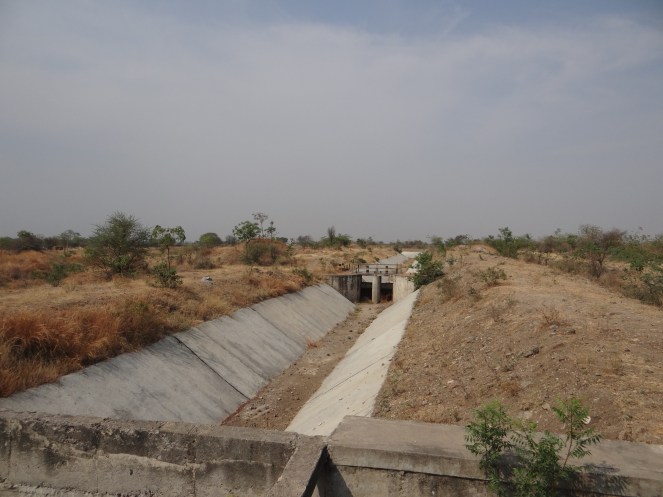
It can be seen that part of Shirapur Lift Irrigation Project was completed back in 2009. The project was considered by SBWL in its Feb 2014 meeting . Photo: SANDRP
DSC02408
Canals of Shirapur LIS completed and close to Great Indian Bustard Sanctuary Photo: SANDRP


Shockingly, ALL of these projects are already under construction when they came before SBWL, in clear violation of WPA (1972) and Supreme Court Orders. Projects are supposed to obtain the Wildlife clearances before even starting survey works and of course before initiating the work. And the fact that no-one raised the issue of these violations seems to indicate that either the members did not know of this ground reality or they chose to ignore it.

In this case, all of the projects are in violation of the WPA and should undergo necessary punitive action. But what we see in the minutes is that all these projects are recommended for clearance!  This indicates the serious issues with the SBWL. When the same projects were considered for Environmental Clearance by the EAC of the MoEF, this committee did not clear these projects and passed strictures against GOM for violations. Note that this was BEFORE these projects were considered by the SBWL.

In April 2014, SANDRP sent an email to some members[1] of the SBWL as well as the Chief Minster, Principal Secretary and PCCF, drawing their attention to the violations, strictures passed on these projects by MoEF’s Expert Appraisal Committee on River Valley Projects[2], requesting the SBWL to take back their recommendation of clearance to these violating projects. But we have received no response till now.

  1. Hugely Contradictory Decisions:
  • While considering the Tambadi Irrigation Project in Roha, Raigad (Buffer Zone of Phansad Sanctuary) in the 7th SBWL Meeting on 24.1.13, the SBWL passed strict comments on the Water Resources Department , Maharashtra (WRD), stating that:

“All members were of the opinion that no proposal of Irrigation Department should be recommended as the department did not comply with the instructions about mitigation measures which should be taken up like construction of over passes and steps in canals within wildlife corridors. It was reiterated by the Board that unless required action is taken, no proposal would be considered by the board.”

Please note this is the part of the APPROVED minutes circulated to the members on the 7th March 2013. Reading this, anyone would get an impression that all further projects from WRD would not be considered. Shockingly, Action Taken Report for the same project attached to the Agenda of the 8th Meeting (20.02.14) states that: “As decided in the 7th meeting a committee comprising 4 members has been constituted to study this and….it came out with possible mitigation measures.”

Firstly, approved minutes do not reflect this decision and secondly, the approved minutes had taken a completely opposite stand than what is decided. This indicates serious problems in not only minuting the meetings but also inconsistency in decision-making.

  • Similarly, the committee considered diversion proposal of Savarde Irrigaton project in its 5th Meeting on the 28.06.11.

Dr Asad Rahmani after conducting a Site visit to the project recommended several strong conditions for the project which included:

  • Cumulative impact assessment of major and medium projects on Radhanagari Wildlife Sanactuary,
  • Permission from Western Ghats Expert appraisal Panel headed by Prof Gadgil and
  • WRD to give in writing that no new project impinging directly or indirectly or Radhanagari Sanctuary will be taken up.

WRD provided no responses on this.

When the proposal was discussed for the third time in NBWL on the 24th April 2011, the CCF told the NBWL that Maharashtra Government agreed with ALL conditions raised by Dr. Rahmani, except the one on sharing water[3]. The WRD had still not provided any response.

This indicates that the Maharashtra Government, especially WRD (Water Resources Department) is not bothered about any statutory clearance related processes surrounding its projects and that the GOM (Government of Maharashtra) has agreed that no new WRD projects will be undertake affecting Radhanagari Sanctuary.

Disturbingly, the same SBWL considered Nardawe Irrigation Project in its 8th meeting, which was affecting Radhanagari Sanctuary and also cleared it, without even mentioning its earlier commitment from WRD.

Add to this the fact that Nardawe Irrigation project was an ongoing project which had violated Forest Conservation Act (1980), Environment Protection Act (1986) and EIA notification 2006.

State Level Appraisal Bodies facing problems in Maharashtra Exactly one year back in July 2013, the Chairperson and majority members of the State Expert Appraisal Committee resigned together stating political and industrial pressures as the reasons.[4][5]

When SANDRP talked with some present and past SBWL members, it was clear that there are several serious issues and hindrances in functioning of SBWL. Agenda is not sent even a week before the meeting giving the members no time to understand the projects, in some meetings agenda was put on the table at the time of the meeting. It is significant to note that the  Agenda notes received by SANDRP under RTI do not carry dates.

Many of the meetings are “clearance” meetings where projects are set out, expected to be cleared, like the 8th Meeting before the Lok Sabha Election, which had a number of proposals from WRD, when it was stated by the SBWL itself that it will not consider any further proposal from WRD. Not surprisingly, 4 project considered and recommended by the SBWL in its last meetings were in violation of the WPA (1972) as noted above.

At the same time, some active members on the condition of anonymity stated that many members do not raise voice against problematic projects and it is left only to a few members, who raise issues all the time. Some members are happy being a part of a board which is headed by the CM and attend meetings where CM is present and will not raise issues. Some members and organizations have to be in the good books of the Forest and Environment Departments as well as the politicians.

We have stated upfront that the SBWL has also taken some commendable decisions, like the formation of new protected areas. However there is no denying the fact that functioning of SBWL is seriously problematic, opaque, non-transparent and contradictory.

It is high time that the Forest Officials, bureaucracy, politicians as well as the non-officials members take steps to improve the functioning of SBWL.  Many of their current decisions will not stand legal scrutiny. The SBWL is a regulatory body and its functioning needs to be governed with some ‘rules of business’, rather than be arbitrary. For starters, the SBWL needs to put their agenda notes and minutes in open domain and invite comments on the same, as is being done by several other decision making bodies.

-Parineeta Dandekar (parineeta.dandekar@gmail.com)

~~~~~~~~~

Dam projects considered in the past 4 Maharashtra SBWL Meetings

No Name District PA Affected Decision & issues Meeting
 1. Kukadi Left Bank Caal through GIB Santuary Ahmedanagar- Solapur Great Indian Bustard Sanctuary Recommended 4th20.02.09
 2. Survey & Invstigation for Savarde Irigation Project Kolhapur Radhanagari Wildlife Sanctuary RecommendedMinutes note no new projects of WRD to be considered 5th28.06.11
 3. 400 MW Humbarli Pumped Storage HEP Satara Koyna Sanctuary Recommended 5th28.6.11
 4. Baglinga Irrigation Project Melghat Sanctuary Recommended 6th7.6.12
 5. Survey and investigation Gargai Dam Project 750 hectares inside Tansa Sanctuary Recommended.No discussion of site visit, further studies, etc. 6th7.6.12
 6. Dams at Chena and Yeoor for drinking water of Thane Thane 80 hectares inside Sanjay Gandhi National Park Not recommended.Thane EE gave letter that after Shai, no new drinking water source will be required till 2031 6th7.6.12
 7. Survey & Investigation for dams at Deokhinpada Vasai. Water supply of Vasai Virar Tungareshwar Sanctuary Recommended.CCF refused recommendation, but SBWL recommend clearance for Survey and investigation 6th7.6.12
 8. Tambadi Irrigation Project Roha, Raigad Phansad Sanctuary Initially stated that no project to be considered from WRD, but later suggested mitigation measures for the project 7th24.1.13
 9. Khindsi Feeder Canal Pench Irrigation Project Nagpur Pench Tiger Reserve Recommended after site visit and mitigation measures 7th24.1.13
 10. Raperi Irrigation Project Washim Recommended 7th24.1.13
 11. Naradwe Irrigation Project Sindhudurg Radhanagari Sanctuary Recommendeddespite clear violation and ongoing work. Despite SBWLs decision of not considering projects in Radhanagari WLS 7th24.1.13
 12. KholsapadaIrrigation tank Wasai, Thane Tungareshwar WLS Recommended 8th20.02.14
 13. Patiya Irrigation Project Amravati Melghat Tiger Reserve Recommended 8th20.02.14
 14. Shirapur LIS Solapur Great Indian Bustard Sanctuary Recommended(Clear violation, nearly 75% scheme is complete) 8th20.02.14
 15. Alewadi Irrigation Project Buldana Ambabarva Sanctuary Recommended(Violation: Work has started, MoEF has passed strictures) 8th20.02.14
 16. Ar Kacheri Irrigation Project Buldana Ambabarva Sanctuary Recommended(Violation: Work has started, MoEF has passed strictures) 8th20.02.14

Current Constitution of the Maharashtra SBWL as per the RTI Response from Wildlife Department

Chief Minister

Chairperson
Minister, Forests Vice Chair
State Minister for Forests Member
Anandrao Gedam, MLA, Gadchiroli Member
Jagdishchandra Valvi, MLA, Member
Representative, BNHS (Dr. Asad Rehmani)
Representative from Sahyadri Nisarg Mitra, Chiplun, Ratnagiri Member
Representative from Satpuda Foundation (Dr. Kishor Rithe) Member
Dilip Yardi, Aurangabad Member
Anuj Khare, Pune Member
Devaji Tofa, Mendha Lekha, Gadchiroli Member
Dr. Erach Bharucha, Pune Member
Prakash Amte, Hemlkasa, Gadchiroli Member
Anish Andheria, Mumbai Member
Hemendra Kothari, Wildlife Conservation Trust Member
Ramratan Bhart Bapu Raut Member
Gopal Bodhe, Mumbai Member
Papa Patil, Sangli Member
Bittu Sahgal, Sanctuary Asia Member
Ms. Belinda Wright, WPSI Member
Principal Secy, Forests and Revenue Member
 PCCF Member
Principal Secy, Tribal Development Department Member
Managing Director, MTDC Member
Representative Police, not below the rank of Superintendent Member
Representative from Armed Forces ( not below the rank of Brigadier) Member
Commissioner, Animal Husbandry, GOM Member
Commissioner, Fisheries Development Member
Representative from WII, Dehradun Member
Representative from Botanical Survey of India Member
Representative from Zoological Survey of India Member
Principal Chief Conservator of Forests (Wildlife) Nagpur Member Secy
Forest_Gargai_Near-Ogade
Forests inside Tansa Sanctuary which will be submerged if Gargai Dam comes up. The dam has survey and investigation clearance from SBWL Photo: SANDRP


Balganga Dam, nearly complete in the buffer zone of Karnala Bird Sanctuary,without any permission from the SBWL or NBWL Photo: SANDRP
Canals of Shirapur Lift Irrigation Scheme, adjacent to Great Indian Bustard WLS. Photo: SANDRP

END NOTES:


[1] We could not send a letter to all the members as even the information about constitution of the Board and its present members is not available in the open domain.

[2] http://www.hindustantimes.com/india-news/mumbai/six-green-panel-members-resign-citing-interference/article1-1094262.aspx


[1] For details see: https://sandrp.wordpress.com/2013/04/26/eac-rejects-2-vidc-projects-from-buldhana-for-violations/

[2] http://envfor.nic.in/sites/default/files/NBWL-22-Mom.pdf

[3] http://epaper.timesofindia.com/Default/Scripting/ArticleWin.asp?From=Archive&Source=Page&Skin=TOINEW&BaseHref=TOIPU/2013/07/19&PageLabel=5&EntityId=Ar00501&ViewMode=HTML

Free flowing rivers · Ganga · Ministry of Environment and Forests · Ministry of Water Resources · Uttarakhand

Will this Ganga manthan help the River?

Uma Bharti at GM

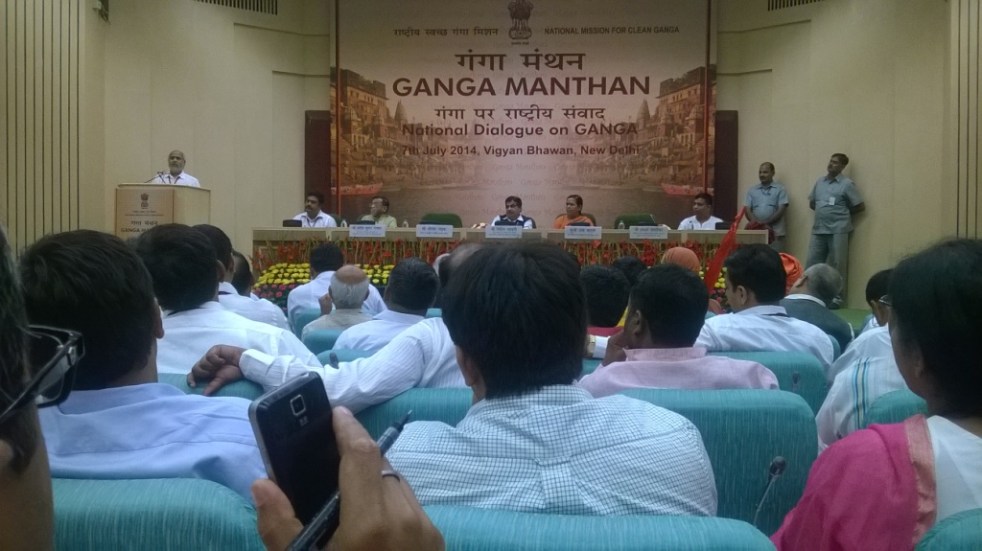
The one day Ganga Manthan[1] organized by the National Mission for Clean Ganga on July 7, 2014 was described by Union Minister[2] Sushri Uma Bharti & Union Minister[3] Shri Nitin Gadkari as “Historical”. The Union Environment Minister, who has one of the most crucial role in achieving a rejuvenated Ganga, was supposed to be there, but could not come at any stage.

I attended the full day meeting with a lingering question: Will this help the river? Even some of the ardent skeptics said that Uma ji has emotional, spiritual and religious attachment with the cause of Ganga.

At the conclave attended by close to a thousand people, the story of how Ms. Bharti came back to the BJP party about a year back to work for the cause of Ganga, and how she was promised a year back that if their party came to power, Ganga will get a separate ministry and she its charge was narrated repeatedly by both Ms Bharti and Mr Gadkari at least twice. It was also stated that the government has the commitment, the will & all the money to make the Ganga clean (Nirmal) and perennial (aviral). There were  also repeated statements by both ministers about the officials being so committed to the cause of Ganga. These, in essence, were the basic positive assets of this government to achieve Ganga Rejuvenation.

While it was good to see large gathering involving various sections of the society, including many independent non government voices, missing were some key stakeholders: Ganga basin state governments, farmers groups, Ministry of Urban Development, fisher-folk groups, boats-people representatives. Another key constituency missing was Ministry of Agriculture, since agriculture is major user of water & irrigation and responsible for water diversion and at the same time major non point source polluter through use of chemicals and fertilizers.

Rejuvenation does not mean just nirmal and aviral But if the task is Rejuvenation of River Ganga, are these assets sufficient? What exactly does Rejuvenation of River Ganga mean? There were no answers to this question at the meeting. The government did not even seem bothered about these questions. Are Nirmal and Aviral Ganga sufficient objectives to achieve Rejuvenation of Ganga? The answer is clearly no, for, even a pipleline or canal carrying perennial flow of water can claim that distinction. A rejuvenated river will need much more than that, but the government has nothing else to offer for a rejuvenated river.

Even for Aviral Ganga, the government had absolutely nothing to offer. In the information package shared with the participants, the only thing relevant to Aviral Ganga was the extended summary of draft “Ganga River Basin Management Plan” being prepared by consortium of seven IITs in collaboration with some 11 other organisations. This is led by Dr Vinod Tare of IIT Kanpur. While standing with Dr Tare and Rajendra Singh of Tarun Bharat Sangh at the lunch, I said, the problem with Ganga is not of technology[4], but of governance. Despite being a proud IITian myself, I have no hesitation in saying that IITs do not have expertise in governance issues, so how can the IIT Consortium help in fix a governance problem? Having read the full Draft Plan of the IIT consortium, it only further strengthens the view that it was wrong decision of Jairam Ramesh to give this task to IIT Consortium.

Agenda for further destruction As a matter of fact, while this government has yet to take a step that will truly help rejuvenation of Ganga, they have declared their agenda that will possibly further destroy the river. This was clear on June 6, 2014, within ten days of new government taking over when a PIB press release[5] announced, “Shri Gadkari said it is proposed to conduct dredging to provide a width of 45 meters and for a three (3) meters draft (depth) to enable transport of passengers and goods between Varanasi and Hoogly on river Ganga in the first stage of its development and eleven terminals are proposed to be constructed along the banks. He said barrages are proposed to be constructed at every 100 Kms.” This was a shocking and arrogant announcement. There is nothing in public domain about this Rs 6000 crores plan, no details as to what exactly is planned, where the barrages are planned, why are they needed, what are their environmental impacts, what are the social impacts, what are the riverine impacts, what is the cost and benefits, who will pay the costs and who will reap the benefits, where is public consultation….there is absolutely nothing in public domain and here is a nine day old government declaring such massive plan! By July 7, 2014, the PIB Press Release declared that the depth will now by 5 meters and not three announced earlier. The PIB PR now said, “He (Mr Gadkari) said barrages are proposed to be constructed at every 100 Kms on the river. Shri Gadkari said his Ministry has sent a proposal in this regard to World Bank for the development of Allahabad- Haldia corridor.”

The minister possibly does not know that there is just one barrage on the Allahabad-Haldia 1500 km long stretch, namely the Farakka barrage and Bangladesh had threatened India to take the matter about building this barrage to the UN! Moreover, that barrage, everyone accepts, has not even achieved the basic objective it was supposed to achieve, namely navigability of Kolkata port, but has had many other severe impacts.

Nitin Gadkari at GM

At Ganga Manthan, Mr Gadkari dropped a bombshell[6] when he said this plan is already in advanced stage of appraisal with the World Bank! He said the government hopes to get Rs 4000 crores from the World Bank!! The World Bank has zero track record in achieving any clean river anywhere in the world, after spending billions of dollars every year. In India itself it stands guilty of destroying many rivers. A more inauspicious start to the Ganga Manthan possibly could not have been possible. At the Ganga Manthan itself, there was opposition to this plan, as The Hindu[7] has reported.But Ms Uma Bharti finds nothing amiss about this as was clear by her answers at the press conference. But what about at least some semblance of participatory democracy?

Business as usual at NMCG and NGBRA will not help In reality, this is not all. While this Manthan for Ganga Rejuvenation is happening, the NMCG and NGBRA[8] (National Ganga River Basin Authority) go on with their work in business as usual fashion. So in Varanasi, the Uttar Pradesh Jal Nigam is going about its task of floating and examining the bids for five-part sewer laying and Sewage Treatment Plants with the help of JICA money. In Kanpur, the effort to divert several streams to Pandu is going on. In Allahabad, “the draft final ESAMP sewerage works for sewerage districts” A & C could be found on the NGBRA website. In Patna, the World Bank is funding the sewerage projects of Pahari in Patna & river front development and the draft social and environmental impact assessments could be found on NGBRA website. All of this (except the Varanasi packages, which are funded by Japanese aid agency) is going on under USD 1 Billion World Bank Funded NBGRA project.

So the business as usual that is going on for 40 years is now going to help rejuvenate Ganga!

The NMCG announced that the Manthan, a “National Dialogue on Ganga”, was supposed “to facilitate interaction with various stakeholders”, “to discuss the issues & solutions to the task of Ganga Rejuvenation”, “to prepare road map for preparation of a comprehensive plan”. The website said the Ganga is “holiest of Rivers”, “purifier of mortal beings” & “living godess”, but now “seriously polluted” and in “extreme environmental stress”.

Where is the dialogue? However, the way the meeting was organized, there was essentially no dialogue. After the inaugural plenary session, the participants were divided among four groups: 1. spiritual leaders, 2. environmentalists, NGOs, water conservationists, 3. scientists, academicians and technocrats, and administrators; 4. public representatives.

I went to the second group and there, when someone pointedly asked, if there is any representative of the government present, there was no response! In fact it was positively shocking that the first panel member that spoke in this group was Dr Arun Kumar of AHEC (Alternate Hydro Energy Centre) whose work on Ganga basin cumulative impact assessment is so discredited that even the official agencies like the Expert Appraisal Committee of MoEF, the Inter-ministerial Group on Ganga, the Expert Body appointed by the Supreme Court after the June 2013 flood disaster and the Supreme Court itself has criticized it or found it unreliable. NMCG has discredited itself by appointing such a person to give an overview of achievement of Ganga Action Plans.

GM stage

Ms Bharti apologized in the beginning for hurriedly-called meeting. But the least she could have ensured was a credible process that will ensure that the officials have to show application of mind to the various suggestions received and conduct of the meeting in credible and confidence inspiring way. But the meeting did not inspire confidence that there will be any credible process that will ensure that there is application of mind to the various inputs given. Many of the participants did not have any opportunity to speak.

Recommendations for the government on Ganga

1. Make an honest effort to learn from the past. Why have the efforts of last 40 years since the passage of Water Pollution Act 1974 not helped Ganga? Similarly why did the GAP I, NRCP, GAP II, NGBRA not helped make the Ganga clean (nirmal) or perennial (aviral)?

2. Understand & recognise that Ganga is a river and what are the essential characteristics of a Ganga that it needs to rejuvenate it as a river. At Ganga Manthan, in post lunch session in the room where the fourth group for public representatives was sitting, I was sitting next to an official of Ministry of Water Resources and I casually asked him does the ministry of water resources understand what is a river? He first said yes, but when I said you are only dealing with water and nowhere in your work have we seen any value for rivers, he said ok, but we can do it in collaboration with MoEF. The trouble is, even MoEF does not understand rivers. [It was also strange to see in this session Mr Madhav Chitale (former Water Resources Secretary) describing Tennessee Valley Authority of 1933 as an effort to clean the river! Such misrepresentation going unchallenged was shocking.] It should be remembered that it is this ministry of water resources through which Sushri Uma Bharti has to achieve a rejuvenated Ganga!

3. Ganga is not 2525 km long river: We kept hearing this sentence that Ganga is 2525 km length of river and Mr Bhurelal in fact said we need to limit ourselves to discussing how to make this stretch clean. The trouble is, if the tributaries are not healthy rivers, how can the main stem of Ganga be rejuvenated? As Manoj Misra of Yamuna Jiye Abhiyaan said, Ganga is not 2525 km, but much more than 25000 km including all the tributaries, as Yamuna is not 1400 km long but 13470 km long including all the tributaries.

4. Ganga in Mountains: Learn the lessons from Uttarakhand disaster, that affected the headwaters of the Ganga river. The Expert body constituted by the MoEF under Dr Ravi Chopra has a lot to say there. Revisit all the existing, under construction and planned projects in the whole basin.

5. Farakka barrage: It is well known that the barrage did not serve the basic purpose it was created for, namely making the Kolkata port navigable. But it has created such havoc in upstream and downstream for millions of people that some of the Bihar MPs of previous Lok Sabhas talked about decommissioning of the barrage in the debate on Ganga. But this government wants to make many more barrages! First do a post facto assessment of the Farakka barrage and its current costs, benefits and risks.

6. Formulate an Urban Water Policy: The footprint of the urban areas on the rivers is increasing in multiple ways, but we have no urban water policy. Some key elements that such a policy will include: Reducing transmission & Distribution losses, water audit from RWA upwards, Rainwater harvesting, decentralised and eco-friendly ways of sewage treatment and recycle, groundwater recharge and bottom up management, demand side management, protection of local water bodies, protection of riverbeds, floodplains and forest areas & democratisation of the Urban water utilities.  As the working report for the 12th Five Year Plan on Urban water said, no Urban areas should be allowed to have external water till they exhaust their local potential, including recycling of the treated  sewage and other demand side and supply side options. The footprint of the urban areas will increase exponentially if we do not urgently on this front.

7. Agriculture is the biggest user of water and our government encourages use of chemicals and pesticides in agriculture. Most of these chemicals end up in water bodies including rivers. If we do not want our rivers to be dumping grounds for these chemicals, the government should encourage organic farming. Similarly, in stead of encouraging water intensive cropping patterns and methods, government needs to encourage low water use crops and methods like System of Rice Intensification (SRI). SRI is applicable for many crops and can reduce water need by upto 50% and yet increase yields and incomes of farmers. But the government has shown no interest in encouraging SRI. Such methods can free up a lot of water for the river. Similarly, under the influence of powerful sugar lobby, we are producing more sugarcane and sugar than we need and than we are exporting the same at subsidized rates! So essentially we are exporting water at huge subsidized rates, that too from Ganga, but we have no water for the river!

8. Irrigation is the biggest user of water. At Bhimgoda, Bijnor and Narora barrages, we are diverting almost all the water in the river for irrigation. But we have no water for the river. If we change our water resources development and agriculture policies, it is possible to restrict these diversions to 50% and release the rest for the river. We need to review all this.

9. The IIT consortium report is seriously flawed and is not likely to help the river.

10. We need to define the path of the riverbed or right of way for the river, based on its need to carry 100 year flood and silt. In absence of such a defined space for the river, there are a lot of encroachments. There is also no river regulation law to regulate this riverways land. This is urgently required.

11. Our Pollution Control Boards and related mechanism is not known to have achieved a single clean river or nala in 40 years of their existence, anywhere in the country. This is because of the completely non transparent, unaccountable, non participatory and exclusive bodies, where people whose lives are affected by the pollution have no role. A complete revamp of this is required to make its management inclusive from block level upwards, and answerable to the local people through clearly defined management system.

12. One of the major reason for the failure of the GAP, NRCP and NGBRA is that their functioning is top down, with absolutely no clearly defined norms for transparency, accountability, participation and inclusive management. Unless we completely change this, no amount of money, no amount of technology, no amount of infrastructure or institutions is going to help the Ganga. We need management system for every STP, every freshwater plant, every city and town, every 3-5 km of the river, every tributary and so on. At least 50% members of the management committees for each of them should be from outside the government, including community members. The people whose lives and livelihoods depend on river including fisherfolk, boatspeople, river bed cultivators, local sand miners, communities depending on river for different water needs have to be represented in such management system. That will also create an ownership in river rejuvenation effort. This is also applicable to urban areas and all the tributaries.

13. This is also true for our environmental governance of dams, hydropower projects, flood control projects, water supply projects, and so on. Today there is no credible environmental management at planning, appraisal, construction, operation or decommissioning stage.

14. River of course needs water. Urgently. Chart out a road map to achieve 50% of freshwater releases from all dams and barrages in two years. Also no sewage water or effluents entering the river in two years.

In the concluding plenary, after listening to the reports from four groups (there were a lot of positive and useful suggestions there), Ms Uma Bharti and Mr Gadkari said that they won’t make any announcement today but they will ensure that the good suggestions that have come will be given to the decision-makers who will create a road map. This is very vague and unconvincing process with no credible transparency. The least the ministers could have assured is a confidence-inspiring process that would transparently ensure that the decision makers have applied their minds to the suggestions. But even that was not promised.

Despite this seemingly gloomy outcome, considering that the NMCG has invited[9] suggestions even after the meeting, I am going to send this blog link to them and wait for their response! Ganga definitely needs a lot of sewa from all of us if the river is to have any better future.

Himanshu Thakkar (ht.sandrp@gmail.com)

END NOTES:

[1] For details, see: http://www.gangamanthan.in/

[2] Union Minister of Water Resources, River Development and Ganga Rejuvenation

[3] Union Minister of Road Transport & Highways, Shipping, Rural Development, Panchayati Raj, Drinking Water & Sanitation

[4] It’s worth noting here that Mr Gadkari seems to have abiding faith in technology, he said that this is an age of technology and there are technological solutions for all problems! This possibly shows where we are heading!

[5] Title: “Development of River Ganga for Tourism, Transport and to make it Environment Friendly”

[6] PIB PR on July 7, 2014; http://www.business-standard.com/article/current-affairs/ganga-clean-up-may-cost-rs-80-000-crore-114070700889_1.html

[7] http://www.thehindu.com/news/national/plan-for-navigation-in-ganga-basin-questioned/article6187510.ece

[8] http://moef.nic.in/sites/default/files/ngrba/index.html

[9] NMCG would welcome any further suggestions, ideas, write-up etc from all interested person through email: info@gangamanthan.in

[10] Also the views of NGBRA expert member B D Tripathi that also questions Dr Vinod Tare and IIT consortium report on Ganga: http://www.thenewsminute.com/technologies/72

http://www.thenewsminute.com/technologies/71: Ganga clean up more about governance than technology: Himanshu Thakkar

http://www.thenewsminute.com/technologies/70: Experts flay Uma Bharti’s Ganga Manthan clean up plan

CAG Report · Forest Advisory Committee · Maharashtra · Ministry of Environment and Forests

Press Release:21.06.14: RAMPANT ENVIRONMENTAL VIOLATIONS OF MAHARASHTRA WATER RESOURCE DEPARTMENT

Press Release:                                          ___________                                                                21.06.14

RAMPANT ENVIRONMENTAL VIOLATIONS OF MAHARASHTRA WATER RESOURCE DEPARTMENT: STATE FOREST AND ENVIRONMENT DEPT AND CENTRAL MOEF NEED TO TAKE URGENT ACTION

A shocking expose by the CAG Report on Management of Irrigation Projects in Maharashtra, 2014, highlights the repeated and rampant Environmental Violations in Maharashtra which have led to huge impacts, environmental issues, stoppage of work, wastage of funds and violations of multiple laws.

CAG states that as many as 249 projects in Vidarbha Irrigation Development Corporation (VIDC) alone started work without receiving the legally required Environmental Clearance (EC) from the Central Ministry of Environment and Forests or the State Environment Department. There are large number of projects also from Konkan IDC, Tapi IDC, Godavari Marathawada IDC and Maharashtra Krishna Valley Dev Corporation. In test cases, an expenditure of Rs 376.96 crore was incurred up to March 2013 without obtaining EC by VIDC alone. In addition, work was started in 89 projects and Rs. 7,129.76 crore were spent without Forest Clearance, in violations of Forest Conservation Act by all IDCs. Issues due to this led to an additional expense of nearly Rs. 2000 Crores. Some of the important CAG findings:

  • There was no mechanism in the WRD to monitor compliance of environmental clearance conditions. However, the responsibility of monitoring compliance also falls with the State and Central Environment Departments and Ministries and the Pollution Control Board. They too have violated the laws by not taking any action against the WRD and are to blame for the terrible state of affairs. Following indicates that some of these agencies refused to take action even when SANDRP and other organisations pointed out the violations in the past.
  • Some examples of projects without Environmental clearance are: Surya, Virdi, Nardawe, Kondane: Konkan IDC, Janai Shirsai LIS and Chaskaman extension by MKVDC (Maharashtra Krishna Valley Development Corporation), Katepurna barrage, Lower Dnyanganga, Januna, Pangrabandhi, Warajahangir, Sukli and  Lower Wardha Major Project by VIDC, Kurha Vadoa project by Tapi IDC and Vishnupuri Project Phase II by Godavari Marathawada IDC which includes 13 barrages on the Godavari.

After the CAG report, the Environment Department, GOM has issued notices to 38 projects without EC. Director, Environment Department told SANDRP that Forest Department may issue a separate notice to projects violating the FC Act.

Violations of Forest Conservation Act (1980). Some of the important CAG findings:

  • 188 projects valuing Rs 46,652.44 crore under the jurisdiction of five IDCs remained incomplete (June 2013) because of pending forest clearances by GoI and GoM. 18 projects were not granted forest clearance due to violation of Forest Act.
  • 139 projects from above mentioned 188 projects needed 19,489 hectares of forest land.
  • An expenditure of Rs 7,129.76 crore was incurred on 89 projects out of these pending clearances under the Forest Act in violation of Forest Conservation Act (1980). For 61 projects and 7636 ha land, no NPV (Net Present Value, required to be deposited for use of forest land) was deposited.
  • In 19 out of 89 projects, commencement of work without forest clearances necessitated changes, stoppage of work etc. resulting in blocking of funds to the extent of Rs 1,944.92 crore.

While the CAG report has done a comprehensive assessment of the violations of Environmental Act, Chitale Committee Report, also brought out around the same time misses many of these projects and violations. However, the Chitale Report also recommends strict action to be taken against Executive Engineers for starting working without clearances.

SANDRP had tried to bring several such violations from bigger projects to the notice of both Govt of Maharashtra and Ministry of Environment and Forests, Government of India consistently. However, most shockingly, no action was taken about these violating projects by these bodies. Letter about irregularities in Nardawe Medium Irrigation Project to Mr. A. Rajeev, Principal Secretary Environment Department, GOM in July 2013, as also to the MoEF, has been unanswered till date.

  • Additional HUGE projects which have commenced without EC include the Krishna Marathwada Lift Irrigation Scheme in Solapur, Lower Tapi Project in Dhule, and as many as 9 lift irrigation schemes based on Ujani.
  • SANDRP had sent relevant information on the above projects in form of submissions to MoEF time to time, but NO ACTION WAS TAKEN BY THE MINISTRY.
  • The State Wildlife Board, Maharashtra, under the Chairpersonship of the Chief Minister has cleared violating projects in its last meeting which were under construction and had already violated the Supreme Court Orders as well as the Environment Protection Act 1986. These projects include Nardawe Medium Irrigation Project and Alewadi and Ar Kacheri Nallah Projects in Buldana. Here too, SANDRP had pointed out the violations to the SWB, but it chose to take no action.
  • Additional Environmental and Forest violations are documented by SANDRP in projects including: Balganga, Kalu, Shai, Talamba and Sarambale Dams of KIDC, Upper Godavari Interbasin Transfer and Manjarpada Phase I project and Components of Gosi Khurd in GMIDC.
  • Lift Irrigation Schemes like Shirapur LIS, Sangola LIS, Barshi LIS, Bhima Seena Link Canal, Dahigain LIS and Seena Madha LIS based on Ujani. All information about these has been given by SANDRP in January 2013 to the Expert Appraisal Committee of the MoEF which grants Environmental Clearance to these projects. But no action has been taken by MoEF.

This points to the inescapable conclusion that the state forest and environment department and ministry as well as the MoEF, Delhi, are equally responsible for consciously turning a blind eye towards violations by WRD, Maharahstra.

Any action taken  by these agencies following the CAG report is only to save face and is too little too late, as environment and forests are already impacted and huge amounts of public funds are already spent or locked in these projects without even basic impact assessments or appraisals. This shows that the government, politicians and bureaucrats have no respect for environment and forest clearances, appraisals, impact assessments & affected community’s opinion through public consultations. Strict action should be taken against all those ministers, officials, engineers & contractors, who are responsible for sanctioning and starting such work. Action also needs to be taken against agencies which have looked the other way and have failed to take necessary action, along with WRD Maharashtra for violating laws of the land and affecting forests, environment, people, society and economy of the state.

While the responsibility of ruling coalition of Congress and NCP is greater, the opposition alliance of BJP and Shiv Sena is also equally to blame for not raising these important issues which are crucial for the people of Maharashtra.

-Parineeta Dandekar (9860030742) parineeta.dandekar@gmail.com, Himanshu Thakkar (09968242798) ht.sandrp@gmail.com

South Asia Network on Dams, Rivers and People (SANDRP), https://sandrp.wordpress.com/, https://sandrp.in/

Arunachal Pradesh · brahmaputra · Cumulative Impact Assessment · Ministry of Environment and Forests · Siang

Cumulative Impact Assessment Study of Siang Basin in Arunachal Pradesh: Serious shortcomings; pro large hydro bias

Most of the major rivers in the North East India are largely free-flowing till date, which is a rarity in India and the world. Their basins are home to unbelievable ecological and cultural diversity. Main rivers in Arunachal Pradesh which form the mighty Brahmaputra are the Siang (the Yarlung Tsang Po), Dibang and Lohit, which meet at the trijunction to form Brahmaputra.

Massive hydropower projects are planned on these rivers in cascade. They will have irreversible destructive impacts on the society, forests, rivers, biodiversity, ecosystems, cultural identity and downstream Assam.

Hydropower Flood in Arunachal Pradesh Map: Neeraj Vagholikar, Sanctuary Asia
Hydropower Flood in Arunachal Pradesh
Map: Neeraj Vagholikar, Sanctuary Asia

Siang River alone has 44 dams planned along its entire length.

Yes, 44 dams. You have read it correctly. At least 44 dams in one sub basin of Brahmaputra River Basin. This is what was meant by MOU virus as Jairam Ramesh described it.

Siang River Basin The Siang river originates in the Chemayungdung mountain ranges which nearly sixty miles south-east of Mansarovar lake in the Mount Kailash range in Southern Tibet at an elevation of 5300 m. A spring called Tamchok Khambab spills from the glaciers which later gather breath and volume to become the Tsangpo, the highest river in world.  Tsangpo river flows 1625 km in Tibet parallel to the main range of Himalayas before entering India through Arunachal Pradesh.

Before entering India, the river passes Pi (Pe) in Tibet and suddenly turns to the north and northeast and cuts a course through a succession of great narrow gorges between the mountain Gyala Peri and Namjabarwa (Namcha Barwa) in a series of rapids and cascades. The river then turns south and southwest and flows through a deep gorge across the eastern extremity of the Himalayas with canyon walls that extends upward for 16,500 feet (5,000 meters) and more on each side.

The river enters Arunachal Pradesh near Gelling from where it is known as Siang. The total length of Siang River is 294 km till its point of confluence with Dibang and Lohit River. After entering India the river traverses approximately 197.0 km to join the Siyom river. From there the length of the river till Assam border is 86.3 km. Flowing further 10.6 km in Assam the river joins the confluence of Lohit and Dibang. From this point forward it flows as Brahmaputra river in Assam and traverses a distance of about 195 km up to the confluence of Subansiri river on its right bank. Further downstream it is joined by Kameng at Jamugurihat near Tezpur, after another 123 km.  From  here  it  travels  for  another  134  km  up  to Guwahati.

River Siang Photo from: Global Descents

The elevation of Siang river catchment area ranges from 90 m to around 5800 m. The total catchment area of Siang river from its origin to its confluence with Lohit and Dibang rivers is 251,521 sq km. Out of this 236555.7 sq km area lies in Tibet. The total catchment area of Siang river in India upto its confluence with Lohit and Dibang rivers is 14965.30 sq km.    

A question arises here, what will be the condition of the 294 km long Siang river if the proposed 44 dams are being built on the river. The Siang river basin study has the answer for this which is actually alarming “Only 85.5 km (29%) of free flowing water regime of Siang river will be left out of its total course in India i.e.  294 km of lotic ecosystem will be converted into 208.5 km of lentic ecosystem altering the entire Siang river aquatic system which will adversely impact the aquatic biodiversity and seriously affecting fish populations and their migration behaviour.”(page 11.23)

Three dams on the main Siang will convert the free flowing river into a three-stepped reservoir, without ANY flowing length of the river! These dams alone will affect more than 18,000 hectares of forests! If all the dams are built, water level fluctuations in the downstream D’Ering Sanctuary will be more than 23 feet every single day in the winter and other non monsoon seasons!

82.26% of the Siang basin is under forest cover (more than 15,000 sq kms), it is rich in orchids (more than 100 species!), holds 16 species of rhododendrons, 14 species of Bamboos and 14 species of canes and overall 27 RET species and 46 endemic plant species. 25 (18%) mammalian species found are Schedule I of WPA (Wildlife Protection Act), while 26 are under Schedule II! There are 447 species of birds, of which 31 are Schedule I species. The single basin consists of 5 Important Bird Areas !!(IBAs)

Formation of River Siyom, which will have multiple dams in a cascade Photo from: Team BHP

This information has been collated by the CIA (Cumulative Impact Assessment)/ CCS (Carrying Capacity Study) of the Siang Basin, which was an attempt to look at the scale and cumulative impacts of projects in Siang holistically.

Has the CIA commissioned by Central water Commission and done by RS Envirolink Technologies done an objective, scientific, independent assessment?

SANDRP sent comments about this 2-volume study  with over 1500 pages to the Expert Appraisal Committee, Ministry of Environment and Forests which will be considering this basin study in its upcoming meeting on Feb 20-21, 2014. Submission below highlights that the study has very serious short comings and bias. The recommendation of dropping 15 (mostly small ones, all below 90 MW installed capacity) HEPs and re-configuring some others is welcome, but far from sufficient. The study itself is disappointing:

Projects planned in the Siang Basin Phot from CIA/ CCS of Siang Basin


Time Line of Siang Basin Study

Feb 2010 Ministry of Water Resources constituted an Inter-Ministerial Group on the directions of Prime Minister’s Office with a view to evolve a suitable framework to guide and accelerate the development of hydropower in the North East and also to assess the impact of the massive hydropower development in Arunachal Pradesh on downstream areas in Assam
Nov 2010 EAC discussed TOR for the Siang Basin CIA
Dec 23, 2010 MoEF issues TORs for the Siang Basin CIA
April 2011 EAC discusses sampling locations for the CIA on request of CWC
Dec 2011 Work of CIA for Siang awarded to RSET Pvt Ltd
May 2012 RSET says draft interim report discussed by TAC, but there is no meeting of TAC in May 2012, minutes of March and July TAC meetings (the ones before and after May 2012) on CWC website also do not mention any such discussion.
Nov 2012 EAC discusses Draft Interim report
Aug 2013 Draft Final report submitted to CWC
Sept 2013 RSET says Draft final report discussed by TAC, but the minutes of the Sept 2013 meeting of the TAC obtained under RTI donot contain any reference to the Siang basin study
DEC 2013 Draft Final Report submitted to MoEF
Feb 17, 2014 Critique of the Draft Final report submitted by SANDRP to EAC
Feb 20, 2014 MoEF’s EAC to  discuss the Draft Final report

To,

Chairperson and Members,

Expert appraisal Committee

Ministry of Environment and Forests

Delhi

Subject: Serious inadequacies of Cumulative Impact Assessment (CIA) and Carrying Capacity Study (CCS) of Siang Sub-basin including Downstream Impacts

Respected Chairperson and Members,

We see from the agenda uploaded on the MoEF Website that Final Report of the Siang CIA/CCS Study commissioned by CWC and conducted by RS Envirolink Technologies Pvt Ltd will be discussed in the 72nd EAC Meeting to be held on 20-21 February 2014.

SANDRP has been analysing basin studies in the Western Himalayas and Brahmaputra Basin for some time now. Looking at the aggressive cascade hydropower development and its far reaching cumulative impacts, CIA/ CCS and Basin Studies should form the backbone of informed decision making by MoEF. Unfortunately, most studies being considered by the EAC are of a sub-standard quality and are shying away from addressing the cumulative impacts [1]. EAC itself is delinking appraisal of individual projects from basin studies, rendering the crucial process meaningless which is in violation of EIA notification of Sept 2006, wherein Form 1 Section 9 actually asks for cumulative impact assessment. Some of the recent orders of National Green Tribunal also make it CIA mandatory, thus making such delinking legally untenable.

Looking at the scale of ecological and social impacts of these projects and the significance of MoEF’s and EAC’s role, we urge the EAC to consider CIA/ CCS/ Basin Studies more seriously.

Main issues with Siang Basin Study include: (These are elaborated with reasons below)

1. No mention of social and cultural impacts!

2. Downstream impacts on Assam not studied in detail

3. Cumulative Disaster vulnerability, impact of projects on such vulnerabilities, Dam Safety Assessment, risk assessment not done

4. “Cumulative” Impacts not assessed on several aspects

5. Non-compliance with critical recommendations by the EAC:

a. Study is not compatible with similar studies done worldwide

b. No suggestions about ramping to reduce downstream impacts

c. No recommendation on free flowing length between two projects

d. No mention of cumulative impact on sediment regime

e. No mention of impact of road construction

f. BBM for eflows not used, despite agreeing to use it before EAC

g. Impact of Sand mining, boulder mining not conducted

h. Impact of specific projects not clearly studied

6. Eflows, one of the most significant issues, handled erroneously: NO ACTUAL ASSESSMENT OF E-FLOWS REQUIREMENTS AS REQUIRED BY TORs

7. No mention of Climate Change, reservoir emissions vis-à-vis cumulative impacts of such massive scale, how the projects would affect the adaptation capacity of the communities and region in the context of climate change

8. No stand taken on three mega projects on Siang Main Stem and other big hydro projects

9. No conclusion about how much length of the river is to be compromised

10. Number of sampling locations: TOR not followed

11. Source of information not given

12. Inconsistency, contradictions in listing of flora-fauna

13. Unsubstantiated advocacy: going beyond the TOR & mandate

14. Other inadequacies of CIA

15. Study should not be finalised without credible Public consultation across the basin.

Division of the Siang Basin into sub basins Phot from : CIA/ CCS Report of the Siang Basin

DETAILED CRITIQUE

1. No mention of social and cultural impacts! In the entire basin study, there is no mention of social and cultural impacts by these 44 projects which will together submerge more than 21,000 hectares of forests and affect the entire Siang Basin adversely. Needless to say, local communities depend heavily on the basin resources like fish, medicinal and food plants, timber varieties for their livelihoods. For example, more than 2000 hectares of multi-cropped, irrigated rice fields will be submerged by Lower Siang Project alone.

Adi Community that will be affected by the dams on Siang Photo with thanks from : Kaushik Shil

The CIA/CCS study needs to be re-conducted, in which social and cultural cumulative impacts are assessed with participation of local communities and downstream communities from Arunachal Pradesh and Assam. It may be remembered that Public Hearing of Lower Siang (in the latest instance, slated to be held on 31st January 2014) had to be cancelled due to a number of procedural issues, and also opposition from local residents [2]. It is incomprehensible how the CIA Study has no assessment of impacts on communities!

2. Downstream impacts on Assam not studied in detail The study assesses impacts specifically on Dibrugarh, Bokaghat (Kaziranga) and Guwahati. However, there are several villages, settlements, tea estates, agriculture, forests etc., on the Right Bank of Siang in Assam after Pasighat. This includes a major part of Dhemaji District of Assam. Impact on this region needs to be assessed. There has been opposition to Siang Dams from places like Jonai from Dhemaji, which have been ignored.[3] 

Meeting protesting against Public Hearing of 2700 MW Lower Siang HEP Photo: Echo of Arunachal

According to the model used, the chainage for assessing impacts at D’Ering Sanctuary is between 20-33 kms from Lower Siang Dam. The next chainage is at 102 kms at Dibrugarh. Impacts on the stretch between D’Ering and Dibrugarh, for nearly 70 kilometres are simply not assessed! What can be reason behind this?

Level fluctuations at D’Ering Sanctuary, with Lower Siang, Middle Siyom and Upper Siang Projects is to the tune of 7.2 meters (23.66 feet!!) in lean season. This highlights the need to study impacts on the intermediate zone in Assam between Dering Sanctuary and Dibrugarh. The Study should not be accepted without these assessments.

3. Cumulative Disaster vulnerability, impact of projects on such vulnerabilities, Dam Safety Assessment, risk assessment not done

Upper Siang Stage I, Stage II and Lower Siang are huge projects with direct impact on downstream state. Even as issues of dam safety and risk assessment have gained high significance in Assam as can be seen in Lower Subansiri protests, the basin study/CIA does not include a word on dam safety, cumulative risk assessment, risk of landslips and landslides, seismic zones of projects, past earthquakes in the region, possible mitigation measures, disaster management, etc. There is no assessment of baseline situation about disaster vulnerability of the region and how the projects will change that. By its nature, a CIA/CCS/ basin study is best placed to assess these impacts.

Lanslides are a common feature of this region. Pic shows Yinkiong in Siang II Sub basin where several projects are planned. Photo: Team BHP

These points have been raised by KMSS, Assam and others. The Uttarakhand disaster of June 2013 underlines this and even the Supreme Court of India has asked for an assessment of how hydropower projects contributed to disaster in Uttarakhand. Looking at Uttarakhand Disaster as well as protests from downstream Assam where dam safety is a major issue, dam safety needs to be addressed in the CIA/ CCS. In the absence of all this, projects will not be allowed by communities, as can be seen with Lower Subansiri and Lower Siang.

4. Cumulative impacts not assessed on several aspects The study has a sketchy section (Chapter 11) on Cumulative impact assessment.

The minutes of 62nd EAC meeting noted, “The main objective of the study is to bring out the impact of dams being planned on the main Siang River and its seven tributaries on terrestrial and aquatic ecology, plant and animal biodiversity, including wild life, hydrology of the basin, etc.” (Emphasis is as in original.) However, the study has not placed emphasis on assessing these impacts.

Yar Gyap Chu: a River and basin which holds high religious significance for the Buddhists Photo: Kaushik Shil

Moreover, the study does not attempt to assess cumulative impacts of all the projects due to:

  • Blasting and Tunnelling: This is not mentioned even once in the entire study! When the disastrous impacts of blasting, tunnelling and related activities are fresh in our minds w.r.t Uttrakhand and Himachal Disasters, it is incomprehensible to see that this section is not mentioned at all in the basin study!
  • Community resources: No mention on loss of agricultural lands, homesteads, displacement, loss of forest rights, etc.
  • Infrastructure development: No mention of the impact of workers colonies, buildings on the society, landscape and cultural aspects, etc.
  • Greenhouse gas Emissions: Considering submergence of more than 20,000 hectares of dense to very dense forests and building of a large number of reservoirs in tropical climate, cumulative impacts on green house gas emissions should have been assessed.
  • Biodiversity, RET Species, Deforestation: While the report deals with these issues very sketchily, there is no statement as to what will be the cumulative impact of 44 projects on the above issues.

5. Non-compliance with critical recommendations by the EAC Interim basin study was discussed in the 62nd EAC meeting in November 2012. The EAC had given some important recommendations at that stage to be included in the study. However, most of the recommendations have not been complied with, these include:

  • Study is not compatible with similar studies done worldwide: EAC had specifically recommended compatibility with global studies. However, Siang CIA is not compatible with any global Basin and Cumulative impact Assessment Study. A Cumulative Impact Assessment is a multi-stake – holder process that assesses the cumulative and indirect impacts as well as impact interactions of the proposed dam or set of dams, as well as existing and planned projects from other sectors, on ecosystems, communities, and identified Valuable Ecosystem Components (VECs) within a specific spatial and temporal boundary. [4]
  • No suggestions about ramping to reduce downstream impact: EAC had specifically asked for ramping study with reference to downstream impacts. However, ramping studies are not done at all, although downstream impacts of the projects in isolation as well as together are huge. 
  • No recommendation on free flowing length between two projects Although Upper Siang I, Upper Siang II and Lower Siang have no free flowing stretch between each other, the study refrains doing any assessments or from making any recommendations in this regard, contrary to EAC’s recommendation. 
  • No mention of cumulative impact on sediment regime 44 projects with several mega reservoirs will have a profound impact on the sediment regime of the rivers as well as downstream impacts thereof. EAC had specifically asked to include sediment balance and impact, which is not discussed in the report. 

The minutes of 62nd meeting of EAC says: “The Consultants were also asked to study and recommend on silt management considering “no dam” and “with dam” scenario as silt substantially impact the ecology and cause sedimentation particularly when its velocity is affected d/s due to construction of dam.” No such study has been conducted. In fact globally, sediment balance on cascade projects is a crucial element of study, which is completely left out in the present study. 

  • No mention of impact of road construction Roads and related activities like deforestation, slope destabilisation, blasting, mining, muck dumping, all the cumulative impacts of peaking operation (needs to be done comprehensively, including the limitations that such operation of upstream projects will impose on downstream projects), etc have a critical impact on fragile geology. Role of roads for hydel projects was significant in Uttarakhand Tragedy in June 2013. EAC had specifically asked for “Impacts due to construction of approach roads”. This point is not touched upon in the report. 
  • BBM for eflows not useddespite agreeing to use it in front of EAC Although the consultant agreed in the 62nd meeting that BBM will be used to assess eflows regime,[5] at the insistence of the EAC, in reality BBM has not been used in the study. The reasons given [6] that BBM is a “prescriptive approach”, “it takes too much time” and “only stakeholder in the basin is river and fish” is wrong, shocking and unacceptable.

The study forgets about the people, biodiversity and other stakeholders. Requirements of BBM were known at the time consultant agreed to use this methodology before the EAC. Is fluvial geomorphology, cultural practices, hydrological requirements and sediment balance not important blocks of BBM study? 

  • Impact of Sand mining, boulder mining not conducted EAC had specifically asked for this study. This is critical as mining of sand and boulders from river bed has severe impact on riverine ecology, bed stability, erosion, flow velocity, etc. However, the study has not even mentioned this issue. 
Yargyap Chu or teh Medicinal RIver Photo: Team BHP
Yargyap Chu or the Medicinal RIver Photo: Team BHP
  • Cumulative Impacts of projects on biodiversity in sub-basins not clearly studied While the study has done impressive job in inventorysing ecological attributes of 11 sub basins, it has fallen woefully short in clearly communicating the individual and cumulative impacts of projects on Valued Ecosystem Components (VECs). This reduces practical application of the report. EAC had brought this up during the 62nd meeting. 
  • Length of rivers to be assessed for downstream studies As per the minutes of the 43rd meeting of EAC held in Nov 2010 the report was to recommend: “What may be criteria for downstream impact study in terms of length of the river downstream to the tail water discharge point and what may be the parameters of such a study”.

The same EAC meeting recommended: “If the states do not change their policy of allotting elevation-wise river reaches for hydropower development, what criteria the EAC may adopt in restricting the river reach for hydropower development. Alternatively, what should be the clear river length of uninterrupted flow between the reservoir tip at FRL of a downstream project and the tail water discharge point of the immediate upstream project.”

“For peaking stations, what extent of diurnal flow variation may be considered safe for the aquatic life. There are examples where the release is drastically reduced during the long time for reservoir filling and huge discharge flows through the river during the few hours of peak power generation. This is detrimental to the aquatic environment of the downstream stretch of the river.”

“For muck disposal, what may be minimum distance that must be maintained between the outer boundary of the muck disposal sites and the river bank.”

6. Eflows, one of the most significant issues handled erroneously: NO ASSESSMENT OF E-FLOWS REQUIREMENTS The CIA has not done assessment of e-flows requirements at various locations keeping in mind the upstream projects. The very crude assumption it has made is by dividing the entire basin in Mahseer and Trout Zone and assuming certain water depths for these fish in lean, monsoon and non-lean, non-monsoon months. Several fisheries scientists do not support this classification or accept these two species alone as representing the ecosystem. The study assumes 50 cms water depth for Mahseer and 40 cms depth for Trout in lean season.[7] Then flows for maintaining that particular depth are calculated and recommended. Added criteria is that depth should not be less that 50% pre-project river depth. 

Luxuriant Biodiversity of the Siang basin Photo: Team BHP

Here it is worth quoting the minutes of 62nd meeting of EAC:

“The EAC asked the Consultants to take comprehensive view of the environmental flow assessment and make final recommendations for each stretch. Committee asked to study international literature available on the subject and use the best suitable methodology for this exercise suiting to Indian conditions. The Consultants said that most appropriate method such as Building Block Methodology would be used by them. Detailed habitat simulation modelling for the entire year needs to be considered so that flow release requirement can be established not only for lean season but also for monsoon season and other months… The Consultants while submitted that public hearing as such is not a part of the study as per ToR, informed that BBM entails expert and stakeholder‟s consultations and would be followed.”

This has clearly not been done.

This approach is incorrect on various counts:

  • The habitat requirements of Mahseer and Snow Trout are higher than the assumed 0.5 m and 0.4 m. This has been confirmed by several fisheries scientists. The WII study on Upper Ganga Projects recommends a minimum of water depth of 1 meter for adult Mahseer (Tor species) (Table 7.6, Page 148) and at least more than 50 cms for Trouts (Schizothorax sps) (Table 7.8, Page 150). Incidentally these tables from WII Cumulative Impact Assessment have been used in the report without stating the source or credit. SANDRP has interacted with several fisheries experts who claim that 0.5 meters is a completely inadequate depth for adult Mahseer.
  • This faulty assumption has led to low eflows recommendations of 15% of average flows in non-lean non-monsoon months for Heo and Tato I Projects, this is lower even that EACs norms. This assessment and recommendations are clearly unacceptable.
  • The criteria of 50% water depth wrt pre-project depth is arbitrary and without any scientific justification. For Himalayan rivers with a stable hydrograph like Siang, 50% depth reduction is very high. As can be seen from Eflows chapter, after 50% depth reduction, most river stretches have less than 100 cms depth, which is just about the minimum depth required for an adult Mahseer or a spawning snow trout. However, Mahseer and trouts are abundant in these rivers. This just indicates the problems behind 50% water depth criteria. This should not be accepted.
  • The entire eflows discourse is not based on assessment of environment flows for various objectives and ignores most critical requirements.

    Division of the Basin into Trout and Mahseer Zones Photo: From CIA/ CCS Report of Siang Basin
    Division of the Basin into Trout and Mahseer Zones Photo: From CIA/ CCS Report of Siang Basin

7. No mention of Climate change In the entire study, there is no mention of climate change, how changing climate would affect the rivers and projects and how project construction would add to climate change impacts and how they will reduce the adaptation capacity of the people and environment to cope with the changing climate. Deforestation to the scale of 21000 hectares of thick forests and complete loss of a biodiversity rich free flowing river has strong impacts in the context of climate change and these need to be assessed.

8. No stand taken on three mega projects on Siang Main Stem and other big hydro projects Three mega projects on Siang Main stem, namely the 6000 MW Upper Siang I, 3750 MW Upper Siang Stage II and 2700 MW Lower Siang will have a huge destructive impact on the entire ecology and society of the region. These three projects together will submerge 18,100 hectares of dense forest area and will convert entire river length between these projects: 208.5 kilometers, into unbroken sequence of reservoir-dam-reservoir-dam-reservoir-dam, with no flowing river between two consecutive projects. The study has not even attempted assessment of length of flowing river required between the projects and eflows allocation for this stretch.

L Section of the Siang River with 3 mega projects which do not leave any flowing river between them. Photo from: CIA/ CCS Report of the Siang Basin


Oppsition to Public Hearing of 2700 MW Lower Siang Project Photo: Echo of Arunachal

These projects in a cascade, destroying a complete flowing river are against the principle of sustainable development and even EAC’s minimalist norm of 1 km of flowing river between projects. A CIA/ CCS study should have raised this issue strongly as these projects are undoing most of the other recommendations. However, the study refuses to take an independent stand against these projects and fails its mandate of being an independent study. 

Yamne Basin, claimed to host highest biodiversity in Siang is planned to have 4 projects back to back! Photo: Abor Country Travels

Similarly the study does not take stand on other big hydropower projects proposed in the basin. Most of the projects it has recommended to be dropped are relatively smaller projects, none are big ones. This shows bias of the consultants. The report is also not in consistent in its recommendations. 

Positive suggestions: The study recommends dropping 15 projects and keeping some tributaries free from any hydel development. It also calls for including small hydel projects under the ambit of EIA. These suggestions are important and should be accepted. EAC should immediately ask MoEF to recommend changes in the EIA notifications to include all hydro projects above 1 MW. 

The study has also asked for change in parameters of Tato II, Hirong, Naying and Siang Middle HEPs so that at least 1 km of river is left flowing between them. This is welcome and EAC should accordingly ask for changes in these projects. But the report has not done any study in this regard. 

9. No conclusion about how much length of the river is to be compromised One of the TORs of the study include, as per the minutes of the 43rd meeting of EAC held in Nov 2010: “Considering the total length of the main river in the basin and the HEPs already existing and planned for future development, how many more HEPs may be allowed to come up. In other words, how much of the total length of the river that may be tunneled inclusive of the tunnelling requirement of all the projects that have been planned for development so that the integrity of the river is not grossly undermined.” (Emphasis added.) The report does not do an assessment on this. The B K Chaturvedi committee had recommended that not more than 50% of the river can be compromised. However, this report was to study this aspect, but has neither studied this, nor done analysis or reached any conclusion. 

10. Number of sampling locations The minutes of 49th meeting of EAC held in April 2011 concluded that the number of sampling locations will be decided based on this criteria: 3 sites for project with over 1000 MW installed capacity, 2 sites for projects with 500-1000 MW installed capacity and one site for projects below 500 MW installed capacity. In addition 2-3 locations will be selected in the downstream areas. 

Menchuka_Team BHP

If we go by this criteria, and considering 44 planned projects listed in the CIA, there should have been 15 locations for 5 projects with capacity 1000 MW or above, 4 for two projects with 500-1000 MW capacity and 37 for projects below 500 MW capacity, in addition to the locations in downstream areas. The CIA has not followed these directions from EAC, else sampling locations would have been about 60 and not 49 as included in the report. 

11. Source of information not given Several annexures in Vol II (this too should have been put up on EAC website, but has not been, we got it from other sources), including Annex I says that it is prepared from “PREPARED FROM SECONDARY DATA & FIELD SURVEYS”, but which information has been obtained from field surveys and which information is obtained from which secondary source is not given. In absence of this it is difficult to verify the claims. 

12. Inconsistency, contradictions in listing of flora-fauna

– In volume II, Annex I titled “LIST OF PLANT SPECIES REPORTED FROM SIANG BASIN”, which is supposed to include data from secondary sources and field surveys lists 1249 angiosperms and 11 gymnosperms. However, the pteridophytes listed in Annex II titled “LIST OF PLANT SPECIES RECORDED FROM DIFFERENT SUB BASINS OF SIANG DURING FIELD SAMPLING” do not find mention in Annex I or Annex III a/b/c.

Out of 11 Gymnosperms listed in Annex I, only two figure in Annex II, rest do not get listed in any of the sub basins.

– The species Dicliptera bupleuroides and Phlogacanthus thyrsiflorus listed in Annex 1 Angiosperms do not get listed in any of the sub basins.

Section 4.1.4 says Paphiopedilum fairrieanum is an endangered and Cymbidium eburneum is an endemic and vulnerable orchid species in Siang basin, however, these species do not get listed in any sub-basins in Annexure II or in any season in Annexure III. Same is the case with endemic orchid species of Siang basin, namely Calanthe densifloraDendrobium cathcartiiD hookerianumGaleola falconeriLiparis plantaginea and Paphiopedilum fairrieanum.

– Similarly among the Rhododendron species, threatened species like Rhododendron boothii, threatened species like Rhododendron falconeri, newly discovered and critically endangered species like Rhododendron mechukae (even though it was found in Yargyap Chhu sub basin), Rare species like Rhododendron arizelumRhododendron dalhousieaevar. rhabdotum,Rhododendron kenderickii, and R edgeworthii are not found in Annex II or III.

Rhododendron Species of Siang Basin Photo: Abor Country Travels

Endemic cane species Calamus leptospadix also do not figure in Annex II or III.

– The CIA says, “The Siang basin as discussed above is also very rich in floristic resources and there are still number of areas in the basin which are either under-explored or yet to be explored”, however, a CIA is supposed to make recommendation how to ensure that such areas are explored before any more projects are taken up, but this report makes no recommendation in this regard.

– The CIA says that 17 Near Threatened (regional level) medicinal plants, 46 endemic species and additional 55 endemic species are reported in Siang basin, but CIA neither gives list of them, nor locations, how these will be affected by hydropower projects or recommendations to conserve them.

– The scope of study given in Annex 1, Vol. I says: “Preparation of comprehensive checklist of flora (Angiosperms, Gymnosperms, Lichens, Pteridophytes, Bryophytes, Fungi, Algae etc.) with Botanical and local name.” However, we do not find the local names listed.

The situation with respect to fauna species is no different, with similar inconsistencies, lack of specific sub-basin wise situations and recommendations to conserve them. This is true in case of mammals, birds, butterflies, amphibians, reptiles, inspects as also aquatic biodiversity. While the report makes some impressive general statements, but is found to be lacking in specifics mentioned above.

This sample list of inconsistencies and gaps shows that there are serious problems in these lists and the consultant should be asked to remove all these inadequacies. There is also need to get these lists peer reviewed by credible independent experts like those from WII.

13. Unsubstantiated advocacy: going beyond the TOR & mandate The CIA says in last para in section 12.3 titled “Downstream Impacts”, “Keeping the substantial storage requirement in Siang, storage projects in Siang needs to be re-configured, which may lead to merging of Siang Upper Stage I and II into single project to create storage.” There are several other such sentences in this section and elsewhere. This is uncritical acceptance of CWC assertions and is an advocacy for more storage projects in the name of flood moderation. This is clearly uncalled for in a CIA report and such uncritical acceptance of CWC assertions is also not what is expected from a CIA. In any case, this is also beyond the mandate of the CIA.

14. Other inadequacies of CIA

– The CIA does not contain the TOR, the scope of the study given Annex 1 of Vol I is not the TOR.

– 49th EAC meeting had asked for inclusion of Assam Experts in the study, but the study does not mention this.

– The 43rd EAC meeting held in Nov 2010 had asked for inclusion of assessment of the impacts of the projects on wetlands, floodplains, river morphology, sediment transport/ erosion/ deposits, impact on human activities and livelihoods and recommend necessary measures in these regard. The report mentions all these aspects, but fails to assess these impacts and make necessary recommendations.

– The Preface of the CIA claims that the TAC reviewed the draft interim report in May 2012 and draft final report in Sept 2013. We have checked the minutes of the TAC meetings and find that in May 2012 there was no TAC meeting. The 114th TAC meeting happened in March 2012 and 115th TAC meeting happened in July 2012, neither of the minutes include any mention of Siang basin study.

– The Sept 2013 meeting also did not include this report in its agenda. The report seems to be making false claims in this regard, they should be asked to provide minutes of the TAC meeting where this was discussed and what were the outcomes.

15. Study should not be finalised without credible Public consultation across the basin A comprehensive Siang Basin Study will give a cumulative picture of impacts on basin and on basin residents, including downstream population in Assam. The study is supposed to include important findings, which are separate from individual EIA reports. Even MoEF’s Strategic 12th Five Year Plan notes: 

Paddy feilds in Siang Basin. Agriculture finds no place in the CIA Photo: Kaushik Shil

“Of late, the limitations of project-level EIA are being realized internationally. Project EIAs react to development proposals rather than anticipate them, so they cannot steer development towards environmentally “robust” areas or away from environmentally sensitive sites. Project EIAs do not adequately consider the cumulative impacts caused by several projects or even by one project’s subcomponents or ancillary developments. The new trend is to address environmental issues earlier in planning and policy making processes. This could be done through cumulative impact assessment.” 

However, such a study cannot be complete without consultations held across the basin in a credible way with full information to the communities in the language and manner they can understand. The study should not be accepted without a credible process of Public hearing [8].

CONCLUSION We would like to urge the EAC NOT TO CONSIDER INDIVIDUAL PROJECTS UNLESS THE CIA/CCS Study is APPROVED through a participatory process. In Siang basin, the EAC has already granted EC to 2 projects, Scoping clearance to 16 projects (of which PH has been held for 8 projects) and nine projects will not need EC as they are below 25 MW. This renders the whole exercise of CIA/CCS meaningless!

We urge the EAC to consider all projects from Siang Basin only after CIA-CCS is finalised and keep the scoping and environmental clearances of projects in abeyance till then. 

Prayer Flags in Siang basin Photo: Team BHP

Looking forward to you point-wise response,

Yours Sincerely,

Parineeta Dandekar, Himanshu Thakkar SANDRP

(with inputs from Parag Jyoti Saikia)

END NOTES:
[1] SANDRPs assessment of Lohit Basin Study, Bichom Basin Study, Subansiri Basin Study and Upper Ganga Cumulative Impact Assessment.
[2] – This news was covered widely in the media – Arunachal Pradesh Groups Ask MoEF to Cancel Illegal Public Hearing of Lower Siang 2,700 mw Lower Siang Hydro Electric project runs into rough weather ,  GreenTalk: Activists to protest public hearing for dam on Arunachal’s Lower Siang river,  Protests against Siang dam,  Anti-dam stir hits Arunachal too, AASU,  TMPK oppose move on Lower Siang project,  Public hearing for Lower Siang project opposed,  Several organisations demand scrapping of Lower Siang project.
[3] Jonai meet opposes Arunachal dams
[4] Some such relevant benchmark norms include:
The World Commission on Dams Report, Nov 2000
International Rivers, Dam Standards: A Rights Based Approach, January 2014
The European Commission’s Guidelines for the Assessment of Indirect and Cumulative Impacts as well as Impact Interactions (1999)
The U.S. NEPA Analysis Guidance Manual (2007)
The Canadian Environmental Assessment Agency’s Cumulative Effects Assessment Practitioners Guide (1999)
– International Finance Corp’s (The World Bank Group) “Good Practice Note on Cumulative Impact Assessment and Management”, Jan 2013
– The World Bank’s “Sample Guidelines: Cumulative Environmental Impact Assessment for Hydropower Projects in Turkey”, Dec 2012
[5] “It was informed that BBM would be applied in addition to other applicable methodologies for working out EFR. The Consultants while submitted that public hearing as such is not a part of the study as per ToR, informed that BBM entails expert and stakeholder’s consultations and would be followed.” 62nd EAC Meeting, November 2012
[6] Section 9.9 of the CIA CCs Report
[7]“ To assess the minimum environment flow requirement in lean season a criteria has been defined that projects in the Mahseer zone needs to provide a minimum 0.5 m average depth in the initial reach studied, and for projects in the trout zone this depth is considered as 0.4m.” (Section 9.6.1 Environmental Flows Assessment in Lean Season)
[8] Himachal Pradesh Government had conducted such a Public Hearing on Satluj Basin Study recently
 

Post Script:

A good report on the Siang Basin CIA: Damn that river Author: Karthik Teegalapalli Posted on: 13 Oct, 2014: http://www.downtoearth.org.in/content/damn-river

Ministry of Environment and Forests · Western Ghats

Open Letter to Dr. Veerappa Moily as he supports foundation stone laying of Yettinahole Diversion Project

 January 30, 2014

To,

Dr. M. Veerappa Moily

Union Minister of Environment and Forests

Paryavaran Bhawan, CGO Complex, Lodhi Road,

New Delhi 110 003

vmoily@kar.nic.in

Subject: Issues about the laying of Yettinahole Diversion Project’s foundation Stone

Respected Dr. Moily,

We learnt about your announcement and support for laying the foundation stone of the controversial Yettinahole Diversion Project on January 31, 2014 in your parliamentary constituency of Chikkaballapur, from several media reports[i]. The project has not conducted any impact assessment study and does not have any statutory clearance from your ministry. This is in complete violation of several norms and laws and is shocking, to say the least.

Dr. Moily, our assessments based on local interactions, site visits, study of the Project report (the DPR for the project is still not ready) indicate that the project involves eight dams inside the Western Ghats, deforestation of more than 100 ha of forests inside the Western Ghats eco-sensitive region, water diversion without any ecological studies, 370 MW of power for pumping, a canal of 250 kms length, 1200 ha submergence near Devaranyadurga including submergence of 2 villages and 600 ha forest land. [ii]

The foundation stone laying ceremony is supposed to take place on the 31st January 2014 at Muddenahalli, Chikkaballapur, which also happens to be your current constituency.  It is clear why you chose Chikkaballapur to lay the foundation stone, and not Sakaleshpur, from where the water will be diverted, or Dakshin Kannada, which will face most of the impacts of the project. In Sakaleshpur and entire Dakshin Kannada, (which was your constituency in the past) there is a huge and mounting opposition to Yettinahole Diversion and also to your decision.

Just in the last two weeks, there have been attempts to a stop train in protest, numerous dharnas, hunger strikes, letters in opposition and a Satyagraha in Netravathi River to oppose this project.[iii]

Rail Roko prtest against Yettinahole Diversion Photo: Daiji World
Rail Roko protest against Yettinahole Diversion Photo: Daiji World

Despite this growing discontent, you, as an MP from Chikkaballapur and the Union Environment Minister, or the Karnataka Government did not feel the need to initiate a dialogue with the people of this region. Has the government learnt no lessons from Delhi as to what happens when local voices are ignored and unheeded?

Protest in Hassan (in addition to Dakshin Kannada) against Yettinahole Diversion Photo: The Hindu
Protest in Hassan (in addition to Dakshin Kannada) against Yettinahole Diversion. Photo: The Hindu

Why has the Karnataka Government or the Union Ministry of Environment and Forests, which you now head, not thought it necessary to assess and address the serious ecological impacts of this project? Why have you supported the fraudulent tactics of this project to escape environmental clearance?  Our letter to the Ministry in his regard dated 10 Sept 2013, which was endorsed by several experts remains unanswered till date[iv].

As the  Minister of Environment and Forests, it is your duty to see that projects with significant impacts on ecology and dependent communities are assessed. Why are you escaping that duty?

Why is the Karnataka Government and the MoEF, under you leadership, hiding behind weak technical clauses of the EIA Notification 2006 to claim that the project does not qualify for Environment appraisal?

In fact the EIA Notification 2006 requires that there is thorough appraisal of the project. We have sent you a letter in this regard again on the 28th of January 2014, with scanned pages from the project report proving  this.

How can you support foundation stone laying ceremony when RTI reveals that Forest Department has not even assessed the forest area affected by this project?

How can a Minister of Environment and Forests of India indulge in an illegal act of formal initiation of a project that does not have environmental or forest clearances?

The project will come to the Ministry of Environment and Forests, headed by you, for Forest Clearances. But you have supported the foundation stone for this project already, giving a signal that forest clearance is a foregone conclusion.

If this is not conflict of interest, what is?

And all this for 2.8 TMC drinking water for Kolar and Chikkaballpur Districts. Has the government conducted any studies to prove that project with Rs 100 Billion cost and severe environmental impacts is the least-cost option to get drinking water for Kolar and Chikkaballapur in whose name the project is being pushed?

Dr. Moily, as the Union Environment Minister, it is you duty to address these questions before you support the foundation stone laying of Yettinahole Diversion Project.

Not doing so is in violation of environmental norms and legal stipulations.

We are looking forward to getting a point-wise response from you.

Sincerely,

Parineeta Dandekar, Himanshu Thakkar, SANDRP, Pune and Delhi

Dr. T. V. Ramchandra, Energy and Wetlands Group, Centre for Ecological Sciences, Indian Institute of Science, Bangalore, Karnataka 

Panduranga Hegde,Parisara Samrakshana Samithi, Appiko Movemenr, Sirsi, Karnataka

Dr. Shrinivas Badigere, Water and Irrigation Expert, Bangalore, Karnataka

Dr. Latha Anantha, River Research Center, Kerala

Dr. Rajeev Raghavan, South Asia Co-Chair, IUCN SSC/WI Freshwater Fish Specialist Group
Member, IUCN SSC Red List Committee 

Debi Goenka on behalf of Conservation Action Trust, Mumbai

Shankar Sharma, Power Policy Analyst, Tirthahalli, Karnataka

R. Sreedhar, Managing Trustee, Environics Trust and Chairpserson, Mines , Minerals and People

Vidyadhar Atkore, Fisheries Researcher, Bangalore, Karnataka

Neethi Mahesh, Mahseer Conservancy, Karnataka

Dr. Ashok Kundapur, Udupi, Karnataka

Anand Krishnamurthy, Bangalore, Karnataka

Dr. Nitya Ghotge, Anthra, Pune

Ms. Nyla Coelho on behalf of  Paryavarni, Belgaum, Karnataka

Pratim Roy on behalf of Keystone Foundation, Kotagiri, Tamilnadu

Dr. Archana Godbole, Jayant Sarnaik, AERF, Pune

Dr. K. Amitha Bachan, Western Ghats Hornbill Foundation

Vijay Sambare, Lok Panchayat, Sangamner, Maharashtra

Dr. Bhaskar Acharya, Independent Researcher, Bangalore

Ramesh Gauns, Environmental Activist, Goa

Ramaswamy Selvam for Tamilnadu organic farmers federation, Arachalur,Erode.

Headwaters of Netravathi and Gundia threatened by Yettinahole Diversion Photo: Parineeta Dandekar, SANDRP
Ministry of Environment and Forests

Open Letter to UPA Leadership: Please Remove Mr. Moily from Paryavaran Bhawan

OPEN LETTER TO UPA LEADERSHIP:

Do you know how much Aam people depends on Environment?

Do you understand what is conflict of interest?

Do you at all get the message from Aam people?

Please immediately remove Moily from MoEF if you do!

Dear Dr Manmohan Singh, Mrs Sonia Gandhi and Mr Rahul Gandhi,

On December 21, 2013, Congress Vice President Rahul Gandhi said at a FICCI meeting  (see the video of this clip uploaded by Indian National Congress: http://www.youtube.com/watch?v=URnr8OKTygg),  “Many of you expressed your frustrations with environmental clearances that they are delaying projects unduly. There is excessive pic 1administrative and judicial discretion. The loopholes are so big that you can drive a truck through some of them. Environmental and social damage must be avoided, but decisions must also be transparent, timely and fair.”

Mr Rahul Gandhi, you are right. The loopholes are so big in our environmental regulations that one can drive a truck through some of them. However, this is a grand understatement. The loopholes in our environmental regulations are in fact so big that even whole dams, mines, mountains and rivers can be driven through them. You are right that decisions must be transparent, timely and fair. Have you had a look at the official website of environmental clearances (http://environmentclearance.nic.in/) or forest clearances (http://forestsclearance.nic.in/) or CDM clearances (http://www.cdmindia.gov.in/), all under Union Ministry of Environment and Forests (http://envfor.nic.in/)? Please do go through the website and let us know if you manage to get the copy of the latest (timely) clearances (transparency) or understand how the decisions have been arrived at (fair decisions). Your statements, that too at the meeting of industrialists’ vested interest lobby like FICCI, only shows, sir, that you have been so poorly informed about the functioning of MoEF, to put it most charitably.

On the same day of Mr Gandhi’s statement, the Union Minister of State of Environment and Forests (Independent Charge) Mrs Jayanthi Natarajan resigned and the Prime Minister Dr Manmohan Singh handed over the charge of the Environment and Forests portfolio to Union Petroleum Minister Veerappa Moily. From day one in office at Paryavarahan Bhawan, Mr Veerappa Moily has earnestly started to dismantle whatever little and poor environmental regulation exists in this country. This is disastrous for the people and future of India and also for the future of UPA.

The Prime Minister Dr Manmohan Singh said at his press conference on Jan 3, 2014 (http://www.ndtv.com/video/player/news/pm-rules-out-third-term-says-he-will-hand-over-baton/303780?pfrom=home-topstories), “There were bottlenecks in terms of timely clearances of the projects from the point of view of environmental-forests clearances.” Mr Prime Minister, this only shows how ill-informed you are (again to put it most charitably) or you choose to be.   To give you just one instance, the Expert Appraisal Committee appointed by your government on River Valley and Hydropower projects have not rejected environment clearance a single project in last seven years (for details see: https://sandrp.in/env_governance/TOR_and_EC_Clearance_status_all_India_Overview_Feb2013.pdf). Even when all of the members of the standing committee of the National Board for Wildlife unanimously rejected Wildlife Clearance to Lower Demwe Dam in Arunachal Pradesh for its disastrous impacts on communities and ecosystems in downstream Assam, Jayanti Natarajan, as the chairperson of the Committee, sanctioned it. On Forest clearance also the story is almost same. pic 2 Here in rare event when the statutory Forest Advisory Committee (twice) rejected forest clearance for the 300 MW Alaknanda Badrinath Hydropower project, your minister Mrs Natarajan overturned the FAC decision and gave clearance (it should be clear that we are not writing this in defense of Mrs Natarajan’s tenure at MoEF). In another instance, when FAC said no to Kalu Dam near Mumbai in April 2012, a more pliable FAC was put in place and your party Chief Minister from Maharashtra wrote to FAC to clear it and lo and behold, in April 2013 it was cleared! Mr Prime Minister sir, you yourself have gone ahead and laid foundation stone for the 3000 MW Dibang Hydropower Project in Arunachal Pradesh on January 31, 2008, when the project did not have statutory environment and forest clearances, the project still does not have them, because the basic studies have still not been done. All this only shows how off the mark your statements are.

As we wrote in our blog (https://sandrp.wordpress.com/2013/12/21/veerappa-moily-as-environment-minister-has-the-upa-leadership-learnt-no-lessons-from-aap-experience/) on December 21, 2013, the appointment of Mr Veerappa Moily is most shocking and bizarre, showing that UPA leadership  do not seem to appreciate or understand the extent to which poor people of this country depend on environmental resources including forests, rivers, hills and biodiversity. You all also do not seem to understand the issue of conflict of interest: How can Petroleum minister be given the charge of environment and forests?

The petition on this issue (see: http://www.change.org/en-IN/petitions/government-of-india-the-same-minister-for-oil-and-environment-how-is-that-reasonable) has by now been signed by close to 700 people and more people continue to endorse it, I am writing this on behalf of all of them.

Mr Gandhi, while we agree that the decisions need to be transparent and fair, but they also need to be democratic, well-informed and professional, and that means much better Environmental Impact Assessments, people with understanding of environment at the helm of Appraisal Committees and of course, informed participation and consent of the impacted people in the impact assessment and in decision making too, as also credible compliance mechanism in place. That is one of the key messages that we can get from recent events in India, but it seems to be falling on deaf years.

Among other things, this whole episode highlights poor is the understanding of UPA leadership to the signals that Aam people of this country have been sending. You are ignoring these signals at your own peril.

The least we expect you to do is to remove Mr Veerappa Moily from the post of Minister of Environment and Forests and replace him with a credible person immediately. There is of course a lot more you can do if you are really interested in the well being and future of Aam people and environment of this country.

Yours Sincerely,

Himanshu Thakkar

To: pmosb@pmo.nic.in, manmohan@sansad.nic.in, soniagandhi@sansad.nic.in, chairperson@nac.nic.in, office@rahulgandhi.in

Ministry of Environment and Forests

Veerappa Moily as Environment Minister??? Has the UPA leadership learnt no lessons from AAP experience?

In a bizarre turn of events, as Jayanthi Natarajan resigned as Union Minister of State of Environment and Forests (Independent charge), she has been reportedly replaced by Veerappa Moily[i]. He holds Union Oil and Petroleum Ministry currently and will hold Ministry of Environment and Forests Ministry as an additional charge. Firstly there is issue of conflict of interest there, since projects from Oil and Petroleum ministry also come for environment clearances.

This choice of Veerappa Moily as the new Minister of Environment and Forests is shocking, ironical and unacceptable for many reasons. It seems the leadership of Congress and United Progressive Alliance (UPA) has learnt no lessons from its Delhi election debacle. Mr. Moily’s appointment as Petroleum Minister in place of Jaipal Reddy was widely criticized as a sop to a specific private sector oil company[ii]. While we do not want to compare Mr. Reddy as Petroleum minister with Ms. Natarajan as Environment minister, Mr. Moily’s appointment as Environment Minister seems to cater to similar lobby for hydropower projects and dams.

Let us look at just a few instances to substantiate this.  

Veerappa Moily laid the foundation stone of 85 MW Mawphu Stage II Hydel Project in Meghalaya in September 2012.[iii] The project is to be developed by NEEPCO (North Eastern Electric Power Corporation Limited). Shockingly Veerappa Moily laid this foundation stone even when the project did not have any of the statutory clearances from the Environment Ministry! This only indicates his callousness towards issues related to people and environment. The project has applied for 1st stage (Terms of Reference) Clearance only in January 2013 and that too has not been issued so far.

“Moily’s love for Hydels” Even as Hydel Power remains one of the most complex, controversial and problematic sectors with huge impacts on environment, people, downstream impacts, disaster implications, Veerappa Moily has been openly supporting Hydel power projects. He has been reported to have sent a note to the Prime Minister, pushing hydel power and Hydel Power Projects. This has been referred by the media as “Moily’s love for Hydels”.[iv]

Mr. Moily has urged the Arunachal Pradesh Chief Minister to “Fast Track” Hydel Projects, and specifically seems to favour NEEPCO and NHPC. NHPC already holds several hydel projects in Arunachal Pradesh including the 2000 MW Lower Subansiri Project which is witnessing possibly the strongest protest in the country from downstream Assam. [v]

In 2011, Veerappa Moily actually wrote to MoEF against expanding boundaries of Pushpagiri Wildlife Sanctuary in Dakshin Kannada.[vi] He wrote that people from affected regions will lose homes and livelihoods. But the region under expansion includes parts of reserved forests. Environmental groups stressed that the pressure against expansion is not coming from people but from the powerful hydel and timber lobby which is causing serious environmental and social impacts in the region.[vii]

Support for controversial Yettinhole Project Mr Moily is staunchly supporting the very controversial Netravathi Diversion project (which is now labelled as Yettinahole Diversion Project, only to mislead people) for his constituency of Chikkaballapur.[viii] He is even asking people of Dakshin Kannada not to oppose the project (he has lost elections from that area more than once). This project has fraudulently tried to escape environmental clearance from the Union Ministry of Environment and Forests. It entails 8 dams inside Western Ghats forest regions, affecting protected areas , a dam at Devaranyadurga which will submerge 1200 hectares of land including nearly 700 hecatres of forests and many villages. The proposal will cost minimum Rs. 100 Billion and is economically as well as technically unviable.[ix]

There is little doubt that Mr. Moily is an incorrect, inappropriate and unacceptable choice for the post of Union Minister of Environment and Forests. The UPA government is only committing blunders after blunders in the face of elections. We urge the UPA leadership to immediately change this decision. It would be in their own interest to do that.

parineeta.dandekar@gmail.com , SANDRP

 PS: This Indian Express story seems to corroborate that the change is not for what is stated, but in favour of the Business and against the interests of the Environment and People. UPA will pay dearly for this: http://www.indianexpress.com/…/pm-wakes-up…/1210241/0

END NOTES:


Environment Impact Assessment · Expert Appraisal Committee · Ministry of Environment and Forests

Poor Quality EIA of WAPCOS Tries to Justify Ten Times Bigger Mohanpura Dam in Madhya Pradesh

title cover

The Mohanpura Project The proposed Mohanpura dam is to be constructed by the Madhya Pradesh Water Resources Deparment near the village Banskhedi of District Rajgarh, Madhya Pradesh on river Newaj in ChambalRiver Basin. The earthen dam project envisages irrigation of 97,750 ha, including the irrigable area of 62250 ha in Rabi and 35500 ha in Kharif in Rajgarh and Khilchipur Tehsils of Rajgarh district. The Environmental Impact Assessment (EIA) dated May 2013 has been done by WAPCOS, an agency under Union Water Resources Ministry.

Site of the proposed Mohanpura Dam (Source: EIA)

The EIA and the EAC We have provided below some critical comments on the EIA, these are only indicative in nature and not comprehensive. These comments were sent to the Ministry of Environment and Forests’ Expert Appraisal Committee (EAC) on River Valley Projects for its meeting in June 2013 and further comments for Sept 2013 and Nov 2013 EAC meetings. We were glad that EAC asked the project proponent to reply to our submission in detail. But we did not get any reply directly either from the project proponent or MoEF. We several times checked the relevant section of MoEF website before the Nov 11-12, 2013 EAC meeting and did not find any additional submission from the project proponent or EIA consultant except the EIA and earlier submissions. We also wrote to the EAC and MoEF officials about this absence of any response from the proponent  or the EIA consultant and they did not respond to our emails.

However, while looking for something else, on Nov 13, 2013, on clicking the EIA (which we assumed was the old EIA), what we got was the Oct 2013 response from the project proponent that supposedly included the response from WAPCOS to our submission. This seems like an attempt on the part of MoEF officials to camouflage/ hide the reply so that the reply is put up, but we do no get a chance to review and respond to it. This is clearly wrong and we have written on Nov 13, 2013 to that effect to the MoEF director Mr B B Barman who is also member secretary of the EAC.

Location map of the Mohanpura Project (Source: EIA)

In any case, the WAPCOS reply of Oct 2013 does not really provide adequate response to any of the points we raised as we have discussed in the following sections. If the EAC had applied its mind, EAC too would have come to the same conclusion. However, if EAC decides to recommend clearance to the project based on this reply by WAPCOS, it will not only show lack of application of mind and bias on the part of the EAC, the project clearance would also be open to legal challenge.

In what follows we have provided main critiques of the EIA and the project.

EIA does not mention that the project is part of Inter-Linking of Rivers The Mohanpura dam is part of the Government of India’s Interlinking of Rivers scheme, specifically part of the Parbati-Kalisindh-Chambal (PKC) scheme, see for example the mention of Mohanpura dam on Newaj river in salient features of the PKC scheme at: http://nwda.gov.in/writereaddata/linkimages/7740745524.PDF, the full feasibility report of the PKC scheme can be seen at: http://nwda.gov.in/index4.asp?ssslid=36&subsubsublinkid=24&langid=1. This hiding of this crucial information by the Project Proponent is tantamount to misleading the EAC and MoEF and should invite action under EIA notification. The claim by WAPCOS (through their response in Oct 2013) that this was mentioned in DPR is clearly not tenable since this should have been mentioned in the EIA.

Much bigger Mohanpura Reservoir proposed compared to the PKC proposal It is clear from the perusal of the Feasibility of the PKC link given on the NWDA link that the project now proposed by the Govt of Madhya Pradesh is much bigger and actually an unviable scheme. The Gross and live storage of the NWDA scheme is 140 MCM and 52.5 MCM, where as the proposal now before the EAC has gross storage of 616.27 MCM and live storage of 539.42 MCM (page 1-328 mentions Live storage as 616 MCM, showing another instance of shoddy work of WAPCOS), which means the live storage proposed now is more than ten times the live storage proposed in NWDA scheme. It may be noted that there is less than 4% difference in catchment area of the two schemes, the NWDA site was slightly upstream with the catchment area of 3594 sq km, compared to catchment area of now proposed scheme being 3726 sq km, the difference between the two is only 132 sq km.

This does not warrant or justify more than ten time higher live storage. In fact the NWDA scheme had the proposal to transfer 464 MCM from the Patanpur Dam to the Mohanpura dam and yet, under the Mohanpura live storage capacity proposed under NWDA scheme was much smaller. It is clear that the proposal before NWDA is completely unviable proposal and should be rejected.

No justification for increasing the live storage capacity OVER TEN TIMES This is a very serious issue and unless this is satisfactorily resolved, EAC should not consider the proposal.

Here it should be point out that the following discussion in the 67th EAC meeting regarding the SANDRP letter is misleading: “The developers were asked to clarify doubts raised in the above letters relating to the project features that contradict with the assumptions made in the NWDA study of Parbati – Kalisindh – Chambal Scheme, a major issue is that the NWDA scheme envisaged a gross and live storage provision of 140 and 52.5 MCM respectively against the present proposal 616.27 and 539.42 MCM respectively because the NWDA proposed transferring 464 MCM from Patanpur dam to Mohanpura Reservoir to reduce the large submergence of Mohanpura Reservoir. The developers clarified that the NWDA scheme has not been accepted by the M.P. Government and is not likely to be implemented in the near future. The M. P. Government wants immediate implementation of Mohanpura Project for poverty alleviation of the backward Rajgarh District.”

The issue is not only about how NWDA plans differed from the current proposal in terms of transferring 464 MCM water to Mohanpura dam from Patanpur dam and transferring 403 MCM from Mohanpura dam to Kundaliya dam. Net effect of these two transfers is addition of less than about 61 MCM water to Mohanpura dam in NWDA proposal from outside the Newaj basin. In spite of this addition, the storage capacity of the Mohanpura dam in NWDA proposal is HUGELY LOWER than in the current GOMP proposal. There is clearly no justification for such huge storage capacity from any angle. Even the water use plan has exaggerated figures and does not change even with changed cropping pattern. The issue is the viability, desirability, need and optimality of the ten times larger reservoir than was NWDA proposed earlier.

Unfounded assumption about water availability The project assumes huge yield of 745.2 MCM, much higher than that assessed by the Chambal Master Plan, without assigning any reason. This seems to be a ploy to push for unjustifiably huge reservoir. This is clearly wrong and the proposal should be rejected. The reply by WAPCOS that “The calculated yield of dam is approved by Bureau of Design of Hydel & Irrigation Project (BODHI), M.P.” is not convincing since BODHI is government of Madhya Pradesh organisation and in any case, their approval letter and methodology details have not been attached. In any case, Newaj being in interstate Chambal river basin, it will need vetting by the interstate Chambal River Board or credible independent body.

Inadequate assessment of upstream water requirement The EIA does not do proper or adequate assessment of current and future water requirements of upstream areas and allocates almost all available water in the catchment to the project in a bid to justify unjustifiable project. The figures given in table 10.9 are not even substantiated with any basis and hence are far from adequate in the context. The PP has also not responded to the EAC query about the upstream water demand.

Unjustifiable submergence The proposal entails submergence of 7051 Ha, almost three times the submergence as per NWDA scheme of 2510 ha. The project proponent has hugely underestimated the number of affected families to 1800 against private land acquisition of 5163 ha. They have amazingly, allotted just 132 ha of land for R&R, when land for land provisions under the MP R&R policy will require much more than 5000 ha just for R&R. The social impact assessment has not been done at all. In fact the phrase Social Impact Assessment or Social Impact does not figure in the entire EIA, when the National Green Tribunal has been laying such a stress on SIA.

The whole social impact assessment of the proposal now submitted is shoddy. It is clear the huge displacement is unjustified, and the project proponent has no interest in even doing any just rehabilitation. The PP has not explained the justification for three times increasing the submergence area compared to the NWDA proposal.

Interstate aspects ignored The project is coming up on an interstate river basin and will have clear implications for the downstream state of Rajasthan, but there is no mention of this in the EIA. Several meetings have also happened between Madhya Pradesh and Rajasthan about the PKC link mentioned above. The Government of India has prioritized this link, but by taking up this project unilaterally without consent of Rajasthan or Centre (Ministry of Water Resources) the Madhya Pradesh government is violating the interstate and federal norms. The EIA does not even mention any of these issues.

Underestimation of Land required for Canal The project has command area of 97750 ha and claims that it will require just 152 ha of land for canals (table 2.6 of EIA), which is clearly a huge under estimate and is not based on any real assessment. The project will require several times more land for the canals and will have related social and environmental impacts which have not even been assessed. The response from WAPCOS that this is because most of the water conveyance system is underground is far from adequate since an assessment of land requirement should still have been done and a lot of land would still be required at the end of water conveyance system.

No Command Area Development Plan The EIA report (May 2013) mentions CAD in two sections: Section 2.8 and 10.9. However, perusal of both sections show that neither have full description of Command Area Development Plan or adverse Impacts of  the project in the Command Area including drainage, health, biodiversity and other issues.

Shocking statements in Command Area Development Plan The CAD now annexed in the Additional information (dated Aug 2013) makes some shocking statements. e.g. It says: “GCA of the project is 928680 ha…” with an extra “0”. This seems to suggest that the EIA consultant is callous.

The CAD further says: “Maximum height of the spillway above the ground will be 47.90 m (measured from river bed level to top of the spillway bridge). Maximum height of spillway from expected foundation level will be 47.90 m.” So the height of the spillway above the riverbed and above the foundation is same! This means that there is no foundation of the dam below the riverbed level! This again shows the callousness and lack of understanding of basic concepts by WAPCOS.

Section 2.9 of CAD says: “The groundwater development is of the order of 6.9% to 8.7% in the command area blocks.” In reality, as the table 2-3 just below this statement shows, the groundwater draft is 69 to 89%.

Section 3.1 of CAD says: “…the catchment area intercepted upto Mohanpura dam site is 3825 sq.km.” The last sentence in the same para says: “The catchment area intercepted at the dam site is 3726 sq.km.” Such figures for the catchment area upto Mohanpura dam keeps appearing in the documents.

The CAD should start with clear statement of HOW MUCH OF THE PROPOSED COMMAND AREA IS ALREADY IRRIGATED. This is not even mentioned.

No Downstream Impact Assessment The EIA report has not done any downstream impact assessment, including the impact on biodiversity, livelihoods, draw down agriculture, water security, groundwater recharge, geo-morphological impacts, among others. The response of WAPCOS in Oct 2013 that Newaj is a monsoon fed river and hence there are no downstream impacts is completely inadequate and shows the lack of understanding of functions of the river on the part of WAPCOS.

Impact of project on National Chambal Sanctuary It may be noted that the project is to be constructed on Newaj river, a tributary of the Chambal river. The project will have significant impact of water, silt and nutrient flow pattern into the ChambalRiver, the approximate 600 km of which has been declared as National Chambal Sanctuary between 1979-1983 across three states of Madhya Pradesh, Rajasthan and Uttar Pradesh. However, the EIA does not even mention that the National Chambal Sanctuary exists down stream of the proposed project and will be impacted by the project. According to section 29 of the Wildlife Protection Act of 1972, any project that affects flow of water into or out of the protected area should be assessed for its impact on such sanctuary and necessary clearances be taken from the designated authorities including Chief Wildlife Wardens and National Wild Life Board. However, WAPCOS does not even seem aware of the existence of the sanctuary.

Another point to note is that the entire water availability in the NCS is dependent on the KaliSindh and Parbati since there is no discharge below the Kota Barrage. The response from WAPCOS (Oct 2013) that the Mohanpura catchment is about 200 km from the river and that it is just 2.5% of the Chambal catchment and hence will not have any impact is clearly untenable. Firstly, the EIA does not even mention the existence of National Chambal Sanctuary. Secondly, it is not the distance of % catchment, but the impact of the abstraction that is important and the EIA has clearly not done that.

Impact of mining of materials for the project not mentioned The EIA has some assessment of material required to be mined for the project at Table 2.7, but where will these materials come from and what will be the impacts of this is not even mentioned.

No proper Options Assessment The EIA does not do proper options assessment to arrive at the conclusion that the proposed project is the most optimum proposal. It may be noted that the area has rainfall of 972 mm (see Chapter 2 in Command Area Dev Plan in Additional Information dated Aug 2013) and there are a lot of options for local water systems. As is clear from the public hearing report, several farmers suggested that in stead of one big dam a series of smaller dams should be built and that farmers will have to commit suicide if the dam is built. The response in the EIA is most callous that this is not technically feasible is not even backed by any evidence, which again shows the shoddy nature of the EIA.

The response of WAPCOS (Oct 2013) that the project is justified for fluoride affected area is completely misleading since if that was the concern than much smaller dam and large number of rain water harvesting structures would better serve the purpose. This again shows that WAPCOS has not done any options assessment.

Public hearing in the office of the DM? Chapter 17 of the EIA says, “Public Hearing for Mohanpura Multipurpose Major Project was conducted by Madhya Pradesh State Pollution Control Board (MPPCB) on 11th March 2013 in the premises of the office of the District Magistrate, Rajgarh”. This is most shocking state of affairs. The Public hearing as per the EIA notification is supposed to be conducted at the project site and cannot be conducted in the office of the District Magistrate. The MoEF should have applied its mind on just this aspect and rejected the proposal and asked them to get the public hearing done in legal way. The public hearing report is also incomplete with several sentences not being complete. This again shows lack of application of mind on the part of the MoEF and WAPCOS. The response from WAPCOS in Oct 2013 that the DM office is just 9 km from the dam site and is convenient to all concerned is clearly wrong, the public hearing should have been conducted in the affected area and public hearing report should be full and cannot be accepted with half sentences. This public hearing will also not pass the legal scrutiny.

CUMULATIVE IMPACT ASSESSMENT FOR CHAMBAL BASIN A very large number of dams and other water use projects have been constructed, are under construction and under sanction in the ChambalRiver Basin. It is high time that a Cumulative Impact Assessment (CIA) and carrying capacity study for the ChambalBasin be done before any more projects are considered in the basin. This is also required as per the MoEF Office Memorandum (J-11013/1/2013-IA-1 dated May 28, 2013) that required states to initiate CIA in all basins within three months, that is by Aug 28, 2013.

Unacceptable EIA The whole EIA is done in most shoddy way and should be rejected for this reason and EAC should make recommendation for black listing of WAPCOS as EIA agency. Just to illustrate, the EIA says MDDL stands for Maximum Draw Down level (page 1-14), has not even mentioned the project impact on the National Chambal Sanctuary (one of the only two river sanctuaries of India also proposed as Ramsar site), for hugely inadequate R&R land and canal land requirements, for not doing impact of mining of materials for the project, for not assessing the hydrological viability of the project, for making unfounded assumptions, among other reasons mentioned above.

Issue of Conflict of Interest for WAPCOS It may be noted that WAPCOS is a Ministry of Water Resources organization, and has been in the business of doing pre-feasibility, feasibility reports and Detailed Project Reports, which are necessary for the justification of the projects. This is part of the business of the organization. Such an organization has clear conflict of interest in doing an honest EIA since an honest EIA can lead to a possible answer that the project is not viable. Hence EAC should recommend that the WAPCOS should be debarred from doing any EIAs or CIAs (Cumulative Impact Assessments).

Other Issues Besides the above, a large number of issues raised by EAC in 67th meeting remain unresolved.

Þ     For example, the area to be inundated by dam break needs to be listed and shown on map, which has not been done.

Þ     EAC had asked: “Details of drainage network planning be included in the report.” In response, PP has attached Annex III which is just a map!

Þ     EAC had asked: “75%flow series gives a total yield of catchment as 25.77 cumec-10 days in 75% dependable year. Whereas in table-5.2 the 75% dependable yield is given as 749.71 Mcm. The same needs to be corrected. Corresponding corrections at relevant sections in Volume-II, EMP report also be done”. This has not been done except an amended table

Þ     Annex XIV in Additional Info on “INCOME – EXPENDITURE DETAILS OF PAFs” leaves a lot to be desired. Here, what does the figures represent in Table 1 is also not clear.

Þ     Annex XV in Additional Info volume is basically a reproduction of 10.11.6 from the EIA. Incidentally, it ends by saying: “Project planner need to understand the negative impacts with sensitivity, and formulate mitigation measures appropriately; such mitigations measures that would be acceptable to the concerned population groups and that are sustainable.” The proposed project or the R&R plan are neither acceptable to the concerned population groups, nor sustainable, in any case, there is no process to achieve this.

Þ     EAC had asked for more no of villages in the sample compared to 9, but the EIA consultant has refused to do this (Annex XVI and XVII in additional Info) without any convincing reason.

CONCLUSION In view of the above, we urge EAC to:

1. Reject the proposal for environmental clearance. It will be most shocking if the project gets cleared with this kind of EIA.

2. Reject the EIA, as explained above this is most shoddy EIA.

3. Reject the Public hearing; as explained above, the public hearing has not been conducted as legally required. The public hearing also need to be conducted again since the EIA is found to be so seriously inadequate and needs to be redone. In any case, with so many additions and changes to the EIA, the public hearing clearly needs to be redone.

4. Suggest black listing of WAPCOS as EIA and CIA agency. It is high time for EAC to send a signal that such shoddy EIA would not be accepted and is in violation of law.

SANDRP

https://sandrp.wordpress.com/, https://sandrp.in/


—————————————————————————–

Annexure 1

Submission showing how the WAPCOS EIA of Mohanpura Project is Inadequate and Plagiarised

Sep 23, 2013

To,

Chairman and members,

Expert Appraisal Committee on RiverValley Projects,

Ministry of Environment and Forests,

New Delhi
Subject: Serious concerns on the Mohanpura Irrigation Project on agenda for the 68th meeting of EAC of RVP
Dear Chairman and Members of the EAC-RVP,
With reference to the Mohanpura Irrigation Project on agenda for the 68th meeting of the Expert Appraisal Committee on River Valley Projects, and WAPCOS response to EAC comments (August 2013), I believe that the concerns raised by the New Delhi based SANDRP has not been addressed. The Project Proponent has also not responded satisfactorily to the queries raised by the EAC, and I outline a few of their (WAPCOS) responses below –
EAC Comment No. 16: The source of data for faunal population is to be provided. The source of secondary information may be provided if used.
EAC Comment No. 17: The avifaunal list is good but requires a lot of typographical corrections. Also some of the species such as Golden Plover and Redshank have been shown as resident although they are migratory.
EAC Comment No. 18: The list of reptiles appears deficient for this hot and dry area of central India. This needs to be updated.
The information provided by WAPCOS under-represents the faunal richness of the region and is an attempt to deceive the Expert Appraisal Committee on River Valley Projects. The sources used in the EIA are old and I would like to draw you attention to more recent work from the region (attached below). 

Nair, T. & Krishna, Y. C. (2013). Vertebrate fauna of the ChambalRiver Basin, with emphasis on the National Chambal Sanctuary. Journal of Threatened Taxa, 5(2): 3620–3641; doi:10.11609/JoTT.o3238.3620-41
EAC Comment No. 19: The methodology for faunal surveys has not been provided properly. The faunal part in section 4.2.2 is too brief and fails to provide any idea about the primary effort. The source of secondary information may be provided if used.
The methodology outlined in Annexure-XII by WAPCOS has simply been copied from other survey reports / studies without actually conducting them. This amounts to professional dishonesty and fraud, and is another attempt to deceive the EAC-RVP. 

Eg: “Direct Count: Both terrestrial and arboreal (small and large) mammals were counted during monitoring of line transect (Burnham et al. 1980) that were walked in the early and late hours of the day, and during the night using spotlight or headlights (Duckworth 1992).” is plagiarised from http://fes.org.in/studies/sitamata-report-final-july.pdf?file=ZG93bmxvYWQvd3AxOS5wZGY=

“Indirect Count: Presence and relative abundance of most of the small and large mammals was evaluated using methods that rely on indirect evidence such as animal burrows/holes, dung, pellets, scats, feeding signs, tracks, nests, digging and antler thrashing.” is also plagiarised from http://fes.org.in/studies/sitamata-report-final-july.pdf?file=ZG93bmxvYWQvd3AxOS5wZGY=

“Line Transect useful in determining variation in herpetofaunal populations across continuously changing environmental gradients (Jaeger, 1994). Thus, systematic searches can be used to provide data for distribution, inventory, relative abundance, density estimates, population trends, site occupancy and territory mapping.” is plagiarised from http://www.outdooralabama.com/research-mgmt/State%20Wildlife%20Grants/AL_AM_Final_Report.pdf

“Species with tags (e.g. coloured beads on tuatara crests) or that have easily identifiable individual marks (e.g. paint spots, and scale & band patterns among snakes) attached that can be identified from a distance.” is plagiarised from http://www.doc.govt.nz/Documents/science-and-technical/inventory-monitoring/im-toolbox-herpetofauna-sytematic-searches.pdf

EAC Comment No. 20: The presence/absence of Blackbuck, a Schedule-I species, may be commented upon since it is expected in the area.
WAPCOS response that ‘Blackbuck is not reported in the area’ is again not true. Please refer to the press report and scientific study which show the presence of black buck from the area. 
Press reporthttp://articles.timesofindia.indiatimes.com/2013-01-05/flora-fauna/36162066_1_blackbuck-population-stray-dogs-habitat
Scientific publication: Karanth, K. K., Nichols, J. D., Hines, J. E., Karanth, K. U. and Christensen, N. L. (2009), Patterns and determinants of mammal species occurrence in India. Journal of Applied Ecology, 46: 1189–1200. doi: 10.1111/j.1365-2664.2009.01710.x
I believe that such a manner of plagiarism and false claims of having used scientific methods during the Environmental Impact Assessment is reason enough to reject the project and to blacklist WAPCOS. Further, the Government must initiate civil and criminal proceedings against WAPCOS for fraud, suppressing facts and providing misleading  information on an issue that has serious and negative ecological and social consequences. 

Yours’ sincerely, 

Tarun Nair (tarunnair1982@gmail.com)

……………………………………………………………..
GHARIAL  CONSERVATION  ALLIANCE,

Madras Crocodile Bank Trust, Post bag No.4,

Mamallapuram – 603104, Tamil Nadu, India.

http://www.gharialconservationalliance.org/