Water

The 2019-20 Union Budget ignores India’s Water Management Crisis

Elephants are known to love water. But even as Union Finance Minister Nirmala Sitharaman, in her maiden budget speech in the Parliament on July 5, 2019 inadvertently compared the government with an elephant[i], her budget speech did not have too much to do with water.

One expected her budget speech to have more on water particularly when Chennai and Tamil Nadu water crisis has been in the headlines and when the Dr Sitharaman’s speech was full of repeated references to Tamil stuff. And also when even the Prime Minister highlighted need for water conservation in his very first Mann ki Baat in the new term. Strangely, FM’s speech did not even mention water sector related words like flood, hydropower, irrigation (except in the list of GST rate reduction items) or even river or Ganga (except for cargo movement and when used in the erstwhile name of the Ministry of Jal Shakti). Continue reading “The 2019-20 Union Budget ignores India’s Water Management Crisis”
Dam floods · Dam Induced Flood Disaster · Dam Safety · Dams

Tivare Dam Disaster: Surviving in the State with maximum dams

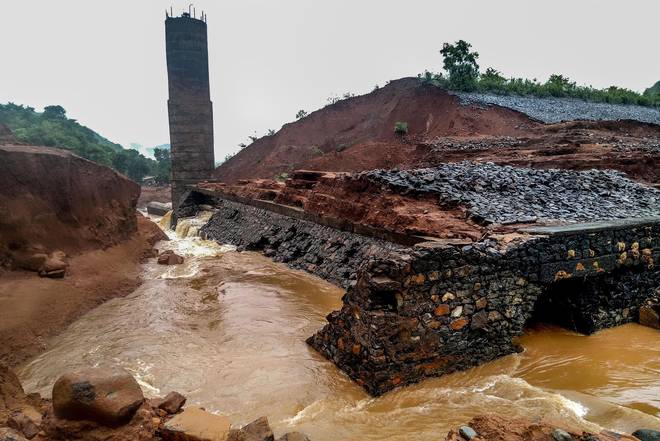
Late that night of July 2, shouts of “Dharan Futla, Dharan Futla” (The dam has breached!) saved the already-scared 62 year old Narayan Gaikwad and his family, as the family ran to nearby hill[i]. Tivare Dam (Longitude: 73° 42′ 0″; Latitude: 17° 36′ 0″ as per CWC’s National Register of Large Dams), across a rivulet in the Vashishthi Basin of coastal Maharashtra breached around 9.30 pm on July 2, 2019, taking 24 men, women and children with its fury.

But how many and how much of Maharashtra would be saved considering the fact that Maharashtra has India’s highest number of large dams, BY FAR? And especially considering the serious questions this episode is raising about the absolute lack of accountability of the government dam establishment.

These questions become pertinent for Konkan region of Maharashtra, where Tivare was located as this region faces highest rainfalls in the state, steepest slopes and is tainted with several incomplete, illegal, inefficient dams which are posing a risk to humans and environment. SANDRP had published a report on incomplete and illegal dams in Konkan region 3 years back[ii]. High Court, SIT Committee Report headed by Madhavrao Chitale and even CAG [iii]had singled out dams in Konkan for their inefficiency and violations at multiple levels. The situation remains the same till date. Experts and past dam bureaucrats put on record that conventional dams-and-canals approach does not work in the steep and hilly region of Konkan. Quality assurance of dams is nearly nonexistent, lighter soils are used in dam cores and even after doing all this, displacing thousands of people and submerging Western Ghats forests, “Area irrigated by Konkan dams may be less than the area submerged by them”[iv] Continue reading “Tivare Dam Disaster: Surviving in the State with maximum dams”

DRP News Bulletin

DRP: 1 July 2019: If Govt is serious about water, begin with sustaining groundwater lifeline & watersheds

For several decades now, groundwater has been India’s water lifeline. It is going to remain India’s water lifeline for long time to come. So when Prime Minister Modi called for people’s movement on water conservation during his MANN KI BAAT Radio program on June 30, 2019 (http://pib.nic.in/PressReleseDetail.aspx?PRID=1576353), the first thing the people would expect the government to do is to acknowledge the reality that groundwater is India’s water lifeline and make the sustenance of that water lifeline as the focus of all National Water Policies, programs and plans.

India also urgently needs a National Urban Water Policy that would also define what is a water smart city. The government will need to show it is serious by putting in place rainwater harvesting and groundwater recharging systems at ALL government buildings and lands across the country and show that these are functioning.

The government will also need to bring back the watershed development as the focus of its work on water conservation and reverse the wrong steps this government took five years back (see the detailed report below).

The government also needs to urgently start work on restructuring of water institutions of India, starting with CWC. Unless people see the government’s seriousness through actions, the one listed here are the initial steps, there is little likelihood of credibility of what the government says.

With rainfall in June 2019 during the South West Monsoon already showing a deficit of massive 33%, the fifth highest deficit in last 100 years, its possibly the most opportune time to take these steps on URGENT BASIS.

Continue reading “DRP: 1 July 2019: If Govt is serious about water, begin with sustaining groundwater lifeline & watersheds”
Cloud Burst

चौथान में बादल फटा; स्थानीय प्रशासन, आपदा प्रबंधन पौड़ी को नहीं पता

गत 23 जून 2019 को, उत्तराखंड की चौथान पट्टी में तेज और असामान्य बरसात हुई। थलीसैंण तहसील के अंतर्गत लगने वाली चौथान पट्टी में 72 गांव आते हैं। पौड़ी जिले के दूरस्थ क्षेत्र में बसी चौथान पट्टी, दूधातोली आरक्षित वन के बफर जोन के आस पास बसी हुई है।  साथ में यह पट्टी अल्मोड़ा और चमोली जिले की सीमाओं से सटी हुई है। 

(“इति जोरग बरख लागि छ, हम भैर-भीतर नि अय स्की, हमूल अपण जमन मै यैस अंधकोप नी देख, हमूल  जाण याल छ, गाढ़-गेदरयुग गुगाट, जरूर कखि ढोल-फ़ोल करल”) “इतने जोर से बारिश हुई थी कि हम लोग घरों में कैद हो गए। हमारी याद में ऐसी घनघोर बरसात पहले कभी नहीं हुई। गाड़ गदेरों में आई बाढ़ की गड़गड़ाहट से ही हम समझ गए थे, कहीं कुछ नुकसान जरूर होगा”, स्यूंसाल गांव की एक बुजुर्ग महिला ने बताया।

बारिश रविवार शाम लगभग तीन बजे के शुरू हुई और करीब दो घंटे तक लगातार चलती रही। अतिवृष्टि के दो बाद ग्रामीण लोग इसे बादल फटने की घटना मान रहे हैं और इलाके में इससे हुए नुकसान की सूचनाएं किस्तों में मिल रही है। 

Continue reading “चौथान में बादल फटा; स्थानीय प्रशासन, आपदा प्रबंधन पौड़ी को नहीं पता”

Cloud Burst

‘CLOUD BURST’ in Chouthan; NO RAIN says Disaster Control Room Pouri Garhwal

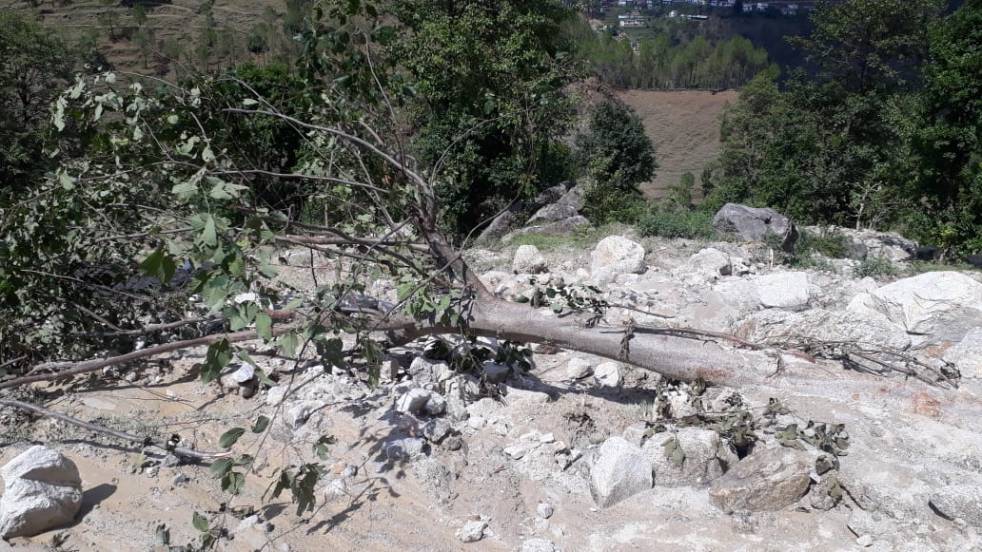
Heavy and unusual rainfall struck, Chauthan Patti, on June 23, 2019. The region is comprised of 72 villages in Thailisain Tehsil of Pouri Garhwal, Uttrakhand. The remote mountain region is settled in and around buffer zone of Dudhatoli reserve forest. It also borders the Almora and Chamoli districts of Uttarakhand.

(“इति जोरग बरख लागि छ, हम भैर-भीतर नि अय स्की, हमूल अपण जमन मै यैस अंधकोप नी देख, हमूल  जाण याल छ, गाढ़-गेदरयुग गुगाट, जरूर कखि ढोल-फ़ोल करल”) “It rained so heavily that we could not move from inside-out vice a versa, we had never seen such a heavy downpour in our lifetime, the streams were full and roaring, we had guessed, it would certainly cause damages” said an elderly woman of Syunsal village, in Garhwali language.

The rain lasted for about two hours beginning around 3 pm. Two days after the deluge, which many villagers are now terming as cloud burst, the details of damages is coming out, though in piece meal.

Continue reading “‘CLOUD BURST’ in Chouthan; NO RAIN says Disaster Control Room Pouri Garhwal”

Wetlands

Wetlands Review 2019: East & North East India

ODISHA

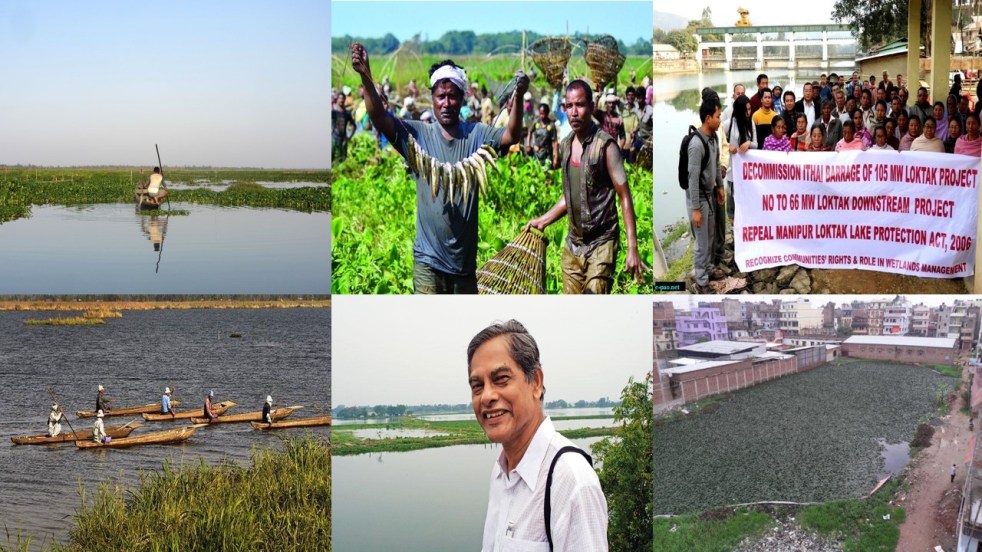
HC asked govt to start demolishing illegal prawn gheries in wetlands In a remarkable order the Odisha High Court on Jan. 21, 2019 directed the govt to start the demolition process of illegal prawn farms in Bhitarkanika National Park and the Chilika Lake under the supervision of the committee formed for the purpose. The high court has set March 18 as the date for taking stock of the work. It has also directed the govt to lodge criminal proceedings against the offenders.

The Supreme Court had on April 3, 2017, asked the chief justice of high courts in 15 states to take up the issue of conservation of important wetlands. Of the 26 major wetlands in 15 states, two are in Odisha. The high court had taken up the issue by suo motu registering a PIL in Sept 2017 for restoration of two wetlands – Bhitarkanika in Kendrapada district and the Chilika Lake, encompassing areas in Puri, Ganjam and Khurda districts.

Continue reading “Wetlands Review 2019: East & North East India”

DRP News Bulletin

DRP: 24 June 2019: Questions about Kaleshwaram as big as the project

June 21 seemed like a new day with all the national newspapers carrying full front page advertisements about Kaleshwaram project of Telanagana, advertised with more than usual share of superlatives: Lifeline of Telangana, record breaking projects, the world’s highest lift project completed in fasted time and so on. At three (Maharashtra – the upstream state- Andhra Pradesh – the downstream state and Telangana the project state) Chief Ministers and one governor gathered on the banks of Godavari river in Jayashankar Bhupalpally district to inaugurate a project that opposition mocked, saying it is just 20% completed.

But there were many serious unanswered questions and problems around the costliest irrigation project of India from a region and sector that is infamous for corruption. Water availability itself is in doubt, the impact assessments are hardly done even in name sake, public consultations non existent. Even statutory clearances are being questioned. If this is the best or even least cost option for the Telangana is not even debated, for a project that may need over 5000 MW of power for lifting the water to over half a km height. That too in a state where no district has below 500 mm rainfall.

Continue reading “DRP: 24 June 2019: Questions about Kaleshwaram as big as the project”
DRP News Bulletin

DRP: 17 June 2019: If the Rains Fail; Is the Nation Ready?

Indian Express, one of the India’s leading and most respected National Newspapers, has an editorial on the above subject on June 17, 2019. The Edit has some rather dire warnings: “If current conditions persist — the US Climate Prediction Center has forecast an 81 per cent chance of El Nino, the abnormal warming of the equatorial eastern Pacific Ocean waters known to adversely impact rainfall in India, continuing till July and 66 per cent up to August — kharif crop production will take a hit.”

The monsoon, after its rather reluctant entry into Kerala, so far is already 43% deficit till June 17. Out of 36 meteorological divisions, 18 had large (over 60%) deficiency and 13 more had 20-60% deficiency, so 31 of 36 sub divisions already faced over 20% rainfall deficit. If the El Nino prediction of US Climate Centre comes true, we could be in for meteorological, agricultural and even hydrological drought, considering our water management situation.

Continue reading “DRP: 17 June 2019: If the Rains Fail; Is the Nation Ready?”
Urban Rivers · Yamuna River

Abuse of Remaining Yamuna River Floodplain in Delhi Continues

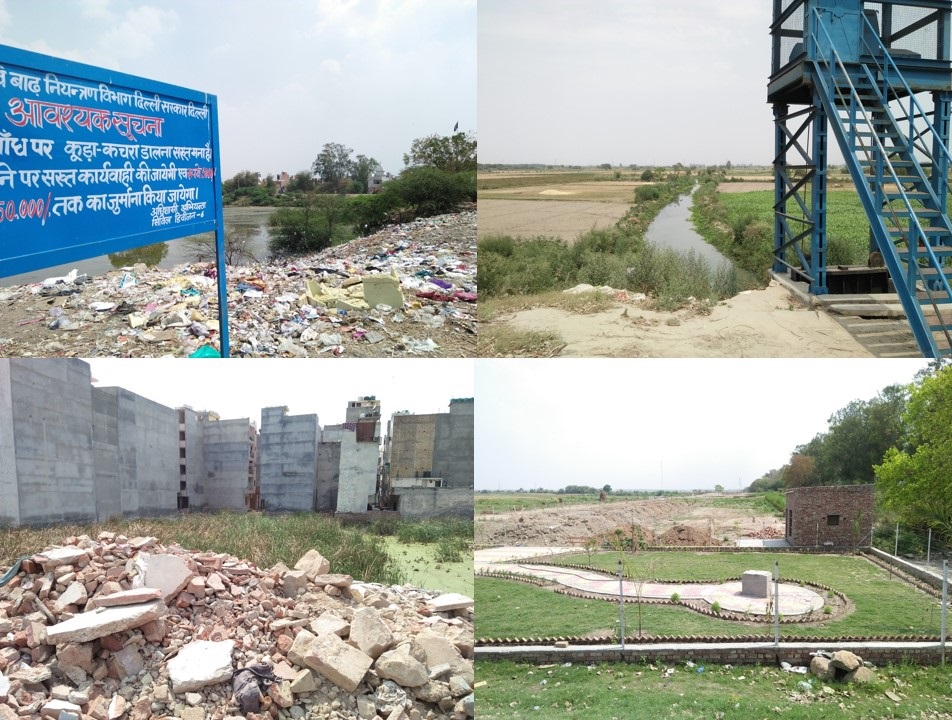
The stretch of Yamuna River & its floodplain lying between Palla and Wazirabad Barrage in Delhi is still in reasonably good state. Though bisected by an embankment, the floodplain is free of too many recent major encroachments. The River keeps meandering between physical boundaries of Delhi and Gaziabad district of Uttar Pradesh on the other side. The average width of floodplain from embankment to embankment is 2 kilometres. The width of active river current varies from 200-300 metres.

Most parts of the floodplain on both sides of this embankment are under agriculture. The crops grown here includes paddy, vegetables and floriculture as cash crops apart from wheat, traditional riverbed crops of melons, cucumber, tomato and bottle guards etc. Use of chemicals is also growing. There is not much information available about the impact of chemical farming on floodplain and river eco system.

Continue reading “Abuse of Remaining Yamuna River Floodplain in Delhi Continues”

Disasters · Floods · Gujarat

Will Cyclone VAYU bring floods in Saurashtra, Kutch and South Rajasthan?

The latest update from IMD[i] on Very Severe Cyclonic Storm VAYU (issued at 0700 hrs on June 13, 2019) does not provide any specific risk of floods in any region, nor does it mention any possibility of persistent rainfall leading to risk of floods.

Another IMD update at 1200 hours on June 13, 2019[ii] says large parts of coastal Saurashtra may experience winds of 160 kmph starting June 13 afternoon, but there is no mention of risk of floods. It does give heavy rainfall warning: “Widespread rainfall with heavy to very heavy falls at few places and extremely heavy falls at isolated places in the coastal districts of Saurashtra” till 0830 hrs on June 15, 2019, in RED colour, the highest risk colour code used by IMD. Further this warning adds: “Flooding of escape routes. Minor disruption of railways, overhead power lines and signalling systems.” Among action suggested it lists: “Inundation of low lying areas along the above mentioned coastal districts due to heavy rainfall and storm surge… Evacuation from low lying areas of the above mentioned Districts, coastal Hutment dwellers, urban slum dwellers and people staying in unsafe house to safer places.” The Ministry of Earth Sciences also sends out these releases through PIB Press Notes as IMD functions under MoES. Continue reading “Will Cyclone VAYU bring floods in Saurashtra, Kutch and South Rajasthan?”